
Proceeding Paper

Quantum Chemical Parameters of TM-Pc Molecules: A Theoretical Investigation †
Faculty of Physics, University of Warsaw, 02-093 Warsaw, Poland
*
Author to whom correspondence should be addressed.
Presented at the 29th International Electronic Conference on Synthetic Organic Chemistry, 14–28 November 2025; Available online: https://sciforum.net/event/ecsoc-29.
Chem. Proc. 2025, 18(1), 119; https://doi.org/10.3390/ecsoc-29-26885
Published: 13 November 2025

Abstract

We investigated quantum chemical parameters for single-molecule magnets using theoretical calculations using the density functional theory (DFT), which includes the Hubbard component (PBE+U). An investigation is conducted into the transition metal phthalocyanine molecules TM-Pc (3d transition metal with TM = Ti, Cr, Mn, Co, and Cu). The energy of the frontier molecular orbitals, gap (HOMO-LUMO), electronegativity, chemical potential, global hardness, softness, and electrophilicity index are among the electronic characteristics and reactivity indices associated with TM-Pc molecules that are displayed. These characteristics are intended to help comprehend and predict the future course of innovative experimental research. As a result, the suggested materials exhibit promising properties for spintronic applications.

1. Introduction

The technology sector is now operating in a new environment where materials are becoming closer to the molecular level as a result of molecular spintronics. The benefit of using molecules is that they may be created using a variety of combinations, with the resulting products having specific properties. Single-molecule magnets (SMMs) are a possible means for high-density information storage and spintronics devices. SMMs have piqued interest because of their unique physical features and exciting prospective applications. The transitionmetal phthalocyanine (TM-Pc) molecules with different metals (TM = V, Cr, Mn, Fe, Co, Ni, Cu, Zn, etc.) on Au (111) [1,2,3,4,5,6,7], Ag(111) [8,9], and graphene [10] substrates have been previously explored theoretically and experimentally. In addition, tetraphenylporphyrin molecules, which are related to phthalocyanines, have also been calculated to be grafted onto the surfaces of noble metals [5]. Phthalocyanines (Pcs) are macrocyclic ligands of special importance due to their great stability, good photophysical characteristics, and ease of structural alteration, which may be utilized to regulate the properties of associated materials and devices. Because of their small size, high sensitivity, low cost, simplicity of synthesis, and low processing temperature, metal phthalocyanine (TM-Pc) sensors are one of the finest materials available for detecting gases [11,12]. MPc aromatic macrocycles have the capacity to stack and produce crystalline and poly-crystalline films, making them suitable for field-effect transistor construction [13,14]. TM-Pc-based sensors have also demonstrated significant absorption in the ultraviolet-visible and near-infrared ranges, which is why these molecules are employed in cancer photodynamic treatment [15,16]. Here, we looked closely at the quantum chemical properties of the TM-Pc molecules. Enhancing the method for conceptually categorizing these molecules to explain their reactivity is the aim of this effort. These descriptions are intended to make it easier to comprehend and predict how new experimental studies will behave in the future. After a brief introduction, Section 2 goes on to detail the computational method. The study of our theoretical results is covered in Section 3. Section 4’s ultimate conclusions and perspectives are found there.

2. Methodology

This work performed quantum chemical calculations using the Quantum Espresso code [17,18]. Density functional theory (DFT) with the Hubbard term U was used to perform geometric optimizations through the Perdew–Burke–Ernzerhof exchange-correlation functional [19] (PBE+U method) in the gaseous phase. For TM-Pc molecules, the kinetic energy cutoff for wavefunctions was set at 30 Ry, and the equivalent parameters for charge density and potential were set at 360 Ry. One k-point was used to sample the Brillouin zone. For TM-Pc structures, we employed pseudopotentials from the PSLibrary [20]. We employed the DFT+U [21] technique with the Hubbard model to address the strong on-site Coulomb interaction for the TM d-electrons of TM-Pc molecules, where U values of 6, 3, 4, 1, and 4 eV were employed for Ti, Cr, Mn, Co, and Cu metal atoms. We optimized the architectures of TM-Pc molecules in three states: positive (+), negative (−), and neutral (0), in order to determine the quantum chemical parameters of these molecules. So, using optimized neutral, cationic, and anionic structures, the electronic parameters such as the ionization potential (IP) and the electron affinity (EA) were calculated. In the simulated cell, the TM-Pc molecule has a total of 57 atoms.

3. Results and Discussion

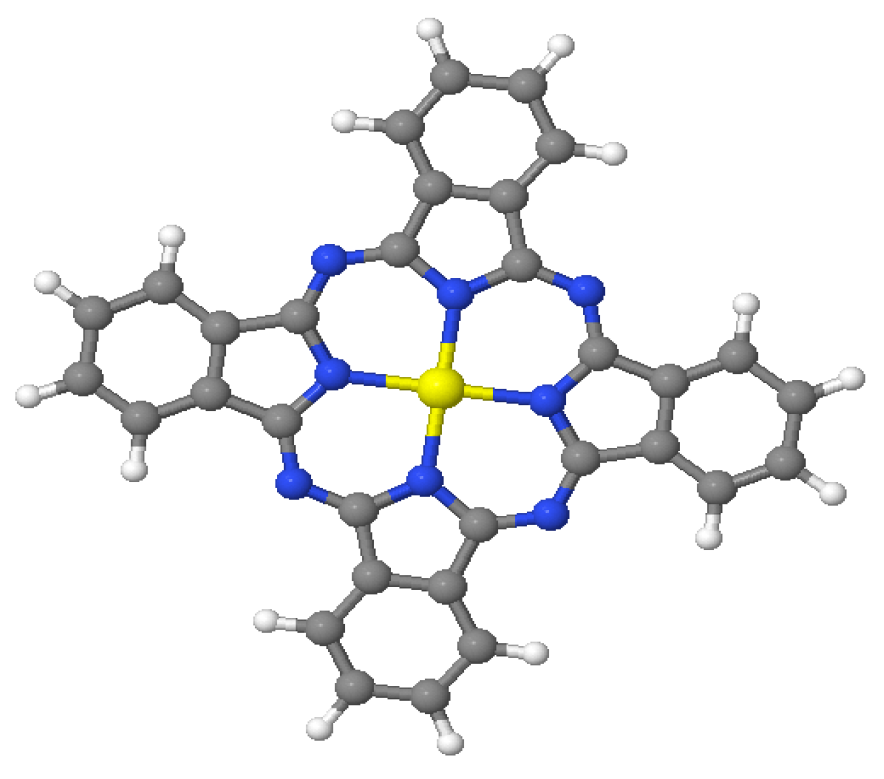
For the purpose of better understanding the chemical reactivity of our structures, the PBE+U method was used to calculate the quantum chemical descriptors for a series of transition metal phthalocyanine molecules TM-Pc (TM= 3d, TM = Ti, Cr, Mn, Co, and Cu). All of the structures were optimized in three different states. Figure 1 illustrates the molecular structure of TM-Pc. Table 1 shows the distances between TM-Pc molecules in three different states (positive, neutral, and negative).
The TM-N lengths between the core TM atom and its surrounding N atom are normally fixed in TM-Pc compounds. Furthermore, the bond lengths of all of the TM-N bonds for each of the individual TM-Pc molecules range between 1.92–2.01 Å (neutral and negative) and 1.92–2.06 Å (positive). The TM-N distance (2.01 Å) remains the same for TM = Mn and Cu. In addition, in all other cases, the difference between all states is on the order of 0.01 Å, except for Ti-Pc, where this value is in the range of 0.05 Å. The quantum chemical parameters are described using the following formulas:
IE = −EHOMO: adiabatic ionization energy
EA = −ELUMO: adiabatic electron affinity
Eg = ELUMO − EHOMO: electronic gap
μ = (EHOMO + ELUMO)/2: chemical potential
χ = −μ: electronegativity
η = (ELUMO − EHOMO): global hardness
ω = μ2/2η: electrophilicity
σ = 1/η: global softness
Different global reactivity parameters, such as electronic gap energy (Eg), adiabatic ionization potential (IP), adiabatic electronic affinity (EA), chemical potential (μ), electronegativity (χ), global hardness (η), electrophilicity (ω), and global softness (σ), have been calculated using EHOMO and ELUMO, energies of the highest occupied molecular orbital (HOMO) and lowest unoccupied molecular orbital (LUMO), respectively. The distinct states of the molecules are used to compute the adiabatic ionization energy and the adiabatic electron affinity. The least amount of energy required to remove one electron from a neutral molecule is known as the adiabatic ionization energy of a molecule or the difference between the energy of the ground state of the neutral species (X) and that of the positive state (X+: cationic). Moreover, the adiabatic electron affinity is determined by the energy difference between the neutral system (X), which corresponds to the most stable geometry, and the negative state of the molecule (X: anionic). A higher electron affinity often implies a lower propensity of the atom to accept an extra electron. In our case, X represents the TM-Pc molecules.
The highest occupied molecular orbital (HOMO) and the lowest unoccupied molecular orbital (LUMO) are called frontier molecular orbitals (FMOs) because they govern how the molecule interacts with other species. They serve to exemplify the kinetic stability of the molecule and the chemical reactivity. The HOMO represents the ability to donate an electron. As a result, a molecule with a high HOMO energy is less stable since it is more reactive. The LUMO, as an electron acceptor, represents the ability to obtain an electron. In addition, a low value of the LUMO energy indicates that the molecule certainly accepts electrons. A large HOMO--LUMO gap indicates a high molecular stability in the sense of its lower reactivity in chemical reactions. The small band gap indicates a highly conductive system with reduced molecular stability and an increased chemical reactivity. If a molecule has a small (large) HOMO--LUMO gap, it is a soft (hard) molecule. Soft systems are large and highly polarizable, whereas hard systems are relatively tiny and much less polarizable. In addition, adsorption might take place at a molecule’s very softest point. Furthermore, the HOMO--LUMO energy gap is an important parameter to indicate the stability index, and σ is the electric conductivity. It should be noted that changes in band gap cause differences in conductivity. The following equation may be used to calculate the connection between conductivity and energy band gap (Eg):
σ ∝−exp(−Eg/KBT)
The electric conductivity is indicated by σ, and KB represents the Boltzmann constant. It is clear that a minor reduction in the band gap leads to much better electrical conductivity. The ionization energy (IP) and the electronic affinity (EA) can be expressed using HOMO and LUMO orbital energies via the Koopmans theorem. The IP specifies the applied energy required to extract an electron from the least state. The capacity of an atom to take an additional electron is referred to as its electronic affinity (EA). In addition, the chemical potential is a chemical characteristic that represents an atom’s or functional group’s propensity to attract electrons or electron density toward itself. The global hardness signifies the resistance toward the deformation of the electron cloud of chemical systems under small perturbations encountered during the chemical process. Moreover, the global softness is the capacitance of the molecule to acquire charge. A high (small) value of electrophilicity characterizes a good electrophile (nucleophile). So, we can say that electrophilicity encompasses both the resistance of the system to exchange the electronic charge with the environment and the capacity of an electrophile to acquire additional electronic charges. The ability of an electron or a collection of atoms to attract electrons to itself is known as electronegativity χ. There is currently no scientific research describing the quantum chemical properties of these compounds. Consequently, our research represents a significant contribution to this field as we analyze the parameters of the TM-Pc molecules.
The relationship between calculated molecular energies and quantum parameters provides insights into the chemical activity of our structures. The current study focuses on the characteristics of 3d TM-Pc molecules, specifically those with TM = Ti, Cr, Mn, Co, and Cu. Table 2 presents the quantum chemistry parameters of the TM-Pc materials, which were determined using the PBE+U computational approach.
We can underline that the Cu-Pc molecule has the largest gap energy value, while Mn-Pc has the lowest. Furthermore, the material with the smallest band gap, Mn-Pc, is considered to be the softest one, which means small excitation energies. The Cu-Pc molecule has the hardest structure and is more stable than the other molecules, whose electron density varies more hardly than a soft molecule. The order of increasing electrophilicity is as follows: Ti-Pc (3.331 eV) < Cu-Pc (3.374 eV) < Cr-Pc (3.393 eV) < Mn-Pc (4.174 eV) < Co-Pc (4.19 eV). It is demonstrated that the Co-Pc and Ti-Pc molecules are the best electrophile and nucleophile, respectively. Our theoretical values Eg for Ti-Pc and Co-Pc molecules are in good accord with the literature [23,24]. For Ti-Pc, Mn-Pc, and Cu-Pc structures, the IE and EA parameters are in good agreement with earlier theoretical data [10,22,23,25]. Our comparative examination of several central atoms reveals that the HOMO and LUMO distributions can vary within certain limits. Thus, we can estimate that the geometry of molecules offers not only the electronic characteristics but also information on the reactivity and selectivity of the compounds using these quantum chemical parameters.

4. Conclusions

Here, to provide new theoretical insights, we present first-principles calculations related to quantum chemical descriptors for TM-Pc structures. Chemical and electronic characteristics are thoroughly discussed. In addition, our extensive analysis demonstrates that these computational predictions may be useful in the future design and functionalization of hybrid structures based on TM-Pc. Synergy between theoretical and experimental research yields novel and significant outcomes. We may draw the conclusion that the theoretical research can be expanded to include different kinds of SMM materials. We believe that the predictions given here will enhance experimental efforts by providing knowledge that might speed future spintronics applications.

Author Contributions

Conceptualization, M.M.; methodology, M.M.; software, M.M.; validation, M.M.; formal analysis, M.M.; investigation, M.M.; resources, M.M.; data curation, M.M.; writing—original draft preparation, M.M.; writing—review and editing, M.M.; visualization, M.M.; supervision, J.A.M.; project administration, J.A.M.; funding acquisition, J.A.M. All authors have read and agreed to the published version of the manuscript.

Funding

This research was funded by National Science Centre Poland (UMO2016/23/B/ST3/03567).

Institutional Review Board Statement

Not applicable.

Informed Consent Statement

Not applicable.

Data Availability Statement

No new data were created or analyzed in this study.

Acknowledgments

This work has been supported by National Science Centre Poland (UMO2016/23/B/ST3/03567).

Conflicts of Interest

The authors declare no conflicts of interest.

References

  1. Mabrouk, M.; Majewski, J.A. Stability electronic structure, and magnetic momentof vanadium phthalocyanine grafted to the Au(111) surface. Comput. Theor. Chem. 2021, 1202, 113319. [Google Scholar] [CrossRef]
  2. Mabrouk, M.; Hayn, R.; Ben Chaabane, R. Adsorption of Iron Phthalocyanine on a Au(111) Surface. Russ. J. Phys. Chem. A 2020, 94, 1704–1707. [Google Scholar] [CrossRef]
  3. Buimaga-Iarinca, L.; Morari, C. Translation of metal-phthalocyanines adsorbed on Au(111): From vander Waals interaction to strong electronic correlation. Sci. Rep. 2018, 8, 12728. [Google Scholar] [CrossRef] [PubMed]
  4. Huang, Y.L.; Wruss, E.; Egger, D.A.; Kera, S.; Ueno, N.; Saidi, W.A.; Bucko, T.; Wee, A.T.S.; Zojer, E. Understanding the adsorption of CuPc and ZnPc on noble metal surfaces by combining quantum-mechanical modelling and photoelectron spectroscopy. Molecules 2014, 19, 2969. [Google Scholar] [CrossRef]
  5. Song, B.-Q.; Pan, L.-D.; Du, S.-X.; Gao, H.-J. Interaction and local magnetic moments of metal phthalocyanine and tetraphenylporphyrin molecules on noble metal surfaces. Chin. Phys. B 2013, 22, 096801. [Google Scholar] [CrossRef]
  6. Zhang, Y.Y.; Du, S.X.; Gao, H.-J. Binding configuration, electronic structure, and magnetic properties of metalphthalocyanines on a Au(111) surface studied with ab initio calculations. Phys. Rev. B 2011, 84, 125446. [Google Scholar] [CrossRef]
  7. Hu, Z.; Li, B.; Zhao, A.; Yang, J.; Hou, J.G. Electronic and magnetic properties of metal phthalocyanines on Au(111) surface: A first-principles study. J. Phys. Chem. C 2008, 112, 13650. [Google Scholar] [CrossRef]
  8. Baran, J.D.; Larsson, J.A. Theoretical insights into adsorption of cobalt phthalocyanine on Ag(111): A Combination of chemical and vander Waals bonding. J. Phys. Chem. C 2013, 117, 23887. [Google Scholar] [CrossRef]
  9. Eguchi, K.; Nakagawa, T.; Takagi, Y.; Yokoyama, T. Direct synthesis of vanadium phthalocyanine and its electronic and magnetic states in monolayers and multilayers on Ag(111). J. Phys. Chem. C 2015, 119, 9805. [Google Scholar] [CrossRef]
  10. Feng, S.; Luo, N.; Tang, A.; Chen, W.; Zhang, Y.; Huang, S.; Dou, W. Phthalocyanine and metal phthalocyanines adsorbed on graphene: A density functional study. J. Phys. Chem. C 2019, 123, 16614–16620. [Google Scholar] [CrossRef]
  11. Ridhi, R.; Saini, G.S.S.; Tripathi, S.K. Sensing of volatile organic compounds by copper phthalocyanine thin films. Mater. Res. Express 2017, 4, 025102. [Google Scholar] [CrossRef]
  12. Klyamer, D.; Sukhikh, A.; Gromilov, S.; Krasnov, P.; Basova, T. Fluorinated metal phthalocyanines: Interplay between fluorination degree, films orientation, and ammonia sensing properties. Sensors 2018, 18, 2141. [Google Scholar] [CrossRef]
  13. Jiang, H.; Ye, J.; Hu, P.; Wei, F.; Du, K. Fluorination of metal phthalocyanines: Single-crystal growth, efficient n-channel organic field-effect transistors, and structure-property relationships. Sci. Rep. 2014, 4, 7573. [Google Scholar] [CrossRef] [PubMed]
  14. Peisert, H.; Schwieger, T.; Auerhammer, J.M.; Knupfer, M.; Golden, M.S. Order on disorder: Copper phthalocyanine thin films on technical substrates. J. Appl. Phys. 2001, 90, 466–469. [Google Scholar] [CrossRef]
  15. Abramczyk, H.; Brozek-Pluska, B.; Surmacki, J.; Musial, J.; Kordek, R. Oncologic photodynamic diagnosis and therapy: Confocal Raman/fluorescence imaging of metal phthalocyanines in human breast cancer tissue in vitro. Analyst 2014, 139, 5547–5559. [Google Scholar] [CrossRef]
  16. Allen, C.M.; Sharman, W.M.; VanLier, J.E. Current status of phthalocyanines in the photodynamic therapy of cancer. J. Porphyr. Phthalocyanines 2001, 5, 161–169. [Google Scholar] [CrossRef]
  17. Giannozzi, P.; Baroni, S.; Bonini, N.; Calandra, M.; Car, R.; Cavazzoni, C.; Ceresoli, D.; Chiarotti, G.L.; Cococcioni, M.; Dabo, I.; et al. Quantum espresso: A modular and open source software project for quantum simulations of materials. J. Phys. Condens. Matter 2009, 21, 395502. [Google Scholar] [CrossRef]
  18. Giannozzi, P.; Andreussi, O.; Brumme, T.; Bunau, O.; Nardelli, M.B.; Calandra, M.; Car, R.; Cavazzoni, C.; Ceresoli, D.; Cococcioni, M.; et al. Advanced capabilities for materials modelling with quantum espresso. J. Phys. Condens. Matter 2017, 29, 465901. [Google Scholar] [CrossRef]
  19. Perdew, J.P.; Ruzsinszky, A.; Csonka, G.I.; Vydrov, O.A.; Scuseria, G.E.; Constantin, L.A.; Zhou, X.; Burke, K. Restoring the density-gradient expansion for exchange in solids and surfaces. Phys. Rev. Lett. 2008, 100, 136406. [Google Scholar] [CrossRef]
  20. Corso, A.D. Pseudopotentials periodic table: From H to Pu. Comput. Mater. Sci. 2014, 95, 337–350. [Google Scholar] [CrossRef]
  21. Cococcioni, M.; deGironcoli, S.S. Linear response approach to the calculation of the effective interaction parameters in the LDA+U method. Phys. Rev. B 2005, 71, 035105. [Google Scholar] [CrossRef]
  22. Mendoza-Domínguez, C.U.; Basiuk, V.A. Distortion and bonding strength of phthalocyanine molecules adsorbed onto pological defects in graphene. Mater. Chem. Phys. 2021, 271, 124963. [Google Scholar] [CrossRef]
  23. Hassani, N. Theoretical investigation of the interaction between the metal phthalocyanine [MPc]a (M= Sc, Ti, and V; a= -1, 0, and +1) complexes and formal dehyde. Turk. J. Chem. 2021, 45, 119–131. [Google Scholar] [CrossRef] [PubMed]
  24. Chen, H.-Q.; Shan, H.; Zhao, A.-D.; Li, B. First-principles study of two dimensional transition metal phthalocyanine-based metal-organic frameworks in kagome lattice. Chin. J. Chem. Phys. 2019, 32, 563–571. [Google Scholar] [CrossRef]
  25. Basiuk, V.A.; Basiuk, E.V. Complexation of free-base and 3d transition metal(II)phthalocyanines with fullerene C60: A dispersion-corrected DFT study. Fuller. Nanotub. Carbon Nanostruct. 2017, 25, 410–416. [Google Scholar] [CrossRef]
Figure 1. TM-Pc molecule structure where TM represents the transition metal. The TM, N, C, and H atoms are in yellow, blue, gray, and white, respectively. The TM-Pc molecule is planar with D4h symmetry.
Chemproc 18 00119 g001
Table 1. The calculated distances of different optimized components using the PBE+U approach in different states for TM-Pc molecules.
Molecules(Ti-Pc)(Ti-Pc)0(Ti-Pc)+(Cr-Pc)(Cr-Pc)0(Cr-Pc)+(Mn-Pc)(Mn-Pc)0(Mn-Pc)+
a TM-N (Å)2.012.012.062.002.012.012.012.012.01
Molecules(Co-Pc)(Co-Pc)0(Co-Pc)+(Cu-Pc)(Cu-Pc)0(Cu-Pc)+
a TM-N (Å)1.921.931.922.012.012.01
a Domain of variation of the liaison TM-N between TM metal atom and the nitrogen atom.
Table 2. IE, EA, Eg, η, σ, μ, χ, and ɷ of different TM-Pc molecules using the PBE+U approach.
a PTi-PcCr-PcMn-PcCo-PcCu-Pc
IE (eV)4.848 (c 4.79)4.9054.221 (f 4.468)4.8794.895 (b 5.077, f 5.066)
EA (eV)2.707 (c 2.42)2.7482.7613.0182.737 (e 3.25)
Eg (eV)2.141 (c 2.37)2.1571.4601.860 (d 1.45)2.158
η (eV)2.1412.1571.4601.8602.158
σ (eV−1)0.4670.4640.6850.5380.463
μ (eV)−3.777−3.826−3.491−3.949−3.816
χ (eV)3.7773.8263.4913.9493.816
ω (eV)3.3313.3934.1744.1903.374
a P: chemical parameter; b ref. [22]; c ref. [23]; d ref. [24]; e ref. [10]; f ref. [25].
Disclaimer/Publisher’s Note: The statements, opinions and data contained in all publications are solely those of the individual author(s) and contributor(s) and not of MDPI and/or the editor(s). MDPI and/or the editor(s) disclaim responsibility for any injury to people or property resulting from any ideas, methods, instructions or products referred to in the content.