Article

In Situ Chemical Characterization by Laser-Induced Breakdown Spectroscopy of a HFGC Tile from the JET Divertor Through In-Depth Chemical Analysis and Linear Correlation


by
Salvatore Almaviva
1,*,
Lidia Baiamonte
1,
Jari Likonen
2,
Antti Hakola
2,
Juuso Karhunen
2,
Nick Jones
3,
Anna Widdowson
3,
Ionut Jepu
3,
Gennady Sergienko
4,
Rongxing Yi
4,
Rahul Rayaprolu
4,
Timo Dittmar
4,
Marc Sackers
4,
Erik Wüst
4,
Pavel Veis
5,
Shweta Soni
5,
Sahithya Atikukke
5,
Indrek Jõgi
6,
Peeter Paris
6,
Jasper Ristkok
6,
Pawel Gasior
7,
Wojciech Gromelski
7,
Jelena Butikova
8,
Sebastijan Brezinsek
4,9 and
UKAEA RACE Team
add Show full author list remove Hide full author list
1
Diagnostics and Metrology Laboratory, ENEA, 00044 Frascati, Italy
2
VTT Technical Research Centre of Finland Ltd., P.O. Box 1000, FI-02044 Espoo, Finland
3
United Kingdom Atomic Energy Authority, Culham Campus, Abingdon OX14 3DB, UK
4
IFN-1 Plasma Physics, Forschungszentrum Jülich GmbH, 52428 Jülich, Germany
5
Faculty of Math, Physics and Informatics, Comenius University, Mlynská dolina, 842 48 Bratislava, Slovakia
6
Institute of Physics, University of Tartu, W. Ostwaldi 1, 50411 Tartu, Estonia
7
Institute of Plasma Physics and Laser Microfusion, 01-497 Warsaw, Poland
8
Institute of Solid State Physics, University of Latvia, LV-1063 Riga, Latvia
9
Faculty of Mathematics and Natural Sciences, Heinrich Heine University (HHU) Düsseldorf, 40225 Düsseldorf, Germany
*
Author to whom correspondence should be addressed.
J. Nucl. Eng. 2026, 7(2), 25; https://doi.org/10.3390/jne7020025
Submission received: 30 January 2026 / Revised: 11 March 2026 / Accepted: 16 March 2026 / Published: 30 March 2026

Abstract

At the end of its last experimental campaign, in December 2023, the Joint European Torus (JET) became available for testing a compact and lightweight Laser-Induced Breakdown Spectroscopy (LIBS) system to be mounted on its robotic arm. The purpose of the test was the in situ chemical characterization of its internal walls and plasma-facing components (PFCs). Among the areas measured, special attention was devoted to the PFCs of the divertor, as this area is most affected by the re-deposition of material eroded from the first wall and unburned nuclear fuel (deuterium and tritium). In this article, we present the results of the LIBS characterization of a PFC of the High Field Gap Closure (HFGC), highly subjected to these phenomena. The in-depth distribution of several ITER-relevant chemical species is discussed through in-depth and correlation analyses, and the interpretation of the results is explained in terms of erosion and re-deposition of materials from the first wall. The study allowed us to estimate the thickness of the ablated layers by each laser shot, which is on the order of a few tens of nanometers, and to outline a mapping of the thickness of the re-deposited material.

1. Introduction

The Joint European Torus (JET) has been a cornerstone of fusion technology as a world-leading tokamak [1], serving as a crucial testbed for ITER, the largest and most powerful machine of its kind, currently under construction in southern France [2], demonstrating the feasibility of deuterium-tritium (D-T) fuel [3] and setting world records for fusion energy production [4], thereby validating the reactor design for future power plants.
In its final years of operation, JET served as a small-scale prototype for ITER, allowing researchers to test technologies, materials, and operational scenarios required for this larger project [5]. ITER will rely on a number of technological systems, some of which have been validated on JET and other plasma physics experiments worldwide. However, due to the challenges of its large scale, most of these will be the first of their kind.
A major challenge for ITER and future fusion power plants operating with D-T nuclear fuel is monitoring unburned T retention within the reactor [6] to reduce the risk of its potential release into the environment during an accident. T retention in ITER is primarily expected to occur through co-deposition of eroded materials from the walls of the vacuum vessel (VV) [7], boron/tungsten from the main chamber or tungsten from the divertor, particularly in the magnetic shadow areas and in the baffle zone, creating thick films on cooler surfaces [7,8]. Additional T retention is also a consequence of the implantation of high-energy T ions, which penetrate directly into the PFCs [8]. Unlike co-deposition, implantation retention tends to saturate over time, but diffusion can push T deep into the PFCs [9].
Finally, additional T retention is also attributed to the neutron irradiation of PFCs during the D-T fusion phases, which creates new trapping sites (displacement damages) in the crystalline lattice of the materials, significantly increasing their retention capacity with respect to the undamaged material [10].
In ITER, the safety limit for T in the VV is 1 kg [11], but the operational limit for its retention is set at 700 g [10], to account for uncertainties (estimated in 180 g) and the cryopump inventory (estimated in 120 g). To estimate T retention in PFCs, many techniques are currently available, such as secondary ion mass spectrometry (SIMS) [12], Ion Beam Analysis (IBA) [12,13], Thermal Desorption Spectroscopy (TDS) [12,14], X-ray photoelectron spectroscopy (XPS) [15], energy dispersive X-ray spectroscopy (EDX) [14], or Rutherford backscattering (RBS) [16]. Many of these techniques are in-lab-based and require prior removal of PFCs from their original location in the VV, making them unsuitable for in situ T monitoring. Therefore, future machines should incorporate in situ analysis techniques.
Among the potential candidates for this task, laser-based methods [17,18] are currently of great interest and Laser-Induced Breakdown Spectroscopy (LIBS) [19,20,21,22] is considered as a promising option.
LIBS uses a high-energy laser pulse to ablate a small quantity of material, creating a hot plasma. By analyzing the light emitted by this plasma, it is possible to determine the elemental composition of the sample with minimal to no sample preparation. Recently, LIBS was successfully used in JET [21,22] for its first demonstration on a large-scale fusion device. The LIBS tool was mounted on the JET remote handling system (MASCOT) to allow for chemical characterization of the PFCs in different parts of the machine. The device detected hydrogen isotopes retained in the PFCs after some D-T campaigns and provided information on erosion and re-deposition phenomena. Given the current progress done at JET, where LIBS was successfully demonstrated as an in situ diagnostic technique for a fusion device, LIBS is currently being evaluated as a diagnostics tool also for ITER.
In this work, we report on the detailed LIBS chemical characterization of a JET PFC of the inner divertor area, composed by a Carbon Fiber Composite (CFC) substrate with a surface coating of tungsten (W) and a molybdenum (Mo) interlayer between the W coating and the CFC substrate [23]. This area of JET is representative of the ITER divertor due to the current understanding of the migration of eroded material in JET, which is dominated by erosion of the main chamber, whose material is transported primarily toward the inner divertor. Therefore, this area provides relevant information on fuel co-deposition and retention in ITER. The LIBS measurements were carried out during the 2024 JET component removal phase, following two D-T campaigns and subsequent cleaning procedures which ended in late 2023 [4,24]. A compact LIBS device, specifically designed to be mounted on MASCOT [21,22], was used. The analysis involved approximately 840 different spatial locations on the main chamber, wall, and divertor. Hundreds to thousands of laser shots were delivered in each location by firing successive laser pulses to ablate the target layer-by-layer, with sub-micrometric depth per laser shot. A LIBS spectrum is recorded for each laser shot [25,26] and the sequence of spectra reveals the chemical composition of the PFCs with depth. At the end of the analysis, small craters, few hundred micrometers in diameter and few tens of micrometers deep, are created. In addition to this in-depth profiling, a method based on linear correlation [25] was also implemented for the analysis of the LIBS spectra to measure the overall similarity between subsequent spectra and identify in-depth transitions in the elemental composition of the PFCs.
The measurements were carried out with Ar as background gas to improve the overall sensitivity of the LIBS technique, with particular attention paid towards the Balmer alpha emissions of the hydrogen isotopes (Tα, Dα, and Hα lines at 656.045 nm, 656.1 nm, and 656.28 nm respectively) [27], and better characterize their in-depth distribution.

2. Materials and Methods

2.1. The LIBS Device

The LIBS tool used in this study is described in detail elsewhere [21,22]. In this section, we just want to recall some of the features on which the design was based. The device was requested to be compact and lightweight, so that it could be mounted on the MASCOT manipulator for remote operations. The optics and laser head of the LIBS tool were mounted and aligned in an aluminum case measuring 310 × 340 × 90 mm for a total weight of 9.1 kg. Figure 1 shows the tool mounted on MASCOT, operating inside the JET VV on a PFC of the divertor.
The laser source is Nd:YAG emitting at 1064 nm, with a pulse duration of 0.8 ns, pulse frequency of 2 Hz, and maximum pulse energy of 10 mJ. This laser source was chosen for its compactness, lightness, air-cooling design, and the shortest possible pulse with a relatively high single-pulse energy, to record a LIBS spectrum with an acceptable signal-to-noise ratio (SNR) from a single laser shot. The pulse duration was chosen to be as short as possible to limits thermal effects on the sample’s surface and possible desorption of hydrogen isotopes after each laser shot. Several spectroscopic systems, external to the JET VV, were connected to the LIBS tool via a 20 m optical fiber [21,22]. Among these, a compact and high-resolution Echelle spectrograph “Aryelle 200” by LTB (LaserTechnnik Berlin, Berlin, Germany), with a spectral range 260–760 nm and resolution 22–83 pm, was used. The spectral data of this device are discussed here. Aryelle 200 was equipped with an Andor USB “ISTAR” ICCD camera DH334T-18 F (1024 × 1024 pixels) (Abingdon, Oxon, UK) externally triggerable to a TTL signal in a frequency range from 0 to 500 kHz. Gate delay of the camera was set to 1 μs after the laser shot, with gate width of 4 μs.
Ar gas was constantly fluxed on the analysis point with a flow rate of 2 L/min. The advantages of using Ar for this particular LIBS measurements are reported in [28,29,30] and shortly summarized in the following section:
(1)
Better confinement of the LIBS plasma: Due to its higher atomic mass and lower thermal conductivity compared to air, Ar reduces the rapid expansion and cooling of the LIBS plasma, keeping it hotter and denser for a longer duration.
(2)
Inert nature and reduced oxidation: As an inert noble gas, Ar does not react with the ablated species, preventing the formation of oxides and nitrides that can reduce the signal from the target elements.
(3)
Higher plasma temperature and electron density: As a consequence of (1).
(4)
Reduced background: The high ionization potential of Ar reduces the background emission (continuum radiation) with respect to air, improving the signal-to-noise ratio (SNR).

2.2. The Site of Analysis: HFGC Tiles at JET

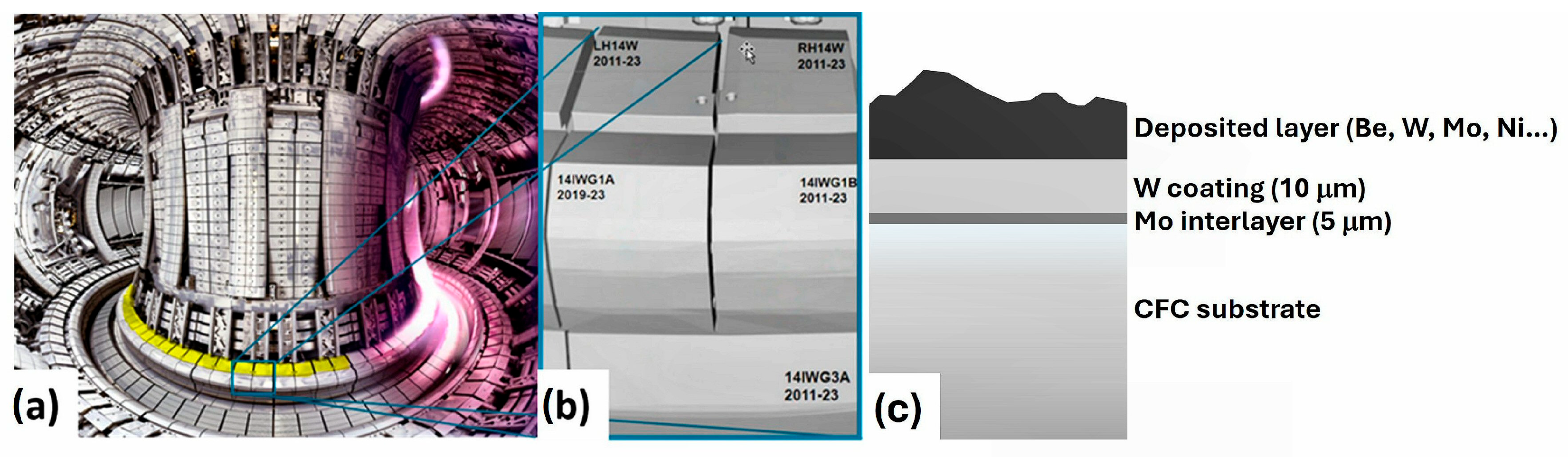
The High Field Gap Closure (HFGC) is a type of PFC used in the inner divertor of JET. These PFCs are designed as tiles to intercept plasma particles (particularly beryllium eroded from the main chamber), and to manage material deposition and erosion. The HFGC tiles (Figure 2) are of high interest in studying material migration, fuel retention, and plasma–surface interactions, revealing how materials move and are retained in fusion reactors. They have a multilayered structure composed of a superficial W coating ≈ 10 μm thick and a Mo interlayer ≈ 5 μm thick on a CFC substrate, and they sit at the high-field side of the divertor, bridging a physical gap in the divertor structure and preventing plasma from escaping into un-monitored regions.
The tile object of the study is HFGC LH14W (referred to as LH14W thereafter) and is shown in Figure 2b. LH14W was part of all JET operations running in the ITER-Like Wall (ILW) configuration [31], conducted from 2011 to 2023, including the full 4th operating cycle of JET ILW D-T campaigns, between 2019 and 2023, with a total of 359 g of T injected into the VV [11].
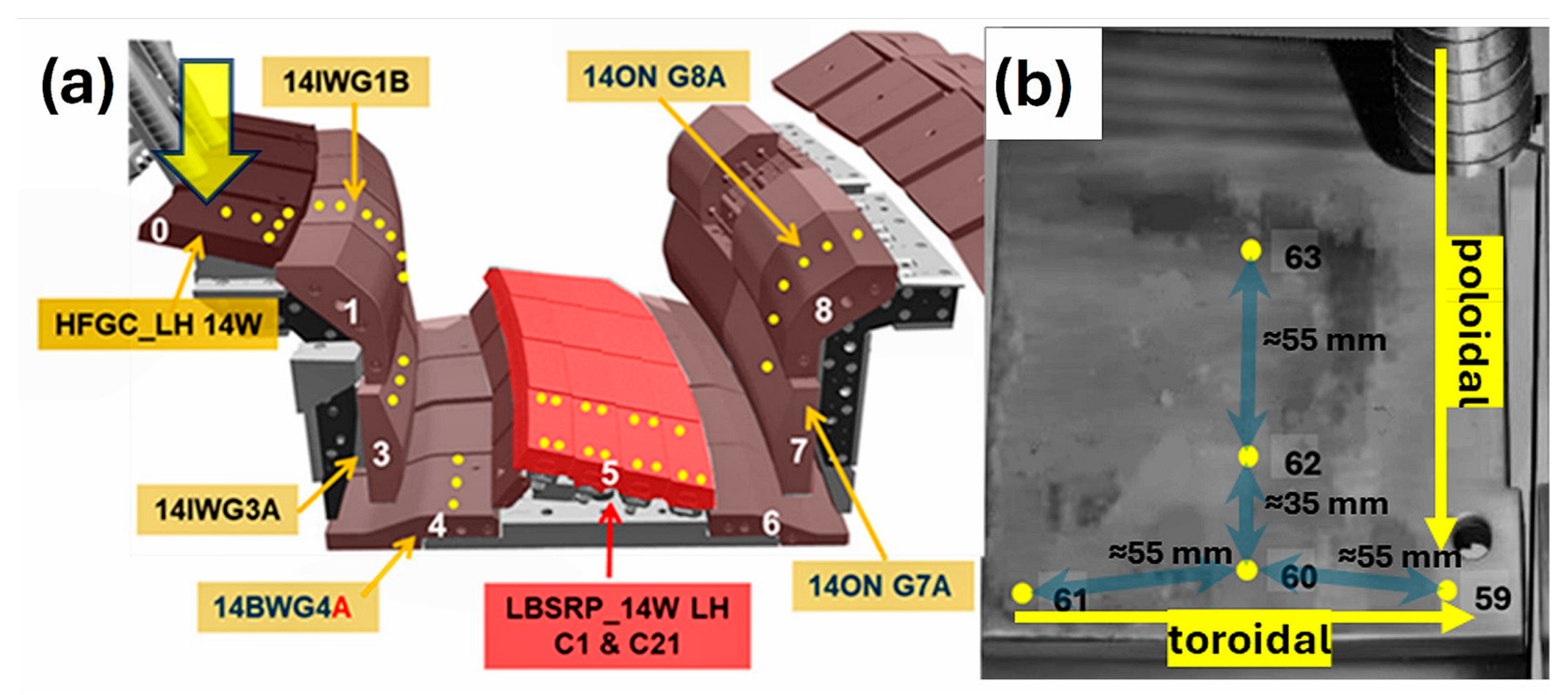
Five points on LH14W were examined, as illustrated in Figure 3a,b, with their positions chosen to provide information on the poloidal and toroidal distribution of the material deposited on the tile [21].

3. Results

3.1. In-Depth Analysis on Tile LH14W

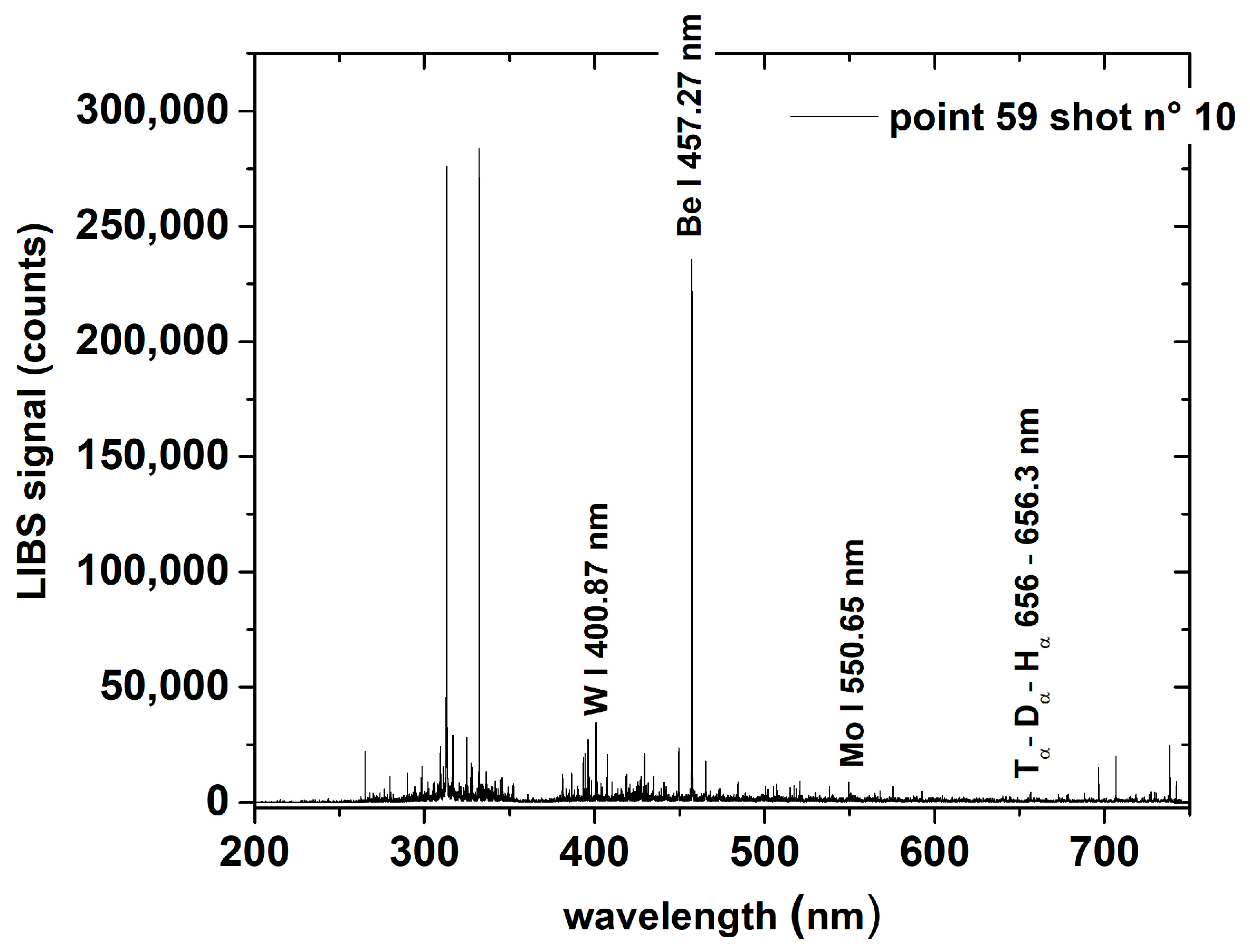
For each location on LH14W, the LIBS device delivered 1000–2000 laser shots. The in-depth analysis was conducted by recording the integral intensities of peculiar and representative spectral lines of different chemical species as a function of the laser shot number, obtaining a qualitative in-depth composition of the sample. These lines have been considered representative of the species because they exhibited a good SNR and were relatively free from interference by nearby emission lines. Figure 4 shows a representative LIBS spectrum acquired during the experimental campaign (point 59 shot number 10) where some of these spectral lines are labeled.
The integral intensities were calculated as the sum of the LIBS signal in a spectral window of 0.2 nm around the peak of the emission line, whose position was retrieved from the NIST database [32]. In-depth analysis was applied through the development of algorithms capable of processing many spectra in a relatively short time in a Matlab® R2023B environment. Each integral intensity was rescaled to that of Ar I at 738.4 nm, detected as background gas in the LIBS plasma. This Ar line was chosen as an internal standard in the spectra because Ar was constantly fluxed at a flow rate of 2 L/min during the measurements, and its concentration (and the relative intensity of its lines in the LIBS spectra) was assumed to be constant in the LIBS plasma and subjected only to the typical intensity fluctuations of the entire spectrum. Table 1 reports on the emission lines and the chemical species monitored using in-depth analysis.
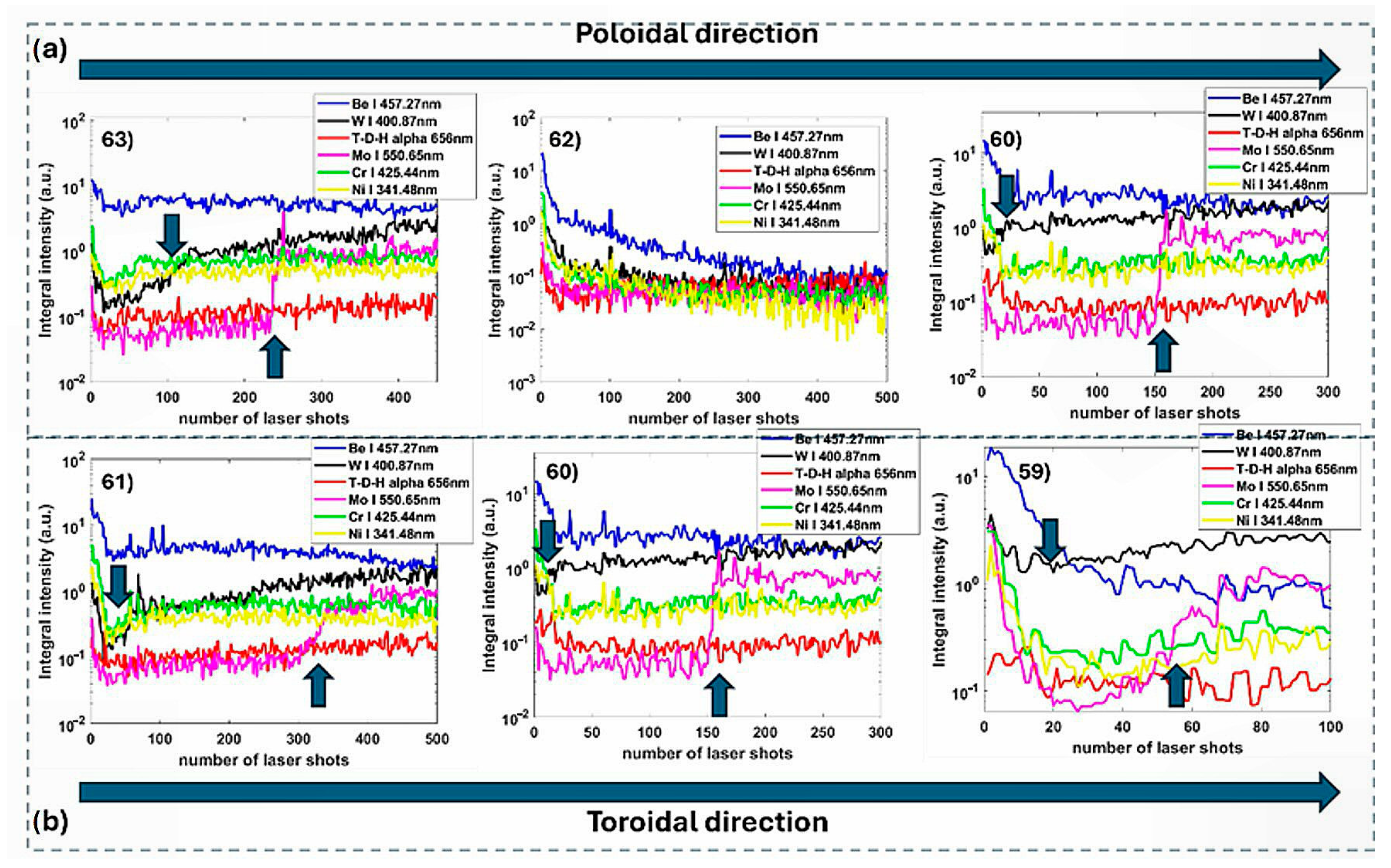
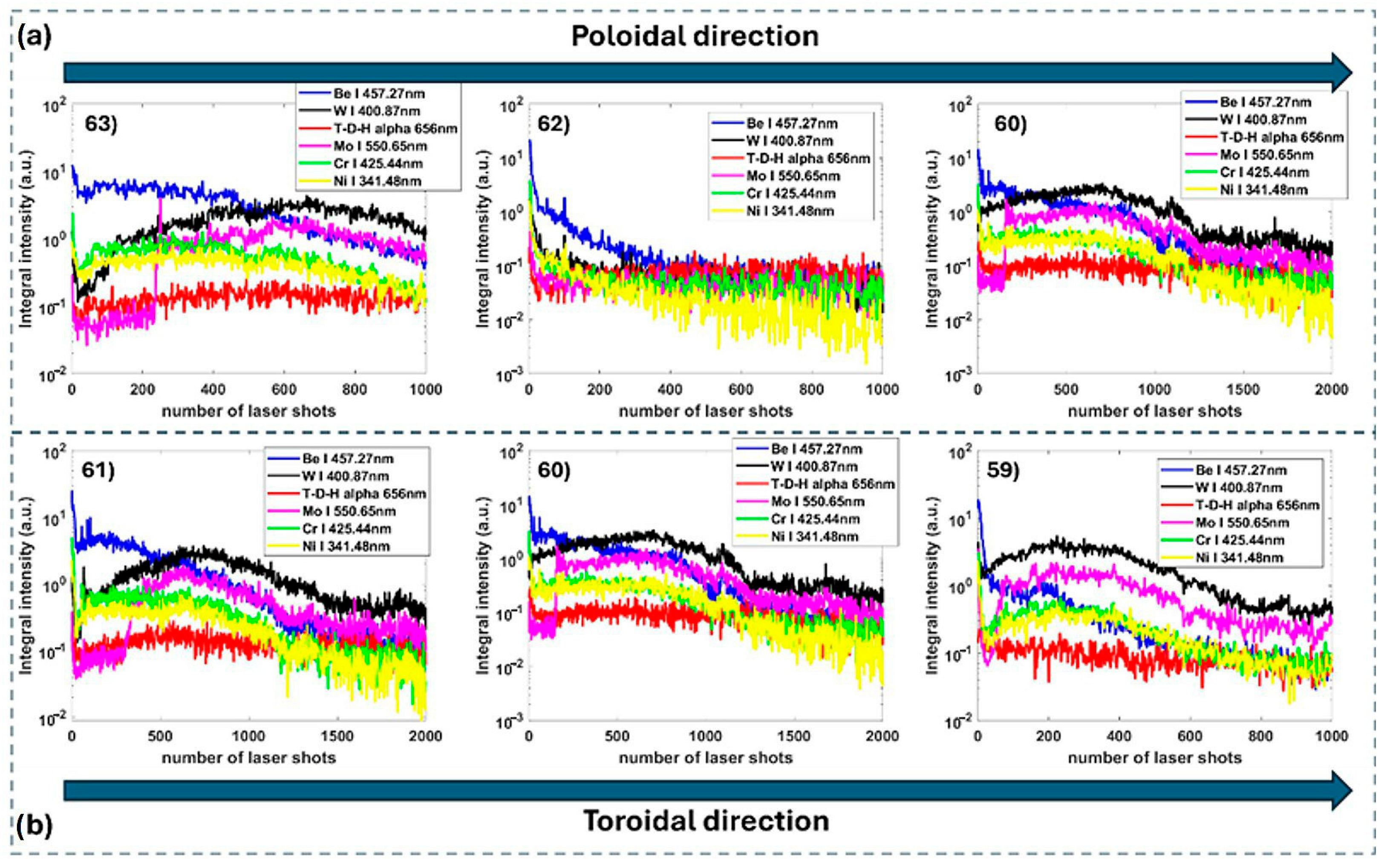
Figure 5 shows the results of the in-depth analysis of each location for the whole series of laser shots. The analysis revealed an evident layer of co-deposited Be (blue track) in both the poloidal and toroidal directions of the VV, along with traces of other chemical species (T-D-H, Ni, Cr) mainly detected in the first laser shots of the sequences, corresponding to the very surface layers. Different trends in the intensity of the Be and W lines show the ablation of the co-deposited Be layer up to reaching the W surface coating, while the steep increase in the Mo line suggested the complete ablation of the W coating. The residual Be and W emission line signals, after reaching the Mo interlayer, are likely caused by partial mixing of the stacked layers due to heat diffusion induced by the laser firing and the resulting melting of stacked material layers. However, this effect can be effectively reduced by using laser sources with even shorter pulses. As stated before, the source used for the LIBS tool is, to our knowledge, the only one with a short laser pulse and simultaneously satisfying the requirements to be mounted on the MASCOT.
In Figure 6, a detailed illustration shows the initial part of the shot sequences for each point of analysis, with arrows indicating the W coating and the Mo interlayer.
Based on the observed trends, we estimated the thickness of the Be layer and the W coating in relation to the number of laser shots as reported in Table 2.
An increasing trend in the thickness of the co-deposited Be layer was observed both in the toroidal direction, from left to right, and in the poloidal direction, towards the closure gap. These trends may be affected by local phenomena such as the specific position of the tile, reflecting peculiarities in terms of crater geometries, variation in the density of the re-deposited material, and laser–material coupling. Point 62 does not show a clear trend, probably because it is located very close to a sampling area subjected to a previous LID-QMS experimental campaign [18]. One hypothesis is that the LID-QMS laser sampling has somewhat modified and altered the composition of the surface layers in this point. Therefore, the observed trend for point 62 needs to be confirmed by similar measurements on other tiles of the same type (currently underway), since it is possibly not affected so closely by LID-QMS sampling.
Assuming the W coating (≈10 μm thick) is not affected by erosion phenomena in points 60, 61, and 63, the ablation rate of the LIBS device for the W coating was estimated to be between 40 and 80 nm per laser shot. The thickness of the surface layer can be estimated by considering the results obtained in a previous experimental campaign in preparation for the measurements presented here, ref. [32], where the same LIBS system was used and an ablation rate of about 80 nm was estimated for the Be deposits. By assuming this value, the thickness of the re-deposited surface Be layer is estimated to be between 1.5 and 7.6 μm, in agreement with the results reported in [32]. The ablation rate here estimated for the underlying tungsten layer is in line with the results of that preparatory experimental campaign.

3.2. Correlation Analysis

Correlation analysis is a statistical measure that expresses the extent to which two variables are linearly related, meaning they change together at a constant rate [33,34]. In LIBS, correlation analysis can be applied by comparing LIBS spectra and calculating the Pearson Correlation Coefficient (PCC) between them using the following formula:
r x i y j =   i , j = 1 n x i x ¯ y j y ¯ i = 1 n x i x ¯ 2 j = 1 n y j y ¯ 2
where n is the sample size (number of LIBS spectra), xi and yi are the individual LIBS spectra, and x ¯   and   y ¯ are the mean values of xi and yj.
Values o f   r x i y j range from −1 to 1. Values close to “1” mean that variables (LIBS spectra) are highly correlated (i.e., belonging to the same or closely related layers in terms of chemical composition), values close to “0” mean that the spectra are uncorrelated (from different layers), and values close to “−1” mean the spectra are anticorrelated (which is not the case of LIBS). In summary, | r x i y j | is a measure to check if the xith, yjth spectra belongs to the same chemical layer.
The correlation of multiple spectra is typically represented as a matrix containing the r x i y j values between the xith and yjth spectra, with spectra “xi,yj of the same physical layer, with r x i y j close to 1 (being similar), and spectra “xi,yj”of a different layer, with r x i y j close to 0 (being different).
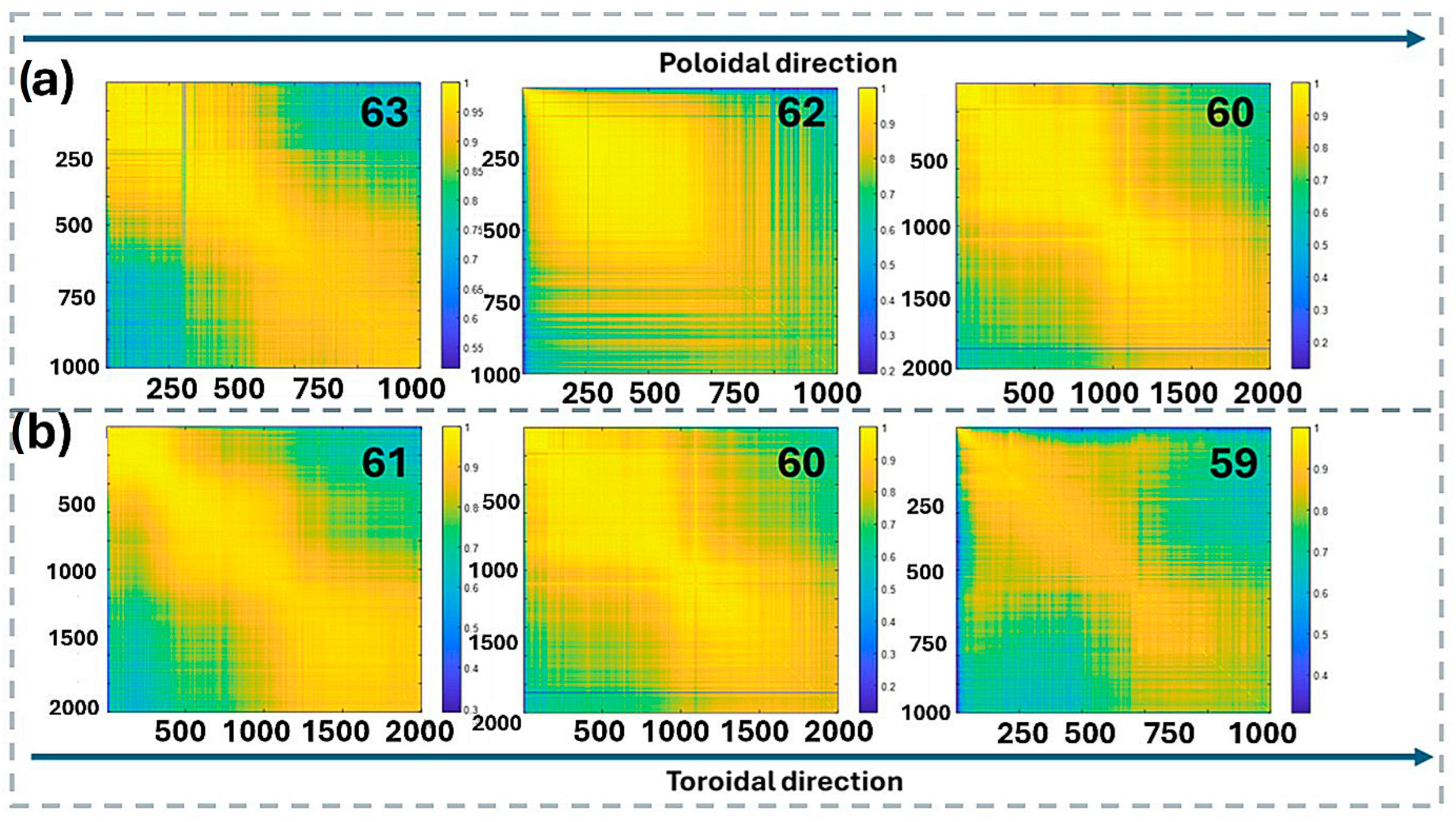
For the present study, correlation is intended to be complementary to in-depth analysis because, when comparing the entire spectra, correlation is more sensitive to transitions between different overlapping layers. It was applied to the whole sequences of spectra of each point, as shown in Figure 7. In this figure, the correlation matrices of the points are shown along the poloidal (top series) and toroidal (bottom series) direction of LH14W. In the matrices of Figure 7, each spectrum is represented by an index on the rows and columns of the matrix, and the PCCs between two spectra “i” and “j” are represented with a color scale (for example, the PCC of the i-th spectrum with j-th in the series is represented in the matrix by the color of the ij element). The yellowish colors of the ij element indicate a high correlation value between the two spectra; the bluish colors of the ij element indicate a low correlation value. Obviously, the main diagonal of the matrix has the maximum correlation value, equal to 1, representing the correlation of each spectrum with itself.
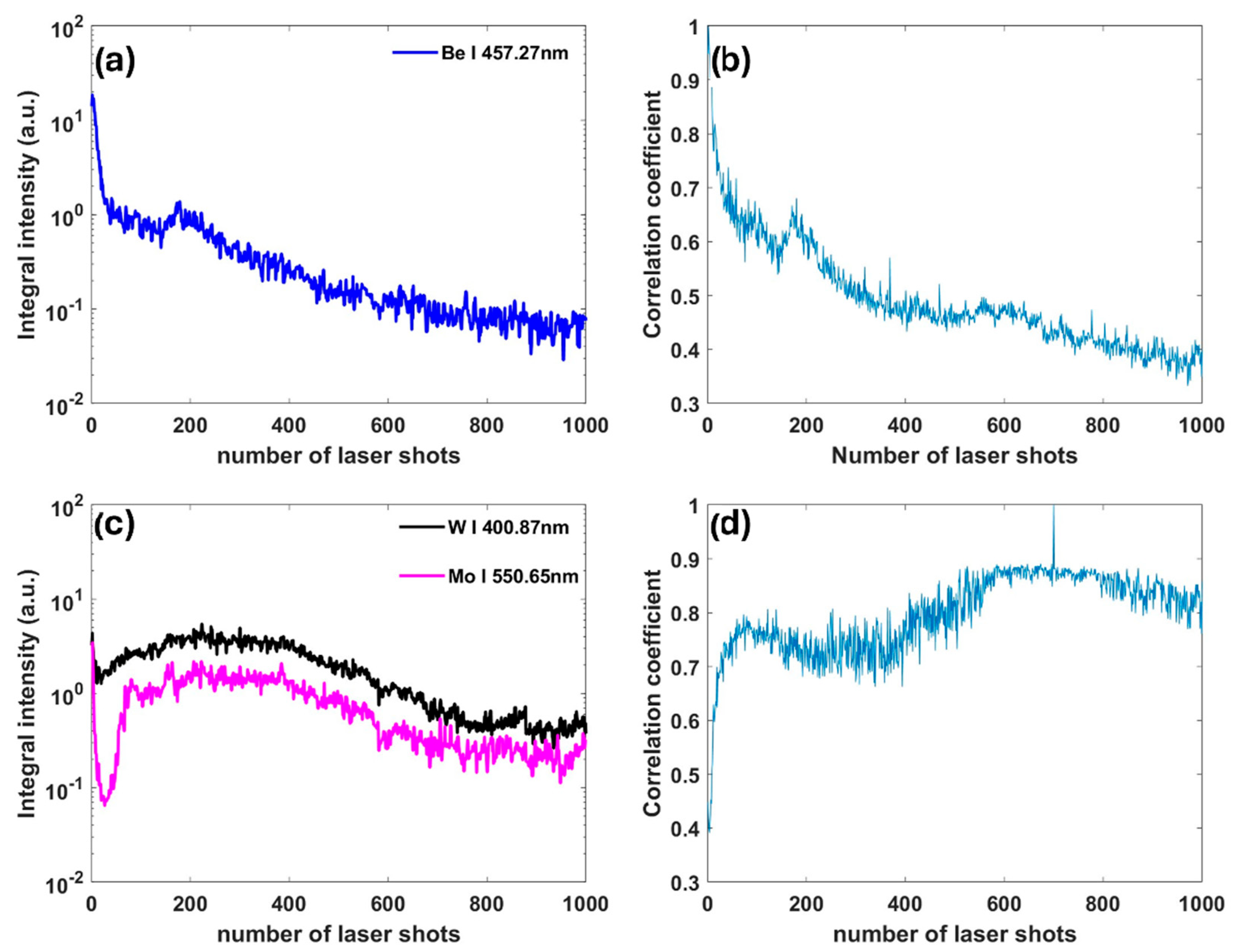
A clear variation in the r x i y j coefficient is observed throughout the entire series of thousands of spectra at each location, indicating that the elemental composition of the layers changed even after hundreds of laser shots. The variation in r x i y j in the first spectra of each sequence corresponds to the in-depth analysis trends observed in Figure 5 and Figure 6, while the variation observed after hundreds of laser shots can be attributed to the complete ablation of these surface layers to reach the CFC substrate, a transition that was not clearly observed with the in-depth analysis. A better example of the complementarity of the two techniques is shown in Figure 8, where the in-depth analyses of Be, W, and Mo for location 59 were compared with the correlation coefficient calculated for shot no. 2 (Be-rich surface layer) and shot no. 700 (LH14W substrate). In the first case, the trend of the two parameters is equivalent, suggesting that Be is present in high concentrations in the first shots. In the second case, the trend of the two parameters is discordant, with the W and Mo signals low and the correlation coefficient high until the end of the sequence.
Table 3 summarizes the results for the five points of LH14W.
The results suggest that many laser shots are required to reach the CFC substrate. This may be due to several factors, including:
(1)
The thickness of the surface layer of co-deposited material, primarily Be, which varies from location to location in the tile.
(2)
The integrity of the original W coating after multiple experimental campaigns, possibly being partially or fully eroded in some locations.
(3)
A reduced ablation rate of deeper layers due to crater confinement [35].

4. Conclusions

In this work, the in situ chemical characterization of an HFGC tile from JET was presented and discussed. The focus was on the layer of material re-deposited on the first wall, the surface tungsten layer, and the CFC substrate. The synergistic use of in-depth analysis and correlation allowed for a more precise definition of the layered structure of the tile and the distinct chemical species present in these overlapping layers of different compositions. Knowing the nominal thickness of the original tungsten coating led to an estimation of the average ablation rate of few tens of nanometers per laser shot. The thickness of the surface re-deposited layer eroded from the first wall was not constant but increased in the poloidal direction, towards the inner divertor high field side and inner wall. Likewise, a similar variation in the deposition pattern was observed in the toroidal direction for the measured tile, with a thicker co-deposit closer to the neighboring HFGC module (left side of LH14W) and thinner towards the RH14W tile, as shown in Figure 2b, opposite to the fusion plasma direction, for an extension equal to the width of the tile. In summary, the LIBS technique provided relevant information for the chemical characterization of PFCs in situ after being highly exposed to the fusion plasma.

Author Contributions

Conceptualization, S.A. (Salvatore Almaviva), J.L., N.J., A.W., I.J. (Ionut Jepu), G.S. and S.B.; methodology, S.A. (Salvatore Almaviva), J.L., A.W., I.J. (Ionut Jepu), G.S., R.Y., R.R., T.D., M.S., E.W., P.V., S.S., S.A. (Sahithya Atikukke), I.J. (Indrek Jõgi), P.P., J.R., P.G., W.G., J.B. and the UKAEA RACE Team; software, S.A. (Salvatore Almaviva); validation, S.A. (Salvatore Almaviva), L.B., J.L., A.H., J.K., N.J., A.W., I.J. (Ionut Jepu), G.S., R.Y., R.R., T.D., M.S., E.W., P.V., S.S., S.A. (Sahithya Atikukke), I.J. (Indrek Jõgi), P.P., J.R., P.G., W.G., J.B. and S.B.; formal analysis, S.A. (Salvatore Almaviva), L.B., J.K. and I.J. (Ionut Jepu); investigation, S.A. (Salvatore Almaviva), L.B., J.L., A.W., I.J. (Ionut Jepu), G.S., R. Xi, R.R., T.D., M.S., E.W., P.V., S.S., S.A. (Sahithya Atikukke), I.J. (Indrek Jõgi), P.P., J.R., P.G., W.G. and J.B.; data curation, S.A. (Salvatore Almaviva) and L.B.; writing—original draft preparation, S.A. (Salvatore Almaviva); writing—review and editing, S.A. (Salvatore Almaviva); supervision, J.L. and A.H.; project administration, S.B., J.L. and N.J.; funding acquisition, S.B. All authors have read and agreed to the published version of the manuscript.

Funding

This work has been carried out within the framework of the EUROfusion Consortium, funded by the European Union via the Euratom Research and Training Program (Grant Agreement No 101052200—EUROfusion), from the EPSRC [grant number EP/W006839/1] and within the framework of the Contract for the Operation of the JET facilities and has received funding from the European Union’s Horizon 2020 research and innovation program. Views and opinions expressed are, however, those of the author(s) only and do not necessarily reflect those of the European Union or the European Commission. Neither the European Union nor the European Commission can be held responsible for them. The research used UKAEA’s Materials Research Facility, which has been funded by and is part of the UK’s National Nuclear User Facility and Henry Royce Institute for Advanced Materials.

Data Availability Statement

The original contributions presented in this study are included in the article. Further inquiries can be directed to the corresponding author.

Acknowledgments

This scientific paper has been published as part of the international project co-financed by the Polish Ministry of Science and Higher Education within the program called ‘PMW’.

Conflicts of Interest

Authors Jari Likonen, Antti Hakola and Juuso Karhunen were employed by the company VTT Technical Research Centre of Finland Ltd. Authors Gennady Sergienko, Rongxing Yi, Rahul Rayaprolu, Timo Dittmar, Marc Sackers, Erik Wüst and Sebastijan Brezinsek were employed by the company Forschungszentrum Jülich GmbH. The remaining authors declare that the research was conducted in the absence of any commercial or financial relationships that could be construed as a potential conflict of interest.

References

  1. Rimini, F.G.; Contributors, J.; The EUROfusion Tokamak Exploitation Team. 40 years of JET operations: A unique contribution to fusion science. Plasma Phys. Control. Fusion 2025, 67, 033001. [Google Scholar] [CrossRef]
  2. Available online: https://www.iter.org/ (accessed on 3 January 2026).
  3. JET Team. Fusion energy production from a deuterium-tritium plasma in the JET tokamak. Nucl. Fusion 1992, 32, 186–203. [Google Scholar] [CrossRef]
  4. Maggi, C.F. Overview of T and D–T results in JET with ITER-like wall. Nucl. Fusion 2024, 64, 112012. [Google Scholar] [CrossRef]
  5. Litaudon, X.; Abduallev, S.; Abhangi, M.; Abreu, P.; Afzal, M.; Aggarwal, K.; Ahlgren, T.; Ahn, J.; Aho-Mantila, L.; Aiba, N.; et al. Overview of the JET results in support to ITER. Nucl. Fusion 2017, 57, 102001. [Google Scholar] [CrossRef]
  6. Federici, G. In-vessel tritium retention and removal in ITER. J. Nucl. Mater. 1999, 266–269, 14–29. [Google Scholar] [CrossRef]
  7. Schmid, K.; Wauters, T. Full W ITER: Assessment of expected W erosion and implications of boronization on fuel retention. Nucl. Mater. Energy 2024, 41, 101789. [Google Scholar] [CrossRef]
  8. Pitts, R.; Loarte, A.; Wauters, T.; Dubrov, M.; Gribov, Y.; Köchl, F.; Pshenov, A.; Zhang, Y.; Artola, J.; Bonnin, X.; et al. Plasma-wall interaction impact of the ITER re-baseline. Nucl. Mater. Energy 2025, 42, 101854. [Google Scholar] [CrossRef]
  9. Causey, R.A.; Karnesky, R.A.; San Marchi, C. Tritium Barriers and Tritium Diffusion in Fusion Reactors. In Comprehensive-Nuclear Materials; Konings, R.J.M., Allen, T.M., Stoller, R.E., Yamanaka, S., Eds.; Elsevier: Amsterdam, The Netherlands, 2012; Volume 4, pp. 511–549. [Google Scholar]
  10. Hatano, Y.; Shimada, M.; Otsuka, T.; Oya, Y.; Alimov, V.; Hara, M.; Shi, J.; Kobayashi, M.; Oda, T.; Cao, G.; et al. Deuterium trapping at defects created with neutron and ion irradiations in tungsten. Nucl. Fusion 2013, 53, 073006. [Google Scholar] [CrossRef]
  11. Roth, J.; Tsitrone, E.; Loarer, T.; Philipps, V.; Brezinsek, S.; Loarte, A.; Counsell, G.F.; Doerner, R.P.; Schmid, K.; Ogorodnikova, O.V.; et al. Tritium inventory in ITER plasma-facing materials and tritium removal procedures. Plasma Phys. Control. Fusion 2008, 50, 103001. [Google Scholar] [CrossRef]
  12. Widdowson, A.; Coad, J.P.; Zayachuk, Y.; Jepu, I.; Alves, E.; Catarino, N.; Corregidor, V.; Mayer, M.; Krat, S.; Likonen, J.; et al. Evaluation of tritium retention in plasma facing components during JET tritium operations. Phys. Scr. 2021, 96, 124075. [Google Scholar] [CrossRef]
  13. Bykov, I.; Petersson, P.; Bergsåker, H.; Hallén, A.; Possnert, G. Investigation of tritium analysis methods for ion microbeam application. Nucl. Instrum. Methods Phys. Res. Sect. B 2012, 273, 250–253. [Google Scholar] [CrossRef]
  14. Teimane, A.; Pajuste, E.; Avotina, L.; Lescinskis, A.; Vitins, A.; Goldmane, A.; Sondars, M.; Zabolockis, R.; Likonen, J.; Widdowson, A. Investigating tritium retention in tungsten coated plasma facing components from the divertor region of the Joint European Torus (JET) after ITER like-wall campaigns. Nucl. Mater. Energy 2026, 46, 102049. [Google Scholar] [CrossRef]
  15. Matsuyama, M.; Zushi, H.; Tokunaga, K.; Kuzmin, A.; Hanada, K. Effect of heating temperature on tritium retention in stainless steel type 316 L. Nucl. Mater. Energy 2018, 16, 52–59. [Google Scholar] [CrossRef]
  16. Rubel, M.; Petersson, P.; Alves, E.; Brezinsek, S.; Coad, J.P.; Heinola, K.; Mayer, M.; Widdowson, A. The role and application of ion beam analysis for studies of plasma-facing components in controlled fusion devices. Nucl. Instrum. Methods Phys. Res. Sect. B 2016, 371, 4–11. [Google Scholar] [CrossRef]
  17. Huber, A.; Schweer, B.; Philipps, V.; Gierse, N.; Zlobinski, M.; Brezinsek, S.; Biel, W.; Kotov, V.; Leyte-Gonzales, R.; Mertens, P.; et al. Development of laser-based diagnostics for surface characterization of wall components in fusion devices. Fusion Eng. Des. 2011, 6–8, 1336–1340. [Google Scholar] [CrossRef]
  18. Zlobinski, M.; Sergienko, G.; Jepu, I.; Rowley, C.; Widdowson, A.; Ellis, R.; Kos, D.; Coffey, I.; Fortune, M.; Kinna, D.; et al. First results of laser-induced desorption—Quadrupole mass spectrometry (LID-QMS) at JET. Nucl. Fusion 2024, 64, 086031. [Google Scholar] [CrossRef]
  19. Almaviva, S.; Caneve, L.; Colao, F.; Lazic, V.; Maddaluno, G.; Mosetti, P.; Palucci, A.; Reale, A.; Gasior, P.; Gromelski, W.; et al. LIBS measurements inside the FTU vacuum vessel by using a robotic arm. Fusion Eng. Des. 2021, 169, 112638. [Google Scholar] [CrossRef]
  20. Karhunen, J.; Hakola, A.; Likonen, J.; Lissovski, A.; Laan, M.; Paris, P. Applicability of LIBS for in situ monitoring of deposition and retention on the ITER-like wall of JET: Comparison to SIMS. J. Nucl. Mater. 2015, 463, 931–935. [Google Scholar] [CrossRef]
  21. Likonen, J.; Almaviva, S.; Rayaprolu, R.; Yi, R.; Jepu, I.; Sergienko, G.; Widdowson, A.; Jones, N.; Atikukke, S.; Dittmar, T.; et al. First Demonstration of laser induced breakdown spectroscopy using remote handling for in-vessel analysis of JET components. Nucl. Mater. Energy 2025, 45, 102021. [Google Scholar] [CrossRef]
  22. Yi, R.; Rayaprolu, R.; Likonen, J.; Almaviva, S.; Jepu, I.; Sergienko, G.; Widdowson, A.; Jones, N.; Atikukke, S.; Dittmar, T.; et al. In-vessel and depth-resolved semi-quantitative analysis on hydrogen isotopes and wall materials in JET by LIBS operated on a remote handling arm. Nucl. Mater. Energy 2025, 45, 102016. [Google Scholar] [CrossRef]
  23. Thomser, C.; Bailescu, V.; Brezinsek, S.; Coenen, J.W.; Greuner, H.; Hirai, T.; Linke, J.; Lungu, C.P.; Maier, H.; Matthews, G.; et al. Plasma Facing Materials for the JET ITER-Like Wall. Fusion Sci. Technol. 2012, 62, 1–8. [Google Scholar] [CrossRef]
  24. Kappatou, A.; Baruzzo, M.; Hakola, A.; Joffrin, E.; Keeling, D.; Labit, B.; Tsitrone, E.; Vianello, N.; Wischmeier, M.; Balboa, I.; et al. Overview of the third JET deuterium-tritium campaign. Plasma Phys. Control. Fusion 2025, 67, 045039. [Google Scholar] [CrossRef]
  25. Mateo, M.P.; Nicolas, G.; Pinon, V.; Yañez, A. Improvements in depth-profiling of thick samples by laser-induced breakdown spectroscopy using linear correlation. Surf. Interface Anal. 2006, 38, 941–948. [Google Scholar] [CrossRef]
  26. Królicka, A.; Maj, A.; Łój, G. Application of Laser-Induced Breakdown Spectroscopy for Depth Profiling of Multilayer and Graded Materials. Materials 2023, 16, 6641. [Google Scholar] [CrossRef]
  27. Traparic, I.; Rankovic, D.; Stankov, B.D.; Savovic, J.; Kuzmanovic, M.; Ivkovic, M. Resolving studies of Balmer alpha lines relevant to the LIBS analysis of hydrogen isotope retention. Spectrochim. Acta B 2024, 221, 107050. [Google Scholar] [CrossRef]
  28. Almaviva, S.; Baiamonte, L.; Pistilli, M. Optimization of the LIBS Technique in Air, He, and Ar at Atmospheric Pressure for Hydrogen Isotope Detection on Tungsten Coatings. J. Nucl. Eng. 2025, 6, 22. [Google Scholar] [CrossRef]
  29. Jõgi, I.; Ristkok, J.; Raud, J.; Butikova, J.; Mizohata, K.; Paris, P. Laser induced breakdown spectroscopy for hydrogen detection in molybdenum at atmospheric pressure mixtures of argon and nitrogen. Fusion Eng. Des. 2022, 179, 113131. [Google Scholar] [CrossRef]
  30. Jõgi, I.; Ristkok, J.; Butikova, J.; Raud, J.; Paris, P. LIBS plasma in atmospheric pressure argon, nitrogen and helium: Spatio-temporal distribution of plume emission and Hα linewidth. Nucl. Mater. Energy 2023, 37, 101543. [Google Scholar] [CrossRef]
  31. Matthews, G.F.; Beurskens, M.; Brezinsek, S.; Groth, M.; Joffrin, E.; Loving, A.; Kear, M.; Mayoral, M.-L.; Neu, R.; Prior, P.; et al. JET ITER-like wall—Overview and experimental programme. Phys. Scr. 2011, 014001. [Google Scholar] [CrossRef]
  32. Ristkok, J.; Almaviva, S.; Likonen, J.; Karhunen, J.; Jõgi, I.; Paris, P.; Soni, S.; Veis, P.; Atikukke, S.; Butikova, J.; et al. Preparing LIBS for in-situ measurements in JET tokamak: System overview and co-deposited layer thicknesses. Nucl. Mater. Energy 2025, 44, 101968. [Google Scholar] [CrossRef]
  33. Kramida, A.; Ralchenko, Y.; Reader, J.; NIST ASD Team. NIST Atomic Spectra Database; Version 5.12; NIST: Gaithersburg, MD, USA, 2024. Available online: https://physics.nist.gov/asd (accessed on 5 January 2026).
  34. Nikolić, D.; Muresan, R.C.; Feng, W.; Singer, W. Scaled correlation analysis: A better way to compute a cross-correlogram. Eur. J. Neurosci. 2012, 35, 742–762. [Google Scholar] [CrossRef] [PubMed]
  35. Sdvizhenskii, P.A.; Lednev, V.N.; Grishin, M.Y.; Pershin, S.M. Deep ablation and LIBS depth elemental profiling by combining nano and microsecond laser pulses. Spectrochim. Acta B 2021, 177, 106054. [Google Scholar] [CrossRef]
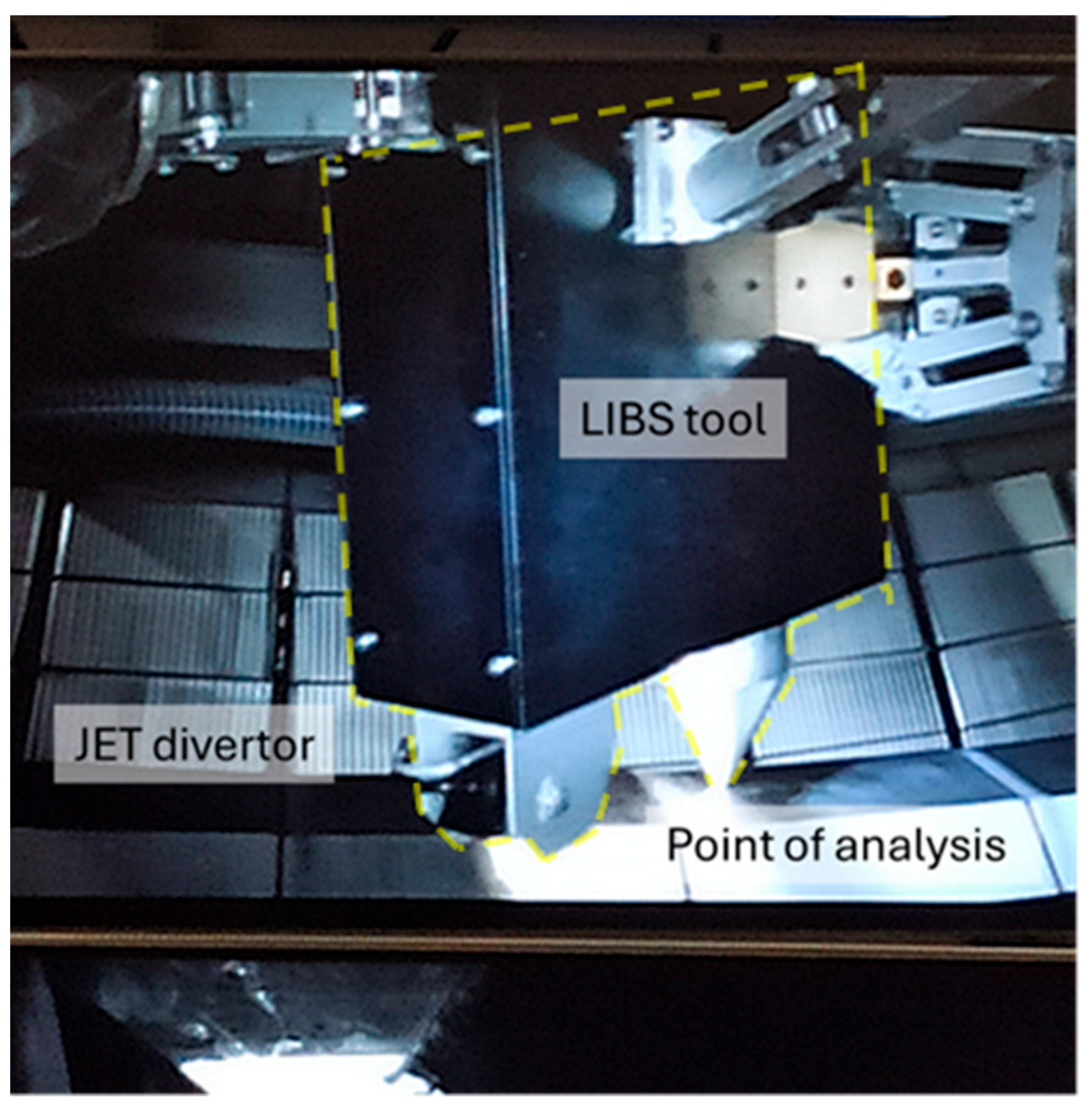
Figure 1. The LIBS tool (in the dashed perimeter) mounted on MASCOT and measuring inside the JET VV.
Jne 07 00025 g001
Figure 2. (a) The HFGC tiles’ location (in yellow) in the JET VV (credit: UKAEA). (b) Close-up of the LH14W tile together with nearby tiles. Numbers indicate the usage period (in years). (c) Schematic diagram of the multilayered structure of the tile.
Jne 07 00025 g002
Figure 3. (a) Series of LIBS locations (yellow dots) on the JET divertor, reprinted from [21]. White numbers identify the tiles along the divertor section; the yellow arrow indicates tile LH14W (tile 0). (b) Close-up of LH14W with the points measured by LIBS (in yellow). Numbers refer to the overall sequence of the points measured at JET during the entire LIBS campaign. The distances among the points (blue arrows) are estimated based on the overall dimensions of the tile (150 × 250 mm).
Jne 07 00025 g003
Figure 4. LIBS spectrum acquired during the experimental campaign (point 59 shot number 10). Some emission lines reported in Table 1 are highlighted.
Jne 07 00025 g004
Figure 5. (a) (Top graphs) In-depth analyses of points 60, 62, 63 on JET tile LH14W (poloidal direction). Semi-log graphs show the normalized intensities of the emission lines of different chemical species as a function of the applied laser shots. Different colors relate to different species. (b) (Bottom graphs) In-depth analyses of points 59, 60, 61 on JET tile LH14W (toroidal direction).
Jne 07 00025 g005
Figure 6. (a) (Top graphs) Details of the in-depth analysis limited to the first shots, to better highlight the intensity trend of Be, W, and Mo lines, marking the re-deposited layer, the W coating, and the Mo interlayer. Blue arrows mark the laser shots related to the achievement of the W coating and the Mo interlayer. (b) (Bottom graphs) The same as in (a) in the toroidal direction.
Jne 07 00025 g006
Figure 7. (a) (Top graphs) Correlation matrices of the LIBS spectra acquired on points 60, 62, and 63 (poloidal direction) on JET tile LH14W. (b) (Bottom graphs) Correlation matrices of the LIBS spectra acquired on points 59, 60, and 61 (toroidal direction).
Jne 07 00025 g007
Figure 8. (a) In-depth analysis for Be I at 457.27 nm in locations 59 as a function of the laser shot number. (b) PCCs of spectrum n°2 with all the spectra of the series. Note that the PCC at laser shot number 2 is 1. (c) In-depth analysis for W I at 400.87 nm and Mo I at 550.65 nm in location 59 as a function of the laser shot number. (d) PCCs of spectrum n° 700 with all the spectra of the series. Note that the PCC at laser shot number 700 is 1.
Jne 07 00025 g008
Table 1. Peculiar emission lines of the chemical species monitored on tile LH14W.
Atom/IonWavelength (nm)Motivation
Be I 457.27Be, as material eroded from the first wall and re-deposited on the divertor
W I400.87W, as constituent material of the divertor eroded and re-deposited after erosion
Tα-Dα-Hα656–656.3Re-deposited unburned (or implanted) fuel
Mo I 550.65Mo, as interlayer material
Ni I341.48Inconel structural material of the first wall
Cr I 425.44 Inconel structural material of the first wall
Table 2. Estimated thickness, measured in number of laser shots, of the co-deposited Be layer and the W coating on tile LH14W.
Points of AnalysisCo-deposited Be (Shot n°) W Coating (Shot n°)
591–1920–55
601–2020–155
611–7576–325
62N.A.N.A.
631–9596–240
Table 3. Estimated thicknesses, measured in number of laser shots, of the overall surface layers based on the correlation analysis on tile LH14W.
Points of AnalysisSurface Layers (Be + W + Mo)
59 1–579
601–972
611–1101
62 1–576
631–490
Disclaimer/Publisher’s Note: The statements, opinions and data contained in all publications are solely those of the individual author(s) and contributor(s) and not of MDPI and/or the editor(s). MDPI and/or the editor(s) disclaim responsibility for any injury to people or property resulting from any ideas, methods, instructions or products referred to in the content.