1. Introduction
The pursuit of controlled nuclear fusion as a viable energy source has motivated extensive research into technologies capable of sustaining high power densities while ensuring long-term operational reliability. In magnetic confinement fusion devices such as tokamaks, fusion reactions release large amounts of energy that must be efficiently extracted while simultaneously maintaining fuel self-sufficiency through the breeding of tritium. These requirements place stringent demands on reactor components exposed to extreme thermal, neutron, and electromagnetic environments.
Within this framework, the breeding blanket plays a central role, as it is responsible for both heat extraction and tritium production, directly affecting the overall performance and feasibility of future fusion power plants. Current fusion roadmaps identify the qualification of breeding blanket concepts as a critical step toward the realization of DEMO-class reactors and beyond [
1]. Among the various blanket designs under investigation, the Dual-Cooled Lead–Lithium (DCLL) concept has emerged as a promising solution, combining a liquid metal breeder and coolant with a separate helium cooling circuit for structural components [
2]. The use of a Lead-Lithium eutectic alloy enables operation at high temperatures, improving thermal efficiency while providing effective tritium breeding capabilities.
However, the adoption of electrically conducting liquid metals in strong magnetic fields introduces additional physical complexities. In fusion reactor environments, the interaction between the imposed magnetic field and the motion of the liquid metal gives rise to magnetohydrodynamic (MHD) phenomena, characterized by the induction of electric currents and the resulting Lorentz forces opposing the flow. These effects significantly modify velocity distributions, suppress turbulence, and, most importantly from an engineering point of view, lead to substantial increases in pressure losses [
3,
4,
5,
6]. The resulting MHD-induced pressure drop has a direct impact on pumping power requirements and represents a major design constraint for liquid-metal-based blanket concepts [
7,
8].
Rectangular ducts are of particular relevance in this context, as they are representative of internal cooling channels and flow paths within breeding blankets. The influence of duct geometry, wall electrical properties and magnetic field intensity on MHD flow behavior has therefore been widely investigated [
9,
10]. While high-fidelity numerical simulations provide detailed insight into three-dimensional current paths and flow structures, they are often too computationally demanding for early-stage design activities. As a result, there remains a strong need for compact analytical models capable of providing reliable estimates of MHD pressure losses under fusion-relevant conditions, to support preliminary design and optimization studies.
In this work, the MHD-induced pressure drop in a Lead–Lithium flow through a rectangular-section duct subjected to a uniform external magnetic field is investigated. The study focuses on quantifying the dependence of pressure losses on the magnetic field intensity, within parameter ranges representative of DCLL breeding blanket applications. An analytical model is developed to estimate the total MHD pressure drop along the duct, explicitly accounting for current redistribution between the fluid core, near-wall layers and conducting walls. The analytical predictions are then validated against CFD simulations performed using COMSOL Multiphysics. allowing an assessment of the model accuracy and of the underlying physical assumptions.
The present study builds upon a recent numerical and analytical investigation by the authors on MHD pressure losses in Lead–Lithium flows within circular ducts [
11], extending the proposed modeling approach to a rectangular geometry and shifting the focus to a systematic analysis of the influence of the magnetic field intensity.
The proposed approach aims to provide a practical and computationally efficient tool for estimating MHD pressure losses in rectangular ducts, suitable for preliminary design evaluations of liquid metal components in fusion reactor blankets.
2. Literature Overview
The study of MHD flows in electrically conducting liquids dates back to the pioneering work of Hartmann, who first analyzed laminar flow in the presence of a homogeneous magnetic field and highlighted the strong alteration of the flow resistance [
3]. Shortly after, Shercliff extended the theoretical description to duct and pipe configurations under transverse magnetic fields, providing a key reference for wall-bounded MHD flows [
4]. A consolidated theoretical framework was later established by Moreau [
5] and further formalized by Davidson [
6], who discussed the physical interpretation and scaling of MHD flows through the use of non-dimensional parameters such as the Hartmann number and the interaction parameter.
From a more application-oriented point of view, Bühler provided a comprehensive treatment of MHD flows in channels and containers, with particular attention to Hartmann, Shercliff and related boundary layers relevant to duct flows [
12]. Further analyses of liquid metal MHD flows in circular ducts at intermediate Hartmann numbers and interaction parameters contributed to clarifying regimes of practical interest [
13].
A general review of MHD thermofluid-dynamics issues in fusion-relevant liquid metal blankets was provided by Smolentsev and co-workers, emphasizing the role of current closure paths, wall electrical properties and three-dimensional effects on pressure drop [
7]. The relevance of breeding blankets for DEMO development and qualification has been repeatedly highlighted in the fusion roadmap and associated testing needs [
1]. Within this context, the DCLL concept has attracted considerable attention due to its potential for high-temperature operation and tritium breeding, while also posing significant MHD-driven hydraulic difficulties [
2].
Beyond general blanket considerations, several numerical studies have targeted duct configurations representative of blanket channels. Early simulations of liquid-metal MHD flows in rectangular ducts were presented by Sterl [
14], establishing a reference for the impact of transverse magnetic fields on velocity distributions and pressure losses in non-circular sections. More recently, three-dimensional simulations by Smolentsev and co-workers investigated MHD flow in rectangular ducts with conducting walls, confirming the importance of three-dimensional current paths and wall effects [
15]. Lately, numerical efforts have addressed blanket access ducts and complex channels, providing pressure-drop characterizations in geometries of direct design relevance [
16]. Additional studies have focused on blanket manifolds and system-level design constraints, offering guidelines and numerical analyses for liquid metal blanket components [
9,
17]. Curved-pipe configurations under nonuniform magnetic fields have also been investigated to represent geometric features typical of realistic tokamak layouts [
10].
Although the literature provides extensive numerical evidence of MHD-induced pressure drop in blanket-relevant channels, compact analytical tools suitable for preliminary design remain comparatively limited, particularly when both geometric complexity and electromagnetic current redistribution are involved [
8]. Recent works have proposed correlation-based approaches and optimization strategies for three-dimensional MHD pressure losses [
18], further confirming the need for tractable predictive tools.
In a recent numerical and analytical study, the authors investigated MHD pressure losses in Lead–Lithium flows within circular ducts of variable geometry under a uniform and unitary magnetic field, developing simplified analytical correlations and benchmarking them against COMSOL simulations. simulations [
11]. The present work builds upon this one, following the same approach, extending the analytical model to a different geometric configuration and conducting a parametric study that varies the magnetic field intensity instead of the duct inclination angle.
4. Analytical Model
An analytical model is developed to estimate the MHD pressure losses associated with the interaction between the electrically conducting PbLi flow and the externally imposed magnetic field. The formulation recalls the same conceptual framework adopted in [
11]: it is based on the physical mechanisms governing the generation, redistribution and closure of electric currents within the duct cross-section and through the walls. Following the nondimensional formulation of the momentum equation under the inductionless approximation [
11]
the relative importance of the different force contributions can be assessed through the interaction parameter
N and the Hartmann number
. For the parameter range relevant to the present study, characterized by large values of
N, the streamwise pressure gradient is primarily balanced by the Lorentz force term, while inertial contributions are of secondary importance. As a consequence, the MHD-induced pressure gradient can be directly related to the electromagnetic force density
.
From this point onward, for the sake of simplicity, we set
and
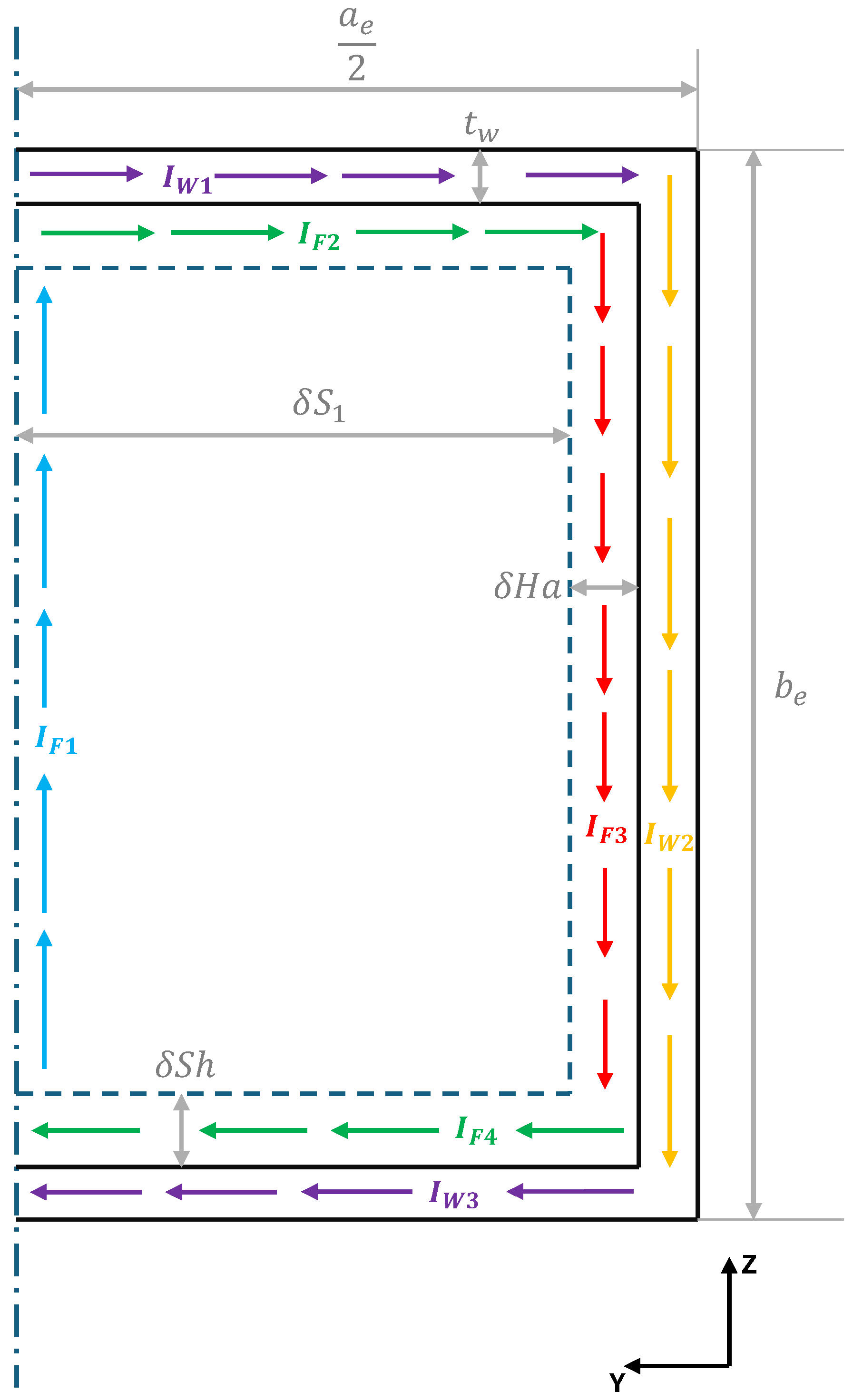
. Neglecting the axial gradient of the electric potential, the induced electric currents are assumed to lie on the duct cross section, showing a closure path schematically illustrated in
Figure 2. Due to the voltage generated by the term
, electric currents are induced in the fluid and tend to close along preferential paths determined by the geometry of the section and the electrical properties of the fluid and walls. In particular, we hypothesize that a portion of the current flows through the core region of the section, generating a braking Lorentz force, while another portion closes through near-wall layers and the duct walls, producing locally accelerating force contributions.
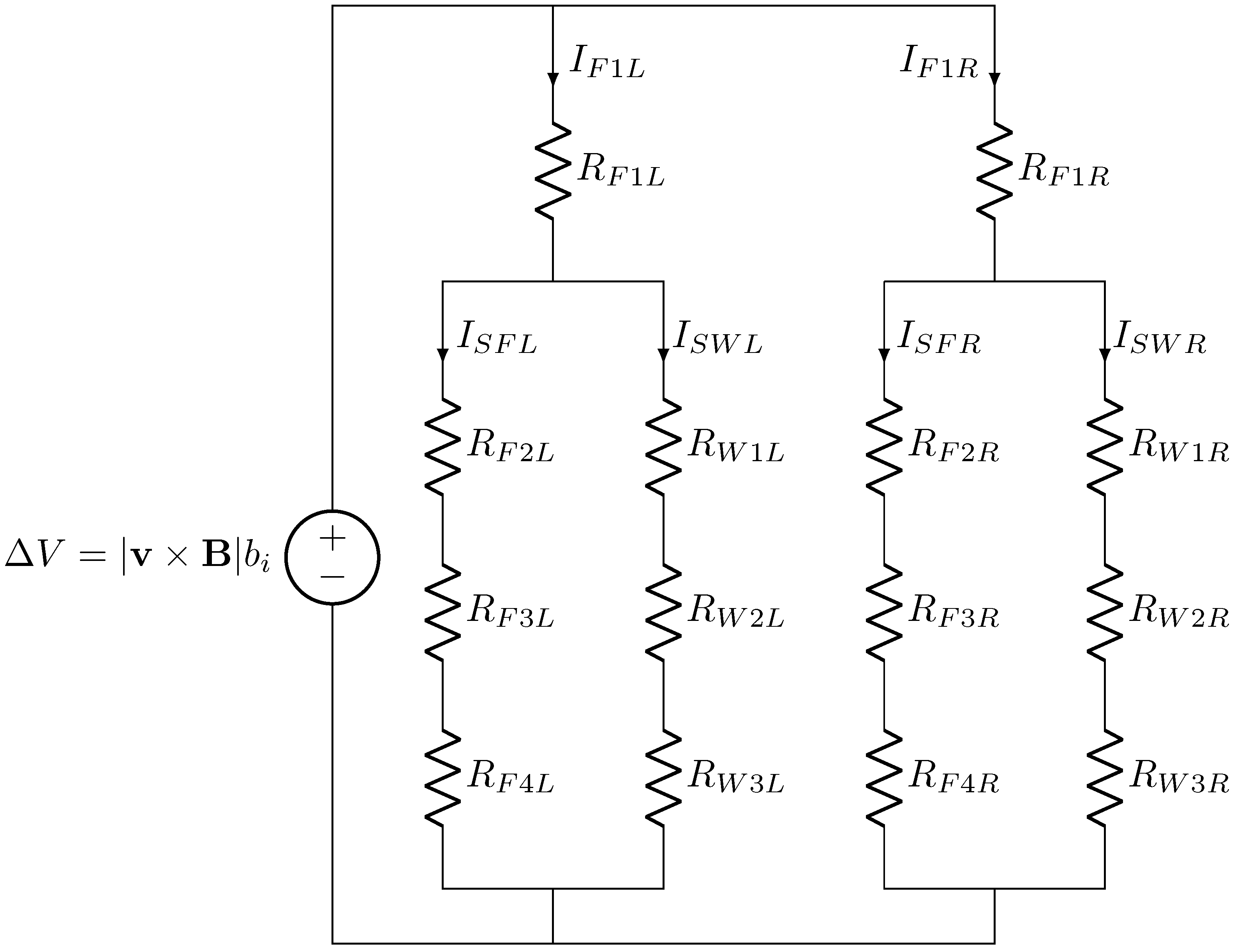
To model this behavior, the current closure mechanism is represented through an equivalent electrical circuit, shown in
Figure 3, defined over an infinitesimal duct slice of length
. The voltage driving the circuit is given by
It is important to note that the mean velocity v at the inlet cross-section is used, as it is known beforehand and therefore suitable for analytical correlations to be employed in the preliminary design of these components. Strictly speaking, the velocity should be averaged section by section to compute a more accurate Lorentz force along the entire length of the analyzed tract.
Each branch of the circuit represents a distinct current path and is associated with an electrical resistance evaluated through Ohm’s law. Subscripts
R and
L stand for the right and left side of the axisymmetric section of the duct. The resistances corresponding to the fluid core regions are expressed as:
where
is the electrical conductivity of PbLi,
denotes the core area where the current
flows and
and
correspond to the layer areas where the return currents
,
and
are assumed to flow. Here,
and
represent the thickness of the Hartmann and Shercliff layers [
3,
4]. The fluid resistance series is defined as:
with
The resistances associated with current closure through the walls are instead written as:
with
and
being the wall thickness and electrical conductivity and
being the averaged values of the section width and length. Introducing the wall conductance ratio
the wall resistance series can be defined as:
with
Due to symmetry, i.e., equality of left (
L) and right (
R) resistances (see
Figure 3), we can focus on half of the section. According to the circuit topology, the equivalent resistance of a single half-circuit (right or left) is obtained as
where the dimensionless coefficients
and
will depend solely on the duct geometry and wall properties and account for the relative contribution of fluid and wall conduction paths.
The induced current over half of the section is then given by
and can be split into two dominant contributions associated with the core and near-wall regions. The corresponding current densities are written as
where
is the angle between the vectors
v and
B and
K is a purely geometric parameter arising from the equivalent resistance formulation, defined as
The parameter
accounts for the redistribution of electric currents between the fluid core and the near-wall regions and is defined as
The parameter
depends on the wall conductance ratio
through the equivalent resistance formulation. An increase in
, corresponding to more electrically conducting or thicker walls, leads to a reduction of the resistance coefficient
and, consequently, of the equivalent coefficient
K. Since
is proportional to
K, higher wall conductance results in lower values of
. According to Equation (
26), this implies a reduced contribution of the density of the near-wall current relative to the core current, thus increasing the relative weight of the electromagnetic braking contribution associated with the core region.
The resulting Lorentz force density (N/
) is given by
. By integrating over the cross-sectional areas affected by the supposed braking and accelerating currents, the net electromagnetic force per unit length (N/m) opposing the flow can be expressed as
where
and
denote the effective cross-sectional areas over which the braking and accelerating current densities act, respectively. In particular,
corresponds to the core region of the duct section, while
represents the complementary near-wall region. They are defined as
and
Consistently with the nondimensional momentum balance introduced above (Equation (
10)), and in the limit of dominant electromagnetic effects, the streamwise component of the momentum equation reduces to a balance between the pressure gradient and the Lorentz force contribution. Finally, the MHD-induced pressure gradient follows from the streamwise momentum balance
which gives us the total MHD pressure drop:
This analytical formulation explicitly accounts for the redistribution of electric currents over the duct cross-section and through the walls, providing a more realistic estimate of MHD pressure losses compared to uniform-current models, while retaining a compact form suitable for preliminary design analyses. For the straight horizontal segment, , whereas for the 90° bend, the geometrically averaged value was adopted.
Analytical Pressure Drop Coefficient
In analogy with classical fluid dynamics, the MHD-induced pressure losses can be recast in terms of an equivalent loss coefficient. In conventional hydraulics, distributed and localized pressure losses are commonly expressed through dimensionless coefficients that relate the pressure drop to the dynamic pressure of the flow. Following the same approach adopted in [
11], an equivalent MHD loss coefficient
is introduced such that
By equating the above expression with the analytical formulation derived in the previous section, the MHD loss coefficient can be written as
This expression highlights the direct dependence of
on the interaction between electromagnetic and inertial effects, consistently with classical MHD scaling laws. In particular, the equivalent MHD loss coefficient can be rewritten in a compact, dimensionless form as
where
N is the interaction parameter defined in (
9) and
is a dimensionless factor that represents the effect of current redistribution over the section:
Equation (
36) shows explicitly that the additional electromagnetic contribution to the pressure losses scales linearly with
N and with the effective magnetic length-to-hydraulic-diameter ratio, while the proportionality is governed by
, which depends only on geometry and wall-related current closure mechanisms.
As in classical hydraulics, the total pressure drop can therefore be evaluated as the superposition of viscous and MHD-induced contributions, with the latter conveniently accounted for through the equivalent coefficient .
The formulation of allows the MHD pressure losses to be treated within the same conceptual framework as used for conventional hydraulic losses, allowing the straightforward inclusion of electromagnetic effects in preliminary design calculations.
5. Numerical Results
5.1. Numerical Pressure Drop and Velocity Field Evaluation
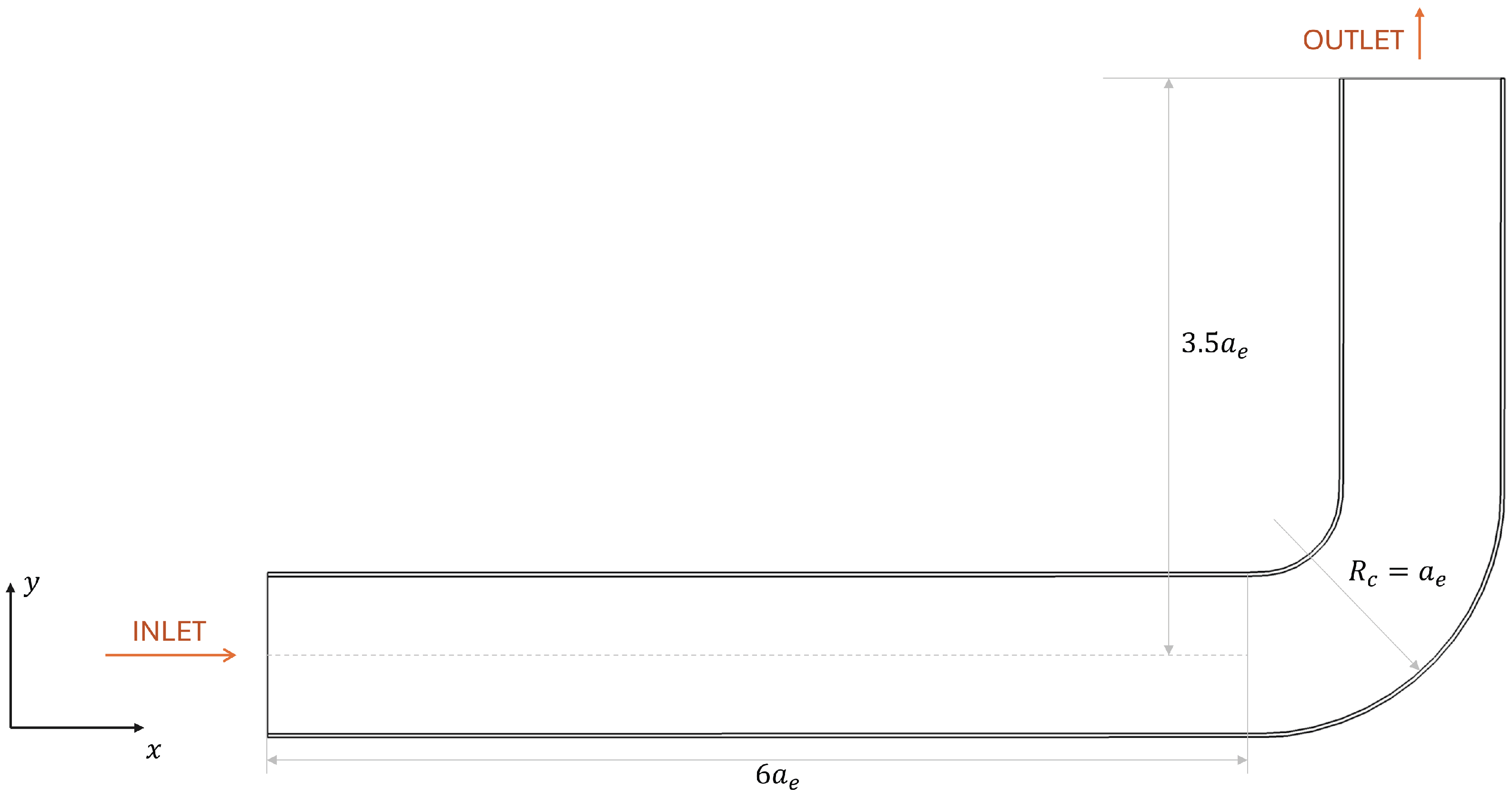
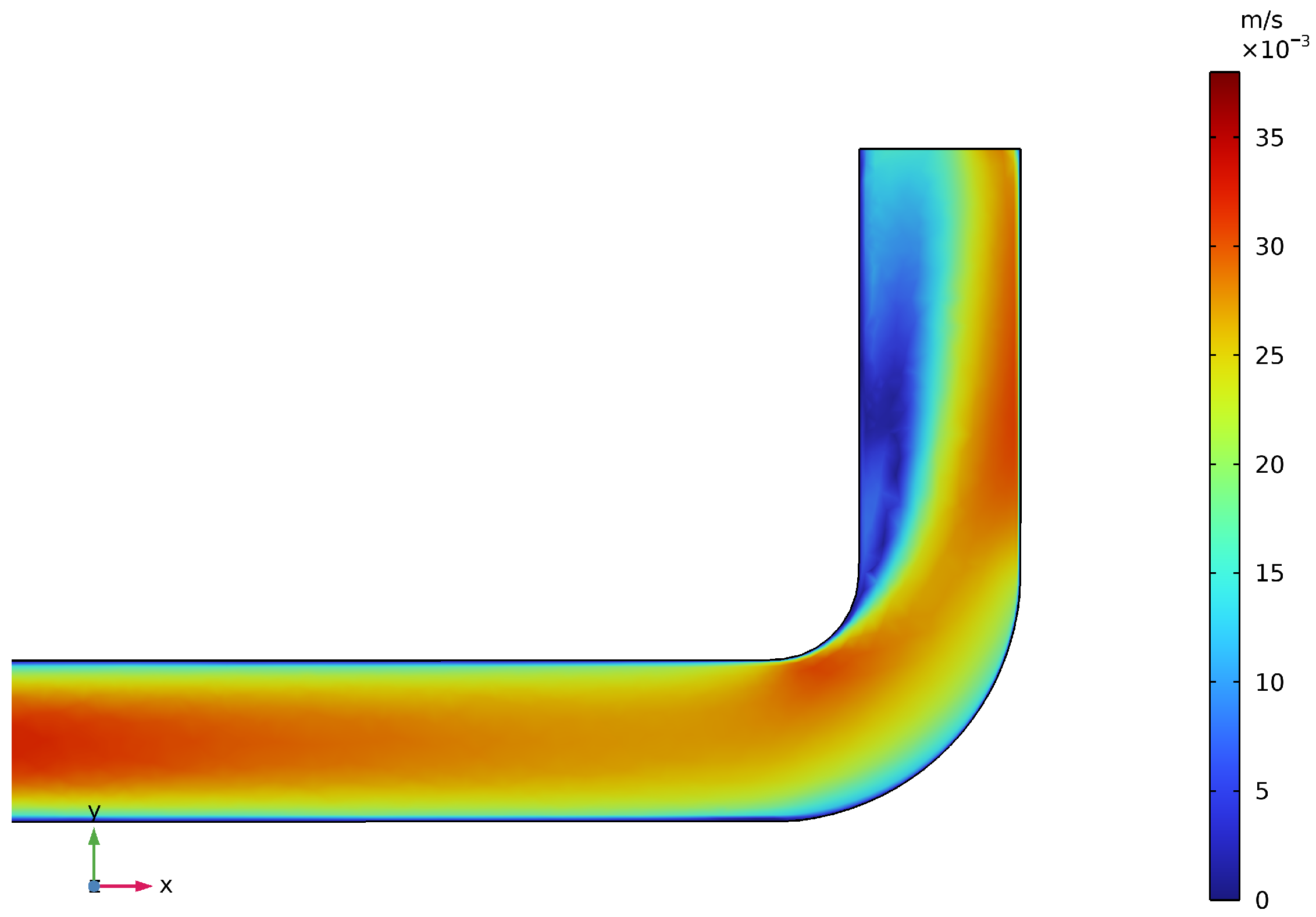
The first CFD simulation on COMSOL was performed without the effect of the magnetic field, to test the code and establish a reliable benchmark case for subsequent analyses. The velocity magnitude distribution over the xy plane for
for the laminar case is observed in
Figure 4.
The flow pattern is consistent with classical fluid dynamics behavior [
25] exhibiting an accelerated core region and reduced velocities near the walls due to viscous effects. Flow separation occurs downstream of the inner wall of the bend, while the flow is compressed and consequently accelerated along the outer wall of the vertical section. The total pressure drop computed for the laminar case is
Then, as previously mentioned, several CFD simulations were performed: keeping the geometry fixed, the magnetic field intensity was varied from to , in increments of .
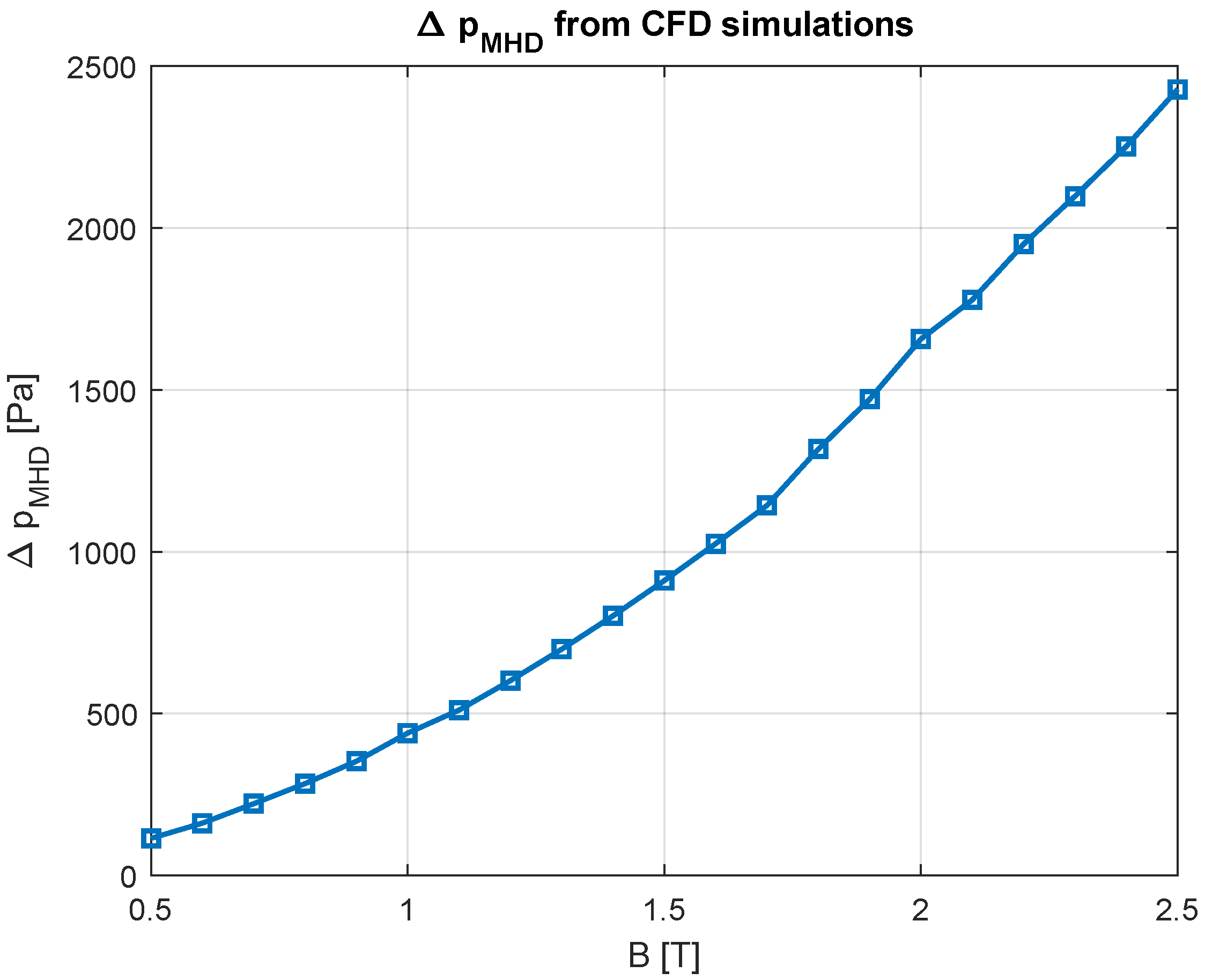
Figure 5 reports the total MHD pressure drop obtained from CFD simulations as a function of the imposed magnetic field intensity. A monotonic increase of
with
B is observed over the investigated range, and the corresponding pressure drops are two to four orders of magnitude higher than the laminar
value.
The trend is non-linear, consistent with classical MHD scaling laws, according to which electromagnetic effects scale with the square of the magnetic field intensity and with the interaction parameter [
5,
6]. As the magnetic field increases, inertial effects become progressively less relevant and the flow enters a strongly MHD-dominated regime, resulting in a substantial increase in flow resistance [
12].
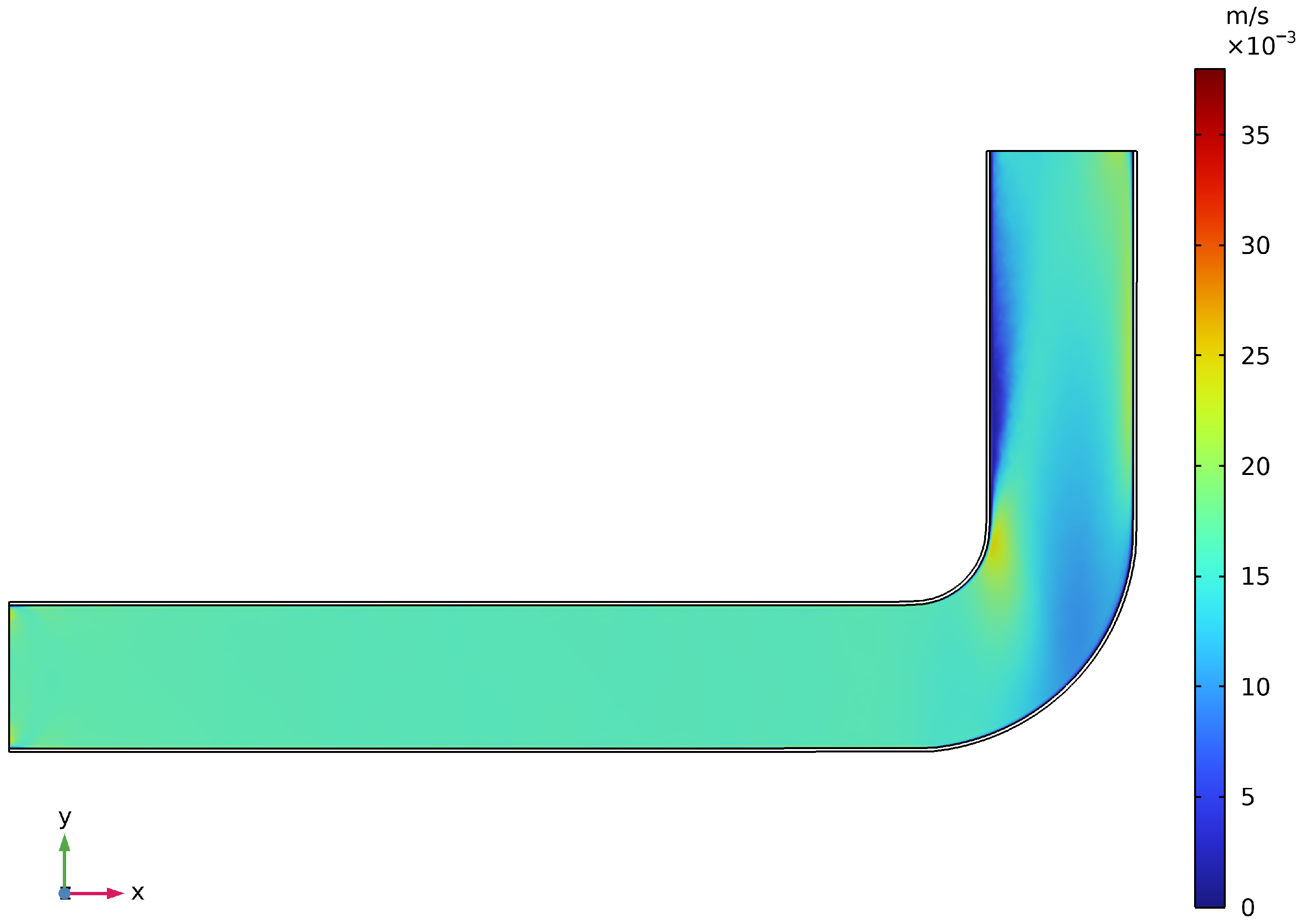
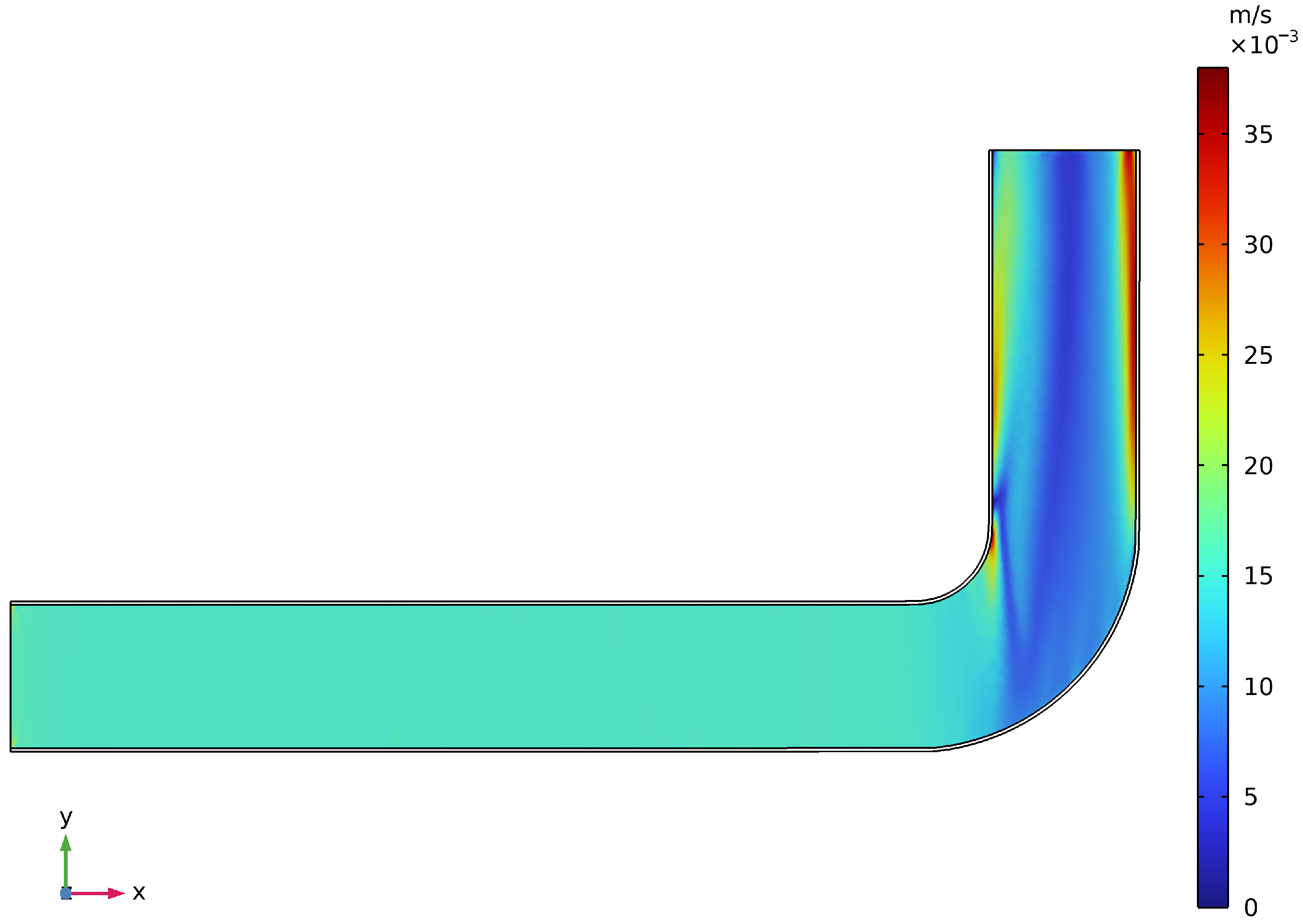
Figure 6 shows the velocity magnitude distribution for
T. Compared with the purely hydrodynamic laminar case, the velocity field already shows noticeable modifications due to Lorentz forces. The core region becomes partially flattened and momentum is redistributed across the bend. In particular, the separation region near the inner wall is displaced and the vertical section shows the onset of magnetic-induced stratification. Although electromagnetic effects are already visible, inertia still plays an important role in the flow dynamics.
At the intermediate magnetic field intensity,
T (
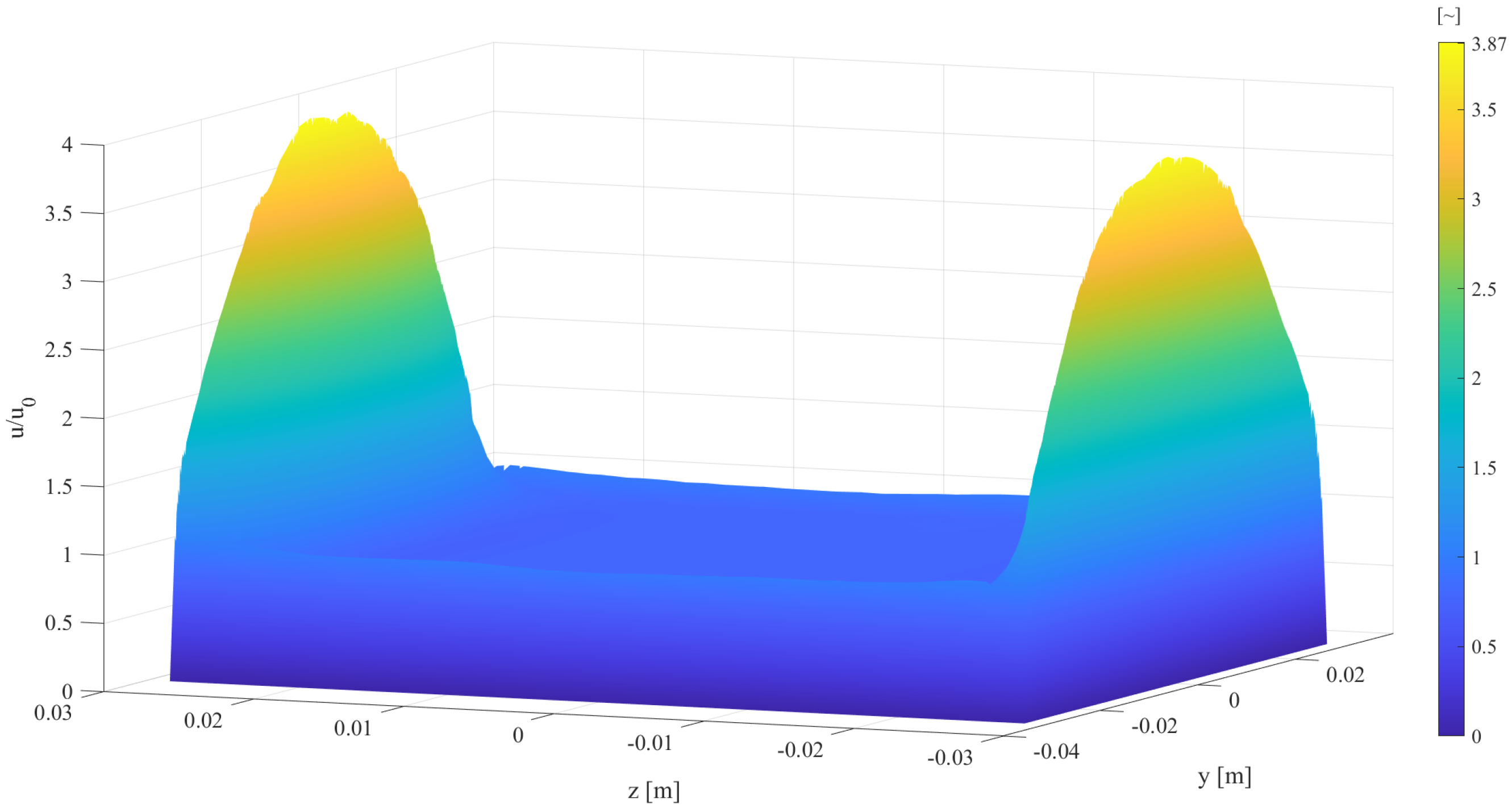
Figure 7), MHD effects become dominant and strongly modify the velocity field. The bulk flow is significantly braked, producing a reduced core velocity and a flatter profile in the horizontal section, while localized acceleration regions develop near the walls. It should be noted that a classical no-slip boundary condition was imposed on all solid walls in the FEM simulations, therefore the velocity is strictly zero at the boundaries. The apparent acceleration observed near the walls corresponds to the typical M-shaped velocity profile of MHD duct flows under a transverse magnetic field, where Lorentz forces brake the core flow while local velocity maxima develop within the thin boundary layers adjacent to the walls before decreasing to zero at the wall (see
Figure 8).
Flow separation in the bend is largely suppressed, and the velocity field becomes increasingly organized by the balance between inertial, viscous and electromagnetic forces.
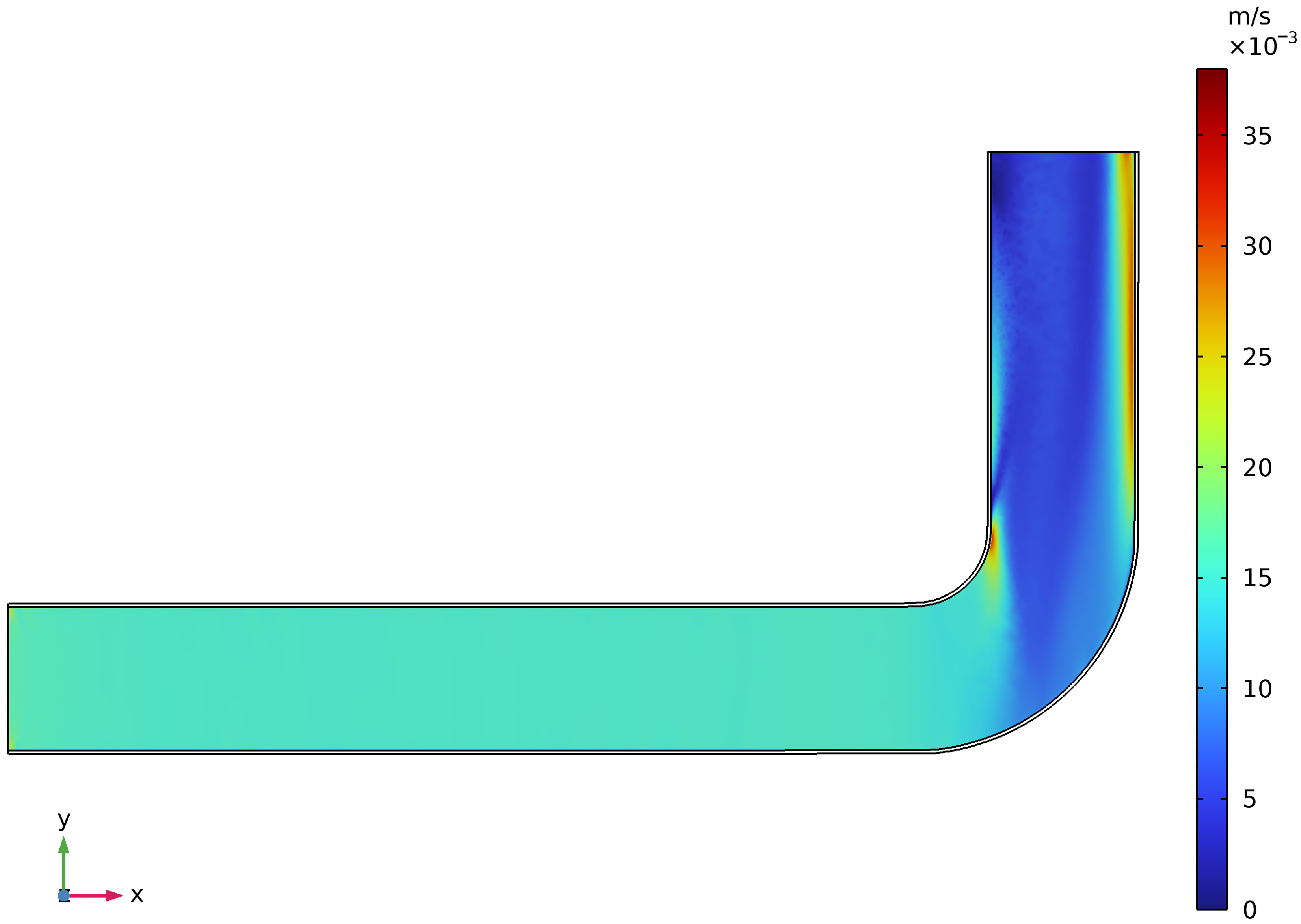
For the highest magnetic field intensity considered,
T (
Figure 9), the flow is strongly controlled by electromagnetic effects. The velocity field shows pronounced acceleration near the inner wall of the bend and a confined region of reduced velocity. While the horizontal tract remains nearly uniform, the vertical tract develops a narrow central region of decelerated fluid with stronger wall-adjacent acceleration.
Overall, the three velocity maps show similar flow features across the investigated magnetic field range. In particular, acceleration near the inner wall of the bend becomes more pronounced as B increases, while the vertical section develops progressively stronger velocity gradients.
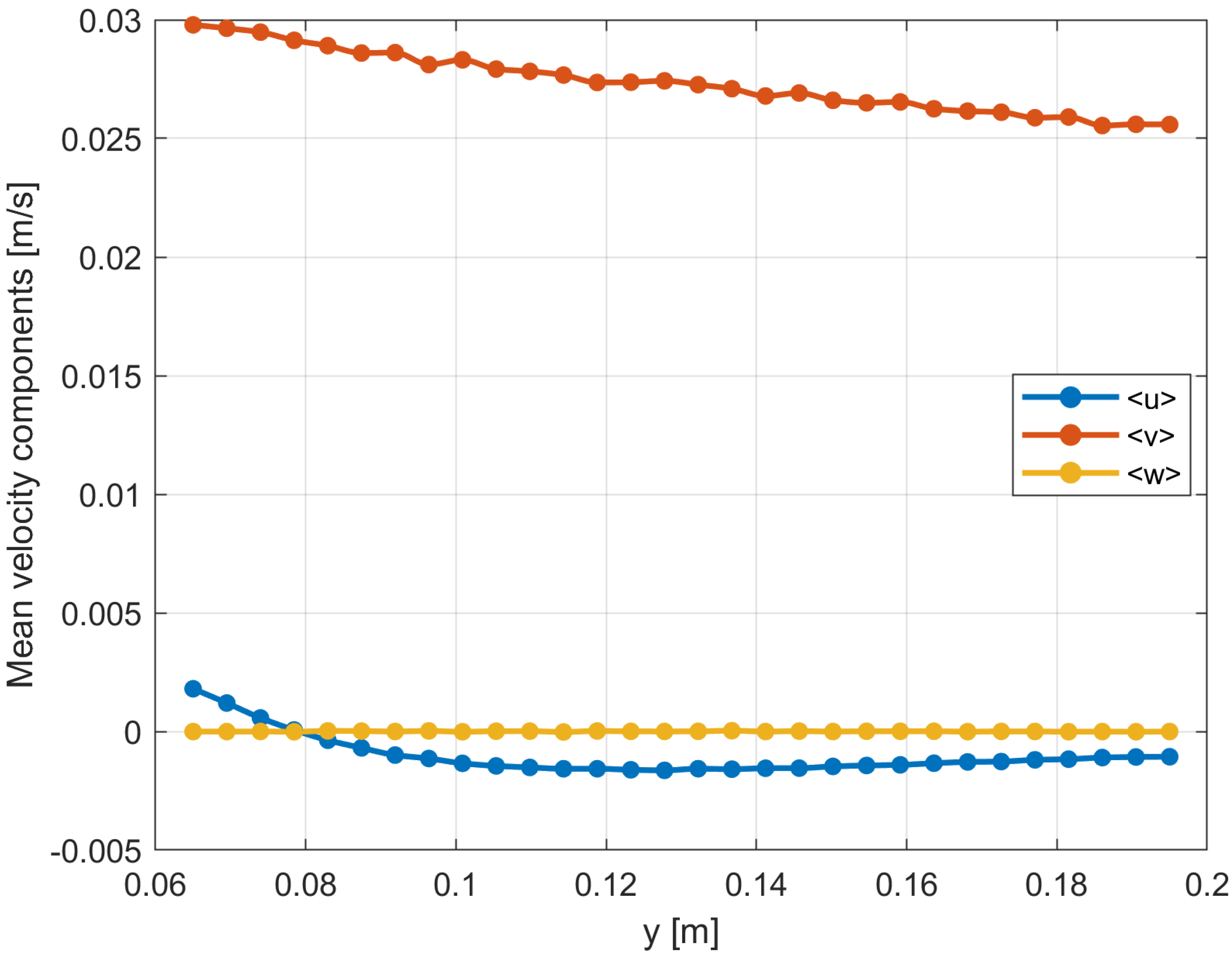
In
Figure 10, the mean velocity components
,
and
are plotted as functions of the vertical coordinate
y in the straight vertical tract downstream of the bend; to obtain the values of
,
and
, the vertical section was divided into 30
-planes, and the spatial averages of the velocity components
u,
v, and
w were extracted on each plane. It is worth noting that, on average, the velocity component along the
x-direction becomes negative in the vertical section, indicating a reversal of the flow direction due to the Lorentz force responsible for the formation of recirculation zones. This phenomenon can also be observed in
Figure 6,
Figure 7,
Figure 8 and
Figure 9: in all cases, a localized acceleration of the flow is observed near the outer wall of the vertical section downstream of the bend. This behavior can be explained considering that transverse velocity components arise due to the bend: the direction of the Lorentz force associated with these transverse velocity components is primarily directed along the
direction, lying in the
plane and therefore not aligned with the main flow direction in the vertical section. As a consequence, this force does not contribute directly to the pressure drop along the flow direction, but instead promotes a lateral redistribution of momentum that pushes the fluid toward the outer wall, leading to local flow acceleration and core deceleration. In fact,
Figure 10 clearly shows that the streamwise component
remains dominant with respect to the transverse components.
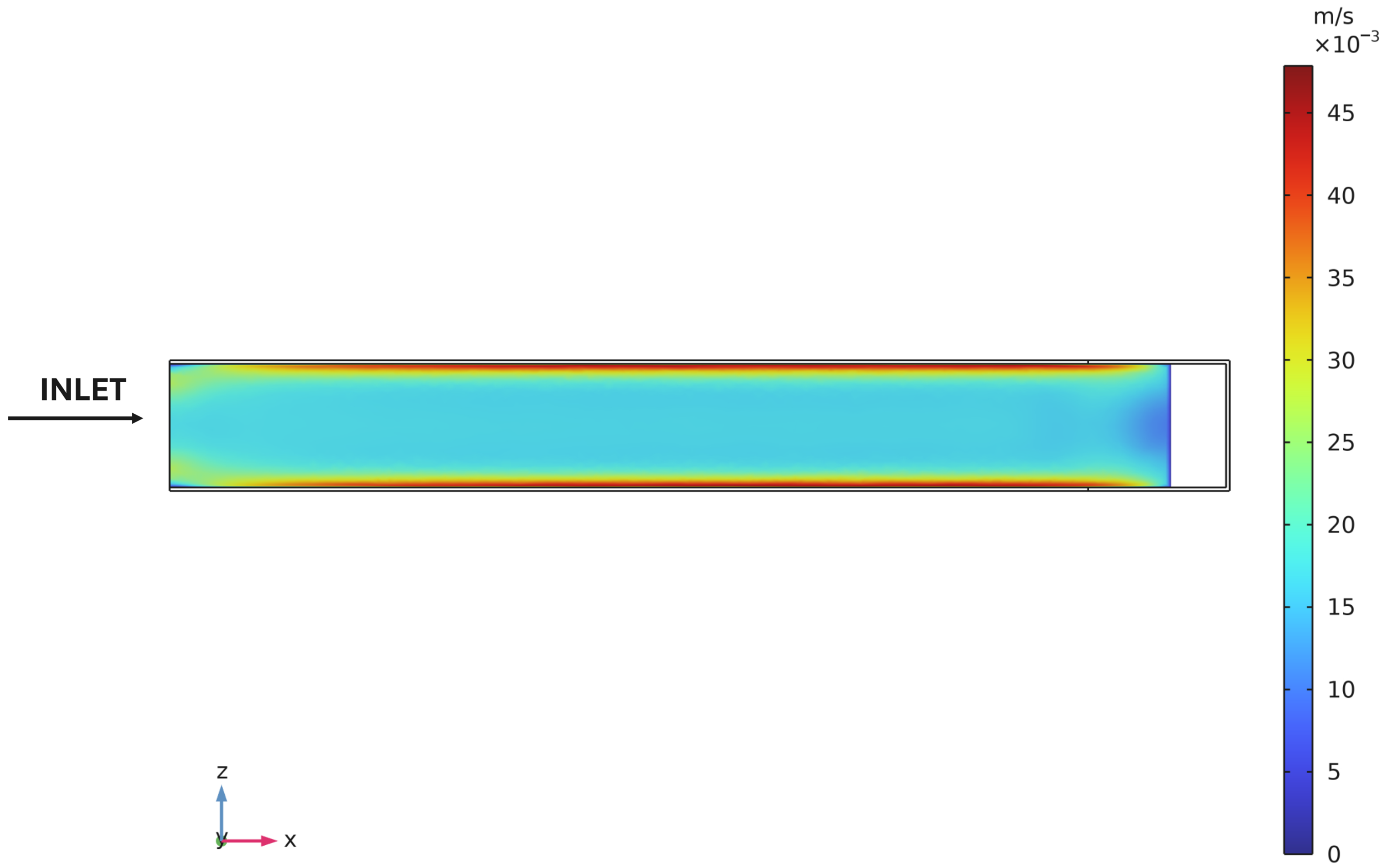
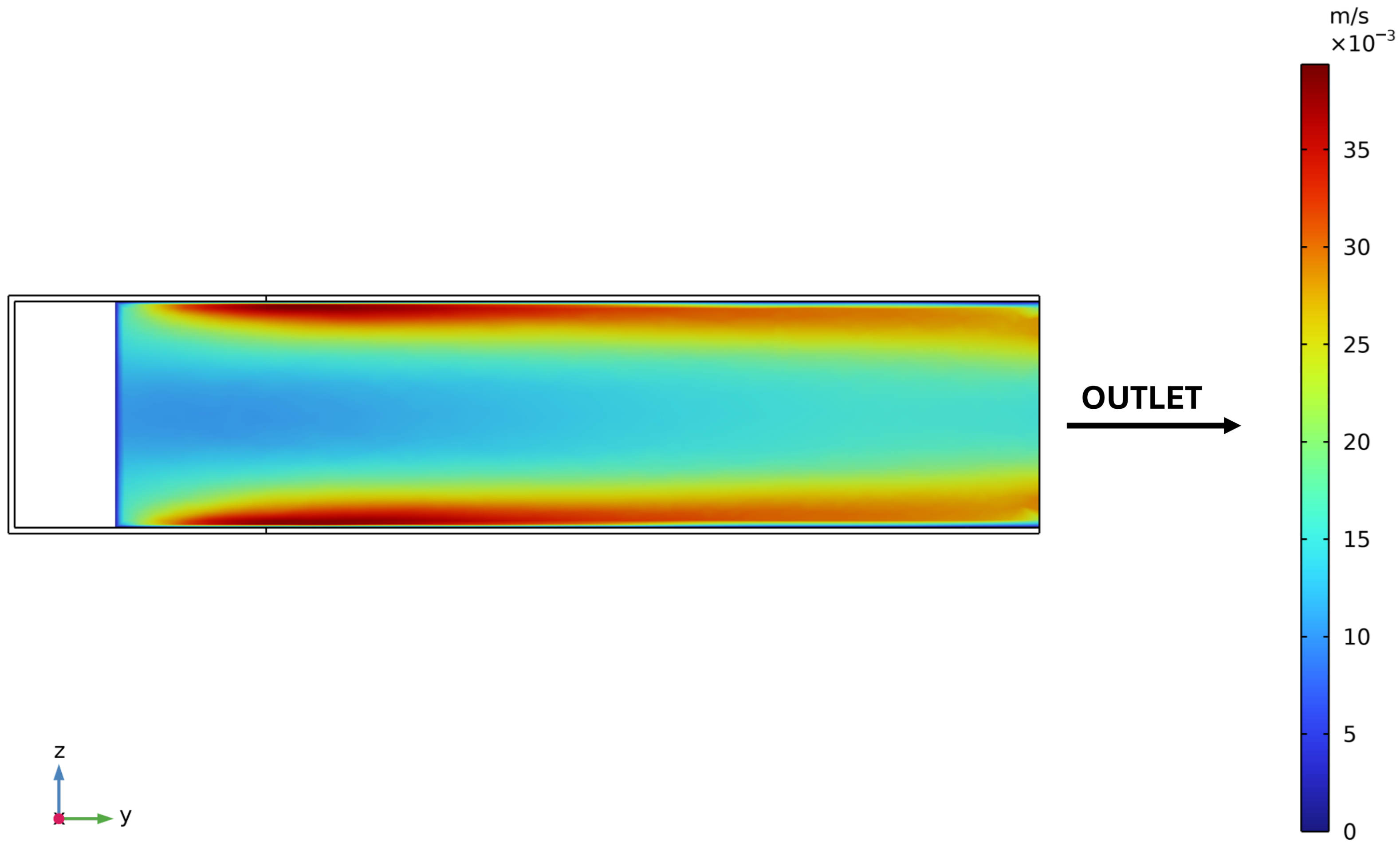
Figure 11 and
Figure 12 illustrate the velocity magnitude distribution on the
and
planes over the horizontal and vertical sections, respectively, for the case
T. In both planes, a braking effect is observed in the core region of the duct, while local accelerations develop within the near-wall layers. This flow organization is qualitatively consistent with the expected MHD behavior [
5,
6,
12], where the Lorentz force leads to a redistribution of momentum characterized by a reduced core velocity and enhanced wall velocities, in line with the physical assumptions underlying the analytical current distribution model.
5.2. Comparison Between Analytical and Numerical Pressure Drop
The analytical predictions of the MHD-induced pressure drop are compared with the results obtained from CFD simulations over the entire range of magnetic field intensities investigated.
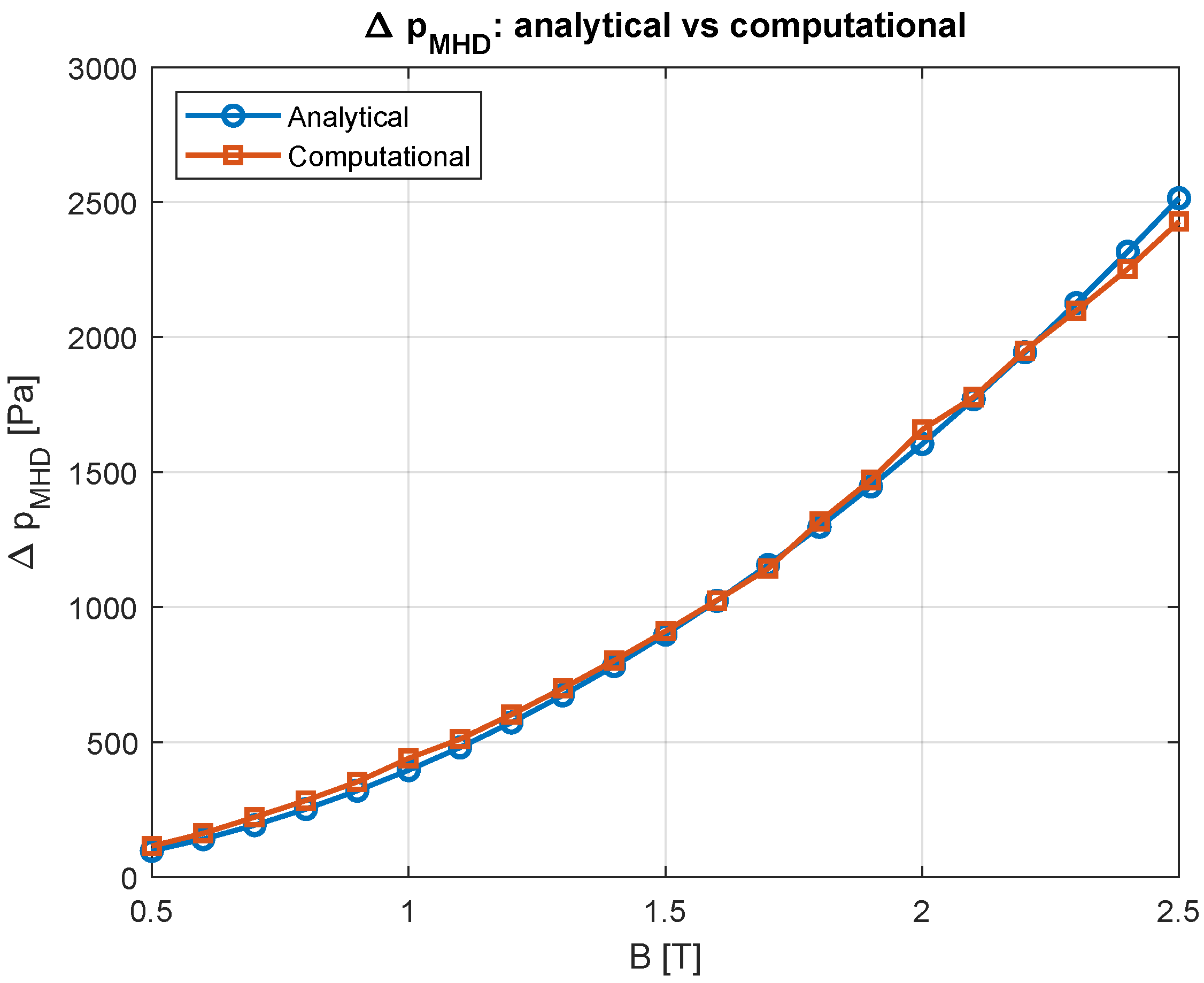
Figure 13 reports the total MHD pressure drop
as a function of the magnetic field intensity
B, as obtained from the analytical model and from numerical simulations.
Overall, the analytical model shows good agreement with the computational prediction of the MHD-induced pressure drop, capturing both the correct trend and the order of magnitude across the investigated magnetic-field range. A modest overestimation is observed at higher B, where the stronger electromagnetic effects promote more pronounced three-dimensional flow structures that are only partially represented by the simplifying assumptions of the analytical model.
At higher magnetic field intensities, pronounced velocity gradients and wall-localized acceleration effects are observed, particularly in the vertical section of the duct. In this region, the mean flow direction is approximately aligned with the imposed magnetic field, while non-negligible velocity components perpendicular to the magnetic field arise locally within the cross-section. As a consequence, the associated Lorentz force is mainly oriented in the transverse direction, consistently with classical MHD theory [
5,
12], and does not directly contribute to the streamwise pressure gradient.
This is also embedded in the analytical model, where only the main flow direction is considered, being known a priori. According to the analytical formulation, the MHD-induced pressure losses originate from the horizontal and curved sections of the duct, where velocity components perpendicular to the magnetic field are significant and generate a streamwise Lorentz-force contribution. Consequently, the vertical section is not explicitly included in the evaluation of the MHD-induced pressure drop.
To assess the possible contribution of this tract, the pressure variation along the vertical section was evaluated from the CFD simulations by comparing the area-averaged pressure immediately downstream of the bend with that at the outlet of the vertical duct. The resulting pressure variation remains of the order of Pa over the investigated magnetic field range, which is several orders of magnitude smaller than the total pressure drop along the duct. These results confirm that neglecting the pressure drop in the vertical section does not affect the overall result.
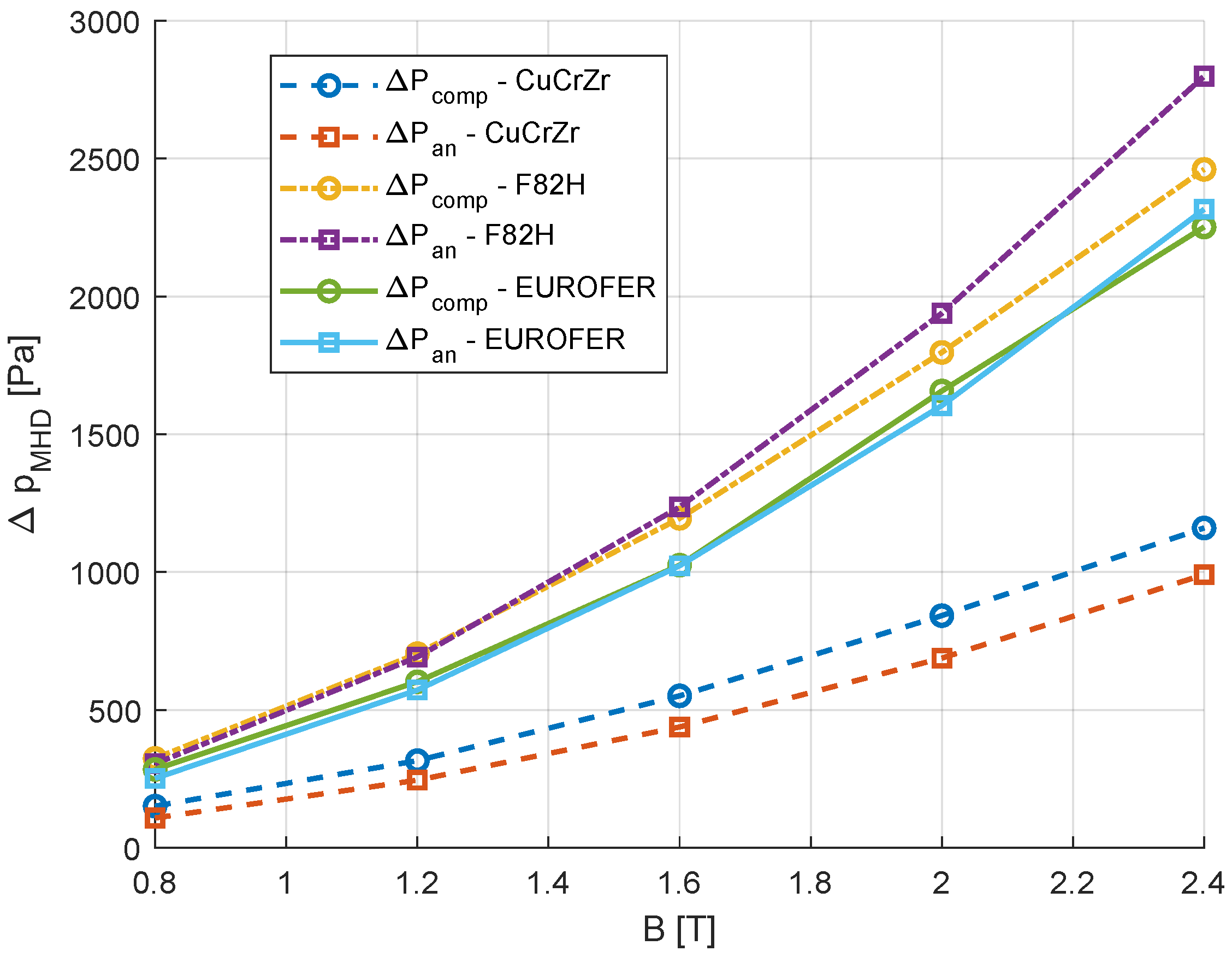
To further test the robustness of the analytical model, a sensitivity analysis for different wall electrical conductivities, i.e., different values of
, was also carried out. Changing the material of the duct to CuCrZr
or F82H
, the analytical predictions continue to follow the computational results as a function of the imposed magnetic field, see
Figure 14.
With respect to the comparison for a duct made of EUROFER, larger discrepancies are observed, although they are still acceptable for analytical estimates. Indeed, the maximum percentage errors for EUROFER, CuCrZr and F82H are 11.3%, 28.4% and 13.7%, respectively. Where the maximum percentage error for the CuCrZr corresponds to an absolute error of only .
These results confirm that the model can be employed for preliminary design phases, being reliable even when varying parameters such as the wall conductance ratio.
6. Conclusions
In this work, a numerical and analytical investigation of MHD-induced pressure drop in a Lead–Lithium flow through a rectangular duct subjected to a uniform magnetic field has been presented. A parametric analysis was carried out by varying the magnetic field intensity within a fixed range, allowing the characterization of the resulting pressure drop and flow structure.
The CFD simulations highlight a predictable strong dependence of the pressure drop on the magnetic field intensity, with Lorentz forces progressively dominating the flow dynamics as the interaction parameter increases. The numerical results also reveal characteristic flow features associated with curved geometries under MHD conditions, including localized acceleration near the duct walls and a redistribution of momentum between the core and near-wall regions.
An analytical model based on an equivalent electrical circuit representation of current redistribution over the duct cross-section has been developed to estimate the MHD-induced pressure drop. The analytical predictions are in good agreement with the computational results, reproducing both the overall trend and the correct order of magnitude of the pressure drop over the investigated range of magnetic field intensity. A slight overestimation is observed at higher values of B, likely related to the simplified assumptions adopted in the analytical formulation.
Overall, the proposed analytical formulation provides a practical and compact tool for estimating MHD-induced pressure losses in rectangular ducts representative of DCLL breeding blanket channels. Despite the simplifying assumptions adopted for the description of current paths and flow organization, the model is able to approximate the numerical results while requiring only limited computational effort. For this reason, it can be particularly suitable for preliminary design assessments and parametric studies, where rapid evaluations of MHD effects are needed. Future developments may focus on extending the present approach to different duct geometries and magnetic field configurations, e. g., spatially variable magnetic fields, in order to enhance its applicability to more realistic blanket layouts.




 ,
,