Brief Report

Progress in Industrialization of Tungsten Fiber-Reinforced Tungsten Composites

1
Forschungszentrum Jülich GmbH, Institute of Fusion Energy and Nuclear Waste Management, Plasma Physics IFN-1, 52428 Jülich, Germany
2
Dr. Fritsch Sondermaschinen GmbH, 70736 Fellbach, Germany
3
Department of Engineering Physics, University of Wisconsin-Madison, Madison, WI 53706, USA
4
Department of Materials, University of Oxford, Oxford OX1 3PH, UK
5
Max-Planck-Institut für Plasmaphysik, 85748 Garching, Germany
*
Author to whom correspondence should be addressed.
J. Nucl. Eng. 2026, 7(2), 24; https://doi.org/10.3390/jne7020024
Submission received: 13 October 2025 / Revised: 26 February 2026 / Accepted: 13 March 2026 / Published: 25 March 2026
(This article belongs to the Special Issue Fusion Materials with a Focus on Industrial Scale-Up)

Abstract

Plasma-facing materials (PFMs) for future fusion reactors require advanced mechanical and thermal properties to withstand the extreme challenges of high heat flux, plasma exposure, and neutron irradiation. Tungsten is one of the most suitable materials for use as a PFM in the divertor region. However, considering the high thermal loading/thermal stress combining plasma exposure and neutron irradiation/embrittlement, one of the major concerns for tungsten in PFMs is its intrinsic brittleness. To avoid cracking and components failure, tungsten toughening has been widely investigated, including the development of tungsten fiber-reinforced tungsten composites (Wf/W) using an extrinsic toughening mechanism, which could provide damage resilience against neutron embrittlement. Recently, a type of aligned long-fiber Wf/W (L-Wf/W) based on a powder metallurgical fabrication process was developed, demonstrating advanced fracture toughness while retaining other application-relevant properties. For L-Wf/W, the relatively easy production process suggests the feasibility and basis of industrialization. This work reports on the initial progress in industrializing L-Wf/W, with a focus on adapting the lab sintering process to a sintering process with industrial partner (Dr. Fritsch Sondermaschinen GmbH) and optimizing the process parameters. To improve the sinterability of tungsten and achieve higher density, various tungsten powders were explored, including commercial W powders, bimodal mixtures of different particle sizes, and granulated W powders. At the dedicated yttria interface, the thickness of yttria coating on the fibers was also optimized to ensure effective separation between the fibers and the matrix. Series of samples were produced with different dimensions up to 100 mm × 100 mm × 4 mm. After optimization, samples with 93% density and desired pseudo-ductility were prepared. Similarly to production in the lab, a major challenge in this work involved balancing the densification of the tungsten matrix with controlling fiber recrystallization and mitigating damage to the yttria interface.

1. Introduction

The development of high-performance plasma-facing materials (PFMs) is a critical aspect in enabling the long-term operation of future fusion power plants [1]. These materials must withstand not only extreme steady-state heat fluxes but also transient thermal loads, intensive plasma exposure, and high-energy neutron irradiation [2]. Tungsten (W) has been widely adopted due to its unique combination of properties: high melting point, excellent thermal conductivity, low sputtering yield, and low tritium retention. As such, tungsten is currently the baseline material for PFMs in the divertor region of future fusion reactors such as DEMO and ITER [3].
However, a major limitation of tungsten is its intrinsic brittleness, particularly under the coupled influence of heat flux, radiation-induced embrittlement, and mechanical stress. These conditions significantly increase the risk of crack formation and catastrophic failure during operation [4]. To overcome these challenges, various toughening strategies have been proposed, such as oxide/carbide particle dispersion-strengthened tungsten (ODS-W/CDS-W) alloys [5,6], tungsten heavy alloys (WHAs) [7], or W-Ta-Cr-V (tungsten–tantalum–chromium–vanadium) alloys [8]. Among them, tungsten fiber-reinforced tungsten composites (Wf/W) have emerged as a promising solution [9,10]. By applying extrinsic toughening mechanisms—such as crack deflection, fiber bridging, and energy dissipation at fiber/matrix interfaces—Wf/W can provide pseudo-ductile behavior even after neutron irradiation [11].
Recent developments have introduced a novel powder metallurgical approach to fabricate aligned long-fiber Wf/W composites (L-Wf/W), offering both high fracture toughness and compatibility with scalable manufacturing techniques [9]. Central to the effectiveness of these composites is the controlled introduction of a weak, thermally stable interface—typically realized with an yttria (Y2O3) coating—between the tungsten fibers and the tungsten matrix [12]. This interface is essential for activating extrinsic toughening mechanisms, particularly under neutron irradiation where fiber integrity and interface stability are critical for long-term performance [10].
Despite the proven performance of L-Wf/W in laboratory settings, the transition to industrial-scale production remains a major challenge. Issues such as powder handling, mold filling, sintering parameter control, and interface preservation must be addressed to ensure reproducibility, quality, and cost-efficiency at larger scales.
This paper briefly presents the initial progress in scaling up the fabrication of L-Wf/W composites from the laboratory to industrial process. It focuses on the adaptation of the field-assisted sintering technology (FAST) process to larger formats, the optimization of tungsten powder characteristics, the engineering of fiber–matrix interfaces, and the production of large composite samples with densification and damage resilience that lab-scale samples provided.

2. Experimental Section

2.1. Sample Manufacturing

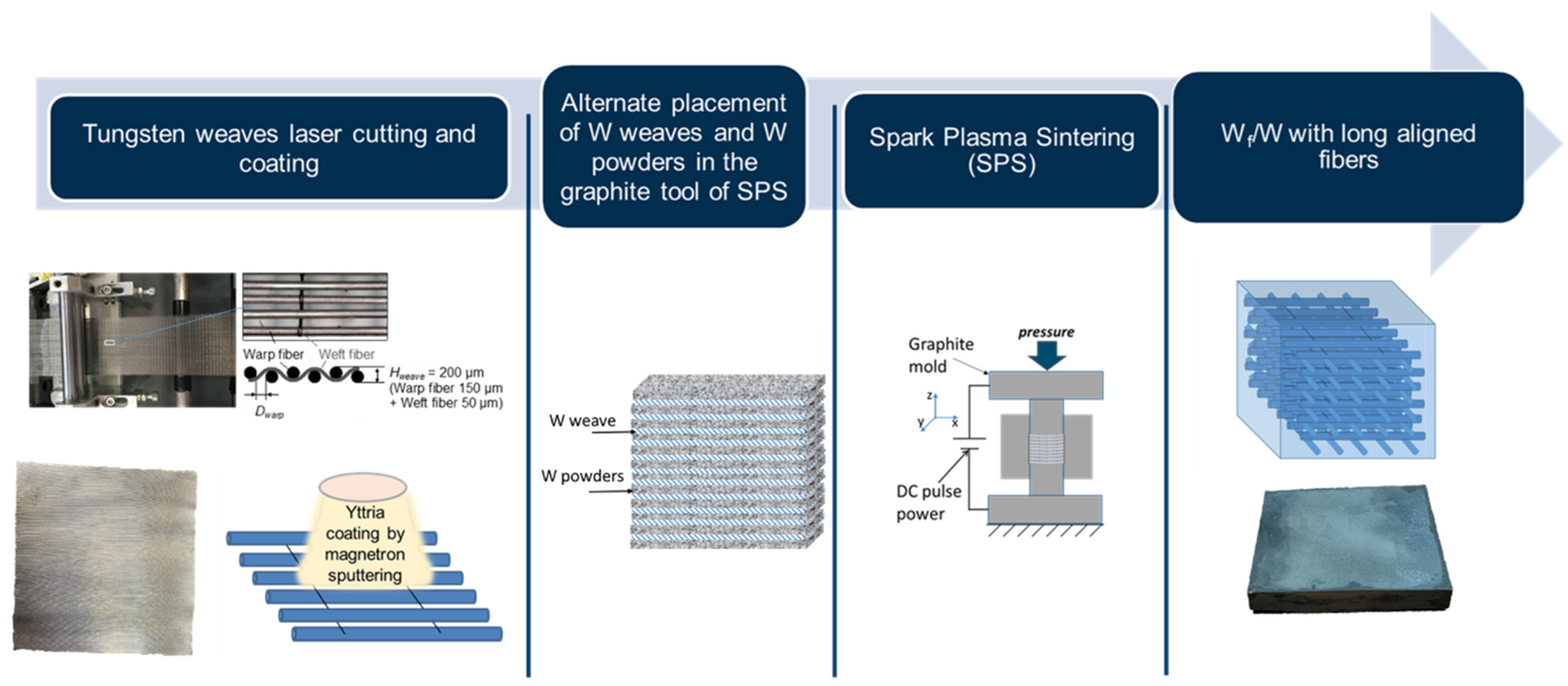
The preparation method for the upscaling process of L-Wf/W is shown in Figure 1, which is adapted from the method described in [9]. The raw materials used were W weaves and W powders (at Dr. Fritsch Sondermaschinen GmbH). The tensile strength of the tungsten wire used was up to 3000 MPa with a fracture strain above 3% [13]. The W weaves were woven by the institute of Textile Technology (ITA), RWTH Aachen University, Germany, using wrap wires with a 150 µm diameter and weft wires with a 50 µm diameter [9]. The W weaves were designed with a wrap fiber spacing of 200 µm for mechanical reinforcement, while the weft fibers, spaced at 2 mm, served primarily to stabilize the weave. The W weaves were cut into a square with a side length of 50 mm.
To establish a fiber/matrix interface, the weaves were coated with yttrium oxide (yttria). Yttria is used here as the interface material due to its excellent thermal and chemical stability and low neutron activation [14]. The coating was applied using a magnetron sputtering process with a thickness of 1 µm or 4 µm using a PVD process similar to that in [9].
A total of 20 layers of coated W weaves were alternated with 21 layers of W powders in a graphite sintering mold. Approximately 4 g of W powder was evenly spread between each layer of W weave to cover the weave surface during packing. The weave layers were orientated in such a way that each layer was perpendicular to the next layer, resulting in a 0–90 ° fiber orientations. In this way, the composites have two-directional reinforcement.
The consolidation of the stacked green body was performed with a FAST facility from industrial partner Dr. Fritsch Sondermaschinen GmbH. The process was carried out under vacuum (<0.1 mbar) with a heating speed of 100 °C/min. The specific production parameters are shown in Table 1. Square samples were produced as a result using the Tri-Force system from Dr. Fritsch Sondermaschinen GmbH [15].

2.2. Characterization

To investigate the fracture behavior under different production conditions, in situ 3-point bending tests were conducted. The test specimens were prepared following EU standards DIN EN ISO 148-1 and 14556: 2006–2010 [16]. Small-sized specimens with KLST geometry were fabricated with dimensions of 27 mm × 3 mm × 4 mm (length × width × thickness), a span of 25 mm, a 1 mm V-notch depth, and a 0.1 mm notch root radius. The specimens were cut using electrical discharge machining (EDM) without any additional surface or notch treatments. The 3-point bending tests were performed using an Instron 3342 universal testing machine 2810-400 (Instron GmbH, Darmstadt, Germany) at a constant testing speed of 1 µm/s.
The microstructure of the Wf/W was analyzed with a Zeiss LEO 982 scanning electron microscope (SEM, Jena, Germany). The density of the samples was measured using Archimedes’ principle.

3. Results and Discussion

3.1. Powders and Weaves

In the first batch (Sample Nos. 1–3), we evaluated different tungsten powder types, varying in average particle size from 3 µm and 5 µm to 6 µm. As shown in Table 1, the resulting sample densities were ~87–90%, comparable among all three powders, indicating that the origin and minor variations in particle size had limited influence on densification under the applied parameters. However, during the sintering process at 50 MPa, severe damage to the graphite die tools was observed due to stress localization. This was attributed to the non-planarity of the tungsten weaves, which hindered homogeneous powder distribution and introduced local compaction gradients.
To mitigate these issues, the second batch (Sample Nos. 4–6) employed flatter, re-engineered weaves. A moderate pressure of 45–60 MPa was applied, successfully avoiding tool damage. This modification enabled the production of larger samples (up to 100 mm × 100 mm × 4 mm) and improved the achievable density to a maximum of ~93% (Sample No. 4), particularly when increasing both pressure and holding time during sintering.
Monolithic tungsten plasma-facing components typically require >98% density to maximize thermal conductivity. However, Wf/W composites follow a different design principle, where fracture resistance relies on extrinsic toughening mechanisms such as crack deflection and fiber pull-out. These mechanisms require a controlled weak interface. Excessive densification conditions, while beneficial for reducing residual porosity, can degrade the yttria interface and promote fiber recrystallization, thereby suppressing pseudo-ductility. In this study, ~93% density provided the balance between matrix consolidation and interface functionality. However, lower density may reduce thermal conductivity and influence retention behavior. Future work will focus on further increasing densification while preserving pseudo-ductile behavior through optimized sintering parameters and powder selection.

3.2. Interface and Mechanical Properties

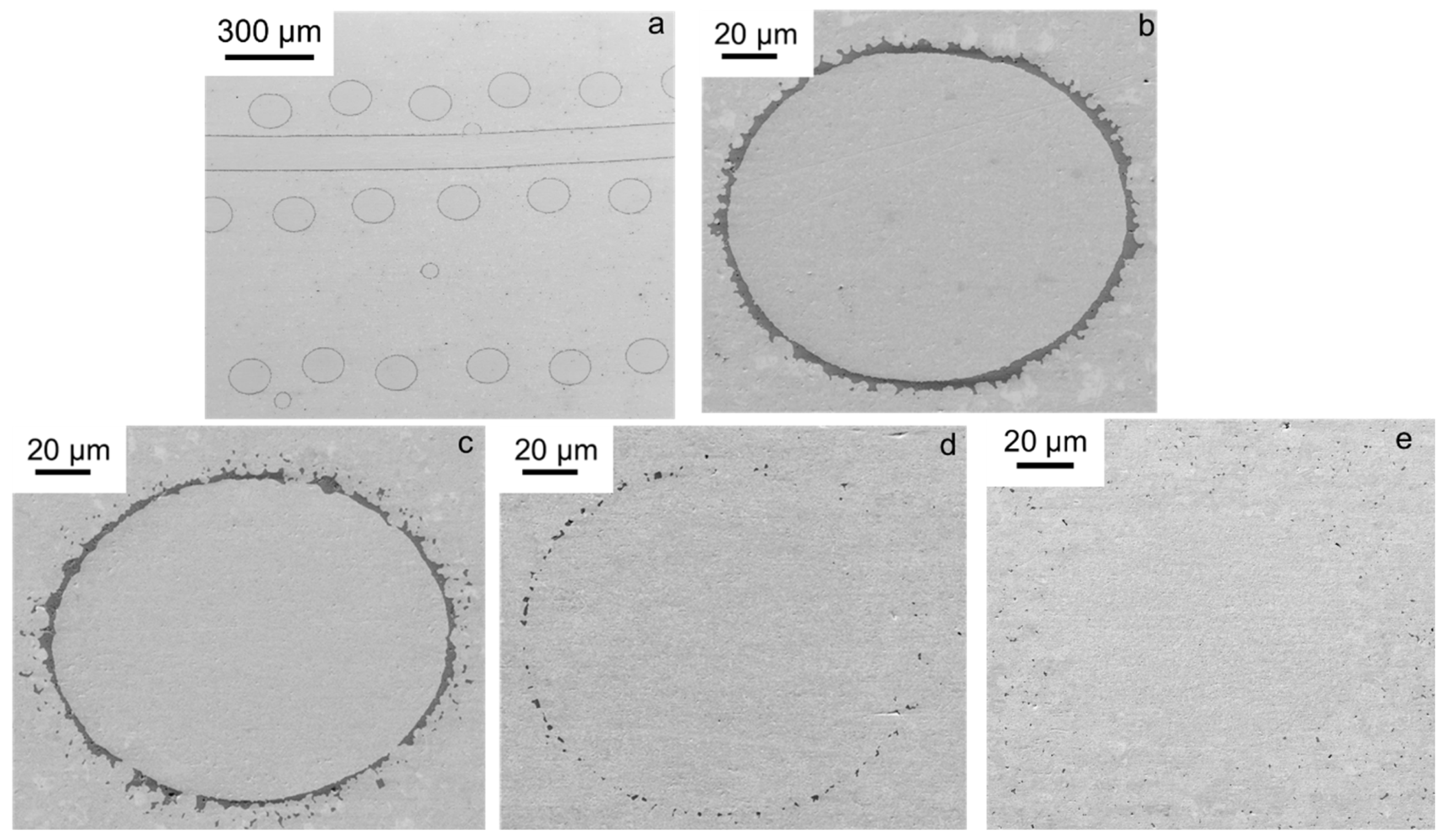
The integrity of the fiber/matrix interface is critical for the activation of extrinsic toughening mechanisms in Wf/W composites. SEM analysis (Figure 2) revealed significant differences in interface preservation across the samples. Sample Nos. 1 and 2, sintered at lower pressure and with thinner yttria coating (1 µm), exhibited almost complete loss of the interfacial layer. In contrast, Samples Nos. 4 and 5—processed using thicker yttria coatings (4 µm)—retained a distinguishable interface.
Notably, 5 µm powders demonstrated improved interface preservation compared to the Dr. Fritsch powders if we compare the fiber interface region of Sample No. 4 to No. 5 and Sample No. 1 to No. 2 (Figure 2b–e). This could be due to the fine powders being more aggressive to the interface layers [17]. Fine powders can significantly influence the interaction at the interface during high-temperature sintering, and subsequently the mechanical response [18].
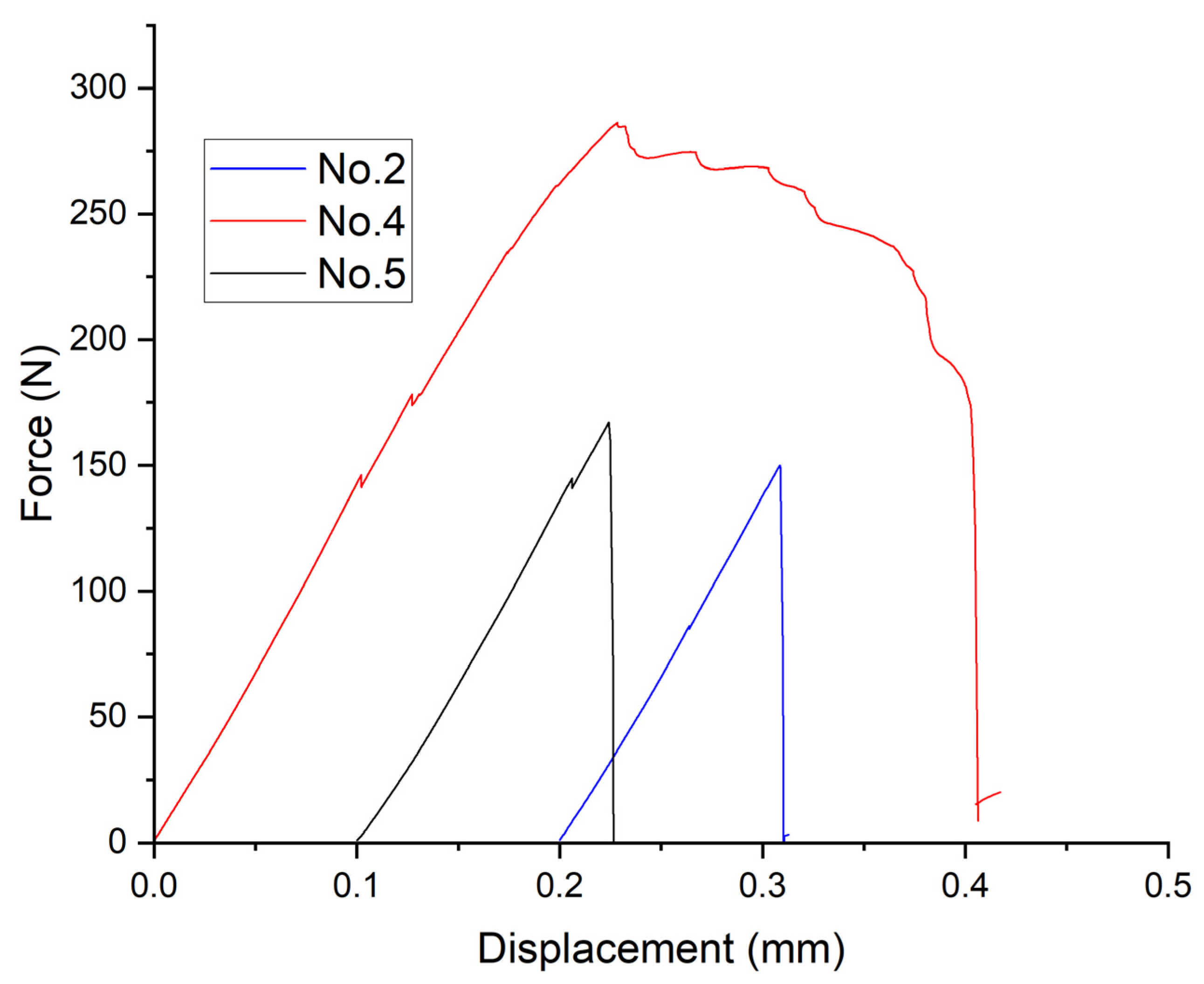
Three-point bending tests were performed to assess the pseudo-ductile behavior of the samples (Figure 3). Among all samples, as also indicated in Table 1, only Sample No. 4 showed signs of pseudo-ductility. All other samples exhibited limited damage tolerance, primarily characterized by limited loading capability after matrix failure.
The suboptimal performance of most samples can be attributed to two dominant factors: (i) degradation or loss of the interfacial layer, particularly in samples with thinner yttria coatings; and (ii) fiber embrittlement caused by recrystallization and grain growth (due to inadequate protection from a damaged interface) and possibly by impurities in the industrial-grade processing (i.e., C) [19,20]. The increased C impurities have been confirmed using a combustion test after the sintering.
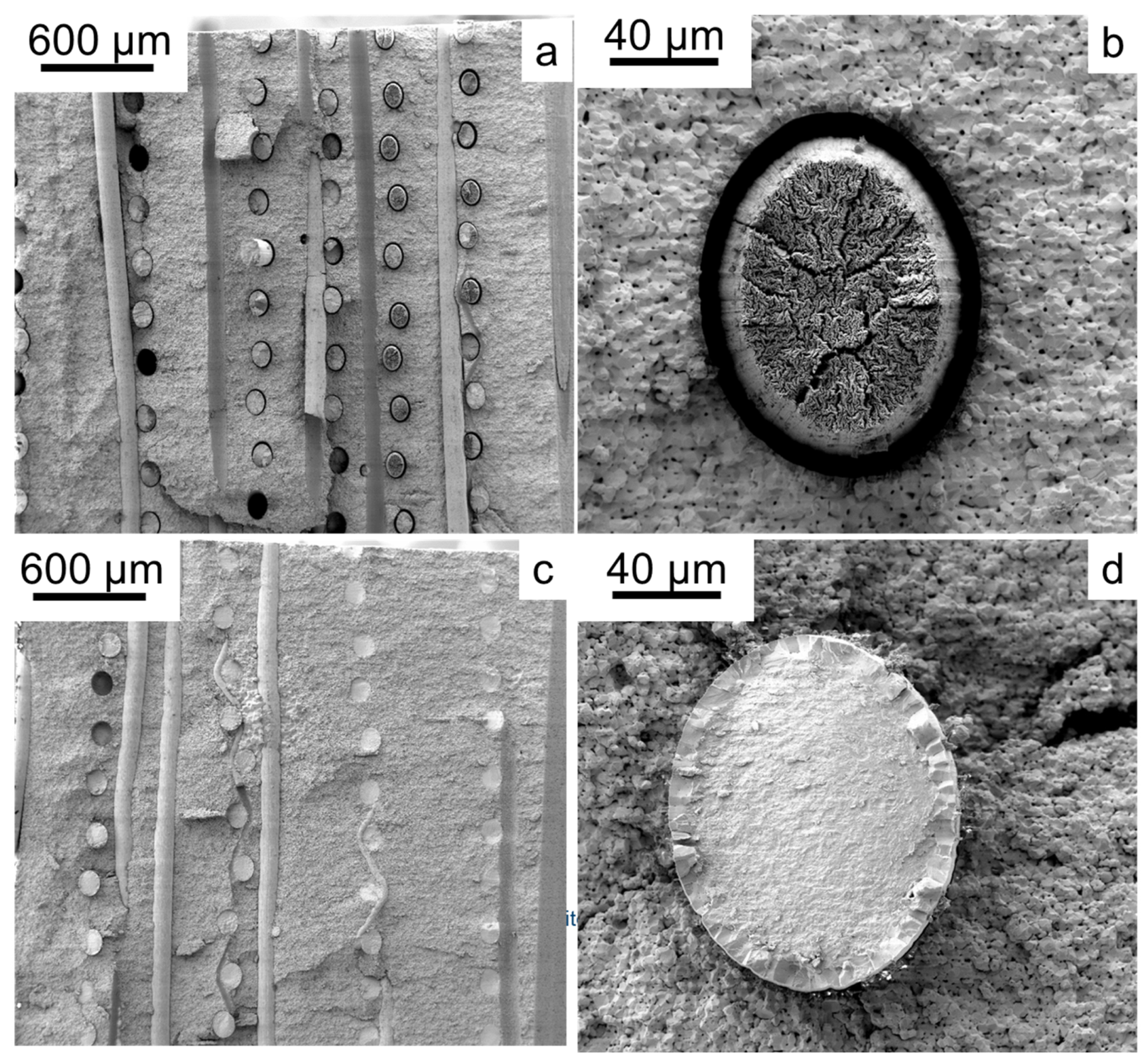
These observations are consistent with the fracture surface analysis (Figure 4), where Sample No. 4 still shows ductile fiber deformation and effective interface debonding. In contrast, Sample No. 5 primarily exhibits brittle fiber fractures, despite partial interface debonding. The outer shell of the fibers appears to have recrystallized [21].

4. Summary

The first attempt at industrial-scale production of L-Wf/W composites successfully demonstrated the feasibility of transferring lab-scale results to a larger manufacturing format. Comparable densification (~93%) and mechanical behavior were achieved using optimized processing parameters. Among the samples produced, Sample No. 4—manufactured with 5 µm powders and a 4 µm yttria interface—exhibited the most promising combination of high density and pseudo-ductile behavior. These developments mark a significant step toward the future application of Wf/W in fusion-relevant components:
  • The flatness of the tungsten weave strongly influences powder distribution and helps prevent tool damage during sintering.
  • Slight adjustments in powder particle size showed only a minor influence on the resulting sample density.
  • Finer powders exhibited increased aggressiveness toward the yttria interface, leading to its degradation and adversely affecting mechanical performance.
  • A thicker interface layer is essential for maintaining interfacial integrity during sintering and for enabling extrinsic toughening mechanisms such as fiber debonding and pull-out.
  • Fiber embrittlement, observed in some samples, may result from recrystallization due to insufficient interface protection and possible contamination from industrial powders. This requires further investigation.
  • Larger-format samples up to 100 mm × 100 mm × 4 mm were successfully fabricated, forming a solid foundation for further mechanical optimization and qualification under fusion-relevant testing conditions.

Author Contributions

Conceptualization, Y.M., J.W.C., and J.R.; methodology, Y.M., D.W., and U.W.; resources, J.W.C., U.W., and C.L.; writing—original draft, Y.M.; writing—review and editing, Y.M., J.W.C., U.W., and J.R.; supervision, J.W.C. and C.L.; project administration, U.W., D.W., and C.L. All authors have read and agreed to the published version of the manuscript.

Funding

This work has been carried out within the framework of the EUROfusion Consortium, funded by the European Union via the Euratom Research and Training Programme (Grant Agreement No. 101052200—EUROfusion).

Data Availability Statement

The original contributions presented in this study are included in the article. Further inquiries can be directed to the corresponding author.

Conflicts of Interest

Author Ute Wilkinson was employed by the company Dr. Fritsch Sondermaschinen GmbH. The remaining authors declare that the research was conducted in the absence of any commercial or financial relationships that could be construed as a potential conflict of interest.

References

  1. Bolt, H.; Barabash, V.; Federici, G.; Linke, J.; Loarte, A.; Roth, J.; Sato, K. Plasma facing and high heat flux materials—Needs for ITER and beyond. J. Nucl. Mater. 2002, 307–311, 43–52. [Google Scholar] [CrossRef]
  2. Coenen, J.W.; Antusch, S.; Aumann, M.; Biel, W.; Du, J.; Engels, J.; Heuer, S.; Houben, A.; Hoeschen, T.; Jasper, B.; et al. Materials for DEMO and reactor applications—Boundary conditions and new concepts. Phys. Scr. 2016, 2016, 014002. [Google Scholar] [CrossRef]
  3. Philipps, V. Tungsten as material for plasma-facing components in fusion devices. J. Nucl. Mater. 2011, 415, S2–S9. [Google Scholar] [CrossRef]
  4. Pintsuk, G.; Bobin-Vastra, I.; Constans, S.; Gavila, P.; Rödig, M.; Riccardi, B. Qualification and post-mortem characterization of tungsten mock-ups exposed to cyclic high heat flux loading. Fusion Eng. Des. 2013, 88, 1858–1861. [Google Scholar] [CrossRef]
  5. Kim, Y.; Lee, K.H.; Kim, E.-P.; Cheong, D.-I.; Hong, S.H. Fabrication of high temperature oxides dispersion strengthened tungsten composites by spark plasma sintering process. Int. J. Refract. Met. Hard Mater. 2009, 27, 842–846. [Google Scholar] [CrossRef]
  6. Iveković, A.; Kocen, M.; Jenuš, P.; Abram, A.; Donik, Č.; Novak, S. Insights into microstructural evolution of tungsten-tungsten carbide plasma facing composite materials prepared by field assisted sintering technique. Int. J. Refract. Met. Hard Mater. 2023, 115, 106301. [Google Scholar] [CrossRef]
  7. Neu, R.; Maier, H.; Balden, M.; Elgeti, S.; Gietl, H.; Greuner, H.; Herrmann, A.; Houben, A.; Rohde, V.; Sieglin, B.; et al. Investigations on tungsten heavy alloys for use as plasma facing material. Fusion Eng. Des. 2017, 124, 450–454. [Google Scholar] [CrossRef]
  8. Yoo, Y.; Zhang, X.; Wang, F.; Chen, X.; Li, X.-Z.; Nastasi, M.; Cui, B. Spark plasma sintering of tungsten-based WTaVCr refractory high entropy alloys for nuclear fusion applications. Int. J. Miner. Metall. Mater. 2024, 31, 146–154. [Google Scholar] [CrossRef]
  9. Mao, Y.; Coenen, J.W.; Liu, C.; Terra, A.; Tan, X.; Riesch, J.; Höschen, T.; Wu, Y.; Broeckmann, C.; Linsmeier, C. Powder metallurgy produced aligned long tungsten fiber reinforced tungsten composites. J. Nucl. Eng. 2022, 3, 446–452. [Google Scholar] [CrossRef]
  10. Mao, Y.; Coenen, J.; Riesch, J.; Sistla, S.; Almanstötter, J.; Jasper, B.; Terra, A.; Höschen, T.; Gietl, H.; Linsmeier, C.; et al. Influence of the interface strength on the mechanical properties of discontinuous tungsten fiber-reinforced tungsten composites produced by field assisted sintering technology. Compos. Part A Appl. Sci. Manuf. 2018, 107, 342–353. [Google Scholar] [CrossRef]
  11. Riesch, J.; Zinovev, A.; Gaganidze, E.; Ries, H.; Höschen, T.; Gietl, H.; Mao, Y.; Coenen, J.W.; Terentyev, D.; Neu, R. Effect of neutron irradiation on the fracture behaviour of tungstenfibre-reinforced tungsten composites. J. Nucl. Mater. 2025, under review. [Google Scholar]
  12. Mao, Y.; Engels, J.; Houben, A.; Rasinski, M.; Steffens, J.; Terra, A.; Linsmeier, C.; Coenen, J. The influence of annealing on yttrium oxide thin film deposited by reactive magnetron sputtering: Process and microstructure. Nucl. Mater. Energy 2017, 10, 1–8. [Google Scholar] [CrossRef]
  13. Riesch, J.; Almanstötter, J.; Coenen, J.W.; Fuhr, M.; Gietl, H.; Han, Y.; Höschen, T.; Linsmeier, C.; Travitzky, N.; Zhao, P.; et al. Properties of drawn W wire used as high performance fibre in tungsten fibre-reinforced tungsten composite. IOP Conf. Ser. Mater. Sci. Eng. 2016, 139, 012043. [Google Scholar] [CrossRef]
  14. Forrest, R.; Tabasso, A.; Danani, C.; Jakhar, S.; Shaw, A. Handbook of Activation Data Calculated Using EASY-2007; UKAEA FUS: Abingdon, UK, 2009; Volume 552, p. 399. [Google Scholar]
  15. Laptev, A.M.; Bram, M.; Garbiec, D.; Räthel, J.; van der Laan, A.; Beynet, Y.; Huber, J.; Küster, M.; Cologna, M.; Guillon, O. Tooling in Spark Plasma Sintering Technology: Design, Optimization, and Application. Adv. Eng. Mat. 2024, 26, 2301391. [Google Scholar] [CrossRef]
  16. Rieth, M.; Hoffmann, A. Influence of microstructure and notch fabrication on impact bending properties of tungsten materials. Int. J. Refract. Met. Hard Mater. 2010, 28, 679–686. [Google Scholar] [CrossRef]
  17. Mao, Y.; Coenen, J.W.; Riesch, J.; Sistla, S.; Chen, C.; Wu, Y.; Raumann, L.; Neu, R.; Linsmeier, C.; Broeckmann, C. Spark Plasma Sintering Produced W-Fiber-Reinforced Tungsten Composites. In Spark Plasma Sintering of Materials: Advances in Processing and Applications; Springer International Publishing: Cham, Switzerland, 2019; pp. 239–261. [Google Scholar]
  18. Shu, R.; Mao, Y.; Martinez-Pechero, A.; Coenen, J.W.; Terra, A.; Schönen, S.; Riesch, J.; Linsmeier, C.; Broeckmann, C. Study on the fracture behavior and toughening mechanisms of continuous fiber reinforced Wf/Y2O3/W composites fabricated via powder metallurgy. Compos. Part B Eng. 2024, 287, 111845. [Google Scholar] [CrossRef]
  19. Shu, R.; Mao, Y.-R.; Coenen, J.W.; Terra, A.; Schönen, S.; Riesch, J.; Linsmeier, C.; Broeckmann, C. Fabrication and fracture behaviors of the continuous brittle fiber reinforced tungsten composites fabricated via field-assisted sintering technology. Tungsten 2024, 7, 172–182. [Google Scholar] [CrossRef]
  20. Mao, Y.; Chen, C.; Coenen, J.W.; Riesch, J.; Sistla, S.; Almanstötter, J.; Terra, A.; Wu, Y.; Raumann, L.; Höschen, T.; et al. On the nature of carbon embrittlement of tungsten fibers during powder metallurgical processes. Fusion Eng. Des. 2019, 145, 18–22. [Google Scholar] [CrossRef]
  21. Shu, R.; Mao, Y.; Lau, A.; Coenen, J.W.; Terra, A.; Liu, C.; Riesch, J.; Linsmeier, C.; Broeckmann, C. Effect of the heating rate and Y2O3 coating on the microstructure of Wf/Y2O3/W composites via field assisted sintering technology. Nucl. Mater. Energy 2024, 38, 101602. [Google Scholar] [CrossRef]
Figure 1. Production process of Wf/W for production upscaling. Adapted from [9].
Jne 07 00024 g001
Figure 2. Typical microstructure: (a) overview of Sample No. 4; (b) fiber region of Sample No. 4; (c) fiber region of Sample No. 5; (d) fiber region of Sample No. 1; (e) fiber region of Sample No. 2.
Jne 07 00024 g002
Figure 3. Typical mechanical behavior of Sample No. 2, No. 4, and No. 5 with 3-point bending test on pre-notched KLST-type geometry (27 × 4 × 3 mm3); the displacement of curve No. 2 and No. 5 are shifted left to avoid curve overlap.
Jne 07 00024 g003
Figure 4. Fracture section of Sample No. 4 (a,b) and No. 5 (c,d) after 3-point bending test.
Jne 07 00024 g004
Table 1. Samples prepared for parameter and powder optimization.
Sample No.PowderTemperature (°C)Pressure (MPa)Holding Time (min)Density (%)Initial Yttria Interface Thickness (µm)Pseudo Ductility
1. 50 mm5 µm 1800505~90%1limited
2. 50 mm3 µm 1800455~88%1limited
3. 50 mm6 µm 1800455~87%1limited
4. 50 mm5 µm 18006010~93%4yes
5. 50 mmMixed 3 µm 6 µm, granulated, 18006010~92%4limited
6. 100 mmMixed 3 µm 6 µm, granulated, 18504510~90%4-
Disclaimer/Publisher’s Note: The statements, opinions and data contained in all publications are solely those of the individual author(s) and contributor(s) and not of MDPI and/or the editor(s). MDPI and/or the editor(s) disclaim responsibility for any injury to people or property resulting from any ideas, methods, instructions or products referred to in the content.