1. Introduction
Mental health is one of the key issues facing modern societies, and depressive disorders are among the most common and burdensome for individuals and healthcare systems [
1,
2]. Depression is associated not only with a reduced quality of life, but also with an increased risk of somatic diseases, absenteeism from work and premature mortality [
3,
4]. Therefore, identifying protective factors and mechanisms that promote mental well-being remains one of the main challenges of contemporary scientific research. The literature on the subject pays particular attention to physical activity as a potential factor promoting mental health [
5]. Regular physical activity is associated with improved mood, reduced emotional tension and a lower risk of depressive symptoms [
6,
7], and the proposed mechanisms of this effect include both neurobiological changes, such as neurotransmitter modulation or regulation of the hypothalamic–pituitary–adrenal axis, and psychosocial factors [
8,
9], including an increase in the sense of agency, competence and control over one’s own functioning.
At the same time, a growing number of studies indicate that the relationship between physical activity and depression is neither unambiguous nor linear [
10,
11]. The results of some analyses suggest that an increase in physical activity alone does not always translate into a significant reduction in depressive symptoms, especially in populations characterised by high psychological stress [
11]. This leads to the conclusion that physical activity may affect mental health in an indirect or conditional manner, depending on the presence of other psychosocial factors. One of the key factors considered in this context is psychological stress, which is considered one of the strongest predictors of mood disorders [
12]. Prolonged or intense exposure to stress promotes the development of depressive symptoms, negatively affects emotion regulation and weakens an individual’s adaptive abilities [
13]. On the other hand, physical activity is often cited as an effective tool for reducing stress, suggesting the existence of a potential mediating mechanism in which stress mediates the relationship between physical activity and the severity of depressive symptoms [
14].
An important but still insufficiently explored aspect of this issue is the influence of sociodemographic factors, such as occupation, place of residence or life situation, which can modify both the level of stress and the availability and effectiveness of physical activity as a health resource [
15,
16,
17]. The environmental and professional context can determine both exposure to stressors and opportunities for regular physical activity, which in turn affects mental health [
18]. An additional methodological challenge is the fact that variables such as the level of physical activity or the severity of depressive symptoms are often characterised by skewed distributions, and the relationships between them may vary depending on the severity of symptoms [
19]. This limits the usefulness of analyses based solely on mean values and points to the need for approaches that capture the heterogeneity of effects, such as quantile regression [
20].
Despite the extensive literature on the relationship between physical activity and depressive symptoms, including the occurrence of pain, previous studies have largely focused on analyses based on mean values and have not sufficiently comprehensively considered the mechanisms mediating this relationship [
5,
11,
21]. In particular, there is a lack of studies that simultaneously treat psychological stress as a potential mediator, control for the influence of key sociodemographic factors within multivariate models, and analyse the variation in the effects of physical activity across the entire distribution of depressive symptom severity, rather than only at the level of mean values [
11]. Furthermore, there are few population studies that combine classical regression models with mediation analyses, quantile regression, and advanced interaction visualisations that capture the conditional and heterogeneous nature of the relationship between physical activity, stress, and depression [
19].
Additionally, a significant but still insufficiently explored gap remains in the limited number of studies focusing exclusively on the adult female population, even though the available data clearly indicate significant gender differences in the perception of stress, the prevalence of depressive symptoms and patterns of physical activity. Ignoring this specificity may lead to an incomplete understanding of the mechanisms underlying the relationship between these variables [
22,
23,
24].
Therefore, the aim of this study was to assess the relationship between physical activity levels and the severity of depressive symptoms in adult women, taking into account the mediating role of stress and the influence of selected sociodemographic factors. An additional objective was to determine whether the relationships between physical activity, stress and depression are homogeneous across the entire distribution of variables or whether they differ depending on the severity of depressive symptoms.
The hypothesis was that higher levels of physical activity are associated with lower severity of depressive symptoms and lower levels of stress, while assuming that stress is positively associated with the severity of depression and acts as a mediator in the relationship between physical activity and depressive symptoms. It was also assumed that, after taking into account sociodemographic factors, physical activity is not a significant independent predictor of depression, and its effect varies depending on the level of stress and the overall severity of depressive symptoms, with the protective effect being more pronounced in the lower and middle ranges of the symptom distribution than in its upper quantiles.
2. Results
Table 1 summarises perceived stress, depressive symptom severity (BDI), and physical activity (IPAQ) across selected sociodemographic factors. No missing data were observed in the final analytical dataset.
No significant differences were found between age groups in terms of stress levels (H = 2.41;
p = 0.49; η
2H = 0.01), severity of depressive symptoms (H = 1.96;
p = 0.58; η
2H < 0.01) or IPAQ physical activity level (H = 3.12;
p = 0.37; η
2H = 0.01) (
Table 1). In all age groups, the medians of the variables studied remained at a similar level, and the effect sizes indicated that age was of little practical significance as a differentiating factor. Significant differences between occupational groups were found for all variables analysed. Stress levels differed significantly between groups (H = 11.82;
p = 0.019; η
2H = 0.06), as did the severity of depressive symptoms (H = 13.47;
p = 0.009; η
2H = 0.07) and the IPAQ physical activity level (H = 10.96;
p = 0.027; η
2H = 0.05). Post hoc analysis showed that people in care and service professions had significantly higher levels of stress and higher rates of depressive symptoms compared to those in manual labour and those classified as ‘other’. In turn, the highest level of physical activity was recorded in the group performing physical work, significantly higher than in the group of economically inactive persons and those working in care and service professions. Significant differences were found between the groups distinguished by place of residence in terms of stress levels (H = 14.23;
p = 0.003; η
2H = 0.07), severity of depressive symptoms (H = 15.61;
p = 0.001; η
2H = 0.08) and IPAQ physical activity (H = 12.87;
p = 0.005; η
2H = 0.06). Post hoc analysis showed that people living in medium-sized cities (50,000–500,000 inhabitants) had significantly higher levels of stress and depression compared to people living in rural areas and smaller towns. The highest level of physical activity was recorded among rural residents, while the lowest was in the group of people living in large cities (>500,000).
Table 2 presents the results of the mediation analysis, which showed a significant indirect effect of physical activity on the severity of depressive symptoms through the effect of physical activity on stress levels (β = −0.08; 95% CI: −0.15 to −0.02). The direct effect of physical activity on the severity of depressive symptoms, after taking into account the mediator, did not reach statistical significance, which indicates full mediation of stress in the analysed model. For better understanding,
Figure 1 graphically presents a mediation model illustrating the relationship between physical activity (IPAQ), perceived stress and depressive symptoms (BDI).
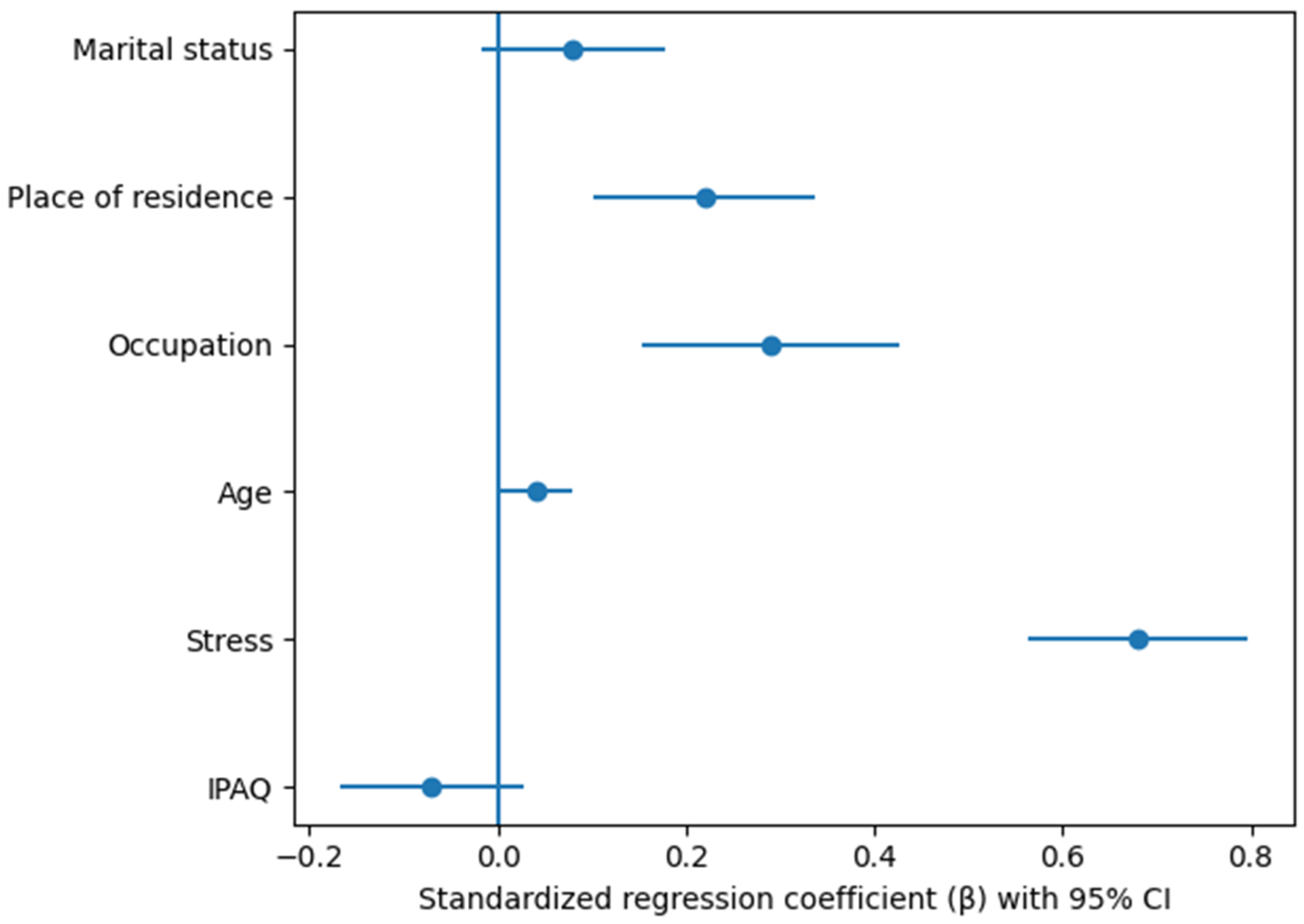
Figure 2 presents standardised regression coefficients (β) with 95% confidence intervals for predictors of the severity of depressive symptoms measured by the Beck Depression Scale. The regression model was statistically significant and characterised by a moderate fit to the data (R
2 = 0.22; R = 0.47;
p < 0.001), indicating that the predictors included explained approximately 22% of the variance in the severity of depressive symptoms.
The strongest predictor of depression was the level of perceived stress, which showed a significant positive correlation with the overall indicator of depressive symptom severity (β = 0.68), with the confidence interval not including zero. This result indicates a strong and independent relationship between stress and depressive symptom severity. Moderate positive β values were also recorded for occupation (β = 0.29) and place of residence (β = 0.22), which indicates a significant contribution of occupational and environmental factors to the development of depression, regardless of the other variables included in the model.
Physical activity, measured using the IPAQ, was characterised by a small negative regression coefficient (β = −0.07), suggesting a tendency for lower severity of depressive symptoms with increasing levels of physical activity. However, the 95% confidence interval included zero, indicating no significant direct effect of physical activity on depression after accounting for stress levels and sociodemographic factors. Age and marital status showed weak and statistically insignificant associations with the severity of depressive symptoms.
Overall, the results presented in
Figure 2 indicate that the severity of depressive symptoms is most strongly determined by stress levels and selected sociodemographic factors, while the role of physical activity is indirect, which is consistent with the results of the mediation analysis presented in
Figure 1.
In addition, quantile regression was used as a method more resistant to the influence of outliers [
20], which showed that the relationship between physical activity and the severity of depressive symptoms was significant in the lower and middle quantiles of the distribution (Q25–Q50), while it weakened and disappeared in the upper quartile.
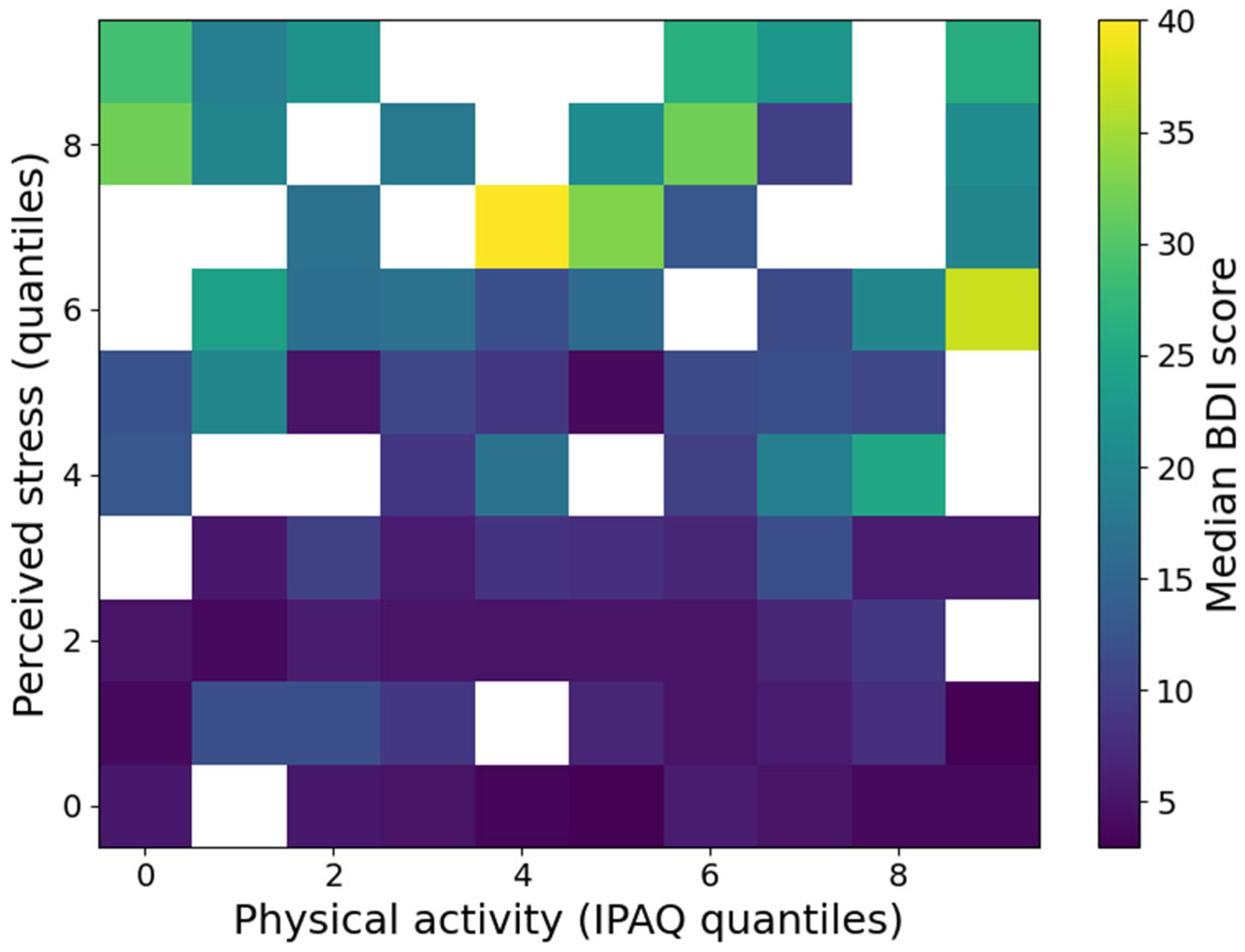
The use of quantile regression also made it possible to assess the relationship at different levels of the distribution (25th, 50th and 75th percentiles). This variation is shown graphically in
Figure 3. Analysis of the heat map revealed a clear interaction between physical activity and perceived stress in relation to the severity of depressive symptoms.
The highest values of the overall depression symptom severity index, BDI, were consistently observed among individuals reporting high levels of stress combined with low physical activity, while the lowest scores were found among participants characterised by low stress levels and high physical activity.
At all levels of physical activity, perceived stress showed a strong positive correlation with the severity of depressive symptoms, which was reflected in a systematic increase in the severity of depressive symptoms with increasing stress levels. At the same time, the protective effect of physical activity was not uniform across the entire distribution: higher IPAQ values were associated with lower severity of depressive symptoms mainly in conditions of low and moderate stress, while at high stress levels this relationship was significantly weakened.
The visualisations obtained confirm the results of regression and mediation analyses, indicating that the level of perceived stress plays an important mediating role in the relationship between physical activity and depressive symptoms. Thus, the role of physical activity in the severity of depressive symptoms is indirect and conditional rather than direct
3. Discussion
The results obtained indicate that the severity of depressive symptoms in adult women is most strongly associated with the level of perceived stress and selected sociodemographic factors, while the role of physical activity appears to be indirect and conditional. Specifically, physical activity was associated with depressive symptom severity primarily through its relationship with perceived stress, rather than as an independent predictor.
Multivariate analyses and visualisations of the results confirm that the relationships between these variables are not homogeneous and cannot be fully explained by simple linear models [
10,
12]. The relationship between perceived stress, anxiety and the severity of depressive symptoms is complex and may vary throughout a person’s life [
25,
26,
27].
Research in different age groups is justified because there is still a lack of data from longitudinal studies of sufficient length to allow for the analysis of risk factors in middle age that influence the higher severity of depressive symptoms in later life in women [
28,
29,
30].
The strongest and most consistent predictor of depressive symptom severity was perceived stress, as demonstrated by the regression analyses, the mediation model, and the accompanying visualisations. Perceived stress showed a strong positive association with depressive symptom severity across all levels of physical activity, highlighting its central relevance in the context of mental health.
This finding is consistent with the existing literature, which describes chronic stress as being linked to higher levels of depressive symptoms through alterations in emotion regulation, hypothalamic–pituitary–adrenal axis functioning, and cognitive processes [
13,
31]. Taken together, these results support a statistical mediation framework, in which perceived stress accounts for a substantial proportion of the observed association between physical activity and depressive symptom severity, without implying a causal mechanism.
Despite showing negative regression coefficients, physical activity was not a significant independent predictor of depressive symptoms after taking into account stress and sociodemographic factors. This result suggests that an increase in physical activity alone, understood as a quantitative indicator of energy expenditure, does not necessarily translate into a significant reduction in the severity of depressive symptoms. At the same time, mediation analysis showed a significant indirect effect of physical activity through stress reduction, indicating that the potential beneficial effect of physical activity on mental health is mainly achieved through mechanisms of psychological tension reduction rather than a direct impact on depressive symptoms [
6,
32].
These findings are significantly supplemented by the results of quantile regression, which revealed differences in the effects of physical activity depending on the severity of depressive symptoms. The protective effect of physical activity was more pronounced in the lower and middle quantiles of the distribution, while in individuals with high severity of depression it was weakened or disappeared [
19,
20]. This suggests that in populations with high psychological stress, physical activity alone may not be a sufficient protective resource and should be treated as part of a broader, integrated therapeutic approach.
These results were further confirmed in visual analyses, in particular in a heat map showing the combined effect of physical activity and stress on the severity of depressive symptoms. The highest values of the overall depression symptom severity index determined on the basis of the BDI were consistently observed in groups characterised by high stress levels, regardless of the level of physical activity, which emphasises the dominant role of stress as a risk factor. At the same time, at low and moderate stress levels, higher physical activity was associated with lower severity of depressive symptoms, confirming its conditional protective nature.
Sociodemographic factors, in particular occupation and place of residence, also played a significant role in shaping stress and depression levels. The higher severity of depressive symptoms and stress in certain occupational groups and in urban environments points to the importance of the environmental and organisational context, which can both increase exposure to stressors and limit opportunities for effective mental regeneration. The lack of significant differences between age groups suggests that in the studied population, psychosocial factors, rather than chronological age, have a greater impact on mental well-being.
Higher levels of perceived stress observed among women living in medium-sized and large cities may reflect contextual factors such as greater occupational demands, time pressure, and reduced access to restorative environments. These findings are interpreted as contextual associations rather than causal effects.
Overall, the results indicate that the relationship between physical activity and depressive symptoms is largely indirect and contingent on levels of perceived stress and selected sociodemographic factors. Physical activity appears to be associated with stress regulation and lower depressive symptom severity, particularly under conditions of low to moderate psychological stress, while its association with depressive symptoms is attenuated at higher stress levels [
6,
33].
Consequently, approaches to mental health promotion may benefit from integrating physical activity with stress-focused interventions, while also considering the environmental and occupational context of individual functioning. In this context, physical activity may be considered one component of broader mental health strategies, rather than a standalone approach, especially in populations experiencing low to moderate levels of perceived stress.
The novelty of this study lies in the combined use of mediation analysis and quantile regression to capture the conditional and heterogeneous associations between physical activity, perceived stress, and depressive symptoms across different levels of symptom severity in adult women.
3.1. Practical Application of Results
The results obtained have important practical implications for the prevention and promotion of mental health in adults. They indicate that physical activity should be treated as an indirect factor influencing mental health, the effectiveness of which is largely dependent on the level of perceived stress. This means that intervention programmes focused solely on increasing physical activity may be insufficient, especially in populations characterised by high levels of stress and severe depressive symptoms.
In clinical and community practice, these findings suggest the need to integrate physical activity interventions with stress reduction activities such as relaxation training, mindfulness techniques, psychoeducation and psychosocial support. This may be particularly important in occupational groups with high mental stress and in urban environments where levels of stress and depression were higher.
Furthermore, the varying effect of physical activity depending on the level of depressive symptoms indicates the need to individualise recommendations for physical activity. In populations with low and moderate levels of stress, physical activity can serve as an effective protective factor, while in people with high levels of depression, it should be part of a broader therapeutic programme rather than the only form of intervention.
The results of the study may also serve as a basis for designing complex public health programmes in which physical activity is one of the components of strategies aimed at improving mental well-being, alongside organisational, environmental and educational measures.
3.2. Limitations of the Study
Several limitations of this study should be taken into account. First of all, the study was cross-sectional in nature, which makes it impossible to draw clear cause-and-effect conclusions about the relationship between physical activity, stress and depressive symptoms. In future studies, it would be advisable to use longitudinal or experimental designs.
Another limitation is the use of self-reporting tools, which may be susceptible to declaration bias, social desirability effects, and inaccuracy in assessing physical activity levels. Although the questionnaires used are widely used and well validated, supplementing them with objective methods of measuring activity (e.g., accelerometers) could increase the accuracy of the results.
Another limitation may be the lack of detailed differentiation between the type and context of physical activity, such as form, intensity or motivation to engage in activity, which may differentiate its impact on mental health. In addition, the analyses did not take into account all potential confounding variables, such as economic status, social support or co-occurring somatic diseases.
An additional limitation of this study is the potential for residual confounding. Although several sociodemographic variables were included in the analyses, other relevant factors—such as socioeconomic status, comorbid physical health conditions, personality traits, or social support—were not directly assessed and may have influenced both physical activity levels and perceived stress. Consequently, the findings should be interpreted with caution, particularly with regard to their generalisability beyond adult women from a specific cultural and regional context.
Finally, stress-related factors may differ between women of reproductive age and postmenopausal women. Menopausal status and the use of hormone replacement therapy (HRT) were not assessed and could not be controlled for in the present study, which represents an additional limitation [
34].
4. Material and Methods
4.1. Study Group
This cross-sectional study included 200 adult women aged 18 to 65 years. Participants were recruited from community and occupational settings in southern Poland during 2025 using convenience sampling. The participants represented diverse sociodemographic backgrounds and were recruited through workplaces and local community institutions.
A total of 216 women were initially assessed for eligibility. Questionnaires were screened for completeness prior to analysis, and participants with incomplete survey data were excluded at the eligibility stage. As a result, sixteen women were excluded, and the final analytical sample consisted of 200 participants with complete data for all variables included in the analyses.
The criteria for inclusion in the study were: being over 18 years of age, no health contraindications to participation in the study, and informed consent to participate. The exclusion criteria included incomplete survey data and currently treated severe mental disorders that could prevent independent and reliable completion of the questionnaires.
The study was cross-sectional and was conducted in accordance with the principles of the Declaration of Helsinki. Resolution No. KE-U/6/2020 Częstochowa, 11 December 2020 of the Research Ethics Committee of the Jan Dlugosz University of Humanities and Natural Sciences in Częstochowa of 10 December 2020. All participants were informed about the purpose of the study, the voluntary nature of participation, and the possibility of withdrawing at any stage without giving a reason. Data were collected anonymously, and participation in the study did not entail any material benefits.
4.2. Research Tools
The study used a set of standardised psychometric tools and an original sociodemographic questionnaire.
The severity of depressive symptoms was assessed using the Beck Depression Inventory (BDI). The tool consists of 21 items relating to the emotional, cognitive and somatic symptoms of depression, rated on a scale of 0 to 3 points. The total score ranges from 0 to 63 points, with higher values indicating greater severity of depressive symptoms. The BDI scale is characterised by good reliability and psychometric validity and is widely used in population and clinical studies. The level of perceived stress was assessed using the Perceived Stress Scale (PSS), a widely used standardised instrument for measuring subjective stress intensity over the recent period. Higher scores indicate greater perceived stress. The validated Polish version of the scale was used.
The level of physical activity was assessed using the International Physical Activity Questionnaire (IPAQ). The questionnaire allows for the assessment of total physical activity expressed in MET·min/week, taking into account activities of varying intensity (light, moderate, vigorous) undertaken at work, during leisure time and while travelling. The overall IPAQ score was used in the statistical analyses, in accordance with the recommendations of the authors of the tool.
In addition, a proprietary demographic questionnaire was used, covering data on age (year of birth), place of residence, level of education, occupation and marital status. No modifications to the original structure or scoring of the standardised instruments were introduced.
4.3. Research Protocol
The research was conducted in the field in the form of a survey, using paper or electronic versions of the questionnaires. The participants completed the set of tools in the following order: sociodemographic questionnaire, stress assessment scale, Beck Depression Scale, and IPAQ. The average time needed to complete the entire set was 20–25 min.
The questionnaires were completed independently, in a calm environment, without time pressure. In case of doubts regarding the content of the questions, it was possible to obtain explanations from the researcher conducting the study, without suggesting answers. After the data collection was completed, it was verified for completeness and logical consistency, and then coded for further statistical analysis.
4.4. Statistical Analysis
The required sample size was estimated using the G*Power 3.1 programme. For multiple regression analysis, assuming an average effect size (f2 = 0.15), a significance level of α = 0.05, a test power of 0.80 and five predictors, the minimum sample size was 92 people. In addition, to estimate the power for intergroup comparison analyses, the Kruskal–Wallis test was approximated by a one-way analysis of variance. Assuming a significance level of α = 0.05, test power of 0.80, four compared groups, and a moderate effect size (f = 0.25; η2 ≈ 0.06), the minimum required sample size was N = 180. The sample size used in the study (N = 200) was sufficient to perform all planned analyses and detect the expected effects.
The normality of the data distribution was assessed using the Shapiro–Wilk test. Since most of the analysed variables, including the level of physical activity (IPAQ), stress intensity and the level of depressive symptoms (Beck Depression Scale), deviated significantly from the normal distribution, non-parametric methods were used in further analyses. Therefore, continuous variables were presented using the median and interquartile range (IQR) as well as minimum and maximum values.
Intergroup comparisons based on sociodemographic variables (age groups, occupation, place of residence and marital status) were performed using the Kruskal–Wallis test. In the case of significant differences, Dunn’s post hoc test with Bonferroni correction was used. The effect size for the Kruskal–Wallis test was calculated as eta squared (η2H) and interpreted as small (≈0.01), moderate (≈0.06) or large (≥0.14).
The relationships between continuous variables were analysed using correlation analyses and then deepened using a statistical method that allowed for the analysis of complex relationships between variables in this multiple regression model. As part of hierarchical regression, sociodemographic variables (age, occupation, place of residence and marital status) were introduced into the models in the first block, while the level of physical activity (IPAQ) was included in the second block. The selection of sociodemographic covariates was based on prior empirical evidence and their theoretical relevance to physical activity, perceived stress, and depressive symptoms. The change in model fit was assessed based on the increase in the coefficient of determination (ΔR2).
In order to assess the indirect effect of physical activity on the severity of depressive symptoms, a mediation analysis was performed to examine the role of stress levels as a mediator of the relationship between IPAQ and the overall severity of depressive symptoms as determined by the Beck Depression Scale. The significance of indirect effects was assessed using the bootstrap method with 5000 draws and adjusted confidence intervals.
Due to the skewness of the distributions and the diversity of effects in individual ranges of dependent variables, quantile regression was additionally used to assess the relationship at different levels of distribution (25th, 50th and 75th percentile). Potential interaction effects between physical activity and perceived stress were explored using visualisation techniques and quantile regression. Formal interaction terms were not retained in the final regression models due to lack of statistical significance and to preserve model parsimony. All statistical tests were two-tailed, and the level of statistical significance was set at p < 0.05. As this was a cross-sectional observational study, no randomization procedures were applied.
5. Conclusions
The results indicate that the severity of depressive symptoms in adult women is most strongly associated with the level of perceived stress and selected socio-demographic factors, while the role of physical activity is indirect and dependent on the psychosocial context.
Physical activity was not a significant independent predictor of depressive symptoms after taking into account stress and sociodemographic factors, but it had a significant indirect effect through stress reduction. This means that the potential beneficial effect of physical activity on mental health is primarily achieved through stress regulation mechanisms rather than through a direct effect on depressive symptoms.
Quantile analyses showed that the protective effect of physical activity is not uniform across the entire distribution of depressive symptoms and is more pronounced in people with low and moderate symptom severity, while it is weakened in people with high levels of depression. This points to the need to individualise recommendations for physical activity and to integrate it with other forms of psychological support in populations with high psychological stress.
Environmental and occupational factors also played a significant role in shaping stress and depression levels, highlighting the role of social context in the mental health of adult women.
In summary, effective preventive and intervention measures in the field of mental health should combine the promotion of physical activity with targeted stress reduction strategies and take into account the diverse socio-demographic and psychosocial conditions of an individual’s functioning.