
Review

Starch Nanoparticles by Sonochemical Protocols: Food Industry, Nutraceutical, and Drug Delivery Applications

by
Adriana García-Gurrola
1,
Abraham Wall-Medrano
2 and
Alberto A. Escobar-Puentes
1,*
1
Facultad de Medicina y Psicología, Universidad Autónoma de Baja California, Tijuana 22390, Mexico
2
Instituto de Ciencias Biomédicas, Universidad Autónoma de Ciudad Juárez, Anillo Envolvente del Pronaf y Estocolmo s/n, Ciudad Juárez 32310, Mexico
*
Author to whom correspondence should be addressed.
Polysaccharides 2026, 7(1), 28; https://doi.org/10.3390/polysaccharides7010028
Submission received: 24 December 2025 / Revised: 27 January 2026 / Accepted: 26 February 2026 / Published: 3 March 2026

Abstract

This review summarizes scientific advances about the sonochemical synthesis of starch nanoparticles (St-NPs) for the food industry, as well as nutraceutical and drug delivery applications. High-intensity ultrasonication (HIU) has been explored as a versatile and environmentally friendly alternative to conventional methods for synthesizing St-NPs with high yields (>90%), controlled size (~100 nm), and minimal effluent generation. Thus, HIU has been explored (pre- or post-treatment) to mitigate the inherent disadvantages (high-cost, low yields, and environmental impact) of hydrothermal gelatinization, acid/alkaline hydrolysis, enzymatic hydrolysis, enzyme branching, water-in-oil and oil-in-water emulsions, non-solvent nanoprecipitation, extrusion, high-pressure homogenization, high-energy milling, and cold plasma. Conventional sources of starch (corn [normal, waxy, high-amylose] and potato) and other unconventional sources (tubers [cassava, yam, malanga], seeds and grains [sorghum, barley, quinoa, lotus], breadfruit, pinhao seed, Araucaria angustifolia) have been subjected to single or assisted sonochemical protocols to obtain St-NPS with unique structural, physicochemical, and technological properties. The physical–mechanical effects of ultrasonication (cavitation, heat, and pressure) directly promote surface functionalization (i.e., esterification, pore formation) and impact the St-NPS’s particle size, double-helix structure, enzymatic-resistance properties, crystallinity, and intra- and intermolecular arrangements. Pickering additives in food systems, colloids in beverages, nanocomposites in biofilms for food packaging, and nanocarriers for drug and nutraceutical delivery (oral and transdermal) have been the most reported applications.

1. Introduction

Nanoscience focuses on synthesizing ultrafine particles (1–100 nm) from a range of materials, including metals, ceramics, synthetic polymers, and natural polymers (biopolymers). The term “nanoparticles” generally refers to particles with sizes ranging from 1 to 100 nm; however, in fields such as pharmaceuticals and medicine, submicron particles (less than 1000 nm) are also classified as nanoparticles. According to definitions, a nanoparticle must have at least one dimension larger than an atom but smaller than 1000 nm [1,2].
Recently, biopolymeric St-NPs have gained attention in the biomedical and food industries due to their high bioavailability, non-toxicity, and biocompatibility [3,4,5]. St-NPs possess unique properties compared to starch microgranules, primarily due to their high surface-to-volume ratio, enhanced solubility, greater absorption capacity, and higher cellular internalization rates across biological barriers [6]. Thus, the global starch nanoparticle market was valued at $412 million in 2024 and is forecast to reach $1.02 billion by 2033, growing at a compound Annual Growth Rate (CAGR) of 10.5% over the forecast period, with corn dominating the market (up to 40% of total revenue in 2024) [7].
Numerous synthesis methods for St-NPs have been reported in the scientific literature [8]. Conventional methods for synthesizing St-NPs include hydrothermal gelatinization, acid-, alkaline-, or enzymatic hydrolysis, self-assembly via nanoprecipitation in a non-solvent, and specialized equipment such as high-pressure homogenization, high-energy milling, and extrusion. These approaches have inherent disadvantages, including low production yields, long processing times, extensive use of chemical agents, and the creation of effluent. In this sense, the sonochemical process has emerged as a successful technology for the synthesis of St-NPs [3,4,6,9]. Since 1927, sonochemical technology has been employed to develop polysaccharide-based nanomaterials with potential applications in pharmaceuticals and biosciences [10,11]. Research on the effects of ultrasonic energy on starch dates to the 1970s, when a French laboratory first documented the fragmentation and surface erosion of starch granules caused by ultrasonic irradiation [12,13].
HIU processing can significantly impact the properties of starch, including its gelatinization temperature, enthalpy, paste characteristics, crystallinity, and solubility [14]. Additionally, ultrasonic irradiation can fragment and reduce the particle size of starch, offering a promising alternative to conventional methods for the synthesis of St-NPs [15,16]. HIU is considered environmentally friendly because it minimizes the use of solvents and catalysts and reduces energy consumption [17].
Thus, the use of ultrasonication in starch treatment has been increasingly documented, notably by Vela et al. [18] and Sujka et al. (2017) [19], who reviewed its effects on starch microgranules. Marta et al. [8] reviewed the preparation, properties, and application of St-NPs. Sreejit et al. [20] briefly outline eco-friendly methods for manufacturing nano starch and its use in the food sector, and Caldonazo et al. [21] reviewed the pharmaceutical application of St-NPs. However, information on the sonochemical synthesis of St-NPs and their applications is limited. This literature review focuses on the synthesis of St-NPs using ultrasonic technology, exploring how ultrasonication affects their molecular properties and applications in biosciences (food industry, drug, and nutraceutical applications).

2. Starch Nanoparticles

Starch is the primary carbohydrate necessary for human nutrition and ranks as the second most abundant biomaterial in nature, following cellulose [22]. It is present in various sources, including cereals (40–90 g/100 g of dry solids), vegetables (30–50 g/100 g of dry solids), tubers (65–85 g/100 g of dry solids), and immature fruits (40–70 g/100 g of dry solids) [23]. Starch naturally occurs as water-insoluble microgranules, primarily composed of two types of glucose polymers: amylose and amylopectin, along with small amounts of lipids, proteins, and minerals. Amylose is a linear polymer made up of α-D-glucopyranosyl units linked by α 1,4 D-glycosidic bonds. In contrast, amylopectin is a highly branched and crystalline polymer made up of α-D-glucopyranosyl chains connected by both α 1,4 and α 1,6 D-glycosidic bonds at the branch points (5–6%).
Starch is particularly notable over other polysaccharides (cellulose or chitosan) because of its inherent advantages stemming from its unique chemical structure. For instance, its α-1 → 4 and α-1 → 6 linkages enable it to be fully digested by human enzymes, offering a major benefit over cellulose for delivering bioactive molecules. Additionally, its branched structure makes it soluble in hot water, easing processing and increasing its appeal in food applications. Compared to chitosan, starch is more abundantly available in a variety of plants, which can help reduce industrial costs. Its food compatibility also surpasses that of chitosan and cellulose, which sometimes face specific regulatory challenges in certain countries. Furthermore, starch exhibits superior thickening and texturizing properties compared to cellulose and chitosan, making it a key ingredient in the food and beverage industry.
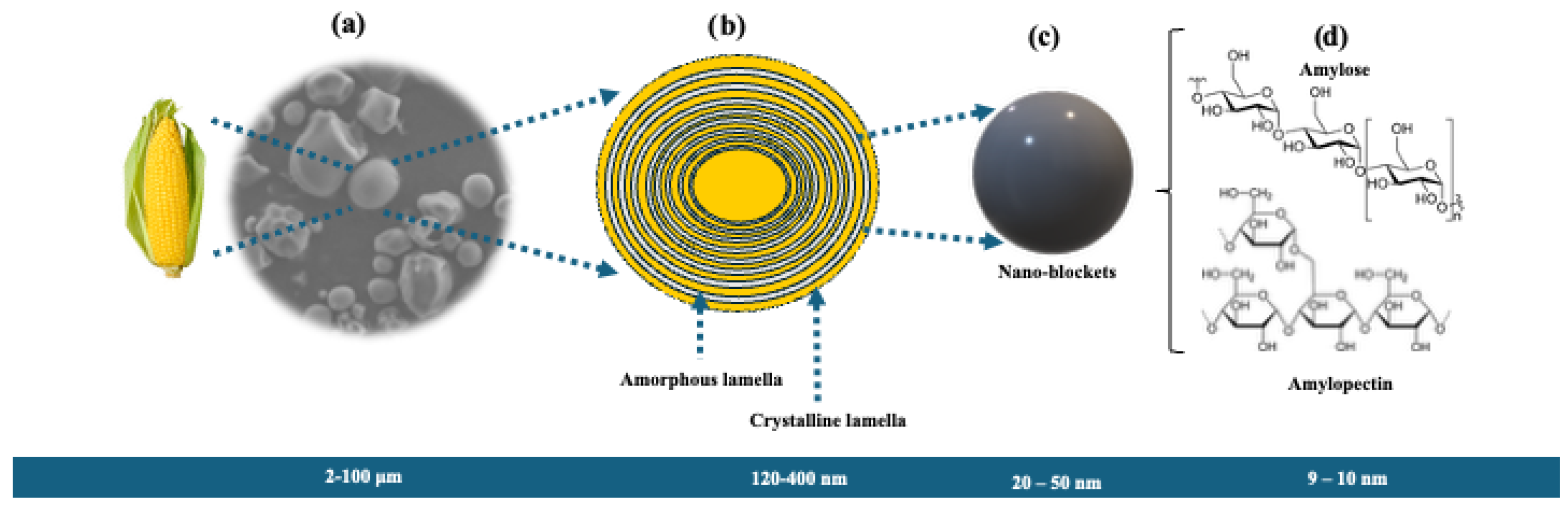
Starch microgranules typically range in size from 2 to 100 μm, exhibiting variations in the amylose-to-amylopectin ratio and differences in morphology and functionality. Starches display a nanostructured form characterized by concentric amorphous and semicrystalline growth rings measuring 120–400 nm. These growth rings consist of nano blocks ranging from 20 to 50 nm, which aggregate to form cluster-like structures composed of alternating crystalline and amorphous lamellae approximately 9 to 10 nm thick. Within these structures, chains of amylopectin and amylose can be found, measuring 0.1–1 nm in length (Figure 1) [24,25,26,27].
The literature describes two types of starch-derived nanostructures that differ in morphology and crystal structure: starch nanoparticles and nanocrystals. St-NPs are particles with reduced or even zero crystallinity and commonly spherical-ovoid morphology. Starch nanocrystals are nanomaterials with sustained or increased crystallinity, typically exhibiting platelet or cubic morphology [25], although recently nanoparticles with sustained crystallinity and round-spherical or ovoid morphologies have been reported [27,28,29,30]. However, the term “starch nanoparticles” is commonly used to refer to the two types of starch-derived nanostructures, and their crystallinity depends mainly on the starch precursor source and synthesis method.
St-NPs possess intriguing properties attributed to their nanosized dimensions. These features provide several advantages over micro-granular starch, including a greater surface area per unit mass, enhanced absorption capacity and molecular interactions, improved penetration rates through biological barriers, increased solubility, stability, and the ability to diffuse freely in various solvents [1,31].
A diverse array of methods for synthesizing St-NPs has been documented, including high-pressure homogenization [32], gamma-irradiation [33], emulsification coupled with solvent evaporation [34], high-energy milling [35], acid hydrolysis [36], acid hydrolysis combined with high-energy milling [37], self-assembly techniques [38], enzyme treatments [39], nanoprecipitation [40,41], extrusion methods [42], ultrasonic energy application [3,4,26,43], as well as techniques combining extrusion and ultrasonication [30,44], and heat-moisture treatments [45].
Conventional methods for StNP synthesis are based on starch fragmentation (top-down approach) or on promoting the association of short-chain glucans (bottom-up approach). However, most of these methods have inherent disadvantages, such as the use of large quantities of catalysts (acid, alkaline, or enzymatic hydrolysis), surfactants (acid, alkaline, or enzymatic hydrolysis), and solvents (hydrothermal gelatinization, emulsions, nanoprecipitation, acid, alkaline, or enzymatic hydrolysis), which consequently generate effluents released into the environment. Reaction and operating time are other important factors; some methods, such as acid or enzymatic hydrolysis, require long reaction times, generally hours or even days. Other equipment requires prolonged operating times. The yield is not always optimal; synthesizing high-yield St-NPs is challenging, first because starch’s intrinsic tendency to agglomerate, and second because some procedures generate excessive heat that promotes agglomeration and loss of nanometric size (high-pressure homogenization, high-energy milling) [5,6,24,25,46,47].

3. Synthesis of Starch Nanoparticles Using Ultrasonic Processing

The term “ultrasound” refers to sound waves above the human hearing range, which is 10–60 kHz. Ultrasound waves facilitate cavitation, a process characterized by the formation, growth, and implosive collapse of bubbles in liquids. This phenomenon releases significant amounts of energy, leading to effects such as erosion, fragmentation, dispersion, sonoporation, and sonocapillarity in the particles present in the liquid reaction medium [17]. Furthermore, solvent molecules may dissociate to form radicals, which can trigger surface degradation and polymer breakdown [19]. Therefore, exposure to sound waves results in depolymerization, reducing the viscosity and molecular weight of starch [19,48].
Sonochemical reactors use ultrasound as a power source, and various types of ultrasonic procedures have been described. Sonication is a procedure that only uses ultrasonic energy at low temperature. Thermosonication employs ultrasonic processes at elevated temperatures; manosonication uses ultrasonic processes plus high pressure; and manothermosonication uses ultrasound in combination with temperature and pressure [49].
Ultrasound can also be classified by power: MHz for high-frequency, low-power ultrasound, and kHz for low-frequency, high-power ultrasound. Based on frequency, ultrasound is divided into three regions: low-frequency ultrasound (20–100 kHz), high-frequency ultrasound (100–1000 kHz), and diagnostic ultrasound (1–500 MHz) [50].
Ultrasound waves travel through a series of rarefaction and compression cycles in liquid media. When the attractive forces between the fluid molecules are less than the negative pressure of cyclic rarefaction, a space will be generated, and the liquid between the bubbles will be vaporized. Tiny bubbles are initially generated, but over successive cycles, they grow and collapse, leading to acoustic cavitation and the release of ultrasonic energy, accompanied by high-temperature and high-pressure gradients. Therefore, ultrasonic irradiation has been used to degrade polymers. The physical–mechanical forces (microjets), heat, pressure, and the production of potent oxidizing agents such as free radicals (H, -OH) and oxygen peroxide (H2O2) due to sonolysis and pyrolysis in the reaction, have been reported as the factors responsible for the disintegration and depolymerization of synthetic and natural polymers [51].

3.1. Sonochemical Protocols for St-NP Synthesis

The use of ultrasound for the synthesis of St-NPs has been explored for almost 50 years [12,13] and has increased over the last 2 decades [28]. This is because ultrasonic irradiation shortens processing times compared to conventional methods and reduces energy consumption. Ultrasound energy is transferred to gelatinized starch solutions [43,52] or to starch granules suspended in a particular solvent, commonly water [53]. The energy released is about 10–100 kJ/mol, well within the range of hydrogen-bonding energies [54]. It also provides high temperatures (5000 K) and pressures (1000 atm), ideal reaction conditions for the depolymerization of starch granules.
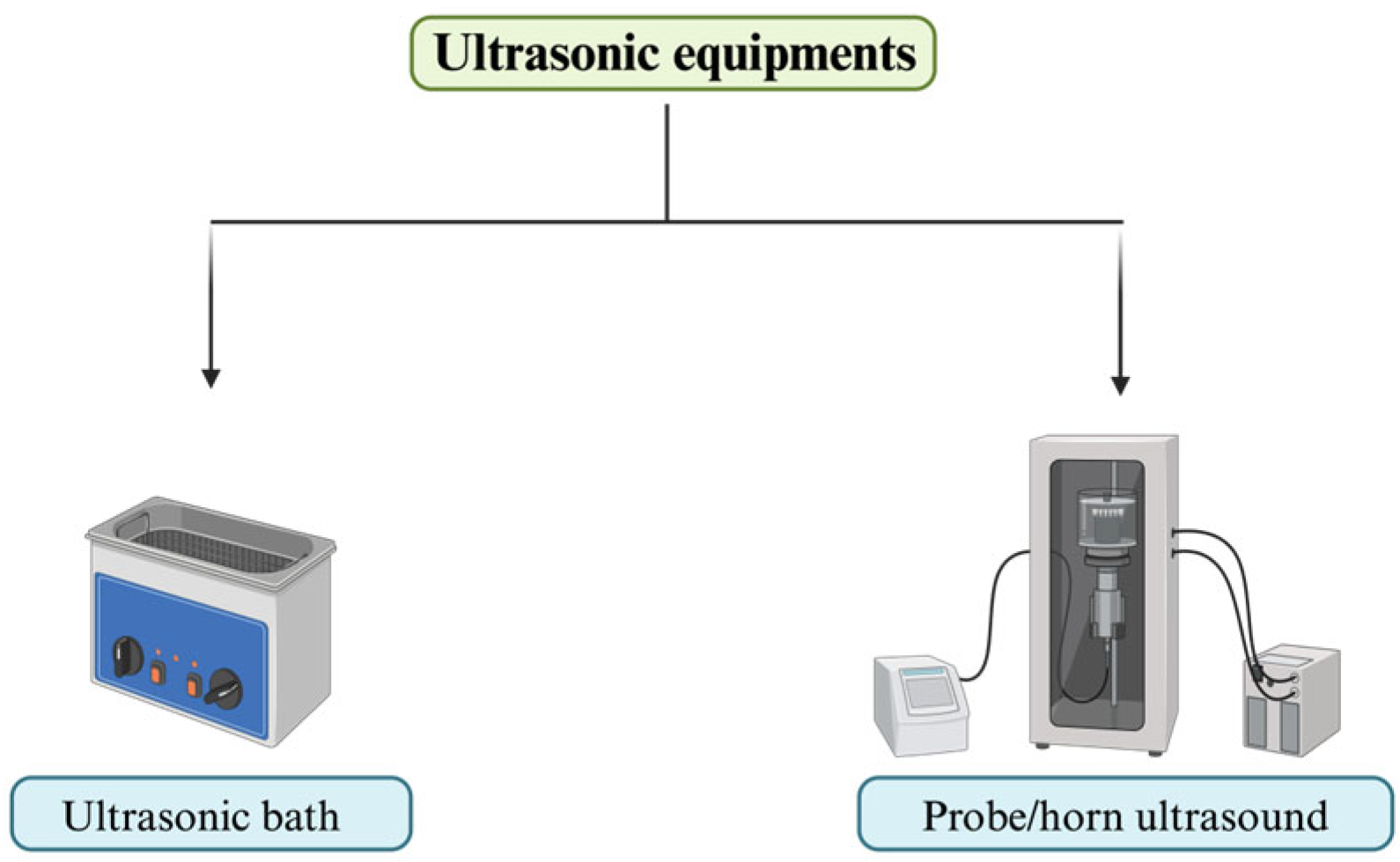
The St-NPs’ synthesis using sonochemical approaches has been carried out mainly with bath-type and probe/horn equipment (Figure 2 and Figure 3). Ultrasonic bath equipment is usually operated at 20–400 kHz and comprises rectangular tanks with transducers at the base that convert electrical energy into ultrasound. On the other hand, probe ultrasound is the most used sonochemical reactor for synthesis. It employs a cylindrical probe immersed in the reaction medium (solvent/starch granules) that transmits the waves directly into it. The probe is generally made of titanium and has a diameter of 5 mm to 1.5 mm [48].
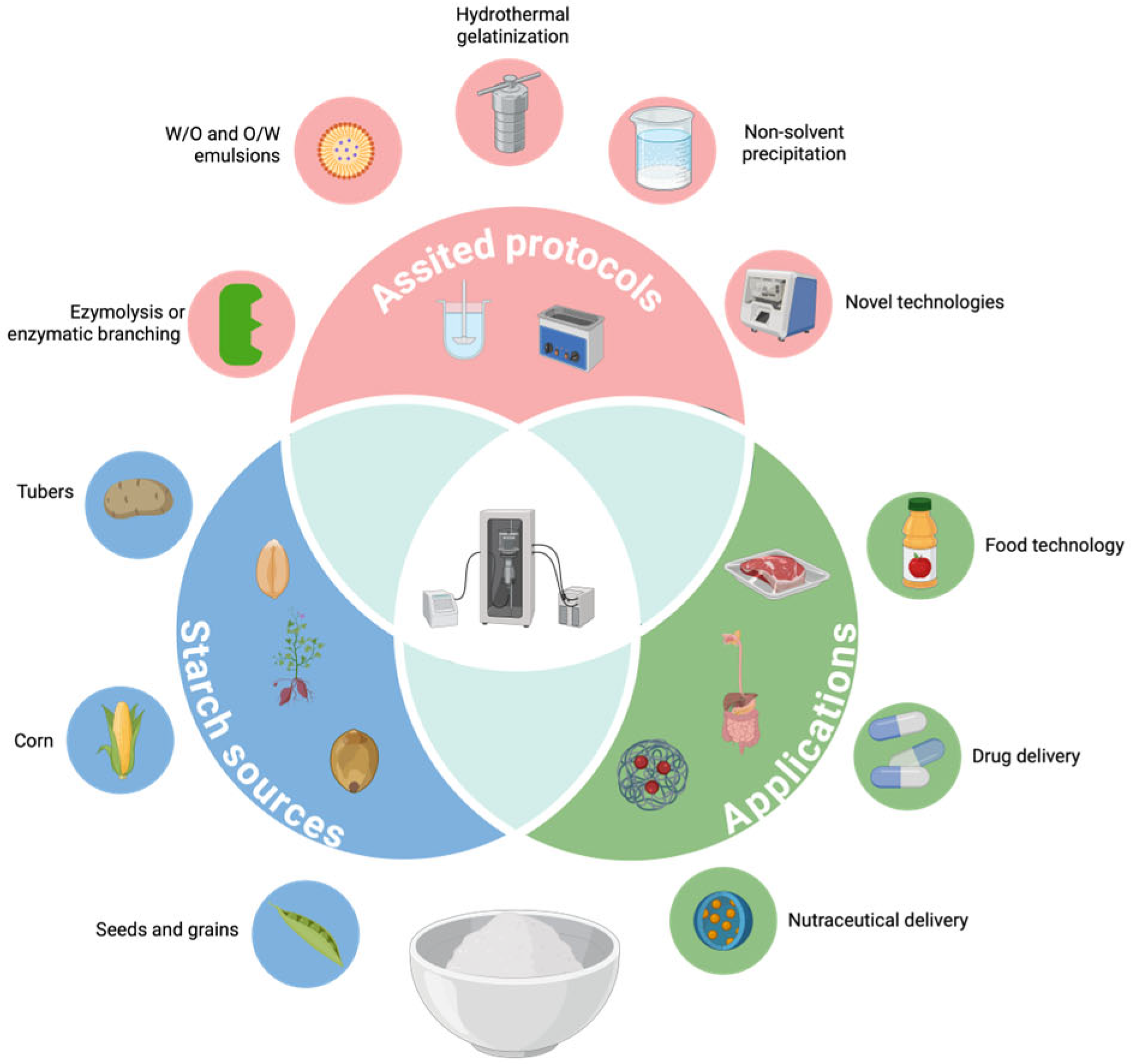
Single or assisted sonochemical protocols have been reported (Supplementary Table S1 and Figure 3). St-NPs from corn, wheat, sorghum, mango seed kernels, quinoa flour, faba starch, cassava starch, navy bean starch, lotus root, arrowroot tubers, jackfruit seed, sago, breadfruit, yam and pinhao seed with yields of up to 90% and reaction times of less than 30 min have been possible [8,23,26,55,56,57,58,59].

3.1.1. Starch Nanoparticles by Ultrasonic Bath Reactors

Ultrasonic bath systems have been studied less frequently than probe methods for producing St-NPs. However, sonochemical procedures for nanoparticle synthesis have been reported to be efficient, yielding improved yields when combined with conventional methods such as acid hydrolysis and nanoprecipitation, due to the dispersion effect that prevents particle agglomeration after synthesis [60].
Also, ultrasonic bath procedures have been effective for synthesizing esterified nanoparticles [45,61]. The hydroxyl groups of starch nanoparticles have been esterified to functionalize their surfaces and expand their applications across various fields, including food packaging. Sun et al. [61] reported that ultrasonic irradiation in a bath system (500 W, 100% amplitude, 40 kHz) was feasible for synthesizing and simultaneously esterifying waxy starch nanoparticles (20 nm) via oxidation. Oxidation was accelerated by the permeation of chemical agents into the eroded granules, leading to nanoparticles with a high content of carbonyl and carboxyl groups due to successful esterification. In another study, St-NPs were esterified by 2,2,6,6-tetramethylpiperidine-1-oxyl (TEMPO)-Oxidation using a 500 W ultrasonic bath for 180 min. The hydroxyl groups of starch nanoparticles have been esterified to functionalize the surface and enhance their applications in various fields, such as food packaging [62].

3.1.2. Starch Nanoparticles by Ultrasonic-Probe Reactors

The probe or horn ultrasonic system is widely recognized as the most common method for synthesizing St-NPs. It effectively produces nanoparticles from gelled starch pastes [52,58]; however, its efficiency tends to decline as the amylose content of the precursor starch increases. A comparison of the effects of ultrasonic irradiation (at 13.5 W and 29.9 W) on gelled pastes of commercial starches indicated that those rich in amylopectin (amioca and mazaca) performed better than those with high amylose content (melojel and gelose). This resistance observed in amylose molecules is likely due to their linear, densely packed structure of -OH groups, which promotes association between neighboring molecules and the formation of agglomerates [59].
On the other hand, HIU with a horn system facilitates the synthesis of starch nanoparticles (approximately 83 nm) from waxy corn starch. It simultaneously esterifies them with 2-octen-1-ylsuccinic anhydride in a single-step reaction lasting 120 min [43].

3.1.3. Starch Nanoparticles by Ultrasonic-Assisted Methods

Many of the conventional methods reported for the synthesis of St-NPs have been combined with, or supported by, ultrasonic irradiation (pre- or post-treatment) to overcome the inherent disadvantages of each method. The use of HIU, whether in probe or bath systems, and in combination with other methods, improves synthesis yields, facilitates the attainment of controlled sizes and specific structural properties, and reduces the use of chemical agents, solvents, and experimental time compared to other methods. It is efficient for synthesizing nanoparticles with high yields from both conventional and unconventional botanical sources.
Acid Hydrolysis and Ultrasonic Irradiation
The acid hydrolysis procedure is the oldest and most studied method for synthesizing St-NPs/nanocrystals. However, due to inherent limitations such as the extensive use of chemical agents, long reaction times, the release of chemical effluents into the environment, and low yields, this method has been studied in conjunction with sonochemical procedures [63,64]. Also, the effects of ultrasonication and acid hydrolysis on the porosity and the textural, mechanical, and sensory properties of StNPs from non-conventional sources (sorghum) have been explored for potential use in food systems [65].
Although the combination of ultrasonication with chemical hydrolysis using oxalic acid was studied to increase starch nanocrystal yields (80%) [22], the combination of the ultrasonic method with the conventional chemical hydrolysis method using sulfuric acid has undoubtedly been the most studied and reported in the state of the art [66]. Kim et al. [67] were the first to experiment with combining the two methods. Waxy maize starch (14.7% solids) was dispersed in an aqueous sulfuric acid solution (3.16 M) and hydrolyzed by stirring for 7 days at 40 °C with ultrasonic treatments at different vibration amplitudes (20 and 40%) and times (30 and 60 min/day). The same authors used ultrasonic treatment to assist acid hydrolysis (at 4 or 40 °C) of waxy starch, while controlling the temperature to preserve the crystalline structure of the resulting nanoparticles [29]. Using the acid hydrolysis-ultrasonication method, corn starch nanocrystals can be produced in 45 min with particle sizes less than 100 nm and a yield of approximately 20% [15,68]. Others also reported a significant decrease in potato starch granule size and reduced agglomeration in high-amylopectin, non-waxy barley nanoparticles following acid hydrolysis and HIU treatment [27,69].
Acid vapor hydrolysis is a possible method for producing St-NPs with high yield. Waxy maize starch was used to synthesize St-NPs using an innovative protocol that employs acid (HCl) vapor to hydrolyze starch macromolecules. First, HCl in a beaker was transferred to a vacuum desiccator and incubated at room temperature for 2 h. Then, waxy maize starch was placed in the vacuum desiccator and incubated for 1, 1.5, and 2 h. After HCl vapor treatment, small starch particles were dispersed in ultrapure water and processed by an ultrasonic processor for 5, 10, 15, 20, and 25 min. Results showed that only HCl vapor treatment produced starch particles with diameters ranging from 13.73 to 1.52 μm. Further ultrasonication treatment produced SNPs with desirable uniformity and near-perfect spherical and ellipsoidal shapes, with diameters of 150–292 nm. The authors concluded that HCl vapor hydrolysis combined with ultrasonication can be an affordable, accessible method for the efficient large-scale production of SNPs [70].
Miniemulsions and Ultrasonication
Ding and colleagues reported the synthesis of type IV and type III resistant starch nanoparticles [54,71,72] using the water-in-oil emulsification technique in combination with ultrasonic irradiation. The process involves four steps: (1) formulation of the aqueous phase by dissolving high-amylose maize starch in a potassium hydroxide solution (50 °C, two h); methylene-bisacrylamide, K2S2O8, and NaHSO3 to the solution. (2) Next, the oil phase was prepared by dissolving a mixture of the surfactants Span 80 and Tween 80 in cyclohexane (45 °C). (3) The aqueous phase was then poured into the cyclohexane with the surfactants to produce a water-in-oil emulsion. (4). The resulting emulsion was treated with ultrasonic irradiation in a bath system at 232 W for 85 min or 100–500 W for 40–200 min, with an amplitude of 100% and a frequency of 40 kHz. The optimal ultrasonic processing conditions to produce 651 nm type IV-resistant starch nanoparticles were 214 W and 114 min. However, ultrasonic energy decreased the resistant starch content (up to 12%), and cavitation promoted surface erosion and disruption of the crystalline structure, which may have facilitated enzymatic activity.
Recently, Guida [73] used a simple ultrasonic protocol to obtain water-in-oil miniemulsions. Water-in-oil emulsions (100 g) were prepared by mixing 20% of sunflower oil and 80% of aqueous phase containing different St-NP concentrations (1.0, 2.0, 3.0, and 3.5% w/w). The pre-emulsions were then subjected to an ultrasonic probe (20 kHz, 525 W, up to 40 °C) for 3, 6, or 9 min to produce acceptable emulsions. Increasing ultrasound energy input reduces the hydrodynamic size of cassava starch particles (from 117.58 to 55.75 nm) and their polydispersity (from 0.958 to 0.547) in aqueous dispersions. Emulsions stabilized by SNPs showed that increasing emulsification (ultrasonication) time led to smaller droplet sizes and monomodal size distribution. Long-term ultrasonication (6 and 9 min) resulted in a slight variation in droplet size after 7 days of storage. Cavitation effects enhanced interaction among oil droplets through weak attractive forces and particle sharing, thereby favoring Pickering stabilization against droplet coalescence.
In another study, the optimal conditions for producing 602 nm resistant starch type III nanoparticles were 231 W, 85 min, 1.1 g of starch, and an oil-to-water emulsion ratio of 9:1 [71]. Particle size decreased as ultrasonic power increased from 100 to 200 W. However, nanoparticle size increased when ultrasonication power was increased from 200 W to 500 W. Furthermore, a significant increase in hydrodynamic size was observed as the resistant starch content in the reaction solution increased, likely due to chemical crosslinking between particles.
Nanoprecipitation and Ultrasonication
The nanoprecipitation method has been extensively studied and proposed for the synthesis of St-NPs [57,74,75,76]. In this procedure, a starch solution is dispersed in a specific antisolvent, or vice versa. The starch concentration in the solution, as well as the proportion and type of antisolvent, influences the size of the precipitated nanoparticles [77]. To synthesize starch nanoparticles of controlled size via precipitation, a highly dilute starch solution and a large volume of antisolvent are required, as a high starch concentration leads to a highly viscous solution that forms large particles [16]. Previous studies have shown that combining ultrasonication with nanoprecipitation in ethyl acetate is an attractive method for obtaining hydrophobic starch nanoparticles [78]. Others have reported that using ultrasound (60 min, 150 W, 20 kHz, 100% amplitude) in addition to nanoprecipitation not only increased yield but also significantly reduced acetone use as an antisolvent [79]. Chang et al. [16] also reported that after 30 min of ultrasonic treatment (100 W), the viscosity of starch solutions decreased by two orders of magnitude; the starch nanoparticles obtained from starch pastes using ultrasonic treatments were smaller (75 nm), more uniform, and required less solvent. Similarly, have been reported that higher starch concentration and longer ultrasonication times improved water absorption capacity (0.76–1.18 g), oil absorption capacity (0.90–1.65 g), swelling power (30 °C: 1.83–2.11 g, 90 °C: 13.22–15.84 g), solubility (30 °C: 1.55–2.68%; 90 °C: 10.83–13.44%) and emulsifying activity index (174.65–245.62 m2/g) of a non-conventional Jackfruit seed starch nanoparticles [57].
Enzymolysis and Ultrasonication
To reduce the use of chemical reagents during the synthesis of starch nanoparticles, an enzymatic procedure has been proposed that uses the enzyme pullulanase (EC 3.2.1.41), also known as amylopectin 6-glucanohydrolase, which cleaves alpha-glucan polysaccharides at the α1-6 glycosidic linkage. After treatment with pullulanase, amylopectin is converted into short, linear glucans that can undergo reassociation, retrogradation, and recrystallization via a bottom-up process. Several studies employing enzymatic procedures in combination with ultrasonic irradiation have been described in the state of the art. Sonochemical processing is commonly classified as a top-down process, but when combined with enzymatic procedures, it is classified as a bottom-up process, since ultrasonic irradiation allows the nucleation and facilitates the reassociation and recrystallization of short starch chains and the formation of nanoscale self-aggregates [6,9,80,81].
Waxy starch (high in amylopectin), the type of starch most commonly used in this method, is initially dispersed in buffer solutions (0.1 M phosphate, pH 4.7) [6,82] or disodium hydrogen phosphate and citric acid (pH 4.6) for a specific time (120 °C and 30 min) [6] to achieve complete starch gelatinization. Subsequently, the starch is subjected to enzymatic hydrolysis with pullulanase EC 3.2.1.41 (30 enzyme units per g of dry starch) at 58 °C for 8 h [9] or up to 24 h [6,82]. Subsequently, the enzymatically hydrolyzed solutions are gelatinized again in autoclaves [9]. The sonochemical procedure is then performed by dispersing debranched starch powders or short starch chains (previously lyophilized) in distilled water at different concentrations and exposing them to ultrasonic irradiation. Furthermore, the sonochemical process has been used as a reactor to esterify short glucans/taro St-NPs with succinic anhydride [83]. Ultrasonication facilitates the dispersion of nanoparticles in solution, thereby creating a homogeneous, supersaturated nanoparticle solution that favors recrystallization [6]. Thus, [82] recently reported that 600 W, 15 min of ultrasonic treatment, and a 3% starch concentration are the best conditions for preparing nanoparticles smaller than 200 nm via ultrasonication-enzymolysis.
The α-amylase (EC 3.2.1.1) has also been explored for the obtaining of St-NPs using enzymatic hydrolysis and ultrasonication [84,85]. Wheat starch (amylopectin-to-amylose ratio of 10:90) solutions (1.5%) were fully gelatinized under aqueous, acid, or alkaline conditions at 80 °C, stirred for 1 h. Then, α-amylase (EC 3.2.1.1) was added to the solution and incubated (55 °C for 24 h). To break the glycosidic bonds and reduce the size of the polymeric chains, the solutions were then exposed to probe ultrasonication (40 kHz, 30–180 s). St-NPs with the smallest particle size (109 nm) and polydispersity index (0.560), and the highest zeta potential (−32.16 mV) and antioxidant activity (30%) values were obtained.
Branching enzymes for St-NP synthesis, as a bottom-up approach, have also increased notably. Himat et al. [86] demonstrated the first attempt to utilize the glucan branching enzyme to form amylose-based nanoparticles from purified pea starch; notably, a sonication step was required before enzyme addition to facilitate StNP formation. Scanning electron microscopy images showed that performing sonication after branching, followed by nanoprecipitation, did not promote SNPs formation. This suggests that the timing and sequence of sonication relative to enzymatic branching are critical for successful StNP formation under this approach.
Extrusion-Ultrasonication
Recently, the extrusion process followed by ultrasonic treatment was reported at both the laboratory [30] and industrial [44] scales, demonstrating that these versatile methods can synthesize succinylated St-NPs of controlled size from corn starch. The extrusion process was efficient for esterification (succinylation) and simultaneously disrupted the native structure of high-amylose starch granules in a relatively short process. In a second stage, ultrasonic processing (40, 80, 120 min; 20 kHz; 750 W; 60% amplitude) effectively yielded succinylated nanoparticles with diameters up to 178 nm and produced up to 88% from extruded starch powders. However, ultrasonication decreased the degree of substitution of the resulting nanoparticles to 0.002 [30].
High-Pressure Homogenization and Ultrasonication
High-pressure homogenization (HPH) and ultrasound treatments induce mechanical stress, thereby reducing starch particle size [87]. Lin et al. [88] have previously standardized a facile protocol for obtaining St-NPs (135.36 to 203.47 nm) with enhanced crystallinity. Corn starch was dispersed in distilled water (5% w/v), homogenized in a high-pressure homogenizer at 60 MPa for 10 cycles, and then subjected to ultrasonication at 280 W for 75 min.
Vacuum Cold Plasma and Ultrasonication
The use of cold plasma has recently been explored for the synthesis of St-NPs and has been combined with HIU for the same purpose [89]. Chang et al. reported that the combination of cold plasma with ultrasonic treatment was effective for synthesizing St-NPs with round-cubic morphologies, yielding approximately 80% [89,90].

3.1.4. Triphasic Protocols

Ball milling has become a popular method for synthesizing StNPs. During ball milling, mechanical forces and friction between the milling spheres modify the crystalline structure and properties of starch. However, due to heat generation and particle friction, large agglomerates can form, potentially limiting nanoparticle performance. Therefore, liquid nitrogen ball milling combined with ultrasonication has gained popularity as a low-temperature process that effectively eliminates thermal effects and facilitates the dispersion of StNPs. A novel protocol has previously been used that employs enzymatic hydrolysis with α-amylase, followed by ball milling with liquid nitrogen, and ultrasonication to obtain StNPs from waxy maize starch. The St-NPs possessed a narrow particle size distribution (46.91–210.52 nm) and a low polydispersity index (0.28–0.45), excellent swelling power (3.48–28.02%), solubility (0.34–0.97 g/g), and oil absorption capacity (9.77–15.67 g/g). During ball milling, mechanical forces, such as impact, shear, and friction between the milling spheres, alter the crystalline structure of starch [91].
Various techniques for producing StNPs, including alkaline and acidic hydrolysis and enzyme treatments, have been developed, sometimes used together. Nonetheless, acid and alkaline hydrolysis can produce effluents that harm the environment. Enzymatic methods, while environmentally friendly, can raise process costs. To address these challenges, a protocol combining ultrasonic processing has been shown to reduce reaction times, lower effluent production, and help achieve optimal results. Rastmanesh et al. [92] explored the acid or alkaline gelatinization plus enzymolysis using α-amylase followed by ultrasonication for the obtaining of wheat StNPs of minimum particle size (225 ± 10 nm), polydispersity index (0.472 ± 0.05), maximum zeta potential (−26.3 ± 1 mV), and antioxidant activity (3.36 ± 0.05%). Others have explored gelatinization of high-amylose maize starch using an autoclave, followed by non-solvent nanoprecipitation and ultrasonication to obtain type 2 resistant starch nanoparticles [93].

4. Ultrasonic Effect on the Structure of Nanoparticles

The ultrasonic process has several effects on the chemical structure, the double-helical molecular order, particle size, and surface properties of St-NPs (Table 1). It is widely recognized that the intense mechanical effects and heat generated by ultrasonic treatment facilitate size reduction by disrupting starch molecular networks and intermolecular interactions, thereby considerably increasing the synthesis efficiency of nanoparticles [76]. Two main effects of ultrasonic irradiation on the polymeric structure and size of starch are described: firstly, the breaking of polymer chains due to the physical forces produced by cavitation (top-down approach), and secondly, the dissociation and degradation of the molecules due to the formation of radicals (hydrogen and hydroxide) in the medium (pyrolysis) [75,94]. It is important to note that ultrasonic processing can also increase particle size when approached from a bottom-up perspective (i.e., enzymolysis plus ultrasonication). For example, when the ultrasonication and nucleation of short glucans have been explored, it has been observed that longer ultrasonication times result in greater nucleation-crystallization (agglomeration) and, consequently, a larger particle size [6].
Regarding the effect of ultrasonication on nanoparticles’ crystalline regions, the information reported is controversial. Generally, ultrasound significantly affects the crystallinity of the resulting nanoparticles, mainly by disrupting crystalline regions through shear forces and pressure generated during cavitation, as well as by forming free radicals [90]. However, some authors have reported an increase in the crystallinity of St-NPs [69] following ultrasonic treatment with autoclaving [95] or enzymolysis (recrystallization) [82], while others have reported no changes in crystallinity patterns [23,48].
The differing impacts of ultrasound on the crystallinity of StNPs may be attributed to structural variations in starches influenced by their botanical origins. For instance, waxy high-amylopectin starch is highly susceptible to processing, readily disintegrating and transforming into amorphous nanoparticles [3,4,43]. Conversely, high-amylose starch exhibits resistance to various processing procedures, retaining its semicrystalline nature even after extensive ultrasonic exposure [30,44].
The parameters of ultrasonic processing also exert considerable influence on crystallinity. In a top-down approach, ultrasonic cavitation, driven by high temperature and pressure within the reaction medium, can cause considerable structural damage when ultrasonication is prolonged, thereby reducing size and crystallinity. On the other hand, in a bottom-up approach, ultrasonication can enhance retrogradation and nucleation of debranched starch chains, thereby increasing their size and crystallinity [96]. In this sense, it has also been proposed that cavitation provokes inter-intramolecular hydrogen bonding, facilitating the interaction of the double-helix structure of the starch chains, which are responsible for the formation of crystalline fractions [6,75,94].
Others have reported that ultrasonication breaks hydrogen bonds [23,97]. The mechanical effect of ultrasonic waves can break hydrogen bonds within and between starch molecules, disrupting the double helix [82]. Ultrasonic treatment has also been reported to cause amylopectin degradation, primarily by cleaving α-1,6-glycosidic bonds at branch points [98], a process very similar to that of the enzyme pullulanase. Furthermore, several reports, using infrared spectroscopy, have determined that molecular cleavage occurs primarily at the C-O-C bonds of amylopectin chains, specifically at the α-1,6 and α-1,4 glycosidic linkages [79].
Ultrasonication also has a noticeable effect on nanoparticle surfaces, creating surface concavities [23]. For example, during the first step of ultrasonic treatment, surface pores and diffusion channels are created within the starch granules. In a second stage of acid hydrolysis, these pores allow sulfuric acid to enter the granule interior, eliminating the amorphous growth rings and the hilum of the native granules [15,59]. Others have also reported cracks and surface unevenness in nanoparticles obtained by ultrasonication and enzymolysis [82].

5. Applications

5.1. Nutraceutical Application

St-NPs produced via HIU methods have been used in many fields, primarily in the food industry, nutraceuticals, and drug delivery (Supplementary Table S1). Succinylated St-NPs (100–300 nm) demonstrated improved encapsulation efficiency and potential stability in a simulated gastrointestinal environment for releasing tocotrienols (α-, δ-, γ-T3). The authors report that ultrasonic treatment significantly impacted the colloidal, encapsulation, and release properties of the resulting nanoemulsions. When up to 30 ultrasonic treatment cycles were applied, the particle size decreased to values close to 100 nm, while the surface charge, expressed as the nanoparticles’ zeta potential, increased significantly, resulting in stable emulsions with adequate colloidal stability for up to 21 days under refrigeration (4 °C). The authors add that the nanoparticles’ encapsulation efficiency was influenced by the number of ultrasound cycles; a higher number led to greater cavitation and, consequently, a more effective emulsifying effect. [96]. Hethnawi et al. [99] reported that StNPs are effective nanocarriers of cholecalciferol (vitamin D3) for controlled release under conditions like those in the human body (37 °C and pH 7.4). Qin et al. used ultrasonication-recrystallization to produce crystalline nanoparticles containing epigallocatechin gallate (EGCG) [6]. These EGCG-loaded nanoparticles were stable and uniform at 37 °C and pH 7.4, exhibiting high antioxidant and antimicrobial activity without cytotoxicity. Others found that efficient encapsulation (87%) and a loading capacity of 25% for essential oils could be achieved with starch nanoparticles prepared by this bottom-up ultrasonic method [9]. In another study, ultrasonication improved the diffusion of ascorbic acid onto the starch surface and promoted intermolecular interactions between the oxygen groups of ascorbic acid and those of starch. The extrusion-ultrasonication process was also effective in producing succinate nanoparticles from waxy, high-amylose, and normal maize starch (65–390 nm), with properties suitable for colloidal, crystalline, thermal, and encapsulation purposes, including the ability to encapsulate an anthocyanin-rich extract [44].

5.2. Biomedical and Drug Delivery Application

Another important application is in the biomedical field. Esterified nanoparticles with bovine serum albumin via electrostatic interactions provided new insights and theoretical support for the use of nanoparticles in biomedical materials and as drug nanodelivery systems [62]. Recently, Talluri et al. [55] developed amorphous mango kernel starch nanoparticles (140 nm) through mild alkali hydrolysis and ultrasonication, with an improved encapsulation efficiency (92%) that results in increased amorphization, solubility, and dissolution rate, and enhances the transdermal delivery of diclofenac sodium. Similarly, Ding and colleagues [54] synthesized 608 nm resistant starch type III nanoparticles (~40%) using the emulsion-ultrasonication method, which showed lower digestibility and greater captopril absorption than micro-granular resistant starch.

5.3. Food Industry Application

Food development and technology are also important areas of application. Resistant starch nanoparticles synthesized by ultrasonication have been proposed for use in acidic and neutral food dispersions, such as juices, dressings, sauces, and carbonated and non-carbonated beverages, due to their colloidal stability [31]. The production of efficient hydrophobic starch nanoparticles for stabilizing water-in-oil Pickering emulsions has also been proposed, with promising applications in the food industry [78]. Also, St-NPs have been reported as excellent fat replacers, with notable improvements in ice cream hardness and viscosity. The overall sensory evaluation indicated that StNPs held substantial promise as a viable alternative fat replacer for improving ice cream quality [88].

5.4. Relationship Between Structure and Function—Application

The applicability and functionality of StNPs depend significantly on their physicochemical and structural properties, which are commonly influenced by HIU processing. StNPs have potential applications in the food industry, commonly as colloidal additives and/or Pickering stabilizers, and it has been reported that ultrasonic processing, primarily using top-down approaches, significantly reduces particle size and increases particle dispersibility and emulsification in various media, thereby promoting the production of stable nanocolloids and nanoemulsions with potential application in the food industry [96].
On the other hand, the encapsulation and delivery of drugs and nutraceutical molecules is another key application area for StNPs, and their colloidal and crystallinity properties greatly influence their performance. As previously reviewed, ultrasonic processing has a notable impact on colloidal and crystalline properties. Several authors conclude that particle size and surface properties significantly influence encapsulation properties. Specifically, a smaller particle size results in a larger surface area and greater encapsulation efficiency for bioactive molecules [6]. On the other hand, crystalline structure is most advantageous because it consists of compact molecules that limit interactions with environmental factors such as water. However, particle amorphization, because of nucleation and ultrasonication, has been reported to improve drug solubility and release. Thus, crystalline or amorphous structure is crucial for a StNPs’ stability, dispersibility, and dissolution rate [55].

6. Conclusions and Future Directions

The ultrasonic process is efficient for synthesizing starch nanoparticles with diverse structural properties and for applications in the research and development (R&D) of the food and biomedical fields. Laboratory- and industrial-scale ultrasonic probe processors are the most widely studied and applied for such purposes due to their direct effect on the reaction medium. The ultrasonic effect is efficient at reducing starch granule size, but it depends heavily on the type of starch, granule size, and amylose and amylopectin content. Therefore, the intrinsic properties of each type of starch according to its source still need to be explored.
A controversial issue that needs to be resolved is the effect of ultrasonics on the crystalline properties of St-NPs. Several methods for the synthesis of St-NPs have been assisted by ultrasonic processing to optimize reaction times, obtain nanoparticles with controlled sizes, and achieve high yields. However, emerging technologies (microwaves, high-pressure homogenization, cold plasma, etc.) assisted by ultrasound for the synthesis of St-NPs should be explored. New (non-conventional) starch sources for the synthesis of starch nanoparticles via ultrasonic processing should be investigated. New experimental protocols for the industrial-scale production of starch nanoparticles should be developed. Finally, researchers should thoroughly investigate the cytotoxicity, functionality, biophysics, and emerging applications in biosciences (biomedicine and food science) of various types of starch nanoparticles/nanocrystals produced via ultrasonic irradiation.

Supplementary Materials

The following supporting information can be downloaded at: https://www.mdpi.com/article/10.3390/polysaccharides7010028/s1. Table S1: Starch source, single or assisted ultrasonic protocols, and applications of starch nanoparticles.

Author Contributions

Conceptualization, formal analysis, investigation, writing—original draft preparation, A.G.-G., A.A.E.-P. and A.W.-M.; supervision and funding acquisition, A.A.E.-P. All authors have read and agreed to the published version of the manuscript.

Funding

This research was funded by Secretaría de Ciencia, Humanidades, Tecnología e Innovación (SECIHTI), grant Ciencia de Frontera 2023 (grant number: CF-2023-G-119) awarded to A.A.E.-P.

Data Availability Statement

No new data were created or analyzed in this study.

Conflicts of Interest

The authors declare no conflicts of interest.

References

  1. Sun, Q. Starch Nanoparticles. In Starch in Food: Structure, Function and Applications; Woodhead Publishing: Cambridge, UK, 2018; pp. 691–745. [Google Scholar] [CrossRef]
  2. Pacheco-Blandino, I.; Vanner, R.; Buzea, C. Toxicity of nanoparticles. In Toxicity of Building Materials; Woodhead Publishing: Cambridge, UK, 2012; pp. 427–475. [Google Scholar] [CrossRef]
  3. Boufi, S.; Haaj, S.B.; Magnin, A.; Pignon, F.; Impéror-Clerc, M.; Mortha, G. Ultrasonic assisted production of starch nanoparticles: Structural characterization and mechanism of disintegration. Ultrason. Sonochem. 2018, 41, 327–336. [Google Scholar] [CrossRef] [PubMed]
  4. Haaj, S.B.; Magnin, A.; Pétrier, C.; Boufi, S. Starch nanoparticles formation via high power ultrasonication. Carbohydr. Polym. 2013, 92, 1625–1632. [Google Scholar] [CrossRef]
  5. Kumari, S.; Yadav, B.S.; Yadav, R.B. Synthesis and modification approaches for starch nanoparticles for their emerging food industrial applications: A review. Food Res. Res. Int. 2020, 128, 108765. [Google Scholar] [CrossRef] [PubMed]
  6. Qin, Y.; Xue, L.; Hu, Y.; Qiu, C.; Jin, Z.; Xu, X.; Wang, J. Green fabrication and characterization of debranched starch nanoparticles via ultrasonication combined with recrystallization. Ultrason Sonochem. 2020, 66, 105074. [Google Scholar] [CrossRef] [PubMed]
  7. Starch Nanoparticle Market Research Report 2033. Available online: https://marketintelo.com/report/starch-nanoparticle-market (accessed on 24 December 2025).
  8. Marta, H.; Rizki, D.I.; Mardawati, E.; Djali, M.; Mohammad, M.; Cahyana, Y. Starch Nanoparticles: Preparation, Properties and Applications. Polymers 2023, 15, 1167. [Google Scholar] [CrossRef]
  9. Liu, C.; Li, M.; Ji, N.; Liu, J.; Xiong, L.; Sun, Q. Morphology and Characteristics of Starch Nanoparticles Self-Assembled via a Rapid Ultrasonication Method for Peppermint Oil Encapsulation. J. Agric. Food Chem. 2017, 65, 8363–8373. [Google Scholar] [CrossRef]
  10. Bera, S.; Mondal, D. A role for ultrasound in the fabrication of carbohydrate-supported nanomaterials. J. Ultrasound 2019, 22, 131–156. [Google Scholar] [CrossRef]
  11. Bera, S.; Mondal, D.; Martin, J.T.; Singh, M. Potential effect of ultrasound on carbohydrates. Carbohydr. Res. 2015, 410, 15–35. [Google Scholar] [CrossRef]
  12. Degrois, M.; Gallant, D.; Baldo, P.; Guilbot, A. The effects of ultrasound on starch grains. Ultrasonics 1974, 12, 129–131. [Google Scholar] [CrossRef]
  13. Gallant, D.; Degrois, M.; Sterling, C.; Guilbot, A. Microscopic Effects of Ultrasound on the Structure of Potato Starch Preliminary Study. Starch-Starke 1972, 24, 116–123. [Google Scholar] [CrossRef]
  14. Abedi, E.; Pourmohammadi, K. Aggregation behaviors of sonicated tapioca starch with various strengths of Hofmeister salts under pre- and post-ultrasonic treatment. Food Hydrocoll. 2020, 105, 105826. [Google Scholar] [CrossRef]
  15. Amini, A.M.; Razavi, S.M.A. A fast and efficient approach to prepare starch nanocrystals from normal corn starch. Food Hydrocoll. 2016, 57, 132–138. [Google Scholar] [CrossRef]
  16. Chang, Y.; Yan, X.; Wang, Q.; Ren, L.; Tong, J.; Zhou, J. High efficiency and low cost preparation of size controlled starch nanoparticles through ultrasonic treatment and precipitation. Food Chem. 2017, 227, 369–375. [Google Scholar] [CrossRef] [PubMed]
  17. Chemat, F.; Rombaut, N.; Sicaire, A.-G.; Meullemiestre, A.; Fabiano-Tixier, A.-S.; Abert-Vian, M. Ultrasound assisted extraction of food and natural products. Mechanisms, techniques, combinations, protocols and applications. A review. Ultrason. Sonochem. 2017, 34, 540–560. [Google Scholar] [CrossRef]
  18. Vela, A.J.; Villanueva, M.; Ronda, F. Ultrasonication: An Efficient Alternative for the Physical Modification of Starches, Flours and Grains. Foods 2024, 13, 2325. [Google Scholar] [CrossRef] [PubMed]
  19. Sujka, M. Ultrasonic modification of starch—Impact on granules porosity. Ultrason. Sonochem. 2017, 37, 424–429. [Google Scholar] [CrossRef] [PubMed]
  20. Sreejit, V.; Preetha, R.; Mubeena, S.A.; Dhananjay, S. Green synthesized nano starch: Preparation and emerging avenues in food industry. J. Nanoparticle Res. 2025, 27, 105. [Google Scholar] [CrossRef]
  21. Caldonazo, A.; Almeida, S.L.; Bonetti, A.F.; Lazo, R.E.L.; Mengarda, M.; Murakami, F.S. Pharmaceutical applications of starch nanoparticles: A scoping review. Int. J. Biol. Macromol. 2021, 181, 697–704. [Google Scholar] [CrossRef]
  22. Zhou, L.; Fang, D.; Wang, M.; Li, M.; Li, Y.; Ji, N.; Dai, L.; Lu, H.; Xiong, L.; Sun, Q. Preparation and characterization of waxy maize starch nanocrystals with a high yield via dry-heated oxalic acid hydrolysis. Food Chem. 2020, 318, 126479. [Google Scholar] [CrossRef]
  23. Gonçalves, P.M.; Noreña, C.P.Z.; da Silveira, N.P.; Brandelli, A. Characterization of starch nanoparticles obtained from Araucaria angustifolia seeds by acid hydrolysis and ultrasound. LWT—Food Sci. Technol. 2014, 58, 21–27. [Google Scholar] [CrossRef]
  24. Kim, H.-Y.; Park, S.S.; Lim, S.-T. Preparation, characterization and utilization of starch nanoparticles. Colloids Surfaces B Biointerfaces 2015, 126, 607–620. [Google Scholar] [CrossRef]
  25. Le Corre, D.; Angellier-Coussy, H. Preparation and application of starch nanoparticles for nanocomposites: A review. React. Funct. Polym. 2014, 85, 97–120. [Google Scholar] [CrossRef]
  26. Minakawa, A.F.; Faria-Tischer, P.C.; Mali, S. Simple ultrasound method to obtain starch micro- and nanoparticles from cassava, corn and yam starches. Food Chem. 2019, 283, 11–18. [Google Scholar] [CrossRef]
  27. Shabana, S.; Prasansha, R.; Kalinina, I.; Potoroko, I.; Bagale, U.; Shirish, S. Ultrasound assisted acid hydrolyzed structure modification and loading of antioxidants on potato starch nanoparticles. Ultrason. Sonochem. 2019, 51, 444–450. [Google Scholar] [CrossRef]
  28. Silva, A.P.M.; Oliveira, A.V.; Pontes, S.M.; Pereira, A.L.; Filho, M.d.S.M.S.; Rosa, M.F.; Azeredo, H.M. Mango kernel starch films as affected by starch nanocrystals and cellulose nanocrystals. Carbohydr. Polym. 2019, 211, 209–216. [Google Scholar] [CrossRef] [PubMed]
  29. Kim, H.-Y.; Park, D.J.; Kim, J.-Y.; Lim, S.-T. Preparation of crystalline starch nanoparticles using cold acid hydrolysis and ultrasonication. Carbohydr. Polym. 2013, 98, 295–301. [Google Scholar] [CrossRef]
  30. Escobar-Puentes, A.A.; Rincón, S.; García-Gurrola, A.; Zepeda, A.; Martínez-Bustos, F. Preparation and Characterization of Succinylated Nanoparticles from High-Amylose Starch via the Extrusion Process Followed by Ultrasonic Energy. Food Bioprocess Technol. 2019, 12, 1672–1682. [Google Scholar] [CrossRef]
  31. Jeong, O.; Shin, M. Preparation and stability of resistant starch nanoparticles, using acid hydrolysis and cross-linking of waxy rice starch. Food Chem. 2018, 256, 77–84. [Google Scholar] [CrossRef]
  32. Shi, A.-M.; Li, D.; Wang, L.-J.; Li, B.-Z.; Adhikari, B. Preparation of starch-based nanoparticles through high-pressure homogenization and miniemulsion cross-linking: Influence of various process parameters on particle size and stability. Carbohydr. Polym. 2011, 83, 1604–1610. [Google Scholar] [CrossRef]
  33. Lamanna, M.; Morales, N.J.; García, N.L.; Goyanes, S. Development and characterization of starch nanoparticles by gamma radiation: Potential application as starch matrix filler. Carbohydr. Polym. 2013, 97, 90–97. [Google Scholar] [CrossRef]
  34. Paulos, G.; Mrestani, Y.; Heyroth, F.; Gebre-Mariam, T.; Neubert, R.H. Fabrication of acetylated dioscorea starch nanoparticles: Optimization of formulation and process variables. J. Drug Deliv. Sci. Technol. 2016, 31, 83–92. [Google Scholar] [CrossRef]
  35. Lin, H.; Qin, L.Z.; Hong, H.; Li, Q. Preparation of Starch Nanoparticles via High-Energy Ball Milling. J. Nano Res. 2016, 40, 174–179. [Google Scholar] [CrossRef]
  36. Herrera, M.P.; Vasanthan, T.; Chen, L. Rheology of starch nanoparticles as influenced by particle size, concentration and temperature. Food Hydrocoll. 2017, 66, 237–245. [Google Scholar] [CrossRef]
  37. Dai, L.; Li, C.; Zhang, J.; Cheng, F. Preparation and characterization of starch nanocrystals combining ball milling with acid hydrolysis. Carbohydr. Polym. 2018, 180, 122–127. [Google Scholar] [CrossRef] [PubMed]
  38. Li, X.; Qin, Y.; Liu, C.; Jiang, S.; Xiong, L.; Sun, Q. Size-controlled starch nanoparticles prepared by self-assembly with different green surfactant: The effect of electrostatic repulsion or steric hindrance. Food Chem. 2016, 199, 356–363. [Google Scholar] [CrossRef]
  39. Cuthbert, W.O.; Ray, S.S.; Emmambux, N.M. Isolation and characterisation of nanoparticles from tef and maize starch modified with stearic acid. Carbohydr. Polym. 2017, 168, 86–93. [Google Scholar] [CrossRef]
  40. Dong, Y.; Chang, Y.; Wang, Q.; Tong, J.; Zhou, J. Effect of operating conditions on size and morphology of amylose nanoparticles prepared by precipitation. Starch-Starke 2015, 67, 365–372. [Google Scholar] [CrossRef]
  41. Farrag, Y.; Ide, W.; Montero, B.; Rico, M.; Rodríguez-Llamazares, S.; Barral, L.; Bouza, R. Preparation of starch nanoparticles loaded with quercetin using nanoprecipitation technique. Int. J. Biol. Macromol. 2018, 114, 426–433. [Google Scholar] [CrossRef]
  42. Song, D.; Thio, Y.S.; Deng, Y. Starch nanoparticle formation via reactive extrusion and related mechanism study. Carbohydr. Polym. 2011, 85, 208–214. [Google Scholar] [CrossRef]
  43. García-Gurrola, A.; Rincón, S.; Escobar-Puentes, A.A.; Zepeda, A.; Pérez-Robles, J.F.; Martínez-Bustos, F. Synthesis and succinylation of starch nanoparticles by means of a single step using sonochemical energy. Ultrason. Sonochem. 2019, 56, 458–465. [Google Scholar] [CrossRef]
  44. Escobar-Puentes, A.A.; García-Gurrola, A.; Rincón, S.; Zepeda, A.; Martínez-Bustos, F. Effect of amylose/amylopectin content and succinylation on properties of corn starch nanoparticles as encapsulants of anthocyanins. Carbohydr. Polym. 2020, 250, 116972. [Google Scholar] [CrossRef] [PubMed]
  45. Kim, J.H.; Park, D.H.; Kim, J.-Y. Effect of heat-moisture treatment under mildly acidic condition on fragmentation of waxy maize starch granules into nanoparticles. Food Hydrocoll. 2017, 63, 59–66. [Google Scholar] [CrossRef]
  46. Razavi, S.M.A.; Amini, A.M. Starch nanomaterials: A state-of-the-art review and future trends. In Novel Approaches of Nanotechnology in Food; Elsevier: Amsterdam, The Netherlands, 2016; pp. 237–269. [Google Scholar] [CrossRef]
  47. Sandhu, K.S.; Nain, V. Starch Nanoparticles: Their Preparation and Applications. In Plant Biotechnology: Recent Advancements and Developments; Springer: Berlin/Heidelberg, Germany, 2017; pp. 213–232. [Google Scholar] [CrossRef]
  48. Abral, H.; Putra, G.J.; Asrofi, M.; Park, J.-W.; Kim, H.-J. Effect of vibration duration of high ultrasound applied to bio-composite while gelatinized on its properties. Ultrason. Sonochem. 2018, 40, 697–702. [Google Scholar] [CrossRef]
  49. Dolas, R.; Saravanan, C.; Kaur, B.P. Emergence and era of ultrasonic’s in fruit juice preservation: A review. Ultrason. Sonochem. 2019, 58, 104609. [Google Scholar] [CrossRef]
  50. Zhou, C.; Ma, H.; Yu, X.; Liu, B.; Yagoub, A.E.-G.A.; Pan, Z. Pretreatment of defatted wheat germ proteins (by-products of flour mill industry) using ultrasonic horn and bath reactors: Effect on structure and preparation of ACE-inhibitory peptides. Ultrason. Sonochem. 2013, 20, 1390–1400. [Google Scholar] [CrossRef]
  51. Gogate, P.R.; Prajapat, A.L. Depolymerization using sonochemical reactors: A critical review. Ultrason. Sonochem. 2015, 27, 480–494. [Google Scholar] [CrossRef] [PubMed]
  52. Kang, N.; Zuo, Y.; Hilliou, L.; Ashokkumar, M.; Hemar, Y. Viscosity and hydrodynamic radius relationship of high-power ultrasound depolymerised starch pastes with different amylose content. Food Hydrocoll. 2016, 52, 183–191. [Google Scholar] [CrossRef]
  53. Sujka, M.; Jamroz, J. Ultrasound-treated starch: SEM and TEM imaging, and functional behaviour. Food Hydrocoll. 2013, 31, 413–419. [Google Scholar] [CrossRef]
  54. Ding, Y.; Kan, J. Characterization of nanoscale retrograded starch prepared by a sonochemical method. Starch-Starke 2016, 68, 264–273. [Google Scholar] [CrossRef]
  55. Talluri, S.R.; Matharoo, N.S.; Dholaria, N.; Albayati, N.; John, S.; Michniak-Kohn, B. Enhanced Skin Permeation of Diclofenac Sodium Using Mango Seed Kernel Starch Nanoparticles. Pharmaceuticals 2025, 18, 1585. [Google Scholar] [CrossRef]
  56. Halim, A.; Torley, P.; Farahnaky, A.; Majzoobi, M. Optimising Gelatinisation–Ultrasound processing for starch nanoparticle production from cassava, quinoa, and faba Bean: Structural and functional characterisation. Food Hydrocoll. 2025, 169, 111644. [Google Scholar] [CrossRef]
  57. Amira, B.S.; Pranoto, Y.; Setiowati, A.D. Physicochemical and functional properties of jackfruit seed starch nanoparticles obtained via ultrasonication-assisted nanoprecipitation. J. Food Meas. Charact. 2025, 19, 9940–9955. [Google Scholar] [CrossRef]
  58. Du, C.; Jiang, F.; Hu, W.; Ge, W.; Yu, X.; Du, S.-K. Comparison of properties and application of starch nanoparticles optimized prepared from different crystalline starches. Int. J. Biol. Macromol. 2023, 235, 123735. [Google Scholar] [CrossRef]
  59. Andrade, I.H.; Otoni, C.G.; Amorim, T.S.; Camilloto, G.P.; Cruz, R.S. Ultrasound-assisted extraction of starch nanoparticles from breadfruit (Artocarpus altilis (Parkinson) Fosberg). Colloids Surfaces A Physicochem. Eng. Asp. 2020, 586, 124277. [Google Scholar] [CrossRef]
  60. Agi, A.; Junin, R.; Gbadamosi, A.; Abbas, A.; Azli, N.B.; Oseh, J. Influence of nanoprecipitation on crystalline starch nanoparticle formed by ultrasonic assisted weak-acid hydrolysis of cassava starch and the rheology of their solutions. Chem. Eng. Process. Process. Intensif. 2019, 142, 107556. [Google Scholar] [CrossRef]
  61. Sun, Q.; Fan, H.; Xiong, L. Preparation and characterization of starch nanoparticles through ultrasonic-assisted oxidation methods. Carbohydr. Polym. 2014, 106, 359–364. [Google Scholar] [CrossRef] [PubMed]
  62. Fan, H.; Ji, N.; Zhao, M.; Xiong, L.; Sun, Q. Interaction of bovine serum albumin with starch nanoparticles prepared by TEMPO-mediated oxidation. Int. J. Biol. Macromol. 2015, 78, 333–338. [Google Scholar] [CrossRef] [PubMed]
  63. Agi, A.; Junin, R.; Arsad, A.; Abbas, A.; Gbadamosi, A.; Azli, N.B.; Oseh, J. Ultrasound-assisted weak-acid hydrolysis of crystalline starch nanoparticles for chemical enhanced oil recovery. Int. J. Biol. Macromol. 2020, 148, 1251–1271. [Google Scholar] [CrossRef]
  64. Baruah, K.N.; Singha, S.; Uppaluri, R.V. Preparation of Potato Starch Nanoparticles Using Acid Hydrolysis and Ultrasonic Post-treatment. ACS Food Sci. Technol. 2023, 3, 626–634. [Google Scholar] [CrossRef]
  65. Jafari, M.; Koocheki, A. Impact of ultrasound treatment on the physicochemical and rheological properties of acid hydrolyzed sorghum starch. Int. J. Biol. Macromol. 2024, 256, 128521. [Google Scholar] [CrossRef]
  66. Bajer, D. Nano-starch for food applications obtained by hydrolysis and ultrasonication methods. Food Chem. 2023, 402, 134489. [Google Scholar] [CrossRef] [PubMed]
  67. Kim, H.-Y.; Han, J.-A.; Kweon, D.-K.; Park, J.-D.; Lim, S.-T. Effect of ultrasonic treatments on nanoparticle preparation of acid-hydrolyzed waxy maize starch. Carbohydr. Polym. 2013, 93, 582–588. [Google Scholar] [CrossRef]
  68. Jo, M.; Ban, C.; Goh, K.K.; Choi, Y.J. Gastrointestinal digestion and stability of submicron-sized emulsions stabilized using waxy maize starch crystals. Food Hydrocoll. 2018, 84, 343–352. [Google Scholar] [CrossRef]
  69. Del Buono, D.; Luzi, F.; Benincasa, P.; Kenny, J.M.; Torre, L.; Puglia, D. Extraction of nanostructured starch from purified granules of waxy and non-waxy barley cultivars. Ind. Crop. Prod. 2019, 130, 520–527. [Google Scholar] [CrossRef]
  70. Zhou, L.; He, X.; Ji, N.; Dai, L.; Li, Y.; Yang, J.; Xiong, L.; Sun, Q. Preparation and characterization of waxy maize starch nanoparticles via hydrochloric acid vapor hydrolysis combined with ultrasonication treatment. Ultrason. Sonochem. 2021, 80, 105836. [Google Scholar] [CrossRef]
  71. Ding, Y.; Zheng, J.; Xia, X.; Ren, T.; Kan, J. Box–Behnken design for the optimization of nanoscale retrograded starch formation by high-power ultrasonication. LWT—Food Sci. Technol. 2016, 67, 206–213. [Google Scholar] [CrossRef]
  72. Ding, Y.; Zheng, J.; Xia, X.; Ren, T.; Kan, J. Preparation and characterization of resistant starch type IV nanoparticles through ultrasonication and miniemulsion cross-linking. Carbohydr. Polym. 2016, 141, 151–159. [Google Scholar] [CrossRef]
  73. Guida, C.; Aguiar, A.C.; Magalhães, A.E.R.; Soares, M.G.; Cunha, R.L. Impact of ultrasound process on cassava starch nanoparticles and Pickering emulsions stability. Food Res. Int. 2024, 192, 114810. [Google Scholar] [CrossRef]
  74. Dong, H.; Chen, L.; Zhang, Q.; Gao, J.; Vasanthan, T. Optimization of processing parameters to produce nanoparticles prepared by rapid nanoprecipitation of pea starch. Food Hydrocoll. 2021, 121, 106929. [Google Scholar] [CrossRef]
  75. Qin, Y.; Liu, C.; Jiang, S.; Xiong, L.; Sun, Q. Characterization of starch nanoparticles prepared by nanoprecipitation: Influence of amylose content and starch type. Ind. Crop. Prod. 2016, 87, 182–190. [Google Scholar] [CrossRef]
  76. Chang, Y.; Yang, J.; Ren, L.; Zhou, J. Characterization of amylose nanoparticles prepared via nanoprecipitation: Influence of chain length distribution. Carbohydr. Polym. 2018, 194, 154–160. [Google Scholar] [CrossRef]
  77. Wu, X.; Chang, Y.; Fu, Y.; Ren, L.; Tong, J.; Zhou, J. Effects of non-solvent and starch solution on formation of starch nanoparticles by nanoprecipitation. Starch-Starke 2016, 68, 258–263. [Google Scholar] [CrossRef]
  78. Zhai, K.; Pei, X.; Wang, C.; Deng, Y.; Tan, Y.; Bai, Y.; Zhang, B.; Xu, K.; Wang, P. Water-in-oil Pickering emulsion polymerization of N-isopropyl acrylamide using starch-based nanoparticles as emulsifier. Int. J. Biol. Macromol. 2019, 131, 1032–1037. [Google Scholar] [CrossRef]
  79. Hedayati, S.; Niakousari, M.; Mohsenpour, Z. Production of tapioca starch nanoparticles by nanoprecipitation-sonication treatment. Int. J. Biol. Macromol. 2020, 143, 136–142. [Google Scholar] [CrossRef]
  80. Hassan, N.A.; Hu, A.; Altemimi, A.B.; Zheng, J.; Han, R.; Khan, D.; Hesarinejad, M.A.; Abedelmaksoud, T.G. Comparative analysis of navy bean starch nanoparticles prepared via ultrasound, enzymatic debranching, and their synergistic application. Sci. Rep. 2025, 15, 22154. [Google Scholar] [CrossRef]
  81. Lin, Q.; Ji, N.; Li, M.; Dai, L.; Xu, X.; Xiong, L.; Sun, Q. Fabrication of debranched starch nanoparticles via reverse emulsification for improvement of functional properties of corn starch films. Food Hydrocoll. 2020, 104, 105760. [Google Scholar] [CrossRef]
  82. Lin, X.; Sun, S.; Wang, B.; Zheng, B.; Guo, Z. Structural and physicochemical properties of lotus seed starch nanoparticles prepared using ultrasonic-assisted enzymatic hydrolysis. Ultrason. Sonochem. 2020, 68, 105199. [Google Scholar] [CrossRef]
  83. Jiang, S.; Dai, L.; Qin, Y.; Xiong, L.; Sun, Q. Preparation and Characterization of Octenyl Succinic Anhydride Modified Taro Starch Nanoparticles. PLoS ONE 2016, 11, e0150043. [Google Scholar] [CrossRef] [PubMed]
  84. Hashemilar, H.; Jafarizadeh-Malmiri, H.; Ahmadi, O.; Jodeiri, N. Enzymatically preparation of starch nanoparticles using freeze drying technique—Gelatinization, optimization and characterization. Int. J. Biol. Macromol. 2023, 237, 124137. [Google Scholar] [CrossRef] [PubMed]
  85. Rastmanesh, S.; Jafarizadeh-Malmiri, H.; Javadi, A.; Anarjan, N. Starch Nanoparticles Based on Ultrasonication Pretreatment and Enzyme Posttreatment: Preparation, Optimization, and Biophysical Characterization. Starch-Starke 2024, 77, 2400095. [Google Scholar] [CrossRef]
  86. Himat, A.S.; Vasanthan, T.; Kharraz, E.; Ullah, A. Harnessing glucan branching enzymes for amylose-based starch nanoparticle formation: A novel bottom-up approach. Food Hydrocoll. 2025, 164, 111182. [Google Scholar] [CrossRef]
  87. Chutia, H.; Mahanta, C.L. Properties of starch nanoparticle obtained by ultrasonication and high pressure homogenization for developing carotenoids-enriched powder and Pickering nanoemulsion. Innov. Food Sci. Emerg. Technol. 2021, 74, 102822. [Google Scholar] [CrossRef]
  88. Lin, D.; Zhao, J.; Fan, H.; Qin, W.; Wu, Z. Enhancing starch nanocrystal production and evaluating their efficacy as fat replacers in ice cream: Investigating the influence of high pressure and ultrasonication. Int. J. Biol. Macromol. 2023, 251, 126385. [Google Scholar] [CrossRef]
  89. Chang, R.; Lu, H.; Tian, Y.; Li, H.; Wang, J.; Jin, Z. Structural modification and functional improvement of starch nanoparticles using vacuum cold plasma. Int. J. Biol. Macromol. 2020, 145, 197–206. [Google Scholar] [CrossRef]
  90. Chang, R.; Ji, N.; Li, M.; Qiu, L.; Sun, C.; Bian, X.; Qiu, H.; Xiong, L.; Sun, Q. Green preparation and characterization of starch nanoparticles using a vacuum cold plasma process combined with ultrasonication treatment. Ultrason. Sonochem. 2019, 58, 104660. [Google Scholar] [CrossRef]
  91. Sun, C.; Hu, Y.; Zhu, Z.; He, Z.; Mei, L.; Wang, C.; Xie, Q.; Chen, X.; Du, X. Starch nanoparticles with predictable size prepared by alternate treatments of ball milling and ultrasonication. Int. J. Biol. Macromol. 2024, 272, 132862. [Google Scholar] [CrossRef] [PubMed]
  92. Rastmanesh, S.; Jafarizadeh-Malmiri, H.; Javadi, A.; Anarjan, N. Enzymatically and chemically starch nanoparticles preparation using ultrasonication, precipitation and lyophilization post-treatments: Screening and characterization. Int. J. Biol. Macromol. 2024, 277, 134506. [Google Scholar] [CrossRef] [PubMed]
  93. Apostolidis, E.; Stergiou, A.; Kioupis, D.; Sadeghpour, A.; Paximada, P.; Kakali, G.; Mandala, I. Production of nanoparticles from resistant starch via a simple three-step physical treatment. Food Hydrocoll. 2023, 137, 108412. [Google Scholar] [CrossRef]
  94. Hebeish, A.; El-Rafie, M.H.; El-Sheikh, M.A.; El-Naggar, M.E. Ultra-Fine Characteristics of Starch Nanoparticles Prepared Using Native Starch With and Without Surfactant. J. Inorg. Organomet. Polym. Mater. 2013, 24, 515–524. [Google Scholar] [CrossRef]
  95. Zhou, D.; Ma, Z.; Yin, X.; Hu, X.; Boye, J.I. Structural characteristics and physicochemical properties of field pea starch modified by physical, enzymatic, and acid treatments. Food Hydrocoll. 2019, 93, 386–394. [Google Scholar] [CrossRef]
  96. Teodoro, A.P.; Mali, S.; Romero, N.; de Carvalho, G.M. Cassava starch films containing acetylated starch nanoparticles as reinforcement: Physical and mechanical characterization. Carbohydr. Polym. 2015, 126, 9–16. [Google Scholar] [CrossRef] [PubMed]
  97. Radosta, S.; Kiessler, B.; Vorwerg, W.; Brenner, T. Molecular composition of surface sizing starch prepared using oxidation, enzymatic hydrolysis and ultrasonic treatment methods. Starch-Starke 2016, 68, 541–548. [Google Scholar] [CrossRef]
  98. Gautam, G.; Mahanta, C.L. Enhancing the stability of tocotrienol nanoemulsion developed using ultrasonic treatment with amphiphilic starch nanoparticles serving as the matrix. J. Sci. Food Agric. 2025, 105, 3654–3664. [Google Scholar] [CrossRef]
  99. Hethnawi, A.; Rajabi, R.; Badran, A.M.; Tomazei, Y. Novel synthesis and application of surface decorated vitamin D3 in starch-based nanoparticles. Colloids Surfaces A Physicochem. Eng. Asp. 2023, 674, 131854. [Google Scholar] [CrossRef]
Figure 1. Hierarchical structure of starch microgranules (2–100 μm (a)) shows a spherulitic radial organization characterized by concentric amorphous and semicrystalline growth rings (120–400 nm (b)) made up of nano-blocks ranging from 20 to 50 nm (c), which are composed of amylose and amylopectin molecules (d).
Polysaccharides 07 00028 g001
Figure 2. Ultrasonic equipment for starch nanoparticle synthesis. Created in BioRender. https://BioRender.com/j8aorgq (accessed on 25 February 2026).
Polysaccharides 07 00028 g002
Figure 3. Sonochemical protocols, starch sources, and main applications of St-NPs. Corn (waxy [high-amylopectin], high-amylose, and regular starch) and tubers (cassava, yams, arrowroot, lotus, and potatoes) are the primary sources of St-NP production, followed by non-conventional sources such as by-products (mango seed kernel) and seeds and grains (sorghum, wheat, quinoa, pea, sago, beans, lentil, pinhao seed, jackfruit seed). Sonochemical protocols assisted by novel technologies (extrusion, high-pressure homogenization, ball-milling, and cold plasma) and conventional methods (hydrothermal gelatinization, nanoprecipitation, emulsions, enzymolysis, and branching enzymatic) were employed to obtain St-NPs. The main applications include drug and nutraceutical delivery, food-industry additives, and food-packaging development. Created in BioRender. https://BioRender.com/wcyr4ea (accessed 25 February 2026).
Polysaccharides 07 00028 g003
Table 1. Main effects of the sonochemical process on starch nanoparticles.
Nanoparticles StructureSonochemical Effects
Surface changes
  • Surface depressions
  • Surface pores
  • Diffusion channels
  • Surface cracks and unevenness
Molecular order
  • Molecular dissociation due to the formation of radicals (hydrogen and hydroxide) in the medium (pyrolysis).
  • Size reduction due to network disruption and intermolecular interactions.
  • Disruption of the double helix structural arrangement.
  • Disruption of amorphous zones and crystallinity due to shear forces and pressure generated during cavitation.
Chemical structure
  • Cleavage of the C-O-C bonds
  • Cleavage of α-1,6 glycosidic and α-1,4 glycosidic bonds
  • Cleavage of hydrogen bonds (double helix structure)
Disclaimer/Publisher’s Note: The statements, opinions and data contained in all publications are solely those of the individual author(s) and contributor(s) and not of MDPI and/or the editor(s). MDPI and/or the editor(s) disclaim responsibility for any injury to people or property resulting from any ideas, methods, instructions or products referred to in the content.