
Economic and Environmental Impact of Water and Biomass Resources for Hydrogen Production in South Africa




Abstract
1. Introduction
1.1. The Energy Sector and Climate Change
1.2. South Africa’s Energy and Climate Change Legislation
- i.
- South Africa’s National Climate Change Response Policy (2011) outlines the country’s strategy for addressing climate change, aiming to reduce greenhouse gas emissions and transition to a low-carbon economy. It involves establishing emissions reduction goals, improving energy efficiency, and encouraging the adoption of renewable energy [39]. Climate change is the alteration in climate patterns primarily driven by greenhouse gas emissions. Greenhouse gas emissions cause the heat to be retained by the Earth’s atmosphere, and this has been the primary factor contributing to global warming [40]. Global warming, which drives climate change, is responsible for the record number of severe weather events, including wildfires, rising sea levels, heatwaves, and severe droughts, and these extreme hydrometeorological events impose a substantial financial burden on the global economy, according to Dube, Nhamo [41].
- ii.
- South Africa implemented the Carbon Tax Act (2019) to reduce greenhouse gas emissions. This tax is imposed on organisations that emit significant amounts of CO2, including power generation facilities, industrial sites, and transportation sectors [42]. The goal is to encourage these sectors to embrace cleaner technologies and lessen their carbon footprint. South Africa is the sole nation in sub-Saharan Africa to have established a carbon tax to date, and, in a global context, was proactive in exploring its introduction at the beginning of 2010 [43]. With an economy that has traditionally been energy- and carbon-intensive due to the complexity of its mineral–energy mix, South Africa ranks as the fourteenth-largest emitter of greenhouse gases worldwide and is the continent’s biggest emitter [44].
- iii.
- The Integrated Resource Plan (IRP) outlines South Africa’s approach to transitioning to a more sustainable energy mix, with a targeted implementation year of 2030. The IRP extended the electricity generation strategy and comprises substantial investments in renewable energy sources, including solar and wind power, to substitute fossil fuels in electricity production [45,46].
- iv.
- Environmental Impact Assessment (EIA) Regulations: South Africa’s EIA regulations, overseen by the National Environmental Management Act (NEMA), require that any significant development or industrial activities undergo a comprehensive environmental assessment [47]. This guarantees that potential CO2 emissions and other environmental effects are considered and addressed. From its initial design 50 years ago, EIA has been regarded as a policy tool to enhance environmental preservation by recognising and addressing possible environmental effects of suggested developments [48].
- v.
- International Commitments (Paris Agreement): As a signatory of the Paris Agreement, South Africa is committed to reducing its greenhouse gas emissions and combating global warming [49]. The nation has committed to reaching its peak emissions by 2025, maintaining that level for a period, and then significantly reducing them by 2030 [50]. Air pollutant emissions for each sector in 2040 were obtained from the IEA STEPS data on fuels and associated sectoral activities to approximate ambient air pollution levels [51]. CO2 emissions from fossil fuels were calculated using the IEA STEPS data, while CO2 emissions were assessed based on precursor emissions (i.e., SO2, NOx, chlorofluorocarbons, and HCFCs) according to the GAINS assumption for sectoral activities [51,52].
- vi.
- Renewable Energy Independent Power Producer Procurement Programme (REIPPPP): The REIPPPP was established by the South African government to obtain and ensure a more sustainable energy combination, transitioning from the nation’s dependence on fossil fuels toward more sustainable energy sources [53]. This initiative promotes the advancement of renewable energy projects in South Africa by inviting private investors to compete for contracts for renewable energy supply [53,54].
2. South African Hydrogen Development
2.1. Hydrogen Road Map and National Energy Policy in South Africa
2.2. Waste to Energy Initiatives

2.3. Deployment of Hydrogen Challenges
- Tax Incentives—The expenses associated with the production of clean hydrogen will possibly be reduced by lowering the taxes and costs within the hydrogen value chain and the return on investments for projects, and reducing corporate, business and sales taxes on GH2 could additionally recover revenues [95,96].
- Subsidies and Other Financial Support—To appease the political faction, the national government of South Africa began the project to subsidise the conversion of coal-fired power plants to hydrogen-fired power plants in 2022. In doing so, it aims to promote legitimacy and public support [97].
- Infrastructure Support—Agyekum [98] stated that a significant challenge in the future commercialisation of the hydrogen economy is determining how to design and operate the infrastructure, mainly because of the numerous technological opportunities in the industry, some of which are still under development in production, storage, and distribution. Building the required infrastructure for hydrogen production requires a significant investment. In a developing region like Africa, this could pose an obstacle, as many countries are struggling with substantial debt. Securing funding for renewable energy projects, in general, has been a considerable challenge for developing economies as this entails high start-up costs.
- High Costs—One of the primary drawbacks of clean hydrogen production at present is the rate of its production, which is presently 3 to 6 times more expensive than the production of grey and brown hydrogen (Figure 2). Therefore, the output of this type of hydrogen currently accounts for 5% of the overall hydrogen production [99]. The expenditure associated with hydrogen production, particularly for clean hydrogen, is higher due to the start-up capital required for equipment and infrastructure [100].
- Lack of Infrastructure—Regardless of the significant technical potential, Africa’s participation in the global hydrogen market is restricted by constraints in access to funding, technology, infrastructure, and policy firmness [101].
- Safety Concerns—Hydrogen is a gas that is highly inflammable and can be explosive; therefore, any loss of containment, specifically during production, distribution, and usage, may cause significant safety risks [102].
3. Energy Resources for Hydrogen Production
3.1. Biomass for Hydrogen Production
3.2. Hydrogen Production with Water Electrolysis
3.3. Prospects and Challenges of Biomass and Water Resources
3.4. Life Cycle Assessment of Hydrogen Production Pathways
3.4.1. Assessing the Impact of Biomass and Water for Hydrogen Production
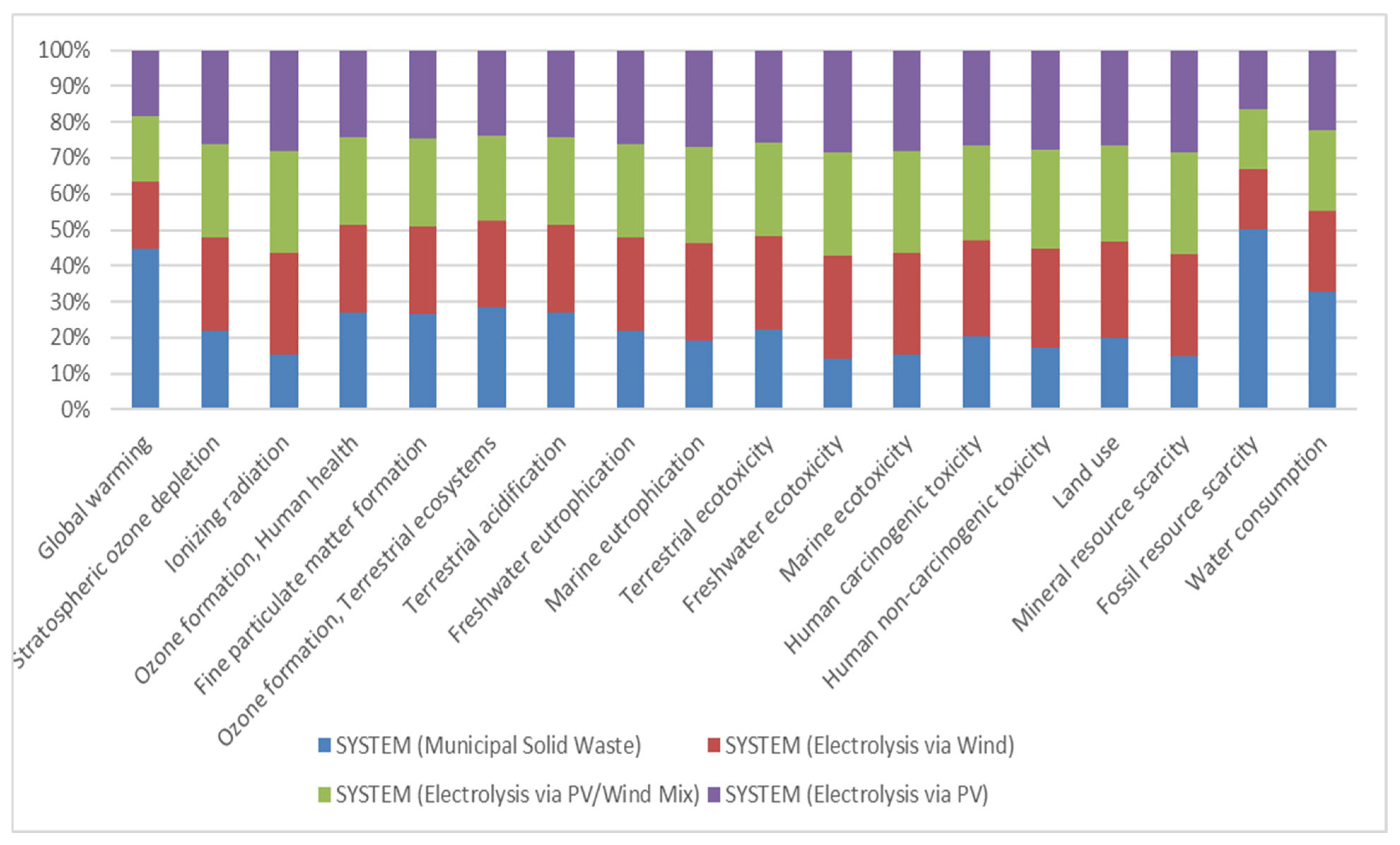
- The analysis reveals that MSW gasification consistently dominates most impact categories, particularly global warming, fossil resource scarcity, and water consumption, where its share exceeds 50% of the total impact [158]. In contrast, electrolysis-based systems exhibit significantly lower contributions to climate-related impacts but show higher shares in categories such as ionizing radiation, human toxicity, and mineral resource scarcity, especially for PV-powered electrolysis due to the material intensity of photovoltaic technology [159]. The hybrid PV–wind system demonstrates intermediate performance, balancing the impacts between wind and PV contributions. These findings highlight a clear trade-off: while electrolysis routes reduce greenhouse gas emissions relative to MSW gasification, they impose additional burdens on resource depletion and toxicity-related categories, underscoring the importance of a holistic sustainability assessment when selecting hydrogen production pathways.
- In the global warming impact category, hydrogen production from municipal solid waste gasification has the highest relative contribution compared to electrolysis-based pathways. This is mainly due to direct process emissions from gasification, auxiliary energy requirements, and upstream activities such as waste collection and transport. Although the biogenic nature of the feedstock partly offsets these emissions, the gasification route remains more carbon-intensive than renewable-powered electrolysis within the defined system boundaries.
- The alkaline water electrolysis powered by renewable energy has a lower global warming potential, with wind-based electrolysis performing slightly better than photovoltaic-based systems. The PV–wind hybrid system exhibits intermediate performance, reflecting the combined embodied emissions of the two renewable technologies. These results highlight the strong influence of electricity sources on the environmental performance of electrolysis-based hydrogen production. Overall, the LCA results demonstrate that alkaline water electrolysis powered by renewable energy outperforms biomass gasification in most climate change and air pollution-related impact categories. However, electrolysis pathways have greater impacts on mineral resource scarcity, land use, and water consumption, particularly for photovoltaic-based systems. Biomass gasification, while more emission-intensive, offers advantages in waste valorisation and reduced reliance on critical minerals.
3.4.2. Land, Water, Forestry and Carbon Footprints
3.4.3. Waste-to-Energy Benefits in Biomass Valorisation
3.4.4. Grid Decarbonization Impact on Electrolysis Viability
3.5. Comparative SWOT Analysis of Biomass Versus Electrolysis Routes
3.5.1. Socio-Economic Co-Benefits of Hydrogen Production
3.5.2. Alignment with UN Sustainable Development Goals
- SDG 7—Affordability and clean energy
- SDG 9—Industry, innovation and infrastructure
- SDG 12—Responsible consumption and production
- SDG 13—Climate action
3.5.3. Future Research Directions
4. Conclusions
Author Contributions
Funding
Institutional Review Board Statement
Data Availability Statement
Acknowledgments
Conflicts of Interest
References
- Rolo, I.; Costa, V.A.F.; Brito, F.P. Hydrogen-based energy systems: Current technology development status, opportunities and challenges. Energies 2023, 17, 180. [Google Scholar] [CrossRef] [Scilit]
- Kabeyi, M.J.B.; Olanrewaju, O.A. Sustainable energy transition for renewable and low carbon grid electricity generation and supply. Front. Energy Res. 2022, 9, 743114. [Google Scholar] [CrossRef] [Scilit]
- Singh, V.; Aishwarya, V.M.; Sriprasath, V.J.; Pranavi, M.; Singh, T. Green hydrogen value chain challenges and global readiness for a sustainable energy future. iScience 2025, 28, 112900. [Google Scholar] [CrossRef] [Scilit] [PubMed]
- Hassan, Q.; Algburi, S.; Sameen, A.Z.; Jaszczur, M.; Salman, H.M. Hydrogen as an energy carrier: Properties, storage methods, challenges, and future implications. Environ. Syst. Decis. 2024, 44, 327–350. [Google Scholar] [CrossRef] [Scilit]
- Hassan, Q.; Tabar, V.S.; Sameen, A.Z.; Salman, H.M.; Jaszczur, M. A review of green hydrogen production based on solar energy; techniques and methods. Energy Harvest. Syst. 2024, 11, 20220134. [Google Scholar] [CrossRef] [Scilit]
- Ren, C.; Rosa, L. Global energy and carbon emissions of irrigation and fertilizers management for closing crop yield gaps. Environ. Res. Lett. 2025, 20, 104026. [Google Scholar] [CrossRef] [Scilit]
- Franco, A. Green Hydrogen and the Energy Transition: Hopes, Challenges, and Realistic Opportunities. Hydrogen 2025, 6, 28. [Google Scholar] [CrossRef] [Scilit]
- Lawal, I.M.; Ndagi, A.; Mohammed, A.; Saleh, Y.Y.; Shuaibu, A.; Hassan, I.; Abubakar, S.; Soja, U.B.; Jagaba, A.H. Proximate analysis of waste-to-energy potential of municipal solid waste for sustainable renewable energy generation. Ain Shams Eng. J. 2024, 15, 102357. [Google Scholar] [CrossRef] [Scilit]
- Giakoumakis, G.; Sidiras, D. Production and storage of hydrogen from biomass and other sources: Technologies and policies. Energies 2025, 18, 650. [Google Scholar] [CrossRef] [Scilit]
- Tüysüz, H. Alkaline Water Electrolysis for Green Hydrogen Production. Acc. Chem. Res. 2024, 57, 558–567. [Google Scholar] [CrossRef] [Scilit]
- Wolf, S.E.; Winterhalder, F.E.; Vibhu, V.; de Haart, L.G.J.B.; Guillon, O.; Eichel, R.-A.; Menzler, N.H. Solid oxide electrolysis cells–current material development and industrial application. J. Mater. Chem. A 2023, 11, 17977–18028. [Google Scholar] [CrossRef] [Scilit]
- Mavukwana, A.-E.; Burra, K.R.G.; Sempuga, B.C.; Gupta, A. Co-Gasification of Gypsum and Municipal Solid Waste Components in CO2 Atmosphere; American Society of Mechanical Engineers: New York, NY, USA, 2023. [Google Scholar]
- Lu, X.-J.; Ullah, I.; Li, J.-H.; Chen, S.; Yuan, C.-Z.; Xu, A.-W. A bimetallic CoZn metal–organic-framework derived CoZnS@ NSC Co-catalyst loaded on gC3N4 for significantly augmented photocatalytic H2 evolution. Inorg. Chem. Front. 2024, 11, 3435–3445. [Google Scholar] [CrossRef] [Scilit]
- Xu, F.; Weng, B. Photocatalytic hydrogen production: An overview of new advances in structural tuning strategies. J. Mater. Chem. A 2023, 11, 4473–4486. [Google Scholar] [CrossRef] [Scilit]
- Liu, M.-H.; Takahashi, Y. Boosting photocatalytic hydrogen production of CdS/BiVO4 nanoplates by transferring in-plane plasmon resonant energy of gold nanoparticles. Catal. Sci. Technol. 2024, 14, 1756–1759. [Google Scholar] [CrossRef] [Scilit]
- Mihăescu, L.; Pîșă, I.; Negreanu, G.P.; Stoica, D.; Lăzăroiu, G.; Simion, I.; Grigoriu, R.M.; Niculescu, B. Vegetable biomass—Source of green hydrogen production through gasification. In Proceedings of the 2024 9th International Conference on Energy Efficiency and Agricultural Engineering (EE&AE), Ruse, Bulgaria, 27–29 June 2024; pp. 1–6. [Google Scholar]
- Mihaescu, L.; Pop, E.; Pisa, I.; Stoica, D.; Grigoriu, R.M. Study of CH4–H2 Gas Combustion in Air Enriched with Oxygen Through Ozone Injection. Energies 2025, 18, 5236. [Google Scholar] [CrossRef] [Scilit]
- Mtolo, S.; Rathilal, S.; Mthombeni, N.H.; Moloi, K.; Tetteh, E.K. Techno-Economic Analysis of Solar-Wind Hybrid Systems for Green Hydrogen Production in South Africa, KwaZulu-Natal Province. Energy Sci. Eng. 2025, 14, 701–720. [Google Scholar] [CrossRef] [Scilit]
- Ganji, M.; Gheibi, M.; Aldaghi, A.; Dhoska, K.; Vito, S.; Atari, S.; Moezzi, R. Comprehensive Study on Hydrogen Production for Sustainable Transportation Planning: Strategic, Techno-Economic, and Environmental Impacts. Hydrogen 2025, 6, 24. [Google Scholar] [CrossRef] [Scilit]
- Kweinor Tetteh, E.; Sijadu, N.G.; Rathilal, S. An overview of non-carbonaceous and renewable-powered technologies for green hydrogen production in South Africa: Keywords occurrence analysis. Energy Strategy Rev. 2024, 54, 101486. [Google Scholar] [CrossRef] [Scilit]
- María Villarreal Vives, A.; Wang, R.; Roy, S.; Smallbone, A. Techno-economic analysis of large-scale green hydrogen production and storage. Appl. Energy 2023, 346, 121333. [Google Scholar] [CrossRef] [Scilit]
- Olabi, A.G.; Abdelkareem, M.A.; Mahmoud, M.S.; Elsaid, K.; Obaideen, K.; Rezk, H.; Wilberforce, T.; Eisa, T.; Chae, K.-J.; Sayed, E.T. Green hydrogen: Pathways, roadmap, and role in achieving sustainable development goals. Process Saf. Environ. Prot. 2023, 177, 664–687. [Google Scholar] [CrossRef] [Scilit]
- Zhang, S.; Lv, L.; Liu, L.; Dai, F.; Sui, J. An efficient low-carbon hydrogen production system based on novel staged gasification coupling with chemical looping technology. Energy Convers. Manag. 2025, 328, 119625. [Google Scholar] [CrossRef] [Scilit]
- Mguni, L.L.; Mmelesi, O.K.; Tetteh, E.K.; Sijadu, N.G.; Yao, Y.; Rathilal, S. Pristine metal–organic framework electrocatalysts for hydrogen production: Role of electrocatalyst properties in basic media. Clean. Chem. Eng. 2025, 11, 100170. [Google Scholar] [CrossRef] [Scilit]
- Mahmod, S.S.; Krisna, R.; Shukor, H.; Abdul, P.M.; Al-Rajabi, M.M.; Atabani, A.E.; Luthfi, A.A.I.; Gunny, A.A.N. Evaluation of biohydrogen production from rice straw hydrolysate via Clostridium sp. YM1: In-lab fermentation and techno-economic study. Int. J. Hydrogen Energy 2024, 138, 1228–1238. [Google Scholar] [CrossRef] [Scilit]
- Li, Y.-C.; Liu, Y.-F.; Chu, C.-Y.; Chang, P.-L.; Hsu, C.-W.; Lin, P.-J.; Wu, S.-Y. Techno-economic evaluation of biohydrogen production from wastewater and agricultural waste. Int. J. Hydrogen Energy 2012, 37, 15704–15710. [Google Scholar] [CrossRef] [Scilit]
- Nirmala, N.; Praveen, G.; AmitKumar, S.; SundarRajan, P.; Baskaran, A.; Priyadharsini, P.; SanjayKumar, S.; Dawn, S.; Pavithra, K.G.; Arun, J.; et al. A review on biological biohydrogen production: Outlook on genetic strain enhancements, reactor model and techno-economics analysis. Sci. Total Environ. 2023, 896, 165143. [Google Scholar] [CrossRef] [Scilit]
- Khandaker, S.; Das, S.; Hossain, M.T.; Islam, A.; Miah, M.R.; Awual, M.R. Sustainable approach for wastewater treatment using microbial fuel cells and green energy generation—A comprehensive review. J. Mol. Liq. 2021, 344, 117795. [Google Scholar] [CrossRef] [Scilit]
- Akinbami, O.M.; Oke, S.R.; Bodunrin, M.O. The state of renewable energy development in South Africa: An overview. Alex. Eng. J. 2021, 60, 5077–5093. [Google Scholar] [CrossRef] [Scilit]
- Haldorai, A. A Survey of Renewable Energy Sources and their Contribution to Sustainable Development. J. Enterp. Bus. Intell. 2022, 2, 211–222. [Google Scholar] [CrossRef] [Scilit]
- Choudhary, M.; Singh, D.; Parihar, M.; Choudhary, K.B.; Nogia, M.; Samal, S.K.; Mishra, R. Impact of municipal solid waste on the environment, soil, and human health. In Waste Management for Sustainable and Restored Agricultural Soil; Elsevier: Amsterdam, The Netherlands, 2024; pp. 33–58. [Google Scholar]
- Atsu, F.; Adams, S. Energy consumption, finance, and climate change: Does policy uncertainty matter? Econ. Anal. Policy 2021, 70, 490–501. [Google Scholar] [CrossRef] [Scilit]
- Nel, E.; Marais, L.; Mqotyana, Z. The regional implications of just transition in the world’s most coal-dependent economy: The case of Mpumalanga, South Africa. Front. Sustain. Cities 2023, 4, 1059312. [Google Scholar] [CrossRef] [Scilit]
- Nunes, L.J.R. The rising threat of atmospheric CO2: A review on the causes, impacts, and mitigation strategies. Environments 2023, 10, 66. [Google Scholar] [CrossRef] [Scilit]
- Jeffry, L.; Ong, M.Y.; Nomanbhay, S.; Mofijur, M.; Mubashir, M.; Show, P.L. Greenhouse gases utilization: A review. Fuel 2021, 301, 121017. [Google Scholar] [CrossRef] [Scilit]
- Nemitallah, M.A.; Alnazha, A.A.; Ahmed, U.; El-Adawy, M.; Habib, M.A. Review on techno-economics of hydrogen production using current and emerging processes: Status and perspectives. Results Eng. 2024, 21, 101890. [Google Scholar] [CrossRef] [Scilit]
- El-Adawy, M.; Dalha, I.B.; Ismael, M.A.; Al-Absi, Z.A.; Nemitallah, M.A. Review of Sustainable Hydrogen Energy Processes: Production, Storage, Transportation, and Color-Coded Classifications. Energy Fuels 2024, 38, 22686–22718. [Google Scholar] [CrossRef] [Scilit]
- Sands, P. Environmental protection in the twenty-first century: Sustainable development and international law. In The Global Environment; Routledge: London, UK, 2023; pp. 116–137. [Google Scholar]
- Nsabiyeze, A.; Ma, R.; Li, J.; Luo, H.; Zhao, Q.; Tomka, J.; Zhang, M. Tackling climate change in agriculture: A global evaluation of the effectiveness of carbon emission reduction policies. J. Clean. Prod. 2024, 468, 142973. [Google Scholar] [CrossRef] [Scilit]
- Fawzy, S.; Osman, A.I.; Doran, J.; Rooney, D.W. Strategies for mitigation of climate change: A review. Environ. Chem. Lett. 2020, 18, 2069–2094. [Google Scholar] [CrossRef] [Scilit]
- Dube, K.; Nhamo, G.; Chikodzi, D. Climate change-induced droughts and tourism: Impacts and responses of Western Cape province, South Africa. J. Outdoor Recreat. Tour. 2022, 39, 100319. [Google Scholar] [CrossRef] [Scilit]
- Nong, D.; Simshauser, P.; Nguyen, D.B. Greenhouse gas emissions vs. CO2 emissions: Comparative analysis of a global carbon tax. Appl. Energy 2021, 298, 117223. [Google Scholar] [CrossRef] [Scilit]
- Gamette, P.; Oteng, C. Implementation of environmental tax in Sub-Saharan Africa: A comparative analysis from policy adopter and policy pioneers. Mitig. Adapt. Strateg. Glob. Change 2025, 30, 11. [Google Scholar] [CrossRef] [Scilit]
- Baker, L. The Political Economy of South Africa’s Carbon Tax; The Institute of Development Studies and Partner Organisations: Brighton, UK, 2022. [Google Scholar]
- Merven, B.; Burton, J.; Lehmann-Grube, P. Assessment of New Coal Generation Capacity Targets in South Africa’s 2019 Integrated Resource Plan for Electricity; ESRG (Energy Systems Research Group), University of Cape Town: Cape Town, South Africa, 2021; Volume 1. [Google Scholar]
- Cunliffe, G. Decarbonisation in the Balance: Assessing South Africa’s Energy Transition and the Implementation of the Integrated Resource Plan; University of Cape Town: Cape Town, South Africa, 2023. [Google Scholar]
- Kalembo, B.M.; Odeku, K.O. An Analysis of the Roles of the Practitioners in the Implementation of the Environmental Impact Assessment in South Africa. Perspect. Law Public Adm. 2023, 12, 163–175. [Google Scholar]
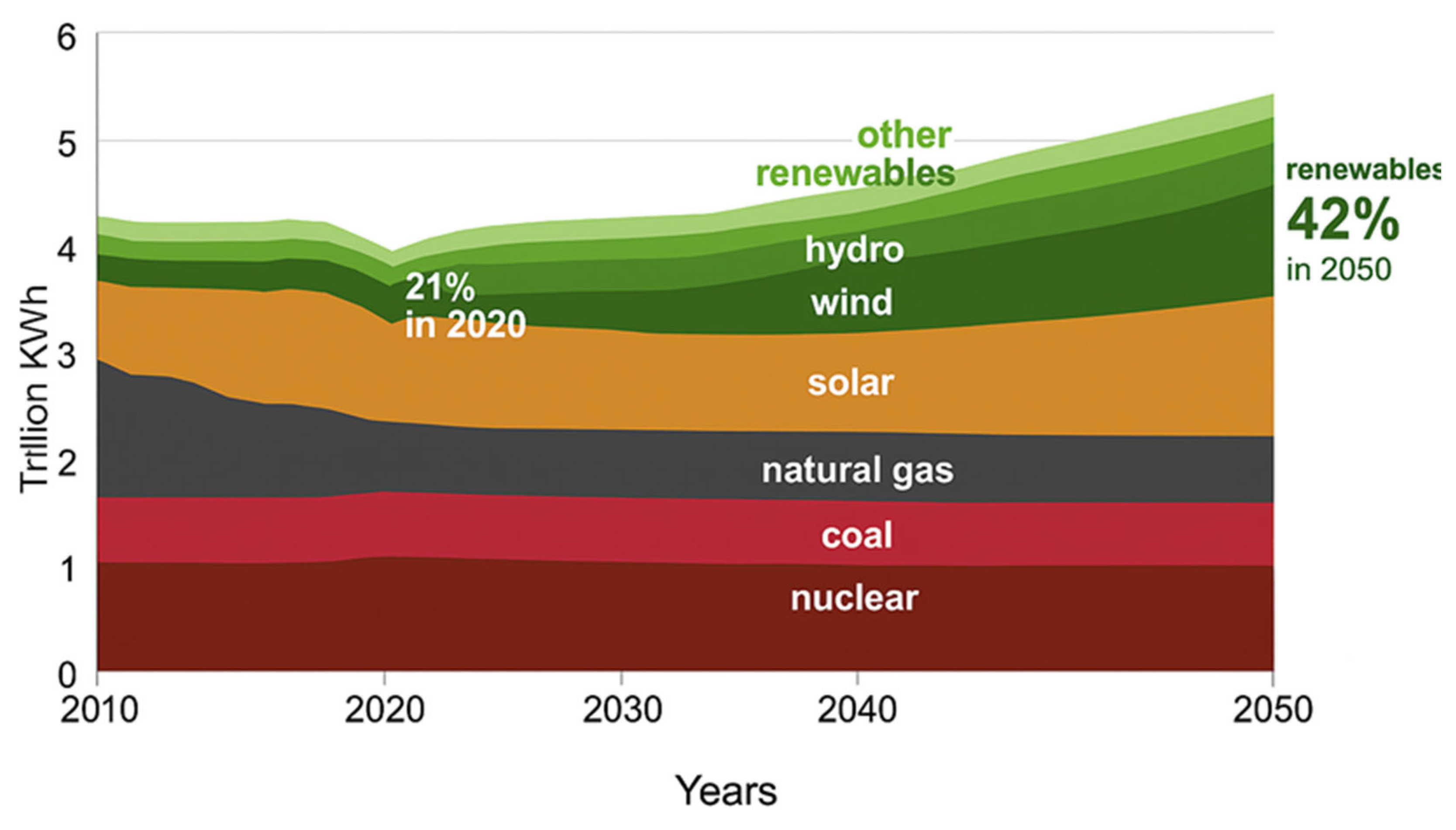
- U.S. Energy Information Administration (EIA). EIA Projects Renewables Share of U.S. Electricity Generation Mix Will Double by 2050. Today in Energy. 8 February 2021. Available online: https://www.instituteforenergyresearch.org/international-issues/eia-expects-energy-demand-to-increase-almost-50-percent-worldwide-by-2050/ (accessed on 25 February 2026).
- Wyk, S.V. Climate Change Law and Policy in South Africa and Mauritius: Adaptation and Mitigation Strategies in Terms of the Paris Agreement. Afr. J. Int. Comp. Law 2022, 30, 1–24. [Google Scholar] [CrossRef] [Scilit]
- Abhyankar, N.; Mohanty, P.; Phadke, A. Illustrative Strategies for the United States to Achieve 50% Emissions Reduction by 2030; Lawrence Berkeley National Laboratory: Berkeley, CA, USA, 2021. [Google Scholar]
- International Energy Agency. World Energy Outlook 2025; IEA: Paris, France, 2025; Available online: https://www.iea.org/reports/world-energy-outlook-2025 (accessed on 25 August 2025).
- Tyler, E.; Hochstetler, K. Institutionalising decarbonisation in South Africa: Navigating climate mitigation and socio-economic transformation. Environ. Politics 2021, 30, 184–205. [Google Scholar] [CrossRef] [Scilit]
- Alcock, K.G. Enterprise Development and Women Entrepreneurship in the Renewable Energy Independent Power Producer Procurement Programme in South Africa; Alternative Information Development Centre: Cape Town, South Africa, 2023. [Google Scholar]
- Mgxashe, P. On REIPPPP: Exploring the Potential of Intermediaries to Support the Implementation of the Programme’s Socio-economic Development Obligations in Low-Income Communities. Master’s Thesis, University of Cape Town, Cape Town, South Africa, 2021. [Google Scholar]
- AbouSeada, N.; Hatem, T.M. Climate action: Prospects of green hydrogen in Africa. Energy Rep. 2022, 8, 3873–3890. [Google Scholar] [CrossRef] [Scilit]
- Kritzinger, A.; Snyman, I. Socio-Economic Impact Assessment Report for the Prieska Power Reserve Solar PV Plant and Wind Energy Facility Phase 1, Prieska, Northern Cape; Central Energy Corporation: Bloemfontein, South Africa, 2022. [Google Scholar]
- Grobbelaar, N.; Ngubevana, L. Ensuring a Just Energy Transition Through Hydrogen: How the G20 Can Support Africa; JSTOR: New York, NY, USA, 2022. [Google Scholar]
- Ibrahim, H.A.; Ayomoh, M.K.; Bansal, R.C.; Gitau, M.N.; Yadavalli, V.S.S.; Naidoo, R. Sustainability of power generation for developing economies: A systematic review of power sources mix. Energy Strategy Rev. 2023, 47, 101085. [Google Scholar] [CrossRef] [Scilit]
- Dyantyi-Gwanya, N.; Giwa, S.O.; Ncanywa, T.; Taziwa, R.T. Exploring Economic Expansion of Green Hydrogen Production in South Africa. Sustainability 2025, 17, 901. [Google Scholar] [CrossRef] [Scilit]
- Scholvin, S.; Black, A.; Robbins, G. Green Hydrogen as a Driver of Development? De-Risking and Production Linkages with New Value Chains in South Africa and Chile; University of Cape Town: Cape Town, South Africa, 2024. [Google Scholar]
- Imasiku, K.; Farirai, F.; Olwoch, J.; Agbo, S.N. A policy review of green hydrogen economy in Southern Africa. Sustainability 2021, 13, 13240. [Google Scholar] [CrossRef] [Scilit]
- Nel, V.; Hugo, M.; Matamanda, A.R.; Oranje, M. Sasolburg: A Town Built Around the Chemical Industry Suffering Under Poor Governance and Its Environmental Legacy. In Secondary Cities and Local Governance in Southern Africa; Springer: Berlin/Heidelberg, Germany, 2024; pp. 233–254. [Google Scholar]
- Olifant, G.E.; Ngubevana, L.; Mathetsa, S. Navigating the Current Landscape of Green Hydrogen, its Potential, and Challenges: A South African perspective. Prog. Energy 2025, 7, 033002. [Google Scholar] [CrossRef] [Scilit]
- Nwakaudu, N.F.; Igwe, J.U.; Ohanyere, I. Green Hydrogen: A Comparative SWOT Analysis of the Green Hydrogen Market in Sub-Saharan and Northern Africa; SPE: Richardson, TX, USA, 2024. [Google Scholar]
- Botha, Z. A glass half full for SA for SA exploration and Mining. J. S. Afr. Inst. Min. Metall. 2023, 123, vi–vii. [Google Scholar]
- Saleh, M.T. Hydrogen in Africa: Navigating the Continent’s Unique Energy Transition Landscape and Unsustainable Energy Supply Backbone. Adv. Sci. Technol. 2024, 142, 3–14. [Google Scholar] [CrossRef] [Scilit]
- Konstantinou, C. Toward a secure and resilient all-renewable energy grid for smart cities. IEEE Consum. Electron. Mag. 2021, 11, 33–41. [Google Scholar] [CrossRef] [Scilit]
- Algarni, S.; Tirth, V.; Alqahtani, T.; Alshehery, S.; Kshirsagar, P. Contribution of renewable energy sources to the environmental impacts and economic benefits for sustainable development. Sustain. Energy Technol. Assess. 2023, 56, 103098. [Google Scholar] [CrossRef] [Scilit]
- Schmid, N.; Lumsden, C. Sowing the seeds of change: Policy feedback and ratcheting up in South African energy policy. Energy Policy 2023, 178, 113597. [Google Scholar] [CrossRef] [Scilit]
- Li, Y.; Shi, X.; Phoumin, H. A strategic roadmap for large-scale green hydrogen demonstration and commercialisation in China: A review and survey analysis. Int. J. Hydrogen Energy 2022, 47, 24592–24609. [Google Scholar] [CrossRef] [Scilit]
- Pandarum, A. The development of green hydrogen in South Africa. In Proceedings of the 11TH CIGRE Southern Africa Regional Conference, Pretoria, South Africa, 24–27 October 2023. [Google Scholar]
- Bessarabov, D.; Pollet, B.G. Hydrogen (H2) technologies in the republic of South Africa. In Hydrogen in an International Context; River Publishers: Gistrup, Denmark, 2022; pp. 203–228. [Google Scholar]
- Nkambule, M.S.; Hasan, A.N.; Shongwe, T. Performance and techno-economic analysis of optimal hybrid renewable energy systems for the mining industry in South Africa. Sustainability 2023, 15, 16766. [Google Scholar] [CrossRef] [Scilit]
- Apata, O. Charting the Course for Sustainable Energy Development: The State of Energy Storage in South Africa’s Decarbonization Efforts; IEEE: New York, NY, USA, 2024. [Google Scholar]
- Andreoni, A.; Roberts, S. Green Hydrogen for Industry and the Challenges for an Entrepreneurial-Regulatory State; CCRED-IDTT Working Paper, 2022. 11; CCRED: Johannesburg, South Africa, 2022. [Google Scholar]
- Pucheta, M.; Álvarez Alonso, C.; Silva Sánchez, P. Just transition and workers’ rights in the global south: The recent Argentine and Chilean nationally determined contributions. Sustainability 2021, 13, 9616. [Google Scholar] [CrossRef] [Scilit]
- Cloete, B.; Kent, B. Environmental Policy in South Africa: From 1994 to Now: Policy Paper 37; ERSA Working Paper Series; Economic Research Southern Africa: Cape Town, South Africa, 2025; p. 44. [Google Scholar]
- Ullman, A.N.; Kittner, N. Are global efforts coordinated for a Just Transition? A review of civil society, financial, government, and academic Just Transition frameworks. Energy Res. Soc. Sci. 2024, 108, 103371. [Google Scholar] [CrossRef] [Scilit]
- Chege, K. Legal/policy tools and strategies for hydrogen in the low-carbon transition. In Handbook of Energy Law in the Low-Carbon Transition; Walter de Gruyter: Berlin, Germany, 2023; Volume 217. [Google Scholar]
- Patel, M. Green Hydrogen: A Potential Export Commodity in a New Global Marketplace; Trade & Industrial Policy Strategies (TIPS): Pretoria, South Africa, 2020. [Google Scholar]
- Maurya, P.K.; Mondal, S.; Kumar, V.; Singh, S.P. Roadmap to sustainable carbon-neutral energy and environment: Can we cross the barrier of biomass productivity? Environ. Sci. Pollut. Res. 2021, 28, 49327–49342. [Google Scholar] [CrossRef] [Scilit]
- Moloto, K.C. Indigenous Knowledge and Science, Technology, and Innovation-Driven Systems for the Healthcare Industry in South Africa. Master’s Thesis, University of the Witwatersrand, Johannesburg, South Africa, 2025. [Google Scholar]
- El-Sayed, A.I.M.; El-Sheekh, M.M.; Zohir, W.F. Introduction to bioenergy production: Concepts, opportunities, and challenges. In Nature-Based Technologies for Wastewater Treatment and Bioenergy Production; IWA Publishing: London, UK, 2025; p. 173. [Google Scholar]
- Kalak, T. Potential use of industrial biomass waste as a sustainable energy source in the future. Energies 2023, 16, 1783. [Google Scholar] [CrossRef] [Scilit]
- Ghanbarzadeh Lak, M.; Ghaffariraad, M.; Jahangirzadeh Soureh, H. Characteristics and impacts of municipal solid waste (MSW). In Technical Landfills and Waste Management: Volume 1: Landfill Impacts, Characterization and Valorisation; Springer: Berlin/Heidelberg, Germany, 2024; pp. 31–92. [Google Scholar]
- Sundaralingam, S.; Ramanathan, N. A deep learning-based approach to segregate solid waste generated in residential areas. Eng. Technol. Appl. Sci. Res. 2023, 13, 10439–10446. [Google Scholar] [CrossRef] [Scilit]
- Alao, M.A.; Popoola, O.M.; Ayodele, T.R. Projecting the energetic potential and economic viability of renewable power generation from municipal solid waste: Indication from South African Provinces. Energy Sustain. Dev. 2022, 71, 352–367. [Google Scholar] [CrossRef] [Scilit]
- Janse van Rensburg, R. Waste Prevention in South Africa: An Evaluation of Waste Management Regulations, Policies and Plans. Doctoral Dissertation, North-West University, Potchefstroom, South Africa, 2022. [Google Scholar]
- Mbazima, S.J.; Masekameni, M.D.; Mmereki, D. Waste-to-energy in a developing country: The state of landfill gas to energy in the Republic of South Africa. Energy Explor. Exploit. 2022, 40, 1287–1312. [Google Scholar]
- Department of Environment, Forestry and Fisheries (DFFE). National Waste Management Strategy 2020; DFFE: Pretoria, South Africa, 2020. Available online: https://www.dffe.gov.za/sites/default/files/docs/2020nationalwaste_managementstrategy1.pdf (accessed on 25 August 2025).
- Voukkali, I.; Papamichael, I.; Loizia, P.; Zorpas, A.A. Urbanization and solid waste production: Prospects and challenges. Environ. Sci. Pollut. Res. 2024, 31, 17678–17689. [Google Scholar] [CrossRef] [Scilit]
- Adeleke, O.; Akinlabi, S.; Jen, T.-C.; Dunmade, I. Towards sustainability in municipal solid waste management in South Africa: A survey of challenges and prospects. Trans. R. Soc. S. Afr. 2021, 76, 53–66. [Google Scholar]
- Liu, B.; Han, B.; Liang, X.; Liu, Y. Hydrogen production from municipal solid waste: Potential prediction and environmental impact analysis. Int. J. Hydrogen Energy 2024, 52, 1445–1456. [Google Scholar] [CrossRef] [Scilit]
- Polasi, T.; Matinise, S.; Oelofse, S. South African Municipal Waste Management Systems: Challenges and Solutions; International Environmental Technology Centre: Osaka, Japan, 2020. [Google Scholar]
- Panel, G.H. Green Hydrogen Commercialisation Strategy for South Africa; Industrial Development Corporation: Sandton, South Africa, 2022. [Google Scholar]
- Taibi, E.; Miranda, R.; Carmo, M.; Blanco, H. Green Hydrogen Cost Reduction; International Renewable Energy Agency: Abu Dhabi, United Arab Emirates, 2020. [Google Scholar]
- Klagge, B.; Walker, B.; Kalvelage, L.; Greiner, C. Governance of future-making: Green hydrogen in Namibia and South Africa. Geoforum 2025, 161, 104244. [Google Scholar] [CrossRef] [Scilit]
- Agyekum, E.B. Is Africa ready for green hydrogen energy takeoff?—A multi-criteria analysis approach to the opportunities and barriers of hydrogen production on the continent. Int. J. Hydrogen Energy 2024, 49, 219–233. [Google Scholar] [CrossRef] [Scilit]
- Panchenko, V.A.; Daus, Y.V.; Kovalev, A.A.; Yudaev, I.V.; Litti, Y.V. Prospects for the production of green hydrogen: Review of countries with high potential. Int. J. Hydrogen Energy 2023, 48, 4551–4571. [Google Scholar] [CrossRef] [Scilit]
- Nnabuife, S.G.; Hamzat, A.K.; Whidborne, J.; Kuang, B.; Jenkins, K.W. Integration of renewable energy sources in tandem with electrolysis: A technology review for green hydrogen production. Int. J. Hydrogen Energy 2024, 107, 218–240. [Google Scholar] [CrossRef] [Scilit]
- Dagnachew, A.G.; Yalew, S.G.; Tesfamichael, M.; Okereke, C.; Abraham, E. A green hydrogen revolution in Africa remains elusive under current geopolitical realities. Clim. Policy 2025, 25, 291–302. [Google Scholar] [CrossRef] [Scilit]
- Cremonese, L.; Mbungu, G.K.; Quitzow, R. The sustainability of green hydrogen: An uncertain proposition. Int. J. Hydrogen Energy 2023, 48, 19422–19436. [Google Scholar] [CrossRef] [Scilit]
- Lepage, T.; Kammoun, M.; Schmetz, Q.; Richel, A. Biomass-to-hydrogen: A review of main routes production, processes evaluation and techno-economical assessment. Biomass Bioenergy 2021, 144, 105920. [Google Scholar] [CrossRef] [Scilit]
- Begum, Y.A.; Kumari, S.; Jain, S.K.; Garg, M.C. A review on waste biomass-to-energy: Integrated thermochemical and biochemical conversion for resource recovery. Environ. Sci. Adv. 2024, 3, 1197–1216. [Google Scholar] [CrossRef] [Scilit]
- Alvarado-Flores, J.J.; Alcaraz-Vera, J.V.; Ávalos-Rodríguez, M.L.; Guzmán-Mejía, E.; Rutiaga-Quiñones, J.G.; Pintor-Ibarra, L.F.; Guevara-Martínez, S.J. Thermochemical production of hydrogen from biomass: Pyrolysis and gasification. Energies 2024, 17, 537. [Google Scholar] [CrossRef] [Scilit]
- Shadle, L.J.; Indrawan, N.; Breault, R.W.; Bennett, J. Gasification technology. In Handbook of Climate Change Mitigation and Adaptation; Springer: Berlin/Heidelberg, Germany, 2025; pp. 793–882. [Google Scholar]
- Chanthakett, A.; Arif, M.T.; Khan, M.M.K.; Oo, A.M.T. Hydrogen production from municipal solid waste (MSW) for cleaner environment. In Bioenergy Resources and Technologies; Elsevier: Amsterdam, The Netherlands, 2021; pp. 219–247. [Google Scholar]
- Mignogna, D.; Ceci, P.; Cafaro, C.; Corazzi, G.; Avino, P. Production of biogas and biomethane as renewable energy sources: A review. Appl. Sci. 2023, 13, 10219. [Google Scholar] [CrossRef] [Scilit]
- Mandree, P.; Thopil, G.A.; Ramchuran, S. Potential opportunities to convert waste to bio-based chemicals at an industrial scale in South Africa. Fermentation 2023, 9, 908. [Google Scholar] [CrossRef] [Scilit]
- Montiel-Bohórquez, N.D.; Saldarriaga-Loaiza, J.D.; Pérez, J.F. Analysis of investment incentives for power generation based on an integrated plasma gasification combined cycle power plant using municipal solid waste. Case Stud. Therm. Eng. 2022, 30, 101748. [Google Scholar] [CrossRef] [Scilit]
- Nandhini, R.; Berslin, D.; Sivaprakash, B.; Rajamohan, N.; Vo, D.-V.N. Thermochemical conversion of municipal solid waste into energy and hydrogen: A review. Environ. Chem. Lett. 2022, 20, 1645–1669. [Google Scholar] [CrossRef] [Scilit]
- Sithole, Z.B. Integrated Dynamic Prediction Modelling for Biomass to Energy Production; University of Johannesburg: Johannesburg, South Africa, 2021. [Google Scholar]
- Viljoen, J.M.M.; Schenck, C.J.; Volschenk, L.; Blaauw, P.F.; Grobler, L. Household waste management practices and challenges in a rural remote town in the Hantam Municipality in the Northern Cape, South Africa. Sustainability 2021, 13, 5903. [Google Scholar] [CrossRef] [Scilit]
- Chapel, C.A. Waste Age-Living in a Throwaway Society: Searching for Sustainability in Eastern Johannesburg. Master’s Thesis, University of the Witwatersrand, Johannesburg, South Africa, 2024. [Google Scholar]
- Streit, A.F.M.; de Santana, M.P.; de Oliveira Júnior, D.L.; Bassaco, M.M.; Tanabe, E.H.; Dotto, G.L.; Bertuol, D.A. Development of a pre-treatment process of polymeric wastes (HDPE, LDPE/LLDPE, PP) for application in the qualification of selectors of recyclable materials. Environ. Dev. Sustain. 2022, 24, 6349–6371. [Google Scholar] [CrossRef] [Scilit]
- Khan, M.A.; Al-Attas, T.; Roy, S.; Rahman, M.M.; Ghaffour, N.; Thangadurai, V.; Larter, S.; Hu, J.; Ajayan, P.M.; Kibria, M.G. Seawater electrolysis for hydrogen production: A solution looking for a problem? Energy Environ. Sci. 2021, 14, 4831–4839. [Google Scholar] [CrossRef] [Scilit]
- Nahman, A. Incentives for Municipalities to Divert Waste from Landfill in South Africa; Waste Research Development and Innovation Roadmap Research Report; Council for Scientific and Industrial Research: Pretoria, South Africa, 2021. [Google Scholar]
- Nkosi, N.; Muzenda, E.; Gorimbo, J.; Belaid, M. Developments in waste tyre thermochemical conversion processes: Gasification, pyrolysis and liquefaction. RSC Adv. 2021, 11, 11844–11871. [Google Scholar] [CrossRef] [Scilit] [PubMed]
- Mostakim, K.; Arefin, M.A.; Islam, M.T.; Shifullah, K.M.; Islam, M.A. Harnessing energy from the waste produced in Bangladesh: Evaluating potential technologies. Heliyon 2021, 7, e08221. [Google Scholar] [CrossRef] [Scilit]
- Nahman, A.; Oelofse, S.; Haywood, L. Haywood, Implementing Economic Instruments and Incentives to Divert Waste from Landfill; A Guideline for National Government; CSIR: Pretoria, South Africa, 2021. [Google Scholar]
- Ismaeel, W.S.E.; Kassim, N. An environmental management plan for construction waste management. Ain Shams Eng. J. 2023, 14, 102244. [Google Scholar] [CrossRef] [Scilit]
- Sebbahi, S.; Nabil, N.; Alaoui-Belghiti, A.; Laasri, S.; Rachidi, S.; Hajjaji, A. Assessment of the three most developed water electrolysis technologies: Alkaline water electrolysis, proton exchange membrane and solid-oxide electrolysis. Mater. Today Proc. 2022, 66, 140–145. [Google Scholar] [CrossRef] [Scilit]
- Qian, Q.; Zhu, Y.; Ahmad, N.; Feng, Y.; Zhang, H.; Cheng, M.; Liu, H.; Xiao, C.; Zhang, G.; Xie, Y. Recent advancements in electrochemical hydrogen production via hybrid water splitting. Adv. Mater. 2024, 36, 2306108. [Google Scholar] [CrossRef] [Scilit]
- Elegbeleye, I.; Oguntona, O.; Elegbeleye, F. Green Hydrogen: Pathway to Net Zero Green House Gas Emission and Global Climate Change Mitigation. Hydrogen 2025, 6, 29. [Google Scholar] [CrossRef] [Scilit]
- Mukiza, E. The Effects of Pressure and Temperature on Alkaline Electrolysis. Master’s Thesis, Lahti University of Technology, Lappeenranta, Finland, 2024. [Google Scholar]
- Adebiyi, A.A.; Moloi, K. Renewable energy source utilization progress in South Africa: A review. Energies 2024, 17, 3487. [Google Scholar] [CrossRef] [Scilit]
- Ndlovu, S.; Adewuyi, S.O. The Extractive Industries and Society. Extr. Ind. Soc. 2025, 24, 101760. [Google Scholar]
- Abushawish, A.; Bouaziz, I.; Almanassra, I.W.; Al-Rajabi, M.M.; Jaber, L.; Khalil, A.K.A.; Takriff, M.S.; Laoui, T.; Shanableh, A.; Atieh, M.A. Desalination pretreatment technologies: Current status and future developments. Water 2023, 15, 1572. [Google Scholar] [CrossRef] [Scilit]
- Mtolo, S.; Tetteh, E.; Mthombeni, N.; Rathilal, S.; Moloi, K. Challenges and Prospect of Solar-Powered Seawater Electrolysis for Green Hydrogen Production in South Africa: A Comprehensive. In Proceedings of the 41st CAPE TOWN Int’L. Conference on “Chemical, Biological and Environmental Engineering” (CCBEE-24), Cape Town, South Africa, 21–22 November 2024; pp. 238–245. [Google Scholar]
- Chisholm, G.; Zhao, T.; Cronin, L. Hydrogen from water electrolysis. In Storing Energy; Elsevier: Amsterdam, The Netherlands, 2022; pp. 559–591. [Google Scholar]
- Abdin, Z. Empowering the hydrogen economy: The transformative potential of blockchain technology. Renew. Sustain. Energy Rev. 2024, 200, 114572. [Google Scholar] [CrossRef] [Scilit]
- Wang, Z.; Li, M.; Zhao, F.; Ji, Y.; Han, F. Status and prospects in technical standards of hydrogen-powered ships for advancing maritime zero-carbon transformation. Int. J. Hydrogen Energy 2024, 62, 925–946. [Google Scholar] [CrossRef] [Scilit]
- Wu, H.; Zhang, S.; Li, X.; Liu, S.; Liang, L. A multivariate coupled economic model study on hydrogen production by renewable energy combined with off-peak electricity. Int. J. Hydrogen Energy 2022, 47, 24481–24492. [Google Scholar] [CrossRef] [Scilit]
- Lee, H.; Choe, B.; Lee, B.; Gu, J.; Cho, H.-S.; Won, W.; Lim, H. Outlook of industrial-scale green hydrogen production via a hybrid system of alkaline water electrolysis and energy storage system based on seasonal solar radiation. J. Clean. Prod. 2022, 377, 134210. [Google Scholar] [CrossRef] [Scilit]
- Wijayasekera, S.C.; Hewage, K.; Siddiqui, O.; Hettiaratchi, P.; Sadiq, R. Waste-to-hydrogen technologies: A critical review of techno-economic and socio-environmental sustainability. Int. J. Hydrogen Energy 2022, 47, 5842–5870. [Google Scholar] [CrossRef] [Scilit]
- Shafiq, H.; Azam, S.U.; Hussain, A. Steam gasification of municipal solid waste for hydrogen production using Aspen Plus® simulation. Discov. Chem. Eng. 2021, 1, 4. [Google Scholar] [CrossRef] [Scilit]
- Garcia-Vallejo, M.C.; Cardona Alzate, C.A. Prefeasibility analysis of biomass gasification and electrolysis for hydrogen production. Environ. Res. 2024, 248, 118003. [Google Scholar] [CrossRef] [Scilit] [PubMed]
- Lourinho, G.; Alves, O.; Garcia, B.; Rijo, B.; Brito, P.; Nobre, C. Costs of gasification technologies for energy and fuel production: Overview, analysis, and numerical estimation. Recycling 2023, 8, 49. [Google Scholar] [CrossRef] [Scilit]
- Hiloidhari, M.; Sharno, M.A.; Baruah, D.C.; Bezbaruah, A.N. Green and sustainable biomass supply chain for environmental, social and economic benefits. Biomass Bioenergy 2023, 175, 106893. [Google Scholar] [CrossRef] [Scilit]
- Abdin, Z.; Khalilpour, K.; Catchpole, K. Projecting the levelized cost of large scale hydrogen storage for stationary applications. Energy Convers. Manag. 2022, 270, 116241. [Google Scholar] [CrossRef] [Scilit]
- Pinheiro, F.P.; Gomes, D.M.; Tofoli, F.L.; Sampaio, R.F.; Melo, L.S.; Gregory, R.C.F.; Sgrò, D.; Leão, R.P.S. Techno-economic analysis of green hydrogen generation from combined wind and photovoltaic systems based on hourly temporal correlation. Int. J. Hydrogen Energy 2025, 97, 690–707. [Google Scholar] [CrossRef] [Scilit]
- Cook, M. Project cash flow. In Developments in Petroleum Science; Elsevier: Amsterdam, The Netherlands, 2021; Volume 71, pp. 133–205. [Google Scholar]
- DiLellio, J.A.; Butler, J.C.; Rizaev, I.; Sheng, W.; Aggidis, G. Evaluating the Long-Term Investment Opportunities of Wave Energy Conversion with Real Options; ISOPE: Cupertino, CA, USA, 2024. [Google Scholar]
- Tanyi, R.J.; Mensah, L.D.; Ntiamoah, A.; Quansah, D.A.; Adaramola, M.S. Techno-economic assessment of hydrogen production in Ghana through PV electrolysis and biomass gasification. Oxf. Open Energy 2024, 3, oiae014. [Google Scholar] [CrossRef] [Scilit]
- Buffi, M.; Prussi, M.; Scarlat, N. Energy and environmental assessment of hydrogen from biomass sources: Challenges and perspectives. Biomass Bioenergy 2022, 165, 106556. [Google Scholar] [CrossRef] [Scilit]
- Worku, A.K.; Ayele, D.W.; Deepak, D.B.; Gebreyohannes, A.Y.; Agegnehu, S.D.; Kolhe, M.L. Recent advances and challenges of hydrogen production technologies via renewable energy sources. Adv. Energy Sustain. Res. 2024, 5, 2300273. [Google Scholar] [CrossRef] [Scilit]
- Nunes, L.J.R. Exploring the present and future of biomass recovery units: Technological innovation, policy incentives and economic challenges. Biofuels 2024, 15, 375–387. [Google Scholar] [CrossRef] [Scilit]
- Ganesh, G.S.; Dasappa, S.; Patil, B.; Shivapuji, A.M. Comparative economic and environmental performance assessment of biomass gasification pathway for green H2 production. Detritus 2025, 30, 75. [Google Scholar] [CrossRef] [Scilit]
- Wang, Y.; Yang, Y. Research on greenhouse gas emissions and economic assessment of biomass gasification power generation technology in China based on LCA method. Sustainability 2022, 14, 16729. [Google Scholar] [CrossRef] [Scilit]
- Nnabuife, S.G.; Darko, C.K.; Obiako, P.C.; Kuang, B.; Sun, X.; Jenkins, K. A Comparative Analysis of Different Hydrogen Production Methods and Their Environmental Impact. Clean Technol. 2023, 5, 1344–1380. [Google Scholar] [CrossRef] [Scilit]
- Nami, H.; Rizvandi, O.B.; Chatzichristodoulou, C.; Hendriksen, P.V.; Frandsen, H.L. Techno-economic analysis of current and emerging electrolysis technologies for green hydrogen production. Energy Convers. Manag. 2022, 269, 116162. [Google Scholar] [CrossRef] [Scilit]
- van Vuuren, M.J. Techno-Economic Analysis of Solid Oxide Electrolysis Using Concentrated Solar Energy for Green Hydrogen Production in South Africa. Doctoral Dissertation, Stellenbosch University, Stellenbosch, South Africa, 2024. [Google Scholar]
- Béres, R.; Mararakanye, N.; Auret, C.; Bekker, B.; van den Broek, M. Analysing the prospects of grid-connected green hydrogen production in predominantly fossil-based countries—A case study of South Africa. Int. J. Hydrogen Energy 2024, 83, 975–986. [Google Scholar] [CrossRef] [Scilit]
- Fonseca, A.; Ramalho, E.; Gouveia, A.; Figueiredo, F.; Nunes, J. Life cycle assessment of PLA products: A systematic literature review. Sustainability 2023, 15, 12470. [Google Scholar] [CrossRef] [Scilit]
- D’Ascenzo, F.; Vinci, G.; Maddaloni, L.; Ruggeri, M.; Savastano, M. Application of life cycle assessment in beer production: Systematic review. Beverages 2024, 10, 86. [Google Scholar] [CrossRef] [Scilit]
- Biagetti, E.; Gislon, G.; Martella, A.; Zucali, M.; Bava, L.; Franco, S.; Sandrucci, A. Comparison of the use of life cycle assessment and ecological footprint methods for evaluating environmental performances in dairy production. Sci. Total Environ. 2023, 905, 166845. [Google Scholar] [CrossRef] [Scilit] [PubMed]
- Jones, E.; Qadir, M.; Van Vliet, M.T.; Smakhtin, V.; Kang, S.-M. The state of desalination and brine production: A global outlook. Sci. Total Environ. 2019, 657, 1343–1356. [Google Scholar] [CrossRef] [Scilit] [PubMed]
- Ouedraogo, A.S.; Frazier, R.S.; Kumar, A. Comparative life cycle assessment of gasification and landfilling for disposal of municipal solid wastes. Energies 2021, 14, 7032. [Google Scholar] [CrossRef] [Scilit]
- Zaki, M.T.; Smith, C.; Badgett, A.; Breunig, H.M. Liquid Alkaline Water Electrolyzers: Comparing Performance across Design, Operation, and End-of-Life Scenarios. Environ. Sci. Technol. 2025, 59, 21941–21956. [Google Scholar] [CrossRef] [Scilit]
- Chigbu, U.E.; Nweke-Eze, C. Green Hydrogen Production and Its Land Tenure Consequences in Africa: An Interpretive Review. Land 2023, 12, 1709. [Google Scholar] [CrossRef] [Scilit]
- Tonelli, D.; Rosa, L.; Gabrielli, P.; Caldeira, K.; Parente, A.; Contino, F. Global land and water limits to electrolytic hydrogen production using wind and solar resources. Nat. Commun. 2023, 14, 5532. [Google Scholar] [CrossRef] [Scilit]
- Adeleke, O.; Akinlabi, S.A.; Jen, T.-C.; Dunmade, I. Sustainable utilization of energy from waste: A review of potentials and challenges of Waste-to-energy in South Africa. Int. J. Green Energy 2021, 18, 1550–1564. [Google Scholar] [CrossRef] [Scilit]
- Thaha, A.N.; Ghamari, M.; Jothiprakash, G.; Velusamy, S.; Karthikeyan, S.; Ramesh, D.; Sundaram, S. High Impact Biomass Valorization for Second Generation Biorefineries in India: Recent Developments and Future Strategies for Sustainable Circular Economy. Biomass 2025, 5, 16. [Google Scholar] [CrossRef] [Scilit]
- Fertahi, S.; Elalami, D.; Tayibi, S.; Taarji, N.; Lyamlouli, K.; Bargaz, A.; Oukarroum, A.; Zeroual, Y.; El Bouhssini, M.; Barakat, A. The current status and challenges of biomass biorefineries in Africa: A critical review and future perspectives for bioeconomy development. Sci. Total Environ. 2023, 870, 162001. [Google Scholar] [CrossRef] [Scilit]
- Rani, G.M.; Pathania, D.; Umapathi, R.; Rustagi, S.; Huh, Y.S.; Gupta, V.K.; Kaushik, A.; Chaudhary, V. Agro-waste to sustainable energy: A green strategy of converting agricultural waste to nano-enabled energy applications. Sci. Total Environ. 2023, 875, 162667. [Google Scholar]
- Khawaja, M.K.; Alkayyali, K.; Almanasreh, M.; Alkhalidi, A. Waste-to-energy barriers and solutions for developing countries with limited water and energy resources. Sci. Total Environ. 2024, 926, 172096. [Google Scholar] [CrossRef] [Scilit]
- Abraham, C.; Zenner, T.; Booysen, M.; Rix, A. Decarbonising South Africa’s Paratransit with Hydrogen: A simulated Case Study; SATC: New York, NY, USA, 2023. [Google Scholar]
- Schmidt, R.-R.; Leitner, B. A collection of SWOT factors (strength, weaknesses, opportunities and threats) for hybrid energy networks. Energy Rep. 2021, 7, 55–61. [Google Scholar] [CrossRef] [Scilit]
- Safari, S.; Esmaeilion, F.; Rabanian, A.; Jamali, D.H.; Negi, S.; Hoseinzadeh, S.; Sayedin, F.; Bhoglla, S.S.; Haj Assad, M.E.; Das, B. Sustainable hydrogen production through water splitting: A comprehensive review. Environ. Dev. Sustain. 2024, 27, 17887–17926. [Google Scholar] [CrossRef] [Scilit]
- Sylvester, M.M.; Masiya, T. Harnessing the Power of Renewable Energy for Rural Development in Africa: A Transdisciplinary Approach. Afr. J. Public Adm. Environ. Stud. (AJOPAES) 2024, 3, 53–77. [Google Scholar] [CrossRef] [Scilit]
- Musetsho, K.D.; Chitakira, M.; Nel, W. Mapping land-use/land-cover change in a critical biodiversity area of south africa. Int. J. Environ. Res. Public Health 2021, 18, 10164. [Google Scholar] [CrossRef] [Scilit]
- Jayarathna, L.; Kent, G.; O’Hara, I. Spatial optimization of multiple biomass utilization for large-scale bioelectricity generation. J. Clean. Prod. 2021, 319, 128625. [Google Scholar] [CrossRef] [Scilit]
- Lestander, T.A.; Weiland, F.; Grimm, A.; Rudolfsson, M.; Wiinikka, H. Gasification of pure and mixed feedstock components: Effect on syngas composition and gasification efficiency. J. Clean. Prod. 2022, 369, 133330. [Google Scholar] [CrossRef] [Scilit]
- Udeagha, M.C.; Ngepah, N. Dynamic ARDL simulations effects of fiscal decentralization, green technological innovation, trade openness, and institutional quality on environmental sustainability: Evidence from South Africa. Sustainability 2022, 14, 10268. [Google Scholar] [CrossRef] [Scilit]
- Roos, T.H. The cost of production and storage of renewable hydrogen in South Africa and transport to Japan and EU up to 2050 under different scenarios. Int. J. Hydrogen Energy 2021, 46, 35814–35830. [Google Scholar] [CrossRef] [Scilit]
- Teixeira, P.; Bacariza, C.; Correia, P.; Pinheiro, C.I.C.; Cabrita, I. Hydrogen production with in situ CO2 capture at high and medium temperatures using solid sorbents. Energies 2022, 15, 4039. [Google Scholar] [CrossRef] [Scilit]
- Shah, T.M.; Khan, A.H.; Nicholls, C.; Sohoo, I.; Otterpohl, R. Using landfill sites and marginal lands for socio-economically sustainable biomass production through cultivation of non-food energy crops: An analysis focused on South Asia and Europe. Sustainability 2023, 15, 4923. [Google Scholar] [CrossRef] [Scilit]
- Ruhnau, O. How flexible electricity demand stabilizes wind and solar market values: The case of hydrogen electrolyzers. Appl. Energy 2022, 307, 118194. [Google Scholar] [CrossRef] [Scilit]
- Saleem, M. Possibility of utilizing agriculture biomass as a renewable and sustainable future energy source. Heliyon 2022, 8, e08905. [Google Scholar] [CrossRef] [Scilit]
- Rawat, Y.S.; Singh, G.S.; Tekleyohannes, A.T. Optimizing the benefits of invasive alien plants biomass in South Africa. Sustainability 2024, 16, 1876. [Google Scholar] [CrossRef] [Scilit]
- Wiese, M.; van der Westhuizen, L.-M. Impact of planned power outages (load shedding) on consumers in developing countries: Evidence from South Africa. Energy Policy 2024, 187, 114033. [Google Scholar] [CrossRef] [Scilit]
- Simoes, S.G.; Catarino, J.; Picado, A.; Lopes, T.F.; Di Berardino, S.; Amorim, F.; Girio, F.; Rangel, C.M.; de Leao, T.P. Water availability and water usage solutions for electrolysis in hydrogen production. J. Clean. Prod. 2021, 315, 128124. [Google Scholar] [CrossRef] [Scilit]
- Sharma, G.D.; Verma, M.; Taheri, B.; Chopra, R.; Parihar, J.S. Socio-economic aspects of hydrogen energy: An integrative review. Technol. Forecast. Soc. Change 2023, 192, 122574. [Google Scholar] [CrossRef] [Scilit]
- Ahmed, T. Advancements in Sustainable Energy Economics: A Comprehensive Review. J. Econ. Manag. Bus. Adm. 2024, 3, 10–29. [Google Scholar]
- Falcone, P.M. Sustainable energy policies in developing countries: A review of challenges and opportunities. Energies 2023, 16, 6682. [Google Scholar] [CrossRef] [Scilit]
- Oluoch, S.; Lal, P.; Susaeta, A. Investigating factors affecting renewable energy consumption: A panel data analysis in Sub Saharan Africa. Environ. Chall. 2021, 4, 100092. [Google Scholar] [CrossRef] [Scilit]
- Ottinger, R.; Bourgeois, T.; Habermann, R.; Vithanage, A. Community renewable energy for sustainable development. In The Transformation of Environmental Law and Governance; Edward Elgar Publishing: Cheltenham, UK, 2021; pp. 167–187. [Google Scholar]
- Shulla, K.; Leal-Filho, W. Achieving the UN Agenda 2030: Overall Actions for the Successful Implementation of the Sustainable Development Goals Before and After the 2030 Deadline; European Union Parliament: Strasbourg, France, 2023. [Google Scholar]
- Cruz, S.A. SDG 17 and global partnership for sustainable development: Unraveling the rhetoric of collaboration. Front. Environ. Sci. 2023, 11, 1155828. [Google Scholar] [CrossRef] [Scilit]
- Strelkovskii, N.; Komendantova, N. Integration of UN sustainable development goals in national hydrogen strategies: A text analysis approach. Int. J. Hydrogen Energy 2025, 102, 1282–1294. [Google Scholar] [CrossRef] [Scilit]
- Udeagha, M.C.; Ngepah, N. A roadmap to a green economy in South Africa: Modelling technological innovation and energy consumption in the novel dynamic ARDL simulations framework. Cogent Econ. Financ. 2024, 12, 2295191. [Google Scholar] [CrossRef] [Scilit]
- Malemane, T.; Garner, K.S. The Design Optimisation of a Solar PV Plant to Power an Electrolyser for Green Hydrogen Production; IEEE: New York, NY, USA, 2025. [Google Scholar]
- Hägele, R.; Iacobuţă, G.I.; Tops, J. Addressing climate goals and the SDGs through a just energy transition? Empirical evidence from Germany and South Africa. J. Integr. Environ. Sci. 2022, 19, 85–120. [Google Scholar] [CrossRef] [Scilit]
- Chirisa, I.; Mphambukeli, T.N. Hydrogen Economy: Infrastructure Planning Options and Technological Permutations for Africa. In The Palgrave Encyclopedia of Sustainable Resources and Ecosystem Resilience; Springer: Berlin/Heidelberg, Germany, 2024; pp. 1–17. [Google Scholar]
- Vonk, D. Energy Justice in South Africa-Visions for a Green Hydrogen Contribution in the Just Energy Transition. Master’s Thesis, Utrecht University, Utrecht, The Netherlands, 2023. [Google Scholar]
- Salah, A.; Abo Elnasr, S.A. Innovation Role in Driving Sustainable Industrial Development: Evidence from BRICS. Arab. J. Adm. 2024, 46, 1–30. [Google Scholar] [CrossRef] [Scilit]
- Hassan, N.S.; Jalil, A.A.; Rajendran, S.; Khusnun, N.F.; Bahari, M.B.; Johari, A.; Kamaruddin, M.J.; Ismail, M. Recent review and evaluation of green hydrogen production via water electrolysis for a sustainable and clean energy society. Int. J. Hydrogen Energy 2024, 52, 420–441. [Google Scholar] [CrossRef] [Scilit]
- Dagnachew, A.G.; Solf, S.; Ibrahim, S.I.; de Boer, H.-S. The Opportunities, Challenges and Potentials for Hydrogen in Africa; PBL Publishers: Ottumwa, IA, USA, 2023. [Google Scholar]
- Gan, K.E.; Taikan, O.; Gan, T.Y.; Weis, T.; Yamazaki, D.; Schüttrumpf, H. Enhancing renewable energy systems, contributing to Sustainable Development Goals of United Nation and building resilience against climate change impacts. Energy Technol. 2023, 11, 2300275. [Google Scholar] [CrossRef] [Scilit]




| Hydrogen Production Pathway | Technology Readiness Level (TRL) | Descriptions | Strength/Limitations | South Africa Remarks | Reference |
|---|---|---|---|---|---|
| Alkaline water electrolysis | 8–9 | LHV of 60–70%, H2 purity of 99.9% Deionised water | Slow dynamics, near-zero carbon | Good with wind/solar/hybrids | [18] |
| Proton exchange membrane (PEM) electrolysis | 7–9 | LHV of 60–68%, H2 purity of 99.9% High water purity | Critical materials, high-cost catalyst, rapid response dynamic, zero carbon | Recommended PV energy system | [19,20] |
| Anion exchange membrane (AEM) electrolysis | 5–7 | LHV of 55–65%, H2 purity of 99.9% High water purity | Low-cost catalyst and membrane, durability concerns | Emerging technology option | [21] |
| Solid oxide electrolysis cell (SOEC) electrolysis | 5–7 | LHV of 75–85%, H2 purity of 99.9% High water purity | High efficiency, and zero carbon | Emerging technology with potential for industrial thermal recycling | [19,22] |
| Biomass gasification | 6–8 | LHV of 45–60%, H2 purity of 95–99% Lignocellulose materials | Readily available biomass as a feedstock with quality variation poses a carbon impact and requires carbon sequestration or cleanup | Biomass footprint available, rural jobs creation | [23] |
| Vegetable biomass gasification | 4–6 | LHV of 40–55%, H2 purity of 90–98% Agrowaste/vegetable biomass | Readily available feedstock, H2 via thermochemical conversion, tar formation, variation in feedstock quality, poses a medium carbon footprint | Strong agricultural waste streams support local H2 production | [16] |
| Biomass pyrolysis + reforming | 5–7 | LHV of 40–55%, H2 purity of 95–99% | Biomass availability, heat generation, low carbon, and upstream methane needs upgrading | Recommended for dispersed residues | [23,24] |
| Coal gasification + carbon capture system (CCS) | 8–9 | LHV of 40–60%, H2 purity of 95–99% | The use of coal requires CCS, high carbon emissions | Declining relevance with domestic coal usage | [20] |
| Photocatalytic/photoelectrochemical H2 production | 3–5 | LHV of <30%, H2 purity of 90–99% | Low efficiency, light source, catalysts, zero carbon | At the lab scale, offers solar resources utilization | [14] |
| Biohydrogen (dark/photofermentation) | 3–5 | LHV of 5–20%, H2 purity of 50–90% | Organic waste utilisation with low hydrogen yield | At the lab scale, with potential for valorisation of municipal waste | [25,26] |
| Microbial electrolysis cell (MEC) | 3–5 | LHV of 40–55%, H2 purity of 90–98% | Highly organic wastewater, scale-up concerns, low H2 yield | At the lab scale, with potential for municipal wastewater | [27,28] |
| CH4–H2 combustion in O2-enriched/ozone-assisted air | 5–6 | NA—Not available | Enhances combustion, flame stability and pollutant control with relevance for hydrogen-blended fuel systems | Future H2 blending fuels and combustion industry | [17] |
| Project Name | Area | Project Details | Sources |
|---|---|---|---|
| Prieska Power Reserve | Northern Cape | The use of renewable solar and wind energy, along with water and air resources, from the Prieska area to produce green hydrogen. | [56,57] |
| Ubuntu Green Energy Hydrogen Project | Northern Cape | This project focuses on producing green hydrogen via electrolysis, powered by renewable energy from solar and wind sources, and supported by storage solutions. Their aim is to use 40% of green hydrogen to produce green ammonia and to sell the remaining 60% to the market. | [58] |
| Boegoebaai Green Hydrogen Development Programme | Northern Cape | The Boegoebaai programme plans to create a hub for green hydrogen and its derivatives on the West Coast of the Northern Cape. The project aims to achieve an initial electrolyser capacity of 1.2 GW by 2028. It will then increase to 5 GW by 2035 and eventually reach 10–20 GW by 2050. | [59,60] |
| Sasolburg Green Hydrogen Production Hub | Free State | A programme for moving from fossil fuels to sustainable sources has been proposed in Sasolburg. This will be achieved by installing solar and wind plants developed by independent power producers. More renewable energy will be sourced from IPPs that use off-site resources, delivered via the grid alongside local renewable power generation. | [61,62] |
| SASOL HySHiFT | Mpumalanga | Secunda plans to transition to more sustainable materials in its processes. This includes using carbon from unavoidable sources, such as biomass, and from green hydrogen produced through electrolysis. | [63,64] |
| HIVE Ammonia | Eastern Cape | This project plans to use electrolysis powered by renewable energy from solar panels and onshore wind turbines. It aims to produce green ammonia upon full operationalisation, which is expected in 2028. | [60,65] |
| Hydrogen Valley Corridor | Limpopo, Gauteng, KwaZulu-Natal | Anglo American’s Green Hydrogen Valley plan includes nine pilot projects to start the hydrogen economy. These projects will focus on the transport, industrial, and building sectors. These projects will use hydrogen for mining trucks, heavy freight, buses, ammonia, chemicals, and fuel cell power. The projects are spread across four areas in Limpopo, Gauteng, and KwaZulu-Natal. | [60,66] |
| Project | Description | Sources |
|---|---|---|
| Urban vs. Rural Variations | Cities such as Johannesburg, Cape Town, and Durban have developed collection systems that are cheaper than those in rural areas, where systems are absent and more costly per tonne. | [113,114] |
| Waste Composition | The cost of pretreatment increases for high-moisture, contaminated waste (e.g., plastic, metal). | [115,116] |
| Landfill Policy Pressure | The expansion of landfill taxes and the closure of landfills have made MSW more attractive for sustainable processes. | [89,117] |
| Energy Content | South African MSW generally has a lower heating value (LHV) of 6–10 MJ/kg, compared with clean biomass, but it is adequate for the gasification process. | [118,119] |
| Government Incentives | Certain projects benefited from grant support for the diversion of waste from landfills under the National Waste Management Strategy. | [120,121] |
| Details | Biomass | Electrolysis | Sources |
|---|---|---|---|
| Costs | Requires lower capital investments. | Large-scale electrolysis plants require higher upfront capital investments. | [144,145] |
| Feedstock | More readily available and less expensive. | Depends heavily on electricity, which is expensive if not fuelled by renewable sources. | [103,146] |
| Challenges | Low efficiencies and requires specialized infrastructure. | Efficiency varies, and storage and transportation of hydrogen produced by electrolysis have some challenges. | [147,148] |
| Emissions | Biomass gasification process does generate some greenhouse gases which needs to be captured to avoid harm in the atmosphere. | Electrolysis via renewable electricity is considered a clean hydrogen production process with low direct emissions. | [149,150] |
| Topic | Research Aim | Results | Model Used | Sources |
|---|---|---|---|---|
| Techno-economic analysis of large-scale green hydrogen production and storage | Research focused on the analyses of the techno-economic potential of waste heat recovery from multi-MW-scale green hydrogen production. A 10 MW proton exchange membrane electrolysis process was modelled with a heat recovery system that was coupled with an organic Rankine cycle (ORC) to drive the mechanical compression of hydrogen. | The technical results shows that when implementing waste heat recovery combined with an ORC, the electrolyser first-law efficiency increased from 71.4% to 98%. The results also revealed that electricity prices dominates the LCOH. When electricity prices are low (e.g., dedicated offshore wind electricity), the LCOH becomes higher when implementing heat recovery. The extra capital and operating expenses associated with the ORC increase the LCOH, and these added expenses exceed the savings obtained from not buying electricity for compression. | Aspen Plus® Software (Version 12) | [21] |
| Techno-economic analysis of current and emerging electrolysis technologies for green hydrogen production | A techno-economic analysis of green hydrogen production via alkaline electrolysis and solid oxide electrolysis technologies was presented. Their present state of development and predicted improvements were also considered for an alkaline electrolyser operating at high pressure and temperature and a solid oxide electrolyser operating at high pressure. | Based on their results, the projected capital expenditure for solid oxide electrolysers, reducing the levelized cost of electricity from 60 to 30 EUR/MWh, would reduce the cost of hydrogen from 3.2 to 1.9 EUR/kg by 2050. With the current capital expenditure, natural gas priced at 30 EUR/MWh and electricity cost of 30 EUR/MWh, a CO2 tax of 90 EUR/tCO2 would make electrolytic hydrogen from alkaline electrolysers less expensive than hydrogen produced from natural gas. It was noted that supplying free steam boosts the efficiency of the low-pressure solid oxide electrolyser from 79 to 94%. | MATLAB (R2024b, version 24.2) | [151] |
| Techno-economic analysis of solid oxide electrolysis using concentrated solar energy for green hydrogen production in South Africa | A techno-economic analysis and optimisation of a 100 MW theoretical SOEC plant with heat integration from concentrated solar thermal and thermal energy storage in the Northern Cape of South Africa for green hydrogen export were explored. The main goal was to carry out the direct economic comparison between a hybrid system that derives thermal energy integration from concentrated solar thermal + thermal energy storage, and a reference system that utilizes thermal energy from electric heating. | In summary, this thesis showed the financial benefits of incorporating concentrated solar thermal + thermal energy storage into an SOEC plant that is powered by PV and wind turbines, resulting in a 4.1% drop in LCOH. Nonetheless, the integration introduced complexity and related operational and financial risks, which will affect investment decisions. | Python 2.7 and EBSILON®Professional 12.02.01 | [152] |
| Analysing the prospects of grid-connected green hydrogen production in predominantly fossil-based countries—a case study of South Africa | Their study examines South African approaches to enhancing and decarbonising the energy sector while simultaneously producing hydrogen for export. These approaches include the Integrated Resource Plan, the Transmission Development Plan, the Just Energy Transition, and the Hydrogen Society Roadmap for grid-connected hydrogen production by 2030. | Results from an hourly-resolution optimisation in Plexos suggested that annual grid-connected hydrogen production of 500 kt may result in a 20–25% rise in electricity costs by 2030, due to South African emission limitations, in scenarios with reduced renewable energy integration. Although the electricity price remains within an acceptable range, and the hydrogen price could be competitive in the global market (2–3 USD/kgH2 for production), the emission factor associated with this hydrogen exceeds that of grey hydrogen, varying from 13 to 24 kgCO2/kgH2. | Plexos10 modelling platform | [153] |
| Aspect | Biomass Gasification | Water Electrolysis | Sources |
|---|---|---|---|
| Strength | -Makes use of abundant agricultural, forestry, and municipal solid waste for production. -Offers dual advantages: waste management and production of energy. -Requires lower electricity when compared to electrolysis routes. -Has the potential to produce hydrogen at minimal costs (depending on biomass availability and logistics). | -Produces highly pure hydrogen straight away. -Can be easily incorporated with renewable sources such as solar, wind, etc. -No direct carbon emissions when fuelled by renewables. -Flexible and scalable from small to large systems. | [171,172] |
| Weakness | -Variability in feedstock influences the efficiency of gasification and the quality of syngas. -Although emissions are lower compared to fossil fuels, they can still emit CO2 and other pollutants if not completely captured. -Needs thorough gas purification to achieve high-purity hydrogen. -The logistics involved in the collection, storage, and transport can be expensive. | -Requires assistance from renewable capacity since electricity consumption is between 30 and 55 kWh/kg H2. -High capital expenses for electrolysers. -Accessibility of water can be a problem in areas with drought. -Irregular power supply (solar, wind) affects operation unless backed up by storage. | [152,173,174,175] |
| Opportunities | -Utilising agricultural waste to enhance rural economies. -Possible incorporation with carbon capture and storage (CCS) to produce “negative-emissions hydrogen”. -Usage of marginal land for the cultivation of energy crops. -Government support for waste-to-energy projects. -Export opportunities for “waste-based hydrogen”. | -South Africa’s robust solar and wind resources enable renewable-powered electrolysis. -Dropping prices of solar PV and electrolysers over time. -Opportunities for green hydrogen export markets (EU, Japan). -Government’s green hydrogen roadmap and financing prospects. -Decarbonization of the industrial sectors such as mining, steel, ammonia, etc. | [19,162,167,176,177,178] |
| Threats | -Sectors such as bioenergy, biofuels, and fertilizers competing for biomass. -Deforestation threats if biomass is not obtained sustainably. -Changes in policy away from technologies based on combustion. -Public concern over perception regarding emissions and land usage. | -Instability in the grid and loadshedding are affecting the supply of renewable energy. -Water shortage in some areas critical for electrolysis. -Worldwide competition driving down hydrogen costs. -Hold up in the development of infrastructure such as hydrogen pipelines, storage, and export hubs. | [69,179,180,181,182] |
Disclaimer/Publisher’s Note: The statements, opinions and data contained in all publications are solely those of the individual author(s) and contributor(s) and not of MDPI and/or the editor(s). MDPI and/or the editor(s) disclaim responsibility for any injury to people or property resulting from any ideas, methods, instructions or products referred to in the content. |
© 2026 by the authors. Licensee MDPI, Basel, Switzerland. This article is an open access article distributed under the terms and conditions of the Creative Commons Attribution (CC BY) license.
Share and Cite
Mbengwa, M.C.; Tetteh, E.K.; Rathilal, S. Economic and Environmental Impact of Water and Biomass Resources for Hydrogen Production in South Africa. Hydrogen 2026, 7, 48. https://doi.org/10.3390/hydrogen7020048
Mbengwa MC, Tetteh EK, Rathilal S. Economic and Environmental Impact of Water and Biomass Resources for Hydrogen Production in South Africa. Hydrogen. 2026; 7(2):48. https://doi.org/10.3390/hydrogen7020048
Chicago/Turabian StyleMbengwa, Mboneni Charity, Emmanuel Kweinor Tetteh, and Sudesh Rathilal. 2026. "Economic and Environmental Impact of Water and Biomass Resources for Hydrogen Production in South Africa" Hydrogen 7, no. 2: 48. https://doi.org/10.3390/hydrogen7020048
APA StyleMbengwa, M. C., Tetteh, E. K., & Rathilal, S. (2026). Economic and Environmental Impact of Water and Biomass Resources for Hydrogen Production in South Africa. Hydrogen, 7(2), 48. https://doi.org/10.3390/hydrogen7020048