Review

Alternative Maritime Fuels for Net-Zero Shipping: A Comprehensive Operational, Techno-Economic and Regulatory Review


by
Nikolaos Diamantakis
1,*,
Nikolaos Xynopoulos
2,
Jil Sheth
3,
John Andresen
1,3 and
Mercedes Maroto-Valer
1,3
1
Research Centre for Carbon Solutions, School of Engineering and Physical Sciences, Heriot-Watt University, Edinburgh EH14 4AS, UK
2
Mare Nova Energia, 105 61 Athens, Greece
3
Industrial Decarbonisation Research and Innovation Centre (IDRIC), Heriot-Watt University, Edinburgh EH14 4AS, UK
*
Author to whom correspondence should be addressed.
Hydrogen 2026, 7(1), 36; https://doi.org/10.3390/hydrogen7010036
Submission received: 30 January 2026 / Revised: 24 February 2026 / Accepted: 26 February 2026 / Published: 2 March 2026

Abstract

The maritime shipping industry faces the challenge of decarbonising its operations while maintaining economic viability. We present a comprehensive techno-economic review of four alternative energy carriers, liquid hydrogen (LH2), ammonia (NH3), liquefied natural gas (LNG), and methanol, evaluating their suitability for maritime applications within the context of global decarbonisation policy. Through the comparative assessment of physicochemical properties, hazard profiles, storage requirements, and regulatory compliance mechanisms, this review demonstrates that fuel selection is highly route-dependent, with methanol emerging as the most practical near-term solution for short-sea corridors, ammonia emerging as the primary pathway for long-term deep-sea decarbonisation, leveraging existing production infrastructure to achieve up to 90% lifecycle GHG reduction when produced from renewable hydrogen, and hydrogen serving as an alternative option pending cryogenic infrastructure maturation. The integration of digital twin technologies and port call optimisation provides a realistic pathway to achieving International Maritime Organisation (IMO) decarbonisation targets by 2030 and beyond. The findings are contextualised within current and emerging regulatory frameworks, including MARPOL Annex VI and FuelEU Maritime, to support evidence-based fuel selection and infrastructure investment decisions.

1. Introduction

Global maritime shipping accounts for approximately 3% of worldwide CO2 emissions, causing a disproportionate environmental impact relative to its economic contribution [1]. However, when examining port-visit operations specifically, the proportion of emissions during port phases is considerably higher due to extended auxiliary engine operation and vessel manoeuvring activities [1]. Research from the European Environment Agency (EEA) shows that roughly 40% of total CO2 emissions from ships visiting ports in the European Union and European Economic Area occurred during port activities, while 60% originated from voyage phases [1]. This distribution demonstrates that ports are a major source of emissions and highlights the urgent need for port-based decarbonisation initiatives.
The International Maritime Organisation’s Initial Strategy for the reduction of greenhouse gas (GHG) emissions from ships (IMO, 2018), revised in 2023, sets ambitious targets requiring at least a 50% reduction in GHG emissions by 2050 compared to 2008 baseline levels [2]. The 2023 IMO GHG Strategy introduces enhanced targets, with decarbonization goals expressed in emission scenarios, specifying a carbon intensity reduction of at least 40% by 2030, with indicative checkpoints to reduce total annual GHG emissions by at least 20%, aiming for 30% by 2030 [3]. These objectives have catalysed the rapid development of alternative energy carriers, with hydrogen, ammonia, methanol, and liquefied natural gas emerging as the principal candidates for medium- to long-term fleet decarbonisation [4,5].

1.1. Market Context and Industrial Dynamics

The market for hydrogen generation is expected to surpass USD 220 billion by 2030 [6]. At the same time, the global liquefied natural gas (LNG) market is projected to reach approximately USD 65 billion by 2030 [7]. Similarly, the global ammonia market is forecast to attain USD 313.2 billion by 2030, with a compound annual growth rate (CAGR) of 5.9% through to that year, driven by agricultural needs and emerging alternative fuel applications [8]. Currently, global ammonia production is approximately 180 million tonnes annually, relying almost entirely on the Haber-Bosch process, which generates roughly 450–500 million tonnes of CO2 annually (approximately 1.2% of global CO2 emissions) [9]. These trends create both opportunities and constraints: while demand for alternative fuels is growing, supply chain infrastructure, regulatory harmonisation, and capital investment requirements pose significant barriers to deployment [5].

1.2. Regulatory Framework

Multiple overlapping regulatory frameworks now regulate maritime fuel selection and emissions performance. MARPOL Annex VI (Regulations 13 & 14) set mandatory nitrogen oxide (NOx) and sulphur oxide (SOx) emission limits within designated Emission Control Areas (ECAs) and worldwide [10]. Similarly, the FuelEU Maritime Regulation (Regulation EU 2023/1805) mandates monitoring greenhouse gas (GHG) intensity from 2025 and includes phased reductions in onboard energy GHG intensity from 2030 onwards, with targets of 2% reduction by 2025, 6% by 2030, 14.5% by 2035, 31% by 2040, 62% by 2045, and 80% by 2050, relative to a baseline of 91.16 gCO2eq/MJ [11,12,13].

1.3. Scope and Objectives

This work offers a comparative techno-economic review of four energy carriers (LH2, NH3, LNG, and methanol) based on their physicochemical properties, hazard profiles, storage and transportation needs, and compatibility with emerging regulatory frameworks. Based on this comprehensive assessment, the review presents route-specific fuel pathway recommendations and highlights key research and infrastructure gaps that require targeted investment to meet IMO 2050 net-zero goals.

1.4. Review Methodology

The literature search was performed across multiple scientific databases and institutional reports, covering publications from 2015 to 2025, with seminal earlier works included where foundational context was required. Inclusion criteria required that sources: (i) address at least one of the four candidate fuels (liquid hydrogen, ammonia, LNG, or methanol) in a maritime or energy-transport context; (ii) provide quantitative data on physicochemical properties, emissions performance, cost parameters, or regulatory compliance; and (iii) be published in peer-reviewed journals, recognised conference proceedings, or authoritative institutional reports.
The evidence synthesis was organised thematically across five dimensions: physicochemical properties and storage requirements, hazard profiles and material compatibility, regulatory compliance pathways, techno-economic performance, and infrastructure readiness. Within each dimension, data were extracted and tabulated to enable systematic cross-fuel comparison. Where quantitative data permitted, normalised metrics (e.g., cost per MJ delivered, emissions per tonne-kilometre) were derived to support comparative assessment. This structured approach ensures transparency and reproducibility while acknowledging the narrative rather than systematic nature of the synthesis, which was necessitated by the breadth of technical, economic, and regulatory domains covered.
Throughout the review, emissions comparisons employ a well-to-wake (WtW) system boundary that encompasses the complete fuel lifecycle from primary energy extraction or generation through to onboard combustion or electrochemical conversion. For bio-methanol, the WtW boundary includes biomass cultivation, collection, and agricultural emissions, with biogenic CO2 treated according to lifecycle accounting conventions [14]. For LNG, upstream methane leakage during extraction and transport is included in the WtW assessment, as is methane slip from dual-fuel engine combustion, given its significant impact on lifecycle GHG performance. For green hydrogen and green ammonia, the WtW boundary encompasses renewable electricity generation and electrolyser operation. This boundary definition aligns with the methodology prescribed by FuelEU Maritime Regulation (EU 2023/1805) [11] and is consistent with IMO guidelines for lifecycle GHG intensity assessment of marine fuels.

2. Overview of Alternative Energy Carriers

2.1. Hydrogen Production Methods

Industrial hydrogen production utilises various methods, each with unique energy demands, carbon footprints, and scalability considerations. The current worldwide output of hydrogen, approximately 100 million tonnes annually, predominantly derives from fossil fuels (steam reforming and partial oxidation), accounting for roughly 96%, whereas green hydrogen production accounts for less than 1 million tonnes annually, representing under 1% of the global supply [15].
Steam reforming is the primary industrial method for producing hydrogen, accounting for about 50% of the global supply [16]. This mature, cost-efficient process converts methane and steam at 700–1000 °C into synthesis gas, which is processed to extract hydrogen [16]. Residual CO (0.3–3%) needs purification for fuel cells [16]. Incorporating carbon capture and storage (CCS) can nearly eliminate emissions but requires high capital and reliable CO2 transport and storage infrastructure [16].
Water electrolysis accounts for approximately 5% of global hydrogen production [5]. Three main technologies are commercially used, with alkaline electrolysis employing potassium hydroxide electrolyte at atmospheric pressure [5,17]. PEM electrolysis operates at up to 30 bar, allowing direct compression to 300 bar for storage [5]. Solid oxide electrolysis at 700–900 °C offers higher efficiency but needs thermal integration [5]. Electrolysis consumes 50–60 kWh per kg of H2, with PEM electrolyser costs around USD 3000 per kW. The levelised hydrogen cost from renewables is projected at USD 5–7 per kg [17]. Renewable-powered electrolysers, like wind and solar, are the main focus of policy support, with global capacity reaching 1.4 GW by 2023 and 5 GW by 2024.
Partial oxidation offers a faster alternative to steam reforming by exothermically catalysing the oxidation of methane, although nitrogen removal is necessary when air-supplied oxygen is used, making it more suitable for small-scale applications [16]. Thermal degradation of coal and biomass in the absence of air offers an additional production route, though significant environmental impacts restrict its viability as a sustainable maritime fuel [18].

2.2. Hydrogen Properties and Characteristics

Gaseous hydrogen exhibits unique physicochemical properties relevant to maritime applications. The gravimetric energy density reaches 141,500 kJ/kg at 25 °C, making it the highest among all fuels on a mass basis [19]. However, the volumetric energy density of 1170 kJ/L at 100 bar is significantly lower than that of traditional marine fuels, requiring either high-pressure storage or liquefaction [5,19].
Hydrogen is highly flammable, with flammability limits of 4–75% by volume in air and an extremely low ignition energy (about 0.02 millijoules) [20]. Its autoignition temperature of 400 °C is relatively low compared to other fuels [20]. A key hazard is that hydrogen flames primarily emit in the ultraviolet spectrum, making them almost invisible to the human eye and creating serious detection challenges without flame detection systems [21].
Hydrogen has a higher diffusivity than natural gas, four times greater, which supports rapid diffusion through most gas-tight materials and increases the risk of leakage [5,20]. The negative Joule–Thomson effect causes hydrogen to cool when compressed and heat upon expansion, unlike most real gases, a property vital for safe liquefaction and handling [22].

2.3. Liquid Hydrogen Storage and Transport

Liquid hydrogen provides a significantly higher volumetric energy density than compressed gaseous hydrogen, reducing storage-volume constraints [23]. Current global production capacity of liquid hydrogen is about 400 tonnes per day [24], mainly supporting aerospace and electronics sectors, with urgent scale-up needed to satisfy maritime demand.

2.3.1. Liquefaction Process and Energy Requirements

The hydrogen liquefaction process involves several stages. Compression to 20–30 bar is carried out using multi-stage centrifugal or reciprocating compressors [25]. Pre-cooling occurs via heat exchangers and liquid nitrogen extraction, followed by expansion through cryogenic expanders that approach the mechanical limits of current materials [26]. An important thermodynamic aspect is the ortho-para hydrogen conversion: at room temperature, hydrogen consists of 75% ortho-hydrogen (parallel nuclear spins) and 25% para-hydrogen (antiparallel spins) [27]. At the boiling point (−252.77 °C), the equilibrium shifts to roughly 99% para-hydrogen [27,28]. This exothermic conversion releases about 527 kJ/kg, requiring additional cooling capacity to prevent boil-off [29].
The overall liquefaction process requires approximately 13 kWh, representing approximately 30% of the stored energy [30]. To meet maritime demand (estimated at 50 million tonnes annually by 2050) [31], significant expansion of liquefaction infrastructure is necessary, along with improved insulation technology and advanced expander designs operating at higher tip velocities.

2.3.2. Storage Tank Design and Cryogenic Challenges

High-efficiency vacuum-insulated vessels are essential for minimising boil-off in liquid hydrogen storage [32]. They feature an inner pressure vessel from austenitic stainless steel (usually 304 L or 316 L) storing hydrogen at −252.77 °C and 1.5–5 bar [32]. Insulation is typically achieved using back-filled expanded perlite [33]. An outer jacket protects against environmental conditions and mechanical impact, while the vacuum gap stops heat transfer. For maritime use, these tanks must meet cryogenic standards (EN 13530-2:2003) and classification society requirements to ensure safe hydrogen containment at operational pressures [32].
Vacuum insulation is critical because austenitic stainless steel is susceptible to cold embrittlement at cryogenic temperatures, with a shift from ductile to brittle failure modes below approximately −150 °C [34,35]. Thermal leakage through mechanical supports, piping connections, and instrumentation penetrations directly drives boil-off rates [36]. Advanced tank designs utilise composite overwrapping and low-conductivity support structures to achieve boil-off rates less than 0.5% per day for well-insulated systems [37].

2.4. Methanol as Maritime Fuel

Methanol (CH3OH) remains a liquid at ambient temperatures and pressures (boiling point 64.5 °C), eliminating the need for cryogenic storage and enabling the use of conventional tank materials [38,39], with minimal retrofitting costs compared to LNG [40]. Methanol has the potential to be carbon-neutral if produced from renewable sources and can reduce SOx and PM emissions by 95% and NOx by 80% [40]. Its gravimetric energy density of 20.0 MJ/kg is about 50% that of conventional marine gasoil (MGO), requiring proportionally larger fuel tanks [39,41]. The volumetric energy density of 15,800 MJ/m3 exceeds that of ammonia but remains lower than that of conventional fuels [41].
Methanol has a viscosity significantly lower than that of conventional marine fuels, requiring careful consideration in material selection [42]. Compatible materials for storage include stainless steel and polyethylene to prevent galvanic corrosion with standard steel tanks [43]. Its flash point of around 12 °C demands specific safety protocols for storage and handling at sea [41]. Concerning toxicity, methanol’s oral lethal dose ranges from 0.3 to 1 g/kg, with risks associated with ingestion and skin contact, yet it is non-toxic to aquatic life (unlike fuel oils) [44]. A major hazard is that methanol burns with a light blue or invisible flame, creating immediate fire-detection challenges that require advanced flame-detection technology [45].

Production Routes and Carbon Intensity

Methanol synthesis can occur via multiple pathways, each with different environmental impacts. Bio-methanol is produced from biomass (such as wood residues and agricultural waste) through thermochemical conversion and methanol synthesis, offering lifecycle GHG reductions of up to 80% compared to conventional marine fuels [46]. E-methanol (synthetic methanol) is generated from captured or direct-air-captured (DAC) CO2 and green hydrogen via the methanol synthesis reaction: CO2 + 3H2 → CH3OH + H2O, potentially reaching net-zero lifecycle emissions when powered by renewable electricity [47]. About 107 million tonnes of methanol are produced annually, with conventional methanol currently dominating global supply and being produced via the steam reforming of natural gas, resulting in approximately 1.5 tCO2 per tonne of methanol [48].

2.5. Ammonia as Maritime Fuel

Ammonia (NH3) is a refrigerated liquid (boiling point −33.3 °C) stored at moderate pressure (typically 1.5–2.5 bar at 15 °C) or higher pressure to maintain liquid phase above ambient temperature [49]. The gravimetric energy density of 19 MJ/kg is comparable to that of methanol and represents approximately 40% of that of conventional marine fuels [49]. The volumetric energy density varies with storage temperature and pressure, with a density of 0.68 kg/m3 at the boiling point and 1 bar [50].
Ammonia poses significant toxicity hazards, with lethal inhalation exposure classifications indicating that acute exposure above 250 ppm causes immediate upper respiratory tract irritation, while exposure exceeding 1500 ppm results in severe chemical burns of the airways and potential fatality [51]. The environmental toxicity classification (H410) signifies very high aquatic toxicity with long-lasting effects, which limits support for environmental policies and mandates strict discharge controls [52]. Additionally, ammonia can induce stress corrosion cracking in carbon–manganese and nickel steels, requiring the use of materials such as copper-free austenitic stainless steels or specialised alloys [53]. Ammonia’s flammability is considerably lower than that of methanol and methane, necessitating preheating for ignition (H221 classification for flammable gas under reduced pressure) [52]. A key concern is that combustion releases nitrogen oxide emissions unless advanced selective catalytic reduction (SCR) or alternative NOx abatement technologies are employed, which could produce N2O emissions (a greenhouse gas 273 times more potent than CO2) that may negate GHG benefits and cause climate impacts comparable to 5.8% of current shipping CO2 emissions if nitrogen releases are not properly managed [54,55,56].
Current global ammonia production of approximately 180 million tonnes annually relies almost entirely on the Haber-Bosch process [57], combining atmospheric nitrogen (N2) with hydrogen at 400–500 °C and 150–350 bar pressure over iron catalysts [58]. Hydrogen sourcing directly determines the carbon footprint: grey ammonia (from steam-reformed hydrogen) generates approximately 2.7 tCO2 per tonne of ammonia, while green ammonia (from renewable hydrogen) achieves near-zero emissions [59]. Green ammonia can achieve lifecycle GHG emission reductions up to 90% compared to traditional fossil fuels when produced using renewable energy [59]. Ammonia’s established infrastructure, mature production technology, and stable supply chains position it as a promising long-term hydrogen carrier [59]. Ammonia can be stored as a liquid under relatively mild conditions (−34 °C and pressures up to 20 bar), offering simpler and potentially lower-cost storage compared to hydrogen, which requires high-pressure compression or cryogenic cooling, and LNG, which also requires cryogenic storage [60].

2.6. Liquified Natural Gas (LNG) as Transitional Maritime Fuel

Liquefied natural gas is a cryogenic mixture (approximately 90% methane, with ethane and trace heavier hydrocarbons), boiling at −161 °C at atmospheric pressure [61]. It exhibits the highest gravimetric energy density among alternative marine fuels [61]. Its volumetric density at the boiling point ranges from 421–470 kg/m3 [62], which is about three times greater than that of methanol. The complete list of physicochemical properties for all alternative maritime fuels is provided in Table 1.
The GHG intensity of LNG combustion produces approximately 20–25% lower CO2 emissions than fuel oil (HFO) when methane slip is strictly controlled below 2%, though methane slip from dual-fuel engines can offset 30–50% of climate benefits if not carefully managed [63,64]. Unburned methane (a potent greenhouse gas with a 100-year global warming potential approximately 28–34 times that of CO2) is a critical environmental concern [65]. LNG presents similar cryogenic hazards to liquid hydrogen, including rapid phase transition (RPT), boiling liquid expanding vapour explosion (BLEVE), and jet fire risks [66,67]. However, LNG benefits from an established global shipping fleet of over 700 vessels and port infrastructure across 50+ import terminals, providing substantial operational and regulatory precedent [68]. The estimated 50+ LNG import terminals across 30+ countries handling over 400 million tonnes annually demonstrate the maturity of LNG infrastructure globally [69].

3. Physicochemical Properties Comparison

The physicochemical properties of alternative maritime fuels fundamentally determine their storage requirements, handling procedures, and associated hazards. As detailed in Section 2, each fuel presents distinct characteristics arising from molecular structure and thermodynamic behaviour: liquid hydrogen requires cryogenic storage at −252.8 °C with exceptionally low density (70.8 kg/m3), while methanol remains liquid at ambient conditions but exhibits lower energy density (18.1–20.0 MJ/kg) compared to conventional fuels [10,20,70]. Table 1 presents a systematic comparison of these properties, which directly inform the hazard classifications and regulatory frameworks examined in Section 4. The substantial variations in boiling points, vapour densities, and heating values across these fuels necessitate fuel-specific safety protocols and infrastructure designs, with implications for vessel configuration, bunkering operations, and emergency response procedures [71,72].

4. Hazard Assessment and Material Compatibility

4.1. Globally Harmonised System (GHS) Classification

The United Nations Globally Harmonised System of Classification and Labelling of Chemicals (GHS, 10th revision, 2023) provides standardised hazard classification applicable to maritime fuels [75]. Table 2 reveals fundamental differences in the hazard profiles of alternative maritime fuels compared with conventional MGO. Notably, liquid hydrogen and LNG share the most severe flammability classification (H220: extremely flammable gas), reflecting their cryogenic storage requirements and wide flammability limits, while methanol’s classification as a highly flammable liquid (H225) presents distinct handling challenges at ambient temperatures [75]. The health hazard profile varies substantially across fuel types: ammonia and methanol both carry inhalation toxicity warnings (H331), yet ammonia uniquely presents severe skin burn risks (H314), whereas methanol’s toxicity extends to dermal and oral exposure pathways (H304, H311) [71,72]. From an environmental perspective, only MGO and ammonia carry aquatic toxicity classifications (H410), with hydrogen and methanol presenting no direct ecotoxicological hazards, which poses a significant consideration for spill response planning and environmental impact assessment [75].
These hazard classifications carry direct implications for regulatory compliance within designated emission control areas. The physical hazards associated with cryogenic fuels (hydrogen and LNG) and the health hazards posed by ammonia and methanol necessitate fuel-specific safety protocols that must be integrated with existing MARPOL Annex VI requirements [10,71]. Furthermore, the environmental classification of ammonia as very toxic to aquatic life (H410) presents particular challenges for operations within sensitive marine ecosystems, including the Baltic Sea, North Sea, and Mediterranean emission control areas examined in Section 5 [72]. The following section discusses how these hazard considerations intersect with emission regulations to shape fuel selection strategies for vessels operating across multiple regulatory jurisdictions.

4.2. Detailed Hazard Analysis by Fuel Type

4.2.1. Methanol Health and Environmental Profile

Methanol presents two specific hazards that differ from those of traditional marine fuels. Its toxicity manifests through human exposure via oral ingestion and skin contact, similar to conventional fuel oils, and additionally through respiratory toxicity, which is not observed in fuel oils [76]. The neurotoxicity pathway involves its metabolism to formic acid and formaldehyde, leading to systemic toxicity that affects the central nervous system and may result in permanent vision loss even at non-lethal doses [76]. Direct contact causes chemical burns that require immediate medical treatment [44].
Volatility presents a major operational challenge, with a low flash point of 10.8–12.2 °C and high vapour pressure at ambient temperature, requiring enhanced ventilation and fire suppression systems in bunkering facilities and fuel storage areas [73]. However, methanol provides a significant environmental advantage, as unlike fuel oils and ammonia, it shows no long-term aquatic toxicity, and its rapid diffusivity in water prevents bioaccumulation [77].
Materials selection for methanol storage and fuel systems must address corrosion and galvanic interactions: austenitic stainless steels show significantly higher corrosion resistance in methanol environments than carbon steels due to the formation of stable passive surface films, whereas carbon steels are more vulnerable to corrosion. This makes corrosion-resistant alloys or compatible polymeric materials preferable for critical components [78,79].

4.2.2. Ammonia Toxicity and Material Compatibility

Ammonia’s toxicity entails significant occupational and environmental risks to maritime operations. Acute inhalation exposure above 300 ppm causes immediate respiratory tract irritation, while exposure exceeding 1000 ppm can be fatal [80]. The aquatic toxicity classification (H410: very toxic to aquatic life with long-lasting effects) limits support for environmental policy and necessitates strict discharge controls [75,80].
Material compatibility issues stem from stress-corrosion cracking in carbon and low-alloy steels, requiring the exclusive use of copper-free austenitic stainless steels or specialised alloys [81,82]. This need considerably raises capital costs for bunkering infrastructure and vessel modifications. Regulatory complexity remains a significant obstacle, as International Maritime Organisation guidelines for ammonia as ship fuel (KR, 2021) are still in development, with training, maintenance, and emergency response procedures not yet standardised across jurisdictions [83].
In response to these regulatory gaps, the IMO Maritime Safety Committee approved MSC.1/Circ.1687 in December 2024, establishing interim guidelines for the safety of ships using ammonia as fuel [84]. These guidelines provide a goal-based safety framework addressing ship design, fuel containment systems, bunkering operations, toxicity mitigation, and crew protection, with requirements for ammonia storage in a refrigerated state at atmospheric pressure and classification of toxic areas with localised and global alarm systems [84]. The National Fire Protection Association (NFPA) 704 classification places ammonia in hazard category 3 for health effects (can cause serious or permanent injury), equivalent to LNG, although different toxicological mechanisms, while its flammability rating of 1 reflects the narrow flammability range (15–28% v/v) compared to hydrogen and methane [85].

4.2.3. Liquid Hydrogen Hazard Scenarios and Material Compatibility

Liquid hydrogen hazards extend beyond those of gaseous hydrogen due to cryogenic properties and thermal dynamics. Critical scenarios include delayed ignition of high-pressure releases, which produce dense hydrogen vapour clouds that flow horizontally or downward [86]. Under certain conditions, particularly low initial pressure release or large diameter orifices, rain-out phenomena occur, forming liquid hydrogen pools on surfaces [87]. Initial deflagration may create sufficient overpressure and turbulence to transition to detonation, with oxygen-enriched air resulting from rapid evaporation causing secondary explosions more hazardous than the initial deflagration or BLEVE event [21,87].
BLEVE Risk of LH2
Boiling liquid expanding vapour explosions (BLEVE) occur when a pressure vessel containing liquid above its saturation temperature at atmospheric pressure fails catastrophically [87,88]. For liquid hydrogen stored at working pressure (typically 3–5 bar at maritime ambient temperatures), vessel failure results in rapid depressurisation, leading to rapid conversion of liquid to vapour [89]. If ignition sources are present, the released vapour ignites, creating a large fireball with associated thermal radiation, blast wave, and fragmentation hazards [21,88,89].
Liquid Hydrogen RPT
The unintentional release of liquid hydrogen onto water can cause rapid and violent vapourisation, known as rapid phase transition (RPT), with heat transfer from water to the liquid hydrogen leading to sudden evaporation and pressure-wave generation [90]. Maritime environments with deck personnel, machinery spaces, and open water present significant RPT risk scenarios.
RPT occurs when an insulating vapour film collapses, significantly increasing heat transfer rates and causing the superheated liquid hydrogen to expand rapidly within its original volume, producing high-pressure waves [91,92]. Maritime environments present serious RPT risks across various operational settings: deck personnel are directly exposed to high-momentum hydrogen jets (0.25–0.8 kg/s) that generate intense evaporation, with pressure waves reaching tens of millibars, rising to hundreds of millibars, and potentially leading to ignition [92]. Machinery spaces pose more severe confined-space hazards, where an expansion factor of 845 can create overpressures that threaten structural integrity and necessitate venting of compartments [91]. Open-water discharge scenarios also expose crew to blast waves and hydrogen combustion hazards [90].
Bunkering-Associated Risks for LH2
Bunkering operations for liquid hydrogen entail quantifiable risks that differ from those of established LNG procedures. Comparative risk assessments of LNG and liquid hydrogen bunkering on an 80,000 DWT bulk carrier show that, although hazardous events (such as pool fires, flash fires, and explosions) occur more frequently with liquid hydrogen due to its lower ignition energy and broader flammability limits, LNG bunkering demands larger safety exclusion zones in two out of three hazard scenarios [93]. Flash fire events, caused by rapid vapour cloud formation, determine the safety distances required for both fuels, though liquid hydrogen’s higher diffusivity leads to quicker dispersion and consequently smaller affected areas for pool fires and explosions [93].
Material Compatibility for LH2
Austenitic stainless steels, the standard material for cryogenic pressure vessels, show a ductile-to-brittle transition at approximately −150 °C [34]. Austenitic stainless steels such as 304 L and 316 L can be susceptible to hydrogen embrittlement under specific conditions, with atomic hydrogen diffusing into the metal lattice and interacting with microstructural defects, thereby reducing ductility and fracture resistance compared to hydrogen-free conditions [34,94]. Material testing standards have been established for cryogenic metallic materials used in liquid hydrogen storage tanks, assessing mechanical properties through tensile cryostat testing and an electrochemical hydrogen-charging apparatus [95].

4.2.4. Liquefied Natural Gas Cryogenic and Explosion Hazards

LNG hazards are similar to liquid hydrogen because of shared cryogenic properties, but they have different flammability characteristics: methane’s narrower flammability range (5–15% v/v in air) compared to hydrogen (4–75% v/v) results in different dispersion and ignition behaviour [72]. The higher density of cold methane vapour compared to ambient air causes LNG vapour clouds to stay close to the ground and to travel significant distances before warming and dispersing, posing ignition risks far from the release point [72,96]. A rapid phase change occurs when LNG is spilt onto water, causing sudden vapourisation and a risk of explosion if ignition sources are nearby [67]. Pool fires happen when LNG is released and ignited on land, creating high-temperature fires that can spread if the liquid continues to evaporate [97]. Vapour cloud explosions happen when LNG vapour disperses in confined spaces or under specific atmospheric conditions, creating explosive atmospheres and detonation hazards [98].
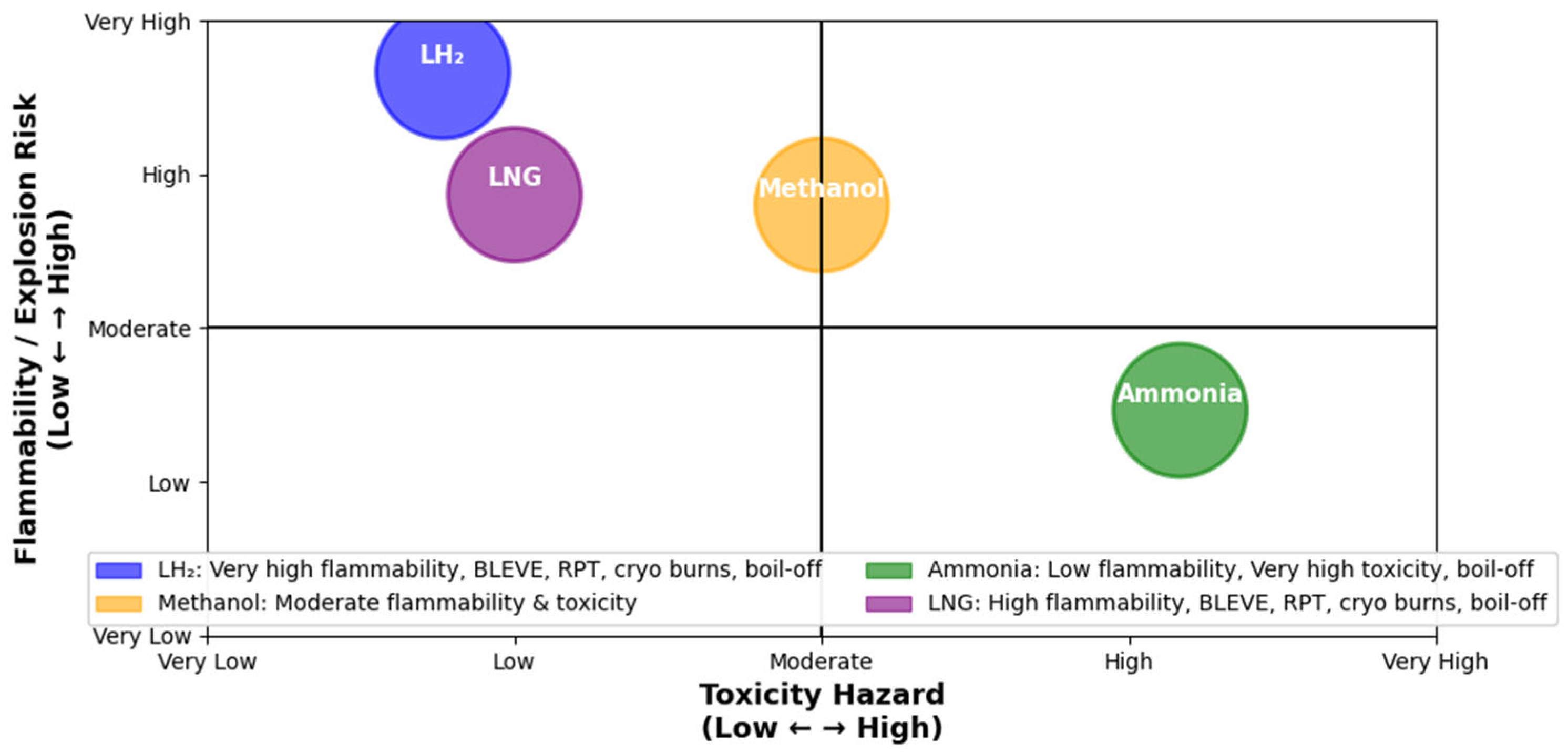
Cryogenic burns are acute hazards from contact with liquid LNG, causing frostbite and material embrittlement similar to those caused by hydrogen [96]. Quantitative risk assessments comparing LNG and liquid hydrogen bunkering indicate that LNG requires larger safety exclusion zones for pool fire and explosion scenarios, attributed to its higher volumetric energy density and slower vapour dispersion characteristics compared to hydrogen [93]. Boil-off gas management during LNG storage and transfer represents a critical operational challenge, with BOG rates for LNG-fuelled maritime vessels typically reaching 0.15–0.30% per day, equivalent to 5–10% per month during extended voyages [99]. BOG management systems are therefore required to increase economic efficiency [100]. A critical operational concern is methane slip in dual-fuel engines: unburned methane (a potent greenhouse gas with approximately 28–34 times the 100-year global warming potential of CO2) poses a significant environmental threat [101]. Figure 1 illustrates an evidence-based flammability-toxicity hazard matrix for alternative fuels, with liquid hydrogen exhibiting high flammability and toxicity hazard, respectively, while methanol and LNG reflect more moderate hazards. The detailed hazard and risk-assessment parameters for ammonia, methanol, liquid hydrogen, and LNG are summarised in Table 3.
Material Compatibility for LNG
Material selection for LNG containment systems requires careful consideration of cryogenic embrittlement. Standard carbon steels undergo ductile-to-brittle transition at LNG storage temperatures (−162 °C), rendering them susceptible to catastrophic brittle fracture, a failure mode responsible for the 1944 Cleveland disaster when a 3.5% nickel steel tank failed, resulting in 128 fatalities [72,96]. Contemporary LNG storage tanks utilise 9% nickel steel (ASTM A553 Type 1), which maintains adequate fracture toughness at cryogenic temperatures due to retained austenite in its microstructure [71,102]. Alternative materials approved under the IGC and IGF Codes include austenitic stainless steels (304 L, 316 L), aluminium alloys, and, more recently, high-manganese austenitic steel, which offers comparable cryogenic performance at 20–30% lower cost than nickel alloys [102]. Unlike hydrogen systems, LNG containment does not require resistance to hydrogen embrittlement, simplifying material qualification requirements while still demanding rigorous weldability standards to prevent crack initiation at cryogenic service temperatures [71,72].
Table 3. Hazard Classification and Risk Assessment Parameters for Hydrogen, Methanol, Ammonia, and LNG.
Hazard/ParameterLH2MethanolAmmoniaLNG (CH4)References
Flammability
Flammable Range (vol%)4–756.7–36.516–254.4–17.0[103,104,105,106]
Laminar Flame Speed (m/s)2.5–2.93<0.5<0.070.37–0.40[107,108,109,110]
Minimum Ignition Energy (mJ)0.011–0.0170.146800.28–0.30[111]
Autoignition Temp. (°C)500464650580[105,106,112]
Deflagration Index Kg (bar·m/s)215–110080<4020–90[113,114,115]
Flashpoint (°C)−253 (b.p.)11–12N/A−188[105,106,116]
Flammability AssessmentVery highHighLowHigh
BLEVE (Boiling Liquid Expanding Vapour Explosion)
BLEVE Risk LevelVery highLowModerateHigh[43,117,118]
Expansion Ratio (L:G)1:848Low1:8501:600[43,103,117]
Trigger MechanismInsulation failure; water contactExternal fire onlyRelief valve failureFire exposure; water contact[43,117,118,119]
Toxicity & Health Hazards
GHS ClassificationNon-toxic (asphyxiant)Cat. 3Cat. 1/3Non-toxic (asphyxiant)[120,121,122,123]
IDLH/Lethal ThresholdN/A6000 ppmIDLH: 300 ppm; LC: 2700 ppmN/A[121,122,124]
Toxicity AssessmentNoneModerateVery highNone[120,121,122,123,124]
RPT (Rapid Phase Transition)
RPT Risk LevelModerateNoneLowHigh[90,125,126]
ΔT with seawater (K)253Non-cryogenic/Above b.p33162[90,117,126]
RPT Overpressure (bar)7N/AMinimal20–60[90,126]
Boil-off Gas (BOG) & Storage
Daily Boil-off Rate (%)0.3–1.0~00.040.10–0.15[61,127,128]
Methane Slip (GWP issue)N/AN/AN/A1–3% (GWP100 = 28–34)[129]
BOG AssessmentVery highNegligibleLowModerate[61,127,128]

5. Emission Control Areas and Regulatory Framework

5.1. MARPOL Annex VI and Emission Control Areas

The International Convention for the Prevention of Pollution from Ships (MARPOL), specifically Annex VI, establishes mandatory regulations for preventing air pollution from ships, focusing on atmospheric emissions of nitrogen oxides (NOx), sulphur oxides (SOx), and particulate matter (PM) [10,130]. Prevention of air pollution from ships. Regulation 13 establishes nitrogen oxide emission standards with Tier I (2000–2010) limits of 17.0 g/kWh for diesel engines exceeding 5.5 MW, Tier II (2011–2020) at 14.4 g/kWh, and Tier III (2016+, NECA only) at 3.4 g/kWh [131,132]. Regulation 14 establishes sulphur oxide and particulate matter emission standards with a global sulphur limit of 3.5% m/m from 2012–2020, reduced to 0.5% m/m from January 2020 [12], and within SECAs a limit of 0.1% m/m sulphur content, enforced since 2015 [133].

5.2. Designated Emission Control Areas and Geographic Scope

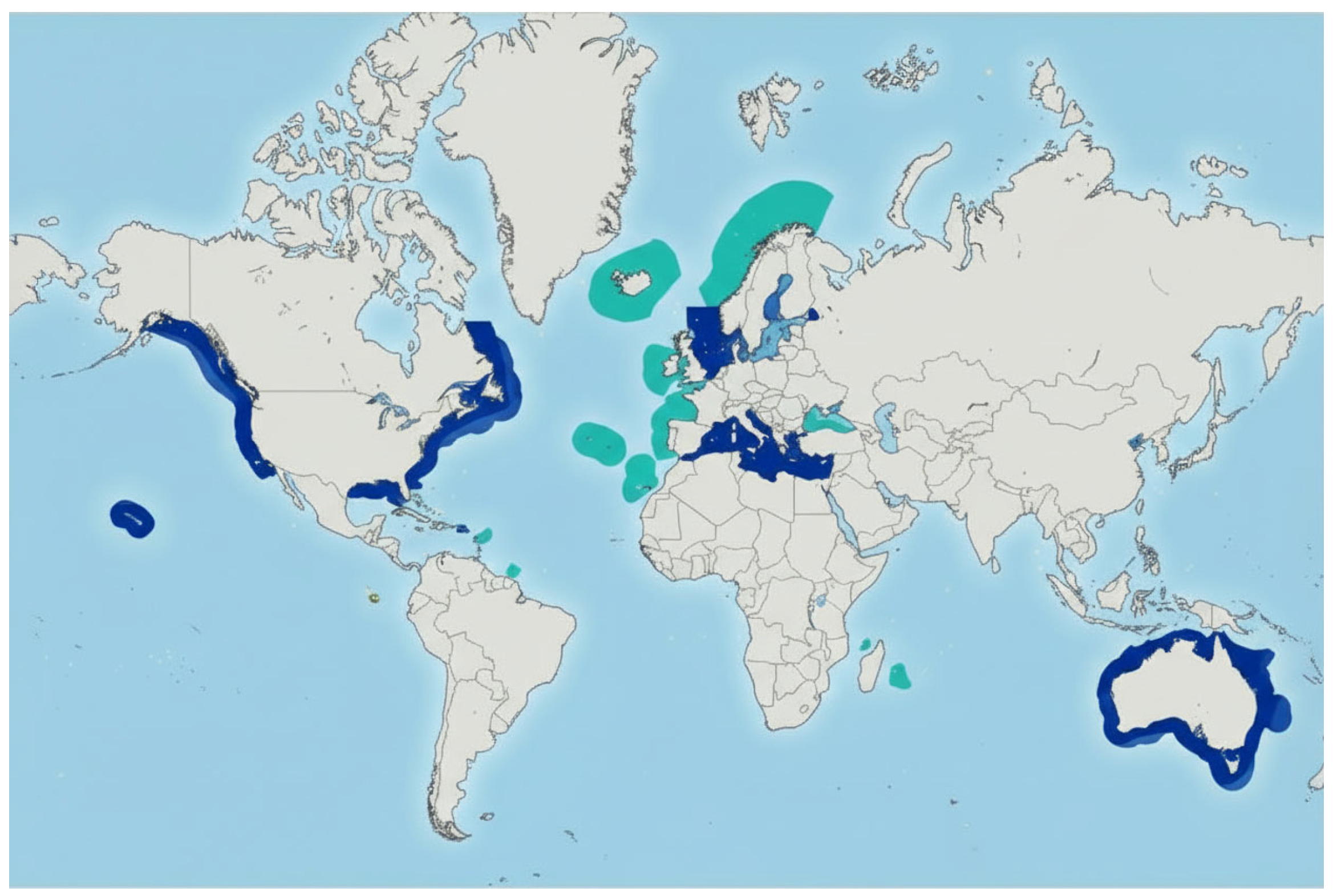
As of 2025, five ECAs are designated under MARPOL Annex VI as illustrated in Figure 2): the Baltic Sea (SECA & NECA, established 2006 and 2021, respectively), the North Sea (SECA & NECA, established 2007 and 2021), the United States and Canada (SECA & NECA, established 2012), the United States Caribbean Sea (SECA & NECA, established 2014), and the Mediterranean Sea (SECA, effective 1 May 2025) [10,132,134]. Ratification by 100 countries as of June 2021 (representing 96.65% of world merchant shipping tonnage) demonstrates broad regulatory acceptance [135].
Within SECAs and NECAs, ships are required to use compliant fuels (Marine Gas Oil—MGO, or Ultra-Low-Sulphur Fuel Oil—ULSFO) or deploy approved emission abatement technologies (e.g., exhaust gas cleaning systems, i.e., scrubbers) [10,130].
Recent developments indicate further ECA expansion. In 2024–2025, the IMO designated three additional Emission Control Areas beyond the original five: the Canadian Arctic (with NOx ECA and SOx ECA designations effective 1 March 2026 and 1 March 2027, respectively), the Norwegian Sea (with NOx ECA and SOx ECA designations effective 1 March 2026 and 1 March 2027, respectively), and the North-East Atlantic (approved April 2025, with effective dates pending IMO confirmation) [136]. These designations reflect the IMO’s intensifying commitment to reducing maritime air pollution and emissions across all major ocean regions.

5.3. Fuel Compliance Pathways and Operational Options

Ships operating in ECAs have three main compliance pathways. Fuel switching involves transitioning to Marine Gas Oil (MGO) or ULSFO containing no more than 0.10% sulphur m/m, achieving immediate compliance [10,137]. However, MGO costs typically exceed those of heavy fuel oil (HFO) by 20–40%, leading to an economic disadvantage [138], and the MGO supply infrastructure is not consistently developed across all ports. Switchover procedures must provide enough time for fuel system purging, usually 15–30 min before entering the ECA [139].
Scrubber technology deployment offers approved systems for cleaning exhaust gases that remove SOx from flue gases, enabling continued use of higher-sulphur fuels while ensuring emissions compliance [140]. Open-loop scrubbers use seawater as a washing medium, with discharge into the ocean, providing effective SOx removal of over 95% but facing increasing environmental restrictions [141]. Closed-loop scrubbers recirculate freshwater with chemical additives, requiring onboard treatment and sludge management, which incur higher operational costs but avoid environmental opposition [140,141]. Installing scrubbers demands significant capital investment (USD 2–4 million per vessel), involves operational complexity, and requires regular maintenance [142].
Emerging alternative fuels, including LNG, methanol, hydrogen, and ammonia, provide long-term decarbonisation pathways while also achieving SOx/NOx compliance if properly engineered [143]. However, adoption remains limited due to a scarcity of infrastructure (bunkering facilities, storage terminals), regulatory uncertainty regarding fuel specifications and compatibility, capital costs for new-build vessels or retrofit modifications, and supply chain immaturity for green fuels [144,145,146].

5.4. Emissions Comparison Across Fuel Types

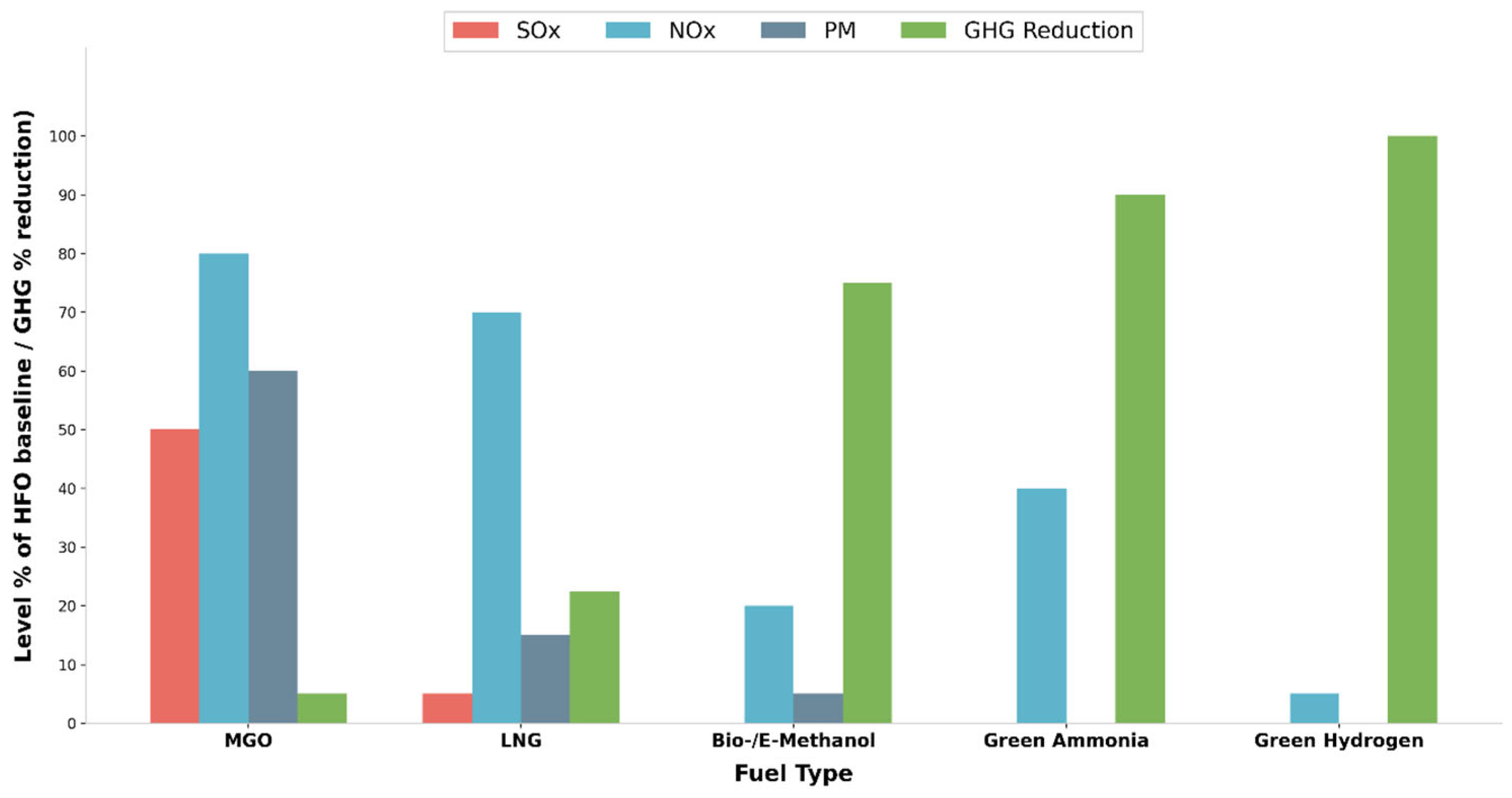
The emissions profile varies substantially by fuel type and engine technology. Heavy fuel oil produces high levels of sulphur oxides, nitrogen oxides, and particulate matter unless equipped with abatement technology [147]. Marine Gas Oil (MGO) produces lower SOx emissions than HFO, but still has significant NOx and PM emissions, with a 0–5% GHG reduction potential [148]. Liquefied natural gas produces very low SOx and moderate NOx emissions, with a 20–25% reduction in GHG emissions if methane slip remains below 2% [63]. Bio- or e-methanol yields near-zero SOx emissions, low NOx emissions with modern engine designs [129], and 71–80% well-to-wake GHG reduction potential [149]. Methanol combustion results in significant reductions in sulphur oxides (SOx) and particulate matter (PM) emissions by over 95%, as well as nitrogen oxides (NOx) emissions by up to 80% compared to conventional marine fuels [129]. Green ammonia, when combusted, produces zero CO2 emissions during combustion but requires NOx management through SCR systems, achieving approximately 100% tailpipe GHG reduction with potential for 90% lifecycle reduction [150]. By including engine efficiency penalties, pilot fuel, and especially N2O/reactive nitrogen assumptions, the total well-to-wake benefit of green ammonia is 77–83% [151,152]. Green hydrogen combustion results in zero CO2, SOx, and PM emissions with NOx minimised through proper combustion techniques [153].
These emission characteristics directly influence regulatory compliance capabilities. LNG achieves immediate SECA compliance through inherently low sulphur content (<0.004% S) but requires careful management of methane slip to realise GHG benefits; current dual-fuel engines operating in gas mode can experience methane slip rates of 2–4%, potentially offsetting 30–50% of the CO2 advantage [63,101]. Methanol’s sulphur-free composition and liquid-state storage at ambient conditions simplify both SECA compliance and onboard fuel handling, while its lower energy density (approximately 50% of HFO) necessitates increased tank capacity [72,129]. Ammonia presents the most complex emissions profile: while combustion produces no carbon emissions, the formation of nitrogen oxides requires exhaust aftertreatment, and ammonia slip (unburned NH3) poses both environmental and crew safety concerns that require catalytic treatment systems [54,150]. Hydrogen offers the cleanest combustion profile but faces the most significant infrastructural and storage challenges, with volumetric energy density approximately one-quarter that of conventional fuels even in liquefied form [20,153].
The % reductions in SOx, NOx, and PM from the HFO baseline, as well as the total GHG reduction for each alternative maritime fuel, are illustrated in Figure 3.

5.5. Compatibility of LNG, LH2, NH3, and LNG with ECA Requirements

When assessed against current and emerging ECA requirements, the four main alternative fuels show distinct compliance profiles and operational trade-offs. LNG provides the most mature route for immediate SECA and NECA compliance, with an established global bunkering infrastructure spanning over 200 ports and a fleet of more than 700 LNG-fuelled vessels setting an operational precedent [68,69]. However, LNG’s classification as a transitional fuel reflects its fossil origin and ongoing GHG emissions. Even with optimised dual-fuel engines achieving less than 1% methane slip, lifecycle emissions remain 15–20% higher than IMO 2050 targets [63]. Methanol offers an appealing alternative for operators requiring rapid deployment: its compatibility with modified conventional engines, liquid bunkering via adapted petroleum infrastructure, and availability in bio- or e-methanol variants support both short-term compliance and long-term decarbonisation pathways [38,72,129].
Ammonia and hydrogen represent the most ambitious decarbonisation options but face significant barriers to widespread ECA deployment. Ammonia’s advantage lies in its established global production and transport infrastructure (approximately 180 million tonnes annually), zero-carbon combustion potential, and higher volumetric energy density than hydrogen [9,59]. However, its acute toxicity (IDLH 300 ppm), aquatic environmental classification (H410), and the requirement for sophisticated NOx aftertreatment systems present operational complexities that current IMO interim guidelines (MSC.1/Circ.1687) are only beginning to address [80,84]. Hydrogen, while offering the cleanest emissions profile with zero CO2, SOx, PM, and minimal NOx when properly combusted, requires cryogenic storage at −253 °C with associated boil-off management, representing the highest technical and infrastructure investment among alternative fuels [20,28,153]. For ECA operations, the optimal fuel selection depends on vessel type, trading pattern, and operator risk: LNG suits established routes with developed bunkering networks, methanol offers flexibility for vessels requiring rapid compliance with future decarbonisation optionality, while ammonia and hydrogen remain most viable for new-build vessels on dedicated green corridors where infrastructure investment can be coordinated with fleet deployment [4,143,146].

6. Storage, Transport, and Boil-Off Gas Analysis

6.1. Tank Design Principles and Heat Transfer Mechanisms

The boil-off rate for cryogenic liquids is determined by heat transfer through tank insulation [155]. Heat transfer mechanisms include conduction through insulation, radiation from external surfaces, and conduction through supports and penetrations, which are minimised through low-conductivity support structures and the strategic placement of thermal breaks [155,156].
For marine-installed tanks subject to ambient air temperature fluctuations (−10 °C to +40 °C), solar radiation heating, wave slap and spray, and wind-driven convection, boil-off rates are considerably higher than those of land-based stationary storage [127,157]. Managing boil-off gas is a critical operational challenge for cryogenic maritime fuels, as heat ingress causes self-pressurisation and boil-off formation that greatly affect storage performance and safety systems [127,157,158].
Tank design requirements vary significantly among the four alternative fuels, reflecting their unique thermophysical properties. Liquid hydrogen requires the most advanced containment systems: Type C independent pressure vessels with vacuum-insulated double walls featuring multilayer insulation (MLI) achieve thermal conductivities below 0.001 W/(m·K), yet daily boil-off rates of 0.5–1.5% remain notably higher than those of other cryogenic fuels [36,127,155]. LNG storage benefits from extensive maritime experience, employing membrane (Mark III, NO96) or independent spherical (Moss) tank designs with polyurethane foam or perlite insulation systems, reaching boil-off rates of 0.10–0.15% per day in modern vessels [102,159]. Ammonia tanks operate under less demanding thermal conditions; refrigerated storage at −33 °C allows for conventional insulated carbon steel construction, while semi-refrigerated or pressurised options (up to 18 bar at ambient temperature) eliminate cryogenic complexity altogether [49,160]. Methanol requires no specialised thermal management, utilising standard marine fuel tank designs with atmospheric or low-pressure configurations; the main design considerations shift from thermal performance to material compatibility (austenitic stainless steel or coated carbon steel), fire detection systems capable of identifying methanol’s invisible flame, and suitable venting arrangements to control vapour build-up [39,43,45,72].

6.2. Comparative Boil-Off Gas Simulation Results

Comprehensive thermodynamic modelling and empirical analysis of boil-off behaviour in cryogenic energy carrier ships demonstrate that boil-off rates vary significantly by fuel type and storage design [127,157]. For liquid hydrogen at −253 °C with typical marine tank insulation, boil-off rates are nine times higher than for LNG carriers with equivalent tank volume and insulation thickness, with an LH2 ship storing 40% of the fuel energy of a conventional LNG carrier [127]. Adding a reliquefaction unit can reduce the LH2 fuel depletion rate by at least 38.7%, though this increases operational complexity [161].
For ammonia storage, experimental and computational analyses reveal substantially lower boil-off sensitivity than for hydrogen and LNG [160,162,163]. Ammonia storage at elevated pressure (exceeding 5 bar) and elevated temperature (maintaining liquid phase near 0–20 °C) provides operational flexibility unavailable to hydrogen or LNG, substantially reducing refrigeration costs and enabling integration with maritime auxiliary systems [160,162,163].
For LNG storage, established operational data confirms boil-off rates of 0.15–0.30% per day under marine conditions [159]. Advanced boil-off gas management systems, including direct reliquefaction and liquid subcooling with spraying, mitigate BOG losses [164].
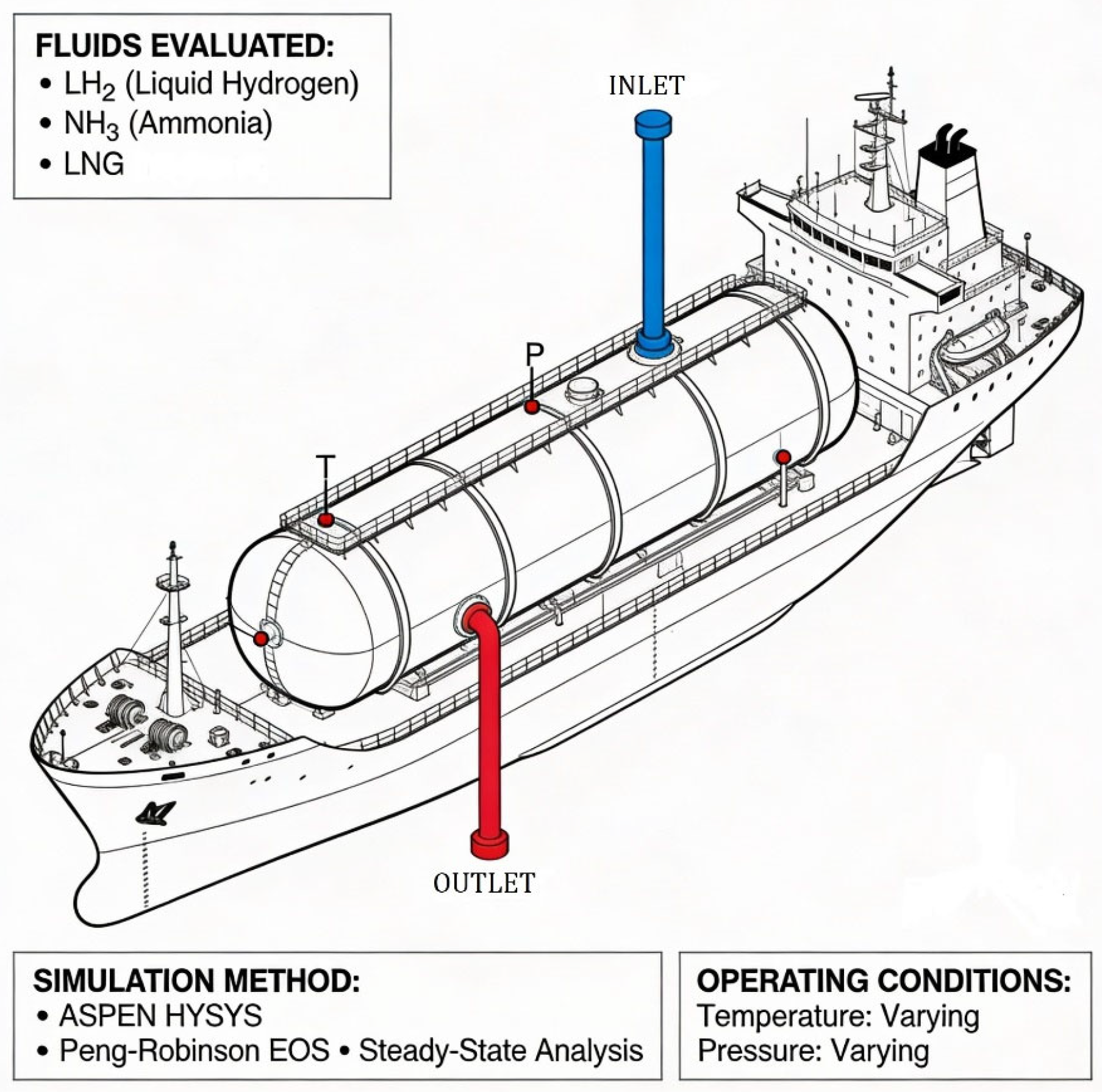
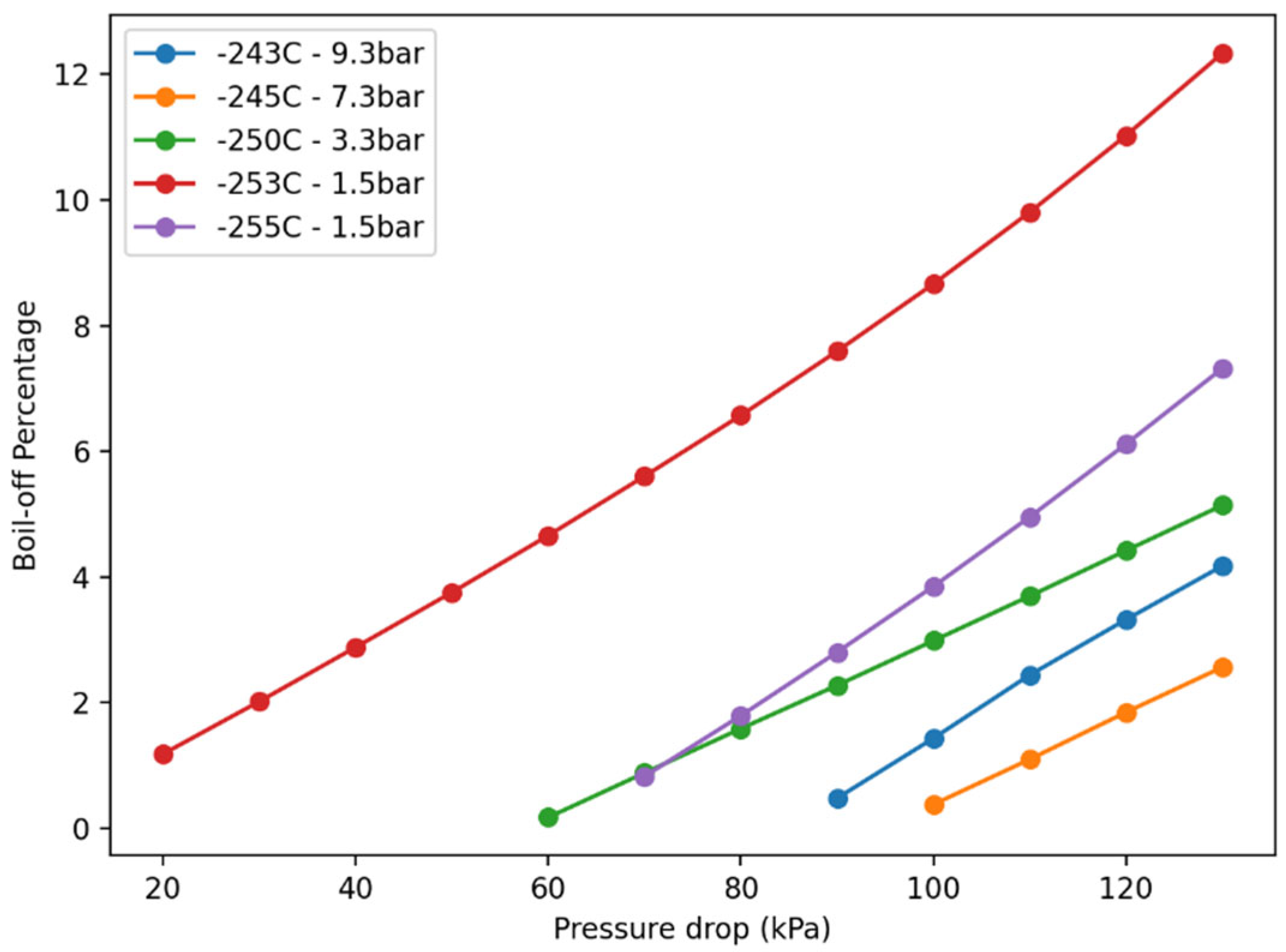
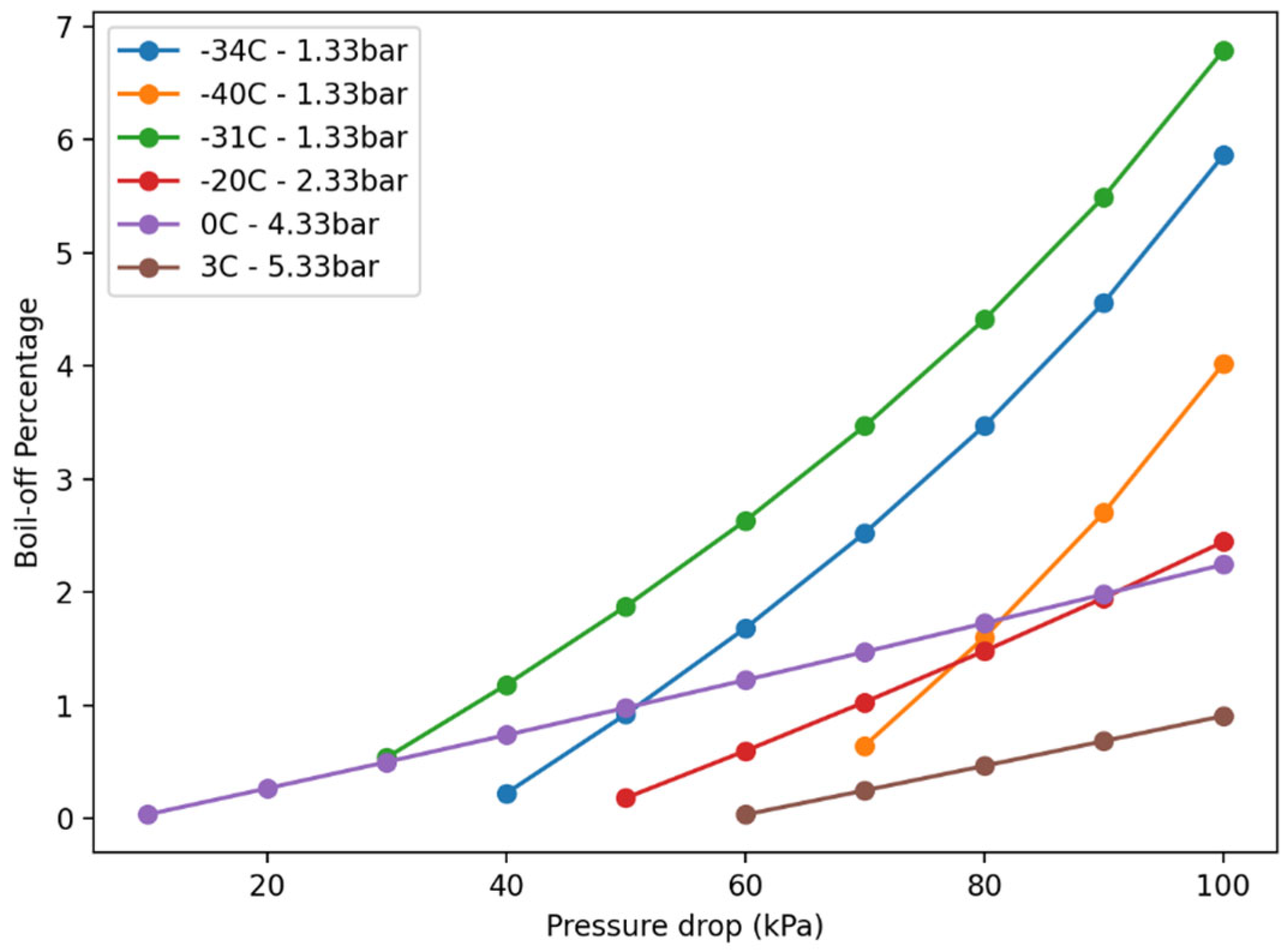
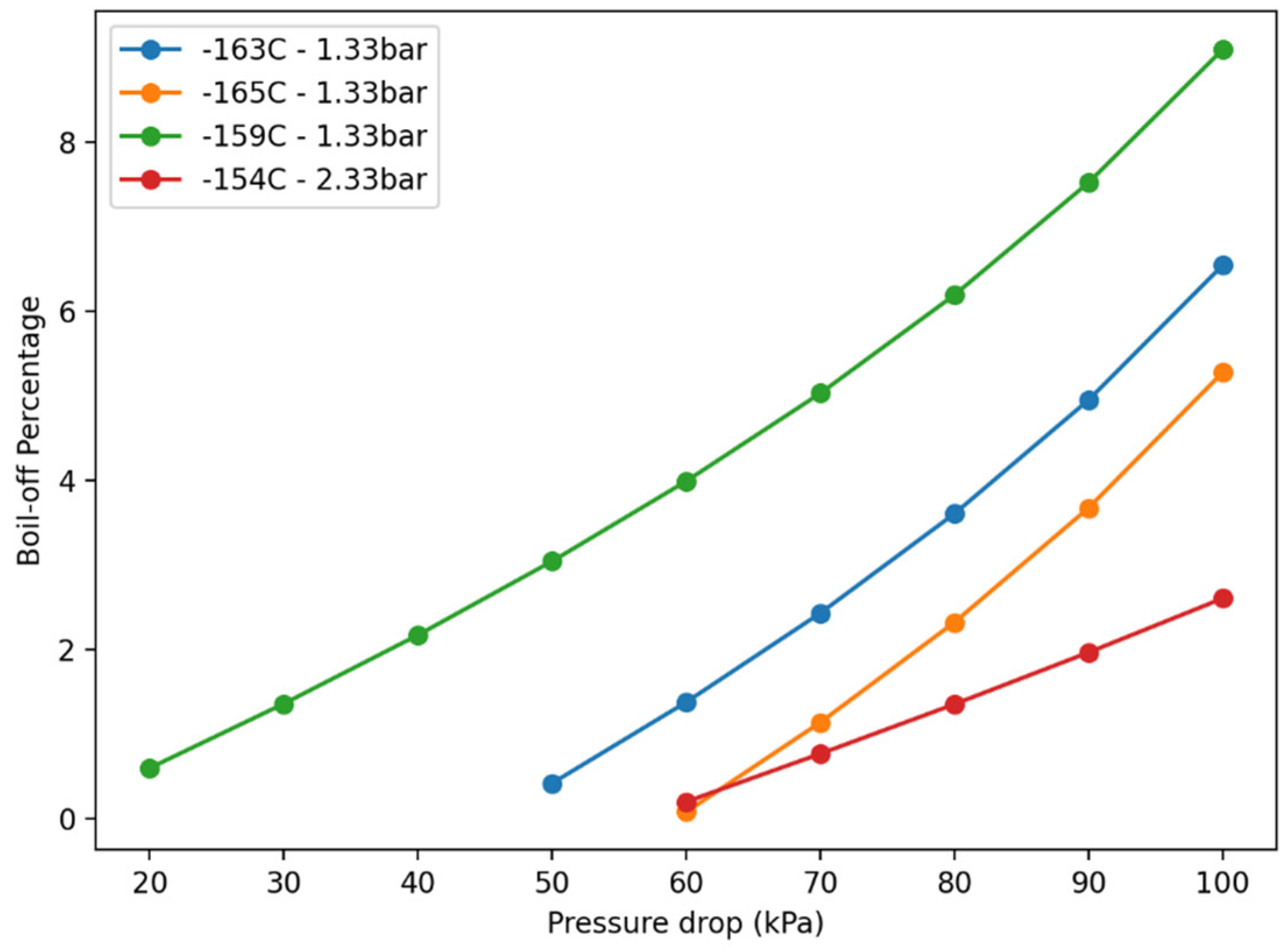
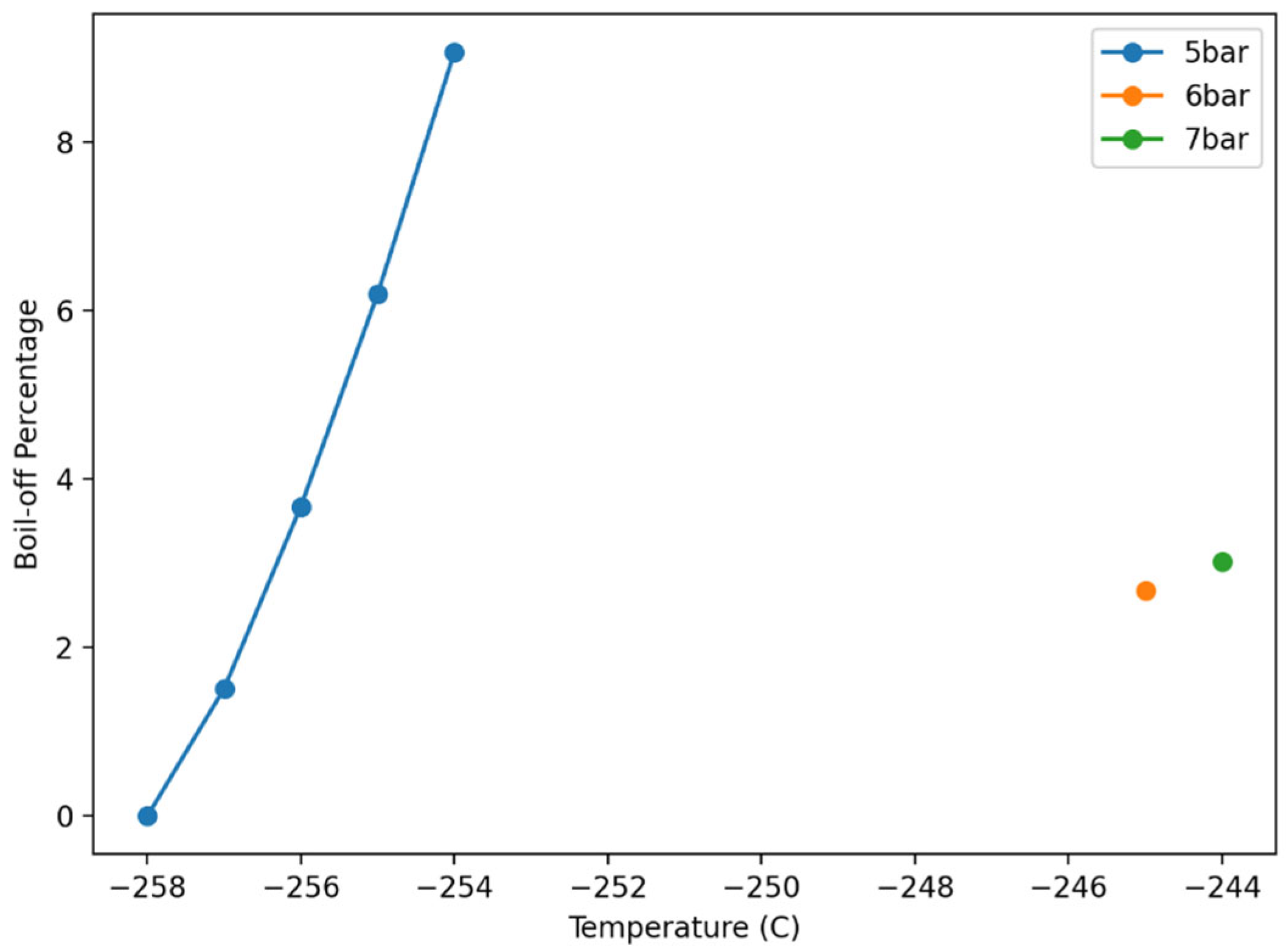
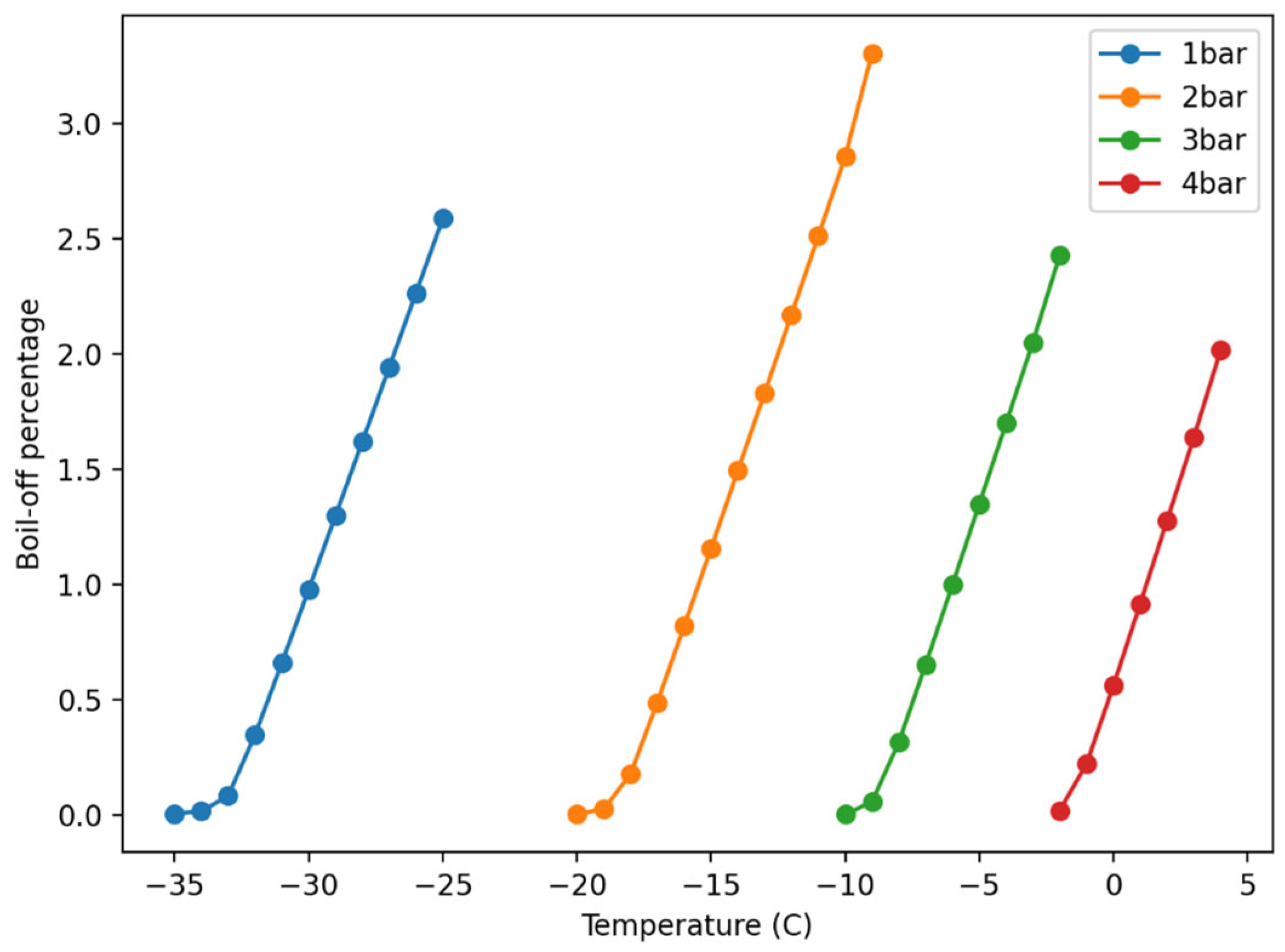
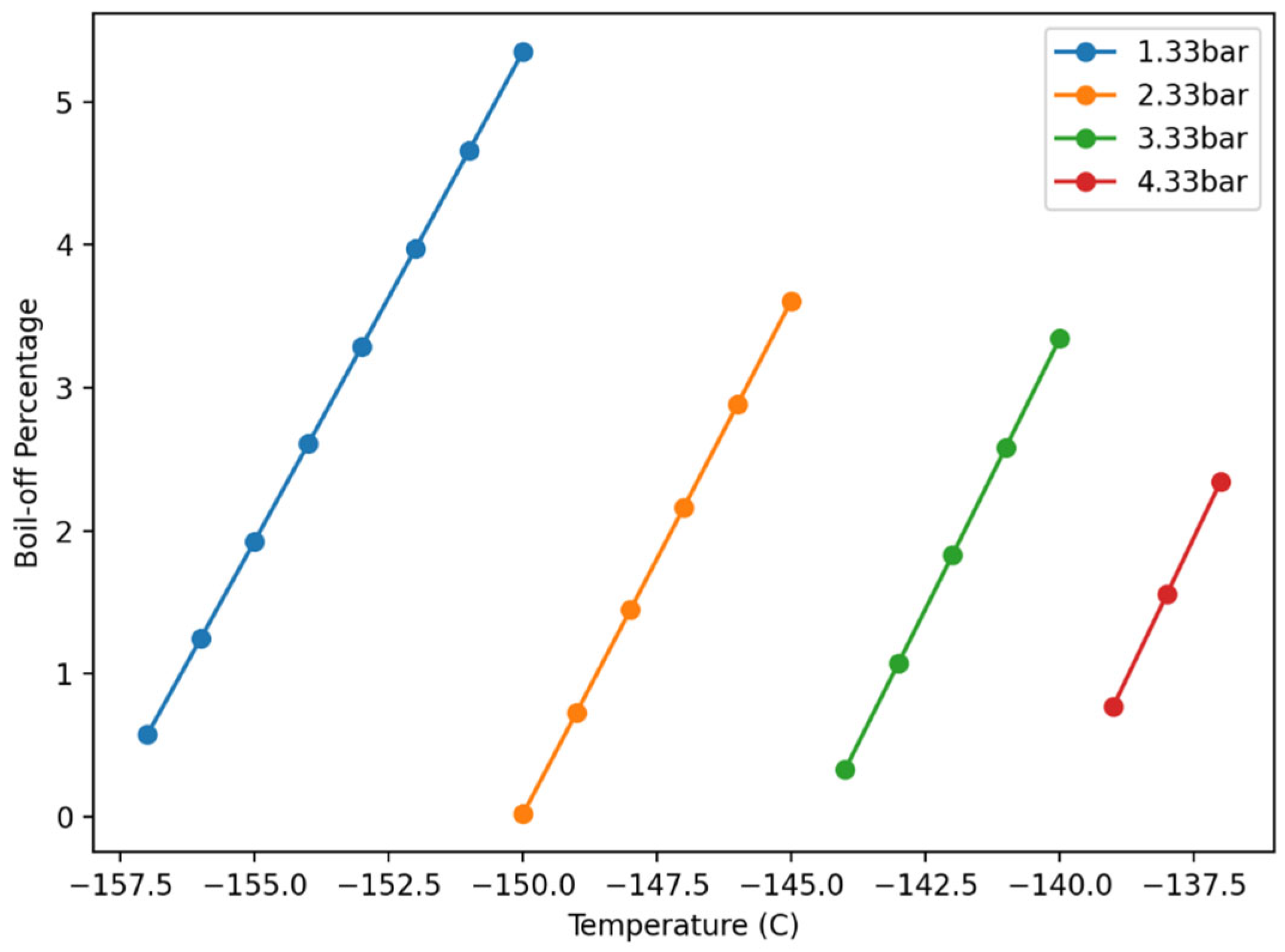
We performed a series of steady-state simulations using ASPEN HYSYS V14 to evaluate the boil-off rates of LNG, NH3, and LH2 under various pressure and temperature conditions. Methanol was not included in the simulations as it reflects negligible boil-off rates. More specifically, we investigated the effect of pressure and temperature variations, which typically occur under marine conditions [165], on the boil-off rate on a simple tank illustrated in Figure 4. The tank comprises an inlet and an outlet line, emulating the stored fuel quantity and boil-off (i.e., liquid–gas transition) losses due to pressure and temperature variations, respectively. The Peng-Robinson equation of state was used in the simulations, which is considered the industry’s workhorse for a variety of components, including those used in this study [166]. A standard methane-rich LNG composition was used (Table 4), as reported by Wlodek [167]. Because of the different boiling points of LH2, NH3, and LNG, it is not straightforward to compare them on an absolute temperature scale. Likewise, because of the low boiling points of hydrogen and natural gas, cryogenic tanks typically operate at pressures up to 16 bar to reduce the extremely low temperatures required [168]. Conversely, ammonia has a much lower boiling point at ambient pressure (−33 °C), while higher tank pressures can alleviate the need for temperatures above 0 °C [169]. Thus, various tank pressures were applied to evaluate their differences better.
Boil-off percentages caused by pressure variations are shown in Figure 5, Figure 6 and Figure 7 for LH2, NH3, and LNG, respectively. Likewise, boil-off percentages resulting from temperature variations are displayed in Figure 8, Figure 9 and Figure 10 for LH2, NH3, and LNG. As demonstrated in Figure 5, Figure 6 and Figure 7, LH2 exhibits higher boil-off rates than the other fuels. At its boiling point (−253 °C) and 1.5 bar, a pressure difference of 100 kPa causes 8.5% of the tank’s volume to evaporate (Figure 5). Conversely, ammonia near its boiling point at −34 °C and a slightly lower tank pressure of 1.33 bar shows a much lower BOG percentage of 5.9% (Figure 6). Similarly, the selected LNG composition near its boiling temperature of −164 °C and the same pressure reflects a boil-off percentage of 6.6% (Figure 7). As tank pressure increases, the boil-off rate decreases for all three cases; however, the impact is more substantial for ammonia. Therefore, milder temperature conditions are needed for storing and transporting ammonia, but most importantly, increasing tank pressure significantly reduces BOG rates.
Temperature variations exhibit a similar trend, as apparent from Figure 8, Figure 9 and Figure 10. Interestingly, higher tank pressures (gt 5 bar) were required for hydrogen to remain in the liquid phase, but be that as it may, a temperature drop from −258 °C to −254 °C at 5 bar led to a boil-off percentage of 9% (Figure 8). The boil-off rates for LNG are significantly lower even at 1 bar, while increasing the tank pressure reduces the BOG percentage, as seen in Figure 10. Ammonia, on the other hand, exhibits the lowest BOG percentages due to temperature variations (Figure 9). As for the other cases, increasing the storage pressure has a beneficial effect on the BOG percentage, reflecting a mere 2% at 4 °C as seem in Figure 9. Overall, ammonia offers an economically favourable option with milder temperature requirements, for which higher tank pressures can significantly reduce the, at any rate, low boil-off effects.
These results align with dynamic modelling studies of boil-off, and validation against laboratory and industrial-scale data demonstrates that ammonia exhibits economically favourable BOG characteristics due to milder temperature requirements and the ability to operate at higher pressures with substantially reduced evaporative losses [127,156,160,163].

6.3. Storage System Design Specifications

As shown in Table 5, cryogenic conditions and boil-off management are the dominant drivers of liquid H2 and LNG storage systems. Liquid H2 storage at ~−253 °C typically relies on vacuum and multilayer insulation, with tank design and auxiliary systems governed by heat ingress, vapour handling, and the resulting high boil-off gas (BOG) rates reported in the literature and comparative assessments [36,61,127,155,169,170,171]. LNG storage, by contrast, operates at a warmer cryogenic temperature (~−161 °C) and generally lower operating pressures in marine fuel applications, while insulation and BOG control remain central design considerations, the thermodynamic burden and typical BOG rates are less extreme than for LH2, reflecting the maturity of LNG tank and bunkering-system engineering practice [158,159,164,168]. These technical differences translate directly into system economics. Comparative studies consistently indicate that LH2 containment is materially more expensive than LNG tankage on an equivalent energy basis, with LNG benefiting from extensive standardisation and supply-chain depth in the maritime sector [84,159].
For ammonia and methanol, Table 5 shows a shift from a cryogenic-dominated design to a hazard-driven containment and a conventional liquid-fuel storage architecture. Ammonia storage can be realised at substantially higher temperatures than LNG/LH2 (e.g., refrigerated or pressure-temperature combinations). Still, design attention is strongly shaped by toxicity, release prevention, and bunkering operational controls, which in turn influence equipment redundancy and cost allocation to safety barriers [150]. Methanol stands out as the least thermally intensive option, typically handled near ambient conditions in conventional tanks, so system specification is more influenced by established tankage practices, compatibility of materials with neat methanol service, and fire detection/extinguishment considerations than by insulation and BOG handling [39,42,43,45,72,78]. From an infrastructure perspective, methanol’s production, storage and transport networks are widely established globally, but dedicated maritime bunkering availability remains an expanding capability that develops port-by-port as fleet uptake grows [39,42,72]. This infrastructure profile, together with relatively conventional tank requirements, supports comparatively lower incremental onboard storage-system complexity than cryogenic options, although total cost competitiveness still depends on fuel price, volumetric energy density penalties, and the extent of bunkering and safety-system modifications required in practice [42,72,84].

6.4. Onshore and Offshore Storage Feasibility Assessment

The feasibility of storing liquid hydrogen is limited by higher insulation needs and related capital costs [127]. There is limited industrial experience outside aerospace and specialised industrial uses. Offshore feasibility faces significant challenges from mechanical stress caused by wave action on vacuum-insulated structures, difficulty maintaining the insulation vacuum in corrosive marine environments, and high operational and maintenance costs [173]. The large temperature difference between liquid hydrogen (−253 °C) and ambient conditions causes continuous heat ingress that even advanced vacuum-perlite insulation systems cannot fully prevent, requiring active cooling or accepting substantial boil-off losses [37]. Onshore storage with shipboard or portable tanks remains the main option, as dedicated offshore terminals are not feasible within the current decade [174].
Ammonia storage presents established pathways, with over 150 onshore ammonia terminals globally serving industrial user [175]. Maritime bunkering infrastructure is emerging, with the Immingham Green Energy Terminal (approved February 2025) designed for multi-user ammonia import and hydrogen production [176]. Modest tank pressures (15–25 bar) enable conventional steel or concrete storage [177]. Material corrosion (stress-corrosion cracking in carbon steel) necessitates copper-free stainless steels, but it avoids extreme cryogenic requirements [178]. Onshore ammonia terminals are feasible and cost-competitive [179].
Liquefied natural gas (LNG) is the most developed alternative fuel option, with global LNG trade surpassing 400 million tonnes annually (406–411 Mt in 2024) and a widespread network of 194 operational regasification terminals across 48 importing markets [180]. Regasification and storage systems adhere to established industry standards (e.g., EN 1473), while bunkering and shipboard use are governed by internationally recognised standards and regulations (IMO IGF Code for low-flashpoint fuels) [83,181]. Offshore feasibility is demonstrated through floating LNG (FLNG) platforms, with eight FLNG units currently in operation worldwide, producing and storing LNG at sea [180]. The regulatory framework, including the International Code of Safety for Ships Using Gases or other Low-Flashpoint Fuels-IGF Code), is well-established and mature [83].
Methanol storage infrastructure benefits from the fuel’s compatibility with established petroleum and chemical industry practices. As a liquid at ambient temperature and pressure, methanol requires no cryogenic or pressurised containment, enabling storage in conventional atmospheric tanks constructed from carbon steel (with appropriate coatings) or stainless steel [39,43,72]. The global methanol production capacity exceeds 180 million tonnes annually, with port storage facilities under development in major chemical trading hubs, including Rotterdam, Singapore, Houston, and Shanghai [42,47]. Maritime bunkering infrastructure is similarly expanding rapidly. As of 2025, over 30 ports worldwide offer methanol bunkering services, with the Methanol Institute reporting a 40% increase in bunkering availability since 2023 [39,40]. Tank farm design considerations focus on fire safety rather than thermal management as methanol’s low flash point (11–12 °C) and near-invisible flame necessitate specialised detection systems (UV/IR flame detectors) and alcohol-resistant foam suppression, while its water miscibility simplifies spill containment compared to hydrocarbon fuels [43,45]. From an infrastructure investment perspective, methanol presents the lowest barriers to entry among alternative fuels, with existing oil product terminals requiring minimal modification for methanol service, instead requiring only material compatibility verification, safety system upgrades, and crew training [39,42,72].

7. Comparative Techno-Economic Analysis

7.1. Energy Density Implications for Vessel Design

Gravimetric and volumetric energy densities directly affect vessel design, tank capacity, operational expenses, and the carbon footprint. Hydrogen attains the highest gravimetric energy density at 120 MJ/kg (liquid), making it ideal for applications that prioritise range and lightweighting [182]. Ammonia and methanol show comparable gravimetric densities at approximately 19 and 18.1–20.0 MJ/kg, respectively [153]. Liquefied natural gas exhibits intermediate gravimetric performance at 50 MJ/kg [46].
Volumetric energy density assigns a different priority ranking, with LNG reaching the highest practical maritime storage density at 22,000 MJ/m3, followed by methanol at 15,800 MJ/m3, ammonia at approximately 12,100 MJ/m3 (at −34 °C), and hydrogen at 8500 MJ/m3 (liquid at −252.77 °C) [183,184]. These volumetric densities directly influence tank size requirements and the consequent impact on vessel cargo capacity and operational efficiency [185].
Hydrogen’s superior gravimetric density suits applications prioritising range (deep-sea, long-haul), but its extremely low volumetric density necessitates either high-pressure storage (700+ bar, presenting significant structural challenges) or cryogenic liquefaction (requiring substantial infrastructure investment) [186]. Methanol’s comparable gravimetric density to ammonia, combined with higher volumetric density, enables the use of existing fuel tank spaces with modest modifications, reducing retrofit costs [46]. Ammonia’s moderate densities (both gravimetric and volumetric), combined with favourable storage conditions (15–25 bar at ambient temperature), reduce capital and operational costs substantially compared to hydrogen [160]. Liquefied natural gas’s superior volumetric density enables the use of proven tank designs and established infrastructure, offsetting its lower gravimetric density relative to hydrogen [187].

7.2. Vessel-Level Capital Cost Comparison

Estimated capital costs for onboard fuel storage and handling systems vary substantially across fuel types. Conventional HFO systems serve as the baseline, with LNG dual-fuel systems requiring an additional capital investment of USD 5–20 million, depending on tank and engine capacity, representing a 15–30% increase over conventional newbuild costs [188,189]. For large crude oil tankers, retrofit costs to LNG dual-fuel capability are approximately USD 30.3 million (approximately USD 1000/kW for a 30,000 kW engine), and as a rule of thumb, retrofitting costs should not exceed 25% of newbuild cost to be economically viable [190,191]. LNG dual-fuel newbuild container ships are typically 20–25% more expensive than their conventionally fuelled counterparts [192].
Methanol systems require significantly lower investment. Methanol dual-fuel newbuilds cost approximately 11% more than standard newbuilds, and methanol-ready designs cost approximately 3% more than conventional designs [193,194]. Retrofitting costs for dual-fuel engines (including fuel storage and supply systems) range from USD 5–15 million, depending on the fuel type, with methanol often at the lower end of this range due to simpler storage requirements at ambient temperature [191,195]. Conversion from conventional fuel oil to full-range methanol dual-fuel operation costs 10–16% of the standard newbuild cost, depending on the level of preparation at newbuild [193].
Ammonia new-build systems require higher investments than methanol but are comparable to LNG. Ammonia dual-fuel newbuilds cost approximately 16% more than standard newbuilds, with conversion costs ranging from 19–24% of the newbuild cost, depending on the level of preparation [193]. Ammonia-fuelled newbuilds typically cost 15–20% more than conventional designs, with studies indicating a 16% premium for large containerships, 19% for Aframax tankers, and 15% for midsize gas carriers [196]. The ammonia fuel supply system cost is estimated at approximately USD 10.65 million for large container vessels, roughly half the cost of comparable LNG fuel gas supply systems [197].
Liquid hydrogen systems require the highest vessel-level investment due to cryogenic storage requirements (−253 °C) and the immaturity of the technology. Hydrogen fuel cell vessel CAPEX is approximately 30–35% above that of equivalent diesel-powered vessels, though hydrogen propulsion systems constitute only approximately 10% of total vessel cost [198]. The MV Sea Change, the first commercial 100% hydrogen fuel-cell passenger ferry, had a total project cost of USD 14.3 million, though this figure reflects first-of-a-kind development costs rather than series production [199]. Techno-economic assessments indicate that hydrogen and e-LNG vessel systems remain 20–50% more expensive than conventional alternatives across sectors [200]. Due to technology immaturity, standardised cost estimates for large-scale liquid hydrogen storage systems in deep-sea vessels remain limited; however, cryogenic storage equipment carries higher CAPEX than compressed gaseous systems due to double-wall tank pressure vessel requirements [186].

7.3. Port-Level Capital Cost Comparison

Port-level infrastructure costs vary considerably depending on fuel type and deployment scale. Developing LNG bunkering terminals requires significant investment, with dedicated facilities costing around USD 300 million or more [201]. The Tacoma LNG facility, designed to produce up to 500,000 gallons of LNG daily and store 8 million gallons, has an estimated total construction cost of about USD 310 million [202]. Large-scale LNG export terminals demand substantially higher investment (over USD 13 billion for Port Arthur LNG Phase I) [203], though these serve wider energy markets beyond marine bunkering. Truck-to-ship LNG bunkering offers the lowest-cost entry point due to limited infrastructure needs [204].
Methanol infrastructure costs are significantly lower because ambient-temperature storage removes the need for cryogenic systems. Initial methanol bunkering facilities cost approximately USD 4 million, as demonstrated by the VOC Port green methanol bunkering facility in India, which incorporates 750 m3 of storage connected via a 2.4 km pipeline [205]. The cost to install a methanol storage tank and bunkering unit is approximately €400,000–€1.5 million for converting a bunker vessel, and about €5 million for a 20,000 m3 tank with loading and unloading facilities [206]. Existing fuel storage and transfer facilities at most major ports require only minor modifications to handle methanol, as it remains liquid at atmospheric pressure and is widely used in industrial applications [207].
Ammonia shipping infrastructure entails distributed investment across bunkering terminals, onboard fuel supply systems, and export-scale production/logistics assets. In Norway, three regional ammonia bunkering terminals have been developed at an estimated total cost of USD 43 million, each providing 2000 m3 of refrigerated storage and >100 t/h of bunkering capacity [208]. For large container ships, the onboard ammonia fuel supply system is estimated at USD 10.65 million, roughly half the cost of an equivalent LNG fuel gas supply system [183]. At the system level, green ammonia export hubs integrating hydrogen production, ammonia synthesis, storage and port distribution show CAPEX in the ~USD 1.5–2.5 billion range [209,210].
Hydrogen bunkering infrastructure requires the highest investment due to cryogenic requirements and limited industrial precedent for maritime applications. Storage dominates CAPEX for import facilities for liquid hydrogen carriers [211]. Liquid hydrogen storage involves high capital expenditure due to cryogenic systems and insulation, combined with high operating expenditure from energy losses during liquefaction and boil-off management [212]. While specific maritime hydrogen bunkering terminal costs remain limited due to technology immaturity, large-scale LNG import terminals (costing over USD 500 million each) provide a reference point, with hydrogen infrastructure expected to exceed this due to more extreme cryogenic requirements (−253 °C versus −162 °C for LNG) [213].

7.4. Operational Cost and Fuel Economics

Current fuel cost benchmarking (2024 market data) shows heavy fuel oil at USD 500–600 per tonne [214], marine gas oil at approximately USD 850 per tonne, and liquefied natural gas at USD 12–18 per MMBTU (approximately USD 350–500 per tonne equivalent) [215]. Among emerging alternative fuels, green ammonia is priced at USD 800–1100 per tonne, reflecting its nascent market status and limited supply [214,216], while bio-methanol costs USD 600–800 per tonne [217]. Green hydrogen currently ranges from USD 5–10 per kilogram for production costs, with delivered costs (including compression and transport) potentially reaching USD 3–7 per kilogram by 2050 [218], while 2030 projections indicate production costs of USD 2–4 per kilogram in major economies such as the United States and European Union [219].
To provide a normalised techno-economic comparison, Table 6 summarises the dominant cost drivers and key economic parameters for each alternative fuel on a common basis. The cost per energy delivered (USD/GJ) metric, calculated as fuel cost divided by LHV from Table 1, enables direct comparison across fuels with different energy densities and storage requirements. This normalisation reveals that while green hydrogen offers the highest gravimetric energy density, its delivered energy cost remains the highest among the candidates due to liquefaction, cryogenic storage, and boil-off losses. Conversely, bio-methanol achieves the most competitive cost per GJ among zero-carbon options when production is co-located with biomass feedstock or renewable electricity. Recent techno-economic studies employing structured assessment frameworks, such as integrated cost modelling and sensitivity analysis for hydrogen-based maritime energy systems, further illustrate the importance of systematic economic evaluation in guiding investment decisions for green hydrogen production pathways [220].
The fuel cost projections presented above are sensitive to several key economic assumptions and drivers that warrant explicit acknowledgement. First, the cost of renewable electricity is the single largest determinant of green hydrogen, green ammonia, and e-methanol production costs, with estimates ranging from USD 20–60/MWh across geographies [222]. Second, carbon pricing mechanisms significantly affect the relative competitiveness of alternative fuels: at carbon prices above USD 100/tCO2 (as projected under EU ETS by 2030) [223], the cost gap between conventional HFO and green alternatives narrows substantially, with green methanol approaching cost parity at approximately USD 195/tCO2 and green ammonia at approximately USD 85/tCO2 [224]. Third, economies of scale in electrolyser manufacturing and fuel production capacity are expected to reduce costs by 40–60% by 2030 [224], but these projections assume sustained policy support and investment continuity. Fourth, bunkering infrastructure investment at scale introduces site-specific cost variability depending on port geography, regulatory environment, and existing industrial capacity [225]. These sensitivities underscore that the cost ranges presented in Table 6 should be interpreted as being indicative of current market conditions and near-term trajectories rather than as fixed values, and that the relative economic ranking of fuels may shift as renewable energy costs decline and carbon pricing intensifies.

7.5. Route-Specific Decarbonisation Pathway Assessment

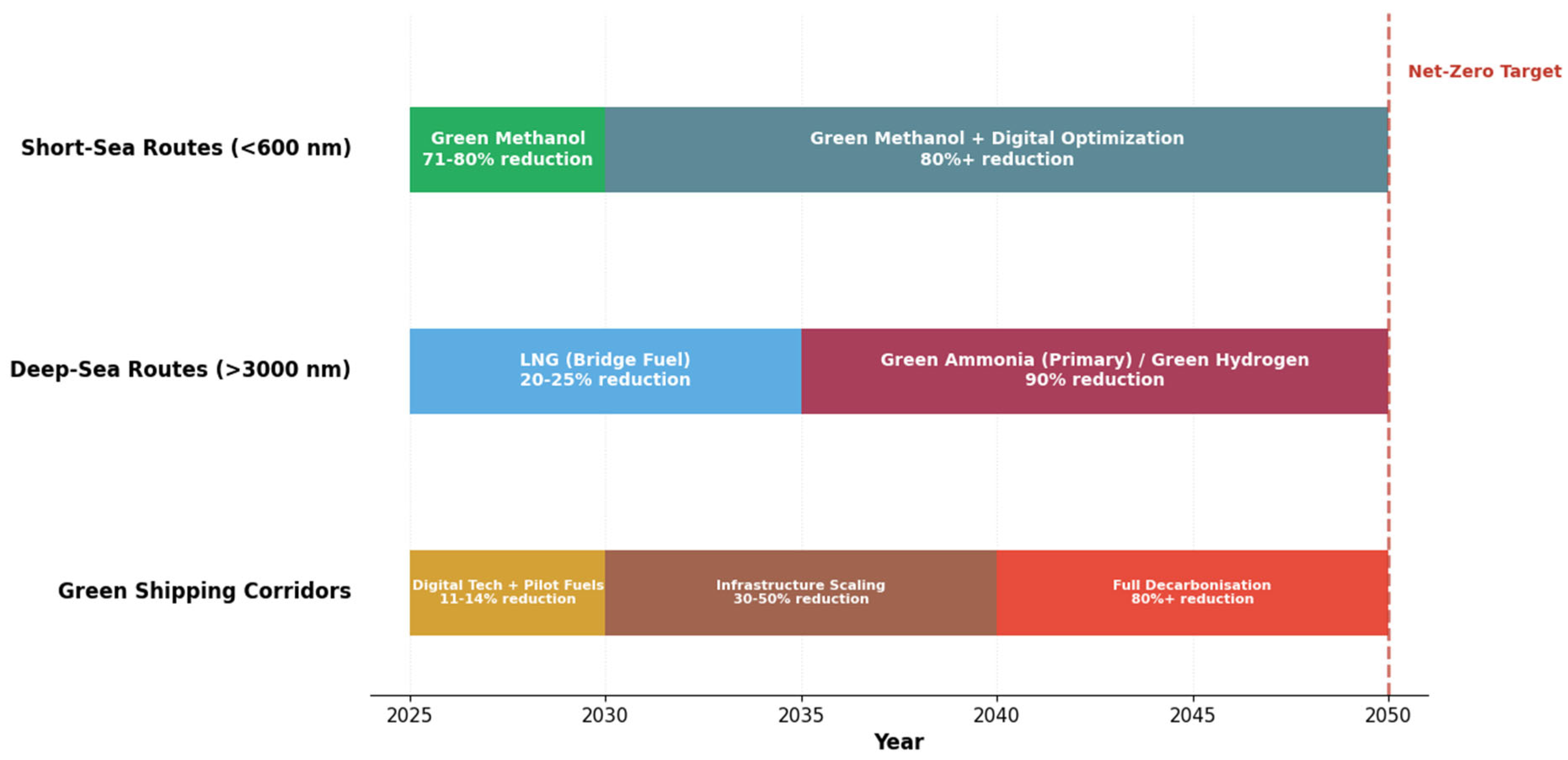
To formalise the route-dependent fuel selection conclusions derived from the preceding sections, Table 7 presents a simplified multi-criteria evaluation that explicitly compares the four candidate fuels across five decision-relevant dimensions: volumetric energy density, safety burden, infrastructure readiness, well-to-wake emissions reduction potential, and cost maturity. Each criterion is scored on a qualitative scale (Low, Medium, High, Very High) based on the quantitative evidence synthesised in Section 2, Section 3, Section 4, Section 5, Section 6 and Section 7 of this review. This structured comparison supports the identification of two representative route archetypes: short-sea corridors (less than 600 nautical miles, daily operations) and deep-sea routes (exceeding 3000 nautical miles), for which the optimal fuel pathways differ substantially.
For short-sea corridors, methanol achieves the most favourable combined score across infrastructure readiness, safety burden, and cost maturity, confirming its suitability as the primary near-term decarbonisation pathway. Methanol retrofits enable immediate deployment on existing RoPax and Ro-Ro vessels [149,226] while the established bunkering infrastructure across the North Sea and Irish Sea ports supports rapid expansion [149,226]. The combined fuel and operational emissions reductions can achieve 70–80% well-to-wake reductions [227].
For deep-sea routes, ammonia emerges as the preferred long-term option due to its combination of high emissions reduction potential [150], leverageable existing production infrastructure, and moderate storage requirements, despite its significant safety burden [228,229]. Hydrogen, while offering the highest emissions reduction potential [153] is constrained by infrastructure immaturity and the highest cost per energy delivered, positioning it as a viable deep-sea option only beyond 2040, contingent on cryogenic infrastructure maturation [230]. LNG remains the optimal transitional fuel for 2025–2035, providing mature infrastructure and immediate compliance capability, though its limited long-term decarbonisation potential [63] necessitates transition to zero-carbon alternatives.

8. Safety, Regulatory, and Implementation Challenges

8.1. Cryogenic Safety and Material Integrity

Hydrogen and liquefied natural gas share extremely cryogenic properties (−252.77 °C and −161 °C, respectively), posing significant challenges for maritime vessel design [231]. Carbon steels and ferritic/martensitic stainless steels experience ductile-to-brittle transition at low temperatures, rendering them unsuitable for cryogenic service [232]. This requires the use of austenitic stainless steels (such as 304 L, 316 L) or 9% nickel steels, which demand specialised welding procedures, including controlled ferrite levels, specific filler metals, and sometimes post-weld heat treatment, differing from conventional shipboard practices [233]. International standards for liquid hydrogen storage vessels have been established by ISO (ISO 13985), CGA (CGA H-3), and national standards bodies, covering requirements for vessel types, materials, design, and safety accessories [234,235].
The rapid cooling of equipment during fuel loading and unloading can create mechanical stress and increase fracture risk, requiring thermal management systems and procedural controls [236]. Hydrogen’s extremely high diffusivity (nearly four times that of natural gas) and its invisible flame create acute detection challenges in the absence of advanced flame-detection systems [237]. Meanwhile, LNG methane releases accumulate in confined spaces, creating asphyxiation and explosion risks [238].
Rapid phase transitions upon water contact and boiling liquid expanding vapour explosions in overpressure scenarios pose catastrophic hazards, requiring specialised engineering controls and operational procedures [239]. Rapid phase transition (RPT) occurs when unintended releases of liquid hydrogen onto water result in sudden, violent vaporisation [240]. BLEVEs result from catastrophic rupture of pressurised liquid hydrogen vessels at temperatures significantly above the atmospheric boiling point, causing rapid expansion of both the vapour and liquid phases, generating overpressure and shock waves [239]. Cryogenic releases produce overpressures up to 3 times those of ambient releases, with shock wave velocities of 390–480 m/s [241]. In enclosed spaces completely filled with liquid hydrogen, theoretical pressure after warm-up could reach 172 MPa, certainly overpressurising systems to the point of bursting [242]. Consequences include large fireballs, thermal radiation, blast waves, and fragment projection [242]. These catastrophic scenarios require specialised engineering controls, including pressure relief systems, thermal management, and loss-of-containment prevention, combined with operational procedures for safe storage, handling, and emergency response [240,242].
Mitigation strategies include comprehensive crew training and certification requirements, advanced detection systems (hydrogen flame detection, methane sensors), emergency response procedures coordinated with port authorities and coastal defences, and regular inspection and maintenance protocols for cryogenic equipment [241].

8.2. Toxicity Hazards and Crew Safety

The inhalation of ammonia poses significant occupational hazards in maritime operations. Exposure above 300 ppm produces immediate respiratory tract irritation, while exposure exceeding 2500 ppm can be lethal [51]. Control measures include enclosed bunkering procedures to prevent direct atmospheric release of ammonia, respiratory protection for emergency response personnel, including SCBA and full-face PPE, and comprehensive crew medical screening and competency training prior to ammonia fuel operations, encompassing an understanding of occupational health hazards and emergency procedures [49].
Methanol toxicity from system exposure presents neurotoxic hazards with risk of permanent vision loss even at sub-lethal exposures [44,76]. Control measures include sealed bunkering systems, personal protective equipment for crew during maintenance and emergency operations, and medical monitoring programmes [243]. An operational advantage is that existing maritime experience with toxic cargoes (ethylene oxide, other chemical tanker operations) provides established precedent for handling toxic substances [244].

8.3. Regulatory Harmonisation and Standardisation Gaps

Current regulatory frameworks reveal significant gaps and inconsistencies in regulating alternative fuel maritime activities. The International Code of Safety for Ships Using Gases or Other Low-Flashpoint Fuels (IGF Code) covers liquefied natural gas and methanol but lacks comprehensive hydrogen regulations, particularly regarding cold embrittlement, hydrogen embrittlement, and delayed ignition phenomena [83]. International Maritime Organisation guidelines for ammonia as fuel (KR, 2021) remain preliminary, lacking mandatory standards for crew certification, bunkering procedures, and emergency response protocols [83].
Required regulatory actions include comprehensive amendment of the IGF Code to address hydrogen-specific hazards, finalisation and mandating of ammonia fuel guidelines [84] to ensure harmonisation among the International Maritime Organisation, national maritime authorities, and port state control regimes, and to avoid inconsistent enforcement.

8.4. Supply Chain Infrastructure and Capital Investment Barriers

Hydrogen supply chain maturity remains constrained by multiple factors. Global hydrogen production of approximately 120 million tonnes annually consists of roughly 96% from fossil fuels [245]. Green hydrogen production remains below 1 million tonnes annually, representing less than 1% of global hydrogen supply [245]. The current operational electrolyser capacity of approximately 300 MW remains insufficient for maritime-scale-up, while global liquefaction capacity is estimated at approximately 350 tonnes per day [246] and maritime needs at 2000 tonnes per day [247]. Total hydrogen supply chain investment requirements through 2050 are estimated at USD 300–500 billion [248].
Ammonia infrastructure development benefits from established production and distribution systems. Global ammonia production stands at approximately 180–183 million tonnes annually, with conventional ammonia accounting for 99% of total supply and relying almost entirely on fossil fuel feedstocks [249]. Despite this mature production base, green ammonia represents less than 100,000 tonnes (less than 0.06–0.2% of global supply) [250]. Over 200 onshore terminals provide operational precedent [251], with 11.5 million tonnes of storage capacity facilitating approximately 144 million tonnes of annual transport capacity [252]. However, maritime bunkering infrastructure remains at a low level of maturity [49].
The methanol supply chain benefits from substantial existing production capacity exceeding 100 million tonnes annually [48], with over 90 operational methanol plants worldwide [253]. Bio-methanol accounts for less than 100,000 tonnes (under 0.1% of global supply) [254], whereas e-methanol (synthetic) is at a demonstration stage, with current annual operational capacity below 10,000 tonnes until the recent Kassø commercialisation (42,000 tonnes/year) in May 2025 [255]. Bunkering infrastructure is developing in key hubs, with operational procedures and safety guidelines now in place [244].

9. Strategic Pathways for Maritime Decarbonisation

9.1. Fuel Selection by Route and Implementation Timeline

The comparative analysis provides distinct route-specific fuel recommendations with clear implementation timelines. For short-sea and feeder routes (voyage distances less than 600 nautical miles with daily operations), the primary pathway is green methanol (bio- or e-methanol) combined with shore power integration [31]. This approach allows for retrofitting existing RoPax and Ro-Ro fleets, achieving a 71–80% well-to-wake emissions reduction [256]. To support this transition, bunkering infrastructure is already being established across some European ports [257]. To speed up the methanol pathway, three key supporting actions are necessary: first, increasing e-methanol production capacity through contracts for difference (CfD) mechanisms and tax incentives [258]. Furthermore, standardising methanol bunkering protocols across EU and UK ports is essential, along with developing crew training and competency frameworks for vessels powered by methanol.
For deep-sea container and bulk cargo operations (voyage distances exceeding 3000 nautical miles), a phased approach is required. In the short term (2025–2035), liquefied natural gas serves as a bridge fuel with strict methane slip control (<2%) [259]. This leverages mature infrastructure and implements dual-fuel engines with three-way catalysts or selective catalytic reduction to minimise methane emissions [260]. Long-term (2035–2050) deployment involves green ammonia or green hydrogen [261]. Ammonia is preferred for leveraging established supply chain infrastructure and moderate storage requirements [262], while hydrogen can serve as a long-range option if cryogenic infrastructure matures and costs decrease [262].
Critical dependencies for long-term pathway realisation include production capacity, regulatory frameworks, and fuel-specific infrastructure development. For hydrogen, electrolyser capacity must scale to over 10 GW by 2030 and 100+ GW by 2040 [263]. For ammonia, production capacity needs to shift to renewable electricity by 2040 [264], with finalisation and harmonisation of ammonia fuel regulations required by 2027 [265]. Regarding methanol, ongoing expansion of bio-methanol and e-methanol production facilities is essential, alongside developing direct air capture infrastructure to supply the carbon feedstock needed for sustainable e-methanol synthesis at scale [225].

9.2. Digital Twin and Operational Optimisation

Beyond fuel switching, digital technologies enable 11–14% reductions in operational emissions without requiring alternative fuels [266,267]. Pre-voyage route optimisation uses isochrone and global optimisation algorithms accounting for weather routing, sea state, and current-assist pathways [268]. Real-time adjustment implements machine-learning-based dynamic routing that responds to live meteorological data and vessel performance parameters [269].
These capabilities are enabled through digital twin implementation, which provides virtual vessel simulation with real-time replication of vessel performance, fuel consumption, and emissions based on integrated sensor data [270]. Building on this foundation, real-time emissions monitoring and reporting implement automated data collection through IoT sensor networks [271]. This data infrastructure enables live MRV compliance through automated reporting to UK ETS and EU ETS systems [272], while enhancing stakeholder transparency through public dashboards that display real-time emissions metrics [273].

Fuel-Specific Digital Twin Applications

The integration of digital twin technology with alternative fuel operations merits detailed examination, as each fuel type presents distinct monitoring, prediction, and optimisation requirements that extend beyond conventional vessel performance management. DTs are increasingly discussed for system monitoring, fault detection/predictive maintenance and operational optimisation in shipping, including alternative-fuel sub-systems [274].
For LH2 shipping, boil-off gas (BOG) behaviour and sloshing/operational conditions are key drivers of cargo loss and system operation; modelling approaches explicitly combine thermodynamics with weather/vessel motion and tank properties to estimate boil-off during voyages [127]. Accordingly, a DT approach for LH2 can be framed as a real-time BOG prediction and thermal-state estimator that fuses sensor inputs and a thermodynamic model to support operational decision-making on venting/consumption/reliquefication strategies [156].
The lower energy density of methanol and ammonia compared to HFO and other alternative fuels [23,38,70,72] signifies increased requirements in terms of fuel mass/volume for a given voyage. DT-enabled voyage energy modelling can thus support consumption forecasting and refuelling/bunkering planning [275] thereby, optimising bunkering schedules and tank utilisation [72,129]. Similarly, ammonia ICE operation requires tight control to manage NOx formation and ammonia slip, and the literature explicitly treats integrated optimisation of NOx reduction and slip constraints [276]. DTs are also being developed specifically for ammonia fuelling systems in maritime contexts with objectives including system monitoring, fault detection and maintenance support [274].
In terms of LNG as a marine fuel, the climate benefit is highly sensitive to methane slip, with maritime life-cycle studies showing that methane slip can significantly reduce or eliminate GHG savings relative to oil fuels depending on engine type and assumptions [277]. For LNG-fuelled vessels, digital twins enable real-time methane slip monitoring and engine parameter adjustment to maintain slip rates below the critical 2% threshold [63,101].

9.3. Policy and Regulatory Harmonisation Requirements

Successful decarbonisation requires coordinated policy action across multiple governance levels. At the International Maritime Organization level, actions include finalising the 2023 GHG Strategy revision (completed June 2023) clarifying fuel pathway neutrality and establishing technology-specific standards [2], amendment of the IGF Code to incorporate comprehensive hydrogen fuel safety standards [278], finalisation of ammonia fuel guidelines, converting preliminary guidance (KR, 2021) to mandatory standards including crew certification and bunkering procedures [83], and continuing to tighten the Carbon Intensity Indicator (CII) and Energy Efficiency Existing Ship Index (EEXI) baselines to incentivise alternative fuel adoption [279].
At national and regional levels, actions include implementing FuelEU Maritime requirements (effective 1 January 2025) with progressive GHG intensity reductions from 2% in 2025 to 80% by 2050 [11,12,13]. and establishing fuel specification standards defining sustainable fuel criteria. Critically, these regulatory frameworks must be supported by funding for green corridors and infrastructure development through dedicated budget allocations for shore power deployment, methanol and ammonia bunkering facilities, and alternative fuel supply chain networks.

9.4. Critical Research and Development Priorities

Substantial technological advancement remains necessary to realise the International Maritime Organisation 2050 net-zero objectives. For hydrogen storage and transport, priorities include developing advanced insulation materials, onboard hydrogen production via ammonia cracking or methanol reforming, and hydrogen fuel cell marine engines achieving 55%+ electrical efficiency [280,281]. For ammonia combustion and nitrogen oxide control, priorities include SCR to meet IMO Tier III NOx limits and ammonia-slip management; ammonia slip is typically controlled (e.g., reported as <5 mg/m3 in monitoring practice) and is not expected to be a significant barrier for marine SCR, with Tier III implying manageable slip risk on the order of ~10 ppm [282,283]. For methanol as a near-term solution, research priorities include optimising direct methanol fuel cell efficiency beyond current 40% thresholds, developing cost-effective direct air capture technologies for e-methanol production, and advancing methanol reforming systems for onboard hydrogen generation that could bridge the transition between methanol and hydrogen propulsion system [126].

9.5. Green Shipping Corridors as Decarbonisation Instruments

Green shipping corridors (GSCs) are crucial for decarbonising maritime routes, offering targeted support for infrastructure, finance, and governance on specific lanes [4]. They enable stakeholders to deploy low- or zero-emission fuels, advanced technologies, and coordinated practices within a framework that ensures measurable emissions reductions [284]. The UK-led Clydebank Declaration at COP26, with 24 signatories, aims for at least six green shipping corridors by 2025/2026, with more planned by 2030 [285]. As of November 2025, there are 84 initiatives worldwide, a 26% increase from about 62 last year, though over 80% are in early stages and less than 5% are operational [286,287].
Green shipping corridors operate as controlled environments to test new fuels, including green ammonia, methanol, hydrogen, and advanced biofuels. They combine voyage optimisation with vessel retrofits and port infrastructure investments, and they test governance arrangements and data-sharing frameworks [284]. The UK has committed to reducing lifecycle maritime GHG emissions by at least 30% by 2030, 80% by 2040, and reaching net zero by 2050, with domestic maritime entering the UK Emissions Trading Scheme in 2026 [288]. Several UK corridor initiatives are underway, including the Green North Sea Shipping Corridor (Port of Tyne–IJmuiden with DFDS), the Holyhead–Dublin central corridor, and the Liverpool–Belfast corridor, which demonstrates a systems blueprint with 29 pilot projects across fuels, shore power, safety protocols, skills development, and data integration [289,290,291].
The decarbonisation impact of green shipping corridors operates through two complementary mechanisms. Firstly, immediate decarbonisation using digital technologies can achieve an 11–14% reduction in GHG emissions by optimising shipping lane travel speeds and streamlining port infrastructure [292]. Digital port call optimisation platforms eliminate inefficient patterns through coordinated just-in-time vessel arrivals, while digital twin technology creates virtual replicas of vessels and ports, enabling real-time emissions monitoring aligned with IMO and UK ETS requirements, predictive maintenance scheduling, and risk-free scenario testing [267,293,294]. Secondly, long-term decarbonisation using green fuels enables vessels to operate on zero or near-zero lifecycle GHG fuels, though this requires dedicated port infrastructure, fuel supply chains, and coordinated policy and finance support [4]. The cost gap for green fuels (biofuels, e-methanol, e-ammonia, green hydrogen) relative to fossil fuels remains substantial at a 45–65% premium, necessitating policy instruments to bridge both capital and operational expenditure requirements [295].
Deep-sea routes present particularly significant opportunities for corridor-based decarbonisation. Port operations contribute approximately 40% of total emissions on EU/EEA container voyages, with this proportion rising on short-sea routes due to continuous auxiliary engine use and limited shore-power infrastructure [296]. In contrast, deep-sea services allocate a smaller share of emissions to the port phase, directing most fuel consumption to voyage operations where AI-driven digital twins can optimise speed, routing, and weather avoidance to achieve 20–40% fuel savings [297]. The UK–China container trade illustrates this strategic opportunity, with its long distances, large vessel sizes, and trade volumes valued at £34 billion in exports in 2023, resulting in high per-voyage emissions and, correspondingly, a high potential for absolute reductions compared to UK–EU short-sea services [296,298,299].
Effective governance structures are essential for corridor success. Recommended models include steering groups comprising ports, operators, fuel suppliers, network operators, cargo owners, and governments, supported by technical working groups addressing fuel safety, onshore power supply, monitoring, reporting and verification, and digital integration [300]. Neutral secretariats are required to manage commercial confidentiality and decision rights across stakeholders [300]. Financing mechanisms should combine grants, concessionary debt, and demand-side contracts, with operational expenditure support to cover initial green fuel premiums [301]. Key policy recommendations include establishing a Green Corridor Delivery Office to package investable projects, dedicated digital infrastructure funding for digital twin platforms, IoT sensor networks, and port call optimisation systems; corridor-specific safety and interoperability codes for methanol, ammonia, and hydrogen bunkering, and alignment of UK corridor development with EU instruments including EU ETS and FuelEU Maritime to avoid emissions leakage and maximise funding eligibility [302,303].
Green shipping corridors face barriers like fuel cost gaps, limited port infrastructure, coordination issues, and data/security concerns [286,287]. Without targeted support to address these, many initiatives struggle, underscoring the need for policy intervention [4,286]. Operational corridors have shown emissions reductions aligned with estimates for optimised vessels, supporting their role in sector-wide change [287]. Success depends on investing in digital/data infrastructure, harmonising emissions methods, and integrating decarbonization tools into routine operations [304].

9.6. Synthesis and Final Assessment

Maritime decarbonisation is achievable through a phased, technology-diverse approach. Immediate action (2024–2030) involves deployment of green methanol on short-sea routes, shore power integration, and digital voyage optimisation [288]. The medium-term transition (2030–2040) requires scaling up green ammonia and hydrogen production, infrastructure development, and regulatory harmonisation [266,267]. Long-term net-zero achievement (2040–2050) requires mature alternative fuel supply chains and integrated decarbonised port systems [31].
Figure 11 illustrates the integrated decarbonisation roadmap, synthesising the fuel pathways, infrastructure requirements, and timeline dependencies analysed throughout this review, and aligning with the International Maritime Organisation’s net-zero objectives. For short-sea routes below 600 nautical miles, green methanol emerges as the immediate pathway for 2025–2030, enabling retrofits on existing RoPax and Ro-Ro vessels with 71–80% well-to-wake GHG reduction potential [14,149] combined with shore power integration [256,288]. Deep-sea routes exceeding 3000 nautical miles follow a bifurcated approach: liquefied natural gas serves as a bridge fuel during 2025–2035, leveraging the established global infrastructure of 700+ vessels and 50+ import terminals, and providing 20–25% GHG reduction when methane slip is controlled [63,68,259].
Medium-term transition through 2030–2040 requires the scaling of green ammonia and hydrogen production, storage, and bunkering chains. Maritime analyses indicate ~60 GW of electrolysers by 2030 to supply ~5% SZEF for international shipping, with further large-scale build-out through the 2030s–2040s to match rising fuel demand [305]. Long-term 2035–2050 deployment involves green ammonia as the primary pathway for deep-sea decarbonisation, leveraging 180 million tonnes of existing annual production infrastructure and potential for achieving 90% lifecycle GHG reduction [150], with green hydrogen serving as an alternative long-range option pending maturation of cryogenic infrastructure [261,262,264]. The convergence of these parallel pathways towards 2050 reflects the IMO’s technology-neutral approach while acknowledging the distinct infrastructure timelines and investment requirements for each fuel [31,265].
Green shipping corridors emerge as the enabling framework connecting these parallel pathways, with 84 initiatives currently advancing globally [4,304]. The existing green shipping corridors demonstrate the systems integration required for successful decarbonisation: combining alternative fuel bunkering, shore power infrastructure, digital twin-enabled emissions monitoring, and policy alignment with FuelEU Maritime requirements [11,12,13]. These corridor initiatives provide replicable blueprints for scaling decarbonisation beyond pilot projects to fleet-wide implementation.
The success of this pathway depends critically on policy certainty through clear long-term regulatory signals, infrastructure investment through coordinated public and private capital deployment, technology development through continued research, and stakeholder collaboration through multi-sector partnerships [304].

9.7. Stakeholder-Specific Implications

The findings of this review carry distinct implications for the principal stakeholder groups involved in maritime decarbonisation. This section translates the technical, economic, and regulatory conclusions into actionable guidance differentiated by stakeholder role.
Shipowners and operators face the most immediate investment decisions. For short-sea fleets (RoPax, Ro-Ro, feeder vessels), the evidence supports prioritising methanol dual-fuel conversions, which carry the lowest CAPEX premium [193,194] and benefit from rapidly expanding bunkering infrastructure across 30+ ports [39,40]. Operators should secure long-term bio- or e-methanol supply contracts to hedge against fuel price volatility. For deep-sea operators, ordering LNG dual-fuel newbuilds with ammonia-ready design specifications provides a pragmatic hedge: the 15–30% newbuild premium for LNG [188,189] enables immediate 20–25% GHG reductions [63], while ammonia-ready provisions preserve optionality for fuel switching as ammonia bunkering infrastructure matures post-2035. Across all vessel segments, investment in digital twin and voyage optimisation technologies offers 11–14% emissions reductions at relatively low capital cost, representing the highest-return near-term measure [292].
Port authorities and terminal operators should prioritise methanol bunkering, leveraging compatibility with existing petroleum infrastructure. Ports serving deep-sea trades should develop phased infrastructure plans that sequence LNG bunkering expansion in the near term with ammonia storage and bunkering provisions for the medium term. Shore power installation should be accelerated across all port categories, as it complements all fuel pathways and addresses the up-to 40% of emissions attributable to port operations [1]. Safety system upgrades, particularly for ammonia (gas detection, emergency response) and methanol (UV/IR flame detection), should be incorporated into capital planning timelines aligned with anticipated vessel fleet transitions [43,45].
Regulators and policymakers should focus on two priority areas. First, the finalisation and harmonisation of ammonia fuel safety standards (building on IMO MSC.1/Circ.1687) is a critical regulatory step identified in this review [84]. Second, the extension of the IGF Code to address hydrogen-specific hazards (cold embrittlement, hydrogen embrittlement, delayed ignition) is essential for enabling hydrogen pathway development [84].

10. Conclusions

This comprehensive review has assessed four alternative energy carriers for maritime decarbonisation: liquid hydrogen, ammonia, liquefied natural gas, and methanol. This review shows that fuel choice is primarily route-dependent, with different pathways appearing for short-sea and deep-sea operations. For short-sea routes under 600 nautical miles, green methanol offers the most practical near-term option, allowing retrofits on existing vessels while delivering 71–80% well-to-wake GHG reductions. For deep-sea routes over 3000 nautical miles, LNG acts as a transitional fuel during 2025–2035, while green ammonia becomes the main long-term decarbonisation option, utilising 180 million tonnes of current annual production infrastructure to achieve up to 90% GHG reduction when produced via renewable-powered electrolysis. Green hydrogen represents a long-range alternative, pending the development of cryogenic infrastructure and cost reductions.
The comparative assessment reveals fundamental trade-offs among these fuels. Hydrogen has the highest gravimetric energy density but requires cryogenic storage at −253 °C and is prone to boil-off. Ammonia has higher volumetric energy density and established infrastructure, but its toxicity requires strict safety measures. LNG is a mature option with global bunkering in over 200 ports, yet its fossil origin and methane slip limit long-term decarbonisation. Methanol combines ambient storage conditions with compatibility with existing petroleum infrastructure, presenting the lowest barriers to near-term adoption.
Achieving the IMO 2050 net-zero goals requires coordinated action across four areas. First, it requires the harmonisation of regulations by finalising safety standards and emissions methods for emerging fuels. Second, it requires investment in infrastructure, aiming for 100 GW of electrolyser capacity by 2040 and expanding bunkering networks. Third, it requires the development of technology to improve combustion efficiency, emissions treatment, and storage. Fourth, it requires the enhancement of stakeholder collaboration through green shipping corridor initiatives, which test integrated decarbonisation approaches. Success relies on policy certainty, coordinated funding, and ongoing research to bridge current capabilities and the transformative change needed for maritime decarbonisation.

Author Contributions

Conceptualization, N.D., N.X., J.S., J.A. and M.M.-V.; methodology, N.D., N.X., J.S., J.A. and M.M.-V.; software, N.D. and N.X.; validation N.D., N.X., J.S., J.A. and M.M.-V.; writing—original draft preparation N.D., N.X., J.S., J.A. and M.M.-V.; supervision, J.A. and M.M.-V.; funding acquisition, J.A. and M.M.-V. All authors have read and agreed to the published version of the manuscript.

Funding

This research was funded by UK Shipping Office for Reducing Emissions (UK SHORE) CMDC6, Grant Application Number: 10160868 and by the Engineering and Physical Sciences Research Council (EPSRC), Award Number: EP/X025322/1.

Data Availability Statement

The original contributions presented in this study are included in the article. Further inquiries can be directed to the corresponding author(s).

Acknowledgments

‘The ‘MaritimeTwin: Maritime Emissions Reduction Through Digital Twin And Satellite Technology Integration’ is part of the Clean Maritime Demonstration Competition Round 6 (CMDC6), funded by UK Government through the UK Shipping Office for Reducing Emissions (UK SHORE) programme in the Department for Transport.

Conflicts of Interest

Author Nikolaos Xynopoulos was employed by Mare Nova Energia. The remaining authors declare that the research was conducted in the absence of any commercial or financial relationships that could be construed as a potential conflict of interest.

Abbreviations

The following abbreviations are used in this manuscript:
IMOInternational Maritime Organization
EEAEuropean Environmental Agency
ECAEmission Control Area
CCSCarbon Capture and Storage
LNGLiquified Natural Gas
MGOMarine Gas Oil
DACDirect Air Capture
HFOHeavy Fuel Oil
BLEVEBoiling Liquid Expanding Vapor Explosion
GHSGlobal Harmonised System
RPTRapid Phase Transition
ULSFOUltra-Low-Sulphur Fuel Oil
SCRSelective Catalytic Reduction

References

  1. IMO. Fourth IMO GHG Study 2020; International Maritime Organization: London, UK, 2020. [Google Scholar]
  2. IMO. 2023 IMO Strategy on Reduction of GHG Emissions from Ships; Resolution MEPC; International Maritime Organization: London, UK, 2023. [Google Scholar]
  3. Joung, T.H.; Kang, S.G.; Lee, J.K.; Ahn, J. The IMO Initial Strategy for Reducing Greenhouse Gas (GHG) Emissions, and Its Follow-up Actions towards 2050. J. Int. Marit. Saf. Environ. Aff. Shipp. 2020, 4, 1–7. [Google Scholar] [CrossRef]
  4. Global Maritime Forum. Annual Progress Report on Green Shipping Corridors 2023; GMF: Copenhagen, Denmark, 2024. [Google Scholar]
  5. IEA. Global Hydrogen Review 2024; International Energy Agency: Paris, France, 2024. [Google Scholar]
  6. Hydrogen Industry Leaders. Global Hydrogen Generation Market Set to Surge to $226 Billion by 2030 Amid Growing Demand for Clean Energy. Available online: https://hydrogenindustryleaders.com/global-hydrogen-generation-market-set-to-surge-to-226-billion-by-2030-amid-growing-demand-for-clean-energy/ (accessed on 2 February 2026).
  7. Bloomberg Professional Services. Global LNG Market Outlook 2030. Available online: https://www.bloomberg.com/ (accessed on 2 February 2026).
  8. Grand View Research. Ammonia Market Size, Share & Trends Analysis Report, 2030; Grand View Research, Inc.: San Francisco, CA, USA, 2024. [Google Scholar]
  9. Rouwenhorst, K.H.R.; Ham, A.G.J.; Mul, G.; Kersten, S.R.A. Islanded Ammonia Power Systems: Technology Review & Conceptual Process Design. Renew. Sustain. Energy Rev. 2019, 114, 109339. [Google Scholar] [CrossRef]
  10. IMO. MARPOL Annex VI—Regulations for the Prevention of Air Pollution from Ships (Consolidated Edition); IMO: London, UK, 2022. [Google Scholar]
  11. European Union. Regulation (EU) 2023/1805—FuelEU Maritime. Off. J. Eur. Union 2023, 234, 48–100. [Google Scholar]
  12. Sustainable Ships. FuelEU Maritime; Sustainable Ships: Copenhagen, Denmark, 2025. [Google Scholar]
  13. Fenech Law. FuelEU Maritime Regulation Explained: A Practical Overview; Mondaq: London, UK, 2025. [Google Scholar]
  14. Esfandiari, H.; Muri, H.; Kramel, D. Biomethanol as a Marine Fuel Within Land Use Sustainability Boundaries. Clean Technol. 2025, 7, 101. [Google Scholar] [CrossRef]
  15. IEA. Global Hydrogen Review 2025; International Energy Agency: Paris, France, 2025. [Google Scholar]
  16. U.S. Department of Energy; Office of Energy Efficiency and Renewable Energy (EERE). Hydrogen Production: Natural Gas Reforming; U.S. Department of Energy, Office of Energy Efficiency and Renewable Energy (EERE): Washington, DC, USA, 2025.
  17. U.S. Department of Energy; Hydrogen and Fuel Cell Technologies Office. Clean Hydrogen Production Cost PEM Electrolyzer. Available online: https://www.hydrogen.energy.gov/docs/hydrogenprogramlibraries/pdfs/24005-clean-hydrogen-production-cost-pem-electrolyzer.pdf (accessed on 2 February 2026).
  18. Midilli, A.; Kucuk, H.; Topal, M.E.; Akbulut, U.; Dincer, I. A Comprehensive Review on Hydrogen Production from Coal Gasification: Challenges and Opportunities. Int. J. Hydrogen Energy 2021, 46, 25385. [Google Scholar] [CrossRef]
  19. Tzimas, E.; Filiou, C.; Peteves, S.D.; Veyret, J.-B. Hydrogen Storage: State-of-the-ART and Future Perspective; European Commission: Petten, The Netherlands, 2003. [Google Scholar]
  20. Rivkin, C.; Burgess, R.; Buttner, W. Hydrogen Technologies Safety Guide; National Renewable Energy Laboratory (NREL): Golden, CO, USA, 2015.
  21. Hall, J.E.; Hooker, P.; Willoughby, D. Ignited Releases of Liquid Hydrogen: Safety Considerations of Thermal and Overpressure Effects. Int. J. Hydrogen Energy 2014, 39, 20547. [Google Scholar] [CrossRef]
  22. McCarty, R.D.; Hord, J.; Roder, H.M. Selected Properties of Hydrogen. NBS Monograph 168; NIST: Washington, DC, USA, 1981.
  23. Zell, T.; Langer, R. Introduction: Hydrogen Storage as Solution for a Changing Energy Landscape. Phys. Sci. Rev. 2019, 4, 20170009. [Google Scholar] [CrossRef]
  24. ENGIE. Hydrogen Powered Planes; ENGIE Innovation: Paris, France, 2021. [Google Scholar]
  25. Barron, R.F. Cryogenic Systems, 2nd ed.; Oxford University Press: Oxford, UK, 1985; Volume 2. [Google Scholar]
  26. Cardella, U.; Decker, L.; Klein, H. Economically Viable Large-Scale Hydrogen Liquefaction. IOP Conf. Ser. Mater. Sci. Eng. 2017, 171, 012013. [Google Scholar] [CrossRef]
  27. Leachman, J.W.; Jacobsen, R.T.; Penoncello, S.G.; Lemmon, E.W. Fundamental Equations of State for Parahydrogen, Normal Hydrogen, and Orthohydrogen. J. Phys. Chem. Ref. Data 2009, 38, 721–748. [Google Scholar] [CrossRef]
  28. Al Ghafri, S.Z.S.; Munro, S.; Cardella, U.; Funke, T.; Notardonato, W.; Trusler, J.P.M.; Leachman, J.; Span, R.; Kamiya, S.; Pearce, G.; et al. Hydrogen Liquefaction: A Review of the Fundamental Physics, Engineering Practice and Future Opportunities. Energy Environ. Sci. 2022, 15, 1433–1603. [Google Scholar] [CrossRef]
  29. Ordin, P.M. Safety Standard for Hydrogen and Hydrogen Systems; National Aeronautics and Space Administration, Office of Safety and Mission Assurance: Washington, DC, USA, 1997.
  30. Hunt, J.D.; Marin Montanari, P.; Nieto Hummes, D.; Taghavi, M.; Zakeri, B.; Romero, O.J.; Zhou, W.; Freitas, M.A.V.; Castro, N.J.; Schneider, P.S.; et al. Solid Air Hydrogen Liquefaction, the Missing Link of the Hydrogen Economy. Int. J. Hydrogen Energy 2023, 48, 29198–29208. [Google Scholar] [CrossRef]
  31. IRENA. A Pathway to Decarbonise the Shipping Sector by 2050; International Renewable Energy Agency: Abu Dhabi, United Arab Emirates, 2021. [Google Scholar]
  32. Bureau Veritas. Hydrogen-Fuelled Ships; NR678; Bureau Veritas Marine & Offshore: Courbevoie, France, 2025. [Google Scholar]
  33. Sambucci, M.; Savoni, F.; Valente, M. Aerogel Technology for Thermal Insulation of Cryogenic Tanks—Numerical Analysis for Comparison with Traditional Insulating Materials. Gels 2023, 9, 307. [Google Scholar] [CrossRef] [PubMed]
  34. Ronevich, J.; San Marchi, C. Materials Performance at Liquid Hydrogen Temperatures; Trans Tech Publications Ltd.: Pfäffikon, Switzerland, 2022; Volume 2022. [Google Scholar]
  35. Rigas, F.; Sklavounos, S. Evaluation of Hazards Associated with Hydrogen Storage Facilities. Int. J. Hydrogen Energy 2005, 30, 1501–1510. [Google Scholar] [CrossRef]
  36. Barthelemy, H.; Weber, M.; Barbier, F. Hydrogen Storage: Recent Improvements and Industrial Perspectives. Int. J. Hydrogen Energy 2017, 42, 7254–7262. [Google Scholar] [CrossRef]
  37. Blakseth, S.S.; Aasen, A.; Massing, A.; Nekså, P. Local-Area Cooling versus Broad-Area Cooling for Boil-off Reduction in Large-Scale Liquid Hydrogen Storage Tanks. Cryogenics 2025, 148, 104065. [Google Scholar] [CrossRef]
  38. Liu, M.; Li, C.; Koh, E.K.; Ang, Z.; Lee Lam, J.S. Is Methanol a Future Marine Fuel for Shipping? J. Phys. Conf. Ser. 2019, 1357, 012014. [Google Scholar] [CrossRef]
  39. Andersson, K.; Márquez Salazar, C. Methanol as a Marine Fuel Report; Methanol Institute & FCBI Energy: London, UK, 2015. [Google Scholar]
  40. OPIS. Fueling the Future: Methanol’s Role in Decarbonizing Maritime Transport; OPIS; A Dow Jones Company: Houston, TX, USA, 2025. [Google Scholar]
  41. Zhaka, V.; Samuelsson, B. Hydrogen as Fuel in the Maritime Sector: From Production to Propulsion. Energy Rep. 2024, 12, 5249–5267. [Google Scholar] [CrossRef]
  42. International Maritime Organization. Methanol as Marine Fuel: Environmental Benefits, Technology Readiness, and Economic Feasibility; IMO Air Pollution and Energy Efficiency Study Series; International Maritime Organization: London, UK, 2016. [Google Scholar]
  43. Methanol Institute. Atmospheric Above Ground Tank Storage of Methanol; Methanol Institute: Washington, DC, USA, 2016. [Google Scholar]
  44. World Health Organization. Methanol Health and Safety Guide; WHO: Geneva, Switzerland, 1997. [Google Scholar]
  45. Evegren, F. ProFLASH: Methanol Fire Detection and Extinguishment; SP Rapport 2017:22; RISE Research Institutes of Sweden: Borås, Sweden, 2017. [Google Scholar]
  46. Huang, J.; Fan, H.; Xu, X.; Liu, Z. Life Cycle Greenhouse Gas Emission Assessment for Using Alternative Marine Fuels: A Very Large Crude Carrier (VLCC) Case Study. J. Mar. Sci. Eng. 2022, 10, 1969. [Google Scholar] [CrossRef]
  47. Li, J.; Wu, C.; Cao, D.; Hu, S.; Weng, L.; Liu, K. Green Methanol- An Important Pathway to Realize Carbon Neutrality. Engineering 2023, 29, 27–31. [Google Scholar] [CrossRef]
  48. Fasihi, M.; Breyer, C. Global Production Potential of Green Methanol Based on Variable Renewable Electricity. Energy Environ. Sci. 2024, 17, 3503–3522. [Google Scholar] [CrossRef]
  49. American Bureau of Shipping (ABS). Ammonia Bunkering: Technical and Operational Advisory; Classification Society Technical Guidance Document; American Bureau of Shipping (ABS): Houston, TX, USA, 2024. [Google Scholar]
  50. Green Shipping Programme. Report for Pilot “Ammonia as Fuel”; Green Shipping Programme: Oslo, Norway, 2022. [Google Scholar]
  51. UK Health and Safety Executive. Ammonia: Toxicological Overview; UK Health Security Executive: London, UK, 2024.
  52. Chemos. Safety Data Sheet: Ammonia, Anhydrous; Chemos GmbH & Co. KG: Altdorf, Germany, 2024. [Google Scholar]
  53. Yanagimoto, F.; Shiotani, K.; Sakakibara, Y.; Watanabe, Y.; Tada, E. Stress Corrosion Cracking of Steels in Liquid Ammonia: A Comprehensive Literature Review. Int. J. Hydrogen Energy 2025, 120, 89–100. [Google Scholar] [CrossRef]
  54. Wong, A.Y.H.; Selin, N.E.; Eastham, S.D.; Rousselle, C.; Zhang, Y.; Allroggen, F. Climate and Air Quality Impact of Using Ammonia as an Alternative Shipping Fuel. Environ. Res. Lett. 2024, 1, 9. [Google Scholar] [CrossRef]
  55. Elizondo, S.; Walkowiak, B.; Sartzetakis, S.S.; Buma, B. Climate Impact of Direct and Indirect N2O Emissions from the Ammonia Marine Fuel Value Chain. Environ. Sci. Technol. 2025, 59, 9037. [Google Scholar] [CrossRef]
  56. Tyrewala, D.; Prikhodko, V.; Kaul, B.; Curran, S. Simultaneous Control of Unburned NH3 and NOx Emissions from High Load Dual-Fuel Ammonia Operation on a High-Speed Diesel Engine Using a Cu-SCR System. J. Eng. Gas Turbines Power 2026, 148, 031016. [Google Scholar] [CrossRef]
  57. Su, W.; Cheng, X.; Shang, S.; Pan, R.; Qi, M.; Sang, Q.; Xie, Z.; Zhang, H.; Wang, K.; Liu, Y. Advances in In Situ Investigations of Heterogeneous Catalytic Ammonia Synthesis. Catalysts 2025, 15, 160. [Google Scholar] [CrossRef]
  58. Rahimpour, H.R.; Mokhtarani, B.; Salehabadi, A.; Zanganeh, J.; Moghtaderi, B. Sustainable Ammonia Production Routes and Barriers: A Critical Review. J. Environ. Chem. Eng. 2025, 13, 116397. [Google Scholar] [CrossRef]
  59. IEA. Ammonia Technology Roadmap—Executive Summary; International Energy Agency: Paris, France, 2024. [Google Scholar]
  60. EPCM Holdings. Ammonia as an Alternative Fuel for Marine Transportation: A Comprehensive Study; EPCM Holdings: Perth, Australia, 2025. [Google Scholar]
  61. Song, Q.; Tinoco, R.R.; Yang, H.; Yang, Q.; Jiang, H.; Chen, Y.; Chen, H. A Comparative Study on Energy Efficiency of the Maritime Supply Chains for Liquefied Hydrogen, Ammonia, Methanol and Natural Gas. Carbon Capture Sci. Technol. 2022, 4, 100056. [Google Scholar] [CrossRef]
  62. Rompokos, P.; Kissoon, S.; Roumeliotis, I.; Nalianda, D.; Nikolaidis, T.; Rolt, A. Liquefied Natural Gas for Civil Aviation. Energies 2020, 13, 5925. [Google Scholar] [CrossRef]
  63. Pavlenko, N.; Comer, B.; Zhou, Y.; Clark, N.; Rutherford, D. The Climate Implications of Using LNG as a Marine Fuel; International Council on Clean Transportation (ICCT): Washington, DC, USA, 2020. [Google Scholar]
  64. Balcombe, P.; Heggo, D.A.; Harrison, M. Total Methane and CO2 Emissions from Liquefied Natural Gas Carrier Ships: The First Primary Measurements. Environ. Sci. Technol. 2022, 56, 9632. [Google Scholar] [CrossRef] [PubMed]
  65. European Commission. Methane Emissions—Energy; European Commission: Brussels, Belgium, 2025. [Google Scholar]
  66. Odsæter, L.H.; Skarsvåg, H.L.; Aursand, E.; Ustolin, F.; Reigstad, G.A.; Paltrinieri, N. Liquid Hydrogen Spills on Water—Risk and Consequences of Rapid Phase Transition. Energies 2021, 14, 4789. [Google Scholar] [CrossRef]
  67. Lervåg, K.Y.; Skarsvåg, H.L.; Aursand, E.; Ouassou, J.A.; Hammer, M.; Reigstad, G.; Fyhn, E.H.; Gjennestad, M.A.; Aursand, P. A Combined Fluid-Dynamic and Thermodynamic Model to Predict the Onset of Rapid Phase Transitions in LNG Spills. J. Loss Prev. Process Ind. 2021, 69, 104354. [Google Scholar] [CrossRef]
  68. Carson, F. The Great LNG Shipping Reset: How Geopolitics Is Rewriting Maritime Energy Rules. Available online: https://www.woodmac.com/news/opinion/great-lng-shipping-reset-how-geopolitics-is-rewriting-maritime-energy-rules/ (accessed on 2 February 2026).
  69. LNG Protocol. Navigating Towards 2040 The Critical Role of the LNG Industry in Achieving the EU’s Climate Targets; LNG Protocol: Brussels, Belgium, 2024. [Google Scholar]
  70. Bose, T.; Malbrunot, P.; Bénard, P. Hydrogen: Facing the Energy Challenges of the 21st Century; John Libbey Eurotext: Paris, France, 2007. [Google Scholar]
  71. International Chamber of Shipping. Tanker Safety Guide (Liquefied Gas), 3rd ed.; International Chamber of Shipping: London, UK, 2018. [Google Scholar]
  72. Wissner, N.; Healy, S.; Cames, M.; Sutter, J. Methanol as a Marine Fuel: Advantages and Limitations; Öko-Institut e.V.: Berlin, Germany, 2023. [Google Scholar]
  73. Green, D.; Perry, R. Perry’s Chemical Engineers’ Handbook, 8th ed.; McGraw-Hill: New York, NY, USA, 2008. [Google Scholar]
  74. Woodward, J.L.; Pitblado, R.M. LNG Risk Based Safety: Modeling and Consequence Analysis; Wiley: Hoboken, NJ, USA, 2010. [Google Scholar] [CrossRef]
  75. United Nations. Globally Harmonized System of Classification and Labelling of Chemicals (GHS), Revision 11; United Nations: Geneva, Switzerland, 2025. [Google Scholar]
  76. Ashurst, J.; Schaffer, D.; Nappe, T. Methanol Toxicity; StatPearls Publishing: Treasure Island, FL, USA, 2025. [Google Scholar]
  77. Malcolm Pirnie Inc. Evaluation of the Fate and Transport of Methanol in the Environment; Technical Memorandum ES-5 & ES-7; Malcolm Pirnie, Inc.: Oakland, CA, USA, 1999. [Google Scholar]
  78. Methanol Institute. Compatibility of Metals & Alloys in Neat Methanol Service; Methanol Institute: Washington, DC, USA, 2016. [Google Scholar]
  79. Wang, L.; Kang, B.; Gao, N.; Du, X.; Jia, L.; Sun, J. Corrosion Behaviour of Austenitic Stainless Steel as a Function of Methanol Concentration for Direct Methanol Fuel Cell Bipolar Plate. J. Power Sources 2014, 253, 332–341. [Google Scholar] [CrossRef]
  80. U.S. Agency for Toxic Substances and Disease Registry (ATSDR). Toxicological Profile for Ammonia; Agency for Toxic Substances and Disease Registry (US): Atlanta, GA, USA, 2004.
  81. Zhang, C.; Huang, H.; Xiao, L.; Yang, F.; Zhang, Y.; Liu, J. Stress Corrosion Cracking Behaviors of Carbon Steel in Liquid Ammonia. Materials Research Express. Mater. Res. Express 2024, 11, 085802. [Google Scholar] [CrossRef]
  82. ASM International. ASM Handbook Volume 13: Corrosion; ASM International: Materials Park, OH, USA, 2018. [Google Scholar]
  83. IMO. International Code of Safety for Ships Using Gases or Other Low-Flashpoint Fuels (IGF Code); IMO: London, UK, 2017. [Google Scholar]
  84. IMO. MSC.1/Circ.1687: Interim Guidelines for the Safety of Ships Using Ammonia as Fuel; International Maritime Organization: London, UK, 2025. [Google Scholar]
  85. Machaj, K.; Kupecki, J.; Malecha, Z.; Morawski, A.W.; Skrzypkiewicz, M.; Stanclik, M.; Chorowski, M. Ammonia as a Potential Marine Fuel: A Review. Energy Strategy Rev. 2022, 44, 100926. [Google Scholar] [CrossRef]
  86. Panda, P.P.; Hecht, E.S. Ignition and Flame Characteristics of Cryogenic Hydrogen Releases. Int. J. Hydrogen Energy 2017, 42, 775–785. [Google Scholar] [CrossRef]
  87. Abbasi, T.; Abbasi, S.A. The Boiling Liquid Expanding Vapour Explosion (BLEVE): Mechanism, Consequence Assessment, Management. J. Hazard. Mater. 2007, 141, 489–519. [Google Scholar] [CrossRef]
  88. Ustolin, F.; Paltrinieri, N. Hydrogen Fireball Consequence Analysis. Chem. Eng. Trans. 2020, 82, 211–216. [Google Scholar] [CrossRef]
  89. Cirrone, D.; Makarov, D.; Molkov, V. Rethinking “BLEVE Explosion” After Liquid Hydrogen Storage Tank Rupture in a Fire. Int. J. Hydrogen Energy 2023, 48, 8716–8730. [Google Scholar] [CrossRef]
  90. Aursand, E.; Odsæter, L.H.; Skarsvag, H.; Reigstad, G. Risk and Consequences of Rapid Phase Transition for Liquid Hydrogen. In Proceedings of the 30th European Safety and Reliability Conference and the 15th Probabilistic Safety Assessment and Management Conference, Venice, Italy, 1–5 November 2020; Research Publishing Services: Singapore, 2020. [Google Scholar]
  91. Verfondern, K.; Cirrone, D.; Molkov, V.; Makarov, D.; Coldrick, S.; Ren, Z.; Wen, J.; Proust, C.; Friedrich, A.; Jordan, T. Handbook of Hydrogen Safety: Chapter on LH2 Safety; International Association for Hydrogen Safety (IA HySafe): Berlin, Germany, 2020. [Google Scholar]
  92. van Wingerden, K.; Kluge, M.; Habib, A.K.; Skarsvåg, H.L.; Ustolin, F.; Paltrinieri, N.; Odsæter, L.H. Experimental Investigation into the Consequences of Release of Liquified Hydrogen onto and under Water. Chem. Eng. Trans. 2022, 90, 541–546. [Google Scholar] [CrossRef]
  93. Tofalos, C.; Jeong, B.; Jang, H. Safety Comparison Analysis between LNG/LH2 for Bunkering Operation. J. Int. Marit. Saf. Environ. Aff. Shipp. 2020, 4, 135–150. [Google Scholar] [CrossRef]
  94. Gavriljuk, V.G.; Shanina, B.D.; Shyvanyuk, V.N.; Sergey, M.T. Hydrogen Embrittlement of Austenitic Steels: Electron Approach. Corros. Rev. 2013, 31, 33–50. [Google Scholar] [CrossRef]
  95. Blackwell, C.; Edwards, H.; Giannis, S.; Morris, R. UK Cryogenic and Hydrogen Materials Testing Landscape; Aerospace Technology Institute (ATI): London, UK, 2025. [Google Scholar]
  96. Fig, M.K.; Bogin, G.E.; Brune, J.F.; Grubb, J.W. Experimental and Numerical Investigation of Methane Ignition and Flame Propagation in Cylindrical Tubes Ranging from 5 to 71 cm—Part I: Effects of Scaling from Laboratory to Large-Scale Field Studies. J. Loss Prev. Process Ind. 2016, 41, 241–251. [Google Scholar] [CrossRef]
  97. Atkinson, G.; Betteridge, S.; Hall, J.; Hoyes, J.R.; Gant, S.E. Experimental Determination of the Rate of Flame Spread across LNG Pools. In Hazards 26: Symposium Series No. 161; Institution of Chemical Engineers (IChemE): Rugby, UK, 2016. [Google Scholar]
  98. Mishra, S.; Mishra, K.B. Numerical Study of Large-Scale LNG Vapour Cloud Explosion in an Unconfined Space. Process Saf. Environ. Prot. 2021, 149, 967–976. [Google Scholar] [CrossRef]
  99. Kalikatzarakis, M.; Theotokatos, G.; Coraddu, A.; Sayan, P.; Wong, S.Y. Model Based Analysis of the Boil-off Gas Management and Control for LNG Fuelled Vessels. Energy 2022, 251, 123872. [Google Scholar] [CrossRef]
  100. Kim, H.-S.; Cho, C.-H. An Economical Boil-Off Gas Management System for LNG Refueling Stations: Evaluation Using Scenario Analysis. Energies 2022, 15, 8526. [Google Scholar] [CrossRef]
  101. Comer, B.; Beecken, J.; Vermeulen, R.; Sturrup, E.; Paschinger, P.; Osipova, L.; Gore, K.; Delahaye, A.; Verhagen, V.; Knudsen, B.; et al. Fugitive and Unburned Methane Emissions from Ships (FUMES): Characterizing Methane Emissions from LNG-Fueled Ships Using Drones, Helicopters, and Onboard Measurements; International Council on Clean Transportation (ICCT): Washington, DC, USA, 2024. [Google Scholar]
  102. Kim, J.H.; Lee, M.-K.; Jang, W.; Lee, J.-H. Strain Behavior of Very New High Manganese Steel for 200,000 m3 LNG Cryogenic Storage Tank. Energy 2023, 271, 126889. [Google Scholar] [CrossRef]
  103. H2Tools; Pacific Northwest National Laboratory. Hydrogen Compared with Other Fuels. Available online: https://h2tools.org/bestpractices/best-practices-overview/hydrogen-basics/hydrogen-compared-to-other-fuels (accessed on 3 February 2026).
  104. Safety4Sea. ITOPF: Consequences of an Methanol Spill in the Marine Environment. Available online: https://safety4sea.com/itopf-consequences-of-an-methanol-spill-in-the-marine-environment/ (accessed on 3 February 2026).
  105. National Research Council; Committee on Acute Exposure Guideline Levels. TABLE 2-2: Physical and Chemical Data, in Acute Exposure Guideline Levels for Selected Airborne Chemicals: Volume 6; National Academies Press: Washington, DC, USA, 2008. [Google Scholar]
  106. Elenger Marine; Eesti Gaas. Safety Data Sheet for Liquefied Natural Gas (LNG), Version 3; OÜ Elenger Marine & AS Eesti Gaas: Tallinn, Estonia, 2023. [Google Scholar]
  107. Dong, C.; Zhou, Q.; Zhang, X.; Zhao, Q.; Xu, T.; Hui, S. Experimental Study on the Laminar Flame Speed of Hydrogen/Natural Gas/Air Mixtures. Front. Chem. Eng. China 2010, 4, 417–422. [Google Scholar] [CrossRef]
  108. Gülder, Ö.L. Laminar Burning Velocities of Methanol, Ethanol and Isooctane-Air Mixtures. Symp. (Int.) Combust. 1982, 19, 275–281. [Google Scholar] [CrossRef]
  109. Hayakawa, A.; Goto, T.; Mimoto, R.; Arakawa, Y.; Kudo, T.; Kobayashi, H. Laminar Burning Velocity and Markstein Length of Ammonia/Air Premixed Flames at Various Pressures. Fuel 2015, 159, 98–106. [Google Scholar] [CrossRef]
  110. Zhu, Z.; Liang, K.; Zeng, D.; Meng, Z.; Zuo, Z.; Pei, Y. Laminar Flame Characteristics of Natural Gas and Dissociated Methanol Mixtures Diluted by Nitrogen. J. Energy Inst. 2020, 93, 292–302. [Google Scholar] [CrossRef]
  111. Thorne & Derrick International. Minimum Ignition Energy (MIE): Hazardous Area Zones and Explosion Prevention. Available online: https://www.heatingandprocess.com/product/hazardous-area-zones/mie-minimum-ignition-energy/ (accessed on 3 February 2026).
  112. Engineering Toolbox. Fuels and Chemicals—Autoignition Temperatures. Available online: https://www.engineeringtoolbox.com/fuels-ignition-temperatures-d_171.html (accessed on 3 February 2026).
  113. Faghih, M.; Gou, X.; Chen, Z. The Explosion Characteristics of Methane, Hydrogen and Their Mixtures: A Computational Study. J. Loss Prev. Process Ind. 2016, 40, 131–138. [Google Scholar] [CrossRef]
  114. Holtappels, K. Explosion Limits and Pressure Rise Rates Part 2; Federal Institute for Materials Research and Testing (BAM): Berlin, Germany, 2006. [Google Scholar]
  115. Saeed, K. Determination of the Explosion Characteristics of Methanol—Air Mixture in a Constant Volume Vessel. Fuel 2017, 210, 729–737. [Google Scholar] [CrossRef]
  116. Cardozo Soares Amaral, P.; Oh, C.B.; Do, K.H.; Choi, B.-I. Risk Assessment of Hydrogen Leakage and Explosion in a Liquid Hydrogen Facility Using Computational Analysis. Int. J. Hydrogen Energy 2024, 91, 950–964. [Google Scholar] [CrossRef]
  117. Minnesota Department of Agriculture. Physical & Chemical Properties of Anhydrous Ammonia. Available online: https://www.mda.state.mn.us/physical-chemical-properties-anhydrous-ammonia (accessed on 3 February 2026).
  118. Ustolin, F.; Paltrinieri, N.; Landucci, G. An Innovative and Comprehensive Approach for the Consequence Analysis of Liquid Hydrogen Vessel Explosions. J. Loss Prev. Process Ind. 2020, 68, 104323. [Google Scholar] [CrossRef]
  119. Pitblado, R. Potential for BLEVE Associated with Marine LNG Vessel Fires. J. Hazard. Mater. 2007, 140, 527–534. [Google Scholar] [CrossRef]
  120. Airgas USA, LLC. Hydrogen: Safety Data Sheet; SDS #001026; Airgas USA, LLC: Radnor, PA, USA, 2025. [Google Scholar]
  121. Methanex Corporation. Methanol Safety Data Sheet. Available online: https://www.methanex.com/wp-content/uploads/Metanol-CAS-67-56-1-SDS-EN-22NOV23.pdf (accessed on 3 February 2026).
  122. Stabilis Energy. Liquefied Natural Gas (LNG): Safety Data Sheet. Revision 04. Available online: https://stabilis-solutions.com/wp-content/uploads/2020/08/Stabilis-SDS-LNG-Rev-4.pdf (accessed on 3 February 2026).
  123. United States Department of Labor, O.S. and H.A. Ammonia Chemical Data; U.S. Department of Labor, Occupational Safety and Health Administration: Washington, DC, USA, 2024.
  124. National Research Council (US) Committee on Acute Exposure Guideline Levels. Acute Exposure Guideline Levels for Selected Airborne Chemicals; National Academies Press (US): Washington, DC, USA, 2008; Volume 6. [Google Scholar]
  125. International Tanker Owners Pollution Federation Limited (ITOPF). Spill of Hydrogen into the Marine Environment: Fate, Behaviour and Potential Liabilities Report; International Tanker Owners Pollution Federation Limited: London, UK, 2024. [Google Scholar]
  126. Moon, K.-T.; Davies, P.; Wright, L.; Choi, S.-J. DeRiskbeta: Comparative Quantitative Risk Assessment (QRA) of Fuel Oil, LNG, Methanol, and Ammonia on a 15,000 TEU Containership. J. Adv. Mar. Eng. Technol. 2025, 49, 42–61. [Google Scholar] [CrossRef]
  127. Smith, J.R.; Gkantonas, S.; Mastorakos, E. Modelling of Boil-Off and Sloshing Relevant to Future Liquid Hydrogen Carriers. Energies 2022, 15, 2046. [Google Scholar] [CrossRef]
  128. Peruško, D.; Karabaić, D.; Bajsić, I.; Kutin, J. Ageing of Liquified Natural Gas during Marine Transportation and Assessment of the Boil-Off Thermodynamic Properties. J. Mar. Sci. Eng. 2023, 11, 1980. [Google Scholar] [CrossRef]
  129. Brynolf, S.; Fridell, E.; Andersson, K. Environmental Assessment of Marine Fuels: Liquefied Natural Gas, Liquefied Biogas, Methanol and Bio-Methanol. J. Clean. Prod. 2014, 74, 86–95. [Google Scholar] [CrossRef]
  130. Bazari, Z. MARPOL Annex VI: Prevention of Air Pollution from Ships. In Proceedings of the National Workshop (Virtual) on Ratification and Effective Implementation of MARPOL Annex VI for Algeria, Virtual, 26 November 2020; REMPEC: Valletta, Malta, 2020. [Google Scholar]
  131. IMO. Nitrogen Oxides (NOx)—Regulation 13; International Maritime Organization: London, UK, 2022. [Google Scholar]
  132. Diesel Net. IMO Marine Engine Regulations. Available online: https://dieselnet.com/standards/inter/imo.php (accessed on 2 February 2026).
  133. IMO. Sulphur Oxides (SOx) and Particulate Matter (PM)—Regulation 14; International Maritime Organization: London, UK, 2022. [Google Scholar]
  134. IMO. List of Special Areas, Emission Control Areas and Particularly Sensitive Sea Areas; Marine Environment Protection Committee (MEPC): London, UK, 2025. [Google Scholar]
  135. IMO. 100th State Joins Ship Air Pollution and Emissions Treaty. Available online: https://www.imo.org/en/mediacentre/pressbriefings/pages/marpol100state.aspx (accessed on 2 February 2026).
  136. Lloyd’s Register. 05/2025: New Emissions Control Areas (Class News); Lloyd’s Register: London, UK, 2025. [Google Scholar]
  137. American Bureau of Shipping (ABS). Fuel Switching Advisory—Marine Classification Guidance (ABS Advisory 15076); American Bureau of Shipping: Houston, TX, USA, 2015. [Google Scholar]
  138. Oak Ridge National Laboratory (ORNL). Hydrogen and Fuel Cell Technical Advisory Committee (HTAC) Report: Hydrogen Production Cost Estimates Using Water Electrolysis; Oak Ridge National Laboratory (ORNL): Oak Ridge, TN, USA, 2022.
  139. Skuld. Fuel Change-Over Procedure. Available online: https://www.skuld.com/topics/ship/bunkers/fuel-change-over-procedure/ (accessed on 2 February 2026).
  140. WÄRTSILÄ. SOx Scrubber Systems. Available online: https://www.wartsila.com/encyclopedia/term/sox-scrubber-systems (accessed on 2 February 2026).
  141. Mestemaker, B.T.W.; Elmazi, E.; van Biert, L.; van den Heuvel, H.N.; Visser, K. Modelling and Simulation of a Wet Scrubber System. In Modelling and Optimisation of Ship Energy Systems 2023; Springer: Cham, Switzerland, 2024. [Google Scholar]
  142. IMO. MEPC.1/Circ.778/Rev.5—Guidance on the Implementation of the 0.50% Sulphur in Fuel Oil Limit Under MARPOL Annex VI; International Maritime Organization: London, UK, 2025. [Google Scholar]
  143. Elmallah, M.; Madariaga, E.; Almeida, J.A.G.; Alghaffari, S.; Saadeldin, M.A.; Ghoneim, N.I.; Shouman, M. Decarbonization Potential of Alternative Fuels in Container Shipping: A Case Study of the EVER ALOT Vessel. Environments 2025, 12, 306. [Google Scholar] [CrossRef]
  144. deManuel-López, F.; Díaz-Gutiérrez, D.; Camarero-Orive, A.; Parra-Santiago, J.I. Iberian Ports as a Funnel for Regulations on the Decarbonization of Maritime Transport. Sustainability 2024, 16, 862. [Google Scholar] [CrossRef]
  145. Global Maritime Forum. IMO Policy Measures: Ensuring Certainty for Shipping’s Energy Transition. Available online: https://globalmaritimeforum.org/insight/imo-policy-measures-ensuring-certainty-for-shippings-energy-transition/ (accessed on 2 February 2026).
  146. Global Maritime Forum. Zero-Emission Shipping Fuels: Methanol and Ammonia. Available online: https://globalmaritimeforum.org/ (accessed on 2 February 2026).
  147. Winnes, H.; Fridell, E.; Moldanová, J. Effects of Marine Exhaust Gas Scrubbers on Gas and Particle Emissions. J. Mar. Sci. Eng. 2020, 8, 299. [Google Scholar] [CrossRef]
  148. Hawkin, T.R.; Lee, U.; Thompson, T. Life Cycle Assessment of Greenhouse Gas and Criteria Air Pollutant Emissions from Conventional and Biobased Marine Fuels; Maritime Administration: Washington, DC, USA, 2024.
  149. Ricardo. Greening the Irish Sea: The Central Corridor—Feasibility Study on Low-Emissions Shipping; Technical Report D7.1; Ricardo: London, UK, 2024. [Google Scholar]
  150. Valera-Medina, A.; Xiao, H.; Owen-Jones, M.; David, W.I.F.; Bowen, P.J. Ammonia for Power. Prog. Energy Combust. Sci. 2018, 69, 63–102. [Google Scholar] [CrossRef]
  151. Dong, D.T.; Schönborn, A.; Christodoulou, A.; Ölcer, A.I.; González-Celis, J. Life Cycle Assessment of Ammonia/Hydrogen-Driven Marine Propulsion. Proc. Inst. Mech. Eng. Part M J. Eng. Marit. Environ. 2024, 238, 531–542. [Google Scholar] [CrossRef]
  152. Kanchiralla, F.M.; Brynolf, S.; Malmgren, E.; Hansson, J.; Grahn, M. Life-Cycle Assessment and Costing of Fuels and Propulsion Systems in Future Fossil-Free Shipping. Environ. Sci. Technol. 2022, 56, 12517–12531. [Google Scholar] [CrossRef]
  153. DNV. Comparison of Alternative Marine Fuels; SEALNG Ltd Report No. 2019-0567, Rev. 3; DNV: Oslo, Norway, 2019. [Google Scholar]
  154. Oeder, S.; Kanashova, T.; Sippula, O.; Sapcariu, S.C.; Streibel, T.; Arteaga-Salas, J.M.; Passig, J.; Dilger, M.; Paur, H.-R.; Schlager, C.; et al. Particulate Matter from Both Heavy Fuel Oil and Diesel Fuel Shipping Emissions Show Strong Biological Effects on Human Lung Cells at Realistic and Comparable In Vitro Exposure Conditions. PLoS ONE 2015, 10, e0126536. [Google Scholar] [CrossRef]
  155. Wang, H.; Gao, Y.; Wang, B.; Pan, Q.; Gan, Z. Perspective for the Safe and High-Efficiency Storage of Liquid Hydrogen: Thermal Behaviors and Insulation. Hydrogen 2024, 5, 559–573. [Google Scholar] [CrossRef]
  156. Kim, M.-S.; Lee, J.H. Prediction of Boil-Off Gas in Cryogenic Tanks with a Coupled Thermal Resistance and Thermodynamic Model. Processes 2025, 13, 3584. [Google Scholar] [CrossRef]
  157. Al Ghafri, S.Z.S.; Swanger, A.; Jusko, V.; Siahvashi, A.; Perez, F.; Johns, M.L.; May, E.F. Modelling of Liquid Hydrogen Boil-Off. Energies 2022, 15, 1149. [Google Scholar] [CrossRef]
  158. Nerheim, A.R.; Æsøy, V.; Holmeset, F.T. Hydrogen as a Maritime Fuel–Can Experiences with LNG Be Transferred to Hydrogen Systems? J. Mar. Sci. Eng. 2021, 9, 743. [Google Scholar] [CrossRef]
  159. Kim, K.; Park, K.; Roh, G.; Chun, K. Case Study on Boil-Off Gas (BOG) Minimization for LNG Bunkering Vessel Using Energy Storage System (ESS). J. Mar. Sci. Eng. 2019, 7, 130. [Google Scholar] [CrossRef]
  160. Hansson, J.; Brynolf, S.; Fridell, E.; Lehtveer, M. The Potential Role of Ammonia as Marine Fuel—Based on Energy Systems Modeling and Multi-Criteria Decision Analysis. Sustainability 2020, 12, 3265. [Google Scholar] [CrossRef]
  161. Choi, M.; Jung, W.; Lee, S.; Joung, T.; Chang, D. Thermal Efficiency and Economics of a Boil-Off Hydrogen Re-Liquefaction System Considering the Energy Efficiency Design Index for Liquid Hydrogen Carriers. Energies 2021, 14, 4566. [Google Scholar] [CrossRef]
  162. Kim, J.-S.; Kim, D.-Y. Thermodynamic and Economic Analysis of Cargo Boil-Off Gas Re-Liquefaction Systems for Ammonia-Fueled LCO2 Carriers. J. Mar. Sci. Eng. 2024, 12, 1642. [Google Scholar] [CrossRef]
  163. Negro, V.; Noussan, M.; Chiaramonti, D. The Potential Role of Ammonia for Hydrogen Storage and Transport: A Critical Review of Challenges and Opportunities. Energies 2023, 16, 6192. [Google Scholar] [CrossRef]
  164. Kim, J.-S.; Kim, D.-Y. Energy, Exergy, and Economic (3E) Analysis of Boil-Off Gas Re-Liquefaction Systems Using LNG Cold Energy for LNG-Fueled Ships. J. Mar. Sci. Eng. 2023, 11, 587. [Google Scholar] [CrossRef]
  165. Wang, Z.; Han, F.; Liu, Y.; Li, W. Evolution Process of Liquefied Natural Gas from Stratification to Rollover in Tanks of Coastal Engineering with the Influence of Baffle Structure. J. Mar. Sci. Eng. 2021, 9, 95. [Google Scholar] [CrossRef]
  166. Lopez-Echeverry, J.S.; Reif-Acherman, S.; Araujo-Lopez, E. Peng-Robinson Equation of State: 40 Years through Cubics. Fluid Phase Equilibria 2017, 447, 39–71. [Google Scholar] [CrossRef]
  167. Wlodek, T. Safety Aspects of Different Composition Liquefied Natural Gas Storage Processes. In Proceedings of the SGEM Conference Proceedings, Albena, Bulgaria, 30 June–6 July 2016. [Google Scholar]
  168. Chen, Q.-S.; Wegrzyn, J.; Prasad, V. Analysis of Temperature and Pressure Changes in Liquefied Natural Gas (LNG) Cryogenic Tanks. Cryogenics 2004, 44, 701–709. [Google Scholar] [CrossRef]
  169. Chen, Q.; Zhang, X.; Yang, X.; Yang, L.; Wang, T.; Lei, G. Analysis of Unsteady Heat Transfer in the Pre-Cooling Process of 300 M3 Liquid Hydrogen Tank. Processes 2023, 11, 787. [Google Scholar] [CrossRef]
  170. Nam, G.-D.; Sung, H.-J.; Ha, D.-W.; No, H.-W.; Koo, T.-H.; Ko, R.-K.; Park, M. Design and Analysis of Cryogenic Cooling System for Electric Propulsion System Using Liquid Hydrogen. Energies 2023, 16, 527. [Google Scholar] [CrossRef]
  171. Al-Breiki, M.; Bicer, Y. Technical Assessment of Liquefied Natural Gas, Ammonia and Methanol for Overseas Energy Transport Based on Energy and Exergy Analyses. Int. J. Hydrogen Energy 2020, 45, 34927–34937. [Google Scholar] [CrossRef]
  172. Kim, M.-S.; Lee, T.; Son, Y.; Park, J.; Kim, M.; Eun, H.; Park, J.-W.; Kim, Y. Metallic Material Evaluation of Liquid Hydrogen Storage Tank for Marine Application Using a Tensile Cryostat for 20 K and Electrochemical Cell. Processes 2022, 10, 2401. [Google Scholar] [CrossRef]
  173. Khan, M.W.Y.; Fan, H. Feasibility of Retrofitting a Conventional Vessel with Hydrogen Power Systems: A Case Study in Australia. Hydrogen 2025, 6, 11. [Google Scholar] [CrossRef]
  174. Li, H.; Cao, X.; Liu, Y.; Shao, Y.; Nan, Z.; Teng, L.; Peng, W.; Bian, J. Safety of Hydrogen Storage and Transportation: An Overview on Mechanisms, Techniques, and Challenges. Energy Rep. 2022, 8, 6258–6269. [Google Scholar] [CrossRef]
  175. Khavari, F.; Choi, Y. A Novel Long-Term Scheduling Framework for Underground Green Ammonia Storage: Balancing Seasonal Fluctuations and Export Pathways. Int. J. Hydrogen Energy 2025, 193, 152360. [Google Scholar] [CrossRef]
  176. FTB Chambers. Secretary of State for Transport Approves the First of a Kind Green Energy Terminal at the Port of Immingham. Available online: https://www.ftbchambers.co.uk/ (accessed on 2 February 2026).
  177. Riemer, M.; Schreiner, F.; Wachsmuth, J. Conversion of LNG Terminals for Liquid Hydrogen or Ammonia: Analysis of Technical Feasibility Under Economic Considerations; Fraunhofer ISI: Karlsruhe, Germany, 2022. [Google Scholar]
  178. Prueter, P. Damage Control: Stress Corrosion Cracking Detection. Insp. J. 2022, 28, 45–52. [Google Scholar]
  179. Souissi, N. Fueling the Future: A Techno-Economic Evaluation of e-Ammonia Production for Marine Applications; The Oxford Institute for Energy Studies: Oxford, UK, 2024. [Google Scholar]
  180. International Gas Union. 2025 World LNG Report; International Gas Union: London, UK, 2025. [Google Scholar]
  181. CEN/CENELEC. A European LNG Infrastructure Fit for the Future: CEN Published the New Edition of EN 1473; CEN/CENELEC: Brussels, Belgium, 2021. [Google Scholar]
  182. Rampai, M.M.; Mtshali, C.B.; Seroka, N.S.; Khotseng, L. Hydrogen Production, Storage, and Transportation: Recent Advances. RSC Adv. 2024, 14, 6699–6718. [Google Scholar] [CrossRef]
  183. Manias, P.; McKinlay, C.; Teagle, D.A.H.; Hudson, D.; Turnock, S. A Wind-to-Wake Approach for Selecting Future Marine Fuels and Powertrains. Int. J. Hydrogen Energy 2024, 82, 1039–1050. [Google Scholar] [CrossRef]
  184. Dias, V.; Pochet, M.; Contino, F.; Jeanmart, H. Energy and Economic Costs of Chemical Storage. Front. Mech. Eng. 2020, 6, 21. [Google Scholar] [CrossRef]
  185. Rivard, E.; Trudeau, M.; Zaghib, K. Hydrogen Storage for Mobility: A Review. Materials 2019, 12, 1973. [Google Scholar] [CrossRef]
  186. Van Hoecke, L.; Laffineur, L.; Campe, R.; Perreault, P.; Verbruggen, S.W.; Lenaerts, S. Challenges in the Use of Hydrogen for Maritime Applications. Energy Environ. Sci. 2021, 14, 815–843. [Google Scholar] [CrossRef]
  187. Thomson, H.; Corbett, J.J.; Winebrake, J.J. Natural Gas as a Marine Fuel. Energy Policy 2015, 87, 153–167. [Google Scholar] [CrossRef]
  188. Schinas, O.; Butler, M. Feasibility and Commercial Considerations of LNG-Fueled Ships. Ocean Eng. 2016, 122, 84–96. [Google Scholar] [CrossRef]
  189. Mitsui, O.S.K. Lines. Current Status and Future Prospects of LNG Fuel for Ships. Available online: https://www.mol-service.com/blog/lng-as-ships-fuel (accessed on 3 February 2026).
  190. Ocean Conservancy and SEA-LNG. Analysis of Liquefied Natural Gas as a Marine Fuel in the United States. Available online: https://oceanconservancy.org/wp-content/uploads/2024/04/Final-LNG-as-a-Marine-Fuel-in-the-United-States.pdf (accessed on 3 February 2026).
  191. DNV. DNV Maritime Impact—Challenging Road Ahead for Retrofitting to Dual-Fuel Engine. Available online: https://www.dnv.com/expert-story/maritime-impact/challenging-road-ahead-for-retrofitting-to-dual-fuel-engine/ (accessed on 3 February 2026).
  192. FreightWaves. Thousands of Ships Could Use LNG as Fuel. Is That a Good Thing? Available online: https://www.freightwaves.com/news/thousands-of-ships-could-use-lng-as-fuel-is-that-a-good-thing (accessed on 3 February 2026).
  193. Mærsk Mc-Kinney Møller Center for Zero Carbon Shipping. Preparing Container Vessels for Conversion to Green Fuels. Available online: https://www.zerocarbonshipping.com/publications/preparing-container-vessels-for-conversion-to-green-fuels (accessed on 3 February 2026).
  194. DNV. What Are the Total Costs of Ownership for Different Methanol-Fuelled Containership Designs? Available online: https://www.dnv.com/expert-story/maritime-impact/commercial-case-study-for-methanol-fuelled-5500-teu-container-vessel/ (accessed on 3 February 2026).
  195. Man Energy Solutions. Upgrading Your Fleet for Future Fuels. Available online: https://www.man-es.com/discover/potential-dual-fuel-conversions (accessed on 3 February 2026).
  196. DNV. Ammonia as a Marine Fuel: Prospects and Challenges; DNV: Oslo, Norway, 2025. [Google Scholar]
  197. Lee, J.; Choi, Y.; Choi, J. Techno-Economic Analysis of NH3 Fuel Supply and Onboard Re-Liquefaction System for an NH3-Fueled Ocean-Going Large Container Ship. J. Mar. Sci. Eng. 2022, 10, 1500. [Google Scholar] [CrossRef]
  198. Madsen, R.T.; Klebanoff, L.E.; Caughlan, S.A.M.; Pratt, J.W.; Leach, T.S.; Appelgate, T.B.; Kelety, S.Z.; Wintervoll, H.-C.; Haugom, G.P.; Teo, A.T.Y.; et al. Feasibility of the Zero-V: A Zero-Emissions Hydrogen Fuel-Cell Coastal Research Vessel. Int. J. Hydrogen Energy 2020, 45, 25328–25343. [Google Scholar] [CrossRef]
  199. Van Sickle, E.; Ralli, P.; Pratt, J.W.; Klebanoff, L.E. MV Sea Change: The First Commercial 100% Hydrogen Fuel Cell Passenger Ferry in the World. Int. J. Hydrogen Energy 2025, 105, 389–404. [Google Scholar] [CrossRef]
  200. Global Maritime Forum. New Fuels: Total Cost of Operation. Available online: https://globalmaritimeforum.org/insight/new-fuels-total-cost-of-operation/ (accessed on 3 February 2026).
  201. Pipeline and Gas Journal. U.S. Gulf Coast’s First LNG Bunkering Hub Approved for Construction. Available online: https://pgjonline.com/news/2025/may/us-gulf-coast-s-first-lng-bunkering-hub-approved-for-construction (accessed on 3 February 2026).
  202. Congressional Research Service. LNG as a Maritime Fuel: Prospects and Policy; Report R45488; Congressional Research Service, Library of Congress: Washington, DC, USA, 2019.
  203. Sempra Infrastructure. Port Arthur LNG. Available online: https://portarthurlng.com/ (accessed on 3 February 2026).
  204. Sustainable World Ports. LNG Bunker Infrastructure. Available online: https://sustainableworldports.org/clean-marine-fuels/lng-bunkering/ports/lng-bunker-infrastructure/ (accessed on 3 February 2026).
  205. India Seatrade News. VOC Port Announces Green Methanol Bunkering Facility to Boost Sustainable Shipping. Available online: https://indiaseatradenews.com/voc-port-announces-green-methanol-bunkering-facility-to-boost-sustainable-shipping/ (accessed on 3 February 2026).
  206. Sustainable Ships. The State of Methanol as Marine Fuel 2023. Available online: https://www.sustainable-ships.org/stories/2023/methanol-marine-fuel (accessed on 3 February 2026).
  207. Wärtsilä. Next Port of Call—The Methanol Bunkering Station? Available online: https://www.wartsila.com/insights/article/next-port-of-call-the-methanol-bunkering-station (accessed on 3 February 2026).
  208. H2View. Norway to Build Three Ammonia Bunkering Stations and Introduce Zero-Emission Vessels. Available online: https://www.h2-view.com/story/norway-to-build-three-ammonia-bunkering-stations-and-introduce-zero-emission-vessels/2136021.article/ (accessed on 3 February 2026).
  209. Ammonia Energy. Ameropa, Hygenco Sign Term Sheet for Renewable Ammonia Supply from India. Available online: https://ammoniaenergy.org/articles/ameropa-hygenco-sign-term-sheet-for-renewable-ammonia-supply-from-india/ (accessed on 3 February 2026).
  210. Offshore Energy. Hynfra Signs Agreement for 1.5 Billion Green Ammonia Project in Mauritania. Available online: https://www.offshore-energy.biz/hynfra-signs-agreement-for-1-5-billion-green-ammonia-project-in-mauritania/ (accessed on 3 February 2026).
  211. Clean Air Task Force; KBR. Landed Cost of Hydrogen Carriers. Available online: https://cdn.catf.us/wp-content/uploads/2023/05/23054736/catf-kbr-landed-cost-hydrogen-carriers.pdf (accessed on 3 February 2026).
  212. Power to Hydrogen. Hydrogen Storage & Infrastructure: Building the Backbone of the Hydrogen Economy. Available online: https://www.power-h2.com/insights/hydrogen-storage-infrastructure (accessed on 3 February 2026).
  213. FutureBridge Net Zero Events. Port Infrastructure Upgrade: Expanding LNG Bunkering Infrastructure. Available online: https://netzero-events.com/port-infrastructure-upgrades-to-support-alternative-fuels/ (accessed on 3 February 2026).
  214. Climate Works. Can Ammonia Propel the Shipping Industry Toward a Zero-Carbon Future? Available online: https://www.climateworks.org/blog/can-ammonia-propel-the-shipping-industry-toward-a-zero-carbon-future/ (accessed on 3 February 2026).
  215. SEA-LNG. LNG as a Marine Fuel—The Investment Opportunity: Newbuild Pure Car and Truck Carrier (PCTC) on Pacific and Atlantic Trade Lanes. Available online: https://sea-lng.org/wp-content/uploads/2020/04/SEA-LNGStudyFINAL2.pdf (accessed on 3 February 2026).
  216. IMARC Group. Green Ammonia Prices, Trend, Chart, Demand, Market Analysis, News, Historical and Forecast Data Report 2026 Edition. Available online: https://www.imarcgroup.com/green-ammonia-price-trend (accessed on 3 February 2026).
  217. BloombergNEF; Climate Technology Coalition. Hydrogen: The Case for LowCarbon Methanol—A BNEF and Climate Technology Coalition White Paper; BloombergNEF; Climate Technology Coalition: London, UK, 2024. [Google Scholar]
  218. CRU Group. Energy From Green Hydrogen Will Be Expensive, Even in 2050. Available online: https://www.crugroup.com/en/communities/thought-leadership/sustainability/energy-from-green-hydrogen-will-be-expensive-even-in-2050/ (accessed on 3 February 2026).
  219. ICCT. The Price of Green Hydrogen: How and Why We Estimate Future Production Costs. Available online: https://theicct.org/the-price-of-green-hydrogen-estimate-future-production-costs-may24/ (accessed on 3 February 2026).
  220. Kansara, S.; Rezanejad, K.; Jahanbakht, M.; Santos, D.M.F. Evaluating Techno-Economic Feasibility of Green Hydrogen Production Integrated with a Wave Energy Converter Device. Fuels 2025, 6, 92. [Google Scholar] [CrossRef]
  221. Ricardo. Study on the Readiness and Availability of Low- And Zero-Carbon Ship Technology and Marine Fuels—Future Fuels and Technology Project; Ricardo Plc: London, UK, 2023. [Google Scholar]
  222. Taibi, E.; Herib, B.; Miranda, R.; Carmo, M. Green Hydrogen Cost Reduction—Scaling up Electrolysers to Meet the 1.5 °C Climate Goal; International Renewable Energy Agency (IRENA): Abu Dhabi, United Arab Emirates, 2020. [Google Scholar]
  223. BloombergNEF. EU ETS II Pricing Scenarios. Available online: https://about.bnef.com/insights/commodities/eu-ets-ii-pricing-scenarios/ (accessed on 18 February 2026).
  224. Hydrogen Council; McKinsey & Company. Hydrogen Insights A Perspective on Hydrogen Investment, Market Development and Cost Competitiveness; Hydrogen Council: London, UK, 2021. [Google Scholar]
  225. IRENA. Innovation Outlook: Renewable Methanol. Available online: https://www.irena.org/-/media/Files/IRENA/Agency/Publication/2021/Jan/IRENA_Innovation_Renewable_Methanol_2021.pdf (accessed on 3 February 2026).
  226. Lloyd’s Register. Lloyd’s Register and Stena Line: Pioneering Methanol Engine Retrofits in Shipping. Available online: https://www.lr.org/en/knowledge/case-studies/pioneering-methanol-engine-retrofits-in-shipping/ (accessed on 3 February 2026).
  227. Tripathi, S.; Kolodziej, C.P.; Masum, F.; Al-Ghussain, L.; Lu, Z.; De Castro Gomez, D.; He, X.; Jin, E.; Bouchard, J.; Hawkins, T.; et al. Life Cycle Greenhouse Gas Emissions and Cost of Marine Transport with Conventional Fuels and Methanol. Energy Convers. Manag. X 2025, 27, 101116. [Google Scholar] [CrossRef]
  228. Balci, G.; Phan, T.T.N.; Surucu-Balci, E.; Iris, Ç. A Roadmap to Alternative Fuels for Decarbonising Shipping: The Case of Green Ammonia. Res. Transp. Bus. Manag. 2024, 53, 101100. [Google Scholar] [CrossRef]
  229. Peecock, A.; Hull-Bailey, B.; Hastings, A.; Martinez-Felipe, A.; Wilcox, L.B. Techno-Economic Assessment of Liquid Carrier Methods for Intercontinental Shipping of Hydrogen: A Case Study. Int. J. Hydrogen Energy 2024, 94, 971–983. [Google Scholar] [CrossRef]
  230. Elam, C. Realizing the Hydrogen Future: The International Energy Agency’s Efforts to Advance Hydrogen Energy Technologies. Int. J. Hydrogen Energy 2003, 28, 601–607. [Google Scholar] [CrossRef]
  231. Timmerhaus, K.D.; Flynn, T.M. Cryogenic Process Engineering; Springer: Boston, MA, USA, 1989. [Google Scholar] [CrossRef]
  232. Anoop, C.R.; Singh, R.K.; Kumar, R.R.; Jayalakshmi, M.; Antony Prabhu, T.; Thomas Tharian, K.; Narayana Murty, S.V.S. A Review on Steels for Cryogenic Applications. Mater. Perform. Charact. 2021, 10, 16–88. [Google Scholar] [CrossRef]
  233. Hobart Brothers. Ferrite in Austenitic Stainless Steel Weld Metal; Stainless Steel Technical Guide; Hobart Brothers Co.: Troy, OH, USA, 2025. [Google Scholar]
  234. ISO 13985; Liquid Hydrogen—Land Vehicle Fuel Tanks. ISO: Geneva, Switzerland, 2006.
  235. Compressed Gas Association (CGA). H-3: Standard for Cryogenic Hydrogen Storage (An American National Standard); Compressed Gas Association: Northbrook, IL, USA, 2024. [Google Scholar]
  236. Zhu, K.; Li, Y.; Ma, Y.; Wang, J.; Wang, L.; Xie, F. Influence of Filling Methods on the Cool down Performance and Induced Thermal Stress Distribution in Cryogenic Tank. Appl. Therm. Eng. 2018, 141, 1009–1019. [Google Scholar] [CrossRef]
  237. Omatick, T.; Zhang, D.; Blais, M.S.; Mossolly, M.; Renzi, P.; Kurz, R.; Freund, S.; Harvey, S. Usage. In Machinery and Energy Systems for the Hydrogen Economy; Elsevier: Amsterdam, The Netherlands, 2022; pp. 251–304. [Google Scholar] [CrossRef]
  238. UK P&I Club; Brookes Bell. Risk Focus: Safe LNG Bunkering Operations; UK P&I Club; Brookes Bell: London, UK, 2024. [Google Scholar]
  239. Vaagsaether, K.; Bakken, L.E. Explosive Phase Transition in LH2—Cold BLEVE. Available online: https://hysafe.info/uploads/papers/2021/87.pdf (accessed on 3 February 2026).
  240. Ødegård, A.; Reigstad, G.; Aursand, E.; Wingerden, K.; Reitan, N.K.; Olsen, S.; George, C. Safe Hydrogen Fuel Handling and Use for Efficient and Sustainable Energy Supply; SH2IFT EU Project Report; SH2IFT Project Consortium: Oslo, UK, 2019. [Google Scholar]
  241. Wen, J.X.; Dutertre, A.; Phillips, L.; Proust, C.; Truchot, B.; Tan, F.; Landucci, G.; Allason, D. Safety of Cryogenic Liquid Hydrogen: An Overview of Hazards, Release, Dispersion and Combustion Characteristics—The Gaps Between Existing Knowhow and Industry Needs. In Handbook of Hydrogen Safety; Springer: Cham, Switzerland, 2023. [Google Scholar]
  242. HyResponder Training Programme. Lecture 5: Safety of Liquid Hydrogen—LEVEL IV. Available online: https://hyresponder.eu/wp-content/uploads/2023/05/L5_HyResponder_Level4_230220.pdf (accessed on 3 February 2026).
  243. Methanol Institute. Methanol Safe Handling Manual, 5th ed.; Methanol Institute: Washington, DC, USA, 2020; Available online: https://methanol.org/wp-content/uploads/2020/03/Safe-Handling-Manual_5th-Edition_Final.pdf (accessed on 3 February 2026).
  244. Port of Gothenburg. Methanol Bunker Operating Regulations. Available online: https://www.portofgothenburg.com/globalassets/dokument/publikationer/portgoth_methanol_bunkeroperatingregulations_20230123.pdf (accessed on 3 February 2026).
  245. Hydrogen Europe. Clean Hydrogen Monitor 2020; Hydrogen Europe: Brussels, UK, 2020. [Google Scholar]
  246. HySafe PRESLHY Project. White Paper on Hydrogen Liquefaction and Maritime Applications; HySafe PRESLHY Project Consortium: Berlin, Germany, 2021. [Google Scholar]
  247. Georgeff, E.; Mao, X.; Rutherford, D.; Osipova, L. Liquid Hydrogen Refueling Infrastructure to Support a Zero-Emission Container Shipping Corridor, International Institute for Clean Transportation (ICCT) Working Paper 2020-24; International Council on Clean Transportation (ICCT): Washington, DC, USA, 2020. [Google Scholar]
  248. World Bank. Sufficiency, Sustainability, and Circularity of Critical Materials for Clean Hydrogen. Available online: http://openknowledge.worldbank.org/bitstreams/b850d1e0-4975-536f-be56-65bb9cd88fbf/download (accessed on 3 February 2026).
  249. Gujarathi, A.M.; Al-Hajri, R.; Al-Ani, Z.; Al-Abri, M.; Al-Rawahi, N. Towards Technology, Economy, Energy and Environment Oriented Simultaneous Optimization of Ammonia Production Process: Further Analysis of Green Process. Heliyon 2023, 9, e21802. [Google Scholar] [CrossRef]
  250. World Economic Forum. Net-Zero Industry Tracker 2023 Edition; World Economic Forum: Geneva, Switzerland, 2023. [Google Scholar]
  251. Egerer, J.; Grimm, V.; Niazmand, K.; Runge, P. The Economics of Global Green Ammonia Trade—“Shipping Australian Wind and Sunshine to Germany”. Appl. Energy 2023, 334, 120662. [Google Scholar] [CrossRef]
  252. Ammonia Energy Association. Low-Emission Ammonia Data (LEAD): Infrastructure Executive Summary; Ammonia Energy Association: Brussels, Belgium, 2025. [Google Scholar]
  253. Maximize Market Research. Global Methanol Market Report: Worldwide Methanol Production Capacity—Forecast Period 2025–2032; Maximize Market Research: Pune, India, 2024. [Google Scholar]
  254. Straits Research. Green Methanol Market Size, Share & Trends Analysis Report By Type (Bio-methanol, E-methanol), By Production Route (Biomethane Reforming, Power to methanol, Biomass Gasification, Waste to Methanol), By End Use (Chemical, Fuel) and By Region (North America, Europe, APAC, Middle East and Africa, LATAM) Forecasts, 2025–2033. Available online: https://straitsresearch.com/report/green-methanol-market (accessed on 3 February 2026).
  255. European Energy. Press Release—European Energy to Introduce Next Generation of Green Methanol Technology. Available online: https://europeanenergy.com/2025/10/07/european-energy-to-introduce-next-generation-of-green-methanol-technology/ (accessed on 3 February 2026).
  256. Zero Green Shipping. Green Corridors Project Presentation. Available online: https://www.zerocarbonshipping.com/files/green-corridors-project-presentation-pdf.pdf (accessed on 3 February 2026).
  257. Port of Rotterdam Authority. Bunkering in Rotterdam. Available online: https://www.portofrotterdam.com/en/sea-shipping/bunkering-in-rotterdam (accessed on 3 February 2026).
  258. Pandey Søgaard, K.; Blaxekjær, L.; Spiegelenberg, F.; Montgomery, R.A. How EU Contracts for Difference Can Support Zero-Emission Fuels; Dansk Energiforsyning: Copenhagen, Denmark, 2022; Volume 2024. [Google Scholar]
  259. Shangguan, Y.; Tian, X.; Pang, K.-W.; Wang, S. Optimizing Dual-Fuel Ship Operations Considering Methane Slip. Transp. Res. Part B Methodol. 2025, 198, 103247. [Google Scholar] [CrossRef]
  260. Carr, W.E.; McCabe, J.S.; Elling, M.; Winebrake, J.J. Options for Reducing Methane Emissions from New and Existing LNG-Fueled Ships; International Council on Clean Transportation (ICCT): Washington, DC, USA, 2023; Volume 2023. [Google Scholar]
  261. Verschuur, J.; Salmon, N.; Hall, J.; Bañares-Alcántara, R. Optimal Fuel Supply of Green Ammonia to Decarbonise Global Shipping. Environ. Res. Infrastruct. Sustain. 2024, 4, 015001. [Google Scholar] [CrossRef]
  262. Melnyk, O.; Bulgakov, M.; Ocheretna, V.; Varlan, T. Hydrogen and Ammonia as Next-Generation Marine Fuels in Line with IMO 2050; National University of Life and Environmental Sciences of Ukraine: Kyiv, Ukraine, 2025. [Google Scholar]
  263. Clean Hydrogen Partnership. Study on Hydrogen in Ports and Industrial Coastal Areas; Report 1; Clean Hydrogen Partnership: Brussels, Belgium, 2023. [Google Scholar]
  264. DNV. Decarbonizing Shipping with Ammonia Fuel. Ammonia24 Project. Available online: https://www.dnv.com/research/review-2023/featured-projects/ammonia-24/ (accessed on 3 February 2026).
  265. DNV. IMO Maritime Safety Committee (MSC 109). Available online: https://www.dnv.com/news/2024/imo-maritime-safety-committee-msc-109/ (accessed on 3 February 2026).
  266. Paulauskas, V.; Filina-Dawidowicz, L.; Paulauskas, D. The Method to Decrease Emissions from Ships in Port Areas. Sustainability 2020, 12, 4374. [Google Scholar] [CrossRef]
  267. Song, D.-P. A Literature Review of Seaport Decarbonisation: Solution Measures and Roadmap to Net Zero. Sustainability 2024, 16, 1620. [Google Scholar] [CrossRef]
  268. Wang, H.; Mao, W.; Eriksson, L. Benchmark Study of Five Optimization Algorithms for Weather Routing. In Proceedings of the ASME 2017 36th International Conference on Ocean, Offshore and Arctic Engineering, Trondheim, Norway, 25–30 June 2017; American Society of Mechanical Engineers (ASME): New York, NY, USA, 2017. [Google Scholar] [CrossRef]
  269. Cao, Z.; Zhu, Z.; Lu, W.; Zhang, S. Risk-Aware Vessel Scheduling and Routing Optimization with CVaR and LSTM-MSNet Prediction. J. Mar. Sci. Eng. 2025, 13, 207. [Google Scholar] [CrossRef]
  270. Spandonidis, C.; Iliopoulos, V.; Athanasopoulos, I. Machine Learning-Powered KPI Framework for Real-Time, Sustainable Ship Performance Management. J. Mar. Sci. Eng. 2025, 13, 1440. [Google Scholar] [CrossRef]
  271. Elsisi, M.; Yu, J.-T.; Lai, C.-C.; Su, C.-L. A Drone-Assisted Deep Learning-Based IoT System for Monitoring Ship Emissions in Ports Considering Adversarial Attacks. IEEE Trans. Instrum. Meas. 2024, 73, 9506111. [Google Scholar] [CrossRef]
  272. DNV. MRV—Monitoring, Reporting and Verification (EU and UK). Available online: https://www.dnv.com/maritime/insights/topics/mrv/ (accessed on 3 February 2026).
  273. City Science. Dashboards—Increasing the Transparency of Your Net Zero Strategy. Available online: https://cityscience.com/news/dashboards-increasing-the-transparency-of-your-net-zero-strategy/ (accessed on 3 February 2026).
  274. Edward, G.; Cui, X.; Jopen, A.; Liu, X. Developing a Digital Twin for the Ammonia Fuelling System Structure: A Systems Approach. Open Res. Eur. 2025, 5, 218. [Google Scholar] [CrossRef]
  275. Kim, H. A Real-Time Lifecycle Analysis Model with Digital Twin and Novel Control Method for Enhancing the Environmental Performance of Electric/Hybrid Propulsion Ships. Ocean. Eng. 2025, 329, 121195. [Google Scholar] [CrossRef]
  276. Jo, K.-S.; Cho, S.-G.; Han, S.-H. Integrated Analysis of NOx Reduction and Performance Enhancement in HYUNDAI-HiMSEN 7H35DFP Dual-Fuel Marine Engine. J. Mar. Sci. Eng. 2026, 14, 349. [Google Scholar] [CrossRef]
  277. Balcombe, P.; Staffell, I.; Kerdan, I.G.; Speirs, J.F.; Brandon, N.P.; Hawkes, A.D. How Can LNG-Fuelled Ships Meet Decarbonisation Targets? An Environmental and Economic Analysis. Energy 2021, 227, 120462. [Google Scholar] [CrossRef]
  278. DNV. IMO CCC 11: Interim Guidelines for Hydrogen as Fuel Completed. Available online: https://www.dnv.com/news/2025/imo-ccc-11-interim-guidelines-for-hydrogen-as-fuel-completed/ (accessed on 3 February 2026).
  279. Kim, M.; Lee, J.-Y.; An, S.; Hwang, D.-J. Proposals on Effective Implementation of the Carbon Intensity Indication of Ships. J. Mar. Sci. Eng. 2024, 12, 1906. [Google Scholar] [CrossRef]
  280. European Commission. Commission Allocates over €600 Million for 70 Projects Deploying Alternative Fuels Infrastructure Across Europe. Available online: https://transport.ec.europa.eu/news-events/news/commission-allocates-over-eu600-million-70-projects-deploying-alternative-fuels-infrastructure-2025-11-17_en (accessed on 3 February 2026).
  281. Wei, S.; Tukker, A.; Steubing, B. Decarbonizing Potential of Global Container Shipping with Hydrogen-Based Fuels. Energy Environ. Sci. 2026, 19, 264–283. [Google Scholar] [CrossRef]
  282. International Council on Clean Transportation (ICCT). Cutting NOx Emissions from Ships: Feasibility of IMO Tier III Implementation Using SCR. Available online: https://theicct.org/press-release-cutting-nox-emissions-from-ships-feasibility-of-imo-tier-iii-implementation-using-scr/ (accessed on 3 February 2026).
  283. Linde Group. Emissions Monitoring on Ships and an Insight into the SCR Aftertreatment. Available online: https://www.envirotech-online.com/ (accessed on 3 February 2026).
  284. Polestar Global. Global Green Corridor Tracker 2025; Polestar Global: London, UK, 2025. [Google Scholar]
  285. Department for Transport. COP26: Clydebank Declaration for Green Shipping Corridors. Available online: https://www.gov.uk/government/publications/cop-26-clydebank-declaration-for-green-shipping-corridors/cop-26-clydebank-declaration-for-green-shipping-corridors/ (accessed on 3 February 2026).
  286. Global Maritime Forum. Green Corridors Grow by 40% Worldwide, But Face a “Feasibility Wall”; Global Maritime Forum: Copenhagen, Denmark, 2024. [Google Scholar]
  287. Global Maritime Forum. At the Crossroads: Annual Progress Report on Green Shipping Corridors 2025; Global Maritime Forum: Copenhagen, Denmark, 2025. [Google Scholar]
  288. Department for Transport. Maritime Decarbonisation Strategy; UK Government: London, UK, 2025.
  289. British Ports Association. The Green North Sea Shipping Corridor Project. Available online: https://www.britishports.org.uk/the-green-north-sea-shipping-corridor-project/ (accessed on 3 February 2026).
  290. Connected Places Catapult. Green Shipping Corridors: A Holistic Approach to Decarbonising Maritime. Available online: https://cp.catapult.org.uk/report/green-shipping-corridors-a-holistic-approach-to-decarbonising-maritime/ (accessed on 3 February 2026).
  291. Royal Haskoning DHV. Decarbonising Maritime: A Feasible Green Shipping Corridor for the Irish Sea. Available online: https://www.haskoning.com/en/newsroom/news/2024/a-feasible-green-shipping-corridor-for-the-irish-sea (accessed on 3 February 2026).
  292. Kenney, M.; Brunton, L. The Optimal Route: The Why and How of Digital Decarbonisation in Shipping; Thetius: London, UK, 2022. [Google Scholar]
  293. Lloyd’s List Intelligence. How Digital Twins Help Shipowners Cut Costs and Meet Emissions Targets. Available online: https://www.lloydslist.com/LL1154578/How-digital-twins-help-shipowners-cut-costs-and-meet-emissions-targets/ (accessed on 3 February 2026).
  294. Orca AI. Digital Twins in Maritime Operations: Complete Guide. Available online: https://www.orca-ai.io/blog/digital-twins-in-maritime-operations/ (accessed on 3 February 2026).
  295. UMAS/UCL. Building a Business Case for Green Shipping Corridors; UMAS: London, UK, 2025. [Google Scholar]
  296. Valer, M.M.; Andresen, J.; Sheth, J. MaritimeTwin—Innovate UK Project: Briefing Document on Pathways to UK Maritime Decarbonisation; Heriot-Watt University: Edinburgh, UK, 2025. [Google Scholar]
  297. Laskar, I.I.; Dowlatabadi, H.; Giang, A. Expert Assessments of Maritime Shipping Decarbonization Pathways by 2030 and 2050. Earths Future 2025, 13, e2024EF005255. [Google Scholar] [CrossRef]
  298. Department for Transport. Port Freight Statistics: 2023 Provisional; UK Government: London, UK, 2024.
  299. Climate Change Committee. The Sixth Carbon Budget: Shipping Background Evidence. Sector Summary: Shipping; Climate Change Committee: London, UK, 2020. [Google Scholar]
  300. Arup & C40 Cities. Navigating Collaboration: Good Governance for green Shipping Corridors. Available online: https://www.arup.com/insights/navigating-collaboration-good-governance-for-green-shipping-corridors/ (accessed on 3 February 2026).
  301. Global Maritime Forum. Port Call Optimisation Provides Critical Opportunity for Shipping Efficiency; Global Maritime Forum: Copenhagen, Denmark, 2024. [Google Scholar]
  302. European Commission. Global Gateway—Green Shipping Corridors; European Commission: Brussels, Belgium, 2025. [Google Scholar]
  303. Hill Dickinson. The UK’s Maritime Decarbonisation Strategy and MEPC 83: Impacts for Industry; Hill Dickinson: Liverpool, UK, 2025. [Google Scholar]
  304. Maroto-Valer, M.M.; Andresen, J.M.; Sheth, J.; Yeta, M. MaritimeTwin—Innovate UK Project: Green Shipping Corridors (GSCs) & Near Term Instruments for Decarbonising UK Maritime Routes; Heriot-Watt University: Edinburgh, UK, 2025. [Google Scholar]
  305. Baresic, D.; Prakash, V.; Stewart, J.; Rehmatulla, N.; Smith, T. Climate Action in Shipping Progress Towards Shipping’s 2030 Breakthrough; UCL Energy Institute: London, UK, 2023. [Google Scholar]
Figure 1. Evidence-based flammability and toxicity hazard matrix for alternative maritime fuels. With information from [21,44,74,75,76,77,80,85,87,90,96,97,98].
Hydrogen 07 00036 g001
Figure 2. Current and future ECAs with information from [10,132,133,134].
Hydrogen 07 00036 g002
Figure 3. Percentage of SOx, NOx, and PM reduction compared to the HFO baseline and % total GHG emission reduction for MGO, LNG, Bio-/E-methanol, green ammonia, and green hydrogen. With infrormation from [20,54,63,72,101,129,148,150,153,154].
Hydrogen 07 00036 g003
Figure 4. Schematic representation of the BOG simulation circuit consisting of a single inlet (blue) and outlet line (red).
Hydrogen 07 00036 g004
Figure 5. Boil-off percentage of the LH2 tank due to pressure variations.
Hydrogen 07 00036 g005
Figure 6. Boil-off percentage of the NH3 tank due to pressure variations.
Hydrogen 07 00036 g006
Figure 7. Boil-off percentage of the LNG tank due to pressure variations.
Hydrogen 07 00036 g007
Figure 8. Boil-off percentage of the LH2 tank due to temperature variations.
Hydrogen 07 00036 g008
Figure 9. Boil-off percentage of the NH3 tank due to temperature variations.
Hydrogen 07 00036 g009
Figure 10. Boil-off percentage of the LNG tank due to temperature variations.
Hydrogen 07 00036 g010
Figure 11. Maritime decarbonisation roadmap by Route Type (2025–2050) illustrating the Progressive fuel transition predictions aligned with IMO net-zero targets.
Hydrogen 07 00036 g011
Table 1. Physicochemical properties of alternative maritime energy carriers.
PropertyLiquid H2MethanolLNGNH3References
Boiling Point (°C)−252.864.5−161−33.4[20,71]
Melting Point (°C)−259.2−97.8−182−77.7[20,71]
Critical Temperature (°C)−239.3239.4−82.6132.5[20,73]
Critical Pressure (kPa)12968084459511,280[20,73]
Density @ B.P. and 1 atm (kg/m3)70.8787421–479[20,44,74]
Latent Heat of Vaporisation (kJ/kg)446.011705101370[20,71]
Lower Heating Value (MJ/kg)12018.1–20.050.719[23,38,70,72]
Relative Vapour Density0.071.110.550.59[71]
Diffusion Constant in Air (cm2/s)0.610.132[70,71]
Table 2. GHS hazard classification for maritime alternative fuels and conventional MGO [72,75].
Hazard StatementCategoryMGOMethanolNH3LNGLH2
H220: Extremely flammable gasPhysical XX
H221: Flammable gasPhysical X
H225: Highly flammable liquidPhysical X
H226: Flammable liquid/vapourPhysicalX
H280: Contains gas under pressurePhysical X X
H304: Toxic if swallowedHealthXX
H311: Toxic in contact with skinHealth X
H314: Severe skin burns and eye damageHealth X
H331: Toxic if inhaledHealth XX
H410: Very toxic to aquatic lifeEnvironmentalX X
Table 4. Composition of natural gas employed in the BOG simulations. Adapted from [167].
ComponentPercentage (% mol)
methane96.07
ethane2.67
propane0.77
n-butane0.18
iso-butane0.21
pentanes0.01
nitrogen0.01
Latent heat of vaporisation (kJ/kg)508.97
Boiling temperature at normal pressure (K)111.8
Table 5. Comparative storage system specifications for alternative maritime fuels.
ParameterLiquid H2AmmoniaLNGMethanolReference
Typical Operating Pressure (bar)1.5–51–101–101[36,39,49,72,85,127,159]
Operating Temperature (°C)−253−34 to +15−161Ambient[36,39,72,160,168,169,170]
Insulation TypeVacuum + multilayerFoam insulation (refrigerated)Vacuum + insulationNone (standard tank; inert gas blanketing)[36,49,85,87,153,155,158,160,164]
Typical BOG Rate (% per day)0.5–1.50.024–0.040.15–0.30~0[39,61,72,127,168,171]
Vessel MaterialAustenitic SSCarbon steel (stress-relieved)/stainless steel9% Ni steel/Al alloys/austenitic SS (Type C)Carbon steel or SS (typical fuel/chemical tanks)[36,49,72,83,87,153,158,172]
Storage Tank Capex (relative)HighestMediumMediumLowest[36,127,153,158,164]
Infrastructure MaturityEmergingEstablished onshoreMature, globalMature (global supply; marine bunkering expanding)[36,39,72,77,87,158,159]
Table 6. Normalised techno-economic comparison of alternative maritime fuels.
ParameterLH2 (Green)Ammonia (Green)LNGBio-/E-Methanol
Fuel Cost (USD/tonne)5000–10,000 [218]800–1100 [214,216]350–500 [215]600–800 [217]
Cost per Energy Delivered (USD/GJ)42–8342–637–1025–40
Newbuild CAPEX Premium (%)30–35 [198]~16 [193]15–30 [188,189]~11 [193,194]
Dominant Cost DriverLiquefaction and cryogenic storageElectrolyser CAPEX and renewable electricityMethane slip abatement and carbon pricingGreen H2 and CO2 feedstock cost
WtW GHG Reduction (%)~100 [153,221]77–83 [151,152]20–25 [63]71–80 [14,149]
Infrastructure MaturityLowLow-mediumMatureMedium (growing)
Table 7. Multi-criteria evaluation of alternative maritime fuels for route-dependent selection.
CriterionLH2 (Green)Bio-/E-MethanolGreen NH3LNG
Volumetric Energy DensityLow (8500 MJ/m3)Medium (15,800 MJ/m3)Medium (12,100 MJ/m3)High (22,000 MJ/m3)
Safety BurdenVery High (cryogenic, wide flammability)Medium (low flash point, neurotoxicity)Very High (acute inhalation toxicity, aquatic toxicity)High (cryogenic, methane slip)
Infrastructure ReadinessVery Low (no maritime bunkering)Medium (30+ ports, growing)Low–Medium (150+ terminals, emerging bunkering)High (200+ ports, 700+ vessels)
WtW Emissions ReductionVery High (~100%)High (71–80%)High (~80%)Low (20–25%)
Cost MaturityVery Low (USD 42–83/GJ)Medium (USD 25–40/GJ)Low (USD 42–63/GJ)High (USD 7–10/GJ)
Best-Fit Route ArchetypeLong-term deep-sea (post-2040)Short-sea corridors (2025–2035+)Deep-sea decarbonisation (2035–2050)Transitional bridge fuel (2025–2035)
Disclaimer/Publisher’s Note: The statements, opinions and data contained in all publications are solely those of the individual author(s) and contributor(s) and not of MDPI and/or the editor(s). MDPI and/or the editor(s) disclaim responsibility for any injury to people or property resulting from any ideas, methods, instructions or products referred to in the content.