Article

Evolution of Hydrogen Evolution Reaction Catalytic Performance of Electrodeposited Nickel Electrodes

College of Materials Science and Engineering, Chongqing University of Technology, Chongqing 400054, China
*
Author to whom correspondence should be addressed.
Hydrogen 2026, 7(2), 47; https://doi.org/10.3390/hydrogen7020047
Submission received: 9 February 2026 / Revised: 1 April 2026 / Accepted: 1 April 2026 / Published: 3 April 2026
(This article belongs to the Topic Advances in Hydrogen Energy)

Abstract

Despite the long-standing recognition of nickel as an effective electrocatalyst for the alkaline hydrogen evolution reaction (HER), the majority of extant studies primarily focus on initial catalytic performance or short-term stability under relatively low current densities. In practical alkaline water electrolysis, however, electrodes operate continuously at elevated current densities for extended periods, where surface chemical states and electrochemical responses may evolve dynamically. A systematic understanding of such time-dependent behaviour remains limited, particularly for electrodeposited nickel under sustained operation. In this study, the long-term HER performance of electrodeposited Ni electrodes at a current density of 100 mA cm−2 over 120 h is investigated. The objective of this study is to correlate the evolution of electrochemical performance with changes in surface chemical states during prolonged electrolysis. To this end, a combination of methods was employed, including polarization measurements, electrochemical impedance analysis, double-layer capacitance evaluation, and ex situ surface characterization. In contrast to the tendency to prioritize absolute enhancement of activity, this study places greater emphasis on the transient decline–recovery–stabilization behaviour that is observed during operation. Furthermore, it discusses the potential relationship of this behaviour with surface hydroxylation and restructuring processes. The present study utilizes a time-resolved analysis to elucidate the dynamic surface evolution of nickel electrodes under practical alkaline HER conditions, thereby underscoring the significance of evaluating catalyst durability beyond the confines of short-term measurements. The findings presented herein contribute to a more realistic assessment of nickel-based electrodes for alkaline water electrolysis applications.

1. Introduction

Securing clean and efficient energy sources is paramount for global advancement, as conventional energy limitations increasingly constrain societal progress. Hydrogen, boasting the highest energy density among energy carriers, emerges as an ideal candidate for a sustainable energy future due to its clean, efficient, and renewable characteristics [1,2,3,4,5]. Electrocatalytic water splitting for hydrogen production stands out as one of the most efficient routes to generate high-purity hydrogen [6]. Platinum group metals (PGMs) and their derivatives, possessing optimal hydrogen binding energies (HBEs) and Gibbs free energies of hydrogen adsorption, are considered ideal catalysts for the hydrogen evolution reaction (HER) [7]. However, the scarcity and high cost of PGMs severely limit their widespread application. Consequently, the development of alternative HER electrocatalysts to replace PGMs is a critical bottleneck in the hydrogen economy [8,9,10,11,12,13,14,15,16,17,18]. Nickel (Ni), owing to its low cost, environmental friendliness, appreciable catalytic activity [19,20,21,22], and a near-platinum-like hydrogen adsorption Gibbs free energy, has found widespread use in industrial hydrogen production.
Nickel-based catalysts have garnered substantial attention for their exceptional activity in the HER within alkaline electrolytes. Unlike acidic HER, the alkaline HER mechanism entails additional water dissociation steps in both the Volmer and Heyrovsky processes. The kinetics of these steps are significantly influenced by the dissociation rate of water molecules into adsorbed hydrogen atoms and hydroxyl groups (-OH) on the metal surface [23]. Investigations have demonstrated a stronger affinity of Ni2+ in NiO for -OH species compared to Ni [24,25]. However, excessive NiO content can lead to the occupation of hydrogen adsorption sites by -OH, thereby hindering hydrogen adsorption and evolution, potentially leading to catalyst poisoning and diminished HER catalytic performance. Electrochemical methodologies have been extensively employed to modify catalyst surfaces and enhance the HER catalytic performance of Ni-based electrodes [26,27,28,29,30]. However, current electrochemical reconstruction studies primarily focus on the initial condition of the electrodes, with limited in-depth investigations into the dynamic evolution during prolonged HER operation, which is important for practical industrial applications.
Several studies have observed an initial performance decay in nickel-based catalysts during the HER. For instance, Weng et al. [31] reported a decline in the activity of Ni-Re alloy electrodes within the first 80 h of long-term HER operation at 200 mA cm−2. Similarly, early-stage HER catalytic performance degradation was noted by Jing’s group [32] in their stability studies of nickel-molybdenum oxide composite monolithic catalysts. Furthermore, Wang et al. [33] observed a pronounced performance decay in Ni-Co electrodes during the initial stages of HER, highlighting instability from the outset. Tatsuki et al. [34] reported a similar phenomenon in their HER stability tests on various nickel microarray structures, where all nickel microarray electrodes exhibited an initial activity decrease. Table 1 summarizes the performance parameters of electrocatalysts for the hydrogen evolution reaction (HER) reported in selected literature, including the overpotential, Tafel slope, long-term stability test conditions, and changes in electrode performance before and after stabilization.
Previous reports from our group demonstrated a ‘decrease–increase–stabilize’ trend in the catalytic activity of Ni/NiO catalysts during long-term stability tests at 100 mA cm−2 [46]. To elucidate the underlying mechanism of this dynamic catalytic performance, we conducted a comprehensive characterization of the catalyst’s surface microstructure and chemical composition at various HER durations. Complementing this, the HER catalytic performance, catalytic kinetics, and electrochemical active surface area (ECSA) were systematically investigated using electrochemical techniques.

2. Experiments

2.1. Electrode Preparation

Copper discs (φ12 mm × 3 mm) were polished sequentially with 400# to 3000# grit sandpaper, followed by ultrasonic cleaning in ethanol for 10 min to remove surface contaminants and degrease. After drying, the discs were activated in 20% (v/v) hydrochloric acid for 20 s, rinsed thoroughly with deionized water to remove residual acid, and dried prior to use. These treated copper discs served as the cathode in a direct current electrodeposition process, with a pure nickel plate as the anode. The resulting nickel deposition exhibited a conical morphology due to tip-enhanced electric field effects. The composition and concentration of the plating solution are detailed in Table 2. The pH of the solution was then adjusted to 4 using NH3·H2O (Chuandong Chemical, Chongqing, China). Electrodeposition was performed at 60 ± 5 °C with a current density of 50 mA cm−2 for 120 s. Following deposition, the samples were etched in 0.5 mol L−1 H2SO4 (Chuandong Chemical, Chongqing, China) solution for 60 min, rinsed with deionized water, and air-dried.
For comparison, 5 mg of commercial 20% Pt/C (Aladdin Reagent, Shanghai, China) was dispersed in a mixture of 480 μL ethanol and 480 μL deionized water, followed by adding 40 μL 5 wt% Nafion solution (The Chemours Company, Wilmington, DE, USA). The suspension was sonicated for 30 min to form a homogeneous ink. The ink was drop-cast onto a glassy carbon electrode with a diameter of 3 mm and dried naturally at room temperature before use.
Nickel discs with a diameter of 10 mm and a thickness of 3 mm were polished sequentially with sandpapers ranging from 400# to 3000#, followed by further polishing with 0.5 μm alumina powder. The discs were then rinsed with ethanol and blow-dried for later use.

2.2. Electrode Characterization

Electrode surface morphology was characterized via field-emission scanning electron microscopy (FE-SEM, Zeiss ΣIGMA HD, Carl Zeiss Microscopy GmbH, Jena, Germany) under high-vacuum conditions. Images were acquired using an accelerating voltage of 8 kV with a secondary electron detector. The chemical composition of the electrode surfaces was analyzed by X-ray photoelectron spectroscopy (XPS, Thermofisher ESCALAB 250Xi, Thermo Fisher Scientific, Hillsboro, OR, USA) using monochromatic Al Kα radiation (1486.6 eV) as the excitation source. Binding energies were calibrated to the C 1s peak (284.8 eV) as a reference. The crystallographic structure of the electrode surfaces was determined by X-ray diffraction (XRD, Panalytical Empyrean Series 2, Malvern Panalytical, Almelo, The Netherlands) using Cu Kα radiation (λ = 0.15406 nm) at a scanning rate of 5° min−1 with a tube voltage of 40 kV.

2.3. Electrochemical Measurements

Electrochemical measurements were conducted at room temperature using a three-electrode system connected to an electrochemical workstation (IVIUM, Vertex.C EIS, Ivium Technologies B.V., Eindhoven, The Netherlands). The prepared nickel electrode, Ag/AgCl electrode (CH Instruments, Shanghai, China), and platinum electrode served as working, reference, and counter electrodes, respectively. All electrochemical tests were performed in a 1 M KOH (Kelong Chemical, Chengdu, China) electrolyte. The HER catalytic performance of the electrodes was evaluated by recording polarization curves, using linear sweep voltammetry (LSV). Prior to LSV measurements, the nickel electrodes were activated by cyclic voltammetry (CV) between −0.5 and −1 V vs. Ag/AgCl at a scan rate of 50 mV s−1 until stable voltammograms were obtained. LSV curves were then recorded from −0.5 to −2.0 V vs. Ag/AgCl at a scan rate of 1 mV s−1. The measured overpotentials were converted to reversible hydrogen electrode (RHE) potentials using the Nernst equation:
E RHE = E ( Ag / AgCl ) + E ( Ag / AgCl ) 0 + 0.059   pH
The ohmic potential drop (IR) arising from solution resistance (Rs) was compensated for by 95% using impedance measurements. The HER kinetics on the electrode was investigated by electrochemical impedance spectroscopy (EIS) at −0.2 V vs. RHE, with a frequency range of 105 to 10−2 Hz and an amplitude of ±10 mV. The electrochemical active surface area (ECSA) was determined by cyclic voltammetry (CV) within a potential window of −0.85 to −0.95 V vs. Ag/AgCl at scan rates ranging from 50 to 300 mV s−1.

3. Results

3.1. Morphology and Catalytic Performance of Electrodeposited Ni Electrode

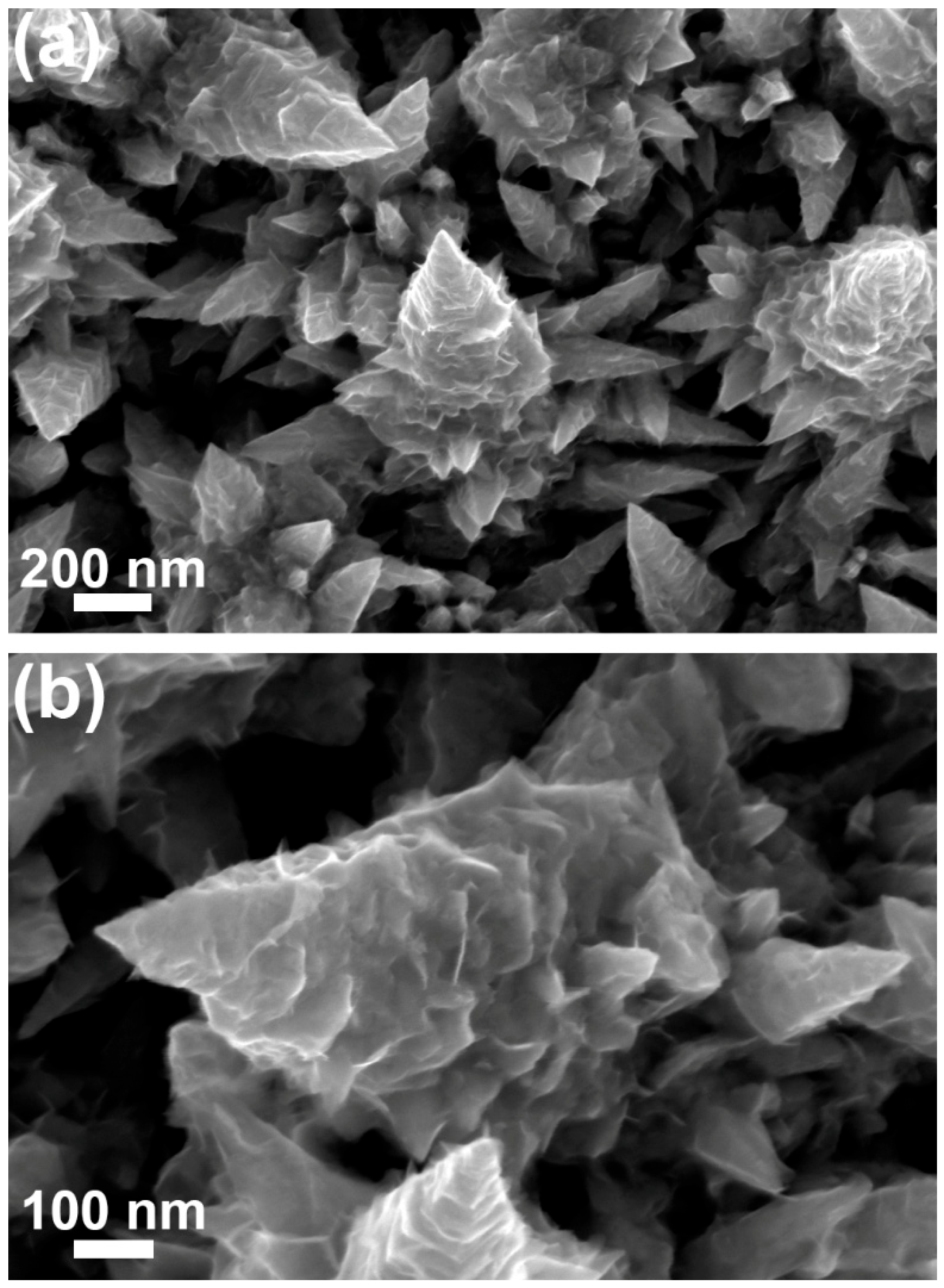
Figure 1 shows SEM images of the electrodeposited Ni electrode. The electrode exhibits a radially oriented, cone-shaped morphology. The primary cones possess lengths ranging from approximately 600 to 800 nm, while the laterally grown cones measure approximately 200 to 400 nm in length. The base diameter of the primary Ni nanocones is ~300 nm, and the base diameter of the lateral cones is ~100 nm. Furthermore, the nanocones display a stepped architecture. This morphology arises from a combination of tip-enhanced electric field discharge and screw dislocation-driven spiral growth during electrodeposition [47,48,49], resulting in the described surface structure of the Ni catalytic electrodes. This growth mode facilitates a larger electrochemically active surface area, thereby providing more active sites for hydrogen atom binding during the hydrogen evolution reaction and ultimately enhancing the electrocatalytic performance.
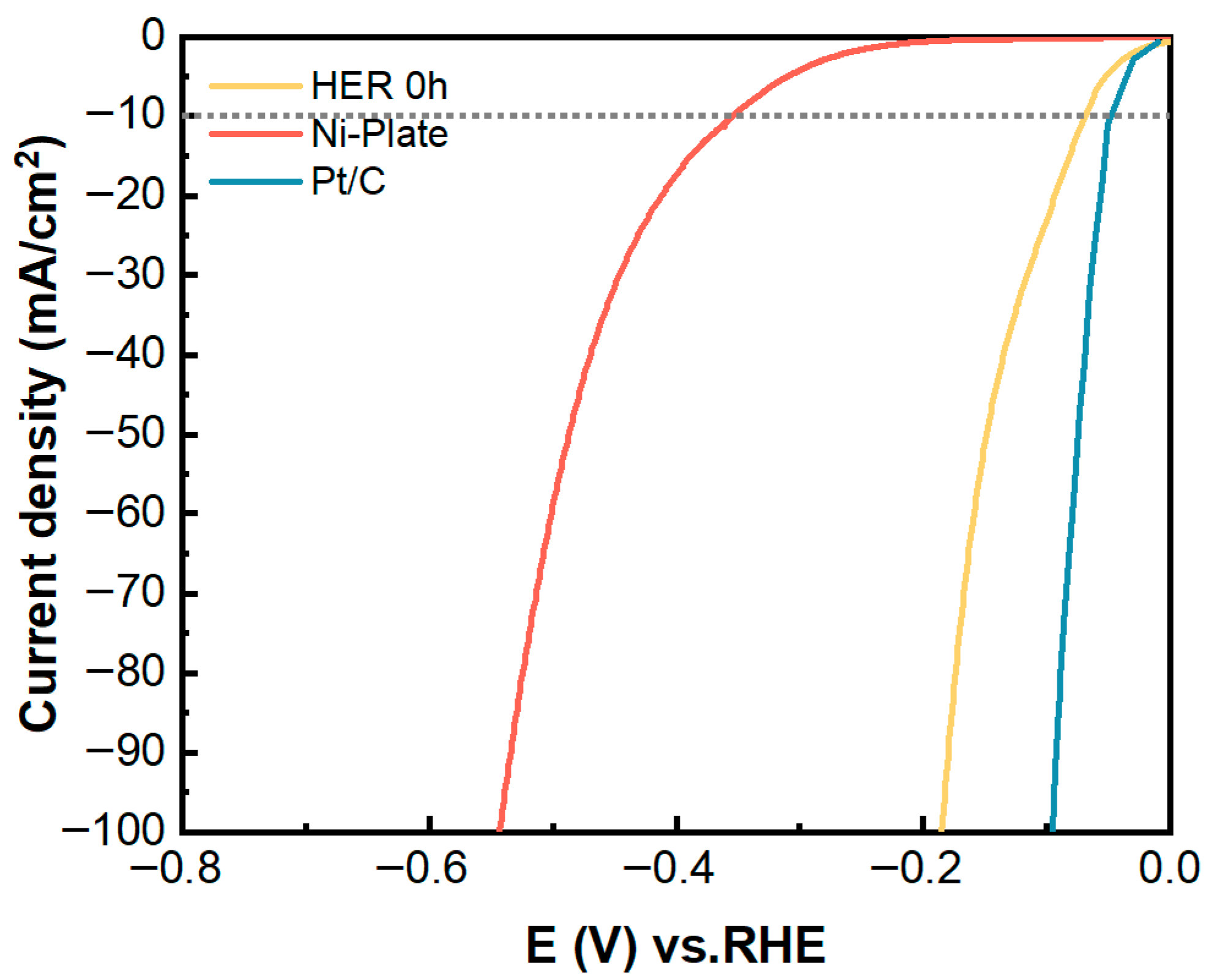
Figure 2 displays the polarization curve of the prepared electrode, compared to nickel plate and the commercial 20% Pt/C as reference samples. The nickel electrode achieved current densities of 10 mA cm−2 at an overpotential of only 68 mV and 100 mA cm−2 at 183 mV, which is significantly better than the nickel plate and approaches the performance of the Pt/C electrode.

3.2. Long-Term Catalytic Performance of Ni Electrode

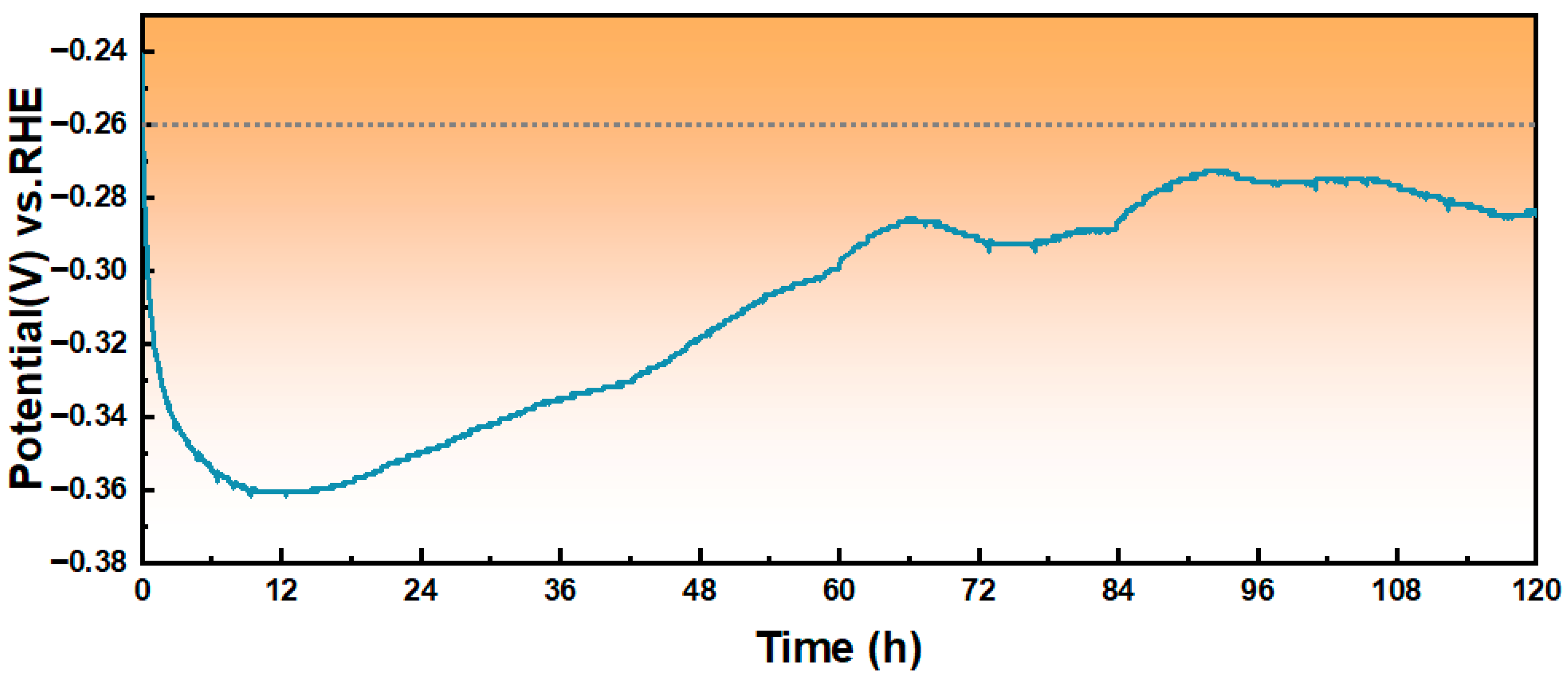
The electrocatalytic activity of the nickel electrode for the HER was evaluated electrochemically as a function of electrolysis time (Figure 3) [50]. The HER catalytic performance of the Ni electrodes exhibited a non-monotonic dependence on electrolysis time. The as-prepared electrode initially demonstrated a high HER activity with a HER potential of −0.24 V. However, the HER catalytic performance sharply declined during the subsequent 12 h. After 12 h, the HER potential increased to −0.36 V. Interestingly, the catalytic activity gradually recovered with the electrolysis time. The HER potential gradually increased and finally stabilized at −0.29 V.
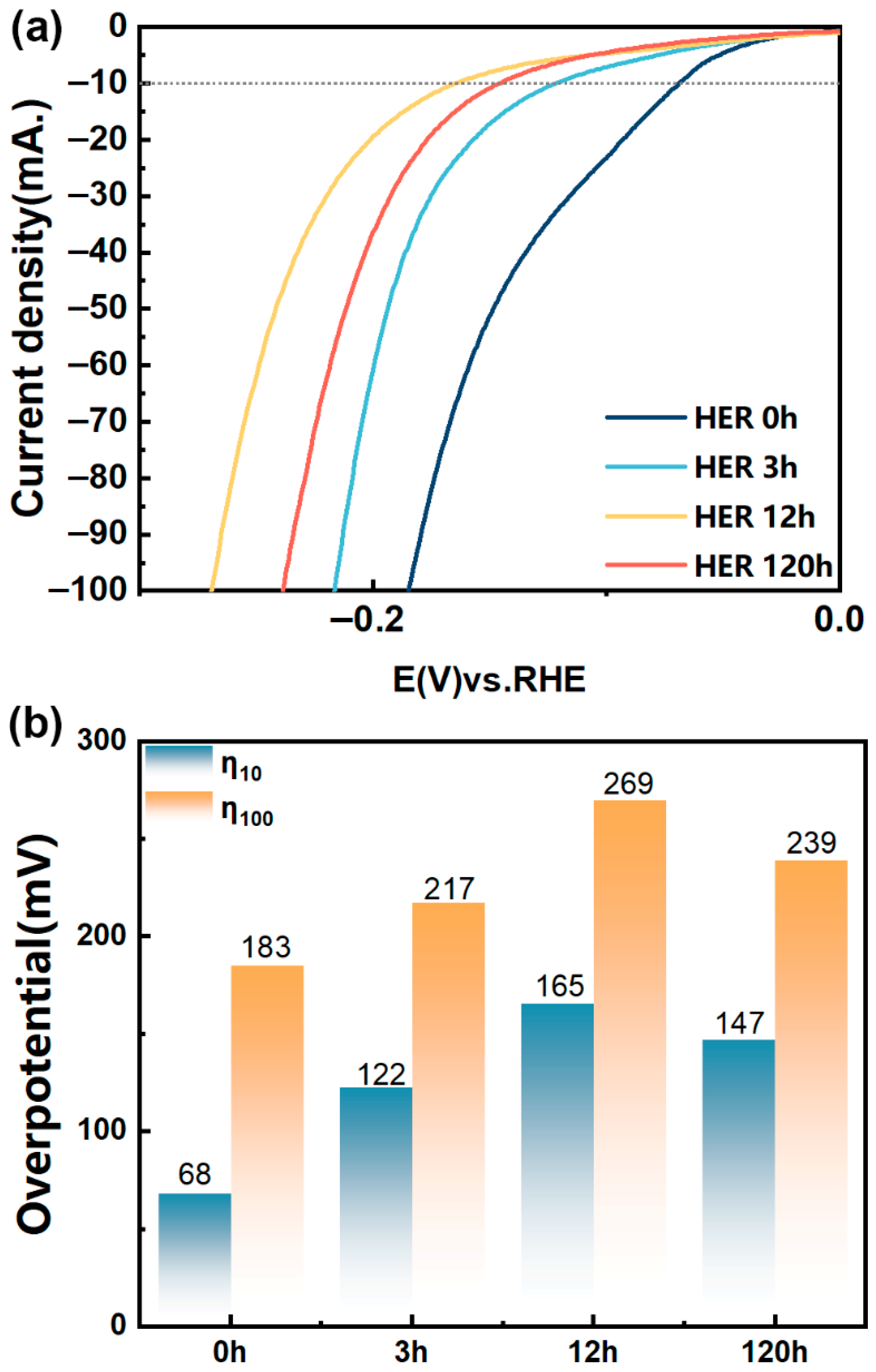
To further understand catalytic performance evolution, LSV curves for Ni electrodes following varying durations were carried out (Figure 4a). Figure 4b illustrates the HER overpotentials of Ni electrodes from Figure 4a. The HER catalytic performance initially deteriorated with increasing electrolysis time, but partially recovered after 120 h. The overpotential of the as-prepared Ni electrode was 68 mV at 10 mA.cm−2, which increased to 165 mV after 12 h of electrolysis, a degradation of 97 mV relative to the initial state. Following 120 h of electrolysis, the overpotential recovered to 147 mV at 10 mA.cm−2, a decrease of 18 mV compared to the performance minimum. This trend is corroborated by the evolution of the long-term chronopotentiometric test.

3.3. Surface Morphologies and Chemical Composition Evolution of Ni Electrodes

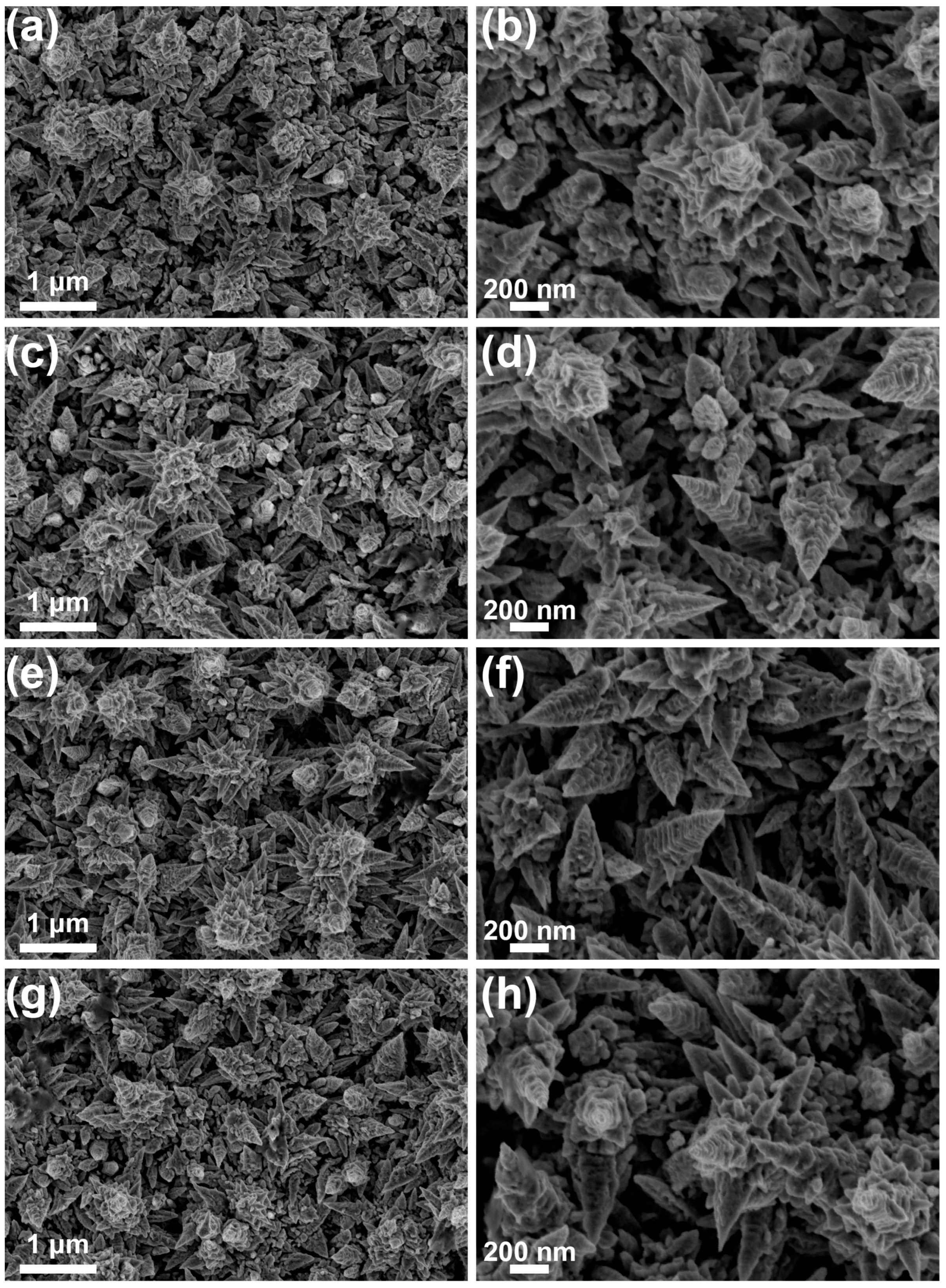
The electrocatalytic performance of electrodes depends on their surface microstructure and morphology. Consequently, SEM was employed to investigate the microstructure and morphology of the coatings. SEM images of the Ni catalytic electrodes obtained at different hydrogen evolution times are shown in Figure 5. Minor variations in hydrogen evolution time between 0 and 12 h result in negligible morphological changes (Figure 5a–f). However, with increasing the hydrogen evolution time to 120 h, Figure 5h reveals partial corrosion and smoothing of the stepped surface features on the Ni nanocone surfaces.
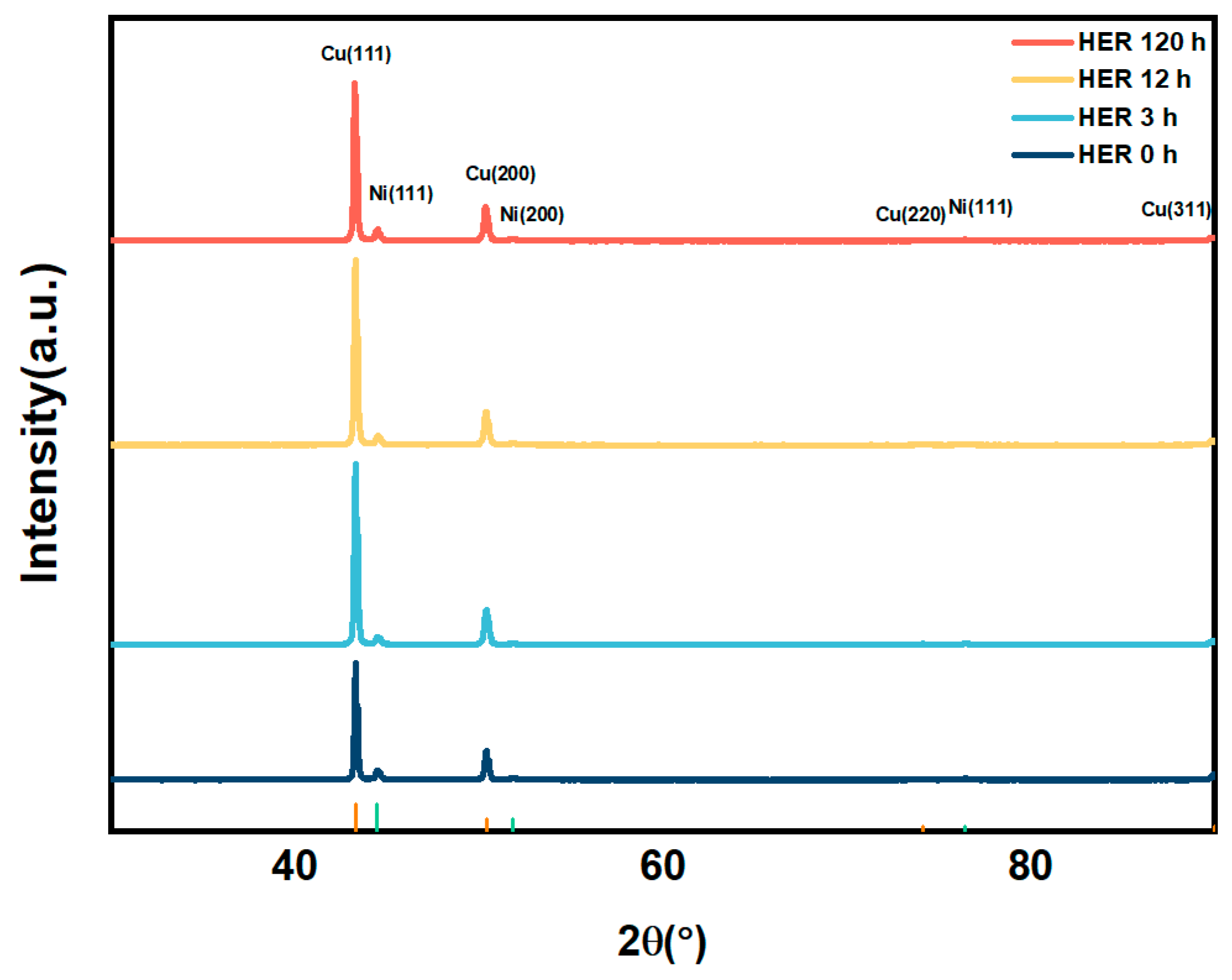
The crystal structure of the synthesized electrode material was analyzed using XRD. Figure 6 shows the XRD patterns of Ni catalytic electrodes after different HER durations. Three characteristic diffraction peaks of Ni are observed at 44.5°, 51.8°, and 76.4°, indicative of a face-centred cubic (FCC) structure for metallic Ni, with a preferred (111) orientation (PDF: 87-0712). Diffraction peaks at 43.3°, 50.4°, 74.1°, and 89.9° correspond to Cu, with a preferential (111) orientation (PDF: 04-0836). The presence of Cu peaks is attributed to the relatively large penetration depth of XRD, allowing detection of the Cu foil substrate. Despite the characterization of Ni electrodes following varying HER durations, no diffraction peaks corresponding to other substances were detected. This may be attributed to the low thickness of the undetected substances on the electrode surface, with a thickness far below the conventional detection limit of XRD.
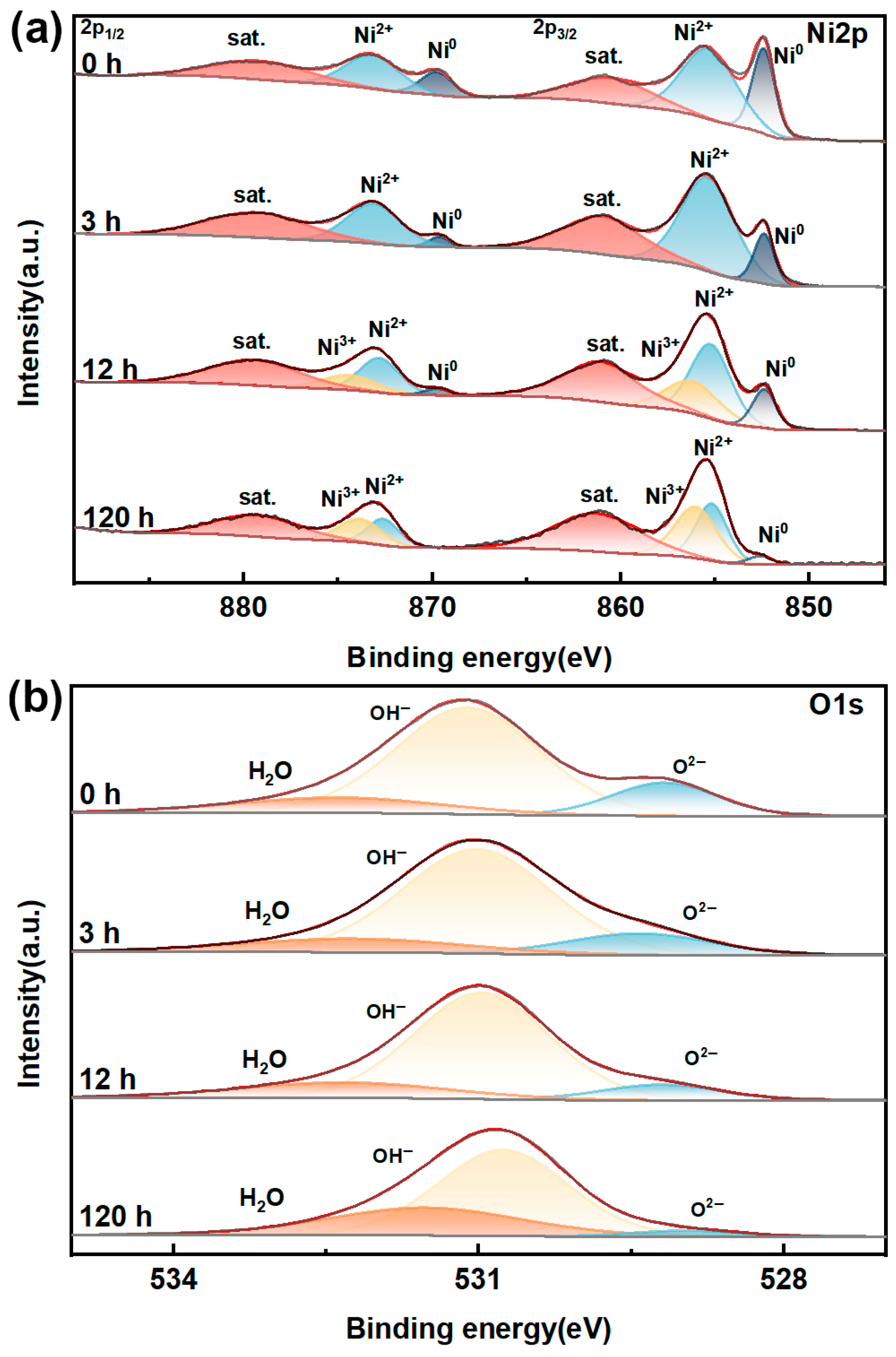
X-ray photoelectron spectroscopy (XPS) was employed to further analyze the chemical composition evolution on the electrode surface. High-resolution Ni2p and O1s XPS spectra (Figure 7a,b) were acquired to investigate the valence state and speciation changes in Ni and O on the electrode surface at different stages of the HER. The Ni2p high-resolution spectra exhibit characteristic spin–orbit split doublets accompanied by satellite features, indicating the presence of multiple Ni oxidation states. In the initial state (0 h of HER), the Ni2p spectrum shows two doublets corresponding to metallic nickel (Ni0) and nickel(II) (Ni2+), signifying that Ni primarily exists as elemental metal and divalent oxide on the electrode surface. After 3 h of HER, the doublet structure in the Ni2p spectrum remains largely unchanged, with both Ni0 and Ni2+ signals still detectable. However, a slight positive shift in the binding energy of Ni2+ is observed. This shift suggests the possible formation of nickel hydroxide (Ni(OH)x) species on the electrode surface during the initial stage of the electrocatalytic reaction, leading to alterations in the electronic environment surrounding the Ni atoms and consequently a subtle increase in the Ni 2p binding energy [15].
As the HER continues to 12 h, the Ni2p spectrum undergoes noticeable changes. In addition to the original Ni0 and Ni2+ doublets, a new set of doublets emerges, attributable to nickel(III) (Ni3+) species. Its provenance may be attributed to surface oxidation of the nickel electrode upon exposure to air subsequent to the hydrogen evolution reaction. However, as the hydrogen evolution process continues, there is a gradual increase in the content of the substance. This observation indicates further oxidation of the Ni catalytic electrode surface during prolonged electrocatalysis [51,52], resulting in a more complex Ni oxidation state distribution. The appearance of high-valent Ni3+ may be associated with evolving oxidative conditions at the electrode surface during the reaction.
Following 120 h of HER, the Ni 2p3/2 spectrum still exhibited a minor Ni0 feature, coexisting with Ni2+ and Ni3+ signals. This indicates the persistence of incompletely oxidized metallic Ni on the electrode surface, alongside the dominance of higher-valent Ni species. These observations suggest a sustained oxidation process of the Ni electrode during prolonged electrocatalysis.
High-resolution O1s spectra consistently resolved three distinct peaks throughout the HER, corresponding to metal oxides, hydroxides, and adsorbed water, respectively. This reveals that the primary form of oxygen species on the electrode surface remained fundamentally unchanged during the HER process. Minor shifts in the binding energies of individual oxygen species across different reaction stages likely arise from subtle structural variations within the surface oxide products, without affecting the overall assignment of oxygen species.
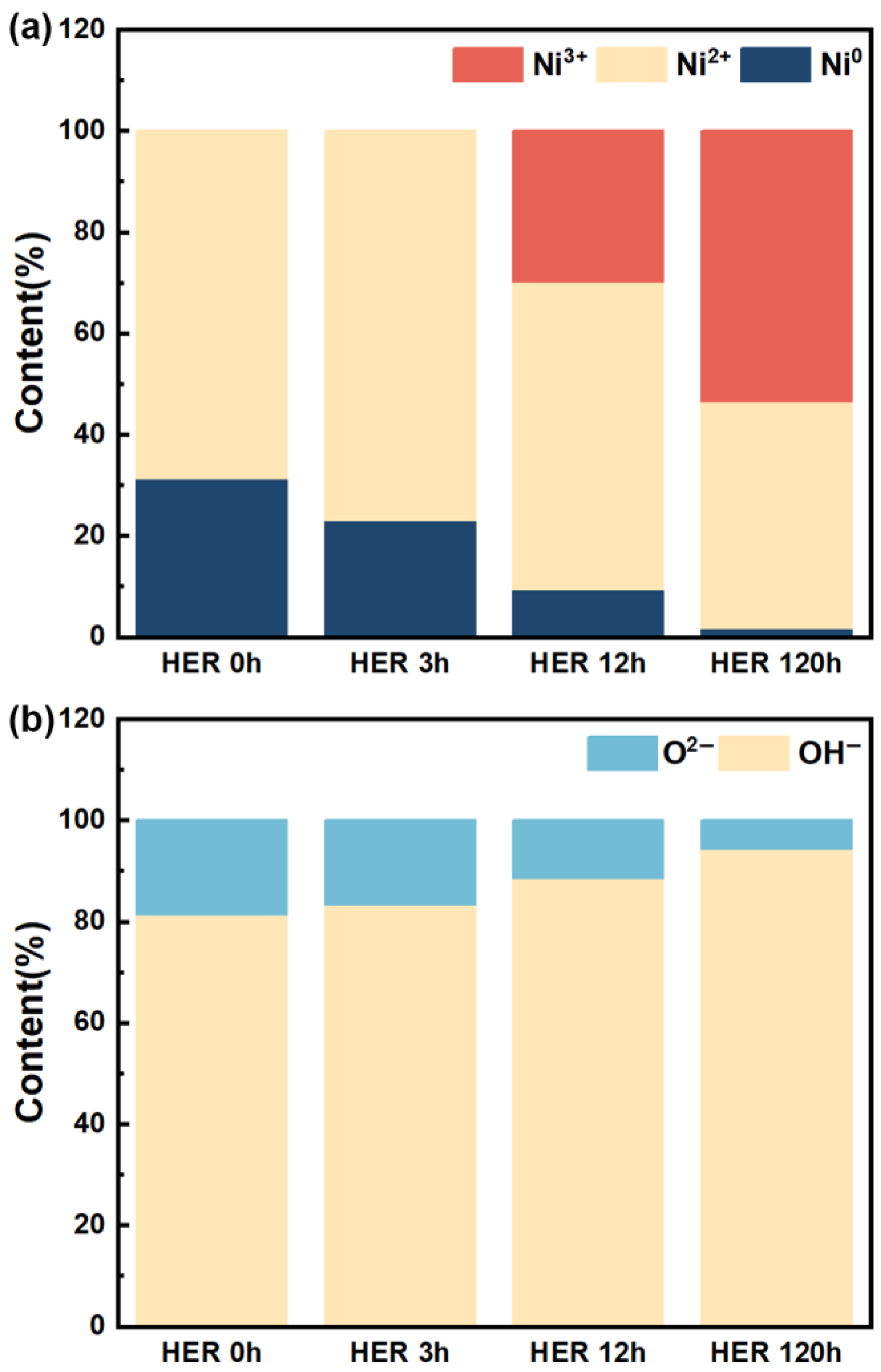
Figure 8 presents the semi-quantitative XPS analysis of Ni and O elements. Figure 8a reveals a significant decrease in Ni0 content with prolonged hydrogen evolution time, from an initial 31.23% to 1.63%. The Ni2+ content exhibited a trend of an initial increase followed by a decrease, starting at 68.76%, peaking at 89.98% after 3 h of hydrogen evolution, and subsequently decreasing to 60.76% after 12 h. Notably, Ni3+ emerged after 12 h of hydrogen evolution, with a content of 29.82%, roughly corresponding to the decrease in Ni2+, suggesting a possible partial conversion of Ni2+ to Ni3+. After 120 h of hydrogen evolution, the system gradually stabilized, with the Ni2+ content further decreasing to 44.75% and the Ni3+ content significantly increasing to 53.61%. Figure 8b shows a gradual increase in adsorbed water content with prolonged hydrogen evolution time, from 14% to 36%. The relative content of oxygen atoms in hydroxides fluctuated, exhibiting an initial increase, followed by a decrease, and then a subsequent increase. Conversely, the relative content of oxygen atoms bonded to Ni (Ni-O) displayed an initial decrease, followed by an increase, and then a decrease, starting at 18.62%, decreasing to 9.17% after 3 h of hydrogen evolution, increasing to 11.59% after 12 h, and finally stabilizing at 5.78% after 120 h.

3.4. Catalytic Kinetics of Ni Electrodes During the Long-Term HER

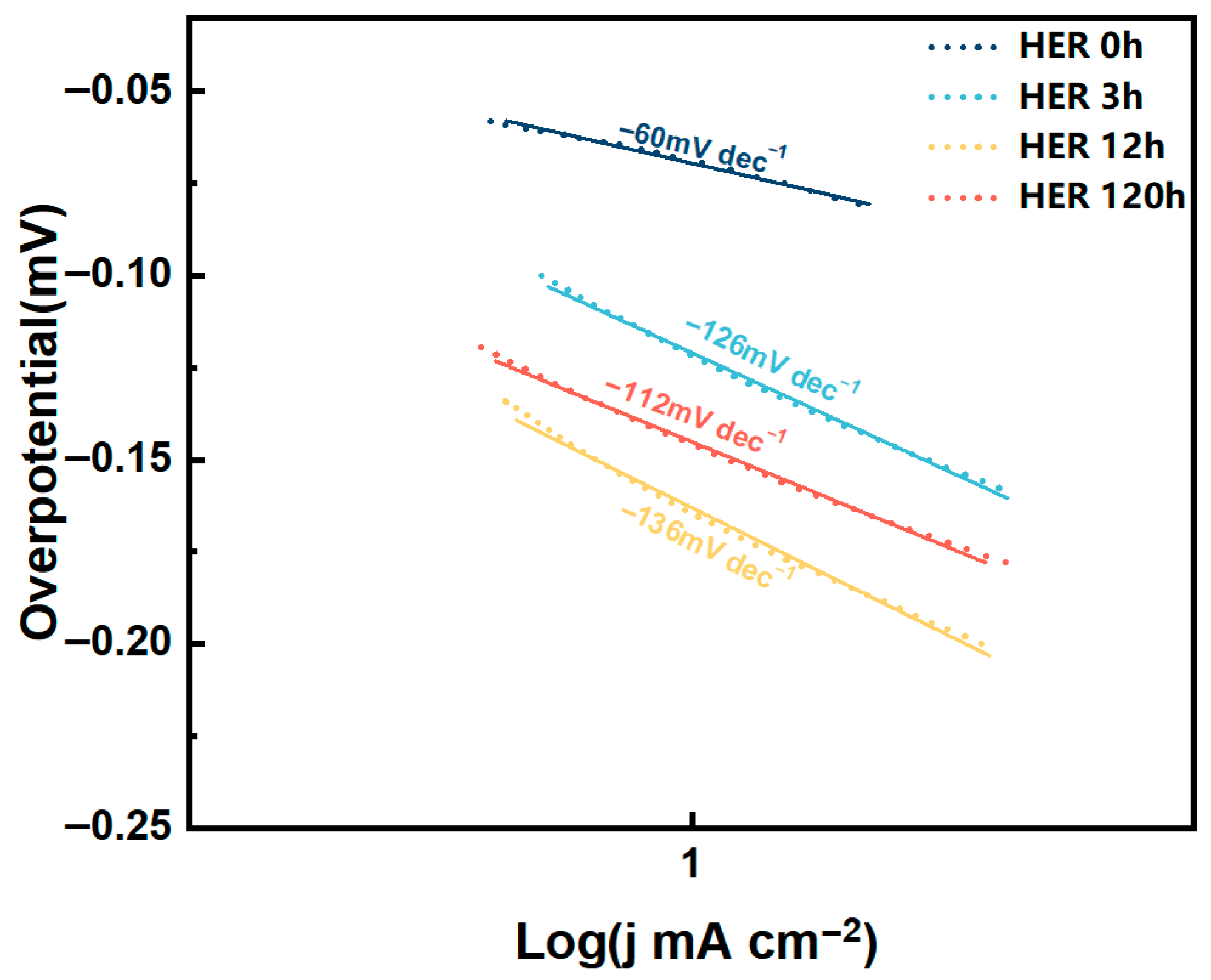
To gain further insights into the HER kinetics on the electrode, the HER polarization curves were fitted using the Tafel equation, and the results are presented in Figure 9. The Tafel slope for HER at 0 h was found to be 59 mV dec−1, representing the most favourable kinetics among all HER durations. An increase in the HER duration initially led to an increase in the Tafel slope, followed by a subsequent decrease. The poorest HER catalytic performance was observed after 12 h of HER. Furthermore, the Tafel slope allows for the determination of the rate-determining step (RDS) for HER [53]. The HER mechanism in alkaline media likely involves the following reactions:
H 2 O + e = H ads + OH ( Volmer   step ,   120   mV · dec )
H ads + H 2 O + e = H 2 + OH ( Heyrovsky   step ,   40   mV · dec )
H ads + H ads = H 2   Tafel   step ,   30   mV · dec
Reaction (2) represents the initial step, followed by either reaction (3) or (4). The rate-determining step (RDS) of the hydrogen evolution reaction (HER) was identified via Tafel slope analysis. Within the Butler–Volmer kinetic framework, assuming a symmetry factor α ≈ 0.5, a Tafel slope of ~120 mV dec−1 indicates that the Volmer step is rate-limiting; ~40 mV dec−1 corresponds to a Heyrovsky-limited process; and ~30 mV dec−1 suggests that the Tafel step is rate-limiting. The observed HER mechanism follows the Volmer–Heyrovsky pathway. At the initial stage of the reaction (0 h), the RDS is the Heyrovsky step. However, after prolonged HER operation for 3, 12, and 120 h, the RDS shifts to the Volmer step. Notably, after 120 h of reaction, the Tafel slope is significantly lower than those at 3 h and 12 h, clearly indicating that the hydrogen evolution electrode exhibits superior catalytic performance at this stage.
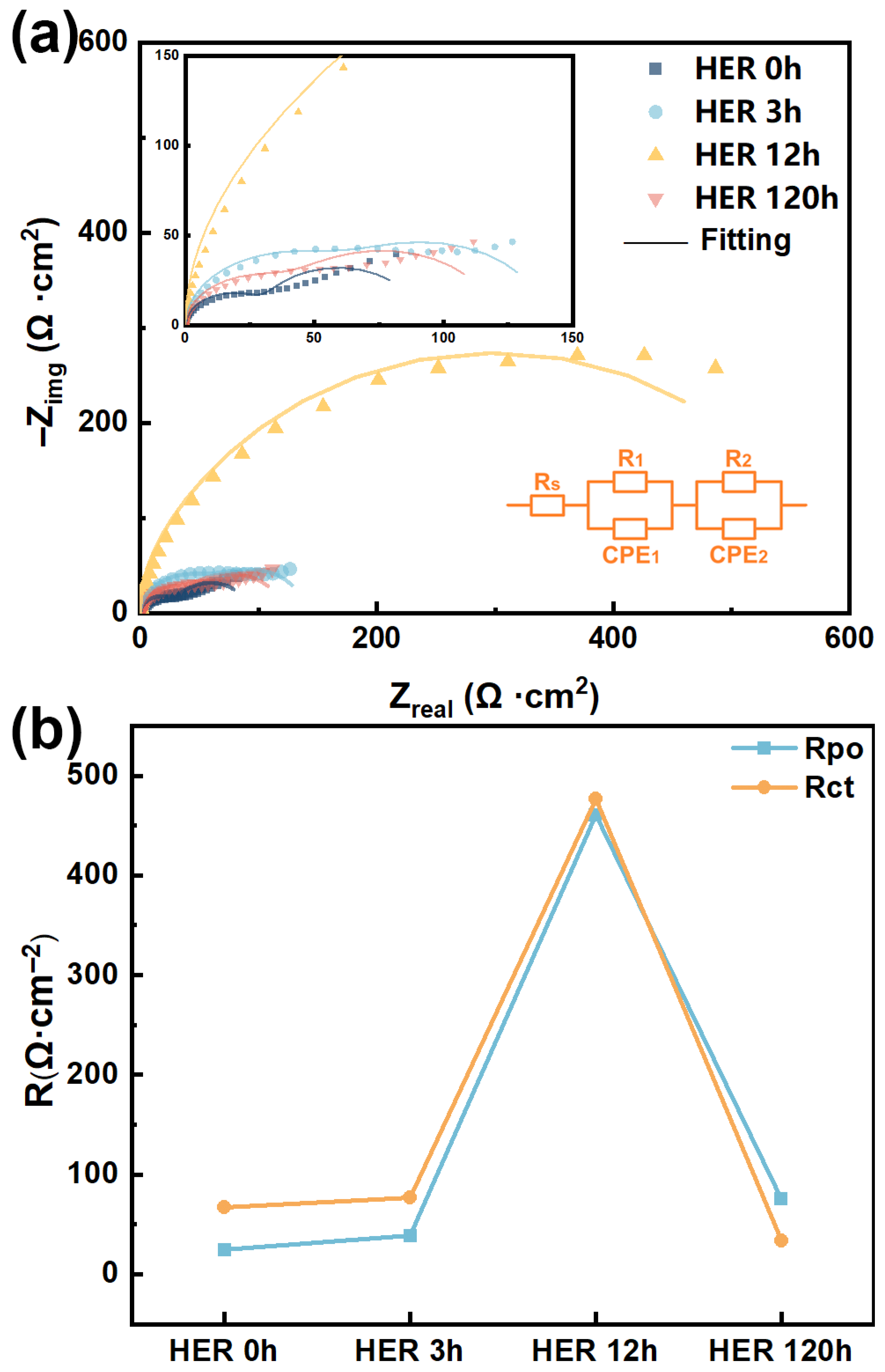
To further elucidate the HER kinetics, electrochemical impedance spectroscopy (EIS) was performed [54,55]. Nyquist plots for the Ni catalytic electrode at varying HER durations are presented in Figure 10a, exhibiting a characteristic semi-circle followed by a linear tail. The high-frequency semi-circle is attributed to charge transfer processes associated with HER, while the tail reflects mass transport limitations. Quantitative analysis was achieved by fitting the EIS data with an equivalent circuit model (inserted in Figure 10a) [56]. To account for surface heterogeneity and roughness, a constant phase element (CPE) was employed in lieu of a capacitor (C) to more accurately represent the non-ideal interface. The equivalent circuit comprises the solution resistance (Rs), the capacitance (CPEpo) and resistance (Rpo) associated with electrode porosity, and the double-layer capacitance (CPEdl) and charge-transfer resistance (Rct) [57,58]. As evident in Figure 10b, the charge transfer resistance (Rct) is lowest at 0 h of HER, indicating the most favourable HER kinetics. The Rct increases at 120 h and 3 h, and reaches its highest value at 12 h. Prior to 12 h, Rct exceeds the pore resistance (Rpo), suggesting that the HER is governed by electrochemical processes. Beyond 120 h, the transition to Rpo > Rct signifies a shift in the rate-determining step towards ion transport limitations.

3.5. Electrochemical Active Surface Area Measurement

The electrochemical specific surface area (ECSA) represents a critical determinant of hydrogen evolution reaction (HER) catalytic performance. Nevertheless, its direct and precise measurement remains challenging. Consequently, ECSA is frequently estimated via indirect methods, serving as a robust proxy for the catalytically active surface area [58]. The relative change in ECSA can be evaluated from the variation trend of C d l / C d l .
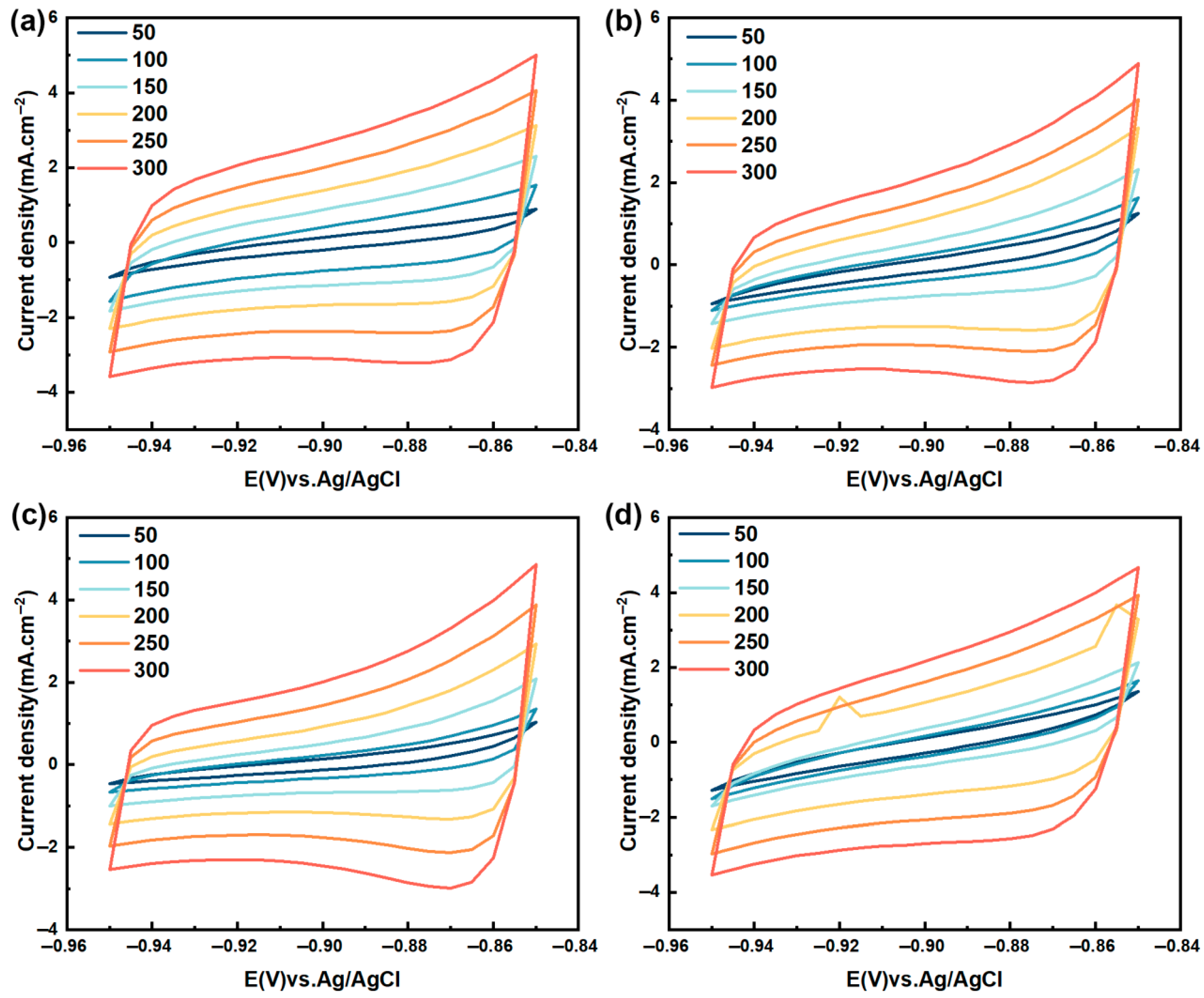
The double-layer capacitance (Cdl) of the electrode within the non-Faradaic potential range was determined via cyclic voltammetry (CV). CV curves obtained at varying scan rates for nickel electrodes subjected to different hydrogen evolution time are presented in Figure 11a–d.
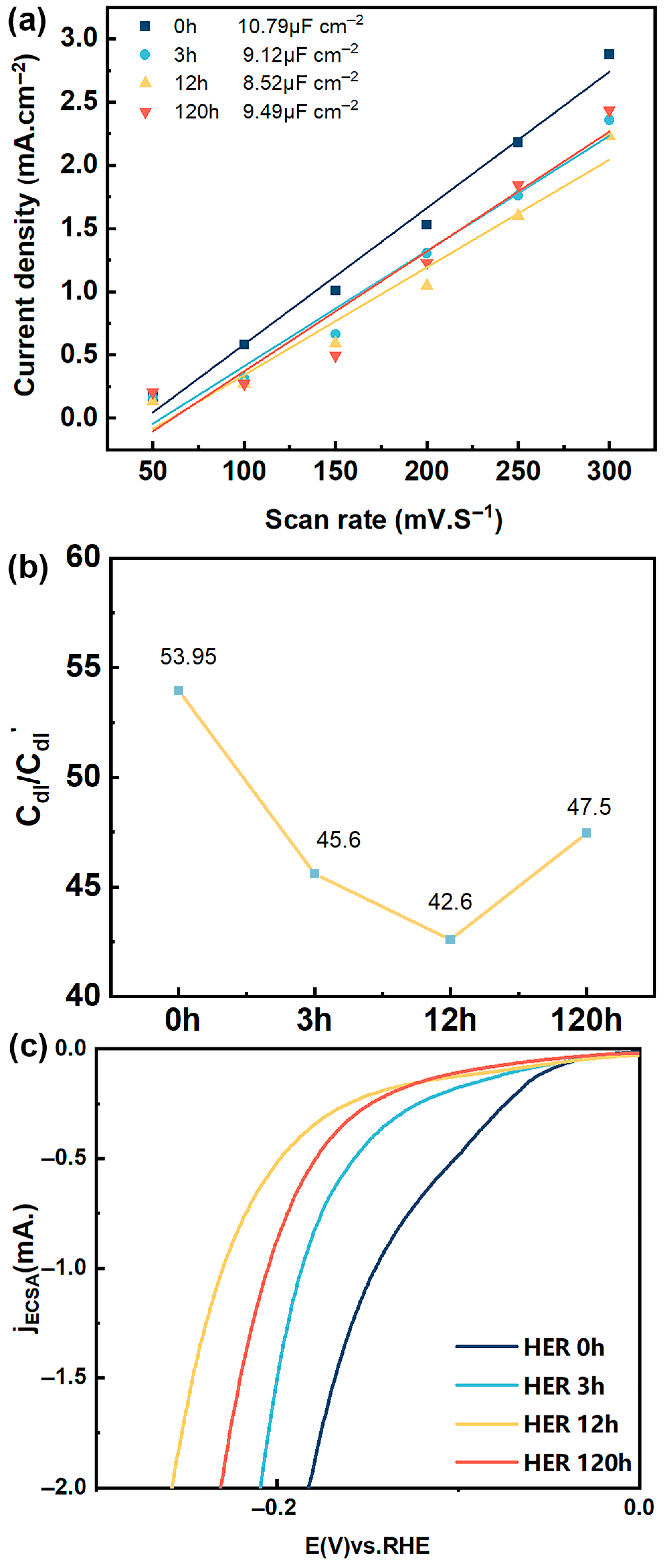
Cdl was derived from the linear fit of the relationship between the scan rate (x-axis) and half the difference in current density at the midpoint potential of the scan (y-axis) (Figure 12a). C d l represents the double-layer capacitance of a planar electrode, typically ~20 μF cm−2 in 1 mol L−1 KOH electrolyte [58]. The calculated C d l / C d l of the Ni catalytic electrodes after different hydrogen evolution times is shown in Figure 12b. It is evident from the variation trend of C d l / C d l that ECSA initially decreases and subsequently increases with increasing hydrogen evolution time. A larger ECSA generally indicates a higher number of active sites and enhanced catalytic performance, and the observed ECSA trend correlates with the overall catalytic activity. However, it should be clearly emphasized that, while the ECSA reflects the apparent number of active sites of the electrode, the actual HER performance is simultaneously and significantly affected by the intrinsic catalytic activity. When the difference in intrinsic catalytic activity between different samples is dominant, the HER activity will mainly change with the variation in the activity per active site. Therefore, it exhibits a trend consistent with the normalized HER performance, but inconsistent with the variation trend of ECSA. Given that all Ni catalytic electrodes were fabricated in the same batch, the influence of ECSA was discounted to allow a more direct assessment of the intrinsic catalytic performance of the Ni catalytic electrodes following different hydrogen evolution times [59], as illustrated in Figure 12c. Elemental changes observed on the Ni catalytic electrode surface with varying hydrogen evolution time coincided with alterations in the intrinsic HER activity. The electrode with 0 h of hydrogen evolution exhibited the optimal performance, followed by 3 h and then 120 h, while the electrode with 12 h of hydrogen evolution demonstrated the poorest performance.

4. Discussion

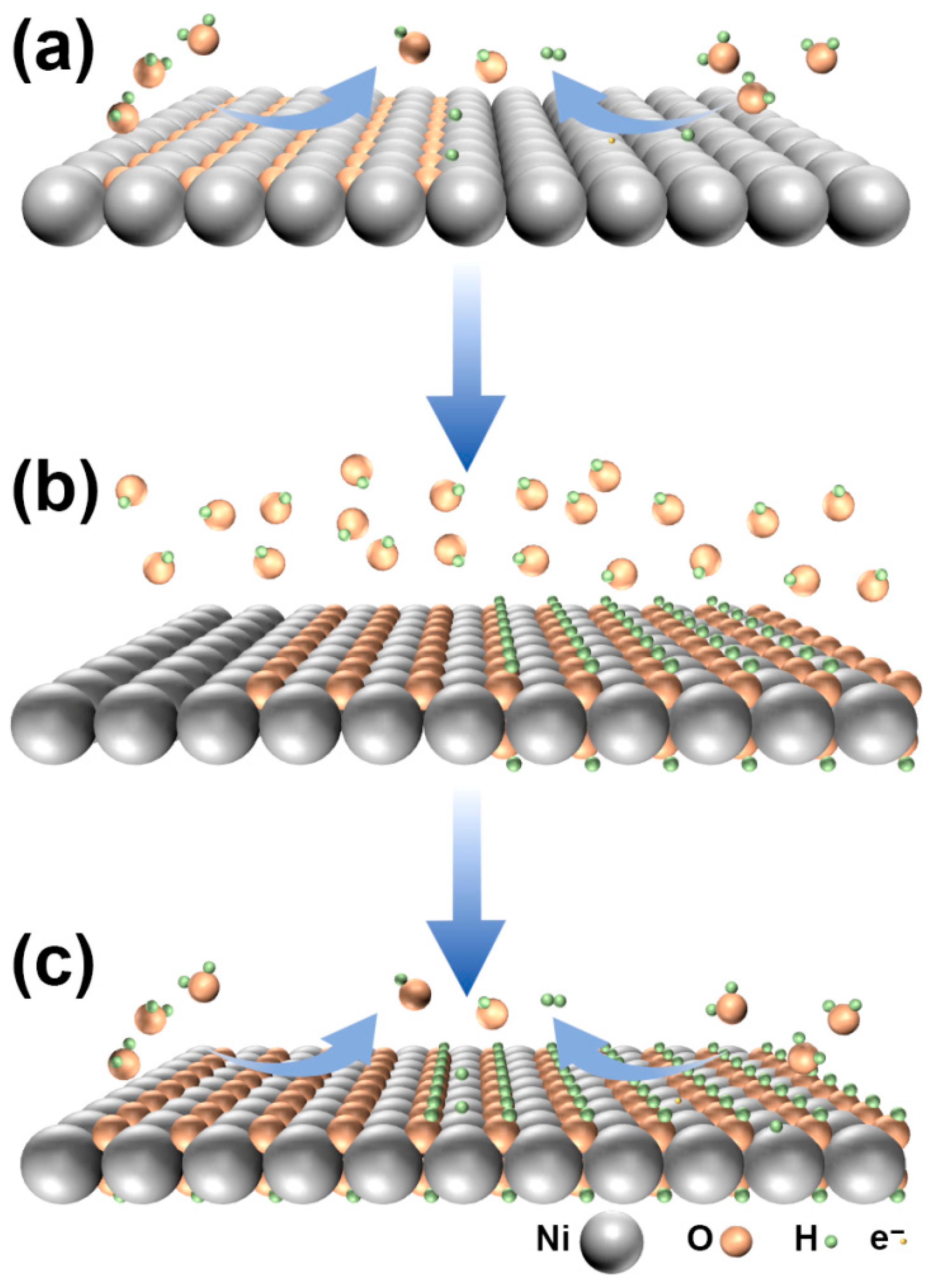
The HER catalytic performance on the electrodeposited nickel electrode reveals a decline–recovery evolution. This trend was mainly induced by the change in surface chemical compositions. Based on the experimental results, the evolution mechanism could be divided into three stages (Figure 13).
Initially, the nickel electrode surface comprises predominantly Ni, NiO, and Ni(OH)2 (Figure 13a). The electrode exhibits the highest HER catalytic performance, attributed to synergistic effects between Ni0 and Ni2+, facilitated by interfacial electronic structure modulation, cooperative active site functionalities, and accelerated reaction kinetics [46]. Alkaline water electrolysis for hydrogen evolution involves two crucial steps: water dissociation and H* recombination–desorption. The work function difference between metallic nickel and nickel oxide establishes a built-in electric field at the heterojunction interface [21,60]. Given nickel’s lower work function (approximately 5.15 eV), electrons spontaneously migrate from metallic nickel to nickel oxide, resulting in a positively charged metallic nickel surface and a negatively charged nickel oxide surface. The positively charged metallic nickel weakens hydrogen intermediate (H*) adsorption, lowering the energy barrier for H* desorption to form H2 and optimizing the hydrogen adsorption free energy (ΔGH*) towards the ideal value of 0 eV. Conversely, the negatively charged nickel oxide enhances water molecule polarization, promoting water dissociation into H* and OH via the Volmer step. Ni/NiO heterostructures may form synergistic catalytic sites at their interfaces, with NiO serving as an efficient water dissociation site and metallic Ni as an efficient hydrogen desorption site. The metallic Ni rapidly combines with H* dissociated on the NiO side, facilitating H2 evolution [46]. Furthermore, metallic Ni is proposed to act as an electron transport conduit within the heterostructure, rapidly delivering electrons from the external circuit to the NiO water dissociation sites, ensuring sufficient electron supply for the Volmer step [22]. An interfacial built-in electric field further accelerates charge separation and migration, lowering charge transfer resistance, and enabling high current densities at low overpotentials. The formation of the heterostructure is an indirect inference based on XPS characterization results; its specific interfacial structure requires further characterization for confirmation.
During long-term operation, surface reconstruction occurs on the electrode. In the first 12 h, a decline in HER catalytic performance is observed. This phenomenon can be attributed to the oxidation of metallic Ni on the electrode surface, gradually transforming it into divalent nickel oxide. This process is associated with the NiO/Ni redox couple, which has a standard electrode potential of −0.72 V vs. SHE in neutral/alkaline media:
NiO + H 2 O + 2 e Ni + 2 O H
The Ni-based electrocatalyst exhibited a HER overpotential of approximately −0.29 V vs. RHE at a current density of −100 mA cm−2. Polarization curve analysis indicated the persistence of oxidation processes at the electrode surface. During water electrolysis, the increasing concentration of OH at the electrode surface facilitates coordination with surface Ni2+ ions, leading to the formation of layered Ni(OH)2:
N i O + H 2 O + 2 O H N i ( O H ) 2 2
N i ( O H ) 4 2 N i ( O H ) 2 + 2 O H
Surface reconstruction of metallic nickel occurs, with partial oxidation of Ni0 to Ni2+, disrupting the synergistic effect between Ni0 and Ni2+ and consequently compromising the HER catalytic performance. The oxidation of Ni0 leads to a progressive decrease in the molar fraction of metallic Ni0, reducing the effective channels for electron conduction. This directly increases charge transfer resistance, thereby limiting the ability of Ni2+ active sites to promptly acquire electrons and diminishing catalytic kinetics. According to the nickel Pourbaix (E-pH) diagram [61], the thermodynamic formation of a compact Ni(OH)2 [62,63] layer on the nickel electrode surface passivates active sites, physically hindering water molecule access to Ni2+ sites and suppressing hydrogen adsorption (Hads) formation. The insulating nature of Ni(OH)2 further exacerbates charge transfer resistance. This densely structured oxide layer, devoid of porosity, fails to provide accessible active sites, resulting in a significant reduction in both the “number of effective active sites” and “site utilization,” ultimately leading to HER catalytic performance degradation.
Following a 12 h hydrogen evolution reaction (HER) in an alkaline electrolyte, the presence of Ni3+ species on the electrode surface was inferred from the XPS characterization results. This phenomenon may be correlated with Pourbaix phase diagram results based on density functional theory (DFT) calculations [61], which indicate that NiO, Ni(OH)2 and NiOOH possess similar Gibbs free energies under strongly alkaline conditions. The present study hypothesizes that localized micro-region anodic polarization and electronic structure modulation at high current densities may underlie this phenomenon. Specifically, the continuous desorption of hydrogen bubbles during HER results in the formation of transient electrolyte-depleted regions on the electrode surface. The reduced electrolyte concentration has been shown to significantly increase the ohmic resistance in these areas [64,65,66], leading to a brief anodic potential shift that induces localized anodic polarization [67,68]. Ph. Mandin and his research team [69] found that when the potential is excessively high and the cathode is continuously covered by a gas film, the anode effect reaches its maximum intensity, and glow or spark discharge may even occur. It is noteworthy that at a pH of 14, the standard electrode potential for the oxidation of Ni(OH)2 to NiOOH is approximately 0.49 V vs. SHE [61]. Consequently, when the local potential exceeds this value, the following oxidation reaction may occur:
N i ( O H ) 2 + O H N i O O H + H 2 O + e
Furthermore, we hypothesize that the inherent built-in electric field within the Ni/NiO heterostructure may facilitate electron transfer from Ni0 to NiO, thereby modulating the electron density distribution at the Ni(OH)2-NiO/Ni0 interface. This modulation potentially renders Ni2+ more susceptible to oxidation into Ni3+. During extended electrochemical testing, the repeated events of bubble detachment, localized polarization, and oxidation reactions might progressively transform Ni(OH)2 into NiOOH [70], and may ultimately lead to the formation of a complex Ni(OH)2/NiOOH multiphasic architecture on the electrode surface. NiOOH functions as a Brønsted acid site, accepting an electron and adsorbing a proton during the Volmer step [18]. Competition with Ni0 for hydrogen adsorption occurs. After 12 h of hydrogen evolution, Ni(OH)2 dominates the electrode surface, and the superposition of multiple interfacial barriers maximizes the electron transport resistance, resulting in the highest Rct. Consequently, the electrode exhibits the poorest hydrogen evolution performance at this stage (Figure 13b).
After 120 h of hydrogen evolution, Ni0 is largely oxidized. The hydrogen evolution performance improves as the amount of Ni0 decreases, reducing competition for Hads adsorption (Figure 13c). The Ni(OH)2/NiOOH heterostructure potentially constructed on the electrode surface is expected to significantly reduce the electron transfer barrier and facilitate the charge transfer process, thereby decreasing the charge transfer resistance (Rct). The hydrogen evolution performance of the electrode recovers to a stable state.
Notably, the formation of the aforementioned heterostructure is an indirect inference based on XPS characterization results. In future work, the specific interfacial structure and the associated electronic transport mechanisms will be systematically validated through advanced experimental characterization techniques, such as high-resolution transmission electron microscopy and in situ spectroscopic methods.
At present, the presence of Ni3+ species and their role in the catalytic process are primarily rationalized based on the available characterization data. However, their exact formation pathways and dynamic evolution remain to be elucidated. Further systematic verification and in-depth investigation are therefore required, particularly through in situ characterization techniques such as in situ X-ray absorption fine structure (XAFS) and in situ Raman spectroscopy.

5. Conclusions

The long-term HER catalytic performance evolution of the electrodeposited Ni electrode was systematically investigated in this study. The HER catalytic performance, catalytic kinetics, and electrochemical active surface area (ECSA) were measured. The surface chemical compositions of the electrode were analyzed. The following conclusion could be drawn:
(1)
The HER catalytic performance on the electrodeposited nickel electrode reveals a decline–recovery evolution. The electrode initially demonstrated a high HER activity with a HER potential of −0.24 V, but it sharply declined with the subsequent 12 h. After 12 h, the HER potential increased to −0.36 V. Then, the catalytic activity gradually recovered with the electrolysis time, and the HER potential gradually increased and finally stabilized with −0.29 V at 120 h.
(2)
The surface morphology of the electrode had hardly changed after the 120 h HER, but the ECSA initially decreased and subsequently increased with increasing hydrogen evolution time. The decline–recovery trend of the catalytic performance was mainly induced by the change in surface chemical compositions of the electrode surface, which leads to changes in the HER catalytic mechanism.
(3)
During the initial 12 h, a catalytic performance decay is observed, which is caused by the oxidation of Ni0 to Ni2+ on the electrode surface, disrupting the Ni0-Ni2+ synergy. NiO facilitates the dissociation of water molecules, while metallic Ni provides low-energy barrier sites for the adsorption and desorption of hydrogen intermediates. The reduction in Ni0 content affects the hydrogen adsorption and desorption, leading to an increase in the HER energy barrier.
(4)
After 12 h of hydrogen evolution, the electrode surface is nearly completely oxidized, might forming the Ni(OH)2/NiOOH heterostructure. NiOOH provides active sites and accelerates water dissociation, creating an acidic-like environment on the electrode surface, while Ni(OH)2 promotes hydrogen adsorption and desorption, significantly lowering the reaction energy barrier, and recovers the catalytic activity.

Author Contributions

Conceptualization, C.H. and Z.W.; methodology, Z.Y.; investigation, C.H.; writing—original draft preparation, Z.Y.; writing—review and editing, Z.W.; supervision, Z.W.; project administration, Z.W.; and funding acquisition, Z.W. All authors have read and agreed to the published version of the manuscript.

Funding

This work was funded by the Science and Technology Research Programme of Chongqing Municipal Education Commission under grant No. KJQN202301112.

Data Availability Statement

The data presented in this study are available on request from the corresponding author due to privacy concerns.

Conflicts of Interest

The authors declare no conflicts of interest. The funders had no role in the design of the study; in the collection, analyses, or interpretation of data; in the writing of the manuscript; or in the decision to publish the results.

References

  1. Jang, B.; Gläser, R.; Liu, C.; Dong, M. Fuels of the future. Energy Environ. Sci. 2010, 3, 253. [Google Scholar] [CrossRef] [Scilit]
  2. Khaligh, V.; Ghezelbash, A.; Liu, J.; Won, W.; Koo, J.; Na, J. Multi-period hydrogen supply chain planning for advancing hydrogen transition roadmaps. Renew. Sustain. Energy Rev. 2024, 200, 114536. [Google Scholar] [CrossRef] [Scilit]
  3. Zhang, X.; Sun, Y.; Ju, S.; Ye, J.; Hu, X.; Chen, W.; Yao, L.; Xia, G.; Fang, F.; Sun, D.; et al. Solar-Driven Reversible Hydrogen Storage. Adv. Mater. 2023, 35, 2206946. [Google Scholar] [CrossRef] [Scilit]
  4. Blanco, H.; Leaver, J.; Dodds, P.E.; Dickinson, R.; García-Gusano, D.; Iribarren, D.; Lind, A.; Wang, C.; Danebergs, J.; Baumann, M. A taxonomy of models for investigating hydrogen energy systems. Renew. Sustain. Energy Rev. 2022, 167, 112698. [Google Scholar] [CrossRef] [Scilit]
  5. Zhu, M. Magnesium for hydrogen energy: Prospects and challenges. J. Magnes. Alloys 2025, 13, 5763–5764. [Google Scholar] [CrossRef] [Scilit]
  6. Tüysüz, H. Alkaline Water Electrolysis for Green Hydrogen Production. Acc. Chem. Res. 2024, 57, 558–567. [Google Scholar] [CrossRef] [Scilit]
  7. Zhu, J.; Hu, L.; Zhao, P.; Lee, L.Y.S.; Wong, K.-Y. Recent Advances in Electrocatalytic Hydrogen Evolution Using Nanoparticles. Chem. Rev. 2019, 120, 851–918. [Google Scholar] [CrossRef] [Scilit]
  8. Yan, Y.; Lin, J.; Xu, T.; Liu, B.; Huang, K.; Qiao, L.; Liu, S.; Cao, J.; Jun, S.C.; Yamauchi, Y.; et al. Atomic-Level Platinum Filling into Ni-Vacancies of Dual-Deficient NiO for Boosting Electrocatalytic Hydrogen Evolution. Adv. Energy Mater. 2022, 12, 2200434. [Google Scholar] [CrossRef] [Scilit]
  9. Feinleib, J.; Adler, D. Band Structure and Electrical Conductivity of NiO. Phys. Rev. Lett. 1968, 21, 1010–1013. [Google Scholar] [CrossRef] [Scilit]
  10. Arciga-Duran, E.; Meas, Y.; Pérez-Bueno, J.J.; Ballesteros, J.C.; Trejo, G. Electrochemical Synthesis of Co3O4-x Films for Their Application as Oxygen Evolution Reaction Electrocatalysts: Role of Oxygen Vacancies. J. Electrochem. Soc. 2018, 165, H3178–H3186. [Google Scholar] [CrossRef] [Scilit]
  11. Pang, C.; Zhu, S.; Xu, W.; Liang, Y.; Li, Z.; Wu, S.; Jiang, H.; Wang, H.; Cui, Z. Self-standing Mo-NiO/Ni electrocatalyst with nanoporous structure for hydrogen evolution reaction. Electrochim. Acta 2023, 439, 141621. [Google Scholar] [CrossRef] [Scilit]
  12. Zhou, Y.; Luo, M.; Zhang, W.; Zhang, Z.; Meng, X.; Shen, X.; Liu, H.; Zhou, M.; Zeng, X. Topological Formation of a Mo–Ni-Based Hollow Structure as a Highly Efficient Electrocatalyst for the Hydrogen Evolution Reaction in Alkaline Solutions. ACS Appl. Mater. Interfaces 2019, 11, 21998–22004. [Google Scholar] [CrossRef] [Scilit] [PubMed]
  13. Huang, J.; Han, J.; Wu, T.; Feng, K.; Yao, T.; Wang, X.; Liu, S.; Zhong, J.; Zhang, Z.; Zhang, Y.; et al. Boosting Hydrogen Transfer during Volmer Reaction at Oxides/Metal Nanocomposites for Efficient Alkaline Hydrogen Evolution. ACS Energy Lett. 2019, 4, 3002–3010. [Google Scholar] [CrossRef] [Scilit]
  14. Zhou, Y.; Liu, H.; Zhu, S.; Liang, Y.; Wu, S.; Li, Z.; Cui, Z.; Chang, C.; Yang, X.; Inoue, A. Highly Efficient and Self-Standing Nanoporous NiO/Al3Ni2 Electrocatalyst for Hydrogen Evolution Reaction. ACS Appl. Energy Mater. 2019, 2, 7913–7922. [Google Scholar] [CrossRef] [Scilit]
  15. Jiang, J.; Dou, H.; Cao, M.; Du, L.; Yan, Y.; Wang, X.; Chen, C.; Ye, L.; Deng, B.; He, H. Amorphous nickel oxide electrodes with high-current-density electrocatalytic performance for hydrogen evolution. Int. J. Hydrogen Energy 2024, 51, 887–894. [Google Scholar] [CrossRef] [Scilit]
  16. Lei, C.; Zheng, Q.; Cheng, F.; Hou, Y.; Yang, B.; Li, Z.; Wen, Z.; Lei, L.; Chai, G.; Feng, X. High-Performance Metal-Free Nanosheets Array Electrocatalyst for Oxygen Evolution Reaction in Acid. Adv. Funct. Mater. 2020, 30, 2003000. [Google Scholar] [CrossRef] [Scilit]
  17. Zhang, C.; Ju, S.; Kang, T.-H.; Park, G.; Lee, B.-J.; Miao, H.; Wu, Y.; Yuan, J.; Yu, J.-S. Self-Limiting Growth of Single-Layer N-Doped Graphene Encapsulating Nickel Nanoparticles for Efficient Hydrogen Production. ACS Appl. Mater. Interfaces 2021, 13, 4294–4304. [Google Scholar] [CrossRef] [Scilit]
  18. Hou, S.; Chen, Z.; Yang, M.; Hou, X.; Yang, G.; Zhang, C.; Wang, J.; Li, Y.; Cui, Y. Electrochemical Reconstruction Tailoring Catalyst Acidity for Boosted Alkaline Hydrogen Evolution. ACS Catal. 2025, 15, 16427–16438. [Google Scholar] [CrossRef] [Scilit]
  19. Liu, X. Preparation and Application of Nickel-Based Electrode Materials in the Supercapacitors. Nonferrous Met. Mater. Eng. 2019, 40, 32–40. [Google Scholar] [CrossRef]
  20. Navarro-Pardo, F.; Selopal, G.S.; Hernandez-Gonzalez, A.P.; Ghasemy, E.; Liu, J.; Ghuman, K.K.; Tavares, A.C.; Wang, Z.M.; Rosei, F. Nickel oxide/nickel nanohybrids for oxygen and hydrogen evolution in alkaline media. Electrochim. Acta 2024, 506, 145002. [Google Scholar] [CrossRef] [Scilit]
  21. Li, R.; Pu, Z.; Zhou, R.; Li, Y.; Huang, Y.; Li, S.; Yang, J.; Zhang, D.; Pi, M. In situ controllable construction of Ni@NiO Schottky heterojunctions for electrocatalytic hydrogen evolution. J. Mater. Chem. C 2024, 12, 18849–18855. [Google Scholar] [CrossRef] [Scilit]
  22. Chen, F.; Peng, W.; Zhou, J.; Ma, X.; Wang, Y.; Zhang, Y.; Gao, F. Ultrastable and highly efficient hydrogen evolution by heterogeneous NiO/Ni catalysts under industrial electrolysis conditions. Inorg. Chem. Front. 2024, 11, 425–435. [Google Scholar] [CrossRef] [Scilit]
  23. Gong, M.; Zhou, W.; Tsai, M.-C.; Zhou, J.; Guan, M.; Lin, M.-C.; Zhang, B.; Hu, Y.; Wang, D.-Y.; Yang, J.; et al. Nanoscale nickel oxide/nickel heterostructures for active hydrogen evolution electrocatalysis. Nat. Commun. 2014, 5, 4695. [Google Scholar] [CrossRef] [Scilit]
  24. Sun, H.; Ma, Z.; Qiu, Y.; Liu, H.; Gao, G.-g. Ni@NiO Nanowires on Nickel Foam Prepared via “Acid Hungry” Strategy: High Supercapacitor Performance and Robust Electrocatalysts for Water Splitting Reaction. Small 2018, 14, 1800294. [Google Scholar] [CrossRef] [Scilit] [PubMed]
  25. Wang, J.; Mao, S.; Liu, Z.; Wei, Z.; Wang, H.; Chen, Y.; Wang, Y. Dominating Role of NiO on the Interface of Ni/NiO for Enhanced Hydrogen Evolution Reaction. ACS Appl. Mater. Interfaces 2017, 9, 7139–7147. [Google Scholar] [CrossRef] [Scilit]
  26. Chen, T.; Tan, Z.; Xu, H.; Zhang, J.; Chen, L.; Huang, Z.; Pang, H. Electrochemical Reconstruction of Defect Engineered MOFs: A Dynamic Frontier in Electrochemistry. Adv. Funct. Mater. 2025, 36, e17710. [Google Scholar] [CrossRef] [Scilit]
  27. Xia, X.; Afshar, A.; Yang, H.; Portela, C.M.; Kochmann, D.M.; Di Leo, C.V.; Greer, J.R. Electrochemically reconfigurable architected materials. Nature 2019, 573, 205–213. [Google Scholar] [CrossRef] [Scilit]
  28. Li, S.; Ma, P.; Gao, C.; Liu, L.; Wang, X.; Shakouri, M.; Chernikov, R.; Wang, K.; Liu, D.; Ma, R.; et al. Reconstruction-induced NiCu-based catalysts towards paired electrochemical refining. Energy Environ. Sci. 2022, 15, 3004–3014. [Google Scholar] [CrossRef] [Scilit]
  29. Huang, J.; Xie, X.; Liu, K.; Liang, S.; Fang, G. Perspectives in Electrochemical in situ Structural Reconstruction of Cathode Materials for Multivalention Storage. Energy Environ. Mater. 2023, 6, e12309. [Google Scholar] [CrossRef] [Scilit]
  30. Ji, Z.; Yuan, W.; Zhao, S.; Wang, T.; Umer, S.; Ding, S.; Liu, J.; Liu, J.; Zhao, Y.; Hu, W. Local supermetastable active structure via electrochemical reconstruction toward electrooxidation process. Chem Catal. 2023, 3, 100501. [Google Scholar] [CrossRef] [Scilit]
  31. Weng, W.; Zhang, W.; Lei, T.; Tan, W.; Chi, X.; Zhong, S. Grafting nickel electrode with self-supporting semispherical NiRe particles for stably large-current alkaline hydrogen evolution reaction. J. Power Sources 2024, 614, 235007. [Google Scholar] [CrossRef] [Scilit]
  32. Ren, J.-T.; Wu, X.-M.; Liu, T.; Chen, L.; Hao, R.; Song, Y.-J.; Liu, Y.-P.; Yuan, Z.-Y. Interfacing nickel with molybdenum oxides as monolithic catalyst to accelerate alkaline hydrogen electrocatalysis with robust stability. Appl. Catal. B 2022, 317, 121786. [Google Scholar] [CrossRef] [Scilit]
  33. Wang, J.; Shao, H.; Ren, S.; Hu, A.; Li, M. Fabrication of porous Ni-Co catalytic electrode with high performance in hydrogen evolution reaction. Appl. Surf. Sci. 2021, 539, 148045. [Google Scholar] [CrossRef] [Scilit]
  34. Fujimura, T.; Kunimoto, M.; Fukunaka, Y.; Homma, T. Analysis of the hydrogen evolution reaction at Ni micro-patterned electrodes. Electrochim. Acta 2021, 368, 137678. [Google Scholar] [CrossRef] [Scilit]
  35. Zhang, K.; Xiao, W.; Li, J.; Liu, J.; Yan, C. Two-step Preparation of Porous Nickel-sulfur Electrode for Hydrogen Evolution in Alkaline Water Electrolysis. Electrochim. Acta 2017, 228, 422–427. [Google Scholar] [CrossRef] [Scilit]
  36. Gabler, A.; Müller, C.I.; Rauscher, T.; Köhring, M.; Kieback, B.; Röntzsch, L.; Schade, W. Ultrashort pulse laser-structured nickel surfaces as hydrogen evolution electrodes for alkaline water electrolysis. Int. J. Hydrogen Energy 2017, 42, 10826–10833. [Google Scholar] [CrossRef] [Scilit]
  37. Wang, Z.; Cheng, C.; Kang, W.; Hu, X.; Lv, W.; Zhang, J.; Wang, X.; Yan, S.; Zhang, R.; Du, X. A defect-rich silver electrode with nickel hydroxide nanoparticles for alkaline hydrogen evolution reaction. Chem. Commun. 2025, 61, 9476–9479. [Google Scholar] [CrossRef] [Scilit] [PubMed]
  38. Xiao, F.; Li, L.; Cui, W.; Zhang, Y.; Zhan, C.; Xiao, W. Aligned porous nickel electrodes fabricated via ice templating with submicron particles for hydrogen evolution in alkaline water electrolysis. J. Power Sources 2023, 556, 232441. [Google Scholar] [CrossRef] [Scilit]
  39. Razmjooei, F.; Liu, T.; Azevedo, D.A.; Hadjixenophontos, E.; Reissner, R.; Schiller, G.; Ansar, S.A.; Friedrich, K.A. Improving plasma sprayed Raney-type nickel–molybdenum electrodes towards high-performance hydrogen evolution in alkaline medium. Sci. Rep. 2020, 10, 10948. [Google Scholar] [CrossRef] [Scilit]
  40. Lotfi, N.; Shahrabi, T.; Yaghoubinezhad, Y.; Darband, G.B. Surface modification of Ni foam by the dendrite Ni-Cu electrode for hydrogen evolution reaction in an alkaline solution. J. Electroanal. Chem. 2019, 848, 113350. [Google Scholar] [CrossRef] [Scilit]
  41. Qiu, Z.; Yang, X.; Ni, B.; Liu, J.; Sun, H.; Chen, J.; Li, C.-P.; Du, M. A superhydrophilic self-supported nickel/terbium oxide electrode for the alkaline hydrogen evolution reaction at high current density. Mater. Chem. Front. 2023, 7, 5439–5446. [Google Scholar] [CrossRef] [Scilit]
  42. Sun, H.; Yao, B.; Han, Y.; Yang, L.; Zhao, Y.; Wang, S.; Zhong, C.; Chen, J.; Li, C.-P.; Du, M. Multi-Interface Engineering of Self-Supported Nickel/Yttrium Oxide Electrode Enables Kinetically Accelerated and Ultra-Stable Alkaline Hydrogen Evolution at Industrial-Level Current Density. Adv. Energy Mater. 2024, 14, 2303563. [Google Scholar] [CrossRef] [Scilit]
  43. Wu, Y.; Gao, Y.; He, H.; Zhang, P. Novel electrocatalyst of nickel sulfide boron coating for hydrogen evolution reaction in alkaline solution. Appl. Surf. Sci. 2019, 480, 689–696. [Google Scholar] [CrossRef] [Scilit]
  44. Wang, S.; Zhang, L.; Shi, C.; Guan, Z.; Shen, G.; Tan, G.; Zhang, Y. 3D hierarchical nanostructured NiCo-LDH/Cu electrode for efficient alkaline hydrogen evolution. J. Electroanal. Chem. 2024, 972, 118611. [Google Scholar] [CrossRef] [Scilit]
  45. Zhao, J.Y.; Lou, Z.X.; Xue, L.Y.; Ding, Y.; Li, X.; Wu, X.; Liu, Y.; Yuan, H.Y.; Wang, H.F.; Liu, P.F.; et al. Rational nitrogen alloying in nickel–molybdenum nitride can mediate efficient and durable alkaline hydrogen evolution. J. Mater. Chem. A 2023, 11, 7256–7263. [Google Scholar] [CrossRef] [Scilit]
  46. Huang, C.; Wang, Z.; Yao, Z.; Ma, Y.; Guo, F.; Chai, L. Facile fabrication of an enhanced electrodeposited nickel electrode for alkaline hydrogen evolution reaction. Electrochim. Acta 2024, 477, 143792. [Google Scholar] [CrossRef] [Scilit]
  47. Rashidi, A.M.; Amadeh, A. Effect of Electroplating Parameters on Microstructure of Nanocrystalline Nickel Coatings. J. Mater. Sci. Technol. 2010, 26, 82–86. [Google Scholar] [CrossRef] [Scilit]
  48. Li, T.; Liang, C.; Yu, K.; Li, J.; Lin, C.; Li, H.; Xu, Y.; Cai, S.; Zhu, Q.; Huang, Q.; et al. Effects of temperature on microstructures of MSA-type electroplating solution: A coarse-grained molecular dynamics simulation. Phys. Chem. Chem. Phys. 2023, 25, 28272–28281. [Google Scholar] [CrossRef] [Scilit]
  49. Arafat, Y.; Sultana, S.T.; Dutta, I.; Panat, R. Effect of Additives on the Microstructure of Electroplated Tin Films. J. Electrochem. Soc. 2018, 165, D816. [Google Scholar] [CrossRef] [Scilit]
  50. Liu, F.; Shi, C.; Guo, X.; He, Z.; Pan, L.; Huang, Z.-F.; Zhang, X.; Zou, J.-J. Rational Design of Better Hydrogen Evolution Electrocatalysts for Water Splitting: A Review. Adv. Sci. 2022, 9, 2200307. [Google Scholar] [CrossRef] [Scilit]
  51. Li, N.; Zhang, L.; Wang, Y.; Zhou, S.; Zhang, Y.; Abdukayum, A.; Jin, Z.; Zhang, H.; Hu, G. Effect of in-plane Mott-Schottky on the hydroxyl deprotonation in MoS2@Co3S4/NC heterostructure for efficient overall water splitting. J. Colloid Interface Sci. 2023, 649, 125–131. [Google Scholar] [CrossRef] [Scilit] [PubMed]
  52. Kirk, D.W.; Thorpe, S. Nickel Cathode Passivation in Alkaline Water Electrolysis. ECS Trans. 2007, 2, 71. [Google Scholar] [CrossRef] [Scilit]
  53. Chen, H.; Compton, R.G. Sub- and super-Nernstian Tafel slopes can result from reversible electron transfer coupled to either preceding or following chemical reaction. J. Electroanal. Chem. 2021, 880, 114942. [Google Scholar] [CrossRef] [Scilit]
  54. Lin, D.; Lasia, A. Electrochemical impedance study of the kinetics of hydrogen evolution at a rough palladium electrode in acidic solution. J. Electroanal. Chem. 2017, 785, 190–195. [Google Scholar] [CrossRef] [Scilit]
  55. Franceschini, E.A.; Lacconi, G.I.; Corti, H.R. Kinetics of hydrogen evolution reaction on nickel modified by spontaneous Ru deposition: A rotating disk electrode and impedance spectroscopy approach. Int. J. Hydrogen Energy 2016, 41, 3326–3338. [Google Scholar] [CrossRef] [Scilit]
  56. Wang, S.; Zhang, J.; Gharbi, O.; Vivier, V.; Gao, M.; Orazem, M.E. Electrochemical impedance spectroscopy. Nat. Rev. Methods Primers 2021, 1, 41. [Google Scholar] [CrossRef] [Scilit]
  57. Lukács, Z.; Kristóf, T. A generalized model of the equivalent circuits in the electrochemical impedance spectroscopy. Electrochim. Acta 2020, 363, 137199. [Google Scholar] [CrossRef] [Scilit]
  58. Cossar, E.; Houache, M.S.E.; Zhang, Z.; Baranova, E.A. Comparison of electrochemical active surface area methods for various nickel nanostructures. J. Electroanal. Chem. 2020, 870, 114246. [Google Scholar] [CrossRef] [Scilit]
  59. Xu, J.; Zhao, Z.; Wei, W.; Chang, G.; Xie, Z.; Guo, W.; Liu, D.; Qu, D.; Tang, H.; Li, J. Tuning the Intrinsic Activity and Electrochemical Surface Area of MoS2 via Tiny Zn Doping: Toward an Efficient Hydrogen Evolution Reaction (HER) Catalyst. Chem.—A Eur. J. 2021, 27, 15992–15999. [Google Scholar] [CrossRef] [Scilit]
  60. Li, C.; Xue, J.-Y.; Zhang, W.; Li, F.-L.; Gu, H.; Braunstein, P.; Lang, J.-P. Accelerating water dissociation at carbon supported nanoscale Ni/NiO heterojunction electrocatalysts for high-efficiency alkaline hydrogen evolution. Nano Res. 2023, 16, 4742–4750. [Google Scholar] [CrossRef] [Scilit]
  61. Huang, L.F.; Hutchison, M.J.; Santucci, R.J., Jr.; Scully, J.R.; Rondinelli, J.M. Improved Electrochemical Phase Diagrams from Theory and Experiment: The Ni–Water System and Its Complex Compounds. J. Phys. Chem. C 2017, 121, 9782–9789. [Google Scholar] [CrossRef] [Scilit]
  62. Alsabet, M.; Grden, M.; Jerkiewicz, G. Electrochemical Growth of Surface Oxides on Nickel. Part 1: Formation of α-Ni(OH)2 in Relation to the Polarization Potential, Polarization Time, and Temperature. Electrocatalysis 2011, 2, 317–330. [Google Scholar] [CrossRef] [Scilit]
  63. Alsabet, M.; Grden, M.; Jerkiewicz, G. Electrochemical Growth of Surface Oxides on Nickel. Part 2: Formation of β-Ni(OH)2 and NiO in Relation to the Polarization Potential, Polarization Time, and Temperature. Electrocatalysis 2014, 5, 136–147. [Google Scholar] [CrossRef] [Scilit]
  64. Wang, M.; Wang, Z.; Gong, X.; Guo, Z. The intensification technologies to water electrolysis for hydrogen production—A review. Renew. Sustain. Energy Rev. 2014, 29, 573–588. [Google Scholar] [CrossRef] [Scilit]
  65. Li, Y.; Yu, F.; Shang, H.; Yang, X.; Zhou, B.; Li, Z.; Xing, Y.; Gui, X. Advances in bubble dynamics regulation for water electrolysis hydrogen production: From interfacial design to external-field intensification. Renew. Sustain. Energy Rev. 2026, 228, 116599. [Google Scholar] [CrossRef] [Scilit]
  66. Gadea, E.D.; Perez Sirkin, Y.A.; Molinero, V.; Scherlis, D.A. The smallest electrochemical bubbles. Proc. Natl. Acad. Sci. USA 2024, 121, e2406956121. [Google Scholar] [CrossRef] [Scilit] [PubMed]
  67. Zhang, J.; Dong, F.; Wang, C.; Wang, J.; Jiang, L.; Yu, C. Integrated Bundle Electrode with Wettability-Gradient Copper Cones Inducing Continuous Generation, Directional Transport, and Efficient Collection of H2 Bubbles. ACS Appl. Mater. Interfaces 2021, 13, 32435–32441. [Google Scholar] [CrossRef] [Scilit] [PubMed]
  68. Bai, L.; Conway, B.E. Electrochemistry of anodic F2 evolution at carbon electrodes: Bubble adherence effects in the kinetics at rotating cone electrodes. J. Appl. Electrochem. 1988, 18, 839–848. [Google Scholar] [CrossRef] [Scilit]
  69. Mandin, P.; Wüthrich, R.; Roustan, H. Polarization curves for an alkaline water electrolysis at a small pin vertical electrode to produce hydrogen. AIChE J. 2010, 56, 2446–2454. [Google Scholar] [CrossRef] [Scilit]
  70. Hall, D.S.; Bock, C.; MacDougall, B.R. The Electrochemistry of Metallic Nickel: Oxides, Hydroxides, Hydrides and Alkaline Hydrogen Evolution. J. Electrochem. Soc. 2013, 160, F235. [Google Scholar] [CrossRef] [Scilit]
Figure 1. (a) Is the scanning electron microscope (SEM) image of the Ni electrode at 50,000× magnification; (b) Is the SEM image of the Ni electrode at 100,000× magnification.
Hydrogen 07 00047 g001
Figure 2. Polarization curves of electrodeposited Ni electrode, Ni plate, and commercial 20% Pt/C electrode.
Hydrogen 07 00047 g002
Figure 3. Chronopotentiometric curve at 100 mA·cm−2.
Hydrogen 07 00047 g003
Figure 4. (a) Polarization curves of Ni catalytic electrodes after different hydrogen evolution times; (b) overpotentials of Ni catalytic electrodes at current densities of 10 and 100 mA cm−2 after different hydrogen evolution times.
Hydrogen 07 00047 g004
Figure 5. SEM images of Ni catalytic electrodes after different hydrogen evolution times: (a,b) 0 h, (c,d) 3 h, (e,f) 12 h, and (g,h) 120 h.
Hydrogen 07 00047 g005
Figure 6. XRD patterns of Ni catalytic electrodes after different hydrogen evolution times.
Hydrogen 07 00047 g006
Figure 7. XPS spectra of Ni catalytic electrodes after different hydrogen evolution times: (a) Ni2p and (b) O1s.
Hydrogen 07 00047 g007
Figure 8. (a) Molar percentage composition of Ni0, Ni2+ and Ni3+ on Ni catalytic electrodes after different hydrogen evolution times. (b) Molar percentage composition of hydroxides and metal oxides.
Hydrogen 07 00047 g008
Figure 9. Tafel slopes of Ni catalytic electrodes after different hydrogen evolution times. Solid lines show linear fits to experimental data in the Tafel region.
Hydrogen 07 00047 g009
Figure 10. (a) Nyquist plots of Ni catalytic electrodes at −200 mVvs. RHE after different hydrogen evolution times and the solid line corresponds to the fitted Nyquist experimental data; (b) Rct and Rpo values of Ni catalytic electrodes after different hydrogen evolution times.
Hydrogen 07 00047 g010
Figure 11. CV curves of Ni catalytic electrodes at different scan rates after (a) 0 h, (b) 3 h, (c) 12 h, and (d) 120 h of hydrogen evolution.
Hydrogen 07 00047 g011
Figure 12. (a) Cdl fitting curves; (b) roughness factor calculation results of Ni catalytic electrodes after different hydrogen evolution times; and (c) polarization curves after ECSA normalization.
Hydrogen 07 00047 g012
Figure 13. Schematic illustration of surface component evolution on the Ni/NiO electrode during long-term hydrogen evolution reaction at a constant current density of −100 mA cm−2 in 1 M KOH electrolyte; (ac) correspond to different reaction periods.
Hydrogen 07 00047 g013
Table 1. Comparison of HER performance of Ni-based catalysts reported in the literature.
CatalystElectrolyteOverpotential (mV)Tafel Slope (mV dec−1)Stability Duration (h)Stable Current Density (mA cm−2)Potential Change (mV)Ref.
Bead-stacked Ni–Re alloy (60% Re)1.0 M KOHη100 = 191.0110.02000−200−20[31]
Porous NiS-830 wt.% KOHη100 = 301.0107.010−100−60[35]
Laser-structured Ni30 wt.% KOHη300 = 320.088.01−300−10[36]
Ag/Ni(OH)2 (H-Ag/Ni)1.0 M KOHη10 = 66.043.0200+−1002.7% decay[37]
APNE-A (Aligned porous Ni electrode, 0.2 μm powder)1.0 M KOHη100 = 203.094.312−100−3[38]
APS-prepared Raney-type Ni–Mo30 wt.% KOHη200 = 82.036.01128−2000−30[39]
Dendritic Ni–Cu1.0 M KOHη40 = 275.082.010−100−50[40]
Ni/Tb2O3@GP (Ni:Tb = 90:10)1.0 M KOHη10 = 71.843.9360−5001.2% decay[41]
Ni/Y2O31.0 M KOHη10 = 61.152.8500−10002.4% decay[42]
Ni–S–B coating30 wt.% KOHη10 = 240.0121.112−10+2[43]
NiCo-LDH/Cu1.0 M KOHη10 = 78.037.3100−10−2[44]
Ni2Mo3N/NF1.0 M KOHη100 = 138.060.4200−10+48[45]
Table 2. Composition and concentration of the plating solution.
CompositionConcentration mol L−1Manuf.
NiCl2·6H2O1.0Macklin, Shanghai, China
EDA·2HCl1.5
H3BO30.5
Disclaimer/Publisher’s Note: The statements, opinions and data contained in all publications are solely those of the individual author(s) and contributor(s) and not of MDPI and/or the editor(s). MDPI and/or the editor(s) disclaim responsibility for any injury to people or property resulting from any ideas, methods, instructions or products referred to in the content.