
Abstract
In this study, density functional theory (DFT) within the generalized gradient approximation (GGA) is employed to investigate the structural, electronic, mechanical, and thermoelectric properties of perovskite hydrides XZrH3 (X = Mg, Ca, Sr, Ba). Mechanical stability and ductility are evaluated through the Cauchy pressure, Pugh’s ratio, and Poisson’s ratio, all of which point to ductile behavior with a dominant ionic-bonding character. Electronic structure calculations reveal metallic behavior arising from band overlap at the Fermi level. Equilibrium energy–volume data are fitted with the Murnaghan equation of state, and transport coefficients are extracted using the BoltzTraP package as implemented in WIEN2k. The absence of a band gap and the overlap between valence and conduction bands confirm conductor-like behavior. Lattice thermal conductivity for MgZrH3, CaZrH3, SrZrH3, and BaZrH3 increases monotonically with temperature. Overall, the results identify MgZrH3 in particular as a promising candidate for thermoelectric devices and solid-state hydrogen storage, thereby supporting progress toward a sustainable hydrogen economy.
1. Introduction
Anthropogenic climate change, intimately coupled to the world’s present and future energy demand, is arguably the most pressing challenge facing society [1,2]. Because hydrogen offers a high gravimetric energy density, can be produced by diverse renewable routes, is amenable to long-term storage, and serves a wide spectrum of end uses, it is widely viewed as a cornerstone of 21st-century energy systems [3,4,5]. Current technologies already exploit hydrogen in internal combustion engines, gas turbines, and, most prominently, fuel cells [6,7,8,9,10]. However, industrial-scale storage remains problematic. Compressed-gas tanks are limited by safety and practical pressure ceilings [11,12,13], cryogenic liquefaction reduces volume but incurs boil-off losses and additional safety hazards [14,15,16], and physisorption systems demand materials with both very high capacity and fast sorption kinetics [17,18,19]. Reversible metal hydrides also solve some of the issues listed by chemically linking hydrogen, offering higher volumetric capacity and inherent safety advantages [20,21]. Of these, ternary perovskite hydrides (formula structure ABX3, with H in the X site) are especially promising: their open, tunable crystal form can accept hydride anions interstitially or on lattice sites to facilitate extensive, reversible hydrogen absorption [22,23,24,25,26]. Owing to immense compositional liberty inherited from mineral perovskites, hydride perovskites can be tailored for a wide range of applications [27,28]. New reports have presented gravimetric storage capacity near practical levels, demonstrating their potential to live up to the full potential of a hydrogen-based economy [29,30,31,32,33,34]. State-of-the-art density functional theory (DFT) has become indispensable for probing and optimizing these materials [35,36,37]. Atomistic modeling elucidates their structural stability, electronic and optical response, and key transport parameters such as electrical conductivity, thermal conductivity, and the thermoelectric figure of merit [38,39,40]. Further, the introduction of catalytically active ions into the perovskite lattice can connect hydride chemistry to more effective photo-electrochemical and electrochemical conversion routes [41,42]. Combined, these findings chart a path towards perovskite hydrides that surpass not only the demanding criteria for hydrogen storage but also serve as multifunctional building units in future sustainable-energy technologies [43,44,45,46].
Recent advances in computational materials science have enabled the engineering of compounds with optimized thermoelectric performance, paving the way for cleaner, more efficient waste-heat harvesting technologies. Perovskite-type hydrides have attracted increasing attention due to their favorable electronic structure and potential for hydrogen storage and thermoelectric applications; however, kinetic limitations in hydrogen sorption remain a significant challenge for their practical use [47,48,49]. Similar to many other metal and complex hydrides, slow hydrogen absorption and desorption rates, as well as high activation barriers for hydrogen diffusion, can limit their operational performance [50,51]. Although most studies on perovskite hydrides have primarily focused on structural stability, formation enthalpies, and hydrogen release thermodynamics, recent computational and experimental works have begun to address dehydrogenation pathways, desorption temperatures, and diffusion characteristics, which are indirectly related to kinetic behavior [52,53].
In this work we couple density functional theory within the generalized gradient approximation (GGA) to semiclassical Boltzmann transport calculations, implemented in BoltzTraP2, to probe the electronic and thermoelectric behavior of the cubic hydrides XZrH3 (X = Mg, Ca, Sr, Ba). The following sections detail the computational protocol, present the temperature-dependent transport coefficients we have obtained, and discuss how these results inform the use of XZrH3 in renewable-energy systems, combining its thermal-to-electrical conversion with reversible hydrogen storage.
2. Calculation Method
In this study, density functional theory (DFT) was employed to assess the hydrogen-storage capacity and other key physical properties of the perovskite hydrides XZrH3 (X = Mg, Ca, Sr, Ba). Exchange–correlation effects were treated with the generalized gradient approximation (GGA). Before analyzing electronic and thermoelectric behavior, the equilibrium lattice parameters were obtained by minimizing the total energy as a function of volume, using the Birch–Murnaghan equation of state in the WIEN2k code [54,55]. Self-consistency was deemed achieved when the total-energy change fell below 10−4 Ry and the total charge difference below 10−3 e. The Brillouin zone was sampled with a dense 10 × 10 × 10 k-point mesh to ensure accurate integration. Thermoelectric transport coefficients were subsequently evaluated with BoltzTraP, which interpolates the DFT band structure and solves the semiclassical Boltzmann transport equations within the constant-relaxation-time approximation. This combined workflow yielded a comprehensive picture of the structural stability, electronic structure, and thermoelectric performance of the XZrH3 series.
In the FP-LAPW framework implemented in the WIEN2k code, the Muffin-Tin radii (RMT) were chosen as follows: X = (2.2–2.5 atomic unit); Zr = 2.3 atomic unit, and H = 1.6 atomic unit, ensuring no sphere overlap. The plane-wave cutoff parameter was set by RKmax = 7.0, which guaranteed the convergence of total energies within 1 meV/atom. The maximum angular momentum inside the Muffin-Tin spheres was set to lmax = 10. The charge density Fourier expansion was limited to Gmax = 12 (atomic unit)−1. These parameters ensure high numerical accuracy and full reproducibility of the reported results.
3. Results and Discussion
3.1. Structural Properties
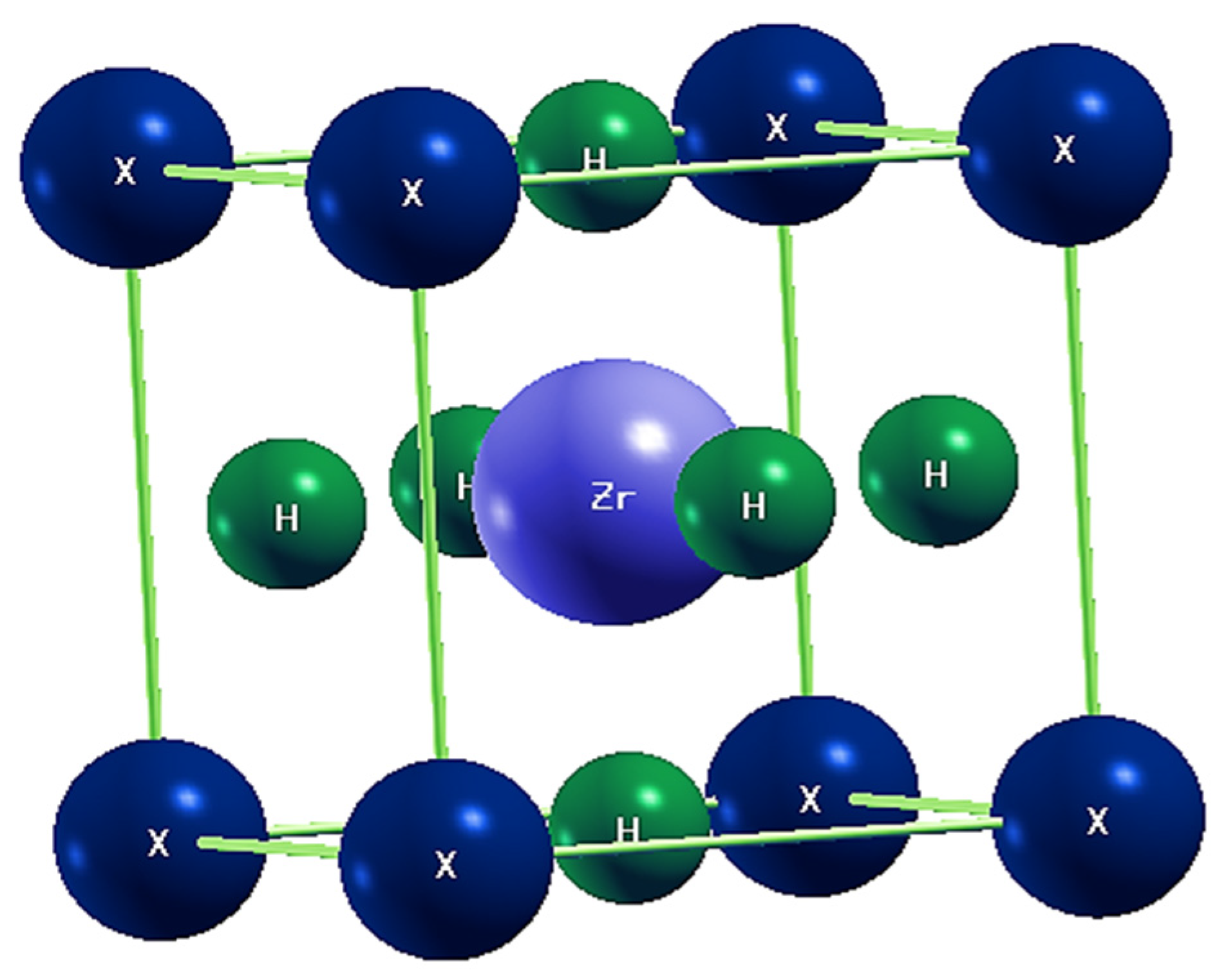
The XZrH3 (X: Mg, Ca, Sr, Ba) perovskite hydrides’ structural characteristics are covered in this section. These perovskite hydrides are members of the space group Pm-3m (#221) and have a cubic crystal shape. The cubic compound XZrH3, with X = Mg, Ca, Sr, and Ba, has a three-dimensional crystal structure shown in Figure 1. The atoms within the cubic crystal unit cell are positioned as follows during the crystalline structure optimization process: Figure 1 displays the optimal architectures of the unit cell with hydrogen atoms at the face centers, Zr cations at the center, and X-cations at the corners. Table 1 summarizes the lattice constants (Å), optimized and theoretical, of XZrH3 (X: Mg, Ca, Sr, and Ba). Because of the variations in ionic radii, volume, and valence electrons, the computed lattice constants of the investigated XZrH3 materials are BaZrH3 (4.24 Å) > SrZrH3 (4.04 Å) > CaZrH3 (3.95 Å) > MgZrH3 (3.84 Å).
Figure 1.
Structure of XZrH3 (X = Mg, Ca, Sr, and Ba).
Table 1.
Theoretical and optimized lattice parameters, gravimetric capacity Cwt%.
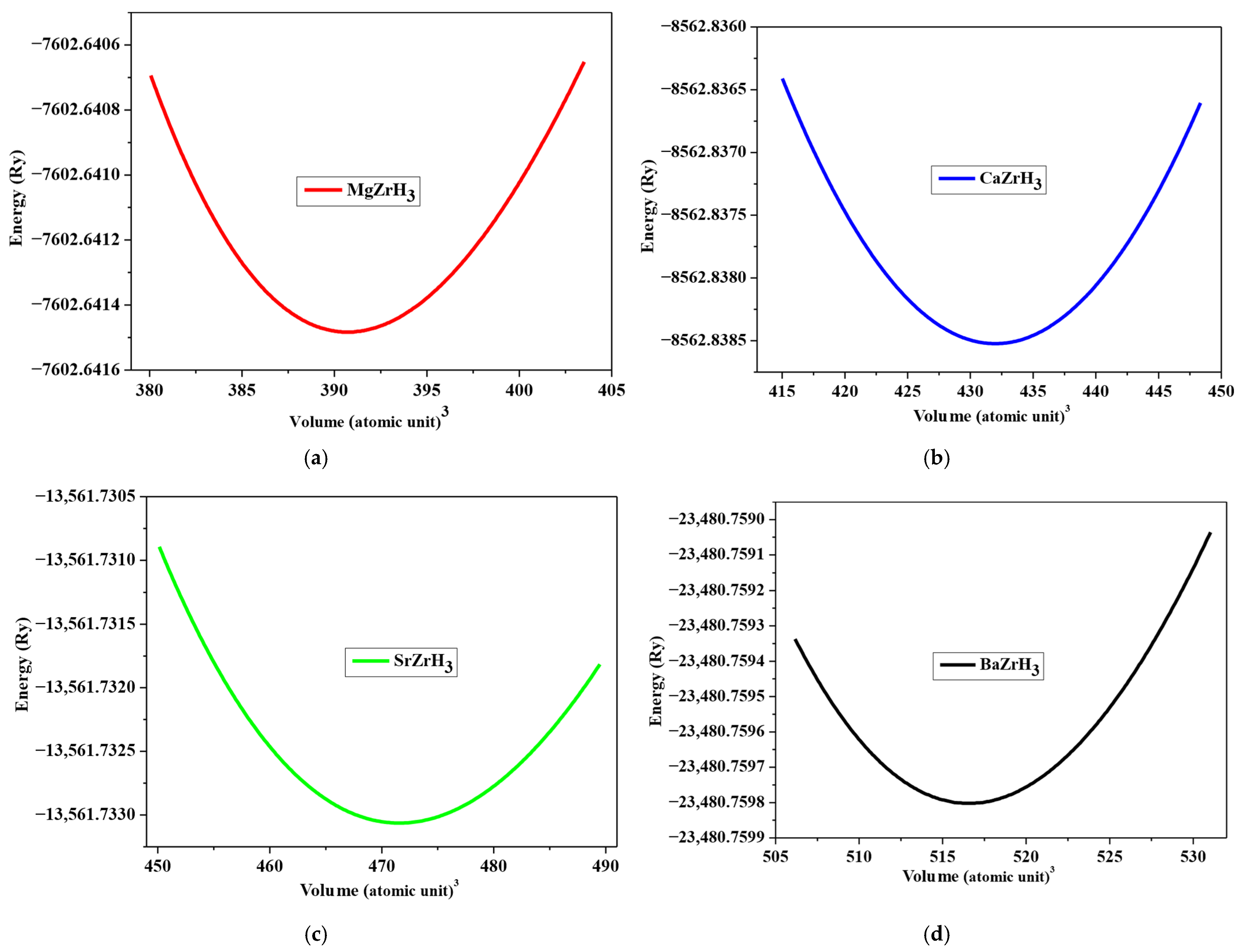
A statistical relationship known as the Murnaghan equation of state accounts for the pressure behavior of materials; specifically, it provides how a material’s volume changes upon applied pressure. It is useful in the crystal structure optimization of a material in DFT calculations. The Murnaghan equation of state (EOS) matches the total energy to the normalized volume to determine the assumed equilibrium a0. Our calculated and experimental equilibrium a0 are in good agreement. Using the equation of Birch–Murnaghan, volumes determined as a function of the expected energies are graphed in Figure 2 and listed Table 2.
where parameter B0, referred to as the bulk modulus or isostatic compressibility modulus, represents the material’s resistance to compression; the pressure derivative of the compressibility modulus, , represents the change in the modulus with the applied pressure; and assumes E0, the ground state energy for the volume V0 of the unit cell, to be the minimum energy.
Figure 2.
Energy as a function of volume of (a) MgZrH3, (b) CaZrH3, (c) SrZrH3, and (d) BaZrH3.
Table 2.
Calculated optimized parameters a0, V, E, B, and B’ of XZrH3 (X = Mg, Ca, Sr, Ba).
The gravimetric hydrogen storage capacity of XZrH3 (X = Mg, Ca, Sr, Ba) perovskites is evaluated using the formula presented in Equation (2) to determine their suitability for hydrogen storage applications. The gravimetric ratio (Cwt%) quantifies the amount of hydrogen stored relative to the total mass of the host perovskite material. This value is calculated as follows:
where mH is the molar mass of hydrogen; mHost is the molar mass of the host material; and H/M refers to the hydrogen-to-material atom ratio. The Cwt% values in Table 1 represent the gravimetric hydrogen storage capacity of XZrH3 (X = Mg, Ca, Sr, Ba) perovskites.
3.2. Electronic Properties
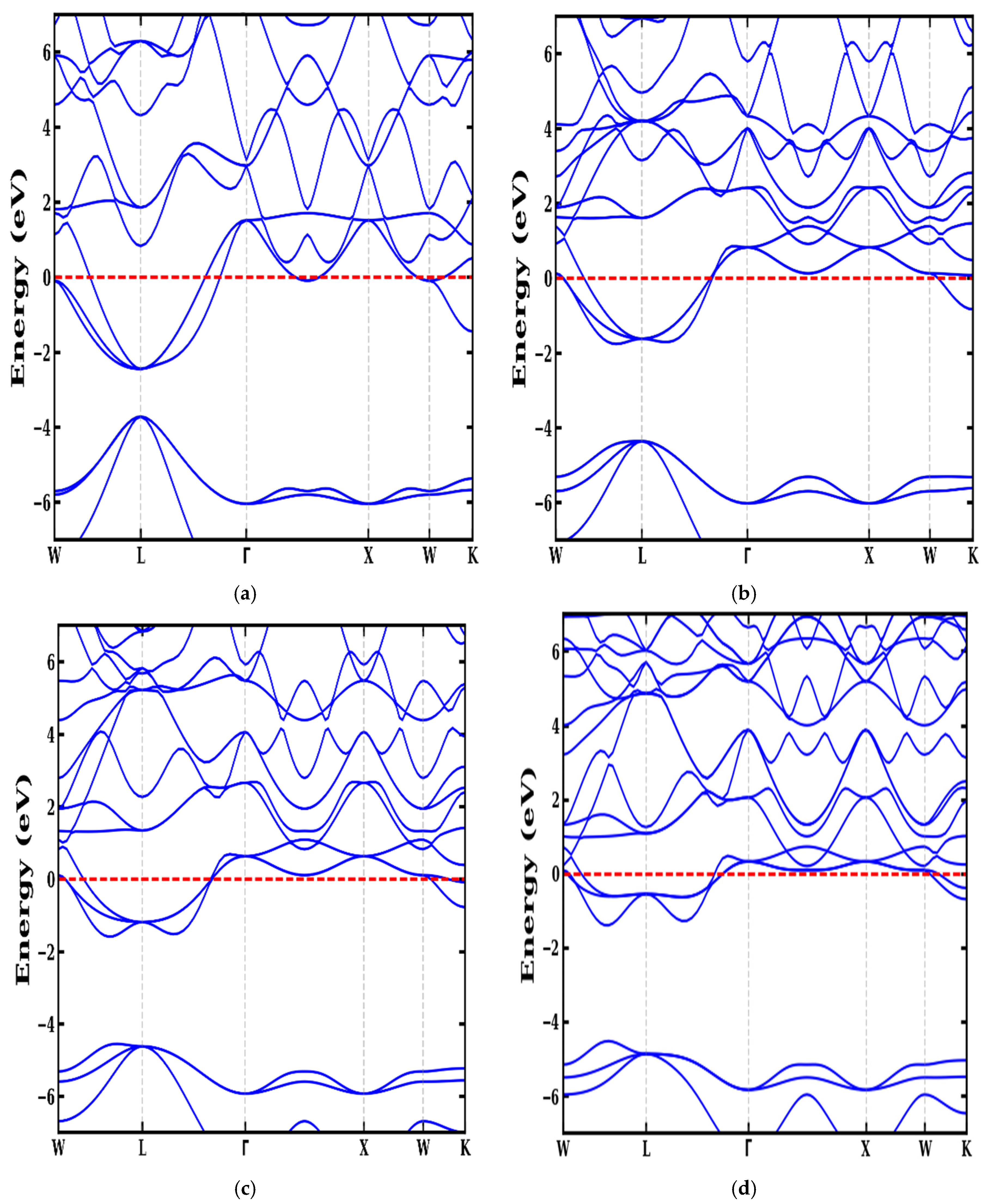
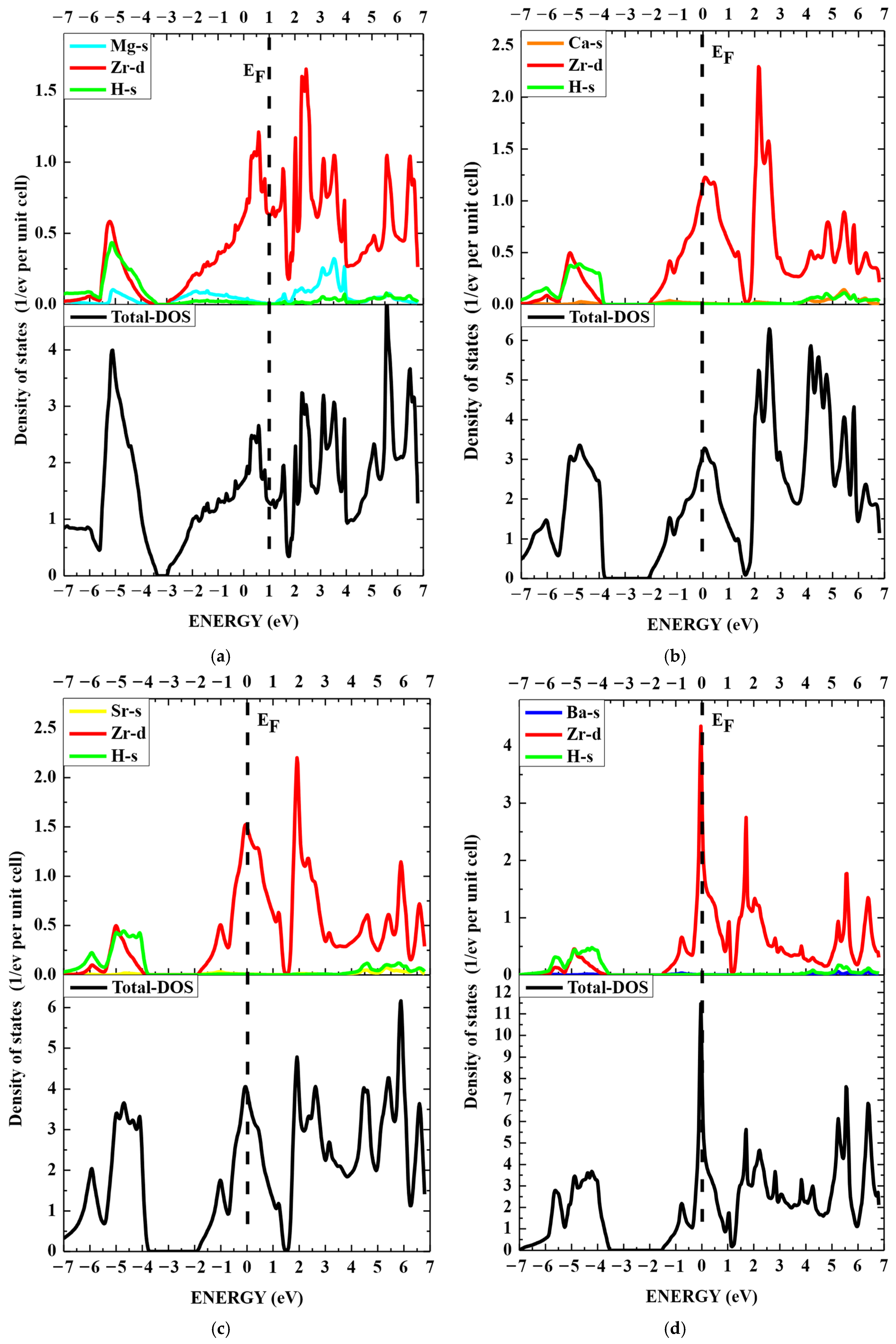
The electronic structures of the XZrH3 hydrides (X = Mg, Ca, Sr, Ba) are investigated using the primitive unit cell, where the Zr atom occupies a high-symmetry Wyckoff position. To understand the nature of the chemical bonding and the electronic behavior, we computed the electronic band structures along high-symmetry directions of the Brillouin zone shown in Figure 3, as well as the partial densities of states (PDOS) shown in Figure 4. As illustrated in Figure 3, the Fermi level (EF) is set to zero energy and represented by a horizontal dashed line. For all four hydrides, the valence band maximum and the conduction band minimum intersect at the Fermi level, indicating the absence of a band gap. This clearly indicates that all the compounds we have investigated possess metal-like properties. In the density of states, which we have plotted from −7 eV to +7 eV, it is clear that these compounds possess metal-like properties. In the case of metal hydrides, the presence of free-moving charge carriers, which are not bound to a particular location, will be highly interesting in the storage of hydrogen. Our results match the results given by other people on XAlH3 [40], as well as in MgCuH3 and MgCoH3 [39]. The metal-like behavior of these compounds will similarly be highly interesting in the storage of hydrogen. In the PDOS plot, it is clear that the valence band is a combination of the Zr-4d and H-1s orbitals. The conduction band will have a combination of the X-ns orbitals and the Zr-5s orbitals, with some remaining Zr-4d orbitals. This indicates that there is a hybridization of the Zr-d and X-s orbitals in these compounds. The Zr-d and X-s orbitals have a strong interaction with each other in these compounds. The strong interaction of the Zr-d and X-s orbitals in these compounds may be the reason for the observation of the metal-like behavior in the PDOS plot of the Zr-d and X-s orbitals.
Figure 3.
Band structures of (a) MgZrH3, (b) CaZrH3, (c) SrZrH3, and (d) BaZrH3.
Figure 4.
Density of states of (a) MgZrH3, (b) CaZrH3, (c) SrZrH3, and (d) BaZrH3.
In order to better understand the nature of the charge distribution, the results of the Bader charge analysis will be discussed. It can be seen from the analysis that there is a large transfer of electrons from the electropositive X and Zr atoms to the more electronegative H atoms. These electrons are primarily in the H-1s orbitals, with the remaining donor charge in the Zr-4d and X-(3–6)s orbitals. While the metallic character and charge transfer toward hydrogen atoms suggest favorable electronic conditions for hydrogen bonding, a quantitative assessment of hydrogen reversibility requires explicit calculation of hydrogen desorption energies and diffusion barriers. Such thermodynamic and kinetic analyses are beyond the scope of the present study and will be addressed in future work to provide a more comprehensive evaluation of the storage potential.
The predicted metallic character of XZrH3 hydrides differs significantly from classical hydrides such as MgH2 and several simple XH3 compounds, which are generally wide band gap insulators due to the dominant ionic bonding and complete filling of valence states. In MgH2, strong Mg2+–H− interactions lead to a large electronic band gap and insulating behavior. In contrast, in XZrH3 perovskite hydrides, the presence of transition-metal Zr introduces partially filled 4d states that strongly hybridize with H-1s orbitals near the Fermi level. This hybridization generates finite electronic states crossing the Fermi level, resulting in metallic conductivity. Similar electronic features have been reported in previous first-principles investigations on Zr-containing and perovskite-type hydrides [57,58,59]. The metallic character may also influence hydrogen transport properties. Compared to purely insulating hydrides, metallic systems exhibit enhanced electronic screening, which can reduce Coulomb interactions and potentially lower migration barriers for hydride ions. However, hydrogen diffusivity remains governed not only by electronic structure but also by lattice dynamics, defect chemistry, and migration pathways [60,61,62,63,64].
3.3. Elastic Properties
The elastic stiffness tensor components are calculated using the finite strain method within the density functional theory (DFT) framework as implemented in the WIEN2k code. After full structural optimization, small symmetry-conserving strains are applied to the equilibrium unit cell, and the corresponding total energy variations are calculated self-consistently. The elastic constants are then obtained from the second-order derivatives of the total energy. For cubic crystals such as XZrH3, only three independent elastic constants (C11, C12, and C44) are required to fully describe the stiffness tensor. All elastic constants are calculated for the fully relaxed stoichiometric compounds with fixed hydrogen composition corresponding to the XZrH3 formula. The effect of hydrogen composition variation was not considered in this work and will be investigated in future studies.
The elastic constants C11, C12, and C44 of the XZrH3 compounds (X = Mg, Ca, Sr, Ba) are key parameters that determine their mechanical behavior, including stiffness, structural stability, and resistance to various deformation modes [65,66]. The mechanical stability of cubic systems requires that the following Born stability criteria be satisfied:
C11 + 2C12 > 0, C11 − C12 > 0, C11 > 0
For cubic crystals, it is generally observed that C11 > C12 and C11 > C44, reflecting strong resistance to longitudinal deformation compared to shear deformation modes. In the present study on metal hydrides (see Table 3), particular attention is given to the C11 value, which shows that resistance to uniaxial compression decreases systematically from MgZrH3 (147.64 GPa) to BaZrH3 (63.97 GPa). This indicates that MgZrH3 exhibits the highest stiffness under compressive loading, whereas BaZrH3 is the most compliant. This progressive softening can be attributed to the increasing atomic radius of the X-site cation (Mg → Ba), which reduces interatomic bonding strength and thus lowers the resistance to axial compression.
Table 3.
Elastic constants of XZrH3.
When we look at the values of C12, which show how the atoms interact with each other when we apply stress, we see that they are in the middle for all the compounds. These values go up when we use heavier alkaline earth elements, and they are the highest for BaZrH3.
On the other hand, the values of C44, which show how well the material can resist being deformed, are the highest for CaZrH3 at 33.3996 GPa. For BaZrH3, the value of C44 is much lower at 9.4161 GPa. This means that BaZrH3 is not very good at resisting shear deformation and is more able to change shape without breaking, which is called ductility. Despite these variations, all compounds satisfy the mechanical stability criteria, confirming their thermodynamic stability at small strains [67].
The mechanical performance of the cubic hydrides XZrH3 (X = Mg, Ca, Sr, Ba) is governed by the interplay between interatomic bond strength, crystal symmetry, and the ionic radius of the alkaline-earth cation. Particular attention is given to the C11 value and the bulk modulus, defined by Equation (4) as
which measure the resistance to uniaxial and uniform compression, respectively. Both properties decrease systematically across the series, with C11 falling from 147. 63 GPa for MgZrH3 to 63.97 GPa for BaZrH3, and the bulk modulus decreasing from 70.82 GPa to 47.58 GPa. This softening reflects lattice expansion and weaker bonding as the X-site cation becomes larger, indicating that MgZrH3 exhibits the highest stiffness under compressive loading, whereas BaZrH3 is the most compliant.
The shear modulus, obtained from the Voigt–Reuss–Hill average [68,69] and defined by Equations (5)–(7) as
shows a similar but more pronounced decline across the series, with G ≈ 40–42 GPa for Mg-, Ca-, and SrZrH3, and only 22.29 GPa for BaZrH3. This indicates that the lattice of BaZrH3 is much more susceptible to shear deformation compared to the other hydrides.
The overall stiffness can be evaluated through Young’s modulus [70,71], expressed as:
This parameter attains its minimum value for BaZrH3 (57.85 GPa), markedly lower than the values (>97 GPa) found for the lighter congeners.
Ductility is assessed via Pugh’s ratio B/G: materials with B/G > 1.75 are generally ductile, whereas lower ratios signify brittleness. BaZrH3 exhibits the highest ratio (2.13) and is thus the most ductile; CaZrH3, with B/G = 1.19, is markedly brittle, while MgZrH3 (1.72) and SrZrH3 (1.40) occupy an intermediate regime.
Poisson’s ratio [72,73] is expressed as:
The calculated values show a clear variation among the studied compounds. BaZrH3 exhibits the highest value (ν ≈ 0.279), which is consistent with ductile metallic bonding. In contrast, CaZrH3 displays the lowest value (ν ≈ 0.156), indicating a more brittle and covalent-like network.
Although BaZrH3 exhibits the lowest bulk modulus (≈47 GPa), indicating reduced mechanical stiffness, such moderate softness is not necessarily unfavorable for hydrogen storage applications (Table 4). Materials used for reversible hydrogen storage undergo repeated lattice expansion and contraction during hydrogen absorption and desorption cycles. A relatively lower bulk modulus may facilitate structural adaptability and reduce internal stress accumulation during cycling. However, very low stiffness could limit resistance to mechanical deformation under external pressure. Therefore, BaZrH3 represents a trade-off between mechanical flexibility and structural robustness, whereas MgZrH3 offers higher rigidity and better mechanical resistance.
Table 4.
Parameters of elastic.
In summary, MgZrH3 is the most rigid and least compressible member of the series, whereas BaZrH3 is the most ductile but also the softest, while CaZrH3 exhibits pronounced brittleness. These trends arise from the increasing cation size and the consequent weakening of Zr–H and X–H bonds from Mg to Ba. This behavior provides a clear guideline for selecting hydrides with specific combinations of stiffness, ductility, and resistance to deformation [74].
Although phonon dispersion calculations were not performed in the present study, the fulfillment of the Born mechanical stability criteria and the positive elastic constants confirm the structural robustness of the optimized cubic phase at small deformations. A full dynamical stability investigation via phonon spectra will be addressed in future work.
3.4. Thermoelectrical Properties
The transport properties, including electrical conductivity, electronic thermal conductivity, power factor, and thermoelectric figure of merit, are calculated using the BoltzTraP2 code based on the semiclassical Boltzmann transport theory. This approach uses the electronic band structure obtained from density functional theory calculations performed with the WIEN2k code. The band energies are interpolated on a dense k-point grid to accurately determine the transport coefficients as a function of temperature and chemical potential. The calculations are performed within the constant relaxation time approximation, which assumes that the carrier relaxation time remains constant. Consequently, the electrical conductivity and electronic thermal conductivity are presented in normalized form with respect to the relaxation time. This method provides reliable insight into the intrinsic transport behavior of the studied hydrides.
Large fractions of the energy produced by renewable technologies are ultimately lost as low-grade heat. Converting this waste heat directly into electricity requires thermoelectric materials that combine high electrical conductivity and low thermal conductivity [75,76,77]. With this motivation, we assessed the thermoelectric performance of the cubic hydrides XZrH3 (X = Mg, Ca, Sr, Ba) using density functional theory combined with semiclassical Boltzmann transport theory, as implemented in the BoltzTraP2 code. Within the constant relaxation time approximation, the temperature-dependent electrical conductivity (σ/τ), electronic thermal conductivity (κe/τ), power factor, and figure of merit ZT [78,79] are analyzed over a temperature range from 300 K to 900 K.
- Electrical conductivity (σ/τ)
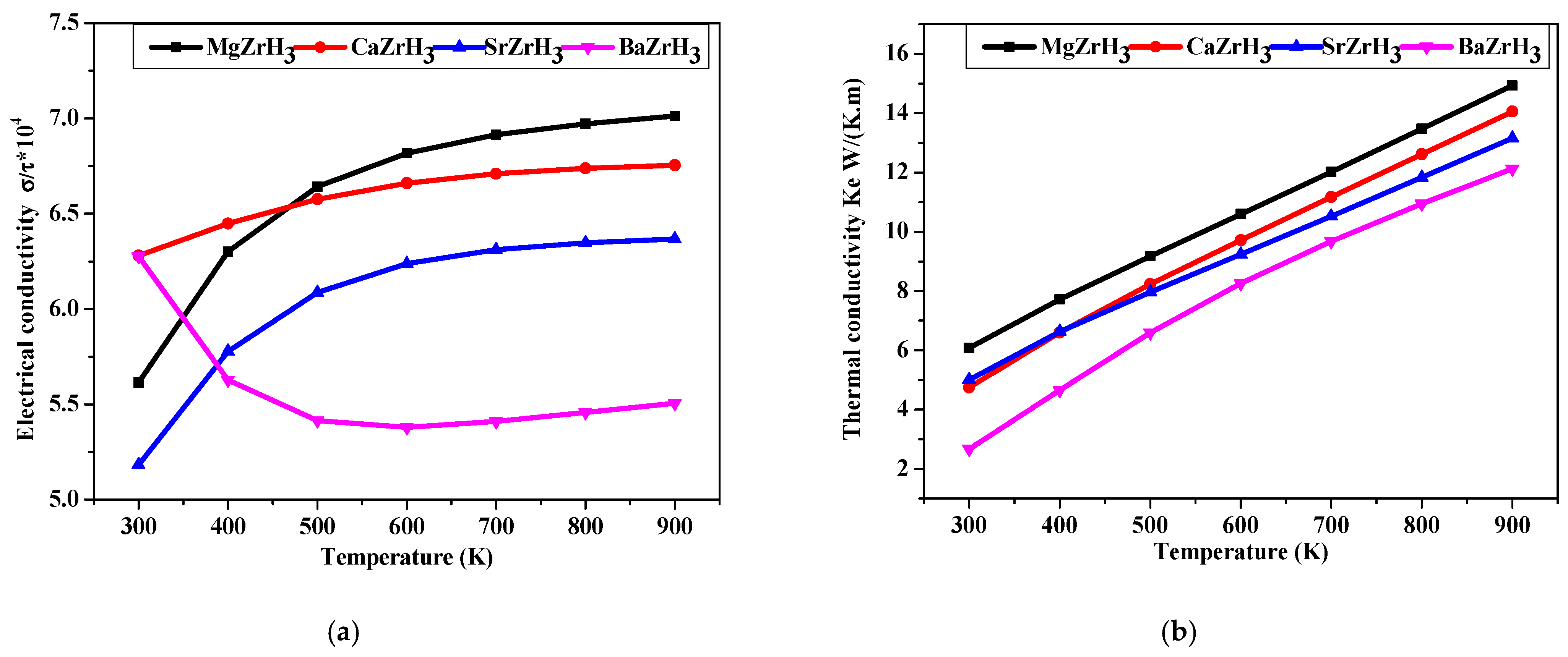
Electrical conductivity reflects both carrier concentration and mobility, which are strongly influenced by the electronic band structure and bonding characteristics of the material. As shown in Figure 5a, the electrical conductivity increases with temperature for MgZrH3, CaZrH3, and SrZrH3, indicating enhanced carrier transport due to thermal excitation and increased occupation of electronic states near the Fermi level. The variation in transport behavior across the XZrH3 series is closely related to the influence of the alkaline earth cation on the electronic structure, which modifies band dispersion and carrier effective mass.

Figure 5.
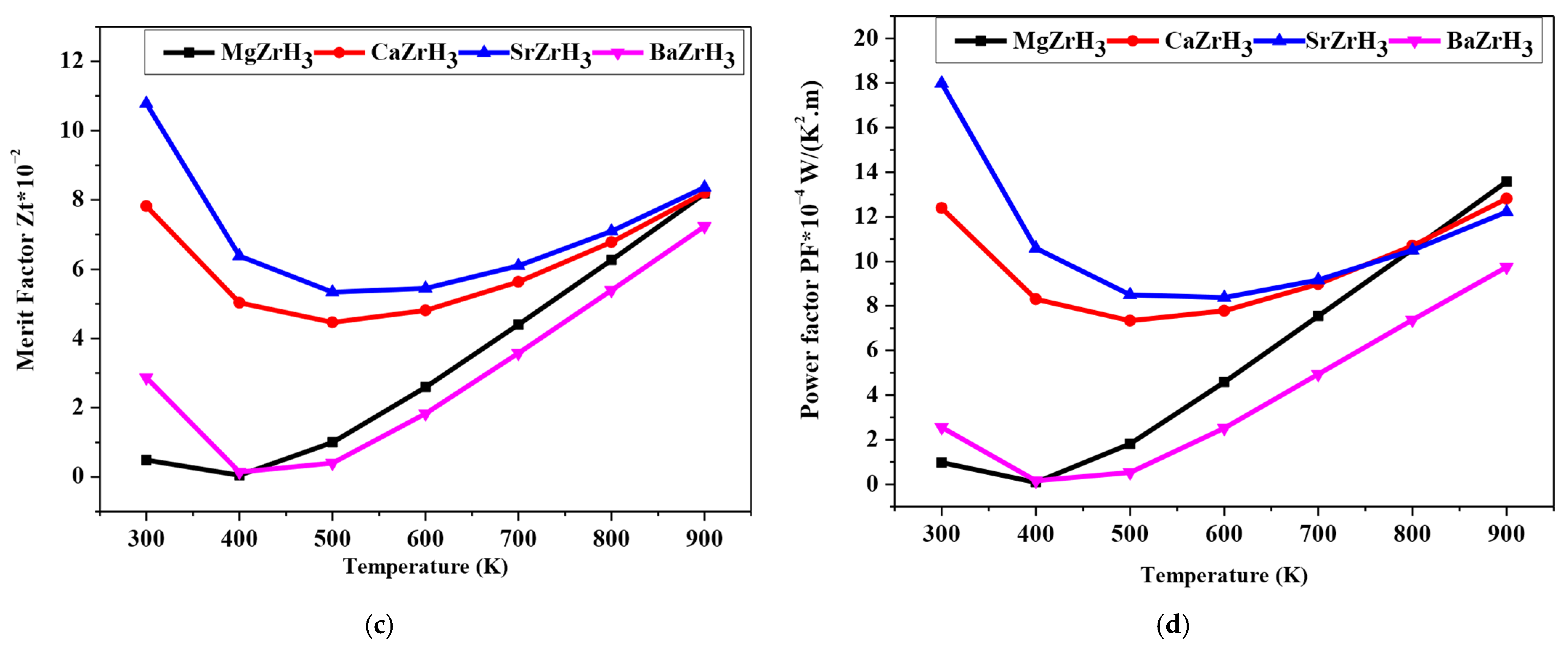
Thermoelectric properties of XZrH3 (X = Mg, Ca, Sr, and Ba). (a) electrical conductivity (σ/τ); (b) thermal conductivity (κe); (c) merit factor (ZT); (d) power factor (PF).
A high electrical conductivity combined with a favorable Seebeck coefficient contributes to an enhanced power factor and improved thermoelectric performance, provided that thermal conductivity remains sufficiently low. These transport characteristics are governed by the electronic structure near the Fermi level, which determines carrier dynamics and transport efficiency. In metallic hydrides, conduction electrons play an important role in screening electrostatic interactions between metal atoms and hydrogen. This electronic screening weakens the effective Coulomb interaction and stabilizes the metal–hydrogen bonding environment. As a result, it can influence hydrogen binding strength, diffusion, and reversibility within the lattice. Improved electronic screening facilitates hydrogen mobility and contributes to reversible hydrogen absorption and desorption processes. However, hydrogen storage performance is primarily controlled by thermodynamic stability, lattice structure, and hydrogen diffusion barriers, while electronic carriers provide a secondary but supportive role in stabilizing the bonding environment. Overall, the calculated transport properties demonstrate that the electronic structure, modified by alkaline earth substitution, plays a key role in determining both the thermoelectric response and hydrogen-related functional behavior of XZrH3 hydrides.
- Electronic thermal conductivity (κe)
One of the major indicators to measure the efficiency of thermoelectric materials is electronic thermal conductivity (κe). Thermal conductivity of XZrH3 (X = Mg, Ca, Sr, and Ba) is important to forecast how efficient these materials would be in devices for energy conversion since heat transfer in a material has a direct impact on whether or not it can maintain a useful thermal gradient. The results indicate that for all the components examined, thermal conductivity rises proportionally to temperature (Figure 5b). Enhancement of the vibration of atoms by thermal energy carriers with temperature is the mechanism responsible for this rise in thermal conductivity. At 900 K, κt values reach 15.7 W/(K·m) for MgZrH3, 14.2 W/(K·m) for CaZrH3, 13.1 W/(K·m) for SrZrH3, and 11.2 W/(K·m) for BaZrH3. However, excessively high thermal conductivity constitutes a limitation on thermoelectric devices because of the inclination to dissipate the temperature gradient responsible for current generation quickly. This result implies that the X-element selection can be maximized for the operating temperature of interest. For instance, MgZrH3 with reduced thermal conductivity at high temperatures may be more suitable for devices being used at high temperatures with a high conversion efficiency. In conclusion, one key consideration in the development of effective thermoelectric materials is creating a compromise between electrical and thermal conductivity. According to this study, XZrH3 compounds have scalable properties and by properly choosing the alkaline element, thermal properties may be optimized in terms of certain applications to power generation or heat recovery from waste thermal sources. This is because of the increase in atomic vibrations with temperature that improves the transfer of heat through thermal energy carriers. However, since it can quickly drain the temperature gradient necessary for current production, too high a thermal conductivity can be a limiting factor for application in thermoelectric devices. Thus, to produce the highest ZT figure of merit, a suitable thermoelectric material should have high Seebeck coefficient, superior electrical conductivity, and low thermal conductivity. Atomic structure affects the thermal properties of XZrH3 compounds, as indicated by varying κe of MgZrH3, CaZrH3, SrZrH3, and BaZrH3.
- Electronic factor of merit (ZT):
The ZT factor of merit, the central parameter for evaluating the efficiency of a thermoelectric material, is defined by the following equation [80,81]:
where T is the absolute temperature; κ is the overall thermal conductivity; S is the Seebeck coefficient; and σ is the electrical conductivity. A perfect balance of these properties must be achieved to optimize heat-to-electricity conversion, as this equation illustrates.
Figure 5c shows that MgZrH3 exhibits the highest thermoelectric figure of merit among the studied compounds, reaching approximately 8.0 × 10⁻² at 900 K. In contrast, BaZrH3 presents slightly lower thermoelectric performance, with a ZT value of approximately 7.2 × 10⁻² at the same temperature. The reduced performance of BaZrH3 is mainly attributed to its lower power factor and higher electronic thermal conductivity, which limit its thermoelectric efficiency compared to the other compounds.
For SrZrH3 and CaZrH3, the thermoelectric figure of merit exhibits a slight decrease in the intermediate temperature range, followed by a significant increase at higher temperatures, reaching values of approximately 8.2 × 10⁻² and 7.9 × 10⁻² at 900 K, respectively. This behavior can be attributed to the temperature dependence of carrier transport properties. At higher temperatures, increased thermal excitation enhances carrier concentration and transport, improving electrical conductivity while maintaining favorable Seebeck coefficient values. As a result, the thermoelectric performance improves significantly in the high-temperature region.
These results indicate that the thermoelectric efficiency of XZrH3 hydrides improves at elevated temperatures, particularly above 600 K, suggesting their potential suitability for high-temperature thermoelectric applications. The observed trends are primarily governed by the electronic structure near the Fermi level and the associated carrier transport properties.
- Power factor (PF)
The power factor (PF) is a fundamental parameter for assessing the thermoelectric performance of a material, particularly under high-temperature conditions, and is described by the equation [80,81]:
PF = σS2
This is a measure of the efficiency of a substance in transferring thermal energy to electric energy, where σ is the electrical conductivity and S is the Seebeck coefficient. The larger the value of PF, the greater the prospect of using a substance in thermoelectric conversion. There is a small drop in PF from 300 K to 400 K, after which its variation with temperature in XZrH3 (X = Mg, Ca, Sr, and Ba) exhibits an intriguing thermal characteristic. A two-step variation in ZT is observed for SrZrH3 and CaZrH3, with a slight decrease from 300 K to 500 K (Figure 5d). In all cases, the power factor (PF) increases steadily up to 900 K. At this temperature, values reach 13.8 × 10⁻⁴ W/(K2·m) for MgZrH3, 13.6 × 10⁻⁴ W/(K2·m) for CaZrH3, 12.8 × 10⁻⁴ W/(K2·m) for SrZrH3, and 9.2 × 10⁻⁴ W/(K2·m) for BaZrH3. The material is suited for heat recovery in an industrial energy system based on performance, as this indicates a substantial improvement in the efficiency at a high temperature. Because the synergy level for electrical conductivity and the thermoelectromotive forces is higher, MgZrH3 is most suitable. These findings open up for synergistic use in next-generation energy devices and vindicate the promise of XZrH3 (X = Mg, Ca, Sr, and Ba) hydride perovskites as bifunctional materials with thermoelectric and hydrogen storage capabilities.
4. Conclusions
In this work, cubic hydride perovskites XZrH3 (X = Mg, Ca, Sr, Ba) were investigated using density functional theory calculations to evaluate their structural, electronic, elastic, and thermoelectric properties. These materials are of significant interest due to their potential applications in hydrogen storage and energy conversion technologies. First-principles simulations were performed to gain detailed insight into their physical properties and underlying mechanisms. The electronic structure analysis revealed that these compounds exhibited metallic behavior, characterized by electronic states crossing the Fermi level, which contributed to their favorable electrical conductivity. This electronic characteristic was beneficial for facilitating charge transport and may also influence hydrogen stability and mobility within the lattice. The calculated elastic constants satisfied the Born mechanical stability criteria, confirming that all studied compounds were mechanically stable in the cubic phase. Furthermore, the calculated transport properties indicated that MgZrH3 and CaZrH3 exhibited superior thermoelectric performance compared to SrZrH3 and BaZrH3 over the temperature range of 300–900 K. These compounds showed higher electrical conductivity, favorable power factor values, and improved thermoelectric figure of merit. Overall, MgZrH3 and CaZrH3 demonstrated the most promising combination of electrical and thermoelectric properties among the studied hydride perovskites.
Author Contributions
A.K.: Conceptualization, Methodology, Investigation, Formal analysis, Data curation, Software. Y.Z.: Supervision, Visualization, Validation. H.B.: Visualization, Validation, Writing—Review and Editing. N.E.: Software. All authors have read and agreed to the published version of the manuscript.
Funding
The authors are warmly grateful to the support of “The Moroccan Association of Sciences and Techniques for Sustainable Development (MASTSD), Beni Mellal, Morocco”. No specific grant number is associated with this support.
Data Availability Statement
The data presented in this study are available on request from the corresponding author.
Conflicts of Interest
The authors declare no conflicts of interest.
References
- Singh, V.; Srivastava, R.K.; Bhatt, A.K. Air Pollution and Climate Change. In Battling Air and Water Pollution: Protecting Our Planet’s Vital Resources; Springer Nature: Singapore, 2025; pp. 61–76. [Google Scholar] [CrossRef]
- Brauch, H.G. Towards Rethinking Politics, Policy and Polity in the Anthropocene: Multidisciplinary Perspectives; Springer Nature: Berlin/Heidelberg, Germany, 2025. [Google Scholar]
- Hung, C.-K.; Thiruppathi, A.R.; McGuire, C.; Jiang, D.-T.; Chen, A. Expanded graphite/reduced graphene oxide hybrid architecture functionalized with RuO2 nanoclusters for high performance energy storage. J. Energy Storage 2024, 106, 114776. [Google Scholar] [CrossRef]
- Atencio, R.; Sanoja-López, K.A.; Luque, R.; Briceño, A. Hydrogen on the horizon: Overcoming barriers to a sustainable energy transition. Biofuels Bioprod. Biorefin. 2026. [Google Scholar] [CrossRef]
- Ahmad, M.I.; HPS, A.K. Environmental Pollution Control Using Micro and Nano Bio-based Materials. In Environmental and Energy Technology: Micro to Nano Bio-Based Materials; Springer Nature: Cham, Switzerland, 2026; pp. 111–152. [Google Scholar] [CrossRef]
- Ventayol, A.A.; Lam, J.S.L.; Bai, X.; Chen, Z.S. Comparative life cycle assessment of hydrogen internal combustion engine and fuel cells in shipping. Int. J. Hydrogen Energy 2025, 109, 774–788. [Google Scholar] [CrossRef]
- Hsan, N.; Kumar, S.; Koh, J. Hydrogen Energy: Innovation in Production, Storage, and Diverse Applications. In Renewable Energy Development: Technology, Material and Sustainability; Springer Nature: Singapore, 2025; pp. 187–212. [Google Scholar] [CrossRef]
- Osman, S.H.; Kamarudin, S.K.; Shaari, N.; Zakaria, Z. Low-temperature fuel cell technology development and issues: An overview. Arab. J. Sci. Eng. 2025, 50, 9675–9688. [Google Scholar] [CrossRef]
- Cai, Z. Feasibility of Hydrogen Energy for High-Power Aerospace Applications: A Comprehensive Assessment. In E3S Web of Conferences; EDP Sciences: Les Ulis, France, 2025; Volume 606, p. 01005. [Google Scholar] [CrossRef]
- Laghlimi, C.; Moutcine, A.; Ziat, Y.; Belkhanchi, H.; Koufi, A.; Bouyassan, S. Hydrogen, Chronology and Electrochemical Production. Sol. Energy Sustain. Dev. J. 2024, 14, 22–37. [Google Scholar] [CrossRef]
- Mukwanje, C.A.; Faik, A.; Nachtane, M. Current progress, challenges, and future prospects in composite cryogenic hydrogen storage tanks. Polym. Compos. 2025, 46, S48–S70. [Google Scholar] [CrossRef]
- Du, A.; Li, H.; Yan, Z.; Han, Y.; Wu, X. Review on the controversies surrounding hydrogen together with its leakage and escape throughout the full lifecycle. Sustain. Energy Fuels 2025, 9, 1399–1413. [Google Scholar] [CrossRef]
- Bennell, A.; Loomes, K.; Rippingale, M. Anaesthesia and Analgesia. In Textbook of Equine Veterinary Nursing; Wiley-Blackwell: Hoboken, NJ, USA, 2025; pp. 385–456. [Google Scholar] [CrossRef]
- Sakib, A.N.; Islam, T.; Resnick, P.M.; Habib, A.K.M.A.; Chowdhury, S.R. Comprehensive Safety Assessment of Hydrogen: From Production to Application in Energy Systems. Int. J. Energy Res. 2025, 2025, 8857513. [Google Scholar] [CrossRef]
- Simonetto, M.; Pascoe, J.A.; Sharpanskykh, A. Preliminary Safety Assessment of a Liquid Hydrogen Storage System for Commercial Aviation. Safety 2025, 11, 27. [Google Scholar] [CrossRef]
- Wu, J.K.; Zhang, Y.X.; Yu, M.; Jiang, L. High-efficient boil-off gas storage using low-temperature activated carbon adsorption. Gas Sci. Eng. 2025, 144, 205765. [Google Scholar] [CrossRef]
- Liu, R.; Jiang, X.; Wang, X.; Li, Z.; Yang, X.; Chen, J.; Liu, Y.; Cui, W.; Gao, F.; Gao, Y.; et al. Boosting the hydrogen storage performance of Mg-rich quaternary alloy hydrides via in-situ evolution of bidirectional catalytic phases. Chem. Eng. J. 2025, 511, 162071. [Google Scholar] [CrossRef]
- Turhan, Y.; Yeşilbiçer, M.B.; Kizilduman, B.K.; Doğan, M.; Bicil, Z. Cryogenic hydrogen storage on peanut shell-derived-activated carbons: Isotherm, kinetics and mechanism. J. Energy Storage 2025, 140, 118998. [Google Scholar] [CrossRef]
- Li, Z.; Li, Y.; Huang, K.; Hu, S.; Li, Y.; Hong, H.; Wang, X.; Lin, X.; Sun, F.; Nie, B.; et al. Balancing Nucleation and Growth Kinetics Enables Fully-Coordinated Acetic Acid-Tethered Metal–Organic Frameworks for Technoeconomic-Viable Hydrogen Storage. Adv. Energy Mater. 2025, 15, e03259. [Google Scholar] [CrossRef]
- Mekonnin, A.S.; Wacławiak, K.; Humayun, M.; Zhang, S.; Ullah, H. Hydrogen Storage Technology, and Its Challenges: A Review. Catalysts 2025, 15, 260. [Google Scholar] [CrossRef]
- Padmanabhan, N.T.; Clarizia, L.; Ganguly, P. Advancing hydrogen storage: Critical insights to potentials, challenges, and pathways to sustainability. Curr. Opin. Chem. Eng. 2025, 48, 101135. [Google Scholar] [CrossRef]
- Kumar, S.; Sharma, V.; Kumari, N.; Kaur, G.A.; Saha, A.; Thakur, S.; Shandilya, M. Recent advances in perovskite materials: Exploring multifaceted properties for energy harvesting applications. Ionics 2024, 30, 5159–5188. [Google Scholar] [CrossRef]
- Njema, G.G.; Kibet, J.K. A review of chalcogenide-based perovskites as the next novel materials: Solar cell and optoelectronic applications, catalysis and future perspectives. Next Nanotechnol. 2025, 7, 100102. [Google Scholar] [CrossRef]
- Zhu, Y.; Tang, Z.; Yuan, L.; Li, B.; Shao, Z.; Guo, W. Beyond conventional structures: Emerging complex metal oxides for efficient oxygen and hydrogen electrocatalysis. Chem. Soc. Rev. 2025, 54, 1027–1092. [Google Scholar] [CrossRef]
- Makepeace, J.W. Non-Oxide and Heteroanionic Materials; Gregory, D.H., Ed.; Royal Society of Chemistry: London, UK, 2025; Volume 16, pp. 191–241. [Google Scholar]
- Patil, O.U.; Park, S. Recent advancement in dehydrogenation techniques for efficient hydrogen release from metal hydrides. Bull. Korean Chem. Soc. 2025, 47, 55–74. [Google Scholar] [CrossRef]
- Jayan, K.D.; Babu, K. Luminescent perovskite quantum dots: Progress in fabrication, modelling and machine learning approaches for advanced photonic and quantum computing applications. J. Lumin. 2024, 277, 120906. [Google Scholar] [CrossRef]
- Aftab, S.; Li, X.; Kabir, F.; Akman, E.; Aslam, M.; Pallavolu, M.R.; Koyyada, G.; Assiri, M.A.; Rajpar, A.H. Lighting the future: Perovskite nanorods and their advances across applications. Nano Energy 2024, 124, 109504. [Google Scholar] [CrossRef]
- Fang, W.; Ding, C.; Chen, L.; Zhou, W.; Wang, J.; Huang, K.; Zhu, R.; Wu, J.; Liu, B.; Fang, Q.; et al. Review of hydrogen storage technologies and the crucial role of environmentally friendly carriers. Energy Fuels 2024, 38, 13539–13564. [Google Scholar] [CrossRef]
- Gunathilake, C.; Soliman, I.; Panthi, D.; Tandler, P.; Fatani, O.; Ghulamullah, N.A.; Marasinghe, D.; Farhath, M.; Madhujith, T.; Conrad, K.; et al. A comprehensive review on hydrogen production, storage, and applications. Chem. Soc. Rev. 2024, 53, 10900–10969. [Google Scholar] [CrossRef]
- Xie, Z.; Jin, Q.; Su, G.; Lu, W. A Review of Hydrogen Storage and Transportation: Progresses and Challenges. Energies 2024, 17, 4070. [Google Scholar] [CrossRef]
- Qureshi, T.; Khan, M.M.; Pali, H.S. The future of hydrogen economy: Role of high entropy alloys in hydrogen storage. J. Alloys Compd. 2024, 1004, 175668. [Google Scholar] [CrossRef]
- Kumar, N.; Lee, S.Y.; Park, S.J. Advancements in hydrogen storage technologies: A comprehensive review of materials, methods, and economic policy. Nano Today 2024, 56, 102302. [Google Scholar] [CrossRef]
- Kopac, T. Recent computational insights into hydrogen storage by MXene-based materials and shedding light on the storage mechanism. J. Energy Storage 2024, 97, 112807. [Google Scholar] [CrossRef]
- Wu, M.; Wei, Z.; Zhao, Y.; He, Q. Recent Applications of Theoretical Calculations and Artificial Intelligence in Solid-State Electrolyte Research: A Review. Nanomaterials 2025, 15, 225. [Google Scholar] [CrossRef] [PubMed]
- Bugnet, M.; Löffler, S.; Ederer, M.; Kepaptsoglou, D.M.; Ramasse, Q.M. Current opinion on the prospect of mapping electronic orbitals in the transmission electron microscope: State of the art, challenges and perspectives. J. Microsc. 2024, 295, 217–235. [Google Scholar] [CrossRef] [PubMed]
- Bal, K.M.; Collas, A. Are Elastic Properties of Molecular Crystals within Reach of Density Functional Theory? Accuracy, Robustness, and Reproducibility of Current Approaches. Cryst. Growth Des. 2024, 24, 3714–3725. [Google Scholar] [CrossRef]
- Koufi, A.; Ziat, Y.; Belkhanchi, H.; Miri, M.; Lakouari, N.; Bougayr, E.H.; Baghli, F.Z. A computational study of the structural and thermal conduct of MgCrH3 and MgFeH3 perovskite-type hydrides: FP-LAPW and BoltzTraP insight. E3S Web Conf. 2024, 582, 02003. [Google Scholar] [CrossRef]
- Koufi, A.; Ziat, Y.; Belkhanchi, H.; Bouzaid, A. DFT and BoltzTrap investigations on the thermal and structural characteristics of the perovskite MgCuH3 and MgCoH3. Comput. Condens. Matter 2025, 42, e01010. [Google Scholar] [CrossRef]
- Koufi, A.; Ziat, Y.; Belkhanchi, H. Study of the Gravimetric, Electronic and Thermoelectric Properties of XAlH3 (X = Be, Na, K) as hydrogen storage perovskite using DFT and the BoltzTrap Software Package. Sol. Energy Sustain. Dev. J. 2024, 14, 53–66. [Google Scholar] [CrossRef]
- Kuo, M.H.; Neykova, N.; Stachiv, I. Overview of the Recent Fidings in the Perovskite-Type Structures Used for Solar Cells and Hydrogen Storage. Energies 2024, 17, 4755. [Google Scholar] [CrossRef]
- Mafokoane, M.A.; Ou, X.; Musyoka, N.M.; Chang, F. Carbon Dioxide Activation and Hydrogenation into Value-Added C1 Chemicals over Metal Hydride Catalysts. Catalysts 2025, 15, 424. [Google Scholar] [CrossRef]
- Nnabuife, S.G.; Quainoo, K.A.; Hamzat, A.K.; Darko, C.K.; Agyemang, C.K. Innovative Strategies for Combining Solar and Wind Energy with Green Hydrogen Systems. Appl. Sci. 2024, 14, 9771. [Google Scholar] [CrossRef]
- Davis Cortina, M.; Romero de Terreros Aramburu, M.; Neves, A.M.; Hurtado, L.; Jepsen, J.; Ulmer, U. The Integration of Thermal Energy Storage Within Metal Hydride Systems: A Comprehensive Review. Inorganics 2024, 12, 313. [Google Scholar] [CrossRef]
- Koufi, A.; Ziat, Y.; Belkhanchi, H.; Bouzaid, A. Investigation of Thermoelectric and Structural Properties of BeAlH3, BeGaH3, and BeInH3 perovskite Hydrides for Energy Applications. Sol. Energy Sustain. Dev. 2025, 14, 1–14. [Google Scholar] [CrossRef]
- Noureddine, N.; Ziat, Y.; Belkhanchi, H.; Koufi, A. DFT Approach for Improving the Electronic and Optical Properties of Kznf3 Perovskite:: Impact of Copper Doping. Sol. Energy Sustain. Dev. 2025, 14, 51–66. [Google Scholar] [CrossRef]
- Selmani, Y.; Bahmad, L. Insights into the physical properties of NaGeH3 perovskite hydride for hydrogen storage applications: A first-principles study. J. Phys. Chem. Solids 2025, 208, 113089. [Google Scholar] [CrossRef]
- Ayyaz, A.; Alkhaldi, H.D.; Saidi, S.; Albalawi, H.; Zayed, O.; Al-Daraghmeh, T.M.; Mahmood, Q.; Alqorashi, A.K. DFT investigation of thermodynamic, electronic, optical, and mechanical properties of XLiH3 (X = Mg, Ca, Sr, and Ba) hydrides for hydrogen, storage and energy harvesting. Mater. Sci. Semicond. Process. 2025, 186, 109020. [Google Scholar] [CrossRef]
- Bahou, S. Vacancy defects and hydrogen doping to improve the thermodynamic and electronic properties of perovskite MgGeH3: A DFT study. Int. J. Hydrogen Energy 2026, 200, 152944. [Google Scholar] [CrossRef]
- Pan, Y.; Yang, X.; Lu, X.; Su, J.; Kong, J.; Huo, D.; Zhang, W.; Hou, Q. Enhancement catalysis of layered CuMoO4 on hydrogen storage performance of MgH2. J. Alloys Compd. 2025, 1017, 179129. [Google Scholar] [CrossRef]
- Wang, Y.; Feng, D.; Meng, W.; Nie, Q.; Zhai, T.; Yuan, Z.; Zhang, Y. Improvement of dehydrogenation kinetics of MgH2 with VMnFeCoNi high-entropy alloy. Fuel 2025, 391, 134559. [Google Scholar] [CrossRef]
- Rehman, M.A.; Rehman, Z.U.; Usman, M.; Alomar, S.Y.; Khan, M.J.; Fatima, J. Exploring the hydrogen storage in novel perovskite hydrides: A DFT study. Int. J. Hydrogen Energy 2024, 84, 447–456. [Google Scholar] [CrossRef]
- Aafi, K.; Fatouaki, Z.E.; Jabar, A.; Tahiri, A.; Idiri, M. First-Principles Investigation of X2NiH6 (X = Ca, Sr, Ba) Hydrides for Hydrogen Storage Applications. arXiv 2025, arXiv:2512.01072. [Google Scholar] [CrossRef]
- Blaha, P.; Schwarz, K.; Tran, F.; Laskowski, R.; Madsen, G.K.; Marks, L.D. WIEN2k: An APW+ lo program for calculating the properties of solids. J. Chem. Phys. 2020, 152, 074101. [Google Scholar] [CrossRef] [PubMed]
- Perdew, J.P.; Burke, K.; Ernzerhof, M. Generalized gradient approximation made simple. Phys. Rev. Lett. 1996, 77, 3865. [Google Scholar] [CrossRef]
- Masood, M.K.; Khan, W.; Bibi, S.; Khan, N.; Pingak, R.K.; Tahir, K.; Rehman, J.; Bahajjaj, A.A.A. The structural, elastic, optoelectronic properties and hydrogen storage capability of lead-free hydrides XZrH3 (X: Mg/Ca/Sr/Ba) for hydrogen storage, hydrogen storage application: A DFT study. Comput. Theor. Chem. 2024, 1242, 114941. [Google Scholar] [CrossRef]
- Gao, Q.; Xie, H.H.; Li, L.; Lei, G.; Deng, J.B.; Hu, X.R. First-principle study on some new spin-gapless semiconductors: The Zr-based quaternary Heusler alloys. Superlattices Microstruct. 2015, 85, 536–542. [Google Scholar] [CrossRef]
- Mishima, T.; Matsuda, M.; Miyake, M. Visible-light photocatalytic properties and electronic structure of Zr-based oxynitride, Zr2ON2, derived from nitridation of ZrO2. Appl. Catal. A Gen. 2007, 324, 77–82. [Google Scholar]
- Zulfiqar, W.; Alay-e-Abbas, S.M.; Abbas, G.; Laref, A.; Larsson, J.A.; Shaukat, A. Revisiting the structural, electronic and photocatalytic properties of Ti and Zr based perovskites with meta-GGA functionals of DFT. J. Mater. Chem. C 2021, 9, 4862–4876. [Google Scholar] [CrossRef]
- Bogdanović, B.; Schwickardi, M. Ti-doped alkali metal aluminium hydrides as potential novel reversible hydrogen storage materials. J. Alloys Compd. 1997, 253–254, 1–9. [Google Scholar] [CrossRef]
- Liang, G.X.; Huot, J.; Boily, S.; Van Neste, A.; Schulz, R. Catalytic effect of transition metals on hydrogen sorption in nanocrystalline ball milled MgH2–Tm (Tm = Ti, V, Mn, Fe and Ni) systems. J. Alloys Compd. 1999, 292, 247–252. [Google Scholar] [CrossRef]
- Barkhordarian, G.; Klassen, T.; Bormann, R. Catalytic mechanism of transition-metal compounds on Mg hydrogen sorption reaction. J. Phys. Chem. B 2006, 110, 11020–11024. [Google Scholar] [CrossRef]
- Wolverton, C.; Ozoliņš, V.; Asta, M. Hydrogen in aluminum: First-principles calculations of structure and thermodynamics. Phys. Rev. B 2004, 69, 144109. [Google Scholar] [CrossRef]
- Klerke, A.; Christensen, C.H.; Nørskov, J.K.; Vegge, T. Ammonia for hydrogen storage: Challenges and opportunities. J. Mater. Chem. 2008, 18, 2304–2310. [Google Scholar] [CrossRef]
- Khedidji, M.; Dahmane, M.; Laoui, M.F.; Yousfi, H.; Trari, M. First-Principles Study of the Structural, Elastic, and Mechanical Properties of Cubic CsF under Hydrostatic Compression. SSRN 2025. Preprint. [Google Scholar] [CrossRef]
- Mughni, A. Computational Analysis of a Hafnium-Titanium Alloy Mechanical Properties from First Principles. Master’s Thesis, Wright State University, Dayton, OH, USA, 2025. [Google Scholar]
- El Galta, A.; Masrour, R. First-principles calculations to investigate structural, magneto-electronic, elastic, thermodynamic, and thermoelectric properties of Co2LuY (Y = Zr, Hf) alloys for potential industrial application. Solid State Commun. 2025, 404, 116028. [Google Scholar] [CrossRef]
- Zhou, J.; Lin, H.; Qiu, K.; Ou, K.; Nie, F. Prediction of Modulus of Elasticity of Concrete Using Different Homogenization Methods. Materials 2025, 18, 2674. [Google Scholar] [CrossRef]
- Qian, W.Y.; Yu, C. First-principles approach to the mechanical properties of Al2CuX alloys. Therm. Sci. 2025, 29, 1927–1934. [Google Scholar] [CrossRef]
- Dai, W.; Lu, J.; Wang, Y.; Cheng, X.; Yu, L.; Wang, C.; Fu, Z. High Young’s Modulus LixTiO2 Layer Suppressing the Pulverization and Deactivation of Lithiophilic Ag Nanoparticles. ChemSusChem 2025, 18, e202401535. [Google Scholar] [CrossRef]
- Schumacher, S.; Gräsle, W. Constitutive equation for Young’s modulus in clay-rich rocks: Adding complexity, reducing uncertainty. Environ. Earth Sci. 2025, 84, 259. [Google Scholar] [CrossRef]
- Sun, X.; Yu, G.; Zhu, X.; Che, J.; Yan, Y.; Wang, W. The Application of an Abaqus Preprocessor Based on Python Language in a DAHC Negative Poisson Ratio Structure. Crystals 2025, 15, 181. [Google Scholar] [CrossRef]
- Akhshani, A.; Białous, M.; Sirko, L. Statistical analysis of level spacing ratios in pseudo-integrable systems: Semi-Poisson insight and beyond. arXiv 2025, arXiv:2505.16656. [Google Scholar] [CrossRef]
- Tenio, T.V. Material Characterization and Development of Simulant Phantoms for a Biofidelic Head Model. Master’s Thesis, York University Toronto, Toronto, ON, Canada, 2024. [Google Scholar]
- Koufi, A.; Ziat, Y.; Belkhanchi, H. First-principles DFT and BoltzTraP investigation of multifunctional properties of XNiH3 (X = Li, Na, K) perovskite hydrides: Thermoelectric and hydrogen storage potential. Next Energy 2025, 9, 100402. [Google Scholar] [CrossRef]
- Jouad, Y.; Koufi, A.; Ziat, Y.; Lakouari, N.; Laghlimi, C.; Bougayr, E.H.; Hamdani, H.; Forsal, I. Investigation of the Structural, Electrical, and Thermoelectric Characteristics of XMnH3 (X = Na, K, and Rb) Perovskites Hydrogen Storage Using DFT. E3S Web Conf. 2025, 649, 01014. [Google Scholar] [CrossRef]
- Koufi, A.; Ziat, Y.; Belkhanchi, H. First-Principles Investigation of Structural, Electronic, Thermoelectric, and Hydrogen Storage Properties of MgXH3 (X = Cr, Mn, Fe, Co, Ni, Cu) Perovskite Hydrides. Hydrogen 2025, 6, 106. [Google Scholar] [CrossRef]
- Yaseen, M.; Ambreen, H.; Mehmood, R.; Iqbal, M.; Iqbal, J.; Alshahrani, T.; Noreen, S.; Laref, A. Investigation of optical and thermoelectric properties of PbTiO3 under pressure. Phys. B Condens. Matter 2021, 615, 412857. [Google Scholar] [CrossRef]
- McGaughey, A.J.; Kaviany, M. Quantitative validation of the Boltzmann transport equation phonon thermal conductivity model under the single-mode relaxation time approximation. Phys. Rev. B 2004, 69, 094303. [Google Scholar] [CrossRef]
- Liang, D.; Ma, R.; Jiao, S.; Pang, G.; Feng, S. A facile synthetic approach for copper iron sulfide nanocrystals with enhanced thermoelectric performance. Nanoscale 2012, 4, 6265–6268. [Google Scholar] [CrossRef] [PubMed]
- Colder, H.; Guilmeau, E.; Harnois, C.; Marinel, S.; Retoux, R.; Savary, E. Preparation of Ni-doped ZnO ceramics for thermoelectric applications. J. Eur. Ceram. Soc. 2011, 31, 2957–2963. [Google Scholar] [CrossRef]
Disclaimer/Publisher’s Note: The statements, opinions and data contained in all publications are solely those of the individual author(s) and contributor(s) and not of MDPI and/or the editor(s). MDPI and/or the editor(s) disclaim responsibility for any injury to people or property resulting from any ideas, methods, instructions or products referred to in the content. |
© 2026 by the authors. Licensee MDPI, Basel, Switzerland. This article is an open access article distributed under the terms and conditions of the Creative Commons Attribution (CC BY) license.