


Abstract
CO-selective methanation (CO-SMET) is an important technology for CO deep removal from reforming hydrogen. We previously proposed a three-stage CO-SMET with a decreasing temperature profile based on critical CO concentration. In this study, focusing on the sharp decline in each stage’s CO inlet concentration, we further proposed and validated a three-stage CO-SMET process characterized by an increasing space velocity profile, combined with a decreasing temperature profile. Compared to operating all stages at an identical space velocity of 9000 h−1, increasing the space velocities of the second and third stages to 27,000 h−1—thereby raising the overall space velocity from 3000 h−1 to 5400 h−1—only modestly increased the CO outlet concentration from 2.1 ppm to 6.5 ppm, while slightly improving the CO selectivity from 75.3% to 76.3%. These findings offer valuable insights into CO-SMET design that simultaneously achieve high CO-removal depth, high CO selectivity, and high space velocity.
1. Introduction
In recent years, renewable energy sources such as solar and wind power have experienced rapid, large-scale development [1,2]. However, due to the intermittency and instability of solar and wind power, integrating them into the grid remains challenging [3,4,5]. To mitigate this issue, the integration of renewable power generation with energy storage systems has been widely adopted [6,7]. Among various storage approaches, converting surplus electricity into green hydrogen via water electrolysis has garnered significant attention [8,9]. To address the challenges associated with hydrogen storage and transportation, converting green hydrogen into green methanol is one of the key technological pathways [10,11].
Green methanol can serve not only as a chemical feedstock and an alternative fuel, but also as an ideal hydrogen carrier, being liquid at normal temperature and pressure [12,13]. Through methanol steam reforming, methanol can be converted into hydrogen to power proton exchange membrane fuel cells (PEMFCs), enabling highly efficient and clean energy utilization [14,15]. However, before the reforming hydrogen is supplied to a PEMFC, its CO concentration must be reduced to below 10 ppm to prevent poisoning of the anode catalyst [16,17,18]. Consequently, a methanol steam reforming system typically incorporates a reforming reactor and a CO deep-removal reactor [16,19].
CO deep removal from reforming hydrogen and other hydrogen-rich gases is typically achieved through either CO preferential oxidation (CO-PROX) or CO-selective methanation (CO-SMET) [19,20,21,22]. Owing to its simple system configuration, ease of control, and absence of nitrogen contamination, CO-SMET has attracted considerable attention [23,24]. However, simultaneously achieving both CO deep removal and high CO selectivity remains a major challenge for CO-SMET [25,26,27,28,29].
In recent years, researchers have focused on addressing this challenge by developing catalysts with improved compositions and structures to address this challenge. A number of novel CO-SMET catalysts have been developed based on traditional Ni-based and Ru-based catalysts, such as Ru/H-TiO2 [29], Ru-Ni/GA-MMO [26], Ru/NiAl-MMO [30], and Ru/15TiO2-NiAl-MMO [30]. Some of them have successfully removed CO in hydrogen-rich gases to below 10 ppm. Additionally, several key factors, such as chloride residue [31,32,33,34] and particle size effect [20,35,36,37], have been found to significantly influence the CO-removal depth and CO selectivity of the catalyst. In addition, studies on the reaction mechanisms of CO and CO2 methanation have also been reported [38,39,40,41]. For Ru/Al2O3 catalysts, it is widely accepted that both CO and CO2 methanation proceed via a dissociative pathway, in which adsorbed CO or CO2 first undergoes C–O bond cleavage, followed by subsequent hydrogenation of surface carbon species to form CH4.
In these studies, the temperature window for CO deep removal typically falls within 190–300 °C at a gas hourly space velocity (GHSV) of 2000–4000 h−1 [26,42,43,44]. However, despite being a critical operating parameter in practical applications, the impact of space velocity on CO-removal depth and CO selectivity has rarely been investigated.
The authors have also enhanced CO-removal performance from two aspects: catalyst development and process design. On the catalyst side, we proposed a two-step impregnation method to prepare a Ru/Al2O3 catalyst with a unique Ru distribution, featuring an eggshell-type Ru layer combined with a uniform Ru-dispersed inner layer [45]. On the process side, we have identified the critical CO concentration and its corresponding critical temperature for CO-SMET [46]. For a given reaction temperature, the critical CO concentration is defined as the inlet CO concentration corresponding to the maximum CO methanation rate while maintaining 100% CO selectivity. In contrast, for a given inlet CO concentration, the critical temperature is defined as the reaction temperature at which the outlet CO concentration reaches its minimum while preserving 100% CO selectivity. Based on this insight, we proposed a three-stage CO-SMET process characterized by a decreasing temperature profile, enabling the simultaneous achievement of high CO-removal depth and high CO selectivity.
As a key operational parameter influencing reactor design and catalyst cost in practical applications, a higher space velocity is advantageous for reducing the volume of steam reforming–PEMFC integrated systems, enhancing system compactness, and lowering both catalyst usage and overall system cost. However, the impact of space velocity on the critical CO concentration and the performance of three-stage CO-SMET remains unclear. However, the impact of space velocity on the critical CO concentration and the performance of three-stage CO-SMET remains unclear. This limitation restricts the practical application of the three-stage CO-SMET and the design of CO-SMET reactors.
In this work, we investigated the influence of GHSV on the critical CO concentration for CO-SMET and evaluated the effects of each stage’s GHSV on the performance of the three-stage CO-SMET. Based on these findings, we proposed a three-stage CO-SMET design characterized by a decreasing temperature profile and an increasing GHSV profile as the reaction proceeds, enabling the simultaneous achievement of high CO-removal depth, high CO selectivity, and high overall GHSV.
2. Experimental
2.1. Catalyst
The catalyst used in this study is a Ru/Al2O3 catalyst reported in our previous study, prepared by a two-step impregnation method. In the first step, Ru is impregnated onto Al2O3 spheres using the incipient-wetness impregnation method introduced with HNO3 (RuCl3·nH2O as the precursor, HNO3/Ru = 30), achieving a 1% Ru loading. In the second step, a 0.5% Ru loading is impregnated onto the pre-prepared catalyst using the conventional incipient-wetness impregnation method. The resulting catalyst has a nominal total Ru loading of 1.5%, with both egg-shell type and uniform Ru distribution. Detailed steps and related characterization results can be found in our previous study [45]. Prior to the experiments, the catalyst was pre-reduced at 300 °C for 4 h with a 200 mL/min flow of 50% H2/N2.
2.2. Apparatus
The experiments were conducted on a tubular fixed-bed reactor system [45,47,48], which mainly consists of a gas mixing system, a furnace, a tubular stainless-steel reactor, and a gas chromatograph (Agilent 7890A) equipped with TCD and FID detectors (with detection accuracy of ±0.1% for H2 and CO2, and ±0.1 ppm for CO and CH4). The flow rate of the inlet gases was controlled by mass flow controllers (MFCs, S49-33/MT, uncertainty: ±1.0% F.S., HORIBA METRON Co., Ltd., Beijing, China). The catalyst was placed in the tubular reactor (length 60 cm, inner diameter 20 mm), and the reaction temperature was monitored by a K-type thermocouple located at the center of the catalyst bed (range: 0–1100 °C, uncertainty: ±1 °C).
The three-stage CO-SMET experimental setup was composed of three fixed-bed reactors connected in series, as reported in our previous study [46]. Each reactor’s temperature can be independently controlled, and each reactor can be separately loaded with catalyst, allowing for independent determination of the GHSV for each stage of the three-stage CO-SMET process.
2.3. CO-SMET Performance Experiments
The critical CO concentration test was conducted in a fixed-bed reactor, with the inlet gas consisting of 75% H2, 24.5% CO2, 100–5000 ppm CO, and N2 as the balance. For a given temperature, the critical CO concentration was determined by measuring the CH4 outlet concentration and CO selectivity at different CO inlet concentrations, with the CO inlet concentration varying in increasing order. Prior to each measurement, the reactor was thoroughly purged with 200 mL/min of N2 until the residual CO and CH4 concentrations were below 2 ppm. After stabilizing the inlet gas, it was introduced into the reactor, and the CO and CH4 concentrations at the outlet were recorded. For each CO inlet concentration, the system was allowed to stabilize for more than 2 h until the CO and CH4 outlet concentrations fluctuated within 5 ppm for 30 consecutive minutes. The final result was obtained by averaging three consecutive measurements. The critical CO concentration at the given temperature was determined as the CO inlet concentration corresponding to the highest outlet CH4 concentration. Before the measurement for another given temperature, the catalyst bed was thoroughly purged.
The inlet gas for the three-stage CO-SMET performance experiments consist of 75% H2, 24.5% CO2, and 0.5% CO, with a flow rate of 750 mL/min under standard conditions. The reaction gas sequentially passes through three fixed-bed reactors connected in series, and the GHSV for each stage of the CO-SMET is adjusted by changing the catalyst amount in each reactor. The GHSV for each stage is calculated as follows:
where GHSVi represents the space velocity of the i-th stage, h−1; q is the gas flow rate, mL/min; Vi is the catalyst volume in the i-th stage, mL. The overall GHSV for the three-stage CO-SMET is calculated as follows:
where GHSVoverall represents the overall space velocity for the three-stage CO-SMET, h−1; V1, V2, V3 represent the catalyst volumes in the first, second, and third stages, respectively, mL. Although the CO methanation reaction may lead to a slight decrease in the gas volumetric flow rate during experiments, resulting in marginally higher actual GHSV values in the second and third stages compared with the calculated values, the maximum variation in flow rate was estimated to be less than 1%. Moreover, the same calculation criteria were applied when determining the GHSV of the second stage, the third stage, and the overall GHSV, thereby ensuring the consistency and comparability of the experimental results.
The CO selectivity is calculated based on the carbon balance (Equation (3)), and the detailed expression is provided in Equation (4).
where , , , represent the inlet and outlet volumetric flow rates of CO and CO2, respectively, mL/min; denotes the outlet flow rate of CH4, mL/min.
3. Results and Discussion
3.1. Effect of Space Velocity on the Reaction Characteristics of CO-SMET
The previously proposed three-stage CO-SMET process was developed based on the identification of the critical CO concentration and its corresponding critical temperature under an identical GHSV for three stages [46]. In this study, we first examined how variations in GHSV influence this fundamental reaction characteristic.
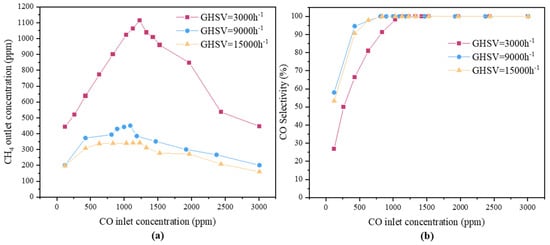
Figure 1 presents the variations in outlet CH4 concentration and CO selectivity with inlet CO concentration at 150 °C under different GHSVs. At GHSVs of 3000 h−1, 9000 h−1, and 15,000 h−1, the CH4 formation reaches its maximum at CO inlet concentrations of approximately 1229 ppm, 1090 ppm, and 1231 ppm, respectively, while CO selectivity simultaneously approaches 100%. This result indicates that the critical CO inlet concentration exists for all three GHSVs, and these critical CO concentrations exhibit minimal differences over a wide GHSV range.
Figure 1.
Variations in CH4 outlet concentration and CO selectivity with CO inlet concentration at 150 °C under different GHSVs.
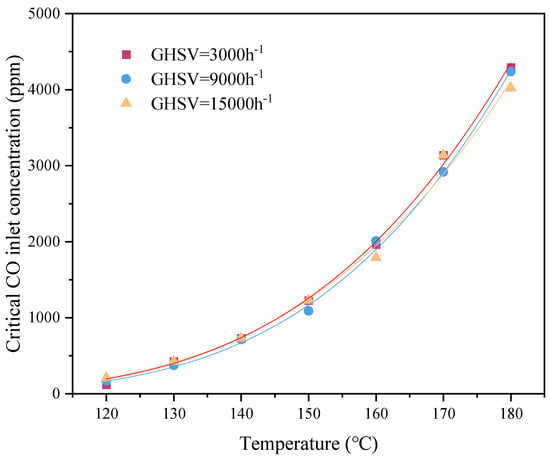
Figure 2 further shows the variation in the critical CO concentration with reaction temperature under different GHSVs. It can be observed that, at any given reaction temperature, the critical CO concentrations under different GHSVs exhibit minimal variation, indicating that the influence of GHSV on the critical CO concentration is negligible. Consequently, the three-stage CO-SMET design based on this characteristic remains valid even when different GHSVs are applied in each stage.
Figure 2.
Variation in the critical CO concentration with temperature under different GHSVs.
From the perspective of the reaction mechanism, the critical CO concentration essentially reflects the optimal ratio between the adsorbed hydrogen and the adsorbed CO on the Ru surface at a given temperature. Therefore, it is governed primarily by the gas composition, reaction temperature and pressure, and the intrinsic properties of the catalyst. In contrast, the space velocity is mainly related to the residence time of reactants within the catalyst bed and does not directly alter the adsorption behavior of reactants on the catalyst surface or the desorption behavior of products. Consequently, it is not expected to influence the surface coverage of adsorbed species. Furthermore, since no diffusion limitations were observed for CO or CO2 methanation under the investigated conditions, the insensitivity of the critical CO concentration to variations in space velocity is theoretically reasonable.
3.2. Effect of Space Velocity on Three-Stage CO-SMET Performance
The experimental results obtained from the proposed three-stage CO-SMET process show that, when a space velocity of 9000 h−1 is applied to all three stages and the temperatures are set to 230 °C, 180 °C, and 150 °C for the first, second, and third stages, respectively, the CO concentration is reduced from 5000 ppm to 383 ppm in the first stage, from 383 ppm to 20 ppm in the second stage, and from 20 ppm to 2.1 ppm in the third stage. These results clearly demonstrate that the inlet CO concentration drops sharply with the progress of the reaction through the stages. Consequently, the CO-removal load in the latter two stages is substantially lower than that in the first stage. This observation highlights the potential of operating the second and third stages at higher space velocities without compromising overall CO-removal performance.
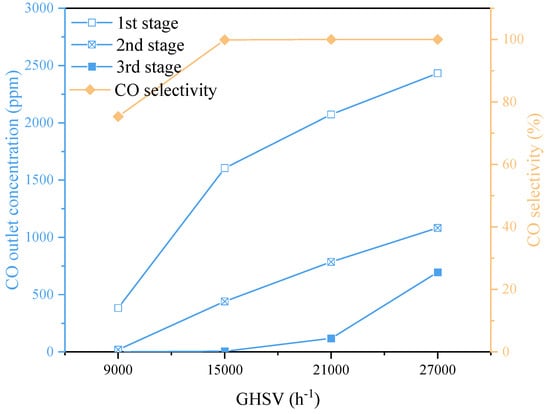
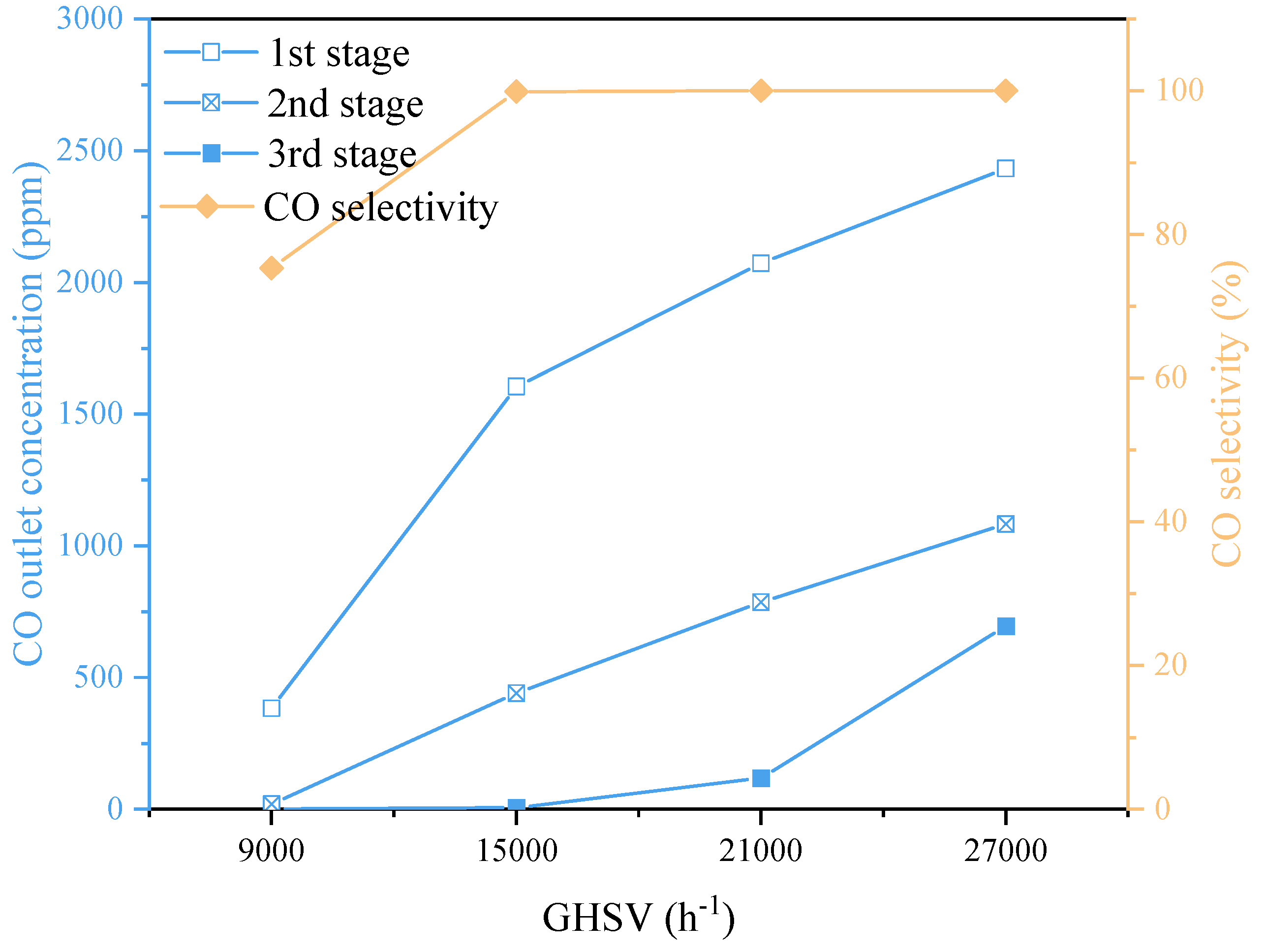
Figure 3 presents the results obtained when the GHSVs of the second and third stages were maintained at 9000 h−1, while the GHSV of the first stage was increased. The reaction temperatures of the first, second, and third stages were 230 °C, 180 °C, and 150 °C, respectively.
Figure 3.
Effect of the first-stage GHSV on the performance of three-stage CO-SMET.
It can be observed that the influence of the first stage’s GHSV on the performance of the three-stage CO-SMET follows general reaction behaviors. As the GHSV in the first stage increases, the outlet CO concentration of the three-stage process rises sharply. Meanwhile, the higher first-stage space velocity suppresses the CO2 methanation reaction, leading to a noticeable improvement in CO selectivity. However, when the first-stage space velocity exceeds 15,000 h−1, the required CO-removal depth of below 10 ppm could not be achieved by the three-stage CO-SMET process.
This result is primarily attributed to the fact that the first stage of CO-SMET is responsible for more than 90% of the total CO-removal load. Increasing the space velocity in the first stage significantly shifts the CO-removal load to the second and third stages, resulting in a rapid increase in the overall CO outlet concentration. Although a moderate increase in the first-stage reaction temperature can partially compensate for the adverse impact caused by the high space velocity, this approach is constrained by the following three factors:
(1) Compared with CO methanation, an increase in reaction temperature enhances CO2 methanation to a much greater extent, resulting in decreased CO selectivity and an increased risk of temperature runaway within the reactor.
(2) From the perspective of methanol steam reforming (MSR)–fuel cell system design, a higher reforming temperature results in a higher CO content in the reformate gas because of the reverse water shift reaction (r-WSR) [49,50], thereby raising the CO-removal load of the CO-SMET and reducing hydrogen production efficiency. Therefore, the reforming temperature generally does not exceed 250 °C. Moreover, the CO-SMET temperature should not exceed the reforming temperature, as this would require additional temperature-control units and heat sources, complicating the overall system design.
(3) Elevated reaction temperatures also accelerate catalyst sintering and deactivation, compromising long-term operational stability.
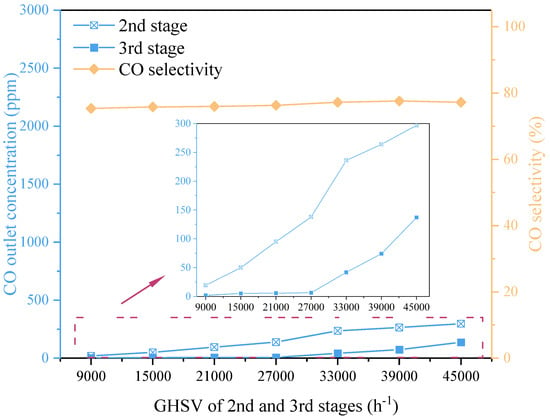
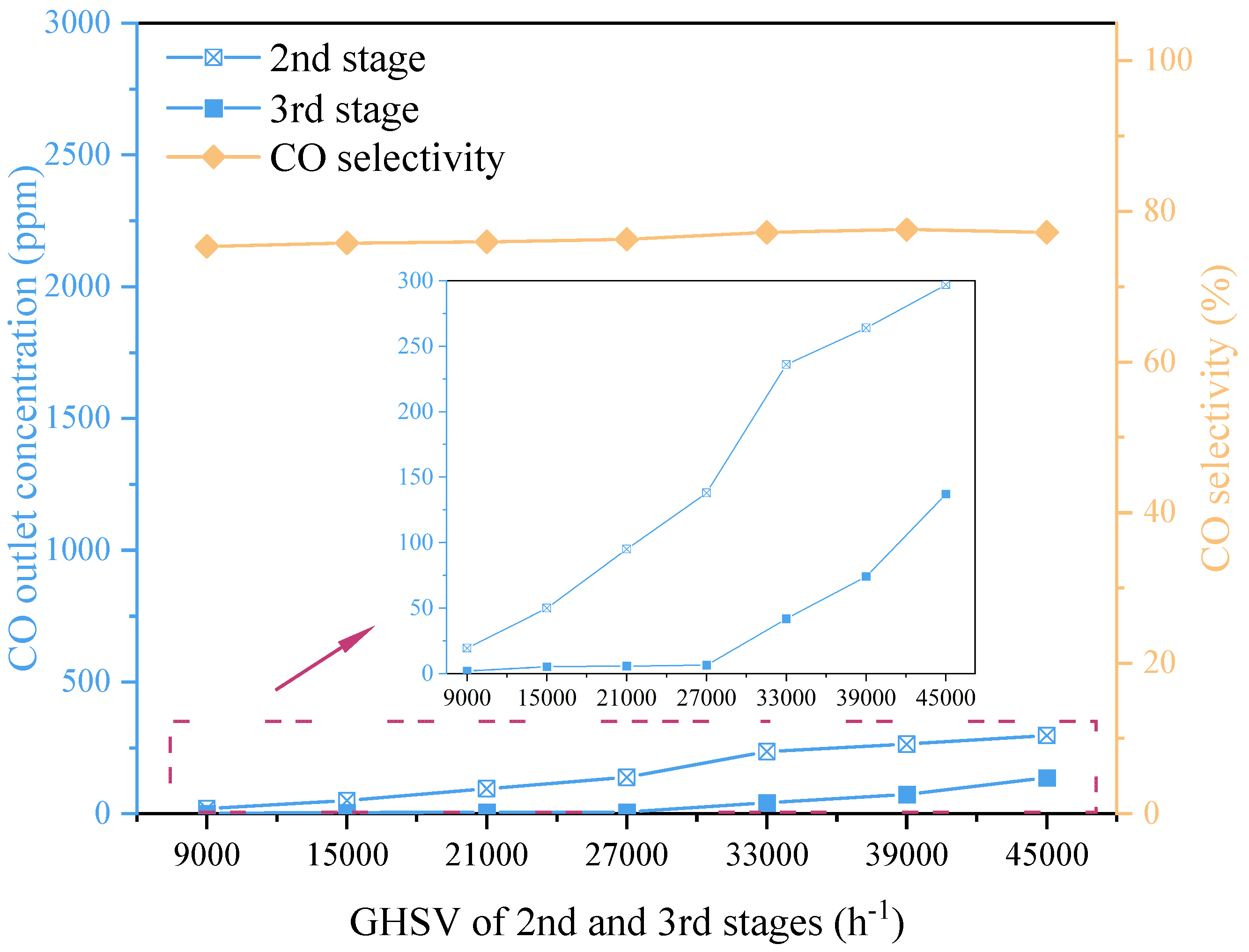
Subsequently, we investigated the effect of increasing the GHSV in the second and third stages on the performance of the three-stage CO-SMET. In the experiments, the GHSV of the first stage was kept at 9000 h−1, and the reaction temperatures of all stages were held constant. The results are presented in Figure 4.
Figure 4.
Effect of the second- and third-stage GHSVs on the performance of three-stage CO-SMET.
It can be seen that, compared with increasing the GHSV in the first stage, raising the GHSV in the second and third stages has a much smaller effect on overall CO-removal performance. When the GHSV of both the second and third stages was increased threefold from 9000 h−1 to 27,000 h−1—resulting in a total GHSV increase from 3000 h−1 to 5400 h−1—the outlet CO concentration of the three-stage CO-SMET rose only slightly from 2.1 ppm to 6.5 ppm, while CO selectivity increased modestly from 75.3% to 76.3%. These observations suggest that there is considerable potential to increase the GHSV in the latter two stages without significantly compromising CO-removal performance.
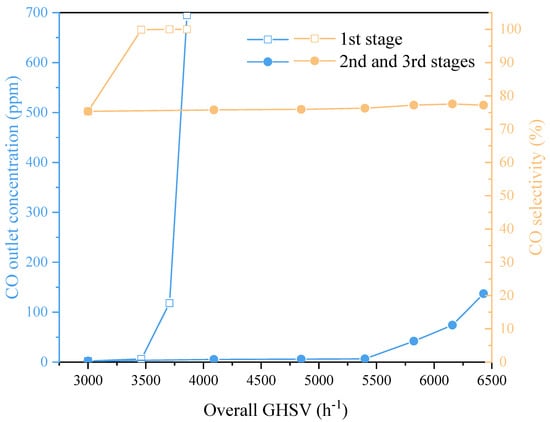
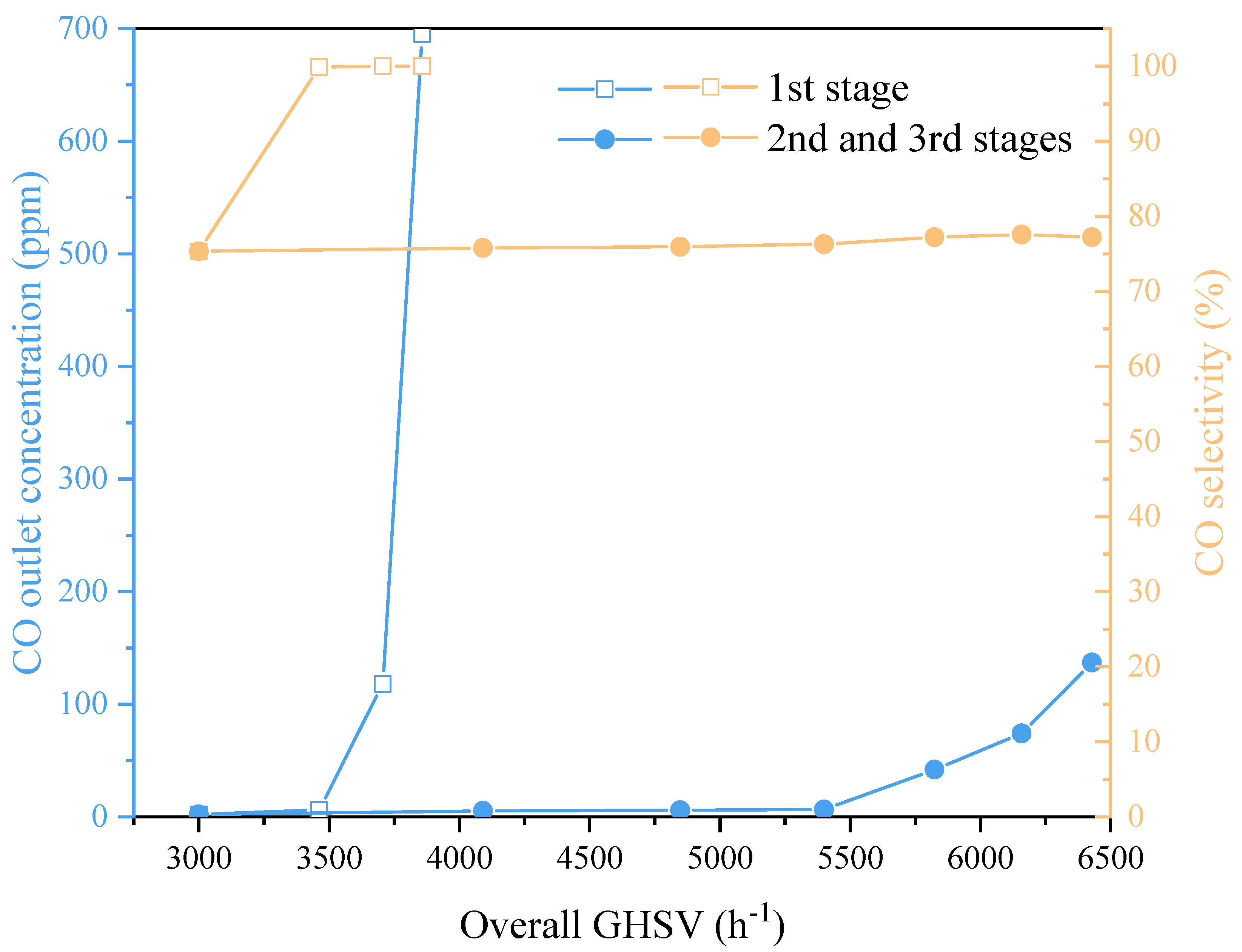
Figure 5 compares the CO-SMET performance for two different ways of increasing the total GHSV: (i) raising the GHSV of the first stage while keeping the second and third stages constant, and (ii) simultaneously increasing the GHSV of the second and third stages while maintaining the first-stage constant. Obviously, at the same overall GHSV, the latter approach achieves significantly deeper CO removal than the former. This suggests that, in addition to the temperature distribution characteristic—where the reaction temperature decreases along the reactor—the three-stage CO-SMET also exhibits a GHSV distribution characteristic, with the GHSV increasing along the reactor. In other words, by designing the reactor to exploit both the temperature and GHSV distributions, the CO-SMET process can simultaneously achieve high CO-removal depth, high CO selectivity, and high GHSV.
Figure 5.
Effect of increasing the first-stage GHSV versus increasing the second- and third-stage GHSVs on the performance of three-stage CO-SMET.
3.3. Effect of Elevating Temperatures Under High GHSVs on the Three-Stage CO-SMET Performance
To explore the possibility of further increasing the overall GHSV by raising the GHSV of the second and third stages while maintaining sufficient CO-removal depth, we leveraged the fact that higher reaction temperatures can enhance the CO methanation rate. Accordingly, we evaluated a strategy in which the temperatures of these stages were moderately increased to suppress the rise in outlet CO concentration caused by the high GHSV in the second and third stages.
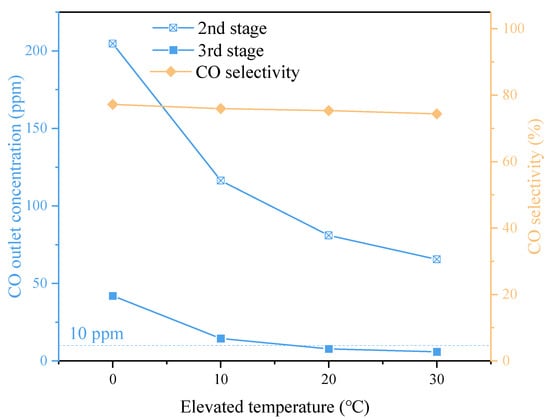
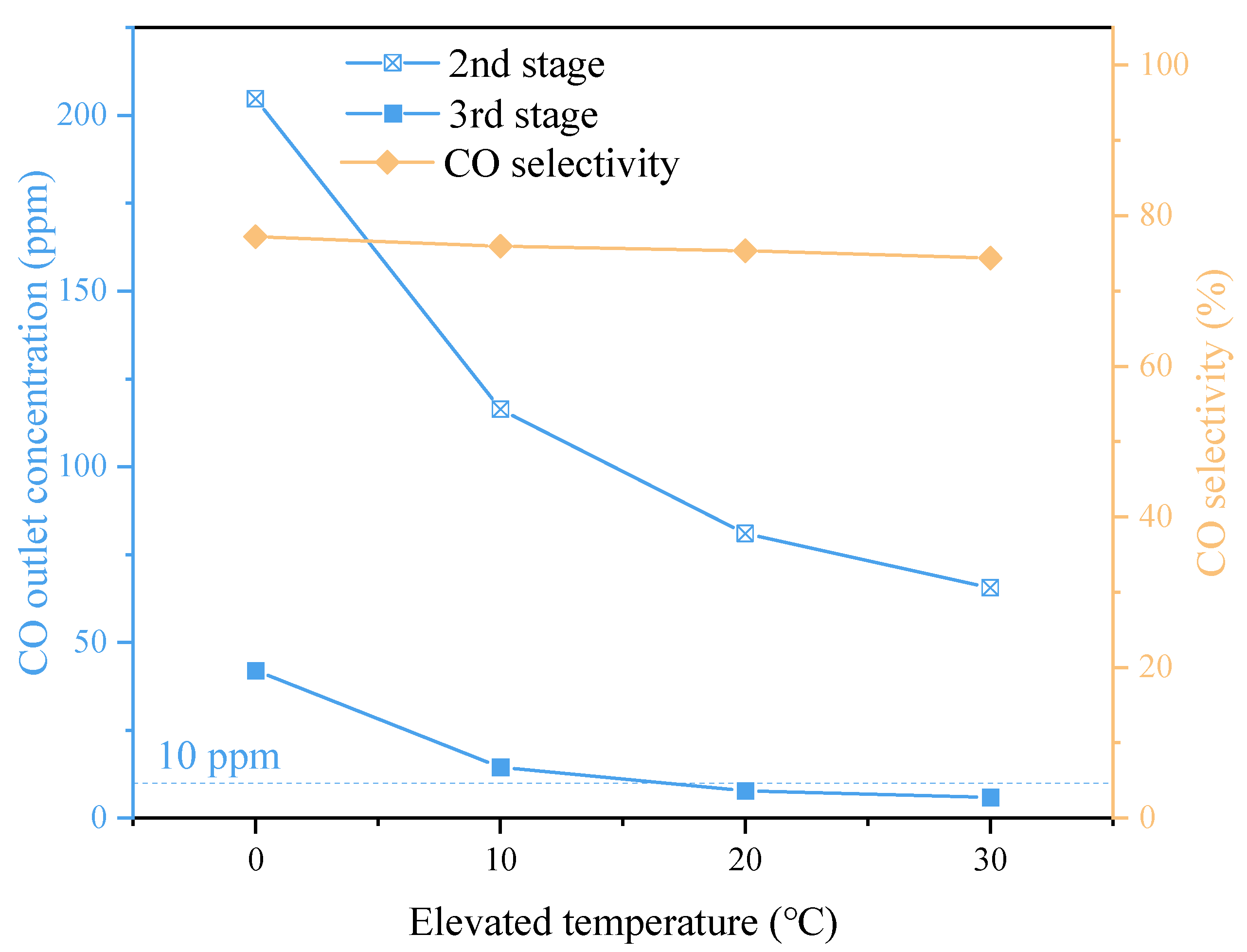
Figure 6 presents the results obtained under the conditions where the first-stage GHSV and temperature were kept constant at 9000 h−1 and 230 °C, respectively, and the GHSV of the second and third stages was simultaneously increased to 33,000 h−1 (corresponding to a total GHSV of 5824 h−1) and maintained constant, while the temperatures of the second and third stages were increased from 180 °C and 150 °C by 10–30 °C.
Figure 6.
Effect of increasing the reaction temperatures of the second and third stages on the performance of three-stage CO-SMET at a GHSV of 33,000 h−1.
It can be seen that a moderate increase in the temperatures of the second and third stages significantly reduces the CO outlet concentration, with CO selectivity virtually unchanged. When the temperatures of these stages were increased by 20 °C, the outlet CO concentration of the CO-SMET dropped from 42 ppm to 7.9 ppm, indicating that the increase in CO outlet concentration caused by the high GHSV was effectively suppressed, with CO selectivity uncompromised.
4. Conclusions
In previous work, the authors proposed a three-stage CO-SMET process characterized by a decreasing temperature profile, based on the critical CO concentration and its corresponding critical temperature, at which CH4 formation rate reaches its maximum and the CO selectivity approaches nearly 100% for a given CO inlet concentration. In this work, the effects of GHSV on the critical CO concentration and the performance of the three-stage process were investigated. The main conclusions are summarized as follows:
1. For CO-SMET, variations in reaction GHSV have little effect on the critical CO concentration at a given temperature. Therefore, the design of a multi-stage CO-SMET process based on the critical CO concentration and its corresponding critical temperature remains valid even when different GHSVs are applied to each stage.
2. Given the sharp decline in CO input concentration of the subsequent stages when all stages were operated at an identical GHSV, there is considerable potential to increase the GHSVs of the second and third stages. Experimental results showed that increasing the GHSVs of these two stages from 9000 h−1 to 27,000 h−1—while maintaining the first stage at 9000 h−1, thereby increasing the overall space velocity from 3000 h−1 to 5400 h−1—only modestly increased the CO outlet concentration from 2.1 ppm to 6.5 ppm while increasing the CO selectivity from 75.3% to 76.3%. Accordingly, a CO-SMET design concept characterized by a decreasing temperature profile and an increasing GHSV profile as the reaction proceeds is proposed.
3. Moderately increasing temperatures of the second and third stages helped suppress the rise in CO outlet concentration caused by raising GHSVs in these stages.
This study provides valuable theoretical and practical guidance for the design of CO-SMET processes that simultaneously achieve high CO-removal depth, high CO selectivity, and high GHSV.
Author Contributions
C.Y.: Methodology, validation, formal analysis, investigation, writing—original draft. C.L.: Methodology, writing—review and editing, supervision. Q.S.: Investigation, writing—review and editing, supervision. All authors have read and agreed to the published version of the manuscript.
Funding
This research received no external funding.
Data Availability Statement
Data are contained within the article.
Acknowledgments
During the preparation of this work the authors used ChatGPT-5 Mini in order to improve writing. After using this tool, the authors reviewed and edited the content as needed and take full responsibility for the content of the publication.
Conflicts of Interest
The authors declare no conflict of interest.
References
- Lian, J.; Zhang, Y.; Ma, C.; Yang, Y.; Chaima, E. A review on recent sizing methodologies of hybrid renewable energy systems. Energy Convers. Manag. 2019, 199, 112027. [Google Scholar] [CrossRef] [Scilit]
- Shaker, H.; Zareipour, H.; Wood, D. Impacts of large-scale wind and solar power integration on California׳s net electrical load. Renew. Sustain. Energy Rev. 2016, 58, 761–774. [Google Scholar] [CrossRef] [Scilit]
- Li, Q.; Ren, B.; Tang, W.; Wang, D.; Wang, C.; Lv, Z. Analyzing the inertia of power grid systems comprising diverse conventional and renewable energy sources. Energy Rep. 2022, 8, 15095–15105. [Google Scholar] [CrossRef] [Scilit]
- Albadi, M.H.; El-Saadany, E.F. Overview of wind power intermittency impacts on power systems. Electr. Power Syst. Res. 2010, 80, 627–632. [Google Scholar] [CrossRef] [Scilit]
- Ren, G.; Liu, J.; Wan, J.; Guo, Y.; Yu, D. Overview of wind power intermittency: Impacts, measurements, and mitigation solutions. Appl. Energy 2017, 204, 47–65. [Google Scholar] [CrossRef] [Scilit]
- Elalfy, D.A.; Gouda, E.; Kotb, M.F.; Bureš, V.; Sedhom, B.E. Comprehensive review of energy storage systems technologies, objectives, challenges, and future trends. Energy Strategy Rev. 2024, 54, 101482. [Google Scholar] [CrossRef] [Scilit]
- Khan, M.K.; Raza, M.; Shahbaz, M.; Farooq, U.; Akram, M.U. Akram, Recent advancement in energy storage technologies and their applications. J. Energy Storage 2024, 92, 112112. [Google Scholar] [CrossRef] [Scilit]
- Kamran, M.; Turzyński, M. Exploring hydrogen energy systems: A comprehensive review of technologies, applications, prevailing trends, and associated challenges. J. Energy Storage 2024, 96, 112601. [Google Scholar] [CrossRef] [Scilit]
- Ge, L.; Zhang, B.; Huang, W.; Li, Y.; Hou, L.; Xiao, J.; Mao, Z.; Li, X. A review of hydrogen generation, storage, and applications in power system. J. Energy Storage 2024, 75, 109307. [Google Scholar] [CrossRef] [Scilit]
- Sikiru, S.; Oladosu, T.L.; Amosa, T.I.; Olutoki, J.O.; Ansari, M.N.M.; Abioye, K.J.; Rehman, Z.U.; Soleimani, H. Hydrogen-powered horizons: Transformative technologies in clean energy generation, distribution, and storage for sustainable innovation. Int. J. Hydrogen Energy 2024, 56, 1152–1182. [Google Scholar] [CrossRef] [Scilit]
- Badawi, M.N.; Agrawal, N.; Luqman, M.; Ramesh, S.; Ramesh, K.; Khan, M.; Adil, S.F. Developments and challenges in batteries, and hydrogen as a future fuel, and storage and carrier devices. Int. J. Hydrogen Energy 2025, 105, 1242–1260. [Google Scholar] [CrossRef] [Scilit]
- Padmanabhan, N.T.; Clarizia, L.; Ganguly, P. Advancing hydrogen storage: Critical insights to potentials, challenges, and pathways to sustainability. Curr. Opin. Chem. Eng. 2025, 48, 101135. [Google Scholar] [CrossRef] [Scilit]
- Zhang, W.; Wen, C.; Zhang, X.; Chen, L.; Zhang, Q.; Ma, L. A Review of Green Methanol Production: Technologies, Economic Evaluation, and Carbon Emission Analysis. Energy Fuel 2025, 39, 18733–18750. [Google Scholar] [CrossRef] [Scilit]
- Wang, Y.; Wu, Q.; Mei, D.; Wang, Y. Development of highly efficient methanol steam reforming system for hydrogen production and supply for a low temperature proton exchange membrane fuel cell. Int. J. Hydrogen Energy 2020, 45, 25317–25327. [Google Scholar] [CrossRef] [Scilit]
- Thirumalesh, B.S.; Asapu, R. State of the Art of Methanol Reforming for Hydrogen Generation. Chembioeng Rev. 2024, 11, 543–554. [Google Scholar] [CrossRef] [Scilit]
- Harkou, E.; Wang, H.; Manos, G.; Constantinou, A.; Tang, J. Advances in catalyst and reactor design for methanol steam reforming and PEMFC applications. Chem. Sci. 2025, 16, 3810–3831. [Google Scholar] [CrossRef] [Scilit] [PubMed]
- Achomo, M.A.; Kumar, A.; Peela, N.R.; Muthukumar, P. Hydrogen production from steam reforming of methanol: A comprehensive review on thermodynamics, catalysts, reactors, and kinetic studies. Int. J. Hydrogen Energy 2024, 58, 1640–1672. [Google Scholar] [CrossRef] [Scilit]
- Pei, P.; Xu, Y.; Wang, M.; Ren, P. Effects of carbon monoxide on proton exchange membrane fuel cells and elimination techniques. Int. J. Hydrogen Energy 2024, 69, 1287–1304. [Google Scholar] [CrossRef] [Scilit]
- Sahebdelfar, S.; Ravanchi, M.T. Carbon monoxide clean-up of the reformate gas for PEM fuel cell applications: A conceptual review. Int. J. Hydrogen Energy 2023, 48, 24709–24729. [Google Scholar] [CrossRef] [Scilit]
- Snytnikov, P.V.; Zyryanova, M.M.; Sobyanin, V.A. CO-Cleanup of Hydrogen-Rich Stream for LT PEM FC Feeding: Catalysts and Their Performance in Selective CO Methanation. Top. Catal. 2016, 59, 1394–1412. [Google Scholar] [CrossRef] [Scilit]
- Liu, K.; Wang, A.Q.; Zhang, T. Recent Advances in Preferential Oxidation of CO Reaction over Platinum Group Metal Catalysts. ACS Catal 2012, 2, 1165–1178. [Google Scholar] [CrossRef] [Scilit]
- Ashraf, M.A.; Ercolino, G.; Specchia, S.; Specchia, V. Final step for CO syngas clean-up: Comparison between CO-PROX and CO-SMET processes. Int. J. Hydrogen Energy 2014, 39, 18109–18119. [Google Scholar] [CrossRef] [Scilit]
- Wang, Y.C.; Wu, Q.; Mei, D.; Wang, Y. A methanol fuel processing system with methanol steam reforming and CO selective methanation modules for PEMFC application. Int. J. Energy Res. 2021, 45, 6163–6173. [Google Scholar] [CrossRef] [Scilit]
- Du, Z.M.; Liu, C.M.; Zhai, J.X.; Guo, X.Y.; Xiong, Y.L.; Su, W.; He, G.L. A Review of Hydrogen Purification Technologies for Fuel Cell Vehicles. Catalysts 2021, 11, 393. [Google Scholar] [CrossRef] [Scilit]
- Cisneros, S.; Chen, S.; Diemant, T.; Bansmann, J.; Abdel-Mageed, A.M.; Goepel, M.; Olesen, S.E.; Welter, E.S.; Parlinska-Wojtan, M.; Gläser, R.; et al. Effects of SiO2-doping on high-surface-area Ru/TiO2 catalysts for the selective CO methanation. Appl. Catal. B Environ. 2021, 282, 119483. [Google Scholar] [CrossRef] [Scilit]
- Shi, Z.; Feng, J.; Dong, X. Ru–Ni/GA-MMO composites as highly active catalysts for CO selective methanation in H2-rich gases. Int. J. Hydrogen Energy 2023, 48, 24640–24651. [Google Scholar] [CrossRef] [Scilit]
- Li, Z.; Ma, J.; Dong, X. RuNi/TiZr-MMO Catalysts Derived from Zr-Modified NiTi-LDH for CO-Selective Methanation. Molecules 2024, 29, 3309. [Google Scholar] [CrossRef] [Scilit]
- Bobadilla, L.F.; Muñoz-Murillo, A.; Gándara-Loe, J.; Pérez, A.; Laguna, O.H.; Martínez, T.L.M.; Penkova, A.; Centeno, M.A.; Odriozola, J.A. Effect of noble metal addition over active Ru/TiO2 catalyst for CO selective methanation from H2 rich- streams. Int. J. Hydrogen Energy 2023, 48, 25065–25074. [Google Scholar] [CrossRef] [Scilit]
- Li, X.; Han, Y.; Huang, Y.; Lin, J.; Pan, X.; Zhao, Z.; Zhou, Y.; Wang, H.; Yang, X.; Wang, A.; et al. Hydrogenated TiO2 supported Ru for selective methanation of CO in practical conditions. Appl. Catal. B Environ. 2021, 298, 120597. [Google Scholar] [CrossRef] [Scilit]
- Ping, D.; Dong, X.; Zang, Y.; Feng, X. Highly efficient Ru/TiO2-NiAl mixed oxide catalysts for CO selective methanation in hydrogen-rich gas. Int. J. Energy Res. 2017, 41, 2308–2317. [Google Scholar] [CrossRef] [Scilit]
- Djinović, P.; Galletti, C.; Specchia, S.; Specchia, V. CO Methanation Over Ru-Al2O3 Catalysts: Effects of Chloride Doping on Reaction Activity and Selectivity. Top. Catal. 2011, 54, 1042–1053. [Google Scholar] [CrossRef] [Scilit]
- Konishcheva, M.V.; Potemkin, D.I.; Snytnikov, P.V.; Stonkus, O.A.; Belyaev, V.D.; Sobyanin, V.A. The insights into chlorine doping effect on performance of ceria supported nickel catalysts for selective CO methanation. Appl. Catal. B-Environ. 2018, 221, 413–421. [Google Scholar] [CrossRef] [Scilit]
- Miyao, T.; Shen, W.H.; Chen, A.H.; Higashiyama, K.; Watanabe, M. Mechanistic study of the effect of chlorine on selective CO methanation over Ni alumina-based catalysts. Appl. Catal. A Gen. 2014, 486, 187–192. [Google Scholar] [CrossRef] [Scilit]
- Shimoda, N.; Shoji, D.; Tani, K.; Fujiwara, M.; Urasaki, K.; Kikuchi, R.; Satokawa, S. Role of trace chlorine in Ni/TiO2 catalyst for CO selective methanation in reforrnate gas. Appl. Catal. B-Environ. 2015, 174, 486–495. [Google Scholar] [CrossRef] [Scilit]
- Truszkiewicz, E.; Zegadło, K.; Wojda, D.; Mierzwa, B.; Kępiński, L. The Effect of the Ruthenium Crystallite Size on the Activity of Ru/Carbon Systems in CO Methanation. Top. Catal. 2017, 60, 1299–1305. [Google Scholar] [CrossRef] [Scilit]
- Panagiotopoulou, P.; Kondarides, D.I.; Verykios, X.E. Selective methanation of CO over supported noble metal catalysts: Effects of the nature of the metallic phase on catalytic performance. Appl. Catal. A-Gen. 2008, 344, 45–54. [Google Scholar] [CrossRef] [Scilit]
- Panagiotopoulou, P.; Kondarides, D.I.; Verykios, X.E. Selective methanation of CO over supported Ru catalysts. Appl. Catal. B-Environ. 2009, 88, 470–478. [Google Scholar] [CrossRef] [Scilit]
- Konishcheva, M.V.; Potemkin, D.I.; Badmaev, S.D.; Snytnikov, P.V.; Paukshtis, E.A.; Sobyanin, V.A.; Parmon, V.N. On the Mechanism of Co and CO2 Methanation over Ni/CeO2 Catalysts. Top. Catal. 2016, 59, 1424–1430. [Google Scholar] [CrossRef] [Scilit]
- Miao, B.; Ma, S.S.K.; Wang, X.; Su, H.B.; Chan, S.H. Catalysis Mechanisms of CO2 and CO Methanation. Catal. Sci. Technol. 2016, 6, 4048–4058. [Google Scholar] [CrossRef] [Scilit]
- Zhang, S.T.; Yan, H.; Wei, M.; Evans, D.G.; Duan, X. Hydrogenation Mechanism of Carbon Dioxide and Carbon Monoxide on Ru(0001) Surface: A Density Functional Theory Study. RSC Adv. 2014, 4, 30241–30249. [Google Scholar] [CrossRef] [Scilit]
- Kaydouh, M.-N.; El Hassan, N.; Osman, A.I.; Ahmed, H.; Alarifi, N.; Fakeeha, A.H.; Bin Jumah, A.; Al-Fatesh, A.S. Optimizing Co2 Methanation: Effect of Surface Basicity and Active Phase Reducibility on Ni-Based Catalysts. React. Chem. Eng. 2024, 9, 1933–1946. [Google Scholar] [CrossRef] [Scilit]
- Chen, A.; Miyao, T.; Higashiyama, K.; Yamashita, H.; Watanabe, M. High Catalytic Performance of Ruthenium-Doped Mesoporous Nickel-Aluminum Oxides for Selective Co Methanation. Angew. Chem.-Int. Ed. 2010, 49, 9895–9898. [Google Scholar]
- Xiong, J.; Dong, X.F.; Song, Y.B.; Dong, Y.C. A High Performance Ru-ZrO2/Carbon Nanotubes-Ni Foam Composite Catalyst for Selective Co Methanation. J. Power Sources 2013, 242, 132–136. [Google Scholar]
- Miyao, T.; Tanaka, J.; Shen, W.; Hayashi, K.; Higashiyama, K.; Watanabe, M. Catalytic Activity and Durability of a Mesoporous Silica-Coated Ni-Alumina-Based Catalyst for Selective Co Methanation. Catal. Today 2015, 251, 81–87. [Google Scholar]
- Yang, C.; Guo, F.; Luo, C.; Su, Q. A Novel Two-Step Ru/Al2O3 Catalyst Impregnation Method for CO Selective Methanation. Int. J. Hydrogen Energy 2024, 97, 845–855. [Google Scholar]
- Yang, C.; Luo, C.; Su, Q. Critical Co Concentration Driven Three-Stage Co Selective Methanation Design: Achieving Synergistic Enhancement of Co Removal Depth and Selectivity. Int. J. Hydrogen Energy 2025, 191, 152326. [Google Scholar] [CrossRef] [Scilit]
- Li, Y.; Luo, C.; Su, Q. Cold Start-up Study of Methanol Reformer Based on Chemical-Looping Combustion. Fuel 2022, 317, 122850. [Google Scholar] [CrossRef] [Scilit]
- Li, Y.; Luo, C.; Xu, J.; Su, Q. A Cold Start-up Method with Combining Chemical-Looping Combustion and Catalytic Combustion for a Methanol Reformer. Int. J. Hydrogen Energy 2024, 49, 668–679. [Google Scholar] [CrossRef] [Scilit]
- Ranjekar, A.M.; Yadav, G.D. Steam Reforming of Methanol for Hydrogen Production: A Critical Analysis of Catalysis, Processes, and Scope. Ind. Eng. Chem. Res. 2021, 60, 89–113. [Google Scholar] [CrossRef] [Scilit]
- Garcia, G.; Arriola, E.; Chen, W.-H.; De Luna, M.D. A Comprehensive Review of Hydrogen Production from Methanol Thermochemical Conversion for Sustainability. Energy 2021, 217, 119384. [Google Scholar] [CrossRef] [Scilit]
Disclaimer/Publisher’s Note: The statements, opinions and data contained in all publications are solely those of the individual author(s) and contributor(s) and not of MDPI and/or the editor(s). MDPI and/or the editor(s) disclaim responsibility for any injury to people or property resulting from any ideas, methods, instructions or products referred to in the content. |
© 2026 by the authors. Licensee MDPI, Basel, Switzerland. This article is an open access article distributed under the terms and conditions of the Creative Commons Attribution (CC BY) license.