
Gas Flow Metering Using National Standards and Gas Mixtures Containing Hydrogen

 , ,
, ,  , , , and
Abstract
1. Introduction
2. Intercomparison
2.1. Design
2.2. Instruments
2.3. Calibration Procedure
- -
- Test gas;
- -
- Date;
- -
- Nominal flow rate (m3/h);
- -
- Average temperature (°C);
- -
- Average pressure (bar);
- -
- Real flow at MUT (m3/h);
- -
- Indicated flow MUT (m3/h);
- -
- Error of the meter (%);
- -
- Reynolds number (-);
- -
- Average indicated flow (m3/h);
- -
- Average error of the meter (%);
- -
- Standard deviation of the mean (%);
- -
- Uncertainty of measurement (%).
2.4. Test Facilities
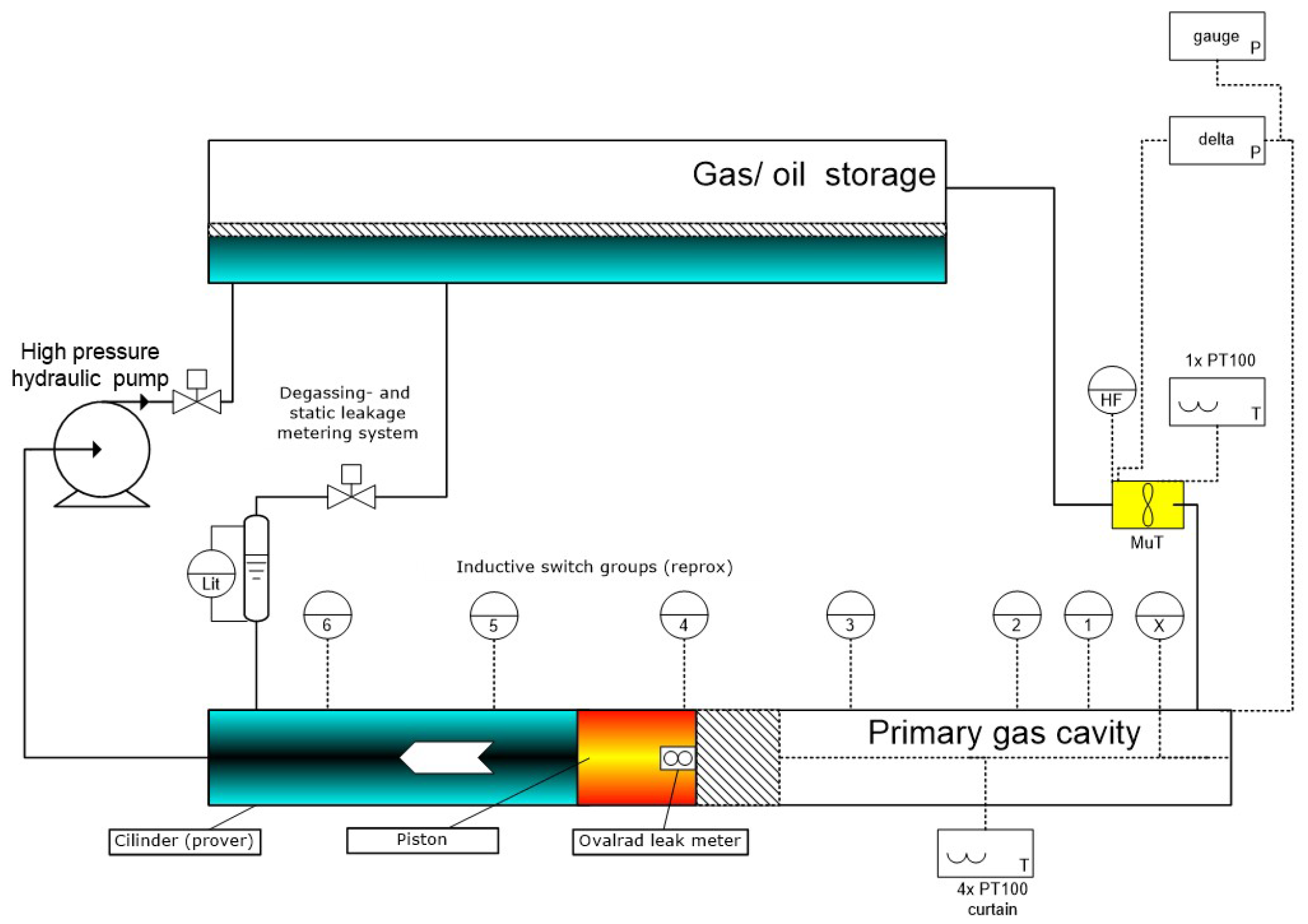
2.4.1. VSL, The Netherlands
2.4.2. FORCE, Denmark
2.4.3. CESAME, France
2.5. Stability of the Meters
2.6. Intercomparison: Results
2.6.1. Air at Atmospheric Pressure, Rotary Meter
2.6.2. Natural Gas at 8 Bar, Rotary Meter
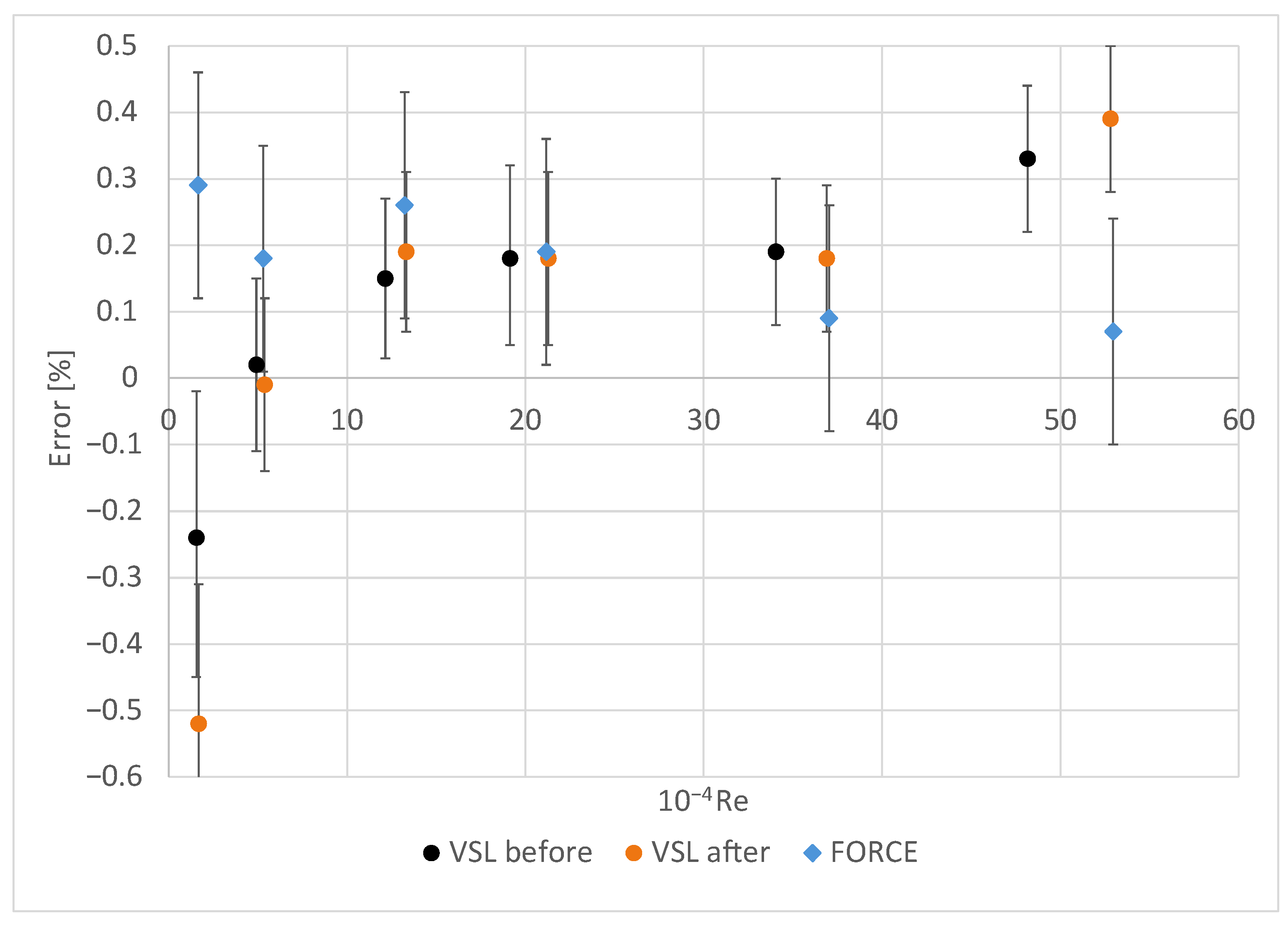
2.6.3. Natural Gas Enriched with 20% Hydrogen at 8 Bar, Rotary Meter
2.6.4. Natural Gas at 60 Bar, Rotary Meter
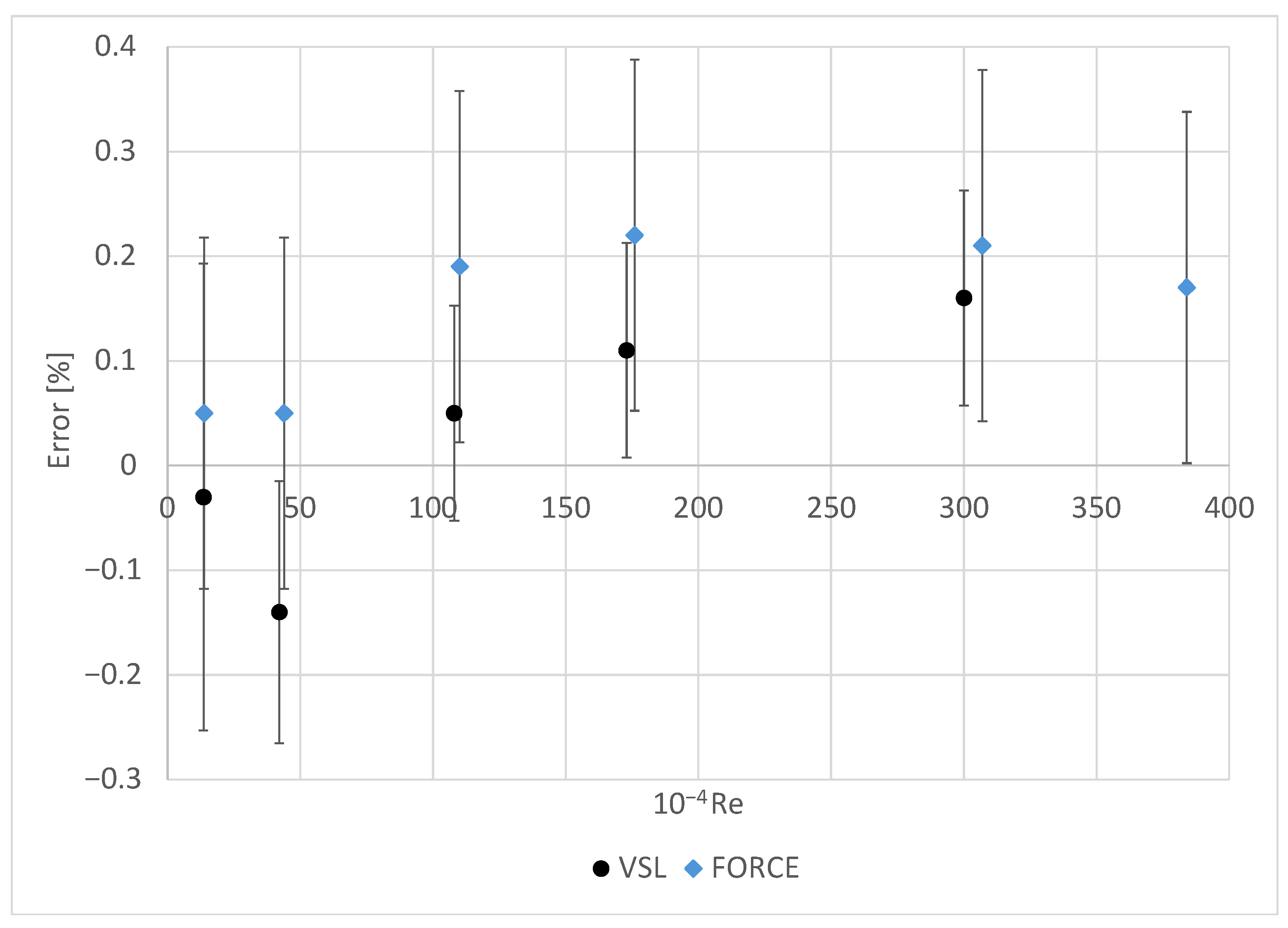
2.6.5. Natural Gas Enriched with 20% Hydrogen at 60 Bar, Rotary Meter
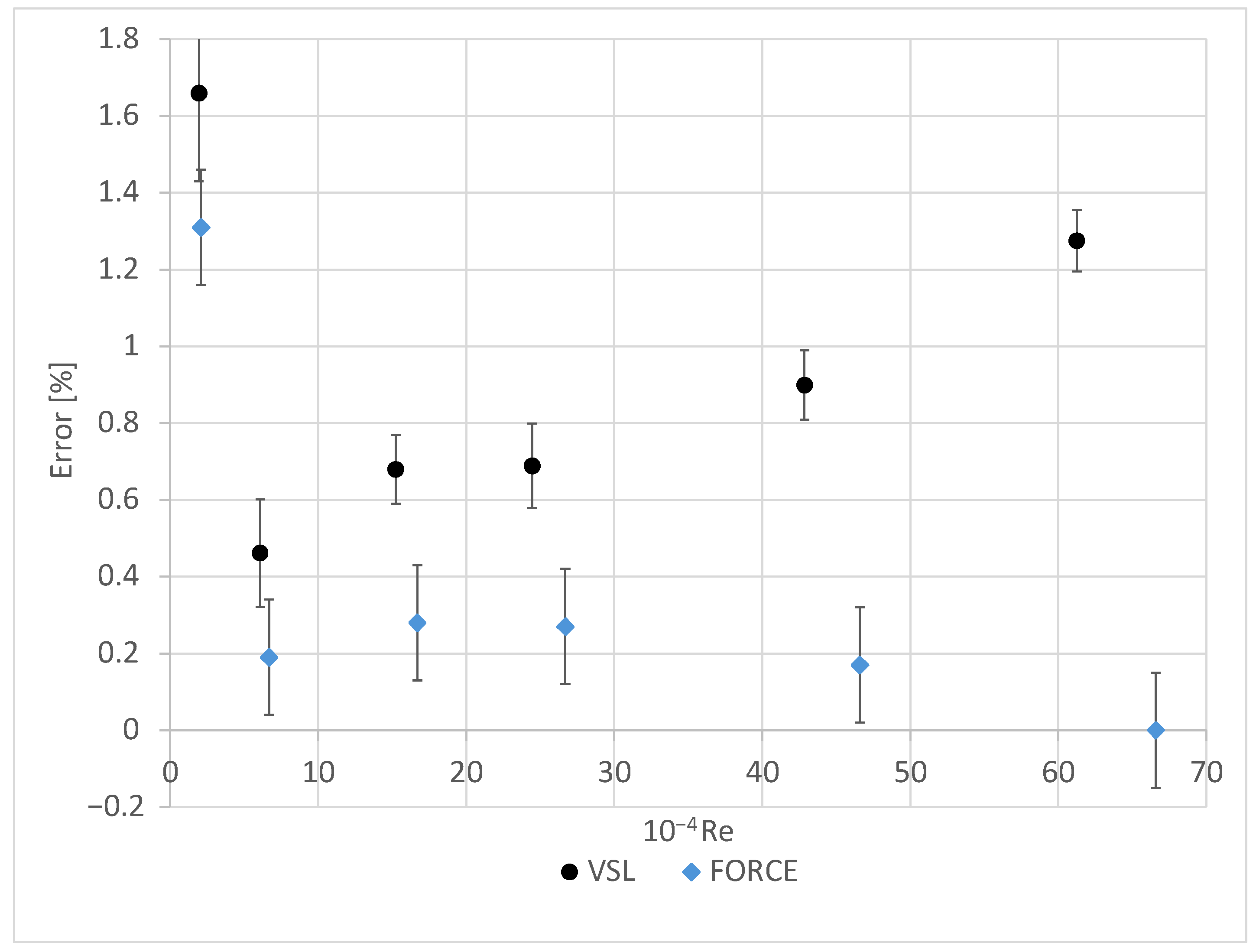
2.6.6. Natural Gas at 8 Bar, Ultrasonic Meter
2.6.7. Natural Gas Enriched with 20% Hydrogen at 8 Bar, Ultrasonic Meter
2.6.8. Natural Gas at 60 Bar, Ultrasonic Meter
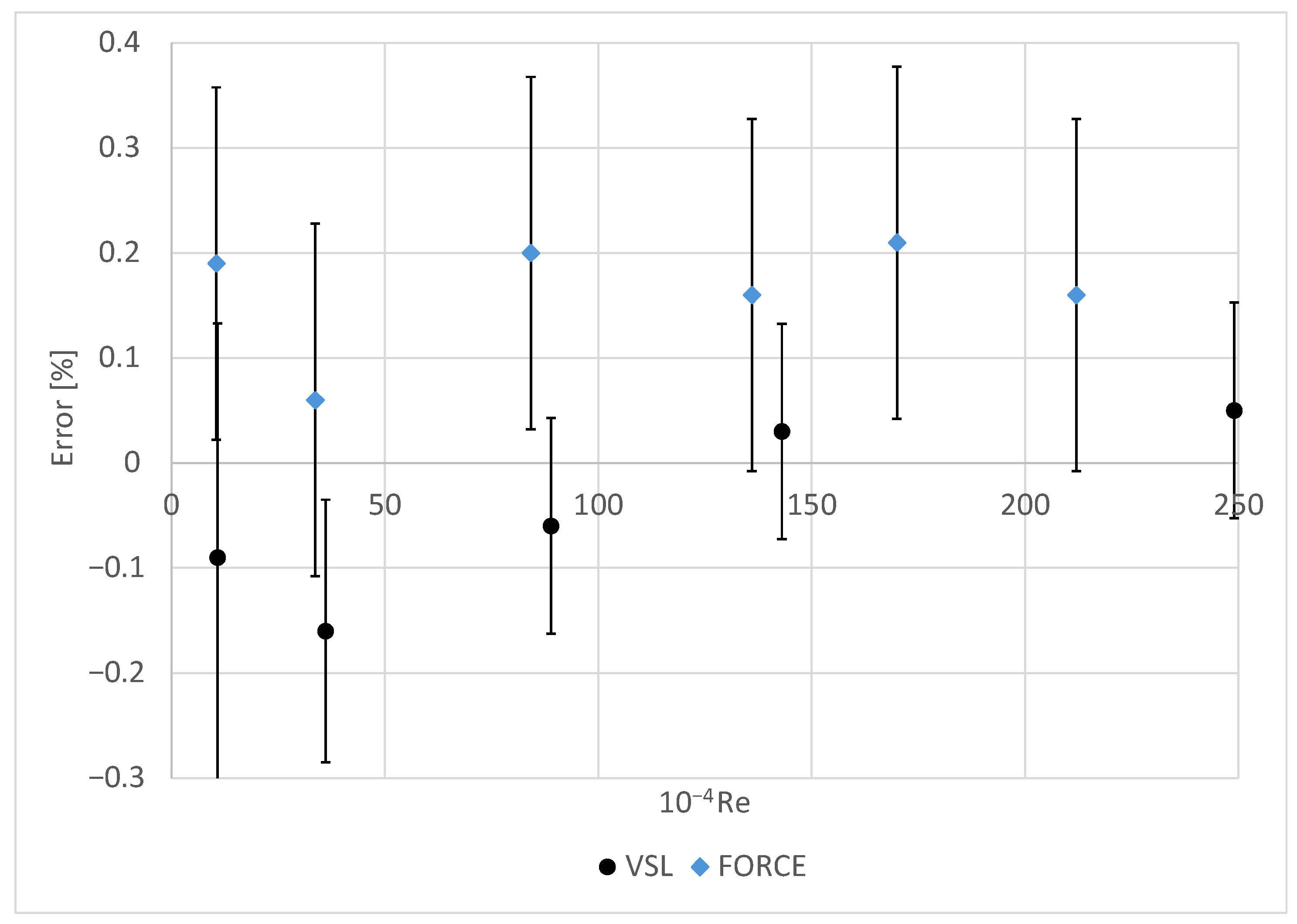
2.6.9. Natural Gas Enriched with 20% Hydrogen at 60 Bar, Ultrasonic Meter
2.7. Intercomparison with NG and HENG: Discussion
- Temperature effects: In some laboratories, the temperature of the facility is not controlled. Hence, the temperature range during calibrations is (8 to 22) °C. Although a temperature correction was applied for the rotary meter, there may be additional effects not covered by this first-order correction. Temperature effects can also be significant for the ultrasonic meter, but the main effects are covered by the built-in corrections. No additional corrections were applied.
- Gas composition effects: The natural gas in Denmark and The Netherlands differs greatly in composition, with the former having a larger density. Consequently, although the experiments are performed at the same nominal flow rate, the Reynolds numbers can differ significantly, which may cause differences in the reported error of the meter. In addition, both VSL and FORCE aimed at having a hydrogen mole fraction of 20% for the HENG tests, but due to operational reasons they could not control optimally this mole fraction. The hydrogen mole fraction measured at VSL was 19.7% at 8 bar and 17.2% at 60 bar. At FORCE, the hydrogen mole fraction for the ultrasonic meter was 18.8% at 8 bar and 19.0% at 60 bar. For the rotary meter, it was 18.0% at 8 bar and 20.0% at 60 bar. This variability in the hydrogen mole fraction yields to additional differences in Reynolds number.
- Pressure effects: Due to operational reasons there were some mild differences in the actual pressure of the calibrations. For example, VSL calibrated the rotary meter at 58 bar with natural gas while FORCE measured at 61 bar. Both the error of rotary meters and ultrasonic meters are affected to some extent by pressure levels.
- Novelty of the tests: Neither FORCE nor VSL had any experience with testing ultrasonic flow meters on their piston provers, which was challenging due to the relatively short stroke of the piston provers combined with the characteristics of the ultrasonic flow meter (delays in pulse output). In addition, there were significant differences in piping configuration, which could affect the ultrasonic flow meter. The stability of the experimental setups is then not guaranteed.
- Stability of the flow meters: As described previously, the stability of the flow meters is relatively poor compared to the CMCs of the participating laboratories. This is especially true for the ultrasonic meter. An analysis according to “Criterion ‘D’” [18] was not performed due to time limitations, but would potentially yield inconclusive results, meaning that the stability of the flow meters may not have been sufficient to confirm the participants’ CMC values.
- The ultrasonic flow meter was a natural gas meter, and as such the addition of hydrogen had a significant experimental consequence.
- The VSL piston prover was designed for 4″ rotary meters of a specific type, and this intercomparison is the first comparison with this piston prover using meters with smaller diameters.
- The rotary meter was a relatively new meter, and the overall increase in measurement error (meter indicates more after the comparison, cf. the “VSL after” results above) seems to be consistent with the theory that the bearings start running more smoothly after an initial run-in period.
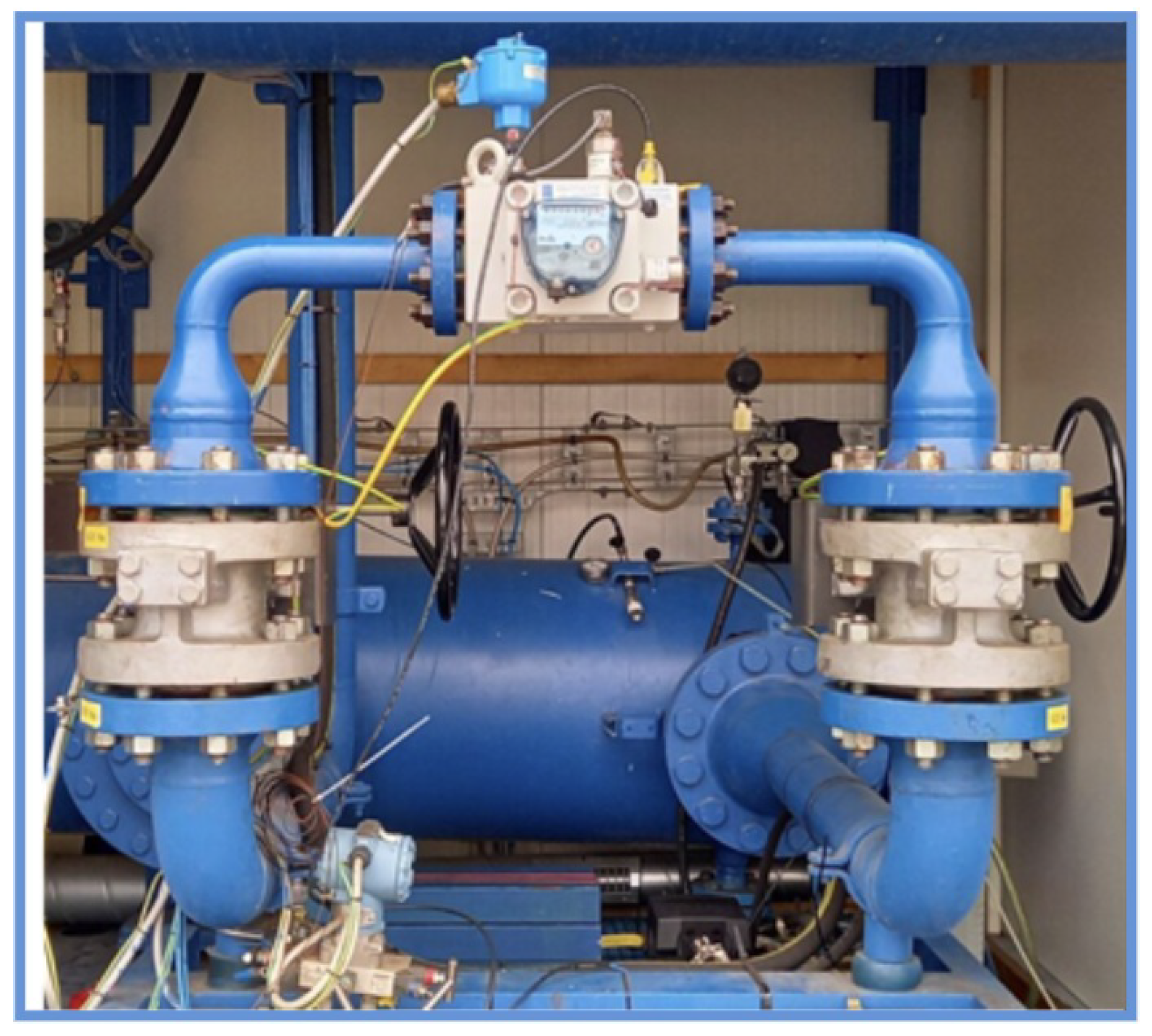
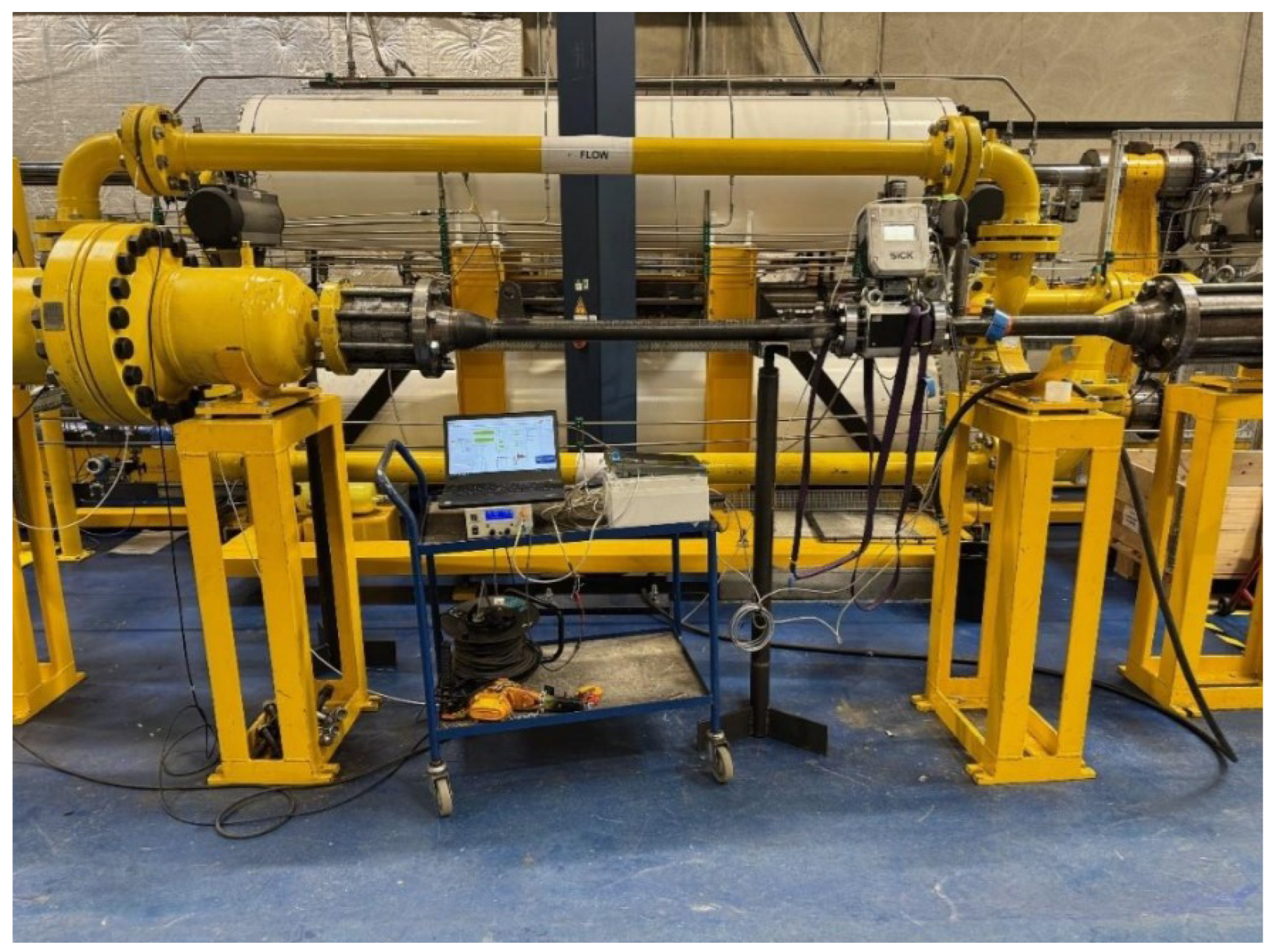
- The configuration was not strictly identical between institutes: the experiments at FORCE did not include bends for either of the meters, contrary to VSL and CESAME. With atmospheric air, differences of 0.05% are possible between the situations with and without bends for the rotary meter; for the ultrasonic meter, a similar or worse impact can be assumed.
3. Domestic Gas Meters
3.1. Meters Tested
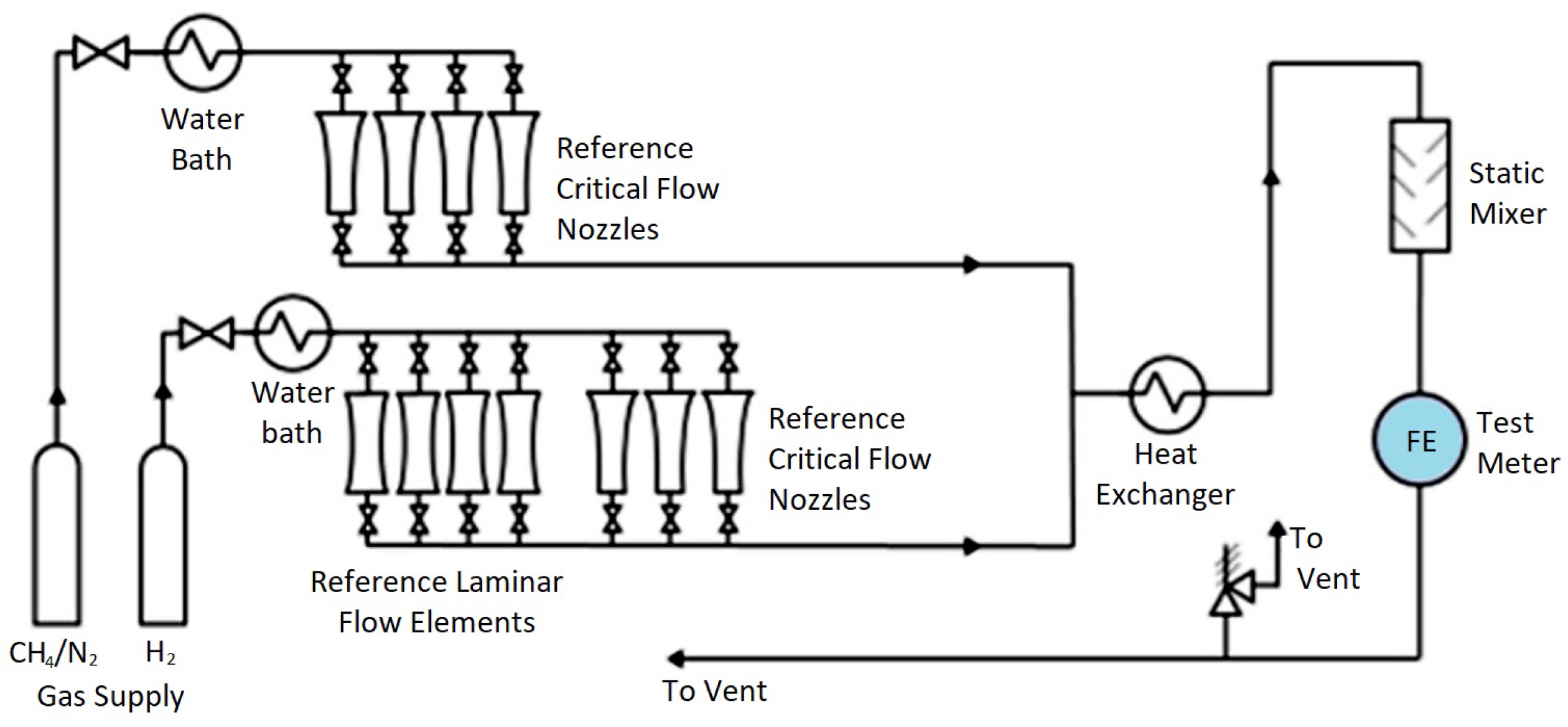
3.2. Testing Facilities
3.2.1. VSL Test Facility
3.2.2. NEL Test Facility
3.3. Test of Domestic Gas Meters: Results
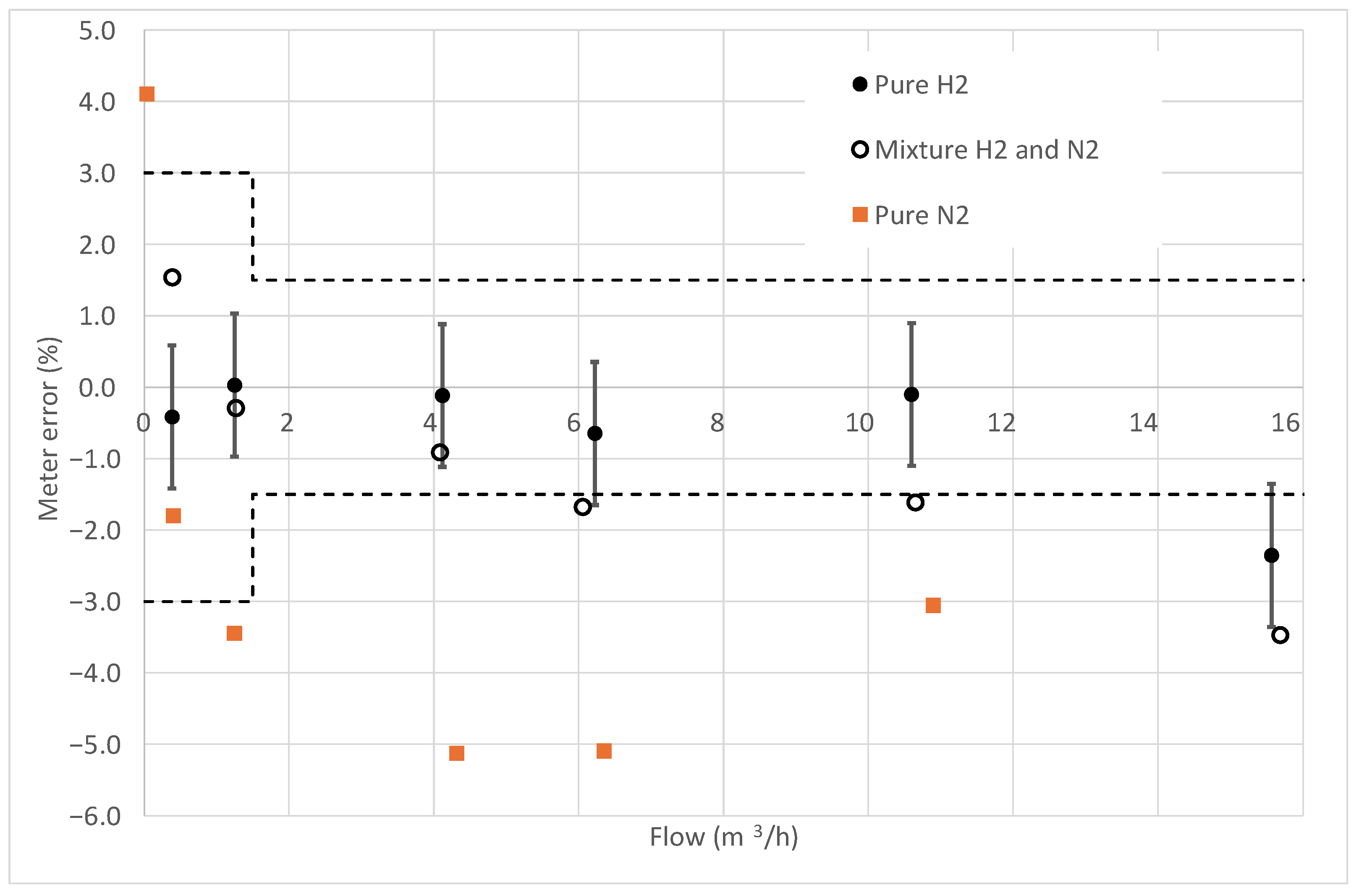
3.3.1. Ultrasonic Meter 2
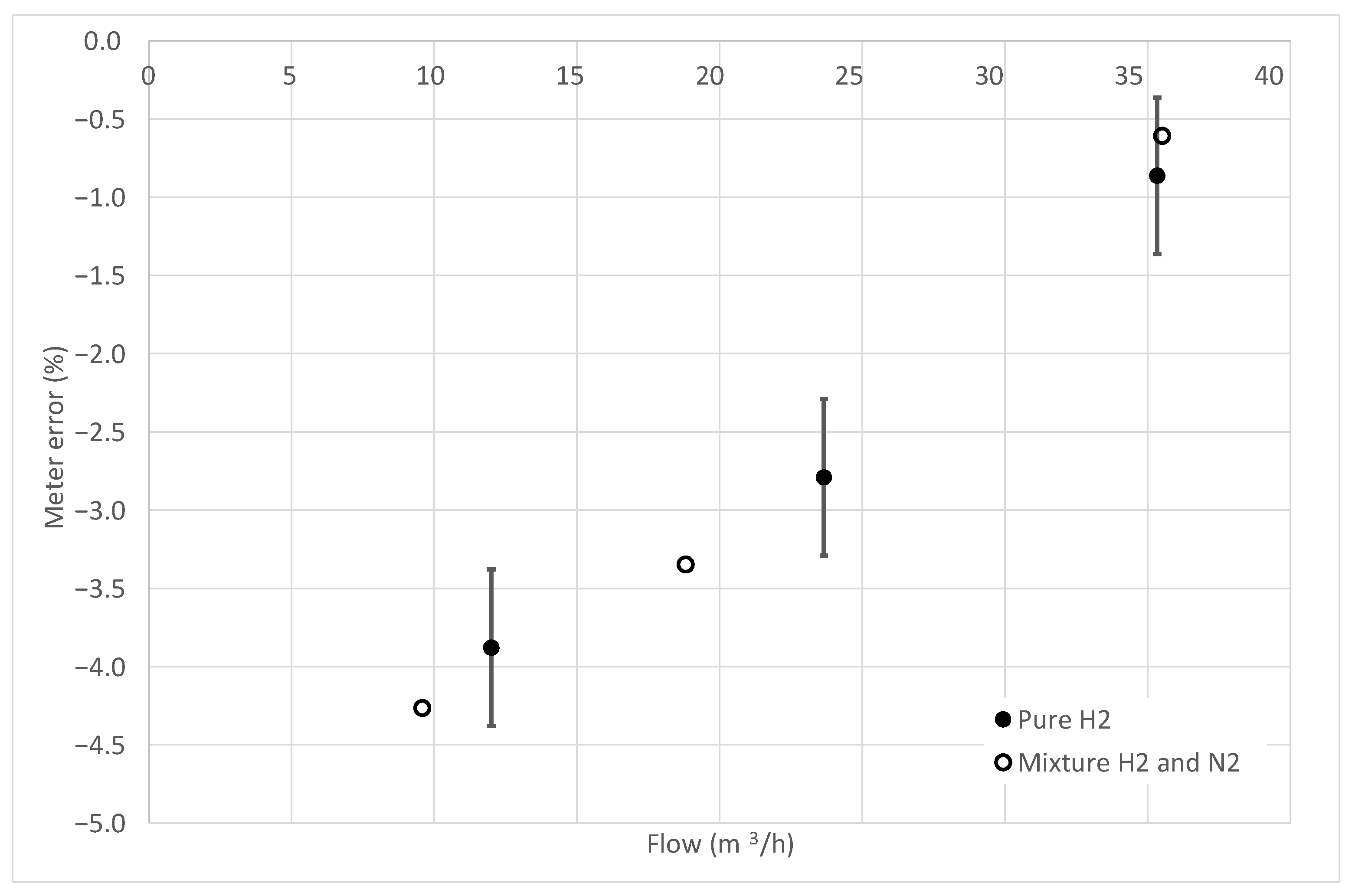
3.3.2. Thermal Mass Flow Meter
3.3.3. Tests with Pure Hydrogen and Hydrogen with Impurities: Discussion
- The accuracy of the ultrasonic meter, originally designed for pure hydrogen, is significantly disturbed by the impurities. The impurities increase the density of the mixture by 25%, which may explain the difference.
- When using a thermal mass meter, the impurities do not seem to affect the accuracy of the volume flow rate measurement. This can be explained by the similar heat capacity at constant pressure for both hydrogen and nitrogen (used as the impurity). However, the meter error was large at lower flow rates even with pure hydrogen, so results must be interpreted carefully. In addition, for impurities with significantly different molar heat capacities (typically non-diatomic gases such as methane), larger differences could be expected.
4. Conclusions
Author Contributions
Funding
Data Availability Statement
Acknowledgments
Conflicts of Interest
Appendix A

| Flow Rates (m3/h) | ||||||
|---|---|---|---|---|---|---|
| Meter | Pressure | Institution | Low * | 16, 40 | 64, 112 | 160 |
| Rotary | 1 atm | VSL (bef. + aft.) | Air | |||
| Meter | CESAME | Air | ||||
| 8 bar | VSL (bef. + aft.) | NG, HENG | ||||
| FORCE | HENG | NG, HENG | ||||
| CESAME | Air | |||||
| 60 bar | VSL, FORCE ** | NG, HENG | ||||
| Ultrasonic | 8 bar | VSL | NG, HENG | |||
| meter | FORCE | HENG | NG, HENG | |||
| 60 bar | VSL, FORCE | NG, HENG | ||||
| Flow | Error of the Meter | Error of the Meter | Difference |
|---|---|---|---|
| (m3/h) | (March 24, %) | (March 25, %) | (%) |
| 16 | 0.09 | 0.05 | −0.04 |
| 40 | 0.12 | 0.15 | 0.03 |
| 64 | 0.13 | 0.17 | 0.04 |
| 112 | 0.16 | 0.26 | 0.10 |
| 160 | 0.04 | 0.17 | 0.13 |
| Flow | Error of the Meter | Error of the Meter | Difference |
|---|---|---|---|
| (m3/h) | (March 24, %) | (March 25, %) | (%) |
| 16 | 1.11 | 1.99 | 0.88 |
| 40 | 1.79 | 1.74 | −0.05 |
| 64 | 1.58 | 1.73 | 0.15 |
| 112 | 0.43 | 0.64 | 0.21 |
| 160 | 0.05 | 0.28 | 0.23 |
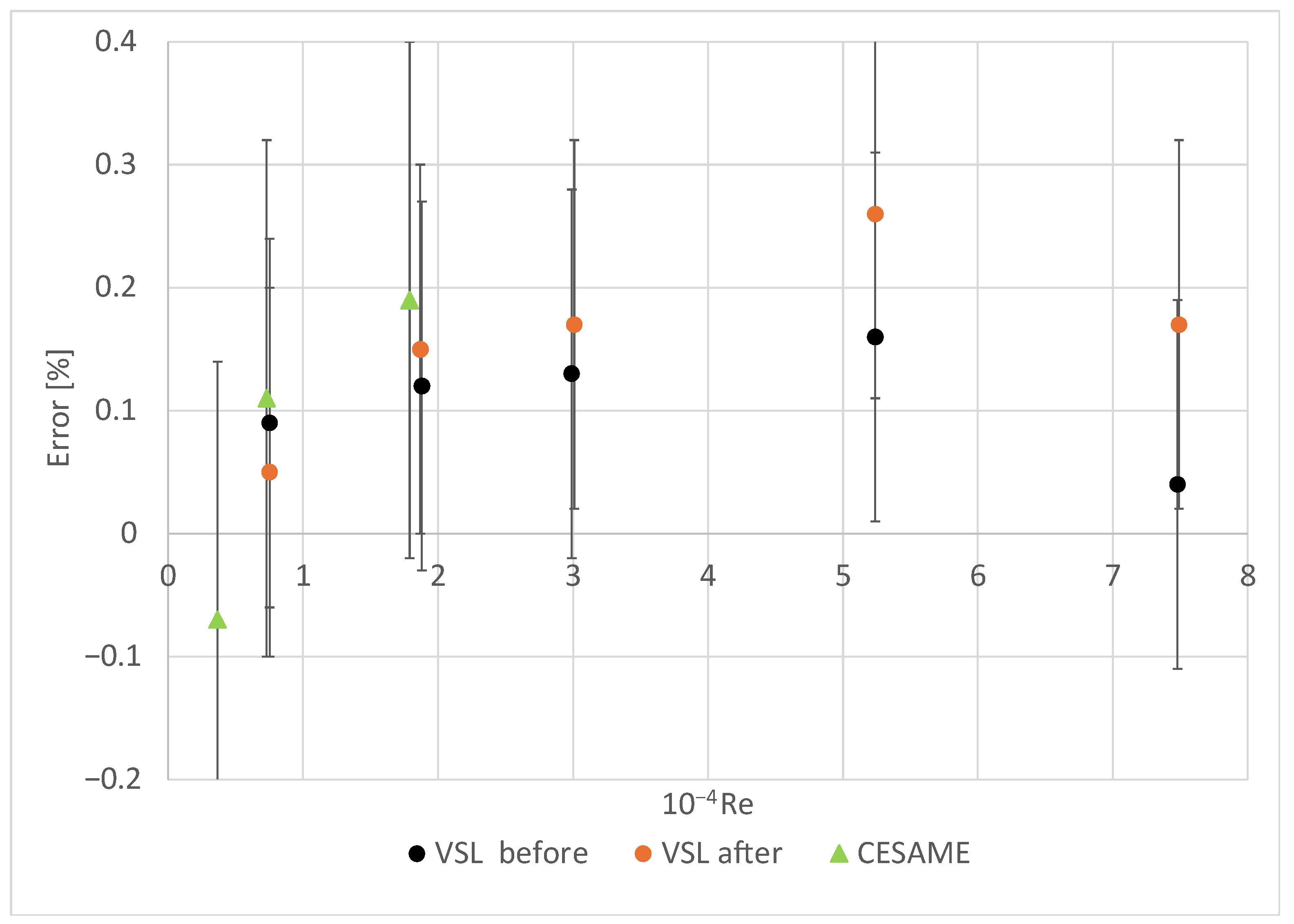
| Laboratory | Re | Error | Uncertainty |
|---|---|---|---|
| (×10−4) | (%) | (k = 2, %) | |
| VSL before | 0.7523 | 0.09 | 0.15 |
| 1.878 | 0.12 | 0.15 | |
| 2.995 | 0.13 | 0.15 | |
| 5.235 | 0.16 | 0.15 | |
| 7.477 | 0.04 | 0.15 | |
| VSL after | 0.7519 | 0.05 | 0.15 |
| 1.871 | 0.15 | 0.15 | |
| 3.006 | 0.17 | 0.15 | |
| 5.240 | 0.26 | 0.15 | |
| 7.487 | 0.17 | 0.15 | |
| CESAME | 0.3673 | −0.07 | 0.21 |
| 0.7316 | 0.11 | 0.21 | |
| 1.792 | −0.19 | 0.21 |
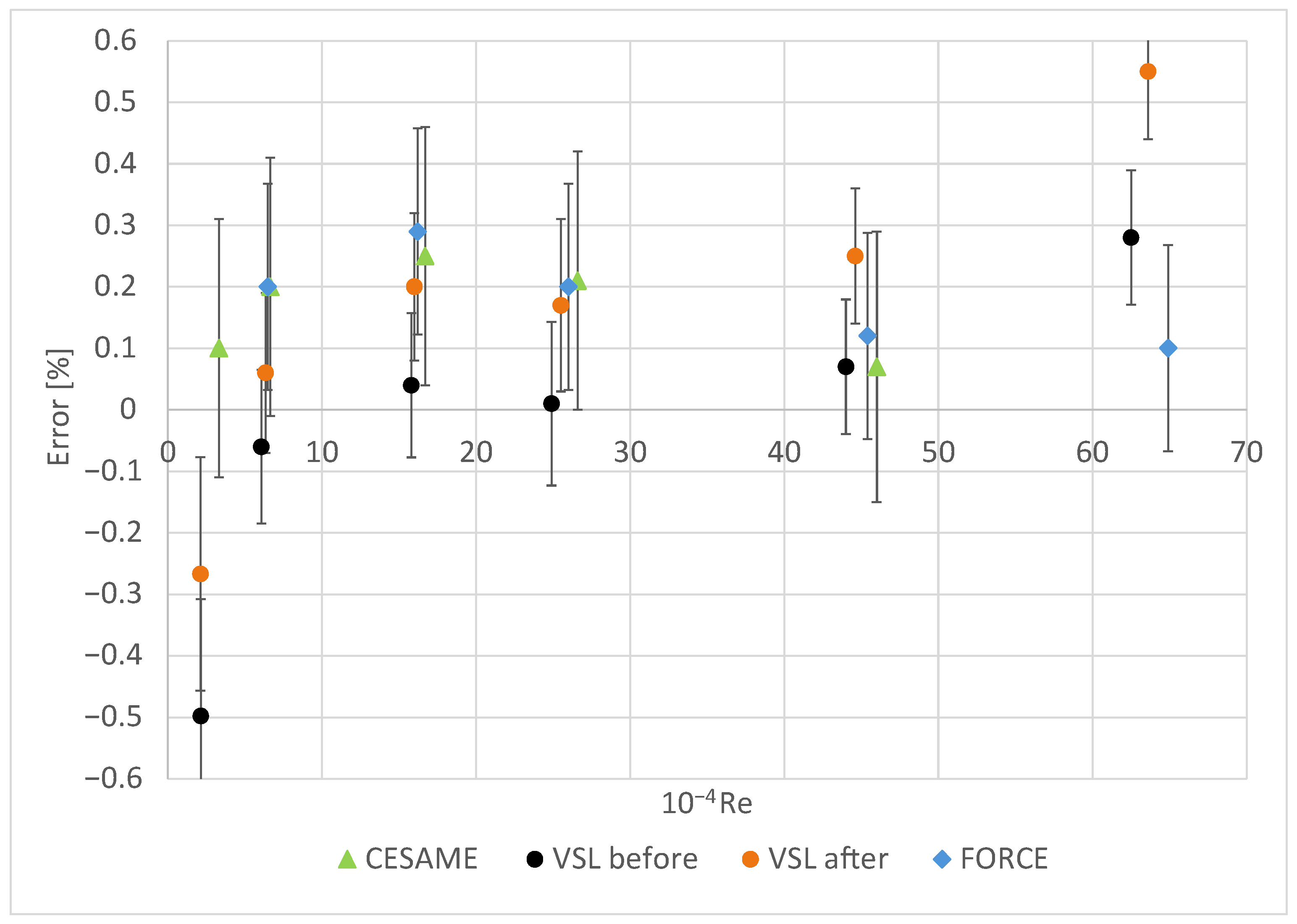
| Laboratory | Re | Error | Uncertainty |
|---|---|---|---|
| (×10−4) | (%) | (k = 2, %) | |
| VSL before | 2.132 | −0.57 | 0.19 |
| 6.072 | −0.06 | 0.13 | |
| 15.76 | 0.04 | 0.12 | |
| 24.90 | 0.01 | 0.13 | |
| 43.97 | 0.07 | 0.11 | |
| 62.50 | 0.28 | 0.11 | |
| VSL after | 2.119 | −0.32 | 0.19 |
| 6.342 | 0.06 | 0.13 | |
| 16.02 | 0.20 | 0.12 | |
| 25.54 | 0.17 | 0.14 | |
| 44.59 | 0.25 | 0.11 | |
| 63.63 | 0.55 | 0.11 | |
| FORCE | 6.490 | 0.20 | 0.17 |
| 16.22 | 0.29 | 0.17 | |
| 25.96 | 0.20 | 0.17 | |
| 45.42 | 0.12 | 0.17 | |
| 64.91 | 0.10 | 0.17 | |
| CESAME | 3.306 | 0.10 | 0.21 |
| 6.645 | 0.20 | 0.21 | |
| 16.67 | 0.25 | 0.21 | |
| 26.65 | 0.21 | 0.21 | |
| 46.01 | 0.07 | 0.22 |
| Laboratory | Re | Error | Uncertainty |
|---|---|---|---|
| (×10−4) | (%) | (k = 2, %) | |
| VSL before | 1.553 | −0.24 | 0.22 |
| 4.920 | 0.02 | 0.13 | |
| 12.15 | 0.15 | 0.12 | |
| 19.14 | 0.18 | 0.14 | |
| 34.04 | 0.19 | 0.11 | |
| 48.16 | 0.33 | 0.11 | |
| VSL after | 1.689 | −0.52 | 0.21 |
| 5.389 | −0.01 | 0.13 | |
| 13.32 | 0.19 | 0.12 | |
| 21.28 | 0.18 | 0.13 | |
| 36.90 | 0.18 | 0.11 | |
| 52.81 | 0.39 | 0.11 | |
| FORCE | 1.636 | 0.29 | 0.17 |
| 5.237 | 0.18 | 0.17 | |
| 13.09 | 0.26 | 0.17 | |
| 20.95 | 0.19 | 0.17 | |
| 36.70 | 0.09 | 0.17 | |
| 52.50 | 0.07 | 0.17 |
| Laboratory | Re | Error | Uncertainty |
|---|---|---|---|
| (×10−4) | (%) | (k = 2, %) | |
| VSL | 13.47 | −0.03 | 0.22 |
| 42.14 | −0.14 | 0.13 | |
| 107.8 | 0.05 | 0.12 | |
| 173.0 | 0.11 | 0.14 | |
| 299.6 | 0.16 | 0.11 | |
| FORCE | 13.73 | 0.05 | 0.17 |
| 43.92 | 0.05 | 0.17 | |
| 109.8 | 0.19 | 0.17 | |
| 175.6 | 0.22 | 0.17 | |
| 307.2 | 0.21 | 0.17 | |
| 384.4 | 0.17 | 0.17 |
| Laboratory | Re | Error | Uncertainty |
|---|---|---|---|
| (×10−4) | (%) | (k = 2, %) | |
| VSL | 10.81 | −0.09 | 0.22 |
| 36.14 | −0.16 | 0.13 | |
| 88.87 | −0.06 | 0.10 | |
| 143.2 | 0.03 | 0.10 | |
| 249.4 | 0.05 | 0.10 | |
| FORCE | 10.52 | 0.19 | 0.17 |
| 33.68 | 0.06 | 0.17 | |
| 84.19 | 0.20 | 0.17 | |
| 135.9 | 0.16 | 0.17 | |
| 169.8 | 0.21 | 0.17 | |
| 212.4 | 0.16 | 0.17 |
| Laboratory | Re | Error | Uncertainty | Base Uncert. |
|---|---|---|---|---|
| (×10−4) | (%) | (k = 2, %) | (k = 2, %) | |
| VSL | 1.937 | 1.67 | 0.56 | 0.23 |
| 6.079 | 0.46 | 0.53 | 0.14 | |
| 15.23 | 0.68 | 0.52 | 0.09 | |
| 24.45 | 0.69 | 0.52 | 0.11 | |
| 42.85 | 0.90 | 0.52 | 0.09 | |
| 61.25 | 1.28 | 0.51 | 0.08 | |
| FORCE | 2.082 | 1.31 | 0.53 | 0.15 |
| 6.675 | 0.19 | 0.53 | 0.15 | |
| 16.66 | 0.28 | 0.53 | 0.15 | |
| 26.65 | 0.27 | 0.53 | 0.15 | |
| 46.63 | 0.17 | 0.53 | 0.15 | |
| 66.59 | 0.00 | 0.53 | 0.15 |
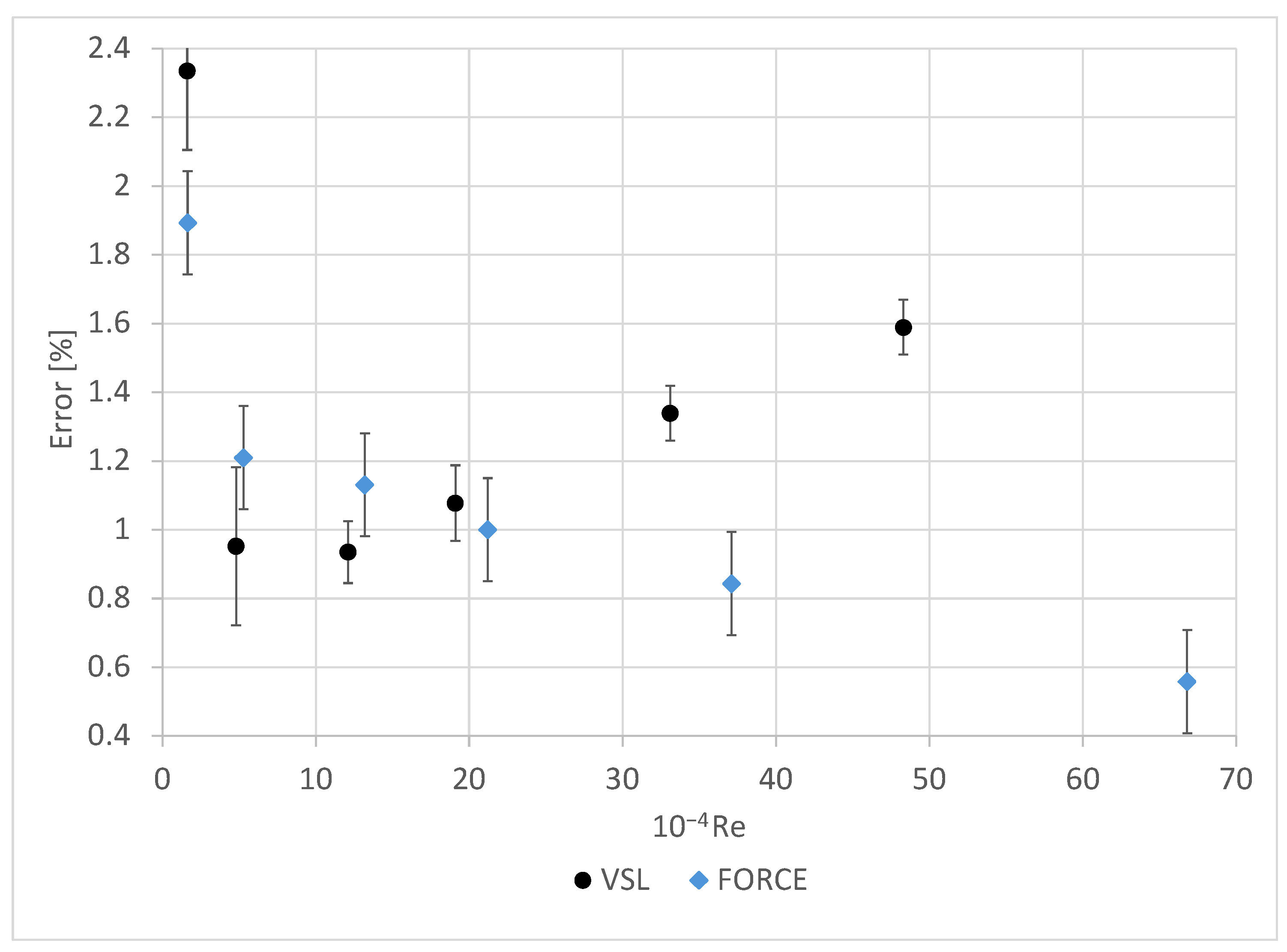
| Laboratory | Re | Error | Uncertainty | Base Uncert. |
|---|---|---|---|---|
| (×10−4) | (%) | (k = 2, %) | (k = 2, %) | |
| VSL | 1.616 | 2.34 | 0.56 | 0.23 |
| 4.800 | 0.95 | 0.56 | 0.23 | |
| 12.06 | 0.93 | 0.52 | 0.09 | |
| 19.14 | 1.09 | 0.52 | 0.11 | |
| 33.07 | 1.34 | 0.51 | 0.08 | |
| 48.27 | 1.59 | 0.51 | 0.08 | |
| FORCE | 1.651 | 1.89 | 0.53 | 0.15 |
| 5.284 | 1.21 | 0.53 | 0.15 | |
| 13.21 | 1.13 | 0.53 | 0.15 | |
| 21.16 | 1.00 | 0.53 | 0.15 | |
| 37.11 | 0.84 | 0.53 | 0.15 | |
| 66.75 | 0.56 | 0.53 | 0.15 |
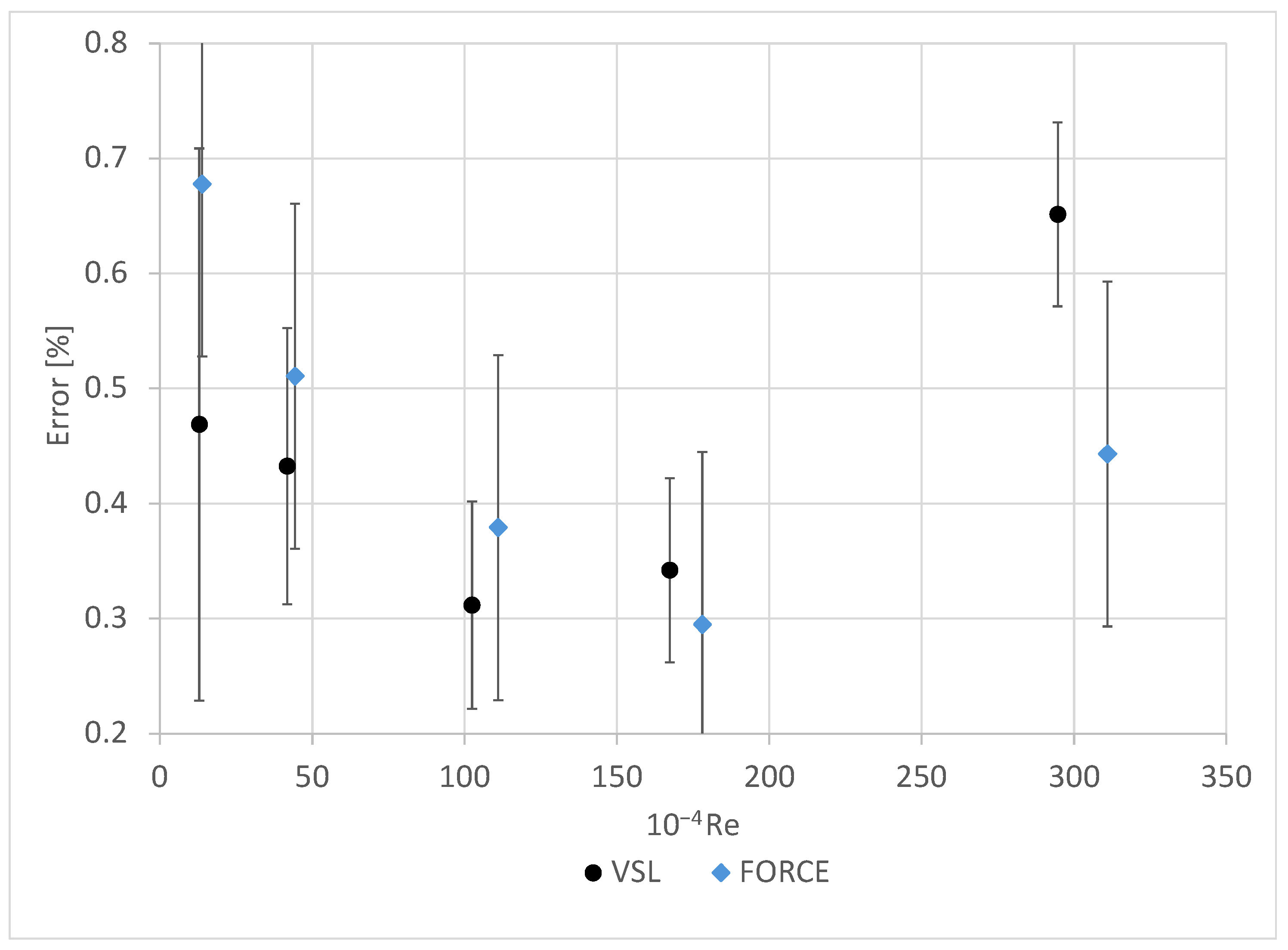
| Laboratory | Re | Error | Uncertainty | Base Uncert. |
|---|---|---|---|---|
| (×10−4) | (%) | (k = 2, %) | (k = 2, %) | |
| VSL | 12.94 | 0.47 | 0.56 | 0.24 |
| 41.87 | 0.43 | 0.52 | 0.12 | |
| 102.4 | 0.31 | 0.52 | 0.09 | |
| 167.3 | 0.34 | 0.52 | 0.08 | |
| 294.6 | 0.65 | 0.51 | 0.08 | |
| FORCE | 13.88 | 0.68 | 0.53 | 0.15 |
| 44.42 | 0.51 | 0.53 | 0.15 | |
| 111.0 | 0.38 | 0.53 | 0.15 | |
| 177.7 | 0.29 | 0.53 | 0.15 | |
| 311.3 | 0.44 | 0.53 | 0.15 |
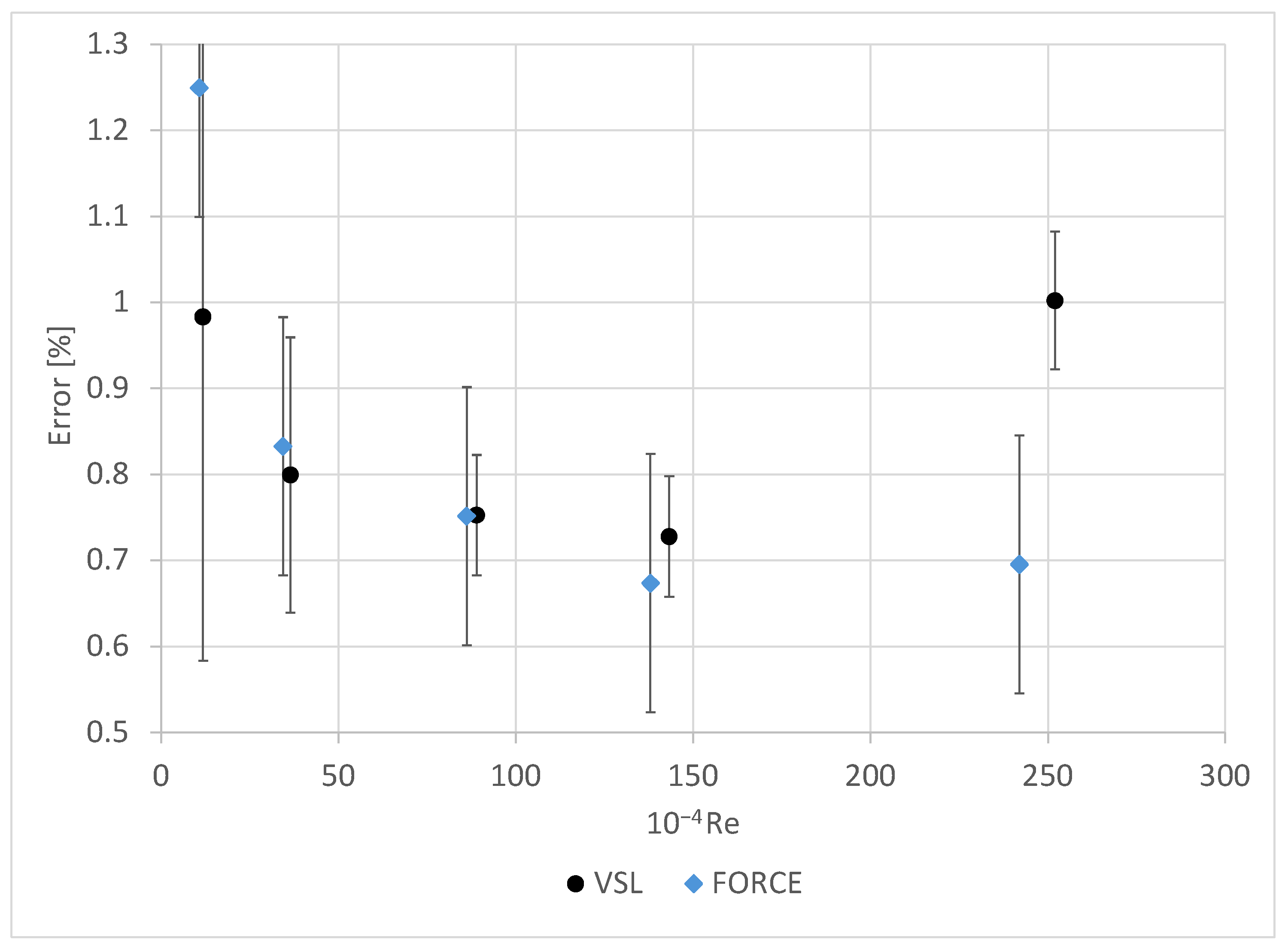
| Laboratory | Re | Error | Uncertainty | Base Uncert. |
|---|---|---|---|---|
| (×10−4) | (%) | (k = 2, %) | (k = 2, %) | |
| VSL | 10.8 | 1.25 | 0.65 | 0.40 |
| 34.4 | 0.83 | 0.52 | 0.16 | |
| 86.2 | 0.75 | 0.52 | 0.07 | |
| 138 | 0.67 | 0.52 | 0.07 | |
| 242 | 0.70 | 0.51 | 0.08 | |
| FORCE | 11.33 | 1.80 | 0.53 | 0.15 |
| 36.22 | 1.56 | 0.53 | 0.15 | |
| 90.49 | 1.32 | 0.53 | 0.15 | |
| 144.9 | 1.25 | 0.53 | 0.15 | |
| 253.4 | 1.35 | 0.53 | 0.15 |
| Gas | Reference Volume Flow Rate (m3/h) | Error (%) | Gage Pressure at the Meter (Pa) | TDUT (°C) |
|---|---|---|---|---|
| Pure | 15.57 | −2.35 | 243 | 18.97 |
| hydrogen | −0.10 | 0.80 | 113 | 18.81 |
| 6.223 | −0.65 | 41 | 18.96 | |
| 4.118 | −0.12 | 16 | 19.15 | |
| 1.249 | 0.03 | −8 | 19.74 | |
| 0.386 | −0.42 | −13 | 21.13 | |
| Hydrogen | 15.69 | −3.47 | 301 | 22.89 |
| with | 10.65 | −1.61 | 144 | 18.52 |
| impur. | 6.056 | −1.68 | 49 | 20.30 |
| 4.085 | −0.91 | 20 | 18.54 | |
| 1.268 | −0.29 | −6 | 23.75 | |
| 0.3869 | 1.54 | −12 | 20.75 | |
| Pure | 10.89 | −3.05 | 904 | 12.81 |
| nitrogen | 6.029 | −5.09 | 348 | 16.57 |
| 4.312 | −5.12 | 183 | 16.48 | |
| 1.247 | −3.44 | 33 | 17.14 | |
| 0.403 | −1.80 | 14 | 22.11 | |
| 0.036 | 4.10 | 15 | 20.53 |
| Gas | Reference Volume Flow Rate (m3/h) | Error (%) | Gage Pressure at the Meter (hPa) | TDUT (°C) |
|---|---|---|---|---|
| Pure | 35.33 | −0.86 | 83.26 | 22.18 |
| hydrogen | 23.65 | 44.74 | 44.74 | 22.41 |
| 11.99 | −3.88 | 17.30 | 22.49 | |
| Hydrogen | 35.50 | −0.61 | 99.10 | 22.66 |
| with | 18.80 | −3.35 | 36.87 | 22.69 |
| impur. | 9.574 | −4.27 | 14.61 | 22.72 |
References
- European Commission and Directorate-General for Communication. The European Green Deal–Delivering the EU’s 2030 Climate Targets; Publications Office of the European Union: Luxembourg, 2023. [Google Scholar] [CrossRef]
- The European Hydrogen Backbone. 2025. Available online: https://ehb.eu (accessed on 8 July 2025).
- Alternative Fuels Data Center-Hydrogen Benefits and Consideration. 2025. Available online: https://afdc.energy.gov/fuels/hydrogen-benefits (accessed on 29 December 2025).
- Murugan, A.; Omoniyi, O.; Richardson, E.; Workamp, M.; Baldan, A. Vision for a European metrology network for energy gases. Environ. Res. Infrastruct. Sustain. 2022, 2, 012003. [Google Scholar] [CrossRef]
- Metrology for Decarbonising the Gas Grid, DECARB. 2025. Available online: https://www.decarbgrid.eu/ (accessed on 9 July 2025).
- Flow Metering of Renewable Gases, NEWGASMET. 2025. Available online: https://newgasmet.eu/ (accessed on 9 July 2025).
- New Methods of Testing for Measurement of Natural Gas and Hydrogen Mixtures, THOTH2. 2025. Available online: https://thoth2.eu/ (accessed on 9 July 2025).
- Metrology Infrastructure for High-Pressure Gas and Liquified Hydrogen Flows, MetHyInfra. 2025. Available online: https://www.methyinfra.ptb.de/the-project/ (accessed on 9 July 2025).
- MacDonald, M.; Anderson, D.; Kramer, R.; Weyhe, M.; Schumann, D.; Böckler, H.B.; Workamp, M.; Schakel, M. Conformity assessment of domestic and commercial gas meters for usage with hydrogen enriched natural gas and pure hydrogen. Flow Meas. Instrum. 2024, 97, 102594. [Google Scholar] [CrossRef]
- Matsuda, M.; Takakura, Y.; Nakabayashi, Y.; Morioka, T. Ultrasonic gas flow and concentration measurement in hydrogen and nitrogen gas mixtures. Meas. Sens. 2025, 38, 101535. [Google Scholar] [CrossRef]
- Chinello, G.; de Kater, A.; Sadri, M.; Modrego, J.; van Putten, D.; Stiphout, W.; Workamp, M.; Anderson, D. Calibration facilities and test results for gas network hydrogen and hydrogen enriched natural gas flow meters. Int. J. Hydrogen Energy 2025, 160, 150431. [Google Scholar] [CrossRef]
- EURAMET e.V. European Reference for Gas. 2025. Available online: https://www.euramet.org/research-innovation/search-research-projects/details/project/eurega-1 (accessed on 9 July 2025).
- ISO 14687:2025; Hydrogen Fuel Quality—Product Specification. International Organization for Standardization: Geneva, Switzerland, 2025.
- Metrology for the Hydrogen Supply Chain, Met4H2. 2025. Available online: https://met4h2.eu/ (accessed on 9 July 2025).
- Gas Meters. OIML R137:2012. 2012. Available online: https://www.oiml.org/en/files/pdf_r/r137-1-2-e12.pdf (accessed on 20 January 2026).
- Measuring Systems for Gaseous Fuel. OIML R140:2007. 2007. Available online: https://www.oiml.org/en/files/pdf_r/r140-e07.pdf (accessed on 20 January 2026).
- Directive 2014/32/EU of the European Parliament and of the Council of 26 February 2014 on the Harmonisation of the Laws of the Member States Relating to the Making Available on the Market of Measuring Instruments (Recast). 2014. Available online: https://eur-lex.europa.eu/eli/dir/2014/32/oj/eng (accessed on 20 April 2016).
- Wright, J.; Toman, B.; Mickan, B.; Wübbeler, G.; Bodnar, O.; Elster, C. Transfer standard uncertainty can cause inconclusive inter-laboratory comparisons. Metrologia 2016, 53, 1243. [Google Scholar] [CrossRef] [PubMed]





| Ultrasonic Meter | Rotary Meter | |
|---|---|---|
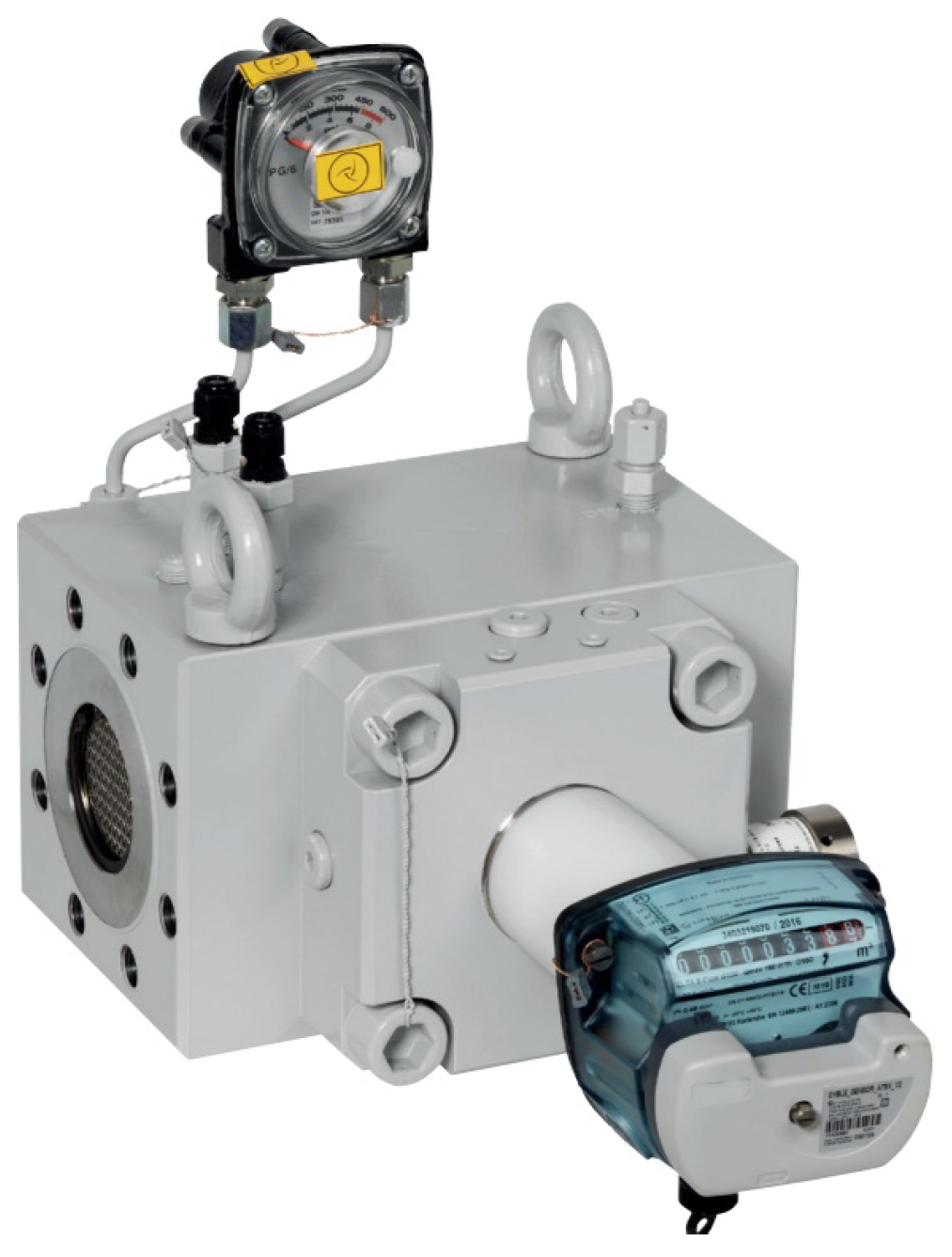
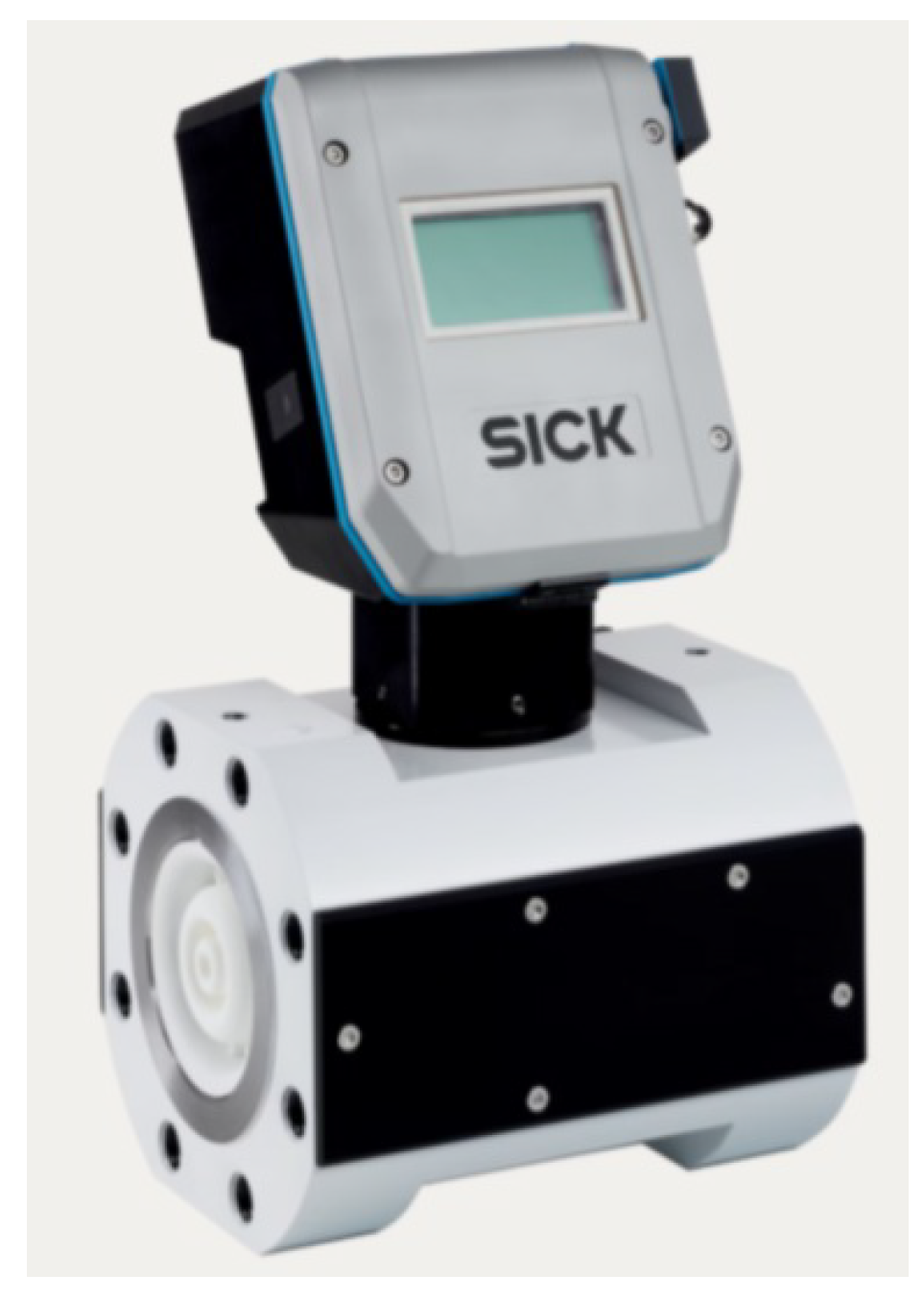
| Flow range (m3/h) | 2.5 to 200 | 0.8 to 160 |
| Min. pressure (bar) | 5 | 1 |
| Max. pressure (bar) | 98 | 101.2 |
| Participants | VSL, FORCE | VSL, FORCE, CESAME |
| Ultrasonic Meter 2 | Thermal Mass Meter | |
|---|---|---|
| Flow range | 0.4 to 15 m3/h | 1.0 to 4 kg/h |
| Accuracy class | 1.5 | Not specified |
| Participant | VSL | NEL |
Disclaimer/Publisher’s Note: The statements, opinions and data contained in all publications are solely those of the individual author(s) and contributor(s) and not of MDPI and/or the editor(s). MDPI and/or the editor(s) disclaim responsibility for any injury to people or property resulting from any ideas, methods, instructions or products referred to in the content. |
© 2026 by the authors. Licensee MDPI, Basel, Switzerland. This article is an open access article distributed under the terms and conditions of the Creative Commons Attribution (CC BY) license.
Share and Cite
Mussard, M.; De Huu, M.; Maury, R.; Nordhjort Mjølna, L.C.; Valenta, T.; Sadri, M.; Starke, E.; Pinson, P.; Workamp, M.; Veen, A.M.H.v.d. Gas Flow Metering Using National Standards and Gas Mixtures Containing Hydrogen. Hydrogen 2026, 7, 19. https://doi.org/10.3390/hydrogen7010019
Mussard M, De Huu M, Maury R, Nordhjort Mjølna LC, Valenta T, Sadri M, Starke E, Pinson P, Workamp M, Veen AMHvd. Gas Flow Metering Using National Standards and Gas Mixtures Containing Hydrogen. Hydrogen. 2026; 7(1):19. https://doi.org/10.3390/hydrogen7010019
Chicago/Turabian StyleMussard, Maxime, Marc De Huu, Rémy Maury, Loucie Cirkeline Nordhjort Mjølna, Tomáš Valenta, Mahdi Sadri, Eric Starke, Pieter Pinson, Marcel Workamp, and Adriaan M. H. van der Veen. 2026. "Gas Flow Metering Using National Standards and Gas Mixtures Containing Hydrogen" Hydrogen 7, no. 1: 19. https://doi.org/10.3390/hydrogen7010019
APA StyleMussard, M., De Huu, M., Maury, R., Nordhjort Mjølna, L. C., Valenta, T., Sadri, M., Starke, E., Pinson, P., Workamp, M., & Veen, A. M. H. v. d. (2026). Gas Flow Metering Using National Standards and Gas Mixtures Containing Hydrogen. Hydrogen, 7(1), 19. https://doi.org/10.3390/hydrogen7010019