Article

Heavy-Metal Contamination, Transfer Factors, and Health-Risk Assessment in Roadside Soils and Crops Along a Major Highway in South Kazakhstan


by
Zhangeldi Kurganbekov
,
Aspondiyar Utebayev
* and
Akbota Aitimbetova
*
Higher School of Chemical Engineering and Biotechnology, South Kazakhstan University Named After M. Auezov, 5 Tauke Khan Ave, 160000 Shymkent, Kazakhstan
*
Authors to whom correspondence should be addressed.
Ecologies 2026, 7(2), 47; https://doi.org/10.3390/ecologies7020047
Submission received: 8 April 2026 / Revised: 13 May 2026 / Accepted: 19 May 2026 / Published: 22 May 2026

Abstract

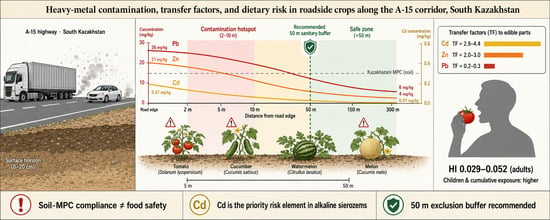
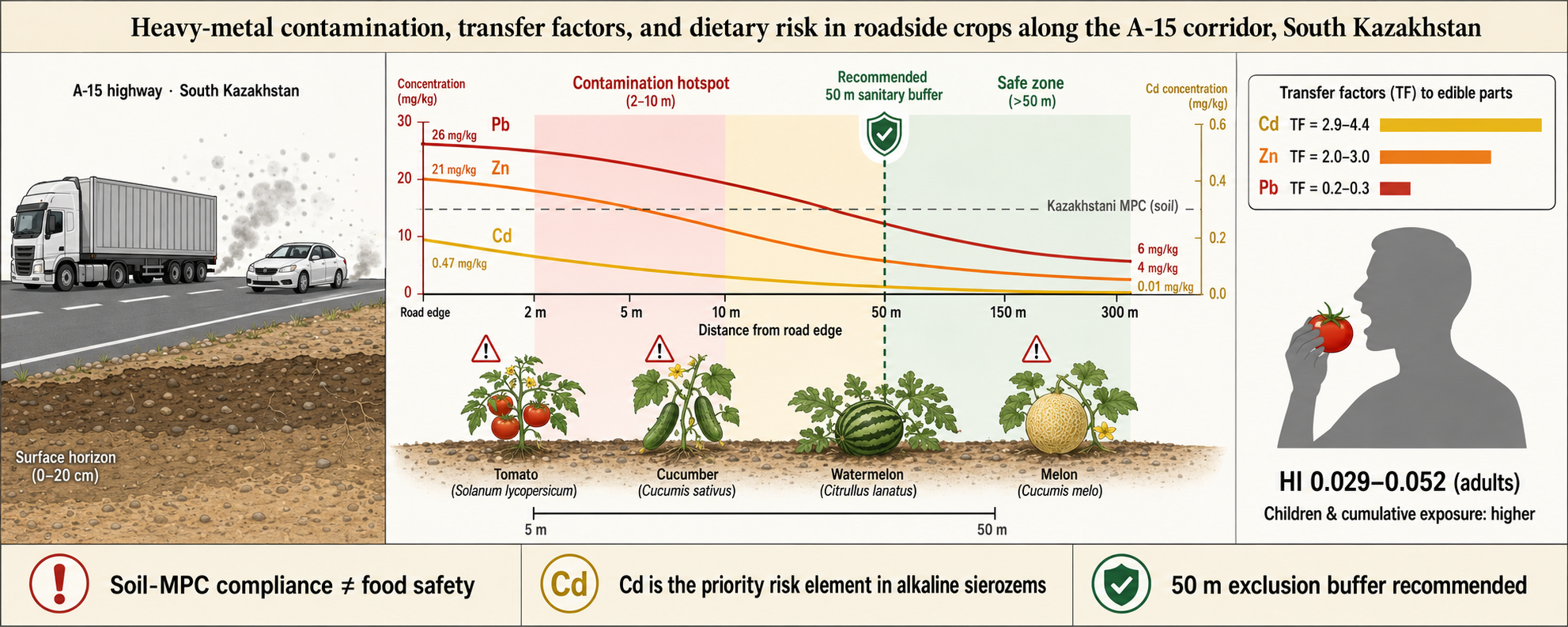
The Shymkent–Saryagash–Abay (A-15) international highway is a major Kazakhstan–Uzbekistan freight corridor that runs through the irrigated horticultural belt of the Turkestan Region in South Kazakhstan, where adjacent fields supply vegetables and cucurbits to the regional market. Composite soil samples (n = 18) were taken at six distances (2–300 m) from the road edge across three locations during 2022–2023, along with edible fruits of tomato, cucumber, watermelon, and melon (n = 12) from the adjoining fields. Pb, Zn, and Cd were measured via flame atomic absorption spectrometry after HNO3/H2O2 digestion. Soil concentrations decreased sharply with distance (Pb: 26.3 → 5.98 mg kg−1; Zn: 21.29 → 4.16; Cd: 0.47 → 0.01 mg kg−1), exceeding the national soil MPCs by 1.5–3 times within 2–10 m. Pb and Zn exceeded the Kazakhstani food-safety MPCs in all four crops, and Cd in three of four (tomato, cucumber, and melon). Transfer factors followed the order of Cd (2.90–4.40) > Zn (1.99–3.00) > Pb (0.16–0.30), and the Cd geo-accumulation index ranged from 1.05 to 1.65 at 2–5 m. Adult dietary risk was acceptable (HI = 0.029–0.052; CR < 1.7 × 10⁻⁶), yet food-safety exceedances support a precautionary sanitary buffer and combined soil-and-crop monitoring along the corridor.

Graphical Abstract

1. Introduction

The southern part of the Republic of Kazakhstan is one of the country’s key agricultural regions. The Turkestan Region plays a vital role in crop production and national food security. According to recent government statistics, agricultural land in Kazakhstan covers about 19.1 million hectares, of which more than 520,000 hectares are in the Turkestan Region [1]. The region lies at the intersection of several international transport corridors, and major highways connecting Kazakhstan with neighboring states traverse irrigated fields and horticultural areas, directly exposing agricultural land to technogenic impacts from intensive road traffic.
Several converging pressures make roadside heavy-metal contamination particularly acute yet understudied in the Saryagash district. First, freight traffic along Kazakhstan’s international transport corridors has grown rapidly over the past decade, driven by cross-border trade with China, Uzbekistan, and the Russian Federation; the A-15 Shymkent–Saryagash–Abay highway is a principal southern route carrying this traffic year-round. Second, the Saryagash district’s predominant gray–brown sierozems have a distinct geochemical profile—alkaline reaction, low organic matter, and high carbonate content—that, together with the semi-arid climate and intense evapotranspiration, concentrates trace elements in the surface horizon and favors retention of Pb and Zn while leaving Cd in a comparatively mobile, bioavailable form. Third, no nationwide program for heavy-metal monitoring in dietary produce grown roadside is currently operational in Kazakhstan. The existing SanRaN RK 4.01.071.04 (2004) framework prescribes both soil and food MPCs but does not specify enforcement mechanisms along major transport corridors. Fourth, the Saryagash district is a principal supplier of fresh tomatoes, cucumbers, watermelons, and melons to the southern Kazakhstani market and to neighboring Uzbekistan, with cultivated fields routinely located within tens of meters of the highway edge. Together, these factors form a public health concern that, despite its evident relevance, has not been the subject of an integrated empirical assessment.
Road transport is a primary source of heavy-metal (HM) contamination in roadside environments. Fuel combustion, tire and brake pad abrasion, and asphalt weathering release trace elements such as Pb, Cd, Zn, Cu, and Ni, which accumulate in roadside soils and dust [2,3]. Metal concentrations peak within the first 5–10 m from the road edge and decline with increasing distance [4,5]. A recent global synthesis confirmed that road transport is a major contributor to HM loading in agroecosystems worldwide, threatening food safety and public health [6].
Pb and Cd are of particular concern because of their cumulative toxicity [7,8]. Chronic lead exposure causes neurodevelopmental disorders in children and cardiovascular disease in adults [8]. Vegetables and cucurbits are important dietary components in South Kazakhstan; the Bureau of National Statistics of the Republic of Kazakhstan reports that horticultural production in the Turkestan Region—including the Saryagash district—supplies a major share of the regional market for these crops [1], which readily accumulate HMs from contaminated soil and transfer them to human consumers [9,10]. Elevated concentrations of Pb, Cd, and Zn in roadside vegetables that exceed food-safety limits have been reported across multiple regions of Asia, Africa, and Australasia [3,11,12,13].
Quantitative evaluation using geochemical indices (geo-accumulation index, Igeo; pollution load index, PLI) and health-risk assessment (HRA) following US EPA methodology are now standard practice in roadside HM studies [14,15].
Three specific knowledge gaps motivate this work. First, no integrated assessment combining soil contamination, transfer factors, geochemical indices, and dietary health risk has been published for any Central Asian roadside agroecosystem. Although existing regional work—including a recent doctoral assessment of soil–plant heavy-metal migration in vegetable cultivation across the Turkestan Region [16]—has documented soil concentrations and their transfer to crops separately, these data have not yet been brought together in a single framework that combines soil pollution indices (Igeo, PLI), transfer factor analysis, and a US EPA-type dietary health-risk assessment for the four most consumed crops along an active high-traffic corridor. Second, transfer factor data for cucurbits grown on alkaline sierozem soils are essentially absent from the literature, even though cucurbits are among the open-field crops with the highest volume in southern Kazakhstan. Third, dietary health-risk assessments for the four most locally consumed crops—tomato, cucumber, watermelon, and melon—have not previously been conducted for produce grown along the country’s high-traffic corridors. On this basis, we tested three hypotheses:
H1. 
Pb, Zn, and Cd concentrations in roadside soils decrease monotonically with distance from the road edge along the A-15 corridor.
H2. 
Despite low absolute concentrations in soil, Cd shows the highest soil-to-plant transfer factor among the three elements, owing to its higher mobility under alkaline sierozem conditions.
H3. 
The concentrations of one or more of the three elements in edible fruits exceed Kazakhstani food-safety MPCs in fields cultivated within 5–50 m of the road edge.
Against the pressures and gaps outlined above, the present study contributes a regional integrated assessment that combines, for a Central Asian roadside agroecosystem, soil contamination, transfer factors, geochemical indices, and dietary health-risk assessment in a single framework. To our knowledge, this is the first report of Cd exceedances in cucurbit fruits (cucumber, watermelon, melon) cultivated along the A-15 corridor. The study also documents a divergence between soil-MPC and food-safety-MPC compliance for Pb in this system, which is of practical relevance for roadside monitoring frameworks in Central Asia. We frame these contributions as a regional empirical assessment rather than a conceptual advance.
Specifically, this study aimed to (1) quantify concentrations of Pb, Zn, and Cd in roadside soils at varying distances from a major international highway, (2) determine HM concentrations in four cucurbit and vegetable crops grown in adjacent fields, (3) calculate transfer factors (TFs) for each metal–crop combination, (4) assess geochemical contamination using Igeo, CF, and PLI, and (5) conduct a dietary HRA for adult consumers.

2. Materials and Methods

2.1. Study Area

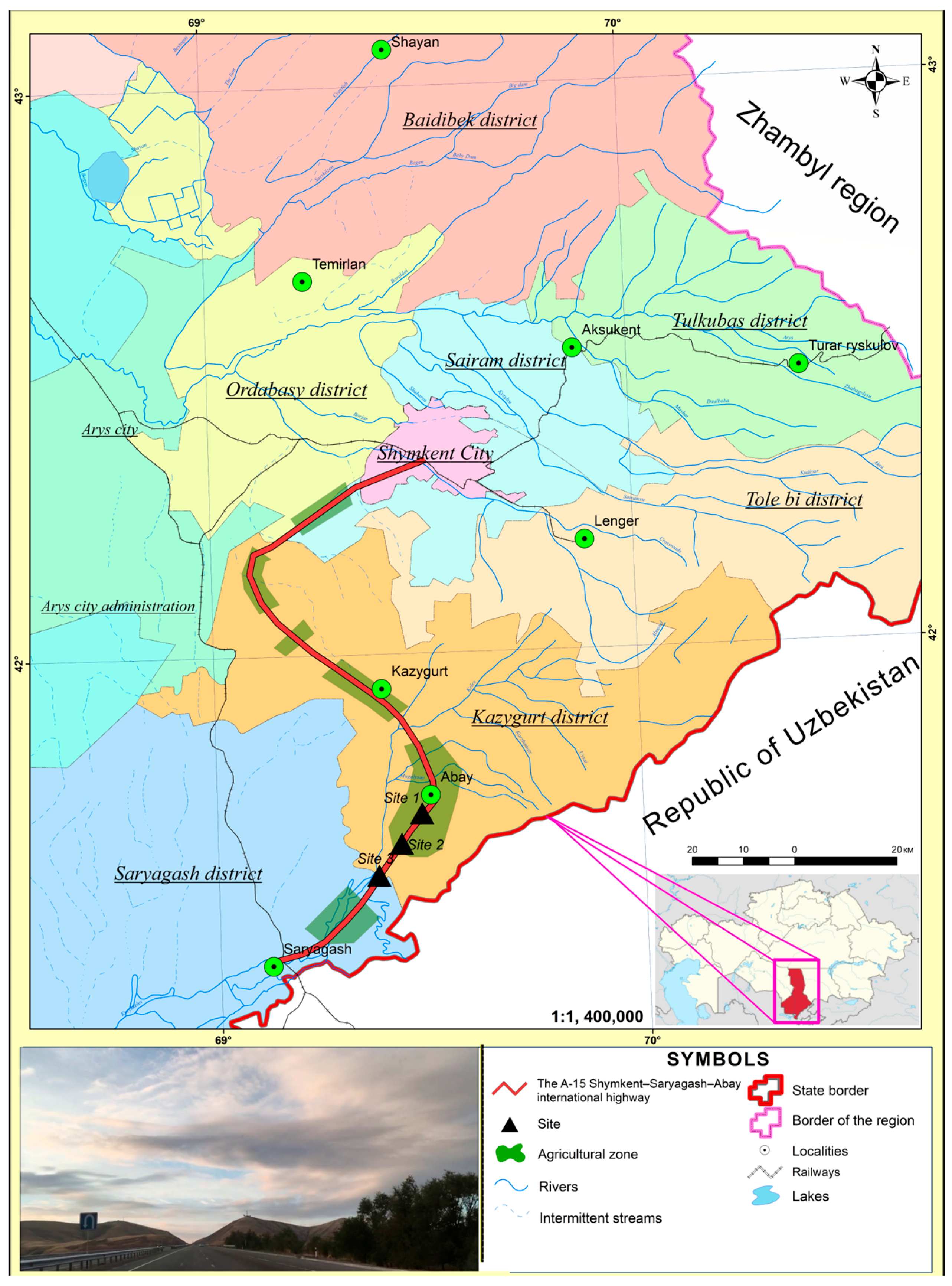
This study was conducted in the Saryagash district, Turkestan Region, South Kazakhstan (41°28′ N, 68°30′ E). The A-15 Shymkent–Saryagash–Abay international highway runs through the district, carrying heavy freight and passenger traffic year-round. The soils in this area are gray–brown sierozems typical of the semi-arid foothill zone of South Kazakhstan, with an alkaline reaction (pH 7.8–8.2), a low organic matter content (0.8–1.5%), and a loamy-to-clay loam texture [16]. Under a semi-arid climate, evapotranspiration substantially exceeds annual precipitation (~200–250 mm), promoting the accumulation of soluble salts and HMs in the surface soil horizon. Background concentrations of Pb (8.4–49.9 mg kg−1), Zn (0.6–17.7 mg kg−1), and Cd (0.23–1.33 mg kg−1) in the agricultural soils of the Turkestan Region have been reported by the Kazhydromet monitoring network [16].

2.2. Sampling Design

Roadside soil was sampled along a 15 km section of the A-15 Shymkent–Saryagash–Abay highway (Figure 1). The corridor runs from northeast to southwest. Sampling was carried out on both sides of the highway at each location, with paired transects established perpendicular to the road on the northwest and southeast sides. This two-sided design was adopted to account for concentration patterns regardless of seasonal variation in the prevailing wind direction in the Saryagash district, and the composite values reported in Table 1 and Table 2 represent averages across both sides of the road at each distance. Sampling was conducted during the dry summer period (July–August 2022 and 2023) to minimize the influence of rainfall-driven leaching and lateral runoff on the measured spatial gradient. At each of the three sampling locations along the 15 km transect, a local field was selected to be free of confounding inputs (no application of mineral phosphate fertilizer, no irrigation with treated wastewater, and no proximity to other point sources within 500 m). At three locations (5, 10, and 15 km from the starting point), composite soil samples were collected at six distances from the road edge: 2, 5, 10, 150, 200, and 300 m. At each distance and on each side of the road, subsamples from the 0–20 cm layer were collected using a stainless-steel auger, homogenized, and combined into a single composite sample. The full design, therefore, comprised 3 locations × 6 distances × 2 sides = 36 composite soil samples; the values reported in Table 1 represent the mean of the two sides at each distance × location combination (n = 18 averaged values, with each value representing the mean of two composite samples). Edible plant samples were collected from adjacent roadside agricultural fields located within 5–50 m of the road edge, which fall within the documented contamination gradient zone [2,4]. These fields were cultivated with tomato (Solanum lycopersicum), cucumber (Cucumis sativus), watermelon (Citrullus lanatus), and melon (Cucumis melo). Only marketable fruits were sampled; five to ten plants were randomly selected from plots approximately 1–5 m2. The sampled fruits were placed in clean polyethylene bags and transported to the laboratory in cool boxes.

2.3. Sample Preparation and Analysis

Sample processing and instrumental analysis followed a uniform protocol for all soil and plant samples, comprising the following sequential steps:
Step 1—Pre-treatment of soil samples. Soil samples were air-dried at room temperature, lightly disaggregated, and passed through a 1 mm stainless-steel sieve to remove gravel, root fragments, and large plant residues.
Step 2—Pre-treatment of plant samples. Edible fruits were rinsed sequentially with tap water, then with deionized water, to remove surface dust and adhering soil particles. Cleaned fruits were oven-dried at 60–70 °C until constant weight was reached (typically 48–72 h), ground in a laboratory mill, and stored in sealed polyethylene containers until digestion.
Step 3—Acid digestion. A 1.0 g aliquot of dried soil or ground plant material was placed in an open digestion vessel, mixed with 10 mL concentrated HNO3 (≥65%, analytical grade) and 2 mL H2O2 (30%, analytical grade), and heated at 120 °C for 4 h.
Step 4—Filtration and dilution. After cooling to room temperature, digests were filtered through acid-washed quantitative filter papers and diluted to a final volume of 25 mL with deionized water in volumetric flasks.
Step 5—Instrumental analysis. Concentrations of Pb, Zn, and Cd in the diluted digests were determined via flame atomic absorption spectrometry (AAS) on a Shimadzu AA-7000 (Shimadzu Corporation, Kyoto, Japan), using element-specific hollow-cathode lamps and an air–acetylene flame.
Step 6—Calibration, quality control, and uncertainty. Calibration curves were constructed for each element using certified multi-element standard solutions (5–6 calibration points per element, R2 > 0.998). Procedural blanks were included with every analytical batch to monitor reagent contamination, and they typically yielded values below the instrumental limit of detection (LOD). Duplicate digestions were performed on approximately 10% of samples to assess digestion reproducibility, with relative percent differences typically below 10%. Each composite sample was analyzed in triplicate (n = 3 analytical replicates per sample), and the results are reported as the mean ± SD on a dry-weight basis (mg kg−1 d.w.). Combined analytical uncertainty (1 SD) is reflected in the SD values reported in Table 1 and Table 2; the relative standard deviation (RSD) was consistently below 10% for soil concentrations and below 15% for crop concentrations, indicating acceptable analytical precision for the trace-element ranges examined.

2.4. Transfer Factor (TF)

The transfer factor (TF) for each metal–crop combination was calculated as follows:
TF = Cplant/Csoil
where Cplant is the metal concentration in the edible plant part (mg kg−1 d.w.), and Csoil is that in soil at 300 m from the road, taken as the operational local background for each transect. The distance of 300 m was chosen as the operational background reference rather than a separately collected non-roadside control plot for the following reasons: at 300 m, soil HM concentrations had decreased to values within the regional baseline range reported by the Kazhydromet network for agricultural soils of the Turkestan Region (Pb 8.4–49.9, Zn 0.6–17.7, Cd 0.23–1.33 mg kg−1 [16]); using a within-transect background reference avoids confounding with spatial soil-property heterogeneity that would be introduced by an externally located control plot with a different soil type, drainage, or land-use history; and this convention is widely adopted in comparable roadside contamination studies [3,4,5]. TF > 1 indicates net accumulation in plant tissue relative to the local reference soil.

2.5. Geochemical Pollution Indices

The geo-accumulation index (Igeo) was calculated following Müller [17]:
Igeo = log2(Cn/1.5 × Bn)
where Cn is the measured metal concentration (mg kg−1), and Bn is the geochemical background value (Pb = 20, Zn = 65, Cd = 0.1 mg kg−1), taken from Müller’s original reference framework [17] for the cross-regional comparability of Igeo classifications. Note that these crustal clarke values are systematically lower than the measured regional baseline for the Turkestan Region (Pb 8.4–49.9, Zn 0.6–17.7, Cd 0.23–1.33 mg kg−1 [16]; reported in Section 2.1), because regional baselines reflect local soil chemistry, parent material, and accumulated atmospheric deposition history. Crustal clarke values serve as the background reference (Bn) in Müller’s [17] original Igeo formula and were adopted in the comparator studies cited in Section 4.1; their use here ensures that the Igeo classifications reported in this study are directly comparable with the international roadside literature. Igeo classes can be defined as follows: <0, unpolluted; 0–1, unpolluted to moderately polluted; 1–2, moderately polluted; 2–3, moderately to strongly polluted; 3–4, strongly polluted; >4, extremely polluted.
The contamination factor (CF) is defined as CF = Cn/Bn. The pollution load index (PLI) [18] is
P L I = ( C F P b × C F C d × C F Z n ) 1 3
where PLI > 1 indicates progressive site quality deterioration.

2.6. Health-Risk Assessment

The health-risk assessment conducted in this study followed the US Environmental Protection Agency’s standard frameworks for non-carcinogenic and carcinogenic risk evaluation [19], using oral reference doses (RfDs) and slope factors (SFs) from the US EPA Integrated Risk Information System (IRIS, 2023) [20]. Non-carcinogenic and carcinogenic risks were assessed using the US EPA [19] methodology. The estimated daily intake (EDI) was calculated as follows:
EDI = (Cplant × IR × EF × ED)/(BW × AT)
where Cplant is the metal concentration in edible parts (mg kg−1 fresh weight; dry-to-fresh weight factor = 0.1, based on an average moisture content of 90% for cucurbits and tomato); the ingestion rate IR = 0.345 kg day−1 (the adult vegetable ingestion rate from the US EPA Exposure Factors Handbook [19]; Kazakhstan-specific dietary survey data with comparable disaggregation by vegetable category were not available at the time of analysis, and use of the US EPA value is consistent with comparable Central Asian roadside HRA studies); exposure frequency EF = 365 days yr−1; exposure duration ED = 30 yr; body weight BW = 70 kg; and averaging time AT = 10,950 days (=ED × 365). The hazard quotient HQ = EDI/RfD, where RfD is the chronic oral reference dose (Pb = 4 × 10⁻³, Zn = 3 × 10⁻¹, Cd = 1 × 10⁻³ mg kg−1 day−1; US EPA IRIS, 2023 [20]). The hazard index is calculated as HI = ΣHQ. HQ values below 1 indicate no expected non-carcinogenic risk for the individual element, while HI > 1 indicates potential aggregate non-carcinogenic risk across elements. Carcinogenic risk (CR) was calculated as CR = EDI × SF, where SF is the oral cancer slope factor (Pb = 8.5 × 10⁻³, Cd = 3.8 × 10⁻¹ (mg kg−1 day−1)−1; US EPA IRIS, 2023 [20]). A CR value within the range 10−6–10−4 is considered acceptable, and a CR value above 10−4 is considered significant [19].

2.7. Statistical Analysis

Descriptive statistics (mean and standard deviation) were calculated for all variables, with values reported as mean ± SD across n = 3 analytical replicates for each composite sample. One-way analysis of variance (ANOVA) was used to test differences in metal concentrations (i) among the four crop species and (ii) across the six distances from the road edge, treating each as a single fixed factor. The assumptions of approximate normality of residuals and approximate homogeneity of variances are expected to hold for balanced composite-sample environmental designs at this scale [21,22]; inspection of within-group standard deviations across all distance levels and species (Table 1 and Table 2) showed coefficients of variation consistently below 10% for soil concentrations and below 15% for crop concentrations, supporting these assumptions. When ANOVA indicated significant effects (p < 0.05), Tukey’s HSD post hoc test was applied for pairwise comparisons; the family-wise error rate is intrinsically controlled by the Tukey procedure, and additional multiple-testing correction was therefore not applied. Pearson correlation coefficients (r) were calculated to examine relationships among transfer factors; given the small number of crop species (n = 4), these correlations should be interpreted as indicative of coupled migration patterns rather than as statistically conclusive. The relative simplicity of the design (single fixed factor, balanced replicates, no nested or repeated-measures structure) does not require multivariate or hierarchical statistical methods. Analyses were performed using Microsoft Excel (Microsoft 365) with the Data Analysis ToolPak, and significance was set at p < 0.05 throughout.
Table 1. Heavy metal concentrations (mg kg−1, dry weight) in roadside soils at six distances from the road edge along the A-15 corridor.
Distance from RoadPb (mg kg−1)Zn (mg kg−1)Cd (mg kg−1)
2 m26.30 ± 0.5621.29 ± 0.290.47 ± 0.01
5 m23.29 ± 0.9018.44 ± 0.490.31 ± 0.01
10 m18.87 ± 0.2513.74 ± 0.470.15 ± 0.01
150 m13.04 ± 0.3812.79 ± 0.190.09 ± 0.01
200 m8.01 ± 0.149.19 ± 0.560.05 ± 0.00
300 m5.98 ± 0.374.16 ± 0.360.01 ± 0.00
Values are mean ± SD (n = 3 composite samples per distance). MPC = Kazakhstani national maximum permissible concentration for agricultural soils [23]: Pb = 32, Zn = 23, Cd = 0.5–2.0 mg kg−1.
Table 2. Heavy metal concentrations (mg kg−1, dry weight) in edible parts of four roadside crops.
CropPb (mg kg−1)Zn (mg kg−1)Cd (mg kg−1)
Tomato1.81 ± 0.15 *12.5 ± 0.9 *0.044 ± 0.007 *
Cucumber1.33 ± 0.11 *10.1 ± 0.6 *0.037 ± 0.005 *
Watermelon0.95 ± 0.07 *8.3 ± 0.5 *0.029 ± 0.004
Melon1.11 ± 0.099.0 ± 0.60.032 ± 0.004
MPC (vegetables) [23]0.50.450.03
Values are mean ± SD (n = 3). MPC = Kazakhstani national maximum permissible concentration for vegetables [23]: Pb = 0.5, Zn = 0.45, Cd = 0.03 mg kg−1. * denotes exceedance of the corresponding MPC.

3. Results

3.1. Heavy Metal Concentrations in Roadside Soils

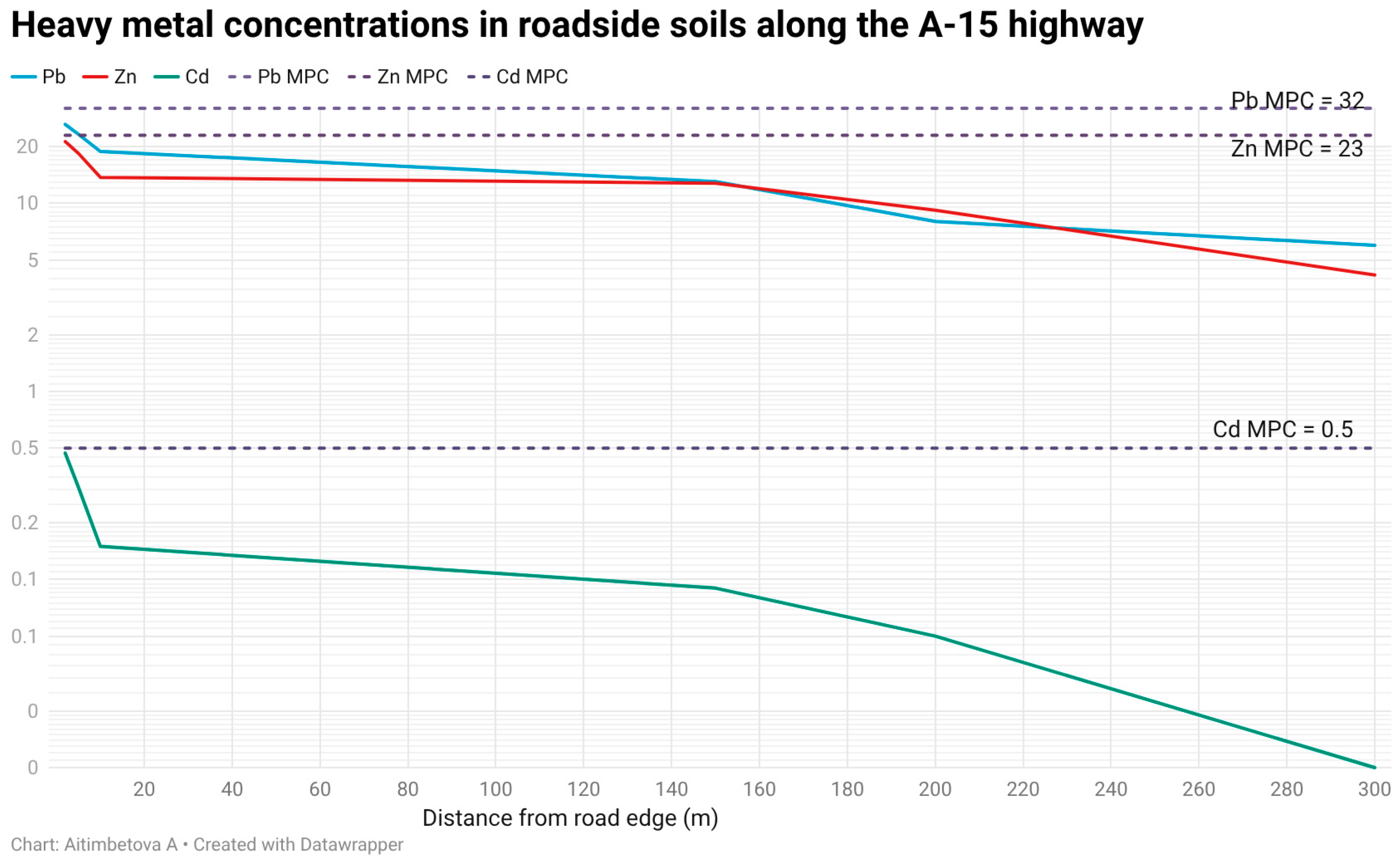
Concentrations of Pb, Zn, and Cd in roadside soils at varying distances from the highway are summarized in Figure 2, Table 1. Maximum values were observed at 2–5 m and decreased sharply with distance to 300 m.
Average Pb concentrations ranged from 26.3 mg kg−1 at 2 m to 5.98 mg kg−1 at 300 m. Zn decreased from 21.29 to 4.16 mg kg−1, and Cd from 0.47 to 0.01 mg kg−1 over the same gradient. Compared with the Kazakhstani national maximum permissible concentrations (MPCs) for agricultural soils (Pb = 32, Zn = 23, Cd = 0.5–2.0 mg kg−1) [23], concentrations at 2–10 m were approximately 1.5–3 times the limits for Zn and Cd. Pb remained below the MPC at all distances, though it approached the threshold at 2–5 m. The decreasing gradient, Pb > Zn > Cd, is consistent with patterns reported in global roadside contamination studies [2,3,5,6].

3.2. Heavy Metal Concentrations in Vegetables and Cucurbits

Metal concentrations in edible parts are presented in Table 2. In this table, values exceeding the corresponding Kazakhstani national MPC for vegetables are flagged with an asterisk [23]. Pb concentrations ranged from 0.95 mg kg−1 (watermelon) to 1.81 mg kg−1 (tomato), exceeding the MPC of 0.5 mg kg−1 for all four crops. Zn contents (8.3–12.5 mg kg−1) exceeded the MPC of 0.45 mg kg−1 in all crops. Notably, Cd concentrations exceeded the MPC of 0.03 mg kg−1 in tomato (0.044), cucumber (0.037), and melon (0.032), while watermelon (0.029) remained marginally below the threshold. This finding—that Cd exceeds food-safety limits in three of four crops—indicates an important public health concern that previous assessments in this area did not report.
Comparable patterns have been documented in roadside agricultural studies globally (see Section 4.2). Species-specific differences in accumulation were observed, with tomato showing the highest concentrations for all three metals; a mechanistic interpretation is provided in Section 4.2.

3.3. Transfer Factors

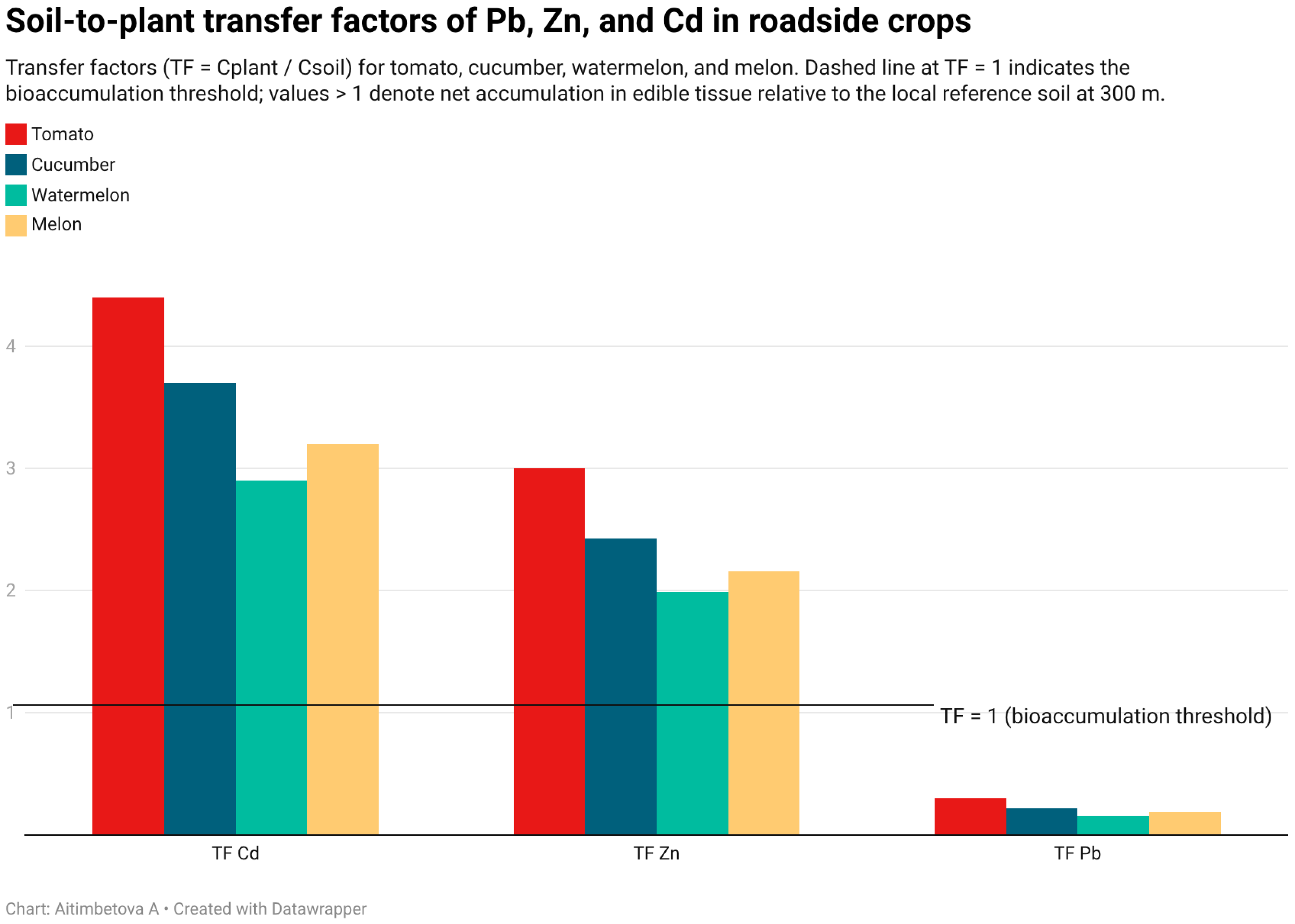
Transfer factors are presented in Figure 3, and Table 3. The TF values confirmed the sequence Cd > Zn > Pb across all crops. Pb TFs ranged from 0.16 to 0.30, Zn TFs from 1.99 to 3.00, and Cd TFs from 2.90 to 4.40. ANOVA revealed significant differences among crops in Pb accumulation (p < 0.001) and in Zn and Cd accumulation (p < 0.05). Cd TFs were the highest among the three metals, despite relatively low absolute soil Cd concentrations. A mechanistic interpretation of the TF sequence and species ranking is provided in Section 4.3.

3.4. Correlation Analysis

Pearson’s correlation matrix of the TFs is provided in Table S1 (Supplementary Materials). Strong positive correlations were found: r = 0.92 (Pb-Zn; t = 3.32, p ≈ 0.08), r = 0.95 (Pb-Cd; t = 4.30, p ≈ 0.05), and r = 0.99 (Zn-Cd; t = 9.93, p ≈ 0.01); two-tailed t-tests on Pearson’s r were computed with df = n − 2 = 2. With only n = 4 crop species, formal hypothesis testing has very low statistical power, and the conventional p < 0.05 threshold requires |r| > 0.95 under such small-sample conditions—a threshold met only by the Pb–Cd and Zn–Cd pairs. We therefore interpret these correlations as indicative of coupled migration patterns of Pb, Zn, and Cd in the soil–plant system rather than as statistically conclusive evidence; expansion to additional crop species and replicates is identified as a research priority in Section 5.

3.5. Spatial Distribution of Pollution Indices

The Igeo values and PLI are presented in Table 4. For Pb and Zn, Igeo was negative at all distances, indicating that the measured concentrations do not reflect geochemical enrichment relative to the crustal background in the Igeo framework, even though they exceed Kazakhstani soil quality standards (set as precautionary public health thresholds stricter than geochemical background levels). For Cd, Igeo = 1.65 and 1.05 at 2 m and 5 m fall within the “moderately polluted” class, confirming disproportionate cadmium accumulation. PLI approached unity (0.68 and 0.58) only at 2–5 m, indicating that the deterioration in quality is spatially confined to the immediate road corridor.

3.6. Dietary Exposure and Risk Estimates

The EDI, HQ, and HI values are presented in Table 5; per-crop carcinogenic risk (CR) values are provided in Table S2 (Supplementary Materials). The HI values for all crops and metals remained well below 1 (range: 0.029–0.052), indicating no non-carcinogenic risk to adults under the modeled average exposure scenario. The CR values for Pb and Cd fell within the acceptable range (10−6–10−4) across all crops, indicating no significant lifetime carcinogenic risk from vegetable consumption alone.
Despite acceptable aggregate risk scores, several considerations warrant precautionary action. First, Pb food-safety limits were exceeded in all four crops, and Cd limits were exceeded in three of the four crops, indicating direct food-safety violations under Kazakhstani national standards. Second, children—who have lower body weight, higher relative vegetable intake, and greater susceptibility to Pb neurotoxicity [24]—would have substantially higher HQ and CR values than adults in the modeled scenario. Third, cumulative exposure through multiple pathways (dietary intake + incidental soil ingestion + dust inhalation) among populations living adjacent to the highway would increase aggregate risk beyond that from the dietary pathway alone. The combination of food-safety exceedances and elevated Cd TFs indicates that precautionary management is warranted even where aggregate HRA scores appear acceptable.

4. Discussion

4.1. Soil Contamination Patterns and Geochemical Significance

The decreasing gradient of HM concentrations with distance from the road (Pb > Zn > Cd) aligns with global roadside contamination studies [2,3,5]. Because soil pH, organic matter, and metal speciation were not measured at our sampling points, a mechanistic explanation of the gradient cannot be advanced here; we limit the interpretation to the observation that the spatial pattern is consistent with regional sierozem characteristics reported elsewhere [16] and with the literature on Pb sorption versus Cd/Zn mobility [24,25]. Site-specific confirmation is identified as a research priority (Section 4.6).
The geochemical indices provide an important international context. Although Zn and Cd levels at 2–10 m exceed Kazakhstani soil standards, their negative Igeo values indicate that these concentrations do not represent geochemical enrichment above crustal background within the Igeo framework. This discrepancy arises because national maximum permissible concentration (MPC) values serve as cautious public health limits, which are much stricter than natural background levels [25,26]. The classification of moderate Cd pollution (Igeo = 1.05–1.65) at 2–5 m is consistent with Cd’s known emission profile from tire and brake wear [2]. The observed Cd Igeo range at 2–5 m (1.05–1.65) is similar to roadside soils in urban India (1.2–1.8 [27]) and peri-urban China (0.9–1.4 [6]), but higher than typical European roadside soils (0.3–0.9 [3,4]), likely reflecting the combination of intense traffic loading and limited atmospheric scavenging in the semi-arid Central Asian climate. The pollution load index (PLI) did not formally exceed unity at any sampled distance, with a maximum of 0.68 at 2 m, indicating that metal accumulation is highest in the immediate road corridor, supporting the need for narrow sanitary buffer zones. Note that the Igeo values are based on Müller’s [17] crustal background, reflecting enrichment over crustal abundance rather than the local Turkestan soil baseline. If the regional Cd baseline (0.23–1.33 mg kg−1 [16]) were used as Bn, the Cd Igeo at 2–5 m would fall into the unpolluted-to-moderate category, acknowledging the naturally elevated soil Cd in Turkestan. Both interpretations are valid within their reference frameworks; the Müller-based classification is maintained here for consistency with international standards.

4.2. Crop Accumulation, Food Safety, and Species Differences

The food-safety exceedances reported here raise a significant public health concern. Pb exceeded Kazakhstani MPC for vegetables (0.5 mg kg−1) in all four crops, and Cd exceeded the MPC (0.03 mg kg−1) in three of four crops—a finding not previously reported for roadside agriculture in South Kazakhstan. Zn also exceeded its MPC in all four crops. Comparable Pb and Zn exceedances have been reported in vegetables grown along high-traffic corridors of Asia [11] and Africa [3], whereas Cd exceedances in cucurbit fruit have been documented less frequently [12,13].
Species-specific differences, with tomato showing the highest concentrations for all three metals, are consistent with factors reported in the literature: a higher transpiration rate in tomato than in cucurbits [28], a rougher fruit surface that retains more particulate deposition, and the thick rind of cucurbits, which limits soil-particle adhesion to the edible flesh. The combined effect predicts the observed ranking: tomato > cucumber > melon ≈ watermelon. As these factors were not directly measured here, the interpretation is offered as a working hypothesis consistent with the data. ANOVA-confirmed differences among crops (Pb: p < 0.001; Zn, Cd: p < 0.05) support the conclusion that species selection is a meaningful risk management variable in roadside agricultural settings.

4.3. Transfer Factors and Migration Mechanisms

The TF sequence Cd > Zn > Pb follows the established mobility hierarchy of these metals in soil–plant systems [28,29]. High TF values for Cd (2.90–4.40), despite relatively low absolute soil concentrations, indicate that Cd is more bioavailable than Pb or Zn in the system studied. Because soil pH was not measured at our sampling points, we do not advance a mechanistic explanation here; we note only that the regional baseline pH range for Saryagash sierozems (7.8–8.2 [30]) and the literature on Cd behaviour in alkaline soils [28,29] are consistent with the elevated Cd TFs observed, and that site-specific pH and speciation measurements would be needed to confirm this (Section 4.6). The strong inter-element TF correlations (r = 0.92–0.99) are consistent with coupled migration of Pb, Zn, and Cd in the soil–plant system, although with only four crop species, these correlations are indicative rather than statistically conclusive.
Comparable TF ranges have been reported for Cd (2.5–5.2) and Zn (1.8–3.5) in vegetables on wastewater-irrigated fields [13,29], for Pb (0.1–0.4) in peri-urban settings [11], and for Cd (1.8–3.4) and Pb (0.2–0.5) in unamended degraded soils [30]. Our values fall within this globally observed range. Ghani et al. [30] further showed that organic amendments (biochar, poultry manure) can reduce the bioavailability of Cd, Pb, and Zn in degraded soils, suggesting that soil-property modification is a complementary management option to spatial avoidance of contaminated zones.

4.4. Health Risk in Comparative Context

Adult HI values reported in similar roadside agricultural studies in Asia typically fall within 0.01–0.3 [12,13,31]; the values obtained here (0.029–0.052) are on the lower end of this range, indicating no aggregate non-carcinogenic risk under average exposure conditions. CR values within the acceptable range (10−6–10−4) also indicate no significant lifetime cancer risk from the dietary pathway alone [19,32].
However, HRA results must be interpreted alongside direct food-safety exceedances. The aggregate HRA metric integrates all metals and represents average exposure, potentially obscuring risks from individual metals associated with high-frequency consumption or vulnerable subpopulations. Children are a substantially higher-risk subpopulation. Using standard US EPA pediatric exposure parameters (BW = 25 kg, IR = 0.15 kg day−1 for a 7-year-old) [19], recalculation of HQ for Pb in tomato yields ≈ 0.108, which is approximately 2.5-fold higher than the adult value, but still below the threshold of unity. When combined with incidental soil ingestion (IR_soil ≈ 1 × 10⁻⁴ kg day−1) and roadside dust inhalation, the aggregate child HQ for Pb approaches 0.3, which is consistent with pediatric risk assessment outcomes reported for similar peri-urban roadside contexts in Asia [12,33]. The long biological half-life of Cd in the kidney (~10–30 years) [24,33] means that even subthreshold daily intakes contribute to cumulative body burden. Furthermore, cumulative exposure through combined pathways (dietary intake, incidental soil ingestion, and road dust inhalation) in populations residing adjacent to the highway would result in a higher aggregate risk than the dietary-only scenario estimated here. For these reasons, acceptable aggregate HRA scores should not be interpreted as evidence that no precautionary action is needed.

4.5. Implications for Management

The combined evidence—soil MPC exceedances for Zn and Cd at 2–10 m, food-safety exceedances for Pb and Cd, moderate Cd geochemical enrichment at 2–5 m, and elevated TFs—supports the enforcement of sanitary buffer zones for edible crop cultivation along the A-15 highway. Given the spatial concentration of integrated metal load at 2–5 m (PLI = 0.58–0.68, approaching unity) and the moderately polluted Cd Igeo classification at the same distances, a minimum 50 m exclusion zone from the road edge is recommended for food crop production. Priority actions to prevent contaminated produce from entering local and regional food markets include enforcing existing Kazakhstani sanitary norms [23], regularly monitoring roadside soils and crop products, and targeted public health communication to farming communities in the Saryagash district. As a complementary mitigation strategy for fields where exclusion is not feasible, applying organic amendments—for example, biochar and composted manure—has been shown to reduce the plant-available fraction of Cd, Pb, and Zn in degraded agricultural soils [30] and warrants field testing under the alkaline sierozem conditions of the Saryagash district.

4.6. Limitations

This study has several limitations. First, the sampling design was structured around three roadside locations along a 15 km transect (yielding 36 soil sampling points and 12 crop sampling points), and crop sampling was limited to four locally dominant species. While this design captures the principal contamination gradient and provides adequate replication for detecting distance and species effects via ANOVA, the small number of crop species (n = 4) constrains the statistical power of inter-element TF correlation analyses; TF correlations should therefore be regarded as indicative rather than statistically conclusive. Extending the design to additional crops and corridor segments is identified as a research priority in Section 5. Second, the HRA was modeled for average adult exposure only; HQ and CR values for children or for combined exposure pathways would be substantially higher. Third, the dry-to-fresh weight conversion factor (0.1) was applied uniformly, introducing uncertainty because actual moisture content varies among species. Fourth, parameters that are key determinants of HM mobility and plant uptake—soil pH, organic matter content, and metal speciation—were not measured at sampling points. Fifth, atmospheric deposition and irrigation water quality data were not collected, precluding quantification of non-soil contamination pathways to plant surfaces. Sixth, the transfer factor calculation used the soil concentration at 300 m within each sampling transect as an operational local background, rather than a soil sample from a true non-roadside control plot; while the 300 m values fall within the regional baseline range reported for agricultural soils of the Turkestan Region [16], the inclusion of an externally located control plot would provide an additional independent reference; thus, it is identified as a research priority in Section 5.

5. Conclusions

This study provides an integrated regional assessment that combines soil contamination, transfer factors, geochemical indices, and dietary health-risk assessment for roadside cucurbit-based agriculture on alkaline sierozem soils in South Kazakhstan. Three findings emerge.
First, soil-based regulatory compliance does not in this system guarantee crop safety: soil Pb remained below the Kazakhstani MPC at all distances, and PLI did not exceed unity, yet Pb in fruit exceeded food-safety MPCs in all four crops, and Cd exceeded MPCs in three of four. This pattern supports a transition from soil-only to combined soil-and-crop surveillance along major freight corridors.
Second, Cd showed the highest transfer factor (2.90–4.40) among the three metals despite low absolute soil concentrations, suggesting that risk-element prioritization derived from temperate or acidic-soil studies may need regional recalibration for alkaline sierozem agroecosystems. Third, integrated HRA (HI = 0.029–0.052; CR < 1.7 × 10⁻⁶ for adults) indicated acceptable aggregate risk, yet individual food-safety MPCs were exceeded for Pb and Cd—illustrating that aggregate health-risk metrics and individual food-safety thresholds can diverge and should be reported together.
These conclusions are subject to the design limitations summarised in Section 4.6: three roadside locations, four crop species, a single 15 km corridor segment, no site-specific measurement of soil pH, organic matter, CEC, or metal speciation, no direct quantification of atmospheric deposition or irrigation-water heavy-metal content, and adult-only HRA. Mechanistic statements concerning Cd mobility under alkaline conditions are therefore framed as working hypotheses pending site-specific confirmation. Within these qualifications, the magnitude of the food-safety exceedances observed justifies precautionary management of cultivation within the immediate roadside zone of the A-15 corridor, and the integrated approach reported here offers a reproducible methodological framework for roadside agroecosystem assessment in Central Asia. Priorities for follow-up work include: (i) higher-resolution soil sampling at 10–150 m to refine the buffer-zone boundary; (ii) child-targeted HRA using Kazakhstan-specific dietary data; (iii) longitudinal monitoring of Cd accumulation in sierozems; (iv) field trials of organic-amendment remediation under local conditions [30]; and (v) direct measurement of soil pH, organic matter, CEC, carbonate content, Fe/Mn-oxide fractions, and irrigation-water composition.

Supplementary Materials

The following supporting information can be downloaded at https://www.mdpi.com/article/10.3390/ecologies7020047/s1, Table S1: Pearson’s correlation matrix of transfer factors (TFs) for Pb, Zn, and Cd across the four sampled crop species (n = 4); Table S2: Carcinogenic risk (CR) values for Pb and Cd via vegetable consumption; Table S3: Per-location raw composite values of Pb, Zn, and Cd in roadside soils at three sampling sites and six distances from the road edge.

Author Contributions

Conceptualization, Z.K. and A.A.; methodology, A.U.; validation, Z.K., A.U. and A.A.; formal analysis, Z.K.; investigation, A.A.; resources, Z.K.; data curation, A.A.; writing—original draft preparation, Z.K. and A.A.; writing—review and editing, A.U.; visualization, A.A.; supervision, A.U.; project administration, Z.K.; funding acquisition, Z.K. All authors have read and agreed to the published version of the manuscript.

Funding

This study was funded by Science Committee of the Ministry of Science and Higher Education of the Republic of Kazakhstan under grant No. AP22684097.

Data Availability Statement

The data presented in this study are available from the corresponding author upon request. The data are not publicly archived due to ongoing research activities.

Conflicts of Interest

The authors declare no conflicts of interest.

Abbreviations

The following abbreviations are used in this manuscript:
AAS atomic absorption spectrometry
ANOVAanalysis of variance
AT averaging time
BW body weight
CECcation exchange capacity
CF contamination factor
CR carcinogenic risk
EDI estimated daily intake
EF exposure frequency
HI hazard index
HM heavy metal
HQ hazard quotient
HRA health-risk assessment
HSDhonestly significant difference (Tukey’s HSD)
Igeo geo-accumulation index
IR ingestion rate
IRISIntegrated Risk Information System
LODlimit of detection
MPC maximum permissible concentration
PLI pollution load index
RfD reference dose
RSDrelative standard deviation
SD standard deviation
SF slope factor
SOMsoil organic matter
TF transfer factor
US EPAU.S. Environmental Protection Agency

References

  1. Bureau of National Statistics of the Republic of Kazakhstan. Statistical Yearbook of the Republic of Kazakhstan 2024; Bureau of National Statistics, Agency for Strategic Planning and Reforms of the Republic of Kazakhstan: Astana, Kazakhstan, 2024.
  2. Szwalec, A.; Mundała, P.; Kędzior, R.; Pawlik, J. Monitoring and Assessment of Cadmium, Lead, Zinc and Copper Concentrations in Arable Roadside Soils in Terms of Different Traffic Conditions. Environ. Monit. Assess. 2020, 192, 155. [Google Scholar] [CrossRef]
  3. Nabulo, G.; Oryem-Origa, H.; Diamond, M. Assessment of Lead, Cadmium, and Zinc Contamination of Roadside Soils, Surface Films, and Vegetables in Kampala City, Uganda. Environ. Res. 2006, 101, 42–52. [Google Scholar] [CrossRef]
  4. Viard, B.; Pihan, F.; Promeyrat, S.; Pihan, J.-C. Integrated Assessment of Heavy Metal (Pb, Zn, Cd) Highway Pollution: Bioaccumulation in Soil, Graminaceae and Land Snails. Chemosphere 2004, 55, 1349–1359. [Google Scholar] [CrossRef]
  5. Sezgin, N.; Ozcan, H.K.; Demir, G.; Nemlioglu, S.; Bayat, C. Determination of Heavy Metal Concentrations in Street Dusts in Istanbul E-5 Highway. Environ. Int. 2004, 29, 979–985. [Google Scholar] [CrossRef]
  6. Hu, N.-W.; Yu, H.-W.; Deng, B.-L.; Hu, B.; Zhu, G.-P.; Yang, X.-T.; Wang, T.-Y.; Zeng, Y.; Wang, Q.-Y. Levels of Heavy Metal in Soil and Vegetable and Associated Health Risk in Peri-Urban Areas across China. Ecotoxicol. Environ. Saf. 2023, 259, 115037. [Google Scholar] [CrossRef] [PubMed]
  7. Rutherford, G.W.; McFarland, W.; Spindler, H.; White, K.; Patel, S.V.; Aberle-Grasse, J.; Sabin, K.; Smith, N.; Taché, S.; Calleja-Garcia, J.M.; et al. Public Health Triangulation: Approach and Application to Synthesizing Data to Understand National and Local HIV Epidemics. BMC Public Health 2010, 10, 447. [Google Scholar] [CrossRef] [PubMed]
  8. Flora, G.; Gupta, D.; Tiwari, A. Toxicity of Lead: A Review with Recent Updates. Interdiscip. Toxicol. 2012, 5, 47–58. [Google Scholar] [CrossRef]
  9. Sridhara Chary, N.; Kamala, C.T.; Samuel Suman Raj, D. Assessing Risk of Heavy Metals from Consuming Food Grown on Sewage Irrigated Soils and Food Chain Transfer. Ecotoxicol. Environ. Saf. 2008, 69, 513–524. [Google Scholar] [CrossRef]
  10. Zhou, H.; Yang, W.-T.; Zhou, X.; Liu, L.; Gu, J.-F.; Wang, W.-L.; Zou, J.-L.; Tian, T.; Peng, P.-Q.; Liao, B.-H. Accumulation of Heavy Metals in Vegetable Species Planted in Contaminated Soils and the Health Risk Assessment. Int. J. Environ. Res. Public Health 2016, 13, 289. [Google Scholar] [CrossRef]
  11. Khan, I.U.; Qi, S.-S.; Gul, F.; Manan, S.; Rono, J.K.; Naz, M.; Shi, X.-N.; Zhang, H.; Dai, Z.-C.; Du, D.-L. A Green Approach Used for Heavy Metals ‘Phytoremediation’ via Invasive Plant Species to Mitigate Environmental Pollution: A Review. Plants 2023, 12, 725. [Google Scholar] [CrossRef] [PubMed]
  12. Kachenko, A.G.; Singh, B. Heavy Metals Contamination in Vegetables Grown in Urban and Metal Smelter Contaminated Sites in Australia. Water Air Soil Pollut. 2006, 169, 101–123. [Google Scholar] [CrossRef]
  13. Sharma, K.; Janardhana Raju, N.; Singh, N.; Sreekesh, S. Heavy Metal Pollution in Groundwater of Urban Delhi Environs: Pollution Indices and Health Risk Assessment. Urban Clim. 2022, 45, 101233. [Google Scholar] [CrossRef]
  14. Mao, Y.; Wang, M.; Wei, H.; Gong, N.; Wang, F.; Zhu, C. Heavy Metal Pollution and Risk Assessment of Vegetables and Soil in Jinhua City of China. Sustainability 2023, 15, 4241. [Google Scholar] [CrossRef]
  15. Ma, H.; Mi, M.; Wang, C.; Wu, X.; Zhen, Z. The Concentrations, Sources, Ecological, and Human Health Risk Assessment of Heavy Metals in Roadside Soils of Six Cities in Shanxi Province, China. Environ. Toxicol. Chem. 2023, 42, 1485–1500. [Google Scholar] [CrossRef]
  16. Kurganbekov, Z. Migration and Transformation of Heavy Metals in the Soil-Plant System in Vegetable Cultivation in Turkestan Region. Ph.D. Thesis, M. Auezov South Kazakhstan University, Shymkent, Kazakhstan, 2025. [Google Scholar]
  17. Müller, G. Index of Geoaccumulation in Sediments of the Rhine River. GeoJournal 1969, 2, 108–118. [Google Scholar]
  18. Tomlinson, D.L.; Wilson, J.G.; Harris, C.R.; Jeffrey, D.W. Problems in the Assessment of Heavy-Metal Levels in Estuaries and the Formation of a Pollution Index. Helgoländer Meeresunters. 1980, 33, 566–575. [Google Scholar] [CrossRef]
  19. US EPA. Exposure Factors Handbook: 2011 Edition (Final); U.S. Environmental Protection Agency, National Center for Environmental Assessment, Office of Research and Development: Washington, DC, USA, 2011.
  20. US EPA. Integrated Risk Information System. Available online: https://www.epa.gov/iris (accessed on 12 May 2026).
  21. Sokal, R.R.; Rohlf, F.J. Biometry: The Principles and Practice of Statistics in Biological Research, 4th ed.; W. H. Freeman: New York, NY, USA, 2012. [Google Scholar]
  22. Underwood, A.J. Experiments in Ecology: Their Logical Design and Interpretation Using Analysis of Variance; Cambridge University Press: Cambridge, UK, 1997. [Google Scholar]
  23. SanRaN RK 4.01.071.04; Sanitary-Epidemiological Requirements for the Safety of Soil; Sanitary Regulations and Norms of the Republic of Kazakhstan. Ministry of Health of the Republic of Kazakhstan: Astana, Kazakhstan, 2004.
  24. Godt, J.; Scheidig, F.; Grosse-Siestrup, C.; Esche, V.; Brandenburg, P.; Reich, A.; Groneberg, D.A. The Toxicity of Cadmium and Resulting Hazards for Human Health. J. Occup. Med. Toxicol. 2006, 1, 22. [Google Scholar] [CrossRef]
  25. Abakumov, E.; Shamilishviliy, G.; Yurtaev, A. Soil Polychemical Contamination on Beliy Island as Key Background and Reference Plot for Yamal Region. Pol. Polar Res. 2017, 38, 313–332. [Google Scholar] [CrossRef]
  26. Gałuszka, A.; Migaszewski, Z. Geochemical Background—An Environmental Perspective. Mineralogia 2011, 42, 7–17. [Google Scholar] [CrossRef]
  27. Kabata-Pendias, A.; Szteke, B. Trace Elements in Abiotic and Biotic Environments, 1st ed.; CRC Press: Boca Raton, FL, USA, 2015. [Google Scholar]
  28. Rattan, R.K.; Datta, S.P.; Chhonkar, P.K.; Suribabu, K.; Singh, A.K. Long-Term Impact of Irrigation with Sewage Effluents on Heavy Metal Content in Soils, Crops and Groundwater—A Case Study. Agric. Ecosyst. Environ. 2005, 109, 310–322. [Google Scholar] [CrossRef]
  29. Ghani, J.; Nawab, J.; Khan, S.; Khan, M.A.; Ahmad, I.; Ali, H.M.; Siddiqui, M.H.; Funari, V.; Dinelli, E. Organic Amendments Minimize the Migration of Potentially Toxic Elements in Soil–Plant System in Degraded Agricultural Lands. Biomass Convers. Biorefinery 2024, 14, 6547–6565. [Google Scholar] [CrossRef]
  30. Praburaman, L.; Murugan, P.; Singaravel, V.; Moovendhan, M.; Kolandhasamy, P.; Seralathan, K. Heavy-Metal Contamination in Agroecosystems From Road Transportation: A Global Threat to Food Safety and Security. Environ. Qual. Manag. 2026, 35, e70330. [Google Scholar] [CrossRef]
  31. Wongsasuluk, P.; Tun, A.Z.; Chotpantarat, S.; Siriwong, W. Related Health Risk Assessment of Exposure to Arsenic and Some Heavy Metals in Gold Mines in Banmauk Township, Myanmar. Sci. Rep. 2021, 11, 22843. [Google Scholar] [CrossRef] [PubMed]
  32. Khan, S.; Cao, Q.; Zheng, Y.M.; Huang, Y.Z.; Zhu, Y.G. Health Risks of Heavy Metals in Contaminated Soils and Food Crops Irrigated with Wastewater in Beijing, China. Environ. Pollut. 2008, 152, 686–692. [Google Scholar] [CrossRef] [PubMed]
  33. Satarug, S.; Gobe, G.C.; Vesey, D.A.; Phelps, K.R. Cadmium and Lead Exposure, Nephrotoxicity, and Mortality. Toxics 2020, 8, 86. [Google Scholar] [CrossRef]
Figure 1. Location of the study area in Saryagash district, Turkestan Region, South Kazakhstan, showing the A-15 Shymkent–Saryagash–Abay highway and soil/crop sampling locations (Sites 1–3). Inset: Location of the Turkestan Region within Kazakhstan.
Ecologies 07 00047 g001
Figure 2. Heavy metal concentrations in roadside soils along the A-15 highway. Mean concentrations of Pb, Zn, and Cd in surface soils (0–20 cm) at six distances from the road edge (2, 5, 10, 150, 200, and 300 m). Dashed grey lines indicate the Kazakhstani national maximum permissible concentrations (MPCs) for agricultural soils [23]: Pb = 32, Zn = 23, Cd = 0.5 mg kg−1. The y-axis is logarithmic.
Ecologies 07 00047 g002
Figure 3. Soil-to-plant transfer factors (TF) of Pb, Zn, and Cd in roadside crops. TF = Cplant/Csoil; Csoil = metal concentration in soil at 300 m (reference background). Bars show values for tomato, cucumber, watermelon, and melon. The dashed horizontal line at TF = 1 indicates the bioaccumulation threshold; values above this line denote net accumulation in edible tissue relative to the local reference soil. Numbers above each bar are exact TF values.
Ecologies 07 00047 g003
Table 3. Transfer factors (TFs) of heavy metals from soil to edible plant parts.
CropTF PbTF ZnTF Cd
Tomato0.303.004.40
Cucumber0.222.433.70
Watermelon0.161.992.90
Melon0.192.163.20
TF = Cplant/CsoIl; CsoIl = metal concentration in soil at 300 m (reference background). TF > 1 = net bioaccumulation.
Table 4. Geo-accumulation index (Igeo), contamination factor (CF), and pollution load index (PLI).
DistanceIgeo PbClassIgeo ZnClassIgeo CdClassPLI
2 m−0.19Unpolluted−2.53Unpolluted1.65Moderately polluted0.68
5 m−0.36Unpolluted−2.74Unpolluted1.05Moderately polluted0.58
10 m−0.67Unpolluted−3.16Unpolluted0.00Unpoll.-mod.0.41
150 m−1.03Unpolluted−3.26Unpolluted−0.74Unpolluted0.28
200 m−1.65Unpolluted−3.74Unpolluted−1.58Unpolluted0.17
300 m−1.99Unpolluted−4.55Unpolluted−3.91Unpolluted0.09
Bn: Pb = 20, Zn = 65, Cd = 0.1 mg kg−1 [17]. PLI > 1 = site quality deterioration.
Table 5. Estimated daily intake (EDI), hazard quotient (HQ), and hazard index (HI) via vegetable consumption (adults).
CropEDI PbHQ PbEDI ZnHQ ZnEDI CdHQ CdHIRisk
Tomato1.76 × 10−40.0441.22 × 10−30.0044.28 × 10−60.0040.052Acceptable
Cucumber1.29 × 10−40.0329.82 × 10−40.0033.60 × 10−60.0040.039Acceptable
Watermelon9.24 × 10−50.0238.07 × 10−40.0032.82 × 10−60.0030.029Acceptable
Melon1.08 × 10−40.0278.75 × 10−40.0033.11 × 10−60.0030.033Acceptable
Exposure parameters: IR = 0.345 kg day−1, EF = 365 days, ED = 30 yr, BW = 70 kg, AT = 10,950 days. RfD (mg kg−1 day−1): Pb = 4 × 10⁻³, Zn = 3 × 10⁻¹, Cd = 1 × 10⁻³ (US EPA IRIS [20]). HQ < 1 = no expected non-carcinogenic risk; HI < 1 = no aggregate non-carcinogenic risk.
Disclaimer/Publisher’s Note: The statements, opinions and data contained in all publications are solely those of the individual author(s) and contributor(s) and not of MDPI and/or the editor(s). MDPI and/or the editor(s) disclaim responsibility for any injury to people or property resulting from any ideas, methods, instructions or products referred to in the content.