

Comparative Life Cycle Assessment of Physical and Chemical Activation Routes for Oil Palm Shell-Derived Activated Carbon in Lufenuron 50-EC Pesticide Adsorption

 ,
,  , ,
, ,  and
and
Abstract
1. Introduction
2. Materials and Methods
3. Results
3.1. Activated Carbon Characterization
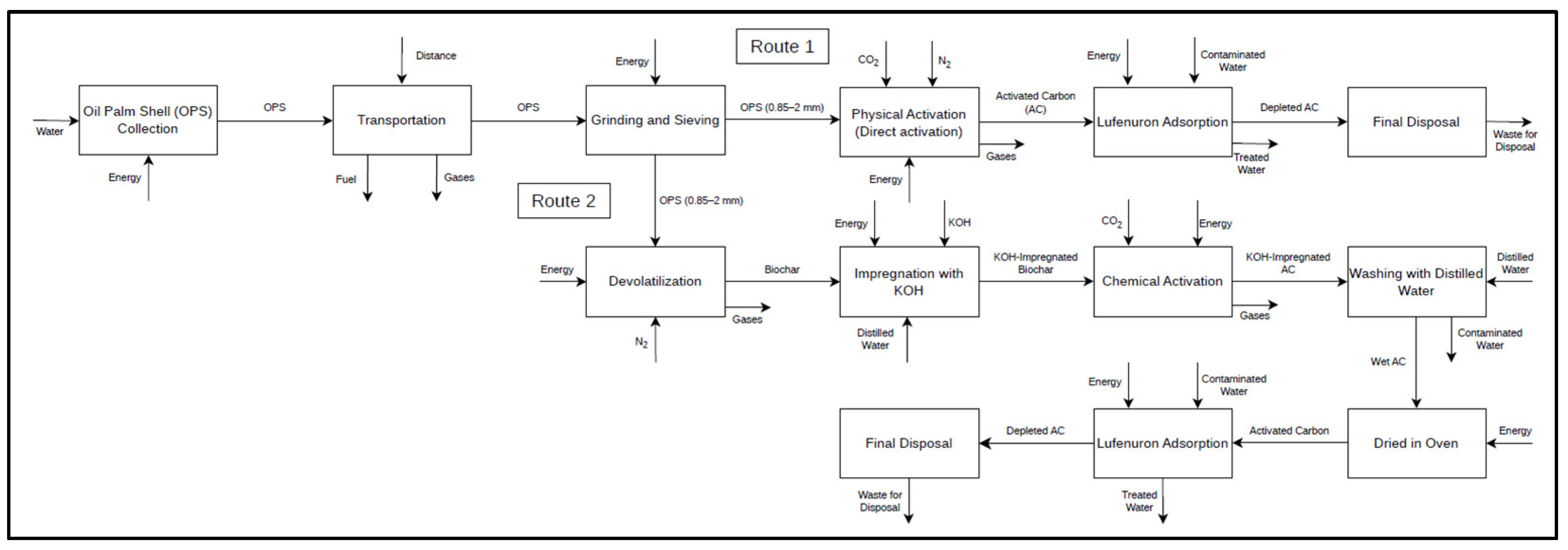
3.2. Life Cycle Inventory
3.3. Environmental Impact Assessment
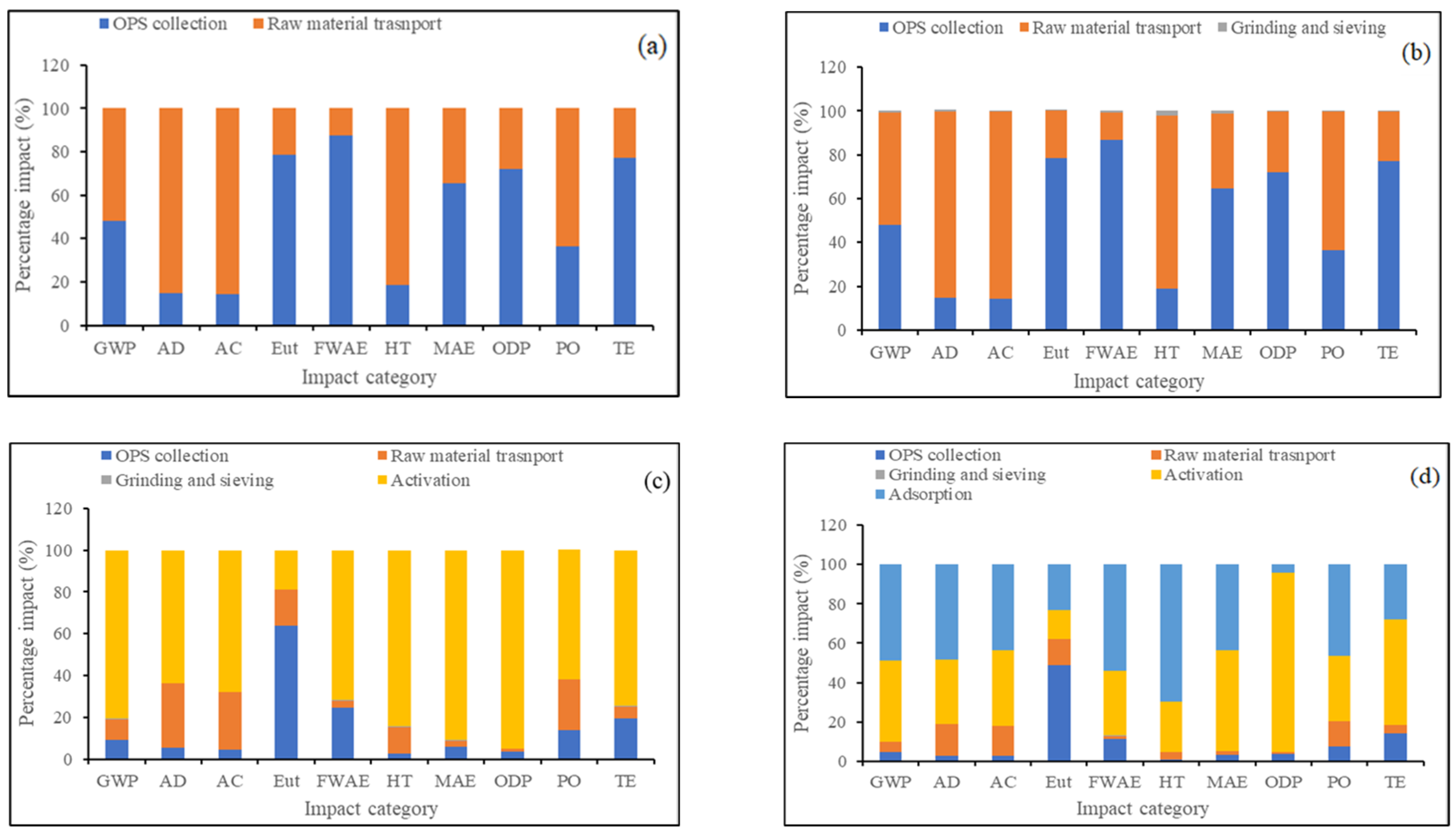
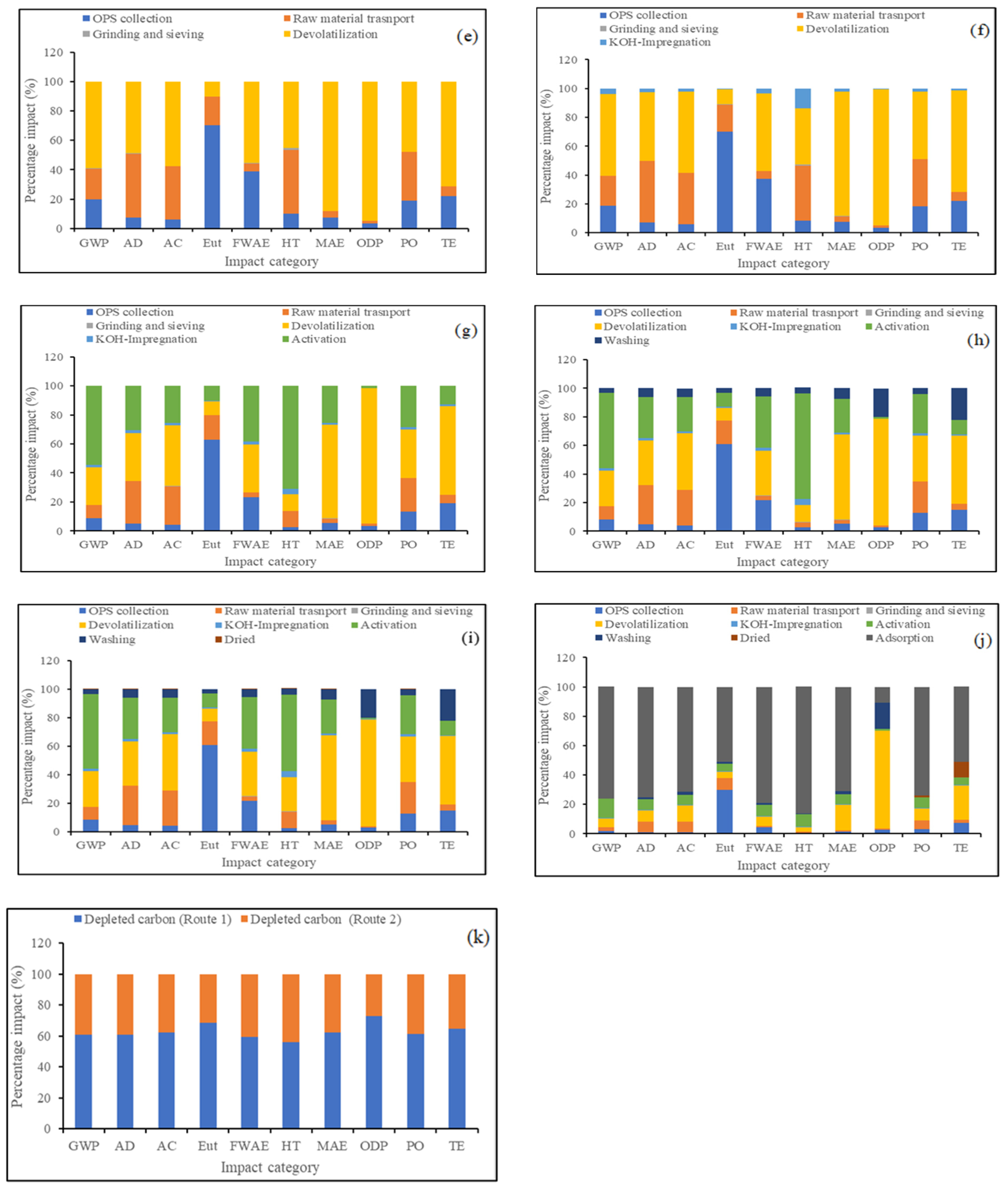
3.4. Contribution Analysis
- Transportation:
- Grinding and sieving:
- Devolatilization:
- KOH-impregnation:
- Activation:
- Washing with distilled water:
- Dried in oven:
- Adsorption:
- Final disposal:
3.5. Sensitivity Analysis
- Electricity consumption during activation:
- Lufenuron 50-EC adsorption yield:
- Transport distance of oil palm shells (OPSs):
- Electricity consumption in activation is the most influential parameter.
- Adsorption yield variations have a moderate effect when GWP is expressed per gram of pollutant removed.
- Transport distance has a marginal effect on GWP.
- The relative ranking between routes remains unchanged.
4. Conclusions
Supplementary Materials
Author Contributions
Funding
Institutional Review Board Statement
Informed Consent Statement
Data Availability Statement
Acknowledgments
Conflicts of Interest
Abbreviations
| LCA | Life cycle assessment |
| OPS | Oil palm shell |
| BET | Brunauer–Emmet–Teller |
| FTIR | Fourier transform infrared |
| XRD | X-ray diffraction |
| SEM | Scanning electron |
| GWP | Global warming potential |
| AD | Abiotic depletion (fossil fuels) |
| AC | Acidification |
| Eut | Eutrophication |
| FWAE | Fresh water aquatic ecotoxicity |
| HT | Human toxicity |
| MAE | Marine aquatic ecotoxicity |
| ODP | Ozone depletion potential |
| PO | Photochemical oxidation |
| TE | Terrestrial ecotoxicity |
| EOL | End-of-live |
References
- Abubakar, Y.; Tijjani, H.; Egbuna, C.; Oluwaseun, C.; Kala, S.; Kryeziu, T.; Ifemeje, J.; Patrick, K. Pesticides, history, and classification. In Natural Remedies for Pest, Disease and Weed Control; Academic Press: Cambridge, MA, USA, 2020; pp. 29–42. [Google Scholar]
- Allen, A.L.; Ugarte, J.F. Monitoreo Ambiental de Plaguicidas en el Cultivo de Palma Africana (Elaeis guineensis), en el Municipio de Kukra Hill. Bachelor’s Thesis, Bluefields Indian & Caribbean University BICU, Kukra Hill, Nicaragua, November 2012. [Google Scholar]
- Alghamdi, A.A. Impact of the invasive plant species ‘Nicotiana glauca’ toxins on the larvae of the invasive insect species ‘Rhynchophorus ferrugineus’: A damaging pest of date palm trees in Saudi Arabia. Saudi J. Biol. Sci. 2021, 28, 1154–1157. [Google Scholar] [CrossRef] [PubMed]
- Del Puerto, A.M.; Suárez, S.; Palacio, D.E. Efectos de los plaguicidas sobre el ambiente y la salud. J. Cuba. Hig. Epidemiol. 2014, 50, 372–387. [Google Scholar]
- Kumar, M.; Yadav, A.N.; Saxena, R.; Paul, D.; Tomar, R.S. Biodiversity of pesticides degrading microbial communities and their environmental impact. Biocatal. Agric. Biotechnol. 2020, 31, 101883. [Google Scholar] [CrossRef]
- Montoro, Y.; Moreno, R.; Gomero, L.; Reyes, M. Characteristics of the use of chemical pesticides and health risks in farmers in the central highlands of Peru. J. Peru. Med. Exp. Salud Publica 2009, 26, 466–472. [Google Scholar]
- Liao, J.Y.; Fan, C.; Huang, Y.Z.; Pei, K.J. Distribution of residual agricultural pesticides and their impact assessment on the survival of an endangered species. J. Hazard. Mater. 2020, 389, 121871. [Google Scholar] [CrossRef] [PubMed]
- Parween, T.; Jan, S. Ecological effect of pesticide on microbial communities and human health. In Ecophysiology of Pesticides; Elsevier: London, UK; Academic Press: San Diego, CA, USA, 2019; pp. 223–263. [Google Scholar]
- Mostafalou, S.; Abdollahi, M. Pesticides and human chronic diseases: Evidences, mechanisms, and perspectives. Toxicol. Appl. Pharmacol. 2013, 268, 157–177. [Google Scholar] [CrossRef] [PubMed]
- DVA de Colombia Ltda. Ficha Ténica del Lufenuron 50 EC-DVA; DVA de Colombia Ltda: Cajicá, Colombia, 2020; pp. 3–5. [Google Scholar]
- Ghelichpour, M.; Taheri, A.; Hoseini, S.M.; Perez, A. Plasma antioxidant and hepatic enzymes activity, thyroid hormones alterations and health status of liver tissue in common carp (Cyprinus carpio) exposed to lufenuron. Aquaculture 2019, 516, 734634. [Google Scholar] [CrossRef]
- Soares, P.R.L.; de Andrade, A.L.C.; Santos, T.P.; da Silva, S.C.B.L.; da Silva, J.F.; dos Santos, A.R.; Souza, E.H.L.d.S.; da Cunha, F.M.; Teixeira, V.W.; Cadena, M.R.S.; et al. Acute and chronic toxicity of the benzoylurea pesticide, lufenuron, in the fish, Colossoma macropomum. Chemosphere 2016, 161, 412–421. [Google Scholar] [CrossRef] [PubMed]
- Mustafa, I.; Fathurrahmi, S.; Farida, M.; Ahmad, K. Palm shell-derived activated carbon adsorbent is better than that of coconut shell: Comparative studies of cod adsorption from palm oil mill effluent. Rasayan J. Chem. 2022, 15, 738–744. [Google Scholar] [CrossRef]
- Zulaicha, A.S.; Saputra, I.S.; Buhani, B.; Suharso, S. Magnetite particle coating to activated carbon of oil palm shells as adsorbent of Cu(II) and Ni(II) cation. J. Iran. Chem. Soc. 2022, 19, 4777–4787. [Google Scholar] [CrossRef]
- Kalijadis, A.M.; Vukčević, M.M.; Jovanović, Z.M.; Laušević, Z.V.; Laušević, M.D. Characterisation of surface oxygen groups on different carbon materials by the Boehm method and temperature-programmed desorption. J. Serbian Chem. Soc. 2011, 76, 757–768. [Google Scholar] [CrossRef]
- Marsh, H.; Rodríguez-Reinoso, F. Activated Carbon, 1st ed.; Elsevier: London, UK, 2006. [Google Scholar]
- Naji, S.Z.; Tye, C.T. A review of the synthesis of activated carbon for biodiesel production: Precursor, preparation, and modification. Energy Convers. Manag. X 2022, 13, 100152. [Google Scholar] [CrossRef]
- Zhang, J.; Li, Y.; Wang, X.; Dong, X.; Zhao, S.; Du, Q.; Pi, X.; Jing, Z.; Jin, Y. Green preparation of polydopamine-modified multiwalled carbon nanotube/calcium alginate composite aerogels for effective adsorption of methylene blue. Int. J. Biol. Macromol. 2024, 283, 137984. [Google Scholar] [CrossRef] [PubMed]
- Aremu, M.O.; Arinkoola, A.O.; Olowonyo, I.A.; Salam, K.K. Improved phenol sequestration from aqueous solution using silver nanoparticle modified Palm Kernel Shell Activated Carbon. Heliyon 2020, 6, e04492. [Google Scholar] [CrossRef] [PubMed]
- Kishibayev, K.K.; Serafin, J.; Tokpayev, R.R.; Khavaza, T.N.; Atchabarova, A.A.; Abduakhytova, A.; Ibraimov, Z.T.; Srenscek-Nazzal, J. Physical and chemical properties of activated carbon synthesized from plant wastes and shungite for CO2 capture. J. Environ. Chem. Eng. 2021, 9, 106798. [Google Scholar] [CrossRef]
- Beri, K.Y.; Barbosa, D.P.; Zbair, M.; Ojala, S.; De Oliveira, S. Adsorption of Estradiol from aqueous solution by hydrothermally carbonized and steam activated palm kernel shells. Energy Nexus 2021, 1, 100009. [Google Scholar] [CrossRef]
- Nuñez, D.M.; Barraza, J.B.; Guerrero, J.S.; Díaz, L.; Dalai, A.K.; Borugadda, V.B. Adsorption of Lufenuron 50-EC pesticide from aqueous solution using oil palm shell-derived activated carbon. Materials 2024, 17, 5389. [Google Scholar] [CrossRef] [PubMed]
- Shah, H.H.; Amin, M.; Pepe, F.; Mancusi, E.; Fareed, A.G. Overview of environmental and economic viability of activated carbons derived from waste biomass for adsorptive water treatment applications. Environ. Sci. Pollut. Res. 2023, 32, 19084–19109. [Google Scholar] [CrossRef] [PubMed]
- ISO 14044; ISO 14044; Environmental Management-Life Cycle Assessment-Principles and Framework; Environmental Management-Life Cycle Assessment-Requirements and Guidelines. ISO: Geneva, Switzerland, 2006.
- Guinée, J.; Gorrée, M.; Heijungs, R.; Huppes, G.; Kleijn, R.; Koning, A.; Van Oers, L.; Wegener, A.; Suh, S.; Udo de Haes, H. Handbook on Life Cycle Assessment: Operational Guide to the ISO Standards; Kluwer Academic Publishers: Norwell, MA, USA, 2004. [Google Scholar]
- Wernet, G.; Bauer, C.; Steubing, B.; Reinhard, J.; Moreno-Ruiz, E.; Weidema, B. The ecoinvent database version 3 (part I): Overview and methodology. Int. J. Life Cycle Assess. 2016, 21, 1218–1230. [Google Scholar] [CrossRef]
- Pereira, P.; Mala, L.; Da Silva, A.; Silva, N.; Pinhati, F.; Aparecida, S.; Rosa, D.; Mulinari, D. Prospective life cycle assessment of activated carbon production, derived from banana peel waste for Methylene Blue dye removal. Adsorption 2024, 30, 1081–1101. [Google Scholar] [CrossRef]
- Maiti, P.; Meikap, B.C. Mechanism and adsorptive removal of Pb (II) by torrefied/pyrolyzed functionalized bio-adsorbent in batch application and life cycle assessment. Sep. Purif. Technol. 2024, 354, 129333. [Google Scholar] [CrossRef]
- Ren, W.; Li, C.; Fan, M.; Wang, Y.; Li, Q.; Hu, X. Production of poplar branch-derived activated carbon with acidic deep eutectic solvent pretreatment coupled with chemical activation. Fuel 2024, 381, 133417. [Google Scholar] [CrossRef]
- Sabando, C.; Corral-Bobadilla, M.; Lostado-Lorza, R.; Somovilla-Gomez, F. Multiresponse Performance evaluation and life cycle assessment for the optimal elimination of Pb (II) from industrial wastewater by adsorption using vine shoot activated carbon. Sustainability 2026, 15, 11007. [Google Scholar] [CrossRef]
- Usama, M.; Khan, H.; Ilyas, M.; Hamid, A.; Tariq, R.; Bibi, A.; Arshad, M.; Hussain, S. Waste plastic derived activated carbon for simultaneous removal of hazardous antibiotics: Multiscale modelling and life cycle analysis. Sep. Purif. Technol. 2025, 364, 132487. [Google Scholar] [CrossRef]
- Abbas, S. From fingerprints to footprints: Bridging lab-scale to industrial reality through prospective life cycle assessment. In Proceedings of the 1st LCA–Symposium at TU Wien, Vienna, Austria, 16 June 2025. [Google Scholar]
- Piccinno, F.; Hischier, R.; Seeger, S.; Som, C. Predicting the environmental impact of a future nanocellulose production at industrial scale: Application of the life cycle assessment scale-up framework. J. Clean. Prod. 2018, 174, 283–295. [Google Scholar] [CrossRef]
- Boumaraf, R.; Khettaf, S.; Benmahdi, F.; Masmoudi, R.; Belarbi, M.; Ferhati, A. Optimization and comparative analysis of acetamiprid removal from aqueous solutions using activated carbon and nanofiltration techniques. Biomass Convers. Biorefin. 2025, 15, 15713–15731. [Google Scholar] [CrossRef]
- Cadorna, R.; Jane, R.; Derin, J.; Bade, L.; Rabongue, A.; Tizo, M.; Jay, R.; Arazo, R. Circular economy-driven methomyl pesticide removal from water through peanut shell activated carbon adsorption. Circ. Econ. Sustain. 2025, 5, 1053–1073. [Google Scholar] [CrossRef]
- Stavrinou, A.; Theodoropoulou, M.A.; Tsakiroglou, C.D. Synthesis of titania/activated carbon composites for the synergistic adsorption and photocatalysis of lindane in aqueous solutions. Environ. Sci. Pollut. Res. 2025, 32, 6468–6491. [Google Scholar] [CrossRef] [PubMed]
- Mahmoud, E.N.; Naffa, R.; Ibrahim, K.M.; Jaafreh, S.; Al-Bzour, M.H.; Abuferweh, A. Removal of pesticides from aqueous solutions using activated carbon derived from Jordanian Jift. Int. J. Des. Nat. Ecodyn. 2025, 20, 9–20. [Google Scholar] [CrossRef]
- Harabi, S.; Attia, A.; Ben Amar, R.; Guiza, S. Optimization of activated carbon synthesis from peach stones using response surface methodology for 2,4-D pesticide removal. In Proceedings of the 15th International Renewable Energy Congress, IREC 2025, Hammamet, Tunisia, 2–4 February 2025. [Google Scholar] [CrossRef]
- Zgolli, A.; Fizer, M.; Mariychuk, R.; Dhaouadi, H. Insights into the adsorption mechanism of chlorpyrifos on activated carbon derived from prickly pear seeds waste: An experimental and DFT modeling study. Environ. Res. 2024, 263, 120221. [Google Scholar] [CrossRef] [PubMed]
- Sanz, E.; Gutiérrez, P. Multicomponent and continuous adsorption of Neonicotinoid pesticides identified in the EU watch lists onto mesoporous and biogenic activated carbon. Sep. Purif. Technol. 2024, 346, 127514. [Google Scholar] [CrossRef]
- Harabi, S.; Guiza, S.; Álvarez-Montero, A.; Gómez-Avilés, A.; Belver, C.; Rodríguez, J.J.; Bedia, J. Adsorption of 2,4-dichlorophenoxyacetic acid on activated carbons from macadamia nut shells. Environ. Res. 2023, 247, 118281. [Google Scholar] [CrossRef]
- Yazid, H.; Grich, A.; Bahsis, L.; Regti, A.; El Himri, M.; El Haddad, M. Exploring and studying the adsorption mechanisms of the herbicides 2,4,5-T and 2,4-D on activated carbon from walnut shells, using theoretical DFT analyses and a central composite design. Results Surf. Interfaces 2024, 14, 100192. [Google Scholar] [CrossRef]
- Ahmed, J.; Farouk, M.; El-Aassar, M.R.; Omran, K.A.; Mohamed, F.M. Fabricating a pistachio nut shells activated carbon + CNTs@ Chitosan (PAC-CNTs @Cs) composite for pesticides attenuation from agricultural wastewater. Desalin. Water Treat. 2024, 320, 100899. [Google Scholar] [CrossRef]
- Milanković, V.; Tasić, T.; Brkovićm, S.; Potkonjak, N.; Unterweger, C.; Pasti, I.; Lazarević-Pasti, T. Sustainable carbon materials from biowaste for the removal of organophosphorus pesticides, dyes, and antibiotics. J. Environ. Manag. 2025, 376, 124463. [Google Scholar] [CrossRef] [PubMed]
- Manjunath, A.P.; Desai, N.; Sudhakar, Y.N.; Mudoi, T. Electrochemical detection of glyphosate and hexaconazole using a nickel-activated carbon/PEDOT composite derived from coffee silver skin. Microchem. J. 2025, 211, 113092. [Google Scholar] [CrossRef]
- Nuñez-Vargas, D.; Barraza-Burgos, J.; Guerrero-Perez, J.; Diaz, L.; Dalai, A.K.; Borugadda, V.B. Oil palm shell-derived activated carbon: Adsorption kinetics, thermodynamics, and interaction mechanism for Lufenuron 50-EC pesticide. ACS Omega 2026, 11, 7005–7013. [Google Scholar] [CrossRef] [PubMed]
- Nandikes, G.; Nguyen, A.H.; Siddiqui, S.I.; Oh, S. Sustainable water treatment using agricultural residue adsorbents: Evaluating efficacy and life cycle impacts. J. Ind. Eng. Chem. 2025, 149, 889–900. [Google Scholar] [CrossRef]
- Klimtová, M.; Kočí, V.; Purkarová, E.; Trecáková, T. Life cycle assessment of variants of water treatment technological processes in Pilsen (Czech Republic). Water Pract. Technol. 2025, 20, 954–970. [Google Scholar] [CrossRef]
- Amin, M.; Chung, E.; Shah, H.H. Effect of different activation agents for activated carbon preparation through characterization and life cycle assessment. Int. J. Environ. Sci. Technol. 2022, 20, 7645–7656. [Google Scholar] [CrossRef]
- Wijeyawardana, P.; Law, D.; Gunasekara, C.; Nanayakkara, N.; Karunarathna, A.; Pramanik, B.K. Assessing the life cycle and economic impact of cement-modified biochar compared to conventional adsorbents for heavy metal removal in stormwater. Process Saf. Environ. Prot. 2024, 192, 244–256. [Google Scholar] [CrossRef]



| Activation Process | Sample | Activation Temperature (°C) | Residence Time (h) | Impregnation Ratio (KOH/Biochar) | Adsorption Yield (% w/w) |
|---|---|---|---|---|---|
| Physical | AC-800-2 | 800 | 2.0 | N/A & | 90.15 |
| AC-900-2 | 900 | 2.0 | N/A | 96.93 | |
| Chemical | AC-750-1.5-3:1 | 750 | 1.5 | 3:1 | 94.01 |
| AC-800-1-2:1 | 800 | 1.0 | 2:1 | 94.87 |
| Raw Material | Adsorbent | Pesticide | Adsorption Capacity (mg/g) | Reference |
|---|---|---|---|---|
| Silver berry seeds | Activated carbon | Acetamiprid | 193.92 | [34] |
| Peanut shell | Activated carbon | Methomyl | 56.62 | [35] |
| Coffee waste | Activated carbon | Lindane | 3.80 | [36] |
| Olive oil pomace | Activated carbon | Methomyl | 277.30 | [37] |
| Imidacloprid | 233.97 | |||
| Metalaxyl | 119.71 | |||
| Paraquat Dichloride | 74.94 | |||
| Peach stones | Activated carbon | 2,4-D | 496.81 | [38] |
| Prickly pear seeds | Activated carbon | Chlorpyrifos | 35 | [39] |
| Industrial sludge | Activated carbon | Imidacloprid | 153.10 | [40] |
| Thiamethoxam | 124.40 | |||
| Acetamiprid | 124.30 | |||
| Macadamia nut shells | Activated carbon | 2,4-D | 600 | [41] |
| Walnut shells | Activated carbon | 2,4,5-T | 224.60 | [42] |
| 2,4-D | 290.20 | |||
| Oil palm shell | AC-800-2 (Physical) | Lufenuron 50-EC | 1011 | [22] Results for the current study |
| Oil palm shell | AC-900-2 (Physical) | Lufenuron 50-EC | 1352 | |
| Oil palm shell | AC-750-1.5-3:1 (Chemical) | Lufenuron 50-EC | 1167 | |
| Oil palm shell | AC-800-1-2:1 (Chemical) | Lufenuron 50-EC | 1149 |
| Stages | Input | Physical Activation | Chemical Activation |
|---|---|---|---|
| Amount | Amount | ||
| OPS collection | Electricity | 1660 kWh | 1660 kWh |
| Water | 110,000 kg | 110,000 kg | |
| Transportation | OPS | 66,000 kg | 66,000 kg |
| Distance | 79,200 t·km | 79,200 t·km | |
| Grinding and sieving | OPS | 6600 kg | 6600 kg |
| Electricity | 2480 kWh | 2480 kWh | |
| Devolatilization | OPS | N/A & | 320 kg |
| Electricity | N/A | 34,240 kWh | |
| N2 | N/A | 560 kg | |
| Impregnation with KOH | Biochar | N/A | 80 kg |
| KOH | N/A | 40 kg | |
| Electricity | N/A | 2640 kWh | |
| Distilled water | N/A | 40 kg | |
| Activation | OPS | 320 kg | N/A |
| KOH-impregnated biochar | N/A | 140 kg | |
| Electricity | 79,240 kWh | 50,000 kWh | |
| CO2 | 220 kg | 240 kg | |
| N2 | 571 kg | N/A | |
| Washing with distilled water | KOH-impregnated activated carbon | N/A | 116.7 kg |
| Distilled water | N/A | 4000 kg | |
| Dried in oven | Wet activated carbon | N/A | 86.6 kg |
| Electricity | N/A | 144,000 kWh | |
| Lufenuron 50-EC adsorption | Activated carbon | 5 kg | 5 kg |
| Electricity | 9600 kWh | 9600 kWh | |
| Contaminated water | 1000 kg | 1000 kg | |
| Final disposal | Depleted activated carbon | 5 kg | 5 kg |
| No. | Impact Category | Abb. | Unit | Activation Route | |
|---|---|---|---|---|---|
| 1 (Physical) | 2 (Chemical) | ||||
| 1 | Global warming potential | GWP | kg CO2 eq | 117.62 | 75.86 |
| 2 | Abiotic depletion (fossil fuels) | AD | MJ | 527.50 | 339.82 |
| 3 | Acidification | AC | kg SO2 eq | 0.18 | 0.11 |
| 4 | Eutrophication | Eut | kg PO4 eq | 0.05 | 0.02 |
| 5 | Fresh water aquatic ecotox. | FWAE | kg 1,4-BD eq | 0.19 | 0.13 |
| 6 | Human toxicity | HT | kg 1,4-BD eq | −5.62 | −4.42 |
| 7 | Marine aquatic ecotoxicity | MAE | kg 1,4-BD eq | 4592.10 | 2806.86 |
| 8 | Ozone depletion potential | ODP | kg CFC-11 eq | 9.13 × 10⁻⁷ | 3.42 × 10⁻⁷ |
| 9 | Photochemical oxidation | PO | kg C2H4 eq | 0.02 | 0.01 |
| 10 | Terrestrial ecotoxicity | TE | kg 1,4-BD eq | 0.01 | 3.33 × 10⁻³ |
| Parameter | Variation | GWP Change—Route1 | GWP Change—Route1 |
|---|---|---|---|
| Electricity consumption (activation) | −20% | −16.3% | −10.5% |
| +20% | +16.3% | +10.5% | |
| Lufenuron 50-EC adsorption yield | −5% (absolute) | +5.3% 1 | +5.2% 1 |
| +5% (absolute) | −4.8% 1 | −4.7% 1 | |
| Transport distance (OPS) | −50% | −5.0% | −4.8% 2 |
| +50% | +5.0% | +4.8% 2 |
Disclaimer/Publisher’s Note: The statements, opinions and data contained in all publications are solely those of the individual author(s) and contributor(s) and not of MDPI and/or the editor(s). MDPI and/or the editor(s) disclaim responsibility for any injury to people or property resulting from any ideas, methods, instructions or products referred to in the content. |
© 2026 by the authors. Licensee MDPI, Basel, Switzerland. This article is an open access article distributed under the terms and conditions of the Creative Commons Attribution (CC BY) license.
Share and Cite
Nuñez-Vargas, D.; Barraza-Burgos, J.; Díaz, L.; Dalai, A.K.; Borugadda, V.B.; Rodríguez Becerra, L. Comparative Life Cycle Assessment of Physical and Chemical Activation Routes for Oil Palm Shell-Derived Activated Carbon in Lufenuron 50-EC Pesticide Adsorption. Eng 2026, 7, 301. https://doi.org/10.3390/eng7060301
Nuñez-Vargas D, Barraza-Burgos J, Díaz L, Dalai AK, Borugadda VB, Rodríguez Becerra L. Comparative Life Cycle Assessment of Physical and Chemical Activation Routes for Oil Palm Shell-Derived Activated Carbon in Lufenuron 50-EC Pesticide Adsorption. Eng. 2026; 7(6):301. https://doi.org/10.3390/eng7060301
Chicago/Turabian StyleNuñez-Vargas, David, Juan Barraza-Burgos, Luis Díaz, Ajay K. Dalai, Venu Babu Borugadda, and Lina Rodríguez Becerra. 2026. "Comparative Life Cycle Assessment of Physical and Chemical Activation Routes for Oil Palm Shell-Derived Activated Carbon in Lufenuron 50-EC Pesticide Adsorption" Eng 7, no. 6: 301. https://doi.org/10.3390/eng7060301
APA StyleNuñez-Vargas, D., Barraza-Burgos, J., Díaz, L., Dalai, A. K., Borugadda, V. B., & Rodríguez Becerra, L. (2026). Comparative Life Cycle Assessment of Physical and Chemical Activation Routes for Oil Palm Shell-Derived Activated Carbon in Lufenuron 50-EC Pesticide Adsorption. Eng, 7(6), 301. https://doi.org/10.3390/eng7060301