


Abstract
Flavor esters are valuable compounds widely used in the food, beverage, and cosmetics industries for their aroma and flavor-enhancing properties. Traditional methods of obtaining these compounds, such as extraction from natural sources or chemical synthesis, present challenges related to cost and toxicity, respectively. Enzymatic synthesis, particularly using immobilized lipases, offers a sustainable and efficient alternative. This study investigates the application of CRL immobilized on Diaion HP-20 for geranyl butyrate synthesis via esterification of geraniol and butanoic acid using Candida rugosa lipase (CRL) immobilized on Diaion HP-20 (CRL-DHP-20). The immobilization process resulted in a protein loading of 29.6 ± 2.2 mg/g support from an initial 40 mg/g, and the immobilized biocatalyst exhibited a hydrolytic activity of 124.0 ± 2.5 U/g using olive oil emulsion. Reaction conditions were optimized through a central composite design, evaluating the influence of biocatalyst concentration, temperature, and agitation on ester conversion. The optimal conditions (13.4% CRL-DHP-20, 48.2 °C, and 220.1 rpm) led to 85.4% conversion in 360 min. Additionally, CRL-DHP-20 retained 84% of its initial activity after six reaction cycles, indicating good operational stability. These findings highlight the potential of CRL-DHP-20 as an effective and reusable biocatalyst for green synthesis of flavor esters.
1. Introduction
Esters have a wide range of applications as biofuels—biodiesel [1], biolubricants, emollients [2,3] and flavors [4,5,6,7] in different formulations. Among ester compounds, geranyl butyrate stands out due to its fruity (apple-like) and floral (rose-like) aroma, which has led to its application in cosmetics and as a flavoring agent in processed foods. It is also valued due to the high costs of extraction and purification from natural sources [8,9,10]. This short-chain ester has been classified by the Food and Drug Administration (FDA) as a “Generally Recognized As Safe” (GRAS) flavoring for human consumption (21 CFR 172.515) [11,12]. However, chemical synthesis usually relies on homogeneous catalysts such as strong inorganic acids. These catalysts are highly corrosive and require elevated temperatures to reach satisfactory conversion yields. This route has generated great environmental impacts due to the high consumption of energy and the formation of chemical products (waste) in the stages of synthesis and separation of esters [13,14]. As an alternative, the enzymatic route proves to be viable in the synthesis of esters, with high productivity, selectivity, and specificity, thus reducing the formation of by-products [15,16,17]. Moreover, the enzymatic process can be performed under mild temperature, pressure, and reaction time conditions [18].
However, the industrial application of free enzymes presents some disadvantages, including high cost, loss of activity in polar and organic solvents, and difficulties associated with enzyme recovery and reuse [18,19,20]. In this sense, the immobilization of enzymes on solid supports is a viable technique, as it enables enzyme reuse, increases stability, and reduces the influence of different solvents on enzymatic activity [21]. Among the enzymes used in the synthesis of esters, lipases (triacylglycerol acylhydrolases, E.C.3.1.1.3) stand out for their versatility in catalyzing esterification, transesterification and interesterification reactions, high stability in organic solvents and high activity for different substrates [22,23].
Several protocols have been proposed for lipase immobilization, including physical adsorption, covalent binding, entrapment in polymeric matrices, and cross-linking of enzyme aggregates (CLEAs). Among these, the most widely applied is physical adsorption on hydrophobic supports, based on the interfacial activation mechanism [24,25,26,27,28]. Lipases have a hydrophobic polypeptide chain (called a lid) that covers their active sites. In aqueous medium, its active sites are inaccessible to the substrate—“closed” conformation. When exposed to hydrophobic surfaces such as oil droplets or hydrophobic supports, the equilibrium of these enzymes shifts to their ‘open’ conformation [29]. Thus, they are immobilized on hydrophobic supports in this ‘open’ state because they recognize these surfaces similarly to how they recognize their natural substrates, like oil droplets. The immobilization of lipases in the open conformation allows the preparation of heterogeneous biocatalysts with high catalytic activity and stability after successive reaction cycles [25,26,30].
For this purpose, there is a variety of natural or synthetic hydrophobic supports (organic, inorganic, or mixed) used in the immobilization of lipases by the mechanism of interfacial activation [26,27,28,31]. Among them, synthetic polymeric resins stand out for their tunable surface properties, chemical resistance, and structural versatility, making them particularly suitable for non-covalent immobilization strategies [32]. Hydrophobic polymeric supports such as Diaion HP-20 have also been successfully applied for immobilization of other lipases, including Thermomyces lanuginosus lipase and Rhizopus oryzae lipase [33], due to their high surface area, porous structure, and favorable hydrophobic interactions [34]. These characteristics promote interfacial activation and stabilization of the open lipase conformation [28,35], contributing to enhanced catalytic performance in non-aqueous media [28,35]. In this context, particular emphasis can be placed on the use of poly(styrene-divinylbenzene), due to its excellent physical properties, such as high surface area and large pore size. These properties enable high enzyme loading on both internal and external surfaces of the support. This is essential for preparing heterogeneous biocatalysts with high activity and stability in the synthesis of industrially relevant esters [26].
Thus, the objective of the present study was to evaluate the application of a previously validated CRL–Diaion HP-20 biocatalyst system in the synthesis of geranyl butyrate, focusing on process optimization, catalytic performance, and operational stability in organic medium. The heterogeneous biocatalyst used in this study was prepared by immobilizing CRL on poly(styrene-divinylbenzene) (Diaion HP-20) through interfacial activation mediated by hydrophobic adsorption. CRL was selected due to its high catalytic performance in the synthesis of industrial esters, including aroma esters, in organic media [36,37]. Several factors affect the performance of immobilized lipases, including temperature, biocatalyst concentration, agitation, and reaction time. These parameters can be optimized using multivariate statistical methods, which consider the interactions among variables and reduce the number of experiments. This approach saves both time and reagents [12,38]. Despite the extensive application of immobilized lipases in esterification reactions [39], studies involving terpene-derived aroma esters such as geranyl butyrate remain comparatively limited [40], particularly regarding process optimization and operational stability of immobilized biocatalysts in hydrophobic media [41,42]. The synthesis of geranyl butyrate, a compound with a pleasant fruity aroma and potential applications in the fragrance and flavor industries, has attracted growing interest due to the demand for eco-friendly and efficient production methods.
Previous studies have demonstrated the feasibility of immobilizing Candida rugosa lipase on hydrophobic polymeric supports such as Diaion HP-20 for aroma ester synthesis [12,43]. In the present work, this previously validated immobilized biocatalyst system was further applied to the synthesis of geranyl butyrate, emphasizing process optimization, catalytic performance, and operational stability. Unlike approaches based on extensive chemical modification of supports, the present study explores the expanded application of a non-functionalized commercial resin, taking advantage of its intrinsic hydrophobic and porous characteristics to promote enzyme stabilization and catalytic efficiency in organic medium.
2. Materials and Methods
2.1. Materials
Commercial Candida rugosa lipase powder (CRL) was purchased from Aldrich Chemical Co. The protein content of the commercial preparation was determined as 27.4 mg g−1 crude solid extract, butyric acid, geraniol and bovine serum albumin (BSA) were purchased from Aldrich Chemical Co. (St. Louis, MO, USA) with analytical purity (≥98%). Gum arabic was acquired from Synth ® (São Paulo, SP, Brazil). Olive oil (Carbonell, Córdoba, Spain) was purchased at the local market (Itabuna, BA, Brazil). Reagents and organic solvents were provided by Synth (São Paulo, SP, Brazil). Diaion HP-20, poly(styrene-divinylbenzene), a synthetic hydrophobic polymer with a specific pore size of 700 nm, specific surface area of 500 m2 g−1 and average pore size 170 Å was purchased from Supelco (Bellefonte, PA, USA).
2.2. CRL Immobilization
The immobilization process was carried out according to the method previously described [43]. Diaion HP-20 (1.0 g) was immersed in 25 mL of 95% reagent-grade ethanol in a 100 mL beaker and maintained at room temperature (25 °C) for 24 h. The support was washed with distilled water and vacuum filtered. An enzymatic solution (2.1 mg mL−1) in pH 7.0 sodium phosphate buffer (5 mM) was prepared. Then, 19 mL of the enzymatic solution was added to an Erlenmeyer (125 mL) with 1.0 g of Diaion HP-20, containing an initial protein load of 40 mg g−1 of support [43]. The suspension was incubated with orbital agitation (Q816M20, Quimis, Diadema, Brazil) at 200 rpm and 25 °C for 12 h. CRL-DHP-20 was filtered under vacuum in a Buchner funnel (vacuum pump 131, Prismatec, São Paulo, Brazil) and stored at 4 °C for 24 h.
The protein concentration of commercial enzymatic preparation was determined by Bradford’s method [44]. Bovine serum albumin (BSA) was used as a protein standard. The experiments described were performed in triplicate. The concentration of immobilized protein (IP) was determined by Equation (1):
where IP is the concentration of immobilized protein (mg g−1); V is the volume of the enzymatic solution (mL); C0 is the initial protein concentration (mg mL−1); Cf is the final protein concentration (mg mL−1); and m is the support mass (g).
2.3. Hydrolytic Activity
The hydrolytic activity of the free and immobilized enzyme was determined by hydrolysis of olive oil emulsion [2]. The substrate was prepared by mixing 5 g of olive oil and 50 g of Gum Arabic solution (3% m v−1). In Erlenmeyer (125 mL), the substrate (5 g) and the sodium phosphate buffer were added (5 g, 100 mM, pH 7.0). Then, free enzyme (0.1 mL) or immobilized enzyme (0.1 g) was introduced into the Erlenmeyer flask. The same amounts of substrate and buffer were added to the blank in an Erlenmeyer flask (125 mL) with 0.1 mL of water.
The experiments were carried out in an orbital shaker (Q816M20, Quimis, Diadema, Brazil) at 240 rpm and 37 °C for 5 min. The reaction was stopped with the addition of 95% m/m ethanol (10 mL) and the amounts of released acids were determined by titration with NaOH solution (30 mM) using phenolphthalein as an indicator. A unit of lipase activity (1 U) is defined as the amount of CRL-DHP-20 required to release 1.0 μmol of fatty acid per minute of reaction at pH 7.0 and 37 °C [2]. Assays were performed in triplicate. The hydrolytic activity (HA) was determined by Equation (2):
where is the volume of NaOH used for sample titration (mL); is the volume of NaOH used for blank titration (mL); is the molarity of NaOH (mol L−1); is the reaction time (min); and corresponds to the amount of enzyme used in the assay, expressed as mL of free lipase solution or g of immobilized lipase. Therefore, HA was expressed as U mL−1 for free lipase assays and as U g−1 for immobilized lipase assays.
The apparent specific activity of the immobilized biocatalyst was calculated according to Equation (3):
where SA (U mg−1) is the apparent specific activity calculated based on the total immobilized protein concentration; IP is the immobilized protein concentration (mg g−1).
2.4. Esterification
Following the adapted methodology previously described [43], the esterification reactions were carried out in closed Duran flasks (25 mL) with 4 mL of reaction mixture containing geraniol and butanoic acid at equal concentrations (500 mM each, corresponding to a 1:1 molar ratio) in heptane medium. CRL-DHP-20 was added to the reaction mixture and subjected to orbital stirring (Table 1) (Quimis, Diadema, Brazil). The reaction scheme of the ester synthesis is shown in Figure 1.
Table 1.
Central composite design matrix (CCD) with experimental values and conversions obtained in esterification reactions.
Figure 1.
Esterification reaction between geraniol and butanoic acid leading to the formation of geranyl butyrate catalyzed by CRL-DHP-20.
Through titration with NaOH (30 mM) using phenolphthalein as an indicator, it was possible to quantify the amount of residual butanoic acid. Aliquots (200 μL) were taken from the reaction mixture and diluted in a mixture of ethanol/acetone (1:1) (10 mL). The conversion yield was determined according to Equation (4):
where FA0 and FAf are respectively the initial and final butanoic acid concentrations in the reaction medium (mM).
2.5. Optimization
The synthesis of geranyl butyrate was optimized using central composite design (CCD) with three independent variables: reaction temperature (30–50 °C), agitation (130–250 rpm) and biocatalyst concentration (3–15% m/v). The response variable was the conversion percentage calculated according to Equation (4). The reactions were conducted for a reaction time of 360 min, which is a previously determined parameter. The results were analyzed using Statistica v.12 software (StatSoft, New York, NY, USA) and the adequacy and efficiency of the model were calculated through analysis of variance (ANOVA).
2.6. Reuse Test
The reuse test was performed under the optimal conditions obtained after the statistical treatment. At the end of each cycle, CRL-DHP-20 was recovered by vacuum filtration (Prismatec, Itu, SP, Brazil) and cold-washed (4 °C) with hexane to remove any substrates or product molecules trapped in its microenvironment. CRL-DHP-20 was stored at 4 °C in a BOD incubator (TE-371, Tecnal, Piracicaba, Brazil) for 24 h. This process was performed 6 times, totaling 6 reaction cycles. CRL-DHP-20, at each cycle, was submitted to the same reaction conditions as the esterification optimization. The conversion yield was determined at the end of each cycle [2,43].
2.7. Analysis by Gas Chromatography
Geranyl butyrate synthesis was monitored by gas chromatography (GC) using a reference standard for peak identification. The analyses were carried out on a GC-2010 Plus system (Shimadzu, Kyoto, Japan) fitted with a flame ionization detector (FID) and a Restek capillary column (0.25 mm i.d., 0.25 µm film thickness). The injector oven temperature was set at 200 °C, while the FID operated at 230 °C. The chromatographic run began at 100 °C with a 1 min holding period, followed by heating at a rate of 5 °C min−1 to 170 °C, where the temperature was maintained for 5 min.
3. Results and Discussion
3.1. CRL-DHP-20 Immobilization
Candida rugosa lipase was immobilized on Diaion HP-20 (CRL-DHP-20) using a physical adsorption method with an initial protein load of 40 mg g−1 of support [4]. The maximum immobilized protein loading was 29.6 ± 2.2 mg g−1 support. The hydrolytic activity of CRL-DHP-20 was 124.0 ± 2.5 U g−1, expressed per gram of immobilized biocatalyst (support plus enzyme), and its apparent specific activity was 4.6 ± 0.8 U mg−1 immobilized protein. In contrast, the free Candida rugosa lipase preparation exhibited a hydrolytic activity of 1370.9 ± 1.4 U g−1, expressed per gram of free enzyme preparation. The reduced activity in CRL-DHP-20 compared to the free enzyme is due to the diffusion limitation effect that occurs due to the reduced access to lipase molecules adsorbed on the inner part of the support surface [2,43]. This is because Candida rugosa lipase is a globular protein with a molecular volume of 50 Å × 42 Å × 33 Å and a molecular diameter of approximately 51 Å [45], whereas the Diaion HP-20 support has a larger pore size (260.0 Å). The larger pore size improves the accessibility of enzyme molecules to the support’s microenvironment. In other words, even though the enzyme is present and structurally intact, its active site may not be sufficiently exposed or reachable to carry out the reaction effectively due to spatial constraints within the support’s porous network [12].
Although the immobilization of CRL on Diaion HP-20 has been previously reported for other aroma esters [12,43], the present study expands its application to geranyl butyrate synthesis under optimized operational conditions. Previous studies have reported the use of support modification strategies to improve lipase immobilization efficiency and catalytic activity. For example, the immobilization of Candida rugosa lipase on a MIL-53(Al) support modified with alkyl anhydride and featuring a larger pore diameter resulted in a 3.5-fold increase in enzymatic activity compared to the unmodified support. This improvement has been attributed to enhanced interfacial activation due to the tailored hydrophobicity and more efficient mass transfer enabled by the porous structure, which facilitates substrate access to the active sites. In the present study, however, effective catalytic performance was achieved without chemical functionalization of the support, representing a potentially advantageous approach due to the simpler immobilization procedure and lower operational cost [46]. Similarly, the immobilization of porcine pancreas lipase on activated carbon showed a direct correlation between pore volume and hydrolytic efficiency; a 15% increase in pore volume resulted in a 10% gain in activity [32]. However, this approach was restricted to aqueous systems and did not assess efficiency in esterification reactions using non-polar solvents. Additionally, the immobilization of Eversa Transform 2.0 lipase on poly(styrene-divinylbenzene) (PSty-DVB) resulted in a 99% reduction in specific activity [29]. According to the authors, this behavior was mainly associated with diffusional limitations caused by the low solubility of oil substrates in aqueous medium and the restricted access of substrate droplets to the internal microenvironment of the heterogeneous biocatalyst in a highly viscous olive oil emulsion system, rather than exclusively to pore diameter effects. In the present study, the esterification reaction was conducted in heptane medium, which may have reduced diffusional constraints compared with aqueous emulsion systems.
3.2. Applying CRL-DHP-20
The effect of important parameters on the enzymatic production of the ester was evaluated in this study. According to the results summarized in Table 1, the percentage of acid conversion varied between 75 ± 0.25% (experiment 13) and 87 ± 0.19% (experiment 9). Experiments 13 and 14 have the lowest and highest percentage of biocatalyst, respectively. This clearly shows that a greater number of catalytic sites in the reaction medium contributes positively to the esterification reaction [47,48]. Although high conversion was achieved under the optimized conditions, complete esterification was not observed, which may be associated with thermodynamic and kinetic limitations of the enzymatic system. In addition to thermodynamic limitations, the molecular structure of geraniol may also influence reaction efficiency. Geraniol is a bulky monoterpenoid alcohol containing unsaturated hydrocarbon chains, which can impose steric limitations on substrate diffusion and orientation within the lipase active site [49]. Compared with short-chain linear alcohols commonly used in esterification studies [50,51], terpene alcohols generally exhibit lower diffusivity due to medium rheology [52,53] and more complex enzyme–substrate interactions caused by steric hindrance [28], potentially contributing to the longer reaction times required to achieve high conversion [50,54]. Esterification reactions are reversible processes, and the accumulation of water generated during the reaction can shift the equilibrium toward hydrolysis, limiting ester formation [55]. In addition, factors such as mass transfer resistance, substrate inhibition, partial enzyme deactivation in the organic medium, and equilibrium constraints may also contribute to the incomplete conversion [56]. Therefore, the final conversion likely reflects the balance between ester synthesis and hydrolysis reactions under the evaluated operational conditions. The reaction time required for geranyl butyrate synthesis was longer than that commonly reported for esterification involving short-chain linear alcohols or fusel alcohols. This behavior may be associated with the larger molecular volume and hydrophobic terpene structure of geraniol, which can increase diffusional resistance and steric constraints during substrate access to the catalytic active site [57]. Additionally, the unsaturated monoterpenoid structure of geraniol may promote more complex enzyme–substrate interactions compared with simpler aliphatic alcohols, potentially contributing to the longer reaction times required to achieve high conversion [58].
ANOVA was performed to assess model fit. According to Table 2, Fcalc. (19.69) was much higher than Ftab. (3.68), therefore, the adequacy of the model was approved, and the lack of fit was not significant with F calculated < F tabulated (5.02 and 19.30, respectively) [59].
Table 2.
Analysis of variance (ANOVA) using regression coefficients with 5% significance.
Furthermore, the high value of the coefficient of determination (R2) (Table 2) explains how the experimental values are close to the predicted values [29]. The values of the coefficients obtained in the statistical analysis of the experimental data are shown in Equation (5), predicted by the proposed model for the enzymatic production of the ester:
where X is the response variable (percentage of ester conversion), and A, B and T are the encoded values of agitation, biocatalyst concentration and temperature, respectively.
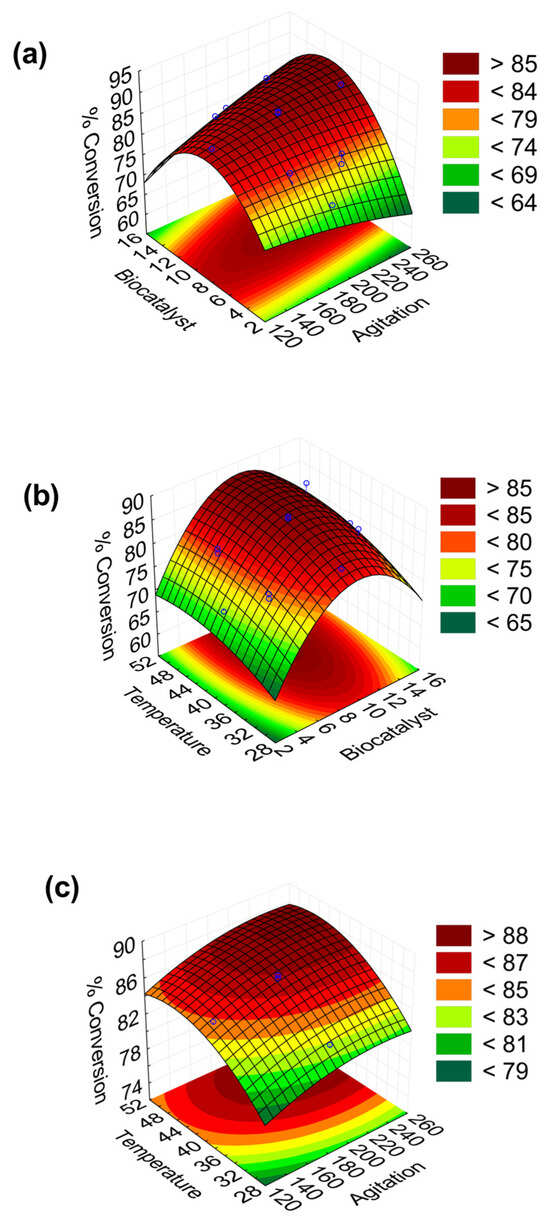
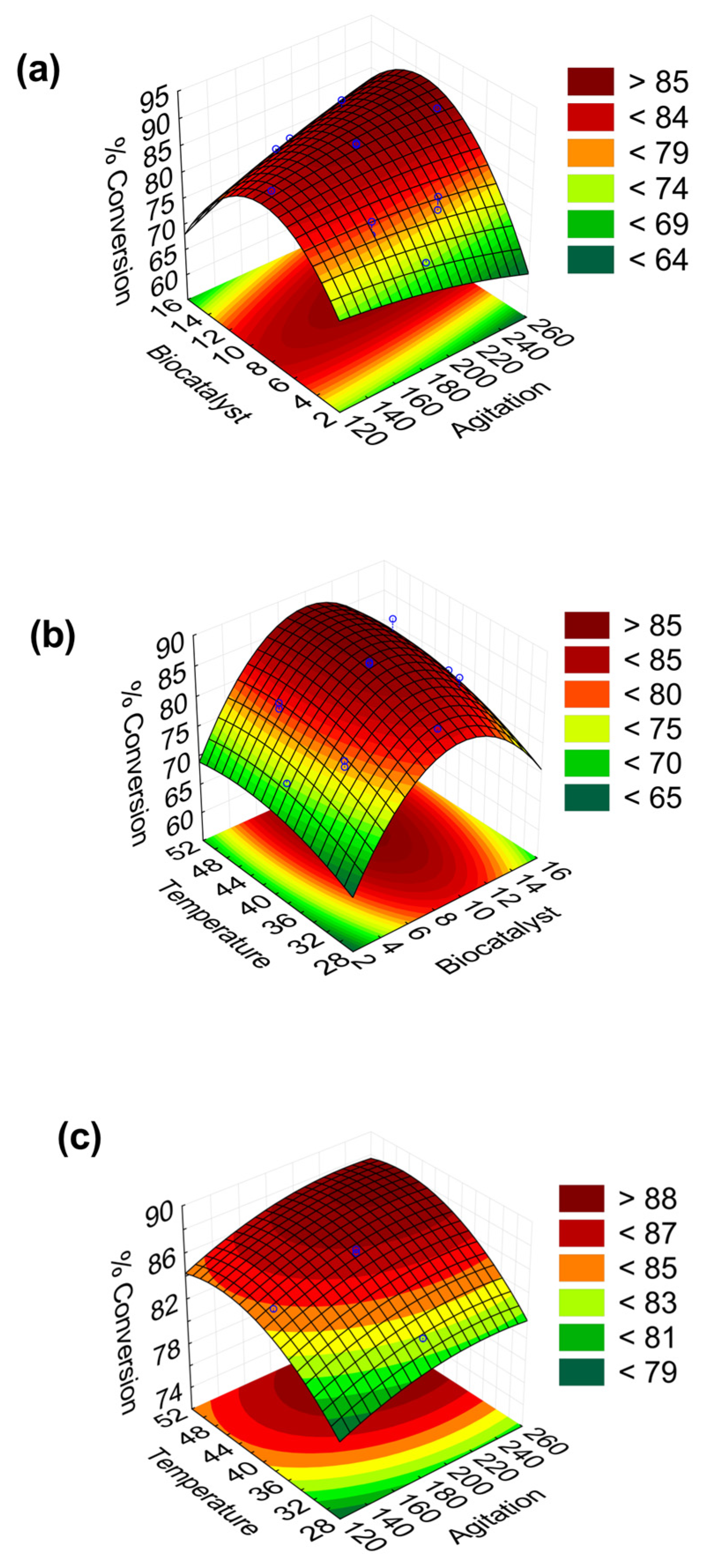
The response surface (Figure 2) was obtained by expressing the effects of the independent variables on the conversion of geranyl butyrate.
Figure 2.
Response surface plots for the synthesis of geranyl butyrate catalyzed by CRL–DHP-20, showing the effect of variable interactions on conversion: (a) biocatalyst concentration × agitation speed; (b) temperature × biocatalyst concentration; (c) temperature × agitation speed. Blue circles represent the experimental data points used to construct the response surfaces. The plots highlight the positive influence of moderate agitation and increased biocatalyst concentration.
As shown in Table 1, the residual value of the model was also very low, which shows the good reproducibility of the data obtained. This indicates that the mathematical model given by Equation (5) is statistically significant and adequate to represent the relationship between the dependent variable (conversion percentage) and the independent variable in the investigated ranges. Thus, the proposed model can also be successfully used to create and explore response surfaces (RS) and achieve optimal experimental conditions that maximize ester production. Unlike several esterification optimization studies that maintain agitation as a fixed parameter [51], the present work evaluated agitation as an independent variable due to its direct influence on external mass transfer resistance and substrate diffusion toward the porous biocatalyst microenvironment.
Figure 2a–c demonstrate the effect of the interaction of variables on the synthesis of geranyl butyrate. As shown in Figure 2a,b, ester production was significantly influenced by the biocatalyst concentration, which is the most important parameter in the ester production, as can be seen in the linear coefficient of Equation (5). This is credited to the greater number of existing catalytic sites in the reaction medium. On the other hand, a marked reduction in ester production was observed at both low (<4%) and high (>14%) biocatalyst concentrations. At low enzyme loadings, the reduced density of active sites may limit catalytic efficiency. Conversely, at high biocatalyst concentrations, excessive particle accumulation may increase the viscosity of the reaction medium and promote steric hindrance, diffusional limitations, or partial enzyme aggregation on the support surface, thereby reducing substrate accessibility to the active sites [60]. Conversely, at low concentrations, the reduced availability of catalytic sites leads to minor conversion capacity [61]. The increase in viscosity in the reaction medium increases the thickness of the stagnant film around the external surface of the biocatalyst, which increases resistance to mass transfer at the solid–liquid interface [62,63]. Consequently, increased agitation of the reaction medium is required to increase the mass transfer of starting materials from the reaction medium to the outer surface of the biocatalyst [62]. The interaction between these variables was significant at the 95% confidence level (Equation (5)), clearly showing that increasing the concentration of biocatalyst requires an increased frequency of stirring in the reaction medium.
Figure 2b shows the interaction between temperature and biocatalyst concentration. As described above, the maximum conversion percentage can clearly be obtained between 8 and 12% in mass of biocatalyst per volume of reaction medium. Under these conditions, maximum conversion percentage was obtained at maximum temperature levels. These results suggest that an increase in temperature decreases the viscosity of the reaction medium and improves its rheological properties, which strongly influences the process of mass transfer from the reactants to the active sites of the enzyme [64]. Moreover, this effect may also be associated with the intrinsic catalytic behavior of the lipase, since the optimal reaction temperature reported for this enzyme is within the same range observed in this study, indicating that both improved mass transfer and enhanced enzymatic activity contribute to the increased conversion [65,66]. The equation predicted by the proposed model shows that the linear coefficient temperature was the second most important parameter in the reaction (positive effect on the enzymatic production of the ester).
Similar results were reported for the synthesis of geranyl butyrate catalyzed by Eversa Transform 2.0 lipase, in which temperature was also identified as a key factor influencing conversion. In that study, an optimal conversion of 93% was achieved at 50 °C using a biocatalyst loading of 15% [58]. The authors attributed the positive effect of temperature to the increase in kinetic energy of the reaction system, which allowed a greater fraction of molecules to overcome the activation energy barrier, thereby favoring ester synthesis. Additionally, enzymatic activity remained stable within this temperature range, avoiding significant thermal deactivation while promoting reaction efficiency. Regarding biocatalyst concentration, increasing the catalyst loading up to 15% improved conversion due to the greater availability of active sites for catalysis. However, concentrations above this level resulted in a slight reduction in conversion. According to the authors, excessive enzyme loading may promote enzyme aggregation, which can hinder substrate access to the catalytic active sites and consequently reduce reaction efficiency.
To validate the model, optimal point experiments (13.4% of biocatalyst, 48 °C and 220 rpm) were performed in triplicate and the conversion obtained was 85.4%. The value observed experimentally corresponds to approximately 97% of the theoretical value, experimentally validating and confirming the proposed model for the synthesis of geranyl butyrate. A similar validation result was reported in another study, in which the experimental conversion (~93%) was close to the value predicted by the statistical model (~96%) [58]. Additionally, another study focused on optimizing the synthesis of hexyl butyrate and confirmed the optimal conditions, with a deviation of just 5.50% from the predicted value [12].
3.3. CRL-DHP-20 Reuse Test
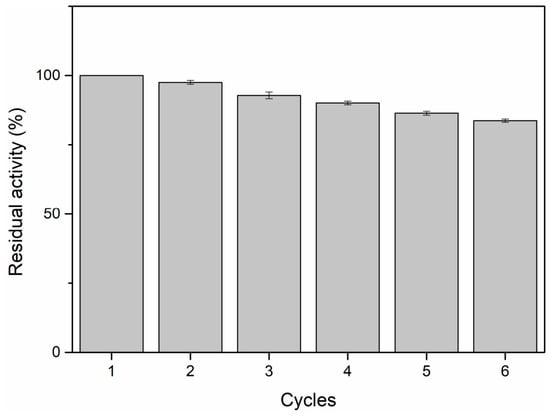
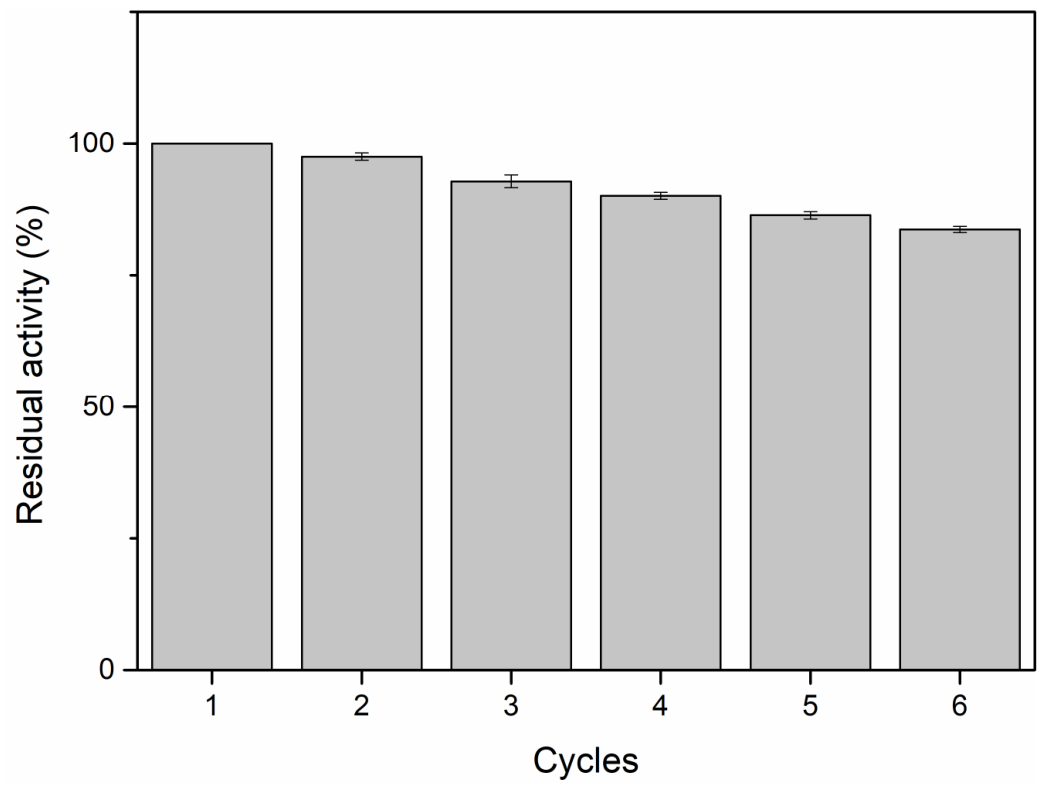
The reusability of immobilized enzymes is industrially important because it improves process performance and reduces operational costs [67,68]. Tests were conducted to evaluate the operational stability and reusability of CRL-DHP-20 during successive cycles of geranyl butyrate synthesis. The reaction was carried out under the optimal conditions established by Equation (5). Figure 3 shows the variation in the residual activity of CRL-DHP-20 after successive reaction cycles.
Figure 3.
Reuse of CRL–DHP-20 in the esterification of geranyl butyrate under the optimal conditions obtained from the response surface methodology. The biocatalyst retains 84% of its initial activity after six consecutive cycles, demonstrating satisfactory operational stability.
The ester conversion achieved before the reuse experiments was defined as the reference value corresponding to 100% relative activity. After six successive cycles, CRL-DHP-20 retained 84% of its relative activity (Figure 3). A reduction in activity during successive reactions is expected due to a possible thermal denaturation of the enzymes, or possible loss of proteins during the process of washing the biocatalyst with hexane [68], these phenomena are widely reported in studies involving immobilization by physical adsorption, where the reversible nature of the interaction between enzyme and support can lead to gradual enzyme leaching during reuse cycles [69,70]. Although enzyme desorption into highly non-polar solvents such as hexane is generally limited, partial loss of weakly adsorbed protein during repeated washing cycles cannot be completely excluded.
Operational deactivation during repeated esterification cycles has also been associated with progressive accumulation of reaction products [41,42] and structural rearrangements in adsorbed enzymes [52], particularly in systems based on physical adsorption, where enzyme–support interactions remain reversible [28]. Additionally, water molecules produced during the esterification reaction can accumulate on the surface of the support, inhibiting product formation, according to Le Chatelier’s principle. Even in small amounts, the water produced in the esterification has a 1:1 stoichiometric relationship with the ester formed, and over successive cycles, these water molecules may accumulate on the support surface, causing a slight reduction in the final conversion. These results confirm the promising use of CRL-DHP-20 in ester synthesis due to a satisfactory stabilization of the enzyme in Diaion HP-20. Although longer operational studies are desirable for industrial validation [71], the six-cycle evaluation performed in this work is consistent with several recent reports involving immobilized lipases on hydrophobic polymeric supports evaluated under batch esterification conditions [72].
When compared with previous studies reported in the literature, CRL-DHP-20 showed satisfactory operational stability during successive reaction cycles. For example, a study involving Candida rugosa lipase immobilized on Accurel MP 1000 reported approximately 70% residual activity after the second reaction cycle during the synthesis of emollient esters [2]. In contrast, CRL-DHP-20 maintained higher residual activity even after six consecutive cycles, demonstrating the effectiveness of the immobilization strategy employed in the present study. In another study, CRL was immobilized on magnetic chitosan, resulting in approximately 76% residual activity after the fifth reuse cycle [68]. Additionally, the reusability achieved in the present study surpassed the results reported in patent CN119193565A [73], which described Candida rugosa lipase immobilized on chitosan/sodium tripolyphosphate (Lip@CS-STPP) and on APTES-modified polyvinyl alcohol/chitosan composites crosslinked with sodium tripolyphosphate and glutaraldehyde (Lip@CS-PVA*-STPP). In that study, Lip@CS-STPP retained approximately 50% of its initial activity after four reuse cycles, while Lip@CS-PVA*-STPP maintained about 50% residual activity after seven cycles. These results indicate that the immobilization of CRL on Diaion HP-20 is an effective strategy for preserving enzymatic activity during repeated esterification reactions in organic media.
These findings reinforce the practical potential of CRL-DHP-20 as a robust and reusable biocatalyst for ester synthesis in organic media. Beyond the production of aromatic esters such as geranyl butyrate, which are used in fragrances and flavors, the high stability and compatibility of the system in hydrophobic media suggest its applicability in broader biocatalytic processes. These include the synthesis of bio-based lubricants [31], fine chemicals [10], and emollients [2], where enzyme reuse and solvent tolerance are critical for reducing costs and environmental impact. The use of Diaion HP-20, a hydrophobic polymeric resin with high surface area and biocompatibility, also contributes to the system’s efficiency, making it a promising platform for industrial-scale biocatalytic processes.
3.4. Chromatographic Analysis
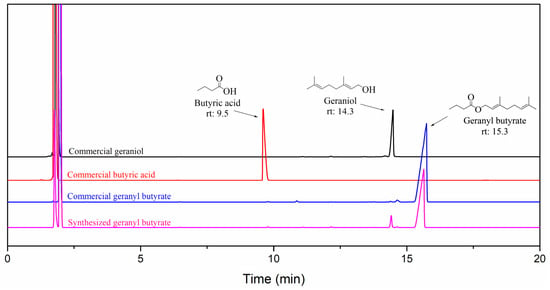
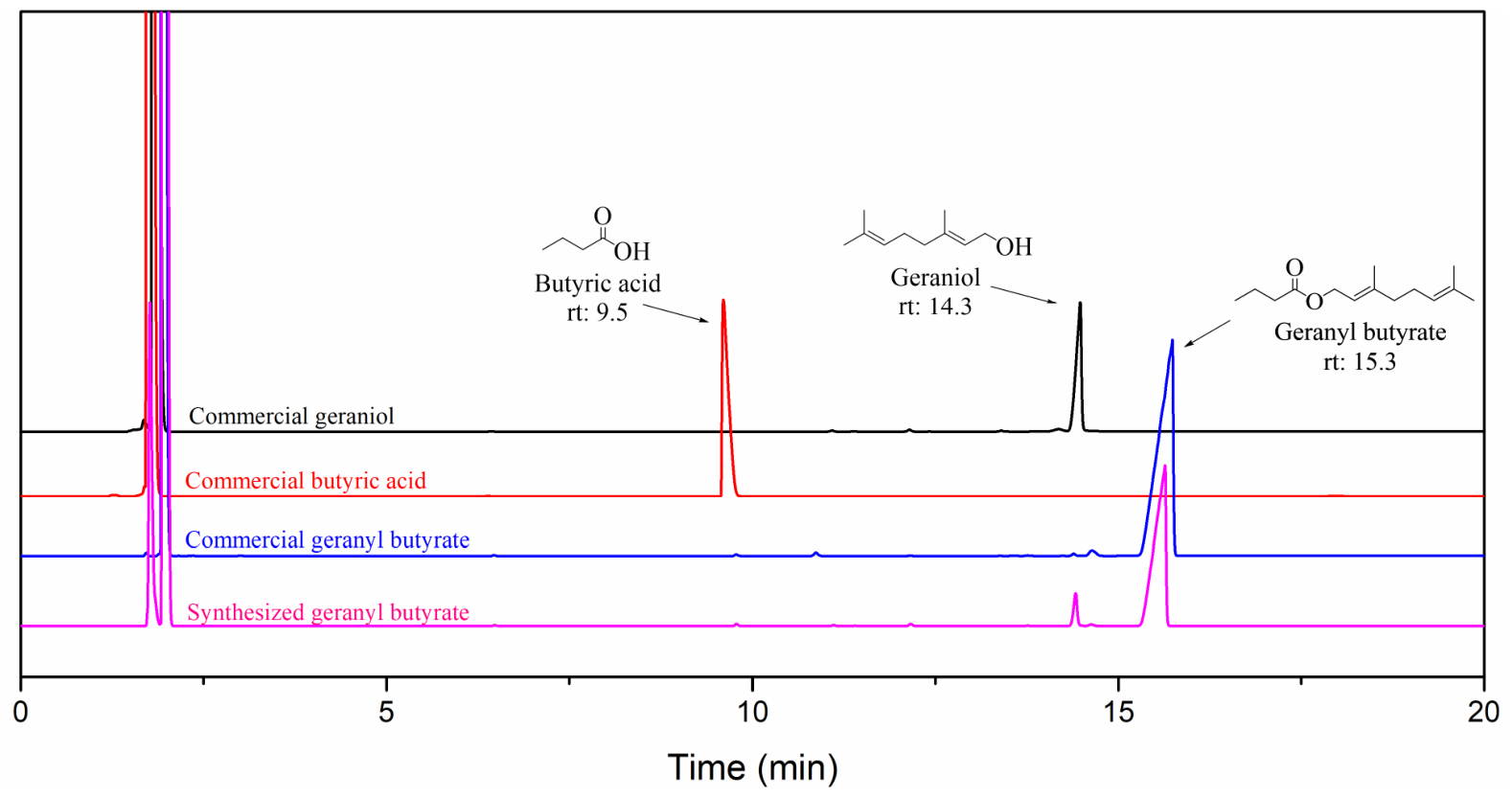
Gas chromatography analysis confirmed the synthesis of geranyl butyrate. According to the GC-FID chromatograms, retention times of 9.5, 14.3, and 15.3 min were observed for the butanoic acid, geraniol, and geranyl butyrate standards, respectively. The detection of geranyl butyrate at the corresponding retention time indicated the effectiveness of the esterification reaction mediated by CRL immobilized on Diaion HP-20 (Figure 4). The chromatographic run was completed within 20 min.
Figure 4.
GC–FID chromatograms of butanoic acid, geraniol, and geranyl butyrate standards and of the reaction mixture obtained after esterification catalyzed by CRL-DHP-20. The retention time of the synthesized product is consistent with that of the geranyl butyrate standard.
4. Conclusions
The previously validated Diaion HP-20 immobilization platform demonstrated good applicability for geranyl butyrate synthesis, achieving high immobilization yield and satisfactory catalytic performance. Under the optimized conditions, the CRL-DHP-20 system achieved 85.4% conversion in the synthesis of geranyl butyrate after 360 min, indicating that the immobilization strategy effectively preserved the catalytic performance of the enzyme. Reusability assays demonstrated that CRL-DHP-20 retained 84% of its initial activity after six consecutive cycles, highlighting its operational stability. The hydrophobic character and porous structure of Diaion HP-20 likely contributed to the preservation of the enzyme’s active conformation by promoting interfacial activation and minimizing structural denaturation in the organic medium. These characteristics favored substrate accessibility and facilitated effective interactions at the enzyme’s catalytic site.
Overall, the results demonstrate the expanded application potential of CRL-DHP-20 as a reusable biocatalyst for aroma ester synthesis under optimized operational conditions. Beyond the laboratory scale, such performance indicates potential applicability for industrial processes, particularly in the flavor and fragrance sector, where mild reaction conditions and catalyst recyclability are crucial. Additionally, the use of immobilized enzymes in organic synthesis reduces the reliance on harsh chemical catalysts and diminishes environmental impact, aligning with green chemistry principles and contributing to the advancement of sustainable biotechnological routes. Some aspects were not addressed in the present study, including the storage stability of the immobilized biocatalyst, the pH profile of the immobilized enzyme, and the use of water-removal strategies to improve esterification performance. These topics may contribute to a broader understanding of the system and should be explored in future studies.
Author Contributions
Conceptualization, E.L.d.E.S. and S.C.A.; methodology, E.L.d.E.S. and S.C.A.; validation, E.L.d.E.S. and S.C.A.; formal analysis, E.L.d.E.S. and S.C.A., investigation, E.L.d.E.S. and S.C.A., writing—original draft preparation, E.L.d.E.S. and S.C.A.; writing—review and editing, E.L.d.E.S., S.C.A., I.C.F.S., I.V.L.d.M., A.A.M., E.G.P.d.S., M.F. and J.R.d.O., funding acquisition, M.F. and J.R.d.O. All authors have read and agreed to the published version of the manuscript.
Funding
This research was funded by the Bahia State Research Support Foundation, FAPESB and National Council for Scientific and Technological Development, CNPq.
Institutional Review Board Statement
Not applicable.
Informed Consent Statement
Not applicable.
Data Availability Statement
All data generated or analyzed during this study are included in this published article.
Acknowledgments
We would like to thank the Coordenação de Aperfeiçoamento de Pessoal de Nível Superior (CAPES), the Fundação de Amparo à Pesquisa do Estado da Bahia (FAPESB), and the Conselho Nacional de Desenvolvimento Científico e Tecnológico (CNPq) for the financial support and the Universidade Estadual de Santa Cruz (UESC) for the administrative and technical support.
Conflicts of Interest
The authors declare no conflicts of interest. The funders had no role in the design of the study; in the collection, analyses, or interpretation of data; in the writing of the manuscript; or in the decision to publish the results.
Abbreviations
The following abbreviations are used in this manuscript:
| ANOVA | Analysis of Variance |
| BOD | Biochemical Oxygen Demand (incubator) |
| BSA | Bovine Serum Albumin |
| CCD | Central Composite Design |
| CRL | Candida rugosa Lipase |
| CRL-DHP-20 | Candida rugosa Lipase immobilized on Diaion HP-20 |
| FA0 | Initial fatty acid concentration |
| FAf | Final fatty acid concentration |
| FDA | Food and Drug Administration |
| FID | Flame Ionization Detector |
| GC | Gas Chromatography |
| GC-FID | Gas Chromatography with Flame Ionization Detector |
| GRAS | Generally Recognized As Safe |
| HA | Hydrolytic Activity |
| IP | Immobilized Protein |
| NaOH | Sodium Hydroxide |
| rpm | Revolutions per minute |
| SA | Specific Activity |
References
- Ahmed, R.; Huddersman, K. Review of Biodiesel Production by the Esterification of Wastewater Containing Fats Oils and Grease (FOGs). J. Ind. Eng. Chem. 2022, 110, 1–14. [Google Scholar] [CrossRef] [Scilit]
- De Menezes, L.H.S.; Do Espírito Santo, E.L.; Dos Santos, M.M.O.; De Carvalho Tavares, I.M.; Mendes, A.A.; Franco, M.; De Oliveira, J.R. Candida Rugosa Lipase Immobilized on Hydrophobic Support Accurel MP 1000 in the Synthesis of Emollient Esters. Biotechnol. Lett. 2022, 44, 89–99. [Google Scholar] [CrossRef] [Scilit] [PubMed]
- Serrano-Arnaldos, M.; Montiel, M.C.; Ortega-Requena, S.; Máximo, F.; Bastida, J. Development and Economic Evaluation of an Eco-Friendly Biocatalytic Synthesis of Emollient Esters. Bioprocess Biosyst. Eng. 2020, 43, 495–505. [Google Scholar] [CrossRef] [Scilit] [PubMed]
- Ramon Tomé Oliveira, A.; Da Silva Aires, F.I.; Nascimento Dari, D.; De Matos Filho, J.R.; Dos Santos, K.M.; Simão Neto, F.; Lucas De Souza Magalhães, F.; Da Silva Sousa, P.; Junior, P.G.D.S.; Melo, R.L.F.; et al. Review on Lipase-Catalyzed Flavor Synthesis: Global Trends and Advances. J. Agric. Food Chem. 2025, 73, 17315–17330. [Google Scholar] [CrossRef] [Scilit] [PubMed]
- Jaiswal, K.S.; Rathod, V.K. Process Intensification of Enzymatic Synthesis of Flavor Esters: A Review. Chem. Rec. 2022, 22, e202100213. [Google Scholar] [CrossRef] [Scilit] [PubMed]
- Marasca, N.; Almeida, F.L.C.; Carneiro, R.L.; Forte, M.B.S. Flavour Ester Synthesis by Immobilized Lipases: A Research Overview With Industrial Relevance. Flavour Fragr. J. 2026, 41, 721–741. [Google Scholar] [CrossRef] [Scilit]
- Chen, J.; Zhang, Y.; Zhong, H.; Zhu, H.; Wang, H.; Goh, K.-L.; Zhang, J.; Zheng, M. Efficient and Sustainable Preparation of Cinnamic Acid Flavor Esters by Immobilized Lipase Microarray. LWT 2023, 173, 114322. [Google Scholar] [CrossRef] [Scilit]
- Ben Akacha, N.; Gargouri, M. Microbial and Enzymatic Technologies Used for the Production of Natural Aroma Compounds: Synthesis, Recovery Modeling, and Bioprocesses. Food Bioprod. Process. 2015, 94, 675–706. [Google Scholar] [CrossRef] [Scilit]
- Liu, Y.; WeiZhuo, X.; Wei, X. A Review on Lipase-Catalyzed Synthesis of Geranyl Esters as Flavor Additives for Food, Pharmaceutical and Cosmetic Applications. Food Chem. Adv. 2022, 1, 100052. [Google Scholar] [CrossRef] [Scilit]
- Sá, A.G.A.; Meneses, A.C.D.; Araújo, P.H.H.D.; Oliveira, D.D. A Review on Enzymatic Synthesis of Aromatic Esters Used as Flavor Ingredients for Food, Cosmetics and Pharmaceuticals Industries. Trends Food Sci. Technol. 2017, 69, 95–105. [Google Scholar] [CrossRef] [Scilit]
- Hall, R.L.; Oser, B.L. Recent Progress in the Consideration of Flavoring Ingredients under the Food Additives Amendment. III. GRAS Substances. Food Technol. 1965, 19, 488–495. [Google Scholar]
- Dos Santos, M.M.O.; De Menezes, L.H.S.; Do Espirito Santo, E.L.; De Carvalho, M.S.; Gonçalves, M.S.; De Carvalho Tavares, I.M.; Mendes, A.A.; Ruiz, H.A.; Salay, L.C.; Franco, M.; et al. Synthesis of Hexyl Butyrate (Apple and Citrus Aroma) by Candida Rugosa Lipase Immobilized on Diaion HP-20 Using the Box-Behnken Design. Food Sci. Biotechnol. 2023, 32, 689–696. [Google Scholar] [CrossRef] [Scilit]
- Ortega-Requena, S.; Montiel, C.; Máximo, F.; Gómez, M.; Murcia, M.D.; Bastida, J. Esters in the Food and Cosmetic Industries: An Overview of the Reactors Used in Their Biocatalytic Synthesis. Materials 2024, 17, 268. [Google Scholar] [CrossRef] [Scilit] [PubMed]
- Máximo, F.; Asensi, M.; Serrano-Arnaldos, M.; Ortega-Requena, S.; Montiel, C.; Bastida, J. Biocatalytic Intensified Process for the Synthesis of Neopentyl Glycol Dicaprylate/Dicaprate. Sustain. Chem. Pharm. 2022, 30, 100882. [Google Scholar] [CrossRef] [Scilit]
- Soares, G.A.; Alnoch, R.C.; Silva Dias, G.; Santos Reis, N.D.; Tavares, I.M.D.C.; Ruiz, H.A.; Bilal, M.; De Oliveira, J.R.; Krieger, N.; Franco, M. Production of a Fermented Solid Containing Lipases from Penicillium Roqueforti ATCC 10110 and Its Direct Employment in Organic Medium in Ethyl Oleate Synthesis. Biotechnol. Appl. Biochem. 2022, 69, 1284–1299. [Google Scholar] [CrossRef] [Scilit] [PubMed]
- Costa-Silva, T.A.; Carvalho, A.K.F.; Souza, C.R.F.; Freitas, L.; De Castro, H.F.; Oliveira, W.P. Highly Effective Candida Rugosa Lipase Immobilization on Renewable Carriers: Integrated Drying and Immobilization Process to Improve Enzyme Performance. Chem. Eng. Res. Des. 2022, 183, 41–55. [Google Scholar] [CrossRef] [Scilit]
- Sousa, R.R.d.; dos Santos, M.M.; Medeiros, M.W.R.; Manoel, E.A.; Berenguer-Murcia, Á.; Freire, D.M.G.; Fernandez-Lafuente, R.; Ferreira-Leitão, V.S. Immobilized Lipases in the Synthesis of Short-Chain Esters: An Overview of Constraints and Perspectives. Catalysts 2025, 15, 375. [Google Scholar] [CrossRef] [Scilit]
- Mustafa, A.; Fathy, S.; Kutlu, O.; Niikura, F.; Inayat, A.; Mustafa, M.; Abdellatief, T.M.M.; Bokhari, A.; Samuel, O.D.; Pastore, C.; et al. Cleaner and Sustainable Synthesis of High-Quality Monoglycerides by Use of Enzyme Technologies: Techno-Economic and Environmental Study for Monolaurin. Clean. Technol. Environ. Policy 2023, 25, 3263–3283. [Google Scholar] [CrossRef] [Scilit]
- Tadesse, M.; Liu, Y. Recent Advances in Enzyme Immobilization: The Role of Artificial Intelligence, Novel Nanomaterials, and Dynamic Carrier Systems. Catalysts 2025, 15, 571. [Google Scholar] [CrossRef] [Scilit]
- Zhong, L.; Feng, Y.; Wang, G.; Wang, Z.; Bilal, M.; Lv, H.; Jia, S.; Cui, J. Production and Use of Immobilized Lipases in/on Nanomaterials: A Review from the Waste to Biodiesel Production. Int. J. Biol. Macromol. 2020, 152, 207–222. [Google Scholar] [CrossRef] [Scilit] [PubMed]
- Chapman, J.; Ismail, A.E.; Dinu, C.Z. Industrial Applications of Enzymes: Recent Advances, Techniques, and Outlooks. Catalysts 2018, 8, 238. [Google Scholar] [CrossRef] [Scilit]
- Remonatto, D.; Miotti, R.H., Jr.; Monti, R.; Bassan, J.C.; De Paula, A.V. Applications of Immobilized Lipases in Enzymatic Reactors: A Review. Process Biochem. 2022, 114, 1–20. [Google Scholar] [CrossRef] [Scilit]
- Basso, A.; Serban, S. Industrial Applications of Immobilized Enzymes—A Review. Mol. Catal. 2019, 479, 110607. [Google Scholar] [CrossRef] [Scilit]
- Adlercreutz, P. Immobilisation and Application of Lipases in Organic Media. Chem. Soc. Rev. 2013, 42, 6406. [Google Scholar] [CrossRef] [Scilit] [PubMed]
- Bolivar, J.M.; Woodley, J.M.; Fernandez-Lafuente, R. Is Enzyme Immobilization a Mature Discipline? Some Critical Considerations to Capitalize on the Benefits of Immobilization. Chem. Soc. Rev. 2022, 51, 6251–6290. [Google Scholar] [CrossRef] [Scilit] [PubMed]
- Rodrigues, R.C.; Hernandez, K.; Barbosa, O.; Rueda, N.; Garcia-Galan, C.; Dos Santos, J.C.S.; Berenguer-Murcia, A.; Fernandez-Lafuente, R. Immobilization of Proteins in Poly-Styrene-Divinylbenzene Matrices: Functional Properties and Applications. Curr. Org. Chem. 2015, 19, 1707–1718. [Google Scholar] [CrossRef] [Scilit]
- Monteiro, R.R.C.; Dos Santos, J.C.S.; Alcántara, A.R.; Fernandez-Lafuente, R. Enzyme-Coated Micro-Crystals: An Almost Forgotten but Very Simple and Elegant Immobilization Strategy. Catalysts 2020, 10, 891. [Google Scholar] [CrossRef] [Scilit]
- Rodrigues, R.C.; Virgen-Ortíz, J.J.; Dos Santos, J.C.S.; Berenguer-Murcia, Á.; Alcantara, A.R.; Barbosa, O.; Ortiz, C.; Fernandez-Lafuente, R. Immobilization of Lipases on Hydrophobic Supports: Immobilization Mechanism, Advantages, Problems, and Solutions. Biotechnol. Adv. 2019, 37, 746–770. [Google Scholar] [CrossRef] [Scilit] [PubMed]
- Miguel Júnior, J.; Mattos, F.R.; Costa, G.R.; Zurlo, A.B.R.; Fernandez-Lafuente, R.; Mendes, A.A. Improved Catalytic Performance of Lipase Eversa® Transform 2.0 via Immobilization for the Sustainable Production of Flavor Esters—Adsorption Process and Environmental Assessment Studies. Catalysts 2022, 12, 1412. [Google Scholar] [CrossRef] [Scilit]
- Montiel, M.C.; Gómez, M.; Murcia, M.D.; Ortega-Requena, S.; Máximo, F.; Bastida, J. Sustainable Biocatalytic Synthesis of a Second-Generation Biolubricant. Sustainability 2024, 16, 1615. [Google Scholar] [CrossRef] [Scilit]
- Bolina, I.C.A.; Gomes, R.A.B.; Mendes, A.A. Biolubricant Production from Several Oleaginous Feedstocks Using Lipases as Catalysts: Current Scenario and Future Perspectives. BioEnergy Res. 2021, 14, 1039–1057. [Google Scholar] [CrossRef] [Scilit]
- Gonçalves, M.S.; Oliveira, P.C.; Araujo, S.C.; Do Espirito Santo, E.L.; Neta, J.L.V.; Dos Anjos, P.N.M.; Ferreira, M.L.O.; Salay, L.C.; Sampaio, I.C.F.; Dos Santos, M.M.O.; et al. Innovating in the Production of Activated Carbon through the Reuse of Fermented Biomass. Chem. Pap. 2024, 78, 2681–2685. [Google Scholar] [CrossRef] [Scilit]
- Alves, M.D.; Aracri, F.M.; Cren, É.C.; Mendes, A.A. Isotherm, Kinetic, Mechanism and Thermodynamic Studies of Adsorption of a Microbial Lipase on a Mesoporous and Hydrophobic Resin. Chem. Eng. J. 2017, 311, 1–12. [Google Scholar] [CrossRef] [Scilit]
- Vilas Bôas, R.N.; Ceron, A.A.; Bento, H.B.S.; De Castro, H.F. Application of an Immobilized Rhizopus Oryzae Lipase to Batch and Continuous Ester Synthesis with a Mixture of a Lauric Acid and Fusel Oil. Biomass Bioenergy 2018, 119, 61–68. [Google Scholar] [CrossRef] [Scilit]
- Kurtovic, I.; Nalder, T.D.; Cleaver, H.; Marshall, S.N. Immobilisation of Candida Rugosa Lipase on a Highly Hydrophobic Support: A Stable Immobilised Lipase Suitable for Non-Aqueous Synthesis. Biotechnol. Rep. 2020, 28, e00535. [Google Scholar] [CrossRef] [Scilit] [PubMed]
- Pereira, A.D.S.; De Souza, A.H.; Fraga, J.L.; Villeneuve, P.; Torres, A.G.; Amaral, P.F.F. Lipases as Effective Green Biocatalysts for Phytosterol Esters’ Production: A Review. Catalysts 2022, 12, 88. [Google Scholar] [CrossRef] [Scilit]
- Iuliano, M.; Ponticorvo, E.; Cirillo, C.; Castaldo, R.; De Pasquale, S.; Gentile, G.; Sarno, M. Wax Esters from Waste Fish Oil Catalysed by Immobilized Candida Rugosa Lipase. Process Biochem. 2023, 130, 386–400. [Google Scholar] [CrossRef] [Scilit]
- Novaes, C.G.; Yamaki, R.T.; De Paula, V.F.; Do Nascimento Júnior, B.B.; Barreto, J.A.; Valasques, G.S.; Bezerra, M.A. Optimization of Analytical Methods Using Response Surface Methodology—Part I: Process Variables. Rev. Virtual Quím. 2017, 9, 1184–1215. [Google Scholar] [CrossRef] [Scilit]
- Ferreira, M.M.; Santiago, F.L.B.; Silva, N.A.G.d.; Luiz, J.H.H.; Fernandéz-Lafuente, R.; Mendes, A.A.; Hirata, D.B. Different Strategies to Immobilize Lipase from Geotrichum Candidum: Kinetic and Thermodynamic Studies. Process Biochem. 2018, 67, 55–63. [Google Scholar] [CrossRef] [Scilit]
- Ceccoli, R.D.; Bianchi, D.A.; Zocchi, S.B.; Rial, D.V. Mapping the Field of Aroma Ester Biosynthesis: A Review and Bibliometric Analysis. Process Biochem. 2024, 146, 587–600. [Google Scholar] [CrossRef] [Scilit]
- Foresti, M.L.; Pedernera, M.; Bucalá, V.; Ferreira, M.L. Multiple Effects of Water on Solvent-Free Enzymatic Esterifications. Enzym. Microb. Technol. 2007, 41, 62–70. [Google Scholar] [CrossRef] [Scilit]
- Tjørnelund, H.D.; Vind, J.; Brask, J.; Woodley, J.M.; Peters, G.H.J. Candida Antarctica Lipase B Performance in Organic Solvent at Varying Water Activities Studied by Molecular Dynamics Simulations. Comput. Struct. Biotechnol. J. 2023, 21, 5451–5462. [Google Scholar] [CrossRef] [Scilit] [PubMed]
- Dos Santos, M.M.O.; Gama, R.S.; De Carvalho Tavares, I.M.; Santos, P.H.; Gonçalves, M.S.; De Carvalho, M.S.; De Barros Vilas Boas, E.V.; De Oliveira, J.R.; Mendes, A.A.; Franco, M. Application of Lipase Immobilized on a Hydrophobic Support for the Synthesis of Aromatic Esters. Biotechnol. Appl. Biochem. 2021, 68, 538–546. [Google Scholar] [CrossRef] [Scilit] [PubMed]
- Bradford, M.M. A Rapid and Sensitive Method for the Quantitation of Microgram Quantities of Protein Utilizing the Principle of Protein-Dye Binding. Anal. Biochem. 1976, 72, 248–254. [Google Scholar] [CrossRef] [PubMed]
- Natalello, A.; Ami, D.; Brocca, S.; Lotti, M.; Doglia, S.M. Secondary Structure, Conformational Stability and Glycosylation of a Recombinant Candida Rugosa Lipase Studied by Fourier-Transform Infrared Spectroscopy. Biochem. J. 2005, 385, 511–517. [Google Scholar] [CrossRef] [Scilit] [PubMed]
- Zhong, L.; Feng, Y.; Wang, Z.; Tian, T.; Bi, Y.; Cui, J. Immobilized Lipase on MIL-53(Al)-AM11 with Regulatable Hydrophobic Surface for Flavor Ester Synthesis. Int. J. Biol. Macromol. 2025, 305, 141322. [Google Scholar] [CrossRef] [Scilit] [PubMed]
- Bose, A.L.; Bhattacharjee, D.; Goswami, D. Process Parameters Influence Product Yield and Kinetic Parameters in Lipase Catalysis. ChemBioEng Rev. 2024, 11, 178–196. [Google Scholar] [CrossRef] [Scilit]
- Hakalin, N.L.S.; Molina-Gutiérrez, M.; Prieto, A.; Martínez, M.J. Optimization of Lipase-Catalyzed Synthesis of β-Sitostanol Esters by Response Surface Methodology. Food Chem. 2018, 261, 139–148. [Google Scholar] [CrossRef] [Scilit] [PubMed]
- Da Silva Corrêa, L.; Henriques, R.O.; Rios, J.V.; Lerin, L.A.; De Oliveira, D.; Furigo, A. Lipase-Catalyzed Esterification of Geraniol and Citronellol for the Synthesis of Terpenic Esters. Appl. Biochem. Biotechnol. 2020, 190, 574–583. [Google Scholar] [CrossRef] [Scilit] [PubMed]
- Lage, F.A.P.; Bassi, J.J.; Corradini, M.C.C.; Todero, L.M.; Luiz, J.H.H.; Mendes, A.A. Preparation of a Biocatalyst via Physical Adsorption of Lipase from Thermomyces Lanuginosus on Hydrophobic Support to Catalyze Biolubricant Synthesis by Esterification Reaction in a Solvent-Free System. Enzym. Microb. Technol. 2016, 84, 56–67. [Google Scholar] [CrossRef] [Scilit] [PubMed]
- Vilas Bôas, R.N.; Lima, R.D.; Mendes, A.A.; Freitas, L.; Bento, H.B.S.; Carvalho, A.K.F.D.; De Castro, H.F. Batch and Continuous Production of Biolubricant from Fusel Oil and Oleic Acid: Lipase Screening, Reactor System Development, and Reaction Optimization. Chem. Eng. Process.-Process Intensif. 2021, 168, 108568. [Google Scholar] [CrossRef] [Scilit]
- Silva, A.R.D.M.; Gonçalves, L.R.B.; Da Silva, I.J. Innovations in Packed-Bed Reactors Utilizing Immobilized Lipase Catalysts: A Comprehensive Technical and Scientific Review. Mol. Catal. 2025, 573, 114814. [Google Scholar] [CrossRef] [Scilit]
- Gómez, M.; Murcia, M.D.; Gómez, E.; Hidalgo, A.; Máximo, F.; Montiel, M.C. Comparative Analysis of Kinetic Parameters of Sustainable Branched Esters Obtained from Lauric Acid. ACS Omega 2026, 11, 9785–9792. [Google Scholar] [CrossRef] [Scilit] [PubMed]
- Nguyen, M.M.; Khodaei, N.; Karboune, S. Enzymatic Modification of Enriched Lemon Oil in a Solvent-Free Reaction Medium: Bioconversion Yield and Product Profile. J. Agric. Food Res. 2021, 6, 100211. [Google Scholar] [CrossRef] [Scilit]
- Junzo, O. Transesterification. Chem. Rev. 1993, 93, 1449–1470. [Google Scholar] [CrossRef] [Scilit]
- Sharma, R.; Chisti, Y.; Banerjee, U.C. Production, Purification, Characterization, and Applications of Lipases. Biotechnol. Adv. 2001, 19, 627–662. [Google Scholar] [CrossRef] [Scilit] [PubMed]
- Tacias-Pascacio, V.G.; Abellanas-Perez, P.; De Andrades, D.; Tavano, O.; Mendes, A.A.; Berenguer-Murcia, Á.; Fernandez-Lafuente, R. A Comprehensive Review of Lipase-Catalyzed Acidolysis as a Method for Producing Structured Glycerides. Int. J. Biol. Macromol. 2025, 309, 142878. [Google Scholar] [CrossRef] [Scilit] [PubMed]
- Simão Neto, F.; Sousa Junior, P.G.D.; Da Silva Filho, C.J.A.; Pinheiro Coutinho, L.; Melo, R.L.F.; Rocha-Martin, J.; Rios, M.A.D.S.; Sanders Lopes, A.A.; Monteiro, N.D.K.V.; De Mattos, M.C.; et al. Green Enzymatic Synthesis of Geranyl Butyrate: Process Optimization and Mechanistic Insights. ACS Omega 2024, 9, 16992–17001. [Google Scholar] [CrossRef] [Scilit]
- Corradini, M.C.C.; Gomes, R.A.B.; Luiz, J.H.H.; Mendes, A.A. Optimization of Enzymatic Synthesis of n -Propyl Acetate (Fruit Flavor Ester)—Effect of the Support on the Properties of Biocatalysts. Chem. Eng. Commun. 2016, 203, 1432–1442. [Google Scholar] [CrossRef] [Scilit]
- Arana-Peña, S.; Rios, N.S.; Carballares, D.; Mendez-Sanchez, C.; Lokha, Y.; Gonçalves, L.R.B.; Fernandez-Lafuente, R. Effects of Enzyme Loading and Immobilization Conditions on the Catalytic Features of Lipase From Pseudomonas Fluorescens Immobilized on Octyl-Agarose Beads. Front. Bioeng. Biotechnol. 2020, 8, 36. [Google Scholar] [CrossRef] [Scilit] [PubMed]
- Colombié, S.; Tweddell, R.J.; Condoret, J.-S.; Marty, A. Water Activity Control: A Way to Improve the Efficiency of Continuous Lipase Esterification. Biotechnol. Bioeng. 1998, 60, 362–368. [Google Scholar] [CrossRef] [Scilit]
- Jacob, A.G.; Wahab, R.A.; Chandren, S.; Jumbri, K.; Wan Mahmood, W.M.A. Physicochemical Properties and Operational Stability of Taguchi Design-Optimized Candida Rugosa Lipase Supported on Biogenic Silica/Magnetite/Graphene Oxide for Ethyl Valerate Synthesis. Adv. Powder Technol. 2022, 33, 103374. [Google Scholar] [CrossRef] [Scilit]
- Bahamondes, C.; Illanes, A.; Pouchucq, L. Effect of External Diffusional Restrictions in Immobilized Enzymes in Stirred Reactors. Biocatal. Biotransform. 2025, 43, 228–244. [Google Scholar] [CrossRef] [Scilit]
- Salgado, C.A.; Dos Santos, C.I.A.; Vanetti, M.C.D. Microbial Lipases: Propitious Biocatalysts for the Food Industry. Food Biosci. 2022, 45, 101509. [Google Scholar] [CrossRef] [Scilit]
- Raghavendra, T.; Sayania, D.; Madamwar, D. Synthesis of the ‘Green Apple Ester’ Ethyl Valerate in Organic Solvents by Candida Rugosa Lipase Immobilized in MBGs in Organic Solvents: Effects of Immobilization and Reaction Parameters. J. Mol. Catal. B Enzym. 2010, 63, 31–38. [Google Scholar] [CrossRef] [Scilit]
- Sharma, S.; Kumar, S.; Sahney, R.; Dahiya, P. Green Synthesis of Iron-Alginate Nanoparticle for Taguchi-Assisted Immobilization of Candida Rugosa Lipase and Its Application in the Synthesis of Butyl Butyrate Ester. Process Biochem. 2024, 139, 81–92. [Google Scholar] [CrossRef] [Scilit]
- Sarno, M.; Iuliano, M. G_Fe3O4/Ag Supporting Candida Rugosa Lipase for the “Green” Synthesis of Pomegranate Seed Oil Derived Liquid Wax Esters. Appl. Surf. Sci. 2020, 510, 145481. [Google Scholar] [CrossRef] [Scilit]
- Bayramoglu, G.; Celikbicak, O.; Kilic, M.; Yakup Arica, M. Immobilization of Candida Rugosa Lipase on Magnetic Chitosan Beads and Application in Flavor Esters Synthesis. Food Chem. 2022, 366, 130699. [Google Scholar] [CrossRef] [Scilit] [PubMed]
- Jesionowski, T.; Zdarta, J.; Krajewska, B. Enzyme Immobilization by Adsorption: A Review. Adsorption 2014, 20, 801–821. [Google Scholar] [CrossRef] [Scilit]
- Girelli, A.M.; Chiappini, V. Renewable, Sustainable, and Natural Lignocellulosic Carriers for Lipase Immobilization: A Review. J. Biotechnol. 2023, 365, 29–47. [Google Scholar] [CrossRef] [Scilit] [PubMed]
- Baena, A.; Orjuela, A.; Rakshit, S.K.; Clark, J.H. Enzymatic Hydrolysis of Waste Fats, Oils and Greases (FOGs): Status, Prospective, and Process Intensification Alternatives. Chem. Eng. Process.-Process Intensif. 2022, 175, 108930. [Google Scholar] [CrossRef] [Scilit]
- Miotti, R.H.; Do Amaral, S.R.; Freitas, A.N.; Bento, H.B.S.; De Carvalho, A.K.F.; Primo, F.L.; De Paula, A.V. Enzymatic Production Process of Capric Acid-Rich Structured Lipids: Development of Formulation as a New Therapeutic Approach. Int. J. Biol. Macromol. 2024, 257, 128641. [Google Scholar] [CrossRef] [Scilit] [PubMed]
- Jiang, L.; Li, S.; Liu, Y.; Liang, J. A Method for Preparing Immobilized Lipase 2024. CN119193565A, 27 December 2024. [Google Scholar]



Disclaimer/Publisher’s Note: The statements, opinions and data contained in all publications are solely those of the individual author(s) and contributor(s) and not of MDPI and/or the editor(s). MDPI and/or the editor(s) disclaim responsibility for any injury to people or property resulting from any ideas, methods, instructions or products referred to in the content. |
© 2026 by the authors. Licensee MDPI, Basel, Switzerland. This article is an open access article distributed under the terms and conditions of the Creative Commons Attribution (CC BY) license.