


Abstract
Magnetic reciprocating engines (MREs) offer an emission-free alternative to internal combustion engines; however, their practical implementation requires precise speed regulation, a challenge compounded by coupled electromechanical dynamics and inductive actuator lag. This paper presents the design, implementation, and experimental comparison of two intelligent control strategies for speed regulation in an MRE prototype: a neural ignition-angle controller that dynamically adjusts ignition timing using an online neural network, and a Voltage Feedforward Neural Network (FFNN) controller that combines a PID feedback loop with an offline-trained inverse neural model as a feedforward compensator. The experimental results confirm that both controllers achieve effective speed tracking. The FFNN approach demonstrates superior performance, exhibiting reduced control effort and a more stable transient response compared with the neural angle controller, while maintaining precise tracking across different operating conditions.
1. Introduction
For over a century, internal combustion engines (ICE) have been the dominant technology powering global transportation, agriculture, and industry [1]. However, their dependence on fossil fuels has led to severe environmental impacts, particularly greenhouse gas emissions that contribute to climate change [2]. In response, electrification has emerged as a major alternative, and governments worldwide are promoting the transition toward electric vehicles [3]. Despite these efforts, high costs and limited charging infrastructure still hinder their large-scale adoption, especially in developing countries [4,5]. In this context, alternative propulsion technologies capable of reducing emissions while maintaining compatibility with existing mechanical infrastructure are of significant interest.
MREs represent one such emerging solution, as they generate mechanical motion through controlled electromagnetic forces, thereby eliminating direct combustion-related emissiones [6,7]. Unlike fully electric propulsion systems that require entirely new architectures, MREs preserve several structural and mechanical characteristics of conventional reciprocating engines, which makes them attractive for gradual transition scenarios where complete electrification is not yet feasible. Nevertheless, the practical implementation of MRE systems remains challenging due to their strongly nonlinear and coupled electromechanical dynamics. In these systems, the piston motion is directly driven by the electromagnetic force generated by the actuator, which depends on the coil current dynamics governed by the supply voltage, inductance, and energization timing. Consequently, accurate speed regulation becomes a critical and non-trivial control problem.
Previous studies on MRE systems have mainly focused on system modeling, experimental characterization, and predefined commutation strategies. In [8], a single-cylinder MRE prototype was experimentally analyzed, while [9] investigated variable-speed operation using switching-based control strategies. Similarly, ref. [10] developed a mathematical model of a single-cylinder MRE and experimentally validated its dynamic behavior, reporting that the highest rotational speed was achieved when the electromagnet was energized between 45° and 55° before top dead center (TDC). The study demonstrated that fixed energization angles within this range allowed the engine to reach approximately 840 RPM while achieving an experimental-model fit of 81.21%. Although these works provide valuable insight into the electromechanical behavior of MRE systems, the implemented strategies are primarily based on predefined energization conditions and do not address adaptive closed-loop nonlinear speed regulation under varying operating conditions.
In MRE systems, the excitation angle is a key factor in the generation of electromagnetic force and, consequently, in the rotational dynamics of the crankshaft. Variations in the ON-angle directly affect piston acceleration, torque production, and energy transfer efficiency [8,9]. However, as the rotational speed increases, the available energization window narrows due to the actuator inductive dynamics, making timing errors increasingly critical. Inaccurate synchronization between the magnetic force and piston position may result in reduced torque generation, oscillatory behavior, and poor speed regulation. Furthermore, the nonlinear coupling between supply voltage, coil current, magnetic force, and crankshaft dynamics makes the design of robust controllers particularly challenging.
From a control perspective, MRE systems share important characteristics with electromagnetic actuators and magnetic levitation (MAGLEV) systems, where force generation is nonlinear and strongly dependent on electrical dynamics [11]. For this reason, several intelligent control strategies have been proposed for related electromagnetic systems, including nonlinear PID schemes, sliding-mode control, backstepping approaches, and predictive controllers [12,13,14]. More recently, artificial intelligence-based techniques such as neural networks and fuzzy controllers have demonstrated strong capabilities for compensating nonlinearities and uncertainties in electromagnetic systems [15,16,17,18]. Neural-network-based approaches are particularly attractive because they can approximate nonlinear electromechanical relationships without requiring an exact analytical inverse model. Recent studies and reviews on intelligent energy systems have further highlighted the growing relevance of data-driven and adaptive control strategies for improving robustness and operational performance in nonlinear electromechanical applications [19].
Despite these advances, the direct application of intelligent nonlinear control techniques to MRE systems remains limited. Most existing MRE studies still rely on fixed ON/OFF commutation schemes or predefined energization windows, which provide limited adaptability under variable operating conditions. Consequently, the problem of achieving adaptive and robust speed regulation capable of compensating the nonlinear electromechanical coupling inherent to MRE systems remains largely open. To provide a clearer depiction of the current state of the art and to identify the prevailing research gap, Table 1 presents a summary of representative control strategies reported for MRE and related electromagnetic systems.
Table 1.
Comparison of control strategies in MRE and related electromagnetic systems.
Motivated by these limitations, this paper proposes two specialized neural-network-based control strategies for speed regulation in a magnetic reciprocating engine. Unlike previous MRE approaches based on fixed energization windows or predefined commutation logic, the proposed methods explicitly exploit the nonlinear relationship between electrical excitation and mechanical response in order to improve transient performance and speed regulation capabilities.
The main contributions of this work are summarized as follows:
- Development of a neural ON-angle controller capable of adaptively adjusting the energization timing according to the operating conditions of the MRE system, moving beyond conventional fixed-angle strategies.
- Design of a hybrid voltage feedforward neural-network controller combined with a PID regulator for nonlinear voltage compensation and improved speed tracking performance under varying speed conditions.
- Experimental implementation and comparative evaluation of the proposed controllers against conventional ON/OFF and PID-based approaches, demonstrating significant performance improvements.
This work focuses on experimental speed regulation in a laboratory-scale single-cylinder MRE prototype. The study is centered on dynamic control performance and does not address thermal analysis, energy efficiency optimization, or multi-cylinder synchronization, which remain topics for future research.
The remainder of this paper is organized as follows. Section 2 presents the problem formulation and system model. Section 3 describes the proposed control strategies. Section 4 reports the experimental results and performance evaluation. Section 5 presents the analysis. Section 6 presents the conclusions. Finally, Section 7 discusses the implications and limitations of our findings.
2. Problem Statement
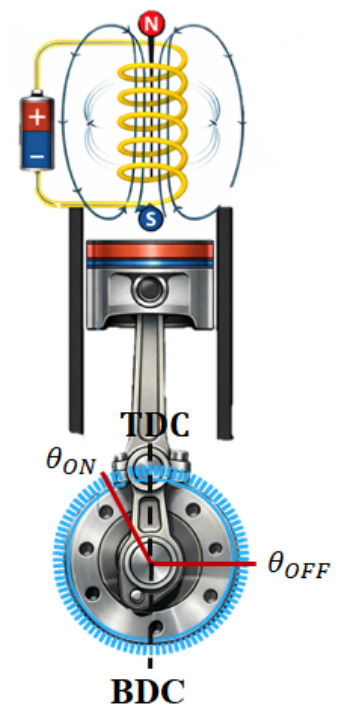
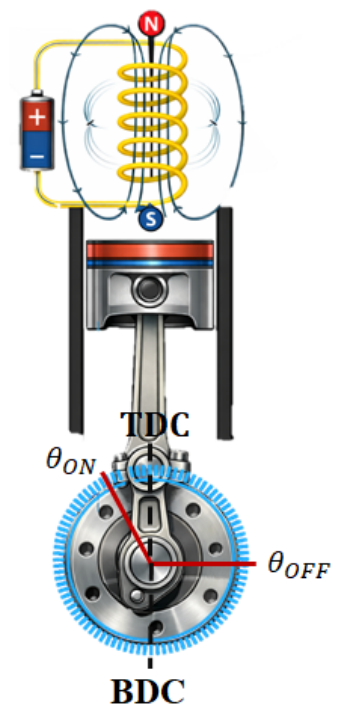
The speed regulation of the MRE is fundamentally determined by the electromechanical coupling between the RL dynamics of the electromagnet and the nonlinear crank–slider mechanism. In this system, the mechanical torque is not directly imposed, but is generated through the magnetic repulsion between the electromagnet and the permanent magnet located on the piston head. The magnitude and timing of this repulsive force depend on the applied supply voltage and the ignition angle relative to the crankshaft position (see Figure 1).
Figure 1.
Schematic diagram of a magnetic reciprocating engine.
Neural-Based ON-Angle Controller
The current flowing through the electromagnet is governed by the RL circuit dynamics (1):
where: L is an inductance, R is a resistance, V is a supply voltage, and is a time constant of RL circuit.
This expression shows that the current exhibits an exponential transient and does not reach its steady-state value instantaneously. Consequently, the supply voltage V determines both the steady-state current level and the rate of current buildup. Since the magnetic flux density inside the solenoid is given by (2):
where: is the magnetic flux density [T], is the magnetic permeability of free space [], is the number of turns in the solenoid, I is an electric current [A], is the solenoid length [m], is a unit vector in the z-direction.
The magnetic field is directly proportional to the current and therefore to the applied voltage. Any variation in voltage modifies the magnetic field intensity and, consequently, the magnitude of the magnetic repulsive force (3):
where: represents the magnetic force generated by an external magnetic field, V is the volume, S is the surface, corresponds the volumetric charge density, denotes the surface charge density, is the external magnetic flux density, while and are the differential volume and surface elements, respectively.
This indicates that the repulsive force is proportional to the external magnetic field generated by the electromagnet. This force appears explicitly in the dynamic equilibrium of the mechanism. Following the dynamic model presented in [10], the reaction components are given by:
Similarly, the ignition angle defines the crankshaft position at which the electromagnet is energized. Due to the exponential evolution of the current, the magnetic force does not reach its peak instantaneously. If the ignition angle is advanced or delayed, the maximum repulsive force will occur at a different angular position, modifying the effective torque contribution during the expansion stroke. As a result, varying the ignition angle also produces different torque waveforms and consequently different angular velocities.
The central problem addressed in this work arises from the nonlinear and time-dependent relationship between voltage, ignition angle, magnetic force, and crankshaft dynamics. Due to the exponential transient of the RL circuit and the angular dependence of the torque expression, distinct operating speeds arise when either the supply voltage or the ignition angle is modified. In this study, both variables are analyzed independently to evaluate and compare their individual influence on engine speed. The objective is to determine which control variable provides a more effective and stable mechanism for MRE speed regulation under the inherent electromechanical nonlinearities of the system.
3. Control Strategies for Speed Regulation in a Magnetic Reciprocating Engine
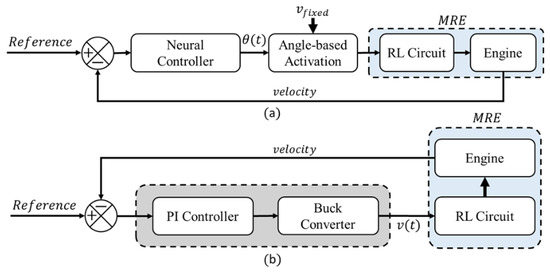
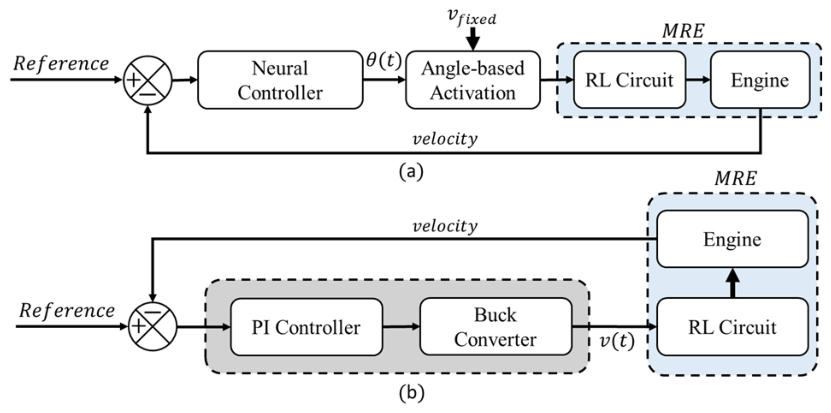
This section presents the proposed control strategies developed to achieve precise and stable speed regulation in the magnetic reciprocating engine (MRE). Considering the nonlinear electromechanical coupling and the timing-dependent actuator dynamics, two intelligent control architectures are proposed and experimentally evaluated. Figure 2 illustrates the overall control schemes of both approaches, highlighting their structural differences and the manner in which the energization variables are manipulated to regulate engine speed.
Figure 2.
Proposed control architectures for the considered control problem: (a) FFNN-based speed control strategy using angle-dependent activation with constant supply voltage; (b) Conventional PI-based speed control system using a buck converter with fixed switching angles.
3.1. Neural-Based ON-Angle Controller
Artificial neural networks (ANNs) possess the capability to adapt their internal parameters through learning algorithms, enabling the approximation of nonlinear relationships in dynamic systems [25].
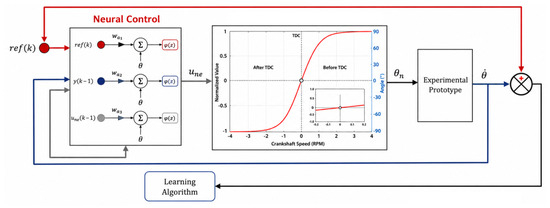
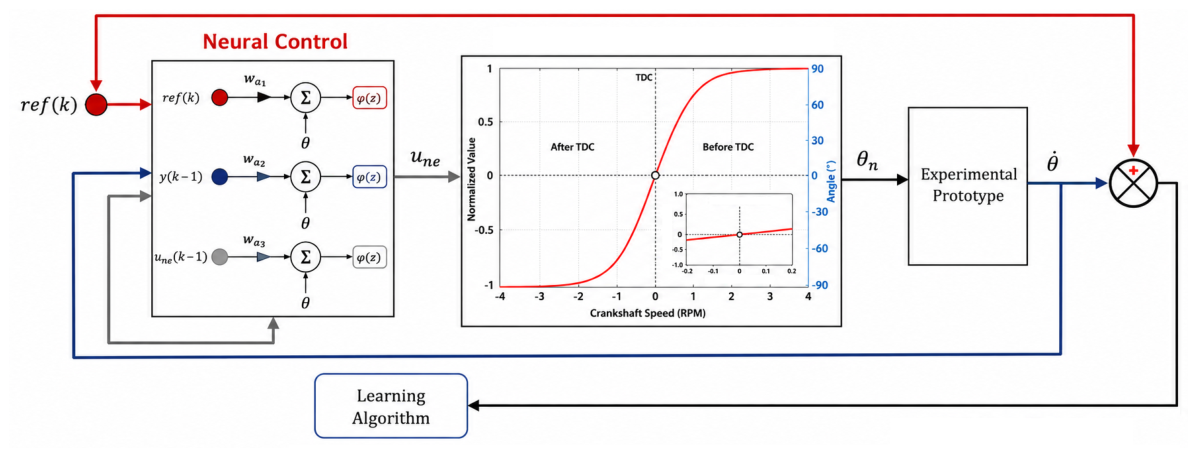
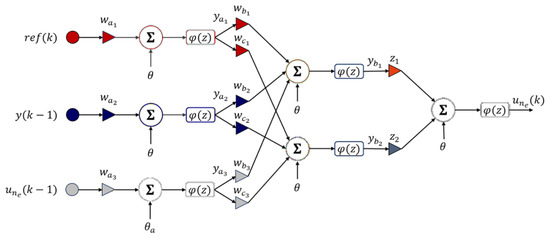
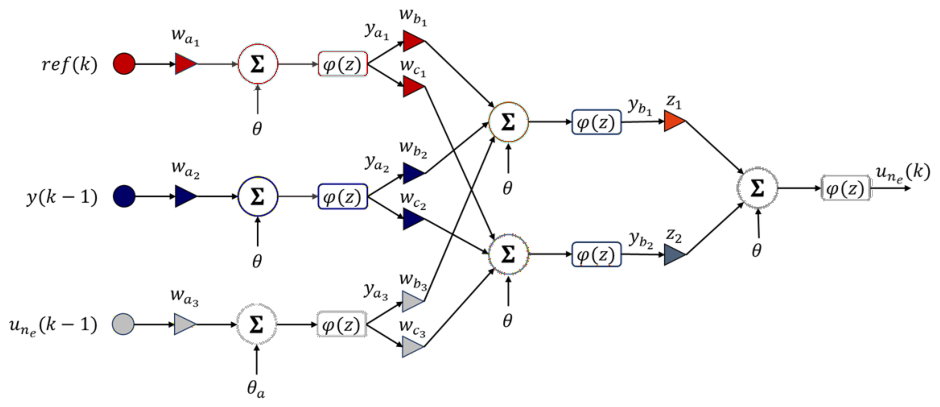
To compensate for the nonlinearities associated with energization-angle control, a three-layer recurrent neural network with a 3-2-1 architecture was implemented. The proposed controller employs an online learning algorithm with learning rate , allowing the synaptic weights to be continuously adjusted according to the operating conditions of the MRE system. This adaptive structure uses feedback from the measured speed and control signals to minimize the tracking error between the reference and the measured rotational speed. The control scheme corresponding to this strategy is shown in Figure 3, which illustrates the online adaptation mechanism used to update the synaptic weights in real time. Figure 4 presents the architecture of the implemented ANN controller.
Figure 3.
Ignition angle controller diagram with ANN structure.
Figure 4.
Internal structure of the ANN used as a controller.
The following equations are derived from Figure 4:
where is the control output at the current instant, and is the control output at the previous sampling instant. The variables and represent the reference speed and the measured speed at the current instant, respectively, while denotes the previous output value. The parameters , , and correspond to the synaptic weights of the input and hidden layers of the neural network, respectively, whereas and denote the synaptic weights of the output layer. The variables , , and represent threshold (bias) terms, where is associated with the input , and corresponds to the scaled output of in terms of the energization angle expressed in degrees. Finally, denotes the learning rate (integration step), and E represents the cost or performance function.
Accordingly, the learning algorithm for the recurrent neural controller in Equation (6) is governed by the cost function presented in Equation (9):
where
The minimization of the discrete steepest descent algorithm for the synaptic weights shown in Figure 4 is represented by Equation (11) through (14):
where: , , .
The above formulation establishes that the ANN output lies in the range [−1, 1]. However, a dead zone with saturation is introduced to prevent the generation of values in the vicinity of , at which the ANN is prone to saturation for extended periods, causing numerical difficulties at that operating point.
3.2. Voltage FFNN or Voltage Controller via Feedforward Neural Network Compensation
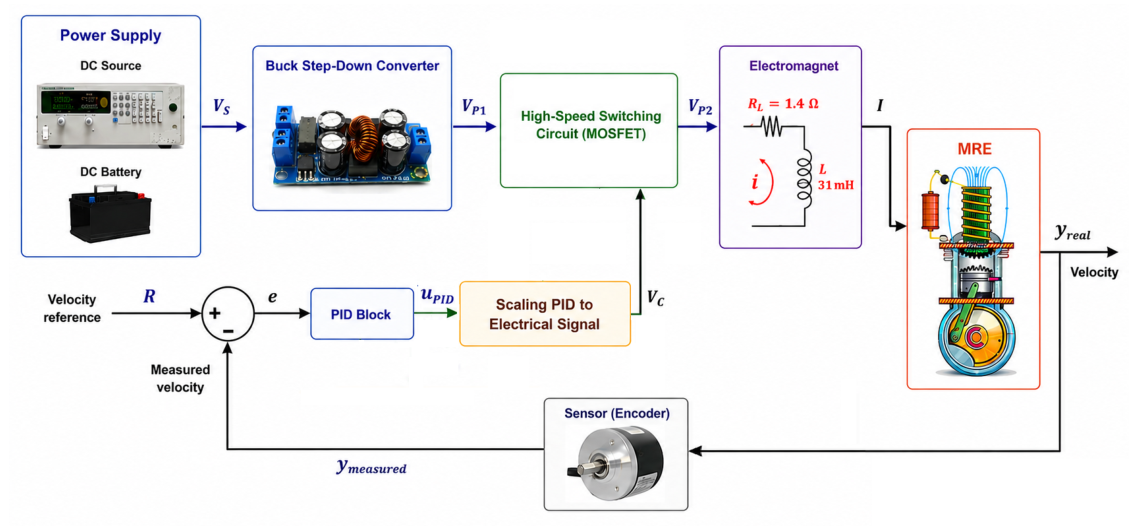
The detailed structure of the proposed control strategy is shown in Figure 5. In this approach, the supply voltage delivered by the power source or DC-DC converter is regulated through a control signal generated by the analog output (AO) of the myRIO card. By adjusting the supply voltage, the controller indirectly modifies the maximum current reached in the electromagnet coil, thereby altering the magnetic force exerted on the piston head and, consequently, the rotational speed of the MRE.
Figure 5.
Block Diagram of a PID Voltage Supply Control System.
The controller design was carried out in two stages. First, a PID controller was tuned using several tuning methodologies, including Ziegler–Nichols, Cohen–Coon, trial-and-error procedures, and Particle Swarm Optimization (PSO). Second, an artificial neural network was trained to model the nonlinear relationship between the input voltage and the resulting engine speed.
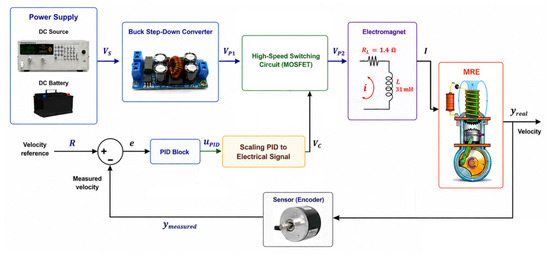
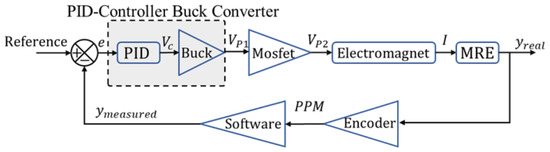
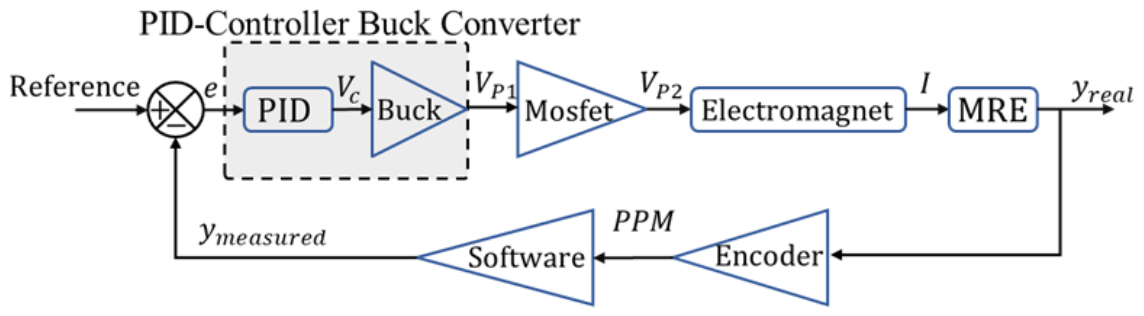
Figure 6 presents a block diagram of the drive system, emphasizing the integration of a PI-controlled Buck converter (in green square) to achieve closed-loop speed regulation of an MRE. Existing hardware/software modules are shown in blue.
Figure 6.
Schematic of the Proposed PID Control Scheme for the Buck Converter, where denotes the actual angular velocity and the measured velocity obtained from the encoder.
3.3. Obtaining the Transfer Function or Identification of the Voltage–Speed Transfer Function
Based on the mathematical model proposed by [10], a step excitation was applied to the voltage input in order to analyze the dynamic relationship between the supply voltage and the engine speed. The resulting response exhibits a behavior that can be accurately approximated by a first-order system. Under this assumption, the voltage–speed dynamics around the selected operating point were represented by the following first-order transfer function:
where denotes the steady-state gain and represents the dominant time constant of the system. This simplified model was subsequently used as the basis for the implementation and comparison of the different PID tuning techniques in simulation.
3.4. PID Tuning Using Classical Techniques
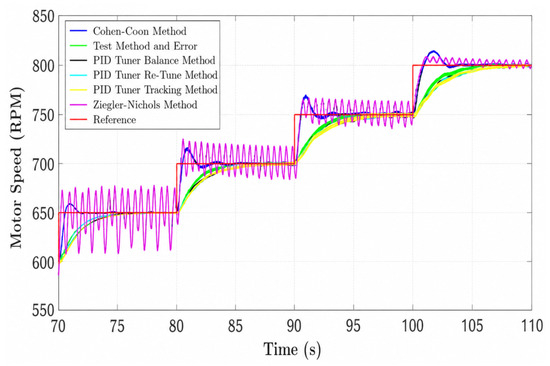
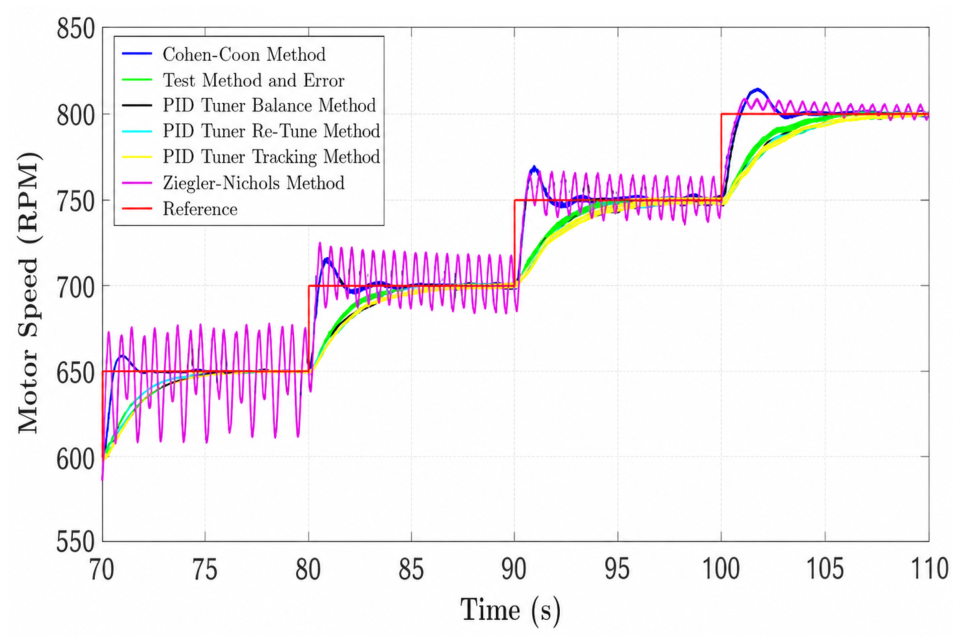
As shown in Figure 7, the preliminary tuning stage involved evaluating classical PID tuning techniques such as Ziegler–Nichols and Cohen–Coon. However, these methods exhibited limited performance due to the nonlinear inductive behavior of the electromagnet. Although the trial-and-error approach and the MATLAB PID Tuner produced acceptable responses, the literature indicates that heuristic optimization methods such as Particle Swarm Optimization (PSO) provide superior global exploration of the controller parameter space. In addition, the implementation of an offline PSO-based tuning framework establishes a technical foundation for the future development of adaptive online PID controllers. Consequently, the following section presents the development of the PSO-based PID strategy adopted to achieve improved dynamic performance.
Figure 7.
Speed responses of PID controllers tuned using classical techniques.
3.5. PID Parameter Optimization via PSO
PSO belongs to the field of swarm intelligence, a branch of bio-inspired artificial intelligence that models the collective behavior observed in nature [26]. In this work, an offline PSO approach is employed, using the following performance criteria to define the cost function:
- Settling time ().
- Overshoot ().
- Zero oscillations in transient and steady state.
- Low global error.
The cost function is then expressed by the following equation:
where:
- J: Total cost function.
- : Settling time. The time required for the output to remain within of its final value.
- : Overshoot. The percentage by which the output exceeds the reference value.
- : Maximum oscillation magnitude in steady state, calculated as the maximum deviation of the final values with respect to their average.
- MSE: Mean Squared Error, defined as:where is the error between the reference signal and the system output.
The values of , , , and are user-defined [27,28]; however, for the established performance criteria, the specific values used are listed in Table 2.
Table 2.
Weighting coefficients used in the cost function.
The offline PSO was configured with a population size of particles and an inertia weight of , balancing global exploration and local exploitation. Termination criteria included a maximum number of iterations and a cost function convergence threshold. A convergence analysis was performed at 10, 20, and 30 iterations. Given the low-dimensional search space (three PID parameters: ), the cost function reached asymptotic stability rapidly. No significant improvement in performance metrics was observed beyond 20 iterations, while computational overhead increased. Therefore, the optimization was stopped after 20 iterations for all results reported (Table 2), providing an optimal balance between accuracy and computational efficiency for the electromagnet control model.
Table 3 shows the values of the gains obtained using PSO to minimize the cost function defined in (17). The gains obtained after 20 iterations were selected for implementation.
Table 3.
Gain optimization results for the PID controller.
3.6. Stability and Robustness Validation
To validate the PI controller design tuned via PSO, a stability analysis was conducted at the most demanding operating point (30 V). The closed-loop system demonstrated asymptotic stability according to the Lyapunov theory, with a positive-definite matrix P whose eigenvalues of and confirm its definiteness and the associated decrease of the Lyapunov function toward equilibrium. Local stability was further confirmed by the placement of closed-loop poles in the left half-plane at and . In addition, robustness against parametric uncertainties in the electromagnet was validated by an infinite gain margin and a phase margin of . These results guarantee high tolerance toward external disturbances and variations in the engine’s dynamic conditions, fulfilling the theoretical requirements for robust control.
3.7. Design and Offline-Training of the ANN or Design and Training of the ANN
The Multi-Layer Perceptron (MLP) is a fundamental neural network architecture composed of an input layer, one or more hidden layers, and an output layer. Information propagates sequentially, layer by layer. Its computational power is derived from its joint use with the error backpropagation learning algorithm [29].
The MLP is characterized by three fundamental attributes:
- The use of nonlinear and differentiable (smooth) activation functions in its neurons.
- The presence of hidden layers that allow it to solve nonlinearly separable problems.
- A high degree of synaptic connectivity between its processing elements.
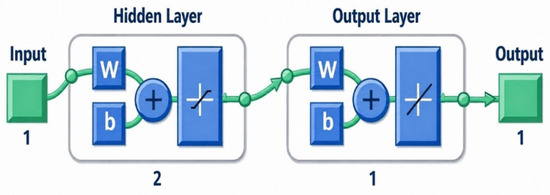
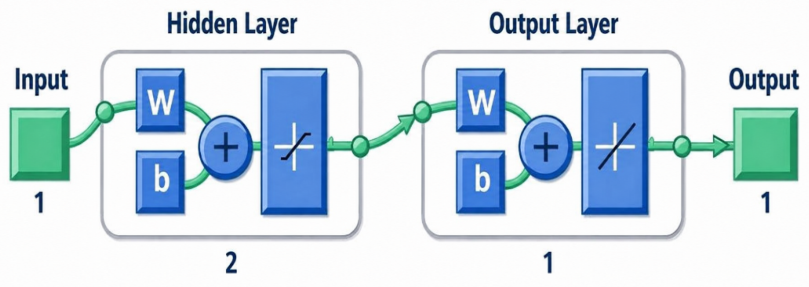
The selection of the neural network architecture was driven by the physical complexity of each control variable. In this case, the relationship between supply voltage and output speed is approximately linear under no-load conditions and fixed energization angles. Given this simplicity, a compact offline architecture was defined through an empirical iterative design process.
Initially, the model was trained in Python (version 2.17.1 of the TensorFlow library, using Google Colab) using the ReLU activation function, where performance metrics stabilized at 16 hidden neurons. However, to facilitate integration with Simulink, the model was subsequently implemented in MATLAB (version R2021a) and the activation function was replaced with the hyperbolic tangent (tanh), which is better suited for the dynamic range of the system signals. After re-evaluation, it was found that the tanh activation function allowed a reduction to only 2 hidden neurons while maintaining and even improving performance compared with the previous 16-neuron configuration. Accordingly, this compact architecture was selected to ensure real-time computational efficiency in the electromagnet system without compromising accuracy.
Experimental voltage (input) and speed (output) data were used for training. The network was implemented and trained in MATLAB, and its structure is illustrated in Figure 8.
Figure 8.
Structure of the Inverse ANN in MATLAB Toolbox.
3.8. Combination of PID and ANN to Form FFNN Controller
Most industrial control systems are still based on PID-type controllers (P, PI, PD, and PID) due to their simplicity and well-established tuning methodologies. However, their performance can be limited when applied to nonlinear systems. In this context, feedforward control represents a complementary strategy that can be combined with feedback control to enhance overall system performance.
This strategy offers significant advantages:
- Ease of implementation: It can be introduced gradually into existing systems.
- Improved performance: It enhances reference tracking without increasing noise sensitivity.
- Synergy: If a stabilizing feedback controller is already in place, feedforward experiments can be conducted more readily.
Nevertheless, an inadequate feedforward design can degrade overall system performance and typically requires the presence of a feedback controller. In this context, Feedforward Neural Networks (FFNNs) are employed due to their capability to approximate complex nonlinear dynamics, enabling the development of more effective feedforward compensation schemes compared with classical approaches.
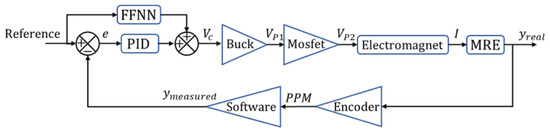
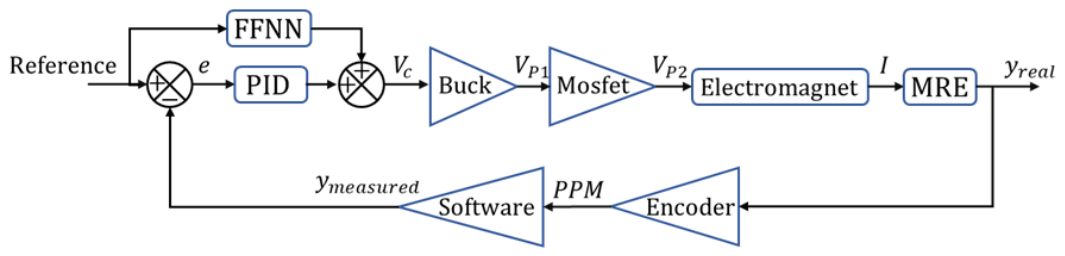
Once both the PID controller and the neural network were designed, the control structure shown in Figure 9 was implemented, where the ANN is used as a feedforward compensator.
Figure 9.
FFNN Control Structure Used.
The system behavior differs depending on whether the reference input is a step or a ramp signal, since the ANN operates as a static compensator. For large tracking errors, such as those generated by step inputs, both the PID controller and the ANN act simultaneously. In fast dynamic systems such as the proposed MRE, this interaction may lead to overshoot in the transient response. In contrast, ramp inputs produce smaller tracking errors, significantly reducing this effect.
Therefore, for step-reference experiments, the PID action was intentionally delayed so that it acts only on the residual error after the ANN contribution. For ramp-reference experiments, both ANN and PID actions were applied simultaneously, as illustrated in Figure 9.
However, this control structure is not sufficient on its own. While it performs adequately under ramp inputs since the gradual variation results in relatively small tracking errors that allow the PID and FFNN actions to complement each other, its performance degrades under step inputs. In this case, the abrupt reference change generates a large instantaneous tracking error. Because the ANN operates as a static mapping, its output responds immediately to this change, while the PID controller simultaneously reacts to the same error signal. This simultaneous action may lead to control signal amplification and consequently to undesirable overshoot in the system response.
To mitigate this effect, a time-based switching strategy was implemented. In this scheme, only the neural feedforward action is active during the initial transient period following a reference change. A delay of 4 s was selected based on the observed transient dynamics of the system in order to avoid overlap between control actions. Activating the PID controller during this period would cause the large initial error to induce a strong corrective action which, combined with the ANN output, could result in excessive control effort and overshoot.
After this transient interval, the PID controller is enabled to compensate for the residual tracking error and to improve robustness against external disturbances.
This strategy is formalized through the hybrid control structure presented below, which integrates the neural feedforward action with the time-conditioned PID feedback action to ensure smooth transitions and improved transient performance.
where is the feedforward control action generated by the neural network model, and is the feedback control action provided by the PID controller.
where e is the error, P is the proportional gain, I is the integral gain, and D is the derivative gain. s denotes the Laplace operator, and represents the time instant when a reference change occurs.
where x is the input (reference) of size , and are the hidden layer weights and biases, respectively. The output layer parameters are and . Finally, n denotes the number of neurons in the hidden layer.
4. Experimental Validation of the Proposed Controllers
This section presents the experimental validation of the proposed control strategies for speed regulation in the MRE. Both controllers were implemented on the real prototype to evaluate their dynamic performance, stability, and control effort under different operating conditions. Due to the thermal and torque limitations of the small-scale electromagnet used in this proof-of-concept setup, all experiments were conducted under no-load conditions.
The hybrid architecture (FFNN plus PID) was selected to reduce the effect of the mismatch between the neural network approximation and the real system dynamics. In this configuration, the neural network provides the primary control action, while the PID controller enhances robustness by compensating for residual tracking errors caused by model inaccuracies. To evaluate the robustness and generalization capability of the proposed approach under these hardware constraints, disturbance tests were performed by introducing simulated speed perturbations. The results show that the system is able to detect and compensate for unexpected speed deviations, whether caused by load variations or power fluctuations, and successfully restore the reference speed. These results confirm the stability of the proposed controller and suggest that load-based experimental validation should be addressed in future work using a larger-scale electromagnet and power stage.
The MRE prototype used for experimental validation is characterized by the parameters reported in Table 4 and Table 5. Table 4 summarizes the mechanical parameters of the system, including the connecting rod length, crank radius, and the masses of the piston, connecting rod, and crankshaft. Table 5 presents the electromagnetic and electrical parameters, such as the number of coil turns, magnet dimensions, magnetic remanence, solenoid geometry, and electrical properties including internal resistance and inductance.
Table 4.
Parameters used in the mathematical model of the mechanical part of the MRE.
Table 5.
Parameters used for the magnetic and electric formulation.
4.1. ON Angle Neural Controller
- Test start conditions for the controller:
The initial open-loop operation of the motor is shown in Figure 10, during which the neural controller begins its initialization process. At approximately 25 s, the system is switched to neural control, resulting in the convergence of the motor speed to the reference value. Once steady-state operation is achieved, a ramp reference test is applied, demonstrating that the velocity tracks the reference consistently throughout the experiment.
Figure 10.
MRE speed using energization angle neural control in the experimental prototype under a ramp input.
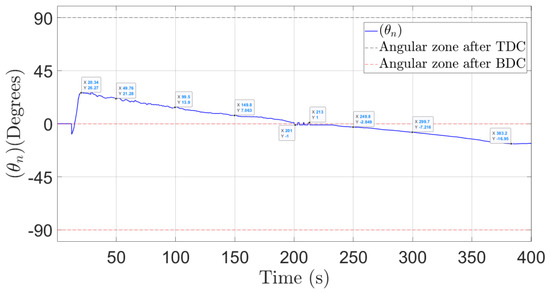
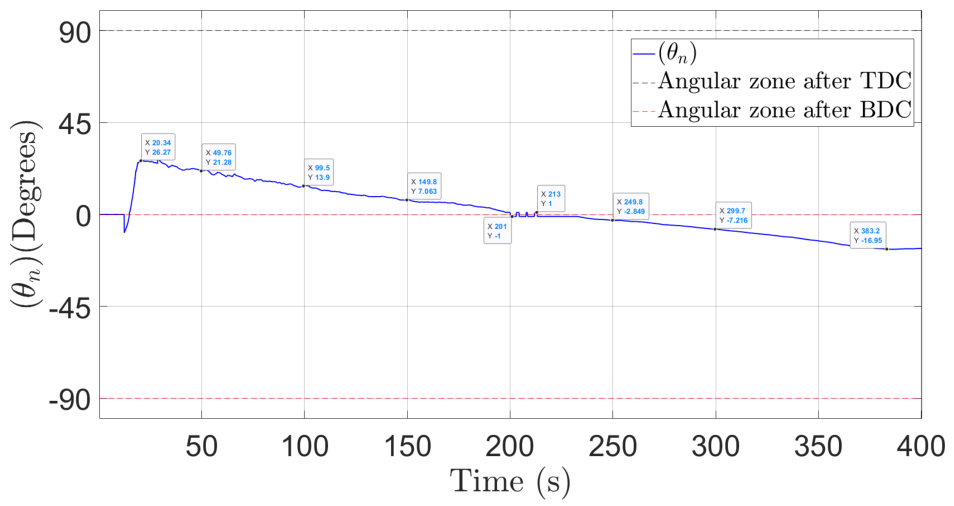
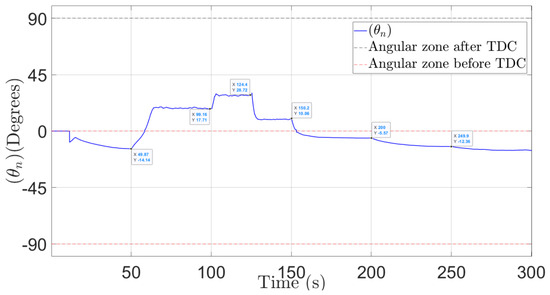
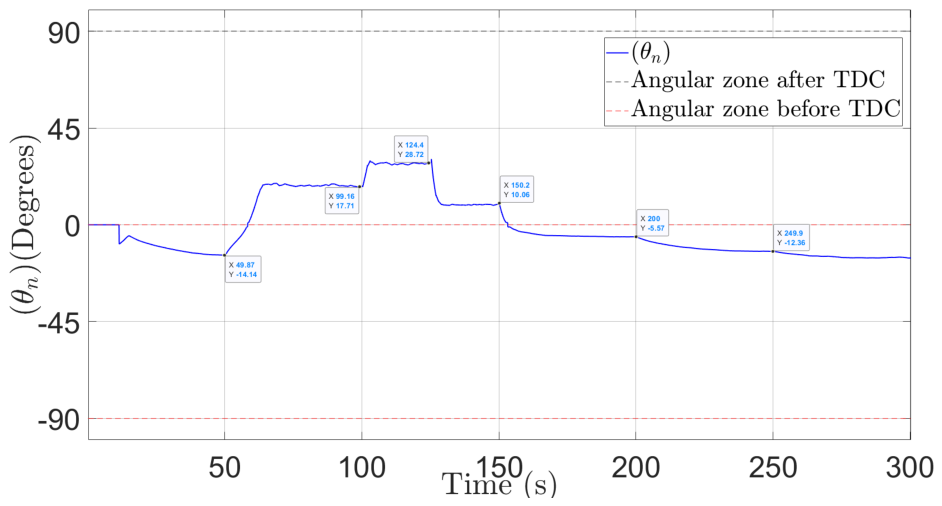
In Figure 11, the behavior of the ignition angle highlights a stationary state until the 25th second, identifying the exact moment of the switch from open-loop to closed-loop control. The observed slope reflects the system’s response to the ramp-type input. Furthermore, at second 200, the signal crosses the 0° “critical zone” where the dead zone with saturation is applied; this prevents the neural network output from remaining at 0° for extended periods, thus avoiding transient state errors.
Figure 11.
Manipulated variable using energization angle neural control in the prototype under a ramp input.
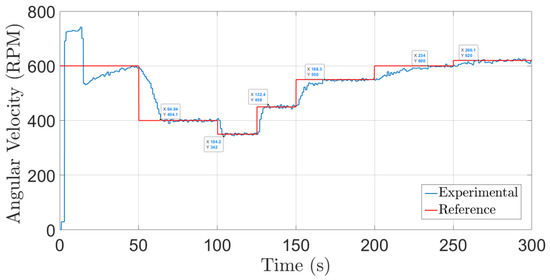
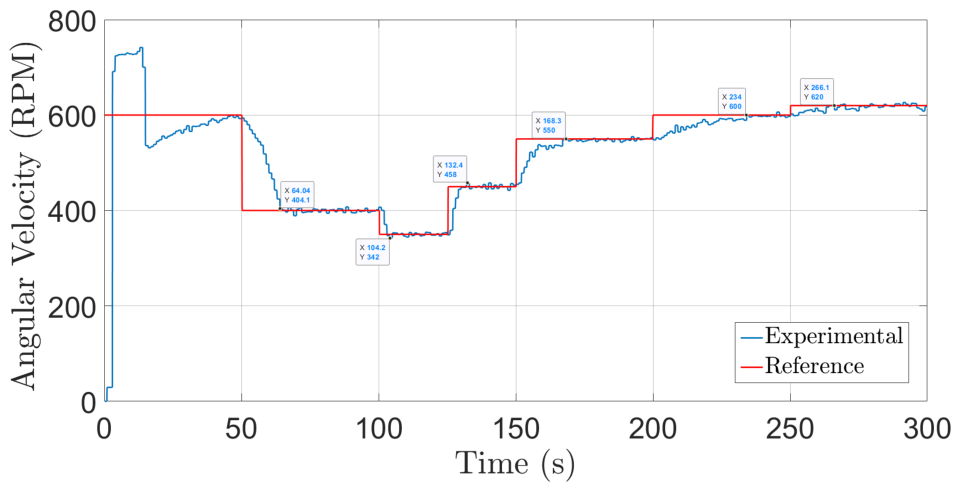
To evaluate the system’s performance across various operating points, the MRE response to a series of step inputs is presented in Figure 12. While ramp inputs result in low tracking errors, step inputs generate large instantaneous errors at each setpoint transition. However, the absence of overshoot at any evaluated point validates the stability and consistency of the implemented control strategy against abrupt reference changes.
Figure 12.
MRE speed using energization angle neural control in the experimental prototype with step input.
The dynamics of the ignition angle, as illustrated in Figure 13, reveal an immediate adjustment to reference changes to calculate the optimal value for minimizing tracking error. A remarkably smooth behavior is observed; consistent with the velocity results, the signal exhibits no overshoot during any of the transitions, confirming the robustness of the neural architecture.
Figure 13.
Manipulated variable using energization angle neural control in the prototype with step input.
4.2. Voltage FFNN Controller
- Test start conditions for the controller:
- Actuator activation: (equivalent to ) before Top Dead Center (TDC).
- Actuator off: after TDC.
- PID Gains: Kp = 0.1383, Ki = 0.2 and Kd = 0
- Sampling time (myRIO card): 0.56628 ms.
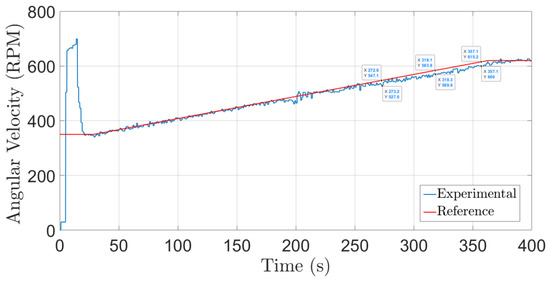
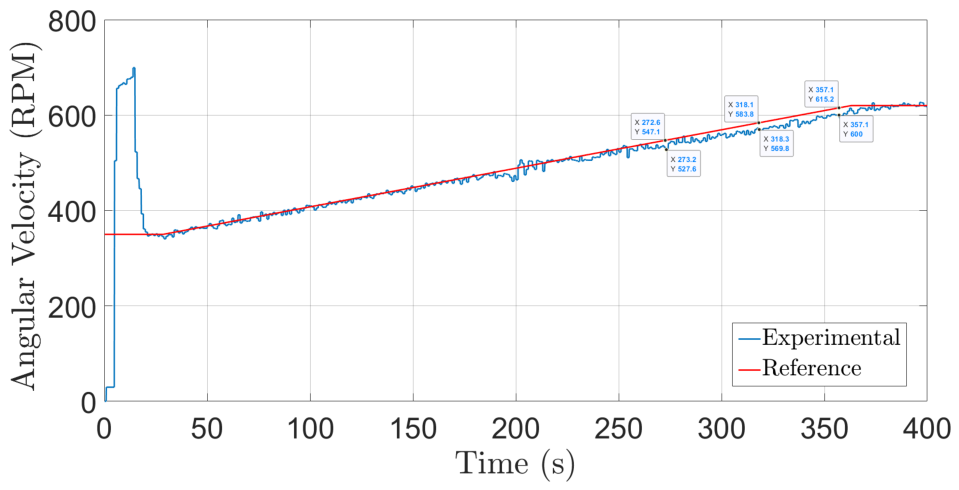
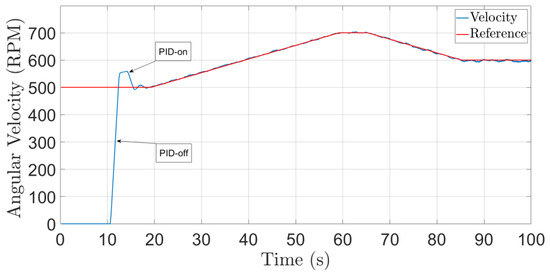
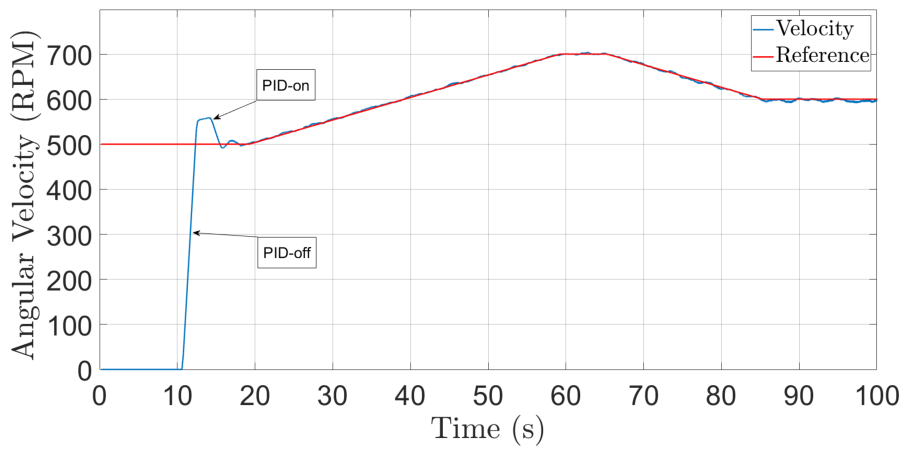
The velocity response, as depicted in Figure 14, highlights the system’s performance under a ramp input. Because the initial reference remains fixed, operation begins in open-loop, driven exclusively by the Artificial Neural Network (ANN). At this stage, a steady-state error (offset) of nearly 50 RPM is detected, stemming from the deviation between the laboratory conditions and the original training environment. Following the activation of the PID controller, the speed converges smoothly toward the reference, successfully eliminating the residual error.
Figure 14.
MRE speed using FFNN voltage control in the experimental prototype under a ramp input.
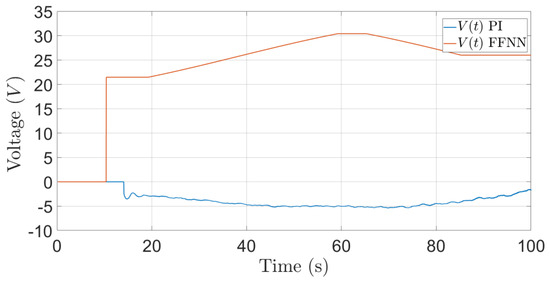
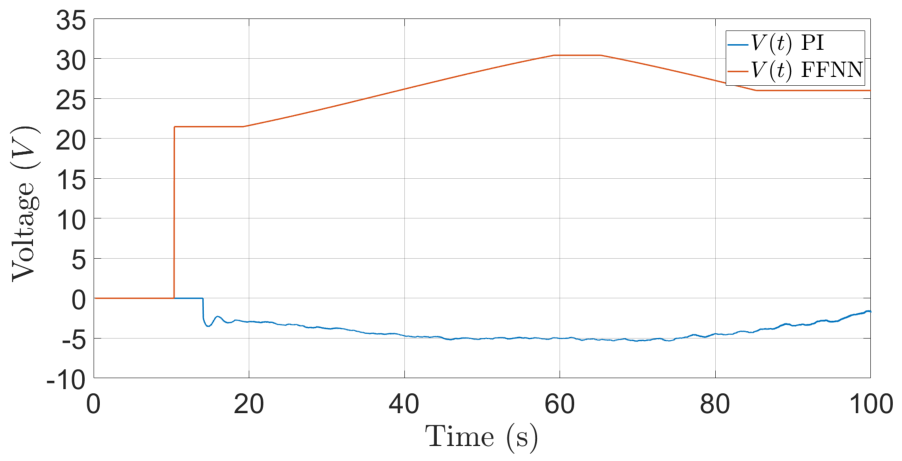
Complementary to this, the interaction between control actions shown in Figure 15 provides further insight. Initially, the PID was forced to an inactive state with zero output. However, the mismatch between the experimental environment and the training data caused the ANN to exert a higher-than-necessary control effort, which explains the previously mentioned steady-state offset.
Figure 15.
Feedback and feedforward control actions using FFNN voltage control in the experimental prototype under a ramp input.
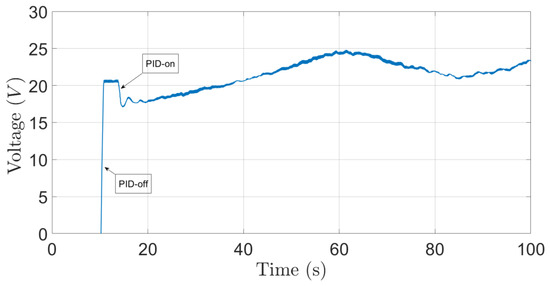
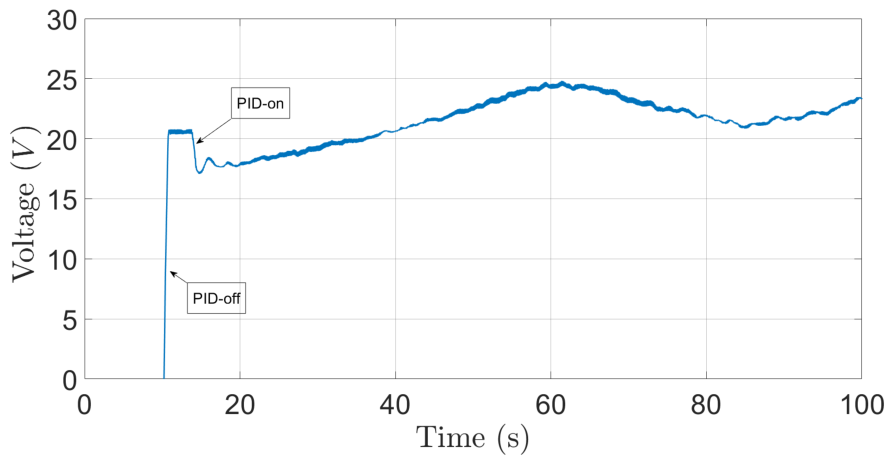
Consequently, the PID controller produced a negative corrective signal once activated. As shown in Figure 16, the algebraic sum of the positive ANN action and the negative PID action results in the precise voltage required by the MRE to track the reference effectively.
Figure 16.
Manipulated variable using FFNN voltage control in the experimental prototype under a ramp input.
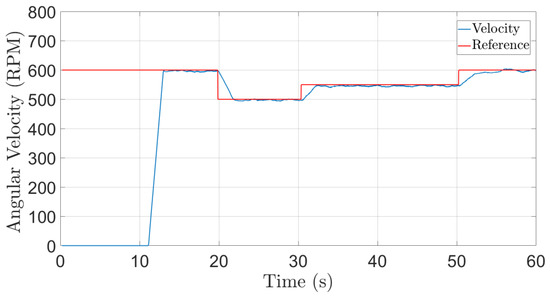
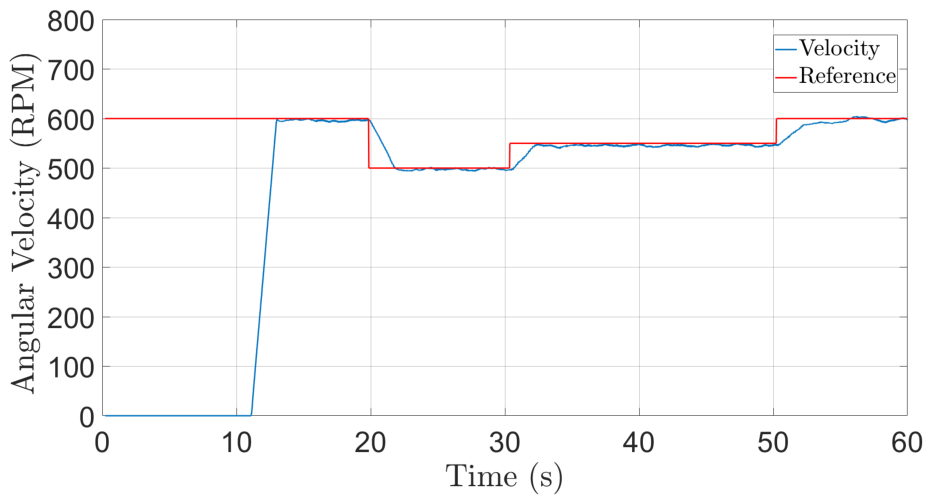
An evaluation of the system’s response to step inputs is depicted in Figure 17. In this specific experiment, the ANN training conditions perfectly matched the laboratory environment, a fact confirmed by the absence of an initial offset in open-loop mode. Furthermore, upon sudden reference changes, the system reaches the desired value rapidly without exhibiting overshoot and maintaining virtually zero steady-state error throughout the test.
Figure 17.
MRE speed using FFNN voltage control in the experimental prototype with a step input.
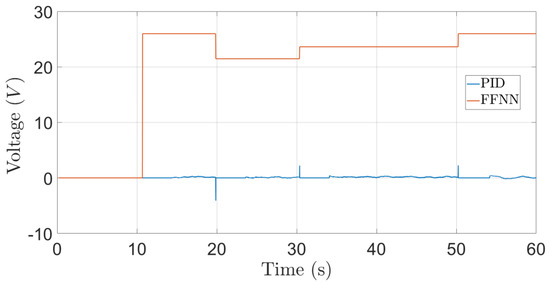
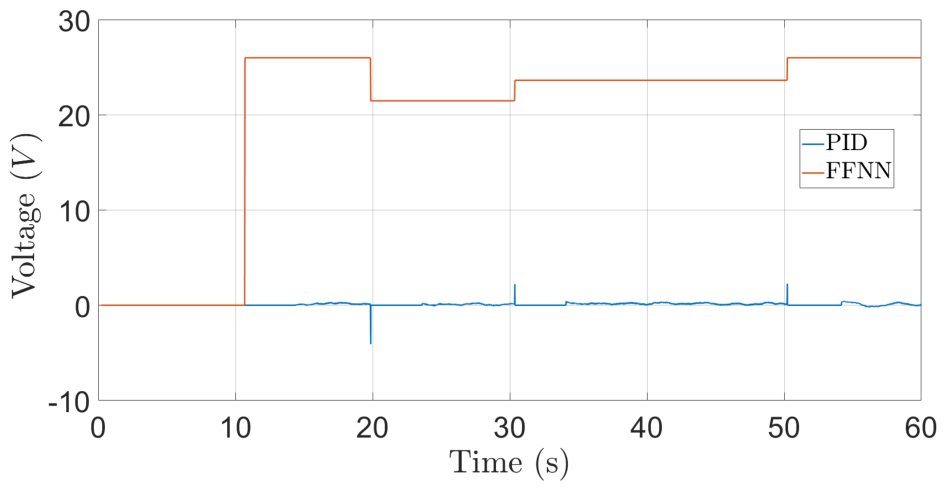
As shown in Figure 18, the system response to a reference change indicates that, at the instant of the setpoint variation, the PID controller produces a transient response due to the instantaneous tracking error. However, the PID output is temporarily suppressed to avoid the combined action of the PID and ANN from generating overshoot. This results in a short-duration control pulse with negligible influence on the system’s speed dynamics.
Figure 18.
Feedback and feedforward control actions using FFNN voltage control in the experimental prototype with step input.
Subsequently, according to the timing logic defined in (19), the PID controller is reactivated after a predefined interval. Since the neural network is well trained, its tracking performance is sufficiently accurate, and the contribution of the PID controller during steady-state operation becomes minimal. Consequently, the overall control effort is reduced, allowing the PID controller to focus primarily on disturbance rejection. As shown in Figure 19, the total control voltage applied to the MRE closely follows the ANN control action.
Figure 19.
Manipulated variable using FFNN voltage control in the experimental prototype with step input.
5. Analysis
Regarding the ramp input tests, for the ignition angle neural controller, Figure 10 shows that the MRE initially starts in open-loop at a constant speed, allowing the algorithm to converge toward the ideal solution until neural control is activated at the 20-s mark, achieving excellent tracking. However, Figure 11 shows a minor oscillatory behavior around 200 s when approaching the operating region , although the system remains stable and passes quickly through it. In contrast, for the voltage FFNN (Figure 15), the PID and ANN operate simultaneously; however, due to a mismatch between training and laboratory conditions, the offline architecture introduced errors that the PI controller corrected to maintain reference accuracy, as shown in Figure 14.
As for the step inputs, the ignition angle controller again starts in open-loop and transitions to neural control at second 20, evaluating various operating points from second 50 onwards (Figure 12) without the output becoming stuck in the zone (Figure 13). For the voltage FFNN case, a timer was implemented to delay the PID intervention, allowing the ANN to handle the abrupt transition initially. Thus, by the time the PID controller is activated, the tracking error is already close to zero, and its role is limited to compensating for minor disturbances. This behavior, validated in Figure 17 and Figure 18, is attributed to the consistency between the training and experimental conditions.
According to the dynamic parameters presented in Table 6, the PID controller maintains the trend observed in simulation by exhibiting the fastest rise times (), oscillating between 0.69 s and 1.01 s. However, this speed translates into a pronounced overshoot () in the real world, reaching 33.5% at 400 RPM. Conversely, the FFNN demonstrates a more effective design transfer to the prototype; despite having slightly higher initial response times than the PID, it achieves remarkable stability with significantly reduced overshoots, with a maximum of 5.6% at 400 RPM, and highly consistent settling times (), close to 2 s across the entire evaluated range.
Table 6.
Comparison of dynamic parameters.
Regarding the neural strategy with online learning, the data in Table 7 reveal an inherent complexity associated with ignition angle control, evidenced by the highest error indices in the study, such as an ISE reaching at 700 RPM. This performance degradation is further detailed in Table 6, where critical overshoots of 64.2% at low speeds and settling times of up to 26.1 s are recorded. These phenomena are primarily attributed to the “cold-start” conditions, in which the motor starts from rest directly in closed-loop mode using a 3-2-1 recurrent neural network initialized with random weights. Since the algorithm operates via online learning, a transient adaptation period is mandatory for the controller to identify the dynamic behavior of the electromagnet. During this phase, the maximum tracking error results in an aggressive initial control effort. However, it was experimentally verified that performance improves significantly when switching from open-loop to neural control once a non-zero speed is established, as the network can begin its dynamic adjustment from a more stable state. Future iterations could further mitigate these transient effects through offline weight initialization, soft-start strategies, or the implementation of an adaptive learning rate ().
Table 7.
Comparison of error-based performance indices.
The experimental comparison ratifies the FFNN as the most balanced solution for the prototype. While the PSO-tuned PID offers speed at the cost of sharp oscillations and the online neural control by ignition angle struggles with transient stability, the offline feedforward neural network successfully mitigates the erratic behavior of the power source, guaranteeing accurate and safe speed regulation.
6. Conclusions
Two control schemes were proposed for speed regulation of the MRE: one based on a fixed supply voltage with variable ignition angle, and another based on a fixed ignition angle with variable supply voltage.
The ignition-angle-based control scheme achieved satisfactory reference tracking; however, it required an initial open-loop operation phase to allow the learning algorithm to converge. Direct initialization in closed-loop resulted in degraded performance indices and dynamic behavior, as reported in Table 6 and Table 7. Since ignition angle is a mechanical actuation variable while supply voltage is electrical, angle-based control inherently exhibits a slower dynamic response compared with voltage-based control. Nevertheless, performance may be further improved by initializing the neural network with weights closer to the expected solution, which could reduce convergence time during the initial operating phase.
Voltage-based control strategies, including PID and FFNN, demonstrated improved performance, achieving the target speeds with lower control effort. In particular, the FFNN-based controller significantly reduced control effort in the closed-loop system while maintaining stability. Its low computational burden during execution, due to offline training, makes it suitable for real-time implementation.
However, it is important to note that the network was trained under specific operating conditions, namely fixed ignition and cutoff angles and no-load operation. This constraint was imposed by the limited torque capability and thermal limitations of the small-scale electromagnet used in the proof-of-concept prototype. As a result, deviations from these conditions reduce model accuracy, requiring PID intervention to compensate for tracking errors. An alternative solution would be the inclusion of online learning mechanisms, enabling adaptation to varying operating conditions. Therefore, while the reported results are valid under no-load operation, performance may vary under loaded conditions, which should be addressed in future work.
Finally, although both controllers achieve the desired speed regulation, the results indicate that the voltage-based FFNN controller outperforms the ignition-angle-based neural controller under the tested conditions, namely no-load operation in a single-cylinder experimental prototype.
7. Discussion
The experimental results demonstrate the feasibility of implementing closed-loop control strategies in MRE systems, either through ignition-angle modulation or supply-voltage regulation. Although each approach presents different advantages and limitations, both are capable of achieving effective speed regulation. These results represent an improvement over previous studies that focused primarily on open-loop operation. Closed-loop control is essential for ensuring robustness against external disturbances commonly encountered in mobile applications, such as aerodynamic drag and road-induced perturbations.
The results also confirm the applicability of neural networks in this class of electromechanical systems, which exhibit similarities to magnetic levitation (MAGLEV) systems due to the electromagnetic interaction between the coil and the permanent magnet. The integration of neural networks enables the system to compensate for uncertainties not captured by the mathematical model proposed in [10]. However, future developments should consider neural networks as a complement rather than a replacement for physics-based modeling. A more comprehensive mathematical framework is still required to accurately describe dynamic torque, energy efficiency, and knocking phenomena, which are critical factors for evaluating the viability of MREs as alternatives to internal combustion engines.
Finally, this work opens several research directions, particularly the development of multivariable control strategies that simultaneously regulate ignition angle, supply voltage, and cutoff angle. The latter parameter remains largely unexplored in the literature. Its transformation from a fixed parameter into a controllable variable may contribute to improving transient response and overall system performance.
Author Contributions
Conceptualization, A.D.E.P., J.G.-M. and M.A.-M.; Methodology, R.A.G. and M.A.-M.; Software, R.A.G.; Validation, R.A.G.; Formal analysis, R.A.G., J.G.-M., J.A.V.T. and M.A.-M.; Investigation, R.A.G., A.D.E.P., J.G.-M., J.A.V.T. and M.A.-M.; Resources, J.G.-M. and M.C.-B.; Writing—original draft, M.C.-B. and M.A.-M.; Writing—review & editing, A.D.E.P., M.C.-B. and M.A.-M.; Visualization, A.D.E.P., J.A.V.T., M.C.-B. and M.A.-M.; Supervision, A.D.E.P., J.G.-M., J.A.V.T., M.C.-B. and M.A.-M.; Project administration, J.G.-M. and M.A.-M.; Funding acquisition, J.G.-M. and M.A.-M. All authors have read and agreed to the published version of the manuscript.
Funding
This research received no external funding.
Institutional Review Board Statement
Not applicable.
Informed Consent Statement
Not applicable.
Data Availability Statement
The original contributions presented in this study are included in the article. Further inquiries can be directed to the corresponding authors.
Conflicts of Interest
The authors declare no conflict of interest.
Abbreviations
The following abbreviations are used in this manuscript:
| A0 | Analogic Output |
| ANN | Artificial Neural Network |
| Magnetic remanence | |
| BTC | Bottom Dead Center |
| FFNN | Feedforward Neural Network |
| ICE | Internal Combustion Engine |
| ℓ | Connecting rod length |
| Solenoid height | |
| Magnet height | |
| Solenoid inductance | |
| Connecting rod mass | |
| Crank mass | |
| MAGLEV | Magnetic Levitation |
| Piston mass | |
| MRE | Magnetic Reciprocating Engine |
| Vacuum permeability | |
| Number of turns | |
| PID | Proportional–Integral–Derivative |
| PSO | Particle Swarm Optimization |
| R | Crank length |
| Inner radius of solenoid | |
| Outer radius of solenoid | |
| Coil internal resistance | |
| Magnet radius | |
| TDC | Top Dead Center |
References
- Serrano, J.R.; Novella, R.; Piqueras, P. Why the Development of Internal Combustion Engines Is Still Necessary to Fight against Global Climate Change from the Perspective of Transportation. Appl. Sci. 2019, 9, 4597. [Google Scholar] [CrossRef] [Scilit]
- Martins, F.; Felgueiras, C.; Smitkova, M.; Caetano, N. Analysis of Fossil Fuel Energy Consumption and Environmental Impacts in European Countries. Energies 2019, 12, 964. [Google Scholar] [CrossRef] [Scilit]
- Adelekan, O.A.; Ilugbusi, B.S.; Adisa, O.; Obi, O.C.; Awonuga, K.F.; Asuzu, O.F.; Ndubuisi, N.L. Energy transition policies: A global review of shifts towards renewable sources. Eng. Sci. Technol. J. 2024, 5, 272–287. [Google Scholar] [CrossRef] [Scilit]
- Mesquita, A.R.; de Abreu, V.H.S.; Poyares, C.N.; Santos, A.S. Barriers to Electric Vehicle Adoption: A Framework to Accelerate the Transition to Sustainable Mobility. Sustainability 2025, 17, 8318. [Google Scholar] [CrossRef] [Scilit]
- Shah, M.A. A Systematic Review of Electric Vehicle Innovations and Implementation Barriers. J. Eng. Comput. Intell. Rev. 2024, 2, 18–26. [Google Scholar]
- Algusaier, M.; Alshammary, Y. Electromagnetic Engines: A Review. Int. J. Emerg. Multidiscip. Eng. 2023, 1, 1–5. [Google Scholar] [CrossRef] [Scilit]
- Chaudhari, V.; Lonkar, S.; Jadhav, A.D.; Vaibhav, P.; Khemnar, V.K. Magnetic Repulsion Engine. Int. J. Adv. Res. Innov. Ideas Educ. 2019, 5, 522–526. [Google Scholar]
- Ansari, E.; Haider, S.A.; Shaikh, A.A.; Ibrahim, M.F. Design and fabrication of single cylinder solenoid engine. Anveshana’s Int. J. Res. Eng. Appl. Sci. 2022, 7, 1–11. [Google Scholar]
- Singh, N.; Navdeep; Abdul Khadeer, A.S.; Shaik, A.S.; Baig, M.S. Motor de solenoide variable RPM. SSRN Electron. J. 2022, 5, 1–12. [Google Scholar] [CrossRef] [Scilit]
- Rios-Enriquez, C.; Adam-Medina, M.; García-Morales, J.; Guerrero-Ramírez, G.V.; Cervantes-Bobadilla, M. Modeling and Simulation of a Magnetic Reciprocating Engine. IEEE Access 2024, 12, 34863–34876. [Google Scholar] [CrossRef] [Scilit]
- Boldea, I.; Nasar, S. Linear Electric Machines, Drives, and Maglevs Handbook; CRC Press: Boca Raton, FL, USA, 2015. [Google Scholar]
- Stępień, S.; Patecki, A. Modelling and position control of voltage forced electromechanical actuator. COMPEL Int. J. Comput. Math. Electr. Electron. Eng. 2006, 25, 412–426. [Google Scholar] [CrossRef] [Scilit]
- Wei, M.Y. Modelling and Predictive Control of Electromechanical Actuators for All-Electric Nose Landing Gear Systems. IET Electr. Power Appl. 2025, 19, e70022. [Google Scholar] [CrossRef] [Scilit]
- Deschaux, F.; Gouaisbaut, F.; Ariba, Y. Nonlinear control for an uncertain electromagnetic actuator. In Proceedings of the 2018 IEEE Conference on Decision and Control (CDC), Miami Beach, FL, USA, 17–19 December 2018; pp. 2316–2321. [Google Scholar] [CrossRef] [Scilit]
- Majewski, P.; Pawuś, D.; Szurpicki, K.; Hunek, W.P. Toward Optimal Control of a Multivariable Magnetic Levitation System. Appl. Sci. 2022, 12, 674. [Google Scholar] [CrossRef] [Scilit]
- Tri do, D.; Hien Chiem, T.; Ngo, v.B.; Vu, v.P.; Le, T.L. Intelligent Control Strategies for Magnetic Levitation System: Leveraging Type-2 Fuzzy CMAC and Elman Neural Networks. IEEE Access 2024, 12, 167683–167693. [Google Scholar] [CrossRef] [Scilit]
- Adil, H.M.M.; Ahmed, S.; Ahmad, I. Control of MagLev System Using Supertwisting and Integral Backstepping Sliding Mode Algorithm. IEEE Access 2020, 8, 51352–51362. [Google Scholar] [CrossRef] [Scilit]
- Ma’arif, A.; Vera, M.A.M.; Mahmoud, M.; Umoh, E.; Abougarair, A.; Rahmadhia, S.N. Sliding Mode Control Design for Magnetic Levitation System. J. Robot. Control (JRC) 2023, 3, 848–853. [Google Scholar] [CrossRef] [Scilit]
- Sun, L.; You, F. Machine Learning and Data-Driven Techniques for the Control of Smart Power Generation Systems: An Uncertainty Handling Perspective. Engineering 2021, 7, 1239–1247. [Google Scholar] [CrossRef] [Scilit]
- Kumar, V.; Singh, A.; Jha, K.K. 8-stroke solenoid engine and its efficiency. Int. Res. J. Eng. Technol. 2021, 8, 2171–2174. [Google Scholar]
- Tharun, G.S.; Samhitha, K.A.; Honey, D.; Harika, C.; Mohith, B.; Nithin, K.; Manoj, V. Exploring Electromagnetic Engine Propulsion: Design of a Next-Gen Engine. E3S Web Conf. 2024, 591, 03004. [Google Scholar] [CrossRef] [Scilit]
- Sun, Y.; Xu, J.; Lin, G.; Sun, N. Adaptive neural network control for maglev vehicle systems with time-varying mass and external disturbance. Neural Comput. Appl. 2023, 35, 12361–12372. [Google Scholar] [CrossRef] [Scilit]
- Liu, G.; Jiang, R.; Fan, L.; Lv, Q.; Lu, C.; Wang, P. Neural network PID control of spherical permanent magnet based on external magnetic field driving system. J. Phys. Conf. Ser. 2024, 2787, 012044. [Google Scholar] [CrossRef] [Scilit]
- Lu, Y. Adaptive Model Predictive Control and Dynamic Analysis for Maglev Systems. Ph.D. Thesis, The Hong Kong Polytechnic University, Hong Kong, 2025. [Google Scholar]
- Cichocki, A.; Unbehauen, R. Neural Networks for Optimization and Signal Processing; John Wiley & Sons, Inc.: Hoboken, NJ, USA, 1993. [Google Scholar]
- Vargas, Y.; Chen, S.; Otero, J. Estrategias Para Mejorar el Balance Entre Exploración y Explotación en Optimización de Enjambre de Partículas; Technical Report; Universidad de la Habana, Facultad de Matemáticas y Computación: Havana, Cuba, 2011. [Google Scholar]
- Marler, R.T.; Arora, J.S. The weighted sum method for multi-objective optimization: New insights. Struct. Multidiscip. Optim. 2010, 41, 853–862. [Google Scholar] [CrossRef] [Scilit]
- Kaur, M.; Kumar, A.; Luhach, A. Optimum design of PID controller using multi-objective CBBO algorithm. Int. J. Sci. Technol. Res. 2020, 9, 68–73. [Google Scholar]
- Moreno Cruz, J.R. Control Neuronal con Término Integral Para Sistemas no Lineales con Oscilaciones. Master’s Thesis, Centro de Investigación y de Estudios Avanzados del IPN, Departamento de Control Automático, Ciudad de Mexico, Mexico, 2012. [Google Scholar]

Disclaimer/Publisher’s Note: The statements, opinions and data contained in all publications are solely those of the individual author(s) and contributor(s) and not of MDPI and/or the editor(s). MDPI and/or the editor(s) disclaim responsibility for any injury to people or property resulting from any ideas, methods, instructions or products referred to in the content. |
© 2026 by the authors. Licensee MDPI, Basel, Switzerland. This article is an open access article distributed under the terms and conditions of the Creative Commons Attribution (CC BY) license.