1. Introduction
Coal mining operations generate substantial quantities of dust, accounting for 50–90% of total particulate matter in underground mines. This dust poses persistent and serious threats to operational safety, equipment reliability, and miners’ health [
1,
2]. Environments with high dust concentrations not only significantly impair visibility and accelerate mechanical wear but also present a major risk of coal-dust explosions. Research indicates that maintaining airborne dust levels below 80 g/m
3 in the working area is a critical preventive measure against such explosions [
3,
4]. Coal mine dust exposure is also a major occupational health issue worldwide. In the United States, NIOSH has summarized engineering practices for reducing respirable dust exposure in coal mining, while MSHA has strengthened exposure-control requirements for respirable coal mine dust. In Australia, the re-emergence of coal workers’ pneumoconiosis in Queensland has further highlighted the need for improved dust monitoring, characterization, and control. These international studies and regulatory efforts indicate that coal dust prevention is a global challenge and that dust-control strategies must be supported by a deeper understanding of dust migration and physicochemical characteristics.
To address these challenges, a comprehensive dust control system has been established in mines, integrating coal-seam water infusion, ventilation, spraying, foam suppression, and personal protection [
5]. The effectiveness of wet suppression methods within this system is closely linked to the physicochemical properties of the dust. Zhou Gang et al. [
6] examined the interaction between dust and spray droplet fields, showing that optimal droplet diameters vary with dust particle size, with 15–17 μm being most effective for capturing respirable dust. Yao Youli et al. [
7] investigated the impact of chemical reagents on foam dust suppression and identified dust wettability as a key factor in foam efficiency. Regarding the underlying mechanism of wettability, Wang Pengfei et al. [
8] reported that it decreases with reducing particle size, whereas Cheng Weimin et al. [
9] attributed variability in wettability to the inorganic mineral composition of coal. Yao Qingguo et al. [
10] further analysed functional groups in different coals using Nuclear Magnetic Resonance and X-ray Photoelectron Spectroscopy, providing a basis for designing targeted polymeric surfactants. In personal protection, dust masks serve as a final defence, their performance depends largely on the filtration efficiency and dust-holding capacity of the filter [
11,
12]. An Ying et al. [
13] prepared polylactic acid (PLA) micro-nanofibre filter membranes and tested them underground, finding that high dust concentrations markedly reduce service life and alter dust-loading behaviour. Moreover, filters with different basis weights and fibre diameters show distinct filtration efficiencies for different particle sizes.
Beyond the studies cited above, international research has increasingly framed respirable coal mine dust as a coupled occupational-health and mine-environment problem rather than as an isolated particulate-control issue. Cumulative exposure to respirable coal mine dust and respirable crystalline silica has been associated with coal workers’ pneumoconiosis, silicosis, mixed dust pneumoconiosis, dust-related diffuse fibrosis, and progressive massive fibrosis. Therefore, particle size, mineral composition, surface chemistry, and particle morphology are not only physicochemical descriptors, but also key parameters affecting respiratory deposition, toxicity, and long-term occupational risk [
14,
15].
In parallel, dust-control research in coal mining, metal mining, and mineral processing has compared ventilation, enclosure, water spraying, surfactant-enhanced wet suppression, foam suppression, filtration, and source-isolation technologies [
16]. These studies demonstrate that dust-control efficiency depends on coupled interactions among airflow field, particle inertia, droplet size, surface wettability, and re-entrainment processes. However, many of these studies still focus on a single control technology or a single dominant dust property, making it difficult to connect microscopic wettability mechanisms with field-scale dust migration patterns.
Recent developments in green and intelligent mining further require dust management to be integrated into a broader mine environmental management framework. For example, the increasing use of battery electric vehicles in underground mining can reduce diesel particulate matter and toxic exhaust emissions, but may also change ventilation demand, airflow distribution, and heat-management strategies. Meanwhile, sensor-driven monitoring, ventilation-on-demand, IoT-based dust prediction, and AI-assisted environmental control provide new opportunities for dynamic and precise dust suppression [
17]. From the perspective of green mining and circular economy, dust and fine mineral wastes should also be considered within an integrated system involving source reduction, water-saving suppression, waste-stream characterization, and resource-oriented environmental management.
Therefore, the present study positions coal mine dust wettability within a multi-scale framework linking spatial dust distribution, particle-size characteristics, microscopic morphology, surface functional groups, and wetting behavior. This framework aims to support property-based, site-specific, and sensor-driven dust-control strategies for fully mechanized mining faces.
Previous studies have provided important insights into individual factors affecting coal dust behavior. For example, some studies have focused on the influence of particle size on spray capture and wettability, while others have examined the role of inorganic minerals, oxygen-containing functional groups, or surfactant formulations in improving wet suppression performance. In addition, several studies have investigated dust migration, airflow-induced dispersion, and filtration behavior as separate issues. Although these single-focus studies are valuable, they usually address only one scale or one dominant property of coal dust. As a result, the coupling relationships among spatial concentration distribution, particle-size characteristics, microscopic morphology, surface chemistry, and wettability remain insufficiently understood. This limitation makes it difficult to develop property-based and site-specific dust control strategies. Therefore, a multiscale framework is necessary to connect macroscopic dust distribution with microscopic physicochemical properties and wetting behavior. In this study, field measurements and laboratory characterization were integrated to establish a concentration particle size, morphology, chemistry, wettability correlation framework for coal mine dust in fully mechanized mining faces.
Therefore, the objective of this study is to clarify the multiscale relationship between coal mine dust distribution, physicochemical properties, and wettability in fully mechanized mining faces. Two representative coal mines were selected for field dust monitoring and laboratory characterization. Dust concentration, respirable dust distribution, particle size, microscopic morphology, surface functional groups, and contact angle were systematically analyzed. The main innovation of this work is the establishment of a concentration–particle size–morphology–surface chemistry–wettability correlation framework, which links macroscopic dust migration with microscopic wetting mechanisms. This framework provides a theoretical basis for developing site-specific and property-based dust suppression strategies.
2. Materials and Methods
2.1. Coal Sample Characterization
Proximate and ultimate analyses of coal samples collected from the shearer cutting zones of Face 31125 (Mine A) and Face 2416 (Mine B) were conducted following Chinese national standards GB/T 212-2008 [
18] and GB/T 31391-2015 [
19]. The results, including the coal rank (determined by mean vitrinite reflectance Rmax, according to GB/T 15224.1-2018 [
20]), are presented in
Table 1. These fundamental properties provide essential context for interpreting the dust’s surface chemistry and wettability.
2.2. Dust Concentration Measurement Protocol
Two underground coal mines (Mine A and Mine B) operated by Shanxi Fenxi Mining (Group) Co., Ltd. (Jiexiu, China) were selected as field sites. In accordance with the Chinese national standard Methods for Determination of Dust in the Workplace (GBZ/T 192-2007 [
21]), five representative monitoring points were established at each location: at the 31125 fully mechanised mining face in Mine A and the 2416 face in Mine B. These points were positioned at key dust-generation sources and in personnel working zones. Dust sampling was conducted using a CCZ20 dust sampler (Qingdao Juchuang Environmental Protection Group Co., Ltd., Qingdao, China), with total dust and respirable dust collected separately at flow rates of 25 L/min and 20 L/min, respectively. Sampling at each point spanned one full production cycle. All samples were sealed immediately after collection and stored at 4 °C pending analysis. The layout of the monitoring points is summarised in
Table 2.
The two fully mechanized mining faces were selected as representative case sites because they have comparable mining processes but different local geological conditions, operational parameters, and dust-control configurations. However, both faces belong to the same mining group, and the field sampling was conducted during one production cycle under stable operating conditions. Therefore, the field data should be interpreted as case-comparative evidence rather than as statistically representative data for all fully mechanized coal mining faces. Temporal variations caused by cutting sequence, ventilation adjustment, equipment condition, coal moisture, and production intensity may influence dust concentration and particle-size distribution. Future studies should include repeated sampling across multiple shifts, seasons, mining groups, and geological settings to improve generalizability.
2.3. Characterisation of Dust Physicochemical Properties
Dust samples from the shearer cutting zones at Face 31125 (Mine A) and Face 2416 (Mine B) were selected for systematic analysis. The methodologies are detailed below.
Particle Size Distribution: The particle size distribution was determined by laser diffraction in accordance with the Chinese national standard GB/T 19077-2016 [
22], using a Mastersizer 3000 instrument (Malvern Panalytical, Malvern, UK). Samples were dispersed in deionized water prior to measurement. Each was analysed in triplicate, and the results are reported as the mean. The mass median diameter (D50) and the cumulative percentage of particles below 5 μm and 10 μm were derived from the data.
Surface Functional Groups: Fourier-transform infrared spectroscopy was performed on a Nicolet 6700 spectrometer (Thermo Fisher Scientific, Waltham, MA, USA). Spectra were acquired in transmission mode across the 400–4000 cm−1 range at a resolution of 4 cm−1 with 32 scans per sample. Baseline correction and peak assignment were performed using Omnic 8.2 software.
Microscopic Morphology and Quantitative Analysis: To assess morphology, dust was collected from the filter membranes of shearer operators’ respirators at both mines. Samples were sputter-coated with gold and imaged using a MAIA3 scanning electron microscope (TESCAN, Brno, Czech Republic). For quantitative analysis, the equivalent diameter of at least 30 agglomerates was measured from SEM micrographs using ImageJ software(version 1.54f), and the mean value was calculated.
Wettability: Dust samples were dried at 60 °C for 12 h in a vacuum oven (DZF-6020, Shanghai Jingqi Instrument Co., Ltd., Shanghai, China). The dried powder was compacted into smooth tablets (approximately 10 mm diameter) under 20 MPa for 2 min. Although the tablets were compacted at 20 MPa to ensure a flat and stable surface for reproducible contact-angle measurements, this preparation process may partially reduce the original surface porosity of loose airborne dust. Therefore, the contact-angle results were interpreted together with SEM observations and roughness measurements obtained from dust collected on respirator filter membranes, which better reflect the natural airborne state of the particles. The pressed-tablet contact angle was used as a comparative wettability indicator rather than a direct representation of the complete three-dimensional pore structure of airborne dust. The static water contact angle was measured via the sessile drop method using a video contact angle goniometer (SL200B, Kino Industry Co., Ltd., Canton, MA, USA). A 2 μL droplet of deionised water was used for each measurement; at least five droplets were placed at different locations per sample. The mean contact angle and standard deviation were calculated.
3. Results and Discussion
3.1. Dust Distribution and Dispersion in Fully Mechanised Mining Faces
Dust is classified by its aerodynamic diameter into respirable (≤5 μm) and non-respirable (>5 μm) fractions. The respirable fraction, which is capable of depositing in the alveolar region of the lungs, represents a primary cause of pneumoconiosis. Its dispersion is governed by the coupled influence of airflow, humidity, and temperature.
3.1.1. Spatial Distribution of Total Dust
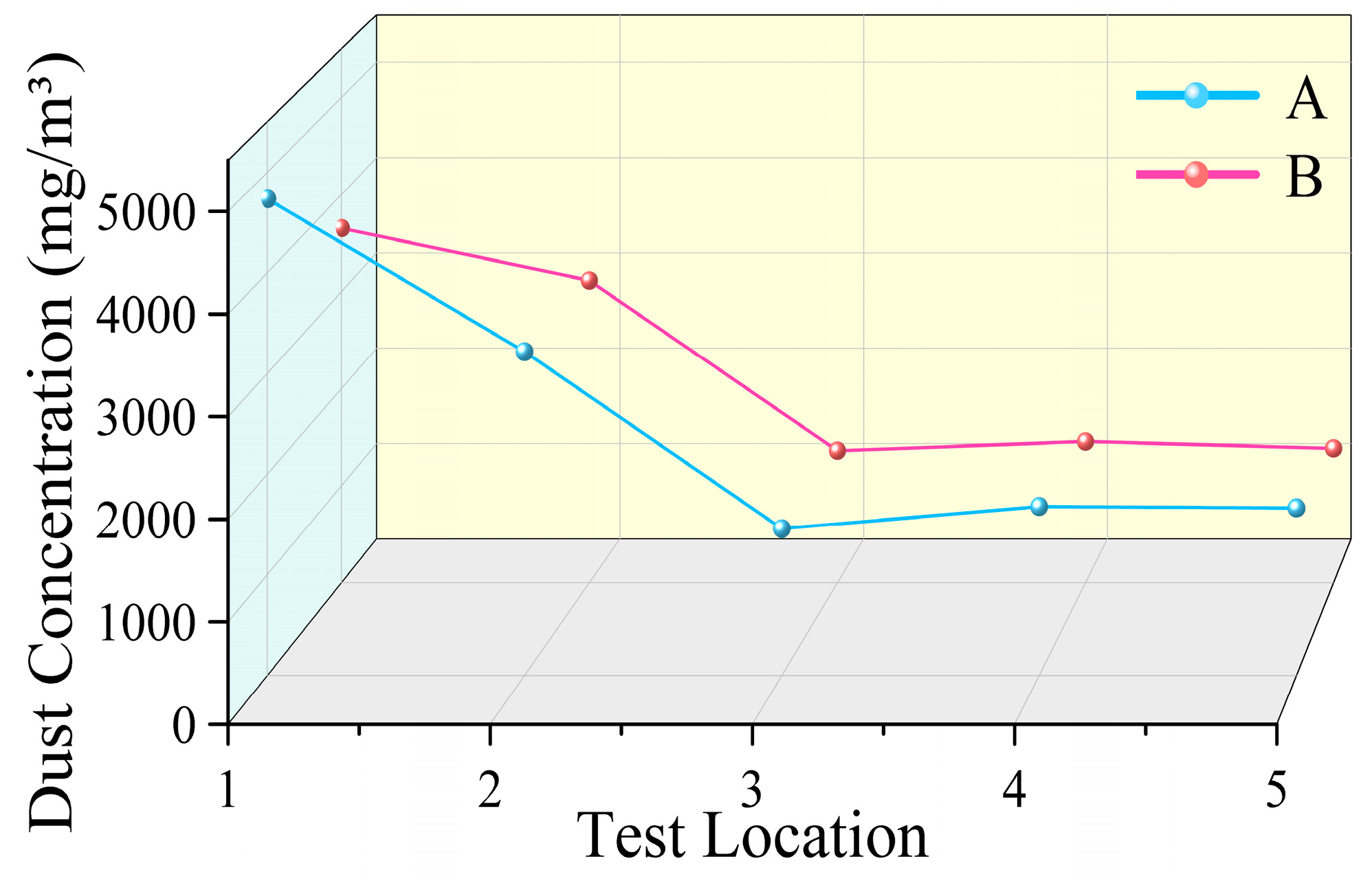
The measured dust concentrations at the monitoring points in Faces A and B are shown in
Figure 1. Due to differences in geological conditions, mining parameters, and dust control measures, the dust concentrations in Face A were higher than those in Face B. Specifically, the average total and respirable dust concentrations in Face A were 1.16 and 1.18 times the respective values in Face B.
The total dust concentration peaked at the shearer location (Location 1), measuring 4734.62 mg·m
−3 in Mine A and 3654.84 mg·m
−3 in Mine B (
Figure 1). Downstream, concentrations decreased along the airflow path and stabilised towards the rear transport zone (Locations 3–5). This trend aligns with the numerical simulations of Jiao Wanying et al. [
23], confirming that vigorous mechanical disturbance and local vortices near the shearer drum produce a high-dust concentration zone. Coarser particles settle under gravity and airflow downwind, reducing the concentration. Additionally, the heterogeneous airflow distribution across the face—typically slower near the coal wall—further affects the lateral dispersion and settling behaviour of the dust.
3.1.2. Enrichment and Formation Mechanism of Respirable Dust
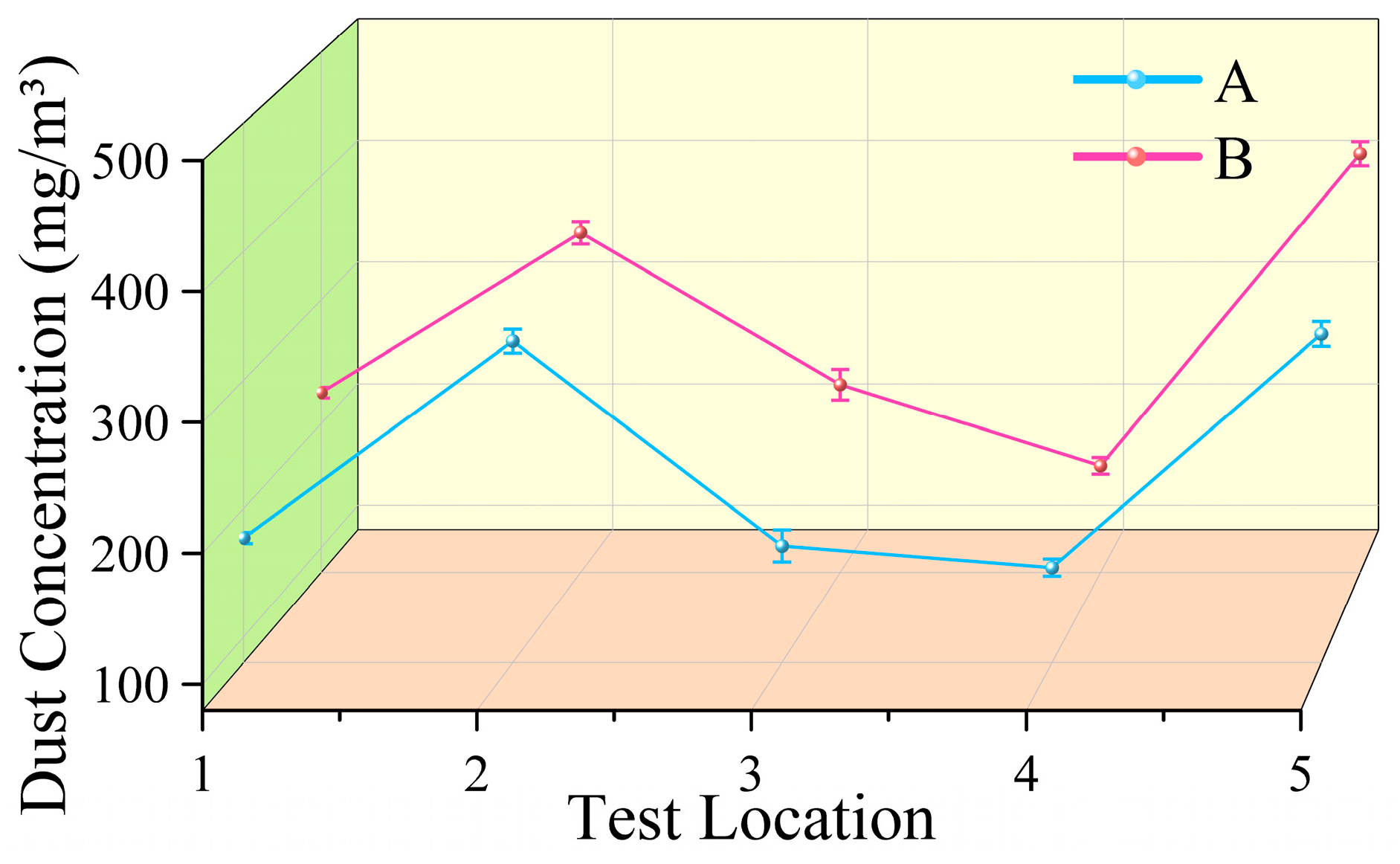
The spatial distribution of respirable dust concentration exhibited a non-uniform pattern, with pronounced peaks at the shearer operator’s station (Location 2, situated 5 m downwind of the shearer drum at a height of 1.5 m) and the belt-conveyor head (Location 5). The concentration at Location 2 was 328.6 mg·m
−3 in Mine A and 278.4 mg·m
−3 in Mine B, which was 1.8 and 1.6 times higher than that at the shearer cutting point (Location 1), respectively (
Figure 2). This counterintuitive increase is attributed to a coupled effect of airflow deceleration and dust re-entrainment. On-site airflow measurements revealed that the local airspeed at Location 2 dropped to 1.2 m·s
−1, significantly below the optimal dust removal range of 1.5–2.5 m·s
−1 identified in recent computational fluid dynamics studies [
23,
24]. This reduction in velocity diminishes the convective transport of fine particles, promoting their retention. Concurrently, the mechanical vibration and impact at the belt-conveyor head (Location 5) induce substantial secondary dust emission, a phenomenon consistent with the findings of Nie et al. [
25], who demonstrated that mechanical disturbances can re-suspend settled dust, increasing local respirable dust concentrations by up to 150%. At the belt conveyor head (Location 5), the elevated respirable dust concentration is mainly attributed to re-entrainment of previously deposited fine particles rather than primary dust generation. Belt vibration, coal transfer impact, and local turbulent airflow disturb settled particles and cause secondary suspension. Therefore, Location 5 is defined as a re-entrainment-dominated secondary emission zone in the proposed Three-Zone Control strategy. The generation mechanism thus shifts from primary breakage (Location 1) to transport-phase re-entrainment (Locations 2 and 5), highlighting the need for targeted control strategies.
3.1.3. Dust Migration and a Zoned Control Strategy
Dust migration is governed by the coupled effects of inlet airspeed, cutting direction, and dust-particle size. Simulations by Zhang Suo et al. [
24] indicate that raising the inlet airspeed (particularly above 1.5 ms
−1) markedly reduces peak and along-face dust concentrations, though speeds exceeding 2.5 m·s
−1 can re-entrain settled dust. Cutting direction further defines the dust’s spatial pattern: downwind cutting concentrates dust toward the coal-wall side and the mid-lower zone, whereas upwind cutting shifts it toward the mid-upper zone, altering the priority areas for control. It should be emphasized that the proposed three-zone control strategy is a mechanism-based design framework derived from the observed dust-distribution patterns and physicochemical characterization results. Its engineering effectiveness has not yet been validated through before-and-after field intervention tests. Future work should combine CFD-based airflow–dust–droplet interaction modelling with in situ dust-reduction experiments to quantify the performance of source suppression, personnel-exposure-zone purification, and secondary-emission-zone containment.
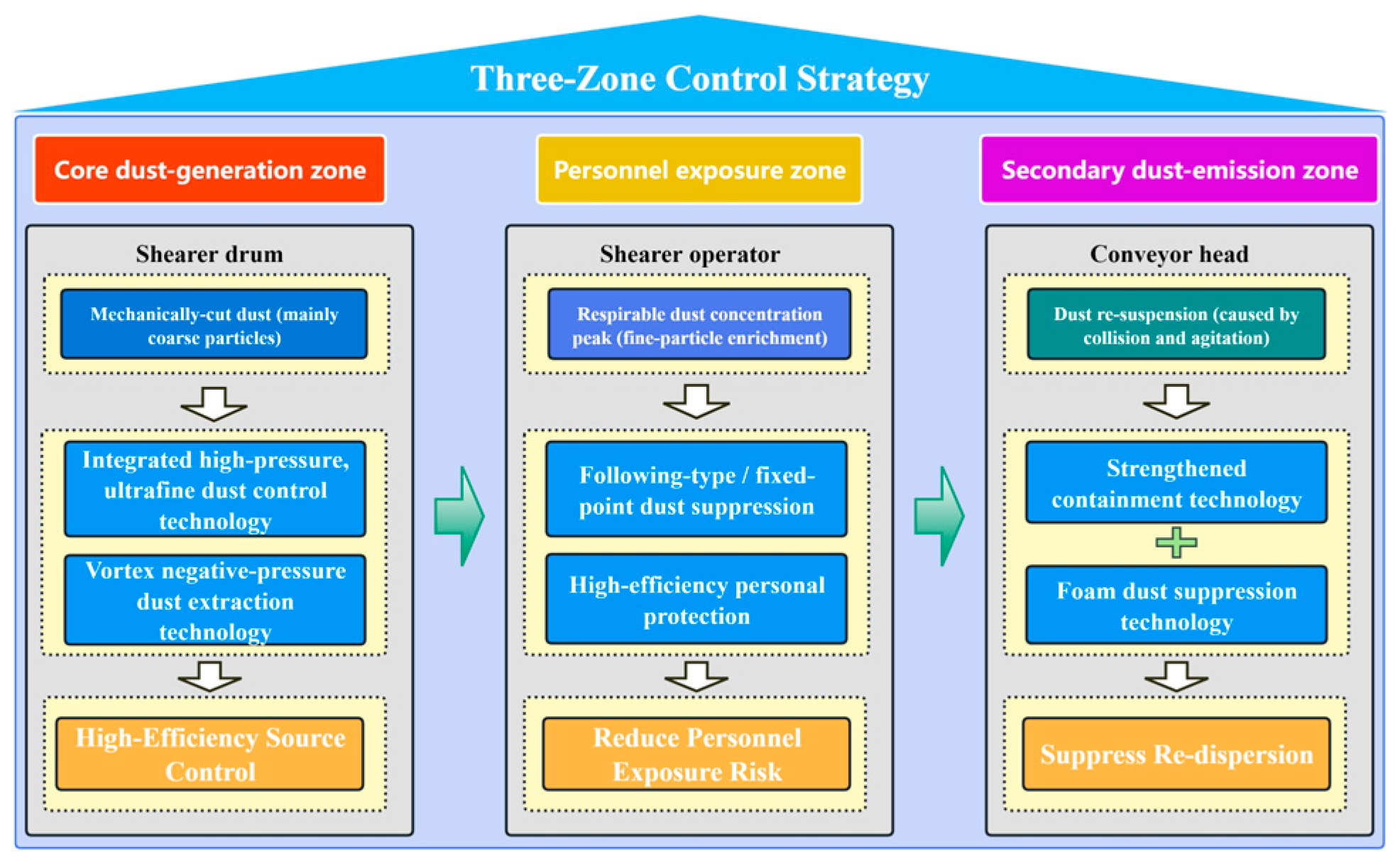
The observed accumulation of respirable dust at the belt-conveyor heads in both mines is consistent with the mechanism by which fine particles, under coupled airflow-turbulence effects, resist settling and are easily re-suspended by conveyance disturbances. Based on these dispersion patterns, a differentiated Three-Zone Control strategy is proposed (
Figure 3). The three-zone strategy was further linked to measurable control parameters rather than only spatial locations. In the core dust-generation zone near the shearer drum, the priority is to reduce peak total dust concentration and initial respirable dust generation; therefore, spray pressure, atomized droplet size, water consumption, and negative-pressure extraction capacity should be optimized. In the personnel exposure zone near the shearer operator, the main indicators are respirable dust concentration, exposure duration, local airflow velocity, and filtration efficiency of personal protective materials. Maintaining the local airflow velocity within approximately 1.5–2.5 m·s
−1 is recommended to balance dust removal and re-entrainment risk. In the secondary emission zone near the conveyor head, the key parameters are deposited dust load, re-suspension intensity, foam coverage, enclosure efficiency, and residual respirable dust concentration. This parameter-based interpretation makes the three-zone strategy more suitable for field monitoring, intelligent regulation, and performance evaluation.
From an operational perspective, the proposed three-zone strategy should not be interpreted as an independent dust-control scheme, but as a decision-support framework that can be integrated into mine-wide environmental monitoring and control systems. In the core dust-generation zone, control decisions should be linked with shearer position, cutting direction, drum speed, spray pressure, and local airflow velocity. In the personnel exposure zone, respirable dust monitoring should be coordinated with personnel positioning and local ventilation adjustment to reduce short-term exposure peaks. In the secondary emission zone, conveyor operating status, vibration intensity, and deposited dust load should be considered when selecting enclosure, wet suppression, or negative-pressure extraction measures. The implementation of such a strategy requires coupling dust monitoring with intelligent ventilation and multi-source sensing architectures. Dust concentration, particle-size distribution, airflow velocity, gas concentration, temperature, humidity, and equipment operating status should be jointly monitored so that dust suppression does not conflict with gas dilution, heat removal, or other occupational-environment controls. For example, increasing airflow velocity may reduce dust accumulation in some locations but may also re-entrain deposited particles or affect gas and thermal management. Therefore, future system design should incorporate scenario analysis, sensitivity evaluation, and cost–benefit assessment to determine the optimal combination of ventilation regulation, spray/foam suppression, enclosure, and personal protection under different mining conditions.
3.2. Analysis of Key Physicochemical Parameters of Dust and Their Impact on Wettability
3.2.1. Particle Size Distribution and Its Influence on Wettability
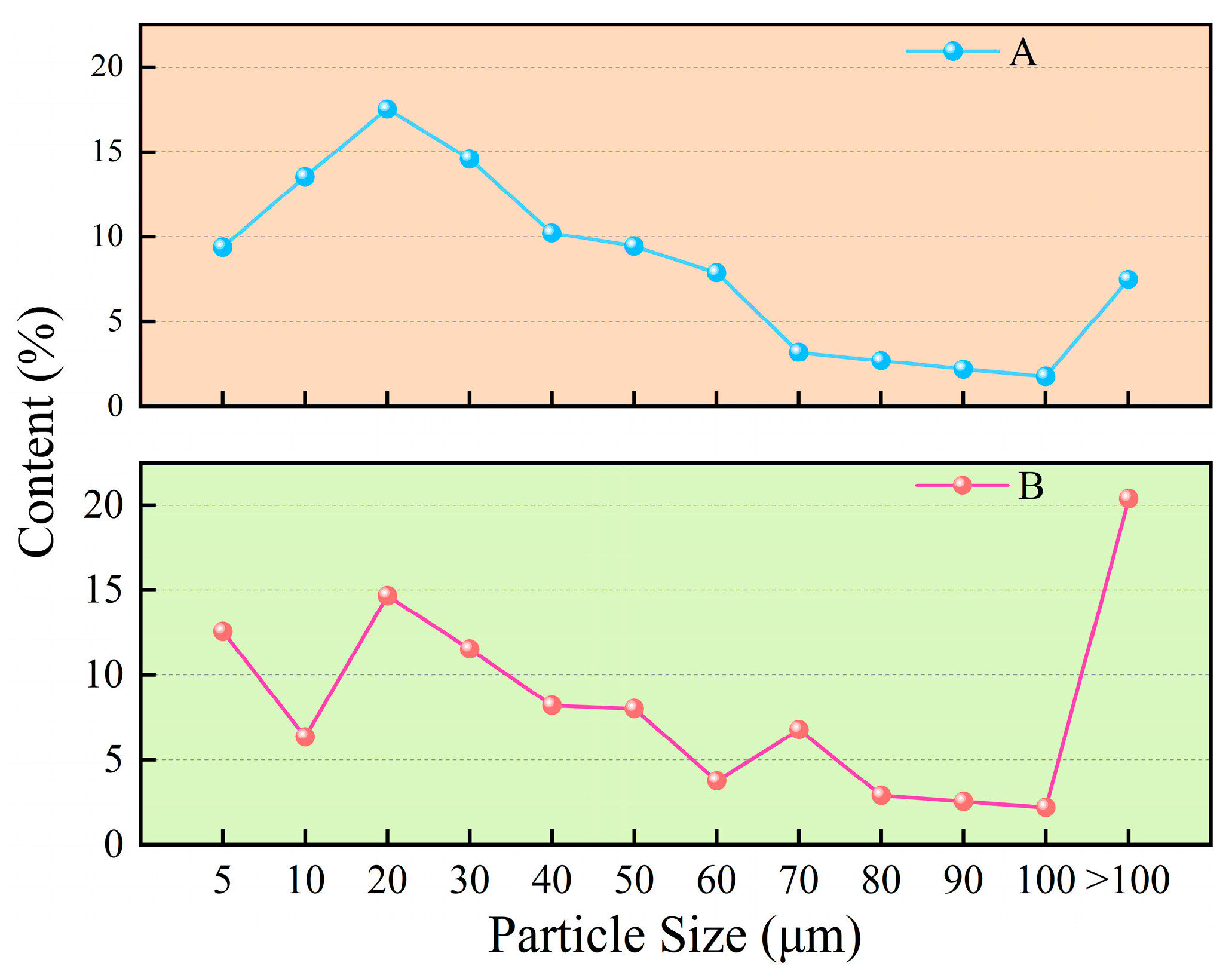
Particle size analysis of dust samples from the fully mechanised mining faces of Mines A and B (
Figure 4) indicates a predominance of fine particles, with the majority within the 0–30 μm range. In the 31125 face (Mine A) and the 2416 face (Mine B), particles smaller than 10 μm constituted 22.93% and 18.93% of the total dust, respectively. Within this sub-10 μm fraction, respirable dust (<5 μm) accounted for 9.39% and 12.57%, respectively. The similar distribution trends between the two mines confirm the efficacy of existing control measures—such as coal seam infusion and water spraying—in mitigating coarse particles (>10 μm). However, the data highlight a significant deficiency in the capture efficiency of conventional wet suppression technologies for fine particles, particularly those below 10 μm [
26]. The higher proportion of respirable dust in Mine B (12.57%) versus Mine A (9.39%) further indicates that the effectiveness of extant dust control is variable and influenced by site-specific conditions.
Dust particle size is both a key parameter influencing suspension and diffusion behaviour and a determining factor for wettability. A distinct inverse relationship exists between particle size and wetting efficiency: finer particles are more difficult to wet and capture via spraying, leading to reduced efficacy. This phenomenon is governed by two coupled mechanisms:
- (a)
Specific Surface Area Effect and Wettability Attenuation
Reduced particle size results in an increased specific surface area, raising the liquid volume required for complete wetting. Under limited spray volumes, forming a continuous and stable liquid film becomes difficult, lowering wetting efficiency. Concurrently, the enlarged area amplifies the chemical heterogeneity of coal dust surfaces, enhancing the ‘masking’ effect of hydrophobic components and exacerbating contact angle hysteresis, which further impedes droplet spreading and adhesion.
- (b)
Aerodynamic Behaviour and Capture Efficiency Decline
Fine particles exhibit high aerodynamic following efficiency and low inertia, enabling them to closely follow airflow streamlines. This reduces their relative velocity with spray droplets, causing a sharp decrease in collision efficiency. Even upon contact, moisture in the liquid film evaporates rapidly—accelerated by the particles’ large surface area—hindering the maintenance of a persistent wetted state and making particles prone to re-suspension.
Consequently, particle size is a critical determinant of dust removal technology efficiency. Dust management must therefore evolve from a “one-size-fits-all” approach to precision control based on particle size distribution, establishing a framework of “source identification, technology matching, and dynamic regulation.” Implementing such a system requires foundational research into dust source characteristics and an intelligent management platform integrating perception, decision-making, and execution. For example, Zhou Jian [
27] developed an intelligent mine management system that enables centralised remote dust control via real-time monitoring and linked suppression devices. Similarly, Gao Bin et al. [
28] created an intelligent platform for large-height fully mechanised faces. By integrating multi-source data—including shearer operation, hydraulic support state, and personnel location—they built a real-time dust concentration sensing and diffusion visualisation system. Based on dust source properties, they developed a digital dust reduction efficiency model, enabling intelligent, dynamic, multi-parameter control of equipment such as shearer-enclosed spraying and support barrier systems.
3.2.2. Analysis of Surface Functional Group Characteristics and Their Impact on Wettability
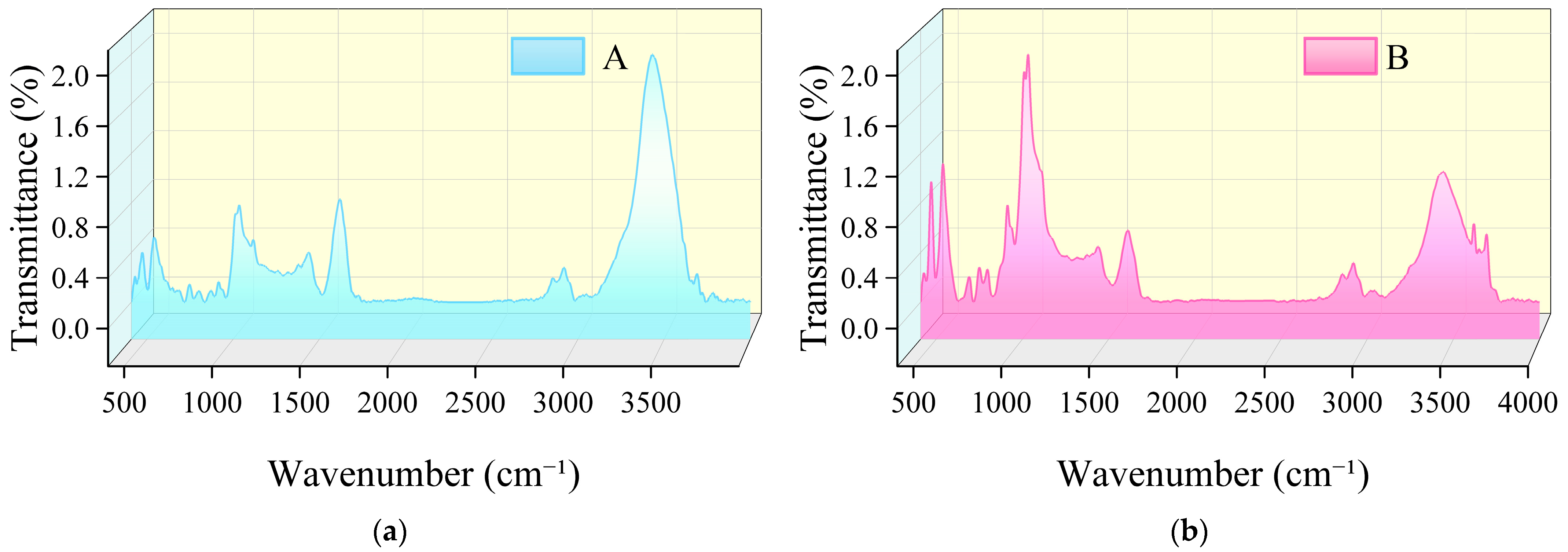
The infrared spectra of dust samples from the working faces of Mines A and B are presented in
Figure 5a and
Figure 5b, respectively, revealing broadly similar spectral profiles.
The characteristic absorption peaks were assigned as follows. The strong peaks between 3619–3691 cm−1 and 3442–3433 cm−1 are attributed to the stretching vibrations of free -OH groups and crystalline water (O-H), respectively. Peaks at 2920–2919 cm−1 and 2856–2854 cm−1 correspond to the C-H stretching vibrations of methylene (-CH2-) groups in aliphatic hydrocarbons, while a peak at approximately 1612–1618 cm−1 indicates the aromatic skeleton (-C=C-) stretching vibration. Within the inorganic mineral region, the peak near 1438 cm−1 and those at 871 and 691 cm−1 correspond to different vibrational modes of carbonate (CO32−). Furthermore, absorption bands in the ranges 1117–1010 cm−1 and 541–471 cm−1 are assigned to the asymmetric stretching and bending vibrations of silicates (Si-O-Si), respectively.
The types and relative abundance of these functional groups significantly influence the dust’s surface wettability. Non-polar groups, such as aliphatic and aromatic hydrocarbons, enhance dust hydrophobicity. In contrast, oxygen-containing groups (-OH), crystalline water, and inorganic minerals (silicates, carbonates) provide hydrophilic sites.
The observed hydrophilic components, including -OH groups and mineral phases, align with findings from Wang et al. [
29] concerning the role of oxygen-containing surface functional groups in coal dust wettability. By systematically measuring characteristic infrared spectral peak areas for various coal dust samples and correlating them with contact angles, their research demonstrated conclusively that the content of surface oxygen-containing groups—specifically the carbonyl group at 1718 cm
−1 and the free -OH group at 3690 cm
−1—positively correlates with enhanced wettability. An increase in these peak areas corresponds to a decrease in the contact angle. Furthermore, a higher fixed carbon content was also associated with this trend towards improved wetting behaviour.
3.2.3. Microstructural Characteristics and Quantitative Analysis
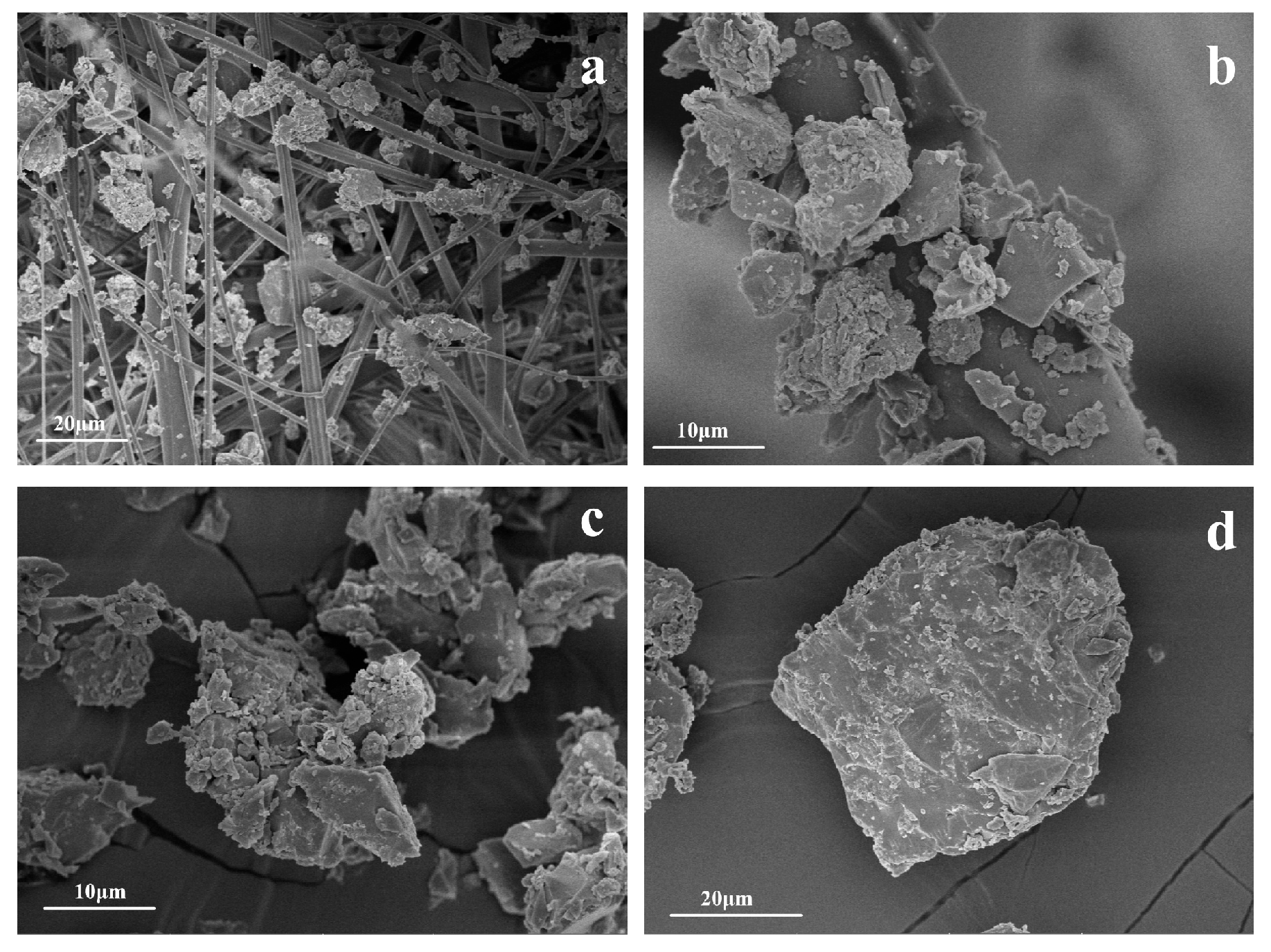
To examine dust microstructure, scanning electron microscopy (SEM) was performed on filter membrane samples collected from shearer drivers’ masks at Mines A and B (
Figure 6).
Figure 6a,c depict the macro- and micro-morphology of the Mine A sample, respectively;
Figure 6b,d show the corresponding views for Mine B.
Both samples exhibit significant dust agglomeration (
Figure 6a,b). ImageJ analysis indicates that agglomerates from Mine A are larger (average ~20 µm) and structurally denser, whereas those from Mine B are smaller (average ~10 µm) and more loosely packed. The approximate two-fold size difference suggests variations in inter-particle adhesion or surface properties. The agglomerates comprise irregular, polyhedral primary particles, characteristic of brittle fracture during coal comminution. Their presence critically challenges wetting: larger, denser agglomerates slow liquid penetration and can create unwetted ‘dead zones’ as trapped air is not fully displaced. Therefore, effective wetting must achieve both surface coverage of individual particles and sufficient penetration to overcome internal capillary forces within agglomerates.
The surface micro-morphology differs notably between mines (
Figure 6c,d). The Mine A dust surface (
Figure 6c) shows pronounced undulations with high local relief, producing a rugged topography. In contrast, the Mine B surface (
Figure 6d) is relatively flat, with lower relief and a smoother overall contour. According to the Wenzel model, surface roughness amplifies intrinsic wettability. Thus, a rugged surface enhances inherent hydrophobicity. Its peak-valley structure traps air, leading to a composite solid-air-liquid interface upon droplet contact that severely inhibits spreading and penetration. A flatter surface provides less amplification of hydrophobicity; liquid contacts the solid more completely, minimising air film barriers and theoretically promoting initial spreading of wetting solutions.
Consequently, surface roughness constitutes another key morphological determinant of wettability alongside agglomeration. For Mine A dust, the substantial surface roughness acts synergistically with its larger agglomerate size: macro-scale agglomeration impedes liquid access to the particle collective, while micro-scale roughness hinders spreading on individual particles. This dual mechanism explains the overall inferior wettability of Mine A dust compared to that from Mine B.
For quantitative surface roughness analysis, three representative 5 × 5 µm areas from each sample were analyzed using the surface topography plugin in Gwyddion software(version 2.62). The arithmetic mean roughness Ra for Mine A dust was determined to be 48.3 ± 5.7 nm, significantly higher than that of Mine B dust (22.1 ± 3.4 nm). The larger Ra value for Mine A dust indicates a more rugged surface topography. According to the Wenzel model, this substantial roughness amplifies the intrinsic hydrophobicity of the already hydrophobic hydrocarbon-rich surface, leading to a higher apparent contact angle. The smoother surface of Mine B dust (Ra = 22.1 nm) provides a more favorable condition for liquid spreading, as it minimizes the air-trapping effect. According to the Wenzel model, the apparent contact angle is expressed as cosθ* = r cosθ, where θ* is the apparent contact angle, θ is the intrinsic contact angle, and r is the roughness factor, defined as the ratio of the actual surface area to the projected surface area. Based on the three-dimensional surface topography analysis, the roughness factor of Mine A dust was estimated to be higher than that of Mine B dust, indicating that the rugged surface of Mine A provides greater roughness amplification. Because both dust samples are intrinsically hydrophobic, a larger r value further increases the apparent contact angle and weakens liquid spreading.
3.3. Synergistic Correlation Between Wettability and Multi-Scale Physicochemical Properties
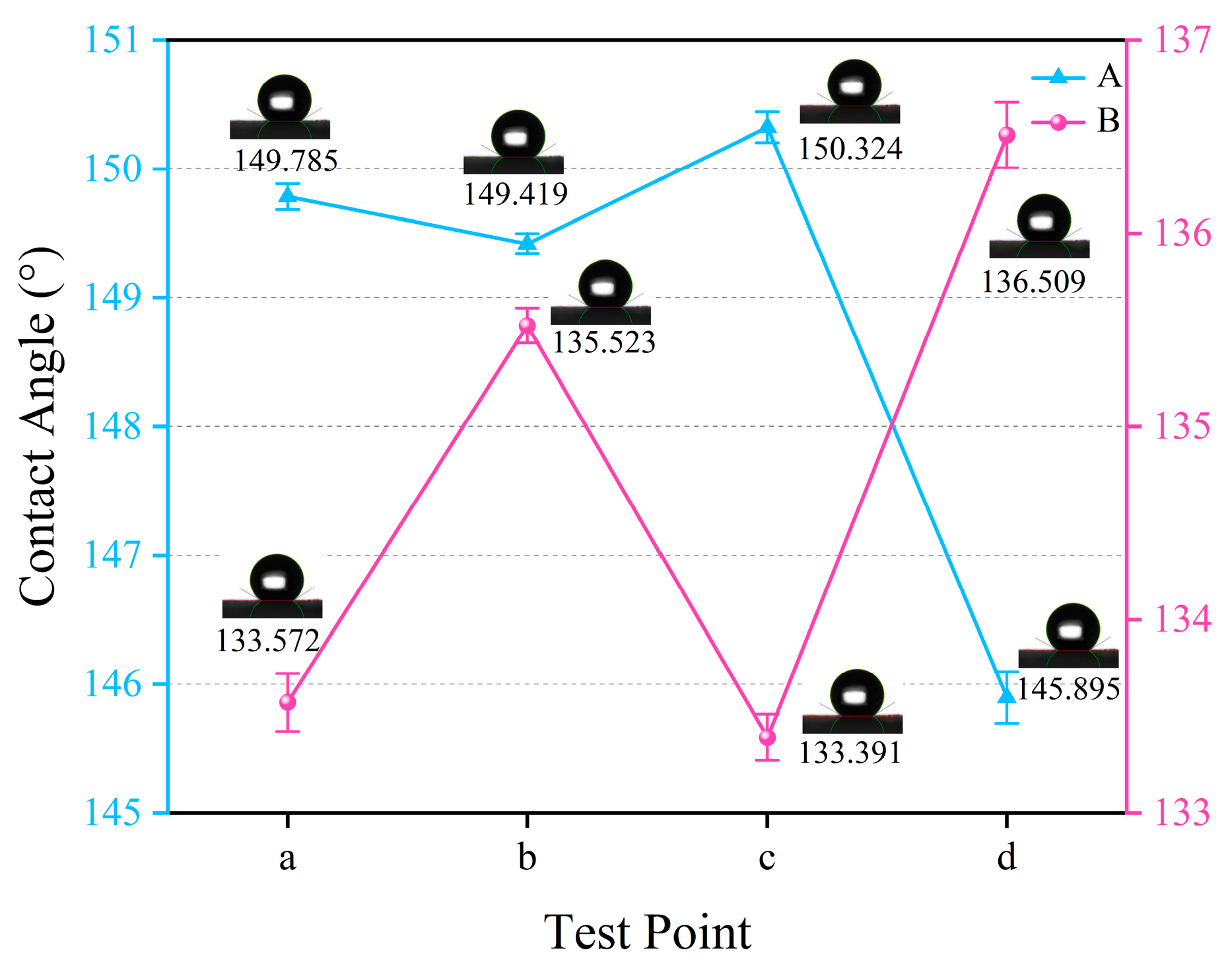
The measured water contact angles for Mine A and Mine B dust were 148.9° ± 2.1° and 134.7° ± 1.8°, respectively (
Figure 7), both indicating hydrophobic surfaces with a statistically significant difference (
p < 0.01, Student’s t-test). To elucidate the factors governing this disparity, a Pearson correlation analysis was performed between the contact angle and key quantitative parameters: the mass median diameter D50, the fraction of particles < 10 μm, the peak area ratio of hydrophilic (O-H at 3690 cm
−1) to hydrophobic (-CH
2- at 2920 cm
−1) groups ROH/CH2, and the arithmetic mean surface roughness Ra. The correlation matrix (
Table 3) reveals that Ra exhibits the strongest positive correlation with CA (r = 0.94,
p < 0.01), followed by the ROH/CH2 ratio (r = −0.89,
p < 0.01) and the <10 μm fraction (r = 0.76,
p < 0.05). Notably, D50 showed a weaker but significant negative correlation (r = −0.68,
p < 0.05). The ROH/CH
2 ratio was selected because the O–H stretching band near 3690 cm
−1 represents hydrophilic oxygen-containing groups and crystalline water, whereas the –CH
2– stretching band near 2920 cm
−1 represents hydrophobic aliphatic hydrocarbon structures. Thus, this ratio reflects the relative balance between hydrophilic and hydrophobic surface functional groups and provides a suitable comparative indicator for evaluating the chemical contribution to coal dust wettability.
It should be noted that the Pearson correlation analysis conducted in this study is exploratory and primarily reveals statistical associations between contact angle and selected dust physicochemical parameters. Although the observed correlations are consistent with known wetting mechanisms, such as the influence of surface roughness, oxygen-containing functional groups, and fine-particle enrichment, they do not by themselves establish direct causality. Therefore, the proposed multiscale interpretation should be regarded as a mechanistic hypothesis supported by field and laboratory observations, rather than as a fully validated causal model.
These results suggest a hierarchical, synergistic mechanism governing dust wettability. Particle size distribution (e.g., higher <10 μm fraction in Mine A) provides the physical basis by increasing the specific surface area, which not only demands a larger liquid volume for wetting but also leads to surface enrichment of hydrophobic carbonaceous components [
30]. Surface chemistry, quantified by the low ratio in Mine A, acts as the intrinsic determinant, defining the inherent hydrophobic nature of the solid surface. Microscopic morphology, particularly the high Ra value in Mine A, serves as a critical modulating factor, amplifying the intrinsic hydrophobicity through the Wenzel wetting regime. The denser agglomerates observed in Mine A may be associated with the combined effects of surface chemistry, mineral composition, moisture-related capillary forces, and mechanical fragmentation conditions during cutting. However, because clay mineral content, real-time moisture variation, and cutting speed were not independently measured in this study, the dominant cause of agglomerate densification cannot be conclusively determined. This limitation has been clarified, and future work should include mineralogical analysis, in-situ moisture monitoring, and cutting-parameter records to further identify the controlling factors.
3.4. Limitations and Future Work
Although this study establishes a multiscale correlation framework for coal mine dust in fully mechanized mining faces, several limitations should be acknowledged. First, the field investigation was conducted in two representative mining faces from a limited geographic and operational context. Geological conditions, coal rank, ventilation layout, cutting parameters, seasonal humidity, and the configuration of dust-control equipment may vary among mines. Therefore, the conclusions should be further verified through multi-season and multi-mine field campaigns covering different coal ranks, mining heights, ventilation modes, and production intensities.
Second, the wettability analysis was mainly based on static water contact-angle measurements. Static contact angles can reflect the apparent hydrophobicity of compacted dust tablets, but they cannot fully describe dynamic wetting processes, including droplet spreading, penetration into agglomerates, evaporation, contact-angle hysteresis, and wetting-agent adsorption. Future work should therefore include dynamic contact-angle testing, capillary penetration experiments, high-speed visualization of droplet–dust interaction, and wetting tests using different surfactant or foam formulations.
Third, the proposed three-zone control strategy was derived from field measurements and physicochemical characterization, but it has not yet been validated through controlled intervention trials or modelling-based optimization. Future studies should integrate computational fluid dynamics and discrete-element simulations to model airflow, dust-particle transport, droplet capture, foam coverage, and particle re-entrainment. Pilot-scale implementation of the three-zone strategy should also be conducted in operating mines, with rigorous monitoring of total dust concentration, respirable dust concentration, particle-size distribution, water and reagent consumption, equipment reliability, occupational exposure reduction, and economic performance. Such validation will be essential for transforming the proposed framework into a practical intelligent dust-control system.
4. Conclusions
This study proposes a preliminary multiscale correlation framework linking dust concentration, particle-size distribution, microstructure, surface chemistry, and wettability. Rather than serving as a universal predictive model, the framework should be regarded as a case-supported heuristic for identifying key dust properties and informing the selection of suitable suppression technologies in fully mechanized coal mining faces. However, the findings are derived from two representative mining faces and should therefore be generalized with caution. Geological conditions, coal rank, mining height, ventilation parameters, equipment layout, water-spray characteristics, and existing environmental-control systems may all influence dust generation, migration, and wetting behavior. Further validation across diverse mines and operating conditions, combined with controlled experiments, numerical simulation, sensitivity analysis, and field-scale intervention tests, is required before the framework can be used as a robust basis for predictive and intelligent dust-control design.
Dust wettability is synergistically controlled by particle size distribution, surface chemistry, and microstructure: particle size provides the physical basis for wetting; surface functional groups determine intrinsic hydrophilicity or hydrophobicity; and microstructure critically influences liquid penetration and spreading across macro and micro scales. Based on these mechanisms, key development directions are outlined for the widely adopted technologies of water spraying and foam suppression.
In practical engineering applications, the proposed multiscale indicators can be used as a basis for selecting dust suppressants. When FTIR spectra show strong hydrophobic aliphatic C–H peaks and a low hydrophilic/hydrophobic functional-group ratio, wetting agents with stronger interfacial adsorption capacity, such as ionic or compound surfactants, should be prioritized. When dust exhibits a high surface roughness Ra and dense agglomeration, formulations with lower surface tension, stronger penetration ability, or foam systems enhanced by micro–nano bubbles are more suitable. In contrast, for dust with relatively abundant oxygen-containing functional groups and lower Ra values, non-ionic wetting agents or lower-dosage compound formulations may be sufficient. Therefore, Ra and FTIR data can provide practical criteria for moving from empirical reagent selection toward property-based dust suppression design.
This work integrates field monitoring and standard laboratory characterization methods to develop a case-based multi-scale correlation framework linking dust concentration, particle-size distribution, microstructure, surface chemistry, and wettability. Rather than proposing a fundamentally new wetting theory, the framework provides a systematic and application-oriented basis for source identification, technology matching, and property-based dust-control optimization. Future efforts should focus on an integrated intelligent system encompassing monitoring, simulation, dynamic wetting evaluation, and field validation. In addition to real-time sensing and coupled airflow–dust simulation, dynamic contact-angle measurements, droplet-impact experiments, foam-penetration tests, small-scale wind-tunnel experiments, and CFD-based spray–dust interaction modelling should be conducted. Moreover, the proposed three-zone control strategy should be validated through in situ before-and-after dust-reduction tests under different ventilation rates, cutting sequences, and production conditions. Such work will help transform the present case-based multi-scale framework into a more generalizable and operationally validated dust-control methodology.