
Characterization of Cavity Reservoirs Based on a Shape-Constrained Multi-Trace Seismic Inversion Method


Abstract
1. Introduction
2. Theory and Methods
2.1. Multi-Trace Impedance Inversion
2.2. Shape-Constrained Inversion
- : Controls the strength of internal smoothing within geo-bodies;
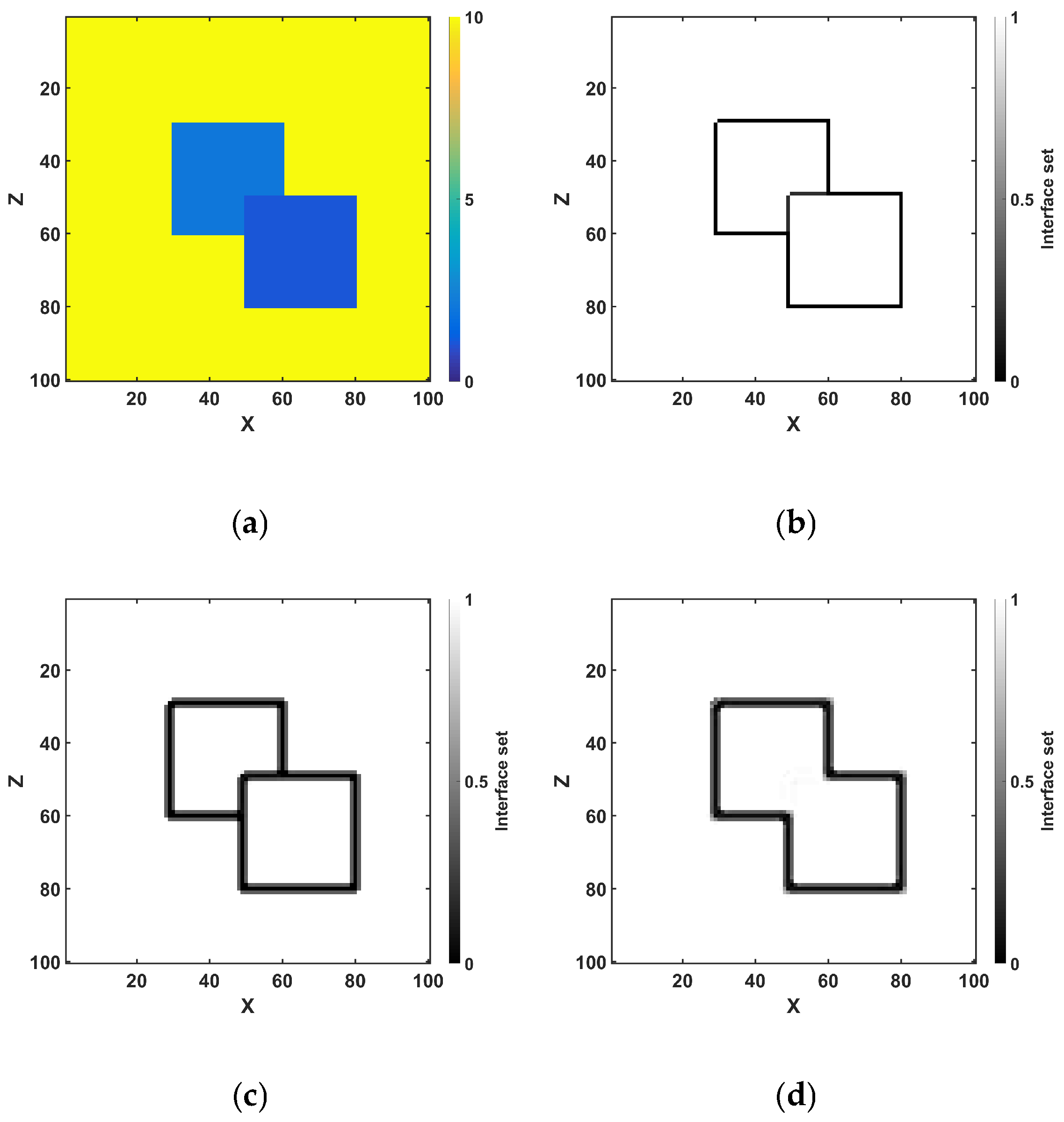
- : Controls the scale and complexity of inverted interfaces;
- : Controls the sharpness of boundary transitions.
- (1)
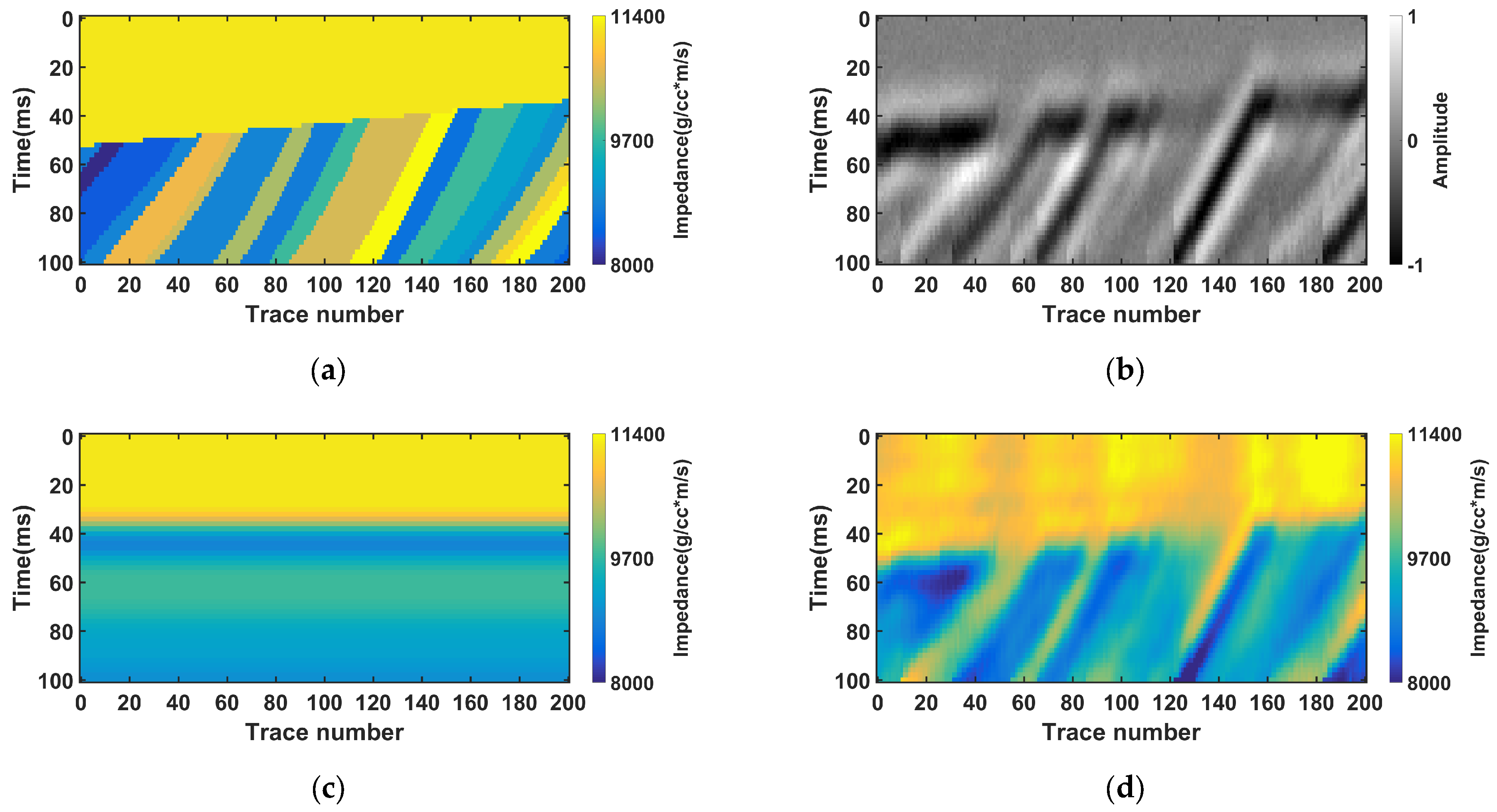
- Estimation of seismic wavelet. In the synthetic recording case, we can simply use the wavelet used in the modeling of the observed data, such as the Ricker wavelet. However, in practical cases, we usually use a statistical wavelet in the target layer or estimate a wavelet by well-to-seismic calibration.
- (2)
- Initial model building. The prior information, such as logging and seismic interpretation, is used so that a smooth low-frequency model can be built.
- (3)
- Initialization of the interface set . In general, we recommend that the interface set should all be initialized to 0, thus ensuring stable updates. However, if a reliable a priori model is available, the initial interfaces can also be set according to the geological understanding.
- (4)
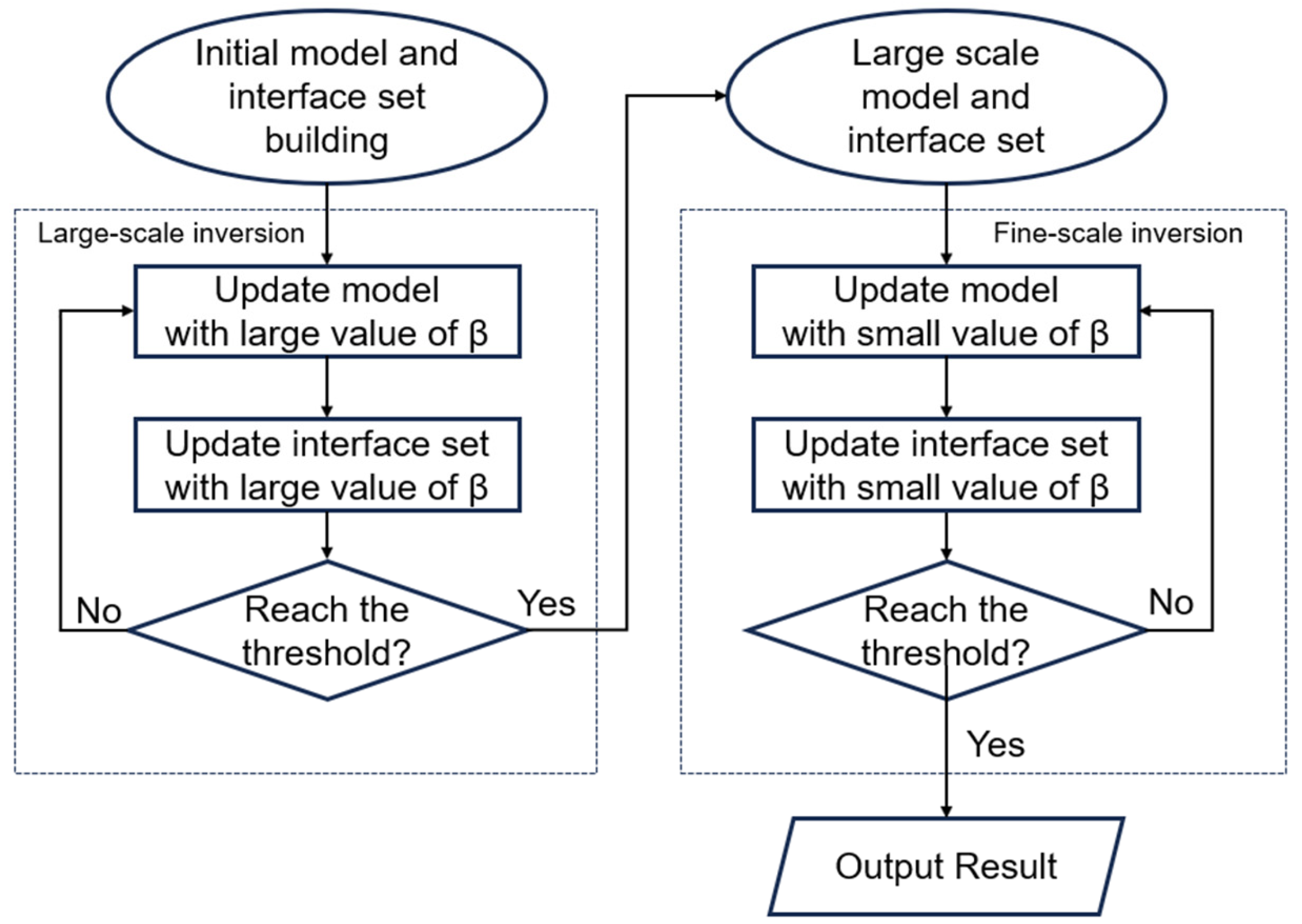
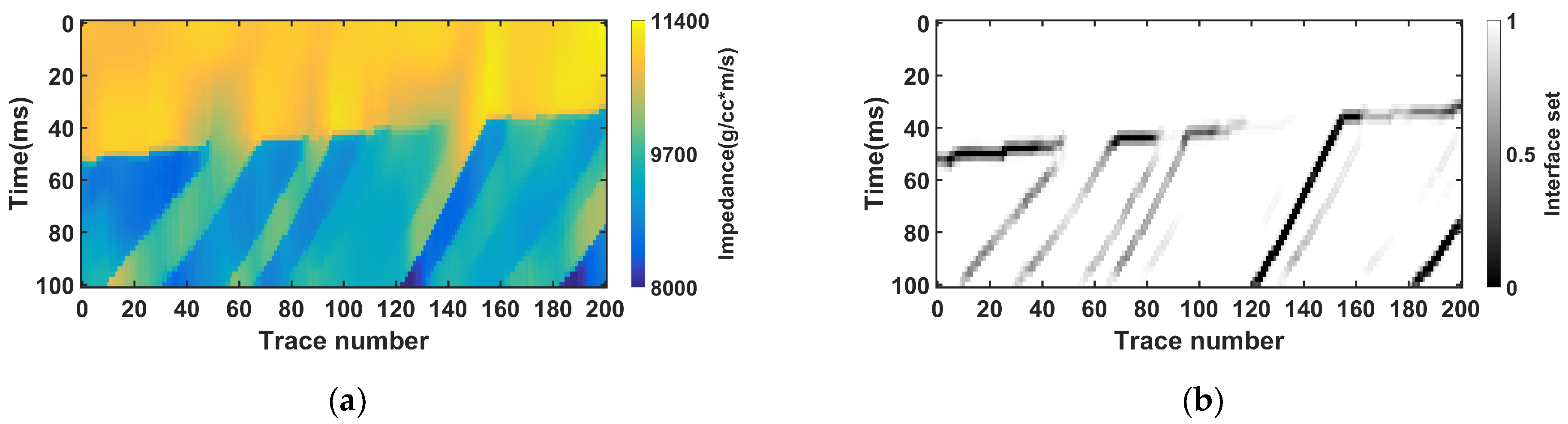
- Solving the objective function. First, set a larger value of and iteratively solve to obtain the large-scale inversion result, and then, based on the large-scale solution, we give a smaller value of to obtain the fine solution. It should be noted that Equation (12) is biconvex, so alternating iterations are required to update the model and interfaces separately.
3. Synthetic Data Example
4. Field Data Application
5. Discussion
6. Conclusions
Author Contributions
Funding
Institutional Review Board Statement
Informed Consent Statement
Data Availability Statement
Conflicts of Interest
References
- Wu, G.; Gao, L.; Zhang, Y.; Ning, C.; Xie, E. Fracture attributes in reservoir-scale carbonate fault damage zones and implications for damage zone width and growth in the deep subsurface. J. Struct. Geol. 2019, 118, 181–193. [Google Scholar] [CrossRef] [Scilit]
- Liu, B.; Yang, F.; Zhang, G.; Zhao, L. Pre-stack fracture prediction in an unconventional carbonate reservoir: A case study of the M oilfield in Tarim Basin, NW China. Energies 2024, 17, 2061. [Google Scholar] [CrossRef] [Scilit]
- Adam, A.; Swennen, R.; Abdulghani, W.; Abdlmutalib, A.; Hariri, M.; Abdulraheem, A. Reservoir heterogeneity and quality of Khuff carbonates in outcrops of central Saudi Arabia. Mar. Pet. Geol. 2018, 89, 721–751. [Google Scholar] [CrossRef] [Scilit]
- Zhang, J.; Ma, P.; Liu, Y.; Dongming, L.; Li, X.; Xin, L.; Leli, W. Control modes of multitype strike-slip fault systems on fractured-vuggy carbonate reservoir development. In SEG Technical Program Expanded Abstracts 2016, Dallas, TX, USA, 16–21 October 2016; Society of Exploration Geophysicists: Houston, TX, USA, 2016; pp. 1813–1817. [Google Scholar] [CrossRef] [Scilit]
- Deng, Z.; Zhou, D.; Dong, H.; Huang, X.; Wei, S.; Kang, Z. Deep learning for predicting porosity in ultra-deep fractured vuggy reservoirs from the Shunbei oilfield in Tarim Basin, China. Sci. Rep. 2024, 14, 29605. [Google Scholar] [CrossRef] [Scilit] [PubMed]
- Gong, W.; Wen, X.; Zhou, D. Characteristics and seismic identification mode of ultra-deep carbonate fault-controlled reservoir in Northwest China. Energies 2022, 15, 8598. [Google Scholar] [CrossRef] [Scilit]
- Wang, Y.; Xie, P.; Zhang, H.; Liu, Y.; Yang, A. Fracture-vuggy carbonate reservoir characterization based on multiple geological information fusion. Front. Earth Sci. 2024, 11, 1345028. [Google Scholar] [CrossRef] [Scilit]
- Qi, L. Structural characteristics and storage control function of the Shun I fault zone in the Shunbei region, Tarim Basin. J. Pet. Sci. Eng. 2021, 203, 108653. [Google Scholar] [CrossRef] [Scilit]
- Han, S.; Wang, S.; Lan, H.T.; Wang, Z. Application of Multi-attribute Clustering Technology to Description of Fault-Controlled Fracture-Cavity Reservoirs in Changxing Formation, Longgang Area. In Proceedings of the International Field Exploration and Development Conference 2023 (IFEDC 2023); Lin, J., Ed.; Springer: Singapore, 2024; pp. 409–422. [Google Scholar] [CrossRef] [Scilit]
- Zhen, W.; Huan, W.; Guangxiao, D.; Wei, D.; Xin, W. Fault-karst characterization technology in the Tahe Oilfield, China. Geophys. Prospect. Pet. 2019, 58, 149–154. [Google Scholar] [CrossRef]
- Wang, L.; Yang, R.; Li, D.; Meng, L.; Xiao, Z. Seismic attributes for characterization and prediction of carbonate faulted karst reservoirs in the Tarim Basin, China. Interpretation 2021, 9, T611–T622. [Google Scholar] [CrossRef] [Scilit]
- Li, Z.; Li, H.; Liu, J.; Deng, G.; Gu, H.; Yan, Z. 3D seismic intelligent prediction of fault-controlled fractured-vuggy reservoirs in carbonate reservoirs based on a deep learning method. J. Geophys. Eng. 2024, 21, 345–358. [Google Scholar] [CrossRef] [Scilit]
- Cao, D.; Yin, X.; Zhang, F. Impedance inversion method constrained with crosswell seismic data. In Beijing International Geophysical Conference and Exposition 2009, Beijing, China, 13–17 April 2009; Society of Exploration Geophysicists: Houston, TX, USA, 2009; Volume 10, p. 261. [Google Scholar] [CrossRef] [Scilit]
- Ye, D.; He, L.; Ren, J.; Wang, X.; Bian, L. Application of Seismic Inversion Technology Based on Complicated Structure Modeling. In International Geophysical Conference 2018, Beijing, China, 24–27 April 2018; Society of Exploration Geophysicists & Chinese Petroleum Society: Beijing, China, 2018; pp. 1095–1099. [Google Scholar] [CrossRef] [Scilit]
- Hameed, M.; Al-Qallaf, H.; Razak, M.H.A. Geostatistical Inversion-Carbonate Case Studies from Kuwait. In 75th EAGE Conference & Exhibition Incorporating SPE EUROPEC 2013, London, UK, 10–13 June 2013; European Association of Geoscientists & Engineers: Houten, The Netherlands, 2013; p. cp-348. [Google Scholar] [CrossRef] [Scilit]
- Liu, H.; Ren, L.; Hu, Z. Pressure curve characteristics for wells drilled in cave of fracture-cavity carbonate reservoirs. Lithol. Reserv. 2012, 24, 124–128. [Google Scholar] [CrossRef]
- Lan, X.; Lü, X.; Zhu, Y.; Yu, H. The geometry and origin of strike-slip faults cutting the Tazhong low rise megaanticline (central uplift, Tarim Basin, China) and their control on hydrocarbon distribution in carbonate reservoirs. J. Nat. Gas Sci. Eng. 2015, 22, 633–645. [Google Scholar] [CrossRef] [Scilit]
- Li, X.; Li, J.; Feng, X.; Dan, G.; Zhang, G.; Zhang, L.; Zhao, W. Heterogeneous reservoir prediction of ultra-deep strike-slip fault-damaged zone constrained with local seismic anomaly data. Earth Sci. Inform. 2022, 15, 1427–1441. [Google Scholar] [CrossRef] [Scilit]
- Yonglei, L.; Zujun, W.; Zhenzhou, L.; Xiangwen, L. The application of phase-controlled inversion in prediction of deeply buried marine reef-bank reservoirs in the central Tarim Basin. In SPG/SEG 2016 International Geophysical Conference, Beijing, China, 20–22 April 2016; Society of Exploration Geophysicists & Society of Petroleum Geophysicists: Beijing, China, 2016; pp. 734–737. [Google Scholar] [CrossRef] [Scilit]
- Wang, C.; Shi, X.; Jing, B.; Xie, E. Characterization of carbonate reservoirs based on geostatistics inversion with lithofacies model: A case study in Tarim Oilfield of China. In SEG Technical Program Expanded Abstracts 2017, Houston, TX, USA, 24–29 September 2017; Society of Exploration Geophysicists: Houston, TX, USA, 2017; pp. 3007–3011. [Google Scholar] [CrossRef] [Scilit]
- Li, K.; Huang, X.; Wo, Y.; Cao, W.; Hu, Y.; Tang, J.; Xiao, W. A characterization method for cavity Karst reservoir using local full-waveform inversion in frequency domain. IEEE Geosci. Remote Sens. Lett. 2023, 20, 1–5. [Google Scholar] [CrossRef] [Scilit]
- Ge, Q.; Cao, H.; Yang, Z.F.; Li, X.M.; Yan, X.F.; Zhang, X.; Wang, Y.Q.; Lu, W.K. High-resolution seismic impedance inversion integrating the closed-loop convolutional neural network and geostatistics: An application to the thin interbedded reservoir. J. Geophys. Eng. 2022, 19, 550–561. [Google Scholar] [CrossRef] [Scilit]
- Song, C.; Lu, W.; Ye, S.; Yao, W.; Zhang, X. Multimodal geophysics-informed neural network for joint inversion of seismic electromagnetic and well-logging. IEEE Trans. Geosci. Remote Sens. 2026, 64, 5906613. [Google Scholar] [CrossRef] [Scilit]
- Gholami, A. Nonlinear multichannel impedance inversion by total-variation regularization. Geophysics 2015, 80, R217–R224. [Google Scholar] [CrossRef] [Scilit]
- Gholami, A. A fast automatic multichannel blind seismic inversion for high-resolution impedance recovery. Geophysics 2016, 81, V357–V364. [Google Scholar] [CrossRef] [Scilit]
- Dai, R.; Zhang, F.; Yin, C.; Hu, Y. Multi-trace post-stack seismic data sparse inversion with nuclear norm constraint. Acta Geophys. 2021, 69, 53–64. [Google Scholar] [CrossRef] [Scilit]
- Cheng, L.; Wang, S.; Li, S.; Ji, Y. Multi-trace nonstationary sparse inversion with structural constraints. Acta Geophys. 2020, 68, 675–685. [Google Scholar] [CrossRef] [Scilit]
- Guo, K.; Li, J.; Chen, X.; Yang, W.; Zhu, G.; Liu, X. Multi-trace acoustic impedance inversion with multiplicative regularization. J. Appl. Geophys. 2021, 186, 104263. [Google Scholar] [CrossRef] [Scilit]
- Yun, Z.; Zhijiang, K. Key Technologies for Oil and Gas Development from Deep Carbonate Fractured-Vuggy Reservoirs. J. Immunol. Res. Rep. 2023, 3, 1–11. [Google Scholar] [CrossRef] [Scilit]
- Mumford, D.; Shah, J. Optimal approximations by piecewise smooth functions and associated variational problems. Commun. Pure Appl. Math. 1989, 42, 577–685. [Google Scholar] [CrossRef] [Scilit]
- Verschuur, D.J.; Berkhout, A.J. Estimation of multiple scattering by iterative inversion; Part II, Practical aspects and examples. Geophysics 1997, 62, 1596–1611. [Google Scholar] [CrossRef] [Scilit]
- Margrave, G.F.; Lamoureux, M.P.; Henley, D.C. Gabor deconvolution: Estimating reflectivity by nonstationary deconvolution of seismic data. Geophysics 2011, 76, W15–W30. [Google Scholar] [CrossRef] [Scilit]
- Cooke, D.A.; Schneider, W.A. Generalized linear inversion of reflection seismic data. Geophysics 1983, 48, 665–676. [Google Scholar] [CrossRef] [Scilit]
- Tikhonov, A.N.; Goncharsky, A.V.; Stepanov, V.V.; Yagola, A.G. Numerical Methods for the Solution of Ill-Posed Problems; Springer: Dordrecht, The Netherlands, 1995; pp. 65–79. [Google Scholar]
- Ambrosio, L.; Tortorelli, V.M. Approximation of functional depending on jumps by elliptic functional via Γ-convergence. Commun. Pure Appl. Math. 1990, 43, 999–1036. [Google Scholar] [CrossRef] [Scilit]
- Wang, C.; Liu, Z.; Liu, L. Feature-preserving Mumford–Shah mesh processing via nonsmooth nonconvex regularization. Comput. Graph. 2022, 106, 222–236. [Google Scholar] [CrossRef] [Scilit]
- Martin, G.S.; Wiley, R.; Marfurt, K.J. Marmousi2: An elastic upgrade for Marmousi. Lead. Edge 2006, 25, 156–166. [Google Scholar] [CrossRef] [Scilit]
- Li, X.; Li, J.; Li, L.; Wan, Z.; Liu, Y.; Ma, P.; Zhang, M. Seismic wave field anomaly identification of ultra-deep heterogeneous fractured-vuggy reservoirs: A case study in Tarim Basin, China. Appl. Sci. 2021, 11, 11802. [Google Scholar] [CrossRef] [Scilit]
- Gao, Z.; Liu, Z.; Gao, S.; Ding, Q.; Wu, S.; Liu, S. Characteristics and genetic models of Lower Ordovician carbonate reservoirs in southwest Tarim Basin, NW China. J. Pet. Sci. Eng. 2016, 144, 99–112. [Google Scholar] [CrossRef] [Scilit]
- Tian, F.; Luo, X.; Zhang, W. Integrated geological-geophysical characterizations of deeply buried fractured-vuggy carbonate reservoirs in Ordovician strata, Tarim Basin. Mar. Pet. Geol. 2019, 99, 292–309. [Google Scholar] [CrossRef] [Scilit]
- Li, J.; Zhang, Z.; Zhu, G.; Li, T.; Zhao, K.; Chi, L.; Yan, H. The origin and accumulation of ultra-deep oil in Halahatang area, northern Tarim Basin. J. Pet. Sci. Eng. 2020, 195, 107898. [Google Scholar] [CrossRef] [Scilit]
- Li, K.; Niu, L.; Zhou, D.; Meng, S. Depth-Domain Direct Inversion Based on Depth-Variant Wavelet Under Geo-Structure Constraints. In Proceedings of the 86th EAGE Annual Conference & Exhibition, Toulouse, France, 2–5 June 2025. [Google Scholar] [CrossRef] [Scilit]


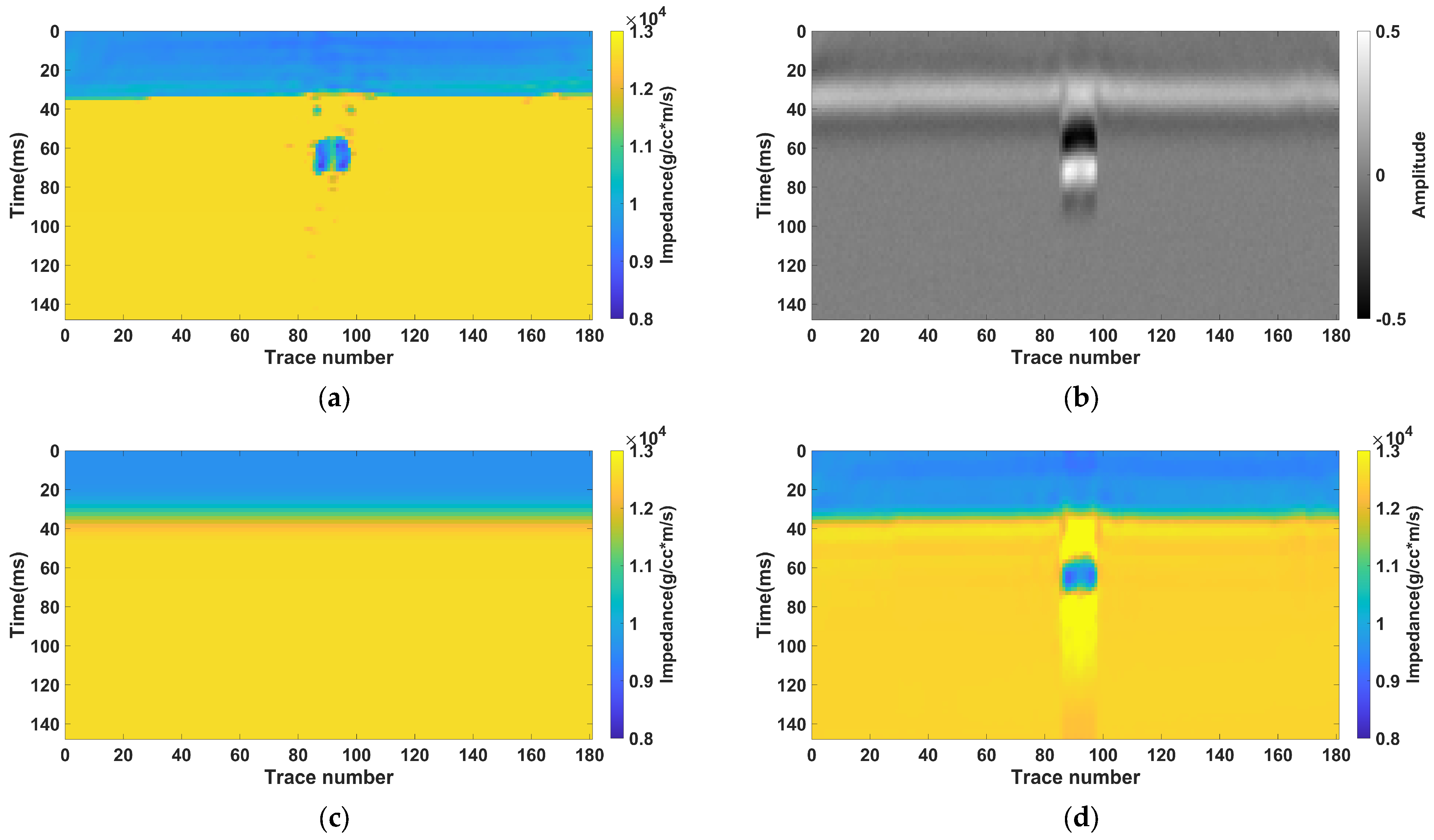
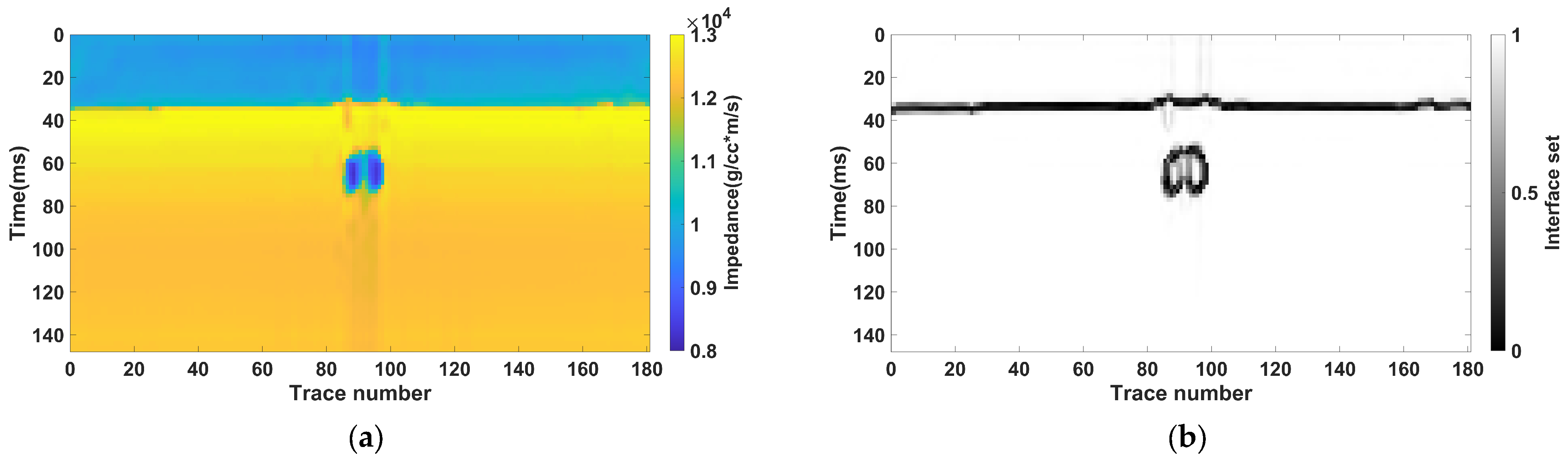




| Inversion Methods | Relative Errors |
|---|---|
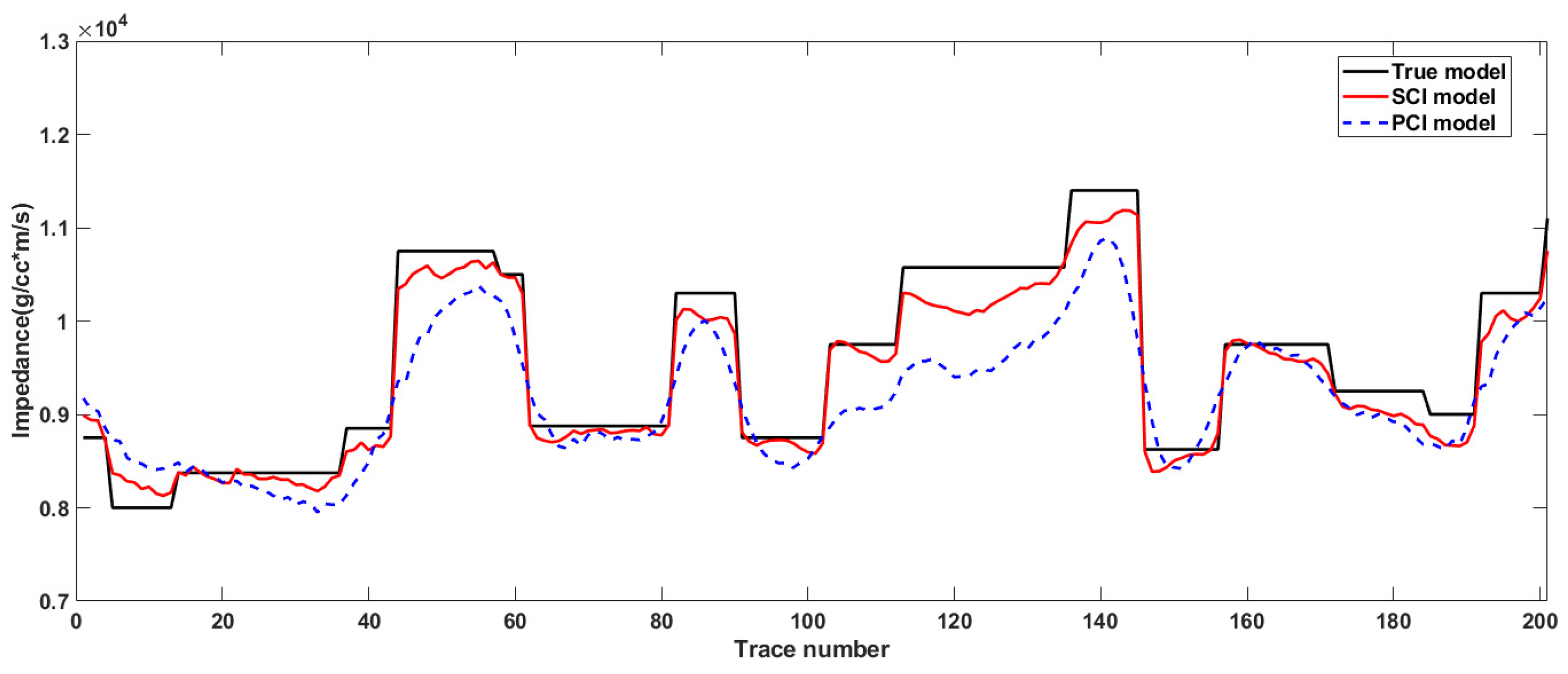
| Large-scale SCI | 0.1030 |
| Small-scale SCI | 0.0233 |
| PCI | 0.0791 |
Disclaimer/Publisher’s Note: The statements, opinions and data contained in all publications are solely those of the individual author(s) and contributor(s) and not of MDPI and/or the editor(s). MDPI and/or the editor(s) disclaim responsibility for any injury to people or property resulting from any ideas, methods, instructions or products referred to in the content. |
© 2026 by the authors. Licensee MDPI, Basel, Switzerland. This article is an open access article distributed under the terms and conditions of the Creative Commons Attribution (CC BY) license.
Share and Cite
Li, K.; Huang, X.; Zhou, D.; Chen, X.; Niu, L. Characterization of Cavity Reservoirs Based on a Shape-Constrained Multi-Trace Seismic Inversion Method. Eng 2026, 7, 222. https://doi.org/10.3390/eng7050222
Li K, Huang X, Zhou D, Chen X, Niu L. Characterization of Cavity Reservoirs Based on a Shape-Constrained Multi-Trace Seismic Inversion Method. Eng. 2026; 7(5):222. https://doi.org/10.3390/eng7050222
Chicago/Turabian StyleLi, Kai, Xuri Huang, Dan Zhou, Xiaochun Chen, and Liping Niu. 2026. "Characterization of Cavity Reservoirs Based on a Shape-Constrained Multi-Trace Seismic Inversion Method" Eng 7, no. 5: 222. https://doi.org/10.3390/eng7050222
APA StyleLi, K., Huang, X., Zhou, D., Chen, X., & Niu, L. (2026). Characterization of Cavity Reservoirs Based on a Shape-Constrained Multi-Trace Seismic Inversion Method. Eng, 7(5), 222. https://doi.org/10.3390/eng7050222