
Multi-Equipment Coordinated Scheduling Considering Dynamic Changes in Truck Handover Points Under Hybrid Traffic in Automated Container Terminals



Abstract
1. Introduction
- (1)
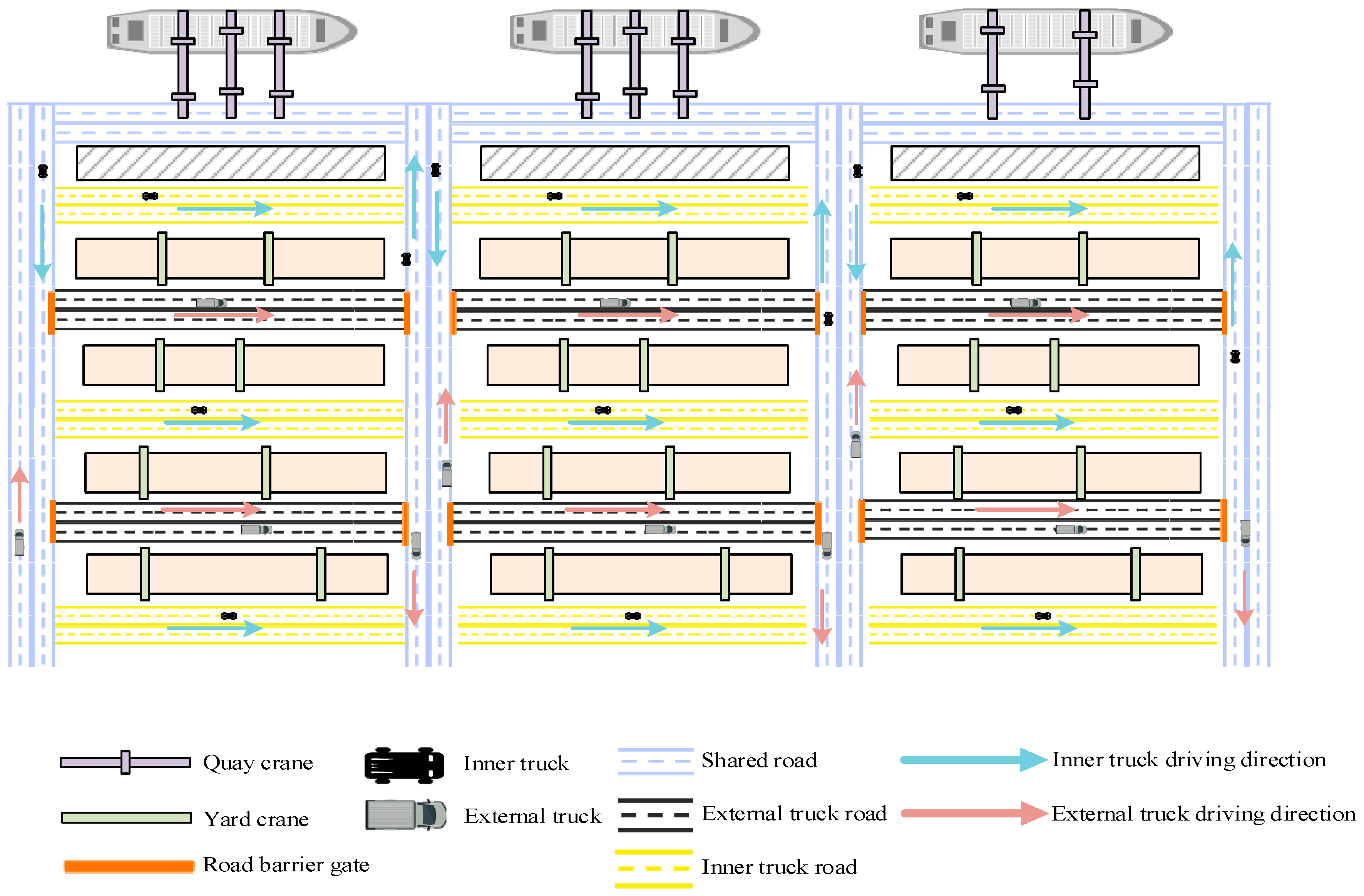
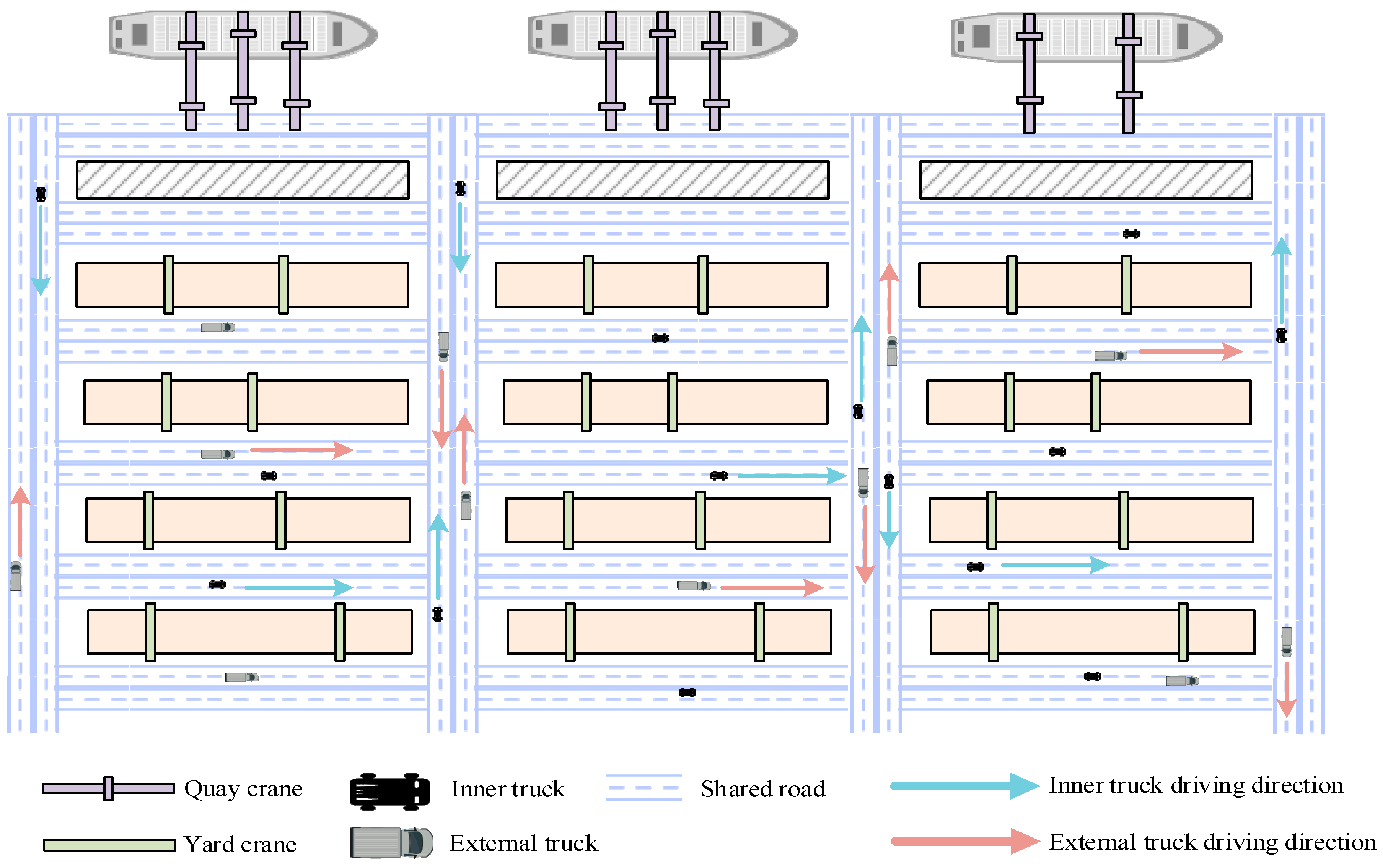
- A coordinated scheduling model that considers dynamic changes in truck handover points under the “side-loading + hybrid ICT/ECT flow” configuration is proposed to achieve integrated optimization among ICTs, ECTs, and YCs within the ACT framework.
- (2)
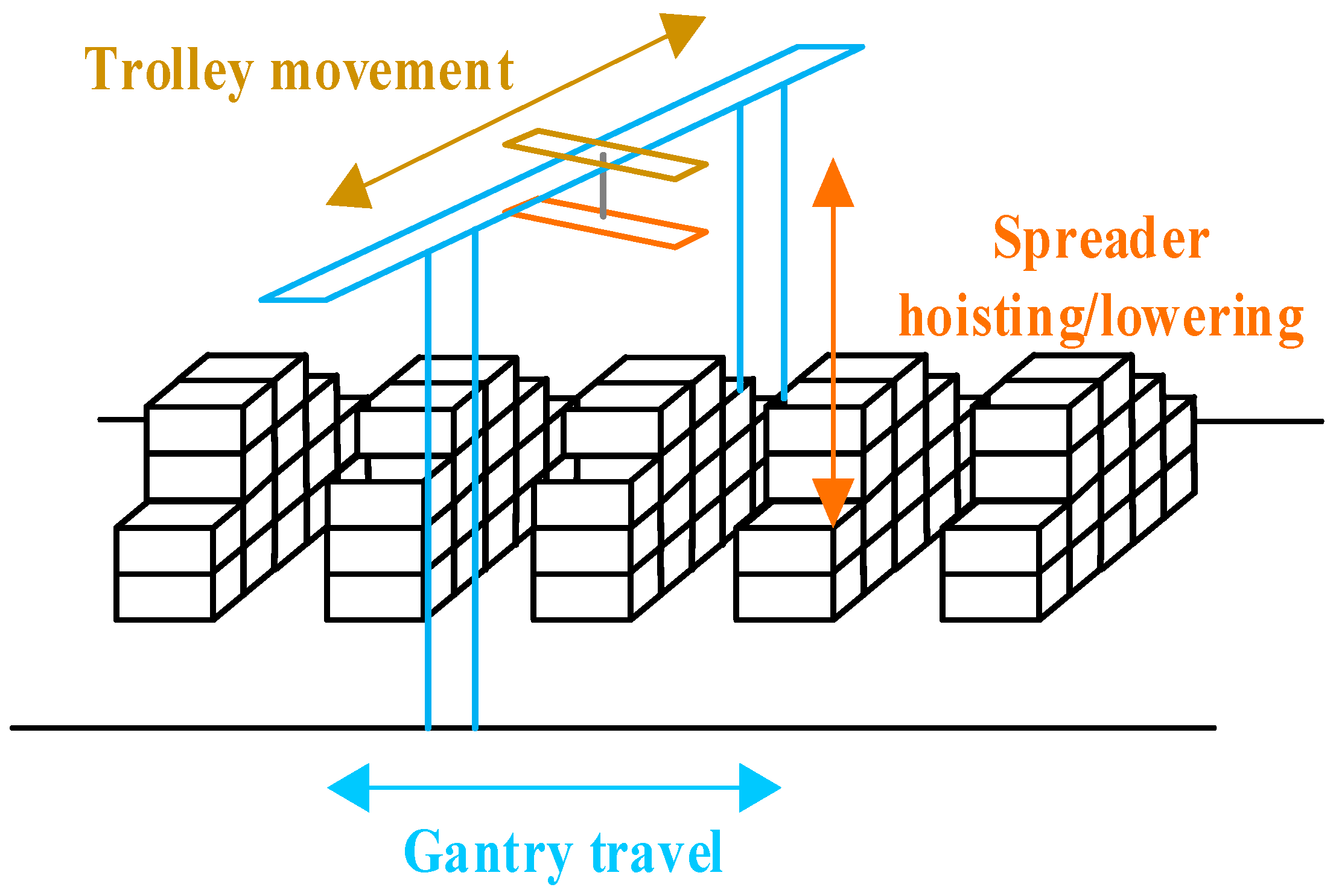
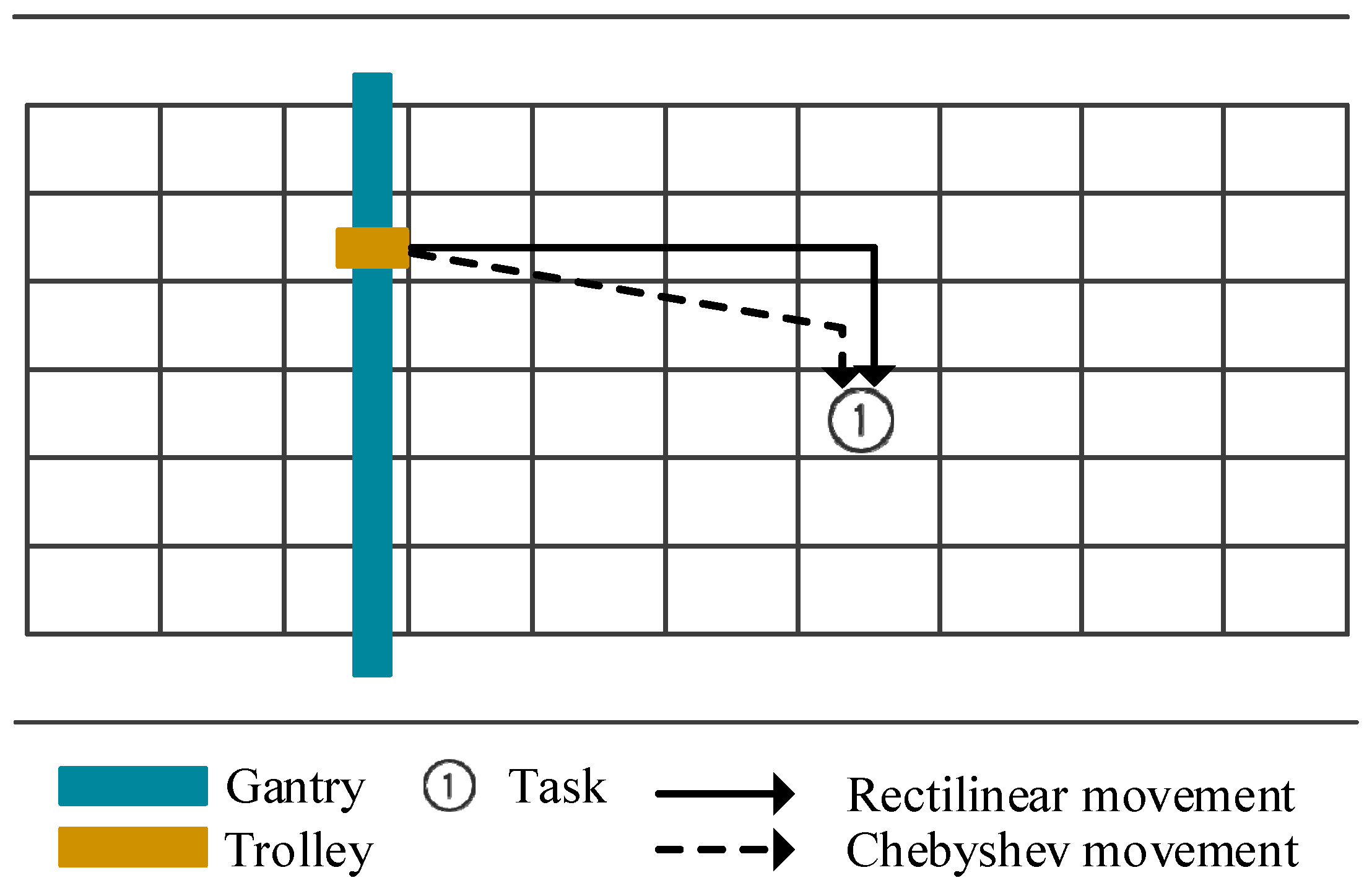
- A Chebyshev-motion-based coordination strategy for YC gantry and trolley movements is proposed to reduce the overall operation time of YCs and the waiting time between devices, thereby enhancing terminal operational efficiency.
- (3)
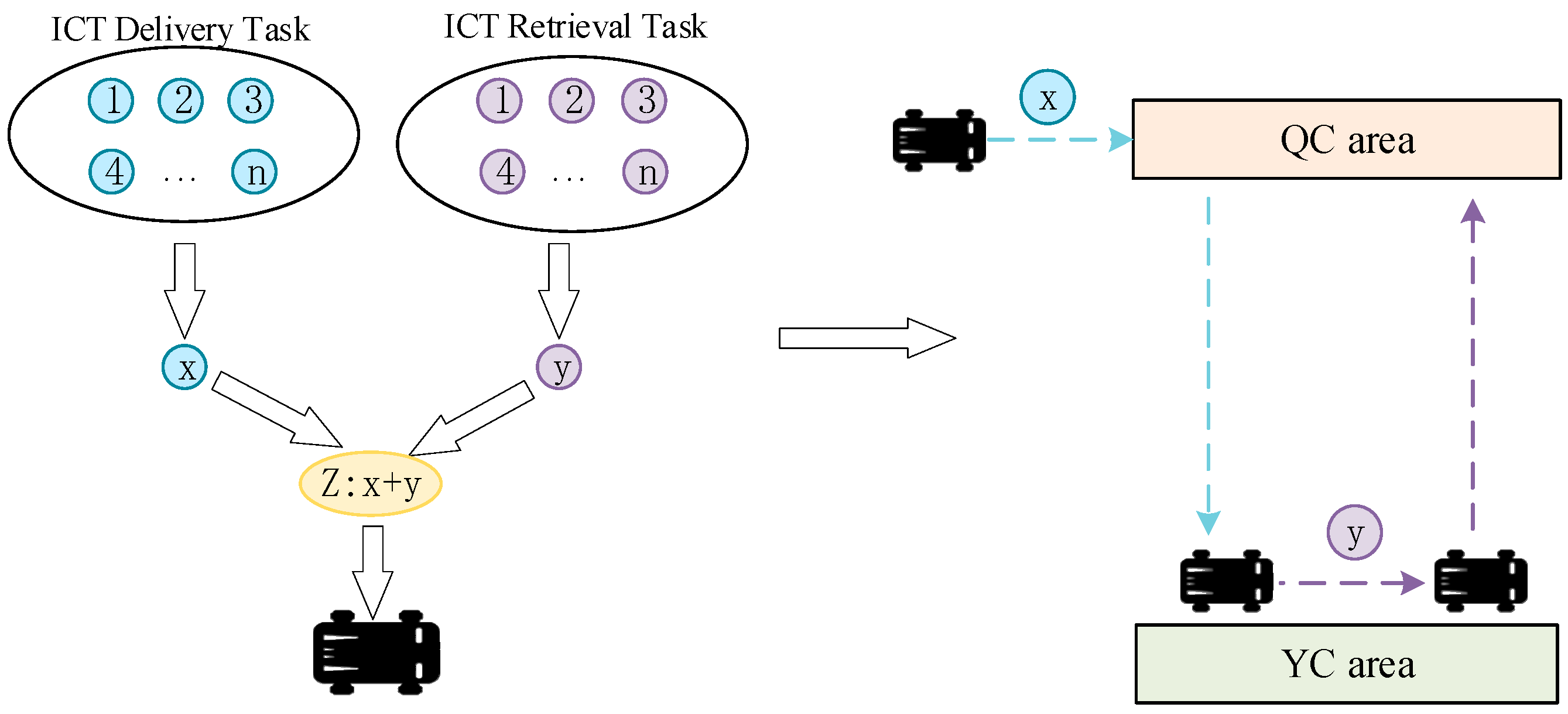
- A task combination strategy for ICTs is proposed, where ICT tasks are preprocessed, and delivery and retrieval tasks within the same or adjacent yard blocks are merged and assigned to available ICTs to enhance truck utilization.
- (4)
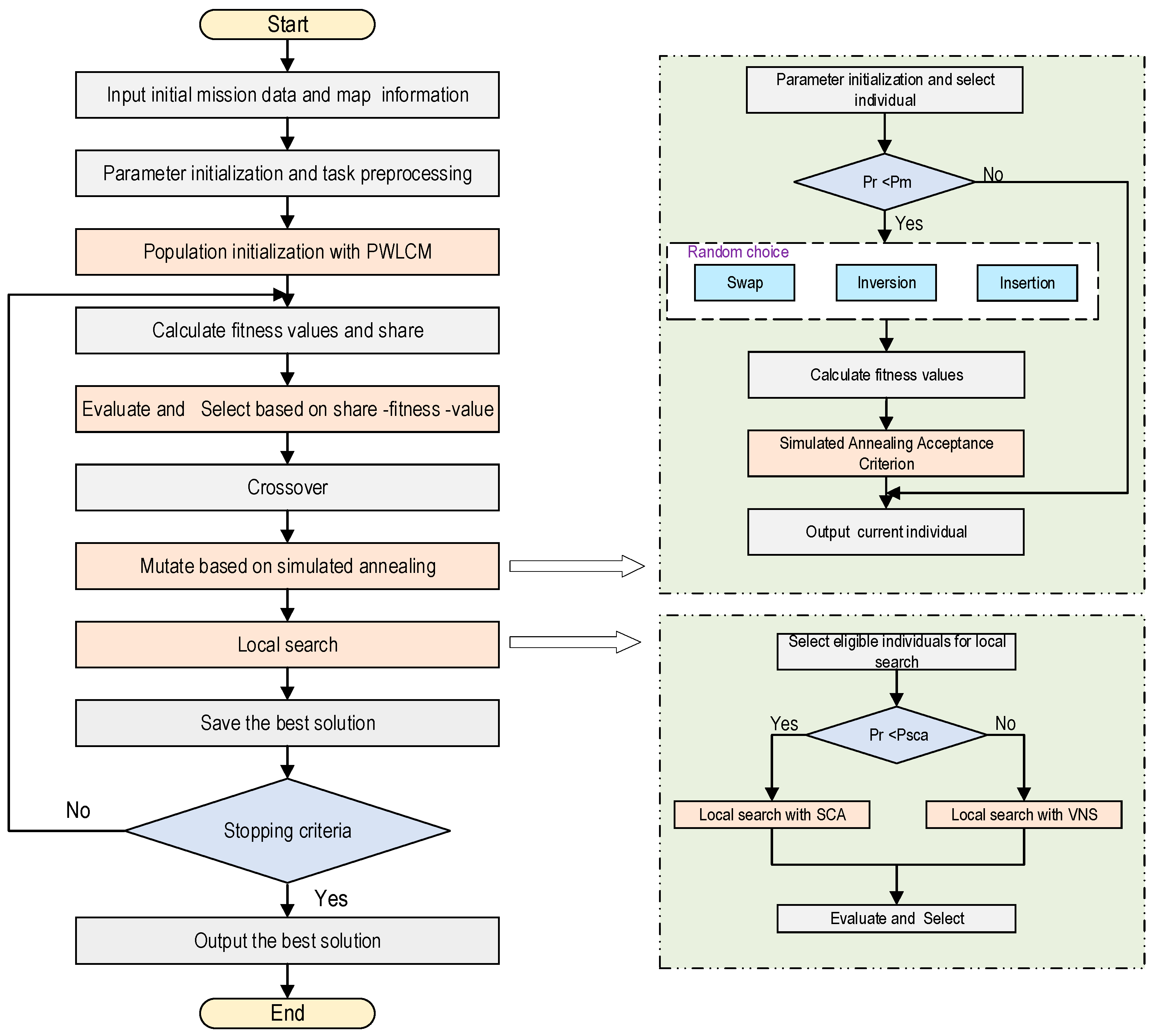
- An Improved Hybrid Genetic Algorithm (IHGA) is designed, which incorporates chaotic mapping for population initialization, and employs strategies such as fitness sharing and elite preservation during evolution. It also applies the Variable Neighborhood Search (VNS) and the Improved Sine Cosine Algorithm (ISCA) with a certain probability to enhance solution diversity and explore broader solution spaces.
2. Literature Review
2.1. Research on the Coordinated Scheduling Between ICTs and YCs/QCs
2.2. Research on the Coordinated Scheduling Between ICTs, ECTs and YCs
3. Mathematical Modeling
3.1. Model Description
3.2. Assumptions and Parameter Settings
3.2.1. Assumptions
- (1)
- The operation schedule of QCs is assumed to be known. ICTs only wait for a single container handling time upon arrival at the QC, and other waiting times are ignored.
- (2)
- Truck startup, acceleration, and deceleration times are neglected. Trucks are assumed to travel at constant speed on all segments, with only two speed levels considered: loaded and unloaded.
- (3)
- Each QC, YC, and truck can only execute one container task at a time.
- (4)
- Each ECT executes only one task per visit to the port.
3.2.2. Parameter Settings
3.3. Coordinated Scheduling of ICTs, ECTs, and YCs Based on an Integrated Optimization Strategy
3.3.1. Handover Point Selection Strategy Based on YC Chebyshev Motion
- (1)
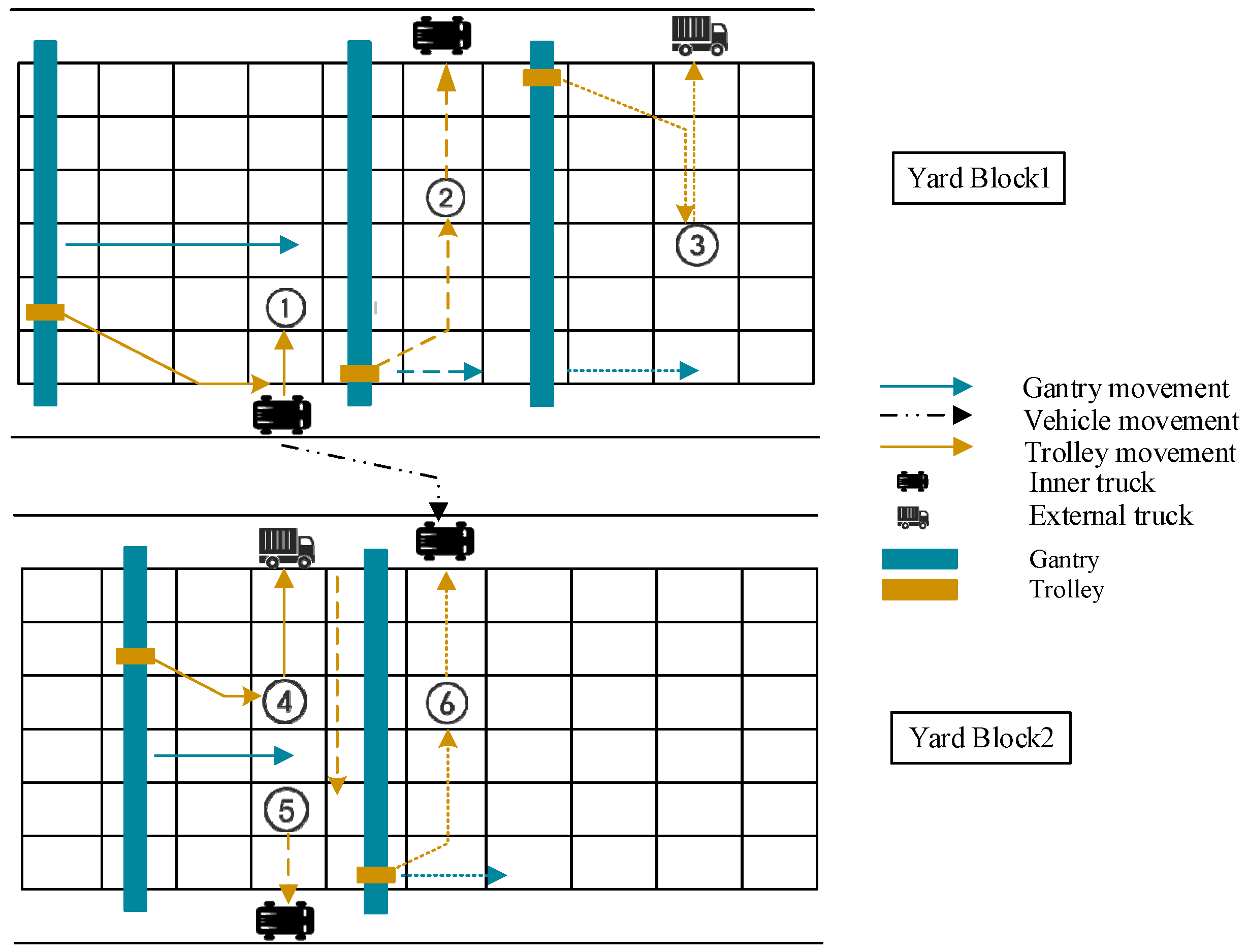
- Coordination strategy of gantry and trolley movement based on Chebyshev motion
- (2)
- Handover point selection strategy based on YC Chebyshev motion
- (1)
- Rule 1: If an ICT executes consecutive tasks within the same yard block, the handover points should be selected on the same side of the block.
- (2)
- Rule 2: If an ICT executes consecutive tasks in adjacent yard blocks, the handover points should be located on adjacent sides of the two blocks.
- (3)
- Rule 3: Select the handover bay on the side that minimizes the trolley travel time of the YC.
3.3.2. Task Combination Strategy for ICTs
3.3.3. Coordinated Scheduling Model for ICTs, ECTs and YCs Based on Integrated Optimization Strategy
4. Improved Hybrid Genetic Algorithm
4.1. Encoding and Decoding
4.2. Chaotic Initialization
4.3. Mutation Based on Simulated Annealing
4.4. Improved Sine Cosine Algorithm (ISCA)
5. Experimental Result and Analysis
5.1. Experimental Parameter Settings
5.2. Validation of Effectiveness
5.2.1. Model Verification
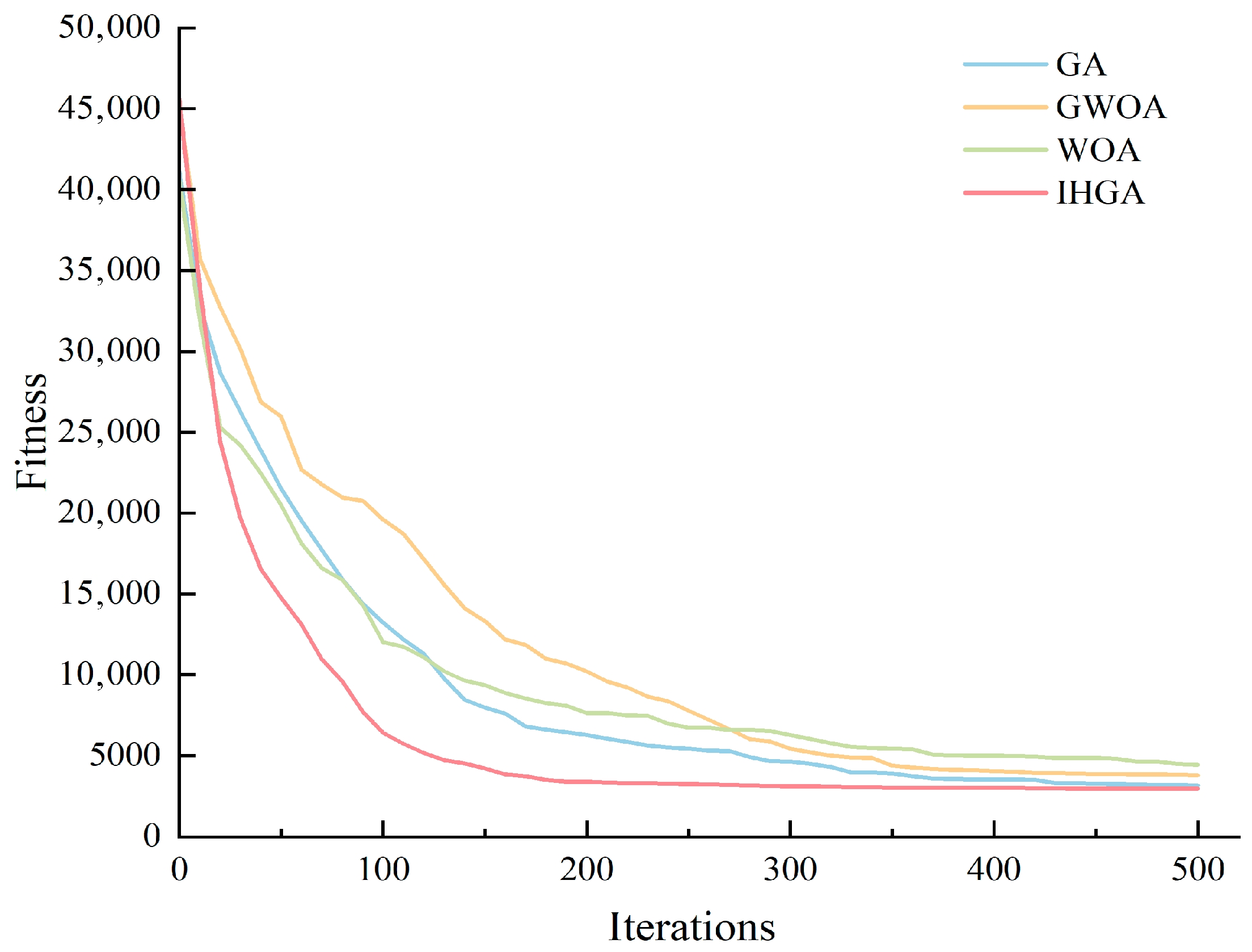
5.2.2. Algorithm Verification
5.3. Comparative Experiments
5.3.1. Comparison of Chebyshev Motion Strategies
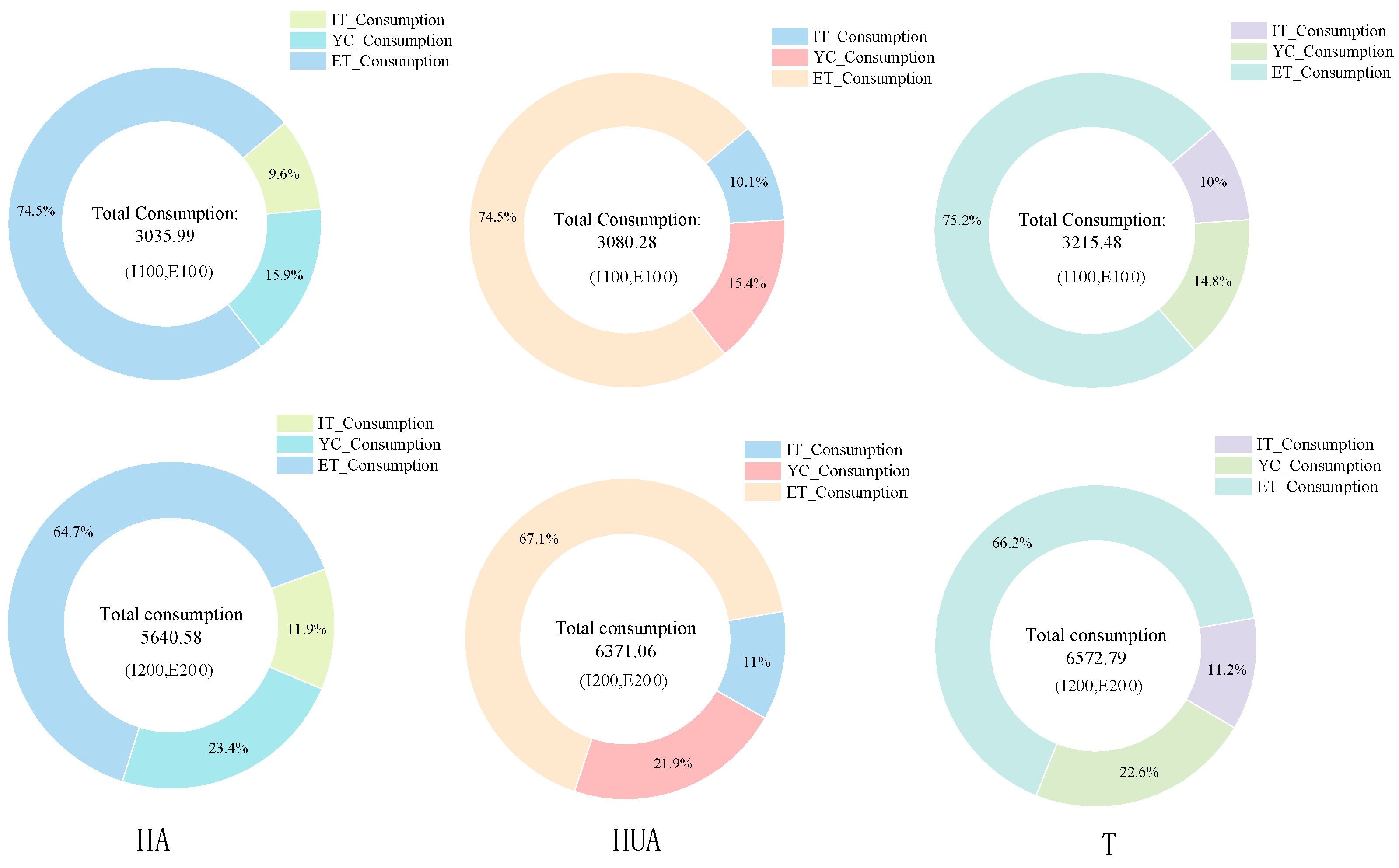
5.3.2. Comparison of Different Operation Strategies and Modes
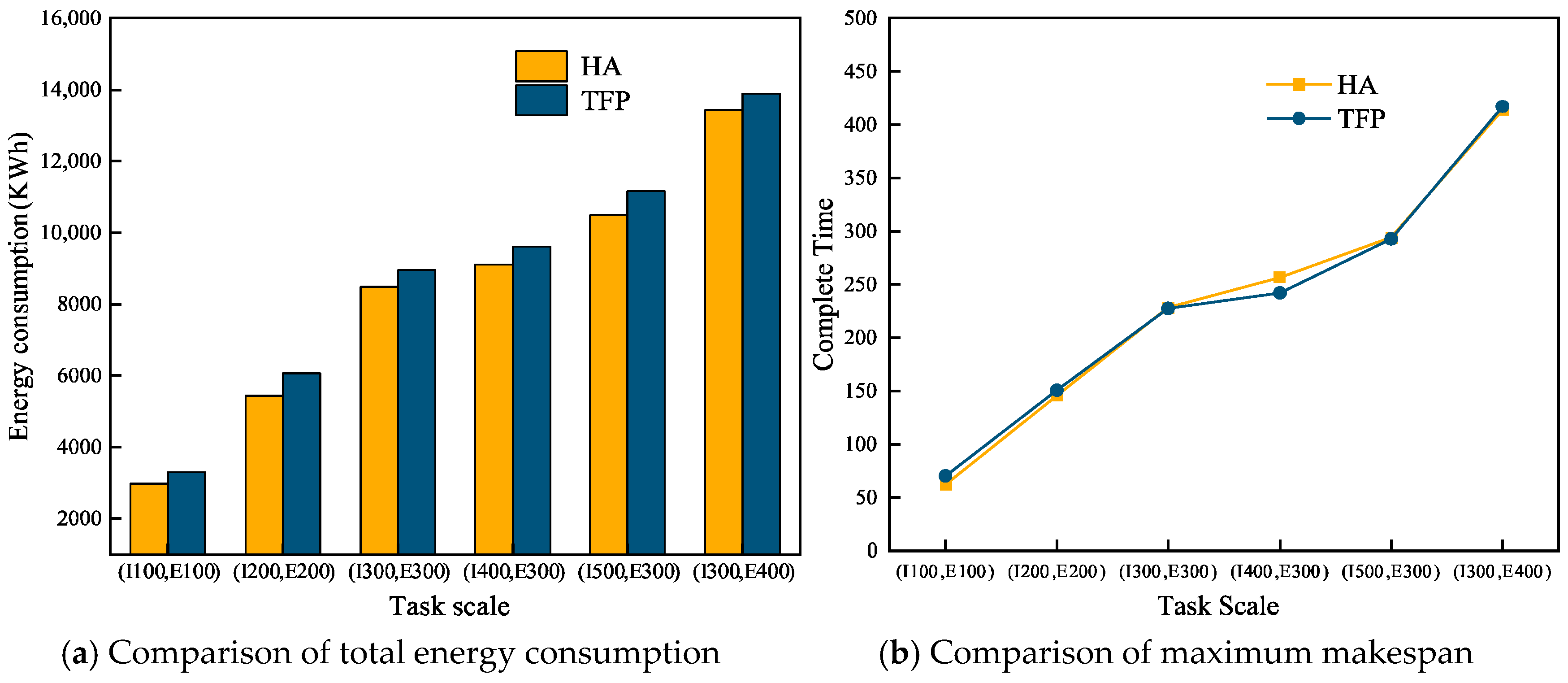
5.3.3. Comparison Between Task Combination and Fixed Handover Point Strategy
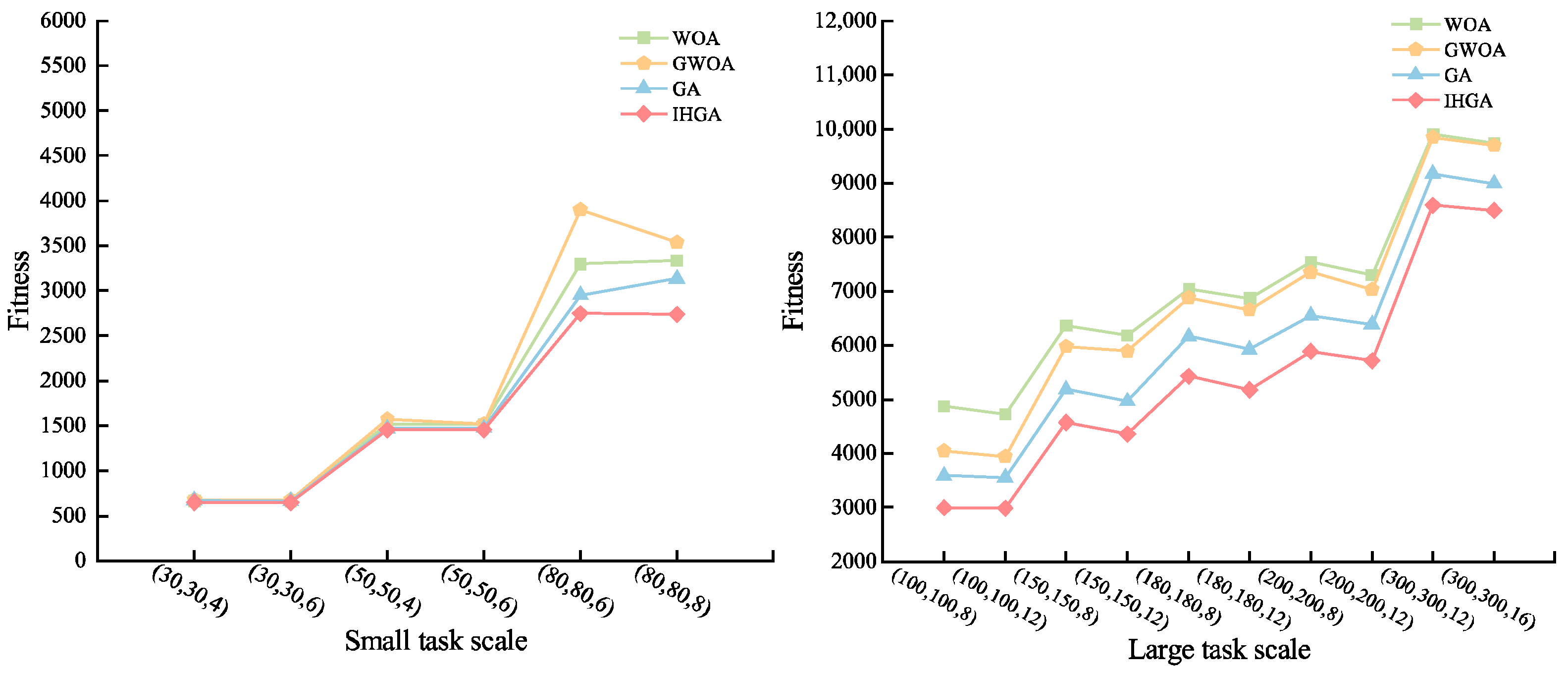
5.3.4. Comparison Between Different Algorithms
6. Conclusions
Author Contributions
Funding
Institutional Review Board Statement
Informed Consent Statement
Data Availability Statement
Conflicts of Interest
Nomenclature
| Abbreviations | |
| ICTs | Internal Container Trucks |
| ECTs | External Container Trucks |
| ACTs | Automated Container Terminals |
| YCs | Yard Cranes |
| IHGA | Improved Hybrid Genetic Algorithm |
| VNS | Variable Neighborhood Search |
| ISCA | Improved Sine Cosine Algorithm |
| MIP | Mixed-integer Programming |
| QCs | Quay Cranes |
| EL | End-loading |
| SL | Side-loading |
| GA | Genetic Algorithm |
| PWLCM | Piecewise Linear Chaotic Mapping |
| SA | Simulated Annealing |
| HA | Hybrid traffic with assigned task combination |
| HUA | Hybrid traffic with unassigned task combination |
| T | Traditional traffic mode |
| MT | Maximum completion time |
| ITEC | ICTs energy consumption |
| ETEC | ECTs energy consumption |
| YCEC | YCs energy consumption |
| TFP | Traditional handling mode with fixed handover point strategy |
| WOA | Whale Optimization Algorithm |
| GWOA | Grey Wolf Optimization Algorithm |
References
- Yu, H.; Deng, Y.; Zhang, L.; Xiao, X.; Tan, C. Yard operations and management in automated container terminals: A review. Sustainability 2022, 14, 3419. [Google Scholar] [CrossRef]
- Ma, M.; Yu, F.; Xie, T.; Yang, Y. A hybrid speed optimization strategy based coordinated scheduling between AGVs and yard cranes in U-shaped container terminal. Comput. Ind. Eng. 2024, 198, 110712. [Google Scholar] [CrossRef]
- Xiang, X.; Feng, C.; Zeng, J.; Ding, X.; Zhou, P.; Li, S.; Liao, W. Research on port autonomous driving hybrid traffic scheduling method based on adaptive right of way management. In Proceedings of the Ninth International Conference on Electromechanical Control Technology and Transportation (ICECTT 2024); SPIE: Nuremberg, Germany, 2024; pp. 1077–1084. [Google Scholar]
- Ng, S.H.; Ong, R.; Zhou, C. Traffic Strategy for Mixed Traffic in Container Terminals. In IRC-SET 2021; Springer: Singapore, 2022; pp. 13–27. [Google Scholar]
- Horst, E. Design of a Traffic Control System for Autonomous Vehicles in Container Terminals with Mixed Traffic. Bachelor’s Thesis, University of Twente, Enschede, The Netherlands, 2019. [Google Scholar]
- Lee, B.K.; Kim, K.H. Comparison and evaluation of various cycle-time models for yard cranes in container terminals. Int. J. Prod. Econ. 2010, 126, 350–360. [Google Scholar] [CrossRef]
- Zhong, Z.L.; Guo, Y.Y.; Zhang, J.H.; Yang, S.X. Energy-aware Integrated Scheduling for Container Terminals with Conflict-free AGVs. J. Syst. Sci. Syst. Eng. 2023, 32, 413–443. [Google Scholar] [CrossRef]
- Zhao, Q.; Ji, S.; Zhao, W.; De, X. A multilayer genetic algorithm for automated guided vehicles and dual automated yard cranes coordinated scheduling. Math. Probl. Eng. 2020, 2020, 5637874. [Google Scholar] [CrossRef]
- Chen, X.C.; He, S.W.; Zhang, Y.X.; Tong, L.; Shang, P.; Zhou, X.S. Yard crane and AGV scheduling in automated container terminal: A multi-robot task allocation framework. Transp. Res. Part C-Emerg. Technol. 2020, 114, 241–271. [Google Scholar] [CrossRef]
- Gong, S.; Lou, P.; Hu, J.; Zeng, Y.; Fan, C. An Improved Whale Optimization Algorithm for the Integrated Scheduling of Automated Guided Vehicles and Yard Cranes. Mathematics 2025, 13, 340. [Google Scholar] [CrossRef]
- Luo, Y.; Liang, X.; Zhang, Y.; Tang, K.; Li, W. Energy-aware integrated scheduling for quay crane and igv in automated container terminal. J. Mar. Sci. Eng. 2024, 12, 376. [Google Scholar] [CrossRef]
- Fereidoonian, F.; Sadjadi, S.J.; Heydari, M.; Al-e-Hashem, S.M.J.M. A timely efficient and emissions-aware multiobjective truck-sharing integrated scheduling model in container terminals. Proc. Inst. Mech. Eng. Part M J. Eng. Marit. Environ. 2024, 238, 982–1008. [Google Scholar] [CrossRef]
- Yue, L.; Fan, H.; Zhai, C. Joint configuration and scheduling optimization of a dual-trolley quay crane and automatic guided vehicles with consideration of vessel stability. Sustainability 2019, 12, 24. [Google Scholar] [CrossRef]
- Fontes, D.; Homayouni, S.M. A bi-objective multi-population biased random key genetic algorithm for joint scheduling quay cranes and speed adjustable vehicles in container terminals. Flex. Serv. Manuf. J. 2023, 35, 241–268. [Google Scholar] [CrossRef]
- Zhang, H.; Qi, L.; Luan, W.; Ma, H. Double-cycling AGV scheduling considering uncertain crane operational time at container terminals. Appl. Sci. 2022, 12, 4820. [Google Scholar] [CrossRef]
- Duan, Y.; Ren, H.; Xu, F.; Yang, X.; Meng, Y. Bi-Objective Integrated Scheduling of Quay Cranes and Automated Guided Vehicles. J. Mar. Sci. Eng. 2023, 11, 1492. [Google Scholar] [CrossRef]
- Ji, S.W.; Luan, D.; Chen, Z.R.; Guo, D. Integrated scheduling in automated container terminals considering AGV conflict-free routing. Transp. Lett.-Int. J. Transp. Res. 2021, 13, 501–513. [Google Scholar]
- Lu, Y. The Three-Stage Integrated Optimization of Automated Container Terminal Scheduling Based on Improved Genetic Algorithm. Math. Probl. Eng. 2021, 2021, 6792137. [Google Scholar] [CrossRef]
- Wang, Q.; Tong, X.; Li, Y.; Wang, C.; Zhang, C. Integrated Scheduling Optimization for Automated Container Terminal: A Reinforcement Learning-Based Approach. IEEE Trans. Intell. Transp. Syst. 2025, 26, 10019–10035. [Google Scholar] [CrossRef]
- Zhong, M.; Yang, Y.; Dessouky, Y.; Postolache, O. Multi-AGV scheduling for conflict-free path planning in automated container terminals. Comput. Ind. Eng. 2020, 142, 106371. [Google Scholar] [CrossRef]
- Zhong, M.S.; Yang, Y.S.; Zhou, Y.M.; Postolache, O. Application of hybrid GA-PSO based on intelligent control fuzzy system in the integrated scheduling in automated container terminal. J. Intell. Fuzzy Syst. 2020, 39, 1525–1538. [Google Scholar] [CrossRef]
- Wang, Z.; Zeng, Q.; Li, X.; Qu, C. A branch-and-price heuristic algorithm for the ART and external truck scheduling problem in an automated container terminal with a parallel layout. Transp. Res. Part E-Logist. Transp. Rev. 2024, 184, 103464. [Google Scholar] [CrossRef]
- Gao, Y.F.; Ge, Y.E. Integrated scheduling of yard cranes, external trucks, and internal trucks in maritime container terminal operation. Marit. Policy Manag. 2023, 50, 629–650. [Google Scholar] [CrossRef]
- Chu, L.; Liang, D.; Zhou, Y.; Zhang, J. Optimal Model and Algorithm Design for the Multi-Equipment Resource Collaborative Scheduling of Automated Terminals Considering the Mixing Process. Adv. Eng. Inform. 2024, 23, 479–490. [Google Scholar] [CrossRef]
- Han, Y.; Zheng, H.; Ma, W.; Yan, B.; Ma, D. Integrated Scheduling of Automated Rail-Mounted Gantries and External Trucks in U-Shaped Container Terminals. IEEE Trans. Autom. Sci. Eng. 2025, 22, 7394–7408. [Google Scholar] [CrossRef]
- Peng, W.H.; Wang, D.J.; Qiu, H.X.; Chu, F.; Yin, Y.Q. Integrated Optimization on Double-Side Cantilever Yard Crane Scheduling and Green Vehicle Path Planning at U-Shaped Yard. IEEE Trans. Intell. Transp. Syst. 2025, 26, 3684–3699. [Google Scholar] [CrossRef]
- Li, J.; Chang, D.; Wen, F. Digital twin enhanced rescheduling based on hybrid strategy in intermodal container terminal. Comput. Oper. Res. 2025, 180, 107053. [Google Scholar] [CrossRef]
- Baldouski, D.; Krész, M.; Dávid, B. Scheduling truck arrivals for efficient container flow management in port logistics. Cent. Eur. J. Oper. Res. 2025, 33, 791–818. [Google Scholar] [CrossRef]
- Zhu, J.; Ma, F. Scheduling of twin automatic stacking cranes and automated guided vehicle considering buffer mode on automated container terminal. Comput. Ind. Eng. 2024, 193, 110271. [Google Scholar] [CrossRef]
- Zhou, C.; Lee, B.K.; Li, H. Integrated optimization on yard crane scheduling and vehicle positioning at container yards. Transp. Res. Part E-Logist. Transp. Rev. 2020, 138, 101966. [Google Scholar] [CrossRef]
- Tang, X.; Zhang, Y.; Gao, Y.; Yang, R. Lock Station Allocation in Unlocking and Padlocking Operation of ART in Automated Container Terminal. In Proceedings of the 2021 6th International Conference on Transportation Information and Safety (ICTIS); IEEE: New York, NY, USA, 2021; pp. 1408–1413. [Google Scholar]
- Xu, Y.; Zhang, Y.; Chen, P.; Yang, R.; Gao, Y. Simulation Analysis of Isolated Lane Layout in Automated Container Terminal Yard. In Proceedings of the 2021 6th International Conference on Transportation Information and Safety (ICTIS); IEEE: New York, NY, USA, 2021; pp. 1414–1418. [Google Scholar]
- Mirjalili, S.; Lewis, A. The Whale Optimization Algorithm. Adv. Eng. Softw. 2016, 95, 51–67. [Google Scholar] [CrossRef]
- Mirjalili, S.; Mirjalili, S.M.; Lewis, A. Grey Wolf Optimizer. Adv. Eng. Softw. 2014, 69, 46–61. [Google Scholar] [CrossRef]
- Zhang, Q.L.; Hu, W.X.; Duan, J.G.; Qin, J.Y. Cooperative Scheduling of AGV and ASC in Automation Container Terminal Relay Operation Mode. Math. Probl. Eng. 2021, 2021, 5764012. [Google Scholar] [CrossRef]







| Author | Equipment | Traffic Management | Handover Point Setting | Model Objective | Algorithm | |||||
|---|---|---|---|---|---|---|---|---|---|---|
| QC | YC | ICT | ECT | MTEC | MMCT | MDT | ||||
| Zhong (2023) [7] | — | √ | √ | — | Segregated+ EL | — | √ | BGA | ||
| Zhao (2020) [8] | — | √ | √ | — | Segregated+ EL | — | √ | IMGA | ||
| Chen (2020) [9] | — | √ | √ | — | Segregated+ SL | Fixed | √ | ADMM | ||
| Gong (2025) [10] | — | √ | √ | — | Segregated+ EL | — | √ | IWOA | ||
| Luo (2024) [11] | √ | — | √ | — | Segregated+ SL | Fixed | √ | ISSA | ||
| Fereidoonian (2024) [12] | √ | — | √ | — | Segregated+ SL | Fixed | √ | NSGA&MPSO | ||
| Yue (2019) [13] | √ | — | √ | — | Segregated+ EL | — | √ | GA | ||
| Fontes (2023) [14] | √ | — | √ | — | Segregated+ EL | — | √ | √ | Mp-BRKGA | |
| Zhang (2022) [15] | √ | — | √ | — | Segregated+ EL | — | √ | HPSO | ||
| Duan (2023) [16] | √ | — | √ | — | Segregated+ EL | — | √ | NSGA-II | ||
| Ji (2021) [17] | √ | √ | √ | — | Segregated+ EL | — | √ | CRS-BAGA | ||
| Lu (2021) [18] | √ | √ | √ | — | Segregated+ EL | — | √ | PGA | ||
| Wang (2025) [19] | √ | √ | √ | — | Segregated+ SL | Fixed | √ | RL | ||
| Zhong (2020) [20,21] | — | √ | √ | — | Segregated+ EL | — | √ | HGA-PSO | ||
| Wang (2024) [22] | — | — | √ | √ | Segregated+ SL | Fixed | √ | B&PHA | ||
| Gao (2023) [23] | — | √ | √ | √ | Segregated+ SL | Fixed | √ | NSGA | ||
| Chu (2024) [24] | √ | √ | √ | √ | Segregated+ EL | — | √ | SAPSO | ||
| Han (2024) [25] | — | √ | — | √ | Segregated+ SL | Fixed | √ | √ | NSGA-III | |
| Peng (2025) [26] | — | √ | √ | √ | Segregated+ SL | Fixed | √ | √ | IMOPSO | |
| Li (2025) [27] | — | √ | √ | √ | Segregated+ SL | Fixed | √ | √ | MOPSO | |
| This paper | — | √ | √ | √ | Hybrid+ SL | Dynamic | √ | IHGA | ||
| Symbols | Meaning of Symbols |
|---|---|
| Maximum number of bays in the container yard | |
| Maximum number of rows in the container yard | |
| Set of containers in the yard | |
| Set of yard cranes in the yard, where denotes any yard crane in the block, with representing a left-side yard crane and representing a right-side yard crane | |
| Set of ICTs | |
| Set of ECTs | |
| Loaded travel speed of ICT | |
| Unloaded travel speed of ICT | |
| Loaded travel speed of ECT | |
| Unloaded travel speed of ECT | |
| Loaded energy consumption per unit time of ICT | |
| Unloaded energy consumption per unit time of ICT | |
| Waiting energy consumption per unit time of ICT | |
| Loaded energy consumption per unit time of ECT | |
| Unloaded energy consumption per unit time of ECT | |
| Waiting energy consumption per unit time of ECT | |
| Loaded energy consumption per unit time of YC | |
| Unloaded energy consumption per unit time of YC | |
| Waiting energy consumption per unit time of YC | |
| An infinite positive integer | |
| Time to pick/place a container by the YC | |
| Loading/unloading time at the QC | |
| Time for gantry of YC to move one bay | |
| Time for trolley of YC to move one row | |
| Energy for picking or placing a container | |
| Total energy for all tasks | |
| Total energy consumption of ICTs | |
| Total energy consumption of ECTs | |
| Total energy consumption of YCs | |
| Empty travel distance of ICT- when executing task | |
| Loaded travel distance of ICT- when executing task | |
| Empty travel distance of ECT- when executing task | |
| Loaded travel distance of ECT- when executing task | |
| The time of YC- arrives at the handover point for task | |
| The end time of YC- to handle task | |
| Empty travel time of YC- when executing task | |
| Loaded travel time of YC- when executing task | |
| The time of YC- waits for ICTs or ECTs when executing task | |
| The start time of YC- to handle task | |
| The time of ICT- arrives at the handover position for task | |
| End time of ICT- executing task | |
| The time of ICT- arrives at the QC handover point for task | |
| The actual time when ICT- picks up the container and starts operations | |
| The time of ICT- waits for YC when executing task | |
| The time of ICT- waits for handover point for task | |
| The arrival time of ECT- for task | |
| End time of ECT- when executing task | |
| The leave time of ECT- upon completing task | |
| The time of ECT- arrives at the handover position for task | |
| Start time of ECT- when executing task | |
| The time of ECT- waits for YC when executing task | |
| The time of ECT- waits for handover point for task | |
| Start time of task occupying handling point | |
| End time of task occupying handling point | |
| Task corresponding handover point corresponds to the bay position, | |
| Task target position | |
| Virtual task starting position | |
| The type of task , where : the ICT delivers the container, : the ICT retrieves the container, : the ECT delivers the container, : the ECT retrieves the container |
| Symbols | Meaning of Symbols |
|---|---|
| if task is assigned to ICT-, then otherwise | |
| if ICT- executes task after completing task , then otherwise | |
| if YC- executes task , then otherwise | |
| if YC- executes task after task , then otherwise | |
| if task is assigned to ECT-, then otherwise | |
| if task is executed by a left-side crane if executed by a right-side crane | |
| if task is executed in handover point , then otherwise | |
| if task and task are combined otherwise | |
| if both task and task select handover point , and task is earlier than task , then otherwise |
| Parameter | Value |
|---|---|
| , , , | , , , |
| , , | , , |
| , , | , , |
| , , | , , |
| , , , | , , , |
| Task | Hybrid Traffic with Assigned Task Combination | Hybrid Traffic with Unassigned Task Combination | Traditional Traffic Mode | |||||||||
|---|---|---|---|---|---|---|---|---|---|---|---|---|
| MT (min) | ITEC | ETEC | YCEC | MT (min) | ITEC | ETEC | YCEC | MT (min) | ITEC | ETEC | YCEC | |
| 100,100,8 | 69.92 | 200.21 | 2268.89 | 557.11 | 75.42 | 219.73 | 2348.16 | 591.43 | 81.70 | 231.62 | 2489.74 | 603.33 |
| 100,100,12 | 65.04 | 231.36 | 2245.22 | 498.97 | 66.52 | 247.90 | 2325.22 | 528.72 | 71.71 | 265.93 | 2435.20 | 532.63 |
| 100,100,16 | 62.45 | 260.74 | 2222.28 | 502.08 | 62.42 | 281.03 | 2289.90 | 493.25 | 67.29 | 295.85 | 2419.33 | 500.36 |
| 200,200,12 | 153.31 | 518.58 | 3752.62 | 1439.54 | 146.61 | 629.04 | 4214.44 | 1556.24 | 165.14 | 581.46 | 4533.43 | 1606.49 |
| 200,200,16 | 145.97 | 599.24 | 3450.70 | 1397.30 | 144.44 | 621.82 | 3956.83 | 1452.69 | 153.95 | 656.78 | 4210.85 | 1417.40 |
| 200,200,20 | 143.70 | 673.09 | 3647.28 | 1320.21 | 139.70 | 700.32 | 4274.07 | 1396.67 | 148.96 | 739.96 | 4350.29 | 1482.55 |
| 300,300,16 | 228.38 | 933.33 | 5207.61 | 2348.09 | 223.22 | 970.82 | 5427.39 | 2398.51 | 231.73 | 1009.28 | 5698.09 | 2248.99 |
| 300,300,20 | 221.93 | 1054.26 | 5146.13 | 2209.97 | 218.51 | 1094.97 | 5392.49 | 2359.82 | 225.30 | 1132.55 | 5540.75 | 2377.18 |
| 300,300,24 | 218.82 | 1177.14 | 5032.30 | 2205.02 | 209.29 | 1193.97 | 5365.83 | 2402.21 | 219.77 | 1245.78 | 5339.88 | 2428.14 |
| 400,300,24 | 240.77 | 1377.42 | 5454.77 | 2373.19 | 234.86 | 1424.69 | 5700.07 | 2395.96 | 243.43 | 1478.91 | 5783.03 | 2602.45 |
| 400,300,28 | 256.76 | 1555.91 | 5355.66 | 2206.49 | 232.49 | 1560.10 | 5594.82 | 2395.39 | 245.60 | 1646.11 | 5732.88 | 2561.49 |
| 400,300,32 | 237.70 | 1661.25 | 5255.56 | 2282.11 | 232.15 | 1695.28 | 5609.44 | 2209.31 | 237.69 | 1742.17 | 5844.99 | 2189.32 |
| 500,300,28 | 293.96 | 1882.47 | 5918.00 | 2696.66 | 283.75 | 1926.87 | 6256.36 | 2971.15 | 293.73 | 2007.25 | 6345.08 | 2889.74 |
| 500,300,32 | 287.42 | 2028.37 | 5764.43 | 2773.47 | 281.57 | 2079.61 | 6058.61 | 3082.67 | 286.07 | 2144.89 | 6093.14 | 2974.16 |
| 500,300,36 | 287.61 | 2214.18 | 5824.03 | 3068.25 | 285.10 | 2278.92 | 6190.89 | 2944.66 | 296.88 | 2373.13 | 6315.03 | 3042.98 |
| 300,400,16 | 414.24 | 1413.63 | 7368.66 | 4656.55 | 409.33 | 1460.00 | 7809.10 | 4745.87 | 425.80 | 1511.58 | 8205.20 | 4526.22 |
| 300,400,20 | 408.47 | 1662.95 | 7413.42 | 4257.13 | 403.66 | 1704.62 | 7921.06 | 4567.39 | 408.72 | 1730.67 | 8191.06 | 4824.86 |
| 300,400,24 | 411.80 | 1926.57 | 7092.23 | 4219.06 | 407.32 | 1973.90 | 7670.89 | 4601.02 | 404.87 | 1970.62 | 7858.69 | 4787.87 |
| Task | MT (min) | ITEC | ETEC | YCEC | MT (%) | ITEC (%) | ETEC (%) | YCEC (%) |
|---|---|---|---|---|---|---|---|---|
| 100,100,8 | 79.62 | 230.86 | 2467.75 | 569.95 | −12.18 | −13.28 | −5.70 | −2.25 |
| 100,100,12 | 70.66 | 262.17 | 2478.37 | 526.49 | −7.95 | −11.75 | −6.65 | −5.23 |
| 100,100,16 | 70.51 | 300.66 | 2488.07 | 504.25 | −11.43 | −13.28 | −7.55 | −0.43 |
| 200,200,12 | 162.82 | 577.95 | 4154.18 | 1573.72 | −5.84 | −10.21 | −6.84 | −8.53 |
| 200,200,16 | 150.64 | 653.97 | 3956.15 | 1454.47 | −3.10 | −20.70 | −9.03 | −3.93 |
| 200,200,20 | 147.48 | 732.93 | 3772.91 | 1342.10 | −2.56 | −8.06 | −2.35 | −1.64 |
| 300,300,16 | 227.36 | 1002.32 | 5485.04 | 2485.31 | 0.45 | −6.89 | −3.58 | −5.51 |
| 300,300,20 | 223.55 | 1122.74 | 5311.93 | 2258.38 | −0.72 | −6.06 | −2.21 | −2.17 |
| 300,300,24 | 225.05 | 1262.68 | 5402.40 | 2325.74 | −2.77 | −6.77 | −4.84 | −5.19 |
| 400,300,24 | 247.04 | 1500.45 | 5688.90 | 2438.67 | −2.54 | −8.20 | −2.91 | −2.69 |
| 400,300,28 | 242.05 | 1626.47 | 5555.67 | 2423.44 | 6.08 | −4.34 | −2.55 | −8.95 |
| 400,300,32 | 241.86 | 1768.34 | 5441.62 | 2516.55 | −1.72 | −6.06 | −2.42 | −9.32 |
| 500,300,28 | 292.78 | 2003.23 | 6118.23 | 3042.96 | 0.40 | −6.04 | −2.31 | −11.37 |
| 500,300,32 | 295.34 | 2198.54 | 5950.16 | 3320.25 | −2.68 | −7.73 | −2.21 | −16.48 |
| 500,300,36 | 284.91 | 2332.87 | 6152.85 | 2972.78 | 0.95 | −5.06 | −3.78 | 3.23 |
| 300,400,16 | 417.29 | 1496.87 | 7777.02 | 4616.57 | −0.73 | −5.55 | −3.71 | 0.87 |
| 300,400,20 | 415.25 | 1755.14 | 7633.49 | 4419.49 | −1.63 | −5.30 | −2.04 | −3.67 |
| 300,400,24 | 412.61 | 2002.79 | 7480.33 | 4356.62 | −0.20 | −3.80 | −3.67 | −3.15 |
Disclaimer/Publisher’s Note: The statements, opinions and data contained in all publications are solely those of the individual author(s) and contributor(s) and not of MDPI and/or the editor(s). MDPI and/or the editor(s) disclaim responsibility for any injury to people or property resulting from any ideas, methods, instructions or products referred to in the content. |
© 2026 by the authors. Licensee MDPI, Basel, Switzerland. This article is an open access article distributed under the terms and conditions of the Creative Commons Attribution (CC BY) license.
Share and Cite
Huang, S.; Yu, F.; Zhang, Q.; Yang, Y. Multi-Equipment Coordinated Scheduling Considering Dynamic Changes in Truck Handover Points Under Hybrid Traffic in Automated Container Terminals. Eng 2026, 7, 181. https://doi.org/10.3390/eng7040181
Huang S, Yu F, Zhang Q, Yang Y. Multi-Equipment Coordinated Scheduling Considering Dynamic Changes in Truck Handover Points Under Hybrid Traffic in Automated Container Terminals. Eng. 2026; 7(4):181. https://doi.org/10.3390/eng7040181
Chicago/Turabian StyleHuang, Suosuo, Fang Yu, Qiang Zhang, and Yongsheng Yang. 2026. "Multi-Equipment Coordinated Scheduling Considering Dynamic Changes in Truck Handover Points Under Hybrid Traffic in Automated Container Terminals" Eng 7, no. 4: 181. https://doi.org/10.3390/eng7040181
APA StyleHuang, S., Yu, F., Zhang, Q., & Yang, Y. (2026). Multi-Equipment Coordinated Scheduling Considering Dynamic Changes in Truck Handover Points Under Hybrid Traffic in Automated Container Terminals. Eng, 7(4), 181. https://doi.org/10.3390/eng7040181