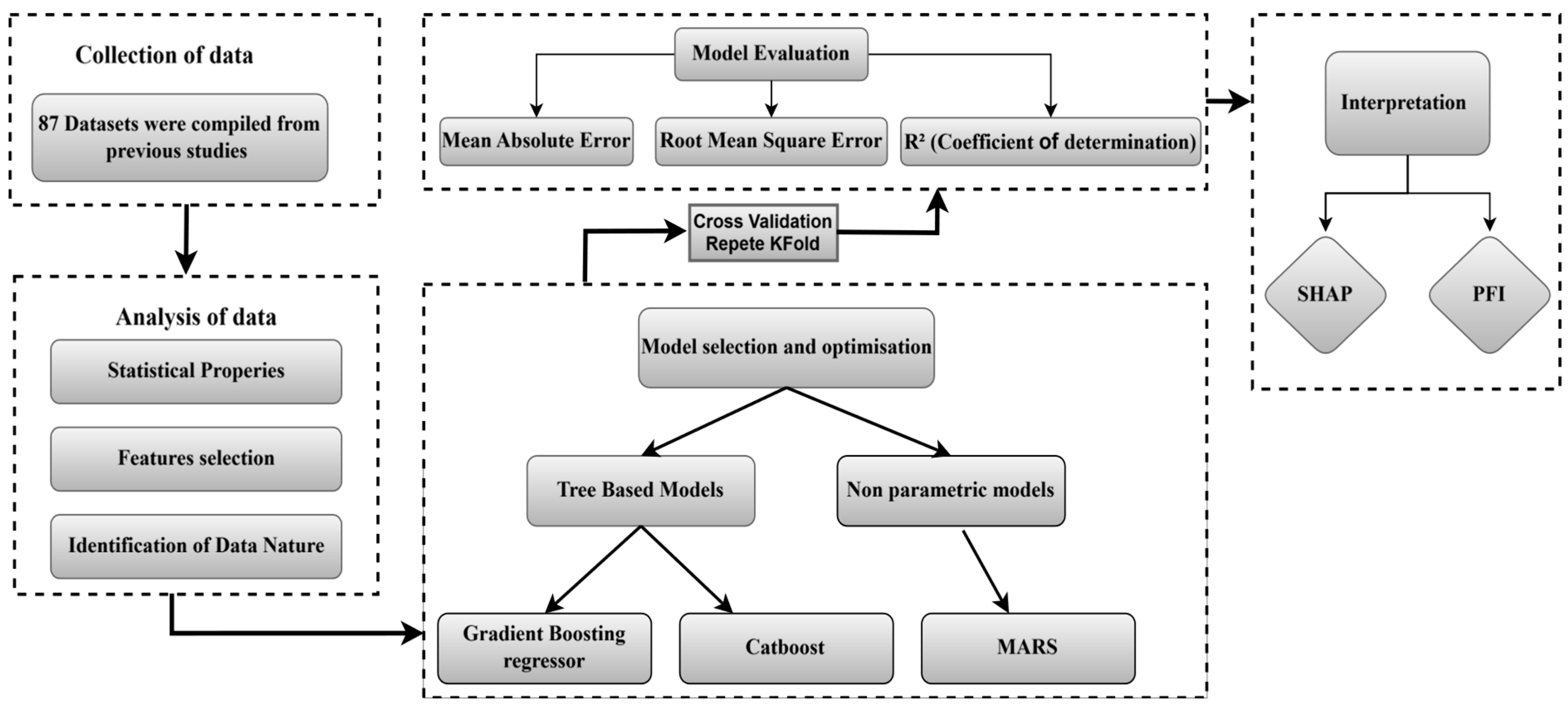


Predictive Modeling of Aggregate Polished Stone Value from Mineralogical and Chemical Composition


Abstract
1. Introduction
2. Methodology
2.1. Description of Database
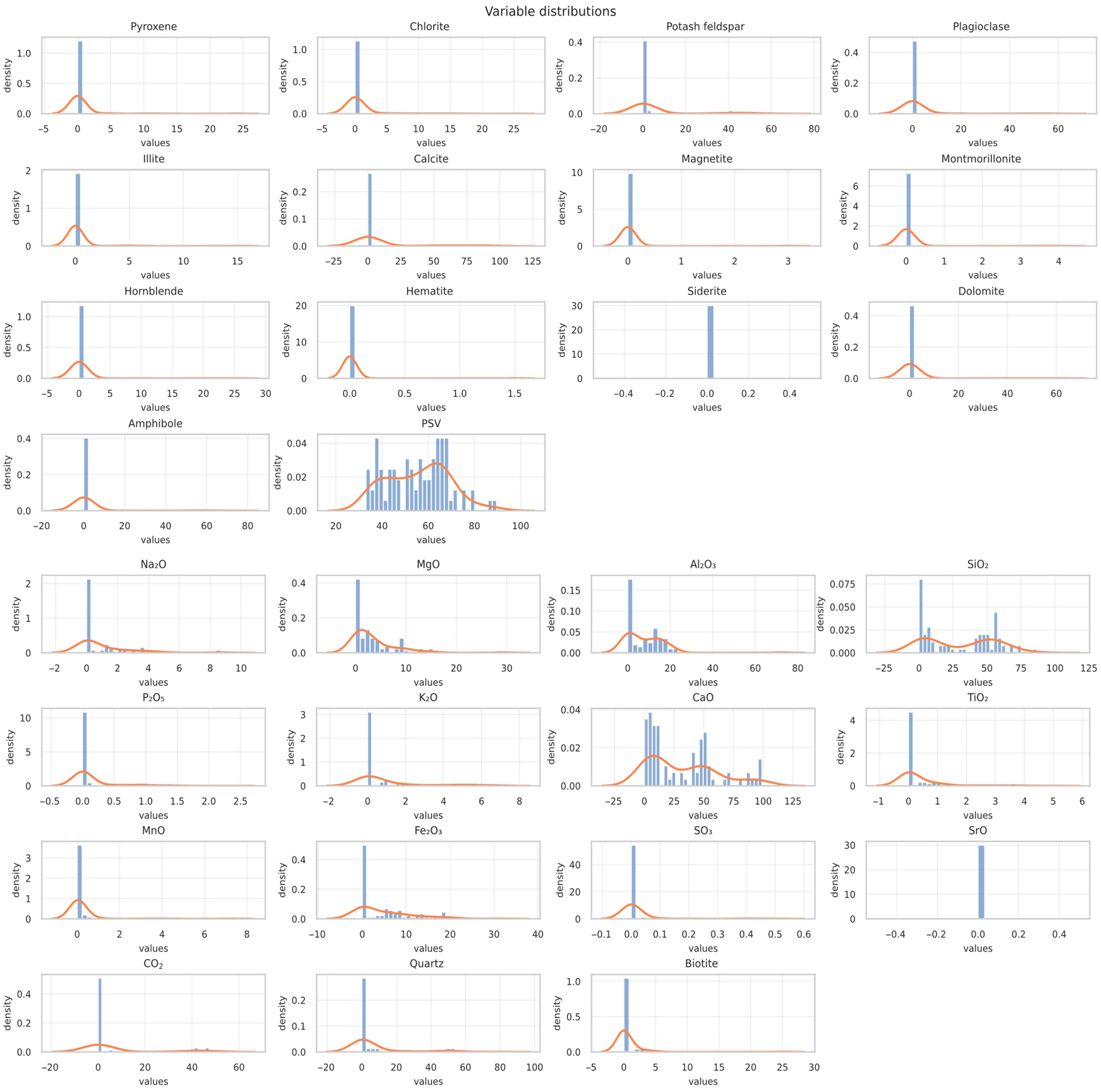
2.2. Statistical Description of Database
2.3. Feature Selection
2.4. Data Transformation
2.4.1. Nature of Data
2.4.2. Isometric Log-Ratio
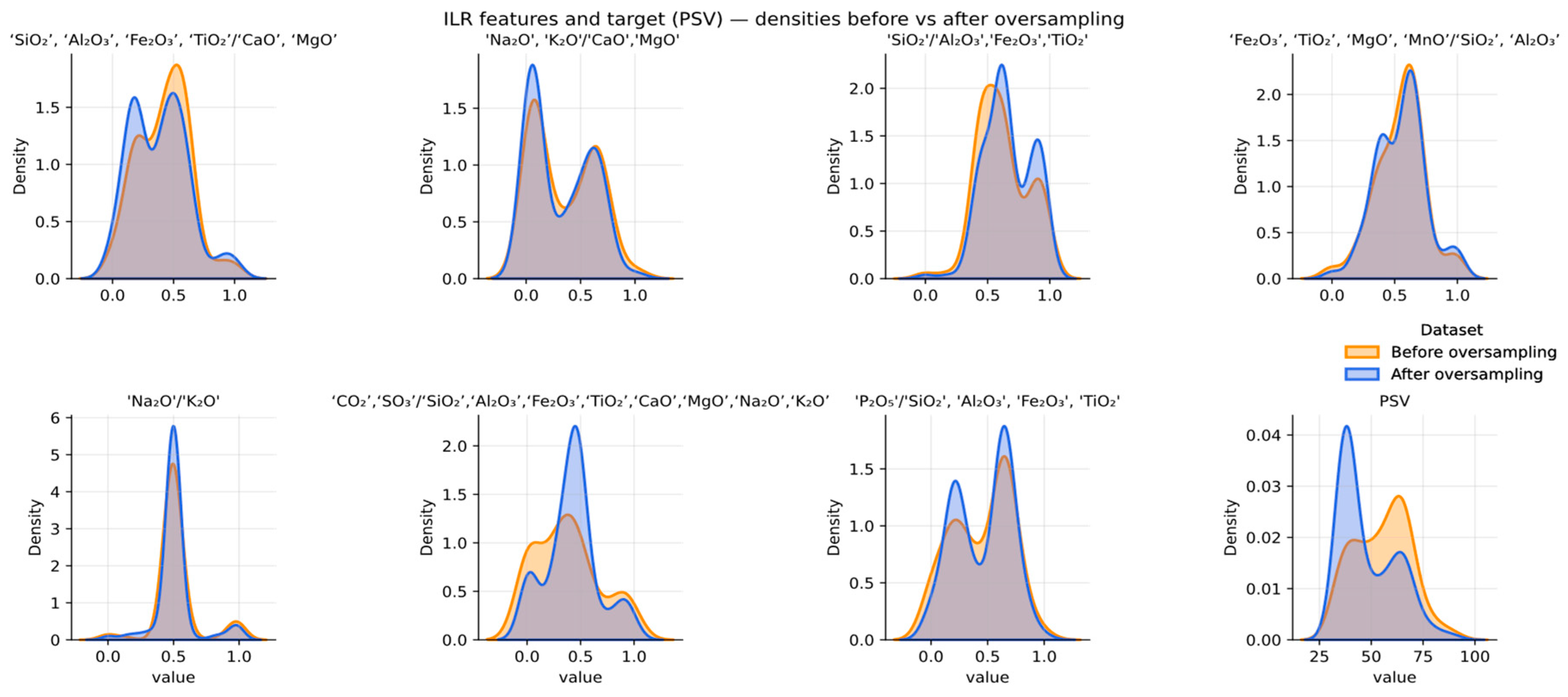
2.4.3. Data Oversampling
3. Machine Learning Models Used
3.1. Gradient Boosting Regression (GBR)
3.2. CatBoost
3.3. Multivariate Adaptive Regression Splines (MARS)
3.4. Model Validation (Repeated K-Fold Cross-Validation)
- •
- denotes the observed PSV value for observation ,
- •
- denotes the corresponding predicted value,
- •
- is the total number of observations in the test set (or in a validation fold),
- •
- is the mean of the observed values.
3.5. Feature Importance Assessment and Interpretation
3.5.1. Permutation Features Importance
3.5.2. SHapley Additive exPlanations
4. Results and Discussion
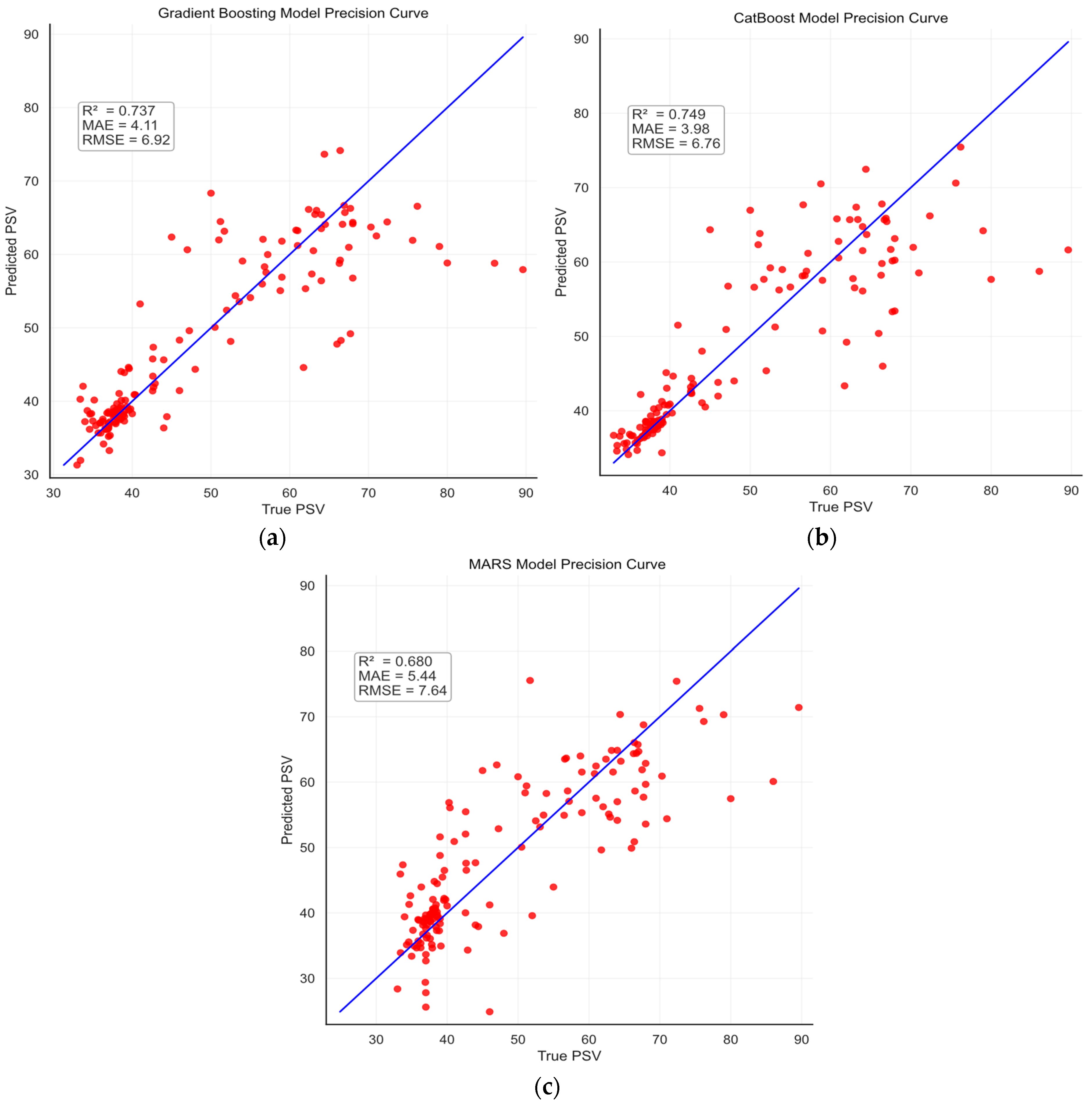
4.1. Models’ Performances
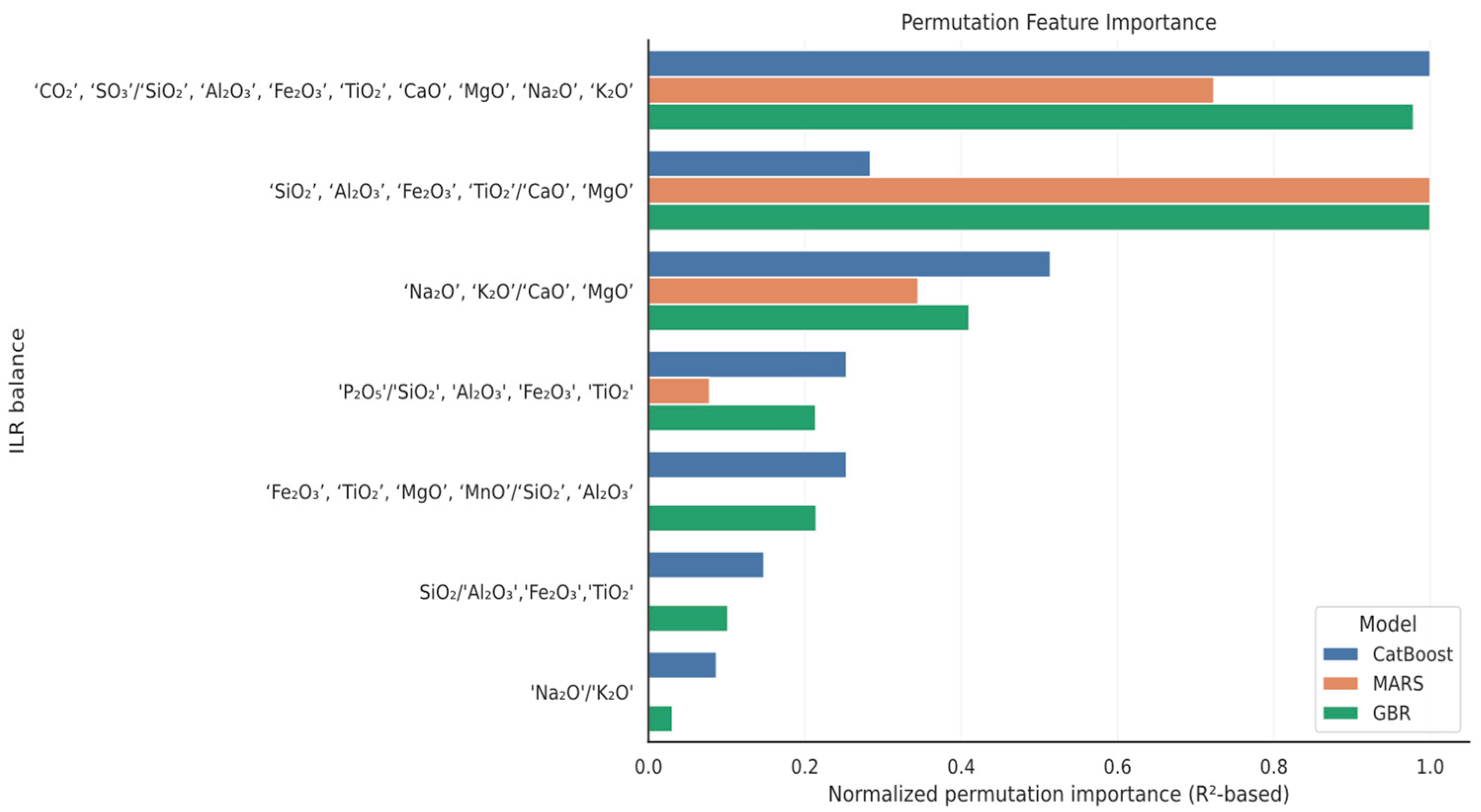
4.2. PFI—Permutation Feature Importance
- •
- Permutation of single balances can distribute importance across correlated ILR components which is an expected behavior with compositional data. Group-based permutations of chemically related balances can help assess robustness.
- •
- Fold-wise variability (e.g., confidence intervals from repeated k-fold cross-validation) should be examined to distinguish reliable signals from sampling noise.
- •
- SHAP analysis from the best performing model can serve as an additional check, ensuring that highly ranked balances also present coherent signed effects at the instance level.
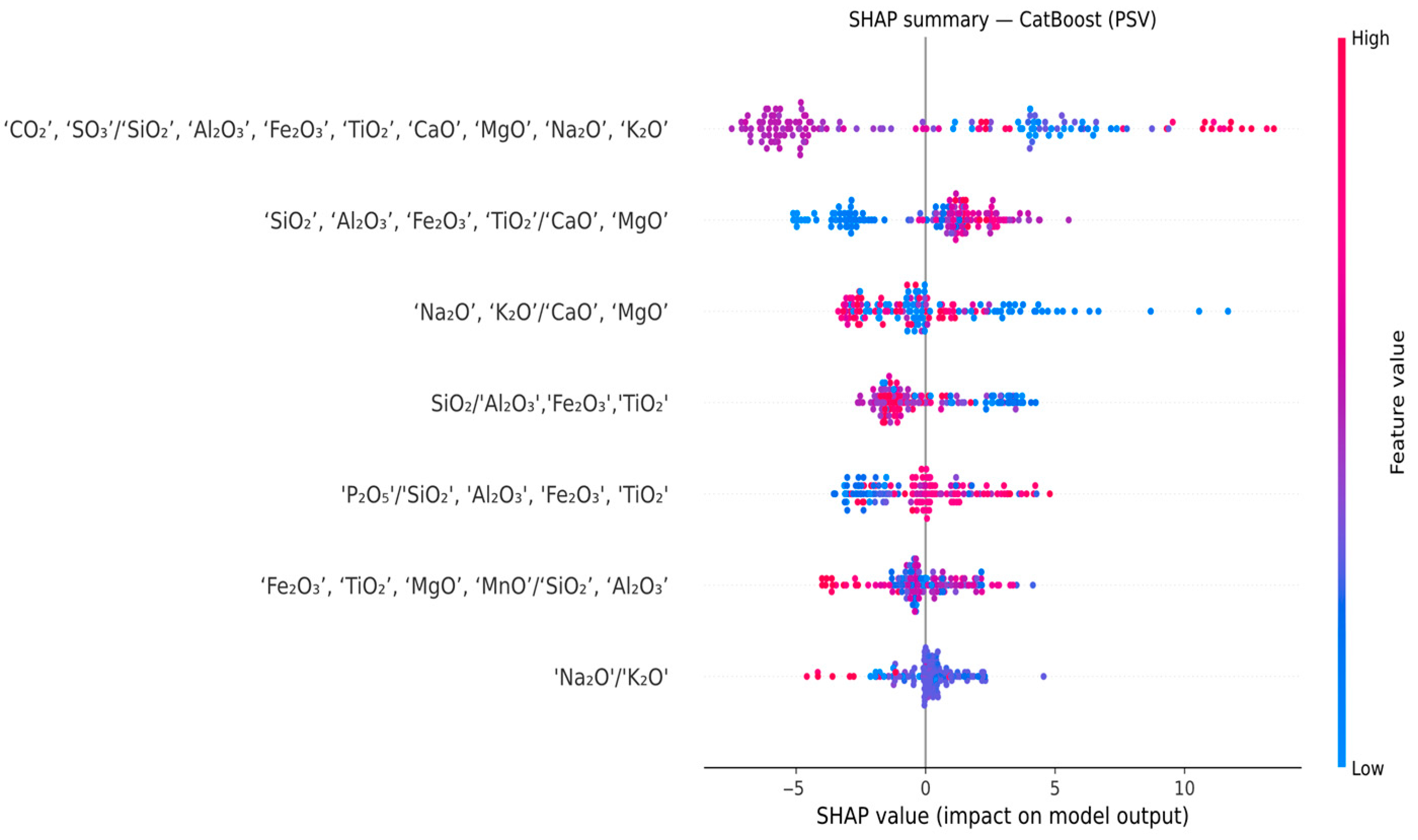
4.3. SHAP—SHapley Additive exPlanations for CatBoost Model
5. Conclusions
Author Contributions
Funding
Institutional Review Board Statement
Informed Consent Statement
Data Availability Statement
Conflicts of Interest
References
- UNEP. Sand and Sustainability: Finding New Solutions for Environmental Governance of Global Sand Resources; United Nations Environment Programme: Geneva, Switzerland, 2019. [Google Scholar]
- Kim, S.S.; Qudoos, A.; Jakhrani, S.H.; Lee, J.B.; Kim, H.G. Influence of Coarse Aggregates and Silica Fume on the Mechanical Properties, Durability, and Microstructure of Concrete. Materials 2019, 12, 3324. [Google Scholar] [CrossRef] [Scilit] [PubMed]
- Sakthivel, S.N.; Kathuria, A.; Singh, B. Utilization of Inferior Quality Aggregates in Asphalt Mixes: A Systematic Review. J. Traffic Transp. Eng. 2022, 9, 864–879. [Google Scholar] [CrossRef] [Scilit]
- Makul, N. Aggregates (Building Materials): Testing. In Dictionary of Concrete Technology; Springer Nature: Singapore, 2025; pp. 53–55. [Google Scholar] [CrossRef] [Scilit]
- Mitchell, C. Construction aggregates: Evaluation and specification. In Proceedings of the Third International Forum for Industrial Rocks & Mining Conference & Exhibition, Fujairah, United Arab Emirates, 30 March–1 April 2015; Available online: https://nora.nerc.ac.uk/id/eprint/510909/ (accessed on 23 March 2026).
- BS EN 1097-8; Tests for Mechanical and Physical Properties of Aggregates-Determination of the Polished Stone Value. BSI (British Standards Institution): London, UK, 2009.
- Perry, M.J. Role of Aggregate Petrography in Micro-Texture Retention of Greywacke Surfacing Aggregate. Road Mater. Pavement Des. 2014, 15, 791–803. [Google Scholar] [CrossRef] [Scilit]
- Crisman, B.; Ossich, G.; Bevilacqua, P.; Roberti, R. Degradation Prediction Model for Friction of Road Pavements with Natural Aggregates and Steel Slags. Appl. Sci. 2020, 10, 32. [Google Scholar] [CrossRef] [Scilit]
- Arampamoorthy, H.; Patrick, J. Potential of the Wehner–Schulze Test to Predict the On-Road Friction Performance of Aggregate; NZ Transport Agency Research Report 443; NZ Transport Agency: Wellington, New Zealand, 2011; 34p. Available online: https://www.nzta.govt.nz/assets/resources/research/reports/443/docs/443.pdf (accessed on 23 March 2026).
- BS EN 13043:2013; Aggregates for Bituminous Mixtures and Surface Treatments for Roads, Airfields and Other Trafficked Areas. BSI (British Standards Institution): London, UK, 2013.
- Goehl, D.C.; Gurganus, C.; Park, E.S. Selection Criteria for Coarse Aggregate in Flexible Pavement Surfaces; Report No. FHWA/TX-21/0-7077-R1; Texas A&M Transportation Institute: College Station, TX, USA, 2021; Available online: https://static.tti.tamu.edu/tti.tamu.edu/documents/0-7077-R1.pdf (accessed on 23 March 2026).
- National Highways. Design Manual for Roads and Bridges: Index (GG 000); National Highways: London, UK, 2025; Available online: https://www.standardsforhighways.co.uk/dmrb (accessed on 23 March 2026).
- Najafi, S.; Flintsch, G.W.; Medina, A. Linking Roadway Crashes and Tire–Pavement Friction: A Case Study. Int. J. Pavement Eng. 2017, 18, 119–127. [Google Scholar] [CrossRef] [Scilit]
- McCarthy, R.; Flintsch, G.; de León Izeppi, E. Impact of Skid Resistance on Dry and Wet Weather Crashes. J. Transp. Eng. Part B Pavements 2021, 147, 04021029. [Google Scholar] [CrossRef] [Scilit]
- Wallman, C.-G.; Åström, H. Friction Measurement Methods and the Correlation Between Road Friction and Traffic Safety: A Literature Review; Swedish National Road and Transport Research Institute (VTI): Linkoping, Sweden, 2001; Available online: https://www.diva-portal.org/smash/get/diva2:673366/FULLTEXT01.pdf (accessed on 23 March 2026).
- Cerezo, V.; Do, M.-T.; Violette, E. A Global Approach to Warn the Drivers before a Curve by Considering the Decrease of Skid Resistance Due to the Rain. In Proceedings of the 3rd International Conference on Road Safety and Simulation, Indianapolis, IN, USA, 14–16 September 2011; Available online: https://onlinepubs.trb.org/onlinepubs/conferences/2011/RSS/3/Cerezo,V.pdf (accessed on 23 March 2026).
- Lebaku, P.K.R.; Gao, L.; Sun, J.; Wang, X.; Kang, X. Assessing the Influence of Pavement Performance on Road Safety Through Crash Frequency and Severity Analysis. Int. J. Pavement Res. Technol. 2025. [Google Scholar] [CrossRef] [Scilit]
- Lindenmann, H.P. New Findings Regarding the Significance of Pavement Skid Resistance for Road Safety on Swiss Freeways. J. Safety Res. 2006, 37, 395–400. [Google Scholar] [CrossRef] [Scilit]
- Li, P.; Yi, K.; Yu, H.; Xiong, J.; Xu, R. Effect of Aggregate Properties on Long-Term Skid Resistance of Asphalt Mixture. J. Mater. Civ. Eng. 2021, 33, 4020413. [Google Scholar] [CrossRef] [Scilit]
- Zong, Y.; Li, S.; Zhang, J.; Zhai, J.; Li, C.; Ji, K.; Feng, B.; Zhao, H.; Guan, B.; Xiong, R. Effect of Aggregate Type and Polishing Level on the Long-Term Skid Resistance of Thin Friction Course. Constr. Build. Mater. 2021, 282, 122730. [Google Scholar] [CrossRef] [Scilit]
- Szatkowski, W.S.; Hosking, J.R. The Effect of Traffic and Aggregate on the Skidding Resistance of Bituminous Surfacing; TRRL Report LR 504; Transport and Road Research Laboratory: Crowthorne, UK, 1972. [Google Scholar]
- Pichayapan, P.; Chaleonpan, P.; Jitsangiam, P.; Wongchana, P. An evaluation of relationship with polished stone value and skid resistance value based on a laboratory investigation. Key Eng. Mater. 2019, 801, 410–415. [Google Scholar] [CrossRef] [Scilit]
- Pérez-Acebo, H.; Gonzalo-Orden, H.; Findley, D.J.; Rojí, E. A Skid Resistance Prediction Model for an Entire Road Network. Constr. Build. Mater. 2020, 262, 120041. [Google Scholar] [CrossRef] [Scilit]
- Roy, N.; Sarkar, S.; Kuna, K.K.; Ghosh, S.K. Effect of Coarse Aggregate Mineralogy on Micro-Texture Deterioration and Polished Stone Value. Constr. Build. Mater. 2021, 296, 123716. [Google Scholar] [CrossRef] [Scilit]
- Shabani, S.; Ahmadinejad, M.; Ameri, M. Developing a Model for Estimation of Polished Stone Value (PSV) of Road Surface Aggregates Based on Petrographic Parameters. Int. J. Pavement Eng. 2013, 14, 242–255. [Google Scholar] [CrossRef] [Scilit]
- Liu, J.; Guan, B.; Chen, H.; Liu, K.; Xiong, R.; Xie, C. Dynamic Model of Polished Stone Value Attenuation in Coarse Aggregate. Materials 2020, 13, 1875. [Google Scholar] [CrossRef] [Scilit]
- El-Ashwah, A.S.; Abdelrahman, M. Relating Aggregate Friction Properties to Asphalt Pavement Friction Loss through Laboratory Testing, Statistical Analysis, and Machine Learning Insights. Int. J. Pavement Eng. 2025, 26, 2456739. [Google Scholar] [CrossRef] [Scilit]
- Hussain, J.; Zafar, T.; Fu, X.; Ali, N.; Chen, J.; Frontalini, F.; Hussain, J.; Lina, X.; Kontakiotis, G.; Koumoutsakou, O. Petrological Controls on the Engineering Properties of Carbonate Aggregates through a Machine Learning Approach. Sci. Rep. 2024, 14, 31948. [Google Scholar] [CrossRef] [Scilit]
- Lei, J.; Zheng, N.; Chen, X.; Bi, J.; Wu, X. Research on the Relationship between Anti-Skid Performance and Various Aggregate Micro Texture Based on Laser Scanning Confocal Microscope. Constr. Build. Mater. 2022, 316, 125984. [Google Scholar] [CrossRef] [Scilit]
- Ergin, B.; Gökalp, İ.; Uz, V.E. Effect of Aggregate Microtexture Losses on Skid Resistance: Laboratory-Based Assessment on Chip Seals. J. Mater. Civ. Eng. 2020, 32, 4020040. [Google Scholar] [CrossRef] [Scilit]
- Zong, Y.; Xiong, R.; Wang, Z.; Zhang, B.; Tian, Y.; Sheng, Y.; Xie, C.; Wang, H.; Yan, X. Effect of Morphology Characteristics on the Polishing Resistance of Coarse Aggregates on Asphalt Pavement. Constr. Build. Mater. 2022, 341, 127755. [Google Scholar] [CrossRef] [Scilit]
- Qian, Z.; Wu, J.; Sun, F.; Wang, L. Effect of Aggregate Mineral Composition on Polish Resistance Performance. In Transportation Research Congress 2016; American Society of Civil Engineers (ASCE): Reston, VA, USA, 2016; pp. 263–271. [Google Scholar] [CrossRef] [Scilit]
- Aboutalebi Esfahani, M.; Kalani, M. Petrographic Analysis Method for Evaluation and Achieving Durable Hot Mix Asphalt. Constr. Build. Mater. 2020, 234, 117408. [Google Scholar] [CrossRef] [Scilit]
- Gökalp, İ.; Uz, V.E. The Effect of Aggregate Type and Gradation on Fragmentation Resistance Performance: Testing and Evaluation Based on Different Standard Test Methods. Transp. Geotech. 2020, 22, 100300. [Google Scholar] [CrossRef] [Scilit]
- Sulandari, E.; Subagio, B.S.; Rahman, H.; Maha, I. Analysis of Aggregate Types with Micro-Texture and Macro-Texture Characteristics of Asphalt Mixture in Indonesia. Open Civ. Eng. J. 2023, 17, e187414952309010. [Google Scholar] [CrossRef] [Scilit]
- Zhao, H.; Gao, H.; Tang, J.; Xue, X.; Guan, B. Investigation of Changes in Aggregates Morphological Characteristics and Abrasion Resistance before and after Abrasion. Int. J. Pavement Eng. 2025, 26, 2520024. [Google Scholar] [CrossRef] [Scilit]
- He, Z.; Li, J.; Nian, J.; Guan, B. Experimental Analysis and Modeling of Micro-Texture and Vickers Hardness Impact on Polished Stone Value in High-Friction Aggregates. Front. Mater. 2024, 11, 1340828. [Google Scholar] [CrossRef] [Scilit]
- Wu, Z.; Hungria, R.; Bharati, S. Assessment of Laboratory Friction Testing Equipment and Validation of Pavement Friction Characteristics with Field and Accelerated Friction Testing; FHWA/LA.25/707; Louisiana Transportation Research Center: Baton Rouge, LA, USA, 2025. Available online: https://rosap.ntl.bts.gov/view/dot/82247/dot_82247_DS1.pdf (accessed on 23 March 2026).
- Li, S.; Xiong, R.; Zhai, J.; Zhang, K.; Jiang, W.; Yang, F.; Yang, X.; Zhao, H. Research Progress on Skid Resistance of Basic Oxygen Furnace (BOF) Slag Asphalt Mixtures. Materials 2020, 13, 2169. [Google Scholar] [CrossRef] [Scilit]
- Qian, Z.; Hou, Y.; Dong, Y.; Cai, Y.; Meng, L.; Wang, L. An Evaluation Method for the Polishing and Abrasion Resistance of Aggregate. Road Mater. Pavement Des. 2020, 21, 1374–1385. [Google Scholar] [CrossRef] [Scilit]
- Kane, M.; Artamendi, I.; Scarpas, T. Long-Term Skid Resistance of Asphalt Surfacings: Correlation between Wehner–Schulze Friction Values and the Mineralogical Composition of the Aggregates. Wear 2013, 303, 235–243. [Google Scholar] [CrossRef] [Scilit]
- Wang, D.; Chen, X.; Xie, X.; Stanjek, H.; Oeser, M.; Steinauer, B. A Study of the Laboratory Polishing Behavior of Granite as Road Surfacing Aggregate. Constr. Build. Mater. 2015, 89, 25–35. [Google Scholar] [CrossRef] [Scilit]
- Fernández, A.; Alonso, M.A.; López-Moro, F.J.; Moro, M.C. Polished Stone Value Test and Its Relationship with Petrographic Parameters (Hardness Contrast and Modal Composition) and Surface Micro-Roughness in Natural and Artificial Aggregates. Mater. Constr. 2013, 63, 377–391. [Google Scholar] [CrossRef] [Scilit]
- Gökalp, İ.; Uz, V.E.; Saltan, M.; Tepe, M. Site Assessment of Surface Texture and Skid Resistance by Varying the Grit Parameters of an SMA. J. Transp. Eng. Part B Pavements 2022, 148, 04022033. [Google Scholar] [CrossRef] [Scilit]
- Greenacre, M. Compositional Data Analysis. Annu. Rev. Stat. Appl. 2021, 8, 271–299. [Google Scholar] [CrossRef] [Scilit]
- Torgo, L.; Ribeiro, R.P.; Pfahringer, B.; Branco, P. SMOTE for Regression. In Progress in Artificial Intelligence—EPIA 2013; Correia, L., Reis, L.P., Cascalho, J., Eds.; Lecture Notes in Artificial Intelligence (LNAI); Springer: Berlin/Heidelberg, Germany, 2013; Volume 8154, pp. 378–389. [Google Scholar] [CrossRef] [Scilit]
- Chawla, N.V.; Bowyer, K.W.; Hall, L.O.; Kegelmeyer, W.P. SMOTE: Synthetic Minority over-Sampling Technique. J. Artif. Intell. Res. 2002, 16, 321–357. [Google Scholar] [CrossRef] [Scilit]
- Friedman, J.H. Greedy Function Approximation: A Gradient Boosting Machine. Ann. Stat. 2001, 29, 1189–1232. [Google Scholar] [CrossRef] [Scilit]
- Prokhorenkova, L.; Gusev, G.; Vorobev, A.; Dorogush, A.V.; Gulin, A. CatBoost: Unbiased boosting with categorical features. Adv. Neural Inf. Process. Syst. 2018, 31, 6638–6648. [Google Scholar]
- Friedman, J.H. Multivariate Adaptive Regression Splines. Ann. Stat. 1991, 19, 1–67. [Google Scholar] [CrossRef] [Scilit] [PubMed]
- Molinaro, A.M.; Simon, R.; Pfeiffer, R.M. Prediction Error Estimation: A Comparison of Resampling Methods. Bioinformatics 2005, 21, 3301–3307. [Google Scholar] [CrossRef] [Scilit]
- Koné, A.; Es-Sabar, A.; Do, M.-T. Application of Machine Learning Models to the Analysis of Skid Resistance Data. Lubricants 2023, 11, 328. [Google Scholar] [CrossRef] [Scilit]





| Column | Mean | Std | Min | Max | Skewness | Kurtosis | Cov | Distinct Values |
|---|---|---|---|---|---|---|---|---|
| Al2O3 | 7.9743 | 10.1374 | 0 | 71 | 3.1624 | 17.7358 | 1.2713 | 54 |
| Amphibole | 3.2455 | 12.9335 | 0 | 70 | 4.1726 | 16.6303 | 3.9851 | 8 |
| Biotite | 0.6771 | 2.9492 | 0 | 25 | 7.3772 | 60.2028 | 4.3555 | 9 |
| CO2 | 7.9338 | 16.4284 | 0 | 47.2 | 1.6831 | 0.9562 | 2.0707 | 17 |
| CaO | 24.7985 | 23.8570 | 0 | 96.53 | 0.8293 | −0.1145 | 0.9620 | 66 |
| Calcite | 12.3477 | 27.8417 | 0 | 96.19 | 2.0763 | 2.7612 | 2.2548 | 20 |
| Chlorite | 1.2009 | 3.8228 | 0 | 24 | 4.0153 | 18.1552 | 3.1833 | 12 |
| Dolomite | 2.8174 | 10.4240 | 0 | 60 | 4.3456 | 18.9962 | 3.6999 | 12 |
| Fe2O3 | 5.2214 | 6.6423 | 0 | 30.1 | 1.3906 | 1.6501 | 1.2721 | 48 |
| Hematite | 0.0185 | 0.1658 | 0 | 1.48 | 8.9443 | 80.0000 | 8.9443 | 2 |
| Hornblende | 0.6647 | 3.6295 | 0 | 24.58 | 5.7833 | 33.7437 | 5.4602 | 4 |
| Illite | 0.3125 | 1.7965 | 0 | 14.83 | 7.1959 | 56.0160 | 5.7487 | 5 |
| K2O | 0.8894 | 1.6217 | 0 | 6.1 | 1.9328 | 2.6433 | 1.8234 | 34 |
| Magnetite | 0.0583 | 0.3799 | 0 | 2.96 | 6.8588 | 48.4896 | 6.5197 | 3 |
| MgO | 3.1478 | 3.6926 | 0 | 15.17 | 1.4897 | 1.6736 | 1.1731 | 64 |
| MnO | 0.2541 | 0.9968 | 0 | 7.2 | 5.6000 | 33.8654 | 3.9234 | 25 |
| Montmorillonite | 0.3751 | 2.5822 | 0 | 22.59 | 8.3211 | 71.7781 | 6.8846 | 4 |
| Na2O | 1.152 | 1.8609 | 0 | 8.67 | 2.1552 | 5.3364 | 1.6154 | 36 |
| PSV | 58.5450 | 11.8005 | 33.4 | 89.6 | −0.0285 | 0.2112 | 0.2016 | 70 |
| Plagioclase | 3.1780 | 11.3261 | 0 | 58.05 | 3.7030 | 12.9603 | 3.5640 | 8 |
| Potash feldspar | 9.3079 | 18.0426 | 0 | 60 | 1.6772 | 1.2264 | 1.9384 | 18 |
| Pyroxene | 2.4177 | 8.9707 | 0 | 55 | 4.4305 | 20.3485 | 3.7103 | 10 |
| P2O5 | 0.1604 | 0.4039 | 0 | 2.25 | 3.0355 | 10.1578 | 2.5189 | 20 |
| Quartz | 9.4275 | 18.2083 | 0 | 77 | 2.0209 | 2.9464 | 1.9314 | 27 |
| SO3 | 0.0223 | 0.0867 | 0 | 0.5 | 4.4368 | 19.5944 | 3.8891 | 8 |
| SiO2 | 28.138 | 25.3575 | 0 | 86.8 | 0.21697 | −1.5204 | 0.9012 | 64 |
| Siderite | 0 | 0 | 0 | 0 | 0 | / | / | 1 |
| SrO | 0 | 0 | 0 | 0 | 0 | / | / | 1 |
| TiO2 | 0.4300 | 0.9266 | 0 | 4.8 | 2.8907 | 8.7998 | 2.155 | 26 |
| ILR (Oxide Ratio) | Description |
|---|---|
| This ratio contrasts volatile-bearing carbonate and sulfate phases with the bulk major-oxide framework of the aggregate. | |
| This ratio measures the relative abundance of silico-aluminous and Fe-Ti oxides versus calco-magnesian components. | |
| This ratio expresses the proportion of free silica (quartz) relative to Al-Fe--Ti bearing phases. | |
| This ratio opposes alkali oxides associated with feldspathic minerals to Ca-Mg oxides typical of carbonates and mafic silicates. | |
| This ratio differentiates Na-rich plagioclase-dominated compositions from K-feldspar dominated ones. | |
| This ratio represents the proportion of P-bearing accessory phases (mainly apatite) relative to the silico-aluminous framework. | |
| This ratio contrasts Fe-Ti-Mg-Mn oxides and mafic silicates with the Si-Al framework. |
| Parameter | Value |
|---|---|
| k (neighbors) | 4 |
| n_syn_per_rare | 3 |
| relevance threshold | 0.75 (lower-tail focus) |
| relevance function | quantile-based (q0.15, q0.50) |
| Model | CatBoost | Gradient Boosting | MARS |
|---|---|---|---|
| n | 146 | 146 | 146 |
| R | 0.867 | 0.860 | 0.826 |
| R2 | 0.749 | 0.737 | 0.680 |
| Adj R2 | 0.736 | 0.723 | 0.663 |
| p_value | ≤0.001 | ≤0.001 | ≤0.001 |
| RMSE | 6.762 | 6.921 | 7.637 |
| MAE | 3.976 | 4.106 | 5.440 |
| MAPE (%) | 7.073 | 7.567 | 11.163 |
| VAF (%) | 75.138 | 73.938 | 67.989 |
| a20 (%) | 90.411 | 89.726 | 82.192 |
| PI | −5.274 | −5.459 | −6.294 |
| Rank | 1 | 2 | 3 |
Disclaimer/Publisher’s Note: The statements, opinions and data contained in all publications are solely those of the individual author(s) and contributor(s) and not of MDPI and/or the editor(s). MDPI and/or the editor(s) disclaim responsibility for any injury to people or property resulting from any ideas, methods, instructions or products referred to in the content. |
© 2026 by the authors. Licensee MDPI, Basel, Switzerland. This article is an open access article distributed under the terms and conditions of the Creative Commons Attribution (CC BY) license.
Share and Cite
Soudani, K.; Bounefla, Y.; Cerezo, V.; Haddadi, S. Predictive Modeling of Aggregate Polished Stone Value from Mineralogical and Chemical Composition. Eng 2026, 7, 149. https://doi.org/10.3390/eng7040149
Soudani K, Bounefla Y, Cerezo V, Haddadi S. Predictive Modeling of Aggregate Polished Stone Value from Mineralogical and Chemical Composition. Eng. 2026; 7(4):149. https://doi.org/10.3390/eng7040149
Chicago/Turabian StyleSoudani, Khedoudja, Yazid Bounefla, Veronique Cerezo, and Smail Haddadi. 2026. "Predictive Modeling of Aggregate Polished Stone Value from Mineralogical and Chemical Composition" Eng 7, no. 4: 149. https://doi.org/10.3390/eng7040149
APA StyleSoudani, K., Bounefla, Y., Cerezo, V., & Haddadi, S. (2026). Predictive Modeling of Aggregate Polished Stone Value from Mineralogical and Chemical Composition. Eng, 7(4), 149. https://doi.org/10.3390/eng7040149