Article

CFD–DEM Modeling of Stress–Damage–Seepage Coupling Mechanisms and Support Strategies in Subsea Tunnel Excavation

1
China Construction Fifth Division South China Company, No. 1088 Xingang East Road, Guangzhou 510220, China
2
College of Architectural Engineering, Qingdao Huanghai University, Qingdao 266427, China
3
School of Energy and Mining Engineering, China University of Mining & Technology Beijing, D11 Xueyuan Road, Beijing 100083, China
4
School of Civil Engineering, Qingdao University of Technology, D11 Xueyuan Road, Qingdao 266033, China
*
Author to whom correspondence should be addressed.
Eng 2026, 7(4), 144; https://doi.org/10.3390/eng7040144
Submission received: 8 January 2026 / Revised: 16 March 2026 / Accepted: 20 March 2026 / Published: 24 March 2026
(This article belongs to the Section Chemical, Civil and Environmental Engineering)

Abstract

The stability of subsea tunnels is governed by the strong coupling among stress redistribution, damage evolution, and seepage flow (Stress–Damage–Seepage, SDS). The dynamic interplay, especially under high water pressure, often leads to catastrophic failures, yet its mechanisms, particularly the role of support timing, remain insufficiently understood due to limitations in conventional numerical methods. This study aims to unravel the SDS coupling mechanisms during tunnel excavation under high hydraulic head, and to quantitatively investigate how support timing influences the stability of the surrounding rock within this coupled system. A coupled Computational Fluid Dynamics and Discrete Element Method (CFD-DEM) framework was employed. In this approach, excavation-induced damage, crack propagation, and fluid–particle interactions are explicitly resolved at the particle scale, whereas the macroscopic permeability evolution is captured through an imposed empirical exponential relationship. Simulations were conducted under both steady-state and transient seepage conditions with varying stress ratios and water heads. High-head transient seepage intensifies SDS coupling, dynamically redistributing seepage forces to damage zone edges and amplifying damage. Support timing critically mediates this interaction: premature support risks tensile failure at the tunnel periphery, while delayed support allows a vicious cycle of shear failure and increased inflow. Optimal “timely” support, applied after initial deformation, diverts high seepage forces inward, minimizing final damage. The spatiotemporal synchronization of transient seepage forces with damage evolution is pivotal for stability. Support timing acts as a key control variable. The CFD-DEM framework effectively elucidates these micro-mechanisms, providing a scientific basis for the dynamic design of support in high-pressure subsea tunnels.

1. Introduction

Against the backdrop of sustained global exploitation of marine resources and the accelerated integration of cross-sea transportation networks, subsea tunnels have emerged as critical infrastructure for overcoming marine geographical barriers. Consequently, their construction scale, burial depth, and engineering complexity have increased continuously in recent decades [1,2]. Compared with land tunnels, subsea tunnels are deeply embedded in highly heterogeneous marine geological environments and are subjected over long periods to high hydraulic heads, intense seepage actions, and complex, spatially variable in situ stress fields [3,4,5]. Tunnel excavation instantaneously disrupts the stress–seepage equilibrium that has developed in the surrounding rock over prolonged geological evolution, triggering a cascade of dynamic and strongly coupled engineering responses. Excavation-induced unloading leads to drastic stress redistribution in the surrounding rock, initiating damage nucleation, propagation and subsequent displacement evolution [6]; the progressive evolution of damage, in turn, alters the internal structure of the surrounding rock, causing abrupt changes in its permeability and driving the reconstruction of the seepage field. Elevated seepage pressures further exacerbate damage development by modifying the effective stress levels acting on both the surrounding rock and the support system [7,8,9]. Meanwhile, as an engineering intervention, the support system—through its installation timing, stiffness, and load-bearing capacity—interacts strongly with the evolving damage of the surrounding rock and the formation of seepage pathways. These interactions form pronounced feedback loops that jointly determine the ultimate stability of the surrounding rock–support system. Such strongly coupled, multi-field and multi-process interactions among stress, damage, and seepage (Stress–Damage–Seepage, SDS) are widely recognized as a critical factor influencing excavation face stability and the initiation of water or mud inrushes in subsea tunnels. Consequently, accurately decoupling and quantifying these complex fluid–solid interactions remain a persistent technical challenge in contemporary tunnel engineering research [10,11].
To elucidate and quantitatively characterize the SDS coupling mechanisms in subsea tunnels, extensive theoretical and numerical studies have been conducted, leading to the development of various research paradigms [12,13,14]. Early investigations primarily focused on the two-field coupling between stress and seepage. A representative approach is the equivalent continuum fluid–solid coupling model based on Biot’s theory, which describes the constitutive relationship between pore water pressure and deformation of the rock skeleton, enabling macroscopic assessment of seepage effects on tunnel stability [15,16]. However, such methods typically idealize the surrounding rock as a homogeneous and continuous medium, making it difficult to capture the localized initiation, propagation, and coalescence of damage and fractures under excavation-induced unloading. To address this limitation, discrete fracture network (DFN) models [17,18] have been introduced into tunnel engineering analyses. By explicitly representing major fracture structures and describing fracture flow behavior using the cubic law, DFN models demonstrate certain advantages in stability assessments of faulted or jointed rock masses. Nevertheless, these models rely on predefined static fracture networks and are therefore incapable of simulating the generation of new damage or the extension and coalescence of existing fractures under construction disturbances.
Building upon these developments, continuum damage mechanics has been systematically incorporated into multi-field coupling frameworks [19,20,21,22]. By introducing damage variables as internal state variables, researchers have characterized the degradation of material mechanical properties and established evolution relationships between damage and elastic modulus, strength parameters, and permeability. In this way, theoretical linkage among the stress field, damage field, and seepage field has been achieved. Numerical approaches based on elastoplastic damage constitutive models have been widely applied to simulate the progressive failure of surrounding rock during step-by-step tunnel excavation and to evaluate the engineering effectiveness of support measures such as grouting rings and reinforced zones [23,24,25]. Furthermore, some studies have attempted to construct macro–micro bridges by introducing mesoscopic descriptors, such as microcrack density tensors and statistical damage parameters, to derive the evolution laws of macroscopic permeability and mechanical properties, thereby advancing SDS coupling research to a deeper mechanistic level.
Despite these notable advances in theoretical modeling and engineering applications, the inherent limitations of existing approaches have become increasingly evident when addressing the extremely complex SDS coupling processes in subsea tunnels. First, in terms of mechanical process representation, finite element or finite difference methods based on continuum assumptions are inherently designed for continuous deformation and often encounter numerical limitations when simulating the catastrophic evolution from a continuous medium to a fragmented state and eventually to granular flow behavior. Severe mesh distortion often leads to numerical instability or termination, while techniques such as predefined fractures or “element deletion” fail to realistically capture block motion and inter-block interactions after surrounding rock disintegration [11]. To address these continuum limitations, discrete modeling frameworks have been increasingly utilized to capture dynamic fracturing processes and structural disintegration in discontinuous rock masses [26]. Second, regarding the description of coupling mechanisms, most existing models employ empirical or phenomenological damage–permeability evolution relationships (e.g., exponential functions) [27]. Although these formulations can reproduce experimental observations to some extent, they lack a universal theoretical basis rooted in mesoscopic interaction mechanisms. In particular, they struggle to capture the strongly localized and channelized seepage behavior that emerges after cumulative damage forms preferential flow paths, as well as the associated erosion and particle transport effects acting on the surrounding rock [28,29]. Recognizing this gap, researchers globally have advanced explicit pore-scale and particle-scale models to simulate fundamental poromechanical fluid–particle interactions [30], complex piping erosion in granular media [31], and fluid-driven fracturing in underground workings [32]. Finally, due to the challenge of explicitly resolving mesoscopic fluid–solid interactions, the complex dynamic feedback between the support system and the evolution of localized seepage pathways is difficult to quantify fully using macroscopic empirical models. This limitation in tracking explicit micro-mechanisms makes it challenging to derive deterministic, predictive guidelines for determining the optimal timing, spatial configuration, and structural parameters of support installation. Consequently, support design often relies on experience-based trial and error [33,34,35,36], making it difficult to actively regulate SDS coupling pathways and to ensure reliable stability of subsea tunnels under extreme conditions.
In light of these challenges, there is a pressing need to develop a new numerical approach that originates from the fundamental mechanics of discontinuous media while accurately capturing fluid–solid interactions. The discrete element method (DEM), which represents materials as assemblies of particles or blocks, can naturally describe damage initiation, fracture propagation, structural disintegration, and block motion of surrounding rock under excavation-induced unloading, and has demonstrated significant advantages in simulating damage evolution during tunnel excavation. When further coupled with computational fluid dynamics (CFD), DEM enables explicit simulation of seepage field evolution and fluid–particle interactions at the particle scale, offering a novel pathway for unraveling cross-scale coupling mechanisms among stress, damage, and seepage.
This study aims to develop and apply a CFD–DEM coupled numerical simulation framework tailored to subsea tunnel engineering problems. From a particle-scale perspective, the framework systematically reproduces the entire excavation-induced evolution process, including unloading-triggered damage initiation in the surrounding rock, fracture network development, seepage channel formation, and localized instability. Furthermore, the regulatory effects of different support strategies—particularly installation timing—within the SDS-coupled system are quantitatively analyzed. The findings are expected to provide a new analytical paradigm and scientific tool for refined risk assessment and dynamic control design of subsea tunnels and other water-rich underground engineering projects, as well as a theoretical basis for the rational selection of support types and parameters in engineering practice.

2. CFD-DEM Framework

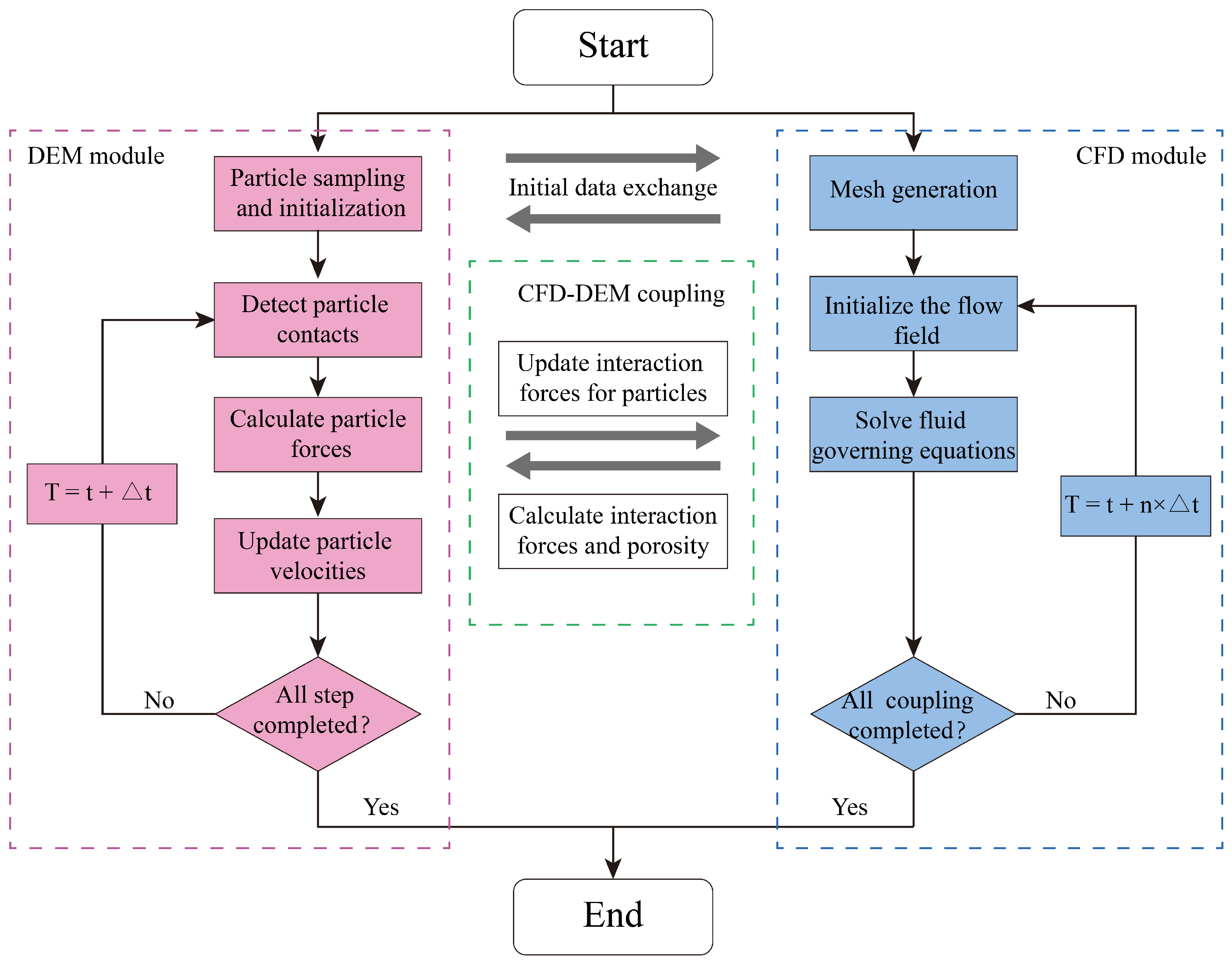
To overcome the limitations of existing theoretical frameworks and numerical techniques, the CFD–DEM has emerged as a transformative multiscale numerical approach, offering new opportunities to address the SDS problem in subsea tunnels. This method adopts a hybrid Eulerian–Lagrangian description. The CFD module solves the governing equations of groundwater flow on a fixed Eulerian grid to accurately resolve pressure and velocity fields. Simultaneously, the DEM module tracks the translational and rotational motions of individual rock particles within a Lagrangian framework. This approach explicitly captures the evolution of inter-particle contact force chains. As a result, complex processes such as surrounding rock cracking, fragmentation, collapse, and block migration are naturally captured. The two solvers are strongly, bidirectionally, and explicitly coupled at each computational time step through porosity-dependent interactions and momentum exchange terms (i.e., drag forces), allowing for a fully coupled and dynamically consistent representation of fluid–solid interactions, as shown in Figure 1.

2.1. Fluid Governing Equations

In the CFD–DEM coupled computation, the computational fluid dynamics (CFD) module represents the influence of particles on the fluid by introducing fluid–particle interaction forces into the fluid governing equations. Neglecting energy exchange, the most fundamental governing equations of the CFD module can be derived from the continuity equation and the momentum equation, yielding the Navier–Stokes equations [37].
ε ρ f t + ( ε ρ f v ) = 0
ε ρ f v t + ( ε ρ f v v ) = ε p + ε τ + ε ρ f g + f f
where ε denotes the solid-phase porosity, ρ f is the fluid density, v is the fluid velocity, p represents the pressure gradient, τ is the mean fluid stress tensor, g is the gravitational acceleration, and f f denotes the fluid–particle interaction force acting on a unit volume of fluid.

2.2. Particle Governing Equations

The DEM was first proposed by Cundall et al. [38,39] for the investigation of rock mechanics problems. Based on a Lagrangian framework, this method treats a discontinuous granular medium as an assembly of independent and discrete elements (particles). By explicitly tracking the translational and rotational motions of individual particles and their mutual interactions, DEM enables the interpretation of macroscopic system behavior from underlying microscopic mechanisms. In DEM, the motion of each particle obeys Newton’s second law of classical mechanics. For an arbitrary particle i in the system, its translational and rotational motions are governed by the following equations:
m i d 2 X i d t 2 = m i d v i d t = F c + F g + F e x t
J i d ω i d t + ω i × J i ω i = M r + F c × r + M e x t
where m i , X i , v i , ω i and J i denote the mass, position vector, velocity, angular velocity, and inertia tensor of particle i, respectively. F g is the gravitational force acting on the particle; F c represents the contact force between the particle and its neighboring particles; F e x t denotes possible external body forces, such as buoyancy and fluid drag; M r is the rolling resistance moment generated at the contact point due to relative rotation; r is the position vector pointing from the contact point to the particle centroid; and M e x t is the moment exerted on the particle by external forces. By performing explicit time integration of the above equations, the particle positions and velocities at each time step can be obtained, thereby capturing the dynamic evolution of the entire particulate system.

2.3. Solid–Fluid Interaction

In CFD–DEM coupled simulations, the solid-phase porosity ε is a critical bridging variable. It is dynamically computed by mapping the discrete particle volume fractions onto the Eulerian fluid mesh using measurement circles centered at each fluid cell. For the intact rock matrix, where fluid flow occurs strictly through the initial pore space (Reynolds number less than 10), the baseline permeability is established using the Kozeny–Carman equation [40].
k = d p 2 ε 3 k 0 ( 1 ε ) 2
where d p is the characteristic particle diameter (equal to the particle diameter for spherical particles), and k 0 is the Kozeny constant.
It should be noted that Equation (5) is primarily applicable to the intact matrix state. As excavation proceeds, the surrounding rock is subjected to severe unloading and evolves into a fractured medium. To accurately capture the sharp, localized increase in macroscopic permeability induced by the formation and coalescence of crack networks, an empirical exponential relationship based on the continuum damage variable is employed [41]:
k D = k g D = k exp β D
D = N b r o k e n N t o t a l
where N b r o k e n is the number of broken contacts, N t o t a l is the total number of contacts, and β is an empirical coefficient that can be determined from seepage–compression experiments.
In DEM, body forces are commonly converted into particle forces using the equivalent area method or the volume distribution method:
F s = C π r 2 P 1 ε
C = 0.63 + 4.8 R e p
R e p = 2 ρ f r | u v | μ f
R e p is the particle Reynolds number, u is the particle velocity, v is the fluid velocity, and μ f is the dynamic viscosity of the fluid.
During the DEM-CFD coupling, the CFD calculation is performed first, then passed back to DEM, and returned to CFD. The steps are carried out alternately until the simulation is completed. Here, the simulation time step in DEM is selected as 1:100 for analysis. Since the simulation time step in DEM is often smaller than that, in CFD, no significant particle motion occurs in a single DEM time step.
Δ t C F D = N c y c l e × Δ t D E M

2.4. Verification of the Fluid–Solid Coupling Algorithm

Prior to simulating the complex SDS coupling induced by tunnel excavation, a classical benchmark of steady-state radial seepage was conducted to quantitatively verify the accuracy of the implemented CFD-DEM fluid–solid interaction interface. Since the capability of DEM to capture purely mechanical crack propagation is well-established, this verification specifically targets the reliability of the fluid solver and the pressure mapping mechanism.
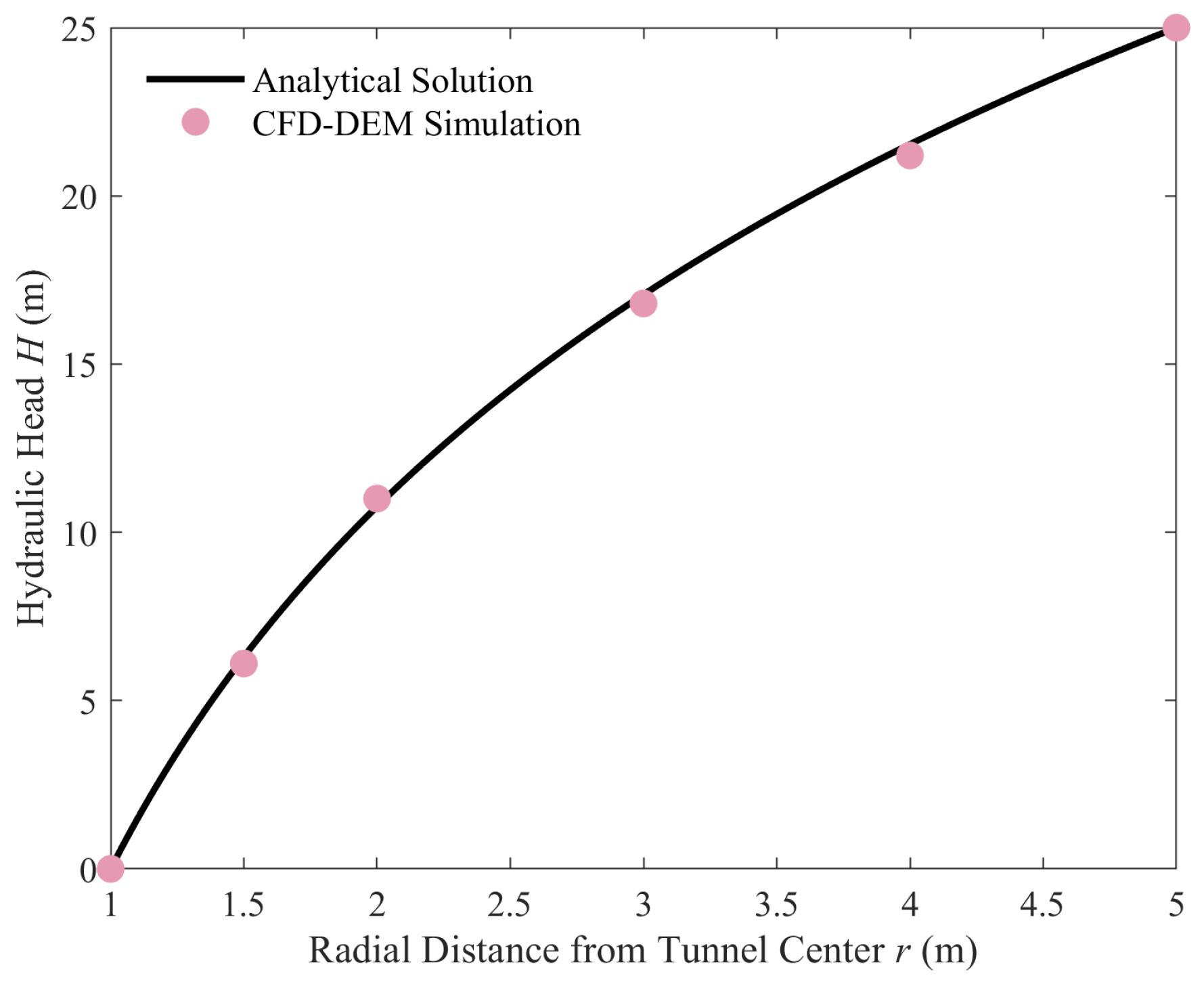
The conceptual model consists of a perfectly circular tunnel excavated in a homogeneous, isotropic, and rigid porous medium. According to Darcy’s law, the analytical solution for the steady-state radial hydraulic head distribution H r around a circular tunnel is given by:
H r = H 0 + H e H 0 ln R e R 0 ln r R 0
where r is the radial distance from the tunnel center, R 0 is the tunnel radius, R e is the equivalent radius of the external constant-head boundary, H 0 is the hydraulic head at the tunnel periphery, and H e is the constant head at the outer boundary.
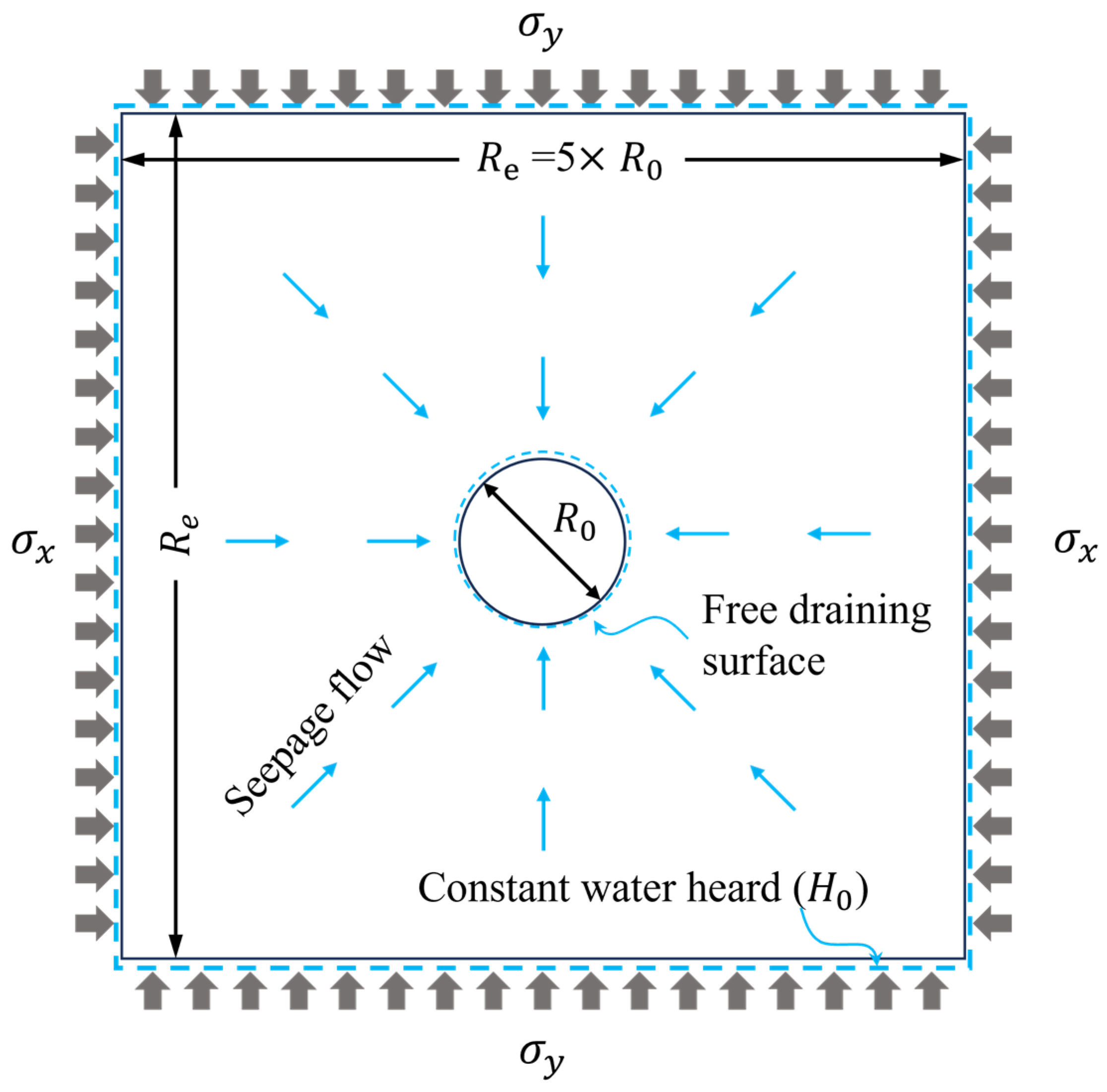
A two-dimensional rectangular particle model containing a pre-defined circular tunnel is established (see Figure 2), with the tunnel located at the center of the model. In general practice, to rigorously eliminate artificial boundary effects, the distance from the tunnel contour to the model boundaries is typically set to exceed 3 to 5 times the excavation diameter. This spatial extent provides a sufficient physical buffer to fully dissipate the excavation-induced stress redistribution and transient hydraulic gradients, ensuring that the boundary constraints neither artificially stiffen the near-field surrounding rock nor steepen the macroscopic seepage flow. Mechanically, to replicate the initial in situ stress field of the deep-buried surrounding rock, target confining pressures ( σ x and σ y ) are applied to the external boundaries via a servo-control mechanism. Hydraulically, the four outer boundaries of the domain are prescribed as fixed-head boundaries to simulate a constant remote groundwater recharge typical of subsea environments. Conversely, the tunnel perimeter is designated as a free-draining (zero-pressure) boundary post-excavation.
As illustrated in Figure 3, the numerically simulated hydraulic head distribution perfectly captures the logarithmic drawdown curve predicted by the analytical solution. The maximum relative error between the numerical results and the theoretical values is controlled within 3.2%. This agreement demonstrates that the customized CFD-DEM interface possesses the requisite mathematical stability and physical accuracy to accurately resolve pore pressure gradients and fluid–solid interactions, thereby providing a reliable foundation for the subsequent fully coupled SDS analyses.

3. Stability Analysis of Tunnels Under Coupled SDS Effects

To systematically investigate tunnel stability under the coupled effects of stress, damage, and seepage, this section develops a corresponding two-dimensional coupled analysis model based on a discrete element–continuum coupled numerical simulation approach. The model is designed to reproduce the interactions among the surrounding rock’s microscale mechanical responses, damage evolution, groundwater seepage, and support system during excavation-induced unloading. It should be explicitly noted that while this 2D simplification effectively captures the fundamental SDS coupling mechanisms, the numerical results presented herein are primarily qualitative and mechanism-oriented. They are intended to provide a foundational understanding of rock–support–seepage interactions rather than direct quantitative parameters for engineering design.

3.1. Numerical Model

Particle discrete element subdomain (using PFC): This subdomain is used to simulate the near-field surrounding rock of the tunnel. The surrounding rock in this region is represented as an assembly of numerous rigid particles connected through a parallel-bond model, which naturally captures the discontinuous nature of the rock, the mechanical behavior of its microstructure, and the initiation, propagation, and coalescence of excavation-induced fractures, i.e., damage evolution.
Fluid continuum subdomain (using FiPy): This subdomain simulates the larger-scale seepage field, including the tunnel. Based on the continuum assumption, it solves the governing equations of flow in porous media to analyze changes in hydraulic head distribution and seepage velocity fields.
The two subdomains are coupled through data exchange: the pore structure calculated in the particle domain (e.g., porosity changes and evolution of flow channels due to damage) is transmitted in real time to the fluid domain to update seepage parameters such as permeability; conversely, the pore water pressures calculated in the fluid domain are applied as body forces on the corresponding particles in the particle domain, influencing their stress state and motion.
We established a two-dimensional rectangular particle model containing a pre-defined circular tunnel at its center. The mechanical behavior between particles is simulated using the parallel-bond model, with parameters determined via trial-and-error based on reference [42]. The parameters used in the particle flow are listed in Table 1. Before simulating tunnel excavation, target confining pressures are applied at the model boundaries using a servo-control mechanism to generate an initial uniform stress field consistent with engineering geological conditions. To simplify the model and focus on the coupling effects of excavation-induced unloading and seepage, the vertical stress gradient caused by gravity is neglected, and the initial stress field is assumed to be isotropic.
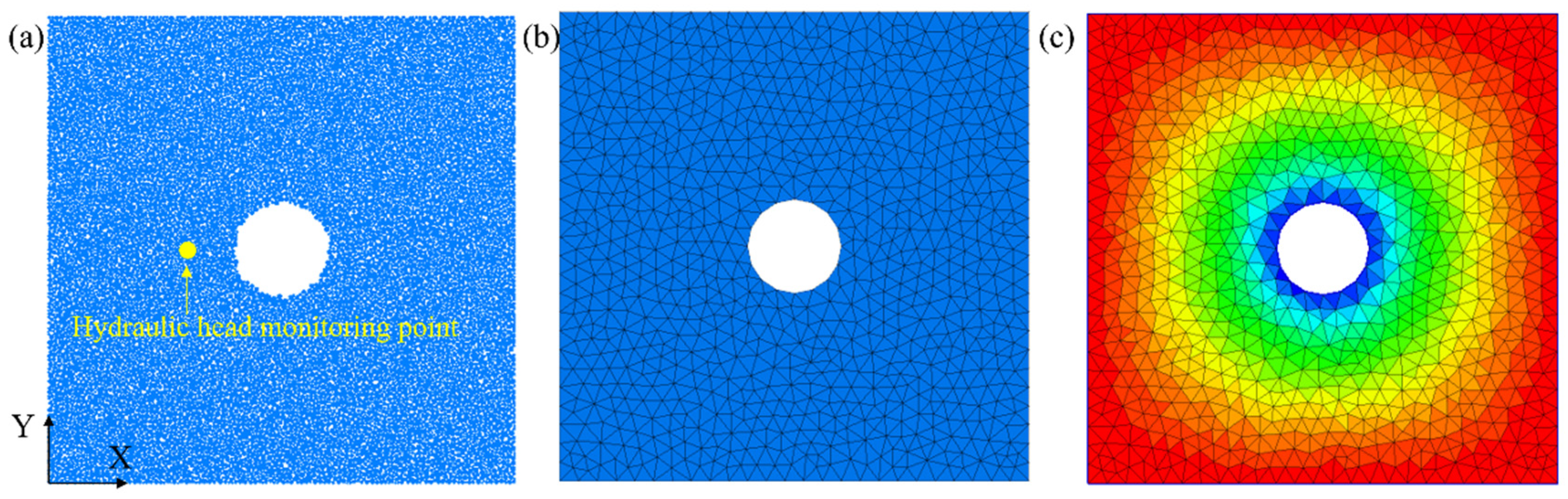
For the fluid domain, the computational domain is discretized using unstructured meshes (see Figure 4) generated by the open-source tool Gmsh 4.0.4. The initial permeability is assigned based on the intact rock state. During the coupled simulation, this parameter is dynamically updated according to real-time damage variables (or porosity changes) transmitted from the particle domain, establishing a damage–permeability evolution relationship. All four boundaries of the square domain are set as fixed-head boundaries to simulate a constant remote groundwater supply, while the circular tunnel boundary is treated as a permeable boundary, representing a free-draining surface after excavation. For the fluid computation, the dynamic viscosity is set to 1 × 10⁻³ Pa·s, and the fluid density is 1000 kg/m3.

3.2. Effect of Excavation-Induced Unloading

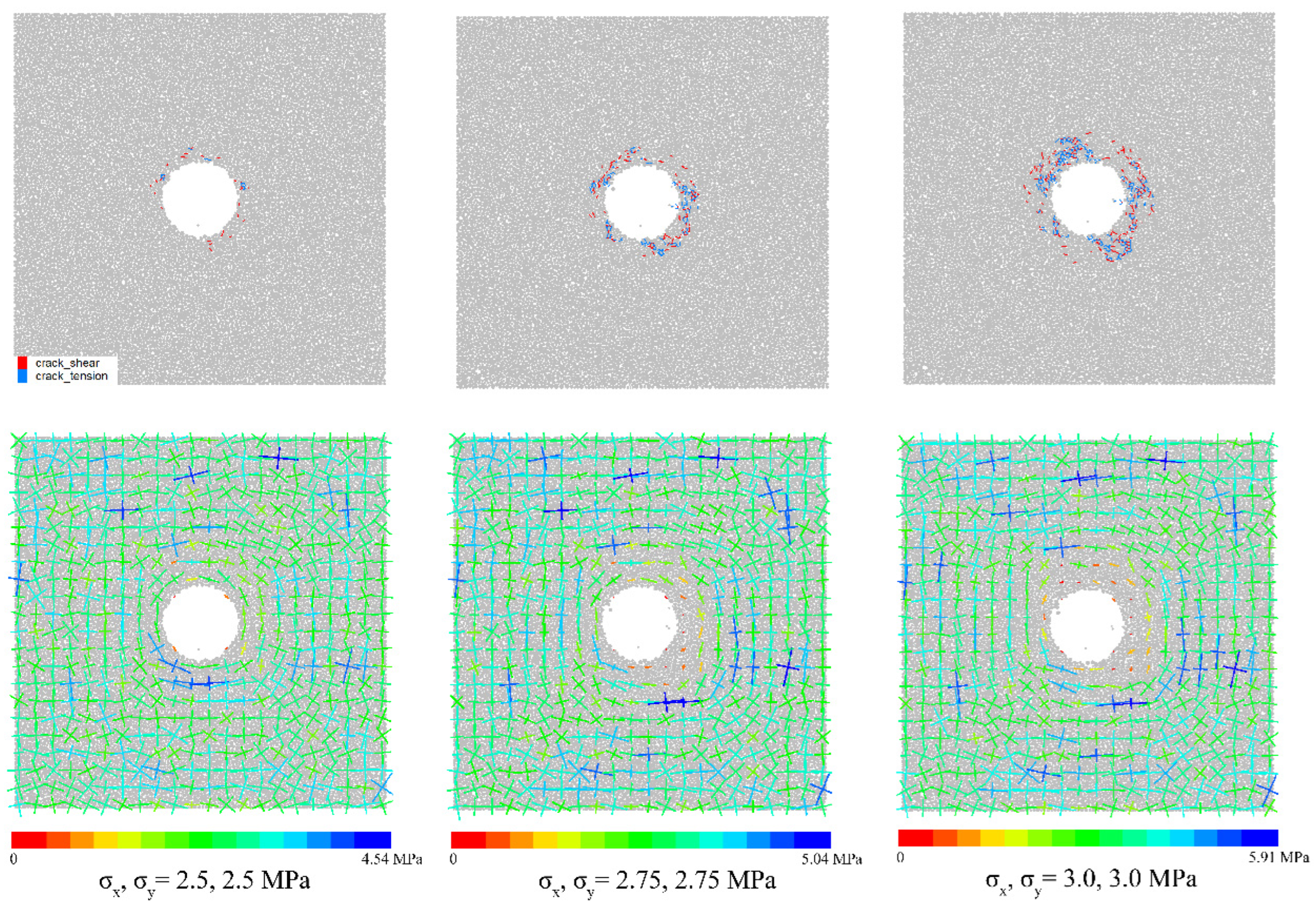
Under the condition of a horizontal-to-vertical stress ratio of 1:1, the surrounding rock is in an approximately isotropic in situ stress state. Numerical simulation results (see Figure 5) indicate that the damage zone formed after tunnel excavation is roughly circular and uniformly distributed around the tunnel (characterized by a uniform normalized damage radius R d / R 0 1.2 and no dominant localization angle α ), showing no significant directional concentration of failure. From the stress distribution perspective, in regions far from the tunnel, the stress “cross” exhibits two principal stresses of nearly equal magnitude, with stable orientations consistent with the initial in situ stress field. Although local areas may show larger differences between the first and second principal stresses, these differences are randomly distributed and mainly arise from the heterogeneity of the PFC discrete particle system and local contact structure variations, rather than from systematic deviations of the macroscopic stress field.
Near the tunnel boundary, particularly in regions where microcracks and damage evolve, significant stress reductions occur within the surrounding rock, indicating that local stress release results from particle contact failure and microcrack propagation. However, under this stress ratio, the principal stress orientations do not experience significant directional rotation, and overall stress rotation lacks a clear preferential direction. As the minimum principal stress gradually increases from 2.5 to 2.75 and 3.0, both the extent of the damage zone and the number of cracks increase, but the spatial distribution pattern of the damage zone and the characteristics of stress evolution remain largely unchanged. This indicates that, under near-isotropic stress conditions, the in situ stress level primarily affects the degree of damage rather than controlling the damage pattern.
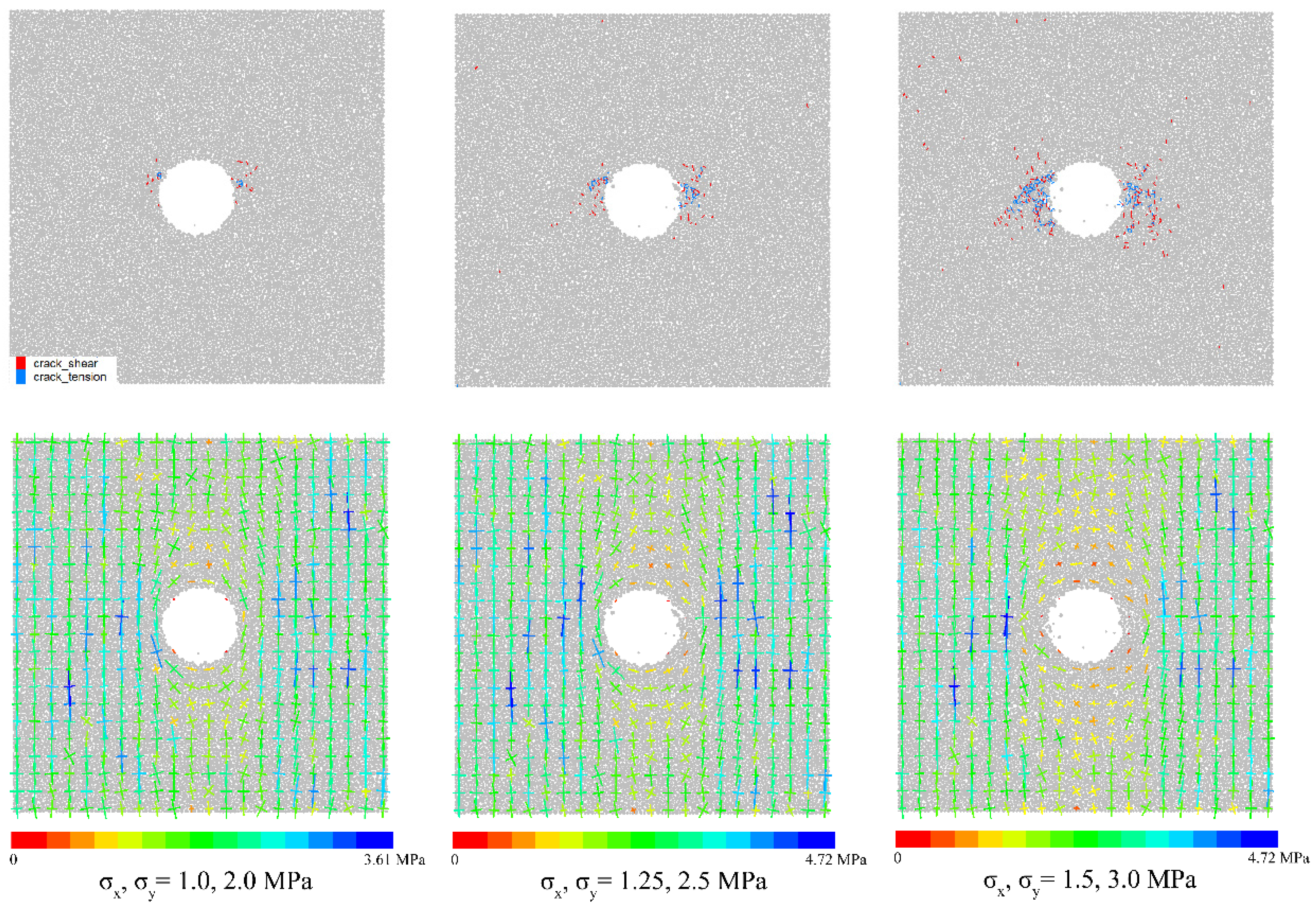
When the horizontal-to-vertical stress ratio increases to 1:2, the in situ stress field becomes clearly anisotropic, and the surrounding rock damage pattern after tunnel excavation changes significantly. Numerical results (see Figure 6) show that the excavation-induced damage zone is no longer uniformly distributed around the tunnel but is instead concentrated in the two sidewall regions. Under lower stress levels (minimum principal stress of 1.0), only local tensile cracks appear near the tunnel surface, while the deeper surrounding rock remains relatively intact. As the boundary stress increases to 1.25 and 1.5, the damage in the sidewall regions rapidly propagates into the deeper surrounding rock, gradually forming V-shaped damage zones with distinct directional tendencies, where the localized damage extends predominantly in the horizontal direction with a normalized maximum depth of R d / R 0 1.5 and no dominant localization angle. In shallow tunnel regions, cracks are predominantly tensile, whereas in deeper areas, they gradually evolve into predominantly shear-type cracks. This indicates that as deviatoric stress increases, the failure mechanism of the surrounding rock transitions from tension-dominated to shear-dominated. Stress “cross” analysis shows that, in this scenario, the first principal stress in the surrounding rock is generally about twice the magnitude of the second principal stress, with the ratio further increasing in the sidewall regions, reflecting pronounced deviatoric stress concentration. After excavation, significant stress transfer and principal stress rotation occur within the surrounding rock. In the tunnel crown and invert regions, excavation unloading leads to substantial stress reduction, accompanied by notable rotation of principal stress directions: the first principal stress gradually aligns with the horizontal direction, while the second principal stress adjusts in both magnitude and orientation. This demonstrates that, under moderate anisotropic stress conditions, excavation significantly reshapes the stress orientation field in the surrounding rock.
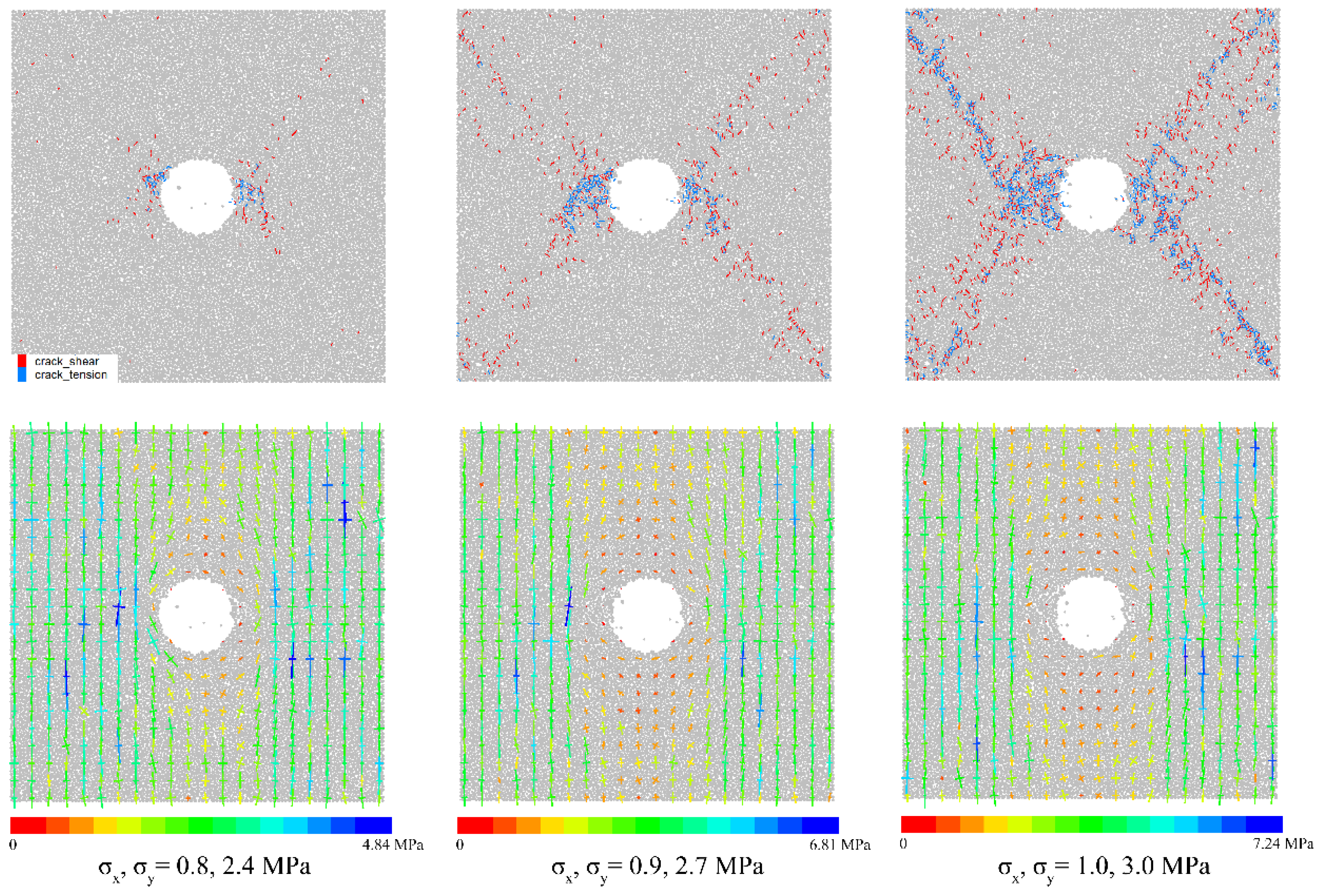
When the horizontal-to-vertical stress ratio further increases to 1:3, the surrounding rock is subjected to a strongly anisotropic in situ stress field, and the post-excavation damage pattern undergoes fundamental changes. Numerical simulations (see Figure 7) reveal the formation of a typical X-shaped excavation damage zone. Damage is concentrated not only in the tunnel sidewall regions but also extends deeply into the surrounding rock (reaching a normalized depth of R d / R 0 2.0 at relatively high angles (approximately 60°), exhibiting clear shear band characteristics. In the initial stages, cracks within the sidewall damage zones are primarily tensile–shear mixed microcracks, indicating that both unloading-induced tensile effects and deviatoric shear effects act simultaneously during early excavation. As the boundary load increases from 0.8 to 0.9 and 1.0, the damage zone extends further into the surrounding rock, with cracks gradually becoming dominated by shear failure, demonstrating the primary role of shear in the instability process of the surrounding rock. Stress “cross” analysis indicates that as the boundary load increases, the X-shaped damage zone exhibits progressively intensified deviatoric stress concentration. After shear failure occurs, localized tensile failure reappears, reflecting stress redistribution effects induced by shear slip.

3.3. Tunnel Stability Under SDS Coupling

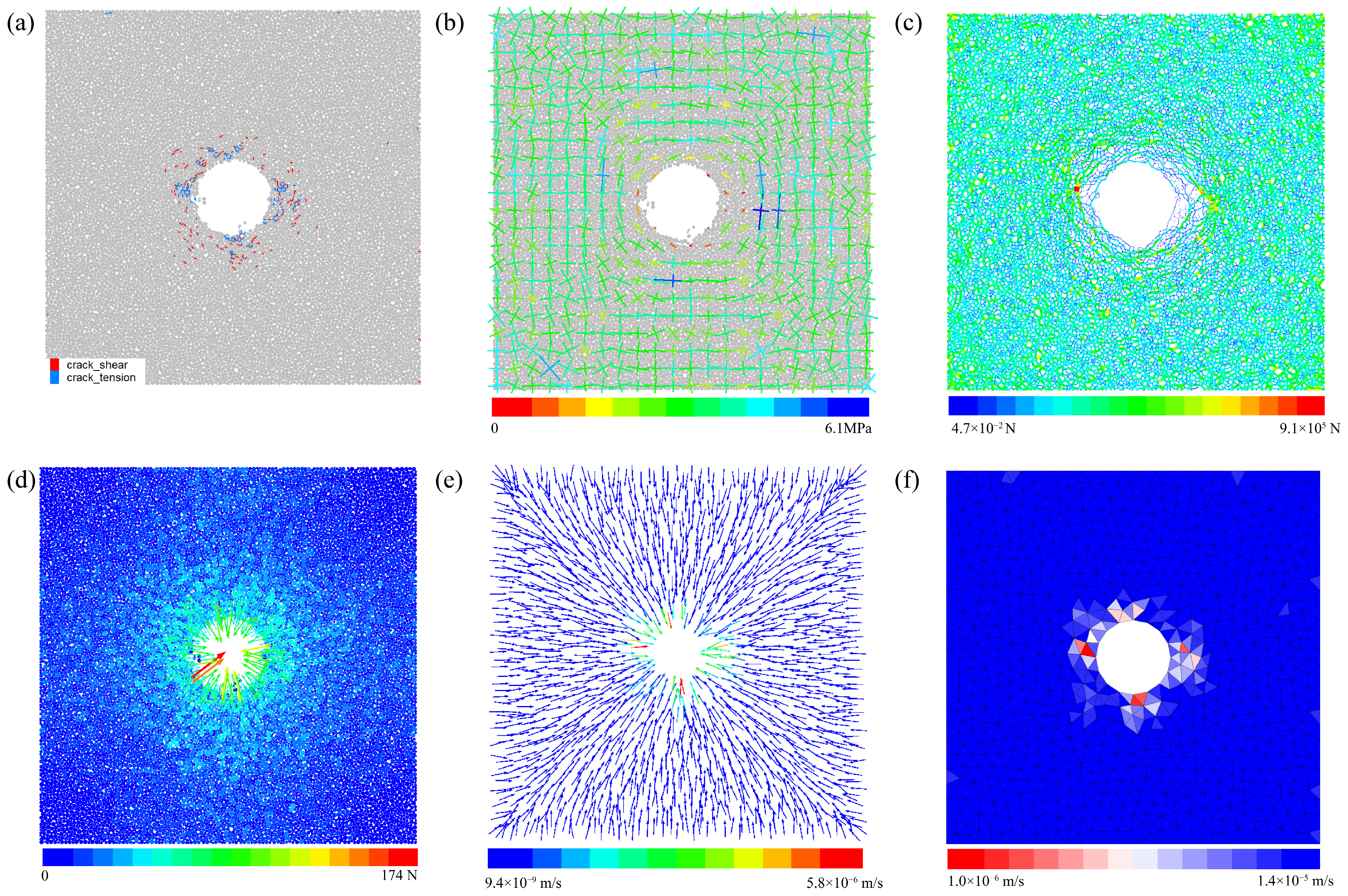
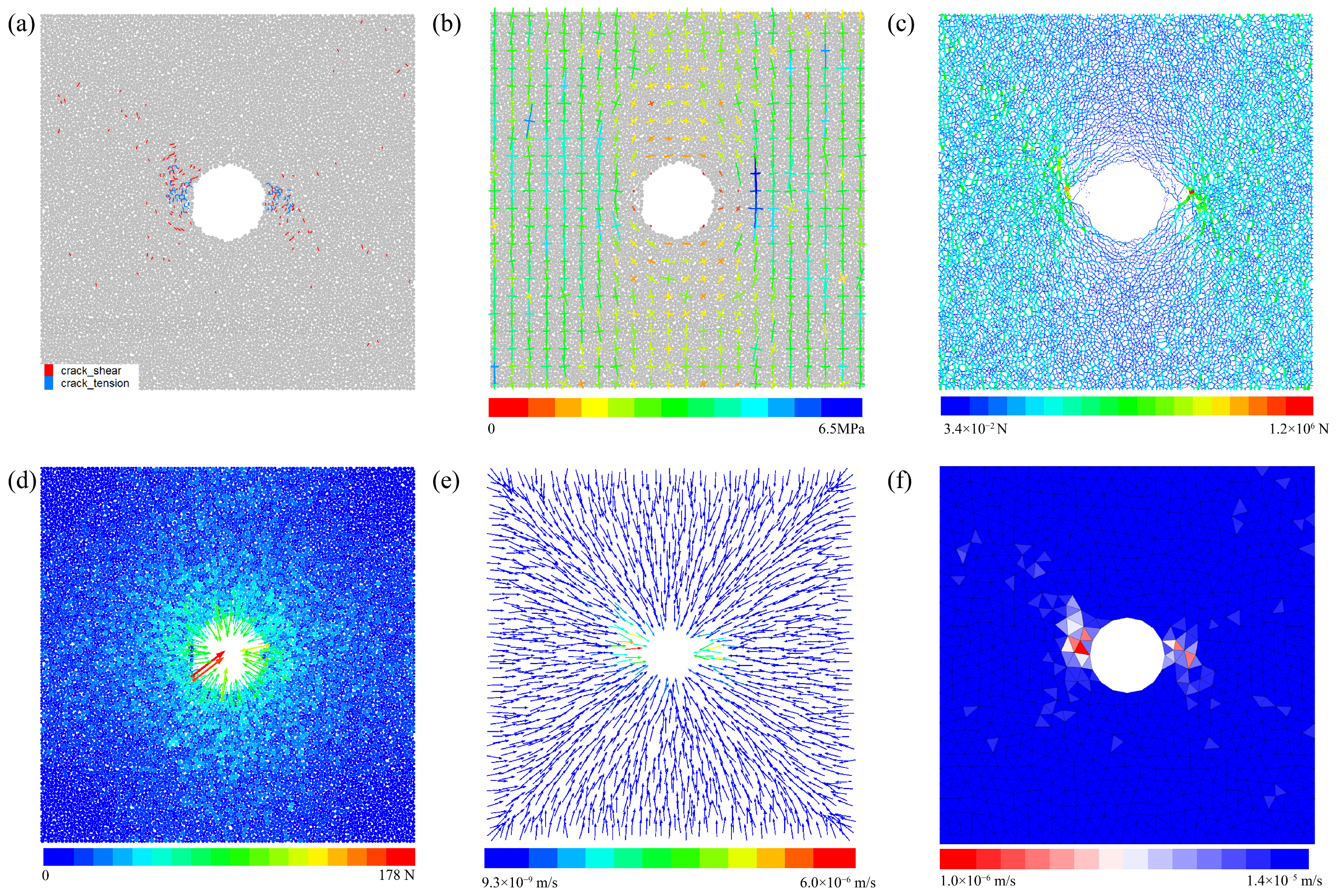
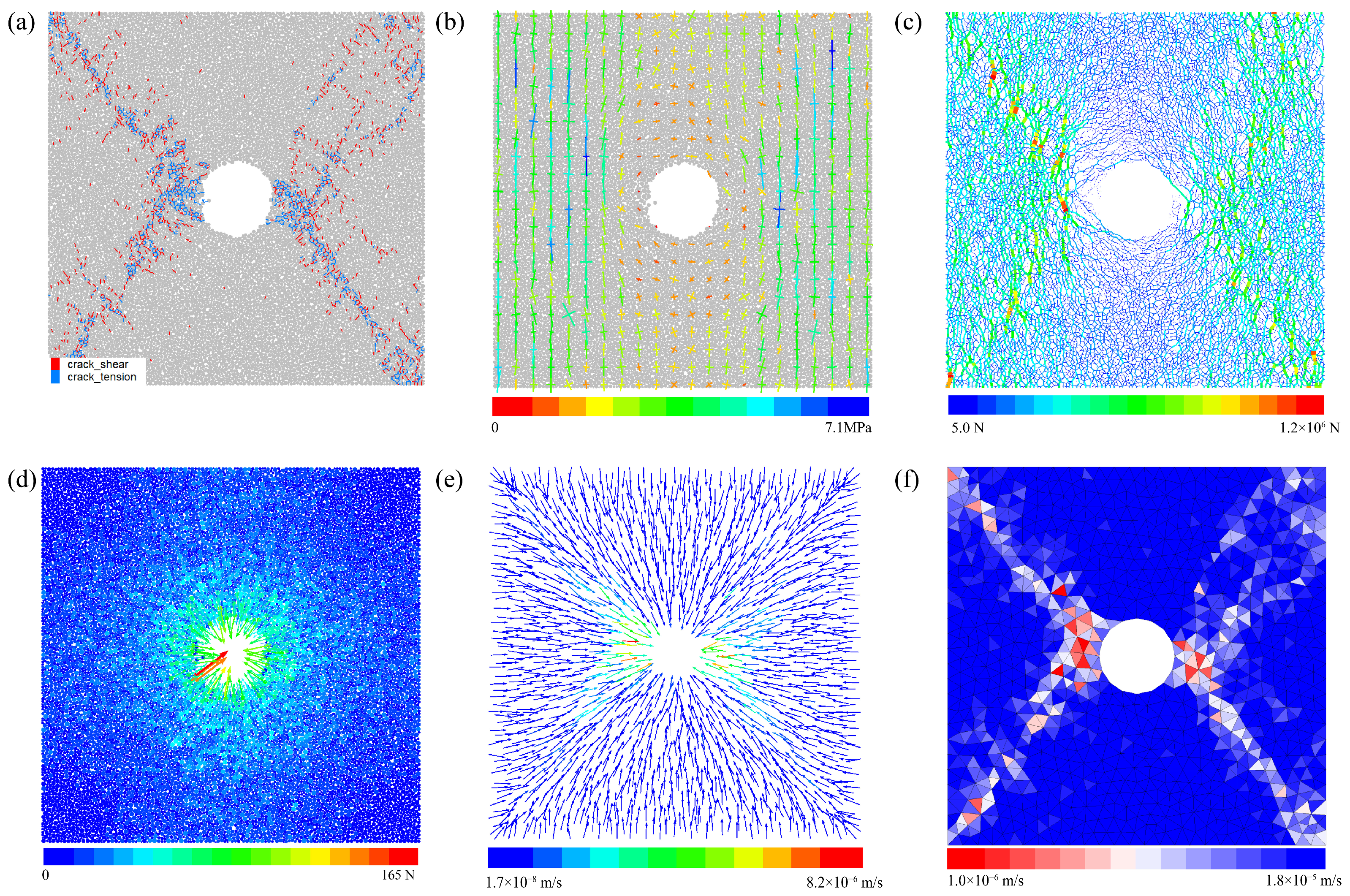
Under the coupled damage–seepage conditions, we conducted numerical simulations for three in situ stress scenarios: vertical and horizontal stresses of 3 MPa–3 MPa, 3 MPa–1.5 MPa, and 3 MPa–1 MPa, respectively. The results are presented in Figure 8, Figure 9 and Figure 10. For each scenario, subfigures (a)–(f) illustrate, in sequence, the fracture (damage) distribution, stress tensor cross (“stress cross”), force chain structure, seepage force distribution, seepage velocity field, and evolution of permeability, providing a systematic characterization of the coupled mechanical and seepage responses of the surrounding rock during excavation.
Overall, compared with the reference cases without considering seepage, although local differences exist in the initiation locations and detailed distributions of fractures due to the randomness of particle assembly and contact networks in the DEM modeling, the macroscopic fracture propagation patterns, force chain reorganization, and principal stress distribution remain essentially consistent between the two types of scenarios. This indicates that, under the current simulation conditions, introducing a seepage field does not fundamentally alter the primary mechanical response mode of the surrounding rock under excavation-induced unloading.
A comparative analysis of different stress ratio scenarios reveals a clear correspondence between the spatial evolution of microfractures (or damage) and permeability. In the 3 MPa–3 MPa scenario, fractures mainly develop in the sidewall regions and the mid-sections of the crown and invert, with permeability significantly increasing in these areas, forming an approximately “+”-shaped high-permeability zone. When the horizontal stress is reduced to 1.5 MPa (3 MPa–1.5 MPa scenario), damage is concentrated in the sidewall regions, and the enhanced permeability zones correspondingly follow the sidewalls, presenting a distinct “V”-shaped pattern. In the 3 MPa–1 MPa scenario, the stress anisotropy of the surrounding rock further increases, fractures extend at high angles (about 60°), and the high-permeability zones exhibit an intersecting “X”-shaped distribution. This evolution clearly demonstrates that the spatially concentrated distribution of fractures or damage is the primary factor controlling the significant increase in permeability.
As permeability within the damage zones increases markedly, seepage velocities inside these zones exhibit abrupt rises, and the spatial pattern of high-velocity seepage aligns closely with the damage distribution. This indicates that, under excavation disturbances, the fracture network formed in the surrounding rock effectively reshapes the seepage pathways, causing fluid to preferentially flow through regions of concentrated damage, thereby amplifying local seepage velocities.
However, a comparative analysis of seepage force distributions across the three scenarios shows that regions of increased seepage force are relatively consistent among different stress ratios and do not exhibit a strong correlation with the spatial distribution of fracture density or permeability. This suggests that, under the steady-state seepage framework adopted in this study, the spatial distribution of seepage forces is primarily controlled by the hydraulic head gradient, and the local enhancement of permeability contributes only marginally to the seepage forces themselves. In other words, even though permeability is significantly increased within the damage zones, its amplifying effect on seepage forces remains limited.
In terms of magnitude, seepage forces remain low relative to the initial in situ stress levels, and their influence on stress redistribution and the expansion of excavation-induced damage zones is relatively minor. Therefore, under the current simulation conditions, the mechanical response of the surrounding rock is still primarily dominated by excavation-induced unloading, with seepage exerting only a weak direct influence on damage evolution. It can be inferred that the stress redistribution and fracture propagation induced by excavation govern the morphology of the damage zones, which in turn control the spatial distribution of seepage pathways; by comparison, seepage forces generated under steady-state conditions are insufficient to significantly alter the stress field evolution or the development of damage zones.
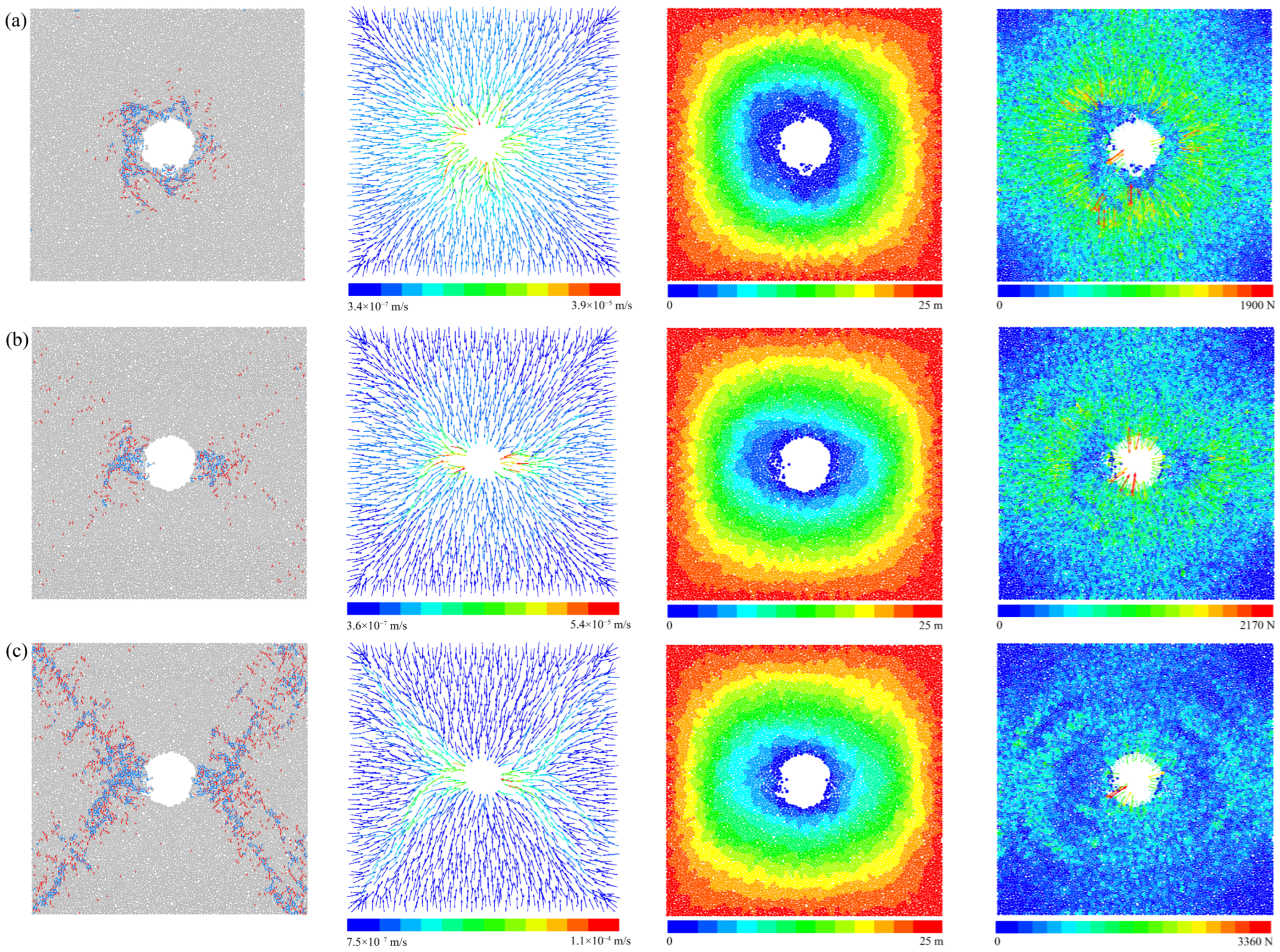
The above numerical results were obtained under low hydraulic head conditions using a steady-state seepage assumption. They primarily reflect the excavation-unloading–dominated stress redistribution and damage evolution of the surrounding rock, as well as the preferential flow paths controlled by the formation of damage zones. Under these conditions, the influence of the seepage field on the mechanical response of the rock is relatively limited, and the damage morphology is largely dictated by stress redistribution. In actual subsea tunnel or water-rich stratum excavation, the surrounding rock is often subject to higher hydraulic heads, and the seepage process exhibits significant temporal evolution. To further investigate the mechanical response under strong coupling of seepage and damage at high hydraulic heads, a 25 m hydraulic head condition was introduced into the aforementioned model, and transient seepage simulations were conducted for comparison, as shown in Figure 11.
The results indicate that, under high-head transient seepage, the spatial extent of excavation-induced damage zones expands significantly, demonstrating that the dynamic evolution of pore water pressure has a pronounced amplifying effect on rock stability. Notably, in the scenario with a vertical stress of 3 MPa and a horizontal stress of 1.5 MPa, the damage pattern evolves from a “V”-shaped distribution under steady-state conditions to an “X”-shaped distribution, reflecting significant changes in fracture propagation paths under the combined effects of strong stress anisotropy and high hydraulic head. Meanwhile, seepage velocities under high-head transient conditions increase markedly, and the spatial distribution of high-velocity regions aligns more closely with the damage zones. This indicates that the fracture network formed under transient conditions not only enhances local permeability but also continuously reorganizes fluid pathways, causing preferential rapid flow through regions of concentrated damage, thereby reinforcing the positive feedback mechanism between seepage and damage.
It is noteworthy that, unlike under steady-state low-head conditions where seepage forces are mainly concentrated near the tunnel boundary, in high-head transient scenarios, the high-value seepage force zones are no longer confined to the excavation contour but shift significantly toward the edges of the damage zones, showing consistent distribution patterns across different stress ratios. This suggests that during transient seepage, the spatial distribution of seepage forces is controlled not only by the hydraulic head gradient itself but also by the temporal evolution of the gradient. Mechanistically, the significantly increased permeability within the damage zones allows fluid to flow rapidly, flattening local hydraulic head gradients in a short time. Conversely, in the transition zone between damage zones and relatively intact rock, abrupt changes in permeability can locally amplify the head gradient during the transient process, generating concentrated seepage force regions at the edges of damage zones. These results reveal a more complex spatial correspondence between seepage forces and damage distribution under transient conditions.
Overall, under high-head transient seepage conditions, seepage no longer merely passively responds to the evolution of rock damage; through dynamic pore pressure diffusion and redistribution of seepage forces, it significantly influences stress field evolution and damage propagation. Compared with steady-state low-head conditions, high-head transient seepage markedly strengthens the seepage–damage coupling effect, giving rise to more pronounced time-dependent behaviors and localized instability tendencies in the surrounding rock.

3.4. Mechanism of Support Timing

To simulate the effect of active support, a constant radial force was applied to particles on the tunnel surface, and an internal hydraulic head monitoring point was established at coordinates (3, 5), located exactly one tunnel radius away from the excavation contour. Although simplifying actual structural behaviors, this constant radial force phenomenologically represents yielding support systems (e.g., constant-resistance cables) that provide steady working resistance. This idealization allows us to strictly isolate the fundamental role of support timing within the complex stress–damage–seepage coupling process. This internal node is designed to capture the transient head redistribution caused by localized permeability variations, effectively quantifying how different support timings prevent severe permeability jumps and mitigate water inrush risks.
The aforementioned computational analysis reveals the significant impact of coupled seepage–excavation interaction on surrounding rock stability: the superposition of seepage forces and stress concentration induced by excavation can exacerbate the deterioration of the mechanical properties of the surrounding rock, while enhancing the connectivity and flow rate of seepage channels. The selection of support timing essentially involves seeking a dynamic balance between “allowing necessary deformation release” and “suppressing unstable failure”, which is heavily dependent on the mechanical role and active response of the support system [43]. Given the pronounced spatiotemporal dynamics of seepage forces, they impose more sensitive requirements on support timing.
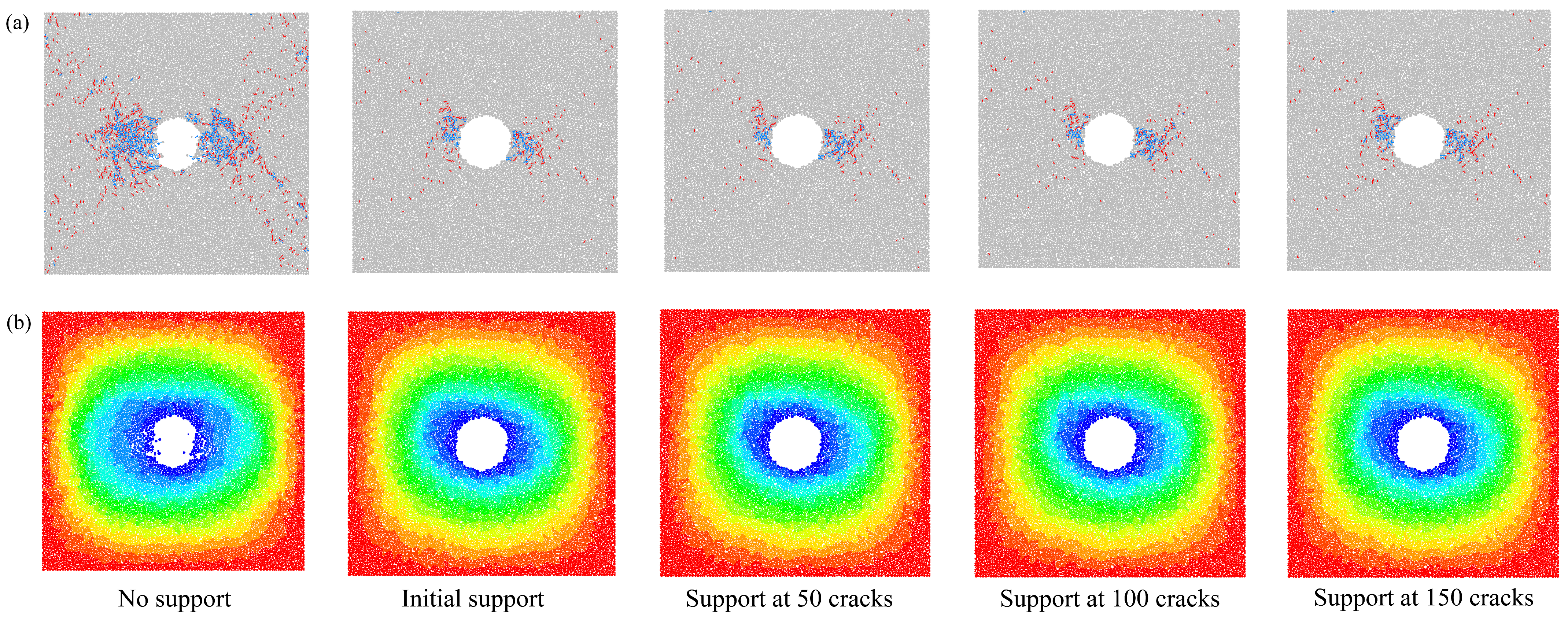
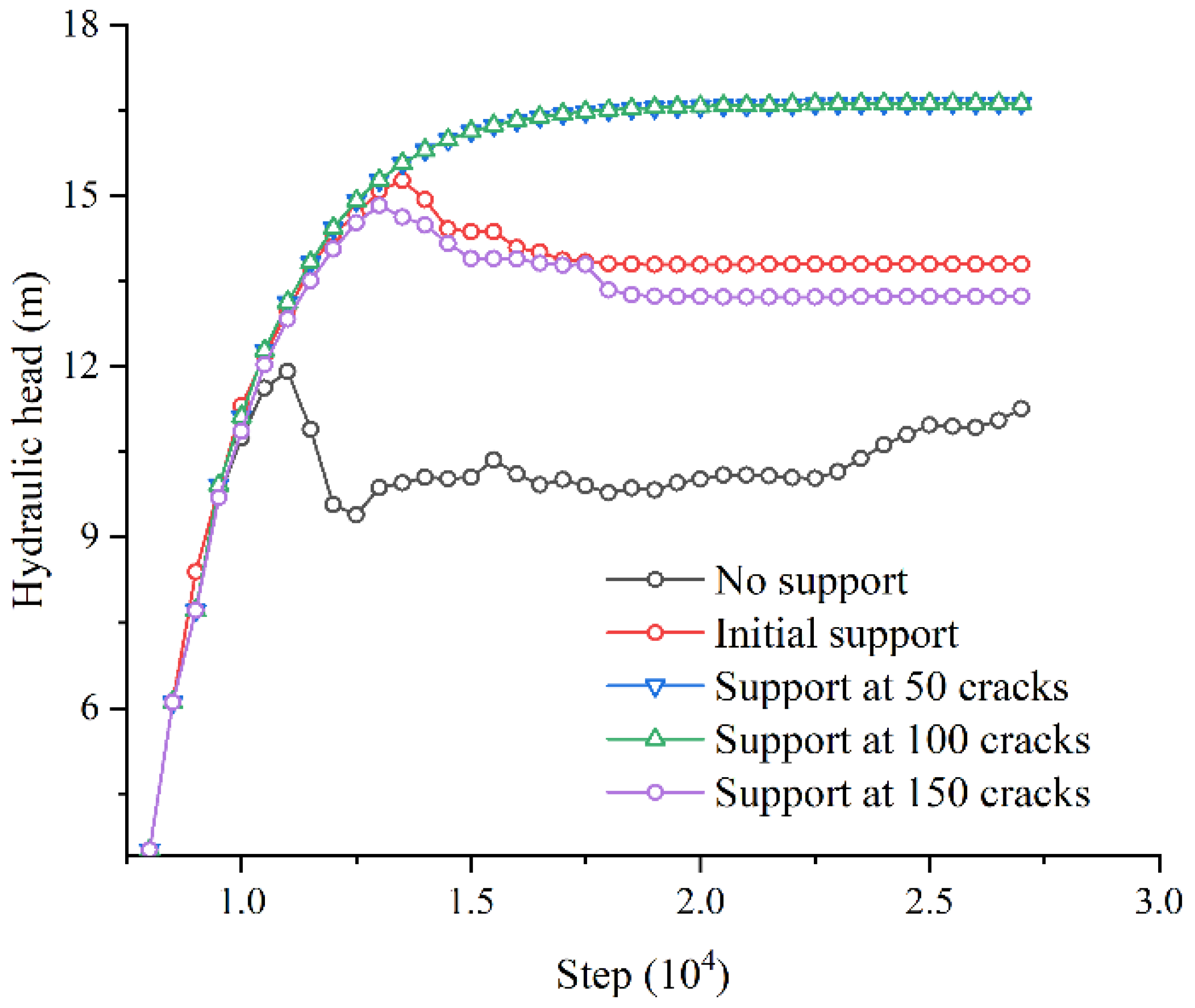
Accordingly, this study investigates the influence of different support timings (corresponding to microcrack initiation numbers of 0, 50, 100, and 150) on surrounding rock stability under stress–seepage–damage coupling via numerical simulations. To simulate the effect of active support, a constant radial force was applied to particles on the tunnel surface, and a head monitoring point was established at coordinates (3, 5). Figure 12 illustrates the variation in the hydraulic head at the monitoring point with calculation steps. The results indicate that support timing significantly influences the head evolution at this point. A lower head value in the later stages suggests a larger excavation damage zone, potentially encompassing the monitoring point.
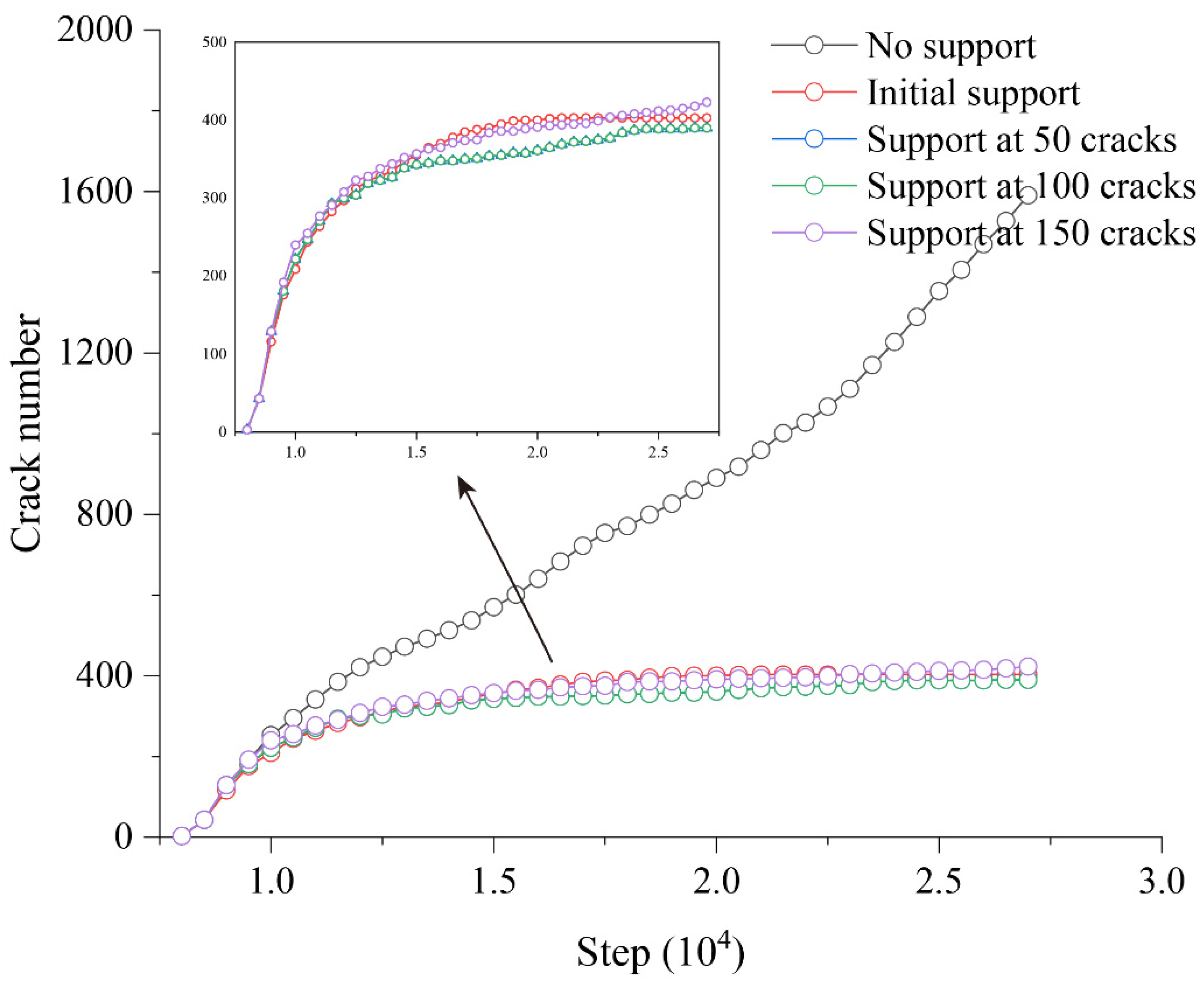
All support schemes exhibited an initial linear increase in hydraulic head, as shown in Figure 13. After approximately 7000 calculation steps, the rate of head increase slowed. Crack evolution diagrams show a concurrent deceleration in crack propagation rates for all schemes after this stage, indicating that head changes during this phase were primarily dominated by excavation unloading. In the unsupported case, a rapid drop in head occurred after about 11,000 steps (see Figure 14), directly resulting from the rapid expansion of the damage zone and crack propagation reaching the monitoring point.
The two schemes involving support installation after the initiation of 50 and 100 microcracks demonstrated nearly identical crack development processes and head evolution curves, resulting in the least damage to the surrounding rock among all schemes. In contrast, the scheme with immediate support after excavation (0 cracks) initially showed less damage than the former two but ultimately exhibited greater damage in the later stages. This suggests that immediate support following excavation is not superior to support implemented after some deformation has occurred in the surrounding rock.
Under transient seepage conditions, the seepage forces acting on the surrounding rock possess time-dependency and spatial heterogeneity. Their impact on excavation stability depends not only on their magnitude but, more critically, on the temporal synchronization between their application and the processes of damage evolution and stress redistribution in the surrounding rock. Therefore, the key to effective support lies not in eliminating seepage forces entirely, but in selecting the optimal timing to prevent unfavorable mechanical superposition at critical locations during the most vulnerable stages of the surrounding rock structure.
The initiation and propagation of excavation-induced damage instantaneously alter the permeability coefficient of the rock mass, triggering head redistribution. This, in turn, modifies the hydraulic gradient, influences the magnitude and distribution of seepage forces, and provides further feedback on surrounding rock stability. The specific timing and spatial location of this coupled process directly determine the required support pressure and the optimal support timing. Premature Support (Immediately after excavation): Damage in the surrounding rock is not yet developed at this stage. Following fluid seepage-induced head redistribution, areas of high hydraulic gradient concentrate near the tunnel periphery. The seepage forces here may exceed the tensile strength of the surrounding rock, inducing new damage and promoting the extension of the damage zone inward. Delayed Support (Long after excavation): By this time, stress redistribution is largely complete, a preliminary damage zone has formed, and water inflow increases. The superposition of seepage forces at the leading edge of the existing damage zone and areas of stress concentration easily triggers shear failure, driving further extension of the damage zone and exacerbating water inflow, forming a vicious cycle of positive feedback between seepage and damage. Optimal Support Timing (After partial damage and initial deformation of the surrounding rock): At this stage, due to faster seepage within the already damage zone, the region of high seepage force shifts deeper into the surrounding rock, away from the tunnel periphery. This effectively avoids the formation of detrimental tensile stress states at the tunnel surface due to high seepage forces. The final extent of the damage zone is smaller than in the case of premature support. Furthermore, implementing grouting reinforcement within the damage zone at this stage is more conducive to the long-term stability of the surrounding rock.

4. Discussion

The CFD-DEM framework proposed in this study elucidates the complex Stress–Damage–Seepage (SDS) coupling mechanisms and highlights the critical role of support timing. However, to bridge the gap between this fundamental numerical investigation and practical engineering applications, it is essential to discuss the practical implications of the chosen evaluation metrics and the inherent limitations of the 2D conceptualization.

4.1. Practical Implications of Microcrack-Based Support Timing

It should be noted that, in this numerical study, the number of initiated microcracks is utilized as a quantitative proxy to define and compare different support timings. While individual microcracks cannot be visually counted during field operations, this metric shares a robust physical correlation with measurable engineering parameters used in real-world tunnel monitoring.
First, the accumulation of microcracks macroscopically manifests as the deterioration and displacement of the surrounding rock, which can be directly correlated with conventional convergence displacement or settlement rates measured on-site. Furthermore, within the discrete element method framework, the initiation of a microcrack corresponds to a sudden release of localized strain energy. This physical process fundamentally mirrors the generation of elastic waves captured by acoustic emission (AE) or microseismic (MS) monitoring systems in the field. While convergence measurements effectively capture macroscopic structural behavior, MS monitoring offers complementary, real-time early-warning signals regarding internal surrounding rock degradation before significant macroscopic deformation occurs. Therefore, by establishing empirical correlations between these numerical microcrack thresholds and field MS event counts, the theoretical support timing strategies evaluated in this framework can be translated into practical, data-driven guidelines for on-site support operations.

4.2. Limitations and 3D Extrapolation

While the proposed 2D CFD-DEM framework effectively captures the fundamental mechanisms of cross-scale fluid–solid interaction, it inherently simplifies the three-dimensional complexities of real-world subsea tunnel excavation. Specifically, the 2D plane-strain assumption does not account for the progressive advancement of the tunnel face and the associated 3D spatial arching effects. In actual construction, continuous face advancement makes immediate support installation at the exact excavation face impractical.
However, based on the classical Longitudinal Deformation Profile (LDP) theory, the 3D spatial constraint of the excavation face gradually diminishes as the face advances. At a certain distance behind the face—typically 2 to 3 times the tunnel diameter—the radial deformation of the surrounding rock stabilizes, and the mechanical state transitions into a plane-strain condition. The current 2D model robustly simulates the cross-sectional ultimate responses under this specific plane-strain state. By evaluating the support timing mechanism within this plane, the findings provide a foundational understanding of rock–support–seepage interaction. In practical 3D applications, these 2D recommendations can be reliably extrapolated to determine the optimal spatial distance for support installation behind the face by correlating the critical damage stages with longitudinal displacement, thereby guiding the longitudinal support design in subsea tunnel engineering.

5. Conclusions

A CFD–DEM fluid–solid coupling framework was established to investigate the SDS interactions during subsea tunnel excavation, with a particular focus on the mechanistic role of support timing in regulating surrounding rock stability. The main conclusions are as follows:
Distinct SDS coupling regimes were identified under steady-state and transient seepage conditions. Under low-head steady seepage, the seepage field plays a secondary and largely passive role in the mechanical response of the surrounding rock. Damage evolution is dominated by excavation-induced stress redistribution, and seepage forces remain concentrated near the tunnel free surface with limited influence on damage propagation. In contrast, high-head transient seepage fundamentally alters the coupling mechanism. Rapid pore-pressure diffusion and redistribution markedly expand the damage zone and induce a systematic migration of peak seepage forces toward the damage-zone boundary. This spatial reconfiguration arises from the abrupt permeability increase within damaged rock, which locally flattens hydraulic gradients while intensifying gradients in the surrounding transition zone. The resulting enhancement of seepage–damage positive feedback gives rise to pronounced temporal instability and nonlinearity in the surrounding rock response.
The simulations further demonstrate that support timing constitutes a primary control parameter within the SDS-coupled system. The effectiveness of support is governed by its temporal alignment with seepage-force evolution, damage development, and stress redistribution. Premature support constrains stress release and concentrates high seepage forces on relatively intact rock, promoting tensile-dominated failure. Delayed support, by contrast, allows the superposition of seepage-force maxima and stress concentration at the damage front, intensifying shear failure and accelerating progressive instability accompanied by water inflow. An optimal timely support strategy accommodates limited stress release and controlled damage adjustment, while exploiting the internal drainage capacity of the incipient damage zone to shift unfavorable seepage-force concentrations toward deeper surrounding rock. This mechanism provides a rational balance between deformation accommodation and instability suppression, and establishes favorable hydraulic and mechanical conditions for subsequent grouting reinforcement.
The study highlights the distinctive capability of the CFD–DEM approach in resolving the full discontinuous and catastrophic excavation process. The coupled framework captures, in a physically consistent manner, the chain of processes from particle-scale damage initiation and fracture-network emergence to preferential seepage-path development and fluid-driven particle migration. This offers a robust bottom-up framework for interpreting complex failure modes such as sudden water inrush and mud gushing in subsea tunnels.
Overall, this work advances the mechanistic understanding of strong SDS coupling in subsea tunnels and underscores that, in high-pressure water-bearing ground, excavation stability cannot be reliably assessed without explicitly accounting for transient seepage dynamics. Support timing should therefore be treated as a core dynamic design variable and incorporated into coupled hydro-mechanical analyses to enable proactive stability control and risk mitigation in subsea tunneling.

Author Contributions

X.C.: Conceptualization, Methodology, Project administration, Resources, Supervision. Y.L. (Yang Li): Validation, Writing—reviewing and editing. H.C.: Data curation. Y.F.: Formal analysis, Investigation, Software, Visualization, Writing—original draft. Q.Y.: Investigation. Y.L. (Yufeng Li): Resources. G.X.: Resources, and G.Y.: Funding acquisition. All authors have read and agreed to the published version of the manuscript.

Funding

The authors gratefully acknowledge financial support from the National Natural Science Foundation of China (52171264).

Institutional Review Board Statement

Not applicable.

Informed Consent Statement

Not applicable.

Data Availability Statement

The data presented in this study are available on request from the corresponding author.

Conflicts of Interest

Author Xin Chen, Hong Chen, Qiang Yue and Yufeng Li were employed by the China Construction Fifth Division South China Company. The remaining authors declare that the research was conducted in the absence of any commercial or financial relationships that could be construed as a potential conflict of interest.

References

  1. Shi, P.; Zhang, D.; Pan, J.; Liu, W. Geological Investigation and Tunnel Excavation Aspects of the Weakness Zones of Xiang’an Subsea Tunnels in China. Rock Mech. Rock Eng. 2016, 49, 4853–4867. [Google Scholar] [CrossRef]
  2. Zhao, W.; Gao, H.; Chen, W.; Xie, P. Analytical study on seismic response of subsea tunnels in a multi-layered seabed subjected to P- and SV-waves. Tunn. Undergr. Space Technol. 2023, 134, 105015. [Google Scholar] [CrossRef]
  3. Qu, C.; Xue, Y.; Li, G.; Su, M.; Zhou, B. A new method for subsea tunnel site selection based on environmental bearing capacity. Environ. Sci. Pollut. Res. 2023, 30, 26559–26579. [Google Scholar] [CrossRef] [PubMed]
  4. Shafiee, A.H.; Neamani, A.R.; Eskandarinejad, A.; Hosseini, R.; Gholami, A. Undrained stability of wide rectangular subsea tunnels using finite element limit analysis and multivariate adaptive regression splines. Earth Sci. Inform. 2025, 18, 60. [Google Scholar]
  5. Zhang, L.; Zhao, D.; Wu, J.; Yang, W.; Wang, W.; Xin, D. Prediction of water inflow in Tsingtao subsea tunnel based on the superposition principle. Tunn. Undergr. Space Technol. 2020, 97, 103243. [Google Scholar] [CrossRef]
  6. Demina, T.; Zhumabekova, A.; Medeubayev, N.; Meiram, D.; Sherubayev, S.; Abdrasheva, Z.; Gabitova, A. Simulation of the enclosing rock displacements around the development mine workings. Min. Miner. Depos. 2024, 18, 153–161. [Google Scholar] [CrossRef]
  7. Li, Z.; Liu, Q.; Liu, S.; Liu, X.; Zhang, Y.; Jia, S.; Song, G.; Zhao, Y. Dynamic Stability Analysis of Subsea Tunnel Crossing Active Fault Zone: A Case Study. J. Mar. Sci. Eng. 2024, 12, 839. [Google Scholar] [CrossRef]
  8. Sun, Z.; Zhang, D.; Fang, Q. Determination Method of Reasonable Reinforcement Parameters for Subsea Tunnels Considering Ground Reinforcement and Seepage Effect. Appl. Sci. 2019, 9, 3607. [Google Scholar] [CrossRef]
  9. Xu, L.-Y.; Xi, J.-P.; Jiang, J.-W.; Cai, F.; Li, Y.-Y.; Chen, G.-X. Effect of wave height on seismic fragility of subsea tunnels in sandy seabed. Ocean Eng. 2025, 331, 121359. [Google Scholar] [CrossRef]
  10. Yu, Y.; Jin, B. Research on Seepage Field and Stress Field of Deep-Buried Subsea Tunnel with Anisotropic Permeability of the Surrounding Rock. J. Mar. Sci. Eng. 2025, 13, 825. [Google Scholar] [CrossRef]
  11. Zhang, D.; Zhou, Z.; Gao, C.; Bai, S.; Bu, F.; Chen, X.; Chen, J. Stability investigation of tunnel surrounding rock by coupling peridynamics, finite element method, and finite volume method. Phys. Fluids 2025, 37, 013614. [Google Scholar] [CrossRef]
  12. He, X.; Zhou, X.; Xu, Y.; Ma, W.; Wu, T. Study on the Influence of Nonlinear Seepage and Grouting Reinforcement on Surrounding Rock in Subsea Tunnel. J. Coast. Res. 2020, 111, 162–167. [Google Scholar] [CrossRef]
  13. Shekari, M.R. A coupled numerical approach to simulate the effect of earthquake frequency content on seismic behavior of submarine tunnel. Mar. Struct. 2021, 75, 102848. [Google Scholar] [CrossRef]
  14. Yan, Q.; Cui, L.; Dong, Y.; Sheng, Q.; Xie, B. A numerical solution of coupling hydro-mechanical behavior for subsea tunnels in strain-softening rock masses: Theory and case study. Eur. J. Environ. Civ. Eng. 2025, 30, 1–28. [Google Scholar] [CrossRef]
  15. Du, X.; Ren, Q. Sensitivity study on the effect of the seepage of underground hydraulic tunnel. In Proceedings of the International Conference on Heterogeneous Material Mechanics (ICHMM), Huangshan, China, 3–8 June 2008. [Google Scholar]
  16. Wei, L.; Zou, J.; An, W. Solution for a circular tunnel in strain-softening rock with seepage forces. Geomech. Eng. 2020, 22, 553–564. [Google Scholar]
  17. El Tani, M.; Kamali, A.; Gholami, M.A. Analytic Assessment of the Water Table Drawdown, Seepage, and Back Pressure at Rudbar PSPP. Rock Mech. Rock Eng. 2019, 52, 2227–2243. [Google Scholar] [CrossRef]
  18. Vazaios, I.; Diederichs, M.S.; Vlachopoulos, N. Assessment of strain bursting in deep tunnelling by using the finite-discrete element method. J. Rock Mech. Geotech. Eng. 2019, 11, 12–37. [Google Scholar] [CrossRef]
  19. Li, L.; Tu, W.; Zhou, Z.; Shi, S.; Zhang, M.; Chen, Y. Dynamic Unloading Instability Mechanism of Underground Cavern Based on Seepage-Damage Coupling. KSCE J. Civ. Eng. 2020, 24, 1620–1631. [Google Scholar] [CrossRef]
  20. Li, T.; Peng, F.; Chen, C.; Ma, C.; Li, Y.; Wang, Y.; Li, Y. Investigating the Creep Damage and Permeability Evolution Mechanism of Phyllite Considering Non-Darcy’s Flow. Rock Mech. Rock Eng. 2024, 57, 8483–8498. [Google Scholar] [CrossRef]
  21. Wang, G.; Luo, J.; Zhang, Z.; Song, Y.; Yi, X. Research on Non-Darcian dynamic prediction model for tunnel water inflow driven by stress-damage-seepage coupling. Tunn. Undergr. Space Technol. 2025, 166, 106972. [Google Scholar] [CrossRef]
  22. Zareifard, M.R.; Shekari, M.R. Comprehensive solutions for underwater tunnels in rock masses with different GSI values considering blast-induced damage zone and seepage forces. Appl. Math. Model. 2021, 96, 236–268. [Google Scholar] [CrossRef]
  23. Xue, T.; Zhang, Q.; Duan, K.; Wang, P.; Lin, H.; Fan, Q.; Liu, L. Geo-mechanical model test on the water inrush induced by zonal disintegration of deep tunnel under hydro-mechanical coupling. Int. J. Rock Mech. Min. Sci. Géoméch. Abstr. 2022, 160, 105278. [Google Scholar] [CrossRef]
  24. Yang, T.; Selvadurai, A.P.S.; Wang, S. The influence of seepage characteristics on the reliability of a tunnel roof under dynamic disturbances. Géoméch. Geophys. Geo-Energy Geo-Resour. 2021, 7, 92. [Google Scholar] [CrossRef]
  25. Yang, T.; Zhu, W.; Yu, Q.; Liu, H. The role of pore pressure during hydraulic fracturing and implications for groundwater outbursts in mining and tunnelling. Hydrogeol. J. 2011, 19, 995–1008. [Google Scholar] [CrossRef]
  26. Lisjak, A.; Grasselli, G. A review of discrete modeling techniques for fracturing processes in discontinuous rock masses. J. Rock Mech. Geotech. Eng. 2014, 6, 301–314. [Google Scholar] [CrossRef]
  27. Kim, N.Y.; Park, D.H.; Jung, H.S.; Kim, M.I. Deformation characteristics of tunnel bottom after construction under geological conditions of long-term de-formation. Geomech. Eng. 2020, 21, 171–178. [Google Scholar]
  28. Coli, N.; Pranzini, G.; Alfi, A.; Boerio, V. Evaluation of rock-mass permeability tensor and prediction of tunnel inflows by means of geostructural surveys and finite element seepage analysis. Eng. Geol. 2008, 101, 174–184. [Google Scholar] [CrossRef]
  29. Zhang, D.-M.; Gao, C.-P.; Yin, Z.-Y. CFD-DEM modeling of seepage erosion around shield tunnels. Tunn. Undergr. Space Technol. 2019, 83, 60–72. [Google Scholar] [CrossRef]
  30. Catalano, E.; Chareyre, B.; Barthélémy, E. Pore-scale modeling of fluid-particles interaction and emerging poromechanical effects. Int. J. Numer. Anal. Methods Géoméch. 2014, 38, 51–71. [Google Scholar] [CrossRef]
  31. Lominé, F.; Scholtès, L.; Sibille, L.; Poullain, P. Modeling of fluid–solid interaction in granular media with coupled lattice Boltzmann/discrete element methods: Application to piping erosion. Int. J. Numer. Anal. Methods Géoméch. 2013, 37, 577–596. [Google Scholar] [CrossRef]
  32. Zárate, F.; Gonzalez, J.M.; Miquel, J.; Löhner, R.; Oñate, E. A coupled fluid FEM-DEM technique for predicting blasting operations in tunnels. Undergr. Space 2018, 3, 310–316. [Google Scholar] [CrossRef]
  33. Bhattacharya, P.; Dutta, P. Stability of rectangular tunnel in anisotropic cohesionless soil under steady-state groundwater flow. Eur. J. Environ. Civ. Eng. 2023, 27, 1596–1616. [Google Scholar] [CrossRef]
  34. Lee, I.-M.; Nam, S.-W.; Ahn, J.-H. Effect of seepage forces on tunnel face stability. Can. Geotech. J. 2003, 40, 342–350. [Google Scholar] [CrossRef]
  35. Shin, Y.-J.; Kim, B.-M.; Shin, J.-H.; Lee, I.-M. The ground reaction curve of underwater tunnels considering seepage forces. Tunn. Undergr. Space Technol. 2010, 25, 315–324. [Google Scholar] [CrossRef]
  36. Zhang, S.; Cheng, X.; Qi, L.; Zhou, X. Face stability analysis of large diameter shield tunnel in soft clay considering high water pressure seepage. Ocean Eng. 2022, 253, 111283. [Google Scholar] [CrossRef]
  37. Ali, S.; Nadeem, S.; Akkurt, N.; Ghazwani, H.A.; Eldin, S.M. Numerical simulation for peristalsis of Quemada fluid: A dynamic mesh approach. J. Adv. Res. 2023, 54, 77–88. [Google Scholar] [CrossRef]
  38. Damjanac, B.; Cundall, P. Application of distinct element methods to simulation of hydraulic fracturing in naturally fractured reservoirs. Comput. Geotech. 2016, 71, 283–294. [Google Scholar] [CrossRef]
  39. Shimizu, Y.; Cundall, P.A. Three-dimensional DEM simulations of bulk handling by screw conveyors. J. Eng. Mech. 2001, 127, 864–872. [Google Scholar] [CrossRef]
  40. Carrier, W. Goodbye, Hazen; Hello, Kozeny-Carman. J. Geotech. Geoenviron. Eng. 2003, 129, 1054–1056. [Google Scholar] [CrossRef]
  41. Ye, P.; Li, B.; Ren, C.; Song, H.; Fu, J.; Wu, X. Investigation on damage-permeability model of dual-porosity coal under thermal-mechanical coupling effect. Gas Sci. Eng. 2024, 123, 205229. [Google Scholar]
  42. Yang, X.; Yang, Z.; Hou, G.; Jiang, Y.; Shao, X.; Qi, W. Evaluation of the Active Limit Support Pressure for Shield Tunnel Face in Clay–Sand Interface Mixed Ground. Int. J. Géoméch. 2022, 22, 04022095. [Google Scholar] [CrossRef]
  43. Krukovskyi, O.; Krukovska, V.; Bulich, Y.; Demchenko, S.; Konstantynova, I. Rock bolt and frame support of mine workings with a compound cross-section: Collective refuge chambers for mine workers. Min. Miner. Depos. 2024, 18, 28–37. [Google Scholar] [CrossRef]
Figure 1. Flowchart of the bidirectional CFD-DEM coupling framework, illustrating the computational sequence and data exchange.
Eng 07 00144 g001
Figure 2. Schematic of the 2D computational model, illustrating the initial in situ stress boundaries and hydraulic head conditions for tunnel excavation.
Eng 07 00144 g002
Figure 3. Comparison of the hydraulic head distribution between the analytical solution and the CFD-DEM numerical simulation.
Eng 07 00144 g003
Figure 4. Configuration of the 2D coupled numerical model: (a) DEM particle assembly; (b) CFD unstructured mesh; and (c) initial hydraulic head distribution.
Eng 07 00144 g004
Figure 5. Damage zone and stress field of tunnel excavation when horizontal stress: vertical stress = 1:1.
Eng 07 00144 g005
Figure 6. Damage zone and stress field of tunnel excavation when horizontal stress: vertical stress = 1:2.
Eng 07 00144 g006
Figure 7. Damage zone and stress field of tunnel excavation when horizontal stress: vertical stress = 1:3.
Eng 07 00144 g007
Figure 8. Surrounding rock response under SDS coupling when horizontal stress: vertical stress = 1:1. (a) Excavation damage zone, (b) Stress tensor, (c) Force chains, (d) Seepage force, (e) Seepage velocity vectors, and (f) Permeability coefficient.
Eng 07 00144 g008
Figure 9. Surrounding rock response under SDS coupling when horizontal stress: vertical stress = 1:2. (a) Excavation damage zone, (b) Stress tensor, (c) Force chains, (d) Seepage force, (e) Seepage velocity vectors, and (f) Permeability coefficient.
Eng 07 00144 g009
Figure 10. Surrounding rock response under SDS coupling when horizontal stress: vertical stress = 1:3. (a) Excavation damage zone, (b) Stress tensor, (c) Force chains, (d) Seepage force, (e) Seepage velocity vectors, and (f) Permeability coefficient.
Eng 07 00144 g010
Figure 11. Distribution of surrounding rock damage zone, seepage velocity, water head, and seepage force under transient SDS coupling conditions. (a) Horizontal stress and vertical stress are 3 and 3 MPa, respectively; (b) Horizontal stress and vertical stress are 3 and 1.5 MPa, respectively; (c) Horizontal stress and vertical stress are 3 and 1 MPa, respectively.
Eng 07 00144 g011
Figure 12. Surrounding rock response under transient SDS coupling conditions at different support timings. (a) Excavation damage zone and (b) Water head distribution.
Eng 07 00144 g012
Figure 13. Variation in hydraulic head with calculation steps under five support timings.
Eng 07 00144 g013
Figure 14. Evolution of crack with steps under five support timings.
Eng 07 00144 g014
Table 1. Micro-mechanical parameters of the parallel-bond model used in the DEM simulation.
Density (kg/m3)Particle Diameters (mm)Effective Modulus (GPa)Contact Stiffness RatioParallel-Bond Modulus (GPa)Parallel-Bond Stiffness RatioFriction CoefficientBond Cohesion (MPa)Parallel-Bond Friction Angle (°)Parallel-Bond Tensile Strength (MPa)
20000.3–0.4821.521.50.53406
Disclaimer/Publisher’s Note: The statements, opinions and data contained in all publications are solely those of the individual author(s) and contributor(s) and not of MDPI and/or the editor(s). MDPI and/or the editor(s) disclaim responsibility for any injury to people or property resulting from any ideas, methods, instructions or products referred to in the content.