Article

Depositing Cs-Co3O4 on Ceramic Foam Fosters Industrial N2O Decomposition Catalysis

1
Institute of Environmental Technology, Centre for Energy and Environmental Technologies, VSB-Technical University of Ostrava, 17, Listopadu 2172/15, 70800 Ostrava-Poruba, Czech Republic
2
Faculty of Materials Science and Technology, VSB-Technical University of Ostrava, 17, Listopadu 2172/15, 70800 Ostrava-Poruba, Czech Republic
*
Author to whom correspondence should be addressed.
Submission received: 16 December 2025 / Revised: 6 February 2026 / Accepted: 8 February 2026 / Published: 13 February 2026

Abstract

N2O emissions exacerbate the greenhouse effect, urgently demanding advances in abatement technologies. Catalytic decomposition of N2O over cobalt-based oxides with alkali metal promoters remains challenging because these catalysts are used in pelletized form, limiting their activity to a narrow outer-shell region due to internal diffusion limitations. However, research efforts continue to focus on enhancing Co–alkali metal contact on unsupported powder samples under inert conditions, even though, under industrial conditions, catalysts are exposed to inhibitory components of waste gases and N2O, and the powder form is unsuitable for practical application. This study aims at testing N2O decomposition over catalysts with a Co3O4-Cs active phase supported on a ceramic foam. For this purpose, we characterized these catalysts by H2 temperature-programmed reduction, H2O and NO temperature-programmed desorption, atomic absorption spectroscopy, and X-ray diffraction and assessed their catalytic performance under an inert-gas atmosphere and with O2, water vapor, and NO to simulate industrial conditions. Using a pseudo-homogeneous, one-dimensional model of an ideal plug flow reactor in an isothermal regime, the simulation calculations for a full-scale catalytic reactor for N2O abatement in waste gas from HNO3 production were performed. The Cs2CO3 precursor significantly enhanced catalyst reducibility and electron transferability, increasing N2O decomposition efficiency in inert gas, but its high hygroscopicity decreased resistance to water vapor and NO, overriding its advantages under industrial conditions. Conversely, glycerol-assisted impregnation enhanced catalyst performance regardless of Cs precursor. These foam-supported catalysts offered several other advantages, including lower pressure drop and lower active phase loading with matching catalytic activity. Based on our findings, depositing Cs2CO3 on ceramic foam through glycerol-assisted impregnation may facilitate catalytic N2O decomposition at the industrial level and, therefore, promote environmental sustainability by reducing N2O emissions.

1. Introduction

Exacerbating the greenhouse effect, carbon dioxide (CO2), methane (CH4) and nitrous oxide (N2O) emissions derive from anthropogenic sources, namely (i) energy, (ii) industrial processes and product use, (iii) agriculture, (iv) forestry and other land use, (v) waste, and (vi) other sources, including indirect emissions from atmospheric N deposition [1]. N2O is a major pollutant because a single N2O has approximately the same greenhouse warming potential (GHWP) as 300 carbon dioxide molecules and can persist in the upper atmosphere for over 100 years [2]. Subsequent N2O diffusion into the stratosphere worsens ozone (O3) depletion as nitric oxide (NO) resulting from N2O photolysis and reactions with oxygen perpetuates the O3 destruction cycle [3]. In addition to fossil fuel combustion and industrial production of adipic and nitric acid sources, atmospheric N2O may also derive from natural (ocean, soil, forest, and grassland emissions) [4]. But the alarming increase in N2O shown by tropospheric measurements [3] underscores the contribution of anthropogenic sources, primarily catalytic ammonia oxidation over Pt-Rh gauzes (Ostwald process) during nitric acid production [5,6]. Reducing these emissions [7] requires improving efficiency, developing new low-carbon technologies and implementing renewable energy and abatement strategies [1].
Among such abatement strategies, low-temperature catalytic decomposition of N2O (up to 450 °C) to nitrogen and oxygen offers an attractive solution for decreasing N2O emissions in tail gas from nitric acid production plants. A catalytic reactor for N2O decomposition can be incorporated into existing technologies with a relatively inexpensive and sufficiently active, selective and stable catalyst, resistant to inhibitory components of waste gases and N2O (usually O2, NOx and H2O). Even in contact with these gases [8,9], cobalt-based oxides with alkali metal promoters show high catalytic activity [10,11,12,13,14,15], including pelletized cobalt spinel-based catalysts developed for low-temperature N2O decomposition under pilot plant-scale conditions [16,17,18]. However, in pelletized catalysts, only active sites in a narrow outer-shell surface region are accessible due to internal diffusion limitations, whereas active sites in the core remain unused. Nevertheless, depositing a thin active layer on a supporting material may decrease the number of costly and potentially harmful active components, ensure their effective use in catalysis and increase the mechanical strength. For cobalt oxide catalysts for N2O decomposition (deN2O), various supports have been tested, namely monoliths [8,16,17,18,19], sieves [20,21] and tablets [22,23], albeit mostly with grained samples in a kinetic regime [24,25,26,27,28,29]. More recent studies have explored the potential of a novel structured catalyst—open-cell foam (or sponge) [30,31,32,33,34]; however, there are only a limited number of studies [9,35] in which supported Co-based catalysts are investigated and, at the same time, evaluated under quarter- or semi-industrial reactor conditions, or even directly in industrial-scale reactors.
Reticulated open-cell foam consists of an assembly of three-dimensionally connected solid struts, enclosing cells with irregular shapes, which communicate via open windows. The foam structure can be described by its morphological parameters, namely cell and window diameter, strut diameter and porosity [36], with various strut morphologies, namely cylindrical, triangular and triangular concave [37], depending on porosity. Strut morphology strongly affects the specific surface area and, consequently, the heat and mass transfer and pressure drop of foam structures. Open-cell (ceramic or metal) foams have excellent properties, such as a large external surface area and high mechanical strength and porosity, resulting in a low pressure drop, but applying these structures as catalyst supports requires knowing their specific surface area and pressure drop. Based on these properties, various models have been proposed for specific surface area and pressure drop determination in N2O decomposition [37,38,39,40,41,42].
In our previous studies on N2O decomposition over Cs-modified Co3O4-supported foam catalysts, the systematic study of deposition procedure and active phase composition [43], foam material composition ((i) Al2O3 + SiO2, (ii) ZrO2, (iii) SiO2 + Al2O3 + C-graphite) [44], foam cell size and washcoat composition ((i) MgO, (ii) MnO2, (iii) SiO2, (iv) TiO2) [45], and loading [46] was performed. According to the observations in [44], α-Al2O3-based ceramic foam (chemical composition: Al2O3 + SiO2) was found to be the best support for the active phase, as it ensures an optimal dispersion level of the individual components on the support, leading to changes in the Cs/Co molar ratio and subsequent variations in reducibility, which in turn are associated with the fact that the Cs–Co-based active phase exhibits the highest activity on this foam. It was also found out that repeated impregnation improved Cs/Co3O4 loading on ceramic foam, but only the last layer was utilized in the reaction, while the rest of the active phase remained unused [46]. In addition, Cs/Co3O4 with the highest Co3+/Co2+ molar ratio provided the best activity due to optimal cobalt oxide aggregation and cesium dispersion, regardless of ceramic foam composition [44] and washcoat [45]. However, the optimal amount of cesium in Co3O4 deposited on foam was 2–3 times higher than that in bulk Cs/Co3O4 as Cs species partly dispersed over the bare support [43]. Glycerol-assisted impregnation was shown to overcome these limitations by enhancing the dispersion of Cs and Co species and therefore enhancing the reducibility of the cobalt spinel phase. This effect originates from the dual role of glycerol, which acts as a complexing agent for metal cations during impregnation and as a fuel in the organic-assisted combustion process during calcination. As a result, glycerol suppresses crystallite growth, promotes the formation of smaller and more uniformly distributed Co3O4 nanocrystals, and induces re-faceting of the spinel phase with preferential exposure of (100) planes, which are more resistant to NO and H2O poisoning [42]. Consequently, glycerol-assisted impregnation enhanced both surface coverage by the spinel phase, leaving less space for cesium dispersion on the support without ineffective contact with cobalt, and catalytic activity, thanks to spinel nanocrystal re-faceting and to the increased resistance of (100) planes to gaseous NO/H2O contaminants.
In all of our previous studies, the cesium nitrate precursor was used to promote Co3O4 catalytic activity [43,44,45,46]. A cesium carbonate precursor has been shown to have a positive effect on the catalytic activity of Co3O4 also by Kotarba group [47], but the tests were conducted on unsupported powder samples and under inert conditions. However, under industrial conditions, catalysts used in N2O decomposition come into contact with inhibiting components in waste gases.
In the present study, it is assessed how using a cesium carbonate precursor and Co3O4 deposited on ceramic foam by wet or glycerol-assisted impregnation affects reducibility, which is closely related to catalytic activity, and these catalysts are directly compared with their counterparts prepared using a cesium nitrate precursor [43]. Unlike most studies on cobalt-based catalysts for N2O decomposition, which are limited to powder samples tested under idealized conditions [48,49], this work focuses on structured ceramic-foam-supported catalysts that are directly relevant for full-scale applications. In addition, the catalytic activity in inert-gas atmosphere and in contact with inhibitory components (O2, H2O and NO) commonly found in waste gases of nitric acid plants to simulate industrial conditions was analyzed. This systematic evaluation under complex gas mixtures allows us to assess catalyst stability and resistance to inhibition, which are critical parameters often overlooked in fundamental studies. Based on results from the catalytic tests and on pressure drop measurements, a pseudo-homogeneous, one-dimensional model of an ideal plug flow reactor in an isothermal regime was used to perform simulation calculations for a full-scale catalytic reactor for N2O abatement in waste gas from HNO3 production. With this model, the catalytic activity and usability between the best ceramic-foam-supported cobalt-based catalysts evaluated in this study and commercial pellets with the same composition was compared, in the same catalyst bed volume. The potential differences between laboratory and realistic operating conditions are discussed only in the context of transport phenomena and reactor-scale effects captured by the model, as the catalyst sample itself remains unchanged, with identical foam structure, size, and composition preserved from laboratory to industrial conditions.

2. Materials and Methods

2.1. Catalyst Preparation

A 48 mm × 20 mm ( ± 2 mm) cylinder of α-Al2O3-based ceramic foam (chemical composition: 85.0 wt.% Al2O3, 14.0 wt.% SiO2, 1.0 wt.% MgO, Lanik Ltd., Boskovice, Czech Republic) with 20 ppi (pores per inch) was used as a support. It was selected based on the previous research [39]. Cs-Co3O4 was deposited on ceramic foam by wet impregnation and organic-assisted impregnation, using a nitrate precursor for cobalt species and a carbonate precursor for cesium species. Impregnation solution composition and catalyst labeling are summarized in Table 1.
Before impregnation, open-cell foams were cleaned with ethanol, weighted and heated to 105 °C. The foams were dipped in impregnation solution for 20 min. Then, the samples were dried for 3 h at 105 °C and calcined in air for 4 h at 500 °C.

2.2. Catalyst Characterization

The chemical composition was determined on an Analytik Jena ContrAA 700 (Jena, Germany) high-resolution continuum source atomic absorption spectrometer (AAS) after dissolving the samples in aqua regia by heating them to 200 °C in an Ethos UP rotor-based microwave digestion system (Milestone, Sorisole, Italy).
Hydrogen temperature-programmed reduction (H2-TPR) was performed using 0.1 g sample milled, sieved to <0.165 mm size fraction and outgassed in 50 mL min−1 He flow at 500 °C for 60 min before each measurement on an AutoChem II 2920 automated catalyst characterization system (Micromeritics, Atlanta, GA, USA) equipped with a thermal conductivity detector (TCD) at 50 mL min−1, 10 mol.% H2/Ar flow, with a 20 °C min−1 heating rate in the 20–450 °C temperature range and with an isothermal step at 450 °C for 20 min, capturing water vapor formed during H2-TPR in a cold trap.
Nitric oxide temperature-programmed desorption (NO-TPD) was performed using 0.25 g sample (powder fraction < 0.16 mm) purged in 50 mL min−1 He at 450 °C for 1 h followed by 1 mol.% NO/He flow through the catalyst bed at 450 °C for 1 h before cooling down to 50 °C in the same flow for 1 h and switching off NO. Each sample was then purged from physically adsorbed compounds in 50 mL min−1 He flow at 50 °C for 15 min prior to NO-TPD measurements on an AutoChemII 2920 automated catalyst characterization system (Micromeritics, Atlanta, GA, USA) in 50 mL min−1 He flow with a 20 °C min−1 heating ramp in the 50–500 °C temperature range and with an isothermal step set at 450 °C for 15 min. m/z = 32 (O2), m/z = 28 (N2) and m/z = 30 (NO) signals were recorded on an RGA 200 quadrupole mass spectrometer (Stanford Research Systems, Prevac, Rogów, Poland).
Water temperature-programmed desorption (H2O-TPD) was performed using 0.2 g of sample (powder fraction < 0.16 mm) purged in He (50 mL min−1) at 450 °C for 1 h, cooling the sample to 38 °C and dosing water vapor pulses (0.5 mL loop, reflux steam generator temperature 75 °C, generator 85 °C) into a 50 mL min−1 He stream until saturation was reached. The adsorbed amount (mmol g−1) of H2O was determined using the TCD and pulse calibration method. After adsorption, the sample was cleaned of weakly adsorbed H2O molecules at 38 °C for 25 min. Once the baseline was stable, H2O-TPD was measured on an AutoChemII 2920 automated catalyst characterization system (Micromeritics, Atlanta, GA, USA) connected on-line with mass spectrometer HPR—20 EGA, Hiden Analytical, software MASsoft 10 Professional (Warrington, England) in 50 mL min−1 He with a 20 °C min−1 heating rate to 500 °C and with an isothermal step at 500 °C for 15 min. Monitoring of signal m/z = 18 (H2O) was used for detection of desorbed water vapor. Since calibration was not possible, the number of desorbed water molecules was determined in arbitrary units (a.u.) as the area under desorption curve.
Catalyst XRD patterns were recorded on a Rigaku SmartLab diffractometer (Rigaku, Akishima, Tokio, Japan) with a D/teX Ultra 250 silicon strip detector (Rigaku Corporation, Akishima, Tokio, Japan) and a Co tube (CoKα source, λ 1 = 0.178892 nm, λ 2 = 0.179278 nm) (Rigaku Corporation, Akishima, Tokio, Japan) operated at 40 kV and 40 mA. Incident- and diffracted-beam optics were equipped with 5° Soller slits. The incident slits were set to irradiate a 10 mm × 10 mm sample area constantly (automatic divergence slits), and the diffracted-beam slits were set to 8 and 14 mm. Prior to analysis, the samples were gently ground using an agate mortar, pressed with microscope glass in a rotational sample holder, and measured in reflection mode (Bragg–Brentano geometry). During each measurement, the samples were rotated (30 rpm) to eliminate the preferred orientation effect. XRD patterns were collected in a 2θ range of 5–90° with a 0.01° step at 0.5 deg min−1 speed, evaluated in PDXL 2 software (version 2.4.2.0) and compared with a PDF-2 database, release 2015. Mean coherence lengths Lc approximately corresponding to the crystallite size were determined from half the width of the peak S (311) using the Scherrer equation.
The thermal behavior of cesium nitrate and carbonate precursors was assessed on a TGA 701 thermogravimetric analyzer (Leco, St. Joseph, MI, USA), heating the sample at 5 °C min−1 from ambient to 1000 °C in air.

2.3. N2O Catalytic Decomposition

N2O catalytic decomposition was performed in an integral fixed-bed stainless steel reactor with 50 mm internal diameter in the 300–450 °C temperature range at atmospheric pressure. The catalyst was placed between inert materials (ceramic rings) in the constant-temperature zone of the furnace under 815–995 mL min−1 total flow (293 K, 101,325 Pa), depending on the sample volume to keep volumetric hourly space velocity (VHSV) = 1500 m3 m3bed−1 h−1. Separate tests confirmed that there was no external diffusion limitation within the investigated range of flow rates. Under inert conditions, the feed stream consisted of 0.1 mol.% N2O in N2. To simulate real waste gas from nitric acid plants, 5 mol.% oxygen, 2 mol.% water vapor and 0.02 mol.% NO were added in selected experimental runs.
N2O concentration was analyzed on a SICK IR analyzer since previous studies have demonstrated that the only reaction products over non-noble metal oxides are nitrogen and oxygen [50]. This was also confirmed in our earlier work using a combination of online IR and chemiluminescence analyzers for the simultaneous detection of N2O, NO, and NO2 [35,51]. Prior to activity measurements, the catalysts were activated at 450 °C for 1 h in an inert atmosphere. N2O catalytic decomposition was then monitored at 450 °C for 10 h, after which the temperature was stepwise decreased to 420, 390, 360, 330 and 300 °C, with a cooling rate of 5 °C min−1 and with a holding time of 2 h at each temperature. N2O conversion was calculated from steady-state N2O concentrations. This procedure was repeated under all investigated conditions.

2.4. Mathematical Model of Industrial N2O Catalytic Reactor

A pseudo-homogeneous one-dimensional model of an ideal plug flow reactor in an isothermal regime was used to simulate an industrial reactor under the following assumptions:
(i)
The change in the number of moles during the reaction was disregarded due to the low concentration of N2O, leading to a constant volumetric flow rate through the reactor;
(ii)
The kinetic experiments were performed with catalyst particles, so the measured rates inherently include the internal diffusion effect;
(iii)
The absence of external mass transfer limitations was verified experimentally, ensuring that the observed reaction rates reflect intrinsic kinetics;
(iv)
Internal and external heat transfer effects were neglected due to the low N2O concentration (1000 ppm) and the resulting isothermal conditions within the catalyst particles;
(v)
The first-order rate law was applied to the kinetics of N2O decomposition, consistent with previous studies on Co-based N2O decomposition catalysts [16,52,53,54].
Polymath 6.10 software was used to solve the following equations of the mathematical model [55]:
Mass balance of N2O in the differential catalyst bed volume dV:
α A · r · d V V ˙ = d c A
Assuming a 1st order reaction rate, the kinetic equation is given by
r = k · c A
The variation in the kinetic constant k as a function of the temperature is described by the Arrhenius equation:
k = k 0 · e E A R T
Disregarding the change in total volumetric flow due to N2O decomposition, the concentration of N2O is expressed by conversion as follows:
c A = ( c A 0 X A · c A 0 ) · p p 0
Pressure drop in gas flow through the catalyst bed of tablets is calculated using Equations (5)–(7) [46]:
d p d z = 2 · v 2 · C D · ρ d p
C D = 1 φ φ 3 · 150 · 1 φ R e + 1.75
R e = φ · g c · d p · V ˙ S · μ
Unlike gas flow in a pelletized catalyst bed, gas flow through foam catalyst beds has not yet been studied in detail. Nevertheless, several studies have addressed pressure drop in foam materials [37,52,56,57,58,59,60]. In this work, the pressure drop was calculated using Equations (8)–(11) [37,52], as described in Supplementary Information. The results (Figure S1) show good agreement between calculated and experimental data, confirming that this approach is suitable for incorporation into the reactor model for a foam catalyst bed.
p L = α S v s o l i d 2 ( 1 ε 0 ) 2 μ V ε 0 3 + β S v s o l i d ( 1 ε 0 ) ρ V ˙ 2 ε 0 3
α = 1 0.971 1 ε 0 0.5 0.6164 1 ε 0 0.5 ε 0 1
β = 1 0.971 1 ε 0 0.5 0.6164 1 ε 0 0.5 1 ε 0 1
S v s o l i d = 4.867 1 0.971 1 ε 0 0.5 d w 1 ε 0 0.5

3. Results and Discussion

3.1. Catalyst Preparation and Characterization

The chemical composition of the active phase for the test and reference samples is shown in Table 2. The samples prepared by glycerol-assisted impregnation exhibited a slightly lower Co content, possibly due to unburnt glycerol residues. Nevertheless, the amount of Cs content ranged from 1.9 to 2.7 across all samples (Table 2). Thus, all samples contained an optimal amount of Cs, which was determined based on previous research published in [43], regardless of whether they were prepared by conventional (2–3 wt.%) or glycerol-assisted (1–3 wt.%) impregnation.
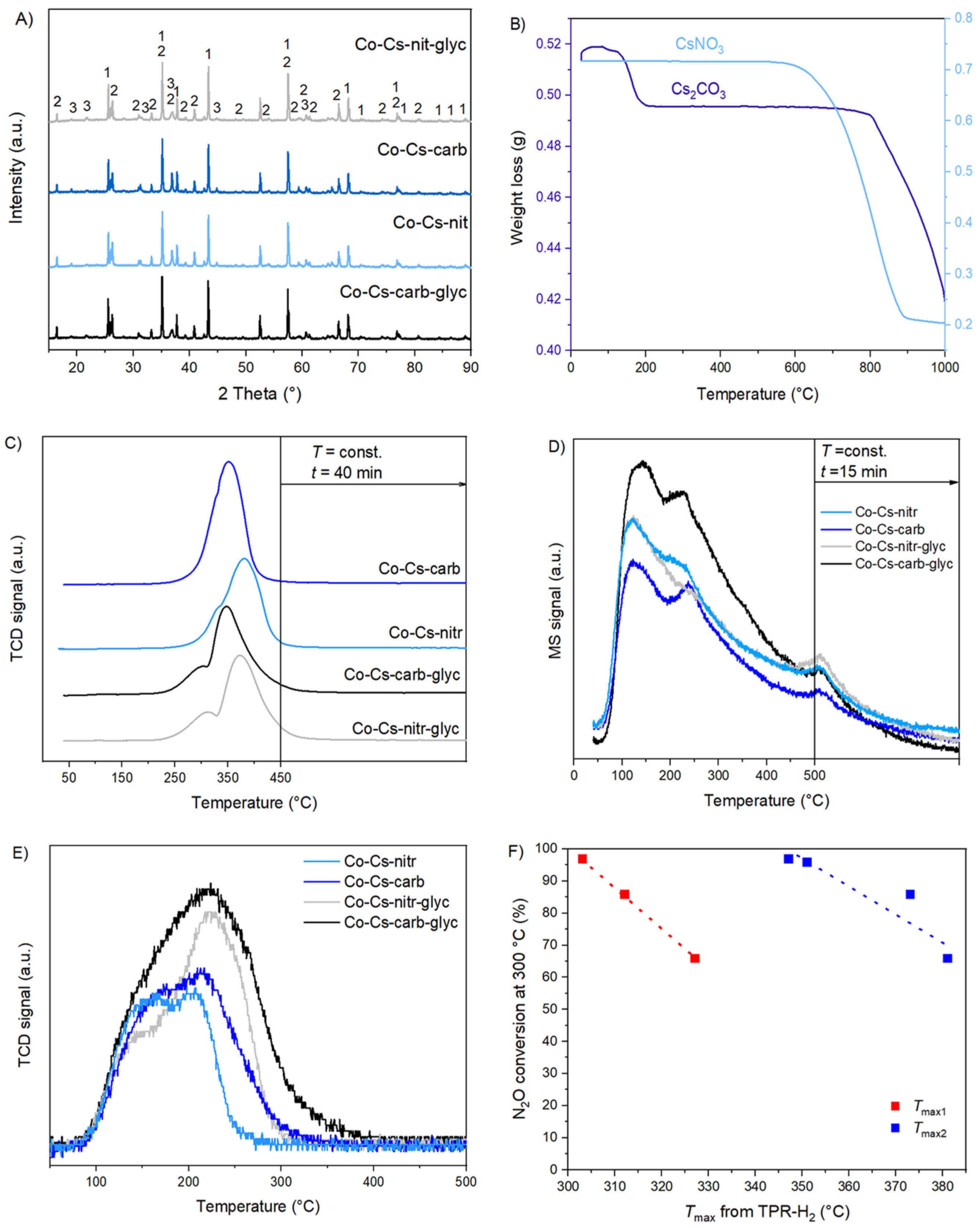
XRD results of foam-deposited cobalt-based catalysts are shown in Figure 1A and Table 2, highlighting intensive diffraction lines of ceramic foam phases (corundum and mullite). Co3O4 mixed oxide with a spinel structure (ICDD, PDF 00-043-1003) was formed, as confirmed by the characteristic lines in XRD patterns of all catalysts, albeit with low intensity. No significant differences were found in the lattice parameter (a), which was 0.8084 ± 0.0003 nm, implying that the shape and size of the Co3O4 unit cell are the same. However, the crystallite sizes (Lc) of samples prepared by conventional impregnation were three to six times larger than those of glycerol-assisted samples. In the latter, the presence of glycerol during preparation led to the release of intensive gaseous products during calcination, which disrupted agglomeration of the forming oxide crystallites and effectively limited crystal growth [61]. This decrease in Lc upon glycerol-assisted impregnation corroborates previous findings [62] and may decrease diffusion in the active layer, thereby yielding a higher number of accessible active sites. According to previous research, the active sites can be defined as the real spatial contact between Cs species and the surface of Co3O4 spinel nanocrystals.
The cesium carbonate precursor did not affect the phase composition of the active phase, likely because it represented only a small fraction of the total sample mass (2–3 wt.% Cs). Indeed, due to the low Cs content and/or its amorphous character, no Cs-containing phases were detected by XRD.
The decomposition temperatures of both Cs precursors are higher than the calcination temperature. The water loss and decomposition of hygroscopic white powder CsHCO3 into Cs2CO3 occur at 180 °C [63], and thermal decomposition of Cs2CO3 starts at 800 °C, while thermal decomposition of CsNO3 starts at 580 °C and ends at 900 °C [64]. To identify the Cs species in the catalysts, TGA of CsNO3 and Cs2CO3 was performed, and the results (Figure 1B) were in line with the literature [60]. Accordingly, the catalysts contained either CsNO3 or Cs2CO3, withCsHCO3 present at low temperatures, depending on the precursor used.
Figure 1. Combined (A) XRD (where numbers correspond to phases as follows: 1- corundum, 2- mullite, 3- spinel), (B) thermogravimetry, (C) H2-TPR, (D) H2O- and (E) NO-temperature programmed desorption analysis, (F) correlation between reducibility and catalytic activity. The results show that (A,B) all cobalt-based catalysts deposited on ceramic foam contain cesium in the form of undecomposed precursor, either CsNO3 or Cs2CO3 in line with [64] albeit with no effect on the phase composition of the catalyst. (C) Cs2CO3 enhances the reducibility of all cobalt active sites, regardless of preparation method. Nevertheless, glycerol-assisted impregnation enhances catalyst reducibility, as described in detail in our previous study [43]. (D) For all catalysts, water vapor stays adsorbed even at 500 °C, as evidenced by H2O-TPD profiles monitored by mass spectrometry (m/z = 18), and (E) both the glycerol method and Cs2CO3 increased NO adsorption, thus worsening resistance to NO. (F) shows the variation in N2O conversion at 300 °C as a function of catalyst reducibility. Lower reduction temperatures correspond to more reducible catalysts, whereas higher reduction temperatures indicate lower reducibility.
Eng 07 00086 g001
The reducibility of the catalysts was assessed by H2-TPR, as this parameter governs the performance of oxide catalysts in redox reactions. N2O catalytic decomposition starts with electron transfer from the catalyst surface to the N2O molecule during the initial dissociation step (Equation (12)). In the second step, adsorbed oxygen recombination (Equation (13)) weakens the metal–oxygen bond with the decrease in the oxidation state of the transition metal [65]. These changes in catalyst reducibility are shown in Figure 1C and Table 2.
N2O (g) + e → N2 (g) + Osurf.
2 Osurf. → O2 (g) + 2e
In all samples, the H2-TPR profiles exhibit two temperature maxima, which correspond to Co3+ → Co2+ and Co2+ → Co0 reduction in Co3O4 spinel [66,67], except for Co-Cs-carb, where this reduction proceeds in a single step. This separation of the two steps observed in reduction profiles is related to differences in grain size (Table 2) and shape effects [68]. In samples prepared using Cs2CO3, the entire H2-TPR profile is shifted to lower temperatures than in samples prepared using CsNO3. In samples prepared using the same precursor, the first temperature maximum is more pronounced and shifted to a lower temperature than the second maximum, whereas in samples prepared by glycerol-assisted impregnation, the two maxima are more similar. Since the total H2 consumption was comparable across all samples (Table 2), this shift indicates that Cs2CO3 enhances the reducibility of all cobalt active sites, regardless of the preparation method (conventional and glycerol-assisted impregnation) (Figure 1C). Furthermore, glycerol-assisted impregnation reduces agglomeration during calcination, as discussed in detail in our previous study [41].
In addition to N2O, waste gases from nitric acid production contain H2O, O2 and NO, which compete with N2O for adsorption on the same active sites or influence them from neighboring positions, triggering an inhibitory effect on Co3O4 activity in N2O decomposition the following order: NO > H2O > O2 [69]. When mixing these gases, their individual contributions to inhibitory effects do not combine additively, indicating competition for adsorption on active sites. The inhibition is reversible, so catalytic activity can be quickly restored after removing these inhibitors from the reaction mixture [70].
To evaluate the impact of H2O and NO, TPD tests were conducted. In our previous study, it was found that glycerol-assisted impregnation enhanced the resistance of the catalysts to H2O, O2, and NO by inducing re-faceting of the spinel nanocrystals, with preferential exposure of the (100) planes [43]. In this study, the effect of the precursor was assessed by comparing Cs2CO3 with CsNO3.
Water exerts an even stronger inhibitory effect than O2, making water adsorption a key factor governing the activity of Co3O4-based catalysts [69]. Cs2CO3 is a strong hygroscopic substance and can affect H2O adsorption on the catalyst surface. H2O-TPD results confirm that samples prepared with a Cs2CO3 precursor adsorbed a larger amount of water, regardless of the impregnation method used (Table 2), indicating that samples prepared with cesium carbonate have worse water resistance. Simultaneously, the amount of desorbed water vapor is higher from the glycerol-assisted-impregnation carbonate sample. For all catalysts, water vapor stays adsorbed even at 500 °C (Figure 1D). However, a higher amount remains adsorbed on the surface of carbonate samples Co-Cs-carb and Co-Cs-carb-glyc. Based on these results, Cs2CO3 precursor may reduce the resistance of the catalyst to water inhibition.
NO adsorption/desorption is higher in the samples prepared by glycerol-assisted impregnation because this method increases the surface area of the active phase [43] and, hence, the number of active sites. NO adsorption/desorption is also higher in the samples prepared with Cs2CO3 than in the samples prepared with CsNO3. In the former, NO desorption ends at higher temperatures, which indicates stronger NO adsorption on the catalyst surface (NO species adsorbed on the catalyst surface can be detected above 300 °C). Consequently, glycerol-assisted impregnation and Cs2CO3 increased the surface affinity to NO from the waste gas, as shown by NO-TPD in Figure 1E.
Physicochemical analysis of the test and reference samples showed that all cobalt-based catalysts contained Cs within an optimal range: 1–3 wt.% for conventional and 2–3 wt.% for glycerol-assisted impregnation, respectively [47], corresponding to an optimal real Cs-Co surface contact, which was determined based on previous research published in [43]. Regardless of the impregnation method, the Cs2CO3 precursor enhanced catalyst reducibility, i.e., decreased oxygen–cobalt bond strength and accelerated oxygen desorption from the catalyst surface, which is decisive for the catalytic activity under inert conditions. Consequently, the samples prepared with Cs2CO3 are expected to exhibit higher activity under the same conditions than those prepared with CsNO3.
In contrast to inert gas, O2, H2O and NO should shift the N2O conversion curves of all samples to higher temperatures due to their adsorption on the catalyst surface at reaction temperatures of up to 450 °C, as shown in H2O- (Figure 1D) and NO-TPD (Figure 1E) profiles. Cs2CO3 increased water vapor adsorption, and both the glycerol method and Cs2CO3 increased NO adsorption. Conversely, the glycerol-assisted method simultaneously improved reducibility (Figure 2C), which is, according to the results from [41], caused by higher Co dispersion, leading to enhanced Co–Cs interfacial contact, as evidenced by catalytic trends, most likely changing the activity order accordingly. The final conversion may result from contradictory effects of the glycerol method on reducibility and NO adsorption.

3.2. N2O Catalytic Decomposition

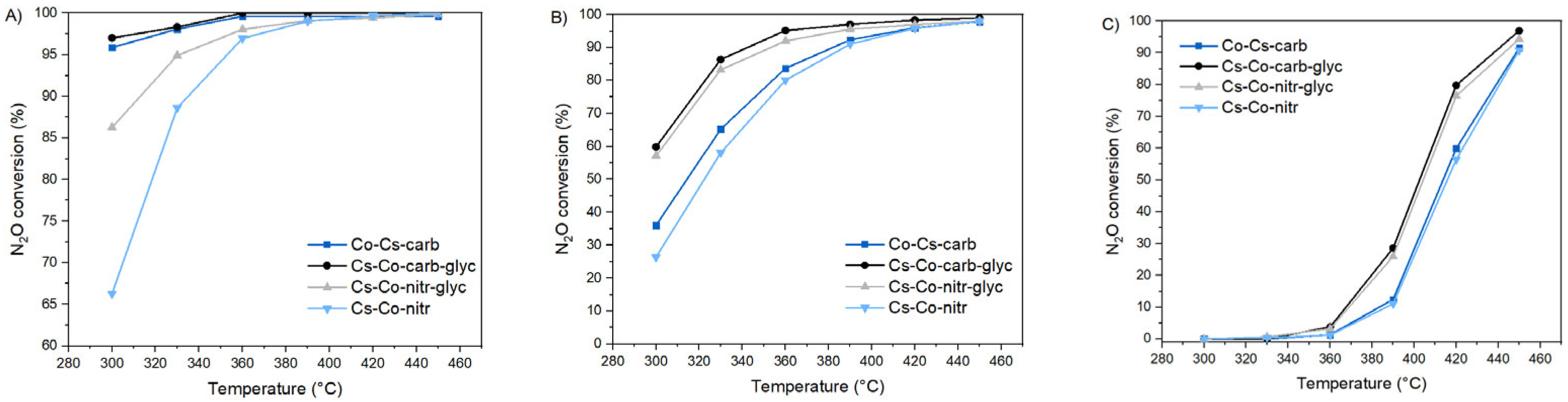
The activity of ceramic-foam-supported cobalt-based catalysts in N2O decomposition was tested under inert (Figure 2A) and simulated industrial conditions (Figure 2B,C). Under inert conditions, both samples prepared with Cs2CO3 (in black and dark blue) reached approximately 100% conversion over the entire temperature range. The sample prepared by glycerol-assisted impregnation with CsNO3 (in gray) reached a slightly lower conversion, and the least-active sample was prepared by conventional impregnation with CsNO3 (light blue). The difference between samples was larger in the temperature region below 360 °C, in line with the H2-TPR results. Figure 1F shows a direct correlation between catalytic activity and reducibility. These results confirm that Cs2CO3 has a positive effect on the catalytic activity in inert gas (Figure 2A).
To simulate industrial conditions, the samples were subjected to N2O, H2O and O2 (Figure 2B) and to N2O, H2O, O2 and NO (Figure 2C). In contact with H2O and O2, the N2O conversions were markedly higher over samples prepared by glycerol-assisted impregnation (in black and gray) than over those prepared by conventional impregnation (dark and light blue). Conversely, samples prepared with the Cs2CO3 precursor (black and dark blue) only slightly outperformed samples prepared with the CsNO3 precursor (gray and light blue), so under these simulated industrial conditions (H2O and O2), Cs2CO3 no longer offers an advantage over CsNO3, in contrast to under inert conditions. This finding confirms that Cs2CO3 weakens resistance to H2O, as observed in H2O-TPD analysis (Figure 1D). Water is expected to preferentially adsorb on the active sites next to Cs in the Cs2CO3 form, blocking them, affecting Co-Cs contact, and decreasing activity [43,53].
In contact with H2O, O2 and NO (Figure 2C), the N2O conversions followed a similar trend to that observed in contact with H2O and O2 alone (Figure 2B), albeit requiring a much higher temperature to reach the same level, indicating that NO has a strong inhibitory effect on catalytic activity. As in the previous conditions, samples prepared by glycerol-assisted impregnation outperformed samples prepared using the conventional method. However, the addition of NO diminished the differences in conversions between samples prepared with Cs2CO3 and CsNO3, regardless of the impregnation method. This result also demonstrates that the cobalt-based catalyst prepared with Cs2CO3 is less resistant to NO inhibition than its counterpart prepared with CsNO3, as evidenced by NO-TPD (Figure 1E).
Considering the above and the previous results [43,44,45,46], the activity of ceramic-foam-supported cobalt-based catalysts is determined by a combination of the following factors: (i) number of active sites, defined here as surface Co sites electronically modified by neighboring Cs species, and their accessibility (catalyst surface); (ii) electron transferability (catalyst reducibility); and (iii) resistance to inhibiting components in waste gas (H2O, O2 and NO). Under inert conditions, Cs2CO3 improves reducibility, achieving excellent results. In contrast, under simulated industrial conditions, these advantages are lost due to poor resistance to inhibiting components (H2O, O2 and NO).

4. Mathematical Model of a Full-Scale Catalytic Reactor for N2O Abatement in Waste Gas from HNO3 Production

N2O conversion under industrial conditions was assessed by mathematically modeling a full-scale catalytic reactor for N2O abatement in waste gas from a HNO3 production plant. For the reactor simulation, an ideal plug flow reactor in an isothermal regime (Equations (1)–(11)) was used, assuming that the reactor was placed downstream of the SCR NOx unit to ensure a low NOx content in the inlet gas to the reactor for N2O decomposition. Under these conditions, the reactor was simulated with a limited NOx concentration in the waste gas (200 ppm NO).
In this system, the ceramic-foam-supported cobalt-based catalyst with the highest activity (Co-Cs-carb-glyc) was compared with the unsupported commercial pellets with optimal chemical composition of the active phase (Co3O4 with 1 wt.% Cs), as reported in a previous study [9]. Kinetic parameters were calculated from experimental data of N2O decomposition over shaped catalysts (Tables S1 and S2 in the Supplementary Materials) using the integral method. The inlet and calculated parameters are shown in Table 3.
The results reveal that commercial pellets and the ceramic-foam-supported cobalt-based catalyst provided similar conversions at 450 °C in the same catalyst bed volume. However, the production and application of the commercial pellets entailed several disadvantages, including (i) problems associated with shaping grains into larger pellets (5 mm) and the inability to prepare shapes with higher geometric surface areas than full pellets, (ii) low mechanical strength (unsuitable for industrial applications), (iii) high pressure drop (7–8 times higher in the full-scale reactor with commercial pellets than in the reactor with the ceramic-foam-supported catalyst in the same catalyst bed volume), and (iv) high Co and Cs content, which increase the catalyst price and remain unused in the catalytic reaction due to internal diffusion limitations. Cs/Co3O4 pellets contain a 40-times-higher cobalt content than the catalyst deposited on ceramic foam in the same catalyst bed volume.
Comparing the tested catalyst with systems reported in the literature is informative, but such comparisons are often challenging due to differences in experimental conditions, including reaction temperature, gas composition, flow rates, catalyst form, and stabilization periods. Nevertheless, two studies were identified for comparison. Inger et al. [71] reported 70% conversion over K/Zn–Co3O4 catalysts at 420 °C, 6000 h−1, and pressures above 5 bar in the presence of NOx and H2O, while the Cs–Co–carb–glyc catalyst on ceramic foam studied in this paper achieved 85% conversion under the same temperature, but at 7500 h−1 and 0.6 bar (Table 3). Grzybek et al. [16] reported rate constants of 0.15–0.55 s−1 at 350 °C for a cobalt–zinc spinel on cordierite monoliths, with 96% conversion at 450 °C, whereas the Cs–Co–carb–glyc catalyst on ceramic foam showed a rate constant of 1.6 s−1 at 420 °C and 98.5% conversion at 450 °C in the presence of H2O, O2, and NOx (Table 3). Despite the differing conditions, these results indicate that the foam-supported catalysts studied here exhibit comparable, and possibly superior, activity. In conclusion, ceramic-foam-supported catalysts offer advantages, such as (a) high mechanical strength and good adhesion of the active phase to the support, (b) the avoidance of demanding catalyst preparation steps (for example, co-precipitation and pelletization), and (c) the use of an inexpensive and readily available material as a support, thereby facilitating catalyst production and reducing costs. Considering these advantages, the ceramic-foam-deposited cobalt-based catalyst demonstrates high potential as a cost-effective option for industrial applications.

5. Conclusions

Cs2CO3 provides Cs-doped cobalt-based catalysts with a higher reducibility than CsNO3, which is a key parameter in redox reactions such as N2O decomposition, accelerating oxygen desorption from the catalyst surface. However, Cs2CO3 is highly hygroscopic, so this precursor renders cobalt-based catalysts less resistant to the inhibitory effects of water vapor and NO found in waste gas, as in real industrial conditions, thereby negating the advantages of using a carbonate precursor of a cesium promoter. Nevertheless, the advantage of glycerol-assisted impregnation persists, regardless of precursor. As a result, ceramic-foam-supported cobalt-based catalysts yield a net profit associated with a lower pressure drop and a considerably (40×) lower active-phase loading required for the same catalytic activity over Cs/Co3O4 pellets.

Supplementary Materials

The following supporting information can be downloaded at: https://www.mdpi.com/article/10.3390/eng7020086/s1, Figure S1: Variation of pressure drop determined using calculated (line) and experimentally (points) data as a function of flow velocity (21 °C and 101,325 Pa) in a foam catalyst bed with a 20 ppi pore density; calculate and experimental data virtually overlap, demonstrating that the calculation method can be used to develop mathematical model of a reactor with a foam catalyst bed.; Table S1: Experimental data of N2O catalytic decomposition over Cs/Co3O4 pellets.; Table S2: Experimental data of N2O catalytic decomposition over Co-Cs-carb-glyc open-cell foam catalyst.

Author Contributions

Conceptualization, A.K. and K.P.; methodology, A.K., K.P. and K.K.; validation, A.K., K.P. and L.O.; formal analysis, T.B., K.P. and L.O.; investigation, A.K. and T.K.; resources, K.P. and L.O.; data curation, A.K., K.K. and T.B.; writing—original draft preparation, A.K.; writing—review and editing, T.B., K.P. and L.O.; visualization, A.K. and T.B.; supervision, L.O.; project administration, L.O. and K.P.; funding acquisition, L.O. All authors have read and agreed to the published version of the manuscript.

Funding

This research was funded by the European Union under Research Excellence For REgion Sustainability and High-tech Industries (REFRESH) project No. CZ.10.03.01/00/22_003/0000048 via the Operational Programme Just Transition. The experiments were performed using the Large Research Infrastructure ENREGAT (No. LM2023056) supported by the Ministry of Education, Youth and Sports of the Czech Republic.

Institutional Review Board Statement

Not applicable, as this study did not involve humans or animals.

Informed Consent Statement

Not applicable.

Data Availability Statement

The data presented in this study are available on request from the corresponding author.

Acknowledgments

The authors acknowledge the technical support of the laboratory staff at the Institute of Environmental Technology (CEET, VSB-TUO) and assistance with material characterization. During the preparation of this manuscript, the authors used ChatGPT (GPT-5.2, OpenAI) for language improvement. The authors have reviewed and edited the output and take full responsibility for the content of this publication.

Conflicts of Interest

The authors declare no conflicts of interest.

Abbreviations

cAconcentration of component A (N2O) (mol.m−3)
cA0initial concentration of component A (N2O) (mol.m−3)
cDcoefficient of resistance (-)
dpcatalyst particle diameter (m)
dwwindow (face) diameter (m)
EAactivation energy (J mol−1)
gcsphericity of catalyst particle (-)
kkinetic constant, first-order rate law (m3 s−1kg−1)
k0pre-exponential factor (s−1)
Llength of the catalytic bed (m)
ppressure in the reactor (Pa)
p0pressure at inlet of catalytic reactor (Pa)
rreaction rate per unit weight of catalyst (mol kg−1 h−1)
Runiversal gas constant (J K−1 mol−1)
ReReynolds number (-)
Sv-solidspecific surface area per unit solid volume (m−1)
Tthermodynamic temperature (K)
Vvolume of the catalyst bed (m3)
V ˙ total volumetric flow (m3 s−1)
XAconversion of component A (N2O) (-)
αAstoichiometric coefficient of component A (N2O) (-)
βcoefficient for inertial term (-)
ε0porosity of catalyst particle (-)
φporosity of catalyst bed (-)
ηinternal effectiveness factor (-)
μdynamic viscosity of the gas (kg m–1 s–1)
ρcbulk density of the catalyst (kg m−3)
Ωoverall effectiveness factor (-)

References

  1. Skiba, U.; Jones, S.K.; Dragosits, U.; Drewer, J.; Fowler, D.; Rees, R.M.; Pappa, V.A.; Cardenas, L.; Chadwick, D.; Yamulki, S.; et al. UK emissions of the greenhouse gas nitrous oxide. Philos. Trans. R. Soc. B Biol. Sci. 2012, 367, 1175–1185. [Google Scholar] [CrossRef] [PubMed]
  2. Hoefs, J. Stable Isotope Geochemistry; Springer: Berlin/Heidelberg, Germany, 2013. [Google Scholar]
  3. Linak, W.P.; Kramlich, J.C. A review of nitrous oxide behavior in the atmosphere, and in combustion and industrial systems. Stud. Environ. Sci. 1998, 72, 265–313. [Google Scholar] [CrossRef]
  4. Yang, W.; Wang, Q.; Dang, H.; Zhao, L.; Wu, R.; Li, J.; Wang, Y.; Zhao, Y. In-situ polymerization intercalation of montmorillonite to achieve Co3O4 barrier dispersion for direct catalytic decomposition of N2O. Appl. Catal. A Gen. 2023, 664, 119329. [Google Scholar] [CrossRef]
  5. Pérez-Ramírez, J. Prospects of N2O emission regulations in the European fertilizer industry. Appl. Catal. B Environ. 2007, 70, 31–35. [Google Scholar] [CrossRef]
  6. Bernauer, M.; Bernauer, B.; Sádovská, G.; Sobalík, Z. High-temperature decomposition of N2O from the HNO3 production: Process feasibility using a structured catalyst. Chem. Eng. Sci. 2020, 220, 115624. [Google Scholar] [CrossRef]
  7. Solomon, S. Climate Change 2007—The Physical Science Basis: Working Group I Contribution to the Fourth Assessment Report of the IPCC; Cambridge University Press: Cambridge, UK, 2007. [Google Scholar]
  8. Wójcik, S.; Grzybek, G.; Gryboś, J.; Kotarba, A.; Sojka, Z. Designing, optimization and performance evaluation of the K-Zn0.4Co2.6O4|α-Al2O3|cordierite catalyst for low-temperature N2O decomposition. Catal. Commun. 2018, 110, 64–67. [Google Scholar] [CrossRef]
  9. Obalová, L.; Klegova, A.; Matějová, L.; Pacultová, K.; Fridrichová, D. Must the Best Laboratory Prepared Catalyst Also Be the Best in an Operational Application? Catalysts 2019, 9, 160. [Google Scholar] [CrossRef]
  10. Pérez-Ramírez, J.; Overeijnder, J.; Kapteijn, F.; Moulijn, J.A. Structural promotion and stabilizing effect of Mg in the catalytic decomposition of nitrous oxide over calcined hydrotalcite-like compounds. Appl. Catal. B Environ. 1999, 23, 59–72. [Google Scholar] [CrossRef]
  11. Obalová, L.; Karásková, K.; Jirátová, K.; Kovanda, F. Effect of potassium in calcined Co–Mn–Al layered double hydroxide on the catalytic decomposition of N2O. Appl. Catal. B 2009, 90, 132–140. [Google Scholar] [CrossRef]
  12. Klyushina, A.; Pacultová, K.; Karásková, K.; Jirátová, K.; Ritz, M.; Fridrichová, D.; Volodarskaja, A.; Obalová, L. Effect of preparation method on catalytic properties of Co-Mn-Al mixed oxides for N2O decomposition. J. Mol. Catal. A Chem. 2016, 425, 237–247. [Google Scholar] [CrossRef]
  13. Obalová, L.; Karásková, K.; Wach, A.; Kustrowski, P.; Mamulová-Kutláková, K.; Michalik, S.; Jirátová, K. Alkali metals as promoters in Co–Mn–Al mixed oxide for N2O decomposition. Appl. Catal. A 2013, 462–463, 227–235. [Google Scholar] [CrossRef]
  14. Abu-Zied, B.M.; Soliman, S.A.; Abdellah, S.E. Enhanced direct N2O decomposition over CuxCo1-xCo2O4 (0.0 ≤ x ≤ 1.0) spinel-oxide catalysts. J. Ind. Eng. Chem. 2015, 21, 814–821. [Google Scholar] [CrossRef]
  15. Inger, M.; Kowalik, P.; Saramok, M.; Wilk, M.; Stelmachowski, P.; Maniak, G.; Granger, P.; Kotarba, A.; Sojka, Z. Laboratory and pilot scale synthesis, characterization and reactivity of multicomponent cobalt spinel catalyst for low temperature removal of N2O from nitric acid plant tail gases. Catal. Today 2011, 176, 365–368. [Google Scholar] [CrossRef]
  16. Grzybek, G.; Stelmachowski, P.; Indyka, P.; Inger, M.; Wilk, M.; Kotarba, A.; Sojka, Z. Cobalt–zinc spinel dispersed over cordierite monoliths for catalytic N2O abatement from nitric acid plants. Catal. Today 2015, 257, 93–97. [Google Scholar] [CrossRef]
  17. Zhang, R.; Hedjazi, K.; Chen, B.; Li, Y.; Lei, Z.; Liu, N. M(Fe, Co)-BEA washcoated honeycomb cordierite for N2O direct decomposition. Catal. Today 2016, 273, 273–285. [Google Scholar] [CrossRef]
  18. Wójcik, S.; Ercolino, G.; Gajewska, M.; Quintero, C.W.M.; Specchia, S.; Kotarba, A. Robust Co3O4|α-Al2O3|cordierite structured catalyst for N2O abatement—Validation of the SCS method for active phase synthesis and deposition. Chem. Eng. J. 2018, 377, 120088. [Google Scholar] [CrossRef]
  19. Isupova, L.A.; Ivanova, Y.A. Low-Temperature deN2O Catalyst Based on Co3O4 for a Single-Reactor Unit for the Removal of Nitrogen Oxides in Nitric Acid Production. Dokl. Chem. 2023, 511, 202–208. [Google Scholar] [CrossRef]
  20. del Río, L.; Marbán, G. Stainless steel wire mesh-supported potassium-doped cobalt oxide catalysts for the catalytic decomposition of nitrous oxide. Appl. Catal. B Environ. 2012, 126, 39–46. [Google Scholar] [CrossRef]
  21. Klyushina, A.; Pacultová, K.; Krejčová, S.; Słowik, G.; Jirátová, K.; Kovanda, F.; Ryczkowski, J.; Obalová, L. Advantages of stainless steel sieves as support for catalytic N2O decomposition over K-doped Co3O4. Catal. Today 2015, 257, 2–10. [Google Scholar] [CrossRef]
  22. Gudyka, S.; Grzybek, G.; Gryboś, J.; Indyka, P.; Leszczyński, B.; Kotarba, A.; Sojka, Z. Enhancing the deN2O activity of the supported Co3O4|α-Al2O3 catalyst by glycerol-assisted shape engineering of the active phase at the nanoscale. Appl. Catal. B Environ. 2017, 201, 339–347. [Google Scholar] [CrossRef]
  23. Grzybek, G.; Wójcik, S.; Ciura, K.; Gryboś, J.; Indyka, P.; Oszajca, M.; Stelmachowski, P.; Witkowski, S.; Inger, M.; Wilk, M.; et al. Influence of preparation method on dispersion of cobalt spinel over alumina extrudates and the catalyst deN2O activity. Appl. Catal. B Environ. 2017, 210, 34–44. [Google Scholar] [CrossRef]
  24. Yoshida, H.; Tsuruta, T.; Yazawa, Y.; Hattori, T. Support effect on oxidation resistance of precious metal catalysts as examined by N2O decomposition. Appl. Catal. A Gen. 2007, 325, 50–56. [Google Scholar] [CrossRef]
  25. Haber, J.; Machej, T.; Janas, J.; Nattich, M. Catalytic decomposition of N2O. Catal. Today 2004, 90, 15–19. [Google Scholar] [CrossRef]
  26. Hussain, M.; Fino, D.; Russo, N. N2O decomposition by mesoporous silica supported Rh catalysts. J. Hazard. Mater. 2012, 211–212, 255–265. [Google Scholar] [CrossRef]
  27. Pacultová, K.; Karásková, K.; Strakošová, J.; Jirátová, K.; Obalová, L. Supported Co–Mn–Al mixed oxides as catalysts for N2O decomposition. Compt. Rend. Chim. 2015, 18, 1114–1122. [Google Scholar] [CrossRef]
  28. Karásková, K.; Chromčáková, Ž.; Študentová, S.; Matějka, V.; Jirátová, K.; Obalová, L. A comparative study of TiO2-supported and bulk Co–Mn–Al catalysts for N2O decomposition. Catal. Today 2012, 191, 112–115. [Google Scholar] [CrossRef]
  29. Wang, Y.; Zhang, J.; Zhu, J.; Yin, J.; Wang, H. Experimental research on catalytic decomposition of nitrous oxide on supported catalysts. Energy Convers. Manag. 2009, 50, 1304–1307. [Google Scholar] [CrossRef]
  30. Tronconi, E.; Groppi, G.; Visconti, C.G. Structured catalysts for non-adiabatic applications. Curr. Opin. Chem. Eng. 2014, 5, 55–67. [Google Scholar] [CrossRef]
  31. Kolaczkowski, S.T.; Awdry, S.; Smith, T.; Thomas, D.; Torkuhl, L.; Kolvenbach, R. Potential for metal foams to act as structured catalyst supports in fixed-bed reactors. Catal. Today 2016, 273, 221–233. [Google Scholar] [CrossRef]
  32. Ho, P.H.; Ambrosetti, M.; Groppi, G.; Tronconi, E.; Palkovits, R.; Fornasari, G.; Vaccari, A.; Benito, P. Chapter 15—Structured Catalysts-Based on Open-Cell Metallic Foams for Energy and Environmental Applications. In Studies in Surface Science and Catalysis; Albonetti, S., Perathoner, S., Quadrelli, E.A., Eds.; Elsevier: Amsterdam, The Netherlands, 2019; Volume 178, pp. 303–327. [Google Scholar]
  33. Ho, P.H.; Da Costa, K.Ś.; de Luna, G.S.; Jabłońska, M.; Ospitali, F.; Di Renzo, F.; Delahay, G.; Fornasari, G.; Vaccari, A.; Palkovits, R.; et al. Facile coating of Co3O4 on open-cell metallic foam for N2O catalytic decomposition. Chem. Eng. Res. Des. 2022, 188, 166–178. [Google Scholar] [CrossRef]
  34. Ho, P.H.; Jabłońska, M.; Palkovits, R.; Rodríguez-Castellón, E.; Ospitali, F.; Fornasari, G.; Vaccari, A.; Benito, P. N2O catalytic decomposition on electrodeposited Rh-based open-cell metallic foams. Chem. Eng. J. 2020, 379, 122259. [Google Scholar] [CrossRef]
  35. Pacultová, K.; Karásková, K.; Kovanda, F.; Jirátová, K.; Šrámek, J.; Kustrowski, P.; Kotarba, A.; Chromčáková, Ž.; Kočí, K.; Obalová, L. K-Doped Co–Mn–Al Mixed Oxide Catalyst for N2O Abatement from Nitric Acid Plant Waste Gases: Pilot Plant Studies. Ind. Eng. Chem. Res. 2016, 55, 7076–7084. [Google Scholar] [CrossRef]
  36. Twigg, M.V.; Richardson, J.T. Structured ceramic foams as catalyst supports for highly exothermic processes. In Studies in Surface Science and Catalysis; Gaigneaux, E.M., Ruiz, P., Eds.; Elsevier: Amsterdam, The Netherlands, 2006; Volume 162, pp. 135–142. [Google Scholar]
  37. Inayat, A.; Freund, H.; Zeiser, T.; Schwieger, W. Determining the specific surface area of ceramic foams: The tetrakaidecahedra model revisited. Chem. Eng. Sci. 2011, 66, 1179–1188. [Google Scholar] [CrossRef]
  38. Richardson, J.T.; Peng, Y.; Remue, D. Properties of ceramic foam catalyst supports: Pressure drop. Appl. Catal. A Gen. 2000, 204, 19–32. [Google Scholar] [CrossRef]
  39. Moreira, E.A.; Innocentini, M.D.M.; Coury, J.R. Permeability of ceramic foams to compressible and incompressible flow. J. Eur. Ceram. Soc. 2004, 24, 3209–3218. [Google Scholar] [CrossRef]
  40. Lacroix, M.; Nguyen, P.; Schweich, D.; Pham Huu, C.; Savin-Poncet, S.; Edouard, D. Pressure drop measurements and modeling on SiC foams. Chem. Eng. Sci. 2007, 62, 3259–3267. [Google Scholar] [CrossRef]
  41. Incera Garrido, G.; Patcas, F.C.; Lang, S.; Kraushaar-Czarnetzki, B. Mass transfer and pressure drop in ceramic foams: A description for different pore sizes and porosities. Chem. Eng. Sci. 2008, 63, 5202–5217. [Google Scholar] [CrossRef]
  42. Dietrich, B.; Schabel, W.; Kind, M.; Martin, H. Pressure drop measurements of ceramic sponges—Determining the hydraulic diameter. Chem. Eng. Sci. 2009, 64, 3633–3640. [Google Scholar] [CrossRef]
  43. Klegová, A.; Pacultová, K.; Kiška, T.; Gryboś, J.; Sojka, Z.; Obalová, L. On the optimal Cs/Co ratio responsible for the N2O decomposition activity of the foam supported cobalt oxide catalysts. Arab. J. Chem. 2023, 12, 105311. [Google Scholar] [CrossRef]
  44. Pacultová, K.; Klegová, A.; Kiška, T.; Fridrichová, D.; Martaus, A.; Rokicińska, A.; Kuśtrowski, P.; Obalová, L. Effect of support on the catalytic activity of Co3O4-Cs deposited on open-cell ceramic foams for N2O decomposition. Mater. Res. Bull. 2020, 129, 110892. [Google Scholar] [CrossRef]
  45. Klegova, A.; Pacultová, K.; Kiška, T.; Peikertová, P.; Rokicińska, A.; Kuśtrowski, P.; Obalová, L. Washcoated open-cell foam cobalt spinel catalysts for N2O decomposition. Mol. Catal. 2022, 533, 112754. [Google Scholar] [CrossRef]
  46. Klegova, A.; Pacultová, K.; Kiška, T.; Obalová, L. How Loading of Co3O4-Cs on an Open-Cell Foam Influences N2O Decomposition. Ind. Eng. Chem. Res. 2023, 62, 1301–1309. [Google Scholar] [CrossRef]
  47. Grzybek, G.; Stelmachowski, P.; Gudyka, S.; Duch, J.; Ćmil, K.; Kotarba, A.; Sojka, Z. Insights into the twofold role of Cs doping on deN2O activity of cobalt spinel catalyst—Towards rational optimization of the precursor and loading. Appl. Catal. B Environ. 2015, 168–169, 509–514. [Google Scholar] [CrossRef]
  48. Feng, R.; Li, Z. Current investigations on global N2O emissions and reductions: Prospect and outlook. Environ. Pollut. 2023, 338, 122664. [Google Scholar] [CrossRef]
  49. Li, R.; Li, Y.; Liu, Z. Recent advances in the catalytic removal of NOx and N2O over spinel oxide-based catalyst. Fuel 2024, 355, 129405. [Google Scholar] [CrossRef]
  50. Konsolakis, M. Recent Advances on Nitrous Oxide (N2O) Decomposition over Non-Noble-Metal Oxide Catalysts: Catalytic Performance, Mechanistic Considerations, and Surface Chemistry Aspects. ACS Catal. 2015, 5, 6397–6421. [Google Scholar] [CrossRef]
  51. Chromčáková, Ž.; Obalová, L.; Kustrowski, P.; Drozdek, M.; Karásková, K.; Jirátová, K.; Kovanda, F. Optimization of Cs content in Co–Mn–Al mixed oxide as catalyst for N2O decomposition. Res. Chem. Intermed. 2015, 41, 9319–9332. [Google Scholar] [CrossRef]
  52. Inayat, A.; Schwerdtfeger, J.; Freund, H.; Körner, C.; Singer, R.F.; Schwieger, W. Periodic open-cell foams: Pressure drop measurements and modeling of an ideal tetrakaidecahedra packing. Chem. Eng. Sci. 2011, 66, 2758–2763. [Google Scholar] [CrossRef]
  53. Grzybek, G.; Gryboś, J.; Indyka, P.; Janas, J.; Ciura, K.; Leszczyński, B.; Zasada, F.; Kotarba, A.; Sojka, Z. Evaluation of the inhibiting effect of H2O, O2, and NO on the performance of laboratory and pilot K-ZnxCo3-xO4 catalysts supported on α-Al2O3 for low-temperature N2O decomposition. Appl. Catal. B Environ. 2021, 297, 120435. [Google Scholar] [CrossRef]
  54. Nowakowski, L.; Hudy, C.; Zasada, F.; Gryboś, J.; Piskorz, W.; Wach, A.; Kayser, Y.; Szlachetko, J.; Sojka, Z. N2O Decomposition on Singly and Doubly (K and Li)-Doped Co3O4 Nanocubes—Establishing Key Factors Governing Redox Behavior of Catalysts. J. Am. Chem. Soc. 2024, 146, 24450–24466. [Google Scholar] [CrossRef]
  55. Obalová, L.; Jirátová, K.; Karásková, K.; Kovanda, F. Simulation of N2O Abatement in Waste Gases by Its Decomposition over a K-Promoted Co-Mn-Al Mixed Oxide Catalyst. Chin. J. Catal. 2011, 32, 816–820. [Google Scholar] [CrossRef]
  56. Inayat, A.; Klumpp, M.; Lämmermann, M.; Freund, H.; Schwieger, W. Development of a new pressure drop correlation for open-cell foams based completely on theoretical grounds: Taking into account strut shape and geometric tortuosity. Chem. Eng. J. 2016, 287, 704–719. [Google Scholar] [CrossRef]
  57. Nie, Z.; Lin, Y.; Tong, Q. Numerical investigation of pressure drop and heat transfer through open cell foams with 3D Laguerre-Voronoi model. Int. J. Heat Mass Transf. 2017, 113, 819–839. [Google Scholar] [CrossRef]
  58. Lali, F. A hydrodynamic study of cylindrical metal foam packings: Residence time distribution and two phase pressure drop. Chem. Eng. Process. Process Intensif. 2017, 115, 1–10. [Google Scholar] [CrossRef]
  59. Wang, H.; Guo, L. Experimental investigation on pressure drop and heat transfer in metal foam filled tubes under convective boundary condition. Chem. Eng. Sci. 2016, 155, 438–448. [Google Scholar] [CrossRef]
  60. Regulski, W.; Szumbarski, J.; Łaniewski-Wołłk, Ł.; Gumowski, K.; Skibiński, J.; Wichrowski, M.; Wejrzanowski, T. Pressure drop in flow across ceramic foams—A numerical and experimental study. Chem. Eng. Sci. 2015, 137, 320–337. [Google Scholar] [CrossRef]
  61. Deng, J.; Kang, L.; Bai, G.; Li, Y.; Li, P.; Liu, X.; Yang, Y.; Gao, F.; Liang, W. Solution combustion synthesis of cobalt oxides (Co3O4 and Co3O4/CoO) nanoparticles as supercapacitor electrode materials. Electrochim. Acta 2014, 132, 127–135. [Google Scholar] [CrossRef]
  62. Zavyalova, U.; Scholz, P.; Ondruschka, B. Influence of cobalt precursor and fuels on the performance of combustion synthesized Co3O4/γ-Al2O3 catalysts for total oxidation of methane. Appl. Catal. A Gen. 2007, 323, 226–233. [Google Scholar] [CrossRef]
  63. Rabie, R.; Hammouda, M.M.; Elattar, K.M. Cesium carbonate as a mediated inorganic base in some organic transformations. Res. Chem. Intermed. 2017, 43, 1979–2015. [Google Scholar] [CrossRef]
  64. Lidin, R.A.; Molochko, V.A.; Andreeva, L.L. Khimicheskiye Svoystva Neorganicheskikh Veshchestv; KHIMIYA: Moscow, Russia, 2000; Volume 3. [Google Scholar]
  65. Pasha, N.; Lingaiah, N.; Siva Sankar Reddy, P.; Sai Prasad, P.S. An investigation into the effect of Cs promotion on the catalytic activity of NiO in the direct decomposition of N2O. Catal. Lett. 2007, 118, 64–68. [Google Scholar] [CrossRef]
  66. Kovanda, F.; Rojka, T.; Dobešová, J.; Machovič, V.; Bezdička, P.; Obalová, L.; Jirátová, K.; Grygar, T. Mixed oxides obtained from Co and Mn containing layered double hydroxides: Preparation, characterization, and catalytic properties. J. Solid State Chem. 2006, 179, 812–823. [Google Scholar] [CrossRef]
  67. Obalová, L.; Jirátová, K.; Kovanda, F.; Pacultová, K.; Lacný, Z.; Mikulová, Z. Catalytic decomposition of nitrous oxide over catalysts prepared from Co/Mg-Mn/Al hydrotalcite-like compounds. Appl. Catal. B 2005, 60, 289–297. [Google Scholar] [CrossRef]
  68. Wójcik, S.; Grzybek, G.; Stelmachowski, P.; Sojka, Z.; Kotarba, A. Bulk, Surface and Interface Promotion of Co3O4 for the Low-Temperature N2O Decomposition Catalysis. Catalysts 2020, 10, 41. [Google Scholar] [CrossRef]
  69. Xue, L.; Zhang, C.; He, H.; Teraoka, Y. Catalytic decomposition of N2O over CeO2 promoted Co3O4 spinel catalyst. Appl. Catal. B Environ. 2007, 75, 167–174. [Google Scholar] [CrossRef]
  70. Liu, Z.; He, F.; Ma, L.; Peng, S. Recent Advances in Catalytic Decomposition of N2O on Noble Metal and Metal Oxide Catalysts. Catal. Surv. Asia 2016, 20, 121–132. [Google Scholar] [CrossRef]
  71. Inger, M.; Wilk, M.; Saramok, M.; Grzybek, G.; Grodzka, A.; Stelmachowski, P.; Makowski, W.; Kotarba, A.; Sojka, Z. Cobalt Spinel Catalyst for N2O Abatement in the Pilot Plant Operation–Long-Term Activity and Stability in Tail Gases. Ind. Eng. Chem. Res. 2014, 53, 10335–10342. [Google Scholar] [CrossRef]
Figure 2. N2O conversion (%) as a function of temperature over ceramic-foam-supported cobalt-based catalysts at VHSV (20 °C, 101,325 Pa) = 1500 m3h−1mcat−3 under inert conditions with 0.1 mol.% N2O in N2 (A). Variation in N2O conversion under simulated waste-gas conditions, either (B) 0.1 mol.% N2O, 2 mol.% H2O and 5 mol.% O2 in N2 or (C) 0.1 mol.% N2O, 2 mol.% H2O, 5 mol.% O2 and 2000 ppm NO in N2. The results show that (A) Cs2CO3 has a positive effect on N2O conversion, regardless of preparation method; (B) H2O + O2 and (C) NO inhibit N2O decomposition.
Eng 07 00086 g002
Table 1. Catalyst labeling and preparation parameters.
SampleCo3O4
(wt.%)
Theoretical Amount of
Cs in Co3O4 (wt.%)
Impregnation Solution
Co-Cs-carb6.9344.8 g Co(NO3)2∙6H2O +
12.5 mL H2O + 0.669 g CsCO3
Co-Cs-carb-glyc6.4350.4 g Co(NO3)2∙6H2O + 12.5 mL H2O + 12.5 mL (~15.74 g) glycerol + 0.752 g CsCO3
Table 2. Chemical composition, XRD, H2O-TPD and H2-TPR results of test and reference samples show that cobalt-based catalysts deposited on foam contain an optimal amount of Cs and the same content of reducible components regardless of impregnation method or Cs precursor used, while glycerol-assisted impregnation and CsNO3 yields smaller crystallite sizes (Lc) than conventional impregnation, decreasing agglomeration during calcination and increasing the number of accessible active sites. Cs2CO3 led to higher water vapor adsorption, while glycerol-assisted impregnation led to higher water vapor desorption.
SampleAASXRDH2O-TPDH2-TPR
Co **
(wt.%)
Cs **
(wt.%)
Lc
(nm)
H2Oads ***
(mmol g−1)
H2Odes ***
(a.u.)
Tmax
(°C)
H2 ****
(mmol g−1)
Co-Cs-carb582.61310.01816535117.7
Co-Cs-carb-glyc472.4410.019269303, 34718.3
Co-Cs-nit *582.71330.013194327, 38117.2
Co-Cs-nit-glyc *491.9200.009207312, 37317.4
Lc: Crystallite size; Tmax: Maximum temperature; * Reference samples [43]; ** Co or Cs content in Co3O4-Cs active phase; *** Adsorbed or desorbed H2O; **** H2 consumption (mmol gCo3O4−1), measurement error: 4%.
Table 3. The inlet and calculated parameters for N2O abatement in waste gas from HNO3 production show that commercial Cs/Co3O4 pellets and the ceramic-foam-supported cobalt-based catalyst provided similar conversions at 450 °C in the same catalyst bed volume, under the same conditions. However, the pellets contain 40 times more cobalt and lead to a 7–8 times higher pressure drop than ceramic-foam-supported catalysts.
Parameters/CatalystCs/Co3O4Co-Cs-carb-glyc
Volume flow (m3/h) (NTP)30,000
Inlet pressure (Pa)600,000
Reactor volume (m3)4
Reactor height (m)2
Reactor radius (m)0.8
Shape of catalysttablets
(5 × 5 mm)
foam
(20 ppi)
Porosity of catalyst bed (-)0.460.80
Pressure drop (Pa)32,6004200
Co content in catalyst bed (kg)337784
Cs content in catalyst bed (kg)543.3
Industrial conditions1000 ppm N2O + 5 mol. % O2 + 2 mol. % H2O + 200 ppm NO in N2
Temperature (°C)450
Kinetic constant (s−1)5.73.6
Conversion of N2O (%)99.998.5
Temperature (°C)420
Kinetic constant (s−1)3.61.6
Conversion of N2O (%)98.585
Disclaimer/Publisher’s Note: The statements, opinions and data contained in all publications are solely those of the individual author(s) and contributor(s) and not of MDPI and/or the editor(s). MDPI and/or the editor(s) disclaim responsibility for any injury to people or property resulting from any ideas, methods, instructions or products referred to in the content.