Article

Effect of Air-Abrasion Dentin Pre-Treatment on Shear Bond Strength of Contemporary Dental Adhesive Systems


Department of Operative Dentistry, School of Dentistry, Aristotle University of Thessaloniki, 54124 Thessaloniki, Greece
*
Author to whom correspondence should be addressed.
Submission received: 22 November 2025 / Revised: 31 December 2025 / Accepted: 13 January 2026 / Published: 14 January 2026

Abstract

The present study aimed to evaluate the effect of air-abrasion as a dentin pre-treatment on the bond strength of contemporary adhesive systems. The bonding approaches included etch-and-rinse (ER), self-etch (SE) and universal (UN) adhesive systems, with the latter applied in both ER and SE modes. Twenty-eight third molars were used, each sectioned in four parts. All specimens were embedded in acrylic resin, ground with silicon carbide papers, and divided into eight experimental groups (n = 14) based on the combination of surface pre-treatment (air-abrasion or none) and adhesive approach. Subsequently, a resin cylinder was bonded to each surface following the respective treatment. Shear bond strength (SBS) was evaluated at a cross-head speed of 0.7 mm/min using a shear-testing machine (OM100 Odeme, Luzerna, Brazil). The data were analyzed with one-way ANOVA and Tukey’s post hoc test. No statistically significant increase in SBS after air-abrasion of dentin was found for any of the experimental groups (p > 0.05). Among the adhesive strategies, the ER system presented higher SBS values (32.81 ± 9.04 MPa) than the UN adhesive applied in SE mode (21.68 ± 5.85 MPa) (p < 0.05). Mixed failures were the most common failure type across all groups. In particular, 20.5% of the specimens exhibited adhesive failure, 14.3% cohesive failure within resin composite, 12.5% cohesive failure within dentin and 52.7% specimens demonstrated mixed failure types. Dentin pre-treatment with air-abrasion using 29 μm Al2O3 did not significantly increase the SBS of the three tested contemporary adhesive systems; however, the choice of adhesive strategies influenced the SBS outcomes.

1. Introduction

Air-abrasion technology was initially introduced for dental applications in 1945 [1] but has resurfaced recently, in relation to developments in adhesion along with minimally invasive approach to dental tissues restoration. It employs a stream of abrasive particles (mainly Al2O3) launched under air-pressure, colliding to tissue surface in high velocity, removing amounts of tooth substance or restorative materials [2]. Air-abrasion is used for caries removal, cavity preparation and surface pre-treatment for both tooth tissue and restorative materials, aiming to increase surface roughness and improve bond strength [2,3]. Depending on the intended outcome, air-abrasion devices can provide various settings, including type and size of abrasive particles, air-pressure, tip diameter, distance and angle between tip and abraded surface [2,4]. When intra-orally used, air-abrasion reduces pain and thus the need for local anesthesia, eliminates vibration and temperature rise related to use of burs [5,6], produces cavity preparations with rounded internal angles, which minimizes stress concentration and aids adaptation of restorative materials [7], and preserves the structural integrity of the sound tooth tissue around a lesion [8].
Smear layer forms on the tissue surface during its preparation by hand or rotary instruments. It is an amorphous, irregular adherent layer of organic and inorganic debris [9]. Heat and shear forces produced by tools cause the debris to compact and aggregate. After sonication, aggregates of globular subunits 0.05–0.1 μm in diameter are exposed. Debris blocks the orifices of the dentinal tubules by formation of the smear plugs to a depth of 1–10 μm [10]. Smear layer may consist of crushed hydroxyapatite crystals and shattered, denatured collagen fibers. In clinical conditions, it can be contaminated by bacteria and saliva [11]. The width and morphology of smear layer seems to vary depending on the method used to prepare dentin, and the location within the dentin substrate in relation to the pulp [10].
Morphology and nature of dentin surface are crucial factors to bond efficiently on dentin substrate. Therefore, several studies have been conducted assessing dentin surface produced by air-abrasion pre-treatment, by scanning electron microscopy (SEM) [12,13,14]. When applied in dentin, air-abrasion produces an irregular surface with a smear layer less adherent to it, compared to use of rotary instruments [12]. Smear layer appears to be irregular, bearing residues of Al2O3 particles, and blocking the orifices of dentinal tubules. When air-abraded dentin is subsequently treated with phosphoric acid (H3PO4), superficial fissures, open tubules and surface irregularities exposing peritubular and intertubular dentin are observed [13], and minimum amounts of smear layer and Al2O3 particles remain [14].
Smear layer’s irregular and brittle structure [15] and weak bond to the underlying dentin [16] can be a compromising factor for bonding of restorative materials to dentin. There are mainly two different approaches to bond on dentin substrate: either by removing smear layer or by penetrating and incorporating it [17]. Removal of smear layer is achieved with the use of acids or chelating solutions. Usually, 30–40% H3PO4 is used in “etch-and-rinse” techniques, resulting in the removal of smear layer and smear plugs, and demineralization of dentin to a depth of 3–5 μm. This leaves a scaffold of collagen fibers containing no hydroxyapatite, while peritubular dentin is dissolved and dentinal tubule orifices are widened [18,19]. Etch-and-rinse adhesive systems first appeared as a three-step clinical procedure, utilizing an etchant, a primer and finally the adhesive resin, but have been simplified since, by combining the two latter steps into one solution (two-step etch-and-rinse adhesive systems).
“Self-etch” adhesive systems were developed to overcome moisture sensitivity of etch-and-rinse techniques, as well as make clinical adhesive procedures faster and simpler [20]. They can be two-step or one-step procedures. The former include a separate primer and the adhesive resin, whereas the latter combine all ingredients into one solution [21]. They aim to penetrate and preserve the smear layer, incorporating it into the adhesive resin. To this end, adhesives containing larger amounts of acidic monomers are used [22,23]. Self-etch adhesives are classified according to their acidity to ultra-mild (pH ≥ 2.5), mild (pH ≥ 2), intermediate (pH ≈ 1.5) and strong (pH ≤ 1). Mild self-etch adhesives induce a shallow demineralization of dentin, leaving hydroxyapatite crystals intact and able to form ionic bonds with the hydrophilic monomers. Smear plugs are partially preserved and a thin hybrid layer is formed. Strong self-etch adhesives produce a similar pattern to an etch-and-rinse adhesive, forming a thick hybrid layer that completely lacks hydroxyapatite crystals, while long resin tags penetrate the dentinal tubules. Intermediate self-etch adhesives produce a pattern that stands between mild and strong adhesives [24]. Apart from pH, other factors can affect the depth of infiltration and demineralization achieved by self-etch adhesives, such as agitation during application, viscosity, wetting characteristics, thickness of smear layer, etc. [25].
The most recent entry in adhesive dentistry is “universal” adhesive systems, which have been used clinically since 2011 [26]. They can be applied in self-etch mode, etch-and-rinse mode or self-etch on dentin and etch-and-rinse on enamel (selective enamel etching) [27]. Universal adhesive systems aim to further simplify bonding procedure by promoting the simplest version of each of the other systems, that is, two-step etch-and-rinse and one-step self-etch technique [28]. Despite having many similarities to self-etch systems, universal systems differ in composition as they incorporate monomers that can achieve chemical and micromechanical bond to dentin substrate [27]. Most of them contain specific carboxylate and/or phosphate monomers that bond ionically to calcium found in hydroxyapatite [29]. The matrix of the universal adhesives contains a combination of hydrophilic, hydrophobic and intermediate monomers, which allows them to bridge the gap between hydrophilic dentin substrate and hydrophobic resin restorative material [26].
Advances in adhesive dentistry and prevalence of a minimally invasive approach result in increased research focus on tooth surface pre-treatment methods, combined with contemporary adhesive methods to provide most efficient bonding. Studies conducted on air-abrasion applied on dentin substrate are still inconclusive about the effect on bond strength, when different adhesive approaches are used. Therefore, the aim of this in vitro study was to evaluate the effect of dentin pre-treatment by air-abrasion on the bond strength of three contemporary adhesive systems: one self-etch system, one etch-and-rinse system and a universal system applied in self-etch and etch-and-rinse mode.
Two null hypotheses were set prior to the study. The first null hypothesis (H01) stated that the air-abrasion pre-treatment would not affect the shear bond strength of the resin composite on dentin. The second null hypothesis (H02) was that the different adhesive strategies would not affect the shear bond strength of the resin composite on dentin.

2. Materials and Methods

2.1. Selection and Preparation of Teeth

This study has been approved by the Ethics Committee of the School of Dentistry, Aristotle University of Thessaloniki (17/13-07-2022). Twenty-eight freshly extracted intact third molars were used. Teeth were stored in a 0.5% chloramine solution at room temperature for no longer than one month. They were then removed from the disinfectant solution, washed thoroughly, stored in distilled water at room temperature and used within six months. Roots were sectioned and disposed. Crowns were sectioned in a mesio-distal direction, using IsoMet™ low speed saw (Buehler, Lake Bluff, IL, USA) with accuracy ±0.01 mm. Three cuts were made, resulting in four tooth sections (112 in total). Two cuts were made 1 mm below the dentino–enamel junction (DEJ) on the buccal and lingual sides, and one on the central groove, thus exposing four dentin surfaces, all 1 mm below the dentin–enamel junction to ensure standardization across specimens and to minimize structural variability associated with regional differences in dentin morphology. The DEJ serves as a reproducible anatomical landmark, and dentin in its immediate sub-DEJ region exhibits relatively consistent tubule density, diameter and orientation compared with deeper coronal dentin, where tubule density increases rapidly toward the pulp, or radicular dentin, which is more affected by age-related sclerosis and functional adaptation [30,31]. Each section was embedded in acrylic resin (NT Newton AYCLIFFE Cold repair, Antalya Turkey) using a PVC tube as a mold. To standardize the smear layer, all dentinal surfaces were abraded with 200-, 400- and 600-grit silicon carbide (SiC) papers (Apex S system, Buehler, Lake Bluff, IL, USA) for 30 s each under running water, using TG250 Jean Wirtz (Dusseldorf, Germany) polishing machine. Teeth were randomly assigned into 8 experimental groups (n = 14) using www.random.org website (Randomness and Integrity Services Ltd.; Dublin, Ireland) according to surface treatment (air-abrasion with 29 μm Al2O3 particles or none) and the adhesive system and method applied (self-etch, etch-and-rinse, universal in self-etch mode, universal in etch-and-rinse mode). Combinations of surface treatment and bonding procedure are displayed in Table 1.

2.2. Surface Roughness Evaluation After Air-Abrasion

The average surface roughness (Ra) of 8 air-abraded and 8 untreated dentin specimens was quantified using a stylus profilometer (Mitutoyo SJ-201, Kanagawa, Japan). Measurements were performed at the center of each dentin specimen using five sampling lengths of 0.8 mm, resulting in a total evaluation length of 4.0 mm. A standard cut-off value of 0.8 mm was applied, with a transverse length of 0.8 mm and a stylus speed of 0.25 mm/s. The Ra (μm) value was defined as the arithmetic mean of the absolute deviations of the roughness profile from the mean line within the sampling length. Five profilometric traces were recorded for each specimen, and the mean value was calculated for each experimental group.

2.3. Restorative Procedures

For specimens that received surface treatment, dentin was air-abraded with AquaCare device (Velopex, Medivance Instruments Ltd., London, UK) using 29 μm Al2O3 (Velopex, Harlesden, UK) in the following instrument set-up; a tip 0.8 mm in diameter was positioned in 5 mm distance from the specimen in an angle of 90° between jet and dentin surface. Pressure was set at 4 bars. Each specimen was air-abraded for 15 s, then rinsed thoroughly with an air/water spray jet for 30 s and dried with absorbent paper.
Clearfil™ SE Bond 2 (Kuraray Noritake Dental Inc., Okayama, Japan) was applied to groups 1 and 2. OptiBond™ FL (Kerr Dental, Salerno, Italy) was applied to groups 3 and 4. Clearfil™ Universal Bond Quick (Kuraray Noritake Dental Inc., Okayama, Japan) was applied to groups 5 and 6 in self-etch mode and groups 7 and 8 in etch-and-rinse mode. All bonding systems were applied according to manufacturer’s instructions. Principal ingredients, pH values and application mode for each adhesive system are shown in Table 2. Following the adhesive procedure, a composite resin restoration was built on the dentin surface, using a Tygon® tube of 2 mm diameter (bonding area: 3.14 mm2) and 2 mm height as a mold. The composite resin used was Clearfil Majesty™ ES (Kuraray Noritake Dental Inc., Okayama, Japan) in A2 shade, according to the manufacturer’s instructions. Resin restorations were light-cured using Bluedent Led Pro (BG Light Ltd., Plovdiv, Bulgaria) at a light intensity of 1400 mW/cm2. Finally, Tygon® tubes were removed by longitudinal cutting with a razor blade and specimens were stored in distilled water for 7 days until shear bond strength test.

2.4. Shear Bond Strength (SBS) Test

For the SBS test, a shear-testing machine (OM100 Odeme, Luzerna, Brazil) equipped with a load cell of 500 N was used in a setup as shown in Figure 1. An orthodontic wire with a diameter of 0.15 mm was looped around the resin composite cylinder, against the resin–dentin interface. The resin cylinder and the center of the fitting pin on the fixed block were aligned as straightly as possible. A shear force was applied at a cross-head speed of 0.7 mm/min until fracture. The failure load was recorded in Newtons (N) with accuracy of ±0.001 N and normalized to the contact area (mm2) to determine the stress value in MPa. The contact surface area of each specimen was verified using a digital caliper (±0.1 mm), with measurements taken at three distinct diameters.

2.5. Failure Mode Analysis

Failures were examined using a clinical microscope at 20× magnification to determine the type of failure mode. The observed failure modes were categorized as follows: (a) adhesive failure at the interface between the resin composite and dentin, (b) cohesive failure within the resin composite, (c) cohesive failure within the dentin, or (d) mixed failure, involving both adhesive and cohesive failures.

2.6. Statistical Analysis

Statistical analysis was performed using SPSS software version 24.0 (SPSS Inc., Chicago, IL, USA). The sample size was calculated to detect a minimum difference of 60% between any two groups, with a statistical power of 80% and a significance level of 5%. Data normality was assessed using the Shapiro–Wilk test. Since all groups demonstrated approximately normal distributions, a one-way ANOVA was conducted to evaluate the relationship between treatment methods and shear bond strength (SBS) values (α = 0.05), followed by Tukey’s post hoc test with Bonferroni correction for multiple comparisons. Failure mode analysis was conducted using Pearson’s chi-squared (χ2) test (a = 0.05).

3. Results

3.1. Surface Roughness Outcomes

Means and standard deviations of surface roughness of untreated and air-abraded dentin specimens expressed in Ra units are presented in Table 3. One-way ANOVA test showed that there was statistically significant increase in surface roughness of dentin following air-abrasion pre-treatment (p < 0.05).

3.2. Shear Bond Strength Outcomes

Means and standard deviations of SBS expressed in MPa are shown in Table 4. One-way ANOVA test showed that there was statistically significant difference between at least two of the experimental groups. In particular, ER group presented higher SBS values than Universal SE group, regardless of the air-abrasion application (p < 0.05). Results revealed no statistically significant increase in SBS after dentin air-abrasion for any of the adhesive systems used (p > 0.05).

3.3. Failure Mode Distribution

Following a detailed examination of the fractured interfaces using a clinical microscope at 20× magnification, the type of bond failure was identified. No pre-testing failures were detected during the experiment. For each specimen, the proportions of the resin composite area remaining bonded to the dentin surface and the regions exhibiting cohesive failure within the resin composite or dentin were quantified using image analysis software (GIMP-GNU Image Manipulation Program, version 2.10.18). Specimens with more than 75% of the total surface showing debonding were classified as adhesive failures, whereas those with over 75% cohesive failure within the resin composite or dentin were categorized as cohesive failures. Samples exhibiting 25–75% debonding across the total surface were identified as mixed failures.
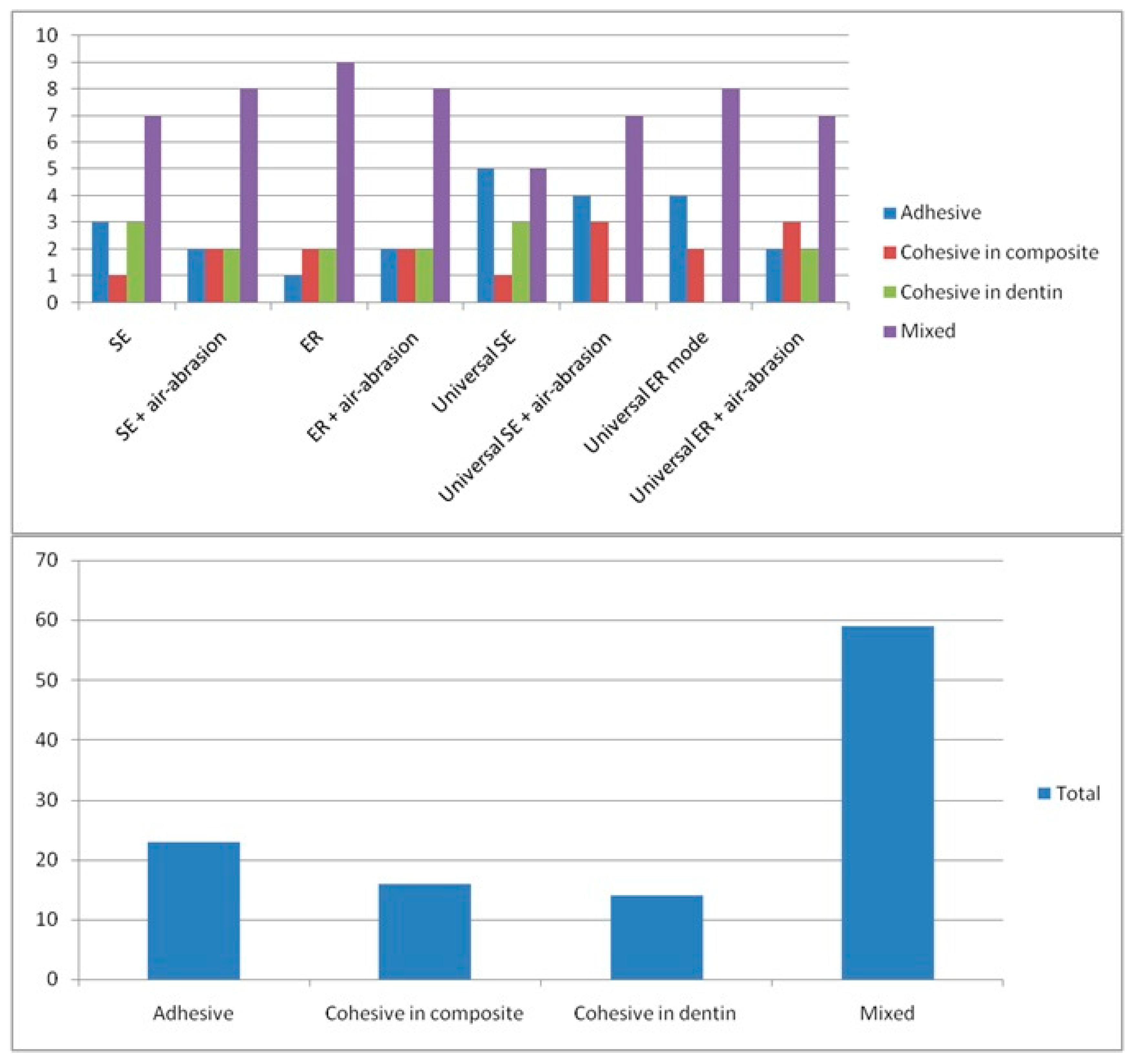
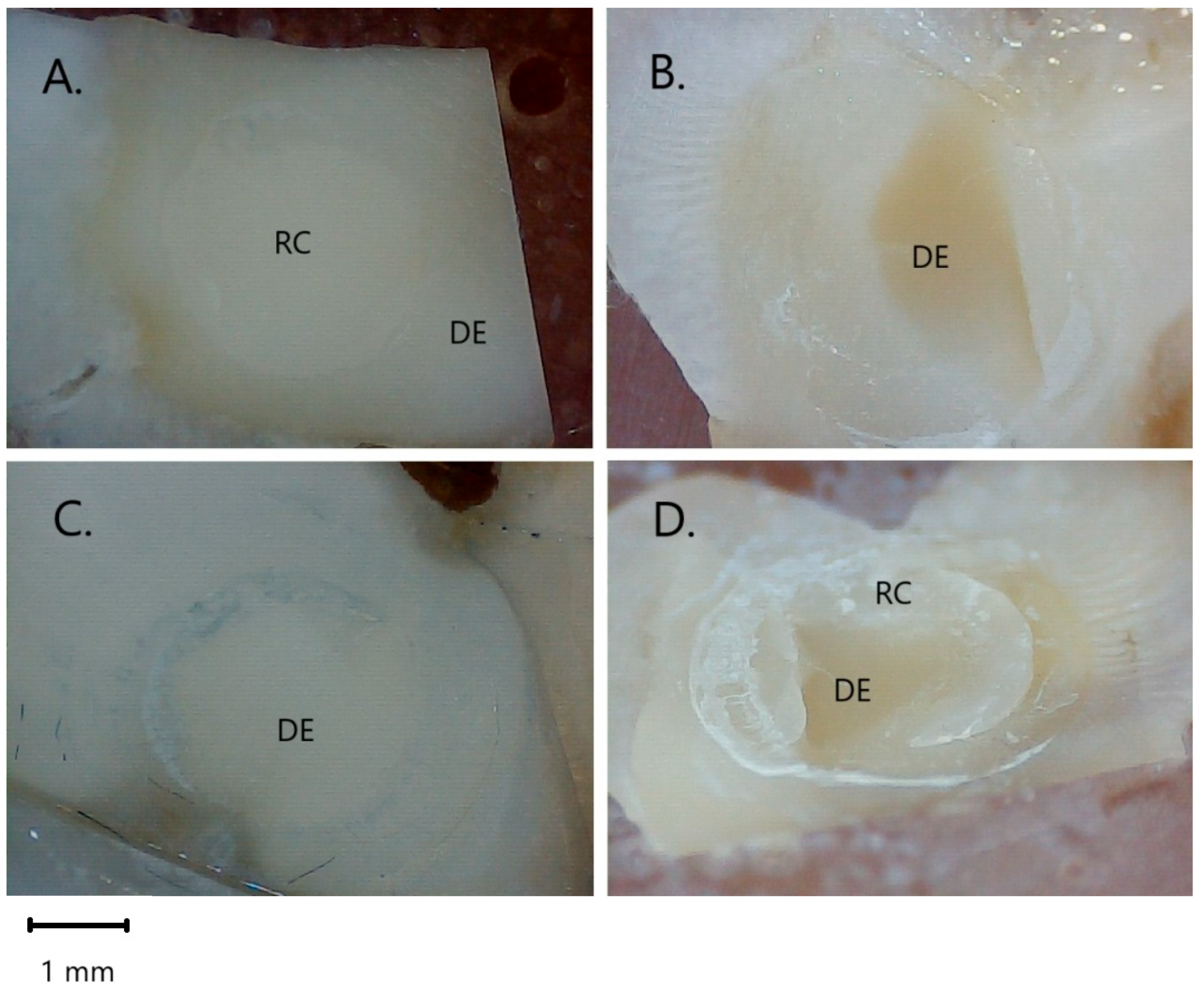
The frequency of the mode of failure is presented in Figure 2, and representative images under the microscope are shown in Figure 3. Considering the significances of Pearson’s χ2 test it can be assumed that there was a relationship between “Treatment” and “Failure type” (p < 0.05). Mixed failures were the most common failure type across all groups. In total, 23 (20.5%) specimens exhibited adhesive failure, 16 (14.3%) had cohesive failure within resin composite, 14 (12.5%) had cohesive failure within dentin and 59 (52.7%) specimens demonstrated mixed failure types. The specimens treated with universal adhesives presented more adhesive failures than the other groups.

4. Discussion

Based on the results of the present study, H01 stated that the air-abrasion pre-treatment would not affect the shear bond strength of the resin composite on dentin, was accepted. In contrast, H02 stated that the different adhesive strategies would not affect the shear bond strength of the resin composite on dentin, was rejected.
The results of the present study demonstrated that the ER adhesive strategy achieved significantly higher SBS values compared to the universal adhesive applied in SE mode, regardless of whether dentin was subjected to air-abrasion. This finding indicates that the conventional phosphoric acid etching procedure remains more effective in achieving strong micromechanical retention with dentin than the milder self-etch approach used with universal adhesives. The superior performance of the ER group may be attributed to its ability to completely remove the smear layer and demineralize the superficial dentin, thereby exposing a collagen network that allows for deeper resin monomer penetration and the formation of a thicker, more homogeneous hybrid layer [32]. On the other hand, SE adhesive strategies are less aggressive and may only partially dissolve the smear layer, leading to shallower hybridization and potentially lower bond strengths [33].
Interestingly, air-abrasion pre-treatment did not produce a statistically significant improvement in SBS for any of the adhesive systems tested. This suggests that while air-abrasion altered the dentin surface topography, increased surface roughness and removed part of the smear layer, these effects were not sufficient to enhance the adhesive interaction or bond strength under the current experimental conditions. It is possible that air-abrasion parameters, such as pressure, particle size or application time, did not substantially modify the substrate to an extent that would influence adhesive performance [34]. Additionally, any potential benefits of increased surface roughness may have been counteracted by the presence of residual alumina particles, which could interfere with adhesive infiltration [35]. In the present study, dentin surface texturing induced by air-abrasion may also alter surface energy and wettability, which could theoretically affect adhesive spreading and infiltration. However, despite these potential effects, our results did not show a significant improvement or deterioration in bond strength following air-abrasion, suggesting that any changes in wettability were not sufficient to translate into measurable differences in bond strength under the conditions tested [36].
Despite the limitations of laboratory techniques evaluating bond strength in general [37], SBS test seems to have some advantages over tensile bond strength test [38], especially when the orthodontic wire loop set-up is employed [39]. One other experimental factor that should be noted is the use of silicon carbide (SiC) papers on all specimens to standardize smear layer, before any abrasive or adhesive procedure. Despite being a common laboratory technique, it appears to produce dentin surfaces that differ from the ones produced clinically by rotary instruments [40]. It has been shown that smear layer thickness produced by 600-grit SiC paper is not comparable to that produced by common burs used in clinical cases [41]. Koibuchi et al. [42] found that the use of 600-grit SiC paper leads to overestimated bond strength of a self-etch system. Finally, Tagami et al. [43] found a difference in acid resistance of smear layer produced by burs compared to one produced by SiC paper.
The results of the test are in compliance with numerous studies that have also not found statistically significant increase in bond strength after dentin air-abrasion [44,45,46,47,48]. This may be due to the fact that in the current experimental protocol, standardized abrasive parameters (particle size, pressure, application time and distance) were used, which created a controlled micro-retentive pattern without excessively altering the dentin substrate. Conversely, studies reporting increased bond strength often used more aggressive abrasion settings, which may enhance micromechanical retention but also risk over-roughening the surface. For instance, earlier studies showed that particles of larger diameter were more abrasive than smaller ones and produce rougher surfaces [2,3]. On the other hand, studies showing reduced bond strength typically involved conditions that excessively remove the smear layer or expose too many open tubules, resulting in a weaker hybrid layer or compromised resin infiltration [13,14].
Other factors concerning air-abrasion that may vary are tip diameter, distance and angle between tip and dentin surface, pressure, time of application and method of surface cleaning after air-abrasion. The latter is often not even mentioned, though it could be potentially significant, as it has been shown that air-abrasion produces smear layers containing Al2O3 residues on dentin surface and inside dentinal tubules [13,14]. The present study uses vigorous rinsing with air/water spray for 30 s to ensure adequate removal of Al2O3 powder from dentin surface, followed by drying with absorbent paper, prior to any adhesive procedure.
Just as crucial to smear layer formation is the origin of dentin substrate. Dentin structure and composition depend on the distance from the pulp chamber, and thus so do composition and thickness of the smear layer produced [49]. Hybrid layer and resin tags formation also depend on dentin surface characteristics, dentinal tubules orientation, intertubular dentin composition, and density, morphology and proximity of dentinal tubules to the pulp [50]. The current study attempts to eliminate these variations by using dentin exclusively from caries and restorations free third molars, 1 mm below the dentin–enamel junction on the buccal and lingual sides.
Finally, an important factor to be taken into consideration when bonding on dentin substrate is the pH value of the adhesive system used in relation to the type of smear layer. Many studies attempted to evaluate the effect of different types of smear layer on the performance of mild and ultra-mild adhesive systems [51,52,53]. In contrast to strong adhesive systems, which did not seem to be significantly affected by smear layer type [52,54], performance of mild and ultra mild systems appeared to be affected by the type of smear layer in relation to their composition and pH value. Some studies report that thicker smear layers relate to weaker bond strengths [24,55]. The acidity of self-etch adhesive systems can affect smear layer dissolution and dentin conditioning [56]. Cuevas-Suárez et al. [55] reported that bond strength of universal adhesive systems on dentin, as well as stability of the bond, depend on their acidity. In the present study, a mild self-etch adhesive system (Clearfil™ SE Bond 2, pH < 2.5) and a mild universal one (Clearfil™ Universal Bond Quick, pH = 2.3) were tested.
Unlike the current and numerous other studies, some others demonstrated a decrease in bond strength after air-abrasion was applied on dentin that was subsequently etched, attributing the results to the enhanced ability of the acid to over-demineralize dentin, causing the collagen network to collapse and phosphoric calcium to be deposited, obstructing adhesive resin penetration [56]. Other researchers argue that air-abrasion can increase bond strength by producing a rougher and irregular dentin surface, and thus a larger bond area [57,58,59] and enhanced hybrid layer and resin tags [60].
The analysis of failure modes provided valuable insight into the nature of the bond between the resin composite and dentin following different treatment protocols. The absence of pre-testing failures indicates that the bonding procedures and specimen preparation were performed consistently and that all specimens had adequate initial bond strength to withstand handling and testing. Mixed failures were the most frequently observed type across all groups, suggesting that the bond strength between the resin composite and dentin was generally well balanced, and that failure tended to occur partially within the adhesive interface and partially within the bonded materials themselves. This pattern typically reflects an intermediate or strong bond, where stresses during testing are distributed across the interface and the surrounding substrates rather than being localized at a single weak point [61].
The statistical analysis (Pearson’s χ2 test, p < 0.05) revealed a significant relationship between the treatment protocol and the type of failure. Specifically, specimens treated with universal adhesives showed a higher incidence of adhesive failures compared to the other groups. This finding may indicate that the bonding performance of universal adhesives under the tested conditions was more dependent on the quality of the adhesive interface [62]. The predominance of adhesive failures in this group suggests that debonding occurred primarily at the resin–dentin interface, possibly due to differences in the composition or infiltration ability of the adhesive system, solvent type, or degree of conversion [63]. Universal adhesives typically contain a combination of functional monomers, such as 10-MDP, along with solvents like water and ethanol that must adequately evaporate to ensure optimal resin penetration [64]. They likely formed a thinner hybrid layer due to their relatively higher solvent content and faster evaporation dynamics, which can limit monomer diffusion into the conditioned dentin substrate. Additionally, the presence of hydrophilic monomers intended to enhance versatility may increase water sorption and reduce phase stability at the interface, making the adhesive layer more prone to separation during stress. Moreover, universal adhesives often rely on milder etching capabilities, which may produce less pronounced demineralization and, therefore, shallower resin tag formation compared with more aggressive systems [65]. This reduced micromechanical interlocking can contribute to a higher likelihood of adhesive failures under shear load. In contrast, the lower incidence of adhesive failures and higher proportion of mixed or cohesive failures in the other treatment groups may reflect stronger interfacial adhesion or improved mechanical interlocking between the adhesive and dentin substrate. The occurrence of cohesive failures within the resin composite or dentin further supports the presence of a durable bond, as the failure propagates through the bulk material rather than along the adhesive interface [62].
Overall, the predominance of mixed failure modes and the significant variation in failure patterns among treatments highlight the influence of the adhesive strategy on the integrity and performance of the resin–dentin bond. Mixed failures are often interpreted as an indicator of a more integrated interaction between the adhesive, hybrid layer, and underlying dentin [66]. In the current study, the predominance of mixed failures suggests that the bond interface was sufficiently strong that fracture did not occur exclusively at the adhesive layer but propagated through both the adhesive and substrate. This pattern is generally associated with more stable interfacial adhesion compared with purely adhesive failures, which typically reflect a weaker or more fragile interface [67]. These findings align with previous studies reporting that the type of adhesive and its application protocol can markedly affect the mode of failure and, consequently, the clinical durability of bonded restorations [62,63]. França et al. [44] found no statistically significant difference in bond strength, but a significant effect of air-abrasion application on fracture mode. A higher percentage of fractures after dentin pre-treatment by air-abrasion were cohesive in adhesive, suggesting integrity in the hybrid layer subjacent to the adhesive, protecting dentin. On the other hand, adhesive failures suggest a rupture at the dentin/resin bond interface, with open dentinal tubules and intertubular dentin with collagen fibers without mineral protection [44].
This study was conducted under controlled laboratory conditions, which may not fully replicate the complex environment of the oral cavity. Factors such as moisture control, temperature fluctuations and intraoral stresses were not simulated and could influence adhesive performance clinically. The use of only one particle size (29 μm Al2O3) and a single set of air-abrasion parameters limit the generalizability of the findings, as different particle sizes, pressures or application times might produce different effects on dentin surface characteristics and bond strength. Additionally, only one type of mechanical test (shear bond strength) was employed, which may not comprehensively represent all aspects of the adhesive interface’s durability. It is also important to mention that in vitro failure modes cannot be directly equated to long-term clinical performance, and their clinical significance must be interpreted with caution and ideally supported by long-term clinical data. Future studies should incorporate other testing methods, such as microtensile or long-term aging protocols, and evaluate a wider range of air-abrasion parameters and adhesive systems to better simulate clinical conditions and outcomes.

5. Conclusions

The current study found no significant increase in shear bond strength of three adhesive systems to dentin, when air-abrasion with 29-μm Al2O3 particles was applied. However, among adhesive strategies there were differences in SBS, favoring etch-and-rinse adhesive systems. From a clinical perspective, these findings suggest that routine air-abrasion of dentin may be unnecessary when using modern adhesive systems, thereby simplifying clinical procedures and avoiding additional operative steps without compromising bond strength. Moreover, the predominance of mixed failure modes supports the formation of a stable adhesive interface across all groups. The effect of dentin air-abrasion on bond strength remains controversial, as studies so far report various outcomes. Further research needs to be conducted, focusing on standardizing certain factors that may cause variations in the results. Also, results need to be related to the composition and pH of the adhesive systems used, in combination with different types of smear layers.

Author Contributions

Conceptualization, P.K.; methodology, X.P. and P.K.; validation, D.D.; formal analysis, D.D.; investigation, X.P., P.K. and D.D.; data curation, K.T.; writing—original draft preparation, X.P. and P.K.; writing—review and editing, D.D.; supervision, K.T.; project administration, K.T. All authors have read and agreed to the published version of the manuscript.

Funding

This research received no external funding.

Institutional Review Board Statement

The study was conducted in accordance with the Declaration of Helsinki, and approved by the Ethics Committee of Dental School of Aristotle University of Thessaloniki (protocol code 17 and date of approval 13 July 2022).

Informed Consent Statement

Informed consent was obtained from all subjects involved in the study.

Data Availability Statement

The data presented in this study are available upon request from the corresponding author.

Conflicts of Interest

The authors declare no conflicts of interest.

References

  1. Black, R.Β. Technic for nonmechanical preparation of cavities and prophylaxis. J. Am. Dent. Assoc. 1945, 32, 955–965. [Google Scholar] [CrossRef]
  2. Hegde, V.S.; Khatavkar, R. A new dimension to conservative dentistry: Air abrasion. J. Conserv. Dent. 2010, 13, 4. [Google Scholar] [CrossRef]
  3. Papadopoulos, K.; Pahinis, K.; Saltidou, K.; Dionysopoulos, D.; Tsitrou, E. Evaluation of the surface characteristics of dental CAD/CAM materials after different surface treatments. Materials 2020, 13, 981. [Google Scholar] [CrossRef]
  4. Rafique, S.; Fiske, J.; Banerjee, A. Clinical trial of an air-abrasion/chemomechanical operative procedure for the restorative treatment of dental patients. Caries Res. 2003, 37, 360–364. [Google Scholar] [CrossRef]
  5. Christensen, G.J. Cavity preparation: Cutting or abrasion? J. Am. Dent. Assoc. 1996, 127, 1651–1654. [Google Scholar] [CrossRef]
  6. Malmström, H.S.; Chaves, Y.; Moss, M.E. Patient preference: Conventional rotary handpieces or air abrasion for cavity preparation. Oper. Dent. 2003, 28, 667–671. [Google Scholar]
  7. Peruchi, C.; Santos-Pinto, L.; Santos-Pinto, A.; Barbosa e Silva, E. Evaluation of cutting patterns produced in primary teeth by an air-abrasion system. Quintessence Int. 2002, 33, 279–283. [Google Scholar]
  8. Rainey, J.T. Air abrasion: An emerging standard of care in conservative operative dentistry. Dent. Clin. N. Am. 2002, 46, 185–209. [Google Scholar] [CrossRef]
  9. Gwinnett, A.J. Smear layer: Morphological considerations. Oper. Dent. 1984, 3, 2–12. [Google Scholar]
  10. Pashley, D.H.; Tao, L.; Boyd, L.; King, G.E.; Horner, J.A. Scanning electron microscopy of the substructure of smear layers in human dentine. Arch. Oral Biol. 1988, 33, 265–270. [Google Scholar] [CrossRef]
  11. Clark-Holke, D.; Drake, D.; Walton, R.; Rivera, E.; Guthmiller, J.M. Bacterial penetration through canals of endodontically treated teeth in the presence or absence of the smear layer. J. Dent. 2003, 31, 275–281. [Google Scholar] [CrossRef]
  12. Antunes, L.A.A.; Pedro, R.L.; Vieira, Á.S.B.; Maia, L.C. Effectiveness of high speed instrument and air abrasion on different dental substrates. Braz. Oral Res. 2008, 22, 235–241. [Google Scholar] [CrossRef]
  13. Chinelatti, M.A.; Corona, S.A.M.; Borsatto, M.C.; Ribeiro, L.F.; Rocha, R.A.S.; Palma-Dibb, R.G. Analysis of surfaces and adhesive interfaces of enamel and dentin after different treatments. J. Mater. Sci. Mater. Med. 2007, 18, 1465–1470. [Google Scholar] [CrossRef]
  14. Oliveira, A.C.M.; Lima, L.M.; Pizzolitto, A.C.; Santos-Pinto, L. Evaluation of the smear layer and hybrid layer in noncarious and carious dentin prepared by air abrasion system and diamond tips. Microsc. Res. Tech. 2010, 73, 597–605. [Google Scholar] [CrossRef]
  15. Pashley, D.H. Clinical correlations of dentin structure and function. J. Prosthet. Dent. 1991, 66, 777–781. [Google Scholar] [CrossRef]
  16. Pashley, D.H. Smear layer: Overview of structure and function. Proc. Finn. Dent. Soc. 1992, 88, 215–224. [Google Scholar]
  17. Van Meerbeek, B.; De Munck, J.; Yoshida, Y.; Inoue, S.; Vargas, M.; Vijay, P.; Van Landuyt, K.; Lambrechts, P.; Vanherle, G. Buonocore memorial lecture. Adhesion to enamel and dentin: Current status and future challenges. Oper. Dent. 2003, 28, 215–235. [Google Scholar]
  18. Perdigão, J.; Lambrechts, P.; Van Meerbeek, B.; Braem, M.; Yildiz, E.; Yücel, T.; Vanherle, G. The interaction of adhesive systems with human dentin. Am. J. Dent. 1996, 9, 167–173. [Google Scholar]
  19. Van Meerbeek, B.; Perdigão, J.; Lambrechts, P.; Vanherle, G. The clinical performance of adhesives. J. Dent. 1998, 26, 1–20. [Google Scholar] [CrossRef]
  20. Sundfeld, R.H.; Valentino, T.A.; Sversut de Alexandre, R.; Fraga Briso, A.L.; Marçal Mazza Sundefeld, M.L. Hybrid layer thickness and resin tag length of a self-etching adhesive bonded to sound dentin. J. Dent. 2005, 33, 675–681. [Google Scholar] [CrossRef]
  21. Chan, K.M.; Tay, F.R.; King, N.M.; Imazato, S.; Pashley, D.H. Bonding of mild self-etching primers/adhesives to dentin with thick smear layers. Am. J. Dent. 2003, 16, 340–346. [Google Scholar]
  22. Tay, F.R.; Carvalho, R.; Sano, H.; Pashley, D.H. Effect of smear layers on the bonding of a self-etching primer to dentin. J. Adhes. Dent. 2000, 2, 99–116. [Google Scholar]
  23. Tay, F.R.; Sano, H.; Carvalho, R.; Pashley, E.L.; Pashley, D.H. An ultrastructural study of the influence of acidity of self-etching primers and smear layer thickness on bonding to intact dentin. J. Adhes. Dent. 2000, 2, 83–98. [Google Scholar]
  24. Van Meerbeek, B.; Yoshihara, K.; Yoshida, Y.; Mine, A.; De Munck, J.; Van Landuyt, K. State of the art of self-etch adhesives. Dent. Mater. 2011, 27, 17–28. [Google Scholar] [CrossRef]
  25. Toledano, M.; Osorio, R.; De Leonardi, G.; Rosales-Leal, J.I.; Ceballos, L.; Cabrerizo-Vilchez, M.A. Influence of self-etching primer on the resin adhesion to enamel and dentin. Am. J. Dent. 2001, 14, 205–210. [Google Scholar]
  26. Sofan, E.; Sofan, A.; Palaia, G.; Tenore, G.; Romeo, U.; Migliau, G. Classification review of dental adhesive systems: From the IV generation to the universal type. Ann. Stomatol. 2017, 8, 1–17. [Google Scholar] [CrossRef]
  27. Hanabusa, M.; Mine, A.; Kuboki, T.; Momoi, Y.; Van Ende, A.; Van Meerbeek, B.; De Munck, J. Bonding effectiveness of a new ‘multi-mode’ adhesive to enamel and dentine. J. Dent. 2012, 40, 475–484. [Google Scholar] [CrossRef]
  28. Muñoz, M.A.; Luque, I.; Hass, V.; Reis, A.; Loguercio, A.D.; Bombarda, N.H.C. Immediate bonding properties of universal adhesives to dentine. J. Dent. 2013, 41, 404–411. [Google Scholar] [CrossRef]
  29. Fukegawa, D.; Hayakawa, S.; Yoshida, Y.; Suzuki, K.; Osaka, A.; Van Meerbeek, B. Chemical interaction of phosphoric acid ester with hydroxyapatite. J. Dent. Res. 2006, 85, 941–944. [Google Scholar] [CrossRef]
  30. Breschi, L.; Maravic, T.; Cunha, S.R.; Comba, A.; Cadenaro, M.; Tjäderhane, L.; Pashley, D.H.; Tay, F.R.; Mazzoni, A. Dentin bonding systems: From dentin collagen structure to bond preservation and clinical applications. Dent. Mater. 2018, 34, 78–96. [Google Scholar] [CrossRef]
  31. Van Landuyt, K.; Kanumilli, P.; De Munck, J.; Peumans, M.; Lambrechts, P.; Van Meerbeek, B. Bond strength of a mild self-etch adhesive with and without prior acid-etching. J. Dent. 2006, 34, 77–85. [Google Scholar] [CrossRef]
  32. Kawai, Y.; Muto, R.; Takamizawa, T.; Ishii, R.; Aoki, R.; Suda, S.; Kasahara, Y.; Suzuki, S.; Miyazaki, M. Influence of air abrasion on the bonding performance of universal adhesives to bovine dentin. Dent. Mater. J. 2025, 44, 579–588. [Google Scholar] [CrossRef]
  33. Ramos, R.Q.; Peumans, M.; Mercelis, B.; Ahmed, M.H.; Politano, G.; Lopes, G.C.; Van Meerbeek, B. Influence of airborne particle abrasion on dentin bonding effectiveness of a 2-step universal adhesive. J. Dent. 2024, 144, 104918. [Google Scholar] [CrossRef]
  34. Peta, K.; Kubiak, K.J.; Sfravara, F.; Brown, C.A. Dynamic wettability of complex fractal isotropic surfaces—Multiscale correlations. Tribol. Int. 2026, 214, 111145. [Google Scholar] [CrossRef]
  35. Placido, E.; Meira, J.B.C.; Lima, R.G.; Muench, A.; De Souza, R.M.; Ballester, R.Y. Shear versus micro-shear bond strength test: A finite element stress analysis. Dent. Mater. 2007, 23, 1086–1092. [Google Scholar] [CrossRef]
  36. El Zohairy, A.A.; Saber, M.H.; Abdalla, A.I.; Feilzer, A.J. Efficacy of microtensile versus microshear bond testing for evaluation of bond strength of dental adhesive systems to enamel. Dent. Mater. 2010, 26, 848–854. [Google Scholar] [CrossRef]
  37. Shimada, Y.; Kikushima, D.; Tagami, J. Micro-shear bond strength of resin-bonding systems to cervical enamel. Am. J. Dent. 2002, 15, 373–377. [Google Scholar]
  38. Van Meerbeek, B.; De Munck, J.; Mattar, D.; Van Landuyt, K.; Lambrechts, P. Microtensile bond strengths of an etch & rinse and self-etch adhesive to enamel and dentin as a function of surface treatment. Oper. Dent. 2003, 28, 647–660. [Google Scholar]
  39. Tani, C.; Finger, W.J. Effect of smear layer thickness on bond strength mediated by three all-in-one self-etching priming adhesives. J. Adhes. Dent. 2002, 4, 283–289. [Google Scholar] [CrossRef]
  40. Koibuchi, H.; Yasuda, N.; Nakabayashi, N. Bonding to dentin with a self-etching primer: The effect of smear layers. Dent. Mater. 2001, 17, 122–126. [Google Scholar] [CrossRef]
  41. Tagami, J.; Tao, L.; Pashley, D.H.; Hosoda, H.; Sano, H. Effects of high-speed cutting on dentin permeability and bonding. Dent. Mater. 1991, 7, 234–239. [Google Scholar] [CrossRef]
  42. França, F.M.G.; Santos, A.J.S.; Lovadino, J.R. Influence of air abrasion and long-term storage on the bond strength of self-etching adhesives to dentin. Oper. Dent. 2007, 32, 217–224. [Google Scholar] [CrossRef]
  43. Freeman, R.; Varanasi, S.; Meyers, I.A.; Symons, A.L. Effect of air abrasion and thermocycling on resin adaptation and shear bond strength to dentin for an etch-and-rinse and self-etch resin adhesive. Dent. Mater. J. 2012, 31, 180–188. [Google Scholar] [CrossRef]
  44. Rosin, C.; Arana-Chavez, V.E.; Garone Netto, N.; De C. Luz, M.A.A. Effects of cleaning agents on bond strength to dentin. Braz. Oral Res. 2005, 19, 127–133. [Google Scholar] [CrossRef]
  45. Santos, M.J.M.; Costa, M.D.; Rêgo, H.M.C.; Rubo, J.H.; Santos, G.C. Effect of surface treatments on the bond strength of self-etching adhesive agents to dentin. Gen. Dent. 2017, 65, 1–6. [Google Scholar]
  46. Yazici, A.R.; Karaman, E.; Ertan, A.; Ozgunaltay, G.; Dayangac, B. Effect of different pretreatment methods on dentin bond strength of a one-step self-etch adhesive. J. Contemp. Dent. Pract. 2009, 10, 41–48. [Google Scholar] [CrossRef]
  47. Tao, L.; Pashley, D. Shear bond strengths to dentin: Effects of surface treatments, depth and position. Dent. Mater. 1988, 4, 371–378. [Google Scholar] [CrossRef]
  48. Walshaw, P.R.; McComb, D. SEM evaluation of the resin-dentin interface with proprietary bonding agents in human subjects. J. Dent. Res. 1994, 73, 1079–1087. [Google Scholar] [CrossRef]
  49. Chowdhury, A.F.M.A.; Saikaew, P.; Alam, A.; Sun, J.; Carvalho, R.M.; Sano, H. Effects of double application of contemporary self-etch adhesives on their bonding performance to dentin with clinically relevant smear layers. J. Adhes. Dent. 2019, 21, 59–66. [Google Scholar] [CrossRef]
  50. Ermis, R.B.; De Munck, J.; Cardoso, M.; Coutinho, E.; Van Landuyt, K.; Poitevin, A.; Lambrechts, P.; Van Meerbeek, B. Bond strength of self-etch adhesives to dentin prepared with three different diamond burs. Dent. Mater. 2008, 24, 978–985. [Google Scholar] [CrossRef]
  51. Saikaew, P.; Chowdhury, A.F.M.A.; Fukuyama, M.; Kakuda, S.; Carvalho, R.M.; Sano, H. The effect of dentine surface preparation and reduced application time of adhesive on bonding strength. J. Dent. 2016, 47, 63–70. [Google Scholar] [CrossRef]
  52. Takamizawa, T.; Barkmeier, W.; Sai, K.; Tsujimoto, A.; Imai, A.; Erickson, R.; Latta, M.A.; Miyazaki, M. Influence of different smear layers on bond durability of self-etch adhesives. Dent. Mater. 2017, 34, 246–259. [Google Scholar] [CrossRef]
  53. Cuevas-Suárez, C.E.; De O. da Rosa, W.L.; Lund, R.G.; da Silva, A.F.; Piva, E. Bonding performance of universal adhesives: An updated systematic review and meta-analysis. J. Adhes. Dent. 2019, 21, 7–26. [Google Scholar]
  54. Perdigão, J.; Lopes, L.; Lambrechts, P.; Leitão, J.; Van Meerbeek, B.; Vanherle, G. Effects of a self-etching primer on enamel shear bond strengths and SEM morphology. Am. J. Dent. 1997, 10, 141–146. [Google Scholar]
  55. Ferdianakis, K.; White, G.E. Newer Class I cavity preparation for permanent teeth using air abrasion and composite restoration. J. Clin. Pediatr. Dent. 1999, 23, 201–216. [Google Scholar]
  56. Manhart, J.; Mehl, A.; Schroeter, R.; Obster, B.; Hickel, R. Bond strength of composite to dentin treated by air abrasion. Oper. Dent. 1999, 24, 223–232. [Google Scholar]
  57. Roeder, L.B.; Berry, E.A.; You, C.; Powers, J.M. Bond strength of composite to air-abraded enamel and dentin. Oper. Dent. 1995, 20, 186–190. [Google Scholar] [PubMed]
  58. Nakabayashi, N.; Nakamura, M.; Yasuda, N. Hybrid layer as a dentin bonding mechanism. J. Esthet. Restor. Dent. 1991, 3, 133–138. [Google Scholar] [CrossRef] [PubMed]
  59. Papadopoulos, C.; Dionysopoulos, D.; Pahinis, K.; Koulaouzidou, E.; Tolidis, K. Microtensile bond strength between resin-matrix CAD/CAM ceramics and resin cement after various surface modifications and artificial aging. J. Adhes. Dent. 2021, 23, 255–265. [Google Scholar] [CrossRef]
  60. Armstrong, S.; Breschi, L.; Özcan, M.; Pfefferkorn, F.; Ferrari, M.; Van Meerbeek, B. Academy of Dental Materials guidance on in vitro testing of dental composite bonding effectiveness to dentin/enamel using micro-tensile bond strength (μTBS) approach. Dent. Mater. 2017, 33, 133–143. [Google Scholar] [CrossRef] [PubMed]
  61. Scherrer, S.S.; Cesar, P.F.; Swain, M.V. Direct comparison of the bond strength results of the different test methods: A critical literature review. Dent. Mater. 2010, 26, 78–93. [Google Scholar] [CrossRef]
  62. Dionysopoulos, D.; Gerasimidou, O.; Papadopoulos, C. Current modifications of dental adhesive systems for composite resin restorations: A review in literature. J. Adhes. Sci. Tech. 2022, 36, 453–468. [Google Scholar] [CrossRef]
  63. Vasconcelos e Cruz, J.; Polido, M.; Brito, J.; Gonçalves, L.L. Dentin bonding and SEM analysis of a new experimental universal adhesive system containing a dendrimer. Polymers 2020, 12, 461. [Google Scholar] [CrossRef] [PubMed]
  64. Gökce, D.; Usumez, A.; Polat, Z.S.; Ayna, E. Evaluation of Four Different Adhesive Systems’ Bonding Strength Between Superficial and Deep Dentin. Materials 2025, 18, 3107. [Google Scholar] [CrossRef]
  65. Valian, A.; Salehi, E.M.; Mahmoudzadeh, M.; Dabagh, N.K. Effect of different surface treatment on the repair bond strength of feldspathic porcelain. Dent. Med. Probl. 2021, 58, 107–113. [Google Scholar] [CrossRef] [PubMed]
  66. Sumikawa, D.A.; Marshall, G.W.; Gee, L.; Marshall, S.J. Microstructure of primary tooth dentin. Pediatr Dent. 1999, 21, 439–444. [Google Scholar]
  67. Fosse, G.; Saele, P.K.; Eide, R. Numerical density and distributional pattern of dentin tubules. Acta Odontol. Scand. 1992, 50, 201–210. [Google Scholar] [CrossRef]
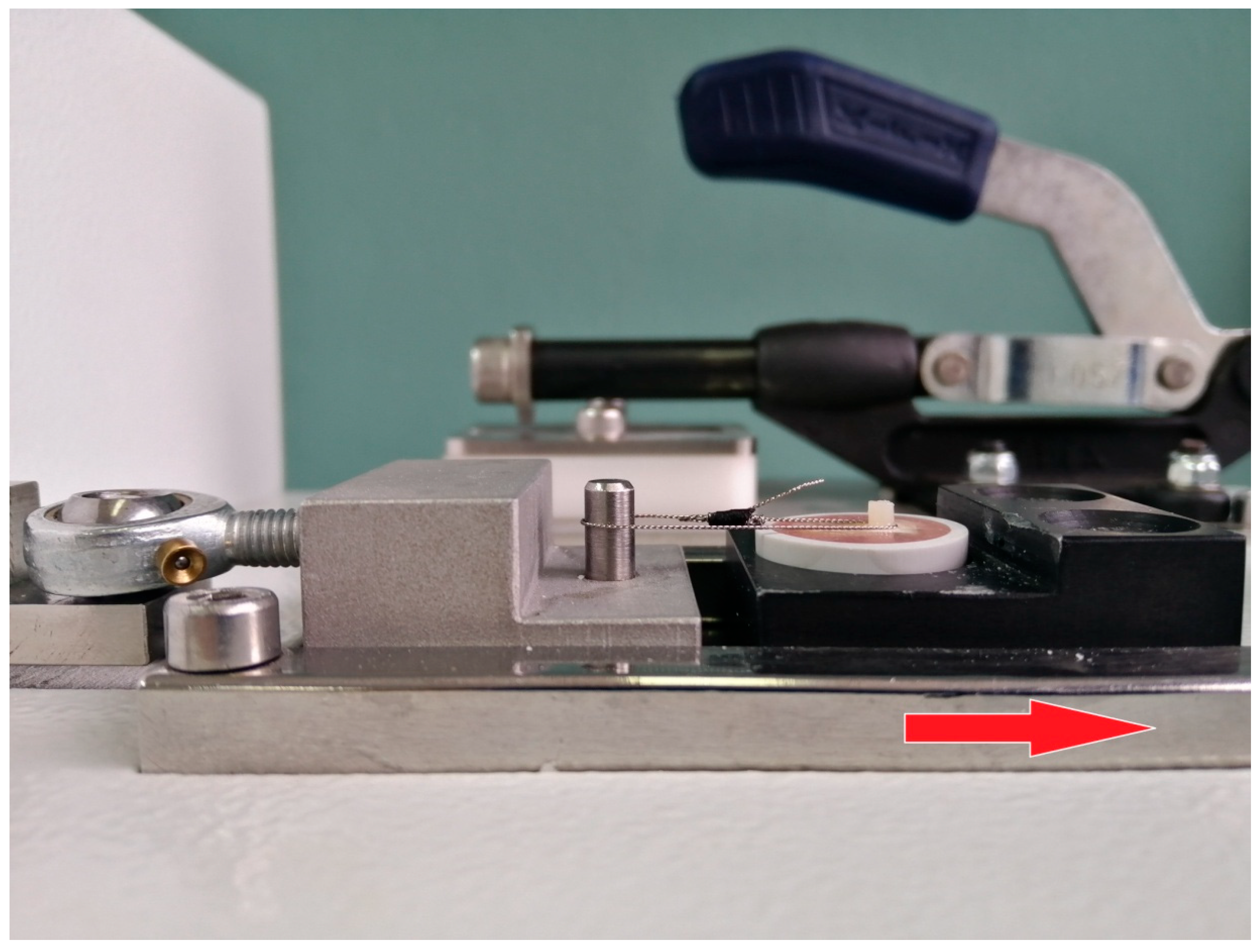
Figure 1. Orthodontic wire loop set-up for SBS with shear testing machine (OM100 Odeme, Luzerna, Brazil). The red arrow shows the direction of movement of the specimen.
Eng 07 00046 g001
Figure 2. Distribution of failure type after shear bond strength test: (1) Adhesive—failure between resin composite and dentin (>75% of the bonding area). (2) Cohesive in resin composite—failure in the resin composite (>75% of the bonding area). (3) Cohesive in dentin—failure in dentin (>75% of the bonding area); and (4) mixed—failure including both adhesive and cohesive failures (>25% and <75% of the bonding area). ER: etch-and-rinse, SE: self-etch.
Eng 07 00046 g002
Figure 3. Representative images of each failure type obtained from the clinical microscope (20× magnification). (A): cohesive type within the resin composite; (B): cohesive type within the dentin; (C): adhesive type; (D): mixed type; DE: dentin and RC: resin composite.
Eng 07 00046 g003
Table 1. Experimental groups formed by combinations of surface treatment and bonding procedure (n = 14).
GroupAdhesive SystemDentin Pre-Treatment
1SENone
2SEAir-abrasion (29 μm Al2O3)
3ERNone
4ERAir-abrasion (29 μm Al2O3)
5Universal in SE modeNone
6Universal in SE modeAir-abrasion (29 μm Al2O3)
7Universal in ER modeNone
8Universal in ER modeAir-abrasion (29 μm Al2O3)
ER: etch-and-rinse, SE: self-etch.
Table 2. Adhesive system, composition and application mode according to manufacturer’s instructions.
Adhesive
System
CompositionApplication ModeManufacturer
Clearfil™ SE Bond 2Primer (pH < 2.5):
10-MDP, HEMA, Hydrophilicaliphatic dimethacrylate, CQ, Water
Bond, Bis-GMA, hydrophobic aliphatic dimethacrylate, initiators, accelerators, silanated colloidal silica
Apply primer for 20 s
Dry with mild air for 5 s
Apply bond
Make a uniform bond
film using a gentle airflow
Light-cure for 10 s
Kuraray Noritake Dental Inc., Okayama, Japan
OptiBond™ FLPrimer (pH = 2):
2-HEMA, ethanol, 2-[2-(methacryloyloxy) ethoxycarbonyl]benzoic acid, glycerol phosphate dimethacrylate
Apply gel etchant for 15 s
Rinse for 10 s
Dry with mild air for 5 s
Apply primer for 15 s
Dry with mild air for 5 s
Apply adhesive for 15 s
Dry with mild air for 5 s
Cure for 10 s
Kerr Dental, Salerno, Italy
Adhesive (pH = 5):
Glass, oxide, chemicals, 2-HEMA, YbF3, 3-trimethoxysilylpropyl methacrylate, 2-hydroxy-1,3-propanediyl bismethacrylate, alkali fluorosilicates (Na)
Clearfil™ Universal Bond Quick(pH = 2.3):
10-MDP, Bis-GMA, 2-HEMA, hydrophilic amide monomers, colloidal silica, silane coupling agent, NaF, CQ, ethanol, water
(Phosphoric acid etching for 10 s
Rinse for 10 s)
Apply with rubbing motion
Air dry for 5 s
Light cure for 10 s
Kuraray Noritake Dental Inc., Okayama, Japan
Bis-GMA: bisphenol A diglycidylmethacrylate, CQ: dl-Camphorquinone, HEMA: 2-hydroxyethyl methacrylate, 10-MDP: 10-methacryloyloxydecyl dihydrogen phosphate, NaF: sodium fluoride, YbF3: ytterbium trifluoride.
Table 3. Means and standard deviations of surface roughness (Ra) for untreated and air-abraded dentin.
Surface TreatmentSurface Roughness (Ra)
None0.19 (0.03) A
Air-abrasion1.17 (0.16) B
Same uppercase superscripts in columns indicate no significant differences between the treatments (p > 0.05).
Table 4. Means and standard deviations of shear bond strength values in MPa of each experimental group.
Dentin Pre-TreatmentAdhesive Strategy
SEERUniversal SEUniversal ER
None26.77 (7.78) Aab32.81 (9.04) Ab21.68 (5.85) Aa26.09 (8.96) Aab
Air-abrasion31.32 (7.40) Aab35.54 (4.64) Ab27.31 (4.59) Aa31.28 (7.47) Aab
ER: etch-and-rinse, SE: self-etch; same uppercase superscripts in columns indicate no significant differences among the treatments (p > 0.05). Same lowercase superscripts in rows indicate no significant differences among the adhesive strategies followed (p > 0.05).
Disclaimer/Publisher’s Note: The statements, opinions and data contained in all publications are solely those of the individual author(s) and contributor(s) and not of MDPI and/or the editor(s). MDPI and/or the editor(s) disclaim responsibility for any injury to people or property resulting from any ideas, methods, instructions or products referred to in the content.