1. Introduction
Inverting prestack seismic data for subsurface elastic properties such as P- and S-wave velocities (
), density (
), etc., is a routine process in the oil and gas industry and has been successfully applied to characterize both hydrocarbon and carbon capture and storage (CCS) reservoirs. These reservoir characterization projects require estimating subsurface models at a resolution of quarter wavelengths of dominant seismic frequency or lower [
1]. Although full waveform inversion (FWI) that numerically solves three-dimensional (3D) wave equation is already in place [
2], computing cost and the curse of high dimensionality limits FWI to low resolution. These low-resolution models from FWI are adequate for imaging-related applications but not for the reservoir characterization projects [
3]. Consequently, routinely practiced prestack inversion methods for reservoir characterization are amplitude-variation-with-angle (AVA) inversion [
4] or its subsets, such as the elastic impedance (EI) inversion and extended elastic impedance (EEI) inversion [
5,
6]. Although AVA provides the desired resolution, the method is based on convolutional modeling that ignores complex wave effects and often fails to estimate an accurate elastic model from real seismic data [
7,
8,
9].
In between FWI and AVA, a method, to which we refer here as prestack waveform inversion (PWI), was also introduced and successfully applied in many reservoir-related projects [
10,
11,
12,
13,
14,
15]. PWI is a subset of FWI which analytically solves the one-dimensional (1D) wave equation for computing synthetic seismic data. Because of the 1D assumption, PWI is strictly valid for horizontally stratified layers. However, all AVA inversion methods, including its subsets, EI and EEI, are also based on such a 1D assumption. To approximately validate the 1D subsurface, AVA inversions are typically applied to prestack-migrated data. Migration is the imaging process of moving the reflection from all source-receiver pairs to their common image points. For simple-to-moderate subsurface geology, a common image gather (CIG) from prestack migration can be regarded as locally 1D, on which both AVA inversion and PWI can be applied [
16].
Mallick and Adhikari (2015) [
1], Pafeng et al. (2017) [
15], and Mallick et al. (2025) [
9] demonstrated the superiority of PWI over AVA inversion. Despite this superiority, the PWI applications are limited, and AVA is still the method of choice for routine reservoir characterization projects. The primary reason for this is the computational cost needed for 3D PWI. Although this method analytically solves the 1D wave equation for forward modeling, it is still computationally demanding. Mallick and Adhikari (2015) [
1], Pafeng et al. (2017) [
15], and Jia et al. (2021) [
3] introduced the concept of multilevel parallelization for PWI to expedite computational efficiency in high-performance computing platforms. However, even with such parallelization, the method is much slower than the AVA inversion. In the regions close to the well locations where well-logs with
, and
measurements are available, PWI can be provided with an initial model that is close to the true model. In such situations, starting from these initial models, PWI converges very quickly to the true model, and its runtime is generally comparable with that of the AVA inversion. However, as we move away from the well locations, the initial model is provided via interpolation of the low-frequency well-log models over the horizons that are interpreted from stacked seismic data (Mallick and Adhikari, 2015 [
1]; Pafeng et al., 2017 [
15]). These interpolated models could be far from the true models for those locations. Consequently, both PWI and AVA require many iterations to converge, and PWI becomes much more computationally demanding than the AVA inversion. Obtaining a good low-frequency initial model is therefore the key to improving the computational efficiency of PWI. The primary motivation of this work is (1) to develop a robust method to generate a good initial model for isotropic elastic seismic inversion and (2) demonstrate that, by using this initial model, PWI can obtain reliable results in reasonable timeframes.
For seismic oceanography, an acoustic attribute-guided approach to obtain initial models for inverting water column reflections from real marine seismic data and to estimate sound speeds have been recently developed [
17]. Furthermore, these inverted sound speeds have also been shown to reliably estimate oceanwater temperature and salinity for weather and climate-related applications [
18]. This acoustic attribute-guided method uses an attribute
, computed from stacked seismic reflection data, which strongly correlates with the sound speed, such that a reliable sound speed can be estimated directly from
, and can be used as the initial model. In this work, we extend this acoustic attribute-guided approach to the elastic case. We use the linearized P-P reflection coefficient formula to estimate AVA intercept (
), AVA gradient (
, and AVA curvature (
from prestack seismic data. We then derive three attributes,
, and
from
, and
. Using both synthetic and real seismic data, we then demonstrate that, like the acoustic case,
, and
strongly correlate, respectively, with
, and
, using which, a reliable initial model for isotropic elastic seismic inversion can be obtained.
In the following, we first review the acoustic attribute-guided approach and the necessary steps to extend the method for isotropic elastic inversion. We then demonstrate the applicability of this elastic attribute-guided approach using synthetic and real seismic data. Using synthetic data, we then provide a potential future application to characterize the subsurface hydrogen storage reservoirs. Finally, we discuss results and make some concluding remarks.
2. Attribute-Guided Method
For acoustic inversion, Mallick and Chakraborty (2022) [
17] and Chakraborty and Mallick (2024) [
18] computed the time (
) variant attribute
as
In Equation (1),
is computed from the stacked seismic data
. To compute
,
is Fourier transformed in the frequency (
) domain as
. Next, the attribute
is computed by interchanging each real and imaginary component of
. Thus, if a given sample
of
is
, where
, the corresponding sample of
is
. Next,
is inverse Fourier transformed into the time domain, and its real part is represented to be the time domain attribute
. Finally,
is computed from
and
as
for each time sample
. Note that
is not the Hilbert transform of
. In Hilbert transform, each component of
is phase-shifted by
and inverse Fourier transformed to the time domain [
19], which is not same as how we compute
.
Mallick and Chakraborty (2022) [
17] and Chakraborty and Mallick (2024) [
18] computed
from the above procedure. Then, they cross-plotted
against oceanwater sound speed
, purely derived from velocity analysis, and derived an empirical relationship of
as a function of
. Finally, they used this derived relationship to compute the attribute-guided initial sound speed model.
To extend this acoustic initial model generation for the isotropic elastic case, it is first necessary to understand the underlying physics behind this acoustic attribute-guided approach. The stacked seismic data amplitudes from which
is computed can be roughly approximated as normal incidence reflection coefficients. Given an interface between two acoustic layers where
and
are the sound speed (velocity) and density of the upper layer and
and
are those for the lower layer, the exact expression of the normal incidence reflection coefficient
is given as (Aki and Richards. 2002 [
19])
For small contrasts in the velocity and density, Equation (3) can be approximated as
where
and
are the average velocity and density and
and
are their contrasts, given as
In seismic oceanography, the density contrasts within the water column layers are very small and the reflection amplitudes are primarily controlled by the sound speed contrasts [
20]. This means that
and therefore
. This dependence of the water column reflection amplitudes on the sound speed contrasts is the reason for the attribute
, given by Equation (1), to depend strongly upon the sound speed.
To extend this attribute-guided approach for the isotropic elastic case, we start from the linearized reflection coefficient formula for the boundary between two layers, where the P- and S-wave velocity and density of the top layer are
, and
and those for the bottom layer are
, and
. This linearized P-P reflection coefficient
for such a boundary can be written from Aki and Richards (2002) [
19] as
In Equation (6),
is the average angle-of-incidence (average of the incident and the transmitted angles for the P-P reflection and transmission). The parameters
,
, and
in Equation (6) are, respectively, the AVA intercept, gradient, and curvature, and are given as
and
In Equations (7)–(9),
,
, and
are the average P-wave velocity, S-wave velocity, and density
and
,
, and
are their respective contrasts
Thus, a least square fit of Equation (6) to the angle domain prestack seismic data would provide the AVA intercept (
), AVA gradient (
), and AVA curvature (
) as functions of time (
). Then, from Equations (7) and (9), we get
and
Finally, from Equations (8), (12) and (13), and assuming a background
, we get
Equations (1), (2), (6) and (12)–(14) provide the fundamental framework to extend the attribute-guided acoustic model to an attribute-guided elastic model from the following steps:
From the prestack seismic data in the offset-time () domain, we compute the data in the incidence angle–time () domain.
By a least square fit of Equation (6) to the
domain seismic data, we estimate the AVA intercept
, AVA gradient
, and AVA curvature
Using Equations (12)–(14), we compute
,
, and
from
,
, and
From Equations (1) and (2), we compute
,
, and
. To compute
, we use
as
. To compute
, we use
as
. Finally, to compute
, we use
as
Cross-plot
versus
,
versus
, and
versus
at the available well locations to derive
,
and
relations and use them to compute the attribute-guided initial elastic model of
, and
.
Although the above five-step process appears straightforward, its practical implementation is not simple. The primary reason for this is developing a robust methodology to extract
and
from real seismic data and estimating
and
. The linearized reflection coefficient formula (Equation (6)), which is the basis of estimating these parameters, requires seismic data to be in the incidence angle and time () domain. Real seismic data, on the other hand, are in the offset and time () domain. Therefore,
domain data must be transformed to the
domain using an offset-to-angle mapping procedure. We postpone the discussion of this
onto
mapping for later, and first discuss having obtained reliable seismic data in the
domain, the necessary steps and the assumptions needed to estimate
and
.
Notice from the right-hand side of Equation (6) that, for incidence angles less than
,
is almost linear with
, because
is nearly zero for those angles. For higher incidence angles, however,
rapidly increases with increasing
. Because of this behavior, fitting the entire Equation (6) to the
domain seismic data is unstable where the range of
values are more than
. At the same time, to reliably estimate the AVA curvature
, data for
values, at least up to
or
, are necessary. This is a classical problem in AVA analysis and there are many robust methods to estimate
, and
from angle domain prestack seismic data. Trying different approaches, below is the method that we adopted for least square fitting to
domain seismic data:
Use a standard least squares procedure to fit the first two terms of the right-hand side of Equation (6) for the subset of data where
. This process provided estimates of
and
Fit all three terms on the right-hand side of Equation (6) for the rest of the
domain data (that is, for the subset of data where
). In this step, we use a constrained least square fitting technique and force
and
to those estimated from step 1 and we estimate only
The above procedure worked reasonably well for both synthetic and real data. We did not apply any angular weighting or stabilization in our two-step fitting. In AVA or poststack inversion, seismic data amplitudes are calibrated using well-logs such that they correspond to the reflection coefficients. In our method, we did this calibration to poststack data for estimating a single wavelet. However, to extract
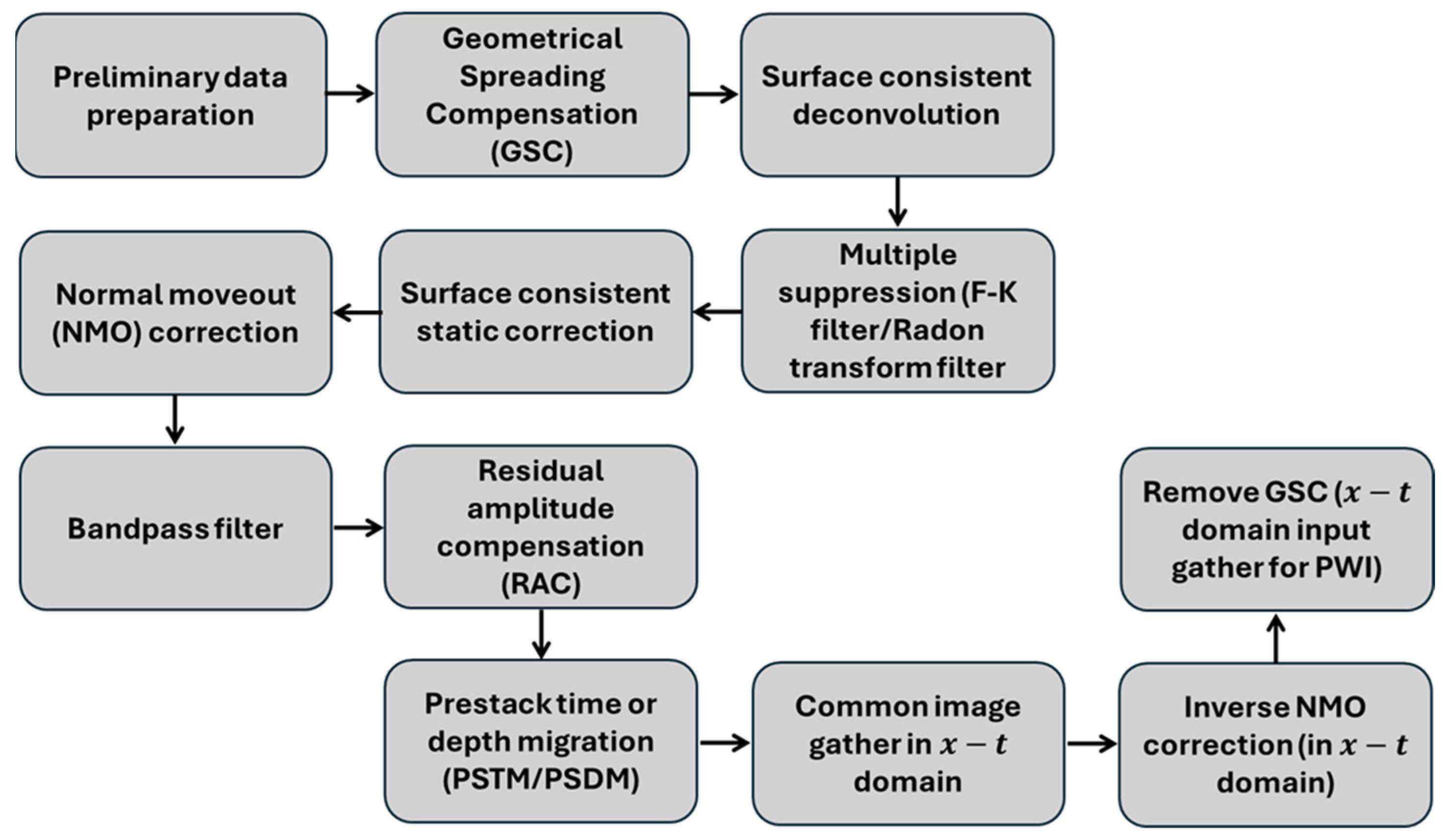
, we did not do any calibration. The reason for this is because PWI does not require absolute amplitudes to be calibrated to the reflection coefficients. However, the method requires that the relative amplitudes on the prestack seismic data are preserved using a surface-consistent relative amplitude preserved (RAP) processing workflow, which we discuss later.
Once
, and
are estimated, Equations (12)–(14) provide
,
, and
. While computing
and
does not require additional assumptions, computing
requires a background value of
, and, in deriving Equation (14), we assumed a value of
, which requires further explanation. Poisson’s ratio
can be defined as (see Mallick, 2007 [
8])
Thus, the value of
for
corresponds to
. For exploration depths of interest, most of the formations are shale and sand, and sometime carbonates. Poisson’s ratio for these formations are, in fact, close to
. Their values sometimes deviate for overpressured shales, clean water saturated sands, oil and gas sands, etc. However, assuming an average (background) value of
is reasonable and widely applied in AVA analysis (Mallick, 2001 [
7]).
3. Synthetic Examples
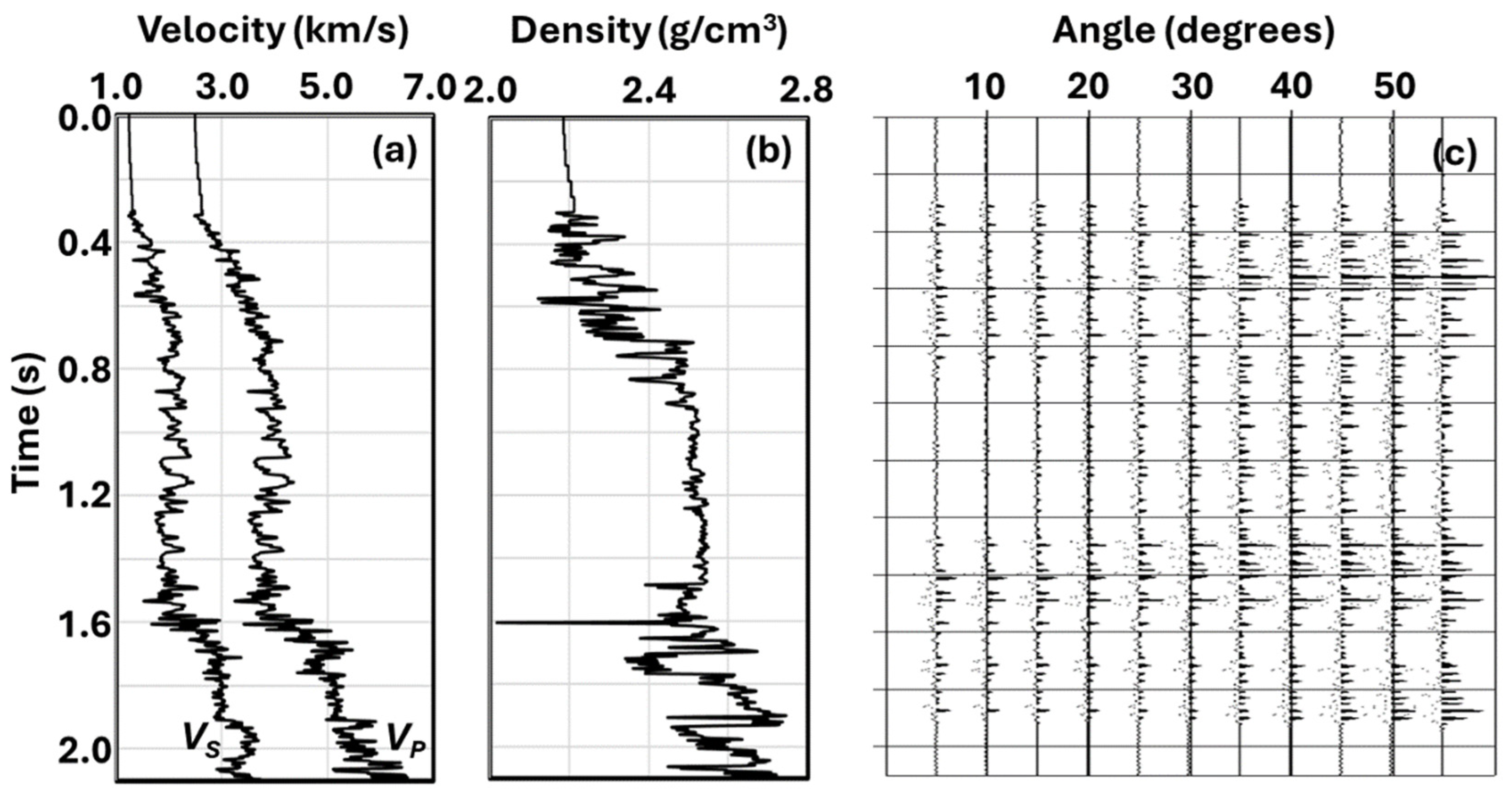
Considering that convolution is the basis for forward modeling for AVA inversion, our first example is based on the convolutional synthetic seismic data, shown in
Figure 1.
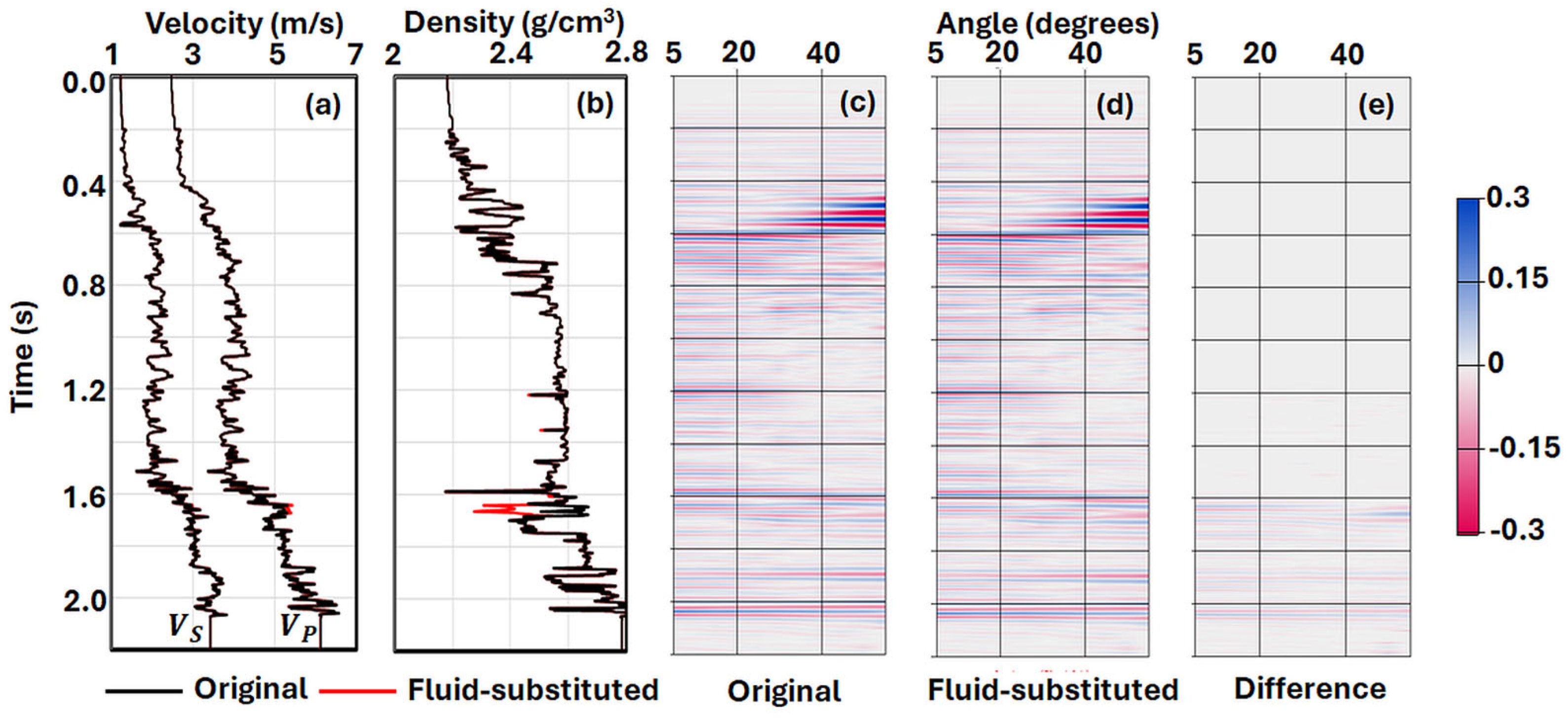
Figure 1a shows the P- and S-wave velocity (
) and
Figure 1b shows the density (
) for the RSU #1 real well-log data from the Rock-Springs Uplift (RSU), Wyoming, USA. Depth domain well-logs were tied to the seismic data, acquired at the RSU location and then converted to two-way P-wave travel times and shown in
Figure 1a,b. Using Equations (6)–(11), we computed the linearized P-P reflection coefficient
for
in steps of
and then convolved with a 30 Hz zero-phase Ricker wavelet to compute the convolutional angle gather, shown in
Figure 1c.
From the convolutional synthetic angle gather (
Figure 1c), we estimated
,
, and
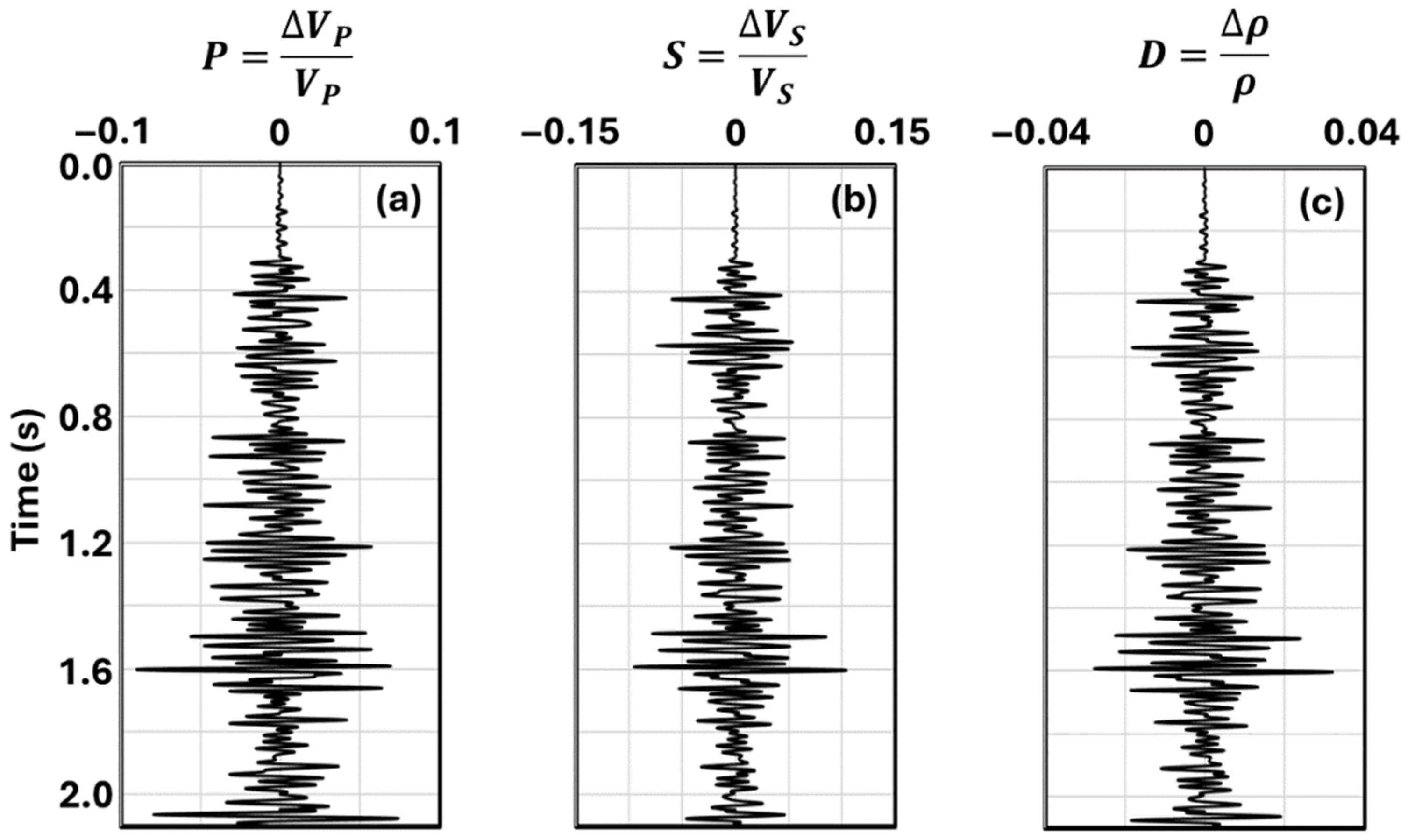
via a least square fit of Equation (6), and used Equations (12)–(14) to compute
,
, and
, as shown in
Figure 2.
We next use Equations (1) and (2) and compute
, and
from the attributes
, and
.
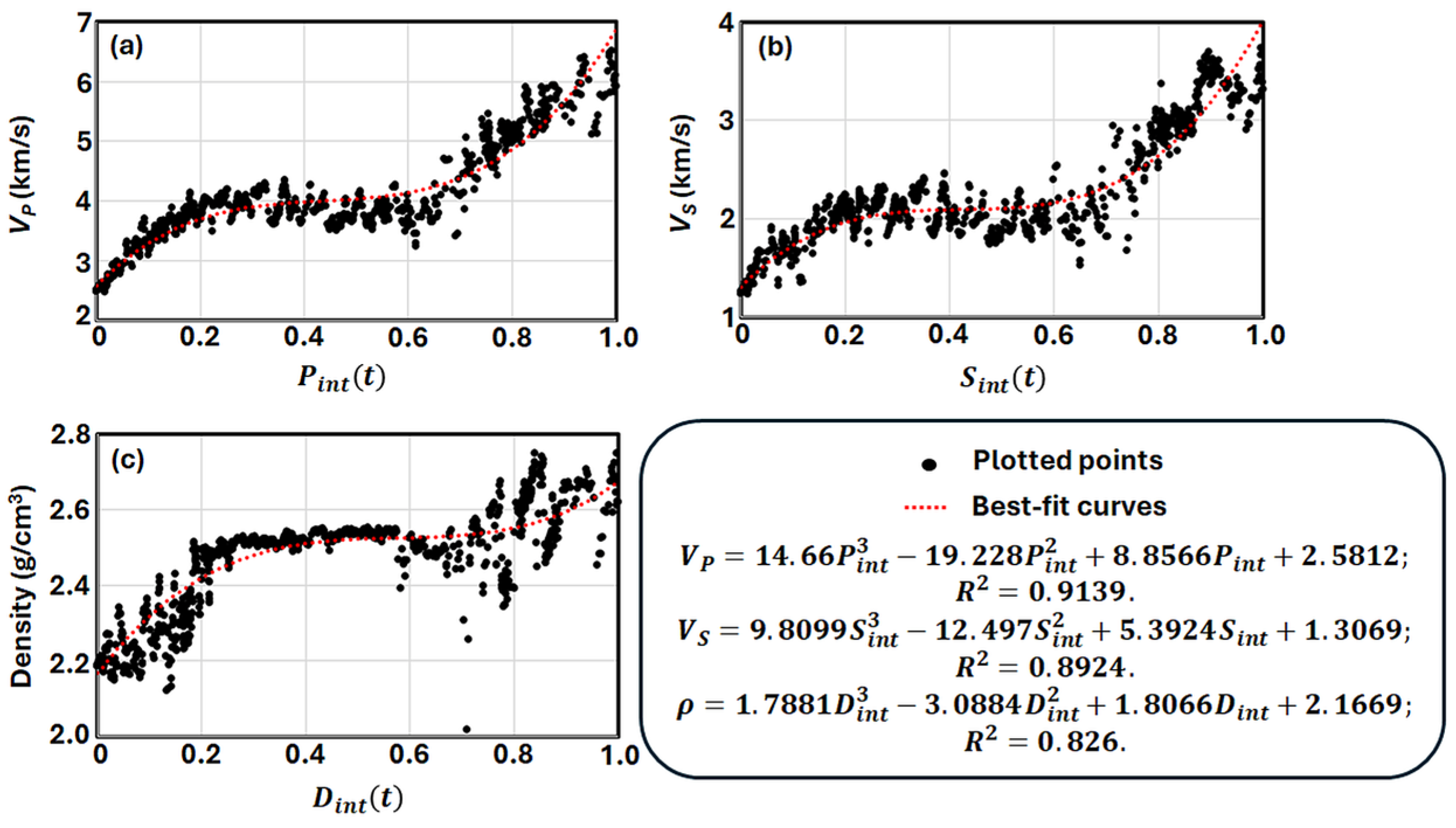
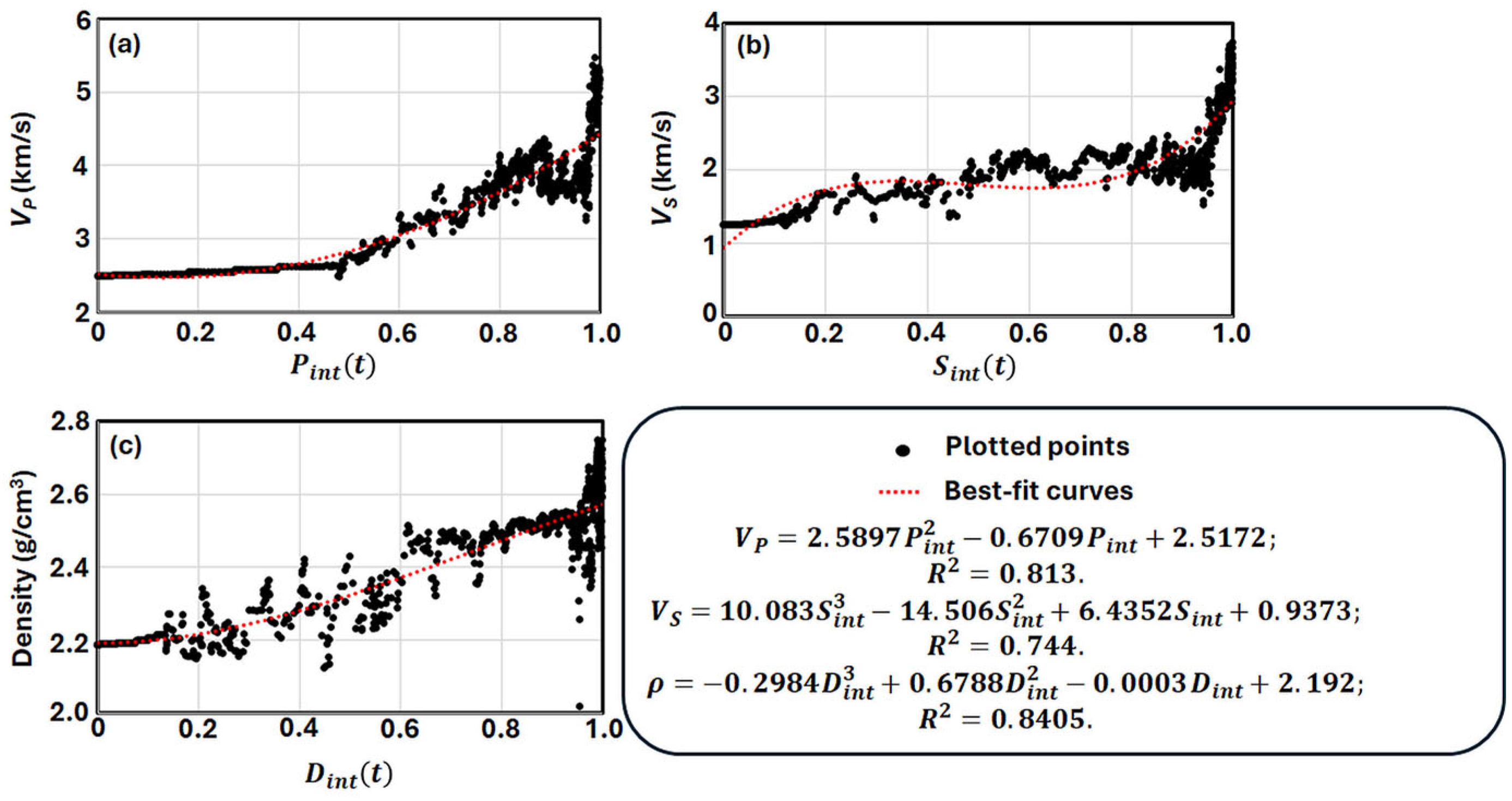
Figure 3 shows the cross-plot of
versus
(
Figure 3a),
versus
(
Figure 3b), and
versus
(
Figure 3c). The black dots in
Figure 3 are the plotted points, and the dashed red curves are the best-fit polynomials through these points. Equations of these fitted polynomials, including their goodness of fit (
) values, are shown as captions at the right bottom corner of
Figure 3.
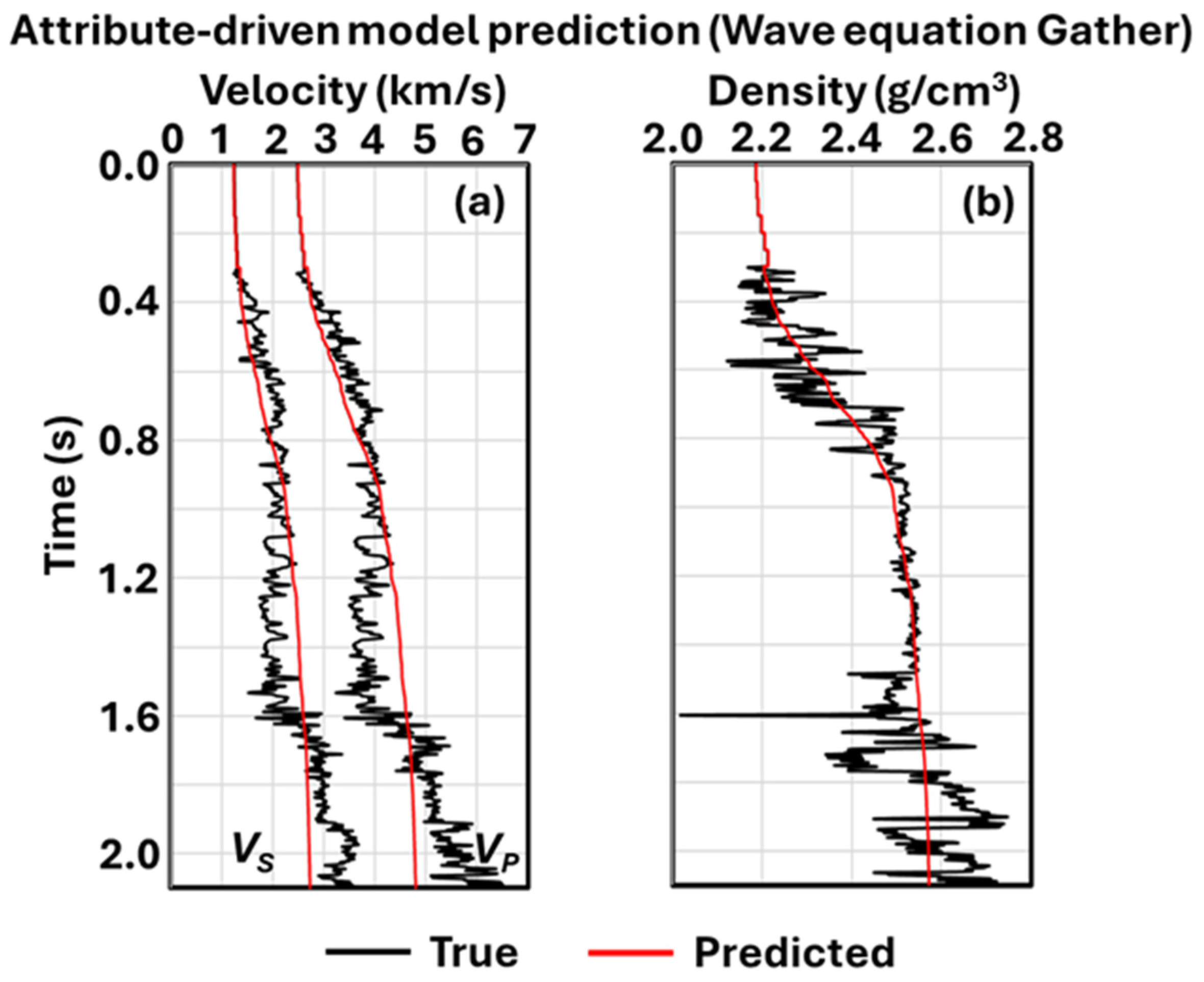
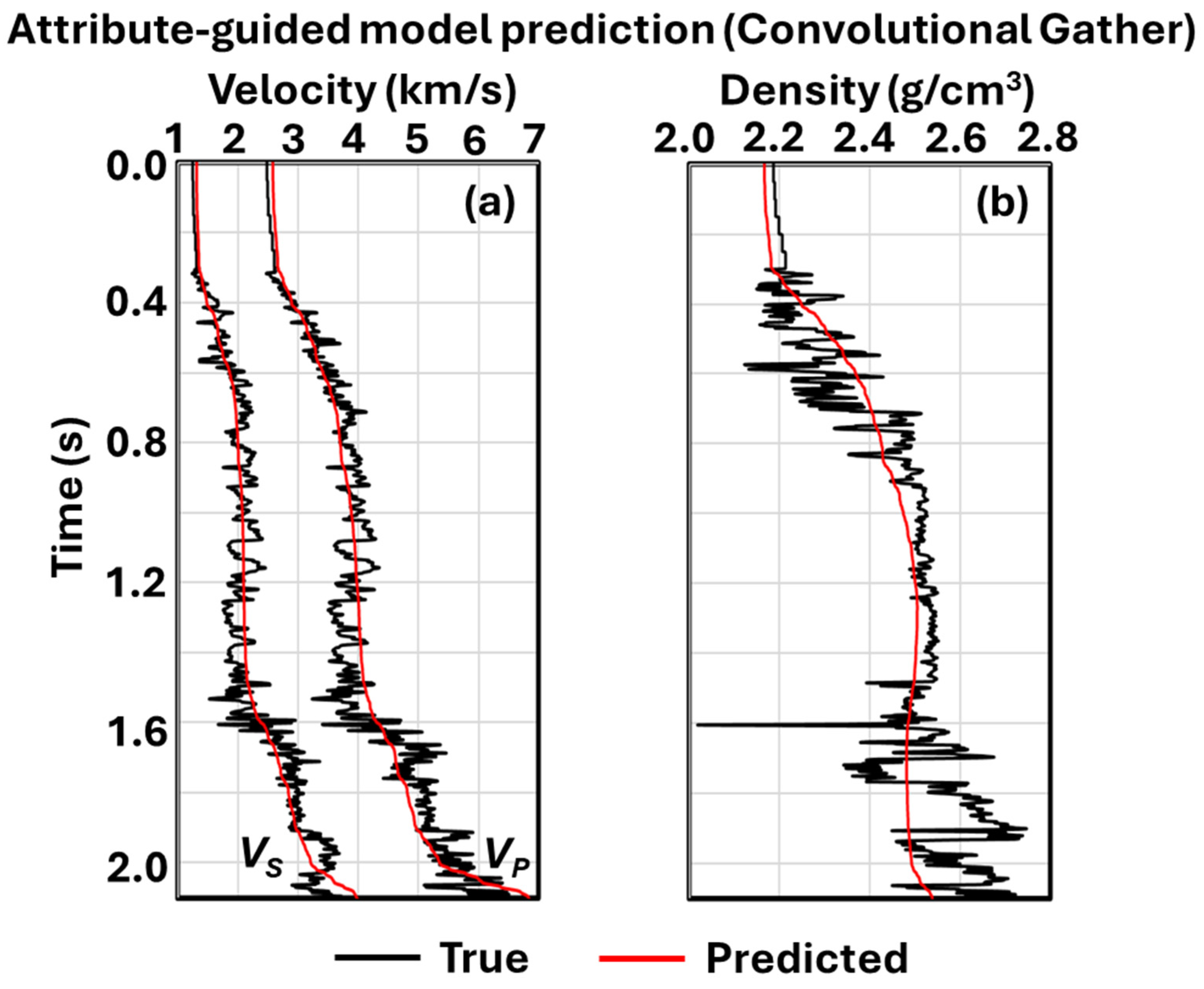
Finally, we use the fitted polynomial equations shown in
Figure 3 to directly compute
from
,
from
and
from
and compare them with the original well-logs (
Figure 4).
From
Figure 3 and
Figure 4, we may conclude that the attributes
,
, and
are good predictors of
,
, and
. Although the predicted model does not perfectly match the true model (
Figure 4), it is of reasonable accuracy to be used as the initial model for any inversion. This conclusion is, however, based on convolutional synthetic seismic data, computed directly in the
domain (
Figure 1c). In practice, seismic data are acquired in the offset-time (
) domain and converted to the
domain. In addition, Mallick (2007) [
8] demonstrated that the convolutional assumption is not valid for
where complex wave effects interfere with the primary reflections, and it is advisable to use wave equation-based computation instead of convolution. Before proceeding with real data, it is thus important to start with
domain synthetic data computed from a wave equation-based method, transform to the
domain, and discuss the usability of our approach.
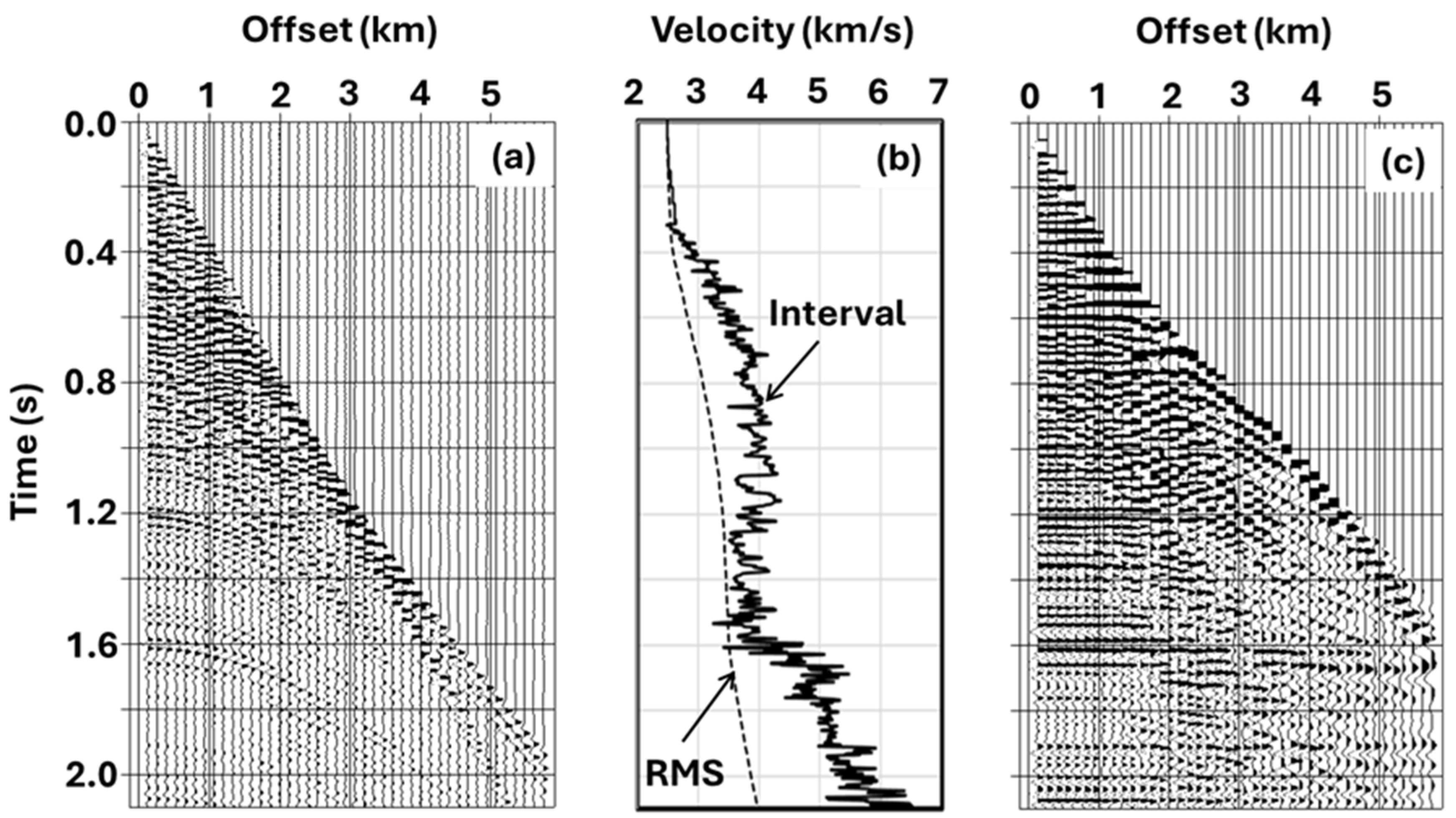
Figure 5a shows the
domain synthetic seismic data computed using full wave equation modeling and the RSU #1 well-log data shown in
Figure 1a,b. Note that, to directly compare with the convolutional synthetic (
Figure 1c), we show the RSU #1 well-logs in the time domain in
Figure 1a,b. To compute the wave equation synthetics, however, we used the depth domain versions of these well-logs.
Figure 5b shows the interval and root mean square (RMS) P-wave velocity. The interval velocity of
Figure 5b is, in fact, the same as the
curve of
Figure 1a. Finally, we used the velocity field of
Figure 5b to compensate the synthetic data of
Figure 5a for the geometrical spreading loss, correct for the normal moveout (NMO), and display them in
Figure 5c.
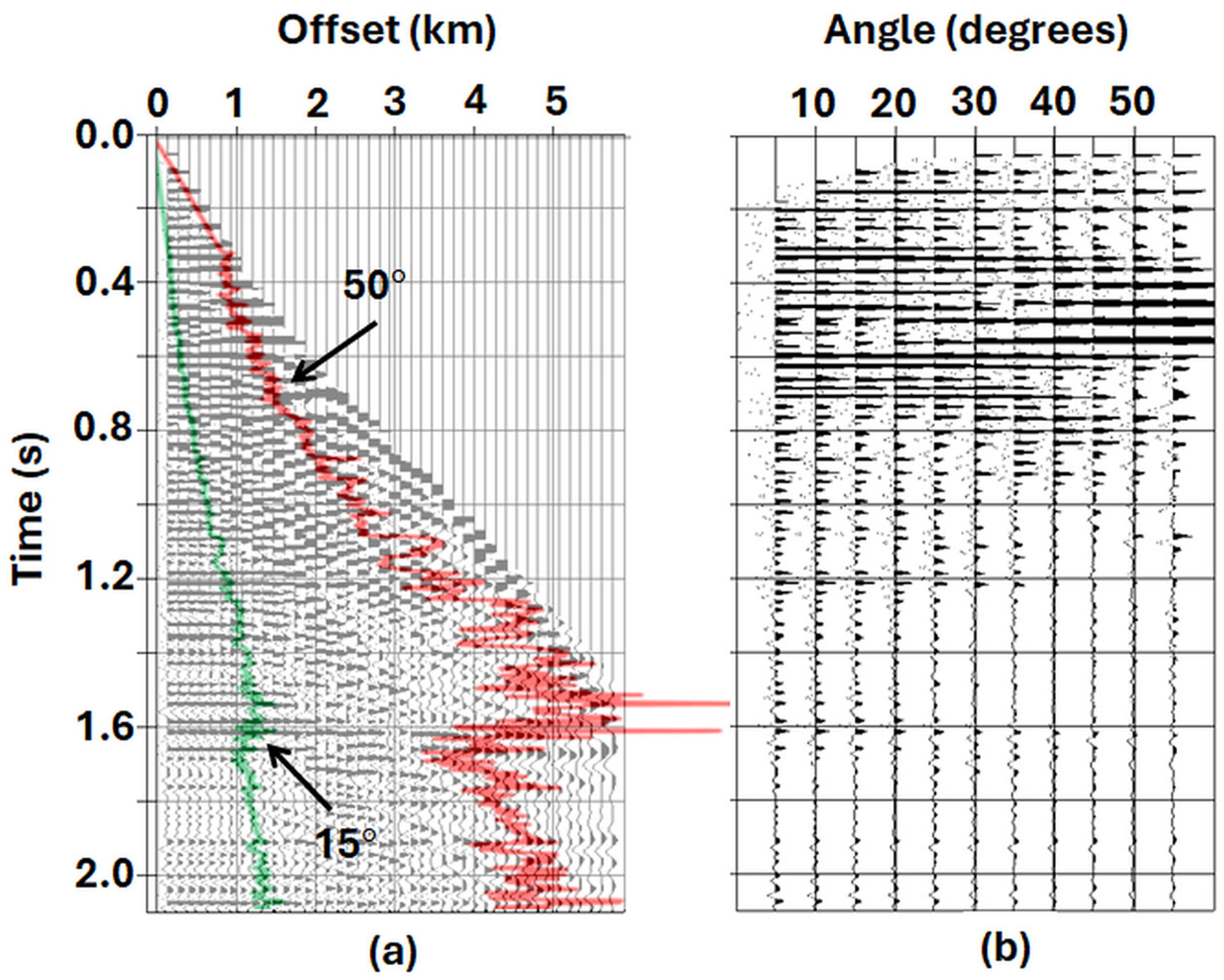
Figure 6 illustrates the process of
to
transformation. Seismic data shown in the background of
Figure 6a are the same synthetic data shown in
Figure 5c. The green and red curves in the foreground of this Figure are the P-wave ray-paths
, computed using the interval and RMS velocities (
Figure 5b) for 15° and 50° incidence angles. These ray-paths, computed from raytracing, are valid for infinite frequency. For band-limited seismic data, contributions for these angles do not come exactly from these time and offset varying ray trajectories, but a range around them, known as the Fresnel zone, given as the quarter of the dominant seismic wavelength on either side of these trajectories [
21]. The range of the offset traces that lie within the Fresnel zone for each angle
is called the angle mute for that angle. A partial stack of the offset domain data after GSC and NMO along the angle mutes, computed for each angle, is the process of
to
transformation and shown in
Figure 6b for
5° to 55° in steps of
. Note that, having known the interval velocity
(
Figure 5b), the dominant seismic frequency
, and constant angle ray trajectory
(
Figure 6a), the offset traces belonging to the angle mute for incidence angle
and time
lie within the range
. Instead of constant
, we can also compute constant ray-parameter (
trajectories. Defining the ray-parameter mutes like angle mutes and partially stacking the
domain traces along them is the process of mapping
domain traces onto ray-parameter intercept-time (
) domain. These partial stacks over
or
mutes are known as slant stacking (Mallick et al., 2025 [
9]), and provide an approximate plane wave decomposition of
domain data onto the
or
domain. Note that an exact plane wave decomposition using Fourier and Hankel transforms (Aki and Richards, 2002 [
19]) requires very fine offset sampling of
domain data; otherwise, they are spatially aliased. The
domain data that Padhi et al. (2015) [
20] used to obtain the
data using an exact Fourier–Hankel transform, for example, had an offset sampling of 12.5 m. In most of the real seismic data, however, it is hard to find such fine offset domain sampling. For real RSU seismic data that we use here, the offset sampling is 440 feet (134.112 m). Because slant stacking does not require fine sampling in offset, it is a practical choice for plain wave decomposition onto the
or
domain.
Like the convolutional angle gather, we now carry out the same analysis using the synthetic angle gather computed from the
to
transformation (
Figure 6b) and show the results in
Figure 7 and
Figure 8. Notice from
Figure 7 that, even for this case, the attributes
,
, and
reasonably correlate with
,
, and
. These correlations are not as good as those we obtained from the convolutional gathers (
Figure 3). However, predicted
,
, and
are still reasonable and can be used as reliable initial models for inversion (
Figure 8).
4. Real Data Example
After convolutional and wave equation-based synthetic seismic data examples computed from the RSU #1 well-log, we now demonstrate our attribute-guided initial model generation from real RSU seismic data.
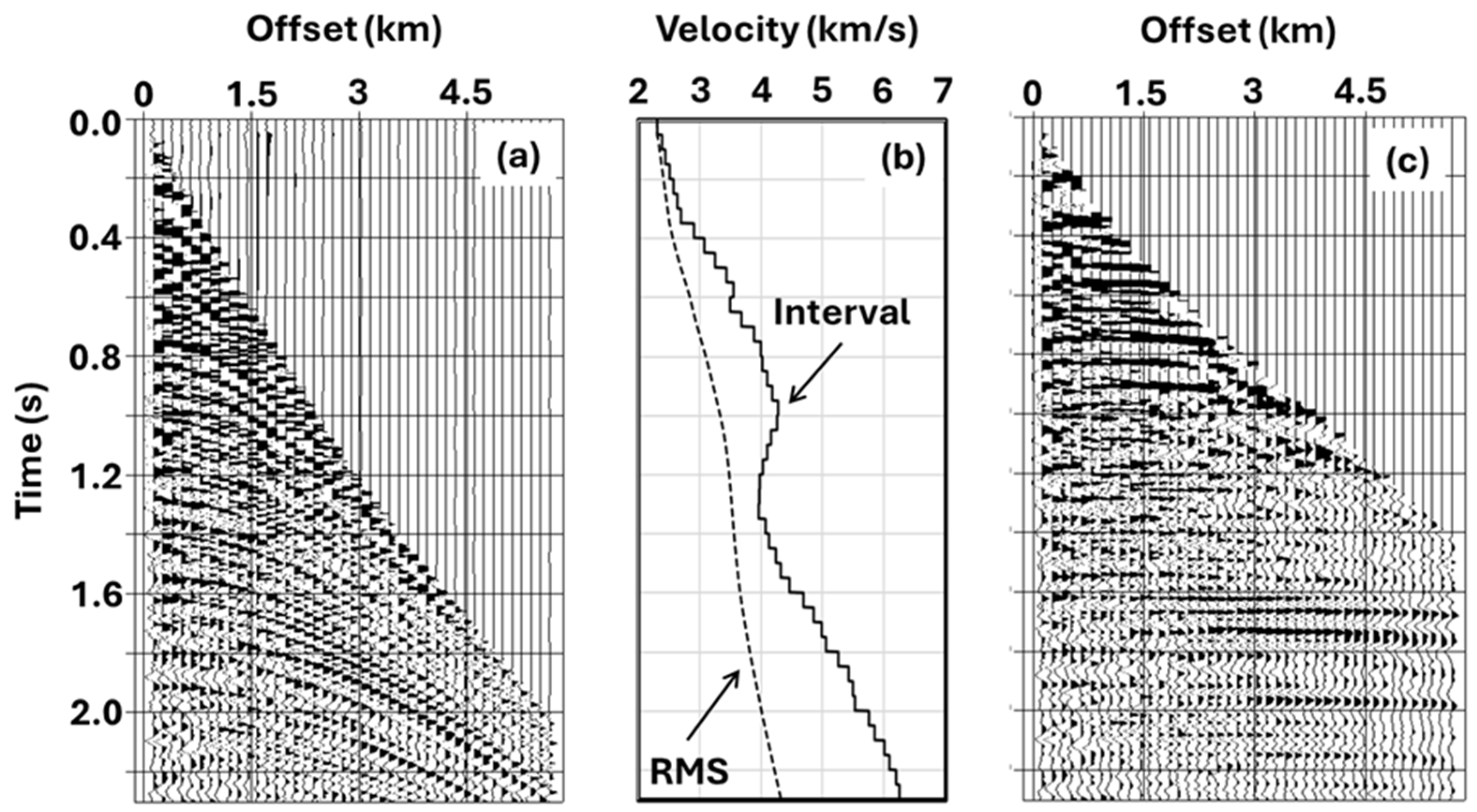
Figure 9a shows the
domain real seismic data before GSC and NMO at the exact location of the RSU #1 well. To correct these data for GSC and NMO and map onto
, we could use the well-log
, as we did for the wave equation synthetics (
Figure 5). Our objective here, however, is demonstrating the ability of the method to extract a good initial model away from the wells. To do so, we propose extracting the
,
, and
relations from the available well locations and using these relations at the locations away from the wells. Therefore, using the well-log velocity for GSC, NMO, and
to
mapping at well locations and using a differently obtained velocity for other locations for the same mapping does not fulfill our objective. So, instead of using the well-logs, we perform a velocity analysis on the data to derive the interval and RMS velocity (
Figure 9b) and use this derived velocity field to correct data for GSC and NMO (
Figure 9c).
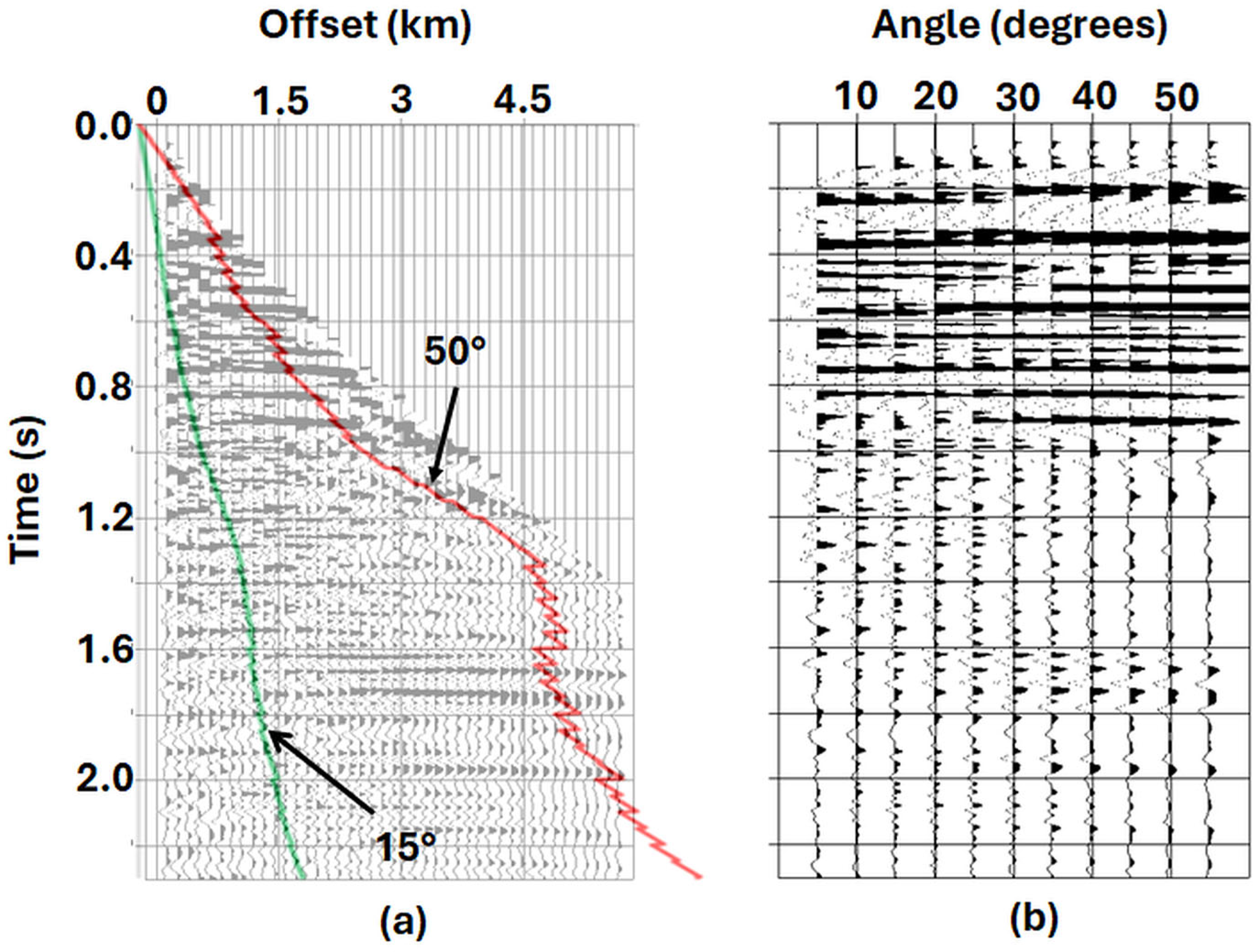
Following GSC and NMO, we obtain angle domain data via
to
transformation (
Figure 10) using the velocity field shown in
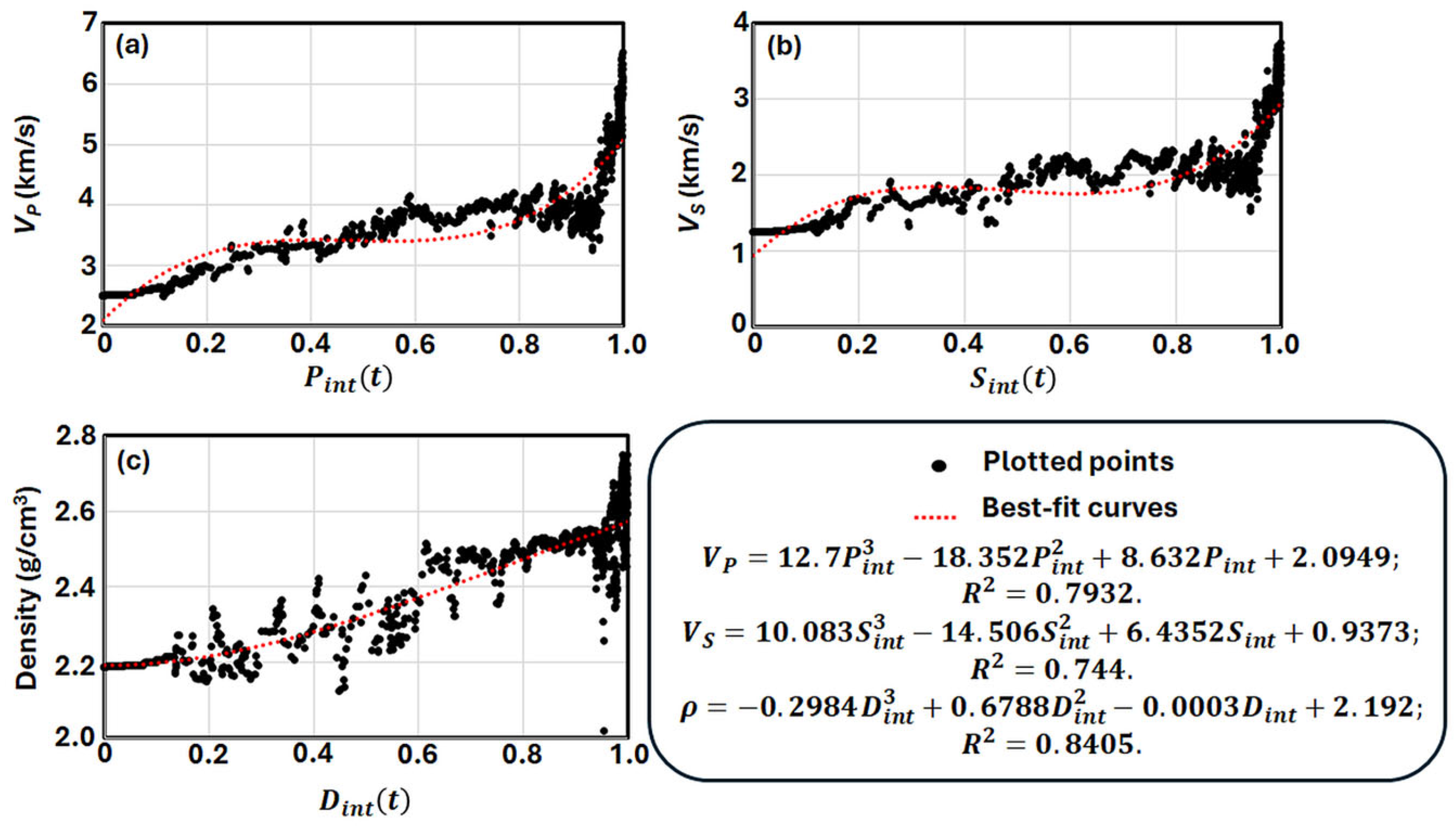
Figure 9b. We then compute
,
, and
and derive the
,
, and
relations (
Figure 11). Finally, we estimate our initial model using the
,
, and
relations shown in
Figure 11 and display the results in
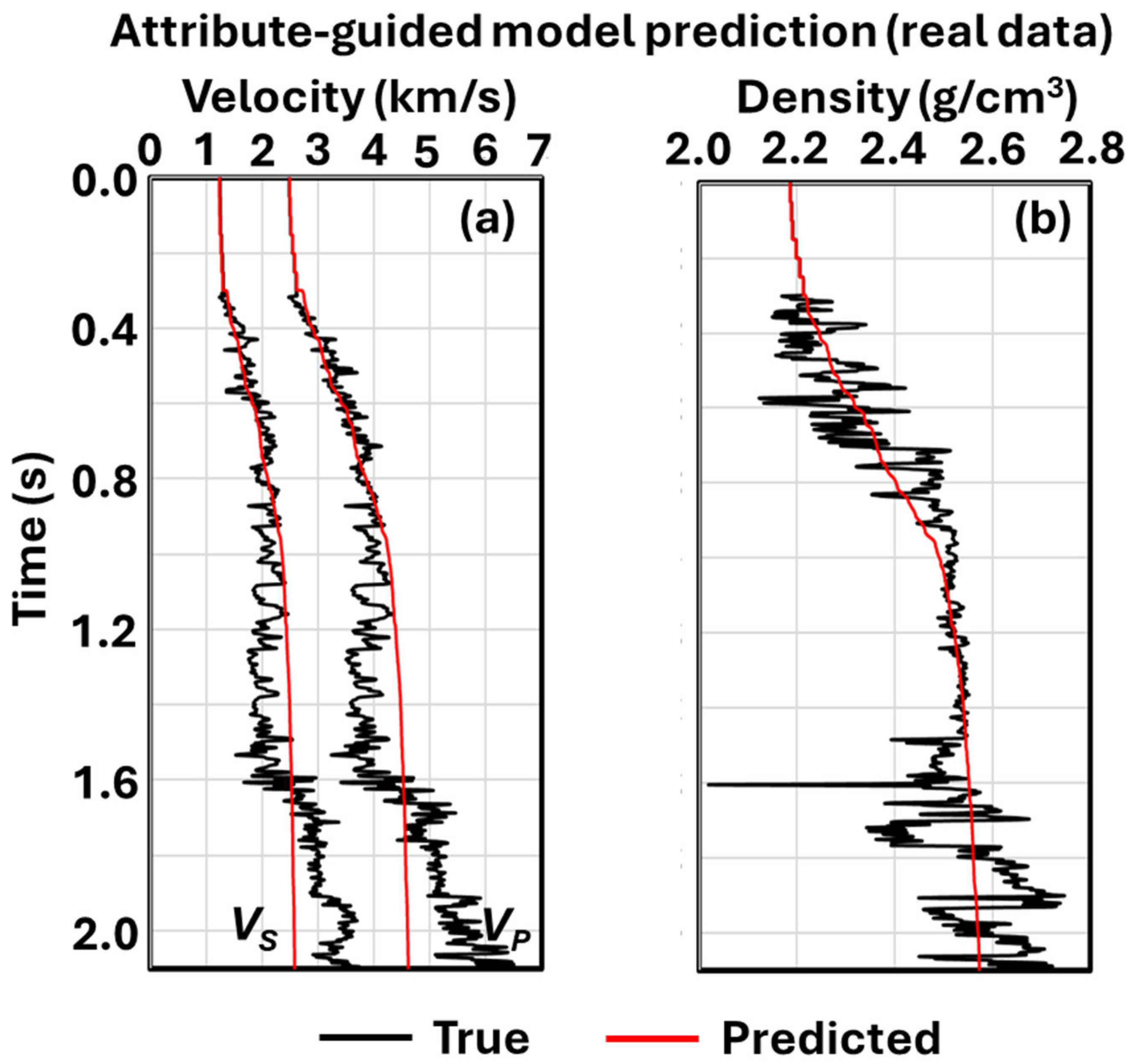
Figure 12. As can be seen, although we used velocity fields from velocity analysis for
to
mapping, the derived
,
, and
relations estimated a reasonable initial model of
, and
from real seismic data.
Using the predicted
, and
model, shown in
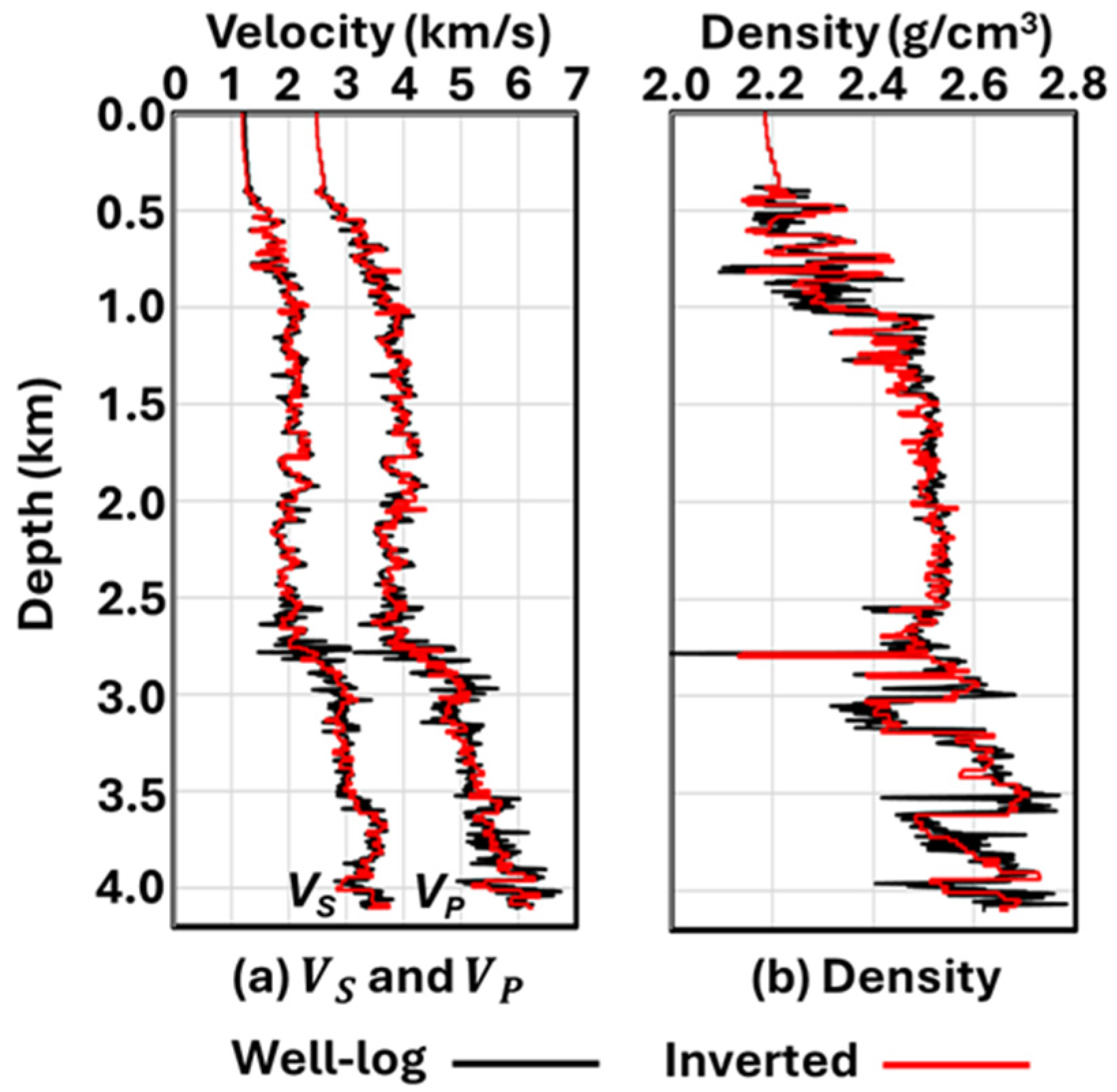
Figure 12 as the initial model, we inverted the real seismic data at the RSU #1 well location (
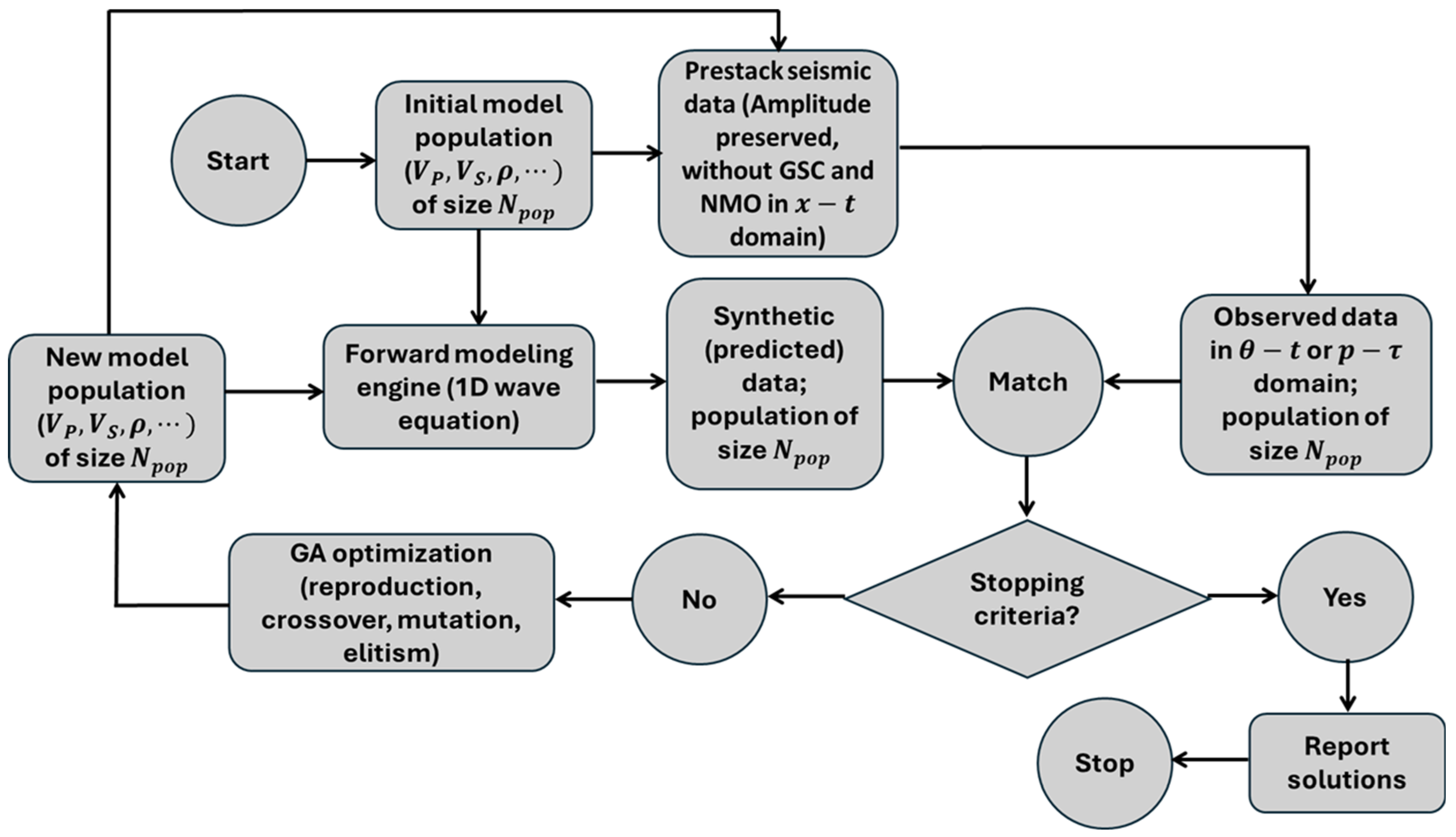
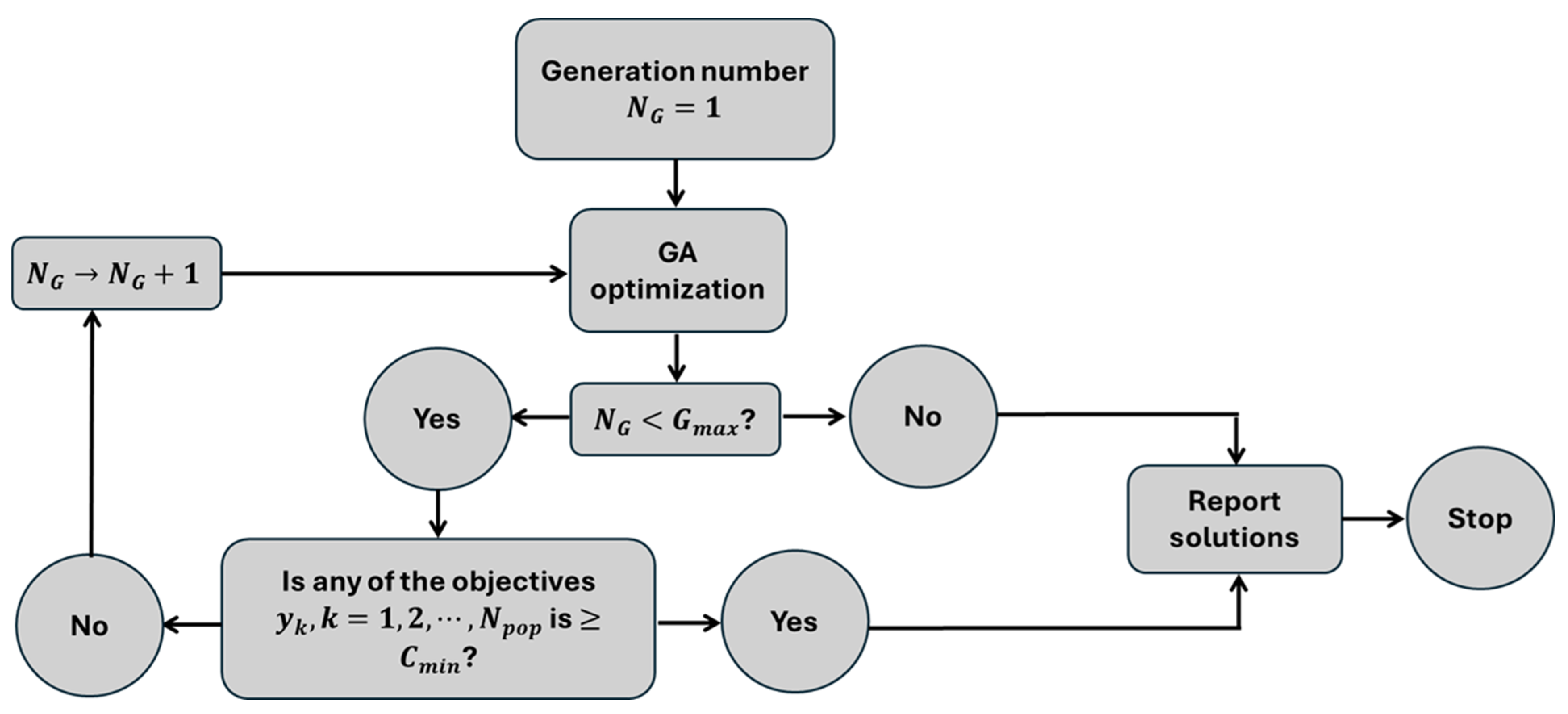
Figure 9a) using PWI with a global optimization method based on a Genetic Algorithm (GA). The details of this GA-based PWI has been previously discussed by Mallick (1995, 1999) [
12,
13], Mallick and Adhikari (2015) [
1], Pafeng et al., (2017) [
15], Jia et al., (2021) [
3], and Mallick et al., (2025) [
9]. For completeness, we provide an overview of the methodology in
Appendix A, and in
Figure 13, we show the comparison of the inverted model (red) with the RSU #1 well-log (black). It is evident from
Figure 13 that, starting from the attribute-guided initial model, PWI estimated the true model with a very good accuracy.
5. Feasibility to Characterize Reservoirs for Underground Hydrogen Storage
Our final example is a synthetic study investigating the application of the attribute-guided approach to characterize subsurface reservoirs for hydrogen storage. To mitigate global warming from fossil fuel consumption, CCS is now a well-accepted method. To achieve the future target of a net-zero emission with a carbon-free grid, CCS alone is, however, inadequate, and the use of alternate renewable energy resources such as solar, wind, hydropower, geothermal, etc., are necessary. Although geothermal energy, especially enhanced geothermal energy, is potentially an unlimited energy resource, its current usage is limited, and many technical hurdles must be overcome before it can be used on commercial scales [
22]. Energy production from other renewables such as solar, wind, hydropower, etc., on the other hand, is a mature technology. Their productions, however, fluctuate, because they depend upon seasonally fluctuating events like the sunlight level and intensity, wind force, water level, etc. These seasonal fluctuations, in combination with annually varying, but steadily rising, energy demand, result in renewable energy excesses or deficits. Therefore, these renewable resources without energy storage cannot meet future energy demands. In view of this, it has been proposed that producing and storing hydrogen (H
2) during the periods of excess renewable energy supply and using it for energy production during periods of low renewable energy supply can address the energy supply and demand from these renewables. This concept prompted many research and development efforts for H
2-based energy technologies. To use H
2 as an energy resource in commercial scales, however, it is important to find ways to store H
2 underground, because surface storage facilities are not adequate [
23]. And the most economically viable options for such underground storage are mine/salt caverns [
24] and porous and permeable sediments, such as the depleted hydrocarbon reservoirs or deep saline aquifers [
25]. Because of the natural worldwide abundance of porous and permeable sediments, they are likely to be important for future H
2 storage. Like CCS, the success of such Underground Hydrogen Storage in Porous media (UHSP) lies in successfully implementing a monitoring, verification, and accounting (MVA) strategy to ensure totality and minimal loss of the injected gas via leakage, chemical reactions, and capillary trapping. While the time-dependent behavior of carbon dioxide (CO
2)-sequestered reservoirs are well-studied and the MVA strategies are well-established, they are mostly untested for UHSP. Heinemann et al. (2021) [
25] discuss a broad list of UHSP challenges, ranging from the physical factors such as the physical properties of H
2, in situ pressure, etc., to geochemical factors like biological (microbial) reactions and the possibilities of the injected hydrogen reacting with the rock-forming minerals. The list of these UHSP challenges is too broad, and here, we perform a feasibility study investigating if seismic data can detect the presence of hydrogen stored in a porous and permeable reservoir using our attribute-guided approach.
Most of our prior experiences on subsurface fluid storage is in connection with CCS, where CO
2 is stable in the supercritical phase at the formation depths of interest. H
2, on the other hand, is stable as gas at similar depths. The density of supercritical CO
2 (~0.941 g/cm
3) is close to that of brine (~1.03 g/cm
3). The sound speed (P-wave velocity or
) of supercritical CO
2 (~280 m/s) is, however, much less than that of brine (~1500 m/s). Consequently, when brine is replaced by supercritical CO
2 in a porous formation, the sharp drop in
is usually detectable from seismic data [
26].
In contrast with supercritical CO
2,
of H
2 (~1400 m/s) is comparable with that of brine, and its density (~0.00084 g/cm
3) is much less (Hassanpouryouzband et al., 2021 [
23]). Consequently, if a 100% brine-saturated rock is replaced by H
2, there is a sharp drop in density (
), the S-wave velocity (
) remains almost unchanged, and the P-wave velocity (
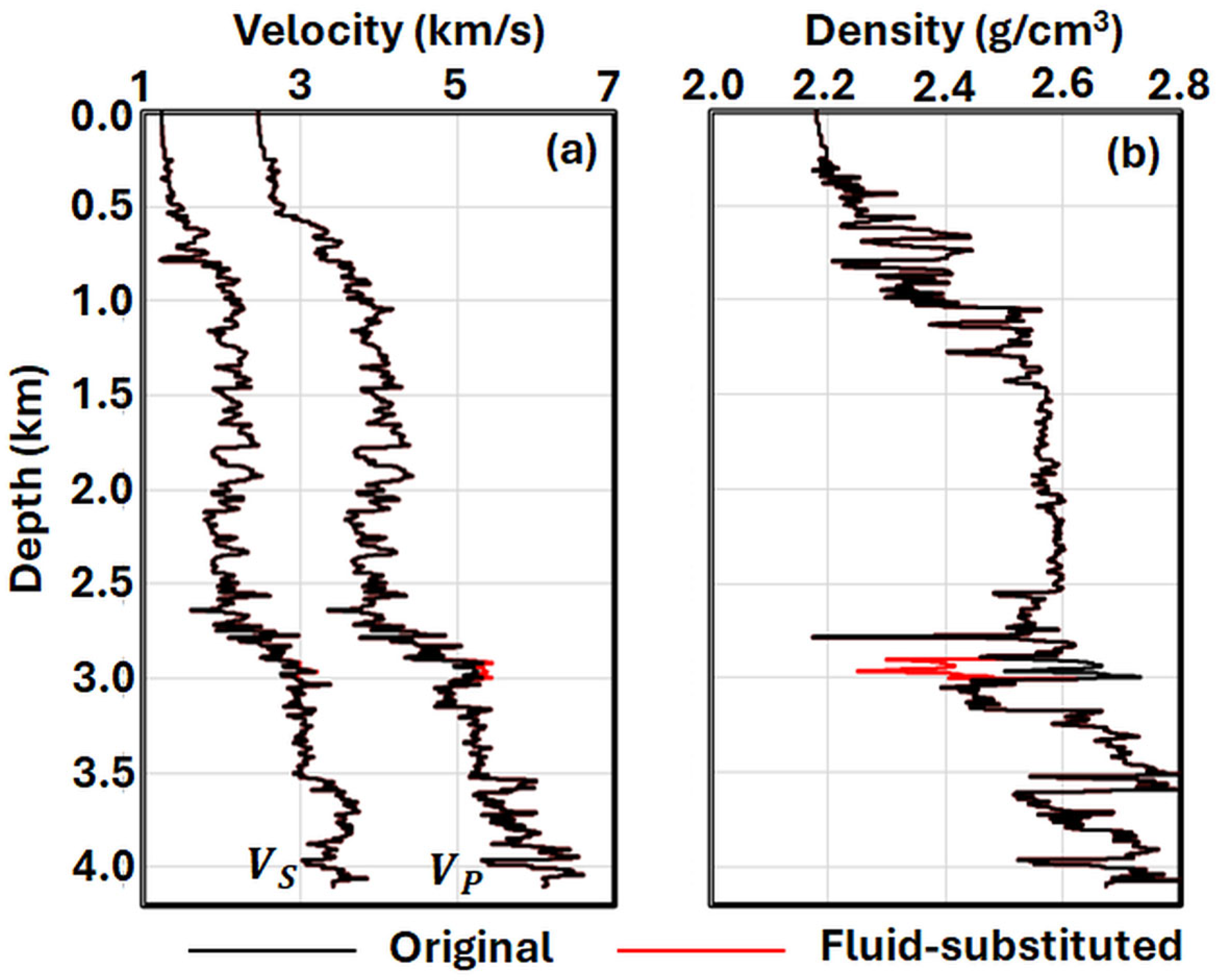
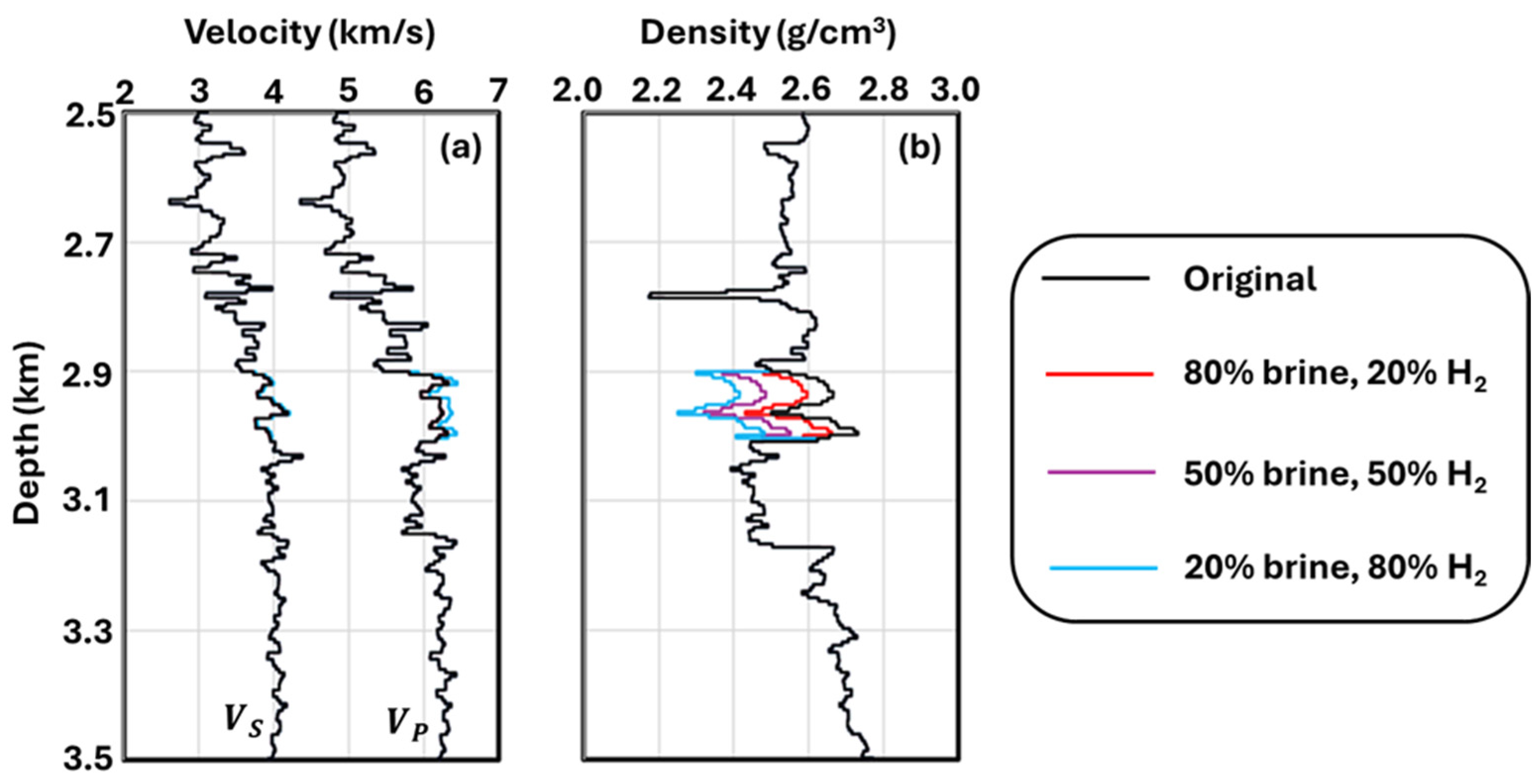
) slightly increases (because of the density drop). To demonstrate this effect, we replaced a 100% brine-saturated sandstone formation (Nugget Sandstone) at a 2900–3000 m depth interval of the RSU #1 well-log with 80% H
2 and 20% brine.
Figure 14 shows the original
, and
ρ in black and those after fluid (H
2) replacement in red.
We computed wave equation-based synthetics in the
domain using the fluid-substituted well-log, converted them into the
domain using the offset-to-angle mapping procedure discussed above, and compared them with the
domain synthetics for the original RSU #1 well-log (
Figure 6b). In
Figure 15, we show this comparison.
Figure 15a,b are the same (original and fluid-substituted) models of
Figure 14 the in time domain,
Figure 15c,d are the
domain synthetics, and
Figure 15d is the difference between the synthetic data shown in
Figure 15c,d. Notice that the fluid replacement produces visible density-driven reflection differences between the original seismic data and those after replacing brine with H
2 for the interval of fluid replacement and underneath.
To study the feasibility of detecting the presence of H
2, we ran the GA-based PWI on the
domain fluid-substituted synthetic data. We used the attribute-driven inverted model (the model shown in red in
Figure 13) as the initial model. Because replacing the brine with H
2 does not change
and
, but substantially modifies
(see
Figure 14), in our GA-based optimization, we searched for
only and did not make any attempt to modify
and
from the initial model. The result of this PWI is shown in
Figure 16.
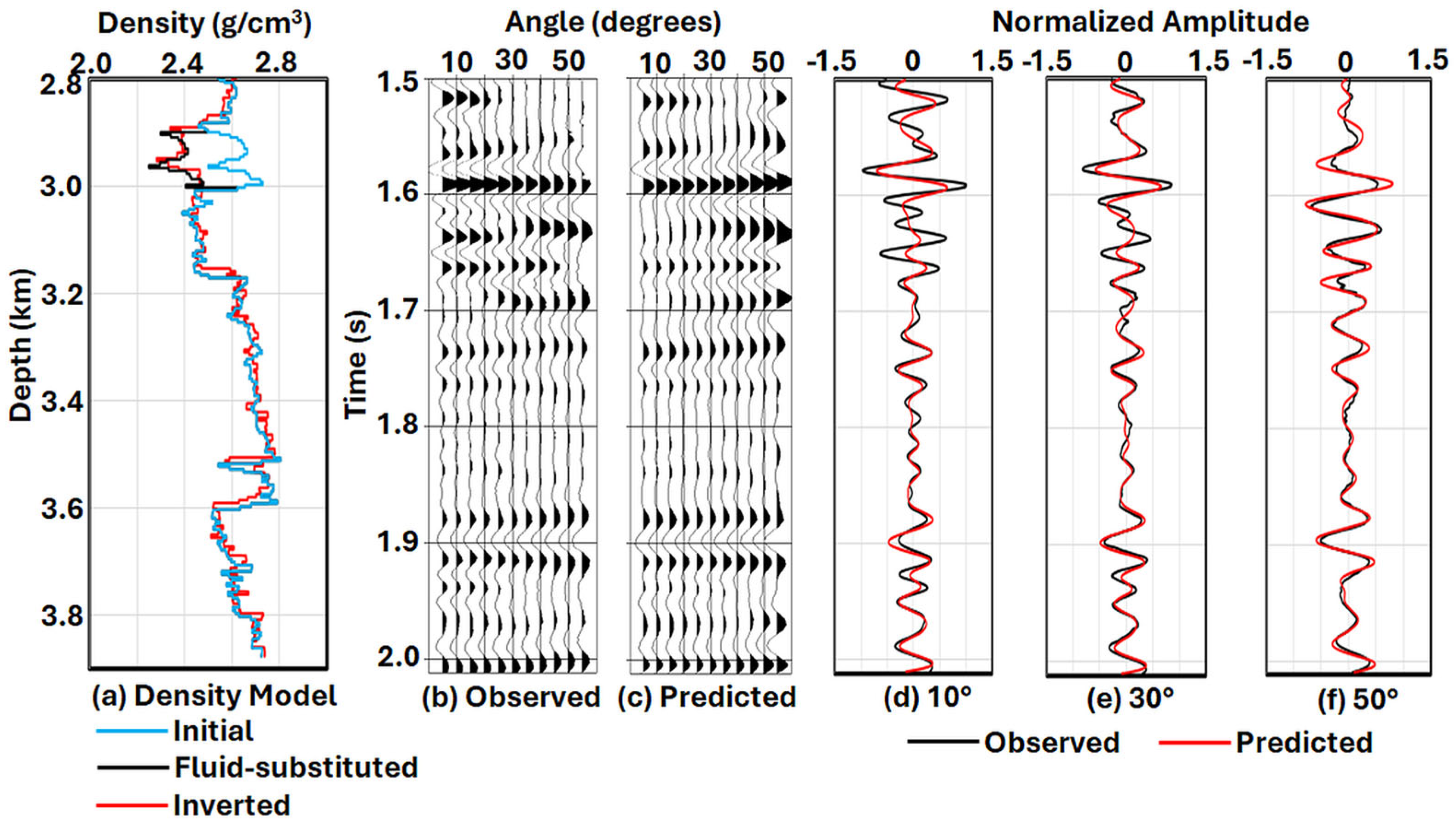
Figure 16a compares the inverted density model (red) with the initial model (cyan) and the fluid (H
2)-substituted model (black), showing that, although our initial density model was the model prior to fluid substitution, it converged to the fluid-substituted model with very good accuracy. This demonstrates that the attribute-guided approach to obtain the static (before fluid replacement) model, and using it as the initial model, is a feasible approach to detect the subsurface H
2 storage reservoirs. To further demonstrate the inversion accuracy, in
Figure 16b,c, we compare the observed (after H
2 substitution) angle domain data with those computed using the inverted model for 5° to 55° in increments of 5°. Furthermore, in
Figure 16d–f, we show the detailed match between these observed and predicted data for 10° 30°, and 50° incidence angles.
6. Discussion
Starting from the acoustic problem for the initial model generation from an attribute-guided approach, we extended the method to the isotropic elastic case. We also demonstrated the application of our method using both synthetic and real data. In contrast with our new approach, the initial model for seismic inversion is traditionally generated from the following three-step process:
- (1)
importing the well-logs at their specific locations on the stacked seismic data;
- (2)
interpreting geological horizons;
- (3)
horizon-guided interpolation of the low-frequency components of the imported well-logs in between the wells.
Although such horizon-guided interpolation provides a geologically consistent initial model, Mallick and Chakraborty (2022) [
17] pointed out that they tend to introduce human bias of horizon interpretations, an imprint of which is always present in the inverted model. Additionally, although such an initial model is reasonably accurate near the well locations, it can be far from the true model for the locations further away from them. Being a global method, the GA-based PWI finds the true model, irrespective of whether the initial model is near or far from it. Its runtime, however, becomes expensive as we move further away from the well locations, where the initial model is progressively far from the true model. The convergence of the GA-based PWI using attribute-guided initial model is slower near the well location as compared with starting with a horizon-guided initial model. Our preliminary investigations, however, indicate that the convergence rate of the method using the attribute-guided initial model does not change as we move further away from the wells, which, in turn, can make the GA-based PWI computationally efficient for inverting 3D seismic data volumes.
To further elaborate our point, in
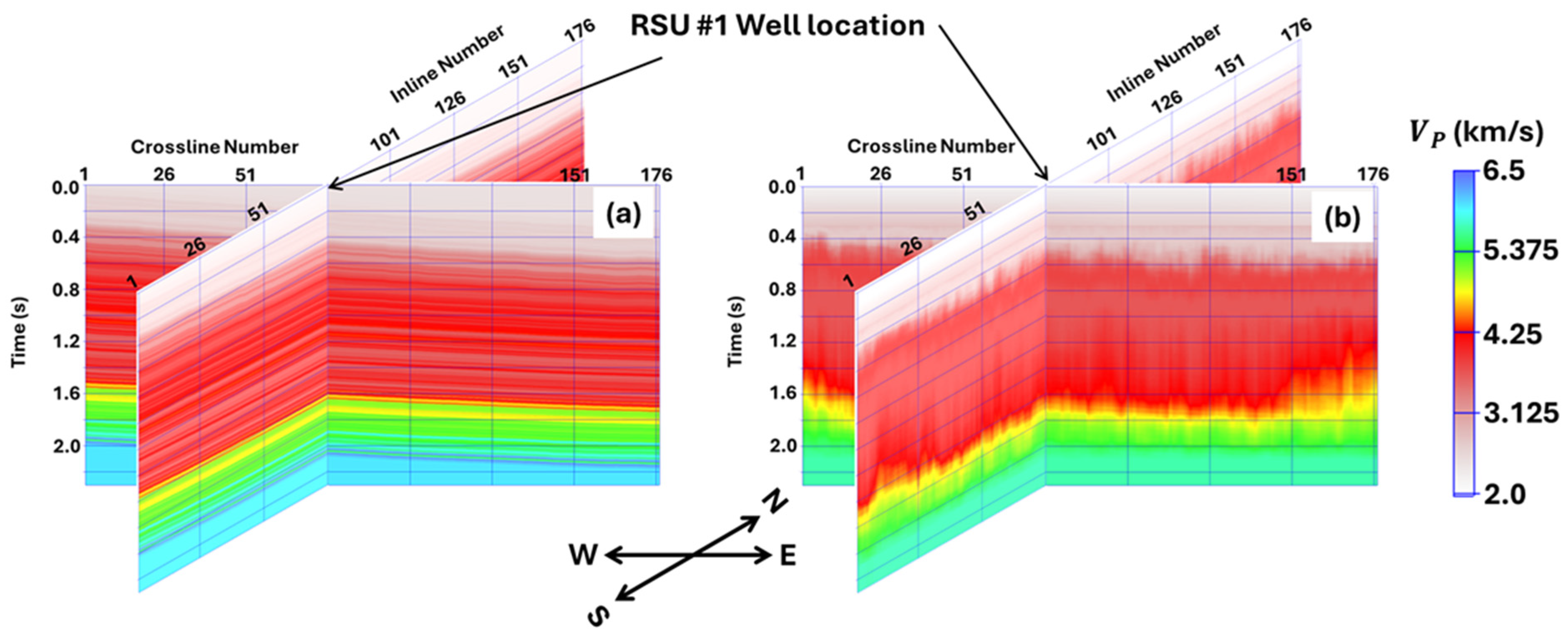
Figure 17, we compare the horizon-guided and attribute-guided initial
models, generated from the RSU real seismic data. Out of the entire 3D volume of 176 inline and crosslines, one inline (IL-74) and one crossline (XL-77), which intersect one another at the RSU #1 well location, are shown in this Figure. Note that the subsurface geological features, estimated from the horizon interpretation and interpolation, are present in the horizon-guided
model (
Figure 17a). The attribute-guided model, shown in
Figure 17b on the other hand, is like the horizon-guided model (
Figure 17a), with a light red zone between 0 and 0.4 s, a bright red zone between 0.4 and 1.6 s, and a yellow/green/blue zone below 1.6 s. However, this attribute-guided initial model lacks geological features like those present in the horizon-guided model. For acoustic inversion, Mallick and Chakraborty (2022) [
17] started from such an attribute-guided model and estimated an accurate sound speed model. They did not guide inversion through the interpreted horizons, but their inverted model was consistent with the reflections on the stacked data. Our final aim is to use the attribute-guided
model (
Figure 17b) and similar models for
and
in our GA-based PWI. If we can estimate a geologically consistent subsurface elastic model without any horizon-based interpretation and interpolation, we can then claim this method to be free from any bias from horizon interpretation. Although this method worked very well for acoustic inversion, some additional fine-tuning of the GA-based PWI is necessary for extending it to the isotropic elastic case. These investigations will require going beyond the qualitative comparison that we provide in
Figure 17 and making rigorous quantitative analyses and studying the relative merits and demerits of horizon-guided and attribute-guided initial model generation methods. These issues are currently being investigated and will be discussed in a separate paper.
In
Figure 3 and
Figure 7, and
Figure 11, we used regression models to estimate
and
from
, and
. To obtain these models, we carried out a thorough analysis of the attributes
, and
and verified that the polynomials shown in these Figures are optimal. Overall similarity between the horizon- and attribute-guided
models (
Figure 17) justifies the appropriateness of the
regression model. Although not shown, we carried out similar comparisons for
and
, which indicate that our estimated regression models are optimal and do not have any over- or underfitting issues.
Although we believe that our regression models are optimal, the accuracy of estimating reliable
, and
models from
,
, and
from real seismic data requires that the data are processed through prestack migration using a surface-consistent relative amplitude preserved (RAP) processing workflow, so that reflection amplitudes for the entire seismic data volume are comparable. A discussion of RAP processing is given in Resnick (1993) [
21] and we provide an overview in
Appendix A. Even after applying such RAP processing, additional investigations will be necessary to further validate the assumptions behind our attribute-guided model generation. However, the capability of inverting seismic data without any horizon-based interpretation can be a very powerful tool and worth investigating.
For achieving the target of a net-zero emission with a carbon-free grid, enhancing energy production from renewable resources is necessary where the role of hydrogen production and its underground storage is vital. Such underground hydrogen storage requires the monitoring of these reservoirs where seismic inversion must play a key role. From
Figure 14,
Figure 15 and
Figure 16, the feasibility of detecting such hydrogen storage reservoirs lies in an accurate estimation of density. This conclusion is, however, based on replacing a 100% brine-saturated formation with 20% brine and 80% H
2, and demonstrating that
and
are less sensitive to the presence of H
2 than
. To emphasize this conclusion, we carried out additional experiments with different levels of brine and H
2 saturation and show the results in
Figure 18.
As can be seen from
Figure 18, irrespective of the saturation level,
remains unchanged and
slightly increases. However,
changes gradually as we replace the 100% brine-saturated formation with increasing H
2 saturation. Because of this sensitivity, we believe that density could be one key factor for delineating the hydrogen storage reservoirs. Estimating density from convolution-based AVA methods is difficult. Our attribute-guided and waveform-based approach, on the other hand, can accurately predict density, and is therefore the appropriate choice to characterize subsurface hydrogen storage reservoirs.
Because our investigations indicate that hydrogen is relatively insensitive to
and
, and sensitive only to
, in the inversion result shown in
Figure 16, we left
and
unchanged and attempted to change
only. However, this behavior is based on the fluid substitution results, in which it is assumed that there is no chemical reaction between H
2 and rock-forming minerals. In case of such chemical reactions,
and
may also change, which requires additional investigation. Additionally, for hydrogen storage reservoirs, it is not only necessary to store hydrogen underground, but it is also equally important to extract the stored fluid for energy production as and when necessary. To achieve this, a cost-effective MVA strategy combining seismic inversion with reservoir fluid flow and geomechanical simulations [
27,
28,
29] must be implemented to optimize H
2 injection and production rates, in such a way that much of the stored fluid can be recovered for energy production. We must therefore point out that our current investigation is only a feasibility study, and additional research is necessary to effectively store and produce hydrogen.