2.1. Parametric Modeling of the Flexible PV Support System
To establish a unified finite element dynamic formulation for the multi-span flexible PV support system, it is necessary to derive the governing equations based on the principle of virtual work prior to introducing the multi-point constraint (MPC) coupling. The MPC method is employed to enforce kinematic compatibility between beam and cable elements by constraining selected nodal degrees of freedom, thereby ensuring displacement continuity and internal force equilibrium at their shared nodes and avoiding artificial stiffness discontinuities. The virtual work principle provides a consistent foundation for discretization and element assembly of beams and cables within the structure.
The dynamic equilibrium of the continuum [
29] can be expressed in terms of virtual work as Equation (1), where
ε and
σ denote the strain and stress tensors, and
ρ,
cd,
b, and
represent the density, damping coefficient, body force, and surface traction, respectively.
Equation (1) can be written as a finite element integral point by numerical discretization:
where
δu denotes the virtual displacement vector,
ρ is the material density,
cd represents the viscous damping coefficient, and
b is the body force vector.
The subscript e denotes the element index, and α indicates the Gauss integration point within the element. wα is the numerical integration weight associated with the Gauss point xeα. ε and σ represent the strain tensor and stress tensor, respectively.
Accordingly, δu(xeα) and δε(xeα) indicate the virtual displacement and virtual strain evaluated at the Gauss integration point xeα.
In matrix form, the virtual work balance of the entire structure is expressed as Equation (4), where
M,
C, and
K denote the global mass, damping, and stiffness matrices, respectively, and
F(
t) represents the external load vector.
Equations (5) and (6) represent the discrete virtual work formulation, where
N and
B are the shape-function and strain-displacement matrices, and
D is the constitutive matrix. This equation forms the foundation for assembling global mass, damping, and stiffness matrices.
The beam element [
30] and the cable element satisfy the virtual work balance equation, and the general form can be expressed as follows:
The virtual work balance of a finite element, either a beam or a cable element, can be expressed in the unified form of Equation (7), where Me, Ce, and Ke denote the element mass, damping, and stiffness matrices, respectively.
For both beam and cable elements, the element-level mass and stiffness matrices are constructed following standard finite element procedures based on isoparametric interpolation and numerical integration. Specifically, the element mass matrix
Me and stiffness matrix
Ke are expressed as
where
ρ denotes the material density,
N is the shape function matrix,
B is the strain–displacement matrix, and
D is the constitutive matrix corresponding to Euler–Bernoulli beam theory for beam elements and truss theory for cable elements, respectively.
For cable elements, the stiffness matrix additionally includes a geometric stiffness component associated with the updated axial force, which accounts for the effect of large deformation. Numerical integration of the element matrices is performed using standard Gauss quadrature. These formulations ensure consistency with the virtual work principles and enable straightforward reproduction of the proposed element models.
This formulation is applicable to both Euler–Bernoulli beam elements, in which bending deformation is considered while shear deformation is neglected, and truss elements, which carry axial force only. In the present formulation, the beam components of the flexible PV support system are modeled using standard Euler–Bernoulli beam elements, whereas the cable components are modeled as truss elements. Accordingly, the element mass matrix Me, damping matrix Ce, and stiffness matrix Ke adopt their conventional finite element forms derived from Euler–Bernoulli beam theory and truss theory, respectively, ensuring consistency with the virtual work formulation and enabling straightforward reproduction of the proposed elements.
Geometric nonlinearity in the present model is primarily considered through the large-displacement behavior of the suspension cables. As the structural configuration evolves under external loading, the axial force of the cable elements is updated incrementally and contributes to the geometric stiffness associated with the current deformation state. In this study, an updated Lagrangian formulation is adopted to account for the continuously changing geometry of the flexible PV support system during deformation.
The global governing equations are solved using an incremental time-integration strategy, in which equilibrium is enforced at each time step based on the updated configuration. This numerical framework enables the coupled static and dynamic responses of the beam–cable system to be captured while maintaining computational efficiency and numerical stability.
To ensure displacement compatibility at the beam–cable–support interfaces, the Multi-Point Constraint (MPC) [
31] method is introduced. Differences in kinematic definitions between beam and cable elements would otherwise cause degree-of-freedom inconsistency or stiffness discontinuity at shared nodes.
To address the mismatch of nodal degrees of freedom between beam elements and truss elements, a linear constraint relationship is introduced:
where
G denotes the MPC matrix and
u is the global displacement vector containing all nodal degrees of freedom. By introducing the Lagrange multiplier
λ, the global stiffness equation can be extended as follows:
This formulation ensures displacement compatibility and internal force equilibrium between beam and cable elements at their connection interfaces, thereby preventing abrupt stiffness variations and unreasonable local stress concentrations. When combined with dynamic analysis, the constraint conditions are likewise incorporated into the second-order motion equation [
32]:
where
M,
C and
K represent the mass, damping, and stiffness matrices, respectively, and
F(
t) denotes the external load vector. Within this framework, the structural response under both static and dynamic loading can be simultaneously considered.
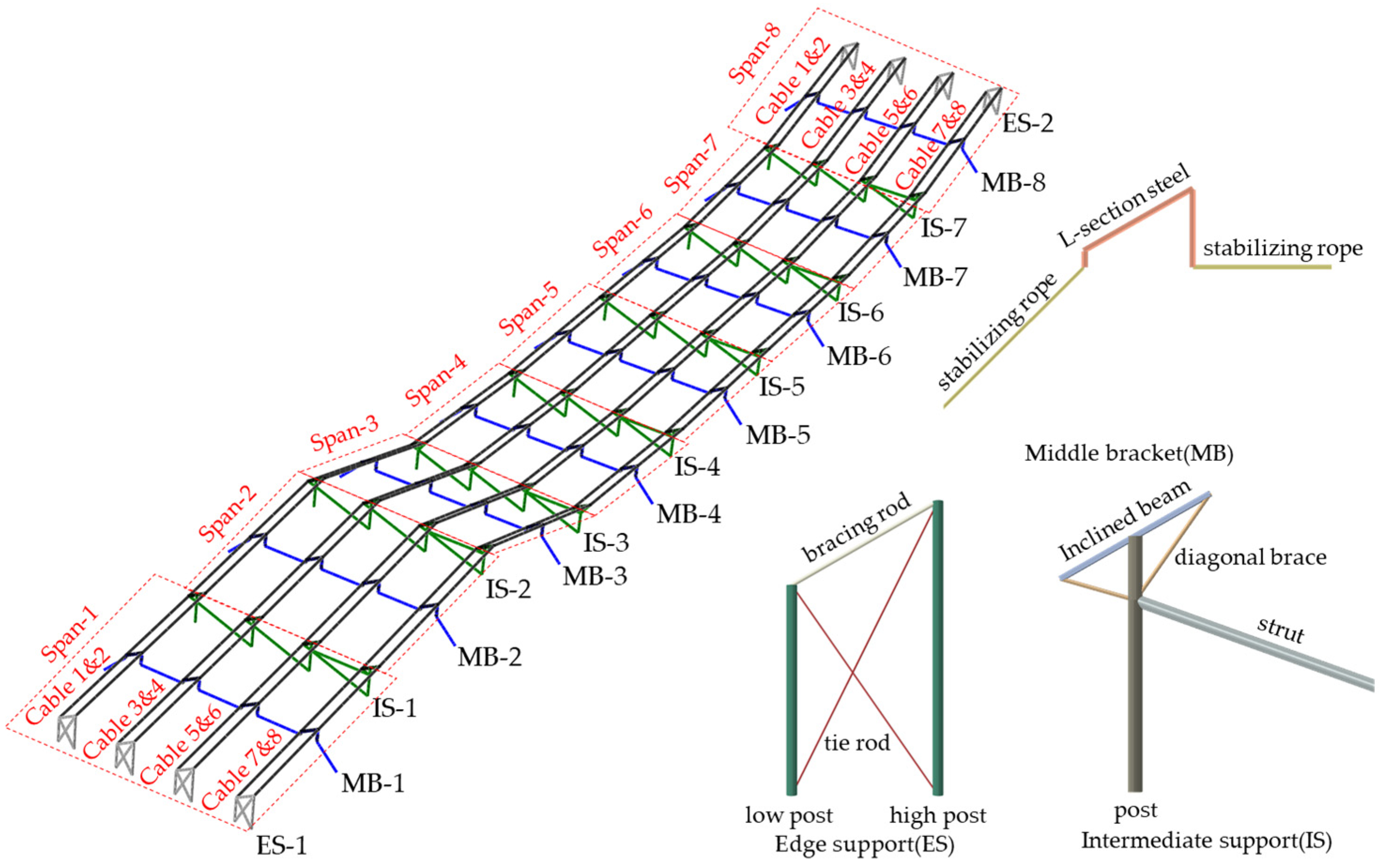
In this study, the numerical model was developed to investigate the structural response of a single-layer, four-row, eight-span flexible PV support system under both static and dynamic loading conditions. The model was constructed using an in-housing Python script (Python 3.11) to automate component assembly, with cross-sectional properties assigned in accordance with the technical specifications provided in
Table 1. The script also facilitates the generation of geometric topology, material property assignment, and the application of boundary conditions.
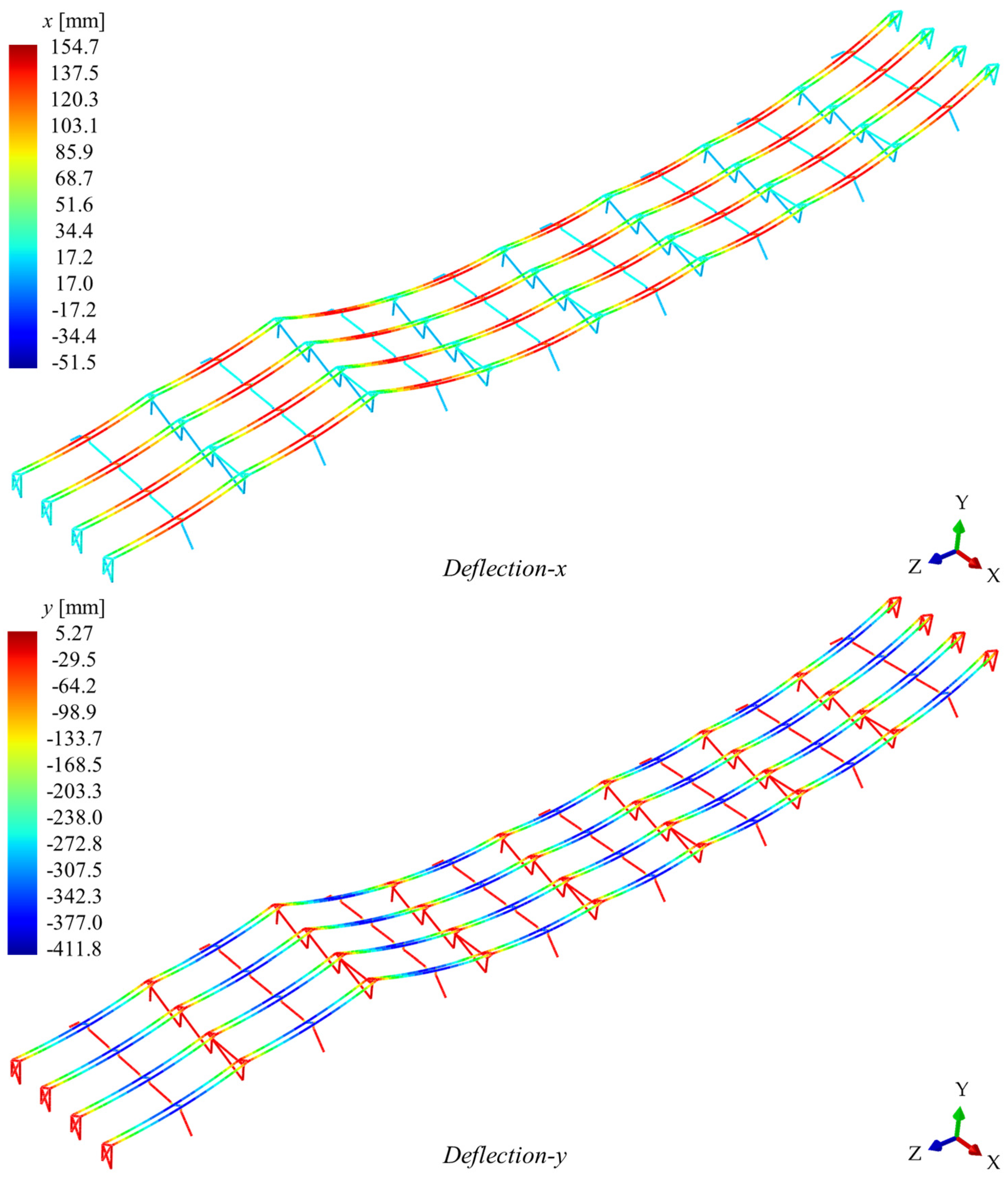
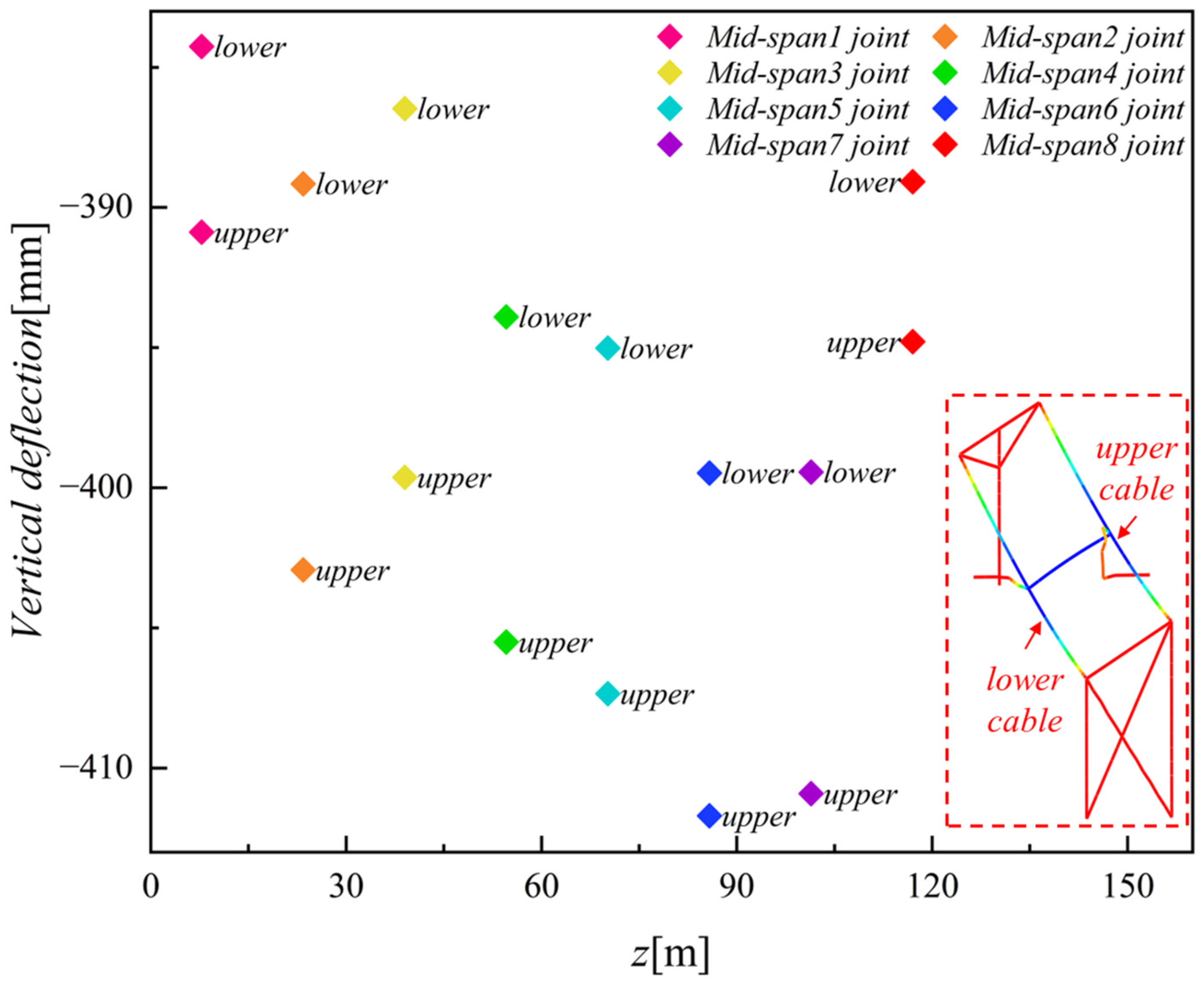
Figure 2 presents a schematic of the numerical model of the flexible PV support, also illustrates its individual components. Transversely, the system comprises edge support brackets, intermediate support brackets, and stabilizing brackets; longitudinally, it adopts a dual-cable configuration consisting of upper and lower suspension cables with a horizontal spacing of 1.4 m and a vertical spacing of 0.8 m.