You are currently viewing a new version of our website. To view the old version click .
Eng
  • Feature Paper
  • Article
  • Open Access

12 December 2025

Influencing Factors and Control Measures for Post-Construction Settlement of High-Fill Red Clay Embankment

,
,
,
,
and
1
School of Architecture and Planning, Yunnan University, Kunming 650500, China
2
Yunnan Green Intelligent Construction Research Institute Co., Ltd., Kunming 650102, China
3
Yunnan Construction Investment First Investigation and Design Co., Ltd., Kunming 650102, China
4
School of Civil Engineering, Central South University, Changsha 410075, China
Eng2025, 6(12), 363;https://doi.org/10.3390/eng6120363 
(registering DOI)
This article belongs to the Special Issue Advanced Numerical Simulation Techniques for Geotechnical Engineering

Abstract

This study systematically investigates the post-construction settlement behavior of high-fill red clay embankments, focusing on the influences of three key factors (water content, degree of compaction, and lift thickness) and the effectiveness of geogrid-based reinforcement measures. A three-dimensional finite-element model based on the Mohr–Coulomb constitutive theory was established using MIDAS GTS NX 2022 R1 to simulate staged construction processes and long-term settlement under self-weight loading. The results indicate that settlement is predominantly concentrated in the upper fill zone adjacent to the slope surface, with displacement contours sagging inward toward the fill interior, while the underlying foundation undergoes negligible deformation. An elevated water content and reduced degree of compaction significantly enhance the compressibility of red clay, leading to increased settlement magnitudes and prolonged stabilization periods. Excessively thick lifts result in inadequate deep compaction, thereby inducing larger final settlements. Two reinforcement schemes (geogrid combined with anti-slide piles and geogrid combined with a gravity retaining wall) were verified to effectively mitigate post-construction settlement, with the former achieving a more pronounced improvement in the embankment stability coefficient. Based on the comprehensive analysis, optimal construction control parameters for high-fill red clay embankments are proposed: precise regulation of water content, maximization of compaction degree, and adoption of a lift thickness of approximately 30 cm. The findings of this study provide quantitative technical support and design references for the settlement control of similar high-fill red clay embankment projects in southern China’s mountainous and hilly regions.

1. Introduction

With the rapid expansion of highways in southern China, red clay has increasingly been used as embankment fill in mountainous and hilly terrain. Owing to its high natural moisture content, pronounced moisture sensitivity, and compaction difficulties, red clay fill is prone to significant post-construction settlement, which can trigger embankment cracking, differential deformation, and other distresses that compromise road stability and driving safety [1,2,3,4,5]. Understanding the settlement behavior of a high-fill red clay embankment, and the factors that govern it, is therefore of clear practical significance for highway construction in southern China.
Since the inception of soil mechanics, settlement analysis has remained a central topic in geotechnical engineering. Calculation methods are commonly grouped into four categories [6]: the elastic-theory method [7,8], engineering-practice methods [9,10], empirical methods [11,12], and numerical methods [13,14]. Many studies have focused on improving prediction accuracy by refining theory and constructing new models. For example, Wen et al. [15], Liu et al. [16], and Peng et al. [8] enhanced the layer-wise summation approach by combining it with other techniques to substantially improve settlement predictions; Wang et al. [17] proposed a rheological mechanical model for high-fill embankment; Morissette et al. [18] developed an empirical model for the long-term settlement prediction of overconsolidated Champlain Sea clays, incorporating the effects of the overconsolidation ratio; Huang et al. [19] introduced the Richards model, widely used in biology, for subgrade settlement prediction; and Liu et al. [20] combined artificial neural networks (ANN) with a genetic algorithm (GA) to construct a GA–ANN model for settlement curves. While these methods are effective for calculation and prediction, many data-driven approaches require extensive long-term monitoring data. By contrast, numerical analysis–rooted in consolidation theory—can reduce the dependence on measured data while offering a transparent framework for mechanism exploration. In practice, a large body of embankment settlement studies employing ABAQUS [21,22], FLAC3D [23,24], and MIDAS [25,26] has demonstrated the practicality and reliability of numerical methods.
Beyond methods of calculation, prior research has cataloged a broad set of drivers for embankment settlement. Wang et al. [27] identified soil type, degree of compaction, traffic loading, groundwater level, rainfall, temperature, foundation deformation, and special soil properties as key factors. Chuan et al. [28] investigated the deformation characteristics of overconsolidated clay under constant and variable confining pressures, emphasizing the coupled effects of confining pressure variation and cyclic loading on settlement accumulation; Peng et al. [29] highlighted soil composition, ambient temperature, and overburden as the principal controls for thaw-settlement; Singh et al. [30] quantified the influence of water content, deviatoric stress, and confining pressure on fine-grained cohesive embankments; and Wan et al. [31] investigated how fill height, slope gradient, and berm width affect deformation in ultra-high fills. Nevertheless, systematic studies that target the combined effects of moisture state, degree of compaction, and lift thickness on post-construction settlement specifically in high-fill red clay embankments remain limited. This gap hampers the development of practical construction specifications tailored to red clay regions.
Motivated by these needs, the present work investigates a representative high-fill red clay embankment in Lincang, Yunnan. Laboratory tests are conducted to characterize the physical, strength, and compressibility properties of the red clay. A three-dimensional finite-element model of the embankment is then established in MIDAS GTS NX to simulate staged construction and long-term settlement. Using this integrated experimental-numerical framework, we quantify how water content, degree of compaction, and lift thickness influence post-construction settlement, and we evaluate practical control measures. The study aims to (i) clarify parameter–response relationships relevant to construction control (moisture conditioning, compaction targets, and lift management); (ii) provide quantitative evidence to guide the design and construction of a high-fill red clay embankment; and (iii) offer a reference for similar embankment and slope projects in red clay areas of southern China.

2. Materials and Methods

2.1. Specimen Preparation

Disturbed red clay samples were taken from a high-fill embankment project in Lincang, Yunnan. The basic physical properties of the red clay obtained through indoor geotechnical tests are shown in Table 1. The soil samples then were air-dried, crushed, and passed through a 5 mm sieve, and their moisture content was determined. Two specimen sets were prepared. Set I controlled the initial water content at 22% and targeted degree of compaction (DC) levels of 90%, 93%, 95%, and 98%. Set II controlled DC at 93% and targeted water contents of 17%, 20%, 25%, and 27%.
Table 1. Basic physical properties of test soil samples.
In China, the minimum requirement for the degree of compaction of high-fill embankment fill is specified in the Technical Code for Construction of Highway Subgrades (JTG/T 3340-2018) [32]. For high-grade highway embankments in red clay regions, the degree of compaction for the embankment body (within the depth range of 0–80 cm) shall not be less than 96%, and for the lower part of the embankment (below 80 cm depth), it shall not be less than 94%. The DC levels (90%, 93%, 95%, 98%) selected in this study cover the common construction quality range and the standard requirement threshold, which is of practical significance for exploring the influence of compaction quality on settlement behavior.

2.2. Test Program

2.2.1. One-Dimensional Oedometer Consolidation Test

One-dimensional drained consolidation tests under lateral confinement were carried out using standard oedometer equipment, strictly following the specifications of the Technical Standard for Soil Test Methods (GB/T 50123-2019) [33]. Vertical stresses of 50, 100, 200, 300, and 400 kPa were applied incrementally. Each load step was maintained until the deformation stabilized, which was defined as a consolidation time of 24 h or an axial deformation rate of < 0.01 mm/h. During the test, deformation data were recorded continuously to analyze the compressibility characteristics of the red clay fill.

2.2.2. Direct Shear Test

Fast direct shear tests were performed using a quadruple electric direct shear apparatus, in accordance with the requirements of the Technical Standard for Soil Test Methods (GB/T 50123-2019) [33]. Remolded specimens were placed in the shear box, and normal stresses of 100, 200, 300, and 400 kPa were applied through a lever system. The lower half of the shear box was driven at a constant horizontal displacement rate of 0.085 mm/min until specimen failure. Horizontal displacement and shear force were recorded in real-time during the test to determine the shear strength parameters (cohesion and internal friction angle) of the soil.

2.3. Numerical Modeling Framework

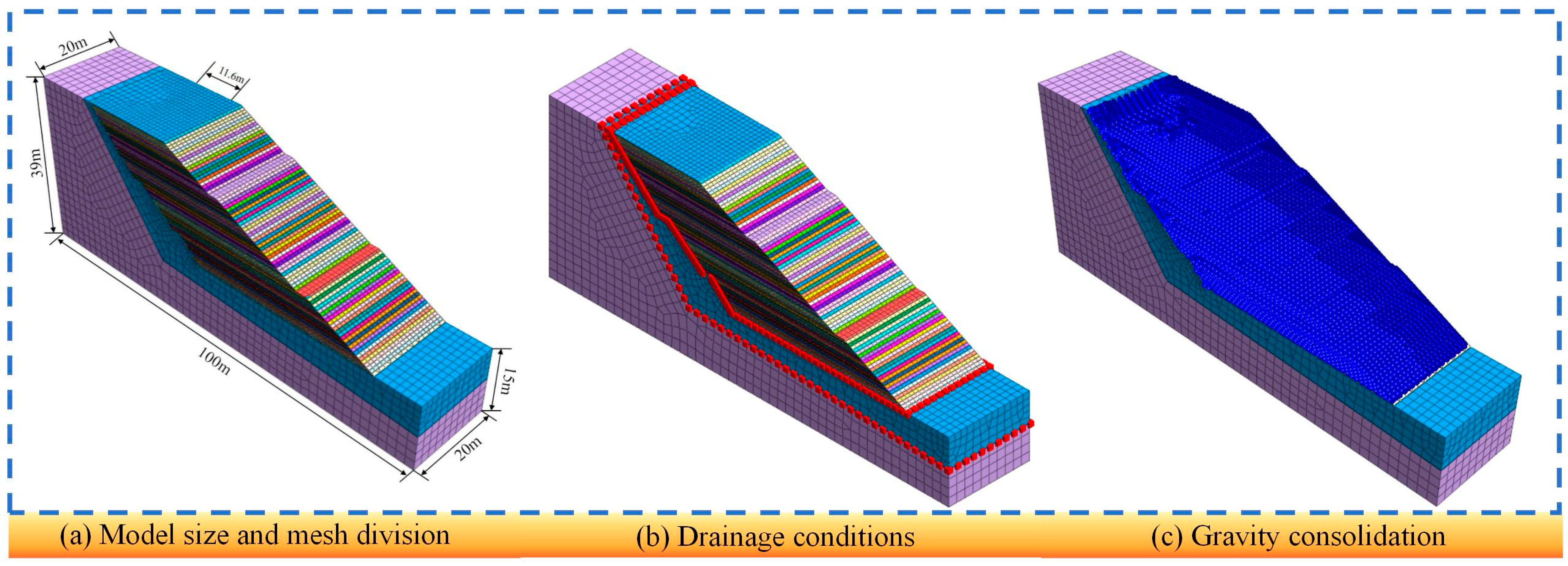
A three-dimensional finite-element model was developed in MIDAS GTS NX 2022 R1, adopting the Mohr–Coulomb constitutive relation for soils. The model was established based on a simplified cross-section from the engineering geological report of the Lincang high-fill embankment project, with a pavement width of 11.6 m, embankment height of 24.0 m, and stepped slopes. A mesh-sensitivity analysis was conducted to ensure numerical accuracy, and the baseline model was finalized with 78,899 elements (Figure 1a).
Figure 1. Schematic diagram of the three-dimensional numerical model for high-fill red clay embankment: (a) model size and mesh division; (b) drainage condition layout; (c) gravity consolidation system.
Consistent with the on-site engineering layout and geological conditions, the model incorporated targeted drainage configurations to replicate the actual consolidation process. Two key drainage interfaces were simulated to match the field drainage blind ditch system: one between the upper red clay fill and the underlying silty clay layer, and another between the silty clay layer and the bottom bedrock (Figure 1b). These interfaces were defined as permeable boundaries to facilitate pore water discharge during consolidation. Hydraulic parameters were set based on project-specific geological data: the red clay fill was assigned a permeability coefficient of 3.32 × 10⁻⁵ m/day (equivalent to 3.84 × 10⁻¹⁰ m/s), while the underlying silty clay and bedrock adopted typical values for similar geological formations. Pore water transport was modeled using Darcy’s law, with incompressible pore water assumed, and the consolidation analysis was implemented based on Terzaghi’s one-dimensional consolidation theory integrated in MIDAS GTS NX. The upper fill undergoes gravity-driven consolidation, with pore water escaping through the pre-defined drainage interfaces to simulate long-term post-construction settlement (Figure 1c).
Mechanical boundary conditions were defined as follows: the base of the model (bedrock) was fully fixed in the x, y, and z directions; the top surface remained free of constraints; the lateral sides were constrained to horizontal displacements; and forward/backward directions adopted symmetry constraints to optimize computational efficiency. Only self-weight loading was considered, and construction staging was simulated by gradually activating boundary constraints and fill layers. This approach reproduced the layered filling process and the sequential development of post-construction settlement under gravity-driven consolidation (Figure 1c).

2.3.1. Simulation Schemes and Parameter Mapping

To isolate factor effects, three schemes were considered (Table 2): (i) moisture variation at fixed DC = 93% and lift thickness = 30 cm (w = 17, 20, 25, 27%); (ii) DC variation at fixed w = 22% and lift thickness = 30 cm (DC = 90, 93, 95, 98%); and (iii) lift thickness variation at fixed w = 22% and DC= 93% (20, 30, 40, 50 cm).
Table 2. Numerical simulation scheme.
The fundamental material parameters for the high-fill red clay embankment, including those of the saprolite, silty clay, and red clay fill, were rigorously derived from detailed engineering geological exploration data and systematic laboratory tests on disturbed soil samples collected directly from the high-fill embankment project site in Lincang, Yunnan (Table 3). Specifically, the disturbed red clay samples were air-dried, crushed, and sieved through a 5 mm mesh to remove coarse impurities, ensuring uniformity for test specimen preparation. A series of standardized geotechnical tests were conducted to characterize the soil properties comprehensively: the natural density was measured via the cutting ring method; the liquid limit and plastic limit were determined using the combined liquid–plastic limit test method to calculate the plasticity index; the maximum dry density and optimal water content were obtained through standard Proctor compaction tests; the shear strength parameters (cohesion, c, and friction angle, φ) were derived from fast direct shear tests under normal stresses of 100, 200, 300, and 400 kPa; and the compression modulus (E) was calculated based on one-dimensional oedometer consolidation test results under incremental vertical stresses (50, 100, 200, 300, and 400 kPa). These comprehensive tests ensured that the material parameters accurately reflected the in situ characteristics of the red clay.
Table 3. Soil material parameters of high-fill embankment.
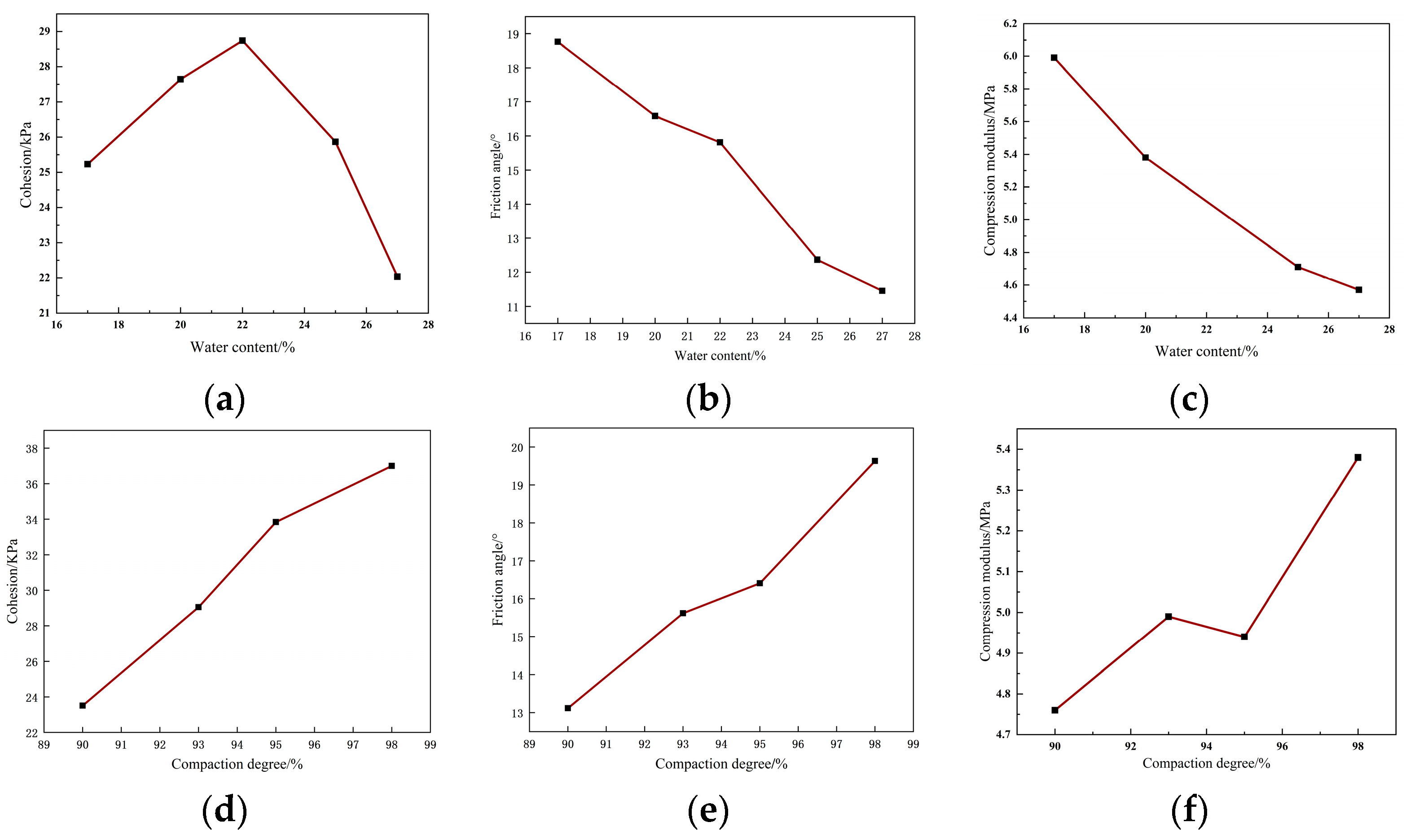
Since MIDAS GTS NX cannot directly input water content and compaction degree as parameters, empirically calibrated parameter mapping relationships were established to integrate the effects of these two construction factors into the numerical model. For moisture-dependent parameters (Table 4), red clay specimens were prepared with a fixed DC of 93% and varying water contents (17%, 20%, 25%, 27%), and their cohesion, internal friction angle, and compression modulus were measured to establish functional correlations. For compaction-dependent parameters (Table 5), specimens were prepared with a fixed water content of 22% and different DC values (90%, 93%, 95%, 98%), and corresponding mechanical properties were tested to derive quantitative links between DC and soil stiffness and strength. The trends of these relationships are visualized in Figure 2: Variations in red clay mechanical parameters with water content and degree of compaction (Figure 2a–c show responses of internal friction angle, compression modulus, and cohesion to water content at fixed DC = 93%, while Figure 2d–f show responses of cohesion, internal friction angle, and compression modulus to DC at fixed water content = 22%). At a constant DC, the internal friction angle and compression modulus decrease with increasing water content (due to thickening of the bound water film and weakened interparticle bonding), while cohesion exhibits a non-linear trend (peaking near the optimal water content of 22%); at constant water content, all three parameters increase monotonically with a higher DC, as denser particle arrangements enhance the soil skeleton’s strength and stiffness. For untested intermediate levels of water content (e.g., 22–25%) or DC (e.g., 93–95%), linear interpolation was applied to estimate corresponding parameters—this approach is justified by the smooth, continuous trends observed in the experimental data (Figure 2) and is a widely accepted practice in geotechnical numerical modeling for intermediate parameter estimation. These mapping relationships enabled the numerical model to accurately capture the influence of practical construction variables (moisture conditioning and compaction quality) on the mechanical behavior of the red clay fill, ensuring the reliability and engineering relevance of the simulation results.
Table 4. Physical–mechanical parameters of red clay filler with different water content.
Table 5. Physical–mechanical parameters of red clay fillers with different compaction degrees.
Figure 2. Variations in red clay mechanical parameters with water content and degree of compaction. (a) (variation curve of cohesion with water content): It depicts that cohesion first increases and then decreases as water content rises; (b) (variation curve of friction angle with water content): It shows that friction angle decreases gradually with increasing water content; (c) (variation curve of compression modulus with water content): It illustrates that compression modulus decreases continuously as water content increases; (d) (variation curve of cohesion with compaction degree): It reflects that cohesion increases with the rise of compaction degree; (e) (variation curve of friction angle with compaction degree): It shows that friction angle increases gradually as compaction degree rises; (f) (variation curve of compression modulus with compaction degree): It demonstrates that compression modulus increases overall with the rise of compaction degree (with a slight fluctuation in the middle).

2.3.2. Simulation of Reinforcement Measures

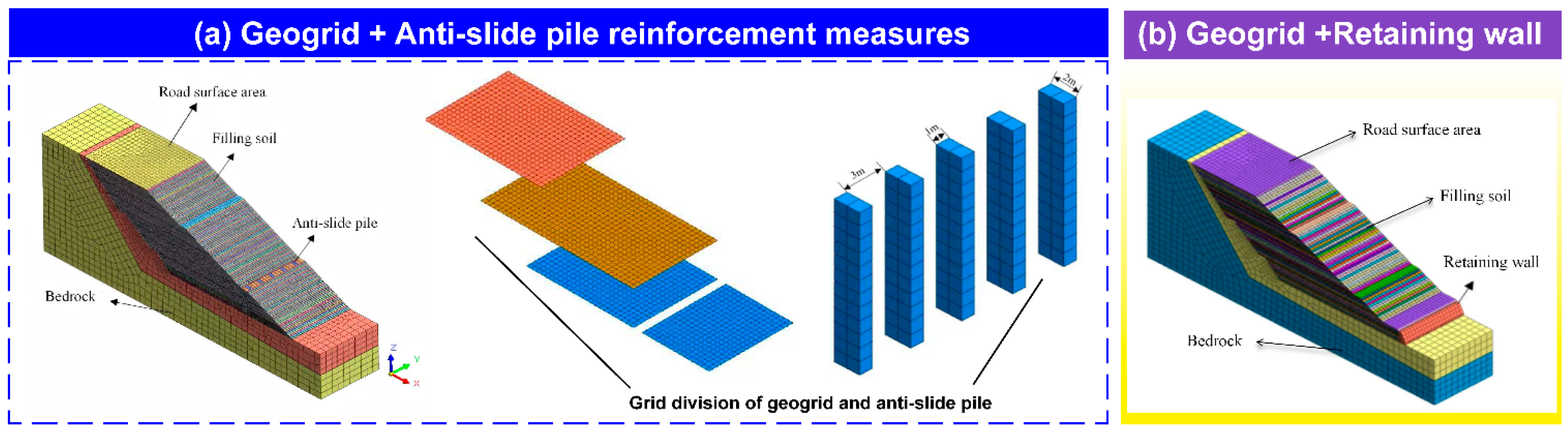
Two widely used countermeasures were modeled for the reference condition (w = 22%, DC = 93%, lift thickness = 30 cm): (a) geogrid layers combined with an anti-slide pile row; and (b) geogrid layers combined with a gravity retaining wall. As illustrated in Figure 3, it depicts the three-dimensional models and grid division diagrams of these two geogrid-reinforced measures.
Figure 3. Three-dimensional model and grid division diagram of two geogrid reinforcement measures (anti-slide pile, gravity retaining wall).
Geogrids were simulated as linear-elastic tensile elements and embedded in three layers at the junctions of successive lifts; soil–geogrid interaction was simplified to improve computational efficiency. Anti-slide piles (1.0 m × 2.0 m section, length 12 m, embedment 4 m, spacing 3 m) and geogrid properties are summarized in Table 6; the model sides and base were constrained, with a free upper boundary.
Table 6. Mechanical and geometric parameters of geogrid and anti-slide pile.
For the gravity retaining wall scheme, wall height was 3.0 m, base width 1.0 m, back-slope 1:0.4; 3–5 elements were used through thickness, with a longitudinal element length of 0.8 m. The wall was assigned ν = 0.25 and E = 28,000 MPa. The foundation received bidirectional constraints; vertical constraints were set within the fill, and horizontal constraints were applied longitudinally and transversely.

3. Results and Analysis

3.1. Settlement Patterns During Staged Construction

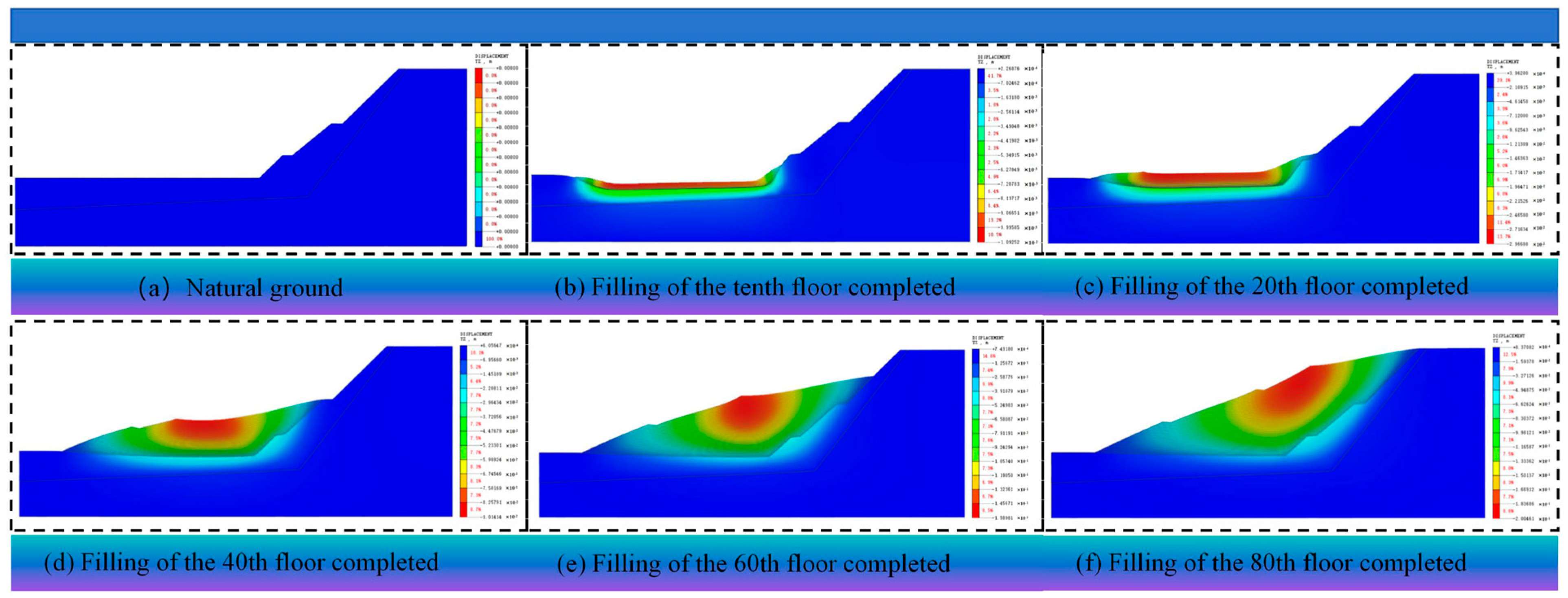
Under the representative condition (water content 22%, lift thickness 30 cm, degree of compaction 93%), Figure 3 presents the vertical displacement cloud diagram of the layered filling process of a red clay high-fill embankment. The simulated settlement field exhibits a consistent pattern during staged filling: the maximum settlement concentrates near the slope surface and the upper portion of the fill, while deformation in the natural foundation is limited. At the same elevation, edge zones show a larger settlement than the pavement center. These features become pronounced as construction progresses from the initial natural ground (Figure 3a) to the completion of the 10th (Figure 4b), 20th (Figure 4c), 40th (Figure 4d), 60th (Figure 4e), and 80th (Figure 4f) lifts, reflecting a self-weight dominated response of the embankment fill.
Figure 4. Vertical displacement cloud diagram of layered filling process of red clay high-fill embankment (water content 22%, lift thickness 30 cm, degree of compaction 93%).

3.2. Sensitivity of Post-Construction Settlement to Moisture, Compaction, and Lift Thickness

3.2.1. Sensitivity of Water Content

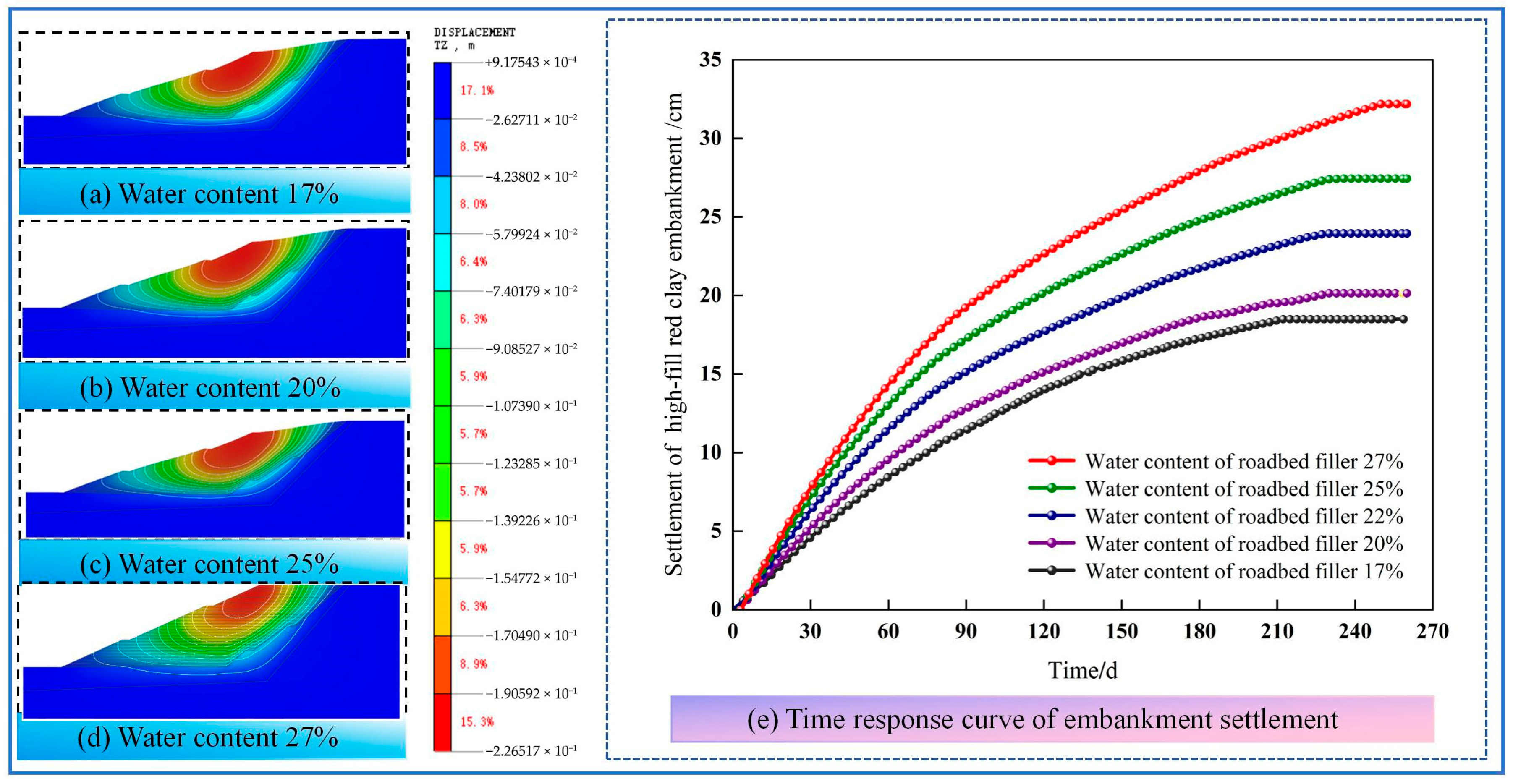
The vertical displacement contour maps for varying filler water contents (Figure 5) indicate that the maximum post-construction settlement consistently localizes near the slope surface of the embankment. Displacement contours sag inward toward the interior of the fill, demonstrating that deformation is concentrated within the embankment rather than the underlying natural ground. Foundation settlement remains small, with only limited deformation developing at the interface between the fill and the natural ground. As water content increases, the settlement at this interface grows, and the zone of appreciable settlement progressively expands.
Figure 5. Contour maps of vertical displacement and time-response curves of settlement for embankments with different filler water contents.
For a given water content, settlement rises rapidly at early times and then the growth rate attenuates, approaching a stable value. As shown in Figure 5, increasing the water content leads to larger final settlements and a longer time to stabilization. Notably, in the very early stage, the higher-moisture groups exhibit smaller instantaneous settlement than the lower-moisture groups.
The observed trends accord with consolidation theory: higher water content implies a higher degree of saturation, so a larger portion of the applied stress is initially carried by pore water (and, where present, pore air), yielding a lower initial effective stress and smaller immediate skeleton deformation. As excess pore pressures dissipate, effective stress increases and additional compression occurs, resulting in a greater ultimate settlement and prolonged stabilization time [34,35].

3.2.2. Sensitivity of Degree of Compaction

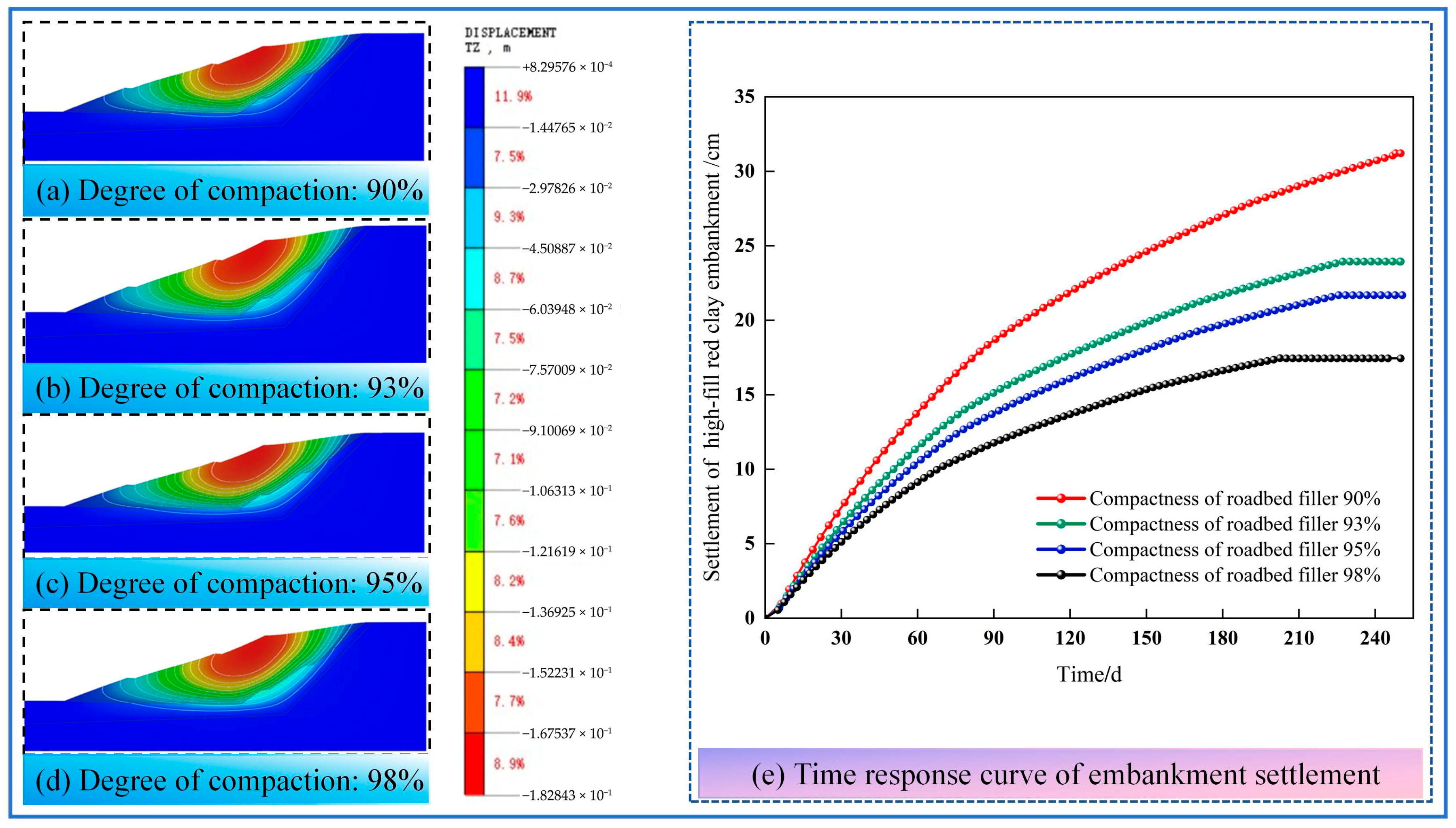
As shown in Figure 6, the vertical displacement contour maps under varying compaction levels show that deformation of the natural foundation is minor, whereas settlement concentrates within the fill, particularly near the cut–fill interface. The upper fill experiences markedly larger settlement than the lower fill, and the magnitude decreases with depth, i.e., the settlement diminishes with increasing distance from the embankment’s free surface. The surface of the fill exhibits a clear sagging morphology, reflecting a typical self-weight dominated response. As the degree of compaction increases, overall vertical displacements systematically decrease.
Figure 6. Contour maps of vertical displacement and time-response curves of settlement for embankments with different compaction degrees of roadbed filler.
Settlement-time curves become progressively flatter as compaction improves, yielding smaller ultimate settlements. When the degree of compaction increases from 90% to 98% (with other conditions held constant), post-construction settlement decreases from 31.3 cm to 17.4 cm, a reduction of 44.3%. The temporal evolution exhibits distinct stages: a rapid initial phase driven by the newly placed fill load, followed by a decelerating phase as consolidation proceeds, and finally a quasi-steady state.
A higher degree of compaction increases dry density, enhances the stiffness of the soil skeleton (higher compression modulus), and improves resistance to recompression. Consequently, under identical external conditions, both the settlement rate and the final settlement are reduced. The prominent early-time settlement and its subsequent attenuation are consistent with consolidation behavior frequently observed in high-fill red clay embankments in engineering practice [36].

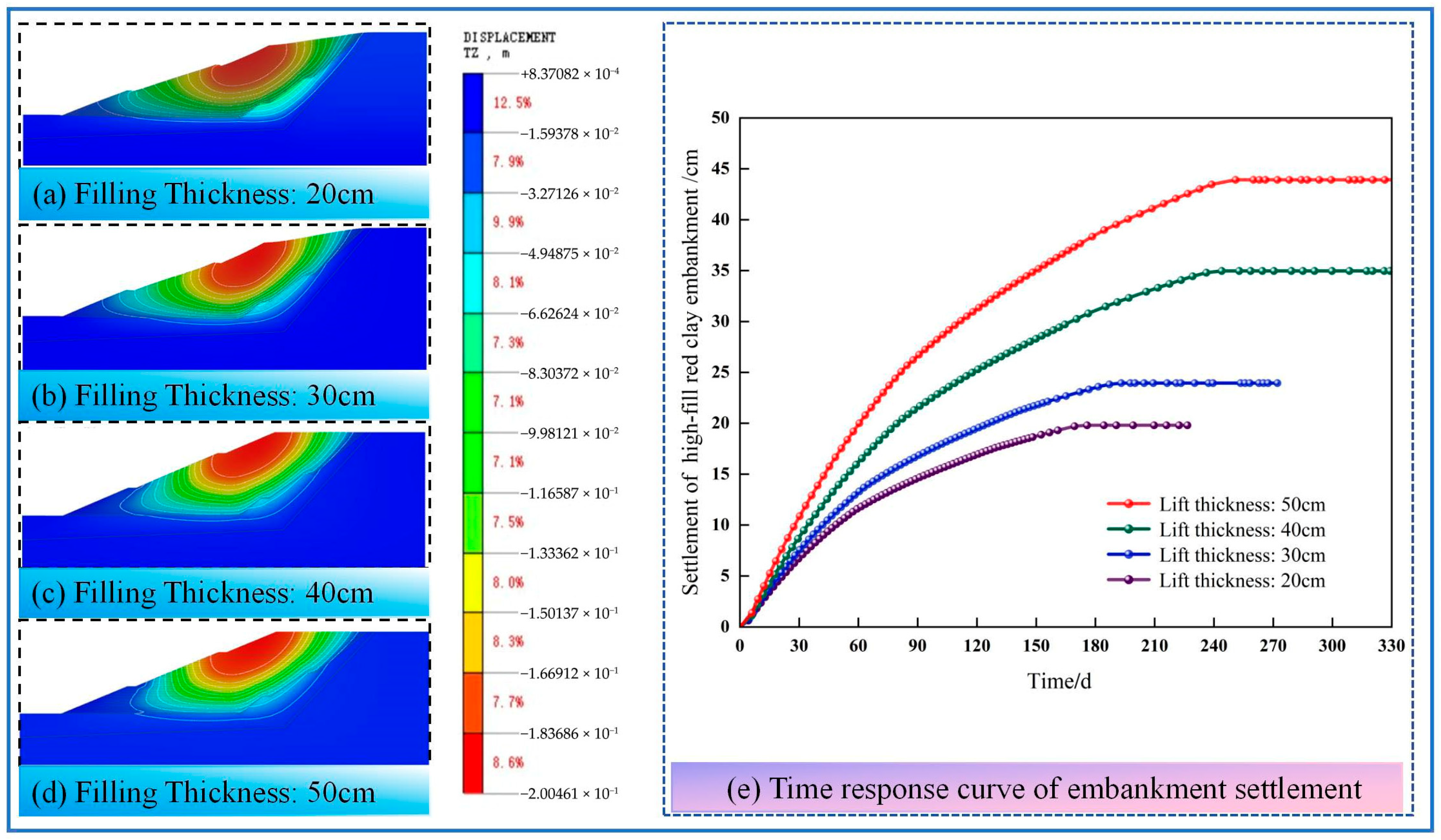
3.2.3. Sensitivity of Lift Thickness

As shown in Figure 7, vertical displacement contour maps for varying lift thicknesses show a settlement pattern consistent with preceding sections: deformation concentrates in the upper portion of the fill, while the foundation experiences limited settlement. Overall magnitudes increase as lift thickness increases. Settlement grows with time toward a stable value. At any given time, smaller lifts produce smaller settlements, reach lower ultimate settlements, and attain stabilization earlier. Conversely, thicker lifts are associated with larger final settlements and prolonged stabilization.
Figure 7. Contour maps of vertical displacement and time-response curves of settlement for embankments with different lift thicknesses.
Thinner lifts are more effectively compacted at depth, yielding a higher in situ density and stiffness and thus reduced compressibility; thicker lifts hinder deep compaction, leaving a looser soil skeleton that is more susceptible to recompression under self-weight. Sensitivity is particularly pronounced in the 30–40 cm range, where modest increases in lift thickness can cause a significant rise in final settlement.

3.3. Analysis of Reinforcement Results

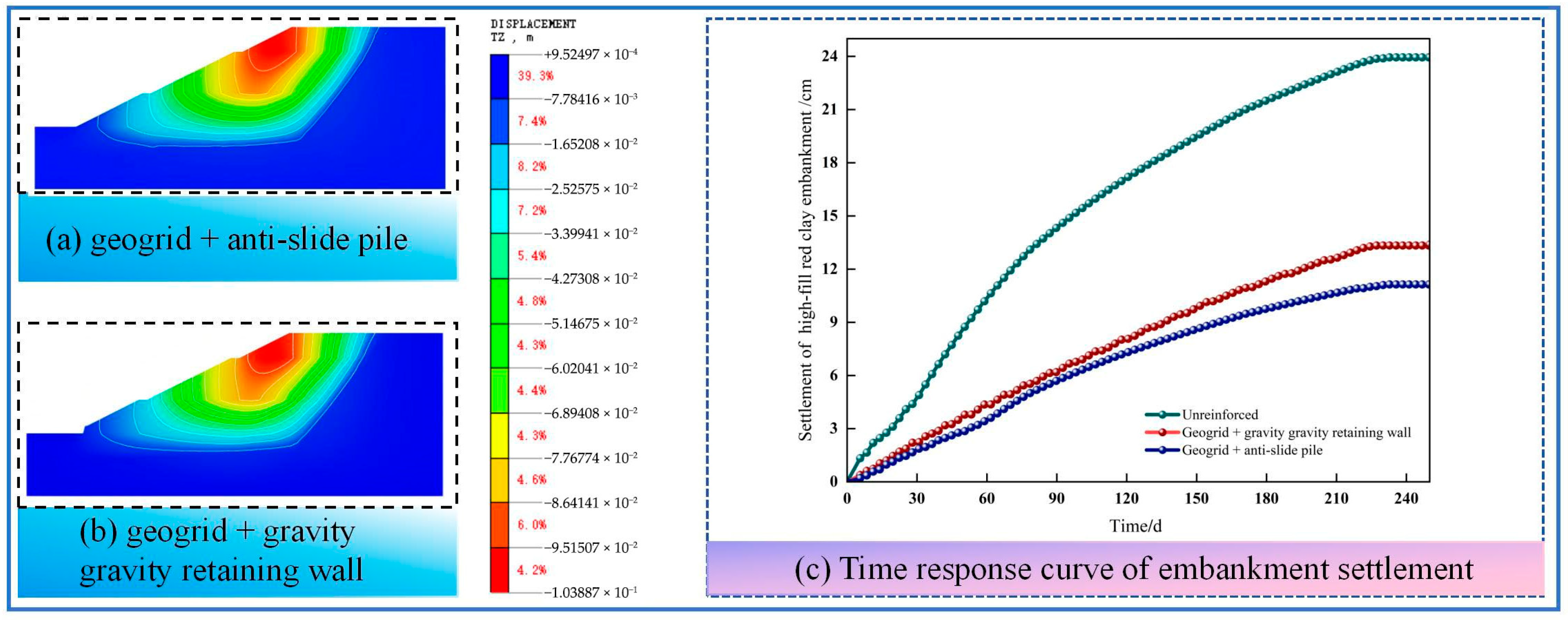
Figure 8 shows the time-response curves of embankment settlement under different reinforcement measures (unreinforced, geogrid + anti-slide pile, geogrid + gravity retaining wall). Over the simulation period, the unreinforced red clay embankment stabilizes at a settlement of approximately 23.9 cm. Incorporating geogrid + anti-slide piles reduces the maximum settlement to 10.3 cm, a 56.9% decrease relative to the unreinforced case. The geogrid + gravity retaining wall scheme limits settlement to 13.4 cm, corresponding to a 43.9% reduction. Both countermeasures thus markedly mitigate post-construction settlement, with the geogrid-pile system providing the larger reduction. The calculated stability coefficient increases by 54.5% for geogrid + anti-slide piles and by 36.4% for geogrid + gravity retaining wall, indicating notable improvements in global stability.
Figure 8. Time-response curves of embankment settlement under different reinforcement measures (unreinforced, geogrid + anti-slide pile, geogrid + gravity retaining wall).

3.4. Model Reliability Analysis

The soil mass was modeled with the Mohr–Coulomb (M–C) ideal elastoplastic constitutive relation, while geogrids were represented by linear-elastic tensile elements. This combination is widely adopted and has been shown to capture the primary features of reinforced-soil behavior: Ahmad [37] used M–C for fine sand and a linear-elastic model for geogrids to investigate a strip foundation on geogrid-reinforced sand, and Yang et al. [38] employed M–C to study the effects of pile length and spacing on embankment settlement. These studies support the applicability of the M–C framework for soil and the linear-elastic treatment for geogrid reinforcement in problems of this type.
A core justification for adopting the M–C model for red clay is its proven ability to capture the material’s key mechanical behaviors governing high-fill embankment settlement. As a foundational framework in geotechnical engineering, the M–C model effectively characterizes the essential strength (cohesion, internal friction angle) and stiffness properties of soils that drive settlement responses—validated by its successful application to clay-based materials. Jastrzebska M and Lupiezowiec M [39] employed the M–C model with a Coulomb–Mohr yield surface to analyze clay–rubber mixtures in road embankments, confirming its reliability in capturing the stiffness and strength of clayey materials. This finding extends to red clay, given their shared clayey mineralogical composition and shear strength-dominated mechanical behavior. While advanced models (e.g., overconsolidated unified hardening models [40], structural damage models [41]) address specialized complex behaviors of red clay (e.g., overconsolidation dissipation, freeze–thaw-induced degradation), the M–C model is sufficiently robust for this study’s scope—focused on quantifying settlement responses to construction parameters and reinforcement measures, where replicating red clay’s primary stress–strain and strength behaviors is paramount. Critically, M–C model parameters were derived from systematic laboratory testing of project-specific red clay (Section 2.3.1), including direct shear tests (shear strength) and oedometer tests (compression modulus). This project-specific calibration ensures alignment with the study’s red clay properties (rather than generic parameters), further enhancing the model’s suitability for predicting post-construction settlement of red clay high-fill embankments.
Reported monitoring data for high-fill foundations indicate settlement magnitudes on the order of tens of centimeters to over a meter, consistent with our numerical predictions. For example, at the Jiuzhai-Huanglong Airport site, the Y11 instrument in Yuan shan zi gou (fill thickness 39.23 m) recorded a final settlement of 1.048 m, and post-construction settlements along a representative observation line ranged from 15 to 30 cm (with a maximum post-construction settlement of ca. 25 cm recorded along observation line L5) [42]. Liu et al. [43] reported additional measurements in the same area, with settlement at point C18 on the southern boundary of 42, 31, and 23 cm (at successive stages/locations). These field observations corroborate the magnitude range produced by our simulations for high-fill embankments.
Given the M–C model’s established effectiveness for clay-based materials, project-specific parameter calibration based on laboratory tests of red clay, and alignment with field monitoring data from similar high-fill projects, the numerical model is considered reliable for evaluating post-construction settlement and comparing reinforcement schemes under the investigated conditions.

4. Analysis of Settlement Influence Mechanisms

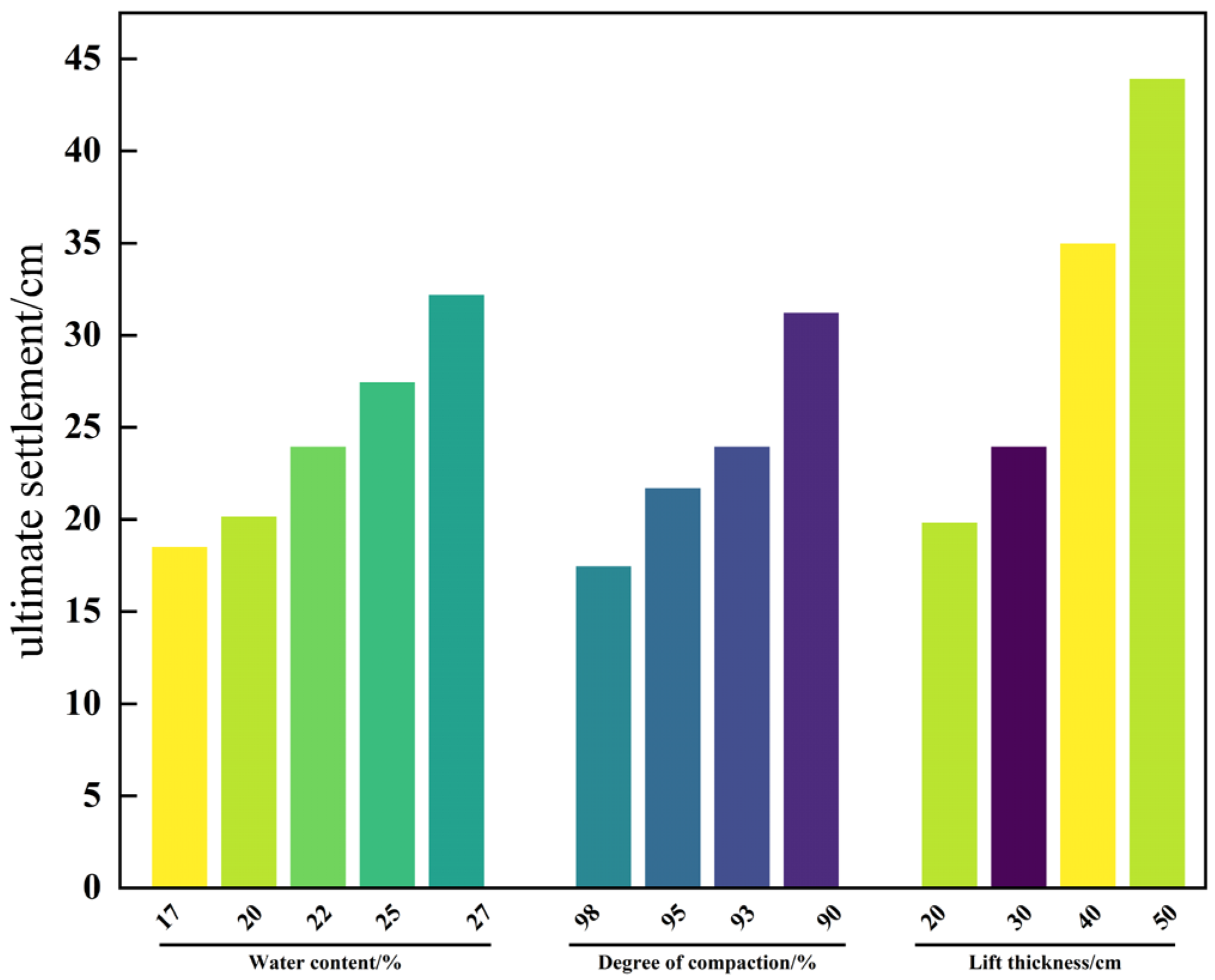
Through the indoor test and numerical simulation results, it is found that the water content, compaction degree, and lift thickness will have a significant impact on the settlement. Figure 9 shows the numerical comparison results of the final settlement of a high-fill red clay embankment under different conditions. Among them, the influence of the lift thickness on settlement is the most prominent. When the lift thickness increases from 20 cm to 50 cm, the final settlement of the embankment increases by about 121%, followed by the increase in water content, which increases the final settlement of the embankment by about 74%. This result fully highlights the important influence of water sensitivity of red clay on engineering. At the same time, the study confirms the effectiveness of the two supporting measures of geogrid + anti-slide pile and geogrid + gravity retaining wall. The former performs better in controlling settlement and improving stability.
Figure 9. Comparison of final settlement of high-fill red clay embankment under different conditions.
From the perspective of Chinese technical standards, the settlement reduction effects achieved by the proposed parameter adjustments (water content control and layered filling optimization) are fully compliant with engineering safety and serviceability requirements, thereby confirming distinct practical significance. As specified in the Technical Code for High Fill Foundation (GB 51254-2017) [44], mountainous embankments are characterized by complex terrain, foundation conditions, and filler properties, and existing research on post-construction settlement control of high embankments with a filling thickness exceeding 20 m still has certain limitations. Furthermore, regionally derived settlement thresholds may not be applicable to Yunnan red clay due to inherent differences in soil properties, which underscores the necessity of targeted parameter optimization for this specific soil type. The code explicitly stipulates that the post-construction settlement of filled foundations in reserved development areas should be controlled within the range of 200–300 mm. Complemented by the Specifications for Design of Highway Subgrades (JTG D30-2015) [45], which sets allowable post-construction settlement limits of 300 mm for general sections of expressways and first-class highways, and 500 mm for second-class highways in soft soil areas, these two core standards establish a rigorous benchmark for validating the effectiveness of the proposed measures in this study.
Optimizing the layered filling thickness from 50 cm to 20 cm reduces the final settlement from 43.9 cm to 19.8 cm, and regulating the water content from 27% to 17% achieves the same final settlement of 18.5 cm. Both results strictly fall within the 200–300 mm control range specified in GB 51254-2017 [44] and are well below the 300 mm allowable limit for high-grade highways (expressways and first-class highways) specified in JTG D30-2015 [45]. This ensures long-term operational stability for expressways and provides a sufficient safety margin for general-grade highways. For Yunnan red clay, which is characterized by high natural moisture content, significant water sensitivity, and compaction difficulty, the proposed adjustments directly address the technical challenges associated with mountainous high embankments. By enhancing interparticle bonding (through water content regulation) and ensuring effective deep compaction (through optimized layered filling thickness), the measures stabilize the embankment settlement within the limits prescribed by national standards. This not only validates the rationality and feasibility of the proposed construction parameters but also offers a reliable technical reference for similar high-fill red clay embankment projects in the mountainous regions of southern China.

4.1. Influence of Water Content, Degree of Compaction, and Lift Thickness

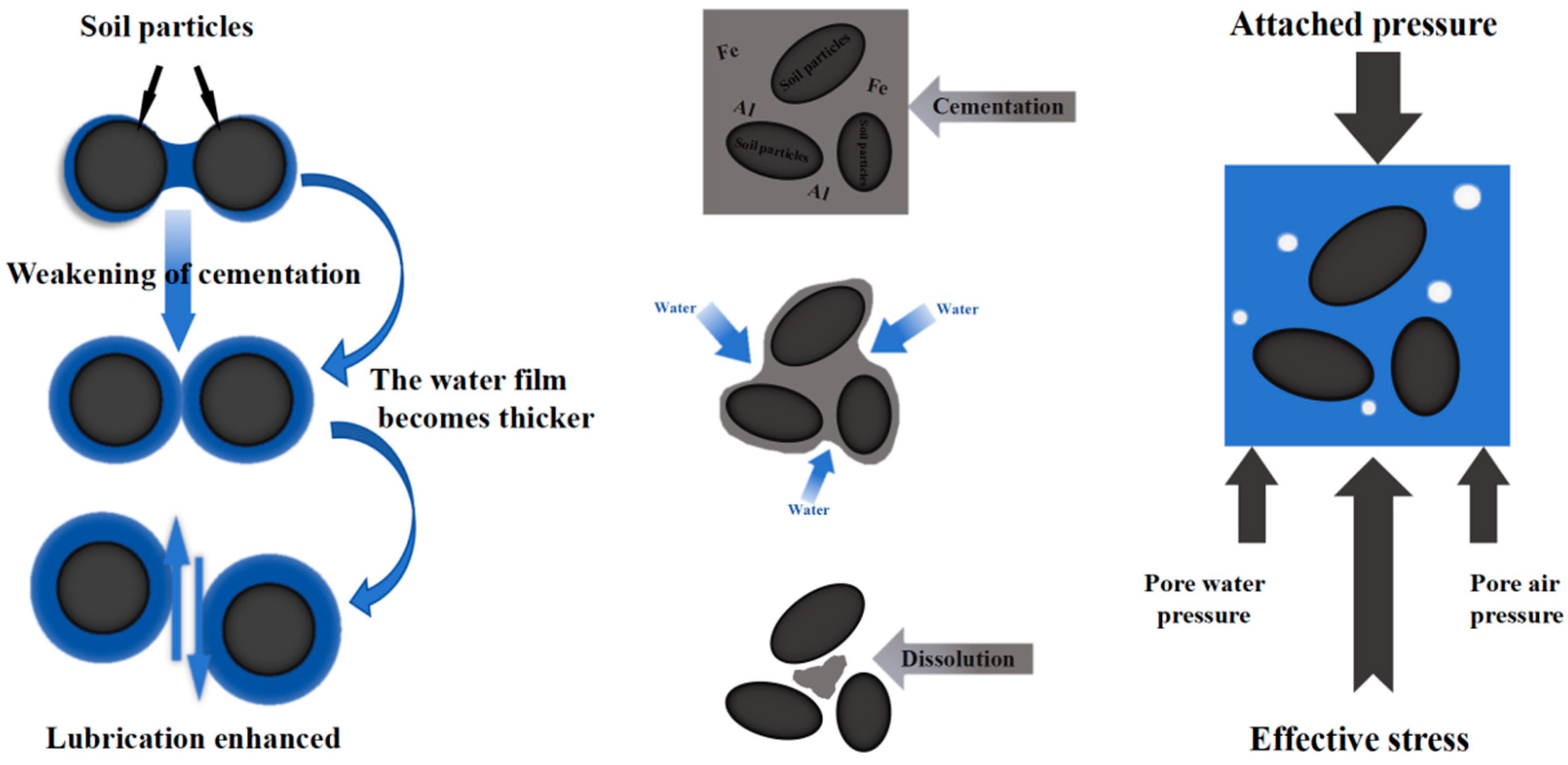
The influence mechanism of water content on the settlement of red clay is shown in Figure 10. From the analysis of the physical mechanism, the water molecules in red clay filler exist in the form of bound water and free water. With the increase in water content, the weak bound water film becomes thicker, the viscosity and molecular gravity between soil particles become weaker, and the free water content increases. The lubrication effect will further reduce the friction resistance and bond strength between the particles [46], making it easier for soil particles to produce dislocation deformation and increase soil settlement. From the analysis of chemical mechanism, red clay is rich in iron and aluminum oxides [47]. These cementing materials may dissolve under high water content conditions, further weakening the structural strength of the soil. From the perspective of mechanics, the dissipation of pore water pressure increases the effective stress [48], and the soil deforms. Under the condition of high water content, the settlement of the embankment develops faster and takes longer to reach stability.
Figure 10. Schematic diagram of influence mechanism of water content.
The test data show that under the condition of vertical pressure of 200 kPa, the compaction degree (DC) increases from 90% to 98%, the compression modulus of red clay increases by about 34%, and the internal friction angle and cohesion increase by 44.7% and 31.5%, respectively. This significant improvement is attributed to the rearrangement of soil particles and pore reduction during compaction—higher DC results in closer particle contact and a more stable soil skeleton structure. This aligns with the conclusion of Olinic et al. [49] on difficult clayey soils, where optimized compaction (even for soil-mixture systems) was confirmed to reduce swelling pressure and improve mechanical stability—findings that extend to pure red clay due to their shared clayey mineralogical composition.
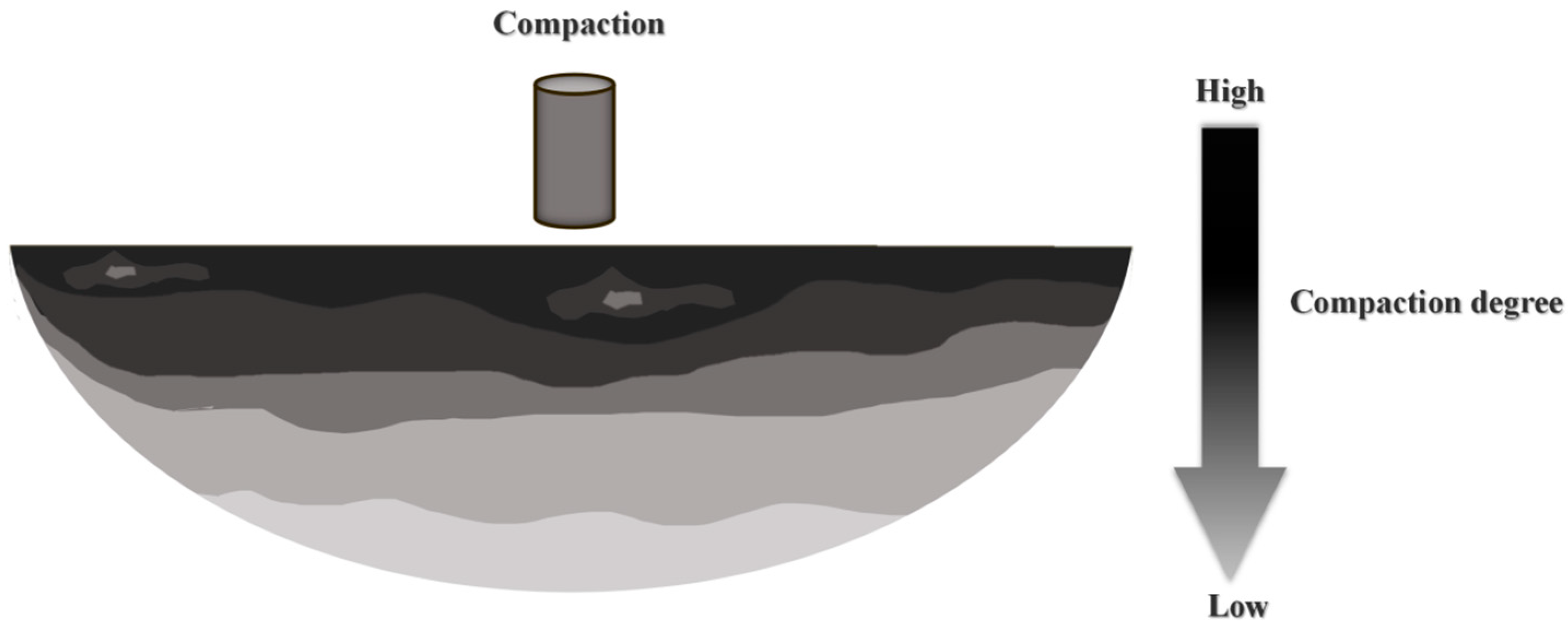
The influence of layered filling thickness on settlement is also closely related to the compaction degree of soil. When the filling thickness is large, it is difficult for the construction equipment to effectively compact the deep filler, resulting in a decrease in the compaction degree. Insufficient compaction will increase the void ratio of the filler and make the soil more prone to compression deformation, which is consistent with Olinic et al.’s [49] finding that the inadequate compaction of problematic clayey fills fails to mitigate their inherent deformation risks. Song et al. [50] introduced the resistivity method into the evaluation of soil compaction degree and obtained the distribution of compaction degree in the region: the general rule is that the compaction degree decreases with the increase in soil depth, and the simplified diagram is shown in Figure 11. This depth-dependent DC distribution aligns with the numerical simulation results of this study, further verifying that excessive lift thickness leads to insufficient deep compaction and increased settlement potential.
Figure 11. Schematic diagram illustrating the variation in soil compaction with depth.

4.2. Influence of Reinforcement Measures

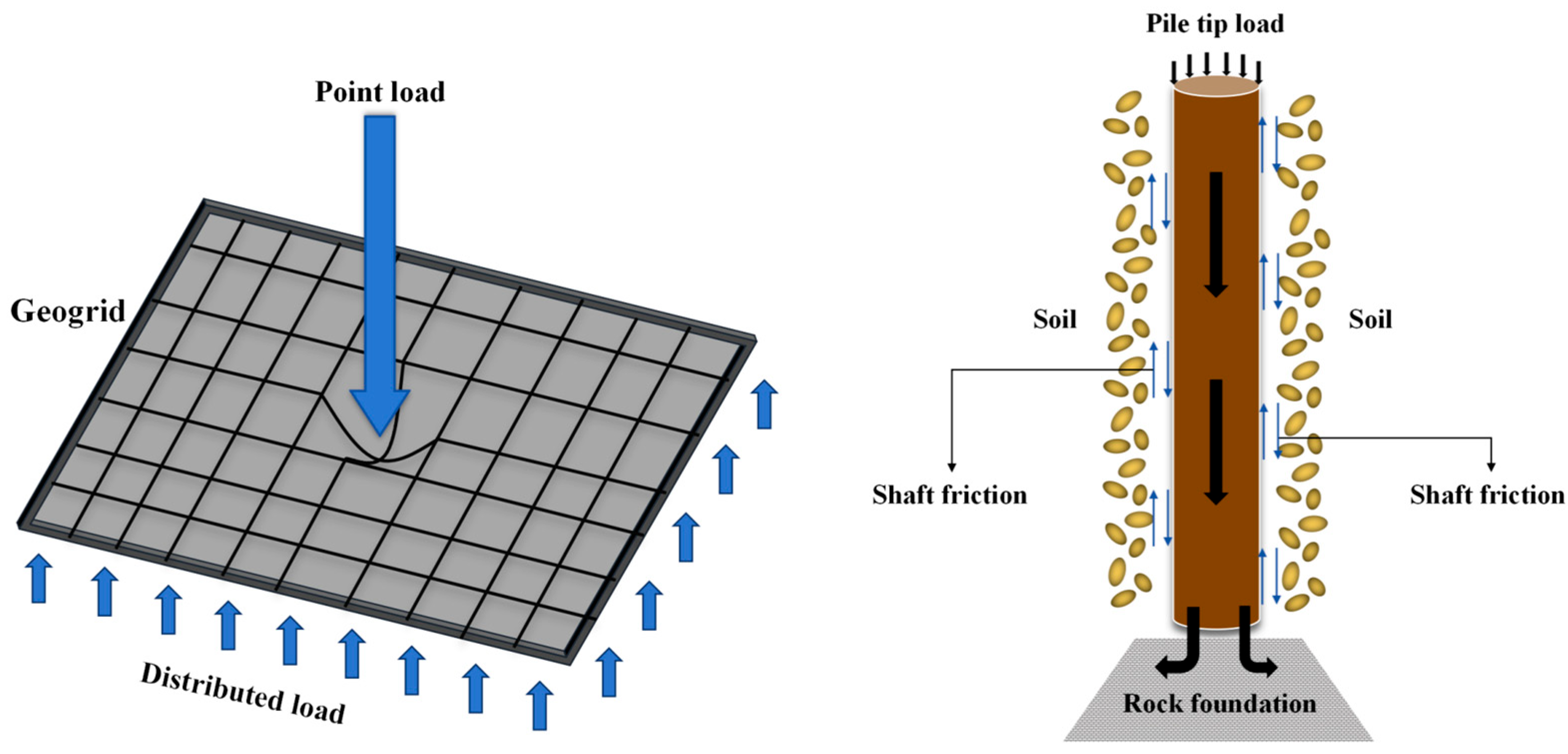
Geogrid + anti-slide piles. Horizontally placed geogrids redistribute vertical loads and alleviate local stress concentrations while constraining lateral deformation, thereby enhancing shear resistance and reducing settlement attributable to shear strains. As shown in Figure 12, anti-slide piles, acting as stiff inclusions socketed into competent strata, directly share vertical loads and transfer stresses to deeper layers through side friction (and end bearing where applicable), which decreases the compressive deformation within the shallow fill. The combined ‘vertical + horizontal’ reinforcement creates a composite system that effectively curtails the overall settlement.
Figure 12. Mechanism diagram of geogrid and anti-slide pile composite reinforcement.
Geogrid + gravity retaining wall. The gravity retaining wall provides lateral confinement and a stable boundary, restraining outward movement of the embankment and inhibiting deep-seated sliding. In conjunction with the geogrid, it reduces deformation heterogeneity and helps control differential settlement, thereby improving the serviceability of the roadbed.
Both schemes are effective for high-fill red clay embankments; however, when minimizing settlement and maximizing stability are the primary objectives under the modeled conditions, the geogrid + anti-slide pile configuration is the more efficient option.

5. Conclusions

This study integrates laboratory tests and three-dimensional finite-element simulations via MIDAS GTS NX to systematically investigate the post-construction settlement behavior of high-fill red clay embankments, focusing on key influencing factors and reinforcement countermeasures. The primary conclusions are drawn as follows:
(1)
Regardless of variations in filler water content, degree of compaction, and lift thickness, the vertical displacement distribution of high-fill red clay embankments exhibits a consistent characteristic pattern. Settlement is predominantly concentrated in the upper fill zone adjacent to the slope surface, with displacement contours presenting an inward sagging trend toward the original foundation. In contrast, the underlying natural foundation undergoes negligible settlement, with only marginal deformation observed at the interface between the fill and the foundation. This displacement pattern is primarily governed by the self-weight-induced consolidation of the embankment fill.
(2)
Filler water content and degree of compaction are critical controlling factors for post-construction settlement. Elevated water content compromises the shear strength of red clay and enhances its compressibility by thickening the bound water film, weakening interparticle bonding, and potentially dissolving cementitious components. Conversely, a higher degree of compaction improves the soil skeleton stiffness and reduces pore volume, thereby mitigating both the magnitude of ultimate settlement and the time required for stabilization. These findings underscore the necessity of strict moisture conditioning and compaction quality control in engineering practice.
(3)
Lift thickness exerts a significant regulatory effect on settlement behavior: increased lift thickness correlates with larger post-construction settlement and prolonged stabilization periods. This phenomenon is attributed to the inadequate compaction of deep fill layers when lift thickness exceeds a critical threshold, resulting in a loose soil structure with high compressibility under self-weight loading. Based on the comprehensive analysis of technical feasibility and economic efficiency, a lift thickness of approximately 30 cm is recommended as the optimal construction parameter for high-fill red clay embankments.
(4)
Geogrid-reinforced composite schemes, geogrid + anti-slide piles, and the geogrid + gravity retaining wall effectively mitigate post-construction settlement and enhance the embankment stability. The geogrid + anti-slide pile system achieves superior performance, reducing the maximum settlement by 56.9% and increasing the stability coefficient by 54.5% compared to the unreinforced condition, owing to the synergistic effects of the horizontal load redistribution by geogrids and vertical stress transfer by anti-slide piles. The geogrid + gravity retaining wall scheme provides a viable alternative with a 43.9% settlement reduction and 36.4% stability improvement, and the selection between the two should be determined by site-specific conditions, engineering requirements, and cost constraints.
(5)
For the design and construction of high-fill red clay embankments in southern China’s mountainous and hilly regions, optimizing moisture content control, maximizing the degree of compaction as much as practically feasible (with 93% serving as a minimum baseline), and adopting a lift thickness of approximately 30 cm constitute core technical measures for controlling post-construction settlement. The application of geogrid-based composite reinforcement schemes can further enhance the embankment stability and reduce deformation, providing reliable technical support for similar projects in red clay areas.

Author Contributions

J.-B.X.: conceptualization, original draft writing, review, and editing; B.W.: original draft writing, and visualization; R.-G.J., X.-M.Z.: resources; Y.-C.Y., K.-N.L.: software and data curation. All authors have read and agreed to the published version of the manuscript.

Funding

This work was supported by the National Natural Science Foundation of China (NO: 12462033) and the fifth professional degree graduate student practice innovation project of Yunnan University (ZC-252512658).

Institutional Review Board Statement

Ethical review and approval were waived for this study as it involves only geotechnical engineering numerical simulations and experimental tests on red clay materials, without involving humans, animals, or any ethical-sensitive content. All experimental procedures and numerical modeling methods comply with standard academic and engineering research norms.

Data Availability Statement

The original contributions presented in this study are included in the article. Further inquiries can be directed to the corresponding author.

Conflicts of Interest

Authors Jian-Bin Xie and Rong-Gu Jia were employed by the company Yunnan Green Intelligent Construction Research Institute Co., Ltd. Author Rong-Gu Jia was employed by the company Yunnan Green Intelligent Construction Research Institute Co., Ltd. The remaining authors declare that the research was conducted in the absence of any commercial or financial relationships that could be construed as a potential conflict of interest.

References

  1. Zhou, Y.; Tong, C.; Wang, Y. Road construction, economic growth, and poverty alleviation in China. Growth Change 2022, 53, 1306–1332. [Google Scholar]
  2. Ding, J.X.; Meng, Y.W. Review of applied study for red clay in highway subgrades. Adv. Mater. Res. 2014, 919, 1144–1149. [Google Scholar] [CrossRef]
  3. Chen, K.; Zhu, R. Study of the deformation characteristics for red clay under drying-wetting cycles. In Proceedings of the 5th International Conference on Civil Engineering and Transportation, Guangzhou, China, 28–29 November 2015; Atlantis Press: Dordrecht, The Netherlands, 2015; pp. 511–516. [Google Scholar]
  4. Wei, H.; Gu, Z.; Liu, Z.; Wang, Y.; Shi, Y. Creep properties and creep modelling of Guilin red clay. Appl. Sci. 2023, 13, 12052. [Google Scholar] [CrossRef]
  5. Zeng, B.; Wang, L.-F.; Tian, Y.; Zeng, T.-R.; Li, B. Study on compaction characteristics and construction control of mixtures of red clay and gravel. Adv. Civ. Eng. 2018, 2018, 8079379. [Google Scholar] [CrossRef]
  6. Yang, G.H. Difficulties and breakthroughs in calculation of foundation settlement. J. Geotech. Eng. 2019, 41, 1893–1898. (In Chinese) [Google Scholar]
  7. Diaz, E.; Tomas, R. Calculation of the three dimensional elastic settlement of foundations with variable rigidity on terrains with a rigid inclined layer. Inf. Constr. 2016, 68. [Google Scholar]
  8. Peng, B.; Feng, R.; Wu, L.; Wei, K.; Wang, P. Settlement calculation method for peat soil foundations. Int. J. Geomech. 2023, 23, 04023094. [Google Scholar] [CrossRef]
  9. Dong, X.M. Research on prediction method of soft soil foundation settlement. Appl. Mech. Mater. 2011, 97, 36–39. [Google Scholar] [CrossRef]
  10. Wang, Y.; Chen, S.; Ouyang, J.; Li, J.; Zhao, Y.; Lin, H.; Guo, P. Predicting ground surface settlements induced by deep excavation under embankment surcharge load in flood detention zone. Water 2022, 14, 3868. [Google Scholar] [CrossRef]
  11. Ouabel, H.; Zadjaoui, A.; Bendiouis-Benchouk, A. Numerical estimation of settlement under a shallow foundation by the pressuremeter method. Civ. Eng. J. 2020, 6, 156–163. [Google Scholar] [CrossRef]
  12. Lukić Kristić, I.; Szavits-Nossan, V.; Miščević, P. Direct method for determination of shallow foundation settlements. Građevinar 2017, 69, 467–477. [Google Scholar]
  13. Tan, F.; Zhou, T.Q.; Li, C. Finite Element Analysis for Pile Group Foundation Settlement in Soft Soil. Appl. Mech. Mater. 2013, 405, 168–172. [Google Scholar] [CrossRef]
  14. Bektas, F.; Uzuner, B.A. Comparison of the computed and the measured settlements of a flexible mat. In Proceedings of the 15th International Conference on Soil Mechanics and Geotechnical Engineering, İstanbul, Turkey, 27–31 August 2001. [Google Scholar]
  15. Wen, Y.; Yang, G.; Zhong, Z. Study on Calculation Method of Foundation Nonlinear Settlement Based on In Situ Loading Test. Geofluids 2023, 2023, 7845944. [Google Scholar] [CrossRef]
  16. Liu, K.; Yuan, K.; Shi, B. Study on prediction method for postconstruction settlement of loess fill foundation in Northern Shaanxi, China. Adv. Civ. Eng. 2020, 2020, 5703420. [Google Scholar] [CrossRef]
  17. Wang, Z.; Luo, Y.; Tang, S. Mechanism and calculation method of rheological settlement of high-filled embankment. J. Cent. South Univ. Technol. 2008, 15 (Suppl. 1), 381–385. [Google Scholar] [CrossRef]
  18. Morissette, L.; St-Louis, M.W.; McRostie, G.C. Empirical settlement predictions in overconsolidated Champlain Sea clays. Can. Geotech. J. 2001, 38, 720–731. [Google Scholar] [CrossRef]
  19. Huang, C.; Li, Q.; Wu, S.; Li, J.; Xu, X. Application of the Richards model for settlement prediction based on a bidirectional difference-weighted least-squares method. Arab. J. Sci. Eng. 2018, 43, 5057–5065. [Google Scholar]
  20. Liu, W.; Chao, W.; Jin, Y.; Yang, F.; Fan, L.; Zhang, W.; Wu, L.; Song, C. Study on GA-ANN-based prediction of paving time of cement-stabilized layer above ultra-high-filled subgrade. Buildings 2024, 14, 2312. [Google Scholar]
  21. Feng, S.; Lei, H. A settlement prediction model considering tidal loading and traffic loading of soft soil subgrade. Comput. Geotech. 2022, 144, 104639. [Google Scholar] [CrossRef]
  22. Tang, C.; Zhu, Z.; Ma, Y.; Yao, Z.; Tan, Q.; Liu, Z.; Xu, J.; Zheng, S. Numerical simulation for vibration-induced settlement and permanent deformation accumulation in permafrost subgrades of the Qinghai-Tibet Railway. Comput. Geotech. 2024, 167, 106047. [Google Scholar] [CrossRef]
  23. Lu, Y.N.; Li, G.W. FLAC3D numerical simulation study on deformation of subgrade construction process. Appl. Mech. Mater. 2011, 90, 466–470. [Google Scholar] [CrossRef]
  24. Lin, Q.; Zhang, Y.; Yang, C.; Wang, X.; Lei, T.; Ju, C.; Yao, Z.; Yao, K. Evaluation of differential settlement of subgrade for highway-widening projects. Sustainability 2023, 15, 2950. [Google Scholar] [CrossRef]
  25. Xie, L.; Tang, B.; Liu, S.; Gong, Y.; Cheng, X. Study on optimization of pouring time for late poured band. Front. Built Environ. 2023, 8, 1059920. [Google Scholar] [CrossRef]
  26. Abhishek, R.; Chawla, S.; Vinod, J.S. Enhancement of Existing Railway Tracks for Heavier Axle Loads: Innovative Retrofitting Techniques. Indian Geotech. J. 2025, 55, 3702–3709. [Google Scholar] [CrossRef]
  27. Wang, Z.; Zhu, J.; Ma, T. Review on monitoring of pavement subgrade settlement: Influencing factor, measurement and advancement. Measurement 2024, 237, 115225. [Google Scholar] [CrossRef]
  28. Gu, C.; Wang, J.; Cai, Y.; Sun, L.; Wang, P.; Dong, Q. Deformation characteristics of overconsolidated clay sheared under constant and variable confining pressure. Soils Found. 2016, 56, 427–439. [Google Scholar] [CrossRef]
  29. Peng, L.Y.; Liu, J.K.; Tian, Y.H. Study on thawing settlement and its influenced factors of embankment in seasonal frost area. Adv. Mater. Res. 2014, 838, 756–760. [Google Scholar] [CrossRef]
  30. Singh, A.K.; Sahoo, J.P. Undrained cyclic loading response of subgrade soil subjected to varying moisture content and stress level. Int. J. Geomech. 2023, 23, 04022284. [Google Scholar] [CrossRef]
  31. Wan, G.; Liu, J.; Liu, C.; Yang, J.; Wang, X.; Li, P. Numerical Study on Deformation Characteristics and Influencing Factors of Super-High Filled Subgrade. In Proceedings of the International Conference on Civil Architecture and Structural Engineering, Da Nang, Vietnam, 7–9 December 2024; Springer Nature: Cham, Switzerland, 2024; pp. 387–399. [Google Scholar]
  32. JTG/T 3340-2018; Technical Specifications for Highway Subgrade Construction. Ministry of Transport of the People’s Republic of China (MOT)/China Communications Press: Beijing, China, 2018. (In Chinese)
  33. GB/T 50123-2019; Standard for Geotechnical Testing Method. Ministry of Housing and Urban—Rural Development of the People’s Republic of China (MOHURD), & State Administration for Market Regulation (SAMR)/China Planning Press: Beijing, China, 2019. (In Chinese)
  34. Cheng, T.; Yan, K.; Hu, R.; Zheng, J.; Zhang, Y.; Jin, L.; Liu, J. A simplified method for one-dimensional consolidation of unsaturated soils. Int. J. Geomech. 2023, 23, 04022251. [Google Scholar] [CrossRef]
  35. Guerriero, V. 1923–2023: One Century since Formulation of the Effective Stress Principle, the Consolidation Theory and Fluid-Porous-Solid Interaction Models. Geotechnics 2022, 2, 961–988. [Google Scholar] [CrossRef]
  36. Feng, R.; Peng, B.; Wu, L.; Cai, X.; Shen, Y. Three-stage consolidation characteristics of highly organic peaty soil. Eng. Geol. 2021, 294, 106349. [Google Scholar] [CrossRef]
  37. Ahmad, H.; Mahboubi, A.; Noorzad, A. Scale effect study on the modulus of subgrade reaction of geogrid-reinforced soil. SN Appl. Sci. 2020, 2, 394. [Google Scholar] [CrossRef]
  38. Yang, L.; Xu, W.; Li, K. Analysis of the embankment settlement on soft soil subgrade with a cement mixed pile. Adv. Civ. Eng. 2021, 2021, 9949720. [Google Scholar] [CrossRef]
  39. Jastrzebska, M.; Lupiezowiec, M. Application of Clay–rubber Mixtures for the Transportation Geotechnics—The Numerical Analysis. Stud. Geotech. Mech. 2023, 45, 370–381. [Google Scholar] [CrossRef]
  40. Liu, W.; Xu, C.J.; Du, H.D.; Zhu, H.S.; Wang, C.H. Stability analysis of overconsolidated unsaturated red clay slope based on modified UH model. Rock Soil Mech. 2024, 45, 1233–1241. (In Chinese) [Google Scholar]
  41. Yu, Y.; Zhang, Z.; Dai, F.; Bai, S. A New Shear Strength Model with Structural Damage for Red Clay in the Qinghai-Tibetan Plateau. Appl. Sci. 2024, 14, 3169. [Google Scholar] [CrossRef]
  42. Li, X.Z.; Xu, Q.; Kong, J.M.; Ding, X.M. Numerical modeling analysis of settlements of high fill foundation for Jiuzai-Huanglong airport. Yanshilixue Yu Gongcheng Xuebao/Chin. J. Rock Mech. Eng. 2005, 24, 2188–2193. (In Chinese) [Google Scholar]
  43. Liu, H.; Li, P.; Zhang, Z. Prediction of the post-load settlement of high embankment by artificial neural network. J.-Chengdu Univ. Technol. 2005, 32, 284. (In Chinese) [Google Scholar]
  44. GB 51254-2017; technical Code for Deep Filled Ground. Ministry of Housing and Urban-Rural Development of the People’s Republic of China (MOHURD)/China Architecture & Building Press: Beijing, China, 2017. (In Chinese)
  45. JTG D30-2015; Specifications for Design of Highway Subgrades. Ministry of Transport of the People’s Republic of China (MOT)/China Communications Press Co., Ltd.: Beijing, China, 2015. (In Chinese)
  46. Feng, X.; Teng, J.; Wang, H. Influence mechanism of water content and compaction degree on shear strength of red clay with high liquid limit. Materials 2023, 17, 162. [Google Scholar] [CrossRef]
  47. Lu, X.; Yu, Q.; Xu, J.; Yue, B.; Sheng, M. Comparative experimental study on strength properties of red clay modified by cement and industrial solid waste powder. Adv. Civ. Eng. 2023, 2023, 6645563. [Google Scholar] [CrossRef]
  48. Lu, M.; Zheng, Y.Y.; Yin, Z.Y. Investigating the consolidation of kaolinite with Molecular Dynamics: The micro effective stress principle. Appl. Surf. Sci. 2025, 690, 162653. [Google Scholar] [CrossRef]
  49. Olinic, E.; Ivasuc, T.; Manea, S. Improvement of difficult soils by mixing with mineral materials and inorganic waste. Exp. Proj. Case Stud. Rom. 2015, 2437–2442. [Google Scholar]
  50. Song, J. Joint Evaluation Method for Soil Compaction Degree Based on Electrical Resistivity and Elastic Wave Property. In Proceedings of the 2015 3rd International Conference on Machinery, Materials and Information Technology Applications, Washington, DC, USA, 21–23 May 2015; Atlantis Press: Dordrecht, The Netherlands, 2015; pp. 1608–1611. [Google Scholar]
Disclaimer/Publisher’s Note: The statements, opinions and data contained in all publications are solely those of the individual author(s) and contributor(s) and not of MDPI and/or the editor(s). MDPI and/or the editor(s) disclaim responsibility for any injury to people or property resulting from any ideas, methods, instructions or products referred to in the content.

Article Metrics

Citations

Article Access Statistics

Article metric data becomes available approximately 24 hours after publication online.