1. Introduction
In the contemporary landscape of organizational theory, the question of how entities navigate existential shocks has shifted toward a debate between internal resilience and institutional conformity. At a broad level, crisis management in family firms has garnered significant academic attention due to the unique dynamics inherent in these businesses [
1,
2,
3,
4,
5]. Traditionally, the literature has emphasized the stewardship model, where internal solidarity—fueled by values such as loyalty, trust, and altruism—forms a bedrock of resilience [
4]. This cohesion, paired with a long-term orientation and the ability to leverage personal resources, has often been credited for superior performance during periods of instability [
6,
7]. Indeed, some empirical studies, such as those by [
8,
9], suggest that publicly listed family firms outperformed their non-family counterparts during the COVID-19 pandemic.
However, moving from these general advantages to a more nuanced organizational view reveals that family firms are deeply heterogeneous entities [
10]. Their specific survival likelihood is dictated by granular factors, including the degree of family involvement in management, generational stage, and regional community embeddedness [
11,
12]. Despite this diversity, the isomorphic perspective suggests that during acute crises, these idiosyncratic differences often dissolve. Under extreme uncertainty, organizations tend to imitate the strategies of their peers rather than relying on pre-existing strategic advantages [
13,
14,
15,
16,
17]. This drive for conformity explains findings where listed family firms failed to demonstrate superior market performance or lower volatility, as isomorphic pressures effectively neutralized the benefits of their distinct resources [
18].
Specifically, for private family firms, these external pressures intersect with a critical internal vulnerability: limited transparency. Unlike public entities, the lack of external scrutiny in private firms can facilitate strategic flexibility but may also mask entrenched inefficiencies or conflicts of interest [
19,
20,
21]. In environments characterized by institutional voids, this secrecy can even catalyze unethical responses or corruption under the guise of survival [
7]. Consequently, the most specific challenge for these firms is not just the crisis itself, but how the combination of low transparency and intense isomorphic pressure leads them toward efficiency-focused exploitative strategies that ultimately hinder long-term innovation and post-crisis recovery [
11].
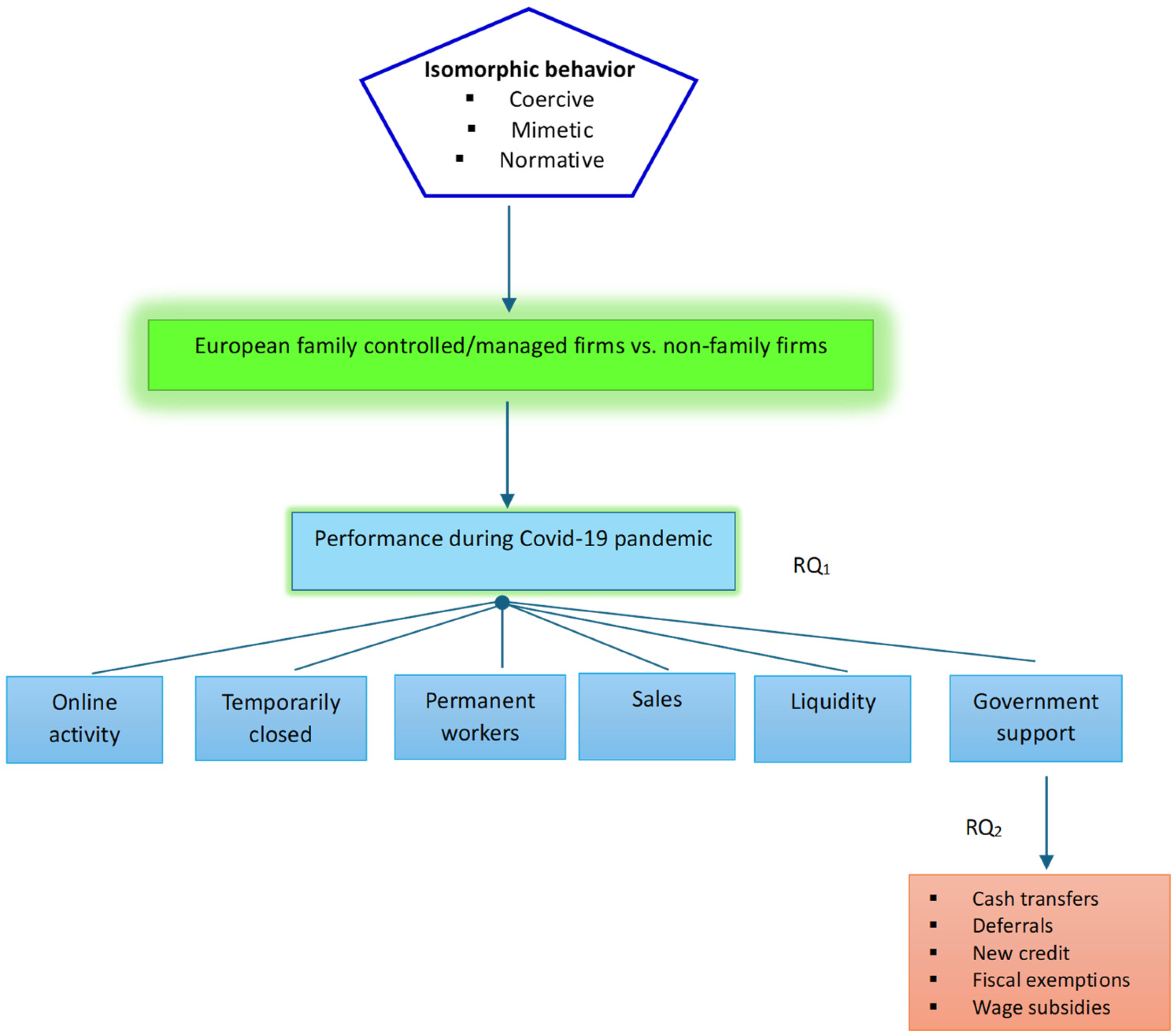
The objective of this study is to examine the behavioral underpinnings of crisis management within family firms across 11 European nations during the COVID-19 pandemic. Specifically, it challenges the traditional stewardship paradigm by exploring the psychological and institutional trade-offs faced by family owners between the preservation of human legacy and financial survival. By analyzing a robust sample of predominantly private family-controlled and managed entities, this research highlights the critical tension between behavioral rigidity—a tendency to persist in established family routines despite environmental shifts—and the pursuit of strategic flexibility, which enables these firms to pivot through innovative adaptations [
2,
11,
14]. Utilizing binary logistic and multinomial logistic regressions, alongside an endogenous treatment effect model, this study evaluates key metrics, such as employment stability, sales dynamics, liquidity, and the utilization of government assistance to provide a comprehensive view of crisis performance.
The research offers three primary contributions that challenge the traditional stewardship paradigm. First, empirical findings dismantle the resilience myth, revealing that family firms did not outperform their non-family counterparts; in fact, family control had a negative impact on temporary closure rates, liquidity, and overall survival. This suggests that inherent family advantages were neutralized by isomorphic pressures, which forced a convergence of crisis responses across all firm types. Second, while family management successfully prioritized personnel retention and reduced reliance on state aid, these prosocial behaviors failed to translate into superior economic performance, indicating that a preference for self-reliance may not yield a competitive edge during widespread volatility. Third, the observation that assistance-seeking behaviors among family firms closely mirrored those of non-family firms reinforces the isomorphic view, proving that external environmental prompts for conformity effectively override internal organizational structures in times of extreme uncertainty.
The remainder of the article is structured as follows.
Section 2 establishes the conceptual framework and develops the research questions, while
Section 3 details the dataset and methodological approach. The empirical results are analyzed in
Section 4 and discussed in
Section 5. Finally,
Section 6 concludes with a summary of key findings, an exploration of policy implications, and a discussion of the study’s limitations and avenues for future research.
4. Results
Section 4.1 and
Section 4.2 focus, respectively, on family firms’ business performance (RQ
1) and their dependence on government support (RQ
2) during the pandemic. In addition to analyzing the full sample of countries,
Section 4.1 also presents evidence from three European countries that had stricter COVID-19 measures in place at the end of December 2020: Austria, Ireland, and Germany.
Section 4.3, in turn, presents some robustness checks that address the potential endogeneity of family control/management when modeling business performance and government assistance requests.
4.1. Impact of Family Control and Management on Performance
4.1.1. Family Control: Full Sample of Countries
Table 3 presents logistic regressions for the likelihood that several establishment-related factors were impacted by the COVID-19 pandemic. Specifically, the dependent variables under consideration are whether the establishment started/increased online activity or not (column (1)), whether the establishment was temporarily closed or not (column (2)), whether the number of permanent workers increased/remained constant or decreased (column (3)), whether sales increased/remained constant or decreased (column (4)), whether liquidity increased/remained constant or decreased (column (5)), and whether the establishment received any support from the local or national government (column (6)). The independent variable of interest is family control. Parameter estimates are expressed as odds ratios so that a given predictor variable is positively (negatively) associated with the dependent variable if its odds ratio is greater (less) than 1.
As shown in
Table 3, family control is statistically significant only in columns (2) and (3). Specifically, column (2) shows that the odds for a family-controlled firm of closing temporarily were 16% higher, while their odds of increasing or maintaining the number of permanent workers during the pandemic were 10% lower. In turn, the marginal effects provided at the end of
Table 3 show that family control increased the likelihood of temporary closure by 2.4 percentage points, whereas it decreased the likelihood of maintaining or increasing personnel by 1.7 percentage points. The remaining marginal effects are statistically insignificant, in line with the findings from odds ratios.
As for control variables, the estimation results suggest, for example, that larger establishments had higher odds of increasing their online activity and of increasing or maintaining sales and liquidity, while they had lower odds of receiving government support. Moreover, establishments with higher labor productivity had lower odds of remaining temporarily closed and higher odds of increasing or maintaining their personnel, sales, and liquidity. Exactly the opposite held true for financially constrained establishments. Interestingly, female top management increased the odds for an establishment of closing temporarily and decreased the odds of increasing/maintaining personnel and sales.
Another COVID-related question addressed by the WBES concerns the number of weeks that an establishment would have remained open if its sales had ceased as of today. 8379 (out of 9454) establishments reported this variable, of which 79 reported zero weeks. Since these businesses represented only 0.94% of the total, they were discarded.
Table 4 reports a linear regression model where the dependent variable is the natural logarithm of the number of weeks of survival. As before, the independent variable of interest is family control. Control variables are analogous to those of
Table 3.
As shown, family control decreased the number of weeks of survival by 7%. As for control variables, female top management and informal competitors decreased the number of weeks by 14% and 6%, respectively. The greatest negative impact on business survival was due to financial constraints: 44%. In contrast, labor productivity and international clientele proved beneficial, at 7.2% and 17%, corresponding increments in the number of weeks of operation.
4.1.2. Family Control: Countries with the Strictest Measures Against COVID
As reported in
Table A2 of the
Appendix A, the stringency of COVID-19 measures varied by country, according to an index available at Our World in Data. This stringency index was based on nine metrics: school closures, workplace closures, cancellation of public events, restrictions on public gatherings, closures of public transport, stay-at-home requirements, public information campaigns, restrictions on internal movements, and international travel controls [
45]. The three countries in the sample with the highest stringency index values at the end of December 2020 were Austria, Ireland, and Germany (82.4, 84.3, and 82.4, respectively). The regression models of
Table 3 and
Table 4 are therefore re-estimated for these three countries in isolation.
As shown in
Table 5, there is evidence that the odds of starting/increasing online activity at family-controlled firms from these three countries increased by 30% (column (1)). However, these family firms also experienced 17% lower odds of increasing or maintaining liquidity (column (5)). Notably, across the full sample of countries, family control was not statistically relevant to either online activity or liquidity. Moreover, for these three countries family control did not impact the remaining dependent variables. This is consistent with the statistical significance of the marginal effects reported at the end of
Table 5: 5 percentage points on online activity and −3.9 percentage points on liquidity.
As for control variables, in line with the findings from
Table 3, higher labor productivity was beneficial to business performance during the pandemic, while the opposite held true for financial constraints. Furthermore, in these three countries retail establishments performed better than those from the full sample, as they significantly increased their odds of online activity and hirings, and decreased their odds of receiving government support.
An unreported logistic regression shows that there was no evidence for the three countries that family control had an impact on the number of weeks an establishment could have remained open in the absence of sales. As for control variables, in line with
Table 4, labor productivity and international sales prolonged business survival (8.9% and 20.5%, respectively), while financial constraints shortened it (45.2%).
Table A4,
Table A5 and
Table A6 of the
Appendix A present an alternative specification based on the full sample of countries, incorporating a dummy variable for government stringency both as a standalone regressor and as an interaction term with family control/management. As indicated at the bottom of
Table A4, the overall marginal effect of family control was positive regarding online activity (2.4 percentage points) but negative for temporary closures (−1.8 percentage points). Similarly,
Table A5 demonstrates that family management exerted a negative overall marginal effect on the acquisition of government support (−3.0 percentage points). Finally,
Table A6—number of weeks a business remained open without sales—reveals that the interactions between family control/management and stringency are statistically insignificant. This suggests that government stringency did not possess a moderating effect on the impact of family governance on business survival.
4.1.3. Family Management
Table 6 presents logistic regressions for the entire sample along the same lines as those in
Table 3, replacing family control with family management (in family-controlled firms). As shown, family management was statistically significant only in column (6), suggesting that it reduced the likelihood of relying on any type of local or national government assistance. Indeed, as the marginal effect at the end of
Table 6 shows, the likelihood of family-managed firms seeking government support was 3.0 percentage points lower. (This is consistent with the marginal effects of
Table A5).
Unreported results for the full sample show that family management had no perceptible impact on firm survival in the absence of sales. For Austria, Germany, and Ireland, unreported results for family management are analogous to those for family control in
Table 5, in that family management only affected online activity and liquidity. (This contrasts with the marginal effects of
Table A5, where family management only impacted the acquisition of government support.)
Considering the empirical evidence, the resolution to RQ1 indicates that family control influenced only specific dimensions of performance, with the overall impact being detrimental. These findings suggest that while family firms were subject to intense coercive pressures—driven by regulatory mandates and tightening financial constraints—they were less effective at mimetic learning due to their inherent conservatism and prioritized focus on socioemotional wealth. Furthermore, a comparative lag in adopting normative professional management practices likely prevented these firms from developing the strategic buffers necessary to cushion the crisis effectively.
Regarding family management within these firms, its primary effect was to reduce reliance on government support, but it showed no overall impact on business performance across the entire sample. That is, while family-managed firms’ normative values might have led them to eschew government aid, these same values do not appear to have conferred a universal performance advantage or disadvantage. This implies that family-managed firms’ overall business acumen, market position, or adaptability to other aspects of the crisis might have been like those of other firms.
4.2. Government Support
In the previous section, logistic regression models were presented for the likelihood of receiving national or local government support in response to the COVID-19 pandemic. It was concluded that family control did not affect this likelihood, while family management in family businesses negatively impacted it (
Table 3,
Table 5 and
Table 6). This section focuses on the type of support received by those firms that sought government assistance. The WBES considered the following measures: (a) cash transfers for businesses; (b) deferral of credit payments, rent or mortgage, suspension of interest payments, or rollover of debt; (c) access to new credit; (d) fiscal exemptions or reductions; and (e) wage subsidies.
For statistical modeling, measures (a), (b), and (c) are grouped as cash & deferral while measures (d) and (e) are grouped as fiscal & wage. Based on this classification, three mutually exclusive alternatives are computed: cash & deferral only, fiscal & wage only, or both. Thus, a multinomial regression model is based on four categories: (1) Receiving no government support (baseline), (2) receiving cash, deferrals, or new credit only, (3) receiving fiscal exemptions or wage subsidies only, or (4) both (2) and (3). Empirically, categories (1) to (4) have 3827 (43.30%), 1036 (11.72%), 1566 (17.72%), and 2409 (27.26%) observations, respectively, for a total of 8,838 observations. Firms that received any type of support other than (a)–(e) were excluded from the analysis (287 observations).
Results are presented in
Table 7. As before, the independent variables of interest are family control and family management. Various controls are considered according to
Section 4.1. As can be seen, family control did not affect the probability of receiving support in any of the forms considered (columns (1)–(3)). In contrast, family management was inversely associated with the likelihood of receiving support in the form of fiscal exemptions or wage subsidies. However, family management did not affect the likelihood of receiving other forms of support.
The above evidence is complemented by binary logistic regressions for each form of support for the subsample of firms that applied for government assistance. As shown in
Table A3(a,b), family-controlled and family-controlled-managed firms were more likely to rely on new credit. However, it should be noted that, unlike multinomial regressions, binary logistic regressions do not consider the interdependence between different options and between the subsamples of firms that did and did not apply for assistance.
Synthesizing these findings, the resolution to RQ
2 indicates that the assistance-seeking strategies of family-controlled and managed firms were largely indistinguishable from those of their non-family counterparts. This finding suggests that while family firms might exhibit a general preference for self-reliance or caution regarding government intervention, when they decided to engage with government aid, the specific choices they made were largely shaped by the same powerful coercive forces of limited options and economic necessity, the mimetic influence of what others were doing in a highly uncertain environment, and the normative guidance from professional advisors that affected all types of businesses during a widespread crisis [
46]. The immediate, existential threat of the pandemic likely amplified these isomorphic pressures, often overriding any distinct family preferences regarding the type of aid sought once the decision to seek aid was made.
4.3. Robustness Check
This section uses an endogenous treatment model to estimate average treatment effects (ATEs) of family control/management on the performance measures considered in
Table 3 and
Table 6. As noted in
Section 3.3.2, this approach addresses potential endogeneity issues regarding family control and management, as unobservable factors influencing these structures may correlate with those impacting firm performance [
47]. While the explanatory variables in the outcome model remain consistent with those in
Table 3 and
Table 6, the treatment model (family control/management) incorporates distinct instruments. These include the top manager’s previous experience in a multinational firm as a measure of human capital, and dual leadership—where the top manager and owner are the same person. Controls include female ownership, business age and size (logged), listing status, foreign property, location in a large city, and year and country fixed effects.
The inclusion of these instruments is supported by existing literature. For instance, family firms often face human capital constraints because highly skilled non-family professionals may perceive a glass ceiling, fearing that top-tier positions like CEO are reserved for family members [
48]. Furthermore, dual leadership is common in family firms to align ownership interests with managerial decisions, thus fostering a long-term commitment to survival. Nevertheless, dual leadership is not without risks, as it can lead to managerial entrenchment and resistance to professionalization [
49,
50].
Table 8 presents the estimation results for the full sample of countries. Panel (a) shows that family control’s ATE was statistically significant for only two areas: online activity (9.5 percentage points) and temporary closure (18.5 percentage points). Panel (b) reveals that family management affected only temporary closure (17.3 percentage points), personnel (9.4 percentage points), and government support (−9.4 percentage points).
While this statistical approach differs from logistic regression, these ATEs can be compared to the marginal effects found in
Table 3 and
Table 6. Specifically,
Table 3 indicated that family control was relevant only for temporary closure and personnel, with marginal effects of 2.4 and −1.7 percentage points, respectively.
Table 6, in turn, showed that family management was only relevant for the likelihood of seeking government support, with a marginal effect of −3.0 percentage points. Overall, the ATEs are larger in absolute terms than the marginal effects in the cases of family control/temporary closure and family management/government support.
It is worth noting that a Wald test for uncorrelated unobservable factors of the treatment and outcome equations—where the null hypothesis (H
0) assumes no correlation—provides evidence of endogeneity (H
1) in only four of the twelve models of
Table 8 (see its notes). Consequently, there is only modest evidence that family ownership and management are endogenous. Specifically, H
0 is rejected in panel (a) for the Closed (
p = 0.00) and Liquidity (
p = 0.05) models, and in panel (b) for the Closed (
p = 0.00) and No. workers change (
p = 0.05) models.
In summary, an endogenous treatment model provides a more nuanced understanding of family firms’ performance. It suggests that family control may have boosted online activity, while family management may have helped to increase or maintain personnel levels. This suggests that during the pandemic, family firms, through these specific actions—online activity and personnel retention—were not immune to isomorphic forces but rather responded in ways that were both aligned with their internal structures and reflective of external coercive, mimetic, and normative pressures.
5. Discussion
The analysis revealed that while family control could have positive impacts in certain areas, such as online activity, this appears to be largely a function of mimetic isomorphism. As the pandemic rapidly accelerated digitalization across industries, family firms, like their non-family counterparts, likely observed and adopted successful online strategies from leading organizations to reduce uncertainty and maintain market relevance. This widespread imitation of effective digital adaptation led to a convergence of behavior, irrespective of the underlying ownership structure [
16,
18].
However, this study also found that family control had detrimental effects on specific performance indicators, including temporary closure, liquidity, and business survival. These outcomes primarily reflect the pervasive impact of coercive isomorphism. Government-mandated lockdowns and universal public health concerns imposed non-negotiable pressures that severely constrained strategic flexibility. Family firms, despite their unique strengths, were compelled to conform to these external directives and were equally susceptible to the generalized economic downturn. In this context, their
familiness offered little buffer against overarching forces [
50], often resulting in a forced behavioral rigidity as traditional resilience mechanisms were neutralized by the crisis.
Furthermore, while family management mitigated dependence on government support and contributed to personnel retention, it did not yield an overall significant positive effect on business performance. The decision to limit reliance on aid and prioritize staff can be understood through normative isomorphism, reflecting deeply embedded family values of self-reliance and stewardship. However, the absence of superior performance suggests that these values may inadvertently foster behavioral rigidity. While providing a social buffer, these deeply held norms can create organizational inertia that limits the extent to which a firm can achieve a competitive advantage during a severe crisis [
17,
22,
35].
It is possible that mimetic behavior was exacerbated in privately owned firms due to restricted access to diverse information sources and a heavier reliance on local networks. Indeed, privately owned firms, especially smaller ones, often lack the resources for independent research and strategic planning, which can stifle strategic flexibility [
11,
14]. This constraint frequently leads them to imitate the strategies of peers perceived as successful. In highly competitive markets, family firms likely felt pressured to conform to the practices of industry leaders to ensure survival and legitimacy during periods of heightened uncertainty.
On the other hand, many privately owned firms rely on less formalized decision-making compared to publicly traded or state-owned entities [
26]. While this can theoretically allow for agility, it also makes them more susceptible to mimetic behavior when they lack established frameworks for crisis management. Privately owned firms, particularly those that are family-run, rely heavily on their reputation within local networks to maintain trust among stakeholders [
1]. Adopting widely accepted, safe strategies during the pandemic served to maintain this legitimacy, even if it meant sacrificing the firm’s unique competitive potential.
Ultimately, these findings suggest a need to revisit assumptions about the inherent advantages of family firms during global shocks. While such firms possess unique resources, the unprecedented nature of the COVID-19 pandemic somehow neutralized these advantages. Both family and non-family firms should reflect on the value of adaptive and collaborative strategies rather than relying on structural heritage [
33,
34]. Moving forward, building systems that balance behavioral rigidity with genuine strategic flexibility may be more critical than relying on traditional strengths tied to organizational structure.
6. Conclusions
This study contended that the unique characteristics of family firms are best analyzed through an institutional isomorphic lens. Under the intense and pervasive pressures of a global crisis, these firms do not merely adhere to internal traditions; rather, they are compelled to adopt survival-oriented practices that mirror the broader organizational landscape. Ultimately, while inherent values may offer a degree of initial resilience, the overwhelming external environment drives family firms toward a convergence of behavior.
The empirical evidence presented in this study carries significant applicability for practitioners and policymakers, as it demonstrates that family control can become a strategic liability during systemic shocks. The detrimental effects observed in liquidity, temporary closures, and survival rates suggest that the resilience myth often attributed to family ownership is highly contingent upon external circumstances. For firm owners, these findings are particularly useful in highlighting how the preservation of idiosyncratic identity can lead to behavioral rigidity. Rather than relying on inherent ownership advantages, firms must recognize that their performance under crisis is largely a reflection of environmental constraints, necessitating a shift toward greater strategic flexibility to navigate the same pressures faced by non-family counterparts.
Furthermore, the relevance of this study lies in its validation of the isomorphic perspective within the context of global crises. While family management provided specific social utility, such as maintaining personnel and mitigating government dependence, its negligible impact on overall performance underscores that severe crises demand a convergence of survival strategies. The observation that assistance options and coping mechanisms were largely uniform across firm types indicates that external prompts for conformity effectively override internal management styles. This insight is crucial for understanding organizational behavior in volatile markets, proving that during acute uncertainty, institutional pressures for mimetic and normative isomorphism dictate the broader organizational landscape.
Policymakers should implement conditional support frameworks that incentivize diversification and technological innovation. By framing modernizing activities as new industry standards, authorities can leverage the drive for conformity to help family firms adopt best practices that have proven successful across the broader organizational landscape. This approach is less about dictating internal change and more about providing the templates and professional leadership training that facilitate the adoption of resilient, standardized approaches common among high-performing organizations.
Furthermore, support frameworks should be streamlined and inclusive, acknowledging that all firms—regardless of ownership—face identical environmental constraints and will seek the most accessible survival mechanisms. Policymakers can further exploit peer isomorphism by fostering networks and associations. Such platforms encourage firms to imitate successful crisis-response strategies from their peers, creating a self-reinforcing cycle of effective behavior. This strategic use of institutional pressure shifts the focus from individual firm resilience to a collective, shared approach, ultimately reducing long-term dependence on external government intervention.
Despite the robust sample size and geographic breadth, there is room for improvement. First, the cross-sectional nature of much pandemic-related data limited the ability to observe the long-term evolution of isomorphic effects. Future research should employ longitudinal designs to determine whether the observed convergence in crisis responses is a temporary survival mechanism or a permanent shift that erodes the idiosyncratic identity of family firms over time. Second, while this study identified broad trends across 11 European nations, it does not fully account for the granular institutional diversity within specific regions or industries. The strength of coercive and normative pressures can vary significantly based on national regulatory frameworks or local cultural expectations of stewardship. Future studies could integrate a comparative institutional analysis to explore how different levels of state intervention or cultural values either amplify or mitigate the drive toward mimetic isomorphism. Specifically, examining the stigma associated with government aid in different cultural contexts could clarify why family firms in certain regions prioritize autonomy more fiercely than others. Finally, the focus on firm-level performance metrics leaves room for a more nuanced exploration of micro-foundational drivers, such as the psychological profiles of individual family CEOs. Future research could delve into the cognitive load and decision-making biases of family leaders during systemic shocks, using qualitative or experimental methods. Understanding how individual loss aversion or perceived social responsibility translates into organizational rigidity would provide a more complete picture of the behavioral mechanisms at play. Additionally, exploring the role of digital maturity as a moderator could help explain why some family firms successfully resisted mimetic conformity by leveraging unique, innovative paths to resilience.