

A Fault Diagnosis Method for Mobile Communication Networks Based on Improved Convolutional Neural Networks

Abstract
1. Introduction
2. Related Work
2.1. Existing Solution Methods and Limitations
2.2. How the Proposed TL-FDN Improves upon the State-of-the-Art
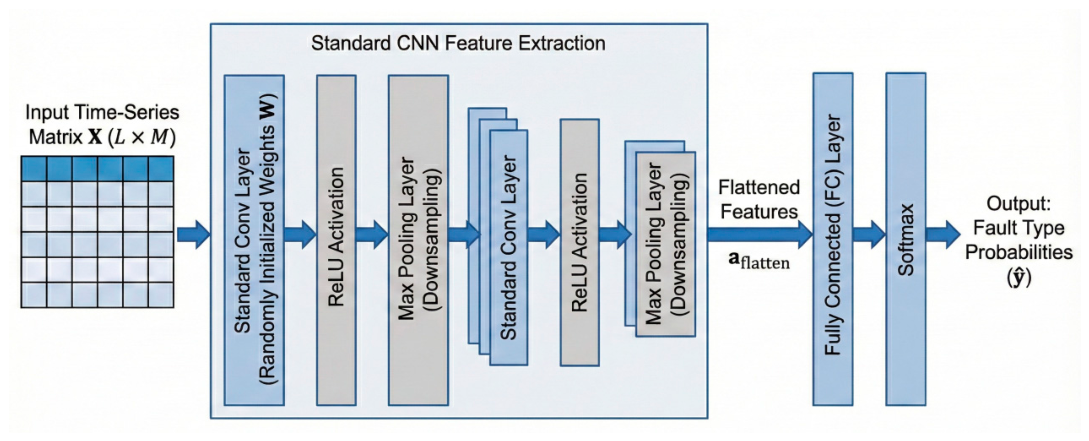
3. Principles of Convolutional Neural Networks
4. Improvement of Convolutional Neural Network Principles
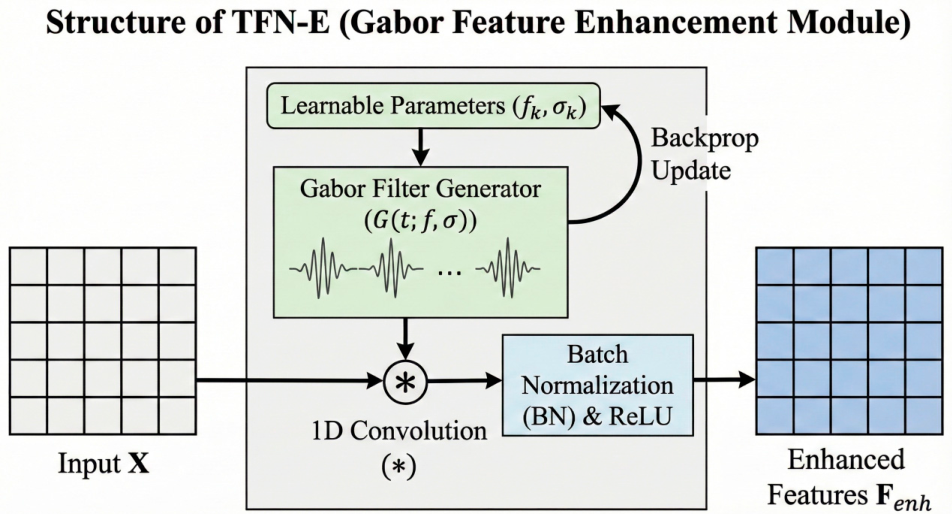
4.1. Improvement for Feature Robustness: Time-Frequency-Neural Feature Enhancement Module (TFN-E)
4.2. Improvement in Computational Efficiency: Lightweight Local Feature Extraction Core (LiConv-Block)
4.3. Improvement for Long-Distance Dependency: Integration of an Efficient Global Dependency Modeling Mechanism (Former-Block)
4.4. Improvement for Output Singularity: Multi-Task Joint Diagnosis Mechanism
4.5. Overall Algorithm Flow and Pseudo-Code
| Algorithm 1: Training Process |
| Require: Training set Validation set Max epochs Batch size Initial learning rate Balance factor Ensure: Optimized model parameters 1: Initialize model parameters randomly 2: for to do 3: Shuffle the training dataset 4: for each mini-batch of size do 5: Forward Propagation Phase 6: 7: 8: 9: 10: 11: 12: Loss Calculation and Backpropagation Phase 13: 14: 15: 16: 17: 18: end for 19: 20: Dynamic Learning Rate Decay 21: Evaluate model on validation set 22: if validation loss plateaus then 23: 24: end if 25: end for 26: return |
5. Data Preprocessing and High-Dimensional Feature Construction
5.1. Data Cleaning, Time Synchronization and Multi-Task Label Extraction
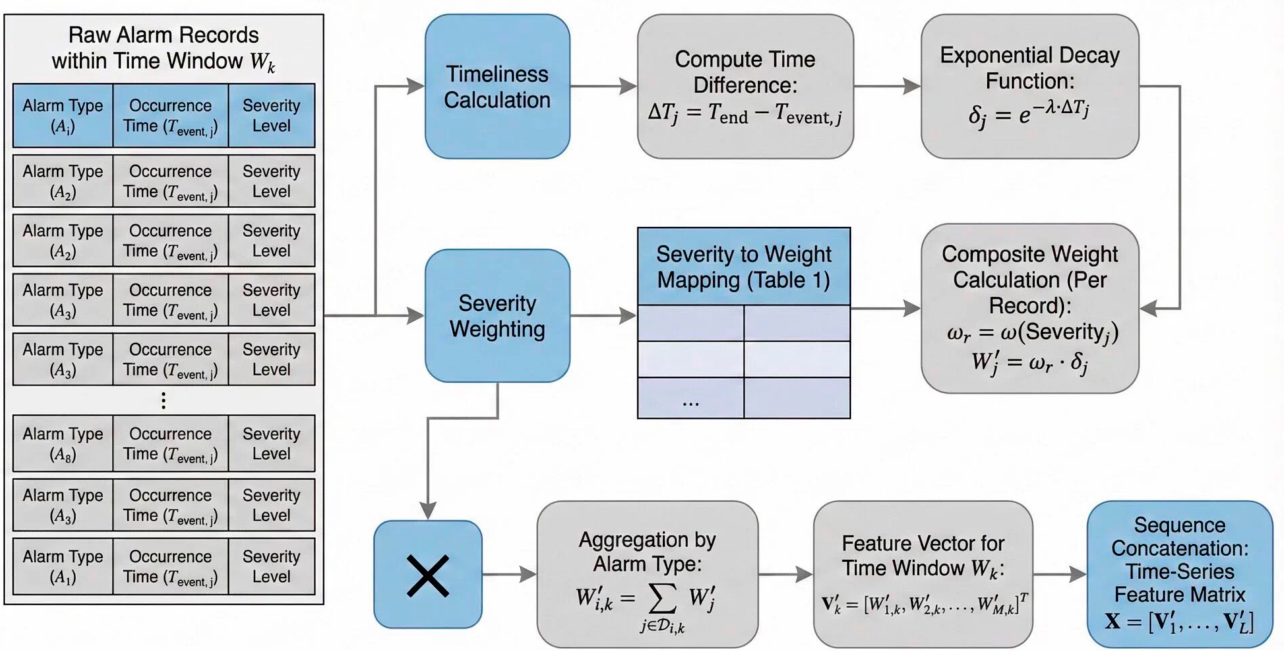
5.2. Composite Weighted Method for Measuring the Severity of Timeliness Issues
5.3. Construction of the Temporal Feature Matrix X
6. Experiments and Analysis
6.1. Introduction to the Experimental Environment and Dataset
6.2. Fault Diagnosis Implementation Process
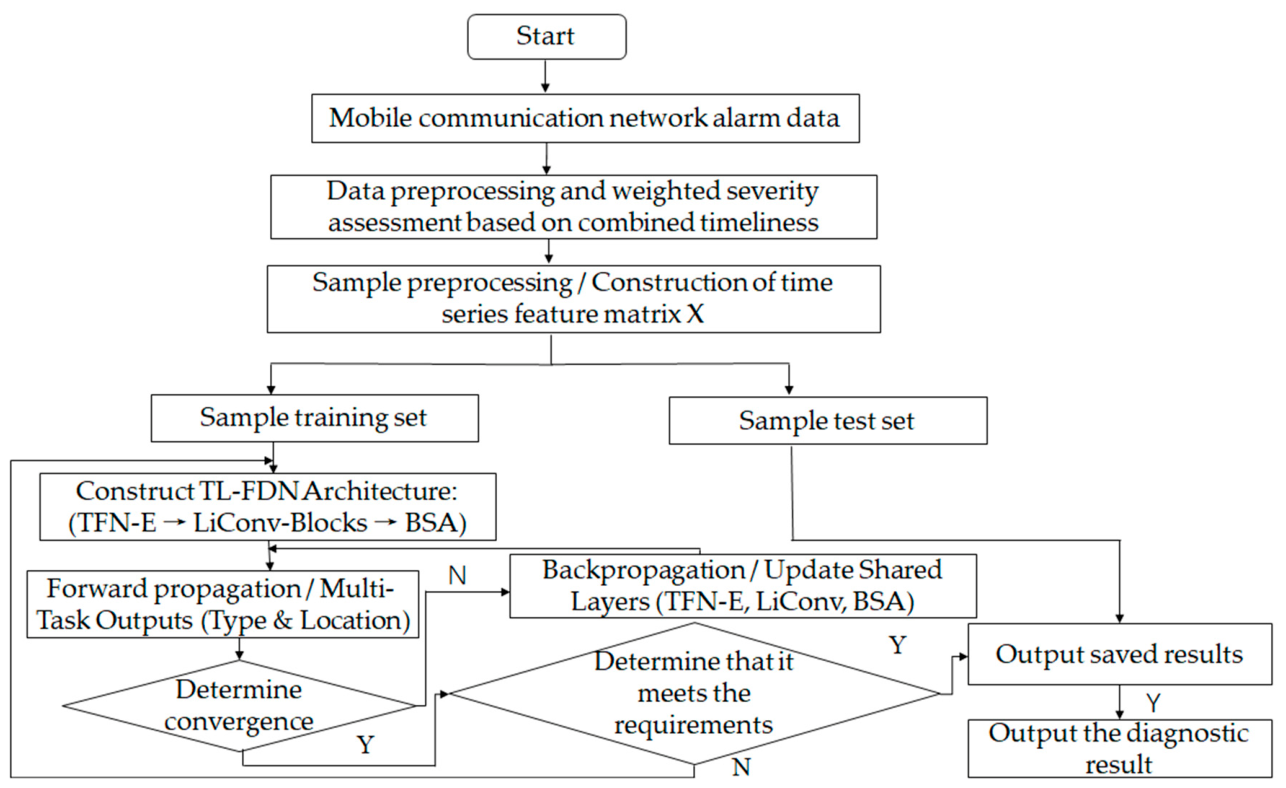
- Collect mobile communication alarm data, and conduct data preprocessing and weighted severity assessment based on combined timeliness.
- Based on step 1, construct the time series feature matrix X.
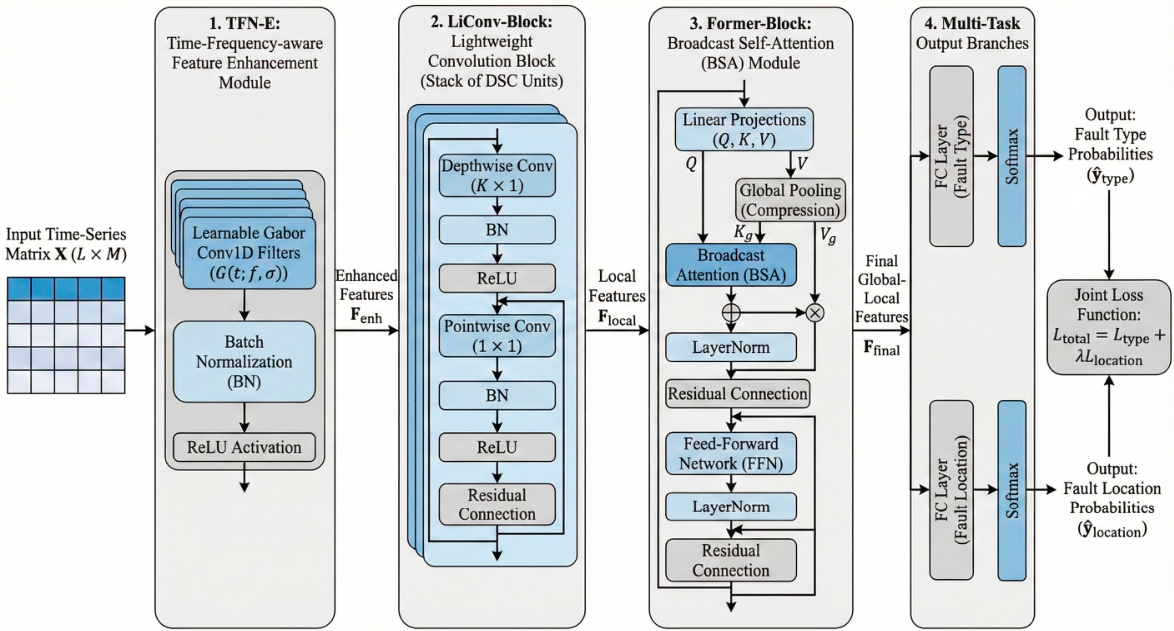
- Construct the TL-FDN architecture (integrating the TFN-E module, LiConv-Blocks, and BSA mechanism) and initialize the model parameters.
- Perform forward propagation through the shared layers to extract robust features, generate the multi-task outputs (Fault Type and Fault Location), and calculate the joint loss error between the output values and the actual labels.
- Determine whether the network is convergent. If it is convergent, proceed to step 7; otherwise, move to step 6.
- The joint error value calculated in step 4 is fed back to the network, and the weights of the shared representation layers are corrected via backpropagation. Then, step 5 is entered, and the error between the network output value and the true value is calculated again. This process is repeated until the model converges.
- The network is judged based on the value of the loss function to determine whether it meets the requirements. If it does, it proceeds to step 8; otherwise, it goes to step 4 and adjusts and modifies the model parameters.
- Output of fault diagnosis results.
6.3. Selection of Experimental Setup and Evaluation Indicators
- Accuracy of Fault Type (): Measures the correctness of the model’s judgment on fault categories.
- Fault location positioning accuracy (): Measures the accuracy of the model in locating the area where a fault occurs.
- F1 score (F1-Score): This metric comprehensively considers the precision and recall of the model, and can better reflect the actual performance of the model in the case of class imbalance.
6.4. Comparative Experimental Analysis and Result Verification
- Traditional CNN: A classic network that uses stacked standard convolutional layers, representing the traditional method for extracting local features.
- LSTM: Models based on recurrent neural networks, representing the traditional methods for time series modeling.
- Standard Transformer: A model using the full attention mechanism, representing a powerful global modeling approach, but with high computational requirements.
- LiConvFormer: A current lightweight hybrid model.
- Random Forest (RF): Traditional classical machine learning algorithms
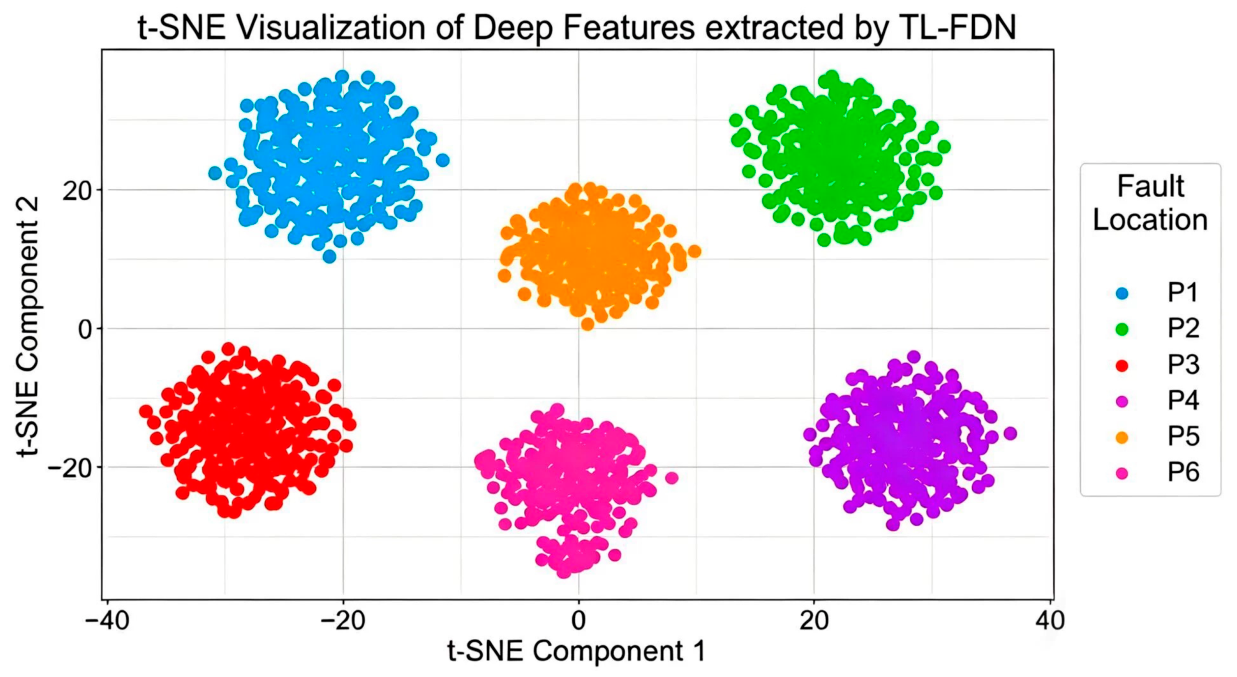
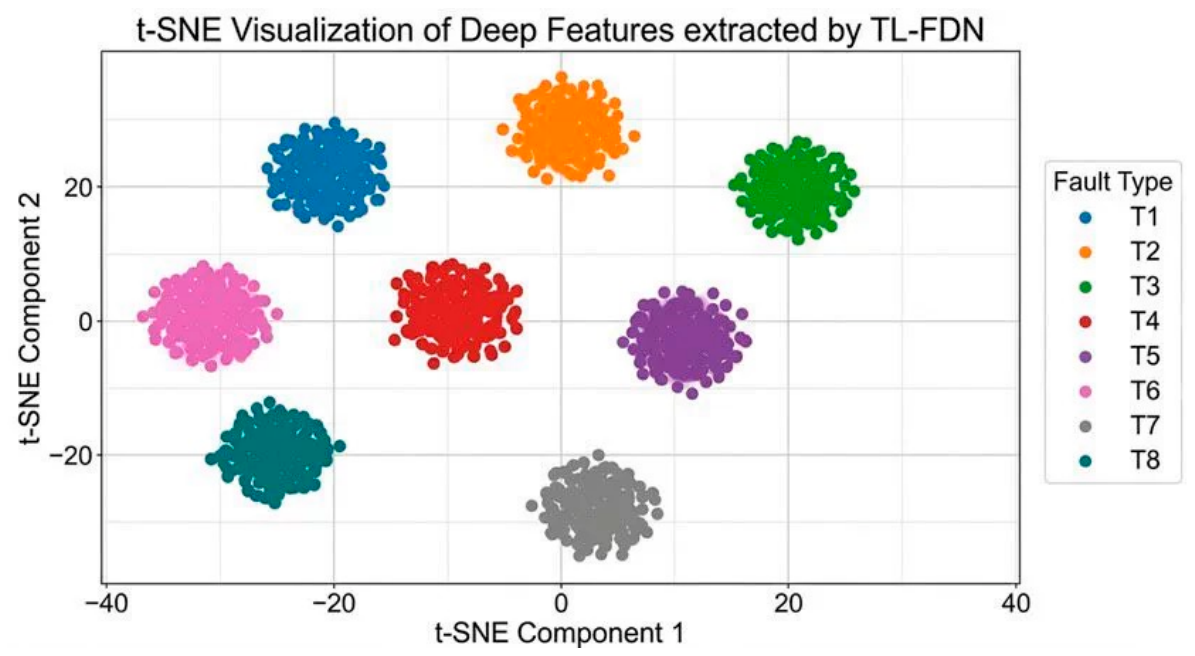
6.5. Feature Visualization and Qualitative Analysis
6.6. Independent Module Abolition Experiments and Analysis
- The independent noise reduction gain of the TFN-E module: Compared to the base model with a higher threshold (95.1%), simply adding a learnable Gabor filter bank at the input end (Base + TFN-E) increases the type diagnosis accuracy of the model to 96.8% (+1.7%). This independently proves that, without touching the main architecture, the TFN-E module can spontaneously purify the underlying signal, filter out interference noise, and the increase in parameters (only +0.2 million) is almost negligible for the overall model capacity.
- The significant parameter compression and lightweight gain of the LiConv module: When the baseline standard convolution is replaced with the depthwise separable convolution (Base + LiConv), although there is a very slight decline in accuracy (by −0.3%) due to the decoupling of feature channels, it achieves a remarkable 40% reduction in model parameters (from 15.6 million to 9.3 million), and the computational cost (FLOPs) also drops by nearly 40% simultaneously. This set of independent test data strongly validates the core leading role of the LiConv structure in eliminating the channel redundancy of multi-dimensional temporal features and achieving engineering lightweighting.
- BSA mechanism’s independent dual-effect leap (improving accuracy and reducing consumption): By merely replacing the standard multi-head attention with the broadcast self-attention mechanism (Base + BSA), not only does the parameter quantity (reducing to 11.3 million) and FLOPs significantly decrease, but its independent introduction also leads to an impressive 1.8% increase in accuracy. This indicates that in the processing of long-sequence MCN data, BSA’s downsampling strategy is not simply sacrificing accuracy for speed, but rather forms an effective “information bottleneck”, successfully filtering out redundant local connection interference, allowing the model to focus highly on the global key dependencies.
- Model fusion synergy (TL-FDN): When these three innovative modules are seamlessly integrated into a complete architecture, the accuracy rate reaches 98.6% (a total improvement of 3.5%), while fully unlocking the potential for lightweighting, with the parameter count reduced to one-third of the baseline model (only 5.2 million). This indicates that these three modules do not operate independently but form a perfect synergy and complementarity: TFN-E provides high-quality underlying features, LiConv extracts local representations at an extremely low cost, and finally, BSA selects the global key dependencies, ultimately achieving a leapfrog improvement in both fault diagnosis accuracy and lightweighting.
6.7. Discussion
7. Conclusions
7.1. Findings and Improvements
7.2. Key Contributions
7.3. Limitations
7.4. Future Work
Author Contributions
Funding
Data Availability Statement
Conflicts of Interest
Abbreviations
| TL-FDN | Based on time-frequency perception and lightweight deep networks |
| CNN | Convolutional Neural Network |
| MCN | Mobile communication network |
| TFN-E | Temporal-Frequency Network Enhancement Module |
| DSC | Depthwise Separable Convolution |
References
- Chen, M.; Jin, L.; Gong, X.; Man, Y. Fault Traceback Technology for Massive Network Management Data in 5G. J. Beijing Univ. Posts Telecommun. 2018, 41, 131–136. (In Chinese) [Google Scholar] [CrossRef]
- Lei, X.; Cheng, G.; Zhang, Y.; Guo, L.; Zhang, F. Alarm Information Association Analysis Based on Power Network Situation Awareness Platform. Comput. Eng. Sci. 2023, 45, 1197–1208. (In Chinese) [Google Scholar] [CrossRef]
- Ma, X.; Yang, T.; Wang, Y.; Yuan, H.; Liu, Z.; He, W. Transformer Oil Chromatography Fault Diagnosis Method Based on Lightweight Neural Network and Model Compression. Power Supply Util. 2023, 40, 84–91. (In Chinese) [Google Scholar] [CrossRef]
- Liu, Y. Research on Knowledge Graph Reasoning Decision-Making Method for Industrial Equipment Fault Diagnosis. Master’s Thesis, Nanjing University of Aeronautics and Astronautics, Nanjing, China, 2023. (In Chinese) [Google Scholar] [CrossRef]
- Li, G.; Qin, Y.; Qi, J. Fault Diagnosis of High-Speed Train Lateral Shock Absorber Based on GASF Multi-Channel Image Temporal Fusion. J. Vib. Shock. 2025, 44, 144–152. (In Chinese) [Google Scholar] [CrossRef]
- Vaswani, A.; Shazeer, N.; Parmar, N.; Uszkoreit, J.; Jones, L.; Gomez, A.N.; Kaiser, L.; Polosukhin, I. Attention is all you need. Adv. Neural Inf. Process. Syst. 2017, 30, 5998–6008. [Google Scholar] [CrossRef] [Scilit]
- Woo, G.; Liu, C.; Kumar, A.; Xiong, C.; Savarese, S.; Sahoo, D. Unified training of universal time series forecasting transformers. In Proceedings of the International Conference on Learning Representations, Vienna, Austria, 7–11 May 2024. [Google Scholar] [CrossRef] [Scilit]
- Qiang, R.; Zhao, X. A Small Sample Rolling Bearing Fault Diagnosis Method Based on Gram Angle Difference Field and Generative Adversarial Network. J. South China Univ. Technol. (Nat. Sci. Ed.) 2024, 52, 64–75. (In Chinese) [Google Scholar]
- Fang, Y.; Li, W.; Zeng, Y.; Zheng, Y.; Hu, Z.; Lu, S. Lightweight Neural Network Restoration Algorithm for Edge Deployment Scenarios. J. Comput. Sci. 2024, 47, 1383–1394. (In Chinese) [Google Scholar]
- Shan, N.; Xu, X.; Bao, X.; Ding, Q.; Liao, T. Lightweight Fault Diagnosis Method for Electromagnetic Energy Equipment Based on Edge Intelligence. Trans. China Electrotech. Soc. 2025, 40, 821–831. (In Chinese) [Google Scholar] [CrossRef]
- Wang, G.; Yang, C.; Ma, L.; Dai, W. Nonlinear Kalman Filtering Based on Gaussian-Generalized Hyperbolic Mixture Distribution. Acta Autom. Sin. 2023, 49, 448–460. (In Chinese) [Google Scholar] [CrossRef]
- Wang, J.; Zhao, X.; Zhang, C.; Wang, Y. Intelligent Edge Computing Applicable to Industrial Internet of Things Gateways. Telecommun. Technol. 2024, 64, 1653–1658. (In Chinese) [Google Scholar] [CrossRef]
- Yan, R.; Zhou, Z.; Yang, Y.; Li, Y.; Hu, C.; Tao, Z.; Zhao, Z.; Wang, S.; Chen, X. Challenges and Opportunities of Explainable Artificial Intelligence in Industrial Intelligent Diagnosis: Attribution Explanation. J. Mech. Eng. 2024, 60, 21–40. (In Chinese) [Google Scholar] [CrossRef] [Scilit]
- Qi, S. Research on RF Unit and Multi-channel Mismatch Calibration Technology Based on SDR. Master’s Thesis, University of Science and Technology of China, Hefei, China, 2024. (In Chinese) [Google Scholar] [CrossRef]
- Akter, S.; Chellappan, S.; Chakraborty, T.; Khan, T.A.; Rahman, A.; Al Islam, A.B.M.A. Man-in-the-Middle Attack on Contactless Payment over NFC Communications: Design, Implementation, Experiments and Detection. IEEE Trans. Dependable Secur. Comput. 2021, 18, 3012–3023. [Google Scholar] [CrossRef] [Scilit]
- Zhu, M.; Feng, R.; Zhang, X.; Li, P.; Su, B. High-Resolution Time-Frequency Feature Enhancement of Bowhead Whale Calls Based on Local Maximum Synchronous Extraction of Generalized S-Transforms. J. Mar. Sci. Eng. 2025, 13, 2332. [Google Scholar] [CrossRef] [Scilit]
- Chang, C.C.; Chen, W.P.; Lin, Y.W.; Lin, Y.J.; Pan, P.J. Real-Time Super Resolution Utilizing Dilation and Depthwise Separable Convolution. Eng. Proc. 2025, 92, 27. [Google Scholar] [CrossRef] [Scilit]
- Tian, R.; Li, X.; Ma, Z.; Liu, Y.; Wang, J.; Wang, C. LDformer: A parallel neural network model for long-term power forecasting. Front. Inf. Technol. Electron. Eng. 2023, 24, 1287–1301. [Google Scholar] [CrossRef] [Scilit]
- Wang, D.; Zhang, X. Dynamic Field Monitoring Based on Multitask Learning in Sensor Networks. Sensors 2019, 19, 1533. [Google Scholar] [CrossRef] [Scilit] [PubMed]
- Guo, J.; Sun, L.; Kawaguchi, T.; Hashimoto, S. Fault Diagnosis of Wire Disconnection in Heater Control System Using One-Dimensional Convolutional Neural Network. Processes 2025, 13, 402. [Google Scholar] [CrossRef] [Scilit]
- Park, C.H. MDCSformer: Multi-scale dilated contracted sub-transformer for fault diagnosis of rotating machinery. J. Comput. Des. Eng. 2026, 13, 462–485. [Google Scholar] [CrossRef] [Scilit]
- Alam, S.; Islam, R.; Fan, R.; Alam Shazid, S.; Hasan, A.S. Attention-Guided Multi-Task Learning for Fault Detection, Classification, and Localization in Power Transmission Systems. Energies 2025, 18, 6547. [Google Scholar] [CrossRef] [Scilit]
- Howard, A.G.; Zhu, M.; Chen, B.; Kalenichenko, D.; Wang, W.; Weyand, T.; Andreetto, M.; Adam, H. MobileNets: Efficient Convolutional Neural Networks for Mobile Vision Applications. arXiv 2017, arXiv:1704.04861. [Google Scholar] [CrossRef] [Scilit]
- TU-T Recommendation X.733; Information Technology—Open Systems Interconnection—Systems Management: Alarm Reporting Function; International Telecommunication Union (ITU): Geneva, Switzerland, 1992; Available online: https://www.itu.int/rec/T-REC-X.733/en (accessed on 25 March 2026).



| Article/Year | Problem Addressed | Solution Method | Features | Contribution of Our Model |
|---|---|---|---|---|
| Ref 1, 2025 [20]. | Fault diagnosis based on raw 1D signals | One-Dimensional Convolutional Neural Network (1D-CNN) | Extracts features directly from time-domain waveforms efficiently, but typically lacks robustness against complex background noise. | Overcomes noise sensitivity: Employs the TFN-E module with Gabor filter banks to dynamically map 1D signals into robust 2D time-frequency features before deep extraction. |
| Ref 2, 2026 [21]. | Global dependency modeling for fault feature extraction | Transformer architectures/Self-Attention mechanisms | Captures long-range dependencies effectively, but standard self-attention incurs extremely high computational complexity | Improves edge-efficiency: Replaces standard self-attention with Broadcast Self-Attention (BSA), drastically reducing parameter counts and FLOPs while maintaining global contextual awareness. |
| Ref 3, 2025 [22]. | Fault Detection, Classification, and Localization | Multi-Task Learning (MTL) framework with attention | Performs joint tasks effectively but relies on complex network branches, which can be computationally heavy for edge gateways. | Enhances feature synergy and efficiency: Proposes a highly unified Multi-task Learning architecture (= 0.5) combined with lightweight LiConv Blocks, achieving high accuracy with minimal parameters. |
| Rebuild the convolutional neural network | Edge-side mobile communication network fault diagnosis | TFN-E + LiConv Blocks + Former-Block (BSA) | Real-time, lightweight, noise-resistant, and high accuracy for multi-task scenarios. | Comprehensive Solution: Achieves an optimal trade-off between multi-task diagnostic accuracy and computational efficiency for edge-side deployment. |
| Index (Fault) | Fault Cause (Label)-Fault Type () After Mapping | One-Hot Vector Encoding |
|---|---|---|
| 0 | T1 | [0, 0, 0, 0, 0, 0, 0, 1] |
| 1 | T2 | [0, 0, 0, 0, 0, 0, 1, 0] |
| 2 | T3 | [0, 0, 0, 0, 0, 1, 0, 0] |
| 3 | T4 | [0, 0, 0, 0, 1, 0, 0, 0] |
| 4 | T5 | [0, 0, 0, 1, 0, 0, 0, 0] |
| 5 | T6 | [0, 0, 1, 0, 0, 0, 0, 0] |
| 6 | T7 | [0, 1, 0, 0, 0, 0, 0, 0] |
| 7 | T8 | [1, 0, 0, 0, 0, 0, 0, 0] |
| Index (Original Base Station/Cell ID) | Derived Location Type: Fault Location After Mapping () | Encoding (One-Hot) |
|---|---|---|
| 0 | P1 | [0, 0, 0, 0, 0, 1] |
| 1 | P2 | [0, 0, 0, 0, 1, 0] |
| 2 | P3 | [0, 0, 0, 1, 0, 0] |
| 3 | P4 | [0, 0, 1, 0, 0, 0] |
| 4 | P5 | [0, 1, 0, 0, 0, 0] |
| 5 | P6 | [1, 0, 0, 0, 0, 0] |
| Models | Optimizer | Learning Rate | Batch Size | Core Structural Parameters |
|---|---|---|---|---|
| Traditional CNN | AdamW | 1 × 10⁻³ | 64 | 3 Conv1D layers (Channels: 64, 128, 256) |
| LSTM | AdamW | 5 × 10⁻⁴ | 64 | 2 LSTM layers (Hidden dim: 128) |
| Standard Transformer | AdamW | 1 × 10⁻³ | 64 | 4 Encoder layers; 8 Attention heads |
| LiConvFormer | AdamW | 1 × 10⁻³ | 64 | 2 DSC layers; 4 Attention heads |
| Random Forest (RF) | - | - | - | -n_estimators:200; max_depth: 20 |
| Rebuild the convolutional neural network | AdamW | 1 × 10⁻³ | 64 | 1 TFN-E layer; 3 LiConv layers; 4 BSA heads; = 0.5 |
| Model | Type Diagnosis Acc (%) | Type Diagnosis: Macro-F1 | Position Diagnosis Acc (%) | Position Diagnosis Macro-F1 | Parameter Quantity (M) | FLOPs (G) |
|---|---|---|---|---|---|---|
| Traditional CNN | 93.2 | 0.921 | 92.1 | 0.910 | 4.5 | 6.5 |
| LSTM | 90.1 | 0.915 | 91.5 | 0.902 | 5.8 | 7.2 |
| Standard Transformer | 96.4 | 0.958 | 95.8 | 0.946 | 18.5 | 22.4 |
| LiConvFormer | 97.1 | 0.965 | 97.2 | 0.963 | 6.5 | 8.6 |
| Random Forest (RF) | 87.5 | 0.869 | 88.4 | 0.881 | - | - |
| Rebuild the convolutional neural network | 98.6 | 0.982 | 98.8 | 0.985 | 5.2 | 6.8 |
| Model | Structural Description | Type Diagnosis Accuracy (%) | Compared to Base Improvement | Parameter Quantity (M) | FLOPs (G) |
|---|---|---|---|---|---|
| Base (Basic Model) | Standard convolution + Standard attention | 95.1 | - | 15.6 | 18.5 |
| Base + TFN-E | Only add time-frequency feature enhancement at the front. | 96.8 | +1.7% | 15.8 | 18.9 |
| Base + LiConv | Replace only the standard convolution with the lightweight convolution | 94.8 | -0.3% | 9.3 | 11.2 |
| Base + BSA | Replace the standard attention with broadcast attention only | 96.9 | +1.8% | 11.3 | 12.8 |
| Rebuild the convolutional neural network | Integrate all three innovative modules | 98.6 | 3.5% | 5.2 | 6.8 |
Disclaimer/Publisher’s Note: The statements, opinions and data contained in all publications are solely those of the individual author(s) and contributor(s) and not of MDPI and/or the editor(s). MDPI and/or the editor(s) disclaim responsibility for any injury to people or property resulting from any ideas, methods, instructions or products referred to in the content. |
© 2026 by the authors. Licensee MDPI, Basel, Switzerland. This article is an open access article distributed under the terms and conditions of the Creative Commons Attribution (CC BY) license.
Share and Cite
Tian, H.; Song, B.; Liu, X. A Fault Diagnosis Method for Mobile Communication Networks Based on Improved Convolutional Neural Networks. Telecom 2026, 7, 60. https://doi.org/10.3390/telecom7030060
Tian H, Song B, Liu X. A Fault Diagnosis Method for Mobile Communication Networks Based on Improved Convolutional Neural Networks. Telecom. 2026; 7(3):60. https://doi.org/10.3390/telecom7030060
Chicago/Turabian StyleTian, Hongliang, Bolin Song, and Xiaoke Liu. 2026. "A Fault Diagnosis Method for Mobile Communication Networks Based on Improved Convolutional Neural Networks" Telecom 7, no. 3: 60. https://doi.org/10.3390/telecom7030060
APA StyleTian, H., Song, B., & Liu, X. (2026). A Fault Diagnosis Method for Mobile Communication Networks Based on Improved Convolutional Neural Networks. Telecom, 7(3), 60. https://doi.org/10.3390/telecom7030060