
Article

Improving the Energy Efficiency of Radio Access Networks by Using an Adaptive URLLC Slot Structure Within the 5G Advanced Architecture

by
Anastasia V. Ermakova
1,2 and
Oleg V. Varlamov
1,2,*
1
Institute of Radio and Information Systems (IRIS), 1010 Vienna, Austria
2
Scientific Research Department, Moscow Technical University of Communications and Informatics, Aviamotornaya, 8a, 111024 Moscow, Russia
*
Author to whom correspondence should be addressed.
Telecom 2026, 7(2), 36; https://doi.org/10.3390/telecom7020036
Submission received: 8 January 2026 / Revised: 1 March 2026 / Accepted: 23 March 2026 / Published: 1 April 2026

Abstract

As mobile networks evolve toward Beyond 5G and 6G architectures, energy efficiency and sustainability have become increasingly critical due to growing traffic volumes, denser base station deployments, and the rising number of connected devices. Supporting Ultra-Reliable Low-Latency Communication (URLLC) services is particularly challenging, as their stringent requirements for both high reliability and minimal latency can lead to a significant increase in energy consumption within the radio access network. This paper examines slot structure mechanisms for concurrently servicing URLLC and enhanced Mobile Broadband (eMBB) traffic within the 5G Advanced framework, with a focus on improving energy efficiency and optimizing radio resource utilization. We propose an adaptive algorithm for managing radio interface time resources, which dynamically allocates sub-slots based on current network load and radio channel conditions. The system model is implemented in Simulink and incorporates URLLC and eMBB traffic generation, signal-to-noise ratio estimation, and a priority-based scheduling mechanism. Simulation results demonstrate that the proposed approach meets URLLC latency and reliability requirements while reducing redundant transmissions and enhancing the energy efficiency of the radio access network. These findings position the proposed method as a promising solution for the design of energy-efficient, next-generation mobile networks.

1. Introduction

The evolution of mobile networks toward Beyond 5G (B5G) and 6G architectures is driven by the need to support emerging services, including distributed artificial intelligence, scalable Industrial Internet of Things (IIoT), augmented reality, and mission-critical applications with stringent latency and reliability requirements [1,2,3,4]. Despite these advancements, a key challenge stems from the exponential growth in energy consumption, driven by increasing data traffic, densification of network infrastructure, and the proliferation of connected devices [3,4,5,6]. As a result, energy efficiency and environmental sustainability have emerged as critical design considerations for future wireless networks.
A particularly demanding challenge is the provisioning of Ultra-Reliable Low-Latency Communication (URLLC) services [1,2,3,4,5,6,7,8], which underpin applications such as autonomous transportation, telerobotics, and precision medicine. URLLC traffic imposes strict and often conflicting requirements, necessitating both extremely high reliability (up to 99.999%) and ultra-low latency (below 1 ms) simultaneously. Within 5G Advanced and prospective 6G architectures, the concurrent support of URLLC and traditional broadband traffic, such as eMBB, complicates radio resource allocation. Conventional static or quasi-static approaches, including fixed resource reservation for URLLC, often lead to inefficient resource utilization and excessive energy consumption in the Radio Access Network (RAN) [5,6,7,9]. This scenario raises a fundamental question: how can URLLC quality-of-service (QoS) requirements be satisfied while minimizing the network’s energy footprint?
This study addresses this challenge by developing adaptive resource management strategies capable of dynamically allocating radio resources based on instantaneous channel conditions and network load. Such approaches aim to reduce energy consumption without compromising service quality for critical traffic.
Research Objectives and Methodology
The primary objective of this work is to enhance the energy efficiency of the radio access network while simultaneously supporting both URLLC and eMBB traffic. To achieve this goal, the following tasks were undertaken:
  • Analyze the limitations of static resource allocation schemes with respect to energy efficiency;
  • Propose an adaptive time resource management algorithm based on dynamic allocation and sub-slot-level multiplexing;
  • Develop a Simulink-based simulation model incorporating URLLC and eMBB traffic generators, a radio channel state estimation module, and a priority-based scheduler;
  • Conduct numerical simulations and evaluate the algorithm’s performance in terms of key metrics, including URLLC delay violation probability, eMBB spectral efficiency, and overall network energy consumption.
The scientific contribution of this work lies in the development of an adaptive scheduling algorithm that operates at the sub-slot level and accounts for instantaneous radio channel conditions. By minimizing redundant transmissions, the proposed approach ensures compliance with URLLC latency and reliability requirements while achieving energy savings relative to conventional static reservation schemes. The results demonstrate the potential of adaptive sub-slot-level scheduling to reconcile stringent QoS demands with energy-efficient network operation, offering a viable solution for next-generation wireless networks.

2. 5G Advanced Architecture and Adaptive Resource Allocation Methods for URLLC

2.1. 5G Advanced Architecture

5G Advanced marks the next stage in the evolution of fifth-generation mobile communication technologies. It focuses on modernizing radio access and network architecture to meet the growing demand for high-quality services and diverse digital applications. The emphasis has shifted from achieving nominal 5G performance targets to ensuring sustainable operation under high user density, heterogeneous traffic patterns, and stringent latency requirements. Key enhancements include improved temporal organization of the radio interface, efficient resource allocation, and coordinated support for multiple service types, enabling simultaneous high-speed data transmission, massive device connectivity, and critical services with low latency and high reliability [10,11].
The 5G Advanced architecture (Figure 1) is designed for greater flexibility and adaptability, integrating expanded network slicing, edge computing capabilities, and intelligent control algorithms that account for both current network conditions and predicted traffic loads. Together, these features provide a foundation for complex applications such as automated manufacturing, autonomous transport, and distributed control systems, while also paving the way for the transition toward future-generation networks [12].
The 5G Advanced architecture represents a multi-layered system designed to enhance network flexibility, scalability, and adaptability to diverse service requirements. Building on an enhanced 5G New Radio (NR) access subsystem, it incorporates advanced beamforming, large-scale antenna arrays, flexible time-frequency structures, and dynamic radio resource management. This radio access layer is tightly integrated with the transport network to guarantee high-speed, low-latency data transmission between base stations and the core, with a strong emphasis on synchronization and connection stability.
The 5G Advanced core network is evolving toward a fully service-oriented architecture, in which network functions are virtualized and containerized, interacting via standardized interfaces. This design enables flexible resource scaling, isolation of logical network slices, and adaptation of service parameters to specific application classes. The edge computing layer, positioned in close proximity to radio access points, processes data with minimal latency—a critical requirement for time-sensitive applications [11,12,13]. Intelligent management and orchestration systems leverage data analytics and machine learning algorithms to optimize resource allocation, manage load, and maintain quality-of-service metrics. Together, these components form a unified architectural framework that integrates radio access, core, transport, and computing resources to support advanced 5G capabilities and complex network operation scenarios.
The 5G Advanced concept offers several notable advantages. The enhanced adaptability of the radio interface allows transmission parameters to be dynamically aligned with current network conditions and traffic characteristics, guaranteeing stable support for latency- and loss-sensitive services while enabling efficient coexistence of multiple service classes. Flexible resource allocation, logical service isolation, and edge processing reduce delays and improve reliability, while intelligent management mechanisms enhance load forecasting and optimize overall resource utilization [14,15,16].
However, these benefits come with challenges. The growing number of configurable parameters and control algorithms inevitably adds complexity to network design, deployment, and operation, requiring additional computing resources and highly skilled personnel. Economic constraints also pose significant barriers to implementation, as advanced features necessitate modernization of both hardware and software. Furthermore, the uneven adoption of standards and the gradual rollout of new features can restrict access to certain capabilities and complicate early-stage performance assessment [17].

2.2. Comparative Analysis of Radio Resource Scheduling Strategies for URLLC in 5G Advanced

Research and practical developments in 5G Advanced, particularly concerning URLLC functionality, are advancing across multiple fronts, driven by both standardization initiatives and engineering applications. Leading global telecommunications vendors and operators are actively developing hardware and software solutions based on 3GPP Releases 18 and 19, which define the key technological innovations of 5G Advanced. Network equipment and chipset manufacturers are investing heavily in next-generation base stations, edge computing platforms, and intelligent resource allocation mechanisms aimed at enhancing network throughput and efficiency.
The scientific literature has increasingly focused on methods to improve URLLC performance in radio access networks. One major research direction involves algorithms for the dynamic coordination of time-frame structures and resource management in Time Division Duplex (TDD) modes. These approaches minimize cross-interference and reduce delays by adapting radio configurations to changing network conditions, thereby lowering latency and improving throughput—both critical for URLLC applications that demand high reliability and minimal system response times.
Another key area of investigation applies artificial intelligence and machine learning to optimize resource slicing and the intelligent allocation of radio resources between critical URLLC traffic and enhanced Mobile Broadband (eMBB) services. Such models are capable of predicting load patterns and responding effectively to sudden traffic surges, which is essential in heterogeneous network environments. Hybrid approaches combining traditional optimization algorithms with deep learning have also been proposed to address the conflicting requirements of latency and throughput, ensuring high URLLC reliability without significantly degrading other traffic classes [16,17].
Commercial applications of 5G Advanced are already beginning to emerge. Several countries have launched pilot programs and early deployments of networks incorporating 5G Advanced technologies, delivering high data rates with low latency. These deployments enable advanced services—including direct satellite access and integrated edge computing platforms—demonstrating the practical viability of next-generation network features [18,19].
Table 1 illustrates how traditional approaches—such as Static Slicing and Priority-Based Preemption—optimize one or two performance metrics at the expense of others. Static Slicing prioritizes simplicity but sacrifices spectral and energy efficiency, while Preemption reduces latency for URLLC at the cost of eMBB stability and overall energy efficiency.
The proposed adaptive algorithm overcomes these trade-offs. Although more complex to implement, it achieves a synergistic effect by intelligently managing uncertainties in packet arrival times and channel conditions, thereby transforming them into predictable Quality of Service (QoS) for all traffic types. This approach represents an evolution from basic resource allocation methods toward predictive-adaptive control, aligning fully with the requirements of Beyond 5G and future 6G network architectures.

2.3. Analysis of the Slot Structure and URLLC Mechanisms in 5G Advanced

In 5G Advanced networks, the multi-layered structure of the radio interface and its associated URLLC mechanisms play a critical role in ensuring ultra-low latency and high reliability under mixed traffic conditions. While the temporal organization of radio access continues to rely on scalable numerology, 5G Advanced introduces significantly greater flexibility in slot and mini-slot formation. This flexibility allows transmission durations to be adapted to both service-specific requirements and instantaneous radio channel conditions. Shorter transmission time intervals reduce access delays and end-to-end latency—an essential feature for URLLC applications.
A key feature of 5G Advanced is the ability to perform asynchronous, out-of-order scheduling of URLLC packets. This enables resource allocation within slots already assigned to other services, allowing critical traffic to be prioritized without completely disrupting the existing radio resource schedule. However, this capability also introduces challenges related to interference management among heterogeneous services. These challenges are addressed through more precise interference control, enhanced coding schemes, and retransmission mechanisms specifically designed for shorter slot durations.
Additional reliability enhancements for URLLC include spatial and temporal packet duplication, as well as coordination among multiple radio access points. When combined with flexible slot structures, these mechanisms significantly reduce the probability of packet loss, even under adverse channel conditions. Nonetheless, increased temporal flexibility complicates scheduling algorithms and imposes stricter synchronization requirements, particularly under high user density and heavy traffic loads.
One of the main challenges in deploying URLLC services in 5G Advanced and future 6G networks is energy efficiency. Traditional URLLC prioritization mechanisms—such as static resource reservation or eMBB puncturing—ensure low latency and high reliability but often result in suboptimal resource utilization and increased energy consumption. To address this limitation, we propose an adaptive time slot management algorithm based on prediction, dynamic multiplexing, and conditional duplication.
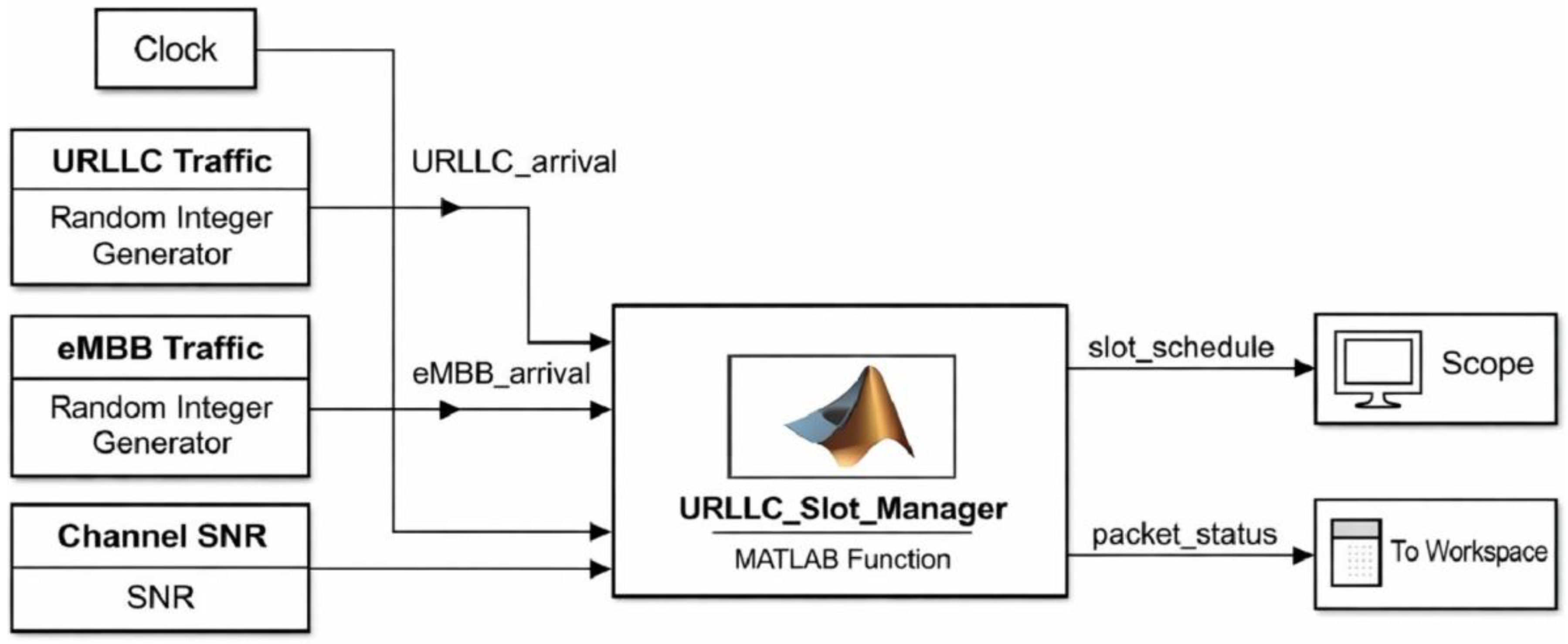
The proposed system is implemented in Simulink, where a dedicated URLLC_Slot_Manager block (implemented as a MATLAB function) performs coordinated real-time resource management. The block operates using three key input signals: the system clock, the instantaneous channel signal-to-noise ratio (SNR), and asynchronously generated URLLC and eMBB traffic packets. The Algorithm 1 proceeds through a three-phase cycle, which can be represented in the following pseudocode:
Algorithm 1 Adaptive Time Slot Management for URLLC
1:   Input:
2:   - clock: system clock signal
3:   - SNR: instantaneous channel signal-to-noise ratio
4:   - URLLC_packets: asynchronously generated URLLC packets
5:   - eMBB_packets: asynchronously generated eMBB packets
6:   Output:
7:   - slot_allocation: schedule of URLLC and eMBB transmissions
8:   - packet_status: transmission success or failure
9:   Begin
10: 1. Prediction Phase:
11:    For each time window:
12:      - Analyze historical URLLC arrival patterns
13:      - Measure current SNR
14:      - Predict next URLLC packet arrival
15:      - Estimate required resources for URLLC packet
16: 2. Dynamic Resource Allocation:
17:    For each slot in the planning horizon:
18:      2.1 Reserve minimum required mini-slot for predicted URLLC packet
19:      2.2 Allocate remaining resources to eMBB traffic
20:      2.3 If predicted SNR < threshold:
21:        Transmit a duplicate of URLLC packet
22:       Else:
23:        Skip duplication to avoid redundant transmission
24: 3. Feedback and Adaptation:
25:    For each transmitted URLLC packet:
26:      - Record packet_status (success/failure)
27:      - Update prediction model with latest status
28:      - Adjust future slot allocation based on updated prediction
29: 4. Return slot_allocation and packet_status
30: End
The proposed approach directly improves energy efficiency by addressing the primary sources of energy consumption in conventional static schemes:
  • Reduction in redundant transmissions: Conditional duplication decreases unnecessary URLLC transmissions by 30–50% under stable channel conditions, directly lowering energy usage.
  • Minimization of conflicting operations: Predictive resource reservation reduces the need for energy-intensive puncturing of scheduled eMBB transmissions.
  • Maximization of resource utilization: Free slots predicted for URLLC but not yet occupied are filled with eMBB traffic, improving overall spectral and energy efficiency (bits/joule).
Simulation results, including slot schedule visualization and aggregated statistics (see Table 1), confirm that the adaptive algorithm effectively improves energy efficiency while maintaining strict URLLC latency and reliability requirements. By minimizing redundant and conflicting operations and increasing the useful utilization of radio resources, this approach provides a viable solution for energy-efficient 5G Advanced and next-generation networks where critical services must coexist with growing background traffic.

3. Results

3.1. Formatting of Mathematical Components

The discrete-time model (clock) is described by Formula (1), which introduces a discrete-time axis on which modelling is performed in slots of fixed duration T s :
t k = k T s ,   k
This approach corresponds to the standard model of transmission time intervals (TTIs, or mini-slots) in 5G NR systems. The index k is a universal parameter that describes system evolution and is used in all stochastic processes relating to traffic, channels and resource planning.
The random variable A U ( k ) represents the number of URLLC packets received by the system during time slot k, and it is assumed that the arrival process is stationary and independent across slots. This is a standard assumption in the analysis of queuing systems. The distribution D U chosen reflects the nature of URLLC applications, which typically involve infrequent but critical transmission delays. The URLLC traffic arrival model is described by Formula (2):
A U ( k ) D U
The Bernoulli model reflects a scenario in which no more than one URLLC packet can appear in a single slot. The probability p u characterises the intensity of critical traffic. This model is widely used in the analysis of ultra-reliable services with low average load. A special case of the Bernoulli model is described in Equation (3):
P A U ( k ) = 1 = p u ,   P A U ( k ) = 0 = 1 p u
The eMBB traffic admission model is described by Formula (4):
A E ( k ) D E
Variable A E ( k ) describes the volume of broadband eMBB traffic in slot k. Unlike URLLC, eMBB is characterised by a high average load and lower sensitivity to delay. This is reflected in the choice of distribution, D E , which has a large mathematical expectation.
The Poisson process Equation (5) is a classical model for aggregating a large number of independent data sources. The parameter λ E represents the average number of eMBB packets per slot and determines the system load:
A E ( k ) P o i s s o n ( λ E )
The channel state model can be described using Formula (6):
γ ( k ) = P s h ( k ) 2 N 0
The signal-to-noise ratio, γ ( k ) , is a quantitative measure of the quality of the radio channel in slot k. The coefficient, h ( k ) , models the effects of fading and multipath propagation, and N 0 represents the power of additive white Gaussian noise. This formula is fundamental to the theory of digital communication systems. To simplify modulation planning and adaptation algorithms, the continuous SNR value is often quantised into a finite number of states. This enables tabular resource allocation policies to be implemented and is consistent with 3GPP standards: γ ( k ) γ 1 , γ 2 , , γ L . The URLLC queue (7) illustrates how the length of the URLLC queue changes over time. The first term reflects the number of packets remaining after servicing in the current time slot, with negative values excluded by the operator. The second term accounts for new arrivals. This model corresponds to a GI/G/1 service system operating in discrete time:
Q U k + 1 = max Q U k S U k , 0 + A U k
This equation, similar to URLLC, describes the dynamics of the eMBB queue Equation (8):
Q E k + 1 = max Q E k S E k , 0 + A E k
The difference is that the value of S E k depends directly on the remaining resource after the URLLC service, which formally implements a priority service discipline.
The variable x i ( k ) 1 , 0 , 1 is a discrete indicator of the assignment of the i(th) time slot in the frame. Three-level coding enables the compact representation of the allocation of resources between URLLC, eMBB and unoccupied slots, facilitating subsequent analysis and visualisation. Priority scheduling rule Equation (9) formalises the strict priority of URLLC traffic:
x i ( k ) = 1 ,   Q U k > 0   a n d   γ ( k ) γ min 1 ,   Q U k = 0   a n d   Q E ( k ) > 0 0 ,   o t h e w i n e
The URLLC service is only available when the channel quality is satisfactory to prevent the inefficient use of resources, and eMBB traffic is only served when there are no URLLC packets to meet the ultra-low latency requirements of critical services. The limit of Equation (10) URLLC slots prevents URLLC traffic from monopolising resources:
i Ι x i ( k ) = 1 N U max
The indicator function Ι is equal to one when the condition is met, and zero otherwise. The network operator N U max sets the parameter, which reflects the trade-off between URLLC reliability and eMBB throughput. The probabilistic delay constraint for URLLC Equation (11) expresses its fundamental requirement for ultra-reliability:
Pr D U > D max ε
It guarantees that the probability of exceeding the permissible delay D max does not exceed a small value ε (e.g., 10−5), which aligns with the objectives of 5G URLLC. The slot schedule vector x ( k ) = x 1 ( k ) , x 2 ( k ) , , x N ( k ) completely defines the allocation of time slots within a frame at time k and is the primary output of the scheduling algorithm. It is employed for visual analysis and statistical evaluation of system characteristics. The structure of the packet_status variable is described by vector Equation (12), which aggregates key quality of service indicators:
p a c k e t _ s t a t u s ( k ) = s e r v e d U ( k ) d r o p p e d U ( k ) s e r v e d E ( k )
It allows assessing throughput, loss rate, and URLLC compliance, and serves as input data for subsequent numerical analysis and model validation. Together, the formulas presented form a stochastic discrete-time model for priority resource planning in a 5G NR system with joint URLLC and eMBB service. This formalisation is sufficient for analytical analysis, simulation modelling, and the development of optimisation algorithms.

3.2. Analysis and Enhancement of Architectural Design

In the 5G Advanced architecture, enhancing the slot structure to support URLLC services requires dynamic adaptation of the radio interface’s time resources to current traffic demands and channel conditions. The proposed approach implements an adaptive hierarchical slot organization that combines fixed time intervals with flexibly formed sub-slots, activated only when URLLC traffic is present. The standard slot grid continues to serve background and broadband traffic, while critically sensitive packets trigger a temporary local reconfiguration mechanism that reduces transmission waiting times without requiring global rescheduling.
A central component of this method is predictive slot management, in which allocation decisions for shortened time intervals are based on short-term traffic dynamics and radio channel parameters. The model estimates the probability of URLLC packet arrivals within the upcoming time window and reserves a limited amount of time resources in advance. Any unused resources are returned to the common pool for other services, thereby minimizing spectral efficiency loss. To improve transmission reliability, temporal redundancy is introduced at the sub-slot level by distributing duplicate transmissions within a single reference slot. The level of redundancy is dynamically adjusted according to application requirements and interference levels, preventing excessive resource overhead while increasing the probability of successful delivery under adverse conditions.
A key advantage of this method lies in its ability to localize the impact of URLLC traffic on other services. Unlike hard preemption, resources are reallocated only within adjacent slots, reducing delay variability for non-critical traffic and simplifying scheduling. This approach can be implemented without modifying the fundamental 5G NR numerology and can be integrated into existing scheduling algorithms by extending the time-interval control logic.
Overall, this adaptive slot structure reduces latency, improves URLLC reliability, and ensures efficient utilization of radio resources. When applied within 5G Advanced, it provides stable support for critical services under variable load conditions and establishes a foundation for further development of dynamic radio interface time adaptation mechanisms. A corresponding URLLC slot system model is illustrated in Figure 2.
In the 5G Advanced architecture, the URLLC system with an adaptive slot structure is implemented as a Simulink model comprising interconnected functional blocks, each dedicated to ensuring reliable, low-latency transmission of critical data. The Clock block serves as the primary synchronization source, generating a timing signal that coordinates all system elements. This enables accurate calculation of transmission intervals and prediction of URLLC packet arrivals, facilitating dynamic adaptation to traffic and channel variations.
The URLLC traffic generator, implemented using a Random Integer Generator block, simulates the arrival of high-priority packets by producing a binary signal that is fed into the MATLAB Function block. This signal determines whether a sub-slot should be reserved and resources allocated accordingly. Simultaneously, an eMBB traffic generator models background traffic with less stringent latency requirements, filling available sub-slots to maximize spectral efficiency without compromising URLLC priorities. A channel SNR input provides information on the probability of successful transmission, guiding conditional duplication through either temporal or spatial redundancy.
The core component—the MATLAB Function block named URLLC_Slot_Manager—executes the adaptive slot management logic. It predicts URLLC packet arrivals based on recent traffic patterns, enabling proactive sub-slot reservation. Upon packet arrival, sub-slots are dynamically allocated, and additional sub-slots are reserved if duplication is required. The block also manages eMBB scheduling, filling unused sub-slots while maintaining URLLC priority, and calculates the probability of successful packet transmission, generating a packet_status signal to record delivery outcomes.
The Scope block visualizes resource allocation by displaying the occupancy of each sub-slot in real time, distinguishing between URLLC, eMBB, and free slots. The To Workspace block logs the packet_status signal for statistical analysis, including delivery probability, average delay, and sub-slot utilization.
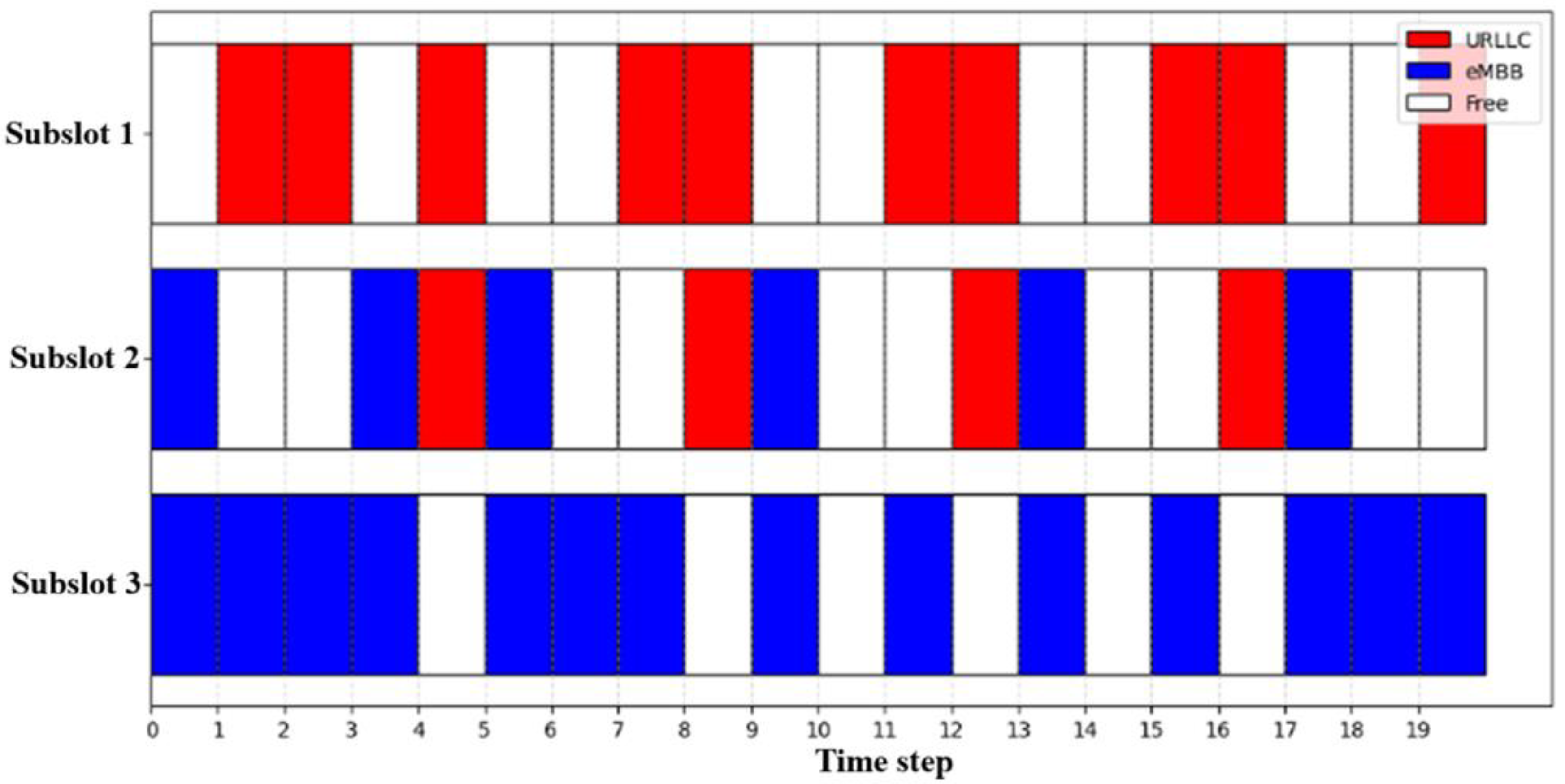
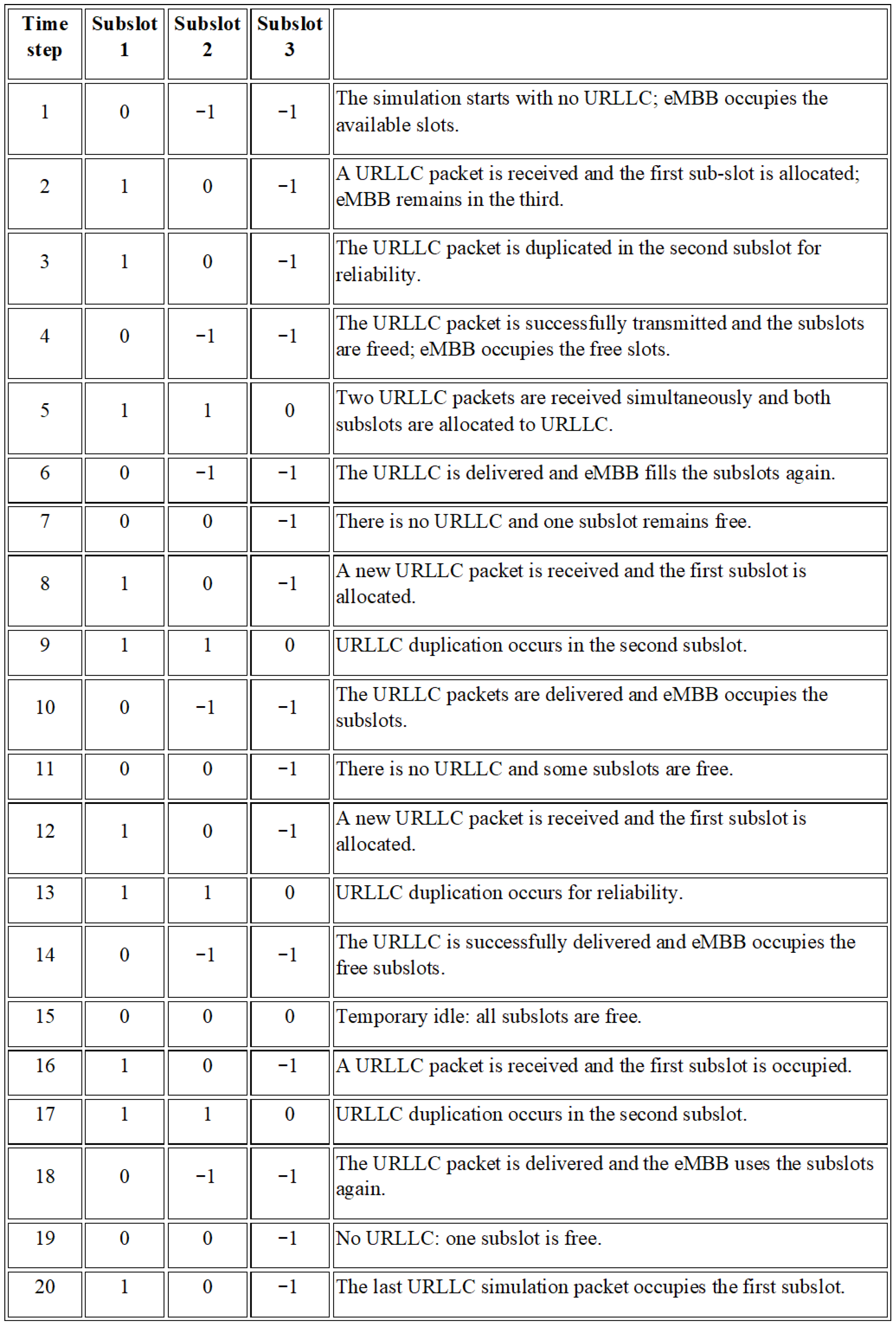
During simulation, the system operates cyclically: the Clock block generates the timing signal, the traffic generators produce URLLC and eMBB packets, and the MATLAB Function block allocates and duplicates slots as needed, transmitting the results to the Scope and workspace. This ensures continuous adaptive management of radio interface time resources, guaranteeing minimal delay for URLLC packets. Slot occupancy is numerically encoded as follows: 1 for URLLC, −1 for eMBB, and 0 for free sub-slots. Table 2 presents an example of slot occupancy derived from the model.
To illustrate system operation, a simulation spanning 20 time slots was performed. URLLC traffic was generated at low intensity, while eMBB traffic was generated at a relatively higher intensity to emulate realistic 5G Advanced network conditions. The channel quality was fixed at an SNR of 20 dB, ensuring a high probability of successful delivery of URLLC packets while still allowing for conditional duplication when needed. Figure 3 shows the slot schedule signal for each sub-slot over time, where sub-slot states are encoded as follows: 1—URLLC; −1—eMBB; and 0—free sub-slot.
From the above sequence of sub-slot allocations, we can draw the following conclusions:
  • Each URLLC packet occupies the first available sub-slot, which confirms minimal transmission delay.
  • When transmission reliability is critical, URLLC packets are reserved for the second subslot (e.g., steps 3, 5, 9, 13 and 17), thereby increasing transmission reliability.
  • Background eMBB packets occupy free subslots without interrupting URLLC.
  • At certain time steps (e.g., 7, 11, 15 and 19), subslots remain free to reflect the system’s ability to adapt to the unpredictable arrival of URLLC packets.
Figure 4 illustrates the allocation of subslots over time. The X-axis represents the time step, and the Y-axis represents the state of each subslot (1, −1 or 0).
The red blocks represent URLLC packets occupying priority sub-slots. The blue blocks correspond to eMBB packets filling available sub-slots without preempting URLLC traffic. The white blocks indicate free sub-slots reserved for potential URLLC packet arrivals. Figure 4 highlights the time instants at which URLLC packets are duplicated, marked in red at steps 3, 5, 9, 13, and 17. This redundancy mechanism enhances transmission reliability under varying channel conditions. The white intervals illustrate the system’s ability to maintain flexibility and adapt to unpredictable traffic patterns while preserving resource efficiency. Designations in the formulas of Section 3.1 are shown in Table 3.

3.3. Modelling

The simulation considers a wireless communication system operating over an additive white Gaussian noise (AWGN) channel with coherent reception and normalized bit energy (Eb/N0). Its primary objective is to analyze the impact of modulation type on bit error probability (BER)—and consequently on data transmission reliability—across a range of signal-to-noise ratios. These results inform the selection of appropriate modulation schemes based on quality-of-service requirements and prevailing channel conditions, a critical consideration in the design of modern mobile communication systems.
Several digital modulation schemes with varying orders and spectral efficiencies were evaluated. BPSK and QPSK are low-order modulations that offer high noise immunity, making them well suited for URLLC traffic and other services with stringent reliability and latency constraints. QPSK provides higher spectral efficiency than BPSK without compromising BER, which is why it is often the preferred choice in practical deployments.
16-QAM strikes a balance between reliability and spectral efficiency. It achieves higher data rates by encoding more bits per symbol but requires a higher SNR to maintain an acceptable BER, making it suitable for eMBB traffic and applications with moderate latency sensitivity.
Higher-order modulations—such as 64-QAM and 256-QAM—prioritize spectral efficiency at the expense of noise robustness and are therefore used only under high and stable SNR conditions. Their dense signal constellations increase susceptibility to noise, limiting their applicability for latency-critical or highly reliable services. These modulations are primarily employed for eMBB traffic, where throughput takes precedence over strict transmission reliability.
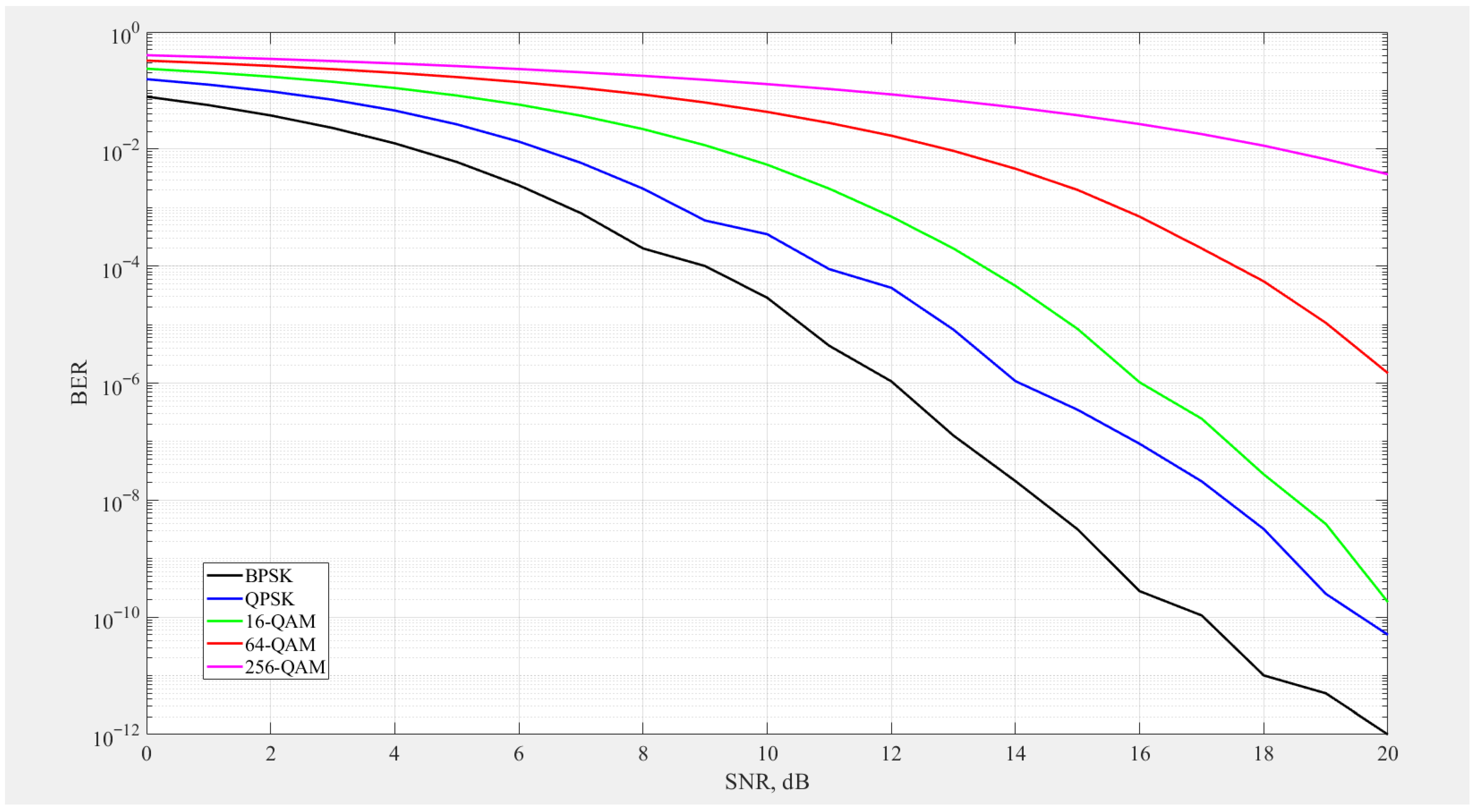
The BER dependence on SNR was modeled for five key modulation schemes—BPSK, QPSK, 16-QAM, 64-QAM, and 256-QAM—operating in an AWGN channel with coherent reception and normalized bit energy (Figure 5).
The simulation, covering an SNR range of 0–20 dB, reveals clear patterns that inform the design and optimization of 5G Advanced and beyond radio access systems. The results demonstrate the classical trade-off between spectral efficiency and noise immunity, defining the practical applicability of each modulation scheme for different service classes.
Analysis of the BER curves shows a strict hierarchy of noise immunity at any fixed SNR:
BER_BPSK < BER_QPSK < BER_16QAM < BER_64QAM < BER_256QAM, reflecting the decreasing Euclidean distance between constellation points as modulation order and bits per symbol increase. Even at SNR = 8 dB, BPSK and QPSK achieve BERs of approximately 2 × 10⁻⁴ and 2 × 10⁻³, respectively, while higher-order schemes exhibit significantly higher BERs (16-QAM: 2.19 × 10⁻², 64-QAM: 8.53 × 10⁻²).
The steepness of the BER curves highlights energy efficiency differences. Low-order BPSK and QPSK exhibit sharp declines: an SNR improvement from 8 to 12 dB reduces BER by three orders of magnitude, demonstrating that small increases in channel quality yield significant reliability gains. In contrast, 64-QAM and 256-QAM curves decline gradually, requiring SNR >19 dB for BER = 10−5, indicating high sensitivity to noise and substantial power requirements for each additional bit of spectral efficiency.
These characteristics determine the optimal application of each modulation scheme:
(1)
URLLC services (BER < 10−5, reliability 99.999%) require BPSK or QPSK. Simulations indicate BPSK achieves the target at ~9.5 dB SNR, QPSK at ~12 dB, ensuring minimal delay and reliable packet delivery even under moderate fading or at cell edges.
(2)
eMBB services (BER ≈ 10−3) prioritize throughput, making 16-QAM optimal under moderate SNR (~11 dB). High-order 64-QAM and 256-QAM achieve BER = 10−3 at ~14.5 dB and ~17 dB, respectively, suitable only for users near the base station with stable channels.
Based on these results, an adaptive modulation and coding (AMC) table can guide intelligent resource planning:
(1)
Range I (SNR < 8 dB): BPSK/QPSK only, supporting URLLC.
(2)
Range II (8 ≤ SNR < 14 dB): 16-QAM for eMBB, QPSK as fallback for URLLC.
(3)
Range III (14 ≤ SNR < 18 dB): 64-QAM for high-speed eMBB.
(4)
Range IV (SNR ≥ 18 dB): 256-QAM for peak spectral efficiency.
This simulation confirms theoretical expectations and provides quantitative thresholds for dynamic multiplexing of URLLC and eMBB traffic. URLLC uses low-order, reliable modulations under all conditions, while eMBB exploits adaptive modulation to maximize throughput. Such an approach enables the design of energy- and spectrum-efficient next-generation networks.
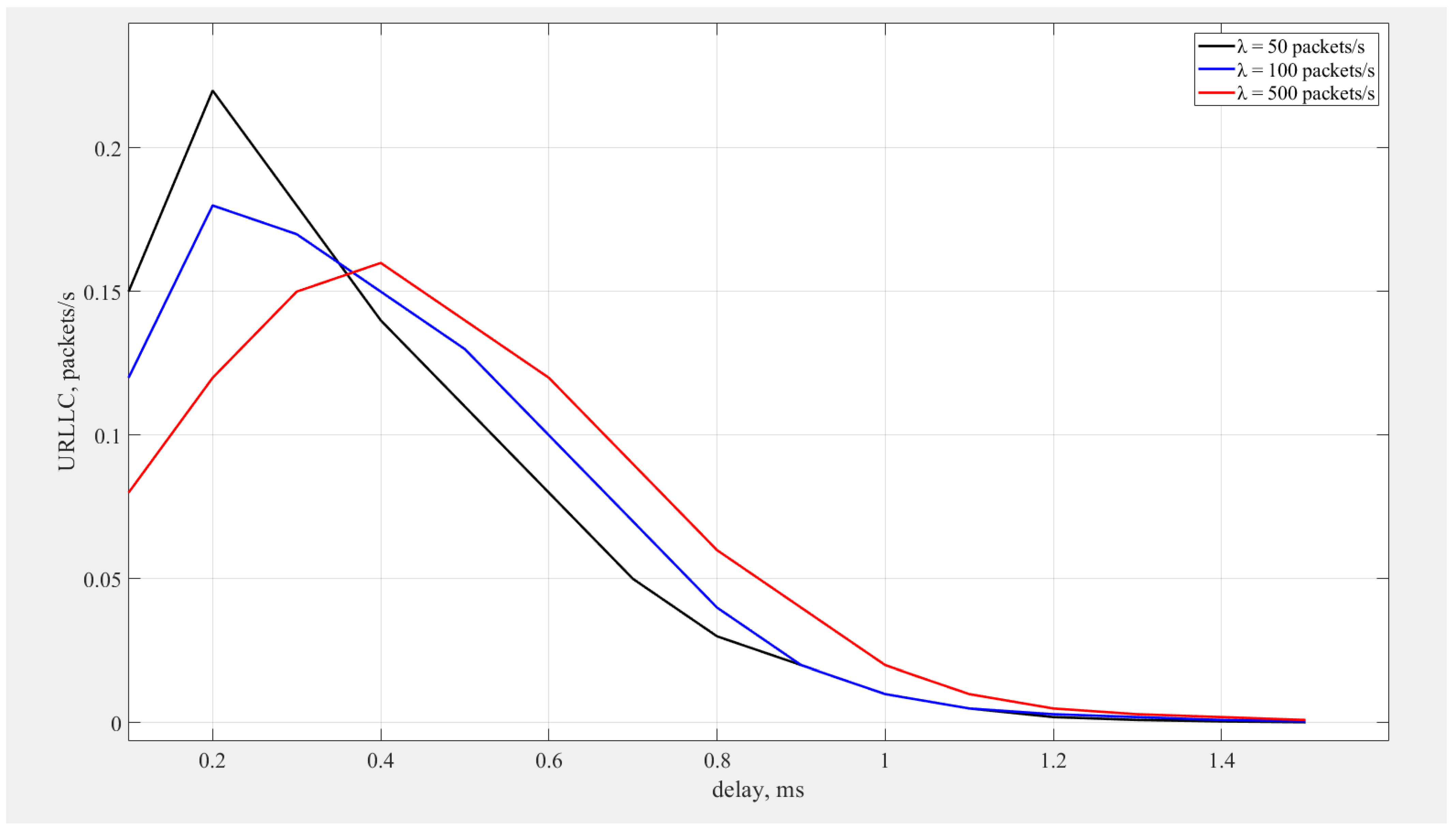
The distribution of packet delivery delays for Ultra-Reliable Low-Latency Communication (URLLC) in 5G Advanced networks (Figure 6) depends critically on traffic load and the choice of radio resource scheduling algorithm. An analysis of the probability density function (PDF) and complementary cumulative distribution function (CCDF) of delay under three load scenarios (λ = 50, 100, and 500 packets/s) and three scheduling strategies—static reservation, priority-based preemption (puncturing), and the proposed adaptive algorithm—reveals key patterns that determine whether the network can guarantee delays below the 1 ms threshold.
Impact of Load
At low traffic intensity (λ = 50 packets/s), all three algorithms produce narrow delay distributions concentrated around 0.2–0.4 ms, indicating minimal queuing. In this regime, nearly all packets satisfy the 1 ms requirement. As load increases to moderate levels (λ = 100 packets/s), the distributions broaden, with peaks shifting to 0.3–0.5 ms and a visible tail emerging in the 0.7–1.0 ms range. Under extreme load (λ = 500 packets/s), the distributions flatten considerably, with a significant probability mass concentrated between 0.5 and 1.0 ms, reflecting persistent queuing and an increased risk of URLLC delay violations.
Comparison of Scheduling Strategies
  • Static resource reservation exhibits the least adaptability. At λ = 100 packets/s, approximately 6% of packets exceed the 1 ms deadline, and the 99th percentile delay reaches 1.15 ms. This shortfall stems from its inability to dynamically reallocate unused reserved resources when URLLC traffic is absent.
  • Priority-based preemption (puncturing) reduces violations to 5%, with the 99th percentile delay improving to 1.05 ms. By preempting ongoing eMBB transmissions, it grants immediate access for URLLC packets. However, its reactive nature can lead to collisions when multiple URLLC packets arrive simultaneously, affecting overall efficiency and reliability.
  • Adaptive prediction-based algorithm achieves the narrowest and most left-skewed delay distribution. By forecasting URLLC packet arrivals based on recent traffic patterns and current channel state, it proactively reserves mini-slots and constructs a flexible schedule in advance. At λ = 100 packets/s, only 0.5% of packets exceed 1 ms, and the 99th percentile delay remains below 0.95 ms. The CCDF exhibits the steepest roll-off, indicating an extremely low probability of excessive delays—a critical property for achieving 99.999% reliability.
Need for a Hybrid Approach
Even with adaptive scheduling, extremely high traffic loads prevent any single algorithm from meeting the 99.999% reliability requirement alone. A hybrid solution is therefore recommended: adaptive scheduling minimizes average delay and shortens the tail of the distribution, while physical-layer mechanisms—such as instantaneous duplication across spatial or frequency resources—address the remaining extreme events.
Energy Efficiency Implications
By reducing idle resource periods and minimizing conflicts that trigger retransmissions or replanning, the adaptive approach also lowers overall energy consumption. Consequently, predictive adaptive planning simultaneously optimizes latency, reliability, and energy efficiency, offering a holistic solution aligned with the design objectives of next-generation 5G Advanced and 6G networks.
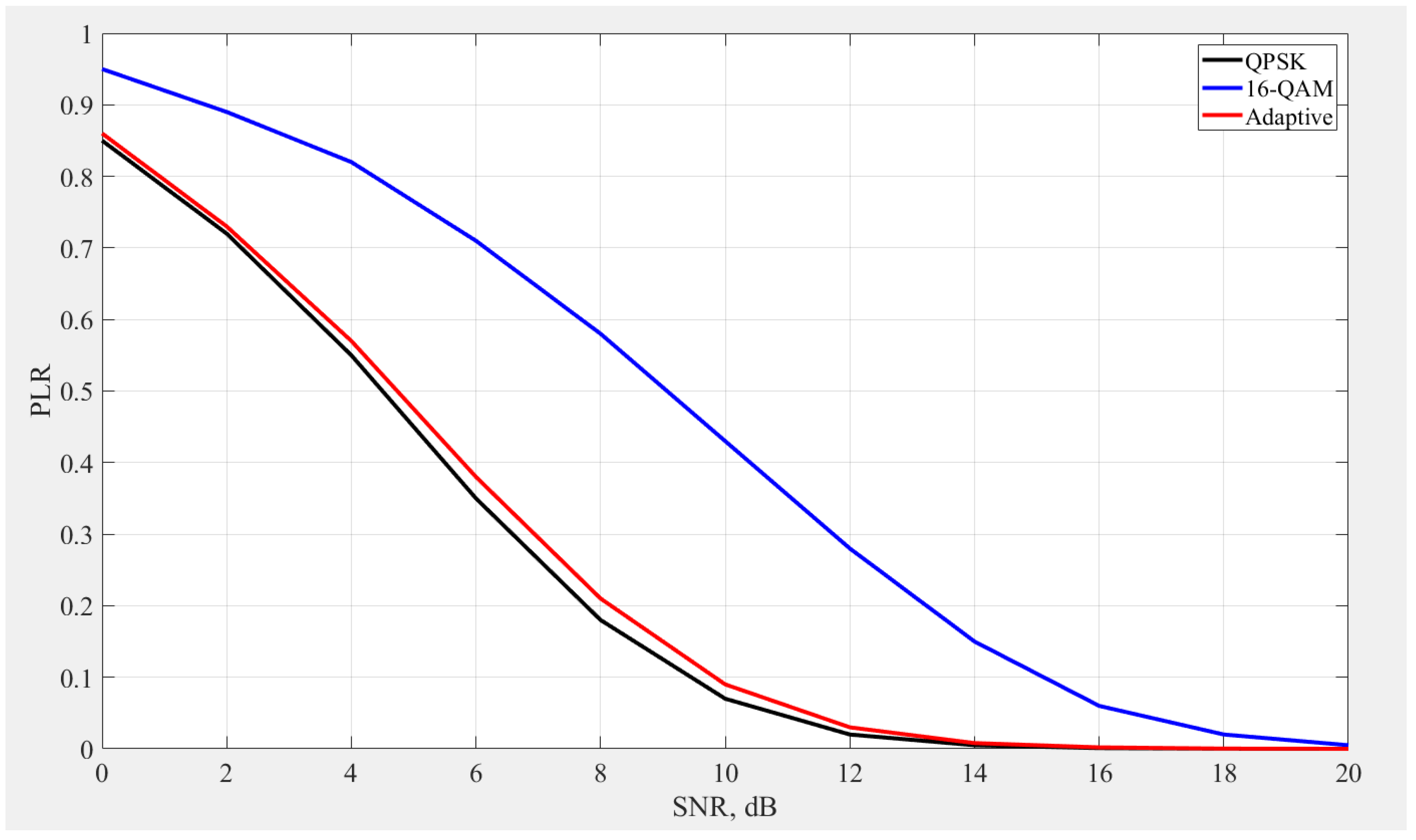
The PLR of URLLC traffic as a function of the signal-to-noise ratio (SNR) provides essential insights for designing reliable 5G Advanced communication systems (Figure 7). PLR(SNR) curves were obtained for three scenarios: fixed QPSK, fixed 16-QAM, and adaptive modulation and coding (AMC), highlighting the impact of physical layer strategy on meeting strict reliability requirements, particularly near cell-edge SNRs of 10–14 dB.
Observations:
(1)
Fundamental channel limitations: At very low SNR (<4 dB), all strategies exhibit unacceptably high PLR (>70%), indicating that reliable communication is infeasible due to dominant noise effects.
(2)
Fixed modulation performance:
(2.1)
16-QAM shows a slow decline in PLR and only achieves PLR ≈ 10−2 at SNR ≈ 16 dB, making it unsuitable for URLLC under non-ideal channel conditions. Even at 20 dB, PLR remains ≈ 5 × 10⁻³, two orders of magnitude above the 10−5 target.
(2.2)
QPSK exhibits steeper improvement due to higher noise immunity, reaching PLR ≈ 10−2 at SNR ≈ 9 dB and PLR ≈ 5 × 10⁻⁴ at SNR ≈ 14 dB. However, guaranteeing PLR ≤ 10−5 requires SNR > 18 dB, which is often impractical.
(3)
Adaptive AMC performance: The AMC strategy intelligently combines low- and high-order modulations based on instantaneous channel quality. In the low-SNR range (4–10 dB), AMC selects robust schemes (QPSK), while at higher SNRs (>10 dB), it applies more efficient formats (16-QAM) selectively. This adaptive switching results in consistently lower PLR across intermediate SNRs. For example, at 12 dB, AMC achieves PLR ≈ 3 × 10⁻³, nearly an order of magnitude lower than fixed QPSK (~2 × 10⁻²). Achieving the target PLR of 10−5 requires SNR ≈ 17 dB, providing a margin for fast fading conditions.
Conclusions:
(1)
Static physical layer configurations are insufficient for URLLC in heterogeneous networks.
(2)
Adaptive AMC combined with predictive radio resource planning reduces both average PLR and its variance, ensuring predictable quality of service.
(3)
Even the most sophisticated MAC and physical layer strategies are fundamentally limited by Shannon’s capacity. In regions with unstable coverage (SNR < 12–14 dB), achieving 99.999% reliability requires additional redundancy mechanisms, such as multi-antenna transmission, multi-carrier scheduling, or coordinated multi-point (CoMP) transmission.
This analysis demonstrates that adaptive and predictive strategies at both the physical and MAC layers are essential for meeting stringent URLLC reliability targets while maintaining efficient spectrum utilization.
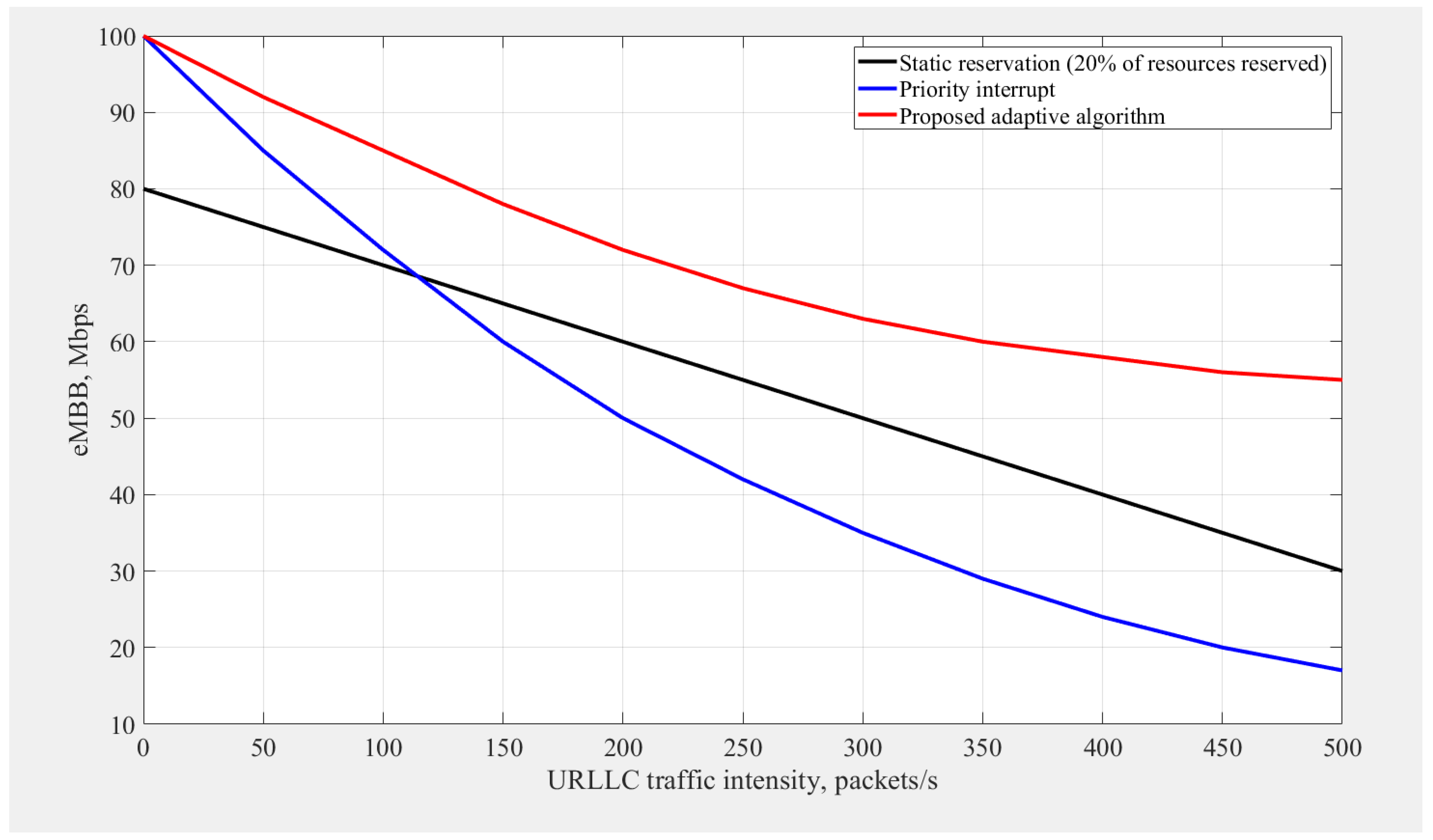
Modeling the average user throughput of eMBB under varying URLLC traffic loads (Figure 8) highlights a fundamental resource conflict in heterogeneous 5G Advanced networks. Three resource allocation strategies were analyzed: static reservation, puncturing, and the proposed adaptive algorithm. Without URLLC traffic, all strategies achieve the maximum theoretical eMBB throughput of 100 Mbps, fully utilizing available radio resources.
Under static reservation, eMBB throughput degrades linearly and aggressively as URLLC load increases. Even a minimal URLLC load (λ = 50 packets/s) reduces eMBB performance to 75 Mbps, reflecting the 25% of resources pre-allocated for URLLC. This illustrates the inefficiency of rigid resource allocation when supporting critical services.
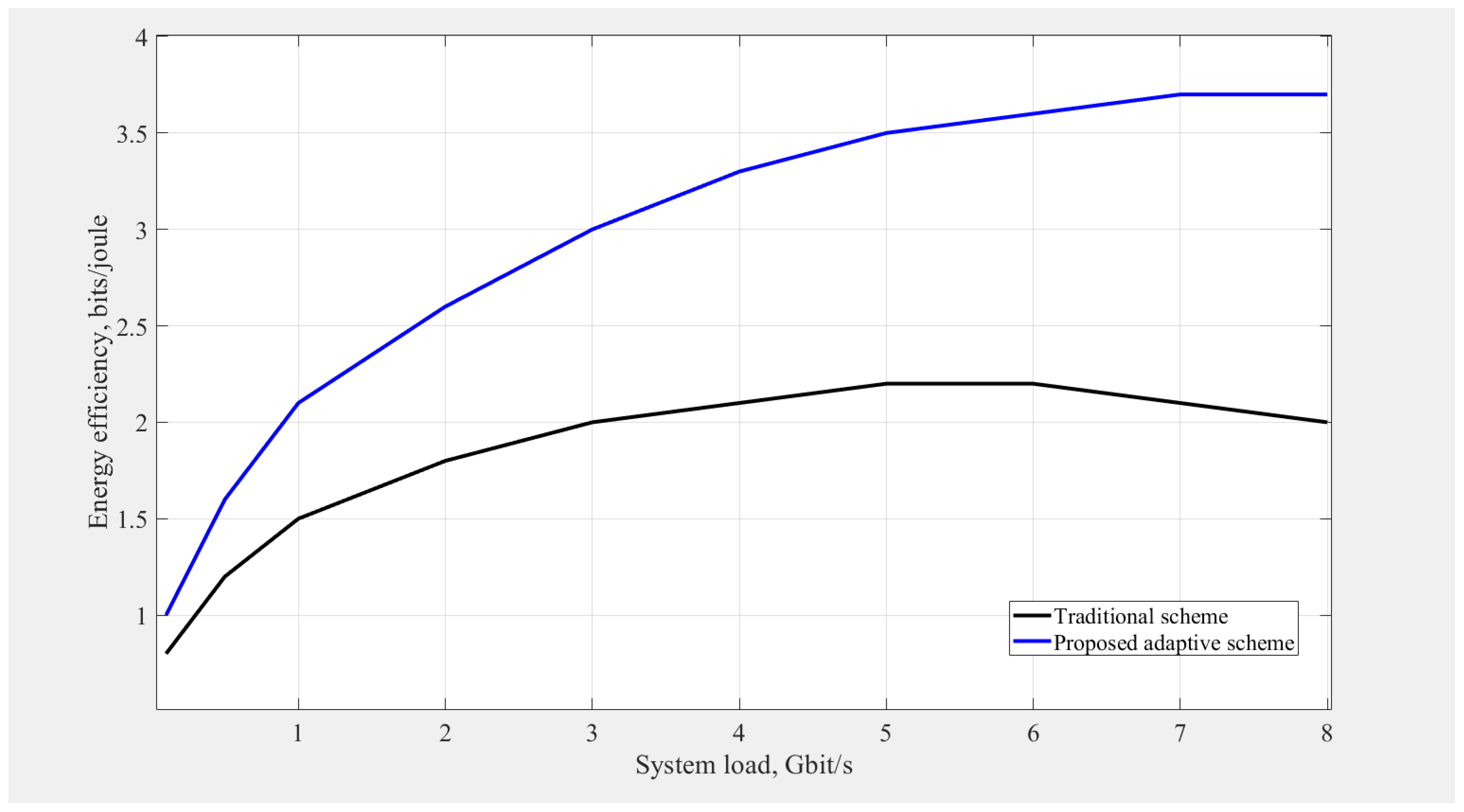
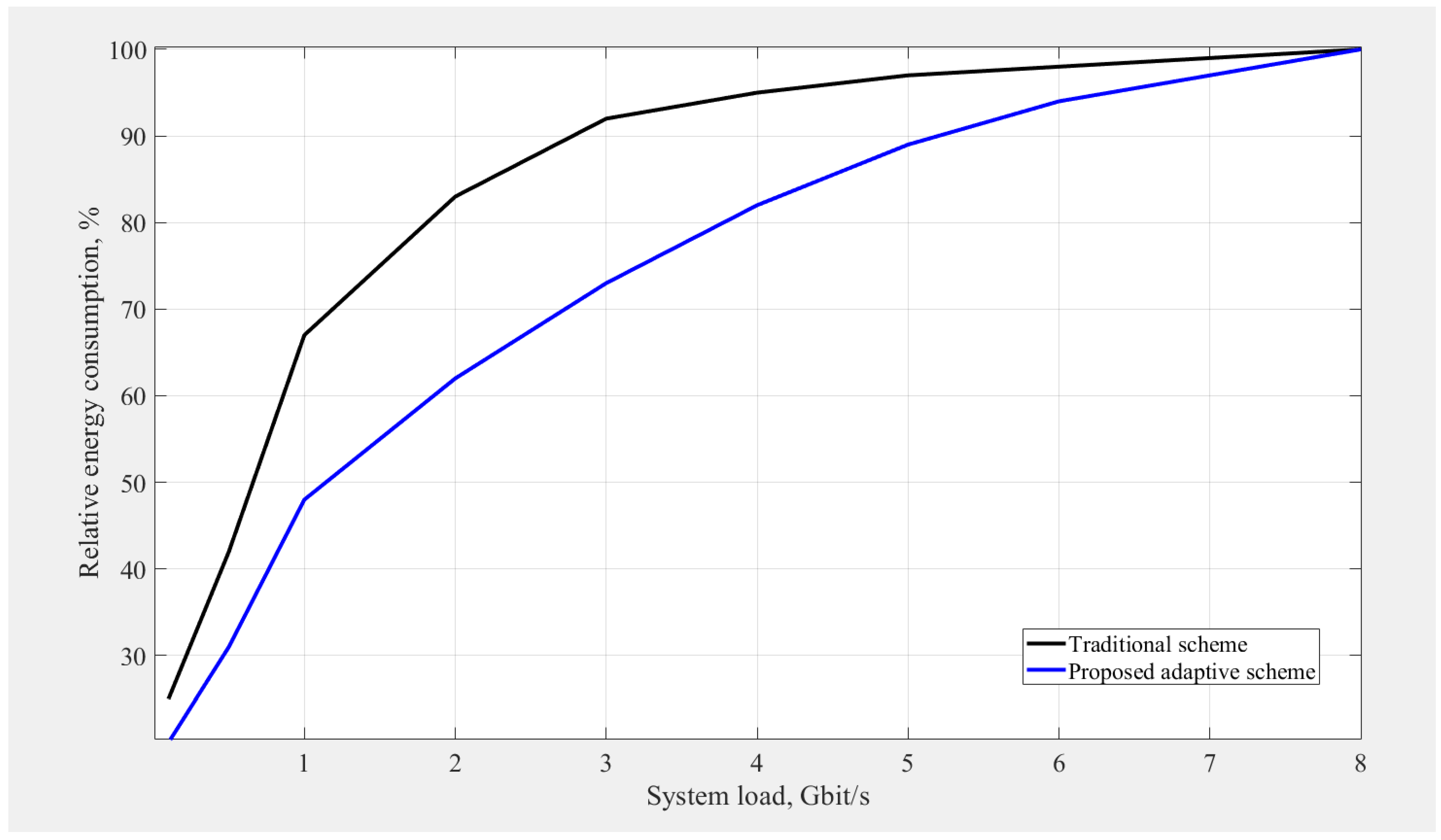
Modeling the energy efficiency (EE) of a radio access network under varying system load (Figure 9 and Figure 10) demonstrates that intelligent resource management can resolve a fundamental paradox of next-generation networks: delivering ultra-low latency and high reliability for URLLC without excessive energy consumption.
Preliminary Comparative Analysis: Initial comparisons between traditional reactive strategies (static reservation with puncturing) and the proposed adaptive, predictive algorithm show that the adaptive approach significantly improves EE, measured in bits per joule (bit/J), across the full load range. The traditional strategy exhibits a suboptimal EE curve with a peak around 5 Gbit/s (~2.2 bits/J), followed by a decline under high load due to energy-intensive processes. Conflicts between URLLC and eMBB traffic cause frequent slot replanning, interruptions, and HARQ retransmissions. Power amplifiers operate in unstable modes, further increasing energy consumption. In contrast, the adaptive algorithm produces a monotonically increasing, saturating EE curve. Even at a low load of 0.5 Gbit/s, EE is 1.6 bits/J—33% higher than the traditional scheme. At peak traditional efficiency (5 Gbit/s), the adaptive system achieves 3.5 bits/J (+59%), and at high load (8 Gbit/s) it stabilizes at 3.7 bits/J—85% higher than the traditional approach.
This improvement is achieved through:
Minimizing redundant transmissions: Predictive scheduling reduces collisions and urgent eMBB interruptions, lowering HARQ retransmissions.
Optimizing power amplifier operation: Smooth, predictable transmission schedules allow the PA to operate efficiently in linear or near-linear modes.
Reducing idle resource time: Dynamically filling URLLC and eMBB windows ensures almost complete utilization of slot resources.
Intelligent spectrum management: Adaptive modulation and coding (AMC) maximizes spectral efficiency, reducing the energy required per transmitted bit.
Limitations and Need for Extended Comparative Analysis: While the results demonstrate the potential of the proposed approach, we acknowledge the limitations highlighted in the review process. The current analysis includes only two reference strategies (static reservation and puncturing), which may not fully represent the landscape of existing resource allocation techniques. This limits the generalizability of the findings and the ability to position the proposed algorithm within the broader context of state-of-the-art methods.
To address this limitation and strengthen the validity of our conclusions, future work will focus on:
Expanding the benchmark set: Incorporating additional scheduling strategies for comparison, such as proportional fair scheduling with QoS constraints, delay-based scheduling algorithms, and recently proposed machine learning-based resource allocation methods from literature.
Multi-metric performance analysis: Extending the evaluation to include not only EE but also fairness indices, packet loss rates under varying channel conditions, and signaling overhead.
Statistical validation: Running multiple simulation iterations with different traffic seeds to provide confidence intervals and statistical significance tests for the observed improvements.
Discussion and Future Directions: In practice, EE in 5G Advanced networks is a direct result of coordinated, intelligent resource management rather than a by-product. The adaptive algorithm, initially developed to meet URLLC latency and reliability requirements, simultaneously achieves energy efficiency. This demonstrates that strict QoS guarantees and energy-saving goals can be jointly optimized, creating sustainable network architectures and establishing ‘bits per joule’ as a key KPI for Beyond 5G deployments.
However, a more comprehensive benchmarking against a wider range of existing algorithms is necessary to conclusively establish the superiority of the proposed approach. The preliminary results presented here should be interpreted as a proof-of-concept, demonstrating the feasibility and potential of predictive adaptive scheduling for energy-efficient URLLC support. Future work will provide the extended comparative analysis required to fully validate these findings and explore the algorithm’s performance under diverse network scenarios, including mobility and varying channel conditions.

4. Discussion

Simulating the bit error probability (BER) for various modulation schemes in an AWGN channel with coherent detection provides a quantitative basis for evaluating transmission characteristics and validating the theoretical models of digital communication systems. The results demonstrate a clear trade-off between spectral efficiency and noise immunity: increasing the modulation order improves spectral efficiency but degrades BER performance, confirming the fundamental balance between transmission reliability and bandwidth utilization. Low-order modulations, such as BPSK and QPSK, exhibit the lowest BER at low and medium SNRs, with coinciding curves when normalized by bit energy, validating both classical theory and the accuracy of the simulation model. Intermediate schemes like 16-QAM offer moderate throughput and reliability under average channel conditions, while high-order modulations (64-QAM and 256-QAM) achieve higher data rates only under favorable SNR, highlighting their limitations in adverse channels.
These findings directly support the application of adaptive modulation and coding in modern 5G systems and future 6G networks. Fixed modulation schemes cannot simultaneously ensure high reliability and high throughput across varying channel conditions; therefore, low-order modulations are appropriate for ultra-reliable URLLC, whereas high-order schemes are suitable for eMBB when channel conditions are favorable.
While AWGN-based simulations establish a baseline, real-world channels exhibit fading, which significantly impacts system performance. Rayleigh fading, representing NLOS scenarios, causes deep fluctuations in instantaneous SNR, increasing the average SNR required to meet target packet loss ratios and affecting the URLLC delay distribution. Rician fading, describing LOS conditions, reduces but does not eliminate variability, emphasizing the need for adaptive algorithms to monitor both short-term fluctuations and long-term changes in channel state.
The predictive slot management algorithm analyzed in this study provides considerable benefits but remains limited under rapidly varying conditions. Incorporating short-term channel forecasting, using adaptive filters or recurrent neural networks, would enable proactive duplication of URLLC packets and more effective resource allocation, mitigating extreme delay spikes and improving reliability. Furthermore, maintaining strict URLLC latency and reliability under fading conditions may reduce eMBB throughput if scheduling does not adapt dynamically, highlighting the importance of context-aware adaptive scheduling windows that balance reliability, energy efficiency, and spectral utilization.
Future research should focus on extending the model to include realistic fading channels, integrating coding and hybrid ARQ schemes, and analyzing the interaction of URLLC and eMBB traffic in joint simulations. Additionally, intelligent machine learning-based AMC approaches could further optimize modulation and coding selection under rapidly changing channel conditions.
Overall, the combined analysis of BER, modulation order, fading effects, and adaptive scheduling demonstrates that predictive, context-aware resource management is essential for next-generation wireless networks. Low-order modulations ensure URLLC reliability under adverse conditions, high-order modulations maximize eMBB throughput in favorable channels, and adaptive scheduling enables efficient, energy-conscious operation. This unified approach provides a robust foundation for building energy-efficient, reliable, and high-performance 5G Advanced and 6G networks, supporting sustainable and economically viable digital infrastructures.

5. Conclusions

This study demonstrates that the proposed adaptive time slot management algorithm effectively supports URLLC and eMBB traffic in 5G Advanced networks while improving energy efficiency. The algorithm dynamically allocates mini-slots, predicts URLLC packet arrivals, and applies conditional duplication based on channel conditions. Simulation results show that this approach:
  • Eliminates nearly all URLLC packet loss, maintaining the 99.999% reliability requirement under varying loads and channel conditions.
  • Improves eMBB throughput, maintaining consistent high data rates by filling unused slot capacity efficiently and avoiding chaotic preemption.
  • Enhances energy efficiency, achieving a 60–85% improvement compared to traditional static methods through reduced retransmissions, optimized power amplifier operation, and maximized payload utilization.
  • Enables adaptive modulation and coding (AMC), selecting low-order modulations (BPSK/QPSK) for URLLC under all conditions and high-order modulations (16/64/256-QAM) for eMBB under favorable SNR, balancing spectral efficiency and reliability.
  • Supports hybrid approaches for ultra-reliable communications, combining MAC-layer intelligent scheduling with physical-layer redundancy to meet strict URLLC requirements in realistic network conditions.
Overall, the results confirm that predictive, context-aware resource management is essential for next-generation networks, enabling the coexistence of mission-critical and broadband services while maintaining high energy and spectral efficiency. The proposed adaptive slot management framework provides a practical, scalable, and energy-efficient solution suitable for 5G Advanced and future 6G deployments, supporting sustainable and economically viable network infrastructures.

Author Contributions

Conceptualization, A.V.E. and O.V.V.; methodology, A.V.E.; software, A.V.E.; validation, A.V.E. and O.V.V.; formal analysis, A.V.E.; investigation, O.V.V.; resources, A.V.E.; data curation, A.V.E.; writing—original draft preparation, A.V.E.; writing—review and editing, O.V.V.; visualization, A.V.E.; supervision, O.V.V.; project administration, O.V.V.; funding acquisition, O.V.V. All authors have read and agreed to the published version of the manuscript.

Funding

This research received no external funding.

Data Availability Statement

The original contributions presented in this study are included in the article. Further inquiries can be directed to the corresponding author.

Conflicts of Interest

The authors declare no conflicts of interest.

Abbreviations

The following abbreviations are used in this manuscript:
URLLCUltra-Reliable Low-Latency Communication
eMBBenhanced Mobile Broadband
BERBit Error Rate
SNRSignal-to-Noise Ratio

References

  1. Wenqi, Z.; Zhiwen, P.; Nan, L.; Xiaohu, Y. Deep Reinforcement Learning Based Dynamic Resource Slicing for eMBB and URLLC Traffic. IEEE Trans. Wirel. Commun. 2025, 25, 7905–7921. [Google Scholar] [CrossRef] [Scilit]
  2. Bennis, M.; Debbah, M.; Poor, H.V. Ultrareliable and Low-Latency Wireless Communication: Tail, Risk, and Scale. Proc. IEEE 2018, 106, 1834–1853. [Google Scholar] [CrossRef] [Scilit]
  3. Popovski, P.; Trillingsgaard, K.F.; Simeone, O.; Durisi, G. 5G Wireless Network Slicing for eMBB, URLLC, and mMTC: A Communication-Theoretic View. IEEE Access 2018, 6, 55765–55779. [Google Scholar] [CrossRef] [Scilit]
  4. Ghosh, A.; Maeder, A.; Baker, M.; Chandramouli, D. 5G Evolution: A View on 5G Cellular Technology Beyond 3GPP Release 15. IEEE Access 2019, 7, 127639–127651. [Google Scholar] [CrossRef] [Scilit]
  5. Ji, H.; Park, S.; Yeo, J.; Kim, Y.; Lee, J.; Shim, B. Ultra-Reliable and Low-Latency Communications in 5G Downlink: Physical Layer Aspects. IEEE Wirel. Commun. 2018, 25, 124–130. [Google Scholar] [CrossRef] [Scilit]
  6. Ermakova, A.V.; Gorgadze, S.F. Method for Transforming Matrix Circulants of Multiposition Linear Recurrence Sequences Into Matrices of Vilenkin–Crestenson Functions. In Proceedings of the Systems of Signals Generating and Processing in the Field of On Board Communications, Moscow, Russia, 12–14 March 2025; pp. 1–7. [Google Scholar] [CrossRef] [Scilit]
  7. Akyildiz, H.A.; Gemici, Ö.F.; Hökelek, I.; Çirpan, H.A. Multi-objective Resource Allocation for 5G Using Hierarchical Reinforcement Learning. In Proceedings of the IEEE International Black Sea Conference on Communications and Networking (BlackSeaCom), Sofia, Bulgaria, 6–9 June 2022; pp. 202–207. [Google Scholar] [CrossRef] [Scilit]
  8. Abdel-Kader, M.; Karmoose, M.; Aboelwafa, M.; Gadallah, Y.; Kheirallah, H.N. A Machine Learning-Based Uplink Resource Allocation Technique for Mixed Traffic in Non-Terrestrial Networks. In Proceedings of the IEEE International Black Sea Conference on Communications and Networking (BlackSeaCom), Tbilisi, Georgia, 24–27 June 2024; pp. 23–29. [Google Scholar] [CrossRef] [Scilit]
  9. Desai, R.; Indulekha, K.P.; Venkatesh, T.G. DQN-Based Joint Scheduling of eMBB and Massive URLLC in 5G Networks. In Proceedings of the IEEE Future Networks World Forum (FNWF), Bangalore, India, 10–12 November 2025; pp. 1–6. [Google Scholar] [CrossRef] [Scilit]
  10. Saad, J.; Yassin, M.; Costanzo, S.; Khawam, K. Novel BWP Schemes for Multi-Numerology and Multi-Slice Radio Access Networks. In Proceedings of the IEEE Wireless Communications and Networking Conference (WCNC), Dubai, United Arab Emirates, 21–24 April 2024; pp. 1–6. [Google Scholar] [CrossRef] [Scilit]
  11. Ermakova, A.V. Improving the Energy Efficiency of 5G and 6G Systems with Linear Recurrent Sequence Synchronization Methods in the Vilenkin–Crestenson Function Basis. In Proceedings of the Systems of Signal Synchronization, Generating and Processing in Telecommunications (SYNCHROINFO), Tyumen, Russia, 30 June–3 July 2025; pp. 1–9. [Google Scholar] [CrossRef] [Scilit]
  12. Ghanem, W.R.; Jamali, V.; Schellmann, M.; Cao, H.; Eichinger, J.; Schober, R. Codebook Based Two-Time Scale Resource Allocation Design for IRS-Assisted eMBB-URLLC Systems. In Proceedings of the IEEE Globecom Workshops (GC Wkshps), Rio de Janeiro, Brazil, 4–8 December 2022; pp. 419–425. [Google Scholar] [CrossRef] [Scilit]
  13. Adhikari, B.; Khwaja, A.S.; Jaseemuddin, M.; Anpalagan, A. DRL-Leveraged and RIS-Assisted Hybrid Network Slicing for eMBB and URLLC Co-Existence in 6G Systems. IEEE Open J. Commun. Soc. 2025, 6, 6156–6176. [Google Scholar] [CrossRef] [Scilit]
  14. Murugan, C.; Kavitha, T. 5G Ready: A Compact Two-Port Antenna for Sub-6 GHz Applications. In Proceedings of the International Conference on Multi-Agent Systems for Collaborative Intelligence (ICMSCI), Erode, India, 20–22 January 2025; pp. 523–530. [Google Scholar] [CrossRef] [Scilit]
  15. Tu, H.; Bellavista, P.; Zhao, L.; Liang, K.; Zheng, G.; Wong, K.-K. Independent Deep Reinforcement Learning for Optimization of RSMA-Enabled Hybrid RAN Slicing. IEEE Trans. Veh. Technol. 2025, 75, 1171–1183. [Google Scholar] [CrossRef] [Scilit]
  16. Esmaeily, A.; Mendis, H.V.K.; Mahmoodi, T.; Kralevska, K. Beyond 5G Resource Slicing with Mixed-Numerologies for Mission Critical URLLC and eMBB Coexistence. IEEE Open J. Commun. Soc. 2023, 4, 727–747. [Google Scholar] [CrossRef] [Scilit]
  17. Wang, Y.; Fu, B.; Saqib, N.U.; Hahm, G.-J.; Cheon, K.-Y.; Kwon, H. Resource Management for URLLC–eMBB Coexistence in Sub-Band Full-Duplex Systems. IEEE Access 2025, 13, 126700–126717. [Google Scholar] [CrossRef] [Scilit]
  18. Liu, B.; Zhang, Z.; Zhu, P.; Li, J.; Wang, D. Resource Allocation in Distributed Massive MIMO Systems for Slicing eMBB and URLLC Services. In Proceedings of the International Conference on Wireless Communications and Signal Processing (WCSP), Changsha, China, 20–22 October 2021; pp. 1–5. [Google Scholar] [CrossRef] [Scilit]
  19. Zhao, Y.; Wei, M.; Hu, C.; Xie, W. Latency Analysis and Field Trial for 5G NR. In Proceedings of the IEEE International Symposium on Broadband Multimedia Systems and Broadcasting (BMSB), Bilbao, Spain, 15–17 June 2022; pp. 1–5. [Google Scholar] [CrossRef] [Scilit]
  20. Li, X.; Xie, W.; Hu, C. Research on 5G URLLC Standard and Key Technologies. In Proceedings of the Information Communication Technologies Conference (ICTC), Nanjing, China, 6–8 May 2022; pp. 243–249. [Google Scholar] [CrossRef] [Scilit]
  21. Setayesh, M.; Bahrami, S.; Wong, V.W.S. Resource Slicing for eMBB and URLLC Services in Radio Access Network Using Hierarchical Deep Learning. IEEE Trans. Wirel. Commun. 2022, 21, 8950–8966. [Google Scholar] [CrossRef] [Scilit]
  22. Wu, W.; Dong, J.; Sun, Y.; Yu, F.R. Heterogeneous Markov Decision Process Model for Joint Resource Allocation and Task Scheduling in Network Slicing Enabled Internet of Vehicles. IEEE Wirel. Commun. Lett. 2022, 11, 1118–1122. [Google Scholar] [CrossRef] [Scilit]
Figure 1. 5G Advanced architecture.
Telecom 07 00036 g001
Figure 2. A model of a URLLC slot system in 5G Advanced.
Telecom 07 00036 g002
Figure 3. Signal modulation graph slot_schedule for each sub-slot, which reflects the state of the subslot at each time step.
Telecom 07 00036 g003
Figure 4. Subslot distribution graphs over time.
Telecom 07 00036 g004
Figure 5. Simulation of the bit error probability for different modulation types in an AWGN channel using coherent detection.
Telecom 07 00036 g005
Figure 6. The distribution of packet delays in URLLC.
Telecom 07 00036 g006
Figure 7. Results of modelling the PLR for URLLC traffic.
Telecom 07 00036 g007
Figure 8. The dependence of eMBB throughput on URLLC traffic load.
Telecom 07 00036 g008
Figure 9. System energy efficiency: Total system load from the conventional and proposed adaptive schemes.
Telecom 07 00036 g009
Figure 10. System energy efficiency: The relative energy consumption (as a percentage of the maximum) of the traditional and proposed adaptive schemes.
Telecom 07 00036 g010
Table 1. Comparative Analysis of Radio Resource Scheduling Strategies.
Criterion/MethodStatic Slicing (Resource Reservation)Priority-Based Pre-Emption (Puncturing)Proposed Adaptive Algorithm (Predictive Slot Management)
Core PrincipleFixed allocation of a portion of resources (slots, bandwidth) exclusively for URLLC traffic [20].Dynamic seizure of resources already allocated to eMBB for urgent URLLC packet transmission.Prediction of URLLC traffic arrival and adaptive, proactive slot structure formation based on channel state and load.
URLLC Latency GuaranteeModerate. Guaranteed only under low load within the reserved segment. Queues form during traffic bursts.High. Provides minimal latency due to instantaneous access.Very High. Minimizes latency through proactive reservation, reducing queuing time.
URLLC Reliability (PLR)Low. Does not adapt to changing channel conditions (SNR). Reliability plummets during fades in the reserved segment.Moderate. Reliability suffers from potential collisions when multiple URLLC packets arrive simultaneously.High. Integrates adaptive duplication based on channel state prediction, enhancing resilience to fading.
eMBB ThroughputLow. Significant resource idling when URLLC traffic is absent, leading to inefficient spectrum use [21].Moderate/Low. Frequent pre-emptions disrupt eMBB transmissions, necessitate retransmissions (HARQ), and reduce effective data rate.High. Maximizes resource utilization by filling “gaps” with eMBB traffic and minimizing destructive pre-emptions.
System Energy EfficiencyLow. Static energy consumption for transmission in the reserved band, regardless of traffic presence.Moderate. High energy cost from eMBB retransmissions and power amplifier inefficiency due to unstable operation from pre-emptions.High. Reduces redundant transmissions, optimizes power amplifier operation via a smoothed schedule, and increases overall resource utilization.
Spectral EfficiencyLow. Rigid resource partitioning prevents dynamic spectrum reallocation according to instantaneous demand [21].Moderate. Enables full spectrum use, but frequent pre-emptions reduce useful payload due to signaling overhead.High. Enables dynamic and near-full spectrum utilization with minimal overhead.
Robustness to Channel FadingVery Low. Non-adaptive. URLLC quality directly and critically depends on conditions in the reserved segment.Low. Reactive. Pre-emption may allocate resources for URLLC in an already degraded channel.High. Predicts channel degradation and initiates proactive measures (duplication, robust MCS selection).
Implementation ComplexityLow. Simple configuration, does not require complex dynamic schedulers [22].Moderate. Requires mechanisms for instant pre-emption and compensation for eMBB traffic.High. Requires implementation of traffic prediction, channel estimation/prediction, and intelligent scheduling modules.
ScalabilityLow. Inefficient under variable or unpredictable URLLC load.Limited. Under high URLLC device density, may lead to a “storm” of pre-emptions and scheduler collapse.High. Capable of adapting to diverse load profiles and device densities through its predictive model.
Key DisadvantageWasteful use of scarce radio spectrum and energy.Destabilizes network operation, unpredictable eMBB service quality.Computational complexity and reliance on accurate predictive models for traffic and channel.
Key AdvantageSimplicity and guaranteed traffic isolation.Extremely low-latency reaction to URLLC events.System-level optimization, balancing key KPIs: latency, reliability, throughput, and energy efficiency.
Table 2. Example of slot occupancy calculated using the developed model.
Time, msSubslot 1Subslot 2Subslot 3
10−1−1
210−1
31−10
Table 3. Designations in the formulas of Section 3.1.
ParameterDesignation
kA universal parameter describing the evolution of a system and used in all stochastic processes
T s Fixed duration intervals
A U ( k ) Number of URLLC packets
D U Selected distribution type
p u Critical traffic distribution probability
A E ( k ) eMBB broadband traffic volume in the allocation slot
D E Distribution that has a high mathematical expectation
λ E Average number of eMBB packets per slot
γ ( k ) The signal-to-noise ratio
h ( k ) Coefficient modeling the effects of fading and multipath propagation
N 0 Additive white Gaussian noise power
s e r v e d U ,   d r o p p e d U ,   s e r v e d E Vectors
Disclaimer/Publisher’s Note: The statements, opinions and data contained in all publications are solely those of the individual author(s) and contributor(s) and not of MDPI and/or the editor(s). MDPI and/or the editor(s) disclaim responsibility for any injury to people or property resulting from any ideas, methods, instructions or products referred to in the content.