
Review

Early to Mature, Early to Detect: Artificial Intelligence in the Risk Prediction and Diagnosis of Precocious Puberty

by
Manisha Chavan
1,
Sameena Tabassum
1,
Divya Dinesh Joshi
1,
Kusalik Boppana
1,
Nasreen Banu
2,
Riya Kayarkar
3,
Kalp Chauhan
1,
Gayathri Yerrapragada
1,
Poonguzhali Elangovan
1,
Mohammed Naveed Shariff
1,
Thangeswaran Natarajan
1,
Jayarajasekaran Janarthanan
1,
Shreshta Agarwal
1,
Sancia Mary Jerold Wilson
1,
Mini Virmani
1,
Atishya Ghosh
1,
Mimi Adu Serwaah
1,
Shiva Sankari Karuppiah
1,
Keerthy Gopalakrishnan
4,
Divyanshi Sood
5,
Swetha Rapolu
1,6,
Swathi Priya Cherukuri
1 and
Shivaram P. Arunachalam
1,7,*
add Show full author list remove Hide full author list
1
Digital Engineering & Artificial Intelligence Laboratory (DEAL), Mayo Clinic, Jacksonville, FL 32224, USA
2
Department of Internal Medicine, Saint Agnes Medical Center, Fresno, CA 93720, USA
3
Department of Internal Medicine, St. Vincent Hospital, Worcester, MA 01608, USA
4
Department of Internal Medicine, Wright Medical Center, Scranton, PA 18503, USA
5
Department of Internal Medicine, UChealth Parkview Medical Center, Pueblo, CO 81005, USA
6
Medical Gastroenterology, AIG Hospitals, Hyderabad 500032, Telangana, India
7
Department of Critical Care Medicine, Mayo Clinic, Jacksonville, FL 32224, USA
*
Author to whom correspondence should be addressed.
Reprod. Med. 2026, 7(1), 9; https://doi.org/10.3390/reprodmed7010009
Submission received: 21 December 2025 / Revised: 17 January 2026 / Accepted: 20 January 2026 / Published: 13 February 2026
(This article belongs to the Special Issue Game-Changing Concepts in Reproductive Health)

Abstract

Background/Objectives: Precocious puberty (PP), defined as the onset of secondary sexual characteristics before 8 years in girls and 9 years in boys, is associated with psychosocial distress, compromised adult height, and long-term metabolic risk. Early identification remains challenging, as current diagnostic approaches are largely reactive and rely on invasive or resource-intensive testing. This narrative review examines how artificial intelligence (AI) can support earlier risk prediction and detection of PP through integration of clinical, hormonal, imaging, lifestyle, and environmental data. Methods: A narrative literature review was conducted using PubMed, Scopus, Embase, Web of Science, and Google Scholar to identify relevant studies published between 2005 and 2025. Eligible studies included original research and high-quality reviews that examined AI-based approaches, such as machine learning and deep learning, in pediatric endocrinology, particularly for the prediction or diagnosis of central or peripheral precocious puberty. Studies incorporating clinical, hormonal, radiological, lifestyle, environmental, or multi-omics data relevant to AI modeling were included. Results: AI models, including XGBoost, random forest, convolutional neural networks, and regression-based approaches, have demonstrated potential utility in predicting central precocious puberty using hormonal, imaging, and growth data. Reported applications include automated bone age assessment, lifestyle and dietary risk stratification, and exploratory use of wearable-derived behavioral data. However, progress is limited by small pediatric datasets, population bias, limited interpretability, and unresolved ethical challenges related to privacy, consent, and equity. Conclusions: Artificial intelligence represents a promising decision-support approach for earlier, non-invasive, and individualized risk assessment in precocious puberty. Future progress will depend on the integration of longitudinal, multimodal data, the development of ethical models, and interdisciplinary collaboration among pediatric endocrinologists, data scientists, and public health stakeholders.

1. Methods

This narrative review synthesizes current evidence on artificial intelligence (AI) applications relevant to precocious puberty (PP), including domains of diet and obesity, lifestyle behaviors, environmental endocrine-disrupting chemicals (EDCs), and pediatric endocrine diagnostics. The objective was to provide a thematic and integrative overview of how AI methodologies are being applied across these domains to support early risk prediction, diagnosis, and clinical decision-making. Given the heterogeneity of study designs, data modalities, and outcomes, a narrative review framework was chosen to enable integrative synthesis across clinical, lifestyle, environmental, and imaging domains, rather than a quantitative meta-analysis.

1.1. Search Strategy

A structured but non-systematic literature search was conducted using PubMed, Embase, Scopus, Web of Science, and Google Scholar from database inception through November 2025. Search terms included combinations of “precocious puberty,” “early puberty,” “central precocious puberty,” “artificial intelligence,” “machine learning,” “deep learning,” “bone age,” “hormone prediction,” “endocrine disruptors,” and “environmental exposure.” Boolean operators (e.g., “precocious puberty” AND “machine learning”) were applied. Reference lists of key articles and recent reviews were manually screened to identify additional relevant studies.

1.2. Eligibility Criteria

Studies were included if they met the following criteria:
  • Involved pediatric populations (children or adolescents);
  • Addressed precocious puberty or determinants influencing pubertal timing;
  • Applied AI or machine learning methods, or provided environmental or lifestyle evidence relevant to subsequent AI-based modeling;
  • Were original research articles, clinical studies, modeling studies, or high-quality reviews published in English.
Studies were excluded if they involved adult populations only, lacked relevance to puberty or AI applications, focused solely on non-AI methodologies, or reported insufficient methodological detail.

1.3. Data Extraction and Synthesis

For included studies, key elements were extracted, including study population, design, AI or machine learning techniques used (when applicable), primary findings, and reported limitations. Given heterogeneity in study designs, data types, and outcomes, quantitative synthesis was not performed. Instead, findings were synthesized narratively and organized into thematic domains—diet and obesity, lifestyle factors, environmental exposures, and clinical AI tools—to align with the objectives of the review.

2. Introduction and Background on Precocious Puberty

2.1. Definition and Clinical Relevance

Precocious puberty (PP) is defined as the onset of secondary sexual characteristics before the age of 8 years in girls and 9 years in boys [1,2]. In girls, PP most commonly presents as premature thelarche, whereas in boys it manifests as testicular enlargement ≥ 4 mL. Beyond early physical maturation, PP is associated with substantial psychosocial sequelae, including body-image concerns and increased rates of anxiety and depression. From a biological perspective, early activation of pubertal pathways accelerates bone maturation and premature epiphyseal fusion, frequently resulting in reduced adult height. Long-term metabolic consequences, including obesity, insulin resistance, and elevated cardiovascular risk, have also been documented [3]. Accordingly, timely identification of PP and accurate differentiation from benign variants are essential to mitigate both immediate and lifelong health consequences.

2.2. Hormonal Physiology and Classification

Normal pubertal development is initiated by reactivation of the hypothalamic–pituitary–gonadal (HPG) axis, in which pulsatile gonadotropin-releasing hormone (GnRH) secretion stimulates luteinizing hormone (LH) and follicle-stimulating hormone (FSH) release, leading to gonadal sex-steroid production [2].
Clinically, PP is categorized into two major subtypes with distinct etiologies and management implications:
Central Precocious Puberty (CPP): A gonadotropin-dependent condition resulting from premature activation of the HPG axis.
Peripheral Precocious Puberty (PPP): A gonadotropin-independent form caused by excess sex-steroid production from adrenal, gonadal, or exogenous sources, such as tumors, congenital adrenal hyperplasia, or external estrogen or testosterone exposure.
Accurate differentiation between CPP and PPP is critical, as diagnostic pathways, therapeutic strategies, and prognostic outcomes differ substantially between these entities [2].

2.3. Epidemiology and Recent Trends

The global incidence of PP has increased over recent decades, particularly among girls and in urban populations [4]. Population-based data from Denmark report CPP prevalence rates of 20.9 per 10,000 girls and 0.9 per 10,000 boys, with significantly higher rates observed in metropolitan regions [4]. Multiple factors are thought to contribute to these trends, including rising childhood obesity, increasing psychosocial stress, and greater exposure to endocrine-disrupting chemicals (EDCs).
Notably, during the COVID-19 pandemic, several centers reported a surge in referrals for early pubertal signs, potentially reflecting lifestyle disruptions such as reduced physical activity, altered sleep patterns, increased screen time, and heightened psychological stress [5]. Collectively, these observations position PP as a sensitive indicator of broader environmental, nutritional, and psychosocial shifts affecting child health.

2.4. Environmental Triggers and Endocrine Disruptors

Environmental exposures play a significant role in modulating pubertal timing. Endocrine-disrupting chemicals (EDCs) can interfere with hormone synthesis, signaling, and metabolism, thereby influencing activation of the HPG axis [6]. Commonly implicated compounds include:
Bisphenol A (BPA): A component of polycarbonate plastics that exhibits estrogenic activity and has been associated with earlier pubertal onset and obesity.
Phthalates: Widely present in packaging materials, toys, and personal care products, and linked to hormonal imbalance and altered pubertal timing.
Benzotriazoles, parabens, and phenols: Household and cosmetic chemicals that function as xenoestrogens or androgen modulators, disrupting endocrine signaling pathways [6].
Exposure to these compounds occurs through ingestion, inhalation, and dermal absorption, often during sensitive developmental windows. Importantly, EDC exposure is not uniform; it varies by geography, socioeconomic status, and occupation, making early puberty an emerging health-equity concern.

2.5. Limitations of Current Diagnostic Approaches and the Need for Early, Personalized Prediction

Current diagnostic approaches for PP are predominantly reactive, with most children presenting only after overt secondary sexual characteristics become evident, often after significant advancement in bone age and psychosocial impact. Standard evaluation relies on growth-chart analysis, physical examination, hormonal assays, bone age assessment, and, in selected cases, GnRH stimulation testing and imaging. While clinically effective, these methods are frequently invasive, costly, and time-intensive.
Moreover, existing diagnostic workflows remain fragmented, rarely integrating clinical findings with lifestyle behaviors, environmental exposures, or psychosocial risk factors. The absence of population-level screening strategies contributes to the delayed identification of at-risk children and unnecessary investigations in those with benign pubertal variants. These limitations highlight the need for holistic, risk-based predictive models that incorporate anthropometry, diet, stress, environmental exposures, and digital behaviors to identify vulnerability before overt pubertal progression occurs [3].

2.6. Why Artificial Intelligence Now?

Artificial intelligence (AI) and machine learning (ML) offer a powerful framework for integrating high-dimensional, heterogeneous data streams relevant to PP, including electronic health records, longitudinal growth trajectories, hormone profiles, medical imaging, environmental exposures, and digital behavioral metrics [7]. AI-driven systems can support:
Continuous monitoring of sleep patterns, physical activity, heart-rate variability, and circadian rhythm disruptions through wearable technologies;
Automated interpretation of imaging modalities such as bone age radiographs, pelvic ultrasound, and pituitary MRI using convolutional neural networks (CNNs);
Predictive modeling that incorporates BMI trajectories, maternal menarcheal age, dietary patterns, screen time, and EDC exposure to estimate individualized PP risk.
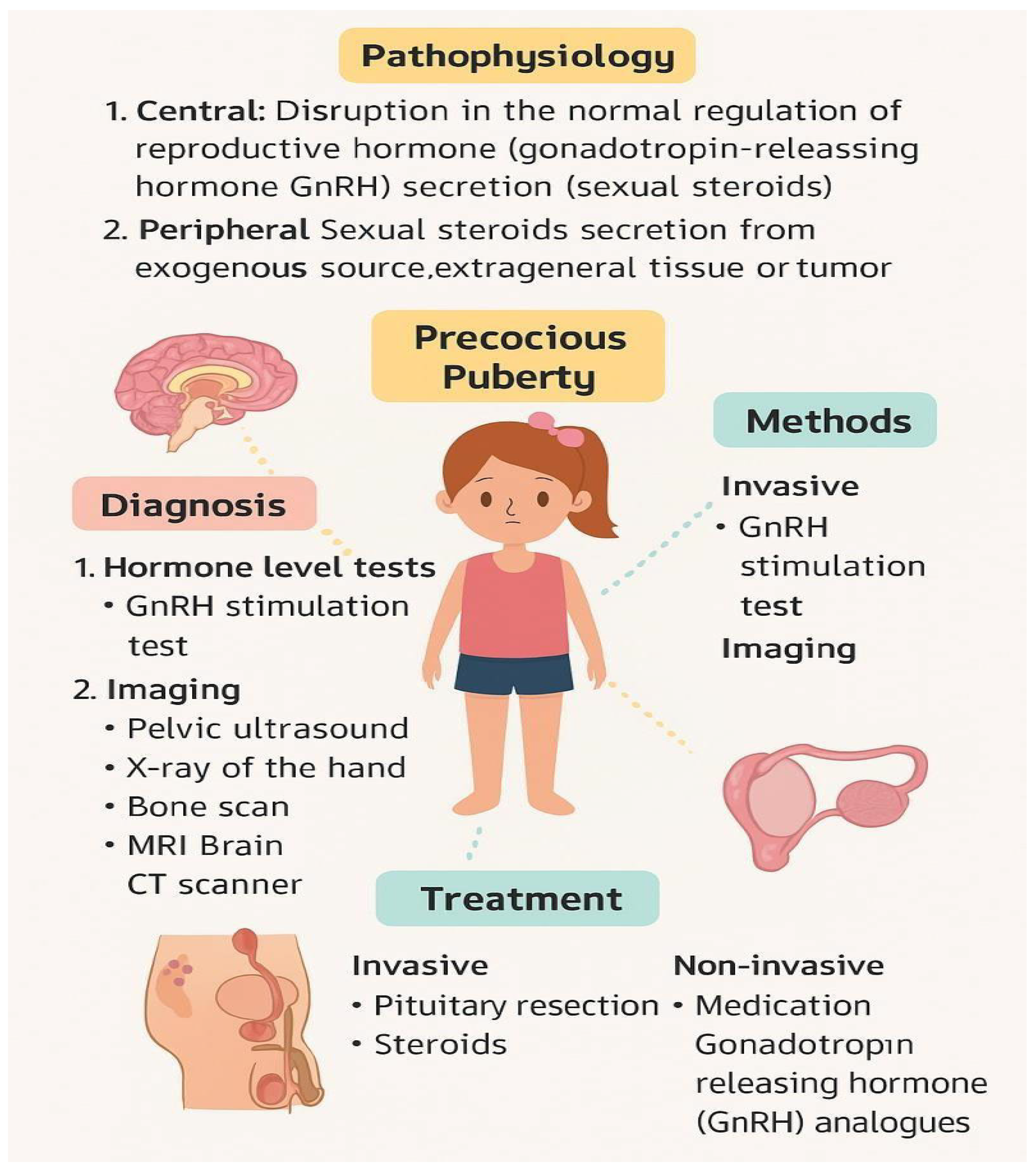
When embedded within clinical, school-based, or mobile health (mHealth) platforms, AI-enabled early-warning systems have the potential to shift PP care from reactive diagnosis to proactive risk stratification, early screening, and targeted prevention [8]. Figure 1 illustrates the pathophysiology of precocious puberty and key hormonal pathways underlying early pubertal activation.
The following sections examine how AI can be applied across key domains, diet and obesity (Section 2), lifestyle factors and wearables (Section 3), environmental exposures (Section 4), and clinical endocrine data (Section 5) to enhance early detection and management of precocious puberty.

3. Role of Diet, Nutrition, and Body Weight in Pubertal Timing

Puberty represents a critical developmental window characterized by activation of the hypothalamic–pituitary–gonadal (HPG) axis and the emergence of secondary sexual characteristics. Although genetic factors strongly influence pubertal timing, environmental and lifestyle determinants, particularly diet and body composition, are increasingly recognized as key modulators of pubertal onset [9]. Global shifts toward energy-dense diets and the rising prevalence of childhood obesity parallel observed trends toward earlier puberty. Understanding how nutrition and adiposity shape endocrine pathways is therefore essential for both clinical risk assessment and public health strategies, and artificial intelligence (AI) offers new tools to analyze these complex, interacting influences.

3.1. High Body Mass Index and Early Thelarche

Childhood obesity is a well-established factor associated with earlier pubertal onset, particularly in girls. Premature thelarche may represent an early manifestation of central precocious puberty (CPP) and is strongly linked to elevated body mass index (BMI) [10]. Adipose tissue functions as an endocrine organ, secreting leptin and other adipokines; leptin, in particular, can stimulate GnRH secretion and promote earlier HPG-axis activation [11]. Longitudinal cohort studies consistently demonstrate that higher BMI trajectories correlate with more advanced pubertal staging compared with normal-weight peers [12].
In boys, the relationship between adiposity and pubertal timing is more heterogeneous. Some studies suggest that excess adiposity may delay puberty through increased aromatization of androgens to estrogens, whereas others implicate leptin and insulin signaling in accelerating pubertal progression in both sexes [13]. These mixed findings highlight the limitations of single-variable risk assessment and underscore the need for integrative, data-driven modeling approaches.
AI-based methods are beginning to address this complexity. In a study of Chinese girls, machine learning and deep learning models trained on combined clinical and lifestyle data identified high BMI, maternal menarcheal age, dietary patterns, and screen time as key predictors, with XGBoost achieving greater than 95% accuracy for CPP risk classification [14]. Such tools may enable earlier identification of high-risk children before overt pubertal signs emerge.
In summary, excess adiposity, particularly in girls, is strongly associated with early pubertal onset [15]. Through leptin, insulin, and inflammatory pathways, adipose tissue modulates HPG-axis activity. AI models that integrate BMI trajectories with dietary and hormonal profiles may support personalized early-risk prediction and timely lifestyle-based interventions.

3.2. Fast Food, High-Calorie Diets, and Animal Proteins

Diet quality is a major determinant of pubertal timing. High intake of energy-dense, nutrient-poor foods, including fast foods, sugar-sweetened beverages, and diets rich in saturated fats, is associated with weight gain and metabolic dysfunction that can influence pubertal onset [9]. High consumption of animal-derived proteins during childhood has been linked to earlier puberty, likely mediated through increased insulin-like growth factor-1 (IGF-1) levels. In contrast, plant-forward diets rich in fiber and phytoestrogens have been associated with modest delays in pubertal timing.
Diet influences endocrine regulation through multiple pathways, including estrogen metabolism, gut microbiota composition, and systemic inflammation. AI models are increasingly used to disentangle these complex interactions. Machine learning applied to large-scale dietary and hormonal datasets can identify dietary patterns most strongly associated with early versus delayed puberty [9,16].
AI-driven models can perform the following:
  • Cluster children into dietary phenotypes (e.g., fast-food–dominant or plant-based) and estimate relative risk;
  • Quantify how caloric intake and macronutrient composition affect IGF-1, leptin, insulin, and sex-steroid levels;
  • Support tailored nutritional guidance targeting modifiable dietary risk factors.
Overall, calorie-dense, animal-protein–rich diets tend to promote earlier pubertal onset, whereas high-fiber, plant-based dietary patterns may delay it. AI facilitates the detection of subtle nutritional signatures and simulation of dietary effects, informing both clinical prevention strategies and population-level interventions.

3.3. Gut Microbiome and Puberty

The gut microbiome plays a significant role in metabolism, immunity, and endocrine function, and emerging evidence suggests that it may influence pubertal timing [17]. Diet is a primary determinant of microbial composition: high-fiber diets promote short-chain fatty acid–producing taxa, whereas Western dietary patterns favor dysbiosis [18].
Children with obesity frequently exhibit reduced microbial diversity and elevated Firmicutes-to-Bacteroidetes ratios, contributing to enhanced energy harvest, systemic inflammation, and altered leptin and estrogen signaling factors implicated in precocious puberty (PP) [19]. Certain microbial taxa express β-glucuronidase enzymes capable of deconjugating estrogens, thereby modifying circulating sex-hormone levels and potentially influencing pubertal progression [20].
AI methods, including random forests, support vector machines, and deep learning, have been effective in classifying disease states using microbiome data and identifying taxa associated with early or late pubertal phenotypes [21]. However, key challenges remain, including heterogeneous sequencing pipelines, dietary and geographic variability, and limited longitudinal pediatric datasets. As larger and more harmonized cohorts become available, AI-enabled microbiome analysis may support risk stratification and guide targeted dietary or probiotic interventions.

3.4. AI in Predicting Pubertal Timing: Opportunities and Pitfalls

Across BMI, diet, and microbiome domains, AI offers substantial potential for predicting pubertal timing from multidimensional datasets. Machine learning algorithms can capture nonlinear interactions among genetic, clinical, environmental, and behavioral factors that are difficult to model using traditional statistical approaches [13]. However, several limitations persist.
Models trained on homogeneous populations may exhibit bias and limited generalizability, while many systems remain at proof-of-concept stages without robust clinical validation. In addition, low interpretability, particularly in complex deep learning architectures, may reduce clinician trust and hinder adoption [15].
Future research must emphasize transparent model development, demographic representativeness, rigorous external validation, and seamless integration into clinical workflows. Strong collaboration among clinicians, data scientists, and public health experts is essential to ensure that AI systems support rather than replace clinical judgment.

3.5. Available Datasets and Future Directions

Large datasets such as NHANES, CHNS, and EYHS provide extensive information on diet, anthropometry, and pubertal milestones [9], forming a strong foundation for AI model development. Future research priorities include the following:
  • Increasing representation of under-studied regions and socioeconomic groups;
  • Incorporating longitudinal tracking of diet, BMI, and pubertal development;
  • Integrating multi-omics data (genomics, metabolomics, microbiome) with lifestyle and environmental variables;
  • Incorporating real-time data from wearables and mobile health tools.
These integrated datasets will be critical for developing robust, clinically actionable AI models that support early, personalized interventions for children at risk of precocious puberty [10].

4. Impact of Lifestyle Factors on Pubertal Timing: Screen Time, Stress, and Physical Activity

Lifestyle factors, including digital media use, sleep patterns, physical activity, and psychosocial stress, are increasingly implicated in pubertal timing. Excessive screen time, particularly during evening hours, can suppress melatonin secretion, disrupt circadian rhythms, reduce physical activity, and promote weight gain. When combined with heightened psychological stress and evolving social behaviors, these factors may accelerate HPG-axis activation and increase the risk of precocious puberty [11].

4.1. Importance of Understanding Digital and Lifestyle Drivers of Precocious Puberty

Early pubertal onset is associated with higher rates of anxiety, depression, and body-image concerns. Digital behaviors—such as prolonged screen exposure, social media engagement, and peer comparison—can amplify psychological stress during a sensitive developmental period [22]. Increased screen time has also been linked to musculoskeletal complaints, headaches, weight gain, and reduced quality of life in children and adolescents [22,23].
From a neuroendocrine perspective, evening exposure to blue light and irregular sleep schedules suppresses melatonin secretion, a natural inhibitor of GnRH release. Sedentary behavior further contributes to adiposity, elevating leptin and pro-inflammatory cytokines that may stimulate GnRH pathways. Because the HPA and HPG axes are interconnected, chronic stress and poor sleep quality may converge to accelerate pubertal onset through overlapping hormonal mechanisms [22].

4.2. What the Existing Literature Shows

Epidemiologic and observational studies consistently demonstrate associations between sedentary behavior, sleep disruption, psychosocial stress, and earlier pubertal timing. One analysis reported an increased risk of early pubertal onset associated with high sedentary time (odds ratio 1.428; 95% CI 1.087–1.876) [22].
Large-scale evaluations of school phone bans suggest that isolated restrictions often fail to meaningfully improve physical activity, sleep duration, or mental health outcomes, indicating the need for more nuanced and continuous behavior-monitoring approaches [23,24]. Pew Research Centre data indicate that 46% of teenagers are online “almost constantly,” with higher rates of anxiety and depression observed among heavy social media users [24].
Sleep–stress interactions further contribute to endocrine vulnerability. Studies demonstrate that flatter diurnal cortisol slopes and elevated pre-sleep cortisol levels are associated with shorter sleep duration, reduced sleep efficiency, and dysregulated stress responses [25]. Adolescents with depression report poorer subjective sleep quality and prolonged sleep latency despite similar cortisol awakening responses compared with healthy peers [22]. During the COVID-19 pandemic, Indian school-aged children exhibited marked increases in screen time, with potential neurochemical consequences—such as dopamine and serotonin dysregulation—that may indirectly influence pubertal timing [23]. Although causal pathways remain under investigation, these findings highlight how rapid lifestyle changes can alter endocrine risk profiles.

4.3. AI-Integrated Wearables in Monitoring Early Puberty Risk

The multifactorial nature of precocious puberty—encompassing diet, stress, digital behaviors, sleep, genetics, and environmental exposures—limits the effectiveness of traditional cross-sectional clinic-based assessments. AI-integrated wearables and digital health platforms help address this gap by enabling continuous, real-time monitoring. Devices such as smartwatches, fitness trackers, smart rings, and medical-grade biosensors can capture heart rate, heart rate variability, sleep stages, physical activity, and stress-related proxies [26].
AI models applied to wearable data can perform the following:
  • Detect subtle circadian disruptions, changes in sleep architecture, or sustained reductions in heart rate variability that may precede overt hormonal disturbances [27];
  • Identify behavioral patterns—such as late-night screen use or persistently low activity levels—that cluster in children at higher risk of obesity and early puberty [28];
  • Generate composite risk scores integrating biometric signals with self-reported mood, stress, and symptoms to flag concerning trends [29].
Emerging platforms—including AI-enabled hospital-at-home solutions and remote monitoring ecosystems—already employ predictive models to forecast hospitalization risk, detect arrhythmias, or identify sleep disorders [28,29]. Adapting similar frameworks to pediatric endocrinology could enable earlier identification of pubertal risk trajectories and support timely lifestyle interventions before irreversible pubertal advancement occurs.
Wearable and mobile AI technologies are increasingly used to track continuous physiological and behavioral signals in children and adolescents. A scoping review by Welch et al. examined mobile and wearable AI applications in child and adolescent mental health, highlighting the use of heart rate, activity, and sleep data for early behavioral risk detection [30]. Li et al. demonstrated that heart rate variability (HRV) derived from wearables serves as a non-invasive marker of autonomic balance and stress in everyday life [31]. Other longitudinal studies have tracked adolescents over weeks to months using wrist-worn devices and daily diaries, characterizing interactions among sleep, stress, pre-sleep worry, mood, and activity in free-living conditions [32]. Additional work has explored smart wearables for child behavioral health, using physiological signals to detect early anxiety and depression in real time [33]. From an endocrine perspective, multi-sensor wearable data—including heart rate, HRV, temperature, and light exposure—have been used with machine learning models to approximate dim-light melatonin onset, providing non-invasive proxies of circadian timing [34]. Digital biomarker research further suggests that HRV may serve as an indicator of psychosocial stress and mood symptoms in adolescents and young adults, with potential relevance to pubertal-risk phenotypes [35].
Despite these advances, most wearable-based AI studies focus on mental health or sleep rather than directly on precocious puberty. Pubertal staging and GnRH or LH outcomes are rarely collected alongside wearable data; sample sizes are modest, follow-up durations are short, and cohorts are often drawn from high-income settings, limiting generalizability. Future studies should prioritize longitudinal designs that jointly track wearable-derived signals, mood, BMI, screen time, and pubertal staging, and develop AI models capable of identifying latent risk trajectories for early puberty rather than focusing exclusively on mental health endpoints.

4.4. Mobile Health (mHealth) Applications and Smart Monitoring Systems

Mobile health applications and app–wearable ecosystems provide scalable tools for tracking daily lifestyle behaviors in adolescents. These platforms can capture screen time and app usage patterns, sleep duration and latency, physical activity and sedentary episodes, self-reported mood and stress, and time-stamped symptoms suggestive of pubertal changes [36,37]. By aggregating these data over weeks to months, mHealth systems generate longitudinal profiles that complement clinic-based assessments, which typically offer only brief snapshots of behavior and physiology [38].
AI models can benchmark these trajectories against established growth and developmental standards to identify deviations suggestive of early pubertal progression [29]. With continuous monitoring, clinicians may be alerted to concerning trends—such as rapidly increasing BMI, persistently short sleep duration, or abrupt declines in physical activity—well before such patterns are evident during routine visits [36]. These data streams can also support tailored behavioral interventions, including sleep hygiene protocols, screen-time restructuring, and activity goals, and inform decisions regarding the timing of endocrine evaluation or imaging.
At present, no published study has used combined mHealth and AI approaches specifically to predict or monitor precocious puberty. Existing applications primarily target mental health, obesity, insomnia, or general wellness, and the resulting data streams remain siloed and infrequently integrated with electronic health records or endocrine assessments. Future work should prioritize deploying mHealth tools in children undergoing evaluation for advanced puberty or CPP, linking behavioral data with hormone panels, bone age, and imaging, and training machine learning models to identify combined risk profiles—such as high screen time, poor sleep quality, and rising BMI—that may precede early pubertal milestones.

5. Environmental Exposures and Endocrine Disruptors

5.1. Key Endocrine-Disrupting Chemicals: BPA, Phthalates, Pesticides, and Cosmetic Compounds

Endocrine-disrupting chemicals (EDCs) are exogenous compounds that interfere with hormone synthesis, secretion, transport, receptor binding, or metabolism. The most extensively studied EDCs in relation to childhood development and pubertal timing include bisphenol A (BPA), phthalates, parabens, phenols, and a range of agricultural pesticides [39,40,41,42,43].
Bisphenol A (BPA), commonly found in polycarbonate plastics, epoxy resins, and food-can linings, acts as an estrogen mimic and has been associated with precocious puberty and obesity in children [39,40].
Phthalates, widely used as plasticizers in toys, packaging, and personal care products, are linked to altered pubertal timing and reproductive hormone imbalance in both boys and girls [40,41,42,44].
Parabens and phenols, present in cosmetics, shampoos, and deodorants, function as xenoestrogens capable of disrupting hypothalamic–pituitary–gonadal (HPG) axis signaling [41,42].
Pesticides, including organophosphates and pyrethroids, may disturb thyroid hormone homeostasis and reproductive development, with downstream implications for pubertal timing [43,45,46].
Children are exposed to EDCs via ingestion, inhalation, and dermal absorption during critical developmental windows. Although individual exposures are often low, the cumulative impact of chronic, multi-chemical exposure is increasingly recognized as a major determinant of endocrine health. Common EDCs, their everyday sources, and associated pediatric health outcomes are summarized in Table 1.

5.2. Household and Industrial Pollutants in Hormonal Disruption

Domestic environments represent major sources of EDC exposure through food packaging, vinyl flooring, cleaning agents, indoor air, and settled dust. These exposures are compounded by industrial pollutants originating from factories, waste sites, and agricultural runoff that contaminate water supplies and food chains [39,44]. Children are particularly vulnerable due to frequent hand-to-mouth behavior, smaller body size, and immature detoxification systems [39,44,45].
Biomonitoring studies measuring urinary metabolites of BPA and phthalates have linked prenatal and early postnatal exposure to altered timing of pubertal milestones [44,45]. Many EDCs are lipophilic and bioaccumulative, meaning that chronic low-level exposure can exert endocrine effects even when individual measurements appear “low,” complicating traditional exposure-assessment strategies.

5.3. Regional and Socioeconomic Differences in Exposure

Exposure to EDCs is unevenly distributed across populations, reflecting socioeconomic and geographic gradients that place disproportionate burdens on specific communities [43,45]. Lower socioeconomic status is frequently associated with residence near industrial zones or major traffic corridors, greater reliance on inexpensive and highly processed foods, and limited access to safer consumer products and environmental health information.
Urban populations may experience higher indoor air pollution, denser traffic-related exposures, and more frequent cosmetic and plastic use, whereas rural communities may face higher pesticide loads from agricultural activities and water contamination [41,42,43,45]. Meta-analyses suggest that these exposure disparities contribute to inequalities in pubertal timing and other endocrine disorders [45], underscoring the need for region-specific regulation, environmental health education, and targeted public-health interventions.

5.4. AI in Environmental Surveillance and Exposure Modeling

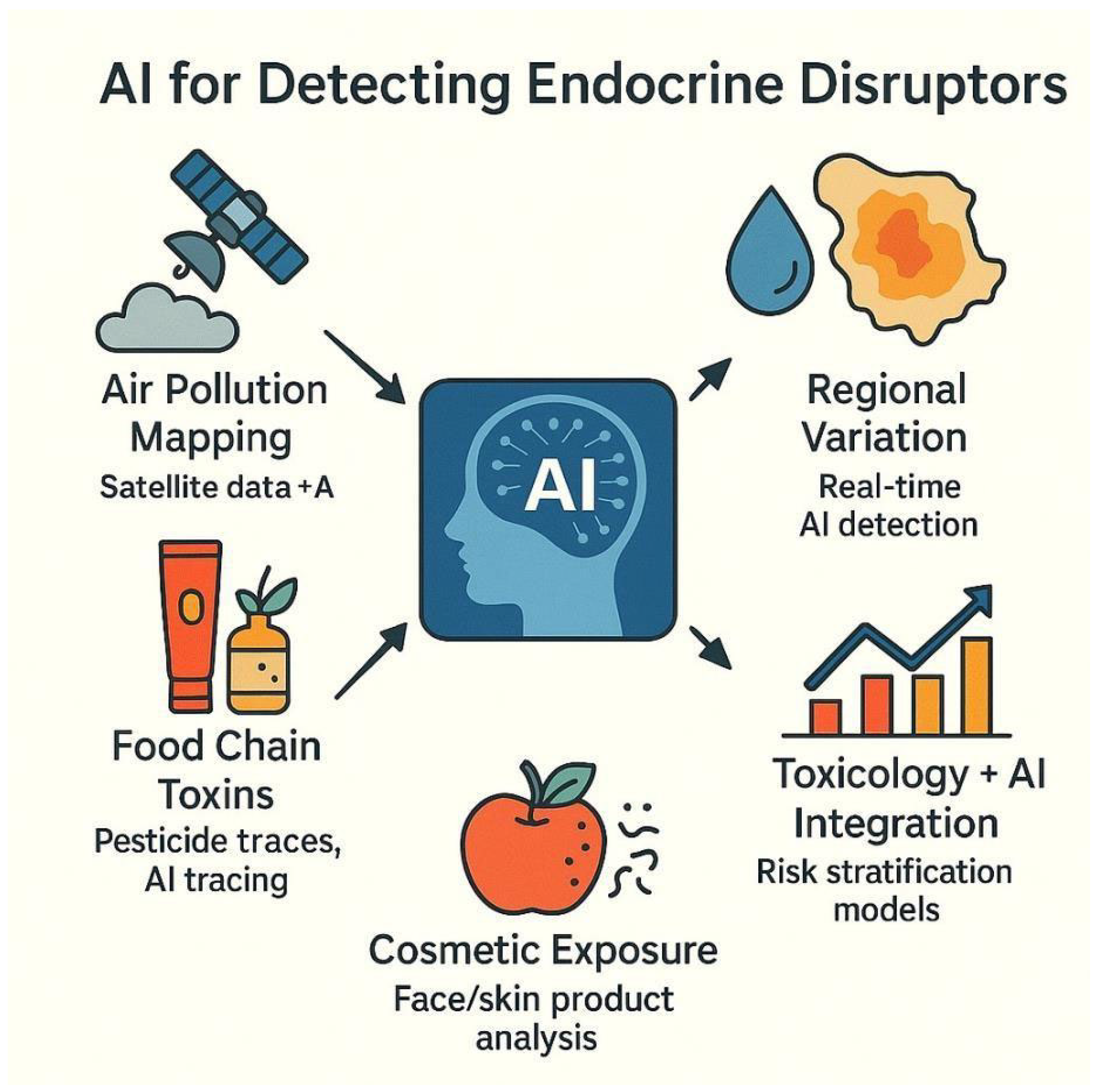
Artificial intelligence has substantial potential to transform environmental health surveillance, particularly for mapping EDC exposure and identifying susceptible pediatric populations. Satellite-based remote sensing combined with machine learning can detect land-use changes, industrial emissions, and pesticide-application hotspots [39]. When integrated with ground-level sensor networks and geographic information systems (GIS), these approaches enable high-resolution, near-real-time monitoring of air and water quality [46].
Recent overviews highlight the rapid expansion of machine learning in environmental chemical research and its ability to link environmental contamination with human health outcomes at scale [47,48]. Within this context, AI enables a transition from coarse population-level exposure estimates to refined, spatially and temporally resolved exposure maps that can be paired with pediatric endocrine outcomes.
Machine learning models can generate high-resolution exposure surfaces, detect spatiotemporal pollutant trends, forecast exposure peaks, and correlate environmental metrics with endocrine-related outcomes. Hybrid ensemble approaches combined with SHAP-based interpretation have been used to quantify the health impact of synthetic agrochemicals, illustrating how AI can support both risk prediction and mechanistic insight [49].
Mobile and wearable environmental sensors linked to AI platforms further enable individualized exposure profiling by capturing variation in air pollution, temperature, and chemical exposure [39,46]. When integrated with health records and developmental trajectories, these data streams can identify early risk signals for endocrine disruption and precocious puberty (PP), bridging the gap between environmental monitoring and clinical phenotypes. Epidemiologic evidence already demonstrates that exposure to phthalates, BPA, phenols, and parabens alters pubertal timing and bone maturation, providing a strong biological rationale for integrating AI-based exposure modeling with pubertal endpoints [50,51,52,53].
Despite rapid progress, most AI-environmental studies continue to prioritize respiratory, cardiovascular, or mortality outcomes rather than endocrine-specific endpoints or pubertal timing. Individual-level biomonitoring data remain sparse and are rarely integrated with AI exposure models at scale, limiting direct linkage between predicted exposure and PP risk [50,51,54].

5.5. Integration of AI and Toxicology for Risk Prediction

While Section 5.4 focuses on where and how much exposure occurs, integrating AI with toxicological data addresses what these exposures mean biologically, providing a complementary layer of mechanistic and risk-based insight. Together, AI-enhanced environmental mapping and AI-driven toxicology form a complete pipeline linking environmental contamination to endocrine outcomes, including PP.
Machine learning models can analyze multidimensional toxicological inputs—such as chemical structures, dose–response curves, biomonitoring data, and clinical outcomes—to predict toxicity profiles and rank chemicals by endocrine-disrupting potential [39,46]. Recent advances include ML-based high-throughput screening tools that classify compounds as estrogenic or androgenic disruptors and prioritize them for regulatory assessment [55], as well as explainable AI frameworks that visualize molecular substructures driving endocrine activity as “toxic alerts” [55,56].
Broader reviews of in silico endocrine-activity prediction highlight the role of QSAR models, deep learning, and hybrid approaches in early hazard identification for hormone-active chemicals [57,58]. Predictive toxicology models can also simulate mixture effects of multiple EDCs, identify vulnerable subgroups, and reduce reliance on animal testing through in silico evaluation. Machine learning methods have been applied to examine combined toxicity and mixture effects and to link exposure patterns with complex endpoints such as gestational age and cardiovascular disease risk [59,60,61].
AI-driven geospatial and toxicological models further enable correlation of regional EDC emission patterns with PP prevalence, childhood obesity, and other endocrine disorders, supporting early-warning systems and informing regulatory decision-making. Recent perspectives on endocrine disease endpoints and chemical mixtures emphasize moving beyond single-compound paradigms, a shift that AI is uniquely positioned to operationalize by managing high-dimensional mixture data [54,62].
Looking ahead, integration of multi-omics data represents a critical frontier. Linking AI-predicted chemical toxicity profiles with puberty-related biomarkers—including GnRH, LH/FSH, estradiol or testosterone, kisspeptin, and epigenetic signatures of HPG-axis genes—could refine individual-level risk prediction and identify children at the highest risk for environmentally driven PP [51,63].
In summary, AI-enhanced environmental surveillance (Section 5.4) and AI-integrated toxicology (Section 5.5) together provide a two-tiered framework: the first defines who is exposed and where, while the second clarifies how those exposures translate into endocrine risk. This integrated approach is essential for constructing mechanistically informed PP prediction models that incorporate environmental drivers alongside diet, lifestyle, and clinical endocrine data. These applications are summarized in Figure 2.

6. Integrated Applications of Artificial Intelligence in Pediatric Endocrinology and Precocious Puberty

Artificial intelligence (AI) is reshaping pediatric endocrinology by enhancing diagnostic precision, enabling earlier detection of endocrine disorders, and supporting personalized treatment pathways. Machine learning (ML) models—including Random Forest, XGBoost, Convolutional Neural Networks (CNNs), and Recurrent Neural Networks (RNNs)—can process high-dimensional data spanning clinical variables, imaging studies, bone age (BA) assessments, growth charts, lifestyle behaviors, and hormone profiles. In the context of precocious puberty (PP), these systems facilitate detection of subtle deviations in growth and pubertal trajectory, reduce dependence on invasive GnRH stimulation testing, and support clinical decision-making through interpretable and reproducible analytics [64]. To improve interpretability and avoid overstatement of clinical readiness, the AI systems reviewed in this section can be broadly categorized according to their level of clinical maturity:
(1)
Clinically deployed tools, such as BoneXpert for automated bone age assessment;
(2)
Clinically validated but non-deployed models, including hormone-based and imaging-augmented CPP classifiers supported by internal or limited external validation; and
(3)
Experimental or pilot systems, such as wearable-based, lifestyle, and environmental AI models, which demonstrate conceptual promise but currently lack endocrine-specific endpoints, large-scale validation, or prospective clinical evaluation.
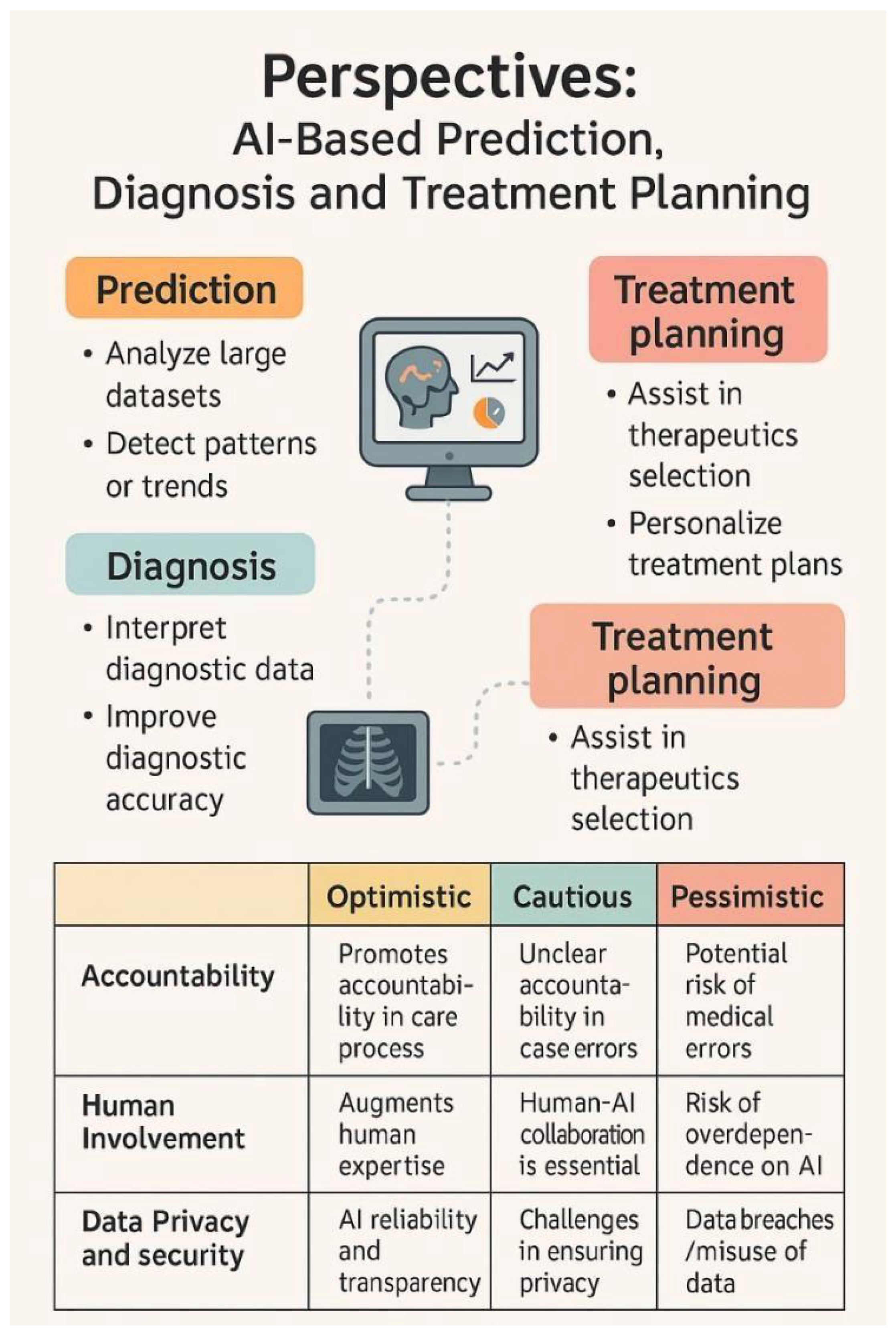
This classification provides essential context for interpreting reported performance metrics and clinical applicability across the reviewed studies. Figure 3 provides an overview of key clinical touchpoints where artificial intelligence can augment decision-making across the screening, diagnostic, and longitudinal monitoring phases of precocious puberty management.

6.1. AI for Childhood Obesity and Early Puberty Prevention

Childhood obesity is a major upstream risk factor for precocious puberty (PP), particularly among girls, and AI has emerged as a powerful tool for predicting, monitoring, and modifying obesity-related risk trajectories. Traditional ML models trained on electronic health record (EHR) data have demonstrated a strong ability to forecast BMI categories and support targeted preventive interventions. Subsequent studies employing data-mining and machine-learning techniques, including work by Lazarou et al. (2012) [65] and Pochini et al. (2014) [66], demonstrated improved lifestyle-based obesity risk stratification in pediatric and adolescent populations. More advanced architectures—particularly deep learning models such as Long Short-Term Memory (LSTM) recurrent neural networks—enable longitudinal modeling by integrating socioeconomic, behavioral, and lifestyle variables, thereby improving predictive robustness in childhood obesity risk assessment [67].
Recent literature has expanded obesity-focused AI applications relevant to PP prevention. AI-supported obesity management programs have demonstrated improved personalization of risk prediction and intervention strategies in children [68]. Ensemble and deep learning models further enhance childhood obesity risk stratification and early identification of modifiable risk factors [69]. One machine learning study showed that adolescent BMI can be accurately predicted using daily behaviors such as diet, physical activity, and screen time, enabling scalable, low-cost community screening approaches [70]. Interventional studies demonstrate that digital and gamified exergame programs significantly improve fitness and body composition in adolescents with obesity [71], while meta-analytic evidence confirms modest improvements in BMI and physical activity following exergame-based behavior-change interventions [72]. Earlier trials also showed that home-based exergaming reduces adiposity and improves cardiometabolic profiles in overweight children [73]. Additional work highlights the role of serious games, wearable AI technologies, and virtual reality–based interventions in improving motor competence and physical fitness among children with overweight and obesity [74].
Collectively, AI-supported interventions—including gamified programs, exergames, and personalized lifestyle guidance—promote healthier behaviors and reduce BMI, offering a plausible pathway for delaying or preventing early activation of the hypothalamic–pituitary–gonadal (HPG) axis. While obesity and BMI are not equivalent to precocious puberty, they represent biologically plausible upstream risk factors and early warning signals in the absence of large-scale AI studies with direct pubertal endpoints. By supplementing clinical decision-making and enabling proactive behavioral intervention, these systems hold potential to reduce PP incidence and improve long-term endocrine and metabolic outcomes [75].
Despite encouraging results, important gaps remain. Most AI-based obesity studies use BMI or metabolic outcomes as endpoints, while pubertal timing is rarely measured directly. Sample sizes are often modest, follow-up periods are short, and integration of endocrine-disrupting chemical (EDC) exposure, sleep disruption, digital behavior, or psychosocial stress remains limited. Consequently, current models capture obesity risk more robustly than pubertal risk per se.
Future research should prioritize longitudinal, multimodal AI pipelines linking early-life obesity trajectories with formal pubertal milestones and PP incidence. Integrating lifestyle behaviors, environmental exposures, sleep metrics, and psychological variables into unified risk frameworks could support proactive, personalized prevention strategies in pediatric endocrine practice. Key AI applications across obesity, bone age, hormonal modeling, imaging, and growth analytics are summarized in Table 2.

6.2. AI-Based Bone Age Assessment and Adult Height Prediction

AI-based bone age (BA) assessment has advanced substantially from early computer-assisted systems such as HANDX developed in the late 1980s to modern platforms like BoneXpert, introduced in 2008. BoneXpert applies active appearance models and convolutional neural networks to estimate skeletal maturity using Greulich–Pyle (GP) and Tanner–Whitehouse (TW) standards [76]. The system evaluates 13 hand and wrist bones and has demonstrated high reproducibility across pediatric populations, including children with short stature and precocious puberty.
Recent advances include enhanced CNN models incorporating contrast optimization to improve clinical accuracy [77], deep-learning systems combining bone age assessment with adult height prediction [78], Faster R-CNN–based frameworks for automated region detection and bone age estimation [79], and large-scale longitudinal modeling using datasets exceeding 96,000 children for height forecasting [80]. Additional machine-learning approaches have also demonstrated effective growth prediction in children with short stature [38]. Validation studies across pediatric clinical cohorts report strong concordance between AI-derived and expert manual bone age assessments. In this context, Pose Lepe et al. (2018) demonstrated high correlation coefficients (r = 0.91–0.93) and minimal mean differences (0.19 years; 95% CI: 0.13–0.25) between automated BoneXpert outputs and Greulich–Pyle readings in routine clinical practice [81].
Despite these advances, limitations persist. Many BA datasets lack ethnic, socioeconomic, and geographic diversity; few studies explicitly validate BA algorithms in children with PP; and deep learning systems often function as “black boxes,” limiting interpretability and clinician trust. Future work should emphasize explainable BA models that highlight bone regions driving advanced BA classification, leverage multicenter datasets, and integrate BA predictions with endocrine, imaging, and growth-trajectory data to support holistic pubertal risk modeling.

6.3. AI for Hormone-Level Prediction and CPP Diagnosis

Machine learning models integrating clinical features, pelvic ultrasound, bone age, and basal hormone levels offer a non-invasive, cost-efficient approach to diagnosing central precocious puberty (CPP), reducing reliance on GnRH stimulation testing. In a large Chinese retrospective cohort of 1757 girls with suspected CPP, Pan et al. developed XGBoost and Random Forest classifiers, achieving AUC values of 0.88–0.90, identifying basal LH, FSH, and IGF-1 as key predictors and using LIME to enhance interpretability [38]. Subsequent synthesis and validation across related studies support the robustness of machine-learning–based CPP prediction models, although heterogeneity in features and validation strategies persists [82,83].
Huynh et al. constructed and validated a 14-variable Random Forest model across cohorts in Taiwan and Vietnam, achieving an AUC of 0.972 with 96.6% sensitivity and 89.3% specificity, demonstrating improved diagnostic accuracy when bone age and pelvic ultrasound data are incorporated [83,84]. However, these high-performance metrics were primarily derived from retrospective datasets with limited external validation, and reporting of class imbalance and calibration performance was inconsistent, warranting caution when extrapolating results to broader pediatric populations. Pang et al. applied ML and deep learning approaches to identify high-importance contributors to early puberty, including BMI, family history, and lifestyle factors [84]. More recently, Tian et al. proposed an interpretable XGBoost model using four clinical and imaging features, with SHAP values providing transparent feature attribution for idiopathic CPP classification [85].
Comparative performance across algorithms suggests that model choice strongly depends on data structure and clinical context. Tree-based ensemble methods such as Random Forest and XGBoost consistently outperform linear models in CPP prediction tasks because they effectively capture non-linear interactions between hormone levels, growth parameters, and imaging-derived features. These models are particularly robust in moderate-sized, tabular clinical datasets and offer intrinsic feature-importance measures that enhance interpretability. In contrast, deep learning architectures such as recurrent neural networks (RNNs) and long short-term memory (LSTM) models are better suited for modeling longitudinal hormone trajectories and growth patterns but require larger datasets and careful regularization to avoid overfitting.
Collectively, these studies support ML as a robust adjunct for CPP diagnosis. However, most models are derived from East Asian cohorts, use heterogeneous feature sets, and rarely integrate lifestyle, environmental exposure, or digital-behavioral data. Future efforts should prioritize globally representative multicenter datasets and multimodal architectures to ensure generalizable, clinically implementable decision-support tools. Key performance metrics of representative AI-based models for predicting or diagnosing central precocious puberty across different populations are summarized in Table 3.

6.4. AI-Augmented Imaging: Clinical Study Evidence

AI-enhanced imaging has emerged as a key component of CPP evaluation, particularly through analysis of pelvic ultrasound, pituitary MRI, and bone age radiographs. Recent meta-analytic evidence indicates that convolutional neural network–based imaging models generally outperform traditional machine-learning approaches for CPP classification, demonstrating high diagnostic accuracy across imaging modalities [82].
Zou et al. developed a multimodal ML framework integrating pituitary MRI radiomics, bone age, and pelvic ultrasound features, significantly improving diagnostic precision and reducing reliance on invasive stimulation testing [86]. These findings align with broader evidence from recent meta-analytic work demonstrating high diagnostic performance of imaging-informed ML models for CPP [83].
Differences in algorithm performance across imaging studies reflect the underlying data modality. Convolutional neural networks (CNNs) consistently outperform traditional machine learning approaches such as support vector machines in imaging-based CPP classification because they are optimized for spatial feature extraction and hierarchical pattern recognition. CNNs are particularly effective in analyzing pelvic ultrasound and pituitary MRI, where subtle anatomical variations in uterine, ovarian, or pituitary morphology are clinically relevant. In contrast, non-deep learning models perform better when imaging features are manually extracted or reduced to structured inputs, but they lack the capacity to autonomously learn complex spatial representations.
Nevertheless, current pediatric imaging datasets remain limited in size and geographic diversity and are affected by protocol heterogeneity, including variation in MRI sequences and ultrasound acquisition parameters. Future research should focus on standardized multicenter imaging repositories, radiomics harmonization pipelines, and explainable AI systems capable of identifying anatomical features driving CPP predictions to ensure equitable and interpretable clinical deployment.

6.5. AI-Integrated Growth Chart Analysis for Early Detection of Precocious Puberty

Growth trajectories offer a sensitive window into pubertal tempo, making AI-enhanced growth-chart analytics a promising strategy for early PP detection. Rodriguez-Marin and Orozco-Alatorre developed an explainable logistic regression model trained on pediatric growth data that achieved 94.65% accuracy, 91.03% sensitivity, and an AUC of 0.96, using SHAP and LIME to maintain transparency [87,88]. This approach demonstrates how interpretable ML can be embedded into routine anthropometric monitoring to flag abnormal growth patterns suggestive of early puberty.
Complementing this work, Chun et al. developed an AI-based pediatric height prediction model using over 588,000 longitudinal measurements from 96,485 children, demonstrating high predictive accuracy and explainable feature importance across age groups [80]. Zhu et al. further validated ML-based short-term height prediction models in children receiving recombinant human growth hormone therapy, supporting individualized growth forecasting [89].
Together, these studies show that AI-driven growth analytics can detect subtle deviations in growth tempo that may precede or parallel pubertal advancement. However, most current models do not incorporate hormone levels or formal pubertal staging. Integrating growth curves with endocrine markers and imaging into unified longitudinal AI pipelines could enable dynamic, clinically actionable PP risk scoring.

6.6. Section Summary and Clinical Implications

This section highlights how artificial intelligence can integrate heterogeneous clinical, imaging, growth, and hormonal data to support earlier and less invasive identification of precocious puberty. Across obesity modeling, bone age assessment, hormone-level prediction, imaging analysis, and growth-trajectory monitoring, AI systems demonstrate strong potential to augment clinical decision-making and reduce reliance on GnRH stimulation testing. Importantly, these tools are most effective when applied longitudinally and interpreted within a multimodal clinical context rather than as standalone predictors. Despite encouraging performance metrics, current models remain limited by population bias, heterogeneous feature selection, and incomplete integration of lifestyle and environmental exposures. Collectively, these findings position AI as a complementary decision-support layer in pediatric endocrinology, underscoring the need for validated, interpretable, and clinically embedded systems before routine implementation.
Across reviewed studies, machine learning models for CPP and early puberty prediction demonstrate AUC values ranging approximately from 0.82 to 0.97, with reported sensitivities between 85–97% and specificities between 86–90%, depending on the data modality and model architecture. Sample sizes vary substantially, from fewer than 200 participants in prospective imaging-based studies to over 1700 participants in large retrospective hormone-based cohorts, and up to >90,000 children in growth-trajectory prediction models. However, many high-performing models were trained on retrospective, single-region datasets with limited external validation, and class imbalance was not consistently reported, raising concerns regarding generalizability across broader pediatric populations. Clinically deployed tools such as BoneXpert show consistent performance across populations, whereas multimodal hormone, imaging, and growth-based AI systems generally remain internally validated and investigational. This quantitative heterogeneity underscores the importance of contextualizing model performance alongside dataset size, validation strategy, and intended clinical use.
From a clinical standpoint, AI-assisted CPP models have the potential to reduce unnecessary GnRH stimulation testing, enable earlier referral to pediatric endocrinology, and shorten time to treatment initiation. By identifying high-risk children before overt pubertal progression, these tools may improve final adult height outcomes and reduce psychosocial burden for affected children and families. However, prospective, multi-center validation studies are still required to confirm real-world clinical benefit, cost-effectiveness, and impact on long-term outcomes before widespread clinical adoption.

7. Limitations and Challenges

Although artificial intelligence (AI) offers substantial promise for early detection and personalized management of precocious puberty (PP), several limitations must be addressed before widespread clinical adoption. These challenges are particularly pronounced in pediatric care, where ethical constraints, technical limitations, and clinical practicality intersect [88]. Key barriers include limited pediatric-specific datasets, model bias and overfitting, cost and access disparities, insufficient clinician technical literacy, and unresolved privacy concerns related to minors [89].

7.1. Limited Pediatric-Specific Datasets

Robust AI development for PP is constrained by the scarcity of large, diverse pediatric datasets. Similarly to challenges observed in pediatric oncology and neurology, small sample sizes and strict privacy regulations limit data availability and increase the risk of overfitting [90]. Because pediatric endocrine conditions are relatively rare, these constraints are further amplified, particularly when datasets are uniform or institution-specific [91]. Data isolation across institutions—driven by ethical and legal restrictions on sharing children’s health data—further reduces dataset diversity [92]. Existing pediatric AI research demonstrates imbalances across age, sex, and ethnicity, undermining generalizability and introducing bias [90,92]. Federated and multicenter learning approaches have been proposed to address these challenges by enabling collaborative model training without transferring raw data, thereby improving diversity while preserving privacy [91].

7.2. Model Bias, Overfitting, and Model Drift

Most reviewed studies relied primarily on internal validation strategies, such as k-fold cross-validation or random train-test splits. External validation across independent cohorts was uncommon, and only a minority of studies explicitly reported validation on temporally or geographically distinct datasets. In addition, few studies addressed potential data leakage, particularly in retrospective pediatric cohorts where repeated measurements, correlated imaging series, or longitudinal growth records may inadvertently appear in both training and validation sets, inflating reported performance metrics. These methodological limitations underscore the need for stricter validation protocols and transparent reporting standards in future AI studies on precocious puberty.
AI models trained on limited or non-representative pediatric datasets are vulnerable to bias and overfitting, reducing reliability when applied to new populations. Machine learning models developed using homogeneous cohorts may achieve high internal accuracy but fail to generalize across age groups, ethnicities, or geographic regions [93]. For example, CPP prediction models trained exclusively in Chinese cohorts highlight the risk of overfitting when external validation is lacking [94]. Such biases can compromise diagnostic accuracy and treatment planning, eroding clinician trust and clinical validity [89].
Notably, none of the reviewed CPP-specific AI studies formally evaluated algorithmic fairness or reported model performance stratified by age, ethnicity, sex, or socioeconomic status, representing a critical gap for clinical translation and regulatory approval.
An additional challenge is model drift, whereby predictive performance degrades over time as population-level trends in BMI, diet, environmental exposure, and lifestyle evolve. Given the sensitivity of pubertal timing to secular changes, CPP-related AI systems require periodic recalibration and retraining to maintain clinical relevance.

7.3. Cost and Access Barriers

Implementation of AI in pediatric endocrinology requires substantial investment in computational infrastructure, data storage, and workforce training. These costs pose significant barriers for healthcare systems in low-resource settings [85]. Limited internet connectivity and inadequate technical infrastructure further restrict deployment in rural and underserved regions, exacerbating inequities in access to AI-enabled care [95].

7.4. Technical Literacy Among Clinicians

The effectiveness of AI tools in clinical practice depends heavily on the clinician’s digital literacy. Many healthcare providers remain hesitant to adopt AI systems due to limited familiarity, opaque model behavior, and a lack of formal AI education during medical training [96,97,98]. Insufficient explainability further reduces clinician and parental trust—an especially critical issue in PP, where diagnostic decisions have long-term psychosocial implications. Integrating AI education into medical curricula, offering ongoing professional training, and fostering collaboration between clinicians and AI developers are essential to improve usability and clinical adoption [96,97].

7.5. Data Sharing and Privacy in Minors

AI applications in pediatric endocrinology involve sensitive health data from minors, raising substantial privacy and data-governance concerns. Ethical guidelines emphasize the need for age-appropriate consent and assent, coupled with robust safeguards for autonomy and confidentiality [92]. Privacy-by-design principles, as outlined under GDPR, are particularly relevant in pediatric contexts [99]. Federated learning offers a promising approach by enabling distributed model development without exposing raw data, though challenges in standardization and regulatory alignment remain [100]. Balancing data accessibility with stringent privacy protection continues to be a persistent and unresolved challenge. The major technical, ethical, and implementation challenges associated with AI applications in pediatric endocrinology, along with their clinical implications and proposed mitigation strategies, are summarized in Table 4.

8. Future Directions

Recent advancements in artificial intelligence (AI), especially machine learning (ML), have created exciting opportunities for improving diagnosis, risk assessment, and clinical decision support in pediatric healthcare. Previous research has shown that machine learning models can enhance diagnostic precision and prognostic evaluation for several pediatric illnesses by utilizing structured clinical data, imaging, and longitudinal health records [101]. Deep learning systems have demonstrated significant efficacy in pediatric diagnostic tasks, such as disease identification and outcome forecasting, underscoring its potential to facilitate earlier and more accurate clinical interventions [102]. Moreover, explainable AI methodologies may assist in identifying the most predictive clinical attributes, enhancing transparency and clinician confidence, an especially critical factor in pediatric decision-making. Although these advancements are promising, more validation across varied pediatric groups is necessary to assure generalizability, reduce bias, and facilitate the safe incorporation of AI technologies into standard pediatric care.
Building on the domain-specific advances discussed in earlier sections, future progress in artificial intelligence–enabled management of precocious puberty (PP) will depend on multimodal data integration, longitudinal validation, and close alignment with clinical and public-health workflows. Rather than isolated, single-domain models, the next phase of research must emphasize systems that reflect the biological and environmental complexity of pubertal development.

8.1. Multimodal AI and Personalised Preventive Care

Future PP management will increasingly rely on multimodal AI frameworks capable of integrating genomic and epigenomic signals, environmental exposures, lifestyle behaviors, growth trajectories, imaging features, and endocrine data to generate individualized risk profiles. Such systems have the potential to identify vulnerable children before overt clinical manifestations occur, enabling preventive interventions rather than reactive treatment. Multi-omics and automated machine-learning platforms further offer opportunities to translate complex biological data into clinically actionable insights, while lowering technical barriers for pediatric endocrinologists. Importantly, future research should prioritize longitudinal modelling that captures pubertal tempo over time rather than static, cross-sectional prediction.

8.2. Collaboration, Early Screening, and Public-Health Integration

AI-enabled mobile health platforms, wearable technologies, and environmental monitoring systems provide scalable tools for continuous assessment of behaviors and exposures relevant to pubertal timing. When validated specifically for PP and integrated with endocrine and growth data, these tools may support early identification of at-risk children and guide personalized lifestyle or environmental interventions. At the population level, AI-driven environmental surveillance and school- or community-based screening strategies could reduce delays in diagnosis and unnecessary specialist referrals.
Achieving these advances will require coordinated collaboration among pediatric endocrinologists, data scientists, environmental health researchers, ethicists, and policymakers. Future systems must be designed with strong privacy protections, bias mitigation strategies, and regulatory oversight to ensure equitable and trustworthy deployment. Integrating AI-based screening into public-health infrastructures represents a key opportunity to shift PP management toward prevention and population-level risk reduction.

9. Conclusions

This narrative review highlights the increasing role of artificial intelligence in enhancing the early detection, risk stratification, and personalized management of precocious puberty. By integrating heterogeneous data sources—including diet, lifestyle behaviors, environmental exposures, hormonal profiles, growth trajectories, imaging findings, and digital health signals—AI-driven approaches offer a pathway to move pediatric endocrinology from reactive diagnosis toward proactive, preventive care. Across multiple domains, machine learning and deep learning models demonstrate the capacity to enhance diagnostic precision, reduce reliance on invasive testing, and support individualized clinical decision-making.
Despite this promise, translation into routine practice remains constrained by limited pediatric datasets, population bias, privacy concerns, and uneven access to technical infrastructure. Ethical implementation requires developmentally appropriate consent processes, protection of sensitive pediatric data, transparent and interpretable algorithms, and sustained clinician oversight to preserve trust and accountability.
Looking ahead, progress will depend on longitudinal, multimodal AI systems validated across diverse pediatric populations and embedded within real-world clinical and public-health settings. Interdisciplinary collaboration and ethical governance will be essential to ensure that AI tools are equitable, clinically meaningful, and align with child-centered care. With continued innovation and careful implementation, artificial intelligence has the potential to become a foundational component of precision pediatric endocrinology, improving developmental and long-term health outcomes for children at risk of precocious puberty.

Author Contributions

M.C., S.P.C. and S.P.A. defined the review scope, context, and purpose of this study. M.C., S.T., D.D.J., K.B., N.B., R.K., K.C., G.Y., P.E., M.N.S., T.N., J.J., S.A., S.M.J.W., M.V., A.G., M.A.S. and S.P.C. conducted the literature review and drafted the manuscript. M.C. and S.P.A. conceived and crafted illustrative figures. K.G., D.S., S.R. and S.P.C. provided clinical perspectives and expertise for this study. All authors read and performed a critical review of the manuscript. M.C., S.P.C., S.S.K. and S.P.A. performed the cleaning and organization of the manuscript. S.P.A. provided conceptualization, supervision, and project administration. All authors have read and agreed to the published version of the manuscript.

Funding

This research received no external funding.

Institutional Review Board Statement

Not applicable.

Informed Consent Statement

Not applicable.

Data Availability Statement

This review was based on publicly available academic literature databases.

Acknowledgments

This work was supported by resources within the Digital Engineering and Artificial Intelligence Laboratory (DEAL), Department of Critical Care Medicine, Mayo Clinic, Jacksonville, FL, USA.

Conflicts of Interest

The authors declare no conflicts of interest.

References

  1. Teilmann, G.; Pedersen, C.B.; Jensen, T.K.; Skakkebæk, N.E.; Juul, A. Prevalence and Incidence of Precocious Pubertal Development in Denmark: An Epidemiologic Study Based on National Registries. Pediatrics 2005, 116, 1323–1328. [Google Scholar] [CrossRef] [PubMed]
  2. Carel, J.C.; Léger, J. Clinical practice. Precocious puberty. N. Engl. J. Med. 2008, 358, 2366–2377. [Google Scholar] [CrossRef] [PubMed]
  3. Kaplowitz, P.B. Link between body fat and the timing of puberty. Pediatrics 2008, 121, S208–S217. [Google Scholar] [CrossRef] [PubMed]
  4. Eckert-Lind, C.; Busch, A.S.; Petersen, J.H.; Biro, F.M.; Butler, G.; Bräuner, E.V.; Juul, A. Worldwide Secular Trends in Age at Pubertal Onset Assessed by Breast Development Among Girls: A Systematic Review and Meta-analysis. JAMA Pediatr. 2020, 174, e195881. [Google Scholar] [CrossRef]
  5. Brix, N.; Ernst, A.; Lauridsen, L.L.B.; Parner, E.T.; AArah, O.; Olsen, J.; Henriksen, T.B.; Ramlau-Hansen, C.H. Childhood overweight and obesity and timing of puberty in boys and girls: Cohort and sibling-matched analyses. Int. J. Epidemiol. 2020, 49, 834–844. [Google Scholar] [CrossRef]
  6. Stagi, S.; De Masi, S.; Bencini, E.; Losi, S.; Paci, S.; Parpagnoli, M.; Ricci, F.; Ciofi, D.; Azzari, C. Increased incidence of precocious and accelerated puberty in females during and after the Italian lockdown for the coronavirus 2019 (COVID-19) pandemic. Ital. J. Pediatr. 2020, 46, 165. [Google Scholar] [CrossRef]
  7. Al Kuwaiti, A.; Nazer, K.; Al-Reedy, A.; Al-Shehri, S.; Al-Muhanna, A.; Subbarayalu, A.V.; Al Muhanna, D.; Al-Muhanna, F.A. A Review of the Role of Artificial Intelligence in Healthcare. J. Pers. Med. 2023, 13, 951. [Google Scholar] [CrossRef]
  8. Manga, S.; Muthavarapu, N.; Redij, R.; Baraskar, B.; Kaur, A.; Gaddam, S.; Gopalakrishnan, K.; Shinde, R.; Rajagopal, A.; Samaddar, P.; et al. Estimation of Physiologic Pressures: Invasive and Non-Invasive Techniques, AI Models, and Future Perspectives. Sensors 2023, 23, 5744. [Google Scholar] [CrossRef]
  9. Gu, Q.; Wu, Y.; Feng, Z.; Chai, Y.; Hou, S.; Yu, Z.; Shen, X. Dietary pattern and precocious puberty risk in Chinese girls: A case-control study. Nutr. J. 2024, 23, 14. [Google Scholar] [CrossRef]
  10. Wei, Q.; Wu, M.; Li, Y.-L.; Rao, R.; Li, S.; Cen, Q.; Wu, H.; Lv, L.; Huang, M.; Ge, Y.-P.; et al. Physical deviation and precocious puberty among school-aged children in Leshan City: An investigative study. J. Int. Med. Res. 2020, 48, 300060520939672. [Google Scholar] [CrossRef] [PubMed] [PubMed Central]
  11. Akhter, N.; Johnson, B.W.; Crane, C.; Iruthayanathan, M.; Zhou, Y.-H.; Kudo, A.; Childs, G.V. Anterior pituitary leptin expression changes in different reproductive states: In vitro stimulation by gonadotropin-releasing hormone. J. Histochem. Cytochem. 2007, 55, 151–166. [Google Scholar] [CrossRef] [PubMed] [PubMed Central]
  12. He, F.; Guan, P.; Liu, Q.; Crabtree, D.; Peng, L.; Wang, H. The relationship between obesity and body compositions with respect to the timing of puberty in Chongqing adolescents: A cross-sectional study. BMC Public Health 2017, 17, 664. [Google Scholar] [CrossRef]
  13. Kim, S.H.; Park, M.J. Childhood obesity and pubertal development. Pediatr. Gastroenterol. Hepatol. Nutr. 2012, 15, 151. [Google Scholar] [CrossRef][Green Version]
  14. Jiang, H.; Shu, Z.; Luo, X.; Wu, M.; Wang, M.; Feng, Q.; Chen, J.; Lin, C.; Ding, Z. Noninvasive radiomics-based method for evaluating idiopathic central precocious puberty in girls. J. Int. Med. Res. 2021, 49, 300060521991023. [Google Scholar] [CrossRef] [PubMed]
  15. Nieuwenhuis, D.; Pujol-Gualdo, N.; Arnoldussen, I.A.C.; Kiliaan, A.J. Adipokines: A gear shift in puberty. Obes. Rev. 2020, 21, e13005. [Google Scholar] [CrossRef]
  16. Xiong, J.; Xu, Y.; Liu, X.; Wang, X.; Shan, S.; Crabbe, M.J.C.; Zhao, L.; Fang, H.; Cheng, G. Prospective association of dietary soy and fibre intake with puberty timing: A cohort study among Chinese children. BMC Med. 2022, 20, 145. [Google Scholar] [CrossRef] [PubMed] [PubMed Central]
  17. Qi, X.; Yun, C.; Pang, Y.; Qiao, J. The impact of the gut microbiota on the reproductive and metabolic endocrine system. Gut Microbes 2021, 13, 1894070. [Google Scholar] [CrossRef] [PubMed] [PubMed Central]
  18. Singh, R.K.; Chang, H.-W.; Yan, D.; Lee, K.M.; Ucmak, D.; Wong, K.; Abrouk, M.; Farahnik, B.; Nakamura, M.; Zhu, T.H.; et al. Influence of diet on the gut microbiome and implications for human health. J. Transl. Med. 2017, 15, 73. [Google Scholar] [CrossRef] [PubMed] [PubMed Central]
  19. Riva, A.; Borgo, F.; Lassandro, C.; Verduci, E.; Morace, G.; Borghi, E.; Berry, D. Pediatric obesity is associated with an altered gut microbiota and discordant shifts in Firmicutes populations. Environ. Microbiol. 2017, 19, 95–105. [Google Scholar] [CrossRef] [PubMed] [PubMed Central]
  20. Flores, R.; Shi, J.; Fuhrman, B.; Xu, X.; Veenstra, T.D.; Gail, M.H.; Gajer, P.; Ravel, J.; Goedert, J.J. Fecal microbial determinants of fecal and systemic estrogens and estrogen metabolites: A cross-sectional study. J. Transl. Med. 2012, 10, 253. [Google Scholar] [CrossRef] [PubMed] [PubMed Central]
  21. Chen, Y.; Wang, H.; Lu, W.; Wu, T.; Yuan, W.; Zhu, J.; Lee, Y.K.; Zhao, J.; Zhang, H.; Chen, W. Human gut microbiome aging clocks based on taxonomic and functional signatures through multi-view learning. Gut Microbes 2022, 14, 2025016. [Google Scholar] [CrossRef] [PubMed] [PubMed Central]
  22. Wu, X.; Wang, L.; Xue, P.; Tang, J.; Wang, H.; Kong, H.; Lin, C.; Chang, B.; Liu, S. Association of screen exposure/sedentary behavior and precocious puberty/early puberty. Front. Pediatr. 2024, 12, 1447372. [Google Scholar] [CrossRef] [PubMed] [PubMed Central]
  23. Gupta, S.; Sharma, P.; Shukla, A.; Rai, R.H.; Mittal, A. Impact of Increased Screen Time on Physical and Psychological Health of Indian Students During COVID-19. Biosc. Biotech. Res. Comm. 2021, 14, 1493–1500. [Google Scholar] [CrossRef]
  24. Haapala, E.A.; Leppänen, M.H.; Kosola, S.; Appelqvist-Schmidlechner, K.; Kraav, S.L.; Jussila, J.J.; Tolmunen, T.; Lubans, D.R.; Eloranta, A.M.; Schwab, U.; et al. Childhood Lifestyle Behaviors and Mental Health Symptoms in Adolescence. JAMA Netw. Open 2025, 8, e2460012. [Google Scholar] [CrossRef] [PubMed] [PubMed Central]
  25. Moitra, P.; Madan, J.; Verma, P. Independent and combined influences of physical activity, screen time, and sleep quality on adiposity indicators in Indian adolescents. BMC Public Health 2021, 21, 2093. [Google Scholar] [CrossRef] [PubMed] [PubMed Central]
  26. Colasante, T.; Faulkner, K.; Kharbotli, D.; Malti, T.; Hollenstein, T. Bidirectional Associations of Adolescents’ Momentary Social Media Use and Negative Emotions. Affect. Sci. 2024, 5, 300–309. [Google Scholar] [CrossRef] [PubMed] [PubMed Central]
  27. Yap, Y.; Tung, N.Y.C.; Shen, L.; Bei, B.; Phillips, A.; Wiley, J.F. Daily associations between salivary cortisol and electroencephalographic-assessed sleep: A 15-day intensive longitudinal study. Sleep 2024, 47, zsae087. [Google Scholar] [CrossRef] [PubMed] [PubMed Central]
  28. Krempel, R.; Jarvers, I.; Ecker, A.; Schleicher, D.; Brunner, R.; Kandsperger, S. Sleep quality and the cortisol and alpha-amylase awakening responses in adolescents with depressive disorders. BJPsych Open 2024, 10, e140. [Google Scholar] [CrossRef] [PubMed] [PubMed Central]
  29. Welch, V.; Wy, T.J.; Ligezka, A.; Hassett, L.C.; Croarkin, P.E.; Athreya, A.P.; Romanowicz, M. Use of Mobile and Wearable Artificial Intelligence in Child and Adolescent Psychiatry: Scoping Review. J. Med. Internet Res. 2022, 24, e33560. [Google Scholar] [CrossRef] [PubMed] [PubMed Central]
  30. Li, K.; Cardoso, C.; Moctezuma-Ramirez, A.; Elgalad, A.; Perin, E. Heart Rate Variability Measurement through a Smart Wearable Device: Another Breakthrough for Personal Health Monitoring? Int. J. Environ. Res. Public Health 2023, 20, 7146. [Google Scholar] [CrossRef]
  31. Menghini, L.; Yuksel, D.; Prouty, D.; Baker, F.C.; King, C.; de Zambotti, M. Wearable and mobile technology to characterize daily patterns of sleep, stress, presleep worry, and mood in adolescent insomnia. Sleep Health 2023, 9, 108–116. [Google Scholar] [CrossRef] [PubMed]
  32. Larsen, M.A.; Magnus, K.O. Smart Wearable Devices for Monitoring Child Behavioral Health. Proceeding Int. Conf. Inov. Sci. Technol. Educ. Child. Health 2024, 4, 204–209. [Google Scholar] [CrossRef]
  33. Lee, E. Wearable Technology in Circadian Rhythm Research: From Monitoring to Clinical Insights. Chronobiol. Med. 2025, 7, 3–8. [Google Scholar] [CrossRef]
  34. Taylor, M.R.; Bradford, M.C.; Zhou, C.; Fladeboe, K.M.; Wittig, J.F.; Baker, K.S.; Yi-Frazier, J.P.; Rosenberg, A.R. Heart Rate Variability as a Digital Biomarker in Adolescents and Young Adults Receiving Hematopoietic Cell Transplantation. Cancer Med. 2025, 14, e70609. [Google Scholar] [CrossRef] [PubMed] [PubMed Central]
  35. Birla, M.; Rajan, R.; Roy, P.G.; Gupta, I.; Malik, P.S. Integrating Artificial Intelligence- Driven Wearable Technology in Oncology Decision-Making: A Narrative Review. Oncology 2025, 103, 69–82. [Google Scholar] [CrossRef] [PubMed] [PubMed Central]
  36. Rukundo, K.; Rukundo, S.K. The Impact of Wearable Technology on Health Monitoring. Res. Inven. J. Public Health Pharm. 2024, 3, 5–8. [Google Scholar] [CrossRef]
  37. Weir, K. The risks of earlier puberty. Monit. Psychol. 2016, 47, 41–44. [Google Scholar]
  38. Pan, L.; Liu, G.; Mao, X.; Li, H.; Zhang, J.; Liang, H.; Li, X. Development of Prediction Models Using Machine Learning Algorithms for Girls with Suspected Central Precocious Puberty: Retrospective Study. JMIR Med. Inform. 2019, 7, e11728. [Google Scholar] [CrossRef] [PubMed] [PubMed Central]
  39. Di Pietro, G.; Forcucci, F.; Chiarelli, F. Endocrine Disruptor Chemicals and Children’s Health. Int. J. Mol. Sci. 2023, 24, 2671. [Google Scholar] [CrossRef]
  40. Calcaterra, V.; Cena, H.; Loperfido, F.; Rossi, V.; Grazi, R.; Quatrale, A.; De Giuseppe, R.; Manuelli, M.; Zuccotti, G. Evaluating Phthalates and Bisphenol in Foods: Risks for Precocious Puberty and Early-Onset Obesity. Nutrients 2024, 16, 2732. [Google Scholar] [CrossRef]
  41. Harley, K.G.; Berger, K.P.; Kogut, K.; Parra, K.; Lustig, R.H.; Greenspan, L.C.; Calafat, A.M.; Ye, X.; Eskenazi, B. Association of Phthalates, Parabens and Phenols Found in Personal Care Products with Pubertal Timing in Girls and Boys. Hum. Reprod. 2019, 34, 109–117. [Google Scholar] [CrossRef]
  42. Lee, J.E.; Jung, H.W.; Lee, Y.J.; Lee, Y.A. Early-life Exposure to Endocrine-Disrupting Chemicals and Pubertal Development in Girls. Ann. Pediatr. Endocrinol. Metab. 2019, 24, 78–91. [Google Scholar] [CrossRef]
  43. Zawatski, W.; Lee, M.M. Male Pubertal Development: Are Endocrine-Disrupting Compounds Shifting the Norms? J. Endocrinol. 2013, 218, R1–R12. [Google Scholar] [CrossRef]
  44. Berger, K.; Eskenazi, B.; Kogut, K.; Parra, K.; Lustig, R.H.; Greenspan, L.C.; Holland, N.; Calafat, A.M.; Ye, X.; Harley, K.G. Association of Prenatal Urinary Concentrations of Phthalates and Bisphenol A and Pubertal Timing in Boys and Girls. Environ. Health Perspect. 2018, 126, 97004. [Google Scholar] [CrossRef]
  45. Uldbjerg, C.S.; Koch, T.; Lim, Y.H.; Gregersen, L.S.; Olesen, C.S.; Andersson, A.M.; Frederiksen, H.; Coull, B.A.; Hauser, R.; Juul, A.; et al. Prenatal and Postnatal Exposures to Endocrine Disrupting Chemicals and Timing of Pubertal Onset in Girls and Boys: A Systematic Review and Meta-Analysis. Hum. Reprod. Update 2022, 28, 687–716. [Google Scholar] [CrossRef]
  46. Stanic, B.; Andric, N. Mapping the Rise in Machine Learning in Environmental Chemical Research: A Bibliometric Analysis. Toxics 2025, 13, 817. [Google Scholar] [CrossRef] [PubMed] [PubMed Central]
  47. Huang, L.; Duan, Q.; Liu, Y.; Wu, Y.; Li, Z.; Guo, Z.; Liu, M.; Lu, X.; Wang, P.; Liu, F.; et al. Artificial intelligence: A key fulcrum for addressing complex environmental health issues. Environ. Int. 2025, 198, 109389. [Google Scholar] [CrossRef]
  48. Singh, S.; Kaur, P.; Kaur, I.; Singh, G.; Kaur, S.; Kaur, P. A predictive framework using advanced machine learning approaches for measuring and analyzing the impact of synthetic agrochemicals on human health. Sci. Rep. 2025, 15, 15544. [Google Scholar] [CrossRef]
  49. Predieri, B.; Iughetti, L.; Bernasconi, S.; Street, M.E. Endocrine Disrupting Chemicals’ Effects in Children: What We Know and What We Need to Learn? Int. J. Mol. Sci. 2022, 23, 11899. [Google Scholar] [CrossRef]
  50. Sha, Y.; Jia, Y.; Wang, Q.; Zhang, B.; Li, X.; Liu, T. Impact of environmental endocrine disruptors on adolescent sexual development: A comprehensive review with a focus on specific chemicals. Discov. Appl. Sci. 2025, 7, 1236. [Google Scholar] [CrossRef]
  51. Huang, S.; Li, Z.; Wu, C.; Zhao, X.; Xiong, J.; Xiao, W.; Su, H.; Zheng, R.; Xu, Z.; Su, Q.; et al. Divergent effects of EDCs on bone maturation: Role of body mass index and puberty. Ecotoxicol. Environ. Saf. 2025, 302, 118525. [Google Scholar] [CrossRef]
  52. Rivera-Núñez, Z.; Kinkade, C.W.; Zhang, Y.; Rockson, A.; Bandera, E.V.; Llanos, A.A.M.; Barrett, E.S. Phenols, Parabens, Phthalates and Puberty: A Systematic Review of Synthetic Chemicals Commonly Found in Personal Care Products and Girls’ Pubertal Development. Curr. Environ. Health Rep. 2022, 9, 517–534. [Google Scholar] [CrossRef] [PubMed] [PubMed Central]
  53. Ahn, C.; Jeung, E.-B. Endocrine-Disrupting Chemicals and Disease Endpoints. Int. J. Mol. Sci. 2023, 24, 5342. [Google Scholar] [CrossRef]
  54. Collins, S.P.; Barton-Maclaren, T.S. Novel machine learning models to predict endocrine disruption activity for high-throughput chemical screening. Front. Toxicol. 2022, 4, 981928. [Google Scholar] [CrossRef]
  55. Rosa, L.C.S.; Sarhan, M.; Pimentel, A.S. Toxic Alerts of Endocrine Disruption Revealed by Explainable Artificial Intelligence. Environ. Health 2025, 3, 321–333. [Google Scholar] [CrossRef]
  56. Zorn, K.M.; Foil, D.H.; Lane, T.R.; Russo, D.P.; Hillwalker, W.; Feifarek, D.J.; Jones, F.; Klaren, W.D.; Brinkman, A.M.; Ekins, S. Machine Learning Models for Estrogen Receptor Bioactivity and Endocrine Disruption Prediction. Environ. Sci. Technol. 2020, 54, 12202–12213. [Google Scholar] [CrossRef] [PubMed] [PubMed Central]
  57. Lee, H.; Kim, J.; Kim, J.-W.; Lee, Y. Recent advances in AI-based toxicity prediction for drug discovery. Front. Chem. 2025, 13, 1632046. [Google Scholar] [CrossRef]
  58. Luan, H.; Zhao, H.; Li, J.; Zhou, Y.; Fang, J.; Liu, H.; Li, Y.; Xia, W.; Xu, S.; Cai, Z. Machine Learning for Investigation on Endocrine-Disrupting Chemicals with Gestational Age and Delivery Time in a Longitudinal Cohort. Research 2021, 2021, 9873135. [Google Scholar] [CrossRef] [PubMed] [PubMed Central]
  59. Hamid, N.; Junaid, M.; Pei, D.S. Combined toxicity of endocrine-disrupting chemicals: A review. Ecotoxicol. Environ. Saf. 2021, 215, 112136. [Google Scholar] [CrossRef] [PubMed]
  60. Yu, W.-M.; Chen, Y.-P.; Cheng, A.-L.; Zheng, Z.-Y.; Wang, J.-W.; Liu, X.-B.; Zhou, J.-X. Machine learning-driven prediction models and mechanistic insights into cardiovascular diseases: Deciphering the environmental endocrine disruptors nexus. J. Transl. Med. 2025, 23, 1272. [Google Scholar] [CrossRef]
  61. Gómez-Olarte, S.; Mailänder, V.; Castro-Neves, J.; Stojanovska, V.; Schumacher, A.; Meyer, N.; Zenclussen, A.C. The ENDOMIX perspective: How everyday chemical mixtures impact human health and reproduction by targeting the immune system. Biol. Reprod. 2024, 111, 1170–1187. [Google Scholar] [CrossRef]
  62. Peralta, M.; Lizcano, F. Endocrine Disruptors and Metabolic Changes: Impact on Puberty Control. Endocr. Pract. 2024, 30, 384–397. [Google Scholar] [CrossRef]
  63. Demir, A.; Aydin, A.; Büyükgebiz, A. Thematic Review of Endocrine Disruptors and Their Role in Shaping Pubertal Timing. Children 2025, 12, 93. [Google Scholar] [CrossRef]
  64. Dimitri, P.; Savage, M.O. Artificial intelligence in paediatric endocrinology: Conflict or cooperation. J. Pediatr. Endocrinol. Metab. 2024, 37, 209–221. [Google Scholar] [CrossRef] [PubMed]
  65. Lazarou, C.; Karaolis, M.; Matalas, A.L.; Panagiotakos, D.B. Dietary patterns analysis using data mining method. An application to data from the CYKIDS study. Comput. Methods Programs Biomed. 2012, 108, 706–714. [Google Scholar] [CrossRef] [PubMed]
  66. Pochini, A.; Wu, Y.; Hu, G. Data Mining for Lifestyle Risk Factors Associated with Overweight and Obesity among Adolescents. In Proceedings of the 2014 IIAI 3rd International Conference on Advanced Applied Informatics, Kokura, Japan, 31 August–4 September 2014; pp. 883–888. [Google Scholar] [CrossRef]
  67. Alghalyini, B. Applications of artificial intelligence in the management of childhood obesity. J. Fam. Med. Prim. Care 2023, 12, 2558–2564. [Google Scholar] [CrossRef] [PubMed] [PubMed Central]
  68. Huang, L.; Huhulea, E.N.; Abraham, E.; Bienenstock, R.; Aifuwa, E.; Hirani, R.; Schulhof, A.; Tiwari, R.K.; Etienne, M. The Role of Artificial Intelligence in Obesity Risk Prediction and Management: Approaches, Insights, and Recommendations. Medicina 2025, 61, 358. [Google Scholar] [CrossRef]
  69. Zhang, Z.; Peng, W.; Sun, S.; Zhang, F.; Sun, Y.; Huang, L. Development and Interpretation of a Machine Learning Model to Predict BMI in Chinese Adolescents. Front. Public Health 2025, 13, 1657551. [Google Scholar] [CrossRef]
  70. Frattolillo, V.; Massa, A.; Capone, D.; Monaco, N.; Forcina, G.; Di Filippo, P.; Marzuillo, P.; del Giudice, E.M.; Di Sessa, A. Integrating Digital Health into Pediatric Obesity Management. Obes. Pillars 2025, 16, 100189. [Google Scholar] [CrossRef]
  71. Li, S.J.; Ma, H.M.; Zhu, L.Q.; Yu, H.Y.; Wang, A.Q.; Tang, X.Y.; Pei, R.Y.; Piao, M.H. Exergame-Based Behavior Change Interventions for Promoting Physical Activity: Systematic Review and Meta-Analysis of Randomized Controlled Studies. J. Med. Internet Res. 2025, 27, e62906. [Google Scholar] [CrossRef] [PubMed] [PubMed Central]
  72. Staiano, A.E.; Beyl, R.A.; Guan, W.; Hendrick, C.A.; Hsia, D.S.; Newton, R.L., Jr. Home-based exergaming among children with overweight and obesity: A randomized clinical trial. Pediatr. Obes. 2018, 13, 724–733. [Google Scholar] [CrossRef] [PubMed] [PubMed Central]
  73. Belghali, M.; Statsenko, Y.; Al-Za’abi, A. Improving Serious Games to Tackle Childhood Obesity. Front. Psychol. 2021, 12, 657289. [Google Scholar] [CrossRef] [PubMed] [PubMed Central]
  74. Yuan, W.; Fan, P.; Zhang, L.; Pan, W.; Zhang, L. Bone Age Assessment Using Various Medical Imaging Techniques Enhanced by Artificial Intelligence. Diagnostics 2025, 15, 257. [Google Scholar] [CrossRef]
  75. Choi, D.H.; Ahn, S.H.; Lee, R. An accurate pediatric bone age prediction model using deep learning and contrast conversion. Ewha Med. J. 2024, 47, e23. [Google Scholar] [CrossRef] [PubMed] [PubMed Central]
  76. Lee, B.D.; Lee, M.S. Automated Bone Age Assessment Using Artificial Intelligence: The Future of Bone Age Assessment. Korean J. Radiol. 2021, 22, 792–800. [Google Scholar] [CrossRef] [PubMed] [PubMed Central]
  77. Suh, J.; Heo, J.; Kim, S.J.; Park, S.; Jung, M.K.; Choi, H.S.; Choi, Y.; Oh, J.S.; Lee, H.I.; Lee, M.; et al. Bone Age Estimation and Prediction of Final Adult Height Using Deep Learning. Yonsei Med. J. 2023, 64, 679–686. [Google Scholar] [CrossRef] [PubMed] [PubMed Central]
  78. Deshmukh, S.; Khaparde, A. Faster R-CNN–Oriented Pediatric Bone Age Assessment. Biomed. Signal Process. Control 2022, 71, 103016. [Google Scholar] [CrossRef]
  79. Chun, D.; Jung, H.W.; Kang, J.; Jang, W.Y.; Kim, J. Artificial intelligence for pediatric height prediction using large-scale longitudinal body composition data. Digit. Health 2025, 11, 20552076251395975. [Google Scholar] [CrossRef] [PubMed] [PubMed Central]
  80. Liu, J.; Zhang, X.; Li, W.; Bigambo, F.M.; Wang, D.; Wang, X.; Teng, B. Explainable predictive models of short stature and exploration of related environmental growth factors: A case-control study. BMC Endocr. Disord. 2025, 25, 129. [Google Scholar] [CrossRef] [PubMed] [PubMed Central]
  81. Pose Lepe, G.; Villacrés, F.; Silva Fuente-Alba, C.; Guiloff, S. Correlación en la determinación de la edad ósea radiológica mediante el método de Greulich y Pyle versus la evaluación automatizada utilizando el software BoneXpert [Correlation in radiological bone age determination using the Greulich and Pyle method versus automated evaluation using BoneXpert software]. Rev. Chil. Pediatr. 2018, 89, 606–611. (In Spanish) [Google Scholar] [CrossRef] [PubMed]
  82. Chen, Y.; Huang, X.; Tian, L. Meta-analysis of machine learning models for the diagnosis of central precocious puberty based on clinical, hormonal (laboratory) and imaging data. Front. Endocrinol. 2024, 15, 1353023. [Google Scholar] [CrossRef]
  83. Huynh, Q.T.V.; Le, N.Q.K.; Huang, S.-Y.; Ho, B.T.; Vu, T.H.; Pham, H.T.M.; Le Pham, A.; Hou, J.-W.; Nguyen, N.T.K.; Chen, Y.C. Development and Validation of Clinical Diagnostic Model for Girls with Central Precocious Puberty: Machine-learning Approaches. PLoS ONE 2022, 17, e0261965. [Google Scholar] [CrossRef] [PubMed] [PubMed Central]
  84. Pang, B.; Wang, Q.; Yang, M.; Xue, M.; Zhang, Y.; Deng, X.; Zhang, Z.; Niu, W. Identification and Optimization of Contributing Factors for Precocious Puberty by Machine/Deep Learning Methods in Chinese Girls. Front. Endocrinol. 2022, 13, 892005. [Google Scholar] [CrossRef]
  85. Tian, L.; Zeng, Y.; Zheng, H.; Cai, J. Interpretable XGBoost model identifies idiopathic central precocious puberty in girls using four clinical and imaging features. BMC Endocr. Disord. 2025, 25, 159. [Google Scholar] [CrossRef]
  86. Zou, P.; Zhang, L.; Zhang, R.; Wang, C.; Lin, X.; Lai, C.; Lu, Y.; Yan, Z. Development and Validation of a Combined MRI Radiomics, Imaging and Clinical Parameter-Based Machine Learning Model for Identifying Idiopathic Central Precocious Puberty in Girls. J. Magn. Reson. Imaging 2023, 58, 1977–1987. [Google Scholar] [CrossRef] [PubMed]
  87. Rodriguez-Marin, M.; Orozco-Alatorre, L.G. Advancing Pediatric Growth Assessment with Machine Learning: Overcoming Challenges in Early Diagnosis and Monitoring. Children 2025, 12, 317. [Google Scholar] [CrossRef] [PubMed] [PubMed Central]
  88. Chng, S.Y.; Tern, M.J.W.; Lee, Y.I.; Cheng, L.T.; Kapur, J.; Eriksson, J.G.; Yap, S.C.; Savulescu, J. Ethical Considerations in AI for Child Health and Recommendations for Child-Centered Medical AI. NPJ Digit. Med. 2025, 8, 152. [Google Scholar] [CrossRef]
  89. Zhu, F.; Wu, A.; Chen, L.; Xia, Y.; Luo, X.; Zhu, J.; Huang, L.; Zhang, Y. Construction and evaluation of a height prediction model for children with growth disorders treated with recombinant human growth hormone. BMC Endocr. Disord. 2025, 25, 170. [Google Scholar] [CrossRef] [PubMed] [PubMed Central]
  90. Dalboni da Rocha, J.L.; Lai, J.; Pandey, P.; Myat, P.S.M.; Loschinskey, Z.; Bag, A.K.; Sitaram, R. Artificial Intelligence for Neuroimaging in Pediatric Cancer. Cancers 2025, 17, 622. [Google Scholar] [CrossRef]
  91. Lee, E.H.; Han, M.; Wright, J.; Kuwabara, M.; Mevorach, J.; Fu, G.; Choudhury, O.; Ratan, U.; Zhang, M.; Wagner, M.W.; et al. An International Study Presenting a Federated Learning AI Platform for Pediatric Brain Tumors. Nat. Commun. 2024, 15, 7615. [Google Scholar] [CrossRef]
  92. Muralidharan, V.; Burgart, A.; Daneshjou, R.; Rose, S. Recommendations for the Use of Pediatric Data in Artificial Intelligence and Machine Learning ACCEPT-AI. NPJ Digit. Med. 2023, 6, 166. [Google Scholar] [CrossRef]
  93. Miotto, R.; Wang, F.; Wang, S.; Jiang, X.; Dudley, J.T. Deep learning for healthcare: Review, opportunities and challenges. Brief. Bioinform. 2018, 19, 1236–1246. [Google Scholar] [CrossRef]
  94. Ahmed, M.; Dai, T.; Channa, R.; Abramoff, M.D.; Lehmann, H.P.; Wolf, R.M. Cost-effectiveness of AI for pediatric diabetic eye exams from a health system perspective. NPJ Digit. Med. 2025, 8, 3. [Google Scholar] [CrossRef]
  95. Perez, K.; Wisniewski, D.; Ari, A.; Lee, K.; Lieneck, C.; Ramamonjiarivelo, Z. Investigation into Application of AI and Telemedicine in Rural Communities: A Systematic Literature Review. Healthcare 2025, 13, 324. [Google Scholar] [CrossRef] [PubMed] [PubMed Central]
  96. Sarwar, S.; Dent, A.; Faust, K.; Richer, M.; Djuric, U.; Van Ommeren, R.; Diamandis, P. Physician perspectives on integration of artificial intelligence into diagnostic pathology. NPJ Digit. Med. 2019, 2, 28. [Google Scholar] [CrossRef]
  97. Wang, F.; Casalino, L.P.; Khullar, D. Deep learning in medicine—Promise, progress, and challenges. JAMA Intern. Med. 2019, 179, 293–294. [Google Scholar] [CrossRef]
  98. Masters, K.; Ellaway, R. e-Learning in medical education: Guide 32 Part 2: Technology, management and design. Med. Teach. 2008, 30, 474–489. [Google Scholar] [CrossRef]
  99. Price, W.N.; Cohen, I.G. Privacy in the age of medical big data. Nat. Med. 2019, 25, 37–43. [Google Scholar] [CrossRef]
  100. Kaissis, G.A.; Makowski, M.R.; Rückert, D.; Braren, R.F. Privacy-preserving federated learning for medical imaging. Nat. Mach. Intell. 2020, 2, 305–311. [Google Scholar] [CrossRef]
  101. Hull, S.C.; Fins, J.J. Balancing Concerns—AI and Moral Agency in Medicine—Reply. JAMA Cardiol. 2025, 10, 456–457. [Google Scholar] [CrossRef]
  102. Murdoch, B. Privacy and artificial intelligence: Challenges for protecting health information in a new era. BMC Med. Ethics. 2021, 22, 122. [Google Scholar] [CrossRef]
Figure 1. Overview of precocious puberty: pathophysiology, diagnostic methods, and treatment strategies. The figure contrasts CPP and PPP, summarizes key hormones and imaging modalities, and outlines current medical and non-pharmacologic interventions.
Reprodmed 07 00009 g001
Figure 2. AI-driven strategies for detecting endocrine disruptor exposure, including air pollution mapping, cosmetic exposure analysis, food-chain toxin tracing, geographic heat maps, and AI-based toxicological modeling.
Reprodmed 07 00009 g002
Figure 3. Perspectives on AI-based prediction, diagnosis, and treatment planning in pediatric endocrinology, illustrating optimistic, cautious, and pessimistic viewpoints across clinical decision-making, human oversight, accountability, and data privacy.
Reprodmed 07 00009 g003
Table 1. Common sources of endocrine-disrupting chemicals and their reported health effects on pubertal timing and endocrine outcomes in children.
Common SourcesHealth Effects in ChildrenReferences
Bisphenol A (BPA)Food containers, cans, plastic bottlesPrecocious puberty, obesity[33,34,38]
PhthalatesToys, packaging, cosmeticsHormonal imbalance, altered pubertal timing[34,35,36,38]
Parabens/PhenolsLotions, shampoos, deodorantsEstrogen mimicry, pubertal shifts[35,36]
PesticidesAgriculture, water runoffThyroid disruption, reproductive effects[37,39,40]
Table 2. Applications of Artificial Intelligence in the Prediction, Diagnosis, and Clinical Management of Precocious Puberty.
DomainApplication AreaAI Models/ToolsKey OutcomesStudy/Source
Obesity PredictionEarly identification of obesity-linked CPP riskMachine Learning, Deep Learning (e.g., LSTM-RNNs)Accurate BMI prediction from EHR data; gamified/exergaming interventions associated with BMI reduction[64,67]
Bone Age AssessmentAutomated BA scoring from hand/wrist radiographsCNNs, Active Appearance Models, BoneXpertHigh correlation with manual scoring (r = 0.91–0.93); low MAE; validated across multiple ethnic groups[69]
Hormone ModelingNon-invasive CPP prediction using multidimensional dataML models integrating clinical + hormonal + imaging variablesAccurate CPP identification; performance comparable to GnRH stimulation test; supports earlier diagnosis[64,67,74]
ImagingInterpretation of pituitary MRI and pelvic ultrasoundCNNs, Deep Learning architecturesDetection of subtle pubertal structural changes; improved diagnostic precision over traditional reading[69,75]
Growth Chart AnalyticsLongitudinal modeling of growth trajectoriesRNNs, Time-series predictive modelingPersonalized tracking of pubertal timing; integration of lifestyle and SES factors enhances prediction[75]
Table 3. Performance of artificial intelligence–based models for prediction and diagnosis of central precocious puberty across published studies.
Study (Author, Year)Ref CountryAI Model(s) UsedAUCSensitivity (%)
Pan et al. (2019)[38]ChinaXGBoost, Random Forest0.88–0.90NR
Chun et al. (2025)[79] Pediatric height prediction (AI)NRNR
Chen et al. (2024)[82]MultipleMeta-analysis of ML models (clinical/lab/imaging)NRNR
Huynh et al. (2022)[83]Taiwan–VietnamRandom Forest (incl. LR/SVM comparisons)0.97296.6
Pang et al. (2022)[84]ChinaML + Deep LearningNRNR
Tian et al. (2025)[85]ChinaInterpretable XGBoostNRNR
Zou et al. (2023)[86]ChinaMRI radiomics + imaging + clinical MLNRNR
Rodriguez-Marin & Orozco-Alatorre (2025)[87] Explainable logistic regression0.9691.03
Table 4. Key challenges, implications, and proposed solutions for the implementation of artificial intelligence in pediatric endocrinology.
CategoryChallengeImplicationSuggested Solution
Data LimitationsSmall, homogenous pediatric datasetsOverfitting, limited generalizabilityFederated or multicenter learning approaches to train models collaboratively without sharing raw data.
Model Bias and OverfittingLimited and non-representative datasetDisparities across race/gender/regionUse diverse datasets, continuous auditing and fairness metrics
Cost & AccessHigh infrastructure cost, limited access to internet and computing resources in rural areasInequitable use across regionsInvestment in infrastructure and low-cost AI alternatives
Clinician LiteracyLow AI familiarity due to lack of AI training in medical educationUnderuse of validated AI toolsIncorporate AI training in medical education, collaboration with AI developers
Privacy & ConsentHandling children’s sensitive health dataEthical/legal risksGuardian + child assent, implementation of privacy-by-design models
Commercial ExploitationUse of pediatric data by third parties for non-clinical useLoss of public trust, ethical breachEnforcement of strict data stewardship
Clinical Judgment vs. AIBlind trust in AI outputsRisk of error due to overrelianceUsing AI as a decision support tool only, not replacement
Disclaimer/Publisher’s Note: The statements, opinions and data contained in all publications are solely those of the individual author(s) and contributor(s) and not of MDPI and/or the editor(s). MDPI and/or the editor(s) disclaim responsibility for any injury to people or property resulting from any ideas, methods, instructions or products referred to in the content.