Article

Geographical Variations in Polycystic Ovarian Morphology: Comparison of India- and United States-Based Women with Polycystic Ovary Syndrome


1
Division of Nutritional Sciences, Cornell University, Ithaca, NY 14850, USA
2
Department of Obstetrics and Gynecology, University of Rochester, Rochester, NY 14642, USA
3
Obstetrics and Gynaecology, Kar Clinic and Hospital, Bhubaneswar 751001, India
*
Author to whom correspondence should be addressed.
Reprod. Med. 2026, 7(1), 10; https://doi.org/10.3390/reprodmed7010010
Submission received: 11 December 2025 / Revised: 9 February 2026 / Accepted: 10 February 2026 / Published: 21 February 2026

Abstract

Background/Objectives: Geographical differences exist in the clinical presentation of polycystic ovary syndrome (PCOS). The degree to which ovarian morphology contributes to this variability is unknown. Methods: This study compared ovarian ultrasound features between women with PCOS residing in two geographical regions (India and the United States) using stored de-identified ultrasound scans from 331 women with PCOS. Sonographic markers of interest included follicle number per ovary (FNPO), follicle number per cross-section (FNPS), ovarian volume (OV), ovarian area (OA), stromal area (SA), and stromal-to-ovarian area ratio (S/A). Results: Most participants in both regions met the accepted criteria for polycystic ovarian morphology (India 87% vs. U.S. 83%). The U.S.-based group had a higher prevalence of follicle excess (41% in U.S. vs. 29% in India; p = 0.037), whereas the prevalence of ovarian enlargement was similar across groups (India 37% vs. U.S. 31%, p = 0.252). FNPS was higher in the U.S.-based group (p = 0.046), while the India-based group had higher OV (p = 0.010). SA and S/A did not differ between groups, albeit OA was slightly larger in women with PCOS from India (p = 0.022). Associations between ovarian morphology and menstrual cycle length (ρ = 0.16–0.25), hirsutism score (ρ = 0.19–0.23), and total testosterone (ρ = −0.33–0.42) were noted in both groups (p < 0.05). Conclusions: Some variation in ovarian morphology may exist across geographic regions. However, the degree of variability is unlikely to warrant regional definitions for polycystic ovarian morphology at this time.

1. Introduction

The global burden of polycystic ovary syndrome (PCOS) is significant, affecting 10–13% of reproductive age women worldwide [1]. PCOS is characterized by a combination of three cardinal features: ovulatory dysfunction, hyperandrogenism, and polycystic ovarian morphology (PCOM). In addition to reproductive dysfunction, PCOS is accompanied by a diverse set of metabolic and psychological health complications, all of which merit early identification and intervention [1,2,3]. Despite the prevalence of PCOS being considered broadly similar across world regions, the prevalence and severity of PCOS symptomology are known to vary across women from different geographical regions [4]. An improved understanding of the impact of regional influences on the presentation of PCOS is needed to refine diagnostic practices and improve screening in PCOS patients across the globe [5].
Individual studies conducted in specific countries or regions of the globe support geographical differences in both the prevalence and severity of hyperandrogenic symptoms and metabolic dysfunction among women with PCOS. For instance, women from South Asia experience significant hyperandrogenism and metabolic dysfunction [4,6,7,8,9]. Conversely, women from East Asia have lower rates of hirsutism and obesity [10,11]. Similarly, obesity rates in PCOS are lower in Mediterranean countries compared to the U.S. and Canada [12,13,14]. That said, few studies have directly compared symptoms across women with PCOS from different countries or geographical regions. In one notable analysis, Norwegian and Indian women were shown to have the highest prevalence of metabolic syndrome (independent of obesity), whereas Finnish and Norwegian women had the lowest prevalence of clinical and/or biochemical hyperandrogenism compared to the other regional groups [4]. Unlike the prevalence of oligo-amenorrhea which was consistent across the various countries, markers of androgen status and polycystic ovarian morphology on ultrasonography were sufficiently variable to suggest that regional considerations might be warranted to detect variable manifestations of these cardinal features across regions, races and/or ethnicities.
In the case of polycystic ovaries, the degree to which individual sonographic features might contribute to regional differences in the prevalence of PCOM remains limited. An understanding of which sonographic markers best capture ovarian dysmorphology in women with PCOS from across geographical regions would clarify the suitability of one international standard to define polycystic ovaries versus the need for regional definitions. The purpose of this study was to directly contrast ovarian morphology on ultrasonography in women with PCOS residing in two geographical regions, namely, India and the U.S. Further, the degree to which ovarian morphology reflected reproductive symptomology across regions was explored.

2. Materials and Methods

Study Population and Participant Selection: Participants in this study were retrospectively identified from de-identified research and clinical records originating from two distinct geographical regions. The two populations of interest were women with PCOS residing in India and the U.S. for which both (1) a scored ultrasound scan of the ovaries and (2) clinical data to corroborate a PCOS diagnosis were available for review. In India, data were amassed from medical records of patients attending a gynecological practice (Kar Clinic and Hospital, Odisha, India) for evaluation and treatment of reproductive disorders. From India, 178 consecutive patients of record that satisfied the criteria for PCOS (described below) between 2018 to 2021 were considered for inclusion in this study. Patients were excluded if they were (1) <18 or >38 years old (n = 1); (2) lacked sufficient clinical and ultrasonographic data to assess endpoints of interest (n = 21); (3) evaluated with transabdominal, instead of transvaginal ultrasonography (n = 33); (4) deemed to have poor image quality on ovarian ultrasonography (n = 2); or (5) not diagnosed with PCOS using international standards (n = 2). No women from the India cohort were using hormonal contraceptives or medications known to interfere with glucose or lipid metabolism within two months of study participation. Ultimately, 119 India-based women qualified for inclusion in the analysis. In the U.S., data were garnered from participants with PCOS that engaged in a clinical research study across three research centers in New York State (Ithaca, NY; Rochester, NY; New York, NY). Participants were initially recruited from the general population using flyers from respective studies. Data from 567 participants who had consecutively completed a research study from 2010 to 2022 were available for inclusion in the analysis. Participants were excluded if they were (1) <18 or >38 years old (n = 22); (2) using hormonal contraceptives or medications known to interfere with glucose or lipid metabolism within two months of study participation (n = 20); (3) lacking sufficient clinical and ultrasonographic data to assess endpoints of interest (n = 185); (4) evaluated with transabdominal, instead of transvaginal ultrasonography (n = 1); (5) evaluated outside the follicular phase or had dominant follicles in both ovaries (n = 7); (6) deemed to have poor image quality on ultrasonography (n = 1); (7) not judged to have PCOS based on international standards (n = 102); or (8) duplicate participants in the dataset (n = 17). Ultimately, 212 U.S.-based women qualified for analysis, yielding a final study sample of 331 women from both the U.S. and India.
PCOS Definition and Assessment of Clinical and Metabolic Features: Women were categorized as having PCOS according to the 2018/2023 International PCOS Guideline of two or more cardinal features: (1) ovulatory dysfunction, (2) hyperandrogenism, and (3) PCOM, in the absence of other conditions known to interfere with reproductive function [1]. Ovulatory dysfunction was based on self-reported evidence of an average menstrual cycle length > 35 days. Clinical hyperandrogenism was defined by a modified Ferriman-Gallwey score ≥ 6 [5]. Biochemical hyperandrogenism was based on increased serum concentrations of total testosterone (TT) and/or an elevated free androgen index (FAI). Different thresholds for elevated TT were used to account for variations in assay technology across sites (U.S. threshold: ≥61.5 ng/dL; India threshold: >45 ng/dL). FAI was calculated as (TT [nmol/L] / sex hormone-binding globulin [SHBG, nmol/L] × 100) and a threshold of ≥5 was used to define hyperandrogenism across both sites. PCOM was based on ultrasonographic assessments of follicle number per ovary (FNPO), follicle number per single slice (FNPS), and ovarian volume (OV). Thresholds to define PCOM were an FNPO of ≥20, FNPS ≥ 10, and/or an average OV ≥ 10 cm3, as judged by the average across the left and right ovaries [1]. In instances where only one ovary was visualized or a dominant follicle was present (n = 47), measurements made in a single or the contralateral ovary were used. Metabolic status markers included anthropometric measurements (body mass index, waist circumference, waist-to-hip ratio), vitals (blood pressure), and blood glucose levels (fasting and 2 h following ingestion of 75 g glucose). Height, weight, waist-to-hip circumference, and blood pressure were assessed using standard clinical approaches. Venous blood glucose was measured using the glucose-oxidase peroxidase method at the India site and a standard glucometer at the U.S. sites (Accu-Check Aviva, Roche Diabetes Care Inc., Indianapolis, IN, USA). Fasting lipid measures included total cholesterol, high-density lipoprotein (HDL), low-density lipoprotein (LDL), and triglycerides. Lipids were measured using a Siemens Dimension Xpand Chemistry Analyzer at the U.S. site and using GPO-TRINDER, CHOD-PAP, Direct HDL-C assay, and Direct LDL-C assay (all from Roche Diagnostics, Indianapolis, IN, USA) in India. Features of the metabolic syndrome were defined as (1) central or abdominal obesity (>88 cm), (2) high triglycerides ≥ 150 mg/dL), (3) low HDL cholesterol (<50 mg/dL), (4) high blood pressure (≥130/85 mmHg), and (5) high fasting glucose (≥100 mg/dL) (18–20).
Sonographic Assessments of Ovarian Morphology: All stored ultrasound exams had been conducted using a GE Voluson ultrasound machine (E8 Expert, S6, or S10 Series) and 5–9 or 6–12 MHz endovaginal transducer (GE Healthcare, Milwaukee, WI, USA) across both U.S. and India-based participants. Scans coincided either with the follicular phase post-natural menses (U.S.- and India-based participants), in the absence of sonographic evidence of a recent or impending ovulation (U.S.-based participants), or after a progesterone-induced bleed (India-based participants). The 3D images of the left and right ovaries were saved and exported for off-line analysis at a single site (Cornell University, Ithaca, NY). Each stored ultrasound exam file was partitioned from their native 3D file format (.4dv) into 2D cineloops (.dcm) representing each of the orthogonal planes. Ultrasound images were prospectively evaluated for the following primary outcomes: (1) follicle number per ovary (FNPO), (2) ovarian volume (OV), (3) ovarian area (OA), (4) stromal area (SA), (5) stromal-to-total area (S/A), and (6) follicle number per single cross-sectional image (FNPS). The total number of 2–9 mm follicles per ovary (FNPO) was counted in a single cineloop using a generic dicom reader software (Sante DICOM Viewer, Version 10.3.1, Santesoft LTD, Athens, Greece) equipped with a programmable grid overlay function which has been shown to improve the reliability of follicle counts in polycystic ovaries [15]. OV was calculated using the largest cross-sectional measurements in two orthogonal planes and the prolate ellipsoid formula which is considered the conventional method [16]. The cineloop showing the largest cross-sectional view of the ovary was used to determine ovarian area (OA), stromal area (SA), stromal-to-total area (S/A), and follicle number per single cross-sectional image (FNPS) as previously described [17,18]. Briefly, OA was calculated as the average of the perpendicular measurements at the largest ovarian cross-section across both transverse and sagittal planes. SA was calculated indirectly by subtracting the total traced follicular area from the traced OA in a single frame and S/A was subsequently determined by dividing SA with traced OA. Measurements reported herein represent average values across the left and right ovaries, where appropriate. Ultrasound images were analyzed by 1 of 14 raters whose suitability to combine measures was based on performance in an internal reliability analysis with intraclass correlation coefficients (ICC) of >0.874 across measures.
Statistical analysis: Data analysis was carried out using JMP Pro 17 Statistical Software (SAS Institute, Cary, NC, USA). Normality and homogenous variances of residuals were determined using graphical methods. Continuous variables were summarized using mean and standard deviations. Categorical variables were summarized using counts and percentages. Wilcoxon rank sum tests and Pearson chi-square tests were used to assess differences across the two groups. Spearman’s rho analyses determined associations between ovarian morphology markers and reproductive features. Effect sizes were quantified using Cohen’s d. Significance was determined at p < 0.05.

3. Results

3.1. Clinical Characteristics of Participants

Characteristics of all study participants in both groups are reported in Table 1. The age and BMI of the participants were similar in both groups. The majority of U.S.-based participants identified as non-Hispanic or non-Latino (87%) or White (67%). The proportions of participants identifying as Black or Asian were relatively similar at 12% and 16%, respectively. The “Other” category (4%) was comprised of the participants that identified either as mixed, Pacific Islander, or Native American. Data were pooled due to the small number of participants in each category. Data on ethnicity for the India-based group were not available.
Menstrual irregularity was more prominent in India-based women compared to U.S.-based women (p < 0.001), with a majority having oligomenorrhea defined by cycles 36–89 days apart (proportion of oligomenorrhea in India vs. U.S., p = 0.005). Hyperandrogenism (both the proportion of those with elevated total testosterone and hirsutism) was also more common in the India-based group (all p < 0.0001). Lastly, a majority of participants in both groups met the criteria for PCOM with the U.S.-based group demonstrating a higher prevalence of follicle excess compared to the India-based group (FNPS, p = 0.037). With regard to clinical phenotype, a vast majority of participants in the India group met the criteria for Phenotype A (ovulatory dysfunction, hyperandrogenism + polycystic ovaries)) whereas U.S.-based participants had a more heterogeneous presentation (p < 0.0001). A sub-group comparison of reproductive features in women with Phenotype A alone confirmed a higher prevalence of hyperandrogenemia (p < 0.0001) and hirsutism (p < 0.0001) in the India-based participants, whereas a higher prevalence of follicle excess (p = 0.004) was evident in the U.S.-based participants (Table 2).
Metabolic features, including the number of those meeting the criteria for metabolic syndrome, are presented in Table 3. Participants in the India group had a higher prevalence of increased waist circumference (p = 0.011) and elevated waist-to-hip ratio (p < 0.0001). Likewise, the prevalence of elevated 2 h glucose (p < 0.0001), increased triglycerides (p < 0.0001) and LDL levels (p = 0.004), as well as lower HDL levels (p < 0.0001) were higher in the India group compared to the U.S. group. Subgroup analysis of only women with Phenotype A (Table 4) also showed increased prevalence of abnormalities in waist circumference, waist-to-hip ratio, 2 h glucose, triglycerides, and HDL within the India-based group (p < 0.0001).

3.2. Ovarian Morphology Markers

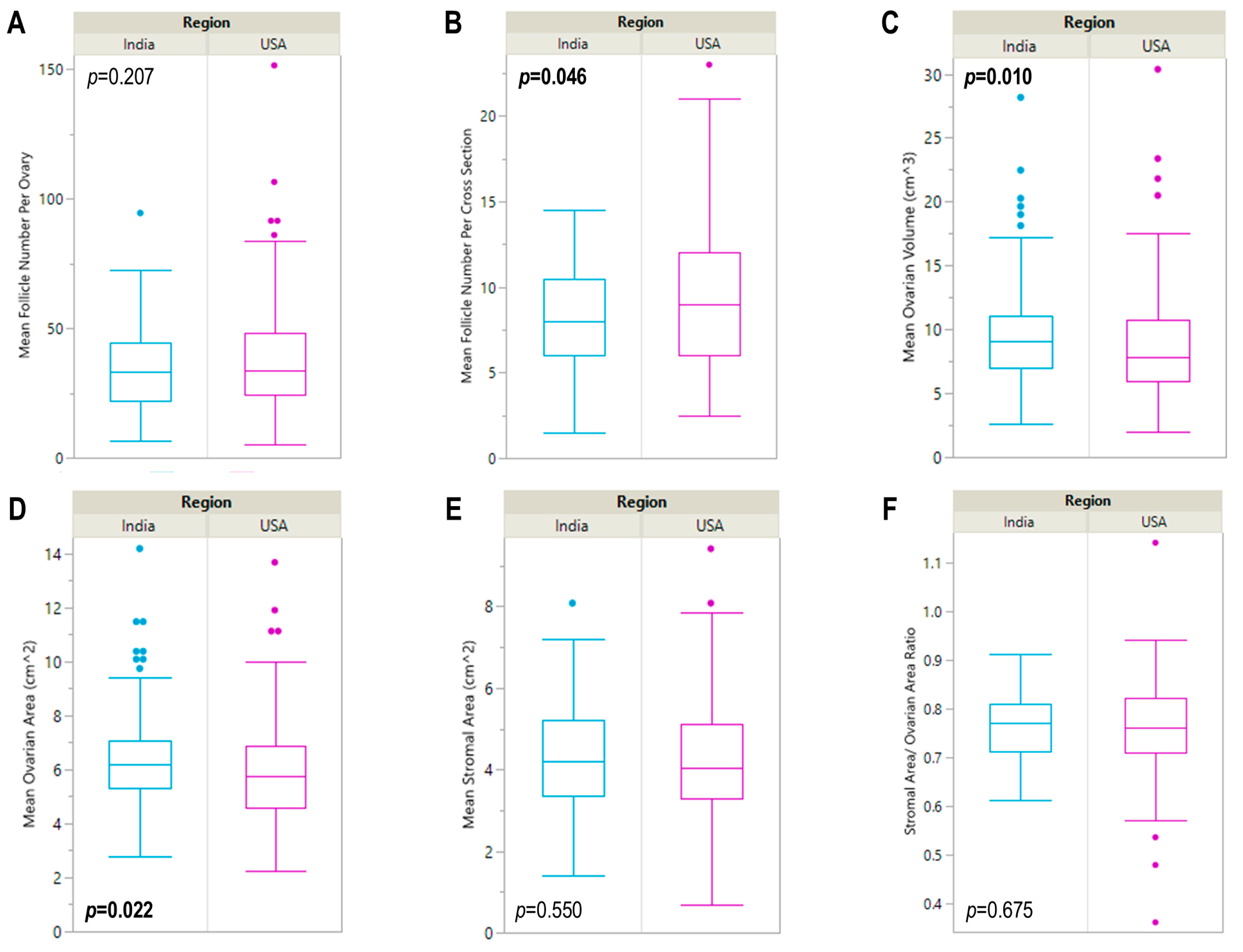
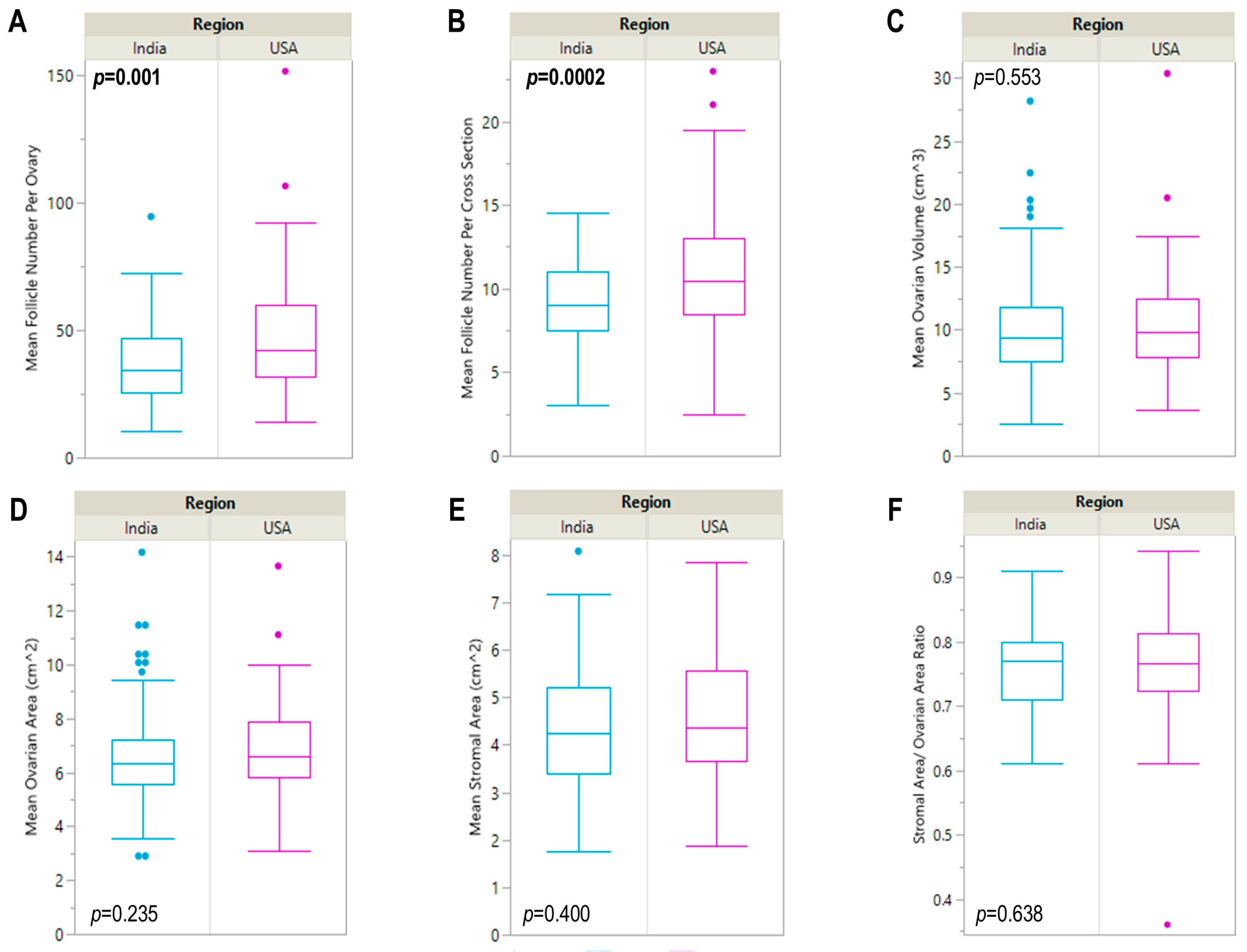
Figure 1 depicts a comparison of conventional and nonconventional markers of PCOM across India and U.S.-based participants. FNPS was higher in the U.S. group (8.2 ± 3.0 for India vs. 9.3 ± 4.0 for U.S., p = 0.046) while no difference in FNPO was noted between groups. By contrast, OV and OA were higher in the India group compared to the U.S. group (9.8 ± 3.9 for India vs. 8.8 ± 4.0 for U.S., p = 0.010 and 6.4 ± 1.8 for India vs. 6.0 ± 1.8 cm2 for U.S., p = 0.022). Subgroup analysis of those with Phenotype A demonstrated greater follicle excess in the U.S.-based group (FNPO 36.7 ± 13.9 follicles for India vs. 47.1 ± 22.2 follicles for U.S., p = 0.001; FNPS 8.9 ± 2.7 follicles for India vs. 10.9 ± 3.9 follicles for U.S.; p = 0.0002) (Figure 2).

3.3. Associations of Ovarian Morphology with Reproductive Features

The relationships between reproductive markers and ovarian morphology are depicted in Table 5. FNPO, FNPS, OV, and OA were positively associated with menstrual cycle length, hirsutism score, and/or total testosterone concentrations within the U.S.-based cohort (p < 0.05). S/A was also positively associated with menstrual cycle length (p = 0.020) in the U.S.-based group. In the India-based group, positive associations were observed between OV and OA with hirsutism scores (p < 0.05) whereas a negative association was found between S/A and total testosterone. On subgroup analysis involving only those meeting the criteria for Phenotype A (Table 6), FNPO (p = 0.003), OV (p = 0.007) and OA (p = 0.011) remained positively associated with total testosterone in U.S.-based participants. Likewise, associations emerged between FNPO (p = 0.018), FNPS (p = 0.018), OV (p = 0.028), OA (p = 0.027) and SA (p = 0.021) with total testosterone concentrations and/or menstrual cycle length in the India-based group.

4. Discussion

This study aimed to directly contrast the ovarian morphology of women with PCOS residing in two distinct geographical regions. We had hypothesized differences in ovarian morphology between populations due to variations in follicle counts and ovarian size reported in prior research [19,20,21]. In addition, we posited that the strength of relationships between ovarian morphology and PCOS symptomology might differ owing to a more severe clinical profile in Indian women with PCOS compared to that of their U.S.-based counterpart [4]. Contrary to our expectations, our findings unveiled largely similarities in ovarian ultrasound features between the India- and U.S.-based groups. While we noted minor discrepancies in follicle populations and ovarian size across groups, these differences would be expected to have marginal clinical significance for current diagnostic practices.
Polycystic ovaries on ultrasonography are an accepted cardinal feature of PCOS [1,5]. The International Evidence-based Guideline for PCOS preferentially defines PCOM by follicle excess as evidenced by an FNPO ≥ 20, with FNPS ≥ 10 and OV ≥ 10 cm3 as alternatives due to their inferior diagnostic accuracy [1]. The utility of these singular criteria to define PCOM across regions is uncertain. In the case of India-based populations, one study showed that an FNPO ≥ 12 and an OV ≥ 6.15 cm3 had the best diagnostic accuracy for PCOS in women from this region [19]. These thresholds are substantially lower than those reported in U.S.-based studies [22,23] and do not agree with current international standards. In this study, we showed that follicle counts were consistently higher in US-based women with PCOS, aligning with recent reports of higher follicle counts in Caucasian women compared to Asian women [24]. Similarly, we noted that ovarian size was larger in the India-based group, albeit this difference became less pronounced when focusing solely on women exhibiting more frank manifestations of PCOS (Phenotype A). Participants from both regions had similar age and body mass index, and thus, these factors are unlikely to have contributed to the observed morphological differences between groups. Morphological differences may have been driven by ethnic variations in follicle reserve dynamics [25] and/or global variability in menopausal timelines [26,27]. We did not have access to stored biological specimens across both groups and were unable to directly measure biochemical markers of ovarian function (i.e., total testosterone and anti-Mullerian hormone) that could have provided functional evidence to corroborate the relevance of this morphological variation. That said, we acknowledge that the observed differences between groups for markers of follicle excess (FNPO: 4.5 follicles; FNPS: 1.1 follicles) and ovarian enlargement (1 cm3) were small and likely clinically insignificant, particularly for diagnosis and screening.
More participants in the India-based group possessed all three cardinal features of PCOS, consistent with previous reports [4,7,28,29]. In contrast, the U.S.-based participants were more heterogeneous, consisting of a majority of Phenotype A followed by Phenotype D (ovulatory dysfunction, polycystic ovaries and no hyperandrogenism), consistent with representation on both sides of the PCOS severity spectrum. These differences are likely due to the study design. The India-based group was garnered from patients presenting to a reproductive health clinic seeking evaluation and/or care for PCOS and/or infertility. By contrast, data from the U.S.-based group captured individuals within the community who had self-presented for participation in a research study on reproductive health and/or PCOS pathophysiology. Therefore, it is likely that a clinic-based population in India would have exhibited a more severe clinical presentation compared to those volunteering from the general population wherein non-androgenic and ovulatory forms of PCOS were more common. Given the design bias, we performed a subgroup analysis comparing only women with Phenotype A. Clinical hyperandrogenism remained more prevalent in those from India, consistent with studies showing higher androgen levels in South Asian populations compared to other geographic regions [4,30,31,32], possibly influenced by genetic factors specific to South Asian populations [33,34,35]. Likewise, the degree of metabolic disturbance was consistently higher in the India-based group, aligning with previous reports that Indian women with PCOS demonstrate a more hyperandrogenic variant of PCOS with overt metabolic dysfunction [2,3,36,37].
In this study, we analyzed stored ultrasound images for both geographic groups using standardized approaches for conventional and non-conventional markers of PCOM [15]. While nonconventional markers, such as stromal measures, lack evidence for PCOS diagnosis globally [22], they may reflect symptom severity [18,38,39]. To our knowledge, our data represent the first report of these measures in an India-based population and support similarities in stromal characteristics across geographic groups. Accordingly, we noted that measures of follicle excess, ovarian enlargement and stromal characteristics had largely positive associations with menstrual cycle irregularity, hirsutism score, and/or total serum testosterone. While this analysis was largely exploratory, the findings support ovarian morphology as a biomarker of reproductive dysfunction in PCOS across geographic regions. Likewise, the rarity of the non-PCOM Phenotype B in either group further underscores the significance of PCOM to the clinical presentation of PCOS.
This study is novel in directly and comprehensively contrasting ovarian sonographic markers in women with PCOS across geographical locations. In addition, we examined the potential for variations in the relationships between ovarian morphology and reproductive disturbance across regions. We had access to raw images for both populations and used standardized image analysis approaches to ensure rigor and reproducibility. However, our study has limitations. As mentioned, participants were garnered from different settings and variations in symptomology between groups may relate to a higher likelihood of severe clinical manifestations presenting to a clinical practice rather than a research setting. Unlike our primary outcomes of ovarian morphology where standardized measurements were prospectively made, we were limited in that some clinical and biochemical endpoints were evaluated with different rubrics and assays across sites. The inability to pool measures across groups restricted the analyses to subgroup and qualitative comparisons. Given the retrospective nature of the study, data for the clinical and metabolic secondary endpoints of interest were not consistently available, thereby impacting the sample sizes for certain analyses. As such, we recognize that the associations identified within this study should be considered exploratory. Although all ultrasound scans were performed in the follicular phase, scans were conducted either post-natural menses or after a progesterone-induced bleed. We are unaware of any recent data documenting a differential impact of exogenous versus endogenous progesterone on ovarian morphology. However, we acknowledge that assessments following a progesterone-induced bleed were more likely in the India-based group.

5. Conclusions

In summary, geographic differences are known to exist in the clinical presentation of PCOS. However, variations in ovarian morphology may not be sufficient to warrant regional definitions for polycystic ovaries on ultrasonography at this time. Ovarian dysmorphology reflected the severity of reproductive symptomology in both regions consistent with the ovary being a helpful biomarker of PCOS. Ultimately, prospective studies involving women with and without PCOS across geographic regions are needed to directly address the utility of regional-specific criteria for PCOM.

Author Contributions

Conceptualization, M.E.L., S.K., and J.P.; methodology, M.E.L., J.P., H.Z., S.K., F.E.C., B.Y.J., A.K. and K.M.H.; software, H.Z. and A.K.; formal analysis, H.Z., E.R., J.P., F.E.C. and B.Y.J.; writing—original draft preparation, H.Z., E.R., M.E.L. and J.P.; writing—review and editing, K.M.H., S.K., B.Y.J., F.E.C., and A.K.; visualization, H.Z.; supervision, M.E.L.; project administration, M.E.L.; funding acquisition, M.E.L. and S.K. All authors have read and agreed to the published version of the manuscript.

Funding

President’s Council of Cornell Women, United States Department of Agriculture (Grant No. 8106), and National Institutes of Health (R56HD089962, R01HD0937848) provided funds to complete the research. Training awards from the National Institutes of Health were provided to B.Y.J. (T32-DK007158), F.E.C (5 T32 HD087137) and J.P. (TL1TR). A.K. was supported by the National Science Foundation Graduate Research Fellowship (Grant No. DGE—2139899). The findings and conclusions in this report are those of the authors and do not necessarily represent the official positions of the Eunice Kennedy Shriver National Institute of Child Health and Human Development, the National Science Foundation, or the National Institutes of Health.

Institutional Review Board Statement

Ethics approval for primary data collection and analysis for the U.S.-based studies was granted by the Cornell University, Weill Cornell Medicine, and University of Rochester Institutional Review Boards (IRB approval #:1108002383, 1303003665, 1202002774, 0908000633, 1207003154h, 00000436, 00007519, 1410015577). The retrospective reviews of de-identified clinical records were deemed exempt from full review by Cornell’s Institutional Review Board (IRB exemption #: 1712007665).Ethics approval date 3 June 2018.

Informed Consent Statement

Informed consent was obtained from all subjects involved in the study.

Data Availability Statement

The data presented in this study are available on request from the corresponding author.

Acknowledgments

The authors would like to thank the research participants, whose contributions were invaluable to the completion of this project. They would also like to thank Heidi Vanden Brink, Rene Hellwitz-Black, and Bailey Drewes Smith for their assistance in facilitating data collection in the present study.

Conflicts of Interest

The authors declare no conflicts of interest. The funders had no role in the design of the study; in the collection, analyses, or interpretation of data; in the writing of the manuscript; or in the decision to publish the results.

Abbreviations

The following abbreviations are used in this manuscript:
PCOSPolycystic Ovary Syndrome
PCOMPolycystic Ovarian Morphology
FNPOFollicle Number Per Ovary
FNPSFollicle Number Per Cross-Section
OVOvarian Volume
OAOvarian Area
SAStromal Area
S/AStromal-to-Ovarian Area Ratio
TTTotal Testosterone
FAIFree Androgen Index
SHBGSex Hormone-Binding Globulin
BMIBody Mass Index
HDLHigh-Density Lipoprotein
LDLLow-Density Lipoprotein
ICCIntraclass Correlation Coefficient
3DThree-Dimensional
2DTwo-Dimensional

References

  1. Teede, H.J.; Tay, C.T.; E Laven, J.J.; Dokras, A.; Moran, L.J.; Piltonen, T.T.; Costello, M.F.; Boivin, J.; Redman, L.M.; A Boyle, J.; et al. Recommendations From the 2023 International Evidence-based Guideline for the Assessment and Management of Polycystic Ovary Syndrome. J. Clin. Endocrinol. Metab. 2023, 108, 2447–2469. [Google Scholar] [CrossRef]
  2. Anagnostis, P.; Tarlatzis, B.C.; Kauffman, R.P. Polycystic ovarian syndrome (PCOS): Long-term metabolic consequences. Metabolism 2018, 86, 33–43. [Google Scholar] [CrossRef]
  3. Sanchez-Garrido, M.A.; Tena-Sempere, M. Metabolic dysfunction in polycystic ovary syndrome: Pathogenic role of androgen excess and potential therapeutic strategies. Mol. Metab. 2020, 35, 100937. [Google Scholar] [CrossRef] [PubMed]
  4. Chan, J.L.; Kar, S.; Vanky, E.; Morin-Papunen, L.; Piltonen, T.; Puurunen, J.; Tapanainen, J.S.; Maciel, G.A.R.; Hayashida, S.A.Y.; Soares, J.M.; et al. Racial and ethnic differences in the prevalence of metabolic syndrome and its components of metabolic syndrome in women with polycystic ovary syndrome: A regional cross-sectional study. Am. J. Obstet. Gynecol. 2017, 217, 189.e1–189.e8. [Google Scholar] [CrossRef] [PubMed]
  5. Teede, H.J.; Misso, M.L.; Costello, M.F.; Dokras, A.; Laven, J.; Moran, L.; Piltonen, T.; Norman, R.J. Recommendations from the international evidence-based guideline for the assessment and management of polycystic ovary syndrome. Hum. Reprod. 2018, 33, 1602–1618. [Google Scholar] [CrossRef] [PubMed]
  6. Mehta, J.; Kamdar, V.; Dumesic, D. Phenotypic Expression of Polycystic Ovary Syndrome in South Asian Women. Obstet. Gynecol. Surv. 2013, 68, 228–234. [Google Scholar] [CrossRef]
  7. Wijeyaratne, C.N.; Seneviratne, R.D.A.; Dahanayake, S.; Kumarapeli, V.; Palipane, E.; Kuruppu, N.; Yapa, C.; Balen, A.H. Phenotype and metabolic profile of South Asian women with polycystic ovary syndrome (PCOS): Results of a large database from a specialist Endocrine Clinic. Hum. Reprod. 2011, 26, 202–213. [Google Scholar] [CrossRef]
  8. Kazemi, M.; Kim, J.Y.; Parry, S.A.; Azziz, R.; Lujan, M.E. Disparities in cardio metabolic risk between Black and White women with polycystic ovary syndrome: A systematic review and meta-analysis. Am. J. Obstet. Gynecol. 2021, 224, 428–444.e8. [Google Scholar] [CrossRef]
  9. Kazemi, M.; Kim, J.Y.; Wan, C.; Xiong, J.D.; Parry, S.A.; Azziz, R.; Lujan, M.E. Comprehensive evaluation of disparities in cardiometabolic and reproductive risk between Hispanic and White women with polycystic ovary syndrome in the United States: A systematic review and meta-analysis. Am. J. Obstet. Gynecol. 2022, 226, 187–204.e15. [Google Scholar] [CrossRef]
  10. Huang, Z.; Yong, E.-L. Ethnic differences: Is there an Asian phenotype for polycystic ovarian syndrome? Best Pract. Res. Clin. Obstet. Gynaecol. 2016, 37, 46–55. [Google Scholar] [CrossRef]
  11. Zhao, Y.; Qiao, J. Ethnic differences in the phenotypic expression of polycystic ovary syndrome. Steroids 2013, 78, 755–760. [Google Scholar] [CrossRef]
  12. Vaggopoulos, V.; Trakakis, E.; Chrelias, C.; Panagopoulos, P.; Basios, G.; Makridima, S.; Sioulas, V.D.; Simeonides, G.; Labos, G.; Boutati, E.; et al. Comparing classic and newer phenotypes in Greek PCOS women: The prevalence of metabolic syndrome and their association with insulin resistance. J. Endocrinol. Investig. 2013, 36, 478–484. [Google Scholar]
  13. Chiaffarino, F.; Cipriani, S.; Dalmartello, M.; Ricci, E.; Esposito, G.; Fedele, F.; La Vecchia, C.; Negri, E.; Parazzini, F. Prevalence of polycystic ovary syndrome in European countries and USA: A systematic review and meta-analysis. Eur. J. Obstet. Gynecol. Reprod. Biol. 2022, 279, 159–170. [Google Scholar] [CrossRef]
  14. Kazemi, M.; McBreairty, L.E.; Chizen, D.R.; Pierson, R.A.; Chilibeck, P.D.; Zello, G.A. A Comparison of a Pulse-Based Diet and the Therapeutic Lifestyle Changes Diet in Combination with Exercise and Health Counselling on the Cardio-Metabolic Risk Profile in Women with Polycystic Ovary Syndrome: A Randomized Controlled Trial. Nutrients 2018, 10, 1387. [Google Scholar] [CrossRef]
  15. Lujan, M.E.; Brooks, E.D.; Kepley, A.L.; Chizen, D.R.; Pierson, R.A.; Peppin, A.K. Grid Analysis Improves Reliability in Follicle Counts Made by Ultrasonography in Women with Polycystic Ovary Syndrome. Ultrasound Med. Biol. 2010, 36, 712–718. [Google Scholar] [CrossRef]
  16. Balen, A.H.; Laven, J.S.E.; Tan, S.-L.; Dewailly, D. Ultrasound assessment of the polycystic ovary: International consensus definitions. Hum. Reprod. Update 2003, 9, 505–514. [Google Scholar] [CrossRef]
  17. Vanden Brink, H.; Nosrati, A.; Ortiz-Flores, A.E.; Tam, A.; Jarrett, B.Y.; Johnson, L.; Peppin, A.K.; Lujan, M.E. Reliability and Agreement of Ultrasonographic Measures of the Ovarian Stroma: Impact of Methodology. J. Ultrasound Med. 2022, 41, 2307–2315. [Google Scholar] [CrossRef] [PubMed]
  18. Christ, J.P.; Willis, A.D.; Brooks, E.D.; Brink, H.V.; Jarrett, B.Y.; Pierson, R.A.; Chizen, D.R.; Lujan, M.E. Follicle number, not assessments of the ovarian stroma, represents the best ultrasonographic marker of polycystic ovary syndrome. Fertil. Steril. 2014, 101, 280–287.e1. [Google Scholar] [CrossRef] [PubMed]
  19. Sujata, K.; Swoyam, S. 2D and 3D Trans-vaginal Sonography to Determine Cut-offs for Ovarian Volume and Follicle Number per Ovary for Diagnosis of Polycystic Ovary Syndrome in Indian Women. J. Reprod. Infertil. 2018, 19, 146–151. [Google Scholar] [PubMed]
  20. Jain, S.; Shukla, R.C.; Jain, M.; Mishra, R.N. Age-Specific Nomograms for Antral Follicle Count in Fertile and Infertile Indian Women: A Comparative Study. Indian J. Radiol. Imaging 2023, 33, 463–470. [Google Scholar] [CrossRef]
  21. Gunasheela, D.; Murali, R.; Appaneravanda, L.C.; Gerstl, B.; Kumar, A.; Sengeetha, N.; Nayak, H.; Chandrikadevi, P. Age-specific distribution of serum anti-mullerian hormone and antral follicle count in Indian infertile women. J. Hum. Reprod. Sci. 2021, 14, 372–379. [Google Scholar] [CrossRef] [PubMed]
  22. Pea, J.; Bryan, J.; Wan, C.; Oldfield, A.L.; Ganga, K.; E Carter, F.; Johnson, L.M.; Lujan, E.M. Ultrasonographic criteria in the diagnosis of polycystic ovary syndrome: A systematic review and diagnostic meta-analysis. Hum. Reprod. Update 2024, 30, 109–130. [Google Scholar] [CrossRef] [PubMed]
  23. Kim, H.-J.; Adams, J.M.; Gudmundsson, J.A.; Arason, G.; Pau, C.T.; Welt, C.K. Polycystic ovary morphology: Age-based ultrasound criteria. Fertil. Steril. 2017, 108, 548–553. [Google Scholar] [CrossRef]
  24. Lazareva, L.; Suturina, L.; Atalyan, A.; Danusevich, I.; Nadelyaeva, I.; Belenkaya, L.; Egorova, I.; Ievleva, K.; Babaeva, N.; Lizneva, D.; et al. Ovarian Morphology in Non-Hirsute, Normo-Androgenic, Eumenorrheic Premenopausal Women from a Multi-Ethnic Unselected Siberian Population. Diagnostics 2024, 14, 673. [Google Scholar] [CrossRef]
  25. Iglesias, C.; Banker, M.; Mahajan, N.; Herrero, L.; Meseguer, M.; Garcia-Velasco, J.A. Ethnicity as a determinant of ovarian reserve: Differences in ovarian aging between Spanish and Indian women. Fertil. Steril. 2014, 102, 244–249. [Google Scholar] [CrossRef]
  26. Yao, L.; Graff, J.C.; Aleya, L.; Jiao, Y.; Gu, W.; Tian, G. Bring the life stages into the domain of basic and clinical pharmacology. Front. Pharmacol. 2022, 13, 923016. [Google Scholar] [CrossRef] [PubMed]
  27. Jungari, S.B.; Chauhan, B.G. Prevalence and Determinants of Premature Menopause among Indian Women: Issues and Challenges Ahead. Health Soc. Work 2017, 42, 79–86. [Google Scholar] [CrossRef] [PubMed]
  28. Goodarzi, M.O.; Dumesic, D.A.; Chazenbalk, G.; Azziz, R. Polycystic ovary syndrome: Etiology, pathogenesis and diagnosis. Nat. Rev. Endocrinol. 2011, 7, 219–231. [Google Scholar] [CrossRef]
  29. Sachdeva, G.; Gainder, S.; Suri, V.; Sachdeva, N.; Chopra, S. Comparison of the different PCOS phenotypes based on clinical metabolic, and hormonal profile, and their response to clomiphene. Indian J. Endocrinol. Metab. 2019, 23, 326. [Google Scholar] [CrossRef]
  30. Mani, H.; Davies, M.J.; Bodicoat, D.H.; Levy, M.J.; Gray, L.J.; Howlett, T.A.; Khunti, K. Clinical characteristics of polycystic ovary syndrome: Investigating differences in White and South Asian women. Clin. Endocrinol. 2015, 83, 542–549. [Google Scholar] [CrossRef]
  31. Kim, J.J.; Choi, Y.M. Phenotype and genotype of polycystic ovary syndrome in Asia: Ethnic differences. J. Obstet. Gynaecol. Res. 2019, 45, 2330–2337. [Google Scholar] [CrossRef] [PubMed]
  32. Afifi, L.; Saeed, L.; Pasch, L.; Huddleston, H.; Cedars, M.; Zane, L.; Shinkai, K. Association of ethnicity, Fitzpatrick skin type, and hirsutism: A retrospective cross-sectional study of women with polycystic ovarian syndrome. Int. J. Women’s Dermatol. 2017, 3, 37–43. [Google Scholar] [CrossRef]
  33. Samant, M.; Bhat, M.; Dadachanji, R.; Sudhakar, D.V.S.; Patil, A.; Mukherjee, S. Whole exome sequencing uncovers rare variants associated with PCOS susceptibility in Indian women. Syst. Biol. Reprod. Med. 2025, 71, 76–89. [Google Scholar] [CrossRef]
  34. Janani, D.M.; Ramasubramanyan, S.; Chellappa, V.; Santhanam, R.; Manickam, R.; Shameli, J.; Balasundaram, U. Whole exome and targeted sequencing reveal novel mutations associated with inherited PCOS condition in an Indian cohort. J. Hum. Genet. 2023, 68, 39–46. [Google Scholar] [CrossRef]
  35. Sharma, P.; Senapati, S.; Goyal, L.D.; Kaur, B.; Kamra, P.; Khetarpal, P. Genome-wide association study (GWAS) identified PCOS susceptibility variants and replicates reported risk variants. Arch. Gynecol. Obstet. 2024, 309, 2009–2019. [Google Scholar] [CrossRef]
  36. Kempegowda, P.; Melson, E.; Manolopoulos, K.N.; Arlt, W.; O’Reilly, M.W. Implicating androgen excess in propagating metabolic disease in polycystic ovary syndrome. Ther. Adv. Endocrinol. Metab. 2020, 11, 2042018820934319. [Google Scholar] [CrossRef]
  37. Schiffer, L.; Kempegowda, P.; Arlt, W.; O’Reilly, M.W. MECHANISMS IN ENDOCRINOLOGY: The sexually dimorphic role of androgens in human metabolic disease. Eur. J. Endocrinol. 2017, 177, R125–R143. [Google Scholar] [CrossRef] [PubMed]
  38. Dewailly, D.; Robert, Y.; Helln, I.; Ardaens, Y.; Thomas-Desrousseaux, P.; Lemaltre, L.; Fossati, P. Ovarian stromal hypertrophy in hyperandrogenic women. Clin. Endocrinol. 1994, 41, 557–562. [Google Scholar] [CrossRef] [PubMed]
  39. Fulghesu, A.M.; Angioni, S.; Frau, E.; Belosi, C.; Apa, R.; Mioni, R.; Xamin, N.; Capobianco, G.; Dessole, S.; Fruzzetti, F.; et al. Ultrasound in polycystic ovary syndrome the measuring of ovarian stroma and relationship with circulating androgens: Results of a multicentric study. Hum. Reprod. 2007, 22, 2501–2508. [Google Scholar] [CrossRef]
Figure 1. Comparison of conventional and nonconventional markers of polycystic ovarian morphology across India and United States-based women with PCOS. A comparison of conventional [(A) FNPO, (B) FNPS, (C) OV] and nonconventional [(D) OA, (E) SA, (F) S/A] markers in women with PCOS in India and the U.S. Box-and-whisker diagrams of conventional and unconventional markers are presented for women with PCOS in India (N = 119) and the U.S. (N = 212). Boxes represent the 25th and 75th percentile, and the horizontal band within the box represents the median. The 5th–95th percentile range is denoted by the vertical bars. p-values from Wilcoxon two sample t-tests (unadjusted comparison).
Reprodmed 07 00010 g001
Figure 2. Comparison of conventional and nonconventional markers of polycystic ovarian morphology across India and United States-based women with PCOS Phenotype A. A comparison of conventional [(A) FNPO, (B) FNPS, (C) OV] and nonconventional [(D) OA, (E) SA, (F) S/A] markers in women with PCOS in India and the U.S. Box-and-whisker diagrams of conventional and unconventional markers are presented for women with PCOS in India (N = 99) and the U.S. (N = 91). Boxes represent the 25th and 75th percentile, and the horizontal band within the box represents the median. The 5th–95th percentile range is denoted by the vertical bars. p-values from Wilcoxon two sample t-tests.
Reprodmed 07 00010 g002
Table 1. Characteristics of the study population by geographic region.
Variable IndiaU.S.Effect Size †p-Value
N = 119 N = 212
Demographics n Mean (SD) n Mean (SD)
Age (years) 119 26.5 (3.5) 212 26.0 (5.4) 0.100.17
BMI (kg/m2) 119 28.1 (5.1) 205 29.0 (8.7) 0.120.44
Ethnicity n Count (%) n Count (%)
Hispanic or Latino - - 203 17 (8) --
Not Hispanic or Latino - - 203 177 (87) --
Other - - 203 9 (4) --
Race
White - - 205 138 (67) --
Black - - 205 25 (12) --
Asian - - 205 33 (16) --
Other - - 205 9 (4) --
Reproductive Features n Count (%) n Count (%)
Menstrual Irregularity 119 118 (99) 206 168 (82) -<0.0001
Oligomenorrhea (36–89 days)119 81 (68) 206 107 (52) -0.005
Amenorrhea (≥90 days)119 37 (31) 206 61 (30) -0.779
Hyperandrogenism119 115 (97) 211 134 (64) -<0.0001
Elevated Total Testosterone 138 28 (74) 205 33 (16) -<0.0001
Free Androgen Index (≥5) - - 202 40 (20) --
Hirsute (≥6) 114 114 (100) 205 100 (49) -<0.0001
Polycystic Ovarian Morphology119 103 (87) 212 176 (83) -0.396
Excess FNPO (≥20) 118 91 (77) 208 176 (85) -0.091
Excess FNPS (≥10) 119 35 (29) 210 86 (41) -0.037
Enlarged Ovarian Volume (≥10 cm3) 119 44 (37) 211 65 (31) -0.252
PCOS Phenotype 2 -
Phenotype A 118 99 (84) 173 91 (53) -<0.0001
Phenotype B 118 15 (13) 173 11 (6) -0.062
Phenotype C 118 0 (0) 173 20 (12) -0.0001
Phenotype D 118 4 (3) 173 51 (29) -<0.0001
Abbreviations: N, total number in group; n, number of data points available for comparison; BMI, body mass index; FNPO, follicle number per ovary: FNPS, follicle number per single section; PCO, polycystic ovary. † Cohen’s d (absolute value shown) for continuous variables only. 1 Elevated testosterone thresholds for India (45.0 ng/dL) and US (61.5 ng/dL). 2 Phenotype was determined for those participants in which data were available for all three PCOS cardinal features. Phenotype A = ovulatory dysfunction + hyperandrogenism + polycystic ovaries. Phenotype B = ovulatory dysfunction + hyperandrogenism. Phenotype C = hyperandrogenism + polycystic ovaries. Phenotype D = ovulatory dysfunction + polycystic ovaries. Bold values indicate statistical significance (p < 0.05).
Table 2. Characteristics of participants with PCOS Phenotype A in India and United States.
Variable IndiaU.S.Effect Size †p-Value
N = 99 N = 91
Demographics n Mean (SD) n Mean (SD)
Age (years) 99 26.3 (3.3) 91 25.8 (5.0) 0.120.22
BMI (kg/m2) 99 27.8 (5.0) 89 29.5 (8.0) 0.260.46
Reproductive Features n Count (%) n Count (%)
Menstrual Irregularity
Oligomenorrhea (35–89 days) 99 69 (70) 91 53 (58) -0.100
Amenorrhea (≥90 days) 99 30 (29) 91 38 (42) -0.100
Hyperandrogenism
Elevated Total Testosterone 132 24 (75) 89 23 (26) -<0.0001
Free Androgen Index (≥5) - - 87 28 (32) --
Hirsute (≥6) 98 98 (100) 90 64 (71) -<0.0001
Polycystic Ovarian Morphology
Excess FNPO (≥20) 98 81 (83) 89 79 (89) -0.235
Excess FNPS (≥10) 99 34 (34) 91 50 (55) -0.004
Enlarged Ovarian Volume (>10 cm3) 96 42 (44) 91 44 (48) -0.412
Abbreviations: N, total number in group; n, number of data points available for comparison; BMI, body mass index; FNPO, follicle number per ovary: FNPS, follicle number per single section. † Cohen’s d (absolute value shown) for continuous variables only. 1 Elevated testosterone thresholds for India (45.0 ng/dL) and US (61.5 ng/dL). Bold values indicate statistical significance (p < 0.05).
Table 3. Metabolic features in women with PCOS based in India versus United States.
Variable India
N = 119
U.S.
N = 212
Effect Size †p-Value
nMean (SD) or count (%)nMean (SD) or count (%)
Metabolic Measures
Waist circumference (cm) 11591.0 (11.1)18088.3 (20.8)0.150.001
Prevalence of elevated WC
(>89 cm)
60 (52) 67 (37)-0.011
Waist-to-hip ratio 1150.9 (0.04)1870.82 (0.1)0.96<0.0001
Prevalence of elevated WHR
(>0.85)
104 (90) 62 (33)-<0.0001
Fasting glucose (mg/dL) 9395.7 (10.4)18493.4 (11.0)0.210.030
Prevalence of elevated 0-h glucose (≥100 mg/dL) 28 (30) 51 (28)-0.313
2-h glucose (mg/dL) 77142.6 (41.6)17696.2 (24.7)1.51<0.0001
Prevalence of elevated 2-h glucose (>139 mg/dL) 40 (52) 17 (10) -<0.0001
Systolic pressure (mmHg) 117118.8 (9.7)181112.7 (15.7)0.450.0002
Prevalence of elevated systolic BP (>130 mmHg) 6 (5) 20 (11) -0.077
Diastolic pressure (mmHg) 11772.2 (10.9)18172.1 (11.8)0.010.827
Prevalence of elevated diastolic BP (>85 mmHg) 11 (9) 21 (12) -0.549
Total Cholesterol (mg/dL) 58178.47 (37.0)184173.9 (31.5)0.140.279
Prevalence of elevated TC
(>199 mg/dL)
15 (26) 31 (17) -0.127
Triglycerides (mg/dL) 59150.2 (71.3)18484.1 (53.7)1.13<0.0001
Prevalence of elevated TG
(>150 mg/dL)
28 (47) 17 (9) -<0.0001
HDL (mg/dL) 5940.4 (7.9)18458.0 (16.3)1.20<0.0001
Prevalence of low HDL
(<50 mg/dL)
50 (85) 62 (34) -<0.0001
LDL (mg/dL) 59110.6 (28.6)18496.8 (26.2)0.510.0004
Prevalence of elevated LDL
(>99 mg/dL)
38 (64) 79 (43) -0.004
Abbreviations: N, total number in group; n, number of data points available for comparison; WC, waist circumference; WHR, waist to hip ratio; BP, blood pressure; TC, total cholesterol; TG, triglycerides: HDL, high density lipoprotein; LDL, low density lipoprotein. † Cohen’s d (absolute value shown) for continuous variables only. Bold values indicate statistical significance (p < 0.05).
Table 4. Metabolic features in women with PCOS Phenotype A based in India versus United States.
Variable IndiaUSEffect Size †p-Value
N = 99N = 91
nMean (SD) or count (%)nMean (SD) or count (%)
Metabolic Measures
Waist circumference (cm) 9790.4 (10.7)7989.8 (20.8)0.040.125
Prevalence of elevated WC (>89 cm) 50 (52) 33 (42)-0.196
Waist-to-hip ratio 970.9 (0.04)820.8 (0.1)1.36<0.0001
Prevalence of elevated WHR (>0.85) 88 (91) 30 (37)-<0.0001
Fasting glucose (mg/dL) 8195.5 (9.7)7793.4 (11.1)0.200.086
Prevalence of elevated 0-h glucose (≥100 mg/dL) 25 (31) 18 (23)-0.291
2-h glucose (mg/dL) 67143.1 (41.6)7496.0 (23.6)1.41<0.0001
Prevalence of elevated 2-h glucose (≥140 mg/dL) 36 (54) 2 (3)-<0.0001
Systolic pressure (mmHg) 99117.9 (9.3)77111.6 (14.0)0.540.009
Prevalence of elevated systolic BP (>130 mmHg) 3 (3) 5 (6)-0.300
Diastolic pressure (mmHg) 9971.4 (10.3)7771.3 (11.0)0.010.946
Prevalence of elevated diastolic BP (>85 mmHg) 6 (6) 8 (10)-0.292
Total cholesterol (mg/dL) 51177.9 (38.0)79177.4 (35.0)0.010.760
Prevalence of elevated TC
(≥200 mg/dL)
13 (25) 18 (23)-0.724
Triglycerides (mg/dL) 51152.6 (74.0)7986.4 (61.8)0.99<0.0001
Prevalence of elevated TG (>150 mg/dL) 24 (47) 7 (9)-<0.0001
HDL (mg/dL) 5140.2 (8.1)7956.1 (15.9)1.19<0.0001
Prevalence of low HDL (<50 mg/dL) 44 (86) 28 (35)-<0.0001
LDL (mg/dL) 51109.6 (30.0)79101.2 (28.1)0.290.058
Prevalence of elevated LDL
(≥100 mg/dL)
31 (61) 39 (49)-0.202
Abbreviations: N, total number in group; n, number of data points available for comparison; WC, waist circumference; WHR, waist to hips ratio; BP, blood pressure; TC, total cholesterol; TG, triglycerides: HDL, high density lipoprotein; LDL, low density lipoprotein. † Cohen’s d (absolute value shown) for continuous variables only. Bold values indicate statistical significance (p < 0.05).
Table 5. Associations between ovarian morphology and reproductive markers by geographic location.
FNPOFNPSOVOASAS/A
Reproductive Markers India U.S. India U.S. India U.S. India U.S. India U.S. India U.S.
Menstrual cycle length (d) −0.01+0.23+0.01+0.15+0.12+0.21+0.13 +0.25+0.16 +0.12 −0.11 +0.16
Ferriman-Gallwey hirsutism score +0.10 +0.23+0.01 +0.13 +0.19+0.27+0.19+0.23+0.18 +0.09 +0.13 +0.01
Total testosterone (ng/dL) +0.24 +0.36+0.32 +0.28+0.04 +0.34 +0.06 +0.33−0.11 +0.14 −0.33−0.09
Presented as Spearman correlation coefficients. Bold values reflect a significant correlation: p < 0.05. Abbreviations: FNPO, follicle number per ovary: FNPS, follicle number per single section; OV, ovarian volume; SA, stromal area; S/A, stromal to ovarian area ratio.
Table 6. Associations between ovarian morphology and reproductive markers in women with PCOS Phenotype A by geographic location.
FNPOFNPSOVOASAS/A
Reproductive Markers India U.S. India U.S. India U.S. India U.S. India U.S. India U.S.
Menstrual cycle length (d) +0.05 +0.10 +0.05 −0.06 +0.22+0.08 +0.23+0.08 +0.22−0.04−0.14 +0.16
Ferriman-Gallwey hirsutism score −0.02 +0.11 −0.11 +0.09 +0.12 +0.15 +0.11 +0.13 +0.15 −0.00 +0.15 −0.09
Total testosterone (ng/dL) +0.42+0.31+0.41+0.16 +0.16 +0.28+0.17 +0.27+0.05 +0.20 −0.31 +0.04
Presented as Spearman correlation coefficients. Bold values reflect a significant correlation: p < 0.05. Abbreviations: FNPO, follicle number per ovary: FNPS, follicle number per single section; OV, ovarian volume; SA, stromal area; S/A, stromal to ovarian area ratio.
Disclaimer/Publisher’s Note: The statements, opinions and data contained in all publications are solely those of the individual author(s) and contributor(s) and not of MDPI and/or the editor(s). MDPI and/or the editor(s) disclaim responsibility for any injury to people or property resulting from any ideas, methods, instructions or products referred to in the content.