Article

Serum Albumin Is Independently Associated with Length of Hospital-Stay and Short-Term Mortality in Elderly Heart Failure Patients: A Real-World Experience


by
Gianluigi Cuomo
1,2,*,
Paolo Tirelli
2,
Gabriella Oliva
2,
Domenico Birra
2,
Antonietta De Sena
2,
Fabio Granato Corigliano
2,
Mariavittoria Guerra
2,
Claudio De Luca
2,
Benedetta Tartaglia
2,
Vittoria Gammaldi
2,
Carmine Fierarossa
2,
Pasquale Madonna
2,
Vincenzo Nuzzo
2 and
Francesco Giallauria
1
1
Department of Translational Medical Sciences, “Federico II” University of Naples, Via S. Pansini 5, 80131 Naples, Italy
2
Department of General Medicine, “Ospedale del Mare”, ASL Napoli 1 Centro, 80147 Naples, Italy
*
Author to whom correspondence should be addressed.
Hearts 2025, 6(4), 34; https://doi.org/10.3390/hearts6040034
Submission received: 21 November 2025 / Revised: 14 December 2025 / Accepted: 17 December 2025 / Published: 18 December 2025
(This article belongs to the Collection Feature Papers from Hearts Editorial Board Members)

Abstract

Background: Serum albumin is a well-known marker of nutritional and inflammatory status and has been associated with adverse outcomes in heart failure (HF). However, its predictive value for length of hospital-stay and short-term mortality in elderly HF patients remains underexplored. Objectives: To investigate the association between serum albumin levels at hospital admission and length of stay, as well as post-admission mortality, in a cohort of elderly patients hospitalized for HF. Methods: We conducted a retrospective analysis of 56 consecutive patients aged ≥65 years admitted for HF. Comorbidities were assessed using the Cumulative Illness Rating Scale for Geriatrics (CIRS-G), and inflammatory status was measured via C-reactive protein (CRP). Negative binomial regression with robust confidence intervals was employed to evaluate the relationship between serum albumin and length of hospital-stay, adjusting for age, comorbidity burden, and CRP. Cox proportional hazards models were used to assess mortality at 6 months and 1 year, adjusting for age, comorbidity, CRP, and HF subtype, with Kaplan–Meier curves illustrating unadjusted survival differences according to albumin levels and HF subtype. Results: Mean age was 78.6 ± 7.5 years, with 69.6% female patients. Mean serum albumin at admission was 3.58 ± 0.60 g/dL, and mean length of stay was 14.8 ± 10.1 days. Each 1 g/dL increase in albumin was associated with a 32% reduction in length of stay (adjusted IRR = 0.68; 95% CI: 0.54–0.85; p = 0.01), independently by age, inflammatory status and comorbidity. Serum albumin was independently associated with reduced risk of death at 6 months (HR 0.30; 95% CI: 0.11–0.82; p = 0.019) and 1 year (HR = 0.41; 95% CI: 0.17–0.96; p = 0.041). Conclusions: Serum albumin at hospital admission independently predicts length of stay and short-term mortality in elderly patients with HF. Albumin measurement, simple, cheap and universally available biomarker, is helpful for early risk stratification and may guide clinical management in this vulnerable population.

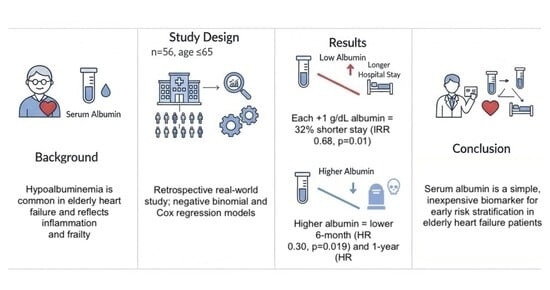
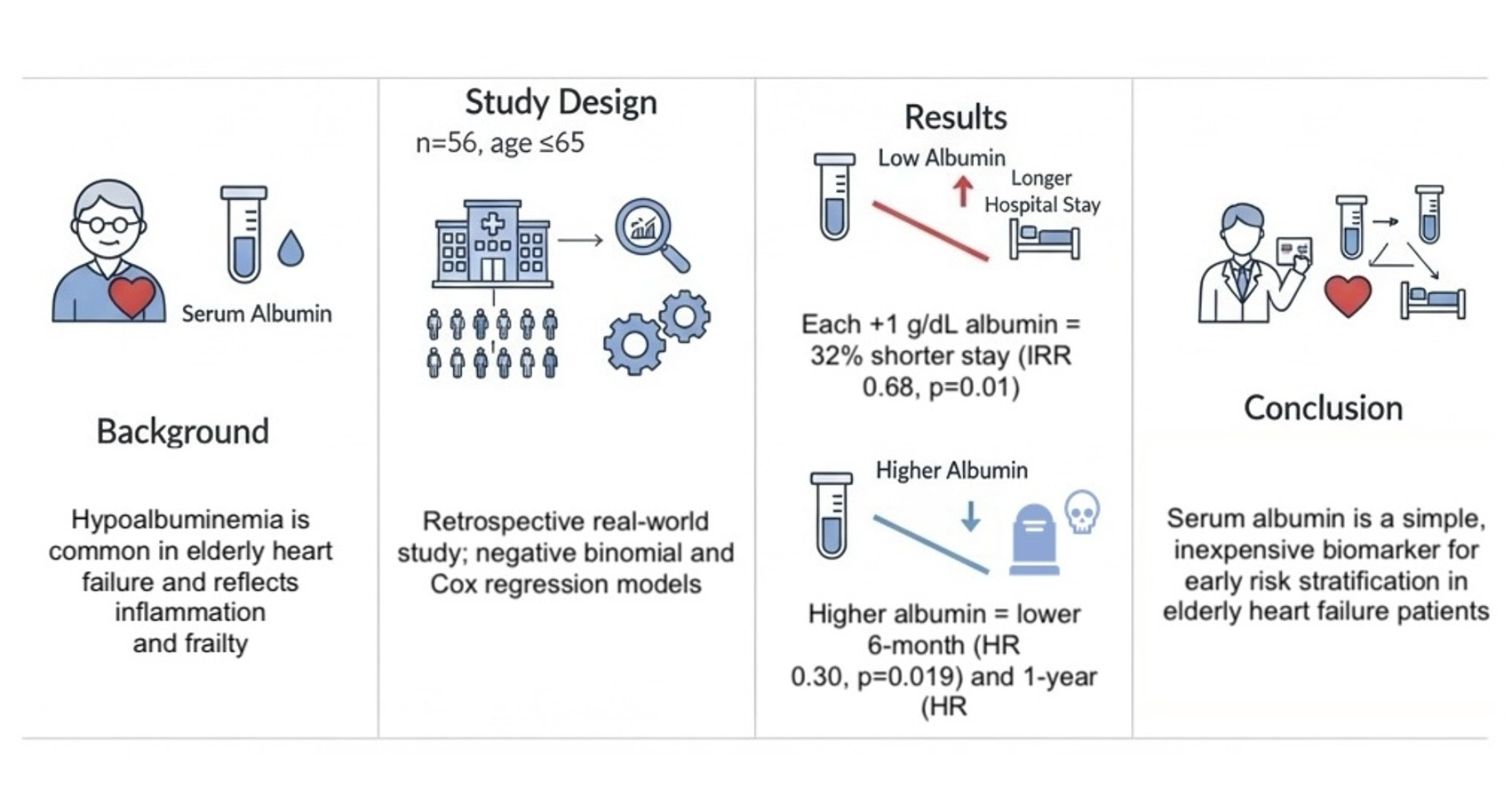
Graphical Abstract

1. Introduction

Despite advances in cardiovascular disease management, the incidence of heart failure (HF) continues to rise in developed countries, primarily due to population aging [1,2]. Epidemiological data show an increasing prevalence of HF among the elderly, with the average age at first diagnosis now approaching 80 years [3,4]. The incidence of new HF episodes is significantly higher in older patients compared to younger cohorts, and registries report a greater proportion of hospital admissions and overall prevalence of HF in the geriatric population [5].
Although survival following HF onset has improved markedly with modern therapies, this survival benefit is less pronounced among the oldest patients. Advanced age is a strong predictor of poor prognosis in both chronic and acute HF. Age-related physiological alterations in cardiac structure and function increase the susceptibility of elderly patients to develop HF, especially HF with preserved ejection fraction (HFpEF) [4].
Serum albumin is the most abundant plasma protein and is synthesized almost exclusively by the liver [6]. Its production is influenced by nutritional status, hormonal and inflammatory signals, and intravascular oncotic pressure [7]. Beyond maintaining colloid osmotic pressure, albumin serves as a carrier for endogenous and exogenous molecules, exerts antioxidant activity through its thiol groups, and contributes to acid–base buffering and endothelial stability [8].
Albumin degradation occurs primarily via intracellular lysosomal pathways, and its half-life in plasma is approximately 21 days in normal conditions [9].
Hypoalbuminemia is a common finding in HF patients, with reported prevalence ranging up to 89%, and is particularly frequent among elderly and frail individuals [10,11]. Systemic inflammation, hepatic congestion, and increased capillary permeability may reduce albumin synthesis or enhance its extravasation, while renal dysfunction, diuretic therapy, malnutrition or cachexia further contribute to low serum levels [12]. In older individuals, age-related sarcopenia, frailty, chronic inflammatory status and diminished hepatic synthetic capacity increase the risk of hypoalbuminemia [13].
Importantly, hypoalbuminemia is an independent and robust predictor of all-cause and cardiovascular mortality [14,15]. Several studies have demonstrated its predictive value for HF onset in specific populations [16]. However, the prognostic role of serum albumin varies according to HF subtype, with conflicting results reported in patients with HFpEF [17].
The primary objective of this retrospective observational study is to investigate the association between serum albumin levels at hospital admission and length of hospital-stay in elderly patients with HF. Serum albumin, serving as a marker of nutritional status, inflammation, and vascular function, may significantly influence clinical severity and treatment response in this vulnerable population. Specifically, we aim to determine whether low albumin levels are correlated with prolonged hospitalization, indicative of worsened clinical status and complications.
As a secondary outcome, we assessed the association between serum albumin and mortality at 6 months and 1 year after hospital admission. This analysis tests whether hypoalbuminemia independently predicts adverse outcomes over the short- to mid-term, thereby providing useful information for early risk stratification and clinical management in elderly patients with HF.

2. Materials and Methods

2.1. Study Design and Population

This retrospective observational study included consecutive patients aged ≥ 65 years who were consecutively admitted to the General Medicine Unit of “Ospedale del Mare” between 1 January and 31 December 2022, after initial stabilization in the Emergency Department. Patients were identified using discharge diagnoses of HF, coded according to ICD-9 (codes 428.0 to 428.9), irrespective of functional class.

2.2. Data Collection

Clinical and laboratory data were extracted from electronic hospital records. Variables collected included: demographic characteristics: age, sex, and HF subtype—classified as heart failure with reduced ejection fraction (HFrEF), mildly reduced EF (HFmrEF), and preserved EF (HFpEF) according to the latest European Society of Cardiology (ESC) guidelines [18]; New York Heart Association (NYHA) functional class at admission; serum albumin levels measured at hospital admission via routine biochemical assays; length of hospital-stay, defined as days from admission to discharge (primary outcome); mortality status at 6 months and 1 year days post-admission (secondary outcome), obtained from the regional registry (SANI.A.R.P.; SANItà a centralità dell’Assistito e della Risposta Prescrittiva, Patient-Centered Care and Prescriptive Response); comorbidities assessed through the Cumulative Illness Rating Scale for Geriatrics (CIRS-G), derived from clinical history and discharge diagnoses [19]; laboratory parameters at admission, including hemoglobin, serum creatinine (used to calculate estimated glomerular filtration rate via the CKD-EPI 2021 equation), sodium, potassium, albumin, aspartate aminotransferase (AST), alanine aminotransferase (ALT), C-reactive protein (CRP), and complete blood count.
All procedures were conducted in accordance with the ethical standards of the institutional and national research committee and with the 1964 Helsinki Declaration and its later amendments. Given the retrospective design of the study and the use of anonymized data, the requirement for informed consent was waived by the local ethics committee.

2.3. Inclusion and Exclusion Criteria

Inclusion criteria: age ≥ 65 years; admission to the General Medicine Unit at “Ospedale del Mare” during the study period; diagnosis of HF recorded in hospital discharge records (ICD-9 codes 428.0–428.9); availability of serum albumin measured at hospital admission; availability of echocardiographic report during hospitalization assessing left ventricular ejection fraction.
Exclusion criteria: age < 65 years; death during the index hospitalization; voluntary discharge or transfer to another healthcare facility; missing albumin measurement at admission; insufficient clinical data to calculate CIRS-G; presence of terminal oncologic diseases unrelated to HF.

2.4. Statistical Analysis

Continuous variables were assessed for normality using the Shapiro–Wilk test. Normally distributed variables are presented as mean ± standard deviation (SD), while non-normally distributed variables are expressed as median (interquartile range). Non-normally distributed variables were analyzed using non-parametric tests without data transformation. Categorical variables are summarized as counts and percentages. For descriptive analyses and Kaplan–Meier survival estimates, patients were stratified according to serum albumin categories (<3.5 g/dL vs. ≥3.5 g/dL), a clinically established threshold for hypoalbuminemia [16].
To assess whether serum albumin independently predicts length of hospital-stay, negative binomial regression models were employed, as the variance of length of stay substantially exceeded the mean, violating Poisson model assumptions. Robust confidence intervals were computed using heteroskedasticity-consistent estimators (HC0 method) to ensure valid inference.
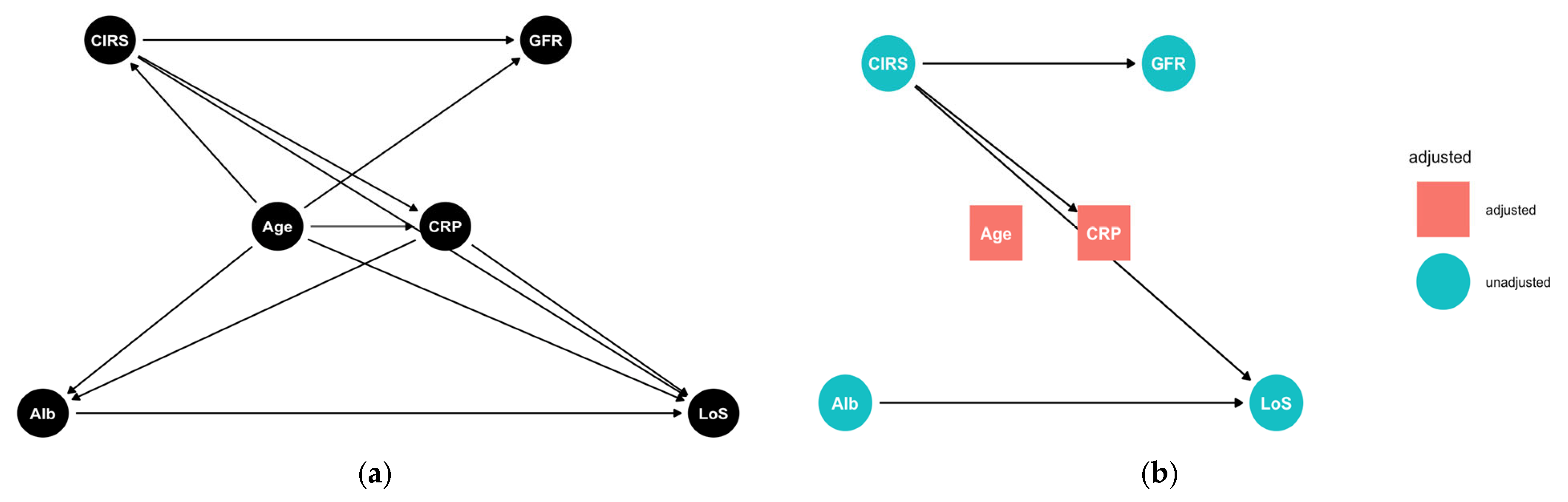
Multivariate models adjusted for potential confounders selected a priori based on clinical relevance and identified through a Directed Acyclic Graph (DAG) (Figure 1). Sensitivity analyses based on the Akaike Information Criterion (AIC) showed a modest improvement in model fit when CIRS-G was included. Given both its statistical contribution and its conceptual importance as a standardized measure of multimorbidity, CIRS-G was retained in the adjusted model in addition to age and CRP. Multicollinearity among covariates was assessed using variance inflation factors (VIF), with all values < 1.5, indicating no relevant collinearity.
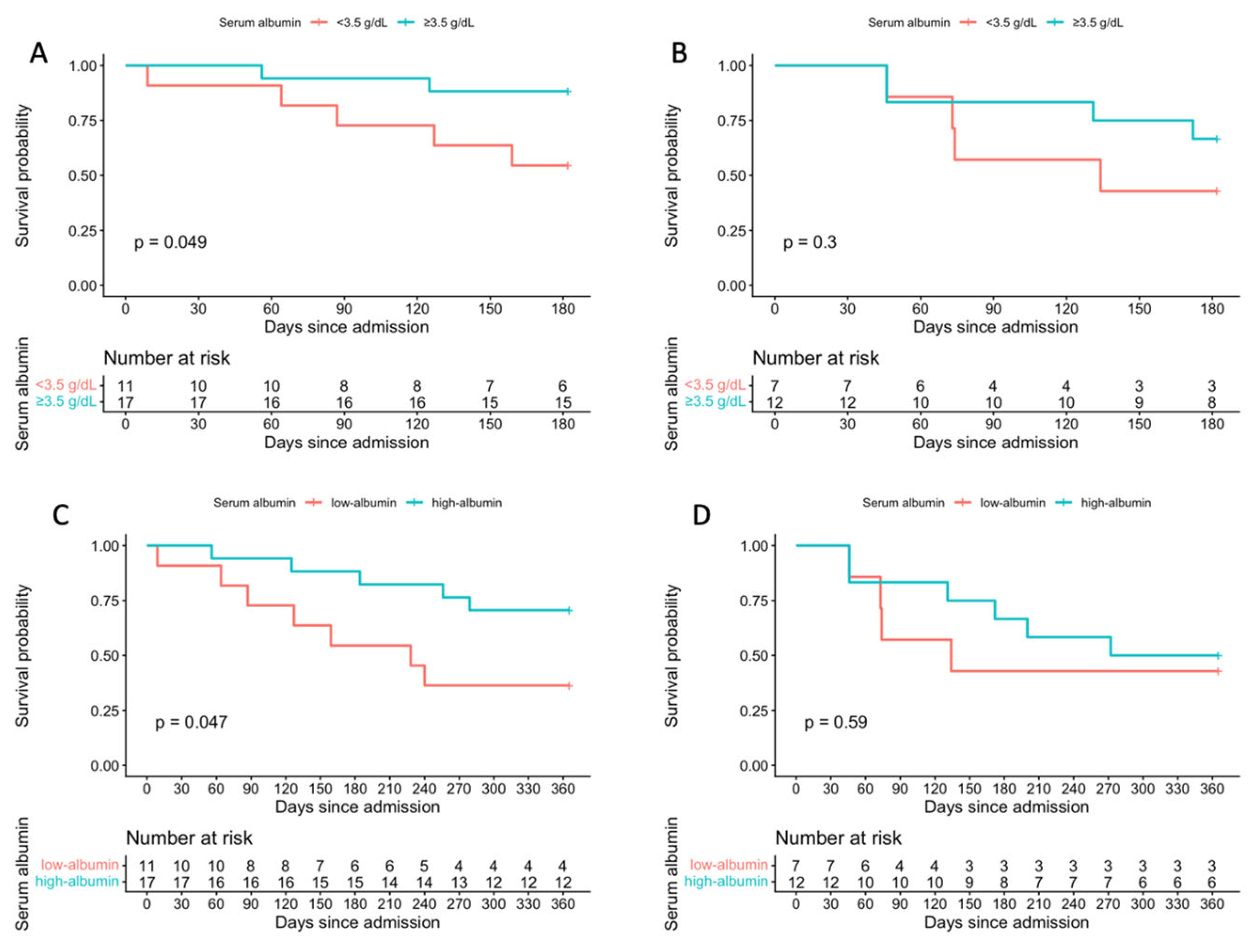
Survival curves for 6-month and 1-year mortality were estimated using the Kaplan–Meier method and compared between groups using the log-rank test. In addition, phenotype-specific survival analyses were performed to explore the prognostic impact of serum albumin within HF subtypes. Kaplan–Meier curves were generated separately for patients with HFrEF and HFpEF, stratified according to serum albumin levels at admission. Patients with HFmrEF were not analyzed separately due to the limited sample size of this subgroup. Cox proportional hazards regression was employed to assess the independent association between serum albumin and mortality, adjusting for age, sex, comorbidity burden (CIRS-G), CRP and HF subtype. HF subtype was included in the Cox models for mortality due to its plausible clinical relevance, but it was not included in negative binomial models for length of stay, as its inclusion did not meaningfully improve model fit (minimal AIC change) and could compromise model stability in this relatively small sample.
Statistical analyses were conducted using R software (version 4.4.2, R Foundation for Statistical Computing, Vienna, Austria).

3. Results

3.1. Population Characteristics

A total of 56 consecutive patients aged ≥65 years (mean age 78.6 ± 7.5 years; 69.6% female) were included. HF phenotypes were distributed as follows: 28 patients (50%) had HFrEF, 9 (16.1%) HFmrEF, and 19 (33.9%) HFpEF. Mean serum albumin at admission was 3.58 ± 0.6 g/dL. The average length of hospital-stay was 14.8 ± 10.1 days. Mean CIRS-G score was 16.0 ± 3.4, ranging from 9 to 24.
Baseline demographic, clinical, and laboratory characteristics in general population and according to albumin categories are shown in Table 1.

3.2. Association Between Serum Albumin and Length of Hospital-Stay

Negative binomial regression revealed a significant inverse association between serum albumin levels and length of stay. In univariate analysis, each 1 g/dL increase in albumin plasma concentration was associated with a 40% reduction in length of hospital stay (IRR = 0.60; 95% CI: 0.49–0.75; p < 0.001). After adjusting for age, CIRS-G score, and C-reactive protein (CRP), this association remained statistically significant, with a 32% reduction in length of stay per unit increase in albumin (IRR = 0.68; 95% CI: 0.54–0.85; p = 0.01). Robust confidence intervals were estimated to account for heteroskedasticity. Sensitivity analysis comparing models with and without CIRS-G indicated slightly better fit when including CIRS-G (AIC = 389.16 vs. 389.90). Results are detailed in Table 2.

3.3. Survival Analysis

During follow-up, 16 patients (28.6%) died within 6 months and 24 patients (42.9%) within 1 year. Multivariable Cox proportional hazards models demonstrated that serum albumin at admission was independently associated with reduced mortality at 6 months (HR = 0.30; 95% CI: 0.11–0.82; p = 0.019) after adjustment for age, sex, comorbidity burden (CIRS-G), CRP at admission and HF subtype.
At 1 year, serum albumin remained independently associated with lower mortality (HR = 0.41; 95% CI: 0.17–0.96; p = 0.041). Age was associated with higher mortality, while sex, CRP, CIRS-G and HF subtype showed no significant independent effect in these models (Table 3).
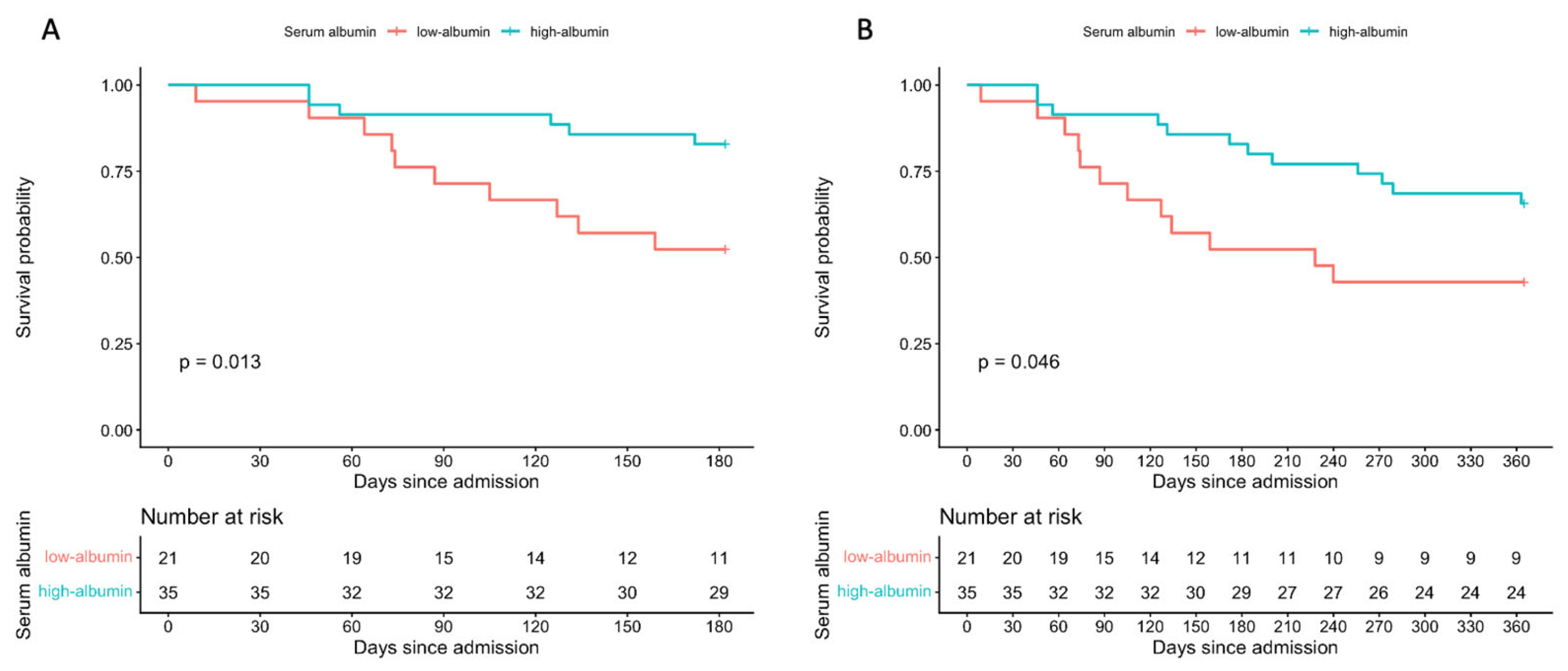
The Kaplan–Meier survival curves stratified by serum albumin levels at admission are shown in Figure 2. Patients with albumin ≥ 3.5 g/dL demonstrated significantly higher survival at 6 months compared with those with albumin < 3.5 g/dL (log-rank p = 0.013). At 1 year, survival remained higher in the high-albumin group, with a statistically significant difference between groups (log-rank p = 0.046).
In phenotype-stratified survival analyses, hypoalbuminemia was associated with significantly reduced survival among patients with HFrEF. At 6 months, patients with serum albumin < 3.5 g/dL showed lower survival compared with those with preserved albumin levels (log-rank p = 0.049), a difference that persisted at 1 year (p = 0.047). In contrast, no significant survival differences according to albumin categories were observed among patients with HFpEF at either 6 months (p = 0.30) or 1 year (p = 0.59) (Figure 3).

4. Discussion

This study demonstrates a significant inverse relationship between serum albumin levels at hospital admission and length of stay in elderly patients with HF. Negative binomial regression indicated that each 1 g/dL increase in albumin was associated with approximately a 32% reduction in hospitalization duration, independent of age, comorbidity burden, and inflammatory status.
Length of stay is a recognized surrogate marker for HF severity, reflecting the clinical complexity and risk of adverse outcomes such as readmission and mortality [20]. Prolonged hospitalization has been consistently associated with greater clinical burden, higher healthcare costs, and worse functional recovery, particularly among older adults with HF.
In a large nationwide cohort, increased frailty in HF patients was strongly associated with longer hospitalizations, higher in-hospital mortality, and a near-doubling of healthcare costs [21]. Similarly, elderly HF patients in both the United States and Japan experienced longer hospital stays and markedly increased hospitalization costs, with extended stays linked to poorer discharge disposition [22].
Evidence from geriatric cohorts also indicates that longer length of stay predicts higher post-discharge mortality and functional decline [23], while recent health-economic data from France confirmed that each additional hospital day substantially increases annual per-patient HF costs [24]. Moreover, a recent meta-analysis underscored that frailty is independently associated with both prolonged hospitalization and increased mortality in HF [25].
This evidence highlights the dual clinical and economic impact of extended hospitalization, reinforcing the need for early identification of vulnerable patients. Our findings suggest that serum albumin, as an accessible biomarker of nutritional and inflammatory status, may be useful in early risk stratification and prognostication in elderly HF patients.
Albumin is a well-established marker of malnutrition, systemic inflammation, and impaired hepatic synthesis, and its prognostic significance in HF has been demonstrated in several studies [16], which identified hypoalbuminemia as a strong predictor of mortality and HF readmissions.
These results align with those of Bhattarai et al. [26], who reported a significant correlation between hypoalbuminemia and prolonged hospital-stay in adult patients with acute HF. While their study categorized hospital-stay durations and did not extensively adjust for confounders, our approach used continuous modeling with negative binomial regression and incorporated a DAG-guided confounder selection process, enhancing analytic rigor. Similarly, Liu et al. [27] found albumin to be an independent predictor of prolonged hospitalization in HF patients, although they employed logistic regression for categorical outcomes.
An intriguing observation was the negative association between age and length of stay (IRR = 0.99). This might reflect earlier discharge practices for older patients driven by clinical considerations, social factors, or palliative approaches that limit aggressive interventions. Further research is eagerly awaited to elucidate these patterns.
Mortality analysis revealed serum albumin was independently associated with reduced risk of death at 6 months and 1 year. Although Kaplan–Meier analyses suggested differences in survival according to HF subtype, these differences were not significant in multivariable Cox models adjusting for age, albumin, comorbidity burden, and CRP. This indicates that the apparent subtype-related survival differences in unadjusted analyses are likely influenced by confounding factors. Importantly, serum albumin remained an independent predictor of mortality across all HF phenotypes, highlighting its prognostic relevance irrespective of HF subtype. This is consistent with prior studies such as Horwich et al. [28], which demonstrated hypoalbuminemia as a predictor of reduced survival in HFrEF patients, and Liu et al. [29], who reported similar findings in HFpEF cohorts with longer follow-up. Our study extends these observations to a mixed elderly HF population with a shorter-term mortality endpoint.
Prenner et al. [30] investigated 3254 HFpEF patients further confirming albumin as an independent predictor of morbidity and mortality after adjustment for traditional risk models such as the MAGGIC score. Originally validated in broad HF cohorts, the MAGGIC score has subsequently shown reliable prognostic accuracy in HFpEF, where it incorporates age, comorbidity burden, renal function, and clinical severity into a unified risk estimate [31]. Within this framework, albumin appears to provide incremental prognostic information, reinforcing its value beyond established clinical risk models.
Patients with low albumin levels had significantly increased mortality risk, indicating that albumin reflects not only nutritional status or renal function but also inflammatory and subclinical processes including hepatic fibrosis, arterial stiffness, and cardiac dysfunction. Compared to the present study that focuses on short-term outcomes, Prenner et al. incorporated several inflammatory biomarkers, hepatic fibrosis indicators, albuminuria, and arterial stiffness metrics, providing a more detailed pathophysiological insight into the albumin–prognosis association.
Finally, Armentaro et al. [32] investigated younger patients with chronic heart failure, reporting that albumin < 3.5 g/dL was associated with higher incidence of major adverse cardiovascular events (MACE), including nonfatal ischemic stroke, nonfatal myocardial infarction, coronary revascularization or bypass surgery, cardiovascular death, as well as increased all-cause mortality and HF hospitalizations over a mean follow-up of 6.1 years. This extended follow-up highlighted albumin as a powerful long-term mortality predictor with significant clinical implications in chronic heart failure management.
Several biological mechanisms support the association between hypoalbuminemia and adverse HF outcomes. Reduced albumin levels reflect the combined effects of congestion, inflammation, hepatic synthetic dysfunction, malnutrition, and catabolic states [16], whereas hypoalbuminemia directly contributes to circulatory and metabolic derangements by lowering oncotic pressure, impairing endothelial barrier function, increasing oxidative stress, and reducing ligand-binding capacity [17,33,34]. This pathophysiological interplay may also explain the higher incidence of MACE observed in hypoalbuminemic HF patients in long-term studies, such as that reported by Armentaro et al., where low albumin identified a subgroup with increased cardiovascular vulnerability [32]. These reciprocal mechanisms provide a biologically coherent framework for the observed association with prolonged hospitalization and higher mortality.
However, several limitations should be acknowledged. First, the study was conducted at a single center with a small sample size and a limited number of mortality events, which may compromise the stability of multivariable models, restrict generalizability, and introduce selection bias, as the population may not capture the broader spectrum of HF severity in the community. Additionally, the observational nature precludes causal inference regarding albumin’s effect on clinical outcomes. While confounding variables were controlled in the multivariate model, residual confounding related to unmeasured factors in clinical management cannot be excluded.
Furthermore, albumin was measured only at admission, without consideration of changes during hospitalization, which may affect its prognostic interpretation. The study also did not address potential therapeutic strategies that may interact with albumin levels or modify their clinical implications. Emerging evidence suggests that albumin-related interventions might influence congestion and clinical outcomes. For example, co-administration of human albumin with loop diuretics has been shown to enhance diuretic responsiveness in patients with diuretic resistance [35], and intravenous iron therapy can improve symptoms and reduce HF hospitalizations, partly through mechanisms linked to inflammation and metabolic dysfunction [36].
Future prospective trials are warranted to investigate whether interventions aimed at correcting hypoalbuminemia, such as albumin supplementation or strategies addressing underlying contributors (e.g., inflammation, congestion, nutritional deficits), can improve clinical outcomes and reduce hospitalizations in patients with HF [12].
Nonetheless, the study has important strengths. First, the examined population is representative of a real-world hospitalized elderly cohort with all HF phenotypes (HFrEF, HFmrEF, HFpEF), providing clinical relevance often lacking in more selected trials. Furthermore, the analysis accounted for relevant clinical factors such as age, CIRS-G score, and CRP levels, allowing control for key confounders. Notably, the use of the CIRS-G scale for comorbidity assessment is a particular strength, enabling a more accurate evaluation of chronic disease burden by capturing factors like age, cognitive status, and education level [37]. This facilitated more precise confounder control, enhancing analysis quality, and reducing bias risk. Such detailed comorbidity assessment is crucial in managing elderly HF patients with multiple comorbidities, as it optimizes therapeutic strategies and improves outcome prediction.

5. Conclusions

In elderly patients hospitalized with HF, serum albumin at admission is a significant independent predictor of length of hospital-stay. Lower albumin levels correlate with prolonged hospitalization, underscoring its potential utility as a simple and readily available biomarker for early risk stratification. Additionally, hypoalbuminemia was associated with increased mortality, suggesting prognostic relevance beyond the acute hospitalization phase.
Given the retrospective design, small sample size, and potential for residual confounding, these findings should be interpreted as preliminary. Prospective studies with larger cohorts are needed to confirm the prognostic role of albumin and to evaluate whether interventions targeting nutritional or inflammatory status can improve clinical outcomes.
Routine assessment of serum albumin in elderly HF patients could guide personalized management strategies, optimize resource utilization, and improve clinical outcomes. Prospective studies with larger cohorts are needed to confirm these findings and explore interventions targeting nutritional and inflammatory pathways to enhance care in this vulnerable population.

Author Contributions

Conceptualization, G.C. and P.T.; methodology, F.G.; software, G.C.; validation, B.T., M.G. and F.G.C.; formal analysis, G.C. and D.B.; investigation, C.F.; resources, V.G. and. A.D.S.; data curation, G.O.; writing—original draft preparation, G.C.; writing—review and editing, F.G.; visualization, C.D.L. and P.M.; supervision, V.N. All authors have read and agreed to the published version of the manuscript.

Funding

This research received no external funding.

Institutional Review Board Statement

This retrospective study was conducted in accordance with European and Italian regulations on the processing of health data for scientific research. Data collection and analysis complied with the EU General Data Protection Regulation (EU Regulation 2016/679, GDPR), the Italian Data Protec-tion Code (D.Lgs. 196/2003, as amended), and the Guidelines of the Italian Data Protection Authority for scientific research (Garante Privacy, 2012 and 2021). According to the Determinazione AIFA n. 20/2008 and the ‘Linee Guida per la Classificazione e Conduzione degli Studi Osservazionali’, retrospective studies based on anonymized clinical data collected during routine care do not require ethics committee approval. In compliance with the institutional policies of ASL Napoli 1 Centro, ethical approval was waived because all data were fully anonymized and no identifiable information was processed. The study was conducted in accordance with the Declaration of Helsinki.

Informed Consent Statement

Informed consent for the use of anonymized clinical data was obtained from all patients at the time of hospital admission in accordance with local regulations.

Data Availability Statement

The data presented in this study are available on request from the corresponding author due to privacy and ethical restrictions.

Acknowledgments

During the preparation of this manuscript, the authors used Gemini (Google) to generate the graphical abstract. The figure was subsequently reviewed and manually edited by the authors. The authors take full responsibility for the content of this publication.

Conflicts of Interest

The authors declare no conflicts of interest.

Abbreviations

The following abbreviations are used in this manuscript:
AICAkaike Information Criterion
ALTalanine transaminase
ASTaspartate transaminase
CIRS-GCumulative Illness Rating Scale for Geriatrics
CRPC-reactive protein
DAGDirected Acyclic Graph
HFHeart Failure
HFrEFHeart Failure with reduced ejection fraction
HFmrEFHeart Failure with mildly reduced ejection fraction
HFpEFHeart Failure with preserved ejection fraction
HRHazard Ratio
ICDInternational Classification of Disease
IRRIncidence Rate Ratio
NYHA New York Heart Association functional class

References

  1. Brouwers, F.P.; de Boer, R.A.; van der Harst, P.; Voors, A.A.; Gansevoort, R.T.; Bakker, S.J.; Hillege, H.L.; van Veldhuisen, D.J.; van Gilst, W.H. Incidence and Epidemiology of New Onset Heart Failure with Preserved vs. Reduced Ejection Fraction in a Community-Based Cohort: 11-Year Follow-up of PREVEND. Eur. Heart J. 2013, 34, 1424–1431. [Google Scholar] [CrossRef]
  2. Yan, S.; Deng, P.; Chai, K.; Wang, S.; Hu, K.; Yang, J.; Wang, H. Global, Regional, and National Burden of Heart Failure and Its Risk Factors between 1990 and 2021 and Projections to 2050: An Analysis of the Global Burden of Disease Study. Eur. Heart J. Qual. Care Clin. Outcomes 2025, 11, 1144–1154. [Google Scholar] [CrossRef] [PubMed]
  3. Roger, V.L.; Go, A.S.; Lloyd-Jones, D.M.; Benjamin, E.J.; Berry, J.D.; Borden, W.B.; Bravata, D.M.; Dai, S.; Ford, E.S.; Fox, C.S.; et al. Heart Disease and Stroke Statistics—2012 Update: A Report from the American Heart Association. Circulation 2012, 125, e2–e220. [Google Scholar] [CrossRef] [PubMed]
  4. Barsheshet, A.; Shotan, A.; Cohen, E.; Garty, M.; Goldenberg, I.; Sandach, A.; Behar, S.; Zimlichman, E.; Lewis, B.S.; Gottlieb, S.; et al. Predictors of Long-term (4-year) Mortality in Elderly and Young Patients with Acute Heart Failure. Eur. J. Heart Fail. 2010, 12, 833–840. [Google Scholar] [CrossRef] [PubMed]
  5. Jugdutt, B.I. Aging and Heart Failure: Changing Demographics and Implications for Therapy in the Elderly. Heart Fail. Rev. 2010, 15, 401–405. [Google Scholar] [CrossRef]
  6. Doweiko, J.P.; Nompleggi, D.J. Role of Albumin in Human Physiology and Pathophysiology. J. Parenter. Enter. Nutr. 1991, 15, 207–211. [Google Scholar] [CrossRef]
  7. Chojkier, M. Inhibition of Albumin Synthesis in Chronic Diseases: Molecular Mechanisms. J. Clin. Gastroenterol. 2005, 39, S143–S146. [Google Scholar] [CrossRef]
  8. Wu, N.; Liu, T.; Tian, M.; Liu, C.; Ma, S.; Cao, H.; Bian, H.; Wang, L.; Feng, Y.; Qi, J. Albumin, an Interesting and Functionally Diverse Protein, Varies from “native” to “Effective” (Review). Mol. Med. Rep. 2024, 29, 24. [Google Scholar] [CrossRef]
  9. Levitt, D.G.; Levitt, M.D. Human Serum Albumin Homeostasis: A New Look at the Roles of Synthesis, Catabolism, Renal and Gastrointestinal Excretion, and the Clinical Value of Serum Albumin Measurements. Int. J. Gen. Med. 2016, 9, 229–255. [Google Scholar] [CrossRef]
  10. Allen, L.A.; Felker, G.M.; Pocock, S.; McMurray, J.J.V.; Pfeffer, M.A.; Swedberg, K.; Wang, D.; Yusuf, S.; Michelson, E.L.; Granger, C.B.; et al. Liver Function Abnormalities and Outcome in Patients with Chronic Heart Failure: Data from the Candesartan in Heart Failure: Assessment of Reduction in Mortality and Morbidity (CHARM) Program. Eur. J. Heart Fail. 2009, 11, 170–177. [Google Scholar] [CrossRef]
  11. Novack, V.; Pencina, M.; Zahger, D.; Fuchs, L.; Nevzorov, R.; Jotkowitz, A.; Porath, A. Routine Laboratory Results and Thirty Day and One-Year Mortality Risk Following Hospitalization with Acute Decompensated Heart Failure. PLoS ONE 2010, 5, e12184. [Google Scholar] [CrossRef] [PubMed]
  12. Ghazal, M.; Khalife, W.I. Hypoalbuminemia in Heart Failure: Pathophysiology, Clinical Implications, and Management Strategies. Heart Fail. Rev. 2025, 30, 1407–1414. [Google Scholar] [CrossRef] [PubMed]
  13. Husain, F.S.; Tey, S.L.; Huynh, D.T.T.; Oliver, J.; Baggs, G.; How, C.H.; Chow, W.L.; Cheong, M.; Aw, T.C.; Chew, S.T.H.; et al. Aging and Liver Health: Liver Chemistries and Associated Factors in Community-Dwelling Older Adults. BMC Geriatr. 2025, 25, 658. [Google Scholar] [CrossRef] [PubMed]
  14. Herrmann, F.R.; Safran, C.; Levkoff, S.E.; Minaker, K.L. Serum Albumin Level on Admission as a Predictor of Death, Length of Stay, and Readmission. Arch. Intern. Med. 1992, 152, 125–130. [Google Scholar] [CrossRef]
  15. Famakin, B.; Weiss, P.; Hertzberg, V.; McClellan, W.; Presley, R.; Krompf, K.; Karp, H.; Frankel, M.R. Hypoalbuminemia Predicts Acute Stroke Mortality: Paul Coverdell Georgia Stroke Registry. J. Stroke Cerebrovasc. Dis. 2010, 19, 17–22. [Google Scholar] [CrossRef]
  16. Gotsman, I.; Shauer, A.; Zwas, D.R.; Tahiroglu, I.; Lotan, C.; Keren, A. Low Serum Albumin: A Significant Predictor of Reduced Survival in Patients with Chronic Heart Failure. Clin. Cardiol. 2019, 42, 365–372. [Google Scholar] [CrossRef]
  17. Arques, S.; Ambrosi, P. Human Serum Albumin in the Clinical Syndrome of Heart Failure. J. Card. Fail. 2011, 17, 451–458. [Google Scholar] [CrossRef]
  18. McDonagh, T.A.; Metra, M.; Adamo, M.; Gardner, R.S.; Baumbach, A.; Böhm, M.; Burri, H.; Butler, J.; Čelutkienė, J.; Chioncel, O.; et al. 2021 ESC Guidelines for the Diagnosis and Treatment of Acute and Chronic Heart Failure. Eur. Heart J. 2021, 42, 3599–3726. [Google Scholar] [CrossRef]
  19. Miller, M.D.; Paradis, C.F.; Houck, P.R.; Mazumdar, S.; Stack, J.A.; Rifai, A.H.; Mulsant, B.; Reynolds, C.F. Rating Chronic Medical Illness Burden in Geropsychiatric Practice and Research: Application of the Cumulative Illness Rating Scale. Psychiatry Res. 1992, 41, 237–248. [Google Scholar] [CrossRef]
  20. Reynolds, K.; Butler, M.G.; Kimes, T.M.; Rosales, A.G.; Chan, W.; Nichols, G.A. Relation of Acute Heart Failure Hospital Length of Stay to Subsequent Readmission and All-Cause Mortality. Am. J. Cardiol. 2015, 116, 400–405. [Google Scholar] [CrossRef]
  21. Kwok, C.S.; Zieroth, S.; Van Spall, H.G.C.; Helliwell, T.; Clarson, L.; Mohamed, M.; Mallen, C.; Duckett, S.; Mamas, M.A. The Hospital Frailty Risk Score and Its Association with In-Hospital Mortality, Cost, Length of Stay and Discharge Location in Patients with Heart Failure Short Running Title: Frailty and Outcomes in Heart Failure. Int. J. Cardiol. 2020, 300, 184–190. [Google Scholar] [CrossRef] [PubMed]
  22. Bates, B.A.; Enzan, N.; Tohyama, T.; Gandhi, P.; Matsushima, S.; Tsutsui, H.; Setoguchi, S.; Ide, T. Management and Outcomes of Heart Failure Hospitalization among Older Adults in the United States and Japan. ESC Heart Fail. 2024, 11, 3395–3405. [Google Scholar] [CrossRef] [PubMed]
  23. López Pardo, P.; Socorro García, A.; Baztán Cortés, J.J. Influence of length of hospital stay on mortality after discharge in older patients with acute medical diseases. Gac. Sanit. 2016, 30, 375–378. [Google Scholar] [CrossRef] [PubMed]
  24. Chemouni, F.; Nishikawa, T.C.; Groyer, H.; Diaby, O.; Chollet, J.; Ittah, D. Hospital Resource Utilization and Costs in Patients with Heart Failure in France. PharmacoEconomics Open 2023, 7, 927–940. [Google Scholar] [CrossRef]
  25. Prokopidis, K.; Nortcliffe, A.; Okoye, C.; Venturelli, M.; Lip, G.Y.H.; Isanejad, M. Length of Stay and Prior Heart Failure Admission in Frailty and Heart Failure: A Systematic Review and Meta-Analysis. ESC Heart Fail. 2025, 12, 2417–2426. [Google Scholar] [CrossRef]
  26. Pokhrel Bhattarai, S.; Dzikowicz, D.J.; Carey, M.G. Association Between Serum Albumin and the Length of Hospital Stay Among Patients with Acute Heart Failure. Biol. Res. Nurs. 2025, 27, 37–46. [Google Scholar] [CrossRef]
  27. Liu, T.; Xuan, H.; Wang, L.; Li, X.; Lu, Z.; Tian, Z.; Chen, J.; Wang, C.; Li, D.; Xu, T. The Association between Serum Albumin and Long Length of Stay of Patients with Acute Heart Failure: A Retrospective Study Based on the MIMIC-IV Database. PLoS ONE 2023, 18, e0282289. [Google Scholar] [CrossRef]
  28. Horwich, T.B.; Kalantar-Zadeh, K.; MacLellan, R.W.; Fonarow, G.C. Albumin Levels Predict Survival in Patients with Systolic Heart Failure. Am. Heart J. 2008, 155, 883–889. [Google Scholar] [CrossRef]
  29. Liu, M.; Chan, C.-P.; Yan, B.P.; Zhang, Q.; Lam, Y.-Y.; Li, R.-J.; Sanderson, J.E.; Coats, A.J.S.; Sun, J.-P.; Yip, G.W.-K.; et al. Albumin Levels Predict Survival in Patients with Heart Failure and Preserved Ejection Fraction. Eur. J. Heart Fail. 2012, 14, 39–44. [Google Scholar] [CrossRef]
  30. Prenner, S.B.; Kumar, A.; Zhao, L.; Cvijic, M.E.; Basso, M.; Spires, T.; Li, Z.; Yarde, M.; Bhattacharya, P.; Zamani, P.; et al. Effect of Serum Albumin Levels in Patients with Heart Failure with Preserved Ejection Fraction (from the TOPCAT Trial). Am. J. Cardiol. 2020, 125, 575–582. [Google Scholar] [CrossRef]
  31. Pocock, S.J.; Ariti, C.A.; McMurray, J.J.V.; Maggioni, A.; Køber, L.; Squire, I.B.; Swedberg, K.; Dobson, J.; Poppe, K.K.; Whalley, G.A.; et al. Predicting Survival in Heart Failure: A Risk Score Based on 39,372 Patients from 30 Studies. Eur. Heart J. 2013, 34, 1404–1413. [Google Scholar] [CrossRef]
  32. Armentaro, G.; Condoleo, V.; Pastura, C.A.; Grasso, M.; Frasca, A.; Martire, D.; Cassano, V.; Maio, R.; Bonfrate, L.; Pastori, D.; et al. Prognostic Role of Serum Albumin Levels in Patients with Chronic Heart Failure. Intern. Emerg. Med. 2024, 19, 1323–1333. [Google Scholar] [CrossRef]
  33. Roche, M.; Rondeau, P.; Singh, N.R.; Tarnus, E.; Bourdon, E. The Antioxidant Properties of Serum Albumin. FEBS Lett. 2008, 582, 1783–1787. [Google Scholar] [CrossRef]
  34. Quinlan, G.J.; Martin, G.S.; Evans, T.W. Albumin: Biochemical Properties and Therapeutic Potential. Hepatology 2005, 41, 1211–1219. [Google Scholar] [CrossRef]
  35. Fernandes, J.; Costa, R.; Guerreiro, R.; Bonifácio, D.; Rodrigues, A.; Henriques, C.; Branco, P.; Araújo, I.; Fonseca, C. Co-Administration of Albumin and Furosemide in Acute Heart Failure with Diuretics Resistance. Acta Med. Port. 2023, 36, 193–201. [Google Scholar] [CrossRef]
  36. Messner, M.; Pölzl, G.; Adlbrecht, C.; Altenberger, J.; Auer, J.; Berent, R.; Dörler, J.; Zaruba, M.-M.; Ebner, C.; Fruhwald, F.; et al. Diagnosis and Treatment of Iron Deficiency in Chronic Heart Failure: Position Statement of the Heart Failure Working Group of the Austrian Society of Cardiology. Wien. Klin. Wochenschr. 2025, 137, 143–156. [Google Scholar] [CrossRef]
  37. Borson, S.; Scanlan, J.M.; Lessig, M.; DeMers, S. Comorbidity in Aging and Dementia: Scales Differ, and the Difference Matters. Am. J. Geriatr. Psychiatry 2010, 18, 999–1006. [Google Scholar] [CrossRef]
Figure 1. Directed Acyclic Graph (DAG) illustrating the assumed causal relationships between serum albumin (Alb), length of hospital stay and length of hospital stay (LoS), and potential confounders in elderly patients with heart failure: (a) Illustrates all causal paths between exposure (Alb, bottom left,) and outcome (Deg, bottom right), including potential confounders (age, CRP, CIRS, GFR, top). This panel shows the structure before statistical adjustment, highlighting backdoor paths that could induce confounding; (b) highlights the minimal adjustment set (age and CRP, orange) required to block all backdoor paths and estimate the independent effect of Alb on outcomes. Alb = serum albumin; CIRS = Cumulative Illness Rating Scale for Geriatrics; CRP = C-reactive protein; GFR = estimated glomerular filtration rate; LoS = length of hospital stay.
Hearts 06 00034 g001
Figure 2. Kaplan–Meier survival curves for elderly patients hospitalized with heart failure, stratified by serum albumin levels at admission. (A) 6-month survival; (B) 1-year survival.
Hearts 06 00034 g002
Figure 3. Kaplan–Meier survival curves stratified by serum albumin levels at admission (<3.5 vs. ≥3.5 g/dL) within heart failure phenotypes. (A) HFrEF, 6-month survival; (B) HFpEF, 6-month survival; (C) HFrEF, 1-year survival; (D) HFpEF, 1-year survival. Survival differences between albumin groups were assessed using the log-rank test.
Hearts 06 00034 g003
Table 1. Baseline Characteristics of the Study Population.
VariableTotal (n = 56)Low Albumin (n = 21)High Albumin (n = 35)
Mean ± SD/n (%)
Age (years)78.6 ± 7.5278.9 ± 6.778.4 ± 8.1
Female sex39 (69.6%)15 (71.4%)24 (68.6%)
HF subtype
- HFrEF28 (50.0%)11 (52.4%)17 (48.6%)
- HFmrEF9 (16.1%)3 (14.3%)6 (17.1%)
- HFpEF19 (33.9%)7 (33.3%)12 (34.3%)
NYHA class
II4 (7.1%)1 (4.8%)3 (8.6%)
III45 (80.4%)17 (81%)28 (80%)
IV7 (12.5%)3 (14.3%)4 (11.4%)
Serum albumin (g/dL)3.58 ± 0.603 ± 0.43.9 ± 0.3
Length of hospital-stay (days)14.8 ± 10.117.3 ± 10.913.3 ± 9.5
CIRS-G score16.0 ± 3.3617.4 ± 315.1 ± 3.3
Hb (g/L)11.1 ± 2.510.4 ± 2.411.5 ± 2.5
WBC (103 × mm3)9.3 ± 3.59.8 ± 3.69 ± 3.4
PLT (103 × mm3)262 ± 103254.8 ± 117260.4 ± 95.4
Creatinine (mg/dL)1.64 ± 1.11.7 ± 1.21.6 ± 1.1
eGFR (mL/min/1.73 m2)50.7 ± 27.548.4 ± 27.552.1 ± 27.8
Sodium (mEq/L)141 ± 4.1140.6 ± 3.7141.1 ± 4.3
Potassium (mEq/L)4.1 ± 0.74 ± 0.74.1 ± 0.7
AST (U/L)36.6 ± 68.224 ± 13.444.1 ± 85.2
ALT (U/L)31.5 ± 6916.7 ± 10.740.3 ± 86
CRP (mg/dL)4.7 ± 7.96.4 ± 4.83.6 ± 9.2
Comorbidities
Atrial fibrillation30 (53.6%)10 (47.6%)20 (57.1%)
Diabetes mellitus29 (51.8%)11 (52.4%)18 (51.4%)
Arterial Hypertension33 (58.9%)10 (47.6%)23 (65.7%)
PAD2 (5.4%)2 (9.5%)1 (2.9%)
Dementia4 (7.1%)3 (14.3%)1 (2.9%)
Stroke4 (7.1%)3 (14.3%)1 (2.9%)
ALT = alanine transaminase; AST = aspartate transaminase; CIRS-G = Cumulative Illness Rating Scale for Geriatrics; CRP = C-reactive protein; eGFR = estimated glomerular filtration rate; HF = heart failure; HFmrEF = HF with mildly reduced ejection fraction; HFpEF = HF with preserved ejection fraction; HFrEF = HF with reduced ejection fraction; NYHA = New York Heart Association functional class; PAD = peripheral arterial disease; PLT = platelets; WBCs = white blood cells.
Table 2. Association between serum albumin levels and length of hospital-stay: univariate and multivariate negative binomial regression models.
VariableIRR95% CIIRR95% CI
Intercept85.6941.14–178.4891.1915.29–543.92
Serum Albumin (g/dL)0.600.49–0.750.680.54–0.85
CIRS Score1.041.00–1.08
Age (years)0.990.97–1.00
CRP (mg/L)1.000.98–1.02
CI = confidence interval; CIRS = Cumulative Illness Rating Scale; CRP = C-reactive protein; IRR = incidence rate ratio. IRR and 95% CI estimated using negative binomial regression with robust (HC0) standard errors.
Table 3. Univariate and multivariate Cox proportional hazards analysis of 6-month and 1-year mortality. Values in bold indicate statistical significance (p < 0.05).
OutcomeVariableUnivariate HR (95% CI)p-ValueMultivariate HR (95% CI)p-Value
6-month mortalitySerum albumin (per 1 g/dL)0.28 (0.13–0.60)0.0010.30 (0.11–0.82)0.019
Age (per 1 year)1.07 (1.00–1.15)0.064
CIRS-G score1.05 (0.89–1.24)0.664
CRP (mg/L)1.03 (0.97–1.09)0.253
HF subtype (vs HFrEF)
HFmrEF0.29 (0.03–2.69)0.276
HFpEF1.54 (0.54–4.36)0.417
1-year mortalitySerum albumin (per 1 g/dL)0.35 (0.18–0.68)0.0020.41 (0.17–0.96)0.041
Age (per 1 year)1.07 (1.01–1.13)0.025
CIRS-G score1.07 (0.94–1.22)0.294
CRP (mg/L)1.04 (0.98–1.10)0.188
HF subtype (vs HFrEF)
HFmrEF0.29 (0.06–1.45)0.131
HFpEF1.09 (0.47–2.57)0.835
HR = hazard ratio; CI = confidence interval; CIRS-G = Cumulative Illness Rating Scale—Geriatric; CRP = C-reactive protein.
Disclaimer/Publisher’s Note: The statements, opinions and data contained in all publications are solely those of the individual author(s) and contributor(s) and not of MDPI and/or the editor(s). MDPI and/or the editor(s) disclaim responsibility for any injury to people or property resulting from any ideas, methods, instructions or products referred to in the content.