1. Introduction
The concept of ventriculo-arterial coupling (VAC) integrates the interaction between left ventricular contractility and the arterial system, reflecting the efficiency of cardiovascular energy transfer. In practice, VAC is expressed as the ratio between arterial elastance (Ea), a lumped measure of the arterial load, and end-systolic elastance (Ees), a relatively load-independent index of ventricular contractility. When the two are balanced, energy transfer from ventricle to arteries is optimal, forward flow is preserved, and metabolic cost is minimised. Conversely, when Ea and Ees are mismatched—typically when VAC rises above normal—the system is uncoupled, stroke volume falls, and efficiency deteriorates [
1,
2,
3].
The physiological foundations of VAC were first described in the 1980s, when pressure–volume loop studies demonstrated that the balance between ventricular contractility and arterial load determines cardiac output and energetic efficiency [
1]. This framework introduced the idea of VAC as an integrative index, moving beyond the traditional emphasis on pressure or flow alone. Subsequent investigations confirmed that this relationship is tightly linked to both stroke work and metabolic efficiency, and that its disruption characterises the transition from normal to failing hearts [
2].
Over the last decades, VAC has been studied across multiple cardiovascular scenarios. In hypertension and ageing, it captures the impact of increased arterial stiffness; in heart failure with preserved and reduced ejection fraction, it correlates with exercise capacity and long-term outcomes; in valvular disease and transcatheter aortic valve implantation (TAVI), it provides a framework to quantify afterload and predict clinical recovery; and in cardiac resynchronisation therapy (CRT), it has been associated with reverse remodelling and symptomatic improvement [
4,
5,
6,
7,
8,
9]. Across these diverse conditions, VAC has consistently shown prognostic value and has been proposed as a therapeutic target to guide management.
In the intensive care unit (ICU), however, clinicians face rapidly evolving haemodynamics in conditions such as septic and cardiogenic shock. In these contexts, pressure or flow parameters alone can be misleading: blood pressure may remain preserved despite impaired flow, or the ejection fraction may appear normal in vasoplegia despite depressed contractility [
10]. VAC provides a physiology-based, load-adjusted framework to evaluate cardiovascular performance beyond these conventional measures, potentially allowing more precise phenotyping of circulatory failure and more rational tailoring of therapy.
Different approaches have been proposed to measure VAC, ranging from invasive pressure–volume loop analysis to non-invasive indices of arterial stiffness (pulse wave velocity, augmentation index, and valvulo-arterial impedance) and myocardial performance (global longitudinal strain) [
4]. While these methods have value in research and outpatient settings, they are less feasible in critical care. For bedside use in the ICU, the single-beat method proposed by Chen et al. in 2001 remains the most practical and reproducible, having been validated against invasive standards and widely adopted for non-invasive VAC assessment [
11].
This article will therefore focus on the role of VAC in critical illness, emphasising its bedside assessment, physiological rationale, and therapeutic implications for clinicians involved in cardiovascular critical care.
2. Applied Physiological Principles
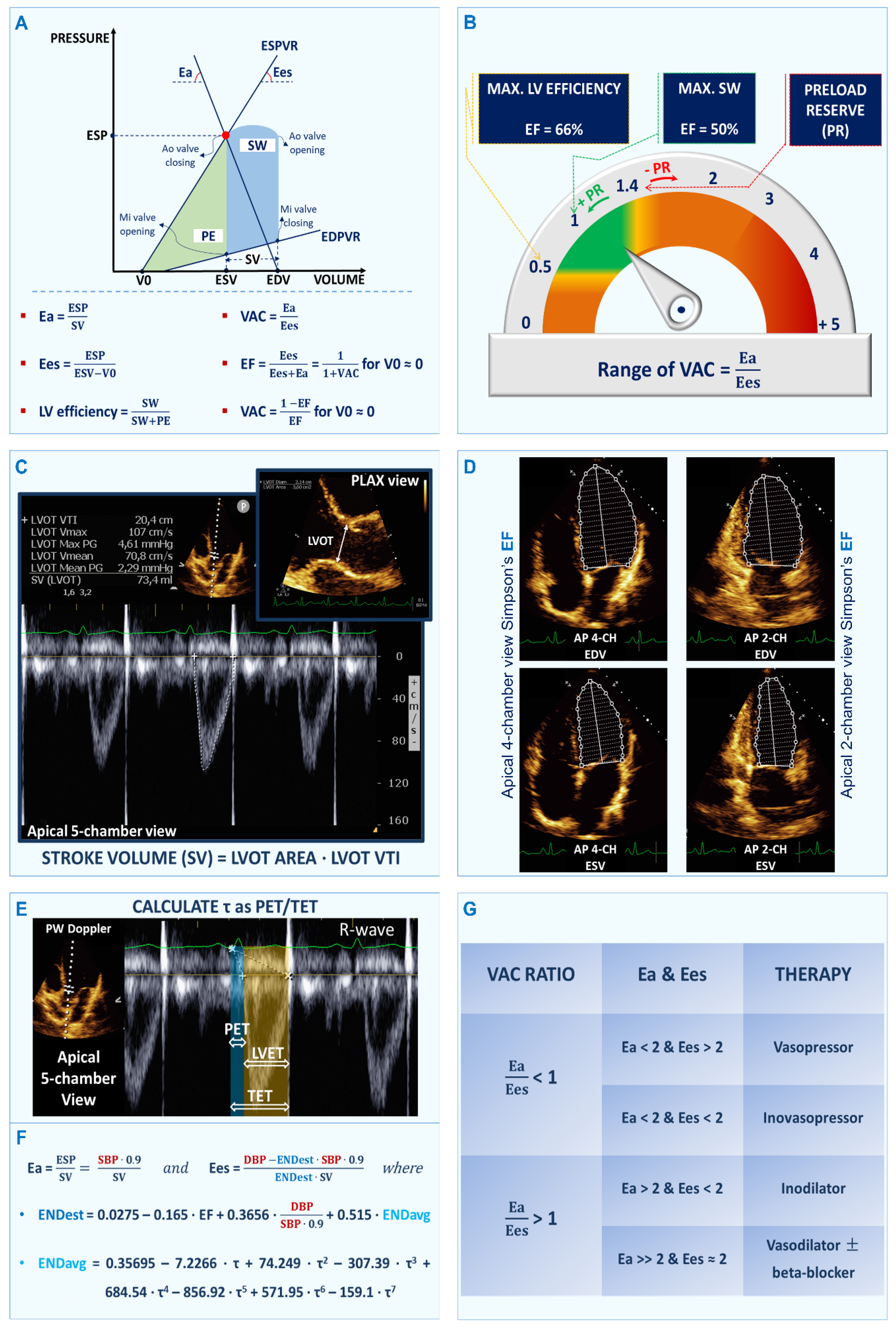
The foundations of ventriculo-arterial coupling lie in the concept of elastance. Elastance describes the relationship between pressure and volume, essentially reflecting how “stiff” a chamber or the arterial system is at a given moment. The left ventricle behaves as a time-varying elastance: it is compliant in diastole, progressively stiffens during systole, and reaches its maximum at end-systole. This maximum slope of the end-systolic pressure–volume relationship (ESPVR) defines end-systolic elastance (Ees), a parameter that reflects intrinsic ventricular contractility and is relatively insensitive to preload or afterload changes (
Figure 1A) [
1].
In parallel, the global arterial load can be represented by arterial elastance (Ea), defined as the ratio of end-systolic pressure to stroke volume (
Figure 1A). Ea condenses into a single value the combined effects of systemic vascular resistance, arterial compliance, and heart rate (HR). Thus, while Ees represents the ventricle’s ability to generate pressure, Ea represents the “stiffness” of the arterial tree. The ratio of Ea to Ees defines VAC, which integrates myocardial performance and arterial load into a single, dimensionless index of cardiovascular efficiency [
13].
Ea can also be expressed mathematically as the product of systemic vascular resistance and HR, under certain simplifying assumptions. This means that interventions that lower HR will also reduce Ea. For example, beta-blocker therapy in septic patients with high sympathetic tone can lower Ea without impairing contractility, thereby improving coupling—a principle that at first glance appears counterintuitive but is physiologically consistent.
From the pressure–volume framework, stroke volume (SV) and end-systolic pressure (ESP) can be derived by the intersection between the ESPVR and Ea lines. This yields the following equations:
- i.
Stroke volume = (EDV − V0)/(1 + VAC), where EDV represents LV end-diastolic volume, and V0 denotes the volume-axis intercept.
- ii.
End-systolic pressure = (EDV − V0)/[(1/Ea) + (1/Ees)], also approximated by multiplying arterial systolic blood pressure by a factor of 0.9.
These relationships convey two key clinical messages. First, SV falls exponentially as VAC increases, highlighting why uncoupling is associated with impaired forward flow even when filling pressures are high. Second, ESP rises proportionally with both Ea and Ees in response to changes in preload. As a result, arterial pressure may appear preserved despite severe uncoupling and inadequate perfusion. This paradox is often observed in septic patients treated with pure vasopressors such as phenylephrine: blood pressure increases, but forward flow and oxygen delivery worsen (
Figure 1A).
Normal and failing hearts prioritise VAC differently (see
Figure 1B). In healthy hearts, the VAC ratio is optimised around 0.5, signifying peak LV metabolic efficiency with an ejection fraction near 66%. In mild cardiac dysfunction, the VAC ratio revolves around 1, indicative of maximal LV stroke work for any given EDV. However, in more severe dysfunction, where Ees falls below Ea, both LV stroke work and metabolic efficiency are compromised [
2]. Thus, whereas a VAC ratio of 0.5 is naturally trended towards in health for metabolic efficiency, in diseased states, the therapeutic aim should shift to achieving a VAC of 1 to maximise stroke work (see
Figure 1G). Additionally, a VAC ratio of 1.4 may discriminate preload reserve, prompting the use of vasoactive drugs in patients with uncoupled VAC to augment cardiac output and mean arterial pressure further (see
Figure 1B) [
13].
Taken together, these physiological principles explain why VAC is more informative than blood pressure or ejection fraction alone: it exposes uncoupling, clarifies paradoxical responses to therapy, and identifies therapeutic targets. By condensing ventricular performance and arterial load into a single framework, VAC bridges physiology and clinical decision-making in both health and critical illness.
Rather than positioning ventriculo-arterial coupling (VAC) as a replacement for established haemodynamic variables, it should be viewed as a complementary physiological framework that integrates ventricular contractility and arterial load—two determinants of cardiovascular performance that are not simultaneously captured by cardiac output (CO), ejection fraction (EF), or mean arterial pressure (MAP) when considered in isolation.
Mean arterial pressure (MAP) reflects the product of cardiac output and systemic vascular resistance and is therefore a pressure-based surrogate of perfusion. However, MAP may remain preserved despite impaired forward flow when arterial elastance (Ea) is elevated, as frequently observed during vasopressor therapy. In such scenarios, pressure is restored at the expense of stroke volume and cardiovascular efficiency, potentially masking ongoing circulatory inadequacy. VAC analysis clarifies this apparent paradox by revealing excessive afterload relative to ventricular contractility, thereby explaining why pressure-guided resuscitation may fail to improve tissue perfusion.
Ejection fraction (EF) is highly dependent on loading conditions, particularly afterload, and therefore does not reliably reflect intrinsic myocardial contractility in acute illness. In vasoplegic states such as septic shock, EF may appear preserved or even supranormal despite depressed end-systolic elastance (Ees), whereas in afterload-excess states EF may fall despite preserved contractile function. VAC overcomes this limitation by explicitly separating ventricular performance (Ees) from arterial load (Ea), allowing a more accurate interpretation of systolic function in dynamically changing haemodynamic conditions.
Cardiac output (CO) remains a cornerstone variable in haemodynamic monitoring but represents the final result of multiple interacting determinants, including preload, afterload, contractility, and heart rate. As such, similar CO values may arise from fundamentally different pathophysiological mechanisms. VAC analysis differentiates whether a reduced CO is driven predominantly by impaired contractility (low Ees), excessive afterload (high Ea), or their combination, thereby providing mechanistic insight that directly informs therapeutic strategy.
Taken together, VAC does not replace MAP, EF, or CO, but rather contextualises and integrates them within a unified physiological framework. By exposing the balance—or imbalance—between ventricular and arterial function, VAC helps to reconcile discordant haemodynamic signals and supports more rational, mechanism-based haemodynamic management in critical care.
3. Bedside Assessment
Over the last decades, the evaluation of Ees has evolved from invasive pressure–volume loop acquisition in the catheterisation lab to more accessible non-invasive techniques. Among these, the single-beat method proposed by Chen et al. in 2001 has emerged as the most practical and reproducible approach, having been validated against invasive gold standards [
11]. This made VAC assessment feasible at the bedside, even in critically ill patients.
This method involves an algorithmic echocardiographic procedure to calculate Ees, outlined as follows:
- i.
Obtain Doppler-derived stroke volume and LV ejection fraction (
Figure 1C,D).
- ii.
Compute the pre-ejection to total ejection time ratio (
Figure 1E).
- iii.
Determine normalised ventricular elastance at ejection onset, integrating the ejection fraction, the pre-ejection to total ejection time ratio, and systolic and diastolic blood pressure data, either invasive or non-invasive (
Figure 1F).
- iv.
Finally, compute Ees using the normalised ventricular elastance at ejection onset, stroke volume, and the blood pressure readings (
Figure 1F).
By contrast, Ea is comparatively straightforward to obtain, as it only requires stroke volume and systolic arterial pressure (
Figure 1F). This relative simplicity underscores why VAC can be translated into routine practice: although Ees requires a structured algorithm, Ea can be quickly estimated with widely available parameters.
To further facilitate bedside implementation, the iElastance© application automates these calculations, providing clinicians with Ea, Ees, and their ratio (VAC) without the need for manual formulas [
11].
The iElastance© application implements the validated non-invasive single-beat method using routinely available haemodynamic and echocardiographic parameters. Required inputs include systolic and diastolic arterial pressure, obtained either invasively or non-invasively, which are used to estimate end-systolic pressure. Stroke volume is derived from standard Doppler echocardiography using left ventricular outflow tract (LVOT) diameter and LVOT velocity–time integral measurements. Left ventricular ejection fraction is obtained by biplane Simpson analysis or visual estimation, in accordance with routine critical care echocardiography practice.
In addition, simple timing intervals—specifically pre-ejection time and total ejection time—are measured using electrocardiographic and Doppler alignment to derive normalised ventricular elastance at ejection onset, a key component of the single-beat elastance algorithm. Following manual entry of these parameters, the application automatically computes arterial elastance (Ea), ventricular end-systolic elastance (Ees), and their ratio, providing immediate ventriculo-arterial coupling assessment.
All parameters are acquired during a standard focused echocardiographic examination, without the need for additional imaging, invasive pressure–volume analysis, or advanced post-processing. Once image acquisition is complete, data entry and calculation typically require approximately a few minutes, supporting the feasibility and usability of the application in routine intensive care practice.
The most widely accepted standard values include a VAC ratio of 1.0 ± 0.36, Ees of 2.3 ± 1.0 mmHg/mL, and arterial elastance Ea of 2.2 ± 0.8 mmHg/mL. Uncoupled systems, defined variably, typically exhibit VAC ratios exceeding these normal ranges. From a practical standpoint, coupled systems are characterised by a VAC ratio nearing unity, aligning with the therapeutic targets usually set at the bedside (see
Figure 1G) [
13].
Of final note, although ejection fraction can be derived from VAC (see
Figure 1A), its analysis alone cannot fully reveal the nuances that the assessment of VAC components, Ea and Ees, can offer, thus differentiating VAC evaluation from mere ejection fraction analysis.
Although ventriculo-arterial coupling has strong physiological rationale and growing observational support, robust prospective outcome-driven evidence validating VAC as a prognostic marker or therapeutic guide in critical care remains limited. VAC should be viewed as a physiological interpretative framework rather than a validated outcome-modifying intervention, and that its role is currently hypothesis-generating and complementary to established haemodynamic indices.
4. Therapeutic Implications
In the late 90s, Chang et al. proposed a paradigm shift in hemodynamic targets, moving beyond pressure or flow alone to focus on the balance between afterload (Ea) and contractility (Ees), a concept embodied by VAC. This perspective is clinically actionable in the ICU, where rapid shifts in vascular tone and myocardial performance fluctuate rapidly. Early work proposed VAC-oriented targets to enhance stroke work and LV power—metrics more tightly related to outcomes than pressure or flow in isolation [
14]. Since the introduction of Chen’s single-beat method in 2001, bedside VAC assessment has become feasible and its widespread adoption to guide cardiovascular insufficiency in critical care has markedly increased [
10].
5. Septic Shock
Sepsis commonly induces decoupling by altering both Ees and Ea: vasoplegia lowers Ea, while sepsis-related myocardial depression lowers Ees. The resulting profiles are heterogeneous, which explains why patients often respond differently to the same therapy. In this setting, focusing on mean arterial pressure (MAP) alone is misleading: pure vasopressors may restore pressure but worsen VAC, reducing ejection efficiency and forward flow, particularly when Ees is already depressed. Furthermore, ejection fraction is unreliable as a guide, since it is highly afterload-dependent and may appear “normal” despite true contractile impairment [
7]. Bedside VAC tracking provides a physiology-based framework to interpret these paradoxes and explains heterogeneous MAP/CO responses to vasopressors, helping to target therapy more rationally [
9].
Preserved Ees + Low Ea (hyperdynamic vasoplegia): Vasopressors are appropriate to restore afterload. EF may appear “normal,” but coupling is impaired because the ventricle ejects against minimal resistance. In tachycardic patients with preserved Ees, heart-rate control can further reduce Ea (via its HR component) and improve coupling.
Low Ees + Low Ea (frequent in septic cardiomyopathy with vasoplegia): The Ea/Ees ratio may appear deceptively “near normal,” but stroke work and efficiency are reduced. Combined therapy is usually required—vasopressors to restore Ea to an adequate level plus inotropes to increase Ees. Escalating vasopressors alone worsens perfusion without improving flow.
Low Ees + High/Normal Ea (often after vasopressor titration): This produces a VAC > 1, reflecting afterload predominance. In this setting, simply escalating vasopressors is counterproductive, as it further raises Ea and worsens uncoupling. The therapeutic priority is to support contractility with inotropes, and—when tolerated—to carefully down-titrate vasopressors in order to reduce excessive afterload.
In addition, HR control plays a complementary role. The randomised esmolol trial in septic shock showed that a carefully titrated beta-blockade reduced norepinephrine requirements without worsening perfusion, consistent with improved coupling when sympathetic drive is excessive and contractility relatively preserved [
15].
Taken together, VAC reframes the management of septic shock. By integrating Ea and Ees at the bedside, clinicians can decide when to add inotropy, limit afterload escalation, or consider β-blockade as an adjunct in selected tachycardic patients.
6. Impaired Cardiac Function
When contractility is severely impaired (low Ees) in the presence of normal or elevated Ea, the VAC ratio rises above 1 and forward flow falls in the setting of elevated filling pressures. This pattern characterises cardiogenic shock and advanced decompensated heart failure.
Drugs such as dobutamine, milrinone [
16], or levosimendan [
17] are central in this scenario. At predominantly inotropic doses, they increase Ees and may secondarily lower Ea through enhanced stroke volume, thereby improving coupling and forward flow. At higher doses, those agents also exert a vasodilatory effect. In this “inodilator” profile, they simultaneously increase Ees and reduce Ea, which can be beneficial when afterload is elevated, facilitating recoupling. However, in vasoplegic states this vasodilatory component may dominate, potentially worsening hypotension and increasing vasopressor requirements.
Vasopressors alone, by contrast, predominantly raise Ea and worsen the imbalance, further compromising cardiac output and congestion. Vasodilators (e.g., nitroprusside, nitroglycerin) can also be valuable in selected patients. In those with preserved or moderately reduced contractility and elevated afterload, vasodilators lower Ea directly, facilitate LV ejection, and relieve congestion. This strategy is particularly helpful in decompensated HF with hypertension or elevated systemic vascular resistance, provided systolic blood pressure is maintained (>90–100 mmHg) and there is no evidence of hypoperfusion.
Thus, VAC assessment helps to differentiate whether uncoupling is primarily due to impaired contractility or afterload excess, guiding the rational use of inotropic/inodilator agents versus pure vasodilators, while avoiding indiscriminate escalation of vasopressors.
7. Practical Pearls
Drawing on expert insights,
Figure 1 serves as a roadmap for VAC-guided therapy [
13]. Several principles can be distilled:
Vasopressors should be reserved for vasoplegia with preserved Ees, since otherwise they may worsen coupling by further increasing afterload.
Ejection fraction is misleading in isolation, as it is highly afterload-dependent; a fall in Ees identifies true contractile impairment even when EF appears normal.
Inodilators improve coupling when contractility is depressed. At higher doses, their vasodilatory component may further lower Ea, which is beneficial if afterload is excessive but harmful if vasoplegia predominates.
VAC > 1 with preserved Ees (EF < 50%): This phenotype reflects afterload predominance with maintained contractility [
18]. In such cases, lowering Ea with vasodilators, β-blockers, or fluids (if preload responsive) may optimise perfusion more effectively than introducing inodilators.
Mixed states require caution: When both Ea and Ees are reduced (as may occur in septic cardiomyopathy with vasoplegia), the VAC ratio may appear deceptively “normal”. In these cases, absolute values must be considered, and combined therapy (vasopressor + inotrope) is often required.
Future studies will be essential to validate VAC-guided therapeutic targets, but these practical insights already offer a physiology-based framework for individualised hemodynamic management in the ICU.
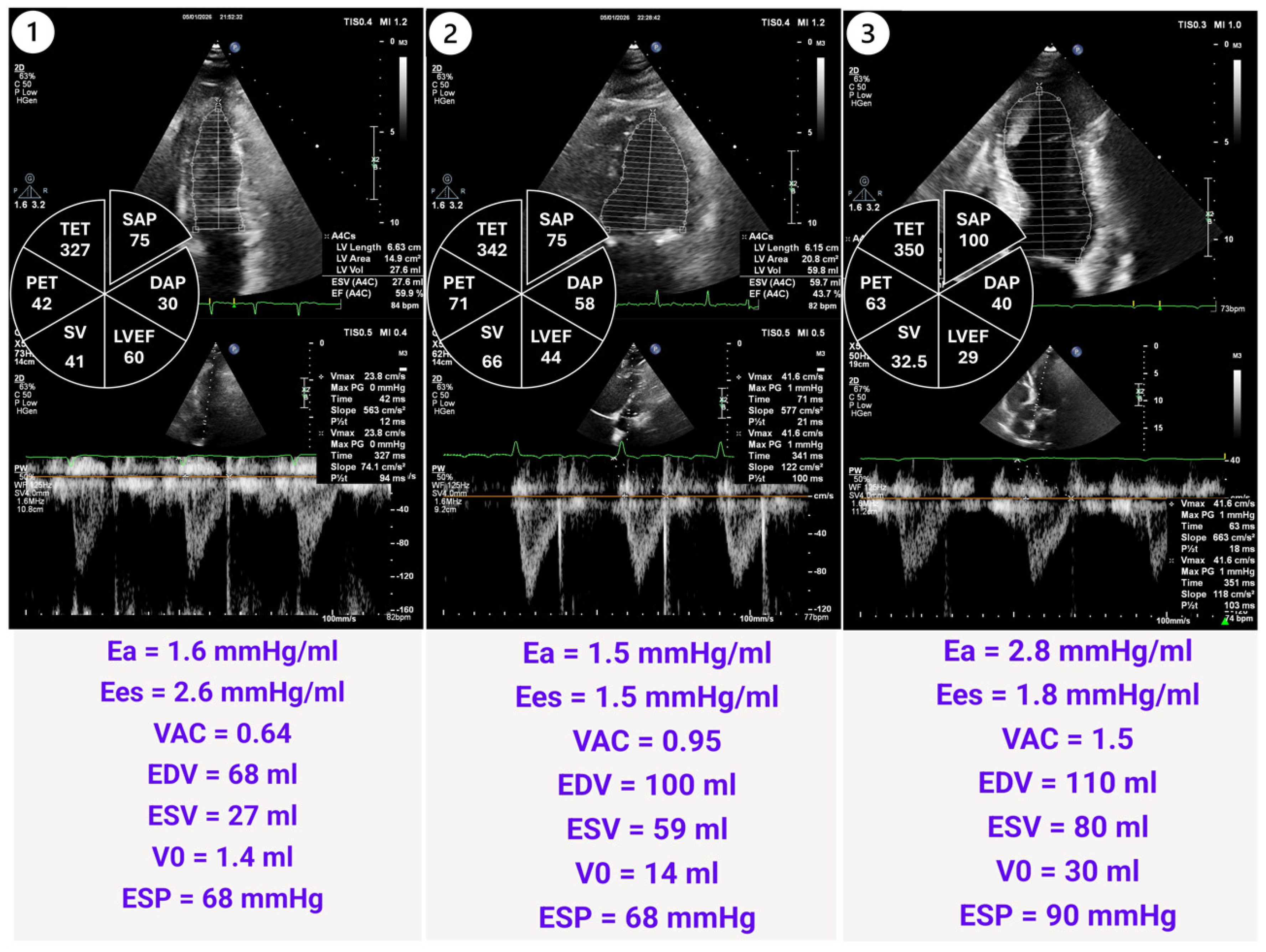
Clinical Application and Bedside Phenotypes (Integrated Examples) (
Figure 2)
Phenotype 1: Vasoplegic septic shock with preserved contractility.
A 62-year-old patient with septic shock presents with preserved left ventricular ejection fraction (>60%) but profound hypotension requiring escalating doses of norepinephrine. VAC analysis demonstrates reduced Ea with preserved end-systolic elastance Ees. Guided by VAC assessment, the use of pure second-line vasopressors (e.g., vasopressin or angiotensin II) is appropriate to restore arterial load, while unnecessary further escalation of norepinephrine can be avoided.
Phenotype 2: Septic cardiomyopathy with superimposed vasoplegia.
A patient with sepsis exhibits reductions in both Ees and Ea, resulting in a near-normal VAC ratio and, consequently, a deceptively preserved ejection fraction. However, VAC-guided evaluation revealing reductions in both the numerator and denominator supports a combined therapeutic approach (vasopressor plus inotrope), rather than isolated afterload augmentation, in order to achieve adequate tissue perfusion.
Phenotype 3: Cardiogenic shock with afterload predominance.
This phenotype represents acute-on-chronic heart failure characterised by elevated arterial load, with VAC exceeding 1 due to increased Ea relative to Ees. In this context, cautious vasodilation or inodilator therapy is more effective in improving ventriculo-arterial coupling and forward flow than further vasopressor escalation.
These representative bedside scenarios illustrate how VAC refines hemodynamic interpretation beyond blood pressure or ejection fraction alone and highlight its role in guiding rational, physiology-based therapy in real-world clinical practice.
8. Serial Assessment and Therapeutic Trajectories
VAC is not static, particularly in the ICU where vascular tone and contractility may change hourly. Single-point measurements risk missing this dynamic course. Serial assessment of Ea/Ees can therefore provide valuable information on therapeutic response, helping to identify whether interventions are effectively restoring coupling or not. For instance, a fall in Ea after heart-rate control, or an increase in Ees following inotropic therapy, may indicate improvement—whereas persistently elevated Ea/Ees despite intervention signals ongoing uncoupling. As illustrated in septic and cardiogenic shock, incorporating trajectories rather than isolated values into decision-making offers a physiology-driven way to refine hemodynamic monitoring at the bedside.
9. Future Directions
VAC-guided management in critical illness is an area of rapid growth, with increasing evidence supporting its clinical relevance. Future studies should also consider integrating both left- and right-sided coupling to capture the full spectrum of circulatory failure. Most importantly, prospective interventional trials are needed to determine whether VAC-guided strategies translate into improved clinical outcomes. Bridging the gap between physiological insight and patient-centred outcomes remains the central challenge. Although ventriculo-arterial coupling has strong physiological rationale and growing observational support, robust prospective outcome-driven evidence validating VAC as a prognostic marker or therapeutic guide in critical care remains limited. VAC should be viewed as a physiological interpretative framework rather than a validated outcome-modifying intervention, and that its role is currently hypothesis-generating and complementary to established haemodynamic indices. Artificial intelligence (AI) is likely to play a central role in this evolution. Deep-learning techniques already enable automated echocardiographic view recognition and beat-to-beat functional assessment, paving the way for operator-independent, near-continuous VAC quantification at the bedside [
19,
20].
In parallel, machine-learning analysis of Doppler and arterial pressure waveforms may uncover haemodynamic signatures of ventriculo-arterial uncoupling that are not apparent to conventional interpretation, allowing earlier detection of circulatory deterioration [
21,
22]. Beyond automation, integrating VAC variables into AI-driven phenotyping models may refine haemodynamic endotypes in septic and cardiogenic shock, supporting precision, physiology-anchored therapeutic strategies rather than pressure-based escalation alone [
23,
24]. Prospective, outcome-driven studies are now required to determine whether VAC-guided, AI-supported haemodynamic management translates into improved patient-centred outcomes.
10. Conclusions
VAC holds promise as a predictive and prognostic enrichment marker, capable of unveiling unique cardiovascular endotypes and enhancing hemodynamic analysis. By integrating ventricular function and arterial load, it refines hemodynamic assessment and uncovers new therapeutic targets. With its straightforward bedside implementation now a reality, there is renewed opportunity to move beyond conventional parameters and optimally integrate VAC into circulatory therapeutics.
Author Contributions
Conceptualisation, C.B. and H.S.A.; methodology, C.B. and H.S.A.; investigation, C.B. and H.S.A.; resources, C.B. and H.S.A.; data curation, C.B. and H.S.A.; writing—original draft preparation, C.B.; writing—review and editing, H.S.A., M.P.S., M.A.L., M.C. and C.B.; supervision, H.S.A. All authors have read and agreed to the published version of the manuscript.
Funding
This research received no external funding.
Data Availability Statement
No new data were created or analyzed in this study.
Conflicts of Interest
The authors declare no conflicts of interest.
Correction Statement
This article has been republished with a minor correction to the Data Availability Statement. This change does not affect the scientific content of the article.
Abbreviations
DBP, diastolic blood pressure; Ea, arterial elastance; EDPVR, end-diastolic pressure–volume relationship; EDV, end-diastolic volume; Ees, left ventricular elastance; EF, ejection fraction; ENDavg, group-averaged normalised ventricular elastance at ejection onset; ENDest, normalised ventricular elastance at ejection onset; ESP, end-systolic pressure; ESPVR, end-systolic pressure–volume relationship; ESV, end-systolic volume; LV, left ventricle; LVET, left ventricular ejection time; LVOT, left ventricular outflow tract; PE, potential energy; PET, pre-ejection time; PLAX, parasternal long-axis view; SBP, systolic blood pressure; SV, stroke volume; SW, stroke work; TET, total ejection time; V0, intercept of the volume axis; VTI, velocity time integral.
References
- Sunagawa, K.; Sagawa, K.; Maughan, W.L. Ventricular interaction with the loading system. Ann. Biomed. Eng. 1984, 12, 163–189. [Google Scholar] [CrossRef] [Scilit]
- Asanoi, H.; Sasayama, S.; Kameyama, T. Ventriculoarterial coupling in normal and failing heart in humans. Circ. Res. 1989, 65, 483–493. [Google Scholar] [CrossRef] [Scilit] [PubMed]
- Pinsky, M.R. Hemodynamic monitoring in the intensive care unit. Clin. Chest Med. 2003, 24, 549–560. [Google Scholar] [CrossRef] [Scilit] [PubMed]
- Ikonomidis, I.; Aboyans, V.; Blacher, J.; Brodmann, M.; Brutsaert, D.L.; Chirinos, J.A.; De Carlo, M.; Delgado, V.; Lancellotti, P.; Lekakis, J.; et al. The role of ventricular-arterial coupling in cardiac disease and heart failure: Assessment, clinical implications and therapeutic interventions. A consensus document of the European Society of Cardiology Working Group on Aorta & Peripheral Vascular Diseases, European Association of Cardiovascular Imaging, and Heart Failure Association. Eur. J. Heart Fail. 2019, 21, 402–424. [Google Scholar] [PubMed]
- Pugliese, N.R.; Balletti, A.; Armenia, S.; De Biase, N.; Faita, F.; Mengozzi, A.; Paneni, F.; Ruschitzka, F.; Virdis, A.; Ghiadoni, L.; et al. Ventricular-Arterial Coupling Derived from Proximal Aortic Stiffness and Aerobic Capacity Across the Heart Failure Spectrum. JACC Cardiovasc. Imaging 2022, 15, 1545–1559. [Google Scholar] [CrossRef] [Scilit]
- Karamichalakis, N.; Ikonomidis, I.; Parissis, J.; Simitsis, P.; Filippatos, G. Association of ventricular-arterial interaction with the response to cardiac resynchronization therapy. Eur. J. Heart Fail. 2021, 23, 1238–1240. [Google Scholar] [CrossRef] [Scilit] [PubMed]
- Teboul, J.L. How to integrate hemodynamic variables during resuscitation of septic shock? J. Intensive Med. 2022, 3, 131–137. [Google Scholar] [CrossRef] [Scilit] [PubMed] [PubMed Central]
- Yokoyama, H.; Yamanaka, F.; Shishido, K.; Ochiai, T.; Yokota, S.; Moriyama, N.; Watanabe, Y.; Shirai, S.; Tada, N.; Araki, M.; et al. Prognostic Value of Ventricular-Arterial Coupling After Transcatheter Aortic Valve Replacement on Midterm Clinical Outcomes. J. Am. Heart Assoc. 2021, 10, e019267. [Google Scholar] [CrossRef] [Scilit]
- Gaczoł, M.; Rajzer, M.; Wojciechowska, W. Ventricular-arterial coupling: Changes with ageing and implications across cardiovascular conditions. Blood Press. 2025, 34, 2457698. [Google Scholar] [CrossRef] [Scilit]
- Pinsky, M.R.; Guarracino, F. Pathophysiological implications of ventriculoarterial coupling in septic shock. Intensive Care Med. Exp. 2023, 11, 87. [Google Scholar] [CrossRef] [Scilit]
- Chen, C.H.; Fetics, B.; Nevo, E.; Rochitte, C.E.; Chiou, K.R.; Ding, P.A.; Kawaguchi, M.; Kass, D.A. Noninvasive single-beat determination of left ventricular end-systolic elastance in humans. J. Am. Coll. Cardiol. 2001, 38, 2028–2034. [Google Scholar] [CrossRef] [Scilit] [PubMed]
- Guarracino, F.; Bertini, P.; Pinsky, M.R. Management of cardiovascular insufficiency in ICU: The BEAT approach. Minerva Anestesiol. 2021, 87, 476–480. [Google Scholar] [CrossRef] [Scilit] [PubMed]
- Chirinos, J.A.; Sweitzer, N. Ventricular-Arterial Coupling in Chronic Heart Failure. Card. Fail. Rev. 2017, 3, 12–18. [Google Scholar] [CrossRef] [Scilit] [PubMed]
- Chang, M.C.; Mondy, J.S.; Meredith, J.W.; Holcroft, J.W. Redefining cardiovascular performance during resuscitation: Ventricular stroke work, power, and the pressure-volume diagram. J. Trauma 1998, 45, 470–478. [Google Scholar] [CrossRef] [Scilit]
- Morelli, A.; Ertmer, C.; Westphal, M.; Rehberg, S.; Kampmeier, T.; Ligges, S.; Orecchioni, A.; D’Egidio, A.; D’Ippoliti, F.; Raffone, C.; et al. Effect of heart rate control with esmolol on hemodynamic and clinical outcomes in patients with septic shock: A randomized clinical trial. JAMA 2013, 310, 1683–1691. [Google Scholar] [CrossRef] [Scilit]
- Colucci, W.S.; Wright, R.F.; Jaski, B.E.; Fifer, M.A.; Braunwald, E. Milrinone and dobutamine in severe heart failure: Differing hemodynamic effects and individual patient responsiveness. Circulation 1986, 73, 175–183. [Google Scholar] [PubMed]
- Papp, Z.; Édes, I.; Fruhwald, S.; De Hert, S.G.; Salmenperä, M.; Leppikangas, H.; Mebazaa, A.; Landoni, G.; Grossini, E.; Caimmi, P.; et al. Levosimendan: Molecular mechanisms and clinical implications: Consensus of experts on the mechanisms of action of levosimendan. Int. J. Cardiol. 2012, 159, 82–87. [Google Scholar] [CrossRef] [Scilit] [PubMed]
- Chirinos, J.A.; Segers, P. Noninvasive evaluation of left ventricular afterload: Part 1: Pressure and flow measurements and basic principles of wave conduction and reflection. Hypertension 2010, 56, 555–562. [Google Scholar] [CrossRef] [Scilit] [PubMed]
- Narula, S.; Shameer, K.; Salem Omar, A.M.; Dudley, J.T.; Sengupta, P.P. Machine-Learning Algorithms to Automate Morphological and Functional Assessments in 2D Echocardiography. J. Am. Coll. Cardiol. 2016, 68, 2287–2295. [Google Scholar] [CrossRef] [Scilit] [PubMed]
- Madani, A.; Arnaout, R.; Mofrad, M.; Arnaut, R. Fast and accurate view classification of echocardiograms using deep learning. NPJ Digital Med. 2018, 1, 6. [Google Scholar] [CrossRef] [Scilit]
- Hatib, F.; Jian, Z.; Buddi, S.; Lee, C.; Settels, J.; Sibert, K.; Rinehart, J.; Cannesson, M. Machine-learning Algorithm to Predict Hypotension Based on High-fidelity Arterial Pressure Waveform Analysis. Anesthesiology 2018, 129, 663–674. [Google Scholar] [CrossRef] [Scilit] [PubMed]
- Greco, M.; Lubian, M.; Cecconi, M. The future of artificial intelligence in cardiovascular monitoring. Curr. Opin. Crit. Care 2025, 31, 354–359. [Google Scholar] [CrossRef] [Scilit] [PubMed]
- Seymour, C.W.; Kennedy, J.N.; Wang, S.; Chang, C.H.; Elliott, C.F.; Xu, Z.; Berry, S.; Clermont, G.; Cooper, G.; Gomez, H.; et al. Derivation, Validation, and Potential Treatment Implications of Novel Clinical Phenotypes for Sepsis. JAMA 2019, 321, 2003–2017. [Google Scholar] [CrossRef] [Scilit] [PubMed] [PubMed Central]
- Komorowski, M.; Celi, L.A.; Badawi, O.; Gordon, A.C.; Faisal, A.A. The Artificial Intelligence Clinician learns optimal treatment strategies for sepsis in intensive care. Nat. Med. 2018, 24, 1716–1720. [Google Scholar] [CrossRef] [Scilit] [PubMed]
| Disclaimer/Publisher’s Note: The statements, opinions and data contained in all publications are solely those of the individual author(s) and contributor(s) and not of MDPI and/or the editor(s). MDPI and/or the editor(s) disclaim responsibility for any injury to people or property resulting from any ideas, methods, instructions or products referred to in the content. |





 ,
,