Fabrication of Wet-Spun Alginate/Halloysite Nanotube Composite Filaments with Tunable Morphology and Caffeine-Functionalized Nanotube Interfaces

Abstract
1. Introduction
2. Materials and Methods
2.1. Materials
2.2. Modification of HNTs
2.2.1. Loading of HNTs with Caffeine
2.2.2. Functionalization of HNTs with Caffeine
- (1)
- 6 g of HNTs was suspended in 80 mL of dry toluene and stirred at room temperature to obtain a homogeneous suspension (20 min). Then, 4.5 mL of APTES was added to the suspension and refluxed for 1 day under a nitrogen atmosphere. HNTs were separated through centrifugation, washed with toluene, and dried at 70 °C, obtaining HNT-NH2. The functionalization was confirmed by means of FT-IR analysis.
- (2)
- 3 g of HNT-NH2 was suspended in 30 mL of dry toluene and stirred at room temperature under a nitrogen atmosphere to obtain a homogeneous suspension (20 min). Then, 4.5 mL of DDMS was added to the suspension and stirred for 1 day under a nitrogen atmosphere. The powder was separated through centrifugation, washed with toluene, and dried at 70 °C, obtaining HNT-Cl. The functionalization was evaluated through FT-IR analysis.
- (3)
- 1.5 g of caffeine was dissolved in 10 mL of DMSO. Then, 2 g of HNT-Cl was added to the stirring solution and mixed at 80 °C for 3 days under a nitrogen atmosphere. The solid was collected through centrifugation, washed with DSMO and dried at 70 °C. The product of the synthesis (HNT-caffeine) was characterized by means of FT-IR and XPS analyses, to confirm the functionalization.
2.3. Preparation of HNTs/Alg Formulations
2.4. Preparation of the Hydrogel Fibers Through Wet Spinning Assisted by 3D Printing
2.5. Characterization Techniques
2.5.1. Characterization of the Nanotubes
Thermogravimetric Analysis (TGA)
Fourier Transform Infrared (FT-IR)
X-Ray Photoelectron Spectroscopy (XPS)
2.5.2. Characterization of the HNT/Alg Formulations
Preliminary Stability Tests
Injectability Tests
2.5.3. Characterization of the Injected Composites
Optical Microscopy
Field Emission-Scanning Electron Microscopy (FE-SEM) and Energy-Dispersive X-Ray Spectroscopy (EDX)
Attenuated Total Reflection-Fourier Transform Infrared Spectroscopy (ATR-FTIR)
Thermogravimetric Analysis
Tensile Testing
3. Results
3.1. Study of HNTs/Alg Dispersions Stability and Injectability
3.2. Wire Extrusions and Characterization
3.3. Study of the Interactions Between Alginate and HNTs
3.4. Composites Containing HNTs and Caffeine
4. Conclusions
Supplementary Materials
Author Contributions
Funding
Institutional Review Board Statement
Informed Consent Statement
Data Availability Statement
Acknowledgments
Conflicts of Interest
Abbreviations
| Alg | Alginate |
| HNT | Halloysite |
| APTES | γ-Aminopropyltriethoxysilane |
| DDMS | Dichloro(dimethyl)silane |
| DMSO | Dimethyl dulfoxide |
| TGA | Thermogravimetric Analysis |
| FT-IR | Fourier Transform Infrared |
| XPS | X-ray Photoelectron Spectroscopy |
| SD | Standard deviation |
| FE-SEM | Field Emission-Scanning Electron Microscopy |
| EDX | Energy-Dispersive X-ray spectroscopy |
| ATR-FTIR | Attenuated Total Reflection-Fourier Transform Infrared Spectroscopy |
References
- Chemistry (IUPAC), T.I.U. of P. and A. IUPAC—Composite (CT07545). Available online: https://goldbook.iupac.org/terms/view/CT07545 (accessed on 28 April 2026).
- Kausar, A. Review on Polymer/Halloysite Nanotube Nanocomposite. Polym.-Plast. Technol. Eng. 2018, 57, 548–564. [Google Scholar] [CrossRef]
- Tu, J.; Cao, Z.; Jing, Y.; Fan, C.; Zhang, C.; Liao, L.; Liu, L. Halloysite Nanotube Nanocomposite Hydrogels with Tunable Mechanical Properties and Drug Release Behavior. Compos. Sci. Technol. 2013, 85, 126–130. [Google Scholar] [CrossRef]
- Kumar, A.; Rao, K.M.; Han, S.S. Development of Sodium Alginate-Xanthan Gum Based Nanocomposite Scaffolds Reinforced with Cellulose Nanocrystals and Halloysite Nanotubes. Polym. Test. 2017, 63, 214–225. [Google Scholar] [CrossRef]
- Silva, T.L.d.; Vidart, J.M.M.; Silva, M.G.C.d.; Gimenes, M.L.; Vieira, M.G.A. Alginate and Sericin: Environmental and Pharmaceutical Applications. In Biological Activities and Application of Marine Polysaccharides; IntechOpen: London, UK, 2017. [Google Scholar]
- Lee, K.Y.; Mooney, D.J. Alginate: Properties and Biomedical Applications. Prog. Polym. Sci. 2012, 37, 106–126. [Google Scholar] [CrossRef]
- Sachan, N.; Pushkar, S.; Jha, A.; Bhattcharya, A. Sodium Alginate: The Wonder Polymer for Controlled Drug Delivery. J. Pharm. Res. 2009, 2, 1191–1199. [Google Scholar]
- Hecht, H.; Srebnik, S. Structural Characterization of Sodium Alginate and Calcium Alginate. Biomacromolecules 2016, 17, 2160–2167. [Google Scholar] [CrossRef] [PubMed]
- Grant, G.T.; Morris, E.R.; Rees, D.A.; Smith, P.J.C.; Thom, D. Biological Interactions between Polysaccharides and Divalent Cations: The Egg-Box Model. FEBS Lett. 1973, 32, 195–198. [Google Scholar] [CrossRef]
- Zhang, X.; Wang, X.; Fan, W.; Liu, Y.; Wang, Q.; Weng, L. Fabrication, Property and Application of Calcium Alginate Fiber: A Review. Polymers 2022, 14, 3227. [Google Scholar] [CrossRef] [PubMed]
- Qin, Y. Alginate Fibres: An Overview of the Production Processes and Applications in Wound Management. Polym. Int. 2008, 57, 171–180. [Google Scholar] [CrossRef]
- Sa, V.; Kornev, K.G. A Method for Wet Spinning of Alginate Fibers with a High Concentration of Single-Walled Carbon Nanotubes. Carbon 2011, 49, 1859–1868. [Google Scholar] [CrossRef]
- Park, J.-S.; Park, C.-W.; Han, S.-Y.; Lee, E.-A.; Cindradewi, A.W.; Kim, J.-K.; Kwon, G.-J.; Seo, Y.-H.; Yoo, W.-J.; Gwon, J.; et al. Preparation and Properties of Wet-Spun Microcomposite Filaments from Various CNFs and Alginate. Polymers 2021, 13, 1709. [Google Scholar] [CrossRef]
- Gao, Q.; He, Y.; Fu, J.; Liu, A.; Ma, L. Coaxial Nozzle-Assisted 3D Bioprinting with Built-in Microchannels for Nutrients Delivery. Biomaterials 2015, 61, 203–215. [Google Scholar] [CrossRef]
- Liakos, I.L.; Mondini, A.; Dottore, E.D.; Filippeschi, C.; Pignatelli, F.; Mazzolai, B. 3D Printed Composites from Heat Extruded Polycaprolactone/Sodium Alginate Filaments and Their Heavy Metal Adsorption Properties. Mater. Chem. Front. 2020, 4, 2472–2483. [Google Scholar] [CrossRef]
- Huang, B.; Liu, M.; Long, Z.; Shen, Y.; Zhou, C. Effects of Halloysite Nanotubes on Physical Properties and Cytocompatibility of Alginate Composite Hydrogels. Mater. Sci. Eng. C 2017, 70, 303–310. [Google Scholar] [CrossRef] [PubMed]
- Li, J.; Ma, J.; Chen, S.; Huang, Y.; He, J. Adsorption of Lysozyme by Alginate/Graphene Oxide Composite Beads with Enhanced Stability and Mechanical Property. Mater. Sci. Eng. C 2018, 89, 25–32. [Google Scholar] [CrossRef] [PubMed]
- Ionita, M.; Pandele, M.A.; Iovu, H. Sodium Alginate/Graphene Oxide Composite Films with Enhanced Thermal and Mechanical Properties. Carbohydr. Polym. 2013, 94, 339–344. [Google Scholar] [CrossRef]
- Zhang, X.; Hui, Z.; Wan, D.; Huang, H.; Huang, J.; Yuan, H.; Yu, J. Alginate Microsphere Filled with Carbon Nanotube as Drug Carrier. Int. J. Biol. Macromol. 2010, 47, 389–395. [Google Scholar] [CrossRef]
- Liu, L.; Wan, Y.; Xie, Y.; Zhai, R.; Zhang, B.; Liu, J. The Removal of Dye from Aqueous Solution Using Alginate-Halloysite Nanotube Beads. Chem. Eng. J. 2012, 187, 210–216. [Google Scholar] [CrossRef]
- Chiew, C.S.C.; Poh, P.E.; Pasbakhsh, P.; Tey, B.T.; Yeoh, H.K.; Chan, E.S. Physicochemical Characterization of Halloysite/Alginate Bionanocomposite Hydrogel. Appl. Clay Sci. 2014, 101, 444–454. [Google Scholar] [CrossRef]
- Fan, L.; Zhang, J.; Wang, A. In Situ Generation of Sodium Alginate/Hydroxyapatite/Halloysite Nanotubes Nanocomposite Hydrogel Beads as Drug-Controlled Release Matrices. J. Mater. Chem. B 2013, 1, 6261–6270. [Google Scholar] [CrossRef]
- Cavallaro, G.; Gianguzza, A.; Lazzara, G.; Milioto, S.; Piazzese, D. Alginate Gel Beads Filled with Halloysite Nanotubes. Appl. Clay Sci. 2013, 72, 132–137. [Google Scholar] [CrossRef]
- Glukhova, S.A.; Molchanov, V.S.; Lokshin, B.V.; Rogachev, A.V.; Tsarenko, A.A.; Patsaev, T.D.; Kamyshinsky, R.A.; Philippova, O.E. Printable Alginate Hydrogels with Embedded Network of Halloysite Nanotubes: Effect of Polymer Cross-Linking on Rheological Properties and Microstructure. Polymers 2021, 13, 4130. [Google Scholar] [CrossRef]
- Roushangar Zineh, B.; Shabgard, M.R.; Roshangar, L. Mechanical and Biological Performance of Printed Alginate/Methylcellulose/Halloysite Nanotube/Polyvinylidene Fluoride Bio-Scaffolds. Mater. Sci. Eng. C 2018, 92, 779–789. [Google Scholar] [CrossRef]
- Cinà, G.; Massaro, M.; Cavallaro, G.; Lazzara, G.; Sánchez-Espejo, R.; Viseras Iborra, C.; D’Abrosca, B.; Fiorentino, A.; Messina, G.M.L.; Riela, S. Development of Alginate Film Filled with Halloysite-Carbon Dots for Active Food Packaging. Int. J. Biol. Macromol. 2024, 277, 134375. [Google Scholar] [CrossRef] [PubMed]
- De Silva, R.T.; Dissanayake, R.K.; Mantilaka, M.M.M.G.P.G.; Wijesinghe, W.P.S.L.; Kaleel, S.S.; Premachandra, T.N.; Weerasinghe, L.; Amaratunga, G.A.J.; de Silva, K.M.N. Drug-Loaded Halloysite Nanotube-Reinforced Electrospun Alginate-Based Nanofibrous Scaffolds with Sustained Antimicrobial Protection. ACS Appl. Mater. Interfaces 2018, 10, 33913–33922. [Google Scholar] [CrossRef]
- Bertolino, V.; Cavallaro, G.; Milioto, S.; Lazzara, G. Polysaccharides/Halloysite Nanotubes for Smart Bionanocomposite Materials. Carbohydr. Polym. 2020, 245, 116502. [Google Scholar] [CrossRef]
- Yuan, P.; Tan, D.; Annabi-Bergaya, F. Properties and Applications of Halloysite Nanotubes: Recent Research Advances and Future Prospects. Appl. Clay Sci. 2015, 112–113, 75–93. [Google Scholar] [CrossRef]
- Du, M.; Guo, B.; Jia, D. Newly Emerging Applications of Halloysite Nanotubes: A Review. Polym. Int. 2010, 59, 574–582. [Google Scholar] [CrossRef]
- Hamedi, S.; Koosha, M. Designing a pH-Responsive Drug Delivery System for the Release of Black-Carrot Anthocyanins Loaded in Halloysite Nanotubes for Cancer Treatment. Appl. Clay Sci. 2020, 197, 105770. [Google Scholar] [CrossRef]
- Tonelli, M.; Baglioni, P.; Ridi, F. Halloysite Nanotubes as Nano-Carriers of Corrosion Inhibitors in Cement Formulations. Materials 2020, 13, 3150. [Google Scholar] [CrossRef] [PubMed]
- Tonelli, M.; Perini, I.; Ridi, F.; Baglioni, P. Improving the Properties of Antifouling Hybrid Composites: The Use of Halloysites as Nano-Containers in Epoxy Coatings. Colloids Surf. A Physicochem. Eng. Asp. 2021, 623, 126779. [Google Scholar] [CrossRef]
- Massaro, M.; Laura Alfieri, M.; Rizzo, G.; Babudri, F.; Barbosa de Melo, R.; Faddetta, T.; Gallo, G.; Napolitano, A.; Sanchèz-Espejo, R.; Viseras Iborra, C.; et al. Modification of Halloysite Lumen with Dopamine Derivatives as Filler for Antibiofilm Coating. J. Colloid Interface Sci. 2023, 646, 910–921. [Google Scholar] [CrossRef]
- Oun, A.A.; Bae, A.Y.; Shin, G.H.; Park, M.-K.; Kim, J.T. Comparative Study of Oregano Essential Oil Encapsulated in Halloysite Nanotubes and Diatomaceous Earth as Antimicrobial and Antioxidant Composites. Appl. Clay Sci. 2022, 224, 106522. [Google Scholar] [CrossRef]
- Zhong, B.; Wang, S.; Dong, H.; Luo, Y.; Jia, Z.; Zhou, X.; Chen, M.; Xie, D.; Jia, D. Halloysite Tubes as Nanocontainers for Herbicide and Its Controlled Release in Biodegradable Poly(Vinyl Alcohol)/Starch Film. J. Agric. Food Chem. 2017, 65, 10445–10451. [Google Scholar] [CrossRef]
- Yang, Y.; Chen, Y.; Leng, F.; Huang, L.; Wang, Z.; Tian, W. Recent Advances on Surface Modification of Halloysite Nanotubes for Multifunctional Applications. Appl. Sci. 2017, 7, 1215. [Google Scholar] [CrossRef]
- Vishvanathperumal, S.; Roy, J.V.; Anand, G.; Ramu, K.N.; Praveenkumar, S. An Investigation on the Effect of the Surface Modifications and HNTs Loading on the Cure Behaviours, Abrasion Resistance, Mechanical and Morphological Properties of NR/EPDM Nanocomposites. Silicon 2024, 16, 2267–2284. [Google Scholar] [CrossRef]
- Russell, D.W.; Fernández-Caldas, E.; Swanson, M.C.; Seleznick, M.J.; Trudeau, W.L.; Lockey, R.F. Caffeine, a Naturally Occurring Acaricide. J. Allergy Clin. Immunol. 1991, 87, 107–110. [Google Scholar] [CrossRef]
- Araque, P.; Casanova, H.; Ortiz, C.; Henao, B.; Peláez, C. Insecticidal Activity of Caffeine Aqueous Solutions and Caffeine Oleate Emulsions against Drosophila Melanogaster and Hypothenemus Hampei. J. Agric. Food Chem. 2007, 55, 6918–6922. [Google Scholar] [CrossRef]
- Góngora, C.E.; Tapias, J.; Jaramillo, J.; Medina, R.; González, S.; Restrepo, T.; Casanova, H.; Benavides, P. A Novel Caffeine Oleate Formulation as an Insecticide to Control Coffee Berry Borer, Hypothenemus Hampei, and Other Coffee Pests. Agronomy 2023, 13, 1554. [Google Scholar] [CrossRef]
- Liu, M.; Jia, Z.; Jia, D.; Zhou, C. Recent Advance in Research on Halloysite Nanotubes-Polymer Nanocomposite. Prog. Polym. Sci. 2014, 39, 1498–1525. [Google Scholar] [CrossRef]
- Liu, M.; Zhang, Y.; Wu, C.; Xiong, S.; Zhou, C. Chitosan/Halloysite Nanotubes Bionanocomposites: Structure, Mechanical Properties and Biocompatibility. Int. J. Biol. Macromol. 2012, 51, 566–575. [Google Scholar] [CrossRef]
- Wang, Y.; Yi, S.; Lu, R.; Sameen, D.E.; Ahmed, S.; Dai, J.; Qin, W.; Li, S.; Liu, Y. Preparation, Characterization, and 3D Printing Verification of Chitosan/Halloysite Nanotubes/Tea Polyphenol Nanocomposite Films. Int. J. Biol. Macromol. 2021, 166, 32–44. [Google Scholar] [CrossRef]
- Del Buffa, S.; Rinaldi, E.; Carretti, E.; Ridi, F.; Bonini, M.; Baglioni, P. Injectable Composites via Functionalization of 1D Nanoclays and Biodegradable Coupling with a Polysaccharide Hydrogel. Colloids Surf. B Biointerfaces 2016, 145, 562–566. [Google Scholar] [CrossRef]
- Wu, Y.; Zhang, Y.; Ju, J.; Yan, H.; Huang, X.; Tan, Y. Advances in Halloysite Nanotubes–Polysaccharide Nanocomposite Preparation and Applications. Polymers 2019, 11, 987. [Google Scholar] [CrossRef]
- Sadegh-Hassani, F.; Mohammadi Nafchi, A. Preparation and Characterization of Bionanocomposite Films Based on Potato Starch/Halloysite Nanoclay. Int. J. Biol. Macromol. 2014, 67, 458–462. [Google Scholar] [CrossRef]
- Makaremi, M.; Pasbakhsh, P.; Cavallaro, G.; Lazzara, G.; Aw, Y.K.; Lee, S.M.; Milioto, S. Effect of Morphology and Size of Halloysite Nanotubes on Functional Pectin Bionanocomposites for Food Packaging Applications. ACS Appl. Mater. Interfaces 2017, 9, 17476–17488. [Google Scholar] [CrossRef] [PubMed]
- Zhao, Y.; Abdullayev, E.; Vasiliev, A.; Lvov, Y. Halloysite Nanotubule Clay for Efficient Water Purification. J. Colloid Interface Sci. 2013, 406, 121–129. [Google Scholar] [CrossRef] [PubMed]
- Tonelli, M.; Gelli, R.; Ridi, F.; Baglioni, P. Magnesium Phosphate-Based Cements Containing Halloysite Nanotubes for Cracks Repair. Constr. Build. Mater. 2021, 301, 124056. [Google Scholar] [CrossRef]
- Cavallaro, G.; Lazzara, G.; Milioto, S.; Parisi, F. Halloysite Nanotubes as Sustainable Nanofiller for Paper Consolidation and Protection. J. Therm. Anal. Calorim. 2014, 117, 1293–1298. [Google Scholar] [CrossRef]
- Tonelli, M.; Gelli, R.; Giorgi, R.; Pierigè, M.I.; Ridi, F.; Baglioni, P. Cementitious Materials Containing Nano-Carriers and Silica for the Restoration of Damaged Concrete-Based Monuments. J. Cult. Herit. 2021, 49, 59–69. [Google Scholar] [CrossRef]
- Var, C.; Palamutcu, S. Diverse Approaches in Wet-Spun Alginate Filament Production from the Textile Industry Perspective: From Process Optimization to Composite Filament Production. Polymers 2024, 16, 1817. [Google Scholar] [CrossRef]
- Hou, C.; Zhang, J.; Zhang, X.; Wang, Y.; Li, T.; Xia, B.; Jiang, J.; Dong, W. High Strength Chitin Nanocrystal/Alginate Filament Prepared by Wet-Spinning in “Green” Coagulating Bath. Cellulose 2022, 29, 8611–8621. [Google Scholar] [CrossRef]
- Xu, Y.; Chen, X.; Zhou, X.; Huang, M.; Liu, M. Sodium Alginate/Polyacrylic Acid/Halloysite Nanotube Fibers Fabricated by Wet Spinning for Salinity Gradient Power Generation. Compos. Part A Appl. Sci. Manuf. 2026, 203, 109574. [Google Scholar] [CrossRef]
- Peixoto, A.F.; Fernandes, A.C.; Pereira, C.; Pires, J.; Freire, C. Physicochemical Characterization of Organosilylated Halloysite Clay Nanotubes. Microporous Mesoporous Mater. 2016, 219, 145–154. [Google Scholar] [CrossRef]
- Jeamjumnunja, K.; Cheycharoen, O.; Phongzitthiganna, N.; Hannongbua, S.; Prasittichai, C. Surface-Modified Halloysite Nanotubes as Electrochemical CO2 Sensors. ACS Appl. Nano Mater. 2021, 4, 3686–3695. [Google Scholar] [CrossRef]
- Karami, Z.; Moini Jazani, O.; Navarchian, A.H.; Karrabi, M.; Vahabi, H.; Saeb, M.R. Well-Cured Silicone/Halloysite Nanotubes Nanocomposite Coatings. Prog. Org. Coat. 2019, 129, 357–365. [Google Scholar] [CrossRef]
- Yaghoubi, S.; Sadjadi, S.; Zhong, X.; Yuan, P.; Heravi, M.M. Clay-Supported Bio-Based Lewis Acid Ionic Liquid as a Potent Catalyst for the Dehydration of Fructose to 5-Hydroxymthylfurfural. Sci. Rep. 2024, 14, 82. [Google Scholar] [CrossRef]
- Gurikov, P.; Smirnova, I. Non-Conventional Methods for Gelation of Alginate. Gels 2018, 4, 14. [Google Scholar] [CrossRef]
- Armelao, L.; Rando, M.; Carlotto, S.; Motta, I.; Bottaro, G.; Rancan, M. Bridging Two Worlds: (DABCO-H)CuKI3 a Hybrid Copper Iodide Phosphor with a Perovskite Structure. Pure Appl. Chem. 2024, 96, 69–80. [Google Scholar] [CrossRef]
- Tonelli, M.; Faralli, A.; Ridi, F.; Bonini, M. 3D Printable Magnesium-Based Cements towards the Preparation of Bioceramics. J. Colloid Interface Sci. 2021, 598, 24–35. [Google Scholar] [CrossRef]
- Zhang, Q.; Fassihi, M.A.; Fassihi, R. Delivery Considerations of Highly Viscous Polymeric Fluids Mimicking Concentrated Biopharmaceuticals: Assessment of Injectability via Measurement of Total Work Done “WT.”. AAPS PharmSciTech 2018, 19, 1520–1528. [Google Scholar] [CrossRef] [PubMed]
- Andriamiseza, F.; Peters, S.; Roux, C.; Dietrich, N.; Coudret, C.; Fitremann, J. Wet Spinning and 3D Printing of Supramolecular Hydrogels in Acid-Base and Dynamic Conditions. Colloids Surf. A Physicochem. Eng. Asp. 2023, 673, 131765. [Google Scholar] [CrossRef]
- Lo Bianco, A.; Calvino, M.M.; Lazzara, G.; Milioto, S.; Cavallaro, G. Geopolymerization of Halloysite Clay Nanotubes Mixed with Hydroxypropyl Cellulose for Development of Composite Films with Flame Resistance Properties. Ceram. Int. 2026, 52, 15130–15138. [Google Scholar] [CrossRef]
- Liu, M.; Dai, L.; Shi, H.; Xiong, S.; Zhou, C. In Vitro Evaluation of Alginate/Halloysite Nanotube Composite Scaffolds for Tissue Engineering. Mater. Sci. Eng. C 2015, 49, 700–712. [Google Scholar] [CrossRef]
- Pereira, D.; Tonelli, M.; Almeida, J.R.; Correia-da-Silva, M.; Cidade, H.; Ridi, F. Epoxy Coatings Containing Nature-Inspired Antifouling Compounds Loaded in Halloysite Nanocontainers. Appl. Sci. 2026, 16, 4114. [Google Scholar] [CrossRef]
- Said, A.A.; Hassan, R.M. Thermal Decomposition of Some Divalent Metal Alginate Gel Compounds. Polym. Degrad. Stab. 1993, 39, 393–397. [Google Scholar] [CrossRef]
- Rehman, A.; Shuib, R.K. Enhanced Thermal Stability, Flame Retardancy, and Thermal Conductivity of Self-Healing Natural Rubber Composites Reinforced Surface Treated Halloysite Clay Nanotubes. Case Stud. Therm. Eng. 2025, 73, 106473. [Google Scholar] [CrossRef]
- Lisuzzo, L.; Cavallaro, G.; Milioto, S.; Lazzara, G. Effects of Halloysite Content on the Thermo-Mechanical Performances of Composite Bioplastics. Appl. Clay Sci. 2020, 185, 105416. [Google Scholar] [CrossRef]
- Imshinetskiy, I.; Kashepa, V.; Nadaraia, K.; Mashtalyar, D.; Suchkov, S.; Zadorozhny, P.; Ustinov, A.; Sinebryukhov, S.; Gnedenkov, S. PEO Coatings Modified with Halloysite Nanotubes: Composition, Properties, and Release Performance. Int. J. Mol. Sci. 2023, 24, 305. [Google Scholar] [CrossRef]
- Kanani-Jazi, M.H.; Akbari, S. Quantitative XPS Analysis of Amine-Terminated Dendritic Functionalized Halloysite Nanotubes Decorated on PAN Nanofibrous Membrane and Adsorption/Filtration of Cr(VI). Chem. Eng. J. 2024, 482, 148746. [Google Scholar] [CrossRef]
- Al-Gaashani, R.; Zakaria, Y.; Gladich, I.; Kochkodan, V.; Lawler, J. XPS, Structural and Antimicrobial Studies of Novel Functionalized Halloysite Nanotubes. Sci. Rep. 2022, 12, 21633. [Google Scholar] [CrossRef] [PubMed]
- Ferrante, F.; Bertini, M.; Ferlito, C.; Lisuzzo, L.; Lazzara, G.; Duca, D. A Computational and Experimental Investigation of Halloysite Silicic Surface Modifications after Alkaline Treatment. Appl. Clay Sci. 2023, 232, 106813. [Google Scholar] [CrossRef]


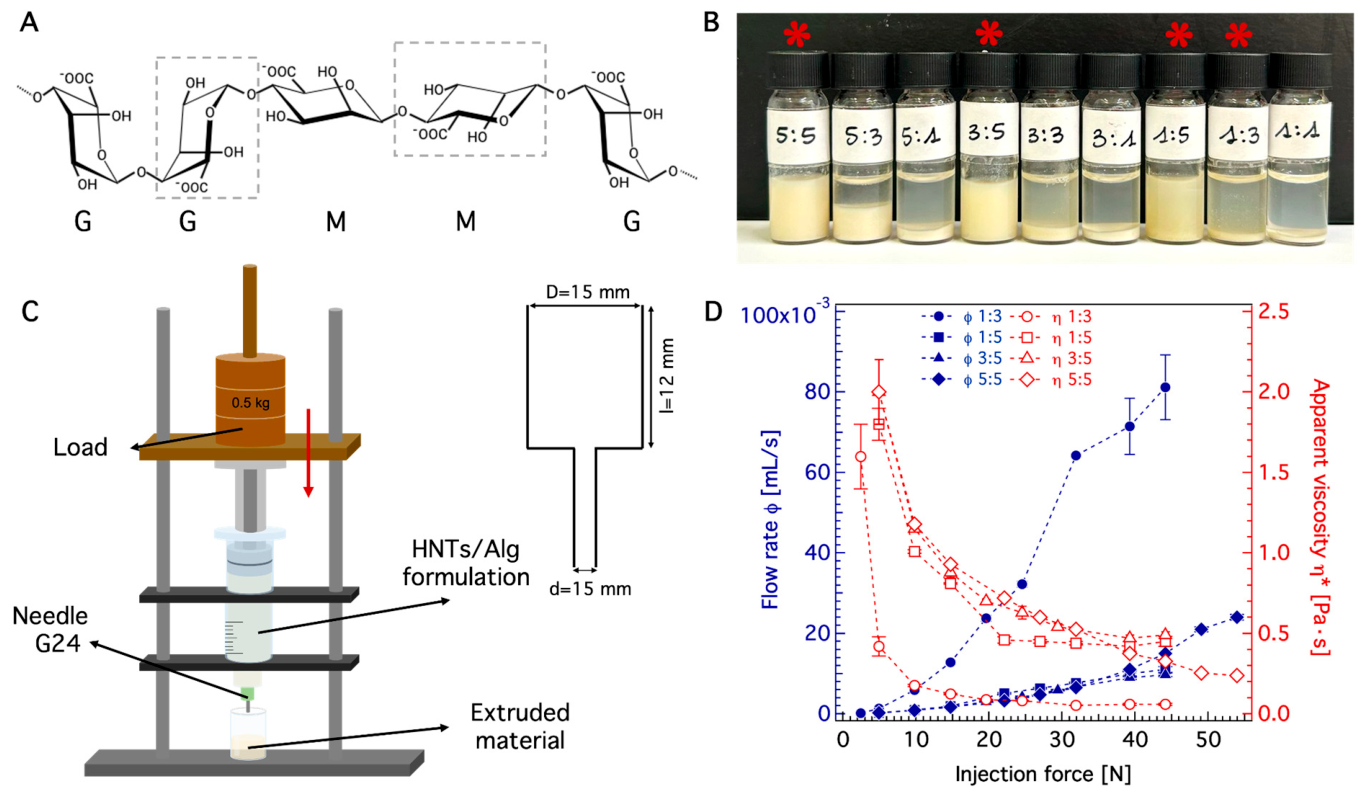
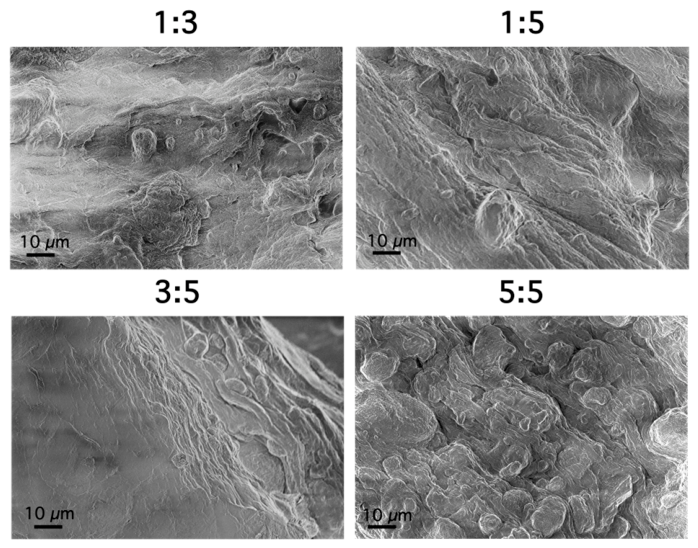
| HNTs:Alg (wt:wt) † | HNTs [mg] | Alg [mg] | H2O [mL] |
|---|---|---|---|
| 5:5 ‡ | 100 | 100 | 1.80 |
| 5:3 | 100 | 60 | 1.84 |
| 5:1 | 100 | 20 | 1.88 |
| 3:5 ‡ | 60 | 100 | 1.84 |
| 3:3 | 60 | 60 | 1.88 |
| 3:1 | 60 | 20 | 1.92 |
| 1:5 ‡ | 20 | 100 | 1.88 |
| 1:3 ‡ | 20 | 60 | 1.92 |
| 1:1 | 20 | 20 | 1.96 |
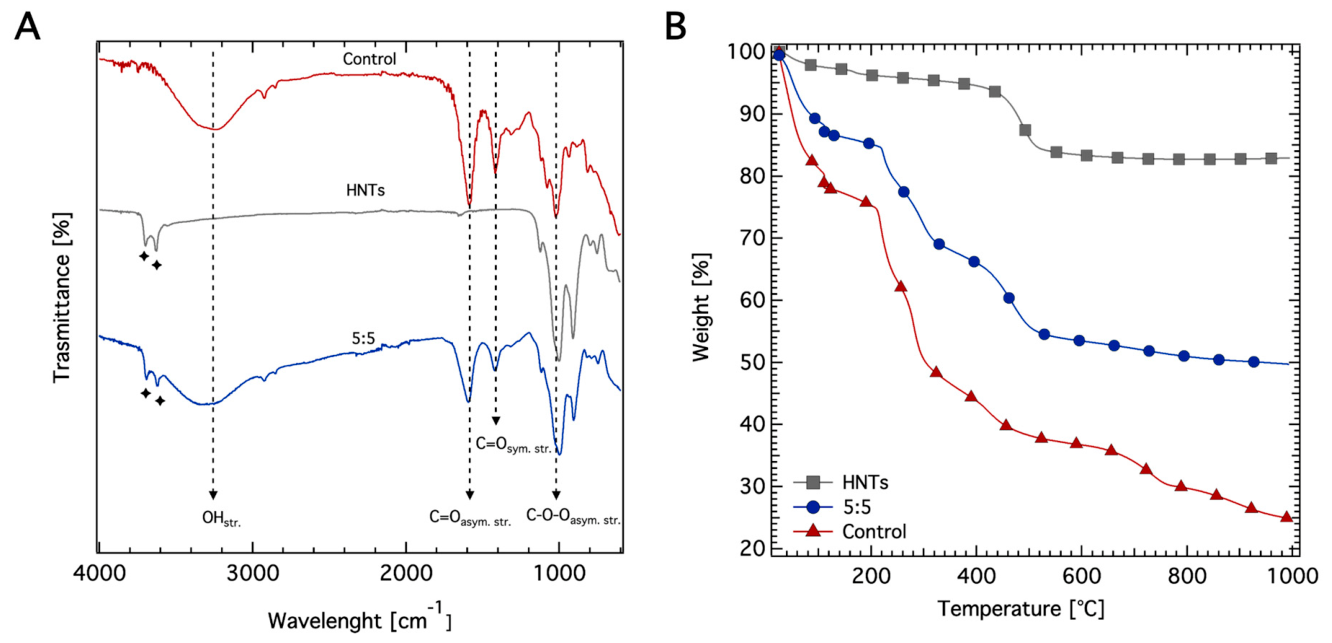
| Sample | Experimental Weight Loss [%] 115–1000 °C | Theoretical Weight Loss [%] 115–1000 °C |
|---|---|---|
| HNTs | 14.5 | - |
| Control | 53.1 | - |
| 5:5 | 37.0 | 51.1 |
| Sample | Element | Atomic [%] | Peak BE [eV] | Chemical State |
|---|---|---|---|---|
| HNTs | Al 2p | 14.7 | 74.7 | Al-O |
| Si 2p | 15.9 | 103.1 | Si-O | |
| C 1s | 9.7 | 284.8/286.1/287.1/288.5/289.9 | C-C, C-O/C-N, C=O, O-C=O, CO32− | |
| N 1s | 2.2 | 398.9/401.0/402.9 | C-N=C, ammonium-oxidized N | |
| O 1s | 57.5 | 531.4/532.0/533.9 | Al-O/Al-OH, Si-O, adsorbed H2O | |
| HNT-caffeine | Al 2p | 10.8 | 74.6 | Al-O |
| Si 2p | 15.4 | 102.9 | Si-O | |
| Cl 2p | 2.7 | 198.3 | Cl- | |
| C 1s | 20 | 284.8/286.1/287.1/288.5 | C-C, C-O/C-N, C=O, O-C=O | |
| N 1s | 5.2 | 399.59/401.5/403.5 | C-N=C, ammonium-oxidized N | |
| O 1s | 45.9 | 531.8/532.3/534.0 | Al-O/Al-OH, Si-O, adsorbed H2O |
Disclaimer/Publisher’s Note: The statements, opinions and data contained in all publications are solely those of the individual author(s) and contributor(s) and not of MDPI and/or the editor(s). MDPI and/or the editor(s) disclaim responsibility for any injury to people or property resulting from any ideas, methods, instructions or products referred to in the content. |
© 2026 by the authors. Licensee MDPI, Basel, Switzerland. This article is an open access article distributed under the terms and conditions of the Creative Commons Attribution (CC BY) license.
Share and Cite
Mugnaini, G.; Spagli, D.; Rancan, M.; Bonini, M.; Tonelli, M. Fabrication of Wet-Spun Alginate/Halloysite Nanotube Composite Filaments with Tunable Morphology and Caffeine-Functionalized Nanotube Interfaces. Appl. Nano 2026, 7, 15. https://doi.org/10.3390/applnano7020015
Mugnaini G, Spagli D, Rancan M, Bonini M, Tonelli M. Fabrication of Wet-Spun Alginate/Halloysite Nanotube Composite Filaments with Tunable Morphology and Caffeine-Functionalized Nanotube Interfaces. Applied Nano. 2026; 7(2):15. https://doi.org/10.3390/applnano7020015
Chicago/Turabian StyleMugnaini, Giulia, Davide Spagli, Marzio Rancan, Massimo Bonini, and Monica Tonelli. 2026. "Fabrication of Wet-Spun Alginate/Halloysite Nanotube Composite Filaments with Tunable Morphology and Caffeine-Functionalized Nanotube Interfaces" Applied Nano 7, no. 2: 15. https://doi.org/10.3390/applnano7020015
APA StyleMugnaini, G., Spagli, D., Rancan, M., Bonini, M., & Tonelli, M. (2026). Fabrication of Wet-Spun Alginate/Halloysite Nanotube Composite Filaments with Tunable Morphology and Caffeine-Functionalized Nanotube Interfaces. Applied Nano, 7(2), 15. https://doi.org/10.3390/applnano7020015