Article

Fabrication of Wet-Spun Alginate/Halloysite Nanotube Composite Filaments with Tunable Morphology and Caffeine-Functionalized Nanotube Interfaces


1
Department of Chemistry ‘‘Ugo Schiff” & CSGI, University of Florence, Via della Lastruccia 3, Sesto Fiorentino, 50019 Florence, Italy
2
Institute of Condensed Matter Chemistry and Technologies for Energy (ICMATE), National Research Council (CNR), c/o Department of Chemistry, University of Padova, Via F. Marzolo 1, 35131 Padova, Italy
*
Author to whom correspondence should be addressed.
Appl. Nano 2026, 7(2), 15; https://doi.org/10.3390/applnano7020015

Submission received: 29 April 2026 / Revised: 28 May 2026 / Accepted: 3 June 2026 / Published: 5 June 2026
(This article belongs to the Collection Feature Papers for Applied Nano)

Abstract

Hybrid organic–inorganic composites based on biopolymers and nanoclays are attracting increasing interest for the development of functional materials in biomedical and agricultural applications. In this work, elongated alginate/halloysite nanotube (Alg/HNT) composite filaments were fabricated through a wet-spinning process assisted by syringe-based extrusion. Alg/HNT dispersions with different inorganic/organic ratios were first screened in terms of colloidal stability and injectability in order to identify suitable formulations for extrusion. The influence of key processing parameters, including the extrusion flow rate and calcium chloride concentration in the coagulation bath, was then systematically investigated to elucidate their effect on filament morphology and structure. Optical and scanning electron microscopy revealed that filament diameter can be tuned by varying the CaCl2 concentration, while partial alignment of alginate chains along the extrusion direction was observed. Halloysite nanotubes were homogeneously distributed within the polymer matrix, mainly as micro-sized aggregates. Finally, the nanotubes were chemically functionalized with caffeine, as a model molecule, and incorporated into the alginate filaments, demonstrating the feasibility of introducing specific functionalities into wet-spun Alg/HNT composite fibers. These results establish a reproducible strategy for the fabrication of alginate/HNT filaments with tunable morphology and functionalizable nanotube interfaces, providing a versatile platform for the development of sustainable hybrid biopolymer materials.

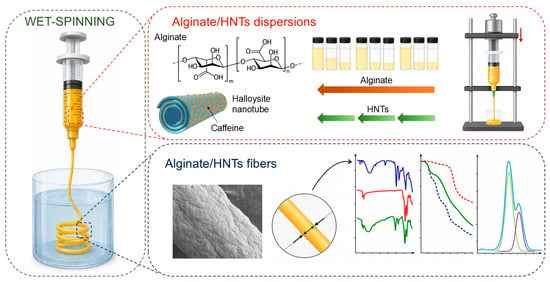
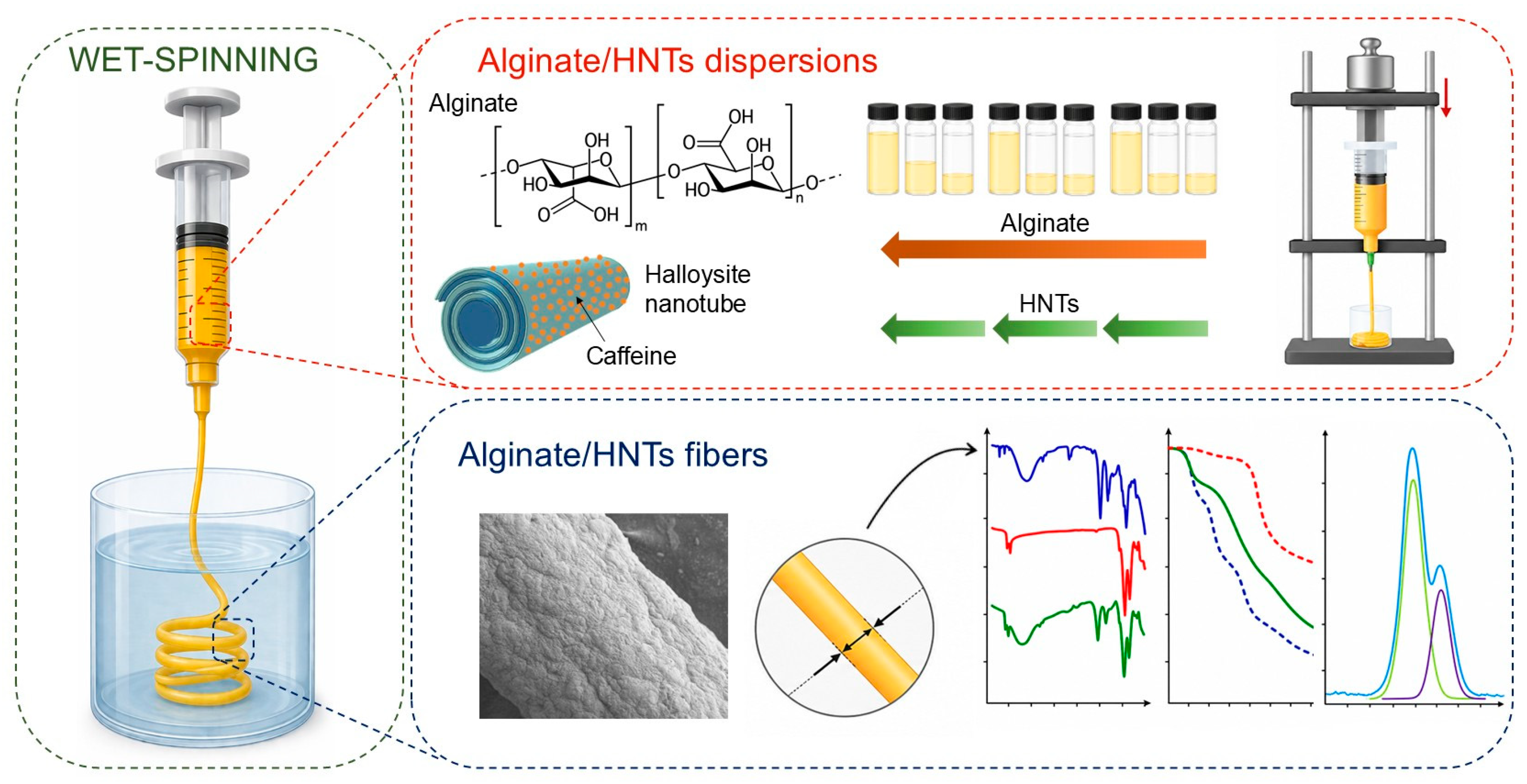
Graphical Abstract

1. Introduction

The design of composite materials represents an important strategy for engineering materials with enhanced performance by combining complementary components. These materials, defined as “multicomponent material comprising multiple, different phase domains in which at least one type of phase domain is a continuous phase” [1], combine the complementary properties of (bio)polymeric phases and inorganic nanofillers. Such combinations often lead to improved physicochemical properties, including enhanced thermal stability and mechanical strength [2,3,4].
Alginate (Alg), an unbranched, anionic polysaccharide primarily extracted from marine brown algae (Phaeophyceae) [5,6], has emerged as an appealing biopolymer for composite fabrication due to its renewability, biocompatibility, and tunable gel-forming ability. Its molecular structure consists of (1→4)-linked α-L-guluronic (G) and β-D-mannuronic (M) residues, organized into homopolymeric (GG or MM blocks) and heteropolymeric (MG blocks) domains [7]. The extensive use of Alg arises from its ability to form physically cross-linked hydrogels in the presence of di- and trivalent cations (e.g., Ca2+). Gelation occurs from an ion-exchange process where monovalent ions from alginate salt (typically sodium, Na+) are replaced by Ca2+ cations. The metal cations coordinate with the G residues, forming highly ordered junction zones, according to the egg-box model [8,9]. The mild gelation conditions necessary for the process allow for the fabrication of cross-linked Alg fibers using various techniques, including wet spinning via syringe extrusion [10,11,12] or microfluidic channels [13], 3D printing [14], and in combination with thermoplastic polymers [15].
A recognized method for introducing smart features or enhancing the physicochemical properties of biopolymeric materials is the incorporation of inorganic components, such as nanoclays, graphene oxide, and carbon nanotubes [16,17,18,19]. Alg nanocomposites containing mineral nanoclays, specifically halloysite nanotubes (HNTs), have been also reported in hydrogel beads [20,21,22,23], aqueous ink formulations for 3D printing [24,25], solid film from solvent casting [26], and fibers [27,28].
HNTs are naturally occurring aluminosilicate clays (Al2Si2O5(OH)4·nH2O, where n = 2 or 0, for the hydrated or dehydrated forms) with a unique multi-walled tubular structure, exposing siloxane (Si-O-Si) groups on the external surface and aluminol (Al-OH) groups on the inner surface, resulting in inner positively-charged and outer negatively-charged surfaces. This distinctive morphology enables the encapsulation of active molecules within the lumen and facilitates surface functionalization with different moieties [29,30]. Indeed, HNTs are extensively utilized as nanoscale carriers for the encapsulation and controlled delivery of various active substances such as anthocyanins [31], corrosion inhibitors [32], antifouling agents [33], antioxidant and antimicrobial compounds [34,35], and pesticides [36]. In return, the outer surface allows for diverse surface modification pathways: guest molecules can be immobilized on the external surface through non-covalent interactions such as Van der Waals forces, hydrogen bonding, and electrostatic forces, or they can be covalently grafted via chemical reactions [37,38]. Among the various active molecules that can be associated with HNTs, caffeine was selected in this study as a model functional compound based on literature reports describing its bioactivity and its use in formulated systems as a naturally occurring insecticide [39,40,41]. In addition, recent studies on mineral particles such as kaolin, an aluminosilicate with a composition related to HNTs but with a platy morphology, have suggested that inorganic carriers themselves may contribute to insect-control performance through abrasive and/or adsorptive interactions with insect cuticles [41]. In this respect, caffeine-functionalized HNTs were considered here as a suitable proof-of-concept platform for the development of functional composite filaments. Furthermore, unlike carbon nanotubes, which share a similar tubular geometry, HNTs are a more cost-effective and environmentally friendly alternative that possesses excellent mechanical properties [42,43]. Typically, HNTs display a high aspect ratio (ca. 10–50) with dimensions ranging from 0.2 to 2 µm in length, from 10 to 40 nm in inner diameter, and 40 to 70 nm in outer diameter [42]. Owing to these structural and chemical characteristics, HNTs have emerged as valuable additives for a wide range of biopolymeric matrices [44,45,46], enabling applications in tissue engineering [27,28,43,45], food packaging [26,36,47,48], wastewater purification [20,49], and cultural heritage conservation [50,51,52]. Despite the increasing interest in alginate–/HNT composite systems, most studies have focused on bulk hydrogels, films, or printable inks, whereas comparatively fewer investigations have addressed the fabrication of continuous composite filaments and the systematic influence of processing parameters on their morphology and structure.
Although alginate/HNT composites have been widely investigated in the form of hydrogels, films, beads, and printable inks, fewer studies have focused on continuous wet-spun Alg/HNT filaments and on the systematic role of processing parameters in determining filament formation and morphology [53]. Previous work on related wet-spun systems includes Alg/chitin nanocrystal filaments [54] and Alg/polyacrylic acid/HNT fibers [55]. In this context, the present study focuses specifically on binary Alg/HNT formulations and provides a systematic analysis of the dispersion stability, injectability, extrusion flow rate, and CaCl2 concentration as key parameters controlling filament formation and diameter. In addition, the incorporation of caffeine-functionalized HNTs is investigated as a proof-of-concept strategy to introduce chemically modified nanotube interfaces into wet-spun alginate filaments. Thus, the novelty of this work lies in the combined formulation–processing–functionalization approach rather than in the simple preparation of Alg/HNT composites alone. Specifically, we first examined the colloidal stability and injectability of Alg/HNT dispersions formulated at various component ratios (1–5 wt% sodium alginate and 1–5 wt% HNTs). Subsequently, the influence of two key processing parameters—the extrusion flow rate (0.052–0.130 mL s−1) and the calcium chloride concentration in the coagulation bath (0.01–1.00 M)—was investigated to elucidate their role in determining filament morphology and structure. These analyses demonstrate that the filament diameter can be tuned by adjusting the CaCl2 concentration, while alginate chains tend to align along the extrusion direction. Finally, caffeine-functionalized HNTs were used to prepare alginate-based composite fibers containing chemically modified nanotube interfaces. This experiment was intended as a proof of concept to demonstrate the compatibility of HNT surface functionalization with the wet-spinning process. The choice of caffeine as a model functional molecule was motivated by the literature, reporting that caffeine can act as a naturally occurring insecticide, but its effectiveness strongly relies on formulation and application conditions [40]. In addition, recent studies have shown that caffeine-based formulations combined with mineral particles, such as kaolin—an aluminosilicate compositionally related to HNTs but characterized by a platy morphology—can display promising insect-control performance [41]. In this context, Alg/HNT-based materials may be of potential interest for future agricultural applications, since alginate can form biodegradable hydrogel matrices, while HNTs can act as carriers or functional inorganic interfaces for active molecules. For this purpose, the outer surface of HNTs was first functionalized with γ-aminopropyltriethoxysilane (APTES), a common and effective strategy to anchor amino groups onto the HNT structure, thereby creating highly reactive sites for subsequent chemical conjugation [56,57,58], and subsequently functionalized with caffeine molecules. These composite fibers with potential relevance for future biological and agricultural applications may serve as versatile platforms for future applications, where the presence of functionalized inorganic nanotubes could be beneficial.
Overall, this study provides a systematic framework for the fabrication of wet-spun alginate/HNT composite filaments with a tunable morphology and functionalizable nanotube interfaces, establishing a versatile platform for the development of hybrid biopolymer fibers for future bio-related and agro-related applications.

2. Materials and Methods

2.1. Materials

Sodium alginate (Alg) and calcium chloride (CaCl2, purity ≥93%) were purchased from Sigma-Aldrich (Milan, Italy). Halloysite nanotubes (HNTs), Dragonite™, were kindly provided by Applied Minerals Inc (New York, NY, USA). According to the technical datasheet, the nanotubes have a density of 2.55 g/cm3, an outer diameter of 50–70 nm, and an inner diameter of 15–45 nm. Their length, estimated from SEM images, ranged from 0.5 to 2 μm, while the specific surface area, measured using a Beckman Coulter SA 3100 analyzer (Brea, CA, USA), was 26 m2/g. 3-Amminopropyltriethoxysilane (APTES, purity 99%) was purchased from Sigma Aldrich (Milan, Italy), and dichloro(dimethyl)silane (DDMS, purity ≥99.6%) and caffeine (anhydrous, purity >99%) were from Fluka Chemicals. Dry toluene (purity ≥99.7%) was obtained from Sigma-Aldrich (Milan, Italy), and dimethyl sulfoxide (DMSO, 0.03% water) was purchased from Fluka Chemicals and used without further purification.

2.2. Modification of HNTs

2.2.1. Loading of HNTs with Caffeine

HNTs were loaded with caffeine by adding 3 g of pristine nanotubes in a highly concentrated solution of caffeine in water (300 mg caffeine in 20 mL H2O, caffeine solubility ≈15 g/L as from technical datasheet) under magnetic stirring and repeating cycles of vacuum/air. Following a procedure already reported elsewhere [33], the suspension was subjected to three vacuum–air cycles (P < 10 mbar), consisting of evacuation for 30 min followed by equilibration at atmospheric pressure for 1 h, in order to promote caffeine diffusion into the nanotube lumen. Then, the dispersion was either centrifuged and dried (HNT+caffeine) or it was centrifuged, rapidly washed with 10 mL of Milli-Q water to remove weakly adsorbed caffeine molecules, centrifuged again, and dried (HNT+caffeinewashed). The samples (HNT+caffeine and HNT+caffeinewashed) were characterized through thermogravimetric analysis (TGA), to quantify the amount of caffeine loaded in the nanotubes.

2.2.2. Functionalization of HNTs with Caffeine

Following a procedure reported elsewhere [59] and re-adapted in this work, the synthesis of HNTs functionalized with caffeine (HNT-caffeine) was conducted in 3 steps (see also Figure 1):
(1)
6 g of HNTs was suspended in 80 mL of dry toluene and stirred at room temperature to obtain a homogeneous suspension (20 min). Then, 4.5 mL of APTES was added to the suspension and refluxed for 1 day under a nitrogen atmosphere. HNTs were separated through centrifugation, washed with toluene, and dried at 70 °C, obtaining HNT-NH2. The functionalization was confirmed by means of FT-IR analysis.
(2)
3 g of HNT-NH2 was suspended in 30 mL of dry toluene and stirred at room temperature under a nitrogen atmosphere to obtain a homogeneous suspension (20 min). Then, 4.5 mL of DDMS was added to the suspension and stirred for 1 day under a nitrogen atmosphere. The powder was separated through centrifugation, washed with toluene, and dried at 70 °C, obtaining HNT-Cl. The functionalization was evaluated through FT-IR analysis.
(3)
1.5 g of caffeine was dissolved in 10 mL of DMSO. Then, 2 g of HNT-Cl was added to the stirring solution and mixed at 80 °C for 3 days under a nitrogen atmosphere. The solid was collected through centrifugation, washed with DSMO and dried at 70 °C. The product of the synthesis (HNT-caffeine) was characterized by means of FT-IR and XPS analyses, to confirm the functionalization.

2.3. Preparation of HNTs/Alg Formulations

To prepare the composite fibers, first HNTs and Alg were mixed in water via magnetic stirring until complete alginate dissolution and macroscopic homogenization. Then, these formulations were injected into a water solution of CaCl2 to obtain physically cross-linked hydrogels (details in the next section).
In this work, several HNT/Alg formulations were prepared by mixing pristine HNTs and Alg powder in water for a total mass of 2 g, as detailed in Table 1. The samples were kept under magnetic stirring until complete dissolution of the biopolymer and then evaluated in terms of stability (details in Section 2.5.2 Characterization of the HNT/Alg Formulations) to select some promising formulations to be used to prepare the fibers.

2.4. Preparation of the Hydrogel Fibers Through Wet Spinning Assisted by 3D Printing

HNT/Alg fibers were prepared via extrusion, injecting some selected formulations in a CaCl2 water solution, to obtain physically cross-linked hydrogels, forming as a result of the interactions between the anionic alginate chains and Ca2+ cations through a typical ionotropic gelation method [60].
To control the extrusion, we used a HYREL 3D Engine SR injection 3D printer, equipped with an SDS-10 syringe head. The four selected HNT/Alg formulations were injected through a straight G24 needle (inner diameter 0.31 mm) into a CaCl2 aqueous solution, leading to the formation of ionic cross-linked Alg fibers containing HNTs. Each formulation was prepared using three different extrusion rates (0.052 mL/s, 0.087 mL/s, and 0.130 mL/s) and injected into three different CaCl2 concentrations (0.01 M, 0.10 M, and 1.00 M). For each pair of operating variables, at least 3 fibers were extruded. After extrusion, the fibers were kept in the CaCl2 solution for 5 min and then air-dried for 24 h at room temperature.
Following the multi-technique characterization of the prepared composites, a selected formulation (HNTs-caffeine/Alg 5:/5) was also prepared with functionalized HNTs (HNT-caffeine), using an extrusion rate of 0.087 mL/s and a CaCl2 concentration of 0.10 M. As controls, Alg fibers without HNTs were prepared with the same procedure using the corresponding Alg solution without the addition of HNTs.

2.5. Characterization Techniques

2.5.1. Characterization of the Nanotubes

Thermogravimetric Analysis (TGA)
TGA was conducted on pristine HNTs, HNT+caffeine, and HNT+caffeinewashed powders, to evaluate the loading procedure. The analyses were performed using an SDT 650 thermogravimetric analyzer (TA Instruments, New Castle, DE, USA) under a nitrogen atmosphere, with a flow rate of 100 mL/min. Samples were heated from room temperature to 1000 °C at a heating rate of 10 °C/min.
Fourier Transform Infrared (FT-IR)
FT-IR spectra were acquired on pristine HNTs and functionalized nanotubes to evaluate the effectiveness of the grafting procedure step by step. FT-IR analyses were carried out using a BioRad FTS-40 spectrometer (Bio-Rad, Cambridge, MA, USA) in the 400–4000 cm−1 range, with a spectral resolution of 2 cm−1, and 32 accumulated scans. For each measurement, approximately 1 mg of sample was homogenized with 100 mg of KBr and pressed into a pellet.
X-Ray Photoelectron Spectroscopy (XPS)
XPS measurements were performed using a Thermo Scientific ESCALAB QXi spectrometer equipped with a monochromatic Al Kα X-ray source (1486.6 eV) operating at 200 W, a concentric hemispherical analyzer, and a spot size of 650 µm × 200 µm. The pressure in the analysis chamber was kept below 10−7 mbar. A few milligrams of each sample were mounted on a grounded sample holder using double-sided adhesive carbon tape. Charge compensation was achieved using an in-lens electron flood source (0.1 eV, 100 µA) combined with an external dual-beam coaxial flood source delivering low-energy electrons and Ar+ ions (0.1 eV, 100 µA). Survey spectra were acquired over the 0–1350 eV binding energy range using a constant pass energy of 100 eV, a step size of 1.0 eV, and a dwell time of 50 ms. High-resolution spectra were recorded using a pass energy of 20 eV, a step size of 0.1 eV, and a dwell time of 50 ms. Further experimental and fitting details are reported in [61].

2.5.2. Characterization of the HNT/Alg Formulations

Preliminary Stability Tests
To identify the most stable HNT/Alg formulations, all the prepared samples (Table 1) were decanted for 24 h at room temperature. Specifically, about 10 mL of the formulation was added to a glass vial and stored at room temperature to check for any visible, physical changes. When a physical phase separation was observed (data reported in Figure 2B), the formulation was discarded and no longer investigated.
Following the stability test, four stable HNT/Alg formulations (5:5, 3:5, 1:5, and 1:3) were selected for further experiments.
Injectability Tests
Injectability tests were performed on the selected stable HNT/Alg formulations by means of a custom-made apparatus (see also Figure 2B), already used for the characterization of similar formulations [45,62]. In this set-up, different loads were applied to a commercial plastic syringe (inner diameter 15 mm) equipped with a G24 needle (length 12 mm, inner diameter 0.31 mm), and the apparent viscosity (η*) of each dispersion was calculated from the Poiseuille law (Equation (1)):
F = 32 D 2 L Φ η d 4
where F is the force applied to the syringe plunger, D is the syringe plunger diameter, l and d are the needle length and inner diameter, respectively, and Φ is the flow rate, determined by measuring the amount of composite extruded over a fixed time interval. The results are reported as the average of three independent measurements ± standard deviation.

2.5.3. Characterization of the Injected Composites

Optical Microscopy
Dry cross-linked fibers were analyzed by means of a Digital USB Optical microscope (Park Systems) to assess the shape fidelity of the formulations in terms of fiber dimensions. For each set of extrusion rate/CaCl2 concentration variables, three different fibers were investigated, collecting several micrographs per fiber, for a total of 90 diameter measurements. The obtained micrographs were analyzed with the program ImageJ 1.54k, extrapolating the fiber diameter. The diameter distribution curves were fitted with a Gaussian function using Igor Pro software 6.10A (Equation (2)):
y = y 0 + A e x p { [ ( x x 0 ) w i d t h ] 2 }
where A is the amplitude and x0 is the peak’s position; the term width is defined as √2 times the standard deviation σ (SD).
Field Emission-Scanning Electron Microscopy (FE-SEM) and Energy-Dispersive X-Ray Spectroscopy (EDX)
The internal structure of the cross-linked fibers was investigated via FE-SEM using a Carl Zeiss ΣIGMA microscope (Oberkochen, Germany). The samples were mounted on aluminum stubs with conductive tape, and micrographs were acquired using the Carl Zeiss InLens detector (Oberkochen, Germany) at an accelerating voltage of 1.00 kV and a working distance of approximately 4 mm. EDX analysis was performed using an X-act Silicon Drift Detector (Oxford Instruments, High Wycombe, UK) at an accelerating voltage of 4.0 kV. The collected EDX maps were coupled with FE-SEM images acquired using the Carl Zeiss SE2 Detector (Oberkochen, Germany).
Attenuated Total Reflection-Fourier Transform Infrared Spectroscopy (ATR-FTIR)
ATR-FTIR measurements of HNT/Alg fibers allowed us to evaluate potential interactions between the nanotubes and the polymer. For this purpose, some spectra were recorded on selected fibers, using the composites obtained with an extrusion rate of 0.087 mL/s and cross-linked with CaCl2 0.1 M. The experiments were performed using a Nexus Thermo-Nicolet 870 FT-IR spectrophotometer equipped with an MTC detector and an ATR Golden Gate accessory. Spectra were collected at room temperature over the 4000–650 cm−1 range, with 128 accumulated scans and a spectral resolution of 2 cm−1.
Thermogravimetric Analysis
TGA was performed using an SDT 650 thermogravimetric analyzer (TA Instruments, New Castle, DE, USA) to evaluate the effect of HNTs on the thermal properties of the extruded composites. The analyses were carried out on fibers prepared at an extrusion rate of 0.087 mL/s and cross-linked in 0.1 M CaCl2. Measurements were conducted under a nitrogen atmosphere, with a flow rate of 100 mL/min. Samples were heated from room temperature to 110 °C at 10 °C/min, held at 110 °C for 10 min to remove residual water, and then heated from 110 °C to 1000 °C at 10 °C/min.
Tensile Testing
The tensile properties of the Alg/HNT fibers were evaluated by performing uniaxial tensile tests using a Universal Testing Machine (Instron 6800) equipped with a dedicated fiber-testing accessory and controlled by Bluehill Universal software v4.47. The fibers were mounted on the testing fixture and carefully aligned along the tensile direction before loading. An initial gauge length of 5.4 cm and a crosshead speed of 10 mm/s were used for all measurements. The recorded force–displacement curves were converted into engineering stress–strain curves. The stress was calculated as follows (Equation (3)):
σ = F / A
where F is the measured force and A is the fiber cross-sectional area, estimated from the average fiber diameter by assuming a circular cross section. The strain was calculated as follows (Equation (4)):
ε = ( h i h 0 ) / h 0
where hi is the instantaneous length and h0 is the initial length.
The stress at break and elongation at break were extracted from the stress–strain curves. Measurements were performed in triplicate, and the results are reported as the mean values ± standard deviation.

3. Results

3.1. Study of HNTs/Alg Dispersions Stability and Injectability

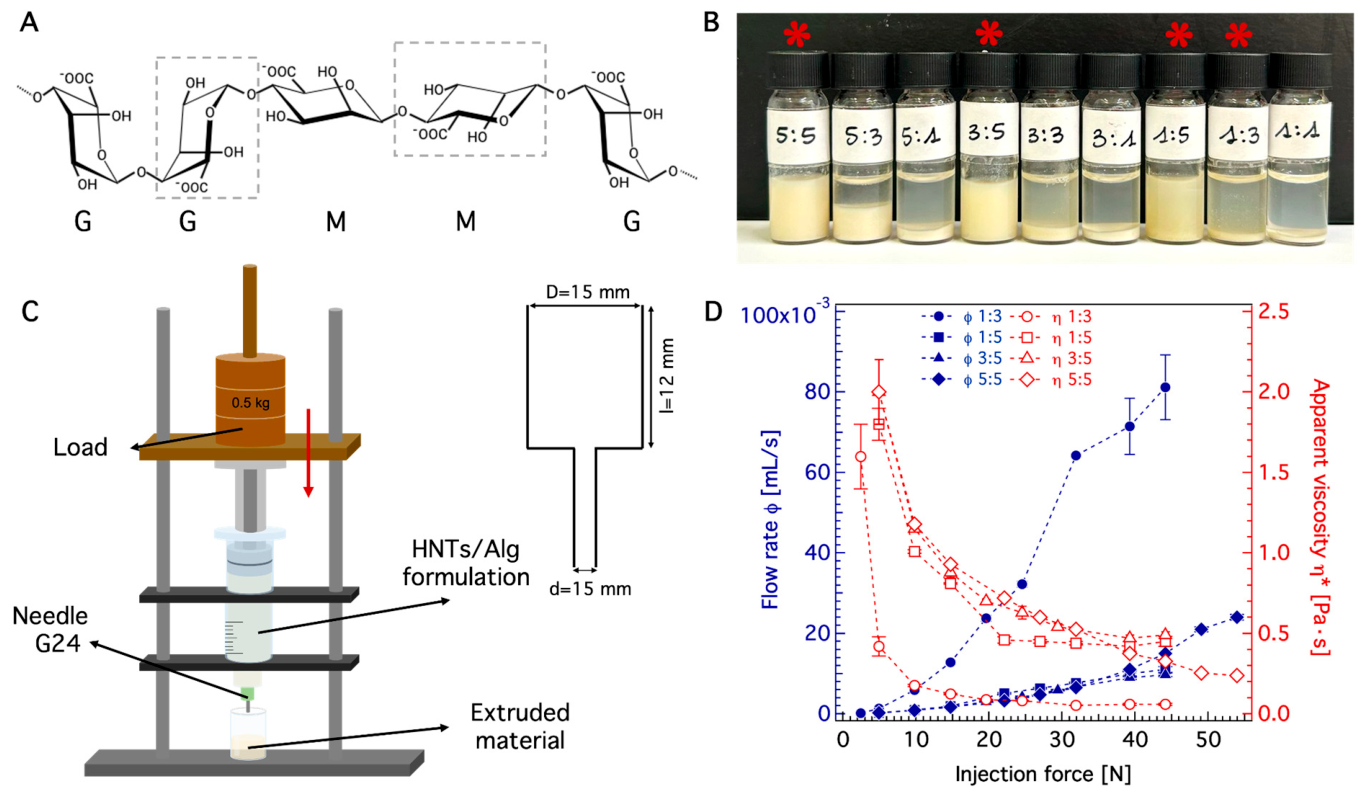
The colloidal stability of the halloysite nanotube (HNT) dispersion is a key point that must be taken into account when preparing HNT formulations, since an adequate colloidal stability prevents the agglomeration of the inorganic filler ensuring an homogeneous phase distribution of the formulation prior and during the processing. With this aim, we initially screened a range of different HNTs and sodium alginate (Alg) ratios (see Table 1), to unravel the best conditions for the obtainment of stable colloidal dispersions. The colloidal stability of the prepared formulations was investigated through sedimentation tests. After 24 h of preparation, the formulations were visually inspected to detect any filler sedimentation at the bottom of the vial, which would indicate phase separation. Figure 2A,B display the Alg molecular structure and the pictures of HNT/Alg formulations 24 h after the preparation. As shown in Figure 2B, most of the HNT/Alg ratios examined here display a deposit on the bottom of the vial, suggesting that a phase separation between the inorganic filler and the biopolymer solution has taken place. However, some formulations displayed adequate colloidal stability, indicating that the alginate concentration plays a more important role than the HNT content in preventing phase separation. In particular, all dispersions containing 1 or 3 wt% alginate appeared unstable, while samples containing 5 wt% alginate and an alginate amount equal to or higher than that of HNTs (5:5, 3:5, and 1:5) remained homogeneous and suitable for extrusion. This behavior can be attributed to the increase in dispersion viscosity at higher alginate concentrations, which slows down the sedimentation of nanotubes. In addition, the presence of polymer chains in solution may provide steric hindrance between particles, further reducing nanotube aggregation and promoting dispersion stability.
Thus, for the next experiments, we investigated the three stable formulations (5:5, 3:5, and 1:5) and one unstable formulation (1:3), to evaluate the effect of the Alg concentration and dispersion stability on the extrusion process.
The injectability of the selected formulations was tested with a custom-built apparatus (see Figure 2C), where different loads were applied on the plunger of a syringe (loaded with the formulation examined), and the corresponding flow rate was measured (details in Section 2.5.2 Characterization of the HNT/Alg Formulations). The obtained flow rates as a function of the injection force (calculated as the applied load multiplied by the gravitational acceleration) are reported in Figure 2D in blue. It is worth noting that the minimum injection force to be applied for achieving an extrusion as a constant flow is 2.45 N for sample 1:3, whereas for the other samples (5:5, 3:5, and 1:5), it is double, confirming that the Alg concentration is a fundamental parameter. The apparent viscosity (η*), estimated from the injectability measurements by applying the Poiseuille law (Equation (1)) [63], is reported in red in Figure 2D. According to the results, in all samples, we see an overall decrease in η* as the injection force increases (shear-thinning behavior) until a viscosity nearly constant value is reached (Newtonian regime) when the force is further increased. This behavior is typical of polymer-based dispersions and can be attributed to the shear-induced alignment and partial disentanglement of alginate chains along the flow direction, which reduces the resistance to deformation at higher shear rates. Such rheological behavior is advantageous for extrusion processes, as it facilitates flow through the needle under shear while maintaining sufficient viscosity at rest to limit nanotube sedimentation.
The main role of the Alg concentration can be also evaluated by comparing the samples 1:3 and 1:5, containing 1 wt% of HNTs and 3 or 5 wt% of Alg, respectively. While these formulations required a comparable injection force (approximately 20 N) to reach the Newtonian regime and displayed similar rheological behavior, sample 1:3, notably, and as expected, shows a sharp drop in its η∗ value. The higher polymer concentration in sample 1:5 results in greater chain entanglements, thereby accounting for the increased viscosity when compared to sample 1:3. For samples with a fixed biopolymer concentration (5 wt%) but increasing HNT amount (1, 3 and 5 wt%), we observed that each sample enters into the Newtonian regime at a different injection force: for the sample 1:5, an injection force of about 20 N is sufficient to induce the transition from shear-thinning to Newtonian, whereas for samples 3:5 and 5:5, in which the filler concentration is higher, the critical load is about 39 N and 49 N, respectively The increasing critical injection force required to reach a constant viscosity regime can be attributed to the higher concentration of nanotubes in the dispersion. At larger HNT contents, stronger particle–particle interactions and the presence of nanotube aggregates likely increase the resistance to flow, requiring higher shear stresses to disrupt these structures and promote nanotube alignment along the flow direction. This behavior suggests that nanotube loading influences the rheological response of the dispersion and therefore the pressure required during extrusion. To ensure an appropriate extrusion process in the Newtonian region, for the preparation of the hydrogel fibers discussed below, higher flow rates were therefore employed (0.052 mL/s, 0.087 mL/s, and 0.130 mL/s).

3.2. Wire Extrusions and Characterization

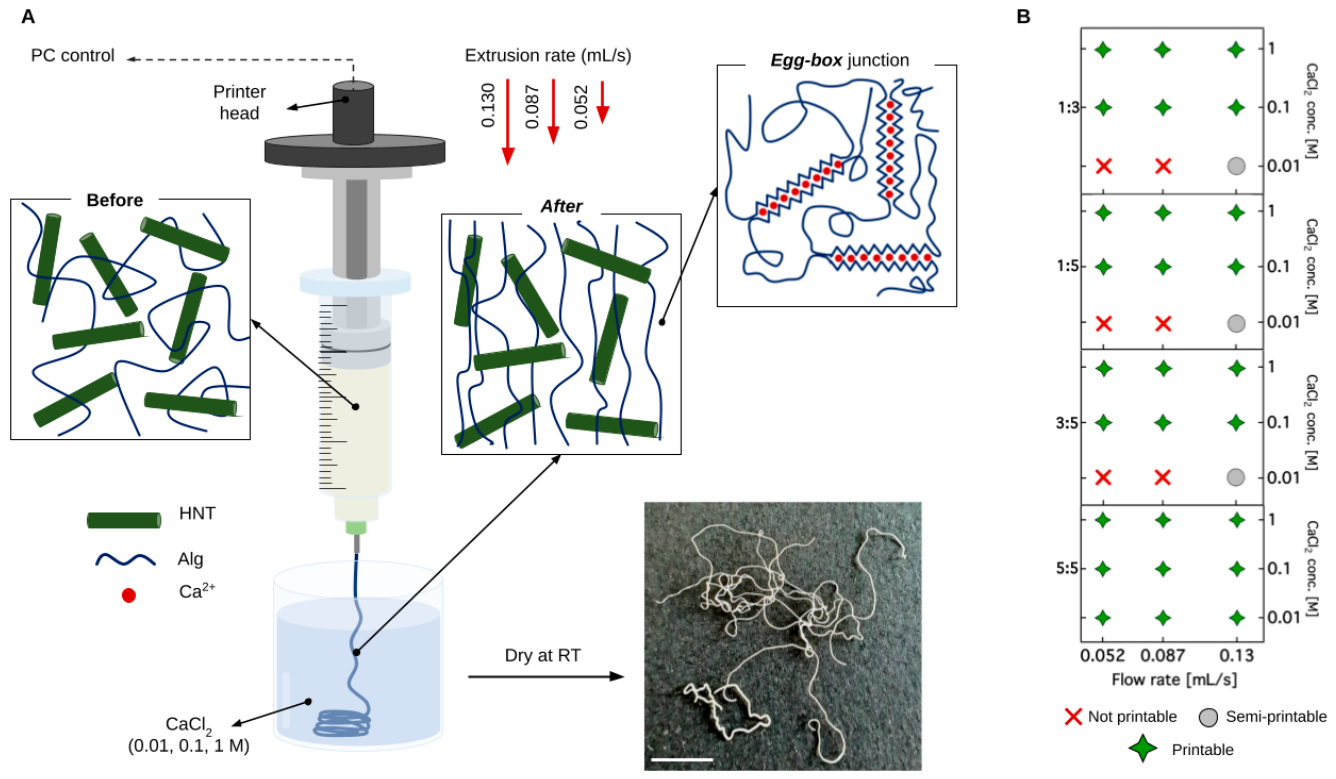
Composite fibers cross-linked with Ca2+ ions were then produced through a 3D-printing-assisted wet spinning process, extruding the HNT/Alg formulations with a syringe (vertical position) into the coagulation bath, and obtaining a hydrogel filament coiling into the bath (a similar configuration was already reported elsewhere for different systems [54,55,64]). In this approach, the composite formulation is forced under pressure through an extrusion apparatus—in our set-up, a 3D printer equipped with a plastic syringe and a needle—into a CaCl2 solution, resulting in the formation of cross-linked alginate fibers enriched with HNTs. A sketch of our experimental wet spinning set-up and cross-linking processes is reported in Figure 3A. To study the influence of the extrusion rate and the CaCl2 concentration, for all the formulations, we systematically increased the flow rate from 0.052 mL/s to 0.087 mL/s to 0.130 mL/s and the CaCl2 concentration (0.01 M, 0.10 M, and 1.00 M), obtaining a series of fibers extruded with different parameters.
According to the results (see Figure 3B, where in red are shown the flow rate/calcium concentration combinations that do not produce stable collectable fiber, in orange the combinations that provide only portions of fibers, and in green the combinations that yield long, uniform and stable fiber), we found out that the lowest CaCl2 concentration tested (0.01 M) at the flow rate of 0.052 mL/s does not allow satisfying fibers for formulations 1:3, 1:5, and 3:5 to be obtained. The formulation 5:5 was the only one leading to a uniform and stable fiber with all the flow rates and CaCl2 concentrations. This behavior suggests that halloysite nanotubes contribute to stabilizing the extruded filament. In particular, physical interactions between the nanotube surfaces and alginate chains may promote the formation of a transient particle–polymer network that increases the cohesion of the extruded jet prior to complete ionic crosslinking. Similar stabilizing effects of HNTs in alginate-based printable formulations have been previously reported: in fact, HNTs have already been used to achieve printable fibers of alginate also when dealing with dilute coagulation baths (0.025 M) [24], taking advantage of the attractive interaction occurring between the nanotubes and the polymer chains. Thus, we can hypothesize that HNTs bind to alginate chains through physical interactions, leading to stable fibers that resist upon dilution once the solutions are injected into the coagulation bath, resulting in cross-linked coils also when using 0.01 M CaCl2. On the other hand, according to these results, the concentration of the polymer does not significantly influence fiber formation. Overall, the 5:5 formulation represented the best compromise among those investigated in terms of dispersion stability, injectability, and filament formation. Higher HNT contents were not explored because they would be expected to increase viscosity, promote nanotube aggregation, and further disrupt the continuity of the alginate matrix, as also suggested by the tensile results reported in the following section.
For further measurements, only the fibers obtained in the “green condition” (see Figure 3B) were considered.
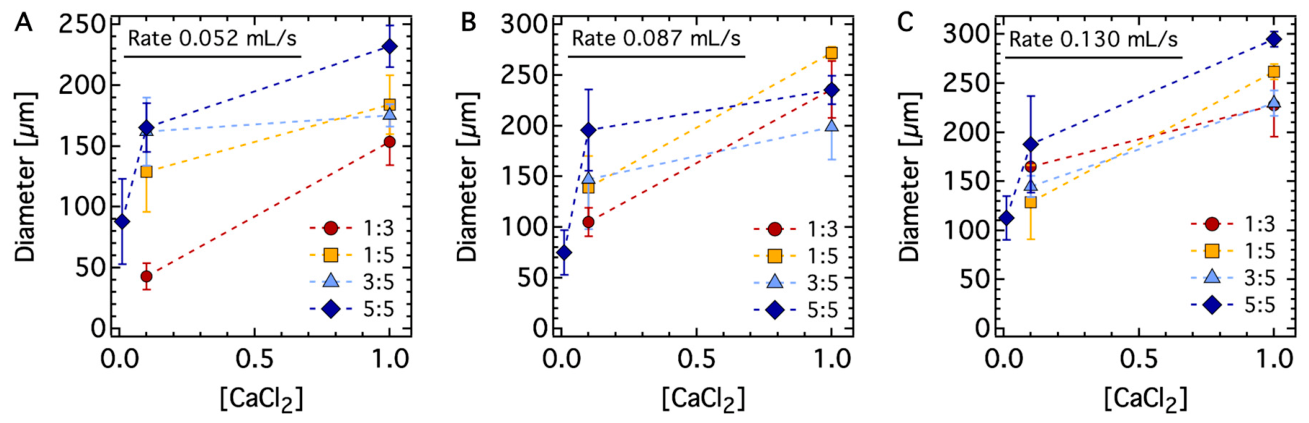
The filaments’ diameter was then investigated via optical microscopy. The plots of the fibers’ mean diameters as a function of the calcium concentration (at a constant flow rate) are shown in Figure 4 and correlate the average diameters with the preparation parameters. According to the results, increasing the CaCl2 concentration in the coagulation bath leads to a larger average filament diameter. This behavior can be attributed to faster ionic crosslinking occurring at the interface between the extruded Alg/HNT dispersion and the coagulation bath. At higher Ca2+ concentrations, the rapid formation of a cross-linked alginate network promotes the development of a gel “skin” around the filament, which stabilizes the extruded jet and limits its partial dissolution or contraction in the surrounding solution. On the other hand, keeping constant the Ca2+ concentration, no correlation between the increase of the flow and the average diameter can be found (see Figure S1). These experimental results evidenced that the calcium concentration is another key parameter when preparing these composites, as it allows the preparation of composite fibers with tunable diameters in the micro-scale range.
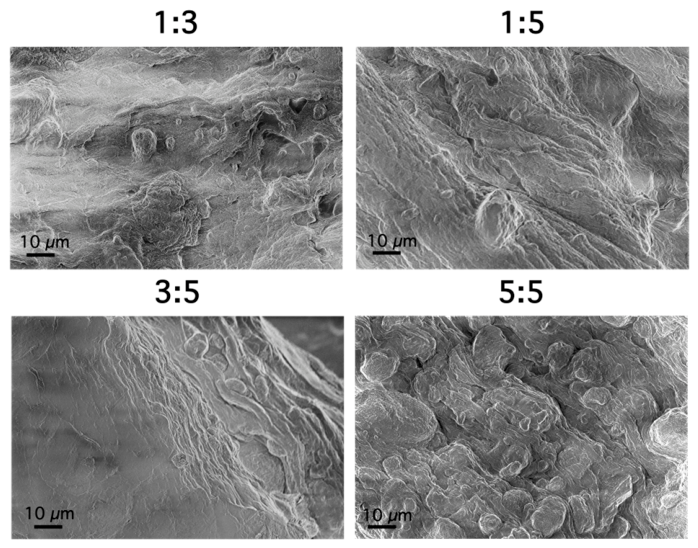
To evaluate the surface morphology and the directionality induced by the extrusion process, as well as to obtain information about HNT aggregation, the surface features of dry fibers were investigated by means of Field Emission-Scanning electron microscopy (FE-SEM). The micrographs, carried out on dry fibers prepared with a flow rate of 0.087 mL/s and cross-linked with CaCl2 0.10 M, are reported in Figure 5. All samples exhibit longitudinal features suggesting the presence of a preferential orientation along the extrusion direction, which is particularly relevant for the samples 1:5 and 3:5. However, this observation should be considered qualitative, since no quantitative alignment analysis was performed in this work. This orientation can be reasonably attributed to the alginate chains’ arrangement occurring during the wet spinning process rather than to the HNT orientation. As a matter of fact, HNTs were not fully dispersed as individual nanotubes with the polymer matrix but were partially present as micro-size aggregates. Therefore, the distribution of HNTs should be considered homogeneous only at the micrometric scale, while a true nanoscale dispersion was not achieved under the processing conditions employed in this work. This aggregation can be attributed to the intrinsic tendency of HNTs to establish particle–particle interactions, to the relatively high filler content, and to the limited deagglomeration efficiency of magnetic stirring alone. Moreover, the high viscosity of alginate-rich formulations may hinder complete aggregate breakup, while the rapid Ca2+-mediated gelation process can freeze the existing dispersion state into the final filament structure. Further optimization of the dispersion process, for example via controlled sonication, high-shear mixing, or tailored surface modification, may help improve nanotube dispersion and composite performance.
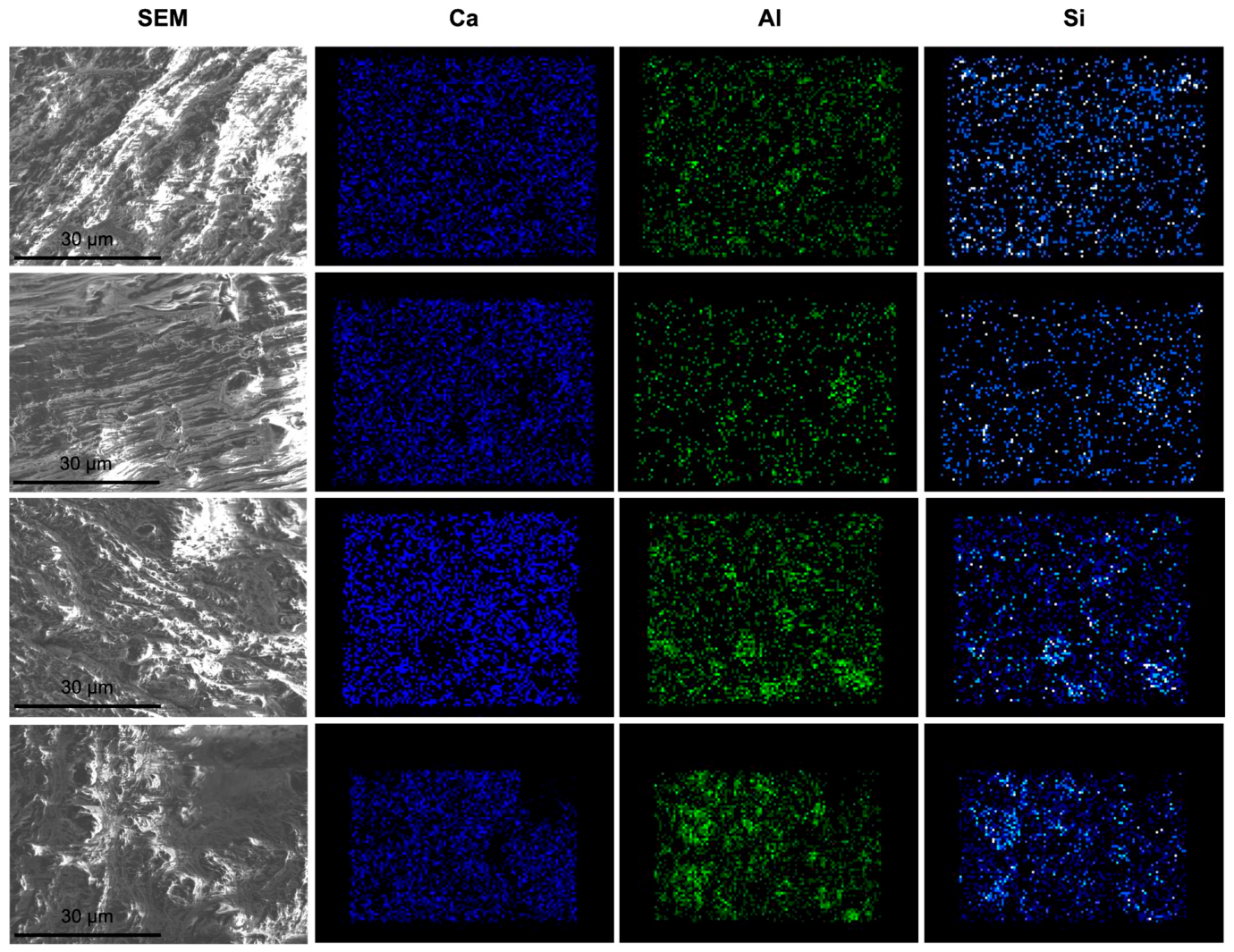
X-ray Energy Dispersive (EDX) analyses were also performed to gain information about the spatial distribution of the nanotubes within the biopolymer. The EDX 2D maps of all the fibers (Figure 6, where aluminum and silicon signals are reported, respectively, in green and light blue) confirmed the presence of the aluminosilicate nanotubes spatially distributed throughout the fibers, although partially present as micro-sized aggregates. Thus, combining the information obtained from FE-SEM micrographs and EDX maps, we could conclude that HNTs were uniformly distributed along the fibers, either as individual nanotubes or as aggregates. EDX was also employed to map calcium (Figure 6, in dark blue), to confirm the Ca2+ coordination between alginate chains.

3.3. Study of the Interactions Between Alginate and HNTs

Attenuated Total Reflection-Fourier Transform Infrared Spectroscopy (ATR-FTIR) and Thermogravimetric analysis (TGA) measurements were performed to investigate potential Van der Waals or electrostatic interactions between alginate chains and HNTs. For this purpose, the sample containing the larger amount of HNTs was selected (5:5, prepared at 0.087 mL/s and cross-linked with CaCl2 0.10 M), being also the only one leading to uniform and stable fibers with all the flow rates and coagulation bath concentrations here investigated, as previously discussed.
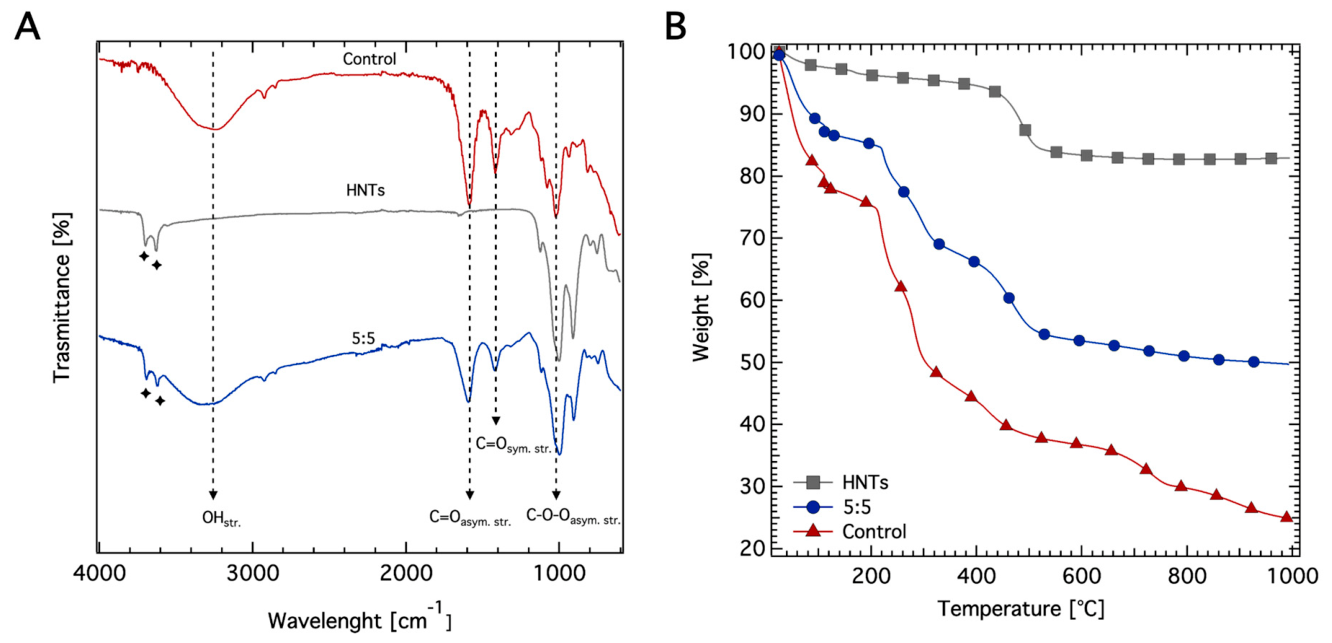
Figure 7A shows the ATR-FTIR spectra of the sample 5:5 and pristine HNTs, together with a spectrum of a fiber prepared with 5 wt% of Alg and without HNTs, reported as the control. The spectrum of the control sample showed a broad band at 3261 cm−1 associated with the –OH stretching, two absorption bands at 1587 cm−1 and 1419 cm−1 referred, respectively, to the asymmetric and symmetric stretching of the carbonyl group (C=O). The peak observed at 1023 cm−1 was associated with the C-O-C stretching [59]. The same absorption bands were also detected in the spectra of the composite. In addition, the spectrum of the sample 5:5 also shows two new absorption bands at 3693 cm−1 and 3622 cm−1, which can be assigned to the O-H stretching of inner-surface hydroxyl groups of HNTs (see spectrum of pristine HNTs, Figure 7A) [59,65]. As neither substantial variations in the position of the peaks nor the appearance of new vibrations were detected, we could reasonably conclude that, in the investigated HNT/Alg ratios, no relevant interactions are occurring between HNTs and the carboxylic groups of the polymer chains. However, when closely looking at -COO- stretching vibrations (peaks at 1588 and 1419 cm−1 in the control sample), we can notice a shift at a higher wavenumber in the composite (1593 and 1421 cm−1 in 5:5 sample), suggesting the formation of weak interactions between the polymer and the nanotubes, as previously already reported for similar systems [66].
The TGA curves of 5:5 fibers, the control sample (i.e., 5 wt% Alg fiber without HNTs), and pristine HNTs are reported in Figure 7B. The weight loss of pristine HNTs can be divided into two major steps: a small initial weight loss due to residual water, and then a major weight loss in the range 260–680 °C attributed to the dehydroxylation of structural aluminol groups [33,59,67]. Concerning the polymer (control sample), the thermal decomposition also proceeds in multiple phases, as typically occurring with the polysaccharide, through the desorption of physically absorbed water, the dehydration reactions that remove the structural water, the depolymerization with the rupture of C–O and C–C bonds in the ring units resulting in the evolution of CO, CO2, and H2O, and, finally, the formation of polynuclear aromatic and graphitic carbon structures [68]. As a result, as expected, the HNT/Alg composite (5:5 sample) displays several steps in the thermograms. When comparing 5:5 and the control sample, we can see some differences, suggesting that HNTs influence the thermal behavior of the polymer. As a matter of fact, considering that the 5:5 sample consists of the control formulation enriched with HNTs, its theoretical weight loss within the investigated temperature range can be estimated by summing the individual contributions of the polymer and the nanotubes (see Table 2). This comparison clearly indicates that the presence of HNTs leads to composites with enhanced thermal stability, in agreement with previous reports on different composite systems [65,69,70]. This is likely due to the barrier effect of the inorganic phase, which limits the diffusion of volatile degradation products during polymer decomposition.

3.4. Composites Containing HNTs and Caffeine

Finally, to pave the way for future potential applications, HNTs were modified with antimicrobial-associated moieties prior to their incorporation into the composites. For this purpose, we explored two complementary strategies: the attempted loading of caffeine into the nanotube lumen and the surface functionalization of HNTs with caffeine. Although caffeine-loaded HNTs have been previously reported as nanocontainers able to provide sustained caffeine release [71], the loading strategy investigated here showed limited efficiency. According to TGA results (see Figure S2 and Table S1), the loading experiments revealed that only a very small amount of caffeine (~1 wt%) could be retained within the nanotubes, and this fraction was almost completely removed after washing with water. This result suggests that caffeine molecules have a weak affinity for the internal surface of HNTs under the investigated conditions, leading to poor retention within the nanotube lumen. Thus, we decided to functionalize the nanotubes with caffeine, following a procedure reported elsewhere and re-adapted in this work (details in Section 2.2.2). FT-IR and XPS analyses (see Figures S3 and S4) confirmed that the nanotubes were properly decorated with caffeine. In particular, the functionalization was confirmed through FT-IR by monitoring the synthesis step by step, while XPS was conducted on the final product in comparison with pristine HNTs and caffeine powders. Concerning FT-IR results (Figure S3), the functionalization with APTES (first step in Figure 1) was confirmed by the signals at 2698 cm−1 (-CH2), 2930 cm−1 (-CH stretch), 3200–3500 cm−1 band (-NH2 stretch), and 1250 cm−1 (-NH scissoring). Then, to confirm the functionalization with dichloromethylsilane (second step in Figure 1), we looked for the disappearance of the signal ascribed to -NH2, and we could spot a change in the region around 3000 cm−1. Finally, the functionalization with caffeine (third step in Figure 1) was confirmed by the presence of signals at about 1714 cm−1 (-C=N) and 1708 cm−1 (-C=O).
XPS experiments were also conducted to obtain quantitative information about functional surface groups and to confirm the integrity of the nanotube, as already reported elsewhere when studying grafted HNTs [72,73]. The results obtained from XPS agree with FT-IR results (see Figure S4 and Table 3). The N 1s spectrum of caffeine (Figure S4) displays two signals, at 400.5 eV (N-CH3) and 399.1 eV (C=N-), in a 3:1 ratio, in agreement with the structure of the molecule. Pristine HNTs (Figure S5) display Al, Si, and O presence, together with an adventitious C signal and N. The presence of nitrogen in this sample can be explained considering that HNTs were extracted from caves and used without purification; thus, some impurities could be present in the powders. The obtained atomic quantification is similar to the stoichiometric H4Al2O9Si2, as already reported elsewhere [74]. Concerning HNT-caffeine (Figure S6), the spectra generally resemble those of HNTs. However, when comparing HNT-caffeine and HNT quantitative analysis, we can see a reduction in the Si/N ratio from 7.2 in HNTs to 3.0 in HNT-caffeine, indicating a higher nitrogen relative amount that further confirms the grafting of caffeine on the HNT surface. The XPS chemical state analysis and quantification of pristine HNTs and HNT-caffeine are detailed in Table 3 and Figures S5 and S6.
Finally, caffeine-functionalized HNTs (HNTs-caffeine) were used to prepare composite fibers with potential relevance for future biological and agricultural applications, following the same procedure described above for the 5:5 fibers. This sample, characterized by a mean diameter of 319 ± 19 µm, was investigated by means of optical microscopy and FE-SEM (see Figure S7), confirming that the presence of HNTs-caffeine did not appreciably affect the morphology of the composite. Moreover, the mechanical properties of selected fibers were investigated by tensile testing. As shown in Figure S8, the pristine alginate fibers exhibited the highest maximum stress (6.9 MPa), indicating the formation of a continuous and effective load-bearing alginate network. The incorporation of HNTs caused a marked decrease in tensile strength, with the Alg/HNT 5:5 and Alg/HNT-caffeine 5:5 samples displaying comparable values (5.0 MPa for both samples). This behavior suggests that, under the investigated conditions, HNTs do not provide an effective tensile reinforcement to the alginate filaments. Rather, the presence of nanotubes, especially in the form of micro-sized aggregates as observed via FE-SEM, likely introduces structural heterogeneities and local stress-concentration sites within the fiber, which in turn promote localized deformation and premature failure. The elongation at break followed a similar trend. Pristine alginate fibers showed the highest deformation before rupture (maximum elongation of 5.6%), whereas both HNT-containing samples exhibited lower and comparable elongation values (1.6–1.7%). This reduction can be attributed to the partial disruption of the continuous alginate network and to the presence of inorganic domains that limit homogeneous deformation of the polymer matrix. Overall, these results indicate that the incorporation of pristine or caffeine-functionalized HNTs is compatible with wet-spun filament fabrication but does not improve tensile performance in the present formulation. Therefore, the main advantage of HNT incorporation should be ascribed to the introduction of functionalizable inorganic interfaces and to the modification of the structural and thermal features of the composite filaments, rather than to mechanical reinforcement.
These results demonstrate that surface-functionalized HNTs can be successfully incorporated into wet-spun alginate filaments without significantly affecting the fiber morphology, confirming the compatibility of the functionalization strategy with the wet-spinning process. This approach therefore provides a versatile route for introducing tailored surface functionalities into alginate-based composite filaments.

4. Conclusions

This work demonstrates the successful fabrication of alginate/halloysite nanotube (Alg/HNT) hybrid filaments through a 3D printing-assisted wet-spinning process, providing a systematic investigation of the formulation and processing parameters governing filament formation. The optimization of Alg/HNT dispersions enabled the preparation of stable and injectable formulations suitable for continuous fiber extrusion.
The results highlight the key role of the coagulation bath composition in determining the final morphology of the fibers. In particular, the calcium chloride concentration was found to strongly influence filament diameter and stability, while the extrusion rate showed only a minor effect within the investigated range. Microscopy analyses confirmed the homogeneous distribution of HNTs within the alginate matrix, mainly as micro-sized aggregates, and revealed partial alignment of the polymer chains along the extrusion direction. Spectroscopic and thermal analyses indicated weak interactions between alginate chains and nanotube surfaces, while the incorporation of HNTs led to improved thermal stability of the composite fibers.
Finally, halloysite nanotubes were successfully functionalized with caffeine through surface modification as a proof-of-concept system, and the resulting HNT-caffeine particles were incorporated into wet-spun alginate filaments without significantly altering their morphology.
Overall, these results establish a reproducible route for the fabrication of wet-spun alginate/HNT composite filaments with a tunable morphology and functionalizable nanotube interfaces, providing a versatile platform for the development of sustainable hybrid biopolymer fibers for future bio-related and agro-related applications.

Supplementary Materials

The following supporting information can be downloaded at: https://www.mdpi.com/article/10.3390/applnano7020015/s1, Figure S1: Plot of the fiber diameter as a function of the extrusion rate (mL/s) at a constant CaCl2 concentration of 0.01 M (A), 0.1 M (B), and 1 M (C). The error bars associated with the markers are the standard deviation σ resulting from the Gaussian fitting; Figure S2: TGA curves of pristine HNTs (HNTs), caffeine, loaded HNTs (HNT+caffeine), and HNTs loaded and rapidly washed with Milli-Q water (HNT+caffeinewashed); Table S1: TGA results of pristine HNTs (HNTs), caffeine, loaded HNTs (HNTs+caffeine), and HNTs loaded and rapidly washed with Milli-Q water (HNTs+caffeinewashed); Figure S3: FT-IR spectra of pristine HNTs, HNT-NH2, HNT-Cl, and HNT-caffeine (synthetic pathway reported in Figure 1); Figure S4: XPS high-resolution narrow spectrum of N 1s for a caffeine reference sample; Figure S5: XPS survey spectrum (0–600 eV) and corresponding high-resolution narrow spectra of pristine HNTs; Figure S6: XPS survey spectrum (0–600 eV) and corresponding high-resolution narrow spectra of HNT-caffeine; Figure S7: FE-SEM micrographs at magnification 250× (A) and 2.50 KX (B) of the HNT-caffeine/Alg 5:5 fibers. All the measurements were carried out on the fibers obtained with an extrusion rate of 0.087 mL/s and cross-linked with CaCl2 0.10 M. The scale bars are 20 μm and 2 µm, respectively; Figure S8: Maximum stress (A) and elongation at break of the investigated samples: Control (i.e., 5 wt% Alg fibers without HNTs), HNT/Alg 5:5 fibers and HNT-caffeine/Alg 5:5 fibers.

Author Contributions

Conceptualization, G.M., M.T. and M.B.; Methodology, G.M., M.T., D.S. and M.R.; Investigation, G.M., M.T., D.S., M.R. and M.B.; Data Curation, G.M., M.T., D.S., M.R. and M.B.; Writing—Original Draft Preparation, G.M.; Writing—Review and Editing, G.M., M.T., D.S., M.R. and M.B.; Supervision, M.B.; Funding Acquisition, M.T. and M.B. All authors have read and agreed to the published version of the manuscript.

Funding

This research was funded by CSGI (Consorzio Interuniversitario per lo Sviluppo dei Sistemi a Grande Interfase) and MIUR-Italy (‘‘Progetto Dipartimenti di Eccellenza 2023–2027 DICUS 2.0” allocated to Department of Chemistry ‘‘Ugo Schiff”, University of Florence). The research was also funded under the National Recovery and Resilience Plan (NRRP), Mission 4 Component 2 “Dalla ricerca all’impresa”—Call for tender No. 341 of 15 March 2022 of Italian Ministry of Research funded by the European Union—NextGenerationEU, CUP: B83C22004890007, Project title “3A-ITALY—Made-in-Italy circolare e sostenibile”. The authors gratefully acknowledge the support of the ISIS@MACH ITALIA Research Infrastructure, the hub of ISIS Neutron and Muon Source (UK), [MUR official registry U. 0008642.28-05-2020—16 April 2020]. The ESCALAB QXi spectrometer was funded by the Italian National Research Council via the following grant: “Sviluppo delle infrastrutture e programma biennale degli interventi del Consiglio Nazionale delle Ricerche (2019)”.

Institutional Review Board Statement

Not applicable.

Informed Consent Statement

Not applicable.

Data Availability Statement

The original contributions presented in this study are included in the article. Further inquiries can be directed to the corresponding author.

Acknowledgments

The authors wish to thank the mechanical workshop of the Department of Physics and Astronomy of the University of Florence (Mattia Leporatti and co-workers) for their help in the development of the custom-built apparatus for injection tests.

Conflicts of Interest

The authors declare no conflicts of interest.

Abbreviations

The following abbreviations are used in this manuscript:
AlgAlginate
HNTHalloysite
APTESγ-Aminopropyltriethoxysilane
DDMSDichloro(dimethyl)silane
DMSODimethyl dulfoxide
TGAThermogravimetric Analysis
FT-IRFourier Transform Infrared
XPSX-ray Photoelectron Spectroscopy
SDStandard deviation
FE-SEMField Emission-Scanning Electron Microscopy
EDXEnergy-Dispersive X-ray spectroscopy
ATR-FTIRAttenuated Total Reflection-Fourier Transform Infrared Spectroscopy

References

  1. Chemistry (IUPAC), T.I.U. of P. and A. IUPAC—Composite (CT07545). Available online: https://goldbook.iupac.org/terms/view/CT07545 (accessed on 28 April 2026).
  2. Kausar, A. Review on Polymer/Halloysite Nanotube Nanocomposite. Polym.-Plast. Technol. Eng. 2018, 57, 548–564. [Google Scholar] [CrossRef]
  3. Tu, J.; Cao, Z.; Jing, Y.; Fan, C.; Zhang, C.; Liao, L.; Liu, L. Halloysite Nanotube Nanocomposite Hydrogels with Tunable Mechanical Properties and Drug Release Behavior. Compos. Sci. Technol. 2013, 85, 126–130. [Google Scholar] [CrossRef]
  4. Kumar, A.; Rao, K.M.; Han, S.S. Development of Sodium Alginate-Xanthan Gum Based Nanocomposite Scaffolds Reinforced with Cellulose Nanocrystals and Halloysite Nanotubes. Polym. Test. 2017, 63, 214–225. [Google Scholar] [CrossRef]
  5. Silva, T.L.d.; Vidart, J.M.M.; Silva, M.G.C.d.; Gimenes, M.L.; Vieira, M.G.A. Alginate and Sericin: Environmental and Pharmaceutical Applications. In Biological Activities and Application of Marine Polysaccharides; IntechOpen: London, UK, 2017. [Google Scholar]
  6. Lee, K.Y.; Mooney, D.J. Alginate: Properties and Biomedical Applications. Prog. Polym. Sci. 2012, 37, 106–126. [Google Scholar] [CrossRef]
  7. Sachan, N.; Pushkar, S.; Jha, A.; Bhattcharya, A. Sodium Alginate: The Wonder Polymer for Controlled Drug Delivery. J. Pharm. Res. 2009, 2, 1191–1199. [Google Scholar]
  8. Hecht, H.; Srebnik, S. Structural Characterization of Sodium Alginate and Calcium Alginate. Biomacromolecules 2016, 17, 2160–2167. [Google Scholar] [CrossRef] [PubMed]
  9. Grant, G.T.; Morris, E.R.; Rees, D.A.; Smith, P.J.C.; Thom, D. Biological Interactions between Polysaccharides and Divalent Cations: The Egg-Box Model. FEBS Lett. 1973, 32, 195–198. [Google Scholar] [CrossRef]
  10. Zhang, X.; Wang, X.; Fan, W.; Liu, Y.; Wang, Q.; Weng, L. Fabrication, Property and Application of Calcium Alginate Fiber: A Review. Polymers 2022, 14, 3227. [Google Scholar] [CrossRef] [PubMed]
  11. Qin, Y. Alginate Fibres: An Overview of the Production Processes and Applications in Wound Management. Polym. Int. 2008, 57, 171–180. [Google Scholar] [CrossRef]
  12. Sa, V.; Kornev, K.G. A Method for Wet Spinning of Alginate Fibers with a High Concentration of Single-Walled Carbon Nanotubes. Carbon 2011, 49, 1859–1868. [Google Scholar] [CrossRef]
  13. Park, J.-S.; Park, C.-W.; Han, S.-Y.; Lee, E.-A.; Cindradewi, A.W.; Kim, J.-K.; Kwon, G.-J.; Seo, Y.-H.; Yoo, W.-J.; Gwon, J.; et al. Preparation and Properties of Wet-Spun Microcomposite Filaments from Various CNFs and Alginate. Polymers 2021, 13, 1709. [Google Scholar] [CrossRef]
  14. Gao, Q.; He, Y.; Fu, J.; Liu, A.; Ma, L. Coaxial Nozzle-Assisted 3D Bioprinting with Built-in Microchannels for Nutrients Delivery. Biomaterials 2015, 61, 203–215. [Google Scholar] [CrossRef]
  15. Liakos, I.L.; Mondini, A.; Dottore, E.D.; Filippeschi, C.; Pignatelli, F.; Mazzolai, B. 3D Printed Composites from Heat Extruded Polycaprolactone/Sodium Alginate Filaments and Their Heavy Metal Adsorption Properties. Mater. Chem. Front. 2020, 4, 2472–2483. [Google Scholar] [CrossRef]
  16. Huang, B.; Liu, M.; Long, Z.; Shen, Y.; Zhou, C. Effects of Halloysite Nanotubes on Physical Properties and Cytocompatibility of Alginate Composite Hydrogels. Mater. Sci. Eng. C 2017, 70, 303–310. [Google Scholar] [CrossRef] [PubMed]
  17. Li, J.; Ma, J.; Chen, S.; Huang, Y.; He, J. Adsorption of Lysozyme by Alginate/Graphene Oxide Composite Beads with Enhanced Stability and Mechanical Property. Mater. Sci. Eng. C 2018, 89, 25–32. [Google Scholar] [CrossRef] [PubMed]
  18. Ionita, M.; Pandele, M.A.; Iovu, H. Sodium Alginate/Graphene Oxide Composite Films with Enhanced Thermal and Mechanical Properties. Carbohydr. Polym. 2013, 94, 339–344. [Google Scholar] [CrossRef]
  19. Zhang, X.; Hui, Z.; Wan, D.; Huang, H.; Huang, J.; Yuan, H.; Yu, J. Alginate Microsphere Filled with Carbon Nanotube as Drug Carrier. Int. J. Biol. Macromol. 2010, 47, 389–395. [Google Scholar] [CrossRef]
  20. Liu, L.; Wan, Y.; Xie, Y.; Zhai, R.; Zhang, B.; Liu, J. The Removal of Dye from Aqueous Solution Using Alginate-Halloysite Nanotube Beads. Chem. Eng. J. 2012, 187, 210–216. [Google Scholar] [CrossRef]
  21. Chiew, C.S.C.; Poh, P.E.; Pasbakhsh, P.; Tey, B.T.; Yeoh, H.K.; Chan, E.S. Physicochemical Characterization of Halloysite/Alginate Bionanocomposite Hydrogel. Appl. Clay Sci. 2014, 101, 444–454. [Google Scholar] [CrossRef]
  22. Fan, L.; Zhang, J.; Wang, A. In Situ Generation of Sodium Alginate/Hydroxyapatite/Halloysite Nanotubes Nanocomposite Hydrogel Beads as Drug-Controlled Release Matrices. J. Mater. Chem. B 2013, 1, 6261–6270. [Google Scholar] [CrossRef]
  23. Cavallaro, G.; Gianguzza, A.; Lazzara, G.; Milioto, S.; Piazzese, D. Alginate Gel Beads Filled with Halloysite Nanotubes. Appl. Clay Sci. 2013, 72, 132–137. [Google Scholar] [CrossRef]
  24. Glukhova, S.A.; Molchanov, V.S.; Lokshin, B.V.; Rogachev, A.V.; Tsarenko, A.A.; Patsaev, T.D.; Kamyshinsky, R.A.; Philippova, O.E. Printable Alginate Hydrogels with Embedded Network of Halloysite Nanotubes: Effect of Polymer Cross-Linking on Rheological Properties and Microstructure. Polymers 2021, 13, 4130. [Google Scholar] [CrossRef]
  25. Roushangar Zineh, B.; Shabgard, M.R.; Roshangar, L. Mechanical and Biological Performance of Printed Alginate/Methylcellulose/Halloysite Nanotube/Polyvinylidene Fluoride Bio-Scaffolds. Mater. Sci. Eng. C 2018, 92, 779–789. [Google Scholar] [CrossRef]
  26. Cinà, G.; Massaro, M.; Cavallaro, G.; Lazzara, G.; Sánchez-Espejo, R.; Viseras Iborra, C.; D’Abrosca, B.; Fiorentino, A.; Messina, G.M.L.; Riela, S. Development of Alginate Film Filled with Halloysite-Carbon Dots for Active Food Packaging. Int. J. Biol. Macromol. 2024, 277, 134375. [Google Scholar] [CrossRef] [PubMed]
  27. De Silva, R.T.; Dissanayake, R.K.; Mantilaka, M.M.M.G.P.G.; Wijesinghe, W.P.S.L.; Kaleel, S.S.; Premachandra, T.N.; Weerasinghe, L.; Amaratunga, G.A.J.; de Silva, K.M.N. Drug-Loaded Halloysite Nanotube-Reinforced Electrospun Alginate-Based Nanofibrous Scaffolds with Sustained Antimicrobial Protection. ACS Appl. Mater. Interfaces 2018, 10, 33913–33922. [Google Scholar] [CrossRef]
  28. Bertolino, V.; Cavallaro, G.; Milioto, S.; Lazzara, G. Polysaccharides/Halloysite Nanotubes for Smart Bionanocomposite Materials. Carbohydr. Polym. 2020, 245, 116502. [Google Scholar] [CrossRef]
  29. Yuan, P.; Tan, D.; Annabi-Bergaya, F. Properties and Applications of Halloysite Nanotubes: Recent Research Advances and Future Prospects. Appl. Clay Sci. 2015, 112–113, 75–93. [Google Scholar] [CrossRef]
  30. Du, M.; Guo, B.; Jia, D. Newly Emerging Applications of Halloysite Nanotubes: A Review. Polym. Int. 2010, 59, 574–582. [Google Scholar] [CrossRef]
  31. Hamedi, S.; Koosha, M. Designing a pH-Responsive Drug Delivery System for the Release of Black-Carrot Anthocyanins Loaded in Halloysite Nanotubes for Cancer Treatment. Appl. Clay Sci. 2020, 197, 105770. [Google Scholar] [CrossRef]
  32. Tonelli, M.; Baglioni, P.; Ridi, F. Halloysite Nanotubes as Nano-Carriers of Corrosion Inhibitors in Cement Formulations. Materials 2020, 13, 3150. [Google Scholar] [CrossRef] [PubMed]
  33. Tonelli, M.; Perini, I.; Ridi, F.; Baglioni, P. Improving the Properties of Antifouling Hybrid Composites: The Use of Halloysites as Nano-Containers in Epoxy Coatings. Colloids Surf. A Physicochem. Eng. Asp. 2021, 623, 126779. [Google Scholar] [CrossRef]
  34. Massaro, M.; Laura Alfieri, M.; Rizzo, G.; Babudri, F.; Barbosa de Melo, R.; Faddetta, T.; Gallo, G.; Napolitano, A.; Sanchèz-Espejo, R.; Viseras Iborra, C.; et al. Modification of Halloysite Lumen with Dopamine Derivatives as Filler for Antibiofilm Coating. J. Colloid Interface Sci. 2023, 646, 910–921. [Google Scholar] [CrossRef]
  35. Oun, A.A.; Bae, A.Y.; Shin, G.H.; Park, M.-K.; Kim, J.T. Comparative Study of Oregano Essential Oil Encapsulated in Halloysite Nanotubes and Diatomaceous Earth as Antimicrobial and Antioxidant Composites. Appl. Clay Sci. 2022, 224, 106522. [Google Scholar] [CrossRef]
  36. Zhong, B.; Wang, S.; Dong, H.; Luo, Y.; Jia, Z.; Zhou, X.; Chen, M.; Xie, D.; Jia, D. Halloysite Tubes as Nanocontainers for Herbicide and Its Controlled Release in Biodegradable Poly(Vinyl Alcohol)/Starch Film. J. Agric. Food Chem. 2017, 65, 10445–10451. [Google Scholar] [CrossRef]
  37. Yang, Y.; Chen, Y.; Leng, F.; Huang, L.; Wang, Z.; Tian, W. Recent Advances on Surface Modification of Halloysite Nanotubes for Multifunctional Applications. Appl. Sci. 2017, 7, 1215. [Google Scholar] [CrossRef]
  38. Vishvanathperumal, S.; Roy, J.V.; Anand, G.; Ramu, K.N.; Praveenkumar, S. An Investigation on the Effect of the Surface Modifications and HNTs Loading on the Cure Behaviours, Abrasion Resistance, Mechanical and Morphological Properties of NR/EPDM Nanocomposites. Silicon 2024, 16, 2267–2284. [Google Scholar] [CrossRef]
  39. Russell, D.W.; Fernández-Caldas, E.; Swanson, M.C.; Seleznick, M.J.; Trudeau, W.L.; Lockey, R.F. Caffeine, a Naturally Occurring Acaricide. J. Allergy Clin. Immunol. 1991, 87, 107–110. [Google Scholar] [CrossRef]
  40. Araque, P.; Casanova, H.; Ortiz, C.; Henao, B.; Peláez, C. Insecticidal Activity of Caffeine Aqueous Solutions and Caffeine Oleate Emulsions against Drosophila Melanogaster and Hypothenemus Hampei. J. Agric. Food Chem. 2007, 55, 6918–6922. [Google Scholar] [CrossRef]
  41. Góngora, C.E.; Tapias, J.; Jaramillo, J.; Medina, R.; González, S.; Restrepo, T.; Casanova, H.; Benavides, P. A Novel Caffeine Oleate Formulation as an Insecticide to Control Coffee Berry Borer, Hypothenemus Hampei, and Other Coffee Pests. Agronomy 2023, 13, 1554. [Google Scholar] [CrossRef]
  42. Liu, M.; Jia, Z.; Jia, D.; Zhou, C. Recent Advance in Research on Halloysite Nanotubes-Polymer Nanocomposite. Prog. Polym. Sci. 2014, 39, 1498–1525. [Google Scholar] [CrossRef]
  43. Liu, M.; Zhang, Y.; Wu, C.; Xiong, S.; Zhou, C. Chitosan/Halloysite Nanotubes Bionanocomposites: Structure, Mechanical Properties and Biocompatibility. Int. J. Biol. Macromol. 2012, 51, 566–575. [Google Scholar] [CrossRef]
  44. Wang, Y.; Yi, S.; Lu, R.; Sameen, D.E.; Ahmed, S.; Dai, J.; Qin, W.; Li, S.; Liu, Y. Preparation, Characterization, and 3D Printing Verification of Chitosan/Halloysite Nanotubes/Tea Polyphenol Nanocomposite Films. Int. J. Biol. Macromol. 2021, 166, 32–44. [Google Scholar] [CrossRef]
  45. Del Buffa, S.; Rinaldi, E.; Carretti, E.; Ridi, F.; Bonini, M.; Baglioni, P. Injectable Composites via Functionalization of 1D Nanoclays and Biodegradable Coupling with a Polysaccharide Hydrogel. Colloids Surf. B Biointerfaces 2016, 145, 562–566. [Google Scholar] [CrossRef]
  46. Wu, Y.; Zhang, Y.; Ju, J.; Yan, H.; Huang, X.; Tan, Y. Advances in Halloysite Nanotubes–Polysaccharide Nanocomposite Preparation and Applications. Polymers 2019, 11, 987. [Google Scholar] [CrossRef]
  47. Sadegh-Hassani, F.; Mohammadi Nafchi, A. Preparation and Characterization of Bionanocomposite Films Based on Potato Starch/Halloysite Nanoclay. Int. J. Biol. Macromol. 2014, 67, 458–462. [Google Scholar] [CrossRef]
  48. Makaremi, M.; Pasbakhsh, P.; Cavallaro, G.; Lazzara, G.; Aw, Y.K.; Lee, S.M.; Milioto, S. Effect of Morphology and Size of Halloysite Nanotubes on Functional Pectin Bionanocomposites for Food Packaging Applications. ACS Appl. Mater. Interfaces 2017, 9, 17476–17488. [Google Scholar] [CrossRef] [PubMed]
  49. Zhao, Y.; Abdullayev, E.; Vasiliev, A.; Lvov, Y. Halloysite Nanotubule Clay for Efficient Water Purification. J. Colloid Interface Sci. 2013, 406, 121–129. [Google Scholar] [CrossRef] [PubMed]
  50. Tonelli, M.; Gelli, R.; Ridi, F.; Baglioni, P. Magnesium Phosphate-Based Cements Containing Halloysite Nanotubes for Cracks Repair. Constr. Build. Mater. 2021, 301, 124056. [Google Scholar] [CrossRef]
  51. Cavallaro, G.; Lazzara, G.; Milioto, S.; Parisi, F. Halloysite Nanotubes as Sustainable Nanofiller for Paper Consolidation and Protection. J. Therm. Anal. Calorim. 2014, 117, 1293–1298. [Google Scholar] [CrossRef]
  52. Tonelli, M.; Gelli, R.; Giorgi, R.; Pierigè, M.I.; Ridi, F.; Baglioni, P. Cementitious Materials Containing Nano-Carriers and Silica for the Restoration of Damaged Concrete-Based Monuments. J. Cult. Herit. 2021, 49, 59–69. [Google Scholar] [CrossRef]
  53. Var, C.; Palamutcu, S. Diverse Approaches in Wet-Spun Alginate Filament Production from the Textile Industry Perspective: From Process Optimization to Composite Filament Production. Polymers 2024, 16, 1817. [Google Scholar] [CrossRef]
  54. Hou, C.; Zhang, J.; Zhang, X.; Wang, Y.; Li, T.; Xia, B.; Jiang, J.; Dong, W. High Strength Chitin Nanocrystal/Alginate Filament Prepared by Wet-Spinning in “Green” Coagulating Bath. Cellulose 2022, 29, 8611–8621. [Google Scholar] [CrossRef]
  55. Xu, Y.; Chen, X.; Zhou, X.; Huang, M.; Liu, M. Sodium Alginate/Polyacrylic Acid/Halloysite Nanotube Fibers Fabricated by Wet Spinning for Salinity Gradient Power Generation. Compos. Part A Appl. Sci. Manuf. 2026, 203, 109574. [Google Scholar] [CrossRef]
  56. Peixoto, A.F.; Fernandes, A.C.; Pereira, C.; Pires, J.; Freire, C. Physicochemical Characterization of Organosilylated Halloysite Clay Nanotubes. Microporous Mesoporous Mater. 2016, 219, 145–154. [Google Scholar] [CrossRef]
  57. Jeamjumnunja, K.; Cheycharoen, O.; Phongzitthiganna, N.; Hannongbua, S.; Prasittichai, C. Surface-Modified Halloysite Nanotubes as Electrochemical CO2 Sensors. ACS Appl. Nano Mater. 2021, 4, 3686–3695. [Google Scholar] [CrossRef]
  58. Karami, Z.; Moini Jazani, O.; Navarchian, A.H.; Karrabi, M.; Vahabi, H.; Saeb, M.R. Well-Cured Silicone/Halloysite Nanotubes Nanocomposite Coatings. Prog. Org. Coat. 2019, 129, 357–365. [Google Scholar] [CrossRef]
  59. Yaghoubi, S.; Sadjadi, S.; Zhong, X.; Yuan, P.; Heravi, M.M. Clay-Supported Bio-Based Lewis Acid Ionic Liquid as a Potent Catalyst for the Dehydration of Fructose to 5-Hydroxymthylfurfural. Sci. Rep. 2024, 14, 82. [Google Scholar] [CrossRef]
  60. Gurikov, P.; Smirnova, I. Non-Conventional Methods for Gelation of Alginate. Gels 2018, 4, 14. [Google Scholar] [CrossRef]
  61. Armelao, L.; Rando, M.; Carlotto, S.; Motta, I.; Bottaro, G.; Rancan, M. Bridging Two Worlds: (DABCO-H)CuKI3 a Hybrid Copper Iodide Phosphor with a Perovskite Structure. Pure Appl. Chem. 2024, 96, 69–80. [Google Scholar] [CrossRef]
  62. Tonelli, M.; Faralli, A.; Ridi, F.; Bonini, M. 3D Printable Magnesium-Based Cements towards the Preparation of Bioceramics. J. Colloid Interface Sci. 2021, 598, 24–35. [Google Scholar] [CrossRef]
  63. Zhang, Q.; Fassihi, M.A.; Fassihi, R. Delivery Considerations of Highly Viscous Polymeric Fluids Mimicking Concentrated Biopharmaceuticals: Assessment of Injectability via Measurement of Total Work Done “WT.”. AAPS PharmSciTech 2018, 19, 1520–1528. [Google Scholar] [CrossRef] [PubMed]
  64. Andriamiseza, F.; Peters, S.; Roux, C.; Dietrich, N.; Coudret, C.; Fitremann, J. Wet Spinning and 3D Printing of Supramolecular Hydrogels in Acid-Base and Dynamic Conditions. Colloids Surf. A Physicochem. Eng. Asp. 2023, 673, 131765. [Google Scholar] [CrossRef]
  65. Lo Bianco, A.; Calvino, M.M.; Lazzara, G.; Milioto, S.; Cavallaro, G. Geopolymerization of Halloysite Clay Nanotubes Mixed with Hydroxypropyl Cellulose for Development of Composite Films with Flame Resistance Properties. Ceram. Int. 2026, 52, 15130–15138. [Google Scholar] [CrossRef]
  66. Liu, M.; Dai, L.; Shi, H.; Xiong, S.; Zhou, C. In Vitro Evaluation of Alginate/Halloysite Nanotube Composite Scaffolds for Tissue Engineering. Mater. Sci. Eng. C 2015, 49, 700–712. [Google Scholar] [CrossRef]
  67. Pereira, D.; Tonelli, M.; Almeida, J.R.; Correia-da-Silva, M.; Cidade, H.; Ridi, F. Epoxy Coatings Containing Nature-Inspired Antifouling Compounds Loaded in Halloysite Nanocontainers. Appl. Sci. 2026, 16, 4114. [Google Scholar] [CrossRef]
  68. Said, A.A.; Hassan, R.M. Thermal Decomposition of Some Divalent Metal Alginate Gel Compounds. Polym. Degrad. Stab. 1993, 39, 393–397. [Google Scholar] [CrossRef]
  69. Rehman, A.; Shuib, R.K. Enhanced Thermal Stability, Flame Retardancy, and Thermal Conductivity of Self-Healing Natural Rubber Composites Reinforced Surface Treated Halloysite Clay Nanotubes. Case Stud. Therm. Eng. 2025, 73, 106473. [Google Scholar] [CrossRef]
  70. Lisuzzo, L.; Cavallaro, G.; Milioto, S.; Lazzara, G. Effects of Halloysite Content on the Thermo-Mechanical Performances of Composite Bioplastics. Appl. Clay Sci. 2020, 185, 105416. [Google Scholar] [CrossRef]
  71. Imshinetskiy, I.; Kashepa, V.; Nadaraia, K.; Mashtalyar, D.; Suchkov, S.; Zadorozhny, P.; Ustinov, A.; Sinebryukhov, S.; Gnedenkov, S. PEO Coatings Modified with Halloysite Nanotubes: Composition, Properties, and Release Performance. Int. J. Mol. Sci. 2023, 24, 305. [Google Scholar] [CrossRef]
  72. Kanani-Jazi, M.H.; Akbari, S. Quantitative XPS Analysis of Amine-Terminated Dendritic Functionalized Halloysite Nanotubes Decorated on PAN Nanofibrous Membrane and Adsorption/Filtration of Cr(VI). Chem. Eng. J. 2024, 482, 148746. [Google Scholar] [CrossRef]
  73. Al-Gaashani, R.; Zakaria, Y.; Gladich, I.; Kochkodan, V.; Lawler, J. XPS, Structural and Antimicrobial Studies of Novel Functionalized Halloysite Nanotubes. Sci. Rep. 2022, 12, 21633. [Google Scholar] [CrossRef] [PubMed]
  74. Ferrante, F.; Bertini, M.; Ferlito, C.; Lisuzzo, L.; Lazzara, G.; Duca, D. A Computational and Experimental Investigation of Halloysite Silicic Surface Modifications after Alkaline Treatment. Appl. Clay Sci. 2023, 232, 106813. [Google Scholar] [CrossRef]
Figure 1. Schematic procedure for the synthesis of HNT-caffeine.
Applnano 07 00015 g001
Figure 2. (A) Molecular structure of alginate G and M block sequence; (B) photograph of the HNT/Alg formulations 24 h after preparation (stars indicate the samples selected for further investigation); (C) schematic representation of the injectability set-up: the HNT/Alg formulation was contained in a plastic syringe equipped with a G24 needle, and different loads were applied, while the extruded material was collected and weighted; (D) flow rate Φ and apparent viscosity η* as a function of the injection force for the HNT/Alg formulations. Values are reported as the average of three measurements ± SD.
Applnano 07 00015 g002
Figure 3. (A) Sketch of the 3D-printing-assisted wet spinning process and ionic cross-linking resulting in the formation of egg-box junctions. Fiber preparation was carried out systematically by varying the extrusion rate (0.052, 0.087, and 0.130 mL/s) and the CaCl2 concentrations (0.01, 0.10, and 1.00 M). The scale bar present in the picture corresponds to 4.5 cm. (B) Results of the fiber extrusion with HNT/Alg formulations, i.e., 1:3, 1:5, 3:5, and 5:5, at different extrusion rate sand CaCl2 concentrations.
Applnano 07 00015 g003
Figure 4. Plot of the fiber diameter as a function of the calcium chloride concentration (M) at a constant extrusion rate of 0.052 mL/s (A), 0.087 mL/s (B), and 0.130 mL/s (C). The error bars associated with the markers are the standard deviation σ resulting from the Gaussian fitting (details in Section 2.5.3. Characterization of the Injected Composites).
Applnano 07 00015 g004
Figure 5. FE-SEM micrographs at magnification 2.50 KX of the HNT/Alg fibers. All the measurements were carried out on the fibers obtained with an extrusion rate of 0.087 mL/s and cross-linked with CaCl2 0.10 M. The scale bar is 10 μm.
Applnano 07 00015 g005
Figure 6. EDX elemental 2D maps of HNT/Alg fibers: the calcium signal is shown in dark blue, and aluminum and silicon signals are reported, respectively, in green and light blue. The FE-SEM image of the analyzed portion is also shown. The scale bar is 30 µm.
Applnano 07 00015 g006
Figure 7. ATR-FTIR spectra (A) and TGA curves (B) of 5:5 fibers, control sample (i.e., 5 wt% Alg fiber without HNTs), and pristine HNTs. In the ATR-FTIR spectra, the stars indicate the absorption bands assigned to HNTs. The fibers were prepared with an extrusion rate of 0.087 mL/s and cross-linked with CaCl2 0.10 M.
Applnano 07 00015 g007
Table 1. Experimental parameters for preparing HNT/Alg dispersions.
HNTs:Alg (wt:wt) HNTs [mg]Alg [mg]H2O [mL]
5:5 1001001.80
5:3100601.84
5:1100201.88
3:5 601001.84
3:360601.88
3:160201.92
1:5 201001.88
1:3 20601.92
1:120201.96
Nominal mass ratio between HNTs and alginate in the initial dispersion. Samples selected for further investigations.
Table 2. TGA results of pristine HNTs and HNT/Alg fibers.
SampleExperimental Weight Loss [%]
115–1000 °C
Theoretical Weight Loss [%]
115–1000 °C
HNTs14.5-
Control53.1-
5:537.051.1
Table 3. Chemical state analysis and quantification for HNTs and HNT-caffeine.
SampleElementAtomic [%]Peak BE [eV]Chemical State
HNTsAl 2p14.774.7Al-O
Si 2p15.9103.1Si-O
C 1s9.7284.8/286.1/287.1/288.5/289.9C-C, C-O/C-N, C=O, O-C=O, CO32−
N 1s2.2398.9/401.0/402.9C-N=C, ammonium-oxidized N
O 1s57.5531.4/532.0/533.9Al-O/Al-OH, Si-O, adsorbed H2O
HNT-caffeineAl 2p10.874.6Al-O
Si 2p15.4102.9Si-O
Cl 2p2.7198.3Cl-
C 1s20284.8/286.1/287.1/288.5C-C, C-O/C-N, C=O, O-C=O
N 1s5.2399.59/401.5/403.5C-N=C, ammonium-oxidized N
O 1s45.9531.8/532.3/534.0Al-O/Al-OH, Si-O, adsorbed H2O
Disclaimer/Publisher’s Note: The statements, opinions and data contained in all publications are solely those of the individual author(s) and contributor(s) and not of MDPI and/or the editor(s). MDPI and/or the editor(s) disclaim responsibility for any injury to people or property resulting from any ideas, methods, instructions or products referred to in the content.