1. Introduction
Nanotechnology enables the design of multifunctional materials exhibiting improved mechanical, optical, and catalytic properties at the atomic and molecular scales [
1]. Among the wide range of hybrid materials, polymer-based nanocomposites have emerged as versatile systems that exploit the synergy between polymers and inorganic nanoparticles, resulting in enhanced mechanical performance and tunable optical and surface functionalities becoming relevant across multiple industries [
2,
3,
4]. These materials have found numerous applications in optics, sensors, biomedical engineering, energy harvesting, and self-cleaning coatings due to their mechanical strength, optical transparency, and high photocatalytic activity [
4,
5,
6,
7,
8,
9,
10,
11,
12].
Titanium dioxide (TiO
2) is one of the most extensively studied photocatalysts because of its strong oxidative power, chemical stability, and low toxicity [
13,
14,
15,
16]. When incorporated into polymer matrices, TiO
2 nanoparticles improve the functional performance of the host polymer by adding photocatalytic and self-cleaning capabilities. Polydimethylsiloxane (PDMS), on the other hand, is a silicon-based polymer known for its flexibility, thermal and chemical resistance, and high optical transparency [
17]. The combination of PDMS with TiO
2 therefore leads to the development of hybrid nanocomposites that exhibit both structural flexibility and catalytic functionality, making them ideal for surface coatings, filtration membranes and environmental remediation applications [
10,
11,
13,
16]. To address these limitations, recent research has focused on developing TiO
2/PDMS composites to modify surface adsorption characteristics, which is a critical step in degradation. Immobilizing nanoparticles within support matrices not only facilitates catalyst recovery but also tunes the adsorption capacity, thereby enhancing the contact between the pollutant and the photocatalyst [
4,
9,
12].
However, one of the major challenges in fabricating polymer/nanoparticles nanocomposites lies in the homogeneous dispersion of nanoparticles within the polymer matrix [
4,
18,
19,
20]. The high surface energy and strong tendency of TiO
2 particles to agglomerate can lead to poor interfacial interactions, reduced light absorption, and the degradation of photocatalytic performance. To overcome this issue, it is essential to identify synthesis strategies that ensure uniform nanoparticle distribution, stability, and efficient charge transfer during photocatalytic processes. Different approaches have been reported in the literature, including in situ polymerization, sol–gel techniques, and ex situ dispersion [
20]. The ex situ method offers the improved control of nanoparticle concentration and dispersion in polymer matrices [
14,
20].
The present work focuses on the synthesis, structural characterization, and photocatalytic performance of PDMS/TiO
2 nanocomposites prepared via an ex situ dispersion technique [
13,
14]. TiO
2 nanoparticles were incorporated into the PDMS matrix in various weight ratios (2 wt.%, 4 wt.%, and 6 wt.%) to investigate the influence of nanoparticle content on structural, optical, and catalytic properties. The X-ray diffraction (XRD) technique was used to determine the crystalline phases and evaluate the strain effects through both the Scherrer and Williamson–Hall analyses [
21,
22]. UV–visible (UV–Vis) spectroscopy was employed to assess light absorption and photocatalytic activity through metronidazole degradation under UV irradiation at 365 nm for 120 min.
Unlike previous works focusing on complex microfluidic integration via in situ synthesis [
10], this study focuses on a facile, scalable ex situ dispersion route to produce large-area photocatalytic films. The primary objective is to develop a robust, flexible nanocomposite capable of degrading persistent pharmaceutical pollutants, specifically metronidazole, under UV irradiation. The structural, morphological, and kinetic properties of the synthesized films are systematically investigated to validate their potential for low-cost environmental remediation applications.
This paper is structured around four pillars that we transpose to the journal format: (i) a literature-based context for nanocomposites and their synthesis methods; (ii) materials and ex situ dispersion procedures targeting agglomeration control; (iii) structural and photocatalytic results across 2–6 wt.% TiO2; and (iv) conclusions and perspectives, highlighting durability, visible light activity, and scalability for real-world deployment.
2. Materials and Methods
An experimental investigation was carried out in three main stages: the selection of materials, preparation of PDMS/TiO2 nanocomposites, and characterization of their structural and optical properties. The materials used in this work, including the base polymer and titanium dioxide nanoparticles, were carefully chosen to ensure reproducibility and high purity. The synthesis of the nanocomposites was performed through an ex situ dispersion method designed to achieve a uniform distribution of TiO2 nanoparticles within the PDMS matrix, minimizing agglomeration and maximizing interfacial interaction. After synthesis, the samples were subjected to detailed characterization to establish the relationship between structural morphology, optical absorption, and photocatalytic efficiency. The applied characterization techniques included X-ray diffraction (XRD) for crystalline phase identification, UV–visible spectroscopy (UV–Vis) for optical and absorption behavior analysis, and photocatalytic degradation tests using metronidazole as a model compound to evaluate the functional performance of the obtained nanocomposites.
2.1. Materials
The physicochemical properties of the materials, presented in this subsection, are critical for the composite preparation. Specifically, the density difference between TiO
2 nanoparticles and the viscous PDMS prepolymer significantly influences dispersion stability and settling time during the curing process. Titanium dioxide powder (TiO
2, CAS No. 13463-67-7, Product Code 320170500) was purchased from BIOCHEM Chemopharma, France and used as received without further purification. As the commercial specifications did not explicitly state the crystallographic phase or particle size, these structural parameters were determined experimentally in this study via X-ray diffraction (XRD). Some chemical and physical properties of the commercial TiO
2 nanoparticles are summarized in
Table 1.
Polydimethylsiloxane or PDMS, DOW Corning SYLGARD™ 184 Silicone Elastomer Base kit, Australia, was selected as the polymer matrix for the fabrication of nanocomposites due to its distinctive characteristics, including exceptional flexibility, optical clarity, and favorable biocompatibility. The typical physical properties of PDMS are listed in
Table 2 [
17].
Chloroform was employed as a common solvent for both TiO2 nanoparticles and PDMS, facilitating efficient dispersion and dissolution, respectively. The TiO2 loading levels investigated were 2 wt.%, 4 wt.%, and 6 wt.% relative to the total mass of the nanocomposite. To achieve a uniform distribution, a sonicator enabled the dispersion of titanium dioxides in chloroform, while a magnetic stirrer was employed to thoroughly dissolve PDMS in chloroform and amalgamate the two suspensions into a solution.
For the photocatalytic measurement test, the PDMS/TiO
2 nanocomposite sample was introduced into an aqueous solution of metronidazole. The sample solutions were subsequently subjected to UV irradiation at a wavelength of 365 nm [
18]. The absorbance of the solution was measured at regular intervals utilizing a UV–visible spectrophotometer to monitor the degradation of metronidazole.
2.2. Preparation of PDMS/TiO2 Nanocomposites (Ex Situ Method)
A series of changing ratios of titanium dioxide nanoparticles to PDMS was synthesized to ascertain the nanoparticle concentration’s influence on the nanocomposite’s optical and photocatalytic performance. The ex situ method route was designed to ensure homogeneous nanoparticle distribution within the polymer matrix and to minimize particle agglomeration.
Various reports attest to the efficacy of ultrasonication and magnetic stirring in improving the interaction between the nanoparticles and the polymer matrix [
19]. Operating conditions were meticulously followed and taken into consideration from the existing literature [
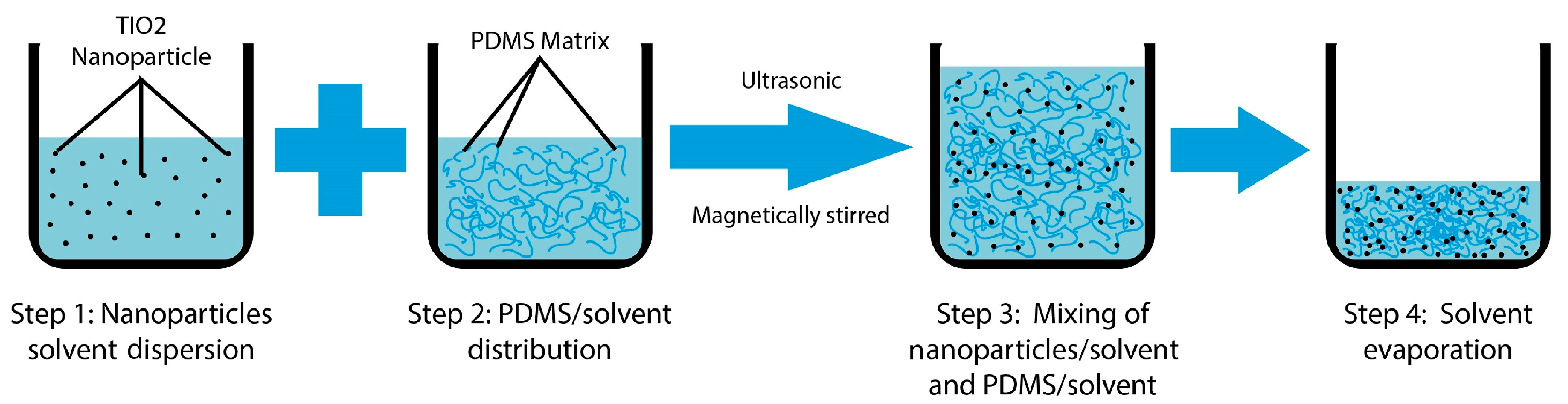
14], allowing for the uniform distribution of the titanium dioxide inside the matrix. A schematic illustration of the ex situ preparation process is presented in
Figure 1, which outlines the main stages of dispersion, mixing, casting, and curing, corresponding to the steps detailed above.
Accurate weight measurements were taken of PDMS and titanium dioxide nanoparticles; the latter were weighed spending on the loadings that were fixed at 2%, 4% and 6% by weight. The weighed samples were individually dispersed in chloroform, the solvent used for this experiment.
Ultrasonication ensured this dispersion for a period of 2 h to eliminate any clusters formed through high-frequency sound waves to generate imploding bubbles, releasing significant energy and thus disbanding the nanoparticle agglomerates [
19]. The resulting solution underwent magnetic stirring for 30 min to achieve a satisfying degree of homogeneity while also avoiding any trace of sedimentation.
The PDMS polymer was subsequently dissolved in chloroform with magnetic stirring for 30 min, followed by 5 min of sonication to achieve uniform dissolution. This procedure guaranteed the thorough integration of PDMS inside the solvent, establishing a uniform medium for the incorporation of nanoparticles.
The titanium dioxide nanoparticle suspension and the PDMS polymer solution were subsequently mixed, resulting in a homogeneous TiO2/PDMS blend. The combination underwent 3 h of sonication, succeeded by 30 min of stirring, to guarantee the uniform distribution of the titanium dioxide nanoparticles within the polymer matrix.
The final steps of this process entail the evaporation of the chloroform solvent by subjugating the mixture to high temperatures, readying the PDMS/titanium dioxide nanocomposite for the cure agent’s administration upon complete solvent evaporation. A ratio of 10:1 of PDMS–curing agent was administered and thoroughly mixed to commence the crosslinking and solidification process. The mixture was permitted to cool and solidify, resulting in the final sought-after nanocomposite.
The described method offers reproducible control over TiO2 loading and dispersion, making it suitable for correlating the structural, optical, and photocatalytic properties discussed in the following sections.
2.3. Characterization Techniques
X-ray diffraction occurs due to the elastic scattering of X-ray photons by the electron clouds of the atoms within the crystal lattice, following Bragg’s Law. A combination of analytical techniques was employed to study the structural, optical, and photocatalytic properties of the prepared PDMS/TiO2 nanocomposites. The methods and instruments used were identical to those described in this paper. Each technique is detailed in the following subsections.
2.3.1. X-Ray Diffraction (XRD)
XRD is an important analytical technique in material science. It gives information about the crystalline structure, material composition, and the chemical analysis of the material. This technique involves casting X-ray lattices. The diffraction profile provides critical information on the phase composition, crystallite size, and strain in the material, which provide the capability to evaluate nanocomposites such as PDMS/titanium dioxide [
23].
This work used XRD data obtained using a Bruker D2 Phaser X-ray diffractometer Karlsruhe, Germany. This compact, high-performance apparatus with a cobalt anode (Co-Kα radiation, λ = 1.78901 Å) was used for the investigation of the material’s crystalline structure. The diffractometer worked at 30 kV and 10 mA; data acquisition was conducted at 2θ from 5 to 80° using a step increment of 0.02°.
The obtained diffraction patterns were matched with the reference data to ensure correct phase identifications and to assess the crystallite size. Phase identification was performed for anatase and rutile phases. The average crystallite size (D) of TiO
2 nanoparticles embedded in the PDMS matrix was calculated using the Scherrer equation [
21]:
where D is the crystallite size (nm), K is the shape factor (typically 0.9 for spherical particles), λ is the X-ray wavelength (1.78901 Å for Co-Kα), β is the full width at half maximum (FWHM) of the diffraction peak, and θ is the Bragg angle.
The Williamson–Hall approach employs a graph of β⋅cos(θ) against 4⋅sin(θ) to distinguish between size and strain effects, facilitating accurate analysis even in cases of complex lattice distortion [
21,
22]. The y-intercept of the linear graph represents the size variable, whereas the slope indicates the strain. The relationship can be defined as:
where ε represents the lattice strain within the crystal.
The request of both methods facilitated a comprehensive understanding of the nanocomposite’s structural properties and the characterization of the TiO2/PDMS nanocomposite, helping us to understand the effect of nanoparticle dispersion and loading levels on the material’s overall structure and functionality.
2.3.2. UV–Visible Spectroscopy
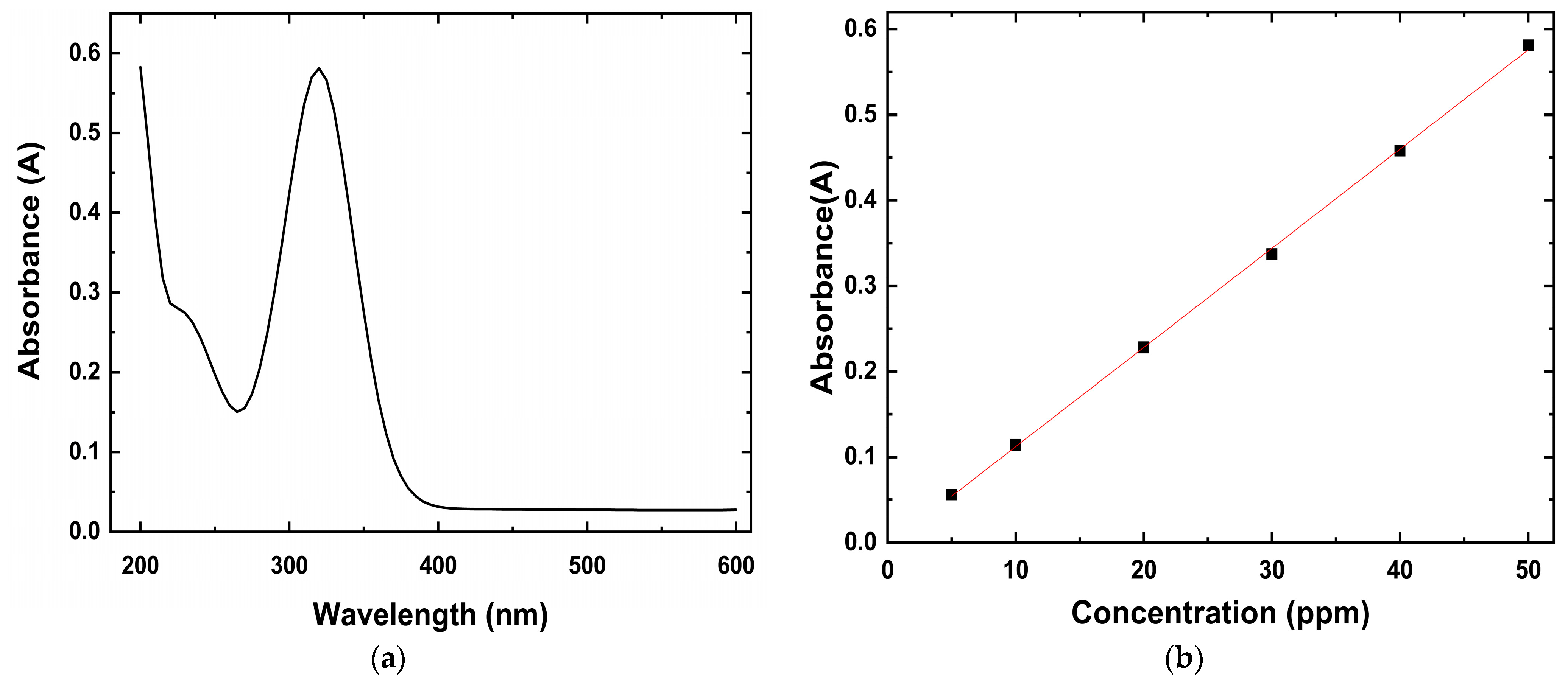
The optical absorption properties and concentration evolution of metronidazole were investigated using UV–visible spectroscopy (PerkinElmer Lambda, Waltham, MA, USA). UV–Vis absorption spectra were first recorded to identify the characteristic optical response of the pollutant and to determine its maximum absorption wavelength. As shown in
Figure 2a, metronidazole exhibits a pronounced absorption peak at λ
max = 320 nm, which is consistent with its molecular structure. This wavelength was therefore selected for all subsequent quantitative analyses.
During the photocatalytic degradation experiments, variations in metronidazole concentration were monitored by measuring the absorbance at 320 nm at 30 min intervals. To ensure accurate quantification, a calibration curve relating absorbance to concentration was established prior to the experiments (
Figure 2b), showing excellent linearity (R
2 > 0.99). This calibration allowed for the reliable conversion of absorbance values into pollutant concentration (ppm), enabling the precise evaluation of photocatalytic performance.
2.3.3. Photocatalytic Activity Tests and Measurement
The photocatalytic activity of the PDMS/TiO2 nanocomposites was evaluated through the degradation of metronidazole under UV irradiation. The experiments were carried out in a quartz reactor under constant stirring at room temperature. The synthesized nanocomposite consisting of pure PDMS and the nanocomposites at 2%, 4%, and 6% wt.% titanium dioxide concentrations were weighed at exactly 15 mg; these samples were each separately introduced into 30 mL of metronidazole solution with a concentration of 10 ppm, a solution selected due to its distinct adsorption peaks.
The mixture was magnetically stirred for a period of 30 min to promote the adsorption of metronidazole onto the nanocomposite’s surface, thus attaining an adsorption equilibrium. The samples were subsequently immersed in 50 mL of aqueous metronidazole solution and irradiated for 120 min using UV lamps operating at a wavelength of 365 nm. This wavelength corresponds to the excitation energy of TiO
2 nanoparticles that allows for the beginning of the photocatalytic degradation process [
24]. The UV irradiation source provided an estimated power density of approximately 1 mW·cm
−2 at the sample surface. The concentration of metronidazole was monitored at regular intervals by measuring the absorbance using the same UV–Vis spectrophotometer. The degradation efficiency (η) was calculated according to:
where
and
represent the initial and instantaneous absorbance values, respectively.
3. Results
The PDMS/TiO2 nanocomposites obtained through the ex situ dispersion process exhibited uniform, flexible, and transparent films with visible changes in opacity depending on TiO2 loading. The structural and optical characterizations presented below demonstrate the relationship between the amount of TiO2 incorporated and the resulting properties of the nanocomposites.
3.1. PDMS/TiO2 Nanocomposite Film Morphology
We studied the visual and structural morphology of the PDMS/TiO
2 nanocomposite films synthesized via the ex situ process, incorporating different concentrations of titanium dioxide nanoparticles (2 wt.%, 4 wt.%, and 6 wt.%) in comparison to virgin PDMS. The incorporation of titanium dioxides affects the transparency, aesthetics, and uniformity of the nanocomposite films, elucidating the impact of nanoparticle loading on their optical properties.
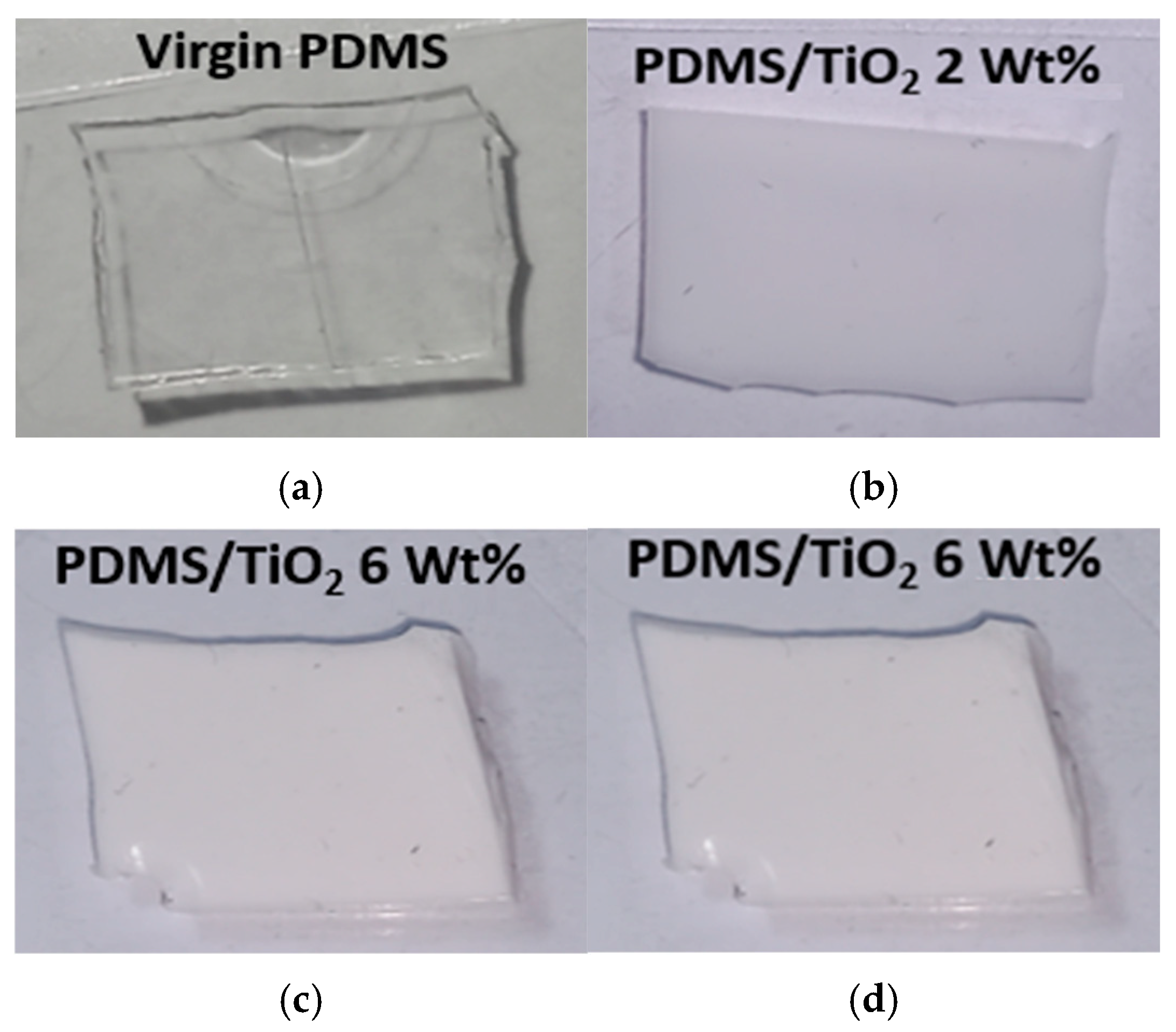
Figure 3 depicts the PDMS/TiO
2 nanocomposite films with increasing loadings of titanium dioxides.
The virgin PDMS depicted in
Figure 3a exhibits the high transparency and amorphous characteristics of PDMS, which are appropriate for applications necessitating optical clarity. At 2 wt.% titanium dioxide, the film, shown in
Figure 3b, exhibits modest opacity while maintaining a degree of transparency, rendering it appropriate for UV-protective coating applications. At 4 wt.% titanium dioxide, as illustrated in
Figure 3c, the film exhibits increased opacity and a white appearance. The elevated amount of titanium dioxides results in enhanced light scattering, markedly diminishing transparency. In
Figure 3d, at 6 wt.% titanium dioxide, the film exhibits great opacity and a white appearance, signifying a dense accumulation of nanoparticles within the matrix. The elevated titanium dioxide level results in considerable light scattering, completely obstructing transparency.
3.2. XRD Characterization of PDMS/Titanium Dioxide Nanocomposites
This study employed X-ray diffraction (XRD) to examine the crystallinity of titanium dioxide, as well as the structural characteristics and phase composition of PDMS/titanium dioxide nanocomposites, thereby validating the incorporation of titanium dioxide nanoparticle fillers into the PDMS matrix. Peak intensity variations at different concentrations were analyzed to evaluate the structural integrity of titanium dioxide nanoparticles within the polymer matrix.
3.2.1. Phase Identification
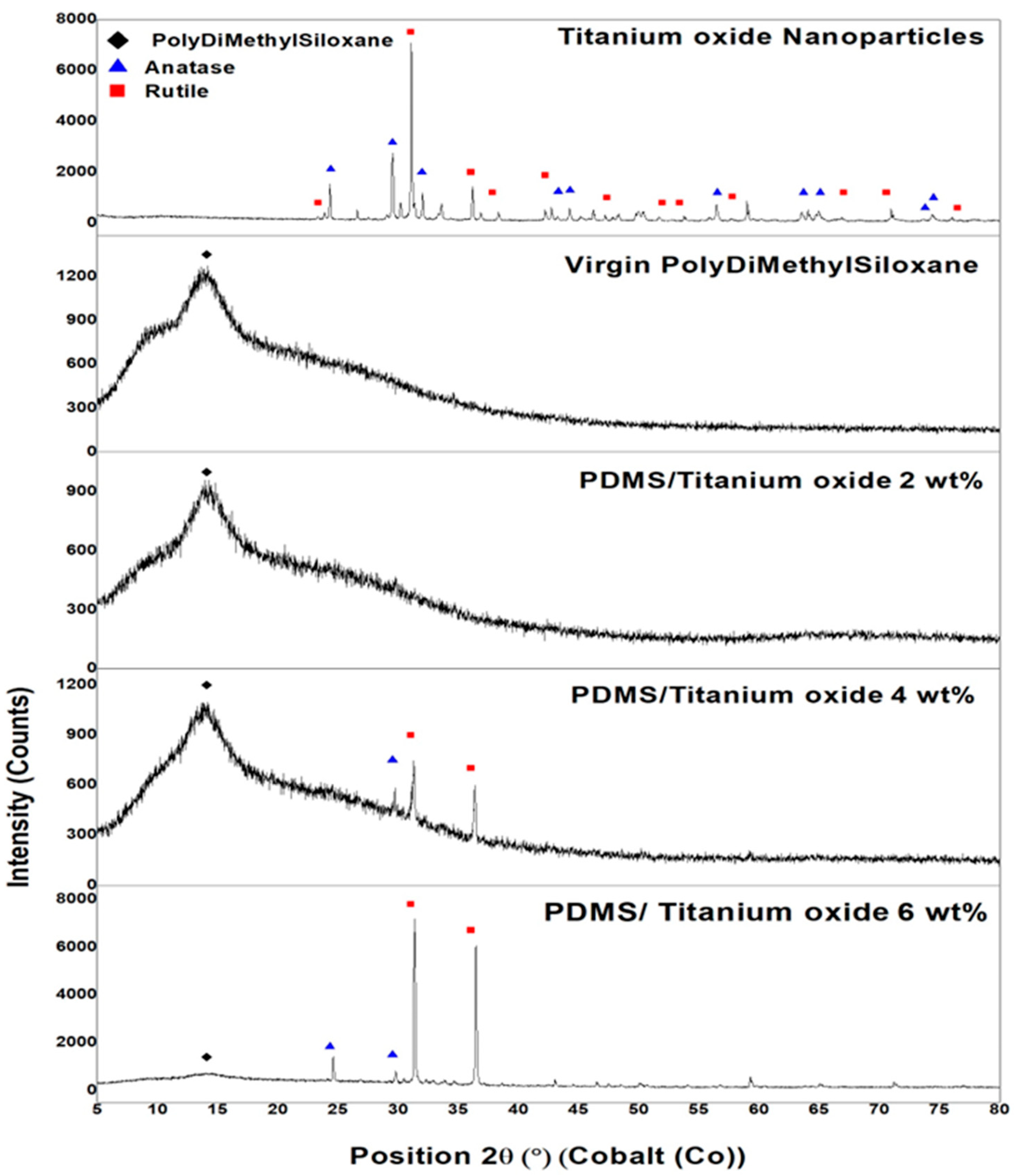
The crystalline structure was analyzed using a Bruker D2 diffractometer equipped with Co-Kα radiation, λ = 1.78901 Å. Note that the use of cobalt radiation shifts diffraction peaks to higher angles compared to standard Copper sources. The various X-ray diffraction (XRD) patterns associated with pure titanium dioxide nanoparticles, virgin PDMS, and PDMS incorporating 2%, 4%, and 6% titanium dioxide nanoparticles are shown in
Figure 4.
Virgin PDMS exhibits a broad amorphous hump centered around 2θ ≈ 14°, characteristic of the polymeric network. For the TiO2 nanoparticles, the diffraction profiles show sharp peaks corresponding to the tetragonal anatase (101) at 2θ ≈ 29.4° and rutile (110) at 2θ ≈ 32°.
In the composite films, the characteristic diffraction peaks emerge and increase in intensity with TiO2 content from 2% to 6%, confirming the successful incorporation of the crystalline nanoparticles into the PDMS matrix. At 2 wt.% TiO2, the peaks are faint due to the low particle concentration; at 4 wt.% and 6 wt.%, peak intensities become more pronounced and display distinct crystallinity superimposed on the amorphous PDMS.
3.2.2. Crystallite Size and Structural Parameters
The crystallite size of the titanium dioxide nanoparticles was ascertained by two methodologies: the Scherrer equation and the Williamson–Hall method. These various techniques yielded insights into the size and structural characteristics of the implanted nanoparticles.
The Williamson–Hall method showed that the crystalline size of the calcined titanium dioxide nanoparticles was larger than the one found when employing the Scherrer equation, as shown in
Table 3. The Williamson–Hall method simply accounts for defects in the crystalline structure or even lattice strain, whereas its counterpart likely does not. In either case, both results confirm that the nanoparticles remain in the nanoscale regime, ensuring a large specific surface area and strong interfacial interaction between TiO
2 and PDMS. The microstrain (ε), extracted from the Williamson–Hall analysis, was on the order of 10
−3, indicating a low lattice distortion and confirming that the crystalline integrity of TiO
2 nanoparticles is preserved within the PDMS matrix.
3.3. Photocatalytic Performance
The photocatalytic degradation of metronidazole concentration variation over time was monitored under UV irradiation using UV–Vis spectroscopy. The influence of the TiO2/PDMS nanocomposite and titanium dioxide nanoparticle ratios on pollutant degradation rate efficiency was examined, and the results were compared with those of the pure titanium dioxide (TiO2) nanoparticles tested under the same operating conditions.
3.3.1. Adsorption Step in the Dark
To isolate the photocatalytic contribution from the inherent adsorption capacity of the materials, the samples were kept in the dark for 30 min to reach adsorption–desorption equilibrium before UV irradiation. It is important to distinguish the adsorption phase (dark, 30 min) from the photocatalytic phase (UV, 120 min). The absorbance measured after 30 min of stirring in the dark was taken as the initial equilibrium value (Aeq) for the kinetic study. The absorbance data, representing metronidazole concentration, are discussed. This step is crucial for establishing a reliable baseline, ensuring that the subsequent reduction in pollutant concentration under UV light is primarily attributed to photocatalytic degradation rather than physical adsorption. The results reveal distinct adsorption behaviors across the samples:
Virgin PDMS exhibited negligible adsorption, with absorbance values showing no significant deviation from the initial absorbance (A0 ≈ 0.58) within the experimental error. This confirms the intrinsic inertness of the PDMS matrix towards the metronidazole pollutant, establishing it as a passive, non-adsorptive substrate in this system.
Pure TiO2 nanoparticles demonstrated the highest adsorption capacity, with absorbance decreasing by 17.90% (from 0.5799 to 0.4761). This significant reduction is attributed to the nanoparticles’ high specific surface area and abundant, readily accessible active sites, allowing for the effective physical and chemical adsorption of metronidazole molecules.
For the PDMS/TiO2 nanocomposites, adsorption was markedly lower and followed a non-linear trend with TiO2 loading. The 2 wt.% and 4 wt.% composites showed similar adsorption (~6.5–6.6% reduction), while the 6 wt.% composite showed the lowest adsorption among the composites (~4.2% reduction).
This counterintuitive trend—where higher TiO2 content does not yield higher adsorption—can be explained by two key factors related to the composite morphology:
- -
Polymer Matrix Shielding: The PDMS matrix partially encapsulates the TiO2 nanoparticles, limiting direct contact between the pollutant and a significant portion of the nanoparticle surface area. This creates a diffusion barrier, reducing adsorption efficiency compared to free-standing nanoparticles.
- -
Increased Agglomeration at Higher Loadings: Although the ex situ method aims for homogeneous dispersion, the tendency for nanoparticle agglomeration inherently increases with higher filler content [
4,
9,
20]. These agglomerates effectively reduce the total accessible surface area available for adsorption, as molecules cannot easily penetrate the interior of the clusters. This effect appears to outweigh the benefit of having more TiO
2 mass at the 6 wt.% loading.
In summary, the adsorption phase clearly differentiates the role of each component: PDMS is inert, while TiO2 provides active sites. However, the embedding of TiO2 within the PDMS matrix significantly restricts its adsorptive capability. The adsorption trend in the nanocomposites reflects how nanoparticle loading, dispersion quality, and polymer shielding together affect the initial pollutant concentration and impact the photocatalytic process.
3.3.2. Photocatalytic Degradation and Kinetics
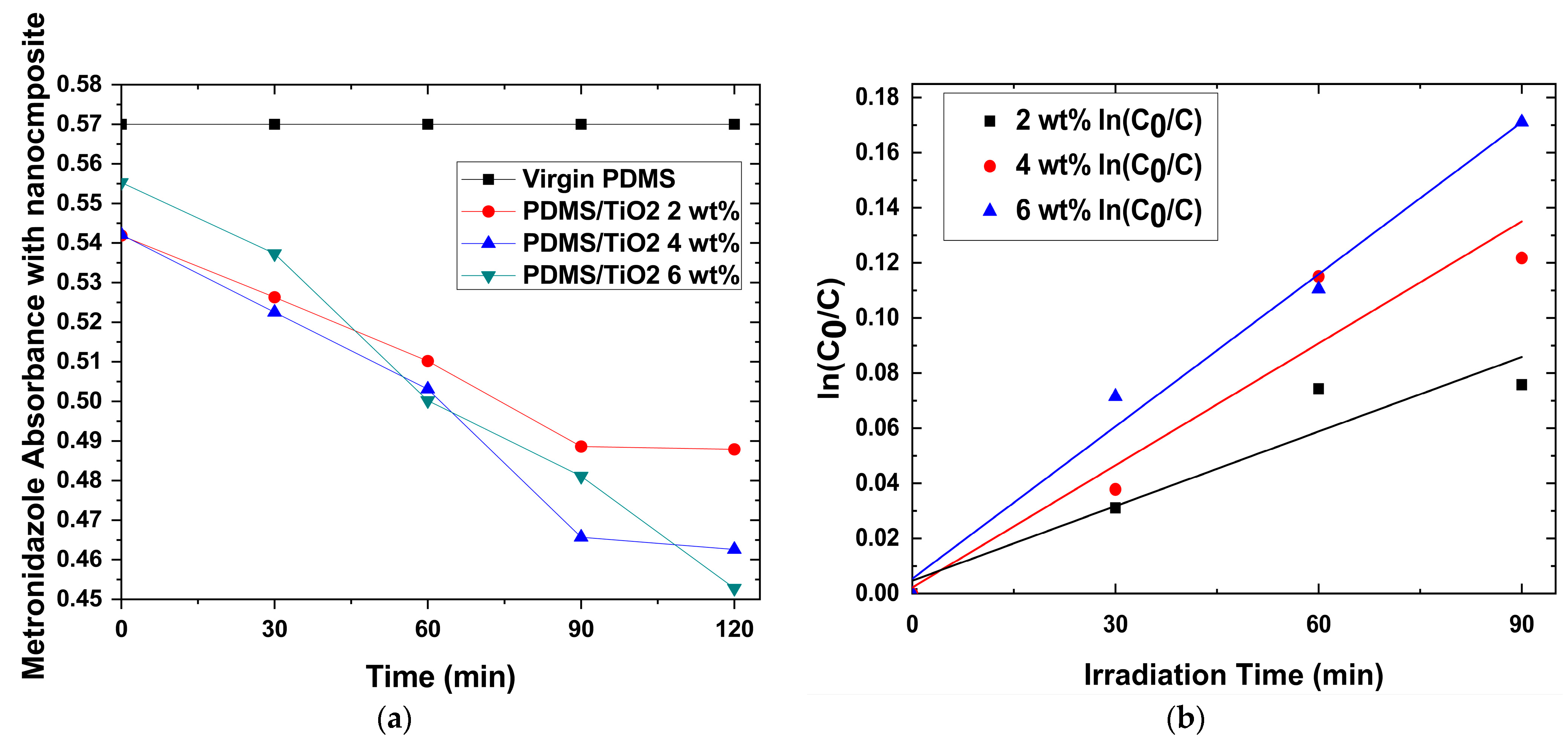
During a 120 min ultraviolet exposure interval, a progressive photocatalytic reduction in metronidazole absorbance was observed for all samples.
Figure 5 presents comprehensive photocatalytic performance.
As shown in
Figure 5a, the absorbance values decreased significantly over time, underscoring the clear relationship between the loading of titanium dioxide nanoparticles and degrading efficiency. To quantify this efficiency, a kinetic analysis was performed. As illustrated in
Figure 5b, the degradation data fits the pseudo-first-order kinetic model ln(C
0/C) = kt with high correlation coefficients (R
2 > 0.96). The apparent rate constant (k), represented by the slope of the linear fits, increased with TiO
2 loading:
The 2 wt.% composite: k ≈ 0.0009 min−1.
The 4 wt.% composite: k ≈ 0.0014 min−1.
The 6 wt.% composite: k ≈ 0.0019 min−1.
This twofold increase in the reaction rate between the 2 wt.% and 6 wt.% samples confirms that increasing the density of photocatalytic sites on the polymer surface directly enhances the degradation kinetics, despite the agglomeration effects observed in the adsorption phase.
3.3.3. Comparison Analysis with Pure Titanium Dioxide (TiO2)
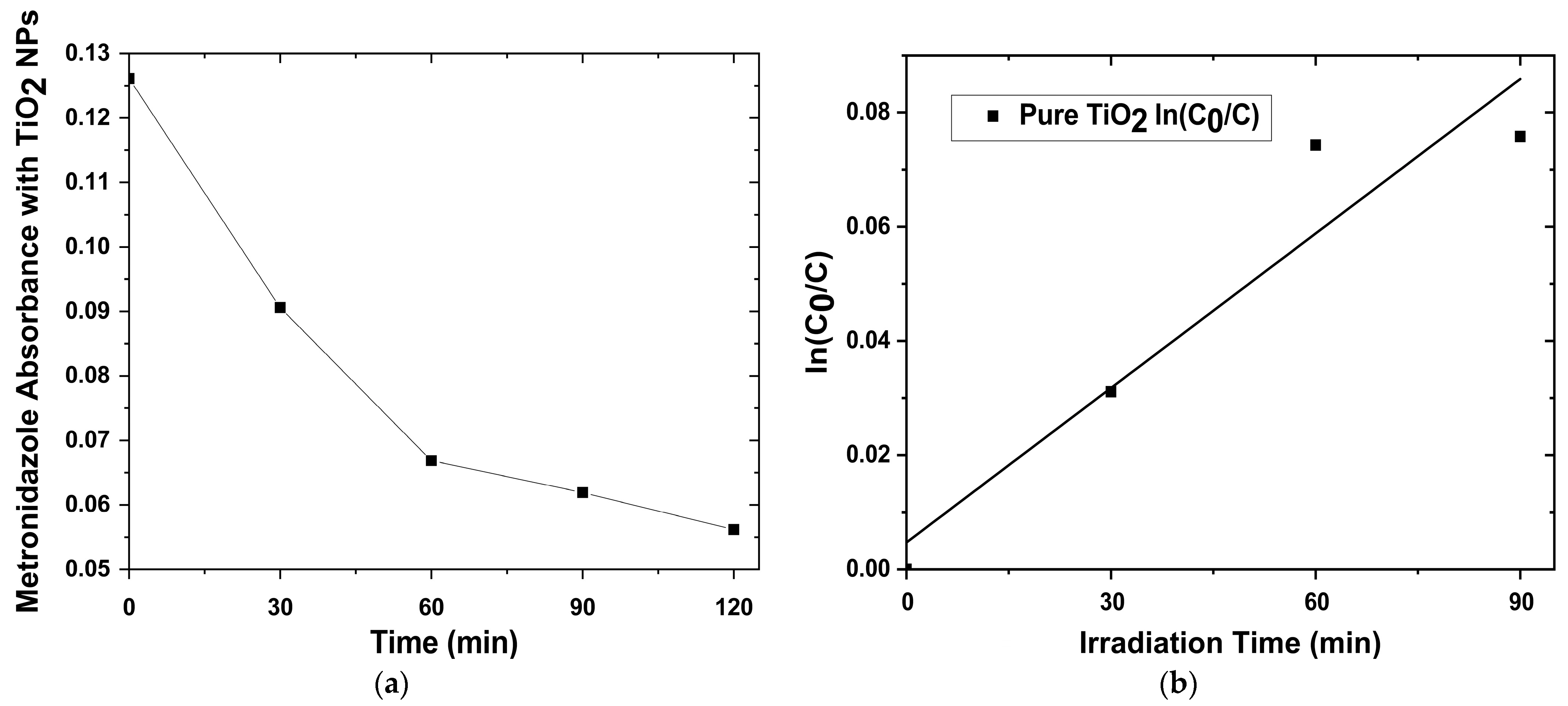
For reference, pure titanium dioxide nanoparticles, devoid of the PDMS matrix, were tested under uniform conditions.
Figure 6a illustrates the photocatalytic effectiveness of pure TiO
2 nanoparticles (NPs) and their performance. The pure TiO
2 nanoparticles exhibited superior photocatalytic activity compared with the nanocomposites, with a calculated rate constant of k≈ 0.0053 min
−1 (
Figure 6b).
This decreased absorbance illustrates the strong photocatalytic efficacy of pure TiO2 nanoparticles, which persist in promoting pollutant breakdown under UV irradiation throughout time. This difference is attributed to the partial shielding of active TiO2 sites by the PDMS matrix in the composites, which limits light penetration and accessibility. This comparison is qualitative and intended to illustrate the trade-off between the high efficiency of suspended powders (optimized contact) and the practical benefit of immobilized films (recoverability). However, while the pure powder is faster, the nanocomposite films offer the critical advantage of recoverability and reusability, which is the primary focus of this study. These results establish a benchmark for evaluating the influence of the PDMS matrix on the photocatalytic response of TiO2-based materials.
5. Conclusions
PDMS/titanium dioxide nanocomposites were successfully synthesized using an ex situ polymerization approach, demonstrating that TiO2 loading plays a decisive role in determining their optical and photocatalytic performance. Among the tested formulations, the 6 wt.% TiO2 composite exhibited the highest photocatalytic activity, making it particularly suitable for applications related to water purification and pollutant degradation. This enhanced performance results from the increased number of active sites provided by the titanium dioxide nanoparticles, which significantly contribute to the breakdown of organic contaminants. However, increasing TiO2 content also reduced optical transparency, creating a trade-off for applications where visual clarity is required. In this respect, the 2 wt.% TiO2 nanocomposite offers a balanced compromise, retaining adequate transparency while providing functional UV protection, making it appropriate for optical sensors and protective coatings.
The reported results have underlined the need to tailor the titanium dioxide content according to the specific functional requirement certain applications require, underlining the adaptability of PDMS/titanium dioxide nanocomposites. The successful ex situ synthesis demonstrated that this technology can produce nanocomposites with specific features for various industrial and environmental uses. Other future efforts of research should be directed toward long-term stability under harsh operating conditions. Their durability and reusability must be tested further to confirm whether they are economically viable for water purification applications.
Scalability is a point of contention as well. Addressing this would, in turn, allow for the real application of these materials to actual situations and would serve the purpose of targeted solutions for ecological and economic viability. More research is needed to improve the efficiency and applicability of titanium dioxide composites. One possible approach is the broadening of the activation spectrum for titanium dioxide into the visible region by doping with elements such as nitrogen or iron, possibly leading to better energy efficiency [
11,
23,
27,
28]. Other polymer matrices or hybrid nanocomposites could improve material performance for a particular environmental condition. Further testing with diverse pollutants such as pharmaceuticals, dyes, and industrial chemicals would clarify nanocomposites’ performance and guide necessary adjustments for broader adaptability [
3,
4,
8]. While this study focused on crystallographic and macroscopic optical characterization to validate ex situ dispersion, future investigations will employ Scanning Electron Microscopy (SEM) to further analyze the microscopic interface between the TiO
2 aggregates and the PDMS matrix.
Finally, considering the known biomedical properties of titanium dioxide, future work will also extend the scope of application by investigating the antibacterial activity of these nanocomposite films against hospital-acquired pathogens.



 ,
,