



Appl. Mech., Volume 1, Issue 3 (September 2020) – 1 article
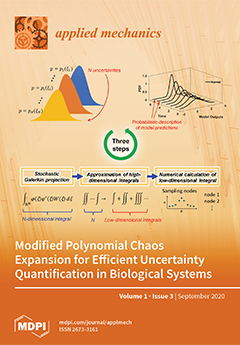
Cover Story (view full-size image):
Uncertainty quantification (UQ) to quantify the effect of uncertainty on model predictions is essential to improve the accuracy of computational models. The polynomial chaos expansion (PCE), one of the most popular UQ techniques, has gained increasing attention lately. The key to the successful application of PCE is stochastic Galerkin projection, which yields coupled deterministic models of PCE coefficients to describe a stochastic system. However, when a system involves nonpolynomial terms and many uncertainties, it is computationally challenging to solve PCE coefficients. In this work, the PCE and generalized dimension reduction methods were combined with the sampling-based gaussian quadrature rules to quickly calculate the PCE coefficients, and the efficiency of the algorithm was demonstrated with examples of biological systems. View this paper
- Issues are regarded as officially published after their release is announced to the table of contents alert mailing list.
- You may sign up for e-mail alerts to receive table of contents of newly released issues.
- PDF is the official format for papers published in both, html and pdf forms. To view the papers in pdf format, click on the "PDF Full-text" link, and use the free Adobe Reader to open them.
Previous Issue
Next Issue
