
1. Introduction
Silicon-based quantum dots have emerged as a leading platform for quantum information processing, due to their long spin coherence times and compatibility with industrial CMOS manufacturing techniques [
1,
2]. Si/SiGe heterostructures utilize isotopically purified
28Si substrates to minimize magnetic noise from nuclear spins, enabling high-fidelity qubit operations [
3]. However, despite these advances, the performance of large-scale quantum processors remains limited by environmental noise, which induces both decoherence and energy relaxation.
The qubit dynamics are characterized by three main timescales that describe how the system loses its quantum information [
1]. The first is Energy Relaxation (
), which dictates the time it takes for the qubit to dissipate its excess energy to the environment and decay to the ground state. The second is Decoherence (
), representing the duration over which the qubit maintains its quantum phase. This coherence is limited both by the energy relaxation process and by pure dephasing mechanisms caused by fluctuations in the qubit’s energy levels. Finally, in experimental settings and realistic simulations, one observes the Ensemble Dephasing time
, which is a shorter timescale that additionally incorporates the severe phase-scrambling effects induced by low-frequency noise sources (inhomogeneous broadening). In our simulations, we focus on
and
, as these are the most relevant parameters for assessing qubit performance without error correction techniques like spin echo.
While modeling these noise mechanisms accurately is essential for optimizing control sequences, solving full quantum master equations becomes computationally prohibitive as the qubit register grows. To overcome this, classical or semiclassical approximations are frequently employed. The primary scientific contribution of this work is to expose a critical thermodynamic inconsistency inherent in semiclassical stochastic modeling when applied to energy relaxation processes, and to demonstrate a rigorous alternative. By benchmarking the Lindblad Master Equation and Bloch–Redfield formalism against semiclassical stochastic methods and Quantum Trajectories, we establish a clear roadmap for simulating multi-qubit Si/SiGe processors, identifying which numerical tools offer the necessary balance between computational efficiency and physical accuracy without sacrificing the system’s thermal physics.
2. Physical System and Noise Model
We consider a system of two electron spin qubits confined in a Si/SiGe double quantum dot (DQD) in the presence of an external static magnetic field B.
2.1. System’s Hamiltonian
The coherent dynamics of the two-qubit system are described by the standard effective Hamiltonian for exchange-coupled spin qubits in a longitudinal magnetic field, as detailed extensively in silicon quantum electronics literature [
1]. The Hamiltonian
accounts for the individual Zeeman energy of each electron and the isotropic Heisenberg exchange interaction:
where
is the effective
-factor of the
i-th qubit,
is the Bohr magneton,
is the external magnetic field, and
J represents the exchange coupling strength between two spins. Here,
denotes the vector of Pauli spin operators acting on the
i-th qubit subspace. The exchange term
couples the two qubits, where the factor of
ensures that
corresponds to the energy splitting between the effective total spin states: the singlet (
) and the triplet (
) manifolds.
2.2. Noise Sources
In realistic experimental setups, spin qubits are exposed to a multitude of noise channels. However, for the purpose of this simulation study, we restrict our model to the most dominant noise mechanisms that fundamentally limit the coherence of Si/SiGe devices.
To formally characterize these limits, we recall that the fundamental relationship governing the transversal coherence time
is given by:
where
is the “pure dephasing” time which comes from fluctuations in the energy levels. Ensemble Dephasing is calculated from the relationship:
where
denotes the effect of low-frequency noise (inhomogeneous broadening).
To simulate realistic device conditions, we decompose the total relaxation (
) and dephasing (
) rates into specific physical mechanisms based on experimental data for Si/SiGe quantum dots [
1,
4,
5].
Direct Spin-Flip (
): At cryogenic temperatures, relaxation is dominated by single-phonon emission. Due to Van Vleck cancellation in silicon, this rate scales with the fifth power of the magnetic field [
1].
Raman Scattering (
): A two-phonon process becoming relevant at slightly elevated temperatures [
6].
Valley-Orbit Coupling (
): We include relaxation effects arising from valley splitting (
), modeled via an exponential activation term [
4].
- B.
The pure dephasing rate () is similarly composed of:
g-tensor fluctuation (
): Often referred to as charge noise. This mechanism follows a
distribution, which means the noise is stronger at low frequencies. Practically, this implies that the qubit’s energy changes slowly over time, rather than changing instantly. This is the main dephasing source and scales linearly with
B [
7,
8].
Hyperfine field function (
): The magnetic noise arising from the bath of residual
29Si nuclear spins, acting as background magnetic field fluctuation [
3].
Anharmonic vibration (
): Pure dephasing induced by elastic phonon scattering caused by anharmonic terms in the lattice potential [
6].
In the rate equations described above, the magnitude of each noise mechanism is governed by a specific sensitivity coefficient (). These are phenomenological prefactors, calibrated to reproduce the characteristic coherence times (, ) observed in Si/SiGe experiments.
3. Simulation Methodology
To evaluate the performance of our quantum system under the influence of the noise mechanisms described in
Section 2, we employ and compare four different numerical frameworks.
3.1. Lindblad Master Equation
One of the most common ways to model a quantum system interacting with an environment is the Lindblad Master Equation (LME). Instead of a simple wavefunction, this method evolves the system’s density matrix
, of dimension
for a 2-qubit system, which contains all the statistical information about the quantum state [
1].
The time evolution of the system’s density matrix is governed by the Lindblad Master Equation, which describes the non-unitary dynamics of an open quantum system in the Markovian approximation [
9]. The equation is given by:
Here, the first term describes the coherent unitary evolution controlled by the Hamiltonian . The second term (the “Lindblad dissipator”) models the irreversible noise. In this formulation, the index explicitly accounts for the noise acting on each of the two qubits. The Lindblad super-operators represent the -th noise channel (relaxation or dephasing) applied to the -th qubit. Specifically, these operators are constructed as tensor products ensuring that the dissipation is modeled locally for each spin while evolving the total 2-qubit state.
The
super-operators represent specific noise channels, such as relaxation (
) and dephasing (Ldeph), with rates derived from our physical model for each j-qubit. The specific super-operators we used are defined as:
and
where
[
9].
LME framework utilizes a density matrix
to describe the system’s state, resulting in a space complexity of
, where
represents the dimension of the Hilber space (
, for a n-qubit system). This quadratic memory requirement arises because the matrix must store
complex elements to account for all possible populations and coherences. The time complexity is defined as
. The
term stems from the matrix–matrix multiplications required to compute the commutator
and the dissipator terms
at each step. These heavy operations are repeated for the total duration of the simulation, represented by
[
1].
3.2. Bloch–Redfield Formalism
An alternative approach that accounts for the microscopic frequency dependence of the environment is the Bloch–Redfield (BR) formalism [
9]. Unlike the Lindblad equation, which assumes a constant noise spectrum, this method explicitly incorporates the spectral density
of the bath. The time evolution of the density matrix is given by:
where
represents the Redfield relaxation superoperator. The components of this operator are constructed from the transition rates
between the energy eigenstates
of the 2-qubit Hamiltonian
. The link between the dissipative dynamics and the environmental noise is established through the transition rates:
where
is the system coupling operator and
is the spectral density at the transition frequency
. For the diagonal elements of the density matrix (populations), the Redfield superoperator simplifies to a rate equation:
which dictates the rate of change
since the coherent Hamiltonian contribution vanishes for diagonal elements in this basis.
For the non-diagonal elements , which represent quantum coherences, the Redfield operator induces an exponential decay at a rate . This rate is a combination of the population lifetimes and the pure dephasing rate , arising from the zero-frequency noise spectral density . This explains the decay envelope observed in our simulations, as the transverse noise leads to the dephasing of the relative phase between the spin eigenstates. In our model, the noise mechanisms are integrated by setting for the relaxation channel and for the dephasing channel .
The Bloch–Redfield formalism also operates within the density matrix space, leading to a space complexity of as it stores both the state matrix and the Redfield relaxation tensor. The time complexity for this method is . The initial term represents a significant computational “overhead” required to diagonalize the system Hamiltonian and identify the energy eigenstates and transition frequencies . Once the system is transformed into the energy eigenbasis, the subsequent evolution of the density matrix elements is typically reduced to operations per each of the .
3.3. Semiclassical Stochastic Hamiltonian
To reduce the dimensionality of the problem, an alternative approach is to treat the noise not as a quantum operator, but as a classical random field
added to the system’s Hamiltonian [
6]. In this framework, the time-dependent Hamiltonian is given by:
where
is a stochastic variable generated to reproduce the specific frequency profile of the noise (typically
) [
10]. This ensures that the simulated noise mimics the real physical environment by fluctuating slowly over time, rather than changing randomly at every instant.
In our implementation, the intensity of these fluctuations is calibrated directly from the total dephasing rate
calculated in
Section 2.2, effectively mapping the physical noise sources onto the classical noise field.
The simulation proceeds by evolving the Schrödinger equation for a single wavefunction for a specific noise realization. To obtain the ensemble dynamics, we employ a Monte Carlo integration technique: the process is repeated for many realizations, and the results are averaged to approximate the expected density matrix.
The stochastic approach offers a more favorable memory footprint with a space complexity of . This linear scaling is achieved because the method evolves a single wavefunction vector of dimension rather than a full matrix. However, the time complexity is . The factor corresponds to the matrix–vector multiplications ( performed during the numerical integration of the Schrödinger equation. Because this is a Monte Carlo-based technique, the entire evolution over must be repeated for many independent trajectories () to obtain a physically meaningful ensemble average.
3.4. Quantum Trajectories
The Quantum Trajectories method (a.k.a. Monte Carlo Wavefunction) provides a stochastic unraveling of the Lindblad Master Equation into individual pure-state histories [
11]. Between the discrete quantum jumps, the state vector
undergoes a continuous, non-unitary evolution. This evolution is generated by an effective non-Hermitian Hamiltonian
, derived such that the ensemble average of the trajectories exactly reproduces the density matrix dynamics of the Master Equation. The effective Hamiltonian is defined as:
where
is the coherent system Hamiltonian and the second, anti-Hermitian term accounts for the loss of probability amplitude due to the interaction with the environment. The imaginary part is directly responsible for the decay of the wavefunction’s norm, which in turn determines the probability of a stochastic jump occurring in the next time step.
The evolution consists of two parts: (a) the continuous evolution under
which decreases the norm of the wavefunction and (b) Quantum Jumps, which occur stochastically with probability
When a jump occurs, the state is projected onto the corresponding operator . Crucially, the jump rates are not arbitrary, they are dynamically updated based on the total relaxation and dephasing values, ensuring that every trajectory reflects the specific physical environment of the Si/SiGe device. The density matrix is recovered by averaging the outer products over many trajectories.
Quantum Trajectories approach maintains a space complexity of as it evolves a state vector instead of the density matrix. Its time complexity is . Each trajectory requires operations per time step to compute the non-Hermitian evolution under and the stochastic jump probabilities . This process is scaled by and the number of trajectories () needed for the ensemble average to converge on the exact Lindblad solution.
While our benchmarking focuses on two-qubit Si/SiGe registers, the advantages of the Quantum Trajectories method are inherently scalable. As a mathematically exact unraveling of the Lindblad Master Equation, its superior memory scaling remains valid for any quantum system where the Hilbert space dimension precludes the direct integration of the density matrix, making it a general-purpose tool for large-scale quantum simulations.
4. System Dynamics and Optimal Operating Conditions
In this section, to ensure that our model reflects realistic experimental conditions, the system parameters (such as valley splitting
and exchange coupling
and the noise sensitivity coefficients
were sourced from established experimental literature or calibrated to reproduce the characteristic coherence times reported for Si/SiGe quantum dots. Specifically, the values for
act as phenomenological prefactors that scale each noise mechanism to match the
and
decay envelopes observed in recent studies [
3,
12,
13,
14,
15]. The complete set of values and their respective bibliographic sources are summarized in
Table 1. The sensitivity coefficients
are derived from the modeling of the system’s noise source operators, with their respective units determined by the physical scaling of each mechanism to ensure that the resulting relaxation and dephasing rates are consistently expressed in
.
4.1. Comparison of Lindblad and Bloch-Redfield Formalisms
To validate our numerical approach, we performed a comparative study between the LME and the BR formalism.
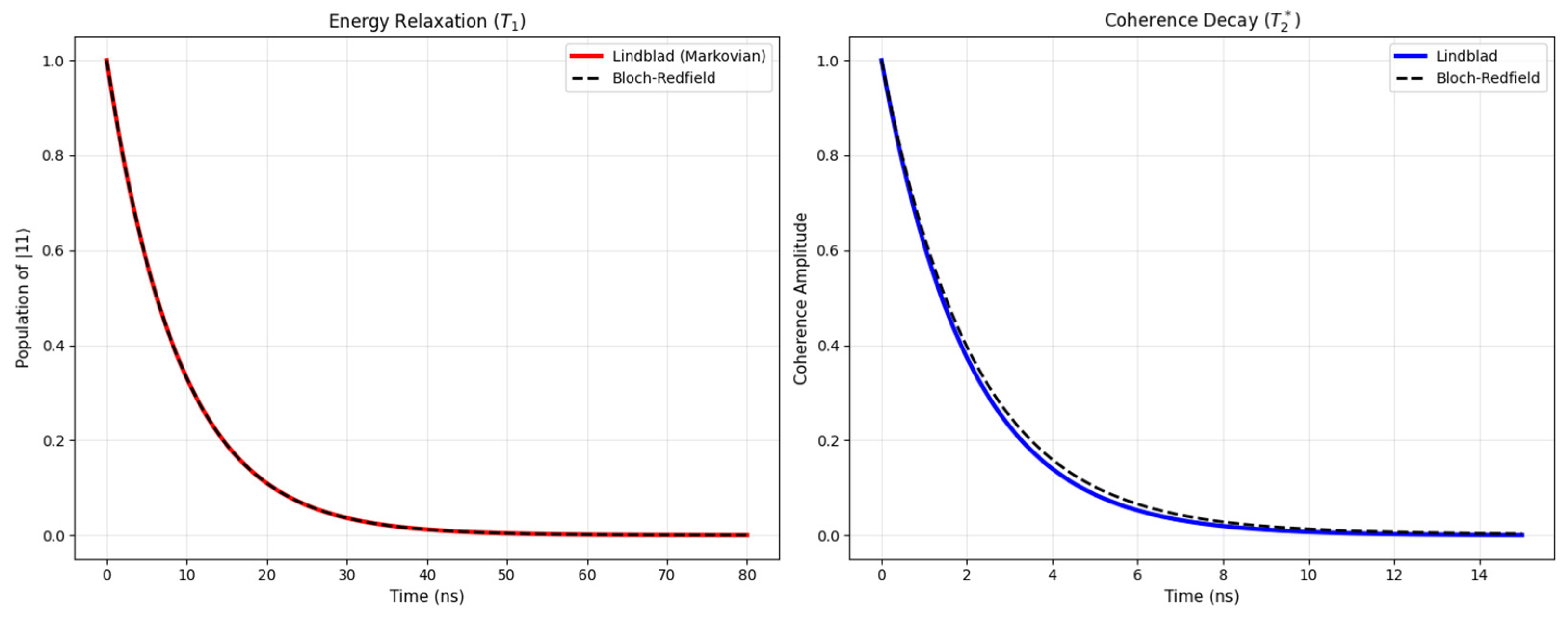
As is clear on
Figure 1 for the Energy Relaxation
, both methods exhibit a perfect numerical overlap. This agreement confirms that in the Markovian limit, where the system–bath interaction is dominated by energy exchange at the Zeeman frequency
, the longitudinal noise is accurately captured by both approaches regardless of the specific eigenstate structure. A noticeable divergence appears in the Coherence Decay
, where Lindblad formalism predicts a faster decoherence rate compared to the Bloch–Redfield results. This difference arises from the way each method handles the exchange interaction (
) and the resulting entanglement of the 2-qubit states.
Bloch–Redfield operates in the energy eigenbasis of the system. In the presence of
, the eigenstates (Singlet–Triplet subspace) possess a specific symmetry that partially protects the coherence against transverse noise [
16], as the transition matrix elements of the noise operators are recalculated based on the coupled system’s energy levels. Lindblad, as implemented with independent jump operators for each qubit, represents a more “conservative” or “worst-case” scenario. It assumes that the noise acts locally and strictly on each spin, disregarding the collective protection offered by the exchange coupling.
Despite this slight overestimation of decoherence, the Lindblad approach is chosen for the subsequent stages of our study. Its computational efficiency is superior for the extensive parameter sweeps (magnetic field and temperature) required to identify optimal operating points. Furthermore, by providing a lower bound for the coherence times, the Lindblad model ensures that our predictions are robust even under the strictest noise conditions.
It is noteworthy that at and , the relaxation time and the coherence time exhibit similar orders of magnitude. This behavior is characteristic of the high-field regime in Si/SiGe quantum dots and differs from other platforms such as NV centers in diamond, where a stiff lattice and large zero-field splitting significantly protect . At elevated temperatures, phonon-mediated thermal processes are expected to dominate, eventually leading to the regime where and pure dephasing becomes secondary to rapid spin-lattice relaxation.
4.2. Magnetic Field Dependence and Operating Point
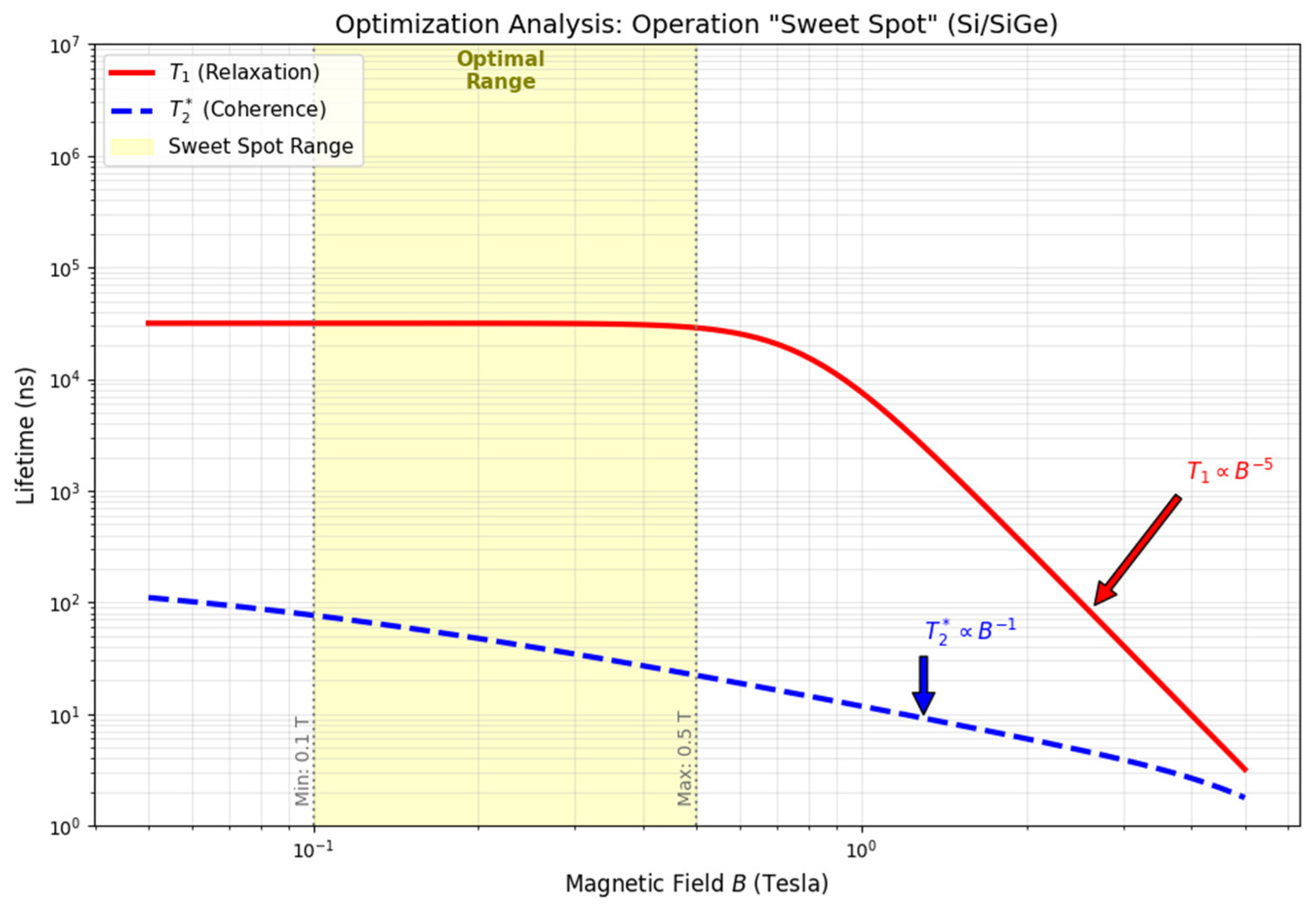
To further investigate how decoherence rates depend on the external magnetic field B, we aimed to find a range of values where our system operates at its maximum coherence duration.
Figure 2 illustrates the competition between low-field noise (Hyperfine) and high-field noise mechanisms (Direct Spin Flip, g-tensor), revealing a “sweet spot” where the total decoherence rate is minimized [
17].
It is worth noting that the very low magnetic field regime () is excluded from consideration as the Zeeman energy splitting in this region is insufficient to overcome thermal fluctuations (), preventing effective qubit initialization and readout regardless of the coherence times.
Ideally, the qubit should be operated at the “sweet spot” to maximize its lifetime. However, for the following simulations, we chose a magnetic field of , and temperature . If we had chosen the sweet spot, the decay would be too slow to observe within a short simulation time. By picking a value outside this region, we make the relaxation faster, allowing us to clearly visualize the decay and test our methods efficiently.
The predicted stability of coherence times for magnetic fields below 0.5 T is qualitatively consistent with experimental findings in Si/SiGe quantum dots, where dephasing is dominated by quasistatic noise sources at low field intensities. Experimental data suggest that in this regime, the coherence time remains relatively insensitive to the Zeeman splitting until field-dependent relaxation mechanisms, such as spin-orbit-mediated processes, become the limiting factor at higher fields [
18].
5. Evaluation of Semiclassical Models and Quantum Trajectories
To validate the statistical convergence of the Monte Carlo solvers (Stochastic and Quantum Jumps), we utilized to trajectories, ensuring that the residual error relative to the master equation remains below 1%. Statistical uncertainties are reported as 95% Confidence Intervals (shaded areas), calculated through bootstrap resampling with 1000 iterations.
5.1. Limitations of Semiclassical Approaches
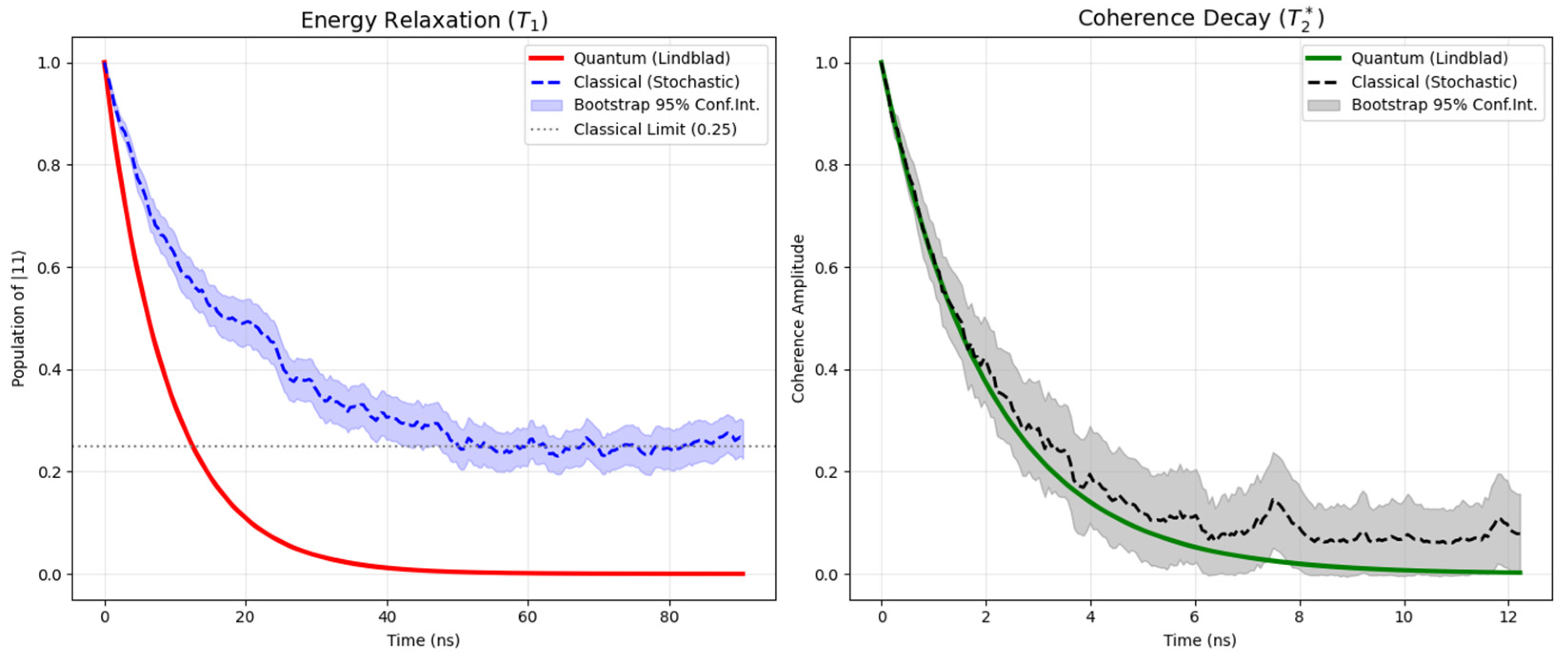
To evaluate the numerical frameworks, we compared the Semiclassical Stochastic Hamiltonian against the exact Lindblad dynamics.
As shown in
Figure 3, the semiclassical method correctly captures the initial rapid dephasing (
), it shows two main issues. First, as the signal becomes weaker, the simulation line starts to jitter. This is simply a numerical noise caused by averaging a limited number of trajectories (Stochastic Monte Carlo method). The noise becomes more visible when the coherence drops to low levels.
Second, and more importantly, the method completely fails to model long-term energy relaxation (). Instead of decaying to zero (the ground state), the population of gets stuck at 0.25. This happens because the classical noise pushes the qubit energy up and down with equal probability, acting like an infinite-temperature environment. As a result, the system ends up in a random state where all four possible configurations are equally likely (25% each). The saturation value we see is exactly this limit, confirming that this method cannot simulate the natural energy loss (spontaneous emission) of the qubit.
5.2. Quantum Trajectories: Accuracy and Efficiency
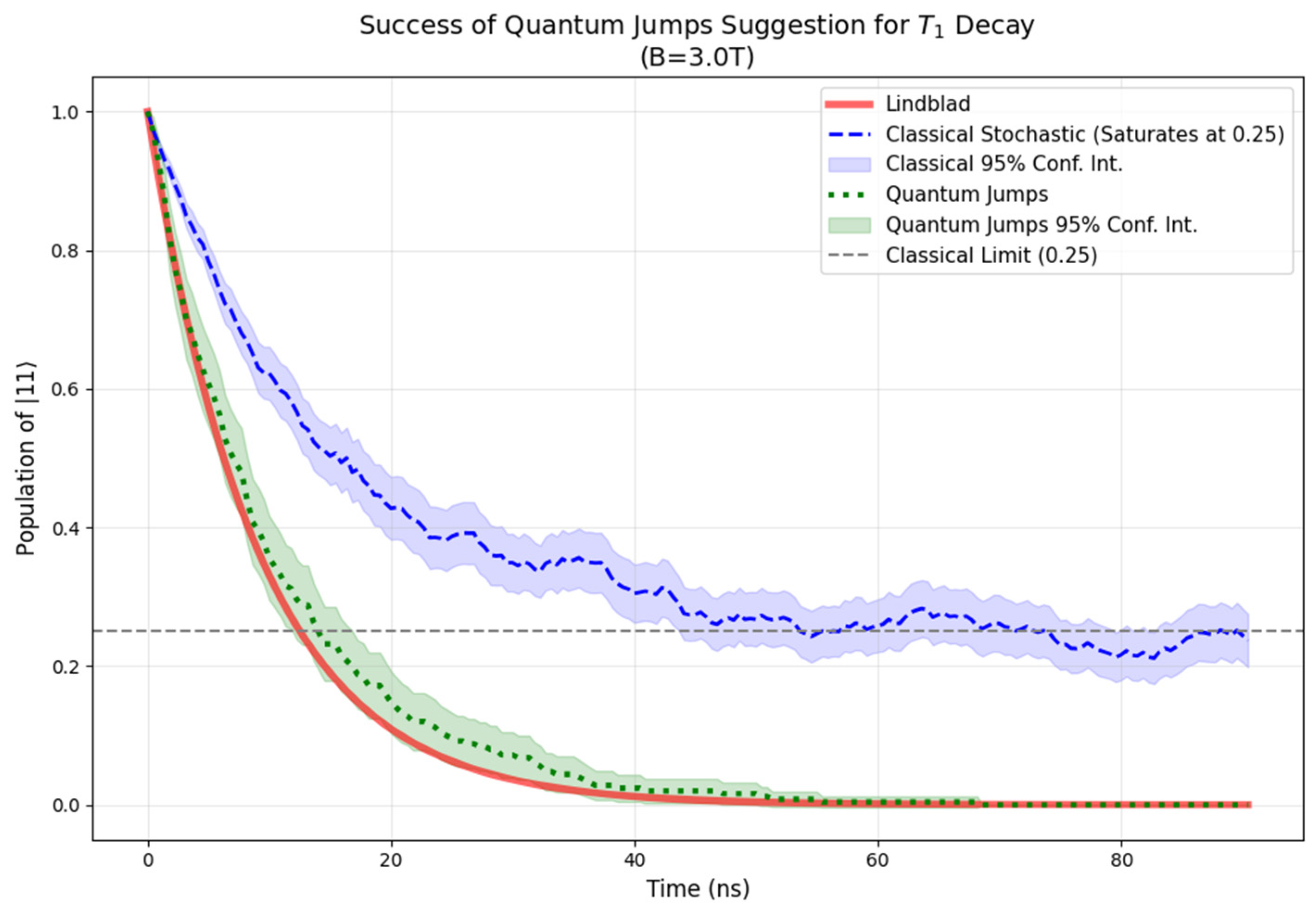
Finally, we propose and validate the Quantum Trajectories (MCWF) method as our last simulation strategy.
Figure 4 demonstrates the ensemble average of
n = 200 quantum trajectories (green dashed line) superimposed on the exact Lindblad solution (red solid line).
The results show perfect convergence, confirming that the MCWF method correctly reproduces both the coherent evolution and the dissipative quantum jumps (spontaneous emission). This proves that Quantum Trajectories offer the best solution, providing the physical accuracy of the Master Equation while maintaining the computational efficiency required for scaling to larger qubit registers [
19].
5.3. Scalability and Multi-Qubit Systems
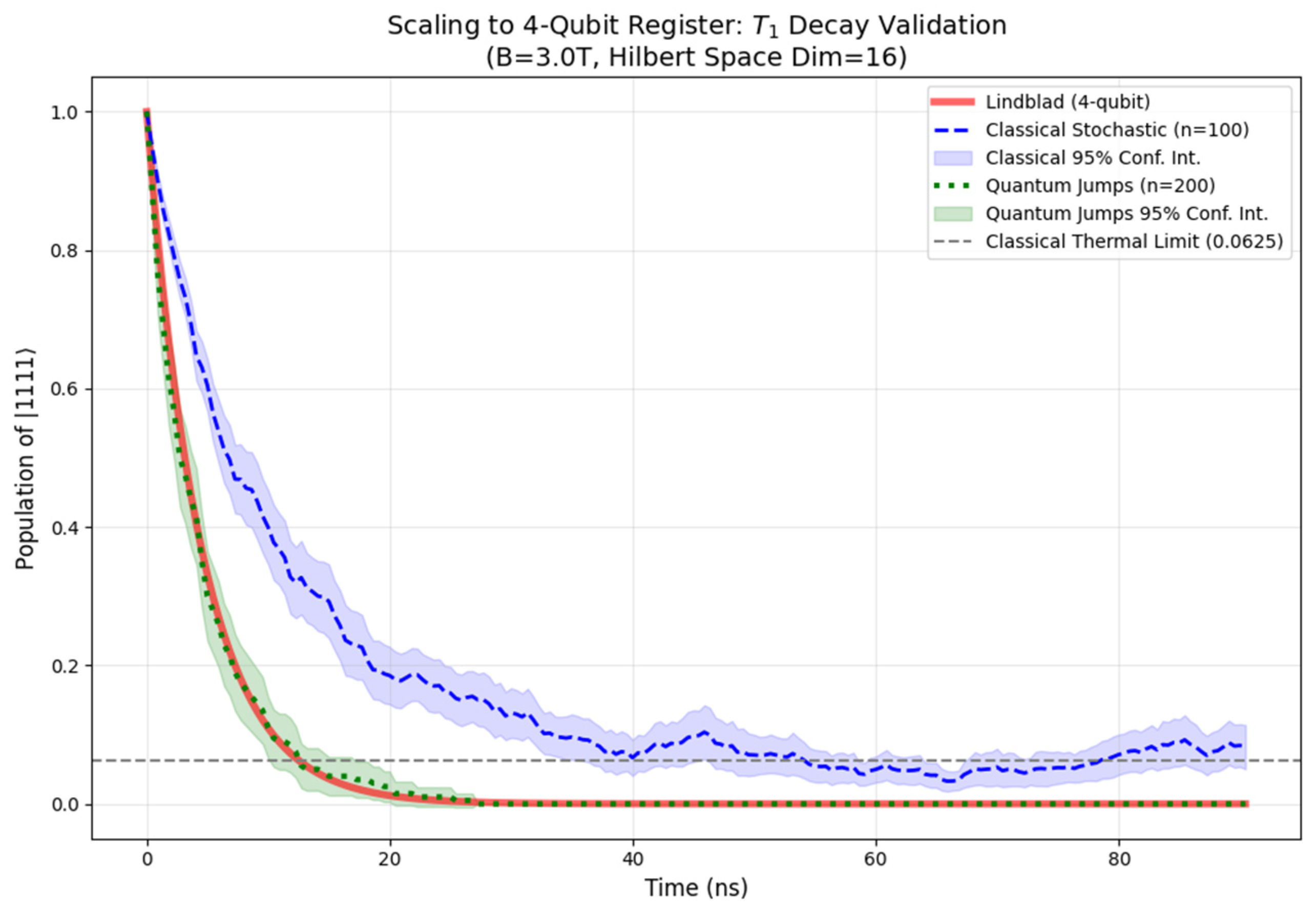
To address the scalability of our proposed framework, we extended the simulation to a 4-qubit register (). This extension serves as a stress test for both the numerical stability and the thermodynamic consistency of the models as the Hilbert space dimension grows.
As illustrated in
Figure 5, the Quantum Jumps method maintains perfect agreement with the Lindblad benchmark. In contrast, the Semiclassical Stochastic approach continues to fail thermodynamically, with the population of the
state saturating at the unphysical value of
. This confirms that the infinite-temperature bias of classical noise becomes increasingly problematic for larger registers, as the qubit system is prevented from reaching its true ground state.
From a computational perspective, the 4-qubit test validates the complexity analysis presented in
Table 2. While the memory footprint of the Lindblad Master Equation scales quadratically, the MCWF method scales linearly per trajectory. This linear scaling, combined with the statistical validation provided by bootstrap resampling, ensures that the framework can be reliably applied to 4 qubit registers and beyond.
5.4. Final Comparison
The benchmarking of the four numerical frameworks highlights the trade-offs between computational efficiency and physical accuracy.
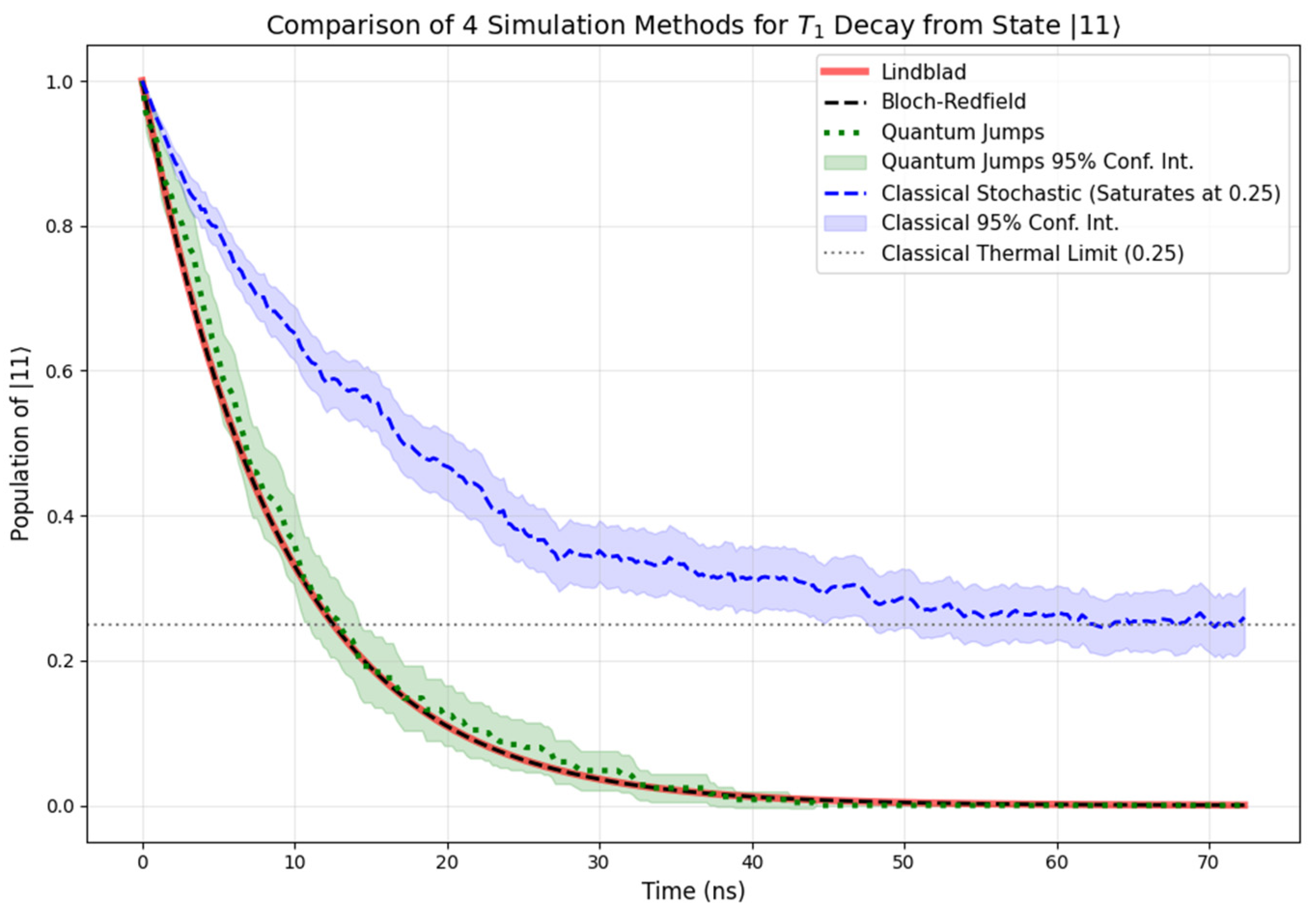
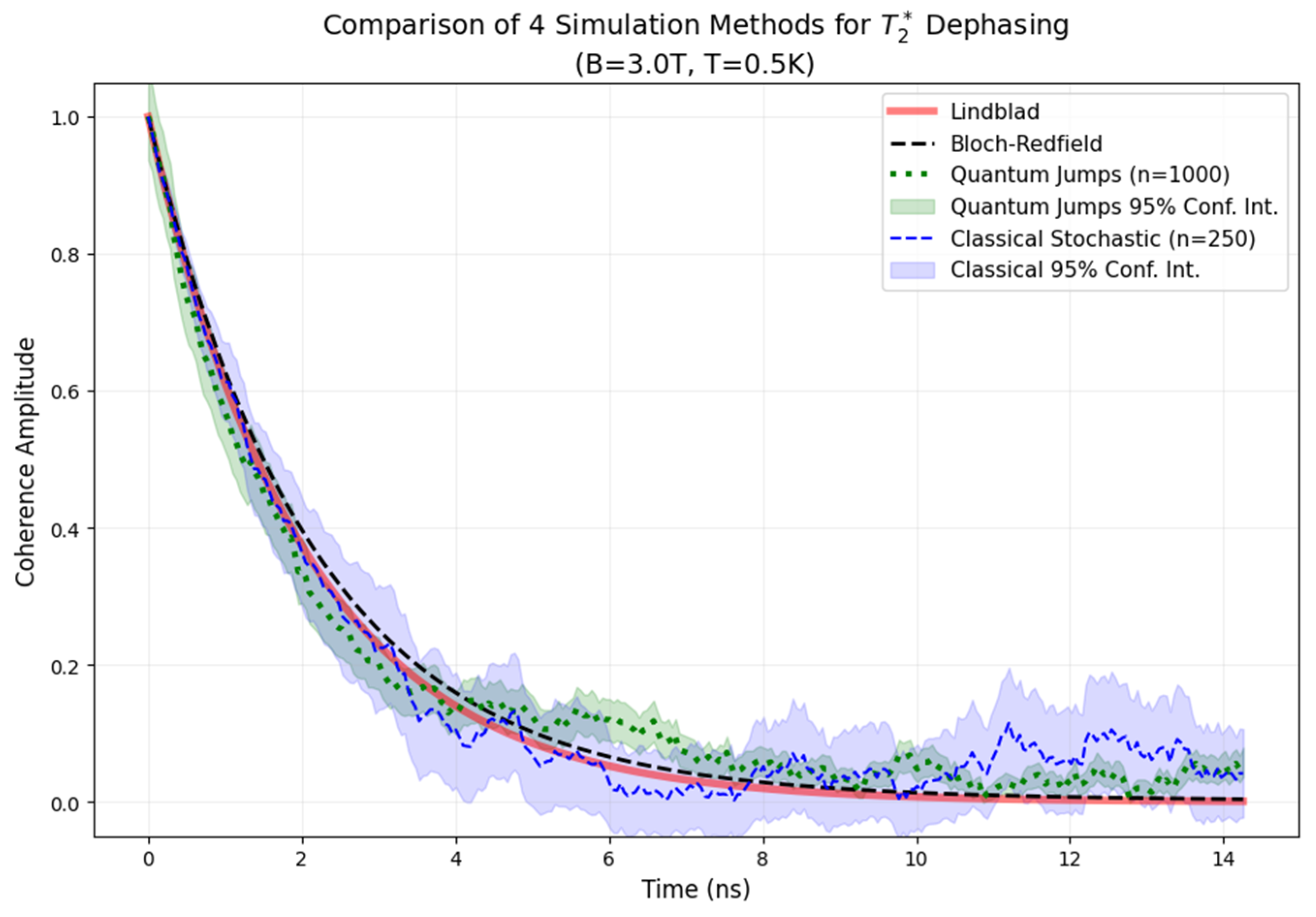
While the LME serves as our exact benchmark, the comparison displayed on
Figure 6 and
Figure 7 reveals critical limitations in semiclassical approximations.
Bloch–Redfield Formalism: Comparisons with the LME show perfect agreement for in the Markovian limit. However, a slight divergence in occurs because the BR formalism accounts for the partial coherence protection offered by the Singlet–Triplet symmetry, whereas LME model provides a more conservative estimation.
Semiclassical Stochastic Hamiltonian: This approach successfully captures initial pure dephasing but exhibits numerical “jitter” as the signal weakens due to the limited number of Monte Carlo trajectories. Most significantly, it fails to model long-term energy relaxation , where the population erroneously saturates at 0.25. This unphysical behavior arises because the classical noise field acts as an infinite-temperature environment, preventing the qubit from reaching its ground state through spontaneous emission.
Quantum Trajectories: This method emerges as the superior alternative, demonstrating excellent agreement with the exact Lindblad solution for both relaxation and dephasing. By incorporating discrete “quantum jumps” it accurately reproduces thermal relaxation to the ground state, resolving the thermodynamic inconsistencies found in the semiclassical stochastic model.
We have also observed that statistical noise follows the expected scaling law and required runs for energy loss and runs for dephasing. Above this number of trajectories, the results remain stable with a relatively small error.
To facilitate the selection of the most appropriate modeling framework for future research, we consolidate the key technical attributes, governing equations, computational demand and noise formalisms of the evaluated methods on
Table 2.
6. Conclusions
In this paper, we analyzed the dynamics of a Si/SiGe QD spin 2-qubit system under realistic noise sources using the Lindblad Master Equation and the Bloch–Redfield formalism. This allowed us to accurately calculate the energy relaxation and decoherence times, while identifying a magnetic field “sweet spot” between 0.1 and 0.5 T where decoherence is minimized.
Since quantum simulations become increasingly demanding as the number of qubits grows, we evaluated a classical alternative to these methods. Our comparison revealed that while the Semiclassical approach captures dephasing, it exhibits limitations in modeling thermal relaxation, leading to unphysical saturation. The proposed Quantum Trajectories method demonstrated significant advantages, accurately reproducing the dissipative dynamics.
Fundamentally, the primary scientific contribution of this study is establishing a verified methodological guideline for the quantum computing community. By exposing the thermodynamic limits of classical noise approximations at cryogenic temperatures, we offer a scalable and physically rigorous simulation framework essential for the accurate design and scaling of future multi-qubit silicon processors.
As our 4-qubit validation test indicates that the proposed framework effectively addresses the infinite-temperature bias of semiclassical models in larger systems, we conclude that the Quantum Trajectories approach offers a favorable balance of physical accuracy and computational efficiency, positioning it as a highly suitable framework for simulating larger-scale quantum processors.
Author Contributions
Conceptualization, K.P.; Methodology, K.P.; Software, D.P. and K.P.; Validation, D.P., K.P. and N.K.; Formal analysis, D.P.; Investigation, D.P.; Writing—original draft, D.P.; Writing—review and editing, K.P. and N.K.; Supervision, N.K. All authors have read and agreed to the published version of the manuscript.
Funding
This research received no external funding.
Data Availability Statement
Acknowledgments
During the preparation of this manuscript, the authors used Gemini (3.1 Pro) for the purposes of linguistic refinement and syntax correction. The authors have reviewed and edited the output and take full responsibility for the content of this publication.
Conflicts of Interest
The authors declare no conflicts of interest.
References
- Zwanenburg, F.A.; Dzurak, A.S.; Morello, A.; Simmons, M.Y.; Hollenberg, L.C.; Klimeck, G.; Rahman, S.; Coppersmith, S.N.; Eriksson, M.A. Silicon quantum electronics. Rev. Mod. Phys. 2013, 85, 961–1019. [Google Scholar] [CrossRef]
- Gonzalez-Zalba, M.F.; de Franceschi, S.; Charbon, E.; Meunier, T.; Vinet, M.; Horsell, D.W. Scaling silicon-based quantum computing using CMOS technology: State-of-the-art, Challenges and Perspectives. arXiv 2021. [Google Scholar] [CrossRef]
- Veldhorst, M.; Hwang, J.C.C.; Yang, C.H.; Leenstra, A.W.; de Ronde, B.; Dehollain, J.P.; Muhonen, J.T.; Hudson, F.E.; Itoh, K.M.; Morello, A.; et al. An addressable quantum dot qubit with fault-tolerant control-fidelity. Nat. Nanotechnol. 2014, 9, 981–985. [Google Scholar] [CrossRef] [PubMed]
- Yang, C.H.; Rossi, A.; Ruskov, R.; Lai, N.S.; Mohiyaddin, F.A.; Lee, S.; Tahan, C.; Klimeck, G.; Morello, A.; Dzurak, A.S. Spin-valley lifetimes in a silicon quantum dot with tunable valley splitting. Nat. Commun. 2013, 4, 2069. [Google Scholar] [CrossRef] [PubMed]
- Burkard, G.; Ladd, T.D.; Pan, A.; Nichol, J.M.; Petta, J.R. Semiconductor spin qubits. Rev. Mod. Phys. 2023, 95, 025003. [Google Scholar] [CrossRef]
- Glazov, M.M.; Ivchenko, E.L. Spin noise in quantum dot ensembles. Phys. Rev. B 2012, 86, 115308. [Google Scholar] [CrossRef]
- Yoneda, J.; Takeda, K.; Otsuka, T.; Nakajima, T.; Delbecq, M.R.; Allison, G.; Honda, T.; Kodera, T.; Oda, S.; Hoshi, Y.; et al. A quantum-dot spin qubit with coherence limited by charge noise and fidelity higher than 99.9%. Nat. Nanotechnol. 2018, 13, 102–106. [Google Scholar] [CrossRef] [PubMed]
- Connors, E.J.; Nelson, J.; Nichol, J.M. Charge-noise spectroscopy of Si/SiGe quantum dots via dynamically-decoupled exchange oscillations. arXiv 2022. [Google Scholar] [CrossRef] [PubMed]
- Campaioli, F.; Cole, J.H.; Hapuarachchi, H. A Tutorial on Quantum Master Equations: Tips and tricks for quantum optics, quantum computing and beyond. arXiv 2023. [Google Scholar] [CrossRef]
- Paladino, E.; Galperin, Y.M.; Falci, G.; Altshuler, B.L. 1/f noise: Implications for solid-state quantum information. Rev. Mod. Phys. 2014, 86, 361–418. [Google Scholar] [CrossRef]
- Dalibard, J.; Castin, Y.; Mølmer, K. Wave-function approach to dissipative processes in quantum optics. Phys. Rev. Lett. 1992, 68, 580–583. [Google Scholar] [CrossRef] [PubMed]
- Mi, X.; Benito, M.; Putz, S.; Zajac, D.M.; Taylor, J.M.; Burkard, G.; Petta, J.R. A coherent spin–photon interface in silicon. Nature 2018, 555, 599–603. [Google Scholar] [CrossRef] [PubMed]
- Watson, T.F.; Philips, S.G.J.; Kawakami, E.; Ward, D.R.; Scarlino, P.; Veldhorst, M.; Savage, D.E.; Lagally, M.G.; Friesen, M.; Coppersmith, S.N.; et al. A programmable two-qubit quantum processor in silicon. Nature 2018, 555, 633–637. [Google Scholar] [CrossRef] [PubMed]
- Petit, L.; Boter, J.M.; Eenink, H.G.J.; Droulers, G.; Tagliaferri, M.L.V.; Li, R.; Franke, D.P.; Singh, K.J.; Clarke, J.S.; Schouten, R.N.; et al. Spin Lifetime and Charge Noise in Hot Silicon Quantum Dot Qubits. Phys. Rev. Lett. 2018, 121, 076801. [Google Scholar] [CrossRef] [PubMed]
- Assali, L.V.C.; Petrilli, H.M.; Capaz, R.B.; Koiller, B.; Hu, X.; Das Sarma, S. Hyperfine interactions in silicon quantum dots. Phys. Rev. B 2011, 83, 165301. [Google Scholar] [CrossRef]
- Reed, M.D.; Maune, B.M.; Andrews, R.W.; Borselli, M.G.; Eng, K.; Jura, M.P.; Kiselev, A.A.; Ladd, T.D.; Merkel, S.T.; Milosavljevic, I.; et al. Reduced Sensitivity to Charge Noise in Semiconductor Spin Qubits via Symmetric Operation. Phys. Rev. Lett. 2016, 116, 110402. [Google Scholar] [CrossRef] [PubMed]
- Takeda, K.; Noiri, A.; Nakajima, T.; Kobayashi, T.; Tarucha, S. Quantum error correction with silicon spin qubits. arXiv 2022. [Google Scholar] [CrossRef] [PubMed]
- Hollmann, A.; Schenke, W.E.; Schreiber, L.R.; Bluhm, H. Large, Tunable Valley Splitting and Long Spin Lifetime in Si/SiGe Quantum Dots. Phys. Rev. Appl. 2020, 13, 034068. [Google Scholar] [CrossRef]
- Daley, A.J. Quantum trajectories and open many-body quantum systems. arXiv 2014. [Google Scholar] [CrossRef]
Figure 1.
Comparison of Lindblad (solid lines) and Bloch–Redfield (dashed lines) formalisms for (left) and (right) decay. While shows perfect numerical agreement, the slight divergence in arises from the effect of exchange interaction on the noise sensitivity in the BR eigenbasis, which the Lindblad model treats more conservatively.
Figure 1.
Comparison of Lindblad (solid lines) and Bloch–Redfield (dashed lines) formalisms for (left) and (right) decay. While shows perfect numerical agreement, the slight divergence in arises from the effect of exchange interaction on the noise sensitivity in the BR eigenbasis, which the Lindblad model treats more conservatively.
Figure 2.
Magnetic field dependence of relaxation and dephasing rates (sweet spot).
Figure 2.
Magnetic field dependence of relaxation and dephasing rates (sweet spot).
Figure 3.
Comparison between the Lindblad Master Equation (red/green) and the Semiclassical Stochastic method (blue/black) , simulating energy relaxation (left) and decoherence (right) for B = 3 T. Shaded areas represent the 95% Conf. Int. for the stochastic method.
Figure 3.
Comparison between the Lindblad Master Equation (red/green) and the Semiclassical Stochastic method (blue/black) , simulating energy relaxation (left) and decoherence (right) for B = 3 T. Shaded areas represent the 95% Conf. Int. for the stochastic method.
Figure 4.
The Quantum Trajectories simulation, averaging runs, shows excellent agreement with the Lindblad solution. By correctly modeling quantum jumps, this method accurately reproduces the thermal relaxation to the ground state. Shaded areas represent the 95% Conf. Int. for the Stochastic and QJ methods.
Figure 4.
The Quantum Trajectories simulation, averaging runs, shows excellent agreement with the Lindblad solution. By correctly modeling quantum jumps, this method accurately reproduces the thermal relaxation to the ground state. Shaded areas represent the 95% Conf. Int. for the Stochastic and QJ methods.
Figure 5.
Scaling of relaxation to a 4-qubit register . The population decay of the state highlights the thermodynamic failure of the classical stochastic model (saturating at the limit) compared to the exact Lindblad and Quantum Jumps results. Shaded regions represent the 95% Conf. Int. derived from bootstrap analysis.
Figure 5.
Scaling of relaxation to a 4-qubit register . The population decay of the state highlights the thermodynamic failure of the classical stochastic model (saturating at the limit) compared to the exact Lindblad and Quantum Jumps results. Shaded regions represent the 95% Conf. Int. derived from bootstrap analysis.
Figure 6.
Comparative analysis of energy relaxation dynamics starting from the excited state . The Lindblad Master Equation, Bloch–Redfield formalism, and Quantum Trajectories show perfect numerical agreement, accurately capturing the dissipative transition to the ground state. In contrast, the Classical Stochastic approach fails to model spontaneous emission, erroneously driving the system toward a maximally mixed state and saturating at the statistical limit of 0.25. Shaded areas represent the 95% Conf. Int. for the Stochastic and QJ methods.
Figure 6.
Comparative analysis of energy relaxation dynamics starting from the excited state . The Lindblad Master Equation, Bloch–Redfield formalism, and Quantum Trajectories show perfect numerical agreement, accurately capturing the dissipative transition to the ground state. In contrast, the Classical Stochastic approach fails to model spontaneous emission, erroneously driving the system toward a maximally mixed state and saturating at the statistical limit of 0.25. Shaded areas represent the 95% Conf. Int. for the Stochastic and QJ methods.
Figure 7.
Comparison of numerical frameworks for ensemble dephasing starting from an initial Singlet state. All four methodologies converge to the same coherence decay envelope. This demonstrates that while semiclassical models are thermodynamically inconsistent for relaxation, they effectively describe the phase-averaging process of pure dephasing in Si/SiGe spin qubits. Shaded areas represent the 95% Conf. Int. for the Stochastic and QJ methods.
Figure 7.
Comparison of numerical frameworks for ensemble dephasing starting from an initial Singlet state. All four methodologies converge to the same coherence decay envelope. This demonstrates that while semiclassical models are thermodynamically inconsistent for relaxation, they effectively describe the phase-averaging process of pure dephasing in Si/SiGe spin qubits. Shaded areas represent the 95% Conf. Int. for the Stochastic and QJ methods.
Table 1.
System parameters and noise coefficients.
Table 1.
System parameters and noise coefficients.
| Parameter Description | Symbol | Value | Unit |
|---|
| Valley Splitting [12] | | 0.15 | meV |
| Exchange Coupling [13] | J | 0.05 | GHz |
| Electron Temperature | T | 0.5 | K |
| Simulation Magnetic Field | Β | 3.0 | T |
| Direct Spin-Flip Coefficient [14] | | | |
| Raman Process Coefficient [14] | | | |
| Orbach Process Coefficient [14] | | 1.0 | |
| g-tensor Noise Amplitude [3] | | 0.08 | |
| Hyperfine Interaction [15] | | 0.005 | |
| Anharmonic Phonon Coefficient [14] | | | |
Table 2.
Comparison of numerical modeling frameworks for Si/SiGe spin qubits. The table summarizes the governing equations, noise formalisms, and computational demands for each simulation method.
Table 2.
Comparison of numerical modeling frameworks for Si/SiGe spin qubits. The table summarizes the governing equations, noise formalisms, and computational demands for each simulation method.
| Method | Governing Evolution/Hamiltonian | Noise and Dissipation Formalism | Physical Accuracy and Use Case | Space Complexity | Time Complexity |
|---|
| Lindblad | | Noise modeled via independent operators and,
| High (Markovian): Primary benchmark for systems with frequency-independent noise. | | |
| Bloch–Redfield | | Spectral Density : Transition rates | Very High: Captures frequency-dependent dephasing and exchange-coupling () effects. | | |
| Stochastic–Hamiltonian | | Classical Fields: Noise treated as a stochastic variable calibrated to charge noise and total . | Medium: Effectively captures but fails to model (erroneous saturation at 0.25). | | |
| Quantum Trajectories (MCWF) | | Continuous evolution under interrupted by stochastic jumps with probability | High: Numerically equivalent to Lindblad. Offers optimal scaling for multi-qubit registers. | | |
| Disclaimer/Publisher’s Note: The statements, opinions and data contained in all publications are solely those of the individual author(s) and contributor(s) and not of MDPI and/or the editor(s). MDPI and/or the editor(s) disclaim responsibility for any injury to people or property resulting from any ideas, methods, instructions or products referred to in the content. |