1. Introduction
Quantum computing has demonstrated the potential to outperform classical computation in a range of problems, including integer factorization, unstructured search, and simulation of quantum systems [
1,
2,
3]. These examples show that quantum systems can sometimes exploit computational resources that are unavailable to classical computation. However, the reason why substantial quantum advantage appears in some problems but not in others remains conceptually subtle. The standard circuit model and the associated complexity class
provide precise operational definitions and rigorous performance criteria [
4], but they do not by themselves provide a single structural explanation of why some problem families admit large quantum speedup while others appear to allow only limited improvement.
Standard accounts of quantum computation emphasize superposition, interference, and entanglement as central resources [
3,
5]. These notions are mathematically well-defined within the Hilbert-space formalism and are indispensable for the analysis of quantum algorithms. Nevertheless, their relationship to computational advantage is not uniform. Superposition alone does not guarantee speedup, interference can be either useful or destructive, and entanglement is known to be necessary in many settings but not sufficient as a standalone criterion for computational advantage. This suggests that a complementary structural description may be useful: one that focuses not only on the presence of quantum resources but on how computational histories are organized, coherently combined, and globally constrained.
Path-integral and history-based formulations of quantum mechanics provide one natural point of departure for such a description. In these formulations, amplitudes arise from coherent sums over multiple possible histories, with observable outcomes determined by constructive and destructive interference among phase contributions [
6,
7,
8]. At the same time, reconstruction-based approaches to quantum theory attempt to derive the formal structure of quantum mechanics from more primitive physical or informational principles [
9,
10]. Together, these traditions suggest that quantum phenomena can be fruitfully described in terms of the organization of histories rather than only in terms of instantaneous state vectors.
The present paper develops this idea in the context of quantum computational advantage. It builds on the reconstruction-based phase framework introduced in [
11], where quantum phase, interference, and wave behavior were derived from finite-action and admissible-continuation principles without assuming the Hilbert-space structure as primitive. In that earlier work, admissible histories and their phase relations were used to motivate the emergence of Schrödinger-type wave dynamics and related physical structures. The present paper does not repeat those derivations. Instead, it uses the same structural language as a diagnostic framework for quantum computation. The central question is not how quantum mechanics emerges but how the organization of admissible computational histories may help to explain the presence, absence, and degree of quantum computational advantage.
In this framework, a computational process is described as a constrained family of admissible continuations connecting input-like configurations to output-like configurations. A quantum computation is then interpreted as the controlled organization of many admissible histories whose phase contributions may combine constructively or destructively. This interpretation is closely related to the sum-over-histories viewpoint, but it emphasizes the structural features of the history space induced by a computation: how many histories are available, how coherently their phases are organized, and whether their continuation constraints factorize into independent components.
We identify three structural features that are relevant to quantum advantage. First, a computation may have large admissible-history multiplicity, meaning that many distinct histories connect input and output configurations. Second, these histories may exhibit phase coherence so that their contributions do not cancel randomly but instead reinforce selected outcomes. Third, the continuation constraints may be non-factorizable, corresponding to entanglement-like global dependence among subsystems. These features are not individually sufficient. Large multiplicity without coherence produces little useful amplification; coherence without sufficient multiplicity has limited computational effect; and non-factorization without stability may lead to fragility, noise sensitivity, or decoherence.
To capture the usable part of history multiplicity, we introduce the notion of effective coherent multiplicity. This quantity measures, prior to probability normalization, the degree to which an admissible-history space contributes coherently to a computational output. We then formulate a structural speedup conjecture: substantial quantum advantage requires not merely large raw branching but scalable effective coherent multiplicity supported by non-factorizable continuation constraints whose instability remains bounded. The conjecture is not presented as a replacement for standard complexity theory, nor as a new lower-bound theorem. Rather, it is proposed as a structural diagnostic principle for understanding why some quantum processes produce large useful amplification whereas others do not.
This viewpoint helps to reinterpret familiar examples. Grover’s search algorithm exploits interference in an unstructured search space and achieves the well-known quadratic speedup [
2]. From the present perspective, it has substantial multiplicity and controlled coherence but limited global structure in the admissible-history space. By contrast, hidden-relation and period-finding algorithms exploit compact relations that organize histories into phase-alignable families. Simon’s problem provides a minimal example of such coherent fibers, while Shor’s algorithm exploits the compact algebraic regularity of period finding [
1,
12]. The distinction is therefore not simply the presence or absence of superposition but the structural organization of coherent histories.
Novel Contribution and Scope
The contribution of this paper is conceptual and structural rather than a replacement of existing complexity-theoretic methods. The framework does not modify the predictions of quantum mechanics, does not redefine , and does not claim new complexity bounds for Grover’s, Simon’s, or Shor’s algorithms. Instead, it introduces a complementary language for describing quantum computational advantage in terms of admissible-history structure.
The main contributions are as follows. First, the paper formulates quantum computation as structured admissible continuation, thereby providing a common language for multiplicity, interference, and entanglement-like non-factorization. Second, it introduces effective coherent multiplicity as a structural measure of coherently usable history space. Third, it relates this measure to the stability of non-factorizable continuation constraints, thereby connecting quantum advantage to the tension between global computational structure and noise sensitivity. Fourth, it introduces a coherent-fiber amplification criterion, showing that admissible histories become computationally useful when they are organized into phase-alignable families selected by compact computational relations. Fifth, it clarifies how the proposed quantities relate to standard notions such as circuit complexity, query complexity, success amplitudes, entanglement entropy, tensor-network simulability, and fault-tolerance constraints.
The framework should therefore be understood as a diagnostic layer placed alongside the standard circuit model. Standard complexity theory asks how many gates, queries, or computational steps are required to solve a problem. The present framework asks how the induced admissible-history space is organized: whether it contains many histories, whether their phases remain coherently aligned, whether the relevant constraints are globally non-factorizable, whether the histories form coherent fibers selected by compact relations, and whether this structure remains stable under perturbation. These questions do not replace standard resource measures, but they may help to explain why those resources lead to substantial advantage in some cases and not in others.
The framework also suggests a heuristic for quantum algorithm design. Problems are natural candidates for significant quantum advantage when their admissible-history spaces contain compact global regularities, such as periodicities, hidden equivalence relations, symmetries, conservation laws, or algebraic constraints, that allow large sets of histories to be manipulated coherently. Conversely, problems with large but unstructured branching, rapidly decohering histories, or efficiently contractible non-factorization are less likely to yield substantial advantage. This heuristic is consistent with the contrast between unstructured search, hidden-relation problems, period finding, and known results on classical simulability of restricted quantum circuits.
The paper is organized as follows.
Section 2 summarizes the reconstruction framework and clarifies its relation to the earlier phase-reconstruction work of [
11].
Section 3 interprets quantum computation as structured admissible continuation.
Section 4 introduces the structural quantities used in the paper, including history multiplicity, phase coherence, effective coherent multiplicity, non-factorization, and instability; it also relates these quantities to standard concepts and presents simple one- and two-qubit examples.
Section 5 formulates the structural speedup conjecture and connects constraint instability to decoherence, noise sensitivity, and fault tolerance.
Section 6 analyzes Grover search, Simon’s problem, and Shor period finding; introduces a coherent-fiber criterion as a structural diagnostic for algorithmic advantage; and discusses tensor-network simulability as a test of compressible history-space structure.
Section 7 relates the framework to complexity-theoretic notions, including
, query complexity, oracle separations, entanglement measures, and classical simulation.
Section 8 discusses the algorithm-design implications, scope, and limitations.
Section 9 summarizes the conclusions.
In summary, the paper presents admissible-history structure as a complementary perspective on quantum computational advantage. Its central claim is not that quantum speedup follows from multiplicity, interference, or entanglement separately but that useful advantage depends on their coordinated organization: many admissible histories, coherent phase alignment, coherent-fiber structure, non-factorizable global constraints, and bounded instability under continued computation.
2. Reconstruction Framework
This section summarizes the reconstruction framework used in the present paper. The goal is not to reproduce the full derivation of the phase-reconstruction program developed in [
11] but to introduce the minimal structural language needed for the analysis of quantum computational advantage. In particular, we use the notions of configuration, admissible continuation, admissible history, phase assignment, and non-factorization. These concepts will later be translated into the language of quantum computation.
The central idea is to replace the usual picture of evolution on a pre-given state space with a more primitive relation of admissible continuation. Instead of assuming at the outset that a physical system is represented by a vector in Hilbert space or by a point in a classical phase space together with a dynamical law [
3,
13], we begin with configurations and a rule specifying which configurations may consistently continue which others. This is not intended to replace the Hilbert-space formalism in ordinary quantum computation. Rather, it provides a structural language for describing how multiple computational histories may coexist, acquire phases, interfere, and fail to factorize into independent components.
2.1. Configurations and Admissible Continuation
Definition 1
(Configuration space). Let be a nonempty set. Its elements are called configurations.
A configuration is an abstract representation of a possible global arrangement. At this level, no spacetime manifold, metric, tensor-product decomposition, or Hilbert-space structure is assumed. Those structures may be introduced later in specific realizations, but they are not part of the minimal reconstruction language used here.
Definition 2
(Admissible continuation)
. An admissible continuation relation is a binary relation If , we write and say that is an admissible continuation of C. For each
, define the continuation set
The relation plays a role analogous to a transition rule, but it is more general than a deterministic dynamical law. It specifies which successor configurations are structurally allowed. Repeated application of induces an ordering of admissible continuation rather than presupposing an external time parameter.
Operationally, this relation can be compared with allowed transitions in a computational process or with allowed paths in a path-integral description. The difference is that is formulated before assuming a fixed background state space or a spacetime geometry. For the purposes of the present paper, this abstraction is useful because it allows quantum computation to be described in terms of the structure of the history space induced by a computational process.
2.2. Admissible Histories
The basic objects of interest are not only single continuation steps but finite chains of admissible continuations.
Definition 3
(Admissible history)
. An admissible history is a finite sequence such that If a history begins at
and ends at
, we write
where
The set is the admissible-history space connecting the initial and final configurations. In general, this set may contain many distinct histories. This multiplicity is the structural origin of the interference effects discussed below.
Definition 4
(Concatenation)
. If then their concatenation is the history Thus admissible histories carry a natural composition law whenever the endpoint of one history matches the starting point of another. This compositional structure is the minimal requirement needed to assign additive phases to histories.
2.3. Minimal Structural Assumptions
The present paper uses only the following structural assumptions.
- 1.
Nontrivial continuation. For configurations relevant to a physical or computational process, is nonempty.
- 2.
Composability. Admissible continuations can be concatenated so that finite histories are well defined.
- 3.
Multiplicity. For some pairs , the set contains more than one admissible history.
- 4.
Phase assignability. Histories may carry a phase contribution compatible with concatenation.
- 5.
Possible non-factorization. Admissible continuation need not decompose into independent continuation rules for subsystems.
These assumptions are deliberately weaker than the standard postulates of quantum mechanics. They do not presuppose linear Hilbert-space structure, unitary evolution, tensor-product decomposition, or Born probabilities. In the present paper, however, we do not attempt to rederive all of those structures. Instead, we use this minimal framework to formulate a structural interpretation of quantum computational advantage.
2.4. Phase Structure and Amplitudes
A key result of the earlier phase-reconstruction framework [
11] is that an additive quantity assigned to histories and compatible with repeated composition naturally leads to a periodic phase variable. For the present paper, we take this result as background motivation and assume that admissible histories may be assigned phases of the form
where
is additive under concatenation:
Given initial and final configurations
, the corresponding history amplitude is defined formally by
whenever the sum is finite or otherwise well defined.
Equation (
1) has the same formal structure as a sum-over-histories amplitude in path-integral formulations of quantum mechanics [
6,
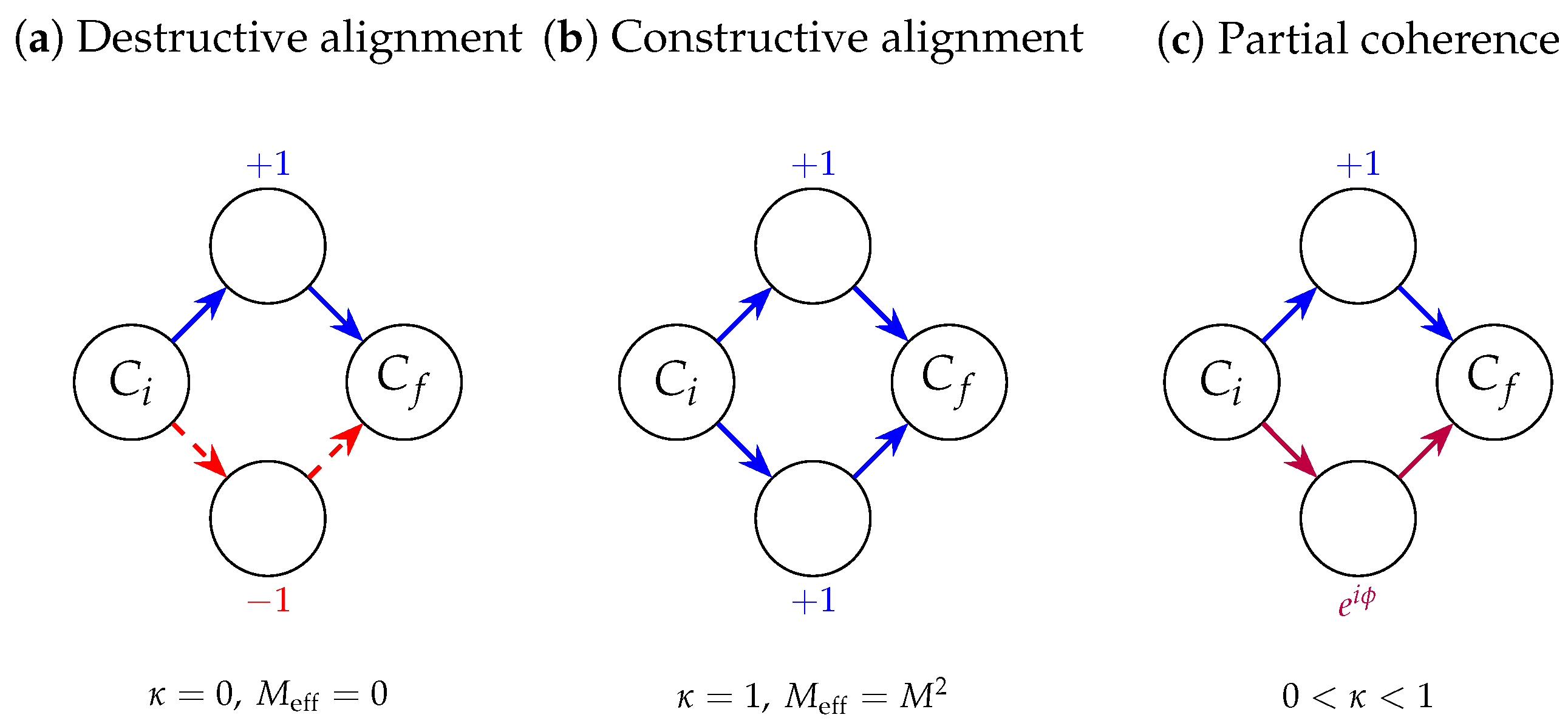
7]. The present interpretation is structural: the amplitude is determined by the organization of admissible histories and their relative phases. Interference arises because different histories connecting the same endpoints may contribute with different phases. In particular, the squared modulus contains cross terms of the form
Thus the contribution of a history space depends not only on the number of histories but also on the coherence of their phase relationships.
This point is central for quantum computation. A large number of admissible histories is not by itself sufficient for computational advantage. Those histories must be organized so that correct or desired outputs receive constructive contributions while incorrect or undesired outputs are suppressed.
2.5. Factorization and Non-Factorization
The second structural feature needed later is the possibility that admissible continuation fails to factorize across subsystems. Suppose that, in a particular realization, a configuration admits a decomposition
If the two components continued independently, one would expect
In general, however, the admissible continuation set may fail to have this product form. The future admissibility of one component may depend on the other, producing a non-factorizable continuation structure.
In standard quantum theory, entanglement is formulated in terms of nonseparable vectors or density operators on tensor-product Hilbert spaces [
5]. In the present structural language, the corresponding condition is the failure of admissible continuation to decompose into independent subsystem continuations. This should not be understood as a replacement for standard entanglement measures such as Schmidt rank, entanglement entropy, or mutual information. Rather, non-factorization is the continuation-level condition that, in Hilbert-space realizations, may give rise to such measures. The relation between non-factorization and standard entanglement quantities will be made more explicit in
Section 4.
2.6. Relation to Prior Reconstruction Results
The present paper depends on [
11] only in a limited way. The earlier work argued that a reconstruction-based framework with admissible histories and additive phase structure can recover important features of quantum wave behavior in suitable continuum limits. That result motivates the use of admissible histories and phase coherence here.
However, the present paper has a different purpose. It does not attempt to rederive quantum mechanics, spacetime, or the Schrödinger equation. Instead, it asks how the same structural ingredients—multiplicity of histories, phase coherence, and non-factorizable continuation—can be used to interpret quantum computational advantage. The framework is therefore used as a diagnostic language for quantum computation rather than as a full foundational reconstruction.
This distinction is important. The standard circuit model remains the operational framework for quantum computation. The admissible-history framework introduced here is complementary: it describes the structure of the history space induced by a circuit and asks whether that structure is large, coherent, globally constrained, and stable enough to support substantial quantum advantage.
2.7. Illustration of Admissible Continuation
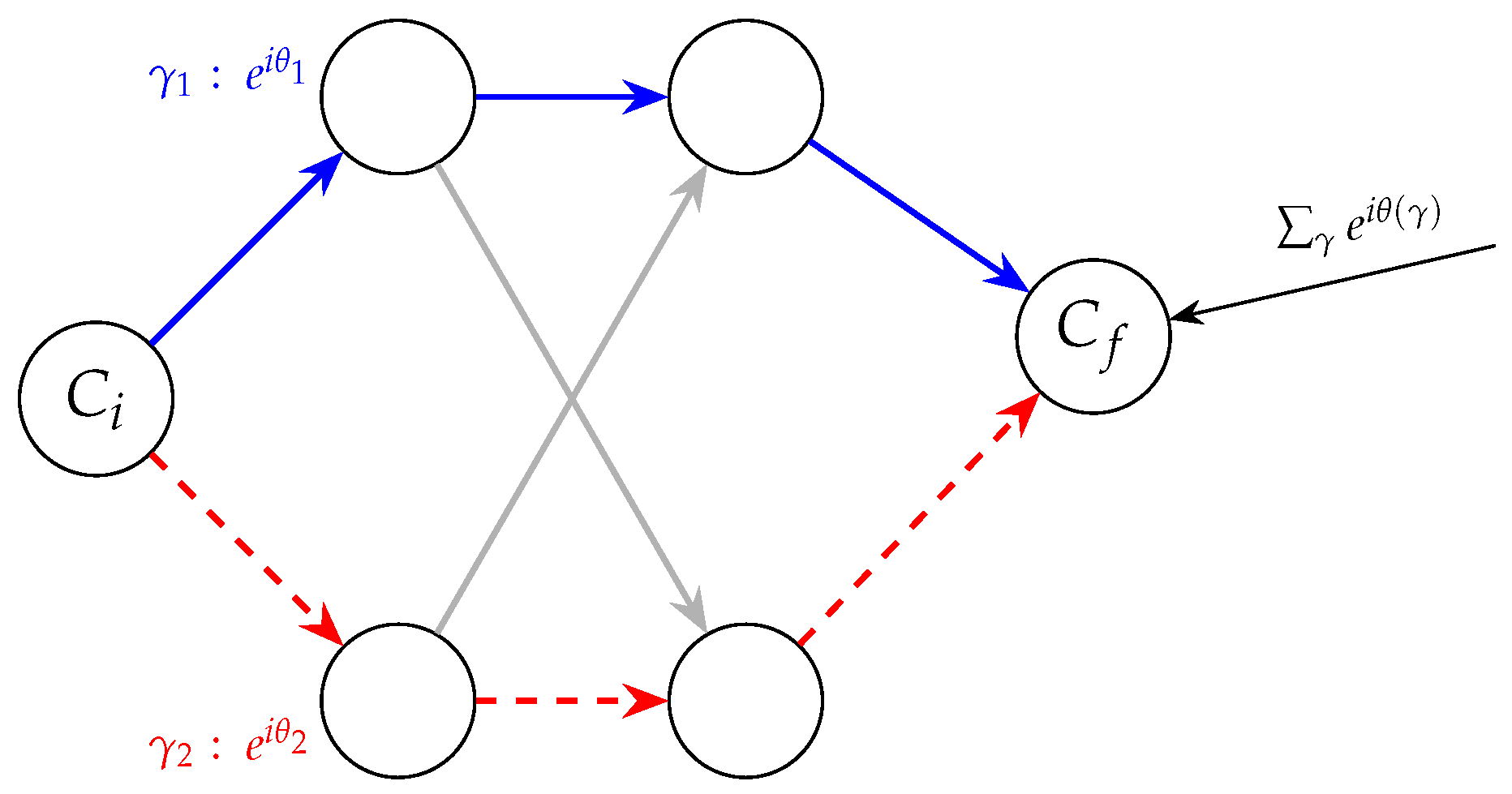
Figure 1 illustrates the basic construction. Configurations are represented as nodes, admissible continuations as directed edges, and histories as paths from an initial configuration
to a final configuration
. Each history
carries a phase contribution
, and the amplitude is obtained by summing over all admissible histories.
2.8. Relevance for Quantum Computation
The reconstruction framework becomes relevant to quantum computation when a computational process is viewed as a controlled organization of admissible histories. In the standard circuit model, gates act on quantum states. In the present structural translation, gates impose constraints on admissible continuation and thereby shape the corresponding history space.
Three features of that history space will be central in the following sections:
- 1.
The number of admissible histories connecting input and output configurations;
- 2.
The degree to which their phase contributions remain coherently organized;
- 3.
The degree to which continuation constraints fail to factorize into independent subsystem continuations.
These features correspond, respectively, to history multiplicity, phase coherence, and non-factorization. The next sections introduce quantitative descriptors for these features and relate them to standard notions, such as amplitudes, success probabilities, entanglement measures, query complexity, circuit complexity, tensor-network simulability, and fault-tolerance constraints.
2.9. Summary
This section introduced the minimal reconstruction language used in the paper. A configuration is an abstract admissible arrangement; an admissible continuation relation specifies which configurations may follow which others; an admissible history is a composable chain of such continuations; and a phase-weighted history space gives rise to interference through coherent summation. Non-factorization of continuation provides the structural analogue of entanglement-like global dependence. In the remainder of the paper, these concepts are used not to replace the circuit model but to analyze the structure of the history spaces induced by quantum computations.
3. Quantum Computation as Admissible Continuation
The previous section introduced admissible continuation as a structural language for describing histories and their phase relations. We now apply this language to quantum computation. The aim is not to replace the standard circuit model but to translate its basic ingredients into the language of admissible histories. This translation allows us to ask how a circuit organizes a space of possible histories, how phases are aligned or cancelled across that space, and how non-factorizable constraints give rise to global computational structure.
In the standard model, a quantum computation is described by a sequence of unitary gates, followed by measurement [
3]. In the admissible-continuation description, the same process is represented as a constrained family of histories connecting input-like configurations to output-like configurations. The relevant question is not only which output amplitudes are produced but how the circuit induces the history space whose coherent summation gives rise to those amplitudes.
This viewpoint is closely related to sum-over-histories descriptions of quantum theory, in which amplitudes are obtained by summing phase contributions over multiple alternatives [
6,
7,
8]. The novelty here is not the use of path summation itself but the use of admissible-history structure as a diagnostic language for quantum computational advantage.
3.1. Computational Configurations
Definition 5
(Computational configuration)
. A computational configuration is a configuration equipped with an interpretation as a computational arrangement. Depending on the realization, this arrangement may include input data, ancilla degrees of freedom, intermediate computational content, constraint structure, and candidate output information. A computational configuration is therefore the admissible-continuation analogue of a computational state. It need not initially be identified with a basis vector, a qubit register, or a Hilbert-space state. In a standard quantum-circuit realization, however, configurations may be specialized to register states, computational basis labels, or more general intermediate computational arrangements. This flexibility is useful because the framework is intended to describe the structural organization of a computation rather than a particular encoding.
A computational task is specified by three elements:
- 1.
An input configuration or input set;
- 2.
A sequence of admissibility constraints implementing the allowed computational transformations;
- 3.
A final selection criterion corresponding to readout.
Thus computation is represented as constrained admissible continuation from input-like configurations to output-like configurations.
3.2. Gates as Continuation Constraints
In the standard circuit model, a gate is represented by a unitary operator acting on a register [
3]. In the present structural translation, a gate specifies which configuration-to-configuration continuations are allowed at a given computational step.
Definition 6
(Gate-induced continuation rule)
. Let be an admissible continuation relation on . A gate-induced continuation rule associated with a gate G is a binary relation specifying the admissible successor configurations compatible with the action of G. This definition should not be read as denying the usual operator description of gates. Rather, it reformulates a gate operationally as a constraint on admissible continuation. In an ordinary quantum circuit, the matrix elements of a unitary gate determine which input–output basis transitions contribute to the amplitude and with what phase. The relation records the corresponding admissible transitions, while the phase assignment records their complex weights.
For a sequence of gates
we associate a sequence of gate-induced continuation relations
Definition 7
(Circuit-admissible history)
. A history is admissible for the circuit if Thus a circuit does not merely specify a single trajectory. It defines a structured set of histories that are compatible with the imposed sequence of computational constraints.
3.3. Circuit-Induced History Spaces
Definition 8
(Circuit-induced history space)
. Let be a circuit and let and be designated input and output configurations. The circuit-induced history space is This history space is the admissible-continuation analogue of the set of intermediate computational paths contributing to a circuit amplitude. Its structure depends on the entire gate sequence, not only on the initial and final configurations.
A deterministic classical computation may be viewed as a limiting case in which, for each computational configuration, the admissible successor is effectively unique. A reversible classical computation may still have a structured state space, but the realized continuation from a given input is single-valued. By contrast, a quantum computation permits multiple alternatives to contribute coherently to a final amplitude. In the present language, this means that may contain many histories whose phase contributions must be summed.
3.4. Circuit Amplitudes and Normalization
Given a circuit-induced history space, define the unnormalized history-sum amplitude
where
is the complex weight associated with the history. In the simplest phase-only case used for structural discussion, one may take
so that
. In a standard circuit realization, however, the magnitudes
are determined by the relevant gate matrix elements.
This distinction is important. The quantities introduced later, such as history multiplicity and effective coherent multiplicity, are structural descriptors of the unnormalized history sum. Physical probabilities require the usual normalization appropriate to the quantum circuit or measurement process. Thus the framework does not replace the Born rule or the standard computation of measurement probabilities; it provides a way to analyze how a circuit organizes the contributing histories before final normalization.
In an ordinary basis-state expansion, Equation (
2) corresponds to the familiar expression
where the intermediate labels
play the role of computational histories. The admissible-continuation framework abstracts this expansion by focusing on the structure of the allowed histories, their phase relations, and their possible non-factorization.
3.5. Interference as Computational Filtering
The history-sum expression makes clear how interference acts as a computational filtering mechanism.
Proposition 1
(Interference from relative phase). Let be a circuit and suppose that contains at least two distinct histories with nonzero weights. Then the squared magnitude of the corresponding amplitude contains cross terms depending on relative phases. These terms may enhance or suppress the contribution of .
Proof. Using Equation (
2), write
Then
The second term depends on relative phases between distinct histories. Depending on these phase relations, the cross terms may be positive, negative, or cancel in aggregate, producing constructive or destructive interference. □
Thus a circuit is computationally useful not merely because it permits many histories but because it organizes their phases so that desired outputs receive coherent reinforcement while undesired outputs are suppressed. This observation motivates the effective coherent multiplicity introduced in the next section.
3.6. Entangling Gates as Non-Factorizable Continuation
The framework also gives a structural interpretation of entangling operations. Suppose that a computational configuration admits a decomposition
If the two components continued independently under a gate
G, one would expect a product form
An entangling operation is one for which this product description fails.
Definition 9
(Non-factorizing gate)
. A gate-induced continuation rule is non-factorizing relative to a decomposition if for any independent continuation rules and that reproduce the allowed successors of the components separately. In Hilbert-space quantum mechanics, entanglement is defined using tensor-product structure and is quantified by measures such as Schmidt rank, entanglement entropy, mutual information, or multipartite entanglement monotones [
5]. The non-factorization defined here is not intended to replace those measures. Rather, it is a continuation-level condition corresponding to the failure of independent subsystem evolution.
Section 4 relates this structural notion more explicitly to standard entanglement diagnostics.
Non-factorization is important because it allows interference to act on global computational relations rather than only on independent local degrees of freedom. However, as discussed in
Section 5, it also creates a potential source of instability: the more globally constrained the continuation structure becomes, the more sensitive it may be to noise, decoherence, or imperfect control.
3.7. Measurement as Output Selection
In standard quantum computation, measurement maps final quantum states to classical outcomes according to the Born rule [
3]. In the admissible-continuation description, measurement is represented structurally as a selection of output configurations compatible with a measurement criterion.
Definition 10
(Measurement selection)
. Let be the set of configurations compatible with an accepted measurement outcome or output condition. A measurement selection rule is the restriction This definition captures only the structural role of measurement as output selection. It does not replace the probabilistic measurement postulates of quantum mechanics. In a standard circuit realization, probabilities are still computed from normalized amplitudes in the usual way. The structural point is that measurement selects among the outputs whose amplitudes have been shaped by the preceding admissible-history organization.
3.8. Summary
This section translated the standard circuit picture into the language of admissible continuation. A computational configuration represents a computationally interpretable arrangement; a gate imposes a gate-dependent continuation constraint; a circuit induces a history space; and the circuit amplitude can be represented as a coherent sum over weighted admissible histories. Interference appears through relative phase terms, while entangling operations correspond structurally to non-factorizable continuation constraints.
The following section introduces the structural quantities used to analyze such history spaces: multiplicity, phase coherence, effective coherent multiplicity, non-factorization, and instability.
4. Structural Quantities for Quantum Speedup
The previous section translated a quantum circuit into a circuit-induced admissible-history space. We now introduce the structural quantities used to characterize such spaces. The purpose of these quantities is not to replace standard measures, such as circuit size, query complexity, success probability, or entanglement entropy. Rather, they provide a complementary diagnostic language for describing how a quantum computation organizes histories, phases, and non-factorizable constraints.
We focus on five related quantities:
- 1.
History multiplicity M;
- 2.
Phase coherence ;
- 3.
Effective coherent multiplicity ;
- 4.
Non-factorization degree ;
- 5.
Constraint instability I.
The first three describe how many histories contribute to an output and how coherently they combine. The fourth describes the extent to which continuation constraints fail to decompose into independent subsystem rules. The fifth, developed further in
Section 5, describes the sensitivity of non-factorizable continuation structure to perturbations, noise, or decoherence.
4.1. History Multiplicity
Definition 11
(History multiplicity)
. Let . The history multiplicity between and is For a circuit , the circuit-induced multiplicity is This quantity measures the number of admissible histories connecting an input configuration to a candidate output configuration. In a deterministic classical computation, the effective multiplicity is often one for each input–output pair. In a quantum computation, many intermediate alternatives may contribute to the same output amplitude, as in sum-over-histories formulations of quantum mechanics [
6,
7].
However, large multiplicity is not by itself a resource. If the phases of the histories are unorganized, the corresponding contributions may cancel rather than amplify the desired output. Multiplicity provides a space of possibilities; coherence determines whether that space becomes computationally useful.
4.2. Phase Coherence
The second structural ingredient is the phase alignment among histories. For clarity, we first define the phase-only version, in which all admissible histories are assigned unit magnitude.
Definition 12
(Phase coherence functional)
. Let be nonempty. The phase coherence functional is For a circuit-induced history space, we similarly define By the triangle inequality,
The limiting cases have a simple interpretation:
indicates strong phase alignment and constructive interference;
indicates strong cancellation, phase randomization, or destructive interference.
Thus
measures the degree to which the available histories are coherently organized. It is analogous in spirit to an interference visibility measure, but it is defined directly on the admissible-history space. Operationally, this interpretation is consistent with the use of interference visibility, state reconstruction, and Bell-type correlation measurements in experimentally accessible optical emulations of quantum phenomena [
14].
In a full circuit realization, histories may carry unequal magnitudes because different gate matrix elements have different absolute values. If
is the complex weight of a history, one may define a weighted coherence quantity
whenever the denominator is nonzero. The phase-only quantity
is the special case
for all histories.
4.3. Effective Coherent Multiplicity
The quantity most directly relevant to the structural analysis of quantum advantage is not raw multiplicity but the coherently usable portion of multiplicity.
Definition 13
(Effective coherent multiplicity)
. Let . The effective coherent multiplicity is For a circuit-induced history space, In the phase-only case,
Thus:
whereas strong cancellation gives
Proposition 2
(Bounds on effective coherent multiplicity)
. Let . Then Proof. The lower bound is immediate from non-negativity of the squared modulus. The upper bound follows from the triangle inequality:
Squaring both sides gives
. □
The quantity should not be confused with a normalized probability. It is a structural measure of coherent contribution before normalization. In an ordinary quantum circuit, physical success probabilities are still computed from normalized amplitudes using the standard Born rule. The value of instead indicates how much of the available history space contributes coherently to a candidate output.
For unequal history weights, the corresponding weighted quantity is
This is closer to the squared unnormalized circuit amplitude. The phase-only version isolates the structural role of phase alignment.
4.4. Non-Factorization
The third structural feature is the failure of admissible continuation to decompose into independent subsystem continuations. This is the continuation-level analogue of entanglement-like global dependence.
Suppose a configuration admits a decomposition
Let
denote the independent product envelope of the possible component continuations:
If continuation is fully independent, then
If instead
then admissibility imposes constraints that cannot be reduced to independent choices of the two components.
Definition 14
(Non-factorization degree)
. Assume that is finite and nonempty and that . The non-factorization degree of C relative to the decomposition is Thus:
when continuation fills the independent product envelope, while
indicates that global admissibility constraints exclude some independently possible component continuations.
This definition is intentionally simple and decomposition-dependent. It is not intended as a replacement for standard entanglement measures, such as Schmidt rank, entanglement entropy, mutual information, or multipartite entanglement monotones [
5]. Rather,
measures the degree to which the admissible continuation rule itself fails to factorize. In Hilbert-space realizations, such non-factorization is the structural condition that can generate entanglement in the usual sense.
More refined definitions are possible. For infinite spaces, one may replace cardinalities by measures. For weighted histories, one may use weighted measures of the product envelope. For multipartite systems, one may define relative to bipartitions or higher-order partitions. The present paper uses only as a structural diagnostic.
4.5. Constraint Instability
The usefulness of non-factorization depends on whether it can be maintained coherently. Strongly global continuation constraints may be computationally powerful, but they may also be sensitive to perturbation, noise, or environmental coupling. We therefore introduce a structural instability measure.
Definition 15
(Constraint instability). Let C be a computational configuration and let be its continuation set. The constraint instability is a non-negative quantity measuring the sensitivity of the admissible continuation structure near C to perturbations of the continuation rule, phase assignment, or environmental coupling.
At this stage,
is a model-dependent quantity. In a noisy quantum circuit, for example, it may be related to the deviation between an ideal channel and a noisy channel, to the rate at which phase coherence is lost, or to the overhead required for error correction.
Section 5 makes this connection more explicit.
The reason to include I among the structural quantities is that quantum advantage requires not only non-factorizable structure but stable non-factorizable structure. If the continuation constraints needed for coherent amplification become too fragile as system size grows, the corresponding advantage may disappear in practice.
4.6. Relation to Standard Quantities
The quantities introduced above are structural descriptors.
Table 1 summarizes their relation to standard notions in quantum computation and quantum information.
This table also clarifies the scope of the framework. Standard complexity theory asks how many gates, queries, or computational steps are required. The present framework asks how the induced history space is structured: how many histories are present, how coherently they combine, how globally constrained they are, and how stable that organization is.
4.7. Worked Examples: One- and Two-Qubit Circuits
We now illustrate the quantities with simple circuits. These examples are not meant to demonstrate computational speedup. Their purpose is to show explicitly how M, , , and are computed in elementary cases.
Consider the circuit
In the intermediate computational basis, the amplitude from input
to output
is
There are two admissible intermediate histories:
Thus
In the phase-only description, the two histories have aligned phase, so
The physical amplitude is not 4; the value 4 is the phase-only structural coherent multiplicity. The actual circuit amplitude includes the Hadamard matrix-element factors and equals 1.
Now consider the output
:
Again there are two admissible histories, so
However, the two phase contributions cancel. Therefore
This elementary example shows why history multiplicity alone is insufficient. The two outputs have the same raw multiplicity, but only one has coherent phase alignment.
Consider the circuit
The CNOT gate imposes a relation between the two output bits: the target bit is flipped conditional on the control bit. Relative to the decomposition into control and target subsystems, the final admissible successors from the intermediate superposition are
The independent product envelope would be
Hence
and the non-factorization degree is
This value does not equal an entanglement entropy. Rather, it measures the extent to which the continuation rule excludes independently possible component continuations. In the Hilbert-space realization, the resulting state
has Schmidt rank 2 and one ebit of entanglement. Thus the structural non-factorization detected by
corresponds, in this simple case, to the standard fact that the final state is entangled.
These examples clarify the roles of the structural quantities: multiplicity counts available histories, measures phase alignment, measures coherent contribution before normalization, and detects global continuation constraints.
4.8. Interdependence of Structural Resources
The structural quantities are not independent. Quantum advantage requires a coordinated regime in which multiplicity, coherence, and non-factorization support one another without becoming unstable.
Proposition 3
(Multiplicity without coherence is insufficient). High history multiplicity without phase coherence does not produce large effective coherent multiplicity.
Proof. If the phases are uncorrelated, then the sum
behaves like a random walk in the complex plane. Its magnitude typically scales much more slowly than
M, and hence
Thus raw branching does not translate into coherent amplification. □
Proposition 4
(Factorizable continuation limits global structure). If admissible continuation factorizes completely across all relevant subsystems, then interference cannot encode genuinely global computational relations.
Proof. If
for each relevant decomposition, then the admissible-history space decomposes into independent component history spaces. Interference may still occur within each component, but there is no continuation-level constraint linking the components into a global computational relation. Many quantum algorithms require precisely such global structure. □
Proposition 5
(Non-factorization can increase instability). Increasing non-factorization may increase sensitivity to perturbation and thereby reduce usable coherence.
Proof. When continuation constraints are non-factorizable, the admissibility of one component depends on the configuration of others. Perturbations in one part of the system can therefore affect phase relations and admissible continuations globally. This is the structural counterpart of the familiar fragility of coherent entangled states under noise and environmental coupling. □
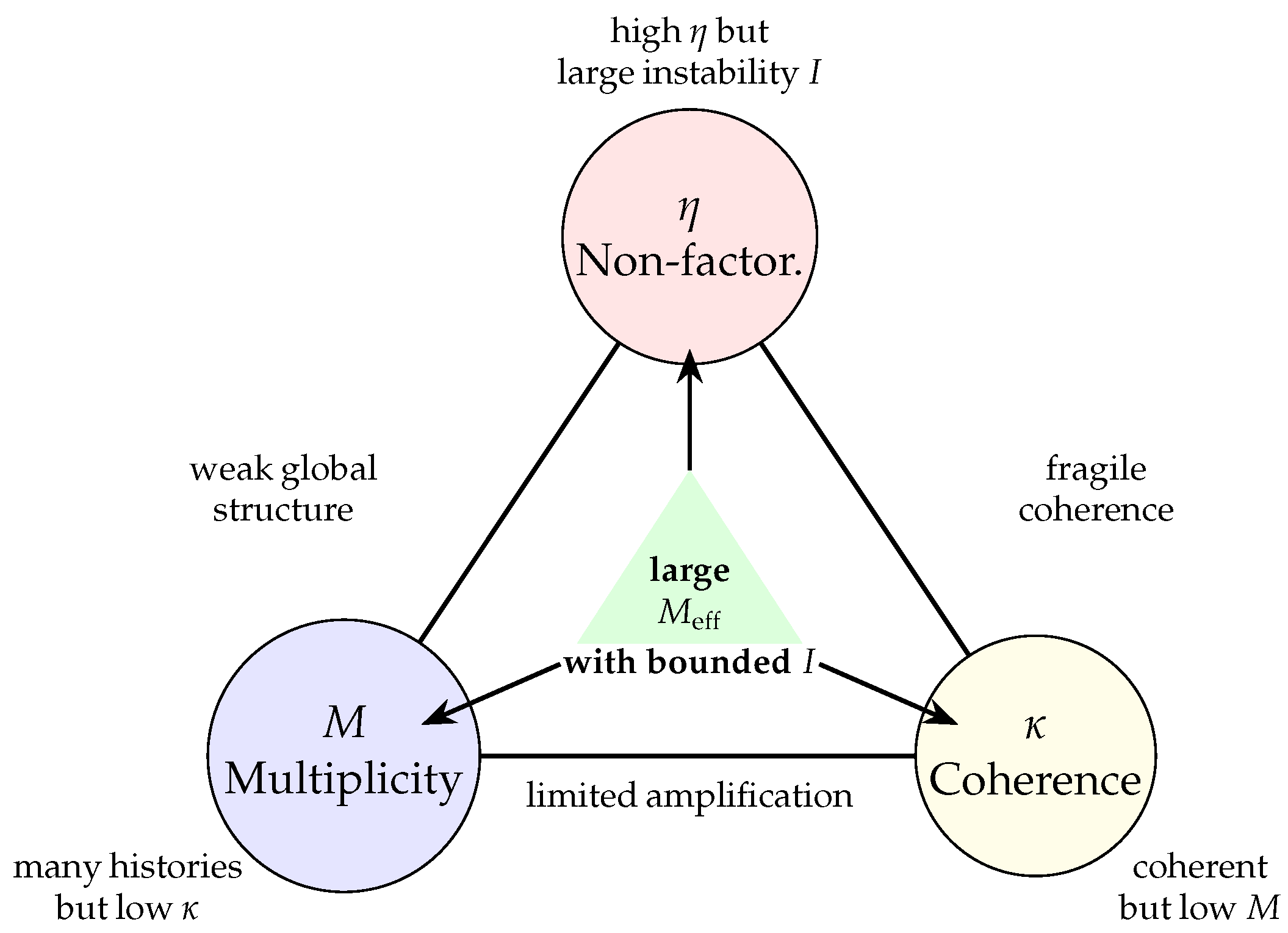
These propositions express the main structural tension. Multiplicity creates a large space of possible histories; coherence organizes that space through interference; non-factorization allows the interference to encode global computational structure; and bounded instability is needed to prevent this structure from being destroyed.
4.9. Structural Characterization of Quantum Advantage
The preceding discussion suggests the following qualitative characterization.
A quantum computation is structurally promising when:
- 1.
The induced admissible-history space has large multiplicity M;
- 2.
The relevant histories exhibit significant phase coherence for desired outputs;
- 3.
The resulting effective coherent multiplicity grows substantially for those outputs;
- 4.
The continuation constraints are non-factorizable in a way that encodes global problem structure;
- 5.
The associated instability remains sufficiently bounded for the coherent structure to persist.
Conversely, large branching without coherence, coherence without enough multiplicity, or non-factorization without stability is insufficient for substantial quantum advantage. This is the basis of the structural speedup conjecture formulated in
Section 5.
4.10. Illustration: Multiplicity and Coherence
The relation between multiplicity and phase coherence is illustrated in
Figure 2. The same raw number of histories can lead to cancellation, constructive interference, or partial amplification depending on the relative phases.
4.11. Summary
This section introduced the structural quantities used throughout the paper. History multiplicity M counts admissible histories; phase coherence measures their alignment; effective coherent multiplicity measures the coherently usable portion of history space before normalization; non-factorization measures the failure of continuation constraints to decompose into independent subsystem rules; and instability I measures the sensitivity of this structure to perturbation. These quantities provide the basis for the structural speedup conjecture developed in the next section.
5. Structural Limits and the Speedup Conjecture
The preceding section introduced the structural quantities used in this paper: history multiplicity M, phase coherence , effective coherent multiplicity , non-factorization degree , and constraint instability I. These quantities are not independent resources that can be increased without cost. A computation may have many histories but little coherence; strong coherence but too few histories; or significant non-factorization that is too fragile to remain useful under noise and perturbation.
The purpose of this section is to make these trade-offs explicit and to formulate a structural speedup conjecture. The conjecture is not intended as a replacement for standard complexity-theoretic lower bounds. Rather, it is a diagnostic principle: substantial quantum advantage appears to require not merely large branching but coherently exploitable branching organized by stable non-factorizable structure.
5.1. Multiplicity Alone Is Insufficient
A large admissible-history space does not by itself imply computational advantage. What matters is whether the histories can be organized so that desired outputs are reinforced and undesired outputs are suppressed. This is the familiar lesson of interference in sum-over-histories formulations of quantum mechanics [
6,
7].
Proposition 6
(Multiplicity without coherence). Large history multiplicity is not sufficient for large effective coherent multiplicity.
Proof. By definition,
while
Even if
is large, the phases
may be distributed so that the terms in the sum cancel pairwise or nearly uniformly. In that case,
and therefore
□
Thus multiplicity supplies possible alternatives, but coherence determines whether those alternatives become computationally usable. Unstructured branching is therefore not enough.
5.2. Coherence Alone Is Insufficient
Conversely, perfect phase alignment does not guarantee large speedup if the history space is too small. Coherence can amplify only the alternatives made available by multiplicity.
Proposition 7
(Coherence with bounded multiplicity). High coherence with polynomially bounded history multiplicity cannot yield superpolynomial effective coherent multiplicity.
Proof. Suppose that a family of computational instances is indexed by size
n and that, for all relevant input–output pairs, one has
for some polynomial
p. By the bound established in
Section 4,
Hence the effective coherent multiplicity remains polynomially bounded regardless of perfect phase alignment. □
This proposition does not imply a complexity-theoretic lower bound. It states only that, within the structural quantities introduced here, large coherent amplification requires both coherence and sufficiently large history multiplicity.
5.3. Factorizable Continuation Limits Global Structure
Multiplicity and coherence still do not capture the full structure of quantum computation if all continuation constraints factorize into independent subsystem rules. In such a case, interference may occur locally, but it does not encode genuinely global computational relationships.
Proposition 8
(Factorization and independent history spaces). If admissible continuation factorizes across all relevant computational decompositions, then the corresponding history space decomposes into independent continuation sectors.
Proof. Suppose that, for each relevant configuration
one has
Then an admissible continuation of
C is equivalent to an independent choice of an admissible continuation of
A and an admissible continuation of
B. Iterating this condition implies that admissible histories decompose into products of component histories. Hence the history space carries no continuation-level constraint linking the components into a genuinely global computational structure. □
This proposition should be interpreted structurally. It does not say that every entangled state is necessary for every quantum advantage, nor that every non-factorizable process yields speedup. It says that a purely factorized continuation structure cannot support interference patterns organized by global constraints across subsystems. This is why non-factorization is treated here as the continuation-level analogue of entanglement-like global dependence [
5].
5.4. Constraint Instability, Decoherence, and Fault Tolerance
Non-factorization is not an unqualified advantage. Global continuation constraints can support computationally useful interference, but they may also become sensitive to perturbations, imperfect control, and environmental coupling. This is the structural counterpart of the well-known fragility of coherent quantum systems under decoherence [
3].
To express this limitation, we use the instability quantity introduced in
Section 4.
Definition 16
(Constraint instability). Let C be a computational configuration and let be its admissible continuation set. The constraint instability is a non-negative quantity measuring the sensitivity of the continuation structure, phase assignment, or history weights near C to perturbation. Larger values of correspond to greater sensitivity.
The exact form of
depends on the model. In a noisy circuit realization, one possible diagnostic is the distance between an ideal channel
and the noisy implemented channel
. For example,
where
is a state associated with the configuration
C in a Hilbert-space realization. More generally, for a circuit of length
, one may consider a cumulative instability of the form
where
is an effective noise or perturbation strength at step
t, and
is a structural weight measuring the extent to which the affected continuation constraints participate in global non-factorizable structure.
These expressions are not proposed as universal definitions. They are examples showing how the abstract instability quantity may be connected to standard notions such as channel noise, decoherence rate, noise sensitivity, and error-correction overhead. In this sense, I plays the same structural role as a fragility measure: it asks whether the non-factorizable history organization required for coherent amplification can persist under realistic perturbations.
Definition 17
(Bounded instability)
. A family of computational processes is said to have bounded instability if there exists a function , at most polynomial in the instance size n, such that for all computationally relevant configurations C arising in . Operationally, bounded instability means that the continuation constraints needed for coherent computation do not become uncontrollably fragile as the system size grows. In fault-tolerant quantum computation, this requirement is related to the existence of encoding, error correction, and threshold behavior that prevent local noise from destroying global coherent structure. Thus, in the present language, fault tolerance may be viewed as a mechanism for keeping effective instability bounded while preserving the non-factorizable structure needed for computation.
5.5. The Tension Between Non-Factorization and Coherence
Non-factorization and phase coherence are jointly important, but they can pull in opposite directions. Non-factorization allows a computation to encode global relationships among subsystems. At the same time, the more globally constrained the continuation structure becomes, the more ways there may be for perturbations to disrupt phase alignment.
Proposition 9
(Non-factorization can increase fragility). Increasing non-factorization may increase instability and thereby reduce effective coherence.
Proof. When continuation factorizes, perturbations affecting one component can remain confined to that component. When continuation is non-factorizable, the admissibility of one component depends on the configuration of others. A perturbation in one part of the system can therefore alter the global continuation structure or the relative phases among histories. Since coherent amplification depends on stable phase relations across histories, increased instability can reduce the effective coherence and therefore suppress . □
This proposition is qualitative, but it captures an important design constraint. Entangling or non-factorizing structure is useful only when it remains stable enough to support coherent interference. Excessive fragility converts potentially useful global structure into decoherence or noise sensitivity.
5.6. Structural Speedup Conjecture
The preceding observations motivate the central conjecture of the paper. It is formulated as a structural necessary-condition conjecture rather than as a new complexity-theoretic theorem.
Conjecture 1
(Structural speedup conjecture)
. Let be a family of quantum computational processes indexed by instance size n. Suppose that exhibits superpolynomial quantum speedup relative to comparable classical processes in the usual complexity-theoretic sense [4]. Then the following structural conditions are expected to be necessary:- 1.
There exists a family of relevant input–output pairs for which the effective coherent multiplicitygrows superpolynomially in n after accounting for the appropriate history representation; - 2.
The continuation constraints involved in this coherent amplification are non-factorizable on a computationally significant portion of the process;
- 3.
The instability associated with these non-factorizable constraints remains bounded in the sense that it does not grow so rapidly as to destroy the useful coherence required for amplification.
The conjecture says that large quantum advantage requires not merely many possible histories but many histories that are coherently exploitable, globally organized, and stable enough to remain useful. Equivalently, it distinguishes raw branching from computationally useful branching.
Several qualifications are important. First, the conjecture is not a formal lower bound on classical computation. Second, the quantities , , and I may depend on the chosen history representation and on the physical or circuit model. Third, the conjecture is intended to guide structural analysis rather than replace standard resource measures, such as gate count, query complexity, or membership.
5.7. Interpretation of the Conjecture
The conjecture has three immediate consequences at the heuristic level.
- 1.
Unstructured branching is insufficient. A process may contain exponentially many admissible histories, but, if their phases are not organized by a useful global regularity, the effective coherent multiplicity need not grow comparably to the raw multiplicity.
- 2.
Purely local coherence is insufficient. A process may preserve phase coherence within local or independent sectors, but, if the continuation structure factorizes, interference cannot encode genuinely global computational relations.
- 3.
Unbounded instability destroys usable advantage. A process may generate non-factorizable structure, but, if that structure is too sensitive to noise or perturbation, decoherence suppresses the phase alignment needed for large .
This perspective helps to explain why quantum speedup is neither universal nor simply proportional to the size of Hilbert space. Advantage appears when the history space is not only large but coherently and globally organized in a stable way.
5.8. Consequences for Algorithmic Structure
The structural speedup conjecture suggests a qualitative classification of quantum algorithms and candidate problems.
Problems with low multiplicity or rapidly decohering history spaces are unlikely to exhibit substantial quantum advantage.
Problems with large multiplicity but weak phase organization, such as unstructured search, may admit limited advantage but not necessarily superpolynomial speedup.
Problems whose history spaces are organized by compact global regularities—such as periodicity, symmetry, group structure, or conservation laws—are more natural candidates for strong coherent amplification.
Problems whose non-factorizable structure is efficiently compressible or classically contractible may fail to yield substantial advantage despite having nonzero entanglement-like structure.
This classification is consistent with the contrast between Grover’s search and Shor’s period-finding algorithm [
1,
2]. It also anticipates the discussion of tensor-network simulability in
Section 6: non-factorization alone is not enough if the relevant global structure remains efficiently compressible by classical methods.
5.9. Summary
The structural resources that are relevant to quantum speedup are mutually constraining. Multiplicity without coherence produces cancellation; coherence without sufficient multiplicity has limited amplification power; non-factorization without stability becomes fragile; and non-factorization that remains efficiently compressible may still be classically simulable. This motivates the structural speedup conjecture: substantial quantum advantage requires scalable effective coherent multiplicity supported by non-factorizable continuation constraints whose instability remains bounded.
The trade-off among these resources is summarized in
Figure 3. The following section applies this perspective to Grover’s and Shor’s algorithms and then relates the framework to tensor-network simulability.
6. Case Studies: Grover, Simon, Shor, and Coherent-Fiber Structure
This section illustrates the structural framework by applying it to canonical quantum algorithms and simulation boundaries. The goal is not to rederive their standard complexity bounds, which are well established, but to interpret their behavior in terms of admissible-history multiplicity, phase coherence, effective coherent multiplicity, non-factorization, stability, and compressibility.
We begin with Grover search and Shor period finding because they exhibit very different forms of quantum advantage. Grover’s algorithm gives a quadratic speedup for unstructured search, while Shor’s algorithm gives an exponential improvement over the best-known classical factoring algorithms by reducing factoring to period finding [
1,
2,
3,
15]. We then sharpen the comparison by introducing a coherent-fiber criterion for algorithmic advantage and applying it concretely to Simon’s problem [
3,
12]. Finally, we discuss tensor-network simulability as a boundary case, showing that non-factorization alone is not sufficient when the induced history structure remains efficiently classically compressible.
In the present framework, the central distinction among these examples is not the mere presence of superposition or interference. Rather, it is the way in which the corresponding circuits organize admissible histories: whether the histories are merely numerous, whether their phases can be coherently aligned, whether they are grouped by compact global relations, and whether the resulting structure resists efficient classical compression.
6.1. Algorithm-Flow Representation of Admissible-History Analysis
To make the case-study comparison more operational, we first summarize the admissible-history analysis as an algorithmic flow. This is not an alternative quantum algorithm. Rather, it is a structural diagnostic procedure applied to a given circuit or oracle process. The standard circuit model and complexity-theoretic analysis remain the operational baseline [
3,
4].
Here an oracle process means a computational procedure in which part of the transformation is specified by access to a problem-dependent black-box function, such as the marked-item oracle in Grover search, the hidden-period function in Shor period finding, or the hidden-string function in Simon’s problem. In the present framework, such an oracle is treated as a constraint that shapes the admissible-history space.
The diagnostic workflow is summarized in
Table 2.
The purpose of this flow is not to replace the standard analysis of quantum algorithms. It instead provides a uniform way to compare how different algorithms organize computational histories.
Theorem 1
(History-flow diagnostic). Let be a quantum computational process represented by a circuit-induced admissible-history space . If the history space has large raw multiplicity but lacks phase organization, non-factorizable global structure, or stability, then large raw multiplicity alone does not imply substantial quantum advantage. Conversely, a structurally favorable process requires the coordinated presence of large , significant , large effective coherent multiplicity , non-factorizable continuation structure , and bounded instability .
Proof. By definition,
in the phase-only representation. Therefore large
produces large coherent contribution only when
remains significant. If the continuation structure factorizes, then interference acts only within independent sectors and does not encode global computational relations. If the relevant non-factorizable structure is unstable, the phase alignment needed for large
is degraded. Hence the useful structural regime requires the coordinated presence of multiplicity, coherence, non-factorization, and bounded instability. □
This diagnostic flow is now applied to Grover search, Shor period finding, Simon’s problem, and tensor-network simulability. The aim is to show how the proposed structural quantities distinguish limited, hidden-relation-based, and stronger forms of quantum advantage.
6.2. Grover Search
Grover’s algorithm searches an unstructured set of size
N for a marked item. In the standard query model, it finds the marked item using
oracle queries, and this scaling is optimal for unstructured search [
2,
3].
The admissible-history analysis of Grover’s algorithm can be summarized as follows:
Structurally, this flow has large
M and controlled
κ, but its global organization is limited to the marked/unmarked distinction [
2,
3,
16].
From the admissible-history viewpoint, Grover’s algorithm has substantial history multiplicity. The initial uniform superposition represents a large set of candidate computational alternatives, and each Grover iteration reshapes the phase relation between the marked and unmarked components. Thus the circuit-induced history space contains many admissible histories associated with candidate solutions
for relevant input–output pairs.
The key point, however, is that this multiplicity is only weakly structured. The oracle distinguishes the marked item from the unmarked items, and the diffusion operator reflects amplitudes about the average. Together, these operations produce a controlled rotation in the two-dimensional invariant subspace spanned by the marked state and the uniform superposition over unmarked states. The phase coherence is real and useful, but it is organized by a very limited global relation: membership or non-membership in the marked set.
In the language of the structural quantities, Grover’s algorithm has:
The algorithm increases the effective coherent contribution of the marked output through repeated amplitude amplification, but this amplification proceeds only at the well-known quadratic rate. After
iterations, the marked state has constant success probability after normalization.
Thus, structurally, Grover’s algorithm illustrates the case where large multiplicity and controlled coherence are present but the admissible-history space lacks a compact global regularity that is richer than the marked/unmarked distinction. The result is significant but limited advantage. This is consistent with the structural speedup conjecture: large raw branching alone does not yield superpolynomial advantage when the exploitable global structure is weak.
Proposition 10
(Structural profile of Grover search)
. Grover’s algorithm realizes a regime of large admissible-history multiplicity and controlled phase coherence, but the exploitable global structure is limited to the marked/unmarked decomposition. Therefore, within the present framework, Grover search is classified as a moderately favorable history-space organization, consistent with quadratic rather than superpolynomial speedup [2,3,16]. Proof. The oracle separates the marked state from the unmarked subspace, and the diffusion step preserves a two-dimensional invariant subspace. Thus the algorithm organizes interference coherently, but only around a single marked/unmarked relation. The admissible-history space has large multiplicity, but its phase organization is low-dimensional and lacks a richer compact global regularity. Hence the structural profile is favorable for amplitude amplification but not for superpolynomial history-space organization. □
6.3. Shor’s Period Finding Algorithm
Shor’s factoring algorithm reduces integer factorization to the problem of finding the period of a modular exponentiation function. The quantum part of the algorithm uses superposition, modular exponentiation, and the quantum Fourier transform to extract this period efficiently [
1,
3,
15].
The admissible-history analysis of Shor’s period-finding routine can be summarized as follows:
Structurally, this flow has large
M, phase coherence organized by periodicity, and non-factorizable arithmetic constraints between registers [
1,
3,
15].
From the admissible-history viewpoint, Shor’s algorithm also has large history multiplicity. The input register explores many possible values in superposition, and the modular exponentiation step correlates these values with function outputs. However, unlike unstructured search, these histories are not merely numerous. They are organized by a compact algebraic regularity: periodicity.
The quantum Fourier transform converts this periodic organization into amplitude concentration. Histories whose phases are compatible with the same period reinforce one another, while incompatible histories tend to cancel. Thus the relevant phase coherence is not merely local or low-dimensional; it is distributed across a large portion of the history space and organized by a global arithmetic invariant.
In the language of the structural quantities, Shor’s period-finding routine has:
The modular exponentiation step correlates registers through a global number-theoretic relation, and the Fourier transform converts that relation into peaks associated with the period. Thus the non-factorizable continuation structure is not arbitrary; it is tied to a compact global regularity that can be coherently exploited.
At the level of unnormalized history sums, the admissible histories compatible with the correct period contribute coherently to the corresponding output configurations. After normalization, this produces a high probability of measuring information from which the period can be recovered with classical post-processing.
Structurally, Shor’s algorithm therefore represents a different regime from Grover’s algorithm. It does not merely increase the number of histories; it organizes them through an algebraic pattern that supports large coherent amplification. This is the kind of admissible-history structure that the structural speedup conjecture identifies as favorable for substantial quantum advantage.
Proposition 11
(Structural profile of Shor period finding)
. Shor’s period-finding routine realizes a structurally favorable admissible-history organization: large history multiplicity is organized by a compact algebraic regularity, and the quantum Fourier transform converts this regularity into coherent amplitude concentration at outputs encoding the period [1,3,15]. Proof. Modular exponentiation groups computational histories into classes related by the period r since . These classes provide a global regularity across the admissible-history space. The quantum Fourier transform maps this periodic organization into constructive phase alignment at frequencies that are compatible with the period and destructive interference elsewhere. Hence the relevant histories are not merely numerous; they are coherently organized by a non-factorizable arithmetic constraint. □
6.4. Comparison
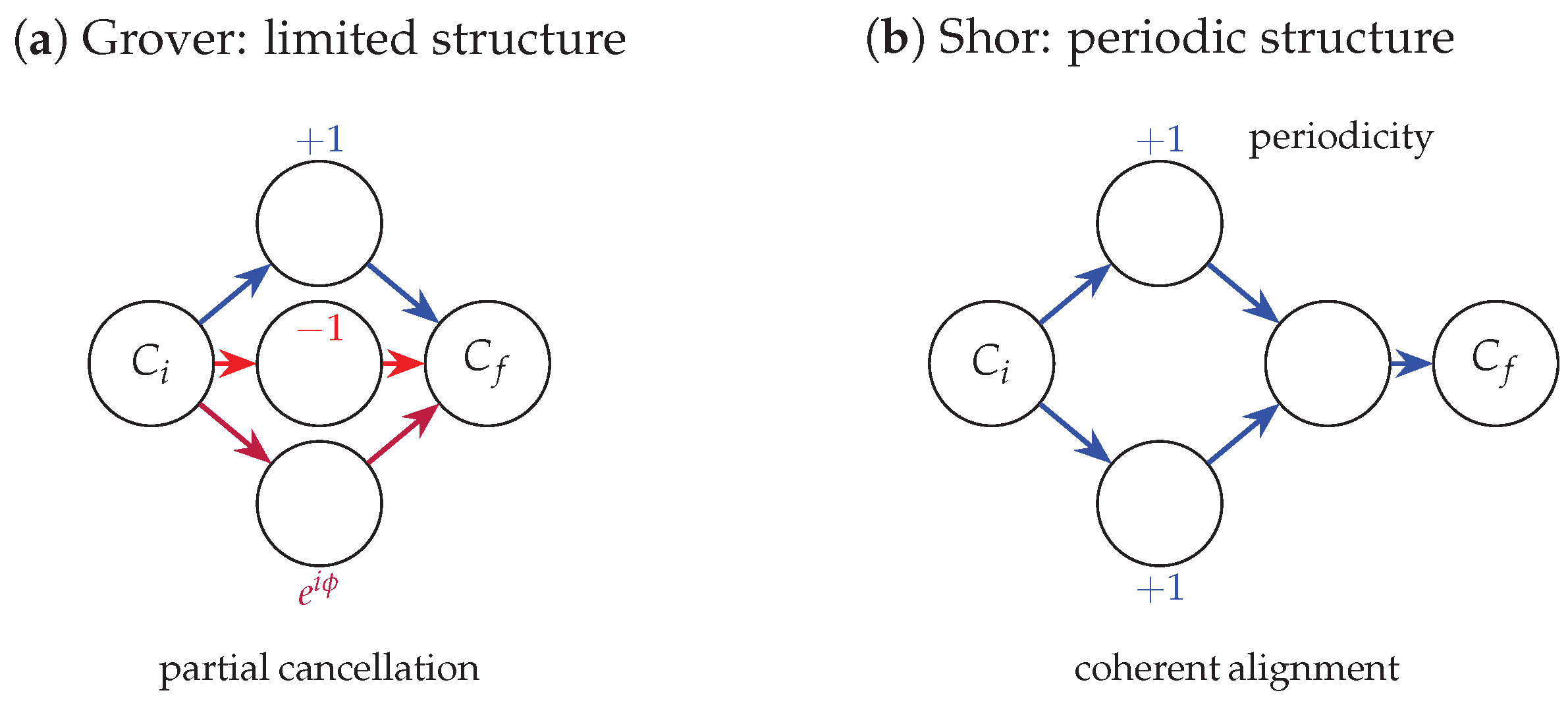
The contrast between Grover’s and Shor’s algorithms is summarized in
Table 3.
The key distinction is therefore not simply the presence or absence of superposition, interference, or entanglement-like structure. Both algorithms use quantum interference. The distinction lies in the organization of the admissible-history space. Grover’s algorithm coherently amplifies a marked component in an otherwise unstructured space. Shor’s algorithm exploits a compact global regularity that aligns large families of histories around the desired period.
Theorem 2
(Structural distinction between Grover and Shor). Within the admissible-history diagnostic framework, the structural difference between Grover search and Shor period finding is not raw history multiplicity alone but the presence of compact global regularity. Grover search organizes interference around a low-dimensional marked/unmarked distinction, whereas Shor period finding organizes large families of histories through periodicity and converts that organization into phase-coherent amplitude concentration.
Proof. Both algorithms generate large admissible-history spaces and use quantum interference. In Grover search, the oracle supplies only the distinction between the marked state and the unmarked subspace, so the relevant phase organization is effectively low-dimensional. In Shor period finding, modular exponentiation supplies the periodic relation
, and the quantum Fourier transform converts this global regularity into constructive interference at outputs encoding the period. Thus the decisive structural difference is the organization of multiplicity by compact global regularity, not multiplicity alone [
1,
2,
3,
15]. □
This comparison supports the structural interpretation developed in
Section 4 and
Section 5. Substantial advantage is favored when many histories are not only present but also coherently organized by a global structure that is non-factorizable and stable enough to survive the computation.
6.5. A Coherent-Fiber Criterion for Algorithmic Advantage
The comparison between Grover search and Shor period finding suggests a more general structural result. In both cases, the circuit creates a large admissible-history space and uses interference to reshape output amplitudes. The difference is that Shor’s algorithm does not merely amplify a marked component inside an otherwise unstructured space, as in amplitude amplification and unstructured search [
2,
3,
16]. It organizes histories into large families that are related by a compact algebraic regularity, namely periodicity, which is then extracted through the quantum Fourier transform [
1,
3,
15]. This observation motivates the following criterion.
Definition 18
(Coherent history fiber)
. Let be the circuit-induced admissible-history space associated with a circuit Q and an output configuration . A subset is called a coherent history fiber if the phases of histories in remain aligned up to a bounded phase spread , namely A fiber is large if grows with the relevant instance size. The term “fiber” is used here in a structural sense. It refers to a family of admissible histories grouped by a common computational relation, such as a marked-or-unmarked distinction, a period class, a symmetry sector, or another constraint that causes the histories to contribute coherently to a selected output. This usage is consistent with the standard observation that quantum algorithms obtain their advantage not from superposition alone but from structured interference among computational alternatives [
3,
12,
15,
17].
Theorem 3
(Coherent-fiber amplification criterion)
. Let be a partition of the circuit-induced admissible-history space into history fibers. Suppose that each fiber has internal phase spread bounded by . Then the contribution of each fiber to the unnormalized history amplitude has magnitude bounded below by Consequently, if one or more large fibers remain internally phase-aligned and their inter-fiber phases do not destructively cancel the selected output, then the effective coherent multiplicity satisfies with a leading contribution that scales quadratically in the size of the coherently aligned fibers. Proof. Fix a fiber
and choose an arbitrary reference history
. Write
Then
Multiplication by the common phase
does not change the magnitude. Projecting the remaining sum onto the direction of the reference phase gives
because
. Hence each internally phase-aligned fiber contributes at least
in amplitude magnitude. Squaring the resulting coherent contribution gives a contribution to
that scales as the square of the coherent fiber size, provided that contributions from distinct fibers are not arranged to cancel the selected output. □
This theorem is not a new complexity-theoretic lower bound. Its role is diagnostic. It identifies a concrete structural condition under which raw admissible-history multiplicity becomes computationally useful: histories must be grouped into sufficiently large fibers whose internal phase spread remains bounded. In this sense, the useful resource is not multiplicity alone but fibered coherent multiplicity. The theorem also clarifies why the same raw branching can have very different computational consequences depending on whether the circuit supplies a compact relation that organizes the branches.
Although the strongest amplification regime occurs when the coherent fibers themselves are large, Simon’s problem provides a minimal and especially transparent example: each fiber has size two, but the hidden relation partitions an exponentially large input space into coherently testable pairs. A simple worked example is therefore provided by Simon’s problem, one of the earliest examples showing an exponential quantum query advantage in an oracle setting [
3,
12]. Let
satisfy the Simon promise: there exists a nonzero hidden string
such that
for all
x, and these are the only collisions. Thus the input space is partitioned into two-element fibers
The standard quantum procedure begins with
applies the oracle
, and obtains
Measuring the second register selects one value
. Because of the promise, the first register is projected onto the coherent fiber
Applying the Hadamard transform to the first register gives
Therefore the amplitude vanishes whenever
and is nonzero only when
Each measurement produces a linear constraint on the hidden string
s. Repeating the procedure
times gives enough independent linear constraints to determine
s with high probability [
3,
12].
In the admissible-history language, the Simon promise induces a canonical partition of the history space into coherent two-element fibers:
The two histories in each fiber are not merely two independent branches. They are constrained by the global relation
. The Hadamard transform then tests each candidate output
y by comparing the relative phase of the two histories:
Using
we obtain
Thus the two histories in a Simon fiber interfere constructively exactly when
and destructively exactly when
. In the notation of the coherent-fiber criterion,
so the fiber contributes coherently. In contrast, for outputs satisfying
, the two phase contributions differ by
, so the fiber lies outside the
coherent-alignment regime and cancels exactly.
This example shows how the coherent-fiber criterion can be applied as a practical diagnostic even in the minimal-fiber case. The quantum advantage does not arise from raw branching over all inputs alone. It arises because the promise structure partitions the admissible-history space into fibers determined by the hidden relation , and because the Hadamard transform converts that fiber structure into observable linear constraints. The admissible-history framework therefore identifies the operationally useful structure before the full algorithm is analyzed: look for a hidden equivalence relation whose fibers can be made phase-coherent and then transformed into measurable constraints.
The same diagnostic also helps to sharpen the distinction among Grover search, Simon’s problem, and Shor period finding. In Grover search, the oracle separates the history space primarily into marked and unmarked sectors. The algorithm then rotates amplitude in the two-dimensional subspace generated by these sectors. This produces a quadratic query advantage, but the fiber structure is essentially the marked/unmarked distinction rather than a rich family of algebraically related coherent fibers [
2,
3,
16].
In Simon’s problem, the hidden relation
creates coherent two-element fibers. The Hadamard transform converts those fibers into linear constraints
, so the algorithm does not merely amplify a marked item; it extracts a global relation from the internal phase structure of the fibers [
3,
12].
In Shor period finding, the same principle appears in a richer form. Modular exponentiation creates families of inputs related by
so that histories associated with the same periodic structure form large regular fibers. The quantum Fourier transform then converts this periodic fiber structure into constructive interference at outputs encoding multiples of the reciprocal period [
1,
3,
15]. Thus the admissible-history framework yields a structural distinction between the algorithms: Grover amplification is coherent but organized around a low-dimensional oracle-defined partition, Simon’s algorithm extracts a hidden linear relation from coherent two-element fibers, and Shor amplification is coherent because a compact periodic regularity partitions the history space into large phase-alignable fibers.
This provides a modest but genuine algorithmic diagnostic. A problem family is a stronger candidate for substantial quantum advantage when its admissible-history space admits coherent fibers generated by a compact global relation, and when a circuit can transform those fibers into measurable amplitude concentration or constraints. Conversely, a problem with large raw branching but no stable fiber structure is unlikely, in this framework, to support more than limited amplification. The criterion therefore turns the qualitative contrast between unstructured search, hidden-relation problems, and period finding into a structural test: look not only for many histories but for stable phase-alignable families of histories selected by the computational constraints.
6.6. Tensor-Network Simulability and Compressible History Structure
The same structural language also helps to clarify why non-factorization alone is not sufficient for quantum advantage. Some quantum circuits contain entanglement or non-factorizable structure but remain efficiently classically simulable because that structure is sufficiently compressible. Tensor-network methods make this point especially clear: when the relevant correlations have low effective bond dimension, limited treewidth, or efficient contraction structure, the global quantum state or circuit amplitude may be represented and computed classically with manageable resources [
18,
19,
20].
In the present framework, tensor-network simulability corresponds to a case in which the admissible-history space is large and perhaps non-factorizable but its non-factorization has a compact classical description. The history space may contain many paths, and the phases may be correlated, but the pattern of correlation is efficiently contractible. Such a process may have nonzero in the structural sense while still failing to produce an intractable or computationally useful growth of effective coherent multiplicity.
This observation refines the role of non-factorization. The relevant question is not merely whether continuation fails to factorize but whether the resulting global structure is both:
- 1.
Coherently exploitable so that it increases for useful outputs;
- 2.
Not efficiently compressible by classical simulation so that the same structure cannot be reproduced by a low-cost classical description.
Thus tensor-network simulability provides an important boundary case for the structural speedup conjecture. A circuit may contain many histories, phase coherence, and some non-factorization yet still fail to exhibit substantial quantum advantage if the relevant admissible-history structure is classically compressible. Conversely, a promising candidate for strong quantum advantage should have not only large
M, significant
, and nonzero
but also a history-space organization that resists efficient tensor-network contraction or other classical compression methods [
18,
19,
20].
Proposition 12
(Classical compression boundary). If the non-factorizable structure of an admissible-history space admits an efficient tensor-network contraction or other efficient classical compression, then non-factorization alone is not sufficient to establish substantial quantum advantage.
Proof. Efficient classical contraction provides a classical procedure for evaluating the relevant amplitudes or expectation values without explicitly enumerating the full admissible-history space [
18,
19]. Therefore the presence of non-factorization, by itself, does not imply computational intractability. Additional structure is required: the history space must be coherently exploitable by the quantum process while resisting known efficient classical compression methods. □
This perspective is also useful for algorithm design. It suggests that a problem is structurally promising for quantum advantage when its admissible histories are organized by compact global regularities that can be exploited quantum mechanically but whose induced interference structure is not efficiently reproducible by classical contraction, sampling, or low-rank representation. Period finding is a paradigmatic example: the regularity is compactly describable, but the quantum Fourier transform exploits it through coherent amplitude concentration over a large history space.
6.7. Illustration
The structural contrast between Grover’s and Shor’s algorithms is illustrated schematically in
Figure 4. The figure is not a circuit diagram; it represents how histories contribute to a final output in the two cases.
6.8. Summary
Grover search, Simon’s problem, and Shor period finding illustrate different regimes of admissible-history organization. Grover’s algorithm has large multiplicity and controlled interference, but the relevant global structure is limited to the marked/unmarked distinction, leading to quadratic speedup. Simon’s problem shows, in a minimal and explicit form, how a hidden relation partitions the input space into coherent fibers whose phase relations can be converted into measurable linear constraints. Shor’s period-finding algorithm uses a richer compact algebraic regularity to organize phase coherence across a large history space, leading to much stronger advantage.
Tensor-network simulability provides a complementary boundary case: non-factorization and multiplicity are not sufficient if the resulting structure remains efficiently classically compressible. These examples support the central claim of the structural framework: quantum computational advantage depends not on raw branching alone but on the coordinated organization of multiplicity, phase coherence, non-factorizable structure, bounded instability, coherent-fiber organization, and resistance to efficient classical compression.
7. Relation to Quantum Complexity Theory
The admissible-history framework provides a structural perspective on quantum computational advantage. Standard complexity theory measures resources such as circuit size, circuit depth, query complexity, runtime, and error probability [
3,
4,
21]. These measures remain indispensable. The present framework does not replace them and does not redefine standard classes such as
,
, or
. Instead, it asks a complementary question: what structural features of the induced history space allow a quantum process to use those resources more effectively than a comparable classical process?
In this sense, the framework should be understood as a diagnostic layer placed alongside standard complexity theory. A circuit family may be analyzed in the usual way by gate count, query count, depth, and success probability. The same family may also be analyzed structurally by asking how its admissible histories grow, how coherently their phases are organized, whether the relevant continuation constraints factorize, and whether the resulting non-factorizable structure is stable or classically compressible.
7.1. Classical and Quantum Continuation Regimes
We begin with a qualitative distinction between classical and quantum continuation regimes.
Definition 19
(Classical continuation regime). A computational process is said to be in a classical continuation regime if, for the computationally relevant configurations, admissible continuation is effectively unique, effectively factorizable, or otherwise unable to support large-scale coherent interference across a global history space.
Definition 20
(Quantum continuation regime). A computational process is said to be in a quantum continuation regime if its computationally relevant configurations induce admissible-history spaces with nontrivial multiplicity, phase coherence, and non-factorizable continuation constraints.
These definitions are structural rather than machine-theoretic. They do not define complexity classes by themselves. Their purpose is to identify the kind of history-space organization that is absent in ordinary deterministic computation but present in quantum computation.
Proposition 13
(Classical regimes lack global interference). In a classical continuation regime, computational advantage cannot arise from large-scale constructive or destructive interference across a global admissible-history space.
Proof. If continuation is effectively unique, then there is no large family of alternative histories whose phases can interfere. If continuation is factorizable, then the history space decomposes into independent sectors. In either case, interference may be absent or confined to independent components, and there is no coherent global filtering across a non-factorizable history space. □
Thus the relevant distinction is not simply that quantum computation has “more paths.” Rather, quantum computation can organize many histories so that their phases interfere coherently in relation to global constraints.
7.2. Relation to BQP
The complexity class
consists of decision problems that are solvable by uniform families of polynomial-size quantum circuits with bounded error [
3,
4]. This definition is operational and resource-based. It specifies what a quantum computer can compute efficiently under standard circuit assumptions.
The admissible-history framework does not alter this definition. Instead, it provides a structural interpretation of why some processes may outperform known classical methods. In this language, a computation is efficient when the relevant admissible-history space can be generated, transformed, and measured by a polynomial-size quantum circuit. A large advantage is expected only when that polynomial-size circuit induces history-space structure with the following properties:
- 1.
Sufficiently large history multiplicity M;
- 2.
Phase coherence organized around computationally useful outputs;
- 3.
Non-factorizable continuation constraints encoding global problem structure;
- 4.
Bounded instability I under the relevant noise and fault-tolerant implementation assumptions;
- 5.
Resistance to efficient classical compression or simulation.
This interpretation is consistent with the fact that not every quantum circuit family yields a useful quantum algorithm. A circuit may be quantum in the formal sense, but, if its history space lacks coherent global structure or if that structure is efficiently classically simulable, it need not provide substantial advantage.
7.3. Continuation Complexity as a Structural Descriptor
The framework suggests that, in addition to standard resource measures, one may describe a computation by the structural complexity of its admissible continuation.
Definition 21
(Continuation-complexity profile)
. Let be a computational process and let be the circuit-induced history space. The continuation-complexity profile of is the collection of structural quantities evaluated on the computationally relevant configurations and input–output pairs. This profile is not a single scalar complexity measure. It is a structural descriptor. Two circuits may have similar gate complexity but very different continuation-complexity profiles. Conversely, two history spaces may have similar raw multiplicity but very different effective coherent multiplicity because their phases are organized differently.
A future quantitative theory could attempt to convert such profiles into formal complexity measures. The present paper makes the more modest claim that these quantities help to explain why circuit resources become computationally powerful in some cases and not in others.
7.4. Query Complexity and Oracle Structure
Query complexity provides a useful setting for the structural viewpoint because the oracle determines how much global structure can be imposed on the history space by each query.
In an oracle problem, the admissible-history space is shaped by repeated application of an oracle-induced continuation rule. If the oracle only marks an otherwise unstructured item, as in unstructured search, then the induced history space has limited global regularity. Grover’s algorithm exploits the available phase structure optimally, but the oracle supplies only the marked/unmarked distinction. In the present language, the history space has large multiplicity but relatively weak compressible global structure.
By contrast, in period-finding problems, the oracle encodes a global regularity
for a period
r. This regularity organizes large families of histories into phase-compatible classes. The quantum Fourier transform can then convert that structure into amplitude concentration. Thus the oracle does not merely increase multiplicity; it organizes multiplicity.
This suggests the following structural interpretation.
Proposition 14
(Oracle regularity and coherent multiplicity). In an oracle problem, large quantum advantage requires not only many query-induced histories but oracle structure that organizes those histories into phase-coherent families contributing to useful outputs.
Proof. If the oracle does not impose a global regularity on the continuation space, then histories associated with different candidate outputs lack a compact structural relation that can align their phases at scale. The raw history multiplicity may be large, but the effective coherent multiplicity for useful outputs remains limited. If, however, the oracle encodes a global regularity such as periodicity, then many histories can be organized into phase-compatible families, allowing coherent amplification of outputs that encode the regularity. □
This proposition should not be read as a formal query lower bound. It is a structural explanation that is consistent with the contrast between unstructured search and period finding.
7.5. Oracle Separations and Relativized Evidence
Oracle results play an important role in quantum complexity theory. They show that, relative to certain oracles, quantum models can outperform classical randomized models, while in other settings quantum speedup is limited. The admissible-history framework gives a structural interpretation of this phenomenon.
An oracle may be viewed as a rule that shapes admissible continuation. Different oracles impose different kinds of structure on the history space. Some oracles create only sparse or unstructured distinctions, which limit coherent amplification. Others impose global algebraic, Fourier, or hidden-subgroup-type regularities that allow many histories to be organized coherently. In this language, oracle separations reflect the fact that different continuation rules can produce very different profiles of
This interpretation does not replace relativized complexity results. It offers a structural explanation of why the oracle matters: the oracle is not merely a black-box input source but a constraint on the organization of admissible computational histories.
7.6. Entanglement Measures and Non-Factorization
The quantity
introduced in
Section 4 measures the failure of continuation constraints to factorize relative to a chosen decomposition. This is related, but not identical, to standard entanglement measures.
In Hilbert-space quantum mechanics, bipartite pure-state entanglement may be quantified by Schmidt rank or entanglement entropy. Mixed-state and multipartite settings require other measures, such as mutual information, entanglement of formation, negativity, or multipartite monotones [
5]. These quantities are defined on states or density operators. By contrast,
is defined on continuation rules or history-space constraints.
The relationship can be summarized as follows:
Standard entanglement measures quantify nonseparability of states;
quantifies non-factorization of admissible continuation;
A nonzero can generate or support entanglement in a Hilbert-space realization;
Nonzero entanglement is not by itself sufficient for speedup if the resulting structure is unstable or efficiently classically simulable.
This distinction is important. The framework does not identify quantum advantage with entanglement alone. Instead, it treats entanglement-like non-factorization as one structural ingredient that must be coordinated with multiplicity, coherence, and bounded instability.
7.7. Tensor-Network Simulability
Tensor-network methods provide an important bridge between entanglement structure and classical simulability. Many quantum states or circuits can be represented efficiently when their entanglement structure has low bond dimension, limited treewidth, or otherwise efficiently contractible geometry [
18,
19,
20]. In such cases, the presence of entanglement does not by itself imply quantum computational advantage.
In the admissible-history framework, tensor-network simulability can be understood as efficient classical compression of the relevant history-space structure. A process may have
and yet remain classically tractable if the resulting non-factorizable structure admits a compact tensor-network representation or efficient contraction algorithm.
This motivates the following refinement.
Proposition 15
(Compressibility limits advantage). If the non-factorizable structure of an admissible-history space is efficiently compressible by a classical representation, such as a low-bond-dimension tensor network or an efficiently contractible circuit tensor network, then non-factorization alone does not imply substantial quantum advantage.
Proof. Efficient tensor-network contraction provides a classical procedure for computing the relevant amplitudes or expectation values [
18,
19]. In admissible-history language, this means that the global correlations among histories can be compressed and evaluated without explicitly tracking the full history space. Therefore the existence of non-factorization does not by itself guarantee a computational separation. □
Thus the framework distinguishes two kinds of structure. Some global regularities, such as periodicity in Shor’s algorithm, can be exploited by quantum interference to concentrate amplitude in useful outputs. Other forms of non-factorization may be sufficiently low-rank, low-width, or locally contractible that they remain classically simulable. Quantum advantage requires history-space organization that is both coherently exploitable and resistant to efficient classical compression.
7.8. Compressible Regularity Versus Classically Compressible Structure
There is an important distinction between two meanings of “compressibility.” A useful quantum algorithm often relies on a compactly describable global regularity: periodicity, symmetry, group structure, or another algebraic constraint. In that sense, the problem contains compressible regularity. However, this does not mean that the resulting quantum process is classically compressible.
We therefore distinguish:
- 1.
Problem-level compressible regularity. The problem contains a compact global structure that a quantum algorithm can exploit coherently, such as the period in period finding.
- 2.
Classical compressibility of the computation. The full quantum process admits an efficient classical representation or simulation, such as an efficiently contractible tensor network.
Quantum advantage is favored when the first form of compressibility is present but the second is absent. The problem must contain exploitable global structure, but the induced interference pattern should not be efficiently reproducible by classical contraction or low-rank representation.
This distinction clarifies the role of structure in the present framework. The claim is not that all compressible structures lead to speedup. Rather, speedup is favored when compact global regularities organize a large history space in a way that is accessible to quantum interference but not efficiently accessible to classical simulation.
7.9. Toward a Structural View of Complexity
The framework suggests a possible long-term research program: to relate standard complexity classes to structural profiles of admissible-history spaces. Such a program might classify computational processes according to asymptotic behavior of
together with measures of classical compressibility, such as tensor-network contraction cost, stabilizer rank, or other simulation complexity measures.
At present, this remains a research direction rather than a completed complexity theory. The contribution of the present paper is to identify the structural quantities and explain how they relate to known distinctions between limited and substantial quantum advantage.
In this view, computational power is not determined by Hilbert-space dimension or branching multiplicity alone. It depends on how the available history space is organized, whether its phases can be aligned toward useful outputs, whether global constraints create non-factorizable structure, whether that structure remains stable, and whether it resists efficient classical compression.
7.10. Summary
This section related the admissible-history framework to standard quantum complexity theory. The framework does not redefine , circuit complexity, or query complexity. Instead, it provides a structural interpretation of why some quantum processes produce substantial advantage while others do not.
The main conclusions are:
remains the standard operational class, while admissible-history quantities describe the structure induced by polynomial-size quantum circuits.
Query and oracle problems differ structurally according to how much global regularity their oracles impose on the history space.
Non-factorization is related to entanglement but is not identical to entanglement entropy or other state-based measures.
Tensor-network simulability shows that non-factorization alone is not sufficient for advantage if the structure remains efficiently classically compressible.
Substantial quantum advantage is favored when a computation combines large multiplicity, coherent phase organization, non-factorizable global constraints, bounded instability, and resistance to efficient classical simulation.
Thus the admissible-history framework complements standard complexity theory by describing the structural organization of the computational histories on which quantum advantage depends.
8. Discussion
The framework developed in this paper provides a structural perspective on quantum computational advantage. It does not replace the circuit model, the Hilbert-space formalism, or standard complexity-theoretic definitions such as
[
3,
4,
21]. Rather, it adds a complementary layer of description: quantum computation is analyzed in terms of the organization of admissible histories, their phase relations, their non-factorizable continuation constraints, and their stability under perturbation.
This perspective is useful because it separates several features that are often grouped together under the broad language of “quantum resources.” A large Hilbert space, a large number of computational branches, the presence of entanglement, and the existence of interference are not individually sufficient for substantial quantum advantage. What matters is their coordinated organization. In the present language, a quantum computation becomes structurally powerful when many admissible histories are available, when their phases are coherently aligned toward useful outputs, when the relevant constraints encode global non-factorizable structure, and when this organization remains stable enough to survive the computation.
8.1. Structural Interpretation of Quantum Advantage
The central claim of the paper is that quantum advantage depends on the coordinated behavior of four structural ingredients:
History multiplicity
M measures how many admissible histories are available. Phase coherence
measures how strongly these histories are aligned. Non-factorization
measures the failure of continuation constraints to decompose into independent subsystem rules. Instability
I measures the fragility of this organization under perturbation, decoherence, or imperfect control.
The effective coherent multiplicity
in the phase-only case captures the coherently usable part of the history space before normalization. This quantity is not a probability and is not intended to replace standard amplitude or success-probability calculations. Its purpose is structural: it distinguishes raw branching from coherently exploitable branching.
This distinction is important. A computation may contain exponentially many formal alternatives, but, if their phases are random or poorly organized, the corresponding contributions cancel. Conversely, a computation may preserve coherence but lack enough multiplicity or global structure to generate substantial amplification. Similarly, non-factorization may create global computational dependence, but, if it is too fragile or efficiently classically compressible, it may not lead to practical advantage. Quantum speedup therefore depends on a balanced regime rather than on the maximization of any single resource.
8.2. Physical Constraints and Computational Power
A useful feature of the admissible-history framework is that it connects computational advantage with physical limitations. In standard circuit analysis, one often separates ideal algorithmic complexity from physical implementation issues, such as noise, decoherence, and fault tolerance. This separation is methodologically useful, but it can obscure the fact that the same structures enabling quantum advantage are also sources of fragility.
In the present framework, non-factorizable continuation constraints allow phase coherence to act on global computational relations. However, those same constraints can increase sensitivity to perturbations. This is why the structural speedup conjecture includes bounded instability as a necessary condition. A large non-factorizable history space is useful only if its phase relations can be preserved long enough to produce coherent amplification.
This provides a natural interpretation of fault tolerance. Error correction and fault-tolerant architectures may be viewed as mechanisms for keeping the effective instability I bounded while preserving the non-factorizable structure needed for computation. Thus the framework does not treat decoherence as an external engineering complication but as a structural limit on the usable growth of coherent multiplicity.
8.3. Algorithm-Design Heuristic
Although the present framework does not provide a new quantum algorithm, it suggests a practical heuristic for identifying problems that may be promising candidates for quantum advantage. A problem is structurally favorable when its induced admissible-history space satisfies several conditions.
- 1.
Large admissible-history multiplicity. The computation should generate many histories or computational alternatives so that there is a large space over which interference can act.
- 2.
Coherent phase organization. The problem structure should permit phases to align for desired outputs and cancel for undesired outputs. Raw branching without phase alignment is not useful.
- 3.
Compact global regularity. The histories should be organized by a global structure such as periodicity, symmetry, group structure, conservation law, or another algebraic relation. This regularity should allow many histories to be manipulated coherently at once.
- 4.
Non-factorizable continuation. The relevant constraints should link subsystems in a way that cannot be reduced to independent local continuations. Otherwise, interference acts only within separate sectors and cannot encode global computational relations.
- 5.
Bounded instability. The required non-factorizable structure should remain stable under noise, imperfect control, or error-corrected implementation. If instability grows too rapidly, coherent amplification is destroyed.
- 6.
Resistance to efficient classical compression. The induced history-space structure should not be efficiently contractible by tensor-network methods, stabilizer decompositions, low-rank representations, or other classical simulation techniques [
18,
19,
20].
This heuristic explains why period finding is structurally favorable: the problem contains a compact global regularity, the quantum Fourier transform converts that regularity into a coherent amplitude concentration, and the relevant history organization is not simply a local or factorizable pattern. By contrast, unstructured search contains large branching but only limited global structure, leading to the quadratic rather than exponential advantage of Grover’s algorithm [
1,
2].
The heuristic also clarifies what the framework can contribute to future algorithm design. It does not automatically generate new algorithms. Instead, it provides a screening principle: candidate problems should be examined for the presence of large but coherently organizable admissible-history spaces with stable, non-factorizable, and classically non-compressible structure.
8.4. Relation to Existing Approaches
The admissible-history framework is closely related to, but distinct from, several existing approaches.
First, it is related to path-integral and sum-over-histories formulations because it treats amplitudes as coherent sums over histories [
6,
7,
8]. Its distinctive feature is the use of history-space organization as a diagnostic for computational advantage.
Second, it is related to standard quantum information theory because non-factorization corresponds to the continuation-level analogue of entanglement-like dependence [
5]. However, the framework does not replace entanglement entropy, Schmidt rank, mutual information, or other state-based measures. It instead asks how continuation constraints generate or support such nonseparable structures. Experimentally accessible optical emulations of quantum-state tomography and Bell-type correlations provide useful examples of how interference, coherence, and entanglement-like structure can be studied operationally [
14].
Third, it is related to tensor-network approaches because both are concerned with the structure and compressibility of many-body quantum processes. Tensor-network simulability identifies cases where apparently large or entangled quantum processes remain classically tractable [
18,
19,
20]. In the present language, this means that non-factorizable history structure may still be efficiently compressible.
Fourth, it is related to complexity theory, but it does not attempt to redefine complexity classes. Standard complexity theory provides the operational classification; the admissible-history framework provides a structural interpretation of why certain circuit families or oracle problems fall into regimes of limited or substantial advantage [
4,
21].
8.5. Scope and Limitations
The present work is primarily conceptual and diagnostic. It proposes a structural language for interpreting quantum computational advantage, but it does not yet constitute a complete quantitative theory of quantum complexity.
Several limitations should be emphasized.
- 1.
No new complexity separation is proved. The paper does not prove new separations between classical and quantum complexity classes, nor does it derive new lower bounds for classical simulation.
- 2.
The structural quantities are representation-dependent. The quantities M, , , , and I depend on how the admissible-history space is represented. This is not unusual for path-based descriptions, but it means that additional work is needed to identify canonical or invariant formulations.
- 3.
is not a probability. Effective coherent multiplicity measures coherent contribution before normalization. Physical probabilities remain those of standard quantum mechanics.
- 4.
is not an entanglement monotone. The non-factorization degree measures failure of continuation factorization relative to a chosen decomposition. It is related to entanglement-like dependence but does not replace Schmidt rank, entanglement entropy, mutual information, negativity, or multipartite entanglement measures.
- 5.
Instability requires model-specific formalization. The instability measure I was introduced structurally and connected to noise, decoherence, and fault tolerance, but a full quantitative theory requires a specified noise model or physical implementation.
- 6.
Algorithm-design implications are heuristic. The proposed design criteria identify favorable structural conditions, but they do not by themselves construct new algorithms.
These limitations are important for positioning the paper. The framework should be evaluated as a structural interpretation and diagnostic tool, not as a completed alternative to circuit complexity or quantum information theory.
8.6. Future Directions
The framework suggests several directions for future work.
A central mathematical task is to identify when two admissible-history representations describe the same computational structure and to develop invariants of M, , , and under allowed transformations of the history description.
The instability quantity I should be formalized in concrete settings, for example through channel distances, decoherence rates, noise sensitivity, or fault-tolerance thresholds. This would allow the structural speedup conjecture to be tested against realistic quantum architectures.
The relation between admissible-history structure and classical simulability should be developed more rigorously. Tensor-network contraction cost, stabilizer rank, low-rank decompositions, and sampling complexity may provide useful bridges between the structural framework and existing simulation theory [
18,
19,
20].
The algorithm-design heuristic should be applied to candidate problem families beyond period finding and unstructured search. The framework predicts that promising problems should combine compact global regularity with non-factorizable and classically non-compressible history-space organization.
A longer-term goal is to relate structural profiles of the form
to known complexity classes and simulation boundaries. Such a program would complement, rather than replace, standard machine-based complexity theory [
21].
8.7. Summary
The admissible-history framework interprets quantum computational advantage as arising from organized history-space structure. Large multiplicity supplies alternatives; phase coherence organizes those alternatives through interference; non-factorization allows the interference to encode global computational relations; and bounded instability allows this structure to persist. Substantial advantage is therefore associated with a balanced regime in which these ingredients support one another and resist efficient classical compression.
The framework remains exploratory, but it provides a coherent diagnostic viewpoint for comparing quantum algorithms, understanding why some problem structures are favorable for quantum speedup, and clarifying why quantum computation is both powerful and fragile.
9. Conclusions
In this work we have proposed a structural framework for interpreting quantum computational advantage in terms of admissible continuation of configurations. The framework does not replace the Hilbert-space formalism, the circuit model, or standard complexity theory. Rather, it provides a complementary diagnostic language in which a quantum computation is viewed as the organization of admissible histories whose phase contributions may interfere constructively or destructively, in a manner closely related to history-based and path-integral formulations of quantum theory [
6,
7].
The central claim is that quantum advantage depends not on any single resource but on the coordinated organization of several structural features. We identified history multiplicity
M, phase coherence
, non-factorization degree
, and constraint instability
I as the main quantities that are relevant to this organization. Their combined effect is captured, in the phase-only setting, by the effective coherent multiplicity
which measures the coherently usable portion of an admissible-history space before probability normalization. This quantity is not a replacement for standard amplitudes or success probabilities but a structural descriptor of how much of the available history space contributes coherently to a computational output.
From this perspective, quantum speedup is not explained by superposition alone, nor by entanglement alone. Large branching without phase coherence leads to cancellation; coherence without sufficient multiplicity has limited amplification power; non-factorization without stability is fragile; and non-factorization that remains efficiently classically compressible need not produce substantial advantage. Useful quantum advantage instead requires a balanced regime in which many histories are available, their phases are organized toward desired outputs, their continuation constraints encode global non-factorizable structure, and the resulting organization remains stable enough to survive the computation.
This viewpoint provides a structural interpretation of the contrast among Grover search, Simon’s problem, and Shor period finding. Grover’s search algorithm exploits interference in a large but essentially unstructured search space, leading to quadratic speedup [
2]. Simon’s problem shows, in a minimal hidden-relation setting, how a promise structure partitions the input space into coherent two-element fibers whose phase relations can be converted into measurable linear constraints [
12]. Shor’s period-finding routine exploits a richer compact algebraic regularity, allowing the quantum Fourier transform to align phase contributions across large families of histories and concentrate amplitude on outputs encoding the period [
1,
15]. The difference is therefore not raw multiplicity alone but the degree to which multiplicity, phase coherence, coherent-fiber organization, and non-factorizable global structure are coordinated.
We also formulated a structural speedup conjecture: substantial quantum advantage requires scalable effective coherent multiplicity supported by non-factorizable continuation constraints whose instability remains bounded. This conjecture is not presented as a new complexity-theoretic lower bound or as a replacement for
[
4]. Instead, it is intended as a diagnostic principle linking quantum advantage to the organization of admissible-history space. The coherent-fiber criterion developed in
Section 6 gives this diagnostic a more concrete form: quantum advantage is favored when histories are not merely numerous but grouped into phase-alignable fibers generated by compact computational relations. It also clarifies why tensor-network simulability and other classical compression methods are relevant: non-factorization alone is insufficient if the resulting structure can still be efficiently represented or contracted classically.
The framework remains exploratory and requires further development. In particular, future work should seek more canonical definitions of admissible-history representations, more quantitative measures of constraint instability, sharper connections to entanglement measures and classical simulation cost, and applications to candidate quantum algorithms beyond unstructured search, hidden-relation problems, and period finding. Nevertheless, the present paper suggests that quantum computational power can be understood not only through resource counts, such as gates, depth, and queries, but also through the structural organization of the computational histories that those resources induce.
In this sense, quantum computation may be viewed as the controlled exploitation of coherent, fibered, non-factorizable, and sufficiently stable admissible-history structure. This perspective complements standard quantum computation theory [
3] and offers a framework for understanding both the power and limitations of quantum computational advantage.