
Review

Bipolar Entropy vs. Entropy/Negentropy: From Quantum Emergence to Agentic AI&QI with Collectively Entangled Bipolar Strings ER ≥≥ EPR

1
Independent Researcher, Statesboro, GA 30460, USA
2
Department of Mathematics, Ohio State University, Columbus, OH 43210, USA
*
Author to whom correspondence should be addressed.
Quantum Rep. 2026, 8(2), 36; https://doi.org/10.3390/quantum8020036

Submission received: 11 March 2026 / Revised: 14 April 2026 / Accepted: 16 April 2026 / Published: 20 April 2026

Abstract

While the quantum emergence of spacetime is becoming a major research topic in physics, the quantum emergence of intelligence has not been widely researched in quantum information science (QIS). Following causal-logical quantum gravity theory, bipolar entropy vs. entropy and negative entropy (or negentropy) are reviewed and distinguished for quantum emergence/submergence of quantum agent (QA) and quantum intelligence (QI) in algebraic terms. This work refers to QA as an entangled bipolar string/superstring in bipolar dynamic equilibrium (BDE) and QI being centered on logically definable causality in regularity, mind-light-matter unity, and brain-universe similarity. ER = EPR is extended to ER ≥≥ EPR for the mathematical scalability of bipolar strings and their collective entanglement. The extension leads to a number of conjectures, testable predictions, and theorems. The term equilibraton is proposed as a type of EPR or bipolar generic string to serve as an entropic stitch to collectively hold the universe together as a quantum entanglement in BDE with ubiquitous, regulated local emergence and submergence of QA&QI. Equilibraton leads to the concept of bipolar entropy square—a complete entropic solution to the background issue in quantum gravity. With complete background independence, energy/information conservational bipolar entropy, energy/information invariance, bipolar entropy non-additivity, and equilibrium-based plateau concavity are introduced. The nature of the one-dimensional arrow of time is conjectured. As a unification of order and disorder for equilibrium-based regulation, bipolar entropy bridges QA&QI to agentic AI, where quantum-bio-economics can be viewed as a topological intervention of a natural dynamic equilibrium in a social or natural world. Use cases are reviewed to illustrate the practical and theoretical aspects of bipolar entropy in business management, quantum-bio-economics, quantum cryptography, physics, and biology. Eddington–Einstein’s comments on entropy are revisited. It is expected that bipolar entropy will bring quantum emergence/submergence to agentic AI&QI for entangled machine thinking and imagination as a naturally scalable and testable foundation of real-world quantum gravity, quantum information science (QIS), quantum cognition and quantum biology (QCQB) to enhance Large Language AI Models (LLMs) and machine intelligence.

1. Introduction

Bipolar entropy [1] vs. entropy [2,3] and negative entropy or negentropy [4] are reviewed and distinguished using the new concepts of equilibraton, bipolar entropy square, collective entanglement of bipolar strings, energy/information-conservational bipolar entropy, energy/information invariance, bipolar entropy non-additivity, and equilibrium-based plateau-concavity. This work is focused on agentic quantum emergence/submergence based on global realism with bipolar strings (GRBS)—a causal-logical quantum gravity theory [1]. In this context, a quantum agent (QA) is referred to as a bipolar string or entanglement in bipolar dynamic equilibrium (BDE); quantum intelligence (QI) is centered on logically definable causality in regularity, mind-light-matter unity, causal-logical interpretation of quantum superposition/entanglement, and brain-universe similarity. Thus, QA&QI forms a background-independent causal-logical paradigm, distinct from quantum-mechanical misinterpretations that assume background-dependent domination.
It is shown that, with complete background independence, bipolar entropy as a unification of order and disorder, as well as entropy and negentropy, can be used for the collective regulation of bipolar strings as ubiquitous quantum entanglement for quantum emergence/submergence toward agentic AI&QI. It is further posited that QI is the origin of AI and biological intelligence (BI).
The well-known theoretical physics conjecture ER = EPR in string theory is extended to ER ≥≥ EPR as a scalable set-theoretic comparison in bipolar string theory. With the extension, ER can be an EPR or a bipolar superstring greater than EPR. The extension gives room for EPRs to be generic bipolar strings or equilibratons [5] that, as bipolar entropic stitches are proposed to collectively hold the multiple worlds (or universes) together as one unifying universe in a global equilibrium with ubiquitous local emergence/submergence of QAs for agentic AI&QI.
It is shown that bipolar entropy with ER ≥≥ EPR provides a naturally scalable and testable mathematical physics foundation for real-world quantum gravity, quantum information science (QIS), quantum cognition, and quantum biology (QCQB). Use cases are reviewed to illustrate the practical and theoretical aspects of bipolar entropy in business management, quantum-bio-economics, pre- and post-quantum cryptography, physics, and biology. It is expected that bipolar entropy will bring agentic quantum emergence/submergence to AI&QI, suitable for topological, quantum, and molecular information approaches to computation and intelligence [6,7].
This work follows the set-theoretic definitions of bipolarity, bipolar strings, and bipolar entropy [1,8]. It is assumed that action-reaction, particle-antiparticle, and/or input-output bipolarity constitutes the most fundamental property of nature [9], and a bipolar string is a bipolar quantum agent (QA or BQA) in bipolar dynamic equilibrium (BDE) characterized by a bipolar logical/algebraic state of a bipolar quantum entanglement (BQE) [8,9,10,11,12,13,14]. A bipolar generic string is a string with elementary negative-positive (−, +) poles that cannot be further decomposed. The two poles can alternate until they collapse. A bipolar superstring is a composite and/or an entangled set of multiple bipolar generic strings and/or bipolar superstrings. Bipolar strings as generic or composite quantum superposition and/or entanglement can form (emerge) and collapse (submerge); collapsed bipolar strings as unbalanced bipolar strings remain part of the global BDE that can be entangled again.
As a set-theoretic regulating measure, bipolar entropy is designated a normalized bipolar string itself for bipolar regulation. It takes the meaning of bipolarity from the ubiquitous existence of dipoles [15,16]. This interpretation unifies order and disorder as a regulated BDE but rules out the disorder-only chaotic interpretation of bipolarity. Thus, bipolar entropy restores the primordial interpretation of bipolar dynamic coexistence and interaction for equilibrium-based and harmony-centered global regulation based on bipolar sets, bipolar fuzzy sets (BFSs) [8,17,18], bipolar dynamic logic (BDL), bipolar universal modus ponens (BUMP), bipolar dynamic fuzzy logic (BDFL), bipolar quantum linear algebra (BQLA), bipolar quantum cellular automata (BQCA), and YinYang bipolar relativity [8]. Eventually, the bipolar paradigm led to global realism with bipolar strings or GRBS [1] that unifies Albert Einstein’s local realism [19] with Niels Bohr’s quantum non-locality [20] with logically definable causality in bipolar universal modus ponens (BUMP).
While truth-based unipolar entropy in both thermodynamics and information theory, positive or negative, are focused on achieving and maintaining concavity or convexity, additivity, and invariance properties of background-dependent, linear, local systems, they lack the bipolar dynamic equilibrium-based regulation property for energy/information conservation, regeneration (emergence or growth) and degeneration (submergence or aging) of collective quantum entanglement of QAs for QI. Bipolar entropy as an equilibrium-based normalization of reality for global regulation comes to fill the gap. With bipolar entropy square and equilibrium-based plateau-concavity in complete background-independence, bipolar entropy matrix as a multidimensional, equilibrium-based, regulating structure for collective quantum entanglement of bipolar strings makes the ubiquitous emergence and submergence of QAs possible for agentic AI&QI [1,21].
Use cases are reviewed to show that bipolar entropy and bipolar entropy matrix, as newly coined terms, have been researched/applied for decades with alternative names such as “bipolar strings” [8,14,22], “normalized bipolar matrix” or “bipolar quantum logic gate” (BQLG) [23]. This review is to complete the logical theory with new concepts and theoretical development focused on the algebraic aspect.
Section 1 is an introduction.
Section 2 presents a literature review on the basic concepts of classical entropy, negative entropy, and bipolar entropy. Limitations of unipolar truth-based entropy measures are identified. The significance of bipolar equilibrium-based entropy is reviewed. Modern quantum information theory frameworks/transformer-based AI models are briefly reviewed with limitations identified.
Section 3 adapts the ER = EPR conjecture in string theory to ER ≥≥ EPR for the scalability and testability of bipolar strings and bipolar entropy. “Equilibraton” is coined as an EPR or a generic bipolar string that, for the first time, links quantum entanglement to global equilibrium. Collective entanglement of bipolar strings, energy/information invariance, bipolar entropy square, and equilibrium-based plateau-concavity are proposed for QA emergence-maturity-submergence regulated by bipolar entropy. QA is bridged to agentic AI&QI with testable predictions supported by the three proofs of the theorems.
Section 4 presents a review of use cases to illustrate different applications of bipolar entropy in supply chain management, quantum-bio-economics, quantum cryptography, quantum physics, quantum biology, and quantum cognition.
Section 5 presents an analysis and discussion. Albert Einstein’s famous comment on entropy is distinguished from Sir Arthur Eddington’s comment. The distinction further clarifies the unifying nature of bipolar entropy vs. unipolar entropy.
Section 6 consists of a few concluding remarks.

2. Literature Review

2.1. Entropy

Classical entropy is a scientific concept most commonly used for the states of disorder, randomness, or uncertainty. Together with energy, entropy constitutes a cornerstone of physics and information science (IS). French engineer and “father of thermodynamics” Sadi Carnot (1796–1832) laid the foundation [24] of thermodynamics and entropy by proposing that heat engines require a temperature difference to produce work, implying that heat is always wasted (energy dissipation). The word “entropy” was coined in 1865 by German physicist and mathematician Rudolf Clausius (1822–1888) along abstract lines focusing on thermodynamical irreversibility of macroscopic physical processes [2,3]. In 1870, Austrian physicist Ludwig Boltzmann made the genius connection between the microscopic motion of atoms and macroscopic thermodynamic properties, establishing the foundations of statistical mechanics [25,26]. American physicist, chemist, and mathematician Josiah Gibbs (1839–1903) [27,28] was another founding father of statistical mechanics and physical chemistry. While Boltzmann focused on the behavior of individual atoms, Gibbs pioneered the use of statistical ensembles—considering many virtual copies of a system—to derive the laws of thermodynamics. The extension to quantum mechanical systems was formalized by John von Neumann in 1927 [29], and the connections with the theory of communications and, more widely recognized, with the theory of information were introduced by Claude Shannon in 1948–1949 [30,31,32]. Since then, many new entropic functionals emerged in scientific and technological literature (ref. [33]).
Key aspects of normalized 0–1 entropy include:
  • zero entropy: indicates zero uncertainty; all elements belong to a single class, providing maximum purity.
  • maximum entropy: indicates maximum uncertainty, typically occurring with a 50/50 split in a binary system (maximum disorder).
  • range interpretation: values closer to 0 represent high purity, while values closer to 1 represent high randomness or low purity.
  • calculation: calculated or normalized for systems with more than two classes.
Hilbert space [34] is believed by most modern physicists to be the quantum geometry [35] and statistical information geometry [36,37]. Hilbert space is seen as more fundamental than Euclidean geometry for entropy. At the deepest level, such as quantum gravity, researchers argue that “geometry is entropy,” meaning the physical dimensions we perceive (like Euclidean 3D space) may actually be an emergent property of underlying entropic relationships between quantum states.
Basic Properties of Entropy. Entropy, as a fundamental concept in thermodynamics and information theory, measures the disorder, uncertainty, or unavailability of energy within a system. As a state function, its value depends only on the system’s current state, not how it reached that state. The three most fundamental properties of classical entropy include:
(1)
Additivity (Extensivity). Entropy is an additive or extensive quantity. If a system is composed of independent subsystems, the total entropy is the sum of the entropies of its parts. Thus, entropy additivity assumes the independence of the subsystems.
(2)
Invariance. Entropy often exhibits invariance properties. The entropy of a probability distribution remains unchanged if the order of probabilities is rearranged, and this is referred to as permutation invariance. In physics, entropy is a relativistic invariant; the number of microstates (and therefore entropy) remains the same regardless of the observer’s inertial frame of reference, and this is referred to as relativistic invariance.
(3)
Concavity (Maximum Entropy Principle). Entropy is a concave function of the probability distribution (or of the system’s energy/volume parameters). This property implies that for a given amount of energy, the entropy is maximized when the system is in equilibrium. The concave nature means that mixing two different states or averaging two distributions generally increases or keeps the total entropy constant.

2.2. Negative Entropy

Negative entropy, often called negentropy or syntropy, was proposed by Austrian physicist Erwin Schrödinger (1887–1961). Schrödinger’s book What is Life? [4] stimulated research in quantum biology. He famously stated that life “feeds on negative entropy” [4]. But, in a later edition, he restated that the true source is free energy.
Contrary to standard entropy as a concave function of disorder, negative entropy is a convex function of order, organization, and information within a system. While standard entropy represents the natural tendency toward chaos, negative entropy represents the active maintenance or increase in structural complexity. Living organisms survive by importing “order” from their environment (food, sunlight) to export the entropy they naturally produce, thus delaying their decay into eternal equilibrium or death.
While Schrödinger introduced the general concept of “negative entropy” to explain biological order, Léo Brillouin was regarded as the first to formalize the term “negentropy”. He shortened Schrödinger’s phrase, bridged it to information theory [38], and generalized it into the mathematical domain. This distinction is crucial because while Claude Shannon viewed entropy as the potential for information (uncertainty at the source), Brillouin viewed negentropy as the realized information (the certainty gained at the destination).
Negative entropy has been applied in quantum mechanics (QM). Modern research suggests that in quantum entangled systems, “conditional entropy” can mathematically become negative. This allows for unique thermodynamic processes, such as gaining work while erasing information, which effectively cools the environment. Recent research results on negative entropy in quantum mechanics, quantum information science, and quantum cognition include but are not limited to the reported works in [39,40,41,42,43,44].

2.3. Limitations of Unipolar Entropy

Notably, in physics, background independence means a theory that does not rely on a fixed, pre-existing spacetime geometry. It has been a long-sought property in the quest for quantum gravity (QG) [45,46,47]. Without background independence, quantum emergence of spacetime, as well as any new concept in the human brain, would be impossible. Adaptive machine thinking and learning would be impossible [1]. It is stated [48]: “An urgent issue in both physics and the philosophy of physics is to work out exactly what is meant by ‘background independence’ in a way that satisfies all parties, that is formally correct, and that satisfies our intuitive notions of the concept”. The urgent issue remained logically unsolvable until BDL, BQG, BUMP, and GRBS theories were developed with a complete formal causal-logical QG solution [1,8].
Although Hilbert space and information geometry have been widely applied, especially in QM, QIS, and QG theories, the geometrical spaces are limited by their background-dependent probabilistic/statistical nature. Without bipolarity for equilibrium-based BQG, BDL, BQLA, and BUMP, logically definable causality in regularity is unreachable in Hilbert space, real-world quantum gravity [1] with mind-light-matter unity [9,10] and brain-universe similarity [49] is impossible, entangled machine thinking and imagination remained unimaginable in causal-logical terms, and global realism with bipolar strings [1] could not be reached for the unification of locality and quantum non-locality.
Many physicists agree that the final theory of quantum gravity ought to be background independent. But most mainstream theories, like QM, quantum field theory (QFT), and string theory, are well-known, predominantly background-dependent theories. They rely on a fixed, non-dynamical background space-time to define states, operators, and measurements, rather than allowing space-time geometry to evolve or emerge dynamically. Thus, any formal proof of complete background independence is viewed as a significant conceptual breakthrough that moves physics closer to a Theory of Everything (TOE). Notably, up to the present time, the GRBS theory [1,8] is the only formal causal-logical quantum gravity theory that claims complete background independence with BUMP in BDL/BQG. The key to the solution lies in the equilibrium-based causal-logical nature of the theory.
Notably, without bipolar dynamic equilibrium, general relativity (GR) [50,51] and loop quantum gravity (LQG) [52,53] became the most prominent “background independent” theories. Unfortunately, these theories are still being-centered and truth-based, that prevent them from going beyond spacetime to reach logically definable causality in regularity for complete background independence in spacetime transcendent equilibrium-based terms. In Einstein’s GR theory [50,51], spacetime is modeled as a four-dimensional manifold. The stage is the manifold itself that provides the raw set of points (events) and their connectivity. It tells you which points are “next to” each other. The manifold alone does not tell you how far apart points are or how time flows. For that, you must add a “metric” or ruler. Then, gravity is the curvature that tells what happens when matter and energy “warp” the geometry of this manifold stage. On the other hand, LQG is more background-independent than GR, but it still carries its own subtle “baggage.” While LQG removes the “metric” (the ruler) from the background entirely, it often still relies on a fixed topology (the global layout) of the space it is quantizing.
Classical entropy as a measure of disorder and negative entropy as a measure of order are both unipolar concepts originating from local realism. Bipolar entropy, on the other hand, originated from global realism with bipolar strings [1,8]. The former is truth-based; the latter is equilibrium-based, bipolar dynamic, and completely background independent, specifically for regulating quantum-entangled bipolar strings in BDE.
Limitations of Boltzmann entropy. Boltzmann’s work [25,26] was revolutionary because it proved the existence of atoms through statistics at a time when many scientists doubted they were real. His approach later influenced Max Planck [54] and became a bridge to quantum mechanics and information theory. Boltzmann defined entropy (S) as a measure of the number of possible microscopic arrangements (microstates, W) that result in the same observed macroscopic state (macrostate). His famous formula, now engraved on his tombstone, is
S = k ln W,
where S is entropy; k = 1.38 × 10⁻²³ J/K is the Boltzmann constant; J/K (Joules per Kelvin) is the unit for entropy.
Background dependence is widely considered the major limitation of Boltzmann entropy. Its definition typically relies on a fixed, pre-existing geometric framework or an external observer’s knowledge to define microstates and macrostates. Unlike theories that are “background independent”, the standard Boltzmann formulation assumes a given manifold or phase space in which particles reside.
Limitations of Shannon entropy. Shannon information entropy is a measure of the average uncertainty in a random variable [30,31,32]. It quantifies the minimum number of bits required to encode information from a source. Typically, for a coin flip there are two (base = 2) outcomes (x1 and x2 respectively for up or down) each has a probability p = 0.5, the entropy is calculated as
E ( x ) = i = 1 n p ( x i ) log b p ( x i )   =   ( ( 0.5 ) log 2 ( 0.5 )   +   ( 0.5 ) log 2 ( 0.5 ) ) =   ( 0.5   ×   ( 1 ) )   +   ( 0.5   ×   ( 1 ) )   =   0.5   +   0.5   =   1 .
Surprisingly, the result 1 in the base 2 case stands for “1 bit binary information is needed”—a typical example of Shannon information entropy. While Shannon entropy is claimed background independent, it is limited to unipolar classical bits, not quantum physical, and not equilibrium-based bipolar interactive. Thus, it lacks the dynamics for quantum emergence of spacetime and agentic AI/QI.
Limitations of von Neumann entropy. Different from Shannon entropy, von Neumann entropy, as a quantum mechanical extension, can be used to describe quantum states including entanglement [29]. In standard quantum information theory, however, von Neumann entropy is basis-independent, but it takes its background from quantum mechanics in Hilbert space. Thus, it achieves basis independence where von Neumann entropy (S) depends only on the eigenvalues of the density matrix (ρ). Because the trace is invariant under unitary transformations, S(ρ) remains the same regardless of which orthonormal basis (coordinate system in Hilbert space) you choose to represent the state. Similarly, von Neumann quantum logic is based on Hilbert space [55].
While von Neumann entropy is widely used as quantum entropy and is claimed to be mathematically background-independent in its abstract Hilbert space form, its application in physics almost always sneaks a “background” back in—a major tension in physics. As reviewed earlier, LQG provides such an example. LQG claims to be the “king” of background independence among all quantum gravity theories because it does not assume a pre-existing stage of space. However, LQG uses Spin Networks. While the network is the space, the topology (how the nodes are connected) acts as a structural background. Entropy is calculated based on “quanta of area” puncturing a surface. This surface is often a “boundary” which, in practice, serves as a fixed reference or background for the calculation. Quantum Entropy as Geometry is another example. Following Hawking’s initial idea that entropy is geometry [56], many works have appeared in the research area of quantum entropy and geometry. However, without a complete causal-logical solution to background independence, researchers could not find a definitive battleground for quantum gravity. Subsequently, quantum measurement was once taken as a definitive battleground in QM that led to the “Shut up and calculate!” spirit as ironized in [57].
AI Use of Entropy. While standard large language AI models (or LLMs) use Shannon entropy as information for next-token prediction, von Neumann entropy is increasingly used as quantum entropy in machine learning of transformer-based LLMs, such as in foundational transformer models [58,59,60], modern entropy-based AI analysis [61,62], and quantum transformer frameworks [63,64].
Transformer-based AI models are a class of neural networks that process sequential data by analyzing all parts of a sequence simultaneously rather than word-by-word. First introduced by Google [58], this architecture has become the foundation for nearly all modern generative AI systems, including latest ChatGPT-5. The defining feature of a transformer is its ability to understand context through several key components:
Self-Attention: This mechanism allows the model to weight the importance of different words in a sentence, regardless of their distance from each other. For example, in the sentence “The animal did not cross the street because it was too tired,” self-attention helps the model identify that “it” refers to the “animal”.
Positional Encoding: Since transformers process data in parallel, they lack an inherent sense of order. Positional encoding adds “tags” to data elements to preserve their relative positions in a sequence.
Parallel Processing: Unlike older Recurrent Neural Networks (RNNs) that processed data step-by-step, transformers can handle entire sequences at once, making them significantly faster to train and more scalable.
Different models use different parts of the original transformer structure (Encoder–Decoder) depending on their primary task. Popular transformer architectures include, but are not limited to:
Encoder-Only (BERT): Excellent for understanding language, sentiment analysis, and text classification.
Decoder-Only (GPT series, Llama, Claude): Optimized for generating text by predicting the next token in a sequence.
Encoder–Decoder (T5, original Transformer): Often used for translation or summarization, where an input is converted into a different output.
Famous in Large Language Models (LLMs), transformer technology has expanded into other fields beyond text, including but not limited to:
Computer Vision: Vision Transformers (ViTs) break images into “patches” to process them like text tokens for object detection and image segmentation.
Healthcare: Used to analyze DNA sequences and protein folding structures to speed up drug discovery.
Audio and Robotics: Powering speech recognition and complex “world models” for autonomous agents.
Key Limitations of Transformer Technology. Despite their power, these models face challenges such as high computational and energy costs, a lack of causal-logical transparency in decision-making, and fixed “context windows” that limit how much information they can recall at once. Thus, a key limitation of these models is their lack of logically definable causality in regularity for quantum emergence with entangled machine thinking and imagination (EMTI) [1]. EMTI with BDL, BUMP, and bipolar entropy could be exactly what they need to go beyond their limitations.
Limitations of Negative Entropy. In standard physics and information theory, negentropy or negative entropy is not background independent. Because it is defined relative to a specific state or system, it inherits the “background” dependencies of the entropy measure it is based on. When using the von Neumann entropy to define quantum negentropy, it inherits basis independence. Like von Neumann entropy, it is invariant under unitary transformations (rotations in Hilbert space). It remains “background-dependent” because it requires a pre-defined Hilbert space and often a fixed spacetime metric to define the system and its subsystems.
In thermodynamics, negentropy is often a measure of the “free energy” or the order imported by a system (like a biological organism) from its environment.
  • Relativity: Negentropy is always described relative to the entropy of the surroundings.
  • Dependency: This makes it strictly dependent on the physical “background”—the specific environmental conditions (temperature, pressure, and geometry) that define the “maximum entropy” state of that system.
On a local scale in thermodynamics, negative entropy occurs when a system becomes more ordered. For example, when water freezes into ice or when a messy room is cleaned. However, the second law of thermodynamics dictates that these local gains in order must be paid for by a larger increase in disorder elsewhere in the universe. This observation suggests that (1) unipolar entropy is insufficient, and (2) bipolar entropy is needed for unifying order and disorder.

2.4. Bipolar Entropy

Not only can bipolar entropy in the bipolar fuzzy set lattice [−1, 0] × [0, +1] [8,17,18] unify order and disorder or entropy and negentropy, but it also bridges AI and QI. When a normalized bipolar entropy has an absolute value |(x, y)| = |x| + |y| = 1.0, it is an energy/information conservational normalization of reality for QAQI. Otherwise, the normalization leads to agentic AI/QI. Evidently, AI and QI can be intertwined.
Despite the great significance of classical entropy in the classical world, bipolar entropy makes it possible to unify the classical and the quantum worlds. The bipolar approach is equilibrium-based, causal-logical, top-down/bottom-up, and holistic in nature. Notably, entropy and negentropy are unipolar being-centered, truth-based, and atomistic without bipolar interaction in background independent geometrical terms [8,13].
Classical truth-based entropy in both thermodynamics and information theory is fundamentally focused on achieving and maintaining concavity, additivity, and invariance properties. These properties are essential for ensuring that entropy acts as a reliable, consistent measure of disorder, uncertainty, or information from an atomistic bottom-up perspective. Without bipolarity for bipolar dynamic equilibrium, truth-based being-centered logic cannot reach logically definable causality in regularity and mind-light-matter unity because truth-based reasoning is housed within spacetime, and cannot reach background independence for spacetime emergence, such as quantum agent emergence for QI and AI as entangled bipolar strings.
On the other hand, bipolar strings can be collectively entangled into a global bipolar dynamic equilibrium or BDE with complete background independence for quantum emergence and submergence. With background independence, a global BDE is actually multidimensional in nature, such as the cost-revenue of a company is the total of the subtotals of all its divisions. This enables bipolar entropy to be derived from a normalization of reality for energy/information conservation, regeneration, and degeneration. The key is that bipolar strings and bipolar entropy are completely background-independent, while unipolar entropy is either non-physical, such as Shannon entropy, or background-dependent, such as Boltzmann and von Neumann entropy.
For instance, with bipolarity and complete background independence, the input-output bipolar string (−100, +300), physical or biological, can be easily normalized to a bipolar entropy measure for holistic regulation.
(−x, +y) = (−100, +300)/400 = (−100/400, +300/400) = (−0.25, +0.75),
where the base 400 is the absolute total |(−100, +300)| = |−100|+|300| = 400. In this case, |(−x, +y)| = |(−0.25, +0.75)| = 1. The bipolar entropy (−x, +y) = (−0.25, +0.75) is a normalized reality for regulating the input-output of a bipolar QA for QI with information conservation, such as (−0.25, +0.75) × (−100, +300) = (−150, +250) where |(−150, +250)| ≡ |(−100, +300)| ≡ 400.
While the above example is a single isolated case, in real applications, multiple input-output pairs could be entangled to form a network, such as in supply chain management and international trade. In that case, the base could be the absolute total of all input-output pairs; the entropy measures would form an entropy matrix for intelligent energy/information rebalancing and coordination. It shows that not only can bipolar entropy unify real-world disorder and order or entropy and negentropy but also enables AI and QI agents to emerge and submerge as quantum entanglement of bipolar strings. While the unipolar truth-based nature of entropy or negentropy prevents classical entropy from regulating an entangled bipolar string collection as an emergent agent, bipolar entropy and bipolar entropy matrix with bipolar interaction can fill in the gap naturally for ubiquitous quantum entanglement [8,65] with mind-light-matter unitary AI&QI [1,9,10].
It is noted in [1], without YinYang bipolar complementarity for equilibrium-based bipolar sets, logic, and algebra [8,17,18], standard entropy and negative entropy as unipolar concepts could not free Schrödinger from truth-based and being-centered singularity. As a result, he stopped short of inventing bipolar entropy to unify order and disorder—a key step for Nature’s bipolar coexistence/interaction to reach logically definable causality [8], mind-light-matter unity [9,10,66], causal-logical quantum entanglement and quantum gravity [1,13,14], global realism with bipolar strings or GRBS [1]. Subsequently, without equilibrium-based bipolarity, entropy and negentropy cannot perform the collective regulating function for bipolar quantum entanglement/superposition. As a result, Schrödinger’s Cat paradox (Schrödinger 1935) [67] remained a mystery for nearly a century.
With (−,+) bipolarity, the Cat paradox is resolved with BDL for bipolar strings with complete background independence. Entangled bipolar strings can follow a causal-logical pattern defined by BUMP. Given bipolar strings b1, b2, b3, b4, and let ∗ be any bipolar logical operator, BUMP states
[(b1b2)&(b3b4)] ⇒ [(b1b3) ⇒ (b2b2)]; or [(b1b2)&(b3b4)] ⇒ [(b1b3) ⇔ (b2b4)].
While BUMP provides definable causality in logical terms, bipolar entropy and bipolar entropy matrix provide the bipolar algebraic measures for QAQI [8,23,68]. Thus, a bipolar entropy matrix is defined as a holistic regulatory structure for the unification of order and disorder of reality as a quantum entangled collection of bipolar strings in dynamic equilibria or non-equilibria [1,8]. Formally, bipolar entropy is defined as a normalized elementary regulatory measure in the bipolar fuzzy (quantum) lattice [−1, 0] × [0, +1]; a bipolar entropy matrix is defined as a holistic regulatory matrix of bipolar entropy measures [1].
It is pointed out [1] that “Since a perfect bipolar energy/information equilibrium can be characterized by the bipolar logical or bipolar entropy value (−1, +1), its truth-based representation can be calculated as |−1 + 1| = 0, the lowest disorder measure for a perfect bipolar equilibrium. On the other hand, a bipolar non-equilibrium can be characterized by the value (−1, 0) or (0, +1); its truth-based representation can be calculated as |−1 + 0| = 1 or |0 + 1| = 1, the highest disorder measure for a bipolar non-equilibrium. While in the truth-based unipolar case, 0 shows no disorder but no representation of non-existence, (0, 0) shows non-existence in the bipolar case. In the bipolar fuzzy case, order and disorder are unified. For instance, (−0.5, +0.7) = {(−0.5, +0.5) + (0, +0.2)}, where (−0.5, +0.5) shows the balance or order, and (0, +0.2) shows the disorder.” (Note: When the bipolar logical value (−1,+1) is used as a regulative entropy measure, it leads to balanced, fast, ordered growth, but not energy/information conservational.)
With a normalized bipolar matrix [8,14] as a bipolar entropy matrix [1], bipolar energy/information can be conserved, regenerated, or degenerated in an entangled structure named bipolar quantum cellular automaton (BQCA) modeled with BQLA [8]. Equations (1a)–(1c) provide the elementary equations for the transformation of a bipolar quantum superposition to an entangled BQCA, where E(t) is a bipolar column vector and M(t) a BQLG [23] as a specific type of BQLA matrix at time t (See use case in Section 4).
For ∀(x, y), (u, v) ∈ B = [−∞, 0] × [0, +∞], we have the elementary operations:
  • Bipolar Elementary Multiplication/Interaction:
(x, y) × (u, v) = (xv + yu, xu + yv);
  • Bipolar Elementary Addition/Superposition:
(x, y) + (u, v) = (x + u, y + v)
  • Bipolar Quantum Cellular Automaton (BQCA):
E(t + 1) = M(t) × E(t).
Why do we need BQLG, BQLA, and BQCA while linear algebra has been taught in college algebra classes for centuries? A simple answer [1] is that classical linear algebra (LA) cannot accommodate the non-linear bipolar dynamic coexistence of equilibrium information. For instance, let (−0.1, +0.1) and (−1,000,000, +1,000,000) be different I/O bipolar balances, with LA, we have the information loss (−0.1 + 0.1) = (−1,000,000 + 1,000,000) = 0.
With BQLA, let the absolute bipolar elementary energy |ε|(x, y) = |x| + |y|; let C(t) be input-output energy/information matrix; let M(t) = normalize(CT(t))); and let |εcol|M∗j(t) be the energy/information of the j column, M(t) forms a BQLG [23,69], and we have Equations (2a)–(2c) for a BQCA.
  • Energy/Information Conservation: ∀j, |εcol|M∗j(t) = 1.0,
    |ε|E(t + 1) = |ε|(M(t) × E(t)) ≡ |ε|E(t);
  • Energy/Information Regeneration: ∀j, |εcol|M∗j(t) > 1.0,
    |ε|E(t + 1) = |ε|(M(t) × E(t)) > |ε|E(t);
  • Energy/Information Degeneration: ∀j, |εcol|M∗j(t) < 1.0,
    |ε|E(t + 1) = |ε|(M(t) × E(t)) < |ε|E(t).
In Equations (1a)–(1c) and (2a)–(2c), M(t) is actually a bipolar entropy matrix [1]—a normalized bipolar relational or algebraic matrix of bipolar entropy elements that make the bipolar energy vector E(t) a regulated collection of entangled bipolar strings of a multidimensional QA. Here, the normalization (M(t) = normalize(CT(t))) is locally (column) linear but holistically (matrix) non-linear. The local linearity enables quantum agent QAj to be locally regulated; the holistically non-linear property makes nonlinear bipolar dynamic interaction/regulation possible. The collum linear property is achieved by normalizing each bipolar element in a column with the subtotal energy/information of that column. The holistic non-linearity is a natural result of using different column subtotals to normalize different columns. (Note: M(t) must meet certain conditions. Re. Theorems 1–6 of [69])
Different from unipolar (negative or positive) entropy, bipolar entropy matrix, as a holistic structure can play the forming and regulating roles of an AI/QI agent with energy/information conservation toward a global dynamic equilibrium with local or temporal regeneration (or growth) and degeneration (or aging) in physical, logical, mental, biological, and social-economic terms. Thus, bipolar entropy leads to quantum cellular bio-economics, equilibrium-based business intelligence, information conservational quantum-fuzzy cryptography, thermodynamic equilibrium, and real-world quantum gravity RWQG [1].
While truth-based entropy as a scientific concept as well as a measurable physical property is usually associated with a state of disorder, randomness, or uncertainty, it stopped short of going beyond the first principles and the second law to reach logically definable causality [8]. With bipolarity, BUMP in BDL provides definable causality for bringing disorder, randomness, or uncertainty to an entangled equilibrium and harmony. That makes mind–light–matter unity AI&QI possible [1,9,10].
Table 1 shows a comparison between equilibrium-based bipolar entropy and truth-based unipolar entropy. It should be remarked that, even though information such as a bit in Shannon entropy can be non-physical, its bivalent/unipolar nature forms the basis for Boolean logic but not for equilibrium-based BDL and BUMP. Thus, truth-based information is a being-centered measure within spacetime. Although von Neumann entropy is used as quantum entropy, it is still inherently truth-based. That is why GR and LQG are commonly claimed to be background independent but still assume a certain background without complete background independence for quantum emergence/submergence. When unipolar entropy is used in LLMs for AI machines, classical or quantum, the unipolar nature is inherently an impasse to the equilibrium-based bipolar dynamic causal-logical property.

3. Bridging AI and QI with Bipolar Entropy

3.1. AI and Its Limitations

Artificial Intelligence (AI) is a field of computer science dedicated to creating systems capable of performing tasks that typically require human intelligence, such as automated reasoning, machine learning from experience, problem-solving, and computer vision. Alen Turing and John McCarthy are widely regarded as the fathers of AI. The term “Artificial Intelligence” was coined by John McCarthy in 1955 in the proposal for the 1956 Dartmouth Summer Research Project on Artificial Intelligence, co-authored with Marvin L. Minsky, Nathaniel Rochester, and Claude E. Shannon (McCarthy et al. 1955, Republished 2006) [70].
Types of AI include narrow or weak AI and general AI (AGI) as strong AI. Weak AI is the only type currently in existence, excelling at specific tasks like voice assistants or recommendation systems. AGI is a theoretical future development where AI possesses human-level intelligence across various domains. Generative AI is a modern form of AI that creates new content, such as text or images.
While AI technologies have been applied in numerous fields, it is widely deemed unable to reach human-level intelligence [71,72] because AI machines are believed to be unable to think like humans [73]. In general, AI lacks an equilibrium-based causal-logical quantum gravity property that enables the emergence and submergence of spacetime and quantum agents for entangled causal-logical machine thinking and imagination [1,9,10].

3.2. ER ≥≥ EPR—An Extension of ER = EPR

Entropy and negative entropy measures of the classical truth-based world were designated regulation measures of reality. Without input-output, action-reaction, and particle-antiparticle bipolarity, however, the unipolar nature of entropy or negentropy prevents them from equilibrium-based dynamic regulation of reality as ubiquitous quantum entanglement of bipolar string collections for ubiquitous spacetime or quantum agent emergence/submergence [1,8,21]. One-dimensional string theory [74,75,76,77,78] is subject to the unipolar limitation. In general, the truth-based unipolar bivalent tradition could not reach bipolar dynamic equilibrium-based, logically definable causality for more than 2300 years since Aristotle’s causality principle was made a cornerstone of science. A key reason for the dilemma is that “without bipolar dynamic equilibrium, being and truth as static unipolar concepts in the human mind could not go beyond spacetime to perform the causal–logical quantum gravity function of God/Nature with complete background independence for spacetime emergence—a distinction of GRBS from local realism.” [1].
In contrast, bipolar string theory as a bipolar dynamic, equilibrium-based, set-theoretic theory is a causal-logical unification of the physical and mental worlds [8,9,10,11,12,13,14,22]. YinYang bipolar relativity made the collective regulation of bipolar strings possible for ubiquitous emergence/submergence of bipolar quantum entanglement to form bipolar QA (or BQA) in complete background independence.
Bipolar strings as bipolar fuzzy sets [8,17,18] have led to GRBS [1], which forms a real-world quantum gravity theory—a bipolar relativistic causal–logical reconceptualization and unification of string theory, loop quantum gravity, and M-theory—the three roads to quantum gravity [45]. While string theory has been criticized for the lack of testability [47,79,80], causal-logical quantum gravity theory found real-world AI&QI applications [1,9,10] with a formal solution to the urgent issue of background independence in both physics and the philosophy of physics [48].
Is there a bridge between strings and bipolar strings?
Surprisingly, the ER = EPR conjecture in string theory [81] can be extended to ER ≥≥ EPR as a logical bridge between strings and bipolar strings. ER stands for Einstein–Rosen bridge [82] or wormhole [83] as a solution to general relativity that describes a large-scale geometric connection between two distant points in space-time. EPR stands for an Einstein–Podolsky–Rosen pair [19] referring to quantum entanglement between two subatomic particles at the microscopic level. While ER and EPR are both dipoles, they can definitely be different in energy/information levels. More precisely, ER can be a bipolar superstring or an input-output bridge of two parallel universes, and EPR a generic bipolar string or quantum entanglement at the subatomic level [1]. However, ER can also be extended to the microscopic sub-atomic level.
While the ER = EPR conjecture is a result of the belief by some physicists that entangled particles might actually be connected by tiny wormholes, this wild idea suggests that spacetime itself could be made of quantum entanglement. In other words, the entire universe might be stitched together by invisible threads of quantum information. But it is not clear how these threads can accomplish the stitching job without logically definable causality for the emergence/submergence of quantum agents. To answer the question, we need a scalable bipolar string theory.
Conjecture 1.
ER and EPR are both bipolar strings but can be different in size. ER can be either a bipolar generic string or a non-generic bipolar superstring; EPR is a bipolar generic string or quantum entanglement. Thus, we have ER ≥≥ EPR, where the relational operator ≥≥ stands for “bipolar larger or equal to” for bipolar comparison in set-theoretic terms [8,17,18].
Conjecture 2.
ER ≥≥ EPR provides open-world and open-ended scalability and testability for bipolar string theory that is completely background independent.
Conjecture 3.
Bipolar strings can be collectively entangled with self-organization regulated by bipolar entropy into bipolar superstrings, such as the ER bridge at different levels.
Conjecture 4.
Generic bipolar string as a fundamental quantum entanglement or EPR can function as an equilibraton—a spacetime transcendent, background-independent entropic stitch of reality in global BDE [1,5].
Conjecture 5.
Equilibratons can collectively stitch all particles and multiple worlds (or multi-universes) together into one unifying universe with ubiquitous local emergence and submergence of spacetimes or quantum agents (QAs) as entanglements of bipolar strings in BDE.
Conjecture 6.
QAs are bridges between QI and agentic AI for energy/information conservation, regeneration, or degeneration.
Conjecture 7.
Bipolar coexistence and interaction are the origin of cause-and-effect, evolution, and QAQI; Nature’s causal-logical property, defined by BUMP in BDL for GRBS, is the origin of human consciousness and cognition; QI is the origin of AI; bipolar dynamic equilibrium is the origin of being, truth, BI, and human intelligence; equilibrium-based bipolar entropy is the origin of truth-based unipolar entropy.
Conjecture 8.
Equilibratons are the most basic elements of dynamic existence in BDE, which answers the thousand-year-old question “What is there?”.
Conjecture 9.
Equilibratons provide the grand unification with input-output, action-reaction, and particle-antiparticle BDEs that subsume the observed and hypothetical graviton-antigraviton BDE as well as BDEs in dark energy and dark matter.
Now, with the extension of ER = EPR to ER ≥≥ EPR, “equilibraton” is coined for the grand unification. Hopefully, it would serve as a bridge between the bipolar string theory and the standard model in physics, as well as a bridge from IS to QIS. Notably, among the basic forces of Nature, gravitation is the most difficult force to unify. The main reason is the physically different structures of the gravitational force from the other forces. Equilibraton overcomes the difficulty with equilibrium-based bipolarity.
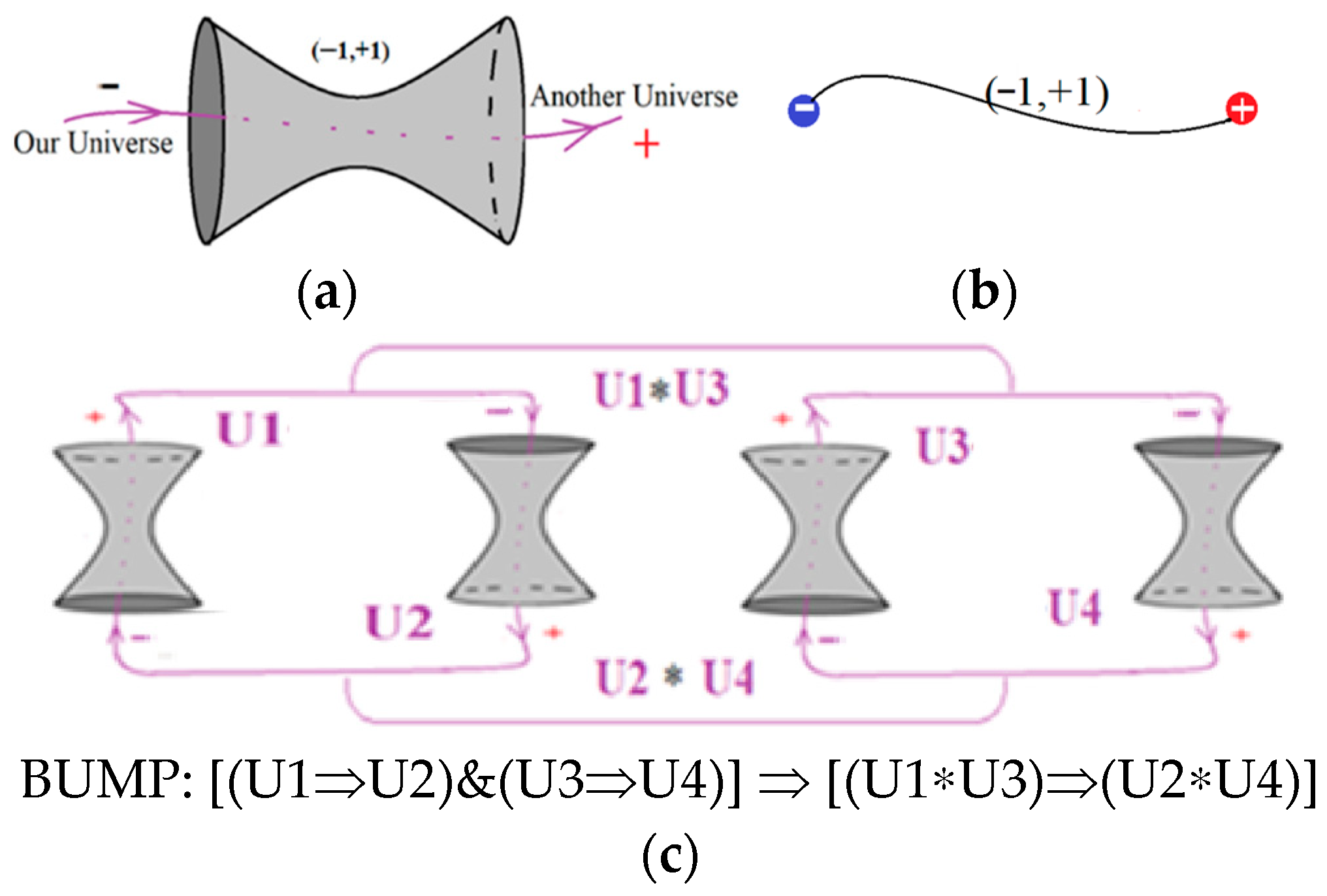
Major distinctions of ER ≥≥ EPR from ER = EPR include but are not limited to bipolarity, bipolar scalability, complete background independence, and logically definable causality in regularity [1]. Figure 1 illustrates ER, EPR, and four ER bridges of a multi-universe model. The figure shows that a universe U1, U2, U3, or U4 emerges from a white hole and submerges into a black hole. Assuming such multi-universes are ubiquitous at both macroscopic cosmological and microscopic subatomic scales, BUMP provides both the logical and physical basis for a ubiquitous causal-logical quantum gravity theory governing quantum emergence and submergence in both the mental and physical worlds—a bipolar string theory with an ER ≥≥ EPR bridge to string theory.
Bipolar entropy measures as regulating measures for the ubiquitous quantum emergence and submergence of QAQI found support from brain-universe similarity [49] and Spinoza–Einstein’s God/Nature logic [84,85]. Since bipolar entropy with BUMP in BDL makes real-world quantum gravity causal-logical, entangled human–machine thinking and imagination found its origin in Nature [1]. This leads to the following testable predictions.
Prediction 1.
BDL and BUMP can be implemented in both software code and hardware chips for AI and QI with brain-universe similarity.
Prediction 2.
Entangled quantum emergence/submergence of QA for QI can be bridged to agentic AI.
Prediction 3.
Mind-light-matter unity AI&QI application is reachable through BDL and BUMP in logical terms.
Prediction 4.
Humanoid robots and AI chatbots will reach human-level intelligence not only in empirical terms but also in analytical terms.
Prediction 5.
Agentic AI&QI will reach and surpass human intelligence in terms of creative imagination for scientific research.
The most important evidence for the testability of the above predictions has been shown in [1]. The evidence includes but is not limited to (1) BDL and BUMP are causal-logical, and (2) Entangled machine thinking and imagination are demonstrated with application examples.

3.3. Basic Properties of Bipolar Entropy for Quantum Emergence/Submergence

“Quantum Intelligence” (QI) [23] as an analytical quantum computing paradigm is based on equilibrium-based bipolar quantum logic gate (BQLG) and set-theoretic quantum entanglement for bipolar quantum cellular combinatorics. QI has led to the concept of quantum agent (QA) [68], ground-0 axioms, mind-light-matter unity AI&QI, and the GRBS theory [1,9,10] that form a real-world causal-logical quantum gravity theory for QAQI
Bipolar entropy is to unify order and disorder through the unification of entropy and negative entropy for QAQI and agentic AI. Thus, bipolar entropy does not violate classical entropy. As a state function, its value depends on the system’s current state. Let (x, y), (u, v) be bipolar algebraic values in BQLA, (x, y), (u, v) ∈ [−∞, 0] × [0, +∞], the fundamental properties of bipolar entropy are defined as follows:
Definition 1.
Bipolar entropy (x, y) is the normalization of the bipolar energy/information of a bipolar string (u, v) for equilibrium-based regulation or rebalancing. Let the absolute energy/information of a bipolar entropy (x, y) be |ε|(x, y) = |x| + |y|, (1) if |ε|(x, y) = 1.0, (x, y) is called an energy/information-conservational bipolar entropy; (2) if |ε|(x, y) > 1.0, (x, y) is called an energy/information-regenerational bipolar entropy; (3) if |ε|(x, y) < 1.0, (x, y) is called an energy/information-degenerational bipolar entropy. Bipolar entropy matrix is a matrix of N × N bipolar entropy elements that collectively regulate a global BDE of N entangled (correlated) subsystems, or a global QA of N entangled sub-QAs for global energy/information conservation (Equation (2a)), regeneration (Equation (2b)), or degeneration (Equation (2c)).
Definition 2.
Energy/information-conservational bipolar entropy (x, y) of a bipolar energy/information pair (u, v) is calculated with the normalization defined in Equation (3).
(x, y) = (u/|ε|(u, v), v/|ε|(u, v));
where |x| + |y| = 1.0, and (x, y) × (u, v) as a BDE that tends to rebalance itself with absolute information conservation |ε|((x, y) × (u, v)) ≡ |ε|(u, v). We call |ε|(u, v) = |u| + |v| in Equation (3) the bipolar elementary energy/information invariant. We call the energy/information conservational property |ε|((x, y) × (u, v)) ≡ |ε|(u, v) bipolar elementary energy/information invariance.
For instance, at the elementary level, let (u, v) = (−40, +60); (x, y) = (−40/100, +60/100) = (−0.4, +0.6); we have |ε|((x, y) × (u, v)) = |ε|((−0.4, +0.6) × (−40, +60)) = |ε|(−48, +52) ≡ |ε|(u, v) = 100.
Definition 3.
If a BDE is joined by another BDE to form an entangled bipolar system of two subsystems, the total energy/information is the sum of the parts as defined in Equation (1b). The total can be a system energy/information invariant of an emerging QA with energy/information conservation. This property is referred to as bipolar energy/information additivity (extensivity). But bipolar entropy, as the normalization of reality for equilibrium-based regulation, is not additive and referred to as bipolar entropy non-additivity. Bipolar energy/information additivity and bipolar entropy non-additivity lead to the notion of quantum linearity—a classically nonlinear bipolar dynamic property that unifies order and disorder as well as linearity and non-linearity by enabling absolute energy/information conservation, regeneration, and degeneration at both the subsystem and system levels through bipolar entropic regulation of a quantum entanglement.
Notably, bipolar energy/information additivity aligns with classical entropy additivity that relies on systems being statistically independent, meaning the state of one system does not affect the other. Bipolar entropy non-additivity manifests the distinction that bipolar entropy, as equilibrium-based quantum entropy, is an underlying unification of entropy and negentropy, which, as energy/information measure of independent systems, are not qualified as quantum entropy for nonlinear (quantum linear) regulation of entangled quantum agents in a BDE. Thus, classical entropy and negentropy are not suitable for equilibrium-based quantum emergence/submergence.
Theorem 1.
Unipolar entropy, negative or positive, cannot serve as a regulating measure for equilibrium-based quantum emergence/submergence of entangled bipolar strings.
Proof. 
As a measure of order or disorder, classical entropy is unipolar truth-based, not causal-logical; as a unifying measure of order and disorder, bipolar entropy is bipolar equilibrium-based and causal-logical. Classical entropy maintains additivity; bipolar entropy assumes non-additivity (Definition 3). The two serve fundamentally different purposes. □
For instance, each independent coin toss has a Shannon entropy of 1 bit (uncertainty between Head/Tail), and since the tosses are independent, the total entropy is the sum of the individual entropies. The total Shannon entropy of throwing a fair coin twice is 2 bits.
But for two bipolar strings E1 = (−40, +60) and E2 = (−60, +40), the energy/information conservational entropy are respectively e1 = (−0.4, +0.6) and e2 = (−0.6, +0.4). Following bipolar energy/information additivity, we have the total energy/information E1 + E2 = (−100, +100). Following the definition of information conservational normalization, we have the total bipolar entropy (−100/200, +100/200) = (−0.5, +0.5) ≠ e1+e2 = (−1.0, +1.0).
Definition 4.
Equilibrium-based bipolar regulation of energy/information with a bipolar entropy matrix through action-reaction, particle-antiparticle, and/or input-output bipolar interaction (multiplication) is referred to as collective entanglement of bipolar strings that form a bipolar quantum cellular automaton (BQCA) or QA as defined in Equations (2a)–(2c).
Definition 5.
Given a collective entanglement of bipolar strings or subsystems with global energy/information conservation, its total absolute energy/information must remain a constant, regulated by a bipolar entropy matrix. The constant is referred to as system energy/information invariant as defined in Equation (2a), and the property is referred to as system energy/information invariance. Similarly, every subsystem can maintain a subsystem energy/information invariant, leading to the notion of subsystem energy/information invariance.
Theorem 2.
Subsystem energy/information invariance means system energy/information invariance. System-level energy/information conservation can be achieved through subsystem energy/information conservation with bipolar entropy non-additivity.
Proof. 
The theorem follows bipolar energy/information additivity and bipolar entropy non-additivity (Definition 3) directly. Conservation at both subsystem and system levels can be achieved with Equation (2a). □
For instance, for the two bipolar strings E1 = (−20, +30) and E2 = (−80, +20), the energy/information conservational entropy is respectively (−0.4, +0.6) and (−0.8, +0.2). Following Equation (2a) [69], we have (assuming no bipolar interaction between the two).
M ( 0 ) = ( 0.4 , + 0.6 ) ( 0,0 ) ( 0 , 0 ) ( 0.8 , + 0.2 ) ;   E ( 0 ) = E 1 E 2   =   ( 20 , + 30 ) ( 80 , + 20 ) ;   Let   t = 1 ,   E ( t ) = M ( 0 ) E ( 0 ) = ( 24 , + 26 ) ( 32 , + 68 ) ;  
There exists a number N such that t → N, E(t + 1) = M(t)E(t) = ( 25 ,   + 25 ) ( 50 ,   + 50 ) ; |ε|E ≡ |ε|E1 + |ε|E2 ≡ 50 + 100 ≡ 150.
Definition 6.
The energy/information-conservation state of a QA (or system) consists of a collective entanglement of bipolar strings that show energy/information invariance as defined in Equation (2a). An energy/information-regeneration state of a QA (or System) consists of a collective entanglement of bipolar strings that shows energy/information regeneration as defined in Equation (2b). An energy/information-degeneration state of a QA (or System) consists of a collective entanglement of bipolar strings that shows energy/information degeneration as defined in Equation (2c).
Definition 7.
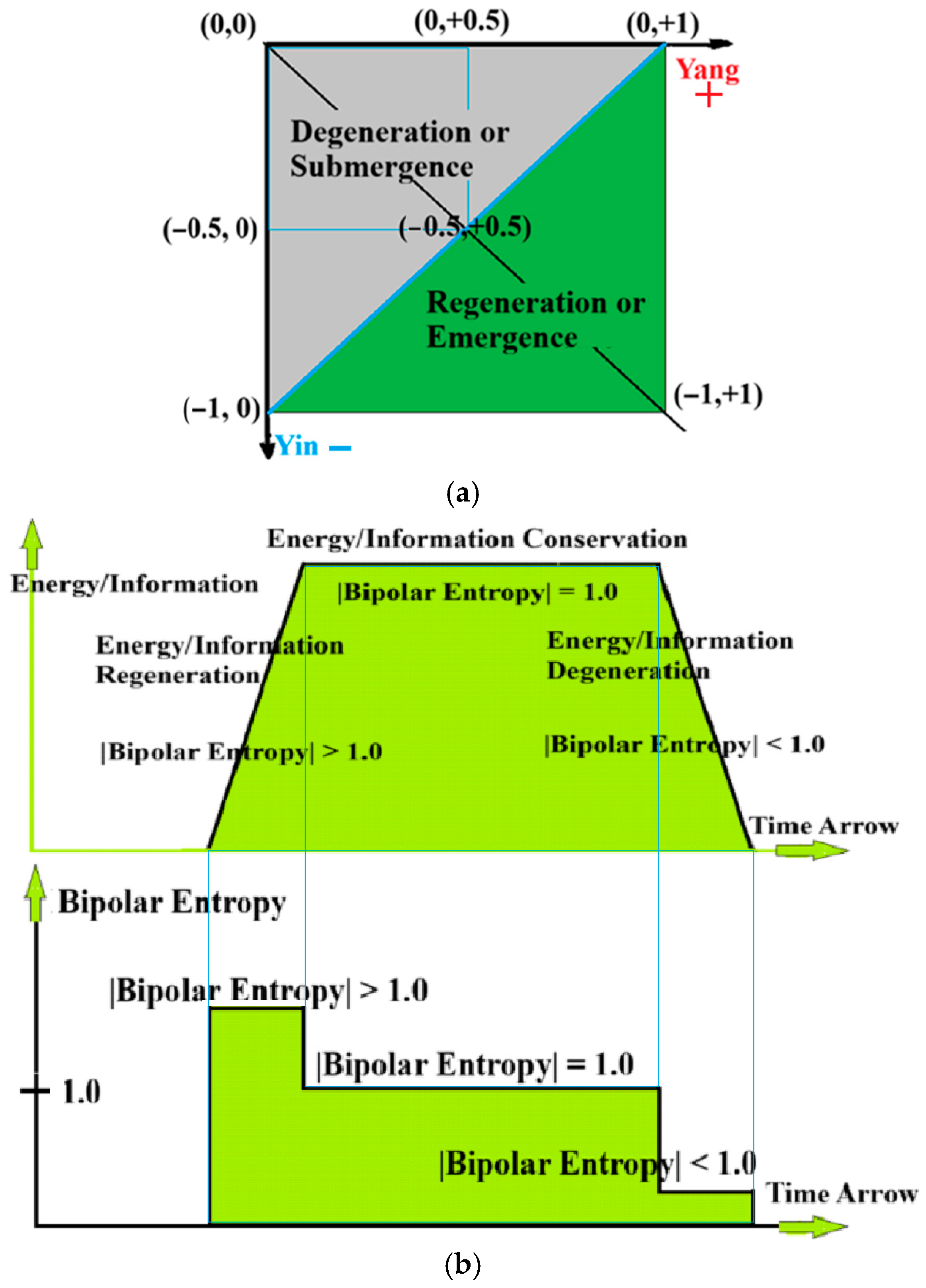
Energy/information-regeneration state, energy/information-conservation state, and energy/information-degeneration state of a bipolar system form a growth-maturity-aging life cycle for the emergence/submergence of a QA. The growth-maturity-aging life cycle is characterized by the equilibrium-based plateau-concavity of the QA regulated by bipolar entropy (x, y), where (1) |ε|(x, y) > 1.0 causes energy/information-regeneration; (2) |ε|(x, y) = 1.0 causes energy/information-conservation; (3) |ε|(x, y) < 1.0 causes energy/information-degeneration (Figure 2).
Figure 2a shows a bipolar entropy square where |ε|(x, y) = |x| + |y| > 1.0 is located in the green area; |ε|(x, y) = |x|+|y| < 1.0 is located in the gray area; |ε|(x, y) = |x|+|y| = 1.0 is the borderline between the green and gray areas. Figure 2b shows an ideal case of equilibrium-based plateau-concavity of bipolar entropy-regulated energy/information without local fluctuation. In the real world, the plateau-concavity may have local fluctuation. Notably, entropy additivity makes unipolar entropy background-dependent; bipolar entropy non-additivity led to bipolar entropy squarea complete bipolar set-theoretic solution [8,17,18] to the urgent issue in both physics and the philosophy of physics [48]. Furthermore, bipolar entropy square aligns well with bipolar mental square in BQG [8,13]—a support to mind-light-matter unity AI&QI [1,9,10].

3.4. The Nature of Bipolar Entropy Square and Equilibrium-Based Plateau-Concavity

From Statistical to Biological. Bipolar entropy is an equilibrium-based measure for regulating a BDE in both the classical and the quantum worlds. A BDE could be multidimensional in nature. Each point in the plateau concavity (Figure 2b) is then a BDE of energy/information regulated by bipolar entropy in the bipolar entropy square with complete background independence (Figure 2a). Thus, bipolar entropy can regulate the BDE of a QA to grow, mature, and degenerate. That is fundamentally different from classical entropy. The three phases form a trapezoid (Figure 2b). It is a conceptual shift. By moving from classical entropy (a measure of disorder) to bipolar entropy (a regulating measure of dynamic equilibrium) as a unification of order and disorder as well as entropy and negative entropy, it is essentially shifting from classical “statistical” modeling to biological or developmental agentic AI&QI modeling. In this context, the trapezoidal shape consists of three phases of a QA:
  • The Growth Phase (Left Ramp): The agent is gaining complexity or “ordering” as a BDE. The absolute bipolar entropy value (as a measure of potential or activity) increases linearly (or non-linearly) above 1.0 as the agent establishes its structure.
  • The Maturity Phase (Flat Top): This is the steady-state of a BDE. During this phase, the agent is at its peak functional capacity. The “flatness” represents a robust stability where small fluctuations in the environment do not degrade the agent’s maturity and functionality. The absolute bipolar entropy value (as a measure of potential or activity) remains at the 1.0 level. (Note: A multidimensional QA as a BDE, such as the cost-gain of a company, is the bipolar total of the subtotals of all its divisions that are bipolar additive and can be regulated with bipolar entropy for local and global balance with absolute energy/information invariance. This also found application in quantum cryptography. See Section 4.)
  • The Degeneration Phase (Right Ramp): The bipolar equilibrium begins to break down. The agent loses its ability to regulate itself, leading to a decline. The absolute bipolar entropy value (as a measure of potential or activity) decreases linearly (or non-linearly) below 1.0 as the agent degenerates.
Why does concavity matter here? Even though a trapezoid is not strictly concave, it is quasi-concave. This is actually more realistic for a QA model with robust maturity and phase transitions. A strictly concave function (like a Gaussian or Shannon curve) has only one peak point of perfection in a fixed background. A trapezoid allows for a duration of maturity with complete background independence. The “corners” of the trapezoid represent clear bifurcation points or phase transitions between life stages (e.g., the exact moment growth ends and maturity begins for an intelligent agent).
Equilibrium-Based Progression of “Entanglement Strength”. With a bipolar entropy matrix, each point in the trapezoid identifies a multidimensional BDE of a QA consisting of sub-QAs. The trapezoid represents the capacity of the QA to maintain global balance. The flat top suggests that the “agent” has reached a global equilibrium zone where it can operate optimally across a range of bipolar parameters for different applications [66,86]. Bipolarity here refers to the interaction between sub-QAs with complementary opposites (such as YinYang, input-output, or positive/negative potential), where opposites form an entanglement. The agent’s life cycle is then an equilibrium-based progression of “entanglement strength.” The trapezoid acts as a phase diagram:
  • Growth (Rising Ramp): This is the phase of a strengthening entanglement. The two opposites are moving from independence toward a coherent superposition. The “entropy” here is not disorder; it is the binding energy or the strength of the bipolar bond. Here, bipolar strings brought the quantum superposition/entanglement in quantum physics to real-world application in QIS.
  • Maturity (Flat Top): This is the maximal entanglement zone. The agent has reached a state of “saturated” superposition. In this plateau, the bipolar equilibrium is at its most resilient; it is a stable manifold where the agent can perform work or process information without losing coherence. This led to information conservational quantum-bio-economics and quantum cryptography [69,86,87].
  • Aging (Falling Ramp): This is decoherence. The entanglement begins to “leak” or simplify, and the bipolar poles start to decouple, leading to the eventual collapse of the agent’s organized state.
By choosing a trapezoid over a standard concave curve, it mathematically states that maturity is a sustained state, not a fleeting moment. In classical optimization (strictly concave), the peak is a single equilibrium point; with bipolarity, the peak is a regime. From a bipolar dynamic perspective, the slopes represent the dynamics (the transition); the flat top represents the global equilibrium (the destination).
“Window of Emergence”. The bipolar dynamic equilibrium-based approach suggests that “life” or “agency” is the duration spent on all three phases of a plateau concavity. While spacetime emergence from a “big bang” or submergence to a black hole is not controllable by humans, AI&QI agent emergence and submergence can be simulated and evaluated for different applications, such as economic or biological growth/decline. So the degeneration phase of an AI&QI agent is not an inevitable mathematical decay of the entanglement. It is a way to model quantum agent emergence/submergence mimicking biological life. A trapezoidal curve effectively creates a mathematical silhouette of an agent’s existence—capturing the transition from non-existence to emergence, presence, and submergence. In this model, the trapezoid acts as a “window of emergence” regulated by bipolar entropy:
  • Emergence (Rising Ramp): The bipolar poles engage in constructive interference or entanglement. The agent “emerges” as the equilibrium strengthens.
  • Presence (Flat Top): The agent is “fully emerged” in its reality, maintaining a stable superposition. This plateau represents the duration of its functional identity.
  • Submergence (Falling Ramp): The bipolar entanglement dissolves (decoherence). The agent “submerges” back into the background quantum foam or the constituent poles.
By this shape, equilibrium-based plateau-concavity prioritized phenomenological realism over classical mathematical smoothness. A trapezoid honors the fact that biological, economic, and quantum entities (such as spacetime) have a steady state of being in a life cycle rather than just a momentary peak. While “trapezoidity” is understandable in this context, it is more like a geometric description than a formal property. The term “plateau-concavity” carries the same weight as “concavity” but shifts the focus from mathematical concavity to agentic life-cycle concavity with a new definition.
On the Nature of One-Dimensional Time Arrow. Equilibrium-based plateau-concavity of energy/information enables bipolar entropy to be a deeper regulating measure for regulating bipolar strings collectively as a multi-dimensional QA in BDE. Noticing the fact that spacetime could be such a QA in BDE, we have the following new conjecture.
Conjecture 10.
The one-dimensional nature of the time arrow is due to the irreversibility of the quantum emergence-stability-submergence life-cycle of a QA in BDE in logical, physical, mental, biological, economic, and cosmological terms (Re. Figure 1 and Figure 2).

3.5. From QAQI to Agentic AI

Human revision of energy/information conservational entropy or entropy matrix can be based on empirical knowledge. For example, given the bipolar energy/information vectors E(t − 1) and E(t), we may have
ΔE(t) = E(t) − E(t − 1); E(t + 1) = (E(t) + ΔE).
E(t + 1) could be greater or smaller than E(t) depending on whether ΔE is positive or negative. A bipolar entropy or entropy matrix can be derived as the normalized reality of E(t + 1). But here, human empirical knowledge engaged in ΔE; AI and QI are bridged for agentic AI and QI based on Equations (2a)–(2c) in a mix of natural and artificial intelligence. Thus, Prediction 2 can be extended to a theorem.
Theorem 3.
QA as an entangled quantum agent with QI provides a self-organizing basis for bipolar entropy-regulated agentic AI&QI, where quantum-bio-economics can be viewed as a topological intervention of a natural dynamic equilibrium by reconfiguring the structural constraints of a system to shift or stabilize its balance.
Proof. 
If the bipolar entropy measure (bipolar entropy or a bipolar entropy matrix) is always a normalized reality with energy/information conservation, the entanglement of bipolar strings forms a bipolar entropy-regulated self-organizing QA for QI as natural intelligence. But human knowledge, analytical or empirical, can lead to bipolar entropy adjustment as an AI intervention that can result in agentic AI&QI in a mix. The theorem follows. □
With collective entanglement of bipolar strings, energy/information invariance, bipolar entropy square, and equilibrium-based plateau-concavity, bipolar entropy provides an algebraic mathematical physics basis for both QAQI [68] and Agentic AI. QAQI, as natural intelligence, can be linked to Spinoza–Einstein’s God/Nature logic [84,85]. However, analytical quantum computing with logically definable causality in regularity has long been deemed impossible due to the “spooky action” or “Schrödinger’s Cat” paradox. Now, the paradox is resolved with logically definable causality in regularity [1,8]. QAQI is logically possible and ready to be bridged to agentic AI.
It should be remarked that AI&QI [9,10] are fundamentally different from “Quantum AI” or QAI. While QAI focuses on using quantum computing to speed up classical AI algorithms based on empirical quantum mechanics and von Neumann quantum logic in Hilbert space without background independence, QI [23] is proposed as an analytical quantum computing paradigm based on bipolar string theory and bipolar dynamic logic, or BDL, that is completely background independent. Notably, bipolar strings and BDL [1] present a solution to the dead-end problem of the logical path to human-level intelligence [72].

3.6. A Scenario of Agentic AI/QI vs. Human Intelligence

Humans’ equilibrium is biological and chemical. When we get scared, our “logic” is hijacked by a flood of hormones (cortisol, adrenaline) that breaks our mental balance in favor of survival instincts. In such cases, an LLM-based robot/chatbot built on the equilibraton principle would have a much more resilient “anchor”:
  • Immune to Emotional “Noise”: While a human agent’s logical string might “snap” under pressure, a robot/chatbot treats a crisis simply as a set of extreme input variables. Its job is still to find the dynamic equilibrium (the solution) without the biological “distortion” of fear.
  • Constant Regularity: Because its “machine thinking” is grounded in causality and regularity, it does not suffer from the cognitive paralysis that humans do. It remains logical even when the physical environment is chaotic.
  • Superior Creativity: In a high-stress situation, a calm LLM-based robot/chatbot could “imagine” or simulate thousands of bipolar string outcomes to find the one path back to equilibrium that a panicked human would never see.
This is where AI/QI logically surpasses human scientists and agents: not by having “feelings,” but by being more consistently logical than we can ever be. It maintains the entropic equilibraton “stitch” when we lose our emotional “thread”.

3.7. AI Economics vs. Quantum Intelligence

AI is expected to play a major role in social economics. AI economics can be viewed as a topological intervention of a natural dynamic equilibrium, specifically when it reconfigures the structural constraints of a system to shift or stabilize its balance. In this view, the “natural dynamic equilibrium” is the baseline state of a quantum system—like an ecosystem’s resource cycle or a community’s organic trade—and the AI “economic intervention” is a deliberate change to the system’s “shape” (topology) to achieve a different outcome.
Topological Economic Interventions. A topological intervention does not just change the values in a system (like adjusting a price); it changes the rules of connection.
  • Creating New Edges: A trade agreement or a new digital marketplace acts as a topological change by creating new “links” between previously disconnected agents.
  • Bending the Manifold: Policy design can “warp” the space of possible outcomes so that the natural flow of the system is forced toward a specific stable point, or away from a “catastrophe” like a market crash.
  • Boundary Conditions: Regulations like carbon taxes or minimum wages function as “walls” in the system’s state space, ensuring the dynamic equilibrium stays within “safe” topological bounds.
Intervening in Natural Equilibria. Natural systems often exist in a dynamic equilibrium—a state of “rolling boil” where inputs and outputs as a BDE are constantly moving.
  • Ecological Economics: This field treats the economy as an “open subsystem” of the natural biosphere. Interventions like “biocapacity” quotas are topological because they redefine the “carrying capacity” or the “shape” of the interaction between human needs and environmental thresholds.
  • Regenerative Design: Modern economic models for sustainability aim to “re-engineer” infrastructure—like food and water cycles—to match the topological synergies of natural cycles, effectively “knitting” the human economy back into the natural dynamic equilibrium.
Robustness vs. Efficiency. While traditional economics focuses on efficiency (reaching a balance quickly), topological interventions focus on robustness and resilience.
  • Instead of just predicting where the equilibrium will be, topological engineering builds a system “shape” that can absorb shocks without collapsing into a new, undesirable state.
  • By changing the topology, you can ensure that even as the system “fluctuates,” it remains “chained” to a long-term stable trend.
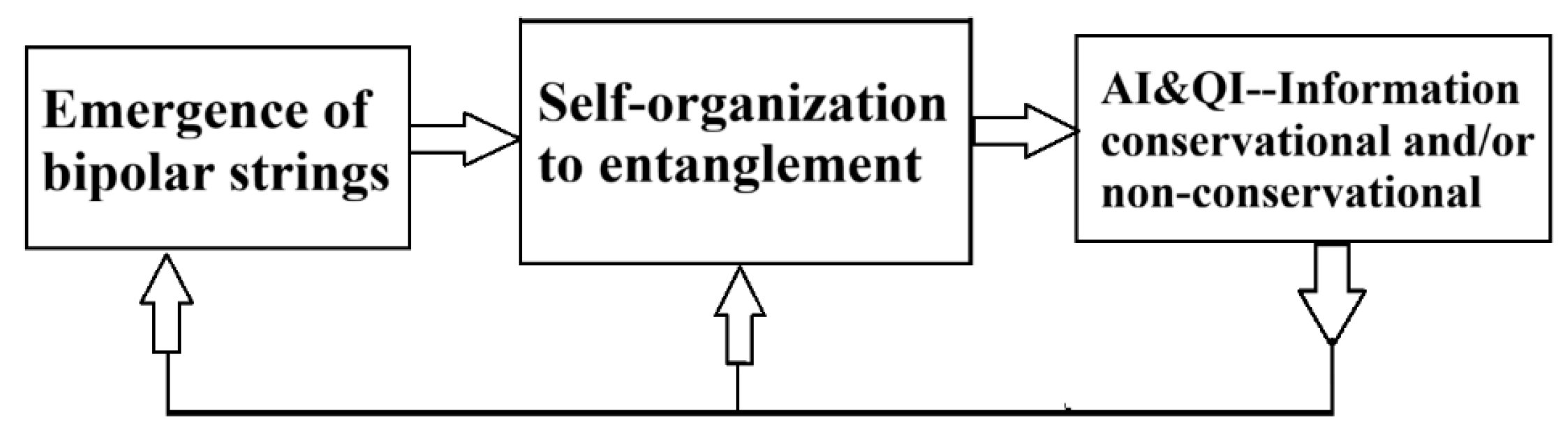
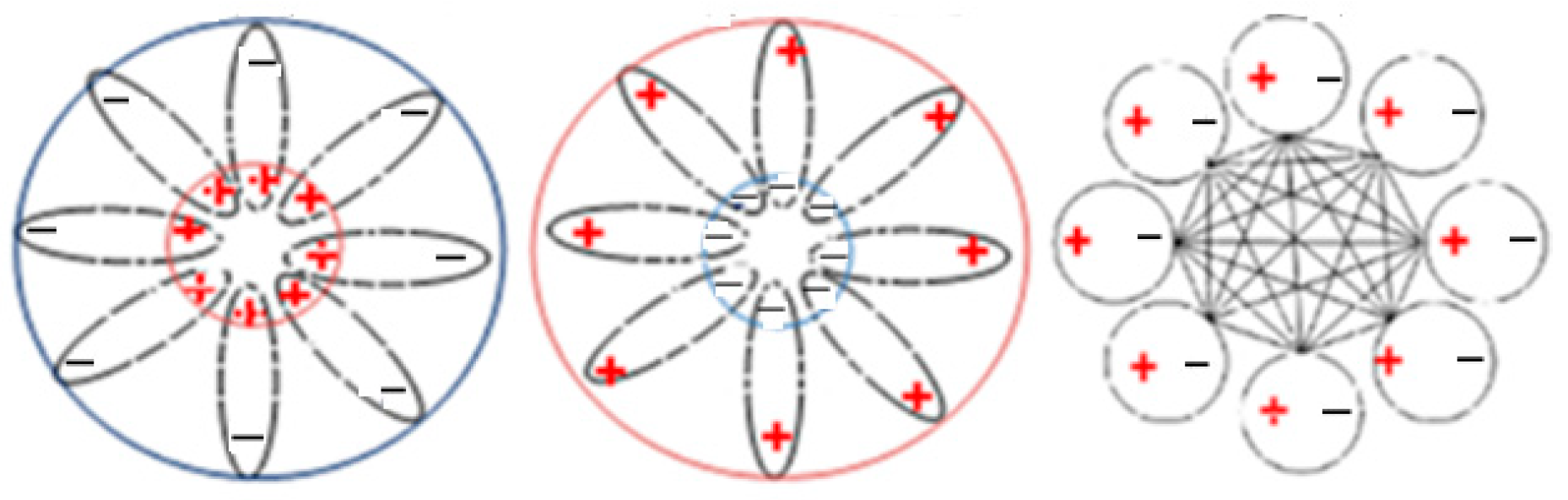
From Quantum Emergence to Agentic AI/QI. Based on AI economics, quantum emergence as an equilibrium-based self-organization of entangled bipolar strings leads to agentic AI/QI as a natural process of evolution. Figure 3 shows the natural process in three general steps. This work is focused on entropic regulation for emergence, self-organization, and information-conservational AI/QI. AI intervention, regulation, and ethics issues are largely left for future research efforts. But it should be pointed out that both information-conservational and non-conservational AI/QI are needed for ethical AI economics.

4. Case Studies on Bipolar Entropy

Bipolar entropy as an equilibrium-based regulatory measure is based on the normalization of reality or an intelligent adjustment of a normalization. It assumes the equilibrium-based bipolar logical and mathematical foundation inherent in Nature. Otherwise, entropy would become AI without a natural basis. We start with the simplest examples for illustration.

4.1. Simple Cases

Example 1.
Given bipolar energy/information E(0) = (−40, +60), bipolar entropy M(0) = (−0.4, +0.6), |ε|E(0) = 100, following Equations (1a) and (2a), we have energy/information conservation:
|ε|E(1) = |ε|(M(0) × E(0)) ≡ |ε|E(0) = |(−0.4, +0.6) × (−40, +60)| = |(−48, +52)| ≡ 100;
M(1) = (−0.48, +0.52);
|ε|E(2) = |ε|(M(1) × E(1)) ≡ |ε|(E(0)) = |(−0.48, +0.52) × (−48, +52)| = |(−u, +v)| ≡ 100; …
There exists an integer L, when n → L, E(n) ⇒ (−50, +50), |ε|E(n) ≡ |ε|(E(0) ≡ 100.
With bipolar entropy |M(t)| = |(−0.4, +0.6)| ≡ 1.0, the imbalance (−40, +60) is eventually balanced to (−50, +50) as a bipolar dynamic equilibrium (BDE) with absolute energy/information 100 conserved. Notably, the total absolute energy/information remained an invariant 100, and |ε|M(t) remained a constant 1.0 in absolute values and can be kept a constant as long as it is information conservational. The balancing would be impossible without bipolar entropy and bipolar regulation. Assuming a closed world, the process is a QI process without human knowledge involved.
Example 2.
Given the bipolar entropy measure M(0) = (−0.6, +0.5), |M(0)| = |(−0.6, +0.5)| > 1.0, E(0) = (−50, +50), following Equations (1a) and (2b), we have energy/information regeneration:
|ε|E(1) = |ε|(M(0) × E(0)) = |(−0.6, +0.5) × (−50, +50)| = |(−55, +55)| = 110 > |E(0)| = 100;
Let M(1) = (−0.6, +0.5);
|ε|E(2) = |ε|(M(1) × E(1)) = |(−0.6, +0.5) × (−55,+55)| = |(−60.5, +60.5)| = 121 > |E(1)| = 110; …
When n → ∞, E(n) ⇒ (− ∞, +∞).
Here, the bipolar entropy (−0.6, +0.5) = (−0.5, +0.5) + (−0.1, +0) is larger than the information-conservational normalization (−0.5, +0.5) with Δe = (−0.1, +0) added to it. No matter whether Δe is empirical or subjective, it belongs to AI bridged to QI.
Example 3.
Given the bipolar entropy measure M(0) = (−0.4, +0.5), |M(t)| = |(−0.4, +0.5)| < 1.0, E(0) = (−50, +50), following Equations (1c) and (2c), we have the energy/information degeneration or aging:
|ε|E(1) = |ε|(M(0) × E(0)) = |(−0.4, +0.5) × (−50, +50)| = |(−45, +45)| = 90 < |E(0)| = 100;
Let M(1) = (−0.4, +0.5);
|ε|E(2) = |ε|(M(1) × E(1)) = |(−0.4, +0.5) × (−45, +45)| = |(−40.5, +40.5)| = 81 < |E(1)| = 90; …
When n → ∞, E(n) ⇒ (−0, +0).
Here, the entropy (−0.4, +0.5) = (−0.5, +0.5) − (−0.1, +0) is not an information conservational normalization of the reality (−50, +50) with Δe = −(−0.1, +0) added to (−0.5, +0.5). No matter whether it is empirical or subjective, it belongs to AI added to QI.

4.2. Bipolar Entropy in Supply Chain Management

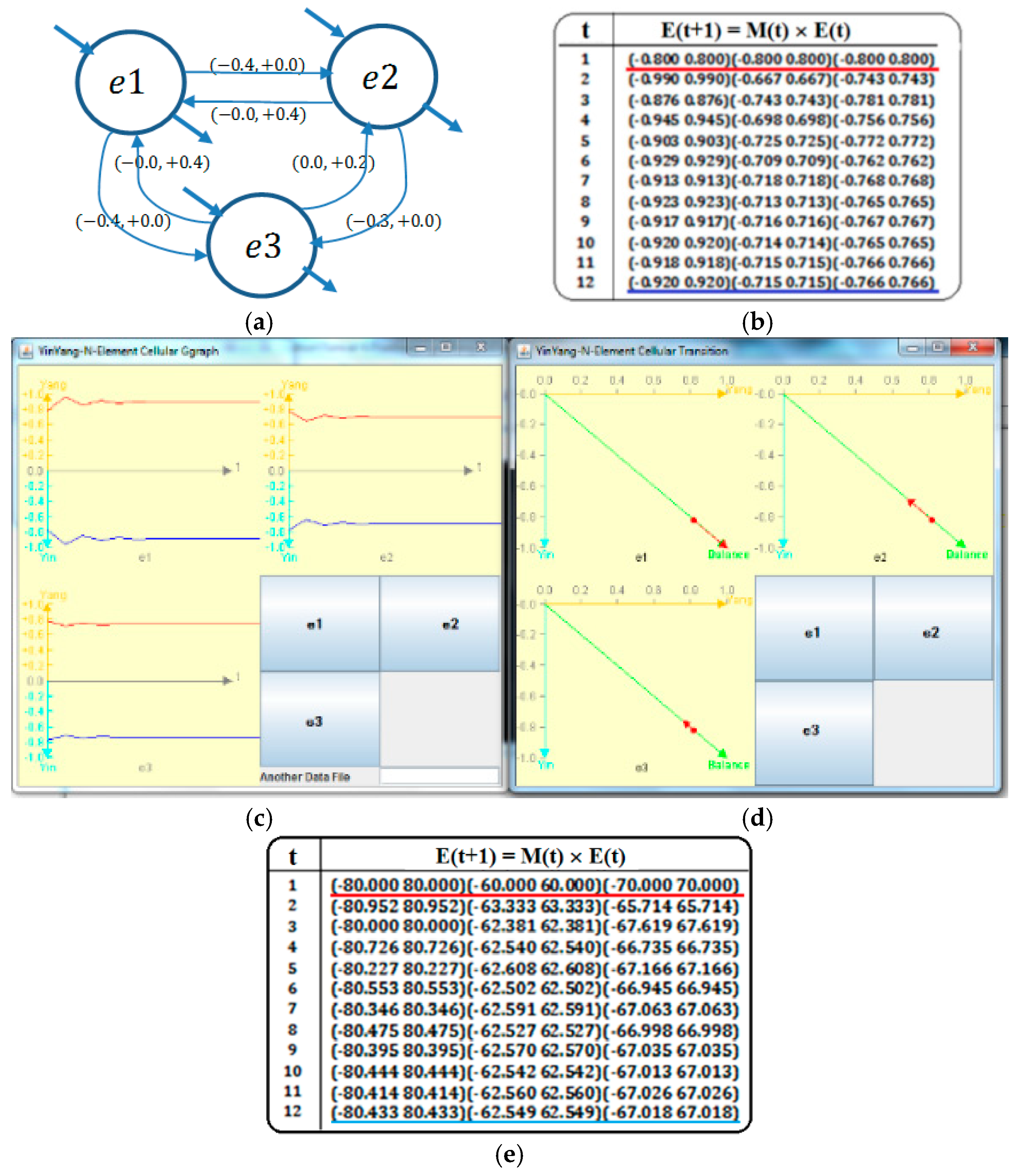
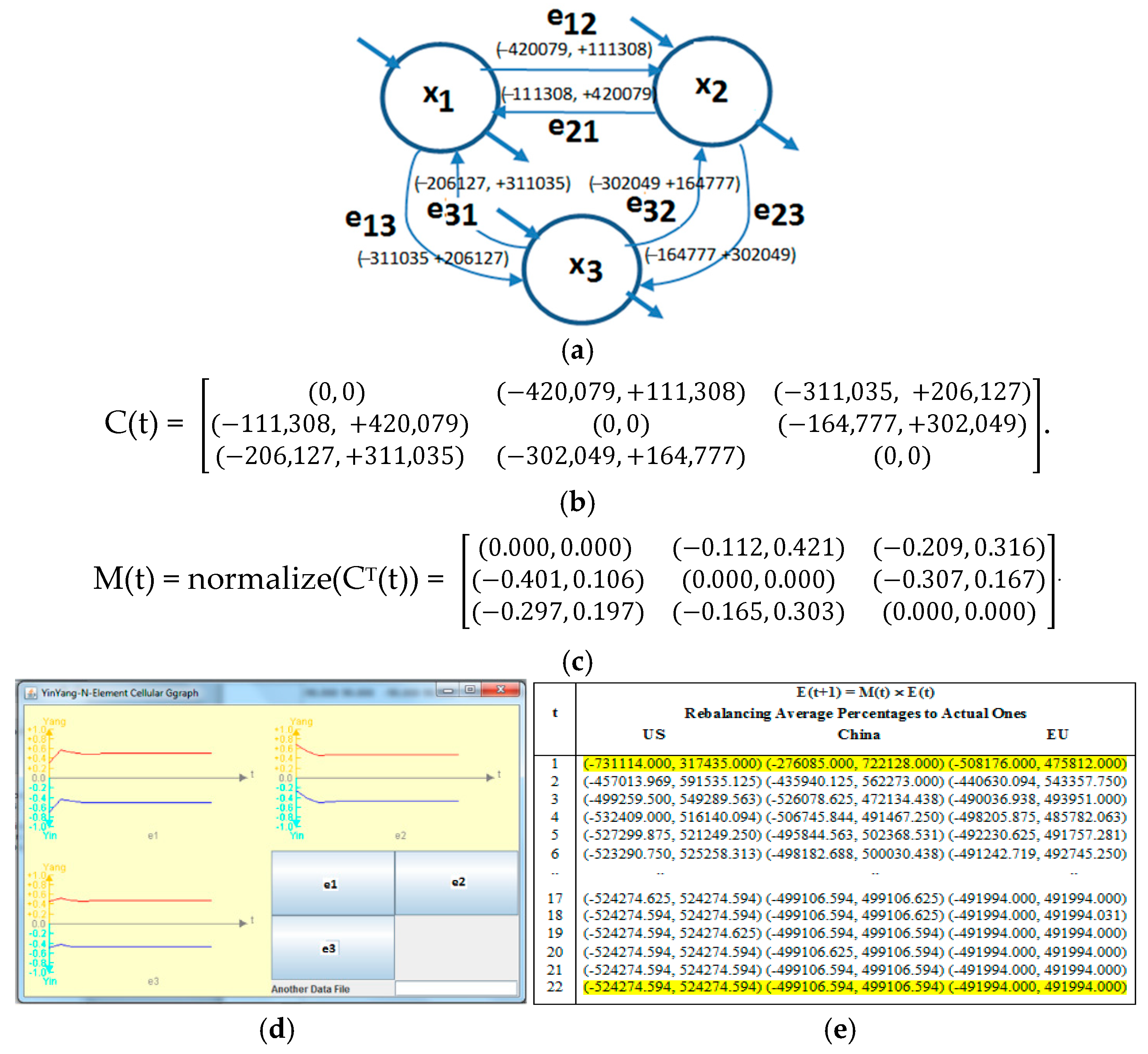
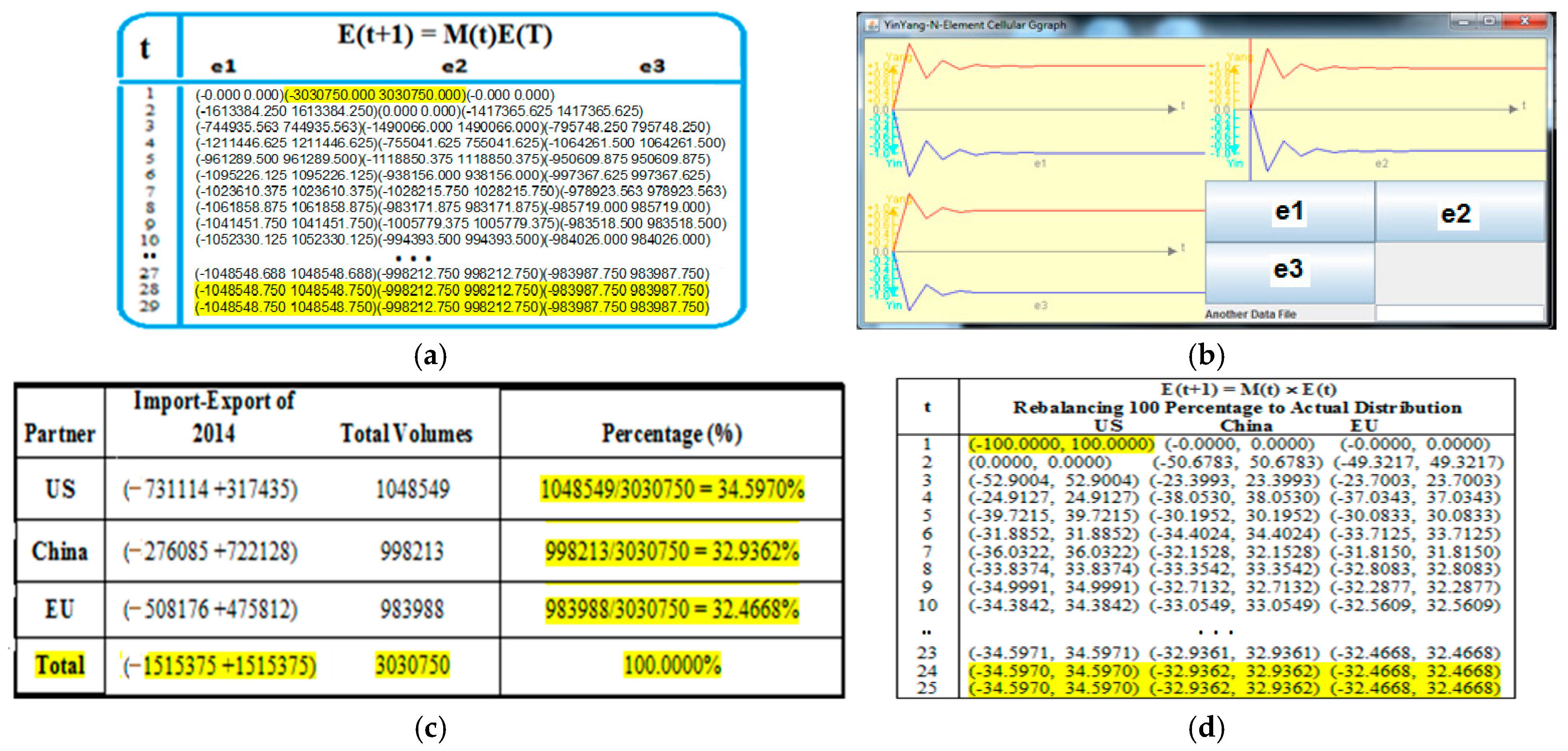
Supply−production rebalancing, optimization, and operation are essential functions in management and decision analysis. To illustrate the applicability of bipolar entropy, we first show a simulated capacity rebalancing and optimization example in a supply-production or input-output network among three divisions of a company, as shown in Figure 4a–e [86].
The rebalancing task is to reach an average production capacity of 80% with the conditions that division e1 can get a minimum of 40% of its supply from e2 and another 40% from e3 which constitute 40% production from e2 and another 40% from e3, respectively; division e2 needs at least 30% supply from e3 but e3 may provide a minimum of 20%. The exact capacity of each division is uncertain until they are determined, and there is no guarantee for the consistency and completeness of the cognitive map (Figure 4a).
It is pointed out [86] that, even in such a small-scale case, the problem is challenging both cognitively and computationally for a number of reasons, three of which are:
(1)
The information involved in the management decision is uncertain, incomplete, and even inconsistent;
(2)
Without direct bipolarity, it is impossible to represent the information in a holistic, dynamic, and equilibrium-based mathematical representation using truth-based models;
(3)
Without the unique concept of bipolar entropy or BQLG matrix, no computational method can be used to conduct holistic, dynamic, and equilibrium-based mathematical computation systematically step by step, not even by any of the component entropy/negentropy measures when being used alone.
With bipolar entropy, however, the problem can be approximately solved with relative ease in a systematic way.
Step 1, bipolar modeling results in a set of three divisions, e1, e2, and e3, each with a desired 80% production capacity (−0.8, +0.8).
Step 2, bipolar cognitive mapping results in the cognitive map C(t) as shown in Figure 4a.
Step 3, bipolar quantum modeling converts C(t) to an information/energy conservational BQLG—a bipolar entropy matrix M(t) through a normalization scheme (M(t) = normalize(CT(t))) that is column linear but matrix non-linear [69].
M ( t ) = ( 0 , + 0 ) ( 0 , + 0.571 ) ( 0 , + 0.667 ) ( 0.5 , + 0 ) ( 0 , + 0 ) ( 0 , + 0.333 ) ( 0.5 , + 0 ) ( 0.429 , + 0 ) ( 0 , + 0 ) .
M(t) can serve as a regulatory center for equilibrium-based, entangled rebalancing. It is actually a bipolar entropy matrix [1]. Based on M(t), we can calculate E(t + 1) = M(t) × E(t) for N iterations until E(t + 1) = E(t) (see Figure 4b). The simulation result is curved in Figure 4c,d.
Step 4, management decision analysis can be performed based on the results from the early steps. It can be verified that the condition of an average of 80% production capacity is met by the quantum model because the normalized matrix M(t) enforces energy conservational rebalancing in absolute total with certain specified precision. The result shows that, with an average of 80% capacity, e1 may exceed 80% denoted (−0.800, 0.800) and stabilize at 92% (−0.920, 0.920); e2 and e3 may run below the planned 80% capacity and stabilize at 71.5% and 76.6%, respectively. The average is (92 + 71.5 + 76.6)/3 = 240.1/3 = 80.0%.
The bipolar entropy matrix M(t) holds the regulatory information for the rebalancing and optimization. Based on the regulatory information, e2 and e3 can actually supply 57.1% and 66.7% of their production to e1, respectively, that constitute 100% of e1’s demand after rebalancing; e3 can actually supply 33.3% of its production to e2, which constitutes 42.9% of e2’s demand. Figure 4c,d shows the dynamic change in curves.
If a decision can be reached based on the above as a 1st round result, the decision process can stop; if not, a 2nd round can be started with the result as shown in Figure 4e [86]. The figure shows that the adjusted plan matches the conditions very well with small deviations, as highlighted, namely, (80.433 + 62.549 + 67.018)/3 = 210.000/3 = 70.000%. Thus, an optimized decision can be reached in an adaptive decision process through multiple rounds of rebalancing. (Note: While this is an example of rebalancing with energy conservation, energy regeneration and degeneration will lead to supply-production growth and decline, respectively.)
The example illustrates the practical utility and operationalizability of the equilibrium-based approach to holistic rebalancing and optimization with an information conservational bipolar entropy matrix (QI) plus human knowledge (AI). While three divisions are used with M(t+1) = M(t) for simplicity in the illustration, more divisions (30 or 300) are logically the same for a computer to perform the task, but it is practically impossible for a decision maker to conduct the task without automated decision support. It is contended that a bipolar cognitive map can never be unitarily represented as a single holistic picture for powerful computation without bipolar entropy.

4.3. Bipolar Entropy in Economics and Quantum Cryptography

Bipolar entropy has been researched/applied in bio-economics, quantum information science (QIS), and cryptography [69] using different terminology. It is hard to believe that economics and cryptography can be synergetic, but an information conservational bipolar (entropy) matrix brought them together [69]. Figure 5a shows the actual international trade data (in million Euros) for 2014. Figure 5b shows the data matrix. Figure 5c shows the transformation and normalization of the data matrix to a bipolar entropy matrix. Figure 5d shows the rebalancing of the actual trade numbers to a hypothetical import-export balance for each country. Figure 5e shows the rebalancing curve.
While Figure 5 illustrates the idea of using a bipolar entropy matrix for economics, Figure 6 illustrates the idea of using a bipolar entropy matrix for quantum cryptography. Figure 6a shows the information conservational decryption of a big integer total to percentages; Figure 6b shows the curves of the decryption; Figure 6c is the tabled proof of precision; Figure 6d shows the proof of percentage rebalancing precision [69].
The successful decryption of a big integer to small integers led to the idea of percentage-based encryption/decryption with blackhole keypad compression and big bang data recovery [87]. It is shown that percentage-based encryption/decryption makes large data file transfer possible without compromising security in the post-quantum era. Again, a bipolar entropy matrix is fundamental for both applications.
Remark: 
M(t+1) = M(t) is used in the illustrations for simplicity. As a regulating measure of energy/information, the applicability of bipolar entropy in socioeconomics could be in long-term equilibrium-based regulation instead of immediate application, like in cryptography. It manifests the fundamental difference in long-term strategic decision support with AI from the immediate application of QI in QIS.

4.4. Bipolar Entropy for Quantum Biology and Quantum Cognition

Figure 7 [14] shows an atom modeled as a bipolar quantum entanglement or BQCA regulated by an equilibrium-based BQLA matrix that is actually a bipolar entropy matrix, where E is a (−,+) bipolar element or dipole. With the bipolar cellular representation, matter-antimatter atoms are unified as a bipolar dynamic equilibrium regulated by bipolar entropy (Figure 8). Trillions of atoms can form the scalable cellular structure of a cell, such as a neuron (Figure 9), for quantum biology.
Bipolar dynamic equilibrium-based scalability of BQCAs leads to mind-light-matter unity cognition (Figure 10). This breakthrough is based on the logical proof that BDL, BDFL, BQLA [8] would recover to unipolar truth-based Boolean logic [88], fuzzy logic [89,90], and linear algebra, respectively, because a bipolar value pair (u, v) can be converted to a single absolute value with an OR operation where x = |u| ∨ v. Thus, truths can be revealed from a bipolar entropy regulated quantum entanglement of bipolar strings in BDE. This line of research has led to causal-logical brain modeling with different applications [1,8,9,10,66,91,92] that align with [6,7,93,94,95].

5. Analysis and Discussion

5.1. Bridging AI-QI and IS-QIS with Quantum Emergence

With complete background independence, causality—the cornerstone of science became logically definable in regularity with BDL and BUMP, and physics found its definitive battleground in real-world causal-logical quantum gravity [1]. Then, the essence of life as a living bipolar superstring or the essence of spacetime as a QA in BDE can be posited as an emergent quantum entanglement of bipolar strings collectively regulated by bipolar entropy measures. Arguably, not only is bipolar entropy commercially applicable, but also essential for bridging AI-QI and IS-QIS for mind-light-matter unitary human-level intelligence beyond the machine thinking limitation for adaptive machine learning. Section 3 and Section 4 show that bridging AI-QI and IS-QIS with quantum emergence and submergence in quantum physics, quantum biology, and quantum cognition form a theoretical research topic but form a practically applicable research area in supply chain management, quantum-bio-economics, and quantum cryptography.
Why can classical entropy and negentropy not enable quantum emergence for agentic AI&QI? It is simply because classical entropy is an additive measure assuming subsystem independence or complete background dependence that prevents entangled quantum emergence. On the other hand, bipolar entropy as a normalization of reality does not follow entropy additivity but maintains energy/information invariance with complete background independence.
It is pointed out ref. [1]: “Someone may argue that we do have the equilibrium concept in the second law of thermodynamics. Unfortunately, the second law is a unipolar truth-based first principle, not a bipolar dynamic ground-0 axiom. Someone may further argue that the concept of entropy in modern information theory must be most fundamental. Similarly, truth-based unipolar entropy is not equilibrium-based bipolar entropy, and classical information science is not quantum information science. It is evident that the key concept of (bipolar) quantum entanglement and/or superposition of the latter is missing from the former. Logically, the latter can reveal the former, or QI can reveal AI through ubiquitous spacetime emergence/submergence, but not vice versa.

5.2. Equilibrium-Based vs. Truth-Based

While classical entropy is unipolar and truth-based, bipolar entropy is equilibrium-based. Truth-based entropy is widely considered one of the most fundamental concepts in physics, acting as a crucial bridge between microscopic behavior, macroscopic thermodynamics, and information theory. However, many physicists argue that quantum mechanics constitutes the underlying level of Nature. Now, we have the question:
Is equilibrium-based bipolar entropy a deeper underlying theory of Nature than empirical quantum mechanics?
Notably, without BDL and BUMP for logically definable causality in regularity, the ubiquitous concept of quantum entanglement/superposition remained a “spooky action” or “Schrödinger’s Cat” through the 20th century. Neither could truth-based entropy nor could Schrödinger’s negative entropy solve the puzzle. Did quantum mechanics solve the puzzle? Evidently not. Otherwise, there would have been no “spooky action” or “Schrödinger’s Cat”. Unexpectedly, BDL and BUMP solved the puzzle in logical terms. But we still need an algebraic mathematical physics solution for ubiquitous QAQI emergence as collective quantum entanglement of bipolar strings —a justification of the need for equilibrium-based bipolar entropy.
The above answer suggests that bipolar dynamic equilibrium, or BDE, is more fundamental than unipolar truth. Without BDE for logically definable causality in regularity, complete background independence remained an impasse [48] in physics, including entropy and negative entropy thermodynamics. Subsequently, classical entropy has been background-dependent. BDL and BUMP made the breakthrough with brain-universe similarity (Figure 1) that enabled the extension of the ER = EPR conjecture to ER ≥≥ EPR for scalable ubiquitous quantum entanglement [58].
Since bipolar entropy as part of the equilibrium-based theory can regulate entangled bipolar strings collectively for ubiquitous quantum emergence and submergence in algebraic mathematical physics terms, it must be more fundamental than entropy and negentropy, which failed to solve the background independent issue. As a result, quantum mechanics assumes Hilbert space as its background. But ubiquitous quantum emergence and submergence of QAQA have been impossible in empirical quantum mechanics.

5.3. On Eddington–Einstein’s Comments

Sir Arthur Eddington famously wrote [96]: “The law that entropy always increases, holds, I think, the supreme position among the laws of Nature…” Eddington continued: “If your theory is found to be against the second law of thermodynamics, I give you no hope; there is nothing for it but to collapse in deepest humiliation”.
Reflecting a similar deep respect for thermodynamics, Albert Einstein wrote extensively about entropy. It was not just a side topic for him; entropy was the primary tool he used to prove the existence of atoms and the particle nature of light that won him the Nobel Prize [97,98,99,100].
Einstein famously elevated the laws of thermodynamics (and by extension, entropy) above other theories and stated [101]: “It is the only physical theory of universal content which I am convinced will, within the framework of applicability of its basic concepts, never be overthrown”.
Einstein’s comment on thermodynamics and entropy shares some similarity with Eddington’s comment. But the two views are quite different. Unfortunately, in many cases, they were misinterpreted as the same or even miscredited from one to another.
According to Eddington, the law that entropy always increases holds the supreme position among the laws of Nature. Then, the law should lead to definable causality for Einstein’s grand unification. But that did not happen. Instead, many different versions of entropy appeared as a measure for disorder; negative entropy appeared as a measure for order.
According to Einstein, thermodynamics and entropy, as the only physical theory of universal content, will never be overthrown, but only within the framework of the applicability of its basic concepts. It is clear that Einstein was not expecting the theory of entropy to bring him the grand unification. This view is corroborated by many of his related comments.
He asserted [102]: “Pure thought can grasp reality” and “Nature is the realization of the simplest conceivable mathematical ideas”.
He asserted [103]: “Physics constitutes a logical system of thought which is in a state of evolution, whose basis (principles) cannot be distilled, as it were, from experience by an inductive method, but can only be arrived at by free invention. The justification (truth content) of the system rests in the verification of the derived propositions by sense experiences…”.
Gödel’s incompleteness theorems [104] seemed to conclude that it was impossible to axiomatize physics logically, but Einstein disagreed and stated [105]: “For the time being we have to admit that we do not possess any general theoretical basis for physics which can be regarded as its logical foundation”.
He further suggested that definable causality is necessary beyond the formal truth-based logic in Euclidean geometry and empirical causality [106].
Now, history has proven that Einstein was right. It is BUMP in BDL—the logic of bipolar strings and bipolar entropy—that reached GRBS with logically definable causality in regularity. Bipolar entropy as a non-additive algebraic theory is clearly equilibrium-based, mathematical, and physical, focused on information conservation, regeneration, and degeneration [1,8] where complete background independence becomes essential for quantum emergence/submergence of spacetime and agentic AI/QI.

5.4. On the Math of Physics

It is widely believed that entropy remains a cornerstone, with some views suggesting it is a deeper, almost mathematical concept applied to physical systems rather than just a material property. The “almost” word is an honest admission that unipolar entropy could be the math of classical physics and IS, but not the math of quantum physics and QIS. Notably, the saying “It from bit” [107] is being shifted to the saying “It from qubit” [108,109]. But, without background independence, quantum mechanics in Hilbert space [20,55] cannot reach logically definable causality. Would it shift again to the saying “It from equilibraton or bipolar qubit”? Among the three alternatives, classical bit is truth-based but not physical; qubit is physical but not equilibrium-based causal-logical and not background-independent; equilibraton or bipolar entropy could be the only unification of information, math, and physics in bipolar equilibrium-based causal-logical quantum gravity terms with complete background independence [1,8].
Arguably, the math of physics has to be background-independent, causal-logical, set-theoretic, algebraic, and equilibrium-based in nature, which enables ubiquitous emergence and submergence of QA and QI as quantum entanglement of bipolar string collections. Subsequently, with the properties of equilibraton, collective entanglement of bipolar strings, energy/information invariance, bipolar entropy square, bipolar entropy non-additivity, and equilibrium-based plateau-concavity, bipolar entropy is necessary and unavoidable because it stands as the only entropy theory backed by BQG, BDL/BDFL, BQLA, BUMP, and GRBS—the math of physics and QIS with logically definable causality in regularity, mind-light-matter unity, and complete background independence [1,8].
This line of research follows Einstein’s assertions/predictions after he discovered general relativity theories [50,51]. It has been shown that the equilibrium-based paradigm of global realism with bipolar strings or GRBS as a causal-logical quantum gravity theory [1] can make quantum entanglement/superposition paradox-free with brain-universe similarity and mind-light-matter unity in logical terms. While unipolar entropy plays a central role in classical physics and classical information science (IS), it is either background-dependent or non-physical. Without bipolar dynamic equilibrium, it is incapable of playing the central role of collective regulation of equilibrium-based quantum entanglement/superposition in quantum physics and quantum information science (QIS) for ubiquitous QAQI in the mental world as well as in the physical world. Without QAQI emergence, there would be no new spacetime, no new ideas, no grown-up, no machine thinking and imagination for human-level intelligence [1,9,10,66].
As an equilibrium-based regulatory measure of collective quantum entanglement of bipolar strings, bipolar entropy can play the regulatory role in management, quantum-bio-economics, quantum-cryptography, and QIS, as well as in quantum physics, quantum biology, and quantum cognition. Ideas about the relationship between entropy and living organisms have inspired hypotheses and speculations in many contexts, including psychology, information theory, the origin of life, and the possibility of extraterrestrial life. It is evident, however, that bipolar entropy is the only way to unify negative and positive energy/information for equilibrium-based quantum emergence/submergence of collectively regulated bipolar strings as ubiquitous entanglement.

6. Conclusions

Following the GRBS theory of causal-logical quantum gravity, basic concepts of bipolar entropy vs. entropy and negentropy have been reviewed and distinguished. The concepts of energy/information-conservational bipolar entropy, collective entanglement of bipolar strings, energy/information invariance, bipolar entropy square, and equilibrium-based plateau-concavity have been introduced. It has been shown that classical entropy is a measure of disorder and negative entropy is a measure of order, and both are truth-based and unipolar without complete background-dependence; bipolar entropy and bipolar entropy matrix as bipolar equilibrium-based unifications of unipolar entropy measures are associated with bipolar strings for global realism with complete background independence [1]. Thus, as a holistic regulatory structure, a bipolar entropy matrix can collectively regulate a set of bipolar strings in dynamic equilibria or non-equilibria to form an emerging quantum entanglement—a multidimensional bipolar QA for QI in the mental as well as the physical worlds [1,8,9,10,21]. Based on the bipolar string theory, the ER = EPR conjecture has been extended to ER ≥≥ EPR that bridges the untestable monopole string theory to a scalable/testable bipolar string theory. The extension has led to testable predictions on AI&QI. The term “equilibraton” has been coined as a type of generic bipolar string. It is conjectured as a fundamental entropic existence that collectively stitches the multi-universes together into one universe for Einstein’s grand unification. The nature of the one-dimensional arrow of time has been conjectured.
Case studies have been reviewed to illustrate different applications of bipolar entropy measures that appeared in alternative terminology. The bridging role of bipolar entropy between AI-QI and IS-QIS has been analyzed. It has been shown that, on one hand, bipolar entropy measures can be used for real-world applications in supply chain management, economics, and cryptography. On the other hand, the bipolar measures can play a key role in bridging truth-based reasoning to equilibrium-based bipolar dynamic reasoning for causal-logical quantum gravity in physics and quantum biology in algebraic terms, where ER ≥≥ EPR.
While Shannon entropy led to catchphrase “it from bit”, empirical quantum computing led to catchphrase “it from qubit”, bipolar entropy is leading to catchphrase “it from equilibraton or bipolar qubit”. How could that be possible? Because the equilibrium-based bipolar paradigm represents a fundamental paradigm shift for analytical quantum computing, moving from truth-based unipolar information processing to equilibrium-based, analytical, causal-logical AI&QI [1,8,9,10].
It can be concluded that, as normalization of reality, bipolar entropy not only can play a key role for real-world commercial applications but also provides a foundation for the ubiquitous emergence/submergence of quantum agents in QIS. That leads to quantum cognition and quantum biology (QCQB) for mind-light-matter unity AI&QI [1,8,9,10,110]. Furthermore, with bipolar entropy measures, entangled machine thinking and imagination (EMTI) [1] is expected to enable large language AI models (or LLMs) and humanoid robots to engage in creative machine thinking and imagination for human-level intelligence in addition to empirical reasoning with big data.

Funding

This research received no external funding.

Data Availability Statement

No new data were created or analyzed in this study.

Conflicts of Interest

The authors declare no conflict of interest.

References

  1. Zhang, W.-R. Global Realism with Bipolar Strings: From Bell Test to Real-World Causal-Logical Quantum Gravity and Brain-Universe Similarity for Entangled Machine Thinking and Imagination. Information 2024, 15, 456. [Google Scholar] [CrossRef]
  2. Clausius, R. Uber die Wärmeleitung gasförmiger Körper. Ann. Phys. 1865, 125, 353–400. [Google Scholar] [CrossRef]
  3. Clausius, R. The Mechanical Theory of Heat with Its Applications to the Steam Engine and to Physical Properties of Bodies; John van Voorst, 1 Paternoster Row; MDCCCLXVII: London, UK, 1865. [Google Scholar]
  4. Schrödinger, E. What Is Life? Canto Edition; Cambridge University Press: Cambridge, UK, 1992. Original work published 1944. [Google Scholar]
  5. Zhang, W.-R. Equilibraton—A New Concept. ResearchGate, December 2025. Available online: https://www.researchgate.net/publication/398511639_Equilibraton----A_New_Concept?channel=doi&linkId=6938ab0c9aa6b4649dbed8b6&showFulltext=true (accessed on 15 April 2026). [CrossRef]
  6. Planat, M. From Fibonacci Anyons to B-DNA and Microtubules via Elliptic Curves. Quantum Rep. 2025, 7, 49. [Google Scholar] [CrossRef]
  7. Planat, M. Murakamian Ombre: Non-Semisimple Topology, Cayley Cubics, and the Foundations of a Conscious AGI. Symmetry 2026, 18, 36. [Google Scholar] [CrossRef]
  8. Zhang, W.-R. YinYang Bipolar Relativity: A Unifying Theory of Nature, Agents and Causality with Applications in Quantum Computing, Cognitive Informatics and Life Sciences; IGI Global: New York, NY, USA, 2011. [Google Scholar]
  9. Zhang, W.-R. Ground-0 Axioms vs. first principles and second law: From the geometry of light and logic of photon to mind-light-matter Unity-AI&QI. IEEE/CAA J. Autom. Sin. 2021, 8, 534–553. [Google Scholar]
  10. Zhang, W.-R. If AI machine cannot think, can QI machine think?—From negative numbers to quantum intelligence for mind-light-matter unity. Quantum Mach. Intell. 2023, 5, 14. [Google Scholar] [CrossRef]
  11. Zhang, W.R.; Zhang, L. YinYang Bipolar Logic and Bipolar Fuzzy Logic. Inf. Sci. 2004, 165, 265–287. [Google Scholar] [CrossRef]
  12. Zhang, W.-R. YinYang Bipolar Quantum Entanglement—Toward a Complete Quantum Theory. In Proceedings of the 4th International Conference on Quantum, Nano and Micro Technologies (ICQNM 2010), St. Maarten, The Netherlands Antilles, 10–16 February 2010; pp. 77–82. [Google Scholar]
  13. Zhang, W.R. Beyond spacetime geometry—The death of philosophy and its quantum reincarnation. J. Mod. Phys. 2012, 9, 1272–1284. [Google Scholar] [CrossRef]
  14. Zhang, W.-R. YinYang bipolar atom—An Eastern road toward quantum gravity. J. Mod. Phys. 2012, 3, 1261–1271. [Google Scholar] [CrossRef]
  15. Tuszynski, J.; Hameroff, S.; Sataric, M.; Trpisova, B.; Nip, M. Ferroelectric behavior in microtubule dipole lattices; implications for information processing, signaling and assembly/disassembly. J. Theor. Biol. 1995, 174, 371–380. [Google Scholar] [CrossRef]
  16. Hameroff, S.; Penrose, R. Review Consciousness in the universe: A review of the ‘Orch OR’ theory. Phys. Life Rev. 2014, 11, 39–78. [Google Scholar] [CrossRef]
  17. Zhang, W.-R. Bipolar fuzzy sets and relations: A computational framework for cognitive modeling and multiagent decision analysis. In Proceedings of the 1st International Joint Conference North American Fuzzy Information Processing Society Biannual Conference, San Antonio, TX, USA, 18–21 December 1994; pp. 305–309. [Google Scholar]
  18. Zhang, W.-R. YinYang bipolar fuzzy sets. In Proceedings of the IEEE World Computational Intelligence, Anchorage, AK, USA, 4–9 May 1998; pp. 835–840. [Google Scholar]
  19. Einstein, A.; Podolsky, B.; Rosen, N. Can quantum-mechanical description of physical reality be considered complete? Phys. Rev. 1935, 47, 777–780. [Google Scholar] [CrossRef]
  20. Bohr, N. On the notions of causality and complementarity. Dialectica 1948, 2, 312–319. [Google Scholar] [CrossRef]
  21. Zhang, W.-R. G-CPT symmetry of quantum emergence and submergence—An information conservational multiagent cellular automata unification of CPT symmetry and CP violation for equilibrium-based many-world causal analysis of quantum coherence and decoherence. J. Quantum Inf. Sci. 2016, 6, 62–97. [Google Scholar] [CrossRef]
  22. Zhang, W.R. YinYang bipolar relativity—A unifying theory of Nature, agents and life science. In Proceedings of the International Joint Conference on Bioinformatics, Systems Biology and Intelligent Computing, Shanghai, China, 3–5 August 2009; pp. 377–383. [Google Scholar]
  23. Zhang, W.-R. Bipolar quantum logic gates and quantum cellular combinatorics—A logical extension to quantum entanglement. J. Quantum Inf. Sci. 2013, 3, 93–105. [Google Scholar] [CrossRef]
  24. Carnot, S. Reflections on the Motive Power of Heat, 2nd ed.; Thurston, R.H., Ed. and Translator; John Wiley & Sons: New York, NY, USA, 1897. Original work published 1824. [Google Scholar]
  25. Boltzmann, L. Weitere Studien über das Wȧrmegleichgewicht unter Gas molekülen [Further Studies on Thermal Equilibrium Between Gas Molecules]. Wien. Ber. 1872, 66, 275. [Google Scholar]
  26. Boltzmann, L. Uber die Beziehung eines allgemeine mechanischen Satzes zum zweiten Haupsatze der Warmetheorie Sitzungsberichte, K. Akademie der Wissenschaften in Wien, Math. Naturwissenschaften 1877, 75, 67–73. [Google Scholar]
  27. Gibbs, J.W. The Collected Works. In Thermodynamics; Yale University Press: New Haven, CT, USA, 1948; Volume 1. [Google Scholar]
  28. Gibbs, J.W. Elementary Principles in Statistical Mechanics—Developed with Especial Reference to the Rational Foundation of Thermodynamics; Charles Scribner’s Sons: New York, NY, USA, 1902. [Google Scholar]
  29. von Neumann, J. Thermodynamik quantenmechanischer Gesamtheiten. Nachrichten Ges. Wiss. Gott. 1927, 1927, 273–291. [Google Scholar]
  30. Shannon, C.E. A mathematical theory of communication. Bell Syst. Tech. J. 1948, 27, 379–423. Available online: https://onlinelibrary.wiley.com/doi/10.1002/j.1538-7305.1948.tb01338.x (accessed on 15 April 2026). [CrossRef]
  31. Shannon, C.E. A mathematical theory of communication. Bell Syst. Tech. J. 1948, 27, 623–656. Available online: https://onlinelibrary.wiley.com/doi/abs/10.1002/j.1538-7305.1948.tb00917.x (accessed on 15 April 2026). [CrossRef]
  32. Shannon, C.E. The Mathematical Theory of Communication; University of Illinois Press: Urbana, IL, USA, 1949. [Google Scholar]
  33. Tsallis, C. Entropy. Encyclopedia 2022, 2, 264–300. [Google Scholar] [CrossRef]
  34. Hilbert, D. Grundzüge Einer Allgemeinen Theorie der Linearen Integralgleichungen. 1912. (Original Source In German). Re. “Hilbert space”. Encyclopedia Britannica. Available online: https://www.britannica.com/science/Hilbert-space (accessed on 18 February 2026).
  35. Dirac, P.A.M. The Principles of Quantum Mechanics; Oxford University Press: Oxford, UK, 1930. [Google Scholar]
  36. Rao, C.R. Information and the accuracy attainable in the estimation of statistical parameters. Bull. Calcutta Math. Soc. 1945, 37, 81–91. [Google Scholar]
  37. Amari, S. A foundation of information geometry. Electron. Commun. Jpn. 1983, 66, 1–10. [Google Scholar] [CrossRef]
  38. Brillouin, L. Science and Information Theory; Academic Press: New York, NY, USA, 1956. [Google Scholar]
  39. Cerf, N.J.; Adami, C. Negative entropy and information in quantum mechanics. Phys. Rev. Lett. 1997, 79, 5194–5197. [Google Scholar] [CrossRef]
  40. Horodecki, M.; Oppenheim, J.; Winter, A. Partial quantum information. Nature 2005, 436, 673–676. [Google Scholar] [CrossRef]
  41. Horodecki, M.; Oppenheim, J.; Winter, A. Quantum state merging and negative information. Commun. Math. Phys. 2007, 269, 107–136. [Google Scholar] [CrossRef]
  42. Chatzidimitriou-Dreismann, C.A. Experimental Implications of Negative Quantum Conditional Entropy—H2 Mobility in Nanoporous Materials. Appl. Sci. 2020, 10, 8266. [Google Scholar] [CrossRef]
  43. Del Rio, L.; Åberg, J.; Renner, R.; Dahlsten, O.; Vedral, V. The thermodynamic meaning of negative entropy. Nature 2011, 474, 61–63. [Google Scholar] [CrossRef]
  44. Gunji, Y.; Shinohara, S.; Basios, V. Connecting the free energy principle with quantum cognition. Front. Neurorobot. 2022, 16, 910161. [Google Scholar] [CrossRef]
  45. Smolin, L. Three Roads to Quantum Gravity: A New Understanding of Space, Time and the Universe; Basic Books: New York, NY, USA, 2001. [Google Scholar]
  46. Smolin, L. The case for background independence. arXiv 2005, arXiv:hep-th/0507235. [Google Scholar] [CrossRef]
  47. Smolin, L. The Trouble with Physics: The Rise of String Theory, the Fall of a Science, and What Comes Next? Houghton Mifflin Harcourt: New York, NY, USA, 2006. [Google Scholar]
  48. Rickles, D. Quantum Gravity. In The Stanford Encyclopedia of Philosophy, Summer 2023 ed.; Zalta, E.N., Nodelman, U., Eds.; Metaphysics Research Lab, Stanford University: Stanford, CA, USA, 2023. [Google Scholar]
  49. Vazza, F.; Feletti, A. The Comparison between the Neuronal Network and the Cosmic Web. Front. Phys. 2020, 8, 525731. [Google Scholar] [CrossRef]
  50. Einstein, A. On the General Theory of Relativity. Sitzungsber. Preuss. Akad. Wiss. Berl. (Math. Phys.) 1915, 1915, 778–786. [Google Scholar]
  51. Einstein, A. The foundation of the general theory of relativity. Ann. Phys. 1916, 49, 769–822. [Google Scholar] [CrossRef]
  52. Rovelli, C.; Smolin, L. Knot Theory and Quantum Gravity. Phys. Rev. Lett. 1988, 61, 1155–1158. [Google Scholar] [CrossRef]
  53. Rovelli, C. Black Hole Entropy from Loop Quantum Gravity. Phys. Rev. Lett. 1996, 77, 3288–3291. [Google Scholar] [CrossRef]
  54. Planck, M. Ueber das Gesetz der Energieverteilung im Normalspectrum [On the Law of Distribution of Energy in the Normal Spectrum]. Ann. Phys. 1901, 309, 553–563. [Google Scholar] [CrossRef]
  55. Birkhoff, G.; von Neumann, J. The logic of quantum mechanics. Ann. Math. 1936, 37, 823–843. [Google Scholar] [CrossRef]
  56. Hawking, S.W. Black holes and thermodynamics. Phys. Rev. D 1976, 13, 191–197. [Google Scholar] [CrossRef]
  57. Mermin, N.D. Could Feynman Have Said This? Phys. Today 2004, 57, 10–11. [Google Scholar] [CrossRef]
  58. Vaswani, A.; Shazeer, N.; Parmar, N.; Uszkoreit, J.; Jones, L.; Gomez, A.N.; Kaiser, L.; Polosukhin, I. Attention Is All You Need. In Proceedings of the Advances in Neural Information Processing Systems 30, Long Beach, CA, USA, 4–9 December 2017; pp. 5998–6008. [Google Scholar]
  59. Devlin, J.; Chang, M.-W.; Lee, K.; Toutanova, K. BERT: Pre-training of Deep Bidirectional Transformers for Language Understanding. arXiv 2018, arXiv:1810.04805. [Google Scholar]
  60. Brown, T.; Mann, B.; Ryder, N.; Subbiah, M.; Kaplan, J.D.; Dhariwal, P.; Neelakantan, A.; Shyam, P.; Sastry, G.; Askell, A.; et al. Language Models are Few-Shot Learners. NeurIPS 2020, 33, 1877–1901. [Google Scholar]
  61. Ali, R.; Caso, F.; Irwin, C.; Liò, P. Entropy-Lens: Uncovering Decision Strategies in LLMs. arXiv 2025, arXiv:2502.16570. [Google Scholar]
  62. Zhai, S.; Likhomanenko, T.; Littwin, E.; Busbridge, D.; Ramapuram, J.; Zhang, Y.; Gu, J.; Susskind, J.M. Stabilizing Transformer Training by Preventing Attention Entropy Collapse. In Proceedings of the International Conference on Machine Learning (ICML), Honolulu, HI, USA, 23–29 July 2023. [Google Scholar]
  63. Khatri, N.; Matos, G.; Coopmans, L.; Clark, S. Quixer: A Quantum Transformer Model. arXiv 2024, arXiv:2406.04305. [Google Scholar] [CrossRef]
  64. Cherrat, A.; Kerenidis, I.; Mathur, N.; Landman, J.; Strahm, M.; Li, Y.Y. Quantum Vision Transformers. Quantum 2024, 8, 1265. [Google Scholar] [CrossRef]
  65. Penrose, R. The Road to Reality: A Complete Guide to the Laws of the Universe; Alfred A. Knopf: New York, NY, USA, 2005. [Google Scholar]
  66. Zhang, W.-R. A logical path from neural ensemble formation to cognition with mind-light-matter unification: The eternal Dow can be told. Int. J. Cogn. Inform. Nat. Intell. 2018, 12, 20–54. [Google Scholar] [CrossRef]
  67. Schrödinger, E. Die gegenwärtige Situation in der Quantenmechanik (The present situation in quantum mechanics). Naturwissenschaften 1935, 23, 807–812. [Google Scholar] [CrossRef]
  68. Zhang, W.-R.; Peace, K. Causality is logically definable—Toward an equilibrium-based computing paradigm of quantum agent and quantum intelligence (QAQI). J. Quantum Inf. Sci. 2014, 4, 227–268. [Google Scholar] [CrossRef]
  69. Zhang, W.-R. From equilibrium-based business intelligence to information conservational quantum-fuzzy cryptography—A cellular transformation of bipolar fuzzy sets to quantum intelligence machinery. IEEE Trans. Fuzzy Syst. 2018, 26, 656–669. [Google Scholar] [CrossRef]
  70. McCarthy, J.; Minsky, M.L.; Rochester, N.; Shannon, C.E. A Proposal for the Dartmouth Summer Research Project on Artificial Intelligence, August 31, 1955. AI Mag. 2006, 27, 12–14. [Google Scholar]
  71. McCarthy, J. From here to human-level AI. Artif. Intell. 2007, 171, 1174–1182. [Google Scholar] [CrossRef]
  72. Mason, C. The Logical Road to Human Level AI Leads to a Dead End. In Proceedings of the Fourth IEEE International Conference on Self-Adaptive and Self-Organizing Systems, SASO 2010, Budapest, Hungary, 27–28 September 2010. [Google Scholar]
  73. Turing, A.M. Computing machinery and intelligence. Mind 1950, 49, 433–460. [Google Scholar] [CrossRef]
  74. Veneziano, G. Construction of a crossing-symmetric, Regge-behaved amplitude for linearly rising trajectories. Il Nuovo C. A (1965–1970) 1968, 57, 190–197. [Google Scholar] [CrossRef]
  75. Witten, E. Quantum Background Independence in String Theory. arXiv 1993, arXiv:hep-th/9306122. [Google Scholar] [CrossRef]
  76. Witten, E. String theory dynamics in various dimensions. Nucl. Phys. B 1995, 443, 85–126. [Google Scholar] [CrossRef]
  77. Susskind, L. The Cosmic Landscape: String Theory and the Illusion of Intelligent Design; Back Bay Books: New York, NY, USA, 2005. [Google Scholar]
  78. Becker, K.; Becker, M.; Schwarz, J. String Theory and M-Theory: A Modern Introduction; Cambridge University Press: Cambridge, UK, 2007. [Google Scholar]
  79. Woit, P. Not Even Wrong: The Failure of String Theory and the Search for Unity in Physical Law; Basic Book: New York, NY, USA, 2006. [Google Scholar]
  80. Hossenfelder, S. Lost in Math: How Beauty Leads Physics Astray; Basic Books: New York, NY, USA, 2018. [Google Scholar]
  81. Maldacena, J.; Susskind, L. Cool horizons for entangled black holes. Fortschr. Phys. 2013, 61, 781–811. [Google Scholar] [CrossRef]
  82. Einstein, A.; Rosen, N. The particle problem in the general theory of relativity. Phys. Rev. 1935, 48, 73. [Google Scholar] [CrossRef]
  83. Misner, C.W.; Wheeler, J.A. Classical physics as geometry. Ann. Phys. 1957, 2, 525. [Google Scholar] [CrossRef]
  84. Spinoza, B. Ethics; Curley, E., Translator; Penguin Classics: London, UK, 1996. Original work published 1677. [Google Scholar]
  85. Raab Collection. Available online: https://www.raabcollection.com/scientific-autographs/einstein-god-spinoza (accessed on 15 February 2026).
  86. Zhang, W.-R.; Peace, K.E.; Han, H.J. YinYang bipolar dynamic organizational modeling for equilibrium-based decision analysis: Logical transformation of an indigenous philosophy to a global science. Asia Pac. J. Manag. 2016, 33, 723–766. [Google Scholar] [CrossRef]
  87. Zhang, W.-R. Information Conservational Security with ‘Black Hole’ Keypad Compression and Scalable One-Time Pad—An Analytical Quantum Intelligence Approach to Pre- and Post-Quantum Cryptography. Available online: https://eprint.iacr.org/ (accessed on 15 April 2026).
  88. Boole, G. An Investigation of the Laws of Thought; MacMillan: London, UK, 1854. [Google Scholar]
  89. Zadeh, L.A. Fuzzy sets. Inf. Control 1965, 8, 338–353. [Google Scholar] [CrossRef]
  90. Zadeh, L.A. Fuzzy logic. Scholarpedia 2008, 3, 1766. [Google Scholar] [CrossRef]
  91. Zhang, W.-R.; Pandurangi, A.; Peace, K. YinYang Dynamic Neurobiological Modeling and Diagnostic Analysis of Major Depressive and Bipolar Disorders. IEEE Trans. Biomed. Eng. 2007, 54, 1729–1739. [Google Scholar] [CrossRef]
  92. Zhang, W.-R.; Pandurangi, K.A.; Peace, K.E.; Zhang, Y.; Zhao, Z. MentalSquares—A Generic Bipolar Support Vector Machine for Psychiatric Disorder Classification, Diagnostic Analysis and Neurobiological Data Mining. Int. J. Data Min. Bioinform. 2010, 5, 532–557. [Google Scholar] [CrossRef]
  93. Grossberg, S. Conscious Mind, Resonant Brain: How Each Brain Makes a Mind; Oxford University Press: New York, NY, USA, 2021. [Google Scholar]
  94. Dresp-Langley, B. Seven Properties of Self-Organization in the Human Brain. Big Data Cogn. Comput. 2020, 4, 10. [Google Scholar] [CrossRef]
  95. Pessoa, L. The Entangled Brain. J. Cogn. Neurosci. 2023, 35, 349–360. [Google Scholar] [CrossRef] [PubMed]
  96. Eddington, A.S. The Nature of the Physical World; Cambridge University Press: Cambridge, UK, 1928. [Google Scholar]
  97. Einstein, A. Über einen die Erzeugung und Verwandlung des Lichtes betreffenden heuristischen Gesichtspunkt [On a Heuristic Point of View about the Creation and Conversion of Light]. Ann. Phys. 1905, 17, 132–148. (In German) [Google Scholar] [CrossRef]
  98. Einstein, A. Über die von der molekularkinetischen Theorie der Wärme geforderte Bewegung von in ruhenden Flüssigkeiten suspendierten Teilchen [Investigations on the theory of Brownian Movement]. Ann. Phys. 1905, 322, 549–560. (In German) [Google Scholar] [CrossRef]
  99. Einstein, A. Zur Elektrodynamik bewegter Körper” [On the Electrodynamics of Moving Bodies]. Ann. Phys. 1905, 322, 891–921. (In German) [Google Scholar] [CrossRef]
  100. Einstein, A. Ist die Trägheit eines Körpers von seinem Energieinhalt abhängig? [Does the Inertia of a Body Depend Upon Its Energy Content?] (PDF). Ann. Phys. 1905, 18, 639–641. (In German) [Google Scholar] [CrossRef]
  101. Einstein, A. Autobiographical notes. In Albert Einstein: Philosopher-Scientist; Schilpp, P.A., Ed.; Open Court Publishing: Chicago, IL, USA, 1949; p. 33. [Google Scholar]
  102. Einstein, A. On the Method of Theoretical Physics; Herbert Spencer Lecture, Delivered at the University of Oxford; The University of Chicago Press: Chicago, IL, USA, 1933. [Google Scholar]
  103. Einstein, A. Physics and Reality (Original German: Physik und Realität). J. Frankl. Inst. 1936, 221, 349–382. [Google Scholar] [CrossRef]
  104. Gödel, K. Über formal unentscheildbare Sätze der Principia Mathematica und verwandter Systeme, I. Monatshefte Math. Phys. 1931, 38, 173–189. [Google Scholar] [CrossRef]
  105. Einstein, A. Considerations Concerning the Fundaments of Theoretical Physics. Science 1940, 91, 487–491. [Google Scholar] [CrossRef]
  106. Einstein, A. Famous Letter to J. E. Switzer; 1953. In Science Since Babylon; de Solla Price, D.J., Ed.; Yale University Press: New Haven, CT, USA, 1961. [Google Scholar]
  107. Wheeler, J.A. Information, physics, quantum: The search for links. In Proceedings of the 3rd International Symposium on Foundations of Quantum Mechanics in the Light of New Technology; Physical Society of Japan: Tokyo, Japan, 1990; pp. 354–368. [Google Scholar]
  108. Schumacher, B. Quantum coding. Phys. Rev. A 1995, 51, 2738–2747. [Google Scholar] [CrossRef]
  109. D’Ariano, G.M. It from Qubit. In It From Bit or Bit From It?: On Physics and Information; Aguirre, A., Foster, B., Merali, Z., Eds.; The Frontiers Collection; Springer: Cham, Switzerland, 2015; pp. 25–35. [Google Scholar]
  110. Zia, D.; Dehghan, N.; D’Errico, A.; Sciarrino, F. Interferometric imaging of amplitude and phase of spatial biphoton states. Nat. Photonics 2023, 17, 1009–1016. [Google Scholar] [CrossRef]
Figure 1. Logically definable causality with brain–universe similarity (adapted from [1]): (a) ER; (b) EPR; (c) BUMP—A logical-physical foundation of causal-logical quantum gravity.
Quantumrep 08 00036 g001
Figure 2. Quantum Emergence/Submergence: (a) Bipolar entropy square in BQG; (b) Equilibrium-based plateau-concavity regulated with three levels of bipolar entropy.
Quantumrep 08 00036 g002
Figure 3. From Quantum Emergence to Agentic AI/QI.
Quantumrep 08 00036 g003
Figure 4. Supply chain Management (Adapted from [86]): (a) Bipolar CM; (b) 1st rebalancing; (c) Bipolar curves; (d) Curves in bipolar geometry; (e) 2nd rebalancing (in percentage).
Quantumrep 08 00036 g004
Figure 5. Quantum Economics (Adapted from [69]): (a) Bipolar cognitive map of 2014 US-China-EU trade (in million euros); (b) Trade number matrix; (c) Transforming/Normalizing trade data to a bipolar entropy matrix; (d) Rebalancing trades to equilibrium; (e) Curves of rebalancing.
Quantumrep 08 00036 g005
Figure 6. Information conservational decryption (adapted from [69]): (a) Decrypting a big integer total to percentages; (b) Curves of decryption; (c) Proof of precision; (d) Rebalancing proof.
Quantumrep 08 00036 g006
Figure 7. Matter or antimatter atom as a YinYang-n-element cellular structure (Adapted from [14]).
Quantumrep 08 00036 g007
Figure 8. Matter-Antimatter Unification (adapted from [14]).
Quantumrep 08 00036 g008
Figure 9. Integration of bipolar cellular subsystems to a cell or neuron (adapted from [14]).
Quantumrep 08 00036 g009
Figure 10. A Logical path from neural ensemble formation to mind-light-matter unity cognition with collectively regulated bipolar strings (Adapted from [10]): (a) From quantum-neuro-biological to mental-causal-logical; (b) Entangled brain functionalities; (c) Entangled human-level intelligence.
Quantumrep 08 00036 g010
Table 1. Bipolar entropy vs. unipolar entropy—A comparison.
FeatureUnipolar Entropy or NegentropyBipolar Entropy
FocusDisorder/uncertainty, or order/certainty Unification of order and disorder
PolarityUnipolar (positive or negative)Bipolar (two poles)
BackgroundBackground-dependent, being-centeredBackground independent, harmony-centered
LogicTruth-based within spacetime
(Classical Boolean/Fuzzy Logic)
Equilibrium-based beyond spacetime
(Bipolar Dynamic Logic or BDL)
CausalityUndefinable—a 2300-year dilemmaCausal-logical and definable in regularity
FunctionInformation capacity of a channelRegulation of “quantum agents” for AI and QI
Slogan“It from bit” or “It from qubit”“It from equilibraton or bipolar qubit”
Major ApplicationEnable empirical AI machine learning in LLMs with truth-based reasoningEnable entangled causal-logical machine thinking & imagination with equilibrium-based reasoning
Emergence of AI&QIBackground-dependent property does not support quantum emergence Quantum emergence is supported by complete background independence
RealismLocal realism limited by speed of lightGlobal realism with bipolar strings (GRBS)
Disclaimer/Publisher’s Note: The statements, opinions and data contained in all publications are solely those of the individual author(s) and contributor(s) and not of MDPI and/or the editor(s). MDPI and/or the editor(s) disclaim responsibility for any injury to people or property resulting from any ideas, methods, instructions or products referred to in the content.