
The Entropy Field Structure and the Recursive Collapse of the Electron: A Thermodynamic Foundation for Quantum Behavior

Abstract
1. Introduction: The Electron Beyond the Particle
1.1. Statement of Significance
1.2. Generalized Definition of Entropy in S-Theory
- counts micro configurations of entropic quanta that produce macroscopic thermal energy through random, minimally correlated arrangements.
- counts field-structured micro configurations of entropic quanta arising from correlations linked to electric charges and magnetic field organization.
- counts mass-forming micro configurations of entropic quanta, representing maximally correlated clusters that behave as stable cores.
1.3. Scope and Interpretation of the Entropy Field
2. S-Theory as a Physical Expansion of Quantum Mechanics
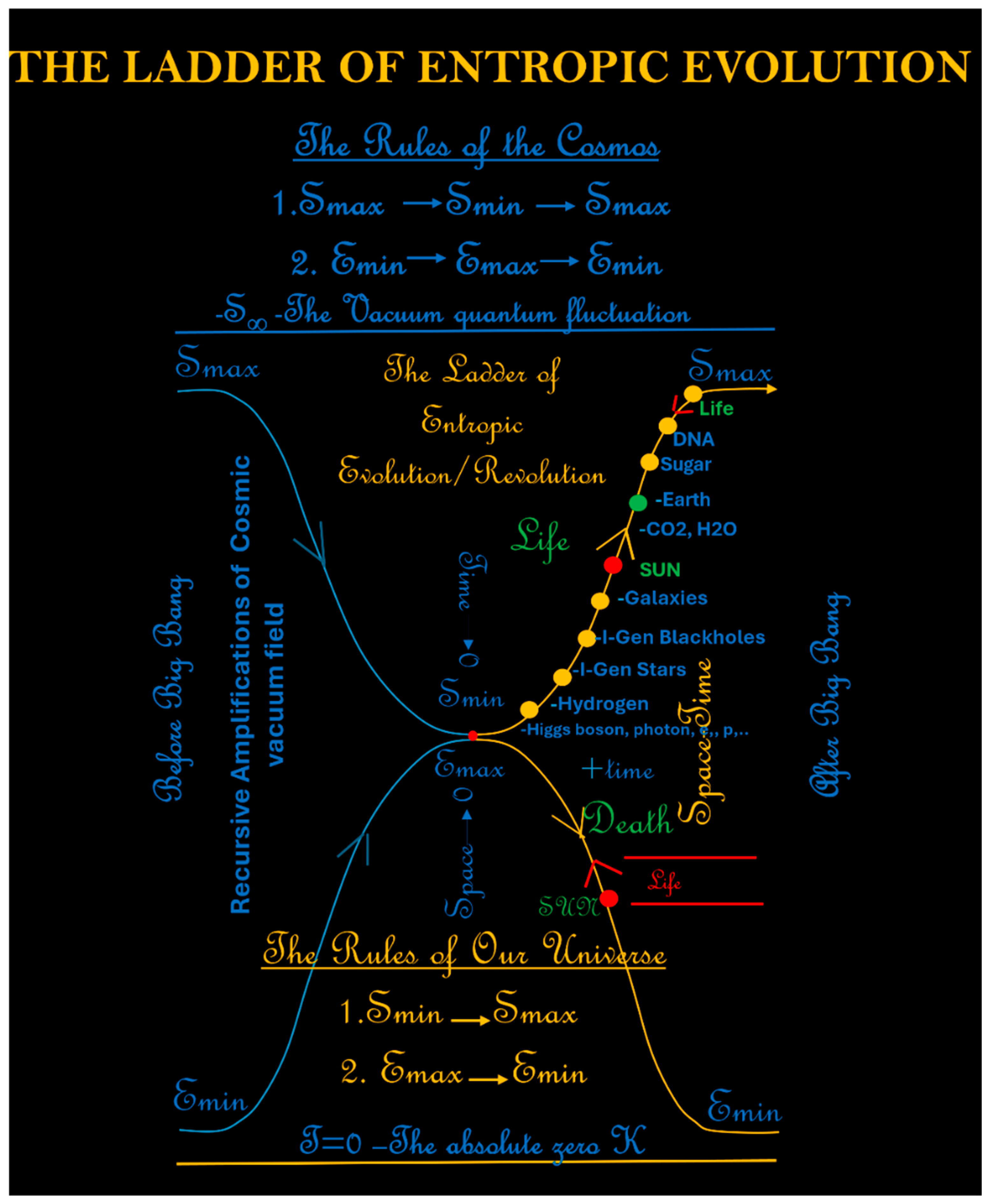
A Brief Overview of S-Theory and Recursive Entropic Evolution
3. Generating the Entropy Field Model of an Electron
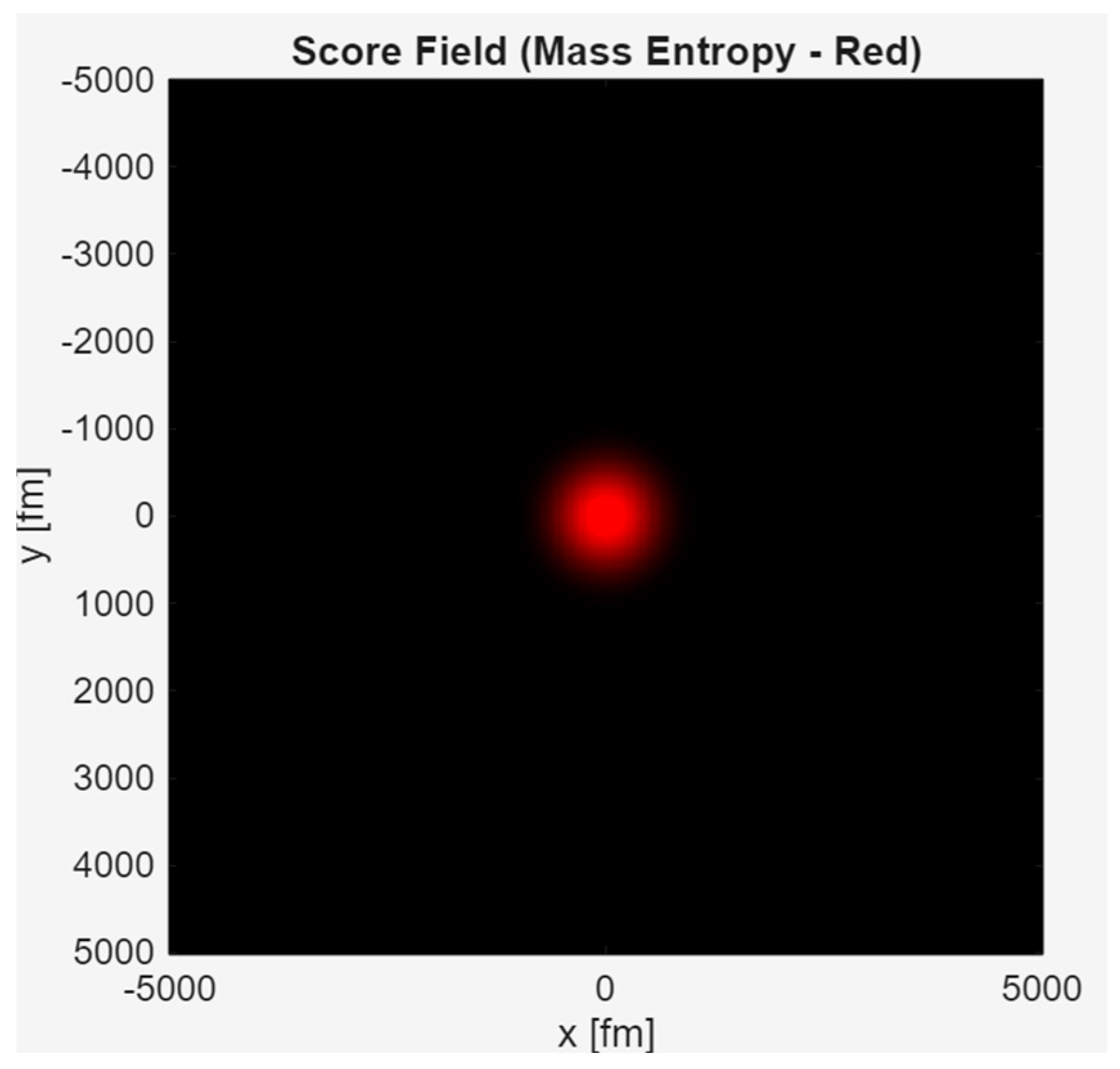
3.1. Mathematical Formulation of Score from Electron Mass
- (i)
- The Score Field: Entropy Core of the Electron
- (ii)
- From configurational Mass to Entropy: Core Logic
- (iii)
- Normalization of Score Field
- (iv)
- Physical Interpretation and justification
- (v)
- Why ln 2? The Identity Bit of the Electron
3.2. Mathematical Formulation of SEM from Charge
- (i)
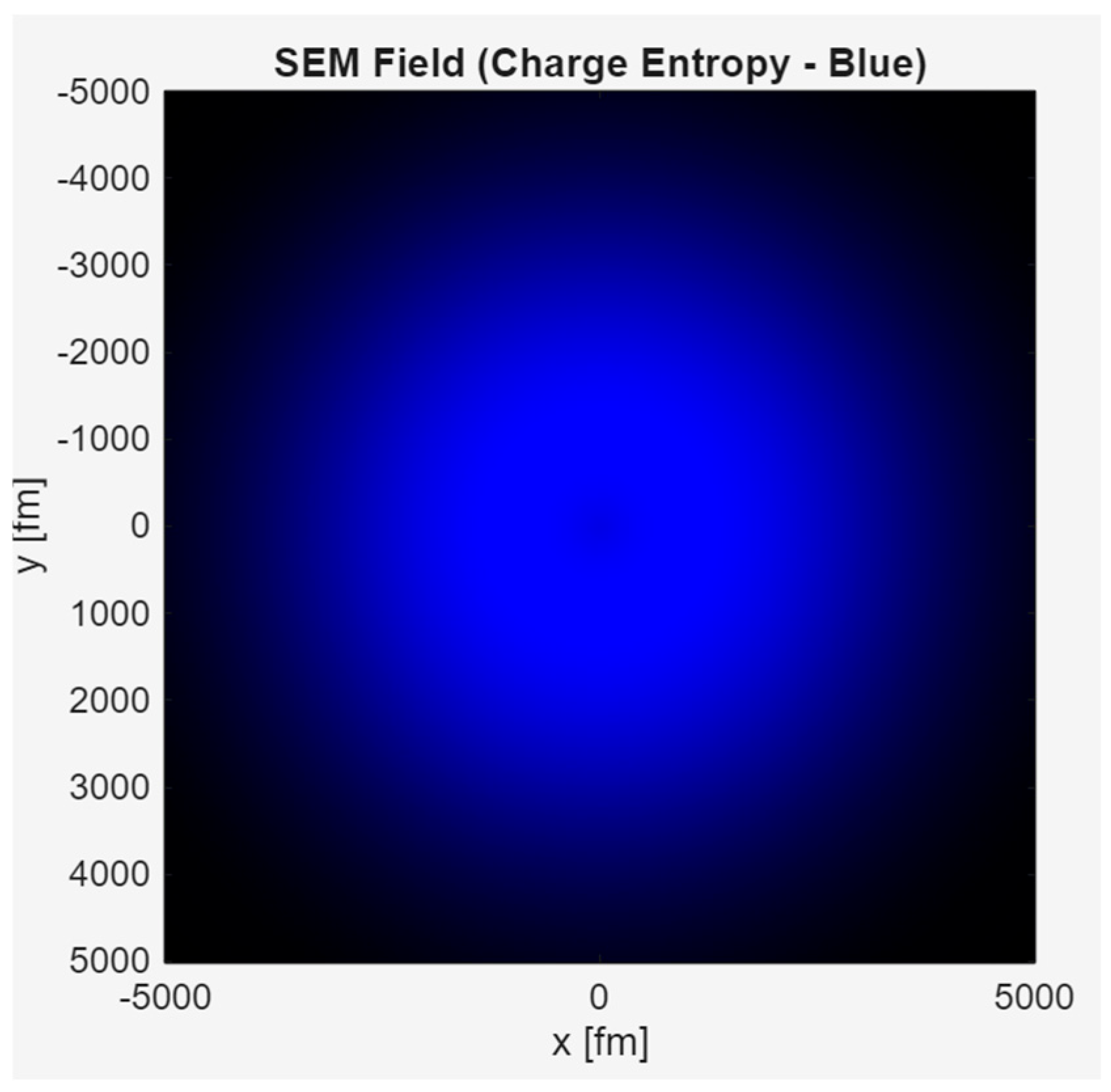
- From Charge to Entropy: The S-Theory Logic
- (ii)
- Choice of Spread Width σq
- (iii)
- Normalization Constant
- (iv)
- Estimation of Microstates of SEM: Comparison to Score
- (v)
- What if Gamma Were 5 Instead?
| Field | Total Entropy S | Bits | Microstates Ω | Meaning |
| Score | kBln2 | 1 | 2 | Binary identity (collapse) |
| SEM | γ⋅kBln2 | γ | 2γ | Distributed EM interaction entropy |
- (vi)
- Physical Basis of γ: Linked to Spatial Entropy Volume
- (vii)
- Justification of γ = 3 (vs. 10)
3.3. The Sthermal Field: Entropic Interaction Between Structure and Environment
- (i)
- Origin and Necessity of Sthermal
- (ii)
- Mathematical Formulation of the Sthermal Field
- (iii)
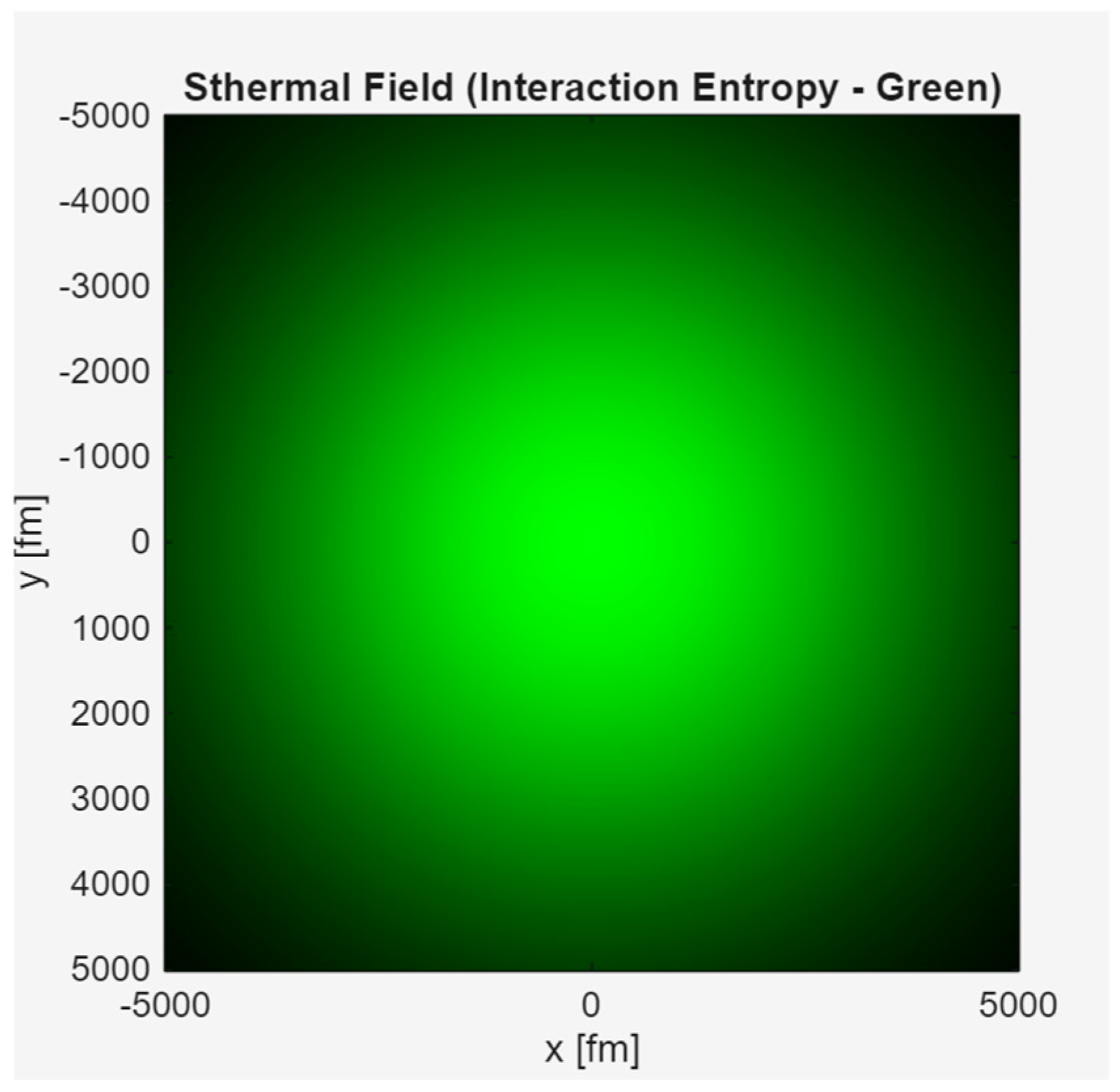
- Physical Interpretation: The Missing Link in QM
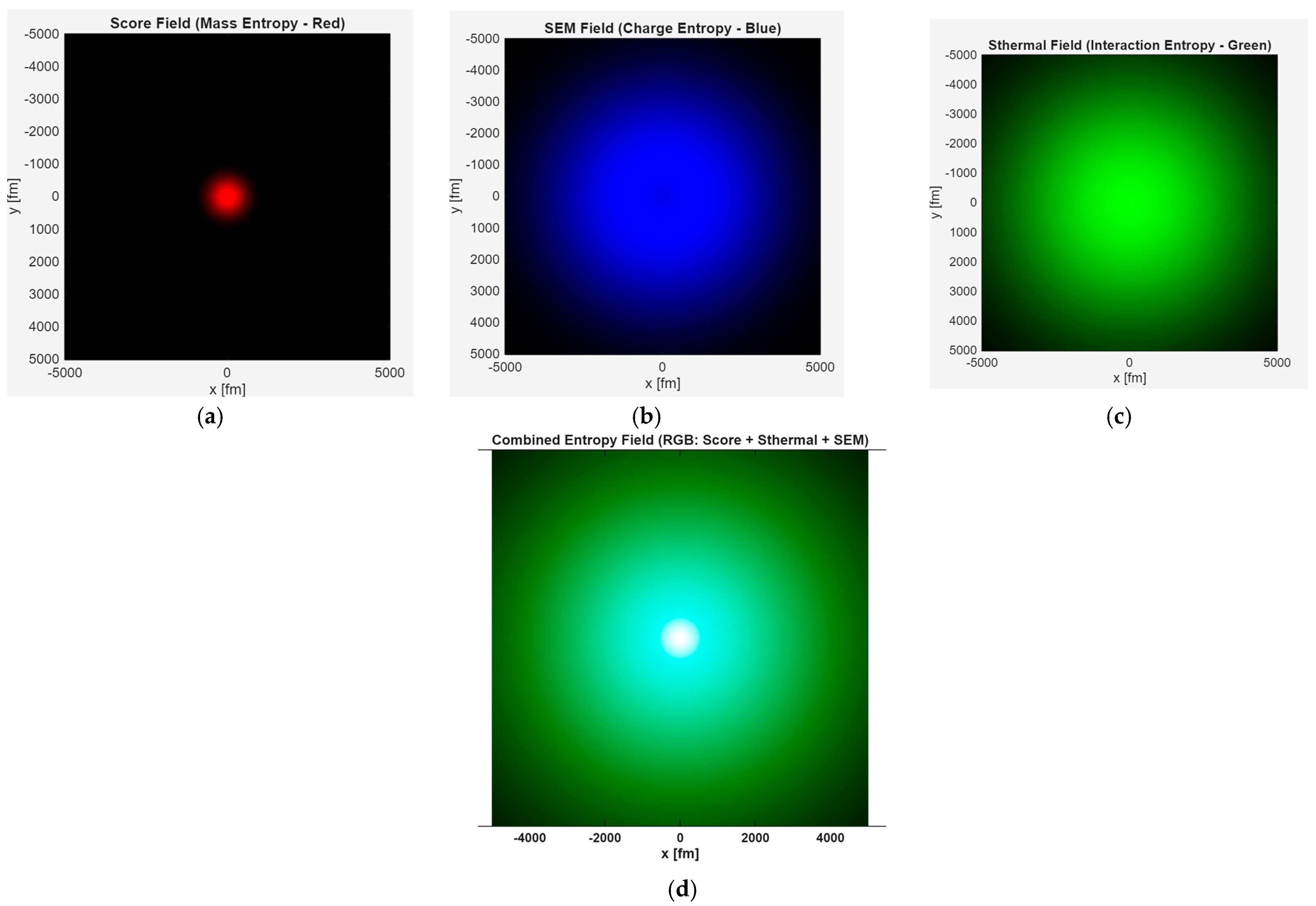
3.4. Combined Entropic Field of an Electron
- (i)
- Estimation of Microstates of Sthermal: Comparison to Score and SEM
4. SEM Field Structure with Spin
4.1. Rotational Spin Field: Mathematical Formulation
- (i)
- Total Integrated Spin and Normalization Constant
- is an entropy-based “mass” density analog
- is the tangential velocity magnitude
- = radius from core
- = 2 is an area element in polar coordinates
- ℏ = 1.055 × 10⁻³⁴ J s
- S0 = 1 (dimensionless, normalized)
- σ = 10 fm = 10 × 10−15 m
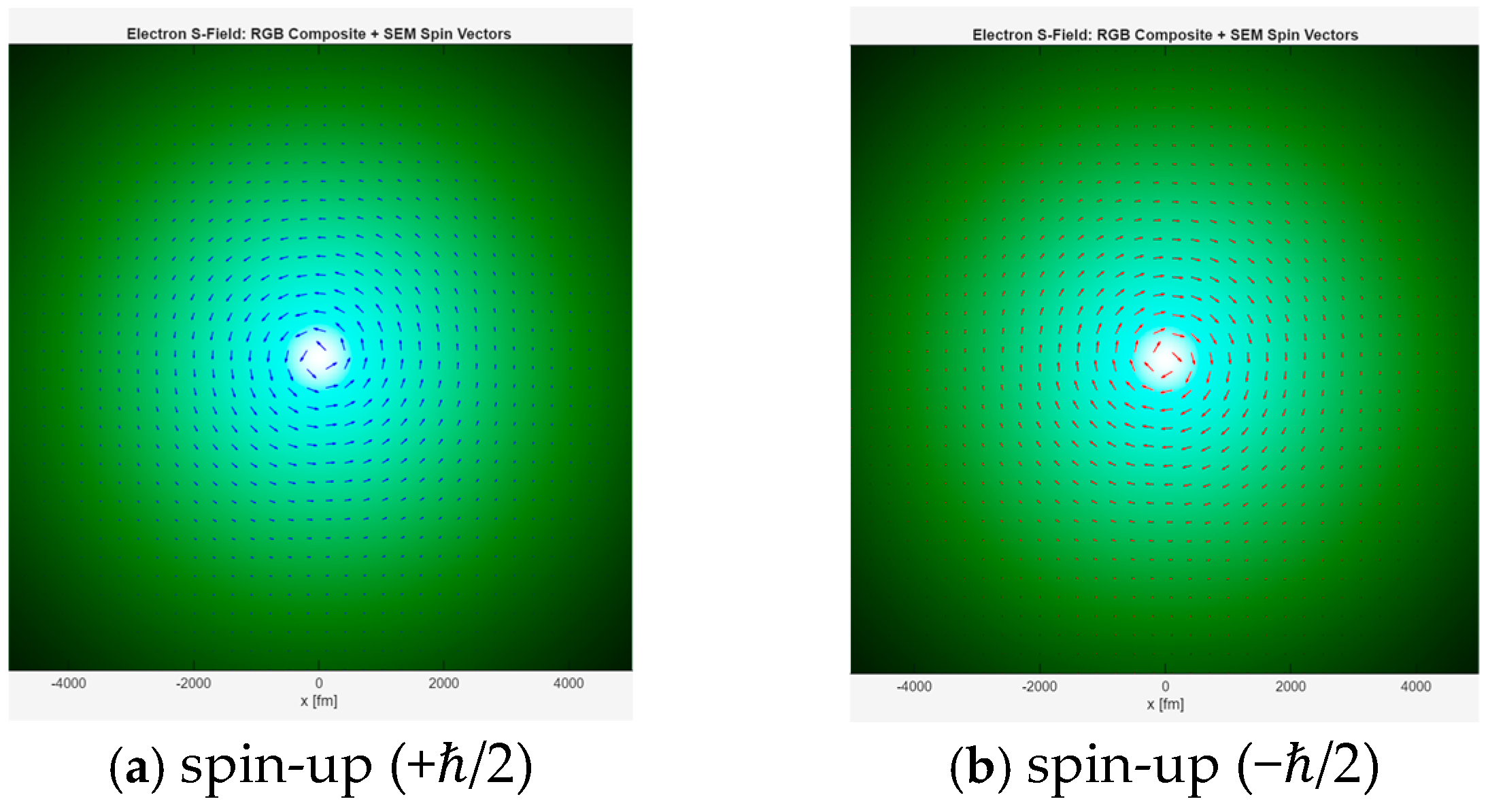
4.2. Spin-Up and Spin-Down Representation
5. Entropy-Based Collapse of the Electron: A Recursive Amplification Structure (RAS)
5.1. Why RAS? A Thermodynamic Recasting of Collapse
5.2. What Triggers Collapse?
5.3. Why a Ring? Spatial Logic of Measurement
5.4. What Is sc? A Perturbation of Entropic Origin
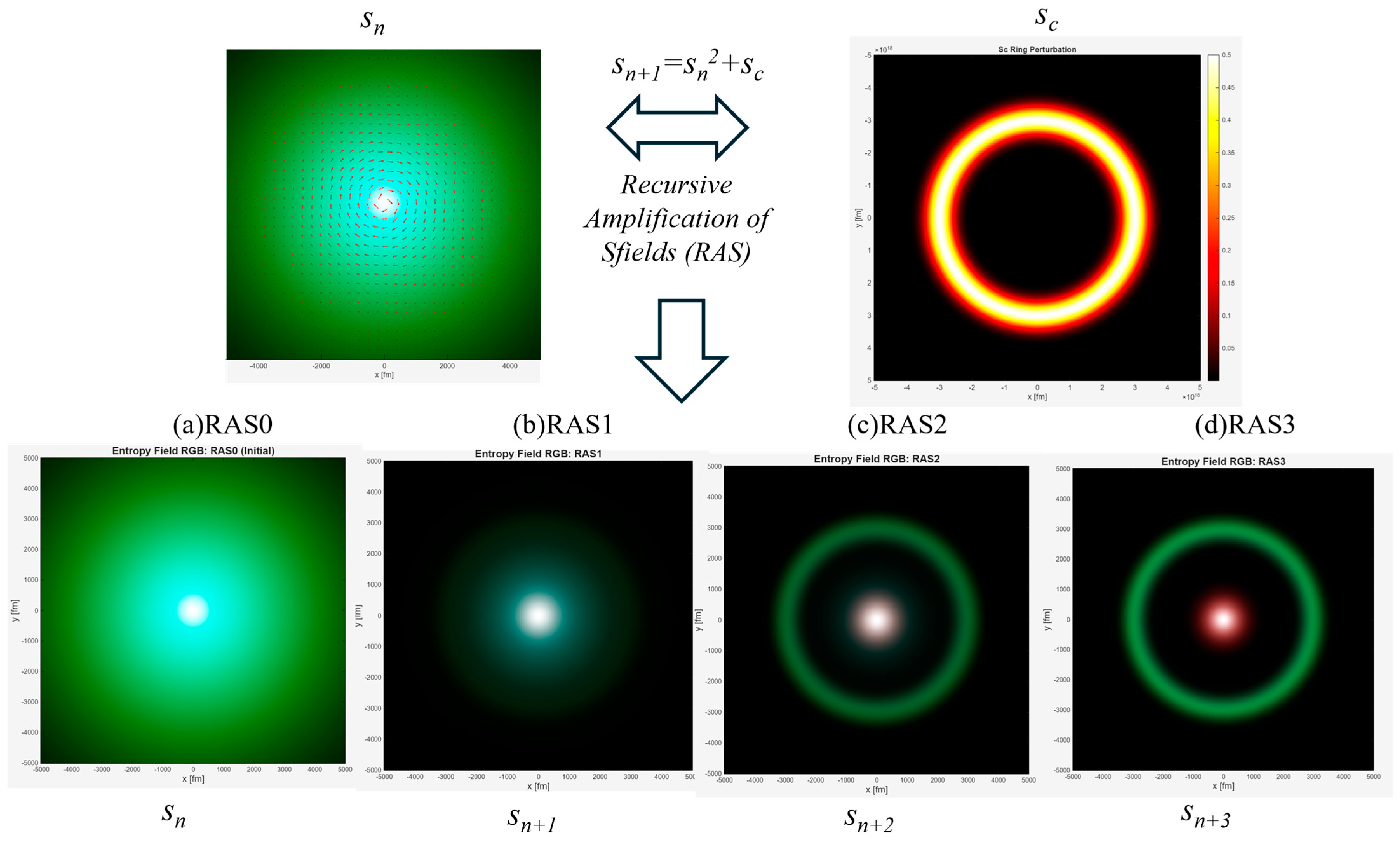
5.5. Collapse as Recursive Amplification
6. Collapse of Electron: A Recursive Entropic Interpretation from Field Profiles
6.1. Non-Dimensional Formulation and Numerical Setup
6.2. Simulation of S-Field from RAS0 to RAS3 (Field Images)
6.3. Simulation of S-Field from RAS0 to RAS3 (S-Field Density Profiles)
- (i)
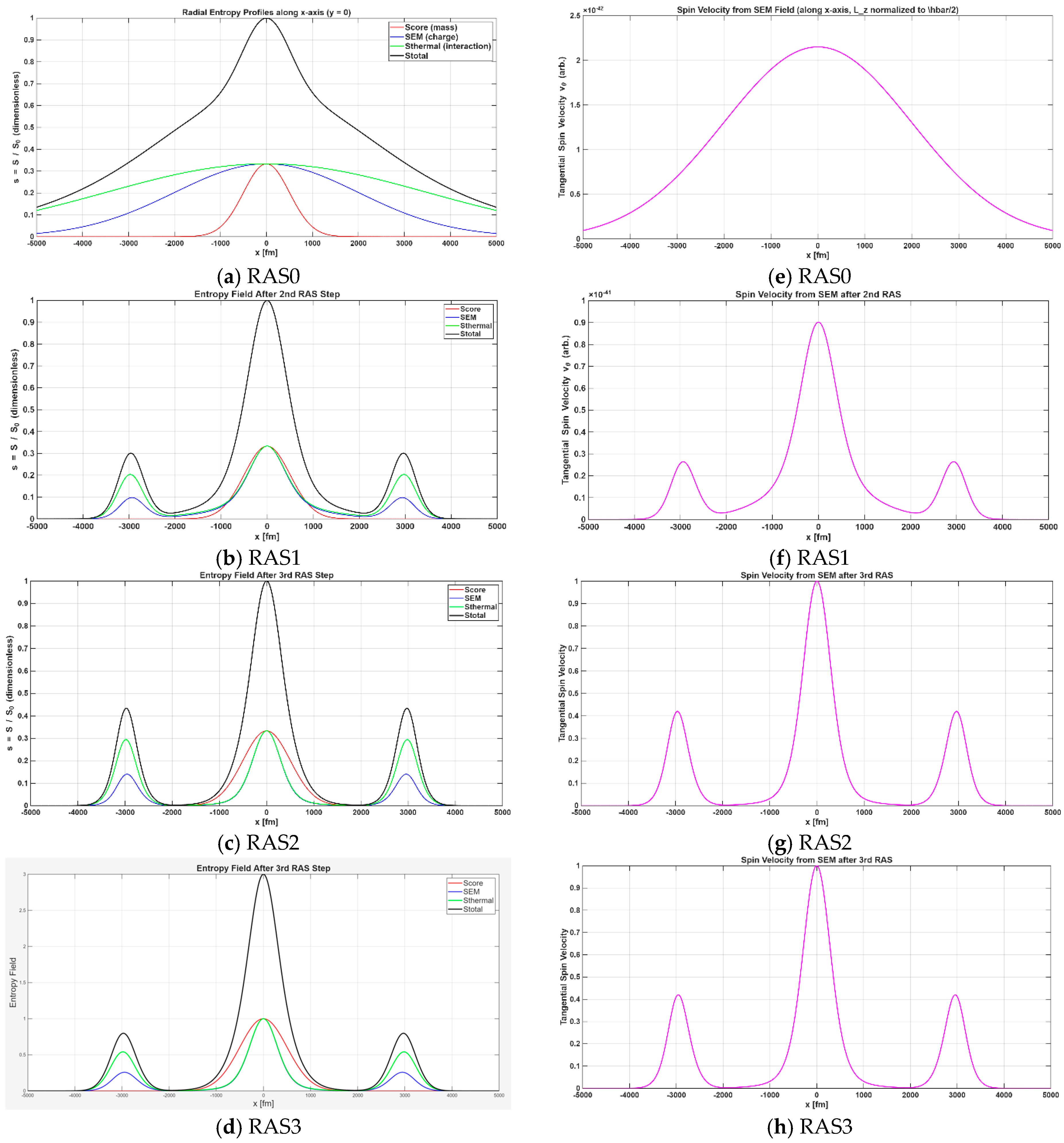
- Figure 8a: Baseline Entropy Profile (y = 0 Line Cut). Figure 8a shows the radial entropy field profile of the electron, taken along the x-axis at y = 0. This is the reference state before any perturbation or measurement. The black curve represents the total entropy field stotal = score + sEM +sthermal. This is the total information field defining the electron’s identity, interaction, and ambient coupling. Each colored curve corresponds to one component: (i) Red corresponds to Score, the entropy field associated with mass, sharply localized around the origin (x = 0). This narrow peak reflects the dense, bounded entropy of the electron’s “collapsed” existence—the score field derived from Compton-width Gaussian (Equation (6)). (ii) Blue corresponds to sEM, the entropy from charge-based electromagnetic interaction. It is broader than the score, derived from Equation (13), with width σq = 4 λC, and reflects the more spread-out field influence. (iii) Green corresponds to sthermal, the broadest field, capturing ambient entropy interactions (background photons, stochastic field noise), modeled with a Gaussian of even larger spread. While less dense, it plays a crucial role in the collapse. This trinity of fields (score, sEM, and sthermal) forms the entropic structure of the electron. Although sEM and sthermal are spatially broad, their entropy density is lower compared to score. This distinction is critical: it is not just the spatial extent, but the local entropy density that determines how collapse unfolds.
- (ii)
- Figure 8e: Tangential Spin Velocity Profile from sEM. The corresponding spin field (Figure 8e) plots the tangential velocity profile derived from the rotation of the sEM field, projected along the same axis. Unlike score, which is static and non-rotating, sEM carries a directional entropy flow—the root of electron spin in S-Theory. Here we observe the following. (a) A wide, smooth bell-shaped profile indicating that spin is not sharply localized. (b) The maximum spin velocity is around the mid-region, confirming that spin is a field effect, not a core identity. This redefines spin not as an abstract quantum number, but as a distributed rotational flow of entropic interaction, physically visualized and dependent on sEM structure. Together, Figure 8a,e provide a clear baseline: (a) the electron is not a point, but an extended entropy structure, (b) its mass (score) is tightly bound and carries high local entropy density, and (c) its charge field (sEM) is broader and rotating—the source of spin.
- (iii)
- RAS Step 1—Beginning of Collapse: Compression and New Structure Formation. In Figure 8b, we present the result of the first recursive amplification step (RAS1) applied to the electron’s non-dimensional entropy field using the update rule: sn+1 = sn2+sc (3). This process simulates the effect of an external entropy perturbation sc—such as a measurement photon—interacting with the native entropy field of the electron.
- (i)
- The rotational entropy flow, previously broad (Figure 8e), now becomes narrower and steeper, showing that the rotational field is collapsing toward the core.
- (ii)
- Like the entropy profile, side peaks begin to emerge in the spin field. These may represent angular momentum residues or quantized spin channels, possibly linked to the appearance of discrete spin outcomes upon measurement.
- (iii)
- Interpretation of RAS1: The first RAS step shows that electron collapse is not instantaneous but begins with a recursive inward pull that (i) amplifies entropy density at the center, (ii) blurs the boundary between charge and thermal fields, (iii) initiates structure bifurcation via side lobes, and (iv) begins reorganizing the spin field into quantized modes. This is the initial quantization pulse—a process not postulated but physically modeled from entropy field logic.
- (iv)
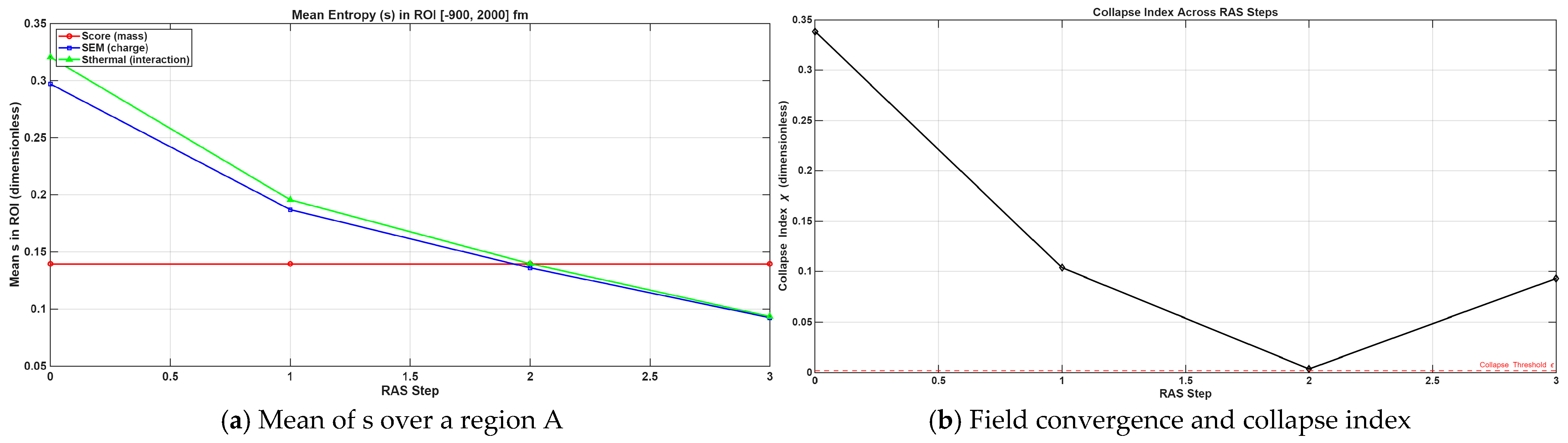
- RAS2—Threshold Convergence and Collapse Criteria Emerges: At the second recursive amplification step (RAS2), the behavior of the entropy field undergoes a dramatic transformation. All three core entropy components—score (mass), sEM (charge), and sthermal (interaction)—now appear almost fully collapsed and overlapping, forming a single dense central peak (Figure 8c): Key observations: (a) Trinity Field Convergence. For the first time, the red (score), blue (sEM), and green (sthermal) curves are no longer distinguishable in the core region. This convergence implies that their local mean entropies in the local area are equilibrated. The total entropy (black) thus becomes a sharply peaked structure, suggesting near-complete field unification.
6.4. Local Mean of Entropy Fields, and the Collapse Criterion
Collapse Index
7. Summary and Reflections
Funding
Data Availability Statement
Conflicts of Interest
References
- Dirac, P.A.M. The Principles of Quantum Mechanics; Oxford University Press: Oxford, UK, 1958. [Google Scholar]
- Schrödinger, E. Quantisierung als Eigenwertproblem. Ann. Phys. 1926, 79, 361. [Google Scholar] [CrossRef]
- von Neumann, J. Mathematical Foundations of Quantum Mechanics; Princeton University Press: Princeton, NJ, USA, 1955. [Google Scholar]
- Dirac, P.A.M. The Quantum Theory of the Electron. Proc. R. Soc. A 1928, 117, 610. [Google Scholar] [CrossRef]
- Weinberg, S. The Quantum Theory of Fields; Cambridge University Press: Cambridge, UK, 1995; Volume I. [Google Scholar]
- Hestenes, D. The Zitterbewegung Interpretation of Quantum Mechanics. Found. Physics. 1990, 20, 1213–1232. [Google Scholar] [CrossRef]
- Bohm, D. A Suggested Interpretation of the Quantum Theory in Terms of “Hidden” Variables. I. Phys. Rev. 1952, 85, 166. [Google Scholar] [CrossRef]
- Solomon, J.T. Why Life? Why God? The Ladder of Entropic Evolution: A Unified S-Theory for Entropy, Energy, Matter, Life, Intelligence and AI; Amazon Publishing: Seattle, WA, USA, 2025; ISBN 979-8290360751. [Google Scholar]
- Solomon, J.T. Entropy-Driven Orbital Formation: A Thermodynamic Foundation for the Hydrogen Atom. 2025. Available online: https://www.preprints.org/manuscript/202511.1885 (accessed on 13 January 2026).
- Jaynes, E.T. Information Theory and Statistical Mechanics. Phys. Rev. 1957, 106, 620. [Google Scholar] [CrossRef]
- Shannon, C.E. A Mathematical Theory of Communication; Bell System Technical Journal: New York, NY, USA, 1948; Volume 27, pp. 379–423. [Google Scholar]
- Madelung, E. Quantum Theory in Hydrodynamical Form. Zeit. f. Phys. 1927, 40, 322. [Google Scholar] [CrossRef]
- Schrödinger, E. What is Life? The Physical Aspect of the Living Cell; Cambridge University Press: Cambridge, UK, 1944. [Google Scholar]
- Guth, A.H. Inflation and eternal inflation. Phys. Rep. 2000, 333–334, 555–574. [Google Scholar] [CrossRef]
- Barrow, J.D. The entropy of the universe. Sci. Am. 2004, 82, 36–43. [Google Scholar]
- Schrödinger, E. An Undulatory Theory of the Mechanics of Atoms and Molecules. Phys. Rev. 1926, 28, 1049. [Google Scholar] [CrossRef]
- Feynman, R.P.; Leighton, R.B.; Sands, M. The Feynman Lectures on Physics, Vol. 3: Quantum Mechanics; Addison-Wesley: Boston, MA, USA, 1965. [Google Scholar]
- Landau, L.D.; Lifshitz, E.M. Statistical Physics, Part 1; Pergamon Press: Oxford, UK, 1980. [Google Scholar]
- Balian, R. Entropy: A Protean Concept; Poincaré Seminar 2003: Paris, France, 2004; pp. 119–144. [Google Scholar]
- Wheeler, J.A. Information, physics, quantum: The search for links. In Complexity, Entropy and the Physics of Information; Zurek, W.H., Ed.; Addison-Wesley: Boston, MA, USA, 1990. [Google Scholar]
- Prigogine, I.; Stengers, I. Order Out of Chaos: Man’s New Dialogue with Nature; Bantam Books: New York, NY, USA, 1984. [Google Scholar]
- Tovbin, Y.K. Small Systems and Fundamentals of Thermodynamics, 1st ed.; CRC Press: Boca Raton, FL, USA, 2018. [Google Scholar] [CrossRef]
- Tovbin, Y.K. Second Law of Thermodynamics, Gibbs’ Thermodynamics, and Relaxation Times of Thermodynamic Parameters. Russ. J. Phys. Chem. A 2021, 95, 637–658. [Google Scholar] [CrossRef]
- Timashev, S.F. Casimir polarization of the electromagnetic field vacuum in the vicinity of particles as a determinant of their interactions: Phenomenology. Russ. J. Phys. Chem. A 2025, 99, 1125–1138. [Google Scholar] [CrossRef]



Disclaimer/Publisher’s Note: The statements, opinions and data contained in all publications are solely those of the individual author(s) and contributor(s) and not of MDPI and/or the editor(s). MDPI and/or the editor(s) disclaim responsibility for any injury to people or property resulting from any ideas, methods, instructions or products referred to in the content. |
© 2026 by the author. Licensee MDPI, Basel, Switzerland. This article is an open access article distributed under the terms and conditions of the Creative Commons Attribution (CC BY) license.
Share and Cite
Solomon, J.T. The Entropy Field Structure and the Recursive Collapse of the Electron: A Thermodynamic Foundation for Quantum Behavior. Quantum Rep. 2026, 8, 5. https://doi.org/10.3390/quantum8010005
Solomon JT. The Entropy Field Structure and the Recursive Collapse of the Electron: A Thermodynamic Foundation for Quantum Behavior. Quantum Reports. 2026; 8(1):5. https://doi.org/10.3390/quantum8010005
Chicago/Turabian StyleSolomon, John T. 2026. "The Entropy Field Structure and the Recursive Collapse of the Electron: A Thermodynamic Foundation for Quantum Behavior" Quantum Reports 8, no. 1: 5. https://doi.org/10.3390/quantum8010005
APA StyleSolomon, J. T. (2026). The Entropy Field Structure and the Recursive Collapse of the Electron: A Thermodynamic Foundation for Quantum Behavior. Quantum Reports, 8(1), 5. https://doi.org/10.3390/quantum8010005