Review

Counterfactual Quantum Control: Review and Applications

1
College of Science, Inner Mongolia University of Technology, Hohhot 010051, China
2
China Telecom Quantum Information Technology Group, Hefei 230094, China
3
Department of Physics and Institute for Quantum Science and Technology, Shanghai University, Shanghai 200444, China
*
Authors to whom correspondence should be addressed.
Quantum Rep. 2026, 8(1), 6; https://doi.org/10.3390/quantum8010006
Submission received: 18 November 2025 / Revised: 5 January 2026 / Accepted: 15 January 2026 / Published: 19 January 2026

Abstract

Counterfactual quantum control is a novel control method, in which no actual material particles or energy are transported and exchanged between the controller and the controlled. By introducing the quantum Zeno effect where the evolution of a quantum system can be suppressed by continuous observation, this paper presents a review of research progress in counterfactual quantum control. The basic concept of counterfactual quantum control is presented and macro counterfactual quantum control is thoroughly discussed. In addition, related experimental verification and applied exploration are also discussed. This review paper covers the progress toward counterfactual quantum communication, non-invasive imaging and specific applications.

1. Introduction

The first 20 years of the 21st century have witnessed an explosion in quantum technology. With the launch of the “Micius” quantum satellite and the rise of the race for quantum supremacy, quantum mechanics has transitioned from a specialized field of academic study to widespread public awareness, demonstrating its important role in national security and high-quality socioeconomic development. Current research on quantum information, such as quantum communication [1,2] and quantum computing [3,4], has attracted widespread attention and support, progressing rapidly toward practicality and commercialization owing to the joint efforts of numerous scientists. In addition, new technologies and research have spurred novel insights and application prospects. The foundation of this work, direct counterfactual quantum communication [5], is rooted in a phenomenon called the quantum Zeno effect, during which the evolution of a quantum system can be suppressed by continuous observation. It exhibits a profoundly counterintuitive quantum phenomenon; that is, information can be transmitted remotely without any physical particle exchange. Unfortunately, direct counterfactual quantum communication has been a controversial topic since its interpretation in 2013 [6,7,8,9,10,11,12,13,14,15]. Many prominent physicists remain skeptical about the counterfactuality of Salih et al.’s protocol, Vaidman’s, based the work on his weak trace [6,7,8], and Griffiths’, based on his consistent histories [16]. The fundamental nature of this nonlocal quantum phenomenon has been understood more deeply over nearly a decade of research. The possible applications of this novel quantum control method have been extensively investigated, involving quantum communication [17,18,19,20,21,22,23,24], quantum computing [25], and quantum detection [26]. The results in this area are anticipated to play a critical role in the development of emerging technologies, such as non-invasive imaging and stealth quantum radar. This work explains and introduces the concept, basic theory, experimental verification, debates and perspective on nonlocality, and relevant applications of counterfactual quantum control.

2. Counterfactual Quantum Control Principle

Consider two objects that are far apart, completely isolated at an initial moment instead of entangled with each other. In counterfactual quantum control, one object affects the state evolution of the other without physical particle transmission or energy exchange to generate distinguishable changes. While quantum entanglement can produce similar results in quantum mechanics, the essence of counterfactual quantum control is that it can both form entanglement remotely across empty space and directly realize remote control even without entanglement. Research on nonlocal control began with direct counterfactual quantum communication; that is, the nonlocal control of a single photon’s propagation path and the quantum Zeno effect serve as the theoretical basis for this control method. Given that counterfactual quantum control contrast sharply with classical intuition, we provide a systematic introduction to its relevant concepts in Table 1.

2.1. Interaction-Free Measurement

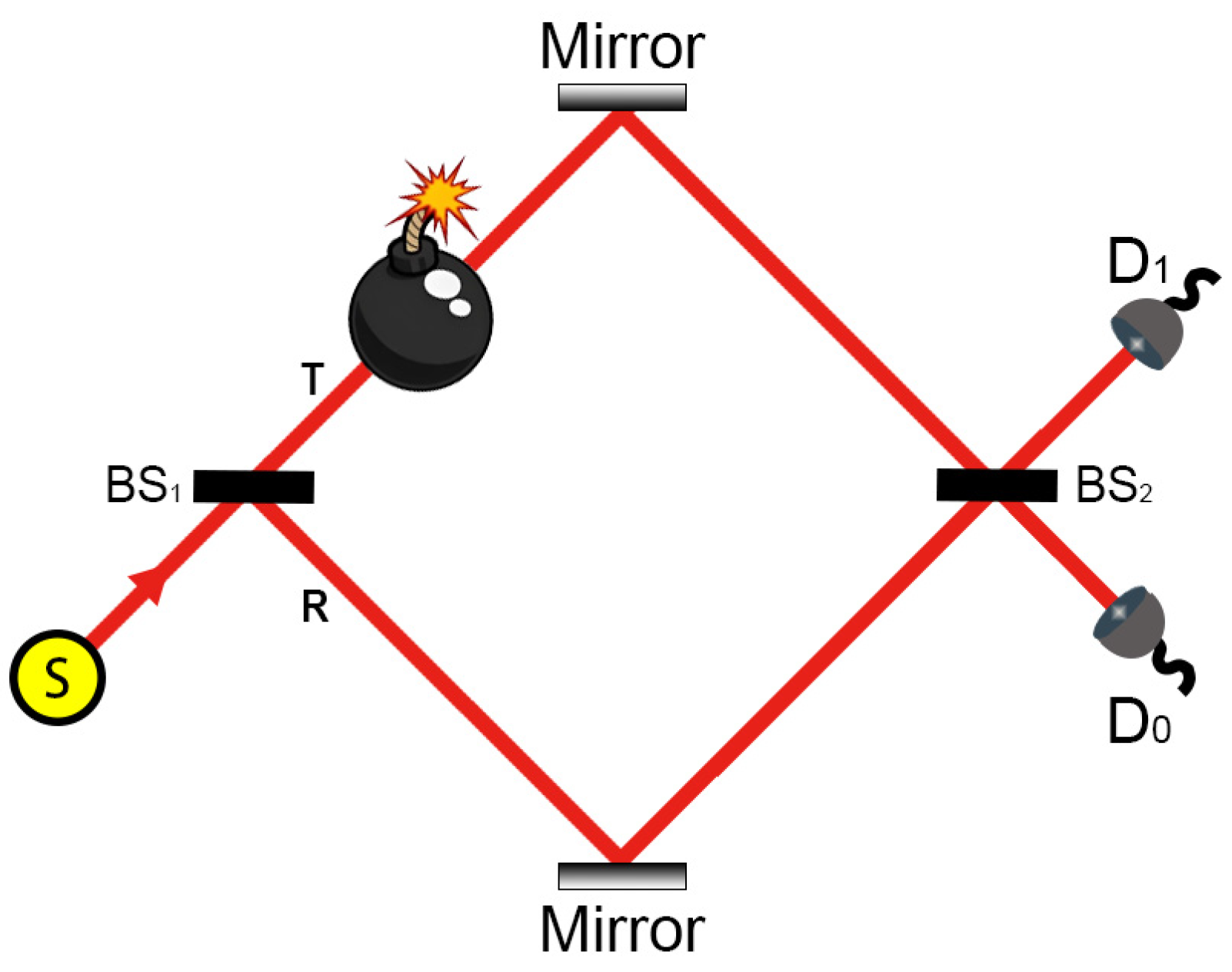
The theoretical study of interaction-free measurement can be traced back to Dicke’s work [27] in 1981. In 1993, Elitzur et al. [28] proposed a concise thought experiment known as the EV bomb detection experiment, which significantly advanced research in interaction-free measurement research. In the experiment, a bomb equipped with a single-photon trigger that detonates upon absorbing just one photon is assumed. If the trigger is defective, it remains transparent to photons. The objective is to identify functional bombs without triggering it. The specific detection scheme is shown in Figure 1.
The bomb to be detected is placed on the right path of the interferometer. When a single photon enters the interferometer, it forms a superposition of two states caused by the function of the beam splitter (BS) and the indivisible nature of the single photon. These two states are as follows: (1) the photon is in the left interference arm ( D 0 ); (2) the photon is in the right interferometer arm ( D 1 ). If the trigger is transparent, the photon will only be detected at output D 1 end because of the interference of the left and right paths. However, if the bomb trigger is functional, there is a 50 % probability that the photon will take the right path and trigger an explosion. If the bomb is not triggered, this conclusively proves that the photon must have traveled through the left side of the interferometer. As a result, D 0 and D 1 each have a 25 % probability of registering the photon. The key point is that if the photon is finally detected at D 0 , this confirms that the bomb trigger is functional. In this case, the photon never physically interacts with the bomb. There is no actual contact; however, the bomb’s functionality is determined without triggering it. This is the essence of interaction-free measurement.

2.2. Quantum Zeno Effect

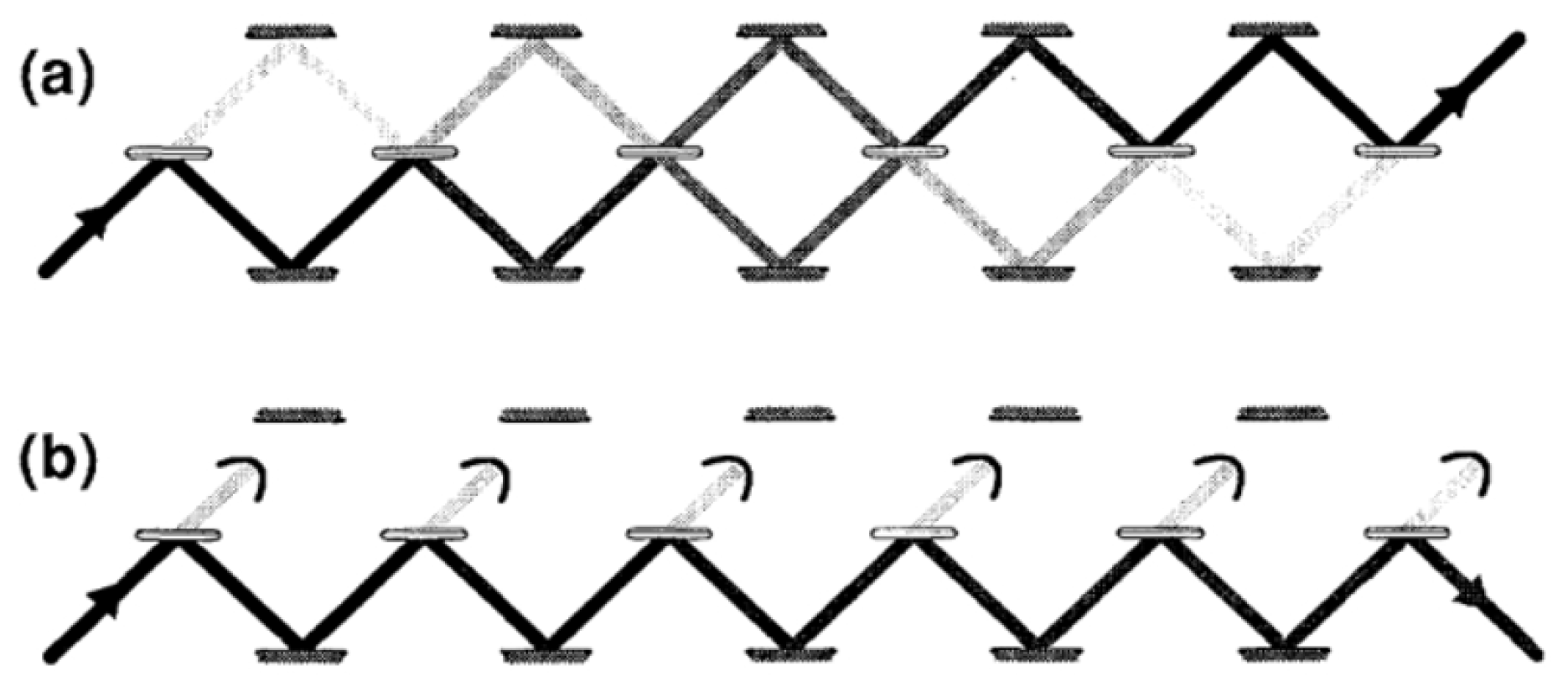
In the EV bomb detection experiment, the probability of identifying the bomb safely without contact was only 25 % . In 1995, Kwiat et al. [29] successfully raised this probability to 100 % using the quantum Zeno effect. The quantum Zeno effect refers to the phenomenon when the evolution of a quantum system can be suppressed by continuous observation [30,31,32]. Consider a chain-type interferometer structure for interaction-free measurement under the quantum Zeno effect, as shown in Figure 2, where the bomb is located on the upper arm of each interferometer in the chain. For simplicity, it is assumed that all bombs are in the same state (either transparent or opaque). Different from the EV bomb detection experiment, the beam splitters (BSs) used here have much higher reflectivity than transmissivity. Building biased BSs with specified reflectivity is a challenging work. Alternatively, a wave plate and a polarizing beam splitter are required to realize the function of a biased beam splitter. During measurement, a single photon must pass through the BS continuously to repeatedly “feel” the effect of the bomb. If the bomb is transparent, the interference between the upper and lower light paths will continue to occur through the BS, causing the “center of gravity” of the photon’s probability distribution will gradually shift from the lower light path to the upper light path. As a result, the probability of detecting the photon at D 1 reaches 100 % . By contrast, if the bomb is opaque, the photon path will be repressed by the continuous absorption of the photon. Consequently, the photon will remain in the lower light path, leading to a 100 % probability of triggering D 0 under ideal conditions. Thus, it becomes possible to determine whether bombs are functional or not without triggering them at all by combining quantum Zeno effect and interaction-free measurement.

2.3. Direct Counterfactual Quantum Communication

Despite the remarkable results of the interaction-free measurement proposed by Kwiat et al. [29], they raise further questions that extend beyond the initial findings. However, this marked the initial phase of the research. Researchers noticed that when the bomb is transparent, photons would still pass through the bomb and interact with it. In reality, passing through an object involves phase accumulation; so, this cannot be regarded as true interaction-free measurement. This prompted a more speculative concept: could there be a scenario where, regardless of the bomb’s state, the photon never interacts with the bomb while accurately reflecting the state information of the bomb? This fantastical idea becomes entirely possible within the framework of quantum mechanics using the nested chain of interferometers [5,33]. Specifically, if the state of the bomb represents signals 0 and 1, information can be transmitted through “empty space” to the photon nonlocally without pre-entanglement or any physical information carrier. This is the direct counterfactual quantum communication protocol. To facilitate readers’ understanding, the physical process of direct counterfactual quantum communication is briefly described, followed by a detailed theoretical proof.
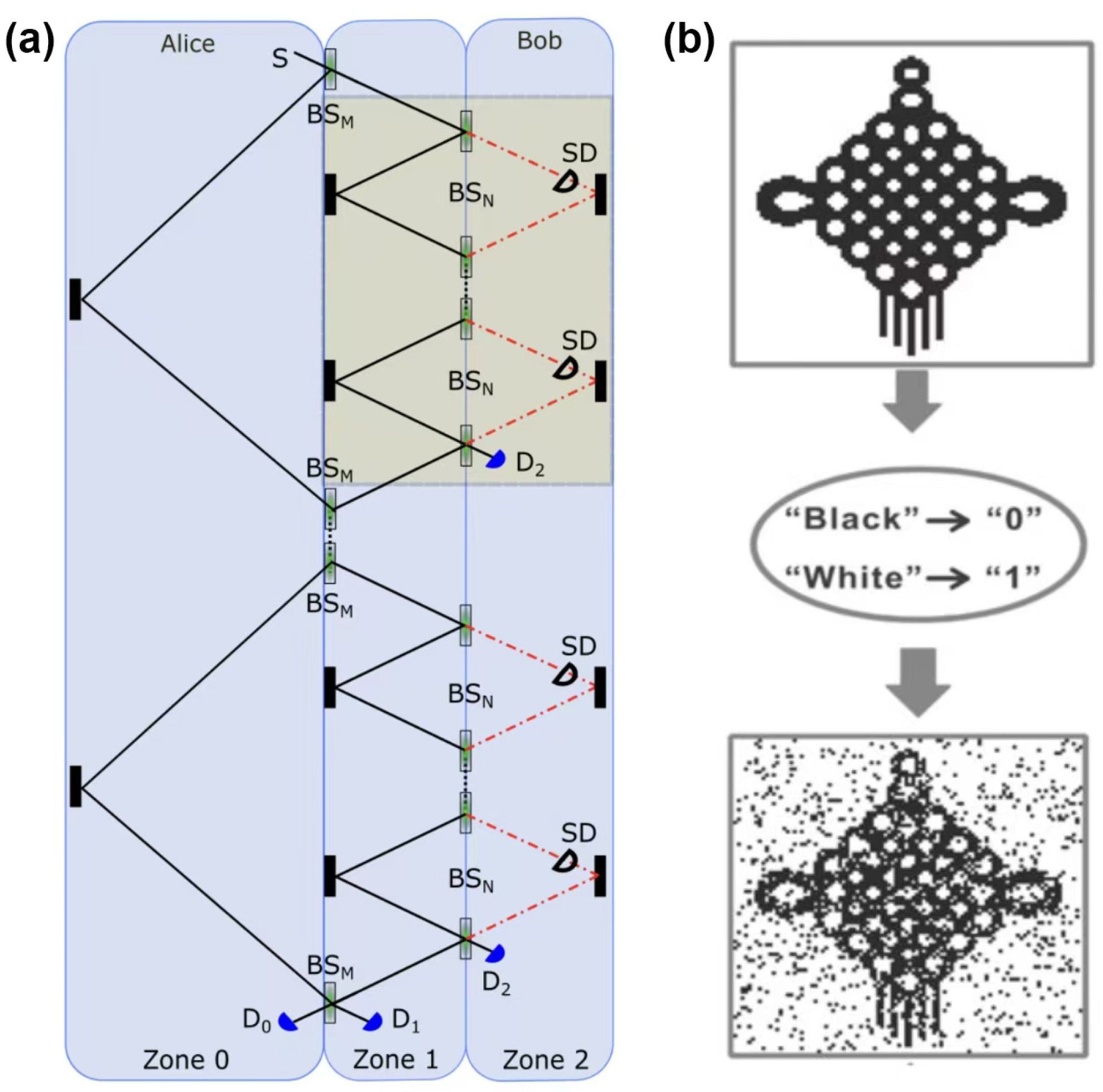
The optical structure of the direct counterfactual quantum communication protocol composed of nested chain of interferometers is shown in Figure 3a. The large interferometer chain on the left consisting of M BS M s is called the outer chain; each interferometer on the right side is nested with a small interferometer chain consisting of N BS N s, which is called the inner chain. The function of a single interferometer chain is consistent with that proposed by Kwiat et al. [29]. On the right arm of each interferometer in the inner chain is a switchable detector (SD), which is transparent when closed and absorbs photons when opened to complete the measurement. Assuming all SDs behave consistent, the influence of SD on the photon’s propagation path is described. With a single photon incident from the side of the outer chain (Zone 0), if the SDs are opaque, any photon entering the inner chain will be confined to the left side (Zone 1) because of the quantum Zeno effect. Consequently, for the outer chain, the interference process will continue to occur and eventually the photon will be completely imported to D 1 , with a probability 100 % under ideal conditions. A single photon is indivisible; D 1 receiving the photon means all SDs remained silent, and the photon does not interact any of them. In contrast, if the SDs are transparent, quantum interference occurs within the inner chain so that any photon entering the inner chain will be guided to D 2 rather than returning to the outer chain through the left exit of the inner chain. The entire inner chain can be regarded as a detector in this case. This also means that, for the outer chain, the quantum Zeno effect will inhibit quantum interference and prevents the photon from entering the inner chain. The probability of D 0 receiving the photon is 100 % . Importantly, D 0 receiving the photon means D 2 does not receive the photon. In this scenario, no photon enters the inner chain, and the SDs have no interaction with the photon. By combining these two processes, we can see that the state of SDs nonlocally controls the evolutionary of the photon path and determines the photon’s final state. If the state of SD represents information 0/1, while the photon represents the information receiver, then information can be transmitted nonlocally from the SDs to the photon. With transparent SDs, the counterfactual property is preserved for finite M and N. A finite M, however, may cause an erroneous event. With opaque SDs, counterfactuality is guaranteed by the structure of the outer chain and is thereby not dependent on the value of M or N. An imperfect outer chain, however, may cause an erroneous event.
The direct counterfactual quantum communication protocol has sparked extensive theoretical research, while its unique control approach has also prompted numerous applied research studies. Aharonov et al. [21] extended counterfactual quantum control theory to matter waves, which is also applied to studies of the quantum Cheshire Cat phenomenon [18,19,20]. However, regardless of the specific model, the fundamental mathematical processes remain similar.
Counterfactual quantum control can be generalized to any arbitrary light sources through calculations. The most recent research [23] shows that single-photon light source is not a necessary condition for counterfactual quantum control but a special case of Fock state light source. Any photon number distribution can be described by expanding the Fock state. With findings related to Fock state light sources, we can explore counterfactual quantum control under any multi-photon light sources. The collective nonlocal control of multiple photons, which behave collectively like a single photon, can be realized. This is crucial in both physical mechanisms and practical application. We expect that the utilization of a multi-photon light source will represent the next important stage in counterfactual quantum control research.

3. Macro Counterfactual Quantum Control

In a microscopic system, an object can be in the linear superposition of multiple states at the same time. However, this quantum phenomenon cannot be explained in macroscopic systems. In 1935, Schrödinger described the famous “Schrödinger cat state” experiment and showed the principle of quantum superposition in the micro world in macro terms. In the experiment, a cat was kept in a closed box containing radium with a decay probability of 50 % and cyanide. If radium decays, it will trigger the organ to break the bottle containing cyanide, and the cat will be poisoned; if radium does not decay, the cat can survive. The superposition state of “decay” and “non-decay” of radium can be mapped to the simultaneous superposition state of “dead” and “alive” of the cat. In modern physics, this cat state (CS) is usually represented by the superposition of two distinct coherent states ± α , which can generally be considered orthogonal when α 2 . Despite many preparation methods for optical CS at present, α remains less than 2 even for the best experimental results in the optical domain. Considering the practical application requirements that involve integrating diverse quantum systems, as well as for advanced sensing and imaging techniques, acquiring large-amplitude high-yield optical CS becomes not only necessary but also significantly valuable.
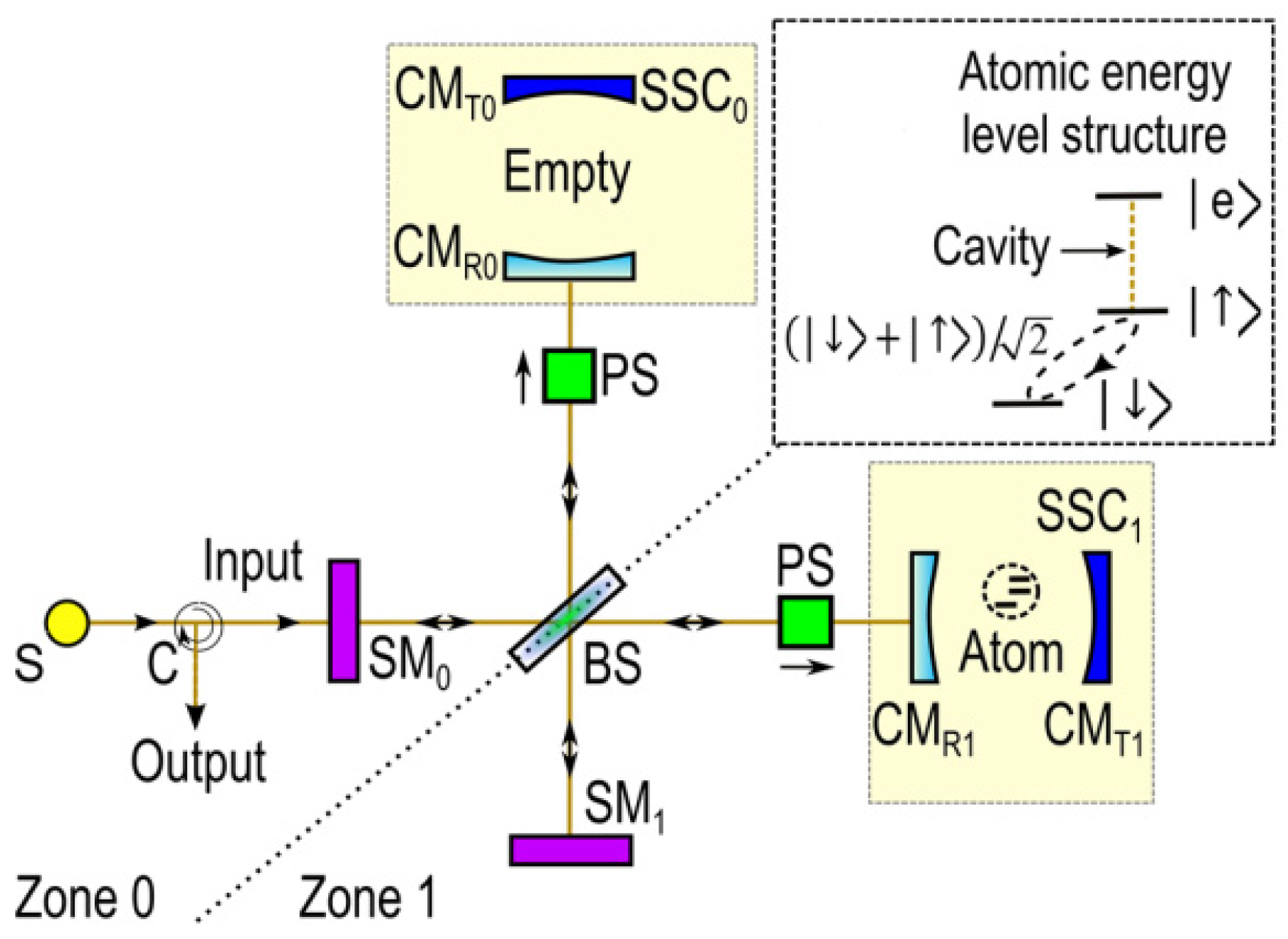
Recently, Li et al. [34] proposed a method of preparing optical CS states based on the Zeno effect and interaction-free measurement. They adopt the atom-single side cavity system as a quantum microsystem, as shown in Figure 4. A single atom is embedded in a single-side cavity SSC1, which is constituted by two facing mirrors CMR and CMT. Ideally, CMT is assumed to have perfect reflection, but CMR is allowed for in- and outcoupling of light. The transition between levels and e is coupled by the cavity mode. When the atom is in , the weak coherent light pulse, resonant with the cavity, is prevented from entering the cavity due to normal-mode splitting, which results in reflection without a π phase shift. As for the transition between and , it is decoupled from the cavity mode due to large detuning. Therefore, when the atom is in , the cavity can be treated as an empty cavity. The incident pulse enters the cavity and reflects back but with a π phase. After a single reflection (hereinafter we call it the single reflection scheme), the atom–field entanglement ( α + α ) / 2 can be generated. Based on the atom–cavity system, they use the chain interferometer structure to implement multiple interactions between the atom and light field. Due to the presence of the empty cavity SSC0, when the atom is in , the light field has no phase difference in Zones 0 and 1. Interference continues to occur, thereby generating α . On the contrary, when the atom is in , the light field is frozen in α due to the phase difference between the two zones. Consequently, after M cycles, they have the light–atom entangled state ( α , 0 + α , 0 ) / 2 .
Note that the light field is output from the SM0 end and no photons appear at SM1 side. After measuring the atom, the optical CS is deterministically prepared. The results show that the preparation of cat states is possible even when the quantum microsystem suffers from significant photon loss, provided that optical losses from classical devices are kept low, which implies that the fidelity of the cat state can be enhanced by improvements to and the perfection of the classical optical system.

4. Progress in Experimental Verification

The theoretical analysis reveals that the implementation of counterfactual quantum control requires a large number of series interferometers, posing a great challenge for experimental verification [35,36]. Despite these difficulties, major breakthroughs in experimental verification of counterfactual quantum control were achieved. A comparison of some counterfactual protocols using different sources and the performances based on them is given in Table 2.

4.1. Counterfactual Communication with Single-Photon Source

In the experiment carried out by Cao et al. [17], a single-photon source and the Michelson interferometer-based optical structure were adopted. This structure does not need multiple SDs in the same state, thus reducing the complexity of the optical setup to an extent. To adapt this structure, path interference is replaced by polarization interference. For demonstration purposes, the SD in the experiment was substituted with a black-and-white Chinese knot, where the black and white represent the two original states of the SD. As shown in Figure 3b, through single-photon imaging, the Chinese knot bit map is successfully transmitted from Bob to Alice in a nonlocal manner.
Pan et al. [24] reported an experimental implementation of an improved counterfactual communication protocol that eliminates the major environmental traces left by photons passing through the transmission channel, thus providing stronger support for the counterfactual nature of communication. Alonso Calafell et al. [37] implemented a novel protocol in a programmable nanophotonic processor. This, together with telecom, a single-photon source and a high-efficiency superconducting nanowire single-photon detector, provides a stable and versatile platform for high-fidelity implementation of counterfactual communication with single photons. Their demonstration shows how a programmable nanophotonic processor could be applied to more complex counterfactual tasks and quantum information protocols.

4.2. Counterfactual Communication with Coherent Light Sources

Liu et al. [38] adopted a nested Mach–Zehnder interferometer chain structure. In their experiment, the outer chain consisted of two interferometers, while the inner chain implemented seven series interferometers. However, instead of using a single-photon light source, they employed a weak coherent light source. Since, the intensity distribution of coherent light in different paths has the same mathematical form as the photon probability distribution in a single-photon case, this experiment validates the correctness and feasibility of the single-photon counterfactual quantum control scheme from a principle perspective. Nevertheless, given this intensity distribution, photons will inevitably appear at the SD, as reflected in the experimental results. Therefore, this experiment does not achieve true counterfactual quantum control but can only be considered quasi-counterfactual. Nevertheless, this experiment still provides insights for subsequent research on multi-photon counterfactual quantum control.
By using the quantum Zeno effect and different sources, direct counterfactual protocols without carrier particle transmission are implemented successfully. The necessary parameters, such as component specifications, interference visibility, or potential challenges in alignment may affect the counterfactuality or security of the protocol. Although the counterfactual protocol with a nested interferometer poses a great challenge for experimental realization, major breakthroughs in experimental verification were achieved. Instead of polarization-insensitive beam splitters, polarized light and half-wave plates combined with polarization beam splitters are used to reach high visibility.

5. Debates and Perspectives on Nonlocality

5.1. Classical Images

Although counterfactual quantum control theory can be obtained by rigorously calculating the photon dynamic, the counterintuitive physical phenomenon it displays has captured significant scientific interest. Gisin et al. [39] attempted to interpret the phenomenon with classical images, proposing that no sound is also a form of “sound” and suggesting the essence of direct counterfactual quantum communication lies in representing information with vacuum state, which can also be realized in a classical system. However, Hance et al. [22] demonstrated that classical implementation can only achieve counterfactual transmission of either 0 or 1, but never a complete bit of information, thereby proving that the counterfactuality is inherently quantum.

5.2. Quantum Nonlocality

Besides the question of whether the counterfactual effect is quantal, the debate increasingly focuses on the nonlocality of the counterfactual quantum phenomenon. In addition to Aharonov’s [21] reinterpretation of counterfactual quantum theory from the perspective of matter wave, novel analytical approaches have been proposed to assess the nonlocality of counterfactual quantum control.
Taking the weak trace criterion as an example, researchers hope to determine whether the photon will appear in the inner chain when the SD is transparent by introducing additional weak measurement. The previous discussion regards the whole inner chain as a detector to determine whether photons will appear within it. Specifically, because of the continuous interference effects, any photons entering the inner chain would trigger D 2 . Therefore, the silence of D 2 confirms that no photons have entered the inner chain. However, once any additional measurement is introduced into the inner chain, it will undoubtedly interrupt the interference process within it, consequently resulting in a non-zero weak value. Vaidman et al. [6,7] argued that this non-zero weak value proves that photons appear in the inner chain, thus refuting the existence of nonlocality. In fact, as early as 2007, Vaidman [40] had explored a similar problem (the three-box paradox) and drew a highly counterintuitive conclusion: “photons neither enter nor leave the interferometer, but they will appear in the interferometer.” This conclusion was based on a non-zero weak value. The input and output ports of the interferometer showed a zero weak value, while a non-zero weak value appeared along internal interferometer paths. In 2013, Li et al. [9] made a rigorous calculation and explanation analysis to address it. Their research shows that the non-zero weak value obtained by Vaidman originates from weak measurement, more precisely, the systematic error caused by weak measurement [9,10]. Counterfactual quantum control fundamentally relies on sequential quantum measurements and any additional measurements will inevitably interfere with the original system. Like in Young’s double-slit interference experiment, determining the photon path through measurements will inevitably disrupt interference.
Arvidsson-Shukur et al. [41] demonstrated via Fisher information that the feasibility of counterfactual communication protocols strictly depends on the perfect quantum channel. In practice, all practical quantum channels inherently exhibit weak and uncontrollable interaction, e.g., polarization rotations. These perturbations disrupt perfect interference conditions, resulting in non-zero probability of particle presence in the transmission channel. The Fisher information quantifies the extractable information about the weak perturbation parameter from output measurement results. Consequently, Fisher information serves as an essential tool for evaluating the practical robustness of protocols against environmental noise.
Counterfactual communication raises deep questions based on divergent scientific perspectives regarding the definition of nonlocality, which are not unified and even employed to refute the nonlocality of counterfactual quantum control [11,12,13,14,15]. Including historical consistency theory [16], the Fisher information method [41,42], and the weak trace criterion [6,7,8], these criteria strictly adhere to the calculation rules within the framework of quantum mechanics, and thereby do not generate any new physical content.

6. Application Review

In addition to the research on the physical nature of counterfactual quantum phenomena, substantial progress has been made in applied research. Based on the object state represented by SD, these studies can be categorized into two classes: classical object and quantum object. The difference lies in quantum objects’ ability to exist in superposition states, i.e., quantum superposition of transparent or opaque states.

6.1. Classical Objects

Research in this area focuses on utilizing quantum mechanical effects to transmit classical information, meaning the transmitted information is encoded in classical bit. Key applications include counterfactual quantum secret communication based on information security [43], quasi-counterfactual quantum communication protocol, where multiple measurements are replaced with multiple phase operations to improve communication efficiency [44], counterfactual quantum multi-party communication requiring simultaneous control of the public transmission channel by multiple isolated objects [45], semi-quantum key distribution [43], and counterfactual quantum ghost imaging that aims to reduce the damage to samples by minimizing photon absorption-induced irradiation while maintaining imaging accuracy [46]. The work of Hance et al. [46] originated from imaging research based on interaction-free measurement. As an advanced version of interaction-free measurement [47,48], counterfactual quantum ghost imaging shows a better signal-to-noise ratio and better sample protection [46].
This category also involves quantum detection. In the traditional Trojan eavesdropping scheme, information is stolen by emitting additional light fields (or photons) [49] into the target device and then analyzing the reflected signals to extract information. However, through active monitoring, such illegal photons are often easily filtered out, making a traditional Trojan eavesdropping scheme highly exposable. The situation is transformed using counterfactual quantum control. The counterfactual quantum Trojan eavesdropping scheme was first proposed by Li et al. [26,50], in which any attempt to detect the eavesdropping photon forces this photon to be localized in the eavesdropper because of the quantum Zeno effect, even with ideal detectors. As a result, the eavesdropping photons in the Trojan attack scheme are almost invisible, making the exposure of eavesdropping extremely difficult. By redesigning the optical path and incorporating multiple-phase modulation, this scheme can effectively decode various encoded signals with high discrimination ability, thus posing threats to a variety of quantum secure communication protocols. Li et al. [26] specifically analyzed the security of two representative protocols [51,52,53,54,55], including the well-known quantum direct secure communication protocol—Ping-Pong protocol [51], making the first theoretical demonstration of its loopholes. Research on eavesdropping technology ultimately aims to upgrade the existing communication technology and ensure communication security. Therefore, Li et al. [26] discussed the possible countermeasures alongside proposing a quantum eavesdropping scheme. Their findings show that while counterfactual quantum Trojan attacks are defendable, the solely active detection of illegally invading photons is infeasible. Hence, the existing defense strategies against traditional Trojan attacks must be upgraded and updated.
Finally, note that the existing counterfactual quantum Trojan eavesdropping schemes still employ a single-photon source. Considering that multi-photon light sources can be significantly easier to prepare and manipulate than single-photon light sources, adopting multi-photon light sources can substantially facilitate and extend the practical application of these schemes. Using Li et al.’s [23] research achievements in multi-photon counterfactual quantum control, this eavesdropping technology can be extended to macroscopic domains, enabling the achievement of stealth quantum radars that cannot be counter-tracked while detecting, which is of great military significance.

6.2. Quantum Objects

Research in this area involves quantum information transmission, e.g., the transfer of quantum bit. In this case, the object used to manipulate photons exists in the quantum superposition state of absorbing photons and not absorbing photons, which is realized specifically by means of Rydberg atoms [56,57] and single-sided cavities embedded with atoms [58,59,60]. Guo et al. [61,62] took the lead in the research work and achieved important results. Studies have shown that the quantum object and a photon can be remotely entangled without any physical particle exchange, which is a novel method of generating entanglement. Chen et al. [63,64] also engaged in related research. Guo et al. [65] indicated that an unknown quantum state can be transmitted counterfactually without pre-entanglement, thus achieving the function of traditional quantum teleportation [66,67,68]. In addition to these advances, the results based on counterfactual quantum entanglement include all kinds of counterfactual quantum logic gate [69,70,71], counterfactual quantum cloning [72], and counterfactual quantum Bell-state analysis [73,74]. Li et al. [75,76] and Wang et al. [77] had contributed extensively to this field. Theoretical work has explored the counterfactual swapping of two unknown quantum states [76]. Specifically, two unknown quantum states are independently prepared in a distant photon and atom. In this protocol, multiple rounds of counterfactual quantum control are adopted, but independent local control of the photon and the atom is implemented between every two rounds of nonlocal control. A feedback mechanism is established in this scheme [75], which not only allows for the evolution of photons controlled by atoms but also enables photons to affect the dynamic evolution of atoms. Lastly, this scheme achieves a novel form of bidirectional quantum teleportation. Different from the traditional quantum teleportation scheme, this scheme requires neither prior distribution of entangled particle pairs between two parties nor classical communication of Bell measurement results. Consequently, the entire transmission process occurs without any particle exchange whatsoever between the parties, which is a true realization of “mind transmission” at the quantum level.
This category can also be generalized to counterfactual quantum computation [25]. A quantum computer is programmed to solve a decision problem with an output of either 0 or 1, but through novel quantum protocols, we can infer the result without triggering the computer to “run”. The key lies in utilizing quantum superposition and interference to keep the system always in the subspace where the computer is “off”, thereby avoiding actual computation. Counterfactual computation can be viewed as a generalization of interaction-free measurements. This paper points out that if the probability of interaction is to approach zero, the number of measurement cycles must be large. This paper also extends counterfactual computation to more general scenarios, such as higher-dimensional switch spaces and multiple possible computation units.
Li et al. [76] also pointed out that counterfactual swapping of unknown quantum states is realized through sequential quantum measurements. Different from the traditional understanding, the multiple quantum measurements here can affect the evolution of the quantum system smoothly and mildly, which can be approximately described by a unitary time evolution operator. More importantly, any unitary time evolution operator can be implemented via a specially designed optical path through sequential quantum measurements. It theoretically provides a universal method of transforming local quantum control into nonlocal quantum control so as to pave a new avenue for future research on nonlocal quantum control. Based on these conclusions, subsequent research will focus on the nonlocal preparation of high-dimensional quantum entanglement states.

7. Conclusions

This work has reviewed the research history, fundamental concepts, basic theories, and applied studies of counterfactual quantum control theory, starting from interaction-free measurement and the quantum Zeno effect. The findings show that the evolution of the quantum system can be affected smoothly and mildly but nonlocally by sequential quantum measurements. Investigations into counterfactual quantum control provide deeper insights into the role of quantum measurements and the nature of nonlocality. The results also reflect the significant value of counterfactual quantum control in quantum communication, quantum computing, and quantum detection. For practical application, because it relies on sequential quantum measurements, counterfactual quantum control typically requires a longer time for implementation compared to other quantum control methods. In addition, counterfactual quantum control is exceptionally sensitive to environmental noise because of the continuous interference process. The effect of noise is primarily manifested at two levels. At the control and operation level, noise such as channel loss and phase fluctuations disrupts ideal interference conditions, causing the final detection probability to deviate from the ideal value of 100 % , thereby reducing the fidelity and reliability of the protocol. At the system level, noise may allow photons to appear with non-zero probability in the transmission channel that should remain empty, thus leaving weak traces in the transmission channel and physically undermining or even negating the protocol’s counterfactuality. Therefore, how to improve the efficiency of counterfactual quantum control and its robustness against environmental noise will be critical for future research. Research in this area can considerably expand the applicability of counterfactual quantum control, reduce the application difficulty, and contribute to the achievement of nonlocal quantum control of macro objects.

Author Contributions

Conceptualization and methodology, N.H. and X.Y.; investigation, N.H. and T.L.; resources, Z.L. (Zijian Liu) and B.Z.; formal analysis, X.Y. and Z.L. (Zhenghong Li); writing—original draft preparation, N.H., X.Y. and Z.L. (Zhenghong Li); writing—review and editing, N.H.; visualization, N.H. and B.Z.; supervision, Z.L. (Zijian Liu) and Z.L. (Zhenghong Li); project administration, T.L.; funding acquisition, X.Y. All authors have read and agreed to the published version of the manuscript.

Funding

This research was funded by National Natural Science Foundation of China (grant No. 62161038), Natural Science Foundation of Inner Mongolia (grant No. 2025LHMS06015), and Natural Science Foundation of Shanghai (grant No. 25ZR1401140).

Data Availability Statement

The data generated during and/or analyzed during the current study are available from the corresponding author on reasonable request.

Conflicts of Interest

Author Zijian Liu was employed by the company China Telecom Quantum Information Technology Group. The remaining authors declare that the research was conducted in the absence of any commercial or financial relationships that could be construed as a potential conflict of interest.

References

  1. Wehner, S.; Elkouss, D.; Hanson, R. Quantum internet: A vision for the road ahead. Science 2018, 362, eaam9288. [Google Scholar] [CrossRef]
  2. Fang, X.T.; Zeng, P.; Liu, H.; Zou, M.; Wu, W.; Tang, Y.L.; Sheng, Y.J.; Xiang, Y.; Zhang, W.; Li, H.; et al. Implementation of quantum key distribution surpassing the linear rate-transmittance bound. Nat. Photonics 2020, 14, 422–425. [Google Scholar] [CrossRef]
  3. Kok, P.; Munro, W.J.; Nemoto, K.; Ralph, T.C.; Dowling, J.P.; Milburn, G.J. Linear optical quantum computing with photonic qubits. Rev. Mod. Phys. 2007, 79, 135–174. [Google Scholar] [CrossRef]
  4. Ladd, T.D.; Jelezko, F.; Laflamme, R.; Nakamura, Y.; Monroe, C.; O’Brien, J.L. Quantum computers. Nature 2010, 464, 45–53. [Google Scholar] [CrossRef]
  5. Salih, H.; Li, Z.H.; Al-Amri, M.; Zubairy, M.S. Protocol for direct counterfactual quantum communication. Phys. Rev. Lett. 2013, 110, 170502. [Google Scholar] [CrossRef]
  6. Vaidman, L. Comment on “Protocol for direct counterfactual quantum communication”. Phys. Rev. Lett. 2014, 112, 208901. [Google Scholar] [CrossRef]
  7. Vaidman, L. Counterfactuality of ‘counterfactual’ communication. J. Phys. A Math. Theor. 2015, 48, 465303. [Google Scholar] [CrossRef]
  8. Aharonov, Y.; Vaidman, L. Modification of counterfactual communication protocols that eliminates weak particle traces. Phys. Rev. Lett. 2019, 99, 0101103. [Google Scholar] [CrossRef]
  9. Li, Z.H.; Al-Amri, M.; Zubairy, M.S. Comment on “Past of a quantum particle”. Phys. Rev. A 2013, 88, 046102. [Google Scholar] [CrossRef]
  10. Salih, H.; Li, Z.H.; Al-Amri, M.; Zubairy, M.S. Salih et al. Reply. Phys. Rev. Lett. 2014, 112, 208902. [Google Scholar] [CrossRef]
  11. Salih, H.; McCutcheon, W.; Hance, J.R.; Rarity, J. The laws of physics do not prohibit counterfactual communication. npj Quantum Inf. 2022, 8, 60. [Google Scholar] [CrossRef]
  12. Popescu, S. Counterfactual communication not achieved yet—A Comment on Salih et al. (2022). npj Quantum Inf. 2025, 11, 122. [Google Scholar] [CrossRef] [PubMed]
  13. Salih, H.; McCutcheon, W.; Hance, J.R.; Rarity, J. Reply to “Comment to ‘The laws of physics do not prohibit counterfactual communication’”. npj Quantum Inf. 2025, 11, 100. [Google Scholar] [CrossRef]
  14. Salih, H. From counterportation to local wormholes. Quantum Sci. Technol. 2023, 8, 025016. [Google Scholar] [CrossRef]
  15. Dressel, J.; Reznik, G.; Vaidman, L. Comment on ‘From counterportation to local wormholes’. Quantum Sci. Technol. 2024, 9, 018001. [Google Scholar] [CrossRef]
  16. Griffiths, R.B. Particle path through a nested Mach-Zehnder interferometer. Phys. Rev. A 2016, 94, 032115. [Google Scholar] [CrossRef]
  17. Cao, Y.; Li, Y.H.; Cao, Z.; Yin, J.; Chen, Y.A.; Yin, H.L.; Chen, T.Y.; Ma, X.; Peng, C.Z.; Pan, J.W. Direct counterfactual communication via quantum Zeno effect. Proc. Natl. Acad. Sci. USA 2017, 114, 4920–4924. [Google Scholar] [CrossRef]
  18. Aharonov, Y.; Popescu, S.; Rohrlich, D.; Skrzypczyk, P. Quantum cheshire cats. New J. Phys. 2013, 15, 113015. [Google Scholar] [CrossRef]
  19. Aharonov, Y.; Cohen, E.; Popescu, S. A dynamical quantum cheshire cat effect and implications for counterfactual communication. Nat. Commun. 2021, 12, 4770. [Google Scholar] [CrossRef] [PubMed]
  20. Hance, J.R.; Ladyman, J.; Rarity, J. Is the dynamical quantum cheshire cat detectable? New J. Phys. 2022, 26, 073038. [Google Scholar] [CrossRef]
  21. Aharonov, Y.; Rohrlich, D. What is nonlocal in counterfactual quantum communication? Phys. Rev. Lett. 2020, 125, 260401. [Google Scholar] [CrossRef] [PubMed]
  22. Hance, J.R.; Ladyman, J.; Rarity, J. How quantum is quantum counterfactual communication? Found. Phys. 2021, 51, 12. [Google Scholar]
  23. Li, Z.H.; Feng, S.Y.; Al-Amri, M.; Zubairy, M.S. Direct counterfactual quantum-communication protocol beyond a single-photon source. Phys. Rev. A 2022, 106, 032610. [Google Scholar] [CrossRef]
  24. Pan, W.W.; Liu, X.; Xu, X.Y.; Wang, Q.Q.; Cheng, Z.D.; Wang, J.; Liu, Z.D.; Chen, G.; Zhou, Z.Q.; Li, C.F.; et al. Counterfactual communication without a trace in the transmission channel. npj Quantum Inf. 2023, 9, 87. [Google Scholar] [CrossRef]
  25. Mitchison, G.; Jozsa, R. Counterfactual computation. Proc. A 2001, 457, 1175–1193. [Google Scholar] [CrossRef]
  26. Li, Z.H.; Zubairy, M.S.; Al-Amri, M. Counterfactual trojan horse attack. Phys. Rev. A 2020, 101, 022336. [Google Scholar] [CrossRef]
  27. Dicke, R. Interaction-free quantum measurements: A paradox. Am. J. Phys. 1981, 49, 925–930. [Google Scholar] [CrossRef]
  28. Elitzur, A.C.; Vaidman, L. Quantum mechanical interaction-free measurements. Found. Phys. 1993, 23, 987–997. [Google Scholar] [CrossRef]
  29. Kwiat, P.G.; Weinfurter, H.; Herzog, T.; Zeilinger, A.; Kasevich, M.A. Interaction-free measurement. Phys. Rev. Lett. 1995, 74, 4763. [Google Scholar] [CrossRef] [PubMed]
  30. Kwiat, P.G.; White, A.; Mitchell, J.; Nairz, O.; Weihs, G.; Weinfurter, H.; Zeilinger, A. High-efficiency quantum interrogation measurements via the quantum zeno effect. Phys. Rev. Lett. 1999, 83, 4725. [Google Scholar] [CrossRef]
  31. Kofman, A.; Kurizki, G. Acceleration of quantum decay processes by frequent observations. Nature 2000, 405, 546–550. [Google Scholar] [CrossRef]
  32. Zheng, H.; Zhu, S.; Zubairy, M. Quantum zeno and anti-zeno effects: Without the rotating-wave approximation. Phys. Rev. Lett. 2008, 101, 200404. [Google Scholar] [CrossRef]
  33. Hosten, O.; Rakher, M.T.; Barreiro, J.T.; Peters, N.A.; Kwiat, P.G. Counterfactual quantum computation through quantum interrogation. Nature 2006, 439, 949–952. [Google Scholar] [CrossRef] [PubMed]
  34. Li, Z.H.; Yu, F.; Li, Z.Y.; Al-Amri, M.; Zubairy, M.S. Method to deterministically generate large-amplitude optical cat states. Commun. Phys. 2024, 7, 134. [Google Scholar] [CrossRef]
  35. Li, F.; Zhang, J.X.; Zhu, S.Y. Numerical simulation of the effect of dissipation and phase fluctuation in a direct communication scheme. J. Phys. B At. Mol. Opt. Phys. 2015, 48, 115506. [Google Scholar] [CrossRef]
  36. Liu, C.; Liu, J.; Zhang, J.; Zhu, S. Improvement of reliability in multi-interferometer-based counterfactual deterministic communication with dissipation compensation. Opt. Express 2018, 26, 2261–2269. [Google Scholar] [CrossRef]
  37. Calafell, I.A.; Strömberg, T.; Arvidsson-Shukur, D.R.M.; Rozema, L.; Saggio, V.; Greganti, C.; Harris, N.; Prabhu, M.; Carolan, J.; Hochberg, M.; et al. Trace-free counterfactual communication with a nanophotonic processor. npj Quantum Inf. 2019, 5, 61. [Google Scholar] [CrossRef]
  38. Liu, C.; Liu, J.; Zhang, J.; Zhu, S. The experimental demonstration of high efficiency interaction-free measurement for quantum counterfactual-like communication. Sci. Rep. 2017, 7, 10875. [Google Scholar] [CrossRef] [PubMed]
  39. Gisin, N. Optical communication without photons. Phys. Rev. A 2013, 88, 030301. [Google Scholar] [CrossRef]
  40. Vaidman, L. Impossibility of the counterfactual computation for all possible outcomes. Phys. Rev. Lett. 2007, 98, 160403. [Google Scholar] [CrossRef] [PubMed]
  41. Arvidsson-Shukur, D.R.M.; Gottfries, A.; Barnes, C.H.W. Evaluation of counterfactuality in counterfactual communication protocols. Phys. Rev. A 2017, 96, 062316. [Google Scholar] [CrossRef]
  42. Arvidsson-Shukur, D.R.M.; Barnes, C.H.W. Postselection and counterfactual communication. Phys. Rev. A 2019, 99, 060102. [Google Scholar] [CrossRef]
  43. Wang, K.; Yang, X.Q.; Li, T.Y.; Lin, Y.Q.; Hai, N.; Yin, Z.Q. Practical semi-quantum key distribution with one-way key and one basis. Opt. Express 2023, 31, 40730–40740. [Google Scholar] [CrossRef] [PubMed]
  44. Li, Z.H.; Al-Amri, M.; Zubairy, M.S. Direct quantum communication with almost invisible photons. Phys. Rev. A 2014, 89, 052334. [Google Scholar] [CrossRef]
  45. Li, Z.H.; Ji, X.F.; Asiri, S.; Wang, L.; Al-Amri, M. Counterfactual logic gates. Phys. Rev. A 2020, 102, 022606. [Google Scholar] [CrossRef]
  46. Hance, J.R.; Rarity, J. Counterfactual ghost imaging. npj Quantum Inf. 2021, 7, 88. [Google Scholar] [CrossRef]
  47. Zhang, Y.; Sit, A.; Bouchard, F.; Larocque, H.; Grenapin, F.; Cohen, E.; Elitzur, A.C.; Harden, J.L.; Boyd, R.W.; Karimi, E. Interaction-free ghost-imaging of structured objects. Opt. Express 2019, 27, 2212–2224. [Google Scholar] [CrossRef]
  48. Turchetti, M.; Kim, C.S.; Hobbs, R.; Yang, Y.; Kruit, P.; Berggren, K.K. Design and simulation of a linear electron cavity for quantum electron microscopy. Ultramicroscopy 2019, 199, 50–61. [Google Scholar] [CrossRef]
  49. Gisin, N.; Fasel, S.; Kraus, B.; Zbinden, H.; Ribordy, G. Trojan-horse attacks on quantum-key-distribution systems. Phys. Rev. A 2006, 73, 022320. [Google Scholar] [CrossRef]
  50. Li, Z.H.; Zubairy, M.S.; Al-Amri, M. Quantum secure group communication. Sci. Rep. 2018, 8, 3899. [Google Scholar] [CrossRef]
  51. Boström, K.; Felbinger, T. Ping-pong coding. Phys. Rev. Lett. 2002, 89, 187902. [Google Scholar] [CrossRef]
  52. Cai, Q.Y.; Li, B.W. Improving the capacity of the boströsm-felbinger protocol. Phys. Rev. A 2004, 69, 054301. [Google Scholar] [CrossRef]
  53. Noh, T.G. Counterfactual quantum cryptography. Phys. Rev. Lett. 2009, 103, 230501. [Google Scholar] [CrossRef] [PubMed]
  54. Brida, G.; Cavanna, A.; Degiovanni, I.P.; Genovese, M.; Traina, P. Experimental realization of counterfactual quantum cryptography. Laser Phys. Lett. 2012, 9, 247. [Google Scholar] [CrossRef]
  55. Liu, Y.; Ju, L.; Liang, X.L.; Tang, S.B.; Tu, G.L.S.; Zhou, L.; Peng, C.Z.; Chen, K.; Chen, T.Y.; Chen, Z.B.; et al. Experimental demonstration of counterfactual quantum communication. Phys. Rev. Lett. 2012, 109, 030501. [Google Scholar] [CrossRef] [PubMed]
  56. Johnson, T.A.; Urban, E.; Henage, T.; Isenhower, L.; Yavuz, D.; Walker, T.; Saffman, M. Rabi oscillations between ground and rydberg states with dipole-dipole atomic interactions. Phys. Rev. Lett. 2012, 109, 030501. [Google Scholar] [CrossRef]
  57. Urban, E.; Johnson, T.A.; Henage, T.; Isenhower, L.; Yavuz, D.; Walker, T.; Saffman, M. Observation of rydberg blockade between two atoms. Nature Phys. 2009, 5, 110–114. [Google Scholar] [CrossRef]
  58. Duan, L.M.; Kimble, H. Scalable photonic quantum computation through cavity-assisted interactions. Phys. Rev. Lett. 2004, 92, 127902. [Google Scholar] [CrossRef]
  59. Reiserer, A.; Ritter, S.; Rempe, G. Nondestructive detection of an optical photon. Science 2013, 342, 1349–1351. [Google Scholar] [CrossRef]
  60. Reiserer, A.; Kalb, N.; Rempe, G.; Ritter, S. A quantum gate between a flying optical photon and a single trapped atom. Nature 2014, 508, 237–240. [Google Scholar] [CrossRef]
  61. Guo, Q.; Cheng, L.Y.; Chen, L.; Wang, H.F.; Zhang, S. Counterfactual entanglement distribution without transmitting any particles. Opt. Express 2014, 22, 8970–8984. [Google Scholar] [CrossRef]
  62. Guo, Q.; Cheng, L.Y.; Wang, H.F.; Zhang, S. Counterfactual entanglement swapping enables high-efficiency entanglement distribution. Opt. Express 2018, 26, 27314–27325. [Google Scholar] [CrossRef]
  63. Chen, Y.; Gu, X.; Jiang, D.; Xie, L.; Chen, L. Tripartite counterfactual entanglement distribution. Opt. Express 2015, 23, 21193–21203. [Google Scholar] [CrossRef]
  64. Chen, Y.; Jiang, D.; Gu, X.; Xie, L.; Chen, L. Counterfactual entanglement distribution using quantum dot spins. J. Opt. Soc. Am. B 2016, 33, 663–669. [Google Scholar] [CrossRef]
  65. Guo, Q.; Cheng, L.Y.; Chen, L.; Wang, H.F.; Zhang, S. Counterfactual quantum-information transfer without transmitting any physical particles. Sci. Rep. 2015, 5, 8416. [Google Scholar] [CrossRef]
  66. Bennett, C.H.; Brassard, G.; Crépeau, C.; Jozsa, R.; Peres, A.; Wootters, W.K. Teleporting an unknown quantum state via dual classical and einstein-podolsky-rosen channels. Phys. Rev. Lett. 1993, 70, 1895. [Google Scholar] [CrossRef] [PubMed]
  67. Bouwmeester, D.; Pan, J.W.; Mattle, K.; Eibl, M.; Weinfurter, H.; Zeilinger, A. Experimental quantum teleportation. Nature 1997, 390, 575–579. [Google Scholar] [CrossRef]
  68. Luo, Y.H.; Zhong, H.S.; Erhard, M.; Wang, X.L.; Peng, L.C.; Krenn, M.; Jiang, X.; Li, L.; Liu, N.L.; Lu, C.Y.; et al. Quantum teleportation in high dimensions. Phys. Rev. Lett. 2019, 123, 070505. [Google Scholar] [CrossRef]
  69. Guo, Q.; Cheng, L.Y.; Chen, L.; Wang, H.F.; Zhang, S. Counterfactual distributed controlled-phase gate for quantum-dot spin qubits in double-sided optical microcavities. Phys. Rev. A 2014, 90, 042327. [Google Scholar] [CrossRef]
  70. Salih, H. Protocol for counterfactually transporting an unknown qubit. Front. Phys. 2016, 3, 94. [Google Scholar] [CrossRef]
  71. Cao, Z. Counterfactual universal quantum computation. Phys. Rev. A 2020, 102, 052413. [Google Scholar] [CrossRef]
  72. Guo, Q.; Zhai, S.; Cheng, L.Y.; Wang, H.F.; Zhang, S. Counterfactual quantum cloning without transmitting any physical particles. Phys. Rev. A 2017, 96, 052335. [Google Scholar] [CrossRef]
  73. Zaman, F.; Jeong, Y.; Shin, H. Counterfactual bell-state analysis. Sci. Rep. 2018, 8, 14641. [Google Scholar] [CrossRef] [PubMed]
  74. Zaman, F.; Jeong, Y.; Shin, H. Dual quantum zeno superdense coding. Sci. Rep. 2019, 9, 11193. [Google Scholar] [CrossRef] [PubMed]
  75. Li, Z.H.; Al-Amri, M.; Zubairy, M.S. Direct counterfactual transmission of a quantum state. Phys. Rev. A 2015, 92, 052315. [Google Scholar] [CrossRef]
  76. Li, Z.H.; Al-Amri, M.; Yang, X.H.; Zubairy, M.S. Counterfactual exchange of unknown quantum states. Phys. Rev. A 2019, 100, 022110. [Google Scholar] [CrossRef]
  77. Wang, L.; Li, Z.H.; Xu, J.; Yang, Y.; Al-Amri, M.; Zubairy, M.S. Exchange unknown quantum states with almost invisible photons. Opt. Express 2019, 27, 20525–20540. [Google Scholar] [CrossRef]
Figure 1. EV bomb testing. S represents the single-photon source, BS the beam-splitter, and D 0 and D 1 the detector.
Quantumrep 08 00006 g001
Figure 2. Interaction-free measurement with the quantum Zeno effect. (a) The bomb is transparent and photons will flow out of the “up” port of the last BS. (b) The bomb is opaque and photons will flow out of the “down” port of the last BS [29].
Quantumrep 08 00006 g002
Figure 3. (a) The optical structure of a direct counterfactual quantum communication protocol. The structure consists of nested chains of interferometer, with M BS M s forming the outer chain and N BS N s forming the inner chain. The SD is a switchable detector which is transparent when closed and absorbs photons when open. The behavior of all SDs is consistent. (b) Experiment of direct counterfactual quantum communication. In transmitting the monochrome bitmap of Chinese knot, the black pixel is defined as logic 0, while the white pixel is defined as logic 1 [17].
Quantumrep 08 00006 g003
Figure 4. Schematic for cat state preparation. S represents the coherent light source, BS the beam-splitter, MR the normal mirror, SM the switchable mirror, PS the phase shifter, and C the optical circulator. When the switchable mirrors (SMs) are turned on, the coherent light pulse bounces inside the interferometer and interacts with the single-side cavity SSC consisting of two mirrors, CM T and CM R , with CM T having perfect reflectivity. Only SSC 1 contains a three-level atom [23].
Quantumrep 08 00006 g004
Table 1. Differences and relationships of key concepts.
ConceptsDefinitionsDifferences and Relationships
CounterfactualityInformation transfer can be achieved without physical particles traveling between two remote parties.It originates from interaction-free measurement and the quantum Zeno effect, which is a reflection of nonlocality.
NonlocalityIt refers to the cases in which two spatially separated quantum objects can influence each other, even in the absence of direct interaction.It specifically refers to correlations that cannot be explained by any “local hidden variable theory”, which is one of the core characteristics of quantum mechanics.
Interaction-free measurementThe state of the measured object can be determined without particle interacting with it.It serves as the theoretical foundation for counterfactual quantum communication and control.
Quantum Zeno effectIt refers to the phenomenon that the evolution of a quantum system can be suppressed by continuous observation.Combined with interaction-free measurement, it enables counterfactual quantum communication and control with high efficiency.
Table 2. A comparison of some counterfactual protocols using different sources and the performances based on them.
         SourceVisibility      StructureError RateReferences
Heralded single photons 98 % Nested chained MZI 12.7 % [17]
Telecom single photons 99 %     Chained MZI 1 % [37]
Heralded single photons 98 % Double-nested MZI 2.3 10 % [24]
       Coherent light 90 % Nested chained MZI 2.7 % [38]
Disclaimer/Publisher’s Note: The statements, opinions and data contained in all publications are solely those of the individual author(s) and contributor(s) and not of MDPI and/or the editor(s). MDPI and/or the editor(s) disclaim responsibility for any injury to people or property resulting from any ideas, methods, instructions or products referred to in the content.