Article

Designing Rubber Mounts with Non-Linear Functional Properties for Commonality Using Solution Space Engineering

by
Sebastian Wagner
1,2,* and
Dieter Schramm
1
1
Department of Mechanical Engineering, University of Duisburg-Essen, Forsthausweg 2, 47057 Duisburg, Germany
2
BMW Group, Development Drivetrain, 80788 Munich, Germany
*
Author to whom correspondence should be addressed.
Vehicles 2026, 8(5), 103; https://doi.org/10.3390/vehicles8050103
Submission received: 18 March 2026 / Revised: 27 April 2026 / Accepted: 28 April 2026 / Published: 7 May 2026
(This article belongs to the Special Issue Vehicle Design Processes, 3rd Edition)

Abstract

Designing strongly interacting vehicle components in the early development phase is challenging because numerous requirements, uncertainties, and conflicting objectives significantly limit feasible design solutions. Achieving optimal commonality is particularly complex when a single component must satisfy the requirements of multiple systems. Solution space engineering is an effective method for identifying robust common solutions and has been successfully applied to components with linear properties. However, its applicability is limited for components with non-linear properties, as their properties vary with the operating point. Consequently, evaluating component commonality across systems cannot rely solely on functional properties, since these are operating-point-dependent and system-specific. Both boundary conditions and quantities of interest differ between systems and must be considered to avoid unnecessary restriction of the solution space during development. This paper presents an extension of solution space engineering for developing common components with non-linear properties, explicitly accounting for differing system requirements at identical operating points. An enhanced layering technique is introduced that establishes commonality at the level of component design variables. The proposed approach is demonstrated through the design of rear axle subframe mounts.

1. Introduction

Component development in automotive engineering is subject to a large number of requirements. Functional properties, available design space, manufacturing aspects, costs, and development time frames must be considered [1]. Within this complex process, the identification of components that can be used across different systems is of particular importance, as it enables synergies between vehicle families by reducing both development time and costs [2]. Identical components used in two or more systems, referred to as common components, reduce the complexity associated with implementing a common parts strategy. Furthermore, economies of scale enable a reduction in unit costs [2]. In addition, the one-time development effort required for a common component is lower than the combined effort needed to develop several individual components.
The design of components for commonality is typically addressed in the early development phase since variables can be adjusted at little cost and with minimal effort. If commonality is not considered at this stage, the potential for developing common components at later phases is significantly reduced, as many design variables of the individual system are already fixed at this stage [3].
Furthermore, during the early stages of system design, only limited information about system parameters and details is typically available. Consequently, the development of detailed simulation models is not feasible, and simplified models are used instead. An important advantage of such simplified models is their significantly reduced computational cost, which enables extensive parametric studies with a large number of variations even in early design phases [4].
However, the reduced level of detail of simplified models introduces uncertainties regarding result accuracy and may limit their valid operating range. Therefore, these uncertainties should be estimated early. Zimmermann shows that solution space engineering addresses them by representing uncertainties as intervals in input parameters and quantities of interest. A robust design is characterized by a sufficiently large solution space in which uncertainties do not lead to infeasible solutions [5].
When identifying common components, various methodological approaches can be applied. The systematic development of multiple related products based on shared elements while satisfying heterogeneous market and technical requirements is called product family design. Classical approaches to product family design are strongly rooted in platform-based design and modular architectures, where a product platform is defined as a collection of shared subsystems, interfaces, and parameters that form the basis for multiple product variants [6,7]. Zimmermann discusses widely used approaches for product family design: the V-model, target cascading, solution spaces and quantitative modeling methods [5]. These are explained in more detail in the following section.
In premium vehicles, performance requirements encompass not only driving dynamics but also a high level of ride comfort. These two overarching vehicle attributes typically impose conflicting requirements on individual components, as enhanced driving dynamics generally necessitate increased structural stiffness, whereas ride comfort favors greater compliance. A representative component affected by these competing demands is the rear subframe mount. On the one hand, it is required to effectively isolate vertical, road-induced vibrations from the vehicle body. On the other hand, it must ensure the direct transmission of lateral and longitudinal tire forces to the body structure with minimal compliance [8].
These complex and often contradictory requirements can only be satisfied if rear subframe mounts exhibit direction-dependent and non-linear stiffness characteristics in all spatial directions. Consequently, their behavior is typically described by a large set of parameters. Furthermore, both stiffness and damping properties may exhibit significant frequency dependence, adding an additional layer of complexity to their characterization [8].
Considering rear axle subframe mounts as common components is important for several reasons. On the one hand, SFMs are relatively expensive components and therefore offer substantial potential for cost reduction. On the other hand, the development of an SFM is time-intensive, as the component is highly integrated and influences numerous system properties, which increases design complexity [7]. Consequently, SFMs exhibit considerable potential for commonality.
Owing to their inherent non-linearity, the stiffness characteristics of subframe mounts (SFMs) vary as a function of the operating point and, consequently, the overall vehicle load condition. Existing solution space engineering approaches have primarily been developed for linear components [9], thereby assuming constant stiffness across all operating points. When applied to non-linear SFMs, such assumptions would impose unnecessary constraints on the feasible solution space. Accordingly, the identified research gap relates to the extension of these established methodologies to account for non-linear component behavior.
This manuscript is organized as follows. Section 2 provides a comprehensive overview of the technical background alongside a review of the current state of the art in the methodology, thereby establishing the existing research gap. Section 3 introduces the design variables and quantities of interest that form the basis for constructing the dependency graph. In Section 4, the relationships among these parameters are systematically modeled using a bottom-up mapping approach. Subsequently, Section 5 presents the results derived from the top-down mapping, which are critically discussed in Section 6. The final section concludes the paper by summarizing the key findings.

2. State of the Art

2.1. Technical Background

Vehicle rear axles can be broadly classified into rigid axles, semi-rigid axles, and independent wheel suspensions. Rigid axles are characterized by their simple and robust design and are therefore predominantly used in heavy-duty vehicles where ride comfort is of secondary importance. Semi-rigid axles offer a cost-effective design solution and are commonly employed in small passenger cars. However, they exhibit limitations in terms of ride comfort and driving dynamics. Independent wheel suspensions represent the most sophisticated approach to axle design. Owing to their kinematic and elastokinematic degrees of freedom, they provide the greatest potential for optimizing both ride comfort and vehicle handling performance. In the following, a five-rod independent rear suspension is considered [8].
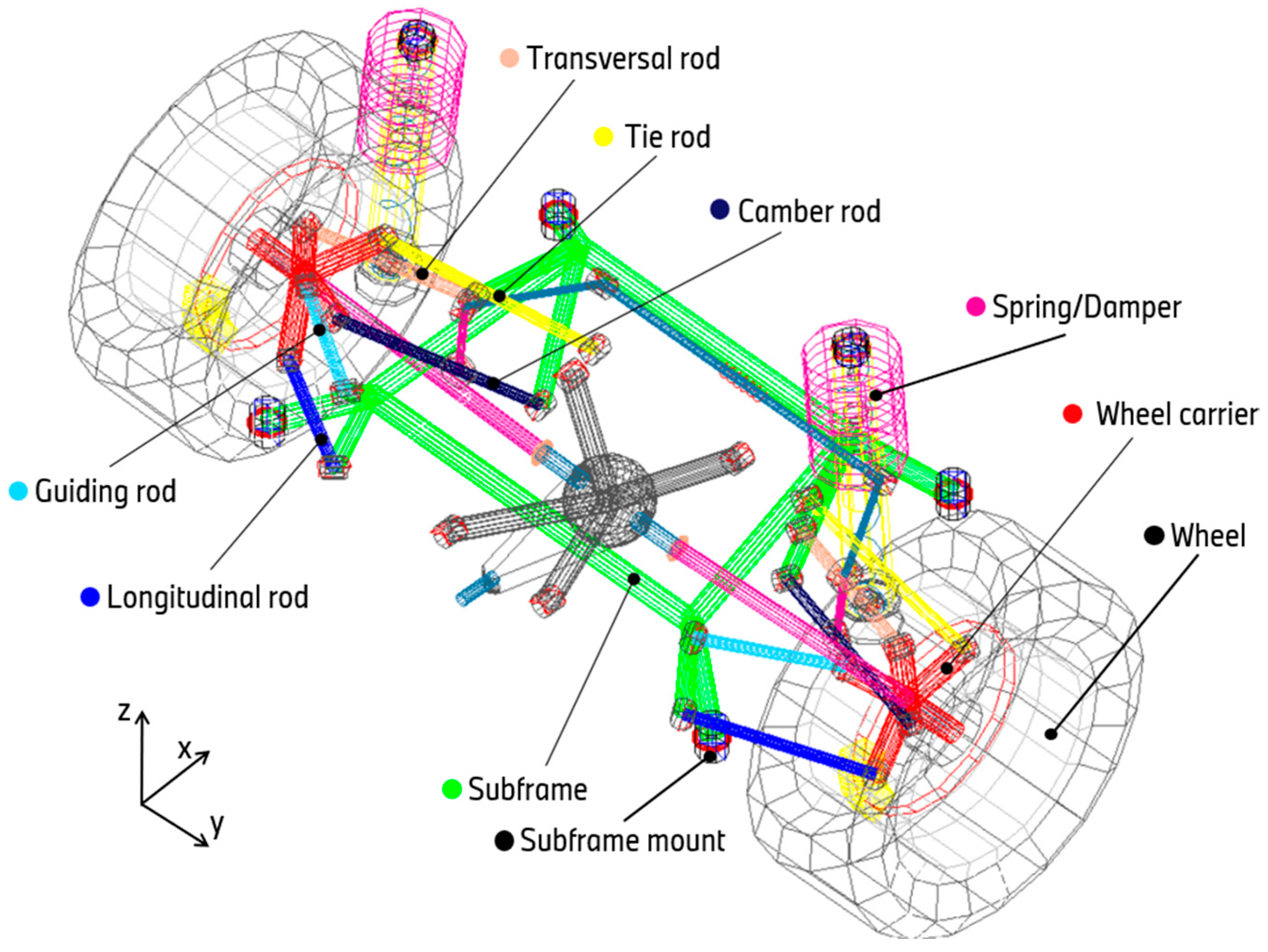
This publication validates the proposed approach using the example of a rear axle subframe mount design. For illustrative purposes, the suspension components of the SFM will be briefly introduced. The following subsystems can be extracted from the general component overview: rear axle subframe, wheel control (five rods), spring/damper, wheel bearing and wheel (Figure 1) [6]. The rear axle subframe is split into the subframe body and its four SFMs. The wheel control on the rear axle consists of five rods on each side of the axle, which link the subframe to the wheel carrier via rubber mounts. A spring/damper unit connects the wheel carrier directly with the body. The wheel bearings ensure the wheel’s rotational degree of freedom and show torsional elasticity around the remaining two axles.
Vehicle dynamics is strongly influenced by the elastokinematics of the suspension. The quantities to be considered are displacements and rotations of the wheel center and wheel–ground contact point due to external loads [6]. These movements are mainly determined by the kinematic arrangement of the connection points of the rods and the rear axle subframe, as well as the stiffness of the different rubber mounts.
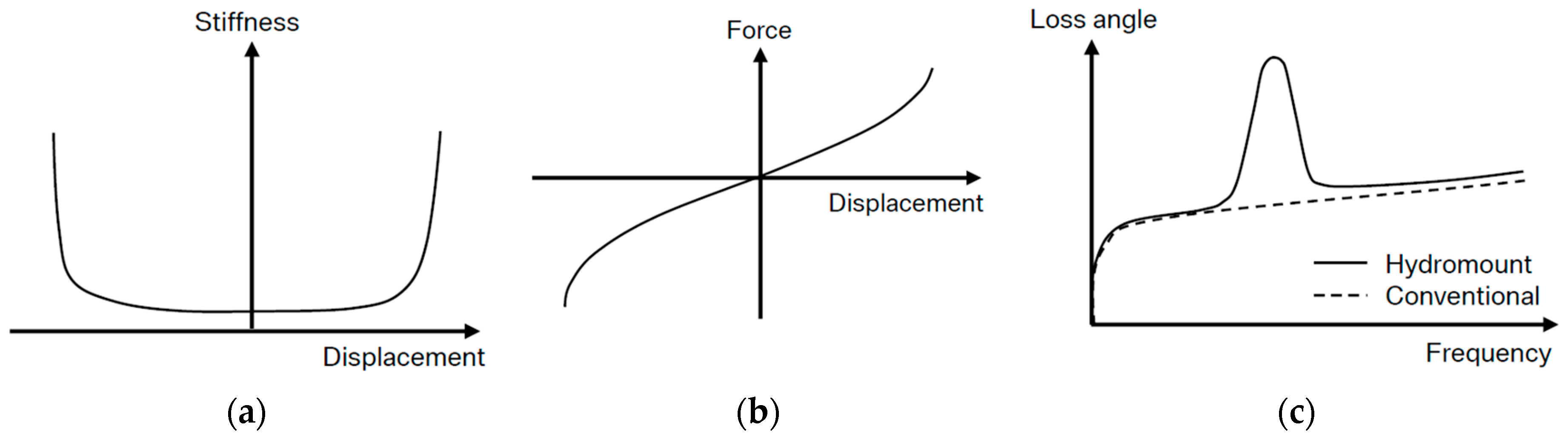
SFMs are rubber mounts showing a non-linear force–displacement behavior, as shown in Figure 2b, and therefore do not have a constant stiffness in their entire operating range; see Figure 2a. When not subjected to forces, the curve is usually linear at first, indicating a constant stiffness. Due to the mount geometry and the intrinsic rubber property, the stiffness increases when a certain force is exceeded. As a result, the mount stiffness directly depends on the deflection of the mount and thus on the preload [10].
In addition to the stiffness, the damping of the mount is a relevant functional parameter. This is specified by the loss angle. Both stiffness and damping vary with the dynamic excitation frequency. This effect is particularly important for hydromounts, as they have a significantly higher damping at a predetermined tuning frequency; see Figure 2c. Active mounts, in which stiffness or damping can be actively controlled, are currently employed in engine mounting systems but are not used in chassis suspension applications [8].
To describe the properties of a non-linear rubber mount characteristic at a specific point, a so-called operating point has to be introduced. An operating point is based on a driving maneuver at the full-vehicle level. All driving maneuvers considered in this publication can be regarded as quasi-static, implying constant forces resulting from the maneuver.
The dynamic wheel load shift during a driving maneuver, e.g., braking, results in different forces in the suspension components and therefore different loads on the rubber mounts. Combining these mount forces with the operating point-independent characteristic curve of the SFMs yields constant mount properties at each operating point. The load-dependent properties of a rubber mount can, therefore, just be clearly specified at a given operating point using the suitable load.

2.2. Current Methods

The V-model, originally introduced in the context of embedded software development [11], structures the design process by defining requirements on objective quantities and systematically cascading them top-down through a hierarchically decomposed system. This is in contrast to classical incremental or iterative approaches that begin with a predefined solution and subsequently adjust design variables [12]. A principal advantage of the V-model is that it does not presuppose a specific solution, which makes it particularly suitable for revolutionary design problems where the exploration of the entire design space is required and requirements are formulated to be minimally restrictive. Nevertheless, the V-model has been characterized as “hypothetical” [13], as the derivation of concrete and quantitative design steps that explicitly account for uncertainty—especially in early design phases involving top-down requirement definition and non-linear system relationships—remains a significant challenge.
Target cascading is an optimization-based method for decomposing system design into a hierarchy of problems by deriving quantitative subsystem requirements as target points from system-level objectives, using coordination strategies to resolve conflicts between multiple targets. However, because discipline-specific target points are often conflicting and uncertain in industrial practice, Kim et al. adopt a top-down formulation based on target regions. This enables the integration of requirements from different disciplines into a unified region that satisfies all constraints and supports the identification of common solutions [14].
The notion of a solution space formalizes the set-based design idea by defining the feasible region of a system in the multidimensional design variable space. A solution space is defined by the intersection of all constraints imposed by functional requirements, physical laws, and boundary conditions [15,16].
Zimmermann and Koenigs significantly advanced this concept by embedding solution spaces into a structured framework for the design of large-scale systems under uncertainty. Their work emphasizes the explicit separation between design variables and quantities of interest, which are linked through a dependency graph that captures the hierarchical structure of the system [5]. This framework allows the systematic propagation of uncertainty in parameters and models, enabling the identification of robust solution spaces rather than fragile optima. Daub focuses on investigating epistemic uncertainties in order to enable flexible decision-making at the component level while ensuring the overall robustness of the system [17].
Solution compensation spaces represent an extension of classical solution spaces. They partition design variables into cost-relevant early-decision variables (A-variables) and performance-related late-decision variables (B-variables). Admissible intervals are determined for the A-variables such that for any selection within these intervals, at least one feasible configuration of B-variables exists that satisfies all constraints. This compensation mechanism enlarges the feasible design regions for shared components [18].
The adaptive solution space methodology represents an advancement of solution space engineering. Within this framework, parameter ranges are systematically recomputed by incorporating development data and user-defined constraints while preserving the independence of the parameters [19].
Quantitative system behavior is commonly analyzed using surrogate models within model-centric or simulation-driven design, with physical surrogates derived from engineering insight into system dependencies and mathematical surrogates trained on data from experiments or simulations. While physical surrogates capture domain-specific behavior and mathematical surrogates offer computational efficiency for optimization, both play complementary roles in enabling efficient analysis and design of complex engineering systems [20].

2.3. Application of Solution Space Engineering

As this paper presents an extension of solution space engineering, the following section focuses on the current application of this method.
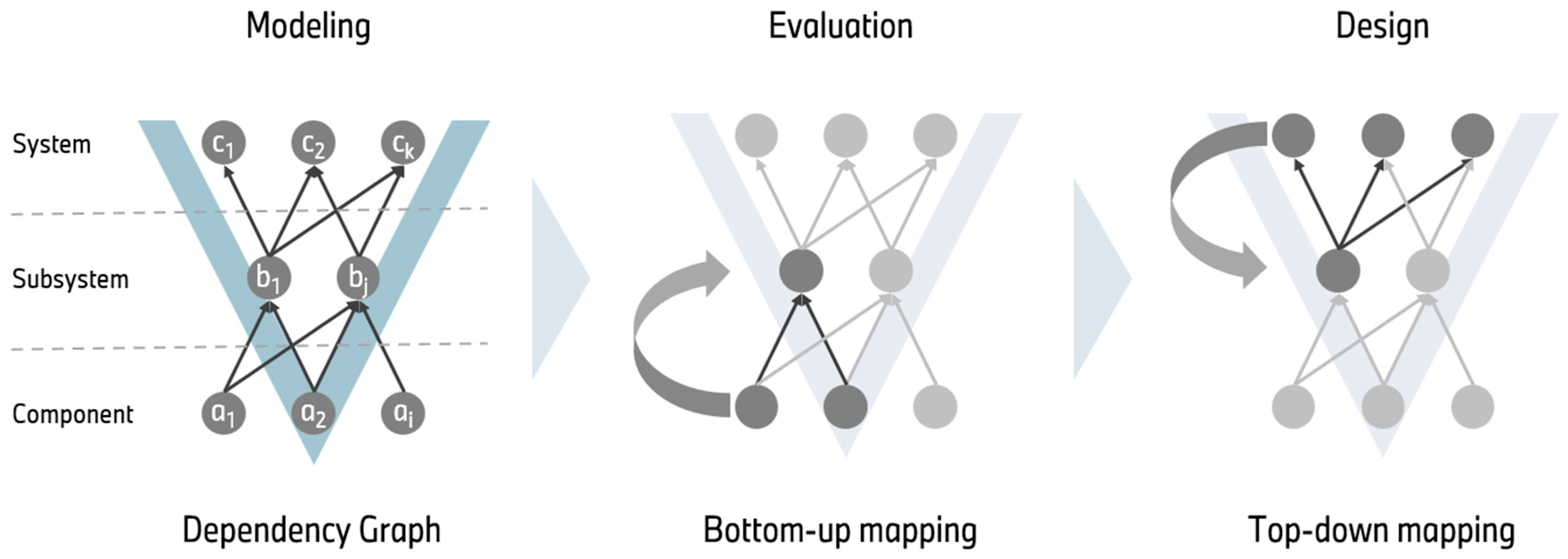
Eichstetter et al. apply solution space engineering to identify common components [2], and the approach has since been adopted in the literature [21,22,23]. The objective of the method is to determine solution spaces in which the component design variables satisfy the quantities of interest at the vehicle level. Designs that fulfill all requirements with respect to the quantities of interest constitute the solution space. An example of a quantity of interest considered in this publication is lateral axle stiffness. Vehicle-level quantities of interest depend on subsystem properties (subsystem properties @operating point), which, in turn, depend on combinations of component properties, such as mount stiffnesses or elastokinematic properties at different operating points (component properties @operating point). This hierarchical derivation process is referred to as target cascading [24]. To apply solution space engineering, a dependency graph is defined: a bottom-up mapping is used to compute the quantities of interest, while a top-down mapping is employed to define the corresponding solution spaces (see Figure 3).
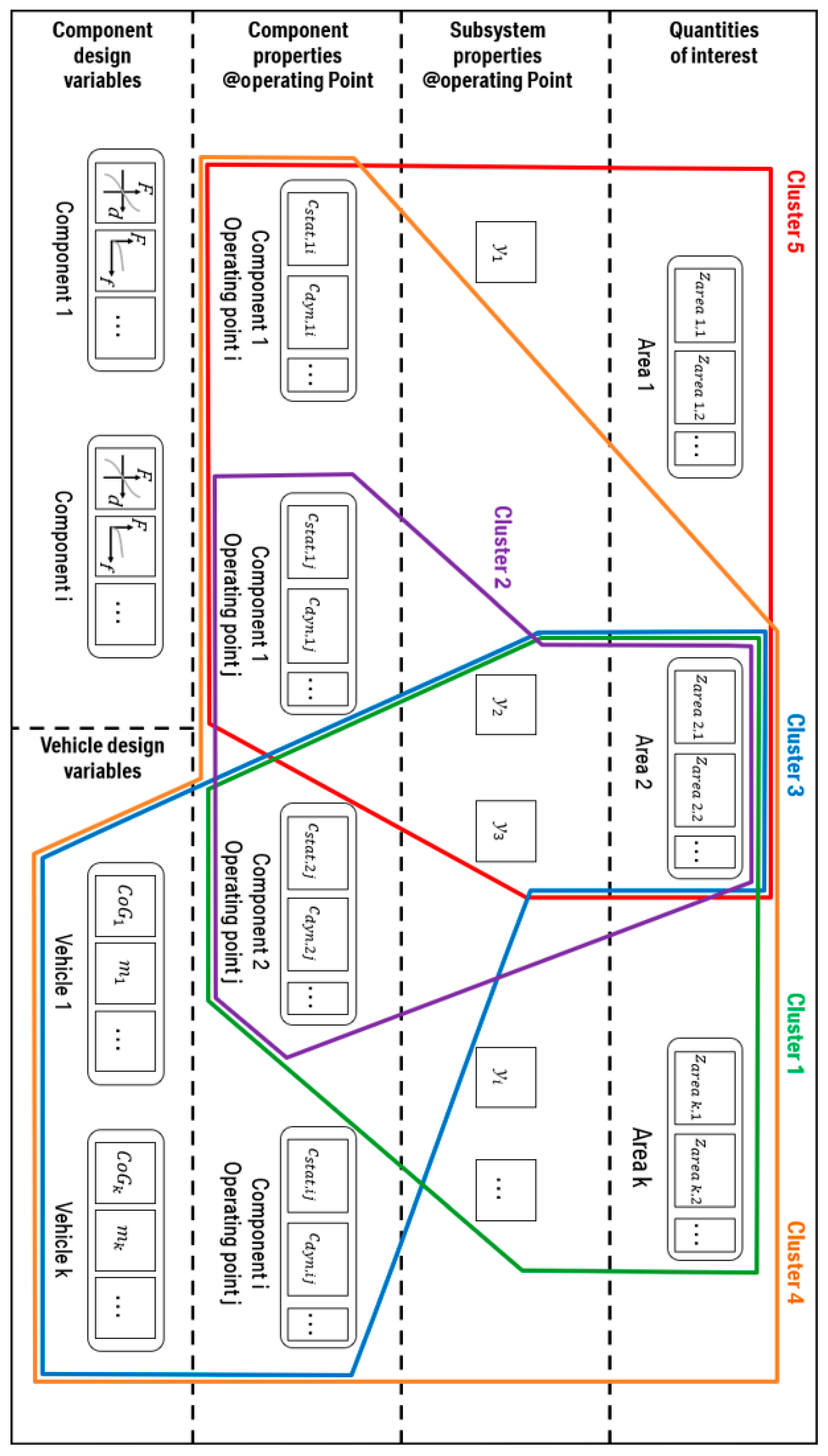
The application of solution space engineering to various technical examples has been discussed in numerous publications. Figure 4 organizes these works into clusters according to their respective research focus.
Cluster 1 comprises publications that address quantities of interest (q.o.i.) from two target areas for a single component. Eichstetter et al. investigate the development of dampers with respect to vehicle dynamics and ride comfort objectives using solution space engineering [9], whereas Koenigs et al. focus on engine mounts in relation to durability and acoustic targets [25]. Eremeev et al. perform a metamodel-based design optimization for gearboxes considering technical objectives and cost aspects [26]. Xu et al. apply solution space engineering to the development of a vibration hammer and a rubber mount, optimizing both static and dynamic quantities of interest [27]. Ziegler et al. define both customer and internal requirements for the design of a gear box with solution space engineering [28].
Cluster 2 includes publications that focus on a single target area while simultaneously considering multiple components. Zimmermann investigates various components with respect to crashworthiness targets using solution space engineering [22], and Wimmler et al. jointly analyze axle components and tires with respect to vehicle dynamics objectives [29]. Furthermore, Münster et al. apply the method exemplarily to the design of a steering system [30]. Condor et al. focus on electric power unit mounts and subframe mounts with respect to NVH objectives [31]. Della Noce extends solution spaces by incorporating physical feasibility constraints, demonstrated using a robotic system as an example [32].
Cluster 3 addresses the simultaneous development of components for multiple vehicles within a single target area. Eichstetter examines different anti-roll bars with respect to optimal commonality [2].
Cluster 4 comprises applications introduced by Zimmermann et al., in which solution space engineering is applied to both crash and chassis components across several vehicles [33]. Rötzer et al. address the cost optimization of product families by replacing a complex system model with modular subsystems and apply this approach to the development of electric vehicles [34].
Cluster 5 considers the design of multiple components across more than one target area. Among others, Wimmler et al. present a methodology for developing components of different axles with respect to vehicle dynamics and feasibility constraints [35].
All publications mentioned above model the considered components with constant properties across all operating points. Consequently, as illustrated in Figure 4 and listed in Table 1, the design and selection of common components are performed using parameters defined at the component properties @operating point level.

2.4. Research Gap

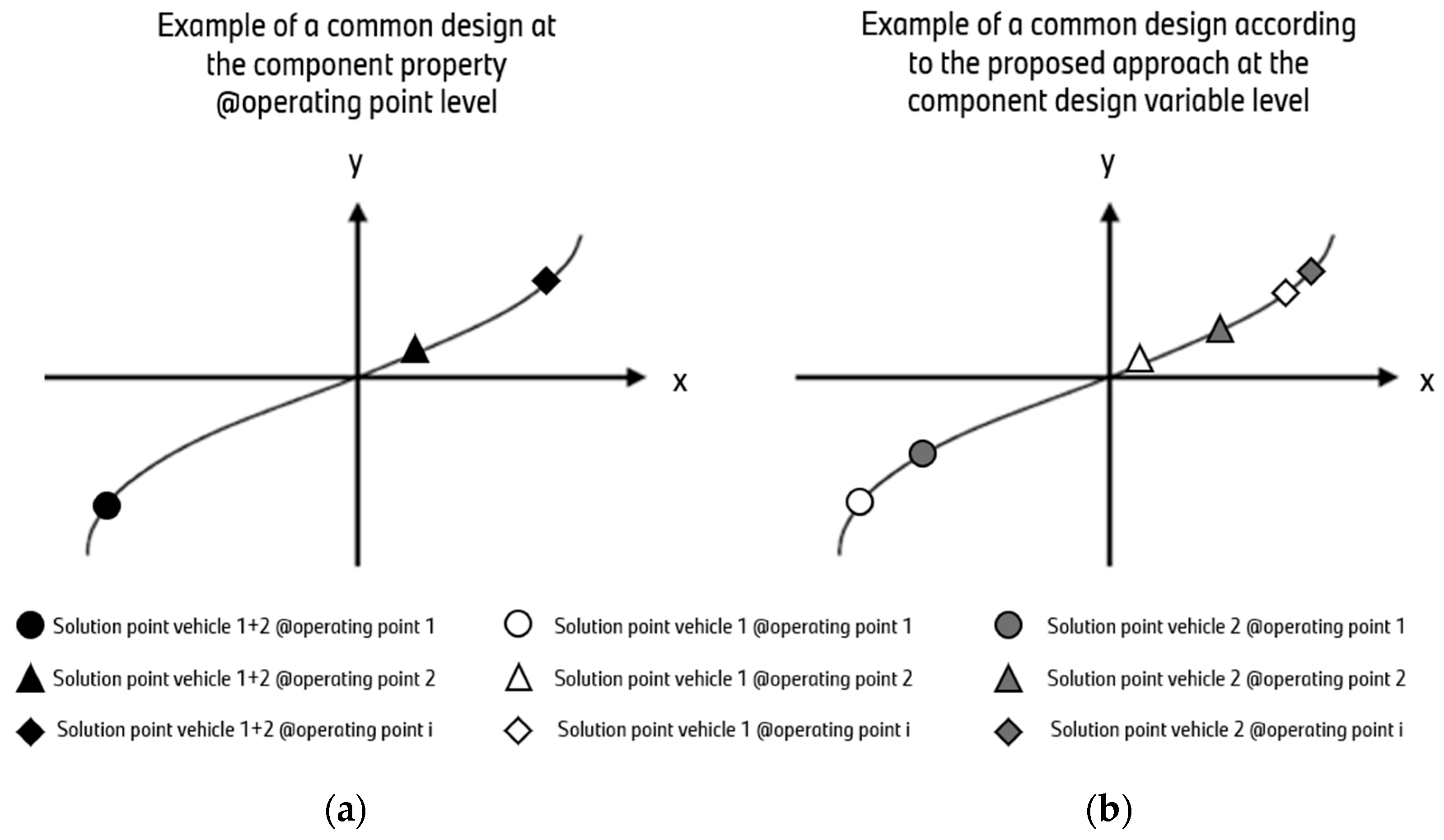
In Cluster 3, commonality is defined for single-parameter components at the component properties @operating point level. Since single-parameter components exhibit constant properties, this parameter remains invariant and fully characterizes the component’s functionality. In contrast, multi-parameter components, such as subframe mounts, exhibit non-linear behavior, causing their properties to depend on the operating point of the mount. Defining commonality at the component properties @operating point level therefore enforces identical component properties for Vehicle 1 and Vehicle 2 at the same operating point. As a result, the number of feasible solutions is constrained, as illustrated in Figure 5a.
To address this limitation, this publication introduces an extended layering technique for the design of multi-parameter components and considers four aspects: First, a new observation level is introduced that characterizes the component independently of any operating point by means of its functional and geometrical variables. This level is referred to as the component design variable level (see Figure 4). Second, this level is employed to define the commonality of multi-parameter components. Third, it is demonstrated that the investigation of commonality for multi-parameter components is only meaningful when this additional observation level is introduced. Fourth, the aforementioned aspects are illustrated using an example problem to demonstrate applicability. For this purpose, the design of common subframe mounts is considered. This allows the constraints to be resolved, and different vehicles have different solution points at the same operating points; see Figure 5b.

3. Parameter Dependencies

This section describes the various system parameters and hierarchical levels to establish a dependency graph encompassing all relevant parameters. The system outputs are referred to as quantities of interest and serve to characterize overall system performance. The system inputs are represented by design variables, which are classified into constant parameters that cannot be modified, design variables that can be varied within a specified range, and common design variables that are adjustable but must be identical across different systems.
To reduce system complexity, several subsystem levels are introduced. The relationships between the different system and subsystem levels, along with their associated parameters, are represented by mathematical and mechanical models and are detailed in Section 4.

3.1. Quantities of Interest

The quantities of interest are derived from a system-level analysis. A vehicle has to comply with requirements originating from multiple domains [8]. In the context of suspension design, five primary design areas are considered: noise, vibration, and harshness (NVH), ride comfort, driving safety, passive safety, and active safety. The feasibility of the mounts is addressed by means of so-called no-go region constraints. As the focus of this work is on technical specifications, economic requirements are not taken into account.
Consequently, only the rear axle subframe mount design variables and the associated requirements relevant to this study are described.

3.1.1. Vehicle Dynamics and Driving Comfort Quantities

Vehicle dynamics and driving comfort quantities are determined based on static and dynamic driving maneuvers. Quantities associated with static maneuvers are derived from the elastokinematic properties of the axle. These properties include the displacements and rotations of the wheel center and the wheel–ground contact point resulting from force and torque loads applied at the contact point.
The stiffness of the rear axle subframe mounts has a significant influence on longitudinal stiffness under braking and acceleration, cx,Fx, lateral stiffness under lateral loading, cy,Fy, the toe gradient under longitudinal and lateral forces, cδ,F_x and cδ,Fy, and the camber gradient under lateral force, cγ,Fy; see Table 2. A detailed derivation of these quantities, including their effects on vehicle dynamics and driving comfort, is provided by Rumpold [36].
Quantities associated with dynamic load cases are evaluated based on the driving maneuver’s steering step and sinusoidal steering [8]. The observed measures in these maneuvers include sideslip angle, yaw rate, and lateral acceleration. Detailed multibody simulations indicate only a minor influence of subframe mount properties on these measures. Consequently, multibody simulations are not considered in the early development phase. Furthermore, deviations in the individual measures during early design stages due to uncertainties are substantially larger than the effects induced by the observed parameter variations.

3.1.2. NVH Quantities

In addition to vehicle dynamics quantities, the axle design process has to consider noise, vibration, and harshness (NVH) quantities. A relevant NVH quantity is the swing-out behavior of the electric power unit (EPU), which is elastically mounted relative to the subframe. The eigenfrequencies of the EPU in the longitudinal and vertical directions, fx,EPU and fz,EPU, as well as the corresponding settling times, tset,x/z,EPU, must be taken into account; see Table 3. These quantities are influenced not only by the subframe mounts (SFMs) but also significantly by the EPU mounts.
For clarity, the following tables present the quantities for a single spatial direction or for either the front or rear SFMs only. The total number of quantities considered is provided in the column “number of quantities.”

3.1.3. Driving Safety Quantities

Driving safety is largely addressed by passive and active safety systems [8], on which the elastic rear axle subframe mounts have little or no direct influence. In contrast, SFMs strongly affect the rear axle vibration phenomenon known as wheel shimmy, which can be safety-critical. This self-excited vibration may cause the wheels to lose contact with the ground during braking due to large oscillation amplitudes, thereby increasing braking distance [37]. The corresponding quantity of interest describes the vibration stability sws and is strongly influenced by both the stiffness and damping properties of the SFMs; see Table 4.

3.1.4. No-Go Region Qualifiers

In this publication, a feasible component is defined as one that can be developed, manufactured, and implemented in an industrial process using current technologies at a competitive cost. Since mounts are hyperelastic components with complex geometries, accurate feasibility prediction is challenging. Nevertheless, infeasible design regions, referred to as no-go regions, can be defined using basic criteria. These include ratios of static and dynamic properties, assembly-related preload criteria, and an empirical criterion representing the combined requirements. The applied criteria are summarized in Table 5 [10].

3.2. Design Parameters

Design parameters constitute the system inputs and are defined at the lowest level of the dependency graph. They may be constant, variable, or shared as common parameters.
Due to vehicle symmetry about its longitudinal axis, left- and right-hand parameters are not distinguished. For readability, parameters defined in the three spatial directions, as well as those associated with front and rear positions, are listed only once.

3.2.1. Constant Parameters

Constant parameters remain unchanged throughout the SFM design process. Two categories are distinguished: system and subsystem parameters as well as component-level parameters.
System and subsystem parameters include, among others, the total vehicle mass mv, wheelbase wbv, and the coordinates of the vehicle center of gravity CoGv,x/y/z, as summarized in Table 6.
The second category comprises component-level parameters that are defined at the same level as the SFM properties but are not varied in this study. Examples include chassis hardpoints, EPU mount characteristics, and tire properties, as listed in Table 7.

3.2.2. Design Variables

Design variables are parameters that are varied during the development process within predefined boundaries, referred to as intervals. They are classified as system-individual or common design variables. System-individual variables describe the connection points of the rear axle SFMs to the chassis, posf/r,x/y/z,SFM, as listed in Table 8, since no commonality is required for the rear axle subframe itself.
Common design variables describe the functional properties of the rear axle SFMs. The SFM characteristic curve is parameterized by the basic stiffness cf/r,x/y/z,SFM, linear range slin,f/r,x/y/z,SFM, progression exponent eprog,pos/neg,f/r,x/y/z,SFM, progression factors fprog,pos/neg,f/r,x/y/z,SFM, eccentricity secc,f/r,x/y/z,SFM, dynamic stiffness hardening cdyn,lf/hf,f/r,x/y/z,SFM, and loss angle δlf/hf,f/r,x/y/z,SFM; see Table 9. These parameters sufficiently describe rubber mount behavior in the early development phase.

3.3. Dependency Graph

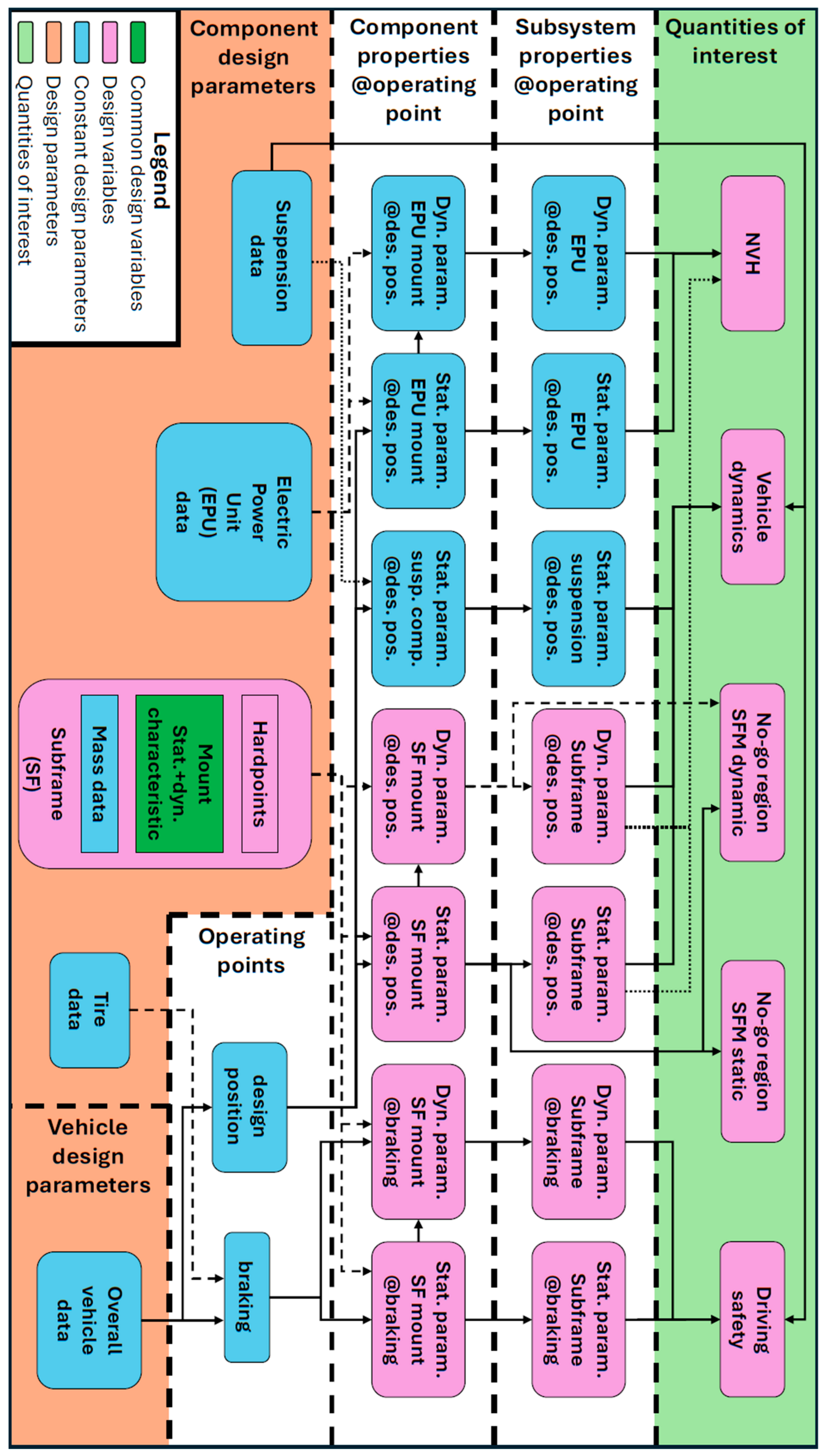
The dependency graph shown in Figure 6 illustrates the relationships between the design parameters and quantities of interest defined in the previous sections. Design parameters (Section 3.2) are shown at the bottom (orange), subsystem properties in the middle (white), and quantities of interest (Section 3.1) at the top (light green). Constant parameters are highlighted in light blue, system-individual design variables in violet, and common design variables—identical across systems—in dark green.
To represent multi-parameter components, component properties are divided into two levels. The lowest level comprises operating-point-independent component design variables that describe behavior independently of external influences such as preload. All SFM stiffness and damping design variables are located at this level, resulting in 66 grouped design variables (dark green box in Figure 6).
Quantities of interest are evaluated at specific operating points and therefore derived from component properties evaluated at those points. The component characteristic curve derived from the design variables is combined with operating-point-specific boundary conditions, resulting in component properties @operating point.
For single-parameter components, properties remain unchanged across operating points, making further level differentiation unnecessary. Accordingly, Eichstetter directly assigns such parameters to the component properties @operating point level [2].
Component properties @operating point are linked to quantities of interest via the intermediate-level subsystem properties @operating point, which describes the functional behavior of the EPU, rods, and subframe, including SFMs. From this level, system-level quantities of interest are directly computed.

4. Bottom-Up Mappings

This section describes the models required to derive the quantities of interest from the design variables. Each arrow in the dependency graph shown in Figure 6 represents a computational relationship between individual parameters and must therefore be captured by an appropriate physical or mathematical model.
At this stage, only a limited number of parameters are known, and uncertainties must be explicitly considered. In the context of early system design, uncertainty primarily refers to epistemic uncertainty, i.e., uncertainty arising from incomplete knowledge about design variables, boundary conditions, and requirements that have not yet been fully specified. Many system quantities remain undefined during this phase and will only assume fixed values once the design process is completed. Consequently, uncertainty is not only associated with parameter variability but also with unresolved design decisions and incomplete system information. In contrast, aleatory uncertainty, such as manufacturing tolerances or material scatter, persists even after the design is finalized and is therefore of secondary importance in early design stages [5].
Instead of relying on probabilistic uncertainty models, which typically require detailed statistical information that is not available at this stage, the present approach follows a top-down treatment of uncertainty. In this framework, permissible ranges of system responses are defined and propagated downwards through the system model to derive admissible regions for design variables. These regions, often referred to as solution spaces, implicitly account for uncertainty by allowing variability within predefined bounds rather than prescribing exact values. This enables the designer to specify how much uncertainty the system can tolerate, rather than quantifying how uncertainty propagates through the system. As a result, the approach supports robust decision-making in early design phases by ensuring feasibility under uncertain and evolving system conditions without requiring explicit uncertainty distributions [5].
In addition, the models must be used to calculate a large number of parameter variations, known as DoE analyses. Consequently, the employed models must be computationally efficient, and the optimization process must yield robust solutions. In this work, simplified models are implemented to ensure low computational effort and to accommodate the limited data availability typical of early development phases. Although these simplified models introduce uncertainties, they provide sufficient accuracy for early-stage estimations. In later development phases, when more detailed system information becomes available, the results can be validated using advanced models.

4.1. Full-Vehicle Modeling

A full-vehicle model is used to describe the considered driving maneuvers and to derive the tire forces that define the corresponding operating points.
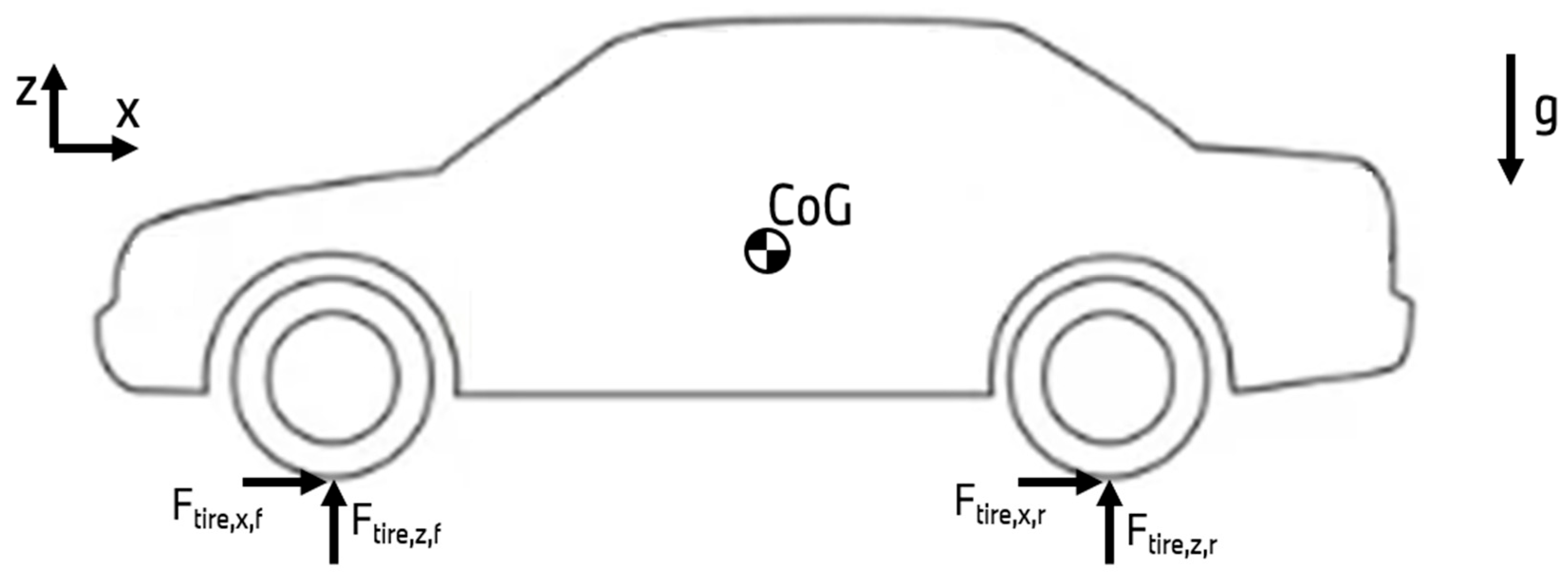
In a first step, static and dynamic tire forces in the vertical and longitudinal directions are determined by balancing forces and moments of the vehicle center of gravity, following the approach of Schramm et al. [38]. These tire forces define the two operating points used in this study: the design position and the braking condition.
The distribution of longitudinal tire forces between the front and rear axles during heavy braking is determined by their respective longitudinal friction potentials. Since the analysis considers quasi-static operating points only and does not investigate transient behavior, a dynamic full-vehicle model is not applied.
To calculate the loads acting on the SFMs due to tire forces, the SFMs and the main spring are separated at their attachment points to the body. As no lateral tire forces occur in the considered maneuvers and the lateral inclination of the main spring is negligible due to its small tilt angle, lateral forces acting on the SFMs are neglected. This allows a two-dimensional analysis in the longitudinal–vertical plane.
The main spring is connected between the camber rod and the vehicle body. Its force is determined by torque equilibrium at the camber rod. It is assumed that the entire vertical tire load, excluding the unsprung masses, is transmitted through the camber rod, as the remaining rods do not contribute significantly to vertical load transfer.
The resulting vertical forces acting on the rubber mount between the camber rod and the subframe are distributed to the front and rear SFMs according to their respective lever arms. Consequently, the static preload of the SFMs only acts in the vertical direction. The longitudinal preload in the design position is neglected in the early design phase due to its comparatively small magnitude.
During braking, longitudinal forces at the tire–road contact patch generate reaction forces in the SFMs based on their respective lever arms. Consequently, vertical preloads change due to the braking torque that must be supported. Additionally, the SFMs are subjected to longitudinal loading. The distribution of longitudinal forces between the front and rear SFMs depends on their stiffnesses, as the elastically supported system is statically overdetermined.
All of the aforementioned calculations, including the equations, can be found in Appendix A.1.

4.2. Subframe Mount Modeling

The functional properties of the SFMs exhibit non-linear behavior. Therefore, constant parameters cannot adequately describe stiffness and damping characteristics over the entire operating range. Instead, a non-linear parameterization is required.
Based on the design variables defined in Section 3.2.2, the static force–displacement behavior of the SFM is described using the characteristic curve given in (1):
F x = c x , S F M x s e c c , S F M + f p r o g , n e g , S F M c x , S F M x s e c c , S F M s l i n , S F M 2 e p r o g , n e g , S F M ,             x s e c c < s l i n , S F M 2 c x , S F M x s e c c ,           s l i n , S F M 2 < x s e c c < s l i n , S F M 2 c x , S F M ( x s e c c , S F M ) + f p r o g , p o s , S F M c x , S F M x s e c c , S F M s l i n , S F M 2 e p r o g , p o s , S F M ,         s l i n , S F M 2 < x s e c c
Dynamic stiffness behavior is modeled using frequency-dependent hardening factors in (2), while damping behavior is represented by loss angles defined for different excitation frequencies in (3).
c x , d y n , S F M f = c x , d y n , l f , S F M + f f l f h f l c x , d y n , h f , S F M c x , d y n , l f , S F M
δ x , S F M f = δ l f , S F M + f f l f h f l δ h f , S F M δ l f , S F M
The non-linear formulation of the force–displacement curves ensures that the correct stiffness is applied at each operating point. The other simplified models use the linearized stiffness at this operating point for their subsequent calculations.

4.3. Elastokinematic Modeling

The objective of the elastokinematic models is to compute vehicle dynamics quantities of interest. This includes the mapping from component properties @operating point to subsystem properties @operating point, as well as the mapping from subsystem properties to system-level quantities of interest.
For modeling purposes, the rear axle system is divided into three subsystems: subframe, rods, and wheel bearing (see Figure 1). Each subsystem is modeled independently, after which the overall system behavior is obtained by superposition. The vehicle dynamics quantities to be evaluated are listed in Table 2.
From an elastokinematic perspective, the wheel bearing subsystem is represented by two rotational stiffnesses crot,wb,r,x/z acting about the vertical and longitudinal axes. The effect of these rotational stiffnesses depends on the point of force application and the associated lever arm. Rotation about the transverse axis is not required for the present modeling approach.
The rod subsystem is represented by a compliance matrix, following Rumpold [36]. Each rod is modeled with one stiffness along its axis, resulting from the series connection of the two mount stiffnesses at its attachment points. The five rods together form a parallel arrangement of individual stiffness contributions.
The subframe subsystem consists of four SFMs connecting the rigid subframe to the vehicle body. The stiffnesses of the SFMs are combined at the spring centers into three translational and three rotational stiffnesses, following Matschinsky [39]. The locations of the spring centers differ for each spatial plane. The resulting longitudinal and transverse stiffnesses, as well as the rotational stiffnesses about all three axes, govern the system-level performance.

4.4. Wheel Shimmy Phenomenon Modeling

Wheel shimmy is a safety-relevant vibration phenomenon that occurs at the rear axle during high deceleration. The axle passes through self-excited oscillations, which, at large amplitudes, may lead to component damage. Furthermore, wheel–road contact may be temporarily lost, resulting in increased braking distance.
Due to the self-excited nature of the vibration, stability can be evaluated using modal damping, enabling identification of the transition from stable to unstable behavior. The model is based on a quarter-car representation extended by elastokinematic effects. Detailed modeling assumptions and formulations are provided in Wagner et al. [37].

4.5. NVH Modeling

The NVH model is formulated as a two-mass oscillator, which effectively captures the swing-out behavior of the EPU (see Table 3). The rigid EPU is elastically mounted to the rigid subframe, which, in turn, is elastically connected to the vehicle body, assumed to be rigid and stationary.
Separate two-mass oscillator models are applied in the longitudinal and vertical directions, with stiffness values corresponding to the aggregated mount stiffnesses in each direction. The lateral direction is neglected because it is neither excited during the considered maneuvers nor critical for swing-out behavior due to the high lateral stiffness of the SFMs.
All of the aforementioned calculations, including the equations, can be found in Appendix A.4.

4.6. No-Go Region Modeling

The modeling of no-go regions—corresponding to the feasibility criteria defined in Section 3.1.4—is based on the approach developed by Penisson [10]. Models for two SFM concepts are used to predict static and dynamic properties.
Static stiffnesses are calculated using physically based formulations derived from Göbel [40]. Load-induced strains and stresses are decomposed into shear and tensile/compressive components based on geometry and loading direction. Standard mechanical relationships are then used to compute component stiffness. The characteristic curve design variables and dynamic properties are predicted using empirical models, whose validity is supported by comparison with experimental data reported in [10].
As in Penisson [10], the feasibility thresholds are determined through a Design of Experiments (DoE) approach. In this process, large sets of design candidates are generated within predefined parameter ranges and evaluated with respect to all functional and feasibility criteria. The resulting distributions of admissible designs (“feasible design clouds”) allow the identification of boundary regions separating feasible and infeasible configurations.
Due to industrial confidentiality constraints, the exact numerical values of the feasibility thresholds cannot be disclosed. Nevertheless, their definition follows the described DoE-based procedure and relies on validated engineering guidelines and experimental observations, ensuring a consistent and practically relevant identification of infeasible design regions. The proposed approach is therefore transferable in principle, as the same procedure can be applied when project-specific data are available.

5. Top-Down Mappings

As described in Section 2.2, a top-down approach is applied to optimize designs with respect to vehicle-level requirements.
Due to confidentiality obligations imposed by the industrial partner, BMW, it is not permissible to disclose absolute numerical values or proprietary data within this study. Consequently, all results presented in the following section are expressed in normalized or relative terms. This approach ensures that the underlying trends, relationships, and methodological insights remain fully interpretable while safeguarding sensitive business information.

5.1. Example Problem Requirements

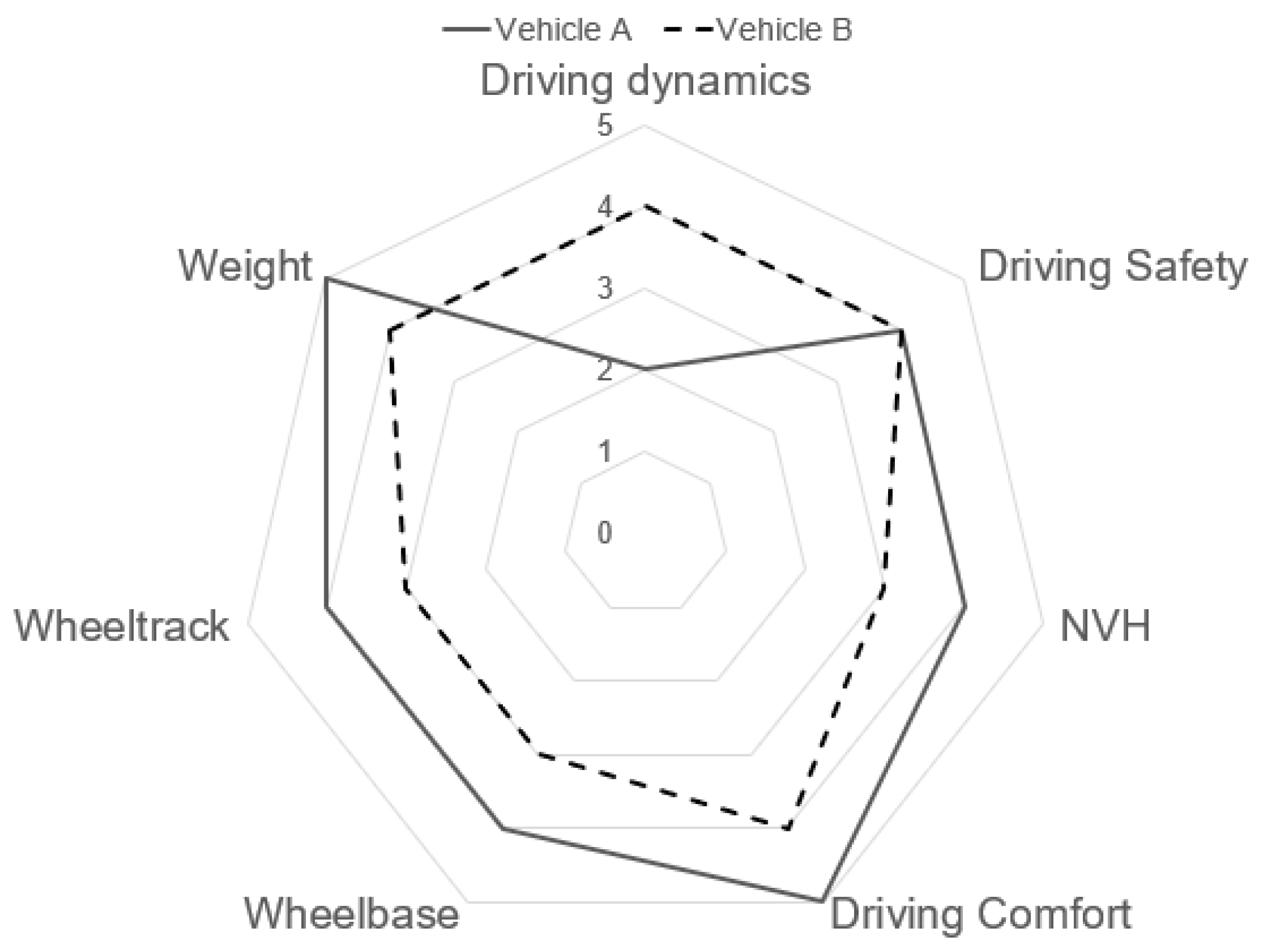
In the presented example, SFMs are designed for two different vehicles, A and B, each characterized by distinct vehicle attributes and market positioning; see Table 10.
As illustrated in Figure 7, the vehicles differ in vehicle design variables such as mass, wheel track, and wheelbase, as well as in their target quantities of interest. The target categories—driving dynamics, driving safety, driving comfort, and NVH—constitute the focus areas of this study. Depending on vehicle character, different performance levels are required in each category. For example, a compact vehicle typically prioritizes agile handling over NVH performance, enabled by lower mass and smaller dimensions. The scales shown are normalized and do not represent absolute values.

5.2. Solution Spaces

Here, a set-based design approach is employed, following the methodology described by Zimmermann et al. [5]. A vector of design variables characterizing a specific design is provided as input to the models, which yields an output vector comprising the corresponding quantities of interest through application of the previously introduced models. A design is considered feasible if all quantities of interest satisfy their respective requirements, i.e., lie within the specified lower and upper bounds. The solution space is defined as the set of all feasible designs. A rectangular subset contained within the solution space is referred to as a solution box. Among the feasible designs, no distinction is made between superior and inferior alternatives, as the quantities of interest cannot be exceeded.
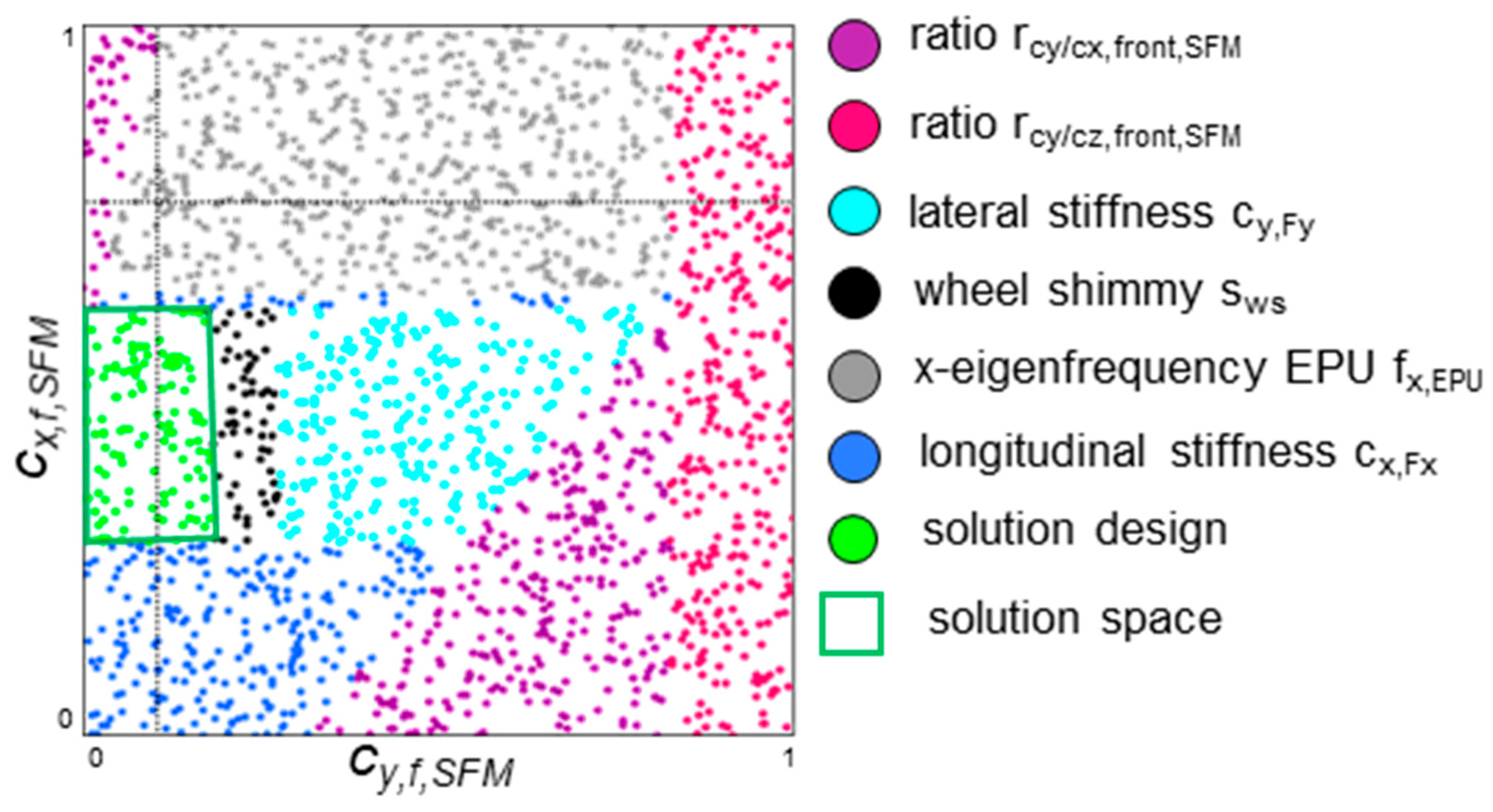
The results are visualized using two-dimensional normalized plots, in which two design variables are varied along the horizontal and vertical axes. All remaining design variables are held constant within each plot, and each point represents a distinct design. Each design is defined by a unique combination of design variables and resulting quantities of interest. Colored sample points indicate that at least one quantity of interest does not meet its requirement, with the color denoting the violated quantity. Designs that satisfy all quantities of interest are shown in green.
An example of a section cut is shown in Figure 8. A section cut represents an intersection through the solution space in which all but two design variables are fixed. The design variables were optimized beforehand using a box optimization algorithm, as described by Erschen et al. [23]. Although a feasible solution space is identified, it is bounded by several limiting requirements, as discussed below.
With increasing lateral basic stiffness of the front SFM, cy,f,SFM, the wheel shimmy stability sws, indicated by black points, is violated first. A further increase leads to a violation of the rear axle lateral stiffness cy,Fy, shown by light blue points, as the axle stiffness becomes excessively high.
When varying the longitudinal basic stiffness of the front SFM, cx,f,SFM, the longitudinal axle stiffness cx,Fx, depicted in blue, constitutes the limiting quantity of interest at both ends of the investigated range. With further increases in cx,f,SFM, the longitudinal eigenfrequency of the EPU, fx,EPU, also exceeds its target range, as indicated by grey points.
Additionally, the no-go regions imposed by feasibility constraints restrict the design space in areas where the ratios between basic stiffness values become unrealizable, as illustrated by red and violet points.

5.3. Commonality Potential

To assess the potential for component commonality, this section considers the front SFM of the two vehicles defined in Table 10. The SFM is parameterized using the 33 design variables listed in Table 9. A subframe mount is regarded as common if all design variables assume identical values for both vehicles. These 33 common design variables are summarized in Figure 6 within the dark green box labeled “static + dynamic characteristic subframe mount”.
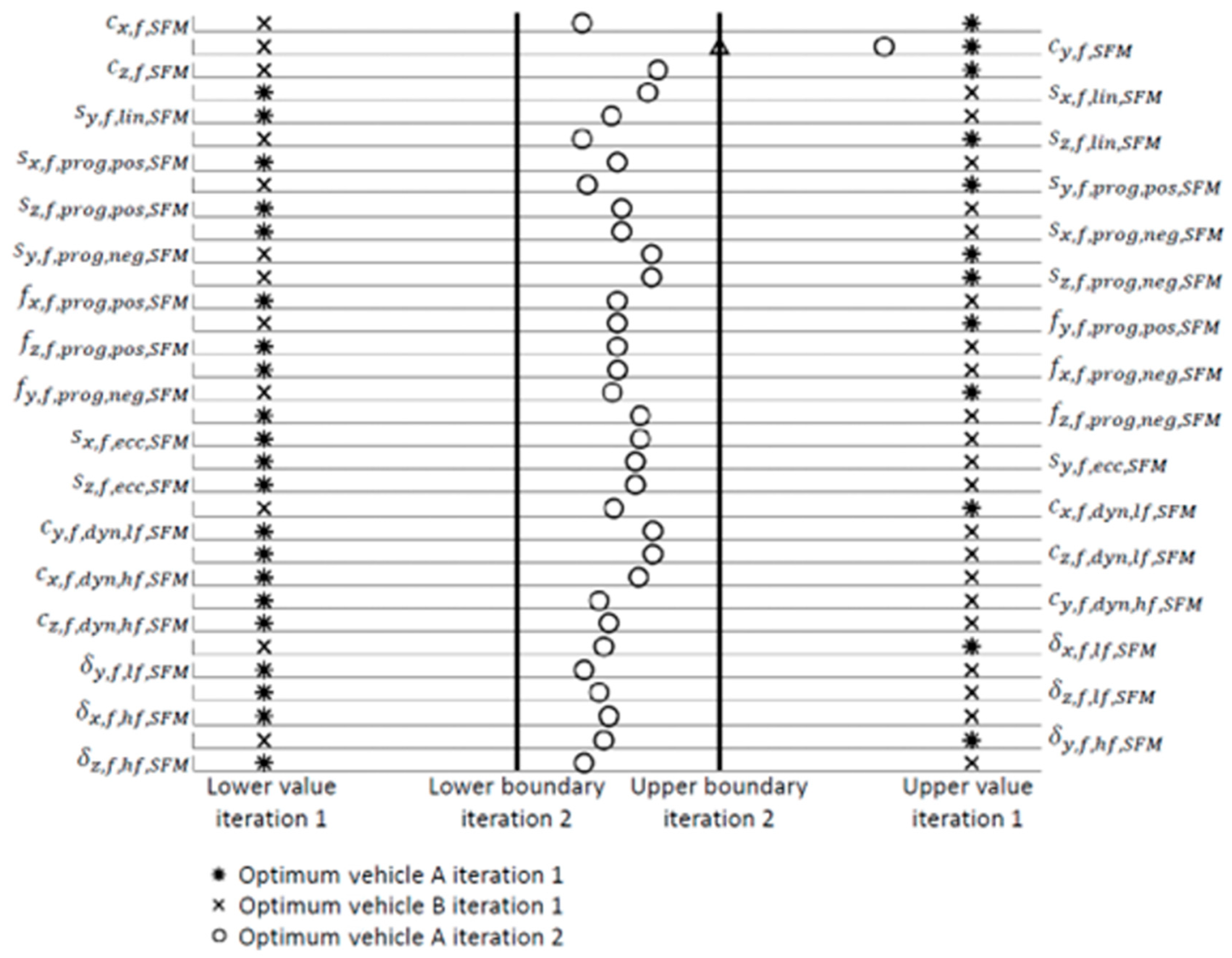
Deriving a common set of design variables by simultaneously optimizing both systems is difficult to implement. Therefore, each system is optimized independently and subsequently combined. In the first step, a single design optimization (SDO) is performed separately for each vehicle within predefined intervals for each design variable. The resulting normalized solutions are shown in Figure 9 and are referred to as optimum vehicle A and optimum vehicle B after the first iteration. Since all design variables differ between the two vehicles after this step, commonality cannot yet be assessed.
In a second step, new intervals are defined around the arithmetic mean of the corresponding design variables obtained for vehicles A and B in the first iteration. Using these intervals as boundary conditions, a second SDO is conducted for one system, here vehicle A. The corresponding results are shown in Figure 9 by circles and a triangle for cy,f,SFM. No feasible design is identified, as the target for the rear axle lateral stiffness cy,Fy cannot be satisfied within the prescribed interval for the lateral SFM stiffness cy,f,SFM. All remaining quantities of interest meet their respective targets for the identified design variable set.
In such cases, either the design variable intervals can be redefined, or the variables can be adjusted manually based on engineering expertise. In the present example, the target for cy,Fy could not be achieved; therefore, the lateral stiffness of the SFM cy,f,SFM was increased. This adjustment is feasible because cy,f,SFM has no significant influence on the remaining quantities of interest.
The resulting design variable set must then be evaluated for the second vehicle to verify whether its quantities of interest are also satisfied. If this is the case, a common SFM is identified. Otherwise, the second iteration must be repeated, or further manual adjustments are required.
In the presented example, the design variable set obtained for vehicle A after the second iteration also satisfies all quantities of interest for vehicle B. Consequently, this design variable set represents a common solution for both vehicles.
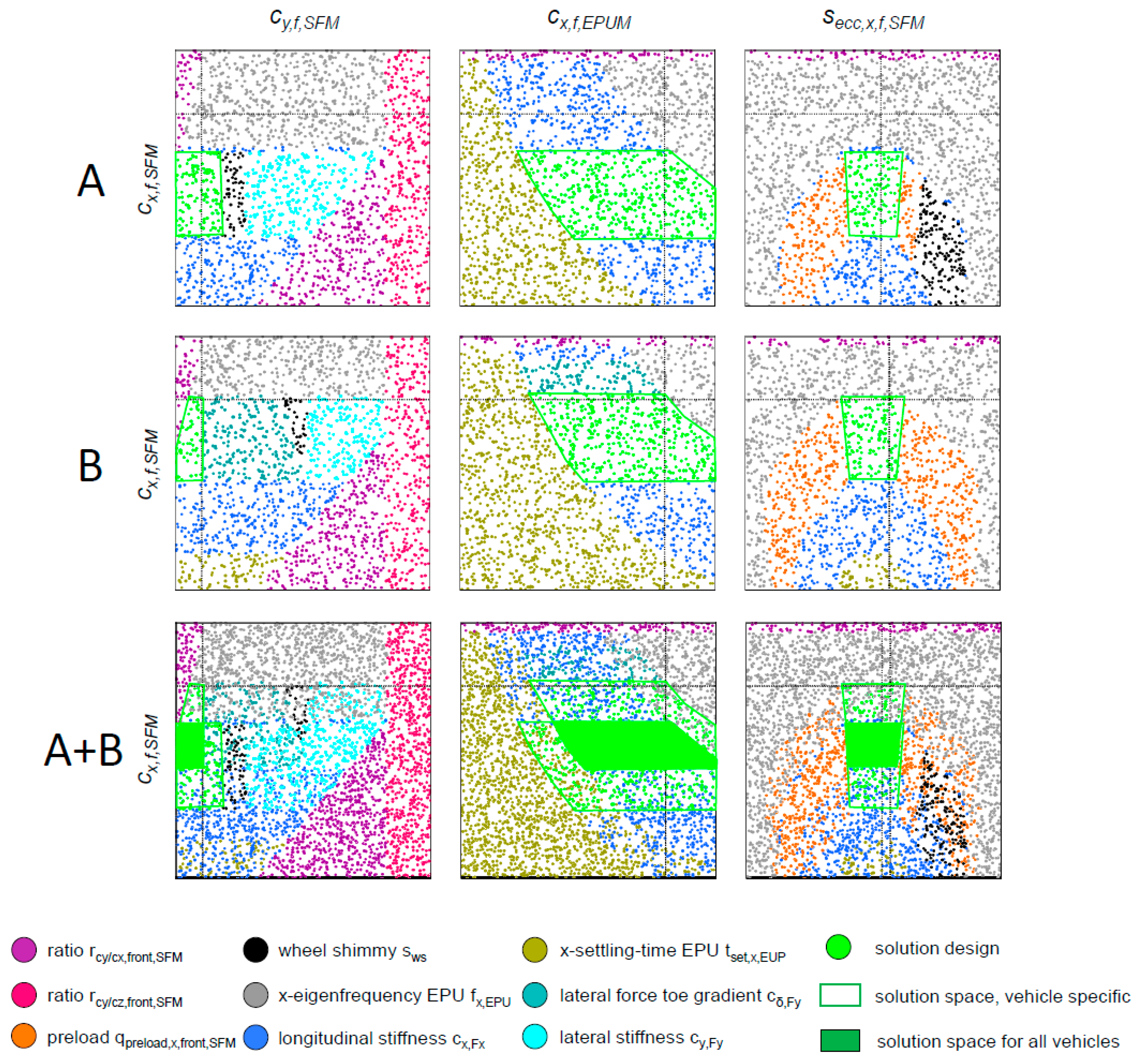
To further illustrate this result, Figure 10 shows the effects of varying selected design variables, namely, the longitudinal basic stiffness cx,f,SFM, the lateral basic stiffness cy,f,SFM, and the longitudinal eccentricity secc,x,f,SFM of the front SFM.
The upper two rows in Figure 10 display the individual results for vehicles A and B, respectively. Each plot represents a section cut through the solution space in which all design variables except the two shown on the axes are held constant. A higher-dimensional solution space in which all 33 variables span intervals also exists but is significantly smaller.
In the lower part of Figure 10, the solution spaces of vehicles A and B are superposed to identify common designs. A comparatively large common solution space is observed, providing substantial design flexibility. As long as the longitudinal and lateral SFM stiffness values cx,f,SFM and cy,f,SFM remain within this region, all quantities of interest satisfy their respective requirements.
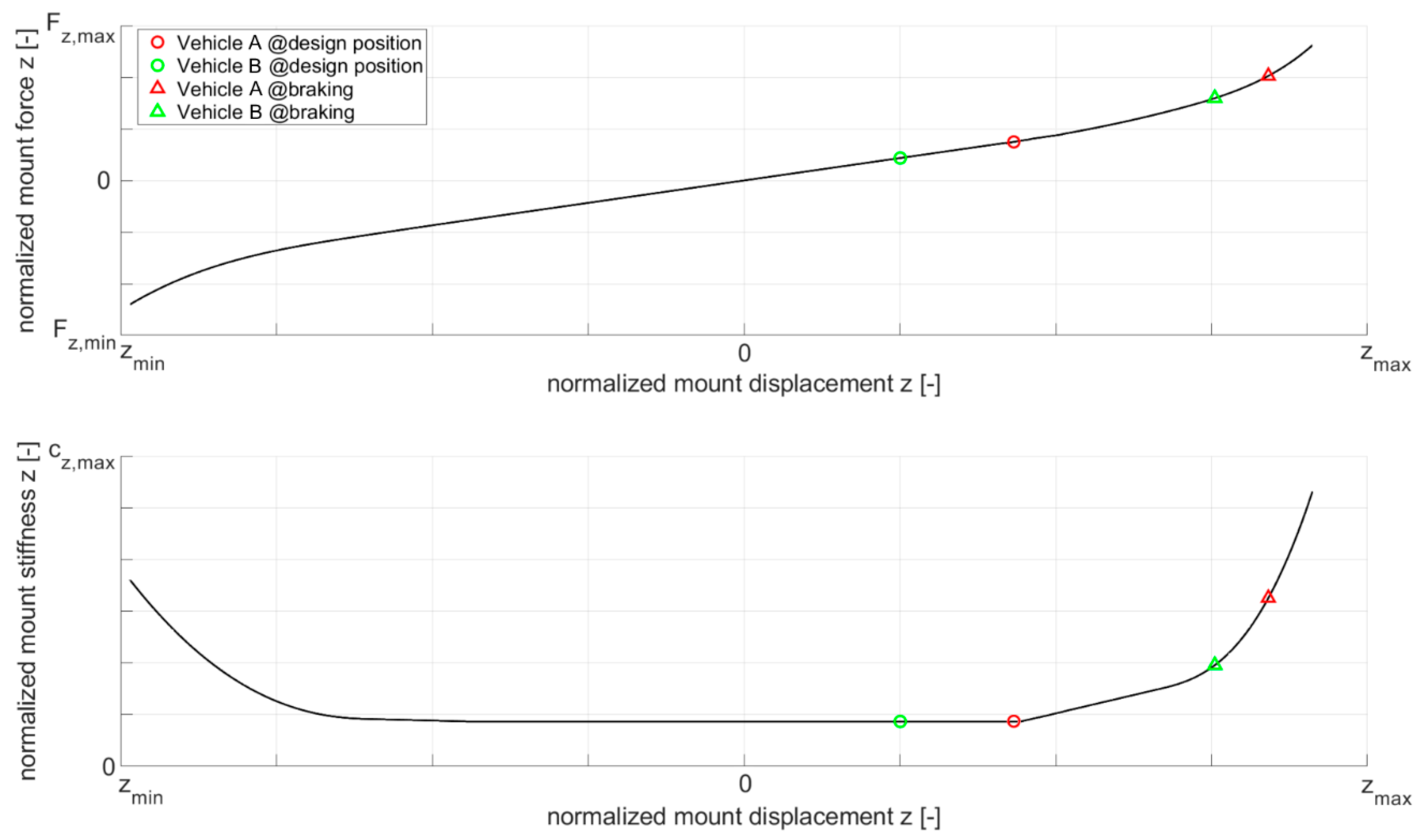
An exemplary subframe mount characteristic curve selected from the common solution space of vehicles A and B is shown in Figure 11. The upper plot illustrates the force–displacement behavior of the mount, while the lower plot depicts the corresponding stiffness–displacement relationship. The operating points associated with the design position and the braking maneuver are indicated by circles and triangles, respectively.
For both vehicles, the design position operating point lies within the range of basic stiffness, implying identical properties due to the constant stiffness in this region. In contrast, during braking, different preloads arise as a result of differing axle geometries and vehicle characteristics, leading to distinct effective stiffness values, as shown in the lower plot. Nevertheless, both vehicles satisfy their respective quantities of interest at all operating points. This demonstrates that a common solution can be achieved for two vehicles with different design variables and distinct performance requirements.

6. Discussion

Extending solution space engineering by introducing an additional observation level for non-linear component properties offers several advantages. In the classical linear approach proposed by Eichstetter et al., component properties are fully described by a single constant value [2]. Consequently, identical properties are assumed for common components across all operating points and all considered vehicles. However, this assumption does not adequately reflect the actual behavior of rubber mounts, as the progressive, non-linear characteristics of the mounts are entirely neglected.
For example, if identical SFM properties were assumed for both the braking operating point and the design position, target violations would occur. The quantity of interest related to wheel shimmy, which is evaluated at the braking operating point, requires a higher longitudinal SFM stiffness to satisfy its target than the quantities of interest related to driving dynamics, which are assessed at the design position. Enforcing identical longitudinal SFM stiffness values at both operating points would therefore inevitably result in a target violation.
An extension of the classical linear approach—where each operating point is treated independently by assigning constant component properties—is also insufficient. In this formulation, common mounts would still exhibit identical properties at the same operating point across different vehicles. This imposes an unnecessary constraint on the design space and may reduce or even obscure the potential for component commonality, as illustrated in Figure 5a.
By introducing the new observation level of component design variables for components with non-linear properties, vehicle-specific component behavior can be represented at different operating points while still enabling component commonality across multiple vehicles, as shown in Figure 5b. This level of modeling fidelity cannot be achieved using the classical linear approach. Consequently, the application examples presented in this publication can only be meaningfully analyzed using the proposed extension of solution space engineering.
Nevertheless, several aspects remain outside the scope of this publication. The presented approach is applied in the early design phase, and in order to reduce complexity, certain secondary requirements have been neglected in the initial design. Among these are vehicle dynamics quantities of interest associated with dynamic load cases, as discussed in Section 3.1.1. It is therefore essential to identify a robust solution space after the initial optimization to retain sufficient flexibility for later design modifications.
In this study, separate single design optimizations were performed for each vehicle, and the resulting solutions were subsequently compared to identify common designs. A more efficient strategy would involve a direct optimization for commonality, in which the objective is to maximize the shared solution space while enforcing equality constraints on selected design variables within the optimization algorithm. In the present context, the SFM design variables would be constrained to remain identical and optimized simultaneously to satisfy the requirements of both vehicles, resulting in a unique and maximized common solution space. Daub presents such optimization approaches, which can lead to more robust solution spaces [17]. With a sufficiently powerful optimization algorithm, it may also be possible to identify common mounts for more than two vehicles.
This approach requires a large number of iterations and sampling points, which, in turn, necessitates efficient computational performance. To achieve this, simplified models with reduced computational effort are employed at the expense of lower calculation accuracy. The resulting uncertainties must therefore be taken into account during result interpretation. In later development stages, these uncertainties can be addressed by applying more detailed models and advanced simulation techniques to validate and refine the predictions.

7. Summary

A more comprehensive layering technique has been introduced for the design of multi-parameter components within solution space engineering. In Section 2, the novelty of the proposed approach is established through an analysis of the state of the art. Section 3 defines the relevant design variables and quantities of interest and describes their interrelations within a dependency graph. Section 4 applies a bottom-up mapping strategy to derive the modeling relationships between the individual design variables across the dependency graph. In Section 5, the proposed method is applied and validated using a top-down mapping approach through the early-phase design of a subframe mount. A common solution space is identified for two vehicles with distinct characteristics. Finally, Section 6 discusses the results and advantages of the approach and outlines directions for future development.

Author Contributions

Conceptualization, S.W.; methodology, S.W.; software, S.W.; validation, S.W.; formal analysis, S.W.; investigation, S.W.; resources, S.W.; data curation, S.W.; writing—original draft preparation, S.W.; writing—review and editing, S.W. and D.S.; visualization, S.W.; supervision, D.S. All authors have read and agreed to the published version of the manuscript.

Funding

This research received no external funding.

Data Availability Statement

Restrictions apply to the datasets. The data is presented in normalized form, as the original data is subject to confidentiality restrictions imposed by the BMW Group.

Conflicts of Interest

Sebastian Wagner is employee of BMW AG. The remaining authors declare that the research was conducted in the absence of any commercial or financial relationships that could be construed as a potential conflict of interest. No funding was provided for this article.

Abbreviations

The following abbreviations are used in this manuscript:
cstiffness
CoGcenter of gravity
ddamping
dyndynamic
ecceccentricity
empempirical
EPUelectric power unit
Fforce
feigenfrequency
ffactor
ffront
hfhigh frequency
hphardpoint
Imoment of inertia
iratio
laloss angle
lflow frequency
linlinear
mmass
ncaster trail
negnegative
posposition
pospositive
progprogression
qqualifier
rradius
rread
rbrod bushing
rotrotation
slength
setsettling time
SFsubframe
SFMsubframe mount
ttrack
unsprunsprung
vvehicle
wwheel
wbwheelbase
wcwheel center
whbwheel bearing
wswheel shimmy
xx-direction in vehicle coordinate system
xxrotation around x-direction in vehicle coordinate system
yy-direction in vehicle coordinate system
yyrotation around y-direction in vehicle coordinate system
zz-direction in vehicle coordinate system
zzrotation around z-direction in vehicle coordinate system
αdiagonal spring angle
γcamber angle
δtoe angle
δloss angle
µfriction coefficient

Appendix A. Simplified Models

Appendix A.1. Full-Vehicle Modeling

The full-vehicle modeling approach is required to derive component loads at different vehicle operating points. Depending on the vehicle state within the respective driving maneuver, quasi-static preload forces in the rear axle subframe mounts are determined, which, in turn, are required for the calculation of functional component properties and thus for the quantities of interest.
To calculate the tire forces at the operating points of the individual driving maneuvers, a simplified full-vehicle model in the longitudinal direction is employed.
In the first step, static and dynamic tire forces in the vertical and longitudinal directions are determined by force equilibrium according to Schramm [38].
m v g = 2 F t i r e , z , f + 2 F t i r e , z , r
m v x ¨ = 2 F t i r e , x , f + 2 F t i r e , x , r
The torque equilibrium at the front tire contact patch provides the third condition for the unknown system variables.
m v x ¨ z C o G z r o a d + m v g x C o G x t i r e , f = 2 F t i r e , z , r x t i r e , r x t i r e , f
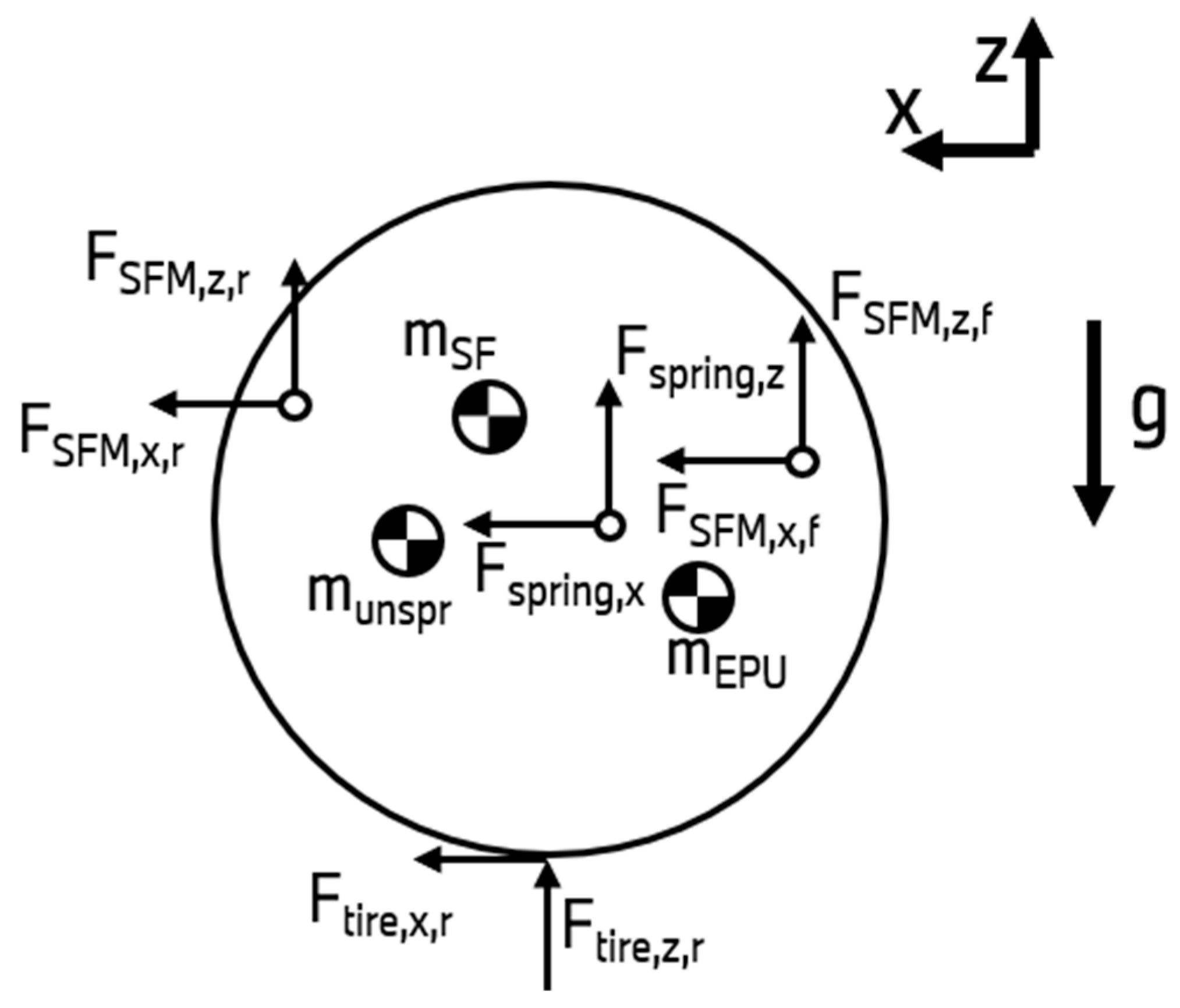
Figure A1. Calculation of static and dynamic tire forces.
Vehicles 08 00103 g0a1
The static tire forces under stationary conditions are obtained by setting x ¨ = 0 . The maximum longitudinal tire friction coefficient is defined as the ratio between the longitudinal tire force F t i r e , x , f / r and the vertical tire force F t i r e , z , f / r . If required, different friction coefficients may be assigned to the front and rear tires, for instance, when non-linear effects due to varying normal tire loads during full braking are considered or when different tire specifications are used at the axles.
µ x , t i r e , f / r = F t i r e , x , f / r F t i r e , z , f / r
The sum of the front and rear axle friction potential represents the maximum longitudinal capability from which the maximum longitudinal acceleration can be derived. Since the present analysis does not consider dynamic transient behavior between operating points but only quasi-static operating points, no dynamic full-vehicle model is derived.
From the tire contact forces, the loads on the main springs can be derived by considering the camber rod. In a simplified manner, it can be assumed that the entire vertical force acting at the tire contact patch, minus the unsprung masses, is supported by the main spring via the camber rod. The camber rod is designed as a bending beam and therefore also transmits vertical forces. The remaining four rods are pure tension–compression rods and thus only transmit forces along their axial directions. Due to their orientation in the x–y plane, the vertical components of these four rods can be neglected.
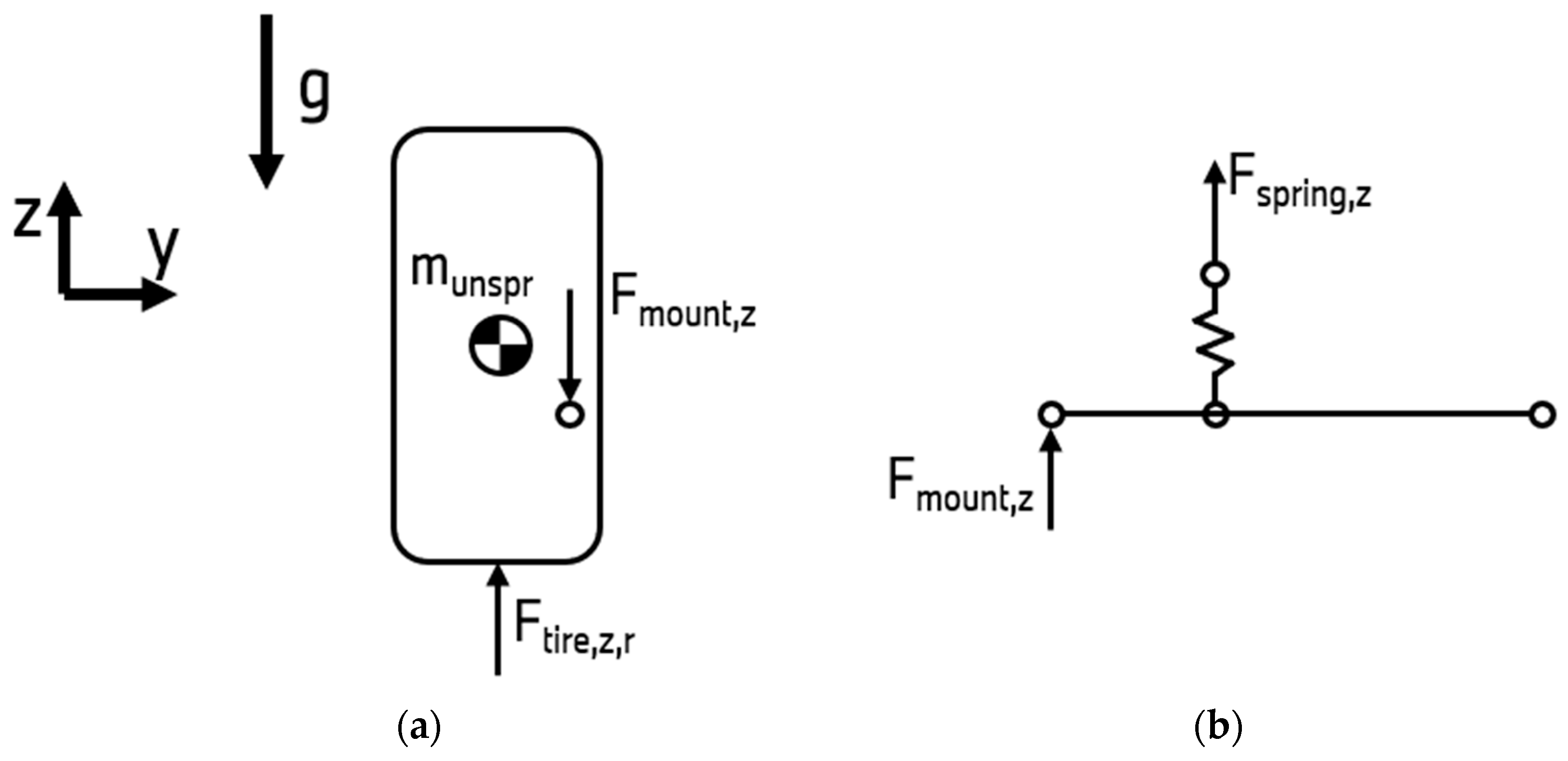
Figure A2. Calculation of the main spring force at the tire (a) and at the camber rod (b).
Vehicles 08 00103 g0a2
The vertical force equilibrium in Figure A2a yields
F m o u n t , z = F t i r e , z , r m u n s p r g
The torque equilibrium is formulated in Figure A2b at the body-side attachment point of the camber rod since the main spring is connected via the camber rod.
F m o u n t , z y C R , w h e e l y C R , S F = F s p r i n g ( y C R , s p r i n g y C R , S F )
Figure A3. Calculation of subframe mount preloads.
Vehicles 08 00103 g0a3
The two force equilibria in the longitudinal and vertical directions yield the following relationships.
F t i r e , x , r = F S F M , x , r F S F M , x , f F s p r i n g , x
F t i r e , z , r + F S F M , z , r + F S F M , z , f + F s p r i n g , z = m u n s p r g + 1 2 m S F g + 1 2 m E P U g
The torque equilibrium at the rear rear-axle subframe mount results in
F S F M , z , f x S F M , r x S F M , f + F t i r e , z , r x S F M , r x t i r e + F s p r i n g , z x S F M , r x s p r i n g = m u n s p r g x S F M , r x u n s p r + 1 2 m S F g x S F M , r x S F + 1 2 m E P U g x S F M , r x E P U + F t i r e , x , r z S F M , r z t i r e + F s p r i n g , x z S F M , r z s p r i n g + F S F M , x , f z S F M , r z S F M , f   .
The fourth constraint arises from the elastokinematic coupling of the two rear axle subframe mounts in the longitudinal direction. Assuming the rear axle subframe is rigid and the chassis is also rigid, the rear axle subframe mounts must exhibit identical displacement in the x-direction at all times. This implies a kinematic coupling of the two mounts via their static characteristic in the x-direction. However, the forces in the two mounts in the x-direction may differ if both mounts exhibit different characteristic curves or preloads.
x S F , x , f = x S F , x , r

Appendix A.2. Elastokinematic Modeling

Rumpold has fully defined all simplified approaches and models for elastokinematics [36].

Appendix A.3. Wheel Shimmy Phenomenon Modeling

Wagner has fully defined all simplified approaches and models for wheel shimmy [37].

Appendix A.4. NHV Modeling

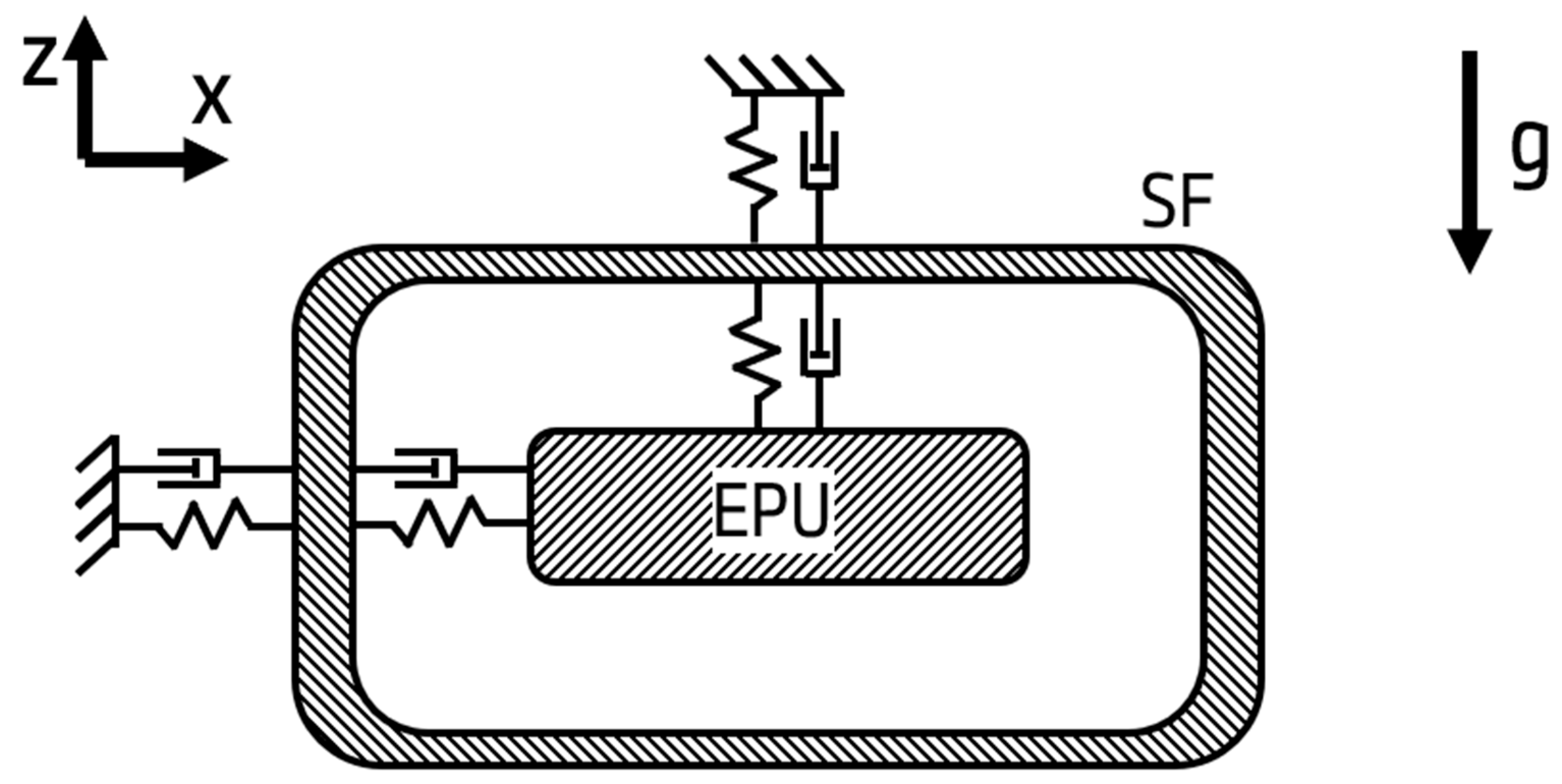
To evaluate the NVH behavior of the electric power unit (EPU), a simplified model is introduced to represent the transient decay characteristics of the EPU. Oscillations in both the longitudinal and vertical directions must be considered. Since only vibrations up to approximately 30 Hz are of interest, both the EPU and the rear axle carrier can be assumed to behave as rigid bodies. The EPU is elastically mounted relative to the rear axle mount, which, in turn, is elastically mounted relative to the vehicle chassis (see Figure A4).
Accordingly, the system can be modeled as a two-degree-of-freedom mass–spring system in both the longitudinal and vertical directions. The lateral direction is neglected due to the absence of excitation during the driving maneuvers under consideration.
Figure A4. NVH Modeling.
Vehicles 08 00103 g0a4
The two force equations in the x- and z-directions can be written as follows.
m S F 0 0 m E P U q x ¨ + b x , S F + b x , E P U b x , E P U b x , E P U b x , E P U q x ˙ + k x , E P U + k x , E P U k x , E P U k x , E P U k x , E P U q x = 0 0
m S F 0 0 m E P U q z ¨ + b z , S F + b z , E P U b z , E P U b z , E P U b z , E P U q z ˙ + k z , E P U + k z , E P U k z , E P U k z , E P U k z , E P U q z = 0 0
In this case, the two direction vectors are given as follows.
q x = x S F x E P U
q z = z S F z E P U

Appendix A.5. No-Go Region Modeling

Penisson has fully defined all simplified approaches and models for the no-go regions [10].

References

  1. Braess, H.-H.; Reichart, G. The Car—A Challenge in Functional Requirements Complexity, Safety and Reliability. J. Occup. Accid. 1990, 13, 63–78. [Google Scholar] [CrossRef]
  2. Eichstetter, M.; Müller, S.; Zimmermann, M. Product Family Design with Solution Spaces. J. Mech. Des. 2015, 137, 121401. [Google Scholar] [CrossRef]
  3. Harrich, A. CAD-Basierte Methoden zur Unterstützung der Karosseriekonstruktion in der Konzeptphase; Verlag der Technischen Universität: Graz, Austria, 2015. [Google Scholar]
  4. Law, A.M.; Kelton, W.D.; Kelton, W.D. Simulation Modeling and Analysis; Mcgraw-Hill: New York, NY, USA, 2007; Volume 3. [Google Scholar]
  5. Zimmermann, M.; Königs, S.; Niemeyer, C.; Fender, J.; Zeherbauer, C.; Vitale, R.; Wahle, M. On the Design of Large Systems Subject to Uncertainty. J. Eng. Des. 2017, 28, 233–254. [Google Scholar] [CrossRef]
  6. Simpson, T.W.; Maier, J.R.; Mistree, F. Product Platform Design: Method and Application. Res. Eng. Des. 2001, 13, 2–22. [Google Scholar] [CrossRef]
  7. Meyer, M.H.; Lehnerd, A.P. The Power of Product Platforms; Simon and Schuster: Sydney, Australia, 1997. [Google Scholar]
  8. Ersoy, M.; Gies, S.; Prokop, G.; Schimmel, C. Fahrwerkhandbuch: Grundlagen—Fahrdynamik—Fahrverhalten—Fahrwerkkomponenten—Elektronische Systeme—Fahrerassistenz—Autonomes Fahren—Entwicklungsprozesse—Perspektiven. In ATZ/MTZ-Fachbuch, 6th ed.; Springer Vieweg: Wiesbaden, Germany, 2026; ISBN 978-3-658-48103-2. [Google Scholar]
  9. Eichstetter, M. Solution Spaces for Damper Design in Vehicle Dynamics. In Proceedings of the 5th International Munich Chassis Symposium 2014; Pfeffer, P.E., Ed.; Springer Fachmedien: Wiesbaden, Germany, 2014; pp. 107–132. [Google Scholar]
  10. Penisson, C. Designing Rubber Subframe Mounts in the Pre-Development Phase. In Proceedings of the 13th Fall Rubber Colloquium, Hannover, Germany, 6–8 November 2018. [Google Scholar]
  11. Haskins, C.; Forsberg, K.; Krueger, M. INCOSE Systems Engineering Handbook, 3rd ed.; International Council on Systems Engineering: Seattle, WA, USA, 2006. [Google Scholar]
  12. Larman, C.; Basili, V.R. Iterative and Incremental Developments. a Brief History. Computer 2003, 36, 47–56. [Google Scholar] [CrossRef]
  13. Eigner, M. Einleitung–Modellbasierte Virtuelle Produktentwicklung. In Modellbasierte Virtuelle Produktentwicklung; Springer: Berlin/Heidelberg, Germany, 2014; pp. 1–13. [Google Scholar]
  14. Kim, H.M.; Michelena, N.F.; Papalambros, P.Y.; Jiang, T. Target Cascading in Optimal System Design. J. Mech. Des. 2003, 125, 474–480. [Google Scholar] [CrossRef]
  15. Otto, K.N.; Antonsson, E.K. Extensions to the Taguchi Method of Product Design. J. Mech. Des. 1993, 115, 5–13. [Google Scholar] [CrossRef]
  16. Chen, W.; Allen, J.K.; Tsui, K.-L.; Mistree, F. A Procedure for Robust Design: Minimizing Variations Caused by Noise Factors and Control Factors. J. Mech. Des. 1996, 118, 478–485. [Google Scholar] [CrossRef]
  17. Daub, M. Optimizing Flexibility for Component Design in Systems Engineering Under Epistemic Uncertainty. Ph.D. Thesis, Technische Universität München, Munich, Germany, 2020. [Google Scholar]
  18. Barthelmes, N.; Sicklinger, S.; Zimmermann, M. Product Family Optimization with Solution-Compensation Spaces. Eng. Optim. 2025, 1–22. [Google Scholar] [CrossRef]
  19. Ascia, P.; Lange, V.A.; Duddeck, F. Increasing Design Flexibility by Manually Adapting the Solution Space for Crashworthiness. J. Math. Ind. 2023, 13, 9. [Google Scholar] [CrossRef]
  20. Forrester, A.; Sobester, A.; Keane, A. Engineering Design via Surrogate Modelling: A Practical Guide; John Wiley & Sons: Hoboken, NJ, USA, 2008. [Google Scholar]
  21. Graff, L.; Harbrecht, H.; Zimmermann, M. On the Computation of Solution Spaces in High Dimensions. Struct. Multidiscip. Optim. 2016, 54, 811–829. [Google Scholar] [CrossRef]
  22. Zimmermann, M. Vehicle Front Crash Design Accounting for Uncertainties. In Proceedings of the FISITA 2012 World Automotive Congress; Springer: Berlin/Heidelberg, Germany, 2012; Volume 9, pp. 83–89. [Google Scholar]
  23. Erschen, S.; Duddeck, F.; Gerdts, M.; Zimmermann, M. On the Optimal Decomposition of High-Dimensional Solution Spaces of Complex Systems. ASME J. Risk Uncertain. Part B 2017, 4, 021008. [Google Scholar] [CrossRef]
  24. Winner, H.; Prokop, G.; Maurer, M. Automotive Systems Engineering II; Springer: Berlin/Heidelberg, Germany, 2018; Volume 1. [Google Scholar]
  25. Königs, S. Resolving Conflicts of Goals in Complex Design Processes—Application to the Design of Engine Mount Systems. In Proceedings of the 7th International Munich Chassis Symposium 2016; Pfeffer, P.E., Ed.; Springer Fachmedien: Wiesbaden, Germany, 2017; pp. 125–141. [Google Scholar]
  26. Eremeev, P.; De Cock, A.; Devriendt, H.; Naets, F. Product Family Design Optimization Considering Manufacturing and Assembly Process Costs. Struct. Multidiscip. Optim. 2024, 67, 115. [Google Scholar] [CrossRef]
  27. Xu, D.; Zhang, Y.; Zimmermann, M. Design of Vibrating Systems Using Solution Spaces. Machines 2023, 11, 642. [Google Scholar] [CrossRef]
  28. Ziegler, K.; Demir, K.; Luft, T.; Mucks, T.; Fürst, M.; Otto, M.; Stahl, K.; Vogel-Heuser, B.; Zimmermann, M. Computing Solution Spaces for Gear Box Design. Proc. Des. Soc. 2024, 4, 3041–3050. [Google Scholar] [CrossRef]
  29. Wimmler, J.; Schramm, D.; Wahle, M.; Zimmermann, M. Concurrent Design of Vehicle Tires and Axles. In Proceedings of the 6th International Munich Chassis Symposium 2015; Pfeffer, P., Ed.; Springer Fachmedien: Wiesbaden, Germany, 2015; pp. 839–851. [Google Scholar]
  30. Münster, M.; Lehner, M.; Rixen, D.; Zimmermann, M. Vehicle Steering Design Using Solution Spaces for Decoupled Dynamical Subsystems. In Proceedings of the 26th Conference on Noise and Vibration Engineering ISMA 2014, Leuven, Belgium, 15–17 September 2014; Volume 26, pp. 279–288. [Google Scholar]
  31. Cóndor López, J.G.; Finger, K.; Herold, S. Defining Robust NVH Requirements for an Electrified Powertrain Mounting System Based on Solution Space During Early Phase of Development. Appl. Sci. 2025, 15, 10241. [Google Scholar] [CrossRef]
  32. Della Noce, E.R.; Zimmermann, M. Optimizing Requirements for Maximum Design Freedom Considering Physical Feasibility. Proc. Des. Soc. 2023, 3, 2865–2874. [Google Scholar] [CrossRef]
  33. Zimmermann, M.; Wahle, M. Solution Spaces for Vehicle Concepts and Architectures. In Proceedings of the 24th Aachen Colloquium Automobile and Engine Technology, Aachen, Germany, 1 October 2015. [Google Scholar]
  34. Rötzer, S.; Berger, V.; Zimmermann, M. Cost Optimization of Product Families Using Solution Spaces: Application to Early-Stage Electric Vehicle Design. Proc. Des. Soc. 2022, 2, 583–592. [Google Scholar] [CrossRef]
  35. Wimmler, J.; Wahle, M.; Zimmermann, M.; Schramm, D. Optimizing Suspension Systems for Feasibility, Performance and Cost. In Advanced Vehicle Control; CRC Press: Boca Raton, FL, USA, 2016. [Google Scholar]
  36. Rumpold, S.K. Validierung und Weiterentwicklung Vereinfachter Simulationsmodelle für Achskennwerte in der Fahrdynamik. Ph.D. Thesis, Technische Universität, Wien, Austria, 2019. [Google Scholar]
  37. Wagner, S.; Vena, G.; Schramm, D. Simplified Model for Self-Excited Rear-Axlevibrations. In Proceedings of the 18. Internationales Stuttgarter Symposium; Bargende, M., Reuss, H.-C., Wiedemann, J., Eds.; Springer Fachmedien: Wiesbaden, Germany, 2018; pp. 715–728. [Google Scholar]
  38. Schramm, D.; Hesse, B.; Hesse, T.; Unterreiner, M.; Liebherr, M. Vehicle Dynamics, Electro Mobility, Vehicle Electrics, Autonomous Vehicles, HMI; De Gruyter: Berlin, Germany; Boston, MA, USA, 2025; ISBN 978-3-11-134882-7. [Google Scholar]
  39. Matschinsky, W. Radführungen Der Straßenfahrzeuge: Kinematik, Elasto-Kinematik und Konstruktion, 3rd ed.; Aktualisierte und Erweiterte; Springer: Berlin/Heidelberg, Germany, 2007; ISBN 978-3-540-71196-4. [Google Scholar]
  40. Göbel, E.F. Berechnung und Gestaltung von Gummifedern; Springer: Berlin/Heidelberg, Germany, 2013. [Google Scholar]
Figure 1. Overview of considered parts at a vehicle rear axle.
Vehicles 08 00103 g001
Figure 2. Example of typical SFM properties. (a) Stiffness vs. displacement, (b) force vs. displacement, and (c) loss angle vs. frequency for conventional mounts and hydromounts.
Vehicles 08 00103 g002
Figure 3. Applied solution space engineering with a subdiscipline dependency graph with corresponding bottom-up mapping and top-down mapping.
Vehicles 08 00103 g003
Figure 4. Clusters of publications covering different applications of the solution space method on a dependency graph.
Vehicles 08 00103 g004
Figure 5. Example of common design properties for two vehicles, (a) without the proposed approach and (b) according to the proposed approach.
Vehicles 08 00103 g005
Figure 6. Dependency graph.
Vehicles 08 00103 g006
Figure 7. Overview of the design variables and targets of the two chosen vehicles.
Vehicles 08 00103 g007
Figure 8. Example of a section cut.
Vehicles 08 00103 g008
Figure 9. Optimal and common design variable set after single design optimization of vehicles A and B.
Vehicles 08 00103 g009
Figure 10. Single section cuts (top and middle) and common section cuts (bottom) of the chosen vehicles.
Vehicles 08 00103 g010
Figure 11. Common subframe mount characteristic for vehicles A and B with plotted operating points.
Vehicles 08 00103 g011
Table 1. Overview of the clustered publications in Figure 4 covering different applications of the solution space method.
ClusterLinePublicationsDescription
1green[9,25,26,27,28]One component with q.o.i. from two areas
2violet[22,29,30,31,32]Several components with q.o.i. from one single target area
3blue[2]Components for several vehicles with q.o.i. from one single target area
4orange[33,34]Components for several vehicles with q.o.i. from several target areas
5red[35]Several components with q.o.i. from several target areas
Table 2. Overview of vehicle dynamics and driving comfort quantities of interest.
QuantityUnitNumber of QuantitiesDescription
cx,FxN/m1longitudinal stiffness of the axle under longitudinal force
cy,FyN/m1lateral stiffness of the axle under lateral force
cδ,FxN/rad1toe gradient of the axle under longitudinal force
cδ,FyN/rad1toe gradient of the axle under lateral force
cγ,FyN/rad1camber gradient of the axle under lateral force
Table 3. Overview of NVH quantities of interest.
QuantityUnitNumber of QuantitiesDescription
fx/z,EPU1/s2eigenfrequency of EPU in x/z-direction
tset,x/z,EPUs2Settling time of EPU in x/z-direction
Table 4. Overview of driving safety quantities of interest.
QuantityUnitNumber of QuantitiesDescription
sws-1safety coefficient for wheel shimmy vibrations
Table 5. Overview of no-go region qualifiers.
QualifierUnitNumber of QualifiersDescription
qcdyn,z,f/r,lf/hf-4dynamic stiffness criterion in z-direction at low and high frequency, front/rear
qla,z,f/rrad2loss angle criterion in z-direction, front/rear
rcy/cx,cy/cz,f/r-4ratio basic stiffnesses in cy/cx, cy/cz, front/rear
qpreload,x/z,f/r-4preload criterion in x/z-direction, front/rear
qc,prog,y,f/r-4stiffness gradient criterion in y-direction, front/rear
qemp,f/r-2empirical criterion, front/rear
Table 6. Overview of constant full-vehicle parameters.
ParameterUnitNumber of ParametersDescription
mvkg1mass of vehicle
CoGv,x/y/zm3position center of gravity of vehicle in x/y/z-direction
tv,rm1rear track of vehicle
wbvm1wheelbase of vehicle
Izz,axlekgm21moment of inertia of rear axle around z-axis
munspr,rkg1rear unsprung mass
CoGunspr,r,x/x/zm3position center of gravity of rear unsprung mass in x/y/z-direction
Table 7. Overview of constant component parameters.
ParameterUnitNumber of
Parameters
Description
µx-1tire longitudinal friction coefficient
cz,tire,rN/m1rear tire vertical stiffness
rtire,rm1dynamic rear tire radius
ntire,rm1caster trail rear
γrrad1camber angle rear
αaxle,rrad1diagonal spring angle rear
hpspring,w,x/y/zm3hardpoint spring–wheel in x/y/z-direction
hpspring,v,x/y/zm3hardpoint spring–vehicle in x/y/z-direction
cspring,rN/m1stiffness main spring
ispring-1ratio spring–vertical wheel travel
hpdamper,w,x/y/zm3hardpoint damper–wheel in x/y/z-direction
hpdamper,v,x/y/zm3hardpoint damper–vehicle in x/y/z-direction
ddamper,rNs/m1damping main damper
idamper-1ratio damper–vertical wheel travel
poswc,r,x/y/zm3position rear wheel center in x/y/z-direction
crot,whb,r,x/zNm/rad1stiffness rear wheel bearing
hprod,w,x/y/zm15hardpoint rod–wheel in x/y/z-direction
hprod,v,x/y/zm15hardpoint rod–vehicle in x/y/z-direction
crb,whm5stiffness rod bushing wheel in rod-direction
crb,SFm5stiffness rod bushing SF in rod-direction
mEPUkg1mass of electric power unit (EPU)
CoGx/y/z,EPUm3position center of gravity of EPU in x/y/z-direction
Ixx/yy/zz,EPUkgm23moment of inertia of EPU around x/y/z-axis
mSFkg1mass of subframe (SF)
CoGx/y/z,SFm3position center of gravity of SF in x/y/z-direction
Ixx/yy/zz,SFkgm23moment of inertia of SF around x/y/z-axis
posf/r,x/y/z,EPUMm6position EPUM in x/y/z-direction, front/rear
cf/r,x/y/z,EPUMN/m6basic stiffness EPUM in x/y/z-direction, front/rear
slin,f/r,x/y/z,EPUMm6linear length EPUM in x/y/z-direction, front/rear
eprog,pos,f/r,x/y/z,EPUM-6progression exponent EPUM in positive x/y/z-direction, front/rear
eprog,neg,f/r,x/y/z,EPUM-6progression exponent EPUM in negative x/y/z-direction, front/rear
fprog,pos,f/r,x/y/z,EPUMN/m36progression factor EPUM in positive x/y/z-direction, front/rear
fprog,neg,f/r,x/y/z,EPUMN/m36progression factor EPUM in negative x/y/z-direction, front/rear
secc,f/r,x/y/z,EPUMN6eccentricity EPUM in x/y/z-direction, front/rear
cdyn,lf,f/r,x/y/z,EPUM-6dynamic hardening stiffness at low-frequency EPUM in x/y/z-direction, front/rear
cdyn,hf,f/r,x/y/z,EPUM-6dynamic hardening stiffness at high-frequency EPUM in x/y/z-direction, front/rear
δlf,f/r,x/y/z,EPUMrad6loss angle at low-frequency EPUM in x/y/z-direction, front/rear
δhf,f/r,x/y/z,EPUMrad6loss angle at high-frequency EPUM in x/y/z-direction, front/rear
Table 8. Overview of system-individual design variables.
Design
Variable
UnitNumber of VariablesDescription
posf/r,x/y/z,SFMm6position SF mount (SFM) in x/y/z-direction, front/rear
Table 9. Overview of common design variables.
Design
Variable
UnitNumber of
Variables
Description
cf/r,x/y/z,SFMN/m6basic stiffness SFM in x/y/z-direction, front/rear
slin,f/r,x/y/z,SFMm6linear length SFM in x/y/z-direction, front/rear
eprog,pos,f/r,x/y/z,SFM-6progression exponent SFM in positive x/y/z-direction, front/rear
eprog,neg,f/r,x/y/z,SFM-6progression exponent SFM in negative x/y/z-direction, front/rear
fprog,pos,f/r,x/y/z,SFMN/m36progression factor SFM in positive x/y/z-direction, front/rear
fprog,neg,f/r,x/y/z,SFMN/m36progression factor SFM in negative x/y/z-direction, front/rear
secc,f/r,x/y/z,SFMN6eccentricity SFM in x/y/z-direction, front/rear
cdyn,lf,f/r,x/y/z,SFM-6stiffness dynamic hardening at low-frequency SFM in x/y/z-direction, front/rear
cdyn,hf,f/r,x/y/z,SFM-6stiffness dynamic hardening at high-frequency SFM in x/y/z-direction, front/rear
δlf,f/r,x/y/z,SFMrad6loss angle at low-frequency SFM in x/y/z-direction, front/rear
δhf,f/r,x/y/z,SFMrad6loss angle at high-frequency SFM in x/y/z-direction, front/rear
Table 10. Overview of chosen vehicles for the example problem.
VehicleDoorsDriven AxlesTypeCharacterWeight
A4RearSedanLuxuryHeavy
B4RearCompactAll-AroundMiddle-Range
Disclaimer/Publisher’s Note: The statements, opinions and data contained in all publications are solely those of the individual author(s) and contributor(s) and not of MDPI and/or the editor(s). MDPI and/or the editor(s) disclaim responsibility for any injury to people or property resulting from any ideas, methods, instructions or products referred to in the content.