1. Introduction
As highway networks continue to expand and vehicle ownership steadily increases, ensuring driving safety in complex road conditions has become a significant area of research within the transportation sector [
1,
2]. Sine-wave-like roads, commonly found in mountainous and rural areas (e.g., continuous curves and serpentine sections), exhibit periodic curvature variations that follow a sine pattern along their length. This requires continuous adjustments to vehicle posture during travel to accommodate changing road curvature [
3,
4,
5]. Overtaking, a high-risk maneuver on complex roads, is heavily influenced by coupled flow field interactions [
6]. It is different from on straight roads. The curvature variations on sinusoidal-like roads disrupt the symmetry of the flow field, creating a non-uniform approach environment. The close proximity of vehicles during overtaking further induces flow field interference, vortex shedding, and pressure field reconstruction. These phenomena directly impact aerodynamic drag, lateral forces, and lift characteristics [
7,
8], thereby affecting handling stability, braking distance, and energy consumption during overtaking maneuvers.
Research on automotive aerodynamics has yielded significant findings under straight-line conditions [
9,
10,
11]. Scholars have used computational fluid dynamics (CFD) simulations and wind tunnel tests to elucidate the distribution patterns of vehicle aerodynamic parameters during straight-line driving. They have also conducted systematic analyses of the effects of inter-vehicle spacing and relative velocity on aerodynamic interference during overtaking maneuvers [
12,
13]. Yang Tianjun [
14] explained the causes of aerodynamic force changes during overtaking through numerical simulation of transient overtaking processes. The experiments revealed that aerodynamic drag, lateral force, and other parameters exhibit trigonometric trends throughout the overtaking process. Zhang Miao [
15] used both overlapping and discontinuous meshes in CFD simulations to study the external flow fields of the simplified Ahmed vehicle when overtaking in the lane-change model. The analysis examined the relationships and trends in drag coefficients, lift coefficients, and lateral force coefficients between the two vehicles. The experiments revealed that the most severe aerodynamic disturbance to the overtaken vehicle occurs when the overtaking vehicle departs the overtaking trajectory. Wu Yunzhu et al. [
16] studied the effects of relative versus absolute vehicle speeds on aerodynamic characteristics during overtaking using dynamic mesh technology in transient simulations. The experiments revealed that relative speed exerts a minor influence on the overtaking vehicle but significantly impacts the overtaken vehicle. With the same relative speeds, the two vehicles with lower absolute speeds generate greater transient aerodynamic effects during overtaking maneuvers. Wu Jingfeng [
17] introduced a multi-parameter simulation in vehicle modeling, proposing that vehicle speed, which influences aerodynamic coefficients, is the primary factor. He highlighted how the asymmetry of body loads during approach and departure from objects affects vehicle dynamics.
Existing research has predominantly focused on straight or single-curvature bend conditions [
18,
19]. There is insufficient attention given to periodic variable-curvature scenarios such as those found on sinusoidal-like roads. The dynamic curvature characteristics of these roads induce periodic unsteady flow patterns around vehicles. This makes existing aerodynamic theories for straight-line overtaking inapplicable. Moreover, during overtaking maneuvers on variable-curvature roads, dynamic changes in vehicle yaw angle, trajectory, and relative positions between vehicles significantly increase the complexity of the flow. The coupling mechanisms that govern aerodynamic loads in such scenarios remain poorly understood [
20,
21,
22]. Current research on the dynamics under crosswinds primarily employs three-dimensional models, yet studies on the mutual influence between two vehicles under crosswind conditions remain insufficient, often focusing on fluid shadow effects [
23]. Research on the interaction between two vehicles still requires the use of shear planes for analysis, examining them in a two-dimensional xy plane. Therefore, this paper adopts a two-dimensional approach.
This study investigates overtaking scenarios on sinusoidal-like roads. Numerical simulations were conducted using ANSYS FLUENT 2024 R2, with post-processing performed in CFD-POST. The SST k-ω standard model was applied to systematically analyze the impact of relative vehicle velocities on lateral forces during overtaking maneuvers. It reveals the evolution of vehicle aerodynamic characteristics on variable-curvature roads. Key findings include:
(1) Analyzing pressure contour plots and velocity vector diagrams for overtaking scenarios with varying initial velocities between the leading and trailing vehicles, and calculating the lateral force to assess vehicle stability and safety during these maneuvers.
(2) Using a four-factor orthogonal design to examine constant real-road variables-vehicle speed, crosswind, overtaken vehicle type and the distance between the two vehicles to identify the safest overtaking conditions. This results in regression-fitted equations [
24,
25,
26].
The findings provide theoretical support and data references for developing safe overtaking strategies on complex roads and enabling automotive intelligent driving systems to predict road conditions.
2. Methodology
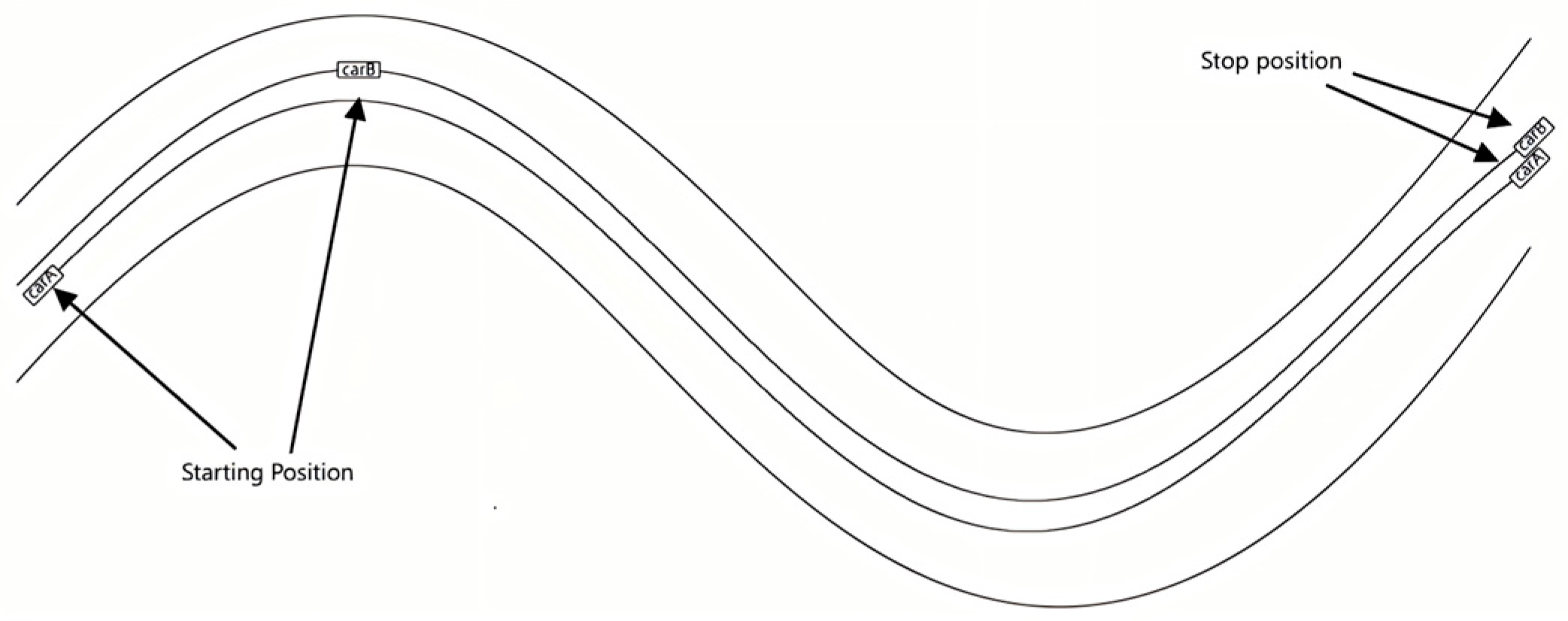
This study investigates overtaking maneuvers on continuous sine-wave-like curves. The research aims to examine the impact of vehicle speed on aerodynamic characteristics during overtaking because there are many factors in real-world road environments. It also serves as a cautionary reminder for drivers exhibiting dangerous driving behaviors. The simulated road trajectory approximates a scaled-up sine curve. The overtaking vehicle (car A) is on the left side, and car B is on the opposite side. The driving trajectory is 25 m for amplitude and (50π) m for period. To ensure strict consistency of the driving trajectory, this study adopts a constant horizontal speed and variable longitudinal speed [
27]. Car A changes its initial speed among them. The overtaking map is presented in
Figure 1. The overall experimental plan is shown in
Table 1.
Model Motion Control Equation:
The formula for the curvature of a sinusoidal curve, expressed in terms of
vx and
vy, is as follows:
The selected vehicle model in this paper has a maximum lateral velocity of 26 m/s, corresponding to a Mach number of approximately 0.076 (less than 0.4). Within this wind speed range, the fluid can be considered incompressible. Therefore, the fluid density ρ is constant, and the applicable continuity equation is
The equation of conservation of momentum is
The energy conservation equation is
In the equation: u, v, w represent the velocity components in the x, y, and z directions respectively; p is the pressure on the fluid element; μef is the turbulent viscosity coefficient; t is time; ST represents the internal heat source of the fluid and the portion of mechanical energy converted to thermal energy due to viscous effects; k is the fluid mechanics heat transfer coefficient; cp is the specific heat capacity; T is the temperature.
In automotive aerodynamics, the aerodynamic coefficient is commonly used to describe a vehicle’s aerodynamic characteristics.
Formula for calculating the drag coefficient:
Formula for calculating lateral force coefficient:
In Equations (6) and (7), D represents the aerodynamic drag force acting on the vehicle body in the direction opposite to the vehicle’s motion; S denotes the lateral force acting on the vehicle body; v+∞ is the relative velocity v of the composite airflow; and A is the vehicle’s frontal area.
Formula for Calculating the Reynolds Number:
In the equation, ρ denotes fluid density, and μ denotes dynamic viscosity. d is the characteristic length
The computational domain has dimensions of 200 × 100 × 3 m, with a dynamic viscosity of 1.7894 × 10
−5 Pa·s and a density of 1.225 kg/m
3. The characteristic length is 5 m. This results in a Reynolds number reaching up to 8.9 × 10
6, far exceeding the aerodynamic threshold of 10
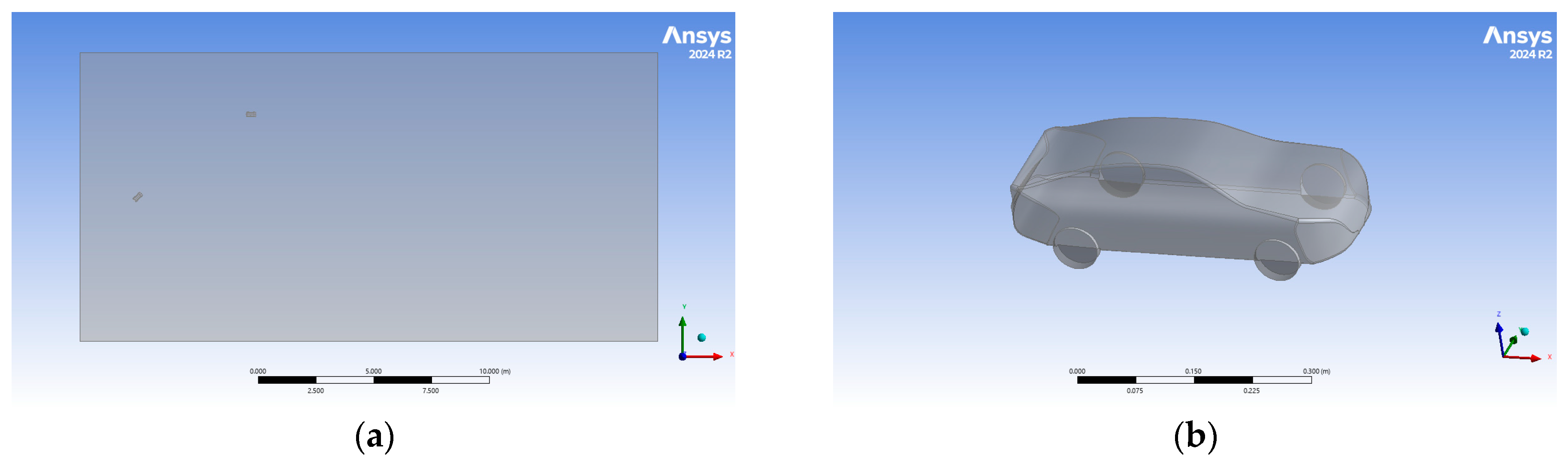
6. Therefore, it can be classified as turbulent flow. The actual computational model is shown in
Figure 2.
3. Numerical Simulation
3.1. Computational Domain Model Design
The passenger car for families studied in this research has original body dimensions of 4988 mm in length, 1874 mm in width, and 1470 mm in height, with a wheelbase of 2920 mm and a weight of 1565 kg. The frontal area is approximately 2.7 m2. To simplify the original dimensions, length is denoted as L, width as W and height as H. To ensure the front and rear profiles more closely match the vehicle’s real characteristics, the front and rear ends will be rounded proportionally to better align with actual conditions. Regarding the computational domain setup, to eliminate boundary condition interference on the surrounding flow field, its dimensions are set to 40 times the vehicle length (40 L), 56 times the vehicle width (56 W) and twice the vehicle height (2H). In all simulation scenarios, the vehicle first completes a pre-driving phase. Once the flow reaches a fully developed state, subsequent analysis proceeds in the overtaking zone.
3.2. Grid-Independence Study
The simplified overtaking model was meshed using Fluent Meshing 2024 R2 software. The model underwent a grid-independence study based on the criterion of maximum lateral force at 22 m/s during the primary overtaking maneuver. This result represents the lateral force on Car A. When the number of grid cells is 2.9 million, the maximum lateral force remains essentially stable. Therefore, this number of grid cells was used for the simulation. The grid-independence results are shown in the
Table 2.
3.3. Grid Preprocessing
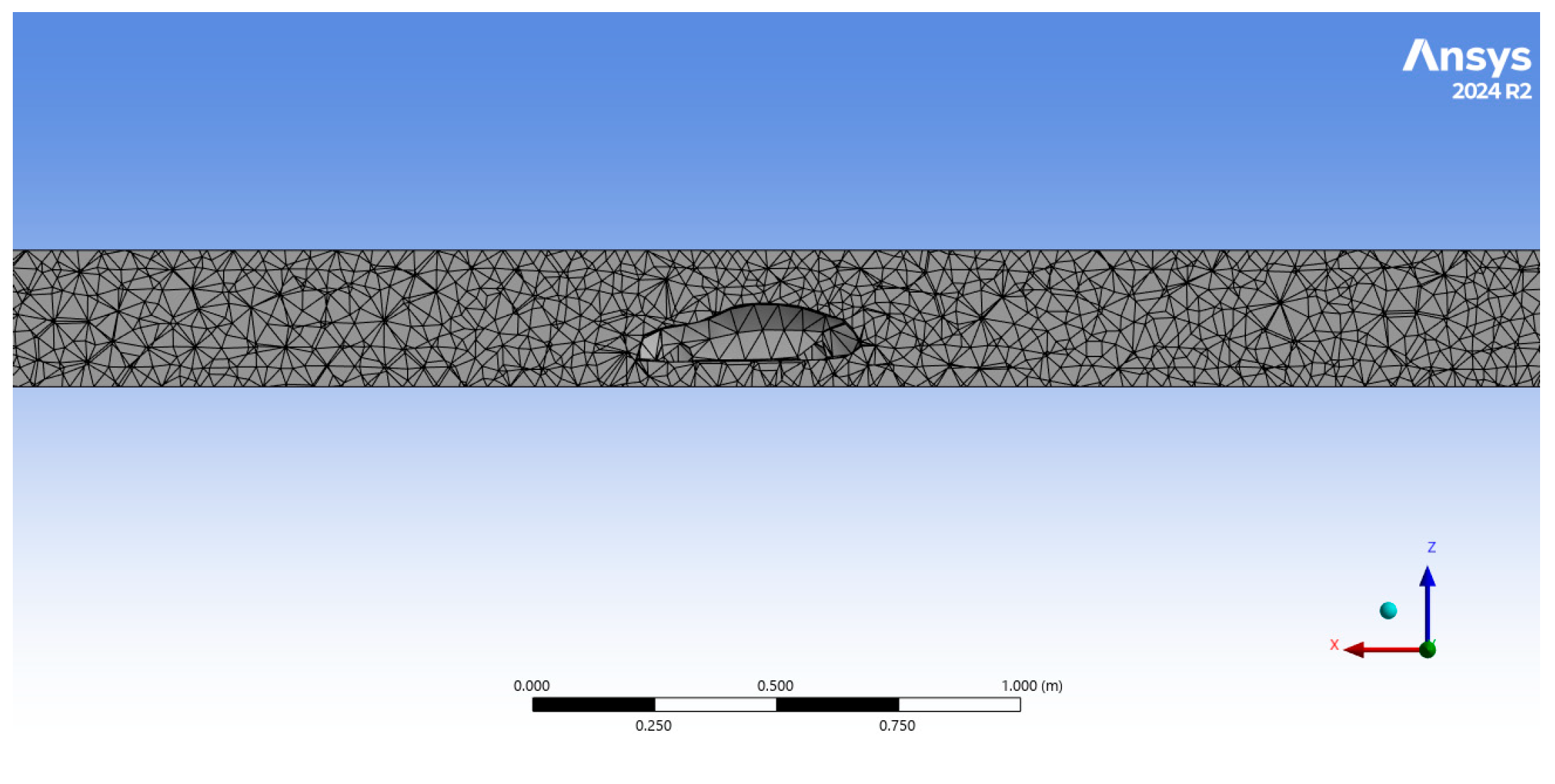
The mesh generation was performed using Ansys Meshing 2024 R2. See
Figure 3 for the grid schematic diagram. The computational model employs a tetrahedral grid. The y+ value is 100. The boundary layer is set using the expansion method, with the first layer at 0.001 m, a transition ratio of 1.2, and a total of 5 boundary layers. FLUENT implements the SST k-ω model with an automated wall treatment. Both k-ω models (standard and SST) in FLUENT support automatic wall treatment: they behave as low-Re models for y+ ≈ 1 and as wall-function models for y+ > 30, with smooth blending in the buffer layer [
28,
29]. The built-in code automatically selects the appropriate parameter settings based on the y+ value of the first grid layer. To enhance computational efficiency, we scaled down the 200 × 100 m computational domain model by a factor of 10 during model creation. Subsequently, the entire model was scaled up by a factor of 10 in the computational settings. The maximum overall grid size is 0.05 m, with a growth rate of 1.2. The minimum curvature captured is 0.05 m. The entire computational domain is a cube measuring 200 × 100 × 3 m, which has been fully meshed. Meanwhile, the vehicle is treated as a rigid body and is controlled by a UDF to move within the computational domain.
3.4. Pre-Processing Settings
The boundary conditions of the computational domain were defined. The left and right boundaries were set as a Velocity-Inlet and a Pressure-Outlet, respectively. The solver type selected is Pressure-Based. It adopted the Transient solution mode. This model is a high-Reynolds-number model, mainly aimed at studying the air field in two workshops. In order to improve calculation accuracy and accelerate convergence speed, the SST k-ω model is selected. The dynamic mesh uses Smoothing and Remeshing approaches. In the Smoothing module, we adopted the Spring/Laplace/Boundary Layer option. The Spring Constant Factor parameter is set to 0.05. This study adopts a moving mesh model in all simulations. We imported the UDF file into the moving mesh settings and defined it separately for Car A and Car B. Then, we set auto-save to every 5 steps. Finally, we performed standard initialization. This simulation employs a time step of 0.001 s and 8000 time steps.
4. Results Analysis
Aerodynamic diagrams effectively illustrate the distribution of and variation in aerodynamic forces on vehicles. This study analyzes the trends in the drag coefficients and pressure center points for two vehicles during an overtaking maneuver. To simplify the description of their relative positions, the horizontal distance between the vehicle centers is defined as X, and the vehicle length as L. The relative position is then expressed as the dimensionless ratio X/L. The positive lateral direction is defined as Vehicle A being ahead of Vehicle B, and the positive longitudinal direction is defined toward the inside of the curve.
4.1. Pressure Map Analysis
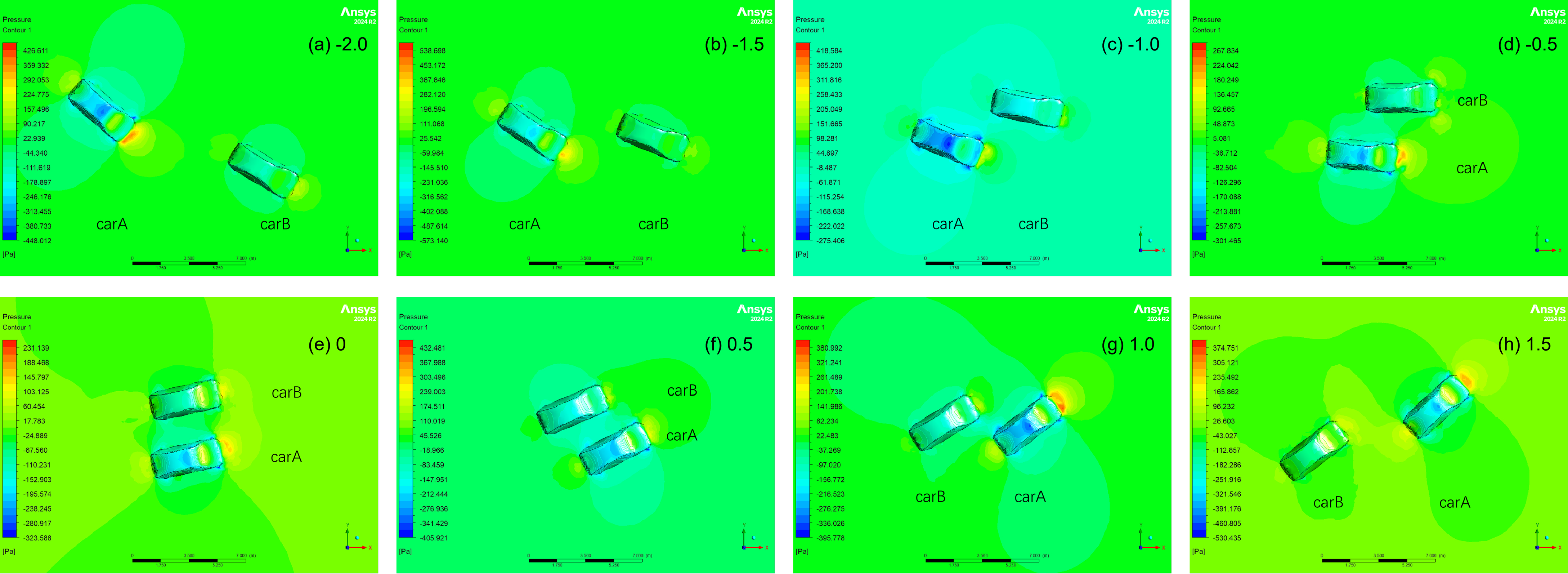
Taking Case 1 as an example, we analyze the simulation results. This simulation employs a time step of 0.001 s and 8000 time steps, and saves data every 5 time steps. To obtain accurate experimental results, we chose positions from several passing maneuvers between −2.0 and 1.5. The unit is Pa.
Figure 4 shows a pressure contour map depicting the pressure changes for both vehicles throughout the entire overtaking phase.
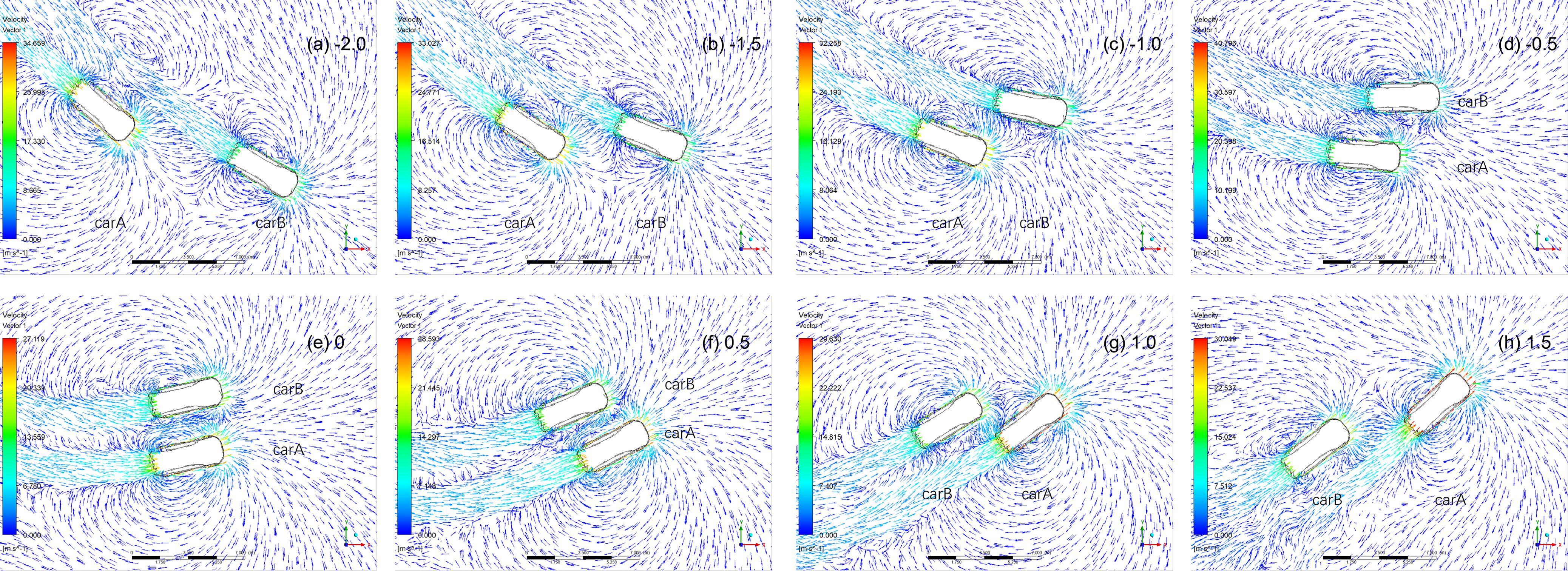
Figure 5 illustrates the changes in airflow and vortices around the two vehicles during the overtaking maneuver. Both figures cover the phases before, during, and after the overtaking maneuver.
It is worth noting that at the X/L = −1.5 position, as shown in
Figure 4b and
Figure 5b, Car A has just begun to enter the overtaking trajectory. At this point, the left front of car A creates an airflow impact on the right side of car B. It is clearly observable that the airflow velocity and air density increase in the interference zones at these two locations, and a backflow vortex begins to form. The negative pressure zone between the two vehicles gradually expands. The collision of the two vehicles’ airflows causes car B to exhibit a counterclockwise rotational tendency, and its body stability begins to decrease.
Furthermore, at the position where X/L = −1.0, as shown in
Figure 4c and
Figure 5c, car A has already entered the overtaking trajectory. The front of car A is aligned with the rear of car B, and the low-pressure zone on the outer side of car A is significantly larger than that on the inner side, gradually exhibiting a counterclockwise distortion. The flow fields at the front ends begin to interact, and the airflow starts to compress the outer side of car B’s body. As the airflow velocity increases, the area of converging negative pressure between the two cars continues to expand. The pressure on the inner side of car B is significantly higher than on the outer side; the confined vortex on the inner side changes shape and shifts toward the rear, while the vortex structures on both sides become asymmetrical, and their twisting tendency intensifies. At this point, a repulsive force begins to develop between the two vehicles, and the lateral force acting on car B reaches its peak. Simultaneously, as car A moves forward, the airflow at its front is diverted to both sides of the vehicle body; part of this airflow subsequently mixes with the wake of car B, gradually forming a wake vortex at the wake. By the position where X/L = 0.5 (
Figure 4d and
Figure 5d), the wake vortex is fully formed. The generation of this wake vortex weakens the vehicles’ dynamic stability and dissipates kinetic energy; at this point, the lateral force on car A reaches its peak, causing the system to enter a state of extreme instability.
When the vehicles reach the X/L = 0 position (
Figure 4e and
Figure 5e), their front ends are essentially aligned. At this point, the chase phase transitions to a separation phase. The influence of the flow field has expanded from the front to the rear. The negative pressure region on the outer side of Vehicle B reaches its maximum value. At this point, the negative pressure flow field on the outer side of the front and the inner side of the rear of car B expands significantly, and the counterclockwise rotation trend reaches its peak. The negative pressure values in the flow field between the two vehicles are significantly lower than the pressure level of the external flow field, gradually forming a mutual attraction pattern. The gap between the two vehicles reaches its minimum. This reduction in vehicle spacing significantly increases the vector density in this region. For car A, vortex structures exist on both sides but exhibit low symmetry; the vector density on the outer side is relatively low while the flow velocity is high. Meanwhile, the vortex on the right side of car B is dissipating, causing the flow field to become highly asymmetric and stability to decline significantly. Therefore, at this stage, car B is significantly more difficult to control than car A.
As the overtaking maneuver nears completion (when X/L = 1.0 in
Figure 5g), the wake generated on the left side of car A exerts a significant influence on car B. Part of the vortex on the right side of car B is drawn into the wake vortex of car A, causing deformation of the vortex on the right side of car B. This phenomenon creates a severe imbalance between the vortices on both sides of car B, thereby jeopardizing subsequent driving safety.
4.2. Lateral Force Analysis
During overtaking maneuvers, the airflow around two vehicles interferes with each other. This can result in changes in the lateral forces on the car bodies. At specific relative positions, the lateral forces of the vehicles reach their maximum values. This force that acts perpendicular to the vehicle body can lead the vehicle to deviate from its intended path. In extreme cases, it may even lead to rollover. Therefore, it is highly significant to study lateral forces during overtaking. This can ensure the safety of driving and enhance vehicle stability.
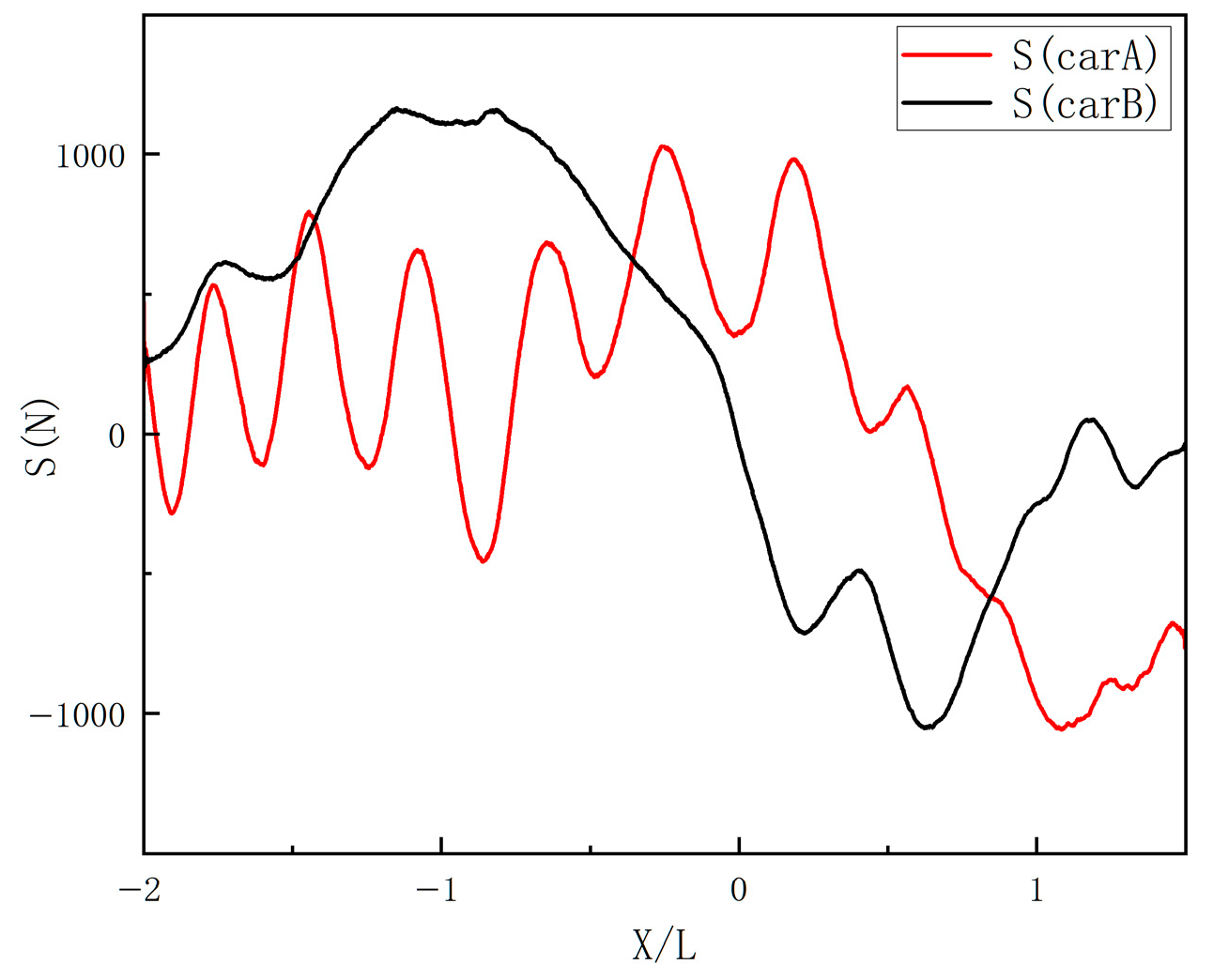
The
Figure 6 shows the lateral force variation curves for vehicles car A and car B during overtaking. The diagram effectively illustrates the complete overtaking process, from the initiation of the maneuver through to its completion along the trajectory. It also depicts the continuous fluctuation of the lateral forces acting on both vehicles throughout this sequence. The lateral force coefficient for car A follows an overall trend of increasing first and then decreasing. At the position X/L = −2.0, the primary overtaking vehicle initially enters the overtaking trajectory. At this point, the airflow disturbance on both sides of the vehicle body is relatively weak, so the airflow has little effect on the lateral force acting on the vehicle body, and both vehicles travel relatively smoothly. Between X/L = −1.5 and X/L = −1.0, car B’s lateral force continuously increases, and the repulsive force between the vehicles also grows. At X/L = −0.5, this force reaches its peak, causing car B to become extremely unstable and posing the highest risk.
Car A’s speed is relatively high, and its lateral force coefficient fluctuates frequently due to car B. The lateral force coefficient exhibits sinusoidal variation, with the overall direction pointing outward from the vehicle body. As shown in the Figure, car A exhibits multiple lateral force peaks with varying directions between X/L = −2.0 and X/L = 0. The direction of car A’s lateral force continuously shifts, causing frequent fluctuations that reduce driving stability and significantly increase the risk of overtaking. When Car A gradually approaches Car B (before X/L = −1.0), Car B’s wake is swept outward by the curvature of the curve, accompanied by periodic oscillations. As Car A closes in, it repeatedly cuts in and out of this oscillating wake. This causes the pressure difference between the left and right sides of the vehicle to constantly reverse, directly resulting in frequent fluctuations in the magnitude and direction of Car A’s lateral force. As the front ends of Car A and Car B continue to approach until they are aligned, the lateral gap between the two vehicles gradually decreases, and the airflow is compressed and accelerated, forming a low-pressure zone. Car A is drawn inward. As the relative positions continue to change, the structure of the wake and the flow field in the gap alters, and the suction force turns into a repulsive force. This alternating pull–push effect causes the lateral force to exhibit distinct positive and negative oscillations. When the vehicles reach the point where their front ends are aligned (between X/L = 0 and X/L = 0.5), their relative positions are closest, and the interference from the gap effect and wake reaches its peak, resulting in periodic extremes in aerodynamic force. After passing the alignment point, the two vehicles gradually move apart, the interference weakens, and the oscillations subsequently decay and tend toward stability.
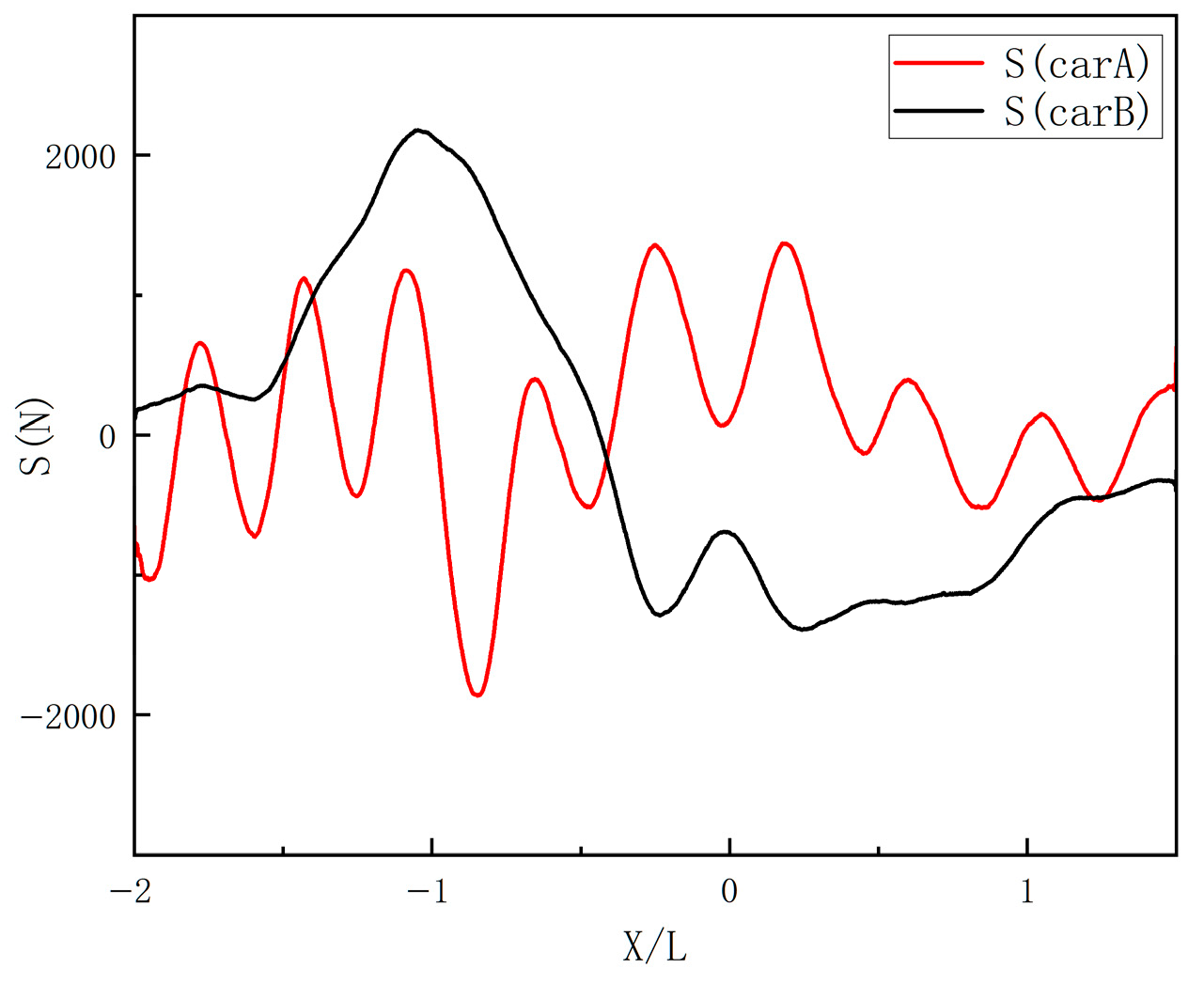
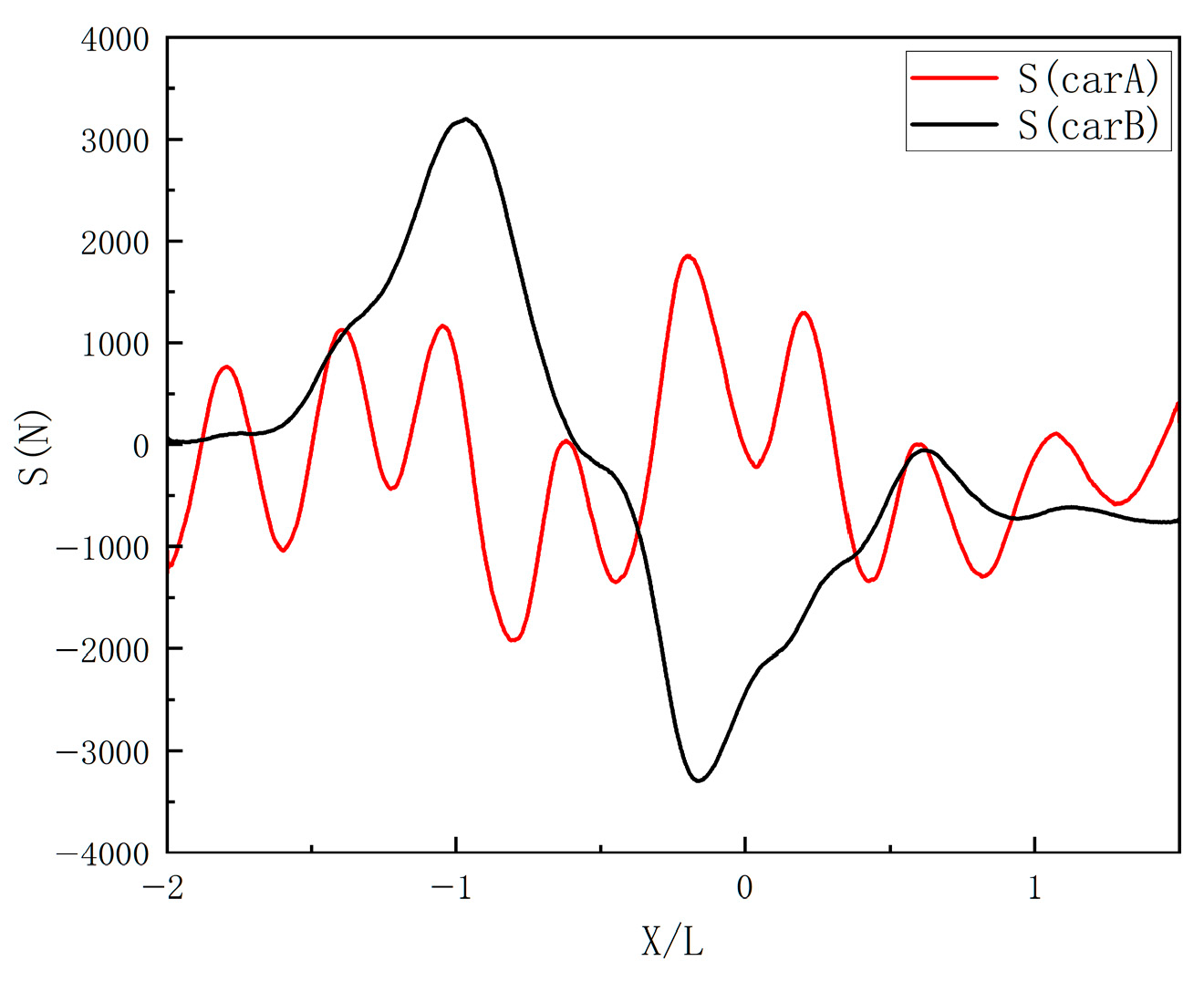
As shown in
Figure 7 and
Figure 8, the overall trend following an increase in speed is similar to that observed at 22 m/s. The lateral forces on the overtaken vehicle (car B) are highly sensitive to speed; when the speed increases from 24 m/s to 26 m/s, the maximum peak value rises by approximately 175%. The increase is particularly significant during the phase when the front ends of the vehicles are aligned, exhibiting a nonlinear amplification characteristic that aligns with the fundamental principle that aerodynamic loads are proportional to the square of the speed. The increase in the amplitude of car A’s lateral force is relatively small, indicating that during an overtaking maneuver, car A is the primary recipient of aerodynamic disturbances. At high speeds, the risk of lateral instability for the overtaken vehicle is significantly higher than that for the overtaking vehicle. An increase in speed leads to more severe separation of the shear layer between the two vehicles, and the aerodynamic disturbances during the overtaking process are more concentrated at the moment the two vehicles are side-by-side.
4.3. Resistance Analysis
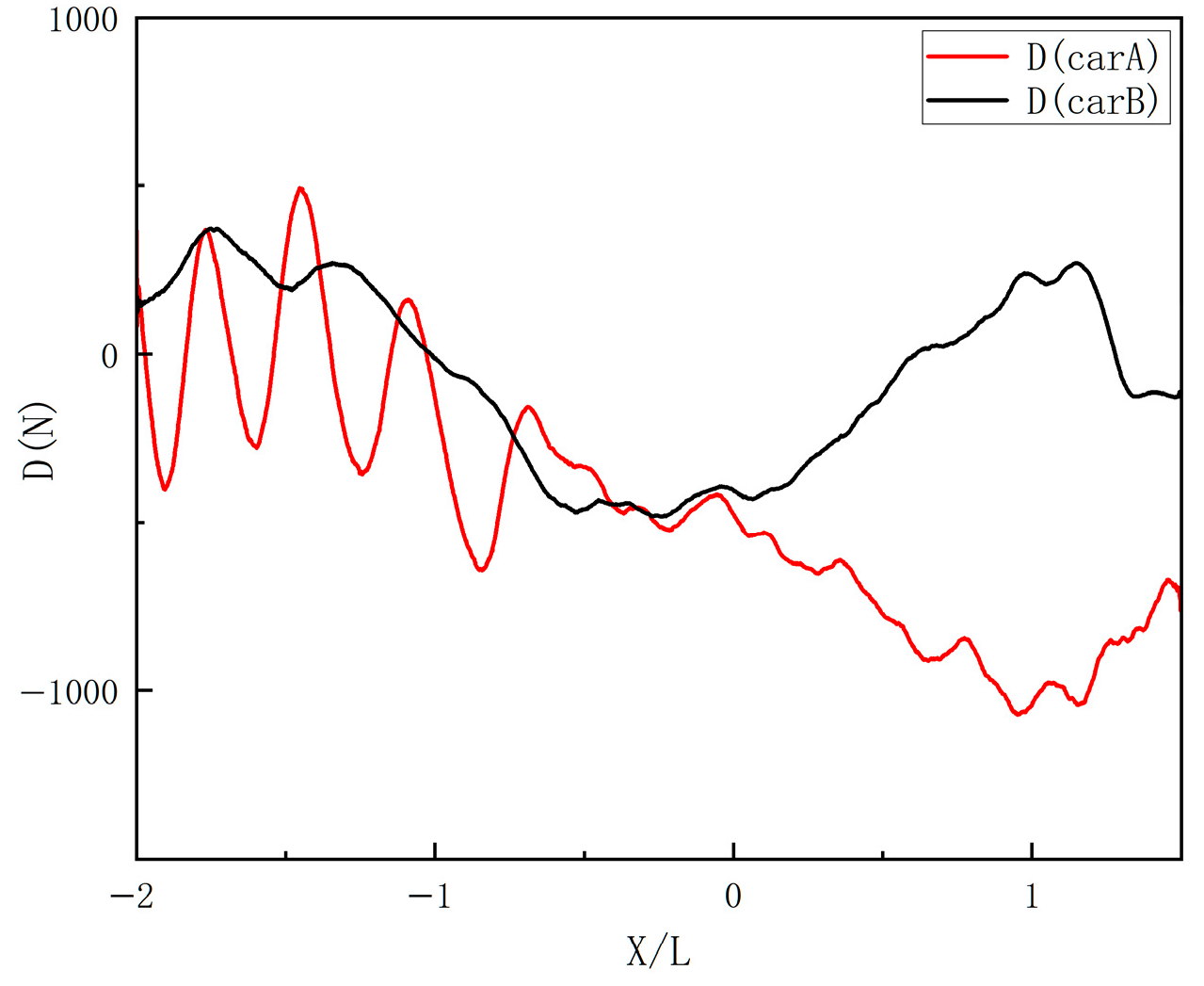
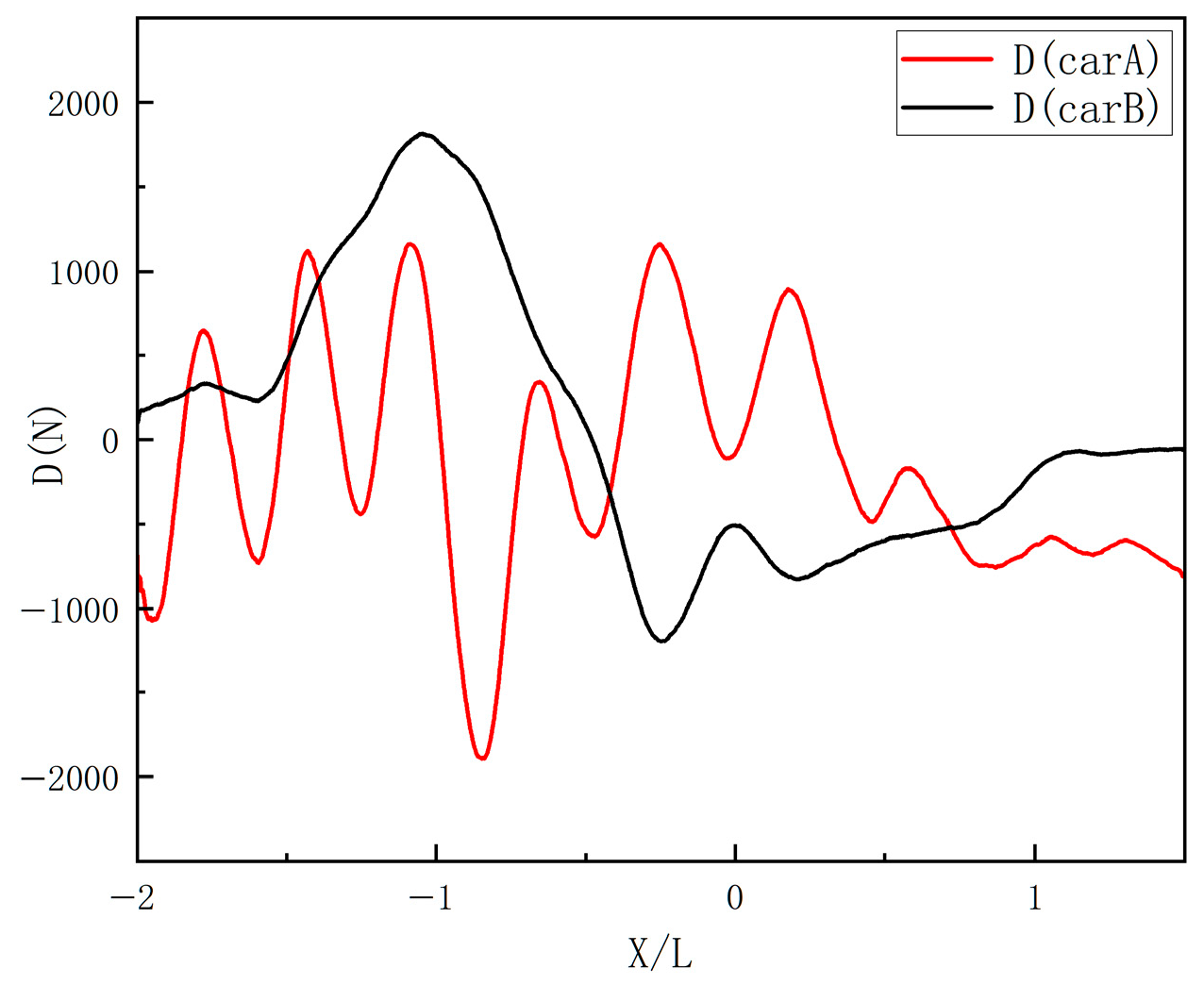
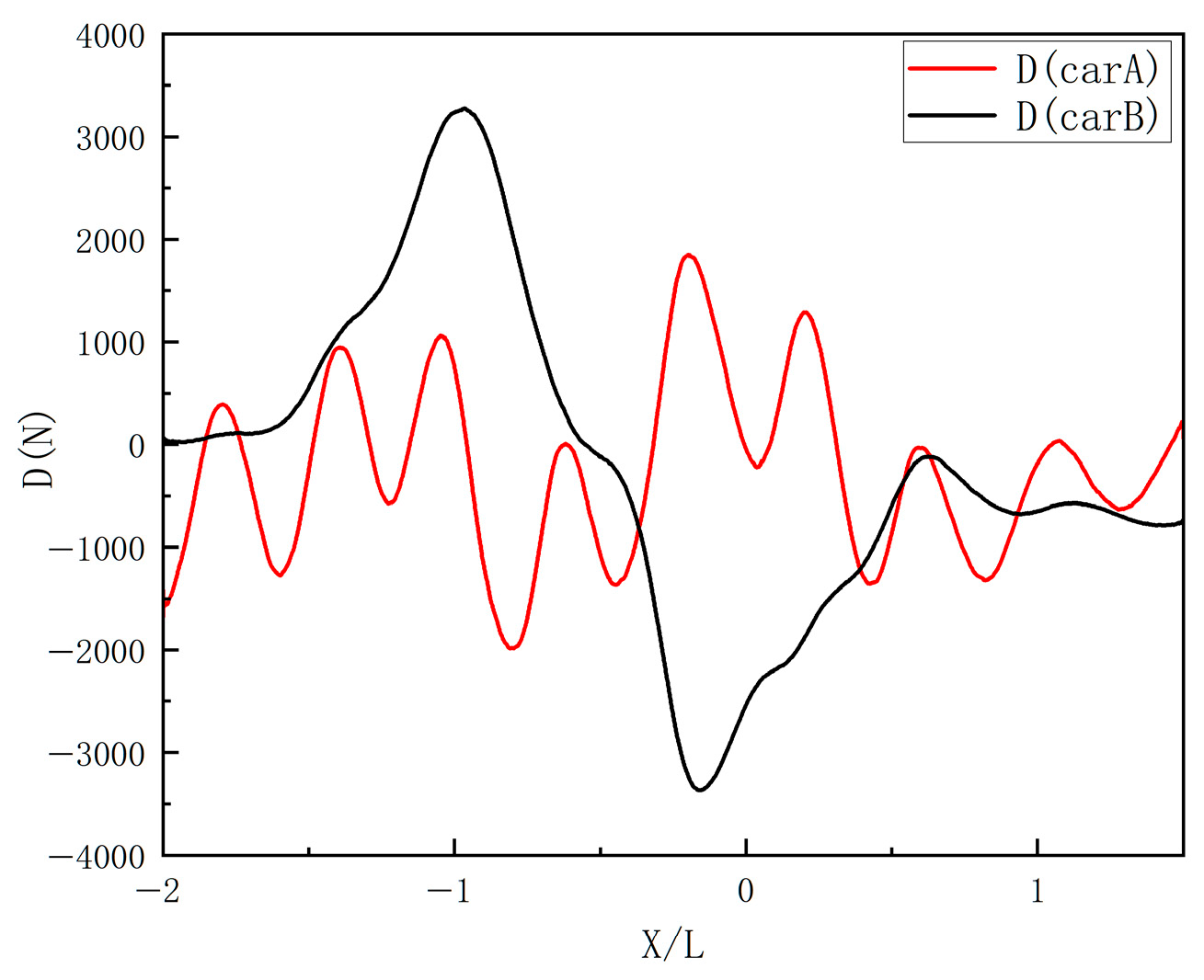
As shown in
Figure 9,
Figure 10 and
Figure 11, the drag and lateral force waveforms for the two vehicles are largely similar. As speed increases, the magnitude of drag also increases. At high speeds, drag exhibits extreme nonlinear amplification, and a sharp transition characterized by “symmetrical positive and negative peaks” occurs during the level-off phase, representing a critical risk point for vehicle dynamics and stability during the overtaking process. The peaks are concentrated around the level-off phase; the higher the speed, the more the strongest disturbances in the flow fields of both vehicles are concentrated in this phase. The drag on car B during the overtaking process causes a sudden drop from a positive peak to a negative peak, which can easily lead to driver error. At the same time, car A experiences severe fluctuations in performance due to the squeeze effect, making this a high-risk critical condition for high-speed overtaking.
4.4. Analysis of Maximum Lateral Force at Different Speeds
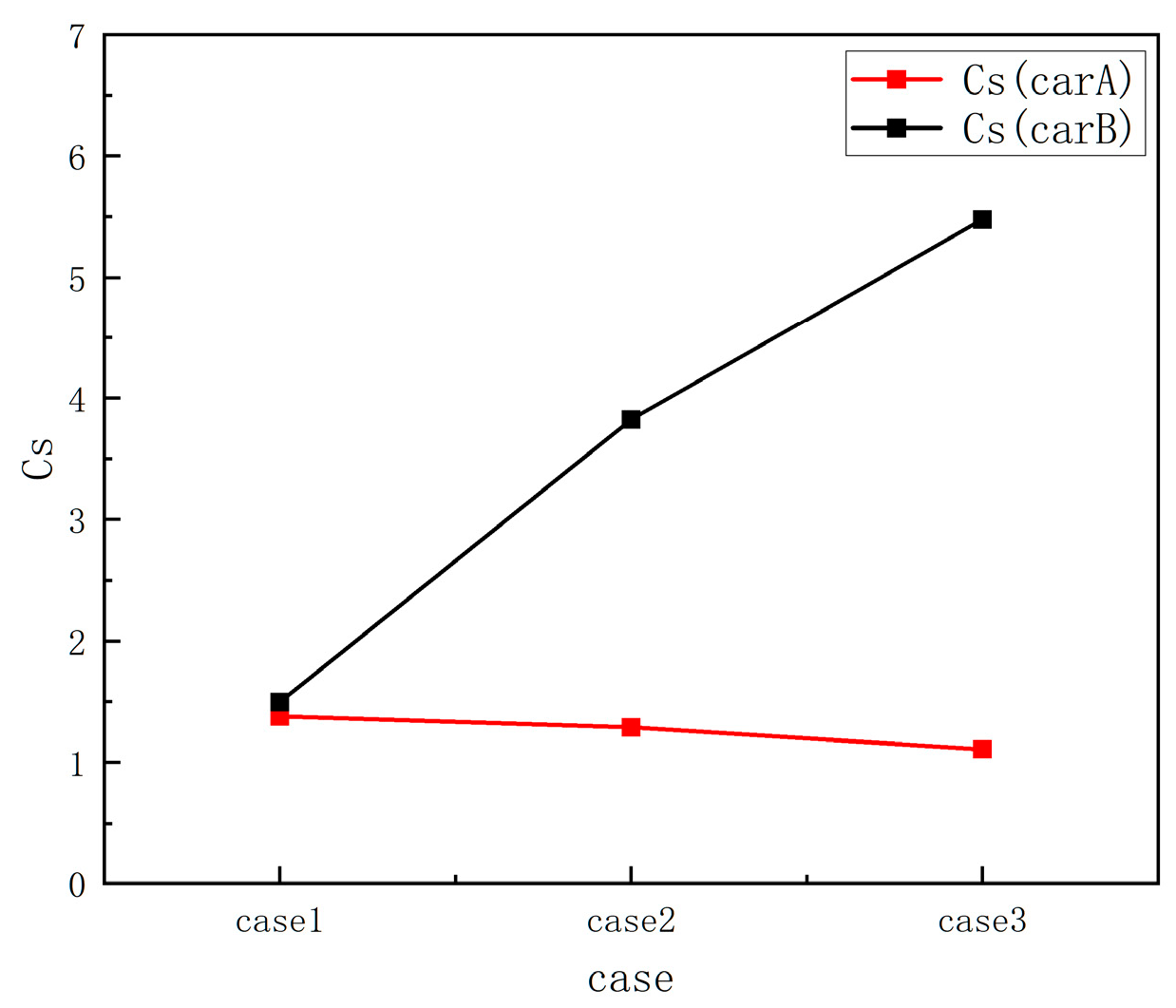
During overtaking maneuvers, the relative speed between the overtaking and overtaken vehicles also impacts driving safety and stability.
As shown in
Figure 12, during overtaking maneuvers on consecutive curves, increased vehicle speed has the most pronounced effect on the overtaken vehicle, followed by the overtaking vehicle itself. However, as shown in the variation diagram, the overtaken vehicle experiences more rapid lateral force changes, leading to greater alterations in driving stability and lower safety. In Case 3, the lateral force coefficient of car A decreases as speed increases, while for car B, the lateral force coefficient increases with speed. This is because, as the speed of car A increases, the overtaking process becomes shorter, reducing the duration of its impact on car A. However, as car A’s speed increases, the wake generated during the overtaking process becomes larger, which in turn amplifies the influence on car B.
5. Orthogonal Test Design and Analysis
5.1. Four-Factor, Four-Level Orthogonal Experimental Design
To address the challenge of ensuring safety during emergency overtaking maneuvers by special-purpose vehicles, such as medical transport, this study quantitatively analyzes the coupled effects of the overtaking vehicle’s initial speed, the overtaken vehicle type, crosswind velocity, and spacing on lateral forces. Employing an L
16(4
4) orthogonal experimental design [
30], combined with range analysis and standard deviation calculations, optimal overtaking conditions are determined. This approach avoids the inefficiencies of one-factor-at-a-time methods. Its orthogonal structure eliminates interference between factors, allowing the independent assessment of each factor’s influence on lateral forces. The procedures for calculating the range and standard deviation are as follows:
Here,
yij is the experimental indicator value, and
n is the total number of trials. Based on a three-factor, three-level orthogonal experimental design, the L
16(4
4) orthogonal array was selected (like
Table 3). The orthogonal experimental plan and its results are shown in
Table 4. The flow field simulation for the experimental group employed the same boundary conditions as the prior simulation, with only the parameter values corresponding to the orthogonal experiment adjusted. For the crosswind condition, the upper boundary (velocity inlet) and lower boundary (pressure outlet) of the computational domain were modified, and the wind speed was altered. In the table, A, B, C, and D represent the four experimental factors: the horizontal speed of the overtaking vehicle, the overtaken vehicle model, the crosswind speed, and the distance between the two vehicles, respectively. The i-th levels of experimental factors A, B, C, and D are denoted as
Ai,
Bi,
Ci, and
Di, respectively. The average lateral force for each condition is recorded as
Xij, with standard deviation
Vij and coefficient of variation
Pij.
5.2. Analysis of Orthogonal Experiment Results
The range analysis of the mean and standard deviation obtained from the orthogonal experimental design results is shown in
Table 5 and
Table 6.
Analysis results indicate that when using the average lateral force under operating conditions as the evaluation metric, the range order is R
C > R
A > R
D > R
B. This demonstrates that crosswind speed has the most significant impact on lateral force, followed by the overtaken vehicle, while horizontal speed has the least influence. Further analysis of
Table 5 data reveals that when using lateral force standard deviation as the evaluation metric, the range order is R
C > R
A > R
D > R
B. This indicates that crosswind speed has the most pronounced effect on lateral force uniformity, while horizontal speed and the type of overtaken vehicle have relatively minor impacts. Experimental results indicate that when overtaking is necessary on consecutive curves, the highest safety occurs when overtaking a small vehicle (5 m × 1.8 m) at 22 m per second with 1.5 times the vehicle width and no crosswind. The experimental data from this study align closely with actual driving data.
5.3. Prediction Using Nonlinear Regression Equations
Perform range and weight analysis for different levels of various factors, as shown in
Table 4.
The observed trend in the lateral force coefficient is consistent with the underlying physical mechanisms, with crosswind velocity remaining the dominant influencing factor. The data exhibits high reliability and can serve as a basis for deriving regression formulas.
The vehicles being overtaken use “wind resistance area” data in calculations. The windage areas for the three vehicle types are 2.7 m2, 5.0 m2, and 7.5 m2.
The revised calculation formula is as follows:
Cy,corr represents corrected lateral force coefficients.
k0 is the constant term;
Vc is the initial speed of the leading vehicle;
S is the frontal area;
Vw is the crosswind speed;
D is the overtaking distance.
kv,
ks,
kw, and
kD are their respective coefficients. A regression analysis was performed on the nine data sets using Origin, yielding the following corrected regression equation [
31]:
After calibration, the 1222 data sets were subjected to validation. The error rate was 2.3% < 5% [
32,
33]. This meets the engineering requirement for “accuracy under normal operating conditions and controllability under extreme conditions.”
In summary, the regression equation demonstrates high precision and reliability, essentially identical to actual driving conditions. Specialized vehicles such as medical transport can utilize this model to predict lateral forces during driving. This provides theoretical support for autonomous driving systems to determine whether overtaking is feasible, thereby reducing accident rates caused by inexperienced driving.
6. Conclusions
In continuous curve overtaking, the flow field around vehicles is constantly changing, leading to fluctuating lateral forces and yaw moments that affect vehicle stability. These forces are influenced by transient pressure distributions and the evolving flow field, which become particularly significant at the completion of overtaking. Lateral forces fluctuate more at higher overtaking speeds, peaking at a relative position of X/L = −1, which leads to notable sway in the overtaken vehicle. Wake interactions persist even after overtaking, preventing the flow field from stabilizing and increasing the risk of dynamic instability.
Crosswind velocity is the most influential factor affecting lateral forces, more so than vehicle size or speed. For safe overtaking on curves, special vehicles should follow certain conditions, such as overtaking small vehicles at specific speeds and avoiding crosswinds. These findings align with real-world driving data, offering valuable insights for overtaking on curved roads.
Finally, the study provides key insights into the dynamic coupling between flow field changes and aerodynamic loads, highlighting how lateral force pulsations and wake interference affect vehicle stability. The proposed regression equation serves as a theoretical basis for improving safety, particularly for special vehicles like medical transports, and aids in the development of intelligent driving systems. These results offer essential data for enhancing overtaking strategies in complex road conditions.
7. Outlook
Based on the above research, we plan to combine three-dimensional flow analysis with actual road testing. We will optimize the vehicle dynamics by analyzing the airflow beneath the chassis and the impact of vertical lift on its dynamic characteristics. Future studies will focus more closely on real-world road feedback, specifically examining how vehicle aerodynamic design influences downforce during cornering.
Author Contributions
Conceptualization, H.-T.T. and F.-R.Z.; methodology, H.-T.T. and F.-R.Z.; software, F.-R.Z. and Z.-H.Z.; validation, H.-T.T., F.-R.Z. and Y.-L.L.; formal analysis, H.-T.T. and F.-R.Z.; investigation, H.-T.T., F.-R.Z., Z.-H.Z. and X.-M.C.; resources, Z.-H.Z. and Y.-L.L.; data curation, F.-R.Z. and X.-M.C.; writing—original draft preparation, F.-R.Z.; writing—review and editing, H.-T.T. and F.-R.Z.; visualization, Y.-L.L. and X.-M.C.; supervision, H.-T.T. and Y.-L.L.; project administration, H.-T.T.; funding acquisition, Y.-L.L. All authors have read and agreed to the published version of the manuscript.
Funding
This research was funded by National Natural Science Foundation of China, grant number 52378254.
Data Availability Statement
The data presented in this study are available on request from the corresponding author as most of the data is confidential; whether it can be disclosed will depend on the circumstances.
Acknowledgments
We are grateful to the Tianjin Key Laboratory of Integrated Design and Online Monitoring of Light Industry and Food Engineering Machinery & Equipment.
Conflicts of Interest
The authors declare no conflicts of interest.
References
- Nazari, F.; Noruzoliaee, M.; Mohammadian, A. Autonomous Vehicle Adoption Behavior and Safety Concern: A Study of Public Perception. Multimodal Transp. 2026, 5, 100252. [Google Scholar] [CrossRef]
- Yue, L.; Pan, Y.; Sun, J.; Zhu, Y.; Cui, X.; Li, Y. Effects of Blind Area Display of Intelligent Vehicles on Drivers’ Cognitive Load and Safety During Lane Change. Tongji Daxue Xuebao/J. Tongji Univ. 2024, 52, 864–874. [Google Scholar] [CrossRef]
- Dai, J.; Ma, Z.; Li, W.; Qin, Z.; Wang, J. Fusion of Dynamic Snake Convolution for Mountain Road Extraction. Remote Sens. Inf. 2025, 40, 11–18. [Google Scholar] [CrossRef]
- Yuan, L.; Wang, X.; Yang, X.; Huang, J.; Li, L. Research on Stability Control Strategy for Intelligent Vehicles under Continuously Varying Curvature Conditions. Mech. Des. Res. 2025, 41, 254–261. [Google Scholar] [CrossRef]
- Li, Y.; Liu, X.; Tang, Y.; Chen, L.; Chen, Y.; You, M. Safety and Stability Tracking Control Strategy for Autonomous Passenger Cars on Curved Roads. J. Automob. Saf. Energy Conserv. 2025, 16, 136–147. [Google Scholar]
- Lai, C.; Liu, L.; Feng, S.; Wen, S.; Zhai, G. Numerical Simulation and Experimental Study on the Aerodynamic Characteristics of FSAE Cars in Curves. J. Chongqing Univ. Technol. (Nat. Sci.) 2023, 37, 17–27. [Google Scholar]
- Jin, L.; Liu, W.; Zhou, J.; Sun, W.; Yi, X. Simulation Analysis and Optimization of the Aerodynamics of New Energy Vehicle Bodies. Automob. New Power 2024, 7, 56–59. [Google Scholar] [CrossRef]
- Zhang, S. Transient Flow Field Numerical Simulation and Analysis of Overtaking Process. Master’s Thesis, Jilin University, Changchun, China, 2006. [Google Scholar]
- Jiang, Z.; Zhang, L.; Pang, J.; He, Y.; Zhou, H. Influence of Structural Parameters of Automotive Wind Tunnel on Aerodynamics. Tongji Daxue Xuebao/J. Tongji Univ. 2025, 53, 152–161. [Google Scholar] [CrossRef]
- Gao, Y.; Fan, G.; Zhao, Z.; Tian, Y. Wind Tunnel Test of Motor Vehicle Aerodynamics Based on Simulated Road Ride Height. Tongji Daxue Xuebao/J. Tongji Univ. 2024, 52, 117–123. [Google Scholar] [CrossRef]
- Lian, Y.; Luo, Q.; Zhang, F.; Zhang, R.; Zhang, Y. Automotive Aerodynamics Development Based on Shape Optimization Method. Qiche Gongcheng/Automot. Eng. 2022, 44, 1619–1626. [Google Scholar] [CrossRef]
- Tong, D. Study on the Aerodynamic Characteristics of Right-Turn Overtaking Based on CFD. Master’s Thesis, Tianjin University of Science and Technology, Tianjin, China, 2023. [Google Scholar] [CrossRef]
- Zhang, X. Study on the Aerodynamic Characteristics of Platoon Truck Overtaking Based on CFD. Master’s Thesis, Tianjin University of Science and Technology, Tianjin, China, 2023. [Google Scholar] [CrossRef]
- Yang, T. Transient Aerodynamic Study of Overtaking Process in Automobiles. Master’s Thesis, Henan University of Science and Technology, Luoyang, China, 2009. [Google Scholar]
- Zhang, M. CFD Numerical Simulation Study of Lane Changing Overtaking Process. Master’s Thesis, Shanghai Jiao Tong University, Shanghai, China, 2011. [Google Scholar]
- Wu, Y.; He, B.; Fu, L. Influence of Vehicle Speed on the Transient Aerodynamic Characteristics of Overtaking Vehicles. J. Jilin Univ. (Eng. Ed.) 2007, 05, 1009–1013. [Google Scholar] [CrossRef]
- Wu, J.; Li, X.; Cai, C.S.; Liu, D. Aerodynamic Characteristics of a High-Speed Train Crossing the Wake of a Bridge Tower from Moving Model Experiments. Railw. Eng. Sci. 2022, 30, 221–241. [Google Scholar] [CrossRef]
- Ji, X.; Xu, Y.; Hao, J.; Qin, W. Time Covariate Modeling of Overtaking Risk Evolution on Two-Lane Highways. Xinan Jiaotong Daxue Xuebao/J. Southwest Jiaotong Univ. 2025, 60, 1240–1249. [Google Scholar] [CrossRef]
- Wang, Q.-M.; Wan, X.; Fang, M.; Lv, Z.-C.; Hang, P. Decision-Making Research on Overtaking Behavior of Connected and Automated Vehicles Based on Dynamic Non-Cooperative Game. Kongzhi Yu Juece/Control. Decis. 2025, 40, 2300–2312. [Google Scholar] [CrossRef]
- Lu, Y.; Zhuang, W.; Yin, G.; Liang, J.; Ren, Y.; Feng, J. Active Roll-Over Prevention Model Predictive Control for Heavy-Duty Vehicles Considering Curved Roads with Varying Curvature. J. Southeast Univ. (Nat. Sci. Ed.) 2022, 52, 990–997. [Google Scholar]
- Mao, T. Research on Speed Planning and Hybrid Lateral Control for Tracked Vehicles on Curved Paths Based on LQR-MPC. Master’s Thesis, Nanjing Agricultural University, Nanjing, China, 2022. [Google Scholar] [CrossRef]
- Lin, C.; Wang, B.; Lu, P.; Gong, X.; Yu, X. Research on Motion Planning and Cooperative Control for Autonomous Vehicles with Lane Change Gaming Maneuvers Under the Curved Road. Qiche Gongcheng/Automot. Eng. 2023, 45, 1099–1111 + 1122. [Google Scholar] [CrossRef]
- Alic, D.; Matijošius, J.; Kilikevičius, A. Numerical Modelling of the Crosswind Influence on Vehicle Aerodynamics in Highway Traffic Conditions. Facta Univ. Ser. Mech. Eng. 2025, 23, 65–77. [Google Scholar] [CrossRef]
- Hu, H.; Xiang, H.-Y.; Liu, K.-H.; Zhu, J.; Li, Y.-L. Aerodynamic Characteristics of Moving Vehicles of Two Trains Passing Each Other on Bridge Under Crosswinds. J. Cent. South Univ. 2022, 29, 2558–2573. [Google Scholar] [CrossRef]
- Han, Y.; Liu, Y.; Cai, C.-S.; Hu, P.; He, X.-H. Effects of Sudden Change in Wind Loads on Running Performance of Trains on a Highway-Railway One-Story Bridge in Crosswinds. J. Cent. South Univ. 2022, 29, 2621–2638. [Google Scholar] [CrossRef]
- Pan, Y.; Li, Z.; Wang, X.; Zhao, H.; Zhang, W.; Deng, Z. Effect of Side Track Height on Aerodynamic Characteristics of a High-Speed High-Temperature Superconducting Maglev Train Under Crosswind. J. Zhejiang Univ. Sci. A 2025, 26, 983–996. [Google Scholar] [CrossRef]
- Kim, G.; Park, C.; Jeong, C.; Kang, C.M.; Cho, J.; Lee, H.; Lee, J.; Kang, D. Vehicle’s Lateral Motion Control Using Dynamic Mode Decomposition Model Predictive Control for Unknown Model. Int. J. Automot. Technol. 2024, 25, 999–1009. [Google Scholar] [CrossRef]
- Menter, F.R.; Kuntz, M.; Langtry, R. Ten Years of Industrial Experience with the SST Turbulence Model. Turbul. Heat Mass Transf. 2003, 4, 625–632. [Google Scholar]
- ANSYS Inc. ANSYS Fluent Theory Guide; ANSYS Inc.: Canonsburg, PA, USA, 2023. [Google Scholar]
- Ren, L. Application of Orthogonal Experimental Design Method in Combinatorial Testing. Comput. Knowl. Technol. 2022, 18, 68–69. [Google Scholar] [CrossRef]
- Che, L.; Zhuo, H. Application of Matlab Software in Computing Regression Equations. Shanghai Metrol. Test. 2013, 40, 21–22. [Google Scholar]
- GB/T 40499-2021; National Standard of the People’s Republic of China, General Conditions for Stability Testing of Heavy-Duty Vehicles. National Market Supervision Administration: Beijing, China; National Standardization Administration Committee: Beijing, China, 2021.
- GB/T 40501-2021; National Standard of the People’s Republic of China, General Conditions for Stability Testing of Light-Duty Vehicles. National Market Supervision Administration: Beijing, China; National Standardization Administration Committee: Beijing, China, 2021.
Figure 1.
Vehicle trajectory diagram.
Figure 1.
Vehicle trajectory diagram.
Figure 2.
(a) Holistic Computational Domain Model; (b) Vehicle Model Magnified Diagram.
Figure 2.
(a) Holistic Computational Domain Model; (b) Vehicle Model Magnified Diagram.
Figure 3.
Vehicle Component Grid Magnified View.
Figure 3.
Vehicle Component Grid Magnified View.
Figure 4.
Pressure contour plots from CFD-POST. Plots (a–h) correspond to positions X/L = −2.0 to 1.5, respectively.
Figure 4.
Pressure contour plots from CFD-POST. Plots (a–h) correspond to positions X/L = −2.0 to 1.5, respectively.
Figure 5.
Velocity vector plots from CFD-POST. Plots (a–h) correspond to positions X/L = −2.0 to 1.5, respectively.
Figure 5.
Velocity vector plots from CFD-POST. Plots (a–h) correspond to positions X/L = −2.0 to 1.5, respectively.
Figure 6.
Changes in the lateral force of the two vehicles at 22 m/s.
Figure 6.
Changes in the lateral force of the two vehicles at 22 m/s.
Figure 7.
Changes in the lateral force of the two vehicles at 24 m/s.
Figure 7.
Changes in the lateral force of the two vehicles at 24 m/s.
Figure 8.
Changes in the lateral force of the two vehicles at 26 m/s.
Figure 8.
Changes in the lateral force of the two vehicles at 26 m/s.
Figure 9.
Changes in the drag of the two vehicles at 22 m/s.
Figure 9.
Changes in the drag of the two vehicles at 22 m/s.
Figure 10.
Changes in the drag of the two vehicles at 24 m/s.
Figure 10.
Changes in the drag of the two vehicles at 24 m/s.
Figure 11.
Changes in the drag of the two vehicles at 26 m/s.
Figure 11.
Changes in the drag of the two vehicles at 26 m/s.
Figure 12.
Distribution of lateral force coefficients for Vehicle A and Vehicle B under different operating conditions.
Figure 12.
Distribution of lateral force coefficients for Vehicle A and Vehicle B under different operating conditions.
Table 1.
Experimental Design for Overtaking Maneuvers by Leading Vehicles with Different Initial Speeds.
Table 1.
Experimental Design for Overtaking Maneuvers by Leading Vehicles with Different Initial Speeds.
| Case | Car A Vehicle Speed (m/s) | Car B Vehicle Speed (m/s) | Cycle (m) |
|---|
| Case 1 | 22 | 15 | 50π |
| Case 2 | 24 | 15 | 50π |
| Case 3 | 26 | 15 | 50π |
Table 2.
Verification of Model Grid-Independence for Overtaking.
Table 2.
Verification of Model Grid-Independence for Overtaking.
| Number of Grid Cells (Million) | Maximum Lateral Force |
|---|
| 1 | 1165.73 |
| 2 | 1326.84 |
| 2.9 | 1730.56 |
| 4 | 1769.42 |
| 5 | 1725.22 |
| 6 | 1735.96 |
Table 3.
Orthogonal test factor level table.
Table 3.
Orthogonal test factor level table.
| Level | A (m/s) | B (m) | C (m/s) | D |
|---|
| 1 | 22 | 5 × 8 | 0 | 1.44 |
| 2 | 24 | 6 × 2 | 6 | 1.8 |
| 3 | 25 | 7.5 × 2.2 | 8 | 2.16 |
| 4 | 26 | 9 × 2.5 | 10 | 2.7 |
Table 4.
Orthogonal test design plan and results.
Table 4.
Orthogonal test design plan and results.
| Number | A | B | C | D | Mean Xij | Standard Deviation Vij | Coefficient of Variation Pij |
|---|
| 1 | 1 | 1 | 1 | 1 | 0.406905 | 0.302056 | 0.742326 |
| 2 | 1 | 2 | 2 | 2 | 1.146355 | 0.776715 | 0.677552 |
| 3 | 1 | 3 | 3 | 3 | 1.361541 | 1.023314 | 0.751585 |
| 4 | 1 | 4 | 4 | 4 | 1.567300 | 0.775362 | 0.494712 |
| 5 | 2 | 1 | 2 | 3 | 1.389748 | 0.803713 | 0.578316 |
| 6 | 2 | 2 | 1 | 4 | 0.269604 | 0.180377 | 0.669045 |
| 7 | 2 | 3 | 4 | 1 | 2.477533 | 1.799420 | 0.726295 |
| 8 | 2 | 4 | 3 | 2 | 2.382403 | 1.494763 | 0.627418 |
| 9 | 3 | 1 | 3 | 4 | 1.511637 | 0.863501 | 0.571236 |
| 10 | 3 | 2 | 4 | 3 | 2.587134 | 1.522729 | 0.588577 |
| 11 | 3 | 3 | 1 | 2 | 0.352913 | 0.314949 | 0.892428 |
| 12 | 3 | 4 | 2 | 1 | 1.155507 | 0.792473 | 0.685823 |
| 13 | 4 | 1 | 4 | 2 | 1.983489 | 1.029245 | 0.518906 |
| 14 | 4 | 2 | 3 | 1 | 1.626203 | 1.017385 | 0.625620 |
| 15 | 4 | 3 | 2 | 4 | 1.354476 | 0.765204 | 0.564945 |
| 16 | 4 | 4 | 1 | 3 | 0.307768 | 0.313971 | 1.02016 |
Table 5.
Analysis of the range of the mean.
Table 5.
Analysis of the range of the mean.
| Mean | A | B | C | D |
|---|
| X1j | 1.1205 | 1.3229 | 0.3343 | 1.4165 |
| X2j | 1.6298 | 1.4073 | 1.2615 | 1.4663 |
| X3j | 1.4018 | 1.3866 | 1.7204 | 1.4115 |
| X4j | 1.3180 | 1.3532 | 2.1539 | 1.1758 |
| Rj | 0.5093 | 0.0844 | 1.8196 | 0.2905 |
Table 6.
Range analysis of standard deviation.
Table 6.
Range analysis of standard deviation.
| Standard Deviation | A | B | C | D |
|---|
| V1j | 0.7194 | 0.7496 | 0.2778 | 0.9778 |
| V2j | 1.0696 | 0.8743 | 0.7845 | 0.9039 |
| V3j | 0.8734 | 0.9757 | 1.0997 | 0.9159 |
| V4j | 0.7815 | 0.8441 | 1.2817 | 0.6461 |
| Rj | 0.3502 | 0.2261 | 1.0039 | 0.3317 |
| Disclaimer/Publisher’s Note: The statements, opinions and data contained in all publications are solely those of the individual author(s) and contributor(s) and not of MDPI and/or the editor(s). MDPI and/or the editor(s) disclaim responsibility for any injury to people or property resulting from any ideas, methods, instructions or products referred to in the content. |