Article

Ruthenium, Rhodium, and Iridium α-Diimine Complexes as Precatalysts in Carbon Dioxide Hydrogenation and Formic Acid Decomposition


by
Juan C. Segura-Silva
1,
Miguel A. Cabrera-Briseño
1,
Ricardo González-Cruz
1,
Sara A. Cortes-Llamas
1,
José G. Alvarado-Rodríguez
2,
Elvia Becerra-Martínez
3,
A. Aaron Peregrina-Lucano
4 and
I. Idalia Rangel-Salas
1,*
1
Departamento de Química, Centro Universitario de Ciencias Exactas e Ingenierías, Universidad de Guadalajara, Blvd. Marcelino García Barragán 1421, Col. Olímpica, Guadalajara 4430, Jalisco, Mexico
2
Instituto de Ciencias Básicas e Ingenierías, Universidad Autónoma del Estado de Hidalgo, Unidad Universitaria, km 4.5 Carretera Pachuca-Tulancingo, Mineral de la Reforma 42184, Hidalgo, Mexico
3
Centro de Nanociencias y Micro y Nanotecnologías, Instituto Politécnico Nacional, Unidad Profesional “Adolfo López Mateos”, Luis Enrique Erro S/N, Zacatenco, Ciudad de México 07738, Mexico
4
Departamento de Farmacobiología, Centro Universitario de Ciencias Exactas e Ingenierías, Universidad de Guadalajara, Blvd. Marcelino García Barragán 1421, Col. Olímpica, Guadalajara 44430, Jalisco, Mexico
*
Author to whom correspondence should be addressed.
Chemistry 2025, 7(6), 196; https://doi.org/10.3390/chemistry7060196
Submission received: 29 October 2025 / Revised: 27 November 2025 / Accepted: 2 December 2025 / Published: 4 December 2025
(This article belongs to the Section Catalysis)

Abstract

This study describes a series of water-soluble half-sandwich ruthenium(II), rhodium(III), and iridium(III) complexes with α-diimine ligands containing substituted aromatic groups. These ligands were derived from glyoxal and 2-aminophenol (a), 4-methyl-2-aminophenol (b), 4-aminophenol (c), phenyl hydrazine (d), and 1-aminonaphthalene (e). The ruthenium(II) (1b1e), rhodium(III) (2a2c, 2e), and iridium(III) complexes (3a3e) were obtained by reacting the ligands (ae) with the corresponding dimeric precursor [(η6-p-cym)RuCl2]2 (p-cym = p-cymene) or [(η5-Cp*)MCl2]2 (Cp* = pentamethylcyclopentadienyl, M = Rh, Ir) in air and under nonanhydro conditions. The air-stable and water-soluble ruthenium(II), rhodium(III), and iridium(III) complexes were characterized via nuclear magnetic resonance spectroscopy and electrospray ionization–mass spectrometry. The structures of complexes [(η6-p-cym)Ru(d)Cl]Cl, 1d; [(η5-Cp*)Ir(a)Cl]Cl, 3a; and [(η5-Cp*)Ir(c)Cl]Cl, 3c were determined via single-crystal X-ray diffraction. Additionally, the complexes exhibited catalytic activity as precatalysts in formic acid decomposition. Complex [(η5-Cp*)Ir(d)Cl]Cl, 3d achieved turnover number (TON) and turnover frequency (TOF) values of up to 2150 and 3861 h−1, respectively, at short reaction times. In the hydrogenation of carbon dioxide, [(η6-p-cym)Ru(e)Cl]Cl, 1e attained TON and TOF values of up to 1385 and 69.25 h−1, respectively.

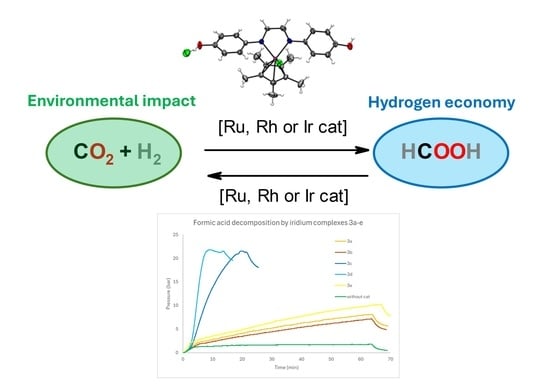
Graphical Abstract

1. Introduction

The activation of small, low-reactivity molecules such as carbon dioxide is an area of growing interest owing to its economic and environmental implications. Specifically, the use of CO2 as a C1 feedstock for producing fuels and chemicals is becoming an increasingly attractive strategy to reduce the carbon footprint in the chemical and energy sectors [1]. Meanwhile, formic acid (FA) has been proposed as an energy carrier and a potential chemical hydrogen storage system [2,3].
Accordingly, intensive efforts have been directed toward developing efficient catalysts to produce FA via CO2 hydrogenation and FA decomposition to generate H2. Several reviews in these two areas have effectively summarized recent work [4], for example, about FA dehydrogenation with homogeneous and heterogeneous systems, including high-pressure H2 generation [5], and carbon dioxide hydrogenation by different types of catalysts addressing reactive capture of CO2 [5,6].
Inoue et al. first reported the homogeneous catalytic hydrogenation of CO2 to FA [7]. Since then, numerous complexes of ruthenium, rhodium, and iridium have been investigated. For several decades, systems were designed such that all transformations occurred at the metal center, with ligands acting only as spectators [8]. However, in recent years, catalytic systems have been developed with the active participation of auxiliary ligands, enabling the creation of highly active catalytic systems for CO2 reduction.
Recent studies have shown that ruthenium(II) and iridium(III) complexes containing proximal protic groups can catalyze the hydrogenation of CO2 to produce formate and promote FA decomposition to H2 and CO2 [9]. It has been proposed that these ligands with protic functional groups near the metal can accelerate proton-transfer events in various reactions.
For example, an iridium(III) complex with a (2,2′-dihydroxy)bipyridine ligand is active in CO2 hydrogenation at 115 °C for 18 h, with turnover number (TON) = 2270 and turnover frequency (TOF) = 126 h−1. The ruthenium(II) analog to the previous complex, featuring a p-cymene auxiliary ligand, is active under the same conditions, with TON = 1070 and TOF = 59.4 h−1 [9], while an iridium(III) complex with the mixed NHC–hydroxypyridine ligand is almost as active as the first example, yielding a TON = 2020 and TOF = 112 h−1 [9]. A unique feature of the last two systems is that the same catalysts are active in the decomposition of FA at 60 °C for 3 h, showing modest values for the ruthenium (2,2′-dihydroxy)bipyridine complex (TON = 45, TOF = 15 h−1) and iridium NHC–hydroxypyridine complex (TON = 180, TOF = 59 h−1) and even higher values for the iridium(III) (2,2′-dihydroxy)bipyridine complex (TON = 3500, TOF = 1200 h−1).
Some of the most efficient homogeneous systems for CO2 hydrogenation include ruthenium complexes [(PNP3)Ru(H)Cl(CO)] (TON = 200,000; TOF = 1,100,000 h−1) [10] and [(η6-p-cym)Ru(bis-NHC1)Cl]PF6 (TON = 23,000; TOF = 300 h−1) [11] and iridium complexes [(PNP1)IrH3] (TON = 3,500,000; TOF = 73,000 h−1) [12] and [Ir(bis-NHC2)(AcO)I2] (TON = 190,000; TOF = 2500 h−1) [13]. On the other hand, for the FA dehydrogenation reaction, some systems show high efficiency in H2 production, such as ruthenium complexes [RuCl2(C6H6)]2/DPPE TON > 1,000,000; TOF = 1000 h−1) [14] and [(PNP3)Ru(H)Cl(CO)] (TON = 706,500; TOF = 256,000 h−1) [10] and iridium complexes [Cp*Ir(pyrimidyl imidazoline)H2O]SO4 (TON = 68,000; TOF = 322,000 h−1) [15] and [Cp*Ir(PHEN-diol)H2O]SO4 (TON = 5,000,000; TOF = 1900 h−1) [16].
Other systems studied in these catalytic reactions involve recent applications such as the Ru-PNP/liquid ionic system, which is used in CO2 hydrogenation–dehydrogenation catalysis [17], a low-coordinate Cp*Ir complex with a donor-flexible O,N-ligand for FA dehydrogenation [18], and a Mn-pincer complex in the presence of lysine, used in the reversible hydrogenation of CO2 to FA [19], as well as several heterogeneous systems that were used in the production of H2 from the decomposition of FA, for example, a CuO-CeO2/γ-Al2O3 catalyst [20], a photocatalyst of copper oxide [21], and gold nanoparticles supported on a porous polymer matrix [22]. In the hydrogenation of CO2 to FA, a system of iridium immobilized in solid phosphines has been used under base-free conditions [23]. However, in these heterogeneous catalyst systems, substrate conversion efficiencies are still low.
Separately, α-diimine complexes of late transition metals have been extensively studied as catalysts in ethylene homopolymerization and copolymerization [24]. Although many studies have explored α-diimine metal complexes, relatively few have focused on their use in CO2 catalytic hydrogenation and FA decomposition. In one study, complexes of ruthenium(II), rhodium(III), and iridium(III) with an α-diimine ligand derived from p-aminobenzoic acid acted as precatalysts in the hydrogenation of CO2 to produce formate, with the best conversion achieved being a TOF of 35 h−1 within 2 h and a TON of 322 for the ruthenium complex, using DBU as a base at 120 °C and 60 bar [25]. In another study, a ruthenium(II) complex with an α-diimine ligand derived from p-aminophenol was synthesized and evaluated for cytotoxic activity [26].
These findings prompted us to investigate half-sandwich ruthenium(II), rhodium(III), and iridium(III) complexes with α-diimine ligands containing protic groups as precatalysts for the direct hydrogenation of CO2 to yield formate and the decomposition of FA to H2 and CO2 in aqueous solution. Both reactions were performed without excluding air or moisture, enhancing their relevance to sustainable energy and chemical feedstock development.

2. Experimental Section

All manipulations were performed in air using undried solvents that were only distilled before use through standard procedures. All the chemicals were used as received from Merck Sigma-Aldrich. The dimeric precursors [(η6-p-cym)RuCl2]2, [(η5-Cp*)MCl2]2 (M = Rh, Ir) were synthesized according to reported methods [27,28]. 1H and 13C nuclear magnetic resonance (NMR) spectra were recorded at 298 K using a JEOL-ECA 600 MHz spectrometer with the “single-pulse” technique, as well as a Bruker Ascend 750 MHz instrument. Chemical shifts (δ) are reported in ppm and coupling constants (J) in Hz. Electrospray ionization–mass spectrometry (ESI-MS) histograms were obtained using a 6410B Agilent Technologies triplet quadrupole mass spectrometer, with electrospray as the ionization method. IR spectra were measured using a Thermo Scientific Nicolet iS5 equipped with iD5 ATR accessory. Thermograms were recorded in a Discovery DSC, TA Instruments system. Single crystals of C24H28Cl2N4Ru (1d) and C24H27N2O2Cl2Ir (3c) were obtained from acetone/water, while single crystals of C24H29Cl2IrN2O3 (3a) were obtained from water. Suitable crystals of the complexes were selected and diffracted on an Xcalibur Atlas Gemini diffractometer. The crystals were kept at 293 K during data collection. The structure was solved using Olex2 [29] with the SHELXT [30] structure solution program via intrinsic phasing, and refined with the SHELXL [31] refinement package through least squares minimization.
The hydrogenation of CO2 was carried out in a stainless-steel high-pressure reactor (Parr®, Parr Instrument Company, Moline, IL, USA). The decomposition of FA in aqueous media was performed in a Monowave 50 synthesis reactor (Anton Paar®, Anton Paar GmbH, Graz, Austria).

2.1. General Procedure for the Synthesis of the α-Diimine Ligands ae

The aromatic primary amine (2 equivalents) was dissolved in methanol (30 mL) using a 50 mL round-bottom flask. Subsequently, aqueous glyoxal (40%, 1.1 equivalents) was added. The reaction mixture was heated at 65 °C for 1.5 h under an open atmosphere. The mixture was then cooled to room temperature, and the formed solid was filtered off and then washed with cold methanol (3 × 5 mL) and diethyl ether (3 × 5 mL). Finally, the solid was dried under reduced pressure. The ligands a, c, and d have previously been reported in the literature [26,32,33].
Cyclic tautomer of N,N′-bis(2-hydroxyphenyl)ethane-1,2-diimine, a
Compound a (Chart 1) was obtained as a white solid from 2-aminophenol (2.0 g, 18.3 mmol) and aqueous glyoxal (40%, 1.16 mL, 10 mmol). Yield: 92% (2.03 g, 8.44 mmol). M. p. 210–211 °C. The chemical shifts conform to the data reported in the literature [32]. 1H NMR (DMSO-d6, 750 MHz, δ in ppm, J in Hz): 7.32 (d, 2H, 3JH-H = 4.58, NH), 6.77 (t, 2H, 3JH-H = 7.78, CHar), 6.73 (d, 2H, 3JH-H = 6.72, CHar), 6.68 (d, 2H, 3JH-H = 6.68, CHar), 6.63 (t, 2H, 3JH-H = 6.62, CHar), 5.29 (d, 2H, 3JH-H = 4.12, CHsp3). 13C NMR (DMSO-d6, 189 MHz, δ ppm): 143.98 (O-Car), 132.83 (N-Car), 124.07 (CHar), 121.35 (CHar), 118.76 (CHar), 116.89 (CHar), 77.98 (CHsp3). C14H12N2O2, Calc. 240.09. ESI-MS, (m/z): 240.9 [M+.]. FT-IR(ATR): 3372 (N–H), 1610 cm−1 (C–N).
Cyclic tautomer of N,N′-bis[(2-hydroxy-5-methyl)phenyl]ethane-1,2-diimine, b
Compound b (Chart 1) was obtained as a white solid from 4-methyl-2-aminophenol (2.0 g, 16.23 mmol) and aqueous glyoxal (40%, 1.02 mL, 8.9 mmol). Yield: 95.7% (2.08 g, 7.76 mmol). M. p. 225–226 °C. 1H NMR (DMSO-d6, 750 MHz, δ ppm): 7.18 (d, 2H, 3JH-H = 4.12, NH), 6.53 (d, 2H, 3JH-H = 7.78, CHar), 6.50 (d, 2H, 4JH-H = 1.37, CHar), 6.40 (dd, 2H, 3JH-H = 8.24, 4JH-H = 1.37, CHar), 5.19 (d, 2H, 3JH-H = 4.12, CHsp3), 2.16 (s, 6H, CH3). 13C NMR (DMSO-d6, 189 MHz, δ ppm): 139.6 (O-Car), 130.53 (N-Car), 130.33 (CH3-Car), 119.47 (CHar), 116.22 (CHar), 115.05 (CHar), 75.81 (CHsp3), 20.97 (CH3). C16H16N2O2, Calc. 268.12. ESI-MS, (m/z): 269.1 [M+.]. FT-IR(ATR): 3494 (N–H), 1623 cm−1 (C–N).
N,N′-bis(4-hydroxyphenyl)ethane-1,2-diimine, c
Compound c (Chart 1) was obtained as an orange solid from 4-aminophenol (2.0 g, 18.3 mmol) and aqueous glyoxal (40%, 1.16 mL, 10 mmol). Yield: 98.0% (2.07 g, 8.96 mmol). M. p. 231–232 °C. The chemical shifts conform to the data reported in the literature [26]. 1H NMR (DMSO-d6, 750 MHz, δ ppm): 9.78 (s, 2H, OH), 8.41 (s, 2H, N-CH), 7.32 (d, 4H, 3JH-H = 8.70, CHar), 6.82 (d, 4H, 3JH-H = 9.16, CHar), 13C NMR (DMSO-d6, 189 MHz, δ ppm): 160.49 (N=CH), 159.13 (O-Car), 143.89 (N-Car), 126.05 (CHar), 118.59 (CHar). C14H12N2O2. Calc. 240.09. ESI-MS, (m/z): 241.1 [M+.]. FT-IR(ATR): 3016 (O–H), 1600 cm−1 (C=N).
N,N′-bis(phenylhydrazine)ethane-1,2-diimine, d
Compound d (Chart 1) was obtained as a yellow solid from phenylhydrazinium chloride (2.0 g, 13.8 mmol) and aqueous glyoxal (0.9 mL, 7.6 mmol). Yield: 92.3% (1.52 g, 6.38 mmol). M. p. 147–148 °C. The chemical shifts conform to the data reported in the literature [33]. 1H NMR (DMSO-d6, 750 MHz, δ ppm): 10.42 (s, 2H, NH), 7.76 (s, 2H, N-CH), 7.24 (t, 4H, 3JH-H = 7.32, CHar), 7.07 (d, 4H, 3JH-H = 8.70, CHar), 6.79 (t, 2H, 3JH-H = 7.32, CHar). 13C-RMN (DMSO-d6, 189 MHz, δ ppm): 145.32 (N=CH), 137.44 (N-Car), 129.61 (CHar), 119.45 (CHar), 112.48 (CHar). C14H14N4, Calc. 238.12. ESI-MS, (m/z): 239.1 [M+.]. FT-IR(ATR): 3203, 3200 (N–H), 1598 cm−1 (C=N).
N,N′-bis[1-naphtyl]ethane-1,2-diimine, e
Compound e (Chart 1) was obtained as a green solid from 1-aminonaphthalene (2.0 g, 14 mmol) and aqueous glyoxal (0.9 mL, 7.7 mmol). Yield: 72.5% (1.56 g, 5.06 mmol). M. p. 245 –246 °C. 1H NMR (DMSO-d6, 750 MHZ, δ in ppm, J in Hz): 8.70 (s, 2H, N=CH), 8.36 (t, 2H, 3JH-H = 5.04, CHar), 8.00 (t, 2H, 3JH-H = 4.58, CHar), 7.93 (d, 2H, 3JH-H = 8.24, CHar), 7.61 (m, 6H, CHar), 7.44 (d, 2H, CHar). 13C NMR (DMSO-d6, 189 MHz, δ in ppm): 161.02 (N=CH), 147.23 (N-Car), 134.06 (qCar), 128.81 (CHar), 128.30 (CHar), 128.04 (CHar), 127.20 (CHar), 126.86 (qCar), 126.77 (CHar), 123.74 (CHar), 113.77 (CHar). C22H16N2, Calc. 308.13. ESI-MS, (m/z): 309 [M+.]. FT-IR(ATR): 1600 cm−1 (C=N).

2.2. General Procedure for the Synthesis of the Complexes

Mechanosynthesis
The α–diimine ligand or its cyclic tautomer precursor ae (1 equiv) and metallic dimeric precursor [(η6-p-cym)RuCl2]2 (0.5 equiv) were ground in an agate mortar for 30–45 min at room temperature in air, without the use of a solvent. The resulting complexes were purified by washing with various solvents, as described below.
Synthesis in solution
The corresponding α–diimine ligand or its cyclic tautomer precursor ae (1 mmol) and metallic dimeric precursor [(η5-Cp*)MCl2]2 (M = Rh or Ir) (0.5 mmol) were dissolved in ethanol (20 mL) in a 50 mL round-bottom flask. The reaction mixture was stirred at room temperature under air for 12 h. Subsequently, the crude product was dried under reduced pressure and purified using different methods, as described below.
[(η6-p-cym)Ru(a)Cl]Cl, 1a
A ground mixture of a (39 mg, 0.163 mmol) and [(η6-p-cym)RuCl2]2 (50 mg, 0.082 mmol) was washed with cold dichloromethane (5 × 3 mL) and dried under reduced pressure for 12 h to yield a dark orange solid. Yield: 64 mg, 71.8%. Complex 1a (Chart 2) only was detected through ESI-MS, C24H26ClN2O2Ru, Calc. 511.07. ESI-MS (m/z): 511.0 [M+].
[(η6-p-cym)Ru(b)Cl]Cl, 1b
A ground mixture of b (43 mg, 0.163 mmol) and [(η6-p-cym)RuCl2]2 (50 mg, 0.082 mmol) was washed with cold dichloromethane (5 × 3 mL) and hexanes (3 × 4 mL). The product 1b (Chart 2) was purified by crystallization with CH2Cl2/hexanes. It was then dried under reduced pressure for 12 h to yield a dark orange solid. Yield: 73 mg, 77.8%. M. p. 217–218 °C. 1H NMR (CDCl3, 750 MHz, δ in ppm, J in Hz): 10.56 (s, 2H, OH), 8.59 (s, 2H, CH=N), 7.57 (s, 2H, CHar), 7.15 (d, 2H, 3JH-H = 8.01, CHar), 7.08 (d, 2H, 3JH-H = 7.85, CHar), 5.44 (d, 2H, 3JH-H = 7.8, CHp-cym), 5.33 (d, 2H, 3JH-H = 7.7, CHp-cym), 2.87 (sept, 1H, 3JH-H = 5.67, CH iPr), 2.32 (s, 6 H, CH3), 2.12 (s, 3 H, CH3 p-cym), 1.10 (d, 6H, 3JH-H = 6.69, CH3 iPr). 13C NMR (CDCl3, 189 MHz, δ in ppm): 144.7 (N=CH), 139.2 (O-Car), 131.2 (N-Car), 128.7 (CHar), 128.0 (CHar), 125.9 (CHar), 125.3 (CHar), 116.7, (CHar), 106.9 (Cp-cym), 106.3 (Cp-cym), 88.4 (CHp-cym), 88.1 (CHp-cym), 30.4 (CH iPr), 21.3 (CH3 iPr), 18.2 (CH3 p-cym). C26H30ClN2O2Ru, Calc. 539.10 ESI-MS, (m/z): 539.0 [M+].
[(η6-p-cym)Ru(c)Cl]Cl, 1c
A ground mixture of c (39 mg, 0.163 mmol) and [(η6-p-cym)RuCl2]2 (50 mg, 0.082 mmol) was washed with cold dichloromethane (5 × 3 mL) and hexanes (3 × 4 mL). The product 1c (Chart 2) was purified by crystallization with acetone/water. It was then dried under reduced pressure for 12 h to yield a dark orange solid. Yield: 69 mg, 77.9%. M. p. 226–227 °C. The chemical shifts agreed with the data reported in the literature [26]. 1H NMR (DMSO-d6, 600 MHz, δ in ppm, J in Hz) 10.48 (s, 2H, OH), 8.47 (s, 2H, N=CH) 7.66 (d, 4H, 3JH-H = 8.09, CHar), 6.99 (d, 4H, 3JH-H = 8.46, CHar), 5.50 (d, 2H, 3JH-H = 6.48, CHp-cym), 5.48 (d, 2H, 3JH-H = 6.36, CHp-cym), 2.28 (sept, 1H, 3JH-H = 6.68, CH iPr), 2.23 (s, 3 H, CH3 p-cym), 0.95 (d, 6H, 3JH-H = 7.26, CH3 iPr). 13C NMR (DMSO-d6, 151 MHz, δ in ppm): 163.31 (O-Car), 160.1 (N=CH), 144.21 (N-Car), 124.7 (CHar), 116.1 (CHar), 106.8 (Cp-cym), 105.9 (Cp-cym), 88.9 (CHp-cym), 87.2 (CHp-cym), 30.89 (CH iPr), 21.92 (CH3 iPr), 18.86 (CH3 p-cym). C24H26ClN2O2Ru, Calc. 511.07. ESI-MS, (m/z): 511.0 [M+]. FT-IR(ATR): 3046 (O–H), 1610 cm−1 (C=N).
[(η6-p-cym)Ru(d)Cl]Cl, 1d
The ground mixture of d (39 mg, 0.163 mmol) and [(η6-p-cym)RuCl2]2 (50 mg, 0.082 mmol) was washed with cold dichloromethane (5 × 3 mL) and hexanes (3 × 4 mL). The product 1d (Chart 2) was purified by crystallization with CH2Cl2/hexanes. It was then dried under reduced pressure for 12 h to yield a dark orange solid. Yield: 59 mg, 66.3%. M. p. 191–192 °C. 1H NMR (DMSO-d6, 750 MHz, δ in ppm, J in Hz): 10.43 (s, 2H, NH), 7.65 (s, 2H, N=CH), 7.27 (t, 4H, 3JH-H = 7.34, CHar), 6.97(d, 4H, 3JH-H = 8.64, CHar), 6.74 (t, 2H, 3JH-H = 8.43, CHar), 5.81 (d, 2H, 3JH-H = 6.18, CHp-cym), 5.77 (d, 2H, 3JH-H = 6.13, CHp-cym), 2.83 (sept, 1H, 3JH-H = 6.95, CH iPr), 2.07 (s, 3H, CH3 p-cym), 1.18 (d, 6H, 3JH-H = 7.0, CH3 iPr). 13C NMR (DMSO-d6, 189 MHz, δ in ppm): 144.65 (N=CH), 136.63 (CHar), 129.32 (CHar), 118.63 (CHar), 111.66 (CHar), 106.1 (Cp-cym), 99.8 (Cp-cym), 86.1 (CHp-cim), 85.3 (CHp-cym), 29.7 (CH iPr), 21.26 (CH3 iPr), 17.63 (CH3 p-cym). C24H28ClN4Ru, Calc. 509.10. ESI-MS, (m/z): 509.1 [M+].
[(η6-p-cym)Ru(e)Cl]Cl, 1e
The ground mixture of e (50 mg, 0.163 mmol) and [(η6-p-cym)RuCl2]2 (50 mg, 0.082 mmol) was washed with cold dichloromethane (5 × 3 mL) and hexanes (3 × 4 mL). The product 1e (Chart 2) was purified by crystallization with CH2Cl2/hexanes. Subsequently, it was dried under reduced pressure for 12 h to yield a dark orange solid. Yield: 84 mg, 84.1%. M. p. 245–246 °C. 1H NMR (DMSO-d6, 750 MHz, δ in ppm, J in Hz): 8.90 (s, 2H, N=CH), 8.06 (d, 2H, 3JH-H = 8.38, CHar), 7.72 (d, 2H, 3JH-H = 8.19, CHar), 7.39 (t, 2H, 3JH-H = 8.32, CHar), 7.35 (t, 2H, 3JH-H = 8.24, CHar), 7.20 (t, 2H, 3JH-H = 7.75, CHar), 7.08 (d, 2H, 3JH-H = 7.90, CHar), 6.70 (d, 2H, 3JH-H = 7.43, CHar), 5.80 (d, 2H, 3JH-H = 6.26, CHp-cym), 5.76 (d, 2H, 3JH-H = 6.17, CHp-cym), 2.83 (sept, 1H, 3JH-H = 6.66, CH iPr), 2.08 (s, 3H, CH3 p-cym), 1.16 (d, 6H, 3JH-H = 7.02, CH3 iPr. 13C NMR (DMSO-d6, 189 MHz, δ in ppm): 144.5 (N=CH), 134.5 (N-Car), 129.0 (Car), 127.9 (CHar), 126.8 (CHar), 125.7 (CHar), 123.9 (Car), 123.0 (CHar), 122.5 (CHar), 115.8 (CHar), 100.2 (CHar), 107.9 (Cp-cym), 106.6 (Cp-cym), 86.6 (CHp-cym), 85.7 (CHp-cym), 30.2 (CH iPr), 21.7 (CH3 iPr), 18.1 (CH3 p-cym). C32H30ClN2Ru, Calc. 579.11. ESI-MS, (m/z): 579.1 [M+]. FT-IR(ATR): 1605 cm−1 (C=N).
[(η5-Cp*)Rh(a)Cl]Cl, 2a
The reaction product of ligand a (39 mg, 0.162 mmol) and dimer [(η5-Cp*)RhCl2]2 (50 mg, 0.081 mmol) was dissolved in dichloromethane (5 mL), and hexane (10 mL) was added to yield a solid, which was filtered and washed with the same mixture of solvents. Finally, the solid was dried for 12 h under reduced pressure to obtain a dark red solid, corresponding to 2a (Chart 2). Yield: 66 mg, 74.3%. M. p. 203–204 °C. 1H NMR (DMSO-d6, 750 MHz, δ in ppm, J in Hz): 7.29 (s, 2H), 6.74 (t, 2H, 3JH-H = 8.72, CHar), 6.69 (d, 2H, 3JH-H = 8.14, CHar), 6.63 (d, 2H, 3JH-H = 8.24, CHar), 6.60 (t, 2H, 3JH-H = 7.98, CHar), 5.26 (s, 2H), 1.62 (s, 15H, CH3 Cp*). 13C NMR (189 MHz, DMSO-D6) δ 141.02 (C=N), 129.88 (N-Car), 121.1 (CHar), 118.4 (CHar), 115.8 (CHar), 113.91 (CHar), 98.57 (d, 1JC-Rh = 7.48, CCp*), 75.01, 8.34 (CH3 Cp*). C24H27ClN2O2Rh, Calc. 513.09. ESI-MS, (m/z): 513.0 [M+].
[(η5-Cp*)Rh(b)Cl]Cl, 2b
The reaction product of ligand b (43 mg, 0.162 mmol) and dimer [(η5-Cp*)RhCl2]2 (50 mg, 0.081 mmol) was dissolved in dichloromethane (5 mL), and hexane (10 mL) was added to yield a solid. The solid was filtered and washed with the same mixture of solvents. Finally, the solid was dried for 12 h under reduced pressure to obtain a brownish-red solid, corresponding to 2b (Chart 2). Yield: 70 mg, 75.3%. M. p. 201–202 °C. 1H NMR (DMSO-d6, 750 MHz, δ in ppm, J in Hz): 7.17 (s, 2H), 6.50 (d, 2H, 3JH-H = 8.92, CHar), 6.48 (s, 2H, CHar), 6.40 (d, 2H, 3JH-H = 8.17, CHar), 5.17 (s, 2H), 2.14 (s, 6H, CH3) 1.62 (s, 15H, CH3 Cp*). 13C NMR (189 MHz, DMSO-D6) δ 138.7 (C=N), 129.7 (N-Car), 129.5 (CHar), 118.6 (CHar), 115.4 (CHar), 114.24 (CHar), 98.4 (d, 1JC-Rh = 7.50, CCp*), 74.98, 20.14 (CH3), 8.22 (CH3 Cp*). C26H31ClN2O2Rh, Calc. 541.11. ESI-MS, (m/z): 541.0 [M+].
[(η5-Cp*)Rh(c)Cl]Cl, 2c
The reaction product of ligand c (43 mg, 0.162 mmol) and dimer [(η5-Cp*)RhCl2]2 (50 mg, 0.081 mmol) was washed with dichloromethane, and then dissolved and extracted using ethanol, which was eliminated under reduced pressure. Finally, the solid was dried for 12 h to obtain a deep red solid, corresponding to 2c (Chart 2). Yield: 70 mg, 79.0%. M. p. 219–220 °C. 1H NMR (DMSO-d6, 750 MHz, δ in ppm, J in Hz) 10.46 (s, 2H, OH), 8.46 (s, 2H, N=CH) 7.61 (d, 4H, 3JH-H = 8.09, CHar), 7.00 (d, 4H, 3JH-H = 8.16, CHar), 1.22 (s, 15 H, CH3 Cp*). 13C NMR (DMSO-d6, 189 MHz, δ in ppm): 162.8 (N=CH), 159.8 (O-Car), 140.3 (N-Car), 124.5 (CHar), 116.0 (CHar), 97.9 (d, 1JC-Rh = 5.30, CCp*), 8.37 (CH3 Cp*). C24H27ClN2O2Rh, Calc. 513.09. ESI-MS, (m/z): 513.0 [M+]. FT-IR(ATR): 3019 (O–H), 1605 cm−1 (C=N).
[(η5-Cp*)Rh(e)Cl]Cl, 2e
The reaction product of ligand e (50 mg, 0.162 mmol) and dimer [(η5-Cp*)RhCl2]2 (50 mg, 0.081 mmol) was dissolved in dichloromethane (5 mL), and hexane (10 mL) was added to yield a solid. The solid was filtered and washed with the same mixture of solvents. Finally, the solid was dried for 12 h under reduced pressure to obtain a dark red solid, corresponding to 2e (Chart 2). Yield: 76 mg, 76.0%. M. p. 243–244 °C. 1H NMR (DMSO-d6, 750 MHz, δ in ppm, J in Hz) 8.69 (s, 2H, CH=N), 8.04 (d, 2H, 3JH-H = 7.17, CHar), 7.70 (d, 2H, 3JH-H = 8.13, CHar), 7.39 (t, 2H, 3JH-H = 8.08, CHar), 7.34 (t, 2H, 3JH-H = 8.10, CHar), 7.18 (t, 2H, 3JH-H = 7.72, CHar), 7.06 (d, 2H, 3JH-H = 7.98, CHar), 6.66 (d, 2H, 3JH-H = 7.46, CHar), 1.61 (s, 15 H, CH3 Cp*). 13C NMR (DMSO-d6, 189 MHz, δ in ppm): 161.0 (N=CH), 147.2 (N-Car), 134.6, 128.2, 128.0 (CHar), 127.2 (CHar), 126.9 (CHar), 126.8 (CHar),126.7 (CHar), 126.0 (CHar), 113.8 (CHar), 99.2 (d, 1JC-Rh = 7.6, CCp*), 9.04 (CH3 Cp*). C32H31ClN2Rh, Calc. 581.12. ESI-MS, (m/z): 581.0 [M+]. FT-IR(ATR): 1593 cm−1 (C=N).
[(η5-Cp*)Ir(a)Cl]Cl, 3a
The reaction product of ligand a (30 mg, 0.125 mmol) and dimer [(η5-Cp*)IrCl2]2 (50 mg, 0.063 mmol) was sonicated for 20 min with 20 mL of a 1:1 mixture of ethyl acetate and hexane. Subsequently, the solid product was filtered and washed with the same mixture of solvents. Finally, the solid was dried for 12 h under reduced pressure to obtain a dark green solid, corresponding to 3a (Chart 2). Yield: 64 mg, 79.3%. M. p. 208–209 °C. 1H NMR (CDCl3, 400 MHz, δ in ppm): 8.75 (s, 2H, N-CH), 7.71–6.73 (m, 8H, CH), 1.34 (s, 15H, C5(CH3)5). 13C NMR (CDCl3, 100 MHz, δ in ppm): 169.23 (C=N), 150.12 (C–OH), 136.19–119.26 (C6H4), 92.93 (C5(CH3)5) y 9.41 (C5(CH3)5). C24H27ClIrN2O2, Calc. 603.14. ESI-MS (m/z): 603.2 [M+]. FT-IR(ATR): 3451 (O–H), 1600 cm−1 (C=N).
[(η5-Cp*)Ir(b)Cl]Cl, 3b
The reaction product of ligand b (34 mg, 0.125 mmol) and dimer [(η5-Cp*)IrCl2]2 (50 mg, 0.063 mmol) was sonicated for 20 min using 10 mL dichloromethane, yielding a black solid. The solid was filtered and washed with dichloromethane (5 × 2 mL) and hexanes (5 × 2 mL). Finally, the solid was dried for 12 h under reduced pressure to obtain a black crystalline solid, corresponding to 3b (Chart 2). Yield: 62 mg, 73.9%. M. p. 210–211 °C. 1H NMR (CDCl3, 400 MHz, δ in ppm): 9.0 (s, 2H, N-CH), 7.5–7.0 (m, 4H, CHar), 7.25 (s, 2H, CHar), 2.43 (s, 6H, CH3), 1.47 (s, 15H, C5(CH3)5). 13C NMR (CDCl3, 100 MHz, δ in ppm): 168.29 (C=N), 147.07 (C–OH), 135.14–118.37 (C6H3), 92.24 (C5(CH3)5) y 7.88 (C5(CH3)5), 20.16 (CH3). C26H31ClIrN2O2, Calc. 631.17 ESI-MS (m/z): 631.2 [M+]. FT-IR(ATR): 1615 cm−1 (C=N).
[(η5-Cp*)Ir(c)Cl]Cl, 3c
The reaction product of ligand c (30 mg, 0.125 mmol) and dimer [(η5-Cp*)IrCl2]2 (50 mg, 0.063 mmol) was sonicated for 20 min with 10 mL of a 2:1 mixture of dichloromethane and hexane. Thereafter, the solid product was filtered and washed with cold dichloromethane (5 × 2 mL) and hexanes (5 × 2 mL). Finally, the solid was dried for 12 h under reduced pressure to obtain a black solid, corresponding to 3c (Chart 2). Yield: 65 mg, 81.4%. M. p. 215–216 °C. 1H NMR (DMSO- d6, 400 MHz, δ in ppm): 10.5 (s, 2H, OH), 9.03 (s, 2H, N-CH), 7.69-6.74 (dd, 8H, CHar), 1.34 (s, 15H, C5(CH3)5). 13C NMR (DMSO-d6, 100 MHz, δ in ppm): 165.16 (C=N), 159.86 (C–OH), 140.68-115.93 (C6H4), 91.58 C5(CH3)5 y 8.09 C5(CH3)5. C24H27ClIrN2O2, Calc. 603.14. ESI-MS (m/z): 603.2 [M+]. FT-IR(ATR): 3056 (O–H), 1603 cm−1 (C=N).
[(η5-Cp*)Ir(d)Cl]Cl, 3d
The reaction product of ligand d (30 mg, 0.125 mmol) and dimer [(η5-Cp*)IrCl2]2 (50 mg, 0.063 mmol) was dissolved in a small amount of dichloromethane (1 mL), and hexanes (20 mL) were added to yield a dark red solid. The product was recrystallized again using the same solvents and dried for 12 h under reduced pressure to obtain a brown solid, corresponding to 3d (Chart 2). Yield: 63 mg, 79.4%. M. p. 220–221 °C. 1H NMR (DMSO- d6, 400 MHz, δ in ppm): 10.49 (s, 2H, NH), 7.74 (s, 2H, N-CH), 7.32–6.55 (m, 10H, CHar), 1.7 (s, 15H, C5(CH3)5). 13C NMR (d6-DMSO, 100 MHz, δ in ppm): 145.35 (C=N), 136.83-111.88 (C6H5), 92.04 C5(CH3)5 y 8.20 C5(CH3)5. C24H29ClIrN4, Calc. 601.17. ESI-MS (m/z): 601.0 [M+]. FT-IR(ATR): 1605 cm−1 (C=N).
[(η5-Cp*)Ir(e)Cl]Cl, 3e
The reaction product of ligand e (38 mg, 0.125 mmol) and dimer [(η5-Cp*)IrCl2]2 (50 mg, 0.063 mmol) was dissolved in dichloromethane (5 mL), and then hexanes (20 mL) were added to yield a solid. The product was filtered, washed with the same mixture of solvents, and dried for 12 h under reduced pressure to obtain a dark green solid, corresponding to 3e (Chart 2). Yield: 74.5, 84.0%. M. p. 252–253 °C. 1H NMR (DMSO-d6, 750 MHz, δ in ppm, J in Hz) 9.56 (s, 2H, CH=N), 8.49 (t, 2H, 3JH-H = 7.40, CHar), 8.17–8.14 (m, 6H, CHar), 8.07 (d, 2H, 3JH-H = 8.13, CHar), 7.80–7.78 (m, 4H, CHar), 0.93 (s, 15 H, CH3 Cp*). 13C NMR (DMSO-d6, 189 MHz, δ in ppm): 172.8 (N=CH), 145.9 (N-Car), 133.8, 129.9, 129.1 (CHar), 128.7 (CHar), 127.8 (CHar), 126.6 (CHar), 125.7 (CHar), 123.1 (CHar), 119.2 (CHar), 92.6 (CCp*), 8.3 (CH3 Cp*). C32H31ClIrN2, Calc. 671.17, ESI-MS, (m/z): 671.2 [M+].

2.3. General Procedure for FA Decomposition in Aqueous Media

In a 5 mL reactor vial, water (2 mL), FA (2.65 mmol), and the catalytic precursor (2.65 × 10⁻³ mmol) were added in air. The reaction mixture was placed in a Monowave 50 synthesis reactor (Anton Paar®) and heated at 110 °C for the duration of the reaction. Residual FA was quantified through titration with sodium hydroxide (0.1 M) and phenolphthalein (1%) as an indicator. Measurements were performed in triplicate to determine the average and standard deviation.

2.4. General Procedure for the Evolution of H2 and CO2 Gases via FA Decomposition in Aqueous Media

In a 50 mL Schlenk tube connected to a graduated bottle, water (2 mL), formic acid (2.65 mmol), and the catalytic precursor (2.65 × 10⁻³ mmol) were added in air. The catalytic mixture was maintained at 90 °C for the duration of the reaction, and gas evolution was measured in a graduated bottle and compared with the theoretical volume (ideal gas equation n = PV/RT). Measurements were performed in triplicate to determine the average and standard deviation.

2.5. Catalyst Reusability Test in FA Decomposition

The catalytic precursor 3d, [Ir] = 0.1 mol% (1.2 mg 3d in 10 mL water or 1.2 mg/10 mL, 2417.0 μL, 0.29 mg) was placed in a 50 mL Schlenk tube connected to a graduated bottle, and formic acid was added (four successive additions of 0.457 mmol). The reaction was conducted at 80 °C throughout the duration required for each addition of the substrate.

2.6. General Procedure for the Hydrogenation of Carbon Dioxide

The CO2 hydrogenation reactions were performed in a Parr® stainless-steel high-pressure reactor equipped with a 6 mL container and a magnetic stir bar. The precatalyst (5 µmol) was dissolved in a solvent mixture (H2O:THF 1:2), and 1 mL of NEt3 (7.17 mmol) was added to the container. The reactor was purged with nitrogen gas for 2 min and CO2 was charged to 20 bar, followed by hydrogen until a total pressure of 60 bar was reached. The reaction mixture was placed at 500 rpm and 110 °C for the designated reaction time. Upon completion, the reactor was cooled to room temperature and carefully depressurized to an internal pressure of 0 bar. N,N-dimethylformamide (DMF) was added to the resulting solution as an internal standard (132 µL, 1.7 mmol). An aliquot (100 µL) of this solution was collected in an NMR tube, and 0.5 mL of D2O was added for analysis through 1H NMR spectroscopy. Measurements were performed in triplicate to determine the average and standard deviation.

2.7. Catalyst Reusability Test in CO2 Hydrogenation

The catalytic precursor 1e (5 µmol) was dissolved in the solvent mixture (H2O:THF 1:2, 2 mL), and 1 mL of NEt3 (7.17 mmol) was added to the container. The conditions were established as mentioned above. After 20 h, when the reactor had cooled and depressurized, an aliquot (100 µL) of this solution was collected in an NMR tube, and 3.5 µL of DMF and 0.5 mL of D2O were added for analysis through 1H NMR spectroscopy. The reactor was refilled with NEt3 and the solvent mixture, repeating the cycle three more times.

3. Results and Discussion

3.1. Synthesis and Characterization of Ligands and Complexes

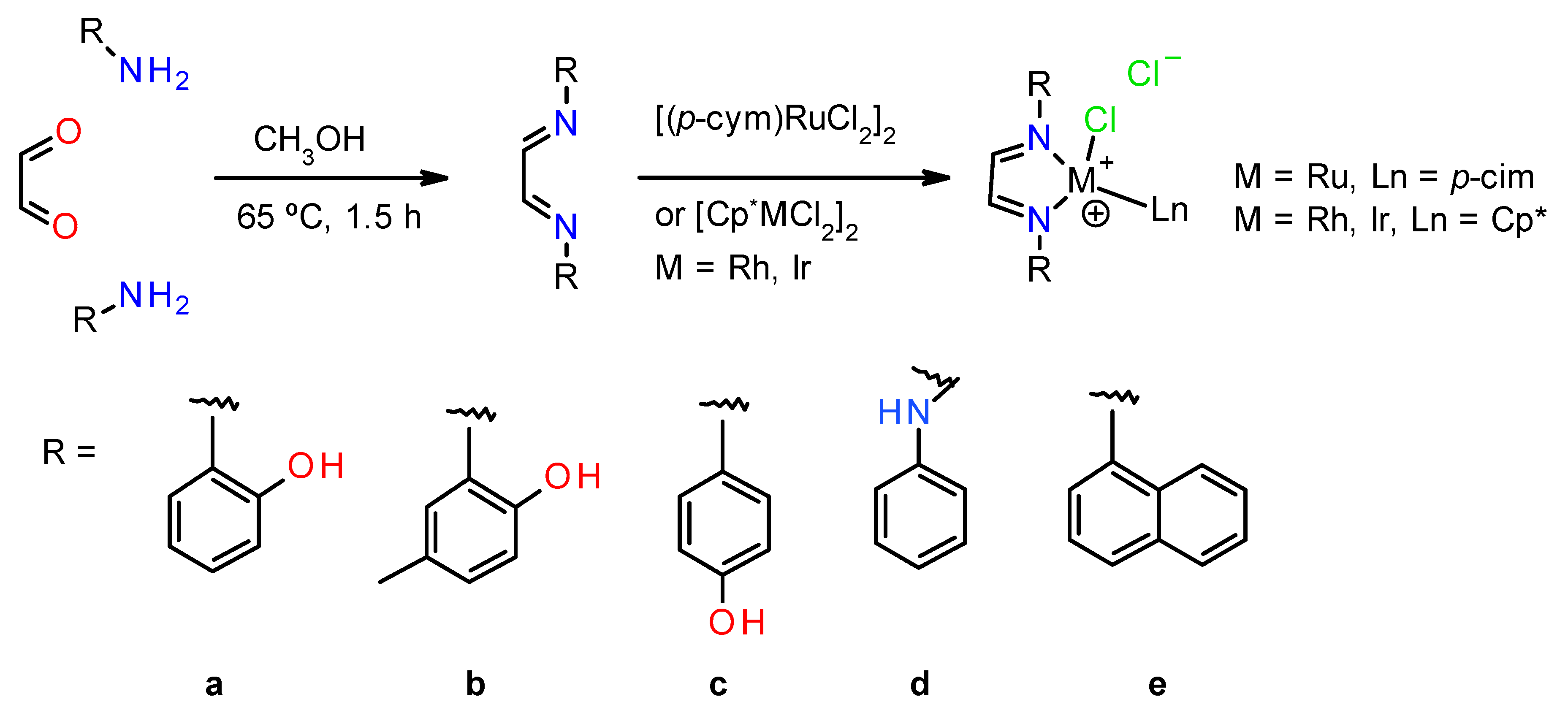
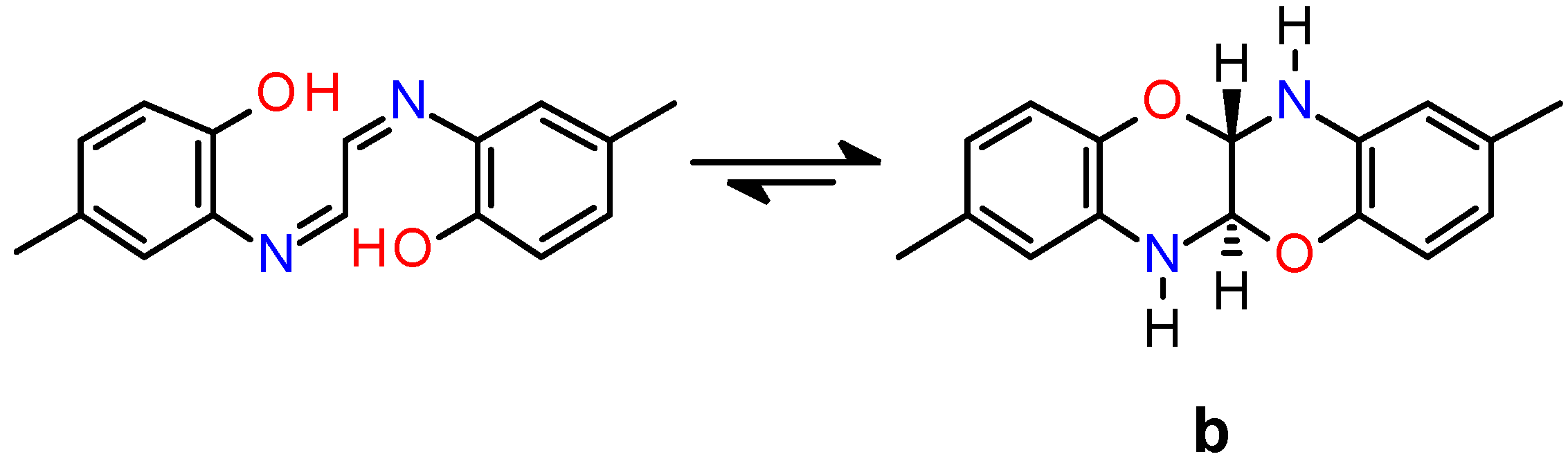
Ligands or their cyclic tautomer precursors ae (Scheme 1) were synthesized via condensation of glyoxal with two equivalents of aromatic primary amines, following the method reported by Sawama et al. [34] Compounds a [32], c [26], and d [33] have been previously reported, including NMR characterization consistent with this study; compounds b and e are newly reported herein. Notably, compound b undergoes cyclic tautomerization (Scheme 2), previously observed for compound a [35], which shows typical chemical shifts in the 1H and 13C NMR spectra; for example, the NH and aliphatic CH hydrogens resonate at δ = 7.25 and 5.25 ppm, respectively, appearing as doublets because of the coupling between them. The sp3 carbon in the CH group is observed at δ = 75.8 ppm, and the aromatic carbons bound to oxygen and nitrogen appear at δ = 139.6 and 130.5 ppm, respectively, which confirms the proposed cyclic form.
Complexes were synthesized from the dimeric metal precursors [(η6-p-cym)RuCl2]2 (p-cym = p-cymene) or [(η5-Cp*)MCl2]2 (Cp* = pentamethylcyclopentadienyl, M = Rh, Ir), and the corresponding ligands ae were successfully obtained for 13 of them (1b1e, 2a2c, 2e, and 3a3e) (Scheme 1). Complex 1a was only detected through ESI-MS ([M]+ = 511.0 m/z), but could not be isolated and characterized; there was evidence regarding its rapid decomposition. Meanwhile, complex 2d could not be synthesized, and there was no evidence of its formation. Complex 1c has been previously reported with nitrate as the counterion [26].
In all complexes reported here, the most characteristic signal in the 1H NMR spectra corresponds to the hydrogen of the CH group in the imine fragment, which is shifted to low frequencies, showing a clear trend. The complexes containing –OH groups show this signal at approximately δ = 9.21 to 8.46 ppm, while in the complexes containing –NH groups, the imine CH resonates at δ = 7.65 to 7.58 ppm. The acidic hydrogens in the –OH group are observed at δ 10.96 to 10.46 ppm and –NH at δ 10.85 to 10.38 ppm. The complexes with ligands derived from naphthylamine show the imine CH signal at δ = 9.56 to 8.69 ppm.
On the other hand, in the 13C NMR spectra, the carbon of the CH group in the imine fragment is most shifted to low frequencies, showing a signal at δ = 172.8 to 144.5 ppm. The other signals in the 13C NMR spectra are consistent with aromatic CH or quaternary carbons.
Representative examples of 1H and 13C NMR spectra for 1b, 2c, 3a, and 3e complexes are shown in the electronic Supporting Information.
Ligands and complexes were studied using ESI-MS. In the mass histogram of ligands ae, molecular ions [M]+. were observed in all cases. Additionally, ligand a showed an association of two water molecules with two molecules of the compound [2M.2H2O]+ at m/z = 516. In the ESI-MS spectra of complexes 1a1e, 2a2c, 2e, and 3a3e, molecular ions [M]+. were observed in all cases. Additionally, some of them showed ion peaks resulting from the fragmentation of the chloro ligand [M-Cl]+, for example, complexes 1b, 1d, 2b, 3a, 3b, and 3d.
The compounds were analyzed by DSC to determine the degree of purity, as well as the decomposition temperature, to ensure that the catalytic test temperatures did not degrade the precatalysts. The analysis of the DSC curves allowed for determining a decomposition temperature range of 210–235 °C for Ru complexes, 185–245 °C for Rh complexes, and 215–240 °C for Ir complexes (Supporting Information).
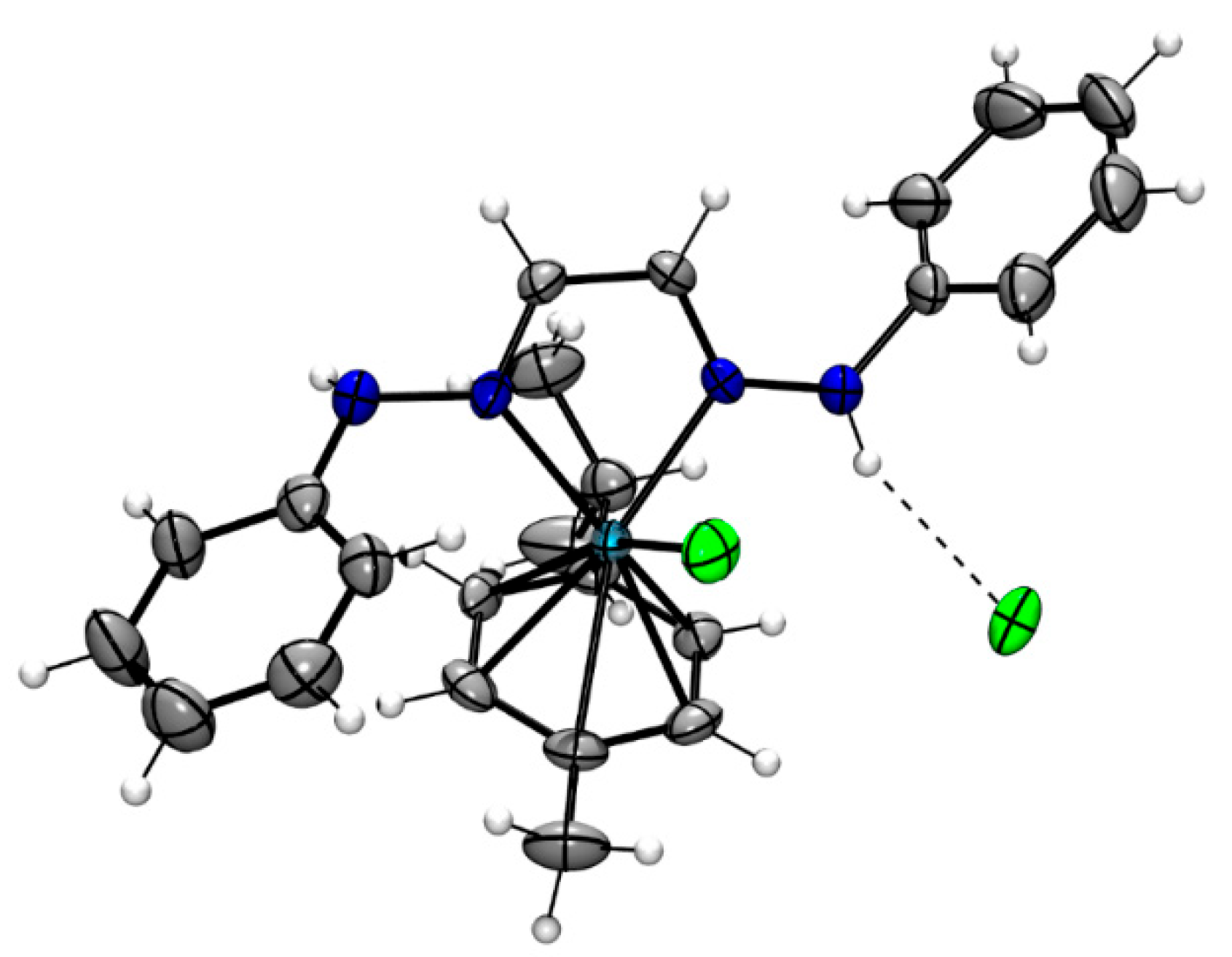
The complexes 1d, 3a, and 3c were studied using single-crystal X-ray diffraction (XRD). The structure of 1d (orthorhombic, Pbca), crystallized from acetone/water, is presented in Figure 1. A spatial orientation of the iPr group of p-cymene is observed toward the α-diimine ligand, and the methyl group of p-cymene is observed toward the chloro ligand. The geometry around the ruthenium atom is pseudo-octahedral, with the two nitrogen atoms of the α-diimine, a chloro ligand, and three positions occupied by the p-cymene ligand. The crystal structure shows an intermolecular hydrogen bond between the –NH– and the chloride with a 3.133 Å distance.
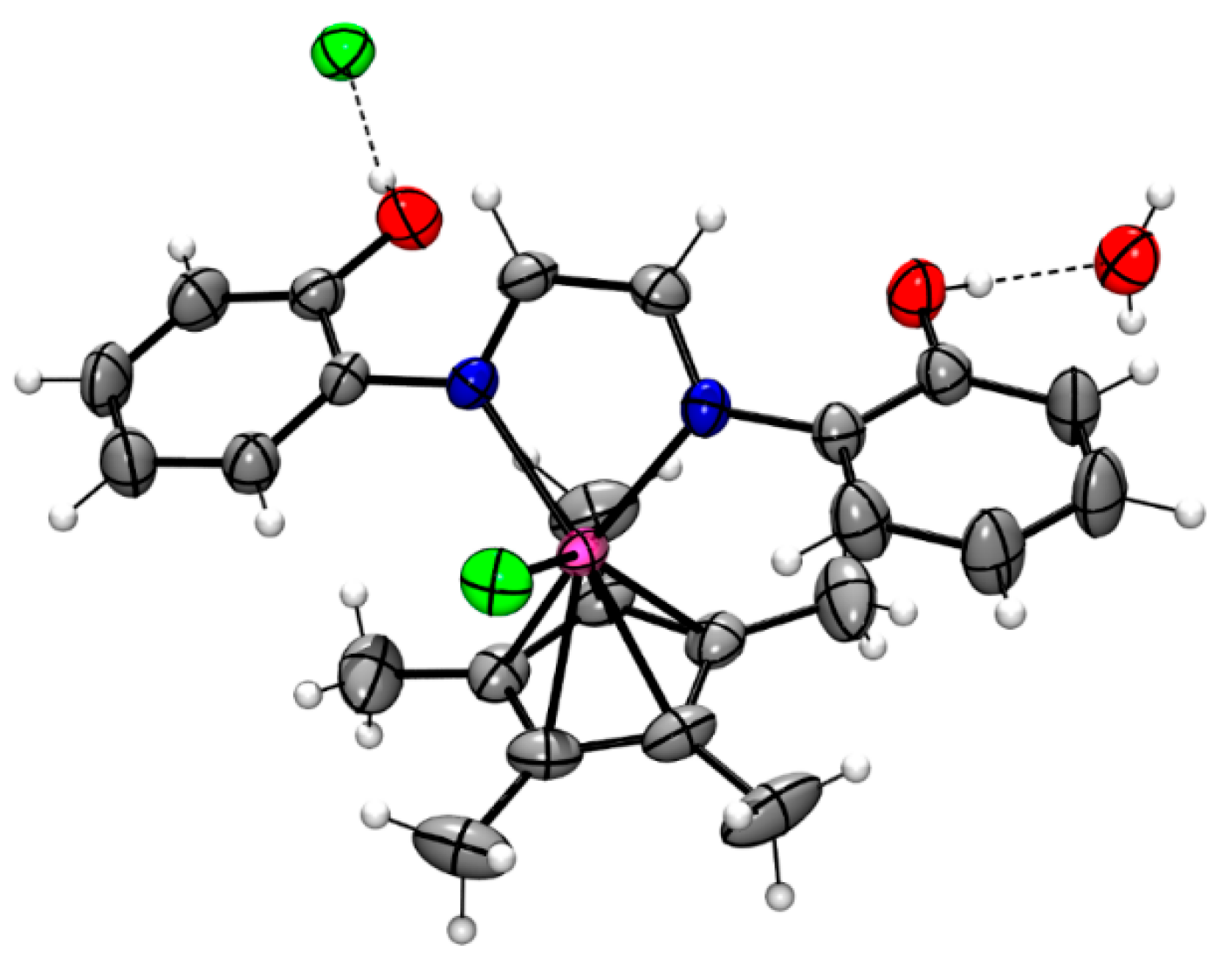
Complex 3a (monoclinic, C2/c) was crystallized in water and studied via single-crystal XRD. Figure 2 shows that the geometry around the iridium atom is pseudo-octahedral, with coordination by two nitrogen atoms from the α-diimine, one chloro ligand, and three positions occupied by the Cp* ligand. Hydrogen bonds are observed between the chloride and the o-OH group at the α-diimine ligand (3.107 Å), as well as between the oxygen atom of the crystallization water molecule and the other o-OH group on the α-diimine ligand (2.652 Å).
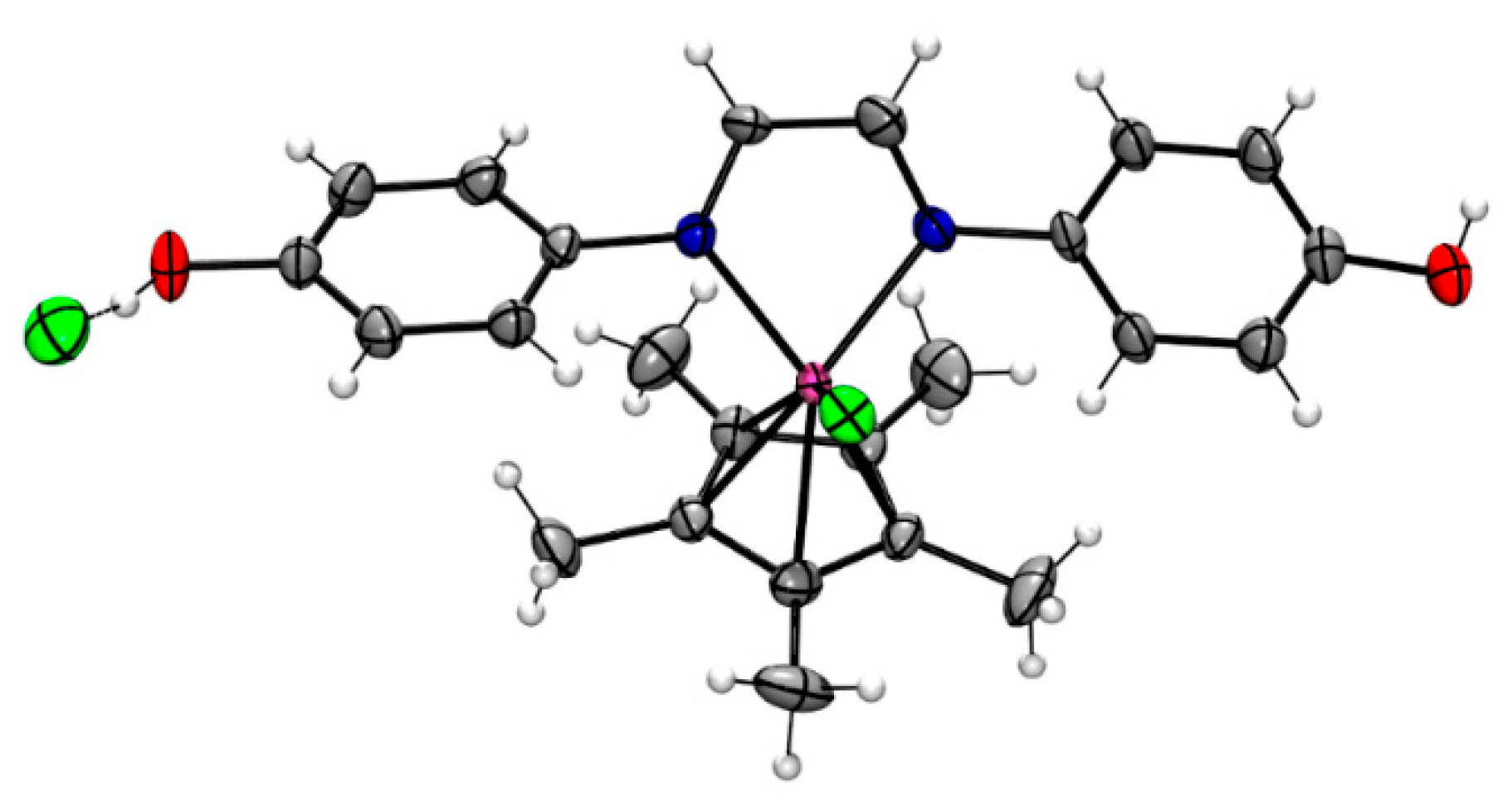
Complex 3c (monoclinic, P21/c) was crystallized from acetone/water, and the structure is shown in Figure 3. It reveals that the geometry around the iridium atom is pseudo-octahedral, with two nitrogen atoms from the α-diimine, one chloro ligand, and three positions occupied by the Cp* ligand. A hydrogen bond is observed between the chloro anion and the p-OH groups on the α-diimine ligand (3.019 Å).

3.2. Catalytic Activity in FA Decomposition Using Complexes as Precatalysts

The incorporation of α-diimine ligands with protic groups improved the solubility in water of the ruthenium (1b1e), rhodium (2a2c, 2e), and iridium (3a3e) complexes, enabling the dehydrogenation of FA in aqueous medium; this process involves the generation of gaseous H2 and CO2 (Scheme 3). For this reaction, a Monowave-50 synthesis reactor was used, which allows continuous pressure monitoring of the system to be observed.
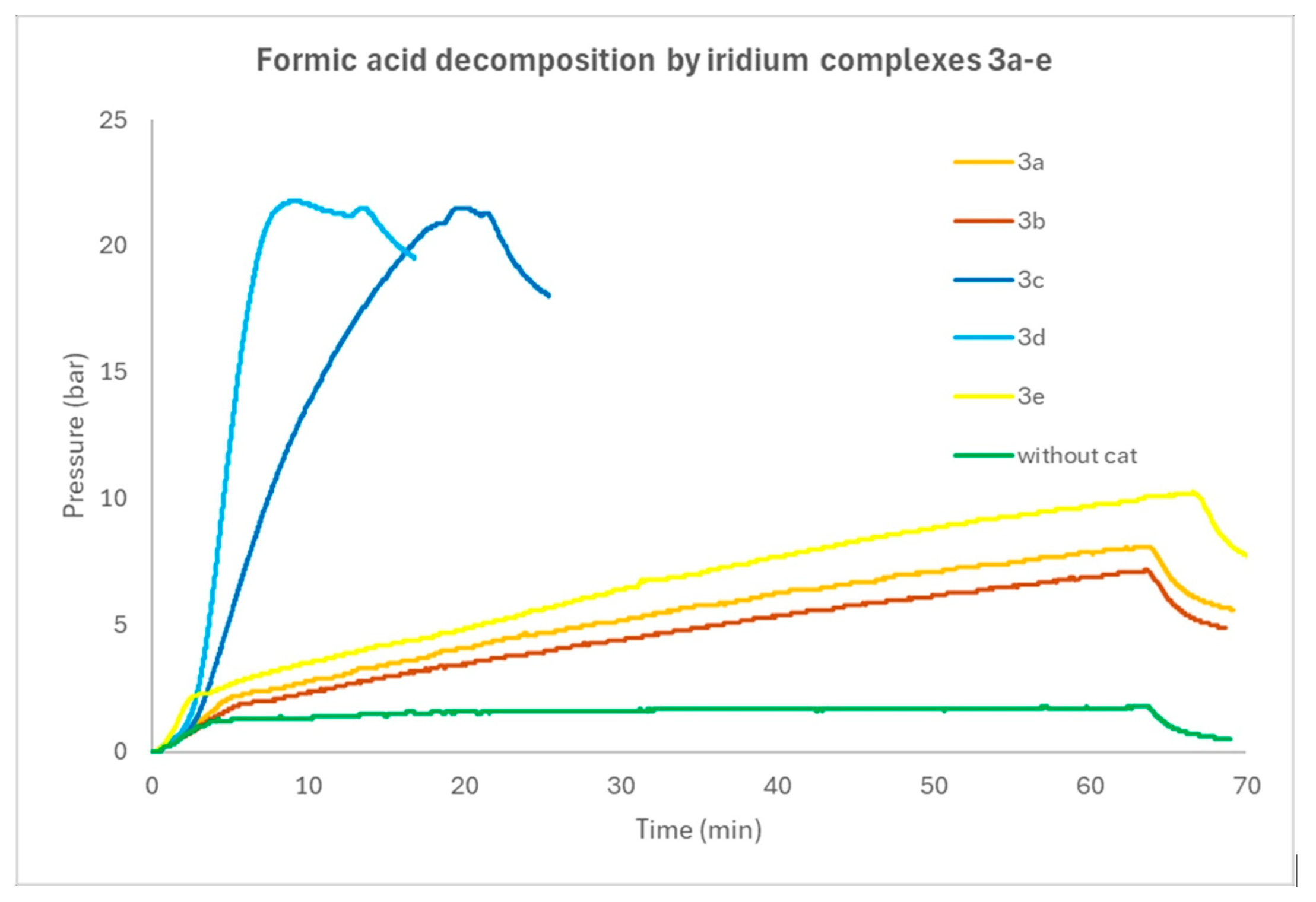
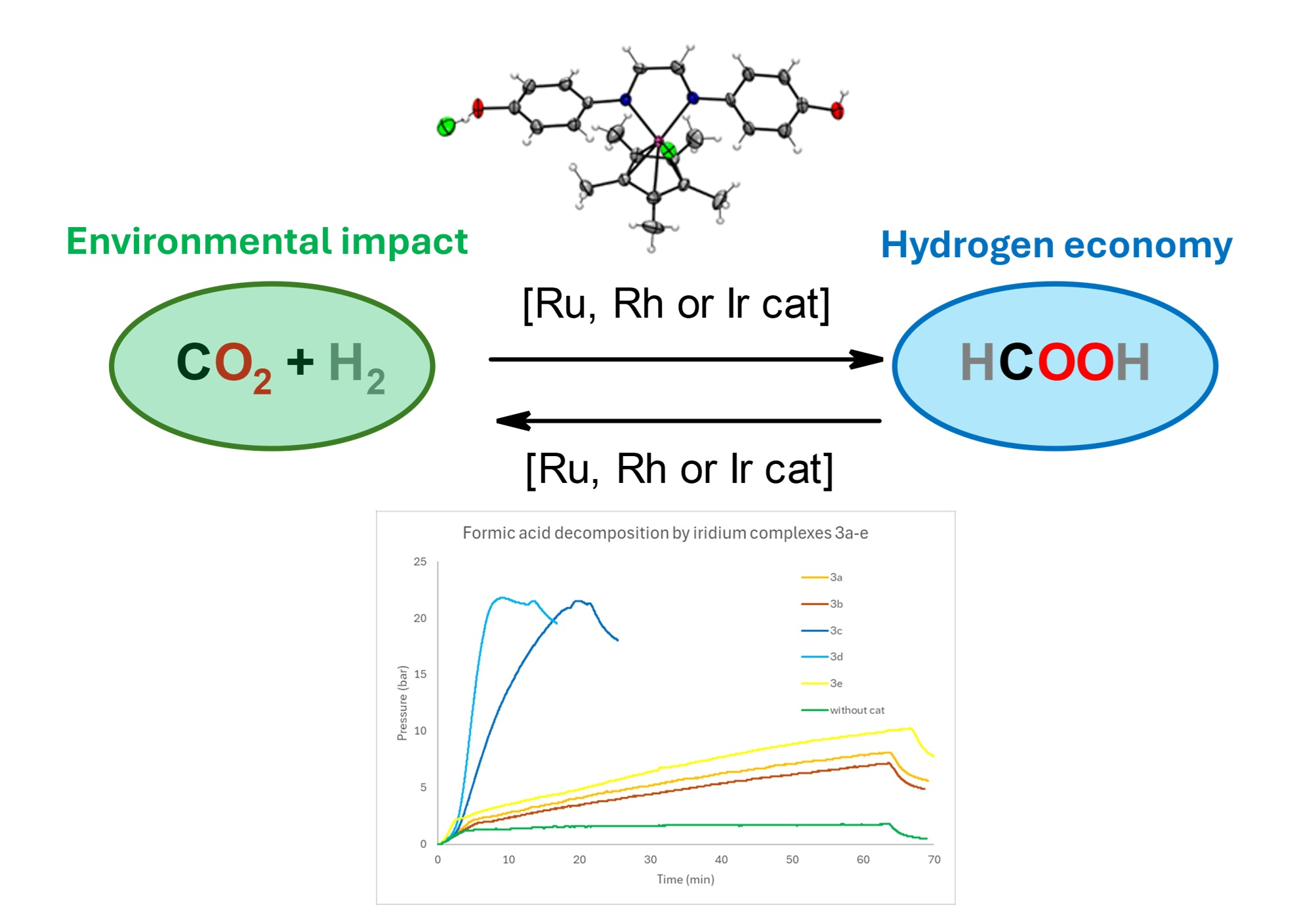
FA dehydrogenation was initiated with the most stable iridium complexes (3a3e) as precatalysts (0.1 mol%) in an aqueous medium. Figure 4 shows the evolution of pressure vs. time for the iridium complexes. The increase in system pressure can be attributed to the presence of the H2 and CO2 generated.
An experiment was conducted without a catalytic precursor (Figure 4, green curve) to rule out the possibility of spontaneous formic acid decomposition under the reaction conditions. No change in system pressure was observed, indicating that the reaction did not proceed without a catalytic precursor.
Complexes 3c and 3d exhibited the best catalytic performance in the dehydrogenation of FA in aqueous medium (Figure 4, navy-blue and light-blue curves), reaching the maximum pressure within a short reaction time in the synthesis reactor.
A previous report [36] demonstrated that the optimal pH for HCOOH dehydrogenation in water is 1.4. The complexes used in that work showed a higher catalytic performance under these conditions compared to catalysis performed at a higher pH (pH = 3.7 using a 1:1 mixture of [HCOOH]/[HCOONa]). Based on these findings, we measured the initial pH of all catalytic solutions and found an initial pH of 1.4, which increased to 5 after the catalytic reaction. These pH changes were even more noticeable for complexes 3c and 3d, correlating with greater substrate consumption.
Following these observations, we focused on the catalytic study of this reaction with complex 3c and conducted several experiments using reduced precatalyst loadings (Table 1, entries 1 to 3), as well as using silver trifluoromethanesulfonate (AgOTf) (entry 4) in an equimolar amount with respect to the complex. The conversions of H2 and CO2 were determined by the titration of residual HCOOH using 0.1 M NaOH.
When the precatalyst load was reduced from 2.82 µmol (entry 1) to 0.282 µmol (entry 2), the conversion of the reaction dropped by almost half, and a further decrease resulted in zero conversion (entry 3). Conversely, the addition of AgOTf to complex 3c resulted in a slight increase in conversion (entry 4).
Based on the previous results, we decided to study the decomposition of FA to H2 and CO2 using the remaining prepared complexes as recitalists at a load of 2.65 µmol, HCOOH (2.65 mmol), water as a solvent (2 mL), and a temperature of 110 °C (Monowave 50). The conversions of H2 and CO2 were determined by the titration of residual HCOOH with 0.1 M NaOH. The results are presented in Table 2. In comparing the catalytic activity of all the synthesized compounds, we observed that the iridium complexes (entries 1 to 6) were the most efficient precatalysts for this reaction, followed by the rhodium complexes (entries 7 to 10), and finally the ruthenium complexes (entries 11 to 14). In all cases, the complexes with α-diimines derived from p-aminophenol (1c, 2c, and 3c) and phenyl hydrazine (1d, 2d, and 3d) were the most effective in each series. The 3d complex (entry 5) presented the highest values of TON (1980.5) and TOF (3203.3 h−1) within a short reaction time.
To verify that the catalytic reaction was carried out in a homogeneous phase by the complexes and to exclude the action of nanoparticles, an experiment was conducted with a drop of mercury (Table 2, entry 4) added to complex 3c, resulting in a slight decrease in conversion.
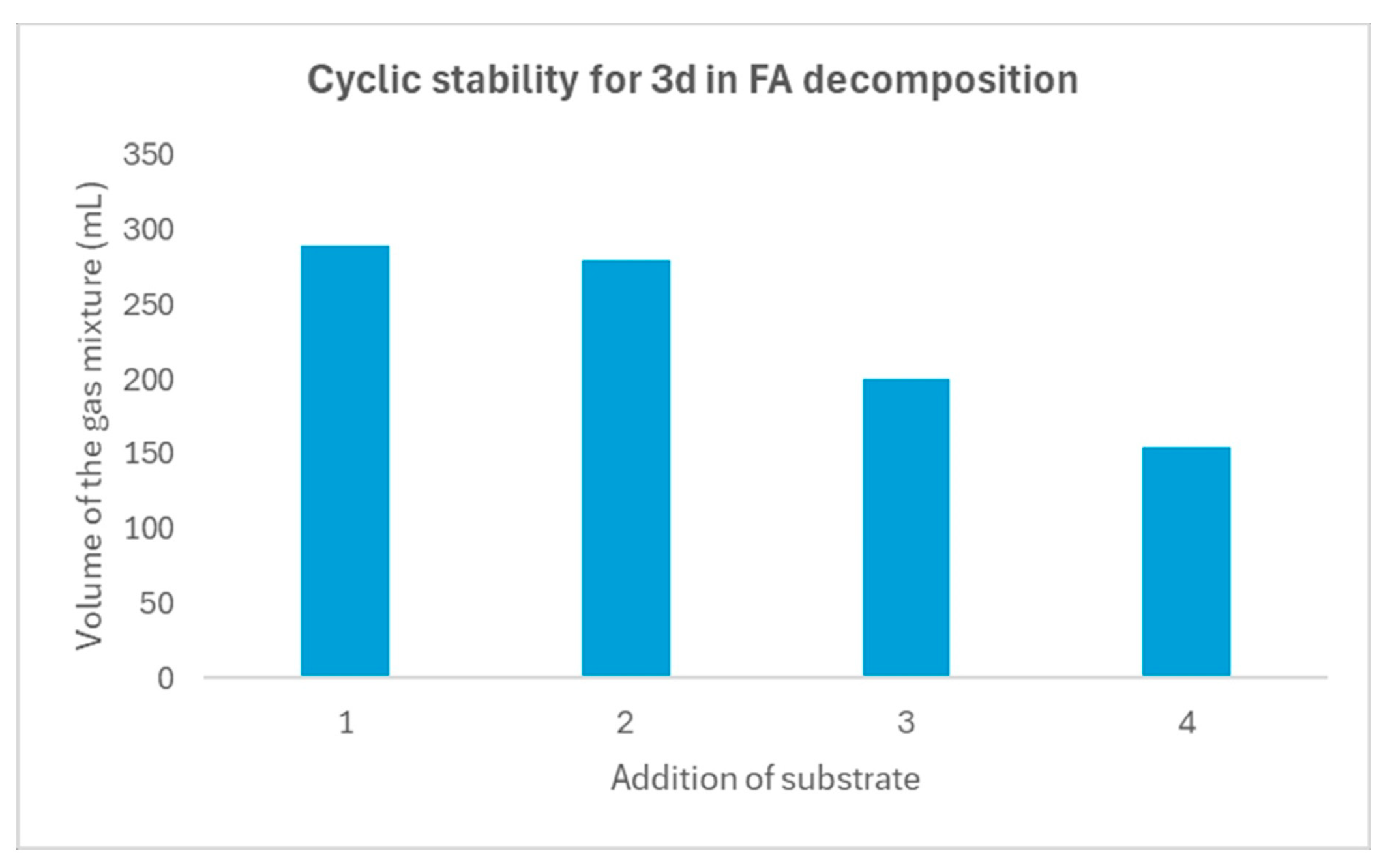
Additionally, an experiment was conducted to recycle the catalytic precursor at 80 °C under an open atmosphere. The progress of the reaction was monitored by collecting the evolved gases over water. Specifically, we employed the method reported by Fujita [37], in which H2 was collected during the oxidative dehydrogenation process of alcohols. The experiment involved four additions of substrate to a fixed amount of catalytic precursor (0.1 mol%). The results indicated that precatalyst 3d exhibited a good catalytic performance over 210 min (Figure 5), after which substrate conversion decreased and proceeded slower. This trend is consistent with that reported in the literature, which suggests degradation of the active species over extended reaction times.
FA decomposition to yield H2 and CO2 was studied under similar conditions by collecting the evolved gases over water. The ruthenium (1b1e), rhodium (2a2c, 2e), and iridium (3a3e) complexes were employed as precatalysts at a loading of 2.65 µmol, with HCOOH (2.65 mmol) and water as a solvent (2 mL) at 90 °C. Reaction times were recorded until the 100% conversion of formic acid. The results presented in Table 3 are consistent with those given in the previous table (Table 2), confirming that iridium complexes 3d (entry 4) (TON = 2150.2, TOF = 3861.8 h−1) and 3c (entry 3) (TON = 2013.5, TOF = 1611.3 h−1) are the most efficient precatalysts for this reaction.
The initial goal of this work was demonstrated with iridium complexes 3d and 3c, containing the –NH– and –OH protic groups as efficient precatalysts for this reaction; however, they can be compared with other ruthenium and iridium complexes reported in the literature, as shown in Table 4.

3.3. Catalytic Activity in the Hydrogenation of CO2 Using the Complexes as Precatalysts

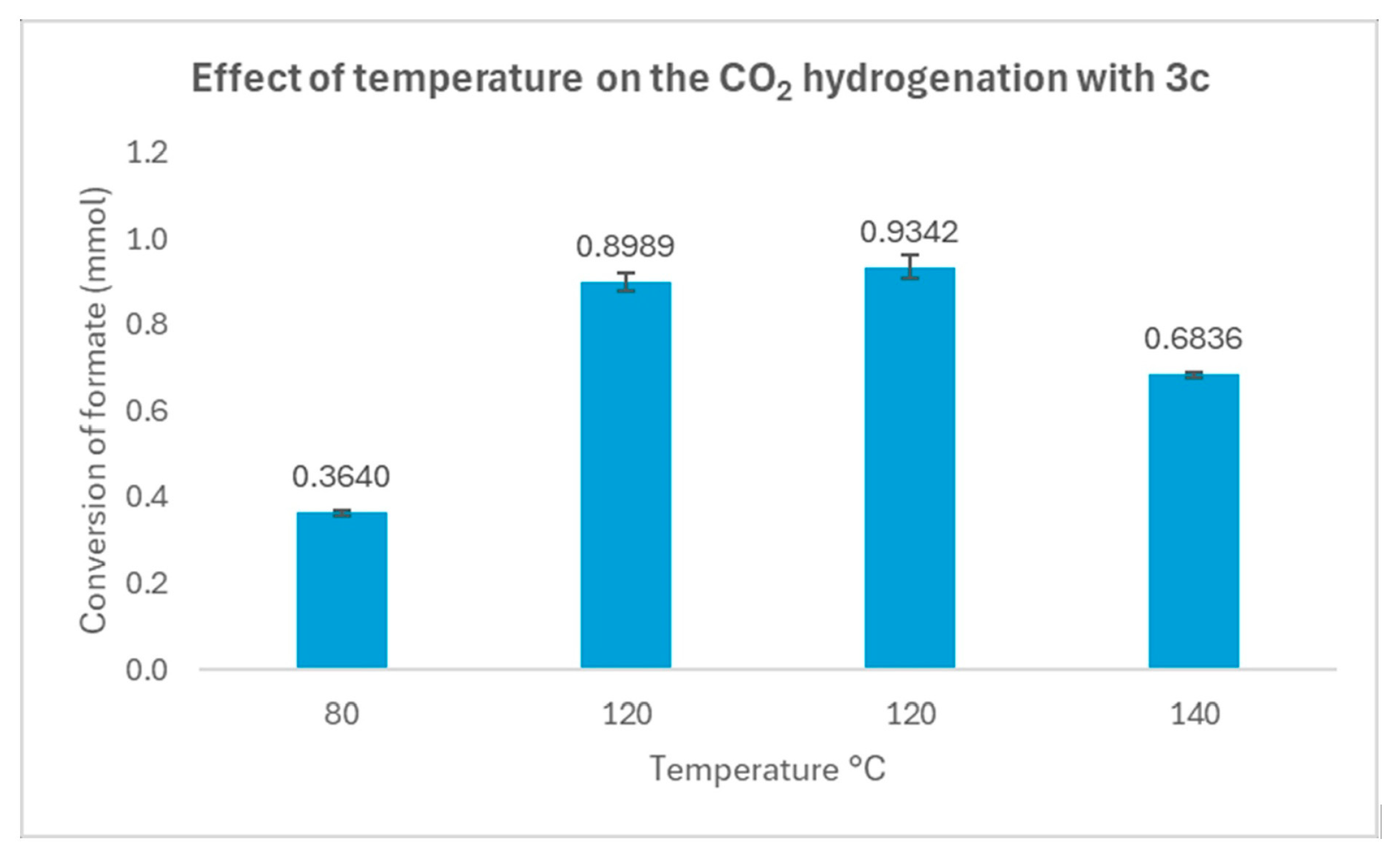
The direct hydrogenation of CO2 was first studied using the 3c complex (Scheme 4), which is one of the more stable and water-soluble complexes. The experiment was conducted from 80 to 140 °C (see Figure 6) to optimize the reaction temperature and achieve maximum conversion of triethylammonium formate, which was found to occur between 100 °C (0.89 ± 0.02 mmol) and 120 °C (0.93 ± 0.02 mmol). Therefore, the following experiments were performed at 110 °C.
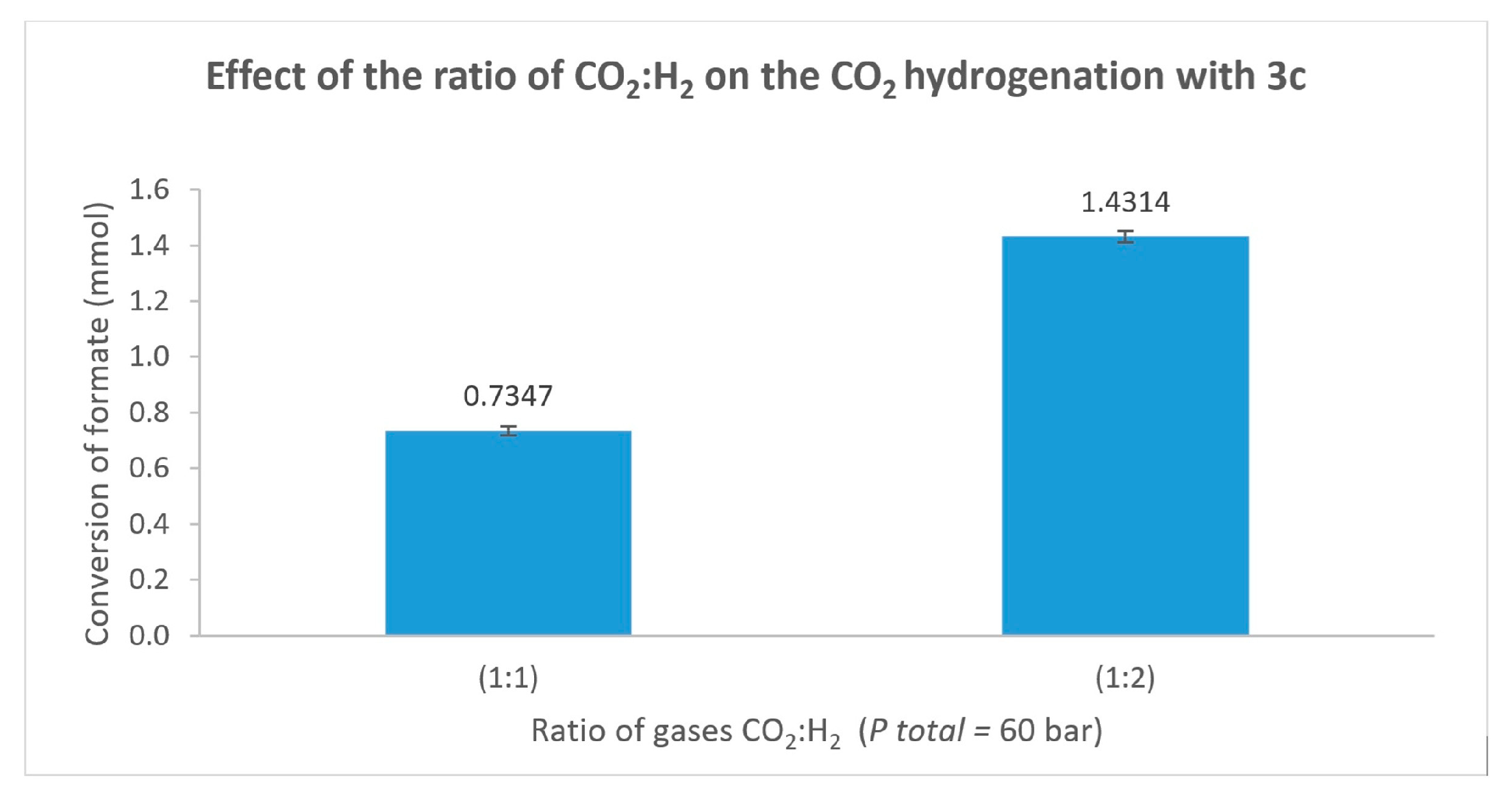
It was important to study the ratio of the mixture of gases, because in most previous reports, better conversions were observed using a CO2:H2 ratio of 1:1. The experiments were conducted with the 3c complex, using a 1:1 or 1:2 CO2:H2 ratio (Figure 7). The maximum conversion of formate was achieved with a 1:2 CO2:H2 ratio (1.43 ± 0.02 mmol).
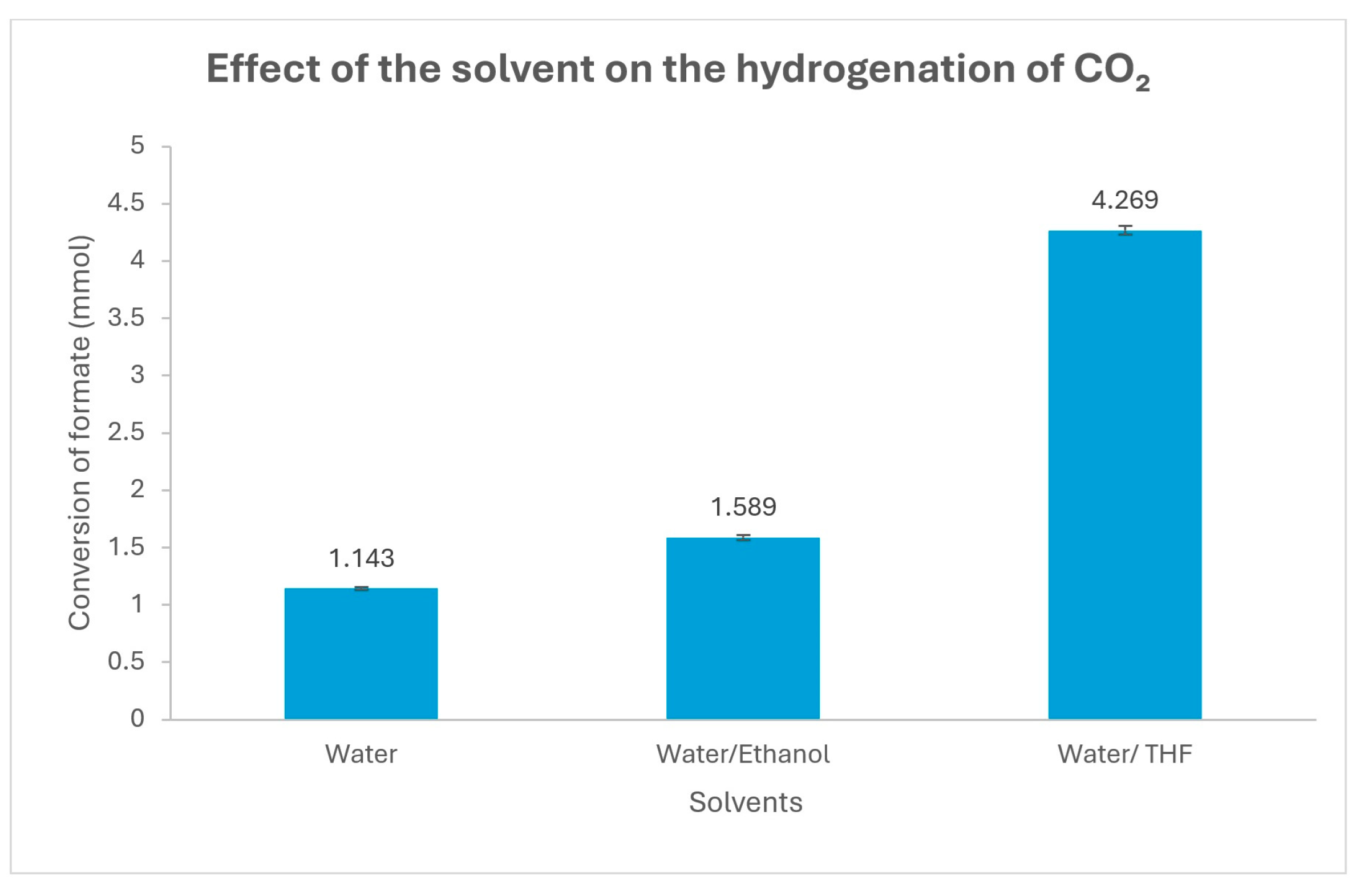
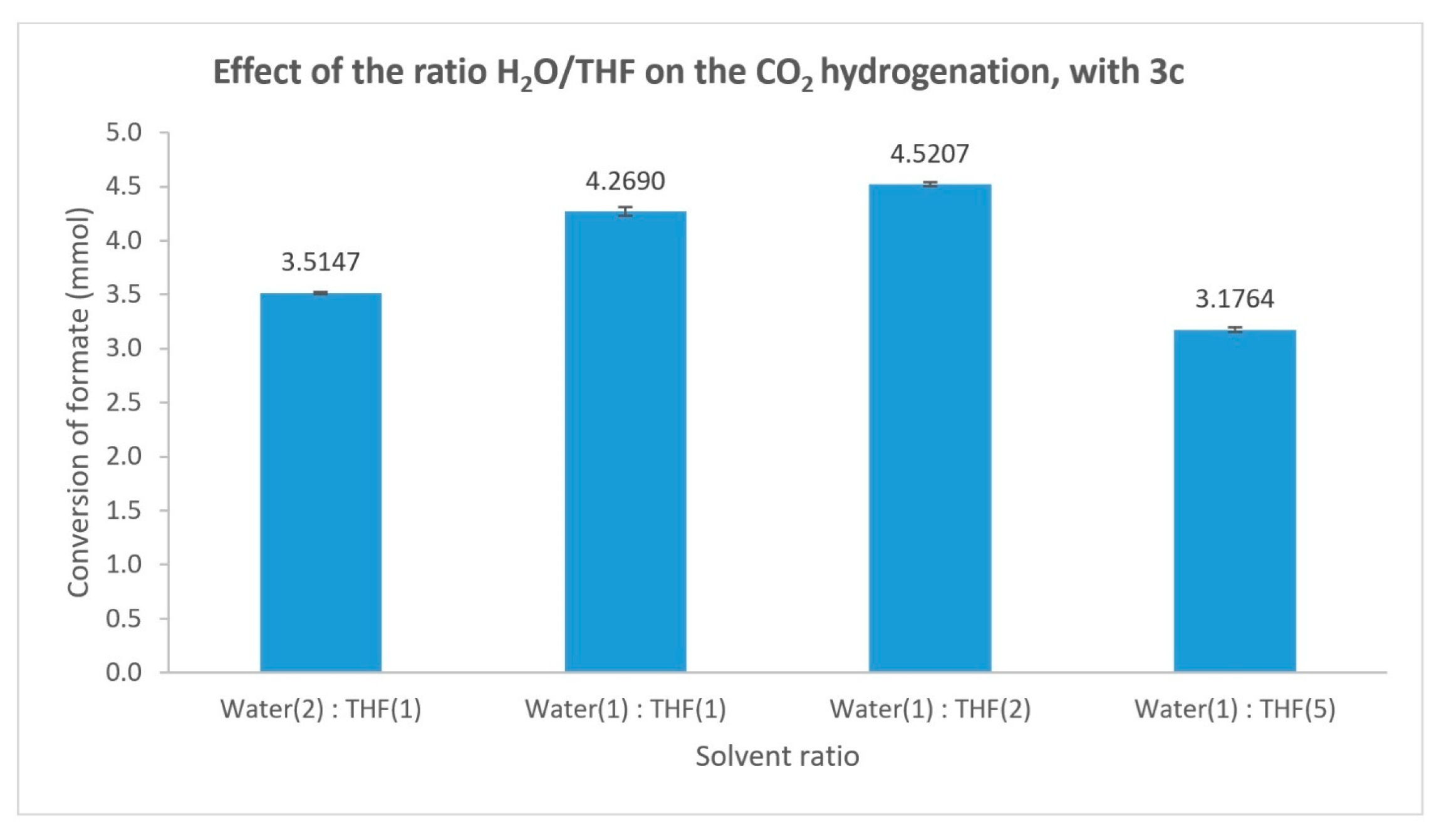
In certain related studies, the effect of solvents in the catalytic reaction has been investigated [38]. Therefore, in this study, we investigated the direct hydrogenation of CO2 using 3c as a precatalyst in water and in a mixture of water and either ethanol or tetrahydrofuran (THF) in a ratio of 1:1 (Figure 8). The water/THF mixture produced the highest formate conversion (4.27 ± 0.04 mmol). We also evaluated various H2O/THF ratios (2:1, 1:1, 1:2, and 1:5) (Figure 9), achieving the highest formate conversion with the 1:2 ratio (4.52 ± 0.02 mmol).
With all these optimizations, we studied the ruthenium (1b1e), rhodium (2a2c, 2e), and iridium (3a3e) complexes as precatalysts in the direct hydrogenation of carbon dioxide, in the presence of triethylamine, to yield triethylammonium formate (Scheme 4). The results are summarized in Table 5.
With these results, it is critical to note that the efficiency of ruthenium complexes in the direct hydrogenation of carbon dioxide to formate reached values of TON = 1474.5 (entry 12) and TOF = 69.2 (entry 15). The presence of the –OH protic group in complex 1c (entries 12 and 13) indicates a better catalytic performance, while the high solubility of complex 1e (entry 15) in THF could be the reason for the high conversion of formate. With respect to iridium complexes, they have a moderate efficiency (entries 2, 3, and 6) and their behavior matches previous observations, that is, the –OH protic groups in 3b (entry 2) and 3c (entry 3) and the solubility of 3e in THF (entry 6) enhance catalytic efficiency. The rhodium complexes presented a lower catalytic performance, and it is only worth highlighting the 2b complex (entry 8), in which the –OH group exhibits the best performance compared to other rhodium complexes.
To verify that the hydrogenation of carbon dioxide is also carried out in a homogeneous phase by the complexes and to exclude the action of nanoparticles, an experiment was conducted with a drop of mercury (Table 4, entry 4) added to complex 3c, resulting in a slight decrease in conversion.
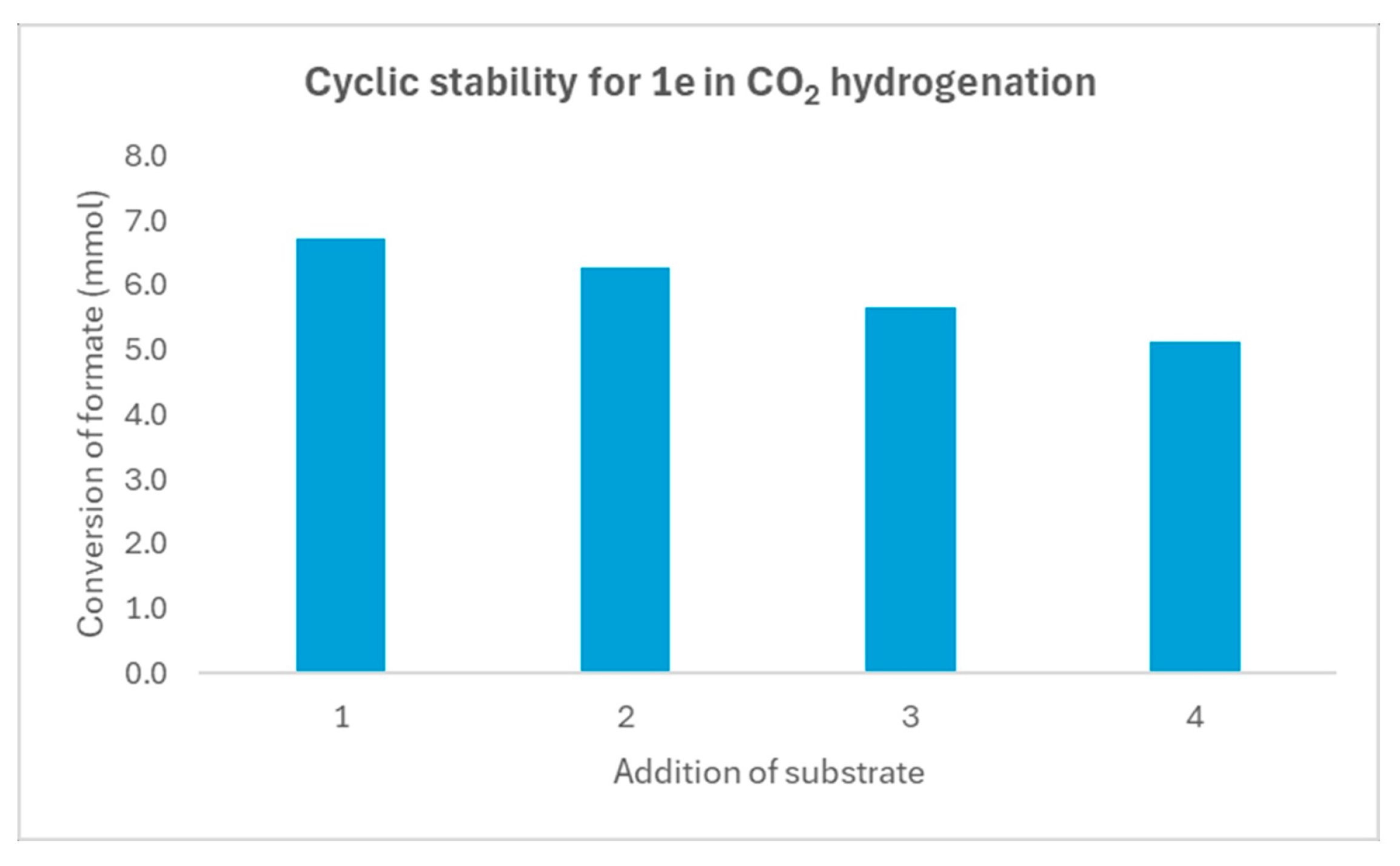
As in the previous catalytic reaction, the cyclic stability of the catalyst was studied by an experiment under the same established conditions. The 1e complex showed competitive conversion over four cycles (Figure 10).
Apparently, in CO2 hydrogenation, the presence of protic groups –OH and –NH– does not increase efficiency as much as the solubility of the 1e precatalyst and that of the CO2 substrate in water/THF. Complex 1e can be compared with other catalyst precursors reported in the literature for this reaction (Table 6).

4. Conclusions

Thirteen ruthenium(II), rhodium(III), and iridium(III) complexes bearing α-diimine ligands with –OH or –NH– protic groups were synthesized and characterized using NMR spectroscopy and ESI-MS. The structures of complexes 1d, 3a, and 3c were confirmed using single-crystal XRD. The highly air-stable and water-soluble ruthenium(II), rhodium(III), and iridium(III) complexes were employed as precatalysts in FA decomposition, with complex 3d achieving TON and TOF values of up to 2150 and 3861 h−1, respectively, within short reaction times. The presence of protic –NH– groups may promote the catalytic process. In CO2 hydrogenation, we obtained TON and TOF values of up to 1385 and 69.25 h−1, respectively, for complex 1e. In this case, the enhanced solubility of the precatalyst in THF may have contributed positively to its performance. It is noteworthy to highlight the high activity of ruthenium complexes in the hydrogenation of carbon dioxide, increasing their relevance as a sustainable catalyst.

Supplementary Materials

The following supporting information can be downloaded at: https://www.mdpi.com/article/10.3390/chemistry7060196/s1, Figures S1–S38: 1H and 13C{1H} NMR spectra; Figure S39: 1H NMR measurement of formate in CO2 hydrogenation; Figures S40–S58: ESI-MS histograms; Figures S59–S71: IR spectra; Figures S72–S75: DSC thermograms; Table S1. Crystal data and structure refinement for complexes 1d, 3a and 3c.

Author Contributions

Conceptualization, I.I.R.-S.; data curation, J.G.A.-R., E.B.-M. and A.A.P.-L.; investigation, J.C.S.-S. and M.A.C.-B.; supervision, R.G.-C., S.A.C.-L. and I.I.R.-S.; writing—original draft, I.I.R.-S.; writing—review and editing, R.G.-C., S.A.C.-L. and J.G.A.-R. All authors have read and agreed to the published version of the manuscript.

Funding

This research was funded by Mexico’s National Secretary of Science, Humanities, Technology and Innovation (SECIHTI) through the J.C.S-S (Ph.D) and M.A.C-B (M.S.) scholarships, grant numbers 775521 and 745735, respectively.

Data Availability Statement

The data presented in this study are available in the Supporting Information.

Acknowledgments

We are thankful to the University of Guadalajara for the Project “Apoyo al Fortalecimiento y Desarrollo de Infraestructura Científica y Tecnológica 2024”.

Conflicts of Interest

The authors declare no conflicts of interest.

References

  1. Centi, G.; Quadrelli, E.A.; Perathoner, S. Catalysis for CO2 Conversion: A Key Technology for Rapid Introduction of Renewable Energy in the Value Chain of Chemical Industries. Energy Environ. Sci. 2013, 6, 1711. [Google Scholar] [CrossRef]
  2. Rice, C.; Ha, S.; Masel, R.I.; Waszczuk, P.; Wieckowski, A.; Barnard, T. Direct Formic Acid Fuel Cells. J. Power Sources 2002, 111, 83–89. [Google Scholar] [CrossRef]
  3. Johnson, T.C.; Morris, D.J.; Wills, M. Hydrogen Generation from Formic Acid and Alcohols Using Homogeneous Catalysts. Chem. Soc. Rev. 2010, 39, 81–88. [Google Scholar] [CrossRef]
  4. Wang, W.; Zeng, C.; Tsubaki, N. Recent Advancements and Perspectives of the CO2 Hydrogenation Reaction. Green Carbon 2023, 1, 133–145. [Google Scholar] [CrossRef]
  5. Patra, S.; Maji, B.; Kawanami, H.; Himeda, Y. High-Pressure Hydrogen Generation from Dehydrogenation of Formic Acid. RSC Sustain. 2023, 1, 1655–1671. [Google Scholar] [CrossRef]
  6. Siegel, R.E.; Pattanayak, S.; Berben, L.A. Reactive Capture of CO2: Opportunities and Challenges. ACS Catal. 2023, 13, 766–784. [Google Scholar] [CrossRef]
  7. Inoue, Y.; Izumida, H.; Sasaki, Y.; Hashimoto, H. Catalytic Fixation of Carbon Dioxide to Formic Acid by Transition-Metal Complexes under Mild Conditions. Chem. Lett. 1976, 5, 863–864. [Google Scholar] [CrossRef]
  8. Wang, W.H.; Himeda, Y.; Muckerman, J.T.; Manbeck, G.F.; Fujita, E. CO2 Hydrogenation to Formate and Methanol as an Alternative to Photo- and Electrochemical CO2 Reduction. Chem. Rev. 2015, 115, 12936–12973. [Google Scholar] [CrossRef]
  9. Siek, S.; Burks, D.B.; Gerlach, D.L.; Liang, G.; Tesh, J.M.; Thompson, C.R.; Qu, F.; Shankwitz, J.E.; Vasquez, R.M.; Chambers, N.; et al. Iridium and Ruthenium Complexes of N-Heterocyclic Carbene- and Pyridinol-Derived Chelates as Catalysts for Aqueous Carbon Dioxide Hydrogenation and Formic Acid Dehydrogenation: The Role of the Alkali Metal. Organometallics 2017, 36, 1091–1106. [Google Scholar] [CrossRef] [PubMed]
  10. Filonenko, G.A.; Van Putten, R.; Schulpen, E.N.; Hensen, E.J.M.; Pidko, E.A. Highly Efficient Reversible Hydrogenation of Carbon Dioxide to Formates Using a Ruthenium PNP-Pincer Catalyst. ChemCatChem 2014, 6, 1526–1530. [Google Scholar] [CrossRef]
  11. Sanz, S.; Azua, A.; Peris, E. ‘(H6-Arene)Ru(Bis-NHC)’ Complexes for the Reduction of CO2 to Formate with Hydrogen and by Transfer Hydrogenation with IPrOH. Dalton Trans. 2010, 39, 6339–6343. [Google Scholar] [CrossRef]
  12. Tanaka, R.; Yamashita, M.; Nozaki, K. Catalytic Hydrogenation of Carbon Dioxide Using Ir(III)−Pincer Complexes. J. Am. Chem. Soc. 2009, 131, 14168–14169. [Google Scholar] [CrossRef] [PubMed]
  13. Azua, A.; Sanz, S.; Peris, E. Water-Soluble IrIII N-Heterocyclic Carbene Based Catalysts for the Reduction of CO2 to Formate by Transfer Hydrogenation and the Deuteration of Aryl Amines in Water. Chem.—Eur. J. 2011, 17, 3963–3967. [Google Scholar] [CrossRef]
  14. Sponholz, P.; Mellmann, D.; Junge, H.; Beller, M. Towards a Practical Setup for Hydrogen Production from Formic Acid. ChemSusChem 2013, 6, 1172–1176. [Google Scholar] [CrossRef] [PubMed]
  15. Wang, W.-H.; Ertem, M.Z.; Xu, S.; Onishi, N.; Manaka, Y.; Suna, Y.; Kambayashi, H.; Muckerman, J.T.; Fujita, E.; Himeda, Y. Highly Robust Hydrogen Generation by Bioinspired Ir Complexes for Dehydrogenation of Formic Acid in Water: Experimental and Theoretical Mechanistic Investigations at Different PH. ACS Catal. 2015, 5, 5496–5504. [Google Scholar] [CrossRef]
  16. Iguchi, M.; Himeda, Y.; Manaka, Y.; Kawanami, H. Development of an Iridium-Based Catalyst for High-Pressure Evolution of Hydrogen from Formic Acid. ChemSusChem 2016, 9, 2749–2753. [Google Scholar] [CrossRef] [PubMed]
  17. Piccirilli, L.; Rabell, B.; Padilla, R.; Riisager, A.; Das, S.; Nielsen, M. Versatile CO2 Hydrogenation-Dehydrogenation Catalysis with a Ru-PNP/Ionic Liquid System. J. Am. Chem. Soc. 2023, 145, 5655–5663. [Google Scholar] [CrossRef]
  18. Lentz, N.; Albrecht, M. A Low-Coordinate Iridium Complex with a Donor-Flexible O,N-Ligand for Highly Efficient Formic Acid Dehydrogenation. ACS Catal. 2022, 12, 12627–12631. [Google Scholar] [CrossRef]
  19. Wei, D.; Sang, R.; Sponholz, P.; Junge, H.; Beller, M. Reversible Hydrogenation of Carbon Dioxide to Formic Acid Using a Mn-Pincer Complex in the Presence of Lysine. Nat. Energy 2022, 7, 438–447. [Google Scholar] [CrossRef]
  20. Pechenkin, A.; Badmaev, S.; Belyaev, V.; Sobyanin, V. Production of Hydrogen-Rich Gas by Formic Acid Decomposition over CuO-CeO2/γ-Al2O3 Catalyst. Energies 2019, 12, 3577. [Google Scholar] [CrossRef]
  21. Mancuso, A.; Diglio, M.; Impemba, S.; Venditto, V.; Vaiano, V.; Buonerba, A.; Sacco, O. Dual-Function Bare Copper Oxide (Photo)Catalysts for Selective Phenol Production via Benzene Hydroxylation and Low-Temperature Hydrogen Generation from Formic Acid. Catalysts 2025, 15, 866. [Google Scholar] [CrossRef]
  22. Diglio, M.; Contento, I.; Impemba, S.; Berretti, E.; Della Sala, P.; Oliva, G.; Naddeo, V.; Caporali, S.; Primo, A.; Talotta, C.; et al. Hydrogen Production from Formic Acid Decomposition Promoted by Gold Nanoparticles Supported on a Porous Polymer Matrix. Energy Fuels 2025, 39, 14320–14329. [Google Scholar] [CrossRef]
  23. Hu, J.; Ma, W.; Liu, Q.; Geng, J.; Wu, Y.; Hu, X. Reaction and Separation System for CO2 Hydrogenation to Formic Acid Catalyzed by Iridium Immobilized on Solid Phosphines under Base-Free Condition. iScience 2023, 26, 106672. [Google Scholar] [CrossRef] [PubMed]
  24. Ittel, S.D.; Johnson, L.K.; Brookhart, M. Late-Metal Catalysts for Ethylene Homo- and Copolymerization. Chem. Rev. 2000, 100, 1169–1204. [Google Scholar] [CrossRef]
  25. Makuve, N.; Mehlana, G.; Tia, R.; Darkwa, J.; Makhubela, B.C.E. Hydrogenation of Carbon Dioxide to Formate by α-Diimine RuII, RhIII, IrIII Complexes as Catalyst Precursors. J. Organomet. Chem. 2019, 899, 120892. [Google Scholar] [CrossRef]
  26. Biancalana, L.; Batchelor, L.K.; Funaioli, T.; Zacchini, S.; Bortoluzzi, M.; Pampaloni, G.; Dyson, P.J.; Marchetti, F. α-Diimines as Versatile, Derivatizable Ligands in Ruthenium(II) p-Cymene Anticancer Complexes. Inorg. Chem. 2018, 57, 6669–6685. [Google Scholar] [CrossRef]
  27. Hodson, E.; Simpson, S.J. Synthesis and Characterisation of [(η6-Cymene)Ru(L)X2] Compounds: Single Crystal X-Ray Structure of [(η6-Cymene)Ru(P{OPh}3)Cl2] at 203 K. Polyhedron 2004, 23, 2695–2707. [Google Scholar] [CrossRef]
  28. White, C.; Yates, A.; Maitlis, P.M. [(C5Me5)MCl2]2-Rh-Ir.Pdf. Inorg. Synth. 1992, 29, 228–234. [Google Scholar]
  29. Dolomanov, O.V.; Bourhis, L.J.; Gildea, R.J.; Howard, J.A.K.; Puschmann, H. OLEX2: A Complete Structure Solution, Refinement and Analysis Program. J. Appl. Crystallogr. 2009, 42, 339–341. [Google Scholar] [CrossRef]
  30. Sheldrick, G.M. SHELXT—Integrated Space-Group and Crystal-Structure Determination. Acta Crystallogr. A 2015, 71, 3–8. [Google Scholar] [CrossRef]
  31. Sheldrick, G.M. Crystal Structure Refinement with SHELXL. Acta Crystallogr. C Struct. Chem. 2015, 71, 3–8. [Google Scholar] [CrossRef] [PubMed]
  32. Xiong, D.; Fu, Z.; Zhong, S.; Jiang, X.; Yin, D. Novel Homogeneous Salen Mn(III) Catalysts Synthesized from Dialdehyde or Diketone with o-Aminophenol for Catalyzing Epoxidation of Alkenes. Catal. Lett. 2007, 113, 155–159. [Google Scholar] [CrossRef]
  33. Roy, A.S.; Tuononen, H.M.; Rath, S.P.; Ghosh, P. First Ruthenium Complex of Glyoxalbis(N-Phenyl)Osazone (LNHPhH2): Synthesis, X-Ray Structure, Spectra, and Density Functional Theory Calculations of (LNHPhH2)Ru(PPh3)2Cl2. Inorg. Chem. 2007, 46, 5942–5948. [Google Scholar] [CrossRef]
  34. Sawama, Y.; Miki, Y.; Sajiki, H. N-Heterocyclic Carbene Catalyzed Deuteration of Aldehydes in D2O. Synlett 2020, 31, 699–702. [Google Scholar] [CrossRef]
  35. Niklas, J.E.; Hunter, K.M.; Gorden, A.E.V. Bonding Interactions in Uranyl α-Diimine Complexes: A Spectroscopic and Electrochemical Study of the Impacts of Ligand Electronics and Extended Conjugation. Inorg. Chem. 2019, 58, 15088–15100. [Google Scholar] [CrossRef]
  36. Menendez Rodriguez, G.; Domestici, C.; Bucci, A.; Valentini, M.; Zuccaccia, C.; Macchioni, A. Hydrogen Liberation from Formic Acid Mediated by Efficient Iridium(III) Catalysts Bearing Pyridine-Carboxamide Ligands. Eur. J. Inorg. Chem. 2018, 2018, 2247–2250. [Google Scholar] [CrossRef]
  37. Fujita, K.; Tamura, R.; Tanaka, Y.; Yoshida, M.; Onoda, M.; Yamaguchi, R. Dehydrogenative Oxidation of Alcohols in Aqueous Media Catalyzed by a Water-Soluble Dicationic Iridium Complex Bearing a Functional N-Heterocyclic Carbene Ligand without Using Base. ACS Catal. 2017, 7, 7226–7230. [Google Scholar] [CrossRef]
  38. Sordakis, K.; Tang, C.; Vogt, L.K.; Junge, H.; Dyson, P.J.; Beller, M.; Laurenczy, G. Homogeneous Catalysis for Sustainable Hydrogen Storage in Formic Acid and Alcohols. Chem. Rev. 2018, 118, 372–433. [Google Scholar] [CrossRef] [PubMed]
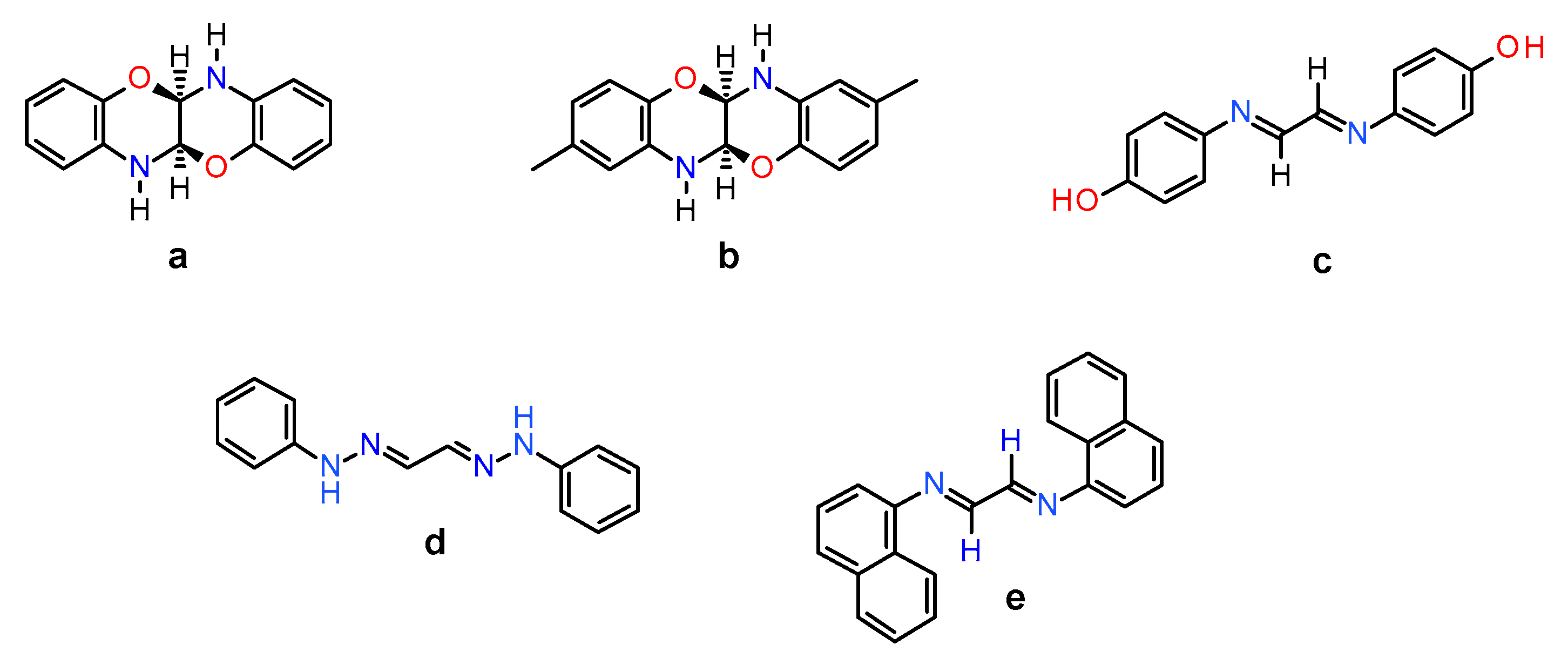
Chart 1. Structures of ligands ae.
Chemistry 07 00196 ch001
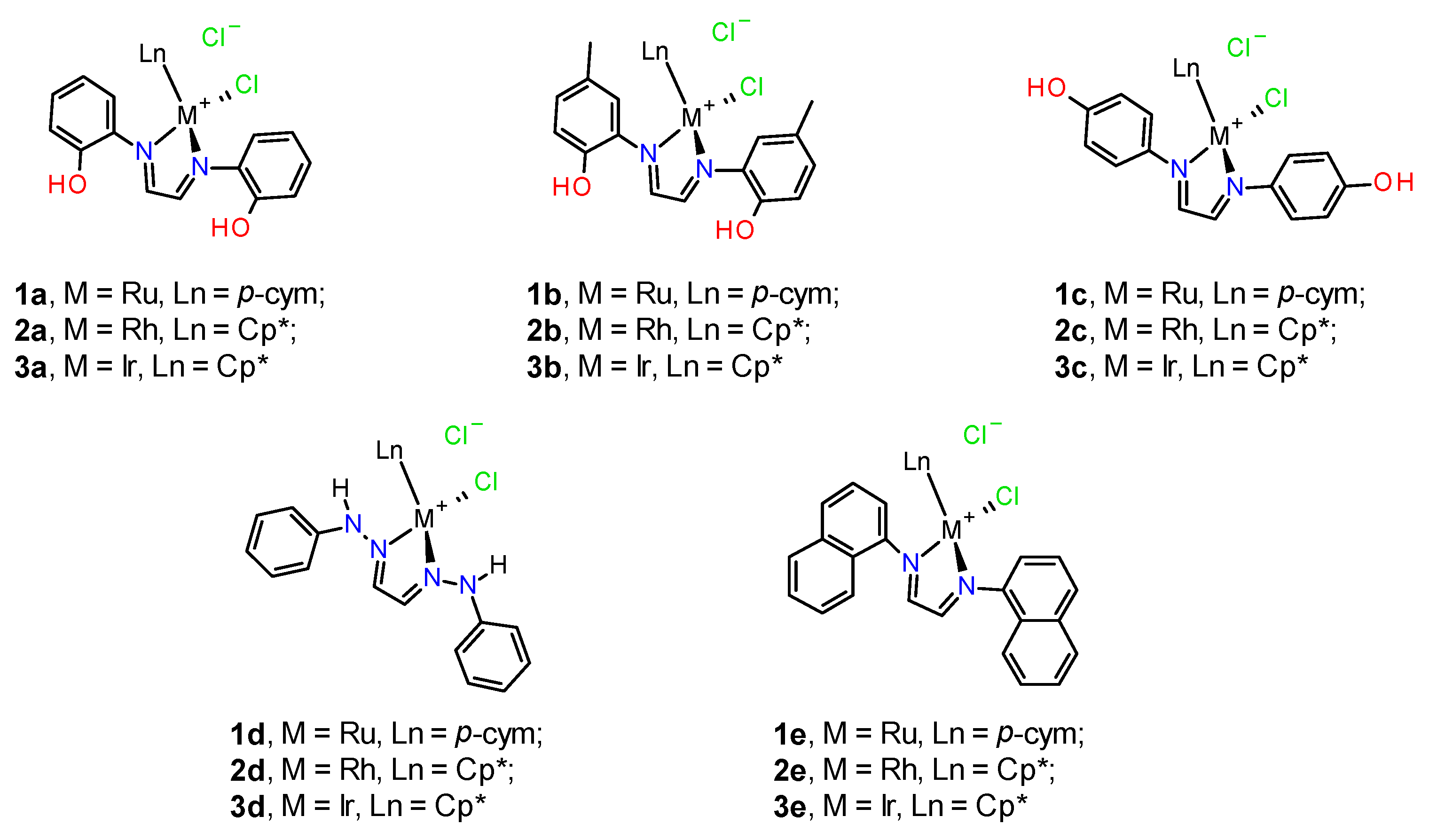
Chart 2. Structures of complexes 1ae, 2ae, and 3ae.
Chemistry 07 00196 ch002
Scheme 1. Synthesis of compounds ae, ruthenium(II) (1b1e), rhodium(III) (2a2c, 2e), and iridium(III) complexes (3a3e).
Chemistry 07 00196 sch001
Scheme 2. Cyclic tautomerization of ligand b.
Chemistry 07 00196 sch002
Figure 1. Crystal structure for complex 1d, orthorhombic, Pbca.
Chemistry 07 00196 g001
Figure 2. Crystal structure for complex 3a, monoclinic, C2/c.
Chemistry 07 00196 g002
Figure 3. Crystal structure for complex 3c, monoclinic, P21/c.
Chemistry 07 00196 g003
Scheme 3. Catalytic decomposition of formic acid to hydrogen and CO2.
Chemistry 07 00196 sch003
Figure 4. FA decomposition to H2 and CO2, using 0.1 mol% of iridium complexes (3a3e) as precatalysts in aqueous media.
Chemistry 07 00196 g004
Figure 5. Cyclic stability in FA decomposition, using 3d as precatalyst. Reaction time: 20, 30, 65, and 95 min. Conditions: 80 °C, [Ir] 0.1 mol%, and four additions of HCOOH (20.0 μL, 0.457 mmol). The volume of the gas mixture was measured via water displacement.
Chemistry 07 00196 g005
Scheme 4. Catalytic hydrogenation of CO2 to formate.
Chemistry 07 00196 sch004
Figure 6. Effect of temperature on CO2 hydrogenation, using 3c as the precatalyst. Conditions: precatalyst (5 µmol), H2O (3 mL), NEt3 (7.17 mmol), CO2 (30 bar), H2 (30 bar), temperature: 80 to 140 °C, and time: 20 h. The conversions of formate were determined via 1H NMR spectroscopy, using DMF (132 µL) as an internal standard.
Chemistry 07 00196 g006
Figure 7. Effect of the ratio of CO2:H2 on CO2 hydrogenation, using 3c as a precatalyst. Conditions: precatalyst (5 µmol), H2O (3 mL), NEt3 (7.17 mmol), pCO2 + pH2 (60 bar), temperature: 110 °C, and time: 20 h. The conversions of formate were determined via 1H NMR spectroscopy, using DMF (132 µL) as an internal standard.
Chemistry 07 00196 g007
Figure 8. Effect of the solvent on CO2 hydrogenation, using 3c as a precatalyst. Conditions: precatalyst (5 µmol), solvent: H2O, H2O/ethanol 1:1, H2O/THF 1:1 (3 mL), NEt3 (1 mL, 7.17 mmol), CO2 (20 bar), H2 (40 bar), temperature: 110 °C, and reaction time: 20 h. The conversions of formate were determined via 1H NMR spectroscopy, using DMF (132 µL) as an internal standard.
Chemistry 07 00196 g008
Figure 9. Effect of the H2O/THF ratio on CO2 hydrogenation, using 3c as a precatalyst. Conditions: precatalyst (5 µmol), solvent: H2O/THF 2:1, 1:1, 1:2, 1:5 (3 mL), NEt3 (1 mL, 7.17 mmol), CO2 (20 bar), H2 (40 bar), temperature: 110 °C, and time: 20 h. The conversions of formate were determined via 1H NMR spectroscopy, using DMF (132 µL) as an internal standard.
Chemistry 07 00196 g009
Figure 10. Cyclic stability in CO2 hydrogenation, using 1e as a precatalyst. Conditions: precatalyst (5 µmol), solvent: H2O/THF 1:2, (3 mL), NEt3 (1 mL, 7.17 mmol), CO2 (20 bar), H2 (40 bar), temperature: 110 °C, and time: 20 h. The conversions of formate were determined by 1H NMR spectroscopy, using DMF (3.5 µL) as an internal standard.
Chemistry 07 00196 g010
Table 1. Dehydrogenation of FA with 3c complex as a precatalyst.
Entry[3c] (mmol)[HCOOH]residual (mmol)Conversion (%)
12.82 × 10−30.082196.9
22.82 × 10−41.153056.5
32.82 × 10−52.650
4 a2.82 × 10−40.905965.8
Conditions: HCOOH (2.65 mmol), solvent: H2O (2 mL), 110 °C, 1 h. The residual HCOOH was determined by titration with NaOH. a AgOTf (2.82 × 10⁻⁴ mmol) was added to the precatalyst solution.
Table 2. Decomposition of FA to H2 and CO2 by ruthenium, rhodium, and iridium complexes as precatalysts.
EntryComplexTime (min)[H2] (mmol)Conversion (%)TONTOF (h−1)
13a551.88 ± 0.1170.931416.11519.8
23b571.68 ± 0.0964.651350.71264.4
33c552.62 ± 0.0198.941975.41835.2
4 a3c602.62 ± 0.0198.821973.81973.8
53d322.62 ± 0.0199.531980.53203.2
6 b3e600.44 ± 0.0516.25192.53192.4
72a511.60 ± 0.0959.601186.01379.9
82b551.79 ± 0.0866.121315.61383.0
92c552.08 ± 0.0675.981511.91645.6
102e601.43 ± 0.1054.081076.11076.8
111b620.42 ± 0.2415.90283.80274.7
121c600.85 ± 0.1728.64484.6484.6
131d640.79 ± 0.3229.73503.0470.4
141e640.49 ± 0.1217.82301.5281.4
Conditions: HCOOH (2.65 mmol), complex = precatalyst (2.65 µmol), solvent: H2O (2 mL), temperature = 110 °C (Monowave 50). The conversion of H2 was determined by the titration of residual HCOOH with NaOH 0.1 M. TON = (mmol of formate/mmol of precatalyst). TOF = TON/reaction time (h). a With a drop of Hg. b Measured with precatalyst = 5 µmol.
Table 3. FA decomposition to yield H2 and CO2 using ruthenium, rhodium, and iridium complexes as precatalysts.
EntryComplexTime (min)[H2] (mmol)Conversion (%)TONTOF (h−1)
13a564.02 ± 0.2875.81513.91624.6
23b683.67 ± 1.7469.11445.61266.9
33c755.34 ± 2.18100.02013.51611.3
43d335.72 ± 0.12100.02150.23861.8
5 a3e600.93 ± 1.4017.7209.6211.7
62a453.16 ± 0.0759.71188.21584.3
72b573.67 ± 0.1769.11376.91521.5
82c523.85 ± 0.0872.51444.71713.7
92e632.96 ± 0.1755.91112.81089.1
101b660.95 ± 0.4418.0321.4293.4
111c601.40 ± 0.2326.5449.0449.0
121d691.55 ± 0.0629.4497.1430.2
131e680.87 ± 0.1216.4277.9245.3
Conditions: HCOOH (2.65 mmol), complex = precatalyst (2.65 µmol), solvent: H2O (2 mL), and temperature = 90 °C. The conversions of H2 and CO2 were determined by measuring the gas mixture via water displacement. TON = (mmol of formate/mmol of precatalyst). TOF = TON/reaction time (h). a Measured at precatalyst load = 5 µmol.
Table 4. Selected catalysts active in FA decomposition.
Catalyst PrecursorSubstrateSolventT (°C)Time (h)TONTOF (h−1)
[RuCl2(C6H6)]2/DPPE [14]HCO2HDMOA251080>1,000,0001000
[(PNP3)Ru(H)Cl(CO)] [10]HCO2H/NHex3DMF903706,500256,000
[Cp*Ir(pyrimidyl imidazoline)H2O]SO4 [15]HCO2H/NaO2CHH2O1000.1768,000322,000
[Cp*Ir(PHEN-diol)H2O]SO4 [16]HCO2HH2O6026005,000,0001900
[Cp*Ir(d)Cl]Cl, 3d (this work)HCO2HH2O1100.5521503861
Table 5. Direct hydrogenation of CO2 to formate using ruthenium, rhodium, and iridium complexes as precatalysts.
EntryComplex[HCOO] (mmol)Conversion (%)TONTOF (h−1)
1 a3a0.94 ± 0.1813.1188.19.4
23b4.74 ± 0.1766.1947.519.7
33c4.53 ± 0.1063.1905.545.3
4 a,b3c2.53 ± 0.0449.2706.135.3
53d1.00 ± 0.0314.0200.610.0
63e4.22 ± 0.1258.8843.242.2
72a1.37 ± 0.0619.1274.313.7
82b2.33 ± 0.1232.5465.823.3
92c1.25 ± 0.1617.5250.512.5
102e0.89 ± 0.1112.4177.98.9
111b5.47 ± 0.0576.31094.854.7
12 c1c7.37 ± 0.10100.01474.530.7
131c6.19 ± 0.0786.31237.661.9
141d4.41 ± 0.3861.6882.944.1
151e6.92 ± 0.0596.61384.969.2
Conditions: Complex = precatalyst (5 µmol), solvent: H2O/THF 1:2 (3 mL), NEt3 (1 mL, 7.17 mmol), CO2 (20 bar), H2 (40 bar), temperature: 110 °C, and time: 20 h. The conversions of formate (mmol) were determined via 1H NMR spectroscopy, using DMF (132 µL) as an internal standard. TON = (mmol of formate/mmol of precatalyst). TOF = TON/reaction time (h). a Measured in H2O, CO2 (30 bar), H2 (30 bar). b With a drop of Hg. c Measured at 48 h.
Table 6. Selected catalytic systems that are active in hydrogenation of CO2.
Catalyst PrecursorSolvent AdditiveP(CO2/H2) (bar/bar)T (°C)Time (h)TONTOF (h−1)
[(PNP3)Ru(H)Cl(CO)] [10]DMFDBU10/301200.1200,0001,100,000
[(η6-p-cym)Ru(bis-NHC1)Cl]PF6 [11]H2OKOH20/202007523,000300
[(PNP1)IrH3] [12]H2O/THFKOH30/30120483,500,00073,000
[Ir(bis-NHC2)(AcO)I2] [13]H2OKOH30/3020075190,0002500
[(η6-p-cym)Ru(e)Cl]Cl, 1e (this work)H2O/THFNEt320/4011020138569
Disclaimer/Publisher’s Note: The statements, opinions and data contained in all publications are solely those of the individual author(s) and contributor(s) and not of MDPI and/or the editor(s). MDPI and/or the editor(s) disclaim responsibility for any injury to people or property resulting from any ideas, methods, instructions or products referred to in the content.