Communication

Spatial Structure and Nonlinear Properties of a Surface Charge Located on a Statically Curved Surface of a Semi-Infinite Plasma


Kurnakov Institute of General and Inorganic Chemistry, Russian Academy of Sciences, Leninsky pr. 31, Moscow 119991, Russia
Physics 2025, 7(4), 53; https://doi.org/10.3390/physics7040053
Submission received: 15 June 2025 / Revised: 14 September 2025 / Accepted: 16 September 2025 / Published: 30 October 2025

Abstract

The effect of the curvature of the boundary of semi-infinite cold plasma on the parameters and properties of surface oscillations localized near this boundary is considered. An analytical description of various cases of the impact of static deformation of the plasma boundary on the characteristics of the oscillating surface charge is obtained, and the results of the exact numerical solution of the initial equations are found to confirm the reliability of the derived analytical formulas. A significant role of the boundary perturbation shape in the formation of the spatial distribution of surface oscillation parameters is revealed. With the help of analytical formulas and precise numerical calculations, a description of this nonlinear interaction is presented. The availability of such a description is crucial both for determining the possibility of using the examined effect for specific applications and, on the other hand, for exciting it in plasma, which requires knowledge of the field structure features.

1. Introduction

Processes occurring at the plasma boundary have always occupied an essential place in the study of this object of investigation due to their naturally high information content about its state, as well as the need to take them into account when providing a purposeful external influence. To date, numerous studies have been produced which describe their various wave properties, both in linear [1] and nonlinear approximations [2,3,4]. One of the recent areas of research is related to nonlinear surface charge (NSC) waves, first described in Ref. [5]. The characteristic feature of those waves is the complete absence of associated density perturbations inside the plasma, which occur exclusively on the surface of the plasma itself. As a result, the spatial structure of the electrostatic potential of such waves is, as a function of coordinates, the solution of the Laplace equation, both inside the plasma and in its environment. Therefore, the search for such a solution can be carried out using the methods of the potential theory [6,7,8], which makes it quite straightforward to solve the problems of finding such a distribution on a curved, complex interface of media. As a result, there are wide opportunities for studying the self-consistent behavior of NSC waves and the curvature of the plasma interface [9], studying its various force interactions with electromagnetic radiation [10,11], for describing nonlinear phenomena at the perturbed interface of media [12], as well as solving a number of other problems related to the complex geometry of the plasma surface. The use of potential theory to study phenomena at the plasma boundary opens up promising prospects for obtaining both scientific results and new practical ways of interacting with plasma, for example, for diagnostic purposes or to exert force or other effects.
In this paper, using simple enough examples of a given static curvature of the plasma surface, the effect of the perturbation on the spatial structure of parameters and the behavior of surface waves under these conditions are considered. The information obtained may be of scientific interest, as well as instructive when used indifferent practical applications.

2. Theory

Numerous nonlinear effects and properties of nonlinear processes on the plasma surface can be studied within the framework of quite a simple model of a semi-bounded cold plasma with a flat boundary, which can be curved either under the influence of nonlinear perturbations or under the influence of external forces. Ions form the background plasma, and their density is constant. The electrostatic potential φe (r,t) depending on coordinates r (radius-vector) and time t, the density of single-charged ions Ni, the density of electrons ne (r,t) having a charge e, and the velocity of electrons v (r,t) satisfy the following system of hydrodynamic equations:
Δ φ e = e ( n e N i ) ε 0 ,
t n e + ( n e v ) = 0 ,
t v + ( v ) v = e m ϕ e ,
as described, for example, in papers [1,2,3,4] (see also [13,14,15,16]), where m is the electron mass, ε0 is the vacuum permittivity, and a ≡ ∂/∂a. A significant peculiarity of NSC is the absence of corresponding perturbations inside the plasma occupying a half-space x > x0(y,z,t), where the densities of electrons and ions are independent on space coordinates and equal to each other (ne (x > x0, y,z,t) = Ni ≡ const.). Perturbations of electron density, velocity, and potential exist only at the plasma boundary for x = x0 that, in a general case, can depend on time. This means that inside the plasma (x > x0) and in the region of the medium (x < x0) with the dielectric constant εd outside the plasma, the Poisson equation (1) transforms to the Laplace equation
Δ φ e = 0 .
To describe the behavior of NSC’s at the boundary (x = x0), a parameter nS introduced in papers [9,10,11,12] as a surface charge density can be applicable, as follows:
n S ( z , t ) = lim δ 0 x 0 δ x 0 + δ d x   n e ( x , z , t ) .
The equation for the density (5) of the surface charge nS follows from the equation of continuity (2) after the latter being integrated [9] along a narrow transition layer near the plasma boundary:
t n S + n 0 u 1 + y ( n S u 2 ) +   z ( n S u 3 )   = 0 ,
where u 1 , 2 , 3 = v x , y , z x = x 0 + 0 .
The motion of electrons is carried out with a speed v, what is connected with the potential Ψ (r,t), i.e., v = grad Ψ(r,t). The value of this potential determined at the plasma surface [9],
t Ψ 0 + a 2 [ ( y Ψ 0 ) 2 + ( z Ψ 0 ) 2 ] + a 1 2 y Ψ 0 z Ψ 0 = e Φ 0 ( y , z , t ) / m , Φ 0 ( y , z , t ) = φ e ( x = x 0 , y , z , t ) ,    a 1 = ln ( 2 + 1 ) / ( 2 π ) 0.2 , Ψ 0 = Ψ ( x = x 0 + 0 , y , z , t ) , a 2 = ( 1 + a 1 2 ) / 2 ,
is obtained from Equation (3).
Equation (7) was derived with help of the preposition that inside plasma x > x0 + 0, the quasi-neutrality takes place, i.e., ne = n0, which provides the validity of the Laplace equation (4) for Ψ that is in accordance to the equation of the continuity (2).
The solution for the potential satisfying the Laplace equation (4) is known from the theory of the potential [6,7,8]. In the case when the half-space plasma is bounded by the infinite surface x = x0(y,z,t), it can be written in the following form [9,10,11,12] for both media:
φ e ( r , t ) = ± 1 2 π d y d z | x x 0 ( y , z , t ) | θ ( y , z ) Φ 0 ( y , z , t ) ( y y ) 2 + ( z z ) 2 + ( x x 0 ( y , z , t ) ) 2 3 / 2 , θ ( y , z , t ) = 1 + H y 2 + H z 2 , H y , z = y , z x 0 ,
where the sign “+” to be taken for any point with coordinates {x,y,z} inside the plasma (x > x0), while the sign “−” to be used for points of observations outside the plasma (x < x0).
As was shown in prior investigations [9,10,11,12], the boundary condition
x φ e x = x 0 + 0 ε d x φ e x = x 0 0 = e ε 0 n S
for the normal component of the electric field can be derived from the Poisson equation (1). The relation (9) connects the surface charge density (5) and the electrostatic potential together with Equation (6), whereas Equation (7) defines the dependence of Φ0 on Ψ0. Another boundary condition is the continuity of the potential at the boundary.
With the help of Equations (8) and (9), Equation (7) reduces to a description of the behavior of the potential Ψ0 in time and space, and, in a dimensionless form, it looks as in paper [9].
τ , | | 2 F 0 + | | ( | | F 0 | | F ) + | | F = 0 , F 0 = τ F + a 2 [ ( ζ F ) 2 + ( η F ) 2 ] + a 1 2 ζ F   η F + a 2 | | F [ H ζ 2 ζ F + H η 2 η F ] , | | = [ 0 , η , ζ ] , a 2 = a 1 ( 1 + a 1 ) , | | = ζ + η ,
with the dimensionless coordinates and variables ζ = z ωS/c, η = y ωS/c, (c = const.), τ = ωS t, F = ωS Ψ0 /c2 ωS = ωp (1 + εd)−1/2, ωp = (Ni e2/mε0)1/2.
It follows from Equation (10) that in a linear approximation there are oscillations [1] with a frequency of ωS. known as surface waves of half-space plasma.

3. Results

Equation (10) allows studying the interaction of surface waves with existing curvatures of the plasma surface which are assumed to be static. Encountering such changes in the conditions of their propagation, these waves adjust their behavior, properties, and spatial structure. The information about these changes is of significant interest, since it relates the geometric parameters of the boundary perturbation to electrostatic characteristics, which can be essential, for example, for plasma diagnostics. The study of such relationships is most straightforward to be performed on a one-dimensional model, when all quantities depend on only one spatial coordinate on the surface of the plasma, i.e., F = F(τ,η), Hz = 0. However, the present consideration is supposed to be restricted by the investigation of only static cases when x0 = x0(η). On the one hand, this facilitates calculations, and, on the other hand, it allows one to identify the main features of the effect under consideration.

3.1. One-Dimensional Model of the Interaction of Surface Waves with the Static Curvatures of the Plasma Surface

Within the framework of this model, it is possible to analyze the behavior of surface oscillations well enough, including a description of the spatial distribution of electrostatic fields along the direction of inhomogeneity of the curvature of the plasma boundary. In this approximation, all the parameters characterizing surface waves are assumed to depend on two variables, namely η and τ, and the function x0(η), which describes the deviation of the plasma boundary from the plane, depending only on the coordinate η.
As a result, Equation (10) can be rewritten for the function w = η F, as follows [9]:
τ w 0 + η ( w 0 w ) + w = 0 , w 0 = τ w + η { ( a 2 + a 2 h ) w 2 } , h h ( η ) = H η 2 .
The search for time-oscillating solutions of Equation (11) for processes that are weakly dependent on phase changes can be carried out using formula
w = w a ( η ) cos ( ω τ ) , ω = const .
By substituting Equation (12) into Equation (11), then multiplying both sides of Equation (11) by cos(ωτ) and averaging the result over the period 2π/ω, the equation
d η { w a d η [ ( a 2 + a 2 h ) w a 2 ] } + δ ω w a = 0 , δ ω = 1 ω 2 .
is obtained, describing the dependence of the velocity w and other parameters of surface vibrations on the coordinate η.
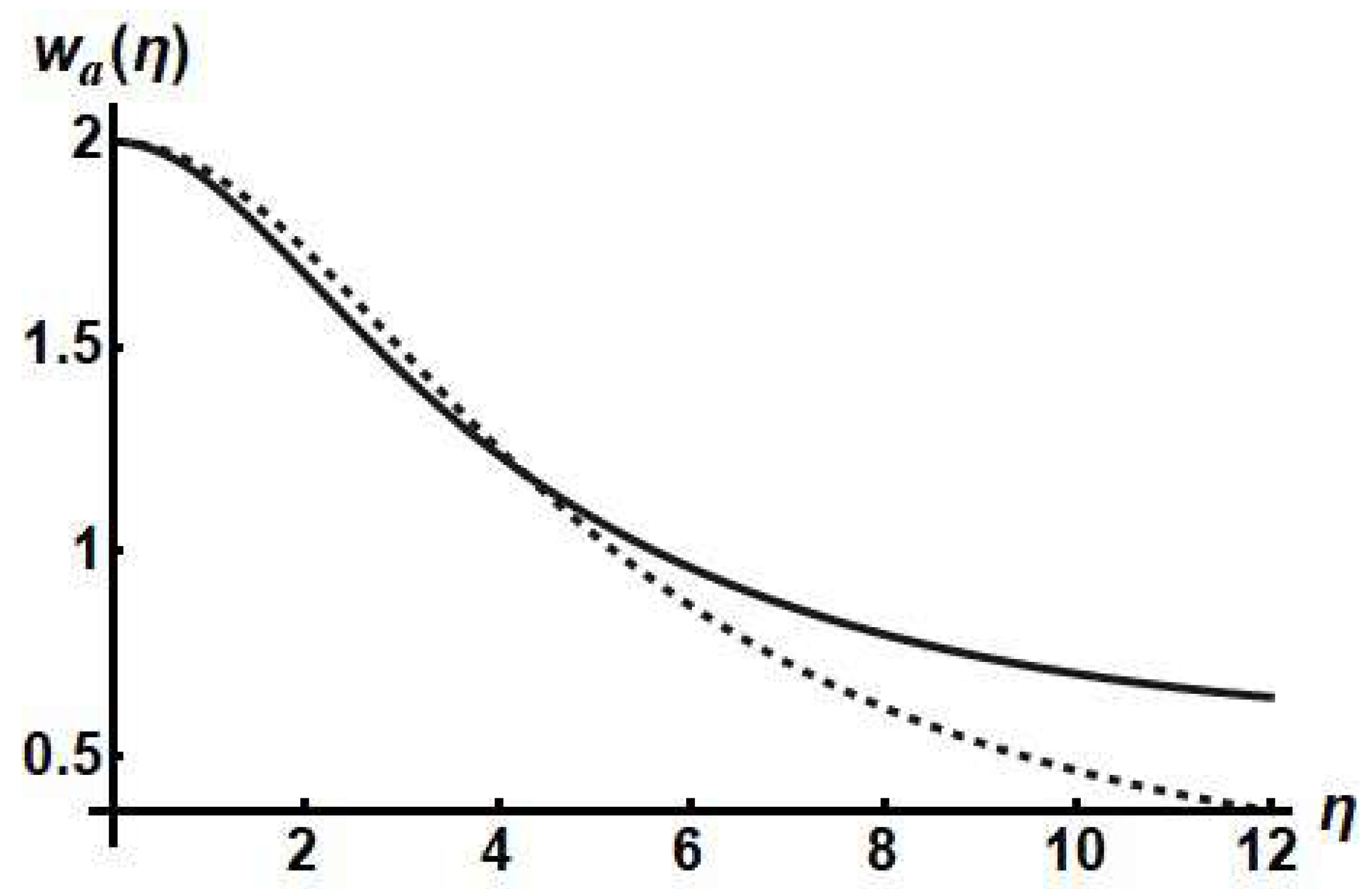
The exact numerical solution of Equation (11) is shown in Figure 1 for the case where x0(η) = xm Sech(bη) cS and for some initial values of the functions w(τ,η) and ∂ηw. Here, xm is a maximal dimensionless value of the distortion of the boundary curvature, b = const. Such a solution provides one with a hint of the spatial structure of the nonlinear effect under consideration. An approximate analytical solution of Equation (13) also contributes to a better understanding of the intrinsic nature of the processes under study and can be written in the form
w a ( η ) w 00 a 2 + a 2 h ( η ) ,   w 00 = const . ,
when describing processes for which phase changes depending on the coordinate η are insignificant.
In Figure 1, the curve corresponding to Equation (14) is depicted by a dotted line. It can be seen that the approximate ratio of Formula (14) is quite close to the exact solution (11) for the selected values of the chosen parameters. Equation (14) describes the nonlinear velocity of electrons in the general case for any given form of plasma surface distortion. With the help of Equation (7), one is able to calculate the value of the electrostatic potential.
The above calculations show that the curvature of the plasma boundary causes a localized perturbation of the NSC when surface waves localized near the boundary encounter an obstacle in the form of a distortion of the shape of the surface along which they propagate. The electrostatic field associated with this disturbance, determined by the ratio of Equation (7), can provide significant information about the current state of the plasma in this region.
It should be noted that in the case where the surface wave propagates along the 0Y axis, i.e., w = w a ( η ) cos ( ω τ k ζ ) , the approximate solution of Equation (11) is quite close to the expression (14) under the conditions |δω| << 1, k >> |dηln(x0)|, where k = const.

3.2. Interaction of a Localized Beam of Surface Waves with the Static Curvatures of the Plasma Surface

In the case where the above-considered curvature of the plasma boundary, described by the equation x = x0(η) ≡ xm Sech(bη) cS and an electrostatic surface wave of the form
F ( τ , ζ , η ) = F a ( η ) cos ( ω τ k ζ ) , k = const . . ,
the solution of Equation (11) can be found in a similar way to the method used in the one-dimensional model discussed in Section 3.1 just above. This means that both sides of Equation (11) must be multiplied by the factor cos(ωτ-kζ) and then averaged over the period 2π/ω.
As a result, the equation
d η { a 2 F a 3 + ( 1 + a 2 h ) F a ( d η F a ) 2 } = 4 k 3 δ ω F a ,
is obtained under conditions where the fulfillment of the inequality k >> |dηln(x0)| makes it possible to significantly simplify the problem.
An approximate solution of Equation (16) for the function wa = dηFa in the region η > 0 is as follows:
w a ( η ) w c [ η 0 + η a 1 b x m 2 6 th 3 ( b η ) ] 1 / 3 [ 1 a 1 b x m 2 2 sh 2 ( b η ) ch 4 ( b η ) ] , w c , η 0 = const . .
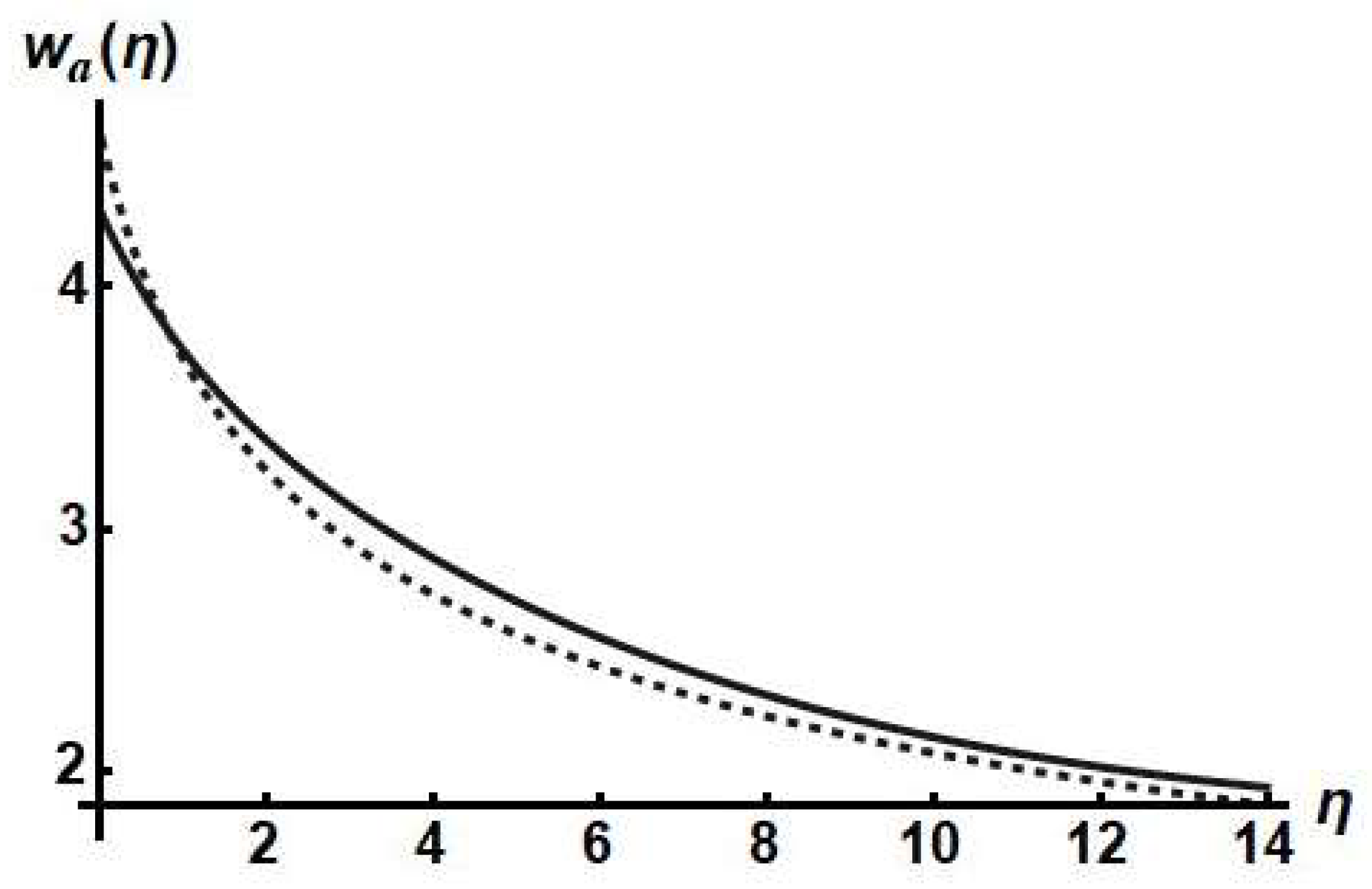
Function (17) and the exact solution of Equation (16) are shown in Figure 2.
As can be seen from Figure 2, the approximation and the exact solution of Equation (16) reveal an acceptable coincidence. For η < 0 area, to describe the function wa(η) in Equation (17), it is necessary to replace η0 −η0.
Thus, with the one-dimensional curvature of the plasma boundary, a beam of surface waves localized along the direction of the strain gradient can propagate along it. The electrostatic field of waves in the cross-section of such a beam has a spatial structure that depends on the shape of the curvature of the plasma surface. The features of such a structure, as described in this paper, can be useful in carrying out appropriate assessments and calculations carried out for the implementation of diagnostic and other goals.

3.3. Interaction of the Surface Charge with Static, Azimuthal-Homogeneous Curvature of the Plasma Surface

In the presence of a static, azimuthal-homogeneous curvature of the plasma boundary, its description is carried out in a cylindrical coordinate system with the polar axis along the 0x axis, where y = ρ cosθ and z = ρ sinθ, where ρ and θ are the radius and azimuth angle, respectively. In this case, the surface equation has the form x = x0(ρ) and the original system (10) transforms into the equation
τ , τ 2 w + 1 η η { η [ τ w + η ( ( a 2 + a 2 h ) w 2 ) ] w } + w = 0
with η = ρ ωS/c and h = [dρx0(η)] 2,, which, as was shown in paper [12], in the area of ρ |dρln(x0)| > 1 of a most interest, takes quite a simple form.
The search for the spatial distribution of the electrostatic fields of surface charge oscillations in the presence of an azimuthal-homogeneous perturbation of the plasma boundary can be found via the method used in this paper when considering a one-dimensional model, i.e., in the form of Equation (12). As a result, for the amplitude wa(η) after averaging over the period 2π/ω from Equation (18), one obtains the following equation:
1 η d η η w a d η [ ( a 2 + a 2 h ) w a 2 ] + δ ω   w a = 0 .
An approximate solution to Equation (19) can be represented by the following formula:
w a ( η ) w 00 η [ a 2 + a 2 h ( η ) ] , w 00 = const .
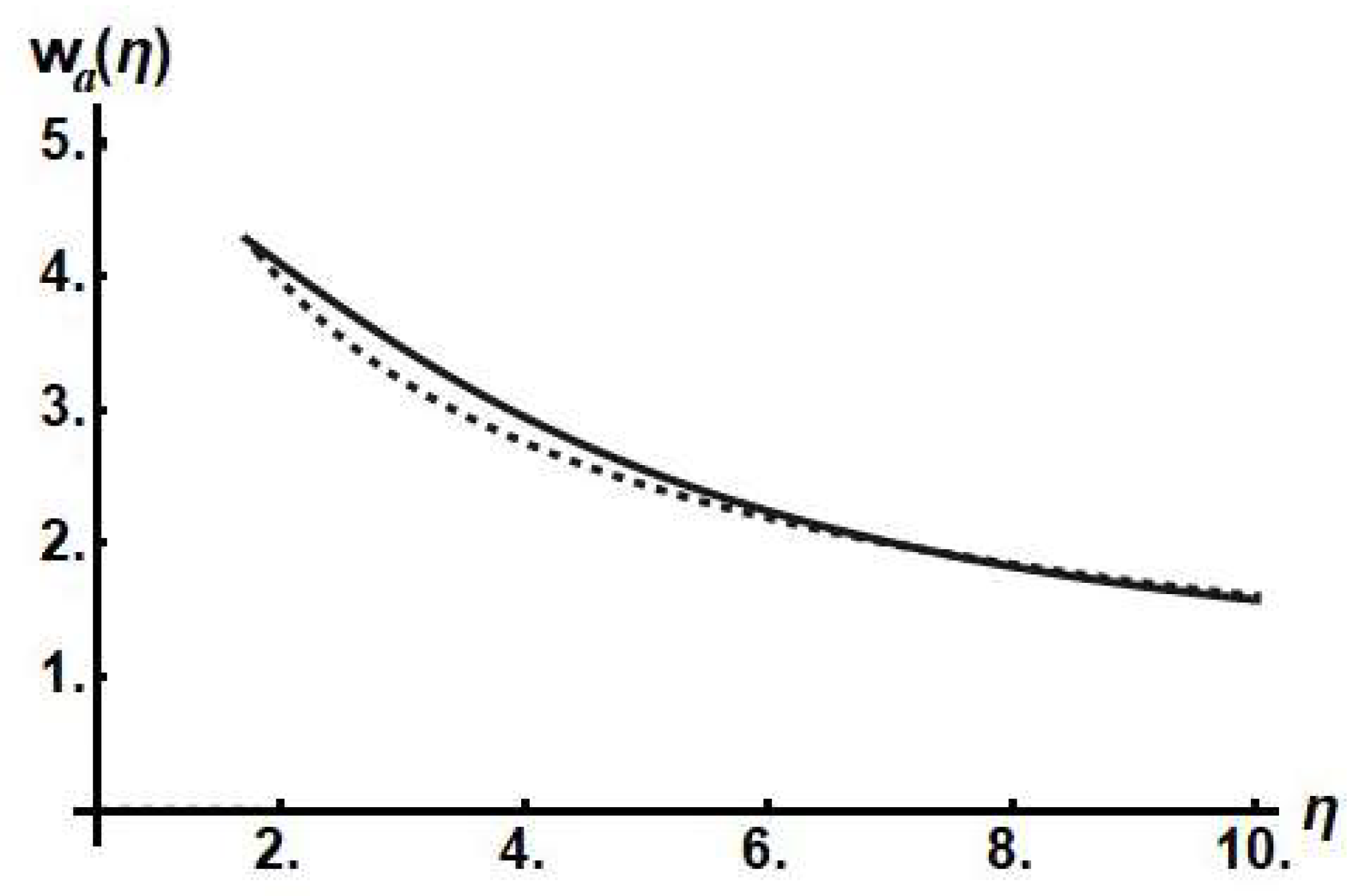
The exact solution to Equation (19) and its approximate solution (20) are shown in Figure 3, where the curve of Equation (20) is shown by the dotted line. One can see that they match.
As follows from Equation (20), the character of the localization of NSC parameters is of a power-law nature outside the region of noticeable curvature of the plasma surface, i.e., the perturbations of the electrostatic fields of the surface charge oscillations retain a sufficiently high intensity in the region of the plasma surface even when far away relative to the place of curvature of the boundary. Similarly to the remark in Section 3.1 above made for the one-dimensional model, it can also be pointed out that in the case where the surface wave propagates along the radius, i.e., w = w a ( η ) cos ( ω τ k η ) , the approximate solution of Equation (19) is functionally similar to the above Equation (20) when the following inequalities are met: |δω| << 1, k >> |dηln(x0)|, where k = const.
Based on the results of the calculations, it can be concluded that the azimuthal-homogeneous curvature of the plasma surface has a significant influence on the spatial structure of the NSC. The perturbation of electrostatic fields and other NSC parameters slowly decreases with an increase in the radius measured from the center of curvature, according to the power law. This characteristic feature of the interaction of plasma boundary deformation with NSC may be helpful in solving diagnostic and other applied problems.

4. Discussion

The model of cold plasma with a sharp boundary is able to describe, in general, those effects that have a scale exceeding the size of the inhomogeneous transition layer between the main volume of plasma and the environment. Such a model makes it possible to study various phenomena at the plasma boundary and, in particular, to study the features of surface waves, and helps to implement their use for practical purposes [17,18]. It is understandable that, in reality, the surface of the plasma boundary undergoes constant changes, which may have a decisive impact on various processes under study. This aspect of the problem of the influence of variability in the shape of the boundary on various kinds of interactions in plasma is little studied but is of unquestionable interest.
The main goal of this paper was to describe the characteristics of electrostatic fields and the motion of charged particles when exciting surface oscillations in the presence of surface plasma curvature using straightforward analytical formulas. The existence of such a description is crucial both for determining the possibility of using the effect in question for specific applications and for exciting it on the plasma surface, which requires knowledge of the features of the structure of electrostatic fields. To obtain such a description, a time averaging method was used, which allows for extracting the main features of the phenomenon and eliminating unnecessary details of the exact solution. The obtained general nonlinear solutions for arbitrary shapes of plasma surface curvature provide complete information about the characteristics of the nonlinear effect under consideration and may be of high help when conducting either experimental studies or in practical applications.
The consideration of the effect of plasma boundary deformation on some properties of nonlinear surface oscillations undertaken in this paper is aimed at identifying individual features of this interaction and can be regarded as an attempt to take a step towards setting up and developing consideration of the dynamism of the boundary shape in the study of various phenomena in plasma. The analysis of the effect of the curvature of the plasma boundary on the parameters of surface oscillations shows the nature and level of changes in the characteristics of the NSC in different cases of interaction implementation. The examples given here confirm the importance and significance of such studies and show the relevance of taking into account the effects under consideration. There is every reason to believe that taking into account the effects of the deformation of the plasma boundary on various processes leads to the discovery of underlying phenomena and to bring various scientific and practically significant results of high interest. These can be expected to range from the generalization of the NSC theory to the study of quantum effects [19], perspective numerical schemes [20], and the design and production [21] of new functional materials and processes.

Funding

This research received no external funding.

Data Availability Statement

Data sharing is not applicable to this article as no datasets were generated or analyzed during the current study.

Acknowledgments

The publication was carried out within the State Assignment on Fundamental Research to the Kurnakov Institute of General and Inorganic Chemistry of Russian Academy of Sciences. The author is deeply grateful to Lennart Stenflo for fruitful joint scientific work for many years and expresses full confidence that his scientific results will be useful to scientists in their work on new and interesting scientific discoveries for many years to come.

Conflicts of Interest

The author declares no conflicts of interest.

References

  1. Gradov, O.M.; Stenflo, L. Linear theory of a cold bounded plasma. Phys. Rep. 1983, 94, 111–137. [Google Scholar] [CrossRef]
  2. Stenflo, L. Theory of nonlinear plasma surface waves. Phys. Scripta 1996, T63, 59–62. [Google Scholar] [CrossRef]
  3. Ma, J.Z.G.; Hirose, A. Parallel propagation of ion solitons in magnetic flux tubes. Phys. Scr. 2009, 79, 045502. [Google Scholar] [CrossRef]
  4. Vladimirov, S.V.; Yu, M.Y.; Tsytovich, V.N. Recent advances in the theory of nonlinear surface-waves. Phys. Rep. 1994, 241, 1–63. [Google Scholar] [CrossRef]
  5. Gradov, O.M.; Stenflo, L. Basic properties of nonlinear surface charge waves at a plasma boundary. Phys. Lett. A 2018, 382, 3083–3085. [Google Scholar] [CrossRef]
  6. Jeffreys, H.; Jeffreys, B. Methods of Mathematical Physics; Cambridge University Press: Cambridge, UK, 1999. [Google Scholar] [CrossRef]
  7. Riley, K.F.; Hobson, M.P.; Bence, S.J. Mathematical Methods for Physics and Engineering; Cambridge University Press: Cambridge, UK, 2006. [Google Scholar] [CrossRef]
  8. Stone, M. Methods of Mathematical Physics; Primader–Casaubon: London, UK, 2007. [Google Scholar]
  9. Gradov, O.M. Nonlinear behavior of a surface charge on the curved plasma boundary with a moving cavity. Phys. Lett. A 2020, 384, 126566. [Google Scholar] [CrossRef]
  10. Gradov, O.M. Self-consistent plasma boundary distortions during the interaction of a normally incident electromagnetic beam and a nonlinear surface charge. Chin. J. Phys. 2021, 72, 360–365. [Google Scholar] [CrossRef]
  11. Gradov, O.M. Generation of electromagnetic resonators and strong electrostatic fields at the plasma boundary by a beam of powerful radiation. Phys. Lett. A. 2022, 446, 128275. [Google Scholar] [CrossRef]
  12. Gradov, O.M. Features of propagation and properties of axially symmetric and azimuthal solitary waves on the curved surface of a halfspace cold plasma. Phys. Plasmas 2024, 31, 070705. [Google Scholar] [CrossRef]
  13. Brodin, G.; Stenflo, L. Large amplitude electron plasma oscillations. Phys. Lett. A 2014, 378, 1632–1635. [Google Scholar] [CrossRef]
  14. Vladimirov, S.V.; Yu, M.Y.; Stenflo, L. Surface wave solitons in an electronic medium. Phys. Lett. A 1993, 174, 313–316. [Google Scholar] [CrossRef]
  15. Yu, M.Y.; Zhelyazkov, I. Solitary surface waves. J. Plasma Phys. 1978, 20, 183. [Google Scholar] [CrossRef]
  16. Novikov, S.; Manakov, S.V.; Pitaevskii, L.P.; Zakharov, V. Theory of Solitons: The Inverse Scattering Method; Springer Science+Business Media, Consultants Bureau: New York, NY, USA, 1984. [Google Scholar]
  17. Stafford, L.; Boudreault, O.; Khare, R.; Donnelly, V.M.; Margot, J.; Moisan, M. Electron energy distribution functions in low-pressure oxygen plasma columns sustained by propagating surface waves. Appl. Phys. Lett. 2009, 94, 021503. [Google Scholar] [CrossRef]
  18. Moisan, M.; Grenier, R.; Zakrzewski, Z. The electromagnetic performance of a surfatron-based coaxial microwave plasma torch. Spectrochim. Acta B Atomic Spectrosc. 1995, 50, 781–789. [Google Scholar] [CrossRef]
  19. Shahmansouri, M.; Aboltaman, R.; Misra, A.P. Surface plasmons in a semi-bounded massless Dirac plasma. Phys. Lett. A 2018, 382, 2133–2136. [Google Scholar] [CrossRef]
  20. Verma, P.S. A novel numerical scheme for nonlinear electron plasma oscillations. Phys. Plasmas 2018, 25, 032107. [Google Scholar] [CrossRef]
  21. Ye, L.; Zhang, Y.; Zhang, X.; Hu, T.; Ji, R.; Ding, B.; Jiang, B. Sol–gel preparation of SiO2/TiO2/SiO2–TiO2 broadband antireflective coating for solar cell cover glass. Sol. Energy Mater. Sol. Cells 2013, 111, 160–164. [Google Scholar] [CrossRef]
Figure 1. Spatial behavior of the velocity amplitude wa(η) of electrons in dependence on the variable η along the plasma surface deformation b = 0.15, w00 = 1.4, xm = 5), and at the initial values wa(0) = 2, and dwa/dη|η =0 = 0. The exact function (13) is depicted by the solid line, and the auxiliary function (14) is depicted by the dotted line.
Physics 07 00053 g001
Figure 2. Spatial dependence of the amplitude wa(η) of the electron velocity for the initial values wa(0) = 4.5 and dwa/dη|η=0 = 0, and the parameters η0 = 1 and wc = 4.5, and the values as in Figure 1. The exact solution of Equation (16) is depicted by the solid line and the approximate solution (17) is depicted by the dotted line.
Physics 07 00053 g002
Figure 3. Spatial distribution of the amplitude of the electron velocity wa(η) in the case of the azimuthal-homogeneous curvature of the plasma boundary under the conditions wa(1) = 5 and dwa/dη|η =0.5 = − 0.2, with the values of other parameters as in Figure 1. The exact solution of Equation (19) is depicted by the solid line and the approximate solution (20) is depicted by the dotted line.
Physics 07 00053 g003
Disclaimer/Publisher’s Note: The statements, opinions and data contained in all publications are solely those of the individual author(s) and contributor(s) and not of MDPI and/or the editor(s). MDPI and/or the editor(s) disclaim responsibility for any injury to people or property resulting from any ideas, methods, instructions or products referred to in the content.