

Research Progress on Intelligent Fault Recognition Technology in Seismic Exploration


Abstract
1. Introduction
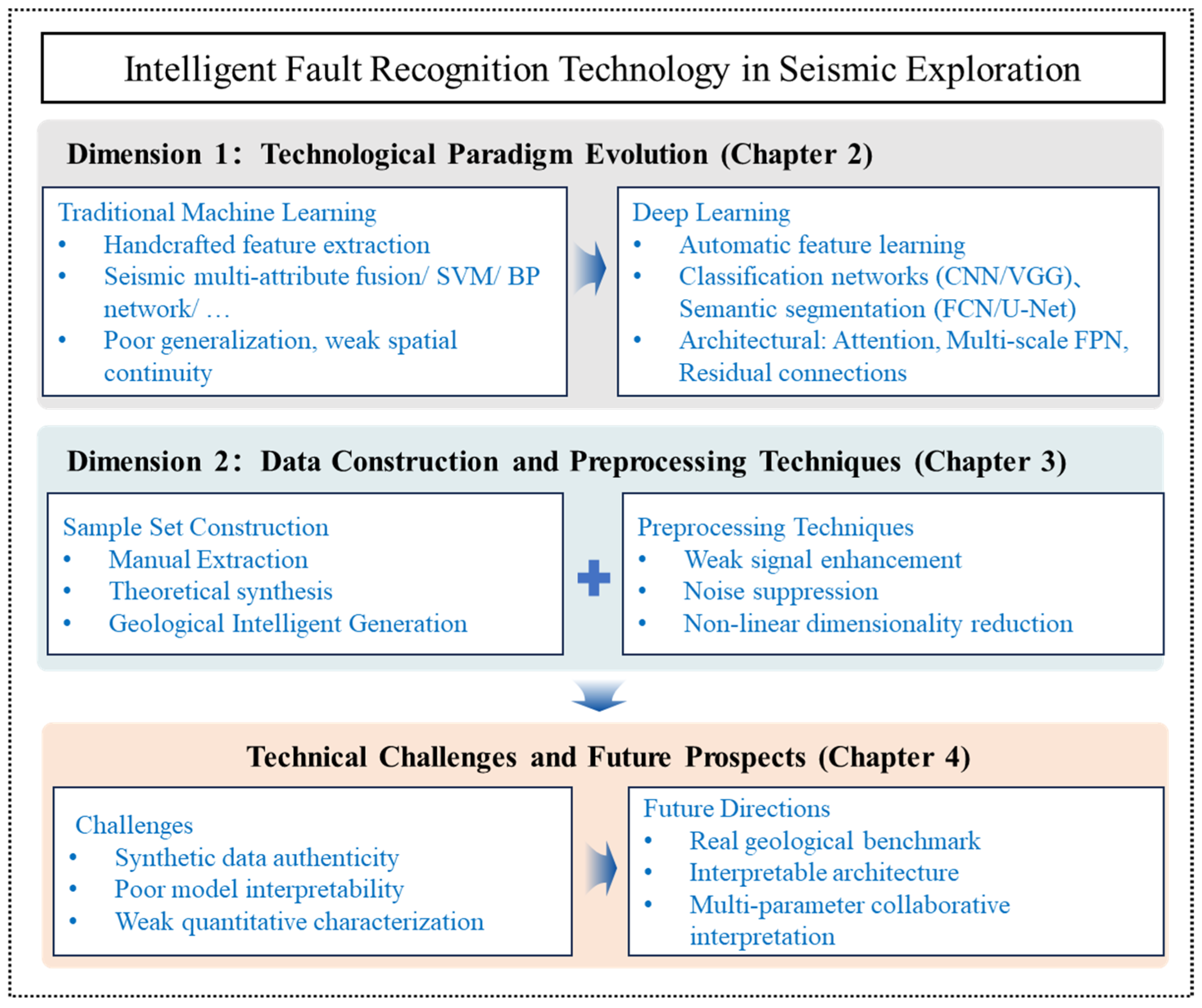
2. The Development of AI Driving Progress in Fault Recognition Technology
2.1. Traditional Machine Learning Methods Based on Seismic Attributes
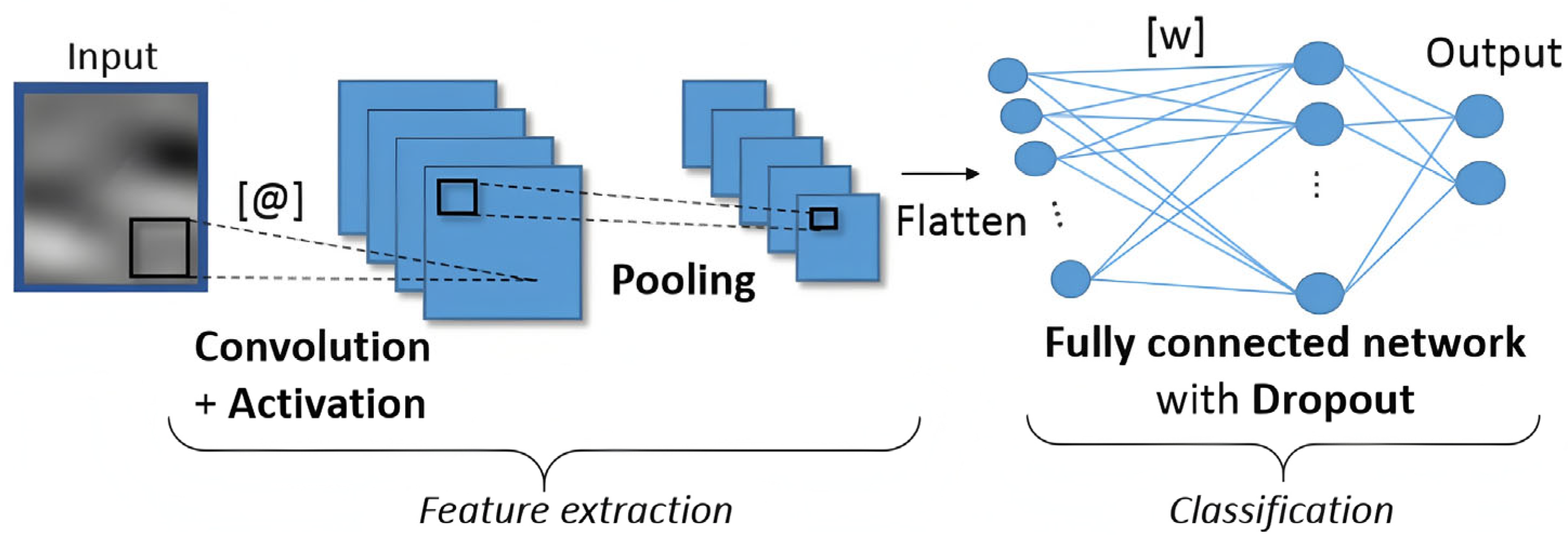
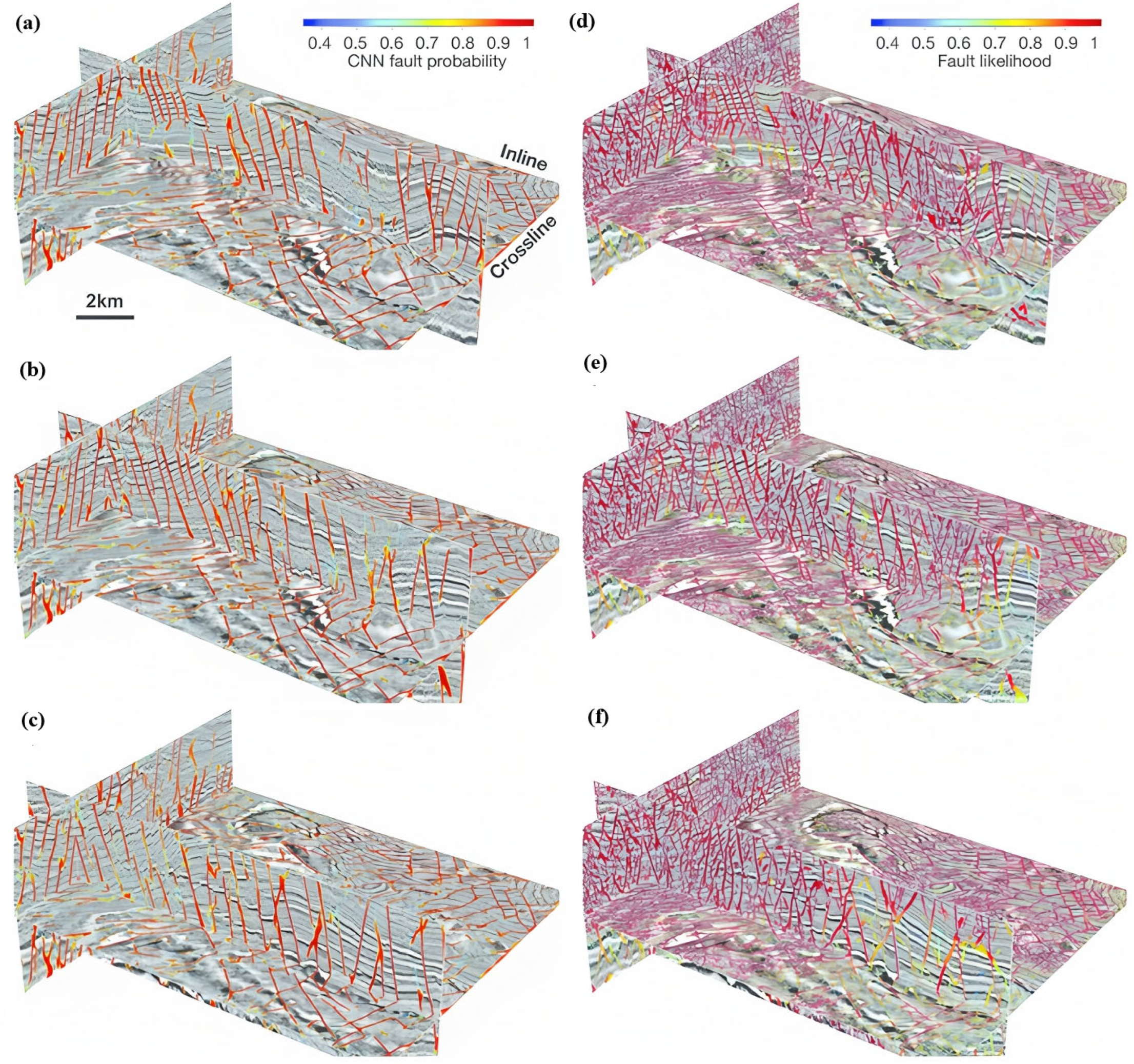
2.2. End-to-End Recognition Based on Deep Learning
3. Data Construction and Preprocessing Techniques
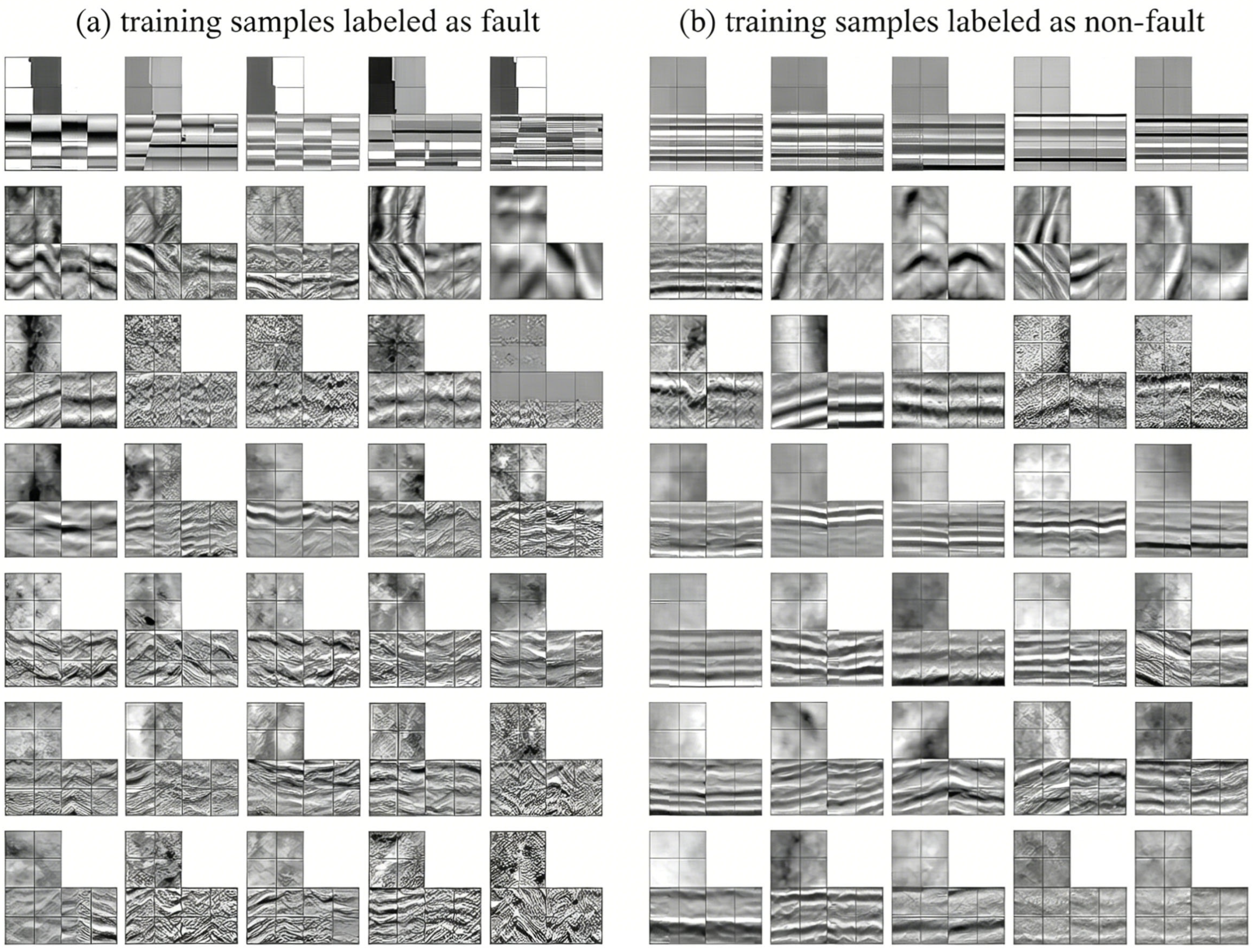
3.1. Sample Set Construction: From Manual Extraction to Theoretical Synthesis and Geological Intelligent Generation
3.2. Data Preprocessing Techniques: Weak Signal Enhancement and Noise Suppression
4. Technical Challenges and Future Prospects
4.1. Constructing Benchmark Datasets for Real Geological Evolution
4.2. Developing Interpretable Model Architectures Incorporating Geological Prior Knowledge
4.3. Achieving Multi-Parameter Collaborative Fault System Interpretation
5. Conclusions
Author Contributions
Funding
Data Availability Statement
Conflicts of Interest
Abbreviations
| CNN | Convolutional Neural Networks |
| SVM | Support Vector Machines |
| FCN | Fully Convolutional Network |
| FPN | Feature Pyramid Network |
| MLP | Multilayer Perceptron |
| DNN | Deep Neural Network |
| GAN | Generative Adversarial Network |
| SNR | Signal-to-Noise Ratio |
| PCA | Principal Component Analysis |
| LLE | Locally Linear Embedding |
| GNN | Graph Neural Network |
References
- Brown, A.R.; Edwards, G.S.; Howard, R.E. Fault slicing—A new approach to the interpretation of fault detail. Geophysics 1987, 52, 1319–1327. [Google Scholar] [CrossRef] [Scilit]
- Zeng, H.; Backus, M.M.; Barrow, K.T.; Tyler, N. Stratal slicing; Part 1, Realistic 3-D seismic model. Geophysics 1998, 63, 502–513. [Google Scholar] [CrossRef] [Scilit]
- Marfurt, K.J.; Kirlin, R.L.; Farmer, S.L.; Bahorich, M.S. 3-D seismic attributes using a semblance-based coherency algorithm. Geophysics 1998, 63, 1150–1165. [Google Scholar] [CrossRef] [Scilit]
- Marfurt, K.J.; Sudhaker, V.; Gersztenkorn, A.; Crawford, K.D.; Nissen, S.E. Coherency calculations in the presence of structural dip. Geophysics 1999, 64, 104–111. [Google Scholar] [CrossRef] [Scilit]
- Van Bemmel, P.P.; Pepper, R.E. Seismic Signal Processing Method and Apparatus for Generating a Cube of Variance Values. U.S. Patent 6,151,555, 21 November 2000. [Google Scholar]
- Boe, T.H.; Daber, R. Seismic features and the human eye: RGB blending of azimuthal curvatures for enhancement of fault and fracture interpretation. In SEG Technical Program Expanded Abstracts; Society of Exploration Geophysicists: Tulsa, OK, USA, 2010; pp. 1535–1539. [Google Scholar] [CrossRef] [Scilit]
- Wei, X.; Zhang, C.; Kim, S.; Jing, K.; Wang, Y.; Xu, S.; Xie, Z. Seismic fault detection using convolutional neural networks with focal loss. Comput. Geosci. 2022, 158, 104968. [Google Scholar] [CrossRef] [Scilit]
- Shi, Y.; Wang, Y.; Lu, J. Application of seismic multi-attribute analysis technique in coalfield. J. China Coal Soc. 2008, 33, 1397–1402. [Google Scholar] [CrossRef]
- Li, Y.F.; Cheng, J.Y.; Zhu, S.J.; Wang, C. Seismic multi-attribute analysis based on RGB color blending technology. J. China Coal Soc. 2009, 34, 1512–1516. [Google Scholar] [CrossRef]
- Neves, F.A.; Triebwasser, H. Multi-attribute seismic volume facies classification for predicting fractures in carbonate reservoirs. Lead. Edge 2006, 25, 698–700. [Google Scholar] [CrossRef] [Scilit]
- Neves, F.A.; Zahrani, M.S.; Bremkamp, S.W. Detection of potential fractures and small faults using seismic attributes. Lead. Edge 2004, 23, 903–906. [Google Scholar] [CrossRef] [Scilit]
- Randen, T.; Pedersen, S.I.; Sønneland, L. Automatic extraction of fault surfaces from three-dimensional seismic data. In Proceedings of the SEG International Exposition and Annual Meeting, San Antonio, TX, USA, 9–14 September 2001; Volume 551. [Google Scholar] [CrossRef] [Scilit]
- Admasu, F.; Back, S.; Toennies, K. Autotracking of faults on 3D seismic data. Geophysics 2006, 71, A49–A53. [Google Scholar] [CrossRef] [Scilit]
- Hale, D. Methods to compute fault images, extract fault surfaces, and estimate fault throws from 3D seismic images. Geophysics 2013, 78, O33–O43. [Google Scholar] [CrossRef] [Scilit]
- Yang, J.; Ding, R.; Lin, N.; Zhao, L.; Zhao, S.; Zhang, Y.; Zhang, J. Research progress of intelligent identification of seismic faults based on deep learning. Prog. Geophys. 2022, 37, 298–311. (In Chinese) [Google Scholar] [CrossRef]
- Zhang, L.; Meng, Y.; Qi, L.; Alimujiang, A.; Dai, J.; Li, A.; Zhang, L. Research progress of fault identification technology based on seismic data. Prog. Geophys. 2025, 40, 208–219. (In Chinese) [Google Scholar] [CrossRef]
- Rumelhart, D.E.; McClelland, J.L.; PDP Research Group. Parallel Distributed Processing, Volume 1: Explorations in the Microstructure of Cognition: Foundations; The MIT Press: Cambridge, MA, USA, 1986. [Google Scholar]
- Rumelhart, D.E.; Hinton, G.E.; Williams, R.J. Learning internal representation by back-propagation errors. Nature 1986, 323, 533–536. [Google Scholar] [CrossRef] [Scilit]
- Dong, S.; Shi, Y.; Wang, Y. Automatic recognition of small fault by BP artificial nervous network from multiple seismic parameters. J. China Univ. Min. Technol. 1997, 26, 16–20. [Google Scholar]
- Tingdahl, K.M.; Steen, Ø.; Meldahl, P.; Ligtenberg, J.H. Semi-automatic detection of faults in 3-D seismic signals. In SEG Technical Program Expanded Abstracts 2001; Society of Exploration Geophysicists: Tulsa, OK, USA, 2001; pp. 1953–1956. [Google Scholar] [CrossRef] [Scilit]
- Tingdahl, K.M.; De Rooij, M. Semi-automatic detection of faults in 3D seismic data. Geophys. Prospect. 2005, 53, 533–542. [Google Scholar] [CrossRef] [Scilit]
- Di, H.; Shafiq, M.; AlRegib, G. Patch-level MLP classification for improved fault detection. In SEG Technical Program Expanded Abstracts 2018; Society of Exploration Geophysicists: Tulsa, OK, USA, 2018; pp. 2211–2215. [Google Scholar] [CrossRef] [Scilit]
- Di, H.; Shafiq, M.A.; AlRegib, G. Seismic-fault detection based on multiattribute support vector machine analysis. In Proceedings of the SEG International Exposition and Annual Meeting, Houston, TX, USA, 24–29 September 2017. [Google Scholar] [CrossRef] [Scilit]
- Tan, X.; Shi, L.; Qiu, M.; Xu, D.; Ji, X.; Wang, J. Forecast of small fault based on SVM in Zhaoguan mine. Coal Geol. Explor. 2015, 43, 11–14. [Google Scholar] [CrossRef]
- Zheng, Z.H.; Kavousi, P.; Di, H.B. Multi-attributes and neural network-based fault detection in 3D seismic interpretation. Adv. Mater. Res. 2014, 838, 1497–1502. [Google Scholar] [CrossRef] [Scilit]
- Sun, Z.; Peng, S.; Zou, G. Automatic identification of small faults based on SVM and seismic data. J. China Coal Soc. 2017, 42, 2945–2952. [Google Scholar] [CrossRef]
- Zheng, Q.; Chen, G.; Jiao, A. Chatter detection in milling process based on the combination of wavelet packet transform and PSO-SVM. Int. J. Adv. Manuf. Technol. 2022, 120, 1237–1251. [Google Scholar] [CrossRef] [Scilit]
- Jiao, B.; Xu, Z.X. Nonlinear inertia weigh particle swarm optimization combines simulated annealing algorithm and application in function and SVM optimization. Appl. Mech. Mater. 2012, 130–134, 3467–3471. [Google Scholar] [CrossRef] [Scilit]
- Katoch, S.; Chauhan, S.S.; Kumar, V. A review on genetic algorithm: Past, present, and future. Multimed. Tools Appl. 2021, 80, 8091–8126. [Google Scholar] [CrossRef] [Scilit]
- Ren, K.; Zou, G.; Peng, S.; Yeh, H.G.; Deng, B.; Ji, Y. Fault identification based on the kernel principal component analysis-genetic particle swarm optimization-support vector machine algorithm for seismic attributes in the Sihe Coal Mine, Qinshui Basin, China. Interpretation 2023, 11, 59–73. [Google Scholar] [CrossRef] [Scilit]
- Ren, K.; Zou, G.; Zhang, S.; Peng, S.; Gong, F.; Liu, Y. Fault identification and reliability evaluation using an SVM model based on 3-D seismic data volume. Geophys. J. Int. 2023, 234, 755–768. [Google Scholar] [CrossRef] [Scilit]
- Chen, L.; Xiao, C.; Li, X.; Wang, Z.; Huo, S. A seismic fault recognition method based on ant colony optimization. J. Appl. Geophys. 2018, 152, 1–8. [Google Scholar] [CrossRef] [Scilit]
- Zhao, T.; Jayaram, V.; Roy, A.; Marfurt, K. A comparison of classification techniques for seismic facies recognition. Interpretation 2015, 3, SAE29–SAE58. [Google Scholar] [CrossRef] [Scilit]
- Lou, Y.; Zhang, B.; Wang, R.; Lin, T.; Cao, D. Seismic fault attribute estimation using a local fault model. Geophysics 2019, 84, O73–O80. [Google Scholar] [CrossRef] [Scilit]
- Wang, X.; Cui, R.; Chen, T. Method to predict coal seam thickness and small fault using RS and NN. Coal Geol. Explor. 2010, 38, 66–68+72. [Google Scholar] [CrossRef]
- Esmaeili, H.; Bagheri, M.; Esmaeili, S. Integrating multiple seismic attributes for fault detection using a new hybrid machine learning. Sci. Rep. 2025, 15, 42744. [Google Scholar] [CrossRef] [Scilit]
- AlRegib, G.; Deriche, M.; Long, Z.; Di, H.; Wang, Z.; Alaudah, Y.; Shafiq, M.A.; Alfarraj, M. Subsurface structure analysis using computational interpretation and learning: A visual signal processing perspective. IEEE Signal Process. Mag. 2018, 35, 82–98. [Google Scholar] [CrossRef] [Scilit]
- Duan, Y.; Zheng, X.; Hu, L.; Wu, C. Fault detection based on 3D semi-dense convolutional neural network. Prog. Geophys. 2019, 34, 2256–2261. (In Chinese) [Google Scholar] [CrossRef]
- Li, S.; Yang, C.; Sun, H.; Zhang, H. Seismic fault detection using an encoder-decoder convolutional neural network with a small training set. J. Geophys. Eng. 2019, 16, 175–189. [Google Scholar] [CrossRef] [Scilit]
- Araya-Polo, M.; Dahlke, T.; Frogner, C.; Zhang, C.; Poggio, T.; Hohl, D. Automated fault detection without seismic processing. Lead. Edge 2017, 36, 208–214. [Google Scholar] [CrossRef] [Scilit]
- Huang, L.; Dong, X.; Clee, T.E. A scalable deep learning platform for identifying geologic features from seismic attributes. Lead. Edge 2017, 36, 249–256. [Google Scholar] [CrossRef] [Scilit]
- Pochet, A.; Diniz, P.H.B.; Lopes, H.; Gattass, M. Seismic fault detection using convolutional neural networks trained on synthetic poststacked amplitude maps. IEEE Geosci. Remote Sens. Lett. 2018, 16, 352–356. [Google Scholar] [CrossRef] [Scilit]
- Guo, B.; Li, L.; Luo, Y. A new method for automatic seismic fault detection using convolutional neural network. In Proceedings of the SEG International Exposition and Annual Meeting, Anaheim, CA, USA, 14–19 October 2018. [Google Scholar] [CrossRef] [Scilit]
- Xiong, W.; Ji, X.; Ma, Y.; Wang, Y.; AlBinHassan, N.M.; Ali, M.N.; Luo, Y. Seismic fault detection with convolutional neural network. Geophysics 2018, 83, O97–O103. [Google Scholar] [CrossRef] [Scilit]
- Long, J.; Shelhamer, E.; Darrell, T. Fully convolutional networks for semantic segmentation. In Proceedings of the IEEE Conference on Computer Vision and Pattern Recognition, Boston, MA, USA, 7–12 June 2015; pp. 3431–3440. [Google Scholar] [CrossRef] [Scilit]
- Liu, Z.J.; He, X.L.; Zhang, Z.H.; Zhou, Y.Q.; Zhang, S. Low-order fault identification technique based on 3D U-Net full convolutional neural network (CNN). Prog. Geophys. 2021, 36, 2519–2530. (In Chinese) [Google Scholar] [CrossRef]
- Ronneberger, O.; Fischer, P.; Brox, T. U-net: Convolutional networks for biomedical image segmentation. In Proceedings of the Medical Image Computing and Computer-Assisted Intervention—MICCAI 2015, Munich, Germany, 5–9 October 2015; Springer: Cham, Switzerland, 2015; pp. 234–241. [Google Scholar] [CrossRef] [Scilit]
- Wu, X.; Liang, L.; Shi, Y.; Fomel, S. FaultSeg3D: Using synthetic data sets to train an end-to-end convolutional neural network for 3D seismic fault segmentation. Geophysics 2019, 84, IM35–IM45. [Google Scholar] [CrossRef] [Scilit]
- Wu, X.; Shi, Y.; Fomel, S.; Liang, L.; Zhang, Q.; Yusifov, A.Z. FaultNet3D: Predicting fault probabilities, strikes, and dips with a single convolutional neural network. IEEE Trans. Geosci. Remote Sens. 2019, 57, 9138–9155. [Google Scholar] [CrossRef] [Scilit]
- Wu, J.; Shi, Y.; Wang, K.; Yang, C.; Yang, Q. Automatic seismic fault identification based on an improved U-Net network. Acta Geophys. 2024, 72, 2377–2389. [Google Scholar] [CrossRef] [Scilit]
- Li, X.; Li, K.; Xu, Z.; Huang, Z.; Dou, Y. Fault-Seg-Net: A method for seismic fault segmentation based on multi-scale feature fusion with imbalanced classification. Comput. Geotech. 2023, 158, 105412. [Google Scholar] [CrossRef] [Scilit]
- Chen, R.; Zhang, Z.; Ma, J. Seismic Fault SAM: Adapting SAM with lightweight modules and 2.5D strategy for fault detection. arXiv 2024, arXiv:2407.14121. [Google Scholar] [CrossRef] [Scilit]
- Lu, P.; Morris, M.; Brazell, S.; Comiskey, C.; Xiao, Y. Using generative adversarial networks to improve deep-learning fault interpretation networks. Lead. Edge 2018, 37, 578–583. [Google Scholar] [CrossRef] [Scilit]
- Di, H.; Shafiq, M.A.; Wang, Z.; AlRegib, G. Improving seismic fault detection by super-attribute-based classification. Interpretation 2019, 7, SE251–SE267. [Google Scholar] [CrossRef] [Scilit]
- Wu, X.; Geng, Z.; Shi, Y.; Pham, N.; Fomel, S.; Caumon, G. Building realistic structure models to train convolutional neural networks for seismic structural interpretation. Geophysics 2020, 85, WA27–WA39. [Google Scholar] [CrossRef] [Scilit]
- Li, Y.; Ku, B.; Zhang, S.; Ahn, J.K.; Ko, H. Seismic data augmentation based on conditional generative adversarial networks. Sensors 2020, 20, 6850. [Google Scholar] [CrossRef] [Scilit]
- Wang, T.; Trugman, D.; Lin, Y. SeismoGen: Seismic waveform synthesis using GAN with application to seismic data augmentation. J. Geophys. Res. Solid Earth 2021, 126, e2020JB020077. [Google Scholar] [CrossRef] [Scilit]
- Wang, P.; Gao, J.; Wang, Z. Time-frequency analysis of seismic data using synchrosqueezing transform. IEEE Geosci. Remote Sens. Lett. 2014, 11, 2042–2044. [Google Scholar] [CrossRef] [Scilit]
- Chehrazi, A.; Rahimpour-Bonab, H.; Rezaee, M.R. Seismic data conditioning and neural network-based attribute selection for enhanced fault detection. Pet. Geosci. 2013, 19, 169–183. [Google Scholar] [CrossRef] [Scilit]
- Zou, G.; Ren, K.; Sun, Z.; Peng, S.; Tang, Y. Fault interpretation using a support vector machine: A study based on 3D seismic mapping of the Zhaozhuang coal mine in the Qinshui Basin, China. J. Appl. Geophys. 2019, 171, 103870. [Google Scholar] [CrossRef] [Scilit]
- Zhang, S.; Sun, D.; Luo, X.; Cai, Y.; Wang, J.; Wang, X.; Yan, Z.; Li, J. Artificial intelligence low grade fault identification technology and its application in BD1 Area. In Proceedings of the International Field Exploration and Development Conference, Wuhan, China, 20–22 September 2023; pp. 901–908. [Google Scholar]
- Jahan, I.; Castagna, J.; Murphy, M.; Kayali, M.A. Fault detection using principal component analysis of seismic attributes in the Bakken Formation, Williston Basin, North Dakota, USA. Interpretation 2017, 5, 361–372. [Google Scholar] [CrossRef] [Scilit]
- Zou, G.; Ding, J.; Ren, K.; Yin, C.; Dong, Q. Automatic identification method of seismic fault based on LLE and SVM. J. China Coal Soc. 2023, 48, 1634–1644. [Google Scholar] [CrossRef]



| Representative Models | Underlying Assumption | Advantage | Limitation | Data Requirement & Computational Complexity | Application Scenario |
|---|---|---|---|---|---|
| SVM/MLP | Fault features can be adequately characterized by manually designed attribute combinations | Strong interpretability; low data requirement; high computational efficiency | Feature engineering dependent; weak generalization; discrete output | Small (hundreds of samples), Low (CPU-compatible) | Simple structures, high-order faults |
| CNN/VGG | Local receptive fields are sufficient to capture fault features | Automatic feature extraction; higher accuracy than traditional methods | Discrete labels; lack spatial continuity; limited receptive field | Medium (thousands of labeled patches), Medium (GPU recommended) | Shallow to medium depth, high-order faults |
| FCN/U-Net | Fault recognition can be formulated as an image segmentation problem | End-to-end; continuous fault volumes; effective for small faults | Requires large labeled datasets; high computational demand | Large (tens of thousands of pixel-level labels), High (high-performance GPU required) | Complex structures, low-order faults, small faults |
| GAN-based Augmentation | Distribution of synthetic data aligns with real data distribution | Addresses sample scarcity; improves model generalization | Training instability; mode collapse risk | Unlabeled data sufficient, High (unstable training, time-consuming) | Scarce samples, class imbalance |
| GNN-based Modeling | Faults can be represented as graph nodes and edges | Models fault topology; enables parameter mutual constraints | Graph construction requires prior knowledge; high computational complexity | Requires fault spatial topology labels, Medium-high (graph convolution cost) | Multi-parameter joint prediction, fault system analysis |
| Study | Method | Dataset | Label Source | Main Outputs | Evaluation Metrics |
|---|---|---|---|---|---|
| Tingdahl et al. (2005) [21] | Semi-automatic neural network, multi-attributes | 3D field | Manual | Fault probability volume | Visual comparison |
| Zheng et al. (2014) [25] | MLP, ant colony algorithm | 3D field | Manual | Fault probability attribute | Single-attribute comparison |
| Xiong et al. (2018) [44] | CNN | Synthetic + field | Synthetic labels | Fault/non-fault classification | Accuracy, recall |
| Wu et al. (2018) [48] | CNN | Synthetic | Synthetic labels | Fault image | Coherence comparison |
| Lu et al. (2018) [53] | GAN | Synthetic + field | Synthetic labels | Augmented seismic data | Visual comparison |
| Wu et al. (2019) [49] | U-Net | Synthetic | Synthetic labels | Fault probability volume | Accuracy, AUC |
| Wu et al. (2019 FaultNet3D) [49] | Multi-task CNN | Synthetic | Synthetic labels | Fault probability + dip + strike | Synthetic validation |
| Li et al. (2019) [39] | U-Net | Field | Manual interpretation | Fault probability volume | Manual comparison |
| Liu et al. (2021) [46] | U-Net | 3D Field | Manual interpretation | Fault probability volume | Accuracy, continuity |
| Li et al. (2023) [51] | Fault-Seg-Net (multi-scale residual + attention) | Synthetic + field | Synthetic labels | Fault probability volume | Precision, Recall, F1-score, mIoU |
| Chen et al. (2024) [52] | Seismic Fault SAM (SAM + Adapter) | Thebe public dataset | Public dataset labels | Fault probability volume | OIS, ODS |
Disclaimer/Publisher’s Note: The statements, opinions and data contained in all publications are solely those of the individual author(s) and contributor(s) and not of MDPI and/or the editor(s). MDPI and/or the editor(s) disclaim responsibility for any injury to people or property resulting from any ideas, methods, instructions or products referred to in the content. |
© 2026 by the authors. Licensee MDPI, Basel, Switzerland. This article is an open access article distributed under the terms and conditions of the Creative Commons Attribution (CC BY) license.
Share and Cite
Ren, K.; Song, C.; Li, N.; Wang, X.; Wang, Z.; Liu, Y. Research Progress on Intelligent Fault Recognition Technology in Seismic Exploration. GeoHazards 2026, 7, 48. https://doi.org/10.3390/geohazards7020048
Ren K, Song C, Li N, Wang X, Wang Z, Liu Y. Research Progress on Intelligent Fault Recognition Technology in Seismic Exploration. GeoHazards. 2026; 7(2):48. https://doi.org/10.3390/geohazards7020048
Chicago/Turabian StyleRen, Ke, Cheng Song, Na Li, Xiaodong Wang, Zeming Wang, and Yanhai Liu. 2026. "Research Progress on Intelligent Fault Recognition Technology in Seismic Exploration" GeoHazards 7, no. 2: 48. https://doi.org/10.3390/geohazards7020048
APA StyleRen, K., Song, C., Li, N., Wang, X., Wang, Z., & Liu, Y. (2026). Research Progress on Intelligent Fault Recognition Technology in Seismic Exploration. GeoHazards, 7(2), 48. https://doi.org/10.3390/geohazards7020048