


Abstract
As the frequency and severity of extreme weather events may increase due to climate change, understanding their impacts on water systems, resources, and infrastructure becomes very important. This study contributes to the growing body of knowledge on how extreme storms and floods disrupt interrelated elements comprising water systems by examining the case of Storm Daniel, which struck the Thessaly region of Greece in September 2023. Using a multi-source approach, including field data, institutional reports, scientific assessments, and publications, the study systematically identifies and categorizes the impacts of the storm and the ensuing flood across surface waters, drinking water supply, and wastewater infrastructure and other water-related systems through various mechanisms. The findings provide an overview of how such extreme storms may affect such systems and reveal widespread, interconnected disruptions that highlight systemic vulnerabilities in both natural and engineered systems, synthesizing these impact pathways. The study presents evidence of poor resilience against extreme events and climate change hazards in water-related infrastructure.
1. Introduction
Extreme storms and subsequent flooding represents a significant and growing societal threat and one of the most destructive natural hazards [1]. Flood events intensified by the expansion of urban areas, as well as poorly developed or insufficient infrastructure, can lead to a noteworthy number of human casualties along with a diversity of impacts on property, infrastructure, the environment, and socio-economic activities. Recent extreme events around Europe [2,3,4,5] show that storm and flood risk remains ever-present across the continent. Furthermore, as extreme weather events could become more frequent due to climate change [6], the impact of floods may pose an even more serious risks to human society.
Among the various sectors affected by flooding, water systems, natural water bodies, and water-related infrastructure can be critically exposed. Evidence from past events, though fragmentary, indicates that flood events can cause disruptions to various systems related to water.
In this field, a part of research has focused on the degradation of water quality in both surface and groundwater sources following major flooding events [7]. Parameters such as dissolved oxygen (DO), biochemical oxygen demand (BOD), chemical oxygen demand (COD), pH, ammoniacal nitrogen (AN/NH3-N), total suspended solids (TSS), and total organic carbon (TOC) have been observed to fluctuate significantly after flooding events, often leading to the deterioration of water quality [8,9,10]. In addition, elevated water temperatures and increased concentrations of organic pollutants have been documented as one of the impacts of floods on water resources [11].
Flooding can also introduce large quantities of sediment carrying fixed mineral nutrients into water bodies, creating conditions favorable for eutrophication [12,13]. In some cases, initial increases in river oxygenation have occurred due to enhanced flow velocities; however, runoff from urban or agricultural areas often brings substantial pollutant loads, reversing any potential benefits [10]. Riverbank filtration systems, which rely on consistent hydraulic gradients and water quality, are also vulnerable to flood-induced disruptions [14]. The contamination of source water (by debris or sewage) has been recorded to overwhelm various water systems and force utilities to suspend or limit operations, creating risks related to everyday activities or public health [15]. Drinking water sources, especially surface waters, have been shown to be vulnerable to pollution during floods as well [15]. Groundwater aquifers have also been recorded to face risks from contaminants infiltrating through soil and subsurface layers [15,16]. Especially in urban and agricultural basins, floodwaters can carry diverse pollutants, such as heavy metals, nutrients, pathogens, and agrochemicals, through both surface and subsurface runoff [17].
Disruptions in hydraulic pressure have also shown evidence of causing backflow problems and intrusion of contaminants [18,19,20,21]. Floodwaters have been recorded in the past to cause damage to vital components of water supply systems. Especially when these systems are dependent on electricity, which may be simultaneously interrupted due to storm-related power outages, these impacts can be further increased [18,22,23].
Beyond direct infrastructure impacts, floods have been documented to influence ecosystem services as well. For example, in agro-ecological zones, flood events have been recorded to reduce the suitability of water for various uses, including potable water supply, irrigation, and industrial cooling, altering the biogeochemical balance and affecting soil and water chemistry, as well as agricultural productivity [24,25,26]. This has been recorded to lead or to necessitate shifts in community livelihood strategies, such as transitioning from crop farming to livestock rearing [25].
Marine and coastal water bodies are not exempt from flood-related impacts. In the aftermath of the 2017 flash flood in Elefsis Bay, Greece, researchers reported increased water turbidity and changes in sediment composition [27]. Similar findings were observed in studies investigating post-flood marine environments, where nutrient and heavy metal concentrations—along with pollutants like polycyclic aromatic hydrocarbons (PAHs)—were elevated, affecting microbial and phytoplanktonic communities [28]. Extreme floods have been recorded also to modify aquatic ecosystems more broadly. High sediment concentrations have been found to interfere with fish respiration and reproductive processes, including the survival of fish eggs and juveniles, particularly when fine sediment settles in riverbeds [29].
While a body of research has examined the impacts of flooding on water systems and resources, most studies focus on individual sectors or isolated elements, rather than adopting a holistic perspective. Previous research does not present the whole spectrum of primary and secondary impacts of extreme storm and flood events in a systematic way, capturing the full range of effects on water domains. They rather limit the analysis to a specific sector instead of looking from the point of view of the systems affected. Furthermore, there is limited empirical evidence in the existing literature on how such events simultaneously affect multiple systems, and how these disruptions may affect other critical sectors across environmental and infrastructural dimensions. Given recent severe disasters, this lack of coverage becomes particularly pronounced for storm events in specific regional contexts, such as those emerging in the Mediterranean basin.
In this context, to address the above knowledge gaps, the aim of this study is to provide a holistic description of the wide range of impacts caused by extreme flooding on surface water resources, infrastructure, and systems, using evidence from the 2023 Storm Daniel event in Thessaly, Greece. Specifically, the study seeks to describe the typology of impacts, the pathways through which flood impacts propagated to the various water-related systems and sectors or to other sectors, analyze how the event simultaneously affected multiple water systems, and examine the duration and temporal evolution of these effects.
2. Study Area and the Case of the Daniel Flood (2023)
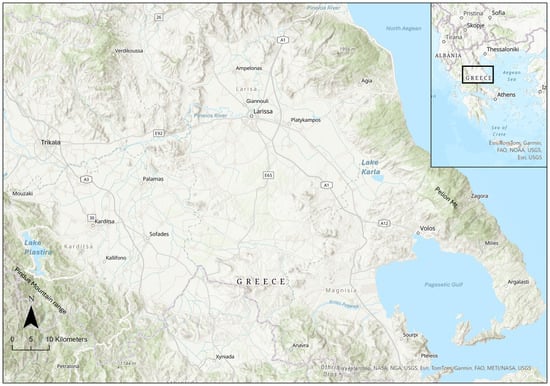
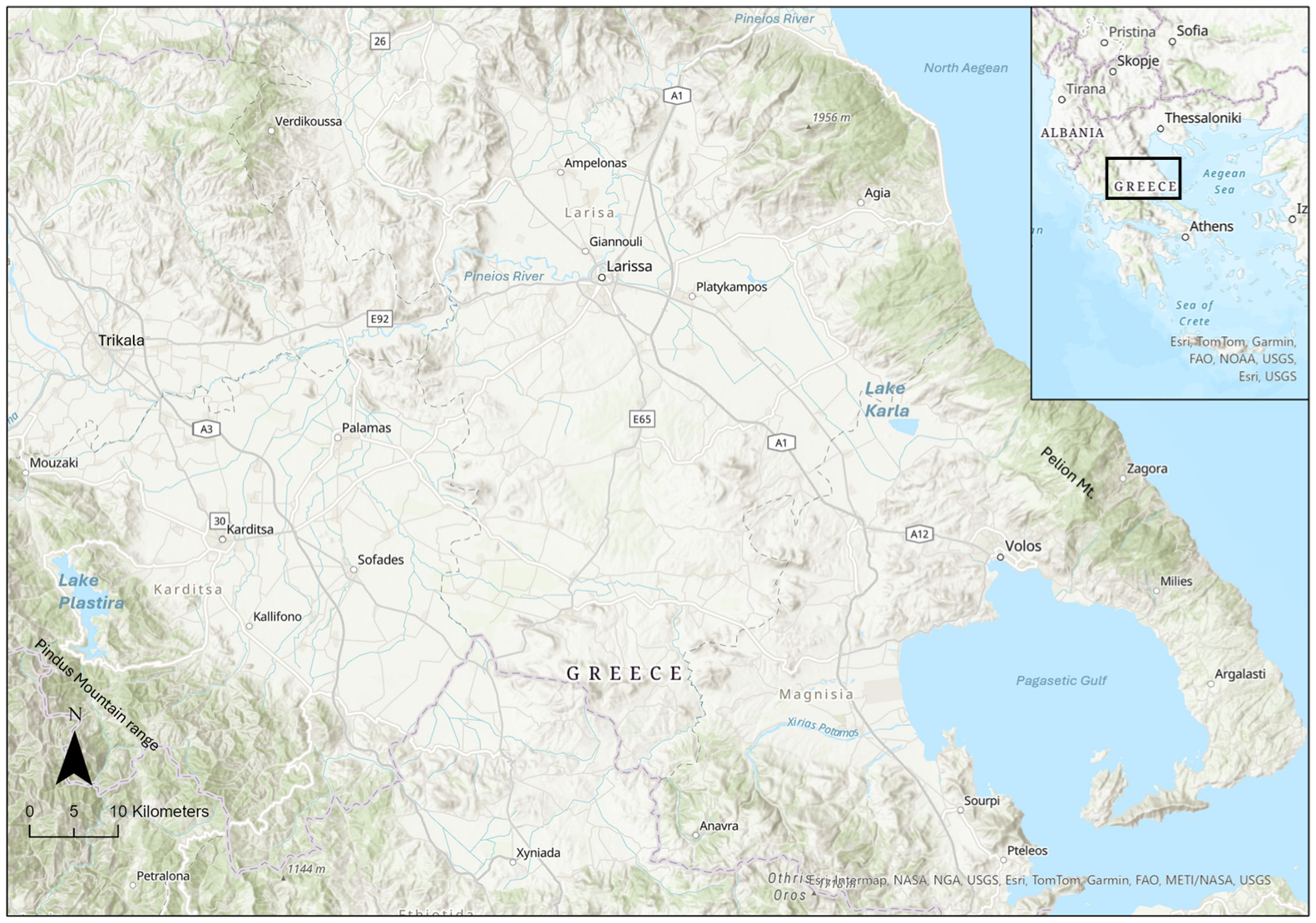
Thessaly, located in central Greece, is a geographically diverse region characterized by an extensive alluvial plain flanked by the mountain range of Pindos to the west and Mt Olympus and Mt. Pelion to the north and east, respectively. This geomorphological setting has historically acted as the country’s agricultural heartland, owing to its fertile soils and favorable climatic conditions. The region is home to several urban centers, including Larissa—the regional capital—as well as Volos, Trikala, and Karditsa (Figure 1). Thessaly has a population of approximately 700,000 inhabitants and supports a mixed economy dominated by primary sector activities. Agriculture is particularly prominent, with significant production of cotton, cereals, fruits, and vegetables, while livestock farming also plays a vital role. In addition, the port city of Volos (population of approximately 140,000 and on the eastern boundary of the region) contributes to industrial output and maritime trade through its port, further enhancing the region’s economic importance at the national level.
Figure 1.
Map of Thessaly showing the plain situated between the Pindus Mountain Range in the west and Mount Pelion and the North Aegean Sea in the east, together with its main cities (Larissa, Trikala, Karditsa, and Volos) and principal water bodies (the Pineios River, the Pagasetic Gulf, Lake Plastira, and Lake Karla). The inset map shows the location of Thessaly within the Balkan Peninsula, outlined by the black rectangle.
In early September 2023, Greece experienced one of its most catastrophic weather events in recent history due to Storm Daniel. The event unfolded under a broader synoptic-scale meteorological anomaly known as Omega blocking, a configuration where a persistent high-pressure system flanked by two low-pressure systems obstructs the usual west-to-east movement of weather systems [30]. On 4 September, a pronounced upper-level trough near the Iberian Peninsula severely disrupted the jet stream, fostering a conducive environment for cyclogenesis in the central Mediterranean [31,32,33]. Simultaneously, a strengthening ridge over eastern Europe directed humid, tropical air masses from North Africa into the region, triggering the formation of a low-pressure system that evolved into Cyclone Daniel, later designated a Medicane.
Storm Daniel made landfall in central Greece on 5 September, particularly impacting the Thessaly region. During its passage over the Greek mainland, it delivered exceptional amounts of rainfall—surpassing 600 mm in certain localities over just four days [30,31,33]. This amount more than doubled the annual precipitation typical for Athens. The resulting hydrometeorological hazards included extensive flooding, slope instability, and severe soil erosion, leading to the devastation of key infrastructure, farmlands, and residential zones [34,35,36]. Notably, approximately 730 km2 of farmland in Thessaly was submerged—an area constituting roughly 70% of the region’s cultivated land. As Thessaly accounts for 22% of Greece’s agricultural output, the socio-economic repercussions were felt nationally, impacting food supply chains and political stability.
The storm claimed 17 lives in Greece and necessitated nearly 1900 rescue operations. It inflicted damage on hundreds of homes and businesses, disrupted utilities for prolonged periods, and resulted in the death of an estimated 100,000 livestock [35]. In total, around 949.52 km2 were affected by the floodwaters, underscoring the breadth of the disaster [34].
After traversing Greece, Storm Daniel moved over the Ionian Sea, intensifying into a tropical-like cyclone as it encountered anomalously high sea surface temperatures (27–28 °C). By 9 September, it had evolved into a well-structured Medicane, with tropical cyclone-like features such as a warm core and organized convection [37].
On 10 September, Storm Daniel struck the northeastern coast of Libya, where it produced extreme rainfall totals ranging from 240 mm to over 400 mm in urban areas like Al-Bayda. The heavy precipitation triggered catastrophic flooding, particularly in the city of Derna, following the collapse of two upstream dams. This secondary disaster caused immense human and material losses—at least 5898 confirmed deaths, over 8000 individuals reported missing, the displacement of 44,800 residents, and the destruction of 18,838 homes across the coastal zones of Derna, as well as Benghazi, Jabal Al Akhdar, and Al Marj [37,38].
Despite the region’s familiarity with autumnal storms and Medicanes, the scale and intensity of Storm Daniel were far beyond conventional projections. The storm’s slow progression, coupled with exceptional atmospheric moisture and thermal energy from the sea, overwhelmed both natural and man-made defenses, resulting in extensive disasters with dramatic consequences.
3. Methodology
To thoroughly assess the consequences of extreme flooding on aquatic environments, water infrastructure, water-dependent sectors, and interconnected critical systems, this study utilized a diverse array of data sources. The research aimed to systematically identify and categorize the specific effects of the storm and subsequent flooding on water-related entities and associated socio-economic functions.
Initial data collection involved on-site investigations within the flood-affected zones, particularly in areas housing essential infrastructure. These field visits were instrumental in obtaining direct observations regarding the scale and character of disruptions, both immediately after the event and over the subsequent 28 months. Engagement with the official Operations Coordination Center, including participation of some of the authors in selected coordination meetings, yielded critical insights into governmental response actions, sectoral challenges, and the evolving operational landscape.
Complementary to fieldwork, we systematically reviewed a wide range of (i) post-disaster assessments, (ii) damage reports, (iii) damage press announcements/releases, (iv) repair initiative catalogs, and (v) scholarly literature to capture both the immediate impact on critical infrastructure and the longer-term effects encountered by system operators or the physical environment. Sector-specific studies—especially those addressing failures or interruptions in water services and systems—were included to validate and enrich field findings. Within the above, we systematically reviewed data and publications from central and local authorities (see Table 1) to examine the performance of different infrastructure networks and facilities during and after the crisis period. For example, reports issued by municipal authorities regarding interruptions to water supply, wastewater, and other essential services were also taken into consideration.
Table 1.
Sources of information on the impacts of Storm Daniel in Thessaly, along with the type of information.
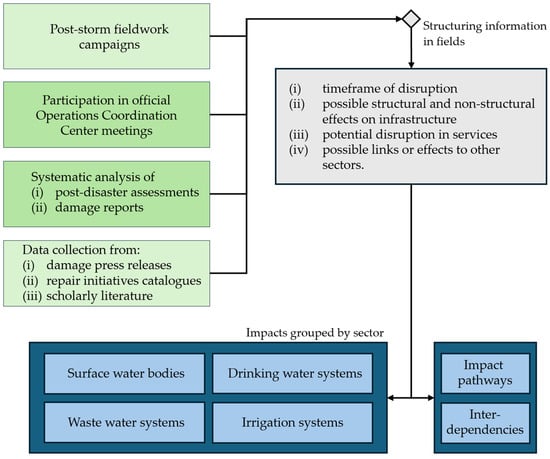
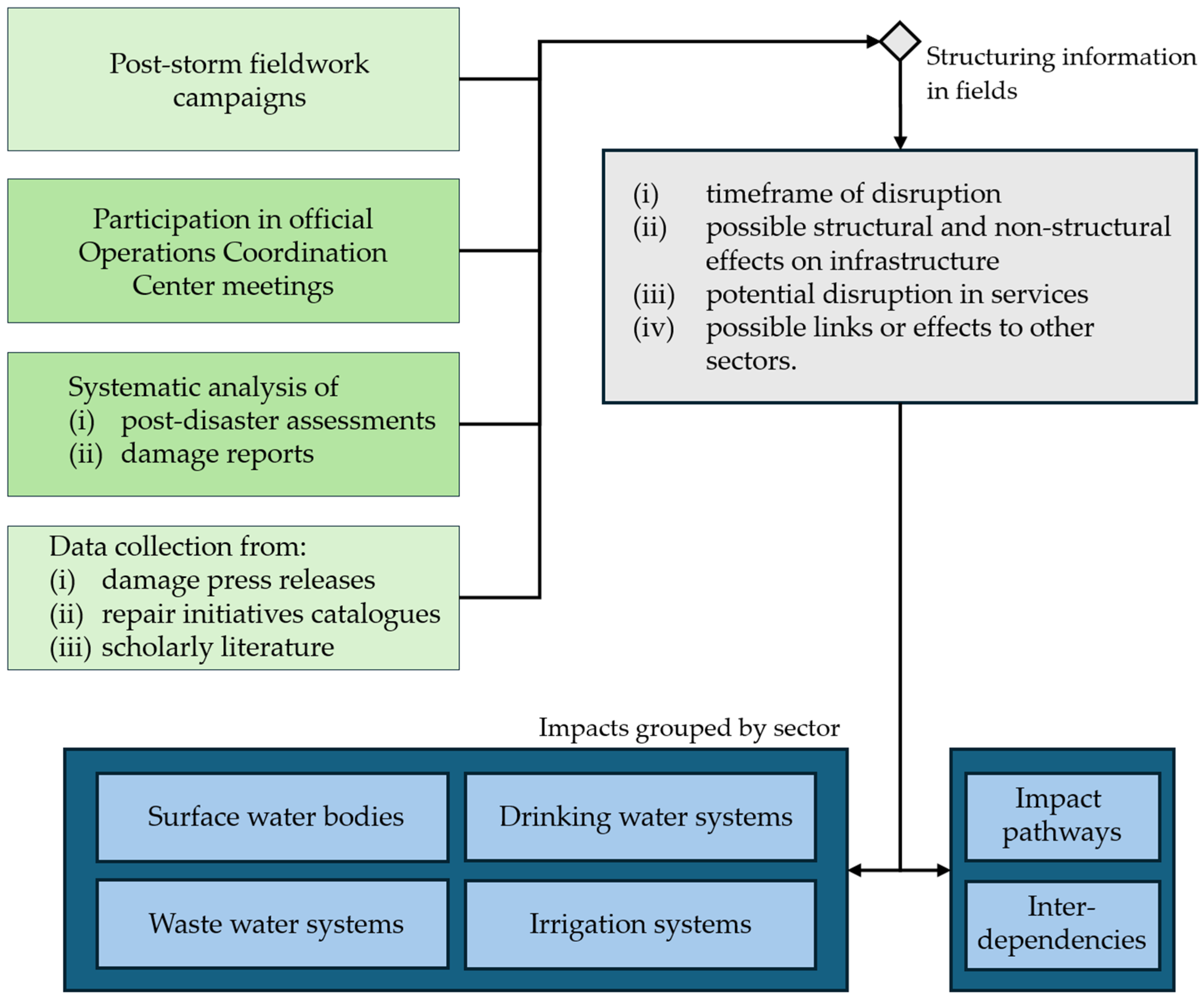
Given the absence of a centralized repository for comprehensive data on all critical systems, the study adopted a multi-source methodology to bridge information gaps, in essence turning scattered published data and information into a more systematic dataset on impacts related to water systems. This integrative approach facilitated a more detailed and context-sensitive understanding of the vulnerabilities and performance of essential infrastructure under extreme hydrological stress, as well as a detailed description of the problems and impacts that appeared. An overview of the sources used in the analysis is provided in Table 1. Out of 226 documents that were collected we identified (i) the timeframe of disruption, (ii) the possible structural effects on infrastructure, (iii) the non-structural impacts, (iv) the potential disruption in services, and (v) the possible links or effects to other sectors.
The basic steps of the methodology are illustrated in the figure below (Figure 2).
Figure 2.
Basic steps of the research approach.
4. Results
4.1. Impacts on Surficial Water Bodies
Based on the collected data, Storm Daniel exerted significant impacts on the hydrological systems of Thessaly, affecting a wide range of natural and artificial water bodies including lakes, reservoirs, rivers, and coastal marine environments.
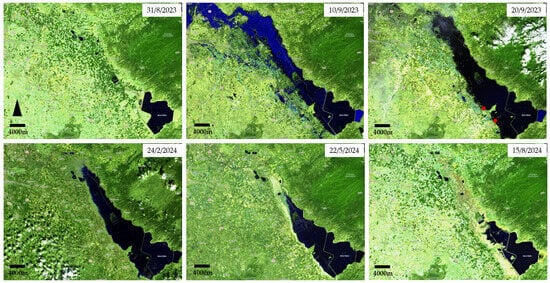
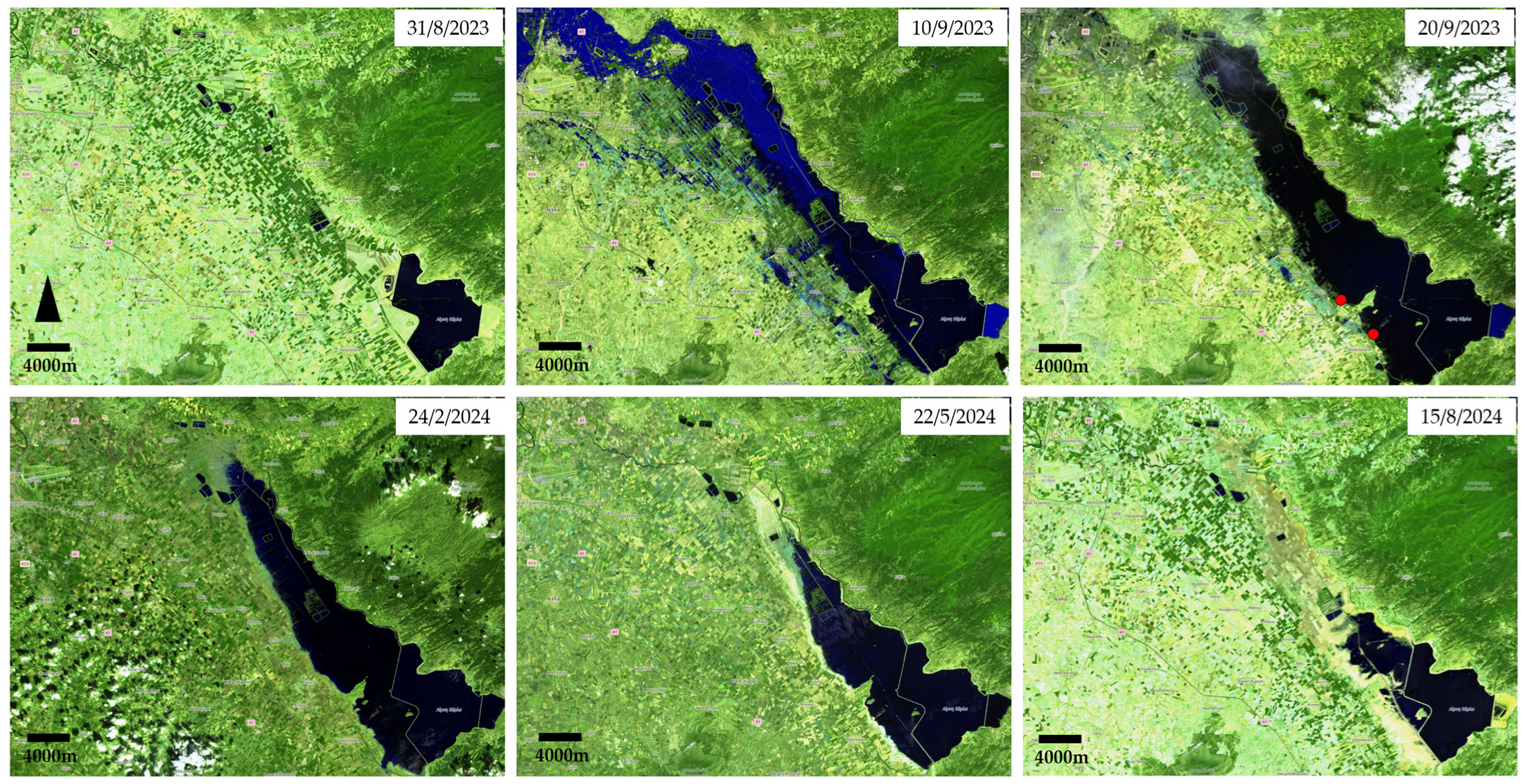
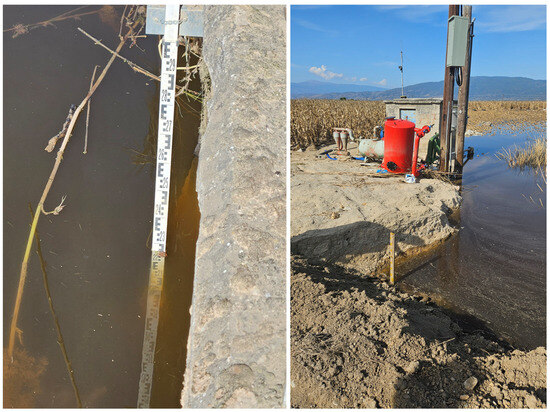
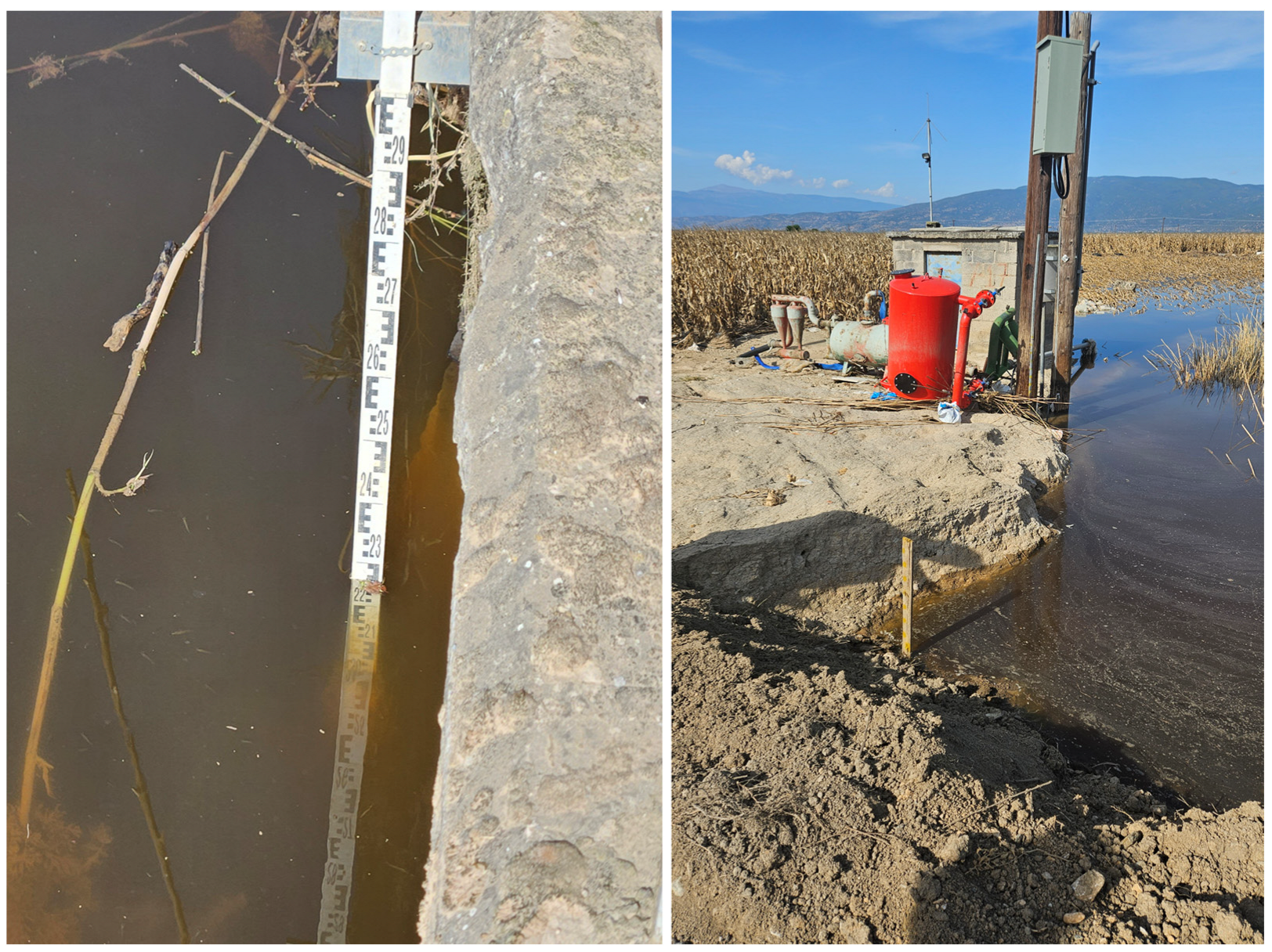
Among the most affected inland water bodies was the area of Karla (Figure 1), situated at the western—lowest elevation—part of the Thessaly Plain. The area experienced an influx of floodwaters after a break of the southern embankment of Pineios River at Gyrtoni. As a result floodwaters moved with a southeast direction towards Karla, flooding a marshy area, that was drained and converted to agricultural land in 1962. The Karla area retained a small reservoir at its southern boundary that also flooded. The lake expanded in 12 days (peak extent achieved on 20 September 2023), as shown in Figure 3, a condition that was followed by months of slow gradual shrinkage. As a result, the area saw an exceptional rise in water levels of up to 2.6 m in its southwestern part. Figure 4 shows two measuring devices at the western boundary of the new-formed lake.
Figure 3.
Gradual expansion and shrinkage of Lake Karla between 31 August 2023 and 15 August 2024 based on a Sentinel-2 L2A false color imagery composite (based on bands B12, B11, and B4). Flooded areas appear in dark blue to black color. The maximum extent of the flooded area appears on 20 September 2023. The red dots in upper right image denote the location of depth measuring devices installed in the area.
Figure 4.
Measuring devices (staff gauges) showing the water stage on 20 September 2025 (12 days after the end of the storm) at the west part of the flooded Karla area near the village of Achillio and Stefanovikio on the east part of Thessaly plain (locations illustrated by red dots in Figure 3).
This influx carried a substantial load of sediments, nutrients, and organic matter into Lake Karla. This likely promoted eutrophication and altered the lake’s biogeochemical conditions. Post-flood measurements showed reduced concentrations in key physicochemical parameters (e.g., chlorophyll-a (Chl-a) and total suspended solids (TSS)), while ammonium levels rose significantly—up to 1.57 mg/L—likely due to organic-rich inflows and intensified microbial decomposition processes [40]. Dissolved oxygen was also depleted in certain areas for a short period after the flood, further indicating deteriorated water quality [40]. In situ and satellite-based monitoring indicated that the system began returning to pre-flood conditions within months, although long-term recovery remains uncertain [40]. Similar stressors with limited impact were observed in Lake Plastira on the western boundary of Thessaly [48].
The local river network experienced impacts as well. For example, mountain streams, particularly high-gradient ones (like the Kraniotiko stream), suffered when intense flood flows triggered bank collapses and geomorphic shifts. These changes had a devastating effect on fish populations. In this case, Vardakas et al. [41] found that Salmo farioides densities declined by 84.3% and 90.7% compared to pre-flood levels in June and August 2023, respectively. Young individuals (<10 cm) were nearly eliminated, with a recorded 99% decline, indicating the level of disruption to ecological balance in fluvial systems [41].
The flood also resulted in significant die-offs of freshwater fish from freshwater channels surrounding Lake Karla. As Karla expanded, the Carassius gibelio and Cyprinus carpio fish experienced an explosion in population but later faced respiration problems, when the lake gradually shrunk in the months that followed [49]. As the fish die in mass or felt frail, many of them were carried into the sea (through a drainage conduit constructed in 1960s) causing widespread accumulation of carcasses in coastal zones near Volos. This not only posed a public health issue due to odor and water contamination but also affected local tourism and hospitality sectors [50,51], leading the city to declare a state of emergency one year after the actual flood event [52].
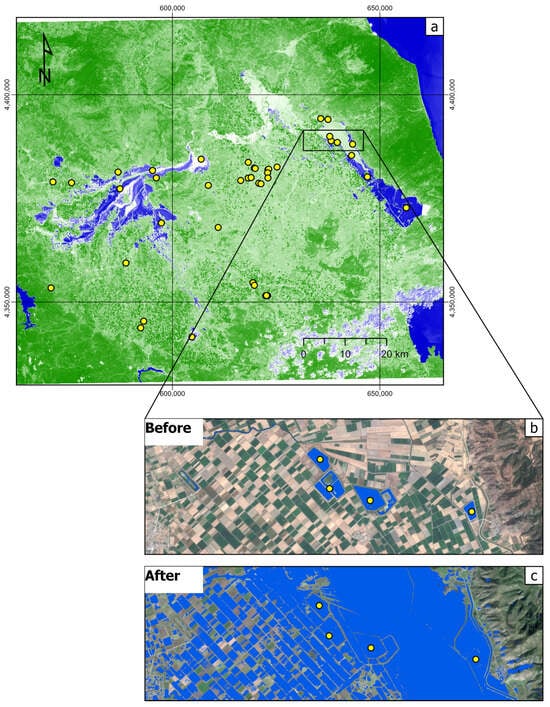
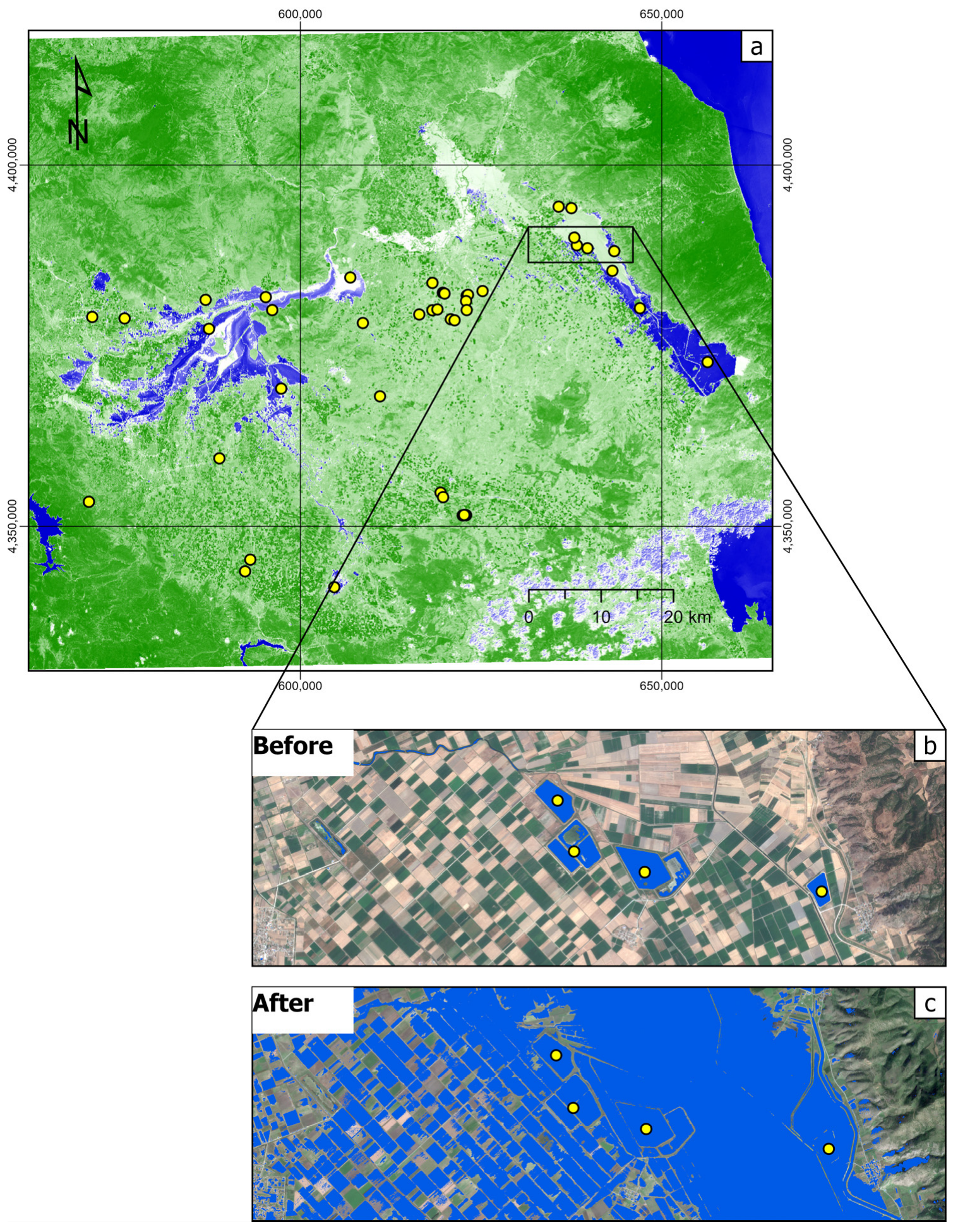
Reservoirs in the storm-affected area were flooded in important percentages. Surveying the Thessaly plain through fieldwork and satellite imagery showed that 15 out of 42 reservoirs were inundated sometime during the flood, while in some of them debris was deposited in them (Figure 5).
Figure 5.
Identification of water gates and ponds (yellow points) in Thessaly, Greece, before and after the major flooding event using multi-source satellite imagery. Sentinel-2 satellite imagery with a spatial resolution of 60 m was used, showing the flooded (blue colored) and non-flooded (green colored) areas (a). Detailed inspection was applied by using high-resolution PlanetScope imagery (3 m) of selected areas before and after the flood, highlighting changes in surface water extent and inundation of agricultural fields (b,c). Based on the quantitative geospatial assessment, a total of 42 ponds and reservoirs were identified within the study area, of which 15 were affected by flooding. The image depicts the extent of the flood at a specific date (10 September 2023) but in our analysis multiple images were taken into account to ensure that we could identify the maximum extent of the flood as it evolved.
Coastal and marine water bodies were also significantly affected. The Pineios River discharged large volumes of suspended matter into the north Aegean. This sediment plume according to Lekkas et al. [35] extended to a maximum range of 50 km and remained visible from satellites for more than two weeks, affecting light penetration, and possibly photosynthetic activity, with high concentrations of total suspended matter.
Pagasetic Gulf was affected as well, with an influx of floodwaters mainly from Pelion and the local river network, as well as the Karla drainage conduit and urban drainage from Volos port town. Multiple authors found effects on water quality in the gulf [42,43,44,45,53]. Increased levels of silicates, ammonium, and nitrate were reported, along with contaminants like atrazine, azoxystrobin, and pharmaceutical compounds—largely attributed to overflows of wastewater treatment plants and agricultural runoff [42,44]. Sediment analyses also revealed elevated levels of potentially toxic elements like cadmium and arsenic, indicating significant geochemical shifts [53]. Among the detected pollutants were also pharmaceutical compounds such as carbamazepine and persistent chemicals like per- and polyfluoroalkyl substances (PFAS), suggesting a direct release from compromised sewage systems [45].
Particularly in Pagasetic Gulf, the influx of sediments was so extensive that changes in the bathymetry were recorded, including sediment deposition near Volos port and the estuaries of Milina. These required dredging interventions, that took place in a few days to restore navigability [54].
4.2. Impacts on Drinking Water Systems
The impact of Storm Daniel on the drinking water systems across Thessaly was extensive and multifaceted, severely compromising both water availability and quality. Drinking water infrastructure—including treatment facilities, storage tanks, pipelines, and pumping stations—was directly affected by intense flash floods and mass wasting, as well as power outages [35].
Field observations and official bulletins of local municipalities (Table 1) revealed that several water treatment plants were inundated, forcing operations to be temporarily suspended due to contamination by debris, sewage, and suspended sediments. Physical damage to the water distribution network was also widespread. Distribution pipes ruptured under the force of moving floodwaters, while shallow landslides in mountainous regions such as Mount Pelion led to the collapse of water tanks serving small villages, resulting in prolonged outages that extended for several months [55].
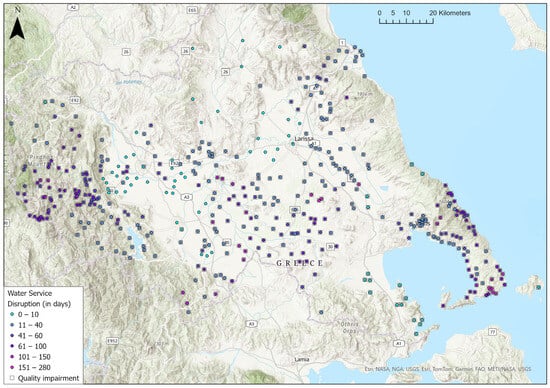
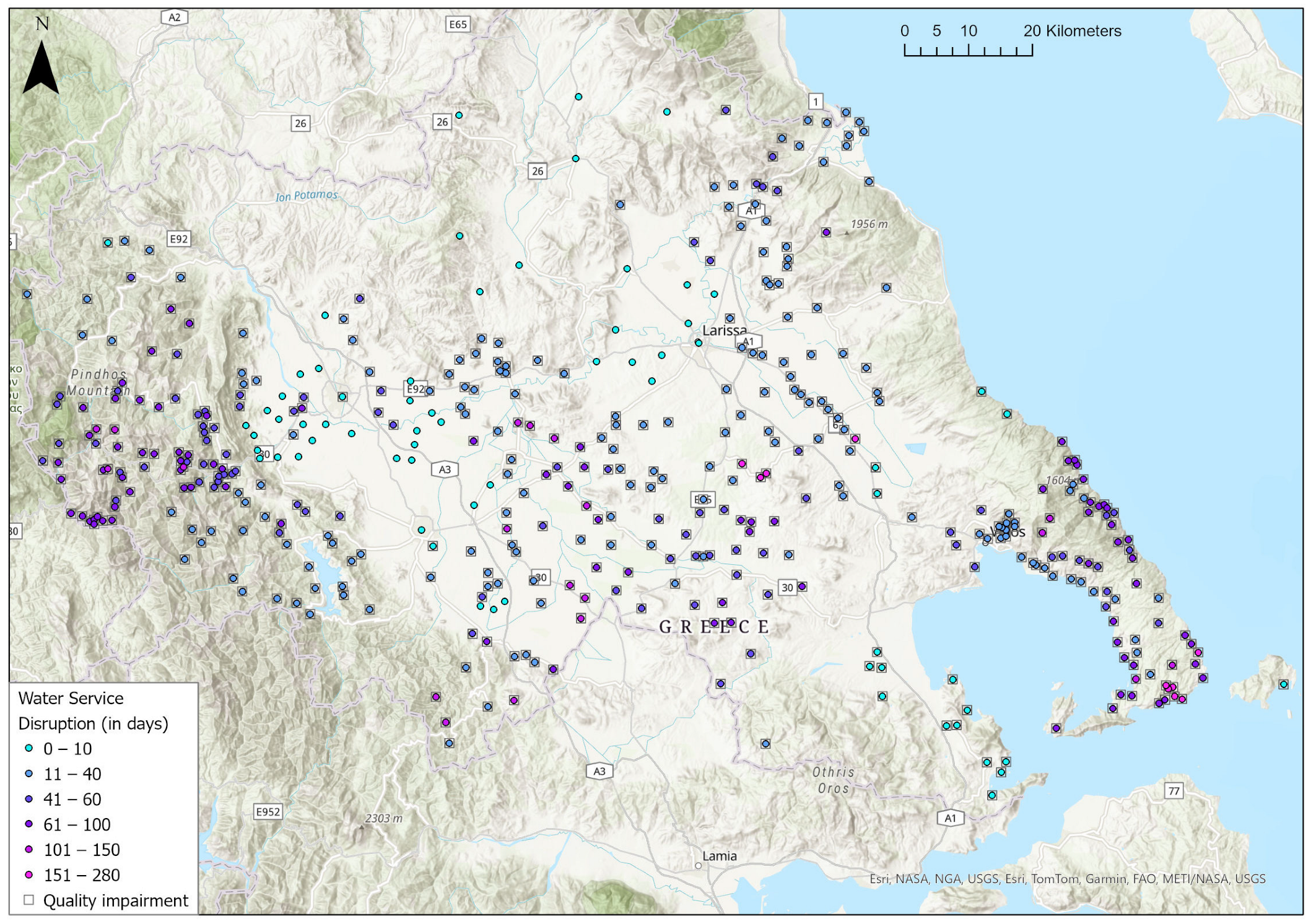
The extent of service disruptions was substantial as well. In total, based on reports of local authorities (Table 1), it was found that 392 settlements across Thessaly experienced varying durations of water supply interruption. In many areas, especially within the hardest-hit regions of Magnesia and Karditsa, outages lasted for weeks or months, with citizens being forced to rely on bottled water deliveries from municipal and regional authorities. In urban areas such as Volos, the disruption had cascading effects, halting emergency operations at the main hospital [56] and causing significant disturbances to hospitality services and local commerce [57].
Electricity outages added further complexity, as many components of the water treatment and distribution systems rely heavily on continuous power supply for pumps, filtration, and monitoring.
Public health was also affected due to the compromised water supply. The use of untreated or contaminated sources—such as wells, boreholes, and fountains—posed serious risks of waterborne diseases, particularly in areas where the municipal supply had been rendered inoperative.
In the map below (Figure 6) we mapped the areas which experienced drinking water outages and problems in its quality.
Figure 6.
Map showing the locations across Thessaly which experienced drinking water outages in days (circles in graduated colors) and quality impairment (squares). A large number of locations are outside the actual inundated area.
4.3. Impacts on Wastewater Systems
While the exact extent of physical damage to wastewater infrastructure remains under-documented, the overflow in multiple assets and infrastructure, as well as damages in wastewater networks and WWTPs, highlights vulnerabilities and impacts in current systems under extreme hydrometeorological stress.
Preliminary environmental monitoring in the Pagasetic Gulf—adjacent to the flooded areas—linked the presence of several emerging contaminants to the overflow of wastewater treatment plants (WWTPs) during the event. Among the detected pollutants, as acknowledged above, were pharmaceutical compounds such as carbamazepine and persistent chemicals like per- and polyfluoroalkyl substances (PFAS), suggesting a direct release from compromised sewage systems into nearby surface waters [45].
The typology of impacts on wastewater infrastructure indicates a systemic pattern of hydraulic, structural, electromechanical, and geotechnical failures across multiple components of the urban water cycle. At the conveyance level, extensive damage occurred in both pressurized (force main) pipelines transporting treated and untreated wastewater, as well as in gravity sewers, resulting from (i) erosion or undercutting of surrounding soil, (ii) soil subsidence, (iii) pipe collapse, or (iv) clogging [58]. Such failures were further evidenced by the need to reconstruct numerous sewer segments and inspection manholes and to unblock obstructed sewer lines that required temporary redirection of flows reported by Municipal Water and Sewerage Companies [58]. Pumping infrastructure suffered widespread disruption, including failures of central and auxiliary pumping stations, destruction of mechanical components related to excess-sludge and homogenization systems, and impairment of stormwater pumping stations, indicating vulnerability to inundation, overload, and prolonged submergence [58]. Electromechanical and power-supply systems were similarly affected, as demonstrated by the destruction of medium- and low-voltage electrical panels, generators, and associated control equipment, which compromised the operability of wastewater treatment and conveyance facilities. Impacts also extended to treatment plant structures themselves, including slope failures in aeration–nitrification–denitrification units, damage to overflow pipelines, and degradation of protective mesh and ancillary infrastructure. Additional effects included the sedimentation and blockage of stormwater networks and the degradation of inlet structures, such as the need to replace bar screens at the entrance of central pumping stations [36,58,59]. Collectively, these impacts illustrate the multi-dimensional susceptibility of wastewater systems to extreme events, with failures propagating across hydraulic pathways, structural supports, and critical operational subsystems.
The combined impact of prolonged rainfall, landslides, and the overloading of both natural and technical water systems revealed significant deficiencies in the maintenance of existing networks [59]. Initial emergency interventions, undertaken by local Municipal Water and Sewerage Companies (MWSCs) and municipalities, were limited to temporary repairs aimed at restoring the functionality of essential infrastructure. However, chronic under-maintenance and the aging of these systems increased the extent of the damage. In the sewerage network, authorities had to proceed to the full reconstruction of approximately 5000 m of pipeline, along with the replacement of a series of pumping stations that suffered complete failure [58,59]. This situation has resulted in elevated water levels across almost the entire sewerage and stormwater drainage networks, particularly in low-lying areas of the city of Larissa, as the conveyance capacity of the pipelines was exceeded, along with the pumping capacity of the lift stations, thus exceeding their endurance limit and breaking, resulting in flooding and the inability to drain.
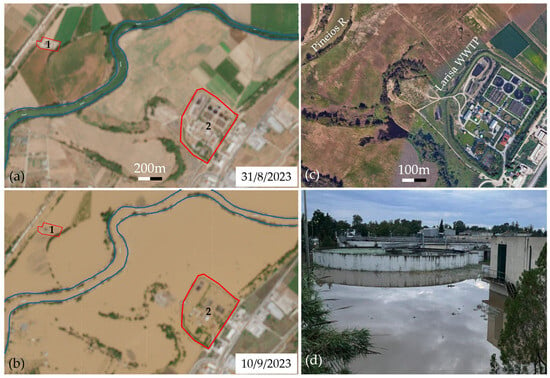
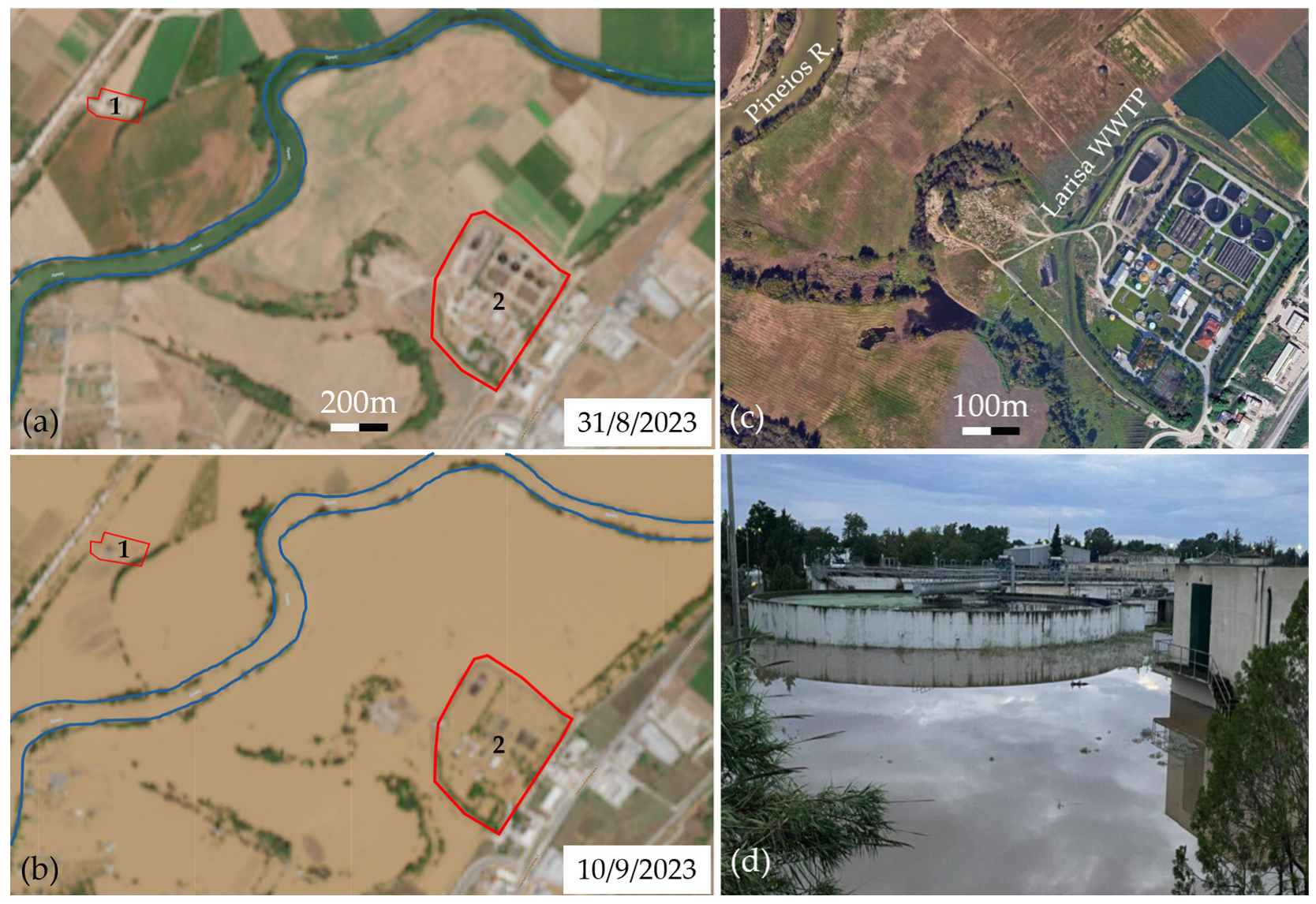
In the same time, WWTPs of Larissa, Giannouli, and Mandra were inundated [60,61] and rendered out of operation; wastewater that was in the process of being treated, mixed with the rising floodwaters, and spilled into the floodplain of the already flooded Pineios River (Figure 7). In terms of duration of disruption, the WWTP of Larissa is scheduled to return to functionality by the end of 2025, while certain functions are projected to start again by the summer of 2028 according to schedule [60,61]. The WWTP of Mandra is projected to return to full functionality in 2026 [61].
Figure 7.
Sentinel imagery showing (a) the Giannouli (1) and Larissa (2) WWTPs before (31 August 2023) and after (10 September 2023) inundation caused by Storm Daniel, in relation to the main channel of the Pineios River (blue lines denote the riverbanks); (c) a high-resolution satellite image of the Larissa (2) WWTP; and (d) a photo of parts of its infrastructure under floodwater. The source of satellite imagery in (a,b) is Sentinel-2 L2A true-color composite based on bands B4, B3, and B2, whereas the imagery in (c) is © 2025 Airbus, Maxar Technologies, Westminster, CO, USA.
The rehabilitation effort included the restoration of damages caused by the flood at the Trikala WWTP; the restoration of the operation of the Karditsa WWTP and the strengthening of the resilience of its pump station through leakage control; repairs to the Palamas WWTP and sewer network along with the implementation of flood-protection measures for the plant; the restoration of the Volos WWTP and its sewerage and water supply network; the repair of damages to the disposal pipeline discharging into the Xirias stream in the Municipality of Almyros; the restoration of the Skiathos WWTP and its pump station; the repair of damages to the Kalampaka WWTP and the collection pipeline of the Diava water supply network; and finally, the restoration of the operation of the Ampelonas–Tyrnavos WWTP, including repairs to the sewerage and water supply networks [58].
Regarding the stormwater system, hundreds of catch basins and extensive pipeline segments of hundreds of meters suffered damages, necessitating widespread rehabilitation works. In April 2025, an amount of EUR 39.46 million was approved for the rehabilitation of sewerage pipeline systems in the affected municipalities, funded through the European Regional Development Fund (ERDF), the Cohesion Fund, and the European Social Fund+ (NSRF) [58].
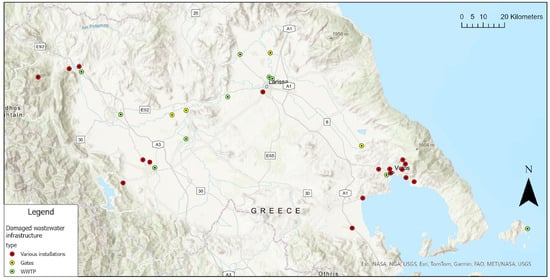
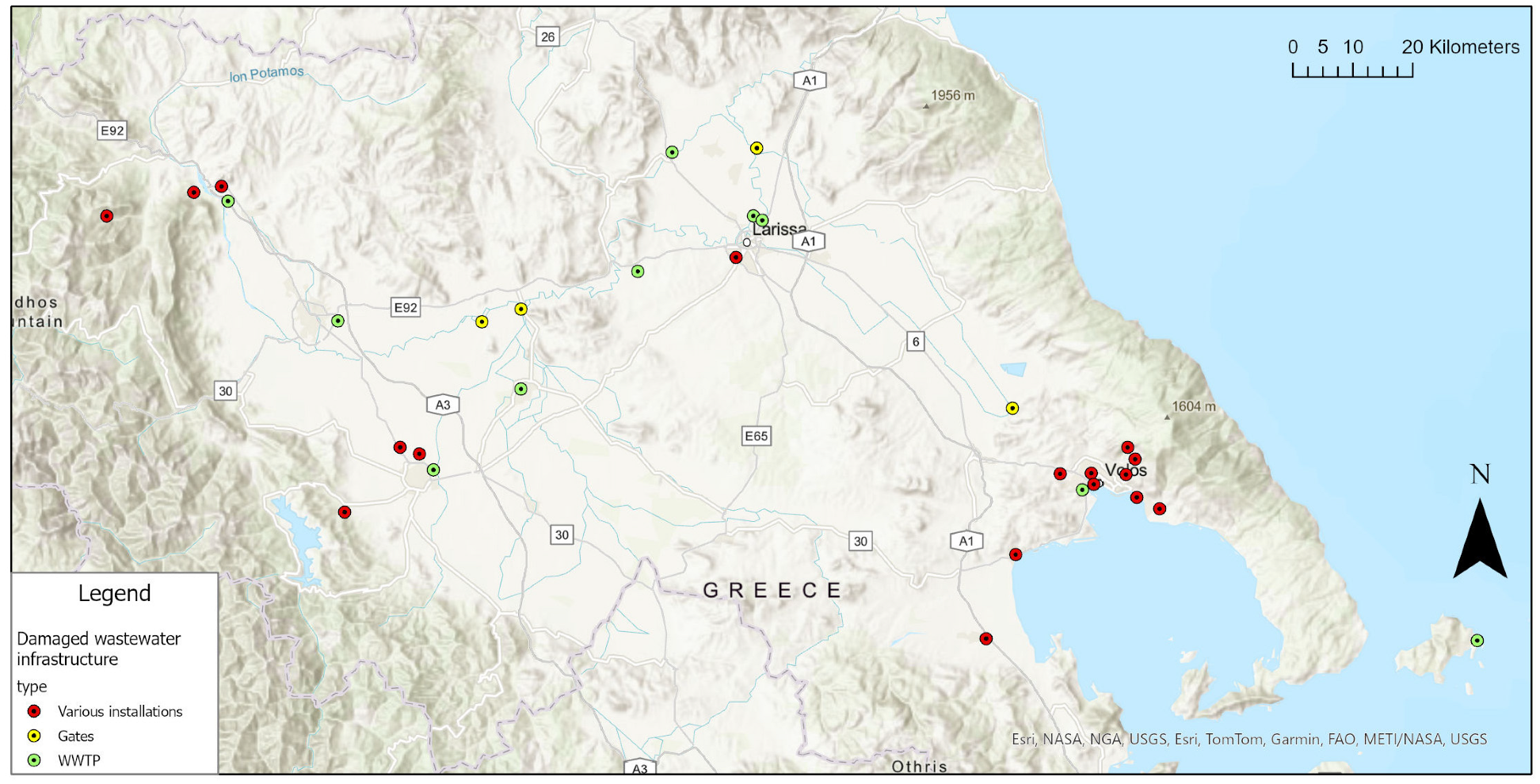
In Volos municipality impacts included breaks of the pipeline transporting treated wastewater at multiple locations, as well as damages of the pipeline conveying untreated wastewater between Neapoli of Larissa, along with damages in four pumping stations at Volos. In Agria, repairs covered the installation of a temporary pumping station and the reconstruction of existing pumping stations that were damaged during the flood [58]. Additional needed interventions involved the restoration of flood-related damages to the sewer network of Anchialos and surrounding rural areas, that was severely damaged in multiple points during the flood, along with the repair of the central pumping station in Nea Ionia of Volos. Finally, the operation of the pumping station in the industrial area (BIP) of Magnesia was restored. All the above pumping stations were damaged by the flood and returned to normal functionality in 2024 along with sewerage pipelines [58]. Other types of impacts included clogging of stormwater catch basins and manhole installations that needed cleaning and removal of debris [58]. Figure 8 below shows the locations of major infrastructure damages across Thessaly.
Figure 8.
Map of the spatial distribution of major wastewater infrastructure impacts by Storm Daniel across Thessaly based on the sources used in this study. WWTP stands for wastewater treatment plants.
4.4. Impacts on Irrigation Channels
The irrigation network of Thessaly sustained significant damages during the flooding, affecting primary, secondary, and tertiary canals as well as their gates and associated drainage channels [59,62]. Protective dykes that support irrigated zones were also compromised, with some approaching overtopping. Large volumes of debris accumulated within rivers and canals, obstructing hydraulic structures and further reducing their conveyance capacity. Additional strain was placed on the system where irrigation and drainage channels had been altered or misused, including cases of unauthorized dams and the diversion of drainage canals for irrigation purposes [59]. Such practices contributed to the rapid spread of floodwaters and increased structural stress on channels not designed for these loads. Poor maintenance conditions—particularly excessive vegetation growth within canals—further limited hydraulic performance and amplified the vulnerability of the irrigation infrastructure during the event. Figure 8 shows the location of major impacts on gates configuring irrigation flow.
5. Discussion
This study documented the extensive and multi-dimensional impacts of Storm Daniel on the water resources, systems, and infrastructure, drawing evidence from the effects of extreme Storm Daniel (2023) and the subsequent flooding in the Thessaly region in Greece. The findings demonstrate that Storm Daniel generated a sequence of hydrological, ecological, and infrastructural disturbances across the region within the field of surficial water systems.
Surface water bodies experienced extensive reconfiguration, marked by emergence of dried lakes, riverbank collapses, altered bathymetry, substantial sediment loads, and biogeochemical shifts—including temporary eutrophication signals and depleted dissolved oxygen. Freshwater and coastal ecosystems suffered acute biological impacts, including massive fish mortality and the introduction of nutrients, heavy metals, pesticides, and emerging contaminants into rivers and the Pagasetic Gulf. Drinking water networks sustained extensive physical damage across hundreds of settlements, while multiple water treatment plants were inundated or rendered inoperative. Wastewater systems experienced complex hydraulic, structural, and electromechanical failures, leading to uncontrolled discharge of untreated effluent, overflow of WWTPs, and widespread pipeline collapses.
Collectively, the results reveal a system-wide pattern of interconnected failures across natural and engineered water-related systems. In this sense, the event serves as a critical case highlighting the vulnerability of water systems and the urgent need for more resilient water infrastructure and improved mechanisms capable of addressing such hazards.
The outcomes of the study illustrate that the event did not act only on isolated components of the water systems, but rather affected a range of systems that span across hydrological and hydraulic functions, physical infrastructure, and other sectors (e.g., public health risks, transportation). Damage to river embankments and the inundation of reservoirs, initiated processes that for a period of time altered ecological balance, compromised water quality, and overloaded drinking water and wastewater systems. In addition, the outcomes reveal an infrastructure network that is sensitive not only to extreme precipitation but also to secondary hazards such as power failure, slope instability, and soil erosion.
Taken together, the evidence substantiates the claim that water-related infrastructure in Thessaly, and likely in comparable Mediterranean basins, is underprepared for climate-intensified hydrometeorological extremes. Particularly the persistence of service outages and impacts—lasting weeks to years—underscores the slow recovery of essential services in such extreme disasters as well as the magnitude of their influence. These are valuable evidence of the time frames needed for recovery and are summarized in Table 2.
Table 2.
Approximate time frames needed for recovery of various disturbances based on reports and other sources used in the present study.
The scale and persistence of impacts can be attributed to several interacting factors:
- Much of the water, wastewater, and stormwater infrastructure was designed for historical hydrological conditions and not for the extreme intensities observed during Storm Daniel.
- Chronic under-maintenance, combined with aging assets, increased susceptibility to structural collapse, blockage, and electromechanical failure.
- The geomorphology and geology of Thessaly facilitated mass movement phenomena (landslides, debris flows, severe erosion) that caused significant structure damage to infrastructure as well.
- Infrastructure interdependencies amplified failures: electricity outages disabled pumping stations, monitoring systems, and treatment processes, while water-related issues triggered hazards related to public health and changes in bathymetry affected transportation in the port of Volos.
This case contributes to the broader understanding of how extreme storms and floods impact not just one aspect of the water sector (e.g., water quality), but the broader water systems and infrastructure. By analyzing a wider view of water systems as well as interconnected failures across surface water bodies, drinking water, and wastewater systems, this study adds a systems-thinking perspective that, to the authors’ knowledge, is lacking in sector-specific disaster impact assessments. Thus it provides a more strategic overview of effects, together with details on the elements that were damaged.
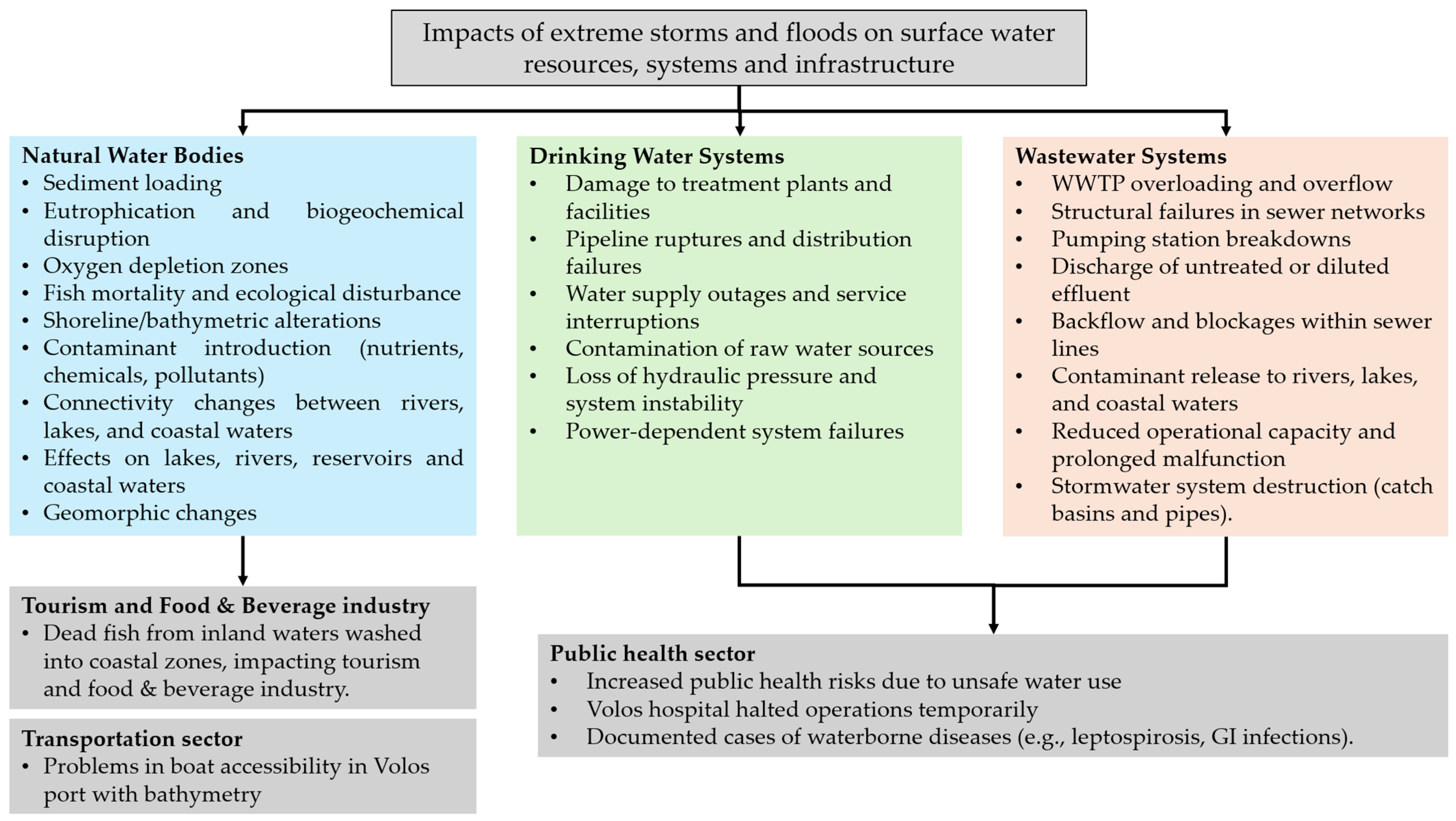
The use of a flowchart below (Figure 9) serves as a visual model that pictures and categorizes the various impact pathways, offering a framework for understanding the disruption of water-related systems. Each category—water bodies, drinking water systems, and wastewater systems—experienced distinct yet interlinked disturbances.
Figure 9.
Flowchart of the major types of elements impacted after Storm Daniel (2023) across the Thessaly region. Gray rectangles include effects on other sectors.
The documented degradation of water quality—characterized by increased suspended solids, nutrients, organic pollutants, and toxic elements—is consistent with findings from global studies on post-flood water quality deterioration [8,9,10,12,13]. The pressure events, pipeline failures, and service disruptions observed in Thessaly align with previous research highlighting the sensitivity of water distribution networks to hydraulic disturbances during floods [18,19,20,21]. Ecological impacts, including sediment-driven hypoxia and fish mortality, mirror patterns reported in other European and North American watersheds following extreme hydrological events [29]. What distinguishes the present case is the simultaneity of impacts across multiple domains—surface water, drinking water supply, wastewater treatment, stormwater management, and coastal environments—not documented collectively in the literature to the authors’ knowledge.
In general, the effects described are related to the region’s characteristics. The vulnerability of the Thessaly region to extreme storm events is defined by a combination of physical and infrastructural factors and its socio-economic activities. Parts of the region are characterized by steep mountainous terrain, complex lithological conditions, and deeply incised drainage networks, particularly along the margins of the Thessaly plain. These features enhance susceptibility to mass-wasting processes, debris flows, and severe erosion during intense rainfall. Moreover, the region’s geomorphology, dominated by a low-lying alluvial plain with limited natural drainage gradients, makes it susceptible to prolonged inundation once floodwaters overtop riverbanks (mainly of Pineios River) or protective embankments. Finally, Thessaly hosts extensive agricultural production supported by dense irrigation, drainage, and water-management infrastructure, which increases exposure to flooding and system-wide disruption and creates a potential for strong interdependencies that may amplify domino failures during extreme events.
Regarding limitations, it has to be noted that this study relies on a heterogeneous set of data sources, including municipal announcements, technical reports, governmental decisions, media releases, and scientific studies. These sources differ in spatial detail, temporal resolution, and reporting standards, potentially creating gaps in the impact reconstruction. Systematic environmental monitoring—especially for groundwater, marine ecosystems, and emerging contaminants—was limited, constraining the ability to quantify long-term contamination pathways. Thus, this study reported published data that spans within the period that concludes by the timing of this writing (that is December 2025). Furthermore, because the event is recent, long-term ecological and infrastructural impacts cannot yet be fully assessed, particularly for WWTP recovery trajectories and water quality evolution. In addition, the study is limited to surface water systems, as groundwater quality data are very limited and non-systematic. It would be very important to include information on impacts on groundwater as well in future research. Finally, the reliance on secondary reporting may also bias documentation toward highly visible impacts, underrepresenting smaller or less conspicuous failures that could be underreported. These limitations reflect broader systemic weaknesses in monitoring and post-disaster documentation, which are themselves part of the vulnerabilities exposed by Storm Daniel.
Further on limitations, it has to be acknowledged that this study focuses on a single extreme event, the findings are therefore interpreted with caution and viewed as a contribution toward understanding similar events rather than as universally applicable generalizations. In addition, this study adopted a qualitative approach aimed at identifying the typology of impacts and the pathways through which extreme flooding affects interconnected water-related systems. Quantitative damage metrics were not analyzed due to lack of systematic data, but also because such measures are highly site- and asset-specific and are not readily transferable across different systems or areas.
Furthermore, it has to be clarified that while some assets exhibited aging and maintenance deficits, they were generally functioning, and therefore the observed disruptions, failures, and damages represent storm-induced departures from pre-disaster conditions, and thus are impacts generated by the storm, rather than manifestations of non-operational systems.
In terms of recommendations, future resilience planning requires the establishment of a systematic and continuous monitoring framework for both the quality and quantity of surface and groundwater resources, enabling early detection of contamination pathways and more accurate assessments of hydrological responses during extreme events. Equally important is the development of an integrated system for monitoring and reporting water-related infrastructure and service performance at a regional scale, rather than relying on fragmented datasets produced by individual municipalities. A unified framework would support a holistic understanding of the spatial distribution, severity, and evolution of impacts, improving evidence-based decision-making. Future research should also deepen the analysis of interdependencies between water systems and other critical sectors—such as energy, transport, health, and agriculture—by examining additional extreme events from the wider Mediterranean region, thus advancing systems-level risk assessment.
In practical terms, drinking water and wastewater systems require substantial upgrading to withstand higher peak flows and to incorporate redundancy, including alternative routing and emergency treatment capacity that can maintain service continuity during crises. Strengthened and routine maintenance programs for aging infrastructure are essential to reduce failure rates under extreme hydrometeorological stress. Governance reforms should improve coordination mechanisms among municipal utilities, regional authorities, national ministries, and public health agencies, supported by standardized reporting protocols and centralized data platforms that facilitate coherent and timely information exchange. Finally, the magnitude and pervasiveness of the observed damages indicate not merely isolated design weaknesses but a systemic vulnerability within water-related infrastructure; thus, long-term planning must explicitly integrate climate projections into all stages of infrastructure design and rehabilitation to ensure that future systems possess the adaptive capacity required to cope with intensifying climate extremes.
6. Conclusions
The study demonstrates how a single extreme hydrometeorological event can trigger widespread and interconnected disruptions across natural water bodies, water-related infrastructure and water and wastewater systems. The findings show that Thessaly’s water systems were unable to withstand the unprecedented rainfall and cascading failures that followed to a very high degree showing an extensive range of impact typology. They also show the complexity of impacts from emerging climate risks and provide evidence to a system-wide lack of resilience. The resulting impacts, ranging from ecological degradation and water quality deterioration to prolonged drinking water outages and wastewater overflows, reveal systemic vulnerabilities that extend beyond isolated infrastructural weaknesses. This event underscores the urgent need to integrate climate resilience into the design, operation, and governance of water systems, supported by robust monitoring and good-coordination emergency planning. As extreme events become more frequent under climate change, strengthening the resilience of interconnected water systems is essential not only for environmental protection, but also for public health, transport, economic stability, and critical infrastructure.
Author Contributions
Conceptualization, M.D. and P.N.; methodology, M.D. and P.A.; software, I.K.; validation, M.D., A.S. and C.F.; formal analysis, M.D. and E.V.; investigation, M.D., P.A. and I.K.; resources, A.K. and P.N.; data curation, M.D. and I.K.; writing—original draft preparation, M.D.; writing—review and editing, M.D., P.A., I.K., A.S., C.F., A.K., E.V. and P.N.; visualization, M.D.; supervision, P.N.; project administration, M.D.; funding acquisition, P.N. All authors have read and agreed to the published version of the manuscript.
Funding
This research received no external funding.
Data Availability Statement
The original contributions presented in this study are included in the article. Further inquiries can be directed to the corresponding author.
Conflicts of Interest
The authors declare no conflicts of interest.
References
- Ebi, K.L.; Vanos, J.; Baldwin, J.W.; Bell, J.E.; Hondula, D.M.; Errett, N.A.; Hayes, K.; Reid, C.E.; Saha, S.; Spector, J.; et al. Extreme Weather and Climate Change: Population Health and Health System Implications. Annu. Rev. Public Health 2021, 42, 293–315. [Google Scholar] [CrossRef] [Scilit]
- Fekete, A.; Sandholz, S. Here Comes the Flood, but Not Failure? Lessons to Learn after the Heavy Rain and Pluvial Floods in Germany 2021. Water 2021, 13, 3016. [Google Scholar] [CrossRef] [Scilit]
- He, K.; Yang, Q.; Shen, X.; Dimitriou, E.; Mentzafou, A.; Papadaki, C.; Stoumboudi, M.; Anagnostou, E.N. Brief Communication: Storm Daniel Flood Impact in Greece in 2023: Mapping Crop and Livestock Exposure from Synthetic-Aperture Radar (SAR). Nat. Hazards Earth Syst. Sci. 2024, 24, 2375–2382. [Google Scholar] [CrossRef] [Scilit]
- Fang, B.; Bevacqua, E.; Rakovec, O.; Zscheischler, J. An Increase in the Spatial Extent of European Floods over the Last 70 Years. Hydrol. Earth Syst. Sci. 2024, 28, 3755–3775. [Google Scholar] [CrossRef] [Scilit]
- Busetti, A.; Leone, C.; Corradetti, A.; Fracaros, S.; Spadotto, S.; Rai, P.; Zini, L.; Calligaris, C.; Busetti, A.; Leone, C.; et al. Coastal Storm-Induced Sinkholes: Insights from Unmanned Aerial Vehicle Monitoring. Remote Sens. 2024, 16, 3681. [Google Scholar] [CrossRef] [Scilit]
- Intergovernmental Panel on Climate Change (IPCC). Climate Change 2021—The Physical Science Basis: Working Group I Contribution to the Sixth Assessment Report of the Intergovernmental Panel on Climate Change, 1st ed.; Cambridge University Press: Cambridge, UK, 2023; ISBN 978-1-009-15789-6. [Google Scholar]
- van Vliet, M.T.H.; Thorslund, J.; Strokal, M.; Hofstra, N.; Flörke, M.; Ehalt Macedo, H.; Nkwasa, A.; Tang, T.; Kaushal, S.S.; Kumar, R.; et al. Global River Water Quality under Climate Change and Hydroclimatic Extremes. Nat. Rev. Earth Environ. 2023, 4, 687–702. [Google Scholar] [CrossRef] [Scilit]
- Fabian, P.S.; Kwon, H.-H.; Vithanage, M.; Lee, J.-H. Modeling, Challenges, and Strategies for Understanding Impacts of Climate Extremes (Droughts and Floods) on Water Quality in Asia: A Review. Environ. Res. 2023, 225, 115617. [Google Scholar] [CrossRef] [Scilit] [PubMed]
- Ching, Y.C.; Lee, Y.H.; Toriman, M.E.; Abdullah, M.; Yatim, B.B. Effect of the Big Flood Events on the Water Quality of the Muar River, Malaysia. Sustain. Water Resour. Manag. 2015, 1, 97–110. [Google Scholar] [CrossRef] [Scilit]
- Hrdinka, T.; Novický, O.; Hanslík, E.; Rieder, M. Possible Impacts of Floods and Droughts on Water Quality. J. Hydro-Environ. Res. 2012, 6, 145–150. [Google Scholar] [CrossRef] [Scilit]
- Prathumratana, L.; Sthiannopkao, S.; Kim, K.W. The Relationship of Climatic and Hydrological Parameters to Surface Water Quality in the Lower Mekong River. Environ. Int. 2008, 34, 860–866. [Google Scholar] [CrossRef] [Scilit]
- Klaus, V.H.; Sintermann, J.; Kleinebecker, T.; Hölzel, N. Sedimentation-Induced Eutrophication in Large River Floodplains—An Obstacle to Restoration? Biol. Conserv. 2011, 144, 451–458. [Google Scholar] [CrossRef] [Scilit]
- Garnier, M.; Pappagallo, G.; Holman, I.P. Sediment and Phosphorus Transport during Flood Events in a Mediterranean Temporary River. Environ. Earth Sci. 2024, 83, 212. [Google Scholar] [CrossRef] [Scilit]
- Ascott, M.J.; Lapworth, D.J.; Gooddy, D.C.; Sage, R.C.; Karapanos, I. Impacts of Extreme Flooding on Riverbank Filtration Water Quality. Sci. Total Environ. 2016, 554–555, 89–101. [Google Scholar] [CrossRef] [Scilit]
- Barbetta, S.; Bonaccorsi, B.; Tsitsifli, S.; Boljat, I.; Argiris, P.; Reberski, J.L.; Massari, C.; Romano, E. Assessment of Flooding Impact on Water Supply Systems: A Comprehensive Approach Based on DSS. Water Resour. Manag. 2022, 36, 5443–5459. [Google Scholar] [CrossRef] [Scilit]
- Lyubimova, T.; Lepikhin, A.; Parshakova, Y.; Tiunov, A. The Risk of River Pollution Due to Washout from Contaminated Floodplain Water Bodies during Periods of High Magnitude Floods. J. Hydrol. 2016, 534, 579–589. [Google Scholar] [CrossRef] [Scilit]
- St-Hilaire, A.; Duchesne, S.; Rousseau, A.N. Floods and Water Quality in Canada: A Review of the Interactions with Urbanization, Agriculture and Forestry. Can. Water Resour. J. Rev. Can. Des Ressour. Hydr. 2016, 41, 273–287. [Google Scholar] [CrossRef] [Scilit]
- Arrighi, C.; Tarani, F.; Vicario, E.; Castelli, F. Flood Impacts on a Water Distribution Network. Nat. Hazards Earth Syst. Sci. 2017, 17, 2109–2123. [Google Scholar] [CrossRef] [Scilit]
- Tarani, F.; Arrighi, C.; Carnevali, L.; Castelli, F.; Vicario, E. Flood Resilience of a Water Distribution System. In Resilience of Cyber-Physical Systems: From Risk Modelling to Threat Counteraction; Flammini, F., Ed.; Springer International Publishing: Cham, Switzerland, 2019; pp. 177–194. ISBN 978-3-319-95597-1. [Google Scholar]
- Siew, C.; Tanyimboh, T.T. Pressure-Dependent EPANET Extension. Water Resour. Manag. 2012, 26, 1477–1498. [Google Scholar] [CrossRef] [Scilit]
- Hatam, F.; Besner, M.-C.; Ebacher, G.; Prévost, M. Combining a Multispecies Water Quality and Pressure-Driven Hydraulic Analysis to Determine Areas at Risk During Sustained Pressure-Deficient Conditions in a Distribution System. J. Water Resour. Plan. Manag. 2018, 144, 04018057. [Google Scholar] [CrossRef] [Scilit]
- Budiyono; Ginandjar, P.; Saraswati, L.D.; Pangestuti, D.R.; Martini; Jati, S.P.; Rahfiludin, Z. Risk Assessment of Drinking Water Supply System in the Tidal Inundation Area of Semarang—Indonesia. Procedia Environ. Sci. 2015, 23, 93–98. [Google Scholar] [CrossRef] [Scilit]
- Gannon, K.E.; Conway, D.; Pardoe, J.; Ndiyoi, M.; Batisani, N.; Odada, E.; Olago, D.; Opere, A.; Kgosietsile, S.; Nyambe, M.; et al. Business Experience of Floods and Drought-Related Water and Electricity Supply Disruption in Three Cities in Sub-Saharan Africa during the 2015/2016 El Niño. Glob. Sustain. 2018, 1, e14. [Google Scholar] [CrossRef] [Scilit]
- Loeb, R.; Van Daalen, E.; Lamers, L.P.M.; Roelofs, J.G.M. How Soil Characteristics and Water Quality Influence the Biogeochemical Response to Flooding in Riverine Wetlands. Biogeochemistry 2007, 85, 289–302. [Google Scholar] [CrossRef] [Scilit]
- Leauthaud, C.; Duvail, S.; Hamerlynck, O.; Paul, J.-L.; Cochet, H.; Nyunja, J.; Albergel, J.; Grünberger, O. Floods and Livelihoods: The Impact of Changing Water Resources on Wetland Agro-Ecological Production Systems in the Tana River Delta, Kenya. Glob. Environ. Change 2013, 23, 252–263. [Google Scholar] [CrossRef] [Scilit]
- Geris, J.; Comte, J.-C.; Franchi, F.; Petros, A.K.; Tirivarombo, S.; Selepeng, A.T.; Villholth, K.G. Surface Water-Groundwater Interactions and Local Land Use Control Water Quality Impacts of Extreme Rainfall and Flooding in a Vulnerable Semi-Arid Region of Sub-Saharan Africa. J. Hydrol. 2022, 609, 127834. [Google Scholar] [CrossRef] [Scilit]
- Kanellopoulos, T.D.; Karageorgis, A.P.; Kikaki, A.; Chourdaki, S.; Hatzianestis, I.; Vakalas, I.; Hatiris, G.-A. The Impact of Flash-Floods on the Adjacent Marine Environment: The Case of Mandra and Nea Peramos (November 2017), Greece. J. Coast. Conserv. 2020, 24, 56. [Google Scholar] [CrossRef] [Scilit]
- Zoppini, A.; Ademollo, N.; Bensi, M.; Berto, D.; Bongiorni, L.; Campanelli, A.; Casentini, B.; Patrolecco, L.; Amalfitano, S. Impact of a River Flood on Marine Water Quality and Planktonic Microbial Communities. Estuar. Coast. Shelf Sci. 2019, 224, 62–72. [Google Scholar] [CrossRef] [Scilit]
- Peters, D.L.; Caissie, D.; Monk, W.A.; Rood, S.B.; St-Hilaire, A. An Ecological Perspective on Floods in Canada. Can. Water Resour. J. Rev. Can. Des Ressour. Hydr. 2016, 41, 288–306. [Google Scholar] [CrossRef] [Scilit]
- Dimitriou, E.; Efstratiadis, A.; Zotou, I.; Papadopoulos, A.; Iliopoulou, T.; Sakki, G.-K.; Mazi, K.; Rozos, E.; Koukouvinos, A.; Koussis, A.D.; et al. Post-Analysis of Daniel Extreme Flood Event in Thessaly, Central Greece: Practical Lessons and the Value of State-of-the-Art Water-Monitoring Networks. Water 2024, 16, 980. [Google Scholar] [CrossRef] [Scilit]
- Nastos, P.T.; Feloni, E.; Paraskevas, A.; Matsangouras, I.T. Meteorological and Remote Sensing Analysis of the Severe Storm “Daniel” over Greece. In Proceedings of the European Geosciences Union General Assembly, Vienna, Austria, 14–19 April 2024; p. 12908. [Google Scholar]
- Arsenis, S.T.; Samos, I.; Nastos, P.T. Orographic Effect’s Correlation with Convection During a Low-Pressure System Passage over Greece in September 2023. Environ. Earth Sci. Proc. 2025, 35, 37. [Google Scholar] [CrossRef] [Scilit]
- Nastos, P.T.; Feloni, E.; Chasiotis, A. Analysis of an Extreme Hydrometeorological Event in Athens on September 6, 2023, Using OTT Parsivel Disdrometer and Pluviometer Data. In Proceedings of the Tenth International Conference on Remote Sensing and Geoinformation of the Environment (RSCy2024), Paphos, Cyprus, 8–9 April 2024; SPIE: Washington, DC, USA; Volume 13212, pp. 578–584. [Google Scholar]
- Falaras, T.; Dosiou, A.; Tounta, S.; Diakakis, M.; Lekkas, E.; Parcharidis, I. Mapping of Flood Impacts Caused by the September 2023 Storm Daniel in Thessaly’s Plain (Greece) with the Use of Remote Sensing Satellite Data. Remote Sens. 2025, 17, 1750. [Google Scholar] [CrossRef] [Scilit]
- Lekkas, E.; Diakakis, M.; Mavroulis, S.; Filis, C.; Bantekas, Y.; Gogou, M.; Katsetsiadou, K.N.; Mavrouli, M.; Giannopoulos, M.; Sarantopoulou, A.; et al. The Early September 2023 Daniel Storm in Thessaly Region (Central Greece); Newsletter of Environmental, Disaster and Crises Management Strategies; Post-graduate Studies Program “Environmental Disasters & Crises Management Strategies” National and Kapodistrian University of Athens: Athens, Greece, 2024; p. 212. [Google Scholar]
- Tsinidis, G.; Koutas, L. Geotechnical and Structural Damage to the Built Environment of Thessaly Region, Greece, Caused by the 2023 Storm Daniel. Geotechnics 2025, 5, 16. [Google Scholar] [CrossRef] [Scilit]
- Normand, J.C.L.; Heggy, E. Assessing Flash Flood Erosion Following Storm Daniel in Libya. Nat. Commun. 2024, 15, 6493. [Google Scholar] [CrossRef] [Scilit]
- Shembesh, R.H.; Beshr, M.S.; Almasheeti, A.A.; Sheltami, A.T.; El-Ojeli, A. The Psychological Impact of Storm Daniel on Medical Students at the University of Derna in Libya: A Cross-Sectional Study. Camb. Prism. Glob. Ment. Health 2025, 12, e82. [Google Scholar] [CrossRef] [Scilit]
- Poulakida, I.; Kotsiou, O.S.; Boutlas, S.; Stergioula, D.; Papadamou, G.; Gourgoulianis, K.I.; Papagiannis, D. Leptospirosis Incidence Post-Flooding Following Storm Daniel: The First Case Series in Greece. Infect. Dis. Rep. 2024, 16, 880–887. [Google Scholar] [CrossRef] [Scilit] [PubMed]
- Perivolioti, T.-M.; Zachopoulos, K.; Zioga, M.; Tompoulidou, M.; Katsavouni, S.; Kemitzoglou, D.; Terzopoulos, D.; Mouratidis, A.; Tsiaoussi, V. Monitoring the Impact of Floods on Water Quality Using Optical Remote Sensing Imagery: The Case of Lake Karla (Greece). Water 2024, 16, 3502. [Google Scholar] [CrossRef] [Scilit]
- Vardakas, L.; Koutsikos, N.; Dimitriou, E.; Vavalidis, T.; Kouraklis, P.; Kalogianni, E. Short-Term Effects of Storm Daniel on Salmo Farioides (Karaman, 1938) in a High-Gradient Stream. River Res. Appl. 2024, 40, 647–654. [Google Scholar] [CrossRef] [Scilit]
- Dimoudi, A.; Voulgaris, K.; Varkoulis, A.; Georgiou, K.; Klaoudatos, D.; Skordas, K.; Vafidis, D.; Neofitou, N. The Impacts of Daniel and Elias Storms on Water Quality of Pagasitikos Gulf—A First Record. In Proceedings of the Proceedings Book; University of the Aegean: Mytilene, Greece, 2024. [Google Scholar]
- Papageorgiou, D.; Spondylidis, S.; Topouzelis, K. Post-Extreme Event Monitoring of Runoff-Carried Natural and Anthropogenic Floating Marine Debris with Sentinel-2 Data. The Case of Storm Daniel in North-Eastern Mediterranean. In Proceedings of the IGARSS 2024—2024 IEEE International Geoscience and Remote Sensing Symposium, Athens, Greece, 7–12 July 2024; pp. 1896–1899. [Google Scholar]
- Varkoulis, A.; Voulgaris, K.; Dimoudi, A.; Georgiou, K.; Skordas, K.; Neofitou, N.; Vafidis, D. Upper Sublittoral Meiofaunal Communities of Pagasitikos Gulf after Two Extreme Storms. In Proceedings of the Proceedings Book; University of the Aegean: Mytilene, Greece, 2024. [Google Scholar]
- Lougkovois, R.; Parinos, K.; Gkotsis, G.; Nika, M.-C.; Thomaidis, N.; Pavlidou, A.; Hatzianestis, I. Monitoring the Presence of Priority Pollutants and Emerging Contaminants at Pagasitikos Gulf, Greece, Following “Daniel” and “Elias” Storm Events, Utilizing the Technique of LC-VIP-HESI-TIMS-HRMS; Copernicus Meetings: Göttingen, Germany, 2024. [Google Scholar] [CrossRef] [Scilit]
- Iatrou, M.; Tziouvalekas, M.; Tsitouras, A.; Evangelou, E.; Noulas, C.; Vlachostergios, D.; Aschonitis, V.; Arampatzis, G.; Metaxa, I.; Karydas, C.; et al. Analyzing the Impact of Storm ‘Daniel’ and Subsequent Flooding on Thessaly’s Soil Chemistry through Causal Inference. Agriculture 2024, 14, 549. [Google Scholar] [CrossRef] [Scilit]
- Pavlis, E. Landscape Loss and Restoration: The Case of Lake Karla in Greece. Landsc. Res. 2024, 50, 661–675. [Google Scholar] [CrossRef] [Scilit]
- Katsoulis, K.; Papadopoulou, A. Case Study: Nutrients Distribution and Assessment of the Current Trophic Status of Plastiras Lake in Thessaly (Central Greece) after Tropical Storm Daniel. GSC Adv. Res. Rev. 2024, 20, 477–483. [Google Scholar] [CrossRef] [Scilit]
- Panhellenic Association of Ichthyologists A Predetermined Ecological Disaster Is Unfolding These Days in Thessaly. 2024. Geotechnical Chamber of Greece, Athens. Available online: https://geotee.gr/2024/09/03/panellinios-syllogos-ichthyologon-dimosiou-mia-prodiagegrammeni-oikologiki-katastrofi-exelissetai-sti-thessalia/ (accessed on 15 January 2026).
- SETE Institute. Region of Thessaly: Annual Report on Competitiveness and Structural Adaptation in the Tourism Sector for the Year 2023 December 2024; SETE Institute: Athens, Greece, 2024; p. 263. [Google Scholar]
- Cheirchanteri, G. Climate Change and the Effect of Natural Disasters on the Tourism of Architectural, Cultural Heritage Sites: The Case of Broader Area of Thessaly, Greece. In Proceedings of the Proceedings Book; CAUSummit: Antalya, Türkiye, 2024. [Google Scholar]
- Raftopoulou, E. Volos in a State of Emergency for One Month—Collection of Dead Fish Continues. Hell. Broadcast. Corp. 2024. Available online: https://www.ertnews.gr/perifereiakoi-stathmoi/volos/se-katastasi-ektaktis-anagkis-gia-ena-mina-o-dimos-volou/ (accessed on 15 January 2026).
- Georgiou, K.; Kelepertzis, E.; Vafidis, D.; Skordas, K. Assessing the Environmental Impacts of Two Intensive Storms on Pagasitikos Gulf Surficial Sediments. In Proceedings of the Proceedings Book; University of the Aegean: Mytilene, Greece, 2024. [Google Scholar]
- Hellenic Navy Hydrographic Service Pagasitikos Gulf Volos Port, Reported Existence of Decreased Depths 2023. Available online: https://hnhs.gr/ydrografisi-limena-volou/ (accessed on 15 January 2026).
- Kyriakopoulos, K. Severe Weather Daniel: Two Girls from Drakeia, Pelion, Describe the Nightmare Their Village Experienced. Manifesto News. Available online: https://tomanifesto.gr/kakokairia-daniel-dyo-koritsia-apo-ti-drakeia-pilioy-perigrafoyn-sto-manifesto-ton-efialti-poy-ezise-to-chorio-toys-152663 (accessed on 15 January 2026).
- Kouti Pandoras News Visit of the President of POEDHN to the Hospital of Volos. 2023. Available online: https://www.koutipandoras.gr/article/episkepsi-proedrou-poedin-sto-nosokomeio-tou-volou-den-epitrepetai-na-vrechei-mesa-stis-klinikes-epeidi-den-eginan-monoseis-video/ (accessed on 15 January 2026).
- Karantzavellou, V. Association of Hoteliers of Magnesia: The Issue of Survival Is Now Imminent. Travel Daily News, 2023. Available online: https://www.traveldailynews.gr/diamoni-diatrofi/xenodocheia/enosi-xenodochon-magnisias-to-thema-tis-epiviosis-pleon-einai-pro-ton-pylon/ (accessed on 15 January 2026).
- MWSC Volos. Catalogue of Damages and Repair Actions. 25th Meeting of the Board of Directors of MWSC; Municipal Water and Sewerage Companies: Volos, Greece, 2023. [Google Scholar]
- HVA. First Report Regarding Post-Disaster Remediation of 2023 Thessaly Flooding; HVA: Amsterdam, The Netherlands, 2023; p. 33. [Google Scholar]
- Municipality of Larissa. Restoration of the Larissa Wastewater Treatment Plant Begins—Contract Signed between MWSC and the Contractor Consortium; Municipality of Larissa: Larissa, Greece, 2025. [Google Scholar]
- MWSC Larissa. Restoration of Tertiary Treatment at the Mandra Wastewater Treatment Plant Due to Damage Caused by Storm Daniel; Municipal Water and Sewerage Companies: Larissa, Greece, 2025. [Google Scholar]
- GOEV Thessalias. Completed Works—Restoration of Storm Daniel Damages; General Land Reclamation Organization of Thessaly (GOEV): Larissa, Greece, 2025. [Google Scholar]

Disclaimer/Publisher’s Note: The statements, opinions and data contained in all publications are solely those of the individual author(s) and contributor(s) and not of MDPI and/or the editor(s). MDPI and/or the editor(s) disclaim responsibility for any injury to people or property resulting from any ideas, methods, instructions or products referred to in the content. |
© 2026 by the authors. Licensee MDPI, Basel, Switzerland. This article is an open access article distributed under the terms and conditions of the Creative Commons Attribution (CC BY) license.