Article

Experimental Study and THM Coupling Analysis of Slope Instability in Seasonally Frozen Ground

1
State Key Laboratory of Water Engineering Ecology and Environment in Arid Area, Inner Mongolia Agricultural University, Hohhot 010018, China
2
College of Water Conservancy and Civil Engineering, Inner Mongolia Agricultural University, Hohhot 010018, China
3
Autonomous Region Collaborative Innovation Center for Integrated Management of Water Resources and Water Environment in the Inner Mongolia Reaches of the Yellow River, Hohhot 010018, China
4
Inner Mongolia Chaole Water Conservancy Hydropower Co., Ltd., Ulanhot 010090, China
*
Author to whom correspondence should be addressed.
GeoHazards 2026, 7(1), 13; https://doi.org/10.3390/geohazards7010013 (registering DOI)

Submission received: 19 December 2025 / Revised: 12 January 2026 / Accepted: 15 January 2026 / Published: 17 January 2026

Abstract

Freeze–thaw cycles (FTCs) are a prevalent weathering process that threatens the stability of canal slopes in seasonally frozen regions. This study combines direct shear tests under multiple F-T cycles with coupled thermo-hydro-mechanical numerical modeling to investigate the failure mechanisms of slopes with different moisture contents (18%, 22%, 26%). The test results quantify a marked strength degradation, where the cohesion decreases to approximately 50% of its initial value and the internal friction angle is weakened by about 10% after 10 freeze–thaw cycles. The simulation reveals that temperature gradient-driven moisture migration is the core process, leading to a dynamic stress–strain concentration zone that propagates from the upper slope to the toe. The safety factors of the three soil specimens with different moisture contents fell below the critical threshold of 1.3. They registered values of 1.02, 0.99, and 0.78 within 44, 44, and 46 days, which subsequently induced shallow failure. The failure mechanism elucidated in this study enhances the understanding of freeze–thaw-induced slope instability in seasonally frozen regions.

1. Introduction

FTCs critically endanger engineering structures in permafrost regions by compromising their stability and integrity. Seasonally frozen soil extensively covers China, which encompasses vast areas of North China, Northwest China, and Northeast China [1] and accounts for >50% of the nation’s landmass [2]. The Hetao Irrigation District of Inner Mongolia, a representative mid-latitude agricultural zone with seasonally frozen soil, features silt-clays and silty sands characterized by loose fabric [3,4,5], extensive porosity, and medium-to-high frost susceptibility. High annual freeze–thaw frequency [6] and substantial diurnal temperature variations accelerate soil structural fatigue. Canal slopes experience cyclic freeze–thaw action under wide moisture fluctuations [7,8], which increase the risks of progressive degradation. Slope failure disrupts hydraulic functionality, damages infrastructure, wastes water resources, and may propagate into ecological degradation, safety incidents, or substantial economic losses.
The mechanical properties of soil constitute a critical factor influencing slope stability [9]. Freeze–thaw cycles alter the physical structure of frozen soil and degrade its mechanical performance [10,11,12,13,14]. As the number of freeze–thaw cycles increases, the strength parameters of soil exhibit significant trends of deterioration [15,16,17]. In light of the dynamic variations in strength parameters induced by freeze–thaw cycles, selecting an appropriate stability analysis method is of paramount importance. Slope stability analysis incorporates diverse methodologies, which include established techniques such as the limit equilibrium method (LEM) and strength reduction method (SRM), alongside advanced numerical approaches. Conventional LEM, originally proposed by Fellenius in 1927 [18], has been extensively adopted in geotechnical and slope engineering practice [19]. This fundamental framework has undergone substantial refinement and generalization, leading to the development of methods such as the Janbu method, Bishop’s simplified method, and the Morgenstern–Price method [20,21,22]. When applied to three-dimensional (3D) slope stability analysis, the limit equilibrium method (LEM) demonstrates superior adaptability compared to the strength reduction method (SRM), particularly in terms of modeling efficiency and handling complex slope geometries [23,24]. SRM, which is based on finite element numerical simulation techniques, integrates strength reduction procedures by progressively decreasing the shear strength parameters until slope failure is observed within the numerical model [25]. This approach enables the detailed characterization of the stress–strain evolution of geomaterials throughout the failure process. Furthermore, SRM is inherently well-suited for multi-physics coupling, which allows the incorporation of additional physical fields such as temperature and moisture. Thus, the approach provides a powerful framework for evaluating slope stability under complex geological and environmental conditions.
Existing research predominantly focuses on static analysis of slope failure upon completion of freeze–thaw cycles, failing to systematically reveal the continuous evolution patterns of slope safety factors throughout the entire process from initial freezing and phase transition to frost heave and thaw settlement. This study focuses on the canal slopes of the Hetao Irrigation District. Through direct shear tests on slope soil samples with varying moisture contents after multiple freeze–thaw cycles, the variation patterns of mechanical parameters in slope soil induced by freeze–thaw actions are studied. A finite element mathematical model for slope stability under thermo-hydro-mechanical coupling is developed to analyze spatiotemporal variations in the internal temperature and moisture fields across different time periods. The research further explores the temporal evolution of slope safety stability and displacement, systematically analyzes the impact mechanisms of freeze–thaw actions on soil strength, and reveals the failure mechanisms of canal slopes in seasonal frozen soil regions. The findings provide theoretical support for slope protection and safe water conveyance in seasonally frozen canals.

2. Materials and Methods

2.1. Site Characterization

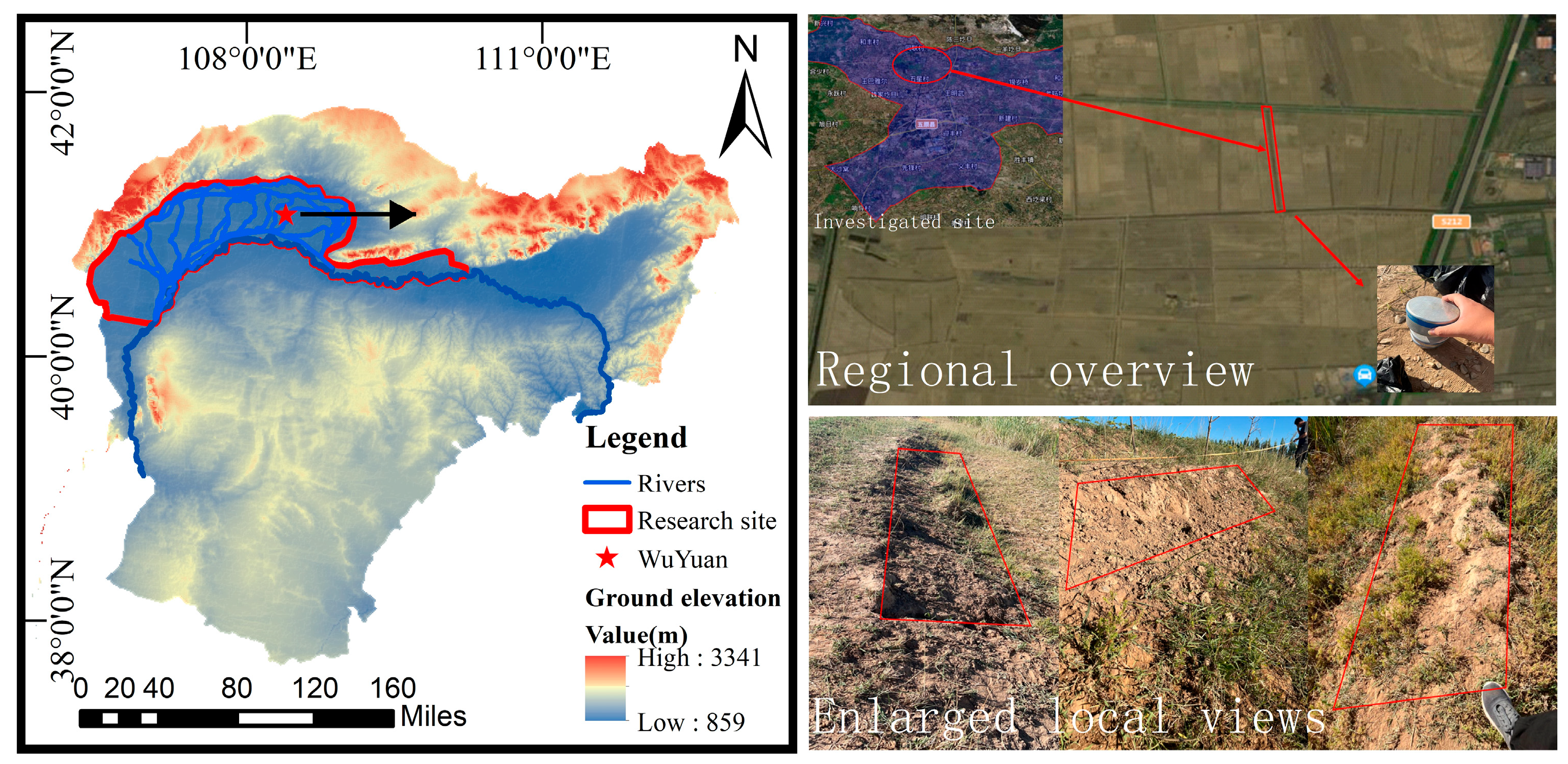
The study area is located in Wuyuan County, Bayannur City, Inner Mongolia Autonomous Region (107°35′70″–108°37′50″ E, 40°46′30″–41°16′45″ N), in China. It lies in the core area of the Hetao Irrigation District, situated at the northern end of the ‘π’-shaped bend of the Yellow River (Figure 1). The study region features a mid-temperate continental climate. The average annual precipitation ranges from 130 to 210 mm [26]. The groundwater table depth ranges between 0.5 and 3.2 m. The annual average temperature is 6.1 °C, with 44% of this amount occurring during the freeze–thaw period [27]. The maximum freezing depth in the study area is approximately 1.5 m. [10].

2.2. Soil Properties and Sample Preparation

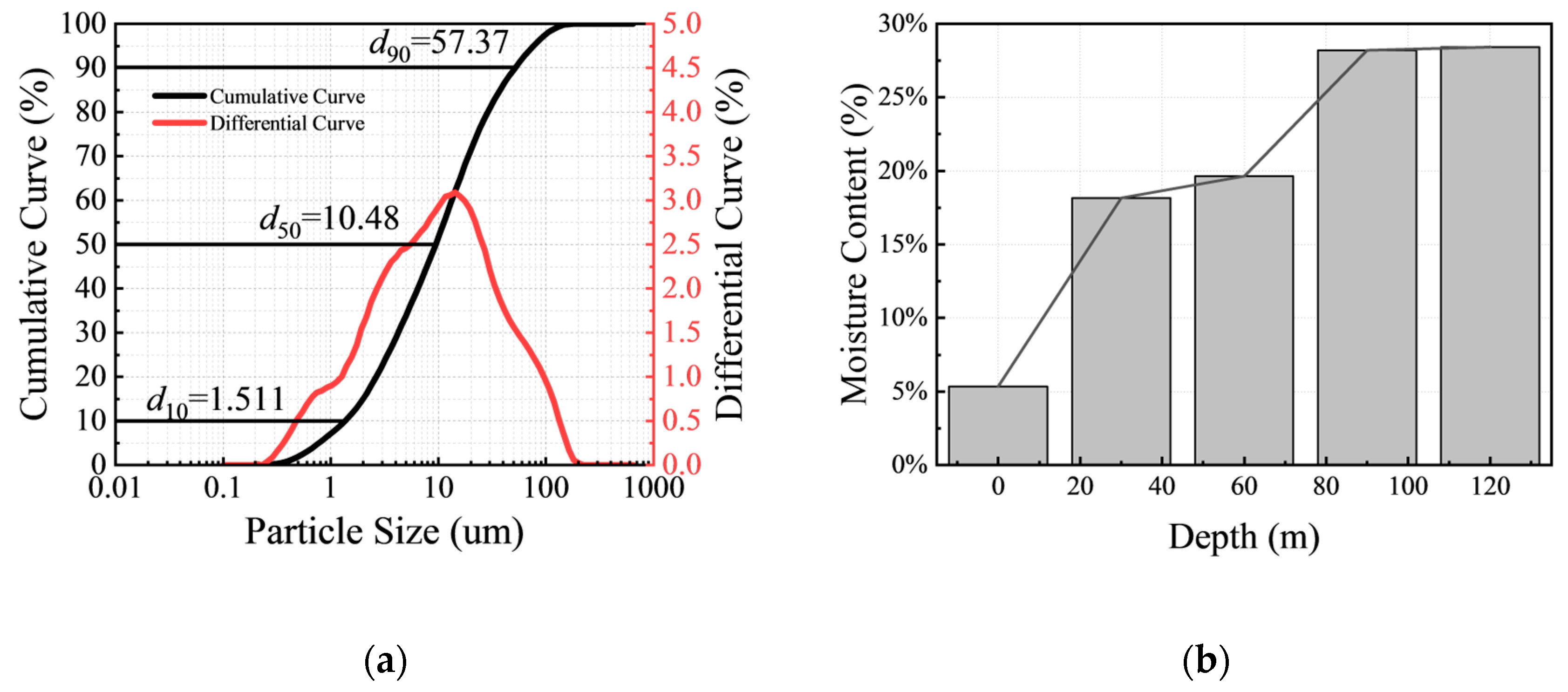
As undisturbed soil is susceptible to structural disturbance, difficult to collect, and challenging to preserve its natural fabric, remolded soil was therefore used for laboratory testing. Soil samples were collected at 0.3 m intervals from the ground surface to a depth of 1.2 m. At each designated depth, three representative undisturbed samples were obtained, resulting in a total of 15 samples from depths of 0, 0.3, 0.6, 0.9, and 1.2 m. The collected soils were air-dried and passed through a 2 mm sieve to remove impurities. Physical and index properties of the soil were determined following the Chinese National Standard GB/T 50123-2019 [28], and the results are summarized in Table 1. The particle-size distribution curve indicates that the soil is dominated by silt-sized particles, with minor clay content and negligible sand fraction. Atterberg limits were determined using the fall cone method. When the cone penetration depths were 2 mm, 4.2 mm, and 11.4 mm, the corresponding water contents were 21.0%, 27.1%, and 34.0%, according to GB/T 50123-2019 [28], the liquid limit corresponding to a penetration depth of 10 mm is approximately 31.5%, and the plastic limit is about 21.2%, resulting in a plasticity index of approximately 10. Based on the particle-size distribution and Atterberg limits, the tested soil is classified as a low-plasticity silty soil (clayey silt) according to the Unified Soil Classification System (USCS). The particle-size distribution of the soil and the vertical distribution of natural moisture content are presented in Figure 2.

2.3. Direct Shear Test

The direct shear test was selected because it not only determines soil strength rapidly and accurately but also offers distinct advantages over triaxial testing for simulating freeze–thaw-affected shallow soils. These advantages include simpler specimen preparation and a shorter testing duration. Furthermore, the apparatus configuration is particularly suitable for simulating the low-confining-pressure stress environment experienced by shallow soil layers in winter, thus providing a closer representation of actual field conditions.
The direct shear test specimens were prepared in accordance with the Chinese National Standard “Standard for Geotechnical Testing Methods” (GB/T 50123-2019) [28]. The remolded soil samples were fabricated into standard cylindrical specimens measuring 61.8 mm in diameter and 20 mm in height, with a compacted density of 1.47 g/cm3. Based on the determined optimum water content (18%) and considering the actual moisture fluctuation range (5.33–28.43%) in the study area, soil specimens were prepared at three water content value levels: 18%, 22%, and 26%. The specimens were sealed in plastic bags and cured for 24 h to ensure homogeneous moisture distribution. Preliminary tests showed that clear shear failure could not be obtained under very low vertical pressures (e.g., 50 kPa), which prevented reliable determination of peak shear strength. Therefore, four vertical pressure levels (100, 150, 200, and 250 kPa) were selected to ensure the development of distinct shear failure modes and a well-defined strength envelope. It should be noted that these stress levels were not intended to directly represent in situ overburden stresses at a specific depth, but were chosen to obtain reliable strength parameters for evaluating the influence of freeze–thaw cycles and for subsequent numerical simulations. The freeze–thaw cycle parameters were defined based on local meteorological data. Considering the multi-year average extreme minimum temperature of −23.3 °C, the freezing temperature was set at −20 °C [29] to effectively simulate the severe conditions of seasonal freezing. The thawing temperature was set at 15 °C to align with the actual thermal conditions of annual freeze–thaw cycles. Each cycle consisted of 12 h of freezing and 12 h of thawing, completing a full 24 h period. This setup reasonably simulates the diurnal cycle of surface soil and ensures the specimens undergo complete phase transformation. Previous research indicates that soil strength generally stabilizes after 5–10 freeze–thaw cycles [30]; consequently, the maximum number of freeze–thaw cycles adopted in this study was 10. The direct shear test specimens were prepared according to the Standard for Geotechnical Testing Method [28].
To focus on the mechanical response dominated by freeze–thaw effects, unconsolidated–undrained (UU) direct shear tests were performed on soil samples subjected to freeze–thaw cycles using a strain-controlled direct shear apparatus, based on the actual slope conditions and specific assumptions.
The typical shear rate for quick shear tests ranges from 0.8 to 1.2 mm/min. Since shear rates exceeding 1.0 mm/min may lead to overestimated shear strength [31], the shear rate in this study was set to 0.8 mm/min. The test was terminated when the shear stress reading stabilized or showed a significant drop, indicating specimen failure. If the shear stress continued to increase, the test was stopped at a displacement of 6 mm. (manufactured by Nanjing Soil Instrument Factory Co., Ltd., Nanjing City, China) The shear stress of the specimen was calculated using the following formula:
τ = C R A × 10
where τ represents shear stress (kPa); C represents load cell calibration coefficient (N/0.01 mm); and R represents load cell reading (0.01 mm). A represents the shear plane area of the soil specimen.

2.4. Numerical Modeling Framework

2.4.1. Simulation Methodology and Governing Equations

Before introducing the governing equations, the purpose and scope of the hydro-thermal numerical simulation are clarified. The simulation aims to investigate the dynamic evolution of temperature and moisture fields within the slope during seasonal freezing and thawing. Rather than reproducing short-term hydrological or meteorological events, the model focuses on the response of the slope to idealized seasonal thermal forcing under typical winter conditions.
This study employed sequential coupled numerical simulation. First, transient hydro-thermal coupling simulation was conducted through hydro-thermal coupling analysis to obtain the temperature field, moisture field, and their evolution laws of the slope during the freeze–thaw process. At this stage, the frost heave stress generated by moisture phase transition was acquired, and the stress and strain during the freeze–thaw process were observed. Subsequently, based on the soil conditions calculated in the first stage, the freeze–thaw degradation mechanical parameters obtained from direct shear tests were assigned to the soil, and the Mohr–Coulomb plastic criterion was introduced. The strength reduction method was used to calculate the slope safety factor, and the displacement changes were analyzed. This study established a hydro-thermal coupling model using the PED module on the COMSOL 6.2 Multi-physics platform, and then introduced the solid mechanics module to realize hydro-thermal-mechanical (THM) three-field coupling analysis.
Assuming homogeneous and isotropic soil properties, with constant thermal conductivity, specific heat, and density, the governing equation for the temperature field in frozen soil was established based on Fourier’s law and energy conservation principles, as follows [32]:
ρ C θ T t = λ θ 2 T + L ρ i θ i t
where represents the Nabla operator; T represents soil temperature (°C); t represents time (s); θ represents the volumetric water content of frozen soil; θi represents the volumetric ice content, with θ = θu + (ρi/ρw) × θi; θu represents the volumetric unfrozen water content; ρ and ρi represent the densities of soil and ice (kg/m3); L represents the latent heat of phase change (334.5 kJ/kg); λ(θ) represents thermal conductivity (W/[m·°C]); and C(θ) represents volumetric heat capacity (J/[kg·°C]).
Unfrozen water is always present within slopes under freeze–thaw conditions, and its migration follows Darcy’s law. Assuming the moisture migration mechanism in frozen soil is analogous to that in unfrozen soil, while neglecting vapor transport effects and accounting for the impedance of the ice matrix on unfrozen water flow [33], the Richards equation for frozen soil was derived based on unsaturated flow theory as follows [34]:
θ u t + ρ i ρ w θ i t = D θ u θ u + K g θ u
where Kg represents the unsaturated hydraulic conductivity in the direction of gravitational acceleration. D(θu) represents the water diffusivity in frozen soil (m/s), calculated as follows:
D θ u = k s × S l × 1 1 S 1 / m m 2 a × m 1 m × S 1 / m × 1 S 1 / m m × 10 10 θ i
where a, m, and l represent shape parameters dependent on soil properties (a = 2; m = 0.5; l = 0.5), parameters “a”, “m”, and “l” are empirical coefficients related to the soil water migration and phase change behavior during freezing and thawing, These parameters control the sensitivity of unfrozen water content to temperature variation and are commonly adopted in hydro-thermal coupling models for frozen soils. The adopted parameter values represent typical conditions and were not obtained through site-specific inverse calibration. The numerical simulation mainly aims to capture the overall evolution trend of the temperature field under freeze–thaw conditions rather than to exactly reproduce point-scale temperature measurements; ks represents the saturated hydraulic conductivity; and S represents the relative saturation of frozen soil, defined as S = (θuθr)/(θsθr), where θr represents residual water content and θs represents saturated water content.
The thermal conduction equation and moisture migration equation were coupled using the ice-to-water ratio Bi. The coupled thermo–hydro equations are as follows [35]:
B i = θ i θ u 1.1 T T f b 1 ,     T < T f 0 ,     T T f
where Tf represents soil freezing temperature (°C) and b represents a soil specific constant dependent on soil type and salt content
Under the aforementioned coupled conditions of temperature field and moisture field, the governing equation of the stress field is added.
Equilibrium equations:
× σ = F
where σ represents the stress tensor and F represents the external force; the symbol × represents the curl operation, not multiplication.
Geometric equations:
ε = u
where ε represents the strain tensor and u represents the displacement vector field.
Constitutive model:
σ = c ε ε 0
where [c] represents the material stiffness matrix (elasticity matrix) and ε0 represents initial strain or eigenstrain (deformation induced by temperature changes). For frozen soil computations, strains induced by time-dependent creep, water–ice phase transitions, and moisture movement must be incorporated:
ε = ε e + ε ν
where εe represents elastic strain induced by mechanical stress and εν represents volumetric strain due to moisture phase change and migration, formulated as
ε ν = β θ i
where β denotes frost heave coefficient.

2.4.2. Geometry Modeling, Boundary Conditions, and Parameter Setting

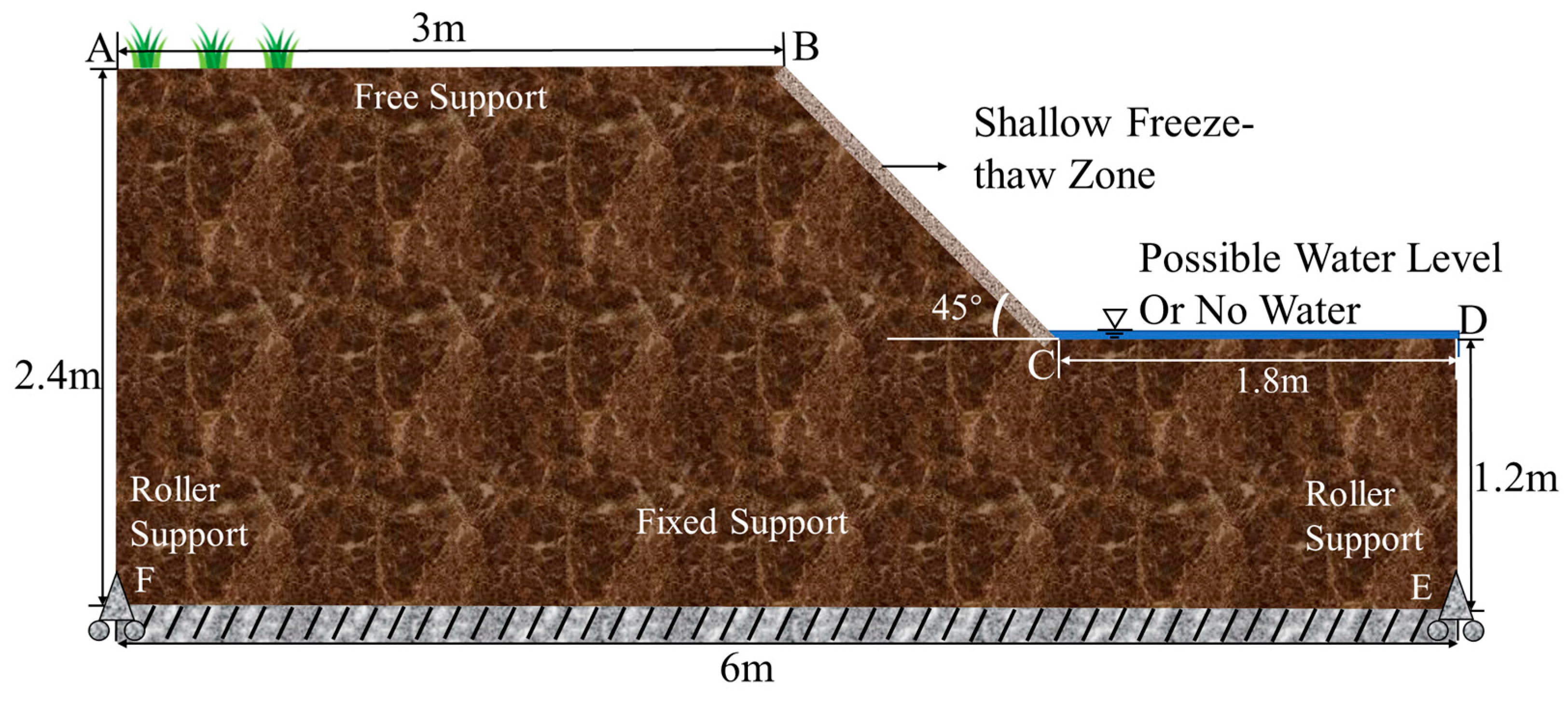
The slope height was 1.2 m based on field measurements. To minimize potential boundary effects on computational outcomes, the model geometry was dimensioned with a crest length of 2.5 times the slope height (3.0 m), a toe distance of 1.5 times the height (1.8 m), and vertical boundaries extending at least twice the height (2.4 m) above and below the slope base. The slope stability model employed Mohr–Coulomb elastoplastic constitutive theory. Boundary conditions included a fixed support at the base, roller supports on lateral boundaries, and a free surface condition at the ground level. Figure 3 shows the detailed configuration.
When the lateral boundaries were positioned at distances exceeding twice the slope height from the slope centroid, their impact on thermal distribution within the slope body became negligible. Thus, adiabatic conditions were prescribed to the vertical boundaries.
Based on the fact that, in the study area, the air temperature gradually drops below zero starting from mid November and the soil does not completely thaw until late March of the following year, this study sets the simulation period to 130 days to represent the complete seasonal freeze–thaw process of shallow slope soil.
The temperature boundary condition applied in the hydro-thermal model is a prescribed and idealized function rather than a direct input of measured meteorological data. A sinusoidal function is adopted to represent the typical seasonal cooling–warming trend associated with freezing and thawing processes. The form of the temperature function is intentionally simplified to facilitate a clear analysis of the underlying hydro-thermal mechanisms within the slope. The amplitude and period of the temperature boundary are specified to ensure the occurrence of seasonal freezing and thawing, but they are not intended to reproduce day-to-day air temperature variations at the study site.
The specific temperature function at the upper boundary of the model is given by the following equation. Considering that the sloping section cannot receive full-period sunlight exposure, the temperature function is set as T(t) − 2. Moisture exchange with the external environment is neglected, and zero-flux boundary conditions are applied to all lateral boundaries.
T t = 2.5 15 × sin 2 × π × t 130 7.8
The computational grid employs triangular elements with a maximum element size of 0.318 m, a minimum element size of 0.0018 m, and a total of 388 elements. The main parameters were determined based on experimental test results and references [36,37,38], as detailed in the following Table 2.

2.4.3. Model Validation

To verify the validity and correctness of the aforementioned coupled model, this study selected freezing test data from experiments conducted by Lu [40] using a self-developed thermo–hydro migration device for inverse simulation validation. The experimental model employed a cylindrical soil column with a height of 0.5 m and a diameter of 0.1 m, with an initial volumetric water content of 30%. The temperature boundary conditions were set as 20 °C at the upper end and −20 °C at the lower end. The soil column freezes from top to bottom, and the entire test was conducted under closed conditions—meaning that there was no external water supply or discharge, with only moisture redistribution within the sample occurring.
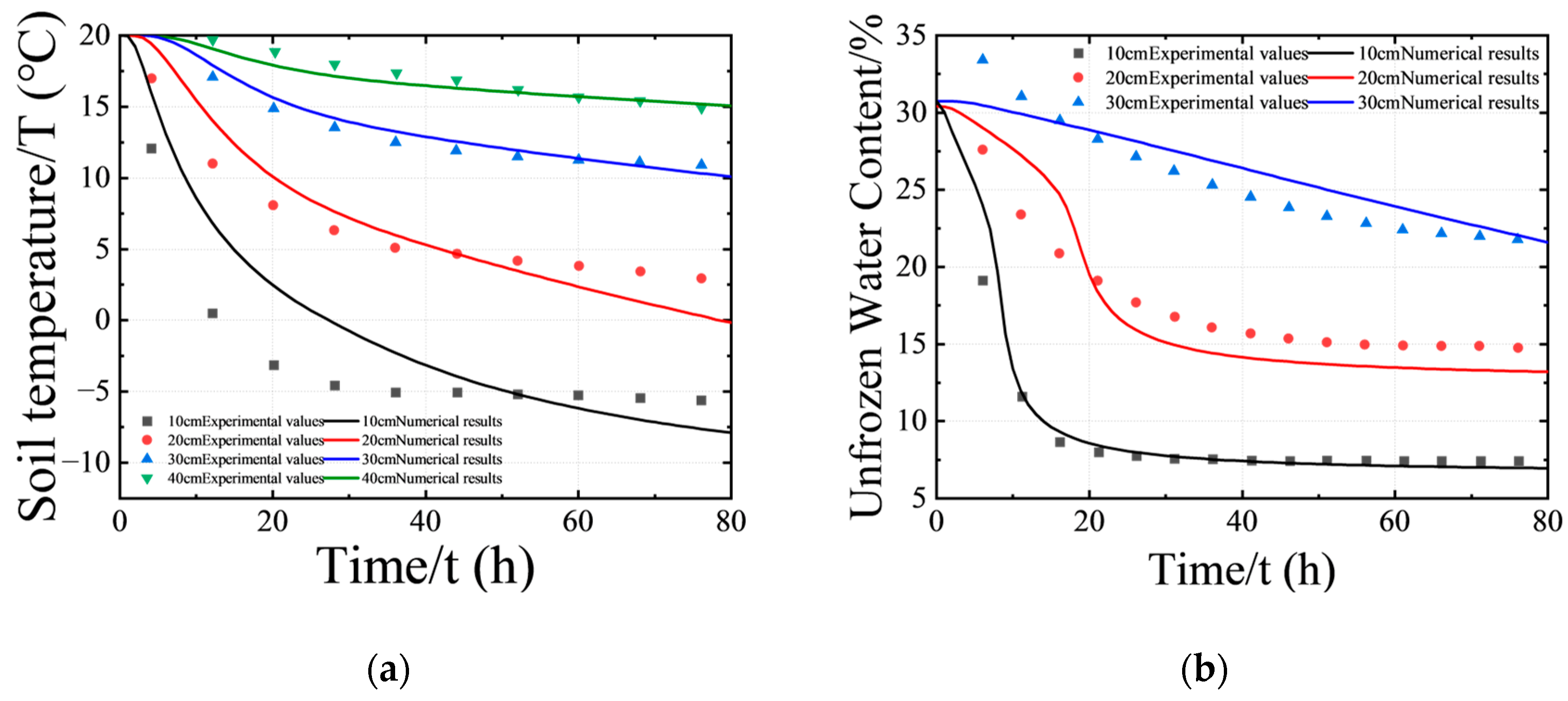
Figure 4 presents a comparison between experimental results and simulated values of temperature and moisture at different times and depths. As shown, the numerical simulations generally agree well with the experimental data, demonstrating the good fitting performance of the adopted numerical method, though minor discrepancies are observed at certain depths. These differences are attributed to incomplete thermal isolation at the soil boundaries during testing, whereas the simulation assumed ideal conditions. Additionally, the model exhibited a slower initial temperature decrease, resulting in delayed ice formation, followed by lower temperatures at later stages with a sharp increase in ice content and cessation of moisture migration. Consequently, enhanced migration of unfrozen water toward the freezing front led to a lower volumetric unfrozen water content at greater depths compared to the experimental values.

2.4.4. Figure Caption

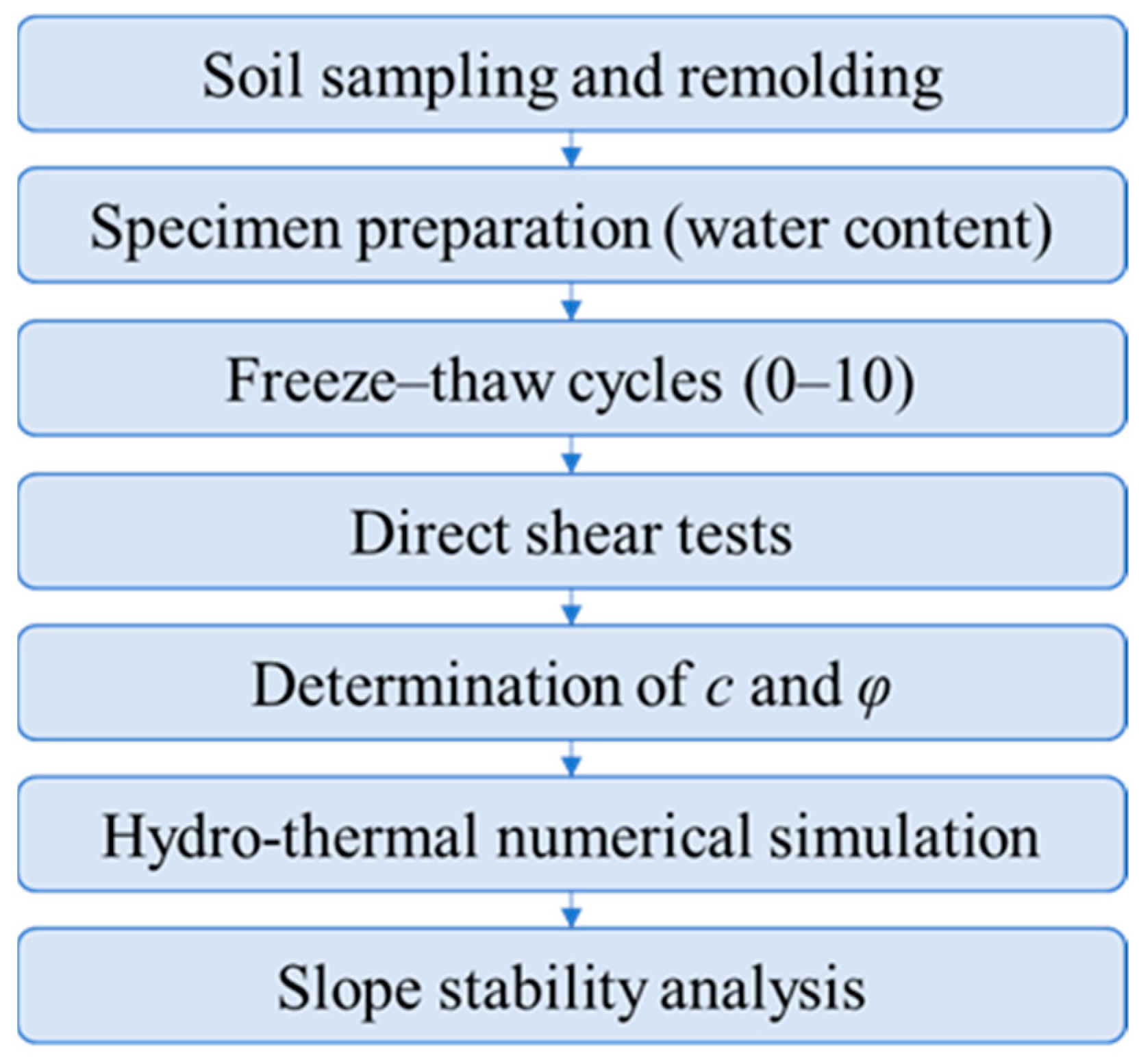
To improve the clarity of the research procedure, a schematic diagram illustrating the experimental and numerical workflow is provided in Figure 5.

3. Results and Analysis

3.1. Deterioration Effects of Freeze–Thaw Cycles on Soil Mechanical Properties

3.1.1. The Attenuation Law of Shear Strength

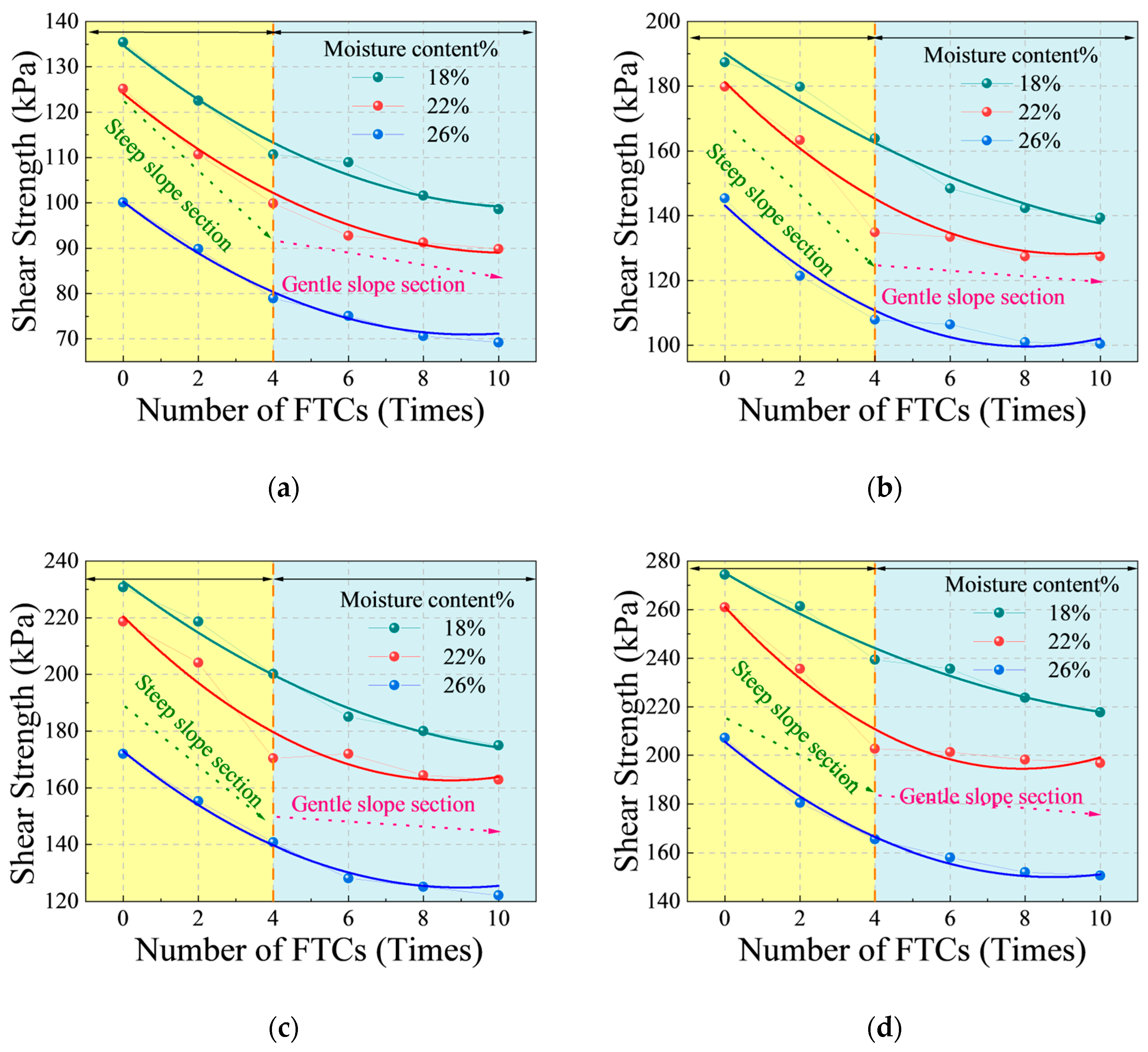
Figure 6 illustrates the variation trend of soil shear strength. As observed, the shear strength continuously decreases with increasing freeze–thaw cycles and stabilizes after 10 cycles. During the initial 1–4 freeze–thaw cycles, the shear strength declines significantly, represented by a steep curve, while the rate of strength reduction slows after 4 cycles. Under confining pressures of 100 kPa, 150 kPa, 200 kPa, and 250 kPa, the attenuation coefficients of the three soil samples with different moisture contents after 10 freeze–thaw cycles (compared to 0 cycles) are 27.17%, 28.24%, and 30.88%; 25.60%, 29.17%, and 30.93%; 24.18%, 25.52%, and 28.95%; and 20.65%, 24.57%, and 27.34%, respectively. Moisture content exhibits an inverse relationship with shear strength: when moisture content increases from 18% to 26%, shear strength decreases by approximately 20–30%. This indicates that moisture is a critical factor influencing the extent of freeze–thaw damage, with soil structure becoming more susceptible to deterioration under higher moisture conditions.

3.1.2. The Evolution Characteristics of Strength Parameters

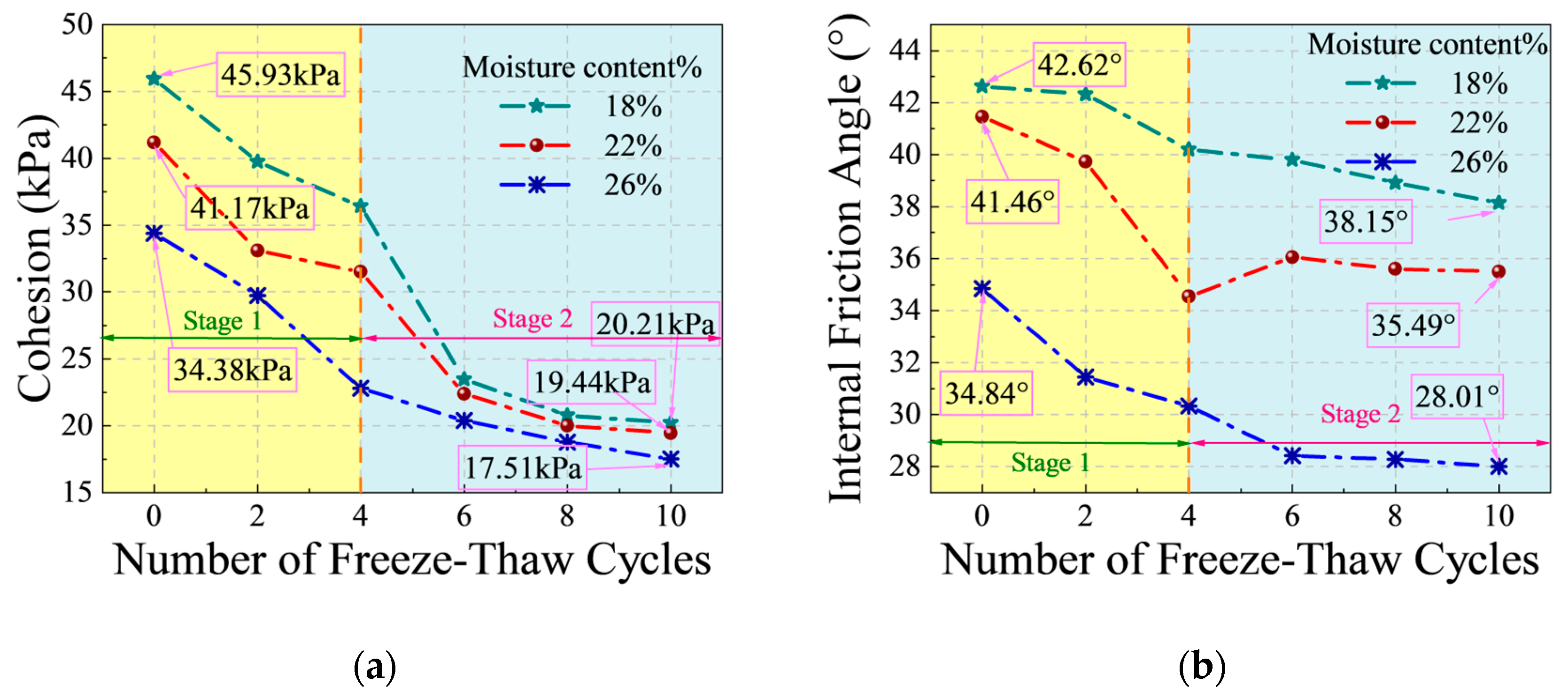
Figure 7a shows the variation in cohesion for specimens with moisture contents of 18%, 22%, and 26% subjected to 0–10 FTCs. Figure 7b illustrates the corresponding variation in internal friction angle. Both cohesion and internal friction angle decreased progressively with increasing FTCs and stabilized after 10 cycles.
After undergoing 10 freeze–thaw cycles (FTCs), the cohesive strength of the soil frozen under moisture contents of 18%, 22%, and 26% decreased by 56%, 52.78%, and 49.07%, respectively, while the reduction rates of the internal friction angle were 10.49%, 14.4%, and 19.6%, respectively. The freeze–thaw cycles exhibited a more pronounced degradation effect on cohesion, with reductions exceeding 50% across all three moisture content conditions, whereas the internal friction angle experienced comparatively moderate deterioration, showing decreases ranging between 10% and 20%.

3.2. The Dynamic Hydro-Thermal Evolution Process of Slopes

This study selects four representative time points for detailed analysis, namely day 1, day 45, day 90, and day 130. Among these, day 1 corresponds to the initial unfrozen state, day 45 represents the active freezing stage, day 90 reflects the late freezing or early thawing stage, and day 130 marks the end of the thawing process. These time points were selected to clarify the key transitional stages of the freeze–thaw cycle and their corresponding slope response characteristics.

3.2.1. Spatiotemporal Distribution of the Temperature Field

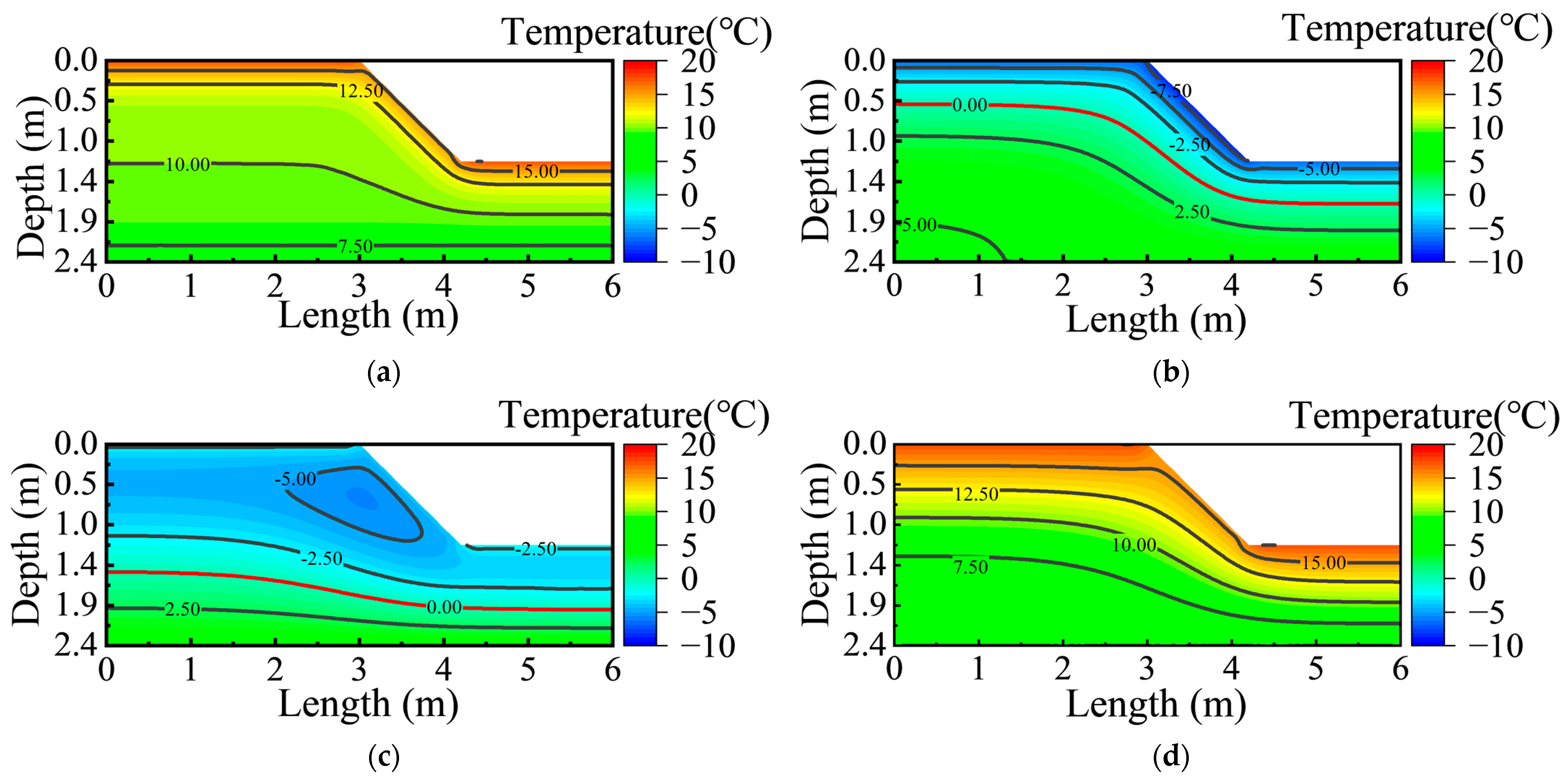
According to the time-series variation in freeze–thaw duration, temperature changes were examined every 45 days, and the temperature variation in the channel section was plotted (see Figure 8). As shown in Figure 8a, when the ambient temperature remains around 15 °C, the surface temperature is relatively high, while the temperature at deeper layers is slightly lower, indicating that heat has not yet fully conducted to greater depths. Nevertheless, the temperature distribution remains relatively uniform, and the overall profile remains comparatively warm. After 45 days of cooling, temperatures dropped significantly, particularly near the surface, to reach approximately −8 °C, while deeper regions remained above 0 °C. This observation indicated the formation of a distinct frozen layer near the surface, accompanied by downward heat dissipation (see Figure 8b). By day 90, the spatial extent of the low-temperature zone had further expanded. This expansion resulted in increased homogenization of the temperature distribution throughout the soil profile and a concomitant increase in the thickness of the frozen layer. The upper slope approached near-complete freezing, while a steep temperature gradient developed in the mid-slope region. As this area became the thermal minimum, cold invaded inward, which resulted in temperatures between −5 °C and −1 °C throughout the near-slope region. This condition indicated that the freezing front had penetrated deeply and stabilized (see Figure 8c). In the final phase (see Figure 8d), rising ambient temperatures caused surface warming and a gradual increase in subsurface temperatures. The temperature distribution approached but did not reach the initial state owing to residual cooling effects, with deeper zones remaining comparatively cold. The frozen layer receded, with the surface and slope crest experiencing the most rapid temperature recovery. The temperature field within the slope soil mass exhibited a pronounced co-variation with atmospheric temperature fluctuations. Specifically, soil temperature increased or decreased in response to air temperature fluctuations. However, this response was not instantaneous. A distinct time lag was observed. The thermal response lag increased progressively with depth, which resulted in a more pronounced delay in temperature changes at greater depths.

3.2.2. The Migration and Redistribution of the Moisture Field

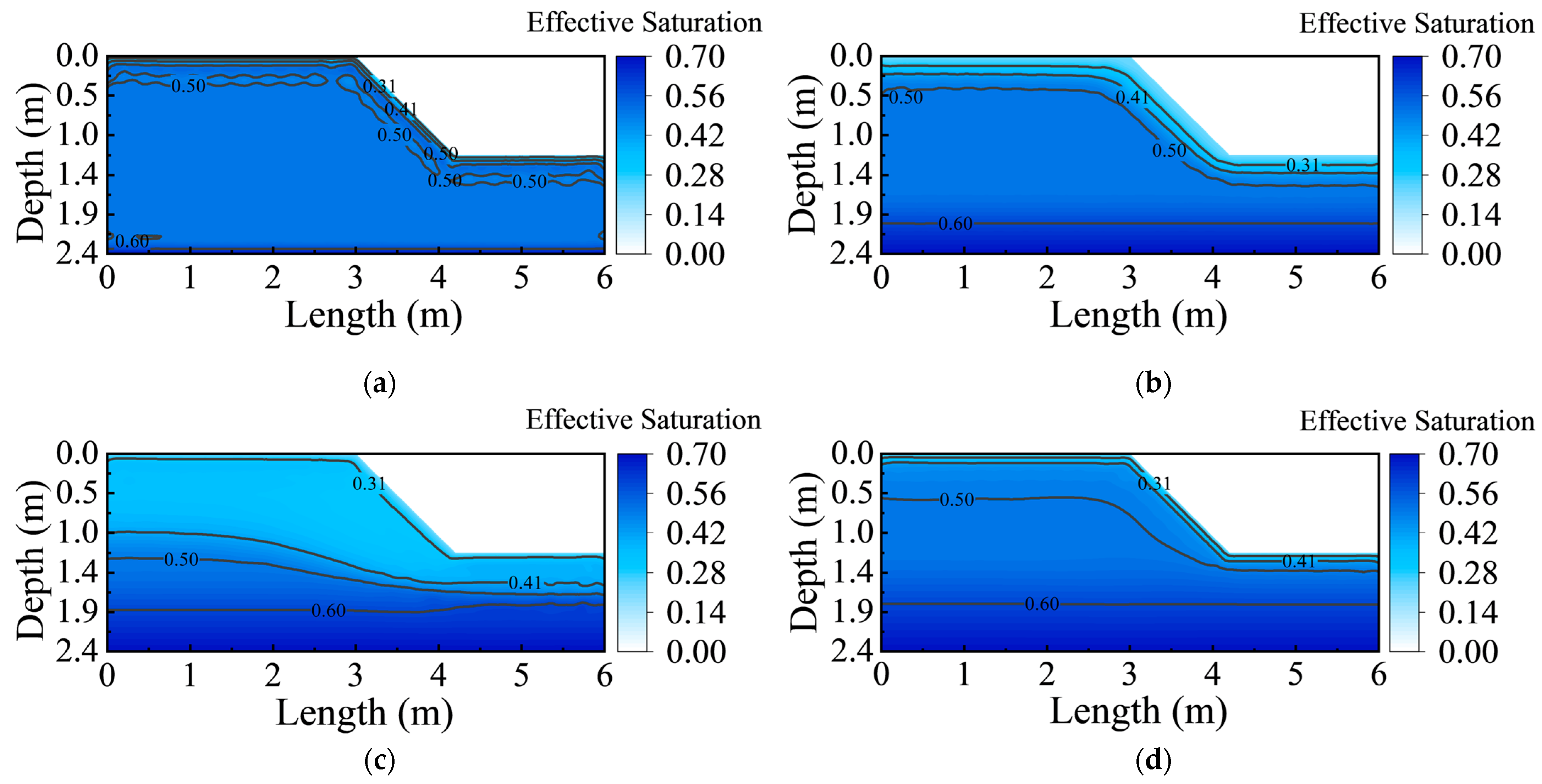
The effective saturation represents the fraction of mobile liquid water rather than the total water content. Under freezing conditions, part of the pore water exists in the ice phase, and this phenomenon reduces the effective saturation despite the presence of surface water. Therefore, it is physically reasonable that the effective saturation at the slope toe and riverbed is lower than 1.0.
Figure 9 illustrates the moisture variation under the coupled hydro-thermal simulation. It can be observed that during the initial freezing phase (1–45 days), high moisture content prevailed at depth, while near-surface moisture content gradually decreased. This condition reflected the overall vertical moisture redistribution. From day 45 to day 90, as freezing intensified and the frozen layer advanced downward, a significant amount of moisture migrated from the slope surface towards greater depths. Meanwhile, near-surface moisture transitioned from liquid to solid phase and accumulated as ice within the developing frozen layer. This migration resulted in reduced moisture content and consequently lower saturation levels within the mid-slope region (1–2 m depth), particularly compared with deeper zones near the slope base. During the thawing phase (90–130 days), the freezing front continued to advance downwards before stabilizing. Subsequent melting released the stored ice, which was transformed into liquid water. This meltwater, previously concentrated at mid-depths, migrated further downwards. By day 130, the saturation profile exhibited a distinct vertical gradient, with saturation increasing progressively with depth.
Throughout the FTCs, soil moisture content consistently exhibited an increasing trend with depth. Moisture migration rates within the vertical profile were heterogeneous and exhibited an inverse correlation with depth. Migration occurred more rapidly in shallow soil layers than in deeper strata. Meanwhile, shallow soil was highly susceptible to thermal influences. This susceptibility promoted the phase transition of pore water from liquid to solid ice near the surface relative to deeper zones. Furthermore, surface soil experienced evaporation driven by environmental factors such as solar radiation and wind. This combination of phase change and evaporation near the surface established a pronounced disparity in unfrozen liquid water content between shallow and deep soil layers.

3.3. Stress–Strain Behavior Under Thermo–Hydro Coupling

3.3.1. Evolution of Frost Heave Stress

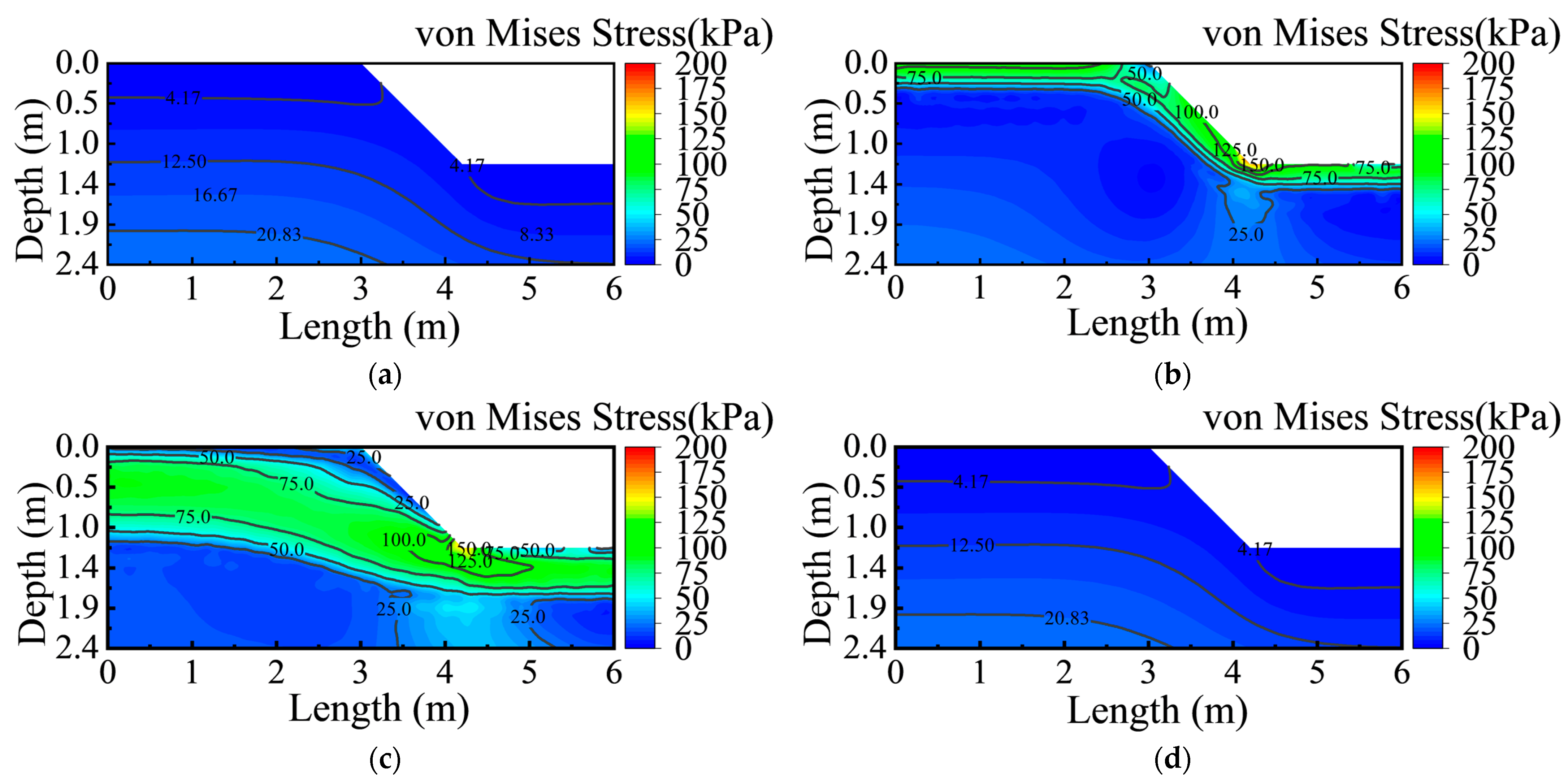
The von Mises stress is used as an equivalent stress indicator to evaluate the overall stress concentration state of the slope under freeze–thaw conditions. It can effectively reflect the stress effects induced by thermo-hydraulic coupling.
Building upon the evolution of the thermal and hydraulic fields, stress response mechanisms under hydro–thermo coupling were analyzed for corresponding time intervals. The initial freezing stage exhibited a relatively uniform stress distribution, which increased gradually from top to bottom, with lower stress values near the surface and higher values at the base (Figure 10a). This distribution indicated gravity-dominated loading without significant frost heave stress concentration. By day 45, sub-zero temperatures triggered ice–water phase change, which generated expansive forces that caused minor stress increases in surface layers while central and basal zones remained largely unaffected (Figure 10b). At the initial thawing stage by day 90, the external air temperature had begun to rise continuously from its minimum. At this stage, particularly at the toe of the slope in the surface layer, stress increased significantly, and the area was most affected by frost heave. This condition was possibly due to moisture migration during the freezing process, which loosened the soil and reduced the local bearing capacity. Small-scale stress changes were observed in the shallow soil layer at depths of 1–2 m below the slope surface. Stress within the sloping section gradually shifted from the slope toe towards the slope face, with stress propagating deeper into the ground. Stress progressively intensified from the center of the slope towards the toe to form a distinct yellow stress concentration zone (Figure 10c). By day 130, with the temperature rising back to the initial value, the stress distribution within the slope gradually returned to its original state (Figure 10d).

3.3.2. Strain Accumulation and Localization

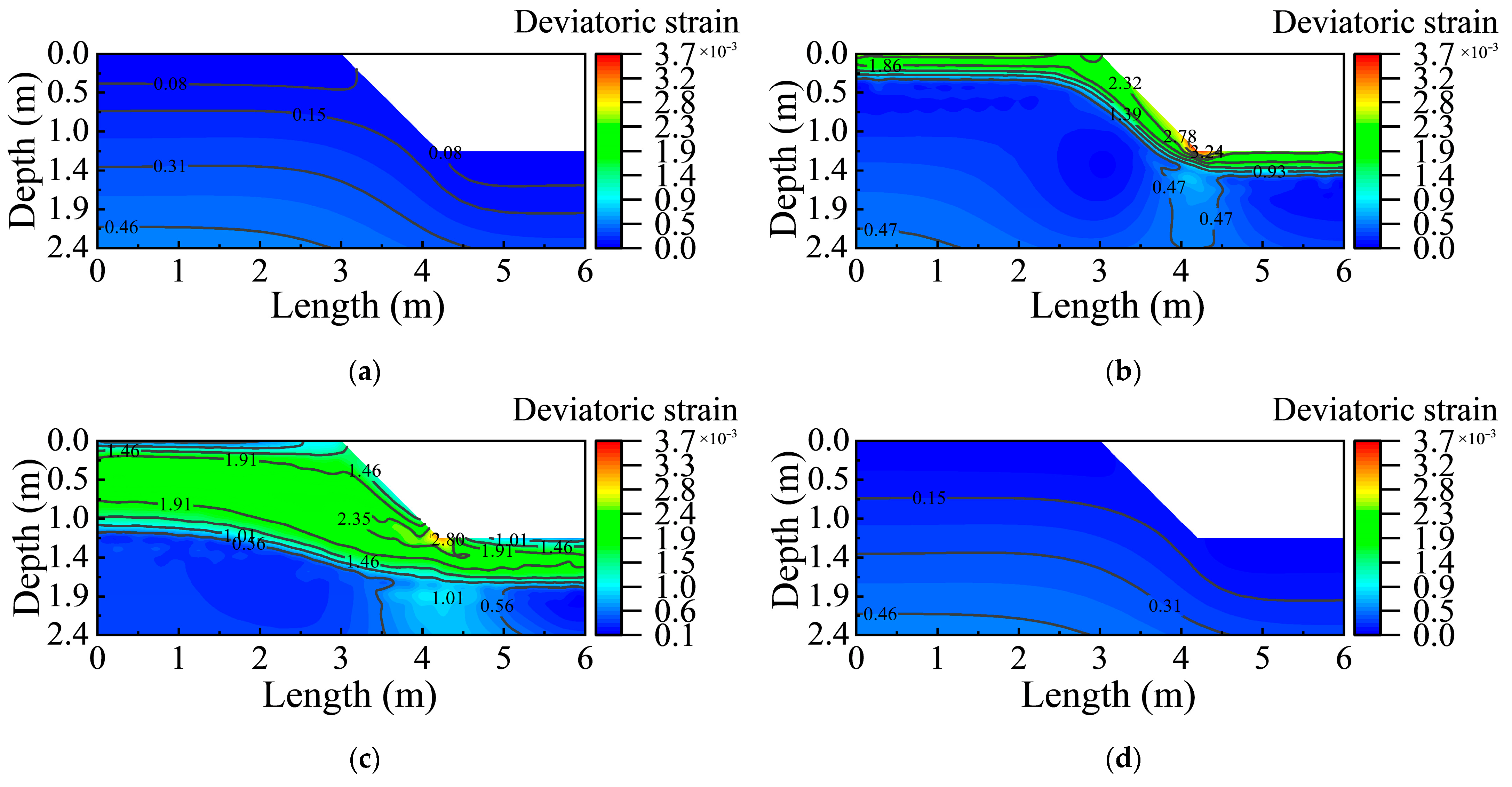
The strain distribution diagrams (Figure 11) revealed significant temporal changes in the deformation characteristics within the slope during freezing, predominantly governed by frost heave and moisture migration. At the initial freezing stage (day 1), the entire slope exhibited a relatively uniform strain distribution with minor strain in the surface and central regions and slightly lower strain at the base, where gravitational loading dominated. By the early freezing phase (day 45), strain intensified substantially near the slope crest and surface as frost heave effects emerged. This condition indicated that the freezing front had not yet penetrated deeply. Surface frost heave became widespread across the ground. By day 90 during initial thawing, shallow slope strain continued to increase with rising temperatures while the freezing front advanced deeper. These conditions induced significant frost heave deformation at the central slope face. This phase exhibited peak moisture migration influence. Water in the central slope migrated downwards along thermal gradients, underwent a phase transition to ice, and accumulated in the middle section. Extensive ice crystallization caused volumetric expansion and frost heave deformation. Meanwhile, the already-frozen surface layer gradually became rigid, and the central slope zone, confined by overlying and underlying soils, experienced increased deformation susceptibility, which led to high strain concentrations. By day 130, the strain distribution reverted to a state consistent with day 1 and replicated the initial strain characteristics.

3.4. Slope Stability and Displacement Analysis

3.4.1. Assumptions

In the slope stability analysis, the influence of water presence within the canal is not explicitly considered. This simplification is adopted to focus on the intrinsic stability of the slope body during the freezing period under non-flood conditions, where temperature induced changes in soil mechanical properties dominate slope behavior.
The shear strength parameters used in the slope stability analysis were obtained directly from the direct shear test results under different freeze–thaw cycles and moisture contents. Specifically, cohesion and internal friction angle were determined by linear fitting of the Mohr–Coulomb failure envelopes corresponding to each freeze–thaw condition. For the slope stability calculations, the strength parameters associated with the corresponding freeze–thaw cycle were assigned to the soil layer in the numerical model. In this manner, the degradation of soil shear strength induced by freeze–thaw action is explicitly incorporated into the stability analysis. Other parameters were kept constant to isolate the influence of freeze–thaw cycles on slope stability.

3.4.2. Evolution of the Safety Factor

The slope stability safety factor (FS) before and after freeze–thaw action was calculated via SRM. This approach introduced a strength reduction factor (SRF) to proportionally reduce the shear strength parameters—effective cohesion c′ and friction angle φ′. Reduced parameters Cr and φr replace C′ and φ′ in the stability equations. SRF was increased incrementally until numerical convergence failed, which indicated a violation of the soil failure criterion or global equilibrium. The critical SRF value at this threshold defined the minimum FS, which indicated the limit equilibrium state. This method effectively quantified how freeze–thaw-induced strength degradation impacted slope stability. The reduction formulas are expressed as follows:
C r = 1 S R F × C
φ r = a r c t a n 1 S R F tan φ
where C′ and φ′ represent the actual strength parameters of the soil after freeze–thaw action, the parameters obtained from the aforementioned tests; Cr and φr represent the reduced cohesion and internal friction angle; and SRF represents the strength reduction factor.
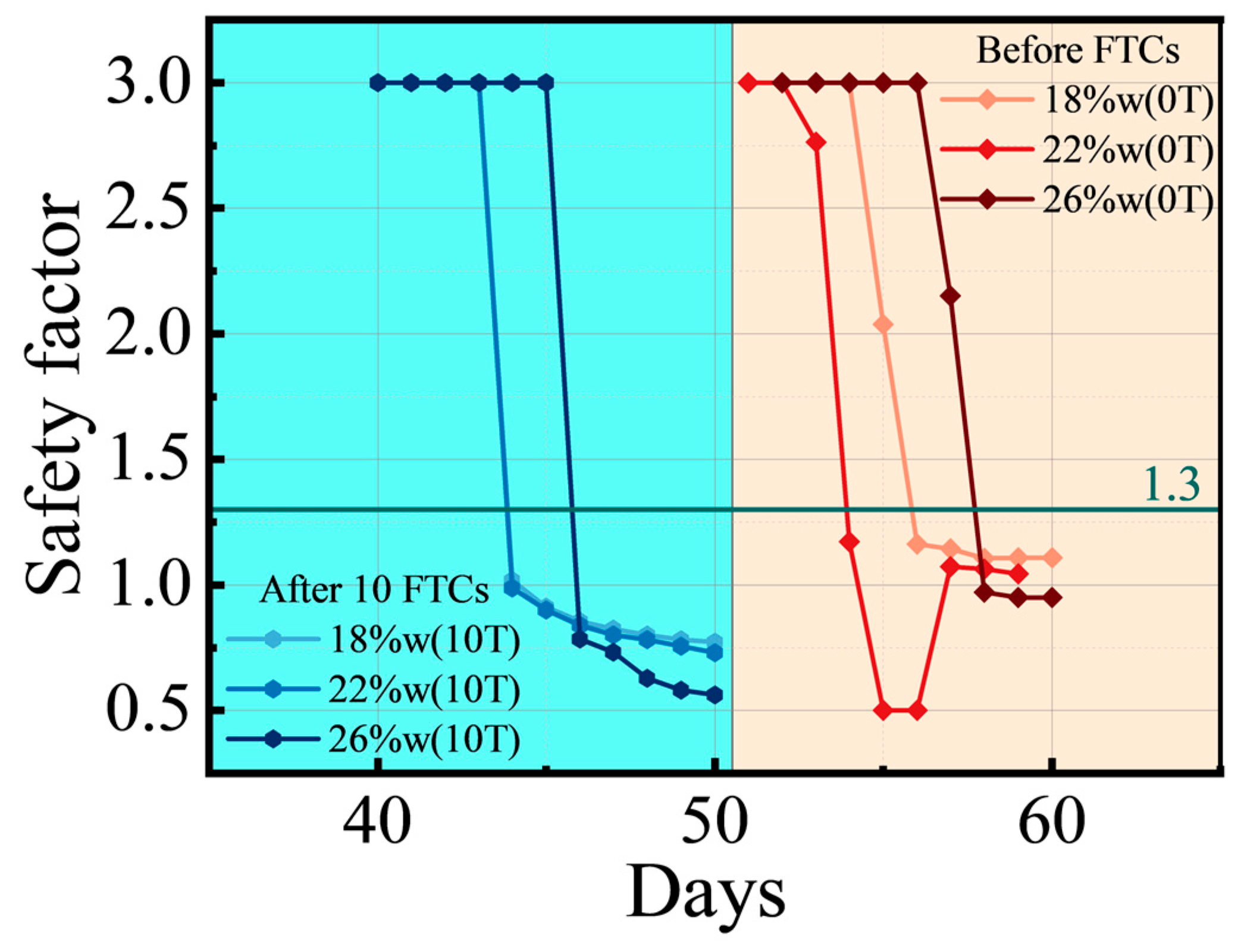
Consistent with geotechnical standards for static 2D slopes in temporary or low-risk projects, an FS of 1.3 serves as the stability benchmark [41]. Figure 12 compares the evolution laws of safety factors for slopes with different moisture contents before and after freeze–thaw cycles. The results show that freeze–thaw action reduces slope stability and accelerates the instability process. For the slope with 18% moisture content, the safety factor of the slope without freeze–thaw cycles first drops below the critical value (1.3) on day 56; however, after 10 cycles, this time point is advanced to day 44, with instability occurring 12 days earlier. Under 22% moisture content, slope instability occurred 10 days earlier. The slope with 26% moisture content shows a similar trend, with the instability time advancing from day 58 to day 46.
Moreover, moisture content itself has an impact on stability: under unfrozen conditions, the FS for slopes with 18% moisture content ranged between 1.11 and 3, while those with 22% moisture content exhibited an FS range of 1.04–3. For slopes with 26% moisture content, the FS further decreased to 0.95–3. After 10 freeze–thaw cycles, significant soil strength degradation occurred, resulting in reduced FS ranges of 0.77–3, 0.73–3, and 0.56–3 for slopes with 18%, 22%, and 26% moisture content. These results demonstrate a synergistic deterioration effect on slope stability induced by the combination of high moisture content and freeze–thaw cycles.

3.4.3. Evolution and Distribution Characteristics of the Displacement

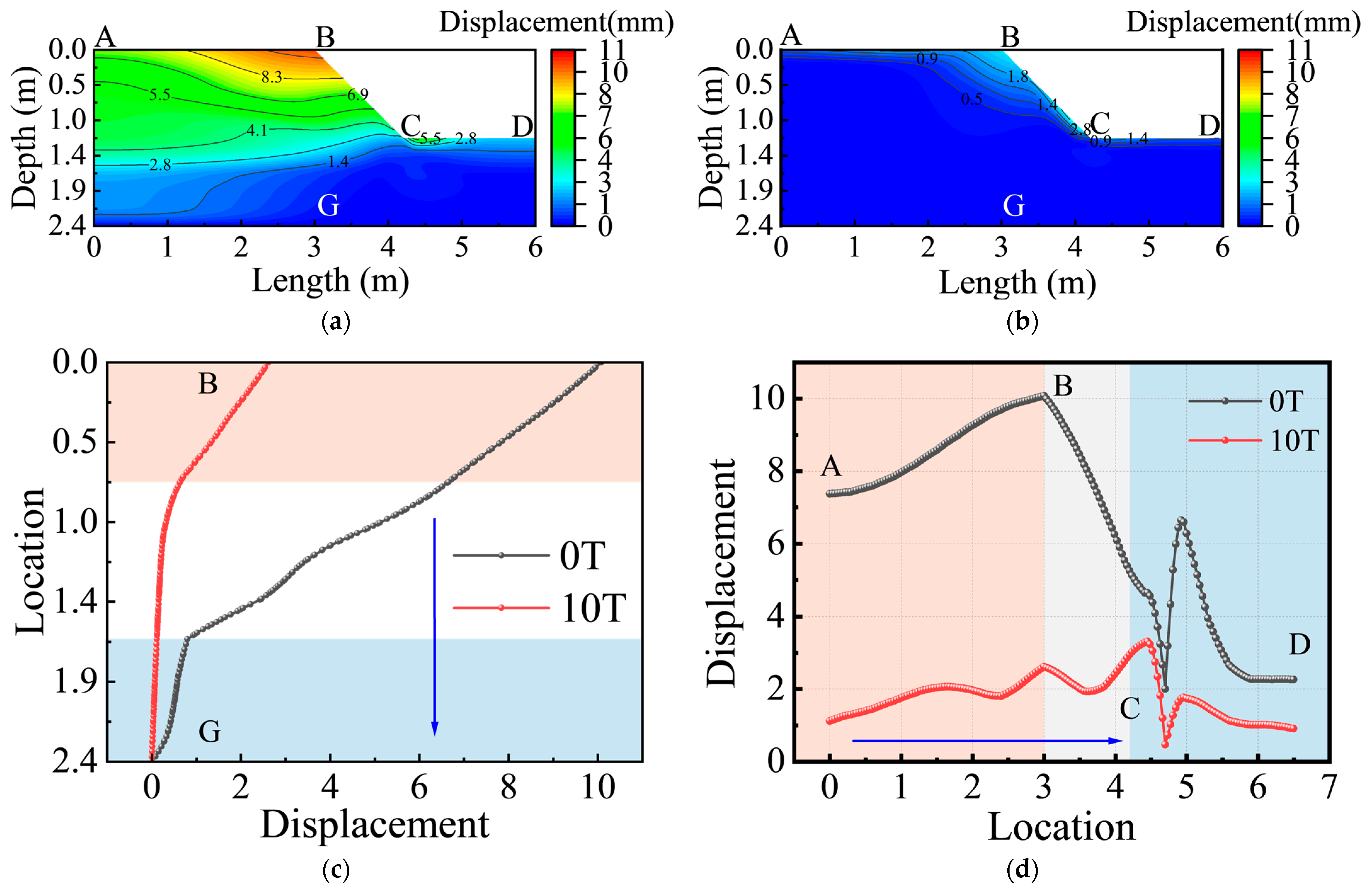
In this study, displacement contour maps corresponding to the occurrence of numerical model non-convergence were plotted for the slope with a moisture content of 18% after 0 and 10 freeze–thaw cycles, respectively. Based on these maps, the vertical displacement profiles along the slope surface from Point B (slope top) to Point G were further extracted, and the displacement distribution characteristics along the slope from Point A to Point D were obtained. The aforementioned results are presented in Figure 13.
Displacement distribution characteristics indicate that slope deformation is mainly concentrated in the BC segment of the slope surface and the slope toe area (point C), among which the displacement at point B (slope top) being the most significant. Specifically, the maximum displacement without freeze–thaw cycles is 10.1 mm, while after 10 freeze–thaw cycles, the maximum displacement instead decreases to 2.6 mm.
This seemingly counterintuitive phenomenon (decreased displacement after freeze–thaw cycles) is highly consistent with existing research conclusions [42,43], and its physical essence stems from a fundamental transformation in the soil failure mode induced by freeze–thaw cycles: unfrozen-thawed soil, due to its dense structure and strong cementation, exhibits strain localization characteristics during failure, leading to abrupt development of local displacements. In contrast, after multiple freeze–thaw actions, the soil undergoes structural deterioration, increased porosity, and significant degradation of strength parameters (cohesion c, internal friction angle φ), causing its failure mode to transform from “concentrated brittle shear” to “diffuse plastic flow”. This transformation enables wider range of soil structural adjustment and particle rearrangement, thereby inhibiting the development of local extreme displacements.
The observed “decreased displacement” is not a sign of improved slope stability; on the contrary, this phenomenon reveals that the soil strength has severely deteriorated and entered a stage of overall plastic flow. In this state, although the maximum displacement value is small, the slope safety factor has significantly decreased and remains below the critical value, indicating that its stability has essentially been lost.

4. Discussion

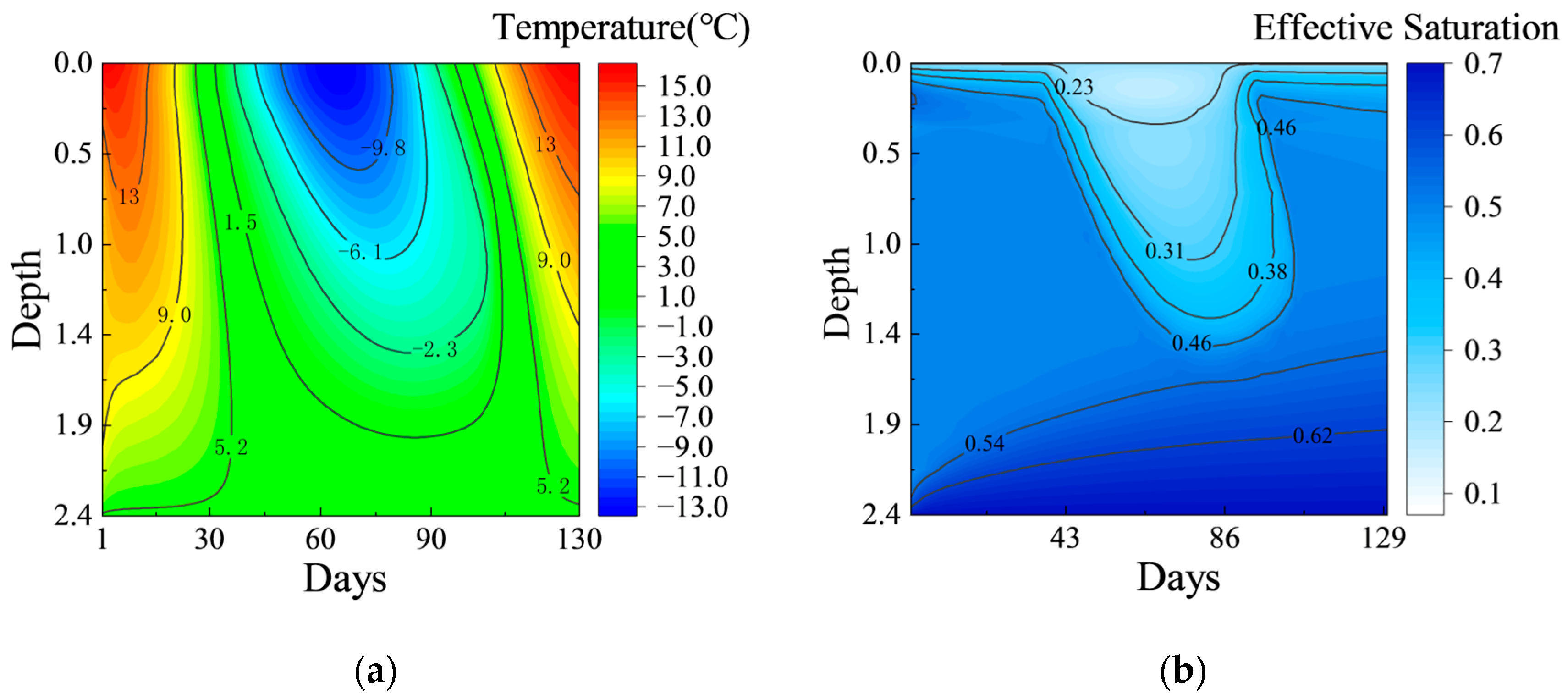
In this section, by analyzing the temperature and moisture changes in the BG cross-section over 130 days, it can be seen from Figure 14 that in the early freezing stage (0–25 days), the surface temperature dropped rapidly, and the surface layer first entered the frozen state. Subsequently, the freezing front gradually advanced downward, reaching approximately 2 m in depth around 50–80 days. At this stage, the area with the lowest temperature was located at 1.5–2.0 m, indicating that this area was near the freezing front and served as the main location for heat transfer and latent heat release. As time continued (beyond 100 days), the surface temperature gradually rose, indicating that the slope entered the thawing stage, and the freezing front disappeared from top to bottom.
At the initial freezing stage, the moisture distribution in the soil is relatively uniform, and moisture migration is mainly controlled by gravity. As the temperature decreases, around days 50–80, the moisture content in the shallow surface layer (1–2.4 m below the surface) drops sharply: most liquid water freezes into solid ice, while a small portion of unfrozen water migrates to the deeper layers. As time progresses, the temperature rises and the solid ice melts, promoting moisture redistribution, and the overall moisture content of the slope returns to the state before freezing.
The results show that during the freezing period, a significant temperature gradient forms within the slope soil, driving moisture to migrate toward the freezing front and accumulate in low-temperature areas. In contrast, the thawing period is characterized by the desiccation of the surface layer and increased moisture content in deep soil layers. This phenomenon is not solely caused by heat conduction or seepage effects, but regulated by micro-mechanisms arising from thermal–hydraulic interactions within the soil.
During the freezing process, a strong shallow temperature gradient drives water to migrate rapidly toward the freezing front, where it accumulates and freezes. In the thawing period, when meltwater infiltrates into deeper layers under the action of gravity and matric potential, the infiltration rate in the shallow layer may be relatively fast. Additionally, the surface soil, directly exposed to the atmosphere, is affected by factors such as wind and sunlight, making water prone to evaporation [44]. After freeze–thaw cycles, the surface soil of the slope becomes structurally loose [15], and water further infiltrates downward and is lost under the combined action of capillary action and gravity.
According to the principles of water migration, water moves continuously from warmer to colder zones. Under the combined influence of gravity and the temperature gradient, this process results in a persistent downward percolation trend. When surface temperatures are low and subsurface temperatures are relatively high, the freezing front attracts surrounding liquid water, which leads to the formation of a moisture enrichment zone within the soil [45]. The shallow soil freezes during cooling to form a frozen layer that obstructs pre-existing drainage pathways. The presence of this frozen layer results in the progressive accumulation of liquid water near the basal surface. The synergistic action of these factors causes the underlying, less-compact soil layer to approach near-saturation.
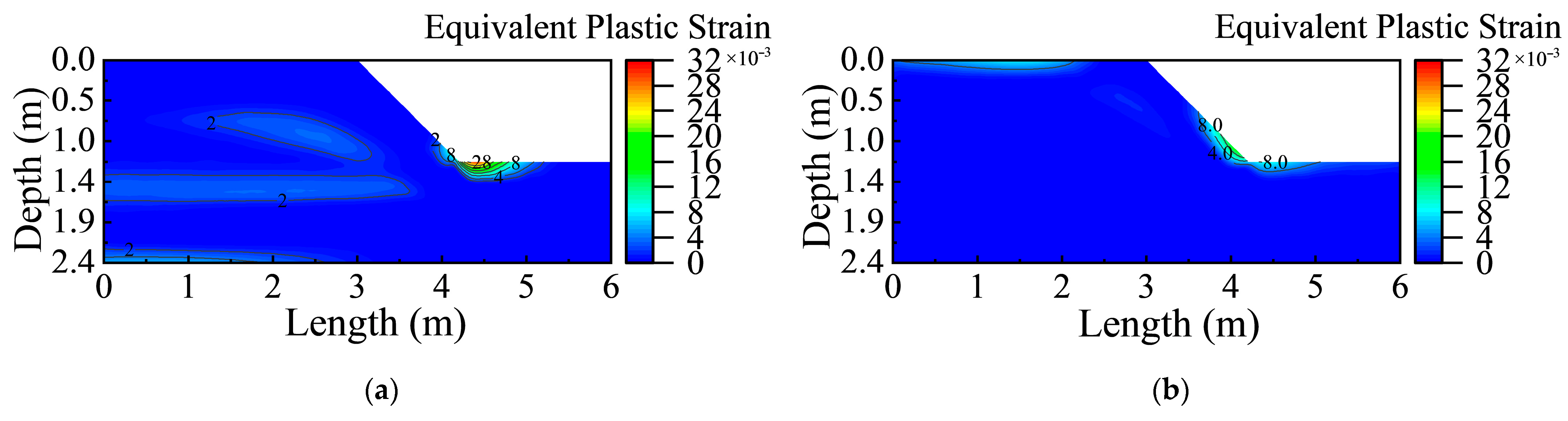
Figure 15 presents the equivalent plastic strain contours of the slope with a moisture content of 18% at the onset of numerical model non-convergence before and after freeze–thaw cycles. It can be clearly observed that plastic deformation is mainly distributed within the shallow surface layer and near the slope shoulder, while no continuous deep-seated shear band is formed throughout the slope body. The plastic zones remain discontinuous and localized, indicating that the slope has not yet developed a global sliding surface. Instead, the deformation pattern is dominated by progressive damage in the shallow soil layer.
The displacement contours further show that the maximum deformation occurs near the slope crest rather than at the slope toe. This spatial distribution is consistent with the plastic strain field and confirms that freeze–thaw-induced deformation primarily affects the near-surface soil. The slope crest is directly exposed to atmospheric thermal forcing and therefore experiences the strongest freeze–thaw action. Repeated freezing and thawing lead to frost heave, ice segregation, and subsequent thaw settlement, which significantly weaken the shallow soil structure and promote local plastic deformation.
In contrast to conventional rainfall- or reservoir-induced landslides, where deep-seated sliding surfaces are commonly controlled by groundwater level differences and seepage forces, the present numerical model does not incorporate external water level fluctuations or canal water loading. Consequently, the dominant driving mechanism in this study is thermo-hydraulic coupling within the soil matrix, rather than hydraulic erosion or pore-pressure-induced softening. Under such conditions, freeze–thaw action preferentially deteriorates the shallow soil, producing localized plastic zones and surface deformation rather than a global instability mode.
Furthermore, the formation and melting of ice lenses within the pores generate additional volumetric expansion and contraction, intensifying structural loosening in the shallow layer. This effect, combined with the low overburden stress and weak mechanical confinement near the surface, explains why deformation concentrates in the upper part of the slope and why the maximum displacement occurs at the slope crest.
The results indicate that seasonal freeze–thaw cycles first induce progressive surficial damage and shallow weakening of the slope. The current failure mode corresponds to a shallow, progressive instability stage, which may further evolve into large-scale sliding when combined with external hydraulic loading or long-term degradation.
Overall, the freeze–thaw process in slopes demonstrates a distinct “frozen upper layer and saturated lower layer” pattern: during the freezing phase, surface temperatures drop while subsurface water accumulates; during the thawing phase, surface moisture is released and deeper layers undergo softening. This thermo-hydraulic interaction induces frost heaving in the upper slope while simultaneously causing strength reduction in the lower section, constituting a critical mechanism for slope deformation and instability under cyclic freeze–thaw conditions. It should be noted that such strength degradation is not spatially uniform. The near-surface soil at the slope toe is subjected to the combined effects of intensive freeze–thaw action, moisture redistribution, and geometric stress concentration. Although the intact soil exhibits moderate cohesion, repeated freeze–thaw cycles weaken particle bonding and reduce the effective cohesion in the shallow layer. Consequently, shear rupture is more likely to initiate along the shallow basal surface near the slope toe, resulting in significant displacement of the overlying soil mass.

5. Conclusions

This study investigated changes in the mechanical properties of soil under different moisture contents and varying numbers of freeze–thaw cycles using direct shear tests. Based on hydro-thermal coupling theory and parameters obtained from direct shear experiments, finite element simulation was employed to analyze slope stability before and after freeze–thaw cycles. The main conclusions are as follows:
(1) Increasing freeze–thaw cycles significantly degrades the fundamental mechanical properties of slope soil. Both cohesion and internal friction angle exhibit declining trends with repeated freeze–thaw cycles, with cohesion decreasing by approximately 50% of its initial value and the internal friction angle reduced by about 10%.
(2) The shallow soil layers of slopes are governed by the combined effects of temperature fluctuations and moisture variations. Temperature drops trigger the phase transition of pore water into ice and its subsequent expansion, generating frost heave pressure that drives the progression of the stress–strain field from the slope toe toward the slope face, ultimately concentrating in superficial zones. The collapse mechanism in these areas is under the synergistic control of the thermo–hydro coupled field.
(3) Freeze–thaw cycles significantly accelerated slope instability, advancing the time to failure by 12 days, 10 days, and 11 days for the three moisture content conditions, respectively. After 10 freeze–thaw cycles, the factor of safety under various confining pressures decreased to 0.77–1.02, 0.72–0.99, and 0.56–0.78, ultimately triggering global plastic flow failure extending from the slope surface to the toe.
This study investigated the influence of different moisture contents on the mechanical properties and stability of slope soils in the Hetao Irrigation District of Inner Mongolia. The use of remolded soil samples, necessitated by constraints in obtaining undisturbed samples, constitutes a noted limitation. The analysis focused exclusively on the individual effects of freeze–thaw cycles and moisture content. Future work should employ undisturbed samples and examine the coupled effects of seepage, external loads, and other relevant factors.

Author Contributions

Conceptualization, X.C. and C.L.; methodology, X.C.; software, X.C.; validation, F.D., Y.S.; formal analysis, X.C.; investigation, X.C.; resources, C.L.; data curation, X.C.; writing—original draft preparation, X.C.; writing—review and editing, X.C.; visualization, X.C.; supervision, C.L.; project administration, F.D.; funding acquisition, C.L. All authors have read and agreed to the published version of the manuscript.

Funding

This work was supported by the National Natural Science Foundation of China, Yellow River Water Science Joint Fund, grant number U2443205, the Inner Mongolia Autonomous Region Science and Technology Plan Project, grant number 2023YFSH0002, the Natural Foundation of Inner Mongolia, grant number 2023MS05023, Central Government Guided Local Science and Technology Development Fund Project, grant number 2024ZY0065, and the Basic Scientific Research Business Fee of Directly affiliated Universities in Inner Mongolia Autonomous. Region, grant number BR231516).

Data Availability Statement

The data presented in this study are available on request from the corresponding author. (the data are not publicly available due to privacy).

Conflicts of Interest

Authors Feng Ding and Yongju Shao are employed by the company Inner Mongolia Chaole Water Conservancy Hydropower Co., Ltd. The remaining authors declare that the research was conducted in the absence of any commercial or financial relationships that could be construed as a potential conflict of interest.

References

  1. Chen, R.; Kang, E.; Ji, X.; Yang, J.; Yang, Y. Cold Regions in China. Cold Reg. Sci. Technol. 2006, 45, 95–102. [Google Scholar] [CrossRef]
  2. Wang, X.; Chen, R. Freezing and thawing characteristics of seasonally frozen ground across China. Geoderma 2024, 448, 116966. [Google Scholar] [CrossRef]
  3. Wang, X.; Zhang, H.; Zhang, Z.; Zhang, C.; Zhang, K.; Pang, H.; Bell, S.M.; Li, Y.; Chen, J. Reinforced soil salinization with distance along the river: A case study of the Yellow River Basin. Agric. Water Manag. 2023, 279, 108184. [Google Scholar] [CrossRef]
  4. Ren, D.; Xu, X.; Hao, Y.; Huang, G. Modeling and assessing field irrigation water use in a canal system of Hetao, upper Yellow River basin: Application to maize, sunflower and watermelon. J. Hydrol. 2016, 532, 122–139. [Google Scholar] [CrossRef]
  5. Guo, H.; Zhang, B.; Li, Y.; Berner, Z.; Tang, X.; Norra, S.; Stüben, D. Hydrogeological and biogeochemical constrains of arsenic mobilization in shallow aquifers from the Hetao basin, Inner Mongolia. Environ. Pollut. 2011, 159, 876–883. [Google Scholar] [CrossRef]
  6. Yin, Y. Study on Frost Heaving Property of Foundation Soil in Seasonal Frozen Soil Region of Inner Mongolia. Anhui Agric. Sci. 2008, 9, 3840–3841+3847. [Google Scholar] [CrossRef]
  7. Li, G.; Zhang, M.; Ye, W.; Wang, D.; Ma, Z.; An, Y. Analysis of Slope Freeze-Thaw Characteristics and Freezing-Induced Water Retention Effects in the Heifangtai Area of Gansu Province. J. Arid Land Resour. Environ. 2021, 35, 117–122. [Google Scholar] [CrossRef]
  8. Li, R.; Shi, H.; Fu, X.; Li, Z. Spatiotemporal Variation of Soil Moisture and Salinity During the Freeze-Thaw Period in a Cold and Arid Region. J. Irrig. Drain. 2012, 31, 86–90. [Google Scholar] [CrossRef]
  9. Zhou, Z.; Ma, W.; Zhang, S.; Mu, Y.; Li, G. Effect of freeze-thaw cycles in mechanical behaviors of frozen loess. Cold Reg. Sci. Technol. 2018, 146, 9–18. [Google Scholar] [CrossRef]
  10. Yang, Z.; Mou, X.; Ji, H.; Liang, Z.; Zhang, J. Effects of freeze–thaw on bank soil mechanical properties and bank stability. Sci. Rep. 2024, 14, 9808. [Google Scholar] [CrossRef]
  11. Zhang, S.; Xu, X.; Dong, X.; Lei, H.; Sun, X. Effects of Freeze–Thaw Cycles on the Mechanical Properties and Microstructure of a Dispersed Soil. Appl. Sci. 2023, 13, 9849. [Google Scholar] [CrossRef]
  12. Zhang, Z.; Ma, W.; Roman, L.; Mel’Nik, A.; Yang, X.; Li, H. Freeze-thaw cycles-physical time analogy theory based method for predicting long-term shear strength of frozen soil. Rock Soil Mech. 2021, 42, 86. [Google Scholar] [CrossRef]
  13. Chang, D.; Liu, J. Review of the influence of freeze-thaw cycles on the physical and mechanical properties of soil. Sci. Cold Arid Reg. 2013, 5, 0457–0460. (In Chinese) [Google Scholar] [CrossRef]
  14. Qi, J.; Vermeer, P.A.; Cheng, G. A review of the influence of freeze-thaw cycles on soil geotechnical properties. Permafr. Periglac. Process. 2006, 17, 245–252. [Google Scholar] [CrossRef]
  15. Zheng, F.; Shao, S.; Wang, S. Effect of freeze-thaw cycles on the strength behaviour of recompacted loess in true triaxial tests. Cold Reg. Sci. Technol. 2021, 181, 103172. [Google Scholar] [CrossRef]
  16. Zou, W.; Ding, L.; Han, Z.; Wang, X. Effects of freeze-thaw cycles on the moisture sensitivity of a compacted clay. Eng. Geol. 2020, 278, 105832. [Google Scholar] [CrossRef]
  17. Liu, J.; Chang, D.; Yu, Q. Influence of freeze-thaw cycles on mechanical properties of a silty sand. Eng. Geol. 2016, 210, 23–32. [Google Scholar] [CrossRef]
  18. Pantelidis, L.; Griffiths, D.V. Stability of earth slopes. Part I: Two-dimensional analysis in closed-form. Int. J. Numer. Anal. Methods Geomech. 2013, 37, 1969–1986. [Google Scholar] [CrossRef]
  19. Duncan, J.M. State of the Art: Limit Equilibrium and Finite-Element Analysis of Slopes. J. Geotech. Eng. 1996, 122, 577–596. [Google Scholar] [CrossRef]
  20. Janbu, N. Application of Composite Slip Surfaces for Stability Analysis. Proc. Eur. Conf. Stab. Earth Slopes 1954, 3, 43–49. [Google Scholar]
  21. Bishop, A. The use of the Slip Circle in the Stability Analysis of Slopes. Geotechnique 1955, 5, 7–17. [Google Scholar] [CrossRef]
  22. Morgenstern, N.R.U.; Price, V.E. The Analysis of the Stability of General Slip Surfaces. Geotechnique 1965, 15, 79–93. [Google Scholar] [CrossRef]
  23. Zhou, X.P.; Cheng, H. Stability analysis of three-dimensional seismic landslides using the rigorous limit equilibrium method. Eng. Geol. 2014, 174, 87–102. [Google Scholar] [CrossRef]
  24. Zhou, X.P.; Cheng, H. The long-term stability analysis of 3D creeping slopes using the displacement-based rigorous limit equilibrium method. Eng. Geol. 2015, 195, 292–300. [Google Scholar] [CrossRef]
  25. Zienkiewicz, O.C.; Humpheson, C.; Lewis, R. Associated and non-associated visco-plasticity and plasticity in soil mechanics. Geotechnique 1975, 27, 101–102. [Google Scholar] [CrossRef]
  26. Cao, Z.; Zhu, T.; Cai, X. Hydro-agro-economic optimization for irrigated farming in an arid region: The Hetao Irrigation District, Inner Mongolia. Agric. Water Manag. 2023, 277, 108095. [Google Scholar] [CrossRef]
  27. Zhang, R.; Qu, Z.; Yang, W.; Li, J.; Wang, L.; Liu, Q.; Zhang, D.; Qiao, T.; Zhao, Y. Evaluating annual soil carbon emissions under biochar-added farmland subjecting from freeze-thaw cycle. J. Environ. Manag. 2024, 365, 12. [Google Scholar] [CrossRef]
  28. GB/T 50123-2019; Geotechnical Test Method Standard. Ministry of Water Resources of the People’s Republic of China: Beijing, China, 2019. (In Chinese)
  29. Yuan, Z. Analysis of the Impact of Extreme Temperature Changes on Agricultural Planting in Wuyuan County over the Past 30 Years. J. Smart Agric. 2022, 7, 44–46. (In Chinese) [Google Scholar] [CrossRef]
  30. Tang, L.; Cong, S.; Geng, L.; Ling, X.; Gan, F. The effect of freeze-thaw cycling on the mechanical properties of expansive soils. Cold Reg. Sci. Technol. 2018, 145, 197–207. [Google Scholar] [CrossRef]
  31. Beren, M.; Cobanoglu, I.; Çelik, S.B.; Ündül, Ö.J.S.M.; Engineering, F. Shear rate effect on strength characteristics of sandy soils. Soil Mech. Found. Eng. 2020, 57, 281–287. [Google Scholar] [CrossRef]
  32. Tao, W. Heat Transfer; Northwestern Polytechnical University Press: Xi’an, China, 2006. (In Chinese) [Google Scholar]
  33. Taylor, G.S.; Luthin, J.N. A model for coupled heat and moisture transfer during soil freezing. Can. Geotech. J. 1978, 15, 548–555. [Google Scholar] [CrossRef]
  34. Lu, N.; Likos, W.J. Unsaturated Soil Mechanics; Higher Education Press: Beijing, China, 2012; pp. 269–287. (In Chinese) [Google Scholar]
  35. Bai, Q.; Li, X.; Tian, Y.; Fang, J. Research on the Coupled Hydrothermal Model of Frozen Soil and Its Numerical Simulation. Chin. J. Geotech. Eng. 2015, 37, 131–136. (In Chinese) [Google Scholar] [CrossRef]
  36. Lu, B.; Zhao, W.; Li, S.; Dong, M.; Xia, Z.; Shi, Y. Study on Seasonal Permafrost Roadbed Deformation Based on Water–Heat Coupling Characteristics. Buildings 2024, 14, 2710. [Google Scholar] [CrossRef]
  37. Qin, B.; Li, X.; Yang, W.; Liu, Z.; Chai, H.; Gao, R. Study on thermal-hydro-mechanical coupling and stability evolution of loess slope during freeze—Thaw process. Earth Surf. Process. Landf. 2024, 49, 2010–2026. [Google Scholar] [CrossRef]
  38. Zhang, Y.; Jia, X.; Hou, Y.; Li, Y. Thermo–Hydromechanical Simulation of Fibre–Coal Gangue Stabilised Expansive Soils Under Freeze–Thaw Cycles Using COMSOL. Adv. Civ. Eng. 2025, 2025, 5908032. [Google Scholar] [CrossRef]
  39. Zhang, N.; Qu, Z.; Yang, X.; Fu, X. Application and Adaptability Assessment of Bayesian Models in Pedotransfer Functions. Trans. Chin. Soc. Agric. Mach. 2014, 45, 149–155. [Google Scholar] [CrossRef]
  40. Lu, S. Experimental and Numerical Simulation Analysis of Hydrothermal Migration in Silty Sand under Freezing Effect in Cold Regions. Master’s Thesis, Lanzhou University of Technology, Lanzhou, China, 2020. (In Chinese) [Google Scholar]
  41. Stark, T.; Ruffing, D. Selecting Minimum Factors of Safety for 3D Slope Stability Analyses; ASCE: Reston, VA, USA, 2017; pp. 259–266. [Google Scholar]
  42. Lai, Y.; Liao, M.; Hu, K. A constitutive model of frozen saline sandy soil based on energy dissipation theory. Int. J. Plast. 2016, 78, 84–113. [Google Scholar] [CrossRef]
  43. Zhang, Z.; Ma, W.; Feng, W.; Xiao, D.; Hou, X. Reconstruction of Soil Particle Composition During Freeze-Thaw Cycling: A Review. Pedosphere 2016, 26, 167–179. [Google Scholar] [CrossRef]
  44. Khamidov, M.; Ishchanov, J.; Hamidov, A.; Shermatov, E.; Gafurov, Z. Impact of Soil Surface Temperature on Changes in the Groundwater Level. Water 2023, 15, 3865. [Google Scholar] [CrossRef]
  45. Zhang, J.; Lai, Y.; Zhang, M.; You, Z.; Li, S.; Bai, R. Study on the coupling mechanism of water-heat-vapor-salt-mechanics in unsaturated freezing sulfate saline soil. Comput. Geotech. 2024, 169, 106232. [Google Scholar] [CrossRef]
Figure 1. Overview of study area. The upper panel shows the regional topography of the study area, while the lower panel presents enlarged views and field photographs of the investigated irrigation canal slope. The areas outlined by red lines indicate the location of the studied slope and soil sampling zone.
Geohazards 07 00013 g001
Figure 2. Particle size distribution curve and stratified soil moisture profile: (a) particle size distribution curve; and (b) moisture content with depth.
Geohazards 07 00013 g002
Figure 3. Model dimensions and boundary conditions.
Geohazards 07 00013 g003
Figure 4. Comparison of experimental and simulation results: (a) temperature field and (b) moisture content.
Geohazards 07 00013 g004
Figure 5. Schematic workflow of the experimental program and numerical simulations conducted in this study.
Geohazards 07 00013 g005
Figure 6. Variation in soil shear strength with normal stress: (a) 100 kPa; (b) 150 kPa; (c) 200 kPa; and (d) 250 kPa.
Geohazards 07 00013 g006
Figure 7. Variation in soil strength parameters: (a) cohesive Strength and (b) internal friction angle.
Geohazards 07 00013 g007
Figure 8. Thermo–hydro coupled simulation of temperature evolution: (a) 1 day; (b) 45 days; (c) 90 days; and (d) 130 days (“depth” is consistently used to represent the vertical distance measured from the ground surface).
Geohazards 07 00013 g008
Figure 9. Thermo–hydro coupled simulation of moisture evolution: (a) 1 day; (b) 45 days; (c) 90 days; and (d) 130 days.
Geohazards 07 00013 g009
Figure 10. Evolution of the stress field during the freeze–thaw process: (a) 1 day; (b) 45 days; (c) 90 days; and (d) 130 days.
Geohazards 07 00013 g010
Figure 11. Evolution of the strain field during the freeze–thaw process: (a) 1 day; (b) 45 days; (c) 90 days; and (d) 130 days.
Geohazards 07 00013 g011
Figure 12. Variation in soil safety factor values under different moisture content conditions for 0 and 10 freeze–thaw cycles (“Before FTCs” represents 0 freeze–thaw cycles and “after FTCs” represents 10 freeze–thaw cycles.).
Geohazards 07 00013 g012
Figure 13. Displacement distribution and segmental variation: (a) before FTCs; (b) after FTCs; (c) BG segment curve; and (d) A–D segment curve. (The letters in the figure represent the slope vertices, and the arrows indicate the displacement directions).
Geohazards 07 00013 g013
Figure 14. Coupled thermo–hydro evolution with depth over time: (a) temperature; and (b) moisture content.
Geohazards 07 00013 g014
Figure 15. Equivalent plastic strain contours of the slope after 0 and 10 freeze–thaw cycles: (a) before FTCs and (b) after FTCs.
Geohazards 07 00013 g015
Table 1. Basic physical properties of the soil.
Natural Water ContentNatural Dry Density (g/cm3)Optimum Moisture ContentMaximum Dry Density (g/cm3)Specific GravityLiquid LimitPlastic Limit
5.33–28.43%1.35–1.5718%1.572.631.521.2
Table 2. Values of main parameters.
ParametersValues
Density of ice ρi (kg/m3)918
Density of water ρw (kg/m3)1000
Density of soil ρs (kg/m3)1460
Saturated water content θs (%)0.42
Residual water content θr (%)0.1
Hydraulic conductivity ksat (m/s)9.62 × 10−6
Soil freezing temperature Tf (°C)−2
Specific heat capacity of ice Ci [J/(kg·K)]2100
Specific heat capacity of water Cw [J/(kg·K)]4200
Specific heat capacity of soil Cs [J/(kg·K)]890
Latent heat L (kJ/kg)334.56
Thermal conductivity of ice λi [W/(m·K)]2.31
Thermal conductivity of water λw [W/(m·K)]0.63
Thermal conductivity of soil λs [W/(m·K)]1.38
α(m−1) *3.2
m * 0.184
l0.5
* The van Genuchten parameters α and m were adopted from the published literature [39].
Disclaimer/Publisher’s Note: The statements, opinions and data contained in all publications are solely those of the individual author(s) and contributor(s) and not of MDPI and/or the editor(s). MDPI and/or the editor(s) disclaim responsibility for any injury to people or property resulting from any ideas, methods, instructions or products referred to in the content.