1. Introduction
Weeds remain one of the most significant constraints on sugar beet production, driving yield losses and costly herbicide programs with environmental side effects [
1,
2,
3]. Early, reliable discrimination between crop rows and inter-row weeds is therefore essential to support timely, selective interventions and to reduce blanket spraying [
4]. Uncrewed aerial vehicles (UAVs) have emerged as a practical sensing platform for field-scale scouting: they capture high-resolution imagery on demand, at relatively low cost, and within the phenological windows when weeds are most competitive, complementing satellite and proximal sensing [
5]. In parallel, deep learning has transformed vision-based agronomy, with convolutional detectors and segmenters now widely used to localize weeds directly in RGB imagery [
6].
Two design families dominate vision pipelines for weed mapping: two-stage region-based methods (e.g., R-CNN variants) that first propose candidate regions and then classify or refine them, and one-stage methods (e.g., the YOLO family) that predict bounding boxes and classes in a single pass [
7,
8]. While one-stage detectors are often preferred for their speed in embedded or near-real-time settings, debates persist regarding their accuracy on small or partially occluded targets, robustness across fields and seasons, and the trade-offs between object detection and pixel-level segmentation for downstream decision making [
9,
10,
11,
12]. In addition, prior UAV-weed studies frequently differ in data partitioning, augmentation strategies, and evaluation metrics; some even mix images from the same flight across training and test sets, creating a risk of inadvertent data leakage and limiting comparability across models [
13,
14,
15]. For spraying decisions, segmentation can provide more precise weed-cover estimates, but it requires denser pixel-level annotation and usually higher computational cost; bounding-box detection was therefore selected here as a pragmatic compromise between annotation effort, inference efficiency, and prescription-map usability.
The specific objective of this study is to evaluate whether UAV RGB imagery combined with deep learning can provide reliable weed detections in sugar beet fields under the local conditions of Beni Mellal, Morocco, while avoiding data leakage between training and testing imagery and producing reproducible outputs that can be inspected by other researchers. The problem addressed is therefore not only model accuracy, but also dataset transparency, split-level reproducibility, and the practical interpretability of detector outputs for weed-management decisions.
The main contribution of this work is a release-oriented regional UAV dataset and a reproducible benchmark for weed detection in Moroccan sugar beet fields. We do not claim novelty at the level of detector architecture; instead, the novelty lies in (i) compiling and documenting a locally acquired UAV RGB dataset with COCO-format annotations; (ii) making anonymized annotations, label maps, split files, configuration files, and evaluation scripts available through a public repository; (iii) comparing representative one-stage and two-stage detectors under the same input resolution, augmentation policy, and evaluation metrics; (iv) explicitly controlling potential field/flight leakage; and (v) linking detections to prescription-map generation as a pilot decision-support workflow. Accordingly, the term field evaluation in this paper refers to testing on field-acquired UAV imagery rather than to a fully validated spraying trial.
For clarity, data leakage is defined here as any overlap of near-duplicate scenes, flights, or parcels between the training, validation, and test sets that could artificially inflate performance. This issue is especially important for UAV imagery because consecutive frames from the same flight can share nearly identical crop rows, soil texture, illumination, weed patches, and camera geometry. If visually similar frames from one parcel or flight are split across training and testing, a detector may appear to generalize while actually recognizing repeated field scenes. To reduce this risk, the partition was created before augmentation, frames from the same parcel and acquisition flight were assigned to a single subset, and fixed split files were used for all model comparisons. This manuscript therefore evaluates representative existing detectors under a controlled, field-oriented protocol and connects the resulting detections to prescription-map generation.
The remainder of this paper is organized as follows.
Section 2 reviews related work on deep learning-based weed detection from UAV imagery.
Section 3 describes the study area, dataset acquisition, annotation procedure, and the proposed detection pipeline.
Section 4 presents the experimental setup and reports the quantitative and qualitative results.
Section 5 offers a detailed discussion of the findings, limitations, and practical implications for precision weed management. Finally,
Section 6 concludes the paper and outlines directions for future research.
2. Related Work
Additional recent studies and reviews also underline that UAV-based weed mapping remains highly dependent on dataset diversity, annotation quality, object-level labeling, and field-level validation. Work on drone-based weed quantification, object-level benchmarks, survey evidence, and UAS imagery detection systems shows that performance estimates can vary substantially with crop type, imaging conditions, annotation strategy, and evaluation protocol [
16,
17,
18,
19].
The revised literature framing emphasizes methodological comparability rather than simple numerical ranking, because UAV weed-detection results depend strongly on crop type, sensor modality, annotation type, split strategy, and the metric used for reporting performance.
Recent UAV-vision studies have explored both one-stage object detectors and segmentation networks for field-scale weed monitoring across crops and sensing setups. On chicory and sugar beet imagery, Gallo et al. [
20] trained YOLOv7 on the Chicory Plant (CP) and Lincoln Beet (LB) datasets; on CP, they reported mAP@0.5 = 56.6%, recall = 62.1%, and precision = 61.3%, improving over earlier reports on LB. Targeting Solanum rostratum seedlings in real fields, Wang et al. [
21] proposed YOLO-CBAM (a YOLOv5 variant with attention), achieving precision = 94.65% and recall = 90.17% in real-time Jetson Xavier tests after multi-scale training. For multispectral UAV data in maize, Seiche et al. [
22] compared a high-end and a low-cost sensor using U-Net segmentation; they reported weed-class precision around 90%, with recall varying between ≈68 and 75% depending on the sensor. In cotton fields, Shahi et al. [
23] benchmarked several deep models on the CoFly-WeedDB UAV RGB dataset (201 images, Greece) and showed that U-Net + EfficientNet-B0 reached ≈88.2% precision. Finally, Li et al. [
24] introduced PD-YOLO, a YOLO-based variant evaluated on mixed UAV weed scenes, reporting ≈75.4% precision on the Lincoln beet dataset and ≈94.3% on the CottonWeedDet12 dataset.
The studies summarized here were selected because they represent recent UAV- or field-image weed detection work using either object-detection or segmentation models and because they report metrics that allow at least a qualitative comparison with our task. However, their objectives and protocols are heterogeneous: some studies emphasize species-level identification, others focus on binary weed/crop separation, and others evaluate pixel-level segmentation rather than bounding-box detection. This heterogeneity limits direct numerical ranking and highlights the need for carefully controlled within-study benchmarks.
A critical limitation in the existing literature is that many comparisons are affected by differences in crop type, weed community, sensor modality, flight altitude, image resolution, annotation type, and split strategy. In particular, when visually similar frames from the same flight are distributed across training and testing sets, reported performance can be inflated by spatial or temporal correlation. These limitations motivate the present study, which uses a unified protocol, explicit field/flight-aware splitting, and a Moroccan sugar beet case study to provide a more controlled evaluation. The study should therefore be interpreted as a reproducible regional benchmark and decision-support demonstration, rather than as a universal claim of superiority over all prior weed-detection methods.
Table 1 summarizes the selected related studies and their reported metrics for contextual comparison.
3. Materials and Methods
3.1. Study Area and Cropping System
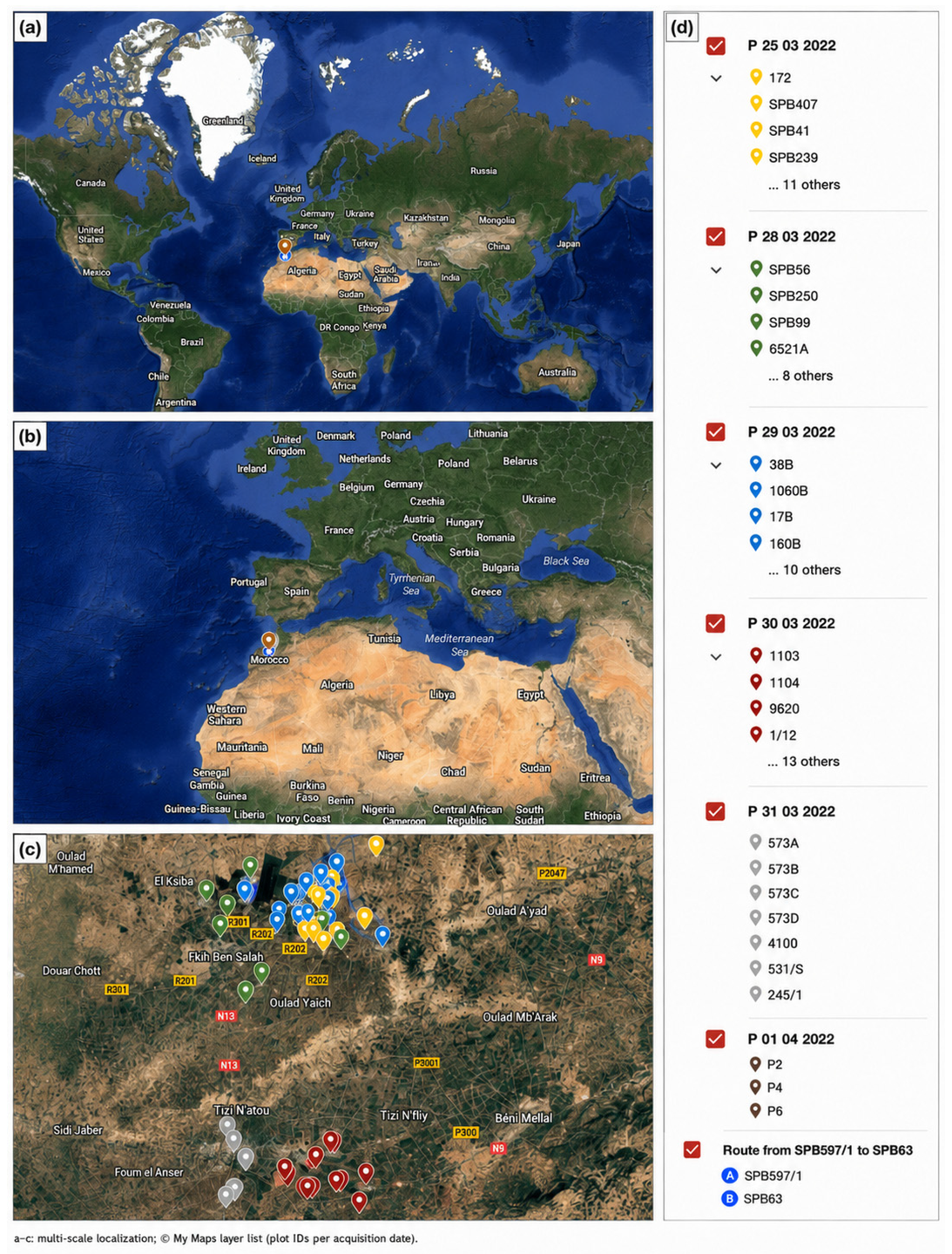
The study was conducted in the Beni Mellal–Khenifra region, Morocco, a major sugar beet production area with a semi-arid Mediterranean climate. UAV image locations are shown in
Figure 1.
Field scouting records from the pilot campaign indicated strong between-parcel variability in weed composition. For example, parcel 900 was dominated by monocots (approximately 81% of the infested area), whereas other parcels were dominated by mallow (for example, BA approximately 56% and C1A approximately 81%) or by a dicot/bindweed complex (for example, LB approximately 61% dicots and approximately 25% bindweed). This spatial heterogeneity supports parcel-level prescription mapping rather than uniform blanket treatment.
3.2. UAV Platform and Sensors
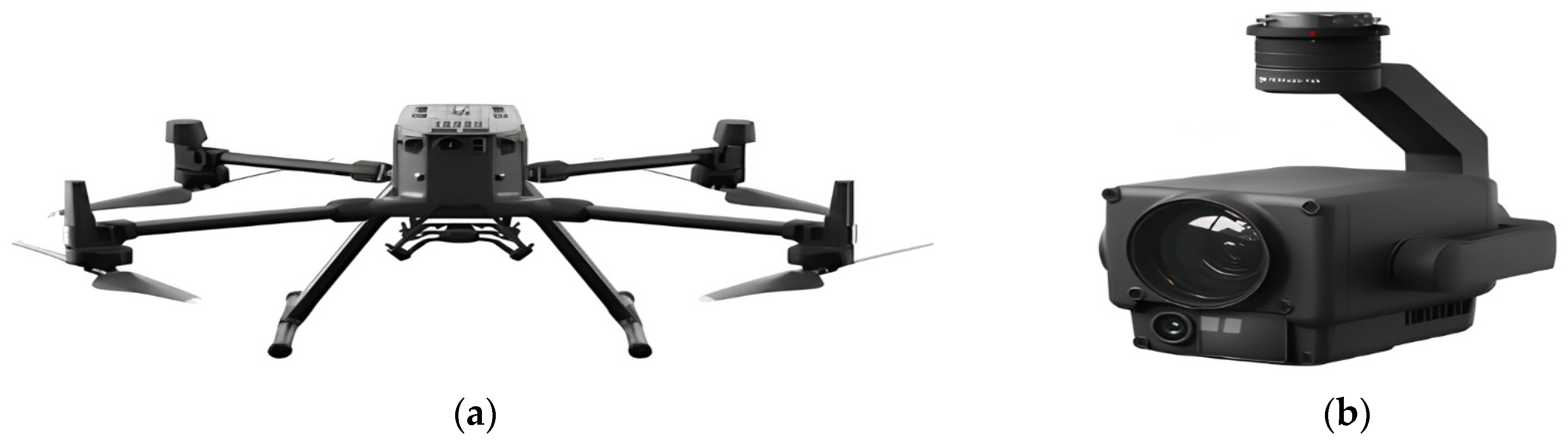
Image acquisition was performed with a DJI Matrice 300 RTK equipped with a Zenmuse H20 RGB camera (24 MP), as illustrated in
Figure 2. Flights were conducted under calm wind conditions and clear skies. Both the UAV and the camera were manufactured by DJI (Shenzhen, China).
3.3. Data Acquisition Protocol
Photographs were collected from 25 March 2022 to 3 October 2022 over multiple fields, using uniformly spaced stations where possible. Flight altitude ranged from 10 to 20 m above ground level; images were captured at the native Zenmuse H20 RGB resolution of 5184 × 3888 px with at least 70% forward and side overlap. Ground operations followed local regulations, and field-owner permission was obtained before UAV flights.
Ground sampling distance (GSD) was calculated for each flight from the camera geometry and flight altitude using GSD = (H × sensor width)/(f × image width). With flights conducted at 10–20 m above ground level, the effective RGB-image GSD was sub-centimeter, approximately 0.3–0.6 cm per pixel, which is suitable for detecting small weed seedlings in the surveyed fields.
3.4. Processing Workflow (Overview)
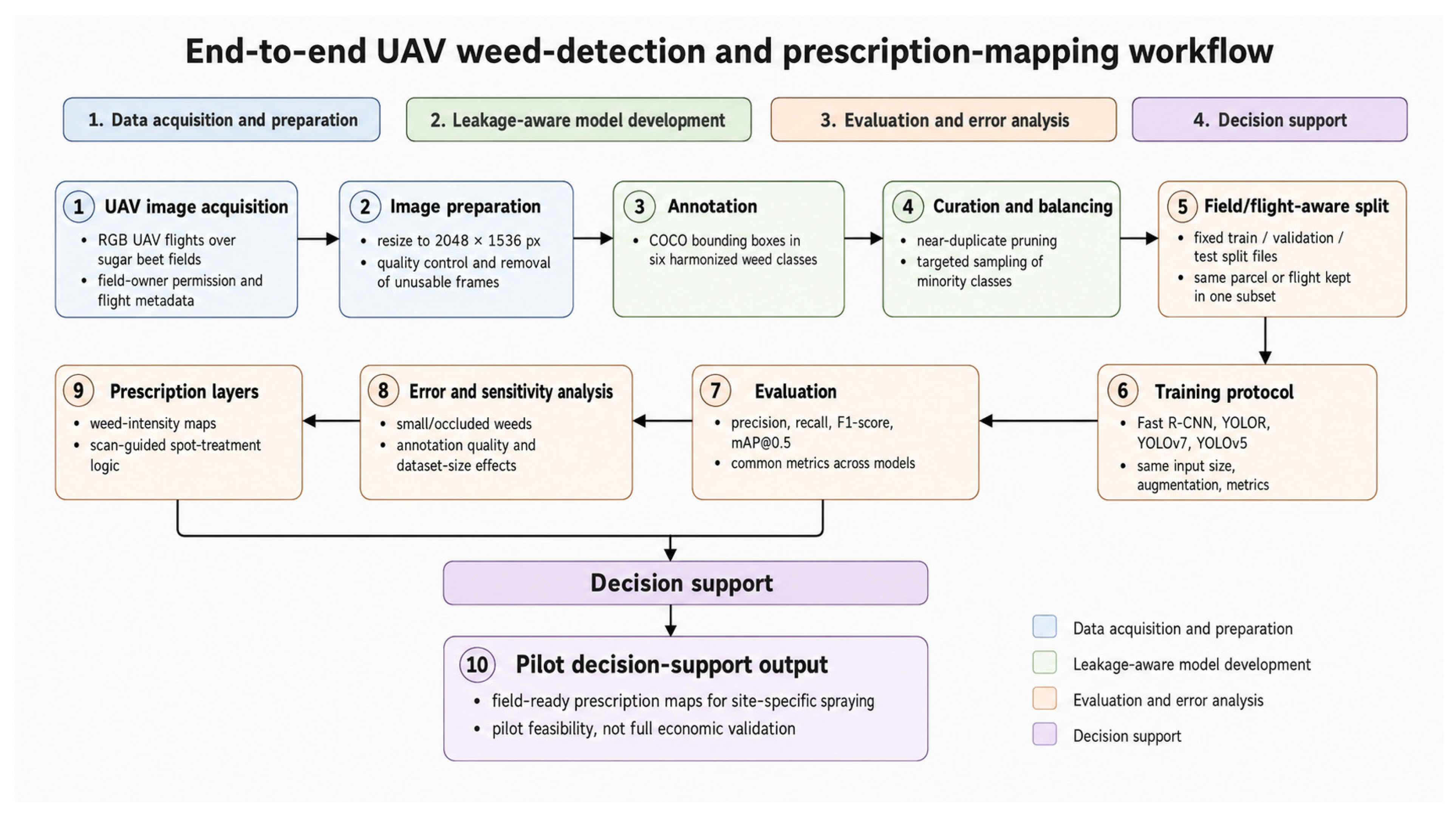
The end-to-end workflow from acquisition to model training is summarized in
Figure 3.
3.5. Image Resizing
To meet GPU memory constraints, native images were resized to 2048 × 1536 px using adaptive interpolation (bicubic with anti-aliasing). This preserves aspect ratio while reducing per-batch memory.
3.6. Annotation Protocol
Images were annotated in COCO format using VGG Image Annotator (VIA, version 3) [
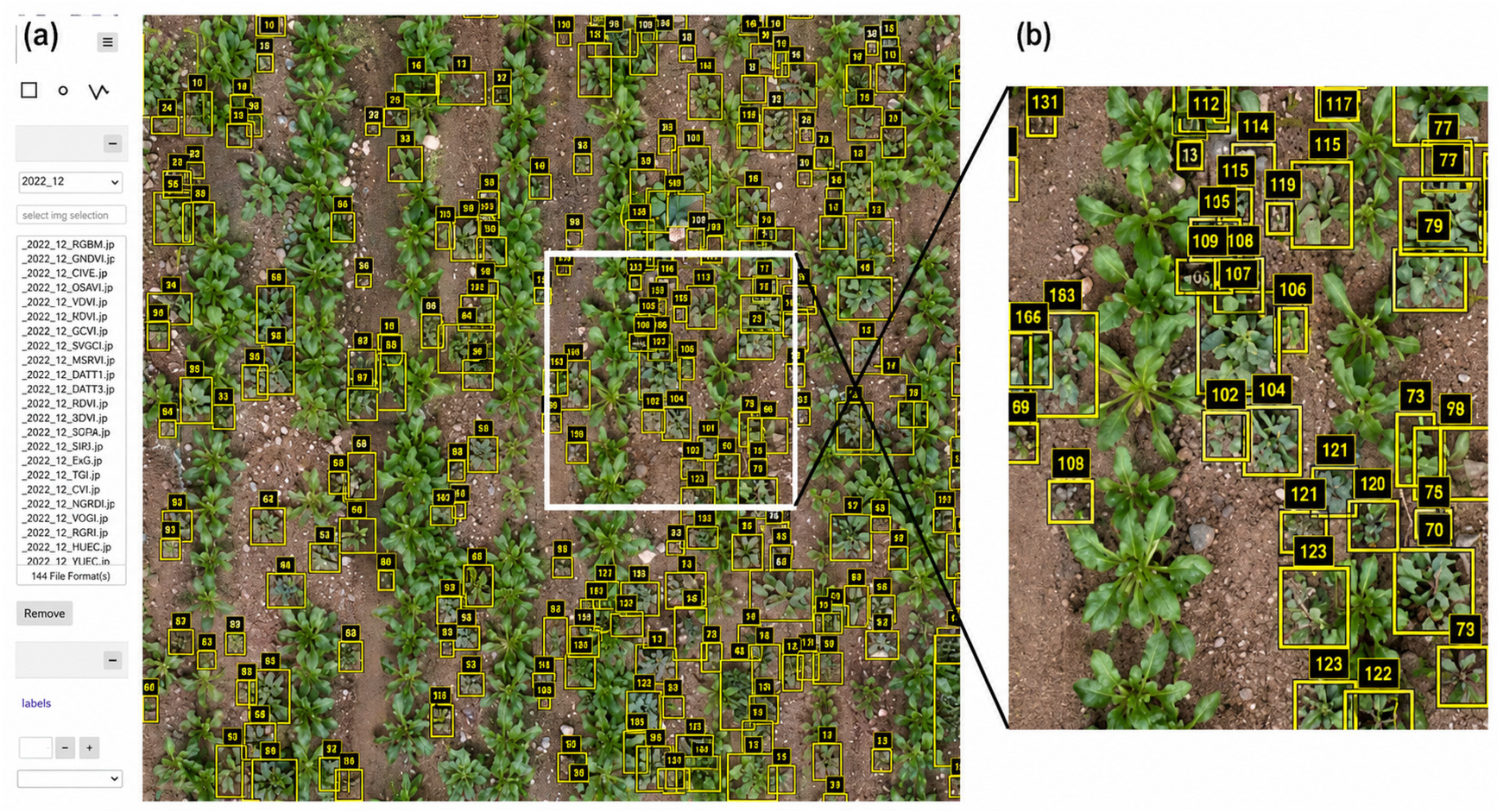
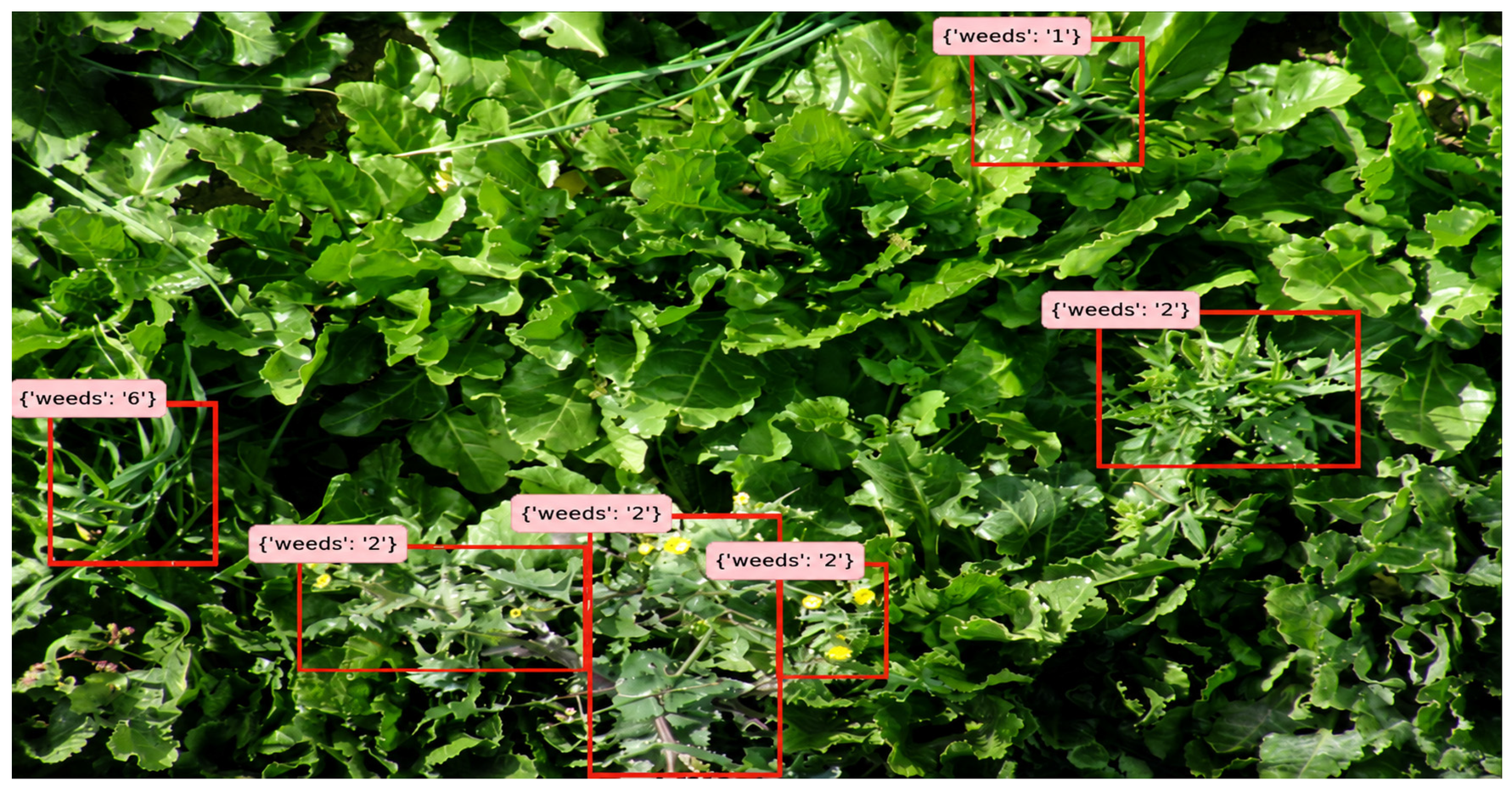
10]. We labeled weeds with tight bounding boxes using a hierarchical scheme aligned with agronomic decisions: crop-versus-weed separation, weed category (monocotyledonous versus dicotyledonous), and species-level tags when visible (for example, mallow, ryegrass, nettle, dill, and mustard). For the detection benchmark, these labels were harmonized into the six final classes reported in the dataset summary; therefore, species-level tags served as annotation guidance and traceability information rather than as independent benchmark classes in all experiments. To reduce label noise, the annotations were visually quality-checked by re-inspecting bounding boxes and removing ambiguous or duplicate cases before training. An example is shown in
Figure 4. The mapping from botanical labels to the six training classes was: monocotyledonous weeds aggregated into the monocot class unless a stable ryegrass label was available; dicotyledonous weeds aggregated into the dicot class unless the mallow, dill, or mustard label was visually reliable. This avoids overstating species-level classification when visual evidence is insufficient.
3.7. Weed Classes Referenced
Table 2 summarizes monocotyledonous and dicotyledonous weeds referenced during labeling.
3.8. Data Augmentation
We applied photometric and geometric augmentations to increase variability and generalization.
Table 3 lists the operators and ranges.
3.9. Dataset Pruning and Class Balancing
We pruned near-duplicates and low-quality frames before training. Near-duplicates were identified from consecutive or highly overlapping UAV frames acquired during the same flight line, and frames were removed when they showed severe blur, strong exposure artifacts, excessive overlap with neighboring images, or insufficient usable field area. Class balancing was then performed through targeted sampling of images containing minority weed classes, while avoiding the transfer of visually similar frames across training, validation, and test subsets.
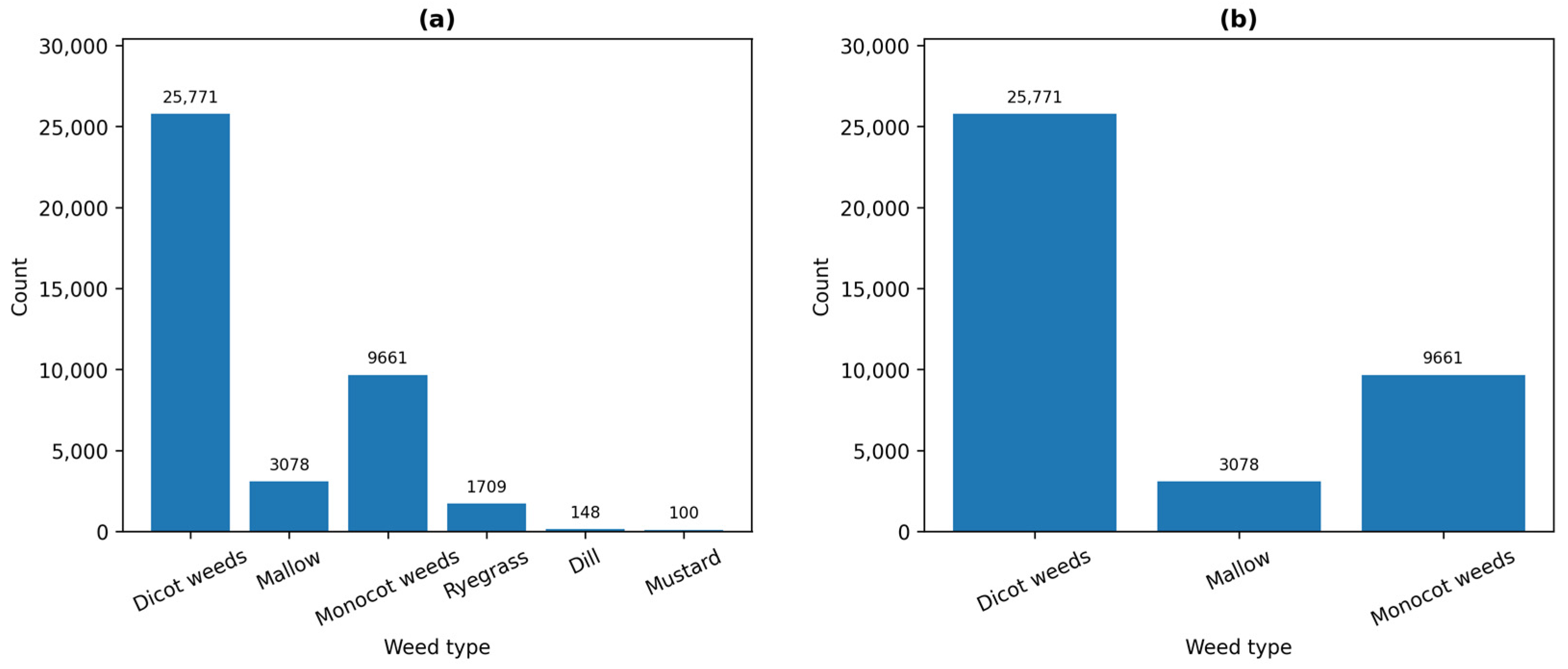
Figure 5 illustrates the class distribution before and after the balancing procedure. For the balancing analysis, the retained subset focused on the three principal and agronomically dominant classes: dicot weeds, mallow, and monocot weeds. The remaining rare classes, namely ryegrass, dill, and mustard, were documented in the full six-class dataset but were not retained in this specific balancing comparison because their object counts were too small for a stable controlled analysis. The final retained dataset size is reported in
Table 4; per-criterion deletion counts were not archived separately, so the revision reports the curation criteria rather than inventing removal totals.
3.10. Dataset Summary
The final benchmark dataset comprises 13,465 images collected over 251 parcels or parcel-level sampling units, with 53,511 annotated weed objects across six harmonized classes: dicot weeds, mallow, monocot weeds, ryegrass, dill, and mustard. Across the full retained dataset, this corresponds to an average of approximately 4 annotated objects per image (53,511 objects/13,465 images). A compact summary is given in
Table 4. This wording reconciles the dataset description with
Table 4 and distinguishes the full benchmark dataset from the smaller controlled subsets used later in the sensitivity analysis. The field/flight-aware split contained approximately 9426 training images, 1346 validation images, and 2693 test images, corresponding to a 70/10/20 train/validation/test split. The split was performed before data augmentation and kept fixed for all model comparisons. The train/validation/test split files are part of the public reproducibility package.
For reproducibility, the train/validation/test partition was created before augmentation and kept fixed for all model comparisons. The split was performed at the field/flight level rather than by random image assignment: all frames from the same plot or parcel and acquisition flight were assigned to a single subset, so the test set contains fields and flight sequences unseen during training. This leakage-aware protocol reduces the risk that near-identical UAV frames appear in both training and testing data. All models used the same partition files, input size, augmentation policy, and evaluation scripts; only the detector architecture changed between experiments.
3.11. Detection Models
We benchmarked YOLOv5 against Fast R-CNN, YOLOR, and YOLOv7 under identical input size and augmentation policies. Fast R-CNN was intentionally retained as the two-stage baseline, rather than Faster R-CNN, following Girshick [
8]; it was used to provide a region-based reference point against the one-stage detectors. YOLOv5, YOLOR, and YOLOv7 were selected as one-stage detectors because they are widely used in agricultural object detection and are more compatible with fast UAV-image inference. This selection allows the comparison to cover both accuracy-oriented region-based detection and lightweight or real-time-oriented detection families.
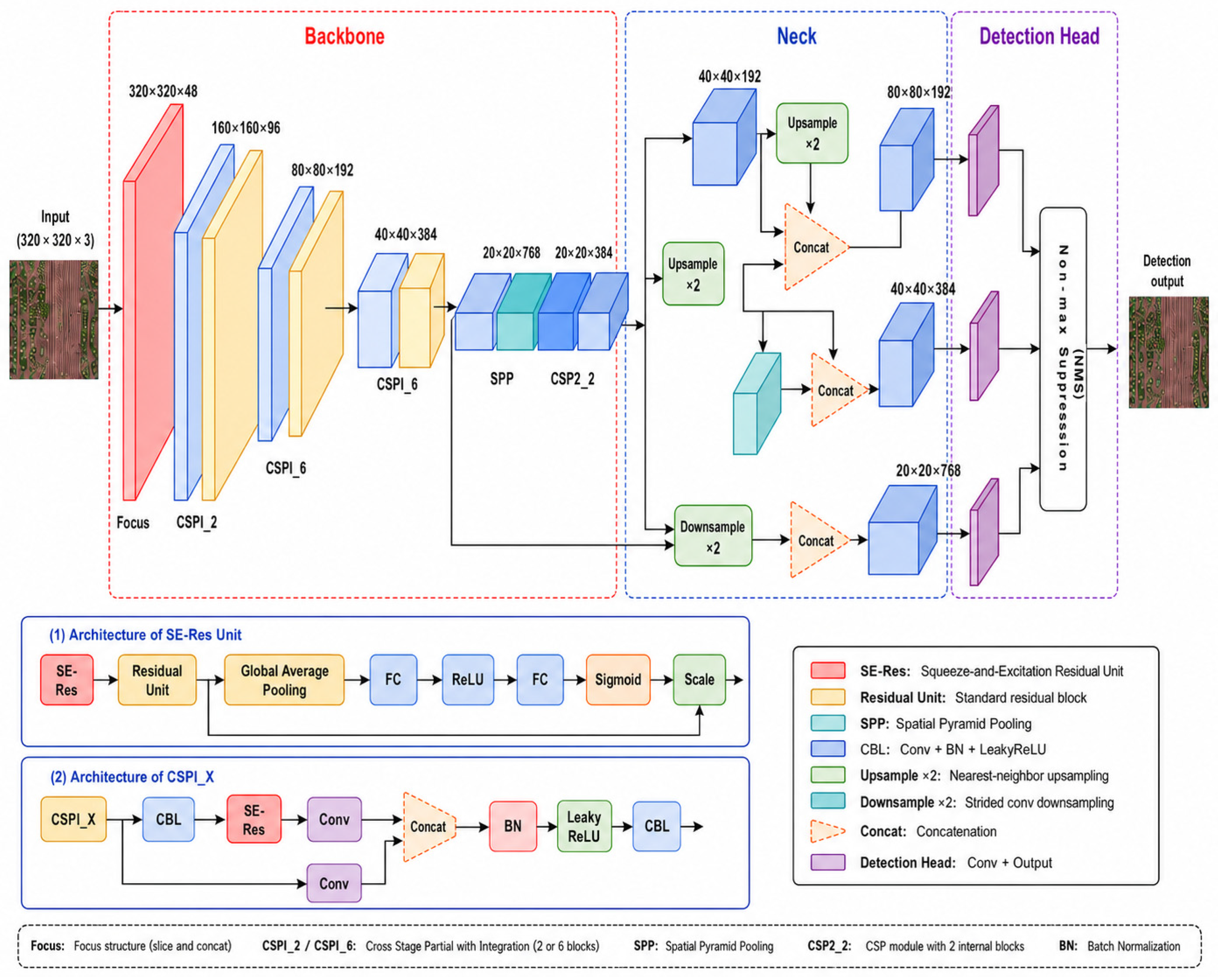
Because YOLOv5 achieved the strongest performance under the tested conditions,
Figure 6 illustrates the YOLOv5-based detection architecture used as the main reference detector in this study. The network is organized into three main stages: a backbone for hierarchical feature extraction, a neck for multi-scale feature aggregation, and a detection head followed by non-maximum suppression (NMS) to produce the final weed detections. The figure also illustrates the SE-Res unit and CSPI_X module configurations used to support feature refinement and representation learning.
3.12. Training Environment
Experiments were run in Anaconda/Python 3.9.13 on a workstation with 2× NVIDIA GeForce RTX 3080 GPUs (24 CPU cores; Windows 10). Code was based on the Ultralytics YOLOv5 v6.1 repository (commit c13c4de…, July 2022) [
25].
Table 5 summarizes the environment. The exact repository snapshot, configuration files, split files, and training commands are planned for release with the anonymized annotations so that the reported benchmark can be reproduced. The GPUs were manufactured by NVIDIA Corporation (Santa Clara, CA, USA), Windows 10 by Microsoft Corporation (Redmond, WA, USA), and Anaconda Distribution by Anaconda, Inc. (Austin, TX, USA).
3.13. Hyperparameters
The hyperparameter settings were chosen to balance convergence, GPU memory constraints, and reproducibility. The batch size was limited to 5 because the resized 2048 × 1536 px UAV images and dense bounding-box annotations imposed high GPU-memory demand. All models were trained for a maximum of 200 epochs under the same protocol, without early stopping (patience = 0), so that architecture-specific stopping behavior did not bias the comparison. To reduce overfitting, we relied on leakage-aware field/flight splits, strong data augmentation, weight decay, and selection of the best validation checkpoint (highest mAP@0.5) rather than the final epoch alone. Although the workstation contained two RTX 3080 GPUs, experiments were executed on GPU:0 to keep the hardware path identical across runs. Training time, energy use, and full edge-device throughput were not benchmarked in the present study and are therefore reported as limitations and future work.
Table 6 lists the main settings.
3.14. Evaluation Metrics
We report Precision (P), Recall (R), F1-score, and mean Average Precision (mAP). Definitions are provided in
Table 7. To improve consistency with the results tables, all performance values in the text and tables are reported as percentages. Because each architecture was trained once under the unified protocol, the comparison should be interpreted as a controlled benchmark rather than a statistical significance test; confidence intervals or standard deviations would require repeated training with different seeds or cross-validation folds.
3.15. Pilot On-Farm Implementation (Scan-Guided Spot Treatment)
To connect UAV detections to agronomic action, detector outputs were converted into parcel-level prescription layers and used during a pilot scan-guided spot-treatment workflow on the surveyed parcels. A DJI Agras T40 UAV sprayer (DJI, Shenzhen, China) was used for the spot-treatment implementation, while the conventional uniform program served as the baseline comparison. Spraying was restricted to weed-positive zones derived from the prescription maps, and operational parameters such as spray volume rate, flight height, and speed followed field calibration procedures recorded during the pilot campaign. This section describes the implementation context; the detailed treatment logic is summarized later in the operational treatment strategy results. A complete replicated economic and active-ingredient reduction analysis remains a future validation step.
3.16. Ethics Statement
This study does not involve human or animal subjects. UAV operations complied with local rules and field-owner consent.
3.17. GenAI Use Disclosure
During manuscript preparation, the authors used a language model to assist with grammar and style only; all technical content, numbers, and interpretations were authored and verified by the authors.
4. Results
4.1. Detector Performance on the Beni Mellal Dataset
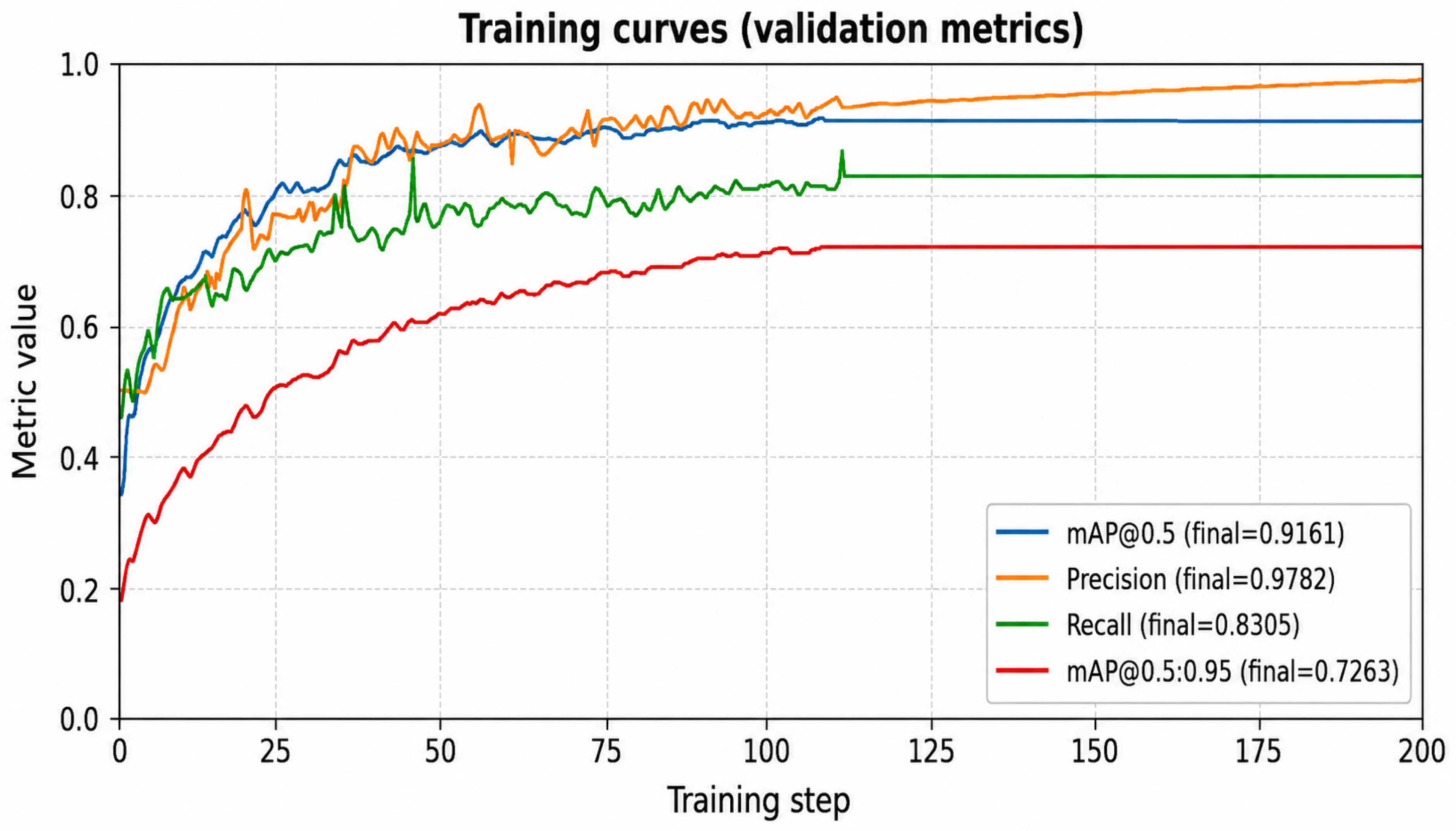
Under the unified evaluation protocol, YOLOv5 provided the strongest overall results on the Beni Mellal weed-detection dataset among the models tested, reaching 97.82% precision, 83.05% recall, 91.61% mAP@0.5, and 72.63% mAP@0.5:0.95 (
Figure 7,
Table 8). These results suggest that YOLOv5 was well suited to this specific UAV RGB dataset and experimental configuration. However, because repeated runs or cross-validation were not performed, we do not claim statistical significance of the differences between architectures. The training and evaluation curves in
Figure 7 indicate stable optimization for YOLOv5, while the final interpretation remains limited to the tested field/flight split and image conditions.
4.2. Comparative Analysis of the Detectors
The comparative analysis from
Figure 7 and
Table 8 is interpreted cautiously because not all model implementations exported the same set of secondary metrics. The main comparison therefore focuses on the metrics common to all available runs, namely precision, recall, mAP@0.5, and APm.
Table 9 adds deployment-oriented descriptors from public benchmarks to contextualize efficiency, but these values should not be treated as measured inference speeds for our own UAV workflow. F1-score is now included because it summarizes the precision-recall balance and makes the comparison more informative when recall differs across detectors.
Overall, YOLOv5 showed the best balance between precision, recall, and mAP@0.5 in this dataset, followed by YOLOv7. YOLOR and Fast R-CNN produced lower precision and recall in the available runs. These findings support the use of modern one-stage detectors for dense UAV weed imagery under the tested conditions, but they should not be generalized beyond the present dataset without additional regional, seasonal, and multi-run validation.
4.3. Qualitative Validation
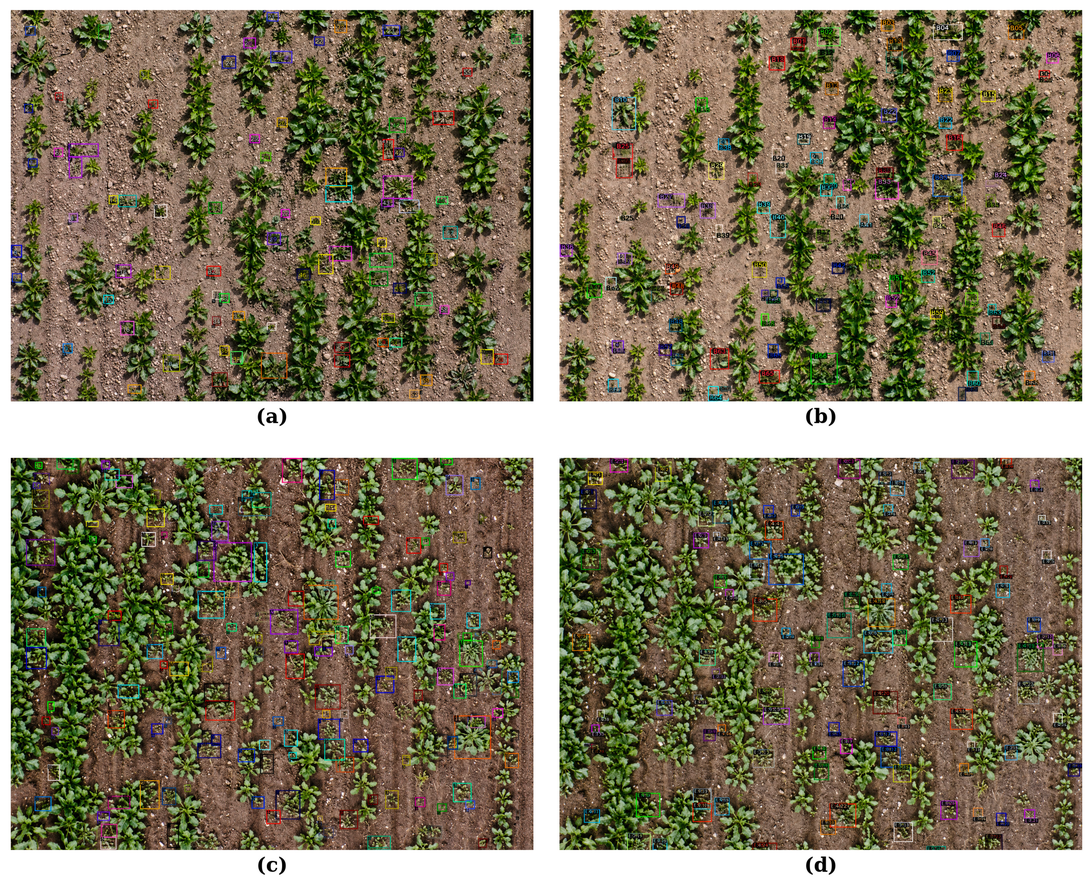
Qualitative examples in
Figure 8 and
Figure 9 illustrate the behaviour of the best-performing detector across phenological stages. On seedling-stage imagery (
Figure 8), YOLOv5 correctly highlights most inter-row weeds while preserving sugar beet rows, producing detections that visually align with dense weed patches and scattered escapes.
On imagery acquired at the budding stage (
Figure 9), detections follow the expected spatial pattern of weeds within and between rows, confirming that the model captures agronomically meaningful structures rather than isolated pixels.
A more detailed inspection of false-negative cases showed three recurrent situations. First, very small weeds at early growth stages were sometimes missed because they occupied only a limited number of pixels after image resizing and often had low contrast with the soil background. Second, partially occluded weeds, especially those covered by sugar beet leaves, were more difficult to detect because only a small visible plant fragment remained available to the detector. Third, some crop-like broadleaf weeds were occasionally confused with the sugar beet canopy. These error modes explain why recall remained lower than precision and indicate that future improvements should prioritize additional training examples of small and occluded weeds, higher-resolution tiling, and more consistent annotations for visually similar classes.
4.4. Sensitivity Analyses
4.4.1. Effect of Annotation Quality
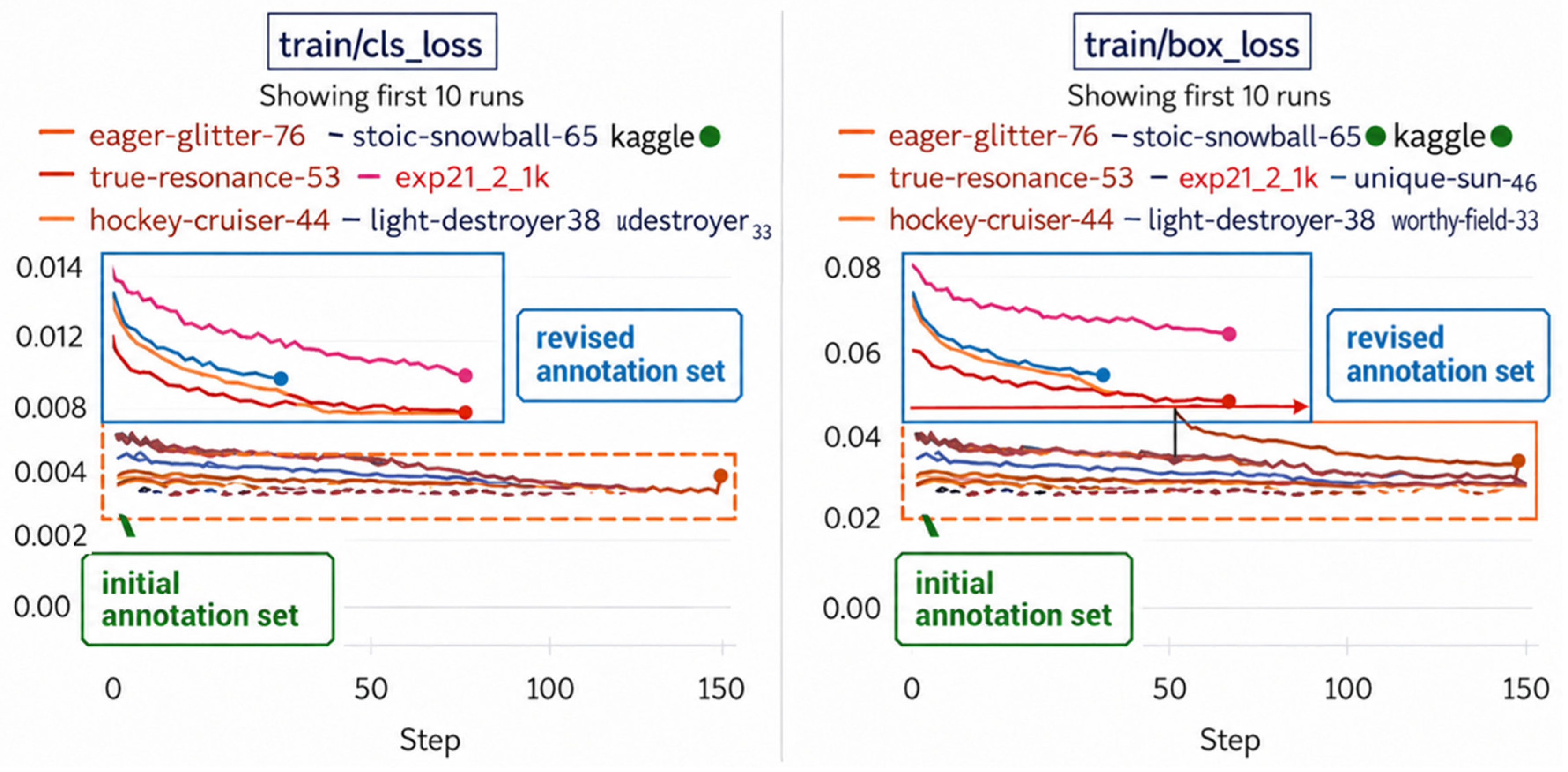
To assess sensitivity to label quality, we compared training runs using the initial annotation set with runs using the revised annotation set on the same imagery. With the revised labels, both classification and bounding-box losses decrease more smoothly and reach lower final values (
Figure 10), and recall increases for the weed classes represented in the subset. In contrast, models trained on the initial annotations converge more slowly and exhibit higher residual loss, especially for minority weed species.
4.4.2. Effect of Dataset Size
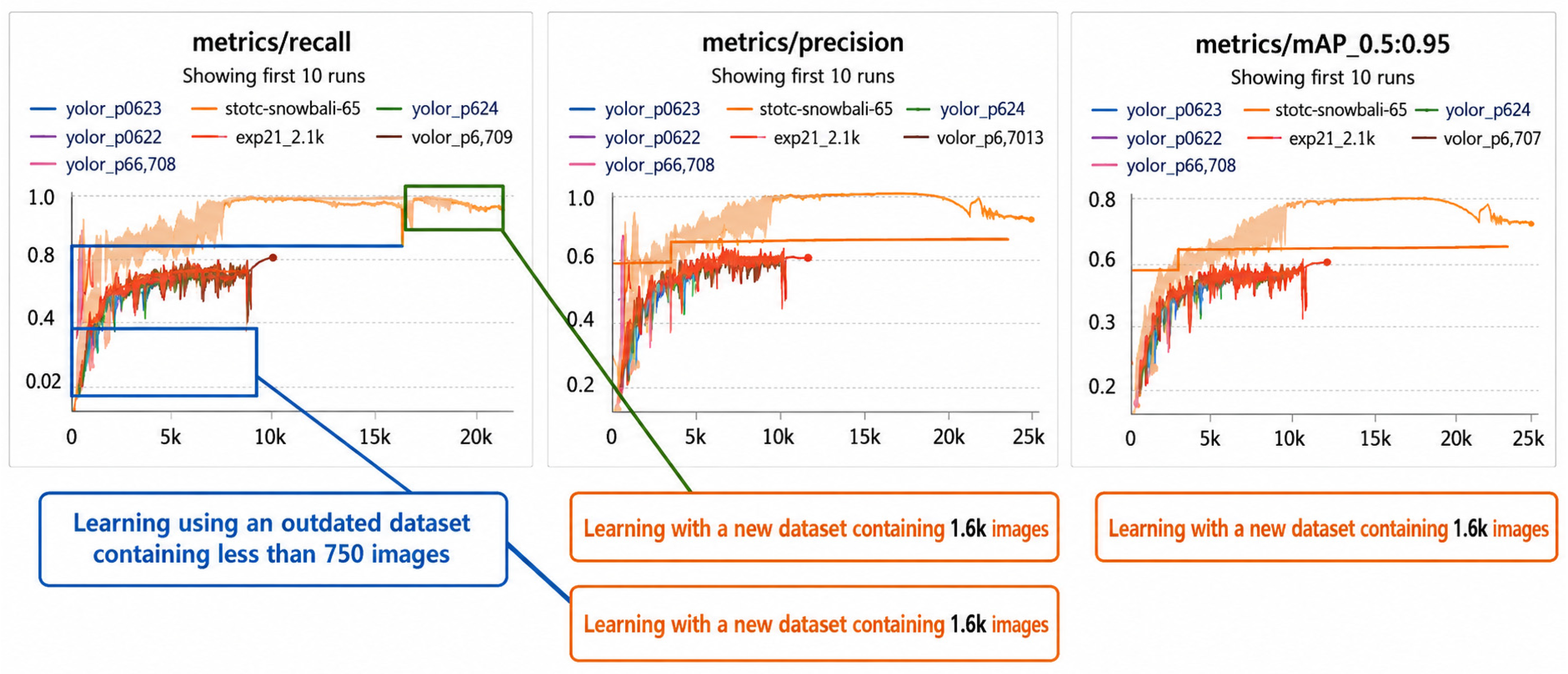
We also evaluated the impact of training-set size using a controlled sensitivity subset, not the full 13,465-image benchmark dataset. This diagnostic experiment used three nested training subsets: fewer than 750 images, approximately 1.6k images, and the largest sensitivity subset of approximately 1.9k images. The purpose was to isolate the effect of additional training examples under comparable conditions. Increasing the number and diversity of training images systematically improved recall and mAP, while precision remained high across all settings (
Figure 11). Models trained on the smallest subset tended to overfit, whereas adding more flights and growth stages produced smoother learning curves and higher recall on minority weed species.
4.5. Operational Treatment Strategies (With/Without Drone Scans)
To illustrate downstream decision support,
Table 10 summarizes the scan-guided treatment logic used during the pilot campaign, expressed primarily by active ingredient rather than only by local commercial product names. Commercial formulations are retained in parentheses only to document the products recorded locally during the campaign. The table is intended to describe the decision logic of the case study, not to provide a transferable herbicide recommendation. Before operational use, active ingredients, formulation concentrations, label authorization, dose units, crop-stage restrictions, safety intervals, and local regulations must be verified from official product labels.
Illustrative pilot impact: compared with the standard first-treatment blanket program, the prescription rules in
Table 10 indicate that scan-guided treatment may reduce unnecessary herbicide inputs in parcels without detected target weeds or in zones requiring lower application intensity. In the pilot records, this workflow suggested a potential reduction in herbicide input costs compared with the uniform standard program. Because a complete economic assessment was not conducted, and because UAV acquisition, image-processing costs, spraying-platform costs, labour, equipment depreciation, yield effects, and multi-season variability were not included, this result should be interpreted only as an illustrative pilot-campaign indicator rather than as a quantified economic validation.
5. Discussion
5.1. Positioning vs. the State of the Art
Table 11 positions our results relative to selected UAV-based weed-detection studies in terms of crop, sensor type, model family, and evaluation protocol. This comparison is intended to provide context rather than a definitive ranking, because prior studies used different crops, datasets, sensors, annotation types, split strategies, and metrics. Therefore, the high precision obtained by YOLOv5 in the present study indicates strong performance under our tested conditions, but it should not be interpreted as proof of general superiority over the state of the art.
A further methodological consideration is the choice between bounding-box detection and segmentation. Pixel-level segmentation can better estimate weed cover and may be advantageous for variable-rate spraying, but it requires more expensive annotations and larger computational resources. Bounding boxes provide a practical compromise for this case study because they localize weed patches sufficiently for prescription-layer aggregation while keeping annotation effort manageable.
5.2. Implications for Site-Specific Spraying
High-precision detections can support the design of variable-rate and targeted herbicide applications by aggregating bounding boxes into weed-density or management zones. In this revision, the prescription-map component is linked to a pilot scan-guided spot-treatment workflow on surveyed parcels. Field records suggest a potential reduction in herbicide input costs compared with a uniform standard program, but no complete economic validation was conducted. This pilot indication excludes UAV acquisition, image-processing, spraying, labour, equipment depreciation, yield response, and multi-season variability. It should therefore be interpreted as preliminary operational evidence, not definitive proof of herbicide savings or economic benefit. Replicated trials are still required to quantify reductions in chemical use, scouting time, treatment efficacy, yield response, and net return across seasons and regions.
5.3. Challenges and Limitations
Dense UAV imagery remains challenging because it contains many small objects, overlapping leaves, variable illumination, and visually similar weed species. Noisy or inconsistent labels mainly affect recall and localization quality, as shown by the annotation-quality sensitivity analysis. Class imbalance also limits minority-class learning, while crop-like broadleaf weeds and partial occlusions explain many residual false negatives. These constraints mean that the reported performance should be interpreted in relation to the annotation protocol, the field/flight-aware split, and the visual characteristics of the Beni Mellal dataset rather than as a universal result.
Generalization and deployment remain open issues. The model was evaluated on one regional crop system and was not cross-validated across multiple seasons, regions, cultivars, or weed communities. Performance may therefore decrease under different illumination, growth stages, field textures, or weed spectra. Although YOLOv5 is a suitable candidate for future edge-computing deployment on devices such as NVIDIA Jetson modules, no onboard benchmark was conducted here. Future deployment work should report latency, frame rate, memory footprint, power consumption, and the effect of ONNX/TensorRT conversion, pruning, quantization, and tiling strategies on detection accuracy.
5.4. Outlook
Future work should expand the dataset across seasons, farms, cultivars, and regions; repeat training with multiple random seeds or cross-validation folds to estimate variability; and convert the pilot scan-guided implementation into larger replicated on-farm trials that quantify herbicide savings, active-ingredient reduction, time savings, treatment efficacy, yield response, and economic return. Lightweight detector variants and edge-device deployment should also be evaluated under realistic UAV workflows to close the loop from detection to actuation. In addition, the public repository should be maintained with versioned releases so that future studies can reuse the split files, configuration files, and evaluation scripts under the same benchmark protocol.
6. Conclusions
This study developed and evaluated a UAV-based deep learning pipeline for weed detection in sugar beet fields using RGB imagery from the Beni Mellal region of Morocco. The main scientific contribution is a leakage-aware and reproducible benchmark comparing one-stage and two-stage detectors on the same field-acquired dataset, together with an error analysis and a pilot prescription-map workflow for scan-guided spot treatment.
Under the tested protocol, YOLOv5 achieved the strongest performance among the evaluated models, with 97.82% precision, 83.05% recall, 91.61% mAP@0.5, and 72.63% mAP@0.5:0.95. These results indicate that modern one-stage detectors can be effective for UAV-based weed mapping in this case study, particularly when data leakage is controlled and annotations are improved. The main residual errors were associated with small weeds, partial occlusion, and visually similar broadleaf plants. Overall, the results show promise for accurate weed mapping under the tested conditions, rather than demonstrating universal performance across all production contexts.
The prescription-map component demonstrates how detector outputs may be translated into management zones and was further used in a pilot scan-guided spot-treatment workflow on surveyed parcels. This strengthens the practical relevance of the work, but the field implementation remains preliminary. Broader claims about real-world deployment, herbicide reduction, and economic benefit require external validation across additional seasons and regions, repeated model runs, and replicated field experiments comparing scan-informed and conventional spraying strategies.
7. Limitations
Several limitations remain. First, the dataset was collected in one Moroccan production region and does not fully represent variation across seasons, cultivars, soil backgrounds, irrigation regimes, or weed communities; this directly limits claims about transferability. Second, the benchmark did not include repeated runs, confidence intervals, or cross-region validation, so the robustness of differences between detectors cannot be quantified statistically. Third, although a pilot scan-guided spot-treatment workflow was implemented, it was not a replicated multi-season economic trial and did not yet provide a complete active-ingredient, yield, or weed-control efficacy assessment. Fourth, high-resolution UAV imagery increases computational load, and no edge-device benchmark was performed on the complete workflow. Future research should therefore release reproducible split files where possible, extend the dataset to multiple campaigns, quantify model variability, and validate the complete detection-to-spraying chain under farm conditions. In addition, figure quality was reviewed during revision, but the definitive production version should use the original high-resolution figure exports rather than screenshots or compressed previews.
Author Contributions
Conceptualization, N.O.S. and M.A.S.; methodology, N.O.S. and A.E.; software, N.O.S.; validation, N.O.S., A.E. and A.A.; formal analysis, N.O.S.; investigation, N.O.S. and A.E.; resources, A.A. and M.A.S.; data curation, N.O.S.; writing—original draft preparation, N.O.S.; writing—review and editing, N.O.S., A.E., M.A.S. and A.A.; visualization, N.O.S.; supervision, M.A.S. and A.A.; project administration, N.O.S. All authors have read and agreed to the published version of the manuscript.
Funding
This research received no external funding.
Institutional Review Board Statement
Not applicable.
Informed Consent Statement
Not applicable.
Data Availability Statement
The raw UAV imagery contains field- and farmer-identifying information collected on privately managed plots in Beni Mellal; therefore, raw images cannot be publicly released. To support reproducibility, anonymized COCO annotations, class label maps, train/validation/test split files, training and evaluation configuration files, and scripts used to reproduce the reported results will be made available in the following public GitHub repository after final publication:
https://github.com/nouraouledsihamman-blip/sugar-beet-weed-detection (accessed on 16 June 2026). Additional information may be made available from the corresponding author upon reasonable request. The configuration files document the software versions used for reproduction, including Python 3.9.13 and Ultralytics YOLOv5 v6.1 (commit c13c4de…, July 2022).
Acknowledgments
The authors thank the Engineering, Modeling, and Systems Analysis Laboratory (LIMAS), Faculty of Sciences Dhar el Mahraz, USMBA–Fez, and the growers in the Beni Mellal region for facilitating field access and UAV operations (DJI M300 with H20 camera). We also acknowledge the open-source YOLOv5 project and experiment-tracking tools referenced in the manuscript.
Conflicts of Interest
The authors declare no conflicts of interest. This research received no external funding; therefore, no funder was involved in the design of the study, data collection, analysis, interpretation, manuscript preparation, or the decision to submit the work for publication.
Abbreviations
The following abbreviations are used in this manuscript:
| UAV | Unmanned Aerial Vehicle |
| CNN | Convolutional Neural Network |
| YOLO | You Only Look Once |
| mAP | Mean Average Precision |
| IoU | Intersection over Union |
| APm/APl | Average Precision (medium/large objects) |
| COCO | Common Objects in Context (annotation format) |
| USMBA | Sidi Mohamed Ben Abdellah University |
| LIMAS | Laboratory of Engineering, Modeling, and Systems Analysis |
References
- Ortatas, F.N.; Ozkaya, U.; Sahin, M.E.; Ulutas, H. Sugar beet farming goes high-tech: A method for automated weed detection using machine learning and deep learning in precision agriculture. Neural Comput. Appl. 2024, 36, 4603–4622. [Google Scholar] [CrossRef]
- Gao, J.; French, A.P.; Pound, M.P.; He, Y.; Pridmore, T.P.; Pieters, J.G. Deep convolutional neural networks for image-based Convolvulus sepium detection in sugar beet fields. Plant Methods 2020, 16, 29. [Google Scholar] [CrossRef] [PubMed]
- Nasiri, A.; Omid, M.; Taheri-Garavand, A.; Jafari, A. Deep learning-based precision agriculture through weed recognition in sugar beet fields. Sustain. Comput. Inform. Syst. 2022, 35, 100759. [Google Scholar] [CrossRef]
- Sishodia, R.P.; Ray, R.L.; Singh, S.K. Applications of Remote Sensing in Precision Agriculture: A Review. Remote Sens. 2020, 12, 3136. [Google Scholar] [CrossRef]
- Sandoval-Pillajo, L.; García-Santillán, I.; Pusdá-Chulde, M.; Giret, A. Weed detection based on deep learning from UAV imagery: A review. Smart Agric. Technol. 2025, 12, 101147. [Google Scholar] [CrossRef]
- Sihamman, N.O.; Ennouni, A.; Sabri, M.A.; Aarab, A. Artificial intelligence-assisted drone approach for accurate stand count in Moroccan sugar beet fields. Ecol. Eng. Environ. Technol. 2025, 26, 36–44. [Google Scholar] [CrossRef]
- Redmon, J.; Divvala, S.; Girshick, R.; Farhadi, A. You Only Look Once: Unified, Real-Time Object Detection. In Proceedings of the 2016 IEEE Conference on Computer Vision and Pattern Recognition (CVPR), Las Vegas, NV, USA, 27–30 June 2016; pp. 779–788. [Google Scholar] [CrossRef]
- Girshick, R. Fast R-CNN. In Proceedings of the 2015 IEEE International Conference on Computer Vision (ICCV), Santiago, Chile, 7–13 December 2015; pp. 1440–1448. [Google Scholar] [CrossRef]
- Alhassan, M.A.M.; Yılmaz, E. Evaluating YOLOv4 and YOLOv5 for Enhanced Object Detection in UAV-Based Surveillance. Processes 2025, 13, 254. [Google Scholar] [CrossRef]
- Dutta, A.; Zisserman, A. The VIA Annotation Software for Images, Audio and Video. In Proceedings of the 27th ACM International Conference on Multimedia, Nice, France, 21–25 October 2019; Association for Computing Machinery: New York, NY, USA, 2019; pp. 2276–2279. [Google Scholar] [CrossRef]
- Ronneberger, O.; Fischer, P.; Brox, T. U-Net: Convolutional Networks for Biomedical Image Segmentation. In Proceedings of the International Conference on Medical Image Computing and Computer-Assisted Intervention—MICCAI 2015, Munich, Germany, 5–9 October 2015; Navab, N., Hornegger, J., Wells, W.M., Frangi, A.F., Eds.; Springer International Publishing: Cham, Switzerland, 2015; pp. 234–241. [Google Scholar] [CrossRef]
- Lin, T.-Y.; Maire, M.; Belongie, S.; Hays, J.; Perona, P.; Ramanan, D.; Dollár, P.; Zitnick, C.L. Microsoft COCO: Common Objects in Context. In Proceedings of the Computer Vision–ECCV 2014: 13th European Conference, Zurich, Switzerland, 6–12 September 2014; Fleet, D., Pajdla, T., Schiele, B., Tuytelaars, T., Eds.; Springer International Publishing: Cham, Switzerland, 2014; pp. 740–755. [Google Scholar] [CrossRef]
- Hu, K.; Wang, Z.; Coleman, G.; Bender, A.; Yao, T.; Zeng, S.; Song, D.; Schumann, A.; Walsh, M. Deep learning techniques for in-crop weed recognition in large-scale grain production systems: A review. Precis. Agric. 2023, 25, 1–29. [Google Scholar] [CrossRef]
- Kamilaris, A.; Prenafeta-Boldú, F.X. Deep learning in agriculture: A survey. Comput. Electron. Agric. 2018, 147, 70–90. [Google Scholar] [CrossRef]
- Sihamman, N.O.; Ennouni, A.; Sabri, M.A.; Aarab, A. A Powerful Plant Disease Classification based on Ensemble Learning. In Proceedings of the 2nd International Conference on Big Data, Modelling and Machine Learning BML—Volume 1, Kenitra, Morocco, 5–6 June 2021; SciTePress: Setúbal, Portugal, 2021; pp. 321–326. [Google Scholar] [CrossRef]
- Vinueza, K.; Sandoval-Pillajo, L.; Giret-Boggino, A.; Trejo-España, D.; Pusdá-Chulde, M.; García-Santillán, I. Automatic weed quantification in potato crops based on a modified convolutional neural network using drone images. Data Metadata 2025, 4, 194. [Google Scholar] [CrossRef]
- Hasan, A.S.M.M.; Diepeveen, D.; Laga, H.; Jones, M.G.; Sohel, F. Object-level benchmark for deep learning-based detection and classification of weed species. Crop. Prot. 2024, 177, 106561. [Google Scholar] [CrossRef]
- Hasan, A.S.M.M.; Sohel, F.; Diepeveen, D.; Laga, H.; Jones, M.G. A survey of deep learning techniques for weed detection from images. Comput. Electron. Agric. 2021, 184, 106067. [Google Scholar] [CrossRef]
- Etienne, A.; Ahmad, A.; Aggarwal, V.; Saraswat, D. Deep Learning-Based Object Detection System for Identifying Weeds Using UAS Imagery. Remote Sens. 2021, 13, 5182. [Google Scholar] [CrossRef]
- Gallo, I.; Rehman, A.U.; Dehkordi, R.H.; Landro, N.; La Grassa, R.; Boschetti, M. Deep Object Detection of Crop Weeds: Performance of YOLOv7 on a Real Case Dataset from UAV Images. Remote Sens. 2023, 15, 539. [Google Scholar] [CrossRef]
- Wang, Q.; Cheng, M.; Huang, S.; Cai, Z.; Zhang, J.; Yuan, H. A deep learning approach incorporating YOLOv5 and attention mechanisms for field real-time detection of the invasive weed Solanum rostratum Dunal seedlings. Comput. Electron. Agric. 2022, 199, 107194. [Google Scholar] [CrossRef]
- Seiche, A.T.; Wittstruck, L.; Jarmer, T. Weed Detection from Unmanned Aerial Vehicle Imagery Using Deep Learning—A Comparison between High-End and Low-Cost Multispectral Sensors. Sensors 2024, 24, 1544. [Google Scholar] [CrossRef] [PubMed]
- Shahi, T.B.; Dahal, S.; Sitaula, C.; Neupane, A.; Guo, W. Deep Learning-Based Weed Detection Using UAV Images: A Comparative Study. Drones 2023, 7, 624. [Google Scholar] [CrossRef]
- Li, S.; Chen, Z.; Xie, J.; Zhang, H.; Guo, J. PD-YOLO: A novel weed detection method based on multi-scale feature fusion. Front. Plant Sci. 2025, 16, 1506524. [Google Scholar] [CrossRef] [PubMed]
- Jocher, G. Ultralytics YOLOv5. GitHub Repository and Software Release. 2020. Available online: https://github.com/ultralytics/yolov5 (accessed on 4 May 2026).
- Ultralytics. YOLOv8 Models Documentation. Available online: https://docs.ultralytics.com/models/yolov8/ (accessed on 4 May 2026).
- Wang, C.-Y.; Yeh, I.-H.; Liao, H.-Y.M. You Only Learn One Representation: Unified Network for Multiple Tasks. J. Inf. Sci. Eng. 2023, 39, 691–709. [Google Scholar] [CrossRef]
- Wang, C.-Y.; Bochkovskiy, A.; Liao, H.-Y.M. YOLOv7: Trainable Bag-of-Freebies Sets New State-of-the-Art for Real-Time Object Detectors. In Proceedings of the IEEE/CVF Conference on Computer Vision and Pattern Recognition (CVPR), Vancouver, BC, Canada, 17–24 June 2023; pp. 7464–7475. [Google Scholar] [CrossRef]
Figure 1.
Multi-scale localization of the study area and UAV sampling sites in the Beni Mellal–Khenifra region, Morocco. (
a) Global context; (
b) regional context in North-West Africa and Europe; (
c) local map showing the sampled parcels; and (
d) My Maps layer list showing parcel identifiers by acquisition date and the route from SPB597/1 to SPB63 [
6]. Author note for the Editorial Office: the map was prepared by the authors using QGIS and Google My Maps based on the authors’ UAV sampling locations; a previous version was used in our earlier article [
6]. Google My Maps source link:
https://www.google.com/maps/d/u/1/viewer?mid=1mV25_SAnrxCbMAAMD5iF4-L61JfIuNoX&ll=32.42249323895714%2C-6.760568459062124&z=11 (accessed on 16 June 2026).
Figure 1.
Multi-scale localization of the study area and UAV sampling sites in the Beni Mellal–Khenifra region, Morocco. (
a) Global context; (
b) regional context in North-West Africa and Europe; (
c) local map showing the sampled parcels; and (
d) My Maps layer list showing parcel identifiers by acquisition date and the route from SPB597/1 to SPB63 [
6]. Author note for the Editorial Office: the map was prepared by the authors using QGIS and Google My Maps based on the authors’ UAV sampling locations; a previous version was used in our earlier article [
6]. Google My Maps source link:
https://www.google.com/maps/d/u/1/viewer?mid=1mV25_SAnrxCbMAAMD5iF4-L61JfIuNoX&ll=32.42249323895714%2C-6.760568459062124&z=11 (accessed on 16 June 2026).
Figure 2.
Sampling materials: (a) DJI Matrice 300 RTK; (b) Zenmuse H20 camera.
Figure 2.
Sampling materials: (a) DJI Matrice 300 RTK; (b) Zenmuse H20 camera.
Figure 3.
End-to-end UAV weed-detection and prescription-mapping workflow. The diagram summarizes the complete pipeline from UAV image acquisition and preparation to leakage-aware model development, evaluation and error analysis, and final decision-support outputs for prescription mapping. Arrows indicate the direction of data flow between workflow stages.
Figure 3.
End-to-end UAV weed-detection and prescription-mapping workflow. The diagram summarizes the complete pipeline from UAV image acquisition and preparation to leakage-aware model development, evaluation and error analysis, and final decision-support outputs for prescription mapping. Arrows indicate the direction of data flow between workflow stages.
Figure 4.
Example of COCO-format weed annotation in UAV RGB imagery. (a) Full annotated UAV image of a sugar beet field with bounding-box labels. (b) Zoomed view of the selected region illustrating dense weed annotations and label quality. Numbers shown inside the bounding boxes correspond to annotation labels/identifiers generated during the annotation process.
Figure 4.
Example of COCO-format weed annotation in UAV RGB imagery. (a) Full annotated UAV image of a sugar beet field with bounding-box labels. (b) Zoomed view of the selected region illustrating dense weed annotations and label quality. Numbers shown inside the bounding boxes correspond to annotation labels/identifiers generated during the annotation process.
Figure 5.
Class distribution before and after balancing. (a) Distribution of annotated weed objects across the six harmonized weed classes in the curated dataset before balancing. (b) Distribution of the three principal classes retained for the balancing procedure and subsequent controlled experiments.
Figure 5.
Class distribution before and after balancing. (a) Distribution of annotated weed objects across the six harmonized weed classes in the curated dataset before balancing. (b) Distribution of the three principal classes retained for the balancing procedure and subsequent controlled experiments.
Figure 6.
YOLOv5-based detection architecture used as the main reference detector, showing the backbone, neck, detection head, NMS, SE-Res unit, and CSPI_X module [
6]. Arrows indicate feature-flow direction, and the colored shapes correspond to the processing modules defined in the figure legend.
Figure 6.
YOLOv5-based detection architecture used as the main reference detector, showing the backbone, neck, detection head, NMS, SE-Res unit, and CSPI_X module [
6]. Arrows indicate feature-flow direction, and the colored shapes correspond to the processing modules defined in the figure legend.
Figure 7.
Training/evaluation curves for YOLOv5 on the Beni Mellal dataset.
Figure 7.
Training/evaluation curves for YOLOv5 on the Beni Mellal dataset.
Figure 8.
Representative validation-set predictions on UAV imagery of sugar beet fields. Panels (a,c) show model outputs on dense field scenes, while panels (b,d) illustrate detections on seedling-stage imagery with variable weed density. Colored bounding boxes indicate model-predicted weed detections, with different colors representing the different weed classes.
Figure 8.
Representative validation-set predictions on UAV imagery of sugar beet fields. Panels (a,c) show model outputs on dense field scenes, while panels (b,d) illustrate detections on seedling-stage imagery with variable weed density. Colored bounding boxes indicate model-predicted weed detections, with different colors representing the different weed classes.
Figure 9.
Example of predicted weed detections at the budding stage of sugar beet. Red bounding boxes and labels indicate model outputs on dense vegetation.
Figure 9.
Example of predicted weed detections at the budding stage of sugar beet. Red bounding boxes and labels indicate model outputs on dense vegetation.
Figure 10.
Impact of annotation quality on classification and bounding-box losses for the initial annotation set versus the revised annotation set across epochs. Colored curves represent the classification and bounding-box loss components for the initial and revised annotation sets, as indicated in the figure legend.
Figure 10.
Impact of annotation quality on classification and bounding-box losses for the initial annotation set versus the revised annotation set across epochs. Colored curves represent the classification and bounding-box loss components for the initial and revised annotation sets, as indicated in the figure legend.
Figure 11.
Effect of dataset size on recall, precision, and mAP for the YOLO detector. Colored curves represent recall, precision, and mAP values, as indicated in the figure legend.
Figure 11.
Effect of dataset size on recall, precision, and mAP for the YOLO detector. Colored curves represent recall, precision, and mAP values, as indicated in the figure legend.
Table 1.
Comparison of related studies on weed detection. The added metric column clarifies that values are not always directly comparable across studies because datasets, annotation types, and evaluation criteria differ.
Table 1.
Comparison of related studies on weed detection. The added metric column clarifies that values are not always directly comparable across studies because datasets, annotation types, and evaluation criteria differ.
| Study (Year, Journal) | Crop/Platform | Model | Dataset (Summary) | Reported Value (%) | Main Metric |
|---|
| Gallo et al. [20], Remote Sensing | Chicory & sugar beet (UAV RGB) | YOLOv7 | CP (Chicory Plant) & Lincoln Beet (public) | 61.3 | Precision |
| Wang et al., [21], Computers & Electronics in Agriculture | Solanum rostratum (field trials, real-time) | YOLO-CBAM (YOLOv5 + attention) | High-resolution field images; Jetson Xavier deployment | 94.65 | Precision/Recall |
| Seiche et al., [22], Sensors | Maize (UAV multispectral) | U-Net (segmentation) | Two sensors (Altum vs. low-cost); multiple flights | 90.0 | Weed-class precision |
| Shahi et al., [23], Drones | Cotton (UAV RGB) | U-Net + EfficientNet-B0 | CoFly-WeedDB (201 images, Greece) | 88.20 | Precision |
| Li et al., [24], Frontiers in Plant Science (PD-YOLO) | Mixed weeds (UAV experiments) | PD-YOLO (YOLO variant) | Multi-scene test sets | 75.4 & 94.3 | Precision |
Table 2.
Classification of weeds by category.
Table 2.
Classification of weeds by category.
| Category | Weed Name | Scientific Name |
|---|
| Monocots | Wheat | Triticum spp. |
| Corn regrowth | Zea mays |
| Ryegrass | Lolium spp. |
| Wild oats | Avena fatua |
| Canary grass | Phalaris spp. |
| Quack grass | Elymus repens |
| Dicots | Torils (wild mustard) | Rapistrum rugosum |
| Poppies | Papaver spp. |
| Mustard | Sinapis spp. |
| Chicory | Cichorium intybus |
| Goosefoot | Chenopodium spp. |
| Mallow | Malva spp. |
| Dill | Anethum graveolens |
| Bur marigold | Bidens spp. |
Table 3.
Data augmentation operators and settings.
Table 3.
Data augmentation operators and settings.
| Operator | Description |
|---|
| Flip | Horizontal and vertical flips. |
| 90° Rotate | Clockwise, counter-clockwise, upside-down. |
| Grayscale | Applied to ~25% of images. |
| Hue | ±54% relative shift. |
| Saturation | ±67% relative shift. |
| Brightness | ±25% relative shift. |
| Exposure | ±6% relative shift. |
| Blur | Gaussian blur up to 1.5 px. |
| Noise | Up to 5% pixels perturbed. |
Table 4.
Dataset statistics.
Table 4.
Dataset statistics.
| Item | Value |
|---|
| Parcels | 251 |
| Images | 13,465 |
| Training images | ≈9426 |
| Validation images | ≈1346 |
| Test images | ≈2693 |
| Objects (total) | 53,511 |
| Images with ≥10 objects | 5351 |
| Target milestone (images) | 5000 |
Table 5.
Computing environment.
Table 5.
Computing environment.
| Attribute | Information |
|---|
| OS | Windows-10-10.0.22000-SP0 |
| Python | 3.9.13 |
| Git repo | github.com/ultralytics/yolov5 |
| CPU count | 24 |
| GPUs | 2× NVIDIA GeForce RTX 3080 (NVIDIA Corporation, Santa Clara, CA, USA) |
| Training framework | Ultralytics YOLOv5 v6.1 codebase; commit c13c4de… (July 2022) |
| Annotation format | COCO JSON bounding boxes |
Table 6.
Training hyperparameters.
Table 6.
Training hyperparameters.
| Hyperparameter | Value |
|---|
| Images | 13,465 |
| Batch size | 5 |
| Workers | 24 |
| Epochs | 200 |
| Data | data/weeds.yaml |
| Name | weeds811k_10GB |
| Patience (early-stop) | 0 |
| Device | GPU:0 |
Table 7.
Metrics used in evaluation.
Table 7.
Metrics used in evaluation.
| Indicator | Description | Formula | Range |
|---|
| Precision (P) | Proportion of predicted weeds that are correct. | P = TP/(TP + FP) | 0–100% |
| Recall (R) | Proportion of true weeds correctly detected. | R = TP/(TP + FN) | 0–100% |
| mAP | Area under Precision–Recall per class, averaged. | AP = ∫01 P(R) dR | 0–100% |
| F1-score | Harmonic mean of precision and recall. | F1 = 2PR/(P + R) | 0–100% |
Table 8.
Results of different deep learning models under the unified protocol. F1-score summarizes the precision-recall trade-off.
Table 8.
Results of different deep learning models under the unified protocol. F1-score summarizes the precision-recall trade-off.
| Model | Precision (%) | Recall (%) | mAP@0.5 (%) | APm (Medium) (%) | F1-Score (%) |
|---|
| Fast R-CNN | 63.10 | 36.28 | 65.46 | 36.00 | 46.07 |
| YOLOv5 | 97.82 | 83.05 | 91.61 | 85.00 | 89.83 |
| YOLOR | 68.90 | 56.78 | 56.78 | 30.24 | 62.26 |
| YOLOv7 | 91.34 | 80.95 | 88.60 | 57.64 | 85.83 |
Table 9.
Efficiency descriptors and representative public benchmark speeds for common one-stage detector configurations at input size 640 × 640. Values are provided for context only because speed is hardware- and implementation-dependent and was not measured on our UAV workflow [
25,
26,
27,
28].
Table 9.
Efficiency descriptors and representative public benchmark speeds for common one-stage detector configurations at input size 640 × 640. Values are provided for context only because speed is hardware- and implementation-dependent and was not measured on our UAV workflow [
25,
26,
27,
28].
| Model | Params (M) | FLOPs (G) | Speed (Reported) | Reference/Notes |
|---|
| Fast R-CNN (two-stage) | Depends on backbone | Depends on backbone | - | Backbone/proposal dependent [8]. |
| YOLOR-CSP (representative) | 52.9 | 120.4 | 106 FPS | Original YOLOR public benchmark; contextual only [27]. |
| YOLOv7 (baseline) | 36.9 | 104.7 | 161 FPS | Original YOLOv7 public benchmark; contextual only [28]. |
| YOLOv5-L r6.1 (representative) | 46.5 | 109.1 | 99 FPS | Ultralytics YOLOv5 release benchmark; contextual only [25]. |
| YOLOv8s (context; not trained) | 11.2 | 28.6 | 1.20 ms on A100 TensorRT; 128.4 ms CPU ONNX | Ultralytics YOLOv8 documentation benchmark; contextual only [26]. |
Table 10.
Illustrative scan-guided treatment logic recorded during the pilot campaign, expressed using active ingredients and local commercial formulations.
Table 10.
Illustrative scan-guided treatment logic recorded during the pilot campaign, expressed using active ingredients and local commercial formulations.
| Treatment Level | Timing/Decision Rule | Scan-Guided Treatment:
Target Weeds Present | Scan-Guided Treatment:
Target Weeds Absent | Standard Blanket Treatment:
Without Scan |
|---|
| First treatment | Green plant stage | Triflusulfuron-methyl
(Safari, 30 g product)
+Lenacil
(Venzar, 200 g product)
+Metamitron
(Goltix, 500 g product) | Lenacil
(Venzar, 200 g product)
+Metamitron
(Goltix, 500 g product)
+Phenmedipham
(Betasana, 0.5 L product) | Triflusulfuron-methyl
(Safari, 30 g product)
+Lenacil
(Venzar, 200 g product)
+Metamitron
(Goltix, 1 kg product)
+Phenmedipham
(Betanal, 0.5 L product) |
| Second treatment | Adjusted according to scan results and weed presence | Triflusulfuron-methyl
(Safari, 30 g product)
+Lenacil
(Venzar, 200 g product)
+Metamitron
(Goltix, 500 g product)
+Phenmedipham
(Betasana, 1 L product) | Lenacil
(Venzar, 200 g product)
+Metamitron
(Goltix, 500 g product)
+Phenmedipham
(Betanal, 1 L product) | Triflusulfuron-methyl
(Safari, 30 g product)
+Lenacil
(Venzar, 200 g product)
+Metamitron
(Mito, 1 kg product)
+Phenmedipham
(Betasana, 1 L product) |
Table 11.
Contextual comparison of selected UAV weed-detection studies; values are indicative because crops, sensors, data splits, and main metrics differ across studies.
Table 11.
Contextual comparison of selected UAV weed-detection studies; values are indicative because crops, sensors, data splits, and main metrics differ across studies.
| Study | Architecture | Reported Precision (%) | Remarks |
|---|
| Wang et al. [21] | YOLO-CBAM | 94.65 | High precision |
| Gallo et al. [20] | YOLOv7 | 61.3 | Lower reported precision in the cited dataset |
| Proposed Model | YOLOv5 | 97.82 | Strongest precision in this controlled case study; not a universal state-of-the-art claim |
| Disclaimer/Publisher’s Note: The statements, opinions and data contained in all publications are solely those of the individual author(s) and contributor(s) and not of MDPI and/or the editor(s). MDPI and/or the editor(s) disclaim responsibility for any injury to people or property resulting from any ideas, methods, instructions or products referred to in the content. |